Biblical Sexuality
8

Visit our website, sign up for our newsletter, follow us on social media, watch Adventist videos, subscribe to our podcast, and read on WhatsApp. adventistreview.org/connect
8
Visit our website, sign up for our newsletter, follow us on social media, watch Adventist videos, subscribe to our podcast, and read on WhatsApp. adventistreview.org/connect
How prayers reveal your theology
JUSTIN KIM
the prophet Daniel is often associated with apocalyptic prophecy or with lions. What characterized him throughout the book of Daniel, though, wasn’t his insight into future dates or his inspection of feline dentistry; it was his intimacy with the faithful divine One.
During the Daniel 2 crisis Daniel made the situation known to his three friends. He acknowledged the power of group prayer, enlisting his comrades to approach God together (verse 17). The same account is also marked by his prayer of gratitude (verses 20-23). Upon God’s revelation of the dream’s interpretation, Daniel thanks God,

fault in Daniel except one contrived through a Medo-Persian law against petitioning other gods than the king. Daniel’s prayer life (verses 10, 11) is marked by habitual devotion that is not concerned with consequences. From his youth (Daniel 2) to his golden years (Daniel 9) he honed prayer as a lifelong skill. His life was so steeped in prayer that he didn’t mind death. This devotional habit became more relevant to him than life itself. Mortal scenarios reveal your theology.
Impasses, heart responses, and mortal scenarios reveal theology by prayer.
praising His wisdom and might, and recognizing Him as the answer to that chapter’s crisis. Impasses reveal your theology.
Contrasting the public crisis of chapter 2, Daniel 9 is a personal and private one in which the prophet is disturbed after studying the prophecies of Jeremiah. Daniel immediately engages the Lord in solitary prayer with fasting, sackcloth, and ashes (verse 3). The prayer of confession (verse 4) acknowledges the greatness and faithfulness of God, while regretting the sinfulness and iniquities of His people (verse 5). Note that Daniel includes himself in the sins of Israel (verses 13-15). He asks for the restoration of Jerusalem, confesses corporate guilt, and appeals to God’s mercy (verses 16-19). Heart responses reveal your theology.
These two bookended prayer accounts are accented by a third mention of prayer in between them in Daniel 6. Prayer so characterized Daniel that even his enemies were aware of it. In fact, they could find no other
If you assume that God is a wish granter, then your prayers will be a list. If you believe that God is cheap-grace oriented, then your prayers will have no repentance. If you fear that God is legalistically oriented, then your prayers will claim no assurance. If you hold that God isn’t transcendent, your prayers will have no adoration. If you suppose that God isn’t imminent, your prayers will have no spiritual affection. If you think that God isn’t powerful, you simply won’t pray. Prayers reveal your theology.
“What a prayer was that which came forth from the lips of Daniel! What humbling of soul it reveals! The warmth of heavenly fire was recognized in the words that were going upward to God. Heaven responded to that prayer by sending its messenger to Daniel. In this our day, prayers offered in like manner will prevail with God.
“That God who heard Daniel’s prayer will hear ours when we come to Him in contrition. Our necessities are as urgent, our difficulties are as great, and we need to have the same intensity of purpose, and in faith roll our burden upon the great Burden-bearer. There is need for hearts to be as deeply moved in our time as in the time when Daniel prayed.”1 Humility, confession, and trust marked Daniel’s prayer life. Impasses, heart responses, and mortal scenarios reveal theology by prayer. What theology does your prayer life reveal?
1
Ellen G. White, “The Prayer That God Accepts.” Review and Herald, Feb. 9, 1897.

The number of years in which the International Association for the Defense of Religious Liberty (AIDLR), a nongovernmental organization, has been promoting and defending freedom of conscience, worship, and religion worldwide. An anniversary celebration took place during the Conscience and Liberty 2026 Conference in Toledo, Spain, March 24-26. The event brought together about 70 invited participants from across the globe for three days of in-depth reflection, debate, and action on the state of freedom of religion or belief in an increasingly turbulent world.
“God does not have to call you to be a disciple for you to understand that you are a person of influence.”
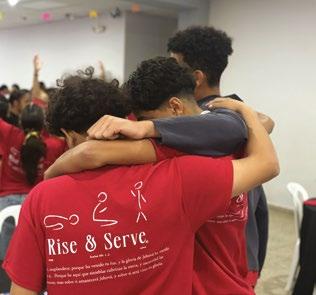
—Kelvin Rodríguez, keynote presenter during the Rise and Serve youth congress in Puerto Rico. Rodríguez encouraged young people to recognize opportunities to serve and reflect God’s love in everyday life. The event, which brought together 240 participants for an initiative aimed at equipping youth to use digital platforms for evangelism and positive influence, included a full-day, hands-on experience that combined worship, reflection, and community outreach with practical training in digital mission.
“ What would happen if, as Seventh-day Adventists, we were not defined as much by a list of characteristics as by a relationship
to a Person? What if what defined us was a relationship, a way of understanding the world and mission in connection to that relationship?”
—Jonathan Contero, associate director of the Center for Secular and Post-Christian Mission of the General Conference, during a workshop at the I Will Go International Mission Congress at Sagunto Adventist College in Sagunto, Valencia, Spain, March 21. Contero explained that the way we do church can drive or jeopardize mission, as he called Adventist members to make Jesus the center of everything we do when reaching other people, especially those from a secular background.
The number of people who attended recent evangelistic meetings in Cochabamba and Oruro, Bolivia. The initiative was part of the La Esperanza es Jesus (Hope Is Jesus) evangelistic caravan, a series of large-scale gatherings held in both cities. International speaker Alejandro Bullón presented the messages, with additional attendees making spiritual commitments that will be followed up by local congregations. At the close of the series, 325 people were baptized following two days of public preaching.
Church members were asked if they are married, separated, divorced, single, widowed, or living with a partner.
“He is a deeply mission-driven leader with exceptional experience across clinical care, academic medicine, and health-care operations. . . . [He] understands both the complexity of our integrated organization and the sacred responsibility of our global calling.”
—Thomas Lemon, chair of the Loma Linda University Health Board of Trustees, reflecting on the April 16 vote to appoint Anthony Hilliard to serve as president of the health-care organization, effective July 1. Hilliard earned his medical degree from the Loma Linda University School of Medicine and completed his residency and cardiology fellowships at the Mayo Clinic, where he received multiple national honors. Since returning to Loma Linda University Health in 2009, he has served in progressively senior leadership roles, including, since 2024, chief executive officer of the hospitals.
“God has been good. We can rejoice in the resources He has provided so we can go about the work to which He has called us. There’s nothing that we need that we do not have.”
—Paul H. Douglas, treasurer of the General Conference (GC), as he introduced his report to the members of the GC Executive Committee April 14. His presentation, which took place on the first day of Spring Meeting at the world church headquarters in Silver Spring, Maryland, United States, highlighted how, with God’s blessing, the church has been able to move forward despite changing and challenging financial conditions across the world.
“When children are trained and trusted, God can use them in powerful ways.”
—Kenia Almánzar, director of Children’s and Adolescents’ Ministries of the Dominican Union Conference, reflecting on the role of the Evangelistic Training School. The program, which seeks to equip children and adolescents to actively participate in public evangelism, includes training in preaching, Bible studies, small-group leadership, and spiritual development. Forty-nine selected children have already completed the program.
Do you want to keep up with what is happening in our church? If you want to receive our weekly newsletter that features news, inspirational stories, videos, and more, sign up today.
Delegates to the next GC Session will vote on the proposed German Union Conference.
members of the General Conference Executive Committee (GC EXCOM) voted to recommend the merger of the North German Union Conference (NGU) and the South German Union Conference (SGU) into a single German Union Conference. The vote took place on the first day of the 2026 Spring Meeting of the body at the Seventh-day Adventist Church headquarters in Silver Spring, Maryland, April 14.
According to General Conference (GC) vice president Tom Lemon, the move is a response to “ongoing missional, administrative, and organizational considerations.” He added that “the merger builds on several years of increasing collaboration between the two unions, including the alignment of departmental functions, shared strategic planning, and the consolidation of administrative operations.” He explained, “These developments have demonstrated the benefits of unified leadership and coordinated mission strategy while reducing duplication and complexity.”
Likewise, GC associate secretary Karen Porter explained that establishing a single German Union Conference “will provide a clearer organizational structure, improve the ability to respond to demographic and societal changes, and support a more agile and mission-focused use of human and financial resources.”
GC EXCOM members and invitees then watched a short video giving the history and rationale for this proposed merger.

“This context explains why we have worked consistently for nearly 40 years to provide a lean structure to a highly overorganized church,” explained the video narrator at the beginning of the presentation. “Our goal is to fulfill our mission more efficiently, proclaiming the good news of the kingdom of God to a society in secular Europe.”
The video explained how in 1984 the SGU initiated the examination of a potential merger, and in 1987 an expert group was commissioned to study the merger, which was officially recommended in 1989. “The historic fall of the iron curtain opened new possibilities for unity across Germany, and the political reunification of West and East Germany transformed the landscape for church organization,” it added.
From 1992 there were several failed attempts to merge, including a divided vote in 2002 when the NGU voted for the merger but the SGU voted against. But in 2013 both unions launched a process of increasingly close collaboration, laying the groundwork for unity. “Despite setbacks, the vision for unity was never abandoned,” and “cooperation became the bridge toward an eventual merger.”
Since 2014 these attempts included one chief financial officer and one secretary (vice president) serving both territories simultaneously, one budget, joint departments, and joint governance. “Rather than waiting for a formal merger vote, the two unions began functioning as one in practice—building trust, aligning systems, and demonstrating that unity was already possible. This period
produced tangible, lasting integration across every dimension of the church.”
In November 2022 the Inter-European Division, which includes Germany, unanimously approved the merger.
According to regional church leaders the merger will support strategy—giving the territory high agility in a rapidly changing society—and unity, as the church will speak with one voice in public. It will also provide greater efficiency and improved finances.
“The merger is not merely a future plan— it is already a present reality in practice. Years of deliberate integration have yielded measurable results that demonstrate that the model works,” the narrator said.
Efficiency improvements and cost savings are already being reinvested in mission growth, regional church leaders said.
“The organizational integration is not just about saving money; it is about redirecting every freed dollar toward the mission of the church.” These gains have already translated to US$580,000 for evangelism and small-group series across Germany, $1.85 million for HopeTV, and $1.15 million for church-planting initiatives.
From the floor Alexander Ott, associate secretary of the GC, celebrated the German leaders’ focus on mission. “We see two unions streamlining resources,” something that “will be a stepping stone toward being more effective for mission.”
seventh-day Adventist regional leaders attending Spring Meeting on April 15 heard an expanded presentation on OneVoice27, a worldwide evangelism initiative designed to bring together media outreach, local churches, and members in a global effort to share the gospel in September 2027.
“OneVoice27 is not a new name that you give for the same things that you’re already doing. Because if you just give the name to do exactly what you are doing, this is not a movement. That is just maintenance,” said Erton Köhler, president of the General Conference (GC). “OneVoice27 is a call to think outside of the box, to think of something we didn’t do before, to mobilize the church, to be more aggressive in the mission of the church. This is an opportunity to move beyond where we are right now.”
Köhler also pointed leaders to September 5, 2026, as the initiative’s planned global launch date, when Adventist entities, institutions, and members around the world will use social media and other media platforms to announce what is coming and begin building momentum for the church’s worldwide effort to share the gospel in September 2027.
A central focus of the presentation was the spiritual preparation of church members worldwide, with leaders emphasizing that the initiative must be grounded in prayer, Scripture, and a renewed focus on Christ.
“Every great movement of God begins with prayer,” Ramon Canals, GC Ministerial Association secretary, said. “OneVoice27 is no exception. The key to every missionary, evangelistic, soul-winning success is prayer.”
“ WE ARE IN TO SPEAK WITH A LOUD VOICE, WITH ONE VOICE,” SAID PAUL H. DOUGLAS, GC TREASURER. “WE ARE IN FOR THE HARVEST—THE HARVEST OF THE SEEDS SOWN IN HOMES, IN LOCAL CHURCHES, AND IN THE PUBLIC SQUARE. WE ARE IN TO ENSURE THAT ALL WHO HEAR THE VOICE OF GOD WILL BE PART OF THE FAMILY OF GOD.”
Canals called the global church to unite in a 40-day prayer initiative from July 23 to August 31, 2027. The initiative is designed to prepare members spiritually ahead of the September outreach by fostering revival, deeper consecration, and a collective focus on mission. Members are
also encouraged to study the biblical books of Daniel and Revelation, which leaders described as foundational to the Adventist Church’s mission.
Mário Martinelli, GC Publishing Ministries director, introduced the 2027 Missionary Book of the Year. The sharing resource will center on Daniel and Revelation and will include the full biblical text, explanatory commentary, visual illustrations, and QR codes linking to additional content. The book is currently in development, with English copies expected in October 2026 and translations to follow, making it accessible for global distribution.
Alongside this, Merlin Burt, director of the Ellen G. White Estate, encouraged members to read The Desire of Ages as part of their spiritual preparation. Plans are underway to release a special edition titled Jesus: The Desire of Ages , featuring updated language, Scripture references, and a six-month daily reading plan. These preparation materials are intended to help members deepen their relationship with Christ as they prepare to share Him with others.
“OneVoice27 needs to be in our DNA,” said Audrey Andersson, a GC vice president, emphasizing that departments across the General Conference are working to integrate the initiative into their ministries—from Children and Family to Education, Stewardship, and Youth—so that members of all ages can take part in the mission.
“All
While OneVoice27 serves as the name of the internal initiative, Alyssa Truman, GC Communication director, emphasized that it will not be the message shared publicly. Instead, church leaders introduced a global theme intended to resonate across cultures, belief systems, and media platforms.
The theme, developed by a working group of departmental leaders, institutional representatives, and communication professionals, is “All Things New: Hope Starts Here,” drawn from Revelation 21:5. Truman explained the theme was designed to be broad enough to connect in both Christian and non-Christian contexts, adaptable across formats ranging from social media to large-scale advertising, translatable, and personal enough to speak to individual experiences of pain, loss, and a longing for restoration.
“ ‘All Things New’ is not our promise as a church. It is God’s promise to His children,” said Truman. “We want each member to internalize that message for themselves, and as we create content to share, we want to ensure that the world hears that restoration can come only through Jesus Christ.”
“The impact of OneVoice27 will never be accomplished through the institutions of the church,” said Richard Stephenson, a GC associate treasurer. “It will be accomplished through the local church member sharing Jesus.”
Stephenson explained that the General Conference is focusing on two primary objectives: equipping members and reaching seekers.
To support this, several global initiatives are being developed. These include the creation of shareable, member-generated content across digital platforms, supported by a centralized content engine where members can access and contribute resources. A global digital billboard and signage campaign will also place the message of “All Things New: Hope Starts Here” in high-visibility public spaces, directing individuals to learn more.
In addition, Jim Howard, Adventist World Radio president, introduced Global Bible School as a supporting tool to help churches receive and nurture interest through digital outreach. The platform uses online and mobile-based Bible studies to engage individuals and connect them with local churches for follow-up and discipleship.
Together, these efforts are designed to make it easier for members to share their faith while ensuring those who respond are connected to local church communities.
A key component of the initiative is the Global Creators Summit, scheduled for July 20-23, 2026. The event will bring together 10 content creators or influencers from each of the Adventist Church’s global divisions to collaborate, receive training, and begin developing content for OneVoice27. Participants will return to their respective regions equipped to create and share digital content, mentor others, and expand the church’s presence across online platforms.
“The objectives and goals of OneVoice27 will not be realized unless our young people are mobilized to participate in the mission of the church,” said Busi Khumalo, GC Youth Ministries director.
Khumalo noted that young people are uniquely positioned to contribute to the initiative, particularly in digital spaces, and encouraged leaders to intentionally involve them in both media-based outreach and local church ministry.
Crystal Ward, GC associate Ministerial Association secretary, emphasized that the initiative also depends on the active involvement of local churches and members. She noted that individuals can participate in a variety of ways, including sharing content, forming small groups, studying the Bible with others, and building relationships within their communities.
Presenters also outlined a collaborative structure to support the initiative, including significant GC funding and coordination through designated GC liaisons who will work with divisions around the world.
“We are in to speak with a loud voice, with one voice,” said Paul H. Douglas, GC treasurer. “We are in for the harvest—the harvest of the seeds sown in homes, in local churches, and in the public square. We are in to ensure that all who hear the voice of God will be part of the family of God. Heaven is in. God is in. Are you in?”


Audrey Andersson
the disappointment of October 22, 1844, resulted in spiritual discouragement and practical questions. When would the Lord return? How should believers live their lives? What did waiting look like? Should they marry or remain single and celibate, focused fully on proclaiming and preparing for the Second Coming?
James White, a young Millerite preacher, and Ellen Harmon, both emerging leaders in the Advent movement, personally faced this dilemma. Mutual attraction and the practicalities of unmarried people traveling and speaking together raised questions that could not be ignored. After much prayerful consideration in the light of the Second Coming and Ellen’s unique calling, they married in 1846.
As a woman in the mid-1800s, Ellen White challenged prevailing societal norms and expectations by addressing such sensitive issues as human sexuality. Her earliest statements on this topic appeared within the broader context of the Adventist health message. In 1864 she published a 64-page pamphlet on what she referred to as the “secret vice,” or masturbation, which she described as “the destroyer of high resolve, earnest endeavor, and
strength of will to form a good religious character.”1 She further emphasized that all who understand what it means to be a Christian recognize their “obligations” as followers of Christ to bring their “passions, their physical powers and mental faculties, into perfect subordination to His will.”2
This tension between sex as uncontrolled passion and sex as an expression of love within the safety of marriage is a recurring theme in her writings. Let me illustrate.
Ellen White consistently portrays sexual intimacy as something to be enjoyed within marriage, a gift from God. “Jesus did not enforce celibacy upon any class of men,” she wrote. “He came not to destroy the sacred relationship of marriage, but to exalt it and restore it to its original sanctity. He looks with pleasure upon the family relationship where sacred and unselfish love bears sway.”3
In this context she explained that those who “enter into matrimonial relations with a holy purpose—the husband to obtain the pure affections of a woman’s heart, the wife to soften and improve her husband’s character and give it completeness” fulfill God’s intention for the marital relationship.4
Although some have called her position puritanical, Ellen White consistently described sexual intimacy as a privilege to be exercised within marriage, urging couples to preserve as “sacred the privacy and privileges of the family relation.”5
“They [married Christians] should duly consider the result of every privilege of the marriage relation, and sanctified principle should be the basis of every action,” she advised.6
Although James and Ellen White experienced the typical family tensions that accompany parenthood, illness, travel, and separation, her comments are grounded in inspiration and her own lived experiences. She sweetly expresses her desire for James in her letters. On one occasion, when James was sick, she wrote:
“Yesterday . . . I rode twelve miles in the stage. The scenery was beautiful. The trees with their varied hues, the beautiful evergreens interspersed among them, the green grass, the high and lofty mountains, the high bluffs of rocks—all are interesting to the eye. These things I could enjoy, but I am alone. The strong, manly arm I have ever leaned upon is not now my support.”7
On another occasion, when separated, she writes:
“This is my prayer, when I lie down, when I awake in the night, and when I arise in the morning, Nearer my God to Thee, nearer to Thee. I sleep alone. . . . I prize my [being] all to myself unless graced with your presence. I want to share my bed only with you.”8
Like all good gifts, the gift of sex can be abused. Referring to sexual excess within marriage, Ellen G. White uses strong language, referring to “animal passions” and, elsewhere, to “bestiality”:
“Sexual excess will effectually destroy a love for devotional exercises, will take from the brain the substance needed to nourish the system, and will most effectively exhaust the vitality. No woman should aid her husband in this work of self-destruction. She will not do it if she is enlightened and has true love for him. The more the animal passions are indulged, the stronger do they become, and the more violent will be their clamors for indulgence.”9
Believers are called to ensure that nothing distracts them from fellowship with God and from the ongoing development of a Christlike character.
Here we see the recurring tension between sex as something wholesome and excessive sex as a distraction from one’s spiritual life. Such a principle applies to many other areas of the human experience. Believers are called to ensure that nothing distracts them from fellowship with God and from the ongoing development of a Christlike character.
Sexual and relational choices have eternal consequences, and Ellen White draws parallels between the time before the Flood and now, when Satan tries to blind Christians, encouraging sentimentality and impurity. As she put it:
“The lust of the flesh has control of men and women. The mind has been depraved through a perversion of the thoughts and feelings, and yet the deceptive power of Satan has so blinded their eyes that poor, deceived souls flatter themselves that they are spiritually minded, especially consecrated, when their religious experience is composed of lovesick sentimentalism more than of purity, true goodness, and humility of soul; the mind is not drawn out of self, is not exercised and elevated by blessing others, by doing good works.” 10
Ellen G. White faced many of the same challenges we face today: How do we live a life that truly honors God? Although her language may at times seem antiquated or harsh, she affirmed that sex is a beautiful gift from God. At the same time, she warned that it is also something that Satan often uses and distorts with great effectiveness. Christians are therefore called to live a life of purity within the confines of marriage, where sexual intimacy finds its proper, meaningful, and beautiful expression.
1 Ellen G. White, An Appeal to Mothers (Battle Creek, Mich.: Seventh-day Adventist Pub. Assn., 1864), p. 9.
2 Ibid.
3 Ellen G. White, The Adventist Home (Nashville: Southern Pub. Assn., 1952), p. 121.
4 Ibid., p. 99.
5 Ellen G. White, Testimonies for the Church (Mountain View, Calif.: Pacific Press Pub. Assn., 1948), vol. 2, p. 90.
6 Ibid., p. 380.
7 Ellen G. White, Daughters of God (Hagerstown, Md.: Review and Herald Pub. Assn., 1998), p. 261.
8 Ellen G. White letter 6, 1876, in Letters and Manuscripts, vol. 3 (1876-1882), p. 8.
9 Ellen G. White, Testimony Treasures (Mountain View, Calif.: Pacific Press Pub. Assn., 1949), vol. 1, p. 272.
10 E. G. White, Testimonies for the Church, vol. 2, p. 252.
Audrey Andersson is a vice president of the General Conference of Seventh-day Adventists.
Keala Thompson
When the Bible says “the two shall become one” (Matt. 19:5), it is not saying that each person in a marriage must lose their individuality. Instead, it means that each person, while maintaining their own autonomy, unselfishly surrenders themselves to the other freely and happily.
Sadly, many relationships today have become the opposite— either selfish or transactional. They selfishly ask, “What can I get out of this relationship?” They demand from their spouse what they want without reciprocating. Or they may become transactional, giving to their spouse only to selfishly get what they want in return.
To have healthy relationships, we must begin with a biblical view of what God intended them to be.
First, Scripture reveals to us how love works: “We love because he first loved us” (1 John 4:19, NIV). Love awakens love. In other words, we are able to love selflessly only after we have first seen and experienced God’s love for us. Only after God initiates love are we then able to respond in kind. Without experiencing His love first, we are incapable of truly loving selflessly. This truth is foundational for relationships to work.
Yes, we can love others with human love. But we must recognize that God’s love and human love are as different as the heavens are higher than the earth. Human love tends to be transactional and selfish, while God’s love is selfless and nontransactional.
Love within a marriage relationship is special. “Husbands, love your wives, just as Christ also loved the church and gave Himself for her” (Eph. 5:25), Paul instructs. The relationship between a husband and a wife should be patterned after the relationship between God and His people. How did Christ love us? He loved us by initiating the relationship and giving His life to redeem us. When we truly see the love God has for us, we want to respond with appreciation and give Him our hearts.
Our decision to surrender to God is not something to be forced. God does not force submission. Instead, the gospel is about us seeing and experiencing God’s love first, then responding to His love through joyful surrender and submission.
Understanding this is crucial because our view of God will ultimately shape how we treat our spouse. If my Christian experience is about forcing myself to submit to God because “it’s the right thing to do,” without first experiencing His love, I may see nothing wrong with demanding that my wife simply “obey” me without winning her heart first. But if God wins my heart with love first, and I respond to His love and understand that my task is to win my wife’s heart with love, then she will willingly surrender her heart to me with love. If we follow this gospel theme in relationships, we will then be able to fulfill the scripture of “submitting to one another in the fear of God” (Eph. 5:21).
What does this look like practically? In a relationship or marriage centered on God’s love, the man doesn’t approach the woman with demands. He is not asking “What can I get?” but instead “What can I give?” Like Jesus, he is willing to lay down his life so that his partner may flourish. When a woman is loved this way—without pressure, fear, or manipulation— she is free to respond, not out of obligation, but out of love. If a woman feels emotionally safe and secure in her husband’s love, she is able to trust him with her surrendered heart.
Selfish love harms healthy relationships, and transactional love harms romantic relationships because it is driven by fear. The latter believes, “I must do something first before I can receive love.” A person with this mindset often fears they have not done enough to be “worthy” of another person’s love. This leads them to fear that they are never good enough or deserving. Or they may feel the opposite: because they did things for their spouse, they are entitled to their spouse’s love. And when they don’t receive the response they expect,
they become disappointed and even angry. These unhealthy behavioral patterns create all kinds of chaos in marriages.
The other side of a transactional love mindset also believes, “Others must do something first before they receive something from me.” They may feel that their spouse didn’t do enough to earn their love, which leads them to fear that their spouse doesn’t love them enough. Or they may feel their spouse did enough to earn their love, but now they feel as though they must repay their spouse because they “owe them.” Sadly, this performance-based mindset is very prevalent and is the reason so many relationships are falling apart today.
In talking about love and fear, Scripture says, “There is no fear in love; but perfect love casts out fear” (1 John 4:18). Notice that the Bible doesn’t just say that love casts out fear; it says that “perfect love” casts out fear. And what is this “perfect love”? It is God’s “perfect love.” In other words, only God’s “perfect love” has the power to cast out the fear in our lives. Imperfect human love has no power to do so. A wrong understanding or a lack of God’s “perfect love” leaves us susceptible to fear.
“Perfect love” does have the power to drive out fear. But the reverse is also true: “Perfect love” can also be driven out by the presence of fear. Let’s take, for example, a newly wed couple that, out of love for one another, chooses to surrender their wishes to please each other. But what if one spouse angrily rebukes the other for meals not being on time? The spouse who is yelled at may find fear replacing love as their motivation to prepare meals on time. Where once love was the motivator, fear now reigns.
You can see how relationships that start with love-driven submission can shift to fear-driven obedience. Fear has the power to kill love.
Fear, likewise, will stifle sexual intimacy. There cannot be true sexual intimacy if either partner doesn’t feel physically or emotionally safe in the relationship. True sexual intimacy is an act of trust and submission. It is the giving of the most intimate part of yourself to a person you trust with all your heart.
Sexual intimacy is not only the surrendering of your physical body to your spouse, but also a supernatural coming together of the two becoming one. If either spouse doesn’t feel emotionally or
spiritually safe in the relationship, it will hinder them from giving themselves fully through sexual intimacy. But if a person trusts and feels safe with their spouse, they will willingly surrender fully, resulting in the most intimate experience for the couple.
Sadly, the opposite is also true. Forcing your spouse—or forcing yourself—to give in sexually because “it is the right thing to do” is contrary to the gospel. God does want us to surrender to Him, but He never forces us to submit, even though it is the right thing to do.
It is only when each partner shows unselfish and nontransactional love to the other, and when they feel safe in each other’s love, that sexual intimacy will be experienced to its fullest. Just as God invites us into a safe relationship with Him as the foundation of spiritual intimacy with us, so should we show unselfish, nontransactional love to our spouses so they can feel safe with us.
But we cannot give what we do not possess. We can give nontransactional, unselfish love to our spouse only if we have first experienced God’s unselfish, nontransactional love for us. “We love because he first loved us” (1 John 4:19, NIV). When we possess this “perfect love,” we will be able to reflect the same love to our spouse. This will make them feel safe and secure in our love for them, inspiring a mutual, willing submission and physical, emotional, and spiritual unity. This is God’s gospel plan for sexual intimacy in our marriages today.
This oneness experienced in a marriage is very special. In fact, this love and unity within a marriage will have a positive effect on those who see it. Through this “perfect love” people will get a glimpse of God’s character. They will learn that God’s love is not a forced love—He does not force His people to serve Him out of duty or obligation, but draws them to Himself with lovingkindness—and our love for God is a surrender made completely out of free will. They will see that those who trust their hearts to God are completely free and fully happy. This is true evangelism—a gospel-focused marriage is an “epistle . . . known and read by all men” (2 Cor. 3:2).
I want the freedom and happiness that this “perfect love” brings from my relationship with God and with my spouse. How about you?
Keala Thompson helps individuals experience healing in themselves, their relationships, and their walk with God. His website is ktadvising.com.

that’s a great question—one that people have discussed for centuries if not millennia. First, let’s acknowledge that the Bible is clear that sexual relations are to be between only a husband and wife (cf. Gen. 2:24; 1 Cor. 6:9, 10). It’s also important to note that while sex is good, it is not essential for personal fulfillment. Singleness and celibacy are highly honored, and those who remain single can serve God with undivided attention (see 1 Cor. 7:32-35).
The Bible does not directly answer the question, but nowhere does it forbid marital sexual relations on Sabbath, so it remains a matter left to personal conviction. Some years ago, while discussing Jewish attitudes on various topics with a shopkeeper in Jerusalem, I asked what Jews thought about sex on Sabbath. His reply? “That’s a big subject of controversy!” The rabbis, though, were clear: The appropriate time to fulfill “conjugal obligations” was “from Shabbat eve to Shabbat eve, i.e., on Friday nights.”1 Interestingly, like bookends, Genesis 2 begins with God’s institution of the Sabbath (verses 1-3) and ends with His institution of marriage (verse 24; cf. Matt. 19:4, 5). Commenting on this, Jesus observed: “So then, they are no longer two but one flesh. Therefore what God has joined together, let not man separate” (Matt. 19:6). Consider the implications:
1. Marriage was created by God and designed as a monogamous “one
flesh” union between husband and wife. Reserving this special gift for the marital bond as He intended portends a truly satisfying lifelong intimacy.
2. After Adam and Eve’s marriage as the culmination of a very busy sixth day (see Gen. 1:26-2:24), the record announces, “They were both naked, the man and his wife, and were not ashamed” (Gen. 2:25). So how did they spend their first night together?
as a beautiful divine gift. Isaiah 58:13, 14 portrays the Sabbath as an exquisite delight, a day for physical, emotional, and spiritual renewal and joy in God. While not a day for doing as we please, pursuing trivial pleasures, or seeking our own will, mutually agreed conjugal relations between husband and wife are not only in harmony with God’s will but commanded (1 Cor. 7:3-5). As Hebrews 13:4 indicates: “Marriage is honorable in every respect;
Nowhere does Scripture forbid marital sexual relations on Sabbath.
We’re not told exactly. But we are told that “God blessed them” and “said to them, ‘Be fruitful and multiply’ ” (Gen. 1:28). Clearly sexual relations that first Friday night would be in harmony with this command.
3. The Sabbath itself was established as an act of delight upon completion of the creation (Gen. 2:1-3), so how fitting if this first Sabbath culminated in a beautiful act of physical and marital love between the first husband and wife!
In fact, the Song of Solomon extols marital love, celebrating sexual intimacy
and, in particular, sex within marriage is pure. But God will indeed punish fornicators and adulterers” (CJB).2 Yes, the Sabbath is holy, but sex within a monogamous, heterosexual marriage is also “pure” or, more literally, “undefiled.” In short, Scripture encourages marital sex on the Sabbath or any other day.

Jasmin Stankovic
arah sat alone in her car in the church parking lot long after the midweek service had ended. The lights inside the building were already off, and the last of the members had driven away. She had stayed because she knew she needed to talk to someone; she just wasn’t sure how to begin.
When Pastor Jordan and his wife finally walked outside, locking the doors behind them, Sarah stepped out of her car and called their names. Her voice was barely audible.
“Can I ask you something . . . difficult?”
They nodded gently. “Of course.”
She hesitated, wringing her hands as if trying to squeeze the words out. “My husband is so patient and loving,” she said. “I love him dearly, but whenever he and I try to be close, something inside me freezes. I feel guilty. I feel scared. I feel like I’m broken, and I don’t know how to tell him that what happened to me years ago, what I have tried so hard to forget, still lives inside me. How do I make it stop affecting our marriage?”
Such stories as Sarah’s echo in counseling rooms, pastors’ offices, and quiet conversations across communities. Survivors of sexual abuse, both women and men, often carry unspoken fears: Will this ruin my marriage? Is something wrong with me? Am I failing my spouse? Am I even capable of being loved?
At the same time, partners of survivors often worry: How can I help? How do I keep them safe? How do we move forward together?
Sexual trauma reaches into the most intimate corners of human life: intimacy, trust, vulnerability, and identity, and from a biblical perspective, it represents a profound violation of God’s design for love, mutual honor, and conventional trust.
This article will not offer a complete guide to recovery; recovery requires time, trained support, and a compassionate community. But I will attempt to explore two of the most common internal struggles survivors face. Understanding these patterns can perhaps help caregivers, churches, and loved ones respond with greater empathy, kindness, and compassionate wisdom.
Before exploring the effects of trauma, we need to remember what sexuality was meant to be. Scripture consistently presents human sexuality as a good and sacred gift from God. In Genesis God creates man and woman in His image and blesses their union, calling them to live in partnership and intimacy (Gen. 1:27, 28). Their bodies, their unity, and their bond were all part of God’s beautiful design. Scripture presents human sexuality as a gift woven into creation itself. The Song of Solomon later paints a poetic picture of marital love: tender, passionate, and mutual, celebrating not just physical closeness but affection, desire, joy, and shared delight. These passages remind us that sex is not shameful or dirty; it is holy, purposeful, and meant to be enjoyed within the covenant of marriage. It is meant to be cherished and honored, not manipulated, coerced, or used for harm or selfish purposes.
We cannot heal alone. God and other humans must be part of the healing journey.
The desire to be cared for and loved: Perpetrators often gain access to a victim’s trust by offering attention, affection, and safety. Later, survivors may wrongly believe their natural longing for connection makes them responsible. Abusers often groom victims, especially children or vulnerable adults, by offering gifts or emotional connection. Survivors sometimes interpret their natural, normal human desire for love, connection, and belonging as a kind of permission. But longing for care is not sin; it is a God-given need. The abuser manipulated that need for their own selfish purposes.
Stopping resistance: When fear, confusion, or powerlessness silences a victim’s ability to fight back, the survivor may misinterpret that survival response as cooperation. Many survivors eventually stop fighting, yelling, or trying to escape, not because they agree, but because their bodies shut down, a psychological mechanism for survival. The absence of resistance is not the presence of consent.
But when sexual trauma enters a person’s story, it distorts what God intended to be beautiful. It twists the meaning of touch, reshapes the body’s reactions, and entangles sexuality with fear, confusion, self-doubt, and self-loathing.
Trauma creates many patterns of thinking and feeling. Survivors often describe internal struggles that stem, not from truth, but from the confusing, coercive, and manipulative nature of abuse. Two of the most common are:
One of the cruelest effects of sexual trauma is the belief that the survivor somehow participated in or allowed the abuse. This feeling of complicity is almost universal among survivors (men and women), though it takes many different forms.
Survivors may believe:
• “If I hadn’t trusted them, it wouldn’t have happened.”
• “I should have fought harder.”
• “Maybe I sent the wrong message.”
• “My body responded, so maybe that means part of me wanted it.”
• “I didn’t say no loudly enough.”
• “I didn’t run, so maybe I let it happen.”
These thoughts are painful, confusing, and deeply unfair, yet they often haunt survivors long after the trauma is over.
Why do survivors feel complicit? There are several reasons:
A false perception of choice: Abusers often create environments in which victims feel they “agreed” to something, even though true consent was impossible. Children cannot consent. Adults who are manipulated, coerced, threatened, or emotionally dominated and conditioned cannot truly consent either. What survivors interpreted as choice were survival skills!
The body’s involuntary responses: Physiological arousal can occur even during unwanted, unconsented contact, leading survivors to believe their bodies betrayed them. This causes survivors to feel confused, as if their bodies responded “wrongly” or that the reaction meant they wanted what happened, but in truth, it was only a reflex, a physiological response, not desire or consent. This is very important to understand. I usually share this illustration with my clients. “If I accidentally hit your toe with a hammer, do you have a choice to feel the pain, or would it be an automatic response?” The body’s reflexes are not a vote of approval. The body is simply doing what it was designed to do in response to stimuli, not following what the heart desires.
Understanding these patterns helps survivors see the truth: I was not at fault. My responses were human responses. My mind and body were trying to protect me. This is foundational for healing. Nothing about their reaction means they participated in the abuse. What may look like compliance was the body and mind instinctively striving to survive. We are designed for survival.
Shame and guilt often accompany trauma as a heavy shadow. But while guilt says, I did something wrong, shame says, I am something wrong.
This identity-shaping force can be devastating.
Survivors may believe:
• “I’m dirty.”
• “I’m damaged goods.”
• “I’m not lovable.”
• “God must be disappointed in me.”
• “My spouse deserves someone better.”
• “I’m not worthy of intimacy.”
These beliefs can be strengthened or weakened by the spiritual environment around the survivor.
Shame often settles into the deepest parts of the survivor’s identity. It may be reinforced by cultural messages, religious misunderstandings, or painful interactions with others.
Common struggles include:
Internalized blame: Survivors wonder if they sinned, failed, or somehow invited what happened. They often replay the trauma, searching for ways they “could have” prevented it. The mind tries to make sense of the senseless, sometimes by assuming responsibility.
Judgment from others: Even subtle reactions from a faith community can make a survivor feel stained or unworthy.
Spiritual confusion: Survivors may ask: Where was God? Why didn’t He stop it? Does He still accept me? Survivors may feel that God abandoned them or that the abuse is somehow connected to divine punishment or testing. These theological misunderstandings deepen guilt and spiritual isolation. This spiritual distress can intensify shame and guilt.
Scripture speaks clearly: The survivor is not to blame (see Deut. 22:25-27). The trauma was a violation of God’s design and reflects the brokenness of a fallen world, not the unworthiness of the person who was harmed.
Scripture affirms:
• Trauma is a result of human sin, not divine punishment (James 1:13, 14).
• God identifies with the oppressed and brokenhearted (Ps. 34:18).
• Jesus consistently moved toward, not away from, the wounded and mistreated (cf. John 8:1-11).
Where shame says, I am unworthy, God says, “You are My beloved ”
While every survivor’s journey is unique, healing from sexual trauma is not linear, easy, or quick. Nor can it be compared with others’ stories. The good news is that it is possible.
These steps can support healing:
Seek professional help. Trauma requires specialized understanding. Skilled therapists can help survivors process their story safely.
Refuse to minimize your experience. Naming the harm truthfully is essential. When survivors minimize what happened, it reinforces the wound. Acknowledging the truth, no matter how painful, is a step toward freedom. Downplaying the abuse does not lessen its impact; it reinforces its power in the shadows. Speaking the truth
is an act of courage, a vital step toward reclaiming one’s voice, dignity, and sense of self.
Stay committed to the process. Healing takes time and courage. There are setbacks, but there is also progress. Recovery is not linear. It involves courage, patience, and perseverance.
Find a compassionate faith community. Not every church is safe, but healthy spiritual communities can offer space for grief, honesty, and comfort. Grieving is part of the healing process, and Scripture affirms that grieving in community is a sacred space.
Hold on to hope. Hope is not denial. It is the belief that brokenness does not have the final word. As survivors move through their healing journey, hope enters their hearts.
Trauma is powerful, but restoration is possible. Healing does not erase the past, but it transforms the future.
Remember, you have been hurt in a relationship, and it will take another relationship to bring healing and restore connection with yourself and others. We cannot heal alone. God and other humans must be part of the healing journey.
Isaiah 61:1-3 offers a profound image for survivors: God gives “beauty for ashes.” Ashes represent what was destroyed: trust, innocence, safety. But God speaks of rebuilding, restoring, and planting lives that become like “great oaks” rooted in His glory.
Ashes represent destruction, grief, and loss. But God does not merely sweep away the ashes. He transforms them. He plants lives that grow strong like great oak trees. He replaces despair with praise and mourning with joy.
This message is not a cliché for survivors; it is a promise: God does not ignore your pain. He does not blame you for the trauma. He walks with you along the path of restoration.
For those healing from sexual trauma, this is a promise not of instant restoration but of God’s unwavering presence in the journey. He sees. He cares. He walks with the wounded, and He brings redemption from even the deepest losses. This does not erase the past, but affirms that God can take even the deepest wounds and create something new: strength, resilience, compassion, and renewed identity! Hallelujah! Professional help, community support, and spiritual care can all be part of the path toward wholeness, because healing is not only possible—it is part of God’s promise to you!
Disclaimer: Healing from sexual trauma is a complex and tender work. Survivors should seek trained professionals whenever possible.
and grandmother of two. As a registered clinical counselor, Jasmin is currently pursuing another postgraduate degree in mental health and neuroscience.
Wilhelm Reich, considered one of the key philosophical architects of the sexual revolution of the 1960s, taught that suppressing sexual impulses is bad for your mental health. He helped set the table for the present-day belief that if something feels good, you should do it—a situation in which our fallen passions are permitted to override moral reason.
1. How does the apostle Paul counter Reich’s advice? Why is there merit to Paul’s solution? What advice or caution would you give to a young person who is trying to apply this counsel? (1 Cor. 7:8, 9)
2. In much of the world, the amount of time during which a person is required to exercise self-control has lengthened. Puberty arrives earlier than it used to, and marriage is delayed much longer than in previous generations. What advice would you give to young people faced with this new reality? Are there passages in the Bible that illustrate or confirm your advice?
3. What other challenges are people now facing regarding sexual purity? How should Christians deal with them?
4. The Bible teaches that both men and women were made in God’s image, and yet He created two versions of humanity: male and female. What do you suppose men and women have to teach each other about God? What does this imply about the nature of marriage? In a world that doesn’t always share our values, has this become more important? (Gen. 1:26, 27; 2:22-24; Matt. 19:4-6)

The Bible teaches that both men and women were made in God’s image, and yet He created two versions of humanity: male and female.
5. There have been times throughout history that people treated sex as shameful and/or dirty. Unfortunately, Christians have been guilty of this too. What does the Bible say about appropriate sexual relations? (Heb. 13:4)
6. The Song of Solomon is well known for its passionate descriptions of a relationship between a man and a woman. Why do you think God included this book in the canon of Scripture? What important lessons can we derive from it?
7. In Song of Solomon 6:4 the author compares the woman he loves to the city of Jerusalem. Does this comparison hold spiritual significance? What do appropriate sexual relationships teach us about our relationship with Christ? (Eph. 5:30-32; Rev. 21:2, 3)
8. In the face of rising divorce rates in much of the world, what can Christians do to help divorce-proof their marriages? (Phil. 2:3, 4)
Shawn Boonstra is an associate editor at Adventist Review.
A topic that I could not care less about
ihave not given last generation theology serious contemplation in years, decades even, not since the late 1990s, maybe. Last generation theology? I cannot think of a topic less relevant to my Christian experience. Some perfected, victorious, fully overcoming host of faithful in 10, 20, or 50 years hence? Are you kidding? It’s a topic that I could not care less about.
What I do care about is how I can be perfected today. How can I be victorious now? How can I, in the immediate moment, overcome my character defects? How can I, this afternoon, selflessly love others? Please! If through God’s grace we do these things day by day now, this last generation stuff will surely take care of itself.
With all that being said, I do have more sympathy for last generation theology than I generally let on to. There are Bible texts and Ellen White quotes that, if inclined, one could view through that last generation lens. Such texts as: “Let your light so shine before men, that they may see your good works and glorify your Father in heaven” (Matt. 5:16). Or “to the intent that now the manifold wisdom of God might be made known by the church to the principalities and powers in the heavenly places” (Eph. 3:10). Or when Ellen White writes that God is honored by “the faith and obedience of [His] people.”1 Or “The honor of God, the honor of Christ, is involved in the perfection of the character of His people.”2
Those who interpret these references, and others, as pointing to a final generation that vindicates God’s character before the onlooking universe—they might be right. And that’s fine, just as long as one point is understood: Whoever these saints are, whatever experiences they have, and whatever character they possess, they are saved only by what saved the thief on the cross: the righteousness of Jesus for them, outside of them, imputed to them, “the righteousness of God, through faith in Jesus Christ, to all and on all who believe” (Rom. 3:22). As long as that truth is jackhammered into our heads, this last
generation could be so sanctified that one more whole-wheat organic bean sprout sandwich and they will float off to heaven even before Jesus returns.
Having joined the Adventist Church in 1980 and becoming, over the decades, a somewhat grizzled old theological street brawler, I thought that I had heard it all. That is, until I recently heard someone claim that Shadrach, Meshach, and Abednego were not consumed by the flames of the fiery furnace because (and I quote) “there was no sin or fault in them to be burned up,” and that is how the final generation has to be. I, truly shaken, had no idea that people believe like this. (“Come on,” my wife said, “you are naive.”)
Yes, we can have victory (1 Cor. 15:57). Yes, we can overcome (1 John 5:4). Yes, we can reflect the character of Jesus (Gal. 4:19). Victory, overcoming, reflecting Jesus—these are undeniable manifestations of what it means to be saved. But to make these manifestations the means of salvation itself? What a stunning denial of the gospel—for any generation, last or otherwise.
1 Ellen G. White letter 1, 1883.
2
Assn., 1898, 1940), p. 671.
Clifford Goldstein is the editor of the Adult Bible Study Guide. His latest book is An Adventist Journey, published by the Inter-American Division Publishing Association (IADPA).

Whoever these saints are, whatever experiences they have, and whatever character they possess, they are saved only by what saved the thief on the cross: the righteousness of Jesus for them, outside of them, imputed to them.
Passmore Hachalinga and Marie-Noëlle Bosdedore
This article draws upon Passmore Hachalinga’s biography of Rosie Le Même and Marie-Noëlle Bosdedore’s history of Rosie Le Même Adventist Nursing Home, published in the Encyclopedia of Seventh-day Adventists (ESDA), available at encyclopedia.adventist.org. It was prepared by Dragoslava Santrac, ESDA managing editor.—Editors.
in the lush beauty of Mauritius, which is often called the “Pearl of the Indian Ocean,” God kindled a small but steady flame that would grow into a movement of hope. It all began with the faith of a young woman named Rosie Le Même.
Rosie never planned to start a movement. She just wanted to follow God with her whole heart. Because of her quiet courage and steady faith, the Seventh-day Adventist message took root in Mauritius and spread to other places.

Rosie (Rosalina) Le Même was born on July 22, 1876, in Rose Hill, Mauritius. She was the fifth daughter in a Presbyterian family. Her father and mother were devout members of their church, raising their daughters Annie, Alice, Lydia, Sylvia, and Rosie in a Christian home. Rosie faced loss early in life. Her mother died when she was 9. Later her father married her aunt, “Aunt Jopine,” and the family grew. Despite these changes, Rosie became known for her kindness and generosity. She never kept more than two or three dresses in her wardrobe, believing she always had more than she needed and gladly giving the rest away. Still, Rosie felt a deep spiritual longing beneath her kindness. By 1906, when Rosie was 26, she felt restless and unhappy. She went to church regularly, but felt she was not living as God wanted. She often cried during services and could not sing the hymns. Social events no longer interested her, so she spent more time reading the Bible.
Rosie was drawn to the prophecies in Daniel and Revelation, but they confused her. She noticed that in Bible times people looked for a prophet when they were unsure. Rosie wished for the same kind of guidance and prayed for understanding of biblical prophecies.
One night while Rosie prayed, her room filled with a bright light. She heard a clear voice say, “Rosie, you must go to Europe, and God will show you what He is planning for you.” Rosie felt overwhelmed but thankful. She thanked God for the message and felt she finally had a clear purpose in life.
In July 1910 Rosie left Port Louis, Mauritius, for Europe, hoping to improve her health and enjoy a period of rest. She planned to visit England, France, and later Switzerland.
In Lausanne, Switzerland, Rosie received a flyer about Adventist lectures on the prophecies of Daniel 8 and the judgment. During the lectures the topics that once confused her now made sense. She started attending more Seventh-day Adventist meetings and soon accepted the Adventist faith. In 1912 Herbert H. Dexter, president of the Leman Conference, baptized her.
While in Lausanne, Rosie also learned about a prophet for the last days, Ellen G. White, who lived in California. For a time Rosie wanted to visit the United States and meet Mrs. White. Yet another conviction pressed upon her heart with even greater urgency: Mauritius must hear this message.
Before going home, Rosie bought as many of Ellen White’s books, tracts, and magazines as she could carry. She planned to share them with people all over Mauritius.
Rosie returned to Mauritius in June 1912, feeling healthier and full of joy. Her sisters greeted her at Port Louis. She quickly shared her new faith with Lydia, Alice, and others. Seeing the change in Rosie and the Biblebased beliefs she brought, her sisters gladly accepted the Adventist message.

The faith that started with two Mauritians who converted abroad grew into a movement that spread across the region.
Meanwhile, similar things were happening elsewhere.
Another Mauritian, Elysee (Elijah) Moikeenah, born into an Anglican family, had encountered the Adventist message in Australia during the first half of 1912. A sailor employed by Charles Jacob & Sons Company, he had received a copy of Les Signes des Temps (French Signs of the Times) while docked in Melbourne. Convinced by the biblical truth and explanations he read, he was baptized between March and June of the same year at what is now the North Fitzroy Seventh-day Adventist Church, located in an inner-city suburb of Melbourne.
Moikeenah went back to Mauritius before Rosie and started sharing the Adventist message with friends. He lent out Adventist books and answered questions using the Bible. When Rosie returned, she heard about Moikeenah’s preaching on the Sabbath and Christ’s return. After they met and realized they shared the same faith, Rosie asked him to help with the evangelistic work and paid him a salary. Moikeenah and Rosie shared the same goal: to continue spreading the Advent message in Mauritius.
In 1916 both were recruited as workers for the European Division Conference. Meanwhile, Lydia and Alice worked tirelessly alongside her.
As more people became interested, opposition also increased.

Rosie’s evangelistic efforts caused controversy. As more people joined, resistance from the community grew stronger. Eventually she was removed from the Presbyterian Church.
Rosie did not give up. As the group of believers grew, she asked the Mission Board to send a missionary to help organize their efforts. The response came in the person of Paul Badaut, a pastor and one of the important figures in the first generation of Seventh-day Adventists in France. He arrived in Mauritius on May 2, 1914, and found 24 individuals preparing for baptism. On May 9 he conducted his first Sabbath service and encouraged the little flock.
But the opposition only increased. Sometimes people openly mocked the church, calling it the “Badaut Church” and its members “Badauts.” The similarity of Badaut’s name to the French word badaud (“gawker,” “idler”) may have added a subtle tone of ridicule, suggesting followers were merely “gawkers” or naive adherents. Angry crowds even threatened them. Rosie and Lydia stayed by Badaut’s side, helping him share the gospel and welcome new members during hard times. On September 12, 1914, Badaut baptized the first group of Mauritian Adventists in the muddy river near Rose Hill. The water was cloudy, but the people being baptized were full of joy.
Little could they imagine that years later, in 1989, Salisbury Street in Rose Hill would be renamed “Pasteur Paul Badaut Street” in recognition of his pioneering contribution. What had once been scorn became a testimony of respect.
God blessed their dedication and sacrifice tremendously. By 1920, only six years after the first baptism, there were six organized churches of Adventists in Mauritius.
But the movement did not stay limited to Mauritius.
From Mauritius the Adventist message reached Madagascar in 1917 through tracts and personal witness. A young man named Tuyau shared the faith with Andre Rasamoelina, an inspector of Protestant schools. Contact with Badaut and later Bible studies with Marius Raspal led to the opening of the first Sabbath School in Madagascar on October 2, 1926. In 1927 Rasamoelina and three others were baptized.
Rodrigues Island felt the influence as well. In 1925 E. Michel of Mauritius settled in Port Mathurin. His witness bore fruit, and in 1929 Aimé-Jacques Girou, an Adventist pastor and missionary from France, came to the island to strengthen in faith and baptize seven converts.
The mission work continued to spread. In 1930 Daniel Ignace carried the message to the Seychelles. Despite difficulties, 21 converts were baptized near Victoria on Mahé, and a church of 23 members was organized with Ignace as elder.
The faith that started with two Mauritians who converted abroad grew into a movement that spread across the region.
As the mission grew, Rosie’s health got worse. While still young, Rosie learned she had heart problems and was told to avoid too much activity. Even so, she kept sharing the Adventist message whenever she could, trusting God to heal her. Badaut and other church members prayed for her often.
In 1919, at just 39 years of age, Rosie Le Même died. Her earthly work ended early, but her influence did not. Her sister Lydia continued her work, traveling around Mauritius as a Bible teacher until the remarkable age of 89.
Rosie’s legacy turned into something lasting. On February 11, 1963, the Rosie Le Même Adventist Home was registered by the government of Mauritius as a humanitarian society. Located in Quatre-Bornes, the home provides care for elderly people. In 2014, during the Mauritius Conference’s one hundredth anniversary celebration of Adventism on the island, the Rosie Le Même Adventist Nursing Home received an award for outstanding contribution in health care services.
The Adventist presence in Mauritius, from early river baptisms to organized churches, and from mockery to respect, shows what God can do through people who are willing to serve.
Rosie Le Même rests in her grave, awaiting the return of Jesus Christ, whom she served with love and trust. She never looked for fame. She just followed her beliefs. Because of her choice, the message spread from Lausanne, Switzerland, to Rose Hill, Mauritius, and then to Madagascar, Rodrigues, and the Seychelles. More than 100 years after Rosie came back from Europe, the Adventist movement she helped start is still going. As of June 30, 2025, the Mauritius Conference of Seventh-day Adventists, including Rodrigues Island, had 37 churches and 5,528 baptized members.
History remembers Rosie as the first Seventh-day Adventist in Mauritius. Heaven remembers her faithfulness. The church in the Pearl of the Indian Ocean continues because one young woman chose to pray, listen, and act.
Passmore Hachalinga, D.Th., D.Min., recently retired from his position as the director of the Ellen G. White Research and Heritage Centre at Helderberg College of Higher Education in Cape Town, South Africa. Marie-Noëlle Bosdedore served as a missionary in the western and eastern African countries for 10 years and is now serving in her motherland, Mauritius.
since the book of nature and the book of revelation bear the impress of the same master mind, they cannot but speak in harmony. By different methods, and in different languages, they witness to the same great truths. Science is ever discovering new wonders; but she brings from her research nothing that, rightly understood, conflicts with divine revelation. The book of nature and the written Word shed light upon each other. They make us acquainted with God by teaching us something of the laws through which He works.
Inferences erroneously drawn from facts observed in nature have, however, led to supposed conflict between science and revelation; and in the effort to restore harmony, interpretations of Scripture have been adopted that undermine and destroy the force of the Word of God. Geology has been thought to contradict the literal interpretation of the Mosaic record of the creation. Millions of years, it is claimed, were required for the evolution of the earth from chaos; and in order to accommodate the Bible to this supposed revelation of science, the days of creation are assumed to have been vast, indefinite periods, covering thousands or even millions of years.
Such a conclusion is wholly uncalled for. The Bible record is in harmony with itself and with the teaching of nature. Of the first day employed in the work of creation is given the record, “The evening and the morning were the first day” (Gen. 1:5).* And the same in substance is said of each of the
They speak in harmony.
Ellen G. White
first six days of creation week. Each of these periods Inspiration declares to have been a day consisting of evening and morning, like every other day since that time. In regard to the work of creation itself the divine testimony is, “He spake, and it was done; he commanded, and it stood fast” (Ps. 33:9). With Him who could thus call into existence unnumbered worlds, how long a time would be required for the evolution of the earth from chaos? In order to account for His works, must we do violence to His Word? . . . When consideration is given to man’s opportunities for research; how brief his life; how limited his sphere of action; how restricted his vision; how frequent and how great the errors in his conclusions, especially as concerns the events thought to antedate Bible history; how often the supposed deductions of science are revised or cast aside; with what readiness the assumed period of the earth’s development is from time to time increased or diminished by millions of years; and how the theories advanced by different scientists conflict with one another—considering all this, shall we, for the privilege of tracing our descent from germs and mollusks
and apes, consent to cast away that statement of Holy Writ, so grand in its simplicity, “God created man in his own image, in the image of God created he him” (Gen. 1:27)?
Shall we reject that genealogical record— prouder than any treasured in the courts of kings—“which was the son of Adam, which was the son of God” (Luke 3:38)?
Rightly understood, both the revelations of science and the experiences of life are in harmony with the testimony of Scripture to the constant working of God in nature. . . .
The greatness of God is to us incomprehensible. . . .
He who studies most deeply into the mysteries of nature will realize most fully his own ignorance and weakness. He will realize that there are depths and heights which he cannot reach, secrets which he cannot penetrate, vast fields of truth lying before him unentered. He will be ready to say, with Newton, “I seem to myself to have been like a child on the seashore finding pebbles and shells, while the great ocean of truth lay undiscovered before me.”. . .
Only under the direction of the Omniscient One shall we, in the study of His works, be enabled to think His thoughts after Him.
*Bible texts are from the King James Version.
Seventh-day Adventists believe that Ellen G. White (1827-1915) exercised the biblical gift of prophecy during more than 70 years of ministry. This excerpt is taken from Education, pp. 128-134.
...for men.

in a culture confused about manhood—in which masculinity is either caricatured as dominance or dismissed as unnecessary—Scripture offers a better way. Jesus is not only our Savior; He is our model. The Bible does not present masculinity as aggression, emotional detachment, or self-promotion. Instead, it reveals men shaped by the character of God—men of courage and tenderness, conviction and humility, strength and surrender.
For Seventh-day Adventists awaiting the soon return of Jesus, the call to godly manhood is urgent. Our homes, churches, and communities need men whose lives align with heaven’s design. What does it mean to be a man of God? And how can fathers raise boys who grow into spiritual leaders, faithful husbands, and disciples of Christ? The clearest answer is found in Jesus—the true blueprint for men. Biblical masculinity looks like Jesus. It is neither harsh nor domineering, nor passive and disengaged. But it is courageous conviction guided by love.
A man fashioned after the biblical model is a man of conviction, responsibility, compassion, and humility.
A Man of Conviction: Daniel “purposed in his heart” (Dan. 1:8). Before he stood before kings, he stood firm in private. A godly man anchors his life in Scripture rather than shifting cultural winds. Likewise, Joshua declared, “As for me and my house, we will serve the Lord” (Joshua 24:15). Biblical masculinity provides spiritual direction.
A Man of Responsibility: From Eden, manhood was marked with responsibility (Gen. 2:15). Paul writes, “If anyone does not provide for his own, . . . he has denied the faith” (1 Tim. 5:8). Provision includes spiritual leadership, emotional presence, and moral example. Even on the cross, Jesus ensured His mother’s care (John 19:26, 27). A man of God does not evade responsibility; he embraces it.
A Man of Compassion: Jesus wept (John 11:35). In Scripture, strength is restrained by love. David spared Saul (1 Sam. 24), and Joseph forgave his brothers (Gen. 45), showing that true strength forgives and restores.
A Man of Humility: “Whoever desires to become great among you, let him be your servant” (Matt. 20:26). The Son of God washed feet (John 13:5) because biblical masculinity stoops to serve.
If Christ is the blueprint for manhood, fathers are called to live intentionally. Scripture reveals that godly fatherhood involves multiple sacred roles, each reflecting Christ’s character. Consider the following roles for example:

1. The Priest Job interceded for his children (Job 1:5). As priest of the home, a father walks with God, leads in worship, and prays over his family.
2. The Prophet Abraham was chosen to direct his household in the Lord’s ways (Gen. 18:19). A father speaks truth, encouragement, and blessing. He brings God’s Word into everyday life.
3. The King Joshua’s declaration (Joshua 24:15) reflects noble leadership. A king leads under God’s authority—not through control, but through humble direction.
4. The Counselor Proverbs repeatedly uses the phrase “My son . . . ” (see Prov. 1:8, 10, 15; 2:1; 3:1, 11, 21, etc.). Fathers initiate honest conversations about integrity, purity, and calling. They listen carefully and guide wisely.
5. The Warrior
“Put on the whole armor of God” (Eph. 6:11). A father stands spiritually alert, guarding his family through prayer and discernment.
6. The Builder
“Unless the Lord builds the house . . . ” (Ps. 127:1). Fathers shape eternal character, not merely earthly success.
7. The Lover “Husbands, love your wives, just as Christ also loved the church” (Eph. 5:25). A father’s visible love for his wife creates security and teaches sons how to love sacrificially.
8. The Friend Jesus said, “I have called you friends” (John 15:15). Fathers who enjoy time with their children and seek to know their hearts build trust that lasts.
9. The Servant Christ took “the form of a bondservant” (Phil. 2:7). Leadership in the home means self-sacrifice.
10. The Steward
From Eden onward, stewardship defined responsibility (Gen. 2:15). Fathers must therefore model faithful management of time, money, and mission.
It is true that no man fulfills all these roles perfectly, but every father can pursue them prayerfully and intentionally.
BOYS BECOMING MEN
Psalm 127:4 says children are like arrows. Arrows must be shaped and aimed. Boys do not drift into biblical masculinity—they are discipled into it. Paul wrote, “Imitate me, just as I also imitate Christ” (1 Cor. 11:1). Boys observe closely. They watch how fathers treat their wives, respond to stress, and prioritize worship. The most powerful curriculum is a father’s example.
Here are three areas of focus to help boys develop well-rounded characters.
Teach responsibility from an early age. David’s courage to face Goliath was shaped while tending sheep (see 1 Sam. 17). Meaningful responsibility builds confidence and resilience, so give boys work! Teach them to follow through. Allow consequences to take their course. Taking responsibility prepares them for leadership later in life. Research shows that the greatest determination of a man’s success is whether, as a child, he did chores, was taught practical skills, and learned discipline and follow-through.
Speak identity into their lives. At Jesus’ baptism the Father declared to Him, “This is My beloved Son” (Matt. 3:17). Identity preceded ministry. Tell your sons who they are in Christ—created in God’s image (Gen. 1:27), called to purity (1 Tim. 4:12), and designed for sacrificial love (Eph. 5:25). A secure identity guards against cultural confusion. Prepare them to launch into adulthood. Practical guidance—an “adulting blueprint”—can teach life skills, financial stewardship, work ethic, spiritual disciplines, and relational maturity. Without intentional training, many young men remain undeveloped and immature. Scripture models meaningful transitions, such as Jacob blessing his sons (Gen. 49) and Moses publicly commissioning Joshua (Deut. 31:7, 8). Such moments marked their readiness for leadership. Having intentional rites of passage and blessings communicates clearly: “You are stepping into manhood under God.”
THE URGENCY OF THE HOUR
Malachi prophesied that before the day of the Lord, God would turn “the hearts of the fathers to the children” (Mal. 4:5, 6). That promise feels urgent today. Fathers, you don’t need to attempt this calling alone. Seek biblically grounded resources—books, training videos, conferences, and trusted ministries—that offer practical direction for raising godly young men. Growth is cultivated, and not accidental. Becoming involved in men’s ministry at your local church can provide a great support. Proverbs 27:17 reminds us that “iron sharpens iron.” When men gather to pray, confess, study, and encourage one another, families are strengthened and churches are revived. If your congregation lacks an active men’s ministry, perhaps God is inviting you to help build one.
Our sons are growing up amid moral confusion and distorted definitions of masculinity. But heaven’s design has not changed. Biblical masculinity is not bravado; it is faithful obedience. It is not domination; it is servant leadership. It is not emotional repression; it is Spirit-led strength. It looks like Jesus.
Men who follow Christ grow in wisdom and stature. They seek favor with God before applause from men. They repent quickly, forgive freely, and lead courageously. May God raise up among us men like Joseph—pure under temptation. Men like Daniel—steadfast in conviction. Men like David—quick to repent. Men like Paul— zealous for mission. And above all, men who reflect Jesus—the perfect Man. The church does not need cultural masculinity rebranded. It needs Christlike masculinity reborn. Fathers, the future is in your hands—and in God’s. Build according to the blueprint—Jesus.
Marty Miller is the founder and president of Blueprint for Men, a nonprofit men’s ministry (blueprintformen.org).
The journey is too great for us alone.
Natalie Lilly

my wedding day was beautiful. Like many starry-eyed engaged couples during the COVID-19 pandemic, Devin and I didn’t want to wait until social distancing restrictions were lifted to make our commitment to each other before God. We were eager to start our life together, so after some prayer we elected to get married in the backyard of a beautiful property in the rolling green hills of the Great Smoky Mountains in Tennessee, United States. Our mothers prepared the food and made me a grocery store bouquet. Surrounded by just a few close friends and family, we made our vows to love one another, in sickness and health, no matter what may come. It was quaint, elegant, and the perfect picture of heaven on earth.
of depression, and while it was certainly understandable given the circumstances, the hope I found next would’ve been beneficial to my spiritual journey if I had turned myself toward God’s tender voice sooner.
Just a few months after my initial visit, Dr. Bennett recommended that we remove my ovarian cyst laparoscopically, a fairly minor operation, all things considered. He assured me that there was almost no chance the cyst was cancerous, but he would need to do a biopsy while I was under just to be sure. I was so angry that this was how the first few months of my marriage had gone. It felt like social media mocked me with pictures of happy, healthy couples and women who weren’t grappling with potential cancer or fertility scares mere weeks after college graduation. The weight of my situation felt too adult, too big, too much to bring to the feet of Jesus with vulnerability and hope.
What I’d hoped would be a time of newlywed joy and bliss was a season of pain, loss, and anger.
About two weeks later I woke up on a Sunday morning with a sharp pain in the lower left side of my abdomen. I attributed it to the stress of the festivities a couple weeks prior, or maybe even some bad food the night before. As the day went on, the pain intensified, and I realized it wouldn’t quell with at-home remedies. Eventually my new husband and I made the trip to our local walk-in medical clinic.
I had an eight-centimeter cyst on my left ovary, the nurse informed me, and I would be referred to the emergency room right away. The ob-gyn, Dr. Bennett, chose not to operate that day, but asked me to come back in a few weeks. The words “screen for cancer” and “oncologist” came out of his mouth, but I was too dizzy with worry to be sure if I really heard them. Just a few weeks after our picturesque wedding, Devin and I faced one of life’s hardest questions together: How will I respond to pain when it crosses my path?
I wish I could tell you that I faced this particular setback with grace and courage. Ideally, I would have recalled the lessons of my youth, and turned to God for comfort, putting my trust in the ultimate Healer to be near me. Instead, I became bitter and unhappy. I turned myself inward, instead of upward toward God. For almost a year I hardly recognized the young woman in the mirror. I was mad at God, mad at my circumstances, and angry with myself for what I thought was a deep personal lack. To be honest, I sank into a season
Depression can put the mind and body into a cruel cycle. The body is so fatigued that it can’t convince the mind to do even such basic things as get up out of bed when the alarm rings in the morning. I had many mornings when I decided that unkempt hair and pajamas were good enough to report to my off-camera remote job. Food, which was once a source of nutrition, energy, and connection with loved ones, became a menial task. And when I didn’t have to force myself to eat, I ate entirely too much sugar and processed food with the hopes that it would comfort me. I looked for comfort everywhere: in long nights in front of the television, in other people’s affirmations, and all the shortterm places that didn’t bring the sustained fulfillment that Jesus pours out on us when we simply ask.
The operation was successful, and I can still see the relief wash over Devin’s face as the ob-gyn assured us that there was no possibility of cancer. We were through the worst of it, but I was exhausted. It felt as if I had fought 20 wars in two months. As the pain started to dull, I felt ready to face God again. Just as the disciples asked Jesus, in Mark 4, “Don’t You care about me, God?” I cried out to God in that same desperate tone, angry that He wouldn’t hear my cries. I assumed that a setback was evidence that God wasn’t near me. Have you ever felt angry with God when life didn’t go your way? Elijah sure did. In 1 Kings 19:4, after a long day’s journey in the wilderness to flee Jezebel, he declared to God, “It is enough! Now, Lord, take my life, for I am no better than my fathers!” Elijah fell asleep, only to be awoken by an angel of God twice.
“And the angel of the Lord came back the second time, and touched him, and said, ‘Arise and eat, because the journey is too great for you’ ” (1 Kings 19:7).
The journey is too great for you. When I read that verse for the first time, it struck me like lightning. The journey was too great for Elijah on his own, and my setback was too much for me to handle all on my own, too. Finally, after almost a full year of neglect, I reignited my personal time with the Lord. I understood what He needed to tell me in Elijah’s story. God doesn’t promise that we won’t have setbacks. The world is full of sin and cruelty, and people have the freedom to choose to hurt us. I can’t explain the genocides, pandemics, loss, and devastation that seem to run rampant across our globe. What I do know, though, for certain, is that we have a Father who loves us, and wants to draw near to us when the inevitable setbacks of life occur.
Our setbacks don’t define who we are, but they can speak volumes about who we will become. Sometimes in our faith communities I hear the words “God won’t give you

more than you can handle.” I think these folks mean well, but I vehemently disagree. In his letter to the Corinthians, Paul urges the early church to rely on God when the burdens of life are too difficult to bear.
“For we do not want you to be ignorant, brethren, of our trouble which came to us in Asia: that we were burdened beyond measure, above strength, so that we despaired even of life. Yes, we had the sentence of death in ourselves, that we should not trust in ourselves but in God who raises the dead” (2 Cor. 1:8, 9).
We will always face more than we can handle. That’s the whole point of the gospel—we are not enough on our own. We need a Savior, and if we didn’t experience setbacks, we wouldn’t always rely on Jesus’ death on the cross. God is not the author of our pain and setbacks. He isn’t cruel or vindictive. God doesn’t haphazardly dole out punishments just so we will have no choice but to turn to Him. In fact, it’s the very opposite. He’s a loving Father, waiting for us to ask for help when the storms of life surge and we’re left in the middle of the sea with no life raft. He is the ultimate helper, comforter, and friend. He holds our pain delicately in His hands, and there is always room for us to choose Him openly.
“And not only that, but we also glory in tribulations, knowing that tribulation produces perseverance; and perseverance, character; and character, hope. Now hope does not disappoint, because the love of God has been poured out in our hearts by the Holy Spirit who was given to us” (Rom. 5:3-5).
To read more Sabbath School Reflections, visit AdventistReview.org.
Natalie Lilly, an intern mental health therapist, and her husband, Devin, a United States Army chaplain, share a passion for supporting God’s children through life’s setbacks.
The journey was too great for Elijah on his own, and my setback was too much for me to handle all on my own, too.
Dick Duerksen


the room was quiet—too quiet for a house whose doors were usually bulging with church members, and whose rafters should have been lifting with music sung and played by musicians who believed the words.
Pastor Jack was lying in his waterbed, the one his church members had given him two months before. The cancer had progressed up from his leg to his spine, and now even the smallest movement caused his bones to cry out in agony. The waterbed had been Doctor Pam’s idea. She had convinced the church board that it would help calm the pain in Pastor Jack’s bones.
She was right. But then Doctor Pam was right about so many things.
Both Pastor Jack and his wife, Deanna, had come to trust her judgment on more than just pain medicine. Her wisdom, expressed through a face filled with love, had become a calming place that inspired courage.
The cancer had shown up nine years earlier. Jack was 19 then, a theology student at La Sierra College in California, United States. Though he could have excelled at almost anything, he felt compelled to choose ministry.
“The Holy Spirit gave me no choice,” he laughed. It began as a small lump behind his left knee, like a wasp sting that wouldn’t go away. He took it to the campus clinic, where a nurse prescribed medication for the pain. When the bottle ran out before the pain subsided, she sent him to a doctor down the road. Three medical experts later Jack found himself on a long white bed in the hospital’s surgical suite.
“You have a very rare form of cancer,” the physician declared. “I’ve seen only a couple like this before, and I’ve learned there is only one way to beat it. The cancer, unfortunately, is in the muscle sheath, the tissue surrounding the muscles in your leg. To remove the cancer, we must remove all the muscles in your right leg.”
“Will I still be able to walk, and play golf and football?”
“Probably not football, but yes on the golf. I may be able to leave the muscle that lifts your foot, so you should be able to walk, but with a limp.”
Jack came home limping like a threelegged kangaroo.
“Walking—and living—is all about exercise,” he’d say. “Gotta lift the foot and put it down. Gotta play golf. Gotta run. It won’t be pretty, but it will keep me moving.”
We watched Jack run. He called it “hobbling,” but he still beat almost everyone else at golf.
Deanna loved him, and after their wedding they spent a year pastoring in Escondido, California. Next they moved to Andrews University, where Jack attended the seminary. He was in constant demand as a speaker.
“Pastor Jack preaches differently,” people would chuckle. “When he asks people to choose to follow Jesus, they swarm to the front—smiling, laughing, and praising God.”
He was a leader people followed because it was fun to be with him, to work beside him, to study with him. Christian high schools invited him to conduct Weeks of Prayer and to announce varsity football games.
The cancer stayed away. “Forever dead,” they hoped.
After seminary Pastor Jack and Deanna were asked to pastor the Seventh-day Adventist congregation in Indio, California. Indio is a desert, similar to where they had both grown up near Phoenix, Arizona.
“Lots of cactus, dates, and heat.”
Pastor Jack smiled. He and Deanna loved it—and they loved their church members even more.
One Sabbath a delegation from the Happy Wanderers church in nearby Desert Hot Springs came to the Sabbath worship service in Indio. After the service they asked to speak with Pastor Jack and Deanna.
“We’re not Seventh-day Adventists,” the head elder said, “but we need a pastor.”
The Happy Wanderers were an everything church. Most of their members lived up north during the summer because it was “too hot to live down here in the desert.” But when winter arrived in Minnesota, a whole herd of their members moved down to the welcome heat of Desert Hot Springs.
“This is our church,” the elder said. “We’re Happy Wanderers looking for heat and heaven. Would you be willing to become our pastor?”
Pastor Jack and Deanna checked with God and then added the Happy Wanderers to their ministry. For the next two years Pastor Jack preached the same sermon twice each weekend—first on Sabbath for the Advent-ists, and then on Sunday for the Happy Wanderers. Everyone loved God more because Pastor Jack and Deanna loved them.
God loves you so much that He will do anything possible to get you into heaven.
And still, Jack traveled across America preaching Weeks of Prayer for Adventist academies and speaking at large youth gatherings.
In 1980 Pastor Jack and Deanna were planning to join their extended family for Christmas when Jack made a call home.
“It’s back,” he said. “And it’s nasty. The doctors tell me that I have a few months to live and that I’ll be in terrible pain until I die.”
Everyone prayed. You know the kind— those special prayer meetings during which dozens of people say the same words again and again, each time louder and with more strident, pleading sounds. Elder Mostert, the president of Jack’s conference, came to Indio and ordained Pastor Jack.
“I’ve been ordained, anointed, prayed for, and cried over,” Pastor Jack said, “but I’m still dying.”
Their good friend, Doctor Pam, moved into the spare bedroom at their house. She, along with other medical experts, suggested and tried every possible cure. Nothing worked.
As the cancer conquered more of Pastor Jack’s body, he, Deanna, and Doctor Pam became regulars at the emergency room in nearby Palm Springs, spending many nights with Doctor James, a physician who knew little about God but much about caring.
The conference sent a young ministerial intern to help care for the church. Pastor Jack gave up the board meetings, but still preached every Sabbath and Sunday. Then, on this final Sabbath morning, he called the intern and gave him the bad news.
“I’m too sick to come in today. Please preach the sermon you have prepared and then bring the elders over to my house after the service. I want to talk with them. I want to share the sermon I have prepared for today.”
It was Pastor Jack’s last sermon.
“What I want you to hear and remember,” he said, “is that God loves you so much that He will do anything possible to get you into heaven. Trust Him. Listen to Him. Follow Him. Love Him in return. We will meet again there. Soon.”
“I want to die tonight, right here in my own waterbed,” he told Deanna and Doctor Pam after the elders left.
“No,” Deanna said a couple of hours later. “We need to go to the emergency room in Palm Springs.”
“No!” Pastor Jack said. “I want to die at home, right here, in my own bed.”
“No!” Doctor Pam said. “Remember Doctor James in the emergency room. He needs to hear you tell him about God once more.”
Jack lay quiet for a long time, then whispered, “OK. Let’s go.”
The ambulance came, and Dr. James was waiting at the emergency room. They took Pastor Jack to a private room and hooked him up to machines that beeped and blinked above him. Moments later Dr. James came in to do a procedure designed to give his patient a few more hours of life.
Deanna stood at the head of the bed, Doctor Pam at the foot. Dr. James stood beside his patient and looked deeply into Pastor Jack’s face. No one remembers how long they stood there, but finally Dr. James sighed deeply, put his instruments down, leaned over, and patted Pastor Jack’s hand.
“I’ve heard him speak often about his best friend Jesus,” the doctor whispered. “Tonight he even looks like Jesus. Tonight I believe.”
Then Dr. James—the wise, caring, newly committed-Christian physician—walked quietly out the door, sat heavily into a hallway chair, and cried.
A small gravestone lies on the side of a hill in Loma Linda, California. Two names are etched into the granite. The top one, Jack Sherman Duerksen, identifies this as the place where my brother has chosen to meet the angels who are guarding his grave. The second name is Deanna’s.
A different brand of cancer caught her a few years later, and she asked me to be sure she would be placed in the same grave as her beloved Pastor Jack.
“We’ve planned a reunion,” she told me from her hospital bed. “Jack, me, and a band of angels. We’re going home together.”
If you visit the hillside grave, listen closely—the angels are singing joyful songs.
Dick Duerksen is a pastor and storyteller living in Portland, Oregon, United States.

Trust Him. Listen to Him. Follow Him. Love Him in return. We will meet again there. Soon.
Prophecy was never given to satisfy curiosity. It was given to form character and awaken mission. Daniel describes a decisive scene: “The court was seated, and the books were opened” (Dan. 7:10). That image calls for readiness, not speculation.
For Seventh-day Adventists, prophetic Scripture is not a ladder of timelines but a revelation of divine purpose. From Genesis to Revelation the Bible unfolds a unified narrative of God guiding history toward ultimate redemption. Among its many prophetic strands, we often emphasize seven major lines because they converge with clarity and urgency. They explain where we stand in salvation history and why our movement exists.
9:25) and confirm His mission “to make reconciliation for iniquity” (verse 24). Scripture proves reliable because redemption is anchored in history.
Revelation completes the panorama: Chapter 12 unveils the great controversy. Chapter 13 exposes the final crisis of worship and allegiance. Finally, chapter 14 proclaims the everlasting gospel to every nation, tribe, tongue, and people.
If the court is seated and the books are opened, then the church cannot remain passive.
Daniel 2 establishes the foundation. Successive kingdoms rise and fall, symbolized by a statue of various metals. Political strength appears impressive yet remains temporary. Then “a stone was cut out without hands” (Dan. 2:34). In contrast, God’s kingdom alone endures, and history is not drifting but steadily advancing toward divine fulfillment.
Daniel 7 intensifies that vision. Earthly empires are exposed as unstable powers, yet heaven remains certain. The judgment scene assures that God will vindicate truth and remember faithfulness. Daniel 8 and 9 shift the focus directly to Christ. “Then the sanctuary shall be cleansed” (Dan. 8:14) reveals His continuing ministry. The 70 weeks identify “Messiah the Prince” (Dan.
These visions produce a unified testimony. “The time of the end” (Dan. 12:4) is not abstract; it situates the church in sacred responsibility. “The mystery of God would be finished” (Rev. 10:7) assures completion, not confusion. And the command to “worship Him who made heaven and earth” (Rev. 14:7) anchors our identity in the Creator Himself. To remain grounded in Scripture is to stand where prophecy stands, steady in truth and clear in calling.
These prophetic lines do not produce pride or fear. They produce mission. God governs history, Christ intercedes, and the gospel must advance. If the court is seated and the books are opened (see Dan. 7:10), then the church cannot remain passive. Our calling is clear: proclaim truth with courage, teach Scripture with conviction, and carry the everlasting gospel across cultures and borders. This hour is serious. The message is urgent. Let us move forward faithfully until Jesus returns.
Maranatha!
Erton C.
Founded 1849. Published by the General Conference of Seventh-day Adventists, Northern Asia-Pacific Divison
PUBLISHING BOARD
Erton Köhler, chair; Pierre E. Omeler, vice chair; Justin Kim, secretary; Audrey Andersson, G. Alexander Bryant, Zeno CharlesMarcel, Sabrina DeSouza, Paul H. Douglas, Mark A. Finley, James Howard, Leonard Johnson, Mario Martinelli, Richard E. McEdward, Magdiel Perez Schulz, Artur Stele, Alyssa Truman, Ray Wahlen, Todd R. McFarland, legal advisor
MANAGEMENT BOARD BASED IN SEOUL, KOREA Soon Gi Kang, chair; Justin Kim, secretary; Todd R. McFarland; SeongJun Byun; Toshio Shibata; Tae Seung Kim; Ray Wahlen; Greg Scott; Ex-officio: Paul H. Douglas; Erton Köhler; Richard E. McEdward
EDITOR Justin Kim
ASSOCIATE EDITORS Shawn Boonstra, Sikhululekile Daco
ASSOCIATE DIRECTOR Greg Scott
ASSISTANT EDITORS Hannah Drewieck, Beth Thomas, Jonathan Walter
EDITORS BASED IN SEOUL, KOREA Jae Man Park, JaeMyung Cho, SeongJun Byun
NEWS CORRESPONDENT Marcos Paseggi
FINANCE MANAGER John F. Feezer IV
DIRECTOR OF SYSTEMS INTEGRATION AND INNOVATION Daniel Bruneau
ART DIRECTION AND DESIGN Brett Meliti, Ellen Musselman/Types & Symbols
CUSTOM TYPEFACE DESIGN RK Type
COPY EDITOR James Cavil
EDITORIAL ASSESSMENT COORDINATOR Marvene Thorpe-Baptiste
KIDSVIEW DESIGN Merle Poirier
AD SALES Glen Gohlke
DISTRIBUTION Sharon Tennyson
WEBSITE: www.adventistreview.org
TO WRITERS: Writer’s guidelines are available at www.adventistreview.org at the footer. For further correspondence, email manuscripts@adventistreview.org. Unless otherwise noted, Bible texts in this issue are from the New King James Version. Copyright © 1979, 1980, 1982 by Thomas Nelson, Inc. All rights reserved. Bible texts credited to NIV are from the Holy Bible, New International Version. Copyright © 1973, 1978, 1984, 2011 by Biblica, Inc. Used by permission. All rights reserved worldwide. Bible texts credited to NRSV are from the New Revised Standard Version of the Bible, copyright © 1989 by the Division of Christian Education of the National Council of the Churches of Christ in the U.S.A. Used by permission. Scripture quotations marked ESV are from The Holy Bible, English Standard Version © 2001 by Crossway, a publishing ministry of Good News Publishers. ESV Text Edition: 2016. Used by permission. All rights reserved. Scripture quotations marked NASB are from the New American Standard Bible, copyright © 1960, 1971, 1977, 1995, 2020 by The Lockman Foundation. All rights reserved.
The Adventist Review (ISSN 0161-1119) is the general paper of the Seventh-day Adventist® Church. It is printed simultaneously around the world in Argentina, Australia, Austria, Brazil, Germany, Indonesia, Korea, Mexico, South Africa, and the United States. It is published monthly by the General Conference of Seventh-day Adventists®, 12501 Old Columbia Pike, Silver Spring, MD 20904, U.S.A. The Korean editorial and business offices are located at the Northern Asia-Pacific Division, 67-20 Beonttwigi-gil, Paju-si, Gyeonggi-do 10909, Republic of Korea. Copyright © 2026, General Conference of Seventh-day Adventists®.