

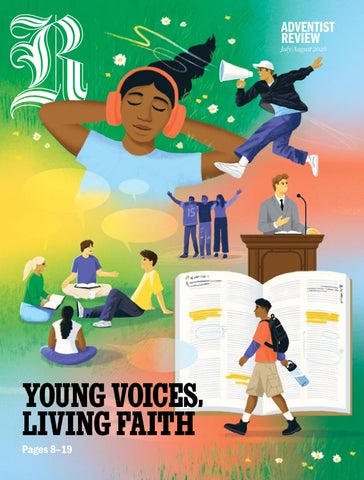
Pages 8–19
Our mission through linguae francae and chiastic structures
JUSTIN KIM
igrew up in a home speaking Konglish (a mixture of Korean and English). When we spoke Korean or Konglish, it was communication meant just for us. But when we spoke in English, it was for everyone to hear.
For more than 300 years it was the French language. But in 1919 at the Treaty of Versailles (which ended World War I), the lingua franca shifted to English. Since the Tower of Babel linguae francae have emerged throughout world history, seeking to unite large regions and facilitate communication among civilizations. Until 1919, diplomacy and international relations were conducted in French. But because of the influence of the British Empire, the United States, and the rest of the Anglophonic world, English became the lingua franca of today.
The term means a common or bridge language. The majority of the world speaks a few languages or at least understands two. One native tongue is used for family or tribal situations, while one or more common tongues are used for trade, education, or any other wider field. Depending on the location and geography, a people can speak several languages just to survive.
French and English are uniquely global, but there were other regional linguae francae, such as Latin in western Europe. During New Testament times it was Greek. In Old Testament times, however, it wasn’t Hebrew, but Aramaic. This third biblical language is found in almost 270 verses that describe an interaction with the larger culture (such as Genesis 31:47; Jeremiah 10:11; and Ezra 4:8-6:18; 7:12-26).
The longest Aramaic passage is found in Daniel 2:4-7:28. It is interesting to note that while the other verses are more official contracts and letters, the Daniel section is a mix of narrative and proph-

ecy.* As Adventist scholar William Shea pointed out about this section, there is an interesting pattern that emerges just from chapters 2-7: a chiasm.
2: Four kingdoms rise and fall
3: King persecutes; God’s people survive
4: King falls because of pride
5: Kingdom falls because of idolatry
6: Kingdom persecutes; God’s person survives
7: Four kingdoms rise and fall
These six chapters when coupled chiastically point to multiple sets of triads. First that Christ is coming (2 and 7), Christ is our deliverer (3 and 6), and Christ is the King of kings (4 and 5). Prophetically, they point to the timing of the investigative judgment (2 and 7); the state enforcing worship of the image and against the worship of God (3 and 6); and that Babylon will fall (4 and 5). Repackaged, this Aramaic section says Jesus is coming and the time of His judgment is now (2 and 7), Babylon has fallen (4 and 5), and image worship will be imposed upon God’s people, but He will be with those who keep His commandments and have His faith (3 and 6).
Does this sound familiar? There are three messages in the chiasm of Daniel 2-7. Yet not only the structure but the language it was written in points, not to an internal, family discussion, but to the larger lingua franca community. Also known as the three angels’ messages of Revelation 14, they are meant to go out to the whole world with a loud voice. It is the unique mission and responsibility of God’s remnant people at the close of earth’s history to proclaim these truths as rooted in Christ’s gospel.
The question is: Are we speaking “Adventistese,” or Aramaic, to the world?

Are all your children still being raised in, or are they still all members of, the Seventh-day Adventist Church?
Church members were asked if their children who grew up in the Seventh-day Adventist Church are still being raised in the faith or are still church members.
“God has placed powerful tools within our reach. Whether through digital ministry, traditional outreach, or personal witness, every method can become a channel of hope.”
—Eliezer T. Barlizo, Jr., president of the East Central Philippine Union Conference of the Adventist Church, in a recent ceremony in the Philippines where attendees dedicated their mobile devices for evangelism as part of the upcoming OneVoice27 initiative.
Promoted by the world church, OneVoice27 calls church members to share the gospel “as never before” in preparation for September 2027, when Adventists will highlight the anniversary of 2,000 years since Jesus’ baptism and beginning of His earthly ministry.
“God continues to reach hearts and open doors to the other children of Abraham. So the question is not whether He is working; the question is if we are bold enough to be His partners when the people He has visited come looking for answers.”
—Erton Köhler, president of the General Conference, during his Sabbath worship message at the recent Mission Refocus Conference in Bangkok, Thailand. Köhler suggested ways of building bridges of understanding with people of the Muslim faith, many of whom report having dreams and visions which prompt them to go out looking for Bible-based answers.
3,000
The number of children, parents, staff, and volunteers who gathered in Katowice, Poland, this year for the annual Trans-European Division Adventurer and Pathfinder Bible Experience finals. The program encouraged children and teenagers to deepen their understanding of Scripture through team-based study and Bible testing, with participants competing in Adventurer and Pathfinder categories focused on the Bible book of Isaiah.
Do you want to keep up with what is happening in our church? If you want to receive our weekly newsletter that features news, inspirational stories, videos, and more, sign up today.
The record number of mission trips planned by AdventHealth Global Missions for 2026, including to such countries as Peru, Nepal, Ecuador, and many others. It is the largest group of global mission opportunities AdventHealth has ever planned. These trips are projected to engage more than 800 AdventHealth volunteers, with most teams consisting of 20 to 25 caregivers, clinicians, and support staff serving together in communities with limited access to care and resources.
“If we are better prepared, we could make a huge difference in the lives of people affected by emergencies. I have no doubt that this is a meaningful way to show the love of Christ to people when they need it most.”
—Gabriel Villarreal, ADRA Europe Emergency Response coordinator, during a training in Lisbon, Portugal, that sought to assist local church representatives so they can help their congregations to be ready before disaster strikes. Preparation cannot start when the crisis arrives, but it must begin before, he emphasized.
“A steward is not an owner but a manager of divine resources. Faithfulness is the proof of understanding that truth.”
“Assumptions about secular people kill effective mission.”
—Johann De Dier, during a presentation at the recent Intercultural Mission Church Planting Summit in Port of Spain, Trinidad and Tobago. De Dier, a layperson with a corporate background who recently became an Adventist pastor, shared his experience in reaching out to secular populations in Panama City, Panama. Together with his wife, they opened a family counseling and center of influence—an urban missional church— which so far has provided more than 400 hours of counseling and resulted in a new Adventist congregation.
—Bright Osei Yeboah, Stewardship Ministries director in the West-Central Africa Division, during his keynote presentation at the Eastern Nigeria Union Conference 2026 Stewardship Summit. Yeboah reminded church delegates that stewardship is about every part of life, not just finances. “When God is first in your time, your talents, and your decisions, every other thing falls into divine order,” he emphasized.

The record number of blood bags collected in a single drive organized by Seventh-day Adventist church members in the state of Rondônia, Brazil. The drive was part of Life for Lives, an initiative of the Seventh-day Adventist Church in South America that promotes blood donation and acts of service on behalf of the community.
In
Trinidad and Tobago more than
20 delegates answer a call to mission service.
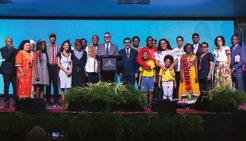
arenewed call for global mission, intercultural evangelism, and church planting marked the closing of the Intercultural Mission Church Planting Summit on May 30 as Seventh-day Adventist Church leaders, pastors, missionaries, students, and lay members gathered at the University of the Southern Caribbean (USC), outside Port of Spain, Trinidad and Tobago.
More than 300 delegates from across the Inter-American Division (IAD) attended the four-day summit to strengthen outreach among urban, secular, indigenous, and unreached people groups around the world through seminars, workshops, worship services, and mission-focused discussions.
The summit culminated with a passionate appeal from General Conference president Erton Köhler, who urged delegates to become active participants in the church’s Mission Refocus initiative. “The gospel is the last sign before the second coming of Jesus,” Köhler said. “Those who love the second coming of Jesus will preach the gospel.”
Köhler reminded delegates that the church’s mission extends beyond local territories. “Our mission is not only for Trinidad,” Köhler said. “Our mission is global.”
He said Mission Refocus aims to strengthen global collaboration by encouraging stronger mission territories to support regions with little or no Adventist presence.
“Mission Refocus is a movement calling
those who are strong in mission to support those who are weak in mission,” Köhler said.
Near the close of his presentation Köhler invited individuals and families willing to serve as missionaries or volunteers in challenging mission territories to stand and come forward. More than 20 people responded publicly to the appeal.
Samuel Telemaque, IAD Adventist Mission director and main organizer of the summit, reinforced the urgency of multiplication and intercultural church planting. “That’s a very challenging vision, a very uncomfortable vision,” Telemaque said while describing an IAD initiative for every church, district, conference, and union to reproduce within five years.
Telemaque said the summit’s training tracks were intentionally designed to equip delegates with practical skills for urban mission, secular outreach, indigenous ministries, evangelism among diverse people groups, and volunteer missionary service.
As the summit concluded Sabbath evening, leaders prayed over the volunteers who responded to the missionary appeal, expressing hope that a new generation of missionaries would emerge from the IAD to serve unreached communities around the world.
A report presented by IAD executive secretary Pierre Caporal during one of the May 30 presentations showed that more
than 3,000 churches were planted across the IAD between 2010 and 2025. “The ripple effects of the initiative Every Church, One Church in Five Years are enormous and may be beyond our imagination at this time,” Telemaque said. “The multiplication of new churches will create a need for more pastors, schools, universities, church leaders, and church buildings.”
During a Festival of Mission Refocus on Sabbath afternoon, unions across the IAD expressed their commitment to supporting missionary outreach around the world through testimonies, mission partnerships, and reports on church planting efforts across the territory.
On May 30, Adventist leaders also signed a memorandum of understanding establishing the Intercultural Mission Training Institute at USC. The initiative, launched in collaboration with the IAD, the Caribbean Union, the Middle East and North Africa Union Mission, and other church entities, aims to prepare missionaries for cross-cultural service and strengthen global mission engagement and intercultural ministry training.
Leaders encouraged pastors, young professionals, and mission-minded members to pursue advanced missiology training. “Understanding culture and cross-cultural ministry is essential to preparing future missionaries and strengthening the church’s global mission impact,” they said.
GC president calls for every Adventist to use their social media to share hope.
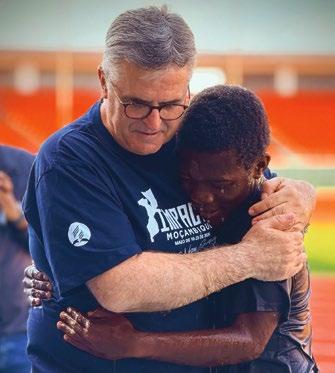
cheerful worship songs, rousing biblical messages, and hundreds of commitments to God and His mission through baptism marked the closing day of Impact Mozambique 2026 in Maputo, Mozambique, May 23. Thousands of church members and regional church leaders gathered at the Zimpeto National Stadium to welcome the new members, listen to General Conference (GC) president Erton Köhler and other church leaders, and commit to get involved in sharing hope with relatives, colleagues, and friends.
“We would like to thank the government of Mozambique,” said Harrington Akombwa, president of the Southern Africa-Indian Ocean Division, in the opening greeting to the crowd attending the day of celebration. “Thank you for creating the conditions and embracing us.”
At the beginning of the worship service, Pathfinders entered the stadium holding the Mozambican and Pathfinder flags. Hundreds of women who support Women’s Ministries at local levels across the country also walked into the stadium singing joyfully, as church leaders acknowledged their support and commitment to mission.
A few minutes later Eduardo Joaquim Mulémbwè, minister in the Presidency for Parliamentary, Local Government, and Provincial Assembly Affairs in Mozambique, walked onto the stage to deliver a special message on behalf of Mozambican president Daniel Chapo.
“The government of the Republic of Mozambique fully acknowledges the role of religious organizations in promoting peace, fostering social cohesion, and advocating for ethical and moral values,” Mulémbwè said. He highlighted the commitment of the Adventist Church to “areas of public interest,” including education, health, social assistance, and moral development.
“IMPACT MOZAMBIQUE HAS BEEN AN OPPORTUNITY TO BE SAVED. THAT’S WHY WE ADVENTISTS KEEP PREACHING—BECAUSE WE WANT EVERYONE TO COME TO JESUS AND BE SAVED.”
Mulémbwè also emphasized what he called the Adventist Church’s “culture of hope, active responsibility, and commitment to one’s neighbor.” In that regard, Impact Mozambique inspires the country’s citizens, Mulémbwè said, “to project themselves to a better future through concrete initiatives which support human development and solidarity.”
At the beginning of his May 23 message Köhler acknowledged the government’s
support, “so that the Adventist Church may be able to serve and fulfill its mission.” He noted that Mozambique is “a young country, formed by young people,” a clear similarity, according to him, to the origins of the Adventist Church.
Köhler brought the approximately 398,000 baptized Adventist members in Mozambique at the time a special greeting on behalf of the global Adventist family. “I like seeing this church as a family, under one Father, purchased by the same blood, and belonging to the same nation—the heavenly kingdom,” he said. “We have the same message, the same mission, and the same hope of seeing Jesus’ soon return.”
In his worship message Köhler called on listeners to embrace and become part of God’s mission. “The gospel will be preached with or without us,” he reminded church leaders and members. “But I believe miracles will be more striking if we join the effort.”
Calling members and visitors to reflect on the sad state of the world, Köhler provided the wider context of what he defined as God’s forbearance. “God is waiting for humans to respond to His love,” he explained. “Jesus says, ‘Satan will do evil and keep doing evil, but I’ll keep waiting because I want everyone to have the opportunity to be saved.’ ”
On those grounds, Köhler emphasized, “Impact Mozambique has been an opportu-
nity to be saved. That’s why we Adventists keep preaching—because we want everyone to come to Jesus and be saved.”
Köhler closed by reminding every undecided person that “heaven is waiting for you. . . . Jesus is waiting for you before He returns.”
A subsequent baptismal ceremony saw hundreds of young and old commit to God through baptism. A dozen pastors, including Köhler and Akombwa, baptized the candidates who waited under the sun in long lines for their turn.
The massive ceremony at the Zimpeto National Stadium in Maputo, however, was only one site of more than 660 across the country, as local pastors and regional church leaders conducted baptismal ceremonies in the ocean, rivers, lakes, baptismal pools, and even plastic bathtubs.
During the celebration at the stadium, Akombwa mentioned that many regional church leaders were not present there that day. “They are not here because they have been preaching for two weeks at various sites and are today leading baptismal ceremonies across Mozambique,” he explained.
Regional church leaders, including Mozambique Union Mission president José Moreira, said they expected to reach a membership milestone. “We believe that with God’s blessing we will cross the 400,000-membership mark today,” he said on May 23.
The afternoon program focused on OneVoice27, an initiative of the world church to engage every member and leader to share Jesus through 2027 and beyond. “Our church was created for evangelism,” Akombwa reminded church members.
The initiative will culminate in September 2027 in commemoration of 2,000 years since Jesus’ baptism and the beginning of His ministry on this earth. “In September 2027 every church member, every pastor, every leader, every media outlet—everyone together, in their own way—will speak about the Jesus who already came and the Jesus who will come back,” Köhler said.
Köhler celebrated that the Adventist Church in Mozambique worked seamlessly together during the Impact Mozambique initiative. “But it was just a beginning,” he said, “because now Mozambique will join the whole world to proclaim Jesus concurrently.”
He explained that the initiative will combine media messages with small group ministry. Others will lead evangelistic series. “Every place will find the best way to implement OneVoice27 locally,” Köhler explained.
To that point, Odailson Fonseca, communication coordinator for GC Presidential, explained that OneVoice27 will be based in communication, which implies proclaiming the same truth, continuously changing the way that truth is shared. “Truth does not
change,” Fonseca reminded church members, “but the way we share it certainly does.”
Against that background, Adventist leaders called on every church member and leader to use the easiest available tool at hand—their cell phones—to share the hope that is in Jesus. “Dedicate your social network channels to God,” Fonseca challenged listeners. “Consecrate your media consumption. Place all your media channels to the service of Jesus.”
Köhler agreed, as he called attendees to raise their cell phones with their hand held high. “OneVoice27 has already started,” he said, seeing thousands of cell phones across the stadium. “We are ready to launch a mass movement from the palm of our hands.” He added, “I call you to use your social media not just for fun; use it as a means to proclaim salvation.”

We asked children (ages 7-9), preteens (ages 10-12), and teenagers (ages 13-16) from around the world to write for the Review in August. The following pages represent a selection of the articles they produced. To read more from our young people, keep an eye on our website, www.adventistreview.org—Editors
Arris R. Berghan
ilove reading true stories! Stories about people who survived World War II. Stories about prisoners who escaped. Stories about missionaries who went into danger. Stories about times people had to be brave.
The best true stories always have something in common: They have dates. They have timelines. And they have evidence. Because when a story is real, it can be checked. It can be proven. It is not just a guess. And that is what makes it powerful. Today I want to tell you why I believe in Jesus. Because God did not just give us a religion. God gave us evidence. And one of the greatest evidences God ever gave is prophecy. Prophecy is like God writing history before it happens.
In the book of Daniel, God gave a prophetic timeline that points straight to Jesus Christ. One of the greatest prophecies in the Bible is in Daniel 8 and 9. It is the prophecy about the 2300 days and the 70 weeks.
Now, I know that sounds complicated, but it is actually really amazing. The 70-week prophecy is like a giant spotlight from heaven pointing to one person: Jesus of Nazareth. The prophecy predicts when the Messiah will come. It predicts when Jesus will begin His ministry. It even points to His death.
I love this quote from Isaac Newton, who was one of the smartest scientists ever. He said the 70-week prophecy is “the foundation stone of the Christian religion.”1 That means it is one of the strongest proofs that Jesus really is the Messiah. So when people ask, “How do you know Jesus is the Christ?” I can say: “Because Daniel predicted it hundreds of years before Jesus was even born.” That is why I believe.
But here is the problem: Some people believe in Jesus only because their parents told them. Or because they grew up in church. Or because it is tradition. Prophecy teaches us something important: God does not want us to have a faith based on guesses. God wants us to have a faith based on truth. Because when life gets hard, a weak faith can fall apart. But a faith built on evidence stands strong.
Here is something else that is amazing. The prophecy does not just point to Jesus. The prophecy also points to God doing something special at the end of the 2300 days. And what happened after that? God gave His church the gift of prophecy!
As Seventh-day Adventists we believe God gave Ellen G. White the gift of prophecy. Recently I visited the Ellen White Estate at the General Conference offices, and it was amazing. Last year I also got to visit Battle Creek, where Ellen White lived as well. And I learned something important: Ellen White spent her whole ministry pointing people to Jesus. She said her writings were like a smaller light leading people to the greater light, which is Jesus.2
There were many miraculous experiences in Ellen White’s life that made people realize God was really using her. For example, people witnessed that during one of her visions when she was a teenager, she held up an 18-pound (8-kilogram) Bible above her head for about 30 minutes. When I visited her house in Battle Creek, I tried to hold a replica Bible and couldn’t even last one minute.
It is also said that sometimes when she was in vision she wouldn’t even be breathing, and people would
hold a mirror in front of her face to check. Even though she was not breathing, she was still speaking and describing what God was showing her. That made people realize something serious was happening. Not magic. Not pretending. But God giving a gift.
And what is the point of the gift of prophecy?
The Bible tells us in Revelation 19:10: “For the testimony of Jesus is the spirit of prophecy.”
So the Spirit of Prophecy is not about making someone famous or being able to tell the future. It is about testifying of Jesus.
That is why I believe.
Moses is not alive anymore, but his words are still speaking. Daniel is not alive anymore, but his prophecies are still teaching. John is not alive anymore, but Revelation is still preaching.
And Ellen White is not alive anymore, but her writings are still speaking.
So here is my question for everyone today: If God gave us all these prophets, why would we ignore them? Why would we be too busy to read the very messages God gave to strengthen our faith?
The Bible says in 2 Chronicles 20:20: “Hear me, O Judah and you inhabitants of Jerusalem: Believe in the Lord your God, and you shall be established; believe His prophets, and you shall prosper.” If you want a faith that is strong, a faith that will prosper, you have to read what God wrote; you have to believe what His prophets have written.
So the Spirit of Prophecy is not about making someone famous or being able to tell the future. It is about testifying of Jesus.
So here is my challenge to every person reading, children and adults alike: This week, start a new habit of reading one chapter of the Bible every morning. Start with Daniel. Start with Matthew. Start with Psalms. Start anywhere, but read one chapter every morning. And then read a little from Ellen White every evening, because her writings point you to Jesus. Because the prophets all have one message: Jesus is the Messiah. Jesus is the Savior. And Jesus is coming again.
And that is why I can stand here today and say, I believe in Jesus and His prophets
With her dying breath, Ellen White whispered the words from 2 Timothy 1:12, “I know whom I have believed.” My question is: Are we honestly able to say the same today?
1
2
Arris R. Berghan is a child living in Maryland, United States with his parents and younger sister. He preached this message as a sermon at his local church (https://www.youtube.com/ watch?v=pBEuJ9PHf08&t=3980s) as part of a Pathfinder Day program.

Julián Omonte, Tereza Poniatovska, and Jael Omonte
The following accounts are written by children from missionary families, each describing their own experience growing up in the mission field.—Editors.
JULIÁN’S STORY
hello. My name is Julián, and I am a missionary kid. I was born in Eldoret, Kenya. My parents, Dr. Valentin Omonte and Dr. Susana Tito, are dentists. They moved from La Paz, Bolivia, to Kenya in 2009 as volunteer missionaries at the University of Eastern Africa, Baraton. At first they planned to serve for only one year, but that one year has now turned into 16 years outside of Bolivia.
I was born in 2011 alongside my twin sister, Jael. I do not remember much about my early years in Kenya; only a few unclear memories of living on the university campus in Baraton.
In 2014 everything changed. My parents were called to serve in Kigali, Rwanda, at the Kigali Adventist Dental Clinic. My father became the director, and my mother continued working as a dentist. This is where my real childhood memories began.
I studied at Green Hills Academy International School during my primary years. During those years I found interest in Legos, origami, science, and interstellar space. I made good friends, but it was not always easy. Many of my friends moved away because their families were also from different countries and always had to move. It felt as though I could not keep friends for long. That changed when I met Meng and Ryan.
Meng is from China, and he did not believe in God. Ryan is Brazilian and a Christian (Jehovah’s Witness). Even though neither of them was Adventist, they became my best friends.
One day they saw me praying. I usually tried to pray quietly because I was in a non-Adventist school, but this time they noticed. Meng asked me what I was doing.
I told him I was just praying to God and asking Him for help. Meng laughed a little. Since he was my friend, I did not take it too seriously. I tried to explain, but he was unsure about believing in God.
My parents also helped start a Pathfinder and Adventurer club at the Adventist University of Central Africa church. We would meet every Saturday afternoon—and sometimes on Sundays for sports—to learn about God through nature and activities. I made many close friends during my time as an Adventurer and now as a Pathfinder. The club kept growing every year, and this year we are celebrating 10 years since it started.
One day I invited Meng and Ryan to join the club. After speaking with their parents, they agreed to come. They felt very welcome, and we shared many special moments together that I will never forget.
Then something happened that changed how I understood being a missionary kid.
One day at Green Hills I saw Meng sitting quietly with his head down. I asked him what he was doing, but at first he did not want to answer. Later he told me he was praying, just to try.
My friend who did not believe in God was praying.
I realized that even in small ways, I can share God’s love with others.
This touched my heart deeply. I was so excited to tell my parents. From that moment I began to understand what it means to be a missionary kid. I realized that even in small ways, I can share God’s love with others. I pray that one day Meng will be baptized. Right now I am studying at Maxwell Adventist Academy in Kenya. I feel as though I have returned to where I started. Even though the culture is different from that in Rwanda, I feel comfortable. There are challenges, but I believe that God is always in control. I miss my parents, who are still serving in Rwanda at the Adventist Dental Clinic in Kigali.
In the future I want to be a missionary like my parents. I want to help in clubs, children’s ministries, and maybe be a director or a doctor, just like them. Their example inspires me to serve God wherever I go. I am also very thankful for my twin sister, Jael. She helps me with my studies and encourages me to keep going. May God bless all missionary kids around the world. May we be a light to other children who need Jesus in their lives.
TEREZA’S STORY
ihave visited many countries, such as Belgium, the United States, Egypt, and my own country, Ukraine. It’s fun to go from country to country, but it’s sad to leave your own home. The place you live in can be small or big, but it is always interesting.
It’s interesting to learn new things, learn new languages, and go to new schools. You can see many new things when you go from country to country, such as new flowers, trees, and people. It’s fun to explore new places, see new animals, even play new games. It’s also sad to leave your own animals and things. Some things you don’t really need, but some you do, like family.
growing up in a missionary family isn’t always how people imagine it to be. My name is Jael Omonte, and I am from Bolivia. I was born in Kenya, but I have lived most of my life in Rwanda. Because of this, I live far from what many people would call “home,” but over time I have learned how to cope and adapt to different environments.
Being from Bolivia, a country in South America, but growing up mostly in Rwanda has made me realize how little I sometimes know about my own origins. It feels strange to say where I am from, because I don’t fully feel connected to just one place. When people ask me where home is, I don’t always

I believe that home is not just one place, but a combination of all the places, people, and experiences that have made me who I am today.
know how to answer. Is it where I was born, where my family is from, or where I have lived the longest? This is something I am still trying to understand.
As a missionary kid, life is often about giving, just as Jesus did. Jesus is a role model for me because He teaches me how to serve others and to give more than I receive. This is not always easy, especially when I feel as though I am sacrificing things that other kids my age get to have. Sometimes it can feel challenging, but at the same time, it helps me grow and become more understanding of other people’s needs.
Another big part of my life is learning new cultures. Moving to and living in different places have allowed me to experience ways of life that many people may never get the chance to see. I have learned different traditions, ways of speaking, and ways people interact with each other. Sometimes I feel like I know more about other cultures than my own, which can feel a bit strange. But it also makes me happy, because I can connect with people from different backgrounds and understand them better.
Even though there are many good things about this life, it is not always easy. At times I feel as though I don’t fully belong anywhere. Even though Rwanda feels like home because I have lived there most of my life, there are still moments I miss my own culture. I wish I could reconnect with it more and understand it better, instead of knowing only a little about it.
There are also times I feel as if I am not in the right place. The people around me may think differently, have different beliefs, and see the world in ways that are not the same as what I am used to. This can make me feel different or even a little lost at times. It is not always easy trying to fit in while also holding on to who you are.
At the same time, being a missionary kid has taught me important lessons. It has taught me how to be flexible, how to understand others, and how to see the world from different perspectives. I have learned that not everyone lives the same way, and that is OK. In fact, it is something I have come to appreciate.
I also remember moments I had to step out of my comfort zone to meet new people
or adjust to a new environment, for example. At first it can feel uncomfortable and even a bit scary, but over time it becomes easier. These experiences have helped me become stronger and more confident in myself.
Even though I don’t know as much as I would like about my home country, I still feel proud of where I come from. At the same time, I am grateful for the life I have as a missionary kid. It has given me opportunities to learn, grow, and experience things that many people may never experience.
In the end, being a missionary kid is not always easy, but it is meaningful. It has shaped who I am and continues to shape who I am becoming. I am still learning, still growing, and still discovering what “home” really means to me. For now, I believe that home is not just one place, but a combination of all the places, people, and experiences that have made me who I am today.
Julián Omonte, Tereza Poniatovska, and Jael Omonte are students at Maxwell Adventist Academy in Nairobi, Kenya. Julián and Jael are teenage twins from Bolivia, and Tereza is a child from Ukraine.
It’s all about priorities.
Jonathan Clegg
perhaps you’re familiar with the term, perhaps you’re not: dead internet theory. It’s the belief that artificial interactions—such as AI and chatbots—are flooding the internet we know (and some of us love), creating a space in which only artificial thinking exists. My question is not about AI taking your job or raising prices, but it is instead about love: not what you love, but rather how much you love it, and what it means to love something—or even someone—more than you should. I believe the easiest way to explain this is with a good and totally not silly analogy.
Right this moment, you have to make a choice. What choice? You must choose one food to eat for all three meals of the day, 365 days of the year . . . and every year after that for the rest of your life. (Whatever food you choose won’t matter much when you die early from an unbalanced diet!)
My point is to compare diet to media. But before I go further, I want to mention that I am not an anti-media activist; in fact, I am greatly invested in video gaming and YouTube. At one point I was so invested in it that I began to love it more than I loved God. I am not saying that loving something is bad, or that media itself is bad. But when you love bread so much that it’s the only thing you eat, you have a problem.
Most young adults (myself included) are guilty of filling our lives with social media, TV, and video games. Most of us spend the 12-16 hours a day we are conscious scrolling YouTube shorts, and Instagram or TikTok reels. But if God asks for only 10 percent of our earnings as a tithe, shouldn’t we also be willing to give at least 10 percent of our day to Him? If you’re awake for 12 hours, that’s one hour and 12 minutes of your day. I, for one, was guilty in this area. From sunup to sundown I would spend my day scrolling YouTube, hopping on video games, never thinking of God. I would go to sleep, not from a spiritually nourished worship, but from a doomscrolled mind that just finished a five-hour stream of a new video game release.
When the Adventist Review offered me the opportunity to write something for them, I agreed. Little did I know that that same week God would compel me to give up media for a week—not because it’s necessarily bad, but because I was putting it before
Photo by Teo / Lightstock
God. As Exodus 20:3 says: “You shall have no other gods before Me.” This verse does not refer exclusively to worshipping other gods apart from the one and only living God, but directly refers to anything in your life that you put higher than God.
I’m reminded of our parents saying stuff like “In our day we didn’t have the internet—we had libraries. And if you wanted to talk to someone, you talked in person and not in a chat!” While it may seem crazy to think about now, life was much better then, as the stimuli and constant brain rot was not a part of everyday life. As they say: “Garbage in, garbage out!”
But back to dead internet theory. I have a theory of my own, which questions what happens if the internet is becoming overrun with artificial communication and intelligence: What happens when you expose yourself to this? You risk losing your own sanity.
It all reminds me that I serve a loving and gracious God who wrote a commandment that on the surface seems plain and simple, but deep down is expansive and meaningful beyond belief. It’s funny to me that God knew that dead internet would ruin people just as much as cars, money, greed, lust, and violence do. So let’s all remember to put God in the forefront of our minds, and He will keep our hearts and minds!
Jonathan Clegg is a teenager in the United States. His hobbies include voice acting for Discovery Mountain, offroad riding on his quad, radio-controlled cars, Bible study, hiking, writing, video gaming, and music (both playing the trumpet and singing in choir).
I was so invested in it that I began to love it more than I loved God.


Bullying. We see it everywhere in our society: at school, work, social groups, online . . . and sadly, even in our churches today. At some point someone has been bullied or has witnessed bullying taking place and didn’t know how to respond to it—or they took matters into their own hands, and it didn’t end well. In the end, bullying or being bullied isn’t nice, and no one deserves to be bullied. I often wonder how to deal with this situation—how to fight back and stand up for myself . . . and others. But the main thing I really want to focus on when dealing with bullying is how Christ would do it. What would Jesus do?
There’s a story in the Bible, in John 19:1-4, in which Jesus Himself was being bullied by Roman soldiers, leading up to His death. The soldiers “twisted a crown of thorns and put it on His head, and they put on Him a purple robe.”
While doing that, they even mocked Him, saying, “ ‘Hail, King of the Jews!’
And they struck Him with their hands.”
Reading that makes me feel horrified by what the soldiers did to Him. I’m thinking, Do the soldiers know whom they are messing with? But something that really touched me was the fact that Jesus never reacted when all these horrible things were being done to Him.
Does this mean that when we are being bullied, we should just go with the flow and do nothing?
First Peter 2:22, 23 really unpacks how Jesus responded when these things were happening to Him. It says that He “ ‘committed no sin, nor was deceit found in His mouth’; who, when He was reviled, did not revile in return; when He suffered, He did not threaten, but committed Himself to Him who judges righteously.” Jesus had no sin, nor is He a liar nor deceitful. Even though He was reviled by the Roman soldiers, He didn’t revile in return. Even when He suffered at the hands of the soldiers, He never threatened them. Instead, Jesus submitted Himself to God, who judges righteously.
Throughout this whole situation He had the power to call down lightning and strike those soldiers dead, or something like that, but He didn’t. Instead, He submitted Himself to God, and on the cross He bore
the sins of those soldiers. He came to die for them because they themselves were lost in sin and didn’t know what was right or wrong—they were blind to their sins. He came for them so they also could take part in His righteousness and receive the free gift of salvation and eternal life.
How can this story be applied to us when it comes to bullying? The first thing to remember is that we are all God’s children—from the Garden of Eden, to the Romans, to the present. We all have fallen short of God’s glory and sinned, but we can thank God for Jesus, who died for our sins that we may be one with God.
The second thing is to consider how we react when dealing with bullying, and the words that come out of our mouths. A verse to consider when dealing with this situation is Proverbs 10:12: “Hatred stirs up strife, but love covers all sins.” When Jesus was being bullied, love was the main factor and His priority when reacting to and talking with His bullies. If His response had been out of hatred, it would have caused all sorts of chaos: heated and constant brawls, and hate for one another, which Jesus never calls us to do. He tells us instead to “love one another; as I have loved you, that you also love one another” (John 13:34).
Third, we must forgive and pray for those who bully us. Consider Stephen in Acts 7:54-60, when he was being stoned. He knelt down and prayed to God, saying, “Lord, do not charge them with this sin” (verse 60). We should pray for our bullies because they themselves are lost in sin and often don’t know that what they are doing is wrong or how it’s hurting you.
In Matthew 5:44 Jesus says, “Pray for those who spitefully use you and persecute you.”
We can also forgive our bullies. In Ephesians 4:32 it says that we should “forgive one another, even as Christ forgave you.” I understand: Doing these things can be challenging because we might feel overwhelmed and anxious. We might not know what to say when it comes to standing up to our bullies. But remember that we have God on our side. Philippians 4:13 says, “I can do all things through Christ who strengthens me.” God can strengthen us in our weakness because “with God all things are possible” (Matt. 19:26). In Christ we are “more than conquerors through Him who loved us” (Rom. 8:37).
Another example in which we can see Jesus dealing with bullying was the time He was a bystander—and an upstander—for others. In John 8:1-11 we see Jesus being an upstander for a woman who was caught in the act of adultery. Jesus was in the temple, where “all the people came to Him; and He sat down and taught them” (verse 2). While teaching the people, Jesus was interrupted by the scribes and Pharisees, who brought the woman caught in adultery. “Teacher,” they said to Him, “this woman was caught in adultery. . . . Now Moses, in the law, commanded us that such should be stoned” (verses 4, 5).
Jesus’ response? He stooped down to the ground and started writing with His finger. Then He stood up and said to them, “He who is without sin among you, let him throw a stone at her first” (verse 7). After saying this, He stooped down and continued writ-
I often wonder how to deal with this situation—how to fight back and stand up for myself . . . and others.
ing on the ground. But when the scribes and Pharisees heard His words, they started to slip away, from oldest to youngest, leaving Jesus and the woman alone.
Jesus stood up again and asked the woman, “Where are those accusers of yours? Has no one condemned you?”
“No one, Lord,” the woman responded.
Then Jesus said, “Neither do I condemn you; go and sin no more.”
What can we learn from this story of being a bystander and upstander for others? First, we can choose not to get involved in the bullying and be the one to shut it down. When the scribes and Pharisees brought this woman to Jesus, He responded by saying nothing. He stooped down and started writing on the ground, “as though He did not hear” (verse 6).
Second, we can stay by the side of the individual who is being bullied, not leaving them to fight on their own. Even after the scribes and Pharisees slipped away, Jesus was left standing there alone with the woman. Not once did Jesus leave the woman to shield Himself—He stayed with her the whole time, revealing His love and compassion toward her.
Third, we cannot judge an individual’s past. We must be the one to show the love of Jesus. We see Jesus say to the woman, “Neither do I condemn you; go and sin no more” (verse 11). Christ knew her past, but treated her kindly. He loved her and revealed His grace and forgiveness.
As we choose to be bystanders and upstanders for others—and ourselves—let us be lights for Christ and reflect His character. Even though we now live in a society in which bullying is a huge issue, let us, through following the example of Jesus, deal with bullying in a way that centers on God’s love and demonstrates how He wants us to live in harmony with one another. And always remember Joshua 1:9: “Have not I commanded you? Be strong and of good courage; do not be afraid, nor be dismayed, for the Lord your God is with you wherever you go.”
Brightness is a student living in the North New South Wales (NNSW) Conference, Australia. The author is a minor, and their last name has been withheld for privacy.
Victoria Gonzalez-Feezer

there’s something different about the Sabbath, and it is hard to explain unless you’ve experienced it the way I have. It doesn’t start loudly. There’s no sudden pause during which the world stops moving. People are still talking, the world keeps moving forward, and life still happens. But for me, everything changes the moment the Sabbath starts.
All week, life feels constant. There’s always something to do or something to worry about. School, expectations, responsibilities—they don’t really leave space for rest. Even when I’m not doing anything, my mind is still racing. I’m thinking about what I didn’t finish, what I could’ve done better, or what’s coming next.
But that all changes when the Sabbath comes.
I’ve grown up understanding that the Sabbath isn’t just a day off; it is something God created from the beginning—a day set apart and made holy. And to me, that idea changes everything. It means the Sabbath isn’t something I earn after a long week of work; it is something given to me, no matter what my week looked like.

That’s one of the reasons I love it so much. Because most of the time, rest feels like a reward. It feels like I deserve it only if I’ve worked hard enough or done everything right. But the Sabbath doesn’t work like that. It comes whether I feel ready for it or not, even if I feel behind, stressed, or overwhelmed. And when it does, it invites me to stop, not because everything is done, but because it doesn’t have to be.
At first, slowing down can be uncomfortable. I’m so used to always thinking, always checking something, always moving forward. The quiet can feel unfamiliar, almost as if I don’t know what to do with it. But over time I’ve started to realize that the quiet is where the Sabbath really begins to mean something.
It creates space. Space to breathe without rushing, to think without pressure. Space to reconnect, not just with the people around me, but with God. That’s something I don’t make enough time for during the week. But the Sabbath brings me back. It shows me what actually matters.
Going to church, listening to the sermon, singing, and spending time with the people around me; it all feels different on the Sabbath. Not forced, not like something I have to do, but like something meaningful. And even outside of church, the whole day feels set apart. Even small things feel as though they actually have space to exist.
I love the Sabbath because it reminds me who I am beyond everything else. During the week it is easy to define myself by my grades, my expectations, or how well I keep up. But the Sabbath reminds me that my value doesn’t come from any of that. It comes from the fact that I am a child of God, and that is enough.
It is comforting to know that no matter what happens, the Sabbath always comes again. No matter how stressful the week was, no matter how I feel about myself, I know there will be another Sabbath, another chance to pause, reset, and start again.
Life doesn’t always feel steady. Things change, people change, and even I change. But the Sabbath doesn’t. It stays the same, a reminder that God’s love and care stay the same no matter what I’m going through.
When the Sabbath ends, everything comes back: the responsibilities, the stress, the constant movement. But it doesn’t feel the same as it did before. It is as though I carry something with me into the new week. Not something loud or obvious, but something quieter. A kind of stillness. A reminder that I don’t always have to keep running just because everything else is.
I don’t always experience the Sabbath perfectly. My mind still drifts at times as I think about all that is waiting for me when the new week begins. But even in those moments, when I notice my thoughts pulling me away, choosing to return to the Sabbath changes something. It creates space where there wasn’t any before. And so I continue to stay grounded in the peace that the Sabbath offers.
And maybe that’s what matters. Because for a little while the noise fades, and the pressure is gone. The world keeps moving, but somewhere between one week and the next, between one sunset and another, there is always a space waiting. A space in which I am not defined by what I’ve done, but simply by the fact that I am here, and that is enough.
Victoria Gonzalez-Feezer is a teenager from Maryland, United States. She loves music, baking, and figure skating. She is studying to become a doctor.

every day we are faced with the same question: Will I do what’s convenient for me, or will I do what’s right? For the most part, as a young child, I grew up in the church, and that meant I heard a lot about how to make choices based on the Bible. But it’s totally different when you actually face those tough decisions in real life. Being a Christian teenager in our generation can seem much harder, given the temptations (such as social media) all around us. For me, being a Christian means living a life that follows the path Jesus gave us. Every day is a constant struggle, and I believe that the only way a Christian can walk in the fullness of the Word is through constant connection with our heavenly Father.
I started reading my Bible from Genesis to Revelation in 2020 with the Adventurer Bible, and I finished my first cycle a year later. At first I didn’t think much of it because, as a young child, reading the Bible can be difficult—especially when tackling deep biblical truths and unfamiliar words. Still, I read five chapters every day. After that first cycle I began my second cycle with the Pathfinder Bible, which
I also finished a year later. By this second cycle I started to understand what I was reading much better than the first time. I realized that the habit of picking up the Bible first thing in the morning had been established during that first cycle, even with my limited understanding.
So I started my third cycle with the Bible for Teen Girls, which is the most recent one I’ve completed. I loved the beautiful insights alongside the main text—especially those from Christian authors who talk about the reality of being a teenage girl, the struggles we all face, and how to overcome them in order to be pure even in today’s society. I finished that in a year as well, and now I’m currently on my fourth cycle of Bible reading using the Andrews Study Bible, which I’m really enjoying. I love the in-depth commentary on the verses and how I can dissect each chapter by journaling and writing my thoughts and prayers. With each cycle I learn something new from every chapter. It’s never the same for me. God reveals
Himself through His Word, and if we dig beneath the surface, we will never run out of things to learn. We are so blessed to have the Bible as a standard to live by—one we can use to guide all our choices.
When I was younger, one of my favorite Bible stories was about Daniel. Daniel was taken to Babylon as a captive at a young age, along with his friends. They faced many challenges, including issues with their diet, as Daniel and his friends believed it wasn’t right to eat the food they were offered.
There’s one verse in that story that has always stood out to me, and as I’ve grown older, it has become even more meaningful. Daniel 1:8 says: “But Daniel purposed in his heart that he would not defile himself with the portion of the king’s delicacies, nor with the wine which he drank; therefore he requested of the chief of the eunuchs that he might not defile himself.” I love the word “purposed.” It was intentional—Daniel decided for himself to do things God’s way.
I remember a conversation with my mom when we were discussing this story. She said, “I wish the parents of Daniel and his friends—those Hebrew mothers—could have written a parenting book on how to raise children who will stand for the truth and make godly decisions the way they did!” Remember, Daniel was a teenager at this time. Imagine being taken to a foreign land as a young captive, losing your home and being separated from your family—it would have been easy for Daniel to lose his faith in God. Yet because he had been trained from childhood to be faithful, his decision not to eat the king’s food reflects a heart led by the Spirit. It serves as an inspiration for youth like me who face many temptations every day.
I saw God in each tree, leaf, flower, and animal. When I was 7, my mom encouraged me to write down my reflections, and over time she compiled them. Eventually, when I was 12 years old, we published Nature’s Secret Treasures. I never imagined that simple nature walks and choosing to spend my time on meaningful things would lead to publishing a book—one that has been a blessing to many children and parents around the world. I truly cannot fathom how God works in such miraculous ways.
Big decisions don’t need to be rushed— they need to be made with God, step by step.
If there’s one thing I’ve learned about making choices, it’s that the steps you take before making a decision are the most critical. Rushing and relying only on your own intuition can lead you into situations you don’t want to be in. First, pray. Kneel down and ask for God’s guidance. Open His Word and let Him speak to you through Scripture. Then seek advice from godly people. For me, asking my parents for guidance really helps. Big decisions don’t need to be rushed—they need to be made with God, step by step.
In a world in which we, as young people, fall prey to these things every day, one factor that often sets the stage for bad decisions is idleness. People often say that during the teenage years we have the greatest strength and capability to do many things, and it’s sad to see that so much of our energy is wasted on things that take up our time and effort but don’t make a lasting impact. We put such a great importance on such things as romantic, infatuated relationships, to the point that it consumes all the time we could’ve spent our energy working for the Lord and finding that love and joy in His service. We have many years ahead of us, and there will be a time for that, yet we tend to rush things and choose to ignore everything else. We are stewards of time and talent, and God has lent us these gifts to be used in His service. Because we are often preoccupied with our own selfish pleasures, however, they can consume much of our strength.
In my personal experience, keeping yourself busy with things that help you grow and glorify God is one of the most effective ways to avoid falling into bad decisions. I remember my mom saying that “an idle mind is the devil’s workshop.” So I chose to stay busy, and my parents trained me to make every second of each day count. I began to look more deeply into God’s creation in nature. Whenever my parents and I went on nature walks, they would ask me how
In life it’s inevitable that we will make mistakes. We live in an imperfect world, and as human beings we are bound to fall short. What matters most is how we respond. I think of the story of King David. He is known as a man after God’s own heart, yet he made many wrong choices. What I admire most about David is how he responded. In 2 Samuel 12:13 he says, “I have sinned against the Lord.” He acknowledged his sin and confessed it instead of hiding from it. God reminds me that my journey won’t be perfect—there will be times that I stumble. But what I do afterward is what truly matters. What a privilege it is to serve such a forgiving God.
I’m still a work in progress. I still stumble and face moments of confusion when making decisions. I’m a teenager, and this stage of life can be especially challenging because of hormones, peer pressure, and outside influences. But if you’re a teen reading this and wondering how to handle these struggles, here’s what I’ve learned: Learn to surrender your battles to the One who knows everything. You might think it’s easier to handle things on your own and keep everything inside, but we are weak on our own. We are easily influenced by what surrounds us.
But don’t lose hope. The Lord says in Psalm 32:8, “I will instruct you and teach you in the way you should go; I will guide you with My eye.” That’s His promise. Yes, the world may look appealing with all its glitter, but let’s focus on what our heavenly Father offers. Will you choose this world, or the one He has prepared for you?
Onyx Daquila is a teenager from a missionary family, devoted to a life of faith and service.
We raised our daughter in the church. She was involved in almost everything—Sabbath School, Pathfinders, youth group, church school, community service, summer camp, camp meeting—and our home was intentionally spiritual. We prayed together, had family worship, and went to church regularly. Now she is in her mid-20s and has completely walked away from any interest in spiritual matters. She isn’t hostile, just indifferent. We feel as though we have failed. What do we do?
First, let us say this plainly: You have not failed. The ache you carry is real, and it speaks of the depth of your love—for your daughter and for God. But pain is not the same as failure, and her present silence does not write the final chapter of her story. What you are experiencing is one of the most common and most heartbreaking realities of Christian parenting. And you are far from being alone.
Jesus told a story in Luke 15:11-32 that seems written for this very moment. A father had two sons. The younger one asked for his inheritance early—essentially saying, I wish you were already dead—and left for a distant land where he squandered everything. The father did not chase him. He did not cut off the relationship in anger, nor did he pretend there was no pain. He simply watched, waited, and kept looking toward the horizon.
Notice what Scripture says about the moment of the son’s return: “But when he
was still a great way off, his father saw him and had compassion, and ran and fell on his neck and kissed him” (Luke 15:20). The father saw him “a great way off”—which tells us one important thing. He had been watching. He had never stopped looking.
This is your posture as parents right now. Not pursuit that smothers. Not silence that distances. But watchful, patient, compassionate presence. The father in the parable did not sprint after his son into the far country, arguing theology at every turn. He held open the door of home—and that open door is what made return possible.
The psychological research on attachment, first developed by John Bowlby and later expanded by Mary Ainsworth, helps us understand something critical: The most powerful thing a parent can offer a child at any age is a secure base— a relationship characterized by warmth, reliability, and unconditional availability. Securely attached adult children are far more likely to maintain or return to the

values of their family of origin, even after periods of departure.
This matters enormously for you right now. Your daughter’s spiritual indifference is not necessarily a rejection of you—it may be a developmental renegotiation of identity. Young adults routinely distance themselves from childhood frameworks, including religious ones, as part of forming an autonomous self. This is normal human development, not spiritual catastrophe. You must carefully guard against allowing her spiritual journey to destabilize your attachment to her as a person. If she senses that your love for her is contingent on her religious participation, she will not feel safe enough to return—even when she is ready.
Family systems theory, rooted in the work of Murray Bowen, teaches that families function as emotional units. Every member’s behavior affects and is affected by every other member. When a child leaves the faith, parents often respond with anxiety—and that anxiety, however understandable, can manifest as pressure, guilt-laden conversations, or subtle withdrawal of emotional warmth. These responses are counterproductive. They turn the relational space between parent and child into a battleground rather than a sanctuary.
Bowen’s concept of differentiation is particularly helpful here. A well-differentiated parent can remain emotionally connected to their child while not being emotionally fused with their child’s choices. In other words, you can love her deeply without collapsing under the weight of her decisions, and without managing your own anxiety by trying to
manage her. Your emotional health as parents is not a luxury—it is a strategic investment in your relationship with your daughter.
Keep the relationship primary. Pursue her as your daughter—not as a spiritual project. Call her, have dinner together, celebrate her milestones, show up at the edges of her life with no agenda other than love. The prodigal’s father did not renegotiate the terms of sonship. He threw a party. Let your daughter know, through consistent action, that the door of your home and your heart is always open. Resist the temptation to use every conversation as an opportunity to “witness.”
Adults who feel spiritually pressured by family members tend to harden, not soften.
Ask thoughtful questions about her life, her work, her friendships, her dreams. Be genuinely curious about who she is becoming. That curiosity is itself a form of grace.
Continue to live your faith authentically and joyfully in her presence—not performatively, but genuinely. Let her see that your relationship with God brings you peace, not anxiety. Let her witness a faith that looks beautiful and livable, not burdensome and brittle. She watched you closely as a child. She is still watching.
Finally, remember that your daughter was God’s before she was yours. You were stewards of her spiritual formation, not its source. The Holy Spirit is not limited by what you did or did not do. He is active in her life even now, in ways you cannot see.
Young adults routinely distance themselves from childhood frameworks, including religious ones, as part of forming an autonomous self.
Pray faithfully, trust deeply, and keep the porch light on. The father in the parable watched the horizon daily. One day he saw his son coming home.
You will see your daughter again, not just in person, but in faith. Hold on.
You are in our prayers.
Willie Oliver, Ph.D., CFLE, an ordained minister, pastoral counselor, family sociologist, and certified family life educator, is director of the Department of Family Ministries at the world headquarters of the Seventh-day Adventist Church. OliverW@gc.adventist.org
Elaine Oliver, Ph.D., LCPC, CFLE, a licensed clinical professional counselor, counseling psychologist, educational psychologist, and certified family life educator, is associate director for the Department of Family Ministries at the world headquarters of the Seventh-day Adventist Church. OliverE@gc.adventist.org

Ellen White’s Christ-centered answer
Jean Carlos Zukowski and Iracéli Cristiani Hubner Zukowski
in the rich and complex landscape of Adventist theology, few topics spark as much debate as the role of human obedience in the cosmic conflict concerning God’s character. Two major perspectives often emerge: one emphasizes human responsibility in vindicating God, while the other places greater emphasis on divine initiative.
In 1947 Adventist theologian M. L. Andreasen published The Sanctuary Service, introducing the controversial “theology of the last generation.”
According to Andreasen, God requires a perfect final generation of believers—sinless in the classical sense—to vindicate His character before

the universe. This generation, living in perfect obedience, would demonstrate that Satan’s accusations—that God is a tyrant enforcing an impossible law—are false. Their lives would prove that God’s law is not only just but also possible to obey.
To support his view, Andreasen leaned heavily on the writings of Ellen G. White. Given the centrality of her work to his argument, it is essential to explore what she actually says about the vindication of God’s character and law. A systematic review of her writings reveals a broader and more nuanced understanding of this theme. According to White, God’s character is vindicated through:
1. The life, death, and mediatorial work of Christ
2. The deliverance and obedience of His people and the judgment of the wicked
3. The manifestation of divine justice in the destruction of evil
4. The faithful witness of the church throughout history
5. The entire plan of redemption
Let’s examine each of these concepts.
Christ vindicates God’s law and character. Ellen G. White affirms that Christ’s mediatorial work fully vindicates “the holiness and immutability of His Father’s law.”1 Furthermore, she indicates that God entrusted the Son with upholding and vindicating the divine law “through His mediatorial work,”2 suggesting that Christ’s entire saving ministry is closely connected with the justification of His governance. Through His redemptive death, Christ was able to “fully vindicate His Father’s law” and exalt it before the universe.3
Moreover, Christ’s life of perfect obedience stands as a living testimony to the righteousness of God’s law. White describes Jesus as “an example of perfect obedience,”4 whose loyalty to the Father revealed the true nature of God’s character.
Yet the meaning of Christ’s sacrifice was so profound that even the angels did not immediately grasp its full significance.5 For this reason the vindication of God’s character is an ongoing process, extending into Christ’s heavenly ministry and the restoration of creation.6
God will vindicate His law by manifesting His justice and destroying evil once and for all.
In this way, God also vindicates the authority of His law, which has faced oppression and disrespect, by demonstrating His justice through the dreadful acts of destruction inflicted upon the wicked. The severity of the punishment reflects the gravity of the transgression, and God’s hesitance to carry out such justice illustrates His patience and mercy.9 When sin is eradicated, God’s honor and love will be fully revealed before the universe. All will see in Him a character of incomprehensible love and infinite wisdom. Then God’s government, founded on the law of liberty, will be honored and revered by all.
God continually vindicates His character through the church throughout the ages.
According to Ellen G. White, God vindicates His character through the church in every age. She gives particular significance to the pioneers of the prophetic remnant church, who upheld divine honor by elevating His law and remaining faithful to His truth.10 God expects the same faithfulness from believers in every subsequent generation. God vindicates His character through the entire plan of redemption.
The faithfulness of His people becomes a testimony before the world and the universe that God is worthy of trust, worship, and obedience.
God vindicates His character through the deliverance of His people and the judgment of the wicked. Particularly in times of crisis, God demonstrates His character through the loyalty and obedience of those who choose to serve Him. By rejecting evil and remaining faithful to His commandments at any cost, they bear witness to the transforming power of His grace. Their commitment shows that God’s law is not arbitrary, but an expression of His righteous and loving character. In this way the faithfulness of His people becomes a testimony before the world and the universe that God is worthy of trust, worship, and obedience.7
Ellen White also notes that those who break God’s law and persecute His faithful followers bring dishonor to Him and will eventually go beyond the limits of His mercy. At that point, the Lord will act to uphold His honor, deliver His people, and restrain the escalating wave of injustice. This judgment will result in the final destruction of Satan and all who join in his rebellion. Evil will be eradicated when it faces the glorious presence of God, revealing His honor before all heavenly beings who delight in doing His will.8
Beyond securing human salvation, the death of Christ and the entire plan of salvation uphold the integrity of God’s character before the universe. This divine plan illustrates the true nature of rebellion in contrast with God’s mercy. Through His life and sacrifice the gentle and humble Jesus unveiled the character of the Father and restored authority over the earth. In the end this earth will become the dwelling place of God with humanity.11
In conclusion, the vindication of God’s character necessitates a process that extends beyond the confines of obedience exhibited by a specific group at a particular point in history. The divine nature has been revealed through various phases of Christ’s mission and the overarching plan of salvation, and it will ultimately be collectively acknowledged by the entire universe through God’s eschatological interventions. This acknowledgment does not negate the involvement of those who claim to represent God to the world. Rather, it moves beyond the narrow debate about perfection and human sinfulness.
1 Ellen G. White, “Christ and the Law,” Review and Herald, Apr. 29, 1875.
2 Ellen G. White, “The Love of God,” Bible Echo and Signs of the Times, Jan. 1, 1887.
3 Ellen G. White, “Redemption—No. 2,” Review and Herald, Mar. 3, 1874; Ellen. G. White, “ ‘What Shall I Do to Inherit Eternal Life?’ ” Signs of the Times, July 21, 1890.
4 Ellen G. White, “Christ’s Sacrifice for Man,” Signs of the Times, June 13, 1900.
5 Ellen G. White, The Desire of Ages (Mountain View, Calif.: Pacific Press Pub. Assn., 1898, 1940), p. 764.
6 E. G. White, “ ‘What Shall I Do to Inherit Eternal Life?’ ”
7 Ellen G. White, Testimonies for the Church, vol. 5 (Mountain View, Calif.: Pacific Press Pub. Assn., 1948), p. 451.
8 E. G. White, The Desire of Ages, p. 764.
9 Ellen G. White, Darkness Before Dawn (Nampa, Idaho: Pacific Press Pub. Assn., 1997), p. 43.
10 Ellen G. White, The Publishing Ministry (Hagerstown, Md.: Review and Herald Pub. Assn., 1983), p. 385.
11 Ellen G. White, From Eternity Past (Nampa, Idaho: Pacific Press Pub. Assn., 1983), p. 35.
Jean Carlos Zukowski is the director of the Ellen G. White Research Center, director of the Latin-American Adventist Theological Seminary, and professor of systematic and historical theology at Amazonia Adventist College in Brazil. Iracéli Cristiani Hubner Zukowski is a professor of systematic and religious education at the Latin-American Adventist Theological Seminary.
You can make an eternal difference.
John Wesley Taylor
when you think about someone who makes a difference, who comes to mind? A community organizer, a CEO crafting strategy, an influencer with millions of followers? But what if genuine, world-changing impact doesn’t always happen on center stage? What if it looks ordinary . . . but carries an extraordinary heart?
Meet Andrew, one of Jesus’ disciples.
The “Average” Disciple
Andrew was as average as they come. So average that his name, Andreas in Greek, can simply mean “man.” He wasn’t an in-demand professional like Luke or a brilliant visionary like Paul. He certainly wasn’t a standout apostle like his brother Peter, who preached to thousands.
In fact, Andrew didn’t make Jesus’ inner circle. No VIP pass to the Transfiguration, no front-row seat at Gethsemane.
He left behind no recorded sermons. No epistles. No miracles with his name on them. If the disciples had voted for Most Likely to Change the World, Andrew wouldn’t have even been nominated.
Yet his impact was immense. Today five nations—Russia, Greece, Ukraine, Romania, and Scotland—claim him as their patron. Why? Because Andrew excelled at one simple, extraordinary thing: bringing people to Jesus.
Photo by LUMO / Lightstock

Andrew was born in Bethsaida, a small fishing village on the northeast shore of Galilee, a crossroads of Jewish and Greek culture. Perhaps that is why he had a Greek name and apparently spoke both Aramaic and Greek, skills that would prove useful.
Andrew later lived in Capernaum, on the other side of Galilee, in a multigenerational home with his brother Peter, Peter’s wife, and her mother. As a fisherman, he worked alongside Peter, James, and John, running a small business. A steady, routine life.
Yet Andrew was spiritually restless. Something stirred inside. Leaving his nets, he traveled south to Judea, searching for something more, for meaning and purpose. There he became a disciple of John the Baptist, the passionate preacher in the desert.
Andrew’s ordinary life is what makes his story so powerful. He could have faded into history, but his heart was searching for something more.
In the New Testament, Andrew’s name appears only 13 times, four merely in lists of the disciples. Outside of those, the Gospel of Luke and the book of Acts never reference Andrew at all, and the other Gospels record only about a dozen of his words all told.
But the Gospel of John captures three moments that reveal the blueprint of Andrew’s extraordinary heart.
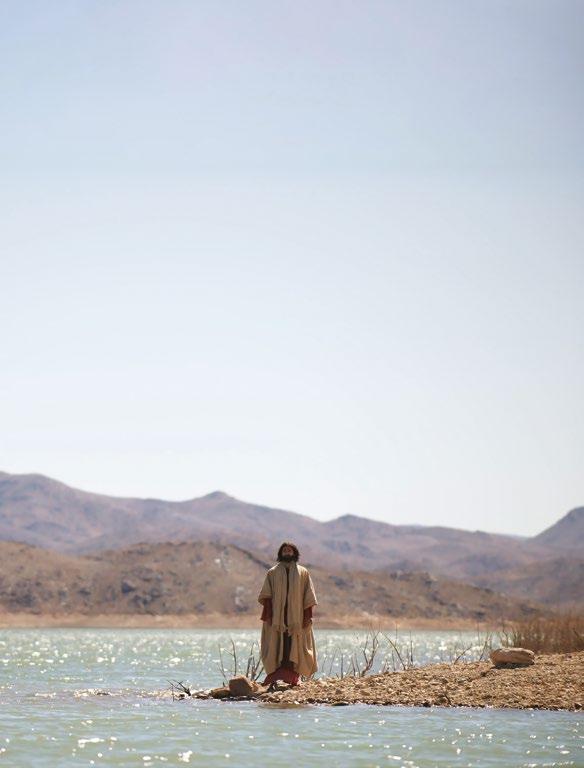
1. ANDREW BRINGS PETER TO JESUS (JOHN 1:35-42)
When Andrew met Jesus through John the Baptist, his first instinct wasn’t to bask in the moment. It was to run to his brother Peter and exclaim, “We have found the Messiah!”
Think about it: Andrew introduces Peter to Jesus. Peter goes on to preach the Pentecost sermon, lead in the early church, and write two letters that shape Christianity. But it all started with Andrew’s introduction.
No jealousy. No sibling rivalry. Just urgency: Peter has to meet Jesus. Andrew didn’t care that Peter would outshine him. His heart was selfless, focused on pointing others to Jesus, even if it meant staying in the shadow. And that perhaps provides the first lesson: Making a difference isn’t about being in the limelight. It’s about lifting others up, about pointing someone else to Christ, even when you don’t get the credit.
Andrew was as average as they come.
2. ANDREW BRINGS THE BOY WITH THE LUNCH (JOHN 6:5-9)
A crowd of thousands gathers, and by the end of the day they are hungry. Jesus asks Philip, who is from the area, how to feed them. Philip panics: “Even six months’ wages wouldn’t be enough to feed this many!”
Then Andrew walks up: “Well, here’s a boy with five loaves and two fish . . . not much, but it’s something.” He knows it’s inadequate, but he brings it to Jesus anyway—and Jesus turns it into a miracle.
Another insight: Faithfulness means offering what you have, even if it feels too small.
You don’t need to have it all figured out. Just offer what you have— your skills, ideas, time, or resources—even if it feels inadequate, and trust that God can use it. Because in Jesus’ hands, inadequate becomes amazing.
ANDREW BRINGS THE GREEKS TO JESUS (JOHN 12:20-22)
During Passover some Greek visitors want to meet Jesus. They approach Philip, but Philip is unsure of what to do. Should he bother Jesus with foreigners? He turns to Andrew, and Andrew doesn’t hesitate. Without missing a beat, he brings them to Jesus.
This moment is groundbreaking. Andrew becomes the first disciple to demonstrate that Jesus is for everyone. No prerequisites. No exceptions. Which brings us to a third message: God’s people build bridges. They make space for others, no matter who they are. They open doors for others to encounter grace.
These stories reveal five qualities of Andrew’s heart, five enduring traits that show us what it means to live with kingdom impact.
A seeking heart: Andrew was spiritually alert and primed for Jesus. When John the Baptist declared, “Look, the Lamb of God” (John 1:29, NIV), Andrew was ready. He followed Jesus that very day and never looked back.
A magnetized heart: Drawn to Jesus, Andrew instantly pulled others along. His first move after meeting Jesus was to find someone with whom to share the good news. Simply put, magnetized hearts don’t hoard Jesus; they share Him. While discipleship begins with encounter, it quickly overflows into invitation.
A selfless heart: Andrew is mentioned throughout the Gospels as “Peter’s brother, Andrew.” Never the other way around. Always the second name on the list. Everyone knew ebullient Peter, but Andrew melted into the crowd, especially when his brother was around.
A lesser person might have resented that. Having lived with Peter, Andrew knew there would be only one seat for him once he brought Peter to Christ: the back seat. But that didn’t matter to Andrew; he introduced Peter anyway.
There are people who will serve only if they can be in charge, who will do ministry only if they get the credit. But true faithfulness doesn’t cling to the spotlight. It gives it away.
An optimistic heart: When others saw problems, Andrew saw opportunities. He saw potential in what seemed insignificant. He believed that even a small offering could become exceptional in God’s hands.
An expansive heart: When foreigners wanted to see Jesus, Andrew didn’t hesitate. Greeks? Outsiders? Bring them in! Andrew didn’t limit who could come to Jesus. He wasn’t a filter or a gatekeeper. He believed the gospel was for everyone, not just people who looked like him or came from his background.
A study by the American Institute of Church Growth found that 80-85 percent of people who come to faith do so through a friend or relative.* Not because of a preacher, program, or event. That’s the Andrew effect: common people. Ordinary relationships. Extraordinary impact.
Andrew was a connector. A bridge between seekers and the Savior.
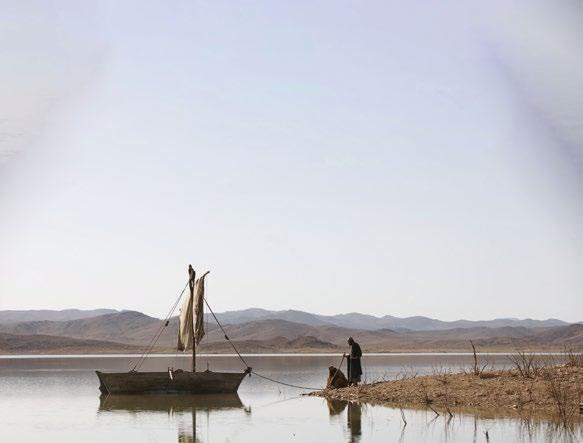
Andrew never headlined. He never wrote a book. He never preached a famous sermon. He never stood in the spotlight. But nations honor him. Churches remember him. And the gospel spread because of him.
His impact was not about prominence, but about presence. Not about visibility, but faithfulness.
You don’t need a title, a stage, or a spotlight to make a difference. You don’t need to be famous to be influential. You don’t need a loudspeaker or a million followers to change lives. You just need to show up and reach out with a heart like Andrew’s.
So right now, think of one person in your life you could invite to experience Jesus. Then take action. It could be an act of kindness, a simple chat about faith, or an invite to a church event. Be an Andrew. Bring them to Jesus.
Because an ordinary person with an extraordinary heart can change eternity.
* G. L. McIntosh, “How Are People Actually Coming to Faith Today?” Biola Magazine, Oct. 31, 2016, retrieved from https://www.biola.edu/blogs/biola-magazine/2016/how-are-people-actually-coming-to-faith-today.
John Wesley Taylor V seeks to be a person with an Andrew heart. Currently he serves as president of Andrews University
prayer is the opening of the heart to God as to a friend. Not that it is necessary in order to make known to God what we are, but in order to enable us to receive Him. Prayer does not bring God down to us, but brings us up to Him.
When Jesus was upon the earth, He taught His disciples how to pray. He directed them to present their daily needs before God, and to cast all their care upon Him. And the assurance He gave them that their petitions should be heard is assurance also to us. . . .
Our heavenly Father waits to bestow upon us the fullness of His blessing. It is our privilege to drink largely at the fountain of boundless love. What a wonder it is that we pray so little! God is ready and willing to hear the sincere prayer of the humblest of His children, and yet there is much manifest reluctance on our part to make known our wants to God. What can the angels of heaven think of poor helpless human beings, who are subject to temptation, when God’s heart of infinite love yearns toward them, ready to give them more than they can ask or think, and yet they pray so little and have so little faith? The angels love to bow before God; they love to be near Him. They regard communion with God as their highest joy; and yet the children of earth, who need so much the help that God only can give, seem satisfied to walk without the light of His Spirit, the companionship of His presence. . . .
Why should the sons and daughters of God be reluctant to pray, when prayer is the key in the hand of faith to unlock heaven’s storehouse, where are treasured the boundless resources of
Satan cannot overcome him whose heart is thus stayed upon God.
There is no time or place in which it is inappropriate to offer up a petition to God. There is nothing that can prevent us from lifting up our hearts in the spirit of earnest prayer. In the crowds of the street, in the midst of a business engagement, we may send up a petition to God and plead for divine guidance, as did Nehemiah when he made his request before King Artaxerxes. A closet of communion may be found wherever we are. . . .
If we would but think of God as often as we have evidence of His care for us we should keep Him ever in our thoughts and should delight to talk of Him and to praise Him.
There is no time or place in which it is inappropriate to offer up a petition to God. There is nothing that can prevent us from lifting up our hearts in the spirit of earnest prayer.
Omnipotence? Without unceasing prayer and diligent watching we are in danger of growing careless and of deviating from the right path. . . .
We should pray in the family circle, and above all we must not neglect prayer, for this is the life of the soul. It is impossible for the soul to flourish while prayer is neglected. . . .
Seventh-day Adventists believe that Ellen G. White (1827-1915) exercised the biblical gift of prophecy during more than 70 years of ministry. This excerpt is taken from Steps to Christ, pp. 93-102.
Dick Duerksen


iwas just praying that I wouldn’t feel the pain of being killed.”
AN UNAVOIDABLE COLLISION
The Historic Columbia River Highway, U.S. 30, is a narrow two-lane road that winds through the mountains on Oregon’s side of the Columbia River. Thick stands of tall cedars tightly hug much of the road, but some of the trickiest sections run along mountain shoulders where stone walls rise high above the road or fall hundreds of feet toward the river below. It’s a favorite travel route for tourists who love mountains and for local teenagers who sometimes use it to test their driving skills. Michelle, with two of her friends, had chosen it as a perfect place to wind down after a hard day. Michelle sat in the front passenger seat as they drove through one of the curvy sections, driving “just a bit above the limit.”
Suddenly two cars came around the curve ahead of them, speeding directly at Michelle and her friends.
“We hadn’t seen them, and they couldn’t have seen us, and now there was less than a car length between us,” Michelle remembers as she tells me the story.
She looked over at her friend in the car and said, “This is it. We’re gonna die.”
Both cars were red. One with a white racing stripe coming down the top and across the hood. The other was a very bright red color. Both were racing at more than 70 miles per hour.
“I can still see the colors and feel the speed.” Michelle’s hands shake as she relives the story years later. “There was a steep rocky embankment on the driver’s side, and my side fell hundreds of feet down toward the river. There was nowhere to go. We were gonna die.”
No one had time to “bow your head and pray.” There was no time to say, “Dear Jesus.” But Michelle’s car filled with prayers.
Michelle closed her eyes and waited, hoping, she remembers, “that I wouldn’t feel the pain of being killed.”
Instead of the sounds of a deadly crash, a powerfully loud snapping and sizzling sound filled the air, along with the strong odor of sulfur. Then everything went very quiet.
“I opened my eyes,” says Michelle, “and saw that the car with the white stripe, the one that had been coming right at me, had somehow flown over our car and was now far over on the other side of the road. It was as if something had lifted the striped car up and moved it over us.”
Michelle’s friend had slammed on the brakes as soon as she saw the cars speeding at them. Now, with both red cars behind them, they drove very slowly ahead. Her friend seemed to be in a trance; her eyes were open, staring at the road, her hands gripping the steering wheel, her voice silent.
They drove that way, silent and overwhelmed, the next mile up to the Vista House at Crown Point.
“Crown Point is a beautiful lookout over the Columbia River Gorge between Washington State and Oregon,” Michelle smiles, “but I didn’t see any of the beauty that day. I did pinch myself a couple times, though, just to be sure I was really still alive.”
As the girls were getting out of their car, a big black jacked-up truck with giant high wheels pulled up beside them. Another big black monster truck pulled in behind it. The doors flew open on both trucks, and about a dozen kids came flying out.
“Did you see the white hand? Did you see the white hand that picked up the striped car and moved it over yours and into the other lane? Did you see it?”
Michelle and her friends just stared while they listened in amazement as the kids told the story.
“We saw this big white hand come down out of the forest, down out of the sky, and it took up the striped car and moved it over your car. Did you see it?”
The kids were all shouting over each other, waving wildly and describing the big white hand that came down and picked up the car. Nine kids, all talking at once.
“No,” Michelle said. “No, I didn’t see anything. I had my eyes closed. But did you smell the sulfur?”
“Yes, I smelled the sulfur,” one of the kids said.
Another added that he had heard a zap and sizzle, along with a really loud snapping sound.
Michelle and her friends, and all nine of the kids from the black trucks, talked there in the parking lot for a very long time. Until one boy told everyone to stop and listen to him.
“My dad is a pastor,” he said, “and my old man’s been telling me about God for years. I’ve never believed him. Now I believe. That had to be the hand of God or the hand of an angel. Something divine!”
PARKING LOT REVIVAL
“Anybody have a Bible?” one of the teenagers asked.
“I’ve got one in the car,” Michelle answered.
Michelle got her Bible, came back to the group, and led a mini revival right there in the parking lot.
“All these teenagers were believing in Jesus Christ,” Michelle tells me. “We were going through verse after verse, talking about how God protects His children, and praising Him together. After a while they all decided they wanted to go back to Portland, go to the boy’s church, and get baptized by his pastor dad.”
After the teenagers roared away, Michelle and her friends went back to the car and checked to see if there were any scratches or anything else that would show they had almost died. There were no marks anywhere, except on their hearts.
She looked over at her friend in the car and said, “This is it.
We’re gonna die.”
“That was an enormous experience,” Michelle remembers. “Imagine if that striped car had crashed into me at 70 miles an hour! We all would have died! There’s just no other way around it.
“God saved my life, and these kids were witnesses to it. I wish I’d had my eyes open so I could tell you exactly what happened, but I was too chicken. I did see it, though, through the eyes of nine teenagers, and because of them this memory is one of the greatest things I’ve ever experienced.
“I wish I could have joined them to celebrate their giant baptism. That would have been awesome.”
Dick Duerksen is a pastor and storyteller living
in Portland, Oregon, United States.

Does Revelation 12:17 really identify the Seventh-day Adventist Church as the remnant?
nowhere does the Bible identify a specific church by name. Several clues are given to help identify “the remnant” (Greek loipos), however. To find these clues, it is helpful to look at the context.
In Scripture God’s people are frequently likened to a woman (Isa. 54:6; Jer. 3:20; Zeph. 3:14; 2 Cor. 11:2). In Revelation 12:1 we see a pure woman clothed with the sun. This contrasts with a harlot woman dressed in purple, scarlet, and decked with jewelry (Rev. 17:4). The two women of Revelation are opposites: The pure woman is faithful to God; the harlot is unfaithful. The pure woman symbolizes God’s true people and a faithful Christian church, the harlot an apostate church.
Revelation 12 describes God’s faithful church through history. The pure woman flees into the wilderness to escape persecution; there she is nourished by God for 1,260 prophetic “days,” or years (Rev. 12:6, 14; cf. Dan. 7:25). The harlot, also in the wilderness, is “drunk with the blood of the saints” (Rev. 17:6), showing that millions of faithful Christians would be martyred through the centuries from A.D. 538 to 1798. This is symbolically described as the serpent pouring “water like a river out of his mouth after the woman, to sweep her away” (Rev. 12:15, ESV). This flood of water is later identified as “peoples, multitudes, nations, and tongues,” representing the persecuting powers of Europe (Rev. 17:15). “But
the earth helped the woman . . . and swallowed up the flood” (Rev. 12:16), symbolizing a more sparsely populated area of the earth. Toward the end of this long period of persecution, in the seventeenth century, Christians began fleeing to America, eventually establishing a government that would uphold religious liberty.
Revelation 12:17 describes what happens next: “the dragon was enraged with the
spirit of prophecy” (Rev. 19:10). There is only one Christian group that arose at the right time (after 1798), in the right place (America), who keep the Sabbath, and have received the gift of prophecy (through the prophetic ministry and writings of Ellen G. White)—the Seventh-day Adventist Church. This is not an arrogant claim, because God raised up the remnant—not because they were better Christians, but to fulfill prophecy and
There is only one Christian group who arose at the right time, in the right place, who keep the Sabbath, and have received the gift of prophecy.
woman [faithful Christians], and he went to make war with the rest of her offspring, who keep the commandments of God and have the testimony of Jesus Christ.”
The “rest of her offspring” refers to an end-time group of Christians having two characteristics. First, they keep all God’s commandments, including the fourth, which identifies the seventh day (Saturday) as the Sabbath (Ex. 20:8-11; cf. Gen. 2:1-3; Heb. 4:4, 9-11). Second, they have “the testimony of Jesus,” which is “the
complete the gospel commission (Matt. 24:14; 28:18-20). Further, the remnant church is also described as the flawed church of Laodicea (Rev. 3:14-22). But prophecy will be fulfilled, and “those who keep the commandments of God and the faith of Jesus” (Rev. 14:12) will be ready for that day.
one question continues to surface quietly but persistently. In a world filled with constant noise, how will the message of Christ be clearly heard? The issue is not how loud we speak, but whether we are speaking together. Repetition goes only so far. What gives weight to our witness is alignment. Multiple voices in a room sound confusing. The world needs one voice that is clear, steady, and true.
We find our direction in Scripture. The final proclamation in Revelation is described as a message given “with a loud voice” (Rev. 14:9). But the emphasis is not on sound, but on clarity— one voice that speaks with authority. It is a message shaped by Scripture and centered in Christ, expressed through a church that understands why it exists and what it has been called to do.
the purpose that guides us and less from the tools we use.
The world needs not more content but more meaning. Jesus made the mission clear: “This gospel of the kingdom will be preached in all the world as a witness to all the nations, and then the end will come” (Matt. 24:14). The promise stands—the responsibility remains.
What is needed now is a church that recognizes the moment it is living in. Not waiting for ideal conditions. Not divided in effort. But moving forward, because it trusts the Word it proclaims.
This is how OneVoice27 should be understood at its core. This is not simply an organized effort—another church initiative. It is a moment in history that calls us forward, to move together. OneVoice27 marks 2,000 years since the baptism of Jesus and the beginning of His ministry. Our focused emphasis will be in September 2027. The invitation is simple and direct—use every available means to lead people back to the Bible as we announce Jesus’ soon return. The strength of this movement will come more from
Movements such as these must be born out of consecration instead of relying on business as usual. Before anything reaches the public space, it must take root in the private life. Ellen White expressed this directly: “We must do something out of the common course of things. We must arrest the attention. We must be deadly in earnest.”* This is a call for creativity, but even more, it is a call for seriousness before God. What is needed now is a church that recognizes the moment it is living in. Not waiting for ideal conditions. Not divided in effort. But moving forward, because it trusts the Word it proclaims. A loud voice will be heard only when it becomes one voice The message is ready. The world is waiting. Are we prepared to speak as one? Are you in?
* Ellen G. White, Evangelism (Washington, D.C.: Review and Herald Pub. Assn., 1946), p. 122.
Founded 1849. Published by the General Conference of Seventh-day Adventists, Northern Asia-Pacific Divison
PUBLISHING BOARD
Erton Köhler, chair; Pierre E. Omeler, vice chair; Justin Kim, secretary; Audrey Andersson, G. Alexander Bryant, Zeno CharlesMarcel, Sabrina DeSouza, Paul H. Douglas, Mark A. Finley, James Howard, Leonard Johnson, Mario Martinelli, Richard E. McEdward, Magdiel Perez Schulz, Artur Stele, Alyssa Truman, Ray Wahlen, Todd R. McFarland, legal advisor
MANAGEMENT BOARD BASED IN SEOUL, KOREA Soon Gi Kang, chair; Justin Kim, secretary; Todd R. McFarland; SeongJun Byun; Toshio Shibata; Tae Seung Kim; Ray Wahlen; Greg Scott; Ex-officio: Paul H. Douglas; Erton Köhler; Richard E. McEdward
EDITOR Justin Kim
ASSOCIATE EDITORS Shawn Boonstra, Sikhululekile Daco
ASSOCIATE DIRECTOR Greg Scott
ASSISTANT EDITORS Hannah Drewieck, Beth Thomas, Jonathan Walter
EDITORS BASED IN SEOUL, KOREA Jae Man Park, JaeMyung Cho, SeongJun Byun
NEWS CORRESPONDENT Marcos Paseggi
FINANCE MANAGER John F. Feezer IV
DIRECTOR OF SYSTEMS INTEGRATION AND INNOVATION Daniel Bruneau
ART DIRECTION AND DESIGN Brett Meliti, Ellen Musselman/Types & Symbols
CUSTOM TYPEFACE DESIGN RK Type
COPY EDITOR James Cavil
EDITORIAL ASSESSMENT COORDINATOR Marvene Thorpe-Baptiste
KIDSVIEW DESIGN Merle Poirier
AD SALES Glen Gohlke
DISTRIBUTION Sharon Tennyson
WEBSITE: www.adventistreview.org
TO WRITERS: Writer’s guidelines are available at www.adventistreview.org at the footer. For further correspondence, email manuscripts@adventistreview.org.
Unless otherwise noted, Bible texts in this issue are from the New King James Version. Copyright © 1979, 1980, 1982 by Thomas Nelson, Inc. All rights reserved. Bible texts credited to NIV are from the Holy Bible, New International Version. Copyright © 1973, 1978, 1984, 2011 by Biblica, Inc. Used by permission. All rights reserved worldwide. Bible texts credited to NRSV are from the New Revised Standard Version of the Bible, copyright © 1989 by the Division of Christian Education of the National Council of the Churches of Christ in the U.S.A. Used by permission. Scripture quotations marked ESV are from The Holy Bible, English Standard Version © 2001 by Crossway, a publishing ministry of Good News Publishers. ESV Text Edition: 2016. Used by permission. All rights reserved. Scripture quotations marked NASB are from the New American Standard Bible, copyright © 1960, 1971, 1977, 1995, 2020 by The Lockman Foundation. All rights reserved.
The Adventist Review (ISSN 0161-1119) is the general paper of the Seventh-day Adventist® Church. It is printed simultaneously around the world in Argentina, Australia, Austria, Brazil, Germany, Indonesia, Korea, Mexico, South Africa, and the United States. It is published monthly by the General Conference of Seventh-day Adventists®, 12501 Old Columbia Pike, Silver Spring, MD 20904, U.S.A. The Korean editorial and business offices are located at the Northern Asia-Pacific Division, 67-20 Beonttwigi-gil, Paju-si, Gyeonggi-do 10909, Republic of Korea. Copyright © 2026, General Conference of Seventh-day Adventists®.
Erton C. Köhler is the president of the General Conference of Seventh-day Adventists.

As the world becomes overwhelmed with information, as consumer brands evolve their approach, and as content producers saturate the market, it is becoming increasingly important to find a way to help people know we are all Seventh-day Adventists.
Help people quickly and easily recognise we are all Seventhday Adventists. Download logos, church bulletin templates, PowerPoint templates, stationery design and more.