Dr Eddie Tupa’i President, New Zealand Pacific Union Conference
So what might wise stewardship of power look like in the church? It looks like leaders who influence through truth, love and patience rather than pressure.
Power in the church is a reality to be stewarded with responsibility and care. Every time a board makes a decision, every time a pastor sets direction, every time a member speaks up, power is present. The question is never whether power exists. The question is whether it is being exercised in the way of Jesus.
God is all-powerful. Yet God does not wield power like the kingdoms of this world. From the beginning He created human beings in His image, entrusting us with real agency—real choices, real responsibility, real participation in the shaping of life. Human power, then, is not something to seize. It is something given—and therefore something to be stewarded.
That stewardship is meant to reflect God’s character. Scripture describes the life God intends not as domination but as flourishing shaped by love—the fruit of the Spirit: love, joy, peace, patience, kindness, goodness, faithfulness, gentleness and self-control (Galatians 5:22,23). If the exercise of authority in the church consistently produces fear, division or humiliation, we should not call it “strong leadership”. We should call it what it is: a drift away from the kingdom of God.
Jesus gives the clearest map for stewarding power in the Sermon on the Mount (Matthew 5–7). In a world trained to admire the forceful, Jesus blesses the meek. In a culture of retaliation, He calls us to mercy and enemy-love. In a society driven by status, He speaks of secret prayer, integrity and quiet faithfulness. Jesus is not naïve about evil. He is revealing a different kind of strength—one that refuses to crush others in order to win.
The apostle Paul adds a sharp corrective: “In Christ there is neither Jew nor Greek . . . slave nor free . . . male nor female” (Galatians 3:28). This is not a denial of difference; it is the dismantling of any spiritual justification for superiority. No ethnicity is closer to God. No culture has a higher rank. No person is any more the image of God than another. That means the way we use power in the church must honour dignity rather than assert rank; dignify rather than diminish; invite participation rather than demand compliance.
The Bible is also honest about what happens when power is mishandled. Saul shows how insecurity becomes control—afraid of losing his position, he disobeyed God, scapegoated his rivals and spiralled into a reign defined by fear rather than faith. David warns us that a leadership calling does not cancel temptation—chosen and anointed, he still used the cover of power to take what was not his, with consequences that rippled through his family and kingdom for generations. Solomon shows how wisdom can be hollowed out by accumulation—he began with a prayer for discernment, but prosperity and unchecked appetite gradually eroded what God had given him. The Bible includes such examples not as exceptions, but as mirrors.
So what might wise stewardship of power look like in the church? It looks like leaders who influence through truth, love and patience rather than pressure. It looks like meetings where quieter voices are heard, not just the confident. It looks like decision-making that makes space for conscience and prayerful discernment, rather than urgency that silences questions. It looks like leaders who see authority as a trust held for the body, not a possession held over the body. And here is the hopeful promise: right stewardship of power produces unity. Unity does not mean uniformity. It means the diverse gifts of the body can function without fear. It means we can disagree without contempt. It means the church becomes a safer place for truth-telling, confession and fresh obedience. It means we are sharpened together—not by rivalry, but by mutual submission to Christ.
So here is a question worth carrying into our next meeting, our next decision, our next crucial conversation: Is the way I am using power creating freedom and growth in others—or is it controlling and shrinking them? May the Holy Spirit form in us the leadership of Jesus—so that in every level of the church, power is stewarded in love, and unity becomes our witness.
Medical mission
Brett Goods CEO Adventist HealthCare
From as early as 1973, Sydney Adventist Hospital (the San) sent volunteer medical outreach teams to developing countries to provide surgery, training and health education. Initially medical outreach teams travelled sporadically to Atoifi in the Solomon Islands. Then in the mid-1980s, at the initiative of San nurse Russell Lee, the San officially launched Operation Open Heart—with regular, coordinated cardiac surgical teams visiting Tonga and further afield.
Volunteer San nurses and doctors, as well as medical personnel from other hospitals, are eager to participate in this life-changing, life-saving work. Each team member pays their own way, often using their annual leave to take part— saying these trips are life changing personally as well as for those they serve.
As the outreach program expanded, it was renamed Open Heart International (OHI). More than 6000 patients have received free surgery in 16 countries including Mongolia, Vietnam, Fiji, Myanmar, Cambodia, Nepal, Vanuatu, Tanzania and Rwanda. Services expanded from cardiac surgery to eye surgery, reconstructive surgery (burns and cleft palate) and women’s health.
OHI is a key missional outreach of the San. The program is being reinvigorated following the pandemic disruption and will now predominantly focus on the South Pacific. In March, OHI had a successful surgical trip to PNG, operating on children with congenital heart defects. Seeing children run around smiling and laughing the day after heart surgery is particularly special, when for years they’ve failed to thrive due to significant heart defects.
Knowledge-sharing and skill-building are essential elements of OHI trips. Over time and with repeated trips, OHI teams support local doctors and staff to become more self-sufficient. Medical personnel from developing countries sometimes come to Australia for periods of further training.
The San is very proud of Open Heart International, and we look forward to continued engagement with our South Pacific neighbours in their particular areas of need. It is indeed a privilege and a blessing to be involved in volunteer medical outreach. We invite your continued prayers and support for this key missional program of the San. For more information, visit <ohi.org.au>.
Adventist Heritage Centre opens at Fulton
Nadi, Fiji | Jane Gibson-Opetaia/Record staff
The opening of the Adventist Heritage and Archives Centre at Fulton Adventist University has marked a significant milestone in preserving the Adventist story in the Pacific.
Officially opened on April 26 by South Pacific Division (SPD) president Pastor Glenn Townend, the centre is located beneath the Fulton Chapel and represents the first substantive outcome of the Pacific Adventist Identity Records (PAIR) project initiated by the Trans Pacific Union Mission (TPUM).
Pastor Townend affirmed the importance of intentionally preserving the Church’s history and legacy, noting that safeguarding records and stories is essential to strengthening identity and mission for future generations.
TPUM president Pastor Charlie Jimmy highlighted the strategic significance of the initiative, describing the new centre as “not just a records
system, but a discipleship tool—one that strengthens identity, connects generations and ensures that the faith journey of our people is not lost, but multiplied”.
The opening program reflected a intergenerational worship and witness, featuring items from the student cohort at Fulton University through the brass band and group Resounding Faith, highlighting the role of young people in carrying the Church’s story forward.
Fulton University vice chancellor, Professor Ronald Stone, said the university was committed to creating a space where the stories of mission across the Pacific could be displayed and shared.
The Centre marks the first step toward the formation of a full Heritage Visitors’ Centre, to be incorporated into the Fulton Auditorium currently under construction adjacent to the chapel.
SPD launches global OneVoice27 initiative
Brisbane, Queensland | Jarrod Stackleroth
The South Pacific Division (SPD) launched global Adventist Church initiative OneVoice27 at the South Pacific for Christ event at Watson Park Convention Centre.
The launch was part of the Wednesday night program at South Pacific for Christ and featured an explanatory video, some information on what the program would entail, a dedicatory prayer and a challenge to gathered church leaders that everyone should be involved.
OneVoice27 will run throughout 2027 to commemorate 2000 years since Jesus’ baptism.
Church leaders hope it will be a movement of Adventists across the world who are unified in sharing Jesus using any means all with one voice. While the campaign will rely on media, there are many ways to be involved.
“What if your church, your members, your community and your screen was part of something bigger,” said Adventist Media CEO Dr Brad Kemp during the introduction of the seg-
ment.
“In every person’s hand there is a communication device or perhaps I should say an evangelism tool.”
With an emphasis on media evangelism, the program will take place in person as well, climaxing in “harvest” events in September 2027.
The video featured SPD leaders and representatives, who filled in details about what the campaign will achieve and look like in the SPD.
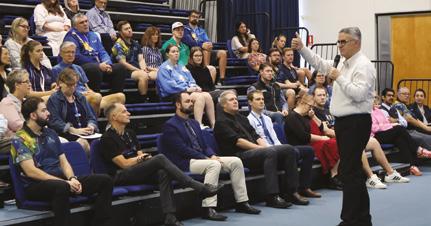
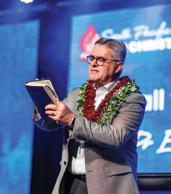
Then Pastor Maveni Kaufononga, SPD vice president, took to the stage to challenge attendees and to announce the theme of the campaign: “All things new—Hope starts here”.
Pastor Kaufononga announced that each union would decide exactly how the program would look, but that the teams would need the right training. Each division will also send 10 content creators to the GC in July to be part of a OneVoice27 content creator summit. Pastor Erton Köhler, General Conference president, led a prayer of dedication for the initiative.
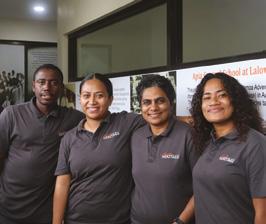
Staff at the Heritage Centre.
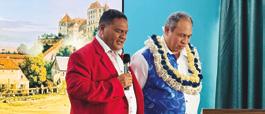
Pastor Maveni Kaufononga challenges attendees. Credit:Charmaine Patel
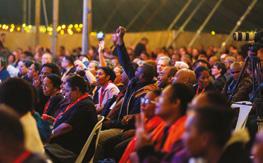
The audience responds. Credit: Charmaine Patel
TPUM names new leaders
The South Pacific Division (SPD) Executive Committee, in partnership with the Trans Pacific Union Mission (TPUM) Executive Committee, has announced a series of leadership appointments and transitions.
Pastor Clive Tefaatau has been appointed TPUM vice president and will also take on the ministerial secretary responsibilities previously held by Pastor Sione Ausage. Pastor Tefaatau brings 27 years of pastoral and departmental service, having entered ministry in 2000. His experience spans local church pastoral leadership, youth ministries direction, district coordination and cross-cultural ministry.
Talonga Pita has been appointed general secretary, transitioning from education leadership into senior administration. With more than 35 years of denominational service, Mr Pita has served across all four unions of the SPD, contributing extensively to education, governance and mission development.
The TPUM Executive Committee
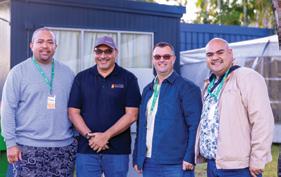
also expressed their appreciation for the contribution of Pastor Sione Ausage, who has given 32 years of service in pastoral ministry and leadership roles across the Pacific. On behalf of the missions and institutions, TPUM president Pastor Charlie Jimmy expressed thanks, formally farewelling Pastor Ausage, who accepted a call to the Northern Australian Conference.
The wives and families of the leaders were also recognised for their support and contribution.
The TPUM Executive Committee also advised that it will work prayerfully to consider suitable candidates for the positions of education director and media and communications officer, ensuring future appointments align with the Union’s strategic priorities and mission focus.
During the meetings, SPD president Pastor Glenn Townend offered special prayer for the TPUM leadership team, affirming their calling, shared responsibility and commitment to serve with unity, humility and faith.
ADRA aids 137 households after cyclone
Western Province, Solomon Islands | Denver Newter
In the wake of Cyclone Maila, the Adventist Development and Relief Agency (ADRA) Solomon Islands has responded to 137 households across three of the most affected villages in South Kolombangara, Western Province.
The villages—Poporo, Ghatere and Vavanga—were identified through ADRA assessments as among the hardest hit.
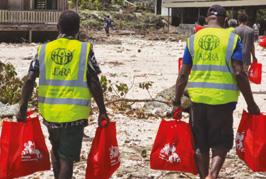
Poporo (20 households), Vavanga (73 households) and Ghatere (44 households) received non-food items (NFIs), food supplies, hygiene kits and blankets. The distribution was carried out by ADRA Solomon Islands in partnership with World Vision Solomon Islands (WVSI), with additional support from the Western Sub Mission of the Seventh-day Adventist Church.
ADRA Solomon Islands worked closely with the National Disaster Management Office (NDMO) in Honiara to deliver NFIs and hygiene kits across
Western Province, supporting rapid response efforts in affected Kolombangara communities.
The agency also collaborated with the Provincial Disaster Operations Centre (PDOC), the Western Provincial Government and other stakeholders to conduct assessments in severely affected villages on Vella Lavella. In partnership with WVSI, ADRA delivered NFIs to these communities.
In response to the disaster, ADRA activated its emergency response plan and worked alongside the Provincial Emergency Operations Centre (PEOC) and NDMO in Gizo to provide timely assistance.
ADRA Solomon Islands is now coordinating with partners and donors to support ongoing recovery efforts across Kolombangara, Simbo, Ranongga and Vella Lavella, while maintaining strong collaboration with PEOC and NDMO.
Suva, Fiji | Jane Gibson-Opetaia
ADRA workers supply essential items.
Tongan president Pastor Fanueli Mataele prays for Pastor Sione Ausauge.
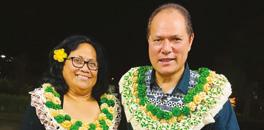
Talonga and Teeraineta Pita.
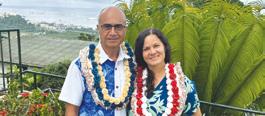
Pastor Clive and Mirella Tefaatau.
South Pacific for Christ launched
Around 1000 leaders and members from across the South Pacific Division gathered at Watson Park Convention Centre in Brisbane, Australia, for the launch of South Pacific for Christ, a five-year initiative aimed at refocusing the Seventh-day Adventist Church on its core purpose for mission.
The event, which ran from April 28 to May 2, opened with a ceremony that set the tone for the week ahead, featuring symbolic moments that highlighted both the diversity and shared calling of the Division.
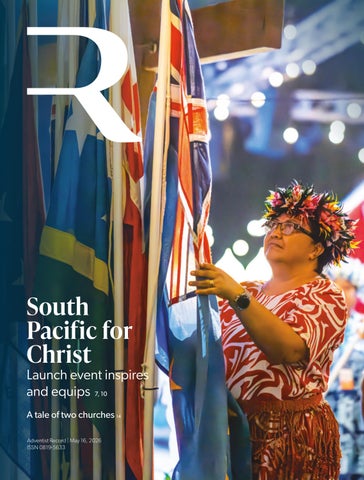
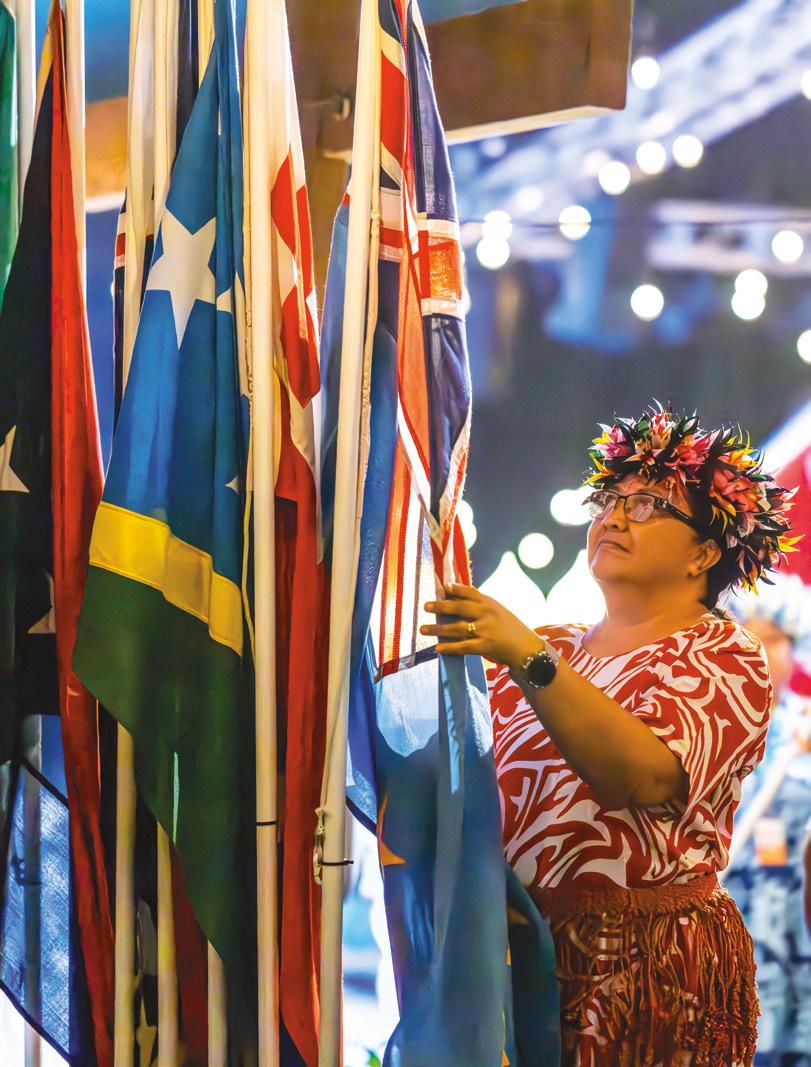
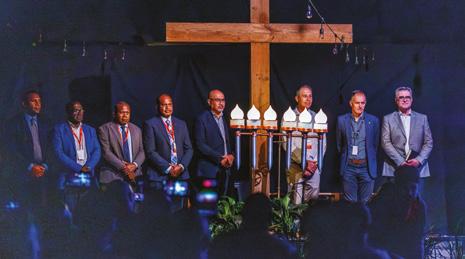
A torch ceremony acknowledged church leaders, with each flame signifying a territory diverse in culture, language and geography, yet united in one purpose—to proclaim the name of Jesus Christ. This was followed by a flag parade that celebrated the many islands of the South Pacific. Audience members cheered as each country was represented on stage, calling out greetings in their own languages.
“Seeing the Vanuatu flag being raised was an honour,” Teouma Ville church leading elder Jackson Miake said. “It’s a celebration of what God is doing despite different cultures that we come from.”
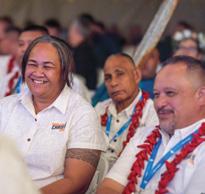
A garland ceremony concluded the segment, with floral garlands placed on leaders from the General Conference and South Pacific Division as a sign of honour, affection and protection. The program also included worship and mission stories from across the region, demonstrating how God is already at work in local communities.
General Conference president Pastor Erton Köhler addressed attendees and encouraged them to be bold in their approach to mission. “Let’s go beyond the ordinary,” he said. “We are here to do great things for God and to expect great things from God.”
Organisers emphasised the initiative was not simply an event, but an invitation to be inspired, stretched and part of something that matters. Attendees heard sermons and testimonies and took part in workshops designed to equip them as disciple-makers and refocus the Church on its purpose.
The opening ceremony was viewed by hundreds online from various parts of the Pacific. Evening worships were livestreamed on the South Pacific for Christ YouTube channel and the Adventist Media Facebook page, allowing members across the region to be a part of what God is doing.
making headlines
Peru beats blood goal
The Adventist Church in Peru collected 72 units of blood in a one-day community health campaign promoted by Nuevo Tiempo Perú, surpassing its initial goal by 12 units. The donations were delivered to the Cajamarca Hospital’s blood bank, helping meet urgent needs in a facility that requires around 80 units each month.—SAD
Cuts of kindness
A new ADRA Russia program is giving participants free hairdressing training and professional kits. After completing the two-month course, graduates volunteer at the “Kind Heart” centre, offering free haircuts to people in need.—ESD
Motorbike mission
Adventist youth in Angola (Africa) marked Youth Week of Prayer with the “Solidarity Motorbike Taxi” initiative, where 24 motorbike taxis gave 703 free rides across the community while distributing evangelistic leaflets. The initiative reflects their broader approach to outreach by meeting people in everyday settings.—SID
Walk your brain young
Researchers at the AdventHealth Research Institute found that regular, moderate aerobic exercise in younger and midlife adults helped brains appear structurally younger than expected, suggesting movement can support long-term cognitive health before any decline begins. Unlike previous studies focused on older adults, this randomised study showed that simple, consistent activity like walking, swimming or cycling directly influenced brain ageing.—Adventist Review
Church leaders carried a torch for each region. Credit: Charmaine Patel
Brisbane, Queensland | Zanita Fletcher
Educators inspired by president’s visit
Northpine Adventist College (Brisbane, Qld) had a special guest lead staff worship on Friday—General Conference president Pastor Erton Köhler! While not originally part of his schedule, Pastor Köhler was pleased to be invited to visit the school and spend time with staff. Northpine is located on the same campus as the South Pacific for Christ launch was held. “I have a good impression of everything that’s happening here, the Lord is using you,” Pastor Köhler said. “More than [presenting] a message, I came here today to express gratitude to you for your faithful work to God’s cause.” Reflecting on the story of the Good Samaritan, Pastor Köhler focused on the innkeeper and his role in caring for the wounded man, drawing a parallel to the caring role of educators.—Tracey Bridcutt
Church supports displaced families
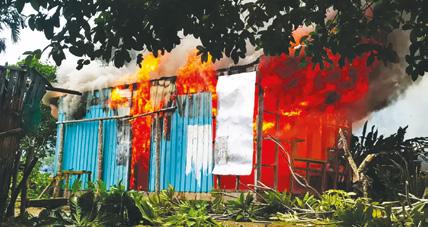
More than 22 families were left homeless following a devastating conflict between two communities from mid-March to the beginning of April in the Nanuk area of East New Britain Province (Papua New Guinea). The affected families, whose homes were burned down during the unrest, sought refuge at the Nanuk Adventist Church grounds. In response, churches from the Kokopo District under the New Britain New Ireland Mission quickly mobilised to support those impacted. For now, the affected families will continue to stay within the church grounds until tensions in the area subside, and the church remains actively engaged in providing ongoing support and urges other churches to continue praying for the victims —Trevor Maino
New school bus
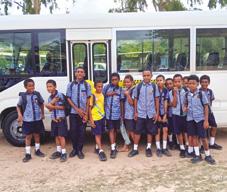
Carr Memorial Seventh-day Adventist School, Port Moresby (PNG), has officially dedicated a new school bus aimed at improving staff transportation and strengthening its education and ministry outreach. The new vehicle will serve multiple purposes, including staff transportation, school administration and supporting church-related programs. With a total of 45 teachers and support staff, 90 per cent of whom are women, the bus is expected to significantly improve daily commuting and operational efficiency.—Rose Maine Sinias
Lest we forget
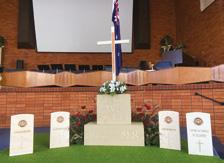
Avondale Memorial Church (NSW) celebrates and remembers Anzac Day every year. A plaque in the foyer acknowledges those who gave their lives in both world wars. A cenotaph designed and set up by Ray Boehm and John Dose, together with magnificent floral displays, tastefully set the tone in the pulpit area. Guest speaker for the day, Pastor Lloyd Grolimund, the Aussie Pastor, preached a powerful sermon on righteousness by faith alone.—Joy Butler
SIM visits PM
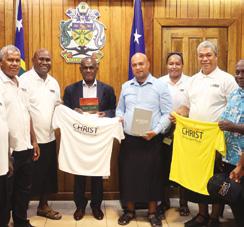
Solomon Islands Prime Minister Jeremiah Manele has welcomed the upcoming Solomon Islands for Christ initiative following a visit from a Seventh-day Adventist Church delegation on April 24. The delegation, led by Solomon Islands Mission general secretary Pastor Linray Tutuo, shared details of the nationwide program, which will run from July 5–18. They presented the Prime Minister with a Bible, an Andrews Bible Commentary and official “Mission 2026” apparel.
They briefed the Prime Minister on key lead-up programs, including a national health expo which will be held in Honiara in May, with simultaneous programs in provincial centres. More than 350 health personnel are expected to participate, providing free health services.
Prime Minister Manele thanked the Church for its continued prayers and longstanding contributions to the country, particularly in the areas of health and education. He acknowledged the role of churches in supporting the spiritual wellbeing of communities. “Transformation begins with individuals, and I am encouraged to see the Adventist Church taking a leading role in supporting our people and complementing the work of government,” he said. He also emphasised the importance of partnerships between churches, government and other stakeholders in strengthening communities and promoting unity across the country. The visit concluded with prayer.—Solomon Islands Mission
have news to share?
Send info and photos to <news@record.net.au>
Literacy training program
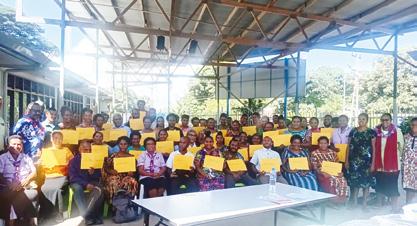
The Central Papua Conference, in partnership with the wider Adventist Church in Papua New Guinea, continues to demonstrate its commitment to mission and community development through an adult literacy training program. A total of 55 out of 57 Level 1 Adult Literacy teachers graduated from a Phase 2 training held at Gordon’s Seventh-day Adventist Church. Through the initiative, participants are trained as missionary literacy teachers who will return to their local churches to assist both members and community residents in developing reading and writing skills, with a strong focus on Bible literacy and Christian education.—Rose
Maine Sinias
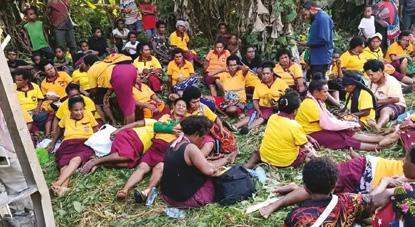
Mothers injured in accident
Members of Morata Seventh-day Adventist Church, Papua New Guinea, are appealing for prayers after several Adventist Community Services (ACS) mothers sustained serious injuries in a road accident along the Brown River section of the Hiri Tano Highway (April 29). The mothers were returning from Vanapa after visiting their branch church pastor during a ministry fellowship trip when the accident occurred. According to information gathered from church members and videos shared from the scene, several individuals suffered serious injuries, mainly to their heads and arms. Three St John Ambulance units responded to the scene and assisted the injured. At the time of reporting, the number of injuries and the full circumstances surrounding the accident had not yet been officially confirmed.—Rose Maine Sinias
Photo credit: Charmaine Patel
. . . one another (reciprocal pronouns)
Warm words, inclusive words! The apostle Paul, whom some regard as a stern character, used these words in most of his letters in his admonition and encouragement to the churches.
And it was none other than Jesus Christ who said, “A new commandment I give to you, that you love one another; as I have loved you, that you also love one another. By this all will know that you are My disciples, if you have love for one another” (John 13:34,35). Jesus reminded His listeners of this command in John 15 when He spoke about love and joy being perfected (v12,17). So let us see in what context Paul, as well as Peter and James, used this term.
Toward the end of his letter to the Romans where Paul gave practical counsel to the church, he used these reciprocal pronouns to reinforce Christian principles.
In chapter 12 verse 10, a beautiful text, he counsels, “Be kindly affectionate to one another with brotherly love, in honour giving preference to one another.” Then, several verses later, he says, “Be of the same mind to one another.” A suggestion to exercise Christian tact and courtesy?
Paul continues his “one another” counsels later in Romans where he says that the church in Rome, and everywhere for that matter, should “be like-minded toward one another,” should “accept one another” and even “admonish one another” (15:5,7,14).
His last use in Romans of one another is where he says, “Greet one another with a holy kiss” (16:16).
In this article I will refer to Bible books that include the phrase under consideration more than once. So we turn now to Paul’s letter to the Galatians. In this book, Paul introduces the concept of service for each other. In chapter five, verse 13 he says, in part, “but through love serve one another”. And then, in 6:2, he says, “Bear one another’s burdens, and so fulfil the law of Christ.”
In the beautiful book of Ephesians (4:2), many people’s favourite, we find further counsel concerning the relationship we should have with one another: “with all lowliness and gentleness, with longsuffering, bearing one another in love”. Obviously, Paul had in mind the ideal church, when he said, “And be kind to one another, tender-hearted, forgiving one another, just as God in Christ also forgave you”
(4:32). And in chapter five, verse 19, “speaking to one another in psalms and hymns and spiritual songs, singing and making melody in your heart to the Lord”.
Whenever differences arise, let us call to mind Paul’s counsel in Ephesians 4:25, where he says, “Therefore, putting away lying, each one speak truth with his neighbour, for we are members of one another.”
Paul continues this theme in his letter to the church at Colossae, where he continues the one another counsel in chapter three: “Bearing with one another, and forgiving one another, if anyone has a complaint against another; even as Christ forgave you, so you also must do” (v13). And, three verses later: “Let the word of God dwell in you richly in all wisdom, teaching and admonishing one another in psalms and hymns and spiritual songs, singing with grace in your hearts to the Lord.”
And now I refer to another biblical writer to the early church, James, who became its leader. He gives some pointed counsel to the church in general. Note chapter four, verse 11: “Do not speak evil of one another, brethren.” Chapter five contains several one another admonitions, where he says, first, in verse nine, “Do not grumble against one another, lest you be condemned. Behold, the Judge is standing at the door!” And then, in verse 16 we read of the relationship we should have amongst fellow church members: “Confess your trespasses to one another and pray for one another, that you may be healed. The effective, fervent prayer of a righteous man avails much.”
Finally, we turn to Peter’s letters for further counsel in the one another theme. In succeeding verses, he says, “Be hospitable to one another without grumbling. As each one has received a gift, minister it to one another, as good stewards of the manifold grace of God” (1 Peter 4:9,10).
We can see from these passages quoted above that the concept of one another is a strongly biblical one. As Christians, we do not journey to our heavenly destiny alone. There are others with us who need our support and encouragement. Together, with one another and with Christ with us and guiding us, we will triumph.
William Ackland a prolific writer who is now retired in Cooranbong (NSW).
THE TEN: QUALITIES TO BE LIKE ADVENTURERS
1. Be obedient
Live with integrity under authority, whether that’s God, the law or the commitments you’ve made.
2. Be pure
Be intentional about what you consume physically, mentally and digitally.
3. Be true
Be honest, even when it complicates things.
4. Be kind
In a culture quick to criticise, be someone who builds people up, choosing generosity over indifference.
5. Be respectful
Treat people well, especially when you disagree.
6. Be attentive
Be present. Put the phone down. Listen properly to people and to the quiet nudges of God.
7. Be helpful
Notice what needs doing and step in.
8. Be cheerful
Choose thankfulness over living in a state of frustration and negativity.
9. Be thoughtful
Slow down enough to consider how your words and actions land.
10. Be reverent
Make space to listen to God, worship and take your faith seriously in the middle of everyday life.
Moroccan-Spiced Roasted Cauliflower Steaks
Serves 4 Prep: 15 Cook: 50
Herby couscous jewelled with vegetables and topped with Parmesan-crusted, Moroccan cauliflower steaks. It’s the perfect platter dish for the whole family to share.
Ingredients
1 large cauliflower head
2 tbsp olive oil
2 tsp Moroccan spice blend
40g Parmesan cheese, grated
200g wholemeal couscous
½ cup water
½ cup reduced salt vegetable stock
1 small red onion, finely chopped
1 small red capsicum, diced
1 small cucumber, diced
¼ cup fresh parsley, chopped
¼ cup fresh mint leaves, chopped
¼ cup sultanas or chopped dried apricots
Juice of 1 lemon
Nutritional Information (per serving)
Method
Step 1
Preheat the oven to 200°C (180°C fan-forced) and line a baking sheet with parchment paper.
Step 2
Trim the leaves and stem of the cauliflower, leaving the core intact. Carefully slice the cauliflower from top to bottom into four thick steaks.
Step 3
In a small bowl, combine the olive oil and Moroccan spice blend. Brush both sides of the cauliflower steaks with the spice mixture.
Step 4
Place cauliflower on lined baking tray, pour a dash of water on the tray and cover with foil. Bake for 30 minutes. Remove foil and bake for another 15 minutes, until golden. Grate Parmesan onto cauliflower and bake for another five minutes.
Uniting communities: A TALE OF TWO CHURCHES
Faith seldom develops in isolation. Rather, it is shaped, stretched and strengthened within a context—a unique environment marked by specific challenges, tasks and relationships.
Throughout the biblical narrative, God consistently calls individuals into service not apart from real-life situations, but within them. It is within these contexts that people grow in their faith, confront their limitations and come to rely more fully on God’s power and providence.
Take Moses, for instance. When God called him from the burning bush (Exodus 3:1–12), it was within the context of Israel’s bondage in Egypt. His calling was not just to lead the Israelites out of slavery, but to engage in a divine process through which both he and the people would grow. Moses, once reluctant and insecure about his speech (Exodus 4:10), became a man who would later speak with God “face to face, as a man speaks to his friend” (Exodus 33:11, NKJV).
Similarly, Esther’s rise to the throne came during a politically volatile time. Her cousin Mordecai discerned the divine context when he told her, “Yet who knows whether you have come to the kingdom for such a time as this?” (Esther 4:14, NKJV). It was in that very moment of tension and risk that Esther’s courage and faith were refined.
In the New Testament, the calling of the disciples occurred within the context of Roman occupation, religious tension and social unrest. As Jesus sent them out, they
were shaped by the very mission they undertook. Peter, whose name in Greek (Petros) signifies a rock, became a foundational figure in the early church—not because he was perfect, but because, within the context of his calling, God shaped him.
A modern example: Two churches, one mission
A modern expression of this biblical principle can be seen in the journey of Garden City Fellowship Seventh-day Adventist Church and Aranui Seventh-day Adventist Church, both located within the South New Zealand Conference. These congregations, while sharing the same Adventist faith, had developed distinct cultural expressions of worship and community outreach.
Garden City Fellowship embraced a contemporary, multicultural worship style, while Aranui maintained a more traditional and community-rooted approach.
For years, the unspoken assumption remained—that congregations with such different identities could not fully integrate or worship together as one. This is a myth that echoes in many church communities: that cultural or stylistic differences are too great to be reconciled.
But God had other plans. Through a church building project, God provided a shared context for transformation.
Bringing two congregations together in one place and under one vision was not without difficulty. Challenges arose in decision-making, cultural expectations and
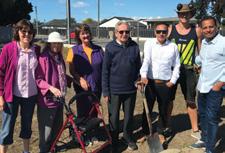
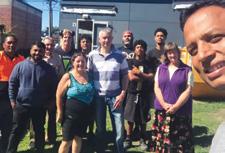
financial pressures. But even more powerfully, something beautiful began to unfold. During the building project, members from both churches came together for practical tasks: weeding the overgrown gardens, fencing, clearing rubbish, painting walls and restoring the once-neglected land. These were not glamorous tasks, but sacred ones. As hands got dirty and tools were passed around, something invisible but real began to take root—unity, trust and genuine love for one another and for God.
They shared meals in between the work, laughed at one another’s jokes and encouraged each other when exhaustion set in. Walls came down—not just physical ones, but relational and cultural ones. Through sweat and service, they began to see each other not as two congregations but as one body of Christ. As Jesus declared, “By this all will know that you are My disciples, if you have love for one another” (John 13:35, NKJV).
A witness to the power of context
In time, the two churches officially became one: Aranui Garden City Seventh-day Adventist Church. The transformation of the building became symbolic of the transformation happening within hearts. The context of building the church was not an interruption to faith but the very arena in which faith matured.
Their story stands as living proof that with God, even
the seemingly impossible becomes reality (Matthew 19:26, NKJV). The myth that different congregations cannot function as one is shattered when God is the one doing the uniting. Like the early church in Acts 2:44–47, this newly united congregation experienced the joy of “having all things in common”, and they saw God add to their numbers—not just in membership, but in love, maturity and mission.
The call for today
This journey reminds us that God’s call often comes through the very context we might try to avoid. Whether through rubble and renovation, cultural differences or the challenges of cooperation, God uses the context of mission to shape us. As the apostle Paul affirms in Philippians 1:6, “He who has begun a good work in you will complete it until the day of Jesus Christ” (NKJV). When we respond to God’s call and engage with the context He places us in, we not only grow ourselves, but we help others grow with us.
Let us, therefore, embrace the call—not waiting for the perfect conditions, but trusting in the God who helps us through the process. In the context of calling, faith is forged and communities are made one—for the glory of God.
Masih minister, Aranui English/Garden City Fellowship, NZ.
Younis
Does the Bible condone slavery?
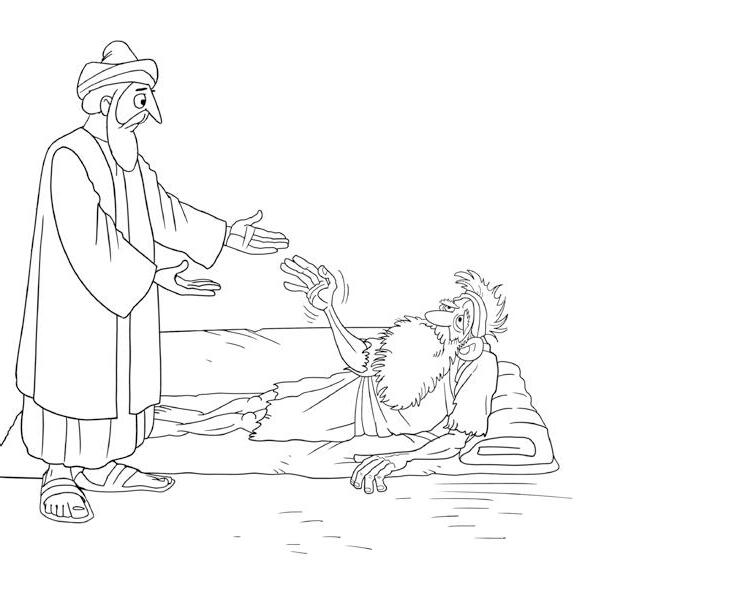
The Bible contains many references to slavery, reflecting the common practice in antiquity. It can be confronting to come across verses that seem to put slavery in a positive light. People rightly find it difficult to reconcile the loving nature of God with a practice that subjugates one person over another, often in very cruel ways. How can a God of love approve of this? Some people resolve this contradiction by concluding that the God of the Old Testament is different to the God of the New Testament. This line of thinking is not new. It first came into prominence in the second century AD through the teachings of a theologian named Marcion. To support this dualistic thinking, not only did Marcion reject the Old Testament but he also rejected many parts of the New Testament which teach that Jesus is the God of the Old Testament, (eg John 8:56-58; 10:30; 14:9; 1 Corinthians 10:1-9; Jude 1:5-6; Revelation 1:8).
Marcion’s teachings were rejected by the broader Christian church for good reason, but it did not stop him from forming his own splinter groups which promoted ideas that persist to this day. So how can we reconcile the character of God as revealed by Jesus with the reality of slavery in the Bible, without throwing out large portions of the Old and New Testaments?
First, we need to look at the term “slavery”. To us the term is often associated with pre-civil war American slavery called chattel slavery. This type of slavery did exist in ancient times, but the question is whether this is what the Bible condones. The Hebrew word translated as “slave” in the Bible is eved Eved is better translated as “servant” as it usually refers to indentured servants. An indentured servant is someone who could not pay a debt monetarily, so they would work off their debt by labouring for their creditor. This would last for a maximum of six years because debts were cleared every seventh year. The conditions under which these people served were often so good that some servants chose to remain with the person they were serving permanently (Exodus 21:5). This is not surprising as the treatment of servants was strictly regulated by the Torah. It even allowed a servant to leave their master if they were mistreated, and furthermore, whoever they came to for help was obliged to protect them (Deuteronomy 23:15,16). This goes against the type of slavery of Antebellum America.
Unlike ancient Israel’s neighbouring countries and, in more recent times, the American Fugitive Slave Act, which required slaves to be returned to their masters, the Bible obliges people to provide sanctuary for runaway servants/ slaves. This means that masters would avoid mistreating their servants so that the servants would not leave them.1 This applied to Israelites and also to foreigners (Exodus 22:21; 23:9; Deuteronomy 24:14). In fact, Israelites were obliged to love foreigners (Deuteronomy 10:19). Regarding a mistreated servant, even if they did not run away, mistreatment of a servant granted them legal freedom (Exodus 21:26,27).
It is true that the buying of servants was permitted from foreigners (Leviticus 25:44-46). Unlike all the other surrounding nations of ancient Israel, stealing people to sell as slaves was strictly prohibited. It was considered such a serious crime that it attracted the death penalty (Exodus 21:16; Deuteronomy 24:7).
There were allowances for buying servants of foreigners, but not fellow Israelites. There were several reasons why one could fall into servitude that did not involve being stolen and trafficked away. The most common were due to famine or other disasters that led to their inability to use their land.2 In some cases a person was placed in servitude as punishment for a crime they committed (Exodus 22:3; Genesis 50:18). Whatever the case was, servants were not to be treated as sub-human, but on the contrary, non-Israelite servants became part of the covenant community (Genesis 17:13) and looked forward to a Messianic age where they would be fully integrated into the community along with
land inheritance (Ezekiel 47:22,23 c.f. Galatians 3:28,29). The realities of the ancient world were such that to be a servant in Israel was the best prospect for displaced persons when it came to quality and longevity of life. Trying to survive as a sojourner in foreign lands exposed one to all sorts of dangers. It also caused anxiety in not knowing how to appease various gods who would be fickle and capricious. This meant that the servitude of foreigners in Israel drastically improved their situation in life. It was the best solution at the time in an imperfect world.
When God came to Earth as Jesus, He did not change the indentured servant model because it was the best system possible in dealing with unpaid debts. There is nothing wrong with someone working off an unpaid debt under protected conditions (with an upper limit of six years). It is reasonable and the fair thing to do. In calling His followers to minister to others as a slave would (Matthew 20:26,27), Jesus was obviously not promoting the unjust chattel slavery that occurred outside of Israel. As He did as Yahweh in the Old Testament, Jesus spoke a lot against injustice and oppression. He identified with the prophecy of Isaiah to release the captives (Luke 4:16-18 cf. Isaiah 61:1). Jesus conquered the ultimate and most cruel form of slavery—slavery to sin (Romans 6:6,7, 11-14; Galatians 5:1). As mankind’s Redeemer, He smashed the prison doors of death and “led captivity captive” (Matthew 27:50-53; Ephesians 4:8 cf. Psalms 68:18). He proclaimed the good news which has fundamentally altered the foundations of society. People who have accepted the gospel have been transformed into better people. This was Jesus’ way to deal with the evils of bondage and oppression. The kingdom of heaven, which He is building through His followers, will be completed when He returns, and when He does, there will no longer be any debts to be repaid or oppression. Affliction and distress will not rise again (Nahum 1:9). While Christians await His return, they are called not to be idle but to actively work to free people from both spiritual and physical oppression. They are to see Jesus in the oppressed, recognising that, whatever they do for those who are suffering, they do for Him (Matthew 25:40-45). They are to spread the gospel which upholds the equal dignity and value of all people regardless of race, gender or socio-economic status (Galatians 3:28).
Some people point out that the Bible was used by slave owners in America to justify slavery. It is a sad fact of history that some people who identified as Christians misused the Bible by misquoting carefully selected verses.3 There was a special Bible printed that served their purpose: referred to as the “Slave Bible”. This Bible was published three years after the Haitian Revolution in 1804 and given to the slaves in the British West Indies to prevent a possible slave rebellion. It had 90 per cent of the Old Testament and half of the New Testament redacted.4 Only 232 of a total of 1189 chapters were included. Obviously, slave owners did not want slaves to understand the context of the passages included in the “Slave Bible”,
let alone the many passages that were omitted—those that speak about the nice treatment of servants and the limited terms of servitude. In some places anti-literacy laws were passed to prevent slaves from being able to read the complete Bible should they come across one. This is because the Bible is against the type of servitude that occurred in the Americas and the slave owners knew it!
Some people wonder about the message regarding slavery in the epistle of Philemon in the New Testament. This is a letter from Paul to Philemon who seems to have owned a slave named Onesimus. Does this letter support slavery? It should be noted that runaway slaves in ancient Rome were punished severely and sometimes killed as an example to the other slaves. Onesimus’s prospects were not good as a runaway. Paul urged Philemon to take him back, not as a servant, but as a brother (v16) and to treat him as he would treat Paul himself (v17). It could be interpreted that Paul was actually advocating for Onesimus’s manumission, which could only be granted to him after he returned to his owner, Philemon.
When the Bible is read in context, it does not lead people to subjugate others, but rather it leads them on a mission of promoting social justice and emancipating bondmen. It was the Bible that compelled Christians to fight to end the evils of trafficking humans as slaves in the British Empire, the Americas and other parts of the world through the abolitionist movements. Many Christians risked fines and imprisonment in order to shelter and smuggle runaway slaves to freedom. In the United States, Adventists were instrumental in the abolitionist movement.5 Western society is indebted to its Christian heritage for the freedoms and prosperity that it enjoys, and the Bible has been foundational in establishing freedom, equality and justice. The challenge for us is to continue this work.
1. Exodus 21:20,21 is not advocating for the beating of servants but on the contrary, it elevates them to being treated as other people, ie, if someone fought a servant and killed him, he would be avenged in the same way as if he had killed another person. This is in contrast to other ancient Near Eastern law codes like the Hammurabi code where killing a slave was not avenged.
2. Conquered people through distant justified warfare were treated as tributaries if they surrendered (Deut 20:10-15 cf 1 Samuel 17:8,9).
3. Eg, Ephesians 6:5 and Colossians 3:22 which, if read in context, shows that the type of servitude referred to was one where the quality of the service was largely dependent on the servant and the servants received remuneration (Colossians 4:1). In these passages, Paul addressed the social context within Roman law and advocated for just and equitable treatment of servants, aligning it with Torah principles. Most significantly, these passages explicitly affirm that God regards all individuals as equals.
4. The slave owners considered the OT more of a threat to their industry than the NT.
5. Kevin M Burton, Apocalyptic Abolitionism: How Millennialists Helped Abolish Slavery and Reform America, 2026.
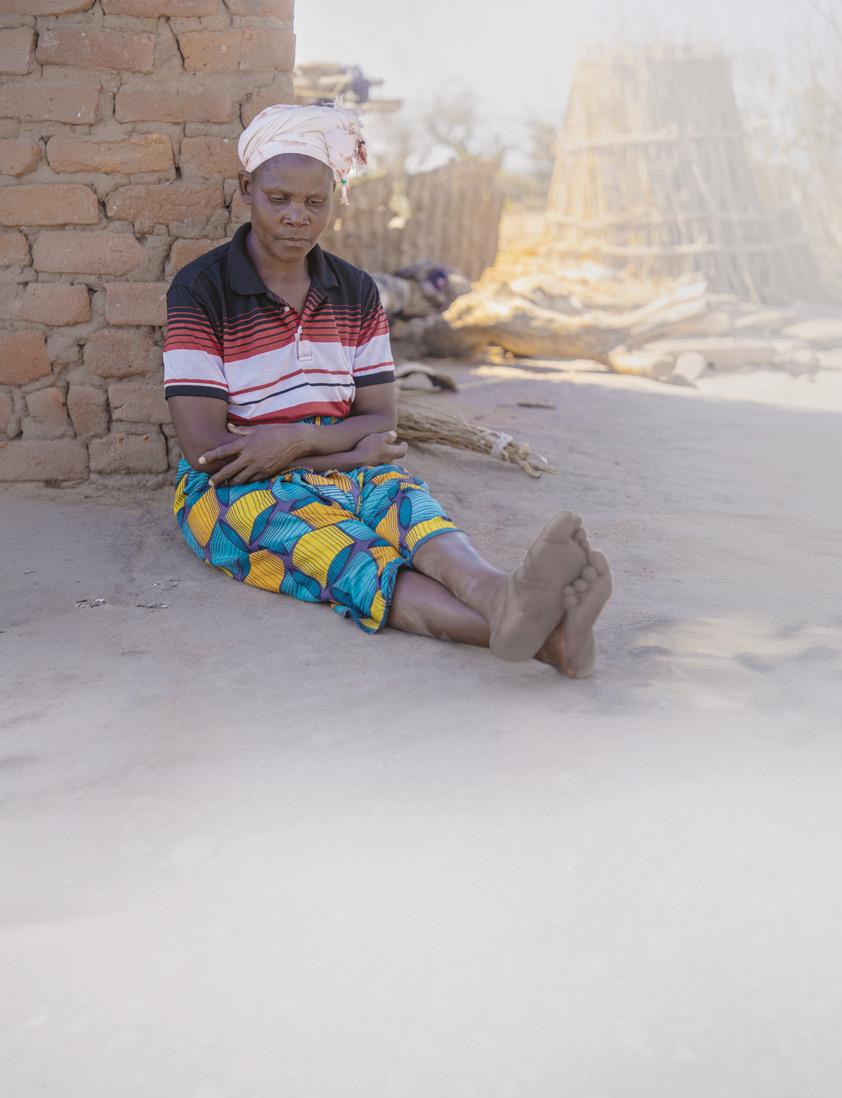
That thought quietly settled in my heart in 2018, while I was a Grade 12 student at Kerowagi Secondary School in Simbu Province. I remember sitting with my Adventist friends—especially the girls—as we talked about relationships, courtship and marriage.
One topic kept coming up: marrying a pastor or missionary. “If you marry a missionary,” one of them said, “just be ready to become a full-time housewife. You’ll be looking after children and following your husband everywhere.”
Everyone seemed to agree. And I believed it too.
At that moment, I silently told myself, that life is not for me. But God was already writing a different story.
After completing my Grade 12 exams, I returned home and became actively involved in my local church, Kundiawa
Town Church. Life felt simple, predictable—until one unexpected moment changed everything. A church minister expressed his interest in starting a relationship with me.
I was not ready.
Not for marriage. Not for that kind of commitment. And certainly not for the life I thought came with being a pastor’s wife.
I felt torn—caught between what I believed, what I feared and what was now right in front of me.
So I did what many daughters do when life feels uncertain—I went to my mother.
Her response surprised me.
“It’s a blessing,” she said with joy. “Pastors and missionaries will take good care of you because they are men of God.” Her words were full of faith. Mine were full of hesitation. This was not part of my plan. But somewhere between fear and faith, I made a decision.
I said yes.
Looking back now, I see the quiet truth of Proverbs 16:9 (NIV): “In their hearts humans plan their course, but the Lord establishes their steps.”
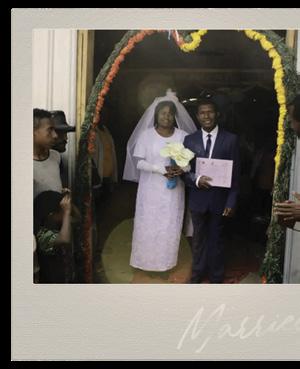
In 2020, while in my second year at the University of Papua New Guinea studying Linguistics, Journalism and Public Relations, we got engaged. Two years later, in 2022, we were married. Today, we have two children, and we continue to walk this journey of ministry together.
But marriage was only the beginning of the lesson God wanted to teach me.
After graduating from university, I stepped into a different kind of challenge.
Waiting.
For nearly three years, I applied to different organisations. Application after application. Hope after hope.
Nothing.
No offers. No doors opening. It was a quiet, stretching season—one that tested my faith and forced me to ask difficult questions.
Did I make the right choices? Was I meant for more than this? Yet even in the silence, God was not absent.
I held on to His promise in Jeremiah 29:11: “For I know the plans I have for you . . . plans to give you hope and a future.” Then, in the middle of that waiting season, God sent someone into my journey—Keetleen Ratnasingam, a leadership developer who saw something in me I had almost forgotten.
She encouraged me to start writing for Adventist Record
At first, it seemed like a small step. But it came with a powerful reminder: Don’t wait for opportunity—use what God has already given you.
Her words echoed the truth of James 2:17: “Faith by itself, if it is not accompanied by action, is dead.”
I realised something important—miracles don’t happen in stillness alone. They often begin with obedience.
Just like Jesus’ first miracle.
In John 2:7 (NIV), Jesus told the servants, “Fill the jars with water.” And they did. Before the miracle happened, there was action. Before the breakthrough, there was obedience.
So I took action. I began to write. I submitted my stories to Record. One by one, they were accepted and published. With each article, my confidence grew. With each opportunity, my purpose became clearer. And then—something changed.
A door opened. I was offered a role with the Central Papua Conference (CPC) as associate communication director and administrative assistant. Suddenly, everything made sense.
The waiting.
The writing.
The journey.
God had not been delaying me—He had been preparing me.
Today, I look back at that young girl sitting with her friends, believing that being a pastor’s wife meant giving up her dreams.
She didn’t know what I know now.
Being a pastor’s wife is not a limitation.
It is a calling. It is a partnership. It is an opportunity to serve God—not just behind the scenes, but fully, boldly and purposefully.
I am not only a pastor’s wife.
I am a writer.
A communicator.
A mother.
A servant of God.
And I now understand the truth of Proverbs 16:3: “Commit to the Lord whatever you do, and he will establish your plans.”
What I once saw as a sacrifice became my purpose. What I once feared became my testimony.
And what I once misunderstood has become, truly, a blessing in disguise.
Maine Sinias assistant communication director, Central Papua Conference.
Rose
Conversations
Count beyond one
I was impressed to read in April 4’s Adventist Record that six AdventHealth hospitals in Florida were named in Forbes’ inaugural list of America’s Top Hospitals chosen from 5400 facilities across the States. Believe it or not Adventists actually operate more than 30 hospitals in the state of Florida.
In Australia, however, it’s a different story. We’ve never seemed to be able to grow beyond the one hospital established by that visionary woman, Ellen White, way back in 1903.
Now in my lifetime I’ve seen the Australian population grow from 10 million to 27 million. During that time there’s been considerable growth in Adventist churches, schools, aged care facilities and membership, but the hospital sector has remained stagnant.
Isn’t it time Aussie Adventists learnt to count beyond one? As the proverb says, “When there is no vision the people perish.”
Jeff C, via email
Once for all
I cannot but agree with “Once for all” (April 18), for Christ performed one atonement once for all, on the cross, for that is what the Bible does say. See for example Hebrews 7:27; 9:12, 26.
How, then, does the author
explain Ellen White on page 480 in The Great Controversy, without redefining “atonement”, when she wrote, “Attended by heavenly angels, our great High Priest enters the holy of holies and there appears in the presence of God to engage in the last acts of His ministration in behalf of man—to perform the work of investigative judgement and to make an atonement for all who are shown to be entitled to its benefits.” And “In the great day of final atonement and investigative judgement the only cases considered are those of the professed people of God.”
Angus McPhee, via email
Author’s response: The Bible is clear that Christ’s sacrificial offering was made once for all at the cross. Hebrews 7:27, 9:12,26 and 10:10–14 are decisive on that point. Christ died once for all. He does not repeat His sacrifice, add to it, or improve upon it.
The question is whether “atonement” in Scripture refers only to the moment of sacrifice (His death) or also includes the priestly application of the blood and the cleansing/ judgement work connected with the sanctuary. Leviticus 16 shows that the Day of Atonement involved more than the death of the victim.
The blood was shed, then the high priest ministered that blood in the Most Holy Place, and Scripture still
calls that work “atonement” (Leviticus 16:15,16,30).
Therefore, Ellen White’s statement should not be read as contradicting Hebrews. She is not saying Christ makes another sacrificial atonement. She is speaking of the final priestly application of the once-for-all atonement already accomplished at the cross. Hebrews itself says both that Christ offered Himself once for all and that He now appears in the presence of God for us as High Priest (Hebrews 8:1–2; 9:24; 10:12–14).
So, I would state it this way: the atoning sacrifice of Jesus was completed once for all at Calvary; the atoning ministry of Jesus continues in heaven based on that completed sacrifice. Ellen White’s “final atonement” language belongs to the latter category, not the former.
Limoni Manu O’Uiha , Fiji
Living High Priest
In the April 18 Adventist Record, I really appreciated Dr Limoni Manu O’Uiha’s well written article “Once for all”.
In a way I hadn’t thought of before, he summarises beautifully the process of our salvation with the Greek word Hapax, affirming both important truths: our atonement accomplished at the cross and our atonement applied by a living High Priest. Merian Richardson, via email
Wedding
RUDGE– STANTON. Liam
Douglas Rudge, son of Craig Rudge (Tewantin, Qld) and Rachel Bosher (Melbourne, Vic), and Kerrilea Anne Stanton, daughter of Ken and Wendy Stanton (Riverside, Tas), were married on 30.3.26 in Christmas Hills, Victoria. A tranquil sunny afternoon in the Christmas Hills Hall provided a splendid setting for the wedding of Liam and Kerrilea. They first met at Converge in 2019, and after years of friendship exchanged sincere vows of commitment following thoughtful words from Pastor Darren Croft. They have established their home in Mooroolbark and are active members of Lilydale church, especially in music presentation.
Darren Croft, Harley Stanton
Anniversaries
DORRINGTON. Col and Beryl (nee Price) have commemorated their 70th wedding anniversary. They met at a youth camp in the Grampians (Vic), and married on 20.3.1956 at Brighton church. Col’s sister Dulcie Bell and nephew Robert Wareham, who were at the wedding, attended the 70th celebration. Also present were Col and Beryl’s children, Julie, Dianne Howard, Jenny Whitehead, Wendy Walshe, Sharyl Dwyer and Peter, along with their spouses, grandchildren, great-grandchildren, two great-great-grandchildren and friends. God has blessed Col and Beryl through the years, with the lyrics of the hymn
that say, “I’d rather have Jesus than anything this world affords today” summing up their life. They look forward to celebrating their next 70th anniversary in heaven.
GOODS. Cecil and Barbara (nee Spelling) have celebrated their 70th wedding anniversary. They were married on 14.3.1956 in Ringwood church by Pastor Brandstater. The family celebrated this significant milestone in Perth, where the couple have relocated. Their four sons and their wives—Steven and Lee, Chris and Robyn, Brett and Denise, and Adrian and Michelle—acknowledge their parents’ love, resilience and faith as the cornerstone of a marriage that has been blessed over the 70 years.
Obituaries
ATKIN, Margaret Ursula (nee Stevenson); born 16.11.1937 in Launceston, Tas; died 15.3.26 in Launceston. She was predeceased by her daughter, Leeta. Maggie is survived by her husband, Peter (Launceston); daughter, Petrina and Russell Fenton (Colinton, Qld); son, Mark (Launceston, Tas); four grandchildren; and eight great-grandchildren. She was a wife and mother who was adored by her family.
Wendy Stanton
BROWN, Graeme Herbert, born 6.9.1939 in Sydney, NSW; died 3.3.26 in Melbourne, Vic. Graeme is survived by his wife, Carole; daughter, Sherie and family; and son, Laurie and family. Graeme began his working life as a teacher in Newcastle, NSW, and Kabiufa College, Papua New Guinea, then honed his skills as a proofreader at Signs Publishing Company, where he applied his red pen with skill to the Church’s books and magazines for more than 35
San Homecoming
Celebrating the San
For 123 years, the San has been here for our community. Join us as we bring together past and present sta , doctors, friends, and families.
years. He mentored generations of Adventist editors, sharing his skills with grace to those learning the art beside him. Graeme was a quiet gentleman, who was a valued member of the Warburton Adventist community. He will be greatly missed. Resting peacefully until Jesus comes.
Kevin Geelan, Nathan Brown
GOLDSWORTHY, Kevin John, born 12.7.1934 in Beechworth, Vic; died 13.6.25 in Walwa. He was predeceased by his first wife, Alleyne Hardy. Kevin is survived by his wife, Cecilia De Laurentis; daughters, Juanita and Lisa (both of Qld); sons, Marty (WA) and Greg (Qld); eight grandchildren; 10 great-grandchildren; brother, Les (Ararat, Vic); and sister, Betty (Mildura). Kevin was a devoted husband, father and unmistakeable follower of Christ, sharing the gospel everywhere he went. He travelled far and is remembered by many who knew him as a talented horse whisperer, shearer and planter of seeds that grew into churches all over Australia. He was a true man of God who left a mark on everyone he met. Now resting until that blessed day of Christ’s return.
Jason Drury
KUO, Dr Dick, born 29.5.1936 in Swatow, China; died 19.1.26 in Sydney, NSW. On 15.1.1960 he married Ramona. Dick is survived by his wife (Sydney); children, Gregory (Seattle, USA), Leonard (Sydney, NSW), Vanessa Yee (Sydney), Roderick (Sydney) and Warren (Sydney). Dick was a doctor, church elder and loving husband, father, grandfather and great-grandfather. He enjoyed sport, travel, classical music, photography and desserts.
Nigel Ackland
LAWS, June Aimee (nee Bowman), born 21.6.1929 in Ardrossan, SA; died 22.1.26 in Cooranbong, NSW. She was predeceased by her husband, Pastor Lindsay Laws in 2018; and her son, Richard in 2010. June is
survived by her children, Marilyn (Cooranbong), Pastor Philip (Taupoˉ, NZ), Adrian (Wagga Wagga, NSW) and Kathleen Mowbray (Cann River, Vic); their spouses; nine grandchildren; and 12 great-grandchildren. June had a passion for helping people of all ages know how much God loved them. Her greatest desire was to see her family and friends ready to meet Jesus soon.
Phil Laws
POLAND, Leon Frederick, born 11.8.1956 in Perth, WA; died 2.9.25 in Ipswich, Qld. Leon is survived by his wife, Leanne (Ipswich); children, Jared Poland and Tofunmi Mojeed (Melbourne, Vic), Danika and Jack Whitling (Catherine Hill Bay, NSW); and sibling, Debz Richards and George Ritchie (Caloundra, Qld). He loved his family deeply. Leon embraced the Adventist faith in 1980 through a mission led by Pastor Geoff Youlden in Perth. He had a passion for helping others, and his humble servant heart touched so many lives. Connected to his Yamatji culture, he was involved in ATSIM ministries and served his local church as a deacon, elder, youth and social leader, and in personal, family and Pathfinder ministries.
David Garrard, Richie Reid, Francis Pule
WILLIS, Terry, born 18.9.1943 in Merredin, WA; died 1.3.26 in Perth. He was predeceased by his wife, Lois. Terry is survived by his children, Anthony and Vicki (Merredin); five grandchildren; and three great-grandchildren. He was a well known and loved member of his community. He loved farming, his family and Jesus. He lived his faith, humbly serving others and sharing the love of Jesus with everyone. Terry will be sadly missed.
Lomani Uilou
WRIGHT, James Mackay, born 13.11.1933 in Mackay, Qld; died 19.3.26 in Murwillumbah, NSW. On 30.5.1964 he married Beryl Agnes Sondergeld. He was
predeceased by his son, Steven. James is survived by his wife; daughters, Denise and Don, Trudy and Mark, and Carolyn and Darren (all of Murwillumbah); grandchildren, Sean, Kylie, Joel, Ben, Emily, Shannon, Brent, Shae, Jim, Ruby, Zoe and Jarred; and 12 great-grandchildren. Jim’s confidence in the soon return of Christ was a wonderful example to all who knew him. His strong faith throughout his illness was an inspiration to all. Jim is at rest until Jesus comes.
Warren Price
YOUAKIM, Emad, born 11.2.1957 in Alexandria, Egypt; died 20.2.26 in Melbourne, Vic. He is survived by his wife, Michelle; children, Krystal, James, Rachel and Jireh; and siblings, Medhat and Mervette. He was a regular attendee of Hughesdale church and a faithful follower of Jesus. We look forward to seeing him again on resurrection day.
Daniel Berchie, David Pearce
Advertising
ABSOLUTE CARE FUNERALS
The Adventist family owned and operated business, caring for you from Sydney to Newcastle and Wollongong. Contact Arne Neirinckx, who understands our Adventist philosophy. Contact us on 1300 982 803 or 0408 458 452 or <arne@absolutecarefunerals.com.au>, even if you have already paid for your funeral.
STUDY THE ADULT SABBATH SCHOOL LESSON YOUR WAY
Accessible formats for vision loss (large print, audio CD, app, YouTube, podcast and braille) or hearing loss (Hope SS captioned). Contact CVHS on +61 (02) 9847 2296 or email <cvhs@adventistmedia.org.au>.
RECORD QUANTITIES
Is your church receiving the correct number of Record magazines? Adjust your numbers by notifying Kelli Geelan at subscriptions@record.net.au or on +61 (03) 5965 6300.
NOTE: Neither the editor, Adventist Media, nor the Seventh-day Adventist Church is responsible for the quality of goods or services advertised. Publication does not indicate endorsement of a product or service. Classified advertisements in Adventist Record are available to Seventh-day Adventist members, churches and institutions only. All advertisements, appreciation, anniversary, wedding and obituary notices may be submitted via <ads@record.net.au> or online at <record.adventistchurch. com>. Notices will not be reprinted unless there is an error of fact caused by Record staff.
abn 59 093 117 689 vol 131 no 9
Consulting editor
Glenn Townend
Editor Jarrod Stackelroth
News editor
Juliana Muniz
Assistant editors
Ashley Jankiewicz
Danelle Stothers
Copyeditor
Tracey Bridcutt
Graphic designer
Theodora Pau’u
Noticeboard
Julie Laws
Letters editor@record.net.au
News & photos news@record.net.au
Noticeboard ads@record.net.au
Subscriptions
subscriptions@record.net.au + 61 (03) 5965 6300
Mailed within Australia and New Zealand $A60.00; $NZ90.00
Other prices on application
Website record.adventistchurch.com
Mailing address
Adventist Media
Locked Bag 1115 Wahroonga NSW 2076 Australia + 61 (02) 9847 2222