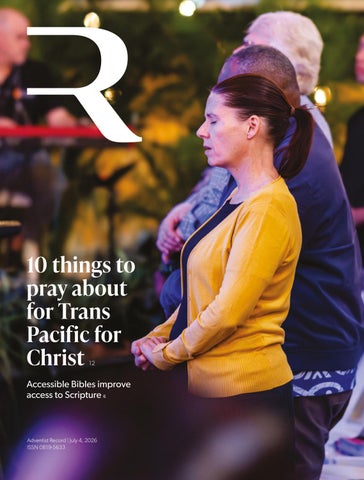
10 things to pray about for Trans Pacific for Christ 12
Accessible Bibles improve access to Scripture 6
Adventist Record | July 4, 2026 ISSN


10 things to pray about for Trans Pacific for Christ 12
Accessible Bibles improve access to Scripture 6
Adventist Record | July 4, 2026 ISSN
People look to Google and social media to find answers to their spiritual questions. We must create engaging digital avenues so that people can find the truth, whenever they seek it, wherever they seek it.
Your church offering today will be used for the Digital Strategy for Mission which will invest in innovative digital strategies to accelerate the mission of the Seventh-day Adventist Church to reach the world for Christ.
These digital mission projects will facilitate the seeker’s journey from contact to conversion and from decision to disciple, integrating a strong element of personal contact.
Thank you for your generous support of world mission.

EDITOR’S NOTE:
Jesse Herford Associate editor, Signs of the Times
In my time in pastoral ministry, I came to realise that this wisdom was a two-edged sword.
Once, when I was a child, I decided I’d be helpful. It had been a long day and the family was tired, so I thought I’d make them all a Milo. Like the dutiful son I was, I insisted everyone relax on their favourite chair while I prepared everyone a hot cuppa to unwind with. I decided to add an extra teaspoon of sugar—a sweet treat that everyone very much deserved. After much hard work, I proudly served everyone and watched with pride as they all took their first sip. My pride, however, quickly turned to hubris as collectively, they all spat out their Milo and gave me a pained grimace.
“What did you put in this, Jesse?” asked my father.
With a creeping sense of horror, I realised that instead of sugar, I’d laced the Milo with salt.
A truism I often was told growing up was some variety of “you get out what you put in”. Input diet and exercise, and you’ll output good health. Input doughnuts and Netflix, and you’ll output poor health. Input salt into a Milo, and you’ll output a salty Milo.
Jesus once said, “A good man brings good things out of the good stored up in his heart, and an evil man brings evil things out of the evil stored up in his heart. For the mouth speaks what the heart is full of” (Luke 6:45). In my time in pastoral ministry, I came to realise that this wisdom was a two-edged sword. On the one hand, church members with deep spiritual formation, shaped by experience, refined by suffering and tempered by patient endurance, were the greatest gift to both me and their church community. On the other hand, people carrying unresolved hurt, bitterness or unrepentant sin often caused deep difficulty within the church community. In my own life, I can’t express how many times a harsh word, a callous attitude or an unhealthy choice were the result not of what was in front of me, but what was in my heart.
It may sound trite, but I believe more than ever how important it is to reckon with this challenge: what am I allowing into my heart? I’m not just talking about media consumption, though of course that is a significant contributor. I’m thinking about the things that shape and change us over time—gender, culture, race, religion, politics, money, family—each of these arenas (and more) contain both opportunities for personal growth as well as pitfalls that can degrade us, limit us, make us lesser (or make us think and feel lesser about others). Either way, what we come to believe about these often-controversial issues will shape us over time. The question is, how?
Immediately following Jesus’ “Sermon on the Plain” in Luke 6 is the story about the Roman centurion—a figure we might expect to present as an adversary, but whose character subverts our expectations. First, he expresses immense grief at the sickness of a servant (7:2). Second, his goodness is attested to by Jewish elders—a surprising development (7:4,5). Third, the centurion gives Jesus great humility (7:6–8)—humility Jesus hasn’t earned, nor would be expected from a Roman officer to a Judean “nobody”.
It is precisely this combination of unexpectedness that amazes Him, causing Him to turn to those nearby and say, “I tell you, I have not found such great faith even in Israel” (7:9). Clearly, this centurion was more than an average Roman bureaucrat. There was something about him— something invisible—that had made him both loved by his men, as well as the Jews. Though he said he wasn’t worthy, the elders said he was worthy. Though he felt unworthy to host Jesus at his house, the elders commended him for building a house of worship. And, though he was a man of authority, he chose to use that authority for the good of someone “beneath” him. The centurion is a “good tree”, to use Jesus’ own phrase. His compassion, humility and faith reveal a good heart—a heart we would all do well to learn from.
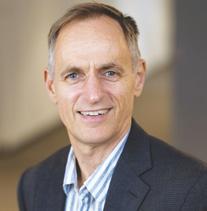
Glenn Townend South Pacific Division president
Today, all over the South Pacific, people of our faith are having a special Sabbath of prayer. This Sabbath of prayer was called for by the presidents of the four unions and the SPD officers to keep the spiritual momentum experienced at the South Pacific for Christ launch in May. It also shows the willingness of all the unions to support one another in their disciple-making efforts through prayer.
In July and August, the Trans Pacific Union is holding public evangelistic meetings in its 11 nations. We are claiming Psalm 2:8: “Ask of me, and I will give the nations as your inheritance, the ends of the earth as your possession.” Jesus is the rightful King of these nations and of the whole earth. Through prayer, we who in Eden gave the earth’s rulership to the enemy, are asking for Jesus to take it back.
South Pacific for Christ is not just a slogan; it is a prayer and a vision. We want to see our families, neighbours and communities respond to the grace and mercy of Jesus and become part of His kingdom. Each year until 2029, the South Pacific will focus on a different union for support in disciple-making and prayer: 2027 New Zealand Pacific, 2028 Australia, 2029 Papua New Guinea.
As you receive this Record, Pam and I are in Buala, Isabel, Solomon Islands. We are at one of the 300-plus sites in the country, where dozens of preachers have come from Papua New Guinea, Australia, New Zealand, China and the rest of the Pacific. The public meetings start tomorrow evening (July 5). Adventists have been serving their communities through acts of kindness, 10,000 Toes health checks and interventions, small-group Bible studies, Discovery Bible Reading and more. They have faithfully prepared the soil, planted the seed of the gospel and nurtured growing interest—it is now a time for decisions.
Some of you are praying in groups in your church; others have joined in the live Zoom prayer meeting that started when Sabbath began in our Division at Invercargill, New Zealand (3pm Friday, July 3, AEST) and concludes in Nuku’alofa, Tonga (3:15pm Sunday, July 5, AEST). For more information see <https://southpacificforchrist.org/>. Some are praying personally. Whatever the setting, let’s keep this orchestra of prayer ascending to God’s throne, where grace and mercy for all abound (Hebrews 4:16).

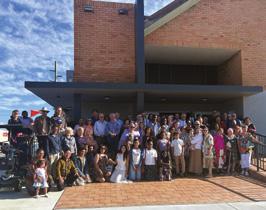
Ayr Seventh-day Adventist Church celebrated its centenary on May 16, bringing together members and visitors to reflect on 100 years of ministry in North Queensland.
The special program included a presentation on the church’s history by local member Selwyn Hawken, as well as a rededication service and fellowship activities throughout the day.
Northern Australian Conference president Pastor Simon Gigliotti said the celebration provided an opportunity to remember God’s leading while looking ahead to future ministry opportunities.
During the service, attendees reflected on the faith and commitment of early members and the role the congregation has played in the Burdekin community over the years.
Founded by a small group of Adventist families who initially met in homes, the Ayr church was officially organised in 1926. Early members purchased a former foundry building
in Charters Towers, dismantled it and transported it by rail to Ayr, where it was rebuilt through volunteer labour and dedicated as the congregation’s first permanent place of worship. Over the following decades, members established a church school, supported community initiatives during the Great Depression and expanded their ministry throughout the district.
In 1965, the congregation dedicated a new church building on the same site, replacing the original structure. A statement read during that dedication expressed the hope that “a light will shine forth to the community”, a vision church leaders said continues to guide the congregation today.
The church currently operates a range of community-focused ministries and is planning an evangelistic series later this year as part of the Northern Australian Conference’s Year of Reclamation initiative.
Cooranbong,
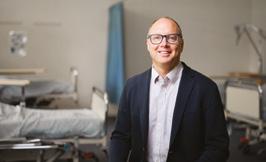
An Avondale University researcher has led the largest study of its kind into the prevention of hospital-acquired pneumonia, with findings that could help shape clinical practice and save lives around the world.
Research professor Brett Mitchell led the Hospital Acquired Pneumonia Prevention (HAPPEN) trial, which involved more than 8000 patients across three Australian hospitals. The study concluded in August 2025 and is the largest multicentre randomised controlled trial ever conducted on the prevention of non-ventilator-associated hospital-acquired pneumonia (NV-HAP).
Published in The Lancet Infectious Diseases on June 9, the research found that improved oral hygiene reduced the risk of developing NV-HAP by 60 per cent.
The intervention involved providing patients with a toothbrush, toothpaste
and information about pneumonia prevention when admitted to hospital wards. Participants in the intervention group brushed their teeth an average of 1.5 times a day.
“Brushing teeth is a simple intervention that helps reduce bacterial load in the mouth and in turn reduces that bacteria entering the respiratory tract in hospitalised patients,” Professor Mitchell said.
“It will help shape clinical practice and guidelines globally—preventing thousands of infections and lives lost to this infection.”
Professor Mitchell said the trial was one of many research projects being undertaken by Avondale academics with tangible benefits for individuals and communities.
“At Avondale, we’re producing a series of high-quality trials in preventing infections. There’s a real need for this research,” he said.
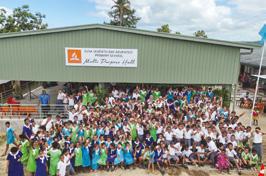
Suva, Fiji | Juliana Muniz
A new multipurpose hall designed to support learning, worship and other school activities was officially opened at Suva Seventh-day Adventist Primary School on June 5.
Valued at approximately $F350,000, the hall will serve the school’s 754 students by providing a central venue for assemblies, examinations, sporting events, cultural programs, leadership initiatives and community gatherings.
Fiji Education Minister Aseri Radrodro attended the opening ceremony alongside church leaders, community representatives and members of the school community. During his speech, Mr Radrodro encouraged students to make full use of the new facility. “This facility has been built for you,” he said.
According to South Pacific Division education director Dr Elisapesi Manson, the hall represents an
investment not only in infrastructure but also in students’ future. She explained that the new facility will strengthen the quality of learning and student development at the school. “In keeping with the wholistic philosophy of Adventist education, the facility will support the spiritual, mental, physical and social growth of students,” said Dr Manson.
The project was completed following a fundraising effort that began in 2019 and drew support from the wider school community.
Established in 1898 and officially recognised as a government primary school in 1913, Suva Seventh-day Adventist Primary School is one of Fiji’s oldest Adventist schools. The school serves families from Suvavou, Lami and surrounding communities and has continued to expand its facilities in response to growing enrolments.
Wahroonga, NSW | Juliana Muniz
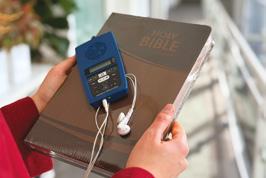
Christian Vision and Hearing Services (CVHS), a ministry of Adventist Media, is helping church members with vision challenges access Scripture through free giant-print and audio Bibles tailored to their needs.
CVHS coordinator Cassie Etwell explained that accessible formats are important. “Because of certain challenges, not everyone can access the Bible in the standard format,” she said. “Accessible Bibles are needed for people to be able to overcome this barrier and access God’s Word in a manner suitable to their needs.”
According to Ms Etwell, people with vision and hearing challenges can struggle to find Scripture in a format they can use, which can affect their connection with God’s Word.
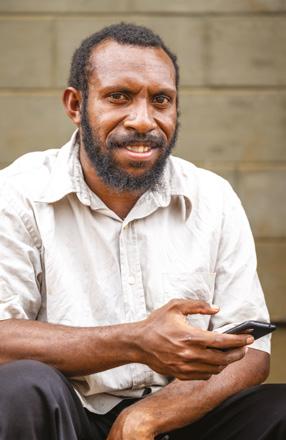
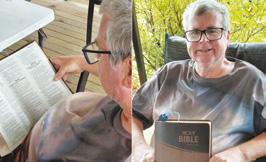
One recipient, Glenn Schofield, said receiving a Giant Letter Bible enabled him to continue reading Scripture. “I am so humbled and appreciative of your kindness and generosity in allowing me to have this Bible. I can now
read with my reading glasses,” he said.
In addition to giant-print Bibles, CVHS provides godpods—audio Bibles produced by Adventist World Radio— for members who are blind or have very low vision. The devices feature tactile buttons that allow users to navigate between books, chapters and verses of the Bible and include a built-in solar panel for charging.
Since introducing the initiative in mid-2025, CVHS has helped more than 20 people access Scripture through Giant Letter Bibles and godpods. CVHS also recommends additional resources for members with hearing challenges, including the Auslan Bible produced by Bible Society Australia, as well as braille-compatible Bible resources available through specialist organisations.
Those interested in accessible Bible resources can contact CVHS on <cvhs@adventistmedia.org.au> to discuss their needs and available options.
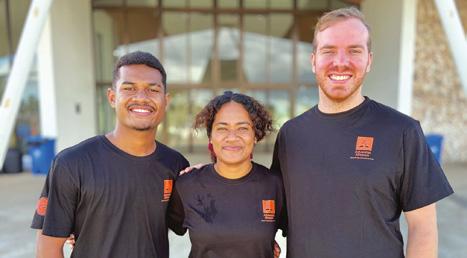
Adventist Volunteer Service (AVS) is preparing its largest mission team ever, with 100 university students set to participate in a service program in Fiji later this year.
In a first-of-its-kind collaboration, students from Avondale University, Fulton Adventist University and Pacific Adventist University will join together for the outreach in Suva from November 26 to December 9.
The project will combine practical renovation work with community outreach programs, health initiatives and relational ministry.
According to AVS manager Rose Miranda, AVS ambassadors at the three universities are working together on the project. “Having those ambassadors in all of our educational institutions has given us an opportunity to work together cross-culturally and give these opportunities to young people,” she said.
The mission team will be volunteering at Suva Adventist College, Suva Adventist Primary School and Wainadoi Seventh-day Adventist Church and Kindergarten, where renovations and classroom improvements are planned. Outreach activities will include hospital visits, local church engagement, health pop-up initiatives and children’s programs.
Ms Miranda said the focus is intentionally relational. “We’re doing this mission trip differently: not just building, but also connecting. There are so many young people in this particular area that we’re going to. It’s intentionally integrating with the community, not just coming in to complete a project.”
The initiative is also designed to develop leadership skills among the young volunteers, with students taking responsibility for areas such as community outreach, children’s programs and project coordination.
The trip will happen after the Trans Pacific Union for Christ harvest programs in July and August. “The timing is perfect as people will be more aware of who the Adventist Church is,” Ms Miranda said.
Students will cover their own travel costs, while fundraising efforts are focused on raising approximately $A30,000 for building materials. For every $5000 raised by one of the universities, the South Pacific Division will match that figure.
A fundraising night is planned for Sydney in October Donations can also be made via Westpac bank. BSB: 032 000. Acc: 532 994. Account Name: SDAC Pacific. Mandatory Reference: Suva AVS Donation.
A yacht carrying 42 Adventist volunteers and 1000 food packs for families affected by the recent earthquake in the Philippines caught fire during a humanitarian relief mission. All volunteers were safely evacuated and rescued, despite dramatic scenes of flames and thick smoke engulfing the vessel.—SSD

Impact Mozambique 2026 launched across more than 800 evangelistic sites, with one local team providing 65 free haircuts, hair washes and braiding services. The youth-led initiative showed Christ’s love in a practical way, creating a welcoming space for residents to experience care, dignity and connection.—ANN
Seventh-day Adventist camp ministry in the United States has reached the milestone of 100 years of growth, expanding from two youth camps in 1926 to more than 60 camps that now serve over 34,000 people annually through discipleship, leadership training and faith-based community programs.—FAVS News
Scientists have found that mosquitoes can learn to associate the smell of DEET repellent with food, suggesting mosquitoes can overcome their aversion to repellents, which could have implications for how we can protect ourselves from being bitten. The researchers say these findings haven’t been tested in mosquitoes outside a lab, and that people should continue to use repellents to prevent a range of potentially deadly diseases.—ABC News
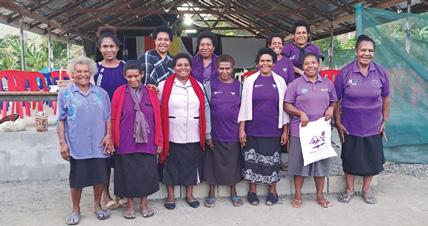
Women from the 15 Mile Seventh-day Adventist church in Central Papua Conference combined worship, community outreach and practical training as part of Women’s Emphasis Day activities held under the theme “Hineni, Here Am I!”. As part of the program, participants conducted a branch Sabbath school in the local community, sharing Bible messages and fellowship with residents. The weekend also included a visit to Laloki Secondary School, where women distributed toiletries and other essential items to approximately 500 boarding students. The activity was part of the Ambassador Module practical component aimed to demonstrate Christ’s love through practical service —Rose Maine Sinias
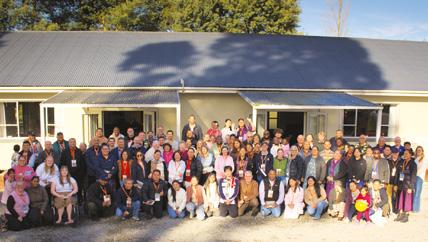
Around 120 church leaders and emerging leaders gathered at Pascoe Park, Christchurch, from June 5 to 7, for the South New Zealand Conference’s second Anchored Leadership Convention. The weekend opened with a focus on the Conference’s renewed vision: “Loved and loving people, courageously following Jesus—Trusting, Growing, Sharing”, and a challenge for the church to be a place where people are expected, equipped and empowered to live out and share their faith. Notable highlights were the strong presence of younger leaders and sessions focused on prayer and fasting, emotional and spiritual health, and encouraging members to embrace their role as witnesses for Jesus and develop personal testimonies for everyday life —South New Zealand Conference Team
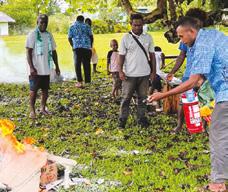
The Adventist Development and Relief Agency Solomon Islands has delivered a one-day disaster training program for the Western Sub Regional Office of the Seventh-day Adventist Church in the Solomons. The training focused on helping participants develop an emergency management plan for the office while also reflecting on the recent impacts of Tropical Cyclone Maila which affected Western and Choiseul provinces.—Denver Newter
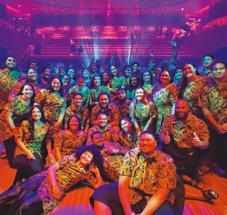
Members of the Conquerors choir from Mt Druitt Samoan Seventh-day Adventist Church participated in One Sydney on June 14, joining Christians from different denominations and cultural backgrounds in worship at the Sydney Opera House. Youth leader Donny Potoi described the opportunity to sing alongside other musicians at the iconic venue as “truly unforgettable” and said the event was a powerful expression of unity, faith and praise —Donny Potoi
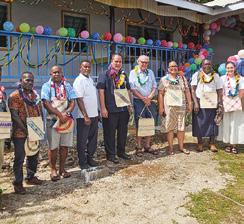
A major redevelopment is underway at Batuna Adventist Vocational School (BAVS), one of the most historically significant educational institutions in the Solomon Islands. The redevelopment aims to transform the school into a highquality, sustainable and mission-focused vocational training centre while preserving its rich Adventist heritage.
Since its establishment in the early 1920s, BAVS has played a pivotal role in the development of Adventist education and mission throughout the Solomon Islands. Today, the school serves approximately 300 students and continues to play a vital role in providing vocational education and workforce development opportunities for young people.
The BAVS redevelopment plan seeks to address challenges associated with ageing infrastructure, limited training facilities, inadequate student accommodation, constrained technological resources and the logistical difficulties of operating in a remote island environment. Increasing enrolment demand, evolving industry requirements and the need for modern learning environments have highlighted the importance of a comprehensive redevelopment strategy.
The initiative aims to position BAVS as a leading Adventist vocational education institution that effectively prepares students for employment, entrepreneurship, community leadership and Christian service.—Elisapesi Manson/ Record Staff
have news to share?
Send info and photos to <news@record.net.au>
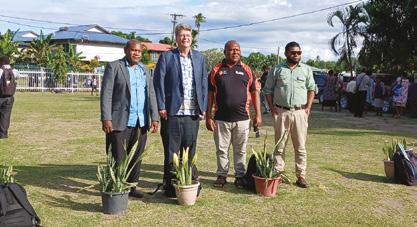
New Britain New Ireland Mission in Papua New Guinea took significant steps toward achieving conference status as it prepared all its churches during a three-day governance and strategic alignment training, held May 26-28 in Kokopo, East New Britain Province. The training brought together more than 120 participants, including church pastors, mission employees and church leaders from across the province. The initiative aimed to strengthen church governance, leadership capacity and strategic alignment as the Mission works towards becoming a local conference by 2029 —Trevor Maino
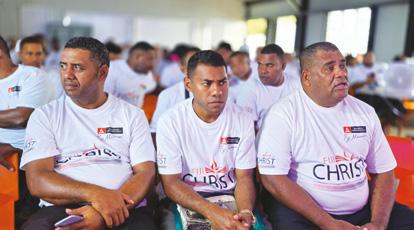
Spiritual renewal, unity and preparations for Fiji for Christ were among the focuses of Fiji Mission’s annual ministerial retreat, held under the theme “One in Christ”. The retreat brought ministers together for worship, fellowship, training and mission planning as the Church prepares for the evangelistic campaign scheduled to begin in August. The theme highlighted the role of collaboration and shared mission as ministers prepare to support the campaign in their local churches and districts. Guest speaker South Pacific Division ministerial secretary Dr Darius Jankiewicz said he observed a strong sense of unity, prayer and shared purpose among the ministers throughout the retreat. The event also provided updates on Fiji for Christ. Organisers reported that more than 400 evangelistic sites are planned across Fiji, featuring both international and local speakers.—Juliana Muniz
JULY 12—26 2 SITES

AUGUST 9—22
62 SITES
JULY 5—18
333 SITES
JULY 5—18 3 SITES
AUGUST 16—30
64 SITES
AUGUST 16—29
446 SITES
JULY 12—24
10 SITES
JULY 12—26
2 SITES
JULY 12—26
50 SITES
A major evangelistic movement is about to sweep across the Pacific, with the first public meetings of Trans Pacific for Christ beginning tomorrow (July 5) in the Solomon Islands and Tuvalu.
During July and August, local and international speakers will join church members in sharing hope, faith and the message of Jesus with communities throughout the Pacific region.
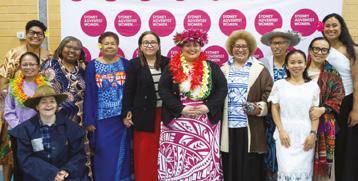
Among those answering the call is a team of 13 women from Sydney Adventist Women, who have travelled to the Solomon Islands to support the campaign through preaching, Bible studies, children’s programs, health outreach
and prison ministry. The team will be ministering across six sites and reflect a broad range of cultures, professions and life experiences.
“Their willingness to step away from their families, workplaces, churches and personal commitments to answer God’s call is both inspiring and humbling,” said Greater Sydney Conference women’s ministries director Meleofa Tovo.
“I am immensely proud of this team. They are not travelling simply as representatives of Sydney Adventist Women, but as ambassadors for Christ. Their hearts for service, compassion and mission reflect the spirit of Jesus,
AUGUST 16—29 11

who came not to be served, but to serve. I am excited to see how God will use them to touch lives, strengthen communities and build His kingdom in the Solomon Islands.”
Ms Tovo said mission has a way of changing not only the lives of those being served, but also those who step out in faith to serve others.
“I believe these women will return home with stories of answered prayers, transformed hearts and renewed faith.”
For team member Minerva Sindac-Lebmeier, the trip marks both her first visit to the Solomon Islands and her first overseas mission experience.
“I don’t really know what to expect,” she said. “I’m
humbled for the opportunity to be part of this mission. I know I
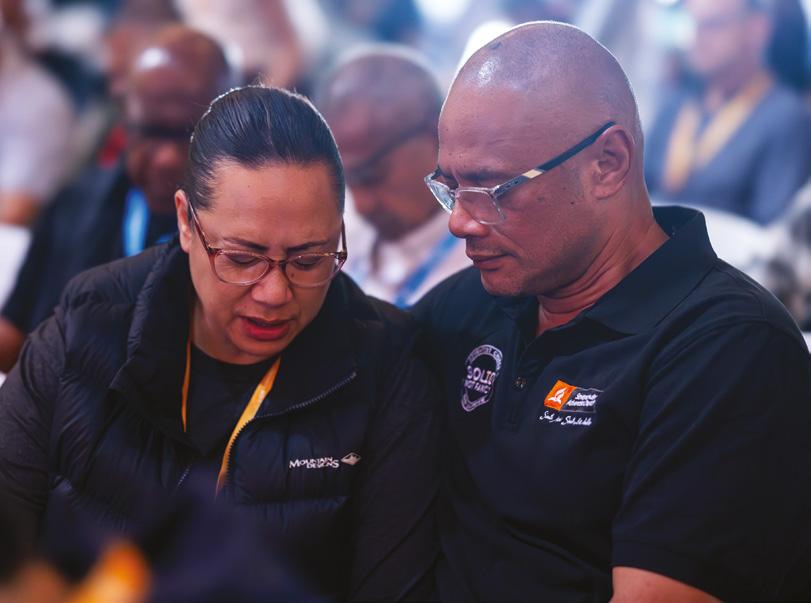
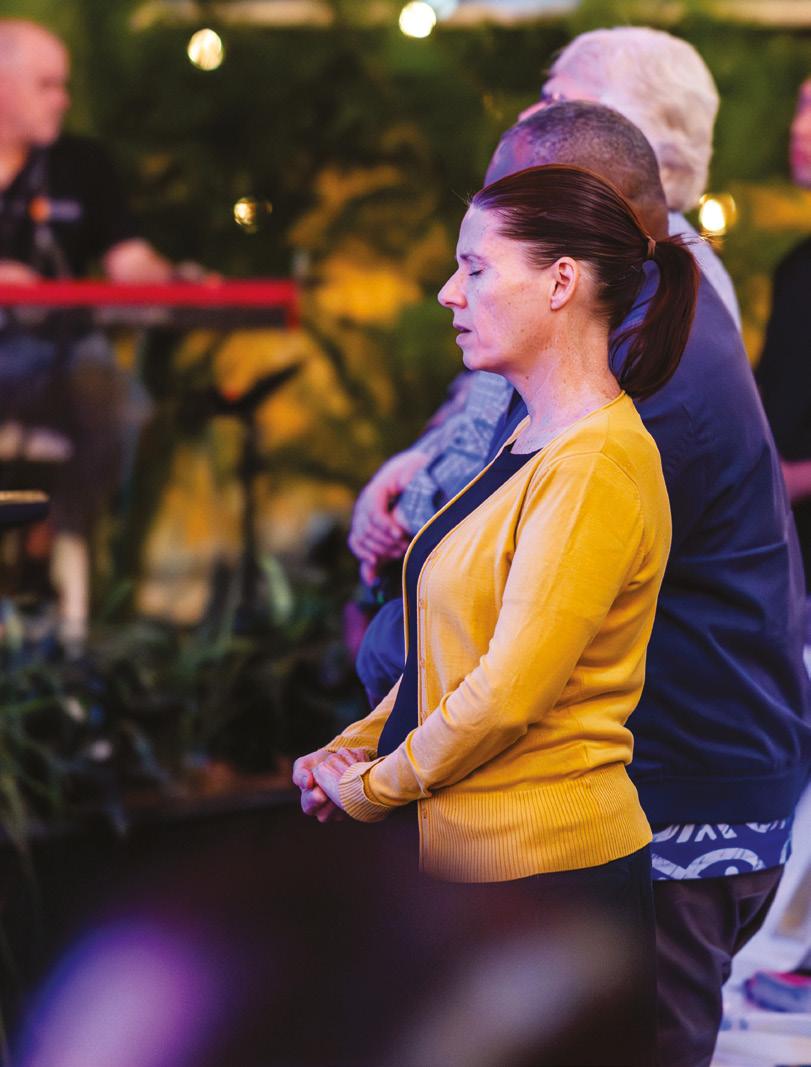
As Trans Pacific for Christ begins, here are 10 things you can pray for during today’s Prayer Sabbath— and over the coming months—as you support this mission initiative from wherever you are in the world.
1. Pray for the speakers
People from more than 20 countries, including Australia, New Zealand, Papua New Guinea, Kenya, India, China, Russia, South Africa, the United Kingdom and the United States, will present at Trans Pacific for Christ.
2. Pray for the attendees
Across 11 Pacific nations, thousands of people are expected to attend the meetings.
3. Pray for the churches involved
Local churches are the foundation of the program, providing venues, volunteers and ongoing support to their communities.
4. Pray for the local communities
With 983 planned preaching sites across the initiative, the communities are diverse—from cities and regional centres to remote villages.
5. Pray for the countries
Trans Pacific for Christ will be held in American Samoa, Fiji, Kiribati, Nauru, Niue, Samoa, Solomon Islands, Tokelau, Tonga, Tuvalu and Vanuatu.
6. Pray for safe travels
Many speakers and support staff will travel significant distances by air and sea, and local attendees will be travelling to sites each day.
7. Pray for the preparation
Months of planning have gone into
the initiative, but last minute problems may arise.
8. Pray for the digital ministry
The programs will be promoted on social media platforms like Facebook and Instagram.
9. Pray for the Holy Spirit’s leading
While planning and preparation are important, ultimately it is a spiritual initiative to connect people with Jesus through the work of the Holy Spirit.
10. Pray for the ongoing nurturing of new believers
Local churches will continue to support and disciple people once the public meetings finish.

Serves 6 Prep: 15 Cook: 10 min
These vegetable burgers are low in saturated fat and full of flavour. They're a perfect addition to your next barbecue.
Ingredients
• 1 small carrot, grated
• 1 small zucchini (courgette), grated
• 400g can lentils, drained and rinsed
• 1 small can corn kernels (no added salt)
• 1 cup dry breadcrumbs
• 1 tbs mayonnaise
• 1 egg
• 1 tbs chopped chives
• 2 tbs olive oil
• 6 medium bread rolls
• 6 tomato slices
• Lettuce leaves
Nutritional Information (per serving)
Method
Step 1
Combine carrot, zucchini, lentils, corn kernels, breadcrumbs, mayonnaise, egg and chives in a bowl and shape ½ cup of mixture into patties. Refrigerate for 30 minutes.
Step 2
Pre heat a non-stick frying pan over medium heat, add oil and cook burgers in batches for 5 minutes on each side or until cooked through. Place in oven for 5 minutes to cook through.
Step 3
Serve on rolls with tomato, lettuce and salsa of your choice.

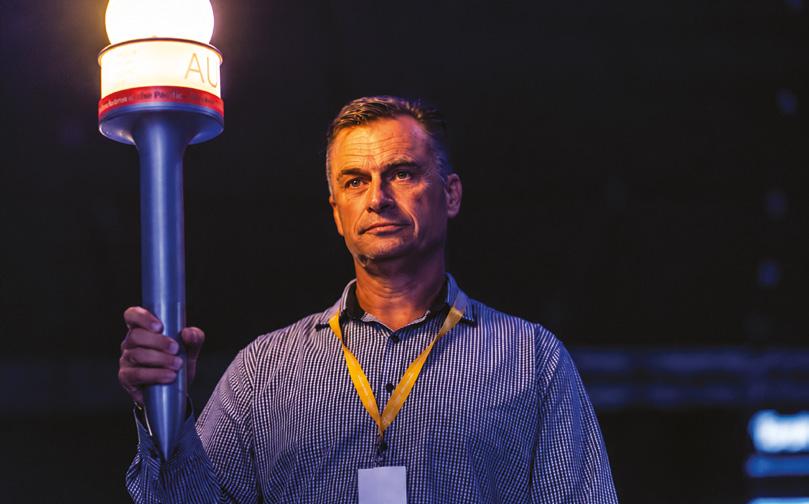
The South Pacific Division contains four unions. Adventist Record recorded interviews with all four union presidents during the South Pacific for Christ launch program in Brisbane, Queensland. In this issue, we bring you our chat with Dr Brendan Pratt, president of the Seventh-day Adventist Church in Australia.
Juliana Muniz (JM): Have you enjoyed this week at the conference? What stood out to you?
Brendan Pratt: I’ve thoroughly enjoyed it. What stood out was people’s heart for mission, and I thought the focus on integration for mission was incredibly valuable. I really enjoyed the presentations by the people from the centres for secular post-Christian mission and the urban centres from the General Conference, because that relates to our Australian challenge. I appreciated that the whole idea of mission was seen from a very broad perspective.
JM: Before we talk about Australia for Christ, it would be good to give our viewers an idea of what Australia looks like as maybe a mission field. What are some of the challenges that you face in your region?
Brendan Pratt: Australia is certainly a mission field. 84 per cent of Australians don’t connect with a church community, and that’s huge. Australia is increasingly spiritual but not religious, walking away from institutional religion. If we look at the challenges in Australia, it comes back to what consumerism does to a culture, what that does to religion and the opportunities that also gives.
JM: You were one of the union presidents who were elected right at the end, towards the end of 2025, so you have a lot of the quinquennium still ahead of you. What are your goals and strategies for this quinquennium?
Brendan Pratt: You’re right, I still have my L plates on. But yeah, there’s a lot of opportunity. So strategies and goals, working on what’s it look like to integrate for mission. What would it look like in Australia if we could get all our entities—whether that be our schools, aged care, local churches, all our members—rowing in the same direction with a mission focus? That’s one of our big challenges— integrating for mission. Our mission statement is about inspiring, empowering and equipping missional conferences, and that’s empowering them to respond to God’s love, God’s calling. So what’s it look like for the Adventist Church in Australia to be a beautiful picture of God? What’s it look like to captivate people with a picture that compels people in their relationship with God? And in the midst of consumerism, which destroys people having time with God and with one another, what’s it look like to call people to a better way of being human? It’s all about time with God, time with each other, and all those things that actually make life better than how it is in Australia at the moment.
JM: Now moving to Australia for Christ, which I’m very interested about. It’s coming up in 2028, and some people are a bit sceptical about it because if we look at
PNG for Christ and Trans Pacific for Christ, they are pretty much following the same model. What can we expect in Australia? Because I can’t really picture that same model being applied here. Would that work? What do you have in mind?
Brendan Pratt: Well, some of it’s exactly the same because humans are very much the same in many regards. I’ve appreciated seeing PNG and TPUM put a huge emphasis on prayer, on equipping their members to share stories, on small groups, on people realising how valuable the mission is. That is essential everywhere, and that’s what we can learn from what we’ve seen already. However, you’re right. The mission in a different context, in a highly secular—people call it post-Christian, I think our younger Australians are pre-Christian—environment. It is a different challenge, but it still comes down to what it looks like to connect hearts to a loving God and to have people see Jesus. I think there’s opportunities with the rising anxiety in Australia. We’re more anxious now than ever, and we’re lonelier now than ever. I think Australians are realising that the political systems, technology, the economy—all those things we put our trust and hope in—are not stacking up. And so I think Australia for Christ in 2028 is the perfect time for lifting our intentionality and outward focus. It’s like when you have an exam to study for; you know you’ve got to sit down and get it done. Will it include some of the stuff that PNG and TPUM included? Yes, it will, because Australia’s incredibly multicultural. Will it include stuff we haven’t seen before? It has to, to reach the 84 per cent of Australians who don’t connect with any faith community. We’ve got to think of things we haven’t done yet. This is where our young people are particularly important. This is where innovation comes into it. We’re setting up innovation hubs where we’re saying to our young people, “We don’t have to try and teach you about how to reach Australian young people. You are one of them. But what can you teach us as a church system to connect better?” So we’re going to have to innovate, try new ideas, learn new things. We’ll work out some things that don’t work and some things that do work. That’s a challenge for us, but the reality is God’s already working in Australia. We join God in that mission and we get the fun of discovering what that mission looks like.
JM: How do you expect people to start preparing for it? Because it is a harvest program, so for the harvest you have a whole preparation. So how do you expect people to start preparing for it?
Brendan Pratt: Well, the preparation, if we take what was explained by Pastor Charlie Jimmy yesterday, does include an intentional prayer focus. It includes a focus on what it means to be part of our communities. One of our challenges is when we do the AUC surveys, people say, “I’m growing my connection with Jesus,” but when we ask them, “How comfortable are you sharing Jesus?”, most people tick unsure. They’re not quite sure how to share
Jesus. That’s a challenge because our best effort is to have our church members be the evangelism campaign. Their lives are the campaign. We can pay for programs, strategies and advertising, that’s all good, but imagine if we had 60,000 church members so eager to share faith that wherever you found a church member, you found someone who’s sharing Jesus.
JM: Before we close, in addition to Australia for Christ, what should church members in Australia be aware of in terms of mission?
Brendan Pratt: In terms of mission, we’ve got OneVoice coming up in 2027. And at first we thought, Hey, is OneVoice going to compete with Australia for Christ 2028? But no, because OneVoice27 is mission for all, having everybody comfortable with sharing Jesus, which is what we’ve got to do anyway. So OneVoice will be where we’re saying, “How do we share Jesus well in Australia?”
Getting ready for 2028 as well, so we’ve got that. You’ll also hear about the Church Next strategy. That’s what we’re doing to encourage this innovation to reach the 84 per cent. So what does it look like to find different ways and different expressions of being the Adventist Church that engages the part of Australia that doesn’t engage at the moment? So that’s pretty exciting. But if you’re a church member in Australia at the moment, then I really do believe that it’s just intentionally making that space and time to grow with God and grow with people. Because in our consumer culture, the opposite to consumerism is community. If we can do community really well and build relationships, that’s where Australia for Christ 2028 is going to work.
JM: It’s a time where with AI and so many automated things, I think if we can take that human side to the next level and be there for people, it’s going to be something really different that will stand out.
Brendan Pratt: And we use all that technology. We’ve got clever people doing clever stuff. That’s all needed. But there’s also the simple things of just simply connecting with God, connecting with people, allowing God to work in and through you. And that’s what we talk about: inspire, empower, equip. Inspiring, connecting with God. Empowered with inner strength out of Ephesians 3. Equipped out of Ephesians 4 to be people of light in the darkness of Australia.
This interview was recorded and published as a recent episode of Record Live.
To watch the full version visit <youtube.com/@AdventistNews> or scan the QR code.


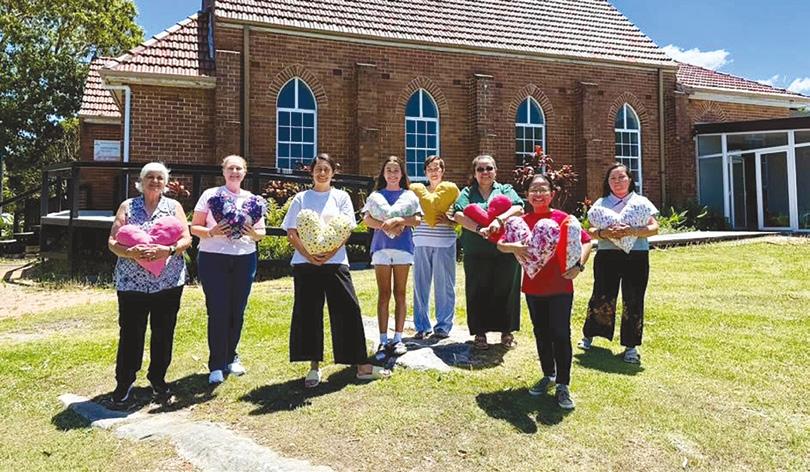
simple hand-made pillow is bringing comfort, connection and hope to individuals facing some of life’s hardest moments.
Minerva Sindac-Lebmeier, a member of the Freshwater Seventh-day Adventist church in Sydney, has helped lead the Heart2Heart project—an initiative that provides heart-shaped pillows to breast cancer patients, terminally ill children and others recovering from illness or surgery.
“Even though this is a small project, it’s just a small pillow, but you know they find comfort in this,” Ms Sindac-Lebmeier said.
Heart2Heart was established in 2019 after a young girl named Lily, who had moved to Australia from Germany, shared an idea she had seen on television about making heart pillows for breast cancer patients. Inspired by the concept, Ms Sindac-Lebmeier recognised its potential and began working with Lily and others to turn the idea into a church and community initiative.
Collaborating with a McGrath nurse at Royal North Shore Hospital, where Ms Sindac-Lebmeier worked, the group officially launched Heart2Heart in March 2019. The first 50 pillows were delivered just two months later.
“I like volunteering and I thought, Wow, this is something really that I can focus myself on as a volunteer,” Ms Sindac-Lebmeier said.
The project’s mission is to provide tangible expressions of compassion through hand-made heart pillows, while also creating opportunities for meaningful “heart-to-heart” conversations and mutual support.

Despite the challenges of the COVID pandemic, the project continued to expand. One of its ongoing partnerships has been with Bear Cottage, a children’s hospice caring for terminally ill children, where volunteers deliver around 200 pillows each year.
“It’s so touching . . . you know with the little ones, you don’t need to say love or anything, just the heart pillow—it speaks for itself,” Ms Sindac-Lebmeier said. “They already feel that they are loved.”
Bronwen Simmons, Bear Cottage community relations manager, said the impact of the project has been significant.
“I think the value of the Heart2Heart project is immeasurable,” she said. “Our children and families are often going through extremely difficult times. For them, knowing that there are people in the community that are supporting them, thinking of them, sending them love and, of course, beautiful heart-shaped pillows, we really couldn’t ask for more than that.”
One particularly memorable moment for Ms Sindac-Lebmeier came when the Northern Beaches Council partnered with the project, bringing staff together for a day of sewing and assembling 200 pillows.
The project has also extended beyond hospitals and hospice care, with pillows distributed during humanitarian crises, including support efforts connected to the war in Ukraine.
Tracey Bridcutt communication director, South Pacific Division.

Iam a perfectionist. I wouldn’t recommend this mindset— it’s made many things more challenging (emotionally) as I tend to fall short of the standards I set for myself. I’ve spent much of my life so far trying to accept that it’s okay to make mistakes.
But I’m a perfectionist in temperament, not theology, because I know the Bible says it’s impossible to live a sinless life, for “we have all sinned and fallen short of the glory of God” (Romans 3:23).
Why, then, is there another verse in the Bible that says, “Be perfect, therefore, as your heavenly Father is perfect”? Yes, that’s in the Bible, and it seems like an impossible standard to reach.
Some read this and interpret it as “perfect in actions”, which can lead to an understanding that we are saved by works, which the Bible clearly refutes: “For it is by grace you have been saved, through faith—and this is not from yourselves, it is the gift of God” (Ephesians 2:8,9). Even with a healthy understanding of God’s grace, it’s easy to slip down a legalistic path and try to prove our salvation by our works, like by how we keep the Sabbath, or how vegetarian we are, or by how regularly we attend church. But nothing we do will ever be enough; only God’s grace is enough. There is no way that we can ever be perfect like Him.
So there must be more than meets the eye when it comes to this verse—we have to look a little deeper to understand its meaning. In the previous verses Jesus talks about not just loving your neighbour but loving your enemies. “If you love those who love you, what reward will you get? . . . If you greet only your own people, what are

you doing more than others? Do not even pagans do that? Be perfect, therefore, as your heavenly Father is perfect” (Matthew 5:46-48). You see, Jesus isn’t talking about living a sinless life, but perfect love, a love that loves even those who are hard to love.
Don’t get me wrong; the standard is still set impossibly high. And none of us will achieve it this side of the kingdom. But we can still grow in our love for others, and even in our unconditional love for the difficult people in our lives. It’s less about striving for a standard, and more about looking to Jesus as our example and growing in His likeness because we love Him. When we truly internalise how much He loves us, we learn to love Him in return, and because we love Him, we want to be more like Him. Out of this process, our love for others grows.
Loving others is the second greatest commandment according to Jesus (Matthew 22:36-40). It’s not how we keep the Sabbath, or being vegetarian, or our church attendance, but our kindness and compassion towards other human beings.
In the original Greek, the word perfect is teleioi and is defined as “having reached its end”. Perhaps we shouldn’t think of that definition as meaning perfect in the context we tend to understand it in (free from mistakes) but as mature or grown. We spend our lives growing towards maturity in our faith, and though we will never be perfect, we can grow in our understanding of how to love those around us.
Ashley Jankiewicz assistant editor, Adventist Record.

Anew study commissioned by the Seventh-day Adventist Church has revealed encouraging signs of spiritual openness across Australia and New Zealand, particularly among younger generations, while highlighting opportunities for the Church to strengthen its visibility and community engagement.
Conducted by McCrindle between February and March, the research surveyed Australians and New Zealanders in city and regional areas to better understand current perceptions of the Adventist Church and compare them with findings from a similar study conducted in 2022. The project was a joint initiative of the South Pacific Division’s communication department and ministry innovations and marketing department in partnership with the Australian Union Conference and New Zealand Pacific Union Conference.
The findings paint a nuanced picture. While public awareness of the Adventist Church has remained largely unchanged over the past four years, positive perceptions are growing in Australia, and younger generations are demonstrating a greater openness to faith and church involvement than many might expect.
One of the most notable findings was the broader shift in the religious landscape. The proportion of Australians identifying as Christian increased from 45% in 2022 to 51% in 2026, while New Zealand also recorded a slight increase from 36% to 39%. Weekly church attendance rose modestly in both countries, with younger age groups driving much of that growth. Among Australian Gen Z respondents, 44% reported attending church at least monthly, while the figure was 35% among New Zealand Gen Z participants.
Denominational awareness of the Adventist Church remained steady, with 56% of Australians and 51% of New Zealanders saying they were familiar with the Church. However, sentiment among those who knew of the Church improved in Australia, with positive perceptions increasing from 14% in 2022 to 17% in 2026. In New Zealand, positive sentiment remained relatively stable.
When respondents were asked what three words first came to mind when thinking about the Adventist Church, “Saturday” or “Saturday Sabbath” remained the strongest association in both countries. Other commonly mentioned terms included “religious”, “Christian”, “Jesus” and “church”. However, some respondents used less positive terms, including “weird”, “strange” and “cult”.
The research also revealed strengthening perceptions of the Church as a Bible-believing movement. In Australia, the proportion of people who identified the Adventist Church as “Bible believing” increased from 26% to 32% over the four-year period. New Zealand recorded a slight decrease, though the attribute remained one of the Church’s strongest identifiers.
Perhaps one of the most encouraging findings related to local church presence and community impact. Across both countries, about one in four people reported knowing of an Adventist church in their local suburb. Among those who were aware of a nearby Adventist congregation, perceptions of positive community impact increased significantly in Australia, rising from 31% in 2022 to 47% in 2026. New Zealand remained relatively stable.
At the same time, the study highlighted a visibility challenge. Most respondents reported having little or no exposure to Adventist advertising. Sixty-two per cent of Australians and 68% of New Zealanders said they had not seen any Church marketing or media.
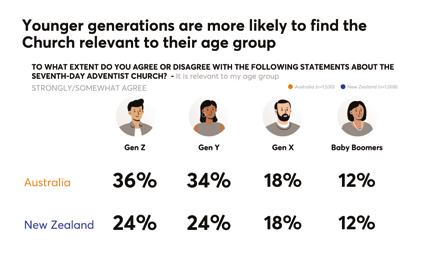
The research found the perceived relevance of the Adventist Church to people’s age groups increased significantly in Australia, rising from 15% in 2022 to 26% in 2026. Younger generations were far more likely than older cohorts to see the Church as relevant to them. More than one-third of Australian Gen Z and Gen Y respondents agreed the Church was relevant to their age group, compared with just 12% of Baby Boomers. Similar trends were evident in New Zealand.
The research also suggests the Adventist Church is becoming increasingly distinct in the minds of those who know it. When respondents were asked how the Adventist
Which of the following best describes the Seventh-day Adventist Church, compared with other Christian denominations?
It is just like other Christian denominations
I don’t know aything about the Seventh-day Adventist Church
It is positively different from other Christian denominations
It is negatively different from other Christian denominations

Church compares with other Christian denominations, 19% of Australians said it was positively different, up from 13% in 2022. In New Zealand, the figure was 15%, up from 12% in the previous study.
Ministry innovations and marketing leader Tim McTernan said the findings indicate that many people remain open to spiritual conversations and church engagement, particularly younger generations.
“The research challenges the idea that young people are closed to faith,” Mr McTernan said. “In many ways, Gen Z may be one of the most important missional opportunities before us.”
Mr McTernan noted that younger people are not only more open to church engagement but also represent an opportunity for the Church to strengthen its mission and communication efforts.
“Gen Z are almost four times more likely in Australia, and almost three times more likely in New Zealand, to attend a Seventh-day Adventist church service than someone who is Gen X,” he said.
“The opportunity is more than just intentionally targeting
the younger generation. McCrindle points out that we have the opportunity to ‘transition younger demographics from passive congregants to active cultural architects’. This means empowering our young people to lead and drive media, communications and practical ways to engage with our communities. This not only seeks to engage and retain our young people but also maximises the potential to engage their peers in the community.”
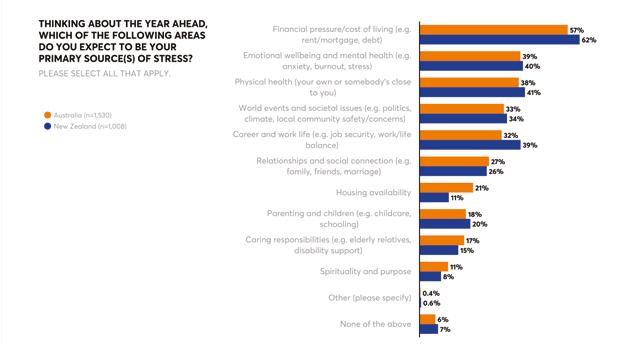
The study also explored the key pressures facing Australians and New Zealanders. Cost of living concerns topped the list in both countries, while other stressors included emotional wellbeing and mental health, physical health, world events and societal issues, and career or work-life pressures.
These concerns were reflected in another significant finding: community-focused programs were consistently more appealing than explicitly faith-based activities. Respondents indicated a growing willingness to attend church-facilitated community services, health and wellbeing programs, social events and community gatherings. While interest in faith-based programs was generally
lower, younger generations were notably more open to participating.
Mr McTernan said there is an opportunity to connect the Church’s message with the real needs people are facing.
“Our beliefs are rich with public relevance. Sabbath speaks to an exhausted culture, our health message speaks to wellbeing, our community life speaks to loneliness, and the gospel speaks to hope, forgiveness and purpose. The challenge is to translate those beliefs into practical local expressions people can see, experience and trust.”
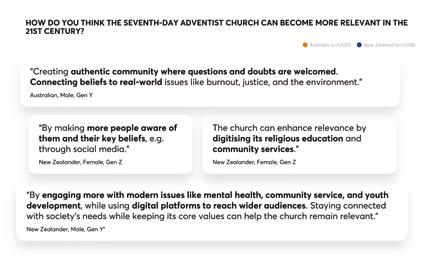
Mr McTernan said one of the disappointing findings is that the Church is not yet as visible as it needs to be in the digital space.
“If people are curious, they told us in the research that their first step is likely to be using a search engine or visiting a church website,” he said. “This means that the ‘digital front door’ really matters. Local church websites, social media pages and other digital channels are not just communication tools—they are now part of the mission pathway.”
The study identified several strategic opportunities moving forward, including strengthening digital discoverability, increasing local community engagement and empowering younger members to lead media, communication and outreach initiatives. It also highlighted differences between Australia and New Zealand, suggesting localised approaches may be required in each country.
New Zealand Pacific Union Conference president Dr Eddie Tupa’i said the findings point to significant opportunities for the Church in New Zealand.
“New Zealanders are open to Christianity, value churches, are looking for community and practical help, and younger generations are surprisingly receptive,” Dr Tupa’i said.
“What they need is a church that is visible, welcoming, practical and easy to discover. The opportunity in New Zealand is not to convince people that faith matters; it is to demonstrate that the Adventist Church matters in their everyday lives.”
Tracey Bridcutt communication director, South Pacific Division.
Scan to watch Tim McTernan’s presentation on the McCrindle survey at the South Pacific for Christ launch.
Re: “One last thought” (Editor’s Note, June 6). Thank you, Jarrod Stack for this timely and heartfelt reflection. Your words remind us that in a world increasingly divided by opinions, politics and personal convictions, the calling of a Christian remains unchanged—to love one another as Christ has loved us.
I appreciate your reminder that unity does not require uniformity. As members of the body of Christ, we may hold different perspectives on certain matters, yet we are united by our faith in Jesus, our mission to share His love and our dependence on His grace. In an age where disagreements often become personal attacks, your appeal to approach one another with humility, kindness and a willingness to listen is both needed and biblical.
The reminder that “a soft answer turns away wrath” is particularly relevant today. Social media and online discussions often encourage quick reactions rather than thoughtful responses. As followers of Christ, we are called to model a different way, one marked by patience, respect and genuine concern for others.
Thank you also for your years of service through Adventist Record. Your commitment to thoughtful journalism, spiritual reflection and fostering meaningful conversations has blessed many readers across the South Pacific. While no leader or editor is perfect, your willingness to
acknowledge mistakes and extend grace reflects the very message you have shared.
As you begin this new chapter of ministry, may God continue to guide and bless your service. May we, as a church family, take seriously Christ’s command that the world will know we are His disciples by our love for one another.
Rose Maine Sinias, via Facebook
Re: “Do no less” (Feature, May 30). I would like to thank you for the article concerning people with disabilities in the Church. Being the mother of a beautiful 20-year-old non-verbal autistic girl, with an intellectual disability, I have been very hurt and disappointed by the attitudes of some people in churches over the years.
When my daughter Evie was younger we were members of the Salvation Army, where she was fully loved and accepted. Over the years we started going to Pentecostal churches. In some of those she was accepted and some told me not to bother coming if I was going to bring Evie. So, by the time I met my now Adventist husband in 2021, I had decided to never go to any church again, and instead watch religious programs on TV and YouTube, but my husband influenced me to go to an Adventist church.
At first I left Evie with her older siblings while we went to church,
but that all changed when my son decided to go to church as well, and my other daughter got a job. But the pastor said bring her to church and if anyone complained about her little happy noises, he would deal with them. That went well for about two years, until one day Evie had a bit of a loud meltdown in church [and consequently] we stopped going to that church. I was scared to go to any others. Evie cannot talk, but what people need to understand is that she can still sense if she is wanted or not, and she still has feelings.
We eventually went to what is now our home church, Castlemaine, where I was told to not worry about Evie’s happy noises and that everyone is accepted there. We have found that to be true. Unfortunately we have been asked to take Evie out of a couple of Adventist churches that we have visited, which left me in tears feeling alone and rejected. But Castlemaine is a very welcoming church where Evie is loved and allowed to be her happy self. She loves it there. I must say that the Maryborough and Benalla churches are also very loving and accepting of our beautiful Evie. But I think all churches should be educated in loving and accepting those with disabilities, especially in the so-called invisible disabilities such as autism. It’s God’s house and all should be accepted.
Leeanne Pearson, Victoria





CHU, Leonard, died 26.4.26 in Melbourne, Vic. He is survived by his wife, Joy; sons, Kerwin and Opeka, and Kurt and Caroline; and five grandchildren. Leonard’s memorial service was held on May 15 at Wantirna church. The church was full and filled with love and faith. Leonard will truly be missed.
Daniel Brunt

ENGELBRECHT,
Enid Isobel (nee Evans), born 10.3.1931 in Wahroonga, NSW; died 26.1.26 in Normanhurst. She was predeceased by her first husband, Dr Russell Standish. Enid is survived by her husband, Bernard; sons, Stephen Standish, Timothy Standish and James Standish; and brother, Dr John Evans. Enid lived an eventful life as a missionary teacher and wife. Her skill and empathy as a teacher transformed the lives of many students attending schools in Australia, Thailand and Malaysia. Enid also worked in London’s finance industry. She is mourned by her family and many friends, relatives and former students.
James Standish, John Hammond

JACKSON, Colleen Ena (nee Gabasa), born 9.8.1940 in Cooranbong, NSW; died 20.5.26 in Stanthorpe, Qld. She is survived by her husband, Merv (Dalveen); daughter, Kim (Dalveen); sons, Tim (Thulimbah) and Chris (Barney View); and sister, Valmai Tucker (Caloundra). Colleen embraced many others as her own family and faithfully served her church community for more than 50 years. She now rests in the blessed hope until Jesus comes again soon.
Wayne Humphries
STUDY THE ADULT SABBATH SCHOOL LESSON YOUR WAY
Accessible formats for vision
loss (large print, audio CD, app, YouTube, podcast and braille) or hearing loss (Hope SS captioned). Contact CVHS on +61 (02) 9847 2296 or email <cvhs@adventistmedia.org.au>.
AITKENVALE SEVENTH-DAY ADVENTIST CHURCH CELEBRATES 60 YEARS OF GOD’S FAITHFULNESS. October 16-17, 2026. Former pastors, members, friends and community are warmly invited to attend. Follow us on Facebook.
IN THE STEPS OF PAUL TOUR OF TURKEY AND GREECE
September 13 to October 4, 2026. Follow the footsteps of the apostle Paul, connecting faith to the ancient sites of Ephesus, Corinth, Thessaloniki and Philippi. Visit the Seven Churches of Revelation. Conducted by Dr Peter Roennfeldt. Contact Anita at <alltrav@bigpond.net.au> or 0405 260 155.
FAMILY FUNERALS. Offering compassionate cremation and burial services with dignity and care at your cemetery of choice in NSW led by an Adventist funeral director. Contact Mark Windus on 0411 797 854 or <director@ avondalefamilyfunerals.com.au>.
Is your church receiving the correct number of Record magazines? Adjust your numbers by notifying Kelli Geelan at subscriptions@record.net.au or on +61 (03) 5965 6300.
The Adventist Identity website provides official tools to help your church communicate professionally and consistently. Explore what’s available at <identity.adventistchurch.com. au>.
“Remember the Lord your God, for it is he who gives you power to get wealth.”
Deuteronomy 8:18
eGiving: The SIMPLE solution for faithfulness in a busy, almost cashless world.
NOTE: Neither the editor, Adventist Media, nor the Seventh-day Adventist Church is responsible for the quality of goods or services advertised. Publication does not indicate endorsement of a product or service. Classified advertisements in Adventist Record are available to Seventh-day Adventist members, churches and institutions only. All advertisements, appreciation, anniversary, wedding and obituary notices may be submitted via <ads@record.net.au> or online at <record.adventistchurch. com>. Notices will not be reprinted unless there is an error of fact caused by Record staff.
abn 59 093 117 689 vol 131 no 13
Consulting editor
Glenn Townend
Interim editor
Tracey Bridcutt
News editor
Juliana Muniz
Assistant editors
Ashley Jankiewicz
Danelle Stothers
Copyeditor
Tracey Bridcutt
Graphic designer
Theodora Pau’u
Noticeboard
Julie Laws
Letters editor@record.net.au
News & photos news@record.net.au
Noticeboard ads@record.net.au
Subscriptions subscriptions@record.net.au + 61 (03) 5965 6300
Mailed within Australia and New Zealand $A60.00; $NZ90.00 Other prices on application
Website record.adventistchurch.com
Mailing address
Adventist Media Locked Bag 1115 Wahroonga NSW 2076 Australia + 61 (02) 9847 2222
Cover credit
Charmaine Patel
Next issue
Adventist Review July 11