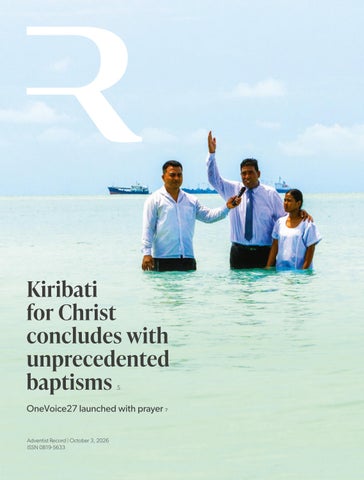
Kiribati for Christ concludes with unprecedented baptisms 5
OneVoice27 launched with prayer 7 Adventist Record | October 3, 2026 ISSN 0819-5633
EDITOR’S NOTE:
Your pastor is a human too Jesse Herford Editor
Perhaps the best thing you can do is remember that your pastor is a person before they are a position
Recently, I asked the question on Facebook: “Pastors, what could your church members say/do for you to feel actually appreciated?” Some church members gave their two cents. Some were snarky, starting their own long comment threads. Some were self-righteous. Others, more guarded. But some were honest. One pastor said, “Take me out for a [hot beverage] and a genuine catch-up.” Another, “Honestly, sometimes it’s as simple as asking, ‘How are you?’ and genuinely wanting to know. As pastors, so much of what we do is serving, giving and being there for others. So, it means a lot when someone calls or checks in, not because they need something, but simply to see how we’re doing or to pray with us. Those small things can mean more than people realise.” One shared, “When someone tells me ‘I’ve been praying for you’. Sometimes it’s about a need I quietly shared and other times it’s something I never even said, but they noticed it. Knowing someone cared enough to take the time to pray for me is so meaningful.” Another said, “Even if it’s hard to align schedules, having a church member reaching out just to catch up is awesome. Most of the time, catching up with people from church is the pastor trying to check in and make things happen or people just wanting to complain. Obviously those two things have their place, but when someone just wants to connect and catch up, that’s awesome.” One of my favourite responses was from a pastoral spouse. “If church members value/appreciate the pastoral family, I can guarantee this will have a positive impact on the pastor. A pastor’s safe place is (or should be at least) their home. If the church is supporting/appreciating the home, then the home can support the pastor.” Pastors come in all shapes and sizes. Some are all bravado and confidence. Some are softer, more reflective. Some are driven by the desire to “have the right answer” for every doctrinal, philosophical or culture war issue. Others ask more questions than they answer. Some pastors overshare at any given opportunity. Others struggle to share much of their interior life at all. We’ve all met the pastor who shares too much in the sermon, only to be met by a glare from their spouse that everyone knows will continue in the car ride home. On the other hand, I knew one minister who notoriously kept personal details close to his chest, including hiding his home address from everyone—church members and colleagues alike. Regardless of differences, all pastors are driven by the same things: to help their community, proclaim the gospel and see people enter a saving relationship with Jesus. Many also face common challenges: imposter syndrome, the pressure to appear spiritual even when they don’t feel it—and the often-overwhelming responsibility of leading a church—big or small. One great outcome from my Facebook post was a church member reaching out to that first responder—the one who simply wanted a hot cuppa—and followed through. So, this Pastor Appreciation Month, perhaps the best thing you can do is remember that your pastor is a person before they are a position. They don’t need to be put on a pedestal, but they do need friendship, prayer, encouragement and the occasional reminder that they are valued for more than what they produce. Ask how they’re doing— and mean it. Make room for their family. Invite them for a hot cuppa— without an agenda. Pastors spend much of their lives caring for others. Every now and then, make sure someone is caring for them, too.
October 3, 2026 | Adventist Record
3
INSIGHT:
When God’s people pray together Maveni Kaufononga South Pacific Division vice president
4
Adventist Record | October 3, 2026
There is something powerful about one person praying. But throughout Scripture, there are remarkable moments when God’s people pray together— and things change. When Esther faced an impossible situation, she did not rely only on her position or influence. She sent a message to Mordecai: “Gather together all the Jews . . . and fast for me” (Esther 4:16). God’s people united, and a crisis became a call to prayer and fasting. God opened a way, and a people marked for destruction were delivered. When Jonah preached to Nineveh, an entire city responded. From the king to ordinary citizens, people humbled themselves, fasted and cried out to God (Jonah 3:5–10). God saw their response and extended mercy. The New Testament church understood the same principle. Before Pentecost, the disciples did not begin with programs or strategies. Acts 1:14 tells us, “They all joined together constantly in prayer.” Then came Pentecost. The Holy Spirit was poured out, the gospel was proclaimed with power and about 3000 people were baptised. Recently, I was reminded again of the beauty and power of God’s people praying together. Across the South Pacific Division, we joined together in a prayer vigil. Different countries, cultures, churches, institutions and ministries were united by one purpose—to seek God together and pray for His mission. As I listened to prayers being offered from across the Pacific, I was reminded that our greatest strength is not found in our plans, resources, technology or strategies. All these have their place, but they can never replace our dependence upon God. Corporate prayer reminds us that the mission belongs to God, power comes from God and results must ultimately also come from God. As we move forward in mission across the South Pacific, perhaps before asking, “What more can we do?” we should first ask:“What might God do if His people prayed together?”
First phase of Kiribati for Christ concludes with unprecedented number of baptisms Tarawa, Kiribati | Juliana Muniz/ Ashley Jankiewicz
Candidates lined up for the mass baptism.
Tewiiti Aata (centre) was one of the 139 people baptised in Tarawa.
Baptism candidates, speakers and church leaders after the baptism ceremony in Betio, Tarawa.
The first phase of Kiribati for Christ has concluded with 206 baptisms across Tarawa, Abemama and Kiritimati (Christmas Island), a result Kiribati Mission leaders described as unprecedented for the Church in the country. Eleven international speakers joined local churches for the first phase of the campaign from August 15 to 29. Kiribati Mission president Pastor Taabua Rokeatau said it was the first time the Mission had conducted an initiative of this scale with international guest speakers. “I’m very excited,” he said. “It’s really something that has inspired our people.” The largest baptism took place in Tarawa, where 139 people were baptised following programs held at multiple sites. A further 24 were baptised on Kiritimati. Among those baptised was Tewiiti Aata from Bikenibeu church, who had been actively involved in the campaign, assisting with evening health talks as well as media and livestreaming at the meeting sites. “I know this is not the end of my journey. It’s the beginning of my journey,” Mr Aata said after his baptism. “I’m very interested in going to tell the gospel all over the world.” He said he was happy to have been part of Kiribati Mission’s efforts to share the gospel and hoped to continue doing the same. On Abemama, 43 people—mostly students and staff—were baptised following a week of worship at Kauma Adventist High School, the Adventist Church’s only school in Kiribati. The boarding school has more than 260 students from across the country, with school staff estimating around 80 per cent come from other faith backgrounds. The school hosted Abemama’s only Kiribati for Christ site, adapting the program to the school setting and opening it to the surrounding community. Trans Pacific Union Mission children, women and family director
Alice Kaisuva presented two messages each day, condensing the two-week evangelistic program into one week. “God gave me the strength, wisdom and vigor to be able to preach two sermons a day. And these sermons are not short!” said Mrs Kaisuva. “Some of them would ask, ‘You’re not tired?’ And I said, ‘I don’t feel tired. I just feel the arms of God around me every day as I prepare and as I read and as I pray.’” Pastor Rokeatau said the conclusion of the international speaker programs was “just the beginning”, with local pastors and preachers now conducting programs on other islands at different times through November. “We are going to all the islands,” Pastor Rokeatau said, including four where the Adventist Church does not yet have an established church or minister. On those islands, the Mission plans to begin with music ministry and health initiatives, including 10,000 Toes screenings and follow-up support. Preaching programs will continue in places where the Church is already established. Teams will be supported by MiracleAir, an independent Adventist aviation ministry based on Abemama. The Mission is also developing a retention program for newly baptised members and others who expressed interest during the campaign, including Bible studies and prophecy seminars led by local church members. Bible study resources are also being translated into Kiribati for the program. Solomon Islands Mission president Pastor David Filo remained in Kiribati for a week following the campaign to assist with developing and implementing the program. Pastor Rokeatau said the Kiribati Mission hopes to learn from retention strategies used by larger missions across the Trans Pacific Union Mission, particularly Solomon Islands Mission, and adapt them to the local context.
October 3, 2026 | Adventist Record
5
Health and media “reaching the unreached” South Tarawa, Kiribati | Juliana Muniz/ Ashley Jankiewicz
10,000 Toes health screenings and live streaming of the evangelistic meetings provided a point of connection with the community.
Media and health initiatives helped Kiribati for Christ connect with people who may not otherwise attend conventional evangelistic meetings. Adventists make up around two per cent of Kiribati’s population, compared with nearly 60 per cent identifying as Catholic and around 29 per cent with the Kiribati Uniting or Protestant churches, according to the 2020 census. Kiribati Mission (KM) leaders explained that, despite interest in Adventist beliefs, including the Sabbath, members of other denominations can be discouraged by their church leaders from attending Adventist events. Geography presents another barrier, with Kiribati’s population spread across 33 islands and atolls. During Kiribati for Christ, evening meetings were broadcast on Hope Radio, giving more than half of Kiribati’s population access to the programs. Campaign sites also
livestreamed their meetings through local Facebook pages, extending their reach to outer islands. “Media plays an important part in reaching the unreached,” said KM communication director Tarataake Angiraoi, explaining that people could access programs privately through their phones or radios. Health initiatives also provided a point of connection. KM president Pastor Taabua Rokeatau said community health programs not only meet real needs in the community, but also open doors to people who might not attend evangelistic meetings. “They can attend screenings without religious barriers because they’re coming for a practical health service,” he explained More than 200 people received 10,000 Toes health screenings across five sites, of which nearly 50 registered for a 12-week Step Up to Wellness follow-up program.
50 baptised at Samoa correctional centre Tanumalala, Samoa | Falepau Aumalaga/ Record Staff
Pastor Afiipu Tuaoi (Mission president), Pastor Laneselota Seufale, Falepau Aumalaga, Pastor Uili Tinomeneta (Mission secretary) and Maryanne Suisala (Mission treasurer).
6
Adventist Record | October 3, 2026
Fifty people, including correctional officers and the prison commissioner, were baptised at Oloamanu Correctional Centre during Samoa for Christ. The baptisms followed evangelistic meetings conducted by Pastor Laneselota Seufale, who serves as the government-appointed spiritual pastor at the correctional centre. During the campaign, Pastor Seufale shared messages about salvation, forgiveness and hope in Jesus. Led by the Samoa and Tokelau Mission, the Samoa for Christ campaign was held from August 16 to 30, involved 64 sites and has resulted in more than 1487 baptisms. While Pastor Seufale conducted the correctional centre meetings, intern pastor Falepau Aumalaga from Wellington, New Zealand, was assigned to Samatau Adventist Church. Representing the North New Zealand Conference, he worked with members from the Samatau and
Manono churches through prayer, Bible studies, visitation and evangelistic meetings. Their combined outreach resulted in 23 baptisms at Samatau, bringing the total number of baptisms from the two ministry sites to 73. The intern pastor described the experience as a significant step in his pastoral journey. “Seeing people hear the truth, surrender their lives to Christ and publicly declare their faith through baptism has strengthened my own sense of calling to ministry,” he said. He also expressed appreciation to Pastor Seufale for his mentorship and thanked Samoa and Tokelau Mission leaders for providing opportunities for pastors and church members to work together during the campaign. Follow-up nurture and discipleship are continuing for those baptised during Samoa for Christ.
making headlines Bread with purpose The Adventist Church in Ghana has launched a bakery as part of its ministry to the community, creating jobs while equipping people with practical skills and promoting healthy living. More than a commercial venture, the bakery was designed to serve the community, with the church planning to train about 500 people over the following year.—Ghana News Agency
Samoa and Tokelau Mission team hosting their prayer vigil timeslot.
OneVoice27 launched through prayer Wahroonga, NSW | Tracey Bridcutt
Church members across the South Pacific Division (SPD) united for 48 hours of continuous prayer from September 4 to 6, marking the regional launch of OneVoice27. The online prayer vigil brought together churches, institutions and individuals from across the SPD, with participants praying, sharing testimonies, singing and reflecting on mission. Thousands joined across the weekend via Zoom and Facebook. SPD president Pastor Glenn Townend described the launch as a “spiritual and cultural success”. “This is just the beginning of our one mission for our one God being proclaimed with one voice.” OneVoice27 SPD coordinator Pastor Pablo Lillo welcomed the strong response from across the region. “I have been deeply encouraged by the overwhelming response from across the Pacific,” he said. “We prayed for our churches and institutions, people of all generations and communities across the Pacific. We also prayed that God would raise up a new generation of digital missionaries who will faithfully proclaim the everlasting gospel.” French Polynesia Mission secretary Pastor Jeff Marirai-Parker said participating in the vigil reinforced the sense of connection. “It was powerful to realise that, across our vast Pacific, our territories were united around the same Jesus, the same mission and the same desire to see the Holy Spirit mobilise His Church,” he said. For French Polynesia, the launch was about more than preparing for an event in 2027, according to Pastor Marirai-Parker. “It is a call to mobilisation now,” he said. “Our desire is to see our pastors, departments, local churches, young people, families and every member understand that they have a place in God’s mission and a testimony to share.” OneVoice27 is a global Seventh-day Adventist initiative focused on mobilising church members to share Jesus in the lead-up to and throughout 2027. “2027 will be a year that Jesus is lifted up in the South Pacific and around the world,” Pastor Townend said. For more information on OneVoice27 in the South Pacific visit <onevoice27.tv>.
Connect with Newbold Newbold College (UK) has launched Newbold Connect, an online learning platform offering cinematic classes designed to help people live their faith in everyday life. Each seven-to12-minute episode combines expert teaching with a practical action step, covering topics such as faith, wellbeing, leadership and service.—TED
Surgery in the jungle Adventist specialists from Peru and the US conducted the first free neurosurgery campaign in the Peruvian Amazon, performing eight complex spine surgeries and bringing specialised care to patients with limited access. The ministry also provided free medical, dental, eye and pharmacy care to more than 600 people in five communities, while distributing water filters and storage buckets and teaching families about hygiene and disease prevention.—SAD
Pretending became belief Brian Guan, a tech entrepreneur and influencer who set out to “pretend God was real” for 30 days, said the experiment led him to believe in Jesus. Prayer and Bible reading changed his outlook, prompting him to declare to his followers, “I’m not pretending anymore”.—Vision Media October 3, 2026 | Adventist Record
7
flashpoint
138 baptised Home visitations Namaka Seventh-day Adventist Church members took Fiji for Christ beyond the meeting venue, visiting homes and businesses each day to personally invite and pray with people in the surrounding community. The Namaka for Christ site hosted the two-week Mysteries Revealed evangelistic series, where Papua New Guinea Union Mission president Pastor Danny Philip served as the main speaker. Pastor Philip, who joined local young people in the visitations, said the initiative was started by the young people themselves and became a daily part of the campaign. According to assistant personal ministries leader Neta Vuwanga Junior, attendance increased after the visits began.—Juliana Muniz
Raising the standard Teachers from Iakina Adventist Academy in American Samoa are strengthening their focus on school improvement and Adventist identity following three days of Quality Adventist Schools Pacific (QASP) training. The initiative, part of the wider QASP rollout across the Trans Pacific Union Mission, aimed at addressing growing challenges facing the school, including declining enrolment and the need to strengthen the school’s Adventist identity and educational quality. It addressed these challenges by focusing on continuous school improvement, the creation of thriving learning environments, stronger leadership and accountability, and enhanced accreditation and quality assurance processes. —Elisapesi Manson/Record Staff
8
Adventist Record | October 3, 2026
An evangelistic campaign at Lokuru on Rendova Island concluded with 138 people being baptised as part of Solomon Islands for Christ. Among the 138 baptised were 39 people from other faiths. Elsewhere on Rendova Island, priests from the Rendova Harbour village Anglican church allowed the Adventist Church to run the campaign at seven sites. When rain fell for four consecutive nights at the Rendova Harbour site, the Anglican priests opened the doors of their church, inviting the pastor and attendees to continue the meetings inside.—Nigel Nemson
Spirit-led leaders Approximately 240 pastors and local church leaders from across New Zealand’s North Island gathered recently at Tui Ridge Park for the Spirit Led leadership training weekend. The event featured six vision-casting sessions led by Conference and Union leaders, and lab sessions that encouraged discussion and practical application.—Adrian Webster
flashpoint
Pioneering convention Koki Seventh-day Adventist Church hosted its inaugural Stewardship Convention in Port Moresby, attracting approximately 250 registered participants. It was the first time a local Adventist church in Papua New Guinea had organised a stewardship convention of this scale. The convention featured Pastor Grego Pillay as keynote speaker. Drawing on his experience in ministry, leadership and mission, Pastor Pillay challenged participants to rethink stewardship through the biblical concept of “mission entrepreneurship”. According to Papua New Guinea Union Mission Sabbath school and personal ministries director Pastor Miller Kuso, Pastor Pillay introduced thought-provoking concepts that challenged conventional understandings of stewardship. “His presentations emphasised that stewardship extends far beyond financial giving and includes one’s vocation, influence, creativity, leadership and service to the community,” he said. “It is our prayer that this pioneering convention will inspire similar initiatives across Papua New Guinea.” The convention also featured presentations from Pacific Adventist University lecturers, Pastor Wally Kapi, stewardship director for the Central Papua Conference, and Pastor Kuso. Leadership representatives from BSP Bank conducted practical workshops and breakout sessions focusing on financial literacy, personal financial planning and investment. —Record Staff
have news to share?
Send info and photos to <news@record.net.au>
A taste of history An historian of spirituality in Australia’s Anzac history has been awarded for a book he co-authored with his wife on the food and drink supplied to Australian soldiers during World War I. Published earlier this year, The Anzac Table by Daniel Reynaud and Emanuela Reynaud received the Anzac Memorial Trustees Military History Prize at the State Library of New South Wales on September 7. The award judges described The Anzac Table as “grounded in thorough archival research and richly illustrated, this well-structured and easily read book achieves the rare feat of being both authoritative and accessible to a wide readership”. —Nathan Brown
Hope behind bars Members of the Eastern Highlands Adventist Students Association at Pacific Adventist University visited more than 100 Indonesian prisoners at Bomana Prison in Papua New Guinea on September 5. This is the second time the students have visited the group who, according to the prison chaplain, have received little outside support since arriving at Bomana. Many have been unable to stay in touch with their wives, children and families in Indonesia. Language presented a challenge during the visit, with many of the prisoners unable to speak English or Tok Pisin. The students used songs, prayer and fellowship to engage with them despite the language barrier. The visit also aligned with Papua New Guinea Union Mission plans to develop ministry across the border with Indonesia.—Harry Nasi/Juliana Muniz October 3, 2026 | Adventist Record
9
SOWING HOPE
cross-culturally
T
arawa, Kiribati’s most populated atoll, welcomed seven international speakers from across the South Pacific for the first phase of Kiribati for Christ, which ran from August 15 to 29. For many of them, it was their first time visiting the country. Pastors Tamanui Mohi and Wilfrid Raurahi, who both pastor in French Polynesia, said it was “a blessing to come to Kiribati to preach”. French Polynesia has its own challenges, with only 17 pastors looking after 62 churches, but Pastor Mohi said, “We are glad for the opportunity we have [to] come help our brothers from the Pacific.” He reiterated that they were not only there to share the gospel, but to “share blessings with each other”. One aspect of life in Kiribati the pastors pointed out was the opposition of other denominations towards the Adventist Church. “The Sabbath is a topic that interests people here,” said Pastor Raurahi. He explained how a bar right next to his site blasted music the first couple of nights while he preached. However, the night when the Sabbath was the topic, the bar turned off the music and lights, and the customers sat in silence. “At first I thought they would make trouble,” said Pastor Raurahi. “But no, they just sat and listened.”
10 Adventist Record | October 3, 2026
Many people in Kiribati have been dissuaded by their church leaders to attend Adventist meetings. One attendee at Pastor Raurahi’s site was told by his church leader he would be “cast away from the church” if he continued to attend the Kiribati for Christ meetings. “They see their church leaders as being close to God,” Pastor Mohi added. “So they feel they have to listen to them and obey them. We try to break these barriers as pastors, to try and tell them, ‘We are just humans like you, we are also sinners in need of Jesus’.” Pastor Mohi also explained how generous the I-Kiribati people are. “I’m very supported by my church,” he said. “They give so much. Every day they bring me a new outfit!” He went on to explain how they are “thirsty for the Word of God”, telling the story of a man who walked 45 minutes each night to hear him preach. “He’s continued coming every night,” Pastor Mohi said. “And he’s not just hearing the message but connecting with other believers— this is also part of evangelism.” Both Tahitian pastors felt they had connected well with the attendees of their site, as did Tekarimwi Bitaa, the Bikenibeu church pastor and Pastor Mohi’s translator. “They’re from the Pacific, and they know our context here,” said Minister Bitaa. “People are also interested in
these two because their English is simple.” Both pastors acknowledged that while there was a language barrier, they both saw God working through their preaching. Trans Pacific Union Mission (TPUM) Hope VA coordinator Lia Daucakacaka also connected well with attendees at her site. “One night after I preached, a man came to shake my hand and said, ‘You know what? I don’t understand much English, but when you preach I understand everything you say’.” Mrs Daucakacaka praised God for the moving of the Holy Spirit. “Even though they do not know the language and even though it was translated, I know they have understood what was shared.” Mrs Daucakacaka made sure to adapt the sermons to the Kiribati context. “I had a play around with my notes and what I was going to share,” she said, “so it actually fits into their understanding and their culture and customs.” She explained that she saw the international speakers exchange as a way to “break cultural barriers” as well as a way to learn from other cultures. “I didn’t come here just to teach these people,” she said. “They have also taught me a lesson.” Mrs Daucakacaka was very touched by the groups of children that frequented her site. One night, as she sang a special item for the attendees, several children climbed a nearby tree, waving their phone lights to the music. “It brought tears to my eyes,” she said. “I said to myself, ‘Oh God, the Holy Spirit is moving around here!’” On Abemama, a nearby island that hosts Kauma Adventist High School, TPUM children’s, women and family director Alice Kaisuva conducted Kiribati for Christ as a single week of worship. While attendees were mostly students, some were also from the surrounding community. Mrs Kaisuva explained how through her teaching, she learned more about the Word of God herself. “When we see what’s happening in this world in light of the great controversy, we appreciate that the Word of God and prophecy is really about Jesus—not about the beasts.” Around 200 attended the Kauma site nightly, and 43 people were baptised at the end of the week, mostly students and staff. “You know, God has a plan for Abemama and He has a plan for Kauma,” Mrs Kaisuva said. “God’s children are here.” “We will keep praying,” said Mrs Daucakacaka. “A seed has been planted here, and the people have learned the truth, even if we don’t see them baptised now, or this year. “But that’s what I’ve been telling the people, to keep praying, and that now it’s in their hands to help that seed grow.” Ashley Jankiewicz assistant editor, Adventist Record. Lia Daucakacaka
Alice Kaisuva October 3, 2026 | Adventist Record
11
Go Bags and blankets: Supporting people through their toughest moments
A
cross South Queensland, ADRA and the Conference are working together to bring hope, dignity and practical support to people facing some of the hardest moments of their lives. Thanks to the generosity of our churches and members, women escaping domestic violence, elderly community members struggling through winter and people sleeping rough are receiving the help they desperately need.
“Go Bags”: restoring dignity in the face of loss One powerful example of this partnership is the “Go Bag” initiative. Churches across the region have filled brand new backpacks with essential items for women fleeing domestic violence. The bags contain toiletries, hygiene products and small personal comforts that mean so much to someone who has nothing left. These bags are ready at our ADRA projects the moment a woman needs one. Recently, a woman arrived with her support worker. She had just fled a violent situation and escaped with nothing but the clothes she was wearing. Her support worker, desperate to find immediate help, searched online and came across ADRA. She had never connected with us before, but was relieved to discover support available right when it was needed. As our volunteer manager handed the woman a Go Bag, her whole expression softened. She unpacked each item slowly, a gentle smile forming as she realised these belongings were now hers. The backpack fit perfectly, and when she found the journal tucked inside, she held it close—something she could use to write, reflect and find a moment of clarity in the chaos. Her support worker was deeply moved by the care put into the bag. Moments like this remind us how simple but thoughtful items can restore dignity when everything else has been taken away.
12 Adventist Record | October 3, 2026
Warmth for winter: essentials for those doing it tough This winter, ADRA and South Queensland Conference partnered with churches to provide new blankets and warm socks to people struggling through the cold. These donations were given to elderly individuals who can’t afford heating, families facing hardship and people sleeping rough in freezing conditions. One moment stands out. While delivering blanket-andsock packs to an ADRA project, I saw volunteers assisting a man who had been sleeping rough. They had given him some food and as I walked past, I quietly asked if he might also need a blanket and some socks. He looked up, surprised, and said, “Well . . . yes.” When I handed him the blanket and three pairs of thick socks, his eyes filled with tears. He walked away with food, warmth and a renewed sense of strength and standing a little taller than when he arrived. None of this would be possible without the partnership between ADRA, the South Queensland Conference, our churches and the many individuals who give so generously. Every Go Bag packed, every blanket donated, every pair of socks purchased reflects the heart of our mission: to serve humanity so all may live as God intended. Thank you to every church, volunteer and donor who makes this work possible. Together, we are bringing comfort and dignity to people in their most vulnerable moments—and that is something truly powerful. *Note: this article was originally published in Focus Magazine, South Queensland Conference’s news magazine. Lisa Booth ADRA Australia regional manager.
Recipes our Sanitarium dietitians love—and why you’ll love them too
Tofu Vegetable Noodles By Rachel Moore
In celebration of our Sanitarium dietitians, we’re shining the spotlight on the incredible work they do behind the scenes! We asked for their favourite recipes.
Noodle Bowl is Rachel’s go-to recipe for a quick, balanced meal. Packed with colourful vegetables, noodles and tofu, it’s a light, fresh dish that’s high in plant-based protein and perfect for using up whatever veggies are on hand. Why Rachel loves it: It’s an easy weeknight dinner that’s both versatile and satisfying. Tofu and noodles are pantry staples she keeps on hand, and the recipe can be adapted with vegetables like mushrooms, broccoli or baby corn depending on what’s available. Health benefits: High in fibre and plant-based protein.
Peaches and Cream Overnight Weet-Bix By Nicola Perry Peaches and Cream Overnight Weet-Bix is Nicola’s favourite breakfast, combining wholegrains, juicy peaches, calciumrich yoghurt and a crunchy topping for a nutritious, on-trend make-ahead meal.
Chickpea Pilaf with Spinach By Shane Landon
Why Nicola loves it: It’s quick, easy, requires no cooking and uses just one dish. Nicola often turns to it when short on time, energy or ingredients, and enjoys it as a smaller, nutrient-dense snack. Health benefits: High in protein, fibre, wholegrains and quality carbohydrates.
One-Pan Pilaf is Shane’s favourite weeknight meal, combining chickpeas, brown rice and spinach for a simple, satisfying dish that’s rich in plant protein and fibre. Why Shane loves it: Ready in just 30 minutes, this fussfree recipe includes 10 different plant foods to support gut health and can be easily frozen for convenient meals later. Health benefits: High in protein and an excellent source of fibre.
How biblical is The Chosen, really?
T
his is probably the question I am asked more than any other about the series, especially by people who know I have been involved with it. The Chosen has taken the Gospel accounts of Jesus and His disciples and turned them into dozens of hours of television. To do that, it has added conversations, relationships, backstories and events that aren’t found in the Bible.
How much of what we are watching is actually biblical? My answer is pretty simple. It is very biblical. But, it is not the Bible. That distinction is probably the most important thing an Adventist viewer needs to understand. Some scenes recreate events recorded directly in Scripture. Others imagine what may have happened around them. The Bible tells us Peter was married, for example, but tells us very little about his wife. The Chosen gives her a name—Eden—and imagines what it may have been like having a husband suddenly leave home to follow Jesus. Years ago, I actually found myself wondering whether Peter really was married, so I went back to my Bible to check. He was. Matthew records Jesus healing Peter’s mother-in-law (Matthew 8:14,15), while Paul later refers to Cephas, or Peter, travelling with a believing wife (1 Corinthians 9:5). This is one of the things I love about the series. It often makes you notice things in the Bible you may have previously overlooked. The Chosen has also always been open about its creative licence. Timelines and locations are sometimes combined, while dialogue and backstories are added. The stated aim is for that imagination to support biblical truth and the intention of Scripture, rather than replace it. The Chosen creator Dallas Jenkins has described the process as asking whether what they create is “plausible”, culturally and historically, and whether it fits “within the character and intentions of Jesus” in the Gospels. That sums it up pretty well.
14 Adventist Record | October 3, 2026
I don’t ask if every sentence Jesus speaks appears in red letters in my Bible. Obviously it doesn’t. I ask whether what has been imagined goes against the Jesus I find in Scripture, or His teachings. For the overwhelming majority of the series, I don’t believe it does.
Does it clash with Adventist theology? Surprisingly very little, because The Chosen isn’t trying to teach denominational systematic theology. It doesn’t deal with the investigative judgement, the state of the dead or many other beliefs that are unique to Adventism. It is telling the gospel story. Adventists aren’t entirely strangers to The Chosen either. Hope Channel International has broadcast Season 1 and produced Story Encounters: The Chosen, a Bible discussion series hosted by Adventist pastors Ty Gibson and David Asscherick. The series used scenes fromThe Chosen as a starting point for exploring the biblical stories and themes behind them. In The Chosen, Jesus is shown as the divine Son of God and promised Messiah. He forgives sins, heals, casts out demons, makes jokes, calls people to repentance and discipleship, confronts religious hypocrisy, plays games and teaches that salvation is found only in Him. There are also parts Adventists should really appreciate. Jesus is a Sabbath keeper. Scripture is pivotal to His ministry and He uses it constantly. The Sabbath itself is shown not as a burden, but as a gift, and Jesus consistently restores its original meaning while confronting legalism without discarding the commandment. Jesus also uses the language of “sleep” when referring to death, reinforcing the biblical teaching that death is a temporary rest awaiting resurrection. I also love the way the Pharisees are portrayed. Some genuinely love Scripture and God’s law. Their tragedy is that protecting their religious traditions can become so important that they fail to recognise the Messiah standing
Not necessarily, and I wouldn’t expect it to. One controversial moment has Jesus say, “I am the Law of Moses”. Those exact words don’t appear in Scripture. Jesus does, however, say in Matthew 5:17, “I have not come to abolish [the Law or the Prophets] but to fulfil them.” Critics also noticed similar wording in the Book of Mormon. Jenkins has addressed that controversy directly, saying the line wasn’t taken from the Book of Mormon and describing it instead as “theologically plausible”. That led into another question I hear a lot.
writers, producers and cast members, and I am now an associate producer on episodes in Seasons 6 and 7. Seeing the project up close has made me more confident, not less, about how seriously the people shaping it take the responsibility of portraying Jesus. Jonathan Roumie has spoken about how portraying Jesus has affected him personally, saying that spending so much time thinking about Jesus and “reading His words” in preparation for the role inevitably has an impact on you as a person. The production also deliberately includes evangelical, Catholic and Jewish voices in its biblical discussions, so the writers aren’t simply hearing one theological perspective. That doesn’t make the scripts inspired, but it does tell me there is serious, deep thought behind them.
Is The Chosen Mormon?
Why do I support it?
No. There are certainly some wonderful Latter-day Saints (LDS) involved with the series, just as there are Catholics, Adventists, Baptists, evangelicals and people from many other backgrounds. Some filming also takes place on an impressive Jerusalem set owned by the LDS Church in Utah. However, Jenkins, an evangelical Christian, remains the creator, director and one of the writers of The Chosen, with creative oversight of the series. Another debated storyline has Little James asking Jesus why he has been given power to heal others while remaining disabled himself. What do we actually know about Little James from Scripture? Very little. James the son of Alphaeus is named among the Twelve (Matthew 10:3; Mark 3:18; Luke 6:15), but Scripture tells us almost nothing else about his life and gives no indication that he had a disability. The scene is imagined, yet it explores a very biblical question: why does God sometimes heal and sometimes not? I love this scene. It is one of my favourites in the whole series. Others may disagree with the theology behind it, and that is okay. The important thing is remembering which parts are Scripture and which are interpretation. Some viewers didn’t like a scene where Jesus plays a game with friends and drops the ball. Would a perfect Jesus do that? Personally, I love that these moments are included. They highlight His full humanity in a way that feels real and relatable, and they open up harder conversations about what “perfection” actually means in the life of Jesus. Is perfection in Scripture about robotic flawlessness, or about complete alignment with the will and character of God? Does not having perfect hand and eye coordination take away from that?
I got involved before Season 1 because I thought this could put Jesus in front of people who may never walk into a church. Seven years later, that remains the reason I support it. People who may know Christianity mainly through rules, politics, scandals or institutions are watching Jesus touch lepers, forgive sinners, welcome children, laugh and cry, challenge religious arrogance, grieve with friends and call ordinary people to follow Him. Is every conversation historically accurate? Of course not. Does every theological choice perfectly match Seventh-day Adventist theology? Maybe not. Is it Scripture? Absolutely not. But is it introducing millions of people to the Jesus of Scripture? I believe it is. The Chosen has now had almost a billion episode views, with more than 300 million viewers around the world. I don’t think there are many Christian projects I’ve seen or been involved with, Adventist or otherwise, that have put the life of Jesus in front of an audience anything like that size. And perhaps the best response when The Chosen makes us wonder, Did that really happen? isn’t to switch it off. It is to open our Bibles and find out. For a Church that believes in taking the everlasting gospel and the three angels’ messages to the whole world, I think that is something worth celebrating.
in front of them. Who knows; there might even be a lesson in that for all of us.
Does it get everything right?
How seriously do they take the Bible? This is one area where my own involvement probably gives me a slightly unusual perspective. Over the past seven years I have been fortunate enough to spend time on set, have meals and conversations with
What happens next? Season 6 begins streaming on Prime Video on November 15, with the crucifixion concluding the season in theatres over the Easter weekend in 2027. Season 7 begins with the resurrection and will complete the seven-season gospel story, currently expected in 2028. After their initial commercial release periods, all episodes will also be available free through The Chosen app. Loren Justins is involved in church leadership at Springwood Adventist Church, Queensland. October 3, 2026 | Adventist Record
15
THE SACRED SCENT OF
sandalwood
S
andalwood has long been prized for its rich fragrance and therapeutic benefits, finding its place in aromatherapy, perfumes, skincare and traditional medicine. Valued for its calming, antiseptic and anti-inflammatory properties, demand for this precious wood has steadily grown. Leaders in the sandalwood industry, such as Clinton Farmer, co-owner of Dutjahn Sandalwood Oils, are reshaping the industry by using more sustainable and ethical approaches, educating other harvesters and ensuring sandalwood can be protected for generations to come. Clinton credits the success of his family business to their love for God and for the country he grew up on. Clinton came from very humble beginnings, with his grandparents living a traditiona, nomadic lifestyle. They are from the Muntjiltjarra people, part of the Martu Nation, who reside where four deserts meet: the Gibson Desert, Great Sandy Desert, Little Sandy Desert and Great Victoria Desert—the heart of Western Australia. His family grew up in some of the harshest conditions and learned to find water in the desert and use natural medicines, such as sandalwood, to help them survive. The older generations passed down knowledge of Country, allowing his tribe to continue living in such harsh conditions. In the late 1940s, the old people moved south-west and lived and worked on stations until they settled in Wiluna, where the Seventh-day Adventist Church had set up a mission. It was here that the family learned about the Bible. The number three is very special to Indigenous people. Clinton explained: “Our old people believed that out of the number three everything came into existence.” That is why, when they heard the Creation story* from the Bible, they felt a connection. Jorna, Clinton’s mum, was born in north-east Wiluna, while his dad, Kenneth, was born in the Gibson Desert.
16 Adventist Record | October 3, 2026
His parents were educated at Karalundi Mission, and Kenneth remained there as a farmer, earning the family the surname Farmer, while Jorna returned to Wiluna Mission as a teacher’s aide. When the Wiluna and Karalundi missions closed in 1974, those who were left struggled to leave. In 1977, the year Clinton was born, his father applied for his licence to harvest sandalwood in Wiluna. “[My dad] could see the danger of our people going back to their cultural lands, going back to drinking, so he wanted to create employment on Country.” Sandalwood holds a special place in Indigenous culture and has been used for thousands of years for medicinal and cultural purposes, including helping make the rain go away with a prayer and song, and helping people clear their minds during smoking ceremonies so they can make important decisions. In harvesting sandalwood, Kenneth was taking something used by his people for many generations and using it as a symbol of strength and unity and to look after Country. “My grandfather was a leader, but my mum and dad chose to follow God and that’s why when I grew up, I wanted to contribute and follow that line by being faithful and following God.” This is one of the reasons Clinton became one of the first students to attend Mamarapha College, an Indigenous institution teaching students about God and health. Clinton studied Indigenous ministry, building on the foundation his parents had laid during his upbringing. The business began to grow, expanding its reach, and partnering with other harvesters while creating opportunities for Indigenous communities to learn and work alongside them. Having spent 30 years learning from his father, Clinton stepped into leadership of the family business after
his father died in 2010. In 2017, he co-founded Dutjahn Sandalwood Oils. Dutjahn means sandalwood in the Muntjiltjarra tribal language. “Everything is done sustainably. We make as low impact as possible to Country, so we do not disturb the ecosystem and environment.” Government regulations require harvesters to leave at least 10 per cent of sandalwood trees standing. However, Dutjahn Sandalwood Oils often exceeds these requirements, sometimes leaving up to 50 per cent as part of its commitment to caring for the land. “My dad taught me that we have to be sustainable. When you take something, you put it back, so when we harvest, we put the seeds back and do enrichment planting where we plant it next to a host tree.” In 2020, they created the K Farmer Dutjahn Foundation (KFDF), whose mission is to create strong communities by focusing on youth mentorship and custodian succession, teaching the next generation how to farm and making sure their family legacy stays strong. The foundation has
supported digital skills by funding new laptops, virtualreality headsets and iPads at the Wiluna Community School and Youth Centre. The foundation is supported by business partners such as Pura, which has committed a percentage of profits from its new fragrance collection to the foundation to support young people in the community. Key team members from Pura visited the area to help them understand Martu culture and build partnerships. Part of empowering people in the Wiluna community is returning to Country. This was important to Kenneth, even before technology and drugs became significant pressures, but it is even more important now. The foundation aims to bring people back to nature, where they can get away from temptations and back to the land. As they are taught how to harvest and become rangers, they are not only healing the land but also themselves. Dutjahn Sandalwood Oils has taken something precious to Indigenous people and culture to the world stage, with its oils being sold to some of the world’s leading fragrance houses. In 2019, it won the United Nations Equator Prize for its innovative, nature-based solutions for sustainable harvesting, honouring traditional knowledge and cultural practices and ensuring local Indigenous harvesters benefit from the business. “When the sandalwood trees [are] planted in the correct environment they are stressed, as it is in the desert, and this produces a strong scented oil with excellent quality.” Clinton may have had humble beginnings, growing up in a small camp on the edge of the desert, but his work has taken him all over the world, including to Nice, France, for the World Perfume Congress, Salt Lake City, Utah, with the Pura fragrance team and his partner, Lisa, for the launch of their collaborative diffuser range, and New York City, NY for the United Nations Equator Prize award. Although the Farmer family has worked hard over the past 50 years, Clinton credits God for their success. “From the beginning, Dad put God first. He was part of the church and doing’s God work by sharing Him with others. When I take the family back to Country, we take the Sabbath off [from work] and have morning and evening worship.” Those who live on Country may not be Christian, but they respect Clinton and participate in reading the Bible, singing and even dressing up for church. They see how God has worked in the lives of Clinton and his family and how this has benefitted the wider community. “It’s been an amazing journey, but when you put God first it shows how God will bless you.” * In the Genesis Creation story, God is described as three-in-one: Father, Son and Holy Spirit. Lorraine Atchia works for the Aboriginal and Torres Strait Islander Ministries of the Seventh-day Adventist Church in Australia. She lives in Melbourne, Victoria. October 3, 2026 | Adventist Record
17
When they
don't choose Jesus
18 Adventist Record | October 3, 2026
T
role is to plant, water and love. The growing—the transforhere’s a certain ache that settles in your heart when mation—belongs to God alone. you’ve prayed for someone over and over again— Even Jesus, perfect in every way, was rejected by many. when you’ve poured out your soul for them, asked People saw His miracles, heard His words and still turned God to open their eyes and watched for even the smallest away. If even Jesus faced that, how much more will we? glimpse of change—but nothing seems to move. Like Paul Yet He kept loving them. He kept teaching. He kept giving wrote, “My heart’s desire and prayer to God is that they Himself anyway. may be saved” (Romans 10:1). That longing runs deep. And so we do the same. You’ve shared your story. You’ve answered their quesWe keep loving. tions the best you can. You’ve tried to live out your faith We keep praying. gently, hoping that through your actions, they’ll see Christ We keep showing up in kindness. reflected in you. You’ve felt moments of hope—when they We keep trusting that the story isn’t over. opened up a little, asked something deeper or said they Faith doesn’t always sprout overnight. Sometimes, might come to church one day. But then the moment it takes years—even decades—for those seeds to push passes and they retreat behind those walls again. through the soil. But God’s timing is never wasted, for He It’s hard. Because this isn’t about winning an argument is patient . . . not wanting anyone to perish, but everyone or convincing someone to agree with you—it’s about eterto come to repentance (2 Peter 3:9). Every prayer, every nity. It’s about someone you care about deeply. Someone act of love, every gentle word—He you can see hurting, lost, searching uses them all. His pursuit is confor peace in all the wrong places. stant, His mercy unrelenting—the You want them to know that Jesus same Shepherd who leaves the can bring light into their darkness— When you feel that ninety-nine to find the one (Luke but they just can’t see it yet. And when that happens, it hurts ache—when it seems your 15:4). When you feel that ache—when in a way that’s hard to describe. It’s it seems your prayers are echoing a mix of love and helplessness. You prayers are echoing off off heaven’s walls—remember that start to question yourself. Did I say the wrong thing? Push too hard? heaven’s walls—remember God is still moving, even in the unseen. He may be softening hearts Not enough? You replay conversain ways you can’t witness. He may tions, wonder about your tone, or if that God is still moving, be allowing circumstances to lead maybe your own brokenness made them closer to dependence on Him. you a poor example. You think, if even in the unseen. He And when you feel weary, only they could experience what I have with God—just once—they’d may be softening hearts in remember that Jesus knows exactly how you feel. He stood outside never go back to a life without Him. Jerusalem and wept because His Faith isn’t something we can ways you can’t witness. people wouldn’t turn to Him (Luke give away like a gift we wrap in our 19:41,42). He understands what it’s hands. It’s something the Holy Spirit like to love deeply and to be rejected. Yet His love never stirs within a person. It’s something they have to choose. changed. And that’s what makes it so painful. You can lead them So don’t give up. Keep loving that person, even when to the truth, but you can’t make them receive it. You can it’s hard. Keep praying, even when it feels silent. Keep pray until your voice trembles and your knees ache, but trusting that God’s promises always bring fruit in His you can’t force a heart to open. perfect timing (Isaiah 55:11). It’s the tension between love and helplessness that You may not see the harvest in your lifetime, but etermakes discipleship so difficult. Sometimes, you have to nity is long—and God’s love is relentless. step back—and that’s the hardest thing of all. Because Sometimes, being a disciple means holding the tension when you care so much, stepping back can feel like giving between heartbreak and hope—loving without conditions, up. But it’s not. It’s surrender. It’s placing them back into praying without proof and trusting without seeing. And the hands of the God who loves them far more than you that, in itself, is a beautiful act of faith. ever could. Paul said, “I planted the seed, Apollos watered it, but God has been making it grow. So neither the one who Tanya Leigh Wood is a self-published author from Western Australia. A devoted plants nor the one who waters is anything, but only God, wife and mother of four, she has a passion for writing and who makes things grow” (1 Corinthians 3:6,7). That verse sharing everyday stories that reveal God’s presence in our lives, brings comfort because it reminds us that we are not failthrough every season of life. ures if someone doesn’t respond the way we hoped. Our October 3, 2026 | Adventist Record
19
Conversations Article amendment In 2024, Adventist Record published a story on the life of Kata Ragoso, one of the first Solomon Islanders to be baptised and ordained as a minister of the gospel. It also detailed his experiences in World War II during the Battle of Guadalcanal. In it, the author erroneously implied that Ragoso suffered persecution at the hands of the Japanese. The original article stated: During World War II, between 1942 and 1945, Pastor Kata Ragoso was chosen to be the Mission superintendent to care for the Seventh-day Adventist work in the Solomon Islands. When the Imperial Japanese Army invaded, Ragoso was ordered by them to kill anyone who had white skin or was from the Allied forces. Ragoso, however, was not willing to kill anyone and was determined to obey God rather than man. For this refusal, Ragoso was severely punished, being imprisoned, interrogated and flogged for his faith. The interrogating officer had a strong disdain for the church and ordered that Ragoso be killed by a firing squad. The officer instructed the firing squad to shoot when he counted to “three”.
20 Adventist Record | October 3, 2026
He counted “one”, “two” . . . but was unable to speak the word “three”. He tried multiple times before giving up and walking away, with the firing squad refusing to shoot without the direct order. Ragoso knew God had prevented the officer from giving the order to shoot. After 10 days’ imprisonment, Ragoso escaped. The corrected paragraphs now state: During World War II, between 1942 and 1945, Pastor Kata Ragoso was chosen to be the Mission superintendent to care for the Seventh-day Adventist work in the Solomon Islands. It was a time of great danger, and the danger did not come from the invading Imperial Japanese Army alone. In May 1943, at the height of the fighting in the Western Solomons, Ragoso was arrested by New Zealand-born Major Donald Gilbert Kennedy, the British colonial district officer, at Seghe, and held prisoner for 10 days. Four times he was interrogated. He was beaten until he fell unconscious and flogged 15 times as he lay across a fuel drum. Ragoso was determined to obey God rather than man, and there were four things he had refused: to translate at
a large gathering held on the Sabbath, to instruct Seventh-day Adventists to work on the Sabbath, to leave the work of the Mission for government service in the war and to sit on a court passing judgement on another man. “I broke no law,” he wrote afterwards. Major Kennedy had a strong disdain for the church and ordered that Ragoso be shot. Twice the rifle failed to fire. On the third attempt the soldier could not bring himself to complete the count, and the order was never given. “I hate to shoot him,” the officer said at last. “Take him down and put a guard on him.” Ragoso knew that God had stayed the hand raised against him. On the night of May 29, as an American ship appeared offshore and the prison camp scattered, Ragoso and his fellow prisoner Lodi got away. He recorded all of it in his diary, in his own hand and never set down a word of hatred against the man who beat him. The article that appears on the Adventist Record website now has been amended. Record staff
Weddings
Obituaries
MORTON—WOLVERTON. Elijah Peter Morton, son of Darren and Sarah Morton (Cooranbong, NSW), and Sydney Maxine Wolverton, daughter of Casey and Katie Wolverton (Caboolture, Qld), were married on 9.7.26 at Little Phoranna, a beautiful outdoor farm location in Yarrahapinni, NSW. Elijah and Sydney began their relationship as Avondale University students. Elijah will graduate as a secondary teacher in 2026 while Sydney is a school chaplain. Their future home is subject to calls and placements for 2027. Colin Renfrew
STANTON—MACKOJC. Jason Luke Stanton, son of Kenneth John and Wendy Karyl Stanton (Riverside, Tas), and Colette Danielle Mackojc, daughter of Mark Edward (deceased) and Ariele Mackojc (Fitzroy, Vic), were married on 30.8.26 at Rocklea Farm in Stonehaven. They first met at Camp Howqua nine years ago while attending a Recharge program. More recently, Colette started attending Lilydale church, where Jason has been actively involved in ministry for many years. Their thoughtful and poignant vows showed a commitment to establish a Christian home and continue their ministry to their Lord. Jason is a software engineer with a large Australian company, and Colette is a teacher at Edinburgh College. They plan to live in Melbourne. Harley Stanton, Darren Croft
22 Adventist Record | October 3, 2026
ANDREWS, Audrey, born 16.3.1937 in Christchurch, New Zealand; died 16.8.25 at Sydney Adventist Hospital, Wahroonga, NSW. She was predeceased by her husband, Thomas, in February 2019. She is survived by her sons, Geoffrey (Glenhaven), Stephen (Saratoga) and Craig (Lane Cove) and their spouses and families. Audrey was a faithful church member and an active witness right to the last, and she will be missed by her family and all who knew her. She sleeps awaiting the call to life from the Saviour whom she loved and served so faithfully. David McKibben
BENNET, Elsie Ethel, born 12.6.1932; died 17.8.26 in Dunedin, NZ, surrounded by her family. She was a dearly loved mother, nana, great-nana, great-great-nana, friend and a much-loved member of her Adventist church family. Tony Parrish
MUNN, Bette (nee Hicks-Ussher), born 4.11.1931 in Christchurch, NZ; died 11.6.26 in Blenheim. Bette was predeceased by her husband, Bill, in 1999. She is survived by her sons, Chris (Te Awamutu) and Ross (Christchurch), and their families; and adopted brother, Brent Ussher (Christchurch). Bette lived primarily in Greymouth and Blenheim. She joined the Church while young and attended Longburn Adventist College. She was once NZ Women’s Go-Kart South Island Champion. A gifted musician, she sang in several groups and made a major contribution playing organ and piano at church. She played the Sabbath before going into hospital. Her gentle, warm and welcoming personality is greatly missed. She passed in confidence of meeting her Redeemer at His coming. Paul Gredig, Owen Ellis
REED, Benjamin David, born 17.12.1949 in Dudley, England; died 21.7.26 in Echuca, Vic. In 2002 he married Nilda, who predeceased him in 2024. David is survived by his children, Nikita (Darwin, NT), Kalina Miran (Darwin), Dianne Hilsley (Altona, Vic) and Greg Laughet
(Shepparton); five grandchildren; and brothers, Clarence (London, UK) and Allan (Uranquinty, NSW). A devoted husband, loving father, proud grandfather and faithful Christian, David was known for his practical nature, generous heart and remarkable gift for storytelling. He loved helping others, discussing Scripture and encouraging people in their faith. Through his love, guidance and constant support, he showed his family something of God’s love and care. David now rests peacefully, awaiting the return of Jesus and the fulfilment of God’s promises. Jayden Croft
SINCLAIR, Natalie, born 21.3.1950 in Palmerston North, NZ; died 20.8.26 in Caloundra, Qld, after six years of illness with multiple myeloma. Nat is survived by her husband, Ross (Pelican Waters); her children, Atina, Heidi and Hamish, and their partners; and grandchildren, Zane and Casey. Ross, Nat’s family and the many friends who were drawn to Nat over the years will miss her extravagant kindness, joy and laughter. Lesley Clark
Advertising AVONDALE FAMILY FUNERALS. Offering compassionate cremation and burial services with dignity and care at your cemetery of choice in NSW led by an Adventist funeral director. Contact Mark Windus on 0411 797 854 or <director@ avondalefamilyfunerals.com.au>. STUDY THE ADULT SABBATH SCHOOL LESSON YOUR WAY Accessible formats for vision loss (large print, audio CD, app, YouTube, podcast and braille) or hearing loss (Hope SS captioned). Contact CVHS on +61 (02) 9847 2296 or email <cvhs@adventistmedia.org.au>. NEED LOGOS, TEMPLATES OR BRANDING RESOURCES ? The Adventist Identity website provides official tools to help your church communicate professionally and consistently. Explore what’s available at <identity.adventistchurch.com. au>.
Positions Vacant EXECUTIVE ASSISTANT—SOUTH QUEENSLAND CONFERENCE BRISBANE, QLD A full-time opportunity is available within the South Queensland Conference treasury team, based in Brisbane. Reporting to the chief finance officer, the executive assistant will provide administrative support, working alongside the senior executive assistant and independently managing responsibilities. The successful applicant will be a practising member of the Seventh-day Adventist Church, have extensive experience in an administrative support/personal assistant role, demonstrate strong proficiency in computer and spreadsheet software, possess excellent communication and interpersonal skills, and demonstrate effective time management and organisational abilities. A detailed position description is available on request. Applications, including a resume and references, should be forwarded to Human Resources manager Susan Hensley at <SQCHumanResources@adventist.org.au>. Applicants must have the legal right to work in Australia. The South Queensland Conference reserves the right to make an appointment. Applications close Friday, October 9, 2026. CHAPLAIN—ADVENTIST HEALTHCARE LIMITED WAHROONGA, NSW Join the Pastoral Care team at Sydney Adventist Hospital, providing compassionate spiritual care and support to patients, families, staff and volunteers. Applicants should have demonstrated experience in Christian ministry and pastoral care, a strong personal Christian faith and active local church involvement. Relevant qualifications in theology, ministry, pastoral care or a related field are required; completion of at least one unit of Clinical Pastoral Education is desirable. Experience providing person-centred spiritual care, particularly for people with serious illness, strong communication skills, emotional resilience and the ability to work across diverse cultures and faith traditions are essential. A current Working With Children Check and National Police Check, or ability to obtain them, is required. Permanent full-time, with a rotating Monday to Sunday roster and shared on-call responsibilities. Commences January 2027. Find out more and apply online at <careers.sah.org.au>. SIGNS PUBLISHING COMPANY WARBURTON, VIC Signs Publishing Company, part of Adventist Media, is a print, publishing and distribution organisation currently recruiting for the following full-time positions at its manufacturing and distribution site in Warburton, Victoria. PRINT-FINISHING MACHINE OPERATORS We are seeking print finishing machine operators to operate a variety of print-finishing equipment in our bindery department. This role involves the set-up and operation of cutting, folding, stitching and gluing machinery. Mechanical aptitude and a willingness to learn are essential for this role. The successful applicants will have either a trade certificate in print finishing or be willing to learn how to operate various print finishing equipment. If required, training is available to the right candidate. SENIOR STOREPERSON We are seeking an experienced senior storeperson to join our distribution team in Warburton. Reporting to the distribution manager, you will be responsible for a range of warehouse and distribution activities, including receiving goods, picking and packing orders, preparing freight documentation, operating a forklift, maintaining stock and supporting general warehouse operations. You will have warehousing experience, good communication and computer skills, the ability to work to deadlines and the capacity to lead and motivate a small team. PLEASE NOTE Both roles are active positions involving manual handling of light and heavy items and the use of relevant equipment. Applicants will need a reasonable level of fitness and be willing to undertake a pre-employment assessment. Successful applicants for all roles will demonstrate a commitment to producing high-quality work, be customer focused, have a high level of attention to detail and have a genuine interest in fulfilling the mission of the Seventh-day Adventist Church. Applicants should ensure they can satisfy Australian working visa requirements before applying. Adventist Media reserves the right to fill vacancies at its discretion and to close applications early. These roles are also advertised on the <adventistemployment.org.au> website. For further information or to learn more about these roles, email <rain.hopkins@signspublishing. com.au> or call +61 3 5965 6300 during business hours. Applications close November 2, 2026.
NOTE: Neither the editor, Adventist Media, nor the Seventh-day Adventist Church is responsible for the quality of goods or services advertised. Publication does not indicate endorsement of a product or service. Classified advertisements in Adventist Record are available to Seventh-day Adventist members, churches and institutions only. All advertisements, appreciation, anniversary, wedding and obituary notices may be submitted via <ads@record.net.au> or online at <record.adventistchurch. com>. Notices will not be reprinted unless there is an error of fact caused by Record staff.
abn 59 093 117 689 vol 131 no 19 Consulting editor Glenn Townend Editor Jesse Herford News editor Juliana Muniz Assistant editors Ashley Jankiewicz Danelle Stothers Copyeditor Tracey Bridcutt Graphic designer Theodora Pau’u Noticeboard Julie Laws Letters editor@record.net.au News & photos news@record.net.au Noticeboard ads@record.net.au Subscriptions subscriptions@record.net.au + 61 (03) 5965 6300 Mailed within Australia and New Zealand $A60.00; $NZ90.00 Other prices on application Website record.adventistchurch.com Mailing address Adventist Media Locked Bag 1115 Wahroonga NSW 2076 Australia + 61 (02) 9847 2222 Cover credit Juliana Muniz Next issue Adventist Record October 17
ADRA Communi ty Projects Offering
TODAY
Help Aussies in need Your gift can provide Aussies like Evie with food, essential items and a supportive community to help them get back on their feet.
TODAY IS THE ADRA COMMUNITY PROJECTS OFFERING! Give in church or scan here to give now
adra.org.au 1800 242 372