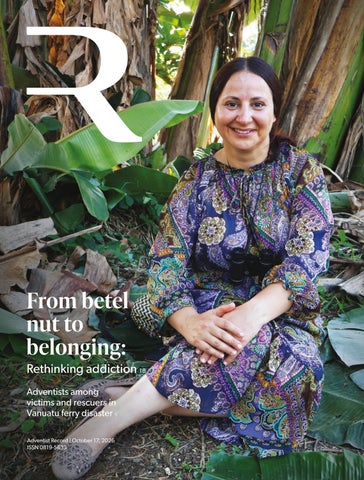
From betel nut to belonging: Rethinking addiction 18 Adventists among victims and rescuers in Vanuatu ferry disaster 5 Adventist Record | October 17, 2026 ISSN 0819-5633
Help Aussies in need YOUR GIFT TODAY CAN HELP AUSSIES WITH FOOD & BASIC NEEDS, COUNSELLING AND SUPPORT
SUPPORT THE 2026
Scan here or visit adra.org.au/donate to help Aussies in need
EDITOR’S NOTE:
A Christian first Ashley Jankiewicz Assistant editor
Adventism is a lens through which we can show others the gospel.
Living in Australia, I’ve become used to Christianity being a minority. In Kiribati, where I spent nearly two weeks reporting on Kiribati for Christ, that’s not the case. Ninety-eight per cent of I-Kiribati people identify as Christian, though only 2 per cent are Adventist, and despite a mostly Christian nation, there is a solid Adventist evangelistic effort. It is remarkable that we are part of a global family—that wherever you go, it seems there’s an Adventist church, filled with people whose faith is thriving. People who gather together on Sabbaths, who take their beliefs seriously and want to share them with their wider community. Adventism is a way of living; it offers a place to belong (we hope) and a set of beliefs in line with the Bible. But my experience in Kiribati reminded me that Adventism is just one denomination among many others, that we all share a commitment to the gospel. This really got me thinking about evangelism in a context where everyone is Christian, and if Adventism has anything to offer other Christians, especially Protestants, who may already be committed to the central truths of Christianity. The very definition of a Christian is someone who follows Jesus and His teachings. The gospel message, saved by grace through faith and not by works (Ephesians 2:8,9), is at the core of the faith of many non-Adventists— and it really is what’s truly important. The unconditional love that we receive from God enables us to express love to others (1 John 4:19), and we come to what Jesus said were the two greatest commandments: to love God with all your heart, soul and mind, and to love others as yourself (Matthew 22:37-40). I’ve been reflecting on some of our beliefs that are distinctive from other denominations, and how they fit into the big picture of Christian faith. Two things that the Bible promises over and over is that through Jesus and the gospel we receive abundant life (John 10:10) and freedom (2 Corinthians 3:17). Our Adventist truth that we embrace embodies this abundant life and freedom, and consequently, the Gospel, in beautiful ways. One thing that makes us unique is the Sabbath, a day of rest, that separates us from our daily worries and brings us back to God. I can’t imagine my life without Sabbaths—having that rhythm and rest truly does contribute to an abundant life in the present. As does the health message. Plant-based eating and avoiding smoking and alcohol have been popularised now because of science, but Adventists were doing it 150 years ago, creating healthier ways of living. Prophecy, when focused on Jesus, brings us freedom from fear of the future: “You will hear of wars . . . but see to it that you are not alarmed” (Matthew 24:6). Likewise, the belief Adventists hold about the state of the dead brings freedom from the fear of death and hell and brings hope for the resurrection and the second coming. These beliefs are not rules to follow, but good news that brings hope and life—this is why Adventist evangelism in mostly Christian spaces is still so important. Adventism is a lens through which we can show others the gospel, and through this lens of Adventist truths, we see Jesus, the Giver of abundant life and freedom, the One who loved us first so that we may then show love to others. You see, we are Christians first, Adventists second. Everything we do and everything we believe should fit around the beautiful promise of grace, the promise of life given and a hope to hold onto. As South Pacific for Christ continues over the next few years, we have an incredible opportunity to reflect the gospel to thousands and thousands of people, through our Adventist identity. With OneVoice27, a Christ-focused initiative based on media, who knows how far our reach could be? But though we are Adventists and stand by our truths, we must remember that evangelism begins and ends with the message: that we love, because He first loved us. October 17, 2026 | Adventist Record
3
INSIGHT:
OneVoice New Zealand Pacific 27 Dr Eddie Tupa’i President, New Zealand Pacific Union Conference
4
Adventist Record | October 17, 2026
At Tiapapata Church, south of Apia in Samoa, I had the privilege of participating in Trans Pacific for Christ. It was a joyful experience of witnessing God’s Spirit at work and a reminder that we are part of a movement reaching across the South Pacific. That same sense of shared mission is shaping preparations for OneVoice New Zealand Pacific. Over the past 12 months, prayer, fasting and planning have laid the foundation for our New Zealand Pacific Union Conference’s participation with the world church in 2027, with a mission focus continuing through to 2030. At its heart, OneVoice is about people: engaging them with Jesus, helping them encounter Him personally and empowering them to join Him in His mission. It is an invitation for every church, school, family and member to take part. Led by Pastor Victor Kulakov (NZPUC missional ministries leader), and our Union team, preparations are moving through the next stage of local planning. Partnerships across the South Pacific will follow, creating opportunities to share blessings and serve alongside our sister unions. Throughout 2027, our missions and conferences will participate in a full year of ministry—a Pacific wave reaching across Pitcairn, French Polynesia, Wallis and Futuna, New Caledonia, the Cook Islands and New Zealand. This will include ministry training, new small groups, Bible studies, church planting, public and follow-up evangelism, schools on mission, community and media outreach, disciple-making and health ministry. Across our diverse communities, these ministries will offer opportunities to build relationships, meet needs and share the hope we have in Jesus. The invitation begins now. Pray for the people in your community. Join others in prayer and fasting. Consider how your gifts, your church or your school could help someone take their next step towards Jesus. Everyone has a part to play. Key dates, locations, resources and opportunities will be shared as planning progresses at <1voice.nz>. Together, we will pray and fast, equip and send, welcoming members and guests into God’s mission so that every person has the opportunity to live life to the fullest in Jesus.
Adventists among victims and rescuers in Vanuatu ferry disaster Santo, Vanuatu | Juliana Muniz
Retired Adventist pastor Jonathan Bule receives support at the memorial service at Samansen Wharf in Luganville. His son Jerry was travelling on the MV Matui. [Credit: Jean Pierre]
A memorial image of Minister Shemo Wilson’s 22-year-old son, who was travelling on the MV Matui. [Credit: Jean Pierre]
Six Adventists are believed to have died in the MV Matui ferry sinking, according to Vanuatu Mission (VM). Described as one of the deadliest maritime disasters in Vanuatu’s history, the tragedy also saw Adventists take part in search and rescue efforts. The vessel sank on September 11 while travelling from Santo to Ambae. According to local authorities, 53 people were on board, with 14 survivors rescued and two bodies recovered. The search ended on September 17 with 37 people still missing. VM reported on social media that several Adventist families lost relatives, including the families of pastors, church leaders and members. On September 19, the Crown of Thorn Singing Ministry organised a memorial service at Samansen Wharf, where the MV Matui had departed on its final voyage. Local Adventists gathered to remember those lost and support grieving families. Among those affected was Luganville Adventist School principal Wesley Karae Seth, whose 72-year-old brother was travelling on the vessel. Mr Seth learned of the incident on September 12 while participating in a school outreach activity. Retired Adventist pastor Jonathan Bule and his wife also lost their son Jerry Bule, 38, who was a ship captain and leaves behind his wife and two children. Their other son, Pastor Shane Bule, travelled from Malekula to Luganville to support the family. Minister Shemo Wilson’s 22-yearold son was also travelling on the MV Matui and is believed to have died. According to VM, the family prayed and fasted for 11 days after the vessel sank, hoping he and the other missing passengers would be found alive. Other affected Adventist families include members from the Lolovatali and Waluriki communities in northwest Ambae. Reflecting on the impact of the disaster, VM president Pastor David George said the individual stories
showed the personal toll behind the tragedy. “Their stories remind us that this is far more than a national tragedy. It is a collection of deeply personal losses carried by families whose lives have been forever changed,” he said. Adventists also helped respond to the disaster, taking part in search and rescue efforts to ongoing support for affected families. Adventist businessman Peter Terry, owner of Luganville-based Indigenous Island Shipping Services, began contacting authorities after receiving a call from a relative on Ambae concerned that something had happened to the MV Matui. His home subsequently became a meeting point for people involved in communicating and coordinating search efforts. Mr Terry also contacted Adventist doctor and pilot Dr Mark Turnbull, who runs a flying doctor service in northern Vanuatu. Dr Turnbull used his aircraft to search for survivors, locating several from the air and providing their coordinates to rescue vessels. He told ABC Pacific he joined the search around 24 hours after the vessel sank. During the operation, he also dropped drinking water to survivors before a boat could reach them. Other Adventist members used their own boats to assist in the search. Pastor George travelled to Santo following the end of the search operation to visit affected families, offering condolences, prayer and support on behalf of the Church. He said Adventist nurses have also been visiting affected families to provide counselling and emotional support. Pastors, church groups and members have continued visiting the families in the weeks since the disaster. “Although the national search operation has ended, our commitment to supporting these families does not end,” Pastor George said. “We will continue to walk beside them in the days, months and years ahead.” October 17, 2026 | Adventist Record
5
Fiji for Christ concludes with 4200 baptisms Suva, Fiji | Jesse Herford
General Conference CFO Paul Douglas with baptism candidates in Lautoka.
Papua New Guinea Union Mission president Pastor Danny Philip preaching in Namaka.
More than 4,200 people were baptised during Fiji for Christ, a nationwide evangelistic campaign held from August 16–29. The campaign involved 135 international speakers and 57 local speakers, including General Conference chief financial officer Paul Douglas and Papua New Guinea Union Mission president Pastor Danny Philip. The program included Bible meetings, prayer, health and family-life presentations, community service and personal visitation. Running in conjunction with supporting ministries such as 10,000 Toes, evangelism teams sought to minister to Fijians’ physical and mental, as well as their spiritual, needs. With the main campaign concluded, Fiji Mission (FM) is now focusing on follow-up and discipleship for newly baptised members. Local churches will provide ongoing support through Bible studies, small groups, Sabbath school, health ministry and
other church activities. “We pray that every new believer will grow in Jesus, every church will stay engaged in mission and every member will keep sharing the hope we have in Christ,” said Trans Pacific Union Mission vice president Pastor Clive Tefaatau. FM president Pastor Epeli Saukuru thanked local members, volunteers and visiting speakers for their involvement in the campaign. “I am very thankful to our pastors, church leaders, members, young people, children, schools, volunteers and everyone who played a part,” he said. “I am especially thankful for the tremendous support of our international speakers and our General Conference and South Pacific Division leaders. They prayed with us, travelled to our communities, preached the Word [and] encouraged our people. When God’s people come together and trust Him, He can do great things.”
Signs’ kids book series continues to grow Perth, WA | Lauren Webb
Author Simone Field holds a copy of Emily and the Perfect Problem, the third book in her series.
6
Adventist Record | October 17, 2026
Recent Book Week celebrations at Victoria Park Christian School in Perth included the launch of a new book by teacher and author Simone Field, continuing a series of stories that explore the challenges primary school children face and the ways faith and friendship can help. Emily and the Perfect Problem is the third book in Mrs Field’s series, following Isabel and the Lunch Box Bully and Sasha and the Scary Spotlight. Each story follows a different girl from the first book’s friendship group. In this book, Emily is paired with a classmate who is learning English as an additional language. “Emily needs to learn how to do her best while being understanding and compassionate,” said Mrs Field. Now working as school librarian and language teacher at Victoria Park school, Mrs Field said the theme of Emily and the Perfect Problem reflects
her experience teaching literacy in Western Australian schools, including working with students learning English as an additional language. Her own experience of living in Peru and learning basic Spanish also helped her understand what it is like to navigate a new language and culture. The series is now also reaching beyond English-speaking readers. Isabel and the Lunch Box Bully has now been published in a Spanish edition by Editorial ACES in Argentina as Isabel Y El Robameriendas. “It is exciting to see this series continue to grow in volumes and reach,” said Nathan Brown, book editor at Signs Publishing. “These are good stories that offer valuable resources for children, families and classrooms.” Emily and the Perfect Problem and the earlier books in the series are now available from Adventist bookshops in Australia and New Zealand, or online.
making headlines HopeMedia begins A new Adventist media institution, HopeMedia, has been officially launched in Czechia, bringing together areas that previously operated independently to collaborate and create content. A new studio was also dedicated as a space for video production, with leaders highlighting the importance of media and digital communication in church mission today.—ANN Representatives from all seven ADRA countries in the South Pacific gathered to discuss mission.
ADRA gathering focuses on mission Sonaisali, Fiji | Juliana Muniz
ADRA and church leaders from across the South Pacific have discussed how local Adventist churches could become more involved in community development at a regional gathering in Fiji. More than 40 leaders met from September 15 to 17 for the ADRA South Pacific Regional Kibung—a Tok Pisin term for a meeting or gathering. Participants included ADRA directors, board chairs and church leaders, with representatives from all seven ADRA countries in the region: Australia, Fiji, New Zealand, Papua New Guinea, Samoa, Solomon Islands and Vanuatu. ADRA International president Pastor Paulo Lopes and and vice president Thierry Van Bignoot also attended. Themed “Kacivi: Called to Serve, Equipped for Mission”, the gathering took its name from the Fijian word kacivi, meaning “invitation”. “Kacivi reminds us that we are called to serve, but we also need to be equipped for the mission God has given us,” said Matthew Siliga, regional director of ADRA South Pacific. One of the initiatives workshopped during the gathering was Mission Ready, a program that has been under development for almost 12 months and is designed to equip Adventist churches across the South Pacific to engage with their local communities through practical community development. ADRA will support the church-led program, with initiatives adapted to individual countries and community contexts. Delegates explored what those initiatives could look like in their respective countries. “When ADRA and local churches work together, we can create pathways for people to experience the love of God in practical ways,” said Mr Siliga. Governance, stewardship and organisational effectiveness were other key areas of discussion. The gathering also celebrated the diversity of the South Pacific. Leaders from different cultural and organisational contexts shared experiences and approaches from their countries. Speaking to the delegates, Pastor Lopes encouraged all to view ADRA’s humanitarian work as part of the Church’s broader mission of service. “Our calling is responding to God’s invitation to participate in His work,” he said. “It’s His work. It’s not ours.”
Bogenhofen rebranded Seminar Schloss Bogenhofen in Austria has changed its name to Bogenhofen Adventist Campus, highlighting its connection to the global Adventist education network. Founded in 1949, the campus offers education from kindergarten through to adulthood, serving more than 200 students across its schools, language program and seminary.—EUD
Cuts with kindness In Russia, ADRA volunteers and Adventist community members have opened a charity salon to provide free haircuts to people in need. The initiative expands the ministry of the “Kind Heart” social centre, which combines practical assistance with care, dignity and hope for people facing difficult circumstances.—ESD
God did what? A new study found that 76 per cent of Americans had experienced or witnessed a miracle, with about half reporting one several times a year or more. The research also found that many Americans, including those without formal religious affiliation, regularly prayed, thanked God and experienced spiritual moments outside church.—The Christian Post October 17, 2026 | Adventist Record
7
flashpoint
Faith on parade Pathfinders for the coast More than 50 Pathfinders aged 10 to 15 planted 1160 mangrove pods along the coastline in Tarawa, Kiribati, on September 20 as part of World Pathfinder Day activities. Supported by young adults and Pathfinder leaders, the group worked under the supervision of Kiribati’s Ministry of Environment, Lands and Agricultural Development, which provided the mangrove pods. The activity aimed to help protect Kiribati’s coastline from erosion and other climate-related impacts. Government officials thanked the young people for their contribution. “Our kids look forward to more community service activities like this,” said Kiribati Mission youth director Leeden Aluta.—Juliana Muniz
8
Pathfinders and other young people marched through Alotau Town, Papua New Guinea, on September 19 as part of a street procession celebrating World Pathfinder Day. The Adventist Youth Ministry procession brought together Pathfinders, Adventurers, youth, instructors and leaders, along with representatives of Adventist Community Services. They sang and shared their faith with the community. A young member of the Guide Class spoke on the day’s theme, “Speak, Lord”, drawn from the story of Samuel in 1 Samuel 3.—Claris Mitayan
Same team, new term
Students in service
Greater Sydney Conference (GSC) delegates returned all three Conference officers to their roles during the 31st GSC Constituency Meeting, held at Mountain View Adventist College on August 29 and 30. Pastor Alban Matohiti was re-elected president, Nadelle Manners chief financial officer and Pastor Cheonneth Strickland secretary for the next four years. Delegates from churches across Greater Sydney also appointed committees, considered constitutional changes and conducted other Conference business. The weekend included a Sabbath mission program featuring stories from across the Conference. Pastor Matohiti thanked delegates for their confidence in the leadership team and the opportunity to serve another term.—Record staff
Eight Year 10 students from Christchurch Adventist School travelled to Invercargill in September for the school’s annual service trip. Hosted by Southland Adventist Christian School, the students led a Week of Worship, visited classrooms, organised activities and PE sessions, and spent time connecting with younger students throughout the week.—Lance Boulton
Adventist Record | October 17, 2026
flashpoint
Praying across cultures
Growing together
Adventists across the South Pacific are being invited to join a global prayer initiative focused on people from South Asian religious and cultural backgrounds. Global Prayer Day: Praying for Our South Asian Neighbours will be held online on November 1, bringing church members worldwide together to pray for South Asian communities. The initiative is being organised by the Global Mission Centre for South Asian Religions, one of several centres operated by the General Conference Office of Adventist Mission to help Adventists better understand and build relationships with people from different religious and cultural backgrounds. South Pacific Division Global Mission director Dr Wayne Krause said the initiative is particularly relevant to the South Pacific because of its culturally diverse communities, including many people with South Asian heritage. “This is an opportunity for Adventists across the South Pacific to unite with believers around the world in praying for these communities,” Pastor Krause added. The prayer day will coincide with the period when millions of Hindus and Sikhs around the world celebrate Diwali. Organisers said the event aims to increase awareness of South Asian communities and encourage Adventists to build meaningful relationships through understanding, friendship and prayer.
Seventh-day Adventist churches across Vanuatu are continuing to support more than 1374 people who were baptised in August as they begin their new journey of faith. Churches are using the “Faith of Jesus” Bible Study Guide to help new believers grow in their understanding of the Bible. Many churches are organising the new members into small groups so they can study together, build friendships and receive personal support. Some church members and leaders are also travelling long distances to reach new believers in their villages and communities.—Vanuatu Mission Facebook page
To join the Zoom meeting, visit: <bit.ly/ Pray4SouthAsia>—Juliana Muniz
have news to share?
Send info and photos to <news@record.net.au>
Room at the table Mums At The Table has launched two more groups in Victoria, bringing the state’s total to five. The Seddon and Werribee Mums At The Table groups partner with their local Adventist churches. “These additional groups will help more community mums find their village,” said Melody Tan, project manager of Mums At The Table. The initiative partners with local Adventist churches, equipping them to “build meaningful, lasting relationships with the local community beyond their congregations”. According to Ms Tan, this is achieved through hosting mum-focused gatherings where churches create safe, welcoming spaces where parents can connect, support one another and access practical help. Churches or individuals interested in being part of the ministry can contact Mums At The Table at <hello@MumsAtTheTable.com> or visit <mumsatthetable.com/ partner/>.—Melody Tan/Record staff October 17, 2026 | Adventist Record
9
Qauia: a faithful local church
T
rans Pacific (TPU) for Christ has come to an end—a massive evangelistic campaign involving more than 1800 individual sites over two months spanning the breadth of the South Pacific. Naoero, Vanuatu, Solomon Islands, Tuvalu, Fiji, Tonga, Niue, Samoa, American Samoa and Kiribati all opened their doors to thousands of speakers, health professionals and volunteers from across the South Pacific Division, the United States, South-East Asia, Europe and beyond, all with a single purpose—to declare the soon coming of Jesus and invite people to follow Him. When faced with the scale of the efforts, it’s easy to get lost in the numbers—especially when what is most often reported are numbers—numbers of sites, numbers of attendees, number of baptisms—you get the point. It’s often easy to miss the individual stories of the church
10 Adventist Record | October 17, 2026
communities who partnered with international speakers— and who continue to faithfully serve their community long after those speakers return home. I’d like to tell one of those stories. I preached in a village in Fiji called Qauia (Gah-wee-uh). It’s a small place just west of Suva that begins at a bridge over the Lami River and ends at the foothills of Mount Korobaba (the tallest mountain in the Suva area). Qauia itself is made up of about 400 homes and is home to several congregations, including Assemblies of God (AOG), Brethren, Methodist and Adventist churches. When I first arrived in Qauia, I was immediately struck by the ingenuity of its inhabitants. The local Adventist church is bordered by a small pocket of farming land— inlets where water gathers and in turn irrigates the dalo
(taro) that grows on the irregularly—but intentionally— raised embankments. Behind the church is an outhouse and shower—as well as housing that stretches up the hills that enclose the valley. No space is wasted. Each home is surrounded by greenery—gardens, farm plots and flower beds. Houses are built from a variety of materials—wood, concrete, corrugated iron or a mix of the three. Taxis constantly move up and down Qauia’s singular potholed street, navigating around dogs, children and parked cars. Children use the street as both a gathering point and playground. Games such as volleyball and football are common, as well as a curious one where children roll tyres at each other in what I can only describe as a mix between bowls and frisbee golf. Qauia Adventist church is an established congregation, several decades old and made up of a wonderful patchwork of characters. The church’s foundational backbone are its elders—some long-standing Adventists, others more recent converts. One particular gentleman, known as “Bola”, told me he used to be quite the ruffian. “I would go down to the police station and get into fist fights with them,” he once remarked in a surprisingly casual way. Bola grew up an Adventist, but left the church in his twenties, becoming a “backslider”. “Thank God for a faithful wife,” he said. His wife, who had been a faithful Adventist, had prayed for Bola for years. Finally, he gave up his life of vice and violence and joined the church. Today, he is the oldest member of the church and plans to live to at least 100. Simione, affectionally known as “Skipper”, and his wife Divika are on the other end of the spectrum. Newly baptised only a year or so ago, they and their family are now mainstays in the church. Skipper runs the church’s A/V while Vika helps with catering and the children’s ministry. The family also played a vital role in the Fiji for Christ evangelism program. Skipper and fellow church member Epeli—a taxi driver with the presence of Forest Whitaker’s Idi Amin in The Last King of Scotland—shared A/V duty, but Skipper and his family bore most of the burden of security. Given we were an open-air site, theft and vandalism concerns were real, meaning someone needed to be present 24/7. Skipper, his family and one other church member provided said security, in addition to their other responsibilities. Though they are new members, they are just as dedicated as the longstanding Adventists in the church. Mijieli, or “Miji”, is the church’s head elder. He and his
wife Elena are widely travelled, and lived in Australia for many years ministering to Aboriginal teens in the Northern Territory (a story for another day). He was my main intermediary to the community, especially for locals who weren’t confident English speakers. We spent a significant amount of time going door-to-door, sitting on living room floors, speaking to members of the community, offering prayer and inviting them to the evangelism program. An unassuming man, over the time spent in Qauia, I soon saw his great heart for ministry, as well as how well-connected he is. After leaving a house, he would often turn to me and remark, “She’s my second cousin” or “that young man is my nephew”, or something like that. Regardless of whether they were Methodist, AOG or Catholic, it was obvious how much respect the community has for him. My site coordinator was Finau. She’s a mum to Junior and Paulina, and wife to Ben. She’s a creative, entrepreneur and leader. She and her family not only welcomed me to Fiji—but thanks to some unfortunate accommodation challenges they ended up hosting me for much of my time there. I especially appreciated her tireless service. During the first week, a team of medical missionaries visited Suva, and Finau assisted them as part of the ground team. Despite the long days, she remained tirelessly dedicated to the numerous responsibilities required to keep our site going. As many of us well know, a church is not a building. A church is a network of people who, on the surface, may seem different, but are nevertheless united by a common cause—the cause of King Jesus. Though flawed and frail, the church embodies the mission of Jesus in ways evangelists simply cannot. At the end of the second week of Fiji for Christ, I felt convicted to encourage the team for the future. While I returned home, they continue to faithfully disciple new Christians, serve their community and live out their calling as the incarnational body of Christ. Just the other day, Miji contacted me to let me know that those who had been baptised were going through Bible studies together, and that Qauia church is inviting their family members to a picnic to encourage them. That’s what the church is. That’s what the church does. Jesse Herford editor, Adventist Record.
October 17, 2026 | Adventist Record
11
Women of the early Adventist movement From the earliest days of the Adventist movement women preached, taught, cared for the sick, shared the gospel and founded both churches and institutions around the world. Their names are often less familiar than those of the men they worked alongside, but their contributions were no less important in shaping the growing Church.
Sarah Lindsey (nee Hallock) Born 1832; died 1914 Sarah was one of the earliest Adventist women preachers. ESDA credits her as the first Adventist woman to receive a conference-issued ministerial licence in 1869. Phebe Helen Rankin Druillard Born 1845; died 1937 Known as Nellie, she was an early American administrator, treasurer and missionary. She helped establish Adventist institutions such as the Madison and Riverside Sanitariums, as well as their Schools of Nursing. Maud Sisley Boyd Born 1851; died 1937 Maud was a Bible teacher, editor, compositor, Bible worker, school matron and missionary to Europe, Africa and Australia. She was the Church’s first woman sent into foreign mission service by the Adventist Church’s Foreign Mission Board.
Sarah Elizabeth Peck Born 1868; died 1968 Sarah pioneered in the education space, helping establish schools in the US, South Africa and Australia, writing curriculums for the many Adventist schools. She served in Adventist mission for almost 80 years as a teacher, ministry partner to Ellen White, writer, lecturer and mentor. Rachel Knight Born 1874; died 1972 Known as Anna, she was an African-American missionary, nurse, teacher, Bible worker and church administrator who pioneered Adventist work among Black communities in the American South. Adelia Parlince Van Horn (nee Patten) Born 1839; died 1922 Adelia was the first woman to serve as a General Conference officer, becoming GC treasurer in 1871. She was also an editor and assistant to Ellen White.
Loretta Viola Robinson (nee Farnsworth) Born 1857; died 1933 Loretta is credited as the first known Adventist Bible worker. She served as a city mission worker, evangelist, missionary to South Africa and Australia, chaplain and religion teacher.
Sarah Jane Thayer Born 1853; died 1940 Better known as Jennie, she was a second-generation Adventist pioneer who worked in publishing and church administration and became the first editor of the Atlantic Union Gleaner.
Euphemia Edie Born 1862; died 1951 A missionary, educator, Bible worker and evangelist, Sister Edie was one of the pioneer Adventist missionaries in Africa who did “soul-winning work among the women and in the schoolroom”.
Georgia Anna Burgess (nee Burrus) Born 1866; died 1948 The first Adventist missionary to India and the first single female Adventist missionary to a non-Christian country. At a time when people hesitated to learn foreign languages, Georgia showed the way learning Bengali and Hindustani.
The information on these women was gathered from the Encyclopedia of Seventh-day Adventists (ESDA). Each of their biographies are worth a read. You can find their stories here: <encyclopedia.adventist.org> October is Adventist Heritage Month. To learn more, visit <heritage.adventistchurch.com>.
12 Adventist Record | October 17, 2026
Mixed berry acai smoothie bowl Serves 1
Prep: 5
This colourful, high fibre smoothie bowl is a great hunger buster and packed with antioxidants. Filled with a wide variety of fruit, it’s super healthy. We suggest adding a handful of baby spinach for an even bigger nutrition boost! Made using So Good Oat No Added Sugar or So Good Almond Unsweetened Milk, this acai bowl is gluten free and vegan, making it a great breakfast option that’s ready in five minutes.
Ingredients
Method
1 cup So Good Oat No Added Sugar Milk or So Good Almond Unsweetened Milk 1 cup frozen mixed berries 1 packet (200g) frozen acai puree, no added sugar 1 banana, fresh or frozen 2 tsp chia seeds ¼ avocado, optional
1. Place all ingredients, except toppings, in a blender jug and puree until smooth. 2. Pour into a bowl, add toppings and serve immediately. 3. Enjoy! Our tip: Top with seasonal fresh fruit and add a sprinkle of your favourite granola to make it unbeatable.
Toppings 2 tbsp granola or toasted muesli 2 tbsp mixed berries or other fresh fruit Nutritional Information (per serving) ENERGY
CALORIES
PROTEIN
FAT
SATURATES
1517kJ
362
7g
13g
2g
CARBOHYDRATE
47g
SUGARS
FIBRE
CALCIUM
SODIUM
IRON
POTASSIUM
26g
12.8g
371mg 120mg
1.5mg
1220mg
Scan the QR code to see more of our healthy smoothies and bowls recipes online
"IF YOU'RE LOOKING FOR A PLACE TO DO MINISTRY, COME TO
."
IBAT R I K I
I
n one of the most remote countries in the world, the Adventist Church is also one of the smallest denominations. Despite being outnumbered, young Adventists are actively involved in the mission of the Church. Compared to other denominations, the Adventist Church represents a fraction of society—and its young people face significant challenges in their undertaking to spread the gospel to the unreached. Approximately 58 per cent of I-Kiribati people are Catholic, with another 21 per cent belonging to the Kiribati Uniting Church. Just 2 per cent are Adventist, as the denomination arrived much later than the others and is still seen as “the new kid on the block”, according to Kiribati Mission youth director Leeden Aluta. Mr Aluta sees the work the young people do as a way to change the perception that the other denominations have towards Adventism. “If they see us as part of a worldwide family, then they will see us differently.” The young people have taken this to heart and in a country where preaching initiatives are often not well received, they are reaching their community through humanitarian aid, environmental initiatives and music. General Conference (GC) initiatives such as Global Youth Day and Adventurers Day represent an opportunity for young Adventists to engage in
14 Adventist Record | October 17, 2026
forms of outreach, such as giving food to people on the streets. They also play a large part in the free health screenings that 10,000 Toes offers the community. Many have been trained as ambassadors and are able to assist Kiribati Mission health director Teera Katarake during health screenings. Environmental initiatives also introduce Adventism to the wider community. Trans Pacific Union Mission’s (TPUM) Walk4Life initiative has been adopted in tandem with beach cleanups. Also, groups of young Adventists recently planted 1000 mangrove pods—an important step in combating shoreline erosion and rising sea levels. “It’s good to get our young people to show our presence,” said Mr Aluta. However, Mr Aluta acknowledged that music was the main way young people in Kiribati get involved. “I think that’s one of the gifts they have,” he explained. On Sabbath afternoons, groups regularly visit prisons and hospitals, as well as homes of church members, to sing. They also hand out Bible tracts and pray with people. “This introduces people to who we are as Adventists,” said Mr Aluta. “It makes a big impact in how we connect with the community. I remember one of the patients at the hospital once asked another patient, ‘Who are these kids that are singing?’ And the other one said, ‘Oh, they’re the Adventist kids. They sing really well!’” One project that has garnered much excitement from the Church and intrigue from the community has been the recording of a music album titled “Kiribati for Christ”.
“People can hear the gospel message through our singing,” said Kenny Charlie, a young woman from Tarawa, who has enjoyed being part of the recording. Accompanying music videos have been filmed on the beaches and have garnered much attention on the Kiribati for Christ Facebook page. “A lot of non-Adventists were asking when it was going to come out,” said Mr Aluta. “I think this is a post-campaign tool that we can use to connect with people in Kiribati.” He added that some young people had said that participating in the album was one of “the most memorable moments of their lives”. Many young people found taking part in the Kiribati for Christ campaign very fulfilling. In fact, Mr Aluta estimated that around 60 or 70 percent of those involved in the campaign were young people—and not just through music. Everything the youth do regularly—visitations, health screenings and beach cleanups—played a part in Kiribati for Christ, whether it be service to the community to build awareness, raising funds with rubbish bag collection or giving health talks. The media and livestreaming were also largely run by young people, assisted by two volunteers from the Solomon Islands Mission. Tewiiti Aata, a young person from Tarawa, gave health talks at three different sites each night and helped with media. As the meetings were held at similar times each evening, he would travel from site to site, speaking and offering assistance where he could. “God told us to go and make disciples,” he said. “Not only the pastors, not only the ministers, but also the youth and our young people. “I want to encourage them [to] keep working for God.” However, despite their involvement and willingness to serve, the youth movement in Kiribati continues to navigate various difficulties. “We don’t have enough people trained in youth ministry,” Mr Aluta explained. “We are still struggling to get proper Pathfinder and other youth programs running.” He added that of Kiribati’s 33 islands and atolls, only Tarawa, Abemama and Kiritimati (Christmas Island) have an active youth ministry. Another challenge is planning enough church events to draw young people away from some of the community activities not in line with Adventism. “It’s hard to compete with that,” said Mr Aluta. “We have to find a way to capture their interest.” And while the perception that other denominations have towards Adventism needs to change, so does the young people’s perception of themselves. Mr Aluta explained how interactions between Adventists in Kiribati and Adventists in other countries were very limited, and that to see Adventists from other countries come during Kiribati for Christ impacted the way they saw their place as a part of the global Church. “That sense of wider Church community is very important,” he said. “It has an impact on the way they see themselves as Adventists—that they have a big family out there in the world.” Mr Aluta has big dreams for I-Kiribati young people. He envisions a vibrant
youth movement connecting with the community on a deeper level. “I would also like to run a discipleship program after Kiribati for Christ,” he said. “To keep the high interest of our young people going. We want to do Bible studies—first care groups in the churches but then also in the community centre.” He also wants to see more leaders. “I would like to see Adventist Youth Ministry in Kiribati have leaders trained in Master Guide and senior youth leadership,” he said. “And have them reach the outer islands and get youth involved there.” Mr Aluta plans to implement more TPUM, South Pacific Division (SPD) and GC initiatives, such as OneVoice27, to connect with the broader Adventist Church. “I want to get them ready for next year,” he said, “Especially those who are into TikTok and other social media. We want to have a short training session for them in preparation.” However, Mr Aluta’s final words were not about the young people in Kiribati. “I want to speak to our young people across the SPD,” he said, acknowledging that Kiribati’s young people have been a part of very few mission initiatives from other countries. “This is a very good place for mission trips.” While the country’s islands are remote, it does not deter the Adventists there, who continue to look for ways to reach out to those who have never heard the gospel. “We still have a few islands with no Adventist presence,” said Mr Aluta, reiterating that support from those looking for mission opportunities would be welcome. “If you’re looking for a place to do ministry, come to Kiribati.” If you’re interested in mission opportunities with Kiribati Mission youth ministries, contact Adventist Volunteer Services at: <volunteers@adventist.org.au> Or Trans Pacific Union Mission youth director Steve Aquila at: <steveaquila@adventist.org.fj> Ashley Jankiewicz assistant editor, Adventist Record. October 17, 2026 | Adventist Record
15
Serving God, one person at a time
F
or Janet Roah Kaupa, serving as a receptionist at Central Papua Conference (CPC) is more than simply welcoming visitors and answering questions. It is an opportunity to serve God and be a witness to everyone who walks through the Conference reception door. Originally from Wanigela Village in the Marshall Lagoon area, Janet is married to a man from Simbu and is the mother of three children. She has faithfully served at CPC for 18 years. One of the things she values most about working at the Conference is the staff morning devotion. “It is good to begin the work with the Lord. I worship at home, but it is also good to begin the day with worship at the workplace because I rely on God. My dependence is on God.” As a receptionist, Janet meets people from many different backgrounds and situations. Some arrive with questions, while others may come carrying personal problems or concerns. Janet wants the reception area to be a place where people experience kindness, encouragement and joy. “I wish to make this reception counter a joyful place where people can find joy. When people come with a problem, I want them to leave with a smile. Sometimes I pray with them.” For Janet, working in God’s office is deeply rewarding. “It is a joy for me to serve God’s people in this Conference. I can be a witness here at the reception.” Her journey into this role was also shaped by her local church. Serving as a church secretary gave her valuable experience and prepared her for the responsibilities she now carries at CPC.
16 Adventist Record | October 17, 2026
One of her most memorable experiences came during a “Drive and Preach” ministry trip to a rural district, when a snake nearly bit her. Janet believes that God protected her and sees the experience as another reminder of His care. Over her 18 years at CPC, Janet says she has learned important lessons from her fellow workers, particularly around unity, humility and sharing. She also treasures the fellowship, retreats and worship experiences shared with the CPC team. Her favourite Bible verse is Philippians 4:13: “I can do all things through Christ who gives me strength.” This verse reminds Janet that she does not have to depend only on her own abilities. “Sometimes I feel I have not gone far and I have limited knowledge, but with God, He can take me to extra heights.” She knows that life and ministry come with challenges and storms, but her faith continues to give her courage. “There are problems and storms I go through, but with Christ in my vessel, I can smile at the storm.” After 18 years of service, Janet’s message is simple: CPC workers are ultimately called to serve God. “We are here to serve the Lord. We are not here to serve or work for our leaders. Let us work in unity for God.” For Janet, every person who approaches the reception desk is an opportunity to show Christ’s love and perhaps help someone leave with a smile. Rose Maine Sinias assistant communication director for the Central Papua Conference.
The deep verb: | ְּּתהֹוםtəhôm [teh-HOME] | Hebrew presented by Pacific Adventist University
T
he Hebrew word ( ְּּתהֹוםtəhôm, pronounced tehHOME) appears in the Bible’s opening scene: “Darkness was on the face of the deep” (Genesis 1:2, NKJV). It refers to deep waters, the ocean depths or a vast watery abyss. Before God formed the earth into an ordered home filled with light and life, darkness covered the təhôm. For people in the ancient world, deep water represented a realm human beings could neither master nor fully understand. Yet Genesis does not portray təhôm as a deity, monster or rival struggling against the Creator. The deep does not speak, resist or threaten God. From the beginning, it is entirely under His authority. Even more reassuring is the presence of “the Spirit of God” hovering over the waters. The Hebrew word translated “hovering” comes from the verb ( ָָר ַַחףraˉh.ap̄). Its participial form, (mĕrah.ep̄et), describes gentle, yet purposeful movement. The same verb is used of an eagle fluttering over its young in Deuteronomy 32:11. The Bible’s first scene of darkness is therefore not a scene of divine absence. Before light appears, God is present. Before creation takes shape, God is already at work. Then God speaks: “Let there be light” (Genesis 1:3). The darkness cannot silence His word and the deep cannot swallow His light. God gives boundaries to the waters, brings dry land into view and fills the earth with life. What was “without form, and void” becomes a world He pronounces “very good” (Genesis 1:31). Təhôm appears again in the Flood narrative. Genesis records that “all the fountains of the great deep were broken up” (Genesis 7:11). The waters cross their appointed boundaries and the ordered world begins returning to disorder. Yet even here, the deep remains under God’s authority. God remembers Noah, restrains the waters and brings the ark safely to rest (Genesis 8:1–4). Psalm 104 also recalls creation: “You covered it with the deep as with a garment” (verse 6). Even the waters that cover the earth remain subject to God’s command. The Psalms also use the imagery of the deep to describe suffering and helplessness. The psalmist cries, “Deep calls unto deep at the noise of Your waterfalls; all Your waves and billows have gone over me” (Psalm 42:7).
Trouble feels like wave following wave, with no opportunity to recover. Nevertheless, the psalmist also declares that no depth can separate us from God: “If I make my bed in hell, behold, You are there” (Psalm 139:8). We encounter our own kinds of depths: grief too heavy to explain, illness that unsettles the future, fractured relationships, unanswered prayers and fears concealed beneath a calm appearance. Genesis does not deny the darkness or minimise the depth. Instead, it directs our attention to the One who is present above it. As a missionary child growing up in Fiji, I travelled with my family by ship to Tonga for furlough. By day, sunlight glittered across the Pacific, even when the sea was rough. At night, however, that same ocean became frightening. Waves thumped against the ship as it rolled through the darkness. There was no land in sight—only restless water and the immeasurable depths beneath us. Those voyages taught me that the sea could be both beautiful and frightening. They also taught me that a difficult passage could end in a joyful reunion. However dark the ocean appeared, the voyage was carrying us home. The Spirit who hovered over the first deep remains present in our unfinished stories. God may not immediately calm every troubled sea or shorten every difficult voyage, but no depth places us beyond His reach. Creation also points towards re-creation. Paul writes that the God who commanded light to shine out of darkness “has shone in our hearts” through Jesus Christ (2 Corinthians 4:6). The Creator still enters lives disordered by sin, speaks light into darkness and leads His people towards wholeness. When life feels like a dark sea, and the waves thump against the vessel carrying us, remember təhôm. The darkness may be deep, but it is not ultimate. God’s Spirit is present, His word remains powerful and the deep remains under His authority. Limoni Manu O’Uiha dean of the School of Theology at Fulton Adventist University, Fiji.
October 17, 2026 | Adventist Record
17
FROM BETEL NUT TO BELONGING: Rethinking addiction
A
fter seeing firsthand the devastating consequences of betel nut use, nurse practitioner Elena Taneva is on a mission to help people break free from the habit. During the Solomon Islands for Christ campaign in July, she worked with the Amazing Facts Oceania team which ran mobile health clinics in partnership with 10,000 Toes ambassadors, offering a range of services including oral examinations, medical and nursing care, addiction education, optometry and pastoral support to more than 1000 people. Betel nut use is widespread in the Solomon Islands, where, though it technically is illegal, is commonly sold on the street. An estimated 80 per cent of the population uses it. Recognising the scale of the issue, the health outreach also included dedicated betel nut workshops led by Ms Taneva. “The experience convinced me that simply telling people, ‘Betel nut is bad for you’ is not enough,” she says. “Addiction affects the whole person—the body, mind, family, finances, relationships and spiritual life. People need knowledge, practical alternatives, compassionate support, hope and real connection which makes addiction obsolete.” Ms Taneva’s enthusiasm for
18 Adventist Record | October 17, 2026
tackling the issue has earned her the nickname, the “Betel Nut Queen”. “I accept the name with a smile, but I hope the real message behind it is that these individuals matter,” she says. “Every mouth we examine belongs to a person whom God loves.” Her passion for the issue has also been shaped by her clinical work in Guam, where she diagnoses and follows patients with oral cancer linked to betel nut use, as well as patients experiencing heart failure linked to methamphetamine. The International Agency for Research on Cancer classifies areca (betel) nut as carcinogenic to humans. Its use is associated with oral cancer and oral submucous fibrosis, a potentially malignant condition that can progressively restrict a person’s ability to open their mouth. “I have lost so many young patients in their 20s and 30s as a result of betel nut,” she says. Those experiences have prompted her to look beyond the physical consequences of addiction and consider what drives people to use addictive substances in the first place. “Rather than simply condemning the habit, I became fascinated by the questions: Why do people chew? What does betel nut provide socially,
culturally and psychologically? And if we ask someone to give it up, what are we going to offer in its place?” That approach is particularly important in South Pacific communities where substances such as betel nut may have longstanding cultural and social associations.
Beyond betel nut But Ms Taneva’s concerns extend beyond betel nut. She also highlights tobacco and nicotine, alcohol, marijuana and methamphetamine, with the prevalence and impact of each differing between Pacific countries and communities. Methamphetamine, in particular, is an issue the South Pacific needs to take seriously, she says. A 2024 report from the United Nations Office on Drugs and Crime (UNODC) identified Fiji, Papua New Guinea and Tonga among the Pacific countries particularly affected by methamphetamine trafficking. “Methamphetamine worries me because it can rapidly affect almost every dimension of life,” she says. “We should not wait until the problem becomes overwhelming.” She believes churches and health professionals need to understand addiction as more than an individual health behaviour.
“Addiction is biological, psychological, social and spiritual. Therefore, our response must also address the whole person.” The Solomon Islands outreach provided an opportunity to put the whole-person approach into practice. Instead of relying on confronting images and warnings, participants were encouraged to understand what addictive substances do to the brain and body, recognise warning signs and consider practical strategies for change. Workshops explored nutrition, hydration, exercise, sleep, stress management, social support, healthy substitutes, strategies for reducing triggers and cravings, and the importance of leaning on God. Prayer was deliberately integrated rather than added as an afterthought. Ms Taneva was encouraged by the response. “People were curious. They asked questions. They wanted their mouths examined,” she says. “Some were surprised to discover that something they had considered a normal cultural habit could have major health consequences.” Importantly, she says people did not feel their culture was being attacked. “When health education is delivered respectfully, with love and practical assistance, people are very receptive.”
Churches as places of healing For Ms Taneva, however, workshops and short-term health campaigns can only go so far. Her vision is for Pacific-wide programs providing education, screening, cessation support, referral pathways and spiritual care, backed by trained community health ambassadors. And local churches could be central to making that vision sustainable. “The church is uniquely positioned because it already exists in villages, towns and islands where specialised addiction services may never exist,” she says.
“Every church does not need to become a hospital. But every church can become a place of healing.” That could mean church members learning basic addiction science, organising screening and prevention programs, providing healthy activities for young people, supporting people trying to quit and working alongside healthcare professionals and government services. But the church also has something less clinical to offer. Ms Taneva says people may turn to addictive substances because they are tired, lonely, depressed, stressed, traumatised or simply searching for belonging. Removing the substance without addressing the underlying need is therefore unlikely to produce lasting change. “That is where churches can make an enormous difference because churches can provide something medicine alone cannot manufacture: belonging, purpose, relationships, forgiveness and hope,” she says. “Imagine churches throughout the Pacific where someone struggling with nicotine, betel nut, alcohol, marijuana or another addiction could walk through the door and find trained people who understand addiction, will not shame them, can connect them with medical care, and will pray and walk with them through recovery. “That would be a powerful form of medical missionary work, because even if millions of dollars are poured into a particular addiction rehabilitation, unless there is a human touch, recovery would be almost impossible.” For Ms Taneva, prevention also needs to start early. She is particularly concerned about the influence adult behaviour can have on children’s attitudes toward substance use. “When children grow up seeing a
substance constantly used by adults whom they respect, it can cease to appear dangerous,” she says. “It simply becomes part of everyday life. “We need to teach young people about the brain’s reward system, dependence, peer influence, emotional health and healthy ways of managing stress before addiction begins.”
A new kind of health ministry Ultimately, Ms Taneva sees addiction ministry as part of the Adventist Church’s longstanding commitment to whole-person health. “Jesus ministered to the whole person. He did not separate physical suffering from emotional or spiritual suffering,” she says. “I believe medical missionary work in the twenty-first century must include addiction ministry.” Ms Taneva says the South Pacific could become a model for a new kind of health ministry. “When people discover that Christians genuinely care whether they live or die, whether their children flourish and whether their families remain together, the gospel becomes tangible,” she says. “It is bigger than betel nut. It is bigger than methamphetamine. It is about restoring the whole person— physical, mental, emotional, social, occupational, environmental and spiritual health.” And that begins by seeing the person rather than the addiction. “We should never see an addicted person merely as someone with a bad habit,” she says. “We should see a child of God whose freedom is worth fighting for.” Tracey Bridcutt communication director, South Pacific Division. October 17, 2026 | Adventist Record
19
Conversations The joy of Sabbath Re: the editorial “Sabbaths” (August 29). Yes, there is nothing like entering and enjoying the services of a Sabbath day. From sunset Friday to sunset Saturday, we can feel the presence of the heavenly hosts worshipping with us. Cannot wait for the next one. May God continue His work in the Pacific islands
Kam rabwa n ami example nakoira nikabane, ao ami kekeiaki n uotarake abara. A big huge thank you to president Pastor Taabua Rokeatau for passionate and impactful leadership that ripples all throughout the Adventist ministry in Kiribati. In God we trust, as disciples of our loving Saviour Jesus Christ. Kam rabwa!
Mosese Laweloa Pordage,
Minister Ruth Cross Kwansing,
via Facebook
Our beautiful outback Re: “Mission in the outback” (August 15). I loved reading about your ministry in our beautiful outback. Thank you so much for sharing how the Holy Spirit is working on people’s hearts in these communities. We are in the Lockyer Valley in Queensland and need prayers for our community also. I believe prayer is our most powerful tool so I pray for your ongoing ministry. God bless you all. Brenda Lee Dettrick, via Facebook
Environmental care Re: “Kiribati for Christ clean-up tackles plastic pollution” (September 19) reposted by Adventist News Network. Thank you so much Kiribati Adventist Mission for your inspiring efforts and environmental stewardship! We loved the Kiribati For Christ 2026 ministry and so many intentional programs across many shared challenges in Kiribati!
20 Adventist Record | October 17, 2026
via Facebook
Along the beach Re: “Kiribati for Christ clean-up tackles plastic pollution” (September 19). Thank you for coming to our shores Adventist Record team. Our young people were happy to have you joining us along the beach. Wish you all the best as you tell the world our stories. Kiribati Mission Youth Ministries, via Facebook
One of the fruits What a blessings to have Adventist Record put us on the map. I’m fortunate to be one of the fruits of Kauma Adventist High School, where I first met my Saviour! Taabua Rokeatau, via Facebook
What gifts we have Re: “The value of showing up” (September 19). I have just finished reading the
article about the author’s experience at Kiribati. Beautiful read! Thank you for sharing this and challenging us to consider what gifts we have to go out and minister out there. Gugu Ncube, via Messages
Join the conversation! Share your thoughts with us via email or on social media. /AdventistRecord /AdventistRecord /AdventistRecord @AdventistNews or email editor@record.net.au
Obituaries BALL, Gloria Ruth, born 26.4.1939 in Wagga Wagga, NSW; died 30.8.26 in the Adventist Nursing Home, Cooranbong. In 1961 Gloria married Daryl in Cooranbong. Gloria is survived by Daryl; sons, Glen and Darren; six grandchildren; and three great-grandchildren. For many years Gloria was employed by the SHF and the Cooranbong Charlie Home for the aged, where she was valued as a faithful worker. Gloria was a loving, kind and caring mother, grandmother and great-grandmother. She greatly enjoyed reading books such as The Desire of Ages and Steps to Christ. She loved Jesus and now rests in peace awaiting the second coming. Roger Nixon
CLARKE, Colin Ian, born 10.12.1933 in Carlton, Vic; died 8.8.26 in Adelaide, SA. He is survived by his wife, Marlene (Adelaide); daughters, Sharon and Phil Brown (Melbourne, Vic), and Joanne and Clinton Alcock (Adelaide, SA); son, Byron (Hobart, Tas); and grandchildren, Tuscany and Jarvis Brown. Colin
22 Adventist Record | October 17, 2026
was a happy, outgoing person who worked for many years in the building industry. He had a deep spiritual life and loved his Lord, his family and the study of the Word. He rests in the hope of a certain resurrection. Garry Hodgkin
MURRAY, George Wilfred, born 26.4.1936; died 30.5.26. He is survived by his wife, Olivia; and his children, Alison, Steve and Greg. Known for being witty, George had a good sense of humour and great knowledge of plants and nature. Those who knew him appreciated his loving way, his patience and kindness for everyone. He was known for being unselfish, a man of his word. Graeme Christian
OMBU, Klink, born 23.9.1989 at Asaro Clinic, Goroka, Eastern Highlands, Papua New Guinea died unexpectedly on 26.4.26. He is survived by his three brothers and two sisters. He was on his yearly break from his job in Inverell, NSW. Klink was a loved and appreciated member of Inverell church and is very missed by his church family. Ted White
Advertising MACEDON RANGES CHURCH 30TH ANNIVERSARY Celebration on November 21, 2026 at 18 Barringo Rd, New Gisborne. Sabbath school at 10am, church at 11am, then lunch followed by an afternoon program at 3pm. Previous ministers, church members and all others are welcome. Contact <lenise.mcnicol@bigpond.com>. ABSOLUTE CARE FUNERALS The Adventist family owned and operated business, caring for you from Sydney to Newcastle and Wollongong. Contact Arne Neirinckx, who understands our Adventist philosophy. Contact us on 1300 982 803 or 0408 458 452 or <arne@absolutecarefunerals.com.au>, even if you have already paid for your funeral.
STUDY THE ADULT SABBATH SCHOOL LESSON YOUR WAY Accessible formats for vision loss (large print, audio CD, app, YouTube, podcast and braille) or hearing loss (Hope SS captioned). Contact CVHS on +61 (02) 9847 2296 or email <cvhs@adventistmedia.org.au>. RECORD QUANTITIES Is your church receiving the correct number of Record magazines? Adjust your numbers by notifying Kelli Geelan at subscriptions@record.net.au or on +61 (03) 5965 6300. NEED LOGOS, TEMPLATES OR BRANDING RESOURCES ? The Adventist Identity website provides official tools to help your church communicate professionally and consistently. Explore what’s available at <identity.adventistchurch.com. au>.
BRAND-NEW MUMS AT THE TABLE PUBLICATION: YOUR MENTAL WELLNESS GUIDE. A 40-page, full-colour, magazine-style booklet packed with expert-led, practical advice designed to bring immediate support to parents. Bulk copies available, perfect for welcoming visitors, parenting seminars and small groups, and community outreach. $1.60AUD per booklet + GST + freight/postage. Find out more at <mumsatthetable.com/ booklet-your-mental-wellnessguide> or email <Hello@ MumsAtTheTable.com>. SIGNS OF THE TIMES 140TH YEAR CELEBRATION Join the Signs of the Times team, past editors and staff to celebrate the magazine’s 140th anniversary. Featuring talks from former staff and a panel discussion, this afternoon will be a journey back in time. 24 October, 3pm at Avondale University Church.
Positions Vacant SIGNS PUBLISHING COMPANY WARBURTON, VIC Signs Publishing Company, part of Adventist Media, is a print, publishing and distribution organisation currently recruiting for the following full-time positions at its manufacturing and distribution site in Warburton, Victoria. PRINT-FINISHING MACHINE OPERATORS We are seeking print-finishing machine operators to operate a variety of print-finishing equipment in our bindery department. This role involves the set-up and operation of cutting, folding, stitching and gluing machinery. Mechanical aptitude and a willingness to learn are essential for this role. The successful applicants will have either a trade certificate in print finishing or be willing to learn how to operate various print-finishing equipment. If required, training is available to the right candidate. SENIOR STOREPERSON We are seeking an experienced senior storeperson to join our distribution team in Warburton. Reporting to the distribution manager, you will be responsible for a range of warehouse and distribution activities, including receiving goods, picking and packing orders, preparing freight documentation, operating a forklift, maintaining stock and supporting general warehouse operations. You will have warehousing experience, good communication and computer skills, the ability to work to deadlines and the capacity to lead and motivate a small team. PLEASE NOTE Both roles are active positions involving manual handling of light and heavy items and the use of relevant equipment. Applicants will need a reasonable level of fitness and be willing to undertake a pre-employment assessment. Successful applicants for all roles will demonstrate a commitment to producing high-quality work, be customer focused, have a high level of attention to detail and have a genuine interest in fulfilling the mission of the Seventh-day Adventist Church. Applicants should ensure they can satisfy Australian working visa requirements before applying. Adventist Media reserves the right to fill vacancies at its discretion and to close applications early. These roles are also advertised on the <adventistemployment.org.au> website. For further information or to learn more about these roles, email <rain.hopkins@signspublishing. com.au> or call +61 3 5965 6300 during business hours. Applications close November 2, 2026.
NOTE: Neither the editor, Adventist Media, nor the Seventh-day Adventist Church is responsible for the quality of goods or services advertised. Publication does not indicate endorsement of a product or service. Classified advertisements in Adventist Record are available to Seventh-day Adventist members, churches and institutions only. All advertisements, appreciation, anniversary, wedding and obituary notices may be submitted via <ads@record.net.au> or online at <record.adventistchurch. com>. Notices will not be reprinted unless there is an error of fact caused by Record staff.
abn 59 093 117 689 vol 131 no 20 Consulting editor Glenn Townend Editor Jesse Herford News editor Juliana Muniz Assistant editors Ashley Jankiewicz Danelle Stothers Copyeditor Tracey Bridcutt Graphic designer Theodora Pau’u Noticeboard Julie Laws Letters editor@record.net.au News & photos news@record.net.au Noticeboard ads@record.net.au Subscriptions subscriptions@record.net.au + 61 (03) 5965 6300 Mailed within Australia and New Zealand $A60.00; $NZ90.00 Other prices on application Website record.adventistchurch.com Mailing address Adventist Media Locked Bag 1115 Wahroonga NSW 2076 Australia + 61 (02) 9847 2222 Cover credit Tracey Bridcutt Next issue Adventist Record October 31