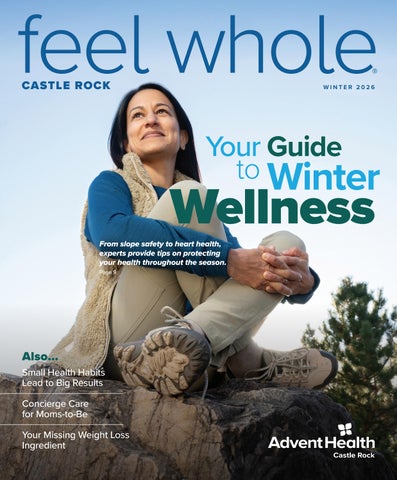
feel whole ®
CASTLE ROCK
WINTER 2026
Your Guide to Winter
Wellness
From slope safety to heart health, experts provide tips on protecting your health throughout the season. Page 9
Also...
Small Health Habits Lead to Big Results Concierge Care for Moms-to-Be Your Missing Weight Loss Ingredient
FROM THE CEO
Health Connections
IN THE NEWS
New Year’s Health Hacks Small changes deliver big benefits.
If you’re trying to get healthier this year, ditch the grandiose New Year’s resolutions and instead make small changes that add up, says Nathan Civili, a certified nurse practitioner with AdventHealth Medical Group Primary Care at Founders. “Small things, done daily, beat big things done rarely,” Civili says. Nathan Civili, FNP-C
New Year, New Beginnings
A
A new year always brings fresh beginnings — and at AdventHealth Castle Rock Hospital, it also reminds us how deeply we’re connected to this community we call home. Every expansion, every new service, and every patient story reflects our shared promise to provide exceptional, compassionate care right here in Castle Rock. As we step into 2026, that promise takes another meaningful step forward with the opening of the Schrader Family Cancer Center, beginning with Medical Oncology and Infusion this month. This milestone represents more than just growth — it’s a commitment to ensuring that advanced, whole-person cancer care is available close to home, supported by the caregivers our community knows and trusts. Our journey continues, fueled by purpose, faith and gratitude for a community that inspires us every day. Together, we’re building a future where hope and healing thrive — for generations to come. Blessings,
Michelle Fuentes President & CEO AdventHealth Castle Rock
2 | feel whole WINTER 2026
Here are his top four low-effort health hacks for 2026.
1.
Sip Smarter — The Power of Staying Hydrated
2.
Sneak in Steps
3.
Adopt “One Better” Food Rule
4.
Anchor Tiny Habits to Things You Already Do
to do Why it works: Most people mistake dehydration for fatigue or hunger. How to do it: • Drink one full glass of water first thing in the morning. • Thirst decreases with age so drink on a schedule, not just when you feel thirsty. Result: More energy, better digestion, less random snacking.
Why it works: You don’t need dedicated workout time to move more — just consistency. How to do it: • Walk during phone calls or plan walking meetings. • Set a “threeminute move break” every hour — dance, stretch or pace. Result: You’ll easily rack up 5,000-8,000 steps a day without noticing, improving heart health and mood.
Why it works: It avoids perfection paralysis. How to do it: Instead of overhauling your diet, make one thing better each time: • Substitute sparkling water with lime for your afternoon soda. • Order a wrap or salad from your usual fastfood stop. Result: You’ll naturally eat healthier, but without deprivation or guilt.
Why it works: The brain loves routines, not revolutions. How to do it: Pair a small healthy action with an existing habit: • Do squats or calf raises while brushing your teeth. • Do two push-ups every time you wash your hands (before washing). Result: You’ll create “automatic health loops” that stick without effort.
Find your path to whole-person health. Mix up your weekly walks with a new location: Pittman Pathway Wellness Trail at AdventHealth Castle Rock Hospital! Located on the hospital’s east side, the quartermile trail is designed to inspire movement and mindfulness, featuring outdoor workout equipment, an incline and useful health tips along the way.
Looking for a primary care provider to get you off to a healthy start this year? AHMG Primary Care at Founders is accepting new patients: 720-455-8024.
High-Tech Health Keeping tabs on your health stats has never been Brandon Stucky, MD easier with the variety of wearable devices available these days. But the amount and types of data they deliver can be overwhelming. Brandon Stucky, MD, with AdventHealth Medical Group Family Medicine at Castle Rock, weighs in on the latest advancements and how to get the most benefit from your device.
“They’re great for real-time feedback. They allow people to gamify their health habits to make them more enjoyable.”
Clinical-Grade Sensors and Biomarker Tracking
Wearables are no longer just step counters. Devices are integrating ECG (electrocardiogram), SpO₂ (blood oxygen), blood pressure estimation, HRV (heart rate variability) and other physiological biomarkers. This means everyday gadgets are edging into the territory of health-monitoring devices, providing deeper insights than ever before. However, don’t rely on your Oura ring or your Apple Watch to make a diagnosis, Dr. Stucky cautions. Instead, share the data with your health care provider to provide a more complete health history. “Irregular heart rhythms are a good example,” Dr. Stucky says. “These devices have variable accuracy for predicting them; I’ve had patients present with arrythmia notifications that have been a false alarm and ones that have been accurate.”
How to make the most of your investment in wearable health technology.
Noninvasive Continuous Monitoring
One of the biggest leaps in wearable technology is the foray into metabolic markers and continuous monitoring. In the past decade, people with diabetes have had access to automated insulin delivery (AID) systems that provide continuous monitoring of blood glucose levels that their doctors can review. Now, people without diabetes are using over-the-counter glucose monitors to better understand how diet, exercise and sleep impact their blood sugar levels, motivating them to adopt better health habits. “I view the technology as an empowerment tool versus a diagnostic tool,” Dr. Stucky says. “They’re really helpful with lifestyle modification and self-monitoring, but they’re definitely not a substitute for clinical evaluation.”
— Dr. Brandon Stucky
Popular Smartwatch Features Wearable devices are regularly adding features. Here is a rundown of what you can count on and where you should use good judgment. Good Accuracy
Useful to Track Trends
Too New to Know
• Steps/distance • Heart rate • Sleep duration • Breathing rate
• Oxygen saturation • Heart rate problems • Sleep quality • Blood glucose
• Mental health assessments • UV exposure • Sweat sensors
Looking to upgrade your health this year? Call AHMG Family Medicine at Castle Rock to book your annual wellness appointment: 720-455-8024. Now accepting new patients.
Secure Your Data With wearables collecting sensitive health data, don’t automatically agree to “terms and conditions.” Be sure to check that your data is encrypted and is not shared or sold. adventhealth.com/castlerock | 3
The Missing Piece Does your weight loss plan include fiber? It should. Not Just for Weight Loss
You’ve cut out empty calories, swapped soda for water, started walking regularly and even prioritized Michael Yuan, MD sleep. Great job! But there’s one powerful tool that you might be missing from your weight loss plan: fiber. “Fiber doesn’t get much attention in weight loss conversations,” says Michael Yuan, MD, family medicine physician with AdventHealth Medical Group Primary Care at Founders. “But it plays a meaningful role in hunger, digestion and long-term weight control.”
Why Fiber Helps With Weight Loss There are two types of fiber — soluble and insoluble — and both are important. Soluble fiber — contained in foods such as oats, apples and beans — has been shown to modestly support weight loss, even when calorie intake stays the same. Insoluble fiber — in foods such as whole wheat, carrots and brown rice — help prevent constipation and keep your digestive tract healthy. “Fiber works in a few ways,” Dr. Yuan explains. “It helps slow digestion, so you
4 | feel whole WINTER 2026
feel full longer. It also increases the release of certain hormones that signal satiety to your brain. That’s actually similar to the mechanism behind injectable weight loss GLP-1 medications.” High-fiber foods are often lower in calories, and they support your gut microbiome in ways that may reduce fat storage over time.
How Much Do You Need?
The recommended daily intake is about 25 grams for women and 38 grams for men, but most Americans get only half that. Adding more fiber to your routine is a simple, sustainable step that supports multiple aspects of health. “Fruits, vegetables, beans and whole grains are great sources,” Dr. Yuan says. “You can also check nutrition labels to find out how much fiber is in packaged foods. Look for items with at least 3 to 5 grams per serving.” Other fiber-rich choices include lentils, avocados, chia seeds and oats. Fiber supplements like psyllium can also help. “They’re useful for patients who want a quick add-on,” Dr. Yuan says. “Just make sure to choose a reputable brand.”
Fiber does more than support weight loss. “It improves overall gut health and can reduce cholesterol,” says Michael Yuan, MD, family medicine physician. Fiber also helps lower inflammation, which is linked to a wide range of chronic conditions. Increasing your intake has been associated with reduced risk of: • Heart disease • Type 2 diabetes • Colon cancer • Cognitive decline • Chronic pain “It’s one of the easiest nutrition changes you can make — and it benefits your whole body,” Dr. Yuan says.
Want to Feel Better and Eat Smarter? If you’re looking for simple, sustainable tools to support weight loss, call AdventHealth Medical Group Primary Care at Founders at 720-455-8024 to schedule a visit and create a nutrition plan that fits your life.
The Lifesaving Screening Women Are Skipping Pap tests save lives — yet fewer women are getting them on time. Pap tests are highly effective at detecting HPV, the virus responsible for nearly all cervical cancers. And because HPVMelissa Zart, related changes in MD, OB/GYN the cervix can be treated before they ever turn into cancer, screening doesn’t just help detect problems — it can actually prevent cancer from developing in the first place. Yet, according to the Centers for Disease Control (CDC), the percentage of women who should be screened dropped to 75% in 2021 from 85% in 2008. Why are so many women skipping or delaying this lifesaving screening? “I see women every week who say, ‘I’ve been so focused on my kids. I haven’t been to the doctor myself in years,’” says Melissa Zart, MD, OB/GYN at AdventHealth Medical Group Ridgegate
OB/GYN at Castle Rock. “They’re often surprised to learn they’re due — or overdue — for this routine screening.”
Test Helps Detect Cancer Before Symptoms
Cervical cancer typically develops slowly, with no symptoms until it’s advanced. But routine screening with a Pap test, HPV test or both can identify changes long before they become serious. If you’re 25 to 65, you should be screened every three to five years, depending on your history and which test is used. Although you don’t need a screening every year, you should still get your annual well-woman visit. “Pap tests are just one part of your preventive care,” Dr. Zart says. “Your annual exam is a chance to talk about breast health, birth control, hormones, skin or colon cancer screening, lifestyle — whatever’s most relevant to you.”
HPV Vaccine Up to Age 45
The HPV vaccine can prevent up to 90% of cervical cancers. The CDC recommends that both boys and girls get it between the ages of 11 and 12 (but it can be given as early as age 9). While it’s most effective when given before exposure to HPV, it’s approved through age 45 and may still offer meaningful protection for women in midlife. “I’ve seen many women in their 40s develop abnormal Pap results after a divorce or new relationship,” Dr. Zart says. “For those patients, I definitely recommend the vaccine, but it is certainly most effective if given before HPV exposure.”
What to Know About the At-Home HPV Test The Teal Wand is a new FDA-approved at-home HPV test that lets women self-collect a vaginal swab using a small insertable sponge. What to know: • Available for ages 25 to 65 • Detects HPV with ~96% accuracy • Requires a virtual visit • Cost: $99 to $249 (depending on insurance coverage) • Does not include Pap, STD testing or a full pelvic exam • Follow-up is required if results are positive “It can be a great option for women who want to avoid what can be perceived as an invasive screening visit,” Dr. Zart says. “But it’s not a substitute for a complete physical exam.”
Schedule Your Next Screening Whether you’re due for a Pap test, curious about the HPV vaccine or ready to reconnect with an OB/GYN, we’re here to help. Call AHMG Ridgegate OB/GYN at Castle Rock at 720-455-8024 to schedule your visit. adventhealth.com/castlerock | 5
“We’d go back in a heartbeat.” Learn the secret that makes AdventHealth Castle Rock a destination birth center, attracting families from far away to deliver here. When Anna Gorka of Lone Tree was pregnant Chelsea Dykstra, RN with her first baby, Diana, in 2022, she had several options on where to deliver close to home. But after her OB practice introduced her to AdventHealth Castle Rock — about a 25-minute drive — and its unique Birth Concierge service, she knew it was the right place. From the beautiful, spacious rooms (complete with mini chandeliers and in-room fridges) to the food so memorable her family still visits the hospital’s restaurant for lunch, Gorka says every detail made her feel cared for. When Gorka scheduled her Birth Concierge appointment — a free, one-on-one visit offered to all expectant families — she
expected a simple tour. What she got was so much more: Not only did the team walk her and her husband through exactly where to park, enter the building and check in, they also worked with them to create a custom birth plan. “We walked the unit, which was helpful, but then we sat down and talked through everything: Our preferences, options, things I hadn’t even thought to ask about,” Gorka says. “I left that day with a real plan. I left feeling prepared.” As a first-time mom, she says, the experience helped her feel more informed, more in control, and far less overwhelmed. “Even if I’d had other options, we’d go back to Castle Rock in a heartbeat,” she says.
Anna Gorka chose to deliver both of her children at AdventHealth Castle Rock, despite living near closer hospitals. The family returns often to eat at the hospital’s Manna restaurant.
6 | feel whole WINTER 2026
And, in fact, she did. As she prepared to give birth to her son, William, in 2025, Gorka returned to Castle Rock for another Birth Concierge appointment that she describes as “just as helpful and reassuring the second time.”
A Personalized Experience
At most hospitals, childbirth prep generally means a brief group tour. But AdventHealth Castle Rock offers something more: a full hour of private, personalized time with a Birth Concierge nurse, completely free of charge. “We meet each family exactly where they’re at,” says Chelsea Dykstra, RN. “First-timers, seasoned parents, families
planning a medicated birth, families planning natural births — we walk them through everything and answer all their questions.” Appointments include: • A walkthrough of the check-in process, labor and postpartum spaces • Conversation about birth preferences, comfort tools and support options • Pediatrician planning, community resources and postpartum guidance “The second half of the visit is a sit-down conversation in our office,” adds co-lead Katelyn Rogers, RN. “We talk through their goals, their birth plan and what’s important to them. It’s all about helping them feel confident and heard.”
“Our goal is to empower families with the right tools and information to make confident choices.” — Chelsea Dykstra, RN, Birth Concierge
Tools for an Ideal Birth Experience
Whether a family hopes to labor naturally or opts for an epidural, the team works to support their choices. “We welcome every birth plan,” Dykstra says. “Our goal is to empower families with the right tools and information to make confident choices.” Available comfort items on the labor menu include: • Aromatherapy • Battery-operated candles and twinkle lights • Birth balls, peanut balls and birth stools • Ceiling light projectors and fans • Nitrous oxide • Spinning Babies and Bundle Birth tools for positioning • Sound machines and guided playlists “We want families to know they have options,” Rogers says. “Even something as simple as lighting or music can help people feel more in control.”
Support That Doesn’t End at Delivery
Even after the tour, parents are encouraged to reach out via email with questions both leading up to and after their baby is born. “Families message us in the months before their expected delivery and weeks after delivery,” Dykstra says. “We help with everything from birth certificates and lactation support to class sign-ups and finding a pediatrician.” All prenatal classes, including birth prep, newborn care and sibling classes at AdventHealth Castle Rock Hospital, are free. Postpartum families can attend lactation groups and weekly support sessions, also free and open to the public. The concierge team also coordinates monthly Mommy & Me Markets, where families can pick up donated baby supplies at no cost — no registration or proof of need is required.
The BirthPlace Tech and NICU Upgrades Every upgrade at The BirthPlace is designed to give families greater comfort, connection and peace of mind during their stay. • Level III NICU now open: The hospital recently earned Level III NICU designation, allowing care for babies as early as 28 weeks. Additionally, the NICU is staffed by Children’s Hospital Colorado providers. • In-room virtual consults: Secure, permission-only cameras allow virtual consults with off-site specialty providers, if needed. • Smart TVs and digital whiteboards: Each birthing suite now features smart TVs and digital whiteboards that display your care team, schedule and goals for the day right at your bedside.
Ready to Meet With a Birth Concierge? Moms-to-be from throughout Colorado’s Front Range and even beyond have chosen to deliver at AdventHealth Castle Rock, in large part due to the Birth Concierge service. The Birth Concierge appointment at AdventHealth Castle Rock is more than a tour — it’s a private session with a nurse who will walk you through the birthing unit, discuss your delivery preferences, answer questions and connect you with classes and resources. Schedule your personalized appointment today at 720-455-8024 or email CRK.BirthConcierge@AdventHealth.com.
adventhealth.com/castlerock | 7
Pain in the Neck
Know the pros and cons of the two most common types of neck surgery. As people age, the discs in their neck and back naturally deteriorate, causing pain and, sometimes, instability. These disc issues can lead to pain, numbness or tingling in the neck, arms or hands. Neck pain affects people of all ages; however, research shows women and William Choi, MD older people are more susceptible. While most people will find relief with conservative treatment such as physical therapy and injections, some conditions will require surgery. A good barometer of when to seek the help of a spine surgeon is if conservative therapies haven’t made a difference after a few months. The two most common neck surgeries to consider are anterior cervical discectomy and fusion (ACDF) and cervical artificial disc replacement (ADR). “ACDF is still considered the gold standard, as it has a long history of use,” says William Choi, MD, a board-certified, double fellowship-trained spine and neurosurgeon at AdventHealth Castle Rock. “But if it was myself or my family members, I would do artificial disc, as the research is continuing to show it’s just as effective and it preserves motion.” During fusion surgery, the deteriorated or herniated disc is completely removed. Bone or other material is placed where the disc was removed and, over time, the bones mend together, providing stability and reducing or eliminating pain and other symptoms. Long-term studies show pain and disability improvement in nearly 90% of ACDF patients. But there is a downside. “During fusion, the surgeon is removing stress out of that level
Fusion and disc replacement surgery are both good options for relieving neck pain, says spine surgeon Dr. William Choi.
of the spine, but that also eliminates movement and puts stress on other areas of the neck or back, creating a domino effect,” Dr. Choi says. That stress can result in disc degeneration above or below the Find Relief fused areas, a condition called From Neck Pain adjacent segment disease (ASD). In contrast, replacing the damaged If you’re disc with an artificial disc that retains experiencing neck motion reduces the risk of additional pain, tingling or arm disc deterioration. numbness, you don’t To keep your options open, need to wait for it to Dr. Choi recommends seeing a worsen. Get a plan spine specialist sooner than later. of action with the “The longer we wait, fusion may AHMG spine care be the only choice, as ADR isn’t an team by calling option once the disc collapses,” 720-455-8024. Dr. Choi says.
ACDF vs. ADR Good Accuracy
Pros
Cons
Best For
ACDF
• Long history of use (since the 1950s) • Offers stability • Provides pain relief and improvement in 9 out of 10 patients
• • • • •
Limits movement Longer recovery time Less immediate pain relief Restricted only to fusions in future Risk of adjacent segment degeneration • Risk of additional surgeries
• Degenerative disc disease that leads to a collapsed disc • More than 2 levels of deterioration • Nonadjacent levels of damage • Disc herniation • Spinal instability
ADR
• • • • • •
• Newer procedure (FDA-approved in 2006) • Fewer studies validating its efficacy • FDA and insurance restrictions
• Degenerative disc disease with disc intact • Disc herniation
Preserves motion Immediate pain relief Shorter recovery Allows for ACDF or ADR in future Lower rates of reoperation Positive long-term outcomes
8 | feel whole WINTER 2026
Brace for Winter Injuries Tips for preventing and treating common hand, wrist and shoulder injuries on the slopes. Colorado is known for its snowy fun, hosting roughly 40% of U.S. Rajshri Bolson, MD skiing and snowboarding visits annually. However, a fall on the slopes can quickly put an end to a great winter. While knee injuries make up 50% of all slope-side injuries, upperextremity injuries account for another 18% of skiing injuries and 26% of snowboarding injuries. “With snowboarding, wrists tend to be more exposed, making them more susceptible to injuries, whereas with skiing, many skiers use poles, which result in more shoulder injuries,” says Rajshri Bolson, MD, a board-certified orthopedic hand and wrist surgeon who specializes in upper-extremity musculoskeletal issues at AdventHealth Castle Rock.
How to Prevent Falls on the Slopes
“When it comes to prevention — and the magnitude of the injury — it really depends on three key factors: the person, the conditions and the energy of the fall,” Dr. Bolson says. Person: Age, reaction time, bone health, and equipment can all impact an injury and its prognosis. Avoid skiing or snowboarding if you’re too tired or inebriated. Equipment should fit properly. To improve upper-body bone health, lift weights and maintain a balanced diet. Conditions: Icy or slushy snow greatly impact injury risk. Visibility is also important to avoid obstacles and ensure a safe landing when falling.
Energy of the fall: “The faster you are going when you fall, the higher probability that your injury will be more severe,” Dr. Bolson says. Consider your skill level when choosing a speed on the slopes. Upper-body extremity injuries with extreme pain or an obvious deformity warrant a visit to the emergency room for evaluation, treatment, or stabilization until you can be seen by an orthopedic surgeon. “My patients and I work together to determine the best method of treatment to achieve the outcomes they desire,” Dr. Bolson says. “We also see plenty of ‘tweener’ injuries, which means perhaps we could operate but perhaps there are other options as well, like hand therapy and casting or immobilization.”
Avoid winter wipeouts off the slopes. You don’t have to hit the slopes to be injured. Falls on ice are one of the biggest hazards of winter. Here are five tips to avoid winter wipeouts: Walk in well-lit areas and go around ice. Wear shoes with good traction or use Yaktrax or microspikes. Keep your dog on a short leash to reduce pulling leverage. Walk like a penguin, taking short, shuffling steps with flat feet. Be extra cautious getting in or out of your car, as these are common places for ice.
If you’re struggling with hand or wrist pain, you don’t need to wait for an injury to get help. Get a plan of action with Dr. Rajshri Bolson by scheduling an appointment: 720-455-8024. Dr. Rajshri Bolson, who treats at least one wrist fracture a week in the ER, encourages Coloradans of all ages to practice winter precautions to avoid falls.
adventhealth.com/castlerock | 9
Winter’s
Hidden Heart Risk A multitude of seasonal factors affect heart health.
Heart Attack Symptoms Sudden chest pain is the most common symptom of heart attacks. Other symptoms include: • Upper-body discomfort in the arms, back, neck, jaw or stomach • Shortness of breath • Sudden cold sweat • Nausea • Irregular or rapid heartbeat • Lightheadedness • Unusual fatigue
10 | feel whole WINTER 2026
As temperatures drop, heart attacks rise. In fact, more people experience and die from heart attacks during the winter than any other season. “Dozens of different things contribute to an increase in heart attacks during the winter,” says Grant Bailey, MD, a board-certified cardiologist at AdventHealth Castle Rock. “There’s daylight saving time, which messes with our circadian Grant Bailey, MD rhythm, colder temperatures, less daylight, more isolation, and poor health habits, all of which can create the perfect storm for winter heart attacks.” Heart attacks occur when blood flow to the heart is restricted, leading to muscle damage or death. “What we often see — and know — is that people naturally become more sedentary in the winter, and then there’s a snowstorm and they head outdoors to shovel,” Dr. Bailey says. “Not only do their blood vessels constrict when they are out in the cold, but they’re also suddenly doing a strenuous activity and are not in shape for it.” Considered a vigorous activity, snow shoveling has been linked to an Need a heart increased risk of heart attack, health checkaccording to the American Heart up? Dr. Bailey Association. Respiratory viruses specializes in also peak during the winter months, cardiac diagnostic adding inflammation throughout the body. testing. Schedule “The final kicker is that people get sick and worn down with a an appointment respiratory virus and then become more susceptible to having a by calling heart attack,” Dr. Bailey says. 720-455-8024.
The best ways to reduce the risk of heart attack during winter months include: • Reducing stress, particularly emotional stress, that can be heightened by shorter days. • Maintaining a healthy weight; avoid overindulging during winter storms or vacations. • Keeping active — safely (you may need to move your workouts indoors if the temps drop or dangerous ice forms). • Staying connected with friends and family. • Checking yourself: Are you in shape to shovel? To snowshoe? • Staying on top of medications, checkups and seasonal vaccines, including flu and COVID. “Being socially and physically active are so important, especially during the winter,” Dr. Bailey says. “Join a gym or pickleball league, get out for walks, or find something that keeps you active and accountable.”
Navigating New Drivers Three ways to support your teen driver — and stay involved through the most dangerous driving years. If you have a teenager getting behind the wheel this year, you’re probably feeling a bit of pride — and a lot of nerves. The good news? You play a major role in helping your child become a safe, confident driver. “Parents are the most influential voice in a teen’s driving habits, but only if they stay involved,” says Mindie Ottke, RN, BSN, Mindie Ottke, RN, BSN injury prevention coordinator with AdventHealth and creator of the Choose S.A.F.E. program, a Colorado initiative designed to reduce teen injuries and deaths from motor vehicle crashes. “It’s not enough to teach them how to drive. You need to talk about safety, set clear rules and model the behavior you want them to follow.”
What Parents Can Do
Ottke offers three simple but powerful ways parents can encourage safer teen driving:
Choose S.A.F.E. for Safer Teen Drivers Choose S.A.F.E. is a Coloradobased initiative supported by AdventHealth. The name reminds drivers of four key safety behaviors: • Seat belts and safe speeds • Avoid alcohol and drugs • Focus on the road • Eliminate distractions The program encourages schools to offer Choose S.A.F.E. as a peer-led campaign and can provide classroom or auditorium-style presentations. To learn more or get your school involved, email Mindie.Ottke@ AdventHealth.com.
1. Know the law. Colorado’s Graduated Driver Licensing (GDL) laws include curfews, passenger restrictions and a ban on underage cellphone use. But many parents aren’t familiar with the details. “Understanding the law helps you support your teen and hold them accountable,” Ottke says. “We created a printable GDL magnet so teens and parents can refer to the restrictions and penalties during the learning phases of driving.” 2. Be the example. “You can’t expect your teen to stay off their phone in the car if they’ve watched you check texts at stoplights,” Ottke says. Buckling up, obeying speed limits and staying off your device are all ways to lead by example and help your teen build lifelong safe habits. 3. Keep the conversation going. Driving safety isn’t a onetime talk. Check in regularly, offer gentle reminders and reinforce expectations. A parent-teen driving contract can help keep those boundaries clear.
Parent Resource: Watch the Free Webinar
Scan the QR code to start watching.
Want to feel more confident coaching your teen driver? The ThinkFirst for Parents of Teen Drivers video is a free, self-paced webinar made just for Colorado families. You’ll learn: • What Colorado’s GDL laws require • How to model safe behavior behind the wheel • Tips to set limits and monitor your teen’s driving safety
adventhealth.com/castlerock | 11
Portercare Adventist Health System
AdventHealth Castle Rock Is Growing!
NON-PROFIT ORG US POSTAGE
PAID
DENVER, CO PERMIT NO. 5377
2350 Meadows Blvd. Castle Rock, CO 80109
Meet a few of our new AdventHealth Medical Group (AHMG) primary care providers. All are accepting new patients.
Nathanial Civili, FNP-C
AHMG Primary Care at Founders
A
Schrader Family Cancer Center
Opens Its Doors to the Castle Rock Community
Kristin Edwards, DO AHMG Family Medicine at the Meadows
Julia Rambo, PA-C
AHMG Family Medicine at the Meadows
Nicholas Shriver, MD
AHMG Primary Care at Founders
To make an appointment with any of these providers, call 720-455-8024.
As of December 2025, the new Schrader Family Cancer Center on the AdventHealth Castle Rock campus is officially open, offering transformative cancer care in Castle Rock. Spanning 17,000 square feet, the stateof-the-art facility provides a wide range of services, including chemotherapy, infusion therapy, an on-site pharmacy and a resource library designed to support patients and their families through treatment and recovery. This vital community resource was made possible through the generosity of Castle Rock residents Lisa and Randy Schrader. Their $8 million donation, made through the Schrader Family Fund, was a cornerstone of the Rock of Hope campaign, which successfully raised $14 million to bring the cancer center to life. With its comprehensive services and community-focused design, the Schrader Family Cancer Center marks a significant milestone in expanding access to high-quality cancer care in the region.
Join Us for a Public Open House Address: Schrader Building 2360 Meadows Blvd., 3rd Floor Castle Rock, CO 80109 Date: February 19 Time: 4:30-6:30 p.m.
12
INFUSION THERAPY CHAIRS BOARDCERTIFIED MEDICAL ONCOLOGIST NURSE NAVIGATION
LAB TESTING NUTRITION THERAPY
GENETIC COUNSELING
SOCIAL WORK SERVICES
Please join us for free Schrader Family Cancer Center tours and light refreshments.
adventhealth.com/castlerock
Scan the QR code to RSVP.