feel whole ®
CASTLE ROCK
FALL 2026
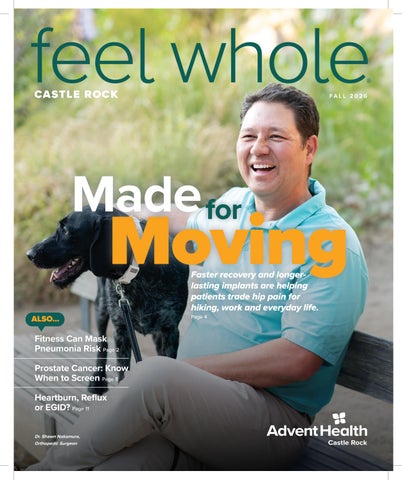
Made for
Moving
ALSO...
Fitness Can Mask Pneumonia Risk Page 2 Prostate Cancer: Know When to Screen Page 8 Heartburn, Reflux or EGID? Page 11 Dr. Shawn Nakamura, Orthopedic Surgeon
Faster recovery and longerlasting implants are helping patients trade hip pain for hiking, work and everyday life. Page 4
FROM THE CEO
Health Connections
This fall, I’m looking forward to cooler days, crisp evenings and the change of season that always seems to bring a renewed sense of energy. I imagine many in our community may be feeling the same. That sense of renewal feels especially meaningful this year as we celebrate an important milestone for our community. AdventHealth Castle Rock has received a five-star rating from the Centers for Medicare & Medicaid Services — the highest rating a hospital can earn. It is a meaningful reflection of the quality, safety and experience we work to provide every person who walks through our doors. For me, this achievement is about more than recognition. It represents the dedication, teamwork and unrelenting pursuit of continued and never-ending excellence that our team brings to caring for you and your family. Excellence is never a destination. It is a commitment we renew each day — to listen closely, improve continuously and earn your trust. Thank you for allowing us to care for this community we are so proud to serve, Blessings,
Michelle Fuentes, President & CEO AdventHealth Castle Rock
IN THE NEWS
Need to Know Even younger adults are at risk of pneumonia and need to be aware of symptoms. When NASCAR driver Kyle Busch died from pneumonia complications at 41, it shocked many people who didn’t think a young, fit athlete could die from a respiratory infection. It also served as a warning about the risk pneumonia poses if left untreated. The irony is that while pneumonia is more common over age 65, it can be especially risky for younger, physically fit people. This is because Nathalie Abisror, MD their healthier cardiovascular function can mask symptoms, says Nathalie Abisror, MD, a primary care physician at AdventHealth Family Medicine at Castle Pines. “Most young adults are going to write symptoms off as overtraining or allergies,” she says. As cold and flu season approaches, here’s what you need to know to stay safe, regardless of your age or health.
Pneumonia Vaccine
Pneumonia: • Lung infection caused by a virus or bacteria • Bacterial form can be treated with antibiotics • Sickens 1.5 million people in the U.S. every year Symptoms: • Cough that doesn’t go away • Persistent fatigue • Shortness of breath • Fever
Although pneumonia is rarely fatal, serious complications are possible, including: • Respiratory failure • Lung damage, sometimes permanent • Sepsis When to see a doctor: • If your symptoms last more than 7 days
“If an illness lasts seven days or lingers past that, I want you to come in,” Dr. Abisror says. “This is not one of those illnesses you can work through.”
Two years ago, the U.S. Centers for Disease Control and Prevention lowered the recommended age for adults to start getting the pneumonia vaccine from 65 to 50. The vaccine is estimated to reduce severity and risk of hospitalization by 50%. Talk to your primary care provider about getting the vaccine if you are: • Over age 50 • Age 19 to 49 with other health risk factors, including heart, liver or lung disease; diabetes; and those who smoke or drink alcohol to excess
SCHEDULE ONLINE
To schedule an appointment with AdventHealth Family Medicine at Castle Pines, call 720-455-3028 or scan the code to schedule online. Same-day and next-day appointments are available! 2 | feel whole FALL 2026
Chronic Condition Playbook Four ways to make diabetes, heart failure, COPD and other long-term conditions feel more manageable.
Nicholas Shriver, MD
Managing a chronic condition can feel overwhelming. Medications, appointments, lifestyle changes and repeat visits with multiple specialists may all become part of the routine. But staying engaged in your care can help you manage symptoms, avoid complications and protect your quality of life. You do not have to master everything at once. Start with a plan, lean on your care team and know how to reset when life gets in the way.
Play 1: Lean on Your Coach
Your primary care clinician can serve as the quarterback of your care by helping specialists communicate, reviewing test results and keeping the bigger picture in view. “Primary care gives patients a consistent place to come back to,” says Nicholas Shriver, MD, a primary care physician at AdventHealth Medical Group Primary Care at Founders. “We can help connect the different parts of your care and make the process feel more manageable.”
Play 2: Practice the Basics
Managing a chronic condition comes with a learning curve. Rather than changing everything at once, start with one manageable step. Set medication reminders, use MyChart to review your care plan or write down questions before appointments. Preparing for each visit with a list of questions helps you avoid stagnating with your routines.
Play 3: Keep Your Goal in Sight
It may be easier to stay motivated when your care plan connects to something that matters to you, such as having more energy, staying independent or continuing activities you enjoy. Regular visits give you and your care team a chance to review progress, address concerns and adjust the plan.
Play 4: Course Correct Missed an appointment or fallen out of your routine? That does not mean you have failed. Stress, anxiety and depression can make chronic care harder. Tell your primary care team what got in the way. They can help simplify the plan, connect you with behavioral health support or identify a realistic next step.
Make Primary Care Your Home Base Call 720-455-3022 to schedule an appointment with AdventHealth Medical Group Primary Care at Founders or Crystal Valley.
SCHEDULE ONLINE
The goal is not perfection. It is to course correct and keep going.
Connected Care at Crystal Valley COMMUNITY OPEN HOUSE Sunday, December 6, 11 am to 3 pm
AdventHealth Crystal Valley Health Park opens
November 9 at 4141 Plum Creek Boulevard. The new health complex will feature: - ER/urgent care (opening December 2026) - Primary care - Specialty clinics for orthopedics, OB/GYN, midwifery, spine and neurosurgery (Beginning January 2027)
Scan the code or go to CrystalValleyCare.com for more info!
Join us on December 6 to meet providers, take a tour, enjoy a mug of hot chocolate and meet Santa! adventhealth.com/castlerock | 3
Back to Life in
Motion
After years of planning around his hip pain, Shannon Moritz found lasting relief — and returned to the active life he loves.
For years, Shannon Moritz measured nearly every activity against the pain in his left hip. Could he finish a hike with his wife? Would the walk through the airport become too painful? How far could he go before he needed to stop? Shawn Nakamura, MD “I was always thinking, ‘Am I going to make it? Is it going to start hurting?’” says Moritz, 63, of Castle Rock. The pain began around 2018 or 2019 and gradually worsened. Moritz tried injections, physical therapy and exercises at home. The injections did not help; the therapy and stretching provided some relief, but the sharp pain always returned. Eventually, he began choosing shorter hikes and changing the way he walked to avoid putting pressure on his hip. At its worst, the pain reached 10 out of 10. “I just thought, ‘This is my life. I can’t do this anymore,’” he says. Moritz decided it was worth a visit with a specialist and booked an appointment with Shawn Nakamura, MD, an orthopedic surgeon at AdventHealth Medical Group Orthopedics at Castle Rock who specializes in hip pain and hip surgery.
The X-rays clearly showed the problem. The cartilage in his left hip was completely gone, Dr. Nakamura told him. He recommended a hip replacement. “That was what I needed to hear,” Moritz says. In the not-so-distant past, Dr. Nakamura might have recommended that Moritz try to get by for a few years longer before hip replacement, with concern that the artificial joint could wear out and cause him to need another surgery. But newer implants and surgical techniques now make it possible for patients in their 60s, even their 50s, to have hip replacement surgery. (See below.) “A lot of younger patients want to exercise and get back to an active lifestyle, and a hip replacement can allow that,” Dr. Nakamura says. Moritz scheduled the hip replacement, and the procedure went smoothly. He returned home the same day, used a walker for about a week and went back to work after roughly three weeks. Within about a month, he was easing back into the gym. Today, Moritz is hiking, exercising and walking around Castle Rock with his wife, all without hip pain. “My biggest regret is that I didn’t do it sooner,” he says. “The only reminder I have is when I go through airport security and set off the alarm. Otherwise, I never think about my hip.”
Why Patients No Longer Have to Wait “My biggest regret is that I didn’t do it sooner.” — Shannon Moritz
4 | feel whole FALL 2026
Surgeons once encouraged younger patients to delay hip replacement as long as possible. “We used to tell patients they had to wait until they were 65 or even older because we wanted the hip replacement to be the last surgery they would need,” says Dr. Nakamura. But longer-lasting implants and newer techniques, including a muscle-sparing anterior approach that can support less pain and faster rehabilitation, are changing that advice. THEN
NOW
Wait as long as possible
Consider how pain affects quality of life
Three to four days in the hospital
Often home the same day
Implants expected to last 15 to 20 years
Implants may last up to 30 years
Traditional approach involved cutting muscles
Muscle-sparing anterior approach
Is Hip Pain Holding You Back? Don’t wait until pain has taken over your life to speak with an orthopedic specialist, advises Dr. Nakamura. “If it’s severely affecting your quality of life — your ability to walk, exercise or work — it’s time to have that discussion,” he says. If you’re wondering if its time, consider the following: 1. Have you stopped or reduced activities you enjoy? Hip pain may cause people to give up walking, hiking, exercising, traveling or doing other activities that keep them active. 2. Does pain interfere with daily life? Difficulty sleeping, working, walking or standing may signal that arthritis is significantly limiting your function. 3. Has your range of motion changed? Hip arthritis can make it difficult to bend, rotate your hip, put on shoes or tie your shoelaces. Hip replacement may improve movement when arthritis has caused severe stiffness. 4. Have other treatments stopped providing enough relief? Medication, physical therapy, injections and activity changes may help manage symptoms. When they no longer provide meaningful relief, it may be time to discuss additional options. Answering yes to the above does not necessarily mean you need surgery, but it may be time for an orthopedic evaluation.
Ready to move forward? Schedule an orthopedic evaluation with AdventHealth Medical Group Orthopedics at Castle Rock to find out what is causing your hip pain and what you can do about it. Call 720-455-3027 to schedule an appointment.
After successful hip surgery, Shannon Moritz enjoys an active life that includes walks with his wife in Downtown Castle Rock.
adventhealth.com/castlerock | 5
Big Advancements Aid the Tiniest Miracles
AdventHealth Castle Rock Hospital’s new Level 3 NICU designation means babies born as early as 28 weeks can now be cared for closer to home — and to mom and dad.
Alyssa Bakken was able to stay close to her son, Liam, at Castle Rock’s Level 3 NICU when he was born at 28 weeks.
SCHEDULE ONLINE
To schedule an appointment at AdventHealth Medical Group Ridgegate OB/GYN at Castle Rock, call 720-455-3025 or scan the code to schedule online.
6 | feel whole FALL 2026
When Alyssa Bakken walked into AdventHealth Castle Rock Hospital last February, she was 28 weeks Brianne Maxwell, DO pregnant and had a stomachache. She expected to get medication and go home. Instead, she was rushed into surgery to deliver her son, Liam, by cesarean section. He weighed 1.7 pounds. “My obstetrician said he fit in the palm of her hand,” Bakken says. Bakken left the hospital a week later, after the dangerously high blood pressure that forced Liam’s delivery was controlled. Her little boy, though, had to stay behind. In all, Liam spent 96 days in the AdventHealth Castle Rock neonatal intensive care unit (NICU). If Liam had been born a year ago, he would have had to spend those 13-plus weeks miles farther away from his parents. On June 1, 2025, the hospital’s NICU became a Level 3 facility, meaning it can care for babies born at 28 weeks’ gestation and greater. Before that, babies born at less than 32 weeks had to be transferred. That could be tough on parents and babies, says Brianne Maxwell, DO, an obstetrician/gynecologist at AdventHealth Medical Group Ridgegate OB/GYN at Castle Rock. “Providing a facility closer (to home) allows them to better bond with their baby,” says Dr. Maxwell, who is Bakken’s obstetrician. Moving to Level 3 status involved getting medical supplies, such as respirators and feeding tubes, for such
small babies, says Jacque Northrup, hospital director of women’s services, who helped spearhead the effort. That’s because babies born as early as Liam often have trouble breathing and
“Being able to care for those tiny babies means we’re able to serve our community better.” — Jacque Northrup eating on their own, she says. “Being able to care for those tiny babies means we’re able to serve our community better,” Northrup says. With Liam close by, Alyssa and her husband, Luke, were able to spend most days with him, without having to drive for hours. The benefit is more than convenience, says Dr. Maxwell. “More frequent visits mean more skin-on-skin time,” she says. Studies show that “the more frequently mom can visit baby, the better for everyone.” Dr. Maxwell recalls a set of preterm twins who were struggling, even on oxygen. When their mother held them, “their oxygen demands began to decrease almost instantly,” she says. “A lot of changes we can’t explain medically.” Liam was home and weighing 10 pounds as of August, Bakken says. His arrival wasn’t the birth story she and Luke hoped for. “But it’s definitely memorable. The important thing is he’s doing well.”
Concussion Calculation Parents play a key role in getting their young athletes back in the game.
Most parents know that when a young athlete Jesse Loar, MD sustains a head injury and possible concussion, it’s time for them to come out of the game. After that, however, the best course of action becomes more uncertain. While prolonged recovery in a dark room used to be the normal advice, the U.S. Centers for Disease Control and Prevention (CDC) updated its guidelines last year to reflect new evidence that aerobic exercise, if introduced early and gradually, enhances recovery and reduces the likelihood of persisting symptoms.
But the athlete needs an initial medical assessment and clearance first. Jesse Loar, MD, chief medical officer for AdventHealth Castle Rock and an emergency room physician, recommends erring on the side of caution and getting your child seen at an urgent care or by their primary care provider. Take them to an emergency room if they’re experiencing the following: • Convulsions or seizures • Lack of recognition of people or places • Vomiting • Unconsciousness or increasing drowsiness • Slurring speech • Worsening or persistent headache • Enlarged pupil in one eye or double vision
There isn’t a specific test to diagnose concussion, Dr. Loar says. Instead, imaging and other screenings are vital to rule out more serious conditions, including skull fracture or bleeding. If signs indicate a concussion, he says, symptoms should improve in a week or two. But complete recovery can take several weeks. Kids may be moody, sleepy, nauseous, unable to concentrate or have headaches, Dr. Loar says. They also may be sensitive to light and sound; screens should be kept to a minimum during the first 48 hours.
Six Steps to Concussion Recovery The CDC’s “6-Step Return to Play Progression” outlines six steps for athletes to return to competition. Once they have been cleared by their health care provider, they can start the process. There must be 24 hours between each step and if symptoms return, the athlete should stop and see their health care provider before starting again.
Step 1
Return to regular activities, such as going to school.
Step 2
Do light aerobic activity for 5 to 10 minutes.
Step 3
Continue light aerobic activity with body or head movements, such as jogging.
Step 4
Add more intense no-contact physical activity (e.g., sprinting, no-contact sports drills).
Step 5
Return to full contact in controlled practice only.
Step 6
Return to competitive sports.
LEARN MORE
AdventHealth Castle Rock’s emergency department is one of only 20 Colorado hospitals to earn Emergency Medical Services for Children Colorado’s prestigious COPPER — COlorado Pediatric Preparedness for the Emergency Room — award. adventhealth.com/castlerock | 7
Prostate Cancer Screening:
When to Take Action The right time to screen — and whether screening is right for you — depends on your age, risk factors and life goals. More men are being diagnosed every year with prostate cancer, especially with advanced stage cancer. A simple Benjamin Katz, MD blood test can help detect prostate cancer at its early stages when it is most curable. But the test, which measures prostate-specific antigen (PSA) levels, is not without debate, leaving men confused about whether they should get the test and, if so, when. “The PSA test does a great job of detecting prostate cancer earlier, before the cancer progresses, which is always the goal,” says Benjamin Katz, MD, a board-certified, fellowship-trained urologist at AdventHealth Castle Rock. “But the PSA screening has its controversies because it cannot be used as a sole indication of suspected cancer.” PSA testing used to be a standard part of annual checkups for men over 50. But that stopped in 2012 when the U.S. Preventive Services Task Force (USPSTF) recommended against routine screening because too many men with high PSA levels were being referred for biopsies and even treatment. As an overcorrection to this, routine prostate cancer screenings declined significantly. Only 28% of men eligible for PSA testing were screened in Colorado during 2023, the latest year for which data is available, according to the American Cancer Society. This decline in screenings contributed to an increase in advanced prostate cancer cases, 8 | feel whole FALL 2026
according to research, including a 2021 study in the Journal of Clinical Oncology that compared prostate cancer screening rates to advanced cancer diagnoses across states. Advanced testing improves screening accuracy. Since the recommendation against routine PSA screening was made, newer tests — along with greater knowledge about prostate cancer — has changed the landscape for men. “Today, we have amazing advancements in the detection and treatment of prostate cancer,” Dr. Katz says. “A shared decision-making model is now the standard, which means discussing the patient’s goals, life expectancy and other risk factors prior to initiating prostate cancer screening.” PSA levels naturally rise with age, so physicians look at a patient’s PSA levels over time and never as standalone. Based on those results and the patient’s goals, additional blood testing, a prostate MRI or a prostate biopsy may be performed. “We cannot treat prostate cancer with one broad stroke,” says Dr. Katz. “It’s very nuanced and complex, and it has to be treated individually.” Based on the patient, molecular and genetic testing also may be used to determine the aggressiveness of the cancer, effectiveness of treatment options and heredity risks. “This is why it is paramount to discuss with your provider your own set of circumstances,” Dr. Katz says. “If that provider is not well-versed in prostate cancer, then it’s important to seek the expertise of an experienced urologist.”
Screening Decision
Prostate Cancer in the U.S.
>99%
2nd
leading cause of cancer death in men
survival rate if found early
Second
most common cancer in men, after skin cancer
1 in 8
men will be diagnosed Source: American Cancer Society
1 in 44
men will die from prostate cancer
It’s important to work with your health care provider to determine if and when you should be screened since recommendations are based on individual risk factors. Men at the highest risk of developing prostate cancer include Black men (who are twice as likely than White men to be diagnosed and die from it), men with a family history of certain types of cancer or a hereditary condition, and men over 65.
In general, the recommended ages to discuss prostate cancer screening are:
40
Black men
45
Men with a family history or hereditary condition
50
Men at average risk
Source: American Urological Association
SCHEDULE ONLINE
Get a customized plan. If you’d like to understand your prostate cancer risk and whether you should be screened, schedule an appointment with a urologist at AdventHealth Medical Group Urology at Castle Rock by calling 720-455-3029 or scan the code to make an appointment online. adventhealth.com/castlerock | 9
Three questions to ask about second opinions:
1.
Is the plan evidence-based and personalized? Treatment should follow accepted guidelines while reflecting your health, goals and circumstances. Another opinion may also identify clinical trials available at diagnosis, during treatment or for advanced cancer.
Second Opinions for Cancer Diagnoses Castle Rock SecondOpinion Clinic Now Available AdventHealth Hematology & Oncology at Castle Rock has opened a second-opinion clinic for patients seeking another review of their cancer diagnosis and treatment plan. If you or a family member has been diagnosed with cancer and you would like a second opinion, call 720-455-3026 and ask to be scheduled for a second-opinion consult. 10 | feel whole FALL SUMMER 20262026
Another perspective on your diagnosis can help, but there are times when it may be better not to delay treatment. After a cancer diagnosis, patients and families have important decisions to make. Hearing from another expert can help confirm the recommended treatment, identify other options and help them choose a care team they trust. But a second opinion does not always Scott Herbert, MD produce a different answer. “In about 95% of cases, the treatment plan will be similar from one cancer center to another because we are all following evidence-based guidelines,” says Scott Herbert, MD, an oncologist at AdventHealth Castle Rock. “That should be reassuring.” What may differ is how well the plan fits your goals, schedule and daily life.
2.
Do I trust this team? You should feel heard, safe, and confident with the oncologist, nurses, and other team members involved in your care.
3.
Can this facility meet my practical needs? Cancer care often requires frequent appointments and sometimes urgent visits. Consider the location, convenience and services available.
When a Second Opinion Is Important
Dr. Herbert strongly recommends another opinion for rare cancers and tumors requiring specialized surgery, including sarcomas, pancreatic or bile duct cancers, and some complex lung tumors. “You want to go somewhere that has done a lot of the surgery you need,” he says.
When NOT to Wait
On the other hand, some fast-growing cancers require care to begin quickly. In those cases, delaying treatment to get a second opinion may cause more harm than good. Ask whether there is time to seek another opinion before treatment begins.
Get another expert perspective. Call 720-455-3026 to schedule an oncology consultation at AdventHealth Castle Rock.
When It’s More Than Reflux
Recurring digestive symptoms may point to an inflammatory condition that is easy to miss. Heartburn. Trouble swallowing. Nausea. Abdominal pain. Diarrhea. These symptoms may come and go, and certain Kevin Rufner, MD foods may seem to trigger them — but not every time. That unpredictable pattern can make the cause difficult to pinpoint. Some patients spend years being treated for reflux or avoiding particular foods before learning they have a completely different problem: eosinophilic gastrointestinal disease, or EGID. EGIDs are chronic conditions in which eosinophils, a type of white blood cells, collect in the digestive tract and cause inflammation. “EGID symptoms can look like reflux, food sensitivity or other common digestive problems,” says Kevin Rufner, MD, a gastroenterologist at AdventHealth Medical Group Gastroenterology at Castle Rock. “When symptoms keep returning or treatment is not helping, it may be time to look for another explanation.”
Prolonged Diagnosis
Symptoms depend on where the inflammation occurs. EGID in the esophagus may cause heartburn, trouble swallowing or food becoming stuck. The same disease affecting the stomach or intestines may cause abdominal pain, nausea, vomiting or diarrhea. The pattern is not always clear. A food may trigger symptoms one day but not the next. And because EGIDs can resemble other digestive conditions, patients may try reflux medication or dietary changes and get temporary, but not lasting, relief.
Confirming EGID
Because EGIDs can mimic several other conditions, symptoms alone are not enough for a diagnosis. A gastroenterologist may recommend an upper endoscopy to examine the esophagus, stomach and first
part of the small intestine. A colonoscopy may be used when symptoms involve the lower digestive tract. During either test, the doctor can collect small tissue samples for a pathologist to examine. These biopsies are especially important because inflammation may occur in patches, and the digestive tract can sometimes look normal during the procedure. “Persistent symptoms deserve an explanation,” Dr. Rufner says. “Once we identify where the inflammation is occurring, we can develop a treatment plan tailored to the patient.”
When to See a Gastroenterologist Talk with your doctor if: • Reflux symptoms continue despite treatment • Food sticks or swallowing becomes difficult • Abdominal pain, nausea, vomiting or diarrhea keeps returning • Symptoms seem food-related, but you cannot identify a consistent trigger • Digestive symptoms interfere with eating, sleep, work or daily activities
SCHEDULE ONLINE
Get answers for ongoing symptoms. If reflux treatment is not working or digestive symptoms keep returning, schedule an evaluation with AdventHealth Medical Group Gastroenterology at Castle Rock. Call 720-455-3022 to schedule an evaluation or scan the code to schedule online. adventhealth.com/castlerock | 11
Portercare Adventist Health System NON-PROFIT ORG US POSTAGE
PAID
DENVER, CO PERMIT NO. 5377
2350 Meadows Blvd. Castle Rock, CO 80109
Same-Day & Next-Day Care Need a primary care provider? Or need to see your PCP quickly? AdventHealth Castle Rock primary care providers now have same-day and nextday appointments available! Our providers offer care for everyday illnesses, annual wellness visits, preventive screenings, chronic condition management and more, all with a focus on helping you feel your best. Find a provider who is accepting new patients and schedule an appointment that fits your needs. Availability: Monday through Friday. To make an appointment, call 720-455-3028 or scan this code.
Two Steps Ahead Lower your risk of breast cancer with lifestyle changes and help catch it early with annual mammograms.
Although you can’t control whether you have a family history of breast cancer, the good news is that there are many things you can do to control your risk. Most Castle Rock women already eat healthy, exercise and don’t smoke. But there’s one other risk factor that’s not as commonly known: alcohol. New research has found that women in their 40s and 50s drink more heavily than any other group, yet they are the least likely to know that alcohol use increases their risk of breast cancer. “Breast cancer is multifactorial, so it’s difficult — often impossible — to point to one cause for any individual diagnosis,” says Eamonn Quinn, MD, a breast radiologist at AdventHealth Castle Rock. “Alcohol is one of several factors I discuss with patients who ask about risk reduction, along with
smoking, diet, exercise and weight control.” Even modest reductions in alcohol matter. If you currently have one drink a day, it’s estimated that stopping can lower your risk by 15%. Higher levels of drinking get even more benefit, with the heaviest drinkers slashing their risk in half if they quit. Early Detection Key The next best thing after preventing cancer is finding it early when it is most treatable. Annual screening mammograms remain the most effective tool for catching breast cancer early, Dr. Quinn says. “Screening is what I emphasize most to my patients,” he says. “Breast cancer can occur even with total lifestyle optimization; annual mammograms are what changes outcomes.”
LEARN MORE
Schedule your annual mammogram.
SCHEDULE ONLINE
Schedule a mammogram by calling 720-455-3024. For women who cannot afford a screening mammogram, AdventHealth Castle Rock Foundation will cover the cost for qualified women. Scan the code to schedule online or apply for a free screening mammogram. adventhealth.com/castlerock