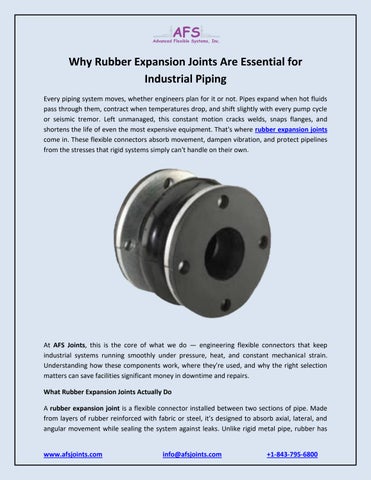
Why Rubber Expansion Joints Are Essential for Industrial Piping Every piping system moves, whether engineers plan for it or not. Pipes expand when hot fluids pass through them, contract when temperatures drop, and shift slightly with every pump cycle or seismic tremor. Left unmanaged, this constant motion cracks welds, snaps flanges, and shortens the life of even the most expensive equipment. That's where rubber expansion joints come in. These flexible connectors absorb movement, dampen vibration, and protect pipelines from the stresses that rigid systems simply can't handle on their own.
At AFS Joints, this is the core of what we do — engineering flexible connectors that keep industrial systems running smoothly under pressure, heat, and constant mechanical strain. Understanding how these components work, where they're used, and why the right selection matters can save facilities significant money in downtime and repairs. What Rubber Expansion Joints Actually Do A rubber expansion joint is a flexible connector installed between two sections of pipe. Made from layers of rubber reinforced with fabric or steel, it's designed to absorb axial, lateral, and angular movement while sealing the system against leaks. Unlike rigid metal pipe, rubber has
www.afsjoints.com
info@afsjoints.com
+1-843-795-6800
natural elasticity, which means it can stretch, compress, and flex without fatiguing the way steel eventually does. This flexibility serves several purposes at once. It compensates for thermal expansion in hot water or steam lines, isolates vibration from pumps and compressors, and absorbs the shock of water hammer — that sudden pressure spike caused by rapidly closing valves. Without this cushioning effect, connected equipment would transmit stress directly into pipe supports, joints, and foundations, leading to premature failure. This is why rubber expansion joints have become a standard component in HVAC systems, water treatment plants, marine applications, and chemical processing facilities. Comparing Rubber and Silicone Expansion Joints While rubber remains the most widely used material, silicone expansion joints have carved out an important niche, especially in applications involving extreme temperatures. Standard rubber compounds like EPDM or neoprene perform well across a broad operating range, but silicone expansion joints handle much higher and lower temperature extremes without losing their flexibility or sealing properties. This makes silicone the material of choice for exhaust systems, food-grade processing lines, and environments where temperature swings are frequent and severe. That said, silicone typically comes at a higher cost and may not offer the same abrasion resistance as certain rubber compounds. Choosing between the two often comes down to a straightforward question: what conditions will the joint actually face? For general-purpose water, air, and low-chemical-exposure systems, rubber remains the practical and cost-effective option. For high-heat or specialty environments, silicone expansion joints justify the added investment. AFS Joints works with clients to evaluate these tradeoffs before recommending a solution, since the wrong material choice can mean replacing joints far sooner than expected. Common Applications Across Industries The versatility of rubber expansion joints is one reason they show up in so many different sectors. In HVAC systems, they connect chillers, cooling towers, and pumps to the surrounding ductwork, absorbing vibration and preventing noise transfer through the building structure. In municipal water and wastewater treatment, they compensate for ground settling and thermal movement in buried or above-ground piping networks. Marine and offshore applications rely on these joints to handle the constant flexing caused by wave motion and engine vibration, while power generation plants use them on large-diameter ducts carrying flue gas or steam. Chemical processing facilities favor specific rubber compounds
www.afsjoints.com
info@afsjoints.com
+1-843-795-6800
engineered to resist corrosive media, acids, or solvents. Each of these environments places different demands on the joint — temperature, pressure, chemical exposure, and movement type all factor into the design. This is precisely why generic, off-the-shelf solutions often underperform compared to joints selected and engineered for the specific application. Beyond these core sectors, rubber expansion joints also play a critical role in oil and gas processing, where they connect large-diameter pipelines carrying crude, refined products, or process gases across long distances subject to ground shift and thermal cycling. In food and beverage manufacturing, sanitary-grade joints — often silicone expansion joints due to their non-reactive, easy-to-clean surface — are used on lines that must meet strict hygiene standards while still tolerating steam cleaning cycles. Pharmaceutical production lines have similar requirements, where any material degradation could compromise product purity. Pulp and paper mills also depend on heavy-duty rubber joints to manage the vibration and thermal loads generated by large industrial dryers and pumps running continuously. Understanding Different Joint Configurations Not all rubber expansion joints look or function the same way, and knowing the basic configurations helps when reading a spec sheet or talking with a supplier. Single-arch joints feature one flexible convolution and are typically used where movement is minimal and space is limited. Multi-arch joints stack two or more convolutions together, allowing for significantly greater movement absorption — useful in systems with large thermal swings or long unsupported pipe runs. Flanged joints bolt directly to matching pipe flanges and are the most common configuration in industrial settings because they're straightforward to install and service. Sleeved or slip-on joints, by contrast, fit over the pipe ends and are secured with clamps or bands, making them a faster option for retrofit work where cutting into existing flanges isn't practical. Some designs also incorporate control rods or limit bolts, which restrain excessive movement and protect the joint from being overextended under abnormal pressure conditions. Matching the configuration to the application is just as important as choosing the right rubber compound. Selecting the Right Joint: Key Factors to Consider Choosing a rubber expansion joint isn't just about matching pipe diameter. Several variables determine whether a joint will perform reliably for years or fail within months. Operating temperature and pressure define the material and reinforcement requirements. The type of movement — axial compression, lateral offset, or angular deflection — determines the joint's shape and construction. Chemical compatibility matters enormously; a joint rated for water
www.afsjoints.com
info@afsjoints.com
+1-843-795-6800
service may deteriorate rapidly if exposed to oils, solvents, or aggressive chemicals it wasn't designed for. Installation conditions also play a role. Improper alignment, over-compression during installation, or inadequate anchoring nearby can shorten a joint's service life regardless of how well it was manufactured. This is where working with an experienced supplier makes a measurable difference. AFS Joints provides technical guidance during the selection process, helping facilities match the right rubber or silicone expansion joint to their exact operating conditions rather than guessing and hoping it holds up. Installation Best Practices Even the best-engineered joint will underperform if it's installed incorrectly. Proper alignment between the two connecting pipe sections is essential — forcing a misaligned joint into place introduces uneven stress that can cause premature cracking. Bolts should be tightened evenly and in a staggered pattern, similar to how lug nuts are torqued on a wheel, to ensure uniform compression across the flange face rather than concentrated pressure on one side. Adequate anchoring on both sides of the joint is equally important. Expansion joints are designed to absorb movement, not to compensate for unsupported or unanchored piping, so nearby supports need to be installed according to the manufacturer's guidelines. Installers should also avoid over-compressing or over-extending the joint beyond its rated movement capability during installation, since this uses up the joint's designed flexibility before the system has even started operating. Finally, joints should never be stored or installed in direct contact with sharp edges, oils, or ozone-generating equipment prior to commissioning, as this can degrade the rubber before the system is even turned on. Maintenance and Longevity Even well-selected rubber expansion joints require periodic inspection. Visual checks for cracking, bulging, or surface degradation should be part of routine maintenance schedules, particularly in systems exposed to UV light, ozone, or fluctuating temperatures. Catching early signs of wear prevents unplanned shutdowns and the far higher cost of emergency replacement. Facilities that build joint inspection into their preventive maintenance programs typically see longer service life and fewer unexpected failures across their piping infrastructure. The Cost of Cutting Corners It's tempting to view expansion joints as a minor line item in a larger project budget, but the cost of choosing the wrong one — or skipping quality inspection altogether — almost always
www.afsjoints.com
info@afsjoints.com
+1-843-795-6800
outweighs the upfront savings. A joint that fails prematurely doesn't just need replacing; it can trigger unplanned shutdowns, water or chemical leaks, damage to adjacent equipment, and in some cases safety incidents that carry regulatory consequences. By contrast, investing in a properly specified rubber expansion joint, or a silicone expansion joint where temperature demands require it, typically pays for itself through extended service intervals and fewer emergency repairs. Facilities that treat expansion joint selection as an engineering decision rather than a commodity purchase consistently report lower total cost of ownership across their piping systems. AFS Joints often works with clients specifically to evaluate this tradeoff, helping them see the long-term operating cost picture rather than just the initial purchase price. Frequently Asked Questions How long do rubber expansion joints typically last? Service life varies widely based on operating conditions, but a properly selected and installed joint often lasts five to ten years, while harsh chemical or high-temperature environments may shorten that considerably. Can silicone expansion joints replace rubber ones in every application? Not necessarily. Silicone excels in extreme-temperature and sanitary applications, but standard rubber compounds are often more cost-effective and just as durable for general-purpose water, air, and low-chemical-exposure systems. What's the biggest cause of premature expansion joint failure? Improper installation — particularly misalignment, uneven bolt torque, and inadequate pipe anchoring — is one of the most common causes, closely followed by chemical incompatibility with the process media. Do expansion joints need to be replaced during routine maintenance even if they look fine? Not automatically, but scheduled visual and physical inspections should guide replacement decisions rather than a fixed calendar date, since actual wear depends heavily on operating conditions. Final Thoughts Rubber expansion joints may not be the most visible components in a piping system, but they're doing critical work every single day — absorbing movement, protecting equipment, and keeping systems sealed under conditions that would destroy rigid connections. Whether your application calls for standard rubber compounds or the extreme-temperature performance of silicone expansion joints, choosing the right joint requires understanding your system's real operating conditions, not just its dimensions.
www.afsjoints.com
info@afsjoints.com
+1-843-795-6800
Source URL: https://afsjoints.wordpress.com/2026/09/29/why-rubber-expansion-joints-areessential-for-industrial-piping/ CONTACT DETAILS Business Mail: info@afsjoints.com Business Phone: 01-843-795-6800 Business Street: 940 Folly Road – Suite E Business City: Charleston Business State: South Carolina Zip or Postal Code: 29412 Country: USA Website: http://afsjoints.com LinkedIn Profile: https://www.linkedin.com/company/advanced-flexible-systems-inc Pinterest Profile: https://pinterest.com/advancedflexiblesystemsinc/
www.afsjoints.com
info@afsjoints.com
+1-843-795-6800