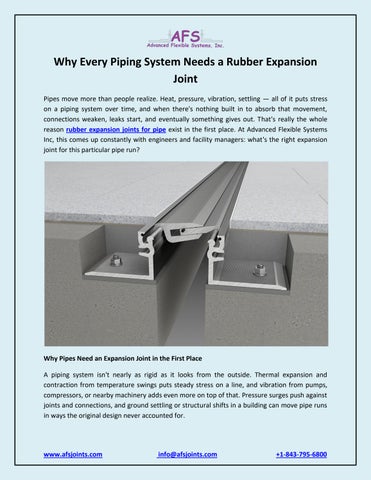
Why Every Piping System Needs a Rubber Expansion Joint Pipes move more than people realize. Heat, pressure, vibration, settling — all of it puts stress on a piping system over time, and when there's nothing built in to absorb that movement, connections weaken, leaks start, and eventually something gives out. That's really the whole reason rubber expansion joints for pipe exist in the first place. At Advanced Flexible Systems Inc, this comes up constantly with engineers and facility managers: what's the right expansion joint for this particular pipe run?
Why Pipes Need an Expansion Joint in the First Place A piping system isn't nearly as rigid as it looks from the outside. Thermal expansion and contraction from temperature swings puts steady stress on a line, and vibration from pumps, compressors, or nearby machinery adds even more on top of that. Pressure surges push against joints and connections, and ground settling or structural shifts in a building can move pipe runs in ways the original design never accounted for.
www.afsjoints.com
info@afsjoints.com
+1-843-795-6800
Without an expansion joint somewhere along that system, all of that movement gets passed straight into the pipe connections, valves, and equipment. Over time, that leads to cracked welds, loosened fittings, and leaks that tend to show up at the worst possible moment. Where Rubber Comes In Rubber expansion joints for pipe exist to absorb that movement instead of letting it travel through the system unchecked. Rubber flexes easily under both axial and lateral movement, and it dampens vibration in a way rigid materials just can't match. Depending on the compound, it can also stand up to a range of chemicals, and it tends to cost less than metal alternatives for moderate-temperature applications. An expansion joint made from rubber can take on a fair amount of movement without pushing stress back into the pipe — which is really the point of using one. It's also quieter than metal in most cases, which matters in systems where vibration and noise are already an issue. Common Applications for Rubber Expansion Joints Rubber expansion joints for pipe turn up in a lot of different settings. Water and wastewater treatment plants use them regularly, as do HVAC systems in commercial buildings, pump and compressor connections, chemical processing lines running at moderate temperatures, and marine or shipboard piping. In most of these situations, an expansion joint isn't just a nice-tohave add-on. It's what keeps the connected equipment from taking on stress it was never built to handle. Different Options to Consider Depending on the Job Not every situation calls for the same type of rubber expansion joint for pipe, and it helps to know what's out there. A single-arch joint is usually the standard choice for typical applications where movement stays fairly moderate and space isn't a major constraint. There's also the spool-type option, which often gets used when a simpler, more cost-effective solution is all a job really needs. Beyond shape, there's also a choice in the rubber compound itself. Some jobs are fine with standard EPDM rubber, which handles water and general weather exposure well. Others — especially anything dealing with oils or petroleum products — do better with a nitrile-based compound instead. And for chemical-heavy environments, a specialty compound designed to resist acids or solvents might make more sense, even if it costs more upfront. Picking between these comes down to what the system actually needs: how much movement it has to absorb, what's running through it, and how much space is available for the joint itself. www.afsjoints.com
info@afsjoints.com
+1-843-795-6800
What to Consider Before Choosing One Not every rubber expansion joint for pipe is built the same, and getting the right one depends on a few key factors. Temperature range matters, since rubber compounds vary in how much heat they can handle — it's worth matching the material to your system's actual operating temperature. Pressure rating matters just as much, since the joint needs to be rated for the pressure your system runs at, not just sized to match the pipe. Chemical exposure is another factor, since some compounds hold up better against oils, acids, or solvents than others. And movement requirements matter too — axial, lateral, and angular movement each place different demands on a joint, so it's worth knowing exactly what kind of movement your system needs to absorb before choosing one. Getting any of these details wrong is one of the more common reasons an expansion joint fails early, even when the installation itself was done correctly. Installation Still Matters Even a well-made rubber expansion joint for pipe won't perform the way it's supposed to if it's installed incorrectly. Proper alignment before installation counts for a lot, since misalignment adds stress the joint was never meant to absorb. Correct torque on flange bolts matters too — both overtightening and undertightening cause problems down the line. Adequate support on either side of the joint helps prevent unnecessary strain, and it's worth building regular inspection into a maintenance routine, since rubber wears over time and doesn't always give obvious warning signs before it fails. This is where working with a team that's handled plenty of these installations really pays off. At Advanced Flexible Systems Inc, we walk through the specifics of a system before recommending anything — temperature, pressure, movement, and chemical exposure all factor into which expansion joint actually makes sense for a given pipe run. Conclusion A rubber expansion joint for pipe might not be the most exciting part of a piping system, but it's often what separates a system that runs smoothly for years from one that starts leaking or cracking well before it should. Whether that means a simple expansion joint for a moderatetemperature water line or a more specialized rubber solution for a demanding industrial application, getting the selection and installation right upfront saves a lot of headaches down the road.
www.afsjoints.com
info@afsjoints.com
+1-843-795-6800
Source URL: https://afsjoints.wordpress.com/2026/08/04/why-every-piping-system-needs-arubber-expansion-joint/ CONTACT DETAILS Business Mail: info@afsjoints.com Business Phone: 01-843-795-6800 Business Street: 940 Folly Road – Suite E Business City: Charleston Business State: South Carolina Zip or Postal Code: 29412 Country: USA Website: http://afsjoints.com
www.afsjoints.com
info@afsjoints.com
+1-843-795-6800