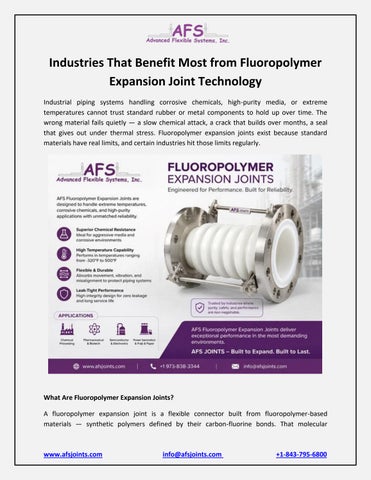

Industries That Benefit Most from Fluoropolymer Expansion Joint Technology
Industrial piping systems handling corrosive chemicals, high-purity media, or extreme temperatures cannot trust standard rubber or metal components to hold up over time. The wrong material fails quietly a slow chemical attack, a crack that builds over months, a seal that gives out under thermal stress. Fluoropolymer expansion joints exist because standard materials have real limits, and certain industries hit those limits regularly.
What Are Fluoropolymer Expansion Joints?
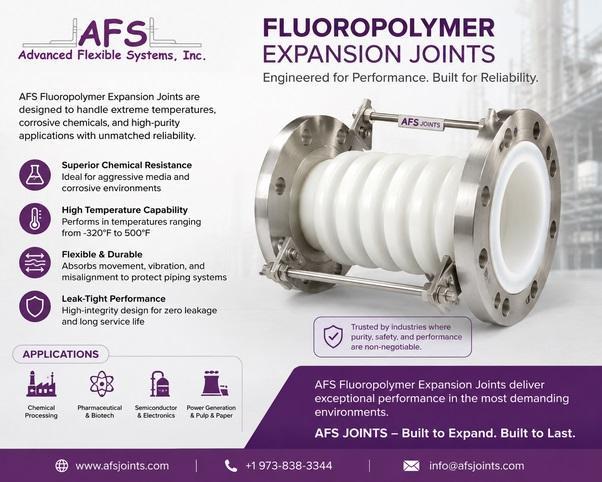
A fluoropolymer expansion joint is a flexible connector built from fluoropolymer-based materials synthetic polymers defined by their carbon-fluorine bonds. That molecular
structure is what makes them tough. The carbon-fluorine bond ranks among the strongest in organic chemistry, which is why these materials stand up to acids, bases, solvents, and oxidizing agents that chew through most other options fast.
These joints sit inside piping systems to absorb movement from thermal expansion, pressure shifts, vibration, and misalignment. A standard elastomer joint swells, cracks, or loses strength when chemicals are involved. Fluoropolymer expansion joints keep their shape and hold their performance. They come in single arch, wide arch, tied, and untied configurations depending on what the system demands in terms of movement and pressure.
Material Properties That Set Fluoropolymers Apart
PTFE is the most widely used fluoropolymer expansion joint construction. It runs at continuous service temperatures up to around 260°C and shrugs off nearly every industrial chemical short of molten alkali metals and certain fluorinating agents. It does not absorb moisture and has a low coefficient of friction, so its mechanical properties stay consistent regardless of what the operating conditions throw at it.
PFA and FEP are two other fluoropolymer options that carry similar chemical resistance with different mechanical and thermal profiles. That gives engineers room to match the material to the actual media and temperature range rather than forcing one solution onto every application. These materials also clear clean-in-place and sterilization requirements, which opens the door to pharmaceutical and food-grade applications where contamination is simply not an option.
Put a fluoropolymer joint next to a standard EPDM or neoprene joint in a chemically aggressive line and the difference in service life is not subtle. Fewer replacements, lower maintenance spend, and less exposure to the kind of unplanned shutdowns that cost real money in continuous-process operations.
The Role of Viton Expansion Joints
Viton sits within the fluoropolymer family as a fluoroelastomer it carries the chemical resistance of a fluoropolymer with the flexibility of rubber. Originally developed by DuPont, it is now manufactured under several trade names. The fluorine content puts its chemical resistance well above standard elastomers, while the elastomeric character gives it the flexibility and compression set resistance that dynamic joint applications need.
Viton expansion joints are the right fit for hydrocarbon-heavy environments fuel systems, oil and lubricant lines, and solvent applications that would break down EPDM or neoprene fast.
They run continuously up to around 200°C and keep their sealing performance across a broad temperature range. Refineries, chemical plants, and fuel handling systems reach for Viton expansion joints when the combination of hydrocarbons and heat is the defining challenge.
Choosing between PTFE-based and Viton-based fluoropolymer expansion joints is a matter of matching the material to the specific chemical and thermal demands of the job. Both are fluoropolymers, but their performance profiles point in different directions. Getting that selection right means knowing the media, the temperature range, the pressure, and how much movement the system generates.
Where Fluoropolymer Expansion Joints Are Used
Chemical processing plants are the most common home for these joints. Acids, caustics, chlorinated compounds, and oxidizing agents need a material that will not break down under constant exposure. Fluoropolymer expansion joints move these media without swelling, hardening, or cracking.
Pharmaceutical manufacturing depends on them where purity cannot be compromised. PTFElined joints block contamination and hold up through the aggressive cleaning cycles that regulated production demands. Semiconductor fabrication runs into the same need ultrapure water systems and chemical delivery lines require the inert, non-contaminating surface that fluoropolymer materials deliver.
Pulp and paper mills, water treatment plants, and petrochemical operations use them wherever bleaching chemicals, chlorine compounds, or aggressive process media are present. In those settings the joint is not just handling movement it is acting as a chemical barrier keeping the system clean and the operation safe.
Power generation uses fluoropolymer expansion joints in flue gas desulfurization systems, where acidic condensate and high temperatures together rule out most standard materials. These joints consistently outlast alternatives in that service.
Choosing the Right Supplier
Fluoropolymer expansion joints are not off-the-shelf products. Material selection, construction method, liner thickness, and flange configuration all shape how the joint holds up in real service. A supplier who understands the chemistry of the application not just the dimensions builds something that lasts.
Advanced Flexible Systems Inc. engineers and manufactures fluoropolymer expansion joints for demanding industrial environments. Before specifying anything, their team works through the
actual operating conditions: media, temperature, pressure, and movement. Whether the job calls for a PTFE-lined joint, a Viton expansion joint, or a fully fluoropolymer-constructed assembly, they have the manufacturing depth and application knowledge to build it right. Reach out to Advanced Flexible Systems Inc. to discuss what your system needs.
Source URL: https://www.quora.com/profile/Advanced-Flexible-Systems-Inc/Industries-ThatBenefit-Most-from-Fluoropolymer-Expansion-Joint-Technology
CONTACT DETAILS
Business Mail: info@afsjoints.com
Business Phone: 01-843-795-6800
Business Street: 940 Folly Road – Suite E
Business City: Charleston
Business State: South Carolina
Zip or Postal Code: 29412
Country: USA
Website: https://afsjoints.com/