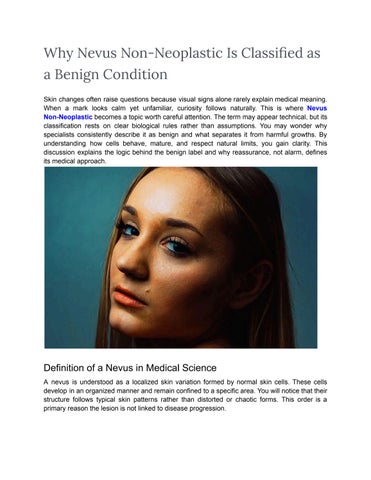
Why Nevus Non-Neoplastic Is Classified as a Benign Condition Skin changes often raise questions because visual signs alone rarely explain medical meaning. When a mark looks calm yet unfamiliar, curiosity follows naturally. This is where Nevus Non-Neoplastic becomes a topic worth careful attention. The term may appear technical, but its classification rests on clear biological rules rather than assumptions. You may wonder why specialists consistently describe it as benign and what separates it from harmful growths. By understanding how cells behave, mature, and respect natural limits, you gain clarity. This discussion explains the logic behind the benign label and why reassurance, not alarm, defines its medical approach.
Definition of a Nevus in Medical Science A nevus is understood as a localized skin variation formed by normal skin cells. These cells develop in an organized manner and remain confined to a specific area. You will notice that their structure follows typical skin patterns rather than distorted or chaotic forms. This order is a primary reason the lesion is not linked to disease progression.
From a diagnostic view, consistency matters. A nevus usually appears early and follows a slow, predictable course. You may observe mild surface changes over time, yet the overall form stays stable. This steady behavior supports a benign interpretation and separates it from lesions that show sudden or aggressive change.
Significance of the Non-Neoplastic Label Non-neoplastic means the cells are not forming a tumor. You are looking at tissue that grows under strict biological control. Cell division stops once natural limits are reached, preventing excessive expansion. This regulated growth is a core reason malignancy is ruled out during evaluation. Pathological review focuses on how cells respond to growth signals. In this condition, signals are obeyed, not ignored. You will find no evidence of unchecked multiplication or structural breakdown. This obedience to normal cellular rules reinforces the benign classification and lowers medical concern.
Normal Cell Maturation and Organization Cell maturity plays a major role in diagnosis. Cells involved reach full development and maintain uniform shape and size. You can expect them to resemble surrounding healthy cells rather than abnormal forms. Such maturity indicates biological stability rather than risk. Organization within the skin layers also matters. The cells remain arranged in defined clusters without disturbing nearby tissue. Even when compared with unrelated surface findings like Milium Cysts, the internal order remains clear. This calm structure signals a harmless condition rather than a pathological process.
Lack of Invasive Biological Behavior Benign conditions do not invade. You will see that the lesion remains confined and does not push into deeper layers. There is no penetration into vessels or surrounding structures. This limitation is essential in separating benign findings from dangerous ones. Equally important is the absence of spread. Cells stay localized and do not travel to other areas. You can feel confident that systemic involvement is not a concern. This biological restraint confirms why extensive treatment is rarely necessary.
Long-Term Stability and Predictable Changes Time strengthens diagnosis. Lesions that remain similar in size and form over the years demonstrate controlled behavior. You may notice slow surface evolution, yet abrupt shifts are uncommon. Stability over time is one of the strongest signs of a benign nature.
When appearance becomes a personal concern, discussion may include optional aesthetic approaches similar to Cosmetic Laser Dermatology Near Me. These considerations focus on appearance, not medical danger. The underlying stability continues to define the condition as nonthreatening.
Conservative Management and Observation Because biological risk is low, observation is usually recommended. You are encouraged to monitor changes rather than pursue immediate intervention. This approach avoids unnecessary procedures while maintaining safety. Regular awareness replaces aggressive care. Observation also supports mental reassurance. Knowing that the condition behaves predictably reduces anxiety. You remain informed and attentive without disruption to daily life. This balanced strategy reflects confidence in the benign diagnosis rather than neglect.
Diagnostic Confidence Through Histological Evaluation Microscopic examination strengthens diagnostic certainty. You will find that tissue samples show uniform cell size and orderly layering. These features confirm controlled growth rather than pathological change. The absence of cellular distortion reassures specialists that the condition aligns with benign standards. Histology also rules out hidden risk. Cells respond normally to staining and maintain predictable patterns. You benefit from this clarity because it reduces the need for repeated testing. A single clear evaluation often supports long-term confidence in the diagnosis.
Psychological Reassurance and Awareness of the Patient Understanding benign behavior improves emotional comfort. When medical explanations focus on stability and limits, anxiety often decreases. You become more aware of what is normal and what would require attention. This awareness supports calm observation rather than constant worry. Education also improves self-monitoring. You learn to notice meaningful changes without overinterpreting minor variations. This balance encourages informed attention and reduces unnecessary concern. Clear knowledge transforms uncertainty into reassurance and supports confident, everyday skin awareness.
Conclusion Benign classification relies on evidence, not assumption. Controlled growth, mature cells, and long-term stability work together to explain why nevus non-neoplastic is viewed as harmless.
Each diagnostic feature confirms biological restraint and predictability. When these factors are understood, uncertainty fades. You gain reassurance through knowledge, recognizing that non-neoplastic represents a condition defined by order, not risk, and by calm behavior rather than progression.