
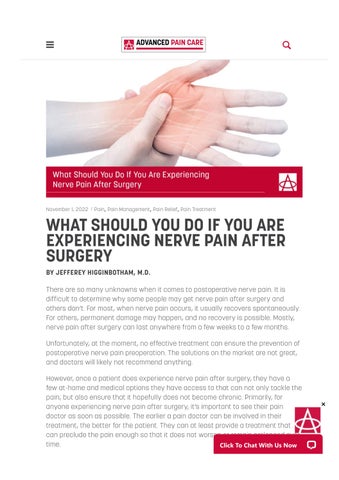
There are so many unknowns when it comes to postoperative nerve pain It is difficult to determine why some people may get nerve pain after surgery and others don’t For most, when nerve pain occurs, it usually recovers spontaneously For others, permanent damage may happen, and no recovery is possible Mostly, nerve pain after surgery can last anywhere from a few weeks to a few months
Unfortunately, at the moment, no effective treatment can ensure the prevention of postoperative nerve pain preoperation The solutions on the market are not great, and doctors will likely not recommend anything
However, once a patient does experience nerve pain after surgery, they have a few at-home and medical options they have access to that can not only tackle the pain; but also ensure that it hopefully does not become chronic Primarily, for anyone experiencing nerve pain after surgery, it’s important to see their pain doctor as soon as possible. The earlier a pain doctor can be involved in their treatment, the better for the patient They can at least provide a treatment that can preclude the pain enough so that it does not worsen or remain prolonged over time

Nerve pain usually occurs as a result of damage done to the nerve tissue around the surgical area and can happen to around 10% to 50% of patients, depending on the surgery For those that undergo surgeries like a hip replacement, only about 2 to 6% may suffer from it
The most common symptoms of nerve pain after surgery are burning, shooting, or electric shock pain that occurs as a result of stimuli The patient may also experience severe symptoms such as loss of movement Stimuli can be as innocuous as a light touch or the wind blowing on or to the affected area
For certain surgeries, nerve pain is somewhat expected or common. For example, if a patient goes into surgery for nerve pain, it is highly likely that some nerve pain after surgery is to be experienced This also applies to any surgery that works on or around the nervous system; such as back surgery However, if the patient goes in for ankle surgery and constantly feels as if their ankles are on fire with the slightest bit of stimuli, that needs to be addressed sooner rather than later with their pain doctor
Some topical treatments may be effective for patients to lessen their pain, but they may not remove it completely. Topical lidocaine and diclofenac gels may be effective for giving local relief Over-the-counter painkillers may also be effective in lessening the pain as well But, if the patient experiences severe nerve pain after surgery, they may not be as useful
Nerve pain after surgery may also worsen due to poor nutrients in a patient’s diet A daily supplement may not remove or lessen the pain, but it could prevent it from worsening Primarily, increasing B12, for example, helps patients enhance their nerve repair
Unfortunately, other than these treatments, there is not much else a person can do from home Herbal remedies and/or CBD topicals and oils may also help, though the data is inconclusive With CBD primarily, there are so many ranges of products available on the market, but the industry is unregulated Patients will have to be very careful where they buy their products from, and it may not be effective for everyone If a patient wishes to start trying one of these remedies, it’s probably best to see a pain doctor first They may recommend a specific product that they have seen effective in their patients, or they may provide patients with a more effective medical treatment plan.
Suppose a patient is experiencing postoperative nerve pain and they have gone to their doctor relatively quickly after feeling pain. In that case, their doctor’s treatment plan may be more effective for reducing their pain Unfortunately, if a patient has waited to go to their doctor, the window for effective treatment may diminish significantly
Some effective treatments doctors might recommend are either spinal decompression or nerve retraction surgery Some prescription drugs can also help patients manage their pain Anti-seizures such as gabapentin and pregabalin can relieve pain, though they have side effects and may leave the patient feeling dizzy, nauseous, or drowsy. Patients may also be prescribed antidepressants because they have found them to be effective in blocking the chemical process between the brain and the spinal cord

Dr Higginbotham is a University of North Texas graduate and earned his medical degree in 2004 from the University of Texas Medical School at Houston After completing an Anesthesiology residency at the University of Alabama, Birmingham, Dr Higginbotham finished his Pain Management Fellowship at Texas Tech University Health Sciences Center View Profile
RELATED POSTS

January 8, 2024 / Chronic Pain, Pain Treatment

EASTERN MEDICINE VS. WESTERN MEDICINE: WHAT’S THE DIFFERENCE?
August 14, 2023 / Pain, Pain Management, Pain Relief, Pain Treatment

PREVENTIONS
August 22, 2023 /
Pain, Pain Management, Pain Relief, Pain Treatment

THE SURPRISING TRUTH ABOUT TESTOSTERONE
October 10, 2013
IT’S NOT JUST IN YOUR HEAD
November 15, 2014
TAKE COMFORT IN THE LEAST-INVASIVE APPROACH TO PAIN MANAGEMENT
January 7, 2015

Fax: 512-244-2895
512-244-4272 (4APC)
Schedule an Appointment Online
254-741-6641
Fax: 254-537-4693
Schedule an Appointment Online
806-350-7918
Fax: 806-418-8982
Schedule an Appointment Online