School 21
No. 3 February 2018
Digitally & Socially Yours eTwinning & Erasmus+ project 2017-1-CZ01-KA219-035484
Impressions from Schwetzingen Special points of interest: Impressions from Schwetzingen Descriptions of team presentations
Inside this issue: Impressions from Schwetzingen
1
Class experiences
2
Appel + Ei
3
Czech presentation
4
Refugees in Hungary in the 2010’s
5
Romanian presentation on
6
SeaLife & Women’s Cafe
7
Freezone
8
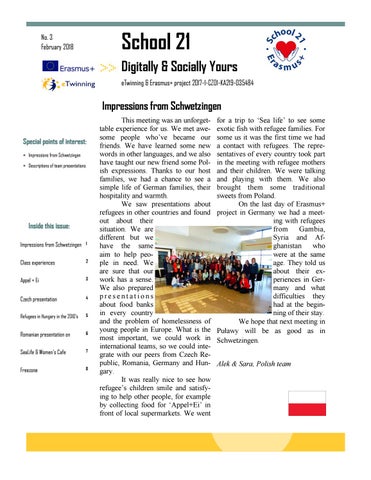
This meeting was an unforgettable experience for us. We met awesome people who’ve became our friends. We have learned some new words in other languages, and we also have taught our new friend some Polish expressions. Thanks to our host families, we had a chance to see a simple life of German families, their hospitality and warmth. We saw presentations about refugees in other countries and found out about their situation. We are different but we have the same aim to help people in need. We are sure that our work has a sense. We also prepared presentations about food banks in every country and the problem of homelessness of young people in Europe. What is the most important, we could work in international teams, so we could integrate with our peers from Czech Republic, Romania, Germany and Hungary. It was really nice to see how refugee’s children smile and satisfying to help other people, for example by collecting food for ‘Appel+Ei’ in front of local supermarkets. We went
for a trip to ‘Sea life’ to see some exotic fish with refugee families. For some us it was the first time we had a contact with refugees. The representatives of every country took part in the meeting with refugee mothers and their children. We were talking and playing with them. We also brought them some traditional sweets from Poland. On the last day of Erasmus+ project in Germany we had a meeting with refugees from Gambia, Syria and Afghanistan who were at the same age. They told us about their experiences in Germany and what difficulties they had at the beginning of their stay. We hope that next meeting in Puławy will be as good as in Schwetzingen. Alek & Sara, Polish team
School 21 Digitally & Socially Yours
Page 2
Class experiences
To sum up, this experience was highly useful for both the German and foreign students, as we could exchange opinions and discuss on various topics.
During our week, starting Monday 5th of February 2018, we were given the opportunity to attend classes at different subjects such as English, for the students that do not understand the German language, and Mathematics, Politics and Spanish for the ones that do. What we liked best were the English and Politics classes because they gave us a clue of how German students improve their language skills and keep informed about the political issues in their country. The participation at this classes offered us the possibility to learn more things about Germany and its school system. We also could spot the differences and similarities between the learning proc-
esses and what are they focused on here and in each of our countries. In comparison to our countries, the school system is very similar, but differences do exist. From our conversations with the German teachers and students we found out that we are having most of the same subjects, with very few exceptions. However, we noticed that the German teachers give their students more freedom of speech and also the students show more confidence in expressing their opinions. What is more, we came across strict rules such as no smartphones on the school territory or a control break schedule, which means the pupils can’t stay in the building during breaks. To sum up, this experience was highly useful for both the German and foreign students, as we could exchange opinions and discuss on various topics. We are looking forward to experience as many meetings as this one in the closest future! Adam Hastrman, Czech Republic Blanka Molnar, Hungary Raluca Trandafir, Romania Gabriela Gregorczyk, Poland
International teams During this week we had an opportunity to work in international groups and to get to know each other. We were divided into multinational teams. Each team contains students from Czech Republic, Poland, Romania, Hungary and Germany. Every team had a presentation about homeless teenagers, food banks and refugees. We had to work 2 hours per day to prepare the presentations and to rehearse our speech. We presented our work on Thursday morning and we found out what the others had prepared. It was useful practice and it was really interesting to see what the other teams were working on. We had no
problems collaborating with the other colleagues. This experience helped us improve our communication skills and overcome our language barrier.
Issue 3, February 2018
Page 3
Appel + Ei WHAT IS APPEL + EI? Appel + Ei is a food bank in Schwetzingen which gives the food that is taken out of the supermarkets because of the expiration date to the people who don´t have enough money. The "Schwetzinger Tafel Appel + Ei" is an ecumenical project of the Caritas Association and the Diakonisches Werk in Schwetzingen. It is supported by the Protestant and Catholic Church, as well as the city of Schwetzingen. The opening times are between 10 a.m. to 1.30 p.m. and Saturday between 10 a.m. to 1 p.m
WHAT DID WE DO ON MONDAY? We were standing in international groups (each group consisted of at least one student of each country) in front of the supermarkets and we asked people if they want to donate food or money for the organization.
The reactions and our experiences There were various reactions; Negative reactions: they ignored us and just walked away Positive reactions: they were very friendly and donated much, they came and told us that it´s fantastic that we help other people in need. Since it was a Monday afternoon and there are not that many people as e.g. on Saturday morning we did not collected as much as usually. Julia, Barbora, Olga, Hannah
“Although it was very cold, we had much fun together and we´re glad to be part of this project. We would do it again!”
Abbildung 1: http://www.evkircheschwetzingen.de/Images/AppelundEi_banner.jpg
School 21 Digitally & Socially Yours
Page 4
Czech presentation
Czechia is a transit county and it means refugees since recent years have just gone through our country to Germany.
Czech presentation is about people on the move (foreigners in the Czech Republic). It consists of three parts: a talk about foreigners, immigration and asylum centres. In the Czech Republic live 500,000 immigrants. The largest part of them are Ukrainians (25%). Ukrainians works on building sites and in industry. Next ones are Vietnamese, they are shopkeepers. There are over 20, 000 small Vietnamese shops in the country. Czechia is a transit county and it means refugees since recent years have just gone through our country to Germany. They ask here for asylum the least from the European Union. In the 20th century there were
large numbers of immigrants from Russia, Greece and Vietnam. Jews came here later in the 1930s, they were scared of the situation in their country, they wanted to protect their families and be safe. Greeks came in the 1940s. In Greece there was a civil war. Vietnamese came in the 1980s. We described a true story about a man from Syria and his family. He took his family and escaped from Syria. There was really hard life because everywhere were falling down bombs. And now he is with his family in an asylum centre. In the Czech Republic are asylum centres in many regions. There are refugees from Ukraine, Azerbaijan, Georgia, Armenia and Syria. There refugees can sleep, get food or learn a language. When a refugee wants to get asylum in the Czech Republic he must go to the local police station and ask for asylum and then he goes to an asylum centre. After 90 days he can get an asylum. He must to learn Czech language and after 5 years he can ask for the Czech citizenship. Around every asylum centre there is a fence, so living there isn´t simple, the place is nice inside, there are gyms, libraries or playgrounds, but the fence as well. There are mostly immigrants and they often works in industry and agriculture. Anna, Pavla Czech team
Issue 3, February 2018
Page 5
Refugees in Hungary in the 2010s The main topic of the first Erasmus Plus project meeting in Germany was “Refugees”. We read a lot of articles and watched a video made by the students of QSI, a multinational school in our town, Pápa. It is called “Refugees are not anonymous”. Also, we had some discussions in our class. Our whole class helped us search pictures and some sources. Petra and I started to turn it into a presentation. It was a lot of work and time. We were really excited to present about this controversial issue. Lili took part in the final work and gave the presentation with us. On Tuesday we were talking about the migration situation in Hungary. We explained who a refugee is and spoke about their rights. We showed some pictures of the Hungarian situation in 1956. After the revolution 200,000 Hungarians left the country and they were received warmly and all of them could find a new home in the free world. In our country even the first Hungarian king, Saint Stephen was really open to foreigners and enriched our economy and culture more than one thousand years ago. However, these days our government does not seem to be friendly
with the refugees coming from Africa and Asia. They built a fence on the border with Serbia and Croatia. On the other hand, there are some migrant solidarity groups in the country that help foreigners. Left wing and liberal opposition parties also NGOs are more welcoming. We displayed a little chart with the numbers of asylum-seekers in the past 5 years. We showed the Hungarian government’s opinion about this topic and some examples of the posters and newspaper advertisements on the topic that have appeared throughout the country. We closed our presentation with a sentence in the languages of the partner schools: ‘Truly, I say to you, as you did not do it to one of the least of these, you did not do it to me.’ (Matthew, 25) Dóra, Petra and Lili Hungarian team
We closed our presentation with a sentence in the languages of the partner schools.
School 21 Digitally & Socially Yours
Page 6
Romanian presentation on refugees
Those things are happening at the present moment, so we should not be indifferent because this problem is affecting us.
The purpose In just a few minutes we succeed to introduce a meaningful story which helps the viewer understand the origins of the refugee situation and the everyday problems these people have to face. The First Drib Everything has a beginning, therefore the Syrian Civil War was the first drib of blood. The chaos had started when the people were forced to leave their countries and find another way to survive. Some of them did choose to stay at home but the possibility of not waking up made them flee. Even though Germany was their target, on their way they spread in different countries like Serbia, Bulgaria and Romania. Here they found shelter and support.
The story of a real hero After giving you general idea about why refugees came to our country and decided to stay here, we thought that the best way to understand what one is going through, we interviewed a Iraqi that saved his daughter and parents from the war. He came to Romania before the war had started and got married to a Romanian lady. Their daughter grew up in Irak with her grandparents. When Hassan saw that things were getting bad there, he went and took his family to Romania.
Listen to their stories A movie always has a story behind itself. The story that we go showed you was a real one. Those things are happening at the present moment, so we should not be indifferent because this problem is affecting us.
Anda & Amanda, Romanian team
Issue 3, February 2018
Page 7
SeaLife On Tuesday 6th of February we were in Sealife in Speyer. We spent time with refugee children and their moms there. We saw lot of water animals for example a shark, turtle or other fish. We also saw interesting and colorful corals. Moreover, we had a chance to play with refugee children and talk to their moms. At the end of the meeting we took a photo of all participants of the meeting. It was an unforgettable experience for us. Most of the students hadn’t had a possibility to spend time with refugees before. They were very nice and told us their stories about why they move to Germany or how they get here. Weronika from Poland, Darina from Czech Republic, Vivi from Hungary
Women’s Café in Schwetzingen What is the Women’s Café? The Women’s Café is a place where refugee women can meet. Men are not allowed to go there. The women go there to drink coffee, eat cake, talk about their lives and learn German. There is a language course which starts 1h before the Café. During the course and the café there are a few people who take care of the children. It was founded in 2016 by Susanne Störmer. When does it take place? The Women’s Café takes place once a month on the first Wednesday, but the language course takes place every week on Wednesday. The courses begins at 3 pm and last till 3.45 pm and if there is the Women’s Café it begins at 4 pm and last till 6 pm. What does our school do in the Women’s Café? The project group of the HebelGymnasium have a partnership with the Women’s Café. Some students support the childcare weekly. The program is very various so for example about two weeks ago they tinker mask because carnival is coming soon. Contact data: Schlossplatz 9 Schwetzingen, In den Räumen der Landeskirchlichen Gemeinschaft Tel. 06202 1270935 (Susanne Störmer) info-frauencafe@asyl-ak-schwetzingen.de Interviews How long did you already help in the child care from the women’s cafe? “I helped in the child care since the beginning of this school year.” (An Ngo, Germany) Do you have some special rules there? In the beginning the child care staff have to explain the rules to the children in English and in German: Be friendly to each other!
No violence! Food and Shoes aren’t allowed in the room! If the kids break the rules they get punished. First they get a yellow card, this a warning. If they break the rules twice they get a red card, so they aren’t allow anymore to visit the child care. (Linh Ngo, Germany) What impression do you have from the Women’s café? “This Wednesday we went to the Women´s Café and we were impressed by this place. I think it was a great experience, because I love kids. Here in Schwetzingen we were able to meet some refugee women and their children and play some games and also take a lot of photos with them.” (Jessica Polk, Romania) “On Wednesday I was in Women’s café. It was very important moment for me, because their stories about their life are interesting and often sad. When I asked children where they are from, they didn’t answer.” (Ingrid Machova, Czech Republik) Do you have something similar in Romania? “I´m used to taking care of little children, in Romania I have the chance to do it every month in an organization, where I read stories for them and play some games.” (Jessica Polk, Romania) How do you think the children care from the women café was this Wednesday? “On this Wednesday there were exceptionally many kids, because of the carnival party. So it was very good that the exchange students helped us. I think it was very nice this week, although the organization wasn’t very good. Everybody was lucky and the kids had fun. We played some games and took many photos and at the end we made polonaise.” (An Ngo and Linh Ngo, Germany)
eTwinning & Erasmus+ project 2017-1-CZ01-KA219-035484
We’re on the web: https://twinspace.etwinning.net/44282/home
Freezone Freezone was founded in 1997 in Mannheim in Germany. It gives a place for teenagers and adults who live on the streets. It is for teenagers from twelve to twenty-five. They can sleep, relax, have a shower, eat and spend some time with other homeless teenagers. These people can bring their pets, too. This place is free for them. We visited this place on Thursday and it was really exciting for us. We took a train from Schwetzingen to Mannheim and we went to Freezone by tram. When we saw that building we were confused because it looked different from other homes or buildings. We did not know what to expect. After that we went in and we met a man. He spoke about this place. How they live, learn and about the history of Freezone. We learned about their ups and downs and how hard it is for them to find an apartment or some job. It was interesting to see their beds and the way they are living.
We saw their rooms which were messy, pictures of their success in school. We also saw this school which was built for the homeless. They call it “street school”. The aim of this Freezone is to help to disadvantaged people to find a good job and live a better life. They are just trying to make their everyday life easier. You can visit this place in Monday, Tuesday, Wednesday and Friday from 13:00 to 17:00 and on Thursday from 16:00 to 20:00. Sára (CZ), Naema (GER) Laura, Bálint (HU)
http://www.freezone-mannheim.de/ http://www.freezonemannheim.de/ https://www.mannheim24.de/mannheim/mannheimhilfe-ankommt-freezone-einrichtung-obdachlosejugendliche-junge-erwachsene-4741135.html
Partners
With the support of the Erasmus+ programme of the European Union
The European Commission support for the production of this publication does not constitute an endorsement of the contents which reflects the views only of the authors, and the Commission cannot be held responsible for any use which may be made of the information contained therein.