School 21
No. 1 October 2017
Digitally & Socially Yours eTwinning & Erasmus+ project 2017-1-CZ01-KA219-035484
Foreword of the project coordinator
Special points of interest:
Team presentations
How we volunteer
Inside this issue: Foreword
1
Czech Team Introduction
2
How we volunteer
2
German Team Introduction
3
Volunteering in Germany
3
Papa Team Introduction
4
AFS
4
Pulawy Team Introduction
5
Community Service in ZSO
5
Lugoj Team
6
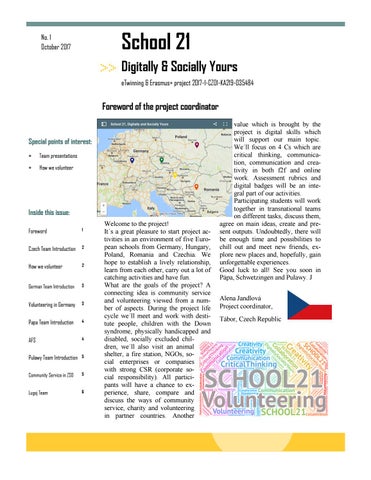
Welcome to the project! It´s a great pleasure to start project activities in an environment of five European schools from Germany, Hungary, Poland, Romania and Czechia. We hope to establish a lively relationship, learn from each other, carry out a lot of catching activities and have fun. What are the goals of the project? A connecting idea is community service and volunteering viewed from a number of aspects. During the project life cycle we´ll meet and work with destitute people, children with the Down syndrome, physically handicapped and disabled, socially excluded children, we´ll also visit an animal shelter, a fire station, NGOs, social enterprises or companies with strong CSR (corporate social responsibility). All participants will have a chance to experience, share, compare and discuss the ways of community service, charity and volunteering in partner countries. Another
value which is brought by the project is digital skills which will support our main topic. We´ll focus on 4 Cs which are critical thinking, communication, communication and creativity in both f2f and online work. Assessment rubrics and digital badges will be an integral part of our activities. Participating students will work together in transnational teams on different tasks, discuss them, agree on main ideas, create and present outputs. Undoubtedly, there will be enough time and possibilities to chill out and meet new friends, explore new places and, hopefully, gain unforgettable experiences. Good luck to all! See you soon in Pápa, Schwetzingen and Pulawy. J Alena Jandlová Project coordinator, Tábor, Czech Republic
School 21 Digitally & Socially Yours
Page 2
Czech Team Introduction
Students of Class 3 work in London companies as part of their school placements, other classes travel to different countries for project meetings with students
We´re a group of 22 students attending a project club at Commercial High School Tábor. We are from 2 different classes of Year 2. There´re students of an economical lycée who prepare for jobs in tourism and of a business academy who study for positions in business administration. The truths is, though, that a lot of students continue their studies at universities and colleges. It´s quite difficult to mention our hobbies, but generally boys enjoy sports and computer games while girls admire shopping and watching films or series. Our main subjects are Economics, Accounting, IT, Typing, English/German/ French/Russian, general subjects as Maths, History, Geography, Civics, Science or PE. In lessons we often use multimedia and smart boards. We regularly participate in sports competitions (ball games, track-and-field running or athletics), in summer months our PE lessons take place in a swimming pool, we go
roller skating on boating on a nearby lake. There is also a skiing course organized every year, recently mostly in Austria. We also travel to foreign countries on study trips, such as Germany, Austria, Poland, France or Britain. Regularly, exchange stays with a German school in Landshut are held. For many years our school has taken part in international projects (Comenius, Leonardo da Vinci, Erasmus+ or eTwinning). Students of Class 3 work in London companies as part of their school placements, other classes travel to different countries for project meetings with students from different European schools (Spain, Luxembourg, Iceland, Germany, Poland, Hungary or Romania). Tábor Team
from different European schools
How we volunteer in Czechia and at school
Czechia helps in different ways through a number of charity organizations or NGOs. Who to? To seriously ill people and their families (Good Angel, Czech Day Against Cancer, Beauty of Help, Medical Clown, Hope), disabled people (Jingle Bell Foundation, Paraple Centre) or disadvantaged people and international help (Red Cross, People In Need). Others help the environment or animals in numerous shelters. Especially in villages, we have voluntary firefighters, a very strong helpful organization where we have 2 of our girls from the project club. At present, food banks are gaining on popularity, customers can donate food straight in shops, this is delivered directly to people in need. Moreover, if you want to donate money you can do it via DMS, which are text messages which send € 1 to a chosen charity (you
can send as many as you want). At Christmas time charity concerts take place in many places. What is the situation in Tábor like? We have here volunteer centre to help people in distress, Jingle Bell and Blot to help disabled kids, a community centre Cheiron T helping disadvantaged children and many others. Every year in the Tábor theatre there is a charity concert to collect money for stranded dogs and cats. Various street money collections for charity organizations are under
way throughout the year. Our school takes part in many of them. We particularly work with the Jingle Bell Foundation which helps people with mental illnesses or disabilities. Students collect money into money boxes or bags, they ask passers by to buy a small jingle bell/ badge. This year the money went to buy a new special van for people on wheelchairs. Some people are happy to donate, others don´t like it very much. Our class earned about € 814, which is really a lot. Another way of our help is a charity run. Run for Africa is a project which collects money for building a school in Ethiopia. If you want to run, you have to have a sponsor who gives you some money for every lap you complete. We ran last school year on June 6 and we ran 238 km and collected € 682. Tábor Team
Issue 1, October 2017
Page 3
Volunteering in Germany Our school year started in the middle of September. Since then, our project group has been very busy with various projects: Every Wednesday afternoon, some members of our group take care of refugee children while their parents either participate in meetings of a women’s café or take German lessons. Our pupils play and talk with the refugee children, thus offering them an opportunity to get into contact with Germans and enabling their parents to improve their knowledge of German and exchange their experiences. Furthermore, our project group is planning a Christmas party for refugee children and children who are mentally or physically disabled. The party is supposed to take place at our school
German Team Introduction
on 21st December, and the afternoon will be filled with playing games, doing handicraft, making cookies – of course and eating them! Finally, our group has already supported Schwetzingen’s local food bank for a few years and is now planning another event in December to collect food for the food bank in front of several local supermarkets. All in all, we Schwetzingen Team
concentrate on enabling our pupils to take responsibility for themselves and show an appreciation
Our school is a co-educational secondary school in Schwetzingen, a small town in the south of Germany. We have approximately nine hundred pupils and eighty teachers. Our aspiration is for all our pupils to become independent thinkers, who are confident and compassionate to others. Both our syllabus and numerous extracurricular activities provide opportunities for our pupils to develop a full range of academic, sporting, creative, social and cultural skills. For instance, they can choose from a variety of foreign languages such as French, Latin and Spanish (English being obligatory) and apply their language skills in exchanges which our school organizes with other schools in Europe and the USA. Next to our pupils’ academic and creative skills, we would like to equip
them with good communication and for others. interpersonal skills, which they do not only achieve in their classes or extracurricular clubs, but also in their roles as mentors for younger pupils or in their commitment for refugees or homeless teenagers - activities which are all supervised by teachers of our school. All in all, we concentrate on enabling our pupils to take responsibility for themselves and show an appreciation for others, which is reflected by the aims of their obligatory subjects as well as their chosen focuses and extracurricular activities.
School 21 Digitally & Socially Yours
Page 4
Papa Team Introduction
Several famous and successful Hungarians have studied here, including scientists, artists and politicians; 3 of them became prime ministers.
Türr István High School was founded by the Pauline Order in Pápa in 1638, so it’s almost 400 years old. Altogether 18 forms study here, which incorporates 3 kinds of classes. On average we have 570 students. Several famous and successful Hungarians have studied here, including scientists, artists and politicians; 3 of them became prime ministers. The school can be found in the town centre. We have some regular events. We make commemorations on our national holidays, when we remember all the people who fought for our country. We have some funnier events
too. Every year we organise a show for the freshmen. At the end of the year, we have two days, when we don’t have to learn, but we can take part in different performances we go to a nearby lake to play interesting games, sports, cook and have a great day to finish the year. We go on a class trip every year in September. This year we visited Pécs and Mohács in the south of Hungary. It was a 2-day tip. We spent a night together in a pension and everybody had a great time. Last year we visited the capital of Hungary, in our first year we visited an amazing volcano park and climbed a mountain. We like these trips because we can learn new things and we can get to know each other better.
AFS – intercultural learning and volunteering On 18 October our class (10.A) took part in a presentation about AFS. AFS stands for American Field Service, it is an international, voluntary, non-governmental, nonprofit organization that provides intercultural learning opportunities to help people develop their knowledge, skills and understanding needed to create a more just and peaceful world. Csikós Gábor who is an AFS trainer and coordinator of intercul
(source: https://www.facebook.com/AfsPapa/ )
tural learning talked about the organisation and its activities. He highlighted the most important parts of intercultural learning: understanding each other, learning about foreign cultures and developing our social awareness. He mentioned the opportunities of exchange programmes which include studying abroad and hosting foreign students. If you don’t want to leave your beloved country or you aren’t able to be a host family you still can be a volunteer. These things are important because they help us get more
welcoming for other cultures’ customs which forms us to become a better person. By knowing people all over the world we wouldn’t fight against each other because we know they are just as worthy as we are and it leads to world peace. Paraicz Petra, AFS volunteer of 10.A Türr Grammar School, Pápa
Issue 1, October 2017
Page 5
The Pulawy Team Introduction Our group consists of 20 students aged 16 to 17 years old and 3 teachers. To become the team members they had to write the English test and after being chosen they were supposed to write the application letter. Some participants of the project are volunteers in our school Volunteering Club. All the members together with the teachers meet regularly to work on the project tasks. We try toget to know about one another as much as possible, exchange ideas concerning the project. Although all the students attend the first form,
they have different interests, attend variuos after school classes and can share their different points of views. They are eager to develop their interests, broaden their minds by learning about other cultures, countries.
They are eager to develop their interests, broaden their mindsby learning about other cultures, countries
Community Service in ZSO nr 2 im. F. D. Kniaźnina w Puławach
The School Volunteers Club in our school was founded in 2002 by Mrs Halina Osiecka, the school headmistress. There are around 30 members every year and three teachers taking care of them, From 2002 the club started the cooperation with the Daily Adaptation Centre in Puławy where the disabled and the Down syndrome people aged from 10 to 25 years old attend. In that place they can develop their interests and learn basic skills with the help of our students who
regularly visit them to lend their hands to their teachers. The most popular forms of the volunteers’ activities are organizing Valentine’s Parties and fancy dress parties or taking part in crafts workshops. Our volunteers used to attend kindergartens in our town. They prepared performances, games and reading sessions for children. Another field in which members of the Volunteering club are involved in are charity actions. Our students raise money for different organizations for example the Hospice in Puławy. They sell candles during All Saints’ Day, Christmas and Easter decorations which they prepare themselves. Together with the PE teachers they organize the Charity Handball Match. The
profit from selling the tickets goes to “Zarażamy radością Foundation” which helps all the people who are in need. Our volunteers help in organizing various sporting events, for example marathons, Nordic Walking for the elderly people or International Table Tennis Championship for the people moving in wheelchairs. Finally, our students help individual people. They are usually lonely, disabled, elderly people moving in wheelchairs. They talk to them, do the shopping or clean their flats.
eTwinning & Erasmus+ project 2017-1-CZ01-KA219-035484
We’re on the web: https://twinspace.etwinning.net/44282/home
Lugoj Team Introduction & Volunteering in Our School Our team consists of about 18 students in the same class—10B and one student in 11B. We have a curriculum with intensive English language learning and computer classes. We like to spend time together and we get involved in many extracurricular activities, including volunteering actions.
Students choose to volunteer for a variety of reasons. For some, it offers the chance to give something back to the community or make a difference to the people around
them. For others, it provides a chance to develop new skills or build on existing experience and knowledge.. Opportunities to volunteer vary continuously throughout the year from baking cookies, organising holiday fairs and environmental cleaning, to helping put together Halloween and Valentine’s day parties. All our high school pupils can be volunteers, regardless of their age. There is no discrimination, all you have to do is really want to get involved. Our school is involved in partenerships with NGOs whose main purpose is to foster the spirit of volunteering and promote it at different levels and in various fields. Children perform volunteering activities in different ways. In the ecological field, through the national projects "Let's do it Romania" and "The recycling patrol" we
Partners
With the support of the Erasmus+ programme of the European Union
managed to clean a part of our city and recycle household appliances. We also carry out charitable activities. Every year, a Christmas fair is organised and the money is donated to a social case. Moreover, students are involved in the national project "Shoe Box". This event offers the chance to donate Christmas gifts to children in need. We also support sports competitions dedicated to people with disabilities. You will probably have some reasons of your own. Remember to think about how much you receive when you give and consider why you want to volunteer. Anda Subţire, Romanian Team The European Commission support for the production of this publication does not constitute an endorsement of the contents which reflects the views only of the authors, and the Commission cannot be held responsible for any use which may be made of the information contained therein.