
God (and Men) at Work
News & Views 1 Editorial 3
“If I cannot say what has been going on in liturgical studies, perhaps I can reflect on what should be going on in liturgical studies.”
Thanks
CNA—Is Latin more effective than vernacular languages in driving out demons? An exorcist answers this controversial CNA’sInterviewedquestion.byACIPrensa,Spanish-languagesister news
agency, Father Francisco Torres Ruiz, a priest of the Diocese of Plasencia in Spain who is in charge of the ministry of exorcism, said that many people wonder “if it’s better to use the exorcism ritual of 1614, reformed by Pope Pius XII in 1952; [they wonder] if it’s better and more effective than the ritual promulgated by St. John Paul II in the year 2000.”
Fathers may know the answers to a lot of things, but according to Father Michael Rennier, if they get this question right, they’ll
By David W. Fagerberg
3 The Rite Questions 11 SEPTEMBER 2022 XXVIII, No. 2 Adoremus 385BoxPO 54602-0385WICrosse,La ProfitNon- Organization PostageU.S. PAID MNMadelia, 4No.Permit
• Wood altar: Paul interprets “Christ’s death on the cross in terms of the cult…. We are still hardly able to grasp the enormous importance of this step. An event that was in itself profane, the execution of a man by the most cruel and horrible method available, is de scribed as a cosmic liturgy, as tearing
• Spiritual altar: “In the Church, this power is visible and sacramental; in the soul it is invisible and mystical. I will call the former sacramental liturgy and the latter liturgical mysticism. The former is exterior liturgy, the latter is interior liturgy.”4
continued
By David Ramos
Pop Quiz: Are you smarter than a liturgist?
“In the first place,” said the priest, who is also a liturgy professor, it’s important “to establish a theological principle: exorcism is a sacramen tal of the Church and, therefore, receives its efficacy from the prayer and faith of the Church.”
be responding to the whole purpose of their vocation as fathers 8
The Many Altars of God: A Primer in Understanding Liturgy and Deification
This, he stressed, “is one of the differences between sacraments and sacramentals.”“Thesacraments are outward signs that communicate grace, that are effective by themselves, because their effectiveness comes from Jesus Christ himself, who is the one who instituted them, and they are neither more nor less than seven, as the Council of Trent said,” the priest explained.“Thesacramentals for their part are visible signs, structured in imita tion, in a certain resemblance, to the sacraments, insofar as they are words and signs, but which have been instituted by the Church and
• Stone altar: when the Holy Doors are opened it is “as though they were the gates of heaven itself, and before the eyes of the whole congregation stands the resplendent altar as the dwelling of God’s glory and the supreme seat of learning from which the knowledge of the truth goes out to us and eternal life is proclaimed.”3
Adoremus Bulletin
AB/WIKIMEDIA. JOHNSTANDMARYWITHCROSSTHEONCHRISTUS (1399/1400–1464).WEYDENDERVANROGIERBY,

NewsViews&
Celebrating the liturgy is hard work. But the good news is that it’s not work we have to do alone, as David Fagerberg says, because God’s doing the heavy lifting—if we only let him 1 Maximus for All of Us

“The Eucharist has, so to speak, this advantage over the Cross, that It is not only the per petual sacrifice of the Cross, but moreover an inexhaustible source of life,” explains French Jesuit Jean Grou. “We behold in the Eucharist Jesus Christ crucified as they sought Him upon Calvary nailed to the cross.”
Story on page 2 page 4
Every Body’s Liturgy
Jan Bentz, who translated Romano Guardini's Liturgy and Liturgical Formation into English, explains in a review of the book how and why the human body is essential to the liturgy….5
Is Latin More Effective in Driving out Demons?
Eternal Dimensions
Please see DEIFICAL on
to a long-standing friend ship, your editor Chris Carstens knew that this is my year of re tirement, and he asked if I could look in the rearview mirror and offer some comments about the field of liturgi cal studies: how I would evaluate the landscape, what I have seen change, what I have learned, etc. Relying on that friendship, I said no. Since I suffer the sin of singularity, I have mainly followed my own interests, and my blinders pre vented me from paying the attention an academic should pay to what’s going on around him. But if I cannot say what has been going on in liturgical studies, perhaps Mr. Carstens (and you, gentle reader) will be satisfied with a reflection on what should be going on in liturgical studies, the ideal being more important than the practice.
Mystery is present in each of them, even though one is bloody, one is sacramen tal, one is interior, and one is supernal.
For the Renewal of the Sacred Liturgy
For seventh-century mystic, St. Maximus the Confessor, the Church is not only the house God built for the life of faith but also, says Adam Cooper, for the liturgy as it should be lived 6
open the closed-up heavens (Romans 3:24-26).”2
I will sum up my prescription by say ing that liturgical studies should be theologically dilated to comprehend the mystery of liturgy. Liturgy involves cos mology, anthropology, the doctrine of sin, the economy of salvation, Christol ogy, ecclesiology, eschatology—roughly everything found along the liturgical path from the alpha to the omega. This might actually make liturgy an unsuit able topic for academic study—it is at least an unwieldy topic—because schol ars like to keep their PhD dissertation topics small and under control, while liturgy is like triggering an inflatable raft in the closet. Liturgy is an activity of man, but it is the work of God. That’s why liturgy must be dealt with theologi cally.
French dramatist Paul Claudel de scribed the dimensions of a church building as “high enough for prayer, wide enough for fraternity, long enough for perspective.”1 In like manner, any study of liturgy should be wide enough, long enough, far enough, near enough, high enough, and deep enough to touch upon all the horizons that liturgy touch es. Here is an image to consider: there are four altars for liturgy—the wood altar of Calvary, the stone altar of the Church, the spiritual altar of our hearts, and the celestial altar in heaven. Christ is at work on all of them; the cross is connected to all of them; the Paschal
“Dad, Can I Help?
Adoremus Bulletin SEPTEMBER 2022 AB
Continued from NEWS & VIEWS
The article set off a frenzy of reactions among Catholics, ranging from amusement to grave concern over what some see as anti-Catholic sentiment.

Society for the Renewal of the Sacred Liturgy
The other path, he added, is to say, “‘Wow. The Lord is giving me an opportunity to grow in holiness. Be cause I am letting go of my will here. I’m trusting that the Lord is at work in his Church [and] that the Holy Spirit is guiding his Church. It’s not what I would do if I was the pope. It’s not what I would do if I was the bishop. But I’m a faithful follower of Christ. And I trust that he is acting always through his Church.’”
“Don’t forget,” he said, “the motu proprio was a year ago,” adding that the pope’s July 2021 directives were effective immediately and were followed by further guidelines in December.
2
Bishop Burbidge said that he intended to choose geographically convenient locations where the Tradi tional Latin Mass is celebrated so that it wouldn’t be a hardship for Latin Mass-goers to attend. He added that the diocese is fortunate to have priests who are trained in celebrating the Traditional Latin Mass and noted that when assistance is needed to cover Mass times, those priests will be called upon to fill in.
CONTENT MANAGER: Jeremy Priest
The rosary, first promoted by the Dominican Order by the 16th century, is a form of prayer based on medi tations on the life of Christ. The beads are a tool to help keep track of prayers that are recited before and after theSincemeditations.1571,popes have urged Catholics to pray the rosary. In doing so they have often employed mili tary terms for these prayer “weapons.” In 1893, Pope Leo XIII saw the rosary as an antidote to the evils of inequality born of the Industrial Revolution, and dur ing World War II Pius XI urged the faithful to pray it in hopes that “the enemies of the divine name (...) may be finally bent and led to penance and return to the straight path, trusting to the care and protection of Mary.”More recently, Pope St. John Paul II, Pope Benedict XVI, and Pope Francis have recommended the rosary as a powerful spiritual tool.
The Spanish exorcist stressed that “the ritual of 1614 is neither better nor more effective, nor is the ritual of
EDITOR - PUBLISHER: Christopher Carstens
SOCIAL MEDIA: Jesse Weiler
Contents copyright © 2022 by ADOREMUS. All rights reserved.
Burbidge offered some ad ditional thoughts on the recent guidelines he issued restricting the Traditional Latin Mass in the Diocese of Arlington, VA. The new restrictions were imposed following liturgical directives given by Pope Francis in July“I2021.think we accomplished our goals of showing fidelity to the Holy Father, to the Holy See, and [were] also mindful that we are still providing the celebration of this Mass throughout our diocese,” Bishop Bur bidge said on the diocese’s “Walk Humbly Podcast” on AugustEffective10.
Dominican Father Pius Pietrzyk of the Province of St. Joseph told CNA, “The article is a long-running stream of inaccuracies, logical fallacies, and distor tions.”The author, he said, fails to understand that “the notion of ‘spiritual combat’ has been with the Church from time immemorial. Recall that a traditional view of Confirmation is that it made one a ‘soldier for Christ.’”“Theproblem is that The Atlantic does not seem to understand what metaphor means. In no wise, does the notion of rosary as ‘combat’ imply physical violence,” Pietrzyk added.
EXECUTIVE COMMITTEE
“The first is what we call the prayer of supplication, which invokes divine help, the one that asks God to free the person, to protect the person who is being harassed, who is being mistreated by the devil,” he pointed out.
MEMBERSHIP REQUESTS & CHANGE OF ADDRESS: info@adoremus.org
The magazine later changed the article’s headline from “How the Rosary Became an Extremist Symbol” to “How Extremist Gun Culture is Trying to Co-Opt the Rosary.” Among other edits to the text, an image of bullet holes forming the shape of a rosary was replaced with a picture of a rosary.
This article has been edited for length.
These editorial changes, nonetheless, left the article’s thesis that there is a connection between the rosary and extremism intact. The author’s contention was based, in part, on his observations about the use of the rosary on social media and rosaries sold online.
WEBSITE AND TECHNOLOGY: Matt Korger
“What does this somewhat strange word mean? Apo tropaic means ‘battle,’ ‘defense,’ [or] ‘combat,’” he noted.
In this way, the devil “is commanded, ordered, above all by proclaiming that victory of Jesus Christ, that battle of Jesus Christ against them, and also reminding them at times of the pain of hell, the punishments to which they are doomed from the creation of the world by their rebellion.”
“That is to say, it is Jesus Christ who confronts Satan, the rebellious spirits, in an exorcism while in that same ritual the victory of Jesus Christ over sin and death, over the devil, is proclaimed,” he said.
PEXELSONAB/COTTONBRO
He describes photos of rosary beads “made of cartridge casings, and complete with gun-metal-finish crucifixes,” along with warrior-themed memes and content catering to survivalists.
There are few exceptions to the rule, established in Traditionis Custodes, that bishops must designate nonparish churches where the Extraordinary Form may be celebrated. But Bishop Burbridge said that he request ed that three churches be able to host the Latin Mass within the main parish church and called the Holy See “very gracious” in its decision to approve.
The second, he continued, is “a prayer of command, which is the prayer that only the priest authorized by his bishop directs straight at Satan, or against the demons that are there, exhorting them, adjuring them, commanding them, ordering them so that they depart from the person they have subjugated.”
GRAPHIC DESIGNER: Danelle Bjornson
Bishop Burbidge offered a “respectful challenge as a spiritual father” and said that there are two different paths that can be followed when change occurs that one disagrees with.
Bishop Burbidge said that his promise of fidelity and loyalty to the Holy Father was “key” when imple menting the restrictions, but also mentioned that he prioritized being “mindful of those who find spiritual nourishment in the Traditional Latin Mass.”
NEWS & VIEWS
PHONE: 608.521.0385 WEBSITE: www.adoremus.org
The Spanish priest also said that in an exorcism “there are two types of prayers that are done.”
“So, the Holy See was very patient, I think, with bishops saying, ‘Well, we need more time to get a better understanding of the use of the Extraordinary Form, Traditional Latin Mass, in our diocese to hear from the faithful, to hear from their pastors, to read both documents,” he said.
Adoremus Bulletin, September 2022
The second path leads to peace, he said.
Adoremus Bulletin
“The rosary has acquired a militaristic meaning for radical-traditional (or “rad trad”) Catholics,” writes Daniel Panneton of the sacramental used in prayer by Catholics for centuries.
Arlington Bishop Seeks Peaceful Path after Restricting Traditional Latin Mass
In the exorcism ritual of 2000, “the threats to the devil, the insults to the devil, have been suppressed, for example, because there were ritual prayers from 1614 that were directly a torrent of insults against the“Thatdevil.”is, they wanted to remove that part, let’s say, more threatening to the devil, to accentuate the kerygmatic proclamation of the Paschal Mystery of Jesus Christ,” he said.
The rules are meant to conform to the mandates Pope Francis published a little over a year ago in his motu proprio Traditionis Custodes, as well as more specific restrictions the Vatican issued in December.
‘The Atlantic’ Publishes Anti-Catholic Article on Rosary By Zelda Caldwell
INQUIRIES TO THE EDITOR P.O. Box 385 La Crosse, WI editor@adoremus.org54602-0385
September 8, Bishop Burbidge’s directives allow eight parishes to continue offering the Latin Mass. But only three of those parishes are allowed to continue offering the Extraordinary Form in their main church. The other five parishes may only cel ebrate the Latin Mass in other designated locations. The eight parishes are not allowed to publish Latin Mass times in their bulletins, on their parish web sites, or their social media channels, per the Vatican’s requirements. Priests are allowed to continue celebrat ing the Mass ad orientem, which consists of facing the altar. This is not the case in the neighboring Archdio cese of BishopWashington.Burbidgerecognized that there was disap pointment and disagreement in response to his imple mentation plan. He added that he is grateful to the priests of the diocese who have promised respect and obedience to him.
Bishop Burbidge said that he hopes the faithful in the diocese understand that the process of implemen tation was purposely not rushed.

“It’s true that the one from 1614 brought together a tradition that dates back at least to the 12th century of the most effective or most widespread prayers among exorcists in the Middle Ages for the fight against the devil,” he noted.
The Rev. Joseph Fessio, SJ
CNA—An article published August 15 in The Atlantic magazine suggests the rosary has become a symbol of violent, right-wing extremism in the United States.
By Joe CNA—BishopBukurasMichael
MANAGING EDITOR: Joseph O’Brien
2000 better or more effective.”
their effectiveness is not ex opere operato, as for exam ple a sacrament, rather it is ex opere operantis—that is, by the faith and prayer of the Church, which is pledged in them and engaged in these actions,” he said.
Torres explained that “if an exorcist uses the ritual of 1614, he is acting correctly and it is effective, and if an exorcist uses the one from the year 2000, he is acting efficaciously and correctly, because the Church has pledged her prayer and her faith in those rituals.”
“Militia culture, a fetishism of Western civilization, and masculinist anxieties have become mainstays of the far right in the U.S.—and rad-trad Catholics have now taken up residence in this company,” writes Pan neton, whose article includes three links to Roman Catholic Gear, an online shop that sells rosaries.
AB/WIKIMEDIA
He also recommended reading the motu proprio, Traditionis Custodes, the further guidance issued in December, and Pope Francis’s most recent apostolic letter on the liturgical formation of the people of God, Desiderio Desideravi
MARKETING AND FUNDRAISING: Eugene Diamond
“One is that of anger and writing or calling or email ing without really thinking of the weight of the words that became somewhat hurtful, not only to me but to my staff who had to read such a tone,” he said.
Father Torres said that “an exorcism is a simple thing; it’s a liturgical celebration of the Church in which the apotropaic action of Jesus Christ is invoked.”
OFFICE MANAGER: Elizabeth Gallagher
The Rev. Jerry Pokorsky = Helen Hull Hitchcock
If I can paint a picture in your mind’s eye, imagine the scene from the Sistine Chapel ceiling depicting the creation of Adam. In it, God the Father and Adam the son are fingertip to fingertip—or nearly so. At Adam’s creation from the Father’s hands (that is, the Logos and Spirit), man was in communion with God, sharing his life and reflecting his image. But with sin, Adam withdraws his hand from God, disfigures himself and all creation, and finds sorrow and death in this world. Christ—who on the one hand is God and on the other hand is man—reconnects heaven and earth. His work is carried on today in the liturgy, a ritual celebration that is as fully divine and completely human as Christ himself.Inshort: the real reason that the liturgy, the Mass, the sacraments, and the sacramentals matter so much is that they continue the work of Christ, putting us face to face (even “mouth to mouth,” the etymological meaning of ad-oration) with God. Get the rites right, and God appears so that we can unite ourselves to him; get the rites wrong, and God remains obscure to us, and our recreation into his image and likeness is thwarted.Thisleads directly to the second fundamental truth
3Adoremus Bulletin, September 2022
The first is to situate the current crises in their proper context. At bottom, the debates and decisions about the liturgy should come down to whether or not our rites manifest God’s glory to today’s world, and how well or not they allow today’s men and women to access God through them. Does the minister’s ars celebrandi answer this call? Do ad orientem, Latin, and chant meet these needs? Do guitar blessings, Mass in the water, or the myriad of ministerial oddities that “expresses a poorly concealed mania to be the center of attention” (Pope Francis, Desiderio Desideravi, 54) do justice to both God and today’s man?
9. How are old missals and other liturgical books disposed of?
5. Are there any norms on the use of TV or
Don’t let us become casualties of the ongoing liturgical fights—even while we acknowledge the essential place of the liturgy and its rites in our lives. But let us keep our eyes raised to the true prize: liturgical transformation into Christ.
of the liturgical life, one that is too often forgotten in most liturgical commentary, but one that must be seen clearly in the midst of our liturgical thinking: namely, that the end game of the liturgy, the true victory, is divinization.
What is divinization? It is becoming by grace what Christ is by nature: God. When the dioceses of the United States began their three-year period of Eucharistic Revival back on the Solemnity of Corpus Christi of this year, St. Thomas Aquinas reminded the Church in her Office of Readings for the day that “Since it was the will of God’s only-begotten Son that men should share in his divinity, he assumed our nature in order that by becoming man he might make men gods.” Along these same lines, Pope Benedict XVI recounts a conversation between St. Augustine and the Eucharistic Christ: “I am the food of grown men; grow,” Augustine hears Christ say, “and you shall feed upon me; nor shall you change me, like the food of your flesh, into yourself, but you shall be changed into me.” Pope Benedict concludes: “It is not the eucharistic food that is changed into us, but rather we who are mysteriously transformed by it.”
1. What year is the new translation of the Liturgy of the Hours slated to come out?
8. What are the principal documents that directed the implementation of Sacrosanctum Concilium?
projection screens in church during Mass?
Unfortunately, divinization is one of the casualties of most liturgical news and commentary today. When was the last time you read a headline (and went on to read the story): “Divine and Indestructible Life Now Available Through the Liturgy”? If the liturgical life will attain full maturity—in the world, in the Church, and in each soul—liturgical teaching, governance, practice, and commentary must focus their full force on our transformation into God, which is the greatest way that we can honor and worship him. “The glory of God,” St. Irenaeus famously says, “is man fully alive.”Don’t, then, let us become casualties of the ongoing liturgical fights—even while we acknowledge the essential place of the liturgy and its rites in our lives. But let us keep our eyes fixed on the true prize: liturgical transformation into Christ, the true man.
2. Christmas in 2022 falls on a Sunday: are there any special considerations for the Mass schedule for that weekend?
By Christopher Carstens, Editor
True victory in the liturgy wars is not, then, ultimately which rite overcomes the other; which direction the Eucharistic Prayer is said; which language the dialogues of the Mass take—even though these are the necessary ballistics in the battle. Rather, it is our transformation into something even greater than Adam was in the garden before his fall.

There appear many reasons for discouragement these days for traditionally minded Catho lics. Ad orientem prayer faces dark times in many places. Latin in the liturgy seems more ancient than ever (despite Vatican II’s calls to the contrary). Gregorian chant, not heard in years in most places, anticipates no reunion tour. Given that today’s Ro man Rite “embrace[s] one and the same tradition” as the Tridentine Missal (see General Instruction of the Roman Missal, 6), these are challenging times for the postconciliar Missal.
A New Liturgical War—and the Path to Liturgical Victory Are You Smarter than a Liturgist?
A quick glance around the web, the blogs, and print matter only exacerbates the mood—these seem to report only bad news. The hierarchy governs too ideo logically, we read. Liturgical abuse garners the most glaring headlines (“You saw the guitar blessing? There was more to that Mass that you missed” [Catholic News Agency, February 23, 2002]; “Priest who offered Mass on inflatable lounge chair in sea: ‘I was perhaps imprudent’” [Catholic News Agency, July 27, 2022]). A new and painful front in the liturgy wars has opened. Thus, it’s not difficult to discern why so many (including myself) are demoralized. Unfortunately, we often add to the fire by contributing our own opinions and complaints. Certainly, it’s important to voice our concerns about the liturgy and the life of the Church (as I am doing now!). But too often—as a review of liturgical headlines and commentary show— liturgical entries focus on the bizarre, the sad, and the disheartening.Isitpossible to move beyond this current state of affairs—a way to win the newly ignited liturgy wars? Indeed, there is: by acknowledging two fundamental liturgical truths.
3. How does a priest hold his right hand when giving a blessing?
Please see ANSWERS, page 10 AB/WIKIMEDIA. LEPANTOOFBATTLETHEOFALLEGORY PAOLOBY, (1528-1588)VERONESE
4. How should one genuflect during adoration of the Blessed Sacrament?
7. What are the prescribed liturgical colors for a funeral?
6. Is there such a thing as a “betrothal ceremony”?
10. Is there a ritual for the closing of a church building?
Editor’s note: Adoremus prints a Readers’ Quiz from time to time on various topics, such as the the Liturgical Movement (January 2021), the Sacrament of Confirmation (May 2021), and the Order of Mass (November 2020). The present Q&A is of a different kind of quiz. Rather than a study on a single topic, this “pop quiz” represents the variety of questions asked over the course of a typical week in a diocesan liturgy office. How would you answer these simple—or not so simple— questions? Are you smarter than a liturgist?
Sequential Reflections
Jordan are all deifical. The reason for liturgy is deifica tion: liturgy is deification’s efficient cause.
The Eucharist can be thought of as a divine food that renders the man who feeds on it wholly divine, if he presents no ob stacle. Saint-Jure describes why. “As the hypostatic union of the Divinity with the Humanity constitutes Jesus Christ, so the union of this same Divinity and Humanity with the Christian, makes the Christian in some manner Jesus Christ.”
Grou continues: “In this sense it may be asserted that Jesus Christ is the only real adorer, a fact so indisputable that our homage acquires value in the eyes of God only be cause comprised in and inseparably united to that of His Divine Son.”13 We are talking here about dei fication, the thing present in liturgy, and the thing liturgical studies should be high enough, wide enough, and long enough to engage.
and His glory. God has created us to give Himself to us in this life and in the next, and by this means to render us happy here below and in eternity; and to put us in a state to procure Him glory, the last end for which He has created all things.”16 In short, liturgy lets us experi ence our end under faith’s veil while waiting for our end to be dis-covered.
Ascetical theologian Charles Louis Gay (1815-1892) describes two acts by God, one interior to the Trinity and one exterior. “God speaks to Himself and gives Himself from within Himself. He has then decreed to speak and to give Himself outside Himself.”9 When he does the latter, it is by no half measure. “He comes straight to this sum of being, to this treasure of lives, to this abridged universe, which is the nature of man…. His love proceeds at once to do for it His utmost, and thus to carry out for it His first design, which is to make a man-God.”10 God’s first design is to make a man-God. Jesus is God’s first design. Jesus is the rationale of creation. Jesus is not merely a methodi cal means to some other end, his hypostatic union is the teleological end of creation. Jesus is the man-God that God’s love proceeded at once to do. And into this man-God liturgists are grafted. “What is Christ? Hu manity possessed by the Word. What is each of the Faithful? If faith in him is a living faith, and especially if it is full and perfect, he is also a man possessed and governed by the Word.”11
“A Christian loves obedience so much that even abjection can be used to please God.”
Furthermore, Jesus is the first liturgist. Jean Grou writes, “Only an Incarnate Deity is capable of offering to God the adoration due to his Sovereign Majesty. He is worthy of infinite homage, and that no mere mortal can present, because no mortal can communicate to an action a value he does not himself possess…. These essential conditions were admirably combined in the homage of Jesus Christ; he adored in the person of a Man-God; he acknowledged himself indebted to his Father for his human nature, and he consecrated his
This connection between liturgical Eucharist and as cetical deification has long lingered in my mind, and has done so mainly in that sequence. The liturgy is a place of spiritual gracing that is deifical (my thanks to Lacordaire for giving me a form of the word I didn’t have until I read him). Standing before God on a litur gical Mt. Horeb, feeding upon his Son in a liturgical cenacle, and being anointed by the Spirit at a liturgical

God’s first design is to make a man-God. Jesus is God’s first design. Jesus is the rationale of creation. Jesus is not merely a methodical means to some other end, his hypostatic union is the teleological end of creation. Jesus is the man-God that God’s love proceeded at once to do.

• Celestial altar: “The river of life can now flow forth from the throne of God and from the throne of the Lamb.”5Whyso many altars? Because Jesus could just not let the Paschal Mystery rest! The reason for multiple altars is the restlessness of divine charity. French Jesuit Jean Grou (1731-1803) explains: “Jesus[,] not con tented with a passing sacrifice, the memory of which would soon be effaced from the minds of men, has willed to render the Sacrifice of His Cross ever-abiding in His Church: he willed to find in the contrivances of His Love effectual means to apply its merits to His members in every place and every age: He willed, so to speak, to found His Cross in the Eucharist, and to change it into an inexhaustible Fount, whence the merits of His Precious Blood should be shed abroad everywhere, to vivify, to sanctify His members.”6 The sacrifice could be offered but once upon the historical, wooden altar, but the whole point of the ecclesial altar is its catholicity and perpetuity. “The Eucharist has, so to speak, this advantage over the Cross, that It is not only the perpetual sacrifice of the Cross, but moreover an inexhaustible source of life.”7 Although Jesus of fered his bleeding sacrifice but once upon the cross, nevertheless his divine ingenuity “found a wondrous means to make it reign in the world until the end of time; He has mysteriously enclosed it in a sacrament of love, where it is made visible, not to our senses, but to our faith…. We behold in the Eucharist Jesus Christ crucified as they sought Him upon Calvary nailed to the cross.”8
AB/WIKIMEDIA. CHRISTOFHEAD (1606–1669).REMBRANDTBY
FLICKRONRAGAIAB/JOHN
But St. Benedicta Teresa of the Cross (Edith Stein) has just recently added a second way of seeing things.17 The reason for deification is liturgy: liturgy is deifi cation’s final cause. Deification happens for the sake of making perfect liturgists. She explains what John of the Cross means by supernatural union with God. The soul reflects the divine light in a more excellent way because the will cooperates, which can best be de scribed as a mystical marriage. “The soul receives only in order to give; she gives back to him all the light and
all the warmth of love that the Beloved gives to her.” St. Benedicta further notes, “Through a substantial transformation, she has become a shadow of God, and thus [says John of the Cross] ‘she does in God through God whatever he does in her through himself, and in the same manner in which he does it…. She [the soul] perceives here that God belongs to her perfectly, that as his adopted child she has entered into her in heritance with full rights of ownership.’”18 This is a perichoretic action. The soul, deified, is taken up into Trinitarian giving-receiving that is called perichoresis. The reason for theosis is for man to become a liturgical agent and join the Son, by the power of the Spirit, in his liturgizing the Father. This means the soul does not worship under her own power. The liturgy of the
History Interrupted
The Paschal Mystery has put its foot down in history, but the collect for the Fifth Sunday of Easter prays God to “constantly accomplish the paschal mystery within us.” The crossbeams from Calvary reach as far as every liturgical altar; the visible altar in the Divine Liturgy is the sacramental pathway to the invisible al tar in the heart; and this spiritual altar extends to the heavenly and beatific meadow where we will finally be pastured. Indeed, if we wished to name the outer limit of liturgy’s mystery, I would suggest the name deifica tion, which is the purpose of the Incarnation, which, in turn, was the purpose of creation. The reason for the universe is to host eucharists, and the altar is the homestead of deified people.
being irrevocably to the glory of the godhead.”
4 Adoremus Bulletin, September 2022 Please see DEIFICAL on page 11 Continued from DEIFICAL, page 1
Divinitysoitydeifical.”ologytransformationofthat(1802-1861)Lacordaireobserves“natureissusceptiblethatenlargementandwhichthedoesnotfeartocall14TheEucharistcanbethoughtofasadivinefoodthatrendersthemanwhofeedsonitwhollydivine,ifhepresentsnoobstacle.The17th-centuryasceticauthorJeanBaptisteSaint-Juredescribeswhy.“AsthehypostaticunionoftheDivinitywiththeHumanconstitutesJesusChrist,theunionofthissameandHumanitywith
Jesus—if I may dare the thought—was the first to live the Christian life. A Christian glorifies God; a Christian lives in faith, hope, and love for the Father; a Christian’s life is a sacrifice of praise to God and a sacrifice of charity to his neighbor; a Christian way of life is stamped with humility, and loves obedience so much that even abjection can be used to please God; a Christian should live a holy life, in union with God. By fact of that ineffable union, we may say Jesus is the first Christian. “Jesus, the first Christian, says, ‘I and my Father are One’ (John 10:30).”12
the Christian, makes the Christian in some manner Jesus Christ. Hence, St. Thomas calls this Sacrament an extension of the Incarnation, and, as it is an extension of the infinite communication which the Father makes of Himself to the Son…so the Sacrament of the Eucharist is an ex tension of the Incarnation for every faithful soul that receives it.”15 An extension of the Incarnation: a track way from the hypostatic union, to the Eucharistic altar, to an interior identity, to a beatific fulfillment. In other words, Christ elevates the soul to himself, transforms it, perfects it, and deifies it in himself. Our end is “God
Ascension Press Releases Book on Solemnities

Christian Liturgy is that it lifts us up out of our narrow sphere and lets us share in the Truth,” says Pope Benedict. “The aim of all litur gical renewal must be to bring to light this liberating greatness” (Feast of Faith, 75).The mission of Adoremus is to rediscover and restore the beauty, the holiness, and the power of the Church’s rich liturgical tradition while remaining faithful to an organic, living process of renewal. Faithful to the magis terium, concerned with tradition, eager to open the lit urgy’s mystery to the modern world, Adoremus is joyful, orthodox, and intelligent. Our hope is to respond to the interventions of Australia’s Plenary Council, through a lay endeavor, by being faithful to our mission and provid ing this resource to the people of Oceania.
Solemnities have a rich tradition and profound meaning in the Bible and our lives. For each of the 17 Solemnities found on the Universal Calendar of the Roman Catholic Church, discover:
By Jan Bentz
Adoremus Bulletin Now Publishing Land-Down-Under Edition
• Images depicting ways that Catholics celebrate the Solemnity around the world
This prejudice still survives today. Take for instance the millions of visitors to the Sistine Chapel in the Vatican each year. On the one hand they gaze in amazement at Michelangelo’s ceiling and “Last Judgment”—and the 351 nudes depicted therein; on the other hand, those unacquainted with Church teaching still persist in their prejudice that the Church despises the body, sex, and everything physical. Naked bodies all around in the papal chapel?! But, no, it still does not cast doubt on their presumptions.Ouragelike few before seems to suffer from an inherent and ubiquitous dualism of mind and body. Descartes may be considered the most recent culprit of this particular error—it was this Catholic Frenchman who famously gave birth to modern philosophy by splitting man into his irreconcilable dual substances, the soul and what he called “extension”—pure, physical mat ter. The body was seen as a mechanism, conceived by nature working quite independently of the soul that, in turn,
Sanctify your year with this hardcover, heirloom-quality book that brings truth and beauty together to demonstrate the glory of these sublime days.
When you sign up to receive Adoremus, you not only receive its full-color, 12-page print bulletin, published six times each year, but you also receive a monthly electronic newsletter, AB Insight. In addition, Adoremus offers podcasts and videos on its website, www.adoremus.org
5Adoremus Bulletin, September 2022
Written by three experts from the Liturgical Institute at St. Mary of the Lake University, Mundelein, IL, this rich resource will help you learn how to live according to the liturgical calendar, celebrate each feast as a family, and estab lish traditions that can be passed on for generations to come.
A more inquisitive investigation reveals that it was not the Church that appeared hostile to the body, but groups associated with the Church (and eventually identified as heretics) who held exaggerated ideas about mortification and the denigration of man’s worldly existence. Understandably, these excesses of a few could appear to a non-Catholic bystander as general doctrine. One of those groups was the early Gnostics who were among the first to infiltrate and highjack Christian teaching about the body and replace it with a debasing dualism—rooted in vulgar interpretations of Platonism— under the guise of being true,
Liturgy Embodied
Please see LITURGICAL on page 9
The
Catholic Church, since her earliest days, has had to defend herself against critics accusing her of being hostile to the body and everything carnal. She was thought to be “body-shaming” to take up a neologism popular in today’s culture. On the contrary, in countless examples in art and in doctrine, the Church unfalteringly upheld the unique dignity of the human body—and not just in the most recent body of theology called properly “Theology of the Body.” Nonetheless, this prejudice surfaces time and time again.
Milwaukee, WI: Ascension Press, 2022. ISBN: $39.95978-1-95488-160-0Hardcover.Celebratethegreatestfeasts of the Catholic Church with art, history, and fam ily activities! A timeless Catholic heirloom that calls believers to rejoice in the sacred feasts of the liturgical calendar, Solemni ties: Celebrating a Tapestry of Divine Beauty helps Catholics understand the most im portant celebrations of the Catholic Faith and why they are important.
• Reflections and explanations on each piece of art
enlightened members of the Church. In consequence, non-Christians easily confused Gnostic teaching with the Christian truth revealed in Genesis in which creation, man, woman, and their bodies were deemed “good” and “very good” by God.

But what does this have to do with the liturgy, one may ask? Isn’t the soul-body relationship something for philosophers and theologians to quibble about? It surely does not have any effect on the practices of quotidian life…
for free until March 2023, orders@parousiamedia.com;emailtomake a donation, renewal!https://www.parousiamedia.com/adoremus-bulletin/.visitPleasejoinusintheworkofongoingliturgical
• How to bring the Solemnities to life in your heart and home
Adoremus
• Inspiring background on the holy per son or event honored
The apparent abolition of the body found within currents of modern phi losophy has led to many a change in the liturgical mindset. The Gnostics after all sought spiritual “purity.” The body along with the sexual urge—was seen as something “dirty,” contaminated, polluted, and tainted. Similarly, the liturgy seems to have undergone an alleged “purification” of all things “superfluous.” In the after math of Vatican II, “superfluous repeti tions,” “superstitious practices,” “mythrooted rites,” and other such things were sought to be eliminated to create a purer, simpler, more convenient liturgy, appro priate for the “modern” and “rational” mindset. Man’s life in modernity became ever more “reasonable,” the liturgy in turn became more “practical,” and more “abstract.” Similar to the development in art, the liturgy became “head-heavy,” i.e., cerebral.Yet,it is precisely the liturgy that is the prime locus in which the body-soul unity, an essential element of Catholic anthro pology, is manifest and truly comes into its own. In the worship of God, man has to participate with his whole self, body and soul, not as separate elements but as a harmonized whole.
• When the feast is celebrated within the liturgical calendar
Adoremus has been blessed since its inception in 1995 to have readers across the English-speaking world, including Australia and New Zealand. Begin ning in May 2022, the Bulletin has been printed and distributed directly from the continent thanks to local donors, current readers, and the Sydney-based Catho lic media enterprise, Parousia
• References to Holy Scripture and Catholic Tradition
• Beautiful, full-page illustrations of Catholic sacred art
Liturgy of the Body—New Translation of Romano Guardini Book Explains Why Prayer Is a Wholly Human Affair

If you would like to receive the Adoremus Bulletin
• Complete explanations of the reason for the feast day
Solemnities: Celebrating a Tapestry of Divine Beauty by Christopher Carstens, Alexis Kutarna, and Denis McNamara.
Bulletin has come to Australia and New Zealand, and prospective subscribers can receive it FREE OF CHARGE until March 2023.

For almost 30 years, Adoremus has fostered the sound formation of Catholic laity in matters relating to the Church’s worship, consistent with the Second Vatican Council and the Magisterium of the Catholic Church, and has aided Catholics (including priests and seminarians) with reliable information and encourage ment about the Church’s mind and heart on all things liturgical.InAdoremus’s mission, its editorial team and host of talented, thoughtful writers strive to bring the Catholic liturgy to its readers. We share Pope Benedict XVI’s excitement in raising up our readers to share ever more fully in the beauty and truth of Christ found at the heart of the liturgy. “What is exciting about
Editor’s note: In 1923, Guardini wrote an essay called Liturgische Bildung (“Liturgical Formation”); in 1966 (and again in 1992), this same essay was supplemented with other writings and chapters and called Liturgie und Liturgische Bildung (“Liturgy and Liturgical Formation”). Pope Francis references this latter book a number of times in his Apostolic Letter Desidario Desideravi. Until now, Liturgie und Liturgische Bildung has only existed in Italian and German—never in English. But via translator Jan Bentz, publisher Liturgy Training Publications, and support from Adoremus: Society for the Renewal of the Sacred Liturgy, a translation of Liturgie und Liturgische Bildung has been prepared and is available starting in September 2022. See www.ltp.org to order.
can never penetrate the body. Those in our day who still believe in the soul— or, at the very least, some remaining spiritual dimension of man—will more often than not detach, disengage, and disconnect this spiritual element from the physical body altogether. As a con sequence, we see run rampant through the institutions of culture two modern errors: gender-ideology which, ignoring common sense, eviscerates the natural differences between men and women for political gain, and transhumanism—the belief that humanity can achieve a kind of natural immortality, whether through artificial intelligence or anti-aging tech nology.
By Adam G. Cooper
In and through her liturgy, the Church enacts a spectacular and performative epiphany of the transfigured Lord who, present in heaven and on earth as eternal high priest, radiates through his body the light of his divine glory.
Liturgy:throughDeificationtheThe Mystagogia of theMaximusConfessor
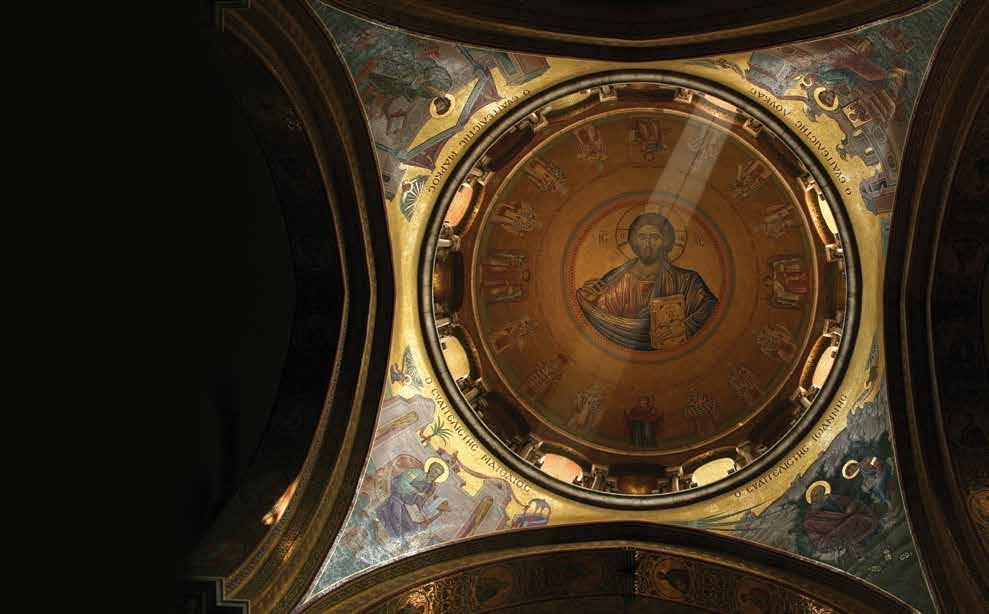
Visual Drama
6 Adoremus Bulletin, September 2022

JERUSALEM.SEPULCHRE,HOLYTHEOFCHURCHAB/WIKIMEDIA.
Liturgy’s Deifying Power Maximus was a monk, not a priest. Yet his commen tary on the liturgy indicates a sensitivity to the total movement of both lay baptized and clergy in the dis tinct spaces that house the Church’s worship. Maximus generally pays greater attention in his Mystagogia to the symbolic value of visual action and ritual move ment than to the significance of particular sacramental words or objects. For him the Church’s liturgy con stitutes a progressive series of unfolding symbolic, theandric activities through which the hidden, es chatological union of the cosmos in and with God is manifested and realized in historic time. He is unique among Greek mystagogues in according particular symbolic prominence to the church building’s archi tectural topography in the traditional division of the church building into two spaces: the nave, accessible to all the lay faithful; and the sanctuary, accessible exclu sively to priests and deacons. This topography speaks for Maximus of the inherent unity and diversity of the Church, the human being, and the entire cosmos. While each remains a distinct space whose boundary is governed by the hierarchical orders and the kind of liturgical action performed in it, the church site, “being by construction a single building… is one in its actual reality without being divided with its parts on account of their difference from one another.”
involves being assimilated to likeness with God as much as possible and, in response to the illuminations that are given it from God, is raised to the imitation of him in its own measure….” The purpose of hierarchy, then, is to bring about assimilation to God and, as far as possible, union with him.
Jesus’ words in John 12:32 about his impending priestly and royal activity on the cross: “And when I am lifted up from the earth I will draw all people to myself.” But Maximus’s immediate source of inspiration for this im age is more likely Dionysius the Areopagite. In Diony sius the Greek word “to draw”—helkein—comprehends the entire function of the Church’s sacerdotal office in which the hierarch—the bishop—serves as a mediating ray for the assimilation to God of all the orderly ranks under him. This of course indicates that Dionysius, and Maximus following him, understood the notion of hi erarchy differently from the way it is commonly under stood today: As Dionysius writes: “Hierarchy is, to my mind, a sacred order, knowledge, and activity, which
AGENCY/NEWSAB/CATHOLIC
Historians,
CARLOACUTIS.COM
At Mass, in an exclusively defined space, through the ritual actions of the Eucharistic liturgy culminating in Holy Communion, are anticipated “the archetypal mys teries”: gifts of the Holy Spirit in which the baptized in this life already participate and in which they shall in the age to come participate “in actual, concrete fact,” that is, when they pass from “grace by faith” to “grace by sight.” The saints—such as today’s Blessed Carlo Acu tis—participated on earth in the divine life of God given in the Eucharist.
Before we examine Maximus’s Mystagogia in more detail, a few comments on his wider ecclesiology are pertinent. Two key aspects of liturgical or ritual action that Maximus often focuses upon are visual action and dramatic movement. In and through its liturgy, the Church enacts a spectacular and performative epiphany of the transfigured Lord who, present in heaven and on earth as eternal high priest, radiates through his body the light of his divine glory. The function of the liturgy is to present God visibly on earth to the eyes of faith. For Maximus, the Church is like the priesthood: it has been instituted to draw people to God, to mediate sacramentally and especially visually between God and
This last work, penned in Greek in the early seventh century, represents an unfolding, heuristic application of the symbolic mysteries of the Church’s eucharistic lit urgy to the ascetic life. It is an application grounded not just in ideas, but in the lived experience of the housed enactment of the divine liturgy, an enactment that implies a predetermined, given complex of concrete ritual, social, and geographical arrangements. At the same time, the Mystagogia offers an implicit ecclesiol ogy in which the Church is envisioned as the sacrament of human deification. This means that the Church is for Maximus not so much an objective thing as a realm of sacred relations and actions in which there is experi enced divine and deifying activity.
humanity. “God ordained the priesthood to represent him on earth to ensure that he may not cease being seen bodily and that his mysteries may not cease ap pearing to those with eyes to see.” The liturgical presi dent communicates heavenly, divine realities on earth, bodily, and more specifically, visibly. For Maximus it is to the eyes more than to any other sense that the priest presents God, for the eyes are the physical organ by which the mind, reflecting on sensible phenomena, is able to penetrate through to apprehend spiritual, divine realities. In turn, the priest draws to himself all those under his care and presents them, perfectly deified, to God. It is chiefly in his role as one who renders visible the divine “mysteries” that the priest is most truly the bodily image of God on earth.
Commenting on this passage in Dionysius, Ortho dox scholar Andrew Louth explains that “hierarchy has a healing purpose…. Hierarchy is the theophany of God’s love that beings are.” Hierarchy is indeed a set of ordered, God-ordained relations, but their purpose is to ensure communion and assimilating union with God.Turning now to Maximus’s Mystagogia, I want to show how, for Maximus, it is only through the Church, insofar as it is the place of divine “fullness,” and spe cifically through her public liturgy—understood as “the sacred arrangement of the divine symbols,” and so hierarchically and dramatically performed—that humanity is deified and God ultimately becomes “all in all.” For while in his divine omnipresence God is equally present to every soul or in all the cosmos, it is in the concrete, corporeal actions of the Church’s Eucharistic synaxis that the grace of the Holy Spirit is present “most distinctively” to “transmute, transform and transfigure” each person.
There is also more to be said about this “drawing” power of the priest’s liturgical actions. The term echoes
theologians, and liturgists are always thrilled to study ancient writings that shed light on the way early Christians actually prayed and worshiped together in their public litur gies. We often come across the complaint that detailed evidence on how Christians in the first centuries worshiped is notoriously sparse and filled with gaps. Occasionally, however, in addition to details scattered throughout the writings of various early authors, there have been left to us whole treatises that help us recon struct concrete details and give us a clearer picture of what Christians actually said and did. A few famous examples spring to mind, such as the Didache, the Apostolic Tradition, the Apostolic Constitutions, and the wonderful Travels of Egeria. Rarer still, there are trea tises that, sometimes describing the liturgy, sometimes presuming certain commonly known liturgical actions, comment on the deep meaning and import of various liturgical details for Christian existence. We may think, for example, of Origen’s On Prayer, Cyril of Jerusalem’s Catechetical Lectures, Dionysius the Areopagite’s Ecclesi astical Hierarchy, and, of special interest for this essay, Maximus the Confessor’s Mystagogia
Adam Cooper is Associate Professor of theology and Church history at the Catholic Theological College in Melbourne, Australia.
subsistent reality—whether church building or cosmos— allows those parts to be seen at the same time as identical both to that single reality and to each other. The whole wholly fills all its parts, and in and through each distinct part there is made manifest entire both the other part and the whole. Taking this section in the Mystagogia fur ther, not simply as a commentary on church architecture but as a demonstrative parable of “the holy Church of God” as image of the cosmos, the Church’s fundamental unity, which at one level might be perceived only as an eschatological finality, is realized here and now, in subsistent, subjective actuality, via the inductive movement enacted in “the sacred rite.”
From this analysis of one of the great liturgical commen taries in the patristic era, we can see how for Maximus the Church is a kind of liturgical synthesis of all creation. Through its thoroughly historical, hierarchical, doc trinal, and liturgical constitution, it brings into being the new creation. The ritually-achieved ecclesial union Maximus envisages between God and the soul/cosmos is nothing short of that future nuptial mystery heralded by Moses (Genesis 2:23), marveled at by St. Paul (Ephesians 5:29-32), and unveiled in all its splendor in St. John’s Apocalypse (Revelation 21:1-4). Drawing upon language familiar to the tradition of contemplative exegesis of Solomon’s Song of Songs, Maximus calls it “the blessed and most holy intercourse by virtue of which there is accomplished that awesome mystery of the union surpassing mind and reason, a mystery through which God becomes one flesh and one spirit with the Church, and thus with the soul, and the soul with God.” Indeed, in the ritual expulsion of the catechumens and the clos ing of the doors in the liturgy, there is anticipated the future passing away of the material world, the complete abolition of deceitful activity in the senses, and the entry of the worthy into the intelligible world, that is, into “the bridal chamber of Christ.” No wonder then that near the end of the Mystagogia Maximus exhorts his readers not to abandon the holy assembly at which the myster ies of their salvation are performatively demonstrated. There, in an exclusively defined space, through the ritual actions of the Eucharistic liturgy culminating in Holy Communion, are exhibited proleptically “the archetypal mysteries”: gifts of the Holy Spirit in which the baptized in this life already participate and in which they shall in the age to come participate “in actual, concrete fact,” that is, when they pass from “grace by faith” to “grace by sight.”
The Church’s Deifying Unity

MEDIAAB/VATICAN
In the first half of the first chapter of the Mystagogia, Maximus outlines the entire economy of God’s activ ity in creation as it can be summarized by the biblical and Neoplatonic formula that knows God to be “all in all.” Having created all intelligible and sensible beings, Maximus notes, “God contains, gathers, circumscribes, and providentially binds them to himself and to one another. Maintaining around himself as cause, begin ning, and end all beings that are naturally set apart from one another, he makes them converge with one another by virtue of the singular power of their relation to him as beginning.” It is this indissoluble “relation” that proves to be the critical factor in the simultaneous unity and iden
In going on to explain how it is that this fundamental unity of the church building is a single, particular real ity is not damaged by the difference admitted through its division into two distinct ritual spaces, Maximus uses a special term which in his metaphysics explains how there can be simultaneous identity and difference between God and the myriad of created things. The term is anaphora. It means a reference or relationship towards someone or something higher, and suggests a passage towards a higher plane. And so, “by means of the reference [of the parts] to [the building’s] unity, the church releases these parts from their difference in name, reveals both to be identical with one another, and shows one to be to the other reciprocally what each one is in itself: the nave, being sanctified as a priestly offer ing by the reference (anaphora) of the sacred rite to its destination, is the sanctuary in potential; and in turn the sanctuary, since it has the nave as the starting point of its own sacred rite, is the nave in actuality. The church remains one and the same through both.”
Much of the substance of this article represents a compressed development of material published in my Holy Flesh, Wholly Deified: The Place of the Body in St. Maximus the Confessor (Oxford: Oxford University Press, 2008).
reciprocal penetration of its parts and their ritually determined orientation to their final state. Suggested in Maximus’s use of the metaphysical term “reference” is, in contrast to Dionysius, an eschatological perspective that views the different parts in terms of what they will become (and thus are) as a single subject. It cannot be accidental that he finds this term especially applicable to a relationship centered upon and realized in associa tion with the unfolding movement of the Eucharistic as sembly, whose central prayer addressed to God the Father was also called the anaphora. It is chiefly by means of their ritually achieved “reference” or upward, eschatological orientation to the final unity realized through communion in the earthly-heavenly sanctuary that the distinct parts of the church building—and, by extension, the members who occupy those parts—compose a single subsistent reality. What I want to emphasize is that the metaphysical “ref erence” of the parts to their whole is seen here to be ritu ally achieved. The ordered divisions of the church building and the two-tiered structure of the liturgy are presented by Maximus as the means of ritually effecting—by disclos ing—the unity of “another sort of church not made with human hands,” that is, the cosmos—likewise undivided in its division into intelligible and sensible reality. The “reference” of the distinct parts to their indivisibly single,
In the same way, as an image reflecting its archetype, the Church effects with human beings the very same activity God performs in creation. But the two activities—ecclesial and divine—are not simply parallels. The activities are the same, in that their effects are indistinguishable. Mirror ing the vast diversity in creation, almost infinite is the multiplicity of men, women, and children differing from one another by race and class, nationality and language, custom and age, opinions and skills, manners and habits, pursuits and studies, reputation, fortune, characteristics and connections. Yet distinct and different as they are, Maximus writes that “those who are brought into being
“Separation from the Church amounts to dissolution into relative non-being.”
in the Church are by her reborn and recreated in the Spirit.” The language here is at once metaphysical and baptismal, since holy baptism is the primary means by which the Church as active subject brings about in these disparate people an utterly new mode of existence. It is in connection with this baptismal, ritual activity of the Church that we find Maximus once again pairing the terms “relation” and “reference”: “The Church confers on and gives to all equally a single divine form and designation, namely, both to belong to Christ and to be named from him. And she confers on and gives to all in proportion to faith a simple, whole, and indivisible relation which, on account of the universal reference and gathering of all things into her, hides from recognition the existence of the many and innumerable differences among“Relation,”them.”therefore, as the beneficial result of the universal, eschatological “reference and gathering” of all creation into the Church, and as a condition commensu rate to faith, is brought about ritually through baptism. On account of it “no one at all is separated from what is common to him.” Rather “all converge and join with one another by virtue of the one, simple, indivisible grace and power of faith, for all, he says, had but one heart and soul (Acts 4:32), since to be and to appear as one body of different members is actually worthy of Christ himself, our true head.” This convergence, according to Maxi mus, is none other than the fulfilment of the Apostle’s words in the great baptismal text of Galatians 3:28, and of Colossians 3:11 in which Christ himself is said to be “all and in all.” To be one is to be the Church, and to be the Church is to be Christ. Separation from this real ity amounts to dissolution into relative non-being. The soul’s activity as a member of the body, the Church’s activity as the Body of Christ, Christ’s activity as Savior and head, and God the Trinity’s activity as creator are, at the level of effect, one and the same. Maximus predicates to God an activity among created beings of identical character and employing identical means to that of the Church: “[God] softens the differences surround ing them and creates an identity by their reference and union to himself.” The Church images God because the union of the faithful with God it effects is the union of the whole universe with God achieved by him without confusion.
7Adoremus Bulletin, September 2022
It is worth underscoring that Maximus is here speak ing about a decidedly concrete, material object: the church as a building, and the actual rite of the synaxis which begins in the nave and proceeds to the sanctu ary. The sanctuary, towards which the focus of the people in the nave is drawn and to which they finally come for communion, constitutes the final destination of the whole rite. From the beginning of the service then, the nave is already the sanctuary in potential, since the progressive movement of “the sacred rite” orients its lay occupants towards it. But this rite which properly culminates in the sanctuary actually begins in the nave as the first processional entrance of the people with the Maximus’sbishop.meditations on the twofold division of the church space are therefore bound to his observation of the way in which those different parts function in the ritual actions and movement of the liturgy. In no way does his insistence on their fundamental unity or even identity imply that the division is arbitrary or dispens able. The two spaces in the church building are dis tinct elements in a single reality whose primary, final, subjective singularity is brought about by the ordered,
tity of diverse beings with one another and with God. So much is this the case that it is said by Maximus to “render impotent and obscure all the particular relations consid ered according to each being’s nature, not by dissolving or destroying them or making them cease to exist, but by overcoming and transcendently revealing them in the way of a whole with its parts…. For just as parts naturally come from the whole, so also do effects properly proceed and come to be recognized from their cause and suspend their particularity in a state of rest at which point, having acquired their reference to the cause, they are wholly quali fied in accordance with the singular power of their relation to the cause.”
Conclusion
It is only through the Church, insofar as it is the place of divine “fullness,” and specifically through its public liturgy—under stood as “the sacred arrangement of the divine symbols,” and so hierarchically and dramatically performed—that humanity is deified and God ultimately becomes “all in all.”
Maximus describes the same ritually achieved real ity with even greater metaphysical precision in the first chapter of the Mystagogia when, in defining how the Church “bears the type and image of God,” he states that it shares “by imitation and type” God’s activity by which he draws diverse beings together into unconfused union with one another in himself. Here again we find the term “reference” playing a pivotal role. But before we examine the particulars, let us first view the chapter as a whole.
My reaction is that, yes, absolutely, altar boys can be a handful. It isn’t unusual that one of the younger ones puts on a cassock that’s way too long and we don’t notice until Mass is about to start. Then we scramble to track down a smaller one. Some days, the boys have excess energy and the deacon and I have trouble keeping them quiet in the sacristy. We always have to watch them during the longer liturgies and litanies in case the boys kneeling with torches look faint. Often it feels like herding cats when we’re trying to put together the Gospel procession or get them all in place to receive communion. It requires significant time and effort to train them and, even so, they do still occasionally make mistakes during Mass or forget what they need to be doing.
Having the servers around isn’t merely a question of efficiency during the Mass. As Pope St. John Paul II teaches in a general audience from August 1, 2001, altar servers are far more than priest-helpers. “Above all,” he says, “you are servants of Jesus Christ, the eternal High Priest.” These Polish altar servers are on pilgrimage to receive relics of Blessed Carlo Acutis.
By Father Michael Rennier
In that same general audience in 2001, Pope St. John Paul II says, “The vestments worn by altar servers are
His father told me that the reason it was all new to him is because his pastor in their parish back home won’t use altar servers. He finds it more efficient to say Mass without them. The servers tend to make everything more complicated, so he doesn’t train them or schedule them.
For a father, it adds quite a bit of time to a project to include the “help” from his boys. A Father could accomplish the task far more easily on his own. But these tutorials are the way of fathers and sons. It’s how children learn to grow up and be like dad.
Teach and They Will Learn
FLICKRONWALESANDENGLANDCHURCHAB/CATHOLIC
All that said, I would never contemplate the idea of discontinuing the server program because of the extra layer of complexity added by having the boys in the sanctuary. It would be like a father refusing to include his sons in the work that fathers are meant to do—with sons.
When
I have a parishioner, Mark, who was recently telling me how he lets his two young sons “help” him with house projects. He shows them how to use a screwdriver to take the plates off the electrical outlets, teaches them how to hammer, what to nail. The two boys are fascinated by the work and proud to be included. They get to do grown-up work. They’re the kind of tasks that attract young men because they include an element of danger, and one must be very responsible to be trusted with sharp saws and nails. For a father, it adds quite a bit of time to the project to include the boys. Mark could accomplish the task far more easily on his own. But these tutorials are the way of fathers and sons. It’s how children learn to grow up and be like Anotherdad.friend of mine, Craig, owns an equipment rental shop where, after school, he would let his fiveyear-old son hang out for a few hours and help him fix the lawnmowers. The boy quietly watched how his dad took apart a carburetor, cleaned it, and put it all back together. Craig would patiently explain to his son what he was doing and why. Then he put the tools in his hands and let him practice while he coached him. It would take extra time—quite a bit, I imagine. After all, his son was learning and still made mistakes. Those mistakes didn’t last long. The boy could fix a lawnmower all by himself by the time he was six years old.
I absorbed all this information from my father. He patiently taught me his craftsmanship, allowing me to make mistakes and demonstrating techniques to do better next time. Today, I’m unafraid to tackle projects because he gave me both skills and confidence. The way I go about these projects, the way I think through my task, make my plan, and carry it out, it’s just like my dad.
I was a child, my father would involve me in all sorts of construction projects around the house. We built a custom skateboard, chopped down a massive tree in the backyard by hand, and carved wooden toy cars to race in my scouting troop. He had a full workshop in our garage where he taught me how to saw a board in half, hammer a nail, and clamp boards together with glue to form a strong joint. We sanded and stained and painted. I remember once, when I was a teenager, he even helped me replace the motor that worked the driver-side window of my beat-up old Camry. Because of the experience I had growing up with a father who patiently included me in his handyman routine around the house, I’m now fairly capable when it comes to projects in my own house. I know how to frame out a wall with two-by-fours, how to hang drywall, and wire electrical outlets.
“Just like boys who are proud to be granted the responsibility to work with their fathers, the altar boy understood the importance of his service at the altar and was pleased to be able to contribute.”

Carburetors and Ciboria: How Fathers and Sons Work
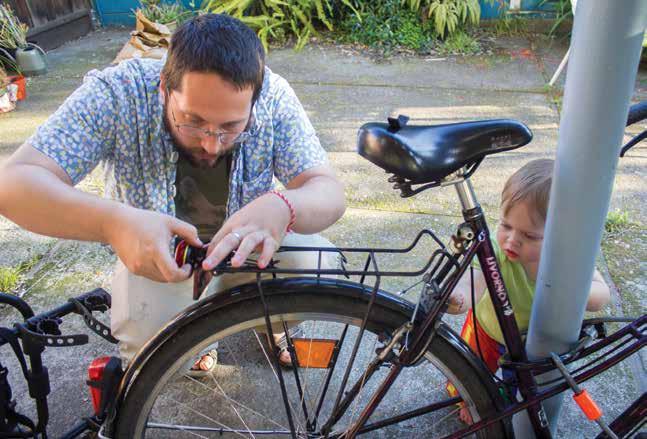
Portraits of Fatherhood
After Mass, I always stand outside on the church porch and visit with the parishioners. One man, a regular visitor from out of town who travels into our parish several times a year for work and stays for a week at a time, paused to thank me for letting his son serve at the altar all week during Masses. When I first met his son, he was a boy of about ten years old who knew nothing about altar serving. In the sanctuary on his first day, he was like a baby deer tripping over his own legs, nervous and somewhat panicked as he dashed around trying to remember what I’d taught him. But he was eager to practice. He showed up, day after day. He watched and imitated. He began to hold his hands in a prayerful posture just as I do, and nod his head in reverence at the name of Jesus because he noticed how I do, and there were myriad other tiny details that he soaked up with an all-encompassing ability to observe and imitate. Nothing escaped him and he took his task seriously. Just like boys who are proud to be granted the responsibility to work with dangerous tools, he understood the importance of his service at the altar and was pleased to be able to contribute. By the end of a single week of altar serving he had become an old hand.
To be clear, having the servers around isn’t merely a question of efficiency during the Mass. As Pope St. John Paul II teaches in a general audience from August 1, 2001, altar servers are far more than priesthelpers. “Above all,” he says, “you are servants of Jesus Christ, the eternal High Priest.” In other words, the role of an altar server isn’t limited to the functional, and it really isn’t about a filling a practical “role” at all. This is why a priest shouldn’t only agree to keep them around when it’s convenient. Through fatherly indulgence, patience, and inclusion in the work of the altar, he is assisting them to become servants of Christ. This process is about far more than getting through the Mass as easily as possible. As the servers imitate the priest, they directly intuit a fatherly virtue, the practice of true religion, which is right worship at the altar of God. And, of course, both priest and server are imitating Christ himself who is our great highThispriest.aspect of imitation is vital to understanding the spiritual fatherhood of a priest for his servers. As a spiritual father, a priest keeps his sons close, shows them how to behave, what to do, how to pray.
FLICKRONDOMBROWSKIAB/QUINN
8 Adoremus Bulletin, September 2022
Anyone who has raised boys knows they are tremendous learners through imitation. As Socrates believed, imitation is one of the forms of education, a belief that is anecdotally and psychologically proven out by the habit of young children to learn by modeling the behavior of their parents. This is a fancy way of saying that our children will imitate us in what we do far more than they pay attention to what we say.
“Man as a whole bears Christian devotion,” Guardini writes. “It is not a ‘purely spiritual’ devotion—what this could look like we do not know. We are not pure spirits, we were not supposed to be, and not even the battle against the body, which is imbued with a desire for freedom, should fool us into thinking this.”
Informed Consent
9Adoremus Bulletin, September 2022
“The human body is the analogy of the soul in the sensible-bodily order,” he writes. “If one were to express the soul, which is spiritual, in a bodily fashion, then the result would be the human body. This is, in the strictest sense, the meaning of the formula, anima forma corpo ris” [the soul is the form of the body].
Assuming we have good models from which to imitate the good and the praiseworthy, we form virtuous habits as we move from youth into adulthood. It’s a great gift for the older generation to actively model devotion for the younger generation. In fact, this is precisely how Our Lord teaches his disciples. He keeps them close. He lets them observe his miracles and later sends them out to imitate them. He lets them observe his relationship with the Heavenly Father and then invites them into his prayer life. They learn how to be witnesses of the Gospel by spending time with their master. It’s no accident that the apostles, by and large, became martyrs. They gave up their lives for the gospel just as Christ taught them andPerhapsdemonstrated.themost intriguing insight to be gleaned from the fatherly care of Our Lord for his disciples is the invitation to gather round in Gethsemane and keep vigil with him. He kept his spiritual sons near and showed them how to maintain prayerfulness at the outset of the Passion. The Holy Sacrifice of the Mass places us in that exact same posture as we are prayerfully placed into the Passion of Christ through the liturgy. The task of the priest is to pray at the
Guardini decries the progressive loss of this sense since the Middle Ages, as the natural bond of the mate rial and the spiritual has gradually been loosened. “This loosening did not grow out of some kind of asceticism,” Guardini notes. “Genuine asceticism does not want to destroy the body or estrange the soul from it, but wants to bring the body always more under the formative power of the soul. In asceticism, the true relation within man is re-established, and thus the body is continu ally more spiritualized. What began in modernity is something completely different. Modernity strives for a ‘pure’ spiritual being, affecting one of the most terrible confusions that have ever plagued the dissent from an integral understanding of man: the purely spiritual was sought and it resulted in something abstract. Em bodiment, and therefore symbol too, were discarded. Almost imperceptibly, the abstract took the place of the spiritual, the pure concept.”
HALSFRANSBYDESCARTES,RENÉOFPORTRAITAB/WIKIMEDIA.(1582/1583–1666)

Raise Them Up with You
Our age like few before seems to suffer from an inher ent and ubiquitous dualism of mind and body. Descartes may be considered the most recent culprit of this partic ular error—it was this Catholic Frenchman who famously gave birth to modern philosophy by splitting man into his irreconcilable dual substances, the soul and what he called “extension —pure, physical matter. The body was seen as a mechanism, conceived by nature working quite independently of the soul that, in turn, can never penetrate the body.
In Liturgy and Liturgical Formation, translated by this writer for the first time into English, Guardini shows why the body-soul unity is crucial for Chris tian anthropology and, even more importantly, why the fragmentation of body and soul have dealt a deep wound to the liturgy. A fragmented being fragmented the liturgy, says Guardini who, at times writing in witty prose, demonstrates his unbroken intention to call for a return to an authentic celebration of the liturgy, body and soul, through a greater internalization and partici pation in the Church’s sacred rites.
I happen to be a married priest ordained under the pastoral provision set up by Pope St. John Paul II for former Anglican clergy. Because of this, I have two sons who often serve at the altar with me. I want nothing more than to model for them the way a man prays, in the hope that one day they will be fathers themselves showing their own sons how to imitate them in the love and worship of God. In the meantime, I’m humbled to have the privilege of keeping them near me at the altar where we pray together as a family along with the other altar servers, sons each and every one of us of our Heavenly Father.
In the end, what father doesn’t want his sons to be like him? Indeed, to be an improved version of him? This means that we should be greatly desirous that the boys learn to become fathers themselves through their service at the altar, either that they grow into the fatherhood of priesthood or become fathers to families of their own. Sons want to be just like dad. We can’t deny them that chance.
The mystery is deep indeed, a “stumbling block” if you will, but ultimately the very reason why the Church—in liturgy and other areas of the faith—has always made
One author as few others was spearheading the counterattack of the body-soul dualism and steering towards a renewed understanding of the unity of man in body and soul. That man was Romano Guardini. His writings, now more than a hundred years old, have lost none of their piercing insightfulness, forth with criticism of liturgical deviations, and traditional Catholic thinking which sought to effectively upend the philosophical underpinnings of reductionist convic tions. Even as a child of his time—with all the unavoid able pitfalls that the 20th century brought—Guardini remains to this day a source of profound insights about the liturgical being that is man.
Here Guardini reveals his profound adherence to the perennial doctrine that the human person is “very good”—body and soul. Surpassing every Gnostic reduction, he insists that it is precisely the body that is a crucial element of the liturgy. Prayer in its most perfect state is not just cerebral, it is acted out, it is lived.
“I want nothing more than to model for my sons the way a man prays, in the hope that one day they will be fathers themselves showing their own sons how to imitate them in the love and worship of God.”
very special,” because they are a way of symbolically putting on the identity of Christ. The servers are not only called to inwardly imitate Our Lord, but there’s also an imitative quality to the exterior symbols such as their cassock and surplice. Again, the imitative quality originates in the imitation of Christ himself.
And thus man must embrace his dual reality to encounter the center of the liturgy, which is Christ,
foot of the Cross, and he gathers his servers round to watch and wait with him as Christ is immolated upon the altar. Through imitation, the servers are learning how to keep vigil with Christ. And, just as the disciples learned, they’re gaining insight into the cost of love and why a man might be willing to make great sacrifices on behalf of that love.
The last 50 years or so have seen a rampant impoverish ment of culture and, with it, the rise of a new paganism and the complete disintegration of the human person. As a result, the liturgy has suffered. Instead of offering to man the perennial image of Christ in his body and soul, sacred art has become abstract, liturgical action has become “pastoral” (read: it seeks out to be as mun dane as possible in the hope to offer more “accessibil ity”), and the whole mindset of the liturgy has become minimalist. The central conviction of many pastors does not seem to be: “How can we give the most glory to God in the most perfect way?” but rather: “What are the basic, essential requirements that we have to obey in order to remain valid?” Holy cards are smirked upon as sanctimonious, incense is an irritating addition,
They’re also learning independence. As they imitate, they become more comfortable being personally identified with the action. They internalize what they imitate and, soon enough, begin to feel their own independent motivation for devotion. They learn how to serve the Lord on their own. Once trained, they ring the sanctus bells, hold candles, care for the fire in the thurible, and so on. This isn’t busy work but, rather, a way through which they begin to assert their relation to God, to gain agency in their spiritual life. They’re at an age when they’re either making the faith their own or in the beginning stages of rejecting it and allowing it to die of neglect. With a good strong role model who invites them into the work at the altar, it’s more likely they’ll choose to make the faith their own. After all, everything we know about passing on the faith emphasizes the importance of the role of fathers.
who himself possesses a human body. Herein lies the first and most basic challenge of liturgical formation: man must become capable of symbol, or said differ ently, man must learn how to establish unison between his spirit and his body. Whatever the soul is to enact (worship, glorification, contrition, penitence, etc.) the body needs to mirror. And whatever the body does will either drag the soul down or raise the soul up.
“No disciple is superior to the teacher;” says Our Lord, “but when fully trained, every disciple will be like his teacher” (Luke 6:40). This is why it simply won’t do to sideline the boys. Doing so would be like a dad telling his sons to go inside and watch television because he can’t be bothered to let them help out. He can get the job done faster on his own. This is the refusal to allow the boys to become disciples, a refusal to hand on the faith.
Guardini’s arguments concentrate on one crucial point: precisely because man is not a pure spirit, an angelic being, his actions in turn cannot be of a purely spiritual sort. There exists a peculiar unity between the soul and the body, between spirit and matter. Whatever moves the spirit will move matter, and concomitantly whatever affects matter will somehow also influence the spirit. Human nature’s existence is such.
In seeking this unattainable and illusory purity, man has demolished the natural unity of body and spirit— or at least he lives in the constant illusion that he has. With Guardini, we witness countless outgrowths of this base dualism, including what was noted above, utopian transhumanism and unimaginable gender-ideology.
Heart of the Matter
room for man in his dual but unified dimension. The ultimate appraisal of the body is found in the Christian mystery of the Incarnation. The very essence of the Church herself is linked with this mystery: she—as a visible institution—administers the sacraments (materi al signs!) in order to save man, body and soul. The doc trine of the “resurrection of the flesh” also emphasizes this. And this physical element is certainly crucial for the liturgy. For Guardini the most important “symbol” (different from allegory which connects arbitrary signs to meanings) is precisely the soul-body relationship.
Continued from LITURGICAL on page 5 Please see LITURGICAL on page 12
Father Michael Rennier lives in St. Louis with his wife and children. A convert from Anglicanism with his family, he has an MDiv from Yale Divinity School and is a Catholic priest in the Archdiocese of St. Louis. He is associate editor at Dappled Things: A Quarterly of Ideas, Art & Faith, and a regular contributor at Aleteia.
7) Liturgiam Authenticam (Fifth Instruction for the Right Implementation of the Constitution on the Sacred Liturgy), Congregation for Divine Worship and the Discipline of the Sacraments, March 28, 2001
10 Adoremus Bulletin, September 2022 Continued from QUIZ, page 3
3. It is not uncommon for a priest (or deacon) to give a blessing with thumb and forefinger touching, but this configuration is not imagined by the liturgical books. The Ceremonial of Bishops, citing the Ritus servandus in celebratione Missae of the 1962 Roman Missal, ex plains that when the bishop (and, by extension, a priest or deacon) “blesses others or some object, he points the little finger at the person or thing to be blessed and in blessing extends the whole right hand with all the fingers joined and fully extended” (108).
5) Vicesimus Quintus Annus (Apostolic Letter On the 25th Anniversary of Sacrosanctum Concilium), Pope John Paul II, December 4, 1988
1. The translation of the Liturgy of the Hours, Second Edition includes numerous elements, from hymns to antiphons to rubrics to scripture. The Committee on Divine Worship of the United States Conference of Catholic Bishops (USCCB) summarized the status of this monumental task in its January 2022 Newsletter: “ICEL has nearly finished its part of the work on the new edition of the Liturgy of the Hours. The USCCB should finalize the remaining non-Scriptural elements of the book in the coming year [2022]. The last piece to be completed will be the Scripture, and it is hoped that all the necessary votes of the body of bishops will have taken place by the end of 2023. Afterward, the various texts will be assembled and transmitted to the Con gregation for Divine Worship and the Discipline of the Sacraments for confirmation. The publication process can only begin when that confirmation is received. Taking these factors into consideration, the current es timate is that printed books could be available in 2025.” (emphasis added)
2) Inter Oecumenici (Instruction on the Proper Implementation of the Constitution on the Sacred Liturgy), Sacred Congregation of Rites, September 26, 19643) Tres Abhinc Annos (Second Instruction on the Proper Implementation of SC), Sacred Congregation of Rites, May 4, 1967
(1756-1838)LAFUENTEMUÑOZLUISBYAQUINAS,THOMASSAINTAB/WIKIMEDIA.

6. The Order of Celebrating Matrimony, Second Edition, includes an “Order of Blessing an Engaged Couple” in its appendix. As the Order explains, it is impor tant that Christian spouses assist and prepare their children for their own marriages upon engagement. Accordingly, “the honorable betrothal of Christians is a special occasion for two families, appropriately celebrated with some ceremony and with common prayer, so that, upon receiving the divine blessing, what is joyfully begun may in its own time be joyfully completed” (218).
7. According to the Order of Christian Funerals, “in the United States, white, violet, or black vestments may be worn at the funeral rites and at other offices and Masses for the dead” (39).
2. Readers may recall that Christmas in 2021 fell on a Saturday and was followed immediately by the Feast of the Holy Family on Sunday. This arrangement led to some confusion about which Mass ought to be cele brated on Saturday evening, December 25—for Christ mas or for Holy Family?—as well as how many Masses (and which ones) the faithful would need to attend to fulfill their obligation. Since Christmas this year falls on a Sunday, there are no other days of obligation on either side. Thus, apart from possibly adding another Mass to accommodate larger numbers of the faithful, no adjustments are required.
4) Liturgiae Instaurationes (Third Instruction for the Right Implementation of the Constitution on the Sacred Liturgy), Sacred Congregation for Divine Wor ship, September 5, 1970
8. Following the promulgation of Sacrosanctum Concilium (SC) on December 4, 1963, numerous letters, instructions, and clarifications detailed the Constitution’s revision and applied its principles more concretely. Any understanding of Sacrosanctum Concilium ought not only appreciate the liturgical movement and legislation that preceded it, but also the documents that governed its implementation. The principal documents following Sacrosanctum Con cilium include:
10. There is no official ritual used to close a church building. Rather, “if a church cannot be used in any way for divine worship and there is no possibility of repairing it, the diocesan bishop can relegate it to profane but not sordid use. Where other grave causes suggest that a church no longer be used for divine worship, the diocesan bishop, after having heard the presbyteral council, can relegate it to profane but not sordid use, with the consent of those who legitimately claim rights for themselves in the church and provided that the good of souls suffers no detriment thereby” (Can. 1222 §1-2). Still, apart from the canonical requirements, it is regular practice that a final Mass be celebrated and the Blessed Sacrament is consumed for the last time (without further reposition) and the tabernacle lamp is extinguished.
1) Sacram Liturgiam (apostolic letter issued motu proprio), Pope Paul VI, January 25, 1964
8) Spiritus et Sponsa (Apostolic Letter On the 40th Anniversary of Sacrosanctum Concilium), Pope John Paul II, December 4, 2003
5. The strongest statement on the universal level that speaks, although indirectly, about the use of TV or projection screens in churches during the liturgy comes from the 1958 instruction On Sacred Music and the Sacred Liturgy (De musica sacra et sacra liturgia): “The use of automatic instruments and machines, such as the automatic organ, phonograph, radio, tape or wire recorders, and other similar machines, is abso lutely forbidden in liturgical functions and private devotions, whether they are held inside or outside the church, even if these machines be used only to trans mit sermons or sacred music, or to substitute for the singing of the choir or faithful, or even just to support it. However, such machines may be used, even inside the church, but not during services of any kind, wheth er liturgical or private, in order to give the people a chance to listen to the voice of the Supreme Pontiff or the local Ordinary, or the sermons of others” (78). While the 1958 Instruction does not speak of today’s televisions or projection screens, the same principles are applicable. Other national or diocesan guidelines may exist in different places. The USCCB, for example, posts the following statement on its Divine Worship website: “The current policy of the Committee on Divine Worship is that permission is not granted to project readings and liturgical texts on screens during the liturgy. The bishops have the perspective that since so many people spend much of their time looking at screens, the Sacred Liturgy ought to be a prayerful break from that experience. The bishops also believe that screens are a distraction from what is actually taking place in the liturgy.” Indeed, whether screens and projected material are permitted by ecclesial norms, current copyright law prohibits the projection or reproduction of protected texts, images, and music without authorization from copyright holders.
4. The ritual text Holy Communion and Worship of the Eucharist Outside Mass directs that “a single genuflec tion is made in the presence of the blessed sacrament, whether reserved in the tabernacle or exposed for public adoration” (84). For those members of the faith ful not fulfilling a ministerial role, genuflection on two knees is possible.
6) Varietates Legitimae (Fourth Instruction for the Right Implementation of the Constitution on the Sacred Liturgy), Sacred Congregation for Divine Wor ship and Discipline of the Sacraments, March 29, 1994
9. The USCCB’s Secretariat for Divine Worship ad dressed this question upon the promulgation of the Third Edition of the Roman Missal: “Whether or not the [outdated] Sacramentary has been blessed by an of ficial rite, it is appropriate to treat it with care as it has been admitted into liturgical use. Its disposal should be handled with respect. The Secretariat recommends burying the Sacramentary in an appropriate location on church grounds, or perhaps in a parish cemetery if there is one.… In lieu of burying old liturgical books, they could be burned, and the ashes placed in the ground in an appropriate location on church grounds. It is advisable to retain a copy of the Sacramentary for parish archives or liturgical libraries” (BCDW Newslet ter, Vol. XLVII, March-April 2011).
Answers:
15. Jean Baptiste Saint-Jure, A Treatise on the Knowledge and Love of Our Lord Jesus Christ, vol 1 (New York: P. O’Shea, 1870) 611.
Quoting Canon 838 § 4, the Instruction Redemptionis Sacramentum clarifies that the ability of the diocesan bishop to set forth liturgical norms in his diocese is circumscribed “within the limits of his competence.” Thus, a bishop can legislate for the liturgy within his diocese, but, it appears, he cannot narrow the options that the universal law permits. That is, he cannot establish norms contrary to higher law: “A lower legislator cannot validly issue a law contrary to higher law” (Canon 135, §2).7
“It pertains to the diocesan Bishop, then, ‘within the limits of his competence, to set forth liturgical norms in his Diocese, by which all are bound.’ Still, the Bishop must take care not to allow the removal of that liberty foreseen by the norms of the liturgical books so that the celebration may be adapted in an intelligent manner to the Church building, or to the group of the faithful who are present, or to particular pastoral circumstances in such a way that the universal sacred rite is truly accommodated to human understanding” (21).
Continued from DEIFICAL, page 4 Church is not another one of Adam’s cults, it is the cult of the New Adam mystically perpetuated in us.
18. Edith Stein, The Science of the Cross: The Collected Works of Edith Stein VI (Washington, D.C.: 2002) Kindle edition, 228. The quotations from John of the Cross are Stein’s translation; she references that they come from The Living Flame of God, Stanza 3, paragraphs 79-84.
precedingNevertheless,sentence.”2“the meaning of the adverb ubicumque weighs against interpreting the passage” as advocating the celebration of Mass facing the people as normative. “
In short, it is clear from the Church’s own history and legislation that the Liturgy of the Eucharist celebrated ad orientem is not contrary to liturgical law—whether it is pastorally advisable is a separate question. The bishop’s authority to restrict this legitimate practice is less clear.
2. Rev. Robert Johansen, “Letters to the Editor: ‘Ad Orientem Debate Continues….’” Accessed on 19 August 2022: https://adoremus. org/2016/09/letters-3/
direction: the extension of the perichoresis is deifical because it invites our synergistic ascent into liturgy. Oh well, back to the drawing board. Something to work on in retirement.
: According to the current Roman Missal, Mass can be celebrated either with the priest “facing the people,” versus populum, or with the priest facing in the same direction as the people, often called ad orientem, whether or not this common direction is literally east. More accurately, it is primarily only the Liturgy of the Eucharist that is celebrated ad orientem, while during the Introductory Rites, Liturgy of the Word, and Concluding Rites, the Missal foresees the priest generally facing the people (see Order of Mass, n. 1, 29, 127, 132, 141).
5. Jean Corbon, The Wellspring of Worship (San Francisco: Ignatius Press, 2005) 55. I was tempted to make it six altars, adding two antecedent to the cross. There is, after all, a cosmic liturgy. “The world was created for the sake of the
If, then, celebrating the Liturgy of the Eucharist ad orientem is a legitimate practice—one in keeping with liturgical tradition and current liturgical law, and affirmed as at least an option by the Holy See—can a diocesan bishop prohibit it, as is the case in some norms implementing Traditionis Custodes on the local level? When the revisions following the Second Vatican
1. Paul Claudel, The Eye Listens (Port Washington, NY: Kennikat Press, 1950)
134 2. Joseph Ratzinger, “Eucharist and Mission” in Pilgrim Fellowship of Faith (San Francisco: Ignatius press, 2005) 95-96.
7. See John M. Huels, Liturgy and Law: Liturgical Law in the System of Roman Catholic Canon Law—Gratianus Series (Montreal, Canada: Wilson & Lafleur Ltée, 2006), 47.
A
1. Augustine of Hippo, Commentary on the Lord’s Sermon on the Mount with Seventeen Related Sermons, ed. Hermigild Dressler, trans. Denis J. Kavanagh, vol. 11 of The Fathers of the Church (Washington, DC: The Catholic University of America Press, 1951), 125–126.
5. Lawrence Feingold, The Eucharist: Mystery of Presence, Sacrifice, and Communion (Steubenville, OH: Emmaus Academic, 2018), 444.
The Dicastery’s 2000 interpretation also fits better with the location of this paragraph in the GIRM, appearing in “Chapter V: The Arrangement and Ornamentation of Churches for the Celebration of The Eucharist.” As Lawrence Feingold notes, “if the GIRM really intended to mandate a celebration versus populum wherever possible, this section on the position of the altar would seem to be an inconspicuous place for such an important rubric.”5 That is, if the phrase “desirable whenever possible” (expedit ubicumque possibile sit) referred exclusively or even primarily to the direction of the praying priest, it would likely appear in another section of the GIRM, for example, “The Different Elements of the Mass” (nos. 29-90) or “Mass with the People” (nos. 115-170). But since “desirable whenever possible” appears in the section of the GIRM bearing the title, “Arrangement of the Sanctuary for the Sacred Synaxis,” the context suggests that it refers principally to the position of the altar, which should be freestanding.
3. Nikolai Gogol, Meditations on the Divine Liturgy (Jordanville, NY: Holy Trinity Monastery, 1985) 22
Church” (CCC 760). And the typological altars of Israel are shadows pointing to Christ’s body. “The Church made its appearance in time before Christ did.” (Charles Journet, The Church of the Word Incarnate (New York: Sheed and Ward, 1955) xxvii). But let’s be satisfied with four here, leaving the six as a handy chap ter outline for a future monograph.
Council first emerged, many questions came along with them. One of them wondered about a bishop limiting the various options in his diocese for the sake of uniformity: “In order to attain uniformity when more than one possibility is given by the rubrics, whether the territorial authority competent for the whole region or the Bishop for his diocese can establish that a single way of doing things be adhered to by all?” The responsa from the Vatican answered: “Per se this is permissible. But always keeping before one’s eyes not to take away the freedom the new rubrics provide of adapting the celebration in an intelligent manner both to the church and to the group of the faithful, so that the universal sacred rite may actually be a living thing for living people.”6
9. Charles Louis Gay, The Christian Life and Virtues Considered in the Religious State, vol. 1 (London: Burnes & Oates, 1878) 18.
10. Ibid., 18-19.
14. Jean-Baptiste Lacordaire, Life: Conferences Delivered at Toulouse (New York: P. O’Shea, 1875) 148.
THE RITE QUESTIONS
Q
16. Jean Baptiste Saint-Jure, The Spiritual Man; or, The Spiritual Life Reduced to its First Principles (London: Burns and Oates, 1878) 196.
17. Stein wrote her book on the 400th birthday of John of the Cross, and titled it The Science of the Cross. He was born in 1542; she was arrested by the Gestapo in 1942, while she was in the chapel. It is said that this book was open on the library table when the Nazis arrested her.
Central to the controversy is paragraph 299 of the GIRM. The pertinent section of paragraph 299 reads: “The altar should be built separate from the wall, in such a way that it is possible to walk around it easily and that Mass can be celebrated at it facing the people, which is desirable wherever possible.” (Altare exstruatur a pariete seiunctum, ut facile circumiri et in eo celebratio versus populum peragi possit, quod expedit ubicumque possibile sit.)
The 2004 Instruction Redemptionis Sacramentum (“On certain matters to be observed or to be avoided regarding the Most Holy Eucharist”), written by the Congregation for Divine Worship and the Discipline of the Sacraments at the request of Pope John Paul II (see Ecclesia de Eucharistia, n.52), invokes this same clarification when describing “The Diocesan Bishop, High Priest of his Flock”:
Ubicumque is an adverb of place, not time”: in other words, the phrase wherever possible “should be construed as referring to the physical placement of the altar.”3
: Is it contrary to liturgical law to celebrate the postconciliar Mass ad orientem?
6. Grou, The Practical Science of the Cross (London: Joseph Masters, 1871) 79.
7. Ibid., 95. 8. Ibid., 59.
“In the first place, it is to be borne in mind that the word expedit does not constitute an obligation, but a suggestion that refers to the construction of the altar a pariete seiunctum (detached from the wall) and to the celebration versus populum (towards the people). The clause ubi possibile sit (where it is possible) refers to different elements, as, for example, the topography of the place, the availability of space, the artistic value of the existing altar, the sensibility of the people participating in the celebrations in a particular church, etc. It reaffirms that the position towards the assembly seems more convenient inasmuch as it makes communication easier (cf. the editorial in Notitiae 29, 245–49), without excluding, however, the other possibility.”
This translation more adequately conveys what the then-Congregation (now called “Dicastery”) for Divine Worship and Discipline of the Sacraments wrote with regard to GIRM 299. Significant here is the fact that Cardinal Medina Estevez’s Congregation was principally responsible for drafting, updating, and approving the Latin text of the GIRM that was published with the new edition of the Missale Romanum in the year 2000. On October 25, 2000, the Congregation penned the following in Notitiae, the official journal of the Congregation, in response to a question about the orientation of liturgical prayer in relation to GIRM 299.
11Adoremus Bulletin, September 2022
The central assertion is that the quod clause, “which is desirable wherever possible,” is asserting “that Mass can be celebrated…facing the people” whenever possible. Much has been written on the question of the grammar and syntax of this sentence and what exactly is being said. Latinists largely agree that the translation given in the 2011 Roman Missal is not well expressed. While some assert that the relative pronoun, quod, should be taken to refer back only to the preceding clause, “celebratio versus populum” (“celebrated facing the people”), this seems untenable. As one author observed, “Quod cannot refer back to the celebratio phrase alone, as celebratio is feminine and the relative pronoun quod is neuter. (Pronouns must agree with their antecedents in gender and number.) The quod clause makes the best sense when taken as referring back to the whole
And God is satisfied with our worship because it comes from a soul in union with Christ, who is the per fect adorer. “The soul’s deep satisfaction and happiness come from seeing that she can give God more than her own worth and capacity, since she, in such generosity, gives God to himself as her possession.”19 The mystical liturgist gives God to himself as her own possession. In credible! Our liturgy has more worth and capacity than we are capable of giving it. God created us, and saved us, and deified us, and gave himself to us, so we can liturgize.Allthis has been in the back of my mind ever since my definition of liturgy first presented itself to me: Lit urgy is the perichoresis of the Trinity kenotically extended to invite our synergistic ascent into deification. That was my attempt to push liturgical studies to the furthest boundaries of the mystery. Except I should find some way to work in the phrase “hypostatic union.” And, Stein reminds me, the current also flows in the other
4. David Fagerberg, Liturgical Mysticism (Steubenville: Emmaus Academic, 2019) xix.
11.Ibid., 157. 12. Ibid., 51.
Thus, a better translation would be: “Wherever it is possible, it is expedient that the principal altar be built separate from the wall, so that it may be walked around easily, and so celebration facing the people may be conducted upon it.”4
3. Ibid.
—Answered by the Editors
4. Ibid.
13. Jean Grou, The Interior of Jesus and Mary (New York: Benziger Brothers, 1893) 368-69.
19. Ibid., 228-29.
There have been various assertions made recently that the current norms laid down in the General Instruction of the Roman Missal (GIRM) prescribe that the entire Mass can only be said versus populum, facing the people. The current GIRM does not prescribe the priest to face toward the congregation or in the same direction as the congregation.
6. Consilium for Implementing the Constitution on the Liturgy, Du bium: Notitiae 1 (1965) p. 254; translation by Father Dylan Schrader.
The basic logic of the liturgy is that when the priest is speaking to the people he faces them; when the priest is offering the sacrifice to God the Father, he is facing in the same direction as the people, as their head. While the Son took flesh and dwelt among us, the Father is spiritual and immaterial, so praying to the Father has traditionally been signified by praying in the same direction, almost universally toward the East, or orient. As St. Augustine puts it, “when we stand at prayer we face the East…. This is not to signify that God is dwelling there, as though he had forsaken the other parts of the world—for God is present everywhere, not in habitations of place but in power of majesty. It is done so that the mind may be admonished to turn toward God while its body is turned toward” the East.1
David W. Fagerberg is professor emeritus of Liturgical Theology at the University of Notre Dame. He holds an M.A. from St. John’s University, Collegeville; an S.T.M. from Yale Divinity School; and Ph.D. from Yale Uni versity. His books include Theologia Prima (2003), On Liturgical Asceticism (2013), Consecrating the World (2016), Liturgical Mysticism (2019), and Liturgical Dogmatics (2021).
Jan Bentz was born and raised in Germany and gradu ated high school in St. Louis, MO, after studying as a foreign exchange student. Prof. Bentz studied philosophy, Church and religions, and Sacred Art and Architecture in Rome. After teaching in Rome he has moved to Oxford where he is a lecturer and tutor in philosophy at the Studium of Blackfriars. In his journalism career he has contributed video productions for EWTN, and his contri butions have been published by Inside the Vatican, The Catholic Herald, Catholic News Agency, and Jüdische Rundschau. Prof. Bentz also worked as a docent tour guide in Rome and the Vatican.
“We must learn to pray with the body,” comments Guardini soberly. “The posture of the body, our ges tures, and our actions must become directly religious once more. We must learn to express interiority in our outward appearance and to read the internal by the external.”Buthow should this be learned? Guardini’s work employs more than one pedagogical tactic to regain the sense for this unity. The learning process begins not in the liturgy—ultimately the moment of implementa tion—but before the liturgy. Guardini suggests starting at the earliest age, indeed in the teaching of children. Educators should imbue a natural sense of move ment and action to children, aiding them to embrace their actions fully. Gestures, movements, expressions, postures: these must all be properly learned. Indeed, by learning ritual and intentional movement in the actions of daily life, the child will, as a consequence, have the proper disposition to approach religious actions in a state of readiness and with openness to understanding. Thus when the child reaches the age of understanding, his or her pedagogical introduction to liturgy will yield immediate fruit. As an example, Guardini observes: “When a mother takes her child into the church at the right hour, walks slowly up the stairs into the church and says, ‘Now we climb up…up into the church…to God,’ then the child will correlate the bodily climbing with the spiritual ascension to God.”
In a time where everything is homogenized, boiled down to the lowest, blandest common denominator, massified and secularized, Guardini provides a wel come antidote in his refreshing insights into the true and real fruits of the liturgy. Every generation must learn anew how to be liturgical, how to order oneself— body and spirit—towards God and how, in turn, to transform the world into a sacred place.
beautifully adorned vestments are “pompous,” wellcrafted, plastic art is shrugged off as “triumphalist,” etc.
AB/WIKIMEDIA.
always simple or easy to read, Guardini utilizes a pedagogical style which forms the reader while he tries to understand the thoughts and insight of the author. Every paragraph is a meditation, every chapter a life-lesson. Guardini succeeds in expounding difficult subjects with clarity, precision, and lucidity, and he guides the reader faithfully through complex matters with fitting examples and immediate applica tions which clergy and laity alike may find fruitful in their encounter with Christ in the liturgy and in their dailyThelives.new translation of Liturgy and Liturgical Formation will serve generations of priests and laity to discover or deepen their knowledge of the liturgy and how to grow ever deeper in the appreciation of liturgi cal action.
The sacred space has to be ordered similarly. All things, instruments, vestments, even elements such as

water and fire, are put in the service of transcendence, of God himself. Mass cannot be celebrated without instruments; so tools are imbued with a higher mean ing and as such are elevated from being profane to being sacred. A bowl ceases to be a bowl in the liturgy, and the tongues of the communion bells cease to be mere hammers chiming against metal. Likewise, natural elements such as water—which certainly can be destructive—are purified and put at the service of God and life-giving sacramental actions. In this way, water becomes a symbol of purity, but one which truly does what it says both literally and figuratively—it purifies both body and soul. For this reason it is an indispens able part of the sacrament of Baptism. All things—even material things—are thus ordered towards God.
This sacred ordering then “spills over” into everyday life. While the liturgy is the cornerstone of the week, the liturgical calendar demands that man form his life with respect to it. There are times of fasting, pen ance, preparation, and special prayer, alongside feasts, celebrations, and moments which offer opportunities to receive intense spiritual power. Most countries in the West still today honor Christian feasts—so the power of transformation has (until very recently) successfully and without interruption informed the spiritual foun dation and moral fiber of our nation and our culture. We can recall the image of a cathedral being the center of a medieval village, and the altar being the core of the cathedral. Symbolically the village developed around this core and progressed ever outwardly to expand and bring the Gospel’s central message further into the “sav age” and “barbaric” world.
Everyday Holiness Guardini convinces the reader with such local, physi cal considerations—and their universal possibilities— that the liturgy and liturgical action have the utmost significance. Having profoundly penetrated the mystery of the Christian cult, Guardini is able to communicate its central elements to the common man with numer
Continued from LITURGICAL on page 9
What Guardini touches on is the perfect unison of the profane and the sacred, the bodily and spiritual, which—paradoxically—become one in the act of wor ship, placed at the service of God, transfigured into their most perfect use and finality.
Gold makes way for tin, brocade makes way for poly ester, kneeling adoration makes way for sentimental community-feeling—the examples are countless.
Each moment of life gives a different occasion for proper movement: breakfast at the family table, a ballroom dance, or a stroll in the park—all are naturally arising occasions for different movements. The liturgy in its own right demands a certain type of gesture, posture, and movement, first and foremost in the cel ebrant, but also in the faithful.
The unity of body and soul and its significance for the liturgy are not exhausted here. The body naturally seeks to extend its action into the surrounding world and its tools and artifacts. Thus, Guardini: “The per forming hand’s expression is expanded when it holds a bowl; the power of a punch is strengthened when a hammer is held.” Consequently, man transforms the whole space around him by his actions. In everyday life a home is formed as the result of things taking on, by human acts, certain human characteristics. This is the place where man makes everything his own.
Just as grace requires and builds on nature without destroying it, so liturgical action requires human action, informed and ensouled. Man has to learn how to behave before he can behave in a sacred way Man must learn how to use instruments before he can learn how to use instruments in a liturgical context. And man must learn how to think well before he can pray properly. Our time craves form, order, authenticity, and leadership—and while it is disintegrated and destroyed everywhere else, the prime location for its most human and transcen dent manifestation is the liturgy.
ATMANAOFPHOTOGRAPH1918AB/WIKIPEDIA. PRAYER,

Readers in Australia and New Zealand can request additional copies of Adoremus Bulletin at no cost by contacting orders@parousiamedia.com.

“We must learn to pray with the body,” comments Guardini soberly. “The posture of the body, our ges tures, and our actions must become directly religious once more. We must learn to express interiority in our outward appearance and to read the internal by the external.” GRACE ENSTROM.ERICBY,
12 Adoremus Bulletin, September 2022

ous examples from everyday life always with a practical application in mind. Countless are the lessons learned from this great German theologian and liturgist, and they are more relevant than ever.
The liturgical use of our bodies is meant to extend into the material world beyond the church building. We can recall the image of a cathedral being the center of a medieval village, and the altar being the core of the cathedral. Symbolically the village developed around this core and progressed ever outwardly to expand and bring the Gospel’s central message further into the “savage” and “barbaric” world.
Chapters in Life Guardini’s thoughts are by far not exhausted with this little presentation. His meditations in Liturgy and Litur gical Formation stretch far over liturgical prayer, time and its relation to space, eternity, formation, education, beauty, religion, mysteries, man’s relation to himself, to God, and to the community, and the challenges of modernWhileman.not
St. Paul says that through Christ we are all called
to incessant prayer (I Thessalonians 5:17). Likewise, our whole life must consistently and continually reflect the truths of Christian revelation. And the Church has given her children manifold ways to reflect upon her essential core truths: the liturgical year, feasts so essen tial for the human being, liturgical space, architecture, sacred art, chant, music, art, paintings, gestures, rituals, rites. The list is endless.