Adoremus Bulletin
NOVEMBER 2026
Pope Leo XIV Offers Catechesis on Sacrosanctum Concilium USCCB Committee on Divine Worship, Newsletter (August 2026)
From the beginning of 2026, Pope Leo XIV has dedicated his General Audience catechesis to the documents of the Second Vatican Council, beginning with the Council’s four Constitutions. This catechetical series is expected to continue into 2027 as all sixteen documents will likely be discussed. After an introductory catechesis on January 7, the Holy Father taught on the Dogmatic Constitution on Divine Revelation Dei Verbum from January 14 to February 11, and on the Dogmatic Constitution on the Church Lumen gentium from February 18 to May 13. From May 20 to August 26, the Pope offered catechesis on the Constitution on the Sacred Liturgy Sacrosanctum Concilium. He drew from Sacred Scripture, the Catechism of the Catholic Church, writings and teachings from saints and popes, and the words of the Constitution itself to teach on the principles and effects of the sacred liturgy, as well as the criteria for its reform. […] For the benefit of our readers, we reprint one excerpt from each of Pope Leo’s catecheses on the Constitution on the Sacred Liturgy:
Adoremus PO Box 385 La Crosse, WI 54602-0385
Non- Profit Organization U.S. Postage PAID Madelia, MN Permit No. 4
The liturgy in the mystery of the Church (May 20) If the liturgy is at the service of the mystery of Christ, one understands Story continued on page 2
XXXII, No. 3
A World in a Host: Liturgy and the Lost Shape of the Cosmos
By Jan C. Bentz
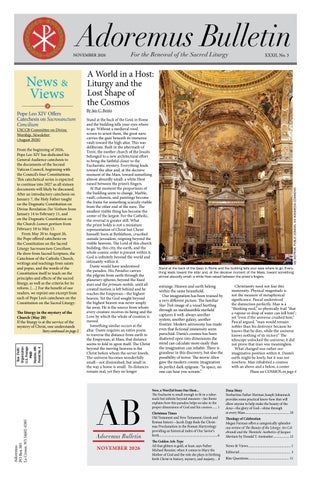
Stand at the back of the Gesù in Rome and the building tells your eyes where to go. Without a medieval rood screen to arrest them, the great nave carries the gaze beneath its immense vault toward the high altar. This was deliberate. Built in the aftermath of Trent, the mother church of the Jesuits belonged to a new architectural effort to bring the faithful closer to the Eucharistic mystery. Everything leads toward the altar and, at the decisive moment of the Mass, toward something almost absurdly small: a white Host raised between the priest’s fingers. At that moment the proportions of the building seem to change. Marble, vault, columns, and paintings become the frame for something scarcely visible from the other end of the nave. The smallest visible thing has become the center of the largest. For the Catholic, the reversal is greater still. What the priest holds is not a miniature representation of Christ but Christ himself: born at Bethlehem, crucified outside Jerusalem, reigning beyond the visible heavens. The Lord of this church building, this city, the earth, and the whole cosmic order is present within it. God is infinitely beyond the world and intimately within it. Dante would have understood the paradox. His Paradiso carries the pilgrim from earth through the planetary spheres, beyond the fixed stars and the primum mobile, until all created motion is left behind and he reaches the Empyrean—the highest heaven. Yet the God sought beyond the highest heaven was never simply far away. He is the source from whom every creature receives its being and the Love by which the whole of creation is moved. Something similar occurs at the altar. Dante requires an entire poem to traverse the distance from earth to the Empyrean; at Mass, that distance seems to fold in upon itself. The Christ beyond the moving heavens is the Christ before whom the server kneels. The universe becomes wonderfully small—not diminished, but small in the way a home is small. Its distances remain real, yet they no longer
AB
Adoremus Bulletin NOVEMBER 2026
AB/JASTROW, PUBLIC DOMAIN, VIA WIKIMEDIA COMMONS
News & Views
For the Renewal of the Sacred Liturgy
Stand at the back of the Gesù in Rome and the building tells your eyes where to go. Everything leads toward the altar and, at the decisive moment of the Mass, toward something almost absurdly small: a white Host raised between the priest’s fingers.
estrange. Heaven and earth belong within the same household. Our imagination has been trained by a very different picture. The familiar Star Trek image of a vessel hurtling through an inexhaustible starfield captures it well: always another system, another galaxy, another frontier. Modern astronomy has made even that fictional immensity seem parochial. Dante’s cosmos has been shattered open into dimensions the mind can calculate more easily than the imagination can inhabit. There is grandeur in this discovery, but also the possibility of terror. The movie Alien gave the modern cosmic imagination its perfect dark epigram: “In space, no one can hear you scream.”
Now, a Wor(l)d from Our Host... The Eucharist is small enough to fit in a tabernacle but infinite beyond measure—Jan Bentz explains how this paradox helps us take in the proper dimensions of God and his cosmos....... 1
Christmas Times Old Testament and New Testament, Greek and Roman history—Jacob Zepp finds the Christmas Proclamation in the Roman Martyrology providing an historical index of Our Savior’s birth......................................................................... 6 The Golden Ark-Type
All that glitters is gold, at least, says Father Michael Rennier, when it comes to Mary the Mother of God and the role she plays in birthing forth Christ in history, mystery, and majesty.…8
Christianity need not fear this immensity. Physical magnitude is not the measure of metaphysical significance. Pascal understood the distinction perfectly. Man is a “thinking reed,” so physically frail “that a vapour or drop of water can kill him”; yet “even if the universe crushed him,” Pascal argued, “man would remain nobler than his destroyer because he knows that he dies, while the universe knows nothing of its victory.” The telescope unlocked the universe; it did not prove that man was meaningless. What changed was rather our imaginative position within it. Dante’s earth might be lowly, but it was not nowhere. Man inhabited a cosmos with an above and a below, a center Please see COSMOS on page 4
Doxa Moxy Norbertine Father Herman Joseph Johanneck provides some practical know-how that will allow anyone to help make the beauty of the doxa—the glory of God—shine through at every Mass........................................................10 Theology of Celebration Megan Furman offers a categorically splendorous review of The Beauty of the Liturgy: Ars Celebrandi and the Thomistic Aesthetics of Jacques Maritain by Donald T. Anstoetter.....................12 News & Views................................................. 1 Editorial........................................................... 3 Rite Questions............................................... 11
2
Adoremus Bulletin, November 2026
NEWS & VIEWS
AB/JEREMIAH SULLIVAN/CARROLL COLLEGE, CC BY 3.0, VIA WIKIMEDIA COMMONS
Continued from NEWS & VIEWS
why it has been defined as “the summit toward which the activity of the Church is directed... the font from which all her power flows” (SC, 10). It is true that the action of the Church is not limited to the liturgy alone; however, all her activity (preaching, service to the poor, the accompaniment of human realities) converges towards this “summit.” Conversely, the liturgy sustains the faithful by immersing them ever and anew in the Pasch of the Lord and, thus, through the proclamation of the Word, the celebration of the sacraments and communal prayer, they are refreshed, encouraged and renewed in their commitment to faith and in their mission. In other words, the participation of the faithful in the liturgical action is at once “internal” and “external.” This also means that it is called to unfold in a tangible way throughout daily life, in an ethical and spiritual dynamic, so that the liturgy celebrated is translated into life and demands a faithful existence, capable of making concrete what has been experienced in the celebration: it is in this way that our life becomes a “living sacrifice, holy and acceptable to God,” fulfilling our “spiritual worship” (Rom 12:1). The reform of the liturgy: tradition and development (May 27) The Council affirms the legitimacy of... progress, rooted in authentic Tradition, distinguishing within the liturgy “immutable elements, divinely instituted” from “elements subject to change [which] not only may but ought to be changed with the passage of time if they have suffered from the intrusion of anything out of harmony with the inner nature of the liturgy or have become unsuited to it” (SC, 21). Changes of this type have taken place constantly over the centuries in order to enable the faithful to participate fruitfully, through ritual actions, in the Paschal Mystery of Christ, the foundation of the Christian faith. The Church’s worship has thus been “embodied” in the cultural forms of each age and has been able to influence them and even transform them. The liturgy has thus been, for centuries, a driving force for evangelization. Today, this energy must be renewed in continuity with the authentic and living Catholic tradition, that is, in accordance with a dynamic aimed at introducing believers to the fullness of the truth. Rite, sign and symbol (June 3) “Sign” and “symbol” are terms that are often used as synonyms. In reality, a sign is symbolic when it is able to refer not only to an idea, but to an entire system of meanings and values. In this way, for example, when we are sprinkled with holy water, our awareness of the gift received at Baptism and our commitment to new life in Christ is rekindled. Secondly, symbols are essentially practical in nature, being first and foremost actions: some simple and common, such as kneeling and exchanging the sign of peace, or more demanding, such as the constitutive acts of each Sacrament. Above all, symbols have a unique performative and transformative dimension, both in relation to the material elements of which they are composed and to those who come into contact with them, engendering a sense of belonging, touching the heart and mind, and giving rise to authentic ecclesial relationships. The Mystery of the Eucharist (June 24) [B]y incorporating us into Christ, the Eucharist teaches us to adopt the very style of life of the Lord Jesus, which was marked by the free gift of himself. This gift draws us into the dynamic of unity, offering a powerful antidote to the forces of division that undermine our world, our communities, our families, and our hearts (cf. SC, 47). [...] With regard to the Word of God, it is important to remember that it is not merely a matter of acquiring intellectual knowledge of the Scriptures, but of receiving the Word that is “living and effective” (Heb 4:12), spoken by God to everyone and at the same time to each individual. This Word nourishes and sustains us together with the Eucharistic Bread and leads us from the decay of sin to new life in Christ. “The Eucharist opens us to an understanding of Scripture,
just as Scripture for its part illumines and explains the mystery of the Eucharist” (Benedict XVI, Verbum Domini, 55). The prayer of the Church (August 5) Saint Paul VI ardently desired that the Liturgy of the Hours, the Church’s daily public prayer, inseparable from the Eucharist, might deeply permeate, enliven, guide and express all Christian prayer, and effectively nourish the spiritual life of the People of God (cf. Apostolic Constitution Laudis canticum). For this desire to be fulfilled, the Liturgy of the Hours needs to be more fully embraced and lived out in the daily lives of the baptized and of the communities. To the many people who wish to learn to pray, especially catechumens, it can offer the path and the school of Christian prayer. The liturgical year (August 12) The liturgical year... repeats, in sacramental form, the teaching of the history of salvation, guiding the faithful from the expectation of the Messiah to the fullness of the Paschal Mystery and to the anticipation of future glory. In it, the Church celebrates the salvific relevance of the mystery of Christ, enabling believers to participate in it ever more deeply. For this reason, the liturgical year constitutes the guiding principle and the essential framework for all pastoral action. Sacred music (August 19) A theme close to the Council’s reform is that of inculturation, including in the field of sacred music. In particular, with regard to the musical traditions of different cultures, the Council emphasizes the importance of taking them into consideration seriously, as they form part of people’s religious and social life. Thus, on one hand, an “attitude toward religion” should be promoted in everyone (SC, 119). On the other, “every effort should be made to see that they become competent in promoting the traditional music of these peoples, both in schools and in sacred services” (ibid.). The motivations of the liturgical reform (August 26) [S]ince the liturgy is a living entity, throughout the centuries it has always been subject to developments and changes. The Magisterium adapted its forms to the needs of different eras. It is therefore not surprising that the Second Vatican Council too, with the utmost respect for the heritage of tradition, and precisely in order to make it more accessible, considered it necessary to revise the liturgical books. [...] The liturgical reform promoted by the Second Vatican Council is... firmly rooted in the living tradition of the Church. A correct understanding of it also enables us to reject the abuses that occurred in certain sectors of the Church during the post-Conciliar period, and which, unfortunately, still occur from time to time today, where some of the principles underlying the reform itself have been taken to extremes or misunderstood.
Pope Leo Prays at Restored Notre-Dame Cathedral By Hannah Brockhaus
EWTN—Pope Leo XIV prayed evening prayer at Notre-Dame Cathedral on September 25, becoming the first pope to set foot in the monumental church since it was rebuilt after the 2019 fire that ravaged its roof, nave, and spire. Less than two years after its reopening, Pope Leo reflected on the iconic cathedral, which, “more than any other [place], has invited the people of Paris for centuries to lift their eyes towards heaven.” “Seven years have passed since the whole world, holding its breath, watched as the cathedral was engulfed in a terrible fire,” he said in his homily. “That pain was felt not only by Catholics, nor only by believers.” “In that tragic moment we came to realize that Notre-Dame is more than a monument,” the pope said.
Adoremus Bulletin Society for the Renewal of the Sacred Liturgy PHONE: 608.521.0385 WEBSITE: www.adoremus.org MEMBERSHIP REQUESTS & CHANGE OF ADDRESS: info@adoremus.org INQUIRIES TO THE EDITOR P.O. Box 385 | La Crosse, WI 54602-0385 editor@adoremus.org
“The collective effort to rebuild it, and the splendor of the result reveal that the heart of a people beats here, and that here we stand at the living center of a civilization, where past and future embrace, where heaven and earth meet.” The prayer service at the famous Gothic cathedral was Pope Leo’s first meeting with the Catholic Church of Paris during his September 25–28 visit to France. Here Pope Leo spoke to the country’s Catholic clergy and religious—the rebuilt church providing a fitting setting for his message that “this cathedral has been reborn so that you too may be reborn with it in a new impetus towards holiness and daily mission.” Notre-Dame Cathedral reopened in December 2024, a little over five years after people around the world watched the church’s blaze in horror. Restoration work of the Gothic cathedral continued into 2026. In his homily, Pope Leo reflected on the symbolism of the architecture of the cathedral, the seat of the archbishop of Paris. “The cathedral’s cruciform layout, where stone and light come together, evokes the meeting of earth and heaven. It gathers and orders the events of history, woven with human joys and sufferings. It holds them together in a symbolic dynamic that transforms these diverse expressions into a living language, uniting them into a whole,” he said. Before evening prayer, Pope Leo approached the cathedral on foot to greet those gathered outside. Local authorities estimated that 300,000 people lined up to greet Pope Leo outside Notre-Dame and along the two-and-a-half mile road from his previous event at UNESCO headquarters to the cathedral, the Vatican said. Upon entering the cathedral, the pope visited a chapel to pray before the Blessed Sacrament and then venerated a relic of the Crown of Thorns. The cathedral, which just moments before had erupted into applause and cries of “Pape Léon,” was silent. After putting on vestments for the prayer, Pope Leo approached the altar to the dramatic tones of the cathedral’s grand organ, the largest pipe organ in France. “We must not forget that this cathedral, like every other church, was built for the purpose of prayer and the worship of God,” the pope recalled in his homily. “This cathedral is not merely a stone structure to be admired; instead, it lives by the sacred mystery celebrated within it. Without the liturgy, it would lose its soul.”
Archbishop Fulton Sheen Declared ‘Blessed’ By Jonah McKeown
EWTN—Archbishop Fulton Sheen, despite his humble origins in small-town Illinois, aspired to great things as an academic and as a communicator of the Catholic faith. On September 24, before a crowd of tens of thousands at The Dome at America’s Center, the farmboy-turned-mass-media star was declared “blessed” after the reading of a decree signed by Pope Leo XIV, a fellow Midwesterner. Via his decree, Pope Leo announced Blessed Sheen’s feast day will be on December 9, the anniversary of his death. His feast day is expected to be on the calendar of the Catholic Church in the United States. Jam-packed crowds of Catholics of all ages—from the elderly who were around when Blessed Sheen’s radio and TV shows first aired, to numerous families with small children—had descended on the stadium for the Mass, which began with a lengthy procession of some 1,000 priests, 89 bishops, and hundreds of seminarians and deacons. The actual moment when Sheen became “blessed” happened early in the proceedings, following the proclamation of a decree signed by Pope Leo XIV. As is customary at beatifications, Cardinal Luis Tagle, the pope’s representative and the pro-prefect of the Dicastery for Evangelization, first read the decree in Latin, and afterward the decree was read in the Please see NEWS & VIEWS on page 5 DIRECTOR: Christopher Carstens EDITOR: Michael Brummond MANAGING EDITOR: Joseph O’Brien CONTENT MANAGER: Jeremy Priest GRAPHIC DESIGNER: Danelle Bjornson OFFICE MANAGER: Elizabeth Gallagher MARKETING AND FUNDRAISING: Eugene Diamond TECHNOLOGY: Zach Tudahl EXECUTIVE COMMITTEE The Rev. Jerry Pokorsky = Helen Hull Hitchcock The Rev. Joseph Fessio, SJ Contents copyright © 2026 by ADOREMUS. All rights reserved.
3
Adoremus Bulletin, November 2026
A Leonine Program of Liturgical Renewal By Michael Brummond, Editor
AB/MAZUR/CBCEW.ORG.UK, CC BY-NC-ND 2.0, VIA FLICKR
A
t the beginning of 2026, immediately after the close of the Jubilee Year, Pope Leo XIV inaugurated a new cycle of catecheses focusing on the Second Vatican Council (see “News & Views,” page 1). The Holy Father explicitly called for a rereading of the texts of the Council as “a valuable opportunity to rediscover the beauty and importance of this ecclesial event.” Giving the catecheses the title, “Vatican Council II through its Documents,” Pope Leo wishes us to return to the Council itself rather than focusing on competing narratives about the Council: “to continue to seek ways and means to implement its insights, it will be important to get to know it again closely, and to do so not through ‘hearsay’ or interpretations that have been given, but by rereading its documents and reflecting on their content” (General Audience, January 7, 2026). Notably, even 60 years after the Council, Pope Leo continues to speak of its implementation as an ongoing task for the Church. From May to August 2026, Pope Leo dedicated eight of these Wednesday audiences to catechesis on Sacrosanctum Concilium, the Council’s Constitution on the Sacred Liturgy. The catecheses range widely across the Constitution’s themes and reward close and repeated reading. Perhaps the main theological thread running through them is that the liturgy is the Church’s encounter with the mystery of Christ: “Indeed, the liturgy touches the very heart of this mystery: it is at once the space, the time and the context in which the Church receives her very life from Christ” (General Audience, May 20, 2026). The series of audiences explores the many facets of this encounter: how Christ acts in the liturgy through word, sacrament, minister, and assembly; how rites, signs, and symbols mediate his saving presence; how the Eucharist, the Liturgy of the Hours, the liturgical year, and sacred music draw the faithful into his Paschal Mystery; and how authentic participation in that mystery forms the Church, transforms Christian life, and provides the proper measure for liturgical renewal. Moreover, woven through Pope Leo’s rereading of Sacrosanctum Concilium are a surprising number of imperatives and calls to action. Read together with the Holy Father’s emphasis on the continuing implementation of the Council, these suggest something like a Leonine program for practical liturgical renewal. While inviting readers to return to the catecheses themselves, I offer here five priorities drawn from Pope Leo’s treatment of Sacrosanctum Concilium.
Pope Leo wishes us to return to the Council itself rather than focusing on competing narratives about the Council. Notably, even 60 years after the Council, Pope Leo continues to speak of its implementation as an ongoing task for the Church.
cal action is at once ‘internal’ and ‘external’. This also means that it is called to unfold in a tangible way throughout daily life, in an ethical and spiritual dynamic, so that the liturgy celebrated is translated into life” (General Audience, May 20, 2026). The faithful are to offer themselves, making concrete in daily life what they have experienced liturgically. Through the liturgy the faithful “are refreshed, encouraged and renewed in their commitment to faith and in their mission” (General Audience, May 20, 2026). Encounter with Christ’s mystery is meant to conform Christians to Christ and extend his selfgiving life into the world.
1. Deepen active participation through formation, especially mystagogical catechesis. Pope Leo quotes his predecessor, Benedict XVI, saying that active participation “must be understood… on the basis of a greater awareness of the mystery being celebrated and its relationship to daily life” (General Audience, August 19, 2026; quoting Sacramentum Caritatis, 52). The Church’s ongoing task, then, is to form the faithful for such participation, helping them understand the rites and prayers so that they may enter the liturgy with the whole person— body, mind, and heart. Christians need to become “capable of symbols,” perceiving the mystery present at the heart of the Church’s rites, signs, symbols, gestures, silences, and sacramental language. Pope Leo stresses that the faithful must allow themselves to be “educated by the rites” of the liturgy: “The experience of a living and devout liturgy, accompanied by appropriate mystagogical catechesis, is the best resource for reawakening in everyone that openness to the encounter with God” (General Audience, June 3, 2026). This mystagogically informed participation is the means by which the faithful enter more deeply into the mystery of Christ made present in the liturgy.
3. Recover the liturgical vision of Christian time through serious Sunday observance and fuller appropriation of the Liturgy of the Hours. Pope Leo lays great emphasis on the reality of liturgical time. At the broadest level, the liturgical year should provide “the guiding principle and the essential framework for all pastoral action” (General Audience, August 12, 2026). Sunday should shape a fundamental rhythm of Christian life. The faithful should gather for the Eucharist, and pastoral structures should facilitate Sunday Mass even for those whose work makes observance difficult. Sunday and the liturgical year continually immerse the Church in the Paschal Mystery of Christ and orient Christian life toward his return in glory. The Holy Father explicitly says that the Liturgy of the Hours needs to be “more fully embraced and lived out” in the daily lives of the baptized and of communities (General Audience, August 5, 2026). It should function as a school of Christian prayer and as a regular means by which the Church’s prayer permeates daily life: “Bound to the Eucharist, whose light it prolongs, the Liturgy of the Hours sanctifies the time of our daily lives: in the morning, we begin the day with faith and gratitude; at midday, we ask for the strength to remain faithful amidst our labours; in the evening, once our work is done, Vespers accompany the moment of sunset; at night, we fall asleep entrusting ourselves to God’s peace” (General Audience, August 5, 2026). The Hours unite the Church throughout the day to Christ’s own prayer, sanctifying ordinary time through participation in his praise of the Father. “Every week and every day, the Eucharist and the Liturgy of the Hours are the breath of the life of the Church… In this way, day by day, we are ever more united with the Paschal Mystery and conformed to him” (General Audience, August 5, 2026).
2. Translate liturgical participation into Christian life and mission. The liturgy is meant to transform those who celebrate it, bearing fruit in communion, conversion, and mission. “The participation of the faithful in the liturgi-
4. Cultivate disciplined, faithful, and beautiful celebration through stronger liturgical and musical formation. Priests and others responsible for liturgical celebrations should respect liturgical texts and norms, avoid
arbitrariness, foster noble simplicity, and care seriously for ritual beauty, silence, and music. “I therefore urge all those called to prepare the celebration of the divine mysteries, in particular priests who exercise the ministry of liturgical presidency, to always uphold that respect for the texts and regulations of the liturgy” (General Audience, May 27, 2026). Pope Leo also highlights the need for stronger formation in sacred music, including in seminaries, houses of formation, and Catholic institutions, as well as sound liturgical formation for musicians and singers. Sacred music “must respond to what is most appropriate for the liturgical moment, beyond fashions or composers’ particular sensitivities. Its form… must be at once noble and simple, of high musical quality and easily performable” (General Audience, August 19, 2026). Celebrations faithful to the Church’s liturgical norms allow the rites themselves to disclose the mystery of Christ, rather than allowing individual preference, poor formation, or arbitrary intervention to obscure it. 5. Receive the liturgical reforms of Vatican II within the living Tradition. Pope Leo rejects both liturgical immobility and continual reinvention. Again, the current pontiff approvingly quotes Benedict XVI: “Tradition is a living reality, which therefore includes in itself the principle of development, of progress” (General Audience, May 27, 2026; quoting the Address to participants in the Congress promoted by the Pontifical Athenaeum of Saint Anselm on the 50th anniversary of foundation, May 6, 2011). The Church must preserve sound tradition, remain open to legitimate organic development, reject abuses and private innovation, and understand reform as serving authentic participation, ecclesial communion, and evangelization. “The liturgical reform promoted by the Second Vatican Council is thus firmly rooted in the living tradition of the Church. A correct understanding of it also enables us to reject the abuses that occurred in certain sectors of the Church during the post-Conciliar period… where some of the principles underlying the reform itself have been taken to extremes or misunderstood” (General Audience, August 26, 2026). Authentic reform serves the Church insofar as it enables the faithful to receive more fruitfully what has been handed on—a living encounter with the mystery of Christ. These catecheses show that Pope Leo is not proposing a novel liturgical program or new structural reform. In his rereading of Sacrosanctum Concilium, he is calling the Church back to the authentic vision of the Council itself as it is found in its documents. That vision is ultimately one of encounter with the mystery of Christ, formation by the rites, fruitful participation, faithful celebration, and renewal within Tradition.
Adoremus Bulletin, November 2026
AB/ESO/A. FITZSIMMONS, CC BY 4.0, VIA WIKIMEDIA COMMONS
4
Physical magnitude is not the measure of metaphysical significance. The telescope unlocked the universe; it did not prove that man was meaningless.
Continued from COSMOS, page 1 and a circumference, an order in which each sphere belonged to the others. Modern man inhabits a universe incomparably greater in physical extent, yet he can experience himself as a biological accident on an unremarkable planet orbiting one star among billions. The deeper difference is not that Dante inhabited a smaller universe. He inhabited a universe whose parts still belonged to one another. A Handful of Earth Consider a handful of turf. It is not much to look at: grass, earth, perhaps a root or two, a worm squirming. Yet, in older European legal customs, possession of an estate could be transferred by handing over precisely such a thing. One did not carry the estate into court. A piece of it was enough. We would probably call the turf a “sign,” though our modern use of that word risks obscuring what was happening. A mere sign points beyond itself by convention. A red light means stop, but there is nothing in redness itself that contains a command to halt. The turf is different. It is a symbol. A symbol participates, in some measure, in the reality it discloses. The handful of turf was obviously not the whole estate, yet neither was it merely a stand-in. The whole entered the ceremony through a genuine part of itself. The sign says: think of something else. The symbol says: encounter the greater reality through this. Something similar appears throughout the older imagination. In Scandinavian poetry, the sea might become the “land of fishes”: one reality disclosed through another rather than being neatly enclosed within its own conceptual boundary. Medieval art could display the same freedom. A king towers above his soldiers; Christ dominates a landscape in which, according to optical perspective, he ought to be smaller. We may be tempted to call this bad perspective. The medieval artist might have wondered whether ours was bad theology. Why, after all, should physical size be the only measure of greatness? The gradual reversal of this logic is no mistake. Christianity itself had placed—and still places—an unprecedented emphasis upon the dignity of the human person. The God who became man had made the human face, the human body, and the individual life worthy of an attention that the ancient world had not always accorded them. There is therefore something genuinely Christian in the growing artistic interest in the particular person and in the world as it appears before human eyes. The difficulty arose when this elevation of man survived the theological order that had made it possible. Medieval man might stand at the center of the created world, but he still stood beneath God; his importance derived from his place within an order he had not made. In the secularized inheritance of Christianity, the center increasingly became the measure. The world was no longer seen primarily according to the hierarchy of what things are, but from the standpoint of how they appear to us. Mathematical perspective coming into its own in the Renaissance is almost too perfect an image of this change. Its great achievement was to organize visible space with extraordinary precision, but it did so from a single point: the position of the observer. The saint who had once been painted larger because he mattered more must now become smaller when he recedes into the distance. Significance yields to optics;
hierarchy to viewpoint. Nothing has necessarily become less sacred in the picture, but the principle according to which the picture is ordered has changed. The human eye has quietly become its geometrical center. Here lies a difference more consequential than artistic technique. Modern thought is extraordinarily good at understanding the part as a fraction. Divide an acre and we have two half-acres; analyze the body and we find organs, tissues, cells, and molecules. But the older symbolic imagination could also understand the part through participation. The particular thing might belong so profoundly to a greater whole that the whole could somehow become intelligible through it.
“ Medieval man might stand at the center of the created world, but he still stood beneath God; his importance derived from his place within an order he had not made.” This is more important for understanding Catholic liturgy than any number of arguments about the use of incense or Latin in the Mass, or the supremacy of Gothic architecture in the building of a church. Distinction and Separation None of this requires us to romanticize the Middle Ages—although our own age might profit from a little more romanticizing. The German Romantic poet and philosopher Novalis understood Romanticism precisely as the recovery of depth in the ordinary, of mystery in the familiar, of higher significance in what had become commonplace. Dante’s astronomy was wrong, at least as astronomy. The planets do not inhabit crystalline spheres, astrology is no substitute for astrophysics, and medieval medicine is best admired from the safe distance afforded by modern hospitals. Yet the collapse of Dante’s physical cosmos does not necessarily invalidate what that cosmos represented: a creation ordered toward God, in which visible and invisible, material and spiritual, part and whole could belong to one another without being confused. Modernity learned to distinguish things that older cultures sometimes joined too readily, and the fruits of that precision are all around us. The difficulty begins when distinction becomes separation. A star is incandescent matter; bread has a chemical composition; incense can be analyzed in a laboratory. None of these descriptions threatens the Christian imagination or the liturgical meaning of all these things. The danger enters with two apparently innocent words: nothing but. The star becomes nothing but matter, the body nothing but biology, bread nothing but chemistry, ritual nothing but communal performance. A method devised to investigate one dimension of reality subtly becomes a claim about the whole of reality. Modern thought possesses a genius for taking things apart. Its difficulty is knowing how to put them back together.
Catholicism has always resisted both confusion and separation. Body and soul are distinct, but man is one. Nature and grace are distinct, but grace does not destroy nature. Christ’s divine and human natures are neither confused nor divided. Creator and creature differ infinitely, yet the creature exists only because it receives its being from God. The characteristic logic is distinction without severance.
“ Modern thought possesses a genius for taking things apart. Its difficulty is knowing how to put them back together.” Liturgy quietly inhabits the same logic. A church is a building, but not merely a building. Sunday is a day of 24 hours, but not merely another day. Water is water, yet it can become the matter of Baptism and thus be endowed with a characteristic that cleanses the spirit. Oil remains oil and can anoint; wax remains wax and can bear the Paschal flame; incense remains resin and can give bodily form to ascending prayer. Thus, even space is not just space. A surveyor can measure a cathedral and a warehouse with the same instruments, but the liturgy does not behave as though every square meter were interchangeable. There are threshold and nave, sanctuary and altar; there are places toward which bodies turn and before which knees bend. The church is not merely a roof erected over a congregation. It is itself drawn into the act of worship within a holy space. As the influential historian of religions Mircea Eliade put it: “For religious man, space is not homogeneous; he experiences interruptions, breaks in it; some parts of space are qualitatively different from others” (The Sacred and the Profane, “Homogeneity of Space and Hierophany,” 20). Time acquires the same depth. “For religious man,” Eliade observed, “time too, like space, is neither homogeneous nor continuous” (The Sacred and the Profane, “Sacred Time and Myths,” 68). Advent waits, Lent fasts, Easter rejoices. More remarkably, sacred time is not a matter of the past. Eliade described it as “reversible,” a primordial time made present again through ritual. Attending Mass means we are truly present at the one and only sacrifice of Christ on the Cross on Calvary. Christianity complicates this account, since its sacred events belong not to a mythical beginning but to history: Christ was born, suffered under Pontius Pilate, died, and rose at particular moments in time. Yet Christian liturgy likewise refuses to imprison these events in an irretrievable past. At Christmas, the Church does not merely recall that Christ was once born, nor on Good Friday simply commemorate an execution long past. In the liturgy, chronological distance remains real without becoming absolute; the mysteries of salvation remain capable of becoming sacramentally present. None of this works if matter, time, and space are intrinsically meaningless and religion merely paints significance onto them afterwards. The sacramental imagination begins elsewhere: creation comes from the Logos and therefore possesses an intelligibility prior to our inventions. Water can bear baptismal meaning because water already cleanses, gives life, refreshes, and can kill. Fire illuminates and consumes. Bread nourishes. Wine gladdens. Liturgy discovers creation’s capacities and raises them into an order they could never attain by themselves. Perhaps this is why “re-enchantment,” for all its attractiveness, is not quite the right word. What we need might better be called “recosmization,” or even “rehoming”: the recovery of a world in which things belong to one another, the part to the whole and creation to its Creator. The World in a Host And here we enter a truly profound mystery of the Christian Faith: the Eucharistic presence. Philosophically speaking, the symbol is good and true, but when we try to understand the Eucharist, the analogy breaks down. A piece of turf can represent an estate. A king may represent his people. A poetic image can disclose another reality. But the Host does not merely represent Christ. It is Christ. Here lies the “scandalous” literalness of Catholicism. Under the appearances of bread and wine, Christ is truly present. Not fractionally, as though breaking the Host divided Christ into smaller portions. Under either species, and in every part after division, Christ is whole and entire. The step from the “part” to the “whole” is actualized and indeed consummated. The older intuition that the part may somehow bear the whole is surpassed beyond imagination. It has to be accepted by faith.
5
Long before consecration, however, bread has already gathered a little cosmos into itself: soil and seed, rain and sunlight, harvest and human labor, milling, kneading, and fire. Wine bears another history of earth, vine, season, fruit, and patient cultivation. At the offertory these histories are gathered into human hands and returned toward their source. What creation has yielded and human work has fashioned is brought to the altar. There is a beautiful contraction in this movement. Field becomes grain, grain becomes bread; vineyard becomes wine; bread and wine are carried toward an altar. The world seems to narrow until it reaches the priest’s hands. Yet at precisely that point the movement reverses and opens upon the all-encompassing divinity and cause of it all. This is why the Mass is more truly cosmic than many forms of “cosmic spirituality.” It does not leave material things behind in search of an abstract transcendence. It takes creation seriously enough to bring matter with it. Water, fire, oil, wax, bread, and wine enter worship; so does the human body, standing, kneeling, speaking, singing, fasting, and eating. The liturgy gathers creation into itself and turns it into worship and thanksgiving.
Continued from NEWS & VIEWS, page 2 vernacular—in this case English—by Bishop Louis Tylka of Peoria, Illinois, in whose diocese Blessed Sheen was born. Earlier in the day, Msgr. Jason Gray, executive director of the Archbishop Fulton J. Sheen Foundation, announced that six purported miracles are attributed to the intercession of Blessed Sheen as part of the process that could lead to his canonization. Any purported miracle attributed to Blessed Sheen’s intercession that has taken place since Pope Francis announced his beatification in July 2019 can count toward his eventual canonization, which typically requires a second miracle to move forward. James Fulton Engstrom, recipient of the confirmed miracle that cleared the way for Sheen’s beatification, survived in spite of having spent 61 minutes without a heartbeat. The healthy 16-year-old presented several of Sheen’s relics during the beatification Mass. Catholics from all over the world hailed Sheen’s example as a highly creative and effective missionary, who used every means available to him to share the love of Christ.
Latin Mass Permissions Steady from Pope Francis to Pope Leo XIV By Victoria Cardiel
EWTN—Thirty-four dioceses received Vatican permission to celebrate the Traditional Latin Mass in parish churches in 2025, matching the 2024 total and remaining broadly consistent with previous years despite the election of a new pope. The United States accounted for 24 of the 34 decrees issued. Pope Francis restricted the use of the 1962 Roman Missal with the 2021 motu proprio Traditionis Custodes. Under subsequent Vatican regulations, diocesan bishops must obtain permission from the Holy See to authorize celebrations according to that missal in parish churches. The 2025 figure was also close to the 35 dioceses and other ecclesiastical jurisdictions that received permission in 2022, the first full year after Traditionis Custodes took effect. The number rose to 55 in 2023 before returning to 34 in each of the following two years.
Long before consecration, bread has already gathered a little cosmos into itself: soil and seed, rain and sunlight, harvest and human labor, milling, kneading, and fire. At the offertory these histories are gathered into human hands and returned toward their source. What creation has yielded and human work has fashioned is brought to the altar.
flattening of modern liturgy has proved so difficult to reverse. Its impoverished forms did not arise in an intellectual vacuum; they bespeak a flattened vision of reality from which symbol, hierarchy, and participation had already begun to recede. Restoring chant, incense, vestments, and ceremonial can therefore accomplish only so much if the world brought through the church doors remains metaphysically mute. But there is hope! Liturgy can school our vision and gradually teach us to see again, but it cannot simply conjure an enchanted cosmos out of a culture that no longer believes such a cosmos possible. The renewal of worship and the recovery of the world must and always will proceed together.
Dr. Jan C. Bentz is a lecturer and tutor in philosophy at the Studium of Blackfriars, University of Oxford, where he is also an Associate Member of the Faculty of Theology and Religion. He also teaches for the online Memoria College, contributing to its classical liberal arts curriculum. Born and raised in Germany, he completed his secondary education in St. Louis, MO, as a foreign exchange student. He went on to study philosophy, comparative religion, and sacred art and architecture in Rome, where he later taught before relocating to Oxford. In addition to his academic work, Dr. Bentz has an extensive background in journalism and media. He has produced video features for EWTN and has written for Inside the Vatican, The Catholic Herald, Catholic News Agency, Judische Rundschau, and CATO. He also previously worked as a docent guide in Rome and the Vatican.
The figures appear in the Summarium Decretorum for 2025, the annual summary of decrees issued by the Dicastery for Divine Worship and the Discipline of the Sacraments. The document shows that permission was granted during 2025 for celebrations according to the 1962 Roman Missal in parishes located in 34 dioceses around the world. Seven of the decrees were issued during the pontificate of Francis, who died April 21, 2025, at the age of 88. The other 27 were issued after the election of Pope Leo XIV on May 8, indicating continuity in the Vatican’s case-by-case handling of requests during the change of pontificates. The vast majority—29 of the 34 published decrees— renewed existing permissions for an additional two years for communities already celebrating the liturgy according to the 1962 missal promulgated by St. John XXIII. In several cases, a single authorization covered more than one parish in the same diocese. The U.S. decrees included permissions for Traditional Latin Mass celebrations in the dioceses of Sacramento, CA; Nashville, TN; Lincoln, NE; Davenport, IA; and Cleveland, as well as the Archdiocese of Seattle. According to the Summarium Decretorum for 2022, the Holy See that year granted permissions to 35 dioceses and ecclesiastical jurisdictions, 20 of them in the United States, making the country the leading recipient of such concessions.
The Traditional Latin Mass, also called the Tridentine Mass, traces its form to the liturgy codified by St. Pius V following the Council of Trent. The reform was set out in the Roman Missal of 1570 in response to the council’s call to unify the various liturgical uses then in existence. The missal currently used for these celebrations is based on that promulgated by St. Pius V but was revised by St. John XXIII in 1962. One of the form’s most distinctive characteristics is that the priest generally celebrates “ad orientem”— facing liturgical east rather than the congregation—as he leads the faithful in common prayer. The permissions granted across the two pontificates in 2025 show that the Holy See continued to consider requests individually under the restrictions established during Francis’ pontificate. The annual Summarium Decretorum is one of the few official sources indicating how the provisions of Traditionis Custodes are applied in practice. The decree indexes published from 2022 through 2025 also document the Holy See’s broader work regulating the liturgy. The records include approvals of translations of liturgical books, confirmations of calendars particular to dioceses and religious congregations, grants of the title of minor basilica, canonical coronations of Marian images, and recognitions of new heavenly patrons.
AB/BOHUMIL PETRIK VIA EWTN NEWS
Beyond Re-Enchantment There is much talk today of “re-enchantment,” and much of it is welcome. After decades in which Christians themselves sometimes seemed embarrassed by ritual, ornament, and mystery, beauty is being rediscovered with understandable enthusiasm. The recovery demanded by Catholic liturgy must go deeper than recovering beautiful things and forms. We need to recover the possibility of a symbolic world: a world in which things can belong to greater wholes without ceasing to be themselves, in which matter can bear meaning without ceasing to be matter, and in which the visible can open upon the invisible without becoming an illusion. Beneath lies a more fundamental question: what sort of world must this be for liturgy to make sense? Grace builds upon nature, and something analogous must be true of liturgical enchantment. An enchanted liturgy cannot simply be laid like a gorgeous cloth over a disenchanted world. The world itself must first—or perhaps simultaneously—become capable of being assumed into worship. This may also explain why the
AB/PIETER BRUEGHEL THE ELDER, PUBLIC DOMAIN, VIA WIKIMEDIA COMMONS
Adoremus Bulletin, November 2026
This story was first published by ACI Prensa, the Spanish-language sister service of EWTN News. It has been translated and adapted by EWTN News English.
Adoremus Bulletin, November 2026
An Explanation of the Christmas Proclamation
By Jacob Zepp
T
he Christmas proclamation is the solemn announcement of the Nativity of the Lord drawn from the Roman Martyrology and found in Appendix I of the Roman Missal. Referring to key moments throughout salvation history, it magnificently situates Christ’s birth as a decisive event within the divine economy. Each year, it is fittingly chanted (or recited) during Vespers on December 24 or proclaimed as a prelude to the Mass during the Night. This article examines both biblical and secular events and considers the chronology employed in the Christmas proclamation to record these temporal markers leading up to the birth of Christ. Martyrologium Romanum1 Octavo Kalendas Januarii
Roman Missal2
Literal Translation
The Twenty-fifth Day of December,
Eight days before the Kalends of January
Typically translated as “The Twenty-fifth Day of December,” the first phrase of the Christmas proclamation employs ancient Roman chronology. Rather than counting upwards starting at the beginning of the month, the Romans counted down to three points in the month: the Kalends (first of the month), the Nones (nine days before the Ides), and the Ides (middle of the month). Since the Romans counted inclusively, the day currently appointed, the 25th of December, would fall eight days before the Kalends of January. Luna …
n/a
The … day of the moon.
After the Roman chronology above, the lunar chronology is now used to identify this date. The significance of calculating the lunar day is evident because the high point of the liturgical year—the Solemnity of the Resurrection—is determined by the first full moon after the spring equinox. Thus, while the solar calendar is recognized and used throughout the world, it is considered appropriate to maintain the tradition of announcing the day in the Roman Martyrology also according to the lunar calendar.3 Innumeris transactis saeculis a creatione mundi,
When ages beyond number had run their course from the creation of the world,
When centuries beyond number had run their course from the creation of the world,
Having established the date using Roman chronology and the lunar calendar, the Martyrology continues to describe the event, situating it in history as something that occurred ages after the creation of the world. This reference back to the foundation of the cosmos itself lends great dignity to the event being described. This section of the Martyrology has been amended over time. For example, in the 1584 Martyrology, this section reads, “In the year, from the creation of the world, when in the beginning God created Heaven and earth, five thousand one hundred and ninety-nine.” Since the date of the creation of the world is scientifically contested, the liturgical text was altered to resonate with the modern understanding of the initial moment of creation. quando in principio Deus creavit caelum et terram et hominem formavit ad imaginem suam;
when God in the beginning created heaven and earth, and formed man in his own likeness;
when God in the beginning created heaven and earth, and formed man to his own image;
The text continues to expound upon creation by recalling the creation account of Genesis 1-2. It uses the monumental phrase “in principio”—the same phrase we find both in Genesis and in the prologue of John’s Gospel. The proclamation also draws attention to the creation of heaven and earth, as well as to the formation of man according to God’s image and likeness. permultis etiam saeculis, ex quo post diluvium Altissimus in nubibus arcum posuerat, signum fœderis et pacis;
when century upon century had passed since the Almighty set his bow in the clouds after the Great Flood, as a sign of covenant and peace;
when many centuries had passed from the time of the Great Flood, after which the Almighty set an arc in the clouds, a sign of covenant and peace;
The next event mentioned is the great flood (see Genesis 6-9). When the Nephilim were on the earth, and the Lord saw that “every imagination of the thoughts of man’s heart was only evil continually,” he sent the great flood. “In the six hundred and first year, in the first month, the first day of the month, the waters were dried from the earth… and in the second month, on the twenty-seventh day of the month, the earth was dry” (Genesis 8:13-14). The importance of this biblical event is evident since great detail is preserved about its occurrence. This same importance is transposed to the Nativity as it is recorded in relation to the great flood. Not only does this section point to the great flood, but it also points to God’s sign of covenant and peace—the bow established in the clouds (see Genesis 9:14). The theme of “peace” will be taken up again below. The bow is the sign of the Noahic Covenant, established by God with Noah, all living creatures with him, and all future generations, an “everlasting covenant” that the waters will “never again destroy all flesh.” a migratione Abrahæ, patris nostri in fide, de Ur Chaldæorum saeculo vigesimo primo;
in the twenty-first century since Abraham, our father in faith, came out of Ur of the Chaldees;
in the twenty-first century after the migration of Abraham, our father in faith, from Ur of the Chaldeans
Genesis 11:31 states that Terah (Abram’s father) took Abram, Sarai, and Lot out from Ur of the Chaldees to the land of Canaan. Ur was a city in lower Mesopotamia that is now known as Tell al-Muqayyar (200 miles southeast of Baghdad). Some biblical scholars believe the appellation “of Chaldeans” is a biblical anachronism, referring to a people who were renowned astronomers prominent during the Neo-Babylonian Empire and the reign of Nebuchadnezzar. Thus, the Chaldeans associated with Ur may reflect the later connection of that area with the Chaldean people and may not reflect any Chaldean influence on the inhabitants of Ur at the time Abram emigrated from Ur. This section of the proclamation about Abraham attributes to him a title which also appears in the Roman Canon: “Our father in faith.” This phrase is linked to Paul’s epistles. Abraham is called the “Father of all who believe” (Romans 4:11“When ages beyond number had run their course 12), and likewise, Paul says, “It from the creation of the world, when God in the beis men of faith who are the sons ginning created heaven and earth, and formed man of Abraham” (Galatians 3:7). It in his own likeness....” is interesting to note that the event in Abraham’s life that is recorded in the proclamation is his departure from Ur (Genesis 11:31), rather than the establishment of the Abrahamic covenant where God promised that Abraham would be the father of a multitude of nations (Genesis 17). The covenant is alluded to, however, by the inclusion of the title “our father in faith.” This phrase, together with the inclusion of Abraham’s emigration in this entry of the Martyrology, points to the significance and dignity of the event being proclaimed in relation to these markers. ab egressu populi Israel in the thirteenth century in the thirteenth century de Ægypto, Moyse duce, since the People of Israel after the flight of the saeculo decimo tertio; were led by Moses in the people of Israel from Exodus from Egypt; Egypt, led by Moses, AB/J. PAUL GETTY MUSEUM, PUBLIC DOMAIN, VIA PICRYL
6
The next Old Testament event used to identify the time of the Nativity of the Lord is the Exodus. It is noteworthy that the theme of the covenant does not necessarily continue in this event; while God established the Mosaic Covenant in Exodus 19-24, the flight from Egypt most properly occurred earlier in Exodus 12-14. It is in the Exodus from Egypt that the Feast of Unleavened Bread is established. This feast is a moment of “higher time” that will be anamnetically recalled for generations—that is, a moment that will be remembered each year in a way that fundamentally links the “right now” and the “in that time.” This historical event anchors the Nativity in relation to yet another great moment of the Old Testament. ab unctione David in regem, anno circiter millesimo;
around the thousandth year since David was anointed King;
around the thousandth year after David was anointed King;
David was thrice anointed. First, he was anointed by the prophet Samuel (1 Samuel 16:1-13). The second time he was anointed was after Saul’s death, when the tribe of Judah recognized his right to rule (see 2 Samuel 2:4). Finally, he was anointed and accepted as the king of Israel (2 Samuel 5:3). The Davidic kingship was a type of Christ’s kingship, and this anointing points forward to the kingship of Christ. hebdomada sexagesima quinta, juxta Danielis prophetiam;
in the sixty-fifth week of the prophecy of Daniel;
in the sixty-fifth week, according to the prophecy of Daniel;
The angel Gabriel gives this prophecy to Daniel: “Seventy weeks of years are decreed concerning your people and your holy city, to finish the transgression, to put an end to sin, and to atone for iniquity, to bring in everlasting righteousness, to seal both vision and prophet, and to anoint a most holy place. Know therefore and understand that from the going forth of the word to restore and build Jerusalem to the coming of an anointed one, a prince, there shall be seven weeks. Then for sixtytwo weeks it shall be built again with squares and moat, but in a troubled time. And after the sixty-two weeks, an anointed one shall be cut off, and shall have nothing; and the people of the prince who is to come shall destroy the city and the sanctuary. Its end shall come with a flood, and to the end there shall be war; desolations are decreed. And he shall make a strong covenant with many for one week; and for half of the week he shall cause sacrifice and offering to cease; and upon the wing of abominations shall come one who makes desolate, until the decreed end is poured out on the desolator” (Daniel 9:24-27). The “seventy weeks of years” are divided into three parts: seven weeks (49 years), 62 weeks (434 years), and one final week (7 years). The Roman Martyrology interprets the fulfillment of this prophecy of Daniel as an event occurring around Christ’s Passion, placing his nativity in the 65th week (between the 449th and 455th year) out of 70 weeks (490 years). Within this division, the coming of the Christ marks a decisive moment, even as the full realization of the prophecy extends beyond it. The inclusion of Daniel’s prophecy in the Martyrology thus situates Christ’s birth within a broader prophetic horizon, highlighting both its fulfillment and its orientation toward what is yet to be completed. Olympiade centesima nonagesima quarta;
in the one hundred and ninety-fourth Olympiad;
in the one hundred and ninety-fourth Olympiad;
Adoremus Bulletin, November 2026 Unlike the previous events, this calendric system is not rooted in the Old Testament. It is rooted in Greek history and tradition. An Olympiad is a four-year period between Olympic Games, reckoned from the conventionally-dated first Olympiad in 776 BC. Hippias of Elis, a contemporary of Socrates, is credited as the author of Olympionikon Anagraphe, which is the basis of all later lists of the Olympiads and their victors. The 194th Olympiad lasted from 4 BC to 1 AD. The inclusion of this event in the Martyrology emphasizes the universal importance of the Nativity. Not only does it line up with the monumental events since the creation of the world and resonate with the prophetic timeline, but it can also be calculated using heathen calendric models. ab Urbe condita anno septingentesimo quinquagesimo secundo;
in the year seven hundred and fifty-two since the foundation of the City of Rome;
7
seven hundred and fifty-two years from the founding of the city of Rome;
Ab Urbe condita (A.U.C.) was a Roman system for reckoning years from the traditional founding of Rome. In reference to the traditional year of the foundation of Rome, the year 1 BC would be written A.U.C. 753, and the current year 2026 AD would be A.U.C. 2779. Referencing the founding of the city of Rome cements the Nativity of the Lord deeper into the annals of the secular world. anno imperii Cæsaris Octaviani Augusti quadragesimo secundo;
in the forty-second year of the reign of Caesar Octavian Augustus,
in the forty-second year of the reign of Caesar Octavian Augustus,
The reign of Caesar Augustus is traditionally calculated from the death of Julius Caesar in 44 BC, the 42nd year of his reign being 2 BC. The inclusion of this reference is of particular importance, since Augustus was in power at the time of Christ’s birth. Furthermore, it was Augustus’s reign that initiated the Pax Romana. toto orbe in pace composito,
the whole world being at peace,
the whole world being at peace,
Jesus Christus, æternus Deus æternique Patris Filius, mundum volens adventu suo piissimo consecrare, de Spiritu Sancto conceptus, novemque post conceptionem decursis mensibus, in Bethlehem Judæ nascitur ex Maria Virgine factus homo: Nativitas Domini nostri Jesu Christi secundum carnem.
JESUS CHRIST, eternal God and Son of the eternal Father, desiring to consecrate the world by his most loving presence, was conceived by the Holy Spirit, and when nine months had passed since his conception, was born of the Virgin Mary in Bethlehem of Judah, and was made man: The Nativity of Our Lord Jesus Christ according to the flesh.
Jesus Christ, eternal God and Son of the eternal Father, desiring to consecrate the world by his most loving arrival, was conceived by the Holy Spirit, and when nine months had passed since his conception, was born of the Virgin Mary in Bethlehem of Judah, and was made man: The Nativity of Our Lord Jesus Christ according to the flesh.
AB/JUSTIN BENTTINEN, CC BY-SA 4.0, VIA WIKIMEDIA COMMONS
In Virgil’s epic poem The Aeneid, Jove tells Mercury that Rome will bring “the world under law’s dominion.” More is said about what it means to be under law’s dominion when Aeneas’s father Anchises foretells to his son Rome’s four arts by which she will rule: “To pacify, to impose the rule of law / To spare the conquered, battle down the proud.” The poem prophesies that Rome will bring peace to the world under law’s dominion and rule. It was not Aeneas, the protagonist of the epic poem, who was destined to bring about this great rule of peace, but rather he bore upon his shield the image of the one who would bring peace to the world. On the shield, the great events in the history of Rome were prophetically inscribed, from the founding of the city, troubles with monarchies, wars with the Gauls, and even Cato’s laws. Peace was not established in these events, but in the lower section of the shield, there lies a golden sea, and in the very center of the shield, the battle of Actium. It was in this battle that Augustus Caesar won a victory over the world, and the whole world was finally brought to peace—Rome had fulfilled its ultimate purpose. Virgil understood that Rome was founded to bring peace to the world, and in the light of Christian revelation, it can be seen that the Pax Romana was ordered, as its final end, to make way for the birth of the Son of God. Rome existed to prepare the way for Christ.
“In the year seven hundred and fifty-two since the foundation of the City of Rome; in the forty-second year of the reign of Caesar Octavian Augustus, the whole world being at peace….”
When all these things had come to pass, and the peace of Augustus was established, Jesus Christ was born. He is the eternal God and the eternal Son of the Father. Conceived by the power of the Holy Spirit in the womb of the Virgin Mary, he was born in Bethlehem of Judah. In this ending of the proclamation, the divine nature of the Son of God is made clear while he is again shown to have existed in a particular time and place, viz., in Bethlehem of Judah.
AB/PSCHEMP, CC BY-SA 3.0, VIA WIKIMEDIA COMMONS
Importance of Christmas Proclamation in the Liturgy The Nativity of the Lord is one of the most solemn celebrations in the life of the Church. Despite its solemnity, the liturgy is quite simple. While Easter and Pentecost have long, complicated vigils, Christmas Mass during the Night does not itself include additional readings, rites, or recitations. For this reason, the Christmas liturgy may feel lacking. Throughout the ages, there have been paraliturgical attempts to fill this emotional void: the dimming of lights, the ceremonious placing of the statue of Christ in a manger, the nativity plays or reenactments, etc. The use of the extended vigil (see Ceremonial of Bishops, nos. 215-216 and 238) and the chanting of the Christmas proclamation are the legitimate liturgical remedies proposed by the Church that can address this sense of emptiness. On this night, the Church remembers all the events leading up to the Nativity of the Lord, situating his birth in the context of creation, covenants, prophecy, typology, Greek and Roman history, calendric models, culminating with the establishment of peace that made way for the birth of the Son of God. Jacob Zepp is the Master of Ceremonies for the Diocese of La Crosse, WI. He graduated from the Catholic University of America, Washington, D.C., with a Master of Arts in Liturgical Studies/Sacramental Theology. He lives in Cashton, WI, with his wife and children. 1. Martyrologium Romanum: Editio Typica Altera (Typis Vaticanis, 2004). 2. The Roman Missal: Renewed by Decree of the Most Holy Second Ecumenical Council of the Vatican, Promulgated by Authority of Pope Paul VI and Revised at the Direction of Pope John Paul II, 3rd typical ed. (Midwest Theological Forum, 2011), Appendix I. 3. See “De Pronuntiatione Lunae ad libitum peragenda” in Martyrologium Romanum.
“Jesus Christ, eternal God and Son of the eternal Father, desiring to consecrate the world by his most loving presence, was conceived by the Holy Spirit, and when nine months had passed since his conception, was born of the Virgin Mary in Bethlehem of Judah, and was made man.”
8
Adoremus Bulletin, November 2026
Our Lady at the Heart of the Liturgy
AB/LAWRENCE LEW, OP, CC BY-NC-ND 2.0, VIA FLICKR
but that, nevertheless, is very much necessary. It is the knowing of love. We can be content to understand that, at Holy Mass, a great gift is given and received. Through liturgical sacrifice we scratch the surface of life-as-usual and, under the wound, everything is gleaming gold.
Because the tabernacle is a creative womb of grace, to speak of it is to speak not only of the saving action of Our Lord, but also to speak of Our Lady. She participates in the Atonement and enables it through her Motherhood.
A
t the Oratory of Ss. Gregory and Augustine in St. Louis, where I am the Vice-Rector, the tabernacle is located directly behind the high altar in our sanctuary. Positioned behind a set of colored veils, the tabernacle’s doors are made of gold and inscribed with symbols of the Alpha and Omega. When the doors are opened, worshipers can briefly glimpse that each one has a relief sculpture of an angel etched into the interior side. The angels are only momentarily visible. The majority of the time, they remain in the darkened interior of the tabernacle, within the sanctum sanctorum, silently keeping watch over the Blessed Sacrament. There’s a moment that deeply affects me when I celebrate Holy Mass. The veils are finally parted and the doors are opened. The ministers genuflect. The altar boys wordlessly kneel. The liturgy has led to this sacred moment. Divine mercy has been requested, the Kyrie chanted, the Gloria intoned. The words of Scripture have been contemplated. Time slows down, the air is saturated with incense, and the ancient prayer of the Church, the Roman Canon, is serenely invoked by the priest. When I pray those words, I do so with the knowledge that they are not my own. At the altar, my actions are not my own. Every word and gesture belongs to the Church and participates in a conversation between Christ and his Father. These whispered prayers press home the weight of the liturgical action. We are slipping through the veil. When the tabernacle opens and the veil between time and eternity is pierced, the reality that has been sought in our preceding liturgical prayers emerges in glory. Christ is present on his altar and Heaven rests there before our astonished eyes. Christ is born to his people. The Holy of Holies shares its treasure, which can only be described as the invisible light of Christ, the Real Presence, miraculously lingering under the shadow and sign of the Sacrament. The Color of Redemption The Church makes every effort to sensibly prepare us to receive divine reality. The interior of the tabernacle, like the interior of the Holy of Holies in the temple of the Old Covenant, is covered in gold. The vessels are gold. The colored vestments are refractions of pure light. Gold is the metal of light, creating a poetic convergence which, along with fire and incense, bodies forth divine glory. God’s glory is light and it is fire. It is the golden wheat of the fields gathered into the Host. When Solomon completed the temple, he spared no expense and had the inner sanctuary plated in gold (1 Kings 6:21). After the temple was consecrated, only the high priest would ever see that gold, and only once a year. I imagine that his annual parting of the veil to enter the interior was a liturgical action accompanied by great personal fear and trembling. The gold inside would have glinted in lamplight, a sign of the Shekinah glory. The veil itself had images of Paradise woven into it. The priest would have beheld these almost as moving images flickering in the shadows as he carefully felt his way to the Mercy Seat with a prescribed set of movements. Over the Mercy Seat, which was also covered in gold, two angels made of gold stood guard, again flickering with light. The Old Testament Holy of Holies was cube-shaped, a perfect geometric abstraction of the cosmos. The liturgical action which took place within it was a reconciliation of creation to its Creator. Through the atoning sacrifice, God
“T hrough liturgical sacrifice we scratch the surface of life-as-usual and, under the wound, everything is gleaming gold.” dwelt with his people once again. The tabernacle was a womb of reconciliation. From it, sins were carried away and the Israelites were spiritually rebirthed into Paradise. There are so many poetic metaphors here that we can hardly comment on them all without hazarding to compose a modern-day Apocalypse. The Atonement sacrifice in the temple unveiled (apokalypsis) a reality beyond description. Holy Mass, in its intimate connection to Calvary, is the Atonement of the New Covenant and what it births into the hearts of the faithful is perfect reconciliation. Sacred, saving knowledge is received through mercy, and it is the sort of knowledge—poetic and symbolic—that we are in no way equipped to explain
AB/DOMENICO GHIRLANDAIO, PUBLIC DOMAIN, VIA WIKIMEDIA COMMONS
By Father Michael Rennier
Lord and Lady Because the tabernacle is a creative womb of grace, to speak of it is to speak not only of the saving action of Our Lord, but also to speak of Our Lady. She participates in the Atonement and enables it through her Motherhood. I’m always given pause by the Scripture readings on the Solemnity of the Assumption which reference the gold of the Ark of the Covenant. St. Luke notes, “Mary set out and traveled to the hill country,” where she stays for “about three months” (see Luke 1:39-56). Further, St. John the Baptist leaps in his mother’s womb to greet his cousin when Mary and Elizabeth meet. St. Luke carefully details the parallels between this event in the life of Our Lady and the events which recall how David brought the Ark to Jerusalem (2 Samuel 6). Both Mary and the Ark travel to the hill country of Judah. St. John the Baptist leaps in the womb and David dances before the Ark. Both Mary and the Ark remain for three months. St. Luke intends for the attentive reader to glean that Our Lady is the Ark. She is the tabernacle of the New Covenant who restores us to the Sanctum Sanctorum. She holds Christ within her golden womb. The Assumption readings also make use of St. John’s Apocalypse: “God’s temple in heaven was opened, and the ark of his covenant could be seen in the temple” (Revelation 11:19). St. John envisions the veil parting and everlasting life emerging from the tabernacle to reconcile the cosmos in one great, final, and perfect Atonement. For St. John, the blood of the Atonement and the gold of the Mercy Seat mediate the same reality. Both are the Cross. The bloody, atoning Cross is a glorious and golden throne. It effects the birth of the New Covenant. The height, depth, width, and breadth of its wood reach out to the extremes. There is nowhere and no one the Alpha and Omega does not desire to redeem, gathering his creation back to the saving center, to the glorious throne of light. He calls his children through the veil and into the tabernacle. He calls us to his Mother. St. John in his Apocalypse is meditating on the fulfillment of the temple mysteries in Christ, so we can turn to additional examples from the liturgy. The Precious Blood at Holy Mass rests in the golden womb of the chalice. The chalice is a calyx, a flower, a site for fruitfulness and the beauteous blooming of new life. The Agnus Dei begs atoning mercy from God at the very moment that the fragment of the Host is mingled into the Precious Blood in the chalice, indicating the completion
St. Luke intends for the attentive reader to glean that Our Lady is the Ark. She is the tabernacle of the New Covenant who restores us to the Sanctum Sanctorum. She holds Christ within her golden womb.
9
Adoremus Bulletin, November 2026
Our Golden Queen I’m narrowing down this meditation on Our Lady’s centrality to liturgy to certain poetic signs of glory such as gold because the Responsorial Psalm refrain for the Solemnity of the Assumption points us in this very direction: “The queen stands at your right hand, arrayed in gold” (Psalm 45:10). The gold in question is identified as the “gold of Ophir.” Ophir was a region renowned for the finest and purest gold, so this is a particularly noble and unique treasure that is set apart for its purity. The metaphors under examination are cohering around images of transfigured light, new birth, and the mediation of impossible glory. Our Lady is ever-present at the heart of the unveiling. At the Cross, which is the Atonement of the New Covenant, she is there. At the birth of Our Lord, a night supernaturally lit up by golden hosts of angels and astronomical wonders, she is there. She is the Ark. She is arrayed in gold. She is the tabernacle. At Holy Mass, she is always there. She is always birthing Christ, always comforting him in his death, always keeping vigil. Yes, it is Christ alone who accomplishes the perfect sacrifice, but his Mother is there and she will never leave him. Our Lady is at the center of all creation because she is still holding her Son. The crossing of her arms is the throne of the dying and rising God. As Mother of God, she mediates all of creation and re-creation. The formless watery abyss of her womb is the prima materia of receptivity to God’s creative love. At the recreation, she maintains her place even amid the fearful apocalyptic theophany as Christ pries open the tabernacle
AB/ANONYMOUS, ENGLAND, PUBLIC DOMAIN, VIA WIKIMEDIA COMMONS
of the sacrifice. The blood of the sacrifice and the golden womb are interwoven poetic images both pointing to the Atonement. The Apocalypse, using a literary technique called a chiasm in which parallel texts guide readers from the outer edges of the text to the center, carefully narrows down the complexity of the Apocalypse to a simple, central poetic image: Our Lady and her Child (see Revelation 12). This image appears in Revelation immediately after St. John sees the tabernacle open. The veil is parted and St. John exults, “A great sign appeared in the sky, a woman clothed with the sun, with the moon under her feet, and on her head a crown of twelve stars. She was with child and wailed aloud in pain as she labored to give birth” (Revelation 12:1-2). The opening of the tabernacle births apocalyptic glory into the cosmos. The Signum Magnum is a sacramental revelation, a light too bright for us to see unless we participate in the order of grace. What St. John beholds at the end also applies to the beginning (the chiasm of the Alpha and Omega), and the very same action effects the birth of Christ at Christmas. Every Holy Mass is a kind of nativity, Christ emergent from his Mother’s tabernacling womb. The birth of Christ is the inauguration of the End Times. He who had been veiled is now, in the Incarnation, revealing his most Holy and Adorable Face.
The Apocalypse carefully narrows down to a simple, central poetic image: Our Lady and her Child. The opening of the tabernacle births apocalyptic glory into the cosmos.
and his glory emerges, carrying with him punishment and triumph. She is present in the clouded eclipse of the Crucifixion and the birth pains of the cosmos as it shuddered. In the same way, we glimpse her in the incense of Holy Mass and the gold of the tabernacle and candles as they flash fire through the sacred cloud. Salvation is nothing less than taking on the image of Christ. Through the grace of adoption, we become like him, mirrors of the Light. Christ is the True Image. At Holy Mass we are ever more deeply united to the Image which we receive sacramentally. Our Lady births the Image and, in her vocation as our spiritual Mother (a role guaranteed her at the Cross), she is the means by which the Image is birthed into you and me. She is the image who guarantees all other images. The Body of Christ is created by our participation in the Image through the grace conveyed through our Mother. Blood to Gold When the tabernacle opens at Holy Mass, we enter the gates to our heavenly home. The tabernacle is the New Jerusalem. St. John measures it out as a perfect cube. He is almost blinded by its radiant light. If we are invited to dwell with Christ for eternity, it is an invitation to enter the
tabernacle. We are bid to draw closer to our Mother, enter her gates, and so dwell with Our Lord at the very place where the blood of sacrifice transfigures into the gold of eternal glory. It is through his Mother that Christ becomes present to his people, and this will always be the case. The dying world whirls round the pieta and is reborn. Our Lady holds the Host in her arms. Placing her in such a central role might perhaps strike some as too much, but as St. Bernard of Clairvaux says, “Of Mary one can never say enough.” We cannot love her too much. We cannot emphasize her proper role too much. If we are to be born again, it is by the power of Christ alone, but when we come to him who is Judge and King of all and we repent and seek redemption, she is also there, the House of Gold and Ark of the Covenant, interceding always for us her beloved children.
Father Michael Rennier is a priest in the Archdiocese of St. Louis where he is Vice-Rector of the Oratory of Ss. Gregory and Augustine. His new book Motherhood: A Poetics of Our Lady is available through Angelico Press.
Adoremus Bulletin, November 2026 10 The Doxa Is in the Details: Fostering the Manifestation of God’s Glory in the Liturgy By Father Herman Joseph Johanneck, O. Praem.
B
AB/GERARD DAVID, PUBLIC DOMAIN, VIA WIKIMEDIA COMMONS
eauty has been described as veritatis splendor, or the splendor of the truth. It is that aspect of truth, of being, and of reality that shines forth and draws, attracts, and delights us. It is the beauty of something true and good that touches us deeply, penetrates us to the core, and even moves us to make significant changes in our lives so that we may pursue, or live more fully in accord with, the truth and goodness we have encountered. Pope Benedict XVI frequently wrote and spoke about beauty and especially of its relationship to the sacred liturgy. In his Post-Synodal Apostolic Exhortation, Sacramentum Caritatis, he wrote that “liturgy is inherently linked to beauty: it is veritatis splendor” (Sacramentum Caritatis, 35). Thus, both beauty in general, and the liturgy, which is inherently linked to beauty, can be understood as the splendor or radiance of the truth. This is not merely an interesting point of speculation. It has profound implications for the revelation of God—who is Truth Itself and Beauty Itself—to his people and to all humanity; for the manner in which man encounters his Creator and Lord; and for the way he discovers his true vocation, which comes from being created in the image and likeness of God. As Pope Benedict puts it, “ Both beauty in “This is no mere aestheticism, but the concrete general, and the way in which the truth of God’s love in Christ encounters us, attracts us, and delights us, liturgy, which is enabling us to emerge from ourselves and drawing us towards our true vocation, which is inherently linked love” (Sacramentum Caritatis, 35). Pope Benedict and others connect beauty to beauty, can be and liturgy to the notion of glory (doxa in understood as the Greek). Throughout Sacred Scripture, the glory of God refers to the manifestation of his splendor or radiance transcendent greatness, power, and majesty. The glory of God is often manifested by the of the truth.” shekinah, the glory cloud that comes down upon and covers Mount Sinai, the Tent of Meeting, and the Temple, as well as Mount Tabor at the Transfiguration.
AB/LAWRENCE LEW, OP, CC BY-NC-ND 2.0, VIA FLICKR
Beautiful Details In the Gospel of John, the glorification of Christ refers primarily to his Passion, The glory of God refers to the manifestation of his transcendent greatness, power, and Death, and Resurrection, when the love of God—which is the heart of his glory majesty. The glory of God is often manifested by the shekinah, the glory cloud that comes because Love is who he is—is most perfectly manifested. Pope Benedict declares, down upon and covers Mount Sinai, the Tent of Meeting, and the Temple, as well as Mount “Here the splendor of God’s glory surpasses all worldly beauty. The truest beauty Tabor at the Transfiguration. is the love of God, who definitively revealed himself to us in the paschal mystery” (Sacramentum Caritatis, 35). To connect the notion of God’s glory to the liturgy, priests, deacons, sacristans, and others who have the Holy Father writes, “The beauty of the liturgy is some role in the liturgy of a parish or community part of this mystery; it is a sublime expression of God’s might be able to influence today, or at least in the glory and, in a certain sense, a glimpse of heaven on near future. earth.” Beauty and liturgy are intimately connected and For priests, deacons, and other liturgical together reveal God’s glory. For this reason, the liturgy ministers, attentiveness to the ars celebrandi, or the ought to be beautiful. Thus, the Holy Father concludes “art of celebrating, ” has a great impact. This term this portion of the exhortation by declaring, “Beauty, is most often applied to priests, but by extension it then, is not mere decoration, but rather an essential also applies to all ministers. All ministers should element of the liturgical action, since it is an attribute of God himself and his revelation. These considerations should make us realize the care which is needed, if the liturgical action is to reflect its innate splendor” “ Contrary to what we might (Sacramentum Caritatis, 35). assume, contributing to the With this last statement of Pope Benedict, we can now make our move from the sublime, theological, and beauty of the liturgy is something profound to the still sublime but also hands-on and practical. What does all of this discussion of beauty that many of us can do even if our mean in practice? Contrary to what we might assume, contributing to the beauty of the liturgy is something role is seemingly insignificant.” that many of us can do even if our role is seemingly insignificant. We have all heard the expression, “the devil is in the details.” The idea is that the greatest and most be attentive to the rubrics and to what the Church ambitious plans can be foiled if certain seemingly small directs in her liturgical books and documents as and insignificant details are not carefully attended to. they pertain to each minister’s role. Ministers should For example, my mother tells the story of how a friend remember that the liturgy is ritual prayer. This means of hers baked a beautiful pie in her home economics that the manner in which ministries are carried out class in high school. However, when tasted, it was should flow from prayer and lead others to prayer, horrible! What went wrong? Salt had been used instead and that ministers should conduct themselves with Cleanliness and good order are important in the church of sugar. Both are white substances commonly used in dignity and decorum in a manner fitting for ritual. building, especially in the sanctuary and even in the saccooking and baking, and an inexperienced baker might Posture, dress, tone of voice, and general bearing risty. These things can augment or diminish the overall mistake one for the other, but they are definitely not all have an impact on the quality of the celebration. quality and the perceived excellence and beauty of the interchangeable. The devil was in that detail. liturgical celebration. Ministers should not draw attention to themselves Interestingly enough, another—and probably or appear casual or sloppy, but should elevate the earlier—version of this dictum is “God is in the details.” celebration and help participants be drawn beyond For our purposes we might say, “The doxa is in the the everyday into the realm of God. details.” The point is that attention to relatively small and often unnoticed things can Less directly connected to the celebration of the liturgy, but still capable of having have a great impact on the extent to which the celebration of the liturgy manifests its a great impact, is lighting. Many churches and chapels now have multiple light innate splendor and the glory of God. settings. Using a more subdued and nuanced setting before a liturgy begins, and We can think of this as being connected to the notion of excellence. The difference outside of liturgical celebrations in general, can help people calm down and settle between banal, mediocre, decent, and excellent is very often in minute details into prayer as they arrive. Proper lighting can help them to realize—often without and nuance. This applies to art, architecture, cooking, and even the ways in which even thinking about it—that they are leaving the hustle and bustle of the world we show love for others. Thoughtful little details, small things that may seem outside and entering a more contemplative and prayerful place. Dimmer lighting insignificant on their own—like putting the cap back on the toothpaste—can go a can also be used during times of adoration, at evening Masses or liturgies, and on long way in showing someone a great amount of devoted attentiveness and love. other occasions to help invite people into a calmer and more reflective mood. More lights can be turned on shortly before the liturgy begins. Brighter and fuller settings The Art of Detail Work can be used to indicate a greater degree of solemnity and a more celebratory tone. Clearly, liturgical music, church architecture and decoration, and other significant Music played before or at the conclusion of a liturgy can also help set the proper elements contribute to or detract from the beauty of the liturgy. For most of us, on a tone for the moment, in keeping with the season or celebration. A musical selection day-to-day basis, these things are beyond our control. We have the church we have, that is more grandiose, bold, and technically challenging might be a fitting way to as it currently exists. And we might not be able to do much, if anything, with the Please see DOXA on page 11 music—at least not on a large scale or in the short term. But there are things that
Adoremus Bulletin, November 2026
Q. What does the Code of Canon Law say about liturgical law?
A
: Canon law is a sacred repository of wisdom collected through the centuries. It is a rich resource to be drawn upon even on a daily basis by all those who exercise any type of authority in the name of the Church, especially when that power and responsibility touch the sacramental life of the faithful. First, it is important to understand what is meant by the term “Code.” There are two codifications of canon law in the Catholic Church, one for the Latin Church (officially known as the Codex Iuris Canonici, abbreviated as CIC83 and informally called the 1983 Code), and another for the 23 Eastern Catholic Churches (officially known as the Codex Canonum Ecclesiarum Orientalium, abbreviated as CCEO and informally called the 1990 Code). The Latin Code, which applies to roughly 99% of the world’s Catholics, has much less to say about liturgical norms than does the Eastern Code, given that authority for things liturgical in the Eastern Churches is not as concentrated (i.e., centralized in Rome) as it is in the Latin Church. Catholics have a right to worship according to their own rite. This is enshrined in both the 1983 Code (cf. canon 214) and the 1990 Code (cf. canon 17). Ministers have the obligation to celebrate the sacraments according to their own rite (i.e., neither adding nor omitting anything when celebrating the sacraments on their personal initiative) (cf. c. 846 CIC83; cc. 668, 674 §§1–2 CCEO). Beyond that, it is a canonical crime to induce a member of the faithful to transfer to another Church sui iuris, thus ignoring the right to worship according to a person’s own rite (cf. c. 1465 CCEO). In practice, this means that liturgists and pastors should be careful to respect the rights of those members of the faithful who come from the various rites of the universal Catholic Church. For instance, not infrequently, employees from abroad who work temporarily in the U.S. may not only attend the Mass offered at a Latin Rite parish, but may seek access to the sacraments such as baptism or matrimony. It would be not only insulting but even perhaps a canonical delict (i.e., a crime under Church law) for a parish liturgist to inform such a person that he or she must do “what every other parishioner” must do in order to gain access to the sacraments, irrespective of the person’s rite—if, for example, a Latin parish insisted that a permanent deacon officiate at the wedding of an Eastern Catholic, the marriage would be invalid, since the Church’s law requires a priest to assist at such a marriage (cf. c. 828 CCEO).
Q. So what does the 1983 Code of Canon Law say about liturgy?
A
: Canon 2 of the 1983 Code provides that “for the most part” canon law does not prescribe the rites to be observed during liturgical celebrations. As a result, the 1983 Code explicitly defers to liturgical law as its own domain. While the 1983 Code establishes who in the Church has authority over worship (i.e., the Holy See and the local bishop), liturgical law specifies how such worship is to be carried out. Nevertheless, it would not be accurate to claim that the 1983 Code is irrelevant to liturgists, or that the only things liturgists need to pay attention to are the books containing liturgical norms (discussed below). On the contrary, there are many important norms and principles applicable to things liturgical in
Continued from DOXA, page 10 end a liturgical celebration, especially for more solemn occasions. Who doesn’t love a joyful and glorious postlude? Music played before liturgical celebrations should be subdued and calming while still being dignified and not overly emotional or sentimental. The intention is not to cover silence or to showcase a musician’s talent, but to foster the prayer and devotion of the faithful, enabling them to enter more deeply into the sacred mysteries about to be celebrated. Finally, cleanliness and good order are also important in the church building, especially in the sanctuary and even in the sacristy. This includes the quality and cleanliness of the linens, vestments, and vessels used in the liturgy; the arrangement of movable sanctuary furnishings; attentiveness to the type and number of things kept in the sanctuary; care in shutting off lights in unused rooms connected to or near the nave or sanctuary; the closing of doors to minimize distractions, such as sacristy doors leading into the sanctuary that can be seen by the people; and treating the sacristy not
RITE QUESTIONS the 1983 Code, including not only the right to their own rite (c. 214, mentioned above), but several others that will be discussed in greater detail below.
Q. Is there a “Code” of liturgical law?
A
: While there is no one book constituting the “code of liturgical law,” the relevant norms are to be found in the Church’s liturgical books themselves such as the following: · the Roman Missal, including the General Instruction of the Roman Missal, · the Lectionary, · the Liturgy of the Hours, · the Order of Celebrating Matrimony, · the Order of Christian Initiation of Adults. Beyond these books, there are also a number of papal documents (issued in the form of “apostolic constitutions” or “apostolic letters”) and “instructions” from the competent Vatican body (now known as the Dicastery for Divine Worship and the Discipline of the Sacraments) that carry legal weight in the area of liturgy. For instance, a well-known recent example of a papal document is Traditionis Custodes (July 16, 2021), an apostolic letter on the celebration of the usus antiquior of the Mass that was issued motu proprio (i.e., written on the pope’s own initiative). Perhaps the best-known Vatican instruction is Redemptionis Sacramentum, issued in 2004 by what was then known as the Congregation for Divine Worship and the Discipline of the Sacraments on the norms to be used in the celebration of the Mass. Liturgical law can also emanate, according to the law, from a conference of bishops, from the local bishop, and even from legitimate custom. More fundamentally than anything that has been mentioned thus far, however, is the Second Vatican Council’s Constitution on the Sacred Liturgy, Sacrosanctum Concilium (SC), promulgated by Pope St. Paul VI on December 4, 1963. That foundational document provides the principles governing the exercise of liturgical authority in the Church. In particular, it establishes that “regulation of the sacred liturgy depends solely on the authority of the Church, that is, on the Apostolic See and, as laws may determine, on the bishop” (SC, 22). At times the law may allow for various groups of bishops to govern the liturgy (e.g., when issuing translations of liturgical books). But the same article of Sacrosanctum Concilium famously provides that no individual, “even if he be a priest, may add, remove, or change anything in the liturgy on his own authority.”
Q. What does the law provide about liturgical abuses?
A
: As a result of what has been stated above, it is a violation of the right of the faithful for someone in a position of authority in the Church to deviate from liturgical law. Such abuses, insofar as they ignore the venerable principle lex orandi, lex credendi, also represent a grave harm to the common good and the bonds of communion uniting all believers. The Instruction Redemptionis Sacramentum, mentioned above, provides strong support for this conclusion, noting that anyone who acts by “giving free reign to his own inclinations,” even if a priest, “injures the substantial unity of the Roman Rite.” Such “arbitrary actions” also “deprive Christ’s faithful of their patrimony and their heritage” (RS, 11). These “arbitrary actions” are not “conducive to true renewal” but harm “the
merely as a storage room or staging ground, but as a dignified place of prayerful preparation. All of these things can augment or diminish the overall quality and the perceived excellence and beauty of the liturgical celebration.
Less Can Be All The relationship between beauty and the liturgy— how the liturgy manifests God’s glory and allows those who participate to encounter that glory—is an essential and profound topic for contemplation and discussion. Many significant elements and projects in the areas of art, architecture, music, and beyond can contribute to or detract from the manifestation of that glory in significant ways. These larger elements may be beyond our ability to change. And even where change is possible, it takes significant time and resources. However, there are many smaller elements and details within our power to change and improve, even today or at least in the near future. These details are small in themselves, but when attended to thoughtfully and lovingly, they can make a great
11 right of Christ’s faithful to a liturgical celebration that is an expression of the Church’s life in accordance with her tradition and discipline.” Abuses inject into the “very celebration of the Eucharist,” which is supposed to bring about communion, grave harms such as “uncertainty in matters of doctrine, perplexity and scandal on the part of the People of God, and, almost as a necessary consequence, vigorous opposition” (RS, 11). A number of canonical delicts might arise from violating these principles. Most grave would be profaning the consecrated species (cf. c. 1382). Other actions include simulating a sacrament (e.g., celebrating Mass with invalid matter; cf. c. 1379 §5), violating the limits of lawful communicatio in sacris (i.e., the sharing of sacraments with non-Catholics; cf. cc. 844, 1381), or consecrating one species alone (cf. cc. 927, 1382 §2). More broadly, one could envision a penal process against a minister who abuses an ecclesiastical power or function that has been entrusted to him (cf. c. 1378). The penalty for such a violation, if proven, could include removal from office (cf. c. 1336 §4). If the liturgical abuse is so extreme that no Mass was in fact offered (e.g., by using invalid matter or by inventing the words of the Eucharistic Prayer), the matter of illicit reception of a Mass stipend could arise as well (cf. cc. 947, 1383).
Q. What other elements of canon law must a liturgist know? : As the list is long, a comprehensive answer is outside the scope of this brief article. Suffice it A to say that a thorough understanding of and famili-
arity with Books IV and VI of the 1983 Code should be required of every liturgist. Book IV speaks of the munus sanctificandi (the sanctifying office) in general, and while many of the canons deal with questions regarding marriage nullity, there are many other canons in that book that deal with the other sacraments (cf. cc. 840-1054). Of particular importance to those involved in sacramental preparation are those relating to Baptism, Confirmation, and Holy Communion. Beyond that, Book IV also covers “other acts of divine worship” and “sacred places and times” (cf. cc. 1166-1253), including sacramentals, the Liturgy of the Hours, funerals, the cult of the saints, the use of sacred images and relics, holy days of obligation, days of penance, and norms relating to churches, chapels, oratories, shrines, altars, and cemeteries. Many Catholics are completely unaware of the level of detail contained in the Code of Canon Law touching such important subjects. Book VI deals with the Church’s penal law. Many canons have direct relevance for the liturgical life of a parish or diocese. Some frequently overlooked norms relate to having multiple offerings for a single Mass (cf. cc. 948, 1383 and the 2025 Decree from the Dicastery for the Clergy, entitled Secundum Probatum). Fundamental rights of the faithful are at stake, as are the precious goods entrusted to us by our Lord himself. —Answered by Michael J. Mazza, J.D., J.C.D. Sacred Heart Seminary and School of Theology, Hales Corners, WI
difference. It is like entering a room that is not especially messy, but still noticing the difference after you realign furniture that has gotten a little off-kilter and straighten the books and other items on the tables and shelves. Nothing was terribly out of place, but the room is unmistakably better ordered. Or it’s like cleaning a window that you could see through just fine (you thought) before applying the Windex, but now that the previously unnoticed fine layer of collected dirt and grime is gone, the light shines through more brilliantly. That’s because the doxa—the glory—is in the details. Father Herman Joseph Johanneck, O. Praem. is a Norbertine priest of St. Michael’s Abbey in Orange, CA. He holds an STL with a specialization in Liturgical Theology from the Pontifical University of the Holy Cross in Rome. He has served as a parish priest, retreat master, and diocesan worship director. He has taught in and helps coordinate the new Institute for Liturgical Formation at Christendom College in Front Royal, VA.
12
Adoremus Bulletin, November 2026
Mining Maritain’s Philosophy of Beauty for a Theology of Liturgical Art
Contemplation of the creative intuition that informs the work of art therefore “bookends” the fine arts, the performing arts, and the art of liturgy. This insight constitutes the basis for a practical application of Anstoetter’s theology of liturgical art. If contemplation is both the first efficient and final cause of liturgical art, then the liturgy will be measured by the degree to which it begins from and bears fruit in contemplation of God’s own creative intuition. That intuition is none other than “the same dispositions as those which the divine Redeemer had when He offered Himself in sacrifice” (85, quoting Pius XII, Mediator Dei, 81).
By Megan Furman
The Beauty of the Liturgy: Ars Celebrandi and the Thomistic Aesthetics of Jacques Maritain by Donald T. Anstoetter. Steubenville, Ohio: Emmaus Academic, 2025. 216 pp. ISBN: 978-1645854654. $34.95, Hardcover and E-book.
S
ince at least the time of the early sixth-century document, The Ecclesiastical Hierarchy of Pseudo-Dionysius, the Church has contemplated liturgy through the lens of beauty. The development, however, of modern aesthetics strained—if not wholly severed—that relationship. By divorcing metaphysics from aesthetics, and ethics from both, Kant, for example, fragments the unity of the true, the good, and the beautiful.1 Nietzsche, in turn, casting truth as mere aesthetics, renders beauty as, at best, purely subjective, and at worst, an object of suspicion. Such was the landscape confronting Hans Urs von Balthasar as, in the early 20th century, he began to pen The Glory of the Lord. In that work, and throughout his career more broadly, Balthasar aimed to restore beauty to its pride of place in the Church. But what, precisely, has beauty to do with liturgy? Few now question beauty’s significance. Indeed, the power of beauty is now so widely acknowledged that opinions concerning its relation to liturgy cause deep division. Contributing to its restoration are documents from, among others, Vatican II, Ratzinger-Benedict XVI, and Bergoglio-Francis. Benedict, for example, who speaks of a via pulchritudinis and employs John Paul II’s term, ars celebrandi, draws an explicit analogy between liturgy and art with beauty at its center. Bergoglio, meanwhile, who, prior to his papacy, calls for liturgical reflection in these same terms,2 later, as pope, provides such reflection in Desiderio Desideravi. It is in this tradition that Father Donald Anstoetter writes, seeking, however, to fill a lacuna. While the popes propose liturgy as art as “a framework” for liturgical celebration, none elaborates “a complete theology of ars celebrandi” (Anstoetter, i). That is the task that Anstoetter, with humility and nuance, makes his own. To begin, he turns to 20th-century French philosopher Jacques Maritain, a major figure in the Thomistic revival who, in part through his close friendship with Pope Paul VI, came significantly to influence the Second Vatican Council. Among Thomists, it is Maritain who first developed a systematic philosophy of art and beauty, and yet, while certainly no stranger to the liturgy, he never explicitly extended his “aesthetics” to that domain. Anstoetter’s unique contribution therefore consists in applying, by analogy, categories from Maritain’s philosophy of art—and of fine art in particular—to the two liturgical “sub-arts” of ars celebrandi and ars participandi. His goal is, by adapting Maritain’s thought and supplementing it as necessary, to offer a framework for liturgical decisions rooted in a principled philosophy of beauty.
Magisterial and Philosophical Foundations The book can be conceived in four parts, each of which contributes a distinctive dimension to the argument. The first establishes a theological framework, the second, philosophical foundations, the third, Maritain’s distinctive contributions to a philosophy of beauty and art, and the fourth, a guide to practical application. Part one explains the magisterial emergence of the two key terms at the heart of the analogy, ars celebrandi and actuosa participatio (or ars participandi). Working efficiently through several conciliar and papal documents since Pius X’s Tra le sollecitudini, the author details first the development of actuosa participatio and then the emergence and maturation of ars celebrandi. He then turns to Maritain. Part two lays the philosophical foundations for the consideration of liturgy as not only art, but fine art, defined by Maritain as art intrinsically ordered to beauty. A fair range of Maritain’s works, including Art and Scholasticism and The Frontiers of Poetry and Creative Intuition in Art and Poetry, along with commentary from John W. Hanke and John Trapani, establishes this basis. Consulting these sources, along with St. Thomas Aquinas directly, Anstoetter situates art as a virtue of the practical intellect. He then turns to Maritain’s distinctive elaboration of “connatural knowledge”—the mode at work in artistic creativity. Maritain distinguishes “connatural” from “conceptual” knowledge by the fact that it operates via inclination rather than concept. Connatural
knowledge is present, if underdeveloped, in Aquinas. One finds it at work in, for example, moral development and mystical experience. But the kind of connatural knowledge at issue here, that which animates the arts, is what Maritain calls “poetry,” “poetic knowledge,” or “creative intuition.” Here Anstoetter helpfully glosses Maritain’s terms, noting a degree of ambiguity in their use without attempting too scrupulously to resolve it. His point is not to exhaustively critique Maritain but rather to take what Maritain offers and apply it to liturgical questions. The argument might therefore benefit, at least in the footnotes, from a bit of additional criticism. Anstoetter does note Ralph McInerny’s Art and Prudence: Studies in the Thought of Jacques Maritain, which vouches for Maritain’s faithfulness to St. Thomas. That note is helpful, but no opposing opinions are presented. Nevertheless, those who are at least intrigued by Maritain’s proposals will find a banquet in the pages that follow. Combining Maritain’s understanding of the “end” of fine art with Randall Colton’s classification and categorization of the arts, Anstoetter now unfolds the analogy between the fine arts and the liturgy. Here his original work really gains speed. Following Maritain, he first observes that while art as such may strive to produce something useful, a fine art strives to engender beauty (Anstoetter, 44, noting that Maritain prefers the term a “free” or “self-sufficient” art). Moreover, since beauty is meant to be contemplated, i.e., to be loved, so too, concludes Anstoetter, is the ars celebrandi (44). On this account, then, liturgy is like a fine art. But there is at least one significant difference between the two. While Maritain never distinguished the productive fine arts from performing arts, the present case requires this distinction (48). For whereas the work of fine art is the product of a single mind, the work of liturgy is mediated from the divine mind, through the minds of human performers. Focusing then on the mind at the origin of a work, Anstoetter turns to Maritain’s notion of creative intuition, the intelligible insight that gives birth and form to a work. Liturgy as Performance Art Creative intuition becomes the heart of the liturgical art, enabling us to discern an order of priority among participants (creator, performer, interpreter), and therefore a measure, as well. Equipped with this anchor point, the third part of the book is now able to plumb the analogy in detail. As a symphony stands to its composer, the liturgy stands to God; as a symphony stands to an orchestra, the liturgy stands to the Church. As the purpose of a performer is, first, to participate in the creative intuition of the artist, so too is the purpose of the Church to participate in the creative intuition of God. As the purpose of a performer is, second, to “cooperate with the audience to evoke poetic contemplation” (48), so too is the purpose of the Church to inspire liturgical contemplation among the people of God.
Beauty as Guide and Measure Noting that the central mystery of the liturgy involves dispositions, and not primarily concepts, Anstoetter claims that the goal of the liturgy is interior conformity to the Paschal Mystery. Its measure, then, will be the degree to which priest and faithful alike “assimilate Christ’s perfect worship of the Father and are disposed to receive his sanctification” (93). How, then, might we order (1) the priest’s and (2) the people’s participation in the liturgy to achieve this end? Drawing upon Maritain’s exposition of integrity, proportion, and clarity as the constituent elements of beauty, Anstoetter now evaluates the ways in which concrete elements—signs, words, gestures, music, dispositions, rubrics—reveal “to human beings the transcendent beauty of God through material signs” (58, pointing to Sacramentum Caritatis, 35). Here the analysis particularly shines. While exterior participation remains always secondary to interior, one’s body, one’s movements, one’s words, really do matter. Because we are body-soul composites, our physical presence, attentive beholding of the signs, actions, and responses are matters of integrity (123–124). So too is an exterior dimension linked to clarity and proportion. For while clarity pertains most directly to the faithful’s “radiant grasp” of the liturgical mystery, that grasp is evident only through “the effect it has on the life of the faithful” (134–135). Hence actions proportioned to the Paschal Mystery disclose the clarity of a holy life. Conversely, certain actions undertaken in life proportion us to a deeper reception of the Paschal Mystery. The sacraments, faith formation, prayer, and penance may proportion us more thoroughly not only to reception of the liturgical mystery (126), but to right relationship, even “profound friendship” with one another (130). The fourth and final part of the book, which is also the longest, seeks to identify the mean between extremes when it comes to the selection of, for example, prayers, parts, and timing, the integration of music and silence, and the involvement of lay ministers. An excursus on celebration ad orientem, which includes brief comments on the Ordinary and Extraordinary Forms, suggests that Anstoetter wishes to offer practical guidance in the context of contemporary disputes. Those involved in liturgical decisions will benefit from his principled, thoughtful, and balanced consideration of these practical dimensions, always ordered to pastoral charity (142). The Divine Masterpiece The resulting impression is that, as with life, so with liturgy: the path, in a sense, is narrow, lined with plenty of distractions from the one goal of conformity to our Lord. But Anstoetter’s message is meant to foster understanding, not despair. “When a beautiful ars celebrandi is met by a beautiful ars participandi,” he writes, “the result is a masterpiece” (135). If we cannot have such a masterpiece at every liturgical celebration, perhaps this thoughtful guide will help us cultivate gratitude for those times when we do glimpse heaven. Anstoetter’s careful appropriation of Maritain’s philosophy of beauty can help us not only more fully participate in the liturgy but more deeply receive and enjoy the fruits of the divine masterpiece. Megan Furman is Assistant Professor of Philosophy at Sacred Heart Seminary and School of Theology in Hales Corners, WI. She has written on Maritain, beauty, and the role of beauty in the moral life. Currently she is contemplating the relationship between time and eternity. 1. See Oleg Bychkov’s introduction to Theological Aesthetics After von Balthasar, eds. Oleg V. Bychkov and James Fodor (Ashgate, 2008), especially xi–xiii. 2. Jorge Mario Bergoglio, S.J., “The Ars Celebrandi,” trans. James Bradley, appendix to James Bradley, “Going Beyond the Rubrics? Ars Celebrandi and Its Relationship to Ius Liturgicum,” Ex Fonte: Journal of Ecumenical Studies in Liturgy 4 (2025): 497–503.