Adoremus Bulletin For the Renewal of the Sacred Liturgy
JULY 2026
Pope Leo XIV Issues First Encyclical: Magnifica Humanitas By EWTN News Staff
Adoremus PO Box 385 La Crosse, WI 54602-0385
Non- Profit Organization U.S. Postage PAID Madelia, MN Permit No. 4
EWTN—On May 25, Pope Leo XIV released his first encyclical— and it may be the most important Church document of our lifetime. Called Magnifica Humanitas, it covers artificial intelligence, human dignity, children’s phones, autonomous weapons, doomscrolling, the mystery of the human soul, and why no machine will ever have the final word on what it means to be a person made in the image of God. Here are 15 powerful quotes from the encyclical: “Never has humanity had such power over itself ” (No. 4). “In practice, however, technology is never neutral, because it takes on the characteristics of those who devise, finance, regulate, and use it. Therefore, the primary choice is not between a ‘yes’ or ‘no’ to technology, but rather between constructing Babel or rebuilding Jerusalem; between a power that claims to dominate the heavens and a people who work together in the presence of God to rebuild the walls of fraternal coexistence” (No. 9). “In the era of artificial intelligence, when human dignity is threatened by new forms of dehumanization, ours is the pressing duty to remain profoundly human. We must lovingly safeguard the grandeur of humanity bestowed upon us and revealed in its fullness in Christ, the splendor of which no machine can ever replace” (No. 15). “Thus, the ‘rejected stones’—the poor, the sick, the migrants, and the Story continued on page 2
Athens to Jerusalem and Back Again: Forms of Contemplation in Art and Liturgy
By James Matthew Wilson
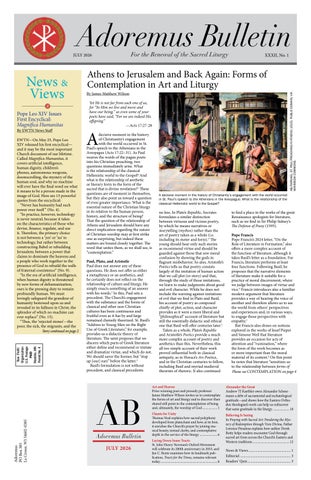
AB/RAPHAEL, ST. PAUL PREACHING IN ATHENS (1515). PUBLIC DOMAIN, VIA WIKIMEDIA COMMONS.
News & Views
XXXII, No. 1
Yet He is not far from each one of us, for “In Him we live and move and have our being;” as even some of your poets have said, “For we are indeed His offspring.” —Acts 17:27-28
A
decisive moment in the history of Christianity’s engagement with the world occurred in St. Paul’s speech to the Athenians in the Areopagus (Acts 17:22–31). As Paul weaves the words of the pagan poets into his Christian preaching, two questions immediately arise. What is the relationship of the classical Hellenistic world to the Gospel? And what is the relationship of aesthetic or literary form to the form of the sacred that is divine revelation?1 These questions are of moment in themselves, but they also point us toward a question of even greater importance. What is the essential nature of the Christian liturgy in its relation to the human person, history, and the structure of being? That the question of the relationship of Athens and Jerusalem should have any direct implication regarding the nature of Christian worship may at first strike one as surprising, but indeed these matters are bound closely together. The word that unites them, as we shall see, is “contemplation.” Paul, Plato, and Aristotle Paul does not answer any of these questions. He does not offer us either a metaphysics or an aesthetics, and he certainly does not reflect on the relationship of culture and liturgy. He simply enacts something of an answer with his words.2 In this, Paul sets a precedent. The Church’s engagement with the substance and the forms of classical and other non-Christian cultures has been continuous and fruitful even as it has by and large remained clumsily theorized. St. Basil’s “Address to Young Men on the Right Use of Greek Literature,” for example, provides us a didactic theory of literature. The saint proposes that we discern which parts of Greek literature either define and recommend or imitate and dramatize virtue, and which do not. We should savor the former, but “stop up [our] ears” before the latter.3 Basil’s formulation is not without precedent, and classical precedents
AB
Adoremus Bulletin JULY 2026
A decisive moment in the history of Christianity’s engagement with the world occurred in St. Paul’s speech to the Athenians in the Areopagus: What is the relationship of the classical Hellenistic world to the Gospel?
no less. In Plato’s Republic, Socrates formulates a similar distinction between virtuous and vicious poetry, by which he means narratives or storytelling (mythos) rather than the art of poetry taken as a whole (i.e. including its meter and form).4 The young should hear only such stories as recommend virtue and should be guarded against those that sow moral confusion by showing the gods in flagrant misbehavior. So also, Aristotle’s Poetics tells us that poetry consists largely of the imitation of human action that we call plot (or story) and that, through the study of those imitations, we learn to make judgments about good and evil character. While he does not include the warning against imitations of evil that we find in Plato and Basil, his account of poetry as composed chiefly of plot, action, and character provides as it were a more liberal and “philosophical” account of literature but still the essentially didactic and ethical one that Basil will offer centuries later.5 Taken as a whole, Plato’s Republic and Aristotle’s Poetics provide a much more complex account of poetry and aesthetics than this. Nevertheless, this all too simple account of their work proved influential both in classical antiquity, as in Horace’s Ars Poetica, and in the Christian centuries to follow, including Basil and myriad medieval theorists of rhetoric. It also continued
Art and Heaven Prize-winning poet and prosody professor James Matthew Wilson invites us to contemplate the forms of art and liturgy and to discover their shared still point in the contemplation of being and, ultimately, the worship of God.................... 1 Chants for Unity Thomas Neal explains how sacred polyphony developed from plainchant and how, at its best, it enriches the Church’s prayer by joining musical beauty, textual clarity, and contemplative depth in the service of the liturgy....................... 6 Laying Down Some Tracts St. John Henry Newman’s Oxford Movement will celebrate its 200th anniversary in 2033, and Jan C. Bentz examines how its landmark publication, Tracts for the Times, remains relevant today........................................................................ 8
to find a place in the works of the great Renaissance apologists for literature, such as we find in Sir Philip Sidney’s The Defense of Poesy (1595). Pope Francis Pope Francis’s 2024 letter, “On the Role of Literature in Formation,” also offers a more complex account of the function of literature, although it takes Basil’s letter as a foundation. For Francis, literature performs at least four functions. Following Basil, he proposes that the narrative elements of literature make it suitable for a practice of moral discernment, where we judge between images of virtue and vice.6 Francis introduces also a familiar modern argument that literature provides a way of hearing the voice of another and therefore allows us to see the world from others’ perspectives and experiences and, in various ways, to engage those perspectives with empathy.7 But Francis also draws on notions explored in the works of Josef Pieper and Simone Weil that literature provides an occasion for acts of attention and “rumination,” where the form of the work becomes as or more important than the moral material of its content.8 On this point he notes that literature “sensitizes us to the relationship between forms of Please see CONTEMPLATION on page 4 Alexander the Great Andrew TJ Kaethler owes Alexander Schmemann a debt of sacramental and eschatological gratitude—and shows how the Eastern Orthodox theologian’s work can help us rediscover that same gratitude in the liturgy......................10 Believing Is Seeing In Praying with Sacred Art: Pondering the Mystery of Redemption through Visio Divina, Father Lorenzo Penalosa explains how author Derek Rotty helps readers encounter God through sacred art from across the Church’s Eastern and Western traditions...............................................12 News & Views................................................. 1 Editorial........................................................... 3 Readers’ Quiz.................................................. 3