Adoremus Bulletin
SEPTEMBER 2026
Vatican to German Bishops: No Lay Homilies at Mass By Victoria Cardiel
Adoremus PO Box 385 La Crosse, WI 54602-0385
Non- Profit Organization U.S. Postage PAID Madelia, MN Permit No. 4
EWTN—The Vatican has rejected a request by the German Bishops’ Conference to allow lay faithful, in exceptional circumstances, to preach the homily during the celebration of the Eucharist. The Dicastery for Divine Worship and the Discipline of the Sacraments communicated the decision in a letter dated June 17 addressed to Bishop Heiner Wilmer, president of the German Bishops’ Conference. In the letter, released by the Vatican on June 23, the dicastery said it is “not possible to grant the indult requested” on March 30, which would have allowed a duly designated layperson to preach in place of the homily. Although the dicastery—which oversees most matters related to the Catholic Church’s liturgy and the ritual of the sacraments—expressed appreciation for the pastoral motivations behind the request, it emphasized that current norms do not allow for exceptions on this point. “The reservation of the homily to a priest or deacon is not a merely disciplinary norm, but derives from the very nature of the liturgy,” the dicastery said. The letter noted that the homily “constitutes an integral part of the Liturgy of the Word,” is “intrinsically linked to the proclamation of the Gospel,” and “represents an exercise of the munus docendi entrusted to ordained ministers through the sacrament of Holy Orders.” The dicastery also stressed that the “proclamation of the Word within the liturgical celebration is Story continued on page 2
XXXII, No. 2
To See with Clear Vision: Divinization As a Model for Active Participation in the Liturgy
By Father Cassian Edwards, OSB
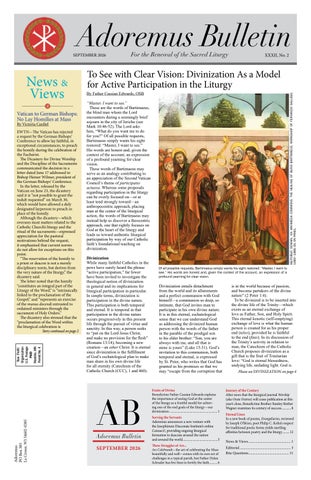
AB/PUBLIC DOMAIN, VIA WIKIMEDIA COMMONS. THE HEALING OF BLIND BARTIMAEUS, WORKSHOP OF FERNANDO GALLEGO, 1480–1488, OIL ON PANEL.
News & Views
For the Renewal of the Sacred Liturgy
“Master, I want to see.” These are the words of Bartimaeus, the blind man whom the Lord encounters during a seemingly brief sojourn in the city of Jericho (see Mark 10:46-52). The Lord asks him, “What do you want me to do for you?” Of all possible requests, Bartimaeus simply wants his sight restored: “Master, I want to see.” His words are honest and, given the context of the account, an expression of a profound yearning for clear vision. These words of Bartimaeus may serve as an analogy contributing to an appreciation of the Second Vatican Council’s theme of participatio actuosa. Whereas some proposals regarding participation in the liturgy can be overly focused on—or at least tend strongly toward—an anthropocentric approach, placing man at the center of the liturgical action, the words of Bartimaeus may instead help us discover a theocentric approach, one that rightly focuses on God at the heart of the liturgy and leads us toward authentic liturgical participation by way of our Catholic faith’s foundational teaching on divinization. Divinization While many faithful Catholics in the pews have surely heard the phrase “active participation,” far fewer have been invited to investigate the theological notion of divinization in general and its implications for liturgical participation in particular. In simple terms, divinization is participation in the divine nature. This participation is both temporal and eternal. It is temporal in that participation in the divine nature occurs progressively in this present life through the pursuit of virtue and sanctity. In this way, a person seeks to “put on the Lord Jesus Christ, and make no provision for the flesh” (Romans 13:14), becoming a new creation—an other Christ. It is eternal since divinization is the fulfillment of God’s eschatological plan to make man share in his own divine life for all eternity (Catechism of the Catholic Church (CCC), 1 and 460).
AB
Adoremus Bulletin SEPTEMBER 2026
Of all possible requests, Bartimaeus simply wants his sight restored: “Master, I want to see.” His words are honest and, given the context of the account, an expression of a profound yearning for clear vision.
Divinization entails detachment from the world and its allurements and a perfect communion with God himself—a communion so deep, so intimate, that God invites man to participate in his own divine nature. It is in this eternal, eschatological sense that we can understand God as addressing the divinized human person with the words of the father in the parable of the prodigal son to his elder brother: “Son, you are always with me, and all that is mine is yours” (Luke 15:31). God’s invitation to this communion, both temporal and eternal, is expressed by St. Peter, who writes that God has granted us his promises so that we may “escape from the corruption that
Fruits of Divine Benedictine Father Cassian Edwards explains the importance of seeing God at the center of the liturgy as a fruitful model for achieving one of the end goals of the liturgy—our divinization............................................................ 1
Serving the Servants Adoremus announces a new venture with the Josephinum Diaconate Institute’s online Connect!, providing ongoing liturgical formation to deacons around the nation and around the world............................................ 3 These Struggles of Ars... Ars Celebrandi—the art of celebrating the Mass beautifully and well—comes with its own set of challenges in a typical parish, but Father Dylan Schrader has five fixes to fortify the faith........... 6
is in the world because of passion, and become partakers of the divine nature” (2 Peter 1:4). To be divinized is to be inserted into the divine life of the Trinity—which exists as an eternal exchange of love as Father, Son, and Holy Spirit. This eternal kenotic (self-emptying) exchange of love is what the human person is created for as his proper end (telos), provided he is faithful to the end (finis). In its discussion of the Trinity’s activity in relation to man, the Catechism of the Catholic Church proposes divinization as a gift that is the fruit of Trinitarian love: “God is eternal blessedness, undying life, unfading light. God is Please see DIVINIZATION on page 4
Journey of the Century After news that the liturgical journal Worship (aka Orate Fratres) will cease publication at this year’s close, Benedictine Brother Stanley Rother Wagner examines its century of success............. 8 Eternal Lines In a new book of poems, Evangeliaries, reviewed by Joseph O'Brien, poet Philip C. Kolin’s respect for traditional poetic forms yields startling affinities between poetry and the liturgy..........12 News & Views................................................. 1 Editorial........................................................... 3 Rite Questions............................................... 11
2
Adoremus Bulletin, September 2026
NEWS & VIEWS
AB/BOHUMIL PETRIK VIA EWTN NEWS
Continued from NEWS & VIEWS
inseparable from the mission received sacramentally and from the unity that links the Word and the Sacrament in the eucharistic celebration.” The letter underlined the need to strengthen the formation of clergy, pointing to “the importance of promoting the ongoing formation of ordained ministers, so that the homily may fully express its pastoral and spiritual efficacy.” Finally, the dicastery recalled that the Church’s current discipline already provides other possibilities for lay faithful to preach. “There are numerous forms of proclamation of the Word and preaching that can be entrusted to the lay faithful outside the homily and outside the celebration of the Eucharist,” the dicastery said, noting that such preaching must always be carried out in accordance with canon law and the proper nature of those forms of announcing the Gospel. This story was first published by ACI Prensa, the Spanish-language sister service of EWTN News. It has been translated and adapted by EWTN News English.
US Bishops Tighten Funeral Policies after Growth of Irregular Practices By Amira Abuzeid
EWTN—Several U.S. bishops in recent months have tightened diocesan funeral policies, emphasizing stricter adherence to the Order of Christian Funerals (OCF) amid evolving popular practices at funerals that depart from Church norms and concern visitations, eulogies, and cremated remains, among others. In a video message and accompanying letter, Bishop Thomas Paprocki’s new rules for the Diocese of Springfield, IL, which went into effect on July 1, address what he described as “irregular practices” and “liturgical anomalies.” Bishop Paprocki explained that his goal is to “ensure that Catholic funerals in our diocese will conform to the norms of the Catholic Church” and maintain the integrity of the three parts of the OCF: the Vigil for the Deceased (the night before the funeral liturgy), the funeral liturgy itself (Mass or liturgy outside Mass), and the Rite of Committal. Among the “anomalies” the bishop addressed and prohibited was the practice of visitations in the church on the day of the funeral liturgy, as the vigil by definition must occur the night before. Priests or deacons will lead vigil prayers even without a public gathering, although family members are strongly encouraged to participate. Families may still gather at the funeral home for the brief prayers of the transfer of the body to the church or to the place of committal, which can be led by a funeral director, parish staff member, or relative if clergy are unavailable. The procession to the church— whether on foot or by motorcade—is important, he said, as it serves as a “reminder of when the deceased person first entered the church” in baptism. Bishop Paprocki said eulogies are not permitted during the funeral rite, but “words of remembrance” are, as long as the words “speak about the faith-life of the one who died and give praise to God.” Eulogies make “the person being praised the main focus of attention,” he wrote, while “the homily and the words of remembrance have God as the primary focus.” Because those speaking at the end of a funeral Mass sometimes say things “that are very inappropriate” or are too overcome with grief, the bishop said all “words of remembrance must be submitted for approval to the pastor… at least three days prior to the funeral. Only the priest or deacon will then read the words of remembrance” at a time other than during or immediately after the funeral rite. Families themselves may offer eulogies or remembrances at other gatherings, such as a meal after the Rite of Committal, provided they do not immediately precede or follow the liturgical rites. On cremation, Bishop Paprocki reaffirmed the Church’s preference for burial of the body while permitting cremation when not chosen to deny the resurrection of the body.
All cremated remains must be interred intact following the Rite of Committal and ordinarily within 30 days. Meanwhile, Bishop David J. Bonnar of Youngstown, OH, issued a decree in October 2025 ending funeral visitations in church buildings effective December 2025. Bishop Bonnar said holding a visitation or viewing in a church compromises the sacred space “by noise and activity unbecoming of the reverence due to the Blessed Sacrament.” His decree created a uniform policy across the diocese, addressing growing requests for in-church visitations driven by convenience and cost. The only exception the bishop permitted is for the funerals of priests or religious, where public visitation in the church or chapel continues as a long-standing tradition. Families may still hold visitations at funeral homes or other appropriate locations. Bishop Robert McManus of Worcester, MA, issued a decree in May reinforcing the intact burial of cremated remains while emphasizing the Church’s preference for bodily burial. “Although cremation is now permitted by the Church, it does not enjoy the same value as burial of the body,” the decree states. “The Church clearly prefers and urges that the body of the deceased be present for the funeral rites since the presence of the human body better expresses the values which the Church affirms in those rites.” “The Church’s teaching in regard to the human body as well as the Church’s preference for burial of the body should be a regular part of catechesis on all levels,” Bishop McManus writes. All of the cremated remains of a body must be interred following the Rite of Committal in a grave, mausoleum, or columbarium, according to the decree. The remains may not be divided and placed in multiple locations or scattered in any location. Neither may they be kept in private homes or placed into jewelry. Interment of cremated remains should not be unduly delayed following the funeral rites. If the Church’s norms concerning cremation are not respected, the bishop says the celebration of public funeral rites may be denied, at the celebrating pastor’s discretion. The decree’s pronouncements are “effective immediately.” In the Diocese of Charlotte, NC, Bishop Michael Martin promulgated the decree “Diocesan Norms for the Governance and Stewardship of Cemeteries and Columbaria” on March 19, the solemnity of St. Joseph, patron of the dying. In a letter accompanying the revisions, Bishop Martin said he was “confident” the new norms would “serve the needs of the faithful as they reverently lay to rest the mortal remains of their loved ones.” The updates set clear eligibility guidelines for interment. While Catholic cemeteries/columbaria are intended primarily for baptized Catholics, the decree states provisions can be made for others, including non-Catholics and even non-Christians. Catholic cemeteries and columbaria are “extensions of the Church’s ministry… not merely functional places of burial” and are “sacred places set aside by the Church for the corporal work of mercy of burying the dead and for providing a final resting place for the faithful departed as a sign of their hope in the promise of resurrection,” the decree states. Consequently, such places must be maintained and used in a way that reflects “reverence for the dead and care for nature.” Burial costs must also remain affordable and accessible. Parishes within the diocese have six months to align local policies with the new norms, while existing contracts will remain in effect. In a March newsletter, the Committee on Divine Worship of the United States Conference of Catholic Bishops announced a revision of the “Prayers after Death,” which occur during the rite of the OCF.
Adoremus Bulletin Society for the Renewal of the Sacred Liturgy PHONE: 608.521.0385 WEBSITE: www.adoremus.org MEMBERSHIP REQUESTS & CHANGE OF ADDRESS: info@adoremus.org INQUIRIES TO THE EDITOR P.O. Box 385 | La Crosse, WI 54602-0385 editor@adoremus.org
According to the committee, the ritual structure, rubrics, and individual elements of the revised prayer are “nearly identical” to the previous edition, “with the exception of the concluding prayers at no. 314” in the Order of Christian Funerals. “These prayers have been retranslated after the pattern of the Roman Missal and according to the principles of Liturgiam Authenticam,” the committee wrote. Liturgiam Authenticam (“Authentic Liturgy”) is a major Vatican instruction issued in 2001 that established precise norms for translating liturgical texts (and Scripture for liturgical use) from the official Latin editions into modern languages, its core principle being fidelity to the original text.
Results of National Survey on the Order of Christian Funerals
USCCB Committee on Divine Worship, Newsletter (May 2026). From February to April 2026, the Committee on Divine Worship and the Federation of Diocesan Liturgical Commissions invited bishops, priests, deacons, lay ministers, and pastoral musicians to describe how they minister to the dying and the bereaved. Nearly 1,500 people, representing dioceses across the country, responded to the National Survey on the Order of Christian Funerals (OCF), giving the Committee a clear picture of parish practice today. Encouragingly, most respondents are satisfied with the current OCF. About eight in ten said the Funeral Liturgy’s options for readings and prayers are adequate or more than adequate, and nearly nine in ten said the rites for a deceased child adequately address difficult circumstances, such as the death of a child before Baptism. Large majorities also found the texts for the Rite of Committal, funerals with cremated remains, and Morning and Evening Prayer with mourners to be helpful in their current form. The survey also illustrated how funerals actually unfold in parish life. While the ritual book envisions three connected liturgies—the Vigil for the Deceased, Funeral Liturgy, and Rite of Committal—only about one in 15 respondents said all three are always celebrated for every funeral; most parishes celebrate some combination depending on the family. Vigils are held overwhelmingly in funeral homes rather than the parish church and are usually led by a priest or deacon, with the rosary reported as a common feature of the Vigil. Funeral Masses remain very much the norm nationwide, with the Funeral Liturgy outside Mass used only occasionally. Family involvement emerged as a major theme. Families most often choose the music and readings for a funeral, usually with the help of the parish’s director of music. Roughly six in ten respondents said families request readings other than those the Church provides. The practice of cremation also came into focus. Virtually all respondents said their bishop has approved funerals in the presence of cremated remains (cf. OCF, no. 426b). Timing varies by family: about half of respondents said it depends on the situation, and most of the rest said cremation usually happens before the funeral liturgy, with only a small share saying it happens afterward. When burial of the ashes is delayed, it is usually because a family is waiting for a spouse or other family member to die so the two can be buried together—and in most of these cases, the ashes are kept at home in the meantime. Finally, respondents identified where they would most welcome further formation and guidance. The proper place and composition of eulogies topped the list by a wide margin, followed by a tightly clustered second tier in which roughly half of respondents cited a need for guidance regarding funerals with cremated remains, music, and pastoral care after a tragedy. On the wider cultural landscape, the concerns cited most often were the need for deeper formation in the Christian theology of death and cultural practices that conflict with Church teaching, followed by the scattering of ashes, a perceived decline in requests Please see NEWS & VIEWS on page 5 DIRECTOR: Christopher Carstens EDITOR: Michael Brummond MANAGING EDITOR: Joseph O’Brien CONTENT MANAGER: Jeremy Priest GRAPHIC DESIGNER: Danelle Bjornson OFFICE MANAGER: Elizabeth Gallagher MARKETING AND FUNDRAISING: Eugene Diamond TECHNOLOGY: Zach Tudahl EXECUTIVE COMMITTEE The Rev. Jerry Pokorsky = Helen Hull Hitchcock The Rev. Joseph Fessio, SJ Contents copyright © 2026 by ADOREMUS. All rights reserved.
Adoremus Bulletin, September 2026
Revising Texts, Renewing Vision By Michael Brummond, Editor
AB/BRUMMOND
T
he Church in the United States stands at a significant moment: for the first time in more than 50 years, she will receive a new translation of the Liturgy of the Hours. The first volume of the Second Edition will be available in January 2027, and the new edition may be used beginning on Ash Wednesday, February 10, 2027, and will become obligatory on the First Sunday of Advent, December 3, 2028. This is more than linguistic tinkering or the replacement of one set of books with another. If the Liturgy of the Hours “is truly the voice of the bride addressed to her bridegroom” (Sacrosanctum Concilium [SC], 84), then in this new translation that voice will take on renewed expression as the Church refines the words with which she offers praise. The Second Edition will provide the text through which the Church gives voice to “that hymn which is sung throughout all ages in the halls of heaven” (SC, 83). The words we chant or speak throughout the day will both express our interior lives and shape our hearts and imaginations, conforming us more closely to Christ the Priest. This moment could also become an inflection point—a time of renewal and wider participation in “the greatest honor of Christ’s spouse” (SC, 85). Publishers are printing beautiful new volumes; seminaries and dioceses are placing orders; old books will be set aside and new ones taken in hand. For a time, even those long familiar with the Liturgy of the Hours will find themselves newly attentive to the words they pray and necessarily more intentional in praying them. The transition will serve as a kind of liturgical “speed bump,” causing us to slow down and take a fresh look at a familiar practice. Like a speed bump, some may experience it chiefly as an inconvenience to be overcome and left behind. Yet it also offers an opportunity to refocus our attention and perceive anew what familiarity may have allowed us to overlook. A similar moment occurred in 1975. There was great hope that the reforms to the Liturgy of the Hours, together with its translation into the vernacular, would make it more spiritually fruitful for those obliged to pray it, while also making it more accessible to the laity and thereby more visibly the prayer of the whole Church. Indeed, Sacrosanctum Concilium noted that “the laity, too, are encouraged to recite the divine office, either with the priests, or among themselves, or even individually” (SC, 100).
Let us pray that, 50 years from now, a new generation will look back in astonishment that there was ever a time when young people, families, workers, and the faithful in every state of life did not regularly draw spiritual nourishment from the Liturgy of the Hours celebrated in their parishes and homes.
On this latter point, it seems fair to say that the reforms to the Hours and their translation have not yet borne the abundant fruit once hoped for in the lives of the lay faithful. Half a century later, many lay Catholics remain unfamiliar with the Church’s daily prayer or continue to regard it chiefly as the province of clerics and religious. Likewise, the Second Vatican Council’s call that “the chief hours, especially Vespers, [be] celebrated in common in church on Sundays and the more solemn feasts” (SC, 100) remains, in many places, largely unrealized. In this regard, the reception of the Liturgy of the Hours may be paradigmatic of liturgical reform more generally. Perhaps the lesson is that the reform of liturgical books—even their translation into the vernacular—is not by itself sufficient to deepen true liturgical participation. Such reform may be a good and necessary step, even as knowledgeable people of good will debate the merits of particular changes. But it cannot be the final step. And that brings us back to the present moment, one filled with both promise and challenge. When a generation 50 years from now looks back on 2027, what will it see? The challenge before us is to ensure that this new translation of the Liturgy of the Hours, with all its potential for genuine renewal, does not become merely an exciting and fruitful development for a few while passing largely unnoticed by many.
3
The further step beyond revising our liturgical books is the renewal of our sacramental vision. I contend that enduring and fruitful fidelity to the Liturgy of the Hours—and its wider embrace by the laity—depends upon cultivating a robust theological vision of the realities that lie just beneath the surface of the words printed in those leather-bound volumes. At the level of immediate experience, the Hours can sometimes seem to consist of things like obligation, routine, repetition, rubrical mechanics (“Which ribbon do I turn to now?”), and psalms that feel remote from one’s understanding or present circumstances. It therefore takes sustained attentiveness to perceive, with sacramental vision and the eyes of faith, the deeper spiritual reality of the Liturgy of the Hours: the prayer of Christ and his Body to the Father; the voice of the Bride addressed to the Bridegroom; a foretaste of the song of praise sung for all eternity in heaven; in the psalms, the voice of Christ addressing the Father, the Father speaking with the Son, and the voices of the Church, the apostles, and the martyrs; and an exercise of our priestly office of interceding for the salvation of the whole world. None of this happens automatically. For those obliged by their state in life to pray the Office, as well as for all who pray it regularly, the new translation offers a fitting occasion to study anew and interiorize the theological vision of the General Instruction of the Liturgy of the Hours, or to undertake a prayerful study of the typology of the psalms. The laity, moreover, will most readily discover the Office when they are introduced to it by someone whose own life has been transformed by praying it. This responsibility rests in a particular way with our priests. Yet it is also worth noting that the Church in the United States now possesses, on a scale scarcely imaginable in 1975, a substantial body of permanent deacons well positioned to promote and teach the Liturgy of the Hours and to preside at its regular public celebration. Let us pray that, 50 years from now, a new generation will look back in astonishment that there was ever a time when young people, families, workers, and the faithful in every state of life did not regularly draw spiritual nourishment from the Liturgy of the Hours celebrated in their parishes and homes.
Pontifical College Josephinum and Adoremus Connect in New Ongoing Formation Venture By Joseph O’Brien
T
he primary charism of a deacon in the Catholic Church is service—expressed in his ministry of the Word, in the liturgy, and in charity. Now Adoremus is collaborating with the Josephinum Diaconate Institute (JDI) of the Pontifical College Josephinum (commonly referred to as the Josephinum) in Columbus, OH, to offer a service to these servants of the Church, allowing them to continue their formation as deacons by exploring particular aspects of the diaconal ministry more deeply. Earlier this year, Adoremus provided eight courses on the Mass for the JDI’s newly launched Josephinum Connect!—an ongoing online subscription-based formation program for deacons. Connect! has been offering pre-recorded online courses to deacons since 2025 on a variety of topics of interest to deacons, including courses on addressing suicide, euthanasia, chastity, and conflict resolution. Earlier this year, Connect! also added to its catalogue an eight-part pre-recorded series, “Deacon at the Mass,” taught by Adoremus’s director Christopher Carstens to help deacons better prepare for and understand their role in assisting the priest or bishop during Mass. Adoremus is also producing an additional three courses for Connect! designed to help deacons in their ongoing formation. Two courses will provide content on sacramental celebrations in which deacons exercise a particular liturgical ministry: Baptism and Matrimony. A third course is designed to help deacons better understand and incorporate the Liturgy of the Hours more fruitfully into their lives. Adoremus also plans to develop two courses on the Eucharist for Connect! The JDI was founded in 2007 as part of the Josephinum, a pontifical Roman Catholic seminary.
The Josephinum, the only pontifical seminary in North America, was founded in 1888 and granted the status of a pontifical college in 1892 by Pope Leo XIII. As a pontifical institution, the Josephinum is governed not by a particular diocesan bishop but by the pope himself as represented by the Apostolic Nuncio to the United States. The Josephinum is fully accredited by authoritative secular and ecclesial associations. Fundamentals Deacon Michael Houghton, the project manager of Connect!, told Adoremus that this new online venture is exactly what its name says—a way to connect deacons with the rich treasures of Church teaching. “The whole idea of Connect! is to have postordination continuing education for deacons,” he said, adding that Connect! helps the JDI in its mission to form deacons. “The JDI itself—which is the only one of its kind in the US and perhaps around the world— takes care of pre-ordination formation, and now with Connect! we also have post-ordination formation.” Each course offered through Connect! is non-credit with a running time of approximately an hour, Deacon Houghton told Adoremus. “We try to keep the courses short,” he explained, “and focused on specific topics that are practical to deacons or those interested in becoming deacons.” “If a course goes longer than an hour,” he added, “which was the case for Adoremus’s Deacon at the Mass course, then we’ll break it up into multiple courses.” According to Deacon Houghton, Connect! follows the same model for formation as the Josephinum does for its seminarians and diaconate candidates in the JDI. “At Connect! we approach formation with the fourpillars model,” he said. “We’re not only focusing on intellectual formation, but also on human, spiritual, and pastoral formation.”
Deacon Houghton told Adoremus that the JDI began developing the program with help from a 2021 Pathways grant from Lilly Endowment. Today, the deacon added, Connect! has nearly 700 users with 59 courses in its catalogue—although only for the moment. “We add two or three courses every month,” Deacon Houghton said, explaining that as the project manager he wants to ensure the future of Connect! “Every course we get from Adoremus helps fill our library and increases interest in Connect! It’s almost like Netflix. The more courses we can stream, the more people will become interested in subscribing.” “As we stand today, we are not a money-maker,” he added. “We’re being supported by the JDI but we’re trying to make sure that we can get enough deacons and partner dioceses to work with us, not to make a profit but not to lose money either. I want us to be in a position where we can hold up the mission of JDI and not be a burden to it financially. That’s my role.” Nor could the JDI find a better fit for this role. Deacon Houghton holds degrees in electrical and industrial engineering, and before being ordained a deacon in 2012 for the Archdiocese of Detroit, he worked for 35 years at General Motors (GM), the majority of that time as GM’s Director of Industrial Engineering for North America. “I worked in GM’s manufacturing in four assembly plants and did a lot of work in industrial engineering,” Deacon Houghton told Adoremus. “When I came to the Archdiocese of Detroit, I headed up a parish restructuring project which, in all honesty, drew a lot on my project management skills I’d used at GM. A lot of those same skills come into play here at the JDI as well. A lot of things I learned in my secular career and at the Archdiocese of Detroit, I now use at Connect!” Please see VENTURE on page 10
Adoremus Bulletin, September 2026 AB/LAWRENCE LEW, O.P. ON FLICKR, CC BY-NC-ND 2.0. DETAIL FROM A PAINTING IN THE CATHEDRAL OF SAN CRISTÓBAL DE LA LAGUNA IN TENERIFE, SPAIN.
4
To be divinized is to be inserted into the divine life of the Trinity—which exists as an eternal exchange of love as Father, Son, and Holy Spirit. This eternal kenotic (self-emptying) exchange of love is what the human person is created for as his proper end, provided he is faithful to the end.
Continued from DIVINIZATION, page 1
love: Father, Son, and Holy Spirit. God freely wills to communicate the glory of his blessed life” (CCC, 257, emphasis added). What is more, the Catechism effectively begins its entire work with the theology of divinization in the very first sentence of the very first paragraph: “God, infinitely perfect and blessed in himself, in a plan of sheer goodness freely created man to make him share in his own blessed life” (CCC, 1, emphasis added). It has always been a part of God’s plan to share his divine life with man, to insert the human person into his divine self. The grace of participation in the divine nature is the true end (telos) of man. It is not the destruction of his humanity, nor does it change him into a divine person. Rather, the divinization of man is his complete integration and transformation into a perfect communion with the Living God. Divinization is the intimacy of union with the Trinity not merely by being in relation to the
“ It has always been a part of God’s plan to share his divine life with man, to insert the human person into his divine self.” Godhead, but by becoming deiform through participation. St. Thomas Aquinas writes: “The only-begotten Son of God, wanting to make us sharers in his divinity, assumed our nature, so that he, made man, might make men gods.”1 God’s sharing of himself with man is the supreme gift that God can give the one who has been saved. This sharing finds a powerful manifestation in the Incarnation. Pope Leo XIV recently stated that “through the work of redemption, God not only restored our human dignity as his image, but the One who created us in a wondrous way, has now made us partakers in his divine nature in an even more wondrous way (cf. 2 Peter 1:4).”2 Divinization through Sacramental Life Like a good lover, God, dare we say, cannot wait until the end to share himself with man. Rather, he provides foretastes of the supreme joy of his presence and our participation in it by way of the sacramental life instituted by our incarnate Lord. Thus, both Jesus Christ, the Word made flesh, and the sacraments which he himself instituted for the sake of the Church bear witness to man’s call to divinization. By the Incarnation, Christ takes to himself our human nature and thus is the divine Door through which man can now enter not only into salvation but also into participation in the divine nature—a participation that would be impossible for man without the aid of grace. In the sacraments, we experience even now the pledge of eternal life and divinization: “The fruit of the sacramental life is that the Spirit of adoption makes the faithful partakers in the divine nature by uniting them in a living union with the only Son, the Savior” (CCC, 1129). These reflections regarding the Incarnation and the graces dispensed from the sacraments recall the liturgically favored phrase, the “wonderful exchange,” by which
“ A theocentric approach to liturgical participation is built on vision— seeing the work of God in the liturgical act with the deepest capacities of the heart.” we “come to share in the divinity of Christ who humbled himself to share in our humanity” (Ordo Missae, 24). The Eucharist especially, as the sacramental presence of Jesus Christ our Lord, is a bestowal and a sharing of his divine life with man in the liturgy. For this reason, the reception of this divine life is called Holy Communion—it is a holy union between Christ and the recipient. The Eucharist ignites the faithful recipient with the living flame of love that is God’s own presence: “the renewal in the Eucharist of the covenant between the Lord and man draws the faithful into the compelling love of Christ and sets them on fire” (Sacrosanctum Concilium, 10). To be set on fire by the Eucharist is to receive the purifying and healing flame of God’s love in the heart of Jesus, which has been called the Burning Furnace of Charity. Yes, to be set on fire is to be set ablaze with a sharing of God’s own nature. Scripture repeatedly associates fire with the nature of divinity: in the bush that burned before Moses without being consumed (Exodus 3:1–6); in the preservation of the three young men in Nebuchadnezzar’s fiery furnace, which King Nebuchadnezzar had ordered heated seven times more than usual and in which a fourth figure appeared “like a son of the gods” (Daniel 3); and in John the Baptist’s prophecy that the one greater than he would baptize with the Holy Spirit “and fire” (Matthew 3:11). So does the fire of God’s benevolent love descend upon man in the Incarnation of Christ and in the sacraments to make man like unto God himself, for “as fire transforms into itself everything it touches, so the Holy Spirit transforms into the divine life whatever is subjected to his power” (CCC, 1127). Divinization, then, is above all a work that God accomplishes in man and not man’s grasping after the riches of God’s nature. It is inherently a participation that occurs through invitation. It is a being-done-unto more than a doing. In one sense, divinization begins now through the power of the Holy Spirit working through the sacraments. In another sense, we anticipate the “not-yet” of divinization as we await the final union of our humanity with God’s divinity—a reality assured and realized in the incarnate Christ for the faithful. To See Is to Become In light of the above introduction to divinization, we can now return to the words of blind Bartimaeus and, in communion with other parts of Scripture, distill from them a more mature appreciation for liturgical participation—for true participatio actuosa. “Master, I want to see.” These words strike me deeply and, in light of the theme of divinization, immediately remind me of those words from the First Letter of St. John which weave these strands
into one: “Beloved, we are God’s children now; it does not yet appear what we shall be, but we know that when he appears we shall be like him, for we shall see him as he is” (1 John 3:2, emphasis added). John contrasts the present experience of sonship through Baptism with the eschatological experience of likeness unto God. He also describes the fulfillment of sonship begun in this present life—becoming like God (i.e., participating in his nature)—as the fruit of vision. This miraculous sight, which tradition has described as the beatific vision, is the vehicle by which we will be like God. The implications here for liturgical participation are serious. Failed is the theory that simply “doing more” in the liturgy will yield richer fruits. Reflecting on the tragedy of some post-Vatican II approaches to active participation that place too much emphasis on what man does in the liturgy, Cardinal Francis Arinze once warned against “the extreme of activism.” This activism manifests itself in an exaggerated anthropocentric insistence on “active participation at all costs, in all sorts of ways, by everyone and in all parts of the liturgy if
“ Divinization is above all a work that God accomplishes in man and not man’s grasping after the riches of God’s nature. It is inherently a participation that occurs through invitation. It is a being-done-unto more than a doing.” possible.”3 The passage from St. John above elicits a fresh hermeneutic by which we can appreciate participatio actuosa and the sincere intentions of the Council Fathers—a hermeneutic based on God’s action upon man and man’s active reception of it. This theocentric approach to liturgical participation is built on vision—seeing the work of God in the liturgical act with the deepest capacities of the heart. Just as the gaze of man upon the Godhead in the end days of the eschaton will yield an eternal divinizing likeness to the Divinity by participation, so, in the liturgical act now, the ability to see and sense the work of God—and man’s receptivity to it—is the richer fare by which true participation in the liturgical feast of faith will nourish the soul. By way of analogy, consider: when someone uses his natural vision to look upon a beautiful sunset, the sunset is acting upon the beholder much more than the beholder is acting on the sunset. Certainly, the beholder is “doing something” by beholding, but the beauty of the sunset—its colors, brilliance, and display—acts much more powerfully upon the one who sees. We can appropriate this theme in the liturgy, for example, by seeing the importance of gazing upon the elevated Host after the consecration or looking upon the raised Book of the Gospels as it is carried in procession. The need to “do” is subverted by the power of vision and by the capacity of that which is gazed upon to act upon
Adoremus Bulletin, September 2026
5
AB/LAWRENCE LEW, O.P. ON FLICKR, CC BY-NC 2.0
the beholder. In this way, we can look at everything in the liturgy—words, gestures, and actions—as sacramental mysteries with deeper realities to be experienced behind the veil. To look at the liturgy with such a vision is to look with a sacramental lens, expanding our capacity to see beyond what is physical and to experience the very realities embedded in our liturgical praxis. This vision indeed forges the Church into a true sacramental people as the Mystical Body of Christ. This liturgical disposition, properly focused on what God invites us to participate in rather than chiefly on our own effort to do anything, is the same posture assumed by the Blessed Virgin Mary when she proclaimed to the Archangel Gabriel, “be it done unto me” (Luke 1:38). Her active fiat is the fruit of her awareness that “the Almighty has done great things for me” (Luke 1:49, emphasis added). Just as with the central principle of divinization, so too our participation in the liturgy becomes most active, most actual, as we take on the posture of active receptivity, being acted upon by the actions, gestures, and elements of the sacred liturgy. In this way, the Catechism’s definition of the liturgy becomes our true experience as “the participation of the People of God in the work of God” (CCC, 1069, emphasis added). When we are adequately disposed to enter this most sincere form of liturgical participation, we make the prayer of Bartimaeus our own, with divinization as its foundation and model. To truly, actively, and consciously participate in the liturgy, we must, as with divinization, see God with clear vision. Thus we, too, must say to the Lord, “Master, I want to see.” Father Cassian Edwards is a Benedictine monk and priest at Saint Vincent Archabbey in Latrobe, PA. Originally from New Orleans, he joined the monastery in 2015, professed Solemn Vows in 2019, and was ordained to the priesthood in 2021. He holds a Master of Arts in Liturgy and a Licentiate in Sacred Theology, both from the University of Saint Mary of the Lake, Mundelein, IL.
Continued from NEWS & VIEWS, page 2 for Catholic funerals, and a rise in committal-only services; a smaller but notable share also pointed to newer practices such as human composting. The Committee on Divine Worship is grateful to everyone who took part in this consultation. These responses will directly inform its ongoing work toward a future edition of the OCF, fitted to the pastoral needs of the Church in the United States.
Five Ways to Be a Better Godparent or Confirmation Sponsor By Diego López Colín
EWTN—Being chosen as a godparent or confirmation sponsor entails a commitment to providing spiritual accompaniment to the godchild or candidate, helping that person to grow in his or her faith. This responsibility holds special significance in the sacraments of baptism, Eucharist, and confirmation, which, according to the Catechism of the Catholic Church, “lay the foundations of every Christian life.” In an interview with ACI Prensa, the Spanishlanguage sister service of EWTN News, Mexican priest Father Luis Fernando Valdés, who holds a doctorate in theology from the University of Navarra in Spain, explained that the role of the godparent or sponsor corresponds to a human reality, since “we all need help to achieve life’s lofty goals.” Just as a person receives support to reach academic or professional goals, the priest noted, “the Church, with its centuries-old tradition, establishes this great custom of godparents for the spiritual life as well, because we all require this help.” Based on this reflection, he shared some recommendations for those wishing to better fulfill this mission and strengthen the bond with their godchild or candidate. (Editor’s note: For simplicity’s sake, both will now be referred to as godchild or godparent but includes adults receiving these sacraments.) 1. Know that the godparent’s mission is to help the godchild grow in the faith. Father Valdés said the first step is to understand that being a godparent means “helping one’s godchild receive and cultivate a new life,” a life that is born solely “from the encounter with Christ.”
The need to “do” is subverted by the power of vision and by the capacity of that which is gazed upon to act upon the beholder. In this way, we can look at everything in the liturgy—words, gestures, and actions—as sacramental mysteries with deeper realities to be experienced behind the veil.
“This new life consists in that we are now another Christ, because Jesus has conformed us to his life through the action of the Holy Spirit among us. Like Christ, we are children of God the Father,” he added. Therefore, he continued, the godparent’s goal is to help the godchild grow in that Christian identity. 2. You can’t give what you don’t have. The priest pointed out that “no one gives what he doesn’t have,” emphasizing that “the first task of the one who agrees to be a godparent is his or her own self.” Godparents need to build their lives on the four pillars of the Catechism of the Catholic Church: “doctrine, sacraments, moral life, and life of prayer.” “That is the great task of the godparents: to form themselves and then help their godchildren know these four pillars, which are what will configure them with Christ in the Church,” he stated. Furthermore, he clarified that this formation does not take place solely in a classroom or during catechesis. Often, it is passed on “through ordinary life, get-togethers, conversations, and visits between godparents and their godchildren.” 3. Make the sacraments and prayer part of life. Another piece of advice from the priest is that godparents should strive to be people of the sacraments; that is, they should attend Mass on Sundays and holy days of obligation, go to confession frequently, and “live in a state of grace, leading a Christian life.” He also encouraged godparents to “strive to grow in charity,” seeking to “care for others, attend to the poor, and share their goods.” He added that they need to be “prayerful souls” who entrust their godchildren to God and learn “the Church’s beautiful vocal prayers,” such as the Our Father, the Hail Mary, the Creed, and the rosary. However, he noted that spiritual life should not be limited to traditional
formulas but also entails “engaging in personal prayer, knowing how to converse personally with Christ.” 4. Review how you’re living the faith. Father Valdés acknowledged that being a godparent requires constant commitment; he therefore invited godparents to periodically examine their own spiritual lives and ask themselves whether they are living in accordance with the four pillars of the Christian life. And if the answer is not what was hoped for, he suggested asking these questions: “What must I do? How should I start over? Where should I personally go to receive formation?” 5. Choose godparents who will “share parenthood.” His final piece of advice is addressed to parents. Father Valdés noted that choosing a godparent “is not simply about making it look like the other person is my closest friend”; rather, it is a commitment in which a person “shares their parenthood with a specific purpose.” “When someone chooses a godparent, they are saying to him or her, ‘I have such love for you, and such trust in you, that I am sharing my parenthood with you so that you can help ensure that my child lives out the Christian life,’” Father Valdés explained. This story was first published by ACI Prensa, the Spanish-language sister service of EWTN News. It has been translated and adapted by EWTN News English.
AB/ANTONIO GRAVANTE/SHUTTERSTOCK VIA EWTN NEWS
1. St. Thomas Aquinas, Opusc. 57, 1-4. 2. Pope Leo XIV, Apostolic Letter In unitate fidei (November 23, 2025), 7. 3. Francis Cardinal Arinze, “Active Participation in the Sacred Liturgy,” in Cardinal Reflections: Active Participation and the Liturgy (Chicago: Hillenbrand Books, 2005), 19.
Adoremus Bulletin, September 2026
Ars Celebrandi: Some Contemporary Challenges
AB/LAWRENCE LEW, O.P. ON FLICKR, CC BY-NC-ND 2.0
6
Being able to hear the celebrant, the deacon, and the readers is a major concern of the average parishioner attending a typical parish Mass. This expectation has led many priests to fuss with expensive sound equipment, install hearing-assistive systems, shout through their Masses, and so forth.
By Father Dylan Schrader
T
he typical parish Mass is celebrated using the revised Roman Missal, in the vernacular, out loud, and facing the people. This can create some contemporary challenges for ars celebrandi. Indeed, the struggle with ars celebrandi in the typical parish Mass has led some to suggest alternatives, such as abandoning the revised Roman Missal, returning to Latin, a silent Eucharistic Prayer, and celebrations ad orientem. It is not my intention in this brief essay to argue for or against those suggestions. Instead, I propose something more basic and modest, which is simply to identify some of the difficulties with ars celebrandi at a typical parish Mass and offer a few points for reflection.
“ In the presidential prayers, the priest is speaking to God (not to the people), but he is speaking in the name of the people, who are called upon to listen attentively and to unite themselves inwardly with what the prayers express.” times when the celebrant speaks directly to the congregation, most obviously during the homily. It also expects the Scripture readings to be “listened to reverently by everyone” (General Instruction of the Roman Missal (GIRM), 29). There may further be instructions and explanations given to the congregation during the course of the liturgy, which are naturally meant to be intelligible to them (GIRM, 31). But what about the priest’s prayers?
AB/LAWRENCE LEW, O.P. ON FLICKR, CC BY-NC-ND 2.0
“Father, I Can’t Hear!” Being able to hear the celebrant, the deacon, and the readers is a major concern of the average parishioner attending a typical parish Mass. This expectation has led many priests to fuss with expensive sound equipment, install hearingassistive systems, shout through their Masses, and so forth. Further difficulty arises if the celebrant’s accent differs from that of his parishioners. “I can’t understand him!” is a frequent complaint from Catholics whose parish is served by a missionary priest who has left his homeland to serve them.
Sadly, there are even parishioners who quit coming to Mass when unable to hear or understand because they “don’t get anything out of it.” What does the Roman Missal say about the audibility of the Mass? The Missal envisions
The presidential prayers (including the Eucharistic Prayer, Collect, Prayer over the Offerings, and Prayer after Communion) are “addressed to God by the Priest who presides over the assembly in the person of Christ, in the name of the entire holy people and of all present” (General Instruction of the Roman Missal, 30).
Here there is a distinction between the presidential prayers and the prayers that the priest says in his own name. The presidential prayers (including the Eucharistic Prayer, Collect, Prayer over the Offerings, and Prayer after Communion) are “addressed to God by the Priest who presides over the assembly in the person of Christ, in the name of the entire holy people and of all present” (GIRM, 30). However, despite being addressed to God, the nature of these parts “requires that they be spoken in a loud and clear voice and that everyone listen to them attentively” (GIRM, 32). In these prayers, the priest is speaking to God (not to the people), but he is speaking in the name of the people, who are called upon to listen attentively and to unite themselves inwardly with what the prayers express. In contrast to the presidential prayers, there are moments when the priest “prays only in his own name, asking that he may exercise his ministry with greater attention and devotion. Prayers of this kind, which occur before the reading of the Gospel, at the Preparation of the Gifts, and also before and after the Communion of the Priest, are said quietly” (GIRM, 33). Whereas the Roman Missal of 1962 (and earlier, of course) expected many of the priest’s presidential prayers, notably the Canon, to be said quietly, the revised Roman Missal limits the quiet prayers almost exclusively to the handful of prayers the priest says in his own name. Not long after the promulgation of the revised Roman Missal, Joseph Ratzinger upset some liturgists by calling for a return to praying the Eucharistic Prayer quietly. He repeated this decades later in The Spirit of the Liturgy, where he again offered two basic suggestions: “First, liturgical education ought to aim at making the faithful familiar with the essential meaning and fundamental orientation of the Canon. Secondly,
“ It is important to help the faithful understand the value of their presence at the Eucharistic sacrifice even when they cannot hear or understand every word.” the first words of the various prayers should be said out loud as a kind of cue for the congregation, so that each individual in his silent prayer can take up the intonation and bring the personal into the communal and the communal into the personal.”1 Indeed, the need for more silence at Mass has been a major theme in recent years, including in liturgical documents.2 Therefore, one challenge for contemporary ars celebrandi seems to be that the liturgical norms themselves expect the priest to say quite a bit out loud in a clear voice. The implementation of
Adoremus Bulletin, September 2026 In contrast, when a prayer is addressed to Christ (e.g., “Lord Jesus Christ, who said to your Apostles...”), he might look at the consecrated Host before him. Further, if the celebrant does deliberately make eye contact with the congregation when speaking to them (e.g., “The peace of the Lord be with you always”), this can be a way of distinguishing such greetings, exhortations, and explanations more explicitly from prayers addressed to God. Finally, a possible general focal point when Mass is celebrated facing the people is the altar cross as suggested by Cardinal Ratzinger.3
“ In a certain way, ars celebrandi is
the fruit of humility, including the celebrant’s acceptance of his own weakness.”
As far as facial expressions go, a special challenge arises when there are acoustic struggles. Not only must the celebrant deal with trying to speak loudly enough to be heard, but he probably wants to do so without adopting a facial expression that comes across as angry or off-putting. He may have to consciously monitor his volume, intonation, and expression at the same time. Even when not speaking, his natural resting face
the liturgical books well before the celebration begins. It may take efforts over time in cooperation and consultation with parishioners to help the whole parish pray the Mass better—the celebrant included. Overall, the priest must conform himself to the Church’s expectations of how he prays. The liturgy is not a personal prayer or private devotion. The priest should not reduce his understanding of prayer to his personal feelings in the moment. It may be his third (or fourth) Mass of the day. He may feel that his heart is not in it. It may feel like an empty performance. This is a real danger, and not ideal. But patience is also needed. The action itself is a prayer. His obedient service is a prayer. His attempt to provide for the people and honor God is a prayer. In a certain way, then, ars celebrandi is the fruit of humility, including the celebrant’s acceptance of his own weakness. He may not be everything he thinks he should be or everything every parishioner thinks he should be. But the liturgy is not about that. For the liturgy is primarily the action of Christ, the High Priest. The liturgy’s power comes primarily from Christ: “Every liturgical celebration, because it is an action of Christ the priest and of His Body which is the Church, is a sacred action surpassing all others;
no other action of the Church can equal its efficacy by the same title and to the same degree” (Sacrosanctum Concilium, 7).
AB/LAWRENCE LEW, O.P. ON FLICKR, CC BY-NC-ND 2.0
Ratzinger’s suggestion, for instance, would require official changes to the General Instruction. In the meantime, parishes may consider maximizing silence where already envisioned by the liturgical norms (GIRM, 45). Further, the celebrant could opt for a silent Preparation of the Gifts (cf. Order of Mass, 23, 25) and adopt an overall slower pace. Finally, it is also important to help the faithful understand the value of their presence at the Eucharistic sacrifice even when they cannot hear or understand every word. As for relying on technology to help the priest better communicate his words to his congregation, this too comes with its own set of challenges. For instance, when it comes to sound systems, a careful cost-benefit analysis is needed. If the priest wears a wireless microphone, he takes on the burden of low batteries, fumbling for the on/off switch, no ability to adjust the microphone’s relative position during the celebration, and having a device strapped to him that impedes graceful gestures and movements. If the priest serves multiple parishes, as many do, each church may have a completely different sound system to deal with. All of this can distract him and negatively impact his ars celebrandi. Rather than focusing on the prayers he is saying, the celebrant may be listening for microphone feedback, worrying about static, or taking extra care to enunciate every syllable so that it comes through to the back pew.
7
A possible general focal point when Mass is celebrated facing the people is the altar cross as suggested by Cardinal Ratzinger.
Eye Contact and Facial Expressions When Mass is celebrated facing the people, the challenge of the celebrant’s eye contact and facial expressions also arises. After all, his eyes must either be closed or else looking at something and his face must be in some position, and it will all be visible to the congregation. Whereas the Roman Missal of 1962 had instructed the celebrant to keep his eyes downcast, even when addressing the congregation with Dominus vobiscum (e.g., Ritus servandus, V.1), the post-conciliar Missal specifies nothing about the eyes (with the exception of the rubric that the celebrant raises his eyes at the relevant words during the Roman Canon). Leaving aside preaching, listening to the readings, processing, and so forth, what should the priest do with his eyes during the presidential prayers when Mass is celebrated facing the people? Obviously, the celebrant has to look at the Roman Missal in order to read from it. Beyond that, the celebrant might consider looking upward as he begins a prayer (e.g., during the silence after saying, “Let us pray”) to signal that he is addressing God. Or, for prayers he has memorized, such as the Lord’s Prayer, the celebrant might look upward throughout the entire prayer as he addresses the Father together with the congregation.
may come across to some people as too serious, unfriendly, etc. Worrying about all this can make it harder for both priest and people to pray. Humble and Faithful Practically speaking, what can the priest do? He may find it helpful to think explicitly about the issues raised in this brief essay and others he has encountered. This could include watching video recordings of various kinds of Masses celebrated by him (e.g., Sunday, a funeral Mass, a wedding Mass). He may consider asking parishioners for feedback. None of this is to suggest that he should consider his role to be like that of a performer or game show host. Not at all. It is simply so that he can reflect more deeply on ars celebrandi and possibly get better in touch with what the celebration may look like from the congregation’s perspective. The priest who finds it difficult to pray the Mass because of the practical considerations he has to juggle (flipping pages, volume, sound system, remembering little exceptions, announcements, etc.) may find it helpful to invite the Lord into his struggle. What small, practical steps can he take to be better recollected? Perhaps he may start by incrementing silence before Mass and at key points during it. Perhaps he can find someone to manage the announcements for him. Perhaps he can mark
The ordained priest and the baptized participate in Christ’s singular action. The subordinate and derivative character of this participation is concretely expressed by faithfulness to the ritual itself rather than relying merely on personal feelings or preferences. “The primary way to foster the participation of the People of God in the sacred rite is the proper celebration of the rite itself. The ars celebrandi is the best way to ensure their actuosa participatio” (Sacramentum Caritatis, 38). It is in this light that contemporary challenges for ars celebrandi should be addressed. Father Dylan Schrader is a priest of the Diocese of Jefferson City, MO. He holds a PhD in systematic theology from the Catholic University of America, Washington, D.C., and has authored various articles on liturgy, theology, and the Latin language. His books include A Thomistic Christocentrism and Mary, Mother of God’s Word Made Flesh, as well as translations of several scholastic works. 1. Joseph Ratzinger, The Spirit of the Liturgy, trans. John Saward (San Francisco: Ignatius Press, 2000), 215. 2. GIRM, 45; John Paul II, Spiritus et Sponsa, 13; Benedict XVI, Sacramentum Caritatis, 40, 50, 55. 3. Ratzinger, Spirit of the Liturgy, 83–84.
8
Adoremus Bulletin, September 2026
A Sympathetic Understanding: Liturgical Renewal, Adaptation, and the Legacy of Worship
By Br. Stanley Rother Wagner, OSB
A Personal Note From the moment I began reading Orate Fratres— Worship articles as an undergraduate and later in graduate school, I became engrossed in the connections between liturgical action and social action. Benedictine Father Virgil Michel, the founding editor of Orate Fratres and father of the American Liturgical Movement, wrote extensively about integrating each person’s grace-filled participation in the Church’s liturgical action with society’s persistent need for grace-filled social action. With the onset of the Great Depression, Michel knew his place in history and proposed a remedy. He preached a formative and informative message that appealed to a broad audience. Pneumonia prematurely ended his life in 1938, yet the work of liturgical and societal renewal continued, thanks to the talented people who had worked alongside him and who, following his example, took up the work (and prayer) for which he diligently labored. And the work continues to this day. I still look to these dense but masterful essays on liturgical and societal renewal, not merely for superb spiritual matter and practical insights, but for hope. What I first read in 2009 could not be timelier now as we approach the end of the third decade of the 21st century. Orate Fratres before Vatican II To preach a message that was sympathetic and engaging yet neither dry nor academic, Michel recruited several people to assist him in bringing the riches of the European Liturgical Movement to a popular American audience.5 The liturgical think tank that Michel assembled included priests,
AB/ARCHIVE.ORG (PUBLIC DOMAIN); BRUMMOND
O
In 1951, the editors changed the journal’s name from Orate Fratres to Worship as an indication of its commitment to liturgical renewal.
monks, laymen, scholars, professors, theologians, a nun, and a musician.6 Michel knew the value of complementing scholarly perspectives with the practicalities of parochial life, though Michel addressed neither a narrow scholarly elite nor an undifferentiated mass audience, but each concrete person. With Michel’s distinct brand of personalism guiding his liturgical apostolate,7 the stock market crash of October 1929 and the ensuing Great Depression proved fertile soil for reminding the members of the Mystical Body of the duties attached to their baptismal promises, both inside and outside of worshiping in a church building.
“W orship’s lasting gift to the Church is its advancement of a personal, sympathetic understanding of the liturgy: one that formed each person in the Church’s worship, so that one’s liturgical participation might become a participation in the ongoing history of salvation.” Contributors submitted analytical and academic articles, shared homilies for certain feast days, and answered pastoral questions—such as H.A. Reinhold’s answers in “Timely Tracts.” The piety that the editors of Orate Fratres encouraged among their readers was simple on the surface, yet beneath it lay the spiritual riches of the Church’s liturgical life. Reflections about praying the Divine Office (Liturgy of the Hours) appeared alongside wisdom from the Catholic Worker Movement and Catholic Action.8 Following Michel’s death in 1938, the editors of Orate Fratres had a personal, people-oriented roadmap rather than a merely ritual one. Under the aegis of Benedictine Father Godfrey Diekmann, Michel’s associate and then successor as editor, Orate Fratres continued to be the American voice of the European Liturgical Movement. Several articles commented on Pope Pius XII’s encyclicals Mystici Corporis (1943) and Mediator Dei (1947), highlighting how both reiterated the personal, communal, and ecclesial nature of Christ’s Mystical Body on earth. Orate Fratres also expanded its outreach, entered into partnerships with organizations such as the Benedictine Liturgical Conference, and hosted the National Liturgical Weeks.9 Diekmann was a worthy successor to Michel, yet he left his own distinctive mark on the publication during his 25-year tenure (1938-1963), thus adjusting the trajectory that Michel had charted without changing the aim. Diekmann increased the number of scholarly articles on sacramental theology and liturgical history, while also enlarging the subscriber base.
AB/PUBLIC DOMAIN VIA WIKIMEDIA COMMONS
n the first Sunday of Advent in 1926, the monks of St. John’s Abbey, Collegeville, MN, began an apostolate that intended to awaken “a sympathetic understanding on the part of the general faithful.” This sympathetic understanding formed Catholics (mostly laity, but also clergy and religious) to participate more fully in the Church’s liturgical life, an understanding that “seizes upon the entire person, touching not only intellect but also will, heart as well as mind.”1 As part of this project, they launched a journal and the editorial board named its publication Orate Fratres, Latin for “Pray, brethren,” taken from the Offertory (Preparation of the Gifts) of the Mass. The journal’s title communicated the editors’ purpose: “We hope that the interest aroused in the liturgy will be primarily spiritual; that the liturgy may be recognized more universally as being what Pius X so happily called it… the primary and indispensable source of the true Christian spirit.”2 The editors closed their foreword with their eyes fixed on the future: “No human tongue can tell what are our prospects of success.”3 With a century of hindsight, and in light of Liturgical Press’s decision to cease publication of Worship at the end of 2026, now is a fitting time to reflect on the contributions Worship made to the fields of liturgical studies and pastoral theology, to name but two. No human tongue could have told of the impact that Orate Fratres—renamed Worship in 1951—would have on the life of the Church, especially in the United States. Worship’s lasting gift to the Church is its advancement of a personal, sympathetic understanding of the liturgy: one that formed each person in the Church’s worship, so that one’s liturgical participation might become a participation in the ongoing history of salvation. Throughout its run, the aim of Worship was truly sympathetic: constantly forming individuals to understand how actual participation in the liturgy could “affect the actual life of the Catholic,”4 thereby enabling grace to transform each person to be Christ for others and to see Christ in one’s neighbor. What began in the 1920s as a popular journal for promoting a renewed Catholic liturgical piety became, by the 1960s, a center for cutting-edge theology, art, culture, social action, and spiritual wisdom, and eventually developed into an academic journal whose scope was ecumenical and whose opinions could be, at times, provocative. The enduring legacy of Worship is one of humbly responding and adapting to the needs of the Church in every age.
Virgil Michel, OSB, the founding editor of Orate Fratres and father of the American Liturgical Movement, wrote extensively about integrating each person’s grace-filled participation in the Church’s liturgical action with society’s persistent need for grace-filled social action.
He recruited prominent liturgical commentators to write for Orate Fratres and, like Michel, served as a conduit for the ideas of the Liturgical Movement that flowed from Europe.10 In 1951, the editors changed the journal’s name from Orate Fratres to Worship as another indication of its commitment to liturgical renewal. “The change reflected the strong commitment of the editorial staff to the use of the vernacular in the liturgy so that all could participate actively and intelligently in the celebration of the liturgy.”11 The pioneers of the Liturgical Movement had at times advocated for a greater use of the vernacular in the liturgy to enable fuller participation.12 Changing the journal’s name signaled an evolution in the goals of the Liturgical Movement—what began under Michel and his call for increased participation in the liturgy took its next step by seeking the use of more of the vernacular in the liturgy.13 Even before Vatican II made aggiornamento a central ecclesial concern,14 Diekmann saw that Worship had evolved from a pious and popular periodical into a respected journal. If Worship intended to maintain its reputation, however, it needed to continue adapting to changing demands in the Church. In a 1960 letter to Frederick McManus, Diekmann confessed that the journal “received criticism recently that we were departing from pastoral subjects and going into general academic fields too much.” He had the humility to add, “and
Adoremus Bulletin, September 2026 I believe there is justice to the criticism.”15 Seven years later, Diekmann reminded people of the work that had been accomplished, and how Sacrosanctum Concilium—the Constitution on the Sacred Liturgy (1963)—was a vindication of the renewal that the pioneers of the Liturgical Movement had achieved up to that point. The constitution was “not treating merely of ritual reforms, of the use of the vernacular, or of the altar facing the people.” Rather, he declared that the constitution’s first chapter alone was historically momentous. “It initiated a reorientation of theology which very likely is the outstanding achievement of Vatican II.”16 In other words, Diekmann believed that as the world changes, so must the Church continue to grow and adapt itself and its public worship in light of the contemporary needs of women and men; and if the Church continues to grow and adapt, so must Worship. Beginning in 1963, the editorship passed from Diekmann to Benedictine Father Michael Marx; Benedictine Father Aelred Tegels joined the editorial staff the following year.17 Diekmann’s words proved to be prophetic for the course of the journal. Worship after Vatican II After the close of Vatican II, as the Church entered a period of liturgical experimentation, Worship continued to cultivate in its readers a sympathetic understanding of the liturgy. As the demand for creativity in the liturgy grew into the 1970s, more liturgy-themed publications began to appear. In Tegels’s words, “Worship could no longer be regarded as the organ of the liturgical movement.”18 Worship recognized its origins and built on its tradition but sought to do so without allowing that tradition to become ossified. Marx and Tegels understood Virgil Michel’s aims and original vision, though they were also acutely aware of their contemporary context and the changing periodical landscape. “Since it would be assumed that new periodicals would, for the most part, take a concretely pastoral approach to problems of liturgical renewal, we concluded that Worship could serve the cause most effectively by concentrating largely on a basically theoretical—yet pastorally very concerned—approach to the problems of renewal, thus becoming, in some measure, the more scholarly review that Dom Virgil had foreseen.”19 Instead of competing to be one of several publications dedicated to the liturgy, Marx and Tegels moved Worship in the direction of being a leading peer-reviewed academic journal within the field of liturgical studies. In shifting away from the more “popular” aspects of the journal and toward a more specialized focus, Worship became the academic
and theoretical voice of the post-conciliar liturgical renewal. Like Diekmann before them, Marx and Tegels responded to contemporary trends by soliciting articles on the connections between liturgy and various academic disciplines, particularly the social sciences, which were experiencing rapid growth in the mid-20th century. The editors also entered into dialogue with members of other Christian communities. Worship sought to respond to the changing needs and shifting tastes of that era, as the publication had always done.
“T he piety that the editors of Orate Fratres encouraged among their readers was simple on the surface, yet beneath it lay the spiritual riches of the Church’s liturgical life.” A Century of Success One hundred years ago, the editors of Orate Fratres admitted to their readers that no one could predict the success of their new venture. From the first issue, the aim of Orate Fratres was to promote “a sympathetic understanding on the part of the general faithful” of the Church’s liturgical life. Virgil Michel spurred his readers to allow grace to transform them in the liturgy and then to go into the world to be “little Christs.” As the work of liturgical renewal progressed in Europe, the journal became the publishing organ for the American branch of the Liturgical Movement. After Michel’s death, Godfrey Diekmann carried on the work of liturgical and societal renewal, entering into partnerships and hosting conferences, though Diekmann also contributed his gifts and ideas to shaping the journal, so much so that the journal changed its name to Worship during his editorship. Changing the original Latin title to an English title was a bold statement, one that established Worship as a reform-oriented publication. As the Church entered into dialogue with the world after Vatican II, Worship—with Marx and Tegels at the helm—again responded to contemporary needs and trends, and became the premier peer-reviewed academic journal for liturgical studies. Throughout the last 100 years, Orate Fratres/Worship has consistently attempted to respond to the needs of the Church by promoting liturgical renewal. Rather than viewing the final issue of Worship simply as an
end, let us focus on the realization of the original
9
aim of the editors of Orate Fratres: a century of cultivating a sympathetic understanding of the liturgy, one that forms love for Christ and neighbor rather than an attachment to mere external ritual accoutrements. According to that measure, it has been a genuine success. Br. Stanley Rother Wagner, OSB, is a Benedictine monk of Saint Meinrad Archabbey in southern Indiana, where he currently serves as the archivist. He holds a BA in history from Quincy University, Quincy, IL; an MA in liturgical studies from the Liturgical Institute at the University of Saint Mary of the Lake, Mundelein, IL; an MA in theology from Saint Meinrad Seminary and School of Theology; and an MA in American history from the University of Louisville, KY. His previous articles and essays have appeared in American Benedictine Review, Church Life Journal, and Pray Tell Blog. 1. The Editors, “Foreword,” Orate Fratres 1, no. 1 (Nov. 1926): 2-3. 2. The Editors, “Foreword,” 1-2. 3. The Editors, “Foreword,” 4. 4. The Editors, “Foreword,” 1. 5. Aelred Tegels, “Fifty Years of Worship,” Worship 50, no. 6 (Nov. 1976): 467. 6. Katherine E. Harmon, There Were Also Many Women There: Lay Women in the Liturgical Movement in the United States, 1926-59 (Collegeville, MN: Liturgical Press, 2012), 60-61. 7. Jonas Norgaard Mortensen, The Common Good: An Introduction to Personalism (Wilmington, DE: Vernon Press, 2019), 29. 8. Joel Rippinger, The Benedictine Order in the United States: An Interpretive History (Collegeville, MN: Liturgical Press, 1990), 187-188. 9. William Busch, “Past, Present, and Future,” Orate Fratres 25, no. 11 (Nov. 1951): 483. See also Jerome Oetgen, Schools for the Lord’s Service: A History of the American-Cassinese Congregation of Benedictine Monasteries 1855–2023 (Collegeville, MN: Liturgical Press, 2024), 286; Keith F. Pecklers, The Unread Vision: The Liturgical Movement in the United States of America, 1926-1955 (Collegeville, MN: Liturgical Press, 1998), 208-210. 10. Kathleen Hughes, The Monk’s Tale: A Biography of Godfrey Diekmann, O.S.B. (Collegeville, MN: Liturgical Press, 1991), 115-116. 11. R. Kevin Seasoltz, “Seventy-fifth Anniversary of Worship,” Worship 75, no. 1 (Nov. 2001): 3. 12. Pecklers, The Unread Vision, 63-70. 13. Seasoltz, “Seventy-fifth Anniversary of Worship,” 3. 14. J ohn W. O’Malley, What Happened at Vatican II (Cambridge, MA: Belknap, 2010), 37-38. 15. Q uoted in Hughes, The Monk’s Tale, 169. 16. G odfrey Diekmann, “The Reform of the Catholic Liturgy: Are We Too Late?” Worship 41, no. 3 (Mar. 1967): 142-143. 17. D iekmann’s assignment as a peritus at Vatican II demanded increasingly more of his attention. “Michael Marx,” Liturgical Pioneers/ Pastoral Musicians and Liturgists, accessed July 21, 2026, https:// liturgicalleaders.blogspot.com/2008/09/michael-marx.html. 18. Tegels, “Fifty Years of Worship,” 470 (emphasis in original). 19. Tegels, “Fifty Years of Worship,” 470.
AB/PUBLIC DOMAIN VIA WIKIMEDIA COMMONS
“W orship recognized its origins and built on its tradition but sought to do so without allowing that tradition to become ossified.”
On the first Sunday of Advent in 1926, the monks of St. John’s Abbey, Collegeville, MN, began an apostolate that intended to awaken “a sympathetic understanding on the part of the general faithful.”
10
Adoremus Bulletin, September 2026
AB/JOSEPHINUM DIACONATE INSTITUTE
Continued from VENTURE, page 3 Parallel Lines Meet The partnership between Adoremus and the Josephinum is not all that surprising, as Adoremus’s director Christopher Carstens explained that, since the JDI and Adoremus were running along parallel lines regarding their strong commitment to liturgical formation, the partnership with the JDI seemed almost inevitable. “Both the JDI and Adoremus have been working in the same arena for some time, namely, the ongoing formation of clergy in the sacred liturgy,” he said. “It was only a matter of time, then, that our apostolates crossed paths and collaboration began.” According to Carstens, Adoremus first came to the attention of the JDI through its executive director, Deacon Matt Coriale, who realized that he had a future partner in the Connect! endeavor—literally at his fingertips. “My initial contact was with Deacon Coriale, who has also been an Adoremus reader over the years,” Carstens said. “The JDI was looking to provide liturgical, sacramental, and ritual content for the “As a result of this course,” Connect! program manager ongoing formation of permanent deacons, and Karen Steffan said, “many participants have shared with Adoremus was looking for still more means to reach us that they will study the Roman Missal and the Lectionclergy desirous of celebrating the liturgy well and ary more diligently to have a better understanding of them, beautifully. It was thus easy for Adoremus and JDI to so they can provide better service to their parishioners during the liturgy.” begin our work together.” As part of Adoremus’s and the JDI’s shared mission to bring clergy to a deeper understanding and love for Connect! offers subscription services to individual the liturgy, Carstens noted that, like Adoremus, the deacons (laity, deacon candidates, and other clergy JDI was intentional in guiding its liturgical formation can also subscribe) and to dioceses, Deacon Houghton of deacons through the official liturgical texts—a said. feature which would also help guide the creation of the “Individuals may purchase single courses directly Connect! courses. online,” he said. “More commonly, however, deacons “Each of the Connect! course offerings stems from or dioceses will pay for an annual subscription, which the actual liturgical books,” Carstens explained, “the means that deacons can watch any and all courses as texts that deacons use regularly in their ministry: the many times as they wish.” Roman Missal, the Liturgy of the Hours, the Order Individual subscriptions cost $144, but “fairly of Celebrating Matrimony, etc. Each begins with a substantial” discounts are available, Deacon Houghton theological grounding of the sacramental rite, and said. “We give discounts to any diocese that the then—taking the lead of the ritual itself—guides United States Conference of Catholic Bishops deems a deacons through the celebration so that they can lead missionary diocese and any diocese which sends men or participate in a way that is intelligent, reverent, and wholly informed by the Church.” “ Like Adoremus, the Josephinum Deacon Houghton concurred, noting that “deacons Diaconate Institute is intentional also need to know the theology behind the liturgy. Don’t just read the words but understand them. That’s in guiding its liturgical formation why we’ll continue to reach out to Adoremus for courses. When you find someone good and reliable of deacons through the official and easy to work with, you tend to go back to them.”
liturgical texts.”
to the JDI. When the day is done you can reduce the original cost for a subscription by about two-thirds, depending on particular factors such as the number of men a diocese wishes to enroll in Connect!” Deacons Respond According to Connect! program manager Karen Steffan, deacons who took Carstens’s eight-part course series “Deacon at the Mass” found three aspects of the course content particularly useful—the theology of the Eucharist, the theology of the Word, and the theology of the Mass itself. Connect! received anonymous feedback from those who took the course, Steffan said, which is helping the Connect! team gauge the success of the course. She summarized these comments for Adoremus.
“ Post-ordination formation can build upon, inform, and deepen the ritual knowledge that deacons have already gained—the program is unique insofar as it works well with the first-hand leadership already experienced.” between God and us. “Participants expressed the notion that the readings are not merely ‘words,’” Steffan told Adoremus, “but living words that form one sacred act with the Liturgy of the Eucharist.” As for the theology of the Mass itself, Steffan noted, participants expressed the common sentiment that “as a deacon, this course will help me deepen my prayer life on the altar and help me to educate my parishioners so they can fully understand Who they are receiving. I will take Ite, missa est—go forth and make Christ’s love present in the world—more seriously and share this with my parishioners as well. This course has also expanded my perspective of the Mass and my role as deacon in shepherding the faithful.” Another aspect of “Deacon at the Mass” that impressed participants, Steffan said, was the way in which it drew them into a deeper understanding of the Lectionary and, through it, of their service at the altar, particularly when they are called upon to proclaim the Gospel during Mass. “As a result of this course,” Steffan said, “many participants have shared with us that they will study the Roman Missal and the Lectionary more diligently to have a better understanding of them, so they can provide better service to their parishioners during the liturgy. Because of this course, these deacons seem to have a renewed desire to serve the faithful. They will seek—and help others to seek—a deeper reverence for the Liturgy of the Word and the Liturgy of the Eucharist.” For more information about Connect! or to view its catalogue of courses, scan the QR code and enter your first and last name. Joseph O’Brien is Managing Editor of Adoremus Bulletin.
QR Code
AB/JOSEPHINUM DIACONATE INSTITUTE
Deacons and Dioceses Deacon Houghton said that the eight-part “Deacon at the Mass” has been particularly helpful to deacons who see a need for renewing their understanding of the Mass. But the other courses which Adoremus is producing will also be helpful to many deacons who may need renewed formation in the sacramental rites in which they minister. “Deacons are different from priests,” he said. “When we receive an assignment at a parish, the pastor may or may not have us do baptisms or marriages. It depends on the pastor’s interests. You can have a deacon ordained five to ten years who has never done a baptism. It wasn’t that he wasn’t trained or formed in it, but it’s been a while. But then, say a new pastor is appointed to a particular parish—the deacon in that parish may need to do baptisms. What can we do to help him get up to speed? That’s where these courses will be helpful. Don’t take the liturgical book and just wing it! We can all try to do that! But let’s get some formal training on it.” Because the Connect! courses are online and easily accessible, Carstens said, this new endeavor will have not only national but also global scope. “One of the benefits of an online program is that deacons around the country or the world can benefit from these courses,” he said. “An entirely online experience would be less than ideal for those in formation for ordination. But since these men have already had pre-ordination formation, the JDI offerings are more suitable for their circumstances. Indeed, this post-ordination formation can build upon, inform, and deepen the ritual knowledge that deacons have already gained—the program is unique insofar as it works well with the first-hand leadership already experienced.” Deacon Houghton told Adoremus that the online feature of Connect! also helps serve deacons and dioceses who may not otherwise have access to ongoing formation. “A number of dioceses around the country do not have qualified teachers or seminaries near them to do the training they need,” Deacon Houghton said. “We want these men to get good-quality education from the Church which is in line with Church teaching and we want it to be professional. Online courses give them an opportunity to understand what intellectual formation of a deacon is all about.”
Regarding the theology of the Eucharist, Steffan said, the responses could be best summed up as an appreciation for “the bigger picture of the Mass” and “a deeper appreciation and contemplation of the Eucharist.” Many deacons, she added, also found in the course a helpful reminder that, as a deacon at the Mass, each can say, “I am at the foot of the Cross during the celebration of the Eucharist.” Likewise, when it came to the theology of the Word, Steffan noted, many participants found the course content helped them see true worship as a dialogue
Each Connect! course begins with a theological grounding of the sacramental rite, and then—taking the lead of the ritual itself—guides deacons through the celebration so that they can lead or participate in a way that is intelligent, reverent, and wholly informed by the Church.
Adoremus Bulletin, September 2026
RITE QUESTIONS Q. What is the seal of confession? A. The sacramental seal absolutely forbids a confessor from betraying in any way a penitent regarding what has been disclosed in sacramental confession (see Code of Canon Law [CIC] can. 983 §1). According to a 2021 interview with Cardinal Mauro Piacenza, former Major Penitentiary of the Apostolic Penitentiary, everything said in confession—from the moment the act of worship begins with the sign of the cross until it ends, whether with absolution or with absolution denied—is protected by an absolutely inviolable seal. “All information referred to in confession is ‘sealed’ because it is given to God alone, so it is not usable by the priest confessor” (all otherwise unattributed quotations from Cardinal Piacenza are from “What Is the Seal of Confession? A Q&A,” interview by ACI Stampa, EWTN News, October 15, 2021; cf. CIC can. 983–984). Q. Why does the Church protect the seal so absolutely? A. Cardinal Piacenza states, “The nature of the Sacrament of Reconciliation consists in the personal encounter of the sinner with the Merciful Father. The object of the sacrament is the forgiveness of sins, reconciliation with God and with the Church, and the restoration of filial dignity by virtue of the redemption wrought by Jesus Christ. The safeguard of the sacrament, instituted by Christ to be a sure haven of salvation for all sinners, is accepted.” The current liturgical ritual notes, “The confessor, understanding that, as the minister of God, he has come to know the secret conscience of his brother or sister, is bound by his office to keep the sacramental seal as sacrosanct” (Order of Penance, Introduction, 10d). Q. What information is actually protected by the seal? A. Direct matter protected by the seal includes all mortal and venial sins confessed by the penitent in order to receive absolution. Cardinal Velasio de Paolis succinctly states that the content of the seal includes “all the sins of both the penitent and others known from the penitent’s confession, both mortal and venial, both hidden (occult) and public, as manifested with regard to absolution and therefore known to the confessor by virtue of sacramental knowledge” (Apostolic Penitentiary, Note on the Importance of the Internal Forum and the Inviolability of the Sacramental Seal, no. 1 and note 6). Q. Does the seal protect only confessed sins, or does it also include other information revealed during confession? A. In general, even apparently incidental information— any circumstances, accomplices in sin, the penance imposed, any counsel given, and even the fact that the person went to confession—may be protected when its disclosure could identify the penitent, reveal what occurred in confession, or otherwise burden the penitent. This also includes information regarding third parties not related to the sin. As the Summa Theologiae states, such “matters also must be most carefully hidden, both on account of scandal, and to avoid leading others into sin through their becoming familiar with it” (ST, Suppl., q. 11, a. 2). Q. Does the seal bind the priest even if the confession was invalid, incomplete, or sacrilegious? A. Yes, it is sufficient that the penitent accuses himself with the aim of receiving absolution. Therefore, the seal arises if the absolution is delayed, not given, or invalid. If the priest simulates the sacrament, or attempts the sacrament, or even if the confession ceases before absolution, the seal still binds the confessor. The sacramental seal, therefore, concerns everything the penitent has admitted, even in the event that the confessor does not grant absolution (Apostolic Penitentiary, Note on the Importance of the Internal Forum and the Inviolability of the Sacramental Seal, no. 1). Q. Does the seal apply when the sacrament is celebrated outside the confessional? A. While the proper place to hear sacramental confessions is in a church or oratory (CIC can. 964 §§1, 3), the seal binds regardless of where the confession takes place. Q. Can a priest ever reveal what he has heard in confession? A. No, the priest may not reveal what he has heard. The Catechism of the Catholic Church notes that the secret regarding the sins that a priest’s penitents have confessed to him “admits of no exceptions” (CCC, 1467). Pope Francis noted in 2019 that “the sacramental seal is indispensable and no human power has jurisdiction over it, nor can lay any claim to it” (Address to Participants in the XXX Course on the Internal Forum, March 29, 2019). Finally, the Apostolic Penitentiary notes, “The inviolable secrecy of Confession comes directly from
the revealed divine right and is rooted in the very nature of the Sacrament, to the point of not admitting any exception in the ecclesial sphere, nor, least of all, in the civil one.” By divine institution and by the law of the Church, the priest is bound to complete silence even to the shedding of his blood (Note on the Importance of the Internal Forum and the Inviolability of the Sacramental Seal, no. 1). Q. May a priest use knowledge gained in confession, even without mentioning names? A. It is forbidden to use knowledge acquired from confession to the detriment of the penitent even when any danger of revelation is excluded (CIC can. 984 §1). This includes not only sins confessed but information learned in confession as well. The priest cannot use such information even if the penitent is unaware of its use. Furthermore, a person who has been placed in authority cannot use in any manner for external governance the knowledge about sins which he has received in confession at any time (CIC can. 984 §2). In general, the person in authority must act as if the confession never took place; in other words, it is never lawful to do what one would not have done but for the fact of having heard the confession. Q. Does sacramental secrecy bind anyone besides the confessor? A. The sacramental seal binds the confessor himself; a corresponding obligation of secrecy also binds those who, in any way, have become aware of sins during confession—individuals such as an interpreter, if there is one, and all others who in any way have knowledge of sins from confession, including those who might overhear a confession while waiting in line outside the confessional (CIC can. 983 §2). The seal does not, however, bind the penitent. Nevertheless, as Pope St. John Paul II once stated, “it is evident that, out of a duty of fairness, and, one might say, out of a sense of honor toward the priest-confessor, the penitent should likewise maintain silence concerning whatever the confessor, relying on the penitent’s discretion, communicates to him within the sacramental confession” (Address to the Apostolic Penitentiary and the Penitentiaries of the Roman Basilicas, no. 5, March 12, 1994). Q. Can a penitent release the priest from the seal? A. Whether a penitent can release the confessor to speak about the confession has been debated over the centuries (cf. ST, Suppl., q. 11, a. 4). The commonly accepted answer in modern times is that there can be no release. The Apostolic Penitentiary notes, “The absolute prohibition imposed by the sacramental seal is such as to prevent the priest from speaking of the content of the confession to the penitent himself, outside of the sacrament, without the explicit permission of the penitent. The seal therefore lies beyond the reach of the volition of the penitent who, once the sacrament has been celebrated, does not have the power to relieve the confessor of the obligation to secrecy, because this duty comes directly from God” (Note on the Importance of the Internal Forum and the Inviolability of the Sacramental Seal, no. 1; cf. CIC can. 1550 §2, 2°). Thus, it seems a penitent may give the confessor explicit permission to discuss the confession with that same penitent outside the sacrament. Even with the Penitentiary’s Note, canonists are still divided about this, and most would say that prudence demands that the penitent should repeat the material from the confession to the priest, so he knows the material outside of confession as well. Under the Church’s current discipline, however, the penitent cannot authorize the priest to disclose sacramental knowledge to third parties or to offer it as testimony.
Q. What if someone says they intend to commit a future sin? A. A stated intention or plan to commit a future sin, when disclosed in sacramental confession, is protected. Revealing it together with the identity of the penitent would constitute a direct violation of the seal. Cardinal Piacenza notes: “The penitent does not speak to the human confessor, but to God, so that to take possession of what belongs to God would be sacrilege.” However, although the seal remains absolute, a declared intention to persist in grave wrongdoing may demonstrate that the penitent presently lacks the disposition required for absolution. Q. What if someone confesses a very serious crime or abuse? A. Cardinal Piacenza notes, “In the case that someone confesses to having committed abuse, if the confessor has no doubt about the disposition of the person asking for absolution, it cannot be denied or postponed. There is certainly a duty to make amends for a perpetrated injustice and to sincerely commit to preventing the abuse from happening again, resorting, if necessary, to
11 competent help, but these serious duties linked to the path of conversion do not involve self-denunciation. The confessor must in any case invite the penitent to a deeper reflection and to evaluate the consequences of his actions, especially when another person has been suspected or unjustly condemned.” Q. Can a priest require someone to report himself to the authorities? A. Regarding sins that involve criminal offenses, it is never permissible for the priest to place on the penitent the obligation to turn himself in to civil justice as a condition for absolution, by virtue of the natural principle and legal maxim according to which “no one is bound to accuse himself ” (nemo tenetur se detegere) (see Apostolic Penitentiary, Note on the Importance of the Internal Forum and the Inviolability of the Sacramental Seal, no. 1). Nevertheless, should there be a penitent who has been a victim of the evil of others, it must be the concern of the confessor to instruct him or her regarding his or her rights as well as about the practical juridical means available in order to report the fact in a civil and/ or ecclesiastical forum. Q. How should a priest respond if someone asks him about another person’s confession? A. If asked, the confessor may truthfully refuse to acknowledge sacramental knowledge and, in the traditional formulation, may say that he does not know what he knows only as God’s minister. The Apostolic Penitentiary remarks, “The priest becomes aware of the sins of the penitent ‘not as man, but as God,’ to such an extent that he simply ‘does not know’ what he was told during confession, because he did not listen to him as a man but, precisely, in the name of God. The confessor could therefore also ‘swear,’ without any prejudice to his conscience, to ‘not know’ what he knows only as a minister of God” (Note on the Importance of the Internal Forum and the Inviolability of the Sacramental Seal, no. 1; cf. ST, Suppl., q. 11, a. 1, ad. 3). Q. May a priest mention a confession in a homily, even if no names are used? A. An early-20th-century instruction of the Holy Office counseled against even references in the course of preaching to matters learned in confession (Instruction on the Seal of Confession, June 9, 1915). A priest must use extreme caution when mentioning anything surrounding confession lest he indirectly or even directly violate the seal. Even without mentioning the person’s name or the specific sin, such a reference could cause suspicion or doubt or place the penitent in danger of betrayal. For example, even a supposedly anonymous reference to grave sins heard in a particular parish, school, or other small community could expose an identifiable group to suspicion. As Pope St. John Paul II noted in 1994, “with regard to grave sins, the priest may not speak of them even in the most general terms; with regard to venial sins, he may never disclose their kind or nature, much less any particular act” (Address to the Apostolic Penitentiary and the Penitentiaries of the Roman Basilicas, no. 4). Q. What precautions should priests take to avoid even the appearance of violating the seal? A. Extreme caution and prudence should be used by any priest when speaking of the sacrament of confession. As Pope St. John Paul II stated, “I must also deplore certain regrettable and harmful instances of indiscretion which, in this matter, have occurred in recent times to the dismay and sorrow of the faithful: May they never become a precedent! Priests should reflect that their carelessness and imprudence in this area, even when they do not reach the level of offenses contemplated by penal law, nevertheless cause scandal, discourage the faithful from approaching the sacrament of Penance, and tarnish a glory spanning two millennia, one that has even had its martyrs” (Address to the Apostolic Penitentiary and the Penitentiaries of the Roman Basilicas, nos. 5–6). Q. What penalties exist for violating the seal? A. A priest who directly violates the seal of confession incurs an automatic (latae sententiae) excommunication reserved to the Apostolic See. A priest who indirectly violates the seal of confession is to be punished according to the gravity of the crime. Interpreters and others who violate the secrecy of confession are to be punished with a just penalty, not excluding excommunication (CIC can. 1386 §§1–2). Canon 1386 §3 also provides penalties for recording a real or simulated confession by technical means or disseminating such a recording through social communication. —Answered by Father Alan Guanella Diocese of La Crosse, WI
12
Adoremus Bulletin, September 2026
New Book of Verse Shows Depth, Breath, and Light of Poet’s Liturgical Vision
By Joseph O’Brien
Evangeliaries: Poems by Philip C. Kolin. Brooklyn, NY: Angelico Press, 2024. ISBN: 979-8892800617. $25 Hardcover. $14.95 Paperback.
W
hat is the relationship between poetry and religion? Or for that matter, what is the relationship between poetry and the liturgy? In the July 2026 issue of Adoremus Bulletin, James Matthew Wilson offered us a glimpse into this connection—by noting that art (of which poetry is naturally a part) inspires us to contemplate form and thereby attain to a meditation on God and all attendant divine realities. German novelist Martin Mosebach attempts to answer the same question in his work The Heresy of Formlessness, by noting the flawed understanding of modern artists: “Artists, surely, are creators of something new; they are the ones who are constantly innovating with regard to form. Is not originality of form the hallmark of the artist? This, indeed, is how we think of things—we who live in a period of almost unimaginable collapse. Artists in the great productive periods never concerned themselves with the problem of originality. It was when they believed they were venerating and lovingly cultivating an inherited great form that they created something new, something unique, something that had never been seen before. What is new, really new—not some cobbled together experiment—comes unconsciously when an individual breathes new life into what is old. So it is in art.” Likewise, T.S. Eliot writes about the importance of focusing not on the sparkle of originality but on the perennial luster of the tradition out of which the triedand-true forms of art—and truly original works of art—both emerge. In his essay, “Religion and Literature,” Eliot looks specifically to the status of so-called “religious literature”—and argues that much poetry that seeks to elevate the soul winds up being poorly written because it does not focus on the forms but rather on the matter. Such poetry in the end, he notes, becomes either a compartmentalized sort of devotional literature or, worse, an equally compartmentalized sort of propaganda. The same is true of those readers who go looking in a poem for a mystical or spiritual experience, or an affirmation of doctrine, rather than the authentic experience that a poem can offer. For, Eliot writes, “if we, as readers, keep our religious and moral convictions in one compartment, and take our reading merely for entertainment, or on a higher plane, for aesthetic pleasure, I would point out that the author, whatever his conscious intentions in writing, in practice recognizes no such distinctions. The author of a work of imagination is trying to affect us wholly, as human beings, whether he knows it or not; and we are affected by it, as human beings, whether we intend to be or not.” In another essay, “What is Minor Poetry?” Eliot finds an excellent example of this kind of poet. George Herbert was a 17th-century poet and Anglican priest who wrote a volume of poetry, The Temple, on which his rightfully earned entry into the Western canon of great poetry rests: “The Temple is something more than a number of religious poems by one author,” Eliot writes, adding that “it was, as the title is meant to imply, a book constructed according to a plan; and as we get to know Herbert’s poems better, we come to find that there is something we get from the whole book, which is more than a sum of its parts. What has at first the appearance of a succession of beautiful but separate lyrics, comes to reveal itself as a continued religious meditation with an intellectual framework; and the book as a whole discloses to us the Anglican devotional spirit of the first half of the seventeenth century.” It also reveals to us, Eliot adds, that Herbert is not for this reason to be considered a “minor” poet but exactly the sort of poet who, apparently rather consciously, seeks in his poems “to affect us wholly, as human beings.” Thus, a well-wrought poem shares much in common with the liturgy: both take into account our entire humanity, both mind and body, spirit and appetites. In this way, a well-wrought poem can also help us better see the importance and power of the liturgy. Open Book A poet who understands this affinity between poetry and the liturgy is Philip C. Kolin. His latest volume, Evangeliaries, is not just a case in point but speaks specifically and profoundly in its content to the liturgy— and not by accident. The title for the volume derives from ancient liturgical books containing selected Gospel passages for proclamation. Dating from the early Church, evangeliaries were read from during Mass on Sundays and Holy Days. They were ornately decorated and artfully constructed—very much like a church
building—or a temple. An evangeliary was as much a work of art as a primary element of the liturgy. In a similar way, Kolin’s poems also exist at this intersection of art and liturgy. “These holy books of the Gospels,” Kolin writes on the back cover of Evangeliaries, “inspired this present book of poems, each of which is anchored in or alludes to a Biblical image, figure, parable, place, or trope.” Furthermore, Evangeliaries manifests an informed and informative design, much like the ancient evangeliaries. In his Foreword to Kolin’s work, Catholic literary critic Joseph Pearce explains the plan of the book, and in so doing provides the reader with a working blueprint of Kolin’s intentions, executed in five sections: “Beginnings,” “Holy Books & Theological Virtues,” “Metaphors & Keys,” “Oremus,” and “Life’s Last Country.” In much the same way that Herbert brings us deeper into the details of the Church’s (that is, The Temple’s) architecture, so Kolin’s poems seek to emulate the form of the ancient evangeliaries to deepen our understanding of the Gospels—especially within the context of the liturgy. Beginning, then, at “Beginnings,” in the second poem of the volume, “God’s Breath,” the poet writes of three instances when God breathed on mankind: to create him (“He blew life into the dust / that was Adam, implanting in him two praying palms / and a pipe organ in his chest.”), to bless or curse (“he breathed blessings, / but blasted those evildoers who trespassed / against his sacred name. They returned to dust.”), and ultimately to save mankind (“In Bethlehem’s body-piercing cold / the savior cried his name to the world; / but saved his last breath for the Father.”). This same trinity of breaths, Kolin concludes his poem, is also found embedded in the sacred liturgy:
In accord, priests breathe three times on infants they baptize. At the Chrism Mass, the bishop breathes on the holy oils. And when the altar is anointed with incense we inhale the scent of eternity. When the body rattles its final breath, it returns again to the Father whose breath never expires. The beauty of this poem echoes throughout the volume by encompassing, like the book itself, all of salvation history—in both a scriptural and a liturgical context—while also providing a key to Kolin’s poetic method. He does not wish us to understand poems about the liturgy; he wants us to see, hear, smell, taste, and touch them—and through them, the liturgy itself. Show, Don’t Tell In the second section, “Holy Books & Theological Virtues,” Kolin seeks to establish a moral context in which to understand how and why we were created in the first place. Remarkably, in these poems, Kolin avoids “moralizing,” a death knell to any poem, but remains in the realm of images and forms. The first lines of each poem in this section alone indicate that Kolin wants us to see the virtues as living things rather than as abstract constructions. Consider, for instance, his treatment of the theological virtues: “Faith” (“A garden full of mustard seeds...”), “Hope” (“It’s the blessing with wings. Noah’s / eventide dove landing ahead.”), and “Charity” (“She is a mother, patient and giving, overflowing / with children...”). In “Metaphors & Keys,” Kolin reverses the pattern— or rather, doubles down on the pattern by helping us see why and how the elements of the liturgy are precisely those things which have been handed down from age to age. I am reminded of Mosebach here too. He writes in The Heresy of Formlessness that “Jesus’ whole life was marked by liturgical acts, whether in submitting to preexisting liturgical forms or in creating a new language of sacramental signs.” Kolin seeks throughout this third section of his poems to help us see the substance through the accidents of the liturgy. For instance, in his poem “Bread,” Kolin focuses us on the sacramental matter to help us see it for what it is: the entree into grace to help us get from here to the hereafter: “Down the long aisles to the altar with bent / heads, we open our mouths to receive / mystery: this bread we consume / now consumes us.”
Oremus, Oremus, Oremus! Reading further into Evangeliaries, we come to the section “Oremus,” which has been prepared for us by what we’ve read so far. For we must know our beginning, we must know by which virtues we can reach our end, and we must know how to embrace both through the liturgical symbols and sacraments which God has provided us. Now we are ready, this section seems to be saying: so, let us pray. In “The Angelus,” Kolin reminds us why this ancient and succinct prayer may be considered, like the Rosary, the poor man’s Liturgy of the Hours: Three times a day the bells remind the air that eternity is not that far away and that flesh has found its fulfillment.
Dawn rings with God’s promise to all— the incarnation of the sun heralded in the fullness of the bells. at midday the bells tell of an angel’s bowing before a lustrous handmaiden confirming heaven’s radiance come into a soiled world. Dark lingers until the last chorus of the bells sounds jubilation at Mary’s Magnificat— Christ dwelling among us as day’s work is done. It is also a magnificently condensed yet flourishing account of how prayer, all true prayer, sanctifies that most abstract of human things, time. Last Call It is curious, then, when we come to the final section of Evangeliaries, “Life’s Last Country,” and find not a Dantesque vision of the afterlife but the most mundane (by which I mean its primary sense, “worldly” and not the pejorative secondary sense) of Kolin’s poems in the collection (although some poems found in the “Oremus” section anticipate this same worldliness, such as “In a Walmart Parking Lot”). The poems in this section are self-referential, such as we find in the first poem of the section, “Ink”—“We are made of ink and into ink / we shall perish. Our history survives / in fire soot and boneblack pigment.” We meet “An Old Man Reflects on Job” as he says, “I’m living in a strange math. / A new year adds days to the calendar / but only subtracts them from mine.” We also are recalled to Margie Parish, to whom Kolin dedicated “Monkey Grass,” in which she plants this hardy ground covering as margins for her driveway. “She joked the grass marked the border / between her house and heaven’s gate... But then she was gone / and relatives forgot the monkeys; their drooping / crowns looked like frayed brown straw hats.” There is a marked difference in tone, if not style, in this final section. But the reason should not be all that surprising as the final poem of the volume, “We Are Awaited,” makes clear: A train whistle rushes through a tunnel filled with amber lights and low chants... Then a conductor appears on the train wearing a high hat, his mouth filled with stones. His words contain only vowels; not a single consonant blurts out. The train chuffs on until I lose the weight of memory and my body becomes soothing light. In this final poem, Kolin returns us to the beginning of his book. The first poem of the book, “Light,” reminds us, “God made light as essential as breathing.” So it is in the last things—which this final section seeks to show us by sacramentalizing the material world through which we are passing pilgrims. For the conductor’s vowels are God’s voice speaking to us throughout our lifetime and, as Kolin imagines, they will be all we hear until God’s breath, should we follow the path the Lord has laid out for us, transforms us so that our bodies, too, become “soothing light.” We should be grateful to Philip C. Kolin for giving us Evangeliaries, which, despite Mosebach’s otherwise accurate assessment that the world is enduring “a period of almost unimaginable collapse,” proves that poets with a great respect for the traditional forms can still—and always will—write powerful verse—even as they lead us through that verse to an affirming glimpse of the divine, the eternal, and God himself. Joseph O’Brien is Managing Editor of Adoremus Bulletin.