Adoremus Bulletin
JANUARY 2026
U.S. Bishops Green-light ‘Catholic American Bible’ and Roman Pontifical By Tyler Arnold
Non- Profit Organization U.S. Postage PAID Madelia, MN Permit No. 4
CNA—The United States Conference of Catholic Bishops (USCCB) approved a new translation of the Bible, which will be used for personal Bibles, the lectionary at Mass, and the text in the Liturgy of the Hours. Bishop Steven Lopes, chair of the Committee on Divine Worship, announced the translation will be called the “Catholic American Bible.” The translation for personal Bibles and the Liturgy of the Hours will be available on Ash Wednesday in 2027. The bishops have not announced when the revised lectionaries will be available. The USCCB also approved a Spanish-language translation of the New Testament, the Biblia de la Iglesia en América, which will be available on Ash Wednesday in 2026. Bishop Lopes made the announcement during the USCCB’s Fall Plenary Assembly in Baltimore on November 11. According to Ascension Press, one of the publishers of the translation, the Catholic American Bible has a modified translation of the Old Testament from the New American Bible Revised Edition. It will replace the current translation of the Book of Psalms with The Abbey Psalms and Canticles, which was translated by monks at Conception Abbey in Missouri. The new translation will also include a revised New Testament. Story continued on page 2
XXXI, No. 4
Stability at the Heart of Culture: The Relevancy of the Benedictines and their Liturgical Life By Andrew TJ Kaethler
B
efore I was a Catholic, I taught a history of Christianity course at a university in Lithuania. I am not a trained historian, so in preparing for the course I was in need of a way to frame it. A friend recommended Mark Noll’s Turning Points: Decisive Moments in the History of Christianity. The book was a life saver. Confessionally, Noll is an Evangelical, which added to my surprise not simply that he lists St. Benedict and the establishment of Western monasticism as a turning point but that he says that “the rise of monasticism was, after Christ’s commission to his disciples, the most important—and in many ways the most beneficial—institutional event in the history of Christianity.”1 Why? Because it preserved, and in many ways continues to preserve, the truest ideals of the Gospel. As Constantine established the close connection between Church and empire, martyrdom lessened and worldliness increased. While decadence made its way into the Church, monasticism preserved the pure truth, goodness, and beauty of the faith. It is these transcendentals of the faith that were then eventually able to make their way back into society, forming European culture. I found and continue to find that Noll’s claim makes sense. However, in what follows I want to take a different line of inquiry and ask what Benedictines positively offer to culture today beyond the static preservation of faith and culture that has preceded us.
Static Rhythms Interestingly, it is the idea of stability that is of importance, a word given in the thesaurus as a synonym of “static.” Stability can imply passivity or have connotations of defensiveness, but arguably there is also something forward moving and active about it. It can be thought of within the framework of temporality—time and history—or within a relational structure. Both can be helpful ways of thinking about and thinking through stability and its importance for culture. Before exploring this further, let’s look at the notion of culture. Joseph Ratzinger defines “ How can there culture as “the historically developed common form of not be a cultural expression of the insights and vacuum when values which characterize the 2 life of a community.” It concerns , i.e., the knowledge and values but is not liturgy, is no a pure theoretical attempt to understand the world and human longer the existence. It is communal but at the same time it concerns the foundation of individual, and “in all known culture?” historical cultures, religion is the essential element of culture, indeed it is its determining core.”3 The very word itself includes cult, culture. The crisis of cultures occurs, so argues Ratzinger, when our “super-rational heritage” loses its connection to new knowledge. Arguably, we in the West are in such a crisis, a crisis of national and personal identity, a lack of a cohesive narrative, a cultural vacuum. How can there not be a cultural vacuum when cult, i.e., the liturgy, is no longer the foundation of culture? This
cult
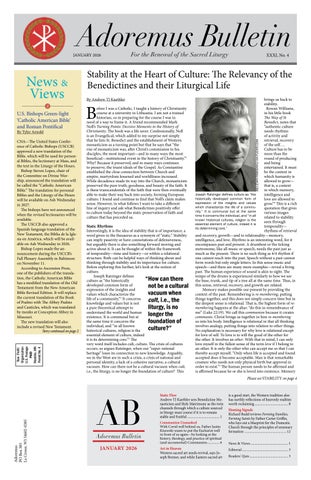
brings us back to stability. Rowan Williams, in his little book The Way of St Benedict, notes that “authentic culture needs rhythms of activity and retrieval, recovery of the self…. Culture has to be more than the round of producing and being entertained. It must be the context in which humanity is allowed to grow— that is, a context in which memory, Joseph Ratzinger defines culture as “the intelligence and historically developed common form of love are allowed to expression of the insights and values grow.”4 This is a rich which characterize the life of a commuquotation that gives nity.” It is communal but at the same various images time it concerns the individual, and “in all related to stability known historical cultures, religion is the seen through essential element of culture, indeed it is temporality— its determining core.” rhythms of retrieval and recovery, growth—and to relationality—memory, intelligence, and love. Rhythms is an interesting word, for it encompasses past and present. A drumbeat or the ticking metronome, like all music or speech, needs the past just as much as the present. There is no such thing as 4/4 rhythm if one cannot reach into the past. Speech without a past cannot form words but only single letters. In this sense music and speech—and there are many more examples—reveal a living past. The human experience of sound is akin to sight. The tempo of the drums is experienced similarly to how we see the base, trunk, and tip of a tree all at the same time. Thus, in this sense, retrieval, recovery, and growth are related. Memory makes possible our present by providing the context of the past. Remembering is re-membering, putting things together, and this does not simply concern time but in the deepest sense is relational. That is, the highest form of remembering happens at the altar: “do this in remembrance of me” (Luke 22:19). We call this communion because it creates communio. Christ brings us together in him re-membering us into his body. Intelligence is relational in that all thinking involves analogy, putting things into relation to other things. No explanation is necessary for why love is relational except for love of self. To love is to will the good of the other for the other. It involves an other. With that in mind, I can only love myself in the fullest sense of the term love if I belong to an other. It is only the other who can accept me so that I can thereby accept myself. “Only when life is accepted and found accepted does it become acceptable. Man is that remarkable creature who needs not only physical birth but approval in order to exist.”5 The human person needs to be affirmed and is affirmed because he or she is loved into existence. Memory AB/LEVAN RAMISHVILI VIA FLICKR.COM
News & Views
For the Renewal of the Sacred Liturgy
Adoremus PO Box 385 La Crosse, WI 54602-0385
Please see STABILITY on page 4
AB
Static Flow Andrew TJ Kaethler sees Benedictine Monasticism and Holy Matrimony as the twin channels through which a culture sourced in liturgy must course if it is to remain stable and fruitful....................................... 1
JANUARY 2026
Art in Heaven Western sacred art needs revival, says Joseph Bremer, and while Eastern sacred art
Adoremus Bulletin
Communion Unmasked With Covid well behind us, Father Justin Kizewski wants to put the Eucharist well in front of us again—by looking at the history, theology, and practice of spiritual (and sacramental) Communion............... 6
is a good start, the Western tradition also has earthly reflections of heavenly realities worth reclaiming........................................ 8 Homing Signals Richard Budd reviews Forming Families, Forming Saints by Father Carter Griffin, who lays out a blueprint for the Domestic Church through the principles of seminary formation .................................................. 12 News & Views............................................. 1 Editorial....................................................... 3 Readers' Quiz.............................................. 3
2
Adoremus Bulletin, January 2026
NEWS & VIEWS
Continued from NEWS & VIEWS U.S. bishops also approved a new edition of the Roman Pontifical, which is the liturgical book for pontifical Masses, which can only be celebrated by bishops. It is expected to be ready in 2027. The bishops are still awaiting Vatican approval for two of the five pontifical rites, but approval is anticipated in December.
Pope Leo XIV Issues Apostolic Letter on Council of Nicaea
AB/PICRYL.COM
CNA—Pope Leo XIV has called on Christians to move beyond “theological controversies” that no longer serve the cause of unity and to rediscover together the faith professed at the Council of Nicaea 1,700 years ago. In a new apostolic letter, In Unitate Fidei (“In the Unity of Faith”), released November 23, the solemnity of Christ the King, the pope links the anniversary of the first ecumenical council to the holy year of 2025 and to his recent apostolic journey to Turkey, where he commemorated Nicaea’s 1,700th anniversary and took part in an ecumenical event with Ecumenical Patriarch Bartholomew on November 30 before traveling on to Lebanon. “I would like this letter to encourage the whole Church to renew her enthusiasm for the profession of faith,” the pope writes, stressing that the NiceneConstantinopolitan Creed “for centuries … has been the common heritage of Christians, and it deserves to be professed and understood in ever new and relevant ways.” In a strong ecumenical appeal, Leo XIV says the Nicene Creed “can be the basis and reference point” for a renewed journey toward full communion among Christians. “It offers us a model of true unity in legitimate diversity. Unity in the Trinity, Trinity in unity, because unity without multiplicity is tyranny, multiplicity without unity is fragmentation,” he writes. “We must therefore leave behind theological controversies that have lost their ‘raison d’être’ in order to develop a common understanding and even more, a common prayer to the Holy Spirit, so that he may gather us all together in one faith and one love,” the pope continues. “The restoration of unity among Christians does not make us poorer; on the contrary, it enriches us,” he adds, calling the goal of full visible unity “a theological challenge and, even more so, a spiritual challenge, which requires repentance and conversion on the part of all.” Linking Nicaea to today’s crises, Leo XIV notes that the holy year is dedicated to the theme “Christ Our Hope” and that the Nicene Creed remains a source of confidence amid war, injustice, and suffering. “In this holy year, dedicated to the theme of ‘Christ Our Hope,’ it is a providential coincidence that we are also celebrating the 1,700th anniversary of the First Ecumenical Council of Nicaea,” he writes. That council, he recalls, “proclaimed the profession of faith in Jesus Christ, Son of God. This is the heart of the Christian faith.” “In these difficult times we are living, amid so many concerns and fears, threats of war and violence, natural disasters, grave injustices and imbalances, and the hunger and misery suffered by millions of our brothers and sisters, this Creed gives us hope,” the pope says. Leo XIV presents the letter as an invitation for all Christians “to walk in harmony, guarding and transmitting the gift they have received with love and joy,” especially through the words of the Creed: “I believe in one Lord Jesus Christ, the Only Begotten Son of God … for our salvation he came down from heaven.” The pope devotes much of In Unitate Fidei to explaining the historical and theological context of the Council of Nicaea, which met in 325 to address the Arian controversy over the divinity of Christ. The dispute, he notes, “concerned the essence of the Christian faith,” namely the answer to Jesus’ question in the Gospel: “Who do you say that I am?” In response, the Nicene Fathers confessed that Jesus is the Son of God “in as much as he is of the substance (ousia) of the Father … ‘begotten, not made, consubstantial (homooúsios) with the Father.’”
AB/CATHOLIC CHURCH OF ENGLAND AND WALES VIA FLICKR.COM
By Victoria Cardiel
Pope Leo Calls for “Sober” Liturgy That Respects Piety By Victoria Cardiel
CNA—Pope Leo XIV urged parishes to invest in liturgical formation, especially for lectors, while also encouraging people to pray the Liturgy of the Hours and calling for attention to be paid to popular piety. While receiving participants on November 17 in a course organized by the Pontifical Liturgical Institute of St. Anselm in Rome at the Apostolic Palace for diocesan liturgical pastoral workers, the Holy Father said that “in the dioceses and parishes there is a need for such formation” and encouraged the creation of “biblical and liturgical courses” in places where such formation programs are lacking. Through such courses, the pope said the institute could help local churches and parish communities “to be formed by the word of God, explaining the texts of the weekday and feast day Lectionary.” For the pope, it is important that the liturgy be “expression of a community that cares for its celebrations, prepares them, and lives them to the full.” Regarding biblical formation combined with liturgical formation, he recommended that those in charge of liturgical ministry pay “particular attention” to those who proclaim the word of God. Referring to lectors and those who regularly read the Scriptures, the Holy Father said that “basic biblical knowledge, clear diction, the ability to sing the responsorial psalm, as well as to compose prayers of the faithful for the community are important aspects that implement liturgical reform and help the people of God grow on their path.” “We are well aware that liturgical formation is one of the main themes of the entire conciliar and postconciliar journey,” Leo XIV stated. In this regard, he affirmed that while “much progress has been made” there is still “a long way to go.” “Let us not tire: Let us enthusiastically resume the good initiatives inspired by the reform and, at the same time, seek new ways and new methods,” he urged.
Adoremus Bulletin Society for the Renewal of the Sacred Liturgy PHONE: 608.521.0385 WEBSITE: www.adoremus.org MEMBERSHIP REQUESTS & CHANGE OF ADDRESS: info@adoremus.org INQUIRIES TO THE EDITOR P.O. Box 385 | La Crosse, WI 54602-0385 editor@adoremus.org
The pope said the aim is “to foster the fruitful participation of the people of God as well as a dignified liturgy that is attentive to different sensibilities and sober in its solemnity.” Among other things, he expressly asked the diocesan liturgy to promote the Liturgy of the Hours and to nurture the dimension of “popular piety.” “Among the aspects linked to your service as directors, I would like to mention the promotion of the Liturgy of the Hours, care for popular piety, and attention to the celebratory dimension in the construction of new churches and the adaptation of existing ones,” he stated. “In many parishes, then, there are also liturgical groups who must work in synergy with the diocesan commission,” the pope noted. The Holy Father continued: “The experience of a group, even small but well motivated, that is concerned with the preparation of the liturgy is an expression of a community that cares for its celebrations, prepares them, and lives them to the full, in agreement with the parish priest.” “In this way, we avoid delegating everything to him and leaving only a few people responsible for singing, proclaiming the word, and decorating the church,” he explained. Similarly, he lamented that these parish groups “have dwindled to nothing, as if they had lost their identity.” Therefore, he called for a commitment to make “this area of Church life attractive again, capable of involving people who are competent or at least inclined to this type of service.” He thus encouraged liturgical leaders to propose to parish priests “formation courses to start or consolidate liturgical groups in the parish, training their members and offering suggestions for their activities.” This story was first published by ACI Prensa, CNA’s Spanish-language news partner. It has been translated and adapted by CNA.
Please see NEWS & VIEWS page 5
DIRECTOR: Christopher Carstens EDITOR: Michael Brummond MANAGING EDITOR: Joseph O’Brien CONTENT MANAGER: Jeremy Priest GRAPHIC DESIGNER: Danelle Bjornson OFFICE MANAGER: Elizabeth Gallagher MARKETING AND FUNDRAISING: Eugene Diamond TECHNOLOGY: Zach Tudahl EXECUTIVE COMMITTEE The Rev. Jerry Pokorsky = Helen Hull Hitchcock The Rev. Joseph Fessio, SJ Contents copyright © 2026 by ADOREMUS. All rights reserved.
3
Adoremus Bulletin, January 2026
By Michael Brummond, Editor
R
ecently, Pope Leo made some of his first remarks addressing the liturgy as the Church’s supreme pontiff. In his homily for the Feast of the Dedication of the Lateran Basilica (November 9), the Holy Father expressed a desire that the liturgy celebrated at Rome’s cathedral should be an example for the whole People of God: “It must comply with the established norms, be attentive to the different sensibilities of those participating and keep with the principle of wise inculturation.” The Pope emphasizes celebrating the liturgy in a way that is faithful to the Church’s liturgical books and laws, while recognizing that those books do not exist in a vacuum but are always incarnated in particular places among diverse peoples. Pope Leo continues, highlighting a particular characteristic of the liturgy: “At the same time, it must remain faithful to the solemn sobriety typical of the Roman tradition, which can do so much good for the souls of those who actively participate in it.” He made similar comments just over a week later when he addressed participants in a course for diocesan liturgical pastoral workers promoted by the Pontifical Liturgical Institute at Sant’Anselmo in Rome. (See Page 2 in “News & Views.”) The aim of ongoing liturgical formation, he said, “is to foster the fruitful participation of the People of God, as well as a dignified liturgy that is attentive to different sensibilities and sober in its solemnity.” It is striking that the Holy Father described the liturgy of the Roman Rite on two occasions in terms of its “solemn sobriety” and being “sober in its solemnity.” The modern roots of this affirmation stretch back to an 1899 address given by the liturgical historian Edmund Bishop, later published as “The Genius of the Roman Rite.” Bishop set out to describe what distinguishes the Roman Rite from other Western rites and from Eastern liturgies. By comparing both the language of various prayers of the Missal and their historical origins, Bishop concluded that the distinguishing features of the native (pre-Carolingian) Roman Rite—its “genius”— are its comparative structural and textual conciseness and its simple practicality. This stands in contrast to elements of other liturgical rites that tend to be more prolix, florid, poetic, or dramatic. “I think that the general position is unassailable,” he says, “that the genius of the native Roman rite is marked by simplicity, practicality, a great sobriety and self-control, gravity and dignity.” He ends his remarks with a somewhat famous and influential conclusion: “If I had to indicate in two or three words only, the main characteristics which go to make up the essential genius of the Roman rite, I should say that those characteristics were essentially soberness and sense.” It is this simplicity, soberness, and sense, according to Bishop, that also allowed the Roman Rite to spread throughout the Latin West, adapting over time while assimilating elements of other rites, outliving most of them. It is debated whether Bishop’s conclusions were primarily descriptive or prescriptive—was this simply the historian reporting his findings on the nature of the Roman Rite, or was this a plan for reform? Either way, Bishop’s analysis influenced later liturgical scholarship and eventually helped shape the principles of liturgical restoration expressed in Sacrosanctum Concilium (SC): “The rites should be distinguished by a noble simplicity; they should be short, clear, and unencumbered by useless repetitions; they should be within the people’s powers of comprehension, and normally should not require much explanation” (SC, 34). While few would dispute the underlying historical foundations of Bishop’s description of the Roman Rite, many more would question the accuracy with which the principles were interpreted after the Council or the prudence in the
ways they were implemented. One unfortunate side effect of emphasizing the noble simplicity of the rites was an accompanying loss of beauty in expression. The simplicity of the rites called for by the Council may rightly exclude “mere sumptuous display” but cannot do so at the expense of “noble beauty” (SC, 124). In other words, it is a false dichotomy to suppose that the simplicity and sobriety typical of the liturgy of the Roman Rite require stripping away its artistic, musical, and ceremonial richness, as though honoring simplicity demanded emptying the liturgy of everything that lifts the heart “Every care should be taken to ensure that toward God. Indeed, Sacrosanctum the simple beauty of the rites expresses the Concilium affirms that “all things set value of worship for the harmonious growth of the whole Body of the Lord.” apart for use in divine worship should be truly worthy, becoming, and beautiful, signs and symbols of the supernatural world” (SC, 122). The simplicity of the Roman Rite should contribute to a mystagogical transparency, where God’s own beauty and the wonder of the Paschal Mystery shine forth in clarity. This brings us back to Pope Leo’s homily with which we began. After speaking of the solemn sobriety of the liturgy, the Holy Father continues: “Every care should be taken to ensure that the simple beauty of the rites expresses the value of worship for the harmonious growth of the whole Body of the Lord.” The Augustinian pope goes on to quote St. Augustine, who observed that “beauty is nothing but love, and love is life,” a line that expresses Augustine’s conviction about the integrative power of divine charity. And Pope Leo comments: “This truth is realized in an eminent way within the liturgy….” Beauty in the liturgy, then, is not simply ornamentation but an act of charity. Banal or careless liturgy is not merely a matter of poor taste. It is a failure of love. It obscures the mystery instead of revealing it; it imposes confusion on the faithful rather than stability; it forms people to expect less from God and from the Church; it can even alienate newcomers rather than welcoming them. Conversely, beautiful, orderly, reverent liturgy—both in its solemn sobriety and in its simple and noble beauty—embodies pastoral charity. It expresses care for the mystery being celebrated, care for the people drawn into it, and care for the Church’s unity across space and time. None of this comes automatically. It requires effort, and it requires a particular way of seeing. In short, the liturgy the Holy Father envisions requires ongoing liturgical formation, a topic Pope Leo also addressed to those gathered at the Pontifical Liturgical Institute: “We are well aware that liturgical formation is one of the main themes of the entire conciliar and post-conciliar journey. Much progress has been made, but there is still a long way to go. Let us not tire: let us enthusiastically resume the good initiatives inspired by the reform and, at the same time, seek new ways and new methods.” Adoremus welcomes the Pope’s call to deepen ongoing liturgical formation and strives to serve this work for the glory of God and the salvation of the People of God. AB/EDGAR BELTRÁN, THE PILLAR, VIA WIKIMEDIA COMMONS.
Solemn Sobriety, Simple Beauty
Readers’ Quiz: On Popes, Papal Documents, and the Liturgy 1. What was the main purpose of Pius X’s 1903 motu proprio Tra le sollecitudini? a. Suppression of vernacular hymns b. Reform of sacred music c. Calendar reform d. Revision of the Breviary 2. Who added the name of St. Joseph to the Roman Canon? a. Pius IX b. John XXIII c. Paul VI d. John Paul II 3. Which pope instituted the feast of Christ the King for universal use in the early 20th century? a. Pius X b. Pius XI c. Benedict XV d. Paul VI 4. Which 1947 encyclical by Pope Pius XII helped shape Vatican II’s liturgical vision by emphasizing both doctrinal clarity and liturgical renewal? a. Mystici Corporis b. Mediator Dei c. Divini Cultus d. Sacramentum Caritatis 5. Which pope reformed the rites of Holy Week, especially the Easter Vigil, in the years before the Second Vatican Council? a. Pius X b. Pius XI c. Pius XII d. John XXIII
6. Which papal document allowed broader use of the 1962 Missal, using the expression “extraordinary form”? a. Ecclesia Dei b. Summorum Pontificum c. Sacramentum Caritatis d. Traditionis Custodes 7. Who wrote the apostolic letter Desiderio Desideravi, on the liturgical formation of the people of God? a. Pope Benedict XVI b. Pope Francis c. Pope John Paul II d. Cardinal Sarah 8. Which pope reformed the Roman Breviary with the Apostolic Constitution Divino Afflatu? a. Leo XIII b. Pius X c. Benedict XV d. Pius XI 9. Which pope founded the Pontifical Institute of Sacred Music in Rome? a. Leo XIII b. Pius X c. Benedict XV d. Pius XI
10. According to Divini Cultus, how should the faithful participate when they assist at sacred ceremonies or when pious sodalities take part with the clergy in a procession? a. They should remain silent while the choir sings on their behalf. b. They should, filled with a sense of the beauty of the liturgy, sing alternately with the clergy or choir as prescribed. c. They should recite only private prayers and devotions. d. They should limit themselves to answering in a low voice. 11. In his homily for the Feast of the Dedication of the Basilica of St. John Lateran, which pope stated that “every care should be taken to ensure that the simple beauty of the rites expresses the value of worship for the harmonious growth of the whole Body of the Lord”? a. Pius XI b. Paul VI c. Leo XIV d. Benedict XVI 12. Which papal letter commemorating the anniversary of Sacrosanctum Concilium reaffirmed the Council’s liturgical vision while warning against both innovation and nostalgia? a. Summorum Pontificum b. Sacramentum Caritatis c. Ecclesia de Eucharistia d. Vicesimus Quintus Annus For answers, see QUIZ on page 11
Adoremus Bulletin, January 2026
AB/WIKIMEDIA COMMONS. ABBEY OF MONTECASSINO, ITALY.
4
The more a monastic community blends with society, the less it is a sign of contradiction, and its inherent stability is overlooked. The stability that monasticism reveals concerns truth, and this is specifically brought forth in the liturgy.
Monasticism and Marriage Growth, which is a directed movement, the process of increasing, involves a foundation, something to grow from. Culture cannot be without a past; culture cannot exist without stability; culture cannot exist without cult.6 St. Benedict models this for us. In chapter four of his Rule, he lists the instruments of good works. This begins with loving God with one’s whole heart, followed by obeying the Ten Commandments and then putting into practice various spiritual recommendations such as “console the sorrowing,” “prefer nothing to loving Christ,” “not to make a false peace,” and “not to be gluttonous.” This list is long and insightful, and it concludes with, “And the cloister of the monastery and stability in the community are the workshop wherein we may diligently effect all these works.” It would be easy to quickly skip by this last line as if it is unnecessary. It seems mundane compared to loving one’s enemies and loving Christ with one’s whole being. Yet, according to St. Benedict, stability is the workshop from which the good works flow. The stability of persevered time—praying the Office, celebrating the Mass, tilling the fields, milking the cows day in and day out—and the consistency of relations is the place where one encounters otherness and thereby oneself. It is here that one comes face to face with beauty, truth, and goodness because there is nowhere to hide. In this sense monasticism, which, it is important to remember, is not a sacrament, reflects the primordial sacrament of marriage. What does the word “primordial” imply? St. John Paul II explains that “as the primordial sacrament, marriage constitutes, on the one hand, the figure (and thus the likeness, the analogy) according to which the underlying, weightbearing structure of the new economy of salvation and the sacramental order is built, which springs from the spousal gracing that the Church receives from Christ.”7 The religious life, monasticism, is not a primordial reflection of reality; therefore, in order to be intelligible, it must be understood in relation to marriage (intelligence involves analogy…). The stability of monasticism is key for culture because it institutionalizes and manifests in a unique form the bedrock of all cultures, i.e., marriage and the family. The indissolubility of marriage is the ultimate form of human stability. It symbolizes the absolute faithfulness of God’s love, a love that endures. The
context of marriage is a place in which one cannot hide, where otherness is constantly in dialogue. It is also a space of affirmation: the lover says to the beloved, “It is good that you are here.” This is an echo of the Creator’s voice in Genesis: “And it was very good.” The stability of the Creator—that he does not change—is the ground of all affirmation and the foundation of hope. This affirmation, sacramentally present in marriage and lived out in monasteries, enables love of self and provides the soil for growth. Within this stability a richness of life, an open vista emerges. AB/WIKIMEDIA COMMONS. ST. BENEDICT DELIVERING HIS RULE TO THE MONKS OF HIS ORDER.
Continued from STABILITY, page 1 (remembering), intelligence, and love—as seen through the framework of relation—require stability, the stability of God himself, the stability of the Logos, the stability of his love.
“And the cloister of the monastery and stability in the community are the workshop wherein we may diligently effect all these works.”
Labor of Love Thinking specifically about the Benedictine motto ora et labora, work finds its proper place by being put alongside liturgy and prayer. Work is set in the context of meaning, and in light of this it is recognized as important but not ultimate. Holding these two together, one can work and create culture with a sense of joy and in the freedom of knowing that all our activities are relativized and directed by the stability of God. It then should be no surprise that Benedictines have had a major impact on Western culture— from Guido of Arezzo who invented modern staff notation to Dom Pierre Pérignon who contributed to the development of champagne—and all the other contributions such as illuminated manuscripts, mechanical clocks, Carolingian minuscule (form of writing), agricultural techniques, and refinement of brewing (e.g., Trappist beer). It is from stability that shared insights and values
grow and culture is formed. If sacramental marriage is key to stability and monasticism reflects this stability, what does monasticism offer that is unique in this regard? To answer this question, let’s turn back to Williams. He writes, “Monasticism is… a significant defence against the absorption of the newness of the gospel into the familiarity of this or that cultural environment; and in this way, monasticism is a necessary part of any truly theological strategy of mission.”8 Bringing this notion to bear on what I’ve written, while marriage has a sort of primordial priority, its apparent ordinariness often makes it difficult to see its symbolic importance. We see married people everywhere, but how often do we engage with a monk or a monastic community? There is something shocking about monasticism. It is counter-cultural; it is a sign of contradiction. This is why, for example, it is vitally important for monastic communities to wear their religious habits in and out of their monastic enclosures (likewise, diocesan priests should wear their clerical collars in public and married couples should wear their wedding rings). The more a monastic community blends with society, the less it is a sign of contradiction, and its inherent stability is overlooked. Lastly, while a man and woman unite in marriage and become one flesh, there is no intimate sacramental union acting as the basis of stability within a monastic community. Rather, the
“ The indissolubility of marriage is the ultimate form of human stability. It symbolizes the absolute faithfulness of God’s love, a love that endures.” monks’ stability comes from the liturgical life, vows, work, place, and The Rule. The stability it evinces, void of romance, is thereby more easily translated for certain aspects of culture and society than the stability of marriage (e.g., governmental structures and societal organizations). The stability that monasticism reveals concerns truth, and this is specifically brought forth in the liturgy. Ratzinger insightfully notes that “the Christian liturgy is a cosmic liturgy precisely because it bends the knee before the crucified and exalted Lord. Here is the center of authentic culture—the culture of truth. The humble gesture by which we fall at the feet of the Lord inserts us into the true path of life of the cosmos.”9 There can be no culture without truth but only a dictatorship of relativism. It is only truth that
5
Adoremus Bulletin, January 2026
AB/COMMUNICATIONS DIVISION OF THE ADMINISTRATION OF THE PRESIDENT OF GEORGIA, VIA WIKIMEDIA COMMONS.
Pope Leo urged choristers not to see themselves as performers set apart from the congregation but as part of the praying assembly. “The choir is a small family of individuals united by their love of music and the service they offer. However, remember that the community is your larger family,” he said. “You are not on stage but rather a part of that community, endeavoring to help it grow in unity by inspiring and engaging its members.” He acknowledged the ordinary tensions that can arise in any group but said that even these can become a sign of the Church’s pilgrimage through history. “We can say to some extent that the choir symbolizes the Church, which, striving toward its goal, walks through history praising God,” he said. “Even when this journey is beset by difficulties and trials and joyful moments give way to more challenging ones, singing makes the journey lighter, providing relief and consolation.” Citing both St. Augustine and St. Ignatius of Antioch, the pope presented the choir as a sign of synodality and unity in the Church in which diverse voices become a single hymn of praise. “In fact, the different voices of a choir harmonize with each other, giving rise to a single hymn of praise, a luminous symbol of the Church, which unites everyone in love in a single pleasing melody,” he said. Pope Leo also encouraged musicians to study the Church’s teaching on sacred music and to resist the impulse to draw attention to themselves rather than to God. “Strive, therefore, to make your choirs ever harmonious and beautiful, and a brighter image of the Church praising her Lord,” he said. “Study the magisterium carefully. The conciliar documents set out the norms for carrying out your service in the best possible way.” “Above all, dedicate yourselves to facilitating the participation of the people of God, without giving in to the temptation of ostentation, which prevents the entire liturgical assembly from actively participating in the singing,” he added. “In this, be an eloquent sign of the Church’s prayer, expressing its love for God through the beauty of music. Take care that your spiritual life is always worthy of the service you perform, so that your ministry may authentically express the grace of the liturgy.” At the end of his homily, the pope entrusted all choir members to the patron saint of sacred music. “I place all of you under the protection of St. Cecilia, the virgin and martyr who raised the most beautiful song of love through her life here in Rome, giving herself entirely to Christ and offering the Church a shining example of faith and love,” he said. “Let us continue singing and once again make our own the invitation of today’s responsorial psalm: ‘Let us go rejoicing to the house of the Lord.’”
Continued from NEWS & VIEWS, page 2
Pope Leo XIV: Liturgical Singing Requires ‘Deep Spiritual Life’ By Victoria Cardiel CNA—On November 23, the Solemnity of Christ the King, Pope Leo XIV praised the “precious” ministry of liturgical music and told choir members from around the world that their service at the altar must be sustained above all by a deep life of prayer. He later used his preAngelus remarks to appeal for the release of hostages kidnapped in Nigeria and Cameroon and to encourage young people on World Youth Day. The pope celebrated Mass in St. Peter’s Square for the Jubilee of Choirs on the solemnity of Christ the King, telling choristers and musicians that their vocation is to lead God’s people into the mystery of worship. “Dear choristers and musicians, today you celebrate your jubilee and you show thanks to the Lord for granting you the gift and grace to serve him by offering your voices and talents for his glory and for the spiritual edification of your brothers and sisters,” he said in his homily. “Your task is to draw others into the praise of God and to help them to participate more fully in the liturgy through song.” Drawing on the day’s responsorial psalm, “Let us go rejoicing to the house of the Lord” (Psalm 122), Pope Leo said the liturgy calls Christians “to walk together in praise and joy toward the encounter with the Lord Jesus Christ, King of the Universe, gentle and humble Sovereign.” “His power is love, his throne the cross, and through
will set us free, that enables a free society, that leads to culture because it grows out of cult and is aligned with the truth of the universe. Yet, as the quotation sets out, proper liturgical participation requires humility. To put it differently, it demands something of us. Neither monasticism nor liturgy (nor both together) automatically equates to the stability of truth without the Christian life of virtue, for it is the moral life that forms a person, making him or her capable of humility and thereby capable of truth. The most beautiful liturgy without beautiful souls is an empty show. Liturgy and life must coalesce. In the Benedictine sense, The Rule must sit alongside the liturgical rubrics. When it does, it becomes a word on fire, igniting culture. (Re)Formed in Christ Some concluding thoughts: the stability of God and his enduring love sacramentally given in marriage and uniquely expressed in monasticism are key for culture. There is a two-way road here between marriage and monasticism. Fundamentally, marriage, as a primordial sacrament, should inform monasticism. In turn, monasticism should reflect this image in its own unique form. In so doing, it reminds marriage of its primordial significance and challenges marriage to be all that it is meant to be. Together they are forming culture. One final tangential reflection: like the Church as a whole, monasticism is always in need of reform. Historically there are reform movements within the Benedictine tradition, e.g., Cistercians and Trappists. Perhaps in our era the movement of reform will come from outside the walls of the monasteries,
the cross his kingdom shines forth upon the world,” he said. “From the wood he reigns as Prince of Peace and King of Justice who, in his passion, reveals to the world the immense mercy of God’s heart. This love is also the inspiration and motive for your singing.” Pope Leo described singing as a uniquely human way of expressing what words alone cannot say. “Music can give expression to the whole range of feelings and emotions that arise within us from a living relationship with reality,” he said, adding that “singing, in particular, constitutes a natural and refined expression of the human being: mind, feelings, body, and soul come together to communicate the great events of life.” Quoting St. Augustine, he recalled that “‘Cantare amantis est’ … that is, ‘singing belongs to those who love.’” For Christians, he continued, liturgical song is more than performance. “For the people of God, song expresses invocation and praise,” he said. “Liturgical music thus becomes a precious instrument through which we carry out our service of praise to God and express the joy of new life in Christ.” The pope underlined that choir members exercise a genuine ecclesial service, especially in the liturgy. “You belong to choirs that carry out their ministry primarily in liturgical settings. Yours is a true ministry that requires preparation, commitment, mutual understanding, and, above all, a deep spiritual life, so that when you sing, you both pray and help everyone else to pray,” he said. This ministry, he added, “requires discipline and a spirit of service, especially when preparing for a solemn liturgy or an important event in your communities.”
from marriage. This makes sense in light of what I have said, and it fits within the trajectory of Vatican II and its emphasis on the importance of the laity, something that the Church is still coming to terms with. Along these lines, we can see how important and prescient St. John Paul II’s Theology of the Body is (lectures given between 1979 and 1984). Theology of the Body is an intelligent and articulate response to the gender and sexual ideologies of secularism and an answer to the crisis of marriage and family within our present
“ The most beautiful liturgy without beautiful souls is an empty show. Liturgy and life must coalesce.” culture. With its theological reflection on the nuptial mystery, embodied and symbolized in marriage, it is also a theological road map for reform, which can revivify and deepen Western monasticism at large. Andrew TJ Kaethler, PhD, is Dean of Studies at the Buckfast Institute in England and is a Visiting Professor of Theology at Catholic Pacific College, British Columbia, Canada. Kaethler specializes in theological anthropology, particularly in the work of Joseph Ratzinger and Alexander Schmemann. He has published in various journals including Modern Theology, New Blackfriars, Pontificia Academia Theologica, Humanum Review,
and Logos: A Journal of Catholic Thought and Culture. With Sotiris Mitralexis, he has co-edited two volumes; the latest is titled Mapping the Una Sancta: Eastern and Western Ecclesiology in the Twenty-First Century (2023). His most recent monograph, The Eschatological Person: Alexander Schmemann and Joseph Ratzinger in Dialogue, was published with Cascade Books in 2022. Kaethler currently lives in the United Kingdom with his wife and six kids. 1. Mark Noll, Turning Points: Decisive Moments in the History of Christianity (Grand Rapids: Baker Academic, 2022), 66. 2. Joseph Ratzinger, “Christ, Faith and the Challenges of Cultures. Meeting With the Doctrinal Commissions in Asia” (1993): accessed October 30, 2025, https://www.vatican.va/roman_curia/congregations/cfaith/incontri/rc_con_ cfaith_19930303_hong-kong-ratzinger_en.html. 3. Ratzinger, “Challenges of Cultures.” 4. Rowan Williams, The Way of St Benedict (London: Bloomsbury Continuum, 2020), 69. 5. My translation. ‘Erst indem das Leben angenommen wird und sich als angenommenes vorfindet, wird es annehmbar. Der Mensch ist das merkwürdige Wesen, das nicht nur der physischen Geburt, sondern der Gutheissung bedarf, um bestehen zu konnen’. Joseph Ratzinger, ‘Ist Der Glaube Wirklich “Frohe Botschaft”?’, in Libertatem Vocati Estis: Miscellanea Bernhard Häring Zum 65. Geburtstag, ed. H. Boelaars and R. Tremblay (Rome: StMor 15, 1977), 528. 6. Ratzinger writes “that ‘cult’, seen in its true breadth and depth, goes beyond the action of the liturgy. Ultimately, it embraces the ordering of the whole of human life in Irenaeus’ sense.” Joseph Ratzinger, The Spirit of the Liturgy (San Francisco: Ignatius Press, 2018), 34. 7. John Paul II, Man and Woman He Created Them: A Theology of the Body, trans. Michael Waldstein (Boston, MA: Pauline Books & Media, 2006), 98:2. 8. Williams, Way of St Benedict, 49. 9. Ratzinger, Spirit of the Liturgy, 207.
Adoremus Bulletin, January 2026 AB/WIKIMEDIA COMMONS. THE LAST COMMUNION OF ST. JEROME BY DOMENICHINO (1614).
6
We should all want to draw nearer to Christ, which is, in effect, a desire for Holy Communion. Whether the time until our next Communion is less than 24 hours or whether we have many steps to undergo to get there, the desire for Communion can be present.
On Desiring Communion By Father Justin J. Kizewski
I
am struck by how even to this day, people express a great woundedness from the Eucharistic famine during the COVID years. For that I am sorry. As a pastor, I worried that after years of teaching that watching Mass on TV is not the same as attending in person and does not fulfill an able-bodied Catholic’s obligation, potentially exaggerated rhetoric out of presumption for safety during the pandemic might undermine my credibility regarding what I truly believe about the Eucharist and its necessity for Christian life. Was the stress on the value of a spiritual Communion part of this exaggerated rhetoric? I don’t think so. Over the course of this reflection, I would like to explore the history, theology, and practice of spiritual Communion, while also being attentive to the differences between the value of a spiritual Communion and the value of actual reception of Our Lord in the Blessed Sacrament. Coherent Communion In anticipation of thoughts on the value of a spiritual Communion, I would like to begin— perhaps counterintuitively—with the value of actual reception of the Holy Eucharist. According to the Catechism of the Catholic Church (CCC), Holy Communion: 1) increases our union with Christ; 2) nourishes and preserves our spiritual life; 3) helps us become less attached to sin; 4) wipes away our venial sins; 5) preserves us against future mortal sins; 6) makes the Church, insofar as we are what we consume; 7) commits us to the poor; 8) builds up our unity; and 9) gives us eternal life (CCC, 1391-1401). Much could be said about each of these. However, a timely insight from a document issued by the United States Conference of Catholic Bishops at the inauguration of this country’s Eucharistic Revival is worth pointing out. These fruits happen only through something the document alludes to as a coherent reception of Holy Communion. While the direct application of this “Eucharistic coherence” is formulated in the negative—who ought not receive, or the “incoherence” that occurs when they do—I want to draw attention to the principle behind that negative formulation. To receive Communion fruitfully, I must be in a state of communion. Just as one ought not receive Communion when communion has been broken, the reverse means that receiving Communion implies that there is a communion present, which I then express and ratify bodily. The document insists, “We also need to keep in mind that ‘the celebration of the Eucharist presupposes that communion already exists, a communion which it seeks to consolidate and bring to perfection.’”1 It is not that we must be perfect to receive Communion, but it does mean that Communion cannot bring about something that is not to some degree already present. It is not a means toward union that does not in some way already exist. “To receive the Body and Blood of Christ while in a state of mortal sin [or any state not reconcilable with communion, for
example, irregular marriages where there may not be a question of mortal sin on account of lack of knowledge or freedom] represents a contradiction.”2 This statement, based on an incarnational anthropology (i.e., bodies matter and are signs of invisible realities), means that the act of receiving Communion is perfecting, even a consummation, of one’s union with the body, blood, soul, and divinity of Christ. Daily Dose of Divinity Before we say something about those who cannot, at the moment, receive Holy Communion, I would like to point out that it is this perfecting of love that originally explains the impetus for spiritual Communion. One cannot receive Communion constantly, nor should one. The Church allows the faithful to receive Communion only twice a day, provided that the second time occurs in the context
“ If one wants to warm the soul, this desire for Communion has the effect of warming and keeping warm. A desire for Communion, a spiritual Communion, is like warming our hands at a fire or getting closer to it for a greater experience of its warmth.” of Mass (can. 917). Even those blessed enough to go to Mass daily must follow the Church’s directives on reception of Communion. From this conundrum of what to do between communions—or in anticipation of Communion— arises the proper place of spiritual Communion. In the history of the life of the Church, there is an ebb and flow in the frequency of Communion. Recent magisterial encouragements of frequent Communion do not change the essence of the common problem. To state it here simply: what can I do when I cannot receive Holy Communion? We should all want to draw nearer to Christ, which is, in effect, a desire for Holy Communion. Whether the time until my next Communion is less than 24 hours or whether I have many steps to undergo to get there, the desire for Communion can—and should—still be present. This interval between sacramental Communions is, as Bernard Blankenhorn notes, the context in which the theology of spiritual Communion takes shape in the work of St. Augustine and St. Thomas Aquinas.3 Blankenhorn draws on St. Augustine’s distinction between sign and reality and its implications for a spiritual Communion. St. Augustine says: “For he [Christ] wills that by this food and drink be understood the society of his body and his members, that is to say, the holy Church in his saints and faithful…. The sacrament of this reality [res], which is the unity of the body and blood of Christ, is found prepared on the altar of the Lord and is taken at the Lord’s table, in some places each day, in others, at a certain interval of time.”4 The occasion for this
distinction occurs in the difference Augustine notes between the manna in the Old Testament and the Eucharist. The manna occasioned the reception of the reality (res) of the sacrament of the Eucharist as an anticipation of the latter gift. Thus, the desire for union—the reality of the sacrament—can obtain that which it desires. St. Thomas Aquinas follows St. Augustine’s application of this distinction. First, in his commentary on John, Thomas reflects on Augustine’s own commentary on John 6: “for both [the manna and the Eucharist] signify Christ. Thus they are called the same food: all ate the same food (1 Cor 10:3). He calls them the same because each is a symbol of the spiritual food. But they are different because one was only a symbol; while this bread contains that of which it is the symbol, that is, Christ himself.”5 Another context in which Thomas appeals to this distinction occurs when he addresses those children who are too young to receive Communion. Again following St. Augustine, St. Thomas notes that “before receiving a sacrament, the reality [res] of the sacrament can be had through the very desire of receiving the sacrament.”6 St. Thomas concludes this article with a reference to a kind of “ecclesial desire for communion” for all the baptized, which highlights the way he answers the question at hand: Whether the Eucharist is Necessary for Salvation? He notes, “from the fact of children being baptized, they are destined by the Church to the Eucharist; and just as they believe through the Church’s faith, so they desire the Eucharist through the Church’s intention, and, as a result, receive its reality.”7 It is not too far a stretch to suggest that the Church plays a role visà-vis the world, and even for separated brethren, by desiring this union for all those who go without the Eucharist. Just as this desire profits the whole Church, so does the notion of a spiritual Communion profit the individual soul. This spirit of desire for Communion gets taken up by the magisterium of the Church and the masters of the spiritual life. For evidence in the magisterium, we can cite the Council of Trent on the Eucharist. The Council notes three ways of receiving: sacramentally, spiritually, and both sacramentally and spiritually. In describing Communion spiritually, the Council observes, “they are the ones who, receiving in desire the heavenly bread put before them, with a living faith ‘working through love’ [Gal 5:6], experience its fruit and benefit from it.”8
Spirituality of Communion Regarding the masters of the spiritual life, we first note St. Teresa of Avila. Her reflections are prompted by reflection on the manna and on the “Daily” or “Today” of eternal life asked for in the words of the Our Father. St. Teresa does not see a more fitting meaning for “Give us this day our daily bread” than the Eucharist. She professes: “His Majesty gave us, as I have said, the manna and nourishment of His humanity that we might find Him at will and not die of hunger, save through our own fault. In no matter how many ways the soul may desire to eat, it will find delight and consolation in the most Blessed Sacrament.”9 She encourages her sisters to “ask the Eternal Father that we might merit to receive our heavenly bread in such a way that the Lord may reveal Himself to the eyes of our soul and make Himself thereby known.”10 After beautiful remarks concerning the importance of a good act of thanksgiving, St. Teresa turns in the next chapter to spiritual Communion specifically. She encourages the practice in precisely the contexts we noted above: “When you do not receive Communion, daughters, but hear Mass, you can make a spiritual communion. Spiritual communion is highly beneficial; through it you can recollect yourselves in the same way after Mass, for the love of this Lord is thereby deeply impressed on the soul. If we prepare ourselves to receive Him, He never fails to give in many ways which we do not understand.”11 She compares the relationship to the Lord in Communion to standing next to and moving closer to a large fire. “It is like approaching a fire; even though the fire may be a large one, it will not be able to warm you if you turn away and hide your hands, though you will still get more heat than you would if you were in a place without one. But it is something else if we desire to approach Him. If the soul is disposed (I mean, if it wants to get warm), and if it remains there for a while, it will stay warm for many hours.”12 If one wants to warm the soul, this desire for Communion has the effect of warming and keeping warm. A desire for Communion, a spiritual Communion, is like warming our hands at a fire or getting closer to it for a greater experience of its warmth. St. Francis de Sales also recommends spiritual Communion for those times between sacramental
Papal Blessings Recent papal magisterium also confirms the benefit of making a spiritual Communion. Pius XII names the occasion of spiritual Communion as precisely those moments when someone cannot receive Communion. “[The Church] wishes in the first place that Christians— especially when they cannot easily receive holy communion—should do so at least by desire, so that with renewed faith, reverence, humility, and complete trust in the goodness of the divine Redeemer, they may be united to Him in the spirit of the most ardent charity.”18 St. John Paul II echoes this emphasis and relates the importance of a spiritual Communion to the heights of goodness one reaches in union with the Lord in actual Holy Communion. “Precisely for this reason it is good to cultivate in our hearts a constant desire for the sacrament of the Eucharist. This was the origin of the practice of ‘spiritual communion,’ which has happily been established in the Church for centuries and recommended by saints who were masters of the spiritual life.”19 Theology of Spiritual Communion Regarding the theological reflection on the benefits of spiritual Communion, we can note the insistence that it is a way to
prolong the influence of a sacramental Communion. It has a “sanctifying efficacy.”20 “It consists in a fervent desire to receive the Eucharist and in giving God a loving embrace as if He had truly entered our hearts.”21 Lawrence Feingold, in response to the question “Is spiritual Communion possible for a person in a state of mortal sin?” distinguishes two kinds of desire for Communion. The first is that of a person in the state of grace who is disposed to receive the effects of sacramental Communion. This is a spiritual Communion in the most proper sense. The second is a desire for Communion “that is not yet efficacious because it is lacking proper contrition.”22 We can make sense of this based on what has been said above. Sacramental Communion expresses the perfecting of something that is already there. For spiritual Communion to be equivalent, it must do the same. It makes sense that a spiritual Communion cannot perfect something that is not in some way begun. This is especially noticeable in the effects regarding sanctifying grace. A spiritual Communion will not increase sanctifying grace for those who lack sanctifying grace—it cannot make something be that is not. Nor will sanctifying grace be deepened or nourished—the proper effect of the sacramental grace of the Eucharist—and for the same reasons. Only what exists can be nourished. However, there will be innumerable actual graces for anyone, and in whatever state, who desires union with Christ. Many of the other fruits of Holy Communion will likely be present in someone—in anyone—who makes a spiritual Communion, even in a less-thanperfectly-efficacious way. There is also the added consolation for those who are unable to receive sacramentally that the Church desires grace for them and obtains it on their behalf. Likewise, this intercession can be a consolation for those who desire this grace for others. For that spiritual desire for others is not ineffectual. A vast number of actual graces can result anytime someone desires union with Christ for another. In this we see that a spiritual Communion is most proper, not necessarily for those who are not in a state of communion, but for those who are. Nevertheless, the act of spiritual Communion can be very fruitful for those who, for whatever reason, find themselves not able to receive Communion, and they should seize any opportunity to desire union with Christ.
St. Thomas Aquinas notes, “From the fact of children being baptized, they are destined by the Church to the Eucharist; and just as they believe through the Church’s faith, so they desire the Eucharist through the Church’s intention, and, as a result, receive its reality.”
AB/LAWRENCE LEW O.P. ON FLICKR.COM. STAINED GLASS WINDOW OF ST. ALPHONSUS LIGUORI FROM ST. PATRICK'S CATHEDRAL, NEW YORK, NY.
Communion. Though ambiguous as to how frequently Communion should be received, he does have the delightful notion that two kinds of people should receive frequently: the perfect and the imperfect. But for both, the recommendation for what to do in the meantime is to receive spiritually. St. Francis notes, “When you cannot enjoy the benefit of communicating in reality at Holy Mass, go to Communion at least in heart and spirit by uniting yourself in ardent desire to the life-giving Body of the Savior.”13 St. Francis enumerates the gifts we receive in cultivating an intention to receive Communion. Our intention should be “to advance, strengthen, and comfort [ourselves] in the love of God.”14 St. Francis even suggests that we make such a spiritual Communion should we wake up in the middle of the night. “If you awake during the night, immediately fill your heart and mouth with words redolent of love by which your soul will be perfumed to receive its Spouse.”15 St. Alphonsus Liguori is perhaps the most famous for recommending spiritual Communion. He cites the authority of St. Thomas Aquinas and the Council of Trent. He also draws attention to the witness of two mystics: Sister Paula Maresca and Blessed Jane of the Cross. According to St. Alphonsus, the former was granted a vision in which the Lord showed her the collection of her sacramental Communions in a golden vessel and the collection of her spiritual Communions in a silver one. Blessed Jane of the Cross, again according to St. Alphonsus, was told by the Lord that “each time she communicated spiritually she received a grace of the same kind as the one that she received when she really communicated.”16 He cites the fact that Blessed Agatha of the Cross received spiritual Communion 200 times daily, and the witness of Blessed Peter Favre, a first companion of St. Ignatius of Loyola, who suggested that it was very useful to make a spiritual Communion in order to receive sacramental Communion well. Finally, St. Alphonsus himself notes that we should never visit the Blessed Sacrament without making a spiritual Communion. St. Thérèse of Lisieux also witnesses to the value of a spiritual Communion as a lived experience. Her account of the graces she received during her sister Celine’s first Communion, before Thérèse herself was old enough to receive, highlights these gifts. “It seemed as if I were going to make my first Communion, and I believe that I received so many graces that I think of it as one of the most beautiful days of my life.”17 This statement is worth emphasizing: one of the most beautiful days of Thérèse’s life was a day on which she received Communion spiritually.
7
AB/LAWRENCE LEW O.P. ON FLICKR.COM.
Adoremus Bulletin, January 2026
Father Justin Kizewski, MS, MA, PhL, STD, ordained in 2008, is a priest from the Diocese of La Crosse, WI. He is Coordinator of Intellectual Formation at St. Francis de Sales Seminary in Milwaukee and adjunct professor of theology at Sacred Heart Seminary and School of Theology. Previously, he was a pastor of two parishes in Chippewa Falls, WI. His graduate studies were done in health care bioethics, philosophy, and theology. He has previously taught for Christendom College, Front Royal, VA; Saint Paul Seminary, St. Paul, MN; and the Gregorian University in Rome. 1. United States Conference of Catholic Bishops (USCCB), The Mystery of the Eucharist in the Life of the Church, 48. 2. USCCB, The Mystery of the Eucharist in the Life of the Church, 47. 3. Bernard Blankenhorn, “A Short History and Theology of Spiritual Communion,” Church Life Journal, April 8, 2020. https:// churchlifejournal.nd.edu/articles/the-theology-and-history-ofspiritual-communion/#_ftnref2. 4. St. Augustine, Tractates on the Gospel of John, tractate 26, no.15 (Blankenhorn’s translation). 5. Thomas Aquinas, Commentary on the Gospel of John, chapter 6, lectio 6, no.954. 6. Thomas Aquinas, Summa Theologiae III, q.73, a.3. Thomas quotes St. Augustine in the sed contra: “Nor are you to suppose that children cannot possess life, who are deprived of the body and blood of Christ” (in Ad Bonifac. Contra Pelag. I). 7. Thomas Aquinas, ST III, q.73, a.3. 8. Council of Trent, Session XIII, cap. 8 (October 1551). 9. Teresa of Avila, The Way of Perfection, chapter 34, par.2 in The Collected Works of St. Teresa of Avila, vol.2, trans. By Kieran Kavanaugh, O.C.D. and Otilio Rodriguez, O.C.D. (Institute of Carmelite Studies, 1980). 10. T eresa of Avila, The Way of Perfection, chapter 34, par.5. 11. Teresa of Avila, The Way of Perfection, chapter 35, par.1. 12. T eresa of Avila, The Way of Perfection, chapter 35, par.1. 13. F rancis de Sales, Introduction to the Devout Life, part 2, chapter 21, trans. John K.Ryan (Image Books, 2003). 14. Francis de Sales, Introduction to the Devout Life, part 2, chapter 21. 15. F rancis de Sales, Introduction to the Devout Life, part 2, chapter 21. 16. Alphonsus Liguori, Visits to the Blessed Sacrament (Tan Publications, 2000), xviii. 17. Thérèse of Lisieux, The Story of a Soul, trans. John Bevers (Image Books, 1989), 41. 18. Pius XII, Mediator Dei, 117. 19. J ohn Paul II, Ecclesia de Eucharistia, 34. 20. See Antonio Royo Marin, O.P. and Jordan Aumann, O.P., The Theology of Christian Perfection, Part IV, chapter 1. 21. Royo Marin and Aumann, The Theology of Christian Perfection, Part IV, chapter 1. 22. Lawrence Feingold, The Eucharist: Mystery of Presence, Sacrifice, and Communion (Emmaus Academic Press, 2020), 531.
St. Alphonsus Liguori is perhaps the most famous for recommending spiritual Communions. He notes that we should never visit the Blessed Sacrament without making a spiritual Communion.
8
Adoremus Bulletin, January 2026
Iconography without Veneration?
Why Western Churches Need Western Art, and How to Recover It Editor’s note: An earlier version of this article appeared online on September 17, 2025 on the Liturgical Arts Journal website.
A
s Catholic parishes seek to reintroduce traditional art in the wake of the architectural relativism that characterized much of the late 20th century, many have turned to Eastern iconography as a means of incorporating art that is meaningful, beautiful, and rooted in tradition. However, there is a potential concern with the use of these images, particularly when they are employed to “traditionalize” otherwise modernist church buildings. The issue is not that these icons originate from a nonRoman tradition, but rather that they were created for a specific purpose that does not align with their typical use in the Roman Catholic context, namely, veneration. Within the Western tradition, the veneration of icons does not play the same theological or liturgical role as it does in the East. As such, the incorporation of Eastern iconography into Roman Catholic churches may in fact continue a departure from, rather than a return to, the Western artistic tradition. Given the evident desire for icon-like sacred art in the West, it is worthwhile to draw attention to several Western artistic traditions that could serve this purpose more appropriately. These traditions, deeply rooted in Roman Catholic patrimony, offer a path toward developing a robust and coherent liturgical artistic language—one that resonates with the theological and cultural identity of the Latin Church while meeting the desperate need for beauty, symbolism, and reverence in modernist sacred spaces. Since there is a clear desire for icon-like art in the West, an examination of the Western tradition with this in mind might bring forth old traditions ripe for revival and reintegration in contemporary churches.
give to relics is equivalent to the veneration Eastern The Devotional Image Christians give to icons, an avenue to interaction with It is within the context of specific devotional images that saint through their actual nature. A Latin Rite that the Western artistic tradition most clearly Catholic certainly venerates an image of Christ in the intersects with that of the East. Devotional images in sense of showing it respect and reverence; however, the West have many similarities with icons in the East: he does not regard the image of St. Christopher on his namely, that their simplicity, dignity, and centricity car’s dashboard as a manifestation of the saint’s true are designed to evoke inward spiritual responses presence. through prayer and Finally, it is in this contemplation on their “W e need to ensure that efforts to comparison between own.4 East and West that a very the most reinvigorate churches with traditional widelyPerhaps relevant distinction needs recognized to be made, especially examples of Western art don’t suffer the same fate that insofar as we work for devotional imagery traditional liturgies and 20th-century churches are facing now. today are modern works liturgical images. In the such as the Divine If we do anything that doesn’t make East, iconography is Mercy image given often venerated on its to St. Faustina. The liturgical sense, future generations own, outside of a liturgy. Divine Mercy and the Eastern icons saturate a will rightfully look at that work, see its Sacred Heart are wellsacred space and image established within the incoherence, and tear it down.” veneration arises from the Catholic imagination visual environment. and aren’t innovative in In contrast, the Latin the context of church tradition, though certainly not devoid of extradecoration. These often exist scattered throughout a liturgical devotion to images, typically orders sacred church without organic integration, so it is crucial that imagery toward and through the liturgy. Within these devotional images are placed such that devotees the context of art within churches, while prayer at can devote! AB/PICRYL.COM. CARAVAGGIO PAINTINGS ABOVE THE ALTAR IN THE CAPPELLA CONTARELLI IN SAN LUIGI DEI FRANCESI, ROME.
By Joseph Bremer
“S acred art in the West traditionally exists in service to the rites: altarpieces, statuary, and mural cycles don’t exist so much for private veneration as to illuminate and deepen actual participation in the Mass.” Defining Terms Before turning to specific Western artistic traditions, it is important to clarify what I do—and do not—mean by the terms icon and veneration, and why it matters to those tasked with considering what art to include in their parish. The term “icon” is tricky. Icons usually represent figures with their temporal and historical context either removed or muted, which is distinguished from the traditional point of narrative images, which intentionally ground figures in a time and place. Artistic language, especially religious artistic language, can always be difficult to pin down, but most would accept that “an icon is a devotional image that demands reverence and respect; it is holy in the sense that it shares in the sanctity of the figure whose likeness it bears.”1 Since the image itself is holy as it shares in the sanctity of its likeness, the icon is differentiated from other religious art insofar as it necessitates a form of veneration. In the Eastern tradition, an icon is “hypostatically different, yet in nature identical to that which it is depicting.”2 When praying to an image of St. Paul, Eastern Christians believe that one is truly interacting with St. Paul through St. Paul’s nature. St. John of Damascus writes that “the image of Christ is Christ, and the image of a saint is that saint. The power is not split asunder, the glory is not divided, but the glory becomes the attribute of him who is depicted.”3 This is clearly not how most Western Christians understand the art in their churches. Most in the West would understand an icon of St. Paul to be only accidentally related to St. Paul: it depicts him but is not actually him. All of this is to say that Eastern Christians believe, in a certain sense, that an icon actually is the saint it is depicting. The reverence and veneration Catholics
Images in the Latin tradition are more tightly integrated into their particular contexts, whether as part of an altar, a devotional shrine, or a narrative cycle, and their meaning is often inseparable from that setting. In the Cappella Contarelli in Rome, Caravaggio’s paintings form a narrative cycle oriented around the altar.
shrines, statues, and devotional images is common and important, such practices remain ancillary to the liturgical life of the Church. Sacred art in the West traditionally exists in service to the rites: altarpieces, statuary, and mural cycles don’t exist so much for private veneration as to illuminate and deepen actual participation in the Mass, even outside of a formally sacramental setting. The Eastern and Western understanding of images is crucial here. St. Paul’s nature is still understood to be just as present in his icon, whether or not a liturgy is taking place. A statue of St. Paul in a Gothic church, though, is not venerated as a manifestation of his real presence per se, but serves to direct the attention in prayer, and that is most fully done within the context of the liturgy. This functional specificity means that images in the Latin tradition are more tightly integrated into their particular contexts, whether as part of an altar, a devotional shrine, or a narrative cycle, and their meaning is often inseparable from that setting. An icon designed for an iconostasis taken out of an Eastern church is still just as much an icon as before. A Western altarpiece taken outside of a church loses its purpose, and much of its meaning. Having clarified the distinct purposes and theological frameworks of Eastern and Western sacred images, we may now turn our attention more fully to the Western tradition. Here we find a rich and varied visual heritage—shaped by centuries of theological reflection, liturgical development, and devotional practice—that offers its own profound contributions to the renewal of sacred art in the contemporary Church.
For those seeking older, icon-like images rooted in historical tradition, there exists a rich reservoir of artistic forms that predate modern devotional styles and offer a more symbolically structured and liturgically resonant visual language. One such image, particularly esteemed by the late Pope Francis, is the Salus Populi Romani housed in the Basilica of Santa Maria Maggiore. Despite its Eastern origin, the Salus Populi Romani has been received and integrated into the devotional life of the Latin Church in a manner that is both liturgically and culturally appropriate. Its longstanding use as an object of veneration in the West makes it a unique example of a Byzantine icon whose presence and function align naturally with Western devotional practices. It would be appropriate, then, for parishes to seek out certain devotional images that are well suited to their spiritual and architectural contexts. Such an approach ensures that the visual language of the church remains theologically coherent, pastorally appropriate, and rooted in sacred tradition. There are, of course, many devotional images for churches seeking to incorporate art outside the immediate context of the liturgy. However, it is essential to recognize the difference in function and theological intent between images intended for liturgical use and those designed for private or paraliturgical devotion. When images created to be prayed with during the liturgy are used in the same manner as those meant for personal devotion—or vice versa—the result can be a confusion of visual language that undermines both artistic integrity and liturgical clarity. Proper discernment in the placement and purpose of sacred images is therefore crucial for fostering prayer and worship.
9
Romanesque and Early Gothic While devotional images are intended primarily for prayer outside the formal structure of the liturgy, the Western tradition also thrives when it incorporates icon-like images within the liturgical setting itself. These images—whether found in altarpieces, processional art, or the decorative programs of sacred architecture—are not merely devotional aids but integral elements of the liturgical environment. Two artistic traditions which are particularly appropriate in this vein are the Romanesque and the Early Gothic—traditions that fulfill the desire for icon-like imagery within the Western prioritization of participation in the liturgy. Romanesque and Early Gothic painting, spanning the 11th–13th centuries, typically depicts simplified forms in narrative scenes designed to heighten prayer in liturgy. Romanesque and Early Gothic paintings are characterized by solidity and symbolic clarity. Frescoes and manuscript miniatures favored strong outlines, flattened space, and vibrant colors, often accompanied by inscriptions or narrative sequencing. Most Romanesque and Early Gothic icons necessarily function to facilitate liturgical or prayerful participation through narrative. They serve to heighten participation not in themselves, but in the liturgy. Ultimately, what unites Romanesque art across media is its commitment to visual theology. Whether through architecture, sculpture, or illumination, Romanesque artists sought not merely to decorate, but to instruct—to make visible the invisible truths of the faith, and to prepare the faithful to enter more deeply into the mysteries of the liturgy. Romanesque and Early Gothic imagery would be especially well-suited for use in contemporary Catholic churches, particularly those constructed during the late 20th century. In many such spaces, the prevailing architectural language—often minimalist or abstract—is theologically dissonant with the content of the liturgy and preaching. The formal solidity and symbolic clarity of Romanesque and Early Gothic art offers a needed corrective, grounding the visual environment in a coherent expression of the faith. Moreover, the stylistic simplicity of the figures, with their clear lines and deliberate abstraction, harmonizes naturally with the minimalist aesthetic of modernist church architecture. The warm, earthy color palette characteristic of the 11th and 12th centuries—reds, oranges, golds, and bronzes— complements contemporary materials. As a result, the integration of Romanesque and Early Gothic imagery into late 20th-century churches allows parishes to recover a more traditional visual language without requiring a full architectural overhaul, restoring a sense of continuity with the Church’s liturgical and artistic heritage in the aftermath of a deep discontinuity. Importantly, Romanesque art supports both actual liturgical participation and private devotion without conflating the two, respecting the distinct functions of sacred imagery in the Western tradition. In short, Romanesque and Early Gothic art offers parishes a coherent, traditional, and pastorally effective visual language—deeply rooted in the Latin Church’s own heritage.
The integration of Romanesque and Early Gothic imagery into late 20th-century churches allows parishes to recover a more traditional visual language without requiring a full architectural overhaul.
“ W hen images created to be prayed with during the liturgy are used in the same manner as those meant for personal devotion—or vice versa—the result can be a confusion of visual language that undermines both artistic integrity and liturgical clarity.” context. The maniera greca represents a moment of genuine synthesis, where the visual language of the East was received and reinterpreted within the Latin tradition, resulting in devotional images that are both theologically resonant and liturgically appropriate for Western use. The maniera greca’s adaptation of Byzantine stylistic elements to suit Western devotional sensibilities allows these images to avoid the idiosyncrasy that a purely Byzantine icon would introduce in a Western liturgical setting. By integrating Eastern aesthetics within a Western framework, this style maintains visual familiarity while remaining theologically and culturally coherent with the Latin tradition. A final suggestion to those parishes wishing to maintain symbolic depth with more naturalistic tendencies would be the styles of Cimabue’s student Giotto and the Sienese painters in the early 14th century. These works are painted with a vibrancy and refinement that deeply enriches their symbolic value, while incorporating more naturalistic understandings of perspective that may be more palatable to contemporary parishioners. These works and their style were created first and foremost as holy things intimately connected with the liturgies that were being performed before them in churches.5
A Path to Tradition Most traditions after the 14th century consciously steer away from the iconographic tropes, but for those parishes desiring iconographic art, the Western Church possesses a rich and vibrant tradition—art for both liturgical participation and private devotion. These two contexts, though complementary, are distinct in purpose, form, and theological orientation. All of this is not to say that the Catholic artistic tradition needs a hard reset to the 12th century. Rather, it is to suggest that the artistic styles proposed offer the most coherent avenue to traditional Western art that isn’t itself revolutionary. We need to ensure that efforts to reinvigorate churches with traditional art don’t suffer the same fate that 20thcentury churches are facing now. If we superglue icons to a brick wall, frame a low-resolution print of a Caravaggio, or do anything else that doesn’t make liturgical sense, future generations will rightfully look at that work, see its incoherence, and tear it down. For the sake of preserving and cultivating a coherent liturgical language, it is essential that those involved in the design or renovation of churches possess a clear understanding of this distinction. Only then can sacred art truly support the worship of the Church and the spiritual life of the faithful in a manner that is both beautiful and theologically sound. Joseph Bremer is an A.G. Leventis Scholar and PhD candidate at the London-based King’s Foundation School of Traditional Arts, where he is studying Western iconography, and specializing in Romanesque painting. He is a part-time iconographer and a high school history and art teacher at Holy Family Classical School in Tulsa, OK. 1. Th omas Noble, Images, Iconoclasm, and the Carolingians (Philadelphia, PA: University of Pennsylvania Press, 2009), 29. 2. L éonide Ouspensky, Vladimir Lossky, and Titus Burckhardt, The Meaning of Icons (Crestwood, N.Y.: St. Vladimir’s Seminary Press, 1982), 32. 3. S t. John of Damascus, Commentary on St. Basil the Great, appended to First Discourse in Defence of Holy Icons. 4. K risten Van Ausdall, “Communicating with the Host: Imagery and Eucharistic Contact in Late Medieval and Early Renaissance Italy,” in Push Me, Pull You, Imaginative, Emotional, Physical, and Spatial Interaction in Late Medieval and Renaissance Art (Brill, 2011). 5. B ruce Cole, Sienese Painting, from Its Origins to the Fifteenth Century (Harper Collins Publishers, 1980), xii.
AB/WIKIMEDIA COMMONS. MAESTÀ BY LIPPO MEMMI, SALA DI DANTE, SAN GIMIGNANO.
Maniera Greca and Sienese Painting Another promising option for congregations seeking icon-like art is the maniera greca—a term coined by Giorgio Vasari to describe the “Greek manner” of painting that gained prominence in the 13th and 14th centuries. Popularized by artists such as Cimabue, this style preserved the symbolic richness and formal clarity of Byzantine iconography while adapting it to a distinctly Western theological and artistic
AB/WIKIMEDIA COMMONS. CHAPEL OF SYLVESTER, BASILICA OF THE SANTI QUATTRO CORONATI, ROME.
Adoremus Bulletin, January 2026
Works by the Sienese painters of the early 14th century are painted with a vibrancy and refinement that deeply enriches their symbolic value, while incorporating more naturalistic understandings of perspective that may be more palatable to contemporary parishioners.
10
Adoremus Bulletin, January 2026
Adoremus: Society for the Renewal of the Sacred Liturgy in conjunction with The Avila Institute: School of Spiritual Formation present Mystery and Mission in the Sacred Liturgy: Four Courses on Liturgical and Sacramental Foundations
Adoremus joins the Avila Institute in offering “Mystery and Mission in the Sacred Liturgy,” a series of four introductory courses on liturgical prayer and the sacraments, taught by Adoremus director Christopher Carstens; Adoremus contributor and adjunct professor of theology at the University of St. Thomas School of Theology at St. Mary’s Seminary, Houston, TX, and the University of Dallas, Roland Millare; and Adoremus Bulletin editor and associate professor at Sacred Heart Seminary and School of Theology, Hales Corners, WI, Mike
Brummond. Adoremus readers will receive a 25% discount and can take each course for only $150. Anyone interested in participating should apply at the Avila Institute for Spiritual Formation (see avila-institute.org/mystery-andmission-in-the-sacred-liturgy) and enter the discount code ADOREMUS to waive the application fee. Once a participant has been accepted for the course, a representative from the Avila Institute will follow up by assisting in enrollment, which includes processing the 25% discount. Consider joining us!
Course 1: Introduction to the Sacred Liturgy Taught by Christopher Carstens January 8, 15, 22, 29; February 5, 12 Thursdays at 7:30 Eastern
This introductory course follows the lead of the Catechism of the Catholic Church and considers how the Church celebrates the Christian Mystery— the plan of God to restore all things in Christ. Christ’s Paschal Mystery—his suffering, death, resurrection, and ascension—carried out in the flesh during his earthly life continues today in the Church’s sacred liturgy. After seeing how the Trinity works in the liturgy, we will explore how its work is made present today through sacramental signs (such as objects, actions, language, music, etc.). It is by these signs that men and women of every age come face to face in a most powerful way with Jesus. Session 1: A Work of the Trinity: Father, Son, and Holy Spirit Session 2: Rites and Ritual Traditions Session 3: Signs, Symbols, and Sacred Language Session 4: Time; Ministers and Assembly Session 5: Liturgical Music Session 6: Sacred Art and Architecture
Course 2: Introduction to the Sacraments Taught by Dr. Roland Millare May 7, 14, 21, 28; June 4, 11 Thursdays at 7:30 Eastern
This course introduces participants to the Church’s sacramental economy, which is a most privileged and tangible means to enter the heart of the Most Holy Trinity. After an introductory session defines “sacrament” and looks at their number, institution, celebration, participants, and effects, we will consider baptism, confirmation, and the Eucharist (sacraments of initiation); penance and anointing of the sick (sacraments of healing); and holy orders and matrimony (sacraments at the service of communion). Session 1: Introduction to “Sacrament” Session 2: Baptism and Confirmation Session 3: Eucharist Session 4: Penance and Anointing Session 5: Holy Orders and Matrimony Session 6: The Sacramental Life
Course 3: Exploring the Source and Summit (the Eucharist) Taught by Dr. Michael Brummond July 2, 9, 16, 23, 30; August 6 Thursdays at 7:30 Eastern
In this course we will explore the life-changing encounter that we are invited to have with Christ in the Eucharist and how we can deepen our devotion to the Lord and his profound self-gift in the liturgy. We will seek to “rediscover the unity of liturgy and life in Christ” (Jean Corbon) and will engage in a prayerful reflection on the truths and gifts given by God to the Church in this Sacrament. The scriptural and historical development of the Sacrament of the Eucharist will be explored in such a way as to orient us to a deeper and mystagogical encounter with the Eucharistic Christ in prayer and adoration. Session 1: N atural, Human, and Old Testament Foundations of the Eucharist Session 2: Old Testament Types of the Eucharist Session 3: Th e Development of Eucharistic Theology and Its Celebration through the Ages Session 4: Praying the Eucharist: Introductory Rites Session 5: P raying the Eucharist: The Liturgy of the Word and Liturgy of the Eucharist Session 6: P raying the Eucharist: Holy Communion and the Dismissal into the World
Course 4: Sacramentals, The Liturgy of the Hours, and Devotions Taught by Christopher Carstens September 10, 17, 24; October 1, 8, 15 Thursdays at 7:30 Eastern
While the celebration of the seven sacraments forms the heart of our liturgical relationship with God, the sacramentals (blessings, consecrations, and exorcisms) extend the grace of the sacraments into many other aspects of Christian life. The Liturgy of the Hours likewise radiates the grace of the daily Eucharist through the hours of the day. Expanding further, devotional and private prayer continue to sanctify the moments of life and are an essential part of a mature, Catholic spirituality. Session 1: Sacramentals Session 2: Blessings, Consecrations, and Exorcisms Session 3: The Liturgy of the Hours (theology) Session 4: The Liturgy of the Hours (practicum) Session 5: Devotions Session 6: Private Prayer
11
Adoremus Bulletin, January 2026
1. b. — Reform of sacred music Pope St. Pius X’s Tra le sollecitudini (1903) was a foundational document for the 20th-century liturgical movement. Its primary aim was to restore the sanctity and authenticity of sacred music in liturgical worship. Gregorian chant was declared the “supreme model” of sacred music, and other forms—particularly theatrical or operatic styles—were explicitly excluded. Fun Fact: This motu proprio is often noted as the first papal document to speak of “active participation” (partecipazione attiva) of the faithful in the liturgy, laying the groundwork for what Vatican II would later express in the phrase actuosa participatio. 2. b. — John XXIII In 1962, Pope St. John XXIII inserted the name of St. Joseph into the Roman Canon (Eucharistic Prayer I), immediately after the Blessed Virgin Mary. This marked the first substantial alteration of the Roman Canon since Pope St. Pius V’s Missal of 1570, effectively the first change in several centuries. Fun Fact: John XXIII had a lifelong devotion to St. Joseph, even choosing him as patron of the Second Vatican Council. Pope Francis later expanded St. Joseph’s inclusion to all Eucharistic Prayers in 2013. 3. b. — Pius XI Pope Pius XI instituted the Feast of Christ the King in 1925 with the encyclical Quas Primas. This document sought to respond to growing secularism, nationalism, and the increasing marginalization of Christ from public and political life. The feast affirmed that Christ’s kingship extends over all human institutions, including governments and societies. Fun Fact: Originally, Christ the King was assigned to the last Sunday of October so that the feast would set “the crowning glory upon the mysteries of the life of Christ already commemorated during the year, and, before celebrating the triumph of all the Saints… proclaim and extol the glory of him who triumphs in all the Saints and in all the Elect.” The feast was moved to the final Sunday of the liturgical year by Pope Paul VI to also highlight Christ’s eschatological reign. 4. b. — Mediator Dei Pius XII’s Mediator Dei (1947) was the first papal encyclical devoted exclusively to the liturgy. It offered theological reflection on the nature of liturgy, its historical development, and the authority of the Church over its forms. It provided a magisterial blessing to the Liturgical Movement, encouraged active participation, and strongly warned against both rigid formalism and “archeologism” (a desire to return indiscriminately to ancient forms). Fun Fact: Mediator Dei laid theological groundwork that would shape later reforms, including the experimental Holy Week revisions of the 1950s. Both the encyclical’s content and balanced tone made it a precursor to Vatican II’s Sacrosanctum Concilium.
7. b. — Pope Francis Desiderio Desideravi (2022), issued by Pope Francis, is a meditation on the beauty, depth, and formative power of the liturgy. It articulates a theological vision behind liturgical unity and calls for deeper liturgical education rooted in an encounter with Christ.
Fun Fact: The letter takes its name from Luke 22:15— “I have earnestly desired to eat this Passover with you”—reminding readers that it is Christ who desires our participation in the sacred mysteries. 8. b. — Pius X In Divino Afflatu (1911), Pope Pius X restructured the distribution of psalms in the Roman Breviary so that all 150 psalms could be prayed over the course of a week, restoring a more ancient and balanced structure. His reform directly addressed the growing imbalance in which a proliferation of saints’ days and fixed psalms at certain hours meant that many psalms were repeated constantly while others were rarely, if ever, recited.
Fun Fact: The reform was so thoroughgoing that many feasts were moved or suppressed. The reform restored the ideal of regularly praying the whole psalter. The 1970 Liturgy of the Hours kept that principle but spread the psalms over a four-week cycle rather than one. 9. b. — Pius X The Pontifical Institute of Sacred Music was founded in 1910 under Pope Pius X to restore and promote Gregorian chant and sacred polyphony. It became a major international center for the study and practice of sacred music.
Fun Fact: The Institute was heavily influenced by the Solesmes tradition and provided official training to musicians and seminarians from around the world in chant, polyphony, and the theology of sacred music. 10. b. — They should, filled with a sense of the beauty of the liturgy, sing alternately with the clergy or choir as prescribed. Divini Cultus explicitly teaches that the faithful should not be “merely detached and silent spectators,” but, “filled with a deep sense of the beauty of the Liturgy,” are to sing alternately with the clergy or the choir, as prescribed, so that they truly participate in divine worship.
to be desired in the liturgy: “As Saint Augustine said, ‘beauty is nothing but love, and love is life.’ This truth is realized in an eminent way within the liturgy….” 12. d. — Vicesimus Quintus Annus On the 25th anniversary of Sacrosanctum Concilium, John Paul II issued this apostolic letter to assess the implementation of the liturgical reform. He praised genuine renewal but warned against abuses, improvisation, and mere nostalgia for the past. Fun Fact: Vicesimus Quintus Annus insisted that genuine renewal means both fidelity to the Council and obedience to liturgical norms. John Paul II was already pressing the Church to examine her “liturgical conscience” and to celebrate the reformed rites worthily and devoutly. Later popes would pick up and develop this concern using the phrase of John Paul II, ars celebrandi (‘the art of celebrating’).
11. c. — Leo XIV In his November 9, 2025, homily, Pope Leo XIV spoke at Rome’s cathedral of St. John Lateran about the liturgy’s character. He insisted that liturgical celebration “must remain faithful to the solemn
MEMORIAL FOR Leslie Leger & Mike Wright from Leger family
Fun Fact: These reforms were initially issued ad experimentum and were the most sweeping changes to the liturgy in centuries—essentially acting as a “test run” for the Council’s broader liturgical renewal.
Fun Fact: The document aimed at coming to “an interior reconciliation in the heart of the Church” through what Benedict called “mutual enrichment” between the two forms of the Roman Rite.
Pope St. Pius X (r. 1903-1914).
Fun Fact: In the same document, Pius XI recalls how in the ancient basilicas, the bishop, clergy, and people together sang the divine praises, and how this shared liturgical chant helped convert many peoples and deepen the faithful’s understanding of the mysteries they celebrated.
5. c. — Pius XII Between 1951 and 1955, Pope Pius XII reformed the structure of the Holy Week liturgies, restoring ancient practices such as the evening Easter Vigil and reshaping the liturgies of Holy Thursday and Good Friday. These changes moved away from the thencustomary morning celebrations and re-emphasized the paschal character of the rites.
Fr. Daren Zehnle AB/WIKIMEDIA COMMONS
6. b. — Summorum Pontificum Pope Benedict XVI’s Summorum Pontificum (2007) affirmed that the 1962 Missal had never been abrogated and allowed priests to celebrate it freely in private Masses without needing episcopal permission, while also giving norms for its broader use in parishes where a stable group of faithful requested it. He labeled the older form the “Extraordinary Form” of the Roman Rite, coexisting with the “Ordinary Form” introduced in 1970. Later legislation, especially Traditionis Custodes (2021), significantly tightened these provisions, but Summorum Pontificum remains a key marker in the recent history of the Roman Rite.
AB/WIKIMEDIA COMMONS
READERS’ QUIZ ANSWERS
Diocese of Springfield in Illinois, Adoremus Author from Adoremus Friends & Staff
IN HONOR
Pope Pius XII (r. 1939-1958).
sobriety typical of the Roman tradition.” His choice of terms—simple beauty, solemn sobriety, faithful to the Roman tradition—marks some of the first hints at the Holy Father’s liturgical approach as Bishop of Rome. Fun Fact: Pope Leo XIV, an Augustinian, appeals again to St. Augustine to explain the simple beauty
Don & Kitty Ricketts
from John & Gretchen Reese
12
Adoremus Bulletin, January 2026
Foundations and Pillars: New Book Offers Blueprint for Domestic Church what was read previously. The reader is also then given the choice to read the text straight through or focus on a specific topic. I found myself easily locating the practical advice in a specific chapter when I was attempting to apply Father Griffin’s wisdom in my own household.
By Richard Budd Forming Families, Forming Saints by Father Carter Griffin. Steubenville, OH: Emmaus Road Publishing, 2024. 240 pp. ISBN: 978-1645854111. $17.95. Paperback.
T
he Catholic Church has had a long and winding history. At times the Church has thrived and been at the center of great wealth, military power, and political superiority. Other times have seen the Church poor, persecuted, or its members confused about doctrine. It has been long observed, however, that at every stage, be it a time of excess or a time of want, God provides exactly what we need. The nascent Church needed credibility and evangelical energy, and God provided St. Paul. The early Church needed to overcome persecution so she could freely grow, and God provided for the conversion of the Roman Emperor. There was Athanasius as a response to Arius, Dominic for eradicating the Albigensians, and, within a geo-political context, John Paul II for playing an integral part in defeating the atheistic communism of the Soviet Union. In our current time, we are in the midst of an unprecedented corruption of marriage and the family. Our culture is profuse with the results of this corruption. Despair, crime, lagging school performance, economic stress, and so much more have been proven time and again to be exacerbated by the problems at the heart of the family. But just as in other moments in the history of the Church, God has been providing. Famously, Sr. Lucia, one of the Fatima seers, prophetically wrote in a letter to Cardinal Caffarra that “the final battle between the Lord and the kingdom of Satan will be about marriage and the family.” God, in his providence, guided the Second Vatican Council to revive a theological truth about the family which was first articulated by the Church Fathers St. John Chrysostom and St. Augustine—that the family is a Domestic Church. In considering this truth of the Christian family, Pope St. Paul VI reflected that “this means that there should be found in every Christian family the various aspects of the entire Church” (Evangelii Nuntiandi, 71). If we take this statement seriously, we begin to see how striking a claim it turns out to be. This means the family has an ecclesial structure, mission, and sacramentality. The implications of this could fill volumes and we need more theologians exploring just what this term “Domestic Church” means for the theology of the family. One area where the structures of the Church could help inform the family is the unique role families have in raising and educating children. Again, from the Second Vatican Council, we read, “parents… are bound by the most serious obligation to educate their offspring and therefore must be recognized as the primary and principal educators” (Gravissimum Educationis, 11). This teaching about the foundational role of parents doesn’t seem too radical a position to take. However, in today’s context, many parents of young children are asking, “How and what do I teach? Show me what to do!” Recently, many different sociologists, demographers, and news agencies have started to notice a kind of Catholic revival taking place in parts of the United States and Europe. People are either embracing the faith for the first time or returning to familial roots with which they had little experience previously. This stands as a bit of a shift in the trajectory of trends in place since, at the very least, the mid-20th century when the world experienced a collapse of a Catholic ethos in the culture and in our homes. This means that, for several generations now, children have been growing up in homes where the faith wasn’t practically lived. Consequently, these newly fervent Catholics have neither their own experience, nor even the experience of their parents to fall back on when desiring to form a more Catholic environment in their own homes as they raise their own children. Ordered to the Holy Enter Father Carter Griffin and his recent book Forming Families, Forming Saints. Father Griffin is the rector of the St. John Paul II Seminary in Washington, D.C., and while he opens his book admitting that it may seem odd for a celibate priest to offer advice to parents on raising their children, his role as a seminary rector gives him keen insight into the task of forming human beings. The wisdom of the Church in these matters may be of some use to Catholic parents who are raising children. Additionally, he gives
four reasons being a seminary rector prepares him to give advice to parents. First, the seminary and the Catholic family have the same aims, to form disciples and send them out on apostolate. Ordination and Matrimony are two sacraments the Catechism describes as being ordered to the salvation of others. John Paul II called the family the “first seminary” for those called to the priesthood. Secondly, the family and the seminary have a broad approach to the formation of the person. The formation of the whole person is the aim of both institutions—the person as body, mind, heart, and soul. Thirdly, as Father Griffin states, “our increasingly secularized environment calls for more intentional family formation, the kind of formation that goes on in seminaries” (4). He points out that parents need to be ever more intentional about their mission as formators because in our media-saturated society, so many influencers have the attention of our children. Finally, he points out that seminaries can provide a “fairly clear benchmark by which to gauge what does and does not work in formation” (4). Since seminaries have as their task the formation of a vast variety of men from all manner of family origins and life experiences, the principles of formation used in the seminary can be a reliable means for many families to rely on in their efforts to form their children. For these reasons, Father Griffin makes the case that the seminary can give insight to families on how best to form their members into the kinds of missionary disciples that can go out into the world and transform the culture for Christ. Having made his case that the mission of the family and the mission of the seminary are similar and that the seminary has a certain expertise in the training and sending of disciples, Father Griffin then proceeds to spend the rest of the book applying the four pillars of seminary formation to the life of the family. First systematically articulated in the 1992 post-synodal apostolic exhortation of St. John Paul II, Pastores Dabo Vobis, and then later adopted by the United States Conference of Catholic Bishops’ Program for Priestly Formation, the four pillars include the main elements of the makeup of a person: human, intellectual, spiritual, and pastoral formation. This structure not only provides a comprehensive personal formation, but it also guides the structure of the book. Father Griffin divides the text into four sections, each dedicated to one of the pillars and within that section has chapters dedicated to the various topics—such as applicable virtues—within that pillar of formation. Each chapter is also similarly arranged with the bulk of the chapter dedicated to explaining the highlighted topic, then two “sidebar articles”—one which highlights additional voices on the topic, such as a saint, or a married couple’s testimony, and the second which gives very practical methods of promoting the subject of the chapter within one’s home. Each chapter concludes with a brief life of a saint who exemplified the topic of the chapter. This not only provides a saintly model to imitate, but also gives the reader a heavenly intercessor to call upon for aid. The consistent arrangement of each chapter makes reading easy and helps when the reader wishes to go back to review
Homing in on Virtue Right out of the gate I found advice I could incorporate in our home. The first chapter of the very first pillar on human formation was about the need for order in our lives and in our homes. Father Griffin convincingly describes the role order plays as the foundation for every other aspect of formation. Without order, one struggles to put first things first and lacks the necessary peace to build all other elements upon. But before one thinks that the author is recommending military seriousness, he argues that order, rather than eliminating spontaneity or fun, actually provides the preconditions to freely enter into play because one is unencumbered by the uncertainties of time or responsibility. In the practical sidebar, Father gives good advice on how to plan one’s time with very practical explanations on how to order and plan the various responsibilities of one’s week. Each chapter is filled with nuggets of wisdom—for example, ideas to practice mortification in our daily lives. I have certainly considered getting up early to be a mortification, but never have I thought about going to bed on time as something I could do to put to death my unruly heart! And his practical advice on developing the virtue of prudence by cultivating in my children a sense of the moral life that is positive, a living for something rather than a practice of avoidance, sparked in me new ideas for encouraging discipline in my children. Finally, concluding the book with a chapter on hope was wise. So often, in my conversations with other parents in my parish, I discover we all carry a certain anxiety about our children. The world they are growing up in is so much more antithetical to the Christian faith than the one we grew up in. Parents need to be reminded that hope is a theological virtue we can ask for and live from as sons and daughters of God. The text can get somewhat repetitive as Father Griffin follows a very strict pattern for each chapter. It can also be a bit overwhelming to see all the virtues listed and realize how much needs to be done in our families. A good recommendation would be to read the book more as a manual, where one first consults the table of contents, then picks and chooses what section of the book to read and implement in one’s family. If one wished to use the text for discussion in a small group of families, where multiple families or parents are meeting, the discussion questions included in each chapter may not be helpful, as they are decidedly directed at individuals or couples. The text itself, however, provides plenty of content for a group discussion and so one shouldn’t be dissuaded from using it in such a context. Leave the Light On We live in an age of moral decay, confusion of what it means to be a man or a woman, secularization, and abuse of the poor and marginalized. The structures which have upheld human society for ages appear to be crumbling around us. Men and women have given up on the hope of entrusting themselves to each other in holy Matrimony. Marriage and the family are considered by far too many to be a risk too great for a reasonable person to take. And yet, as parents of children growing up in this world, we have not been left as orphans (cf. John 14:18). God reminds us that our homes are churches as well, and therefore we have a divine blueprint for how to place our lamp on a stand so that it gives light to all about us. As domestic churches, families pray together, learn from one another, and serve one another. Gifted through his experience of forming priests to lead the Church, Father Griffin has aided us in reading that divine blueprint for forming the next leaders of the Domestic Church. “The night is far gone, the day is at hand. Let us then cast off the works of darkness and put on the armor of light” (Romans 13:12). Richard Budd lives in Lansing, MI, with his wife and six children. He obtained a Master’s degree in Marriage and Family Theology from the Pontifical John Paul II Institute for Studies on Marriage and Family in Washington, D.C., and serves as a consultant for the non-profit Communio, which seeks to help churches minister more effectively at building healthy relationships.