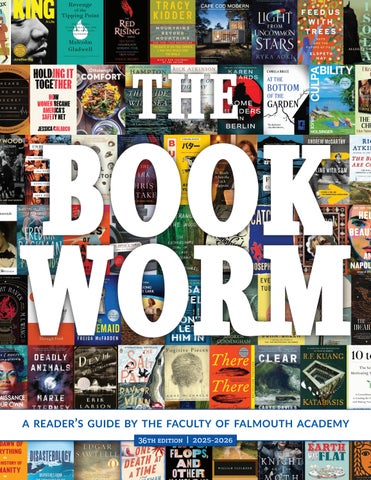
THE
BOOK WORM a reader’s guide by the faculty of falmouth academy 36th edition | 2025-2026
From the Librarian
The Bookworm Falmouth Academy
Dear Falmouth Academy Community, Falmouth Academy’s Bookworm gathers the voices of our faculty and staff as readers who understand that every book is a threshold—an invitation to step briefly into a different mind, a different history, a different way of being. A book can place us in the center of a far-off city, send us adrift on an unfamiliar sea, or offer the rare feeling of being understood by someone we have never met. In the classroom, it sparks debate and imagination; at home, it becomes a quiet pull toward curiosity. Each review in this issue reflects the many lives of reading. Our contributors write not only about plots and themes, but about moments when a sentence stopped them mid-page, when a character clarified something they had struggled to name, or when an unexpected idea illuminated a lesson or conversation. These reflections sketch the contours of how books shape us as teachers, thinkers, and simply as people trying to make sense of the world. To the faculty who offered their insights: thank you. Your words turn this collection into something more than recommendations. They create a portrait of an intellectual community that finds joy in connection, discovery, and the steady work of understanding. Whether you are searching for your next read or simply curious about what has been on the nightstands of FA faculty and staff, we hope you find something here that invites you in. Books remind us that learning never really stops—and this collection is our small way of celebrating that truth. So consider this an invitation to pause—unhurried—and step into another voice, another world. Even on the busiest days, a quiet refuge waits in the pages. Happy reading,
Britta Santamauro Director of Library and Archive
7 Highfield Drive, Falmouth, MA 02540 508-457-9696 falmouthacademy.org
Administration David Perry, Head of School Petra Ehrenbrink, Academic Dean Michael Deasy ’10, Dean of Students Katharine Enos, Director of Development Sarah Knowles, Director of Admission and Enrollment Management Carmen DiSanto, Director of Finance and Operations
Editorial Staff Liz Lerner, Director of Marketing and Communications Clare Perry, Communications and Marketing Support Julianne Waite, Designer
Our Mission Harnessing the power of inspired learning in a world-renowned scientific and vibrant artistic community, Falmouth Academy emboldens each student to take creative and intellectual risks to confidently engage the challenges of our times.
Guiding Values We value... • the beauty of knowledge and the joy of conversation • collaboration and generosity of spirit • the power of a culture of kindness • relationships built on trust, respect, and direct communication • the wonder of imagination • each student’s pursuit of diverse challenges and opportunities • teachers as models of confident, rich adulthood • the richness of an educational experience that includes people with diverse backgrounds, perspectives, and identities
DEI Statement of Commitment Falmouth Academy is committed to continued growth in the area of diversity, equity, and inclusion. We intentionally strive to be a community of dedicated learners who understand their roles and responsibilities as local and global citizens confronting the challenges of our times.
Matt Barnes
History Chair
Undelivered: The Never Heard Speeches That Would Have Rewritten History Jeff Nussbaum
This book caught my attention as it sat on Monica Hough’s bookshelf. As I do with many books, I filed it away into my “To Read” section on Goodreads. Eventually, I listened to the audiobook over the winter. Nussbaum’s book is a fun read; it straddles this line of a non-fiction text and a writing critique. The book is divided into sections based upon themes ranging from “the fog of war” to “crisis to changes of heart.” Within each section, Nussbaum, a presidential speechwriter, provides the context for the speech, details the writing process, evaluates the use of rhetorical devices, and analyzes the end result. I was already familiar with certain speeches, such as General Eisenhower’s speech ahead of D-Day or John Lewis’ speech at the March on Washington. The speech that blew me away was President Nixon’s speech, in which he stated that he would refuse to resign. Nixon’s words offer a legal quagmire for presidential wrongdoing. Nussbaum’s book gives the reader an insight into the last-minute decisions that Nixon made. In fact, I was pleased to pass this source along to one of my juniors, who wrote their research paper on the Watergate scandal. Undelivered is a great read for anyone interested in the “what ifs” of history.
To Kill a Mockingbird Harper Lee
Countless words have been published about this book. From eighth grade essays to literary scholars to eulogies, Harper Lee’s To Kill a Mockingbird needs no introduction. In fact, many of you have probably already read this classic as I did in eighth grade. However, I was reacquainted with it earlier this year. We were studying Jim Crow in eleventh grade history. A student of mine, who did not attend FA in eighth grade, mentioned that he was reading it. After class, he said he understood the book far more now, as a 17-year-old. Our conversation inspired me to revisit the text. As an adult, reading this American classic, I was reminded of the vast amount of subtext I missed as a child. Moreover, the vast ocean of social structures that make the book unique was lost on me growing up in the 21st century in New England. Rather than recommending this book individually, I invite all readers to re-read books from their childhood, whether classics or otherwise. It’s a wonderful opportunity to read from a new perspective. I recognize our readers vary in
age, however, go back and think about the books you loved (or hated) in middle school and high school and start there. It can never hurt to read things from a new perspective. As Atticus Finch once said, “you never really understand a person until you consider things from his point of view.”
King
Jonathan Eig Biographies can be tricky to read let alone to write. How can one encapsulate a complex figure in so many words? Especially given America’s exaltation of the late Dr. Martin Luther King Jr, it would be a monumental task. Yet, Eig does so with a degree of ease. For a book that clocks in just under 700 pages, it was a page-turner. Eig writes short and snappy chapters that keep the reader’s toes on edge. Reading this as an adult, I was reminded of how quickly King accomplished such important moments. He graduated from college at 19, earned a PhD at 25, and led the Montgomery Bus Boycott by 26. He was 34 when he delivered his I Have a Dream speech on the steps of the Lincoln Memorial. The book shapes King in a profoundly human manner. However, Eig does not shy away from some of the controversies that King found himself in. The author details King’s issues with plagiarism throughout his academic journey and his infidelity, which often became a point of contention with the FBI. It allows the reader to feel the sense of pressure MLK experienced while pushing for some of the most significant changes in American society. This Pulitzer Prize-winning book details how King was received in his day, not necessarily how he became a patron saint of American history.
The Wide Wide Sea: Imperial Ambition, First Contact and the Fateful Final Voyage of Captain James Cook Hampton Sides
While on vacation in the Caribbean, I finished a few easy reads, soaking up the sun on sandy beaches. Unfortunately, I realized I did not have a book for the plane ride back to New England. I found myself stumbling into a Hudson News in the Miami airport in an attempt to look for a good read. I tend to scoff at the selection of books at these stores as they are typically a reflection of the New York Times bestsellers list and lack options, especially in the history and nonfiction section. However, I grabbed Hampton Sides’ book on Captain James Cook’s circumnavigation across the globe. I skimmed through the preface and was hooked. Published in 2024, the author recognizes the present day emphasis on decolonization. Instead, he emphasizes Captain Cook’s strengths as a The Bookworm 2025-2026
1
cartographer and navigator. Sides’ introduction highlights how Cook has been blamed for subsequent colonization efforts across the Pacific, but he himself was not a conqueror. I appreciated the nuance he emphasized so early on in his writing. For the rest of the summer, it became a page turner. The sound of waves across Falmouth became the soundtrack as I read. I would look out to the Atlantic and imagine the dual sense of dread and adventure Captain Cook or his crew members must have faced. If you’re interested in adventure or nautical history, this book would be a great addition to your reading list.
Barbara Campbell
Director of Alumni and Parent Relations
Some Murders in Berlin Karen Robards
In 1943, a renowned Danish psychological profiler, Dr. Elin Lund, also known as Dr. Murder, is tapped to solve a series of murders of young women. She and her team are in Berlin, assigned to Detective Kurt Schneider, head of the Criminal Police Unit staffed by Nazis. As the clues to the identity of this serial killer build and the team gets closer to solving the murders, the danger to them and prospective victims also grows. Forced to acknowledge a previous suspect as the killer, Elin learns that the general in charge of the investigation is the actual killer. After a terrifying escape to Denmark from a menacing Nazi Germany, Elin returns to her young son who was hiding with his grandmother, only to be captured by the General. As the officer points his gun to kill her, she is saved by the detective she had partnered with to solve the case.
Jennifer Chamberlain
School Counselor
The Housemaid Freida McFadden
Do you enjoy yelling “no!” and “what?!” at fictional characters? If so, I recommend Freida McFadden’s psychological thriller The Housemaid. This rollercoaster of a novel begins by detectives conducting interviews in the Winchester’s home following a suspicious death. On the pages that follow, McFadden introduces readers to Millie, a young woman trying to get her life back on track as she navigates the many challenges of working for the Winchester family. Just as you think you have the dots connected, a character reveals more about themself or their past to keep you guessing until the very end. 2
The Bookworm 2025-2026
Eleanor Clark
English
Clear
Carys Davies Clear, by Carys Davies, is a small book filled with big disruptions. Earthquake, shipwreck, bone-breaking falls. One can feel the forces at work, along with the potential for pain. Added to that is a context of social change. Set in Scotland during the Clearances in the mid 1800s—a time when landowners forcibly expelled poor families from their property to make way for more profitable endeavors, i.e., crops, cattle, and sheep—Clear follows the journey of John Ferguson, a minister who, having given up his settled position to join the new Free Church, is in dire need of money. Hoping to raise funds for his new parish, he agrees to take on a job of traveling to a remote northern island to evict the last remaining resident, a grim compromise for a good and likeable man. In fact, all the characters feel good and likeable, even wryly funny: John; his wife, Mary; Ivar, the lone island dweller; and the boat captain who escorts them to and fro. Part of Davies’s magic is that, amid all the momentum of characters caught in the current of an impossible time, she creates moments of stillness, of mending and recovery. Throughout much of the story, John must figure out how to communicate his mission to Ivar, a difficult task considering Ivar speaks a personal and dying language, one based on Norn, a language of the far north of Scotland. Gradually, starting with nouns, they connect. Surek. Lorin. Flodrek. The words hover between them like a tentative promise. Liki. “The condition of a ball of wool…when it had just been started; that described its innermost beginning when a fine thread of worsted was being wound. Liki. When the thing was at the very start of what it would become.” Even in a world of upheaval, Davies gives us hope.
Jennifer Crowley
Spanish
The Story of Edgar Sawtelle David Wroblewski
On the last day of school, I left with the thickest book I could find on the shelf outside the library. I didn’t even check the title—just figured the most pages would give me the most time to relax by the sea. That’s how The Story of Edgar Sawtelle ended up accompanying me to a hot, crowded month on the Mediterranean coast. At first, I was drawn in by the beautiful writing. The author paints rural Wisconsin life on a dog-breeding farm with incredible detail. I could clearly picture the quiet
landscape and the repetitive rhythm of life on a farm. At the heart of this peaceful setting is Edgar, a mute teenage boy whose silence shapes the entire novel. Despite his muteness, Edgar communicates a lot, just not through words. His relationships with people are limited, often restrained by the effort required to truly understand him. Ironically, the most meaningful bond he has is with the dogs he trains, especially Almondine, his lifelong fourlegged companion. Their connection is wordless but complete. It’s honest, loyal, and emotionally rich in a way that most of the human relationships in the book are not. As Edgar becomes more curious about his family’s past, he uncovers hidden letters and fragments of truth. These brief glimpses into his family’s history offer more insight than any conversation he’s had. Meanwhile, the emotional weight of caring for his sick mother and running the farm starts to take its toll. Even the dogs begin to rebel, paralleling Edgar’s internal chaos. As much as I enjoyed the writing and found moments of beauty, I never felt fully connected to the story. The first half moved slowly, overdone in description for my liking. The second half was dramatic, tragic, and surprising. I rooted for Edgar and hoped for peace, but when I finally reached the end of 576 pages, I felt…nothing. No closure. No satisfaction. So why did I keep reading? Because there’s something important about pushing through things we don’t enjoy. I’ve heard students ask, “What’s the point of this?”—especially when tasked with something that doesn’t resonate. And honestly, I asked myself the same thing with this book. But I finished it anyway. And it taught me something. I walked away thinking about communication. About silence. About the spaces between words. About listening in new ways and how deeply we can be understood without ever speaking. As a language teacher, I spend my days thinking about words and helping others to use them. At the beginning level, words are basic even though their meaning isn’t. Then we build vocabulary and structure and have a choice in expressing ourselves. Edgar didn’t have that ability, and that was the real story of Edgar Sawtelle. Not what he couldn’t say but how he made others feel without saying a word. No, I didn’t love the book. But I’m grateful I read it and ultimately, it reminded me that purpose doesn’t always come from joy or entertainment—sometimes it comes from frustration and from paying attention to what lingers after the last page is turned. If nothing else, it gave me long hours of reading on the beach in Tossa de Mar. And that alone was worth every page.
Mike Deasy ’10
Dean of Students, History, English
There’s Always This Year: On Basketball and Ascension Hanif Abdurraqib
In the 1990s and 2000s, basketball entangled itself in the promise of America. Media outlets, hungry for tales of American exceptionalism, crafted narratives of the blacktop courts in the country’s cities where poor people could make it, rising—ascending—through the hierarchies of our society to the highest echelons of greatness. In February 2002, Sports Illustrated crowned LeBron James, or “King James” as he’s now known, as the pinnacle of that era; the magazine featured the seventeen year old phenom on its cover, declaring him “The Chosen One.” Hanif Abdurraqib, poet and staff writer for the New Yorker, was born a year before James and grew up in East Columbus, two hours south of where LeBron played his high school ball. In Abdurraqib’s most recent book, LeBron’s path to greatness features heavily, but this is not a book about The Chosen One—nor is it about Abdurraqib, exactly. It’s about making it—which in LeBron and Abdurraqib’s cases meant making it out of somewhere “in spite of the odds,” as they say. In this text which defies easy definition—part memoir, part biography of James, part cultural criticism, part collection of poetry, part ode to East Columbus, part growing up, and part basketball—Abdurraqib crafts a reflection on the foundational aspects of American life: ambition, competition, family, love, community, race, wealth, poverty, but, primarily home—the identities we shape at home, the courts we conquer at home, the heroes we cherish from home, and what’s lost (and gained) when we find ourselves without a home. Abdurraqib asks: What does it mean to be from somewhere you’re supposed to leave? What does it mean to find love in that place? How does one maintain that love while also leaving? How does one return? What does it mean if you don’t?
Gundhild Eder
German
Pineapple Street Jenny Jackson
Pineapple Street by Jenny Jackson is an enjoyable and thoughtful novel centered on the wealthy Stockton family who live in the exclusive Brooklyn Heights neighborhood of New York City. The story focuses on three women: Darley, the oldest daughter, who gives up her career to raise her children; Georgiana, the The Bookworm 2025-2026
3
youngest, who begins to question the privileged life she was born into; and Sasha, who marries their brother Cord and often feels like an outsider as her background lacks the family’s old-money roots. The narrative shifts between each woman’s point of view and explores themes of wealth, class, family expectations, and self-discovery. Although the Stockton family enjoys a lavish lifestyle, their emotional lives are anything but simple. Each woman faces personal struggles and difficult choices as they try to find their places in a world shaped by tradition and privilege. With its mix of humor, honesty, and heart, Pineapple Street is both entertaining and thought-provoking. It invites readers to reflect on what truly matters: love, identity, and the courage to live life on your own terms.
Petra Ehrenbrink
Academic Dean, Modern Language Chair
The Incandescent Emily Tesh
Chetwood School is a magical boarding school, and Dr. Sapphire Walden, one of the most powerful magicians in England, is its Director of Magic. When a century-old threat resurges, attempting to attack the school’s wards, Walden and her colleagues will try to keep the school safe from any danger—including the danger sprouting among themselves. I think teachers may be able to relate to some of the descriptions of teenagers and the internal workings of a school.
One Death at a Time Abbi Waxman
Julia Mann, a cranky former movie icon, teams up with her Gen Z sobriety sponsor, Natasha Mason, to solve the murder she is accused of. This is mainly a romp through Hollywood’s film industry, warm-hearted and filled with wry humor. I could see this story becoming one of Julia’s movies. And I’d go see it.
Deadly Animals Marie Tierney
Studious 14-year-old Ava Bonney has an obsessive interest in the macabre. Along the highway of her hometown, she created her own secret body farm for roadkill where she meticulously studies how dead animals decompose. When she accidentally stumbles across the body of a missing classmate, Ava reports the find to the police anonymously, fearing that her pastime might be discovered and, as a result, forbidden. However, the phone call raises the interest of Detective Seth Delahaye who races alongside—and sometimes in partnership with—Ava to find the killer whose body count is steadily rising. Ava makes for an unusual, utterly likeable protagonist. And even though a few plot threads may not be pulled together tightly enough for my taste, this was a thoroughly engrossing read.
At the Bottom of the Garden Camilla Bruce
I found this a charming book. An estranged murderous aunt becomes the guardian of her two orphaned underage nieces because she is hoping to get her hands on the children’s trust fund. Little does she know that the siblings have some special talents that will unearth longburied secrets—quite literally. This is a gothic dark fairy tale with a touch of wicked humor, and I thoroughly enjoyed reading it.
4
The Bookworm 2025-2026
Don’t Let Him In Lisa Jewell
Nick Radcliffe seems perfect. When he arrives in widowed Nina Swann’s life, he seems to brighten her days. But her adult daughter isn’t quite as enchanted and starts digging into his past. What she finds is dark and warped. Told from different perspectives, the puzzle pieces slowly fit together and allow us a glimpse into the reasoning of someone’s twisted mind trying to appear not twisted at all. It’s hard to grasp that there are allegedly real-life cases that inspired this book. I found this a gripping read.
All the Colors of the Dark Chris Whitaker
During the first pages, I did not quite know whether I would warm to this book, but then—entirely and absolutely (if you read the book you will recognize this mantra)—I fell in love with this stunning novel that is an engrossing and captivating crime story that transcends its genre. After a crime pushes a small town into the national headlines, we follow complex characters in the aftermath of the event into a sprawling, decades-spanning
narrative, in which the author skillfully connects various plotlines and character arcs in an emotional, haunting, and yet uplifting story. I’m not sure when I last read anything quite like this.
My Friends
Fredrik Backman This is another lovely book. Backman, of A Man Called Ove fame, creates a funny and moving novel about the transformative time-spanning power of art and friendship in all of its glory. Newly 18-year-old Louisa’s life is complicated to say the least when a chance encounter with a famous painter leaves her with a priceless painting whose origin story she is determined to discover. Having been disappointed and traumatized in her life by many so far, her journey will slowly show her that there are reasons to get up every morning and that there are reasons to dream even when, at the moment, there is no evidence that this promise will ever be fulfilled. Some of the passages describing the inevitable grief humans experience in their lives struck me as profoundly beautiful: “Soon Ted will stand up and discover that he’s forgotten how to walk too, that happens to us all when the love of our life falls asleep for the last time, because when the soul leaves the body, evidently the last thing it does is tie our shoelaces together. In the weeks following the death, we trip over thin air. It’s the soul’s fault.” A lovely book indeed.
Liza Fox ’96
Science, Spanish
Everything is Tuberculosis John Green
Most of us consider tuberculosis to be a disease of the past—one of Keats and Poe. Yet, 150 million people have died of tuberculosis since the 1950s. Why the 1950s? Well, that is when the first cure for TB became widely available. It is also when it began to disappear and become a disease of the past for those of us living in wealthy nations. We have treatments for TB here, in the United States, but we don’t have TB here—well, very little. In countries like India, Indonesia, and Sierra Leone, where TB is still relatively common, medications to treat TB are harder to come by and, in the case of those that treat drug-resistant TB, they can be nearly impossible to access. TB treatments are where TB is not, and TB is where the treatments are not. In his book, Everything Is Tuberculosis, John Green explores the history of TB and the present inequities in medical treatment. He began writing his book to show
how TB, like many other diseases caused by unicellular organisms, have shaped human history—one could argue that Gavrilo Princip’s consumption started WWI or New Mexico became a state because of TB. After researching and spending time with the sons and daughters, brothers and sisters, and fathers and mothers who are battling with TB in Africa, namely Sierra Leone, and India, his book plan morphed, becoming a bull horn to reveal what those of us in the privileged West have mostly forgotten—people are still dying in large numbers from a disease that is curable.
Bettina Freelund
German, Academic Support
The Many Lives of Mama Love Lara Love Hardin
This book pulled me in like a thriller. I simply couldn’t stop reading Mama Love, the true story of a well-to-do mother of four, seemingly living the perfect suburban dream. But one Percocet pill taken “as needed” spirals into 10, then 30, then 60 a day—before Lara Love turns to heroin. Desperate to maintain her lifestyle, she begins stealing her neighbors’ and friends’ credit cards and ultimately is arrested and convicted on 37 felony charges. Now serving time in prison, Lara has lost everything—her home, her career, and custody of her toddler and three teenage sons. How do you ever recover from that? In spite of—rather than because of—our punitive criminal justice system, she fights her way back, regains custody of her young son, and builds a thriving career ghostwriting for Archbishop Desmond Tutu and the Dalai Lama. Lara’s remarkable journey is a riveting testament to unlikely redemption and extraordinary resilience.
Andy Hamilton
History
The Stranger in the Woods—The Extraordinary Story of the Last True Hermit Michael Finkel
Has it ever sounded appealing to be a hermit? Many of us may dream of finding solitude or finding peace in a quiet place. But journalist Michael Finkel tells a fascinating story about a man who left his home in Massachusetts, drove his car into the woods near his childhood home in Maine, and lived hidden among boulders by a lake without talking to another person for 27 years. I found this story gripping. If you like adventure stories, with a hint of law and order, and might enjoy reading research on what it means to be a hermit, this could be a good book to explore. The Bookworm 2025-2026
5
Monica Hough
English
The Cazalet Chronicles Elizabeth Jane Howard
I read all five of these engaging and engrossing novels (The Light Years, Marking Time, Confusion, Casting Off, and All Change) over the summer, delighting in spending my days with Cazalets young and old. Enticed by a Washington Post article that listed author Hilary Mantel (of the marvelous Wolf Hall trilogy) as a huge supporter of the novels, I found much to love in the realistic storytelling, the large cast of characters, and the rich character development, especially in the spot-on voices of the younger children. Mantel says of Howard, “She helps us to do the necessary thing—open our eyes and our hearts.” These novels do both with warmth and humor. This is the kind of family that refers to patriarch William as “the Brig” and matriarch Kitty as “the Duchy.” While not aristocrats, the well-to-do family’s lumber business means they can afford Home Place, a Sussex estate for large family holidays and the major setting for many of the novels. The first novel begins in 1937, with some characters still traumatized by the First World War as the second one looms, and the series takes William and Kitty, their children, Hugh, Edward, Rupert, and Rachel, and their assorted spouses, children, and lovers through WWII and beyond.
Foster
Claire Keegan Keegan’s novel, a novella really at 128 pages, breaks the heart and mends it all at once. A few years ago, I recommended her Small Things Like These, astounded at how much Keegan can pack into so few luminescent pages. In Foster, an unnamed little girl goes to live with relatives on a farm while her mother gives birth to yet another child. In the Kinsella’s home, she finds a level of care and attention that she has never known and blossoms under the warmth of their love. I fell in love with the child, whose narration blends innocence, naivety, and keen insight into one captivating, heartwrenching, heartwarming whole.
6
The Bookworm 2025-2026
Doug Jones
Mathematics
When the Earth was Flat: All the Bits of Science We Got Wrong Graeme Donald
I discovered When the Earth was Flat: All the Bits of Science We Got Wrong, by Graeme Donald, when I was going through suggestions that my Kindle Amazon account gave based on my library, and I was not disappointed with the suggestion. Through a mix of careful scientific analysis and a light hearted approach, the author explores the fantastical whims and fancy created by mankind throughout the ages such as the search for the “missing link” in evolution. A great book to read in small doses as you can easily finish one chapter in a sitting and come back later for another topic.
Deadly Shore
Andrew Cunningham My guilty pleasure book of the summer was Andrew Cunningham’s Deadly Shore. This fast-paced and adequately written novel explores life on Cape Cod following a terrorist attack on all three bridges, the steamship authority docks, and all the airports, leaving Cape Cod as an isolated and panicked community. Hoarding, looting, and bunker mentality run rampant without much happening of an intellectual nature. Might be best read on your Kindle or with the cover removed.
Sarah Knowles
Director of Admission and Enrollment Management
Butter
Asako Yuzuki (translated by Polly Barton) Written by Japanese author Asako Yuzuki, Butter is a 2017 international bestseller translated into English in 2024. Its buttery yellow cover with a cow, a streak of blood, and the tagline “a novel of food and murder” immediately caught my eye. Loosely inspired by a real-life Japanese con woman and serial murderer, Butter follows a young female journalist, Rika, determined to secure an exclusive interview with a prisoner, Manako Kajii, accused of seducing and murdering her male victims through her cooking. As Rika tries to uncover the truth, she begins to take Kajii’s advice, both culinary and personal.
While I thought I was going to read a murder mystery, Butter is less about crime and more about food and society. It provides an interesting look into Japanese culture— exploring cuisine, social expectations, and gender norms. Yuzuki looks at fatphobia and misogyny and questions how Japanese media treats women who don’t fit its beauty and behavior standards. It’s a lengthy, slow-burn that highlights how cooking brings people together across generations and social circles.
Taste: My Life Through Food Stanley Tucci
While Stanley Tucci is often known as one of the greatest character actors of all time, he is also an amazing storyteller and foodie. I came across Tucci’s travel documentary Searching for Italy in 2021, where he traveled around Italy visiting each region’s unique culture, cuisine, and history. For me, it was escapism during a time when we couldn’t travel but could cook. After watching all the Searching for Italy episodes I could find, I turned to Tucci’s first memoir, Taste, which was released in fall 2021. He writes in a warm, conversational way where you can practically hear his voice in your head as you laugh and cry at his stories. Tucci’s memoir reflects on how food shaped his marriages, his children, his cancer diagnosis, and his relationship with his parents. Food has even inspired him to write, direct, and star in films, like Big Night (which I still need to watch). He also adds in some of his favorite recipes like his wife’s (Felicity Blunt) roasted potatoes, pasta con aglio e olio, and the perfect Negroni. I’m making my way through trying them all.
Cape Cod Modern: Midcentury Architecture and Community on the Outer Cape Peter McMahon and Christine Cipriani
Before my career in admissions, I was an undergraduate studying architecture and art history. While I never pursued architecture professionally, I love reading about the different architectural styles, especially now that I’m a homeowner. When you think of Cape Cod, you naturally think of the classic two-story, steep-roofed, shingled “Cape Cod” house that has defined our region since the late 1600s. What surprised me, and what Cape Cod Modern brings to light, is how the Outer Cape became a location for modern homes in the early to mid-20th century. McMahon and Cipriani don’t just catalog these houses, they celebrate them. Once dismissed as eyesores, these streamlined, modest dwellings embody an experimental
spirit and look more like today’s ADUs. Prominent modern architects Marcel Breuer, Serge Chermayeff, and Olav Hammarstrom built summer homes on the Outer Cape for themselves and their friends, creating an enclave of modern design. Through the book’s vivid photos, architectural renderings, and historical context, the authors show how these houses reflected new ideas about materials, space, and environment. The book connects the work of the Cape Cod Modern House Trust (CCMHT) founded in 2007 by McMahon to save modern homes on the Outer Cape and National Seashore from demolition. Out of more than 100 modern homes in the area, the CCMHT has already restored several key houses, and some can even be rented in the summer. If you’re interested in modern architecture, design, or hidden gems of Cape Cod, Cape Cod Modern is a beautiful and informative read. It’s a history lesson and a love letter to a chapter of Cape Cod and American home architecture.
Chesnok: Cooking from My Corner of the Diaspora: Recipes from Eastern Europe, the Caucasus, and Central Asia Polina Chesnakova
Born in the Ukraine to a Russian mother and an Armenian father who got married in Georgia, Chesnakova grew up in Rhode Island cooking dishes from another side of the globe. In her third cookbook, Chesnok, she wrote down her family’s recipes, many of them passed down from her mother, who cooked “na glaz,” by eye rather than by measurements. Chesnakova paints a portrait of the Soviet diaspora through food. I went to high school with Chesnakova but never had the chance to talk with her about her roots and love of cooking. Reading this book and cooking from it has given me a way to reconnect with her and learn more about her heritage through food. I’m excited to make more from this cookbook as the weather gets colder, and it becomes the season of dinner parties. I hope that when our former Ukrainian student is able to visit again, I’ll have a meal ready that reminds him of home.
Ottolenghi Comfort Yotam Ottolenghi
Comfort food evokes a sense of nostalgia and tradition. Ottolenghi’s newest cookbook has over 100 comfort recipes co-written with Helen Goh, Verena Lochmuller, and Tara Wigley. Each dish is paired with a personal story, highlighting the authors’ diverse culinary roots from the Middle East to Germany, The Bookworm 2025-2026
7
Scotland, Malaysia, and Great Britain. The cookbook asks its readers to think about who we eat with, why we eat, what we eat, and how we eat. Some of my favorite recipes are sambal spiced chicken, coconut rice with peanut sauce and cucumber relish, roasted carrots with dukkah, and tomato and eggplant one-pot pasta. Cooking from Comfort makes me reflect on what dishes I might consider my comfort food. Is it the Fluffernutter sandwich I ate every day in grade school? Maybe it’s the homemade spaghetti and meatballs I always cook the night before the Falmouth Road Race. While certain comfort foods become part of a shared culture, my most treasured dishes are ones I make for family and friends. If you love spices and are interested in adding a twist to what would be considered a more traditional recipe, Comfort offers some inspiration. If you ever find yourself in London, I suggest visiting one of Ottolenghi’s many restaurants. You are guaranteed to have a delicious meal.
Celeste Labedz
Science
Light From Uncommon Stars Ryka Aoki
If I had known in advance how bizarre this book would be, I likely would have hesitated to pick it up. Thank goodness I didn’t know, however, because this novel is a truly wonderful ride! The story follows Shizuka Satomi, a music teacher who struck a deal with a demon to deliver the souls of young virtuosos to hell; Katrina Nguyen, a violin prodigy who flees her transphobic family and falls under Shizuka’s potentially deadly tutelage; and Lan Tran, the matriarch of an alien family fleeing a spacebourne psychological plague, disguised on Earth as a donut shop owner who falls for Shizuka. Despite its strong and strange sci-fi elements, this book felt surprisingly grounded and familiar to me, not only because of its setting in the San Gabriel Valley where I once lived, but also by the author’s use of music as a throughline. The characters’ emotions and relationships are paralleled by the practice, performance, and feeling of music, known well to anyone who has spent time in music and art. This novel stretches the classic theme of found family into new shapes, bridging intergenerational differences with intergalactic ones and expressing beautifully how feelings of love, home, and safety can come in many forms.
8
The Bookworm 2025-2026
There There
Tommy Orange I encountered this book at the Chicago Public Library, on a display of past selections for One Book One Chicago. This novel was a spectacular choice for a city-wide book club because its large cast of characters give every reader stories they can relate to and stories that can challenge them. A dozen different narratives from a community of Native Americans in the San Francisco Bay area comprise the book, which jumps between narrators and time periods as the characters grapple with identity, family, poverty, and history in different ways. The stories seem disparate at the start, and the author reveals their connections in a measured and satisfying way. By the time I reached the climactic events of the story (a robbery with 3D printed weapons), I found myself so deeply invested in every character that I stayed up late to get to the end! In addition to the gripping story, I also appreciated learning about events missing from my prior history education: parts of the novel take place during the 1969-1971 occupation of Alcatraz Island, which led me to read more about that event and the activities of the larger American Indian Movement at the time.
Disasterology: Dispatches from the Frontlines of the Climate Crisis Dr. Samantha Montano
I read this book shortly before teaching my natural hazards course at UChicago, and I loved it so much that I reworked my already-written syllabus to give students a project that included it! This book is a spectacular introduction to the fundamentals of the science and policy of disasters. It’s both informative and narrative, combining the author’s technical expertise as a professor in emergency management with personal stories of her experiences working with a variety of communities facing climate-related hazards or recovering from disasters. As someone who thinks a lot about natural hazards like floods, storms, and earthquakes from a geophysical perspective, this book was a spectacular bridge from the science side to the community side. My students last year made wonderful connections between the ideas in this book and recent climate-related disasters like Hurricane Helene and the LA wildfires, some of which affected them personally. I would recommend this book (and Dr. Montano’s newsletter on the same topics) to those looking to improve their understanding of hazards and disasters in the news, or those hoping to make their own communities more resilient.
Holding It Together: How Women Became America’s Safety Net Dr. Jessica Calarco
This book is one of the best and most frustrating books I’ve read this year, centering around the idea of social safety nets: support structures that help people make it through hard times in employment, finances, or family. Based on her extensive sociological research, Dr. Calarco argues that the lack of public safety net policies in the US doesn’t mean that this support doesn’t exist but rather that its burden is shifted onto individuals, disproportionately women. The book blends sociology, gender studies, and political science with the lived experiences of women encountered by the author through her research on the gendered nature of social support. This book is spectacular in its frustrating familiarity; I know women who have faced situations similar to those featured here, and suspect that most readers can also see relatable stories among its chapters. The power given to the reader that transcends the frustration is the ability to connect women’s anecdotes (in the book or in our own communities) to the large-scale social and policy environment of the US. Looking at individual stories through the political lenses outlined in this book is already changing the way I see the social world around me.
Liz Ledwell
English Department Chair, Drama
Katabasis R.F. Kuang
I will admit that I’m not yet finished with R.F. Kuang’s Katabasis, but I’m loving it so much I had to include it. If you are an English teacher like me, what’s not to love? With shades of Lev Grossman’s The Magicians and Susanna Clarke’s Jonathan Strange and Mr. Norrell, this story follows Alice Law, a graduate student in Magick at Cambridge, who follows her professor into the underworld in pursuit of a letter of recommendation for a tenure-track position in the field. Guided only by literary texts like The Inferno, she heads into Hell at a great cost to herself. This might sound a little too fantastical and a bit dull when I write the description here, but that doesn’t do justice to Kuang’s terrific sense of humor, complexity, and cleverness. I had loved her novel Yellowface, and it’s clear that Kuang has a talent to be reckoned with. If I hadn’t known it, I would never have guessed that the same person wrote both novels. I’m having a ball reading it.
Mountains Beyond Mountains Tracy Kidder
Mountains Beyond Mountains by Tracy Kidder was one of those books I always meant to read but never got around to finding a copy. Finally, I found one at a used bookstore and picked it up determined to finish the story of Paul Farmer, a doctor who Kidder characterizes as “the man who would cure the world.” Farmer is a fascinating subject—energetic, devoted, and brilliant—and his life makes for fascinating reading.
A Devil in the White City Erik Larson
A summer trip to Chicago made me pick up and reread Erik Larson’s A Devil in the White City. I read small snippets as I toured the architecture the novel showcases. From the original site of the world’s fair to the Art Institute of Chicago, there is nary a building in sight not touched by the stories told in this fabulous book.
Hits, Flops and Other Illusions Ed Zwick
I snuck into my past movie-going experiences by reading a lot of film history this summer. I miss the days when everyone in the room was excited to share the communal experience of seeing a great film. Jeanine Basinger’s and Sam Wasson’s Hollywood is an exhaustive look at the history of the art form, from silents to the present day. A compilation of interviews from the last one hundred years, it is a great starting point to understand the business and the art of film. Ed Zwick’s Hits, Flops and Other Illusions read like Zwick’s movies—smart, creative, and intriguing. It even had some great advice for would-be filmmakers (and as someone who teaches a film class, I found those moments the most interesting!).
The Devil’s Candy Julie Salamon
Julie Salamon’s The Devil’s Candy is an almost day-by-day account of the making of The Bonfire of the Vanities. One of the great books of the eighties, the film was a disaster. Salamon was granted unlimited access to the filmmakers’ conversations from development to the premier; everyone from AFI interns to director Brian de Palma had the chance to offer their take on the The Bookworm 2025-2026
9
process. Clearly, they had high hopes for the film, and even though the press began to turn on the film well before its opening, only after it opened did the artists and studio realize that the film would not succeed. What’s most intriguing is Salamon’s and de Palma’s relationship, for ten and twenty years later they would meet and revisit the film’s legacy. Though it stalled his career for a short while, the director bears no ill will toward those who seemed to gleefully relish the film’s demise.
Walking with Sam: A Father, A Son, and Five Hundred Miles Across Spain Andrew McCarthy
Andrew McCarthy’s Walking with Sam: A Father, A Son, and Five Hundred Miles Across Spain, is a memoir that combines many styles. McCarthy, you might remember, was a key member of the Brat Pack in Hollywood in the 1980s (a fact which has haunted him for much of his adult life), but this story is simply about his walking the Camino de Santiago, a pilgrimage of sorts for him and his newly-adult son. Musings on parenthood and acceptance blend with the scenery. Moments of humor and frustration, great beauty, and overwhelming fatigue pepper this story, making me want to undertake such a pilgrimage myself.
Liz Lerner
Director of Marketing and Communications
Feed Us With Trees Elspeth Hay
What if the key to our food future isn’t in the soil but in the canopy? That’s the question Feed Us With Trees asks, and it stays with you long after you’ve finished reading. Written by Elspeth Hay, host of WCAI’s Local Food Report, the book blends science, storytelling, and Indigenous knowledge to reveal a world where oak trees, acorns, and forest ecosystems form the backbone of sustainable living. Hay takes readers on a journey across continents and centuries, traveling to meet foragers, scientists, and cultural historians, and uncovering the deep roots of humanity’s relationship with trees. Through engaging interviews and rich historical context, she digs into the anthropology of what and how we eat, and how we might do it differently in a changing world. In doing so, Hay offers a powerful challenge to the “no farms, no food” refrain and invites readers to imagine abundance rooted in reciprocity rather than ownership. Hopeful and grounded, Feed Us With Trees will have you 10
The Bookworm 2025-2026
looking at your neighborhood oak tree and fallen acorns in a whole new light.
Be Ready When the Luck Happens Ima Garten
Long before she became “The Barefoot Contessa,” Ina Garten was searching for purpose. In her memoir, Be Ready When the Luck Happens, she traces that quest with honesty and humor—reflecting on an anxious childhood, a windy career path, and how she learned to express herself through food. Through each chapter, Garten shares hard-earned wisdom, from navigating gender roles in business to building a marriage rooted in respect. Her reflections are as nourishing as her recipes: comforting, thoughtful, and gracefully delivered. Even when the anecdotes in her memoir feel just a touch out of reach, Garten’s warmth and humanity invite readers to pull up a chair and listen. Beyond her warm persona, Garten reveals herself as a savvy entrepreneur with a sharp business mind, navigating an era when few women were encouraged to lead. It’s a blend of insider stories, delightful anecdotes, and reflection. If you have ever used her recipes, or watched her television show, you’ll find the same grace, passion, and ease in her storytelling.
Rachel Mulcahy
Arts
Circe
Madeline Miller (audiobook read by Perdita Weeks) This novel tells the epic life story of the goddess Circe—witch of the mythical island of Aeaea and daughter of Helios, the Sun God of Greek mythology. I picked this story as my next listen on Audible after it came up on my discovery page and not knowing much about the character other than what I remembered from reading The Odyssey in high school. Circe was the goddess-nymph who trapped both evil and good men alike on her island, transforming them into pigs to fill her sties. The story begins at her birth and spans the thousands of years of her life, delving into themes of love, grief, loneliness, motherhood, and courage. A fantastic listen for readers who enjoy the fantasy genre, this story is a masterpiece of world-building as it draws from the remarkably complex histories and fables of Greek mythology. I thoroughly enjoyed this story and was especially captivated by Perdita Weeks’ outstanding performance as the narrator.
Lucy Nelson
Arts
The Red Rising Series: Red Rising, Golden Son, Morning Star Pierce Brown
After repeatedly seeing this trilogy popping up online as one of the best dystopian science fiction series, I finally picked it up and then couldn’t put it back down. The story is set on Mars with a sharply delineated caste system. The Reds, lowest in the color-coded system, have been laboring beneath the surface of the planet for generations in order to create a habitable surface for their future offspring. Unbeknownst to them, the other colors have been living on the surface for years, reaping the rewards of their work. We follow Darrow, a Red beset by tragedy, who joins the revolution to overthrow the Gold ruling class and create a more fair society. The trilogy takes us across the solar system with planetary battles and clandestine spy networks. If you are a fan of The Hunger Games, you will enjoy this series.
Blood Over Bright Haven M.L. Wang
I bought this book while visiting Lovestruck Books in Harvard Square, and I highly recommend you stop by whenever you are in that area. Blood Over Bright Haven is a stand-alone fantasy novel that hooks you with its elaborate magic system. The city of Tiran has maintained its magical border for hundreds of years with a shield powered by an unearthly realm, overseen by the all-male Archmages. The story follows Sciona as she labors to become the first female admitted to the Magistrate, along with her assistant, Thomil, from the blighted lands beyond the border. The rigid social hierarchy makes it difficult for Sciona and Thomil to prove their worth, and their research into the source of the city’s magic further threatens their position.
Dan Nightingale
Science Department Chair
The Salt Path Raynor Winn
I found this book in a small independent bookstore in Lenox, Massachusetts. The cover called to me—a blockprint of a seagull, white cliffs, and two shadowy silhouettes. This memoir depicts the physical and emotional journey of a couple traversing the South West Coast Path, a
630-mile trail extending from Minehead to Poole in England. The author, Raynor Winn, and her husband, Timothy “Moth” Winn, lose their home, and Moth is diagnosed with a degenerative illness. Unhoused and in ailing health, they walk the path hoping to garner clarity over a life upended. Raynor Winn draws you in with a relatable narrative about life’s cruel circumstances and the resilience necessary to overcome them. The warm dialogue between Raynor and Moth is a particular highlight. As one loses hope and begins to doubt their ability to accomplish such a feat, the other buoys spirits and reminds them that whatever life they live together is a complete one. Such an inspiring story nearly convinces the reader that hiking along smooth shorelines and steep cliffs has a preternatural ability to heal both the body and the mind. Unfortunately, I must caution you not to be swept away by the undertow of this compelling story. Halfway through this memoir, I was reminded of the nature of memoir and memory itself, both impermanent and imperfect. A notable news outlet in the United Kingdom broke the scandal that Raynor Winn likely embellished, if not outright fabricated, some of her accounts à la James Frey’s A Million Little Pieces. As the reader, I felt betrayed. It took several weeks before I could consider returning to the work. Eventually, I convinced myself that, despite losing trust in the author, finishing the tale would provide some closure to my connection with its characters. Although its conclusion left me satisfied, you will likely not see me reading another of Winn’s works for the foreseeable future.
Jennifer Park
Spanish
Isola
Allegra Goodman “Isola” means island, while “sola” means alone. Much of Allegra Goodman’s story takes place on an island off what is now the Gulf of St. Lawrence, Canada, where Marguerite de La Rocque confronts the unforgiving elements and the fear of losing the three people she loves the most. In winter, the sea freezes solid enough for animals to cross yet remains too expansive for humans— the mainland lost beyond the horizon. Set in the 1500s, when the French crossed the Atlantic in hopes of claiming new lands, Goodman reminds us that the greater hardships often began at home—in France’s “civil” society—where a woman’s wellbeing depended on the men in her life. Without legal or social power, her survival hinged on whether a husband, father, or guardian chose to treat her well.
The Bookworm 2025-2026
11
Though inspired by a true story, I recommend delaying research until you reach the end of this page-turner. The story as recorded in history has several contradictory endings. Goodman chooses one. By far my favorite book of the summer, I found it impossible to put down.
Clare Perry
Communications and Marketing Support
The Shell Collector Anthony Doerr
This is one of my all-time favorite collections of short stories. While I haven’t read it recently, the title beckons after a recent visit from my mother—an avid collector. We took her to a couple of beaches where she could cast her dementia aside and turn her usual Maryland weeding posture toward the sand and rocky shores. If there are no weeds or shells or rocks, my mother moves to other “treasures,” even the tiniest scraps of trash from the street or the crumbs of our morning muffins from the carpet. When asked about the inspiration for his book, Anthony Doerr talks about finding an old tin tennis ball “can [in his closet where there] were hundreds of shells that [he] had collected on trips to Florida with [his] family during [his] childhood. Finding them started firing all these large-scale emotions and memories—stuff [he] hadn’t thought about in a long time.” Further, he describes his writing process as “looking for detail, imagery [he] falls in love with, scraps of people [he] can build into made-up people.” I think my 87-year-old mother is picking everything up these days (much more than she used to) to bring home, to rearrange on the counter in ways that help her cobble together stories of her days that otherwise feel a bit fragmented. All eight stories in The Shell Collector are beautiful weaves of scraps of science and people. In fact, one of my favorite aspects of this collection is how well Doerr incorporates his naturalist perspectives and scientific findings into extended metaphors that guide us readers into rich landscapes of emotional narratives. Now that my mom has headed home, I am ready to read this one again, in a low-lying beach chair, just off the bike path, before it’s too cold to do so!
12
The Bookworm 2025-2026
David Perry
Head of School
10 to 25: The Science of Motivating Young People David S. Yeager
This summer, I asked the faculty to read 10 to 25 by psychologist David Yeager, and we began our August inservice with a conversation about its central idea: the mentor mindset. Yeager defines this mindset as the balance of high standards and high support—an approach that challenges young people while also providing the scaffolding and respect they need to meet those challenges. It is a deceptively simple formula but one that has profound implications for schools like ours. Yeager contrasts this stance with two less effective extremes. The enforcer mindset demands much but offers little support, often leading to resentment or mere compliance. The protector mindset, by contrast, offers abundant care but lowers expectations, which can inadvertently signal a lack of belief in students’ abilities. The mentor mindset, however, does both: Five Practical Ways to it holds the bar high Practice the Mentor Mindset while making clear that 1. Be Transparent: Explain the the adult is invested “why” behind expectations, in the young person’s assignments, and rules. success. Adolescents, Purpose fuels motivation. Yeager argues, 2. Give Wise Feedback: Pair critique with belief: “I expect are not primarily more of you because I know motivated by rewards you can do it.” or punishments but 3. Treat Stress as a Signal: by a yearning for Normalize nerves as signs of meaning, respect, engagement, not reasons for and recognition. They withdrawal. rise to challenges 4. Ask Real Questions: Pose when they sense authentic questions, listen carefully, and show students that those challenges their voices shape the work. are both purposeful 5. Communicate Belonging: and achievable with Remind students, especially guidance. in moments of struggle, that In our discussion, they are respected members faculty connected of a community that wants them to succeed. Yeager’s ideas to the daily work of teaching and advising. We talked about “wise feedback,” the practice of giving critique in a way that communicates both belief and expectation: “I’m pushing you because I know you can do it.” We reflected on the power of transparency— explaining the why behind assignments, classroom rules, or even disciplinary policies—so that students see purpose rather than arbitrariness. Teachers shared examples of framing stress as a challenge signal, encouraging students to understand butterflies in their stomachs before a test or
nerves before a performance not as reasons to panic but as signs that they are engaged in something meaningful. Others pointed to the value of authentic questioning: asking students real questions, listening carefully to their answers, and using those responses to co-design next steps. What struck me most in our conversation was how natural the mentor mindset feels in the context of Falmouth Academy. Ours is a school built on close relationships, high expectations, and a shared seriousness of purpose. Yet Yeager’s language gave us a sharper lens for examining our own habits. It challenges us to notice when we slide too far into enforcer mode—frustrated that students don’t meet expectations—or when, in the name of kindness, we protect them from challenges that would actually promote growth. Naming those tendencies helps us resist them. We left our in-service with a shared commitment: to practice the mentor mindset more deliberately in classrooms, advisory groups, and on the playing fields. That means setting high bars, explaining why they matter, offering steady support, and giving feedback that treats students with dignity. In short, it means helping young people experience what all of us crave: the respect that comes from being taken seriously and the encouragement that makes success possible. High standards, high support—raising the bar and lifting together.
The Dawn of Everything: A New History of Humanity David Graeber and David Wengrow
Those who know me well know that I have long loved history—not only for the stories it tells, but for the way it reshapes the questions we ask about ourselves. This past summer I read The Dawn of Everything: A New History of Humanity by anthropologist David Graeber and archaeologist David Wengrow. It is a sweeping, provocative work that unsettles many of the assumptions underpinning the traditional story of human development. Graeber and Wengrow take aim at the neat, textbook version of our past—the idea that humanity advanced in a straight line from small egalitarian bands of foragers, to farming villages, to hierarchical states and modern nations. They argue instead that such narratives rest on shaky evidence and unexamined assumptions. By drawing on archaeology, anthropology, and Indigenous traditions, they show how early societies were remarkably diverse and experimental: farming and foraging often coexisted; some cities flourished without kings or centralized power; freedom was sometimes defined less by laws than by the ability to move or to refuse. The book is not without controversy. Its bold claims and reinterpretations have sparked debate among historians, anthropologists, and archaeologists. Yet Graeber and
Wengrow are not primarily offering a new master story so much as challenging us to ask better questions about the human past: Why do we assume that inequality was inevitable? Why do we imagine that complexity must lead to hierarchy? And what other paths might have been possible? While not all of Graeber and Wengrow’s claims will persuade every reader, I found their willingness to unsettle old certainties exhilarating. For me, this is history at its best: bold, questioning, and alive with possibility. At Falmouth Academy, where we encourage students to probe assumptions and think critically about the stories they inherit, The Dawn of Everything offers a powerful model: history not as a fixed narrative but as an open invitation to reimagine what is possible.
Alaina Plueddemann ’15
Arts
As I Lay Dying
William Faulkner My return to FA as a faculty member, rather than as a student, gave me the perfect excuse to reread some of my old favorites from high school (maybe All the King’s Men will be next year’s pick!). If I were to totally fail to do justice to the complexity and depth of this book, I would tell you it’s a story about a destitute family traveling across rural Mississippi in the 1920s to bury their deceased matriarch. But with a dozen different characters taking turns narrating the story (including the aforementioned deceased matriarch herself), each propelled by their own motivations, fears, desires, and secrets, it’s nowhere near that simple. When I first tackled this book in Ruth Slocum’s 11th grade English class, most of my brainpower was spent on trying to decipher what exactly was going on. Faulkner’s prose can be opaque and convoluted, and in-class discussions were essential for untangling it all. Now that I know the plot, I was able to reread it “for fun” this time! And what fun it was, in a sort of “watching a train crash you’ve already seen before, knowing you can’t stop it this time either” kind of way. The world of the Bundren family is by turns strange (Darl and his inner monologues), touching (Dewey Dell’s desperation, Vardaman’s raw grief, Jewel’s loyalty to his mother), horrific (the fate of Addie’s coffin and Cash’s leg), and even darkly comedic—the final line is so appalling that you almost have to laugh. As I Lay Dying almost reads like a parable sometimes, in the sense that characters are often hoist by their own petard; though it also contains a bleak sense of unfairness in the way that some of the most egregious sins not only go unpunished but are rewarded. The characters are so complex and murky and often go to great lengths to hide The Bookworm 2025-2026
13
their motivations from the reader (and even themselves). A decade ago, my favorite character was Dewey Dell, whose fearful and erratic nature felt very relatable at the time. During this read, though, she struck me as self-absorbed and naive—but on the other hand, I found I got a lot out of Jewel and Vardaman, both of whom I breezed past in high school (Jewel was far too edgy for my taste, and I was keen to distance myself from the child of the group, Vardaman). It is not a book I’d recommend as a light beach read, but if you’ve got a pen and an appetite for a story, it’s a book I’d recommend as a glimpse into a fascinating cast of complex humans.
jaunt through the absurdity of war—until suddenly, with about a third of the book remaining, it’s not. The darker tone shift towards the end is somewhat jarring but finally sheds some light on the true horror that Yossarian has lived through, and the heartwrenching fate of his one-time flying mate, Snowden, which Yossarian has carefully skirted around for much of the book. The ending is, of course, just as ridiculous as the rest of it—and yet somehow it worked for me and after spending most of the book laughing, I had a tear in my eye as I closed the last page!
Catch-22
Helen Reuter
Joseph Heller Like me, you may have heard the phrase “Catch-22” in casual conversation and deduced from context clues that it meant some sort of lose-lose situation. I always had a sneaking suspicion that there might be more to it, and I was doubly intrigued by seeing this book on my dad’s bookshelf (he is famously not a big reader, so I figured it must be special to earn a place in his hall of fame!). The book follows the zany misadventures of a group of soldiers stationed in Italy during World War II, with bombardier John Yossarian emerging as the main rabblerouser. Yossarian is plagued by the delusion that everyone is trying to kill him—most egregiously, the leaders of his own unit, who keep raising the required mission count, making it impossible for Yossarian to fly enough missions to go home. When we meet Yossarian for the first time, he is embroiled in a scheme to fake being sick to get out of missions, leading him eventually to get a stern talking-to where he is reminded of the famous Catch-22. When the original meaning of “Catch-22” was revealed, I was struck, paradoxically, by both the elegance and the nonsense of the premise. Essentially, this (fictional) military rule states that any person who fears for their safety is clearly sane, and could never be relieved from duty on account of insanity—so Yossarian, who would like very much not to be shot down in a plane over the Mediterranean, has a sound mind and must fly. On the other hand, Orr, his erratic compatriot who seems to have no regard for his own life, is clearly insane and could be grounded—but if he were to ask to be grounded, he would prove himself as sane, and must fly again. Paradoxes, circular logic, and absurdity are the calling cards of this book, and Catch-22 had me bursting out laughing almost constantly. Jokes are set up in one chapter, fleshed out in another, and the long-awaited punchline comes in yet another chapter. Stories cascade into each other, circle back around, and are shown from different perspectives until the whole truth is revealed. It’s a wacky 14
The Bookworm 2025-2026
Learning Specialist
Fugitive Pieces Anne Michaels
In a recent craving for poetry, I came upon Anne Michaels. Although I initially dismissed her three novels since I was not in the mood for historical fiction, the first chapter of her novel Fugitive Pieces pulled me in like few other books ever have. The young protagonist, Jakob, escapes the Nazi-era fate of his mother, father, and sister as a young, traumatized animal would: running and hiding. Describing Jakob’s first nights as a fugitive, Michaels’ poetic prose rings loudly: “The night forest is incomprehensible: repulsive and endless, jutting bones and sticky hair, slime and jellied smells, shallow roots like ropy veins.” From the forests of WWII Poland to Greece and then to Canada, Jakob moves through his world as a poet, dealing with his loss of family and homeland through the power of observation and the word. Perhaps taking metaphor too far, Michaels has Jakob saved by a Greek geologist and in turn, helping one of his students excavate the truths of the student’s concentration camp survivor parents. This slight criticism, however, does not dull the novel’s strength and beauty and will not stop me from opening Michaels’ other novels, The Winter Vault and Held.
Olivia Riddiford
Assistant Director of Admission, Yoga
The Knight and the Moth Rachel Gillig
Honestly, I do not want to give too much away about this interesting adventure. After seeing this book pop up on a few of my recommended reads lists, I opened it not sure what to expect. After the first few pages, I knew this would be my Bookworm submission. There are six Diviners who dream of the future by being drowned in a magical spring by the Abbess. Omen
messages from the gods come to the Diviners relaying messages to all who travel to have their futures told. When the king arrives with his entourage, the Diviner Six reads his future. One by one Six’s Diviner sisters begin disappearing until she is the only one left. Her adventures continue with a handsome rogue who helps her to discover the whereabouts of the other Diviners. I don’t want to give too much away, but I really liked this novel and also enjoyed reading Rachel Gillig’s other two novels, One Dark Window and Two Twisted Crowns.
Hello Beautiful Ann Napolitano
Hello Beautiful is the story of four Italian American sisters growing up in Chicago. Using different points of view, we learn about Julia and her drive to have the perfect “all-American” family. Her dreams are shattered when her husband leaves her and their newborn after he realizes his life is not on the same path as hers. William’s point of view demonstrates why he could not be the man Julia dreamed him to be. Her sister, Sylvie, completes the narrative as the third point of view. Love, family drama, and ultimately, forgiveness are what draw the reader in. Beautifully written—I gobbled this book up in a couple of days.
Britta Santamauro
Director of Library and Archive
Renaissance of Our Own: A Memoir and Manifesto on Reimagining Rachel Cargle
When I saw that the independent bookstore Belonging Books in Hyannis was holding a “Defining Moments” book club in the summer, I was keenly interested to join. The first book they chose was Rachel Cargle’s memoir. It is one of the most truthful and courageous books I have read in a long time. Cargle recounts how she reckons over and over with her life choices, questioning standard norms we all abide by, while pushing to discover who she truly wants to become and was meant to be. Above and beyond, she creates a world that she herself envisioned and wants to live in, completely reimagining traditional educational pathways, as well as corporate hierarchies and policies. This book is essential reading for anyone with an interest in supporting the greater good and promoting positive change.
Revenge of the Tipping Point: Overstories, Superspreader, and the Rise of Social Engineering Malcolm Gladwell
I was surprised to receive Gladwell’s book through the library’s Libby app without a long wait period, pretty much shortly after it was published. Once I had finished listening to it, I started listening to it all over again. I do not recall any other time ever when that has happened to me. I was just so floored with the multiple case studies on social epidemics that Gladwell recounts that I needed to hear them again. Whether you agree or disagree, or have a different take on these things altogether, there is just so much to unpack after reading this book. In fact, I might have to go back and read it for a third time.
Culpability
Bruce Holsinger Although this book is an Oprah Book Club pick and therefore already receives considerable attention, I decided to write about it anyway. The reason is that this is the first book I have read that incorporates modern AI technology into its present-day fictional plot line (as opposed to science fiction). Set against the backdrop of a family vacation, it skillfully weaves in the use of self-driving cars, drones, and AI bot mentors and friends, all while questioning the moral responsibilities and ethical consequences these technologies create. Ultimately, it invites us to consider how seamlessly (and perhaps uneasily) artificial intelligence is becoming part of our everyday lives.
George Scharr
Music
I Heard There Was a Secret Chord Daniel J. Levitin
In his book, Daniel J. Levitin (author of best seller This Is Your Brain on Music) brings together numerous studies on the effect of music on the human body and spirit. “Whether through singing, playing an instrument, or actively listening, music diverts attention away from negative thoughts and rumination. . . Exposure to music has been found to enhance neuroplasticity, leading to changes in neural connectivity,” Levitin writes. For those of us of a certain age, studies confirm that older adults who took music lessons for an hour a week The Bookworm 2025-2026
15
and played just 30 minutes a day for six months showed robust increases in grey matter. The positive effects of music go on to have positive effects on depression, dementia, hormone production, socialization, pain lessening, and even conflict resolution. The Congress of Vienna in 1814 brought together the heads of European states to settle many destabilizing issues of the time: the French Revolution of 1799, the dissolution of the Holy Roman Empire in 1806, and the Napoleonic Wars which were ongoing at the time. Did you know that Beethoven wrote his seventh symphony—often considered his most uplifting—for this Congress? I will undoubtedly continue to use this book as reference throughout my life. There are portions of it that go into music theory so it is not always a light read, but you may skip over those paragraphs and still come out with the same satisfaction and knowledge.
Ruth Slocum
Director of College Counseling
The Song of the Lark Willa Cather
This lesser-known novel by Willa Cather was published in 1915 after Cather had come to New York and was living the life of an artist far from her formative upbringing in a Nebraska small town. Some see this novel as deeply autobiographical as it chronicles the struggles of opera singer Thea Kronborg, born to a Swedish immigrant family in Nebraska, as she rises to become a star at New York City’s Metropolitan Opera, a journey not unlike Cather’s own. Thea’s artistic inspiration stems from the beauty and mystery of the West that she is able to channel into her vocal expression. Just as Cather was able to infuse her western novels, most notably My Antonia, with a portrait of the West at a remarkable time in our nation’s history and yet also address universal themes of individuality, feminism, and creativity, here she again captures these forces in a compelling and beautiful novel. If you’ve enjoyed reading other Cather titles, I encourage you to pick this up.
Mrs Pollifax on Safari Dorothy Gilman
In these frightening times, what better title to delve into than the clearly escapist Mrs Pollifax on Safari. It turns out, of course, that times have always been bad, and in this instance our intrepid Mrs. Pollifax must try to avert the assasination of the President of Zambia. New Jerseyborn-and-bred, Mrs. Pollifax is no fool, and 16
The Bookworm 2025-2026
her astute powers of observation help her to analyze a cast of mysterious safari-mates, looking for the deadly international assassin with the code name Aristotle. Written by Dorothy Gilman in the 1970s, the Mrs. Pollifax books are a tonic in a time of seeming chaos and digital overload as our heroine uses her deep knowledge of human nature and some surprisingly good karate moves to bring things to order. It isn’t all hi-jinks, however, as Gilman inserts a certain gravitas at times. After one character comments on the apartheid of Rhodesia, saying: “I think it’s terribly unfair that a minority of two hundred and fifty thousand white people have absolute power over six million natives and squash them. After all, it’s their country,” our Mrs. Pollifax replies: “In general, the Golden Rule seems to be the last rule applied in any situation these days.” Some things don’t change. But luckily we can distract ourselves with a delightful, action-packed sojourn with a heroine who follows her moral compass to the end.
Rob Wells
History
The British Are Coming: The War for America, Lexington to Princeton, 1775-1777 The Fate of the Day: The War for America, Fort Ticonderoga to Charleston, 1777-1780 Rick Atkinson
After the success of his acclaimed World War II trilogy detailing the campaigns of US forces in the European theater, Atkinson, a former journalist and war correspondent, has turned his attention earlier in time and closer to home with a planned three-book account of the American Revolution; these works represent the first two-thirds of that trilogy. He is a skilled practitioner of a very vivid style of historical writing that brings the reader intimately into recounted events with a flowing narrative that does justice to his journalistic roots; his work is far from anyone’s idea of dry, academic history, but he has definitely engaged in meticulous and extensive research. In one manner and context or another, I have been hearing and learning about the American Revolution my whole life, so it was wonderfully surprising to encounter so much that I had not known about the conflict. For example, though I grew up in Rhode Island, and my ancestors were there and involved throughout the time period, I knew next to nothing about the details of the Battle of Rhode Island fought in the late summer of 1778. Though reading about actions playing out on terrain that I know well was intriguing, what I enjoyed most about these books
were the chapters that dealt with the political battles and mismanagement playing out back in England. I knew that there was extensive opposition to the war in Parliament, but it was sobering to learn that most British military leaders, and even key members of the government, saw the war as an unwinnable mistake from very early on. Yet, key policy makers clung to abstract ideas about national pride and glory of empire to justify continuing a futile struggle that became increasingly sure to lead to war with the Bourbon powers of France and Spain. Certainly reflecting Atkinson’s own war journalist experiences, the parallels to the hubris and misperceptions that continue to dominate military efforts at conquest and suppression in our own time are unmistakably clear. British leaders were sure that most colonists were loyalists who would rally to the King’s forces, even after years of hard evidence to the contrary! The British found to their frustration that they could capture, but not really hold, territory over such a vast region so far from home. The brutal tactics of burning coastal villages to undermine Colonial morale only served to embitter the population against the invaders and completely destroyed designed efforts to win hearts and minds. It all sounds too familiar and, frankly, discouraging, about the notion of history as a teacher of lessons for the betterment of humanity.
Delia White
French
the fall of King Louis-Philippe and the rise of the Second Republic, a period marked by social unrest, economic instability, and widespread demands for justice, reform, and democratic liberty. Frédéric is passive and indecisive, perpetually caught between his yearning for greatness (whether in his career or his love life) and his inability to act. He is destroyed by his own inertia. Flaubert, who witnessed three revolutions during his lifetime, viewed many attempts of political change as chaotic and futile, and revolutionaries as naïve and self-deluded. His cynicism permeates every page of the novel: through Frédéric and the members of the Club de l’Intelligence, Flaubert exposes the emptiness and incoherence of the idealism that led to the collapse of the 1848 Revolution. L’Éducation sentimentale is both a love story and a social critique—a portrait of a society incapable of meaningful change or purposeful action.
Falmouth Academy
L’Éducation sentimentale (Sentimental Education) Gustave Flaubert
L’Éducation sentimentale (Sentimental Education) is a novel by Gustave Flaubert, published in 1869. The book follows the life of Frédéric Moreau, a young man from Provence, who moves to Paris in the mid-nineteenth century in pursuit of love, ambition, and new experiences. On his journey to the city, he meets Madame Arnoux, the wife of an art dealer, and becomes deeply infatuated with her. In Paris, Frédéric becomes involved in the city’s political and social circles, attending the debates of the Club de l’Intelligence, where ideologies are incoherent, arguments are cyclical and sterile, and conclusions are never reached. The club becomes a microcosm of the broader failure of the 1848 Revolution in Paris. While studying history in Paris, I wrote a commentary focusing on how the political club in the novel represents, in Flaubert’s view, the contradictions and failures of the 1848 Revolution. I, therefore, read the novel through a political lens rather than a romantic one. While the story traces Frédéric’s downfall through his obsessive love for Madame Arnoux, it also functions as a sharp social critique of Parisian youth in the wake of
Falmouth Academy is distinguished by its dedication to educational excellence, guided by its exceptional faculty and accomplished alumni. With a long-standing record of academic success, our aim is to set the standard for superior education in southern New England. Beyond academics, we prepare our students to be lifelong learners, responsible citizens, and ready participants in the challenges of the future. We encourage curiosity, creativity, and cultural understanding, empowering our students to thrive in an interconnected global society. Through innovative learning experiences inside and outside the classroom, we connect our students with diverse ideas, places, and cultures. Curious about the students who come from more than 22 towns across Cape Cod, the South Shore, the South Coast, and Martha’s Vineyard to be a part of our community? Explore their stories and experiences by visiting us at falmouthacademy.org. If you’d like to schedule a tour or learn more about our admission events, please visit falmouthacademy.org/ admissions or call us at 508-457-9696.
The Bookworm 2025-2026
17
Falmouth Academy 7 Highfield Drive Falmouth, MA 02540 ADDRESS SERVICE REQUESTED