“The land does not bend for us. We survive by learning how to bend with it.”
Editorial Team
Max Donovan ‘26
Maverick Pil ‘26
Annabelle Bush ‘26
Hannah Flanders ‘26
Raven Guinta-Tavares ‘27
Weston Mogul ‘27
Luke Seston ‘28
Hollis Oliver ‘28
Hannah Park ‘28
Mahnaz Ronan ‘28
2026 Awards Panel
Graphic Design & Editing
Mahnaz Ronan ‘28
Faculty Advisor
Ms. Monica Hough
Dr. Bettina Freelund Ms. Leslie Walters
Ms. Hayley Yeamans
Ms. Delia White
Mx. Dan Nightingale
Ms. Jennifer Park
50
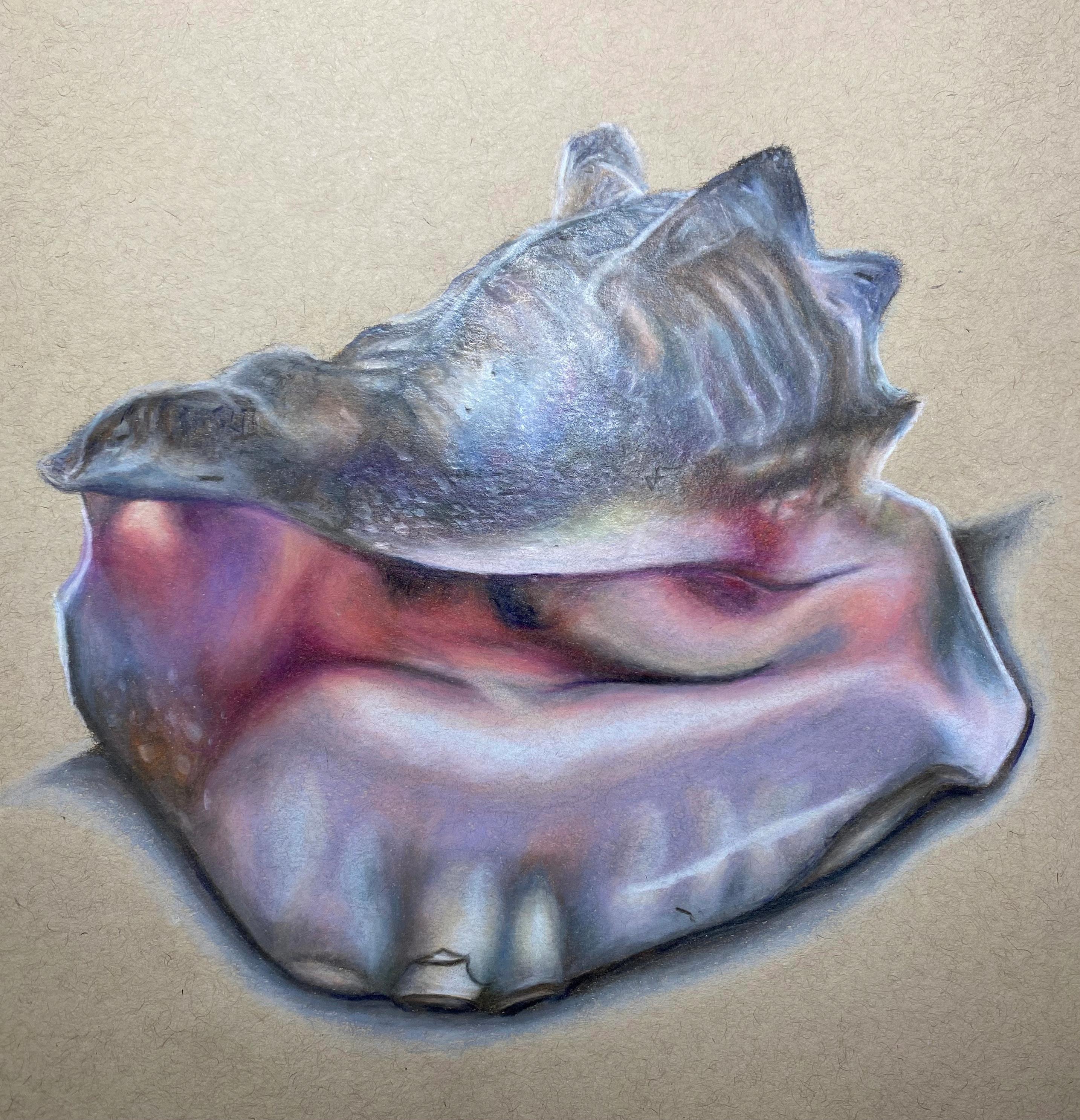
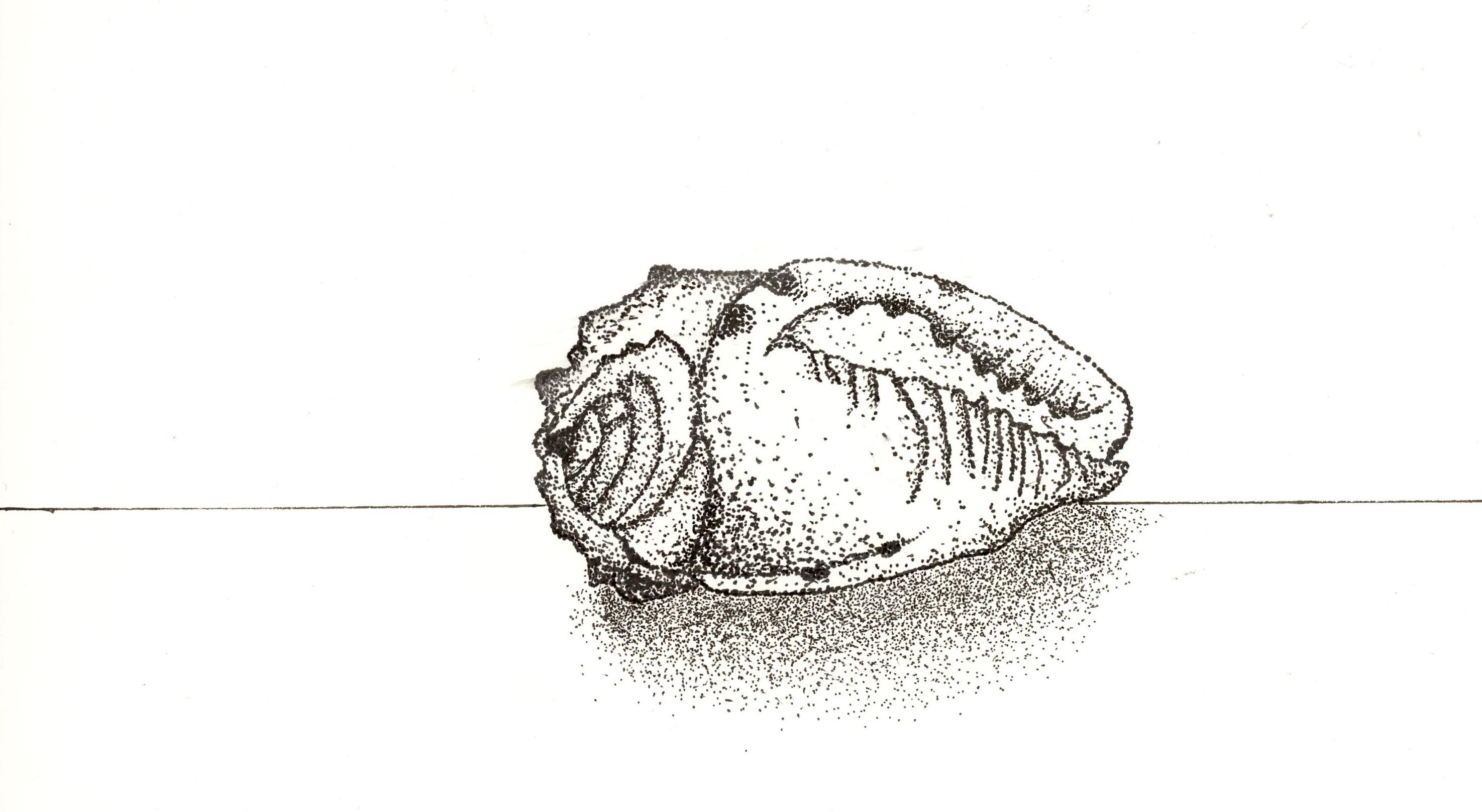
76 STIPPLED SHELL
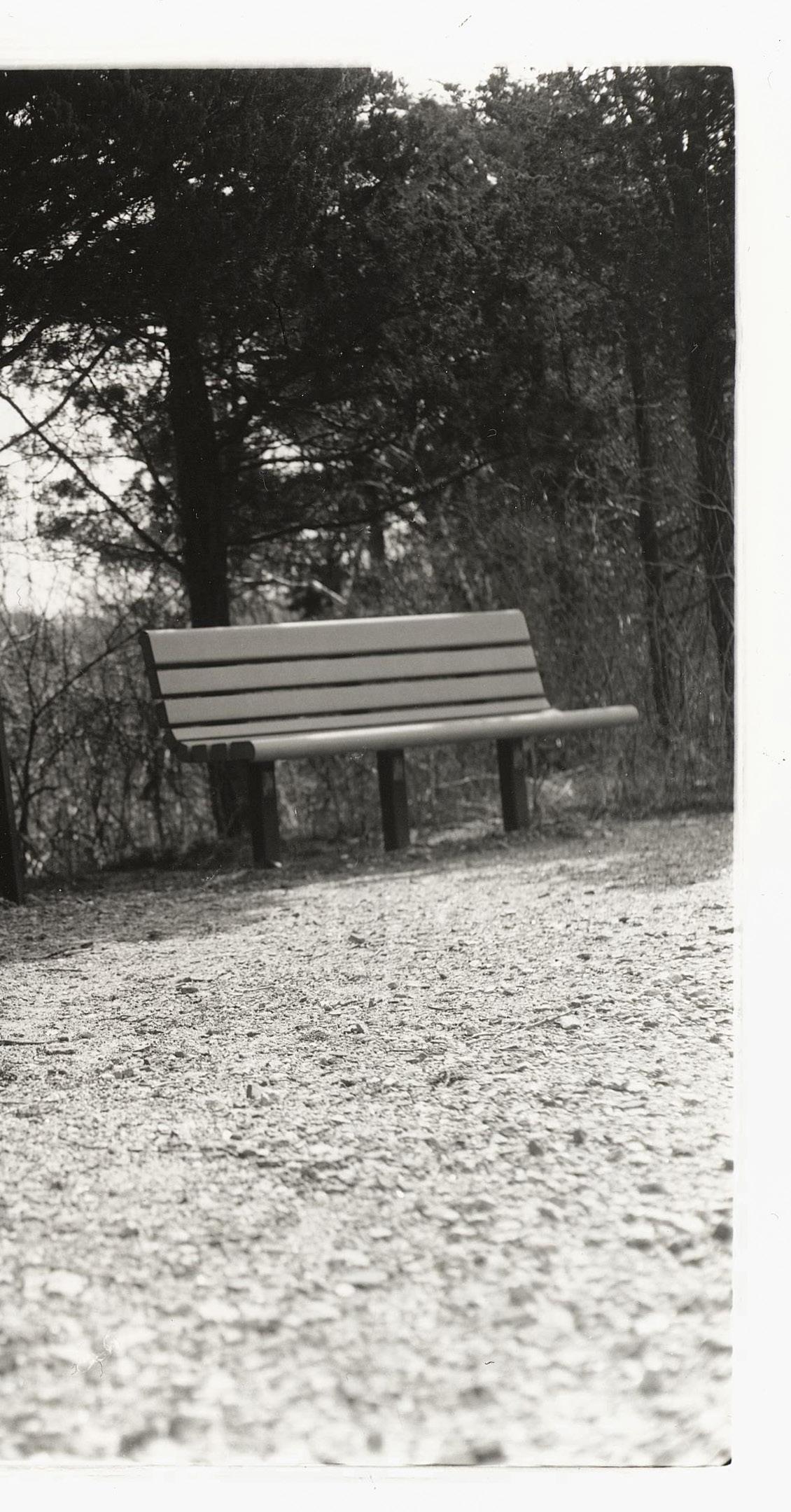
Back Cover FILM PHOTOGRAPHY
Weston Mogul ‘27
Dalia Najarian ‘29
Raven Guinta-Tavares ‘28
Weston Mogul ‘27
Cameron Zuluaga ‘31
Hollis Oliver ‘28
Niamh Cullinane ‘30
Lynn Jazo ‘26
Mira Davis ‘28
Raven Guinta-Tavares ‘27
Hollis Oliver ‘28
Hollis Oliver ‘28
Raven Guinta-Tavares ‘27
Raven Guinta-Tavares ‘27
Raven Guinta-Tavares ‘27
Cassius Duarte ‘28
Raven Guinta-Tavares ‘27
Mathilda Moehnke ‘27
Elise Soule ‘27
Gabe Coughlin ‘27
Mahnaz Ronan ‘28
Mahnaz Ronan ‘28
Mahnaz Ronan ‘28
Grace O’Hanlon ‘31
Nina McKim Knight ‘26
Amelia Russell Schaeffer ‘26
Mahnaz Ronan ‘28
Raven Guinta-Tavares ‘27
Wyatt Thornton ‘26
Mahnaz Ronan ‘28
Raven Guinta-Tavares ‘27
Cassius Duarte ‘28
Justin McNeil ‘27
Luke Seston ‘28
Reese Williams ‘28
Cassius Duarte ‘28
Alanna Andrews ‘29
Hollis Oliver ‘28
Max Donovan ‘26
Alanna Andrews ‘29
Justin McNeil ‘27
Cassius Duarte ‘28
Elise Soule ‘27
Magdalena Jazo ‘28
Cassius Duarte ‘28
Raven Guinta-Tavares ‘27
Max Donovan ‘26
Luke Seston ‘28
Mahnaz Ronan ‘28
Prem Connor ‘30
Raven Guinta-Tavares ‘27
Mahnaz Ronan ‘28
Resonance Staff
Elise Soule ‘27
Willa Hershfield ‘31
Olive Nelson ‘31
Ailsa Kluckhuhn ‘31
Ivy Homa ‘26
Resonance Staff
Short Story
Shivericks Pond
Raven Guinta-Tavares
‘27
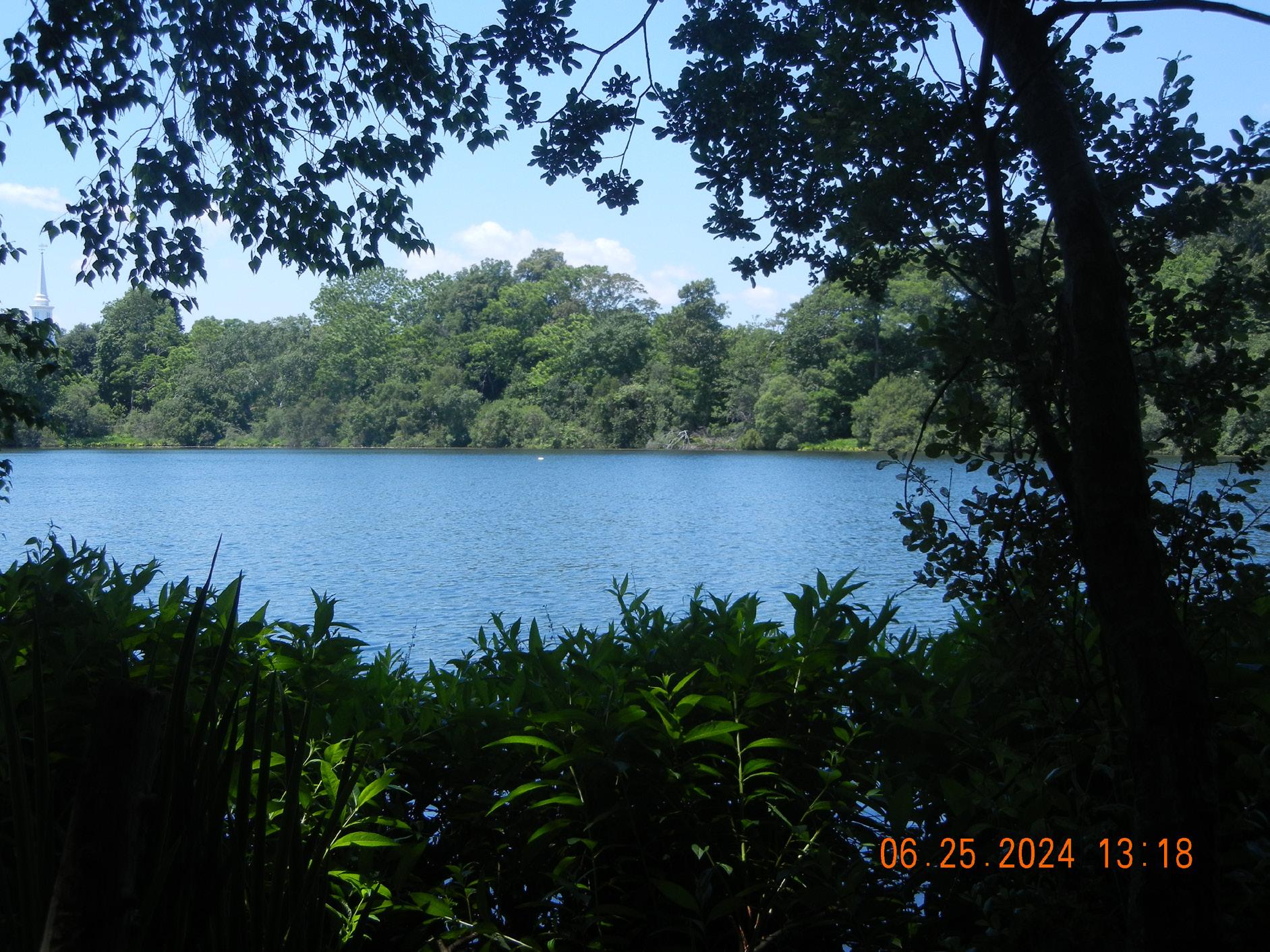
The ripples of the water are gently persuaded towards the shore by the breeze, calmly swaying the water weeds and aquatic plants along the dirt. The tips of my shoes catch on an exposed root, coaxed to the surface by years of foot traffic busting over the mini-tree highways, delivering nutrients to the tall shading oak. The breeze ruffles the leaves overhead, causing the light to fall and dance along the rocky hill I am standing on, almost like stars dappling the shore. The pond is me, and I am the pond.
The distant sound of church bells brings me back to humanity from the natural landscape, reminding me of how close to town I actually am. I sit there for a while and listen. Listen to the symbiotic symphony of late-summer bugs hums and children’s laughs. The quack of a duck flows right into the sound of a distant car that definitely needs a tune-up. The creaking of the tree duets the metronome steps of a couple walking behind me, reminding me that I am just off the beaten path. Not so far as to be isolated and distant, but just far enough that I can forget that this spot is not just for me, with little reminders of humanity poking their way through the brush every now and again.
My attention turns back to the pond, the brief reminders of people proving too much for the moment. I sit and let the dirt connect with my skin. My hands find their way to my sides, the cool dirt literally and figuratively grounding me. I can feel each tiny, individual grain, every molecule, every atom of dirt fill the cracks in my skin and rise between the gaps of my fingers. I intentionally dig my index fingernail into the dirt, fixing some beneath it. A subtle reminder of this moment, of this day, of this year, of this life.
I turn towards the pond again and gaze upon the soft waves. I cannot see what lies below the surface. Can you ever? Can you ever really see what truly lies beneath the surface? Even when you can see the ground, in the few shallow areas, the water distorts its image. Light refracts, altering your perception of what is truly there. Are we meant to see below the surface? Can we handle it?
Another gust of the breeze—stronger this time—briefly shakes me from my thoughts. Colder than the last, this breeze serves as a gradual reminder that summer is coming to a close, autumn arriving to take its place. Then winter, then spring, then summer again. And again. And again. The cycle repeats. The greens of the trees will fade, and come back. The water will get colder, freezing against the shore, preserving a snapshot in time, if only for a moment. The dirt will erode, enlarging the boundaries of the pond. The algae will grow, changing the surface of the water, and what lies below.
But for now, at this moment, it is still. The water is blue, the trees are green, the clouds are white. It will never be the exact same as it was then, not ever. As soon as this moment is there, it is gone. It exists only in memory. As I stand up to leave, to rejoin the humanity I have so briefly escaped, I repeat something to myself. Something the pond taught me.
“I am alive. I am alive. I am alive. I am alive. I am alive.”
Lament of the Moonlit Tides Cassius Duarte ‘28
Under the happenings of the moon, the beaches are quiet. The tide pulls in and out as it always does, and the shells sing a lament for soulless sands. Only the inquisitive and the careless wander the shores at this hour.
You wish to feel the sand.
You wish to stare into the reflecting moonlight and hear the melody hummed by a goddess eons ago, before the sky married the sun, and before the ocean became salty.
And as you let the tide lap at your legs, now salty and cold, you plunge your hands in and hold a shell.
It sings to you in a voice sickly sweet:
Before ships docked at shores and kisses were a sign of love, the moon loved the tide. She danced at her shores as the sun reached for the horizon. The tide loved her reflected sunlight, her bare feet kicking at the water, her soft giggles as the sea pushed back at her.
The Lady of the Moon, the silver-draped goddess, dipped her hands in the water as she always did when her sister collapsed into the far distance.
Only this time, the waters didn’t feel so cool and gentle. No, they felt like acid on her silver-laced hands.
She peered into the rippling surface, sunlight burning into her eyes.
“My seafoam? Oceanic Queen of White Capped Waves?” she whispered, digging her nails into the sands beneath.
The tide did not stir. She was still. Silent as never before.
The Lady of the Moon began to grow more desperate. She splashed at the unmoving waters. “Why do you not respond? Has something given you grief or trouble? Please, lovely waves.” She leaned closer to the orange tinted surface, strands of silver hair floating atop as seafoam always did after the waves crashed. Only now, no waves crashed and the seafoam did not rise.
As her head bobbed closer, soaking her tinted brow, she came to a conclusion.
She dived into the sea, her legs unused to water surrounding them so crushingly and her breath left high above the surface. But as she swam closer to the heart of the ocean, she could only think of one thing, “I will come, lovely rippling of the tide. I do not know what horrors plague you, but whatever it may be, I shall be there. For you, dear sea.”
The heart of the sea is wrapped in sea glass and sandstone. The tides slept there, lulled into a wakeless sleep by an entity without conscious, her hands drifting across the stones keeping her encased.
On the other side, crushing and pushing glass she’d come to collect and hold dear, the pale blue dancer begged with swallowed breath for her love to wake.
In the blubbering of the sea, she cried out, “Lovely tides! Waves sprinkled with white caps! Please wake! Open your eyes, my dear!” Her unearthly lungs filled with flavourless water.
She sank deeper than the heart could shine upon, than her sister wrapped in the embrace of her lover could meet her. Her thoughts once again only returned to her dear ocean. Her tides.
As she reached the sands of the bottom, so smooth and untouched, the Lady of the Moon
grasped blindly. Her once soft and lace-covered hands found a shell, and she whispered into it. There were no special words to say. No unnecessary sayings. Goddesses had no need to confess love.
“On even the darkest of days, I will hold your hand and with my drapes of silver, I will give you the tides,” she hummed, feeling every unworldly part of herself fade to dullness.
Drowning in the breath of her love, the moon returned to the resting place of all creatures. Up in the night sky, stars without rulers greeted her, letting her nestle against them. No souls dwelled in the constellations, lives had not died before then.
The Lady of the Moon watched, unable to move, for her once-dangling silvers wrapped up around her like chains. She hated the feeling of breath without water, no matter how crushing it had been.
She could not see the tides, the seafoam and splashing ocean. But she could feel it. The wondrous and lively feeling of the waters crashing against stones and shores.
Though she could not reach it, could not hear it, she remembered the melody. It was a song of silver and pale blue she could never forget. She danced, unaware of the chain-like drapery loosening and twirling around her as they always did at her shores.
She sang in the emptiness of space.
She sang a tune a woman with sleeves of seafoam once taught her. Without words or harmony but simply the ebb and flow of the tides. She danced, unable to let her tears fall. Far below, a hand rubbed against a sandy surface. The Lady of the Tides knew better than all others the power of her waters. For a hundred nights she never saw, she waited for the water to flow in. And on the hundredth night, she saw a splinter of pale light.
Her prison of sand and stones crumpled, and finally, she stood on the surface of the glassy waters, seafoam bubbling around her.
She stared at the sight above her. Her Lady of the Moon, her dancer of pale blue, so far above she could not dance on her shores or splash in her tides.
She reached up, and though it was only a vision, a mirage born from madness and sorrow, she felt the hand of her love, cold and dry, and she remembered the way they danced. Her steps and twisting fabrics.
The tide was rougher now, not the cool and gentle way it had always been. It scraped at the surfaces of glass and stones, but the goddess of seafoam continued her lonely waltz.
She had heard, as all the shells in the sea did, the last words of the far-off goddess. She repeated them, over and over, until every new shell and every new stone knew them, too. “On even the darkest of days, I will hold your hand and with my drapes of silver, I will give you the tides!” she cried, her being fading into the waters for the final time.
Then, the shell you hold grows quiet, humming the familiar sounds of water. You lift another and another, but all say the same thing.
“On even the darkest days-”
“On even the darkest-”
“On even-”
Until you cannot stand it anymore.
And you throw the shell towards the crescent of the moon.
It splashes and ripples through the water, and you feel the cold water freezing your legs and the tides come in. The outline of the moon is distorted now, but you can feel where the two
Grandma’s Kitchen
Justin McNeil ‘27
In the heart of her kitchen, where spices take flight, Grandma stirs magic, from morning ‘til night.
With hands soft but strong, she kneads love into dough, And seasons each meal with stories we know.
The sizzle of pans, the scent in the air, A feast of her kindness she’s eager to share.
Her apron a banner of comfort and grace, Each dish that she serves brings a smile to your face.
From savory stews to pies golden-brown, She cooks up her love for a well-earned crown.
But it’s more than the food, It’s the warmth she imparts,
A recipe written in all of our hearts.
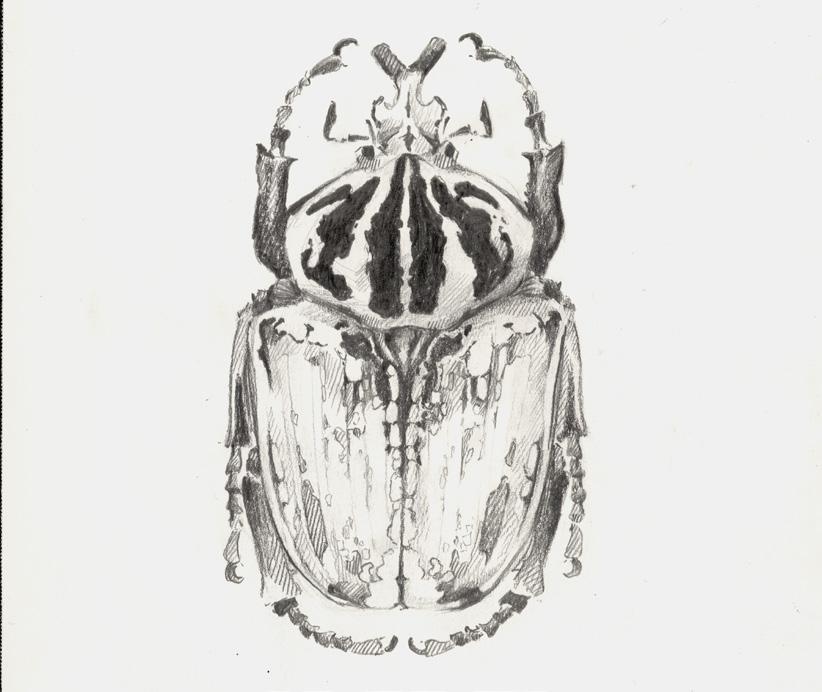
Beetle Songs
A calligram by Max Donovan ‘26
Green and round and iridescent, It glitters and shines on the windowsill, A little star glittering without relent in the expanse of space between me and that so-so view of the Schuykill. Brown waters made the beetle sparkle a yellow-green hue as it looked at m e neonatal innocence in its black oyster-pearl eyes. I hope it knew I saw, really saw, it, too. I thought about how it would feel to go and beetle around the world. on six little beetle legs, I’d cartwheel.
I wonder if it thinks about being human? It spread its wings, and into the air it whirls.
If You Give a Man a Cookie
Luke Seston ‘28
Sadie and Ellen sat on Sadie’s back porch, which overlooked a large lawn that was pleasantly between well kept and wild. The women sat in adjacent cushioned chairs and gazed upon the yard with pensive expressions.
“Oliver told him,” said Ellen, suddenly looking eagerly at Sadie for her reaction.
“What?” She stared incredulously back. “I mean, what a way to start the conversation!”
“I know,” said Ellen. “And just before his wedding. At least wait ‘til the day after or something.”
“Hang on, I flew in for the wedding, you picked me up from the airport, and you’re just bringing this up?”
“Yes.” Ellen smiled. “I thought we would get through the pleasantries first.”
“The pleasantries?” Sadie repeated, grinning back. “I caught you up on what it’s like to live in Seattle. I droned on about the rain.”
“Yeah, it was funny,” Ellen smirked.
Sadie laughed. “Anyway, Oliver told Henry, and how did he react?”
“You know Henry. The two of them have been friends for sixteen years. He found it a little weird as we did, but he didn’t make trouble.”
“Did he tell Rachel?” Sadie asked in disbelief.
“His fiance? Must have since he told me. He told me what he said to Oliver. Said that feelings like his were normal, especially when they hung out so often. Said Rachel was beautiful and that’s why he was marrying her.”
“Why does Henry have to be so nice?” Sadie shouted, her anger coming abruptly. She actually stood up from her chair and looked down at Ellen. “How can he have let this happen?”
“Let this happen?” Ellen looked taken aback and used a softer tone when she spoke, remaining in her seat. “Oliver has feelings for Rachel. He has done nothing wrong and neither has Henry. The impression I got from him is that this will not damage their friendship, but that the understanding will simply be another reason for them to trust each other.”
“Is Oliver still invited to the wedding?” Sadie hurled the question at Ellen as she looked straight into her eyes.
“Of course,” she answered, calmly.
“Then he’s giving the mouse a cookie!” Sadie shouted, turning away with a sardonic note in her voice.
“Giving the mouse a cookie?” Ellen repeated, sounding defeated, now forced to get up and follow Sadie across the porch. “Don’t you think,” she began again, “it would be quite rude to uninvite your best friend to your wedding?”
“Oh,” Sadie said quietly, turning back around with realization and apology in her face. “Of course it would. Ellen, I didn’t mean that, but don’t you remember what the mouse wants after the cookie?” Her temper came back alarmingly fast. “Milk! And after Oliver eats his cookie, he’s going to want that milk. And I’m not talking about the kind from gallon!”
There was a pause. “That’s not funny,” said Ellen, though the corners of her mouth twitched traitorously.
“I know, I know, “ Sadie replied, looking surprised at her own rage. She smiled sadly.
Then Ellen was chuckling in spite of herself. “You are the limit,” she sighed. “Look, if Henry and Rachel enjoy his company, it’s their decision. It’s their wedding, it’s their business.”
“But it’s just dangerous.”
“Perhaps it is. We don’t have the right to do anything about it, though,” Ellen laughed. Sadie smiled, and the two of them walked back into the house.
Mr. Windex Reese Williams ‘30
A man arrived in the church parking lot. Although the reflection on the windshield didn’t allow for much visibility, everybody knew who it was. Only one man kept his car so clean.
“Hello Mr. Windex,” cried one of the kids playing on the church lawn.
“Hello,” he responded with a sigh. He wore a cheap brown overcoat with a false pocket on the chest, under which hid a perfectly white t-shirt. He had an even cheaper pair of navy-blue pants with a few papers sticking barely above the top of the pocket. Yet, despite all of the clothing’s apparent cheapness, all of it was free of lint and freshly ironed. The overcoat had pinned to it a small, brass pin that bore his real name, Charles Wynnson. It’s not as if the name tag truly mattered. None of the churchgoers paid any heed to it, and for as far back as many of the younger ones could imagine, they called him Mr. Windex.
Regardless of the name given to him by the attendees, he still came in to do his work. Charles looked up at the building in awe, as he had for decades at this point. Who wouldn’t when faced with a building like the St. Zita Church? The building’s great stone walls rose high, intricately detailed all the way to the top, on which a large hexagonal dome sat. Charles strolled through the glass double doors onto the soft, black carpet. Dozens of rows of pews and doorways to a sparkling yellow hall greeted him. He took a deep breath in, smelling the air freshener he had installed exactly a week ago. Charles grabbed his supplies, which he always left waiting by the door, and got to work cleaning.
Charles’ cleaning had a routine to keep the whole inside of the building looking as spotless as possible. Every other day of the week, starting on Sunday, he would drive to the church and scrub and mop and sweep. He would stay from when he got there, always around 2:00 pm, until at least when the clock hands could tell him it was the next day. Each time, Charles would start at the left edge and slowly, but surely, make his way to the right edge. By the end, everything had to be pristine, otherwise he would start it all over again.
But today his schedule was interrupted. He had been shuffling down the end of the left hallways, wiping the mirrors that lined the walls free of finger prints. Rain began to drum on the roof of the building, and the wind that had been going for the entirety of the day began to pick up speed. Charles looked up, hearing the start of some new weather, and took another step directly into a small puddle of water. It was cold and soaked straight through his shoes. He sighed as a droplet of water fell onto his head from the ceiling. Charles feverishly mopped up the water and took another look up to the ceiling. A second drop fell into the corner of his eye, causing him to blink rapidly.
He concluded that a bucket would be necessary, but not anticipating a leak, he didn’t carry any of the buckets with him. He sprinted across the church to the broom closet and grabbed the decent quality iron pail that sat in the back. The walk back to the leak seemed a bit longer to Charles, but he didn’t mind. All the more time to see the glamor
of the building, its stained glass windows which glimmered with the dying light of the day, its black-and-white tile flooring, and its walls of off-white paint. Once he got back, he repeated the mopping and placed down the bucket, vowing to check on it every now and then.
He returned to his more usual activities, finishing the mirrors, dusting the boards, sweeping the cobblestone floors, and vacuuming the carpets that separated the row of pews. He checked on the leak bucket periodically, but it never really filled. That was until his fifteenth time checking on it. That time, it was overflowing, murky water gushing out of the top as if it were a sink. Every drop that came down began a new cascade of liquid. He hung his head and picked up the bucket for emptying.
Opening the nearest window, it was easy to tell that the rain was worse now. Already the winds were strong enough to throw branches off of the trees. The raindrops sounded more like metal ball bearings than water. Charles heaved the bucket onto the windowsill and tipped it over, throwing the water back to where it was meant to be. He sat down on the tiles, taking a short breather before going back.
He strolled back over, replaced the bucket, and went back to wiping down the benches, polishing the metal parts, and clearing the gum some kids tended to stick under the seats. Mr. Wynsson checked the bucket religiously now, every few minutes hurrying his way over and then returning to his duties. It had been somewhere near his 36th check that he found something out of the ordinary. He shone his flashlight, which he had begun using roughly twenty-seven checks ago, onto the bucket’s position. Mr. Wynsson’s light fell on nothing, however. He shrugged it off, replacing it with one of the cheap sand buckets the kids would ask to borrow when digging. It was not three checks later that it disappeared as well.
He stared, wide-eyed, at the leak in the ceiling. It didn’t make sense, and this time he couldn’t shrug it off as easily. He placed down another bright green plastic pail and sat in the corner, waiting for something to happen: a person to pick it up, some great gust of wind to move it, for it to simply pop out of existence, something! But Charles saw nothing, and so he waited. After all, nearly everything had been cleaned, all the base boards dusted, all of the tiles swept, everything but the glass doors sparkling.
Hours passed. Charles’ eyes grew heavy and closed as he slipped into a shallow slumber. It was then as the sun began to rise behind the white clouds and the drumming of the rain was replaced with the chirping of birds that he was awoken by the sound of plastic. His eyes fluttered open, spotting a blur of black movement pushing around a trapezoid of green. As his vision cleared, he could see it was one of the churchyard cats. Its fur was a striking black that sparkled brown in the sunlight, and it had a small, triangle chip in its left ear. “Little menace,” Charles whispered to himself jokingly before picking up the feline. The cat looked almost surprised but didn’t seem to mind as he carried it with him.
Then he remembered the one task still left to do, the door. Charles picked up one of his bottles of Windex and sleepily walked over to the glass. He twisted the tip of the bottle and squeezed the trigger just as a man pushed open the door, the cleaning solution landing on his face.
“Gosh dang it, Mr. Windex,” he said, wiping the Windex off his face with a smirk, “that’s the third time this month!”
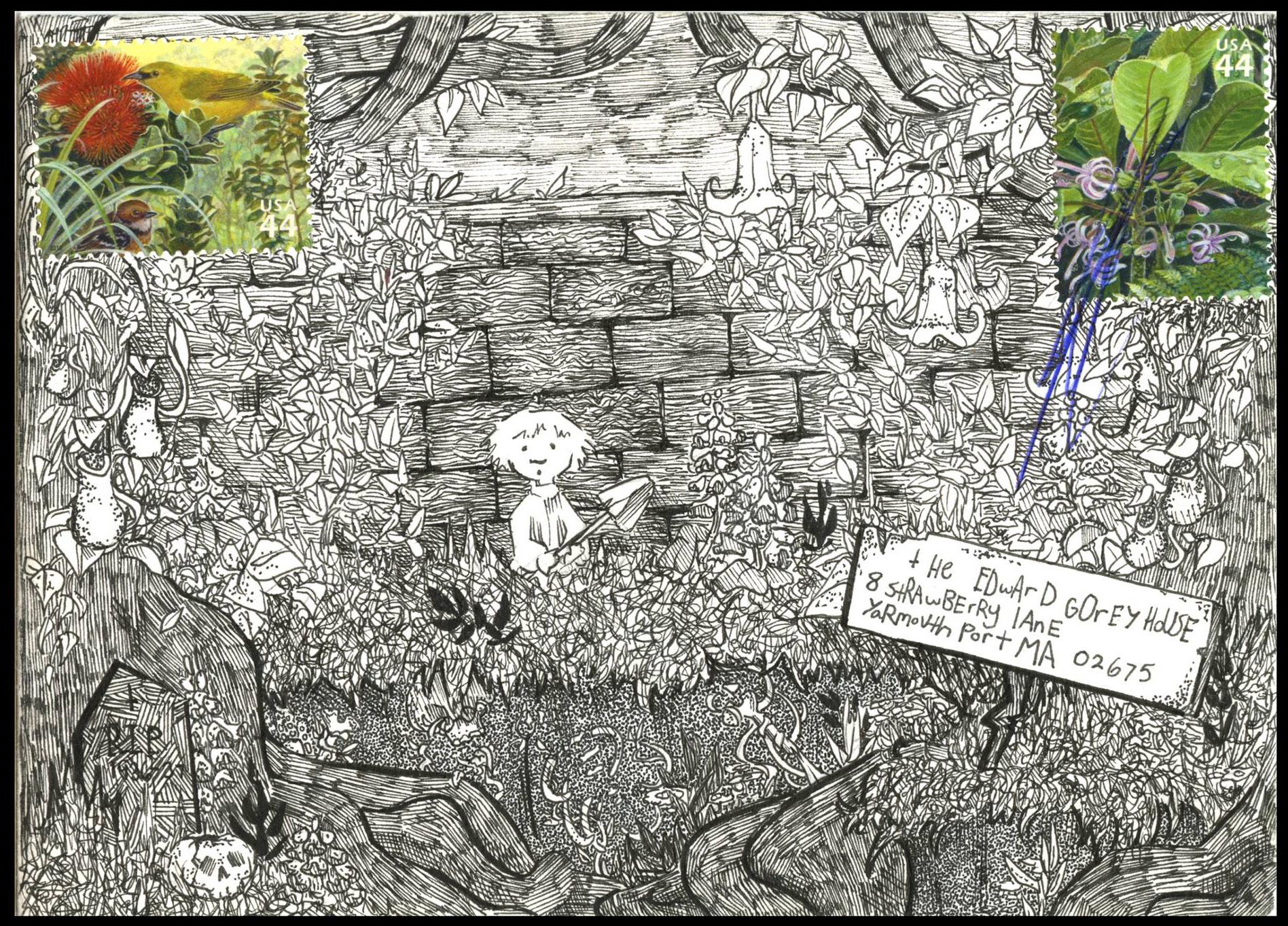
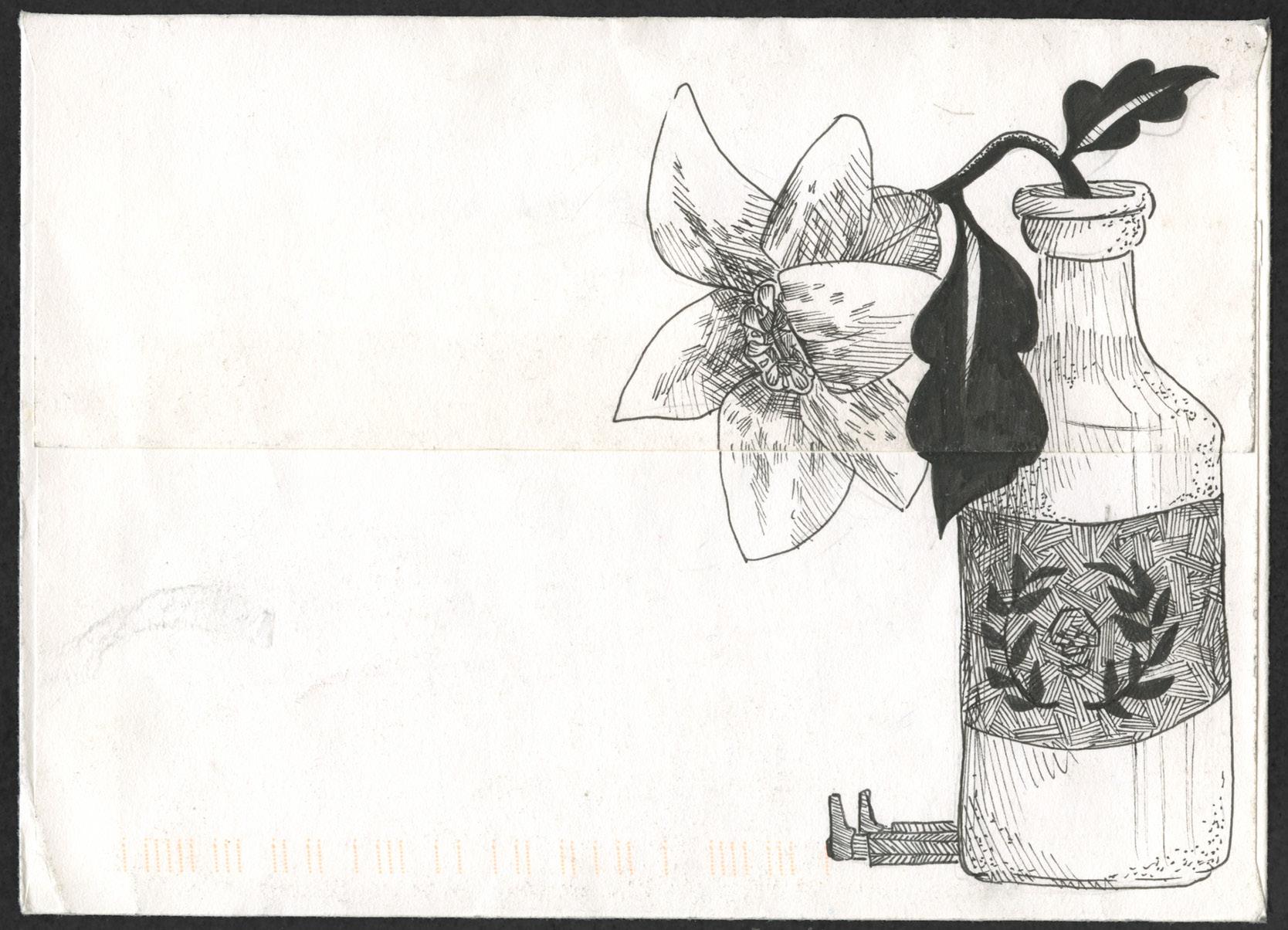
Edward Gorey House Envelope Niamh
Cullinane ‘30
(Front)
Featured is the envelope design of the winner of the Edward Gorey House 2025 Annual All-Ages Envelope Art Contest, Niamh Cullinane (‘30)! The theme for this contest was “The Evil Garden.”
(Back)
The Pale Blue Planet
Cassius Duarte ‘28
You have reached the end of the solar system. Neptune is watching you. Pluto stares distantly at the swirling light it once was a part of.
You are asked a question.
“What do you wish for?”
…
“I want to grow wings,” you say, eyes glittering in the reflected light of the sun. Your wings will be useless here; you can already fly, but you ask anyway, for the beauty of it all.
You have waited a long time to fly, and it’s not truly flight without wings, right?
You are the embodiment of Icarus, and you know it. You will fall and burn and crash over and over. And yet, when I ask you, at Jupiter, at Mars, you always answer the same.
“I want to grow wings.”
And you do. You soar higher than the birds, than the planes and the rockets. You are a myth, a legend, a beautiful sight.
In the sky, you are alone; you are free.
But when you come down, falling into the sea, what response will you give when they ask you, “What is your purpose?”
…
“I want to see the future,” you whisper, and your gaze has not left Pluto for a very long time.
It is a dangerous gift. You see. You know. But you can not stop it. The fate that will befall your friends, your family, you’ll know it and you’ll watch it come to pass.
Could you have done something? Could you stop it? What could you have done better? You are Prometheus without the flame. The forethought. You know what you should do and yet… will you do it?
I ask you only once, before we even make it to Saturn. Your answer is short.
“It will all burn.”
I respond, though I should not. “It will, will it? No surprise there I suppose.”
When we return to the swirling Earth, every prophecy of yours will come true. Fire, death and blood. Your tears do not stop the flames. Your words don’t stop the panic.
In the end, it all burns.
And when it does, you are asked: “Why didn’t you stop it?”
…
“I want to stay,” you decide, staring right back at me.
And I can’t help but be surprised. I have heard every answer. Greed and Sloth. Lust and Envy. Gluttony and Wrath. And so, so much Pride.
There is no benefit to staying. The outer reaches of the solar system have nothing. Only floating satellites and bits of rock. You will get no fame. No glory. No power, no riches, no pleasure nor knowledge. It’s hell for any kind of person.
And so, I ask, falling off the script. “Why?”
And you smile. Not because of a magic or gift, but for some reason I can’t seem to figure out. “To keep you company.”
“You don’t even know me,” I remind you and yet your smile does not waver.
“In time, I will,” you say simply. “I bet I can guess your favourite colour,” you say as if you were a child on a playground.
This is not in my script. This is not in my job. My nature. “Please, just choose another wish,” I beg, and Pluto seems to look back with a smile.
“It’s blue,” you say with a grin.
You are wrong. I have never chosen a favourite colour. It has never been necessary. And yet, when I look at Neptune, at Uranus, and the distant stars, I must admit, blue must be the most beautiful.
“I’m right, aren’t I?” you exclaim, crossing your arms proudly.
“You are right,” I respond quietly, and I am not sure if it’s true.
For whatever reason, you continue to stay. I keep the offer of a new wish open. You could leave whenever it pleases you. But you never do. I don’t know what pleasure you get from staying, from talking with me, telling me about all the things that happen on your little planet, but I cannot say I dislike it.
Many more come, many more are asked what they wish for, but you, you, my dear, are the only one to stay.
I know you’ve told me why, but I still can’t understand it.
You have no fame. No glory. No power and no riches. Yet, it seems you gain pleasure from it. That you gain knowledge from asking about me. You cannot save your burning world. Cannot soar on wax-soaked wings. But you have always kept me company.
And so, I asked you,“What is your favourite colour?” because there is no other question I want to ask.
The Soul Beneath the Beauty
Alanna Andrews ‘29
Beneath the sunlit veil they see A face of perfect symmetry. A flower blooming, fragile, bright, Yet caged within the world’s delight.
They praise the curve, the flawless hue, But never glimpse the deeper view, Where storms of doubt and shadows play, And whispers of the soul decay.
For beauty’s weight, a gilded chain, Can mask the heart, obscure the pain. A thousand eyes may watch, admire, But never touch the soul’s desire.
Eros knew, with quiet grace, The truth beyond my mortal face. He saw the cracks, the aching core, The parts of me I’d long ignored.
Yet even love could not unbind The emptiness I’d trapped inside. For what is love, if not begun By loving all you are or none?
The sunlight shifts, the shadows part, meet the mirror, heart to heart. Not for the beauty they adore, But for the soul I’d long ignored.
The storms within, the scars I bear, The strength to rise, the will to care, These are the truths that make me whole, The beauty woven in my soul.
Until I loved this fractured me, I was a ghost, a fantasy. But now I see, with eyes unblind, That love begins within the mind.
So let them gaze, let whispers flow, Their shallow praise, they’ll never know
The light of truth, the shadow’s grace, The beauty in my soul’s embrace.
Hollis Oliver ‘28
The current host of FA’s Poem of the Week and an avid English student, Hollis Oliver has eight pieces to showcase!
As much of an artist as he is a creative writer, Hollis’s descriptions are works of art on their own. He transforms the natural world into a place so vivid that every molecule of its landscape is of importance to the story he is crafting.
Angel of Death
The Land Collection
Short Story
In this moment, I am a young boy standing watch over the sea, noticing the coming and going of ivory sailboats and the long rising whitecaps breaking through the maritime lull. A passing ship’s wake crashes against the sides of the jetty, casting gleams of seaspray onto the fishermen and onto me. One of them curses for getting wet, but I don’t mind. I am so eager—and so immune. That is the pleasure of being ten years old and barefoot and free.
A distance away, the summer lilies ripen themselves on full stalks near the water, complimenting the wildgrass and beach plums with their heavy vintage on the dunes. Bands of sandpipers lie languidly at the shore while a sweet wind sweeping in from the west cleanses the day’s heat. The upturned laughter of seagulls rings out from above, calling, calling, calling.
A path opens from the beach onto a section of marsh. It’s quiet back there. Dunes rise to one side, blocking out human noise from the beach, and the surrounding forest dampens all other sound. The only exceptions permitted through the barrier are the crashing of waves, the trickling of the resident streams, and the chirping of specific birds which under other circumstances stay far away from the sea. There is enough vegetation here for the animals to claim this part of the land as their own domain, an environment which opens a rare pocket where ocean and wilderness meet, where the wrens flit joyfully above the waterfowl and brackish fry swim below sand-dusted thrushes. A heron turns silently in the water, plunges its bill through the surface, and departs without rippling the mirror-liquid. I take an old boardwalk through the muckier sections and make my way to a copse of beech trees. A pile of stones forms a step up onto solid ground beneath the relative atrium of branches. The shaking leaves cast green light around like a temple of stained glass. On higher ground I can see over the dunes. The ocean is endlessly blue. My eyes scan past the ships moving outward from the shore. I look away, then disappear into the forest. Soon enough sand melts into loam as the trees become thicker, taller, deeper. Cool black humus sticks to my feet from certain patches between the versicolor moss. A river dances around the path, almost playfully, catching the dappled light in its winding embrace.
Then I emerge from the treeline, once more gaining sight of the variable clouds and intermittent breeze. Stonewalls trace up and out from the wetlands into the meadow, leading my way. The pasture is leaden with wild clovers, thistles, and dandelions with their seeded tufts which crown the elder flowerheads and their yellow rays atop the more youthful stems. An army of devoted insects attend to these flowers—a monarch settles itself upon the bronze thimble of a coneflower, then lifts, and it seems to dip and flutter and twirl around without reason, racing and diving through the thick mat of grasses and flowers and imaginary cloud castles, and from afar I know that being alive is the only reason it needs to do all these things. In my mind, no better reason for anything exists. I am the droning of honeybees and the golden shimmering waters. And there is nothing else for me to be.
I came not knowing exactly what to look for, but when I arrived at the field I knew I had found it. There I was met by an animal in the center of its own pasture, basking in the sun and the flowery perfume, unblemished and sweet and as soft as a budding magnolia. Her family stood behind her in the shade of a broad cumuliform cedar. I held out my hand, and the young one came. I knelt in the fragrant grass and felt the new wool behind her ears. I patted her neck, and she lay down beside me. A low wind rolled over the field. I closed my eyes and let my head touch the soil. This was one of those glorious summer days that never ends, and I lay in it—a lamb in the farthest field.
Tiasquam
These were the days of the blue flag iris—that short period of time when the flowers first stretched up from the marshes, and the thick rains of May soaked deep into their broad and velvet petals. It was so that even the smallest plants shimmered with excitement at the turning of the seasons, unfurling fresh leaves into spring, filling themselves on the bright green marrow of the earth. The dewy benevolence of warmth in the air drew rodents and deer and insects from their innumerous winter coves. The universe and the valley settled into a content and steady humming. At home, the wide fields had left behind their downy coats in exchange for stalks of grass which rose tall and soft like the wings of great birds. When the winds pushed down through the valley, the whole world seemed to fly with their movement. The sun felt good and warm, and the days grew longer. The days of the blue flag iris were rich days.
Now I was going home, running off into the woods again, the excitement of the new trail pulling me irresistibly forward—I in no mood to pull back. Moving southwest, far beyond the standing evergreens, the old deer path had formed a new branch. I had gone dead south from the path many times before, to the beech trees and shrub oaks which traced elegantly around thin strands of riverbed, but I had not yet taken the east road and did not know where it could lead.
This divergence was at the place of the last cabin, a quiet house with peeling white paint laid thick over lines upon lines of crooked shingles. All the lace curtains were drawn except one. The sole open window revealed a warm glow of an incandescent bulb set high up beneath a yellowing lampshade. The owner of the house was reading, her feet propped up on a coffee table positioned beside a heavy grandfather clock. The smell of a pie came wafting out to me from what must have been the room over, followed by the odor of chintzy perfume.
“Hun, where are you goin’?” she called.
The neighbor was kind, but she wasn’t one to understand what brought me here. Most weren’t, I believed, so I lied, calling back, “I’m just visiting a friend. He lives a little past this way, I’m just passing through.”
“Didn’t know there’s anyone around for the next few miles, ‘cept for that new development a bit off. You sure you’re not lost?”
“Yes.”
And I carried on.
The broad oaks and birches of the North gave way to pines. Damp clay became silt, then sand. The trees which grew here grew labored and thin, as though they were starving for life. Their bark was pale and sharp as the drying air around them. The croaking wind smelled of salt. The marrow of spring was nowhere to be found here. And on the roadside, I noticed a stunning lack of irises.
Through the thin veil of hard trunks, I could see the flash of water in motion. I considered it for a moment, things would feel better by the river. The river which I knew, the Tiasquam, marked the most fertile stripe of land for leagues in all directions. Where it flowed, mosses flourished and little florets bloomed. Its water fed the wildlife as it roamed through the landscape, bestowing a certain vigor upon the world. That river was a sanctuary; it was home. With these thoughts guiding my mind, I plunged my hand into the water, expecting it to carry the intimate warmth of the Tiasquam, but it was cold—ice cold. This was not my river. No, it was too wide, too swift. This water shone with metallic hues where the Tiasquam ran dark and caramel, marked by the richness it contained. I missed the mounded clay,
sculpted like flesh on the riverbank. Here, this land was already made of dust. Even so, I clung to the river, believing it would bring me somewhere with more life. I had always known freshwater in motion to be a prerequisite to lush fields full of wildflowers and deep forests with their deep trees. That was the case with the Tiasquam at least, and I hoped that this water’s movement would somehow stir up a similar feat—shake the dry soil from its haze and set it blooming. I held on to that hope in the way light glimmers on the crest of a ripple on the clear river water—gingerly, desperately. It did not take long before I realized this was not the case.
Where the river led me, it was the closest thing I had seen to the trail of the Angel of Death. The sun beat down on me like it was the discerning eye of God and this was the day of judgment, made horribly unjust. I surveyed the desecration around me: tree after tree, mile after mile, had been cleared down to the stump. Something incredibly sacred had been undone, for the sake, by the looks of it, of building a parking lot. I imagined all the birds and the birdsong brought to an end, their last notes sung too soon. Or the bees robbed of flowers. Or the squirrels robbed of trees. Whoever did this could not have understood what they were doing. That was my prayer, that this was a mistake, and that nobody would commit such a conspicuous crime. I thought finally of all the irises, their rhizomes crushed by iron wheels so that they could never put forth a bloom again. I couldn’t stop myself from collapsing under the weight of these revelations, the pulling back of curtains, the apocalypse. I don’t remember making sound as I fell to my knees, palming the dead earth.
There was nothing left to do, so I ran, passing the dead river and the far cabin. The neighbor looked on with concern. She didn’t understand. I kept running. I ran until I reached the north fields, then the road, then the front yard. It wasn’t even until I had reached the doorstep that I realized I was crying, and this I realized too late. My mother opened the door to see me perched on the step, sniffling like a small child, legs scored by catbriar thorns from my run all the way home. She could see me, really see me, and I hated the feeling.
“Oh dear, are you all right? Did you hurt yourself? Oh, gosh, look at your legs!”
I looked up slowly, not meeting her eyes. That was good. Right, the thorns. The thorns were what had made me cry. Kids cried when they were cut by thorns. “I cut myself a bit, is all.”
“Come inside. Let’s clean you up, all right?”
“Okay, sure.”
She washed my legs in warm, clean water and dabbed me dry with a towel. You could tell she was worried by the way she treated me tenderly, nearly wincing each time her towel brushed against the nicks as if she was feeling the pain for me. I didn’t wince. In fact, I was considerably numb.
“How do you feel now, darling?”
Now that my mind was called to it, the cuts did hurt, as did many other things. I said I felt fine and moved on. In the vase on the table, my bright violet irises cut wild from three days before had wilted. It was funny, they usually last longer, I thought.
I stumbled up into the four white walls of my bedroom and sprawled across the mattress. I lay there staring up at the blank white ceiling. My open window carried in a birdsong with the lush breeze. I closed the window. I closed my eyes. It was not yet midday, but I closed the curtains as well and crawled under the covers and grew silent, quietly weeping, tears giving way like blood to the fields as the emptiness crushed me, thoroughly.
On Reading Ovid in the Clouds
The plane’s weight Shifts onto the wings. The mechanisms lock, And the cold iron glides. Meanwhile, the gods Are pouring honey Over their shoulders And watching it melt Into the sea. The clouds, As one dim peony, Eclose themselves open. The sun moves like silk Upon immaculate skin, And in a deep exhale The shower of gold Rains down.
Short
Story
Parable of the Owls
In the beginning, there was the Storm and the quick catch of wind howling over the waters. There was the Storm, and He said, let there be light, and so lightning broke out on the rim of the sky. He said, let the waters be separated, and so the rains fell in broad sheets and cleared out the calm eye of the storm. The Tempest gathered Himself, throwing great torrents of air and icy precipitation, seething with black madness and howling through the deep sails of Time.
The owls leaned in, watching, and listening. In times like this when the winds blew hard, they would roost inside the greenhouse up in the eves where they were safe from the rain but close to the storm itself. They would act frightened as they picked their way around piles of potting mix, orchids, masses of vines—then they would settle. Sometimes they waited only a few hours, but every once in a while, when the weather was severe, they made longer lodging there. They nestled themselves up against the glass, pressing their feathers to the cool surface and gazing out at the wild gnashing of branches. I couldn’t say exactly why they did so, but they were observers of things, it seemed, not actors in the play.
As the owls would watch the storm, I too would watch the owls. I used the storm as an opportunity to be near them, meeting their company in the greenhouse. As much as I liked them, the birds didn’t really like me, but they didn’t mind my presence when they thought greater things were at work. They would rather brave me than the storm, I suppose. And aside from a few curious pokes with a garden stake, I posed no threat. Over time, my presence became a certainty: I would not harm them. But the storm remained wild and dangerous, and so they stayed perched in the greenhouse.
One storm dragged on for a matter of days. It was exciting for the first two because it felt like something special had been set into motion and was looming just around the corner. I met my owls in the greenhouse with excitement; they met me with disregard. The big storms carried the weight of creation with them, as if when they finally ceased the world they would leave behind would be refreshed and forgiven of its former sins. I hoped the owls felt this. The rivers would run clean and full. The air would be purified.
I expected this renewal on the third day, but it didn’t come. Same upon the fourth, even the fifth. I was very near to exhausting my store of wonder in the owls and in the childhood paraphernalia lying around the house and was growing bored. Meanwhile, the owls had exhausted their store of food and were growing hungry. Unable to leave the structure to hunt for fear of what lay outside, they let themselves grow closer to starvation. As the days wore on, they nestled in closer together, all three astride, cooing to themselves, the smallest burrowed neatly abreast the other two. When they called at once, their voices formed a sugary chord which fought back for just a moment against the bleak wailing of the sky. They were like a choir of angels, somehow beyond the physical realm as they flashed in and out with the lightning.
During my visit on the sixth day, I was met with two frantic owls, the larger ones, flying out to me. They directed my gaze to the smallest who was hunched over and shivering on the beam, eyes nearly closed. After six days without nourishment, it was being overtaken by the weakness which comes from hunger and inevitably leads to death, so they were asking me to look for food.
This was their last resort, and to be fair, it was hopeless. I tried briefly, but I was no good at finding mice, nevermind catching them. I spent that evening with a pit in my stomach, waiting to see how the forces of nature would play out on this brink of reason.
There were only two outcomes, really: the birds would fly out into the night and risk the unknown for food, or the little one would die in its shelter. It was late at night when the highest call stopped coming in with the others, and the sound dropped from its sweet three-part harmony to a dull two-part lament. With this little sacrifice completed, the world stilled to a halt. The storm rested. I woke to sunlight on the seventh day.
Poetry
To Winter
I walk to you against the icy breeze Where through the wood a silence reigns supreme, And in the night, devoured forests freeze; With cold and death, the shattered landscapes teem.
When you, the Winter, bear your murd’rous teeth
And don your heavy, stark, mysterious cloak, You draw us out to suffer on the heath; You test us, see what Gods we will invoke.
Yet I adore you, icy winter squalls. Your shining glory, like the sunrise, breaks The call of night, alluring to us all, To see what rugged beauty darkness makes.
I quench the candle’s everlasting glow And leap beneath the falling wreaths of snow.
Chrysanthemums
Over the water, swallows churn
The thin, clean air with their wings, Teasing the gold leaves from treetops.
The leaves do not go easy, It is more the spark of fire catching Which runs across the gilded field.
With the leaves, the swallows dance
In a dance of emerald and crimson, Bowing down over the frothing tide of Autumn.
And the world grows heavy, And tired, and fat with harvest. And the chrysanthemums bloom at last.
Essay on the Farthest Field
I put down the book. The grass curls around my leg in that familiar way. I am home. I have made it to where the Tiasquam river strolls through the soft earth, taking its time, being on time, and going nowhere. The water is dark, and clean.
I remember when I was still young and once picked a hibiscus flower from the bushes at the edge of our yard and walked miles to this river, just so I could take the pleasure of dipping the bloom into the amber water and watching it float away, the pink flashing out against the brown of the rocks and the profound green of the moss before submerging, then appearing again, then falling away down a turn in the bank. I remember finding the flower, nearly an hour later, floating in the center of one of the small ponds fed by the Tiasquam. It spun there—I remember—its petals splayed open like a waterlily.
“I think I’ve been daydreaming too much,” I say aloud to myself, snapping suddenly very upright. I have a point, I realize. I look down at my marred hands and the patterns they’ve left in the mud around me. There are little spirals, little stars, wings, petals, hearts all carved by an absent mind. I hadn’t been trying to draw anything, but it was easier to think with my hands busy. I had been doing a lot of thinking, and when you think so much there is little definition between cognition and reverie.
Near the treeline, a group of cattle are grazing their way through the meadow. Their smooth horns are sunlight among the damp arrangement of echinacea and catbriar.
I spend more time in daydreams than I do in my body. Mostly when I dream I have dreams from the Great Before—before the world took its mask off. Things are always easier in the dreams, until you wake up. And that’s the thing with dreams, exactly that—we wake. We wake to an imperfect world when we want only the dream. On account of the dream, we reject reality because it’s not worthy of our lives, and we stop living. In waiting for the world to revise itself, I have been holding my breath.
In the midst of the herd lies a Swiss calf. He was born in the spring, and he has lived to experience the end of his first summer. It has been a fruitful season for him, full of nourishment. His legs are strong enough to bound over the crests of stone walls into the cool green ferns which have been waiting for him all day.
I have been holding my breath for years now, and my lungs have been dying for air. I look around—of course there is so much beauty here to breathe. The calf leaps to his mother, bobbing up and down through the shades of clarity cast by the morning sun. I have been depriving myself of it for fear that it will be ripped away, but what is the use in defense when already in the throes of starvation? I had been careful, when I needed to be alive. So my lungs, gently at first, breathe it in. The emptiness is filled by the moment itself, by the fullness of the air. Then comes an exhale. Then, an inhale. And for a moment that is all there is. Breath. Breathe. Be quiet. Be still. The wind follows these movements, entwining itself in invisible ribbons
around my neck, around my arms, around my legs, binding me once more to this place. The cars now are closer to the field than they were a few years ago, and I can hear the traffic from the road almost as loud as the rustling leaves, but that’s all right because I can still hear the rustling leaves, and I can hear the birds, and the chipmunks, and the movement of the grass, and it is all so beautiful around me.
Looking up, there isn’t much green so late into October, but the trees aren’t all bare yet. The beeches are sending out showers of brass through the canopy, oaks with their steady browns, odd sassafras punctuate with tones like mottled jewels, sturdy pillars of evergreen rise among them, and of course there is the torch of the red maple. I never paid much mind to the leaves this late in the season, but it’s occurring to me that here, at this crossroad, each one becomes like its own flower, and together the leaves are more bright than the petals, and the sky, by their virtue, looks more blue. I wonder if I am like the leaves changing into something new, something stronger, and something overlooked by even myself. I can feel the shadowed edge of my chin, the set of my eye—all these things that come with age. With a deep breath I take it all in: the smells, birdsong, the dampness of the earth beneath my feet, the emotion, the uncertainty, and I again resolve to drop my shield.
Then, I step out into the farthest field.
Benediction
An orchid blooms, Drawing in rills of life From its rich and ornate seams.
A wind howls, Writhing against the sides of the greenhouse, And the orchid, inside, sits still.
I lie down among the grasses Who sway like the wings of great birds around me, Blessing my skin, calling me to fly with them.
A Coup de Force from the Sea off Gay Head
Max Donovan ‘28
The tide beats on time-hardened sands, A sloping canvas white expands, Whose surface siphon-clams pockmark. They gulp and breathe in light or dark Algal Manna from Ocean’s hands.
Atop the cliff sit the pinelands, Course and scrubby, each needle tans. Sun baking their wind-weathered bark, The tide beats on.
Thus, once or twice a cliff chunk lands, Its soft, supple face like Byzance, Walls falling to Ottoman sparks. Against red clay’s pleas and commands The tide beats on.
Where the Ladybug Rests
Alanna Andrews ‘29
Trees, shrubs, greens. Birds nestled within soft, silky leaves. The sea moving from blue to green; the trees turning, peaceful and serene.
Small embers drifting through the air, carrying sweetness everywhere.
Perhaps there is a ladybug among these very trees; perhaps she is feeling the same as me.
I am free.
The sun is bright; it loves the sea, just as I love it, and it loves me.
The birds sing on so happily, trees, shrubs, greens, in harmony, uninterrupted peace.
This place is now a part of me, this wood solid beneath my feet.
I am free.
Below the Split Stone
Justin McNeil ‘27
The ravine was not meant to be entered.
From the edge of the mesa, it looked like nothing more than a shallow wound in the land, a narrow break running through the red stone. I had seen dozens like it while hiking, sturdy, harmless—easy to get through. The afternoon sun scorched down on my shoulders, but the air was still, kind of like the land was welcoming me. That illusion ended as soon as I stepped inside.
These walls seemed to close in almost immediately. As I navigated, the walls rose higher, while the light thinned. I noticed the temperature dropping as the stone swallowed the sun. The air smelled sharp, dusty, like it had not been touched by anything in ages. I followed the remnants of what seemed like a creek bed; it seemed logical. Water, once, had moved this way, so it had to lead somewhere. This land, however, does not care about logic. When I looked up to see if I could climb back out, or if I had to keep moving forward, the truth settled heavily in my chest. I realize the walls were too abnormal, their layers cracked and slanted just wrong. Loose stones broke free when I tested them, skittering down with sharp clicks that echoed and vanished. It did not offer handholds. It did not offer mercy.
By the time I accepted that I was trapped, the sun had already begun its slow descent. Near the center of the ravine lay a fallen tree, pale and stripped of bark, its trunk split open lengthwise. It rested at an angle, wedged between stone walls as if the land itself had caught it mid-fall. I couldn’t imagine how it had ended up there. Trees did not belong in places like this. They grew tall on open ground. They reached for the sky, not the shadow.
I set my pack down beside it and sat, pressing my back against the exposed grain of the wood. It was rough and splintered, uncomfortable, but solid. The silence around me was thick. No birds called. No wind stirred. Even my breathing sounded too loud. Fear crept in slowly, the way the cold does when the sun leaves. I thought of the trail I had left behind, of how easily I had wandered off it. I had trusted my instincts without respecting the land. The ravine corrected that mistake.
I tried climbing again, refusing to give in to the panic rising in my throat. My fingers burned as I clawed at the rock. Gravel slipped beneath my boots, and each failed attempt left my arms weaker than before. The walls rejected me without effort, as if to remind me how small I was. Eventually, I stopped. My chest heaved, and my hands shook. The ravine had won that battle. As the light faded, shadows filled the grooves of the stone, deepening every crack and fold. The walls looked taller now, more severe, like ancient sentinels watching without judgment. The land did not threaten me; it simply existed, indifferent to my fear.
I turned my attention back to the tree. Its surface was cracked and weathered, but the inner wood was smooth where it had split open. Once, it had stood upright on the mesa above, roots buried deep, enduring storms and droughts year after year. It hadn’t fallen because it was weak. It had fallen because the land had decided its time there was done. That realization settled something inside me. I had been fighting the ravine, trying to force my way out, believing strength alone would save me. But nature does not reward force. It rewards attention. Using the fallen tree, I studied the walls more carefully. One side angled inward slightly, just enough to allow pressure from both feet and back. I wedged the tree more firmly into place, trusting its strength the way it once trusted the earth.
The climb was slow and painful. My muscles trembled, and my breath came in short bursts, but I moved with care instead of panic. Inch by inch, I let the stone guide me, adjusting my body to the land rather than resisting it. When my hands finally grasped the edge of the mesa, the sky had turned gold and violet. I pulled myself up and collapsed onto the open rock, breathing in dust, cold air, and freedom. The land stretched wide and silent around me, unchanged by my struggle. Before leaving, I crawled to the edge and looked back down into the ravine. The tree remained where it had fallen, split and scarred, still holding its place between the stone walls. The ravine had trapped me, but it had also taught me something essential.
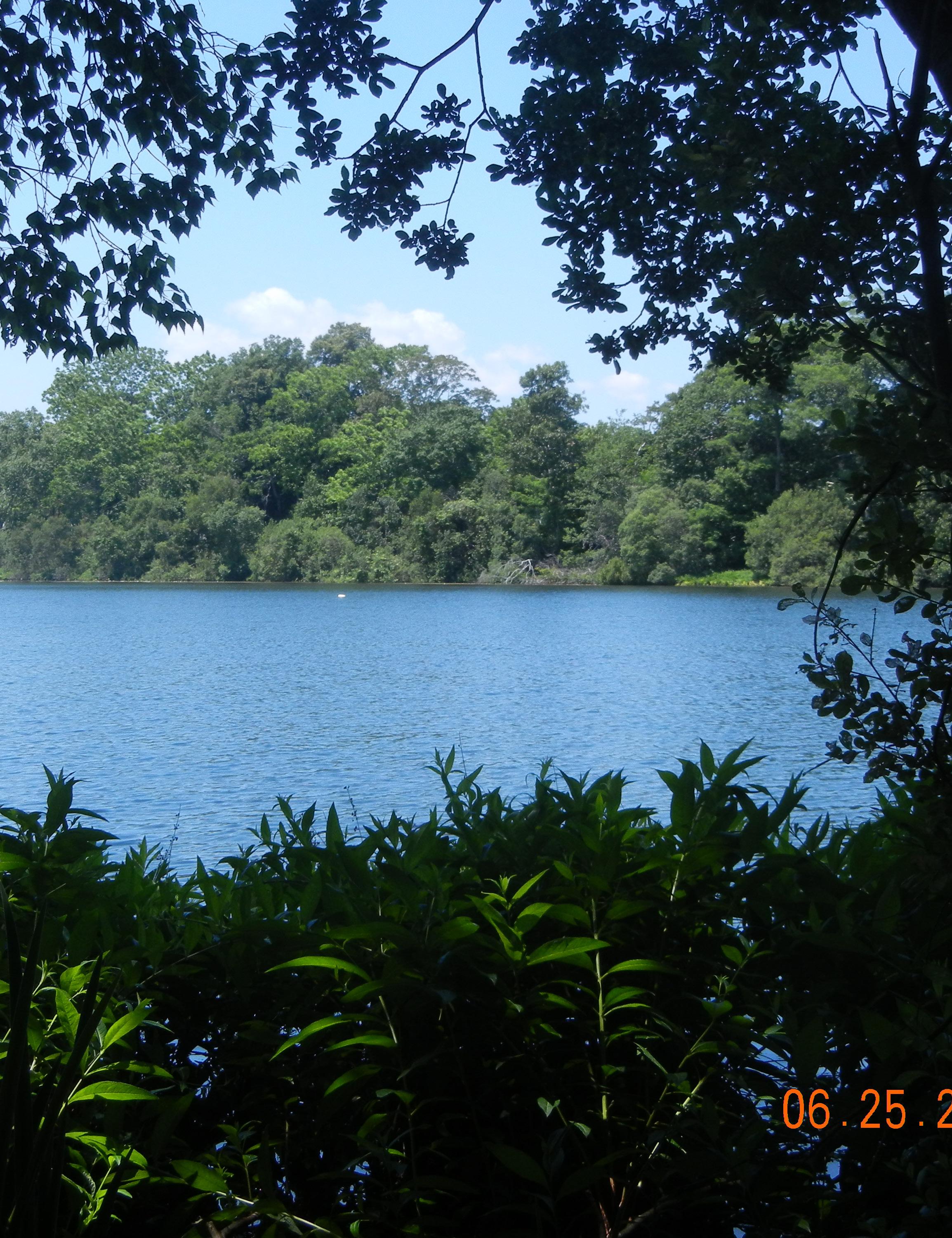
The land does not bend for us. We survive by learning how to bend with it.
Fleeting Memory
Cassius Duarte ‘28
I wish I could tell you
Every little memory of mine,
The afternoons I spent playing games
Cross-legged on the floor.
The nights I spent after dinner,
Running around in the cold air.
The mornings on the bus
Chatting and staring out the window.
I wish I could paint every story of mine; I wish I could write every picture of mine.
I guess in the end,
I just don’t want to forget those afternoons, Those nights and mornings.
So, to a future me,
Please don’t forget how you got here.
You are an amalgamation of every story you’ve read, Of every song you’ve heard, Of every painting you’ve seen.
Please don’t forget those things that make you You.
So tell me now,
Tell me now so I won’t ever forget, What color were the lights that day?
Two Centos Elise Soule ‘27
The Physician
See’st thou yon gray Startling faces of the dead, Pale, yet sweet, Being sharpened by his death, A certain marvellous thing. Be perfect, make it otherwise, Hear bones crack and pulverize. Out of which a miraculous crescent And star-dials pointed to morn— above A worn curtain, rears the white head Of a god or madman.
Monster
The egg could be broken then mended, Better to begin as if some[thing] small-handed
(Felicia Dorothea Hemans, ‘The Haunted House’) (William Butler Yeats, ‘All Souls’ Night’) (Dorothea Tanning, ‘All Hallow’s Eve’) (Edgar Allen Poe, ‘To -- -- --. Ulalume: A Ballad’) (Sylvia Plath, ‘On the decline of oracles’)
Then a scalpel cut her open for all the world, limbs bent and twined into crown, this slip- pery musculature all twisted up, How harmless can we really be? Patience, blessed woman, the song of the cranes as they grind us all do we all reduce to such slime? And what is birth to us? Nothing and ev- erything. We are one thing: That naked river.
(Donia Kelly, ‘A Dead Thing That, in Dying, Feeds the Living’) (Mary Jo Bang, ‘How Beautiful’) (Reed Turchi, ‘Snake Farm’) (Maggie Queeney ‘Metamorphoses: The Female Into’) (Mona Arshi, ‘Do No Harm/I Dream of Goat’) (Abraham Smith, ‘From “Sur- gencies”’) (Charlotte Pence, ‘What DNA Knows’) (Forrest Gander,
Raven Guinta-Tavares
Guinta-Tavares ‘27 Collection
Toska Magdalena Jazo ‘28
Toska [tɐˈska]. This is a word I discovered that encapsulates my feelings - my emotional conflict. Toska is a Russian word inherited from Proto-Slavic *tъska (stone), which is perhaps related to то́щий (scrawny/thin) or ти́ скать (to squeeze or to press). There is no direct translation of Toska to English, but it is an immense ache for nothing and everything all at once. An anguish from the bottom of the heart. “Тоска,” this ‘Russian sadness’ is an element of core identity, the way Russians see themselves and that is integral to they are.
Toska for me is a thing beyond mere depression, ennui, or simple sadness. It’s a kind of state of being where one deeply feels the utter emptiness of the cosmos, and yet, at the same time, is keenly aware of the terrible sharpness and intensity of a single moment in life. I feel utterly what it is to be human, to be pierced by loss, sadness, betrayal, and all the myriad things that can happen over the course of a lifetime, yet I am stuck in the background the empty, nihilistic, screaming void that would deprive every action and thought of any weight, as meaningless in an infinite and ultimately irrational universe.
The feeling of toska ties me intrinsically to the very spark that gives us life as humans and allows us to hold a small, bright torch against the weight of that endless void that would bear down upon us and crush us into oblivion. Is it the curse of critical thought? To scream into the void, for nothing, to be all too aware of how pointless it all is, but to have such hope and a will to keep screaming?
Toska is the only word I have found that describes this feeling, this pressure that I, in fact, exist despite everything. At its deepest and most painful, it is a sensation of great spiritual anguish without any specific cause. I don’t know if it’s even spiritual - but that’s the only word I can imagine that in some way capitulates the feeling. It is a constant dull ache of the soul, a longing with nothing to long for, a sick pining, a vague restlessness, a yearning. If nothing, I can’t explain it; my words can’t describe it. I have nothing to pain me yet I can not shake this feeling of Toska. But who would I be without this feeling? Would I still even be human? Do others feel the same? To think and wonder about one’s own existence, and that every person I see has a life as complex as my own, that I may never know, may never even understand. That I myself exist outside of my own perception; that people see me and form their own opinions about me. I wish to never be easily defined. Yet I persist living in this limbo of thought; I’m trying to understand this nothingness yet intensity of emotions I feel, this Toska.
Left in the Past Cassius Duarte ‘28
What happened?
Last I checked, We were twelve and playing In the yard,
Pretending to be heroes.
Last I checked,
We were all wearing masks And sneaking food from teachers. And now here we are, High School and growing up. You guys keep talking about college, About growing up, Getting jobs and driving. Where did the playground go? What happened to the games, The stories and the innocence?
What happened
While I was lost in my own world? You guys were growing up, And I was getting taller, too, But I didn’t really grow up, Did I?
I’ve gotten better at things, But I’m still a kid.
I like cartoons and comic books, I wanna go to the park, Do you wanna play on my Wii? It’s not broken anymore… (And it hasn’t been for years).
The Lives We Buried
Raven Guinta-Tavares ‘27
This is my home. My family has been born here, lived here, and died here, all on these four square miles of land—for generations. People like to question exactly who was the first in the family to come here to plant the seed of our roots. Uncle Casper says that great-great-grandma Iris first bought this land to build a school for deaf children. Great-aunt Lynnette says that this was once panning land, and that great-grandpa came here to make his fortune in this very river. Mama says that we come from this land, that we have always been here. She says that our very cells were cultured in the stream, long ago.
Did they know that seed would blossom into the deep-rooted family it is now? I like to think they did.
Well, however we got here, it doesn’t matter. What matters now is how we’re going to leave. And fast.
“Harlow, quit starin’ into space and help me tie this down!” Papa barks, shaking me from my thoughts. Papa is a squat and angry man who still thinks he’s in the war. “Coming!” I shout, taking one last long look at the land, drinking it in. I want to absorb this land into myself. I want the long grass beneath my feet, just like those cool nights chasing Max through the field. I want the river water to replace my blood, circulating its way into my heart. I want the dirt forever under my fingernails, never washing off, no matter how hard Mama makes me scrub. I want to stay.
I run over to Papa, tying the overstuffed suitcase onto the roof of the 1979 green Pontiac Grand Safari. The car barely runs anymore, and Papa’s been working on it every night after supper for weeks. Yup, that’s been his routine. Sitting down late to whatever Mama could scrounge up and leaving early to go work on the car or have his “secret phone calls”. Mama says they are some of Papa’s old friends from the army and that they are just catching up. She says it’s been a while since they talked.
“Can I drive?” I ask, meekly. Papa looks at me, deadpan, and quickly mutters an “absolutely not” as he opens the back door for Mama and her bag. “But please? I promise I’ll be careful, and you and Mama–” “I said no.” He shouts, presumably louder than he meant to. Mama freezes for a moment, then places her bag down right next to the old trunk Grandpa gave me, with all the luggage stickers forming a mosaic of faded colour on the sides. Papa jumps in the front seat and the car sputters for a second then roars to life, reluctantly jolting awake. Mama throws her handbag into the backseat and joins Papa in the front.
“We’re leaving right now? Right this minute?” I question, surprised. I at least expected we could say a proper goodbye to the house, to the rest of the family, to the land. I am not ready to leave yet.
“Yes, right now. Now get in back, there’s no room in the middle,” he yells through the closed window. I can feel the anger in his voice. I have not heard him like this before. There is something else in his voice, something I can’t place. It rips into the back of my neck and forces itself into my lungs. Fear. “Harlow, listen to your father and get in the damn car!” Mama shouts. I feel the fear in her voice, too. It makes my skin crawl.
I climb into the back, over the boxes and hurriedly packed suitcases, our lives whittled down into just a carload. I don’t even have my seatbelt on when Papa accelerates
away, kicking up gravel and dirt in our wake. I stare out the back window, facing the land we are leaving behind. The land I grew up on, the land we grew up on. Every tree and rock we pass hits like a pipe to the skull, crushing my lungs and making my throat dry. Silent sobs start to claw their way out of my throat as hot tears start to run down my face.
“Harlow, buddy, I need you to listen to me, okay?” The fear is still in Papa’s voice but it is lesser now. More controlled, more hidden. “I just want you to know, whatever happens, whatever they say; we did this, we lied to protect you, because we love you.” His voice wavers. Silent sobs wrack Mama’s body. “What are you talking about?” I choke out through the tears. “Some people are going to tell you some things. Some of them are lies, some of them are true. Whatever you do, I just need you to believe me. Can you do that bud?”
I don’t respond. Instead I look out the back window at what I once thought was my home, with the people I once thought were my family.
Then I see the U.S. Marshals flashing lights; and I know I have been lied to.
Negative Girl
Max Donovan ‘26
My Diet Coke had gone flat. Its smooth, untextured bounce against my tongue as it made its way down my gullet was entirely underwhelming. I glanced at the clock—half past nine.
“Chrissake,” I cursed, “Where the hell is she?” She would always come over to my cramped apartment before a league tournament down at the alley. Slowly, reluctantly, I pushed myself from the fraying brown-green sofa and headed towards the door, throwing on a worn black leather jacket over an equally worn grey sweatshirt. I figured I’d find her as I went.
The air in the elevator was chokingly stale as it rattled down to the ground floor. As I stepped outside, I was blasted by a frigid wind that sent a flurry of ice, salt, trash, and Godknows-what-else hurtling down the street. The red-brick buildings of Tribeca were subsumed by an overwhelming greyness, a raw haze which instantly froze my woefully ungloved fingers. Barely being able to feel my digits as I tapped away at my phone made it difficult to call her.
It went to voicemail twice before the electric blare of the ringback stopped, and I heard the soft, rhythmic clacks of wheel on rail in the background. “Hey, where—are you on the train? Where the hell are you? I’ve been waiting around since I woke up!”
She responded in a silky yet languid tone, barely whispering over the noise of the traincar, “Oh, yeah, you know…on the train…I think I’ve just passed Fordham Road, or something.”
“Fordham Road? Jesus! The hell are you doing in the Bronx? That’s like an hour away!”
“Just seeing a friend.” Her voice was filled with such an innocuous innocence that I knew she must be hiding something. I inhaled another burning cold breath of air as I started weaving between the pedestrians in front of me, almost at a jog now.
“A friend? Really? A friend. What are you doing with this friend?”
“Oh, well, I suppose you could describe it as a sort of…appointment.”
“An appointment?”
“Yeah, he’s a doctor. Doctor Wu. Maybe you could look him up on WebMD.”
“And you’re seeing this Doctor Wu fella in some random building in the Bronx. An hour away from where you live. Because that’s not at all suspicious.” I light a cigarette, if, for anything, to bring a little warmth back into my frozen insides. What with the way things have been going, I’ve had to switch from Marlboros to Newports. I exhale, “This isn’t one of those quack doctors, is it? Just to buy cheap prescriptions off of?”
With that, some emotion finally found its way into her voice—exasperation, seemingly, “Walter, you know Mount Sinai won’t give it to me, right? Bunch of spineless bureaucrats… I do have a diagnosis, you know. It’s not like I chose to go to some run-down hovel for my val—”
“Okay, okay, whatever. Whatever. I get it,” I assuaged. “Why don’t you just, uh, meet me at Rudy’s, yeah? I’ll pay. It’s, um, kinda halfway. Ninth and Forty Fourth…”
“Thanks, I know where it is, Magellan.” I felt that venomous sneer of hers through the receiver. “Christ knows it’s the only place cheap enough for you to act like a gentleman and not split the tab.”
I gasped loudly, in jest. That was a mistake, though, as a vile combination of cigarette smoke, car exhaust, and thick, wet snowflakes was pulled down into my lungs like the gaggle of geese sucked into the jet engines of Sully’s Airbus.
The microphone must have picked up my struggle to breathe, because I heard a soft sound on the other end of the line, “Christ, Walt, you okay? Anyway, sounds like a plan. See you there!” She blathered so quickly, I was unable to respond. Tugging my hood down to stave off the ever-increasing torrent of snow, I set off down the street.
Having finally made it to West Forty-Fourth, I surveyed the surrounding sidewalk for any passersby. Despite being squarely between Birdland and the Shubert Theater, the street was full-up with an uncanny, pressing silence. The solitude was almost intoxicating, in a morbid sort of way—as though I was simultaneously Jake Gyllenhaal in Day After Tomorrow and Bezhukov in War and Peace—one misstep away from plunging into a deep, never-ending void of white and rime and frost and cold, all-enveloping warmth. But I kept my footing. With a deft movement of my fingers, the cigarette butt went flying into a muddied snowbank beside me and landed with a soft, satisfying sizzle. I drew another from the box, the second to last. Dammit. I thought, I’ll probably have to switch to goddamned Lucky Strikes next.
Then I looked across Ninth Avenue and saw that chipper pink polyvinyl pig statue, its too-tight red tuxedo giving the impression of a bright-eyed young kid at his First Communion, and the crooked red neon sign above it: Rudy’s Bar and Grill. I went and stood beside it, my back against the grey bricks beside the statue. I stared off into the storm, the monumental towers of interlaced steel and concrete now all but silhouettes in the hoary silver fog, overtaken by the enormity of the nobodiness all around me.
I turned. A figure faded into view, obscured by the falling snow. There was another flick of my fingers, and another soft sizzle in the gunmetal slush collecting in the corners between sidewalk and wall.
“How’s that photo exhibit going?” I flipped the beer-stained menu sheet over in my hands a few times. She’s probably tired of the question, but I felt it was the only safe card I had in my hand.
“Gone to crap. Everything’s falling apart,” she grabbed the menu and glanced around for a server. “I thought it had good composition, but now it just feels…trite? Tacky, for sure. Like I’ve just read Photography for Dummies and went out with a Kodak instead of having dropped several tens of thousands on these NYU classes.”
“Heh,” I snorted, “ I mean, come on! Don’t say that!” Christ, I thought this was the safe option. “Look, can I see them? I’m sure you’ve got scans of them on your laptop or something.” She silently obliged, grabbing the computer from her bag as I shimmied over to her side of the booth. The server dropped off a pint and a tall, bubbly Diet Coke, with a beautiful, bright, verdant green, glistening lime wedge garnished reassuringly on the rim of the glass. The imperceptible slice cut into the lime’s peridot flesh hugged the glass with incredible grace and security, and small, sparkling drops of oil perfumed the stale air. “I think I might cry.”
“What was that?”
“Huh? Oh, uh, I said ‘let’s see them!’ Ha!”
She popped open the lid. I took a long, crisp swig of that heartwarming, effervescent Coke. My primal, impulse-based reptile brain urged me to stay in that moment of safety and plaisance forever, like the caterpillar-goop in a high-up cocoon.
She ripped me from it, “Here’s where I started.” A tilted black-and-white (though they
were all black-and-white, I remembered) statue jutted diagonally into frame, with a string of pigeons in flight continuing to the opposite corner. “It’s in Gramercy Park. My aunt has a key. I think I was forcing it on this one.”
I remembered a few months back, when she showed me how she would mix the chemicals and prepare the solutions and develop the little pieces of film. How she had to send them through the enlarger. I had accompanied her to a copy machine while she made a digital scan for posterity, me pawing at her back while she watched the machine whirr.
Another image. A dark figure of a man with his arms raised triumphantly towards the ceiling, a blur of black boxes which I recognized as the A train hurtling behind him. She added, “I actually don’t mind this one, though I’m not sure if it’s better or worse with this column in the shot.” I remembered how, about a week after the copy machine, we had taken that train to our league night in Bed-Stuy. We had both found seats together, miraculously, even though it was the tail-end of rush hour. She dropped 220 points.
The Third. This one a taxicab, almost invisible in the dark expanse of a streetlampless avenue. “If I had shot this digitally, I would’ve totally upped the exposure. Just a bit, for clarity. But I didn’t,” she sighed.
I remembered how, maybe a year ago, I was out with some friends, coming back from a nightclub or something, walking down 6th Ave, when I saw a crying face in the backseat of a black Lincoln sedan. It was around 2 AM. I was certain the face was hers.
She lightly tapped the right arrow key, and another image slid into view. Round water droplets on the lens and in the air obscured a whirling central figure on the sidewalk, arms outstretched joyously. “I don’t hate the subject, obviously,” she lilts up a bit on that last word, “but I feel like it doesn’t fit. Tonally. The rest are all so… austere. Like, I really like it, but maybe that’s why I have to remove it?”
That’s when it clicked. The figure was me. It was five months ago—a hot, humid, late August day. From over the Steinway to the south came thick, black, bilious clouds that turned to sunshower. We were stuck out in the middle of Central Park, and I knew how she’d always hated getting wet, especially with her camera in tow, and the rain was coming slowly but in fat, heavy drops that landed on her arms and my arms and the grass each with an audible splat and a spray of droplets, and I had tried to cheer her up with some crappy Singin’ in the Rain Gene Kelly pastiche, twirling around light fixtures and whatnot, and I had heard the sharp piercing snap of the shutter while I was halfway through the chorus and in my twirling, dizzied state I saw her lips curl up and part slightly in the middle, and a flash of shadowed white peer into the waking world from out of its curtains of Matte Plum, and she smiled for what I remembered as the first time in a long while.
“No, Marlene. Keep it.”
She stared at me in the tight space between our snow-chilled bodies in the peeling-leather booth of this dank bar with the empty Coke cup, and she said, “Okay.”
And I replied, “You wanna go bowling?”
Purgatory in my Mind
Luke Seston ‘28
I open my eyes. They have to adjust to the unnaturally bright room. When they do, I realize it’s my room. And this is my bed. I untangle myself from the unusually soft, warm blankets and swing my legs over the side of my bed to face the door. I have a feeling it’s going to open.
“Knock Knock.” It’s a man. An extremely tall, extremely tan man with eyes black as death. His mane of hair is on fire and huge horns protrude from his forehead. He’s completely naked except for a thick, wild ribbon of flame that wraps around his waist to match his hair.
“The name’s Lucy,” says the man. “People don’t call me that around here, though. See, I’m Satan.”
My mind is paralyzed with terror, and for a moment, I can’t move. When my mind returns, it has an insane desire to launch myself upon the man in front of me. To do what? Punch every inch of his perfect body, rip it limb from limb, or something else? I blink, open my mouth, and say, finally, “I thought I lived a pretty good life. I didn’t steal or lie.”
Satan just gazes at me with a wide grin on his face. “I know,” he says, “you were a constant disappointment to me.”
“So why am I going with you instead of going to heaven? Am I that bad?”
Satan stares at me. “No, I love bad. Bad is like my whole thing. If you were bad, I’d be doing cartwheels right now. You think I’m here because I want your soul? I’m here to guide you to heaven. Kind of boring if you ask me.”
“Hey!” I say, feeling attacked.
“It’s not your fault, trust me. It’s kind of a character trait of mine to hate everything I do. Being as unpleasant as I am, I get stuck with the tedious task of welcoming the newly dead people. There’s a plethora of horrible things I’d rather be doing right now,” says Satan, with an evil laugh. “Besides, you’re not boring, you’re like the nicest person I’ve ever met.”
“Really?”
“Hey, now, don’t be too proud, the bar isn’t remotely high where I’m from. And as I said, it gets boring up here in the afterlife. Can I take you to heaven now?”
“I guess,” I respond, sliding off the bed. I follow Satan out the door.
Instead of the usual hallway outside my bedroom door, there is a white void as far as I can see, pressing in on me on all sides. I shoot Satan a nervous look, then step out into blank space. My feet hit solid ground.
“What’s this?” I ask, the fear paramount in my voice now.
“The Ethereal Realm. And now,” says Satan, with an ominous laugh and a manic grin, “let us step out into nothingness and pursue that flighty temptress, adventure.” He pushes past me and leads the way into the abyss.
A Mound of Unhelpful Commands
Mahnaz Ronan ‘28
Forgive the reins for squanderìng1
O You, who turns into a bing2. You sit upon your throne alone
Perhaps you feel a tad unstoned; The reins will energìze this bing.
They cannot cause awakenìng, If you forget your abstainìng.
Then you form a restful pose, [so] Forgive the reins.
Whether the horse moves you, bing, You have much loss of control, king.
Unless you ‘member your new slones3, or gain your limbs and dauntful groans,
Forgive the reins!
1 The grave accent (`) is meant to push secondary stress on a three or four syllable word.
2 In British dialect, a heap or pile.
3 Dialectal word for a sloe, the small blue or purple fruits of the blackthorn shrub, which is known for being dry and tart and is an ingredient in jams or syrups in the UK.
A Greeting to War
Prem Connor ‘30
I never understood others. The arguing, the ambiguity of conflict, politics, everything. It was then I looked down the side of my third-story apartment on Kaiser Wilhelm II Street that I saw a butcher arguing with a man over the price of the beef. I couldn’t quite hear, so it looked utterly foolish and pathetic. It had been years since there was war, and I hoped it would never happen again. War is loss, change, and confusion. I had lived through many wars and battles, the Battle of Tannenberg, the battles of the Masurian Lakes, the Franco-Prussian War. It was in the First Battle of the Masurian Lakes that I lost my family. It was because of those wars that I never understood anything. They stripped me of all of my emotions, especially love. I was left with a soul lost and confused. Without loss, there would be no confusion, and without confusion I would not have the inquisitive and separated nature I have today. It prodded me to understand and never stop. I imagined everything.
I was out of food, and seeing as I made full wage this week, I would be able to buy two days worth of meat, along with the typical rations. I decided to buy them now, as I needed a starting point for my conquest of knowledge today. I took my coat, walked out my door, and slowly approached the stairs. After the Austro-Prussian War, I was never able to walk down stairs quickly without falling into a trance of excruciating pain, so I went down right foot first, then left just like I had done for fifty years. I remember my father following the exact same pattern. He was a good man, the best I ever met. He was always surrounded with politics, but he never involved himself. He said that the squabbling over differences is what leads to exponential growth of conflict, and he didn’t need any more of that. He died when I was young. That left my mother with me and my sister. I never knew either of them well, seeing as they died from another war a year later. I spent thirteen years living with my aunt. After that, I got a job in the Ministry of the Interior and spent the rest of my life there, stamping papers and shoving them up tubes.
I reached the front door of the building and I opened the door to be greeted cordially by a pungent gust of wind. The conflict below my window had dissipated, the man was gone, and the butcher was now entitled to the price of his meat. Pointless. I went down the street to the marketplace on Olyzev Street to see it packed with civilians, all gathered around a podium of some sort, most likely some announcement by the German government about the annexation of God knows what. To me this was merely another attempt by the Germans to prove to me why they ought to control a little piece of land and cause a million wars that only give me more pain and suffering. I no longer wanted to go buy rations.
On my return home, I was disgusted. If there were not any greedy despots in this world, there would be no reason for war. It would be a democratic society where all are
equal and policies, foreign and domestic, would be supported by a person’s own code of morals and ethics. As ethics and morals would prevail over law enforcement, there would be no reason for conflict, thus solving a conflict inflicted by the despots in the first place!
It was then when I saw a family with two small children speaking to a military commander, one who I had seen many times at many anti-Social Democratic Party protests, and he was never happy about them. He was telling this family that for strictly administrative reasons they were being temporarily relocated to a small town in Siberia. I had lived here long enough to know that his “temporarily” was a “permanently.” I came closer and I could tell they were distraught.
He ordered the family to enter his lorry. The family, with the parents on the verge of tears, did not oblige, so he immediately ordered a squad of soldiers to take them. As they were being dragged away, I could tell they were begging him to release them and proclaiming their innocence.
I was going to interject, but I froze as if a wall isolated me, forbidding me to get involved. It was then when I realized that if anything is to be done about greedy tyrants, it must be done by the people. By me. If there is hope, it must lie in the proletariat.
I broke down the wall that stopped me from helping, but it was too late. I took a step forward and all I could do was stare into the eyes of the crying little girl being hauled off to some place in the distance.
We Go Again
Raven Guinta-Tavares ‘27
We go again, on up the hill, To chase the fleeting, fragile thrill. Fly up, and down the hill we go, Down to the people, far below. The sleds slide down, released at will;
The kids they tumble, take a spill, Yet happy shrieks do sound so shrill. The steps are heavy in the snow; We go again
A pop, a crack, a sled is nil, And then, a gift, children’s goodwill, Untouched by worldly greed, and know That up the hill, the children will. We go again.
Mahnaz Ronan ‘28
Photographer, poet, and audio tech Mahnaz Ronan has four pieces in this collection to share. Their many photographs can be found elsewhere, too!
An avid poet, their wide range of passions from linguistics to current events and even the central sciences form the basis of their abstract expressions. They love to explore poems with varying meters and grammar structures.
You’re Scrambling My Wrong Head
A calligram inspired by MTV’s intro for Daria, You’re standing on my neck, for which they commissioned the band Splendora.
Stylized Poetry
The Transitivity of Time
you’d wonder where the paled white ends the white box a figment of our reality your mind spins yet dwindles on this idea of a confinement but
it shifts; you finally allow it be you reprise your disbelief a prison becomes wondrous mundanity is relative to your praise of divine deliverance yet intransitive to your
life this box is not confinement well can you see that you feel the cool air rush in step upon a hard knockable wood casing to discover that it
is a book maybe even a book atop another atop another
stack another book is noted and soon stacks and stacks can
you see them can you wonder why you reside now in a non-white massive library you called the box a misanthropist against your kind the “promised” kind promised territory and space have they stolen it
the stacks are innately extant and in the past they were when they notice chronology they do not fight the woes of moving time they do not fight the changes of a hostile environment if you’d want to
you’d stand there a tree of vividness you owning its mundanity becomes an issue does it not without control you’d stand there you stand there and wonder what you missed and you’d realize you’d wonder what you made them
mourn the genocidal box
Poetry
Guidance
Mahsa Amini, a Kurdish-Iranian woman, was brutally murdered on September 13th, 2022 in Tehran by members of the Iranian Morality Police for allegedly miswearing her hijab. She endured brutal beatings and mistreatment by the police, which soon thereafter led to her passing.
when democracy succeeds the secrets increase the gap fills in the space that opens the people confuse themselves blinded by the sun and a great line is crossed because it is gallant no reason to defy it but defiance is a beckoning difficult to refute
defiance is its strength and their weakness your beauty is your strength but a lion is a lion no matter how kind your rights are not owed you put that to yourself take in your strength and
unveil your locks present your prowess snarl like a lioness observe their fear intake your dying breaths and realize what has tragically been done and heroically you were not spared becoming an example of declawing and despair
The Security circles you and arrests your decidedly misguided demeanor still you wait your head becomes mutilated so your voice keeps on living because
Amini is reliable no less than the line of freedom was courageous the line falters when the sun refracts through it it may not ever pierce through your omnipotent spirit
when democracy falters death is in vain for the security for the inconsiderately defiant but when freedom must rise defiance Is our strength and your prowess is your omnipotence against the defiance and removal
1 “Az gasht-e ershaad”, meaning “[removal] of the morality/guidance police of Iran”.
Poetry
Getting Rid of the Thirteenth
The name of the thirteenth day of Nowruz (Persian new year) in Farsi roughly translates to this title; it is a time where you throw out your sabzeh, which is any weed grown from a seed during Nowruz, and celebrate the community in your life. These acts are meant to ensure your safety and luck throughout the new year.
The Thirteenth day is the last because it rids us of our past. Herein, our greenery parts with us to cast the new month free of rain and musk.
All others flourish because the plant is diminished. Never middles, or ends, these green sprouts are beginnings, They run along their paths until we are shining.
To prolong their beginnings, We used to tear off these leaves. We let them float through rivers. Reaching after 365 days bountiful reefs.
Cleansed of its leers, the river guided them This we named a tradition—a tireless, true gem.
But then tradition’s equivocations fell And ethics trampled our excuse for winter’s knell—
Patriotic men could rant for hours, Or we could adapt to which we are not entitled power; We could celebrate nature without agonizing it— that would tie together our promising ambit.
Now comes troubles into our borders, Washing away a century of hurtful hoarders. The descendant of a King spreads promises of a century, Those who know solely religious premises agree preferentially.
Hide in the shade of the omniscient lion, Go on, recess into a lack of horizon. Have you not realized why, so far, the lion and sun cannot split apart?
Our spot of shade wherein we shall die, The light pools above him: she shines to divide. Who cares if we disagree?
At least we live in righteous harmony!
Listen to the voices that were there twice before You suffered fourty years—they suffered fourty more. Most of us cannot start anew When Hormuz floods through and all the sabzeh do too.
This world is dying in more ways than one, but we can choose to hear the insatiable rush or we can throw our sabzeh in the river And watch it float away as we shiver.
The shriveled banks of our rivers hope that we will soon shimmer, but they also know they will saturate again, basking in the love of our fresh and tasteful senses.
Because the Thirteenth day will return It always has returned, as we discern.
Should I begin to wonder if the new year’s hope will enthrall us to renew action, or will we wash that away too, amidst redaction?
Hannah Park ‘28
Annabelle Bush ‘26
Emme Carroll ‘28
Annabelle Bush ‘26
On the Vine
Grace O’Hanlon ‘31
Featured is a middle school first prize winner of the annual SISAL (Small Independent School Art League) contest in our district for her darkroom photography!
49 Hours Elise Soule ‘27
One hour
Nobody came to collect the last suitcase from baggage claim six at Denver International Airport, so it kept spinning around the carousel. The suitcase was a beat-up black hard shell, just barely too large to be a carry-on. The matte coating was chipping away at the corners, but the owner had covered it in various stickers—the logo of a local brewery, a hibiscus flower, Hello Kitty. Once enough people had left for their rental cars and Lyfts that the area felt like it could breathe again, Aryanna Baptiste left the women’s restroom to get her things. She was a short woman of twenty-two years, sturdily built and traversing the airport as if it were a minefield. Keeping her head down and the hood of her sweatshirt up, she swung her suitcase over the side of the carousel where it clacked loudly on the terrazzo flooring. A bored lost luggage clerk glanced over and swiftly lost interest in the minor commotion. Aryanna breathed a sigh of relief and pulled her phone out of her pocket. It was an hour and a half to Cimarron Hills, Colorado, from the airport, and Aryanna had given up on a ride from her cousin halfway through her flight. Shooting off another two texts (im at den if u can get me) (no worries if not tho), she swiped to the Uber app and requested a car.
Waiting outside at the external transportation services lot, she stripped off her jacket and sweatshirt in quick succession. Boston was cold even in April, but the Colorado sun beat down unforgivingly on her face and neck. Lifting her hair from the back of her neck and wiping the sweat there, she checked her phone again. No missed calls, no texts. She had the sinking feeling that she had forgotten something important, perhaps a vestige of her days as a marine chemistry major. Glaring at her phone like it would summon a message from Yvette bore no fruit, and through the whole silent ride to her mother’s house in Cimarron Hills, she stared at their last exchange, hoping against logic that it would change.
One day
“I just don’t know what you want from me, Yvette! My family is my priority. You of all people should get that.”
Yvette didn’t reply, because she was back at school in Boston, and Aryanna was currently arguing with the wall of the break room at the Cimarron Hills post office.
“Ariel? Are you all right?” Mickey Lawson, her coworker, who she had given up on teaching to remember her name, poked his balding head around the corner.
“I’m fine, Mike,” she sniped back. Two could play at his game. Despite herself, her face burned with embarrassment.
“Who’s Yvette? A special someone from back home?” Mickey asked cheerily with the air of someone trying very hard not to offend. Aryanna swiped both hands over her face. Hardly a week at her new job was far too early to have an enemy, but Mickey had brought something bitter out in her.
“Yeah, something like that, Michael.”
“See you tomorrow!” Forever affable and unfazed, Mickey ambled off to do some-
over her shoulder, Aryanna grumbled all the way to her car. A special someone. Well. Heather Yvette Jackson was something special, at least. Aryanna had first met her freshman year of college, a Harvard marine bio major deigning to attend an Emerson party. Aryanna had been intimidated at first, by the modelesque French girl with navy blue hair pressed to shining perfection, and the feeling hadn’t disappeared in their subsequent friendship, but had receded into the back of her mind where it would stay, even after they started talking, after they got together officially, after they moved into an apartment together sophomore year. Even after spending nearly every day with Yvette for three and a half years, she still inspired awe in Aryanna. Not the sweet, gentle, I-can’t-wait-to-spend-our-whole-entire-lives-together awe, but the biblical kind that came with a healthy dose of terror. Aryanna had confessed first on Old Silver Beach in her hometown of Falmouth. They had spent a weekend there exploring all of Aryanna’s childhood haunts, soaking in the meager amount of sun that made it to the Cape in March. They had bundled up one night, Yvette in a fashionable plum-colored peacoat and earmuffs and Aryanna in a black puffer and misshaped crocheted hat (one of Yvette’s many ill-fated hobbies). Sitting on the sand, just past tipsy, with Aryanna’s jacket spread out beneath them to shield their clothes from the sand, Yvette had turned to Aryanna and said earnestly, “Aryanna, I’m having the best day.”
How could Aryanna not tell her then that she loved her? She had agonized for weeks over this trip, overplanning for every free moment. Yvette had been lackluster the whole time except for meeting Aryanna’s father, where she dazzled with her get-out-of-jail-free smile, the one with nothing behind it. But when she leaned into Aryanna’s shoulder on that beach, with the sun setting low and casting red flickers over the dark water, the force of relief was so strong that it forced three little words unbidden from Aryanna’s throat.
And the rest is history, Aryanna mused as she rolled to a stop at the entrance of her mother’s gated community. Scanning her visitor’s pass, she licked her lips. She hadn’t yet grown accustomed to the Colorado lack of humidity, the skin around her mouth cracking and peeling. She chewed her lip, tasting nothing.
One day, six hours
Sleep was nearly impossible in Aryanna’s mother’s house. Mrs. Baptiste kept the heat at what resembled a rolling boil, coupling with the sound of her various monitors whirring and beeping to form a perfect storm of discomfort. Aryanna had always run hot, and when she was spending summers with her father as a young girl, she’d pushed her bed up against the wall to sleep next to the open window. When she opened the windows in her mother’s house, hoping to relieve the starched dryness of the guest bedroom, the outside was just the same. The stillness and silence was inescapable, and Aryanna realized that if she were to finally snap, to charge through the door and into the great open outdoors, she could run for hours and find nothing but flatness. Straight lines all throughout, from the square buildings to the gridded cities to the desert. She thought of Colorado with the same sadness that she felt for parking lots- more of the natural world’s wildness razed. It was the first time in a long time that she couldn’t hear the ocean from where she was. No matter how loud she pumped Ocean Sounds 1hr Loop through her headphones, it couldn’t replicate the real thing.
Giving up on a restful night, she kicked the blankets off her legs and pulled them back up again. She couldn’t decide if she was hot or cold. She could feel a fire building under her skin, but she wasn’t sweating. She flailed around the side table for her phone and flicked open her photo album of Yvette. Locked and labeled with the dolphin emoji, these photos
were far cries from the ones posted on Yvette’s meticulously curated Instagram account. Most of the photos in the album were taken by Aryanna, and all of them featured some wonky angles or a thumb in frame. Whenever Aryanna had submitted a photo for consideration and had been roundly ordered to delete it, she saved it instead in an album just for her. Even with amateur photography, Yvette shone out of every image. Aryanna’s favorite featured Yvette rising out of the ocean like a siren, hair starting to curl from the moisture. She tracked the way the salty droplets rolled down Yvette’s body like liquid pearls caught by starlight. Her expression was faraway and stormy, mirrored by the dark blue sky and roiling water. The photo was slightly blurred, and Aryanna knew it was from her own wet hands slipping over her phone’s camera lens. She turned the brightness up, overtaken by longing. It was a different time, then, when she was still in school and her degree was in reach; it was a different place, one where she could still feel the push and pull of the tides. She felt like a sailor returning home after years at sea, unable to stand now that the ground was solid. Yvette hadn’t texted her since she’d been in Colorado. It was the longest stretch they had gone without talking since before they met. Aryanna’s head pounded in rhythm with the rushing of Ocean Sounds 1hr Loop, although it was hard to tell whether it was a headache or her own frantically beating heart.
Two days
“Yes, you can absolutely check your P.O. box, Mrs. Kim. I’ll just get the spare key for you.” Aryanna leaned heavily on the reception desk with one hand, bringing the other to her mouth. She could hardly speak through her parched throat, but managed to lead the little old lady to retrieve her package of jewelry shipped by her daughter. As Mrs. Kim chattered away about the naissance of every piece, she didn’t notice that the nice clerk helping her seemed to be heavily favoring one leg over the other. Aryanna breathed heavily through each spasm of her calf muscle, biting down on her cheek to keep from crying out. It was a ridiculous thought, dismissed as soon as it arrived, but Aryanna wondered dimly if Colorado was hurting her like this. But it was the stress, only the stress, she told herself. Missing Yvette, too. That was it. It was odd, though, because Aryanna was hardly a stranger to missing Yvette even when they were together. Yvette was larger than life, overwhelming and comforting in equal measure. She was like the ocean in that way, where one could be gently buoyed by her currents or dragged down into fierce riptides in the same moment. If Yvette was the sea, Aryanna was the land, long and bleak and flatly hopeless.
“Excuse me, young lady,” Mrs. Kim demanded. “I’m ready to leave now.”
Aryanna shook her head and nodded, not trusting herself to speak. Her throat prickled. What had she been doing? Why was Mrs. Kim still here?
“You have to close the box, dear.” The key. Yes, Aryanna was holding it. She fumbled with the lock, inserting the key backwards and upside down before she finally heard the deadbolt click into place. The key fell from her shaking hands, and as she bent down to pick it up, the rush to her head—
Two days, fifteen minutes
“Ariana, I’m looking for the code to–” she was on the floor of the mailroom, crouched in the corner with her head between her knees.
“Oh my god, are you okay?” Mickey hesitated in the doorway. “You don’t look so good.”
Aryanna whined. Just watching him move sent stabbing pains through her head. He flapped his hands nervously, and she could almost feel it even with her eyes screwed shut and covered. Another wave of agony crested in her abdomen, and she couldn’t decide whether to move her hands from her eyes to cradle her side or leave them there in defense from the light. Suddenly, the room was plunged into blissful darkness.
“Is there someone I can call for you?” Mickey asked quietly, much closer now. He had knelt on the tile after closing the blinds and turning off the lights. She felt a surge of guilt at how she had hated him yesterday. She shook her head minutely before realizing he couldn’t see it.
“No, my mother…no.” He grunted as he stood.
“Okay, I’ll drive you home then.” A hand on her shoulder, gently guiding her to stand. She protested, but only weakly, since she had the sinking feeling she really wasn’t okay. She managed to stay standing just long enough to point out the pocket of her messenger bag her keys were in and lurch into the backseat of her own car. She muttered the address and floated away.
Two days, one hour
Aryanna jolted awake in her mother’s guest bedroom, soaked to the skin and smelling of salt. The little water her body had managed to conserve while she’d been in Cimarron Hills was evacuating through her pores, drying in seconds and leaving her coated with a thin second skin. The heat was becoming unbearable, and she thought deliriously that she might cook from the inside. Suddenly desperately thirsty, she attempted to sit up and only managed to lift her head. She thought about calling for her mother, even though she knew Mrs. Baptiste was incapable of response. Loneliness crept into her stomach, compressing it into a leaden musket ball tearing through her organs. God, she wished she had someone to rely on. No man is an island, said her father’s favorite poem, but she certainly felt like one, a small, insignificant bump in a dried-up sea. When she had left Yvette, her home, and her future, she hadn’t expected anything in return. Now she felt ugly resentment towards her mother’s failing body. It wasn’t fair. It wasn’t fair that she was here and Yvette was there, that she had to work at a post office and wait for her mother to die while Yvette was probably swimming with dolphins somewhere far away, not thinking about Aryanna. That was the thing about the ocean, wasn’t it? You only mattered when you broke the surface. Once you were pulled under, it was placid and glassy again, like you had never happened. The ocean would always matter more to the sailor than the sailor to the ocean. Why else would she take lives so effortlessly? Even for all her philosophical thought, Aryanna knew one simple truth. She would always choose the sea over dry land. In its wild unpredictability, in its dangerous lashings and warm embraces. Her blood never truly settled, circling her body in time with the waves. She needed to leave, to get out. She needed Yvette. Aryanna had always run hot, while Yvette froze even in summer. She would snake cold hands around Aryanna’s middle, laughing at her startled noises. She could barely feel coolness on her sides now, soothing the burn that had taken up residence there.
Don’t let it end this way.
Aryanna forced herself upright, head spinning. She choked on nothing, prying her mouth open to gulp down air. Her mouth felt powdery and tasted sour with a hint of iron. The cool hands came back, this time on each side of her face, then her back, prodding. She swung her legs over the side of the bed with tremendous effort, feeling seasick. She closed her eyes and pictured the ferry to Martha’s Vineyard where she had taken Yvette for their one-year anniversary. Aryanna had stumbled around, unable to find her bearings despite the familiarity of the trip. Taking pity on her, ever-poised Yvette had grabbed her around the shoulders and guided her around until they docked. She tried to summon that feeling of being able to let go and allow someone else to do the thinking. She half-staggered, half-slid along the walls towards the kitchen, unheeding of the loud thump of her hipbone against the wall. Listing forward, she pressed her forehead against the refrigerator. The tremors in her hands were uncontrollable and violent, so she used the back of her wrist to press on the water dispenser. A stabbing cramp in her shin brought her to her knees, closer to the stream of cool water flowing over her arms
and down her sleeves. She placed her lips on her inner arm, welcoming it into her mouth. It was freezing, dissolving the fire in her throat, and slightly salty where it had rolled over her skin. Her stomach protested and the fissured corners of her lips sparked with pain, but she couldn’t stop drinking.
Back in the bedroom, her phone buzzed, but she didn’t pick up.
The Door Beyond the Dark
Willa Hershfield ‘31
Locked in a cellar, she wept all day; she cried out for help but nobody came. She was stuck; she was trapped, but how could this be? All because of that rusty old key. The key that had left her all alone in this room, with the mice and the spiders and the cobwebs, too. Then one day, when all hope had been lost, appeared a door glowing bright that was covered in moss. She leapt from the corner, baffled, perplexed! Then she turned the knob with one sharp twist.
She stepped in the door, and for the first time in ages, she saw the world beyond all of the cages. She dashed off in a whirl at a daring pace with a smile spread across her small freckled face. She frolicked with the wind and danced the grass, but she knew deep down this was not going to last.
She walked along the rocky shore, the water clear and shiny, until she noticed something odd, shimmering and tiny. She dove in to see, and to her surprise, a path of gold sea shells and a door of blue skies. She took one final glance and began to proceed, when an awful sounding yelp rang with greed. Without hesitation, she leapt inside.
She saw all the people and the glistening tide. She saw women with dresses, beautiful and bright, and young children playing with colorful kites. She sat on the sandy beaches and watched the birds in the sky and thought to herself ‘I wish I could fly.’
She walked and she walked until exhausted and sweaty, until she came upon an old rocky jetty. She crawled to the top and without a doubt she saw the next door, the next way out. Until she heard it again, a horrible shriek from the one she had heard back at the creek. So she grabbed on the handle and held on tight, the door swung open and into the night! The streets, they bustled, vibrant and bright, music and laughter. It was a dazzling sight. Food and music, and colorful lights. All she could wish for, indeed a delight.
Though all had been swell, it was over in an instant with a most dreadful sound, that was bold, and resistant. It showed itself a horrifying being, with feathers and talons. It had only one feeling! A feeling of anger, that’s all there was.
She stood there trembling, her ears began to buzz, she turned around screaming and started to run, the black feathered monster took its flight, and soared overhead into the night. It followed the girl, getting lower and lower until it swooped down and grabbed her, in one swift whirl.
It tore her apart limb by limb, until nothing was left but a pinky - so grim. The girl was dead, as she would be forever, no changing that, no..not ever.
Deceit
Olive Nelson ‘31
The two hung back, separate from the crowd. The individual whispers in the crowd formed together as one loud voice.
“If you ask me, she pushed him,” a shrill voice exclaimed from the crowd.
“I bet he jumped,” another voice remarked.
“Simon? Jump? He would never leave Carrie, not like that,” an anonymous someone responded.
The crowd opened just enough to show the grisly scene it was hiding. The jarring, flashing lights of ambulances lining the road reflected off of the many sky-high buildings.
The devastated widow sat on the back of an ambulance, her mascara dripping down her hollow cheeks. A gathering of reporters huddled around her, pestering her with questions. Her blank face, just another unanswered question.
The two in the back looked at each other with dread in their eyes. Dread that the brutal scene here was not an accident.
“What do you think really happened?” The taller, slimmer woman of the mysterious pair, asked the shorter, stouter one.
The shorter one looked around nervously, “I mean you heard Carrie earlier, she was livid with Simon.”
“Can you blame her? If I found out what she did about her husband, I would be, too.” She looked ahead at the ambulance, an undefinable expression on her face. “But we know Carrie, she wouldn’t do this; she couldn’t do this.”
The shorter one was still unconvinced, “Evelyn, I could hear her screaming at him all the way from the lobby.”
“Nancy, Carrie loved Simon! She would never hurt him no matter how mad she was at him.”
Nancy shook her head but still said, “Okay.” She looked back at Carrie and then began to walk away.
“Where are you going?” Evelyn called out.
“Home,” she replied simply.
“But the police are going to want to talk to us.”
“If the police want to talk to me, they can find me themselves.”
Evelyn opened her mouth as if to say something but changed her mind at the last second. She nodded; a subtle look of annoyance crossed her face.
Nancy looked back at Evelyn regretfully, “I’ll call you tomorrow, okay?”
“Sure,” she said sullenly, and then retreated back and was swallowed by the crowd.
Carrie jolted up, her hands clammy from her nightmare and now her very real reality. The silence was painfully still. She looked around her room, her tired eyes adjusting to the darkness. The floor was littered with clothes and trash that she was too desolate to pick up.
Her husband’s dead, crumpled body flashed behind her eyes. Her stomach lurched at the memory.
The prior day had clearly taken its toll on Carrie. Her once bright and fiery eyes put out. Even her presence had changed.
She rolled over and clicked on the lamp. Pictures of her and Simon came to light, pain washed over her and guilt riddled her body. She lay back down, her head plunging into the pillow. She lay there, not caring about the mayhem surrounding her life. As time seeped by, so did the numbness. Eventually the sun began to filter through the window, the curtain forming a cascading light.
She finally pulled herself from the comforting escape of her bed. Her phone began buzzing in her pocket, sending a jolt up her leg. She fished her phone out of her pocket and answered with a bland hello.
“Hello, is this Ms. Carrie Turner?” A deep monotone voice asked.
“Yes, what’s it to you?”
“This is Deputy Smith, we need you to come down to the station to continue our questioning.”
Panic rose up in her chest, pushing into her lungs until it was hard to breathe. “Deputy, does it have to be today? As you know, I have had a very exhausting past twenty-four hours and what I need right now is time to grieve for my deceased husband.”
“I understand and I’m very sorry, but it would be easiest to just wrap up this case as quickly as possible.”
“Oh, so this is just about it being easy?” she replied sharply.
The voice on the end of the line sighed, “No ma’am, but unless you want to be in interrogations for the next month, this is what you must do.”
She conceded, “All right then, I’ll meet you there in an hour.”
Evelyn arrived at the police station at exactly 7:42. It was now 9:03. She had gotten up out of her stiff chair many times to ask the lady at the front desk, who had a thick southern drawl, when the officers would grab her for questioning. The lady always had the same response, “When they’re ready, be patient dear.”
“Yes miss, I understand. But you do have to realize that I do have a life and other matters to attend to.”
“Any minute now, darlin’,” was all she said back.
It was some time after, when an officer finally ushered Evelyn into his office. While Evelyn was making her way into the room, a very familiar voice sounded from behind her. She whipped her head around, a look of surprise plastered on her face.
“Nancy, what are you doing here?”
Nancy didn’t look surprised to see her, in fact it looked like she had been expecting her, “I’m sorry Evelyn, but I had to come clean.”
“What do you mean?” Evelyn’s eyebrows furrowed, her voice getting higher.
“I-I had to tell the truth.”
“Nancy, what have you done?”
Carrie showed up at the station, expecting a few follow up questions, sad looks, and heartfelt apologies. She could have never prepared herself for what was waiting for her.
When she walked in, a swarm of officers and reporters enveloped her. Reporters were clamoring her with questions, but she had no idea what they were about. An officer roughly grabbed her wrists and encircled them in cuffs.
“Excuse me, what do you think you’re doing?”
“You are under arrest for the murder of Simon Turner, you have the right to remain silent. Anything you say can and will be used against you in a court of law. You have the right to an attorney. If you cannot afford an attorney, one will be provided to you.”
Carrie looked around frantically, grasping for some sort of justice.
“I didn’t kill my husband,” she yelled out. “I would never hurt him. I loved him.”
She found Nancy in the crowd of spectators, “Nancy! Please, you know me, I would never do this.”
Nancy looked away, too pathetic to look her in the eyes. “Please! I didn’t do this.” Her cries were drowned out by the commotion happening around her. The last thing she saw before she was taken away, was Nancy’s sly smirk.
The Old House on Willow Street
Ailsa Kluckhuhn ‘31
When Sarah Hargrove bought the old house on Willow Street, she thought she’d found a bargain. The realtor had stammered something about “family history” and “an unfortunate accident,” but the price was too good to question. The house was tall and narrow, with crooked windows and a roof that dipped like a frown. It smelled faintly of dust and something metallic.
The first night, the house spoke to her in groans and sighs. The pipes moaned when the wind blew, and the floorboards murmured under her feet. Sarah laughed nervously and told herself she’d get used to it, that it was better than going back to her old life. Old houses had personalities — this one just needed to learn hers.
On the third night, something changed.
It was close to midnight when she woke to a sound like whispering. Faint, like a radio left on in another room. She sat up in bed, straining to listen. It came from upstairs — the spare room at the end of the hall.
She hadn’t gone in there since moving her boxes in. The door stuck slightly in the frame, and every time she walked past it, she thought she heard a faint tap-tap-tap from the other side, like fingernails against wood.
Now, heart thudding, she crept down the hallway in her slippers. The whispering stopped the moment her hand touched the doorknob. She opened the door slowly. The air inside was colder, sharper. Moonlight spilled through the single window, silvering the dust in the air. Her moving boxes were untouched. But on the floor, faintly visible in the dust, were handprints. Small ones. Dozens of them.
When she turned on the light, they were gone, like a ghost.
Over the next few days, Sarah tried to convince herself it was her imagination. She cleaned the spare room, threw open the curtains, and set up her computer desk there. But the sense of being watched never left.
Sometimes, when she worked at night, she could feel warmth at the back of her neck — a breath, just barely there. And when she glanced toward the mirror leaning against the far wall, she’d see shapes that weren’t hers.
On the fifth night, the whispering returned. Voices screaming, chanting to let them out.This time, she could make out words. Dozens of soft, overlapping voices, hissing through the air like wind in dry leaves.
“Let us out.”
Her blood went cold. She stood in the hallway, listening. The voices weren’t coming from behind the door anymore. They were coming from inside the walls.
Sarah grabbed her flashlight and forced the door
open again. The mirror — an old, ornate thing she had found in the attic — reflected her trembling face. Her eyes looked sunken, wrong.
Then her reflection smiled.
Her flashlight flickered, and the whispering turned into a single, low moan. The mirror’s surface rippled like black water, and dozens of pale hands pressed against the inside of the glass, warping her reflection into something hideous.
Sarah stumbled backwards, dropping the flashlight as a hand broke through the mirror. It was translucent, gray, dripping with a strange black substance that hissed as it dripped onto the floor.
Another hand followed. Then a face.
They looked as if they were children. Or they had been, once. Their mouths were stitched shut with black thread, yet she could still hear the voices — inside her head now — begging her to open the mirror wider.
Sarah screamed and made an attempt to escape, but the old, crooked, floorboards swelled beneath her, the walls breathing as if the whole house was alive. Hands erupted from the mirror, clutching her arms, her hair, dragging her toward the glass. She felt the surface give way like a thin sheet of ice breaking under the weight of someone.
And then she was inside.
The last thing she saw before the glass sealed shut was her own reflection stepping out, smiling, brushing the dust from its hands.
As she was dragged deeper in, it felt as if she were being suffocated, trapped at the bottom of a vast ocean with no air left, the light slowly disappearing into the endless void where she lay.
The last words that Sarah Hangrove ever heard someone utter were the screaming, chanting voices pleading, saying, “Let us out, let us out.”
The house on Willow Street stands empty now.
But sometimes, late at night, the lights flicker in the upstairs window, and if you stand close enough, you can hear the whispers of a chorus of death through the glass.
“Let us out, let us out.”
And if you listen carefully, you might spot the screaming
The Friends
Ivy Homa ‘26
The louder friend slammed her hand on the table, nearly toppling over the silverware perched near the edges of the porch table. “And you’ll never guess what she did next!”
The quieter friend, as if hypnotized by the explosive words, leaned in and made their guess. “She took the sledgehammer and dropped it on him when he was getting his morning coffee.”
The louder friend laughed heartily. “It was an unsound marriage for sure.” She wiped a happy tear off her cheek and took some of the porcelain plates, now damp from the noodles that had been sitting in them for the past thirty minutes of conversation. “Now don’t turn on me like she did, okay? I know we’re no lovers, but I can’t imagine you hanging from the rafters with a sledgehammer in hand, ready to end my life.”
The quieter friend handled their plates with care and stood up. “No, never. She could never stand that man and his woes. He always thought of her as a punching bag for his belief system, troubles, thoughts, could take it out on her mentally, verbally, physically, whatever. He had it coming. I find you tolerable, to put it at minimum.” They smiled meekly, and carried their plates to the sink to prepare the encroaching ceremony of washing dishes.
When the louder friend arrived at the sink to help them, she continued her rant. “I can’t imagine ever wanting to marry someone as problematic as he was. Or at least that’s what I’ve heard.”
“Some say that she married him mostly for his looks, hoping to bear beautiful children and then run away without a moment’s notice to a new partner. Nevertheless, he did garner infamy, and she ignored it.” The quieter friend looked up for a moment and saw a moth fluttering out the window, aimlessly attempting to reach the light flooding out the kitchen window. They looked down to scrub a resilient piece of excess food off of the shiny white of the plate, and the next time their eyes wandered upwards the moth was splattered on the windowsill. A breeze blew its loose wings out of view.
“Maybe he thought of her as idiotic, easily manipulated! That’s it, isn’t it? Someone pretty enough to make love with but shallow enough that he could bend her to his will.” The louder friend delivered a slightly rusted ladle into the compartment best suited for it in the dishwasher. “And she was much younger than him, too. I doubt that both parties were equal in making the decision to marry in the first place.”
The quieter friend slung the dishrag being used by them over their shoulder and closed the dishwasher, their gaze akin to an exhausted parent. “I’ll run it later. It’s too early in the evening, and who knows when we’ll have another dish to put in.”
The louder friend smugly smiled. “Just make sure to actually do it, okay. We don’t want another rice cake incident.”
“Trust me, I’d never do anything to prompt you to drop a hammer on me.”
“HA! That’s for sure.” The louder friend poured herself a glass of white wine before putting it down, seemingly lost in thought. Then, she jolted and turned towards the quieter friend. “Do you think…she was drunk? I still don’t understand how anyone in their right mind would end a relationship like that.
“Your obsession over these two is funny. Although I did hear that the man kept a bottle of liquor under their sink, and drank whenever his wife wasn’t around. His wife didn’t approve of it, of course, but she could never catch him in the act of drinking, only when he was inebriated after the fact.”
“Well it’s interesting, and I don’t have any better stories to cling on to! That girl always wanted stardom, and thought her husband was holding her back. Maybe it was her revenge; who knows what that man could have done to her behind the scenes? Like a hero, striking down the villain that seemingly nobody knew was actually bad!”
The quieter friend wiped their brow and the lids of their eyes lowered. “Just, none of it makes sense. The wife is jailed now, we could leave it alone. If you’d like.”
Farewell from the Resonance literati...
10 Ways of Looking at a Firefly Resonance Staff
Wracked with indecision, He sat at a crossroads, Pondering the glitter of fireflies.
The blinking lighthouses flit through the trees Calling But never answering Thinking
But never believing
That we lay within a fire
They almost conspire
As if fire builds the entirety Of our illuminous societyIn here, we may not fly
It is early in the morning
And the fireflies are starsBurning out one by one
The child
Clasps its hand to cover The light Of the firefly
Only between fingers can you see A sliver of the glow
With light black seed of body
Faded orange-painted head
Outside the night
It’s just a bug.
What are fireflies?
The glitter of nature?
The flashing stars of our minds?
Or just bugs?
Flit flat
Above our bogs
The inevitable crush Of winter approaches
The fireflies do Their final dance
A small mob takes up A hundred blazing green torches