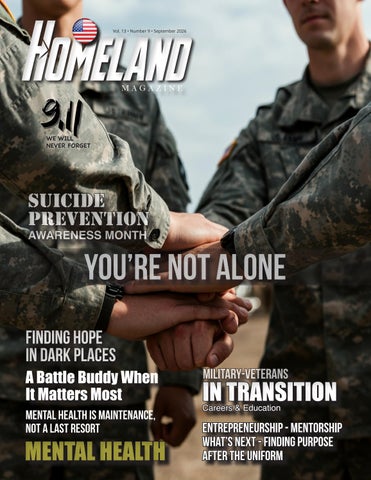
Homeland
Vol. 13 • Number 9 • September 2026
MAGAZINE
WE WILL NEVER FORGET
SUICIDE PREVENTION AWARENESS MONTH
YOU’RE NOT ALONE Finding Hope in Dark Places
A Battle Buddy When It Matters Most Mental Health is Maintenance, Not a Last Resort
MENTAL HEALTH
Military-Veterans
IN TRANSITION Careers & Education
entrepreneurship - Mentorship What’s Next - Finding Purpose After the Uniform HomelandMagazine.com / September 2026
1
teamstepusa.org
2
HomelandMagazine.com / Septembert 2026
Buy a home with a $0 down VA loan Because you served your country, you’re eligible for the special mortgage benefits of a VA loan. As a top VA lender,1 we’ll guide you through the home-buying process and help you take advantage of the benefits you’ve earned.
VA LOAN FEATURES • Options with no down payment2 • No Private Mortgage Insurance required • Cash-out and interest rate reduction refinance options • Access to our RealtyPlus® program—you could earn up to $9,000 cash back3
Scan4 to learn more or visit navyfederal.org/valoan navyfederal.org/VALoan
Navy Federal is federally insured by NCUA. 1Navy Federal Credit Union was included in 8 Best VA loan Lenders in May 2026 by money.com (www.money.com/best-va-loans). 2100% financing subject to all VA rules, guidelines, and additional program requirements. All loans subject to approval. VA loans may include a funding fee, which may be financed up to the maximum allowed loan amount. Navy Federal has no affiliation with the U.S. Department of Veterans Affairs or any other government agency. ³The program is only available for individual home purchases/sales in the contiguous US, Alaska, and Hawaii, excluding Iowa and all employer-sponsored relocations. You are not required to receive financing through Navy Federal Credit Union in order to receive the benefits of this program. The cash back is only available with the purchase or sale of your home through the use of a program-referred and -approved real estate agent, and is offered in most states, with the exception of Iowa, Alaska, and Oklahoma, and is not available in certain transactions with restricted agent commissions (including many new constructions, For Sale by Owner, or For Sale by iBuyer transactions). Your assigned agent can help you identify any transactions where the cash back would not be available. The amount of your cash back depends on the value of the property you are buying or selling. Obtaining the full $9,000 cash back requires transacting in a property valued at $3 million or greater. To calculate your potential cash-back amount, please visit the RealtyPlus website: https://navyfederalrealtyplus.com/. The cash-back offer is limited to one cash back per property with no limit on the number of times you may use the program. In some states, a gift card or commission credit at closing may be provided in lieu of the cash back. In Kansas and Tennessee, a Mastercard® MAX gift card will be issued with preloaded points that are ready for spending at specified retail establishments after closing. State regulations in Kansas limit the dollar amounts and the type of incentive. In Mississippi, New Jersey, and Oregon, a commission reduction may be available at closing in lieu of cash back. Please check with the program coordinator for details. All real estate commissions are negotiable. Contact RealtyPlus for terms and conditions. Seller listing fees apply. This program is offered, in part, by Anywhere Leads Inc., which may receive a co-operative brokerage fee as a result of a referral to any affiliated real estate companies, including Better Homes and Gardens® Real Estate, Coldwell Banker®, Century 21®, ERA® Real Estate, and Corcoran. Program terms and conditions are subject to change at any time without notice. Additional terms, conditions, and restrictions apply. This is an advertisement and not a solicitation for agent representation if your property is currently listed with an agent. Anywhere Leads Inc., 175 Park Avenue, Madison, NJ 07940. Licensed broker in the state of Texas. Broker license #9009191. 4Message and data rates may apply. Visit navyfederal.org for more information. © 2026 Navy Federal NFCU 10299 (5-26) HomelandMagazine.com / September 2026
3
EDITOR’S LETTER
Publisher Editor-In-Chief
Mike Miller mikemiller@homelandmagazine.com
Monthly Columns
What’s Next In Transition Eve Nasby Human Resources Paul Falcone
Veterans in Business Barbara Eldridge
www.HomelandMagazine.com Welcome to Homeland Magazine! Homeland is a veteran-focused magazine throughout the country. It serves to assist all veterans, active military as well as their spouses and families. It’s the leading veterans magazine emphasizing resources, support and focusing on topics and issues facing today’s veteran community. Homeland focuses on resources, support, community, transition, mental health and inspiration for our veterans, & military personnel. The content is the driving force behind our magazine and the connection it makes with our veterans, service members, military families, and civilians. The magazine is supported by a distinguishing list of veteran organizations & members, resource centers, coalitions, veteran advocates, and more. We are honored to share the work of so many committed and thoughtful people. Despite all the challenges, our team has upheld their focus and let not one opportunity go to provide resources and support to our veterans & military personnel.
Risky Business Hadley Wood
Real Talk: Mental Health Hope Phifer
PTSD: Reclaiming Control Robert ‘Bob’ Cuyler, PhD Aging & End of Life Care Shelly Dew Legal Eagle Kelly Bagla, Esq. Midway Magic David Koontz
Cartoons For Veterans Jerry King Contributing Writers
Wounded Warrior Project Disabled American Veterans (In-House) Correspondents Holly Shaffner CJ Machado Lori Noonan
Homeland Magazine 9528 Miramar Road, #41 San Diego, CA 92126
On behalf of our team, we wanted to take this moment to say THANK YOU to the readers and the military and veteran community for supporting our magazine. With that support we aim to make a difference and continuing to make a profound impact on the quality of life for our veterans, military personnel and their families.
(858) 275-4281
If you want to catch up on the current and all past issues please visit: www.homelandmagazine.com/archives
Homeland Magazine is published monthly. Submissions of photographs, Illustrations, drawings, and manuscripts are considered unsolicited materials and the publisher assumes no responsibility for the said items. All rights reserved
Mike Miller
Editor-In-Chief mikemiller@homelandmagazine.com www.homelandmagazine.com 4
HomelandMagazine.com / Septembert 2026
mikemiller@homelandmagazine.com
september 2026 INSIDE THIS ISSUE 6 A Battle Buddy When It Matters Most 8 Our Military Kids: A Unique Nonprofit 12 Mental Health Is Maintenance, Not a Last Resort 14 Gold Star Mother’s: Remember & Honor 16 Finding Hope in Dark Places: Suicide Prevention 18 PTSD - Fishing and Healing 22 AGING & END OF LIFE CARE 24 Beyond the Battlefield: Neurocognitive Assessments 26 The Weight Was Lifted Off 28 There Are Options Other than Suicide 30 Military-Veterans In Transition (September 2026) 32 I Stand Relieved 34 Airman: Living Well After Transition 36 Workplace Health and PTSD 38 Finding Purpose After Military Service 40 From Service to Strength: A Veteran’s Journey 44 Mentorship: Supercharge Your Job Search 46 Veterans Understand the Power of a Unit 48 Asset Protection and Estate Planning 50 Blueprint for Veteran Transition 54 Risky Business: Acts of Terrorism Cover Photo: AI-Generated Image: This image was created using artificial intelligence (AI) and is intended for illustrative purposes only.
HomelandMagazine.com / September 2026
5
A Battle Buddy When It Matters Most By Paris Moulden Wounded Warrior Project When Army veteran Benjamin Heck first heard the term “peer support,” he pictured a room of veterans taking turns sharing their trauma with strangers. It didn’t appeal to him. When someone finally convinced him to attend a Wounded Warrior Project® (WWP) Peer Support Group meeting, Benjamin was hesitant. But the experience didn’t require sharing his life story — just an open mind and a willingness to show up. “It’s not, ‘spill your guts and tell me the most horrific thing in the whole world,’” Benjamin said. “I just want to be your friend.” For many veterans, one of the hardest parts of military transition is losing the camaraderie they shared with fellow service members. WWP® helps fill that gap through Peer Support Groups and Alumni Connection Program events that bring warriors together in low-pressure, meaningful ways. Building Connection Without Pressure WWP’s Connection programs aren’t about baring your soul, although warriors can if they choose. They’re about finding people who understand what you’re going through and rebuilding the bonds unique to military members and their families. Peer Support Groups are small gatherings led by fellow warriors. They provide encouragement and community but are not clinical in nature. “You can talk. You don’t have to talk; no big deal,” said Benjamin, who now serves as a Peer Support Group leader. “We’ll talk about a topic … then do something fun.” WWP warriors, including Joe Stabley and Benjamin Heck, share a laugh at a recent meetup. Peer support and connection events help veterans build connection and community.
The WWP Warrior Survey* underscores how important that connection is: About 2 in 3 WWP warriors say talking to another veteran helps them cope with stress or mental health concerns. “Isolation has a domino effect,” Benjamin said. “It just leads down to a bad path that could be potentially dangerous. Just that I have somewhere to go and meet up with some people, that’s huge.” Taking the First Step For Benjamin, military service wasn’t a given. Several family members had served, but he initially thought he’d take another path — until 9/11 changed his outlook.
WWP Peer Support Groups and Alumni Connection events help veterans reclaim the camaraderie they experienced during military service.
6
HomelandMagazine.com / Septembert 2026
Benjamin joined the Army in 2002 and found his calling. But multiple deployments led to multiple injuries, including a traumatic brain injury (TBI), broken bones, and back and knee injuries. Still, leaving the service felt impossible.
“I was having flashbacks and panic attacks in school, and I kept all of it to myself. I didn’t want to risk getting kicked out of the course, so I just laid low and pushed it all in.”
“I made it a point to stay in as long as I possibly could because I didn’t want to leave. Because of the camaraderie, the friends that I made, the brothers and sisters there, I felt like I would let them down if I was to leave.” Benjamin medically retired in 2018. Retirement meant more time with family, but it also brought a painful loss of purpose.
In 2021, Joe medically retired. After losing his mom and struggling with suicidal ideation himself, he came to understand the importance of staying connected.
“I was in charge of over 70 soldiers, over $50 million worth of equipment. Then all of a sudden, I’m getting up in the morning like I have somewhere to go, but I have nowhere to go,” Benjamin said.
“Just by virtue of hearing one person’s voice on the other end of the line or one handshake or a hug can just lift you back up,” Joe said.
After getting his kids out the door, the house became “really quiet,” he said. “I felt like I didn’t have a purpose.” Benjamin heard of WWP during his transition but didn’t think he qualified. Even after signing up, he was reluctant to attend events. Then someone asked him to help at a peer support group meeting because they were shorthanded. Benjamin couldn’t say no. “Turns out, they didn’t need help,” Benjamin said. “But the group was great. I had that battle buddy I had been lacking. And it was a whole room of them.” Finding Strength Through Shared Experience Joe Stabley joined the Army as a medic at 17, before 9/11. During an early noncombat deployment to Egypt, a close friend and fellow soldier died by suicide — a loss that stayed with him. After 9/11, Joe reenlisted, completed special forces training, and served as a medic to front-line forces. Later, while deployed to Iraq, one of his roommates and special forces classmates was killed in action. “It haunted me for a while, but you just get through. That’s what we do. Complete the mission, go home,” Joe said. Back home, the emotions were harder to suppress. Joe returned to a house where his roommate’s room sat untouched, just the way he had left it. Joe married, started a family, joined the National Guard, and enrolled in school to become a physician assistant. Outwardly, life moved forward, but internally, flashbacks and survivor’s guilt became part of his day-to-day life.
Joe now works as a physician assistant, leads a group for First Responder Psychological Services, and is heavily involved in WWP programs and services. “If people are looking for meaning or hope, they can find it here,” Joe said of WWP Peer Support. “I’ve seen it, I’ve lived it.” Making Room for Connection Connection doesn’t have to happen all at once, and it doesn’t look the same for everyone. WWP’s Peer Support Groups help warriors feel heard in a safe, judgment-free environment. The Alumni Connection Program helps warriors and their loved ones connect through activities like dinner, kayaking, bowling, painting, and movie night. “It may just take one phrase or one moment or one small hint to let them know, ‘Hey, this is a safe place,’” Joe said. “I’ve seen that countless times and that’s pretty special.” Benjamin decided to take that chance and found more than he expected. Now, he wants other warriors to know they can find that sense of belonging, too. “I can see I have somewhere I feel I belong,” Benjamin said. “I want other people to experience that battle buddy that they may be missing, because you have it here.”
To learn more, visit woundedwarriorproject.org or call 888.997.ALUM (2586) to connect with the WWP Resource Center. HomelandMagazine.com / September 2026
7
Our Military Kids: A Unique Nonprofit Serving Reserve, Guard, and Veteran Caregiving Families September 11th changed our Nation forever. Many of us can remember that day clearly, even a quarter of a century later. This year’s 25th anniversary observances encourage us to reflect on the meaning of that day—and its lasting effects. Today’s military kids were born years after 2001, but September 11th continues to have a profound impact on them. For National Guard and Reserve families, overseas deployments are now a routine part of life. If their parents return home from service with injuries or illnesses, children often experience changes in responsibilities, priorities, and schedules. Enter: Our Military Kids (OMK). This national nonprofit was founded in 2004 as a response to the toll that increased post-9/11 operations tempo, demands, and combat has on National Guard, Reserve, and caregiving military families. About Our Military Kids
OMK funds activities for children (ages 1-18) who have a parent deployed in the National Guard or Reserve or who is a Veteran/service member of any branch receiving care for combat-related injuries or illnesses. Funding is disbursed as “activity awards,” and provides up to $300 per application to help pay for an activity of choice selected by the child. From music lessons to soccer clubs, summer camps to art classes, martial arts to dance,
OMK brilliantly funds programming that gives kids joy, confidence, and connection. OMK is proud to have funded over 107,000 activity awards and has never turned away or wait-listed an eligible child in its organization’s history. How to Apply
The application process is easy and straight-forward. Review the complete eligibility requirements and begin the application at ourmilitarykids.org/apply. Applicants will need some information to meet eligibility guidelines, including military documents and information about their child’s chosen activity. Activity awards can help pay for sports, fine and performing arts, camps, tutoring, driver’s education, STEM enrichment, and more! School tuition, childcare, and religious mission trips are not eligible. Receiving a Top-Secret Package
Every military kid who receives an OMK activity award also gets a top-secret package in the mail, created just for them. Inside, they’ll find military-inspired dog tags, a special patch, a handwritten thank-you note, and a check made out to their activity provider. These small details help OMK beneficiaries feel seen, heard, and celebrated during what may be some of the most difficult moments of their young lives. And it makes a difference. Here’s what some of OMK’s award recipients parents have said: • “[OMK] gave our son confidence, encouragement, joyful memories, and something positive to hold onto during a season that can be difficult for our family. As his mom, watching him light up each day and seeing his excitement grow was a gift to me as well.” • “Thank you all for your support and affording my child this opportunity in my absence.” • “The [activity awards] Elizabeth received… allowed her to fill her time with piano, which makes the days, weeks, and months go by a little faster until her daddy returns. Thank you for making this deployment a little more manageable and fun for a sweet seven-year-old!” Proven Impact on Kids, Proven Impact on Families
OMK has a profound and measurable effect on the health and wellness of award recipient families. When children use activity awards, the entire family benefits--mentally, physically, socially, and emotionally. 8
HomelandMagazine.com / Septembert 2026
Our most recent survey of more than 2,000 OMK families found that: • 96% of families saw a positive impact on overall family wellbeing; • 92% reported a positive impact on service member or Veteran morale; • 93% said that the morale of the civilian parent or guardian in the family improved;
• 92% reported their child experienced a positive impact on their behaviors and emotions; • 87% said their child made friends or found a sense of community.
The mother of an OMK activity award recipient shared this description of her family’s experience: “Since receiving the [activity] awards my daughter has been on another level of gratitude and happiness! She is truly living her best life getting to enjoy new things and balancing school and lacrosse. And she continues to show her appreciation towards us (her parents) in the kindest ways! We are so overjoyed by how impactful these grants have been to our family and the community around us!” The Need is Growing
More than two decades in, OMK’s mission is larger than it’s ever been. The last two years have seen tremendous growth as military families request support. In the first half of 2026, overall applications for activity funding grew 14% over the same time last year. OMK can only meet this increased demand through its generous donors. For more information on how to contribute and stand with military kids, visit give.ourmilitarykids.org/omk Keep in Touch Stay up-to-date with OMK: • Facebook: facebook.com/ourmilitarykids • Instagram: instagram.com/ourmilitarykids • LinkedIn: linkedin.com/company/ourmilitarykids Joanna Guldin Lead Director of Brand and Strategic Communications Joanna Guldin is the Lead Director of Brand and Strategic Communications at Our Military Kids. Her writing has been featured in national and international publications, including Military.com, the Military Times, and the Huffington Post. She founded one of the largest and longest-running military spouse blogs online and is the co-founder of a yearly virtual retreat for military spouses and significant others dealing with their partners’ deployment. She lives in Central Pennsylvania with her Navy Veteran husband, young twins, and Jack Russell/Godzilla mix.
HomelandMagazine.com / September 2026
9
• MISS
O
EY •
S
A
N VA LL
IO
N DIEG
On a Mission to Serve Our Military While the military pledges to support and defend our country, this commitment can come at the cost of behavioral health. At Thousand Branches Wellness in Mission Valley, we honor the sacrifices of servicemen and women by proudly providing specialized mental health treatment for veterans and military service members.
If you or someone you love is struggling, call our 24/7 intake line 619-202-8586 for a level-of-care assessment.
Some of the issues we address: • PTSD • Depression and anxiety • Grief and loss • Relationship challenges • Work and career concerns
Our personalized programs can include: • Individual therapy with a licensed clinician • Weekly group therapy sessions • Medication management We understand the distinct challenges of military life and are dedicated to supporting those who have bravely served.
10
HomelandMagazine.com / Septembert 2026
3838 Camino Del Rio North, Ste. 380 San Diego, CA 92108 ThousandBranchesWellness.com Physicians are on the medical staff of Thousand Branches Wellness – Mission Valley, but, with limited exceptions, are independent practitioners who are not employees or agents of Thousand Branches Wellness – Mission Valley. The facility shall not be liable for actions or treatments provided by physicians. Model representations of real patients are shown. For language assistance, disability accommodations and the nondiscrimination notice, visit our website. 254432318-4433814 11/25
HomelandMagazine.com / September 2026
11
Mental Health Is Maintenance, Not a Last Resort We know the drill when it comes to physical health. Schedule the annual exam. Check the blood pressure. Get the screening. Refill the prescription. Move more, sleep better, and try not to pretend that coffee is a food group. We call these things prevention. We call them wellness. We call them responsible. But when the warning signs involve our mental health— sleep that disappears, anger that comes faster, joy that feels farther away, drinking that increases, or relationships that begin to fray—we often apply a very different standard. We wait. We minimize. We tell ourselves to push through.
September is Suicide Prevention Month, and the annual attention is important. But if our conversation begins and ends with crisis, we are arriving far too late. Crisis lines save lives, and everyone should know how to reach them. Yet meaningful suicide prevention also happens upstream, in the ordinary days and quieter moments when someone first notices that something is not right. Mental health is not binary. We are not simply “fine” or “in crisis.” Just as physical health exists on continuum, so does mental health.
In the veteran community, we may even call that resilience. Sometimes it is. Sometimes it is suffering with better branding.
There are days when we are thriving, days when we are strained, and days when we need professional care. None of those days determines our character. The latest U.S. Department of Veterans Affairs suicide-prevention report reinforces that suicide is rarely about one diagnosis or one event. 12
HomelandMagazine.com / Septembert 2026
Risk can be connected to pain, poor sleep, declining health, relationship problems, financial strain, housing instability, substance use, hopelessness, and isolation. In other words, people do not live in clinical silos, and neither does risk. That matters because it changes what prevention looks like. Prevention can be telling your primary care provider that you have not slept well in months. It can be making a counseling appointment before the stress becomes unbearable. It can be calling a friend, joining a peer group, talking with a chaplain, reducing alcohol use, or accepting help with employment, housing, finances, or a difficult transition. It can be taking prescribed medication without shame and keeping the next appointment even after one good week. These are not signs that someone is broken. They are acts of maintenance. Veterans are trained to adapt, endure, solve problems, and keep the mission moving. Those qualities are real strengths. But any strength can become a liability when taken too far. Self-reliance can quietly become isolation. Endurance can become avoidance. Mission-first can become never making room for our own needs. Asking for help does not erase resilience. It is often what preserves it. Normalizing mental health care also requires more than telling people, “It’s okay not to be okay.” That phrase is compassionate, but compassion without action can become a slogan. We need to make it as ordinary to say “I have a therapy appointment” as it is to say “I have a physical.” We need leaders who do more than circulate a hotline number once a year. We need workplaces that protect time for appointments, train supervisors to respond appropriately, and build cultures where using support is viewed as responsible rather than suspect. We also need to check on one another more honestly. “Let me know if you need anything” is well-intended, but it puts the burden on the person who may already be overwhelmed. Try something more direct: “You haven’t seemed like yourself lately. How are you really doing?” Then listen without rushing to fix, compare, or explain away the answer. If you are worried that someone may be thinking about suicide, ask directly: “Are you thinking about suicide?” Research shows that asking does not put the idea in someone’s head. It can open the door to an honest answer and lifesaving support.
If the answer is yes, stay present and help connect the person with qualified crisis support. You do not have to become a therapist. You do have to take the answer seriously. The same is true when we examine our own lives. A mental health check-in does not need to be complicated. Ask yourself: Am I sleeping? Am I isolating? Am I relying on alcohol or other substances more than usual? Am I carrying anger, anxiety, grief, or hopelessness that is affecting my relationships or daily life? Do I feel connected to people and a sense of purpose? What support would make the next week more manageable? The goal is not constant happiness. That is neither realistic nor healthy. The goal is awareness, connection, and the willingness to respond when something changes. Suicide prevention belongs to all of us—not because every friend, family member, colleague, or community leader should become a clinician, but because every one of us helps establish what our culture permits. We can reinforce silence, or we can make care normal. We can praise people only for pushing through, or we can also respect them for knowing when to pause, repair, and reach out. We would never tell someone with chest pain to wait until the heart attack becomes undeniable. Mental health deserves the same urgency, the same attention, and the same absence of judgment. This September, let’s do more than raise awareness about suicide. Let’s normalize the habits that can help prevent a crisis in the first place. Make the appointment. Answer the phone. Ask the direct question. Accept the support. Mental health care is health care. And taking care of it is not weakness. It is readiness.
Crisis support: Veterans, service members, National Guard and Reserve members, and those who support them can contact the Veterans Crisis Line 24/7 by calling 988 and pressing 1, texting 838255, or chatting at VeteransCrisisLine.net. Enrollment in VA benefits or health care is not required. Anyone in the United States experiencing mental-healthrelated distress can call or text 988. If there is immediate danger, call 911. About the author: Lori Noonan is a U.S. Navy veteran, nonprofit executive, and founder of Capacity Builders. She serves as Chief of Staff for Veterans Bridge Home and works to strengthen the organizations and communities that support veterans and their families. HomelandMagazine.com / September 2026
13
GOLD STAR MOTHER'S day
- Remember and honor -
Gold Star Mother's Day is observed on the last Sunday in September, which will be Sunday, Sept. 28, 2024. Gold Star Mother's Day honors the families of service members who have died while serving their country.The day recognizes the pain and sacrifice of the families, and the country's pledge to support them and remember the lives of the fallen.
Today, the United States military presents a Gold Star Lapel Pin to the immediate family of a deceased service member.
The term "Gold Star" originated during World War I, when families would display flags with a blue star for each family member serving in the military and a gold star for each who died.
www.americangoldstarmothers.org
In 1928, 25 mothers who lost sons or daughters in the war formed American Gold Star Mothers, Inc. to honor their children, support veterans, and heal together. The organization's membership has since expanded to include mothers of those who died in other conflicts, as well as adoptive mothers.
14
HomelandMagazine.com / Septembert 2026
While all mothers of fallen service members are considered Gold Star Mothers, there's a veterans service organization they can join for support, known as the American Gold Star Mothers. The group was started in 1928 by one woman --Grace Darling Seibold. Her son disappeared fighting in World War I, so she spent years working at veterans hospitals in hopes of finding him. Seibold eventually learned of her son's death but continued her community service, organizing a group of mothers of the fallen so they could comfort each other and care for those veterans confined to hospitals far from home.
WE WILL NEVER FORGET
Support the 9/11 Memorial Donate today to sustain the 9/11 Memorial. www.911memorial.org
The 9/11 Memorial & Museum is committed to providing relevant and engaging learning opportunities for students, teachers, families, and the general public. * Photo by Tobe Roberts - Pexels
HomelandMagazine.com / September 2026
15
Real Talk: Mental Health By Marissa Ceniceros, LMFT The Steven A. Cohen Military Family Clinic at VVSD, San Diego
Finding Hope in Dark Places: September is Suicide Prevention Awareness Month Suicide prevention and awareness is increasingly important for active duty service members, veterans, and the families, friends and communities who support them. As conversations surrounding suicide become more open and normalized, many people are asking how they recognize warning signs in themselves or others. There is also growing interest in learning how to start difficult conversations, identify appropriate resources, and support someone experiencing suicide ideation or other stressors that may affect their mental health. While this topic carries significant emotional weight, one message that deserves to be shared is that even in the darkest moments, hope is still possible. Reaching out, staying connected, and having the courage to seek support or to support others are strengths and can serve as important sources of hope for those who are struggling. Sentiments of Consideration: • You are not a burden, and you do not have to face this alone. Many people may feel apprehensive about reaching out, but remaining in isolation can deepen feelings of loneliness. Reachig out is an act of courage and opportunity for connection. • It’s ok to not be ok. Many people experience difficult periods in their lives, and with support, relief is possible. We can find strength through community, connection, and access to appropriate resources. • Check on your people and do not be afraid to ask difficult questions. Research suggests that asking someone directly and compassionately about suicide can help them feel seen, supported, and less alone. As CVN's Ask Anyway: Conversations to Save a Life public awareness campaign reminds us, if you're concerned about someone, trust your instincts, move past hesitation, and start the conversation. Ask anyway. • Stay connected during transitions, significant anniversaries, and times of adversity. Life can bring periods of change and significance that may feel more difficult than others. Maintaining connection during these times can provide stability, belonging, and support. • Looking out for each other does not end when service ends. Building and maintaining community after military service can help ease transition and remind veterans that they continue to have a place where they belong. 16
HomelandMagazine.com / Septembert 2026
• Talk about safety before a crisis occurs. For military and veteran communities, talking about firearm access and safe storage is an essential part of suicide prevention. Firearms are the most common method of suicide among veterans. Secure firearms storage is a practical way to reduce risk, protect families, and create opportunities for support when someone is struggling. Supported by Face the Fight, the Ask Anyway: A Lethal Means Safety Toolkit encourages respectful conversations about firearm access, safe storage, and planning before a crisis occurs. Suicide prevention is a shared responsibility and hope often begins with connection. To learn more about starting conversations about suicide prevention and firearm safety, visit cohenveteransnetwork.org.
By Marissa Ceniceros, LMFT The Steven A. Cohen Military Family Clinic at VVSD, San Diego
our
Therapy for Veterans, Service Members, and their Families Cohen Clinics provide therapy to post-9/11 veterans, service members, and their families, including National Guard / Reserves. CVN Telehealth, face-to-face video therapy available statewide.
LEARN MORE vvsd.net/cohenclinics
CALIFORNIA locations
San Diego 8885 Rio San Diego Dr. Suite 301 Oceanside 3609 Ocean Ranch Blvd. Suite 120 Los Angeles 20800 Madrona Avenue, Suite C-100, Torrance, CA HomelandMagazine.com / September 2026
17
PTSD: Reclaiming Control By: Robert ‘Bob’ Cuyler, PhD Psychologist and Trauma Expert
Fishing and Healing, Part 2 Last month I approached veterans’ health from a different perspective, namely the availability of several programs that center on fishing as a healing experience for participants. A few weeks ago, I helped out at Joni and Friends, joniandfriends.org an organization that among other things offers weekend retreats at Camp Allen, outside of Houston. This July weekend was for veterans. I had a chance to visit with organizers and participants as I helped out. Mary Grace Burkey, the director of these programs, visited with me over lunch. “There’s a lot of a lot of reasons behind our Warrior Weekend getaway. One of them is to help veterans find healing with their families. Joni and Friends brings the whole family, spouses, caregivers, and kids. We focus on celebrating the caregiver, giving them some rest. We also want veterans to have a community with each other. A lot of veterans may come back kind of a different person than when they went. Here, they can share stories with their peers, and so do their spouses with one another. We encourage them throughout the year to stay connected with other participants and our volunteers. As a faithbased organization, we also help participants to find and connect with a local church to support them when they get home.” Mike, a retired Marine and a volunteer talks of his informal gatherings of veterans: “At the weekend, we have four or five guys hanging with each other, the battle buddies. We don’t have the same experiences, but we talk the same language. Mary Grace gives us a license to talk to and reach these guys, that starts on night one. I ask, tell me a little bit about yourself. Some of these guys you can’t shut them up, others nothing. But first, let me see who you are. Let me get the lay of the land here and then I’ll tell you a little bit something else, cause I know you now so I can talk to you.” Paul is a veteran: “It’s great being out here with Joni and Friends, being able to share the experience with other veterans, for my wife to share this experience with other caretakers. 18
HomelandMagazine.com / Septembert 2026
It creates a space where I feel comfortable opening up and talking about what I’m going through and hearing what other veterans have gone through and being able to relate to that life experience and not feeling pressured. Where it’s not something wrong with you and you can just be yourself and relax. It’s been life-changing. The first time I was here is very uncomfortable. Didn’t know what to expect, then I realized that everyone here cares and has their own issues and their own problems. No one judges you and you can be yourself and get support that you need that really helps. Luis, a veteran also: “You think you’re the only one deal with it but then you realize there’s a lot of other men going through the same thing and you sit there and talk about what made it better I mean what didn’t work and just the way we gotta hang out fishing like right now and we’re talking and I’m doing this. I’m over here fishing and my wife’s in a session right now. Some one on one time is good with the counselor obviously but I think this helps out so much. We just sit here and just talk and have something in common and especially to catch something.” As Luis and I visit, he casts to and lands an 8-1/2 pound bass. Dr. Cuyler is chief clinical officer of Freespira, an FDA-cleared non-medication treatment that helps people with panic and PTSD manage their symptoms by learning how to regulate their breathing. www.freespira.com
Available to eligible veterans through their VA benefits.
PTSD Isn’t Weakness.
Trusted by 1,000+ veterans.
it’s a wound. we treat it.
A medication-free option to overcome PTSD symptoms.
”
“I am shocked and surprised that this treatment worked. When I think about PTSD, I think about the brain and this being a brain problem… There is no denying the calming effect this treatment had on me. This has made a significant difference in my personal life. This treatment is remarkably effective.” — Kevin, US veteran whose symptoms included social anxiety and monthly panic attacks before he found Freespira
PTSD and panic symptoms are not signs of failure. They’re signs of impact. At Freespira, we offer a proven, medication-free treatment designed to help veterans reclaim peace of mind and control over their lives. No stigma. No judgment.
a
Get relief today See if you’re eligible at freespira.com/relief freespira.com/relief or 1-800-735-8995. Or ask your VA or VA CCN clinician for a Freespira referral.
Just science-backed support. 06378 REV A | ©2025 FREESPIRA, INC. ALL RIGHTS RESERVED.
HomelandMagazine.com / September 2026
19
T U R N I N G PA I N I N T O P U R P O S E
Healing our nation’s heroes through nature, connection and community.
W H I T E H E A RT. O R G WHITEHEART.ORG
20
HomelandMagazine.com / Septembert 2026
VA DISABILITY CLAIM DENIED? Know Your Rights and Don’t Take “No” for an Answer! VA Accredited Representation Including: Appeals of VA Disability Claims: • PACT Act Conditions • Agent Orange Conditions • PTSD / Anxiety / Depression • Unemployability (TDIU) • Musculoskeletal Conditions • Migraine Headaches • and more...
• Higher Level Reviews (HLR) • Supplemental Claims (SCL) • Notices of Disagreement (NOD) • Board of Veterans’ Appeals (BVA) • BVA Videoconference Hearings
* NOTE: We do not assist with filing of new claims or increases
VetDisabilityAid.com (800) 921-0310
Veteran Resources & Support Navigating the wide range of resources available to veterans can feel overwhelming, but you don’t have to do it alone.
Homeland Magazine is committed to helping military service members, veterans, and their families navigate every stage of their journey. Through timely, relevant, and inspiring content, we provide trusted information, valuable resources, and real-world guidance on the issues that matter most—including mental health, fighting PTSD, wellness, healthcare, military family life, deployments and reunification, transition to civilian life, career and educational opportunities, spouse employment, financial well-being, and the many social challenges that can arise along the way.
Homeland Magazine
Resources & Support Available at homelandmagazine.com/category/mental-health/ HomelandMagazine.com / September 2026
21
AGING & END OF LIFE CARE By: Shelly Dew, CFRE, CDE Director of Philanthropy Hospice of the North Coast www.hospicenorthcoast.org
Navigating Medicare, Medicaid and Medigap: What Veterans and Families Need to Know As a hospice professional, I’ve learned that some of the most important conversations with patients and families happen when time is already precious. One conversation I wish happened more often—long before a serious illness—is about healthcare coverage. Understanding Medicare, Medicaid, VA benefits and supplemental insurance can make an enormous difference when families are suddenly faced with difficult decisions. Medicare is federal health insurance primarily for people age 65 and older. Part A helps cover hospital care, skilled nursing care, home health services and hospice care. Part B covers doctors and outpatient services, and Part D provides prescription drug coverage.
Medicaid is different from Medicare. It is based largely on financial and other eligibility requirements, and some people qualify for both programs. If you are “dual eligible,” Medicaid may help with Medicare premiums and certain out-of-pocket costs. Medicaid rules vary by state.
If you’re approaching 65, put the Medicare Initial Enrollment Period on your calendar. It generally begins three months before your 65th birthday month and ends three months afterward. Missing this window can result in delayed coverage or late-enrollment penalties. If you’re still working and have employer-sponsored coverage, different rules may apply, so check your options before turning 65.
And remember Medicare Open Enrollment: October 15 through December 7. Each year, take time to review your Medicare Advantage or Part D coverage, especially if your medications, doctors or healthcare needs have changed.
For veterans, there’s another important consideration: VA health benefits and Medicare can work together, but they are separate programs. Before making changes to your insurance, understand how your VA coverage, Medicare and any other insurance will coordinate.
My advice is simple: Don’t wait until you need care to understand your coverage. Mark the important deadlines, keep your insurance information together and ask questions early. A Medicare counselor, SHIP counselor, VA representative or qualified benefits professional can help you understand your choices.
What about “gap” insurance? You may have heard the term Medigap. Medigap policies are private insurance plans that supplement Original Medicare by helping pay certain deductibles, copayments and coinsurance. They are different from Medicare Advantage, and you generally cannot have both a Medigap policy and Medicare Advantage at the same time. One deadline deserves special attention: your six-month Medigap Open Enrollment Period begins when you are 65 or older and enrolled in Medicare Part B. This is generally the best time to purchase a Medigap policy because you have the strongest protections against being denied coverage or charged more because of health conditions.
In hospice, we see firsthand how much easier difficult decisions can be when families have planned ahead. No one wants to be sorting through insurance paperwork during a health crisis.
Planning ahead isn’t just about paperwork. It can give families greater clarity and peace of mind when facing the challenges of serious illness. Shelly Dew serves as Director of Philanthropy and Community Outreach at Hospice of the North Coast, a community-based nonprofit dedicated to compassionate end-of-life care, comfort, and support for patients sdew@hospicenorthcoast.org | hospicenorthcoast.org
22
HomelandMagazine.com / Septembert 2026
hospicenorthcoast.org HomelandMagazine.com / September 2026
23
Beyond the Battlefield: Neurocognitive Assessments, Neurorestorative Care are Changing Veterans’ Lives
Science-backed therapies are strengthening brain health, offering hope for those who’ve served. By Dr. Amber Deckard, PsyD Military life brings experiences and traumas that are unlike any other. For some, military training or operational demands result in traumatic brain injuries. For others, the trauma is related to prolonged hypervigilance or the psychological toll of combat. As a Marine veteran working in trauma-informed care, I also see the effects of moving from deployment to home life.
Objective Monitoring – Watching the Growth
These stressors often present themselves in veterans through a combination of cognitive, emotional, and physical factors. If you only treat what you can see, though, you cannot achieve lasting recovery. Just like an arborist knows that caring for the leaves and branches won’t help a tree flourish unless the roots are also tended to, patients must first work with clinicians on healing what lies beneath the surface.
A Cognitive Success Story
Neurocognitive Assessment Programs (NAP) – Inspecting the Roots
These programs use tools to identify the causes of issues beyond surface-level symptoms – such as neuroimaging, cognitive testing, and psychiatric evaluation – increasing insight into what truly drives a veteran’s struggles, allowing mental health professionals to treat causes, not just effects.
Finally, progress must be tracked with repeated psychometric tests and follow-up neuroimaging. This “before and after” data helps clinicians see real changes in brain function, cognitive skills, and emotional wellness – objective evidence that the roots are getting stronger and the canopy is recovering. Among the Veterans seen in our Neurocognitive Assessment Program at Caron was a career service member in their mid-60s, whose history reflected decades of repeated combat deployments and longstanding polysubstance use. Cognitive testing confirmed deficits in executive and motor functioning, and neuroimaging tools showed patterns consistent with the effects of trauma, substance use, and head injury. These findings were integrated into a care plan that included abstinence from substances, traumafocused psychotherapy, daily cognitive training, nutritional and exercise interventions, and neurorestorative therapies. Over the course of treatment, progress was tracked showing significant gains across nearly every domain assessed. The Veteran reported reduced depression and anxiety, improved motivation, greater cognitive clarity, and the ability to apply new coping skills learned in therapy. Digging Deep for Lasting Recovery
The need for root-level care becomes clear when we look at relapse statistics: nationally, 40–60% of individuals with substance use disorders relapse within one year. For veterans specifically, rates are even higher – one study found approximately 94% of veterans relapsed following discharge from outpatient or residential treatment. Neurorestorative Approach – Cultivating Healthy Soil
Neurorestorative care enriches the brain’s environment – the “soil” – to foster healing and growth. Clinicians tap into the brain’s capacity to rewire (neuroplasticity) and generate new cells (neurogenesis). Alongside neuro-focused treatments, it’s also important to support whole-person wellness through programing such as nutritional counseling, physical fitness, spiritual care, and medical and psychiatric monitoring. 24
HomelandMagazine.com / Septembert 2026
In the end, taking care of the brain is taking care of the whole warrior.
Dr. Amber Deckard, PsyD is a Marine Corps Veteran and Director of NeuroPsychological Services & the Neurocognitive Assessment Program (NAP) at Caron Treatment Centers www.caron.org/our-team/dr-amber-deckard
RESILIENCY. GROWTH. BELONGING. Led by veteran facilitators, MOSAIC experiences blend physical activity, mindfulness, and resiliency education to rediscover strength, purpose, and connection in everyday life. Weekend programs open to all service members including active-duty, reservists, and veterans. https://tinyurl.com/apply-mosiac Apply today.
themosaicfoundation.org HomelandMagazine.com / September 2026
25
‘THE WEIGHT WAS LIFTED OFF’ A routine exam nearly cost a veteran everything—until a deeper look into toxic exposure revealed the full truth
Left: Now retired, Javier Guzman faced uncertainty when the VA reevaluated his condition and determined erroneously that his illness was not service-connected, putting his benefits at risk. Right: Guzman, during training at Lackland Air Force Base. He was later exposed to PFAS, which caused prostate cancer.
By Matt Saintsing
F
or years, Javier Guzman had no reason to question his health. While stationed at Richards-Gebaur Air Force Base in Missouri, Guzman drove vehicles on the flight line, near aircraft and while transporting officers. Like other airmen, he ate the food, drank the water and did his job without hesitation. He was also unknowingly being exposed to toxic chemicals. “No one knew that anything was potentially contaminated,” Guzman said. He was surprised when, decades after service, he was diagnosed with prostate cancer, a condition the Department of Veterans Affairs attributed to his time at Richards-Gebaur, which officially closed in 1994.
26
HomelandMagazine.com / Septembert 2026
“I didn’t have any symptoms,” he said. “All of a sudden, it popped up.” His protein levels, used to screen for prostate cancer, were dangerously high. Doctors confirmed the diagnosis, and Guzman had surgery to remove part of his prostate, beginning a long, uncertain journey. The VA initially recognized the connection between his service and illness. Guzman received a disability rating, which acknowledged that the cancer was tied to where he served. However, that recognition wasn’t permanent. During a routine VA reevaluation—standard for cancer ratings—the department confirmed Guzman still had prostate cancer. Then, unexpectedly, the VA concluded his condition was not linked to his exposure at Richards-Gebaur. That notification meant his benefits were at risk.
“At my age, 73, it would have changed everything,” Guzman said. “I would’ve had to cut down a lot of things.” Guzman sought help from DAV, where he connected with Michael Franko, a senior national service officer in St. Louis. Franko immediately saw problems. “The blatant disregard for positive medical evidence— that was the first red flag,” he said. Guzman was confused. The VA had approved his claim based on medical evidence linking his cancer to toxic exposure but now argued the opposite using the same record. Franko began a deeper investigation, and what he found was even more concerning. The VA examiner focused narrowly on particulate matter related to perfluoroalkyl and polyfluoroalkyl substances (PFAS)—so-called “forever chemicals”— ignoring the broader environmental reality at the base. “That’s when I really started getting into the weeds,” Franko said, dissecting the medical opinion. Richard-Gabaur had long been identified as heavily contaminated. Environmental Protection Agency (EPA) reports documented a wide range of toxic chemicals in the groundwater and soil, far beyond a single exposure source. That understanding hadn’t yet influenced VA decisionmaking. Instead of arguing over one chemical or one exposure, Franko reframed the case around the “totality of exposure.” “This isn’t a case where you can point to just one thing,” he said. “It’s everything combined.” He combed through EPA reports, identifying contaminants such as vinyl chloride, trichloroethylene (TCE) and perchloroethylene (PCE)—chemicals known to persist on the base and impact human health. Armed with new findings, he challenged the VA’s process directly. Franko argued that the original medical opinion was inadequate because it failed to consider all exposures together, something required under VA guidelines for toxic-exposure risk activity cases. After Franko detailed and presented the facts, his analysis succeeded. The VA agreed to obtain a new medical opinion rather than proceed with the reduction of benefits. The conclusion this time was more favorable to Guzman. When viewed collectively, the chemical exposures Guzman experienced on base pointed to his cancer.
DAV benefits advocate Michael Franko
Not long after, Franko picked up the phone to break the good news. Guzman heard the words he’d been waiting for: His benefits would remain intact. “I was really excited,” said Guzman. “It helped me tremendously.” After months of uncertainty, the outcome brought financial, emotional and medical stability and restored a needed sense of balance. “It was like the weight was lifted off,” he said. DAV’s report Ending the Wait for Toxic-Exposed Veterans notes that inconsistent processes and a weak legal framework continue to impact veterans. Franko’s experience highlights that when a veteran’s exposure or medical history isn’t fully and properly evaluated, the consequences can be life-altering. Cases like Guzman’s are more common than many veterans realize, Franko said. Routine future exams can trigger reevaluations, and without updated medical evidence or strong advocacy, veterans can lose benefits they have rightfully earned. “Veterans have to stay on top of their medical evidence,” he said. Equally important is having knowledgeable advocacy to challenge the system when it errs. For Guzman, that advocacy was pivotal. What once felt like it could unravel his life instead became a moment of relief—and a testament to the transformative power of effective advocacy when facing the VA system. n
dav.org HomelandMagazine.com / September 2026
27
There Are Options Other than Suicide By: Stanley Popovich www.managingfear.com You are at the end of your rope and you can’t take it any much longer. You are in pain and you feel there is no hope. The first step you need to do is to seek treatment for your mental health issues. Do not make the decision to end your life when you are in these kinds of fearful situations. With this in mind, here are seven reasons why suicide is not an option regarding your problems. 1. Things change over time: Regardless of your circumstances, events do not stay the same. Everything changes over time. Knowing that your situation will improve will help give you the confidence that things are not as bad as they seem. In addition, your loneliness will not last. 2. There are always other options: You may feel lost and confused, but the answers to your specific problems are out there. The key is that you have to find the answers; the answers to your anxieties and depression will not come to you. As mentioned before, the first step in finding the solution to your problem is to seek help from a qualified professional. 3. You can’t predict the future: Remember that no one can predict the future with one hundred percent certainty. Even if the thing that you are afraid of does happen, there are circumstances and factors that you can’t predict which can be used to your advantage. For instance, you miss the deadline for a project you have been working on. Everything you feared is coming true. Suddenly, your boss tells you that the deadline is extended and that he forgot to tell you the day before. This unknown factor changes everything. 4. Focus on the facts of your situation and not your thoughts: When people are depressed, they rely on their fearful and depressing thoughts. Your fearful thoughts are exaggerated and are not based on reality. When you are depressed, focus on the facts of your current situation and not on what you think. Do not assume anything regarding your current situation. 28
HomelandMagazine.com / Septembert 2026
Veterans Crisis Line—Dial 988, then press 1, or text 838255
5. Worrying makes things worse: A lot of times, our worrying can make the problem even worse. All the worrying in the world will not change anything. All you can do is to do your best each day, hope for the best, and when something does happen, take it in stride. The key is not to get upset and learn how to manage your negative thoughts. 6. Go to the hospital when it is that bad: If things are so bad that you are unable to function, drop everything and go to your local hospital or crisis center immediately. The people at the hospital or crisis center will take care of you right away. 7. No situation is hopeless: There are many people and organizations that are willing to help you, but you must be willing to take advantage of this help. Regardless of your situation, take advantage of the assistance that is around you. Every problem has a solution. You just have to find it.
One Suicide is Too Many Empowering soldiers with the mental health skills and tools to reinforce suicide protection
WARRIOR
Fight Stigma Provide Peer Support Access to Counseling
@GiveAnHour
HomelandMagazine.com / September 2026
29
Your next mission starts here. Whether you're pursuing a new career, higher education, entrepreneurship, or trusted legal resources for veteran business owners, you'll find the support, insights, and practical guidance you need from successful transitioning service members, veterans, military-friendly employers, and schools. Visit Veterans In Transition and take the next step with confidence. https://homelandmagazine.com/category/veterans-in-transition
Military-Veterans
IN TRANSITIO 30
HomelandMagazine.com / Septembert 2026
Military-VETERANS IN TRANSITION Homeland Magazine - September 2026
32 I Stand Relieved 34 Living Well After Transition 36 Workplace Health and PTSD 38 Finding Purpose After Service 39 Infused: Recruiting. Simplified. 40 From Service to Strength 42 LAPU / Azusa Pacific 43 HealthStaff Training Institute 44 Supercharge Your Job Search 45 ICOHS College 46 Understanding Power of Unit
47 Knauss School of Business USD 48 Asset Protection and Estate Planning 50 Blueprint for Veteran Transition 51 Workshops for Warriors 52 Warrior-Scholar Project 52 Land-Based Learning 53 AGTS Evangel University 58 Covered Six Security Academy 59 Join SFPD 60 Join CDCR 61 SDPD Now Hiring
ON HomelandMagazine.com / September 2026
31
I Stand Relieved Twenty-five years after 9/11, a generation is coming off watch—and no one tells them who has it now. By National Veterans Transition Services, Inc. (NVTSI)
On the deck plates, there is a ritual for handing off responsibility, and it takes about four seconds.
comprehensive, most service members have little reason to recognize it as infrastructure. It simply feels like life.
“I am ready to relieve you.” “I am ready to be relieved.” “I stand relieved.”
Separation changes everything at once. Housing, health care, income, identity, community, purpose and routine may all shift on or around a single date. The scaffolding falls away, but people rarely say, “I have lost my infrastructure.” They are more likely to think, “Something is wrong with me.”
It is exact, spoken aloud, witnessed and logged. The watch is never abandoned; it is transferred. Both parties acknowledge the exchange, leaving no ambiguity about who holds responsibility. This September, 25 years after the towers fell, the men and women whose service was shaped by September 11 are completing careers spanning the post-9/11 era. Many will be relieved at Friday retirement ceremonies before family and shipmates, with shadow boxes, flags and applause. Then Monday arrives. For the first time in decades, no one tells them who has the watch. At NVTSI, we have spent 15 years watching what happens next. This fall, the REBOOT Institute plans to research something long observed but not yet quantified: whether length of service shapes beliefs about who controls life outcomes—and what happens when the structure supporting those outcomes disappears. The Invisible Operating System The military is very good at its job. It manages housing, health care, income, professional development, relocation and daily schedules. Leaders are expected to notice when someone struggles. Because the system is so 32
HomelandMagazine.com / Septembert 2026
Psychologists use the term locus of control to describe a person’s generalized belief about whether outcomes follow from personal action or from forces outside the self. Inside the military, believing that powerful others direct important parts of your life is not irrational. The chain of command is real. Orders matter. Deferring to authority is often correct—and sometimes essential to the mission. At separation, those powerful others recede. Nothing automatically replaces them. A belief that was adaptive on Friday may become limiting on Monday, yet no one announces the change. The veteran must become the architect, navigator and advocate of a life that previously came with orders, checkpoints and a team. Our proposed research will ask whether this change becomes harder with longer service and whether an overlooked population deserves greater attention: those separating after 10 to 14 years. They may be deeply shaped by the institution yet leave without retirement income, continuing health coverage or the retiree network that can cushion a 20-year career.
We do not know the answer. That is why it must be studied rather than assumed.
Did you know?
Why This Belongs in September September is National Suicide Prevention Month, and careless claims in this space can cause harm. This study will not measure suicide risk, predict suicide or imply that transition difficulty inevitably leads to crisis.
Your military discipline, leadership, and unique skills are highly valuable assets, not just memories; focus on transferring that mission-driven mindset, building new habits, and actively seek out a renewed sense of purpose, and remember, you are well-equipped to thrive.
It will examine a form of structural isolation. In uniform, help-seeking can be partly automatic: a chief pulls you aside, a teammate notices a change, or a supervisor asks the second question. The system has eyes. After separation, many of those eyes are gone. Reaching out changes from something the community initiates into something the veteran must initiate. For someone whose experience has taught them that direction and resources come from elsewhere, taking that first step may be the hardest available act.
HomelandMagazine.com
Understanding whether veterans believe action is worth taking is not the same as claiming a causal chain. It is an effort to identify where the handoff fails—and where community organizations, peers, families and institutions can meet veterans before isolation hardens into hopelessness.
Transitioning out of the Military into the Civilian Workforce?
If you are struggling, or worried about someone, confidential support is available 24 hours a day through the Veterans Crisis Line. Call 988 and Press 1, text 838255, or chat at VeteransCrisisLine.net. You do not have to be enrolled in VA benefits or health care to connect.
Finding a job in the civilian workplace may seem easy at first. After all, you have learned skills, practiced leadership and demonstrated initiative that will make you successful wherever you go.
Never Relieved September also brings Gold Star Mother’s and Family’s Day, honoring families whose loved ones died in service to our nation. For a Gold Star Mother, the language of relief carries a different weight. There was no ordinary transfer of the watch she never volunteered to stand. Her vigilance, memory and love continue. The ritual of relief only works because someone is present to accept the handoff. Someone says, “I am ready to relieve you,” and means it. Responsibility transfers, but the watch continues unbroken. For the veterans coming off a 25-year watch, that sentence may still be missing. Our obligation is not to replace their agency. It is to notice that they are still standing there, help them see the bridge ahead and assure them they do not have to cross it alone. They stood the watch for us. Now we must be ready to receive the handoff. NVTSI is a San Diego-based nonprofit serving transitioning service members, veterans and military families through REBOOT programs, community integration and veteran-centered research. Learn more at nvtsi.org.
The reality, though, is that In fact, it can be downright depressing, demotivating, and you may feel totally disillusioned. We can help. In our Veterans In Transition archives you will find helpful and informative articles about what’s next in transition, veterans in business, career, advice, tips, workshops, transition to education, entrepreneurship, veteran franchises, legal tips & resources for veteran businesses and much more...
For assistance in your journey please visit:
Veterans-In-Transition https://tinyurl.com/vet-in-transition
homelandmagazine.com/category/veterans-in-transition
VETERANS IN TRANSITION HomelandMagazine.com / September 2026
33
WHAT’S NEXT Transition to Civilian Life By Eve Nasby eve@infused.work
The Beach or Nothing: What One Airman Learned About Leaving Well Sarau grew up in a Florida town with an old joke attached to it: you either stay for the beach, or you get stuck. Her father was a lifer in the Air Force, a flag honoring his dedication and commitment lay folded into a shadow box on the mantel. Inspired by his service, she followed him into the uniform. She served six years in a logistics squadron, moving equipment and people across bases with a RED HORSE unit, learning discipline in a way that never left her. But the story worth telling isn't just what she did in uniform. It's what she learned about leaving it, and what she'd tell anyone standing where she once stood. Know the difference between fulfilling a commitment and finishing a life. Sarau served her full obligation honorably. That distinction mattered to her father, who needed to know she wasn't quitting, only completing one
mission before starting another. If you are transitioning, be able to say clearly what you finished and why. It will matter to the people who raised you, and it will matter to you on the harder days. Weigh every option before you sign anything. Looking back, Sarau admits she might have stayed a reservist, kept one weekend a month, and had both the civilian life and the career she'd built. Her best friend chose that path and is now a career engineer, still serving. Sarau was young and didn't fully weigh it at the time. Talk to someone who chose differently. Ask what their weekends actually look like, and do the math on benefits and retirement against what walking away completely might cost. Expect your identity to wobble before it steadies. Sarau's sense of self had been built inside that uniform for years. Her command was stunned when she put in her package. Her father worried. This is normal, and it is temporary. Give yourself permission to feel unmoored for a while. It does not mean you made the wrong choice. Have your reasoning ready before the hard conversations. Sarau didn't just tell her father she was leaving, she explained why, and she explained it in terms he could respect. Before you talk to the people whose opinions matter most to you, know your own answer to the question they will ask, even if they never say it out loud: was it worth it, and are you sure. Build your community before you need it. What Sarau misses most isn't structure, it's camaraderie, the friends from basic training who are still connected to a life she stepped out of. Before you separate, start building the relationships that will hold you up on the other side. Find your Veterans Service Organization. Find people who already made the jump. Community does not transfer automatically. You have to plant it early. Let your skills translate, don't shrink them. Discipline, accountability, leadership, problem solving under pressure, none of that disappears when you take off the uniform. Evan
34
HomelandMagazine.com / Septembert 2026
Daniel
Sarau credits every civilian success back to what she learned in service. Do not undersell what you already know how to do. Employers and organizations need exactly what you were trained to give. Replace the structure yourself. No one will enforce your appointments for you anymore. That freedom can feel like a loss before it feels like a gift. Build your own routines early, your own accountability, your own version of the discipline that used to be handed to you. Give yourself permission to grieve what you are leaving. The camaraderie, the purpose, the shadow box version of yourself, all deserve to be honored, not rushed past. Sarau still talks to her old unit. She still feels the pull. Grieving what was does not undo the choice you made. Remember why you left in the first place. Sarau wanted both worlds, service and home, benefits and belonging. Write your reasons down before you go, so that on the hard days you can return to them and remember they were sound. Know that leaving didn't mean her service ended, it simply changed shape. Today, Sarau still serves, just without the uniform, through her work with veterans, nonprofits, philanthropy, and community organizations. If you are leaving, understand you're not walking away from service itself, only the version that required a rank and a roster number. That instinct will find another outlet, if you let it. The tip Sarau offers above all the others is the simplest, and the one she now shares with every young person she meets through her Veterans Service Organization work: whatever comes next for you is not an ending. It is not a closing door with nothing behind it. It is the beginning of a new chapter, and you do not have to write it alone.
Did you know? Veterans don’t simply survive after their military service—they have the tools to thrive. Your military discipline, leadership, resilience, and unique skills didn’t disappear when you took off the uniform. They are valuable assets that can help you build the next chapter of your life.
www.HomelandMagazine.com
Transitioning out of the Military and living your Best Life. Your service prepared you for the mission. Now it’s time to define your next one. Take that same mission-driven mindset into your civilian life. Set new goals. Build new habits. Discover new opportunities. Surround yourself with people who inspire you, and seek out a renewed sense of purpose. You are equipped, experienced, and capable of more than you may realize. Don’t just live after the military—thrive, pursue your purpose, and live your best life.. In our Veterans In Transition & Life Style archives you will find helpful and informative articles about what’s next in transition, and living your best life.
For assistance in your journey please visit:
Veterans-In-Transition https://homelandmagazine.com/category/hlm/ Article Archives
homelandmagazine.com/category/veterans-in-transition
Need help with your transition? Reach out to Eve at eve@infused.work
VETERANS IN TRANSITION HomelandMagazine.com / September 2026
35
HUMAN RESOURCES Transition to Business By Paul Falcone PaulFalconeHR.com
What’s Trending in Workplace Health and PTSD Awareness? Mental health and wellness in the workplace are experiencing a significant transformation, moving beyond reactive measures to proactive, holistic, and integrated strategies. Companies are increasingly recognizing that employee wellbeing encompasses not just mental health, but also physical, financial, social, and even spiritual aspects. The days of siloed wellness programs are fading, replaced by integrated approaches that address the "whole person." Prioritizing employee mental health isn't just about being a good employer; it's also a critical business strategy. Research consistently shows that robust mental health support leads to increased productivity, higher employee engagement, and better retention, and employers are paying attention. In fact, there's a growing demand for and awareness of preventative and proactive strategies. Instead of only intervening when employees are in crisis, employers are investing in tools and policies that support wellbeing before challenges escalate, recognizing that early identification and support are more sustainable and effective.
Much Wider Acceptance among Employers and Workers Gen Z “Zoomers”—the 27-and-under crowd—fully embrace mental wellness and wellbeing in the workplace and access employer benefits willingly and much more openly than in the past. Gen Z is the first truly “digital” generation. As such, research shows that the generation, as a whole, suffers from social isolation, loneliness, and depression, even more so than retirees in retirement homes. Combine that with the general sense of burnout and overwhelm facing many workers, and corporate America recognizes that it has a problem on its hands: employee engagement and discretionary effort are down, while resentment is up, leading to a significant swath of workers looking to change jobs. That poses a serious threat to retention and loss of employee institutional knowledge, so today’s wisest employers are meeting their employees “in the moment” by adding mental health benefits that workers welcome and embrace. PTSD Awareness Trends There's a growing push to normalize conversations around mental health, including PTSD. Brands and organizations are increasingly embracing mental health as a core value, which helps to break down long-standing stigmas. Social media movements like #stopthestigma and #silencetheshame are helping to reduce the shame and embarrassment often associated with mental health conditions. Awareness is expanding beyond military veterans to acknowledge that PTSD can affect anyone who experiences a traumatic event, including survivors of sexual assault, natural disasters, accidents, and even those exposed to mass violence or institutionalized oppression.
36
HomelandMagazine.com / Septembert 2026
The impact of current events, such as civil unrest, political polarization, and the lingering effects of the COVID-19 pandemic on individuals with PTSD is likewise recognized as a factor that can exacerbate symptoms. Further, the VA's National Center for PTSD actively promotes understanding and encouraging individuals to seek help. Campaigns emphasize that effective treatments are available and can significantly improve quality of life. Local communities and mental health centers likewise play a crucial role in organizing events, workshops, and support groups to create safe spaces and to connect individuals with resources. Specific attention is being paid to how trauma affects different age groups, with resources being developed for children and adolescents. Advances in Treatment and Personalized Care Research and clinical practices highlight innovative treatments. These include trauma-focused therapies, technology-assisted therapies, and emerging therapies like Accelerated Resolution Therapy (ART) that focuses on rapid symptom alleviation. Overall, there’s a shift towards more personalized care, with neurobiological advances allowing for treatments tailored to individual neural patterns and new medications that can stabilize neurotransmitters involved in triggering PTSD events. The surge in digital health platforms and teletherapy services is making mental healthcare more accessible, particularly in underserved regions. Collaborative care models, including telehealth, are improving patient compliance and outcomes. The corporate bottom line: companies always strive to be “good corporate citizens.” The workplace is evolving to treat mental health not as a separate issue but as an integral part of overall employee wellbeing and a strategic component of business success. Many organizations are following the trend in PTSD awareness that is characterized by a concerted effort to break down stigma, improve access to diverse and advanced treatments, and broaden the public's understanding of the condition's causes and widespread impact. If this challenge is part of your reality now, speak with your company’s Human Resources team for EAP (Employee Assistance Program) access, benefits programs, and other resources that are available to support you through your journey.
You can connect with Paul on LinkedIn at www.linkedin.com/in/paulfalcone1 Paul Falcone (www.PaulFalconeHR.com) is a management trainer, executive coach, and bestselling author on hiring, performance management, and leadership development.
www.HarperCollinsLeadership.com
HomelandMagazine.com / September 2026
37
Beyond the Uniform: Finding Purpose After Military Service Homeland Magazine sat down with Vic Strecher, behavioral scientist, professor at the University of Michigan School of Public Health, founder of Purposeful, and author of Life on Purpose, to discuss the role purpose plays in resilience and well-being, the challenges veterans can face when transitioning from military to civilian life, and how reconnecting with a deeper sense of purpose can help build a meaningful next chapter. Homeland: Military life is built around serving something bigger than ourselves. Why can losing that be so difficult, and how can veterans create a meaningful next chapter? Vic: In the military, purpose comes standard issue. You know what you're serving, who you're serving alongside, and why it matters. That's rare. Most civilians spend decades searching for what a service member is handed in week one. So, separation isn't just a job change. Viktor Frankl called the emptiness that follows lost meaning an "existential vacuum," and it carries real health consequences — research consistently links low sense of purpose to higher rates of depression, cognitive decline, and early mortality. This has been studied extensively among veterans, where loss of purpose is consistently a top predictor of mental and emotional health problems. The mistake is believing that purpose lived in the uniform. It didn't. It lived in the values underneath it: protecting people, mastering hard things, belonging to something worth belonging to. Those values are portable. A meaningful next chapter doesn't come from replacing the mission — it comes from asking what mattered most about the mission, then finding somewhere new to spend it. Homeland: Many people believe resilience means simply pushing through difficult times. How has your research changed your views? What practical habits can help people rebuild after loss, trauma, or major life changes? Vic: Resilience got sold to us as grit — clench your jaw and drive on. The evidence doesn't support it. Pushing through is a decent short-term tactic and a terrible longterm strategy.
What actually predicts recovery is purpose. When I lost my daughter Julia, I tried toughness first. It failed badly. What eventually worked was rebuilding around what still mattered to me. Three habits, all small: Start the day on purpose. Before your feet hit the ground, name one value you want to carry into the day. One strength you might need. Sixty seconds. Act on it. Purpose isn't a feeling you wait for — it's closer to a muscle. One small values-driven action beats an hour of reflection. Turn outward. Self-transcendence — doing something bigger than yourself — is among the fastest routes back. Veterans tend to be exceptionally good at this, which is part of why peer support works. Homeland: For a veteran or service member who may feel isolated, overwhelmed, or uncertain about the future, what would you want them to know today? Vic: That you're not broken. What you're feeling is what happens to people who cared deeply about something and then lost their place in it. Elite athletes get the same way after they retire. That’s not weakness — it's evidence of your capacity to care. Purpose doesn't have to be large. It narrows in hard seasons: one person, one day, one reason to get up. That's enough to build from. And reaching out isn't surrender. You were trained to call for support when the situation called for it. You served something bigger than your self once. There's still something out there bigger than you that needs you in it.
Vic Strecher, behavioral scientist, professor at the University of Michigan School of Public Health, founder of https://bit.ly/4gPCBPq https://bit.ly/4iwDTzY Purposeful, and author of Life on Purpose 38
HomelandMagazine.com / Septembert 2026
infused.work
HomelandMagazine.com / September 2026
39
From Service to Strength: A Veteran’s Journey to Building Her Own Gym Homeland Magazine sat down with Stephanie O’Connor, Army Veteran and successful transitioning business owner. Homeland: What led you to going into the Army? Stehpanie: I joined the military for the sole purpose of being able to get an education and skill that would help me in the civilian workforce. Unfortunately, my parents could not help me with a college education. My stepfather was in the military, forced me to join JROTC in high school and helped to instill a love for my country and service to it. Homeland: What lessons from serving have shaped you into who you are today?
I worked on the Child and Adolescent Program for about 6 years. All my training helped to prepare me for what was ahead in working both in psych and on the regular hospital floors. I not only learned so much about people, but about myself. I continued to work in the hospital setting until I got married and started having a family. I then stayed home to teach and raise my children. Eventually, when they were old enough, I started to volunteer at a nonprofit, which later became a full-time job running a program for young women in crisis. Homeland: You’re now an owner of a strength training gym. How did you go from being in mental health and nursing to fitness?
Stehpanie: I learned discipline, resilience and determination. I was an athlete inhigh school, so I had some discipline but nothing like what you learn in the military. I joined the military at 17 years old and was in boot camp 6 days after my 18th birthday. I was a tiny girl who hadn’t been out of her hometown very much. I felt very much alone but I was determined to make something of myself and defy odds of not being able to do much with my life. One of the other things that the military taught me is that there are so many people from all walks of life. I think I learned to just have a love for people, to understand where they are coming from and that even if people seem angry or upset that it probably isn’t about me. In that way I think I also learned to not take everything so seriously.
Stehpanie: I was always one of those people who could eat or drink anything and not really gain much weight… until I got older. As I said earlier, I was an athlete growing up. Playing sports, eating healthy whole foods and just being active was normal. We all say that life gets busy with marriage, kids and working and it gets harder to make specific time to do dedicated workouts. That is a true reality, but it is also an excuse. For me, I realized that I was so busy taking care of everyone else that I neglected myself.
Homeland: What was the skill/education you received while being in the military?
It wasn’t easy, but I had to do something to change how I felt on the inside and what I looked like on the outside. I started going to therapy, I joined a 12 step program, and I joined a gym that taught classes on weight training and how to eat so that I could see results.
Stehpanie: I started out as Psychiatric Technician which is basically like a psych nurse. All of us in the medical field served as medics too. I later got my LVN. There were other skills; going to Primary Leadership Defense Course, serving as Training NCO of the Nursing Section and just observing my direct leadership, instructors and chaplains gave me valuable insights, knowledge and help. Homeland: How did this education and training in the military help you transition? Stehpanie: Straight off active duty I went to Mesa Vista Hospital to apply for a job and was hired within a week! 40
HomelandMagazine.com / Septembert 2026
I think a lot of people who are in “helping” professions fall into this trap. I found myself telling everyone else how to manage their lives and what to do to be healthy both mentally and physically, but I wasn’t doing what I told my clients. I wasn’t healthy mentally or physically and no one was going to get me healthy but me.
I believe this is still a difficult thing for a lot of service members transitioning out of the military. The general public sees you as someone who is tough, who doesn’t fear a lot of things or doesn’t need that much help. It was especially difficult for me being the one who was trained on mental health, to face the fact that I was the patient that needed help! Even though going to therapy, being in a 12 program and joining the gym were the most difficult times in my life, I wouldn’t trade facing those things for anything. I couldn’t have opened the gym with the unhealthy mindset or body I had before.
Homeland: What advice would you give to others about starting a gym or business? Stehpanie: Take care of your mental health and physical health first. Figure out who you are when no one is watching. It takes being able to love yourself to better things and believing you can, in order to make it
Did you know? Transitioning service members and veterans are well-suited for entrepreneurship and franchising, leveraging their militaryhoned skills like leadership, discipline, and strategic thinking.
HomelandMagazine.com
Transitioning out of the Military into the Civilian Workforce? Finding a job in the civilian workplace may seem easy at first. After all, you have learned skills, practiced leadership and demonstrated initiative that will make you successful wherever you go. The reality, though, is that In fact, it can be downright depressing, demotivating, and you may feel totally disillusioned. We can help.
House of Strength is more than a fitness gym – it’s a place where determination meets encouragement and every athlete, regardless of experience level, finds a path to success. As the leading strength training gym in San Diego, we’re dedicated to delivering expert coaching, empowering programs, and movement-focused training in a supportive, welcoming environment. Our community is the heart of House of Strength. Located in San Diego’s Convoy District, we proudly bring together individuals who value hard work and meaningful connections, creating a culture that celebrates every achievement, big or small. We regularly host training events and partner with local organizations, making fitness accessible and creating lasting impact both inside and outside the gym. For more information visit www.houseofstrengthsd.com
In our Veterans In Transition archives you will find helpful and informative articles about what’s next in transition, veterans in business, career, advice, tips, workshops, transition to education, entrepreneurship, veteran franchises, legal tips & resources for veteran businesses and much more...
For assistance in your journey please visit:
Veterans-In-Transition https://tinyurl.com/vet-in-transition
homelandmagazine.com/category/veterans-in-transition
VETERANS IN TRANSITION HomelandMagazine.com / September 2026
41
Your Mission Doesn’t Pause. Your Education Shouldn’t Either. 100% Online. Flexible. Built Around Your Life.
Now becoming APU Global, in partnership with Azusa Pacific University. Los Angeles Pacific University Is Becoming Azusa Pacific University Global. New Name with Expanded Opportunities. Same Christ-centered Mission.
W
hether you’re balancing deployments, PCS moves, family responsibilities, or a busy work schedule, your education can move with you. Earn your degree online with the flexibility to learn when and where it works for your life—while making the most of the benefits and credits you’ve already earned. 100% Online & Flexible
Transfer What You’ve Earned
Learn from anywhere*, on a schedule that fits your life.
Maximize eligible transfer credits toward your degree.
Maximize Your Benefits
Faith-Based & Supportive
Use GI Bill®, tuition assistance, and spousal benefits.
Get dedicated Success Coaches who are invested in helping you reach your goals.
Turn Experience Into Credit
Accredited Education
Military training and experience may qualify for college credit through CLEP, DSST (DANTES), and AARTS/JST.
Earn an accredited associate, bachelor’s, master’s, or certificate credential.
apuglobal.edu ♦ 855.527.2768 *At this time, APU Global is unable to offer distance programs or courses to students residing in the following states and districts: Alabama, Arkansas, Connecticut, the District of Columbia, Indiana, Kansas, Maryland, Minnesota, New Mexico, New York, North Carolina, Oregon, Wisconsin, and Wyoming.
42
HomelandMagazine.com / Septembert 2026
Never NeverForget: Forget: Remembering Remembering9/11 9/11 &&Supporting SupportingThose Those ininNeed. Need. As we honor National Suicide Prevention Month and the memory of 9/11, we acknowledge the struggles of our Veterans: nearly 20% of those with PTSD also face Substance Use Disorders. Alarmingly, 22 Veterans take their own lives each day. Awareness is just the first step; it is the dedicated support of certified professionals that drives true healing.
How How HealthStaff HealthStaff Training Training Institute Institute Serves Serves You: You: Job Placement & Externship Assistance
Certied Drug & Alcohol Counseling Courses
Resume & Cover Letter Preparation
www.hsti.com/VA www.hsti.com/VA HomelandMagazine.com / September 2026
43
My Mentor Helped Me Double My Salary: Supercharge Your Job Search with Customized Mentorship Finding the right career after military service can be challenging. You may have the skills, leadership experience, and determination—but knowing how to translate your military experience, navigate the job market, and build the right professional network can make all the difference. That’s where American Corporate Partners (ACP) can help. www.acp-usa.org ACP is a national nonprofit that connects post-9/11 Veterans with experienced professionals from some of America’s leading organizations for free, year-long, oneon-one mentorships. Mentors come from organizations including Amazon, Disney, Lockheed Martin, MLB, and more. For Army National Guard Major Jared Hendler, the impact was significant. “After working with my ACP Mentor James, I landed the best possible job out of everything I had applied for,” Hendler said. He is now a manager at a major global company—and earning twice his previous salary. What Can a Mentor Do for You? ACP mentorships are customized to your career goals and professional experience. Your Mentor can help you: ● Strengthen your résumé and prepare for interviews ● Explore career options and identify meaningful opportunities ● Build and expand your professional network ● Develop leadership and communication skills ● Navigate work-life balance and workplace culture ● Create a long-term career plan ● Explore entrepreneurship and small-business development ACP Protégés who obtain meaningful employment during their mentorship report an average salary increase of more than $41,000+ over their previous compensation. In 2025, ACP Protégés reported an average starting salary of $105,000. 44
HomelandMagazine.com / Septembert 2026
Army Veteran Shameka Howell experienced that impact firsthand. After more than 10 years out of the Army, Howell found herself underemployed following an unexpected layoff. Only a few months into her ACP mentorship, She landed a new position paying $20,000 more than her previous job. “By following my Mentor’s advice on networking, I was able to land a new, higher-paying position at a company that will be paying for me to learn new skills!” Howell said. “I am so grateful for my Mentor’s guidance and for the connection to her through ACP.” Your Mentor. Your Goals. Your Next Career. ACP hand-picks a Mentor based on your career interests, professional history, and mentoring preferences. You and your Mentor then develop a personalized action plan and typically connect monthly. ACP staff remain involved throughout the year, providing resources and helping ensure a successful experience. Who is eligible? Post-9/11 Veterans who have served at least 180 days of active duty since September 11, 2001. Since 2010, more than 43,000 Veterans and Military Spouses have participated in ACP, and 98% of Veterans say they would recommend the program. Ready to take the next step in your civilian career? Apply today at ACP’s website.
www.acp-usa.org/programs/veteran-mentoring-program
The brief application asks about your military experience, career goals, and mentoring preferences. ACP will contact you within 24 hours to schedule a short phone conversation and begin the matching process. Your next career may be closer than you think. Don’t navigate the transition alone—find a Mentor who can help you get there.
READY TO TAKE CHARGE OF YOUR CAREER? Talk to our friendly veterans admissions counselor today! admissions@icohs.edu (858)581-9460 www.icohs.edu Become a certified IT professional in 15 weeks with no prior experience necessary!
Why ICOHS College?
Career Outcomes:
• GI Bill & MyCAA Approved
• Technical Support Specialist
• Flexible Schedule
• IT Support Technician
• Online & In-person Hybrid Classes
• Network Administrator
• Small Class Size
• Network Analyst
• Hands-on Training
• Systems Administrator
• Lifelong Job Placement and Career
The median IT job salary in the US was about $88,000 last year.
Counseling
HomelandMagazine.com / September 2026
45
BUSINESS FOR VETERANS By Barbara Eldridge www.mindmasters.com
Veterans Understand the Power of a Unit—Bring that to Business After several years hosting events and introducing dynamic guest speakers, I had a realization: while expert content is valuable, what entrepreneurs need more is connection. A space to share real-world challenges, get unstuck, and tap into the hard won insights of others who’ve walked a similar path. Napoleon Hill emphasized the idea of Master Mind groups in his book Think and Grow Rich. In this business environment it is easy to see why a Master Mind Group helps business owners thrive: The components are the things that make it work. 1. Brainstorming. It's true, two heads are better than one. And just meeting on a regular basis with business associates to kick around ideas, challenge each other, make promises to take action, and share resources and strategies yield major results. Often our thoughts are limited to our current and past experiences. When you tap into the power of a mastermind, opportunities are unlimited. This is a type of synergistic potentiality that can only happen when multiple people build on each other’s ideas. 2. You can't hide with in-person accountability. When you follow your same old routines, it is easy to slip into the habits that have kept you in your current challenges. You can be your own worst enemies when it comes to accountability and staying on track. You don’t have bosses, just goals. You let yourselves off the hook when necessary or slide into playing small again. When you make commitments, you know that people are going to be listening to your updates, it's like a kick in the pants to remember to stay on track. 3. Other people's ideas can stimulate a healthy challenge. It only takes one new idea to put you on track for million-dollar results. There is a difference between playing it safe and stepping into ourbigger game. Left to our own devices…most people unconsciously play small. When you listen to how others think and strategize, it can help you grow and expand your "box" as well as challenge you to play a bigger game. 46
HomelandMagazine.com / Septembert 2026
4. The realization that your obstacles are shared by many. Many times, a fellow group member’s breakthrough can be exactly what another member needed to hear to help realize where they had been getting in their own way. 5. Overcome isolation to thrive with connection. Dan Kennedy says, "Being an entrepreneur/or salesperson is lonely." Most of us work alone from home, surrounded by people who need something from us or just don’t understand our passion for our work. A mastermind can be a powerful way to stay connected to people who get us, overcome the feeling of isolation and be a springboard for taking business into new dimensions of success. Veteran entrepreneurs are uniquely positioned for success. You understand strategy. You take ownership. You know how to execute under pressure. But even the best trained soldier needs backup. That’s what a mastermind group provides: backup, insight, and a boost when you need it most.
About the Author
Barbara Eldridge has built a solid reputation as a Results strategies specialist, within industry and business over the past 40 years. Her unique message, since starting Mind Masters 30 years ago for entrepreneurs and small business owners, continually stresses vision, purpose and values as the key elements of business philosophy. Her undying compassion for the entrepreneur’s journey, her tireless capacity to listen, and her sincere enthusiasm for other’s success have insured her growing influence and her own mastery with Mind Masters www.mindmasters.com
Flexible programs,
100% COVERED FOR MOST MILITARY
Ready for your next career step? The Knauss School of Business at the University of San Diego offers flexible graduate programs to help you advance your career, bring your values to enterprise and prepare you for a lifetime of impact. And as a 100% Yellow Ribbon School, tuition is fully covered for most military-connected students.
LEARN MORE
www.sandiego.edu/business sandiego.edu/business
Independence isn’t about doing everything alone; it’s about creating a life and support system that reflects your unique strengths, needs, and aspirations. By building your own framework for Independent Living, you take an active role in defining what success, well-being, and fulfillment look like for you. HomelandMagazine.com / September 2026
47
legal Eagle Straight-forward legal tips for Military and Veteran Business Owners By Kelly Bagla, Esq. www.BaglaLaw.com
What’s the Difference Between Asset Protection and Estate Planning? Building a successful business isn’t just about creating wealth—it’s about growing, preserving, and transferring what you’ve built. A comprehensive plan should address both asset protection and estate planning. While they often work together, they solve different problems. For business owners, understanding the difference is essential to protecting what you’ve built and preserving it for the people who matter most. What Is Asset Protection?
Asset protection is designed to help safeguard your personal and business assets from financial risks, including lawsuits, creditor claims, business debts, personal guarantees, contract disputes, and professional or operational liabilities. Depending on your circumstances, an asset protection plan may involve: • Choosing the appropriate business entity
• Keeping business and personal finances separate • Maintaining adequate insurance coverage • Using properly drafted contracts
• Structuring real estate and investments carefully • Using retirement accounts, trusts, or other legal structures
The goal is not to hide assets or avoid legitimate obligations. It is to structure your affairs lawfully so one business problem doesn’t put your entire financial foundation at risk. Asset protection works best before a lawsuit, creditor claim, or financial crisis arises. Moving assets after a claim occurs can create serious legal problems. The best time to protect your wealth is before you need protection. 48
HomelandMagazine.com / Septembert 2026
What Is Estate Planning?
Estate planning focuses on what happens to your business, assets, and affairs if you become incapacitated or die. For business owners, it goes beyond deciding who receives your personal property. Your estate plan may determine who controls the company, who can make decisions on your behalf, and whether the business can continue without you. A comprehensive estate plan may include: • A will
• One or more trusts
• A financial power of attorney • A healthcare directive
• Business succession documents • A buy-sell agreement
• Updated beneficiary designations These tools help answer critical questions: Who will own your business interests? Who will manage the company if you can’t? Should the business pass to family members, be sold to key employees, or be purchased by a business partner? Without a clear plan, ownership and control may pass according to default legal rules rather than your wishes. That can create uncertainty, conflict, and disruption for your family, employees, and customers.
How Do They Work Together?
®
Asset protection and estate planning address different risks, but business owners often need both. Business entities and insurance may help address liability risks during your lifetime. A trust, buy-sell agreement, or succession plan may determine what happens to your ownership interest after death or incapacity.
Rental Asset Protection YOU NEED!
But one does not replace the other. An estate plan does not automatically protect assets from lawsuits or creditors. Likewise, asset protection planning does not determine who inherits your business or how it will be managed in the future.
Protect Your Rentals
California Considerations
California business owners should consider state-specific issues, including community-property rules, probate, business succession requirements, and potential property-tax consequences when transferring real estate under Proposition 19. California rules governing business entities, trusts, professional practices, and real property can differ from those in other states.
Avoid Costly Lawsuits Build With Confidence
The Bottom Line
Asset protection helps safeguard what you’ve built. Estate planning determines who controls and receives it. Succession planning helps keep the business moving forward. A coordinated plan can help separate business and personal risk, preserve wealth, provide for your family, and create a clear path for your company’s future. Because these decisions involve legal, tax, and business considerations, your plan should be tailored to your ownership structure, industry, assets, family, and long-term goals For more information on how to legally start, grow, protect and exit your business, please visit my website at www.BaglaLaw.com.
Disclaimer: This information is made available by Bagla Law Firm, APC for educational purposes only as well as to give you general information and a general understanding of the law, and not to provide specific legal advice. This information should not be used as a substitute for competent legal advice from a licensed professional attorney in your state.
When it comes to investing in real estate, your hard-earned assets are at risk! YOU NEED THE RIGHT ATTORNEY ON YOUR SIDE! Kelly Bagla, Esq., and her team at Bagla Law Firm, APC, a Business Formation and Asset Protection firm, have over twenty years of experience protecting real estate for rental owners. They customize your asset protection plan to ensure that your rentals are protected in case of a lawsuit. Build your real estate empire with confidence through legally proven strategies.
Call today for your asset protection consultation and start building with confidence.
760-579-6789 BaglaLaw.com HomelandMagazine.com / September 2026
49
Veterans Chamber of Commerce By Joseph Molina veteransccsd@gmail.com www.nationalveterans.org
Blueprint for Veteran Transition From My Perspective My journey, both personal and professional, has taught me that supporting our veterans & military-connected community requires goodwill, structural and Intentional systematic approach. When I look at the landscape of military transition, I see a clear need for a trustworthy, high-quality ecosystem where veterans don't just find a job—they find their next leadership mission. This is why I positioned the National Veterans Chamber of Commerce (NVCC) as a primary project incubation platform and keeping the main focus on empowering local veteran-leaders who are Ready, Willing, and Able tm to spearhead transformative initiatives right in their own community. The pivotal experiences that shaped my current path stem from seeing the gaps in traditional transition models. True economic mobility doesn't happen through fragmented support; it requires standardizing excellence. To solve this, I designed a scalable licensing and chartering framework for the NVCC. As a primary chartering authority, we review, verify, and approve programs in four critical pillars: Education, Employment, Wellness, and Entrepreneurship. The most valuable lesson I have learned through this work is that standardization breeds credibility. When we validate local programs or offer Professional Development Units (PDUs), we protect our community and ensure that our training models deliver real-world, measurable results. What deeply drives my dedication to this cause is our "Family Approach". Military service affects the entire Family, which is why my framework purposefully extends to veterans, spouses, parents, and children. To me, this work is a micro-reflection of what makes a democracy thrive: the willingness of a diverse all-inclusive group of people to align around a shared mission, working together as "one unit" and supporting each other 50
HomelandMagazine.com / Septembert 2026
as "one family". When we equip local leaders with turnkey curriculums in supervision, procurement, and business management, we aren't just helping individuals; we are strengthening the civic and economic fabric of those communities. To scale these aspirations, global networks like GlobalMindED are essential in supporting these goals by connecting and helping us identify local leaders who are Ready, Willing and Able to lead our standardized, licensed programs and curricula matched with visionary corporate partners and forward-thinking educational institutions. By collaborating, we can accelerate workforce integration and business equity for military-connected families on a Local or national scale. Looking ahead, I am always open to meeting with community leaders with the passion to spearhead a Local Veteran Chamber or veteran business club. Share your Ideas with us:
The National Veterans Chamber Joseph Molina National Director/Founder email: josephmolina@nationalveterans.org Website: www.nationalveterans.org
BEFORE SERVED HONORABLY.
Workshops for Warriors is a nonprofit school that provides veterans and transitioning service members with hands-on training and nationallyrecognized credentials in CNC machining, CAD/CAM programming, and welding. Our students earn credentials that open doors to jobs anywhere in the U.S. Call us at (619) 550-1620.
AFTER EARNED A CAREER IN JUST 4 MONTHS. ENROLL NOW AT WFW.ORG CAD/CAM Programming CNC Machining Welding DoD SkillBridge Organization HomelandMagazine.com / September 2026
51
Boot camp prepared you for the military. We prepare you for college.
Just like boot camp molded you into the service member you would become, our free on-site and virtual programs mold you into the college student you strive to be.
Scan the code to learn how our programs help enlisted veterans succeed in college
landbasedlearning.org 52
HomelandMagazine.com / Septembert 2026
PREPARE FOR YOUR CALL TO SERVE { Become a military chaplain by earning a
MASTER OF DIVINITY degree
{ Proven record of more than 200 chaplain graduates
IN-PERSON OR ONLINE
www.evangel.edu HomelandMagazine.com / September 2026
53
RISKY BUSINESS Insurance Info & Risk Management Tips By Hadley Wood www.hlinwood-insurance.com
Can Acts of Terrorism be Covered by Insurance? As a business owner, you always need to be diligent about protecting your assets and understanding your risks and exposures. While terrorism may be a low risk to your business, you may wonder if your insurance policy extends coverage to Acts of Terrorism. Prior to 9/11, a standard business insurance policy included terrorism coverage as part of the policy package. Since terrorism was a relatively low exposure on US soil, insurance companies built that coverage into the policy for no additional cost, thinking they had a very low risk. The aftermath of 9/11 nearly bankrupted major insurance companies with over 43 billion in claims and losses. It was, and still is, the largest global insurance loss in history. Not surprisingly, insurance companies removed terrorism coverage from the standard coverage offering and made it nearly impossible (and unaffordable) to purchase. In 2002, the Federal Government stepped in and created the Terrorism Risk Insurance Act or TRIA that mandated insurance companies to offer terrorism coverage at a reasonable price. The act was set up to be a temporary bridge solution to a potentially large problem, but it has since been renewed 4 times – 2005, 2007, 2015 and 2019 (in place until 2027) with bi-partisan support. Insurance companies need to offer the coverage to you OR automatically include the coverage for little or no additional premium. If the coverage is offered, you do not need to purchase it. Is Terrorism Coverage something worth having? It depends on the scope of your business and the cost of the coverage. For many small to medium sized companies, the risk would be so slight that purchasing the coverage would not make sense. Also, in order for the TRIA coverage to become ‘triggered’, a terrorist act must meet the following criteria: • Be Certified by the Federal Government as an Act of Terrorism. • Be an act that is dangerous to human life, property, or infrastructure and results in damage within the U.S. or U.S. sovereignty. • Result in over $5 million of property and casualty losses. • Be a violent act or an act that is dangerous to human life, property, or infrastructure. 54
HomelandMagazine.com / Septembert 2026
• Cause damage within the United States or other area of US sovereignty (e.g., a US embassy, airplane, ship). • Be committed as part of an effort to coerce the civilian population of the United States or to influence the policy or affect the conduct of the US government by coercion. • NOT be an act of War. Considering that the last Certified Act of Terrorism was 9/11/2001, 25 years ago this month, I would say that purchasing the coverage is not something I generally recommend to my clients. But things can change, and it is always good to know it is available if we need it!
If you want to learn more about this subject or have questions about business insurance, please reach out to me at hadley@hlinwood-insurance.com
www.identityiq.com/veterans
HomelandMagazine.com / September 2026
55
www.lightheadedhelmets.com 56
HomelandMagazine.com / Septembert 2026
As the nation marks 250 years of independence, Liberty Station stands as a powerful reminder that America was forged by bravery and remains anchored in liberty. To learn more, please visit libertystation.com/events/250th-anniversary
www.midway.org/contact/volunteer-opportunities
www.midway.org HomelandMagazine.com / September 2026
57
www.c6securityacademy.com 58
HomelandMagazine.com / Septembert 2026
Be the
CHANGE
Veterans! Join Our Team
SFPD Salary
https://tinyurl.com/vet-in-transition
Earn $119,262 to $164,164/year
TEXT “JoinSFPD” to
(415) 704-3688
www.JoinSFPD.com HomelandMagazine.com / September 2026
59
JoinCDCR.com
60
HomelandMagazine.com / Septembert 2026
www.joinSDPDnow.com SDPDrecruiting@pd.sandiego.gov
HomelandMagazine.com / September 2026
61
62
HomelandMagazine.com / Septembert 2026