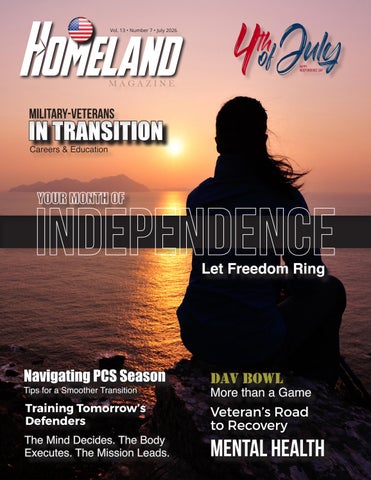
Homeland
Vol. 13 • Number 7 • July 2026
MAGAZINE
Military-Veterans
IN TRANSITION Careers & Education
YOUR MONTH OF
INDEPENDENCE Let Freedom Ring
Navigating PCS Season
DAV Bowl
Training Tomorrow’s Defenders
Veteran’s Road to Recovery
Tips for a Smoother Transition
The Mind Decides. The Body Executes. The Mission Leads.
More than a Game
MENTAL HEALTH HomelandMagazine.com / July 2026
1
teamstepusa.org
2
HomelandMagazine.com / July 2026
Buy a home with a $0 down VA loan Because you served your country, you’re eligible for the special mortgage benefits of a VA loan. As a top VA lender,1 we’ll guide you through the home-buying process and help you take advantage of the benefits you’ve earned.
VA LOAN FEATURES • Options with no down payment2 • No Private Mortgage Insurance required • Cash-out and interest rate reduction refinance options • Access to our RealtyPlus® program—you could earn up to $9,000 cash back3
Scan4 to learn more or visit navyfederal.org/valoan navyfederal.org/VALoan
Navy Federal is federally insured by NCUA. 1Navy Federal Credit Union was included in 8 Best VA loan Lenders in May 2026 by money.com (www.money.com/best-va-loans). 2100% financing subject to all VA rules, guidelines, and additional program requirements. All loans subject to approval. VA loans may include a funding fee, which may be financed up to the maximum allowed loan amount. Navy Federal has no affiliation with the U.S. Department of Veterans Affairs or any other government agency. ³The program is only available for individual home purchases/sales in the contiguous US, Alaska, and Hawaii, excluding Iowa and all employer-sponsored relocations. You are not required to receive financing through Navy Federal Credit Union in order to receive the benefits of this program. The cash back is only available with the purchase or sale of your home through the use of a program-referred and -approved real estate agent, and is offered in most states, with the exception of Iowa, Alaska, and Oklahoma, and is not available in certain transactions with restricted agent commissions (including many new constructions, For Sale by Owner, or For Sale by iBuyer transactions). Your assigned agent can help you identify any transactions where the cash back would not be available. The amount of your cash back depends on the value of the property you are buying or selling. Obtaining the full $9,000 cash back requires transacting in a property valued at $3 million or greater. To calculate your potential cash-back amount, please visit the RealtyPlus website: https://navyfederalrealtyplus.com/. The cash-back offer is limited to one cash back per property with no limit on the number of times you may use the program. In some states, a gift card or commission credit at closing may be provided in lieu of the cash back. In Kansas and Tennessee, a Mastercard® MAX gift card will be issued with preloaded points that are ready for spending at specified retail establishments after closing. State regulations in Kansas limit the dollar amounts and the type of incentive. In Mississippi, New Jersey, and Oregon, a commission reduction may be available at closing in lieu of cash back. Please check with the program coordinator for details. All real estate commissions are negotiable. Contact RealtyPlus for terms and conditions. Seller listing fees apply. This program is offered, in part, by Anywhere Leads Inc., which may receive a co-operative brokerage fee as a result of a referral to any affiliated real estate companies, including Better Homes and Gardens® Real Estate, Coldwell Banker®, Century 21®, ERA® Real Estate, and Corcoran. Program terms and conditions are subject to change at any time without notice. Additional terms, conditions, and restrictions apply. This is an advertisement and not a solicitation for agent representation if your property is currently listed with an agent. Anywhere Leads Inc., 175 Park Avenue, Madison, NJ 07940. Licensed broker in the state of Texas. Broker license #9009191. 4Message and data rates may apply. Visit navyfederal.org for more information. © 2026 Navy Federal NFCU 10299 (5-26)
HomelandMagazine.com / July 2026
3
EDITOR’S LETTER
Publisher Editor-In-Chief
Mike Miller mikemiller@homelandmagazine.com
Monthly Columns
What’s Next In Transition Eve Nasby Human Resources Paul Falcone
Veterans in Business Barbara Eldridge
www.HomelandMagazine.com Welcome to Homeland Magazine! Homeland is a veteran-focused magazine throughout the country. It serves to assist all veterans, active military as well as their spouses and families. It’s the leading veterans magazine emphasizing resources, support and focusing on topics and issues facing today’s veteran community. Homeland focuses on resources, support, community, transition, mental health and inspiration for our veterans, & military personnel. The content is the driving force behind our magazine and the connection it makes with our veterans, service members, military families, and civilians. The magazine is supported by a distinguishing list of veteran organizations & members, resource centers, coalitions, veteran advocates, and more. We are honored to share the work of so many committed and thoughtful people. Despite all the challenges, our team has upheld their focus and let not one opportunity go to provide resources and support to our veterans & military personnel.
Risky Business Hadley Wood
Real Talk: Mental Health Hope Phifer
PTSD: Reclaiming Control Robert ‘Bob’ Cuyler, PhD Aging & End of Life Care Shelly Dew Legal Eagle Kelly Bagla, Esq. Midway Magic David Koontz
Cartoons For Veterans Jerry King Contributing Writers
Wounded Warrior Project Disabled American Veterans (In-House) Correspondents Holly Shaffner CJ Machado Lori Noonan
Homeland Magazine 9528 Miramar Road, #41 San Diego, CA 92126
On behalf of our team, we wanted to take this moment to say THANK YOU to the readers and the military and veteran community for supporting our magazine. With that support we aim to make a difference and continuing to make a profound impact on the quality of life for our veterans, military personnel and their families.
(858) 275-4281
If you want to catch up on the current and all past issues please visit: www.homelandmagazine.com/archives
Homeland Magazine is published monthly. Submissions of photographs, Illustrations, drawings, and manuscripts are considered unsolicited materials and the publisher assumes no responsibility for the said items. All rights reserved
Mike Miller
Editor-In-Chief mikemiller@homelandmagazine.com www.homelandmagazine.com 4
HomelandMagazine.com / July 2026
mikemiller@homelandmagazine.com
JuLY 2026 INSIDE THIS ISSUE 6 DAV Bowl: More Than a Game
8 Warrior Foundation Freedom Station
10 Independence Day. History. Facts. 12 Our American Freedom & Liberty 14 Navigating PCS Season
16 Migraine Treatment & Symptoms 18 Veteran’s Road to Recovery
22 PTSD at the Semiquincentennial
24 One Veteran’s Journey from PTSD to Advocacy 26 Let Freedom Ring
20 Honoring Our Veterans: America's 250th Anniversary 28 How Veterans Can Handle Depression
30 Cyber Security: Protecting the Benefits You’ve Earned 32 Transition to Civilian Life (July 2026)
34 Make July Your Month of Independence
36 From Saddam's Capture to a Corner Office
38 The Mind Decides. The Body Executes. The Mission Leads. 44 Keeping Up with Change: Whose Responsibility Is It? 46 Training Tomorrow’s Defenders
48 Misconceptions About Franchising 50 Business for Veterans
52 Asset Protection in CA HomelandMagazine.com / July 2026
5
6
HomelandMagazine.com / July 2026
HomelandMagazine.com / July 2026
7
Transitional Housing
Offers Warriors a Stable Home.
Honoring Our Nation by Supporting Its Warriors As America celebrates 250 years of freedom, we reflect on the courage, sacrifice, and service that have preserved our nation’s independence since 1776. Throughout our history, generations of Americans have answered the call to defend our country, protecting the liberties we enjoy today. At Warrior Foundation Freedom Station (WFFS), we support our nation’s most seriously ill and injured active-duty service members and disabled Veterans. We believe this is one of the greatest ways to pay tribute to the freedoms we cherish. Every day, we witness the resilience and determination of Warriors who have sacrificed for our country and are now building new lives after military service. For more than two decades, WFFS has remained committed to ensuring that these Warriors receive the support, resources, and opportunities they deserve. As we celebrate America’s 250th birthday, we are proud to showcase the many ways we support our Warriors.
8
HomelandMagazine.com / July 2026
Our three Freedom Stations are the first transitional housing residences of their kind in the San Diego region, providing service members with a place to heal and prepare for their next chapter. Twenty-nine move-in-ready cottages help Warriors transition from barracks to independent living, while central community gathering spaces provide crucial camaraderie. Qualified professionals offer guidance on new career paths, college enrollment, and more. Unlike many transitional housing programs, Freedom Station is uniquely structured. It is not a shelter or a temporary fix. It is a thoughtfully designed, 18-month program. Here, Warriors are surrounded by peers who understand their challenges, as well as a support network that includes mentors, counselors, and staff dedicated to helping them succeed.
Career Development
Allows Professional and Personal Growth.
Warrior Foundation Freedom Station understands that transitioning from military service to civilian employment can be challenging. To help ease that transition, WFFS provides resources that prepare Warriors for successful careers and meaningful futures. Through educational opportunities, professional development, mentorship, and programs such as Dress for Success, a program that allows Warriors to receive $700 worth of business attire, Warriors gain the tools and confidence needed to enter the workforce and achieve their goals.
Adaptive Sports
Empowers Recovery Through Strength.
Adaptive sports help Warriors regain confidence, build camaraderie, and discover new possibilities after injury or illness. Whether participating in wheelchair basketball, para-cycling, archery, or other athletic activities, Warriors challenge themselves while reconnecting with the teamwork and determination that defined their military service. These programs improve physical health, strengthen mental well-being, and remind Warriors that their greatest accomplishments may still lie ahead.
The appearance of U.S. Department of Wa r (DoW) visual information does not imply or constit ute DoW endorsement.
Outdoor Therapy
Cultivates Healing Through Connection.
Some of the most meaningful healing happens outside of traditional clinical settings. Through outdoor therapeutic programs, we provide opportunities for Warriors to reconnect with nature, build confidence, and strengthen bonds with fellow service members who understand their journey. Activities such as hunting, fishing, camping, boating, and other outdoor adventures offer more than recreation; they provide a sense of purpose, connection, and renewal. These experiences help Warriors reduce stress, improve emotional wellbeing, and rediscover a new passion for the outdoors.
Serving Those Who Served
Our foundation is honored to stand beside these remarkable Warriors to help them overcome challenges, pursue new opportunities, and continue to build their future serving as leaders in their communities. This year, as America celebrates 250 years of freedom, let us remember that one of the most powerful ways to honor our nation is by supporting its Warriors. The essence of Warrior Foundation Freedom Station is this: we are not just homes, but hope. Not just support, but strength, and most importantly, not just words, but unwavering action. Visit WarriorFoundation.org for more information, to donate, or to get involved.
(619)-WARRIOR
|
www.WarriorFoundation.org
HomelandMagazine.com / July 2026
9
Independence Day
Independence Day Facts
Independence Day is annually celebrated on July 4th and is often known as “the Fourth of July”.
• The original copy of the Declaration is housed in the National Archives in Washington, D.C. and July 4 has been designated a national holiday to commemorate the day the United States.
It is the anniversary of the publication of the declaration of independence from Great Britain in 1776. Patriotic displays and family events are organized throughout the United States. On July 4th, 1776 the United States laid down its claim to be a free and independent nation by adopting the Declaration of Independence. Today, Independence Day is celebrated and honored in many forms such as fireworks, BBQs and parades. It is an opportunity for Americans to express patriotism and love of country including reflecting on the sacrifices from those in the military.
Independence Day History On June 11th, 1776 the Second Continental Congress met in Philadelphia to formally sever ties with Great Britain. Thomas Jefferson, who considered an esteemed writer, was selected to draft the document. After 86 revisions and onJuly 4th, 1776 the Continental Congress signed the final version. The first readings of the document included ringing
• On July 4, 2026, America will celebrate 250 years of independence. • 56 People signed the Declaration of Independence. • John Hancock was the first signer and famously had the largest signature. • In July 1776 there were an estimated 2.5 million people living in the Colonial United States. • Currently there are approximately 342 to 349 million people living in America • The Declaration of Independence was revised 86 times. • The first Independence Day was celebrated on July 8, 1776. • Thomas Jefferson and John Adams both died on the Fourth of July, 1826.
Things to do on the Fourth of July • Barbecue with friends and family
of bells and band music. The following Fourth of July Congress was adjourned in Philadelphia and everybody celebrated with bells, bonfires and fireworks. Soon these customs spread to other areas within the 13 colonies and new customs began to develop such as picnics, speeches, games, military displays and of course fireworks. These traditions continued for almost a century before Congress finally established Independence Day as a holiday.
• Watch a fireworks show
Thomas Jefferson was the principal author of the
Patriotic Things to do on the 4th of July
“We hold these Truths to be selfevident, that all Men are created equal, that they are endowed by their Creator with certain unalienable Rights, that among these are Life, Liberty, and the Pursuit of Happiness….” 10
HomelandMagazine.com / July 2026
• Go to a blockbuster movie release • Have a block party
• Light some fireworks (safely & legally of course) • Attend a baseball game
• Find water – Boating, beaching and water skiing • Rent a 4th of July themed movie
• Find a National Park hosting a July 4th event
• Fly the American Flag
• Wear Red, White and Blue
• Volunteer to help our veterans
• Take a trip to a special fort, park or monument near you.
• Go to a Fourth of July celebration
• Attend a Revolutionary War reenactment
• Send Letters, Care Packages, and Other Ways to Support the Military
Land of the Free and Home of the Brave is a phrase from the last line of the StarSpangled Banner, the U.S. National Anthem. It is often associated with the Fourth of July and Independence Day celebrations in the United States, as it embodies the nation's ideals of freedom and courage. - Francis Scott Key
Star-Spangled Banner
HomelandMagazine.com / July 2026
11
Veterans Chamber of Commerce By Joseph Molina veteransccsd@gmail.com www.vccsd.org
Our American Freedom & Liberty Living in a Free Country
The concept of American Freedom is rooted in the founding ideals of the United States—liberty, justice, and the rule of law. At the heart of these principles lies the U.S. Constitution, a living document designed not only to define the powers of government but, more importantly, to protect the individual rights and freedoms of everyone. To live in a free country, as defined by the Constitution, is to live in a society where the government’s authority is limited by law, and where the people hold the ultimate power. The Constitution guarantees basic rights such as freedom of speech, religion, and the press; the right to a fair trial; the right to vote; and the right to live without undue interference from the state. These are not privileges, but inalienable rights secured by a framework of checks and balances that ensure accountability at every level.
principle is what continues to make America both exceptional and worth preserving. Conclusion: In summary, American freedom is more than a symbol—it's a structured reality safeguarded by the U.S. Constitution. It ensures that power rests with the people, rights are protected, and justice is upheld. Living in a free country means having both the liberty to pursue personal goals and the responsibility to contribute to a just society. As long as the Constitution endures, so too does the promise of freedom, making America a beacon of hope, opportunity, and democracy for generations to come.
American freedom is also about the opportunity to pursue one’s own path—whether in education, business, personal life or belief—without fear of oppression. This vision is supported by the Bill of Rights, which offers protections against governmental overreach. For example, the First Amendment ensures the right to express dissenting opinions, even when those views challenge those in power. The Fourth Amendment protects against unreasonable searches and seizures, reinforcing the idea that individuals have a zone of privacy that the government must respect. Freedom in America depends on a functioning legal system, civic responsibility, and an informed citizenry. The Constitution provides not only freedoms but also responsibilities—requiring that laws be applied equally and that no one is above the law. In times of uncertainty, the meaning of American freedom is often debated, but its foundation remains clear: a government that exists to serve its people, bound by a Constitution that prioritizes liberty, justice, and equality. To live in a free country is to have the power and freedom to shape one’s future while respecting the freedoms of others. That enduring 12
HomelandMagazine.com / July 2026
National Veterans Chamber (NVCC) The NVCC acts as a project incubation platform that empowers veteran-leaders to lead transformative projects in their communities that support and empower transitioning military. It focuses on training, and entrepreneurship. www.vccsd.org
RESILIENCY. GROWTH. BELONGING. Led by veteran facilitators, MOSAIC experiences blend physical activity, mindfulness, and resiliency education to rediscover strength, purpose, and connection in everyday life. Weekend programs open to all service members including active-duty, reservists, and veterans. https://tinyurl.com/apply-mosiac Apply today.
themosaicfoundation.org HomelandMagazine.com / July 2026
13
Real Talk: Mental Health The Steven A. Cohen Military Family Clinic at VVSD www.vvsd.net/cohenclinics
Navigating PCS Season: How Military Moves Impact Families Tips for a Smoother Transition By Vanessa McDonnell, Outreach Coordinator, The Steven A. Cohen Military Family Clinic at VVSD, Los Angeles If you've ever watched your life packed into boxes on someone else's timeline, you know PCS season is about much more than logistics. It means uprooting routines, relationships, and the sense of home you've worked hard to build. It means starting over—again. And while each set of orders may bring career growth, new adventures, and fresh starts, the weight of what you leave behind is real. You're not alone in feeling that. And you're not alone in getting through it. The Real Impact of a PCS Move
Tips That Actually Help
Every family member feels the move differently—but everyone feels it.
No two moves are the same, but these strategies can make a real difference:
Emotionally, PCS season can be a rollercoaster. Excitement about a new chapter often sits right alongside grief over the chapter you're closing. Children lose classmates. Spouses lose the community they just found. Service members step into unfamiliar units and leadership. It's a lot to carry at once.
Start Planning Early
Financially, even with relocation support, costs have a way of creeping in—temporary lodging, meals on the road, unexpected purchases. Without a plan, the budget can become another source of stress during an already demanding time. For children, switching schools is often the hardest part. New teachers, new expectations, new social dynamics— all while processing the emotions of leaving what was familiar. Parents find themselves managing enrollment paperwork and extracurricular transitions on top of everything else. For spouses, a PCS move can mean starting a career over from scratch. Licensing requirements vary by state, job searches take time, and gaps in employment can feel discouraging. Yet military spouses consistently rise to the challenge—bringing adaptability, grit, and determination to every new location. 14
HomelandMagazine.com / July 2026
As soon as orders drop, build a timeline. Map out housing, school transfers, medical records, transportation, and moving appointments. Breaking the process into smaller steps keeps overwhelm at bay. Create a PCS Binder or Digital Folder
Gather your essentials in one place—PCS orders, medical and dental records, school files, housing paperwork, travel reservations, and key contact information. When things get hectic, you'll be glad it's all within reach. Involve Your Children
Kids handle change better when they feel included. Let them ask questions, research the new area, and take charge of packing their own space. Encourage them to stay connected with old friends through video calls—it helps bridge the gap. Budget for the Unexpected
Set aside a cushion for surprise expenses. Track spending carefully and hold onto receipts for reimbursement when applicable. A little preparation can prevent a lot of financial stress.
Research Your New Duty Station
Look into housing, schools, healthcare, recreation, and local family programs before you arrive. The more familiar the destination feels, the less intimidating the move becomes. Build Community Quickly
Attend newcomer orientations, family readiness events, and local activities. Military communities are built on mutual support—lean into that. The connections you make early often become the ones that carry you through. Prioritize Self-Care
Moving is physically and emotionally exhausting. Rest when you can. Eat well. Move your body. Make time for small moments of connection with your family. Taking care of yourself isn't optional—it's essential. The Opportunity Inside the Challenge
PCS moves are hard. Full stop. But they also shape families in extraordinary ways. With every transition, military families build resilience, cultural awareness, and problem-solving skills that few others develop. Each new duty station is a chance to explore, grow, and create memories that become part of your family's story.
PCS season may never be stress-free—but with preparation, community, and a willingness to embrace the unknown, it can become something more than survival. It can become a launchpad. From One Military Family to Another
Sometimes the smallest preparations make the biggest difference. Research schools, housing options, and community activities early—it takes the edge off the unknown. Pack a "first-night kit" with the basics: sheets, a crockpot, a pan, and kitchen utensils so your first evening feels a little more like home. And make a list of places you want to see along the way—because the journey matters, too. My family turned our PCS from Nebraska to California into a cross-country adventure, stopping to explore and making memories that had nothing to do with moving boxes. The move is mandatory. How you experience it is up to you. - Vanessa McDonnel For more tips for PCS moves, visit www.cohenveteransnetwork.org/pcs
our
Therapy for Veterans, Service Members, and their Families Cohen Clinics provide therapy to post-9/11 veterans, service members, and their families, including National Guard / Reserves. CVN Telehealth, face-to-face video therapy available statewide.
LEARN MORE vvsd.net/cohenclinics
CALIFORNIA locations
San Diego 8885 Rio San Diego Dr. Suite 301 Oceanside 3609 Ocean Ranch Blvd. Suite 120 Los Angeles 20800 Madrona Avenue, Suite C-100, Torrance, CA HomelandMagazine.com / July 2026
15
Migraine Treatment & Symptoms Homeland Magazine sat down with Ronen Jashek, Co-Founder and Chief Operating Officer at Theranica, to discuss migraine among veterans and service members and the advancement of migraine care through Remote Electrical Neuromodulation (REN) technology and Theranica’s drug-free wearable treatment, Nerivio®. Homeland: Why are veterans at higher risk for migraine? Ronen Jashek: Migraine affects roughly 14% of people worldwide, but it occurs disproportionately among veterans and service members. Military service can expose individuals to traumatic brain injuries (TBI), chronic stress, and other occupational factors that increase the risk of headache disorders. Veterans also tend to live with PTSD, depression, anxiety, sleep disorders, and chronic pain, all of which are associated with higher migraine prevalence and severity. Because the VA population is predominantly male, migraine often goes under-recognized in veterans despite affecting a significant number of men. Homeland: What symptoms should veterans be aware of? Ronen Jashek: Migraine is not “just a headache”. It is a disabling neurological condition that can cause recurring head pain, nausea, sensitivity to light and sound, dizziness, and difficulty concentrating. It can interfere with work, family responsibilities, and everyday activities. Because migraine often overlaps with service-connected conditions such as PTSD, sleep disturbances, chronic pain, and post-traumatic headache, symptoms can sometimes go unrecognized or be attributed to something else. Veterans experiencing these symptoms should speak with their healthcare provider, as migraine is a real and treatable condition. Homeland: What is Nerivio and what makes it different? Ronen Jashek: Nerivio is a prescription, drugfree wearable device that uses Remote Electrical Neuromodulation (REN) to treat and prevent migraine. Worn on the upper arm and controlled through a smartphone app, it works by stimulating the body’s natural pain-regulation system rather than masking pain with medication. Its drug-free approach is particularly important for veterans, many of whom are already managing multiple health conditions and medications. As a result, drug interactions, contraindications, and medication-overuse concerns can complicate migraine care. Nerivio is FDAcleared for both the acute treatment and prevention of migraine in patients aged 8 and older. 16
HomelandMagazine.com / July 2026
Homeland: What has your experience been with veterans using Nerivio? Ronen Jashek: Our experience has been encouraging. In a recent study presented at the American Headache Society congress, 466 veterans completed more than 28,000 treatments using Nerivio in real-world settings. This is not a snapshot from a controlled trial, but what actually happened when veterans used the device in their everyday lives. About two-thirds reported pain relief, nearly 70% experienced improvement in functional disability, and more than half reported relief from associated symptoms such as nausea or sensitivity to light and sound. In roughly three-quarters of treatments, veterans did not use a prescribed rescue medication afterward, and veterans who were treated within the first hour of an attack consistently achieved better outcomes. Only two participants reported device-related side effects, neither of which was serious. Homeland: What would you tell veterans experiencing migraine symptoms? Ronen Jashek: First, know that you do not have to simply live with migraine. It is a treatable neurological condition, and veterans should explore all available treatment options, including non-drug approaches. If medications have not worked well, are not well tolerated, or are complicated by other health conditions, a drug-free wearable like Nerivio may be worth discussing with your healthcare provider. Most importantly, do not ignore your symptoms. Early treatment and the right care plan can make a meaningful difference in quality of life. For further information, you can visit: https://www.nerivio.com
VA DISABILITY CLAIM DENIED? Know Your Rights and Don’t Take “No” for an Answer! VA Accredited Representation Including: Appeals of VA Disability Claims: • PACT Act Conditions • Agent Orange Conditions • PTSD / Anxiety / Depression • Unemployability (TDIU) • Musculoskeletal Conditions • Migraine Headaches • and more...
• Higher Level Reviews (HLR) • Supplemental Claims (SCL) • Notices of Disagreement (NOD) • Board of Veterans’ Appeals (BVA) • BVA Videoconference Hearings
* NOTE: We do not assist with filing of new claims or increases
VetDisabilityAid.com (800) 921-0310
Veteran Resources & Support Navigating the wide range of resources available to veterans can feel overwhelming, but you don’t have to do it alone. Homeland Magazine is committed to helping military service members, veterans, and their families navigate every stage of their journey. Through timely, relevant, and inspiring content, we provide trusted information, valuable resources, and real-world guidance on the issues that matter most—including the transition to civilian life, career and educational opportunities, mental health and wellness, healthcare access, military family life, deployments and reunification, spouse employment, financial well-being, and the many social challenges that can arise along the way. Homeland Magazine Resources & Support Available at HomelandMagazine.com HomelandMagazine.com / July 2026
17
Veteran’s Road to Recovery shaped by Family, Faith, and Determination By Paris Moulden Wounded Warrior Project Service came naturally to Josh Fohner. Even as a child, he sought ways to help others, whether through church activities or mission trips. After graduating from the University of Arkansas, his desire to serve led him to enlist in the U.S. Navy. Josh joined the Navy with the goal of becoming a Navy SEAL, but during special ops training, he suffered a shoulder and back injury that resulted in medical retirement. He relocated from Arkansas to Colorado, found work, settled into an apartment, and embraced the active, adventurous lifestyle he loved. A bike ride home from the gym changed everything for the Fohner family. Josh was struck by a car on the morning of Sept. 27, 2016. The impact sent him crashing into the vehicle’s windshield. He was unresponsive when he arrived at the hospital.
Josh wiggled his left toe.
The outlook was grim. Josh was in a coma. He had a traumatic brain injury (TBI) and a broken neck. His parents, Mike and Kelly Fohner, were told there was a good chance he wouldn’t survive. But one neurosurgeon reminded them there’s always a chance.
“And then he wiggled,” Mike said.
That sliver of hope was enough. 15 Months in a Coma — and a Sign of Life Josh remained in a coma for 15 months. During that time, he endured seven bouts of pneumonia, and his care team transferred him to the VA’s polytrauma unit in San Antonio. But everything changed during a hyperbaric chamber treatment, which the family pursued as a last resort. Mike monitored Josh’s heart rate during the sessions. On their fifth visit, something happened that Mike will never forget. 18
HomelandMagazine.com / July 2026
It could’ve been an involuntary movement, but when Mike asked Josh if he was doing it on purpose, the toe continued to move. Then, Mike gave him a simple instruction: wiggle for yes.
That toe wiggle became their lifeline. “He was still in a rough place, but he had emerged.” Mike said. Slowly, Josh was able to do more movements, like tapping his foot. Although the injuries and TBI left Josh unable to speak, he longed to communicate. His family built him a communication system using yes/no signals, then letters. Through therapy, Josh gained more control of his foot movements and developed a means of communication through foot tapping. “He would wiggle his toe on the letter he wanted … and tap out a sentence,” Mike explained. For the first time since the accident, they could see Josh coming back.
A Fighter at His Core
Finding Community Through WWP
Once Josh emerged from the coma, his drive became clear.
In 2021, the Fohners connected with Wounded Warrior Project® (WWP). Mike had heard of WWP® but didn’t think Josh was eligible because Josh’s injury didn’t occur during his military service. But during a visit to the VA hospital in San Antonio, Mike found out Josh absolutely qualified for WWP’s programs and services. Among those was the Independence Program, which supports warriors with the most catastrophic injuries.
“He’s always been the kind of kid who tried to do things to his potential,” Mike said. That spirit never softened, not even after the accident. It was Josh who made the next big decision about his recovery. The progress he’d made told him he was ready for something bigger. So, when Mike proposed completing a long bike ride to raise money for additional therapy, Josh thought it over. A week later, he tapped out his response: He wanted to ride, too. Within months, they had a custom side-by-side recumbent bike built to accommodate Josh’s needs. Father and son spent nine months training together. Then they set out from the site of the accident on a 908-mile ride to their hometown in Arkansas. “We did it in 21 days … it was really a special event,” Mike said. “For Josh, it was his way of making a statement that I’m here, and I’m here to fight.”
Through the Independence Program, Josh was able to get involved in art and music therapy and create new connections via his local CrossFit gym, which had adaptive equipment and helped him regain some of the camaraderie he’d been missing. “It’s motivating for him,” said Sarah Barnett, Josh’s case manager in the Independence Program. “He’s made physical gains, but also just really become a part of that community.” Independence Program team members also learned Josh’s foot-tapping dialogue to better communicate with him. Since then, Josh has taken part in adaptive sports, music therapy retreats, and even a Soldier Ride®, a multi-day adaptive cycling event that empowers warriors to build camaraderie and confidence through movement. But a songwriting retreat Josh attended lit another spark. It marked a turning point, signaling the beginning of a new chapter where Josh could express himself more fully and connect more deeply. “He wrote a song that was his song,” Sarah said. “That was the first time since his accident in 2016 that he was able to really just express himself without an intermediary person guessing and filling in gaps.” Sarah also recalled a powerful experience crossing paths with Josh. She was visiting San Antonio, and Josh happened to be at the VA hospital there at the same time. Sarah decided to stop by and say hi. “I come in ready to do some foot-tapping, and he looks over at me and says ‘hello.’” It was a glimpse of the breakthroughs still to come. Learning to Be Present — and Preparing for the Future
Josh Fohner and his dad Mike Fohner ride on a side-by-side recumbent bike. The two embarked on an amazing journey from Colorado to Arkansas.
Though Josh still faces significant challenges, he continues to improve. Continued on Next page >
HomelandMagazine.com / July 2026
19
He carries on full conversations through his foot taps and can say a few words. After a recent surgery to plump his vocal cords, a surgeon told the family, “I think he’s going to be able to start talking.” The Fohners now plan their lives around maximizing Josh’s independence.
“We wanted to create as much autonomy for him as we could … we don’t even know what the goal is, but we know we won’t get there standing still,” Mike said. “So, we’re always pushing.”
While caregivers often struggle with burnout, Mike has learned to recognize warning signs. He now meets regularly with mentors and friends and encourages other caregivers to pay attention to their own needs. “You need to be able to pay close attention to how you’re doing and don’t ignore red flags,” he said. Still Fighting Every step of Josh’s journey signals the same message the family felt with that first toe wiggle, the 908-mile ride, the first spoken hello — he’s here, and he’s fighting.
To learn more, visit woundedwarriorproject.org or call 888.997.ALUM (2586) to connect with the WWP Resource Center.
Warrior Josh Fohner with his parents, Mike and Kelly
WARRIOR
BETH KING
HELPING VETERANS THRIVE Wounded Warrior Project® has helped thousands of post-9/11 veterans, service members, and their families with life-changing support. Join today and discover the strength of your possible.
Register at woundedwarriorproject.org/join
20
HomelandMagazine.com / July 2026
independence Declaring independence in the context of mental health and disability is about embracing your power to shape your own life.
Independence isn’t about doing everything alone; it’s about creating a life and support system that reflects your unique strengths, needs, and aspirations. By building your own framework for Independent Living, you take an active role in defining what success, well-being, and fulfillment look like for you. HomelandMagazine.com / July 2026
21
PTSD: Reclaiming Control By: Robert ‘Bob’ Cuyler, PhD Psychologist and Trauma Expert
PTSD PTSD at the Semiquincentennial As the 250th anniversary of this great, complicated country is upon us, I have much to reflect on the contribution of our armed forces and the impact of warfare on our soldiers. As we look back to antiquity we can see recognition of what we now call PTSD. One of my favorite books on the subject is Jonathan Shay’s Achilles in Vietnam, which draws parallels from the Trojan Wars to the challenges of Vietnam veterans. So, was there PTSD in the revolutionary war? Of course, every war has psychic casualties. In the late 1700’s, mental exhaustion, nightmares, insomnia, ‘ghostly’ flashbacks, and severe anxiety were all noted. Sometimes, the peculiar term ‘nostalgia’ was used to categorize these experiences, reflecting a belief that homesickness was the key driver of lingering combat-related stress. Interestingly, Shay also wrote a follow up book, Ulysses in Vietnam, addressing the challenges of return to civilian life. Of course, Ulysses had his years long journey to return to home and family and his fight to regain his place at home. During the Civil War, the term ‘irritable heart’ or Da Costa’s Syndrome began to be applied to combat stress, which for the first time incorporated the presence of bodily symptoms such as palpitations, chest pain, and racing heart. These are classic signs of panic attacks as well. We now know that there is significant overlap between panic disorder and PTSD, which led our team at Freespira to do research on the benefit of our panic treatment for PTSD, which has been substantiated in several research projects and recognized by the FDA. By the time we get to World War I, ‘shell shock’ becomes the term of the era, likely reflecting the new role of relentless artillery and trench warfare. By World War II, 22
HomelandMagazine.com / July 2026
combat fatigue and combat stress reaction become the descriptors. Almost shocking now, the PTSD diagnosis was not officially used until 1980’s DSM-III. We’ve come a long way in honoring our warriors, recognizing the impact of trauma, and searching for (and making available) effective treatments for those impacted. There is much more to be done, as we know that PTSD can become persistent, that effective treatments are not as widely available as they should be, and that even the effective treatments have their limitations. As a psychologist of many years, I am too aware that so many go untreated or undertreated. Although I’ve offered talk therapies over those years, I’m too aware that specialty trained practitioners are in short supply, and that many veterans do not access effective treatment. Sometimes it’s stigma, but too often the exposure-based therapies are intolerable to many, resulting in avoiding entering treatment or dropping out prematurely. Our field simply has to do better to find new, effective treatments that are widely available, acceptable, and accessible. I hope we will honor our veterans in many ways at this 250 year landmark, and I hope that my field will take the steps necessary to offer individualized, innovative, effective, and accessible care to our warriors.
Dr. Cuyler is chief clinical officer of Freespira, an FDA-cleared non-medication treatment that helps people with panic and PTSD manage their symptoms by learning how to regulate their breathing. www.freespira.com
Available to eligible veterans through their VA benefits.
PTSD Isn’t Weakness.
Trusted by 1,000+ veterans.
it’s a wound. we treat it.
A medication-free option to overcome PTSD symptoms.
”
“I am shocked and surprised that this treatment worked. When I think about PTSD, I think about the brain and this being a brain problem… There is no denying the calming effect this treatment had on me. This has made a significant difference in my personal life. This treatment is remarkably effective.” — Kevin, US veteran whose symptoms included social anxiety and monthly panic attacks before he found Freespira
PTSD and panic symptoms are not signs of failure. They’re signs of impact. At Freespira, we offer a proven, medication-free treatment designed to help veterans reclaim peace of mind and control over their lives. No stigma. No judgment.
a
Get relief today See if you’re eligible at freespira.com/relief freespira.com/relief or 1-800-735-8995. Or ask your VA or VA CCN clinician for a Freespira referral.
Just science-backed support. 06378 REV A | ©2025 FREESPIRA, INC. ALL RIGHTS RESERVED.
HomelandMagazine.com / July 2026
23
Healing Out Loud: One Veteran’s Journey from PTSD to Advocacy Homeland Magazine contributor Erin Schalk recently spoke with Marie Slider Henriksen—U.S. Army veteran, combat medic, recovery advocate, and writer-artist—who shares her powerful story of service, recovery, creativity, and perseverance.
Marie: The creativity started in junior high. I always was a singer, and my mom put me in choir. I learned how to find an outlet in music, even as I was struggling with everything else that was going on. When I was 17, I was raped by my boss and his 2 friends, and what little bit of hope I had fell to the wayside. But I had a teacher that was phenomenal. His name is Greg Park. He’s a local author as well, and he taught sci-fi and creative writing classes. Mr. Park gave me a space in writing. His whole thing was, “I don’t care what you write, just write.” At that time, he gave me language when I couldn’t talk about the rape. I didn’t even know that I needed to talk about it. I also didn’t feel safe talking to anybody, but [I felt safe] writing. Erin: You sing and write. Are there other art forms you’ve found healing?
Marie: I came from a very rough childhood. I was born to parents lost in addiction, and was in foster care for 6 years. I never really knew who I could trust. My first addiction started with codependency, and I was hoarding food at an early age. At 12, somebody was sexually abusing me. That person was a dealer and introduced me to drugs and alcohol, but before that, I struggled with self-harm. Bulimia started, and food became an addiction. When I graduated high school, I wanted to join the military, which came with its own struggles. I got lost for a long time, and I started becoming an alcoholic and stopped utilizing creativity. I stopped finding joy in a lot of things, especially after experiencing the trauma of being a medic in Iraq. However, my parents taught me how to trust God. If I couldn’t trust other people, I could trust God. That’s something that stayed with me throughout my life.
Marie: Right before I got out of the military, I took a photo with my phone in Yosemite Park. I thought, “Oh, this is beautiful.” I couldn’t feel love or peace inside of me, but I could see this beauty outside. I would go on trips and on hikes, and I would do all this nature photography, and I fell in love with finding beauty in the world. Erin: What would you want veterans, service members, and military families who are struggling or seeking healing to know? For those interested in using art or writing for healing, where should they start? Marie: I’ve kept journals over the years, and one of the things that has helped me is being able to read my own words. The biggest thing I can say is, lean into whatever writing looks like to you –– if that’s a journal, a gratitude list, or a creative expression. Everyday it could be one sentence, and that is part of the healing.
I almost got in a really bad accident while driving drunk, and I literally felt God grab the wheel. On January 17, 2017, I got sober. It opened up doors for me, and I found my voice in writing poetry.
With the caveat that some people are too scared to put things on paper, my biggest suggestion is to either write something down or find your voice in a different way. We are meant to connect with people, and that means that every single part of us, even all of the shadows inside, have to have light at some point, or you will suffocate.
Erin: Was there a particular turning point when you began to see art as part of your healing process?
I want people to know that there is a way out of trauma and addictions. You can find peace and joy.
24
HomelandMagazine.com / July 2026
A tag that I’ve been using lately is: Healing out loud. PTSD to advocacy. I also have a Facebook group called Sliderbabe for people to creatively heal out loud through community. Erin: Tell us about your book, More Me Than I Used to Be: A Journey to Freedom. Marie: This is my journey through recovery from the trauma and addictions. The book includes spoken word narrative poetry, and it also has my photography. It shows how I found beauty when I didn’t see how lost I was and how I found a voice to speak the truths locked within. From the preface: Your thoughts, feelings, and entire existence is meant to be part of a bigger story that we will one day see, and you are meant to connect with individuals. Forget those who try to tear you down, or who are envious and irritated. God may use your words to save a life today, and tomorrow they may save the life of the individual who tried to tear you down today. With God in your heart, just write, and I add, just speak.
She is Me (1/23/2025) by Marie Slider Henriksen
I am still afraid of me, at least the me I used to be. I want to love her and forgive, I feel I must so I can live. Looking at my past mistakes, I am reliving past heartaches. I hurt others and myself; my heart was hidden on a shelf. Aggressor, victim; both within, intertwined around the sin. Drinking, drugging, people too; any high I would pursue. Resentment, aplenty, on my mind, held me tight like chains that bind. The hurt in others I could see; I often used them to help me. I wouldn’t admit when I had betrayed, I couldn’t look back at scars I made. I just blamed them for their flaws; as I look back, I have to pause. I see the patterns I have sewn, the damage caused has been shown. With some hindsight I have borrowed, I’m changing roads I have followed. God is showing me new ways, to escape resentment’s maze. I’m learning how to make amends, seeking to reset the trends. I’m learning love for old me, one day maybe I can see, she wasn’t bad, she was sick; being afraid is a mind trick. I do not need to hold fear; she’s been healed by the one who’s near. She is not some distant monster, she is me, I already love her.
Purchase or Donate my Poetry Book About Recovery from Trauma and Addictions at https://tinyurl.com/b4pdwh6f
For more information, visit: sliderbabe.com or email: marie@sliderbabe.com HomelandMagazine.com / July 2026
25
Let Freedom Ring By Katie Krefft Freedom to Choose Let Freedom Ring true for what it means to be free: free to choose how you take care of you, I take care of me, and how we take care of each other. We are human beings made to help ourselves and each other get through and enjoy the ebbs and flows of this beautiful life. Can you believe we are halfway through 2026! Let’s all take this opportunity to reset, realign, and reprioritize our lives, how we choose to live them, and how these choices and actions impact our collective future. Freedom Begins Within To be independent. To be healthy, WELLthy, and wise. Slowing down in a frenzied world can bring inner peace and overall wellness to our minds, bodies, and spirits. For those of us who served, Independence Day took on a new meaning long ago. We went through a lot to join the military and to serve, train, and deploy. We grew up fast while serving. After deployments, our appreciation for life, the pursuit of happiness, and being an American evolved and changed our perspective. There is a depth of gratitude for the highs and the lows as we come to understand that they helped shape who we were, who we have become, and the growth and wisdom that comes with time and grace. At the point of any transition, an inevitable reality of being human, we embrace the need to take better care of ourselves and make ourselves a priority. Despite expectations, we must remember what is important to thrive and feel alive! What Are You Choosing Today? The choices are ours when it comes to wellness, lifestyle, what we consume, and how that affects our well-being: what we eat, drink, think, listen to, watch, read, and who we spend time with. It’s time to check ourselves before we wreck ourselves! Community, connection, hobbies, sleep, habits, journaling, yoga, meditation, laughter, music, dance, travel, exploring, movement, getting OUTSIDE, emotional and mental health, keeping our brains healthy, purpose, gratitude, giving back, and finding holistic approaches to health and wellness help increase our quality of life. What are some other ideas that help you? Health is WELLth because nothing else matters but our mental, emotional, spiritual, and physical health. The years and age matter less than the quality of those years and ensuring you have no regrets as you live the life you want, incorporating your passions for fulfillment. Live your LIFE to its fullest. 26
HomelandMagazine.com / July 2026
What is going well? Say three things out loud that are going well in your life, mind, and world. Hand on heart with gratitude for what is going well. Now, say out loud at least three things that are NOT going well. What do you want to do about it? What are you going to do to make it better? What is the solution? How do you take action? Do you add something, or take something away for it to be better? You don’t have to prove anything to anyone but yourself. If you are honest with yourself, that is when you can make change. This also allows you to be honest with others, which is a life well lived: honesty and sincerity. We are all works in progress, and when we weed out what doesn’t serve us, we enjoy a life that is more fulfilling and magical. Life shines, sparkles, and glimmers in new ways! Turning Your Freedom into Action Seek out the connections, resources, people, places, and things that lift you up, support you, love who you are, and want the very best for you. Ask for help, advice, and tips. Collaborate with others. Build the business, the idea, the thought that keeps ringing in your mind. Go take the trip, do the thing! Make it happen! Sharing gratitude for FREEDOM of choices and INDEPENDENCE to be good to ourselves and each other, adding to that positive ripple effect that sustains kindness, love, peace, unity, and respect for all. Happy Independence Day! As Bon Jovi sang: “It’s MY LIFE. It’s now or never. I ain’t gonna live forever. I just want to live while I’m alive.” I started WELLthy Life this year because of my mission to help us all live WELLthier lives on a holistic level: mind, body, and spirit. I love helping and collaborating with individuals, groups, companies, entrepreneurs, and small businesses. I share educational and inspirational information, conversations, and resources to create action plans to live more fulfilling lives focused on longevity and a higher quality of life. I also teach gentle yoga and exercises to SLOW down. I have experienced a multitude of benefits from slowing down, and yoga has helped bring more inner peace and calm into my mind, body, and soul. That is my desire for us all: love and peace in mind, body, and spirit. Connect: wellthylife.net
or linkedin.com/in/katiems
"We have the freedom to make ourselves a priority focusing on mind, body, and spirit wellness to ensure that the rest of this year, and our lives are fulfilling and Joyous!" - Katie Krefft
independence HomelandMagazine.com / July 2026
27
How Veterans Can Handle Depression In Their Life
DEPRESSION
By: Stan Popovich Many disabled veterans struggle with depression as they adjust to life after military service. Physical injuries, chronic pain, PTSD, financial stress, and difficulties reconnecting with family or society can all take a serious emotional toll. Without proper support and treatment, these challenges may lead to feelings of hopelessness, isolation, and ongoing mental health struggles. What Is Depression? Depression is a common mental health disorder that can cause persistent sadness, low energy, loss of interest in activities, changes in sleep or appetite, difficulty concentrating, and feelings of guilt or worthlessness. It affects daily life, work, and relationships. Warning signs include mood swings, anxiety, social withdrawal, substance use to cope, and loneliness. If symptoms last more than two weeks, seek help from a doctor, counselor, or mental health professional. Practical Ways to Cope with Depression 1. Challenge negative thoughts: One of the ways to overcome your depression is to challenge your negative thinking with positive statements and realistic thinking. When encountering thoughts that make you fearful, challenge those thoughts by asking yourself questions that will maintain objectivity and common sense. Your fearful thoughts are not based on reality. 2. Take a break: Some people get depressed and have a difficult time getting through the day. When this happens, a person should take a deep breath and try to find something to do to get their mind off the problem. A person could take a walk, listen to some music, read the newspaper, or do an activity that will give them a fresh perspective on things. 3. Move your body: Exercise can significantly help combat depression by boosting mood, reducing stress and anxiety, improving sleep, and enhancing self-esteem. Exercise triggers the release of endorphins, which are natural mood-boosting chemicals that can promote a sense of well-being. 4. Carry a small notebook of positive statements: A technique that is helpful is to have a small notebook of positive statements that makes you feel good. 28
HomelandMagazine.com / July 2026
Whenever you find an affirmation that uplifts you, write it down in a small notebook that you can carry with you in your pocket. Whenever you feel depressed, open your small notebook and read those statements. 5. Watch your diet: Aim for a balanced diet with plenty of fruit and vegetables and reduce your intake of food that can affect your mood. This includes caffeine, alcohol, and processed food with high levels of chemical preservatives. 6. Do not overgeneralize: Recognize the good that is around you. Write down what was meaningful about your day. You can track what you achieved that day, and which activities were enjoyable. This will help you to stop focusing on your current problems and give you a better perspective on things and the future. 7. Reduce procrastination: Procrastination can be a symptom of depression, where individuals have trouble completing tasks due to feelings of hopelessness, fatigue, and lack of motivation. Do things a little at a time rather than avoid tasks altogether. This can promote a sense of accomplishment. It’s also important to stay connected with your friends and family. 8. Don’t dwell on your problems: It’s OK to air your thoughts and feelings with people who care about you but do not focus on your problems all the time. Turn your negative thoughts into more positive ones when you become depressed. 9. Seek professional help: Talk to a professional who can help you manage your fears and anxieties. They will be able to provide you with additional advice and insights into how to deal with your current problem. This is important if your symptoms are affecting your daily activities. Getting support helps you and your loved ones.
About the Author Stan Popovich is the author of “A Layman’s Guide to Managing Fear” which covers 200+ techniques that can drastically improve your mental health. For more information, please visit Stan’s website at www.managingfear.com
HomelandMagazine.com / July 2026
29
AGING & END OF LIFE CARE By: Shelly Dew, CFRE, CDE Director of Philanthropy Hospice of the North Coast www.hospicenorthcoast.org
Cyber Security: Protecting the Benefits You've Earned Veterans are trained to stay alert, assess risks, and protect what matters most. In today's digital world, those same skills can help safeguard your personal information, finances, and healthcare benefits from cybercriminals.
In some cases, individuals have discovered they were fraudulently enrolled in healthcare programs or had services billed in their name. This can create confusion and delays when legitimate care is needed.
Scammers are becoming increasingly sophisticated, using emails, text messages, social media, and fake websites to steal sensitive information. Veterans are often targeted because they may receive benefits through the VA, Medicare, TRICARE, Social Security, and military pensions. Fortunately, a few simple habits can help keep you safe online.
To protect yourself, review Medicare Summary Notices and VA benefit statements regularly. If you see services, providers, or charges you don't recognize, report them immediately. Also remember that HIPAA privacy laws help protect your medical information, so be cautious about sharing health-related details with anyone whose identity you cannot verify.
Think Before You Click Many scams begin with an email or text message that appears to come from a trusted source. Before clicking a link or opening an attachment, verify the sender. Be especially cautious of messages that create urgency or ask for personal information.
Just as military service teaches situational awareness, cyber security requires staying vigilant to threats that may not be immediately obvious. A healthy dose of caution can go a long way toward protecting the benefits you've earned through your service.
Use Strong Passwords Create unique passwords for important accounts and avoid using birthdays, addresses, or other easily guessed information. A password manager can help you securely store and manage passwords. Enable Two-Factor Authentication Whenever possible, add two-factor authentication to your accounts. This extra layer of security helps prevent unauthorized access even if a password is compromised. Keep Devices Updated Software updates often include important security fixes. Enable automatic updates on your computer, smartphone, and tablet whenever possible. Be Alert to Impersonation Scams Scammers frequently pose as the VA, Medicare, Social Security Administration, banks, or healthcare providers. Remember: legitimate organizations rarely contact you unexpectedly to request passwords, account numbers, or payment information. Healthcare fraud is another growing concern. Criminals may use phishing scams and fake websites to obtain Medicare numbers, VA information, and other personal data. They can then bill for medical equipment, tests, or services that were never provided. 30
HomelandMagazine.com / July 2026
At Hospice of the North Coast, we are committed to helping veterans and seniors age well through education and community support. We offer free presentations on cyber security, healthcare fraud prevention, caregiving, advance care planning, and other topics important to older adults and their families. To schedule a presentation for your veterans organization, service club, civic group, or senior living community, please contact us at hospicenorthcoast.org Shelly Dew serves as Director of Philanthropy and Community Outreach at Hospice of the North Coast, a community-based nonprofit dedicated to compassionate end-of-life care, comfort, and support for patients sdew@hospicenorthcoast.org | hospicenorthcoast.org
healthproassist.com/ranger
hospicenorthcoast.org lanterncrest.com HomelandMagazine.com / July 2026
31
IN TRAN Military-Veterans
VETERANS IN TRANSITION JULY 2026 ISSUE 34 Make July Your Month of Independence 36 From Saddam's Capture to a Corner Office 38 The Mind Decides. The Body Executes. 42 Knauss School of Business USD 43 LA Pacific University 44 Keeping Up with Change 46 Training Tomorrow’s Defenders
32
HomelandMagazine.com / July 2026
48 Misconceptions About Franchising 49 HealthStaff Training Institute 50 Business for Veterans 51 INFUSED.WORK 52 Asset Protection Strategies 53 ICOHS College 54 AGTS Evangel University 56 Law Enforcement Careers
NSITION IN TRANSITION
Your next mission starts here. Whether you're pursuing a new career, higher education, entrepreneurship, or trusted legal resources for veteran business owners, you'll find the support, insights, and practical guidance you need from successful transitioning service members, veterans, military-friendly employers, and schools. Visit Veterans In Transition and take the next step with confidence. https://homelandmagazine.com/category/veterans-in-transition HomelandMagazine.com / July 2026
33
Before you let the doubts and opinions of others shape your thinking, ask yourself three simple questions: Did I genuinely give this goal my best effort? If I did, what prevented me from succeeding? Was it a lack of resources, knowledge, experience, or skills? What can I learn from this experience, and how can I build a plan to gain what's missing so I'm better prepared next time? The Roman emperor and philosopher Marcus Aurelius posed a similar question: "Does what's happened keep you from acting with justice, generosity, self-control, sanity, prudence, honesty, humility, or straightforwardness?"
Make July Your Month of
Independence
In the United States, we have just celebrated Independence Day—a meaningful occasion that represents far more than picnics, parades, and fireworks. It serves as a reminder that more than 250 years ago, ordinary people grew determined to change the course of their future. They boldly pledged their “lives, fortunes, and sacred honor” in pursuit of a vision they believed would create lasting success and freedom for generations to come. July also marks the midpoint of the year, placing us six months beyond the excitement and optimism that often accompany New Year’s resolutions. As such, it offers the perfect opportunity to pause, reflect, and recommit to the goals and aspirations we set for ourselves. Consider making this month your own declaration of independence—freeing yourself from the habits, doubts, distractions, or obstacles that may be standing in the way of your progress. Revisit those ambitious dreams and renew your commitment to achieving them. With the same determination and courage that inspired our nation's founders, embrace the changes necessary to move forward and create the success you envision for yourself. Declare your independence from failure. How are you doing on the goals you made at the first of the year? Have you fallen so far behind that you have shoved them back into a corner, pointedly ignoring them because you feel that you have failed? 34
HomelandMagazine.com / July 2026
His point is simple: does this setback change who you are at your core? Does it diminish your values or your character? If the answer is no, then don't let failure define or delay you. Treat it as feedback rather than a verdict. Learn from it, grow through it, and use those lessons to move forward with greater wisdom, resilience, and purpose. Every setback can become a stepping stone toward achieving your goals. As you move into the second half of the year, make the necessary adjustments. Learn from the setbacks and successes of the first six months. Let go of fear, reconnect with the people who encourage you, and recommit to the goals that matter most. You still have half the year ahead of you to turn your goals into reality. More importantly, you now have the experience, wisdom, and lessons from the first half of the year to help guide your path to success.
PUSH YOUR LIMIT You Got This
Make this July your personal “Independence Month” – a month to recommit to the goals that you want to achieve this year.
HomelandMagazine.com / July 2026
35
WHAT’S NEXT Transition to Civilian Life By Eve Nasby eve@infused.work
The Man Who Went from Saddam's Capture to a Corner Office and Wants to Help You Do the Same Jeff Helfgott did not grow up dreaming of the Army. He grew up in New Britain, Connecticut, a working-class town dreaming of working in technology. He loved computers and coding so he went to college to sharpen that skill.
He was injured in country and reassigned to a technology role. The Army, it turns out, never forgot what he was good at and when he finally came home for good, he transitioned out of uniform and back into the civilian IT world. The salary was better. The mission was harder to find.
He had a web development role paying $75 an hour, and had every reason to stay on that trajectory forever.
What nobody tells you about leaving the military is how disorienting the silence is. Not literal silence because the civilian world is loud and chaotic. The silence is actually the absence of structure, accountability, and the particular kind of belonging that comes from a team of people who would, without hesitation, put themselves between you and the worst day of your life.
Then he watched someone rappel off a building in cammies. It was an ROTC exercise that most observed and moved on to their next class, but Helfgott stopped. Something about the deliberateness of it and the trust required coupled with the training embedded in every movement stirred something in him. He signed up, and his previous path that had seemed so sensible and straight bent hard in a new direction. Think of it. He left $75 an hour to earn a combat soldier's salary. To most people, that looks like a 404 Error. To Helfgott, it was the most clarifying decision he ever made. He served four years on active duty and another two with the Texas Army National Guard, six years in total, with each year building on the last in ways that no corporate org chart could replicate. He climbed ranks, took on responsibility, and learned the central truth of leadership: that people will run through walls for someone who actually sees them. In 2003 and 2004, as a young Armor Officer assigned to the 4th Infantry Division, Helfgott deployed to Iraq. The 4th ID, yes, the very division that rolled into the Tikrit region and helped execute the intelligence operation that pulled Saddam Hussein out of a spider hole in December 2003. He was there, in the heat and the dust and the uncertainty, part of something that made headlines around the world. He doesn't lead with that. He doesn't need to. But it is worth understanding, because it explains the way he thinks about pressure, and preparation, and the cold calculus of when to move and when to wait. 36
HomelandMagazine.com / July 2026
Helfgott found his footing through two things: relentless preparation and the right community. He worked with Cameron Brooks, the veteran transition firm known for treating the process like a military operation with rehearsals, after action reviews, and a level of rigor that most job seekers never apply to themselves. He read books the way some people do push-ups. He used the STAR format that we have highlighted in previous columns to translate a decade of military experience into the language of boardrooms and quarterly reviews. He rehearsed interviews the way his platoon rehearsed missions: until the answers came out clean and the nerves had nowhere to hide. "Most people coming out of corporate roles are interviewing from a corporate role," he says. "You're coming from somewhere different. That's not a disadvantage, unless you don't prepare for it like it matters." His advice to transitioning service members is layered in a way that reflects a man who has made real mistakes and learned from each one carefully. On geography: figure out where your family will be supported before you decide where you'll work. On bosses: optimize for a great one. A leader who will go to bat for your development is rare. Find that person and stay close. On pace: it is not a failure to take a job at
forty hours a week. Large organizations like GE, USAA, and Dell often have the infrastructure to develop you in ways a lean startup cannot. And on money: he remembers standing in front of his platoon after a deployment, making sure his soldiers understood that the combat pay they had earned deserved a plan. Today, Helfgott is the CEO of BoardroomSalon.com, a PE backed premium men's grooming franchise with more than fifty locations. He took over in January 2024 and has spent the time since doing what good commanders do: getting the fundamentals right before asking the organization to sprint. He rebuilt the people infrastructure, improved retention, launched a new membership model, and relaunched franchising after more than a decade. The results speak for themselves. Average unit volumes have crossed $1 million, making Boardroom one of the strongest franchise systems in the men's grooming space. Franchising, he will tell you, changed the trajectory of his financial life in ways he never expected. It is a perfect path for veterans who want to build something of their own while having an experienced mentor in their corner every step of the way. The last thing Jeff Helfgott wants you to take from his story is not the resume, the combat deployment, the McKinsey training, the private equity companies scaled, or the CEO title. Those are mile markers. What matters, he says, is simpler and harder: surround yourself with people who will see you fully, not just in the suit you put on after you turned in the camouflage The transition is not a single moment. It is a long, unglamorous process of becoming, and the people who make it across well are almost never the ones who had the best credentials. They are the ones who had the best team. He learned that in an ROTC courtyard. He proved it in Iraq. He lives it now, from a corner office in Texas, mentoring budding entrepreneurs who are standing exactly where he once stood, rying to find their way. He would like to help you as you make your way into the civilian work world.
Did you know? Transitioning service members and veterans are well-suited for entrepreneurship and franchising, leveraging their military-honed skills like leadership, discipline, and strategic thinking.
www.HomelandMagazine.com
Transitioning out of the Military into the Civilian Workforce? Moving into the civilian workforce or returning to school might look easy at first. After all, you’ve developed real-world skills, strong leadership, and the initiative to thrive anywhere. Yet the transition can be tougher than expected. Many veterans face challenges that feel overwhelming or isolating. That’s where we come in—to support you every step of the way. Our Veterans in Transition archives provide trusted guidance and insights on life after service—education options & resources, career advice, business and entrepreneurship resources, workshops, legal tips, veteran franchises, and much more to help you move forward with confidence.
For assistance in your journey please visit: https://tinyurl.com/vet-in-transition homelandmagazine.com/category/veterans-in-transition
Veterans-In-Transition
Reach out to him today at jeffhelfgott.com. Need help with your transition? Reach out to Eve at eve@infused.work HomelandMagazine.com / July 2026
37
1
The Mind Decides. The Body Executes. The Mission Leads.™ 6 Questions for Riley Gruppo, Strategic Advisor and Founder of The Standard™
SDVM: You were one of the first women in Infantry, a role that only just opened in 2016 when you graduated from high school and joined. What drove you to pursue a role everyone said couldn’t be done? Riley: Everyone said it couldn’t be done. When women completed the Ranger School pilot program, critics immediately claimed they’d been pushed through, that they hadn’t truly met the standard. That critique never went away. And honestly, it’s part of why I named my brand The Standard™. It’s a direct response to the constant accusation that women in combat arms — in Infantry, in Ranger School, in leadership in life, arguably — somehow don’t measure up. I measured up. I did the thing. And I wanted every young woman watching to know: regardless of what anyone else says, you can do whatever you set your mind to. I wanted to serve on the front lines, to lead Soldiers in the action, to carry on my family’s legacy of patriotism and sacrifice. So I did.
38
2
SDVM: Your service came at a serious personal cost. What were you carrying that most people couldn’t see? Riley: More than I knew. And that’s the thing people miss — you cannot judge a book by its cover. On paper, I looked successful. Objectively in shape, put-together, seemingly like someone who had it all. But internally? Internally is where the battle was. I was managing an incredibly complex command while navigating a PTSD diagnosis, a medical retirement I hadn’t planned for, the sudden loss of my grandmother — the person I was closest to in the world. Three weeks later, a fatal accident involving two of my Soldiers. Multiple subordinate investigations. An exit date with no transition plan. I was on a heavy cocktail of prescription medications, drinking heavily just to numb the pain, and carrying decades of trauma from childhood abuse and
HomelandMagazine.com / July 2026
military harassment that I was only beginning to reckon with. I didn’t want to live. What I know now is that my brain was in crisis in ways I hadn’t even been diagnosed for yet. That’s the invisible battle. It’s the one no one talks about because from the outside, you’d never know.
3
SDVM: You’re now the Marketing Director for Aspen Elevation Institute, which uses skiing and snowboarding as a therapeutic modality for veterans. Tell us about your personal experience with the program. Riley: This is exactly why I am so passionate about what AEI does — because it targets the invisible wounds. Not the physical ones. PTSD, TBI, moral injury, the kind of damage that does not show up
4
SDVM: Faith plays a significant role in your story. How did it factor into your rebuilding?
on an X-ray but dismantles a life from the inside out. Matt Zeller, AEI’s founder and a close friend, introduced me to the program. I had done so much of my own therapeutic work by then that I actually hesitated to participate — I didn’t want to skew the study results. What I didn’t know was that I had an undiagnosed traumatic brain injury on top of my PTSD. AEI’s baseline brain scanning technology found it. Had they not, I would be living a very different life. I was declining physiologically and emotionally in ways I couldn’t see. The program also introduced me to skiing, which I now love. Preliminary data shows that five days on the mountain can produce improvements in brain function comparable to what the VA achieves through six months of conventional treatment. That is not a small thing. We are actively working to get this recognized and approved by the VA — because veterans deserve every tool available, especially the ones that work.
Riley: It was everything. I was working my second corporate job after leaving the military — doing well by most measures but feeling an undeniable pull toward something more. I started attending a Bible study in my community, something I’d never done before but felt called to do. I grew incredibly close to God, and the conviction that came from that was something I couldn’t ignore or dispute. The morning I decided to walk away from that job and step out on my own — no real plan, just faith — I woke up at 5am and asked God for a sign. Minutes later, my close friend Adam Peters sent me a text. He wrote: “Just wanted to give you a little pep talk this morning before you go and make the decision that sets the tone for how you live the rest of your life. You are making the right decision, even if it doesn’t feel that way; you are moving in the direction you’re supposed to be moving. Don’t second-guess yourself. Just go in there, tell the truth, stand firm in the decision, no matter how hard they try to talk you out of it, and walk out a free woman ready to design the next chapter of your life. You got this!!” He had no idea I was awake at 5am asking for a sign. That was my answer. I walked in, made the decision, and never looked back.
5
SDVM: What does your work look like today, and what is the philosophy driving it? Riley: I started sharing my story online and within the first 30 days had over a million views. That told me something. People are starving for this. Through The Standard™, I work as a strategic advisor to business owners at every stage — from early-stage startups to established organizations — as well as individuals and teams navigating major transitions. Everything is rooted in Mind. Body. Mission.™ The mind decides. The body executes. The mission leads.™ You tell your mind you can or you can’t — either way, you’re right. Performance is not onedimensional, and you cannot separate who you are mentally, physically, and purposefully. I also continue to lead the marketing mission at AEI. And my podcast, The Riley Gruppo Show, launches July 1st to commemorate the 250th anniversary of The United States of America. All of it is connected. The mission is the same.
HomelandMagazine.com / July 2026
39
6
SDVM: What would you say to a transitioning service member or veteran who is struggling right now? Riley: The pain you are carrying is real. What happened to you is real. And it is not the end of your story. We are our own toughest critics. The battle most veterans are fighting is invisible — it lives inside the mind, and the mind will make or break you. I was in the darkest place imaginable. Today I am the happiest, most confident, most at peace, most empathetic and compassionate I have ever been. My healthiest too. That transformation did not happen by accident. It happened because I did the work, found the right support, and refused to let what I survived define where I was going. You served. You sacrificed. You deserve a life that reflects that. Raise your standard. Don’t negotiate it. YOU are the mission now.
40
HomelandMagazine.com / July 2026
About Riley Gruppo Riley Gruppo is an Army veteran, former Company Commander, and one of the first women in the Infantry. After eight years of service and a medical retirement, she rebuilt her life on her own terms — grounded in faith, purpose, and performance. She is the Founder of The Standard™ | Mind. Body. Mission.™, a strategic advisory practice with an emphasis on the power of media, storytelling, and marketing, serving business owners, executives, and individuals navigating high-stakes transitions. She also serves as Marketing Director for Aspen Elevation Institute, a Colorado-based nonprofit working to achieve VA recognition of skiing and snowboarding as therapeutic treatment for veterans’ invisible wounds.
The Riley Gruppo Show, launches July 1, 2026. Website: www.rileygruppo.com
Aspen Elevation Institute: www.aspenelevationinstitute.org Podcast: The Riley Gruppo Show (Sponsored by The Standard™) — available everywhere you listen to podcasts. Instagram: @rileygruppo LinkedIn: Riley Gruppo
Embracing your power to shape your own life.
independence HomelandMagazine.com / July 2026
41
Flexible programs,
100% COVERED FOR MOST MILITARY
Ready for your next career step? The Knauss School of Business at the University of San Diego offers flexible graduate programs to help you advance your career, bring your values to enterprise and prepare you for a lifetime of impact. And as a 100% Yellow Ribbon School, tuition is fully covered for most military-connected students.
LEARN MORE
www.sandiego.edu/business sandiego.edu/business
42
HomelandMagazine.com / July 2026
Military Life Is Unpredictable. Your Education Shouldn’t Be. Earn Your Degree Anytime, Anywhere. Flexible, Affordable, and 100% Online!*
M
ilitary life comes with constant changes—deployments, PCS moves, and unpredictable schedules. But your education doesn’t have to wait. At Los Angeles Pacific University, we understand the unique challenges military members, spouses, veterans, and dependents face. That’s why our fully online programs offer the flexibility you need to study at your own pace, no matter where life takes you. Whether you’re on base, deployed overseas, or at home, your degree moves with you! •
100% Online & Flexible: Learn from anywhere, on a schedule that fits your life.
•
Maximize Your Benefits: Use GI Bill®, tuition assistance, and spousal benefits.
•
Earn Credit for Your Experience: Take advantage of CLEP, DSST (DANTES), and AARTS/JST to turn your military training and knowledge into college credit.
•
Fully Accredited: LAPU offers fully accredited associate, bachelor’s, and master’s degrees through the WASC Senior College and University Commission (WSCUC).
•
Faith-Based & Supportive: Dedicated military-friendly success coaches who care about your journey.
Your Future Starts Today! Take the Next Step at LAPU.edu/homeland *At this time, LAPU is unable to offer distance programs or courses to students residing in the following states and districts: Alabama, Arkansas, Connecticut, the District of Columbia, Indiana, Kansas, Maryland, Minnesota, New Mexico, New York, North Carolina, Oregon, Wisconsin, and Wyoming.
LAPU Voted #1
Military Friendly School & Spouse School
HomelandMagazine.com / July 2026
43
Keeping Up with Change: Whose Responsibility Is It? By Maurice Wilson, NVTSI.org From the Armed Forces to the Workforce™ Series
Every generation faces a moment when the world
changes faster than people are ready for. For some, that change comes through war. For others, it comes through economic shifts, cultural disruption, or new technology. Today, artificial intelligence is creating one of those moments. But the deeper issue is not really AI. The deeper issue is change. I have spent much of my life helping service members, veterans, and military families navigate change. After 26 years in the Navy and more than two decades working in community and workforce development, I have learned that people rarely resist change because they are lazy, stubborn, or unwilling to grow. More often, they resist change because change threatens identity, control, belonging, and confidence. That is true in military transition. It is also true in the civilian workforce. And it is now true in the age of AI. When a service member leaves the military, they are not simply changing jobs. They are leaving a system that gave them structure, rank, mission, purpose, identity, and a clear way to measure success. Suddenly, the rules change. The language changes. The network changes. The way people judge value changes. That can be deeply unsettling. AI is creating a similar reaction across America. People are asking: Will I still matter? Will my skills still count? Will my job still exist? Will someone else control my future? Will I be left behind? Those are not foolish questions. They are human questions. So, who is responsible for keeping up with change? The answer is all of us — but not all in the same way. Individuals have a responsibility to keep learning. We cannot allow fear to make decisions for us. We cannot refuse to learn a new tool simply because it makes us uncomfortable. In today’s world, AI literacy is becoming part of basic career readiness. That does not mean 44
HomelandMagazine.com / July 2026
every veteran, spouse, or worker needs to become a software engineer. It means we need enough understanding to use these tools wisely, question them responsibly, protect ourselves from misuse, and remain competitive in the workforce. At NVTSI and through the REBOOT Workshop, we often talk about the need to RELEARN, REBUILD, and REBRAND. That message is more important than ever. Transition requires us to relearn how the world works, rebuild our sense of identity and direction, and rebrand our experience for the next chapter. AI does not change that formula. It makes it more urgent. But personal responsibility is only part of the answer. Employers also have responsibility. If companies benefit from automation, artificial intelligence, and new technology, they cannot simply tell workers, “Keep up or get out.” Responsible employers should help their people adapt. That means training, upskilling, career pathways, honest communication, and internal mobility. Innovation without a bridge becomes displacement. The education and workforce system also has responsibility. Schools, community colleges, workforce boards, adult education programs, veteran organizations, and nonprofits must stop treating AI as a future issue. It is already here. AI literacy should be part of career development, transition assistance, entrepreneurship, job search, resume writing, interview preparation, case management, and small business support. For the veteran community, this is especially important. Veterans bring leadership, discipline, adaptability, teamwork, problem-solving, and mission focus. But those strengths must be translated into the language and tools of the current economy. That is one reason VeteranMatch and SpouseMatch use predictive analytics to match veterans and spouses to right-fit jobs — reducing time to hire, extending retention, and promoting advancement. Technology should not replace the human being. It should help reveal where that human being can thrive. Government also has a role, and it is an important one. Government cannot stop change. It should not try to freeze the economy in place. But government does have a responsibility to make sure people are not abandoned by change.
We also understand that no one succeeds alone. People need structure, guidance, trusted relationships, and a pathway forward. At NVTSI, we do not see transition as simply a job search. We see it as a life change. Our mission is to help service members, veterans, and spouses move from uncertainty to self-efficacy, from confusion to clarity, and from fear to purpose. The same principle applies to AI and every major change ahead of us. That means protecting the public from misuse of technology. AI must not become a tool for discrimination, fraud, surveillance, manipulation, or unfair decisionmaking in hiring, lending, healthcare, education, benefits, or public services. We need guardrails that protect people while still allowing innovation. Government must also invest in preparation. That includes funding for workforce training, apprenticeships, community colleges, digital literacy, veteran transition programs, rural access, small business support, and nonprofit-led community education. If new technology changes the economy, then public policy must help people cross the bridge into that new economy. The moral question is simple: Who has power over the change, and who bears the cost? If institutions, corporations, and governments drive change, profit from change, or impose change, then they must also help people navigate change. But individuals still have a duty to engage. Resistance may be understandable, but permanent refusal becomes self-harm. This is where I believe the veteran community can lead. Veterans understand change. We understand mission. We understand training. We understand that fear is real, but fear cannot be allowed to command the operation.
People must take responsibility for their future. But government, employers, educators, and community institutions must make sure the future remains reachable. Personal agency without institutional support becomes blame. Institutional support without personal agency becomes dependency. The answer is both: agency plus access, responsibility plus opportunity, innovation plus protection. Change is coming. In truth, change is already here. The question is not whether we can stop it. The question is whether we will prepare our people to lead through it. For veterans, spouses, and communities across San Diego and beyond, the mission is clear: do not let fear make the decision. Learn the tools. Ask hard questions. Protect your values. Build new skills. Stay connected. And take command of your next chapter. The future should not be something that happens to us. It should be something we are prepared to help shape. For more information E-mail: Maurice@nvtsi.org | www.nvtsi.org Mission: To REBOOT the Lives & Careers of Transitioning Military, Veterans, and Spouses Schedule a Meeting: https://calendly.com/maurice-nvtsi Join our Mailing List - lp.constantcontactpages.com/sl/3k3zpLP Get Assistance: Transitioning Active Duty - cmvr.infojiniconsulting.com Veterans, Spouses - www.tfaforms.com/5040929
HomelandMagazine.com / July 2026
45
Training Tomorrow’s Defenders: One Veteran’s Mission Beyond Service In the evolving world of defense, where precision and readiness define success, veterans like Melissa Gauntner bring the steady hand experience that can’t be taught. After two decades of service, including roles as a first sergeant and operations leader, Gauntner now applies that leadership to train the next generation of missile defense professionals. As a Terminal High Altitude Area Defense (THAAD) system technical trainer, she draws on her field experience to strengthen national security through advanced missile defense training. Her mission hasn’t changed, only her vantage point. The shift to civilian life wasn’t easy. Balancing caring for a young son and health challenges, Gauntner knew she needed a new way to serve that supported her family and her purpose. Her transition became one of reflection, resilience, and redefining what service means beyond the uniform.
Charting a Fulfilling Career Path Through Reflection and Resilience For nearly 20 years, Gauntner’s career was built on discipline, coordination, and precision under pressure. Most of that time was spent leading teams, planning missions, and adapting on the fly, skills that defined her success while serving.
But when it came time to enter civilian life, those same strengths were harder to translate. Like many veterans, Gauntner faced the challenge of turning complex military experience into language that made sense to recruiters. “Breaking down my military experience into civilian terms felt like learning a new language, but I knew my skills were valuable. I just had to find the right way to tell that story,” said Gauntner. Gauntner turned to transition programs and resume workshops, investing long hours studying job descriptions to match her skills to civilian roles. But her goal wasn’t just employment; it was purpose. 46
HomelandMagazine.com / July 2026
She wanted work that aligned with her values and allowed her to keep making a difference.
Making Veteran Experience Count for the Civilian Workforce
When Preparation Meets Opportunity
Gauntner doesn’t sugarcoat the transition. It’s personal, complex, and demanding.
When Gauntner hung up her uniform, her mission didn’t end; it evolved. Determined to keep serving beyond active duty, she began mapping out her next chapter of years before retirement. By 2020, well ahead of her official departure from the military, she had already completed one degree and had enrolled in a bachelor’s program in psychology. Her commitment to education didn’t stop there. Today, she’s working toward a master’s degree in higher education, aiming to sharpen her skills and expand her impact in the classroom. The turning point came when Gauntner realized the value of reaching out to others who had already made the transition to civilian life. Fellow veterans offered candid insight into the process, especially the complexities of navigating medical benefits and the Veterans Affairs (VA) system. Structured transition programs also gave her a boost, helping her fine-tune her resume and plan her next move with confidence. Then came the call that changed everything. A former colleague, now a program manager, mentioned a teaching position that was still in development, a role focused on missile defense training. The opportunity was an ideal match for her background. By early 2024, Gauntner had accepted the job. Within months, she was standing at the front of the classroom, teaching future missile defense operators how to use the very systems she once managed in the field. Her recent role is far more than instructional; it’s operational readiness in action. With her depth of field experience, Gauntner can guide trainees through more than just procedures. She teaches context, strategy, and how to respond when things don’t go according to plan. For contractors and agencies alike, that level of insight is invaluable. Gauntner, like many veterans, knows what it means to work under pressure, how to manage complex systems on the move, and what failure looks like when it truly matters. “There’s a huge difference between memorizing a manual and having lived through the mission. That perspective is what prepares veterans to respond decisively in civilian life when it really counts,” said Gauntner.
Her advice to fellow veterans is simple: network with purpose, keep learning, and look beyond job titles to find meaningful work. She urges service members to take advantage of every resource, from on-base job fairs and online platforms like LinkedIn to programs such as the Department of Defense (DoD) SkillBridge, which gives troops hands-on civilian experience during their final months of service. She also calls on employers to do their part. True veteran support, she says, means more than just checking a box. It requires clear communication, strong onboarding, career growth opportunities, and leadership that understands the value veterans bring across all roles. Gauntner says that when this support is in place, veterans don’t just transition — they thrive. Leading With Purpose Beyond Military Service Today, Gauntner is still learning. Her team brings together instructors from diverse backgrounds, sharing knowledge and building skills collectively. The mission remains the same: collaboration, precision, and purpose, just in a new environment. “For me, service didn’t end when I took off the uniform; it just evolved into a new way to lead and give back,” said Gauntner. Gauntner may have traded field gear for a whiteboard, but her mission hasn’t changed: build readiness, lead with purpose, and serve something greater than herself. For veterans like her, service may shift and evolve, yet its purpose endures.
Launch your next career at www.akima.com/veterans HomelandMagazine.com / July 2026
47
FRANCHISE DREAMs
Veterans Make Great Entrepreneurs By Doug Dwyer doug.dwyer@dreammakerbk.com
Misconceptions About Franchising: Insights for Veterans Franchising presents a unique opportunity for veterans transitioning from military service to civilian life. The structure, support, and established systems can make it an appealing option for those accustomed to discipline and teamwork. However, several misconceptions about franchising can deter veterans. I’d like to take a moment to debunk some of the most common myths, specifically from a veteran's perspective. Myth 1: Franchising Guarantees Success A prevalent myth is that franchising guarantees business success. While franchises often have higher success rates than independent startups due to established brand standards and support systems, they are not a guaranteed ticket to prosperity. Veterans, familiar with rigorous training and strategic planning, understand that success depends on several factors such as location, market conditions, and their management skills. The military's emphasis on preparedness and adaptability can be crucial in navigating these variables. Myth 2: Franchises Are Easy to Run Some believe that franchises are simple to operate because they come with a set operational model. This misconception can be misleading. Managing a franchise requires effort in areas like staffing, marketing, and customer service. Veterans, who excel in leadership and operational excellence, are well-suited to handle these challenges. The franchisor provides a framework, but veterans must apply their discipline and leadership to execute the business plan effectively. Myth 3: Franchises Are Mainly for Fast Food When people think of franchises, they often picture fast food chains like McDonald's. However, franchising spans numerous industries, including healthcare, education, home services, and even kitchen and bath remodeling. Veterans, with their diverse skill sets and experiences, can explore a wide array of franchise opportunities that align with their interests and strengths. This opens possibilities that allow veterans to find a niche that suits their passions and career goals. 48
HomelandMagazine.com / July 2026
Myth 4: Franchisees Lack Independence Another common misconception is that franchisees are merely extensions of the franchisor with little independence. Franchisees are independently owned and operated, providing you with significant control over your business operations, from staff management to local community involvement. Veterans, who are used to making decisions in high-stakes environments, can thrive in this model. The structure provided by the franchisor ensures consistency, but the day-to-day operations and local adaptations are in the hands of the franchisee. Myth 5: Franchising Is Only for Large Investors Many veterans might believe that franchising requires a substantial financial investment. While some franchises do have high entry costs, many are affordable and offer financing options. There are also specific programs and incentives designed to assist veterans in franchise ownership. Organizations like VetFran (go to VetFran.org to learn more) provide resources and discounts to help veterans transition into franchising, making it accessible to those with varying budget levels. At DreamMaker, we’re proud to offer veterans a 20% discount on their franchise fee. For veterans considering franchising, understanding these misconceptions is crucial. Franchising offers a structured yet flexible path to entrepreneurship, blending the benefits of proven processes and systems with the autonomy of running a business. With realistic expectations and the right approach, veterans can find a rewarding and prosperous career in franchising.
Doug Dwyer is the President & CSO of DreamMaker Bath & Kitchen, a company dedicated to helping its remodeling franchisees achieve Strong Margins and a Quality of Life.
doug.dwyer@dreammakerbk.com
celebrating freedom. empowering your future. PROGRAMS CLINICAL & ADMINISTRATIVE MEDICAL ASSISTANT CLINICAL MEDICAL ASSISTANT ADMINISTRATIVE MEDICAL ASSISTANT PHARMACY TECHNICIAN PHLEBOTOMY TECHNICIAN MEDICAL BILLING & CODING DRUG & ALCOHOL COUNSELING ... AND MORE!
www.hsti.com/VA (951) 694-4784 WE PROUDLY HONOR YOUR SERVICE BY ACCEPTING VA BENEFITS AND MYCAA
HomelandMagazine.com / July 2026
49
BUSINESS FOR VETERANS By Barbara Eldridge www.mindmasters.com
Know the Game You Are In: Keep Score Did you spend hours pulling together your tax records in preparation for filing your tax return? It was agonizing watching one of my clients, a CPA, trying to get his clients to get him last year’s work? Or worse yet hearing his frustration in the 11th hour when a client owed the IRS more money because they had failed to confer with him ahead of time to plan the right strategies.
Knowing the state of your cash flow and expenses at all times, gives you the clarity of how much money you are actually earning, and the profitability of your business. Once you have established good accounting practices you can sleep better and make wiser decisions based on your knowledge. Play the Game for Success!!
Where is your business now in relation to managing costs, or assessing your borrowing needs in relation to this year’s financial goals? Is your business surviving or thriving? Do you have your finger on the financial aspects of the business? As a small business owner with so many conflicting priorities, and so much information out there selling you the next most important idea, gadget, or technology, how do you make good decisions and concentrate on the critical matters? Are you taking advantage of new technology like AI or accepting more forms of digital payment or automating scheduling, invoicing or inventory tracking? Creating a successful business, demands focus on the truly essential areas, in particular the most effective and strategic management of your business is finances. This can be straightforward and simple. The challenge is often more in establishing the routine and habits of a good financial manager. The reason most small businesses fail is because of poor accounting practices. In other words, you have never taken the time and planning to do what a wise owner should do: Monthly take account of the revenues and expenses, the cash flow, and the budget forecasts, as well as opportunities in the market, these are crucial. It does not require a degree in accounting or an MBA, but the basics must be in place and practiced! To be a truly effective “manager” of your business, you should organize your information, so it is easy to review and even easier to present to your Tax accountant each year. 50
HomelandMagazine.com / July 2026
About the Author
Barbara Eldridge has built a solid reputation as a Results strategies specialist, within industry and business over the past 40 years. Her unique message, since starting Mind Masters 30 years ago for entrepreneurs and small business owners, continually stresses vision, purpose and values as the key elements of business philosophy. Her undying compassion for the entrepreneur’s journey, her tireless capacity to listen, and her sincere enthusiasm for other’s success have insured her growing influence and her own mastery with MIND MASTERS. www.mindmasters.com
WWW.INFUSED.WORK
EVE@INFUSED.WORK
HomelandMagazine.com / July 2026
51
legal Eagle Straight-forward legal tips for Military and Veteran Business Owners By Kelly Bagla, Esq. www.BaglaLaw.com
ASSET PROTECTION STRATEGIES Asset protection strategies are legal methods used to shield personal and business wealth from lawsuits, creditors, and unforeseen financial risks. The strongest strategies are available before any claim exits, but the door, albeit more difficult and extra expensive, does not close when a lawsuit is filed. Some key strategies include utilizing offshore asset protection trusts, forming limited liability companies to separate business liabilities with charging order protection, equity stripping, irrevocable trusts with spendthrift clauses, exemption planning, obtaining insurance and umbrella policies. OFFSHORE ASSET PROTECTION TRUST An offshore trust is the strongest form of asset protection available to U.S. residents. It moves assets to a foreign trustee governed by a country’s laws that are built to block U.S. creditor judgments. The Cook Islands is the most established jurisdiction. A U.S. judgment has no legal force there. A creditor who wants the trust assets must start over, such as hire local attorneys, refile the lawsuit under Cook Islands law, and file a minimum of $100,000 bond with the Cook Islands authorities. The Cook Islands trust laws have been tested in contested proceedings for over 45 years. ORDER PROTECTION A properly structured limited liability company limits a creditor to a charging order, a lien on distributions that does not give the creditor control over the limited liability company, access to its assets, or the ability to force a payout. EQUITY STRIPPING Equity stripping is an asset protection strategy that involves reducing a property’s equity to make it less appealing to creditors. It works by placing liens or loans, such as a second mortgage or home equity line of credit, on an asset, creating high debt and low net value. The primary goal is to make a property or business appear “judgement proof” meaning it has no equity for a creditor to seize, thereby deterring lawsuits. 52
HomelandMagazine.com / July 2026
IRREVOCABLE TRUSTS WITH SPENDTHRIFT CLAUSES An irrevocable trust created by one person for the benefit of another provides creditor protection for the beneficiary if the trust includes a spendthrift clause. A spendthrift clause in a trust prevents a beneficiary from mismanaging their inheritance and protects trust assets from their creditors. The beneficiary’s creditors generally cannot reach the trust assets before distribution because the beneficiary never owned them and cannot compel a payout. It restricts the beneficiary from voluntarily transferring, selling or assigning, their future interest and blocks creditors from seizing assets while they remain in the trust. Spendthrift clauses are common in estate planning, whereby a parent creates a trust for an adult child, protecting those assets from the child’s future creditors, divorce claims, and lawsuits. Most states enforce these provisions. EXEMPTION PLANNING State and federal law automatically shield certain categories of assets from creditors. The protections are statutory rights, though structuring assets to quality often involves professional guidance. • Homestead exemptions protect equity in a primary residence. The strongest states include Florida and Texas, who have no dollar cap. Other states limit protection to as little as $5,000. • Federal law shields retirement accounts covered by ERISA, including 401(k)s, pensions, and profit sharing plans from creditors. IRA protection depends entirely on state law and ranges from full protection to none. • Tenancy by the entirety protects jointly held marital assets from the individual creditors of either spouse in states that recognize it.
INSURANCE AND UMBRELLA POLICIES Liability insurance is where asset protect starts. Auto, homeowners, and professional liability coverage handle most routine claims. An umbrella policy extends coverage beyond the limits of underlying policies, usually in $1,000,000 increments. Insurance is necessary but limited. Every policy has a dollar cap, a list of exclusions, and the possibility the carrier denies the claim. An umbrella policy excludes intentional acts, business disputes, and professional liability. Eventually insurance runs out or they refuse to pay.
®
Rental Asset Protection YOU NEED!
Protect Your Rentals Avoid Costly Lawsuits Build With Confidence
If you need help determining the best asset protection strategies, we can help. Timing is NOW. Click here https://baglalaw.com/contact/ to schedule your consultation. Becoming a business owner, you control your own destiny, choose the people you work with, reap big rewards, challenge yourself, give back to the community, and you get to follow your passion. Knowing what you’re getting into is smart business because the responsibility of protecting your business falls on you.
For more information on how to legally start, grow, and exit your business please visit my website at www.BaglaLaw.com Disclaimer: This information is made available by Bagla Law Firm, APC for educational purposes only as well as to give you general information and a general understanding of the law, and not to provide specific legal advice. This information should not be used as a substitute for competent legal advice from a licensed professional attorney in your state.
When it comes to investing in real estate, your hard-earned assets are at risk! YOU NEED THE RIGHT ATTORNEY ON YOUR SIDE! Kelly Bagla, Esq., and her team at Bagla Law Firm, APC, a Business Formation and Asset Protection firm, have over twenty years of experience protecting real estate for rental owners. They customize your asset protection plan to ensure that your rentals are protected in case of a lawsuit. Build your real estate empire with confidence through legally proven strategies.
Call today for your asset protection consultation and start building with confidence.
760-579-6789 www.B BaglaLaw.com Continued on next page > aglaLaw.com HomelandMagazine.com / July 2026
53
READY TO TAKE CHARGE OF YOUR CAREER? Talk to our friendly veterans admissions counselor today! admissions@icohs.edu (858)581-9460 www.icohs.edu Become a certified IT professional in 15 weeks with no prior experience necessary!
Why ICOHS College?
Career Outcomes:
• GI Bill & MyCAA Approved
• Technical Support Specialist
• Flexible Schedule
• IT Support Technician
• Online & In-person Hybrid Classes
• Network Administrator
• Small Class Size
• Network Analyst
• Hands-on Training
• Systems Administrator
• Lifelong Job Placement and Career
The median IT job salary in the US was about $88,000 last year.
Counseling
54
HomelandMagazine.com / July 2026
PREPARE FOR YOUR CALL TO SERVE { Become a military chaplain by earning a
MASTER OF DIVINITY degree
{ Proven record of more than 200 chaplain graduates
IN-PERSON OR ONLINE
www.evangel.edu HomelandMagazine.com / July 2026
55
www.c6securityacademy.com 56
HomelandMagazine.com / July 2026
Be the
CHANGE
Veterans! Join Our Team
SFPD Salary
https://tinyurl.com/vet-in-transition
Earn $119,262 to $164,164/year
TEXT “JoinSFPD” to
(415) 704-3688
www.JoinSFPD.com HomelandMagazine.com / July 2026
57
JoinCDCR.com
58
HomelandMagazine.com / July 2026
www.joinSDPDnow.com SDPDrecruiting@pd.sandiego.gov
HomelandMagazine.com / July 2026
59
www.identityiq.com/veterans 60
HomelandMagazine.com / July 2026