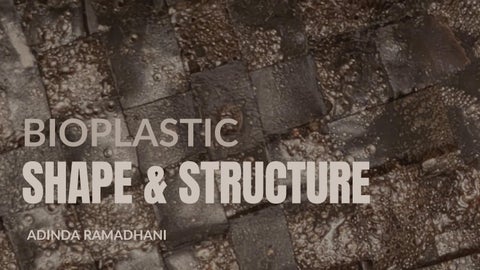
BIOPLASTIC
SHAPE & STRUCTURE ADINDA RAMADHANI
BIOPLASTIC Following the recipe experiments in previous cookbook, this second book investigates how the most promosing bioplastics (#11 Orange Peel and Coffee) can be manipulated. Through techniques such as stiching, waeving, interlocking, layering, and structural folding, this cookbook studies each material’s flexbility, strength, and design potential.
WEAVING Weaving is a technique where thin strips of material are interlaced in over-under pattern to create a unifies surface.
SEWING Sewing is a method of joining or reinforcing material by passing a needle and thread through it, creating a stitched line that can hold pieces together.
INTERLOCKING interlocking is joining method where two or more pieces fit together through cut-out tabs and slots, allowing the material to connect mechanically wihout sewing, adhesives, or heat.
BRAIDING Braiding is a simple hand-manipulation technique that interlaces three or more strips create a unified, decorative form. This method naturally adds structure and can increase the tensile strength of flexible materials.
MOLDING Molding is a forming technique where a material is shaped by pressing or pouring it into a fixed mold.
WEAVING - ORANGE PEEL Process The orange peel sheet was cut into strips approximately 1 cm wide and woven manually using simple over-under pattern. The material was flexible enough to be cut cleanly and handled without tearing during the process.
Observation The sheet held its structure well and remained workable throughout the manipulation. The woven pattern formed succesfully, although some strips tended to slip out of place, likely due to smooth surface, the material did not crack or break, showing good elasticity and durabilitty.
This technique worked quite well for the orange peel material. It produced a stable, visually interesting woven texture and demostrated that the sheet can behave like a soft, pliable bio-textile. Additional securing methods may help prevent strips from sliding out.
Highly promising for small woven elements, modular surfaces, or experimental textile applications. With edge reinforcement, this technique could be expanded into structured dorms or larger woven compositions.
SEWING- ORANGE PEEL Process The orange peel sheet was cut into narrow strips, then stitched individually using a simple straigth stitch. A standard needle and thread were able to pass through the material without causing tearing or cracking.
Observation The sheet handle the sewing process surprisingly well. The needle pierced the material smoothly, and the thread held securely without ripping through the surface. Some areas showed slight distortion due to the sheets’s softness, but overall the structural integrity remained intact.
Sewing proved to be a succesfull manipulation technique for the bioplastic. The stitches stayed in place, demonstrating that the material has adequate flexbility and tensile strength to tolerate puncturebased techniques. It opens possibilities for constructing modular pieces, edge reinforcement, or evem assembling multi-layered bio-textile forms. This technique could be expanded by exploring stronger or contrasting thread types, decorative stitching patterns, or combining stitching with weaving or folding.
INTERLOCKING- ORANGE PEEL Process The orange peel sheet was cut into uniform strips, each with small slits designed to slot into one another. The pieces were then manually connected by gently sliding the tabs through the openings until they locked in place.
Observation The sheet generally responded well. It was flexible enough to bend slightly during assembly, which helped the tabs pass through the slots. However, because the material was relatively thin and the slits were small, the edges occasionally tore when too much pressure was applied or when the allignment wasn’t perfect.
Overall interlocking worked, but with limitations. The material can hold interconnected structures, but the strength heavly depends on slit size, thickness of the material, and how muchh force is applied during assembly. This technique could be expanded by adjusting slit size to reduce tearing, doubling layers to increase strength, reinforcing slot edges with stitching or thicker mixture, or creating modular pattern for larger constructions.
BRAIDING- ORANGE PEEL Process The orange peel sheet was cut into long, narrow strips of equal width. Three strips were then interlaced using a basic threestrand braiding pattern until the full length was braided.
Observation The final braid held its shape nicely and produced an aesthetically pleasing texture and form. However, due to the thinness of the sheet, the individual strips were prone to tearing if pulled too forcefully, especially at the edges.
Braiding proved to be a succesful and visually appealing technique for this material. It enhances texture and dimensionality without requiring additional tools or reinforcements. Its main limitation is the sheet’s thinness, which reduce its tensile strength when subjected to pulling forces. This technique could be expanded by using wider strips to reduce tearing, double layer sheets for added durability, combining braiding with stitching to lock the ends, or forming braided modules for larger surfaces or 3D forms.
WEAVING - COFFEE Process The coffee sheet was cut into narrow strips and arranged in an over-under pattern to create a woven panel. The strips were interlaced manually and adjusted to form a grid-like structure.
Observation The strips were very flexible but very sticky, causing them to adhere not only to each other but also to surrounding surfaces during weaving. The stickiness made it difficult to slide strips into place or adjust tension.
Despite the challenges, the woven panel held its structure well once assembled, the stickiness effectively locked the weave in place. Weaving has potential but may require surface modification, such as dusting the strips with starch, or reducing glycerin. This technique could lead texture surfaces, basket-like structures, composite woven sheets if improved.
SEWING- COFFEE Process Multiple pieces of the coffee bioplastic sheet were aligned edge-to-edge. A needle and thread were used to sew the pieces together using a simple running stitch. The thread was tightened to test how well the sheet holds punctures.
Observation The sheet proved very fragile when pierced. Although the needle could pass through, the material easily stretched, warped, and tore, especially when thread was pullen even slightly tighter. Small rips began forming around the holes, showing low tear-resistance when force is applied.
The stitched sample was structurally weak and visually messy. The seam does not hold, the material tears along the holes, and the final result is unstable. This technique is the least compatible with the coffee bioplastic recipe. Stitching may work if the sheets is made significantly softer/elastic, or edges are inforced.
INTERLOCKING- COFFEE Process The strips of the coffee bioplastic sheet were cut and locked together using a simple interlocking slot method. The goal was to test the whether material could handle repeated folding and tension at the connection points.
Observation Because the sheet is thin, the edges tore easily during the slot cutting process, small cracks appeared around the corners. The surface of the sheet sticks to itself very easily, making it difficult to slide or adjust the modules when linking them.
Visually, the interlocked pattern forms a clear modular structure. However, the stickiness of the material reduces its workability. The pieces can be challenging to adjusted once connected. The interlocking works, but not smoothly . This technique could be improved if the recipe is adjusted to produce a less tacky structure, or making larger modules so the sticky contact points are minimized.
BRAIDING- COFFEE Process Narrow strips were cut and braided together using a three strand plaiting method. This test examined whether the coffee sheet could handle repeated twisting and pulling.
Observation The material responded very well to braiding. It remained flexible, did not crack during folding and twisting. The natural stickiness of the coffee did not interfere with the process, because the strips only overlap lightly rather than slide againts each other.
The material held its shape neatly. There were no major issue, no ripping, no deformation, no slipping out of place. The texture of the cofffee material actually enhanced the overal look, giving the braid a natural, handcrafted aesthetic. The braiding technique shows strong potential for creating reinforced straps or handles, forming decorative panels, combining multiple braids into larger woven surfaces, also exploring tighter or more complex braiding patterns for structural strength.
MOLDING- EGGSHELL-COFFEE Process The eggshell-coffee mixture was pressed into a rigid mold to test how well the material could hold a three dimensional form. The material was packed into each cavity and allowed to dry and harden while retaining the mold’s geometry.
Observation The material responded very well to molding. Because the mixture contains both fine eggshell particles and coffee ground, the texture become dense and compact when pressed. The surface smoothed out nicely on the cavity side, while the outher edges retained a rougher, more organic texture.
The molded result is structurally strong, visually chesive, and impressively rigid. The trays maintained their geometry, and the individual domes can even function as separate modular pieces when cut. The top and bottom halves also fit together, showing that the material can handle interlocking or stacking applications. This techniques shows significant potential for packaging applications, protective inserts for fragile items, stackable modular components, experimenting with thicker or thinner walls for different strength levels, also exploring using molds with more complex shapes to evaluate how much detail material can capture.
Its ability to hold form, develop thickness, and gradually harden over time indicates that the same recipe could be explored at a larger scale, particularly if the proportions, mould size, and drying conditions adjusted accordingly. The material’s slow curing and increasing rigidity could become and advantage, allowing it to function as a surface or cladding-like element. In terms of weathering, the material would likely perform best in interior or semi-protected environments. Over time, exposure to moisture, UV light, and temperature changes may cause hardening, cracking, or surface degradation.
This final pieces was created by applying the interlocking technique to multiple layers of orangepeel bioplastic. The material remained flexible enough to bend and connect, yet firm enough to hold its shape once assembled. Some tiles required gentle handling to avoid tearing at the connection points. The layered interlocking system produced a surprisingly sturdy structure with good dimensionality. The repeated tile shape also creates a cohesive aesthetic, enhancing the overal craft quality of the object. This outcome suggests potential applications in small containers, light diffusers, accessory components, or decorative modular panels. Structural strength could be improved by reinforcing with additional tile shapes. Implemeting a finishing method such as polishing the surface or a protective natural wax could further extend durability.
INTERLOCKED ORANGE PEEL - FINAL OUTCOME
From the joinery experiments, it became clear that each technique worked very differently depending on the material’s physical properties. Not all joinery methods were suitable for every bioplastic, instead, the success of each technique was strongly influenced by flexibility, thickness, surface texture, and internal strength. One important observation was how sensitive the materials were to concentrated force. Techniques that involved pulling too tightly or applying pressure in a small area often caused tearing or cracking. In contrast, joinery methods that spread force more evenly across the surface tended to perform better and caused less damage. This suggest that these bioplastic are more suitable for surface-based or low-stress joining rather than techniques that rely on tension or penetration. Another key insight relates to reversibility. Some joinery techniques became difficult to undo once applied, especially when the material’s surface was sticky or when layers adhered to each other. This means the assembly process requires careful planning, as mistakes are not always easy to correct.
These observation also connect to questions of durability and weathering. Most of the bioplastics developed in this project are best suited for interior or semi-protected environments. Prolonged exposure to moisture, sunlight, or temperature changes would likely lead to softening, surface damage, or gradual degradation. However, this limited durability can be understood as an intentional material characteristic rather than a weakness. Overall, the bioplastic explored here are not meant to last indefinitely like conventional plastic. Their lifespan depends on how and where they are used, and they may last from weeks to several months. This shifts the design focus from permanence to ideas of care, maintenance, replacement, and material cycles, encouraging more responsible and sustainable design thinking.
BIOPLASTIC
SHAPE & STRUCTURE ADINDA RAMADHANI