
Impact
REPORT
Gender ideology in women's sport
PAGE 12
INTERVIEW
Olivia Maurel on surrogacy
PAGE 17
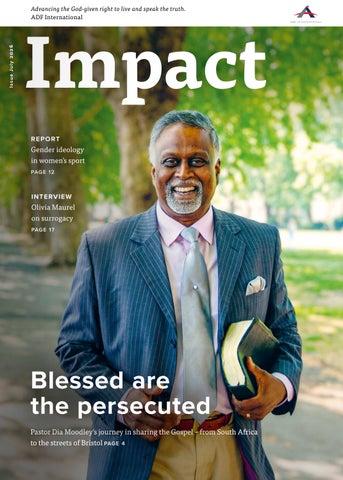
Pastor Dia Moodley’s journey in sharing the Gospel – from South Africa to the streets of Bristol
PAGE 4

Our brochure on the EU’s Digital Services Act (DSA) is a guide for anyone who expresses their views online. We break down exactly what the DSA is, how it threatens freedom of expression in the digital space, and why this could affect you.
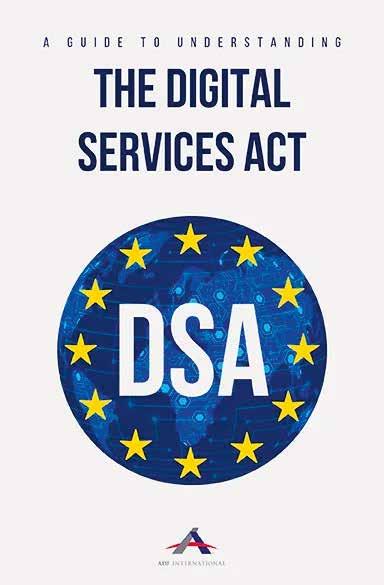
Download your free copy Scan here or visit adfinternational.org/resources/digital-services-act
Impact
Dear Reader,
On 16 May 2026, I celebrated when Pastor Dia Moodley was cleared as police closed their investigation into his street preaching, marking a clear win for free speech. Dia’s ministry in the public arena is genuinely inspiring, and we have been proud to coordinate his legal defence through what has been a tumultuous five years.
While it was a cause for celebration, the decision was also a stark reminder of how, without protection and advocacy, voices like Dia’s sharing the Good News are under severe threat in the UK and beyond (see page 4).
This March, we also welcomed a win across the Atlantic when the Brazilian Federal Regional Court ruled in favour of Isadora Borges, a veterinary student who was facing up to 10 years in prison for peacefully sharing her views on gender ideology on X (see page 8).
Wins aside, there is still plenty of work to do. In the United Kingdom, we wrote to 10 sporting bodies, including Swim England and parkrun, whose policies violate laws which protect women and girls in sport (see page 12). We are also raising the alarm on Comprehensive Sexuality Education (CSE), which is quietly sexualizing children as young as five in classrooms around the world, all in the name of gender ideology (see page 15).
I’m so proud to be a part of Alliance Defending Freedom International – an organisation that works tirelessly to keep the door open for the Gospel and protect people’s fundamental freedoms, whoever and wherever they are in the world. Freedom is not guaranteed – it must be defended, and with your help, this is what we work toward each day.
Thank you for your continued support and prayers.
With gratitude and hope,


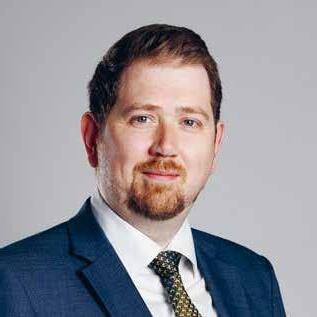
Robert Clarke Director of Advocacy, ADF International

Alliance Defending Freedom (ADF) International is a faithbased human rights organisation that protects fundamental freedoms and promotes the inherent dignity of all people.
In 2025 we placed 95 of our authored articles in media outlets, including The Times and the Wall Street Journal.
Page 10
“As men of God, as pastors, we need to recognise that blessed are the persecuted. If our church is not experiencing any persecution for preaching the Gospel, we need to question how effective we are as a church.”
Pastor Dia Moodley
Page 4
Blessed are the persecuted
Following a controversial arrest that sparked debate about free speech and religious expression, Pastor Dia Moodley found himself at the centre of a national conversation. Yet behind the headlines is a pastor whose journey from apartheid-era South Africa to the streets of Bristol has been shaped by faith, conviction, and a determination to share the Gospel. ADF International’s Writer & Editor, Praveen, met him in London to hear his story.
On the 22nd of March, Pastor Dia Moodley took to the teeming streets of Bristol, as he had done many times before, to share the Gospel and pose a question to the public. Standing on a small platform, holding a Bible in one hand and a Quran in the other, Dia asked, “Which is true?”

“As men of God, as pastors, we need to recognise that blessed are the persecuted. If our church is not experiencing any persecution for preaching the Gospel, we need to question how effective we are as a church.”
PASTOR DIA MOODLEY
Among the crowd who gathered were a number of Muslim men who took offence to Dia’s question. Quickly, matters escalated as a man threatened to stab Dia while another attempted to attack his wife. Moments later, bystanders then forcibly tried to take the Quran from Dia’s hand, pinning him to the floor as they told him the Quran was their book, not his.
When police arrived, an officer was already physically restraining one of the men from reaching Dia. Dia pointed directly at the assailant and told officers that he had just been threatened with a stabbing. Soon after, Dia was threatened with arrest for breaching the peace. The man who threatened to stab Dia has not been charged yet.
“They refused to take my statement,” Dia recalls. “They were more interested in shutting it down."
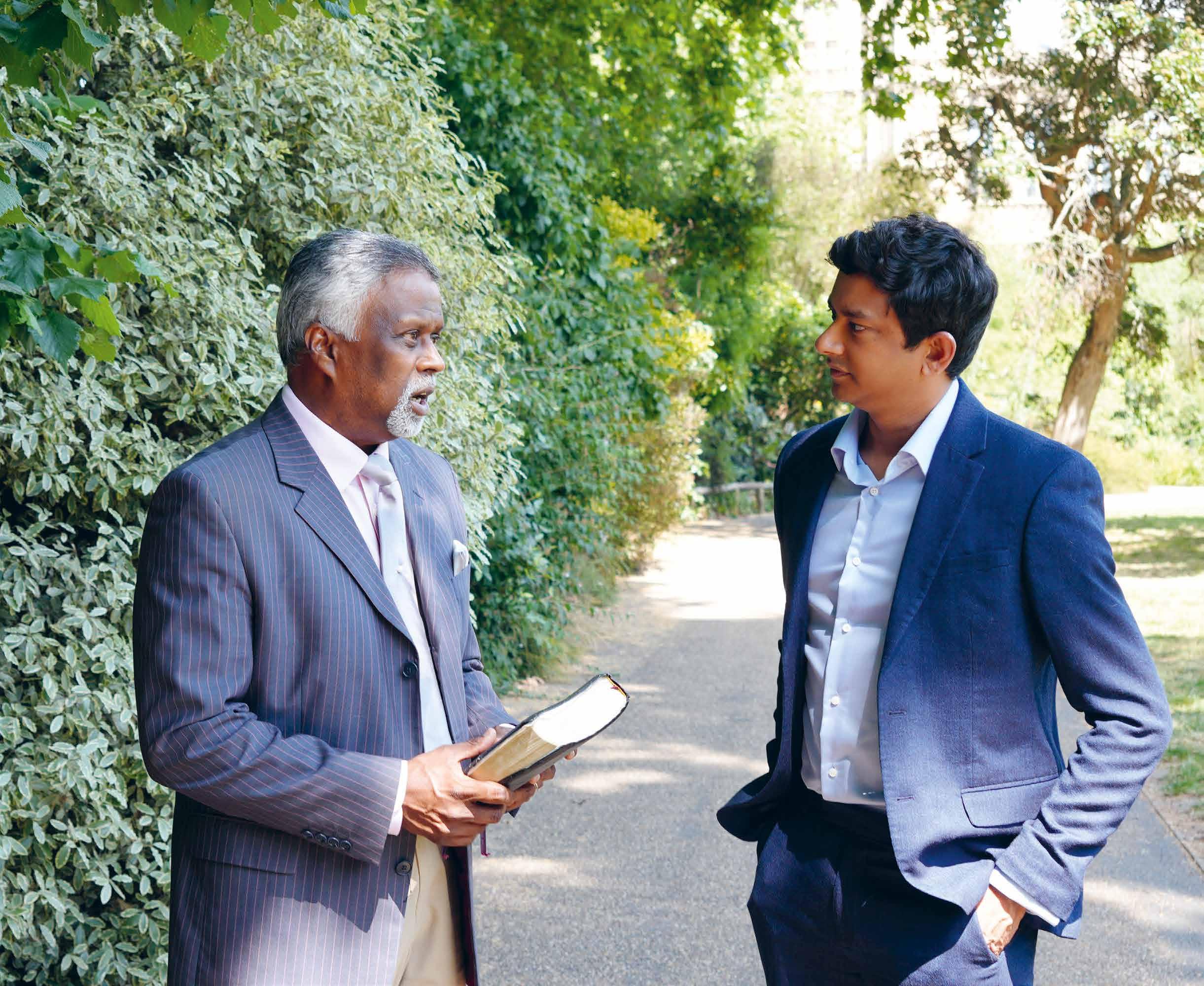
As I sit across from Pastor Dia, who is donning a 3-piece pin-striped suit, I’m fascinated to understand the man behind the headlines and the 15-second video clips. As we speak, Dia is calm, open-handed, and clear in his convictions, which he delivers with quiet confidence.
Dia’s motivations soon become clearer to me. This is certainly not a man chasing the spotlight or promotion. Pastor Dia Moodley, who never set out to preach publicly, is unashamedly single-minded in his mission to share the Gospel. The threats, assaults, and press attention
are, in fact, an unfortunate reality for Dia, who tells me of his response to a member of the public who asked him how he had the confidence to speak publicly during one of his street visits:
“I’m standing here with my knees quivering. I'm shaking every time I do this. There have been so many threats that have come against my life, against my wife, against my family, and against members of my congregation.”
“As men of God, as pastors, we need to recognise that ‘blessed are the persecuted’. If our church is not experiencing any persecution for preaching the Gospel, we need to question how effective we are as a church, because true preaching of the Gospel always brings persecution to the church.”
Pulpit to the pavement
While now in Bristol, Dia was born in apartheid South Africa in the late '60s to Indian parents. As part of an Indian community, Dia observed Hinduism and was misled to believe from an early age that Jesus was a “white man’s God” and that any Indians who left Hinduism were traitors. As a young, excitable teenager, Dia was admittedly a defender of that belief. With a wry smile on his face, he tells me of how he once chased a Christian down the street with a golf club after they tried to pray for his sick mother.
“I thought – I was born a Hindu, so I will die a Hindu", Dia tells me before
he shares a story of how a close friend guided him and his wife to Christ when they were in their early twenties. Far from a ‘road to Damascus’ moment, Dia’s faith in Christ grew gradually, despite resistance from his Hindu community, and eventually led him to train to become a pastor for congregations in the UK and abroad.
For the early part of his ministry, Dia preached from the safety of his pulpit until a defining moment of conviction – witnessing a member of his congregation being tried before a court for sharing a King James Bible in public. Dia describes an uncomfortable sense of shame and guilt sitting in the courtroom. While he was safe within the four walls of his church, members of his congregation were willing to risk their freedom to share the Gospel in public. This conviction, alongside a persistent friend and fellow pastor who would ask Dia to join him on Saturday mornings to preach on the streets, eventually saw Dia take the step to share the Gospel publicly.
As Dia recounts his first time preaching outside the church, he looks to the ceiling and laughs to himself:
“I was put up on the stand and started preaching and I absolutely messed it up. I just messed
it up like crazy. I don't know where I was going with Scripture. I didn't know what I was saying. I was repeating things over and over again. It was a total train wreck.”
Fortunately, this wasn’t enough to deter Dia. Instead, a process of debriefing and refinement began, in which Dia would discuss with his congregation, who were often with him on the streets, how the delivery of the message could be improved next time. As part of his ministry, Dia also led his small congregation in apologetics training to better equip them to respond to questions and challenges from the public after the preaching.
Two-tier policing
Before he began his public ministry in Bristol, it was important to Dia that the local police were aware of his mission to share the Gospel. Encouragingly, local officers were initially receptive, which helped enable Dia’s mission, but the appointment of a new chief inspector soon closed the drawbridge to any form of Christian message being shared outside the church.
Far from defending Dia’s right to freedom of speech and religion, the police took what Dia calls “the path of least resistance”. “Two-tier

preaching freely
Street preacher Pastor Dia Moodley has faced a repeated pattern of police censorship and arrest –raising serious questions about freedom of speech and religious liberty in
policing, which targets the expression of Christians, who rarely retaliate, is a reality in modern-day Britain”, Dia tells me before I hear more of the unjust treatment he and his congregation have faced at the hands of the police.
Winning hearts to Christ
As we continue our conversation, I learn that at the heart of Dia’s public ministry is a desire to help people better understand the Gospel through conversations and relationships, unlike what would be considered more traditional street preaching.
“When you preach a sermon in church, people are reading the text along with you. They can follow the narrative and see the tapestry of scripture forming. They can follow the line of thought. In the public square, you can't do that because people are constantly moving. To address this, my congregation and I take a different approach. We set up signs on particular topics to draw people into a conversation with us. The deal is, they can ask us a question if we can ask one back.”
Dia then comes to life as he tells me about stories of connection, revelation, and winning hearts to Christ with people from all different backgrounds during his time in public ministry. Contrary
2021 MARCH 2024
Police ban him from speaking freely about his faith
Avon and Somerset Police hand Moodley a notice forbidding him from comparing Christianity to other religions or preaching without prior consent – a direct curb on his rights.
Arrested for expressing his beliefs, held 13 hours
Arrested for contrasting Christianity and Islam. Moodley spends 13 hours in a cell. Police destroy his signs but later apologise for this.

to what he was taught as a child in 1960s South Africa, his ministry has taught him that Jesus provides salvation for all – regardless of race, colour or creed – a fundamental truth which Dia has since committed his life to proclaiming.
Prayer for the UK and beyond
As we finish our conversation, Pastor Dia shares with me his prayer:
“I pray that we would not pull up and moor the boat to rest, but that we would launch into the deep and have the power of God fill our sails, that we may be driven forth into the mission field for the preaching of the Gospel.
I pray that the church will rise up and more Christians will step out and make Christ known. The only hope for the United Kingdom and beyond is Jesus Christ and Jesus Christ alone.”
Threatened with stabbing, pinned down –then police threaten him
Moodley is threatened with stabbing and pinned to the ground; someone tries to punch his wife. Police arrive but target him – not his attackers –with threats of arrest for public order offences.
Second arrest –Christmas ban imposed on his ministry
Arrested for "inciting religious hatred" after discussing Islam and transgender ideology, Moodley is held eight hours then banned from Bristol over Christmas –silencing his ministry at its most significant time.
Easter sermon draws a threat of violence
Still under criminal investigation, Moodley returns to preach at Easter. A bystander warns him after he compares Jesus to the Prophet Mohammed: "We'll send the boys round."
“I pray that the church will rise up and more Christians will step out and make Christ known.”
PASTOR DIA MOODLEY
ADF International has supported Pastor Dia throughout his public ministry and continues to work to ensure he is afforded his rights to freedom of speech and freedom of religion.
www.adfinternational.org/ en-gb/cases/dia-moodley-uk
Investigation dropped –free speech vindicated
No charges are brought after over four months under investigation. Moodley calls it a vindication of his right to religious expression –and says he will keep preaching.
Cleared
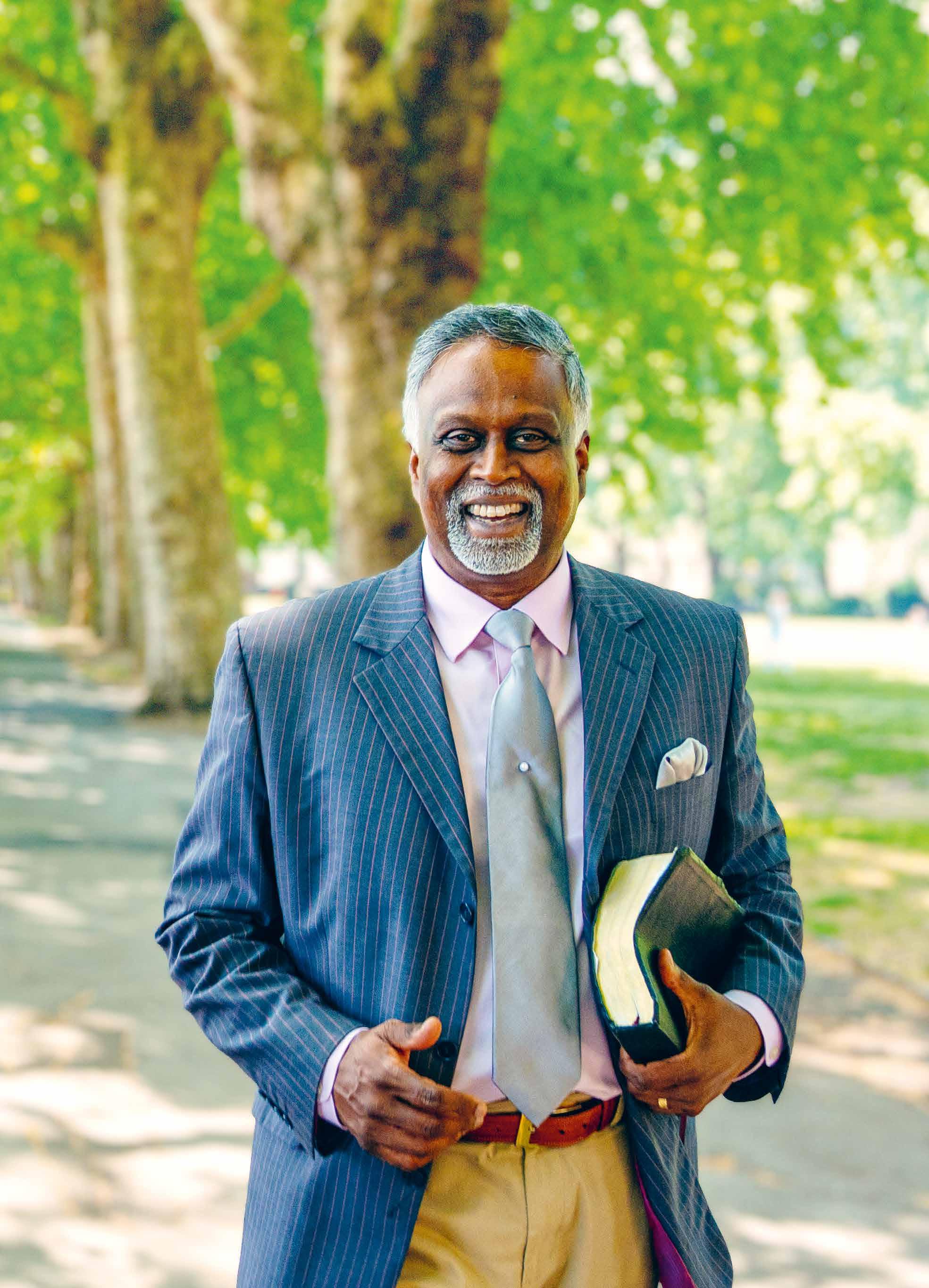
Pastor Dia Moodley shares his journey of faith and public ministry