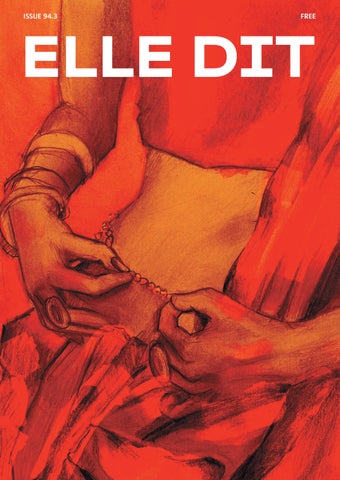
ELLE DIT ISSUE 94.3
FREE
THE SHORTCUT LOOKING FOR TO FINDING CASUAL WORK? YOUR PEOPLE
We provide free support to help you get job-ready and find employment. Meet newOur friends, fuelisyour passion,free learn a new skill service completely to all or find a fun way toUniversity unwind from your studies. Adelaide students.
Scan to explore Bookand a free clubs appointment join the fun. here.
On Dit respectfully acknowledges the Kaurna, Boandik and Barngarla First Nations Peoples and their Elders past and present, who are the First Nations’ Traditional Owners of the lands that are home to our campuses located in Adelaide, Magill, Mawson Lakes, Waite, Roseworthy, Mount Gambier and Whyalla.
1
Gold chains are still chains Front and Back Cover Artwork by Harini Bitla
Highlights 4 6 8 16 25 30 32 42 48 57 58 63
Editor’s Letter Spotify® Playlist Vox Pops She Means Business Crossword Club Spotlight Fashion x Frequency Doll Quiz Theatre Watchlist Word Search Student Publication Spotlight AUSA Chairperson’s Letter
Student Submissions Written
Visual
11 We were girls together
10 She said what?!
12 I feel like a woman/I feel like a child 19 her blemishes and flaws 20 The years between
12 What Blooms Between Us 1 14 What Blooms Between Us 2
26 How to unlearn misogyny
18 Observe
28 The boys club: barriers women in engineering face
19 In Aging There Is Blooms Of Joy
35 How feminism helped me embrace my gender identity 36 ‘Community-based and communityminded’: seeing SA youth homelessness through kinder eyes. 44 Zoe Retallack Artist Spotlight 46 In the beginning was the word: Jaya Savige’s Carousel 50 Schrödinger's KATSEYE®: girlhood in the digital age 52 Daughters of God 54 It's hard to be a woman
24 What Blooms Between Us 3 27 Beauty in Diversity 34 Man Enough 39 Basking in Sunlight 47 Gold chains are still chains 53 Fashion x Frequency 56 Stories Through Stitches 60 Unknown Abyss
Elle Dit is BACK!
On Dit is back with the traditional theme of Elle Dit — French for “she said.” However, Elle Dit is not just about identifying the ways women face inequality. It also examines the everyday assumptions and expectations that shape how women are perceived. Someone used to tell me, “you’re a really good driver for a woman.” On the surface, it sounds like a compliment. But think about it for a moment. Why does being a good driver need to be qualified by gender? Beneath the compliment is an assumption that being a good driver is somehow unexpected for a woman. Without realising it, we can end up measuring women against a standard that was never neutral to begin with.
This edition focuses on women, girlhood, sisterhood, and the relationships, experiences, and struggles that shape them. This theme feels particularly relevant to us this year. The 2026 On Dit team is composed entirely of women, and our discussions have naturally led to these topics in our everyday lives. We wanted to take this opportunity to reflect on our own experiences while also looking beyond them. Elle Dit is a platform for women across our student community to share their diverse stories, identities, perspectives, and experiences. 4
And that is what makes conversations about gender so complicated. Inequality is not always obvious. It can exist in the expectations we grow up with, the stereotypes we accept, the way women are expected to look or behave, and even in the language we use without thinking twice. Living in Australia, we are fortunate to have many rights and opportunities that women in other parts of the world continue to fight for. Yet gender inequality has not disappeared. Across different countries and communities, women continue to experience issues such as genderbased violence, sexual harassment, discrimination, and unequal opportunities.
These experiences can also look very different depending on culture, age, identity, background, and circumstance. But Elle Dit is not about creating a divide between women and men. It is not about blaming men, nor is it about suggesting that every woman experiences the same struggles. Instead, it acknowledges different experiences and creates space for conversations that let us listen, question, and understand. So, in this edition, we explore the many sides of being her — from girlhood and friendship to femininity, identity, ambition, expectations, anger, self-esteem and everything in between. Sometimes, the question is not simply whether women are being treated equally. It is who decided what we are measuring them against in the first place? Now let’s listen to what she said and what she experienced from a woman’s perspective.
Head Editor
5
Her Own Words
Listen Here! 6
Everything Is Embarra'ing Sky Ferreira
Most Girls
Hailee Steinfeld
Fashion Killa
A$AP Rocky
Rhiannon
Fleetwood Mac
I Think About It All the Time Charli XCX
Under the Table Fiona Apple
Angry Woman Ashe
Rebel Girl Bikini Kill
Control Halsey
In Our Bones
Against the Current 7
Q1: What do you think is the biggest issue currently facing women in the world?
Q2: What do you wish society understood better about women? Q3: What expectation of women would you like to get rid of?
Vox P Zoe Isobel Hatol Husan Ara
Bachelor of Software Engineering (Honours)
Q1: As National Women’s Officer, the
issue I see most is safety, especially on campus. Students tell me they’ve changed their routes home, skipped late classes, or stayed quiet after harassment because reporting feels exhausting. When women plan their education around fear, it limits their opportunities. Safety isn’t a side issue. It decides who gets to participate fully.
Q2: I wish people understood that
female students are carrying far more than their degree. Between study, work, caring responsibilities and the pressure to keep it all together, many are stretched thin. Through my welfare work, I’ve learned that women rarely ask for help until they’re at breaking point. Support shouldn’t have to be earned by struggling first.
Q3: The expectation that women should
be grateful just to be in the room. As a woman studying software engineering and leading in student politics, I’ve seen how women are expected to prove themselves twice over, stay polite while doing it, and never seem “too much”. I want women to take up space and lead unapologetically.
8
Bachelor of Graphic Communication Design
Q1: Where do I even start? I feel like
with every generation, there will always be new and returning problems that women face. It’s hard to decipher the biggest issue when so much is happening to so many of us around the world from abortion bans to the growing violence against women.
Q2: I want women’s health to be more
common knowledge. I feel like the fact our bodies work differently from men’s bodies has led to our health issues being overlooked or simplified. This has led to our health issues not being taken seriously. Obviously, I don’t expect society to start reading medical books but socially speaking, I just want people to understand that women’s health is complex and that our experiences shouldn’t be dismissed simply because they’re different.
Q3: I would like the expectation that
women have to be perfect to disappear. I feel like we’re expected to be mature, capable and have everything figured out, but when we make mistakes, they’re often treated as evidence that we’re incompetent. I want women to be allowed to learn, fail, and be wrong without being judged so harshly for it. Why do we have to be right all the time and why is it that when we’re wrong, you treat it as evidence that we’re weak and not human?
Pops Savanna Laucke
Lan Pham-Ellickson
Bachelor of Graphic Communication Design
Bachelor of Engineering (Mechanical) (Honours), Bachelor of Commerce (Finance and Banking)
Q1: To my knowledge, gender-based
Q1: I think gender-based violence and
Q2: As a whole, society often traps
Q2: I wish society understood how much
violence and systemic safety threats are the biggest issues currently facing women globally, with minimal awareness about either topic within society. Furthermore, this is followed by deep economic inequality and a lack of legal gender parity, systemic racial bias, and unequal access to the justice system.
women in structured, contradictory expectations that demand they balance careers and caregiving perfectly. In reality, true equity requires validating their diverse choices, protecting their autonomy, and believing their voices without bias or systemic minimisation.
the lack of control many women have over their own bodies and futures remain two of the biggest issues. These challenges affect women differently depending on where they live, but every woman deserves to feel safe, make her own decisions and have access to equal opportunities.
invisible labour women often carry. Women are still expected to care for their families, do more cooking and cleaning, remember what everyone needs and provide emotional support. This “second shift” requires real energy, yet women are expected to meet the same professional and academic demands.
Q3: Personally, the biggest expectation Q3: I would get rid of the expectation of women I’ve experienced throughout my life is through sports and the way our bodies are viewed. Women around the world are constantly critiqued for the way our bodies look rather than what they are capable of through strength, determination, and commitment.
that women must be exceptional to deserve their place. As one of relatively few women studying engineering, I often pressure myself to outperform everyone else to prove I belong. Women should not need to be perfect or the best in the room; being equally capable should be enough.
9
She said what?! Artwork By Leah Herderich
10
this little coven of ours i remember when your hair was short and mine was deeply parted to the side we talked strange, and laughed stranger and clasped our hands together as we skipped down the hall oh how they marvel, oh how they gawk elbows touching and pinkies interlocked lovers? we were not no, beyond that we were to know each other just as we would goes beyond blood ties and shallow words and then we were odd together we were jokers, we were serious we were flowers and debris, ugly and pretty, and girls, together and no one can or will ever misconstrue because all who witness know it true you speak like me, and i speak like you our lives, souls entwined like braided loops and i know i will never love anyone like i love you, our strange coven so tightly glued and us girls, in our funny little group, now inch towards something new we were girls together, now women too and now so far apart, oceans between, oceans through, just how i long and rue how i yearn to be girls again, girls together with you.
Words By Ludin Batilong
11
I feel like a woman I feel like a child Words By Holly Robinson
I once thought that becoming a woman would feel like arriving somewhere; that there would be a moment when I looked around and realised I had crossed over. Sex seemed like the obvious threshold, but when I lost my virginity, I never felt more like a child. I assumed I would adopt this unmistakable woman-ness, but as I looked at myself in the mirror, all I could see was my mother’s daughter, a little girl, poking out from under my blotchy cheeks and frizzy hair. That was years ago now. I still feel as if I am constantly arriving in and promptly leaving womanhood. I feel like a woman when I wear jeans, specifically when I pull them up by the belt loops, tugging them higher around my hips. Or when I wear ballet flats, not to be mistaken with wearing heels — that makes me feel like a child. There is something about wearing heels that makes me feel incredibly aware of my feet, my height, my hands, and not quite knowing where to put them. In flats, I can forget I’m wearing shoes at all. They make me feel like I have somewhere to be. They feel sensible, which makes me feel grown, which makes me feel like a woman. I feel like a woman when I pick up takeaway instead of ordering in. This distinction is probably stupid, but there is something about waiting at the counter, slippers on, keys in hand, that makes me feel older and wiser. Feeling like a woman is going to therapy because I want to. Feeling like a child is wanting my mum
12
to pick me up afterwards because I’m tired. I feel like a woman when I make my own doctor’s appointment. I feel like a child when I’m sitting on the examination table and I don’t know what is wrong with me, or what I’m supposed to say, or if I’m allowed to ask the doctor to explain again. I feel like a woman when I pay a bill. I feel like a child when I receive a bill and instinctively want to hand it to someone older. I think I spent a long time confusing womanhood for competence. I assumed becoming a woman meant knowing things: what to wear, what to say, where to go. Looking after myself was supposed to become second nature, not something to actively remind myself about. Eat your vegetables. Drink more water. Get a dog and go on walks every day. What do you mean these things don’t come automatically with my subscription? I paid with my virginity, electricity bills, jeans a size too small paired with sensible shoes. I was told becoming a woman meant buying a bra with wire, bleeding once a month, and having sex with a boy who loves you. Nobody told me that becoming a women would mean being responsible for a body that occasionally still feels like somebody else’s. That I would have to remember to buy groceries, prepare them, and eat them. That sometimes I would be very good at taking care of myself, and sometimes I would be bad at it. Competence is not the same thing as certainty. Nobody told me that.
I call my mum and ask her what to do. I call her every day. Sometimes because I have something to tell her. Sometimes because she has something to tell me. Sometimes I forget what I’m going to say before she picks up the phone. When I call her, I have started to realise that there are two ways I can feel like a child. I can be the daughter who wants her mother to tell her what to do. Or I can be the daughter who wants to know her mother is okay. There is something about getting older that means your mother slowly stops being the person who seems to know everything and starts becoming a person you can worry about. She tells you about her new towels. You send her a picture of the sensible shoes you just bought. You notice her tiredness. She notices yours. You understand, suddenly and terribly, that she is not just your mother. She is a woman who is also getting older. Maybe that is what I’ve been getting wrong. Maybe becoming a woman was never about not being a child. Maybe there is no threshold. Maybe there is no place to arrive. Maybe I can be a woman and still be a child. Maybe the two were never opposites. I pull my jeans up by the belt loops. I make an appointment. I pay a bill. I forget to pay a bill. I call my mother. I ask her what I should do. I tell her what she should do. I know things now. I know nothing. I am someone’s daughter. I am someone’s woman. I am 25 years old and sometimes I still want my mum to come and get me. Sometimes I am the one she calls.
What Blooms Between Us Artwork By Alexa Balog
13
What Blooms Between Us Artwork By Alexa Balog
14
15
She means business Celebrating the female-owned small businesses run by Adelaide University students
East Egg Society @easteggsociety_33)
East Egg Society is devoted to sourcing beautiful vintage designer items from Japan and prioritises attention to authenticity and sophisticated design. Vinka, a second-year Law and Art student, launched this business in July 2026 and derived its name from her favourite author’s classic novel: The Great Gatsby by F. Scott Fitzgerald. You can follow East Egg Society on Depop ® and Instagram ® (@easteggsociety_33) to find the vintage bag of your dreams. *Please note that East Egg Society is not affiliated with any of the brands it sells.
16
Fair Flo
@fairfloperiodproducts
Fair Flo was founded by Taylah Gregory, a Master of Philosophy student at Adelaide University. Fair Flo sells organic cotton period products to businesses so they can provide the products to their employees for free. Fair Flo is aiming to make toilets more menstrual-friendly, with products in every cubicle and other resources are available. Fair Flo is based on Taylah’s research, which investigates how university students manage their menstruation on campus. You can follow Fair Flo on Instagram at @fairfloperiodproducts.
Satrangi
@shop.satrangi
When Anshi, an international student, moved to Australia, she had to build a life from scratch. Somewhere along this journey, she realised how much she missed all the endearing things that made home feel like home: her nani’s stories, old Bollywood songs, dancing, festivals and growing up in a loud desi family. Her business, Satrangi, grew from that feeling. Anshi creates South Asian-inspired accessories such as jhumkas, bangles, hair tassels and caps to bring little pieces of colour, culture and nostalgia into everyday life. Satrangi is her way of carrying pieces of home with her, sharing that feeling with others while creating something that feels completely her own.
Empower & Connect
@empowerandconnect.adl
Empower and Connect Support Services offers personalised support for children and teenagers. The business focuses on building confidence, routine, independence and social skills through community participation and everyday activities. The founder of Empower and Connect, Vanessa Tsimiklis, strives to meet her goal of taking time to help everyone reach their own goals through providing a supportive, safe and encouraging environment for individuals, one step at a time. 17
Observe Artwork By Faith Fitton-Gum
18
her blemishes and flaws
Words By Zia Az-Zahra
paintings seen in wallpaper-covered galleries, though the scene was not which I see; I grasp at the strokes and notes and bumps and tones, laid by hairs of the brush held by the taut, tired hand. twas through those which beauty was revealed to me, their blemishes leave as scars of their true story, every stroke, note, bump and tone, like gems laid by hairs of the brush held by the taut tired hand, by incident or intention. blemishes, flaws, bumps and strokes, like the pores and bones of the very image. yet why do I fail to perceive the image painted in the mirror this way? her pores, her scars, her bumps and tones, why do they gnaw and scratch at her dim complexion? though her strokes and tones and blemishes and flaws were painted by the glorious hand, why do I loathe them so much as though she is putrid? seen in amber, the hairs not on her face but of the brush, the curves on the frame of His beautifully sculpted piece. beauty, in the eyes of the beholder. should the beholder look close enough.
19
The years between Words By Arita Haque Content advice: this story contains mention of the Stolen Generations
My friend once told me about the first time her grandmother met her daughter again. Years had passed. She had given birth to her as a young woman, but she did not get to watch her grow up. Her daughter was taken from her and raised elsewhere. By the time they found each other again, the baby she remembered was an adult. I kept thinking about that story… how does a mother live through all the birthdays she misses? What does it feel like to meet your own child years later and recognize someone who is simultaneously family and a stranger? It made me wonder how many Australian women had lived with stories like hers. Let us take a dive into the past and rewind a little. When we hear about children being separated from their families in Australian history, many of us understandably think of the Stolen Generations. But looking further back reveals a broader history of women and family separation, one shaped by very different policies and circumstances but often intersecting with gender, race, and economic independence. For much of 20th-century Australia, becoming pregnant outside marriage could carry enormous social stigma. Research by the Australian Institute of Family Studies (AIFS) documents how unmarried mothers experienced shame, secrecy and pressure surrounding pregnancy and adoption. Some women described being discouraged from seeing their babies or being given little meaningful choice about adoption. 20
Australia's Senate later investigated these experiences. Its 2012 inquiry heard predominantly from women who had been young and unmarried when they gave birth and documented practices that contributed to what Australia now recognises as forced adoption. In 2013, Australia formally apologised to people affected by these practices, yet there was an economic story behind the social one. For a woman without a husband, raising a child could be financially difficult. Employment opportunities for women were more restricted than today, childcare was limited, and government assistance was considerably less developed. Then, in 1973, the Commonwealth introduced the Supporting Mother's Benefit, providing greater financial assistance to eligible single mothers. Its introduction occurred during the same period in which adoption numbers fell dramatically, alongside changing social attitudes and reforms. That leaves us with a revealing question: how many women considered incapable of providing for a child were actually mothers living without enough economic support? On the other hand, for Aboriginal women, the story was different. For Aboriginal and Torres Strait Islander women, family separation occurred within a distinctly different and racialised history. Across generations, Aboriginal children were removed from families under government laws, policies and practices. These children became known as the Stolen Generations. But if we look specifically at the girls another story emerges.
The Bringing Them Home (conducted by the Human Rights and Equal Opportunity Commission, now the Australian Human Rights Commission) inquiry found that in New South Wales, by 1921, 81 per cent of Aboriginal and Torres Strait Islander children removed were girls. Many were sent to institutions, trained for domestic service and eventually placed in non-Indigenous households. During the 1920s, an estimated 300 to 400 Aboriginal and Torres Strait Islander girls at a time were apprenticed to white households, principally as domestic workers. For these girls, separation could shape not only childhood but womanhood. A girl trained primarily for domestic service had fewer opportunities to pursue broader education and skilled employment. And that matters economically. Education influences employment. Employment influences income. Income creates opportunities to save, acquire property and provide financial security for children.
reported that their own children were later removed. Imagine that sequence from a woman's perspective. A girl grows up separated from her mother. She loses years in which family knowledge, cultural traditions and everyday experiences might otherwise have passed from mother to daughter. She enters adulthood carrying that separation with her. Then she becomes a mother herself. This is where the economic consequences become intertwined with something harder to measure: social and cultural capital. Money can be inherited, but so can knowledge, relationships and support. Grandmothers help daughters. Aunties help raise children. Families provide somewhere to stay when money is tight. Communities transmit language, identity and knowledge. Removing a girl from that network could therefore mean losing much more than income.
When opportunities are restricted early in someone's life, the consequences can travel much further than the first pay cheque. For Aboriginal and Torres Strait Islander women, this occurred alongside historical controls over Aboriginal and Torres Strait Islander employment and wages in some jurisdictions. Perhaps the most profound consequence appeared years later. The Aboriginal girls who were removed eventually became women. Some became mothers themselves. Research presented in Bringing Them Home showed how removal could repeat across generations. Among 483 Aboriginal people surveyed by the Aboriginal Legal Service of Western Australia who had themselves been forcibly removed, more than one-third
21
My friend's grandmother was not part of the Stolen Generations. Her story belongs to Australia's separate history of adoption and the experiences of unmarried mothers. Aboriginal women experienced child removal within policies specifically directed towards Aboriginal and Torres Strait Islander people. The distinction matters. But looking at both histories through women's experiences reveals something that statistics alone can miss. Economic independence matters to motherhood. Social support matters. Education matters. And when women have limited access to those things, their choices can become considerably narrower. Australia today is different in many important ways. Attitudes towards unmarried motherhood have changed. Women's economic opportunities have expanded. Forced adoption practices have been formally acknowledged, as has the profound harm caused by the removal of Aboriginal and Torres Strait Islander children. But perhaps history becomes most meaningful when we stop seeing it only as policy, as these forgotten stories definitely deserve to be read and heard. Behind every statistic was somebody's daughter. Some of those daughters became mothers. Some spent decades wondering about the children they had lost. And some, like my friend's grandmother, eventually found themselves standing face-to-face with the child they once knew only as a baby. Years had passed. Their lives had continued separately. But they were mother and daughter still. Perhaps that is where this history is best understood, not only in legislation, inquiries or economic statistics, but in the years between those two women. 22
In Aging There Is Blooms Of Joy Artwork By Beatrice Walker
23
What Blooms Between Us Artwork By Alexa Balog
24
Crossword Across
Down
5.Absolutely nail it
2. “I’m not saying anything, but…”
7. Qualities traditionally associated with being feminine
3. Someone who doesn't follow the rules
4. Your best friend
1. Having the same rights and opportunities
6.Growing up as a girl
8. A fixed and oversimplified idea about a group
4. BESTIE 5. SLAY 7. FEMININITY 8. STEREOTYPE
ANSWER Across 25
1. EQUALITY 2. GOSSIP 3. REBEL 6. GIRLHOOD
Down
How to unlearn internalised misogyny Words By Meetali Thakur
There is a man living inside my head. I didn’t invite him. I don’t remember meeting him. But somehow, he has been here for as long as I can remember. He wakes up before I do. He looks in the mirror before I do. He always has something to say. “Your stomach looks bigger today,” he says. Someone on Twitter® (I refuse to call it “X®”) once said, “the first feminist action is to kill the man inside your head”. At first, I thought it was funny. Then I realised I had been living with a man-shaped voice in my head my entire life. He has opinions on everything. He has opinions about how women should dress, speak, sit, eat, date, age, have sex, work, cry, laugh and exist. He tells me that confidence is attractive until it becomes intimidating. That femininity is beautiful until it becomes frivolous. That sexuality is empowering until a woman enjoys it too much. That ambition is admirable until she’s more successful than the people around her. He is a man of contradictions. He hates women with careers and surprisingly, he also hates women who choose to be a trad wife. I met him properly when I was young. He taught me that being “like the other girls” was something to be embarrassed about. He prepped me to say, “I am not one of those annoying feminists”. I didn’t realise that I was participating in one of misogyny’s oldest tricks: convincing women that they can
26
escape sexism by proving they’re better than other women. Later, I met him again, in other women. “Your legs are so hairy,” he said at age 14. “Go change your shorts into pants, the relatives are visiting,” he said at 15. “You should learn how to cook for your future husband and his family,” he said at 16. “Did you see what she was wearing!? Such an attention seeking whore,” he said at 19. “My ex got a new girlfriend. He downgraded. I’m prettier,” he said at 20. And at 22, when a man said something inappropriate, “he’s just 18, he doesn’t know any better.” This man inside my head is passed down from generations. My mum has a man inside her head, so did my grandma. They thought it was important to keep that man fed to keep the culture alive. He terrorised them into thinking if they aren’t married and have children (read: a son), their life is worthless. He made them believe women should stay home, cook, clean and be financially and socially dependent on their beloved husbands. However, they did manage to kill some parts of that man to break the generational curse. Look at me now, sitting in a foreign country womansplaining about feminism.
So, how do you unlearn internalised misogyny? You start by noticing it, acknowledging it and questioning it. When you catch yourself judging another woman, instead of immediately defending the thought, ask yourself: “why does her choice make me uncomfortable?” “Why do I feel the need to be better than her?” Sometimes the answers are uncomfortable, and you realise you don’t actually dislike the woman you’re judging; you dislike that she is doing something you haven’t allowed yourself to do. Unlearning means letting women be different from me without turning that difference into a hierarchy. You can love makeup and be a feminist. You can hate makeup and be a feminist. You can want children or not want them, want a career or choose to stay home. There is no single correct way to be a woman. The man inside your head may never completely disappear, but every time you question him, he gets a little quieter.
Man enough Artwork By Libby Hoffmann
27
The boys’ club: the barriers women in engineering face Words By Saxon Schapel
I have heard the phrase “women in STEM” so many times that I’ve lost count. Scholarships, events, programmes, and so much more are centred around it. In fact, I’ve had fellow male students tell me that there’s just too much of it and they need a break. Is this the case? Do we really need this many women in STEM programmes? I’ll let you decide this for yourself, but considering only 13 per cent of engineers are women (ABC, 2024) and the significant difference in experiences men and women have in the engineering field, I would say we most definitely do.
It starts as children in primary and secondary school. Boys are encouraged to build with Lego®, trucks, cars, woodworking or metalworking while girls are encouraged with sewing, baking, cooking, arts and crafts. The difference in exposure to certain subjects and activities heavily impacts the choices children make in terms of what they study at school. When I was in year nine, everyone had to pick between studying food or materials technology; each choice had a 95-5 split between girls and boys. Boys dominated materials and girls dominated food. This was also the first time that I truly saw what my future would be like if I picked a STEM career, constantly being one of, or the only, girl in the room. If I didn’t have such a passion for it, I doubt I would have kept going on that STEM path. It’s not just me either; as part of their June 2022 Women in Engineering report, Engineers Australia conducted a study that revealed three in four girls never even considered engineering as a possible future for themselves, and 29 per cent said that they didn’t pursue engineering because of how male-dominated it is. This is why women in STEM programmes are essential. If girls are exposed to STEM topics and are given the opportunity to engage with them, more girls will consider such a career path. With not just exposure to the content, but also to an environment that is more than a room full of boys, girls can feel like they belong and see people like them in this future path. Representation is extremely important; how can you imagine yourself in a career that doesn’t have anyone like you? Speaking beyond careers, it is generally beneficial to everyone to have a wider range
28
of experiences and knowledge. Cooking, cleaning, problem-solving, critical thinking, maintenance, psychology, physics, biology. These are all areas from which the average person would benefit; deep and extensive knowledge isn’t required; knowing how to make yourself dinner or fix household items is enough. How can anyone know something they haven’t had the opportunity to learn? Is this the largest barrier? Yes, but only in terms of getting more women to study and enter the workforce. No matter how many women and girls you get interested in engineering, very few will stay in an industry if they are constantly subjected to what can be thought of as “the boys’ club” culture. This culture includes constant sexual remarks (i.e. objectifying women, staring at your chest, too much information given about their own sexual experiences when entirely unprompted, etc.), misogynistic tendencies, microaggressions, and general bullying and harassment. In the same study by Engineers Australia, they found that “two in three women who left the engineering profession did so because they felt that their opportunities for career progression were limited, and/or they experienced gender discrimination, bullying, or sexual harassment”. Women aren’t leaving because of the work; they are leaving because of the culture. Imagine this: you are so excited to attend university, finally getting to learn about subjects that fascinate you. But every single day you are subject to hearing misogynistic and objectifying jokes in between learning about viscous damping or project scheduling. You showed up to class just wanting to learn, but now have to hear about how your classmates think you should be doing the housework instead. The teacher does nothing, or worse, joins in. Now you wonder what your classmates would do outside of the classroom when there was no
staff member, what they might do after hours or at the bar after they’d been drinking. This was a real experience from an Australian university within the last six years. It isn’t an environment that makes women feel welcome; instead, it’s one that makes them scared. Unfortunately, the most likely case is that no one in that room, except for the women, knew that what was being said was inappropriate. Fortunately, when this issue was posed to the university, it took action to attempt to correct it through staff awareness and clear guidelines for appropriate conversations during class. The fact that actions were only taken after the women came forward is another barrier. Most of the time, by voicing that these actions are inappropriate, women can instead be given the reputation of being difficult, sensitive, or emotional. In the worst-case scenario, it may not be physically safe to address it. A lack of diversity almost certainly contributed to these ongoing behaviours; if there was a woman on staff, the students may have felt safer to come forward earlier, or the corrective actions may have been taken sooner without requiring student intervention. In this case, these women were able to break through the first barrier to study engineering but were then faced with the next. If people are scared to go to university or work, then eventually they are going to stop going. Most times, a passion for something does not outweigh the need to feel safe. So, to anyone who’s thought that there are too many “women in STEM” initiatives which aren’t required in 2026, I would ask you to reflect on what you think your perspective might be if these were your experiences instead. And to all women in STEM, we’ve always got each other. 29
WISTEMS CLUB SPOTLIGHT
!"#$%&'(#)(#*+,-#*%.)'/0
!"#$%&'()%*(+,-%#%.'/#,%+,%01233%/(#,%$'%4'56 !"#$%&'&()*'$&#$&+,-..&#/&012#)/#345&3'6#$%&17&/7'0"& '$8&6$)(#$%&39"2"&#/&'&7:'0"&;)2&4)15&"<"$&#$&'2"'/& (9"2"&()*"$&9'<"&9#/3)2#0'::4&=""$&1$8"22"72"/"$3"8>& ?3@/&':/)&'=)13&/177)23#$%&39"&()*"$&'2)1$8&4)1& '$8&9":7#$%&*'6"&+,-..&'&/7'0"&(9"2"&39"&$"A3& %"$"2'3#)$&0)$3#$1"/&3)&;"":&39"4&=":)$%>
!"#$%&'%4'5%$"+,7%,((&)%$'%8"#,-(%$'%89(#$(% -9(#$(9%'::'9$5,+$+()%;'9%.'/(,%+,%012336 B"&$""8&3)&;)01/&$)3&)$:4&)$&%"33#$%&()*"$&#$3)& +,-..5&=13&*'6#$%&/12"&39"4&0'$&/3'4&'$8&72)%2"//>& ,9'3&*"'$/&<#/#=:"&2):"&*)8":&'00"//#=:"&)77)231$#3#"/5& /177)23#<"&()267:'0"/&'$8&'03#)$&3)&'882"//&39"& ='22#"2/&39'3&/3#::&"A#/3>&C2"'3#$%&)77)231$#3#"/&':/)& *"'$/&2"'09#$%&%#2:/&"'2:4&'$8&/9)(#$%&39"*&9)(& =2)'8&+,-..&0'$&="> 30
C'.%"#)%!B01230%"(>:(&%4'5%;((>%/'9(%8',;+&(,$%+,% :59)5+,-%4'59%;5$59(%+,%012336 B?+,-.+&9'/&91%":4&#*7'03"8&*4&7:'0"&#$&+,-..>&,92)1%9&39"& 7")7:"5&"<"$3/5&'$8&)77)231$#3#"/&'<'#:'=:"&3)&*"5&?@<"&2"':#/"8& 39"2"&#/$@3&)$"&7'39('4&)2&347"&);&7"2/)$&(9)&=":)$%/&#$&+,-..>& !"#$%&/122)1$8"8&=4&/109&7'//#)$'3"&()*"$&9'/&*'8"&*"&*109& *)2"&0)$;#8"$3&#$&;#$8#$%&*4&)($&7'39>
<'9%)$5&(,$)%."'%.#,$%$'%(=:>'9(%01233%*5$%&',?$%7,'.%."(9(% $'%)$#9$@%"'.%8#,%$"(4%-($%+,A'>A(&%.+$"%!B012306 D1/3&0)*"&':)$%E&F)1&8)$@3&$""8&3)&6$)(&"A'03:4&(9'3&4)1&('$3&3)& /3184&)2&(9"2"&4)1&('$3&4)12&0'2""2&3)&%)>&B?+,-.+&21$/&"<"2439#$%& ;2)*&/)0#':&"<"$3/&'$8&0)G""&0'309H17/&3)&#$81/3245&)132"'09&'$8& 72);"//#)$':&8"<":)7*"$3&)77)231$#3#"/>&+3'23&(#39&(9'3"<"2&/)1$8/& #$3"2"/3#$%5&*""3&/)*"&7")7:"&'$8&/""&(9"2"&3'6"/&4)1>
31
Fashion & Frequency Fresher is an independent, feminist-led group of aspiring young creatives who are dedicated to crafting art about fashion, lifestyle, and culture on Kaurna land. Chloe, Fresher's marketing & media director, once said her passion is making media and art accessible to everyone in South Australia. The creatives behind it believe the state needs more third spaces for young people to explore the arts and their ambitions.
"This is where good fashion is happening. here's a bit of tea: fashion in our state, like the fashion industry is very one-note, a bit elitist. When you go out to places like pubs or even at uni, you see people that are thrifting or finding their unique style. You see that here. In those small communities. I think events like this allow people to express themselves."
- Chloe, Marketing & Media Director at Fresher 32
Photographs By Libby Hoffmann
Photos from Fashion x Frequency: An Alternate Fashion Universe, an event Fresher hosted as part of the 2026 Adelaide Fashion Week.
"I think the best you can do is to express yourself and I think its the least you can do to live in resistance to whatever noise is out there." - Elaine, Creative Director at Fresher 33
Beauty in Diversity Artwork By Farida Ayu Brilyanti
34
Why feminism helped me embrace my gender identity Words By Em Grinter
I am a feminist. When most people hear that, they immediately think of a woman, but I am not a woman, and I am not a man either. I am genderfluid: a mishmash of gender without expectations and stereotypes. When I was in high school, I didn’t identify as a feminist until I was 14, and even then, I was a hesitant and quiet feminist. When my male friend spoke about me being a feminist, he would say, “but don’t worry, they’re one of the good ones”. At the time, that was a compliment, as men wouldn’t be offended by my existence. Now I know that it was a shielded way of saying I wasn’t loud and proud about my feminism. I also didn’t know that I was genderfluid at this point. I had this feeling that I wasn’t right. It was an underlying and overwhelming belief that something was incorrect about me and my identity. I wouldn’t begin to understand my gender until I turned 17 and met someone else who was genderfluid. When I came to university, I started to become a louder feminist, but after coming out to friends at 18, I went back into the closet so that I could be a “good girlfriend” for a relationship that didn’t last long. Once the relationship ended, I was loud and proud about my identity, but I was also trying to sit with one gender rather than the other and follow typical gender roles and expectations, which sort of defeated the purpose of being genderfluid.
At 19, I joined the Women’s Collective at the former University of Adelaide and started to study gender in more of my classes. The more information I came across about patriarchy and colonialism and the more time I spent discussing feminism with likeminded people, the more I came to realise that my gender didn’t have to fit into a specific box. As I’ve gotten older, my feminism has helped me learn more about identity, gender roles and how to break them and find my own space in this world. I learnt that I can be called “mum” and still use he/him pronouns. I learnt that I could wear dresses, use she/ they pronouns and still be called “boyfriend”. I learnt that I don’t have to be a boy or a girl, I can just be a person existing on this earth. I learnt that my pronouns, my clothes, and my appearance don’t define my identity and that acting as though they do would be playing into the same colonial patriarchy that I was actively fighting against as a feminist. I am a genderfluid feminist, and I am proud to say that feminism has helped me be better at expressing my identity.
35
‘Community-based and community-minded’: seeing SA youth homelessness through kinder eyes.
Words By Manuri Jayawardhana
“It’s so scary being in the situation that I was in three years ago, two years ago,” rings Sienna Sedgmen’s earnest voice from the phone. “[But] it does get better, and it does get to a point where you get stable.” She is answering my call from Melbourne, where she splits her time between university study and working as a youth advocate and consultant. However, Sedgmen’s involvement in youth advocacy began prior to her move to Victoria, as a part of the South Australian Youth Forum (SAYF). “[SAYF] was really the foundation of a lot of the youth advocacy work that I’m doing now,” she says. “I focused a lot on housing because of my lived experience, and it’s what I continue to do now.” Sedgmen’s experiences with homelessness and housing insecurity as a young South Australian reflect the realities of many young people across the state. According to the Australian Bureau of Statistics, 23 per cent of all people experiencing homelessness are aged between 12 and 24. The State Government identifies “young 36
people at risk of or experiencing homelessness” as a priority group in South Australia’s 2025-2028 Youth Action Plan. Dr Carole Zufferey, former social work practitioner and senior lecturer at Adelaide University, says while public discourse on homelessness largely centres rough sleepers, definitions of homelessness are contested and can also include broader experiences of housing insecurity. “Young people who are homeless can live in squats and sleep rough, but they are often ‘couch-surfing,’ or living in overcrowded or unsuitable situations such as domestic or family violence and abuse,” she says. Between 2023 and 2024, a total of 5,263 children aged 12-17 have received support from specialist homelessness services in South Australia, according to the Australian Institute of Health and Welfare. These services range from short-, medium-, or long-term accommodation and mental health support to general services including employment training, education assistance, meals, and shower facilities. Sedgmen says discourse on youth homelessness and housing insecurity oftentimes focuses on what leads a young person to experience homelessness rather than its effects on them.
“Trauma can sometimes result in homelessness, but on the other end, being homeless is a form of trauma within itself, and I feel like a lot of the time that isn’t recognised,” she says. Dr Zufferey says the lack of affordable housing and structural inequalities in the housing and employment markets contribute to the causing of homelessness. “With the move to the right in politics across the world, the structural or social-justice argument [regarding homelessness] often gets ignored, and neoliberal policy agendas focus on holding individuals responsible for their own homelessness,” she says. She believes this is “troubling” because it holds individuals “responsible for broader structural disadvantages.” According to the SAYF Broader Consultation Survey data, between 2023 and 2025, cost of living and housing affordability have consistently remained among the topmost issues that concerned young South Australians. South Australia’s Youth Action Plan, created with the input of 854 young South Australians, suggests increasing availability of affordable housing for youth and creating “fairer housing conditions and opportunities for young people” under the theme of housing and cost of living. In a submission to the 2025 SAYF Branch’s Annual Report, Sedgmen recommended “fully [integrating] the welfare system” so education, housing, psychiatric and financial services work under one framework. She also recommends guaranteeing “long-term, stable housing for all youth.”
“Having your own space is so important,” she tells me. She says young people experiencing homelessness “aren’t being lazy” when they disengage from education or employment. “We do want to be doing something more than [looking for] housing,” she says. “But when you’re on the phone for most of the day … trying to find somewhere to live … it’s really hard to maintain being engaged in education.” Dr Zufferey says the idea that some people experiencing homelessness are more “deserving” of government assistance than others continues to be “central to the eligibility criteria of services.” She says this approach is at odds with the ideal of “access to housing [as] a universal, basic human right.” “Unfortunately, homelessness isn’t a unique problem anymore,” says Sedgmen. “But it feels very isolating.” According to her, at the time she felt “different” from her peers who were in stable housing situations, and the poor mental health and stress she was experiencing led her further into selfisolation. “I did online school, so I wasn’t really having interaction[s] that you would at a regular face-to-face school [either],” she says. She believes it’s important to create spaces that focus on community for youth experiencing homelessness and housing insecurity, where they can be themselves and unwind.
37
At the end of our call, I ask Sedgmen if she has any advice for young people currently confronting the same uncertainty she once did. She warmly replies: “When you get to the point of stability, it’s okay to just sit in it and feel the feelings. You don’t have to feel bad for living in a better situation.”
*If you or anyone you know needs help please reach out below.
Lifeline: 13 11 14 (24 hours, seven days a week) Crisis support and suicide prevention services. ReachOut Australia Free and anonymous online mental health support for young people. Homeless Connect SA: 1800 003 308 (24 hours, seven days a week) Crisis accommodation and support hotline. The first point of contact. 13YARN: 13 92 76 (24 hours, seven days a week) Crisis support helpline for Aboriginal and Torres Strait Islander people. St John's Youth Services: 08 8359 2989 Immediate short-term housing and accommodation-related support services for young people, including the Foyer Port Adelaide. Kids Helpline: 1800 551 800 (24 hours, seven days a week) Phone and online counselling for young people aged five to 25.
38
Basking in Sunlight Artwork By Evelyn Lau
39
IT TOOK AN ORGAN DONOR A MINUTE TO REGISTER. IT'S GIVEN KRISTY A LIFETIME. Register as an organ and tissue donor today at donatelife.gov.au
Proudly supported by
SCAN TO REGISTER
Kristy had a kidney transplant
WHAT DOLL For each question, pick A, B, C, or D. At the end, count which letter you chose most and find your styling’ doll twin! Your style is usually… A) Heavy on the accessories! B) Whatever’s still clean in my closet that day C) Cute tops and matching activewear D) Statement EVERYTHING- I want to stand out!
If you could listen to one genre forever, it’d be… A) Pop/R&B B) Idk! My fav genre changes every 30 seconds C) Songs I can sing in the car D) 2000s Rock!
Your dream weekend plan is… A) Slumber party with my friends B) I’ll decide on the weekend! C) Puppy yoga D) SHOPPING!!
WEIRD BARBIE
®
MONSTER HIGH
®
You’re loyal, artsy, and love your ghouls more than anything. You proudly embrace your flaws and lift up those around you- Creeperific!
You’re the definition of unfiltered. Creative, authentic, and brutally honest, you’ve been through it and came out the other end!
B A
42
ARE YOU? Your favourite piece of room decor is… A) ALL my posters B) So many cool little thrifted things- I can’t choose! C) My throw pillows D) My shoe rack
Your group-chat role is… A) Advice-giver- I’m a late-night convo typa girl B) Idk- I haven’t checked it in a while C) Organiser (so the plans actually make it out of the chat!) D) Hype girl
Your best trait is… A) Loyal B) Creativity C) Optimism D) Confidence
MALIBU BARBIE
®
You’re like if sunshine was a person. You romanticize everything, love having fun with your family and face problems head-on with a positive attitude. You can do anything!
C
BRATZ
®
Bold, independent, and ambitious, you keep your eye on your goals. You have a passion for fashion and aren’t afraid to be a trendsetter. Rockin’!
D 43
Artist Spotlight Zoe Retallack
Zoe Retallack is an Adelaide-based artist working on Kaurna Country. Like every (hyperbole) trans women, she’s lived one hundred lives, studying across fields as disparate as music, engineering, horticulture, and business management. She has a trail of dead creative careers — musician, speculative fiction author, and that time she method acted for thirty years, almost convincing the world she was a happy adult man who could be trusted not to behave like she will in the following paragraphs — behind her, she leverages these and two decades of experience in corporate Australia to tackle creative projects of ambitious scales. Post-awakening, she’s completing her Bachelor of Fine Arts at Adelaide University. Her practice ranges from crafting delicate chainmail jewellery that changes a single body to confronting, room-sized installations that change the perspectives of the masses. The themes that excite her include identity, such as queerness versus normativity, consent, collection, disability, neurodivergence, activism, human rights, trauma, and communal healing. On Dit: What's your experience creating and installing this artwork, and what inspired it? Zoe: Hands Off started its life in May of 2025. It was an untitled self-portrait. One I painted the night before FFS. Oh, that stands for Facial Feminisation Surgery. It was an act of processing, a farewell to the bones that overdeveloped during my first puberty. The puberty I didn’t consent to. I had no intention of sharing it beyond its small public: my circle of gender diverse loved ones. Z: So yeah, fast-forward to a few weeks ago — the first of September. The Legislative Council was
44
due to vote on a One Nation bill the next day. This bill would criminalise the legitimate prescribing — by medical professionals backed by both science and the lived experience of trans youth — of puberty blockers to gender diverse kids across South Australia. Notably, no such crimes were proposed regarding their use in cisgender kids. We were pissed. Trans people. I was really fucking pissed. Z: [In] the months leading up to this, I’d contributed what I could within the context of a group, grassroots activism. I work with one organisation that cares about trans people, but there are tonnes of them. All hardworking. But on the eve of such a potentially devastating and regressive decision — one that would, you know, increase the rates of depression and suicide in an already marginalised group of literal children — it didn’t feel like it was enough. That same day advocacy groups advised the trans community to avoid Parliament House immediately before the parliamentary debate, as was there going be an anti-trans rally. So, it was deemed collectively unsafe for us to show our faces. Z: That evening, I was overcome with powerlessness and fury. I spent hours pacing, debating the safety and legality of graffitiing the steps of Parliament with my queerest group chat and was, thankfully, talked down from the litigable ledge. I promised them I wouldn’t do it and said my goodnights. This was when I remembered my painting. My reverse Dorian Gray. The one that hides in the dark, unchanging while I become more me with each post-transition choice.
Z: So, it’s well after midnight. I pulled it (the painting) out of storage and — after some frantic solo workshopping of what message would be most effective—I piped paint onto the canvas, writing out “KNOW WHAT ELSE HAS LIFELONG CONSEQUENCES?” Then, tragedy. I ran out of red paint. Red is passion, hunger, anger, life. No other colour would suffice. This meant finding red non-art materials to spell out “THE WRONG PUBERTY.” Z: Ketchup would slide right off the acrylic. Lipstick felt all wrong, too sexualised for an artwork about the rights of children. Then I remembered I had a good amount of fake blood from an unrealised SALA work. Thematically, it was perfect. Unintentionally, it was even better. Z: Fuck. I still love this. I thought the blood would dry overnight. And I packed it so carefully into my little car, I didn’t even realise it was wet when I left it in front of Parliament House. On Dit: What about the handprint? Z: Oh yeah. Like I said, I’d essentially run out of red paint. Then I ran out of the fake blood. And I wanted to punctuate the piece. And remember, it was late, I was exhausted and I was worked up as fuck. [I was] not the happy art student you’re interviewing today. So yeah, I wanted to add something to reflect the sense of impending violence the trans community was feeling that night. I managed to squeeze a few drops of various reds into my hand and smeared my palm across the bottom right of the canvas. I was done. I couldn’t tell if I liked it yet, but the act of making had felt cathartic. I set it to dry in front of a pedestal fan and went to bed. Z: I tried to imagine what thirteen-year-old Zoe would have wanted to see from the art world, or the protest world, or the whatever. Not that I knew anything about this stuff back then, but maybe what I would’ve liked to see had I figured out I
was trans in the 2000s, and my parents were supportively following the story on the 6pm news. Z: All the Instagram posts from trans support groups and advocacy groups and human rights groups were great and all — and let me be clear, they collectively did all of the work behind the scenes that actually defeated this bill — but to thirteen-year-old me, the imagined isolated trans kid with no knowledge of politics and how power actually works, those infographics would be cold comfort. I had to show up. I had to risk something—the artwork being damaged, or destroyed, or stolen, or maybe even a fine. I had to show that I was willing to risk something. We’ve been talking about semiotics this semester, which is the study of signs, and I wanted to make a signifier that would give trans kids in South Australia their rightfully owed signified: Someone is fighting for your rights.
*If you or anyone you know needs help please reach out below. QLife Australia: 1800 184 527 (3pm to 9pm, seven days a week) Peer support and referral service for LGBTIQ+ people. Thorne Harbour Health South Australia: 08 7078 4128 (9am to 6pm Weekday) Health services for LGBTIQ+ communities and PLHIV 13YARN: 139276 (24 hours, seven days a week) National Aboriginal and Torres Strait Islander Crisis line LETSS: 1800 013 755 (5pm - 11:30pm, 365 days a year) After-hours support for mental health. Lifeline: 13 11 14 (24 hours, seven days a week) Crisis support and suicide prevention services.
45
In the beginning was the word: review of Jaya Savige’s Carousel Words By Willow Rann
Jaya Savige’s Carousel revels in the beauty of language itself, hedonistic in its indulgence, a world where language triumphs over sense. The rich consonance of Savige’s language begs you to feel it first, forcing you to roll the words on your tongue, tasting them. As sense is all but abandoned, the poem is reduced to these “oral cues”, to sound, to the feeling of the words in your mouth, which leaves an impression far more permanent than their meaning. Savige’s sustained sibilance becomes the very whispers of the Universe, a language you are not meant to understand, as its “2 am soda pour / of stars… all but silent” and “spill[ed]… moon spice” rustle like cosmic dust, the very stars brushing against each other. The whole poem is made to feel like “spinning sonic coins”, written like snatches of the fantastical, fleeting moments or
flashes of a fading dream. To read this poem is to read life stripped down to a second sense, to experience, to its raw material. The carousel takes you on its ride, you step on compulsively. The anagrammatical first and final lines: “dense night” and “needs thing”, “slide show” and “old wishes”, send you spinning; the poem, in its elasticity, bleeding into language’s liminal space, its ambiguity. The cycle resembles a phantom revisitation of our memories and past, representing that place we inevitably return to: a limbo between waking and dreaming, between reminiscence and presence, between awareness and being forever lost. The liminal world itself is one routinely inhabited by the poem, whether “2 am”, the “dense night”, or the Cosmos themselves, that “lunar ocean”. Even the poem’s structure feels disconnected, visually buoyant, as if suspended in space: micro galaxies or shouts lost in the silence of the universe. In its sedating and luring, its releasing, spilling, and pouring, in its sap and soda, the poem’s language creates a viscous languid movement, an almost constant oozing, as the stuff of dreams and memory melt together: that sun-faded scarlet coating the carousel. In the beginning was the word, and Savige’s Carousel embodies a language-centred consumption of the universe, where language and sound begat meaning and will long outlive it.
46
*Read Jaya Savige’s Carousel on the Poetry Foundation website.
Gold chains are still chains Artwork By Harini Bitla
47
Elder Conservatorium Music Theatre (ECMT)
& Juliet
flips the script on one of the
world’s most famous Shakespearean love stories and asks the question, “what if Juliet chose her own ending?” This musical follows Juliet as she refuses to die for Romeo and instead embarks on a journey of self-discovery with her friends, new and old. Set to songs by pop hitmaker Max Martin and his collaborators, Juliet navigates love, identity, and independence in a world that is constantly rewriting itself.
SUFFS
tells the powerful story of the women’s suffrage movement in the United States of America. Created, written and starring Tony Award winner Shaina Taub, the musical follows historical figures such as Alice Paul on their journey to earn the constitutional right to vote by winning the 19th Amendment. The show explores race, class, sexism, political compromise, friendship, and the heavy personal sacrifices required to push society forward.
LEGALLY BLONDE
® follows Elle Woods, a fashionable sorority president, as she goes to Harvard Law School in the quest to win back her ex-boyfriend, only to discover her brilliance and talent in law. Based on the hit movie of the same name, Elle ventures on a journey to defy expectations while also staying true to herself.
48
MY BRILLIANT CAREER is an Australian musical based on Miles Franklin’s famous novel. It follows Sybylla Melvyn, a strong-willed young woman living in rural Australia who dreams of becoming a successful writer but is forced to conform to traditional expectations for women to marry. The musical debuted at Melbourne Theatre Company® in 2024.
SIX
puts an upbeat lens on the lives of the six wives of King Henry VIII. Each queen competes to share her tragic experience with the infamous husband, in pursuit of becoming the lead singer of the band. Staged as a pop concert, this electrifying musical gives power back to these women to tell and celebrate their story.
Little Women is based on the ®
timeless semi-autobiographical novel by Louisa May Alcott. It follows the lives, dreams, and heartaches of the four March sisters growing up in Concord, Massachusetts, during the American Civil War. Meg falls in love, Amy searches for her own place in the world, gentle Beth brings the family together and Jo dreams of becoming a famous writer and struggles to accept the expectations placed on women.
49
Schrödinger's KATSEYE®: girlhood in the digital age Words By Dee Disanayaka Mudiyanselage
The young women of KATSEYE® have been defendants in an ongoing prosecution launched by the internet for some time now. The moment they were announced as the final surviving lineup of The Debut: Dream Academy, it was clear that the critiques and unrealistic standards drilled in by the judges were just a teaser for what was to come. If you tie that in with the corporate astuteness of both HYBE® (a South Korean entertainment conglomerate responsible for many popular Korean acts, namely, BTS®) and Geffen (a subsidiary of Universal Music Group), who were jointly responsible for production, the girls had no chance of balancing the battle between their childhood dreams of stardom and the rigid contractual stipulations of their tiger parents. As per the internet’s obsession with talking about the group, the prosecution’s claim is as follows: KATSEYE® are, primarily, as young women in the spotlight, responsible for being the aspirational representation for young girls everywhere. All adverse reactions to the girls, their music and associated performances are just “reasonable” demands that come with the double-edged sword of fame. The prosecution insists that these girls are robotic, perfectly purpose-built industry darlings, but are also incredibly messy, foolish, naïve girls who know no better. They are regularly criticised for purportedly “catering to the male gaze” instead of 20-something pop-stans and Pitchfork-grads, who are still very quick to hurl misogynistic insults towards the group’s primary 50
audience, young girls. Furthermore, in part due to their breakthrough hit Gnarly, the group was quickly catapulted into fame but bombarded with backhanded comments made by people who feigned sympathy for the incredibly talented girls who were forced to sing “AI-slop” material. As confusing as this proposition is, this is what the internet has agreed on over the course of KATSEYE®’s rise to fame. But by taking a closer look, it was quite easy to see what the internet’s real issue with these girls was. Unfortunately, no amount of Bridgerton®esque period dramas and romance novels would be able to cover up the fact that over time, family and close communities have always been steadfast in policing the progression of their young girls into adulthood, so as to ensure that they did not “mess up.” They could not afford to be a source of shame for their family name, their fathers, or their eventual husbands. A woman’s closest circle has always been her first and most critical audience. However, fast and easy access to the internet has made this policing far more difficult to escape. The early days of technology and cyberbullying prompted us to reckon with the fact that humankind had created something so abnormal, so alien — so inhumane. Criticism at such a large level, so quickly, and anonymously? God, we could not have possibly allowed this to happen.
Perhaps, at one point, this was true. But now, the digital space no longer exists as some separate corner of the world that we ignore like a dog chasing its own tail in the corner. Having adapted to using apps that originated as “rate-a-girl-on-campus” websites, and as platforms designed to minimise direct and consensual interactions, the social networks we rely on now for real, human connections were built to reproduce and, in many cases, amplify the misogyny already embedded in society. Because of this amplification, young women are no longer simply growing up against the expectations forced upon them by their closest circle; they are now growing up under the permanent, highly prejudiced gaze of anyone who cares to observe. Thus, the only tragic issue the girls of KATSEYE® can be held accountable for is growing up in the public eye. And, like all girls in the digital age, every outfit malfunction of theirs can be photographed, every mistake can be recorded and archived, every awkward phase can be replayed, and every attempt at self-expression can spark a referendum on whether or not they are on the track to becoming an “acceptable” grown woman. If KATSEYE® is an example of what girlhood can be in the digital age, they are showing us that it seems to no longer exist. The very things that are meant to characterise it — the freedom to make silly mistakes, obsess over a secret crush, or simply go through a phase of liking a certain look or style — are instead framed as embarrassing, harmful reflections of a person’s inner persona. Girlhood is instead repackaged into skincare product ads, Pilates routines from an influencer who has the money for cosmetic surgery that us proletariats will never have, and the latest pseudo-eating-disorder trend used to keep young girls hungry until their eyes droop and their spirits sink. If you do not
subscribe to the overlords, you are immediately mocked. And after a while of being imprisoned inside misogynistic echo chambers, Stockholm syndrome will set in and condition young girls to internalise the way their peers are criticised, apply the critiques to themselves, and begin to point fingers back at other girls online — the easiest targets being the ones in the spotlight. What then repeats is the cycle of holding young women to the expectation of existing as a kind of cultural Schrödinger’s cat — forever expected to be everything and nothing at once. Ultimately, women will never quite be allowed to exist just as they are. As I watch this case unfold from the public gallery of the court of opinion, I cannot help but agree with the prosecution that KATSEYE® are in fact representative of young girls everywhere. Every one of them is forced to navigate self-discovery in an authoritarian environment that promotes bad-faith criticism. Despite this, to an industry that views every female artist as a commodity with value that depletes when controversy arises, self-assurance and ambition are truly the biggest crime.
51
Daughters of God Words By Beatrice Walker
Let us begin in history, for which we are unnamed, uncharacteristic in the scriptures, and that we are all the same. Genealogy cannot trace us for we are more erased. Since they trace the sons from fathers but not the children and its raiser. They complement my father’s face and yet hated when I have his mind. My mother never seemed to like me and yet she acts as if I'm the only child. I'm the life that has been born to care and to accept, and yet the opulence of forever makes me rather seemingly inept. Fragile little thing I am they say and forget that my heart is bigger than my body. And throw each and every callous words they can to deter my ability. And since God sent a son to a world of non-believers. Wouldn't it be funny if he sent a daughter to a world where they won't even see her? I'm the heroine in the epics full of trickery and conscience I'm the stolen property valued at everything but my nonsense And I'm the reason why the harvest chosed its time of essence And I am always somehow here ready to clear up all the messes I am the queen trained by royalty then kneeling to the guillotine I'm the fourteen-year-old child that sired the people's Christ almighty They study me and claimed that I'm the ambitious of them all And then the mothers would chastise us and act as if they are appalled I carry your nerves, your heart, your fears, your blood, your DNA And yet wherever I stand, there will always be an impasse I am forever indebted to you where no debt should exist But I am my God's daughter, forgiveness remains a bliss 52
Photograph By Libby Hoffmann
53
It's hard to be a woman
Words By Adele Chiuchiolo
Content advice: this article contains reference to and descriptions of sexual assault and violence.
It’s hard to be a woman right now. When I open my phone, all I see is rape. Rape. Rape. When I turn off my phone, I look behind me while walking home to double-check that no one is following me. I always look in the back of my car before driving in case someone is hiding in the back. I walk opposite traffic to make it harder to follow me. I don’t stay out past 11pm. I take well-lit, open streets, no matter the time of day. I keep my phone on in rideshares and make sure my location is always on. I prepare myself every time a man is walking opposite me just in case. Just in case. Always just in case. When I was 16, I read Rules for Being a Girl by Candace Bushnell and Katie Cotugno. It cemented in me that the true mark of womanhood is the constant fear that follows you while simply being. Because even in the mundane routine of life, I can never live without thinking about rape. Rape. Rape. So, when the discussion of the Cornell Seven spread into every corner of the internet, I knew what the discussion would be. I knew what people would say about Jane Doe. I knew what they would say about Cornell. I 54
knew what was coming like it was a tsunami warning and everyone was evacuating the city. And yet it didn’t soften the damage. The suffering of Jane Doe is universal amongst every woman: the feeling of having your dignity, your choice, the innate respect that you should be awarded as a human, stripped from you. I have yet to meet a woman who has not experienced the feeling of being stripped. Being sent unsolicited dick pics at 12 years old, being catcalled in school uniforms at 15, being harassed in bars at 18. Being scrutinised at every turn of your life, even when you can brush off the nonsensical insults and demands, they still stick to you. I have three brothers, and every day I think, “Will they say something? Will they call out their friends? Will they… Will they... Will they?” I know the answer, but I won’t admit it. They won’t. I have been attacked by my oldest brother in my home — I won’t forget him reaching for me with a curled fist and my two younger brothers jumping to stop him. Every time I think about that, I wonder why did they wait until he was about to hit me? Why didn’t they stop him when he was yelling and threatening me?
My friends joke that I hate men, I laugh because they’re wrong. I don’t hate men. I’m scared of them.
It’s hard to be a woman right now. That’s how I know I am one.
I must worry every day about how safe I am and how I can make myself safer. And still, when I come home, my dad tells me my gym shorts are too short, my youngest brother uses the word female without batting an eye, my younger brother plays devils advocate and says men are suffering too, and my oldest brother tells me my degree is just taking classes on how not to be raped. I must stay as quiet as possible about how scared I am as a woman; about how much I worry because I don’t want to provoke my older brother. Even as I sit still and stay silent, he tells me my degree is worthless, I’m a diversity hire, I shouldn’t support victims because they’re lying, and I should shut up because no one cares about what I’m talking about. I think about being catcalled leaving my Year 12 formal — I shouldn’t have walked out before my friend’s mum was ready to pick us up. My dress was too revealing, of course he said something. I think about being harassed for nudes at 14, reminded that when I tried to report him for having other girls’ nudes, the police told me all I could do was file a civil suit — does he still have them? Are they gone? Did he keep doing this to other girls? Why didn’t I do anything then? I think about my partner getting drunk and trying to grind on me while I was running a club event, having to hide in the green room to calm my panic attack. This is my fault I invited him. I should have said something then.
55
Stories Through Stitches Artwork By Ishrar Kabir
56
AMBITION EMPOWERMENT GENDERROLES INTERSECTIONALITY SELFEXPRESSION
EDUCATION EXPECTATIONS INDEPENDENCE RESILIENCE SELFLOVE
EMPATHY FREEDOM INDIVIDUALITY SELFCONFIDENCE SOLIDARITY 57
STUDENT PUBLICATION SPOTLIGHT
1
How does your publication create space for women and diverse voices within student media? On The Record is proud to have a mainly female editorial team and collaborators from diverse backgrounds. We love to provide a platform for those often ignored by traditional media. Recently we’ve published articles featuring people who live with endometriosis, play on the AFLW Adelaide Crows® team, and advocate for immigrants in healthcare. Most importantly, the editorial team genuinely enjoys collaboration — we work best as a blend of genders, beliefs and backgrounds.
58
2
What role do you think student publications play in shaping how young people understand identity and gender today? A massive role! Student publications are the closest media to young people, so we have a responsibility — not just to represent everyone — but to introduce readers to diverse identities and understandings of gender. Adelaide University has a great history of female student writers, including Annabel Crabb, Julia Gillard and InDaily’s Helen Karakulak. There’s an expectation that we help young people gain a better understanding of themselves and the world around them.
3
Do you have a female dream contributor for your student publication? Gloria Steinem was an American journalist and activist who founded the Women’s Media Centre. She fought against domestic violence and for women’s reproductive rights. A career highlight was her article, “A Bunny’s Tale”, which used her experiences as a Playboy Bunny® to highlight their exploitative working conditions. She represents everything we value at On The Record : bravery, a great moral compass, and a desire to change the system. Gloria passed in September, but we would have loved to hear about her improvements to women’s rights in Australia.
4
Why should students keep an eye on On the Record? On The Record is Adelaide University’s journalism platform, so we feature a wide range of stories. We’ve been particularly strong recently, publishing fantastic stories on topics including nicotine pouches, looksmaxxing and a cult targeting university students. In an age when most people turn to social media for news, On The Record provides fact-checked and balanced articles for the South Australian community. Plus — we’re always open to contributors, regardless of degree, so if you have a story you want told right, send us an email. 59
Artwork By Jia Hsu
60
]¥§ÖŁüÒÜìÄÒµŁ§ÖŁ ü·· Łŭa¾µ¾Äì¾Ł òÖÖŮń *Ł½ü Ł§ÜŁì¥ ¾Ł*ŁìüÖŁ ü §¾ĈŁÄ¾·§¾ ŁÖ ñàü·Ł ¥üÒüÖÖ½ ¾ÜńŁ]¥ Ł ·§¾ĈŁÄ ŁÜ¥üܣܧ½ ŁìüÖŁ·§µ Ł §¾ĈŁ ÒüĈĈ Ł§¾ÜÄŁüŁ ÖÏü§Ò§¾ĈŁü òÖÖŁ ÄÒŁ¾ÄŁ Ò üÖľńŁ ]¥ ŁÖÜüÒÖŁÒ ÏÒ Ö ¾Ü Ł½òŁ¥ÄÏ ŔŁüÖŁ*Ł ··Ł Ï ÒŁ §¾ÜÄŁÜ¥ Łü òÖÖœŁÜ¥üÜŁ¥ÄÏ Ł· ÜŁ½ Łü·Ä¾ ńŁ ]¥ Ł¥üÒüÖÖ½ ¾ÜŁ· ÜŁ ¥§¾ Ł¾ÄÜŁ³àÖÜŁÜ¥§ÖŁüÒÜìÄÒµœŁ àÜŁ·§¾Ĉ Ò§¾ĈŁ½ ½ÄÒ§ ÖŁÜ¥üÜŁÖܧ··Ł ëĵ ŁüŁÑà§ ÜŁ üÒŁì¥ ¾ ë ÒŁÜ¥ òŁÒ ÖàÒ ü Ł§¾ŁÜ¥ Ł àÜàÒ ń
61
BE BE PART PART OF SOMETHING SOMETHING BIGGER BIGGER Volunteer Volunteerwith withAUSA AUSAand andgain gainskills, skills, confidence, confidence, andconnections connectionsat atAdelaide AdelaideUniversity. University. and
Sign become Sign upuptotobecome an AUSA Volunteer. an AUSA Volunteer.
AUSA Chairperson’s Letter Hi friends, Women’s health, safety, support and representation have been a central part of how AUSA functions and advocates from the very beginning. From supporting women’s clubs like WISTEMS and the Women’s Collective to advocating for better support systems such as ending period poverty and improving women’s safety on campus and at events, these issues have always been important to us. However, there is still more work to do. Supporting women’s equity on campus will continue to be an important area for AUSA to work on and advocate for. If you have an idea for how AUSA, our board and I can better support, represent and advocate for women on our campus, I’d love to hear from you. Please feel free to send me a message or email anytime. Your ideas and experiences can help shape what we advocate for next, so please stay in touch.
Yesh Varona ★ 63
þüþĂ HH9,B$U HS B
o`$H ; , ,[o ³ çÔÈìºÈ ³ìÈö ÌÔÙ ³Ô ¬ ä ³ nȒƬƏɎƺƳ Ȓȇ ǣƬȒȇǣƬ zȒȸɎǝ ÁƺȸȸƏƬƺ ǣȇ ƳƺǼƏǣƳƺټɀ ! (ً çɖǕȒ ƳƺǼƏǣƳƺ !ǣɎɵ ȵɖɎɀ ɵȒɖ ƳǣȸƺƬɎǼɵ ȒȵȵȒɀǣɎƺ ƳƺǼƏǣƳƺ ÈȇǣɮƺȸɀǣɎɵ ƏȇƳ ɯǣɎǝǣȇ ƺƏɀɵ ȸƺƏƬǝ Ȓǔ Ɏǝƺ ƬǣɎɵټɀ ɀǝȒȵɀً ƳǣȇǣȇǕً ƬɖǼɎɖȸƺ ƏȇƳ ȇǣǕǝɎǼǣǔƺِ RȒȅƺ ɎȒ ȅȒȸƺ ɎǝƏȇ וɀɎɖƳƺȇɎɀً ǣɎ Ȓǔǔƺȸɀ Ə ɮǣƫȸƏȇɎ ƬȒȅȅɖȇǣɎɵ ƏȇƳ Ə ƬǝȒǣƬƺ Ȓǔ ȸȒȒȅ Ɏɵȵƺɀ ǣȇƬǼɖƳǣȇǕ ȵȸǣɮƏɎƺ ɀɎɖƳǣȒɀ ƏȇƳ ɀǝƏȸƺƳ ƏȵƏȸɎȅƺȇɎɀِ
ä ÈöÔ ³ öºÙ ³ Ù³ È º³ Ⱥº ȇٮɀǣɎƺ Jɵȅ
³ɎɖƳɵ ³ȵƏƬƺɀ
!ǣȇƺȅƏ «ȒȒȅ
ǼǼ ƫǣǼǼɀ ǣȇƬǼɖƳƺƳ
!ȒȅȅɖȇƏǼ ǼȒɖȇǕƺɀ ƏȇƳ ǕƏȅƺɀ ȸȒȒȅɀ
nǣɮƺ çȒɖȸ ƺɀɎ nǣǔƺ ƺɮƺȇɎɀ ƏȇƳ ƏƬɎǣɮǣɎǣƺɀ
٢٣באבד ובז ז
ƏƳƺǼƏǣƳƺƬǣɎɵ۬ɵɖǕȒِƬȒȅ
³ɎƏȸɎǣȇǕ ǔȸȒȅ
ŻÿąĆ ȵƺȸ ɯƺƺǸ
ɵɖǕȒِƬȒȅ
AD
Contributors
·ü§ Ła¾§ë ÒÖ§ÜòŁ · ÒŁ Ä¾Ö ÒëüÜÄÒ§à½Ł >àÖ§ Ł]¥ üÜÒ Łř >]Ś Ŵ · Ò Ä¾½àÖ§ Ü¥ üÜÒ ·ü§ Ła¾§ë ÒÖ§ÜòŁ]¥ ŁmĽ ¾Ł§¾ŁW] >Ł WÄ § ÜòŁřm*W] >WŚ ŴìĽ ¾§¾ÖÜ ½Řüà
(àÖü¾Ł Òü
*Ö¥ÒüÒŁ6ü §ÒŁ Ŵ§Ö¥ÒüÒصü §Ò 5§üŁ(ÖàŁ Ŵà¥à§ńÏàĈ 8ü¾ŁP¥ü½ŕ ··§ µÖľ
· ñüŁ ü·ÄĈ ŴÖÜà §Äńü· ñüń
8üë§ üŁmàŁ Ŵ·üë§ üìàŁőŁŴ ò·ì ü
Ò§ÜüŁ(üÑà ŴüÒ§Üü¥üÑà
8 ü¥Ł( Ò Ò§ ¥ Ŵ· ü¥·§µ ÖÏü§¾Ü
üÜÒ§ Łmü·µ Ò Ŵ üÜÒ§ ńì·ì ììü¾ §Ł §Öü¾üòüµüŁ>à §òü¾Ö ·üĈ Ŵ ììü¾ §ì
8 §üŁl·ü¥ÄÖŁ Ŵ· §üë·ü¥ÄÖŘł
üÖÜŁ ĈĈŁWÄ § Üòł Ŵ üÖÜ ĈĈÖÄ § ÜòŘĥĥ
8§ òŁ(Ä ½ü¾¾ Ŵ·§ ò¥Ä ½ü¾¾¾Łőł Ŵ·§ ò¥Ä ½ü¾¾üÒÜ
· ü¾ÄÒŁ$üÒ Ŵµü¾Ĉ ·µüìü§§ĨĢ
8à §¾Ł üܧ·Ä¾Ĉ @l_udi_n
½Ł$Ò§¾Ü Ò Ŵ½ÄÜ¥òÖń ÄÒ¾ Òńĩĥ
>ü¾àÒ§Ł5üòüìüÒ ¥ü¾üŁ Ŵ½ü¾àÒ§Ř³ł
½ÏÄì ÒŁŵŁ ľ¾ Üłł Ŵ ½ÏÄì Òü¾ ľ¾ Üńü ·
> Üü·§Ł]¥üµàÒ Ŵ½ Üü·§Ü¥üµàÒŘ
#ü§ÒŁ#·Ä Ŵ ü§ÒĞÄÏ Ò§Ä ÏÒÄ à ÜÖ
E¾Ł]¥ ŁS ÄÒ Ł Ŵľܥ Ò ÄÒ üàł
½Ł$Ò§¾Ü Ò Ŵ½ÄÜ¥òÖń ÄÒ¾ Òńĩĥ
WüÜÒü¾Ĉ§ ŴÖ¥ÄÏńÖüÜÒü¾Ĉ§ł
#ü§Ü¥Ł#§ÜÜľŕ$འŴ ü§Ü¥ĝÜÜľĈà½ńüÒÜŁőŁ Ŵ ü§Ü¥ĝÜÜľĈà½ń½ §ü
Wüëü¾¾üŁ8üà µ
#üÒ§ üŁ òàœŁ Ò§·òü¾Ü§ Ŵ üÒ§ üüòà Ò§·òü¾Ü§Ł
m§··ÄìŁSü¾¾Ł Ŵ짷·Ř§ÖŘ½§ÖÖ§¾Ĉł
#Ò Ö¥ ÒŁ>üĈüø§¾ Ŵ Ò Ö¥ Ò½üĈ
y§üŁ øŕyü¥ÒüŁ Ŵĝë ÄÄÜ ü§Öòł
(üÒ§¾§Ł §Ü·üŁ Ŵ¥ ¾§ń ¾§
yÄ Ł*ÖÄ ·Ł(üÜÄ·
(Ä··òŁSÄ §¾ÖľŁ Ŵ¥Ä·· ½üò
WüñľŁW ¥üÏ ·
ŁyÄ ŁS Üü··ü µŁ ŴøÄ ŘÒ Üü··ü µł ON DIT IS PROUDLY BROUGHT TO YOU BY