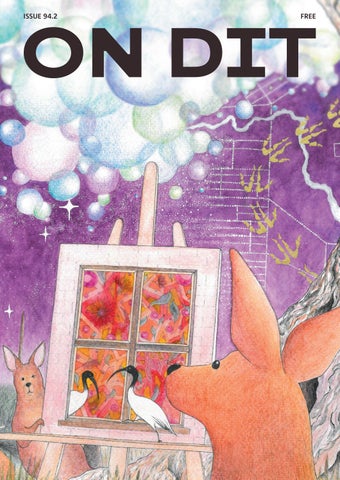
ON DIT ISSUE 94.2
FREE
LOOKING FOR CASUAL WORK? We provide free support to help you get job-ready and find employment. Our service is completely free to all Adelaide University students.
Book a free appointment here.
On Dit respectfully acknowledges the Kaurna, Boandik and Barngarla First Nations Peoples and their Elders past and present, who are the First Nations’ Traditional Owners of the lands that are home to our campuses located in Adelaide, Magill, Mawson Lakes, Waite, Roseworthy, Mount Gambier and Whyalla.
1
The Dreamer’s Gathering Front and Back Cover Artwork by Kai Kniebeiss Hamada
Highlights 4 6 8 20 34 39 44 56 60 63
Editor’s Letter Spotify® Playlist Vox Pop Quiz Film Watchlist Crossword Club Spotlight Student Publication Spotlight Life Donation AUSA Chairperson’s Letter
STUDENT SUBMISSIONS WRITTEN
Visual
10 Say My Name
12 Mushrooms in the Forest
14 Dreaming of wattle and our laws
13 VIVID
16 PROFILE: Peter Drew and the ‘paradox’ of Australian identity
19 Hanging out on the scene
22 Cricket: a rich man’s game in a poor man’s world
26 The Dreamer’s Gathering
25 Yellow Tail Ridge 28 Q&A With Kai 36 My very own Australian dream 40 A room full of lawnmowers 42 Warnings from Our Neighbours 46 Eventual Acceptance Chapter 4: Out of the Shadows 50 Adelaide medical students ‘ignored’ by paid placement expansion 52 Reclaiming the Australian dream through modern patriotism and union power
24 Yellow Tail Ridge 29 Ngulmiya at the Osaka World Expo 30 Australian Birds 38 Festival in Adelaide 48 Baby Tiger 49 Close Enough 58 Junk Mail, Home Wrecker, Threshold
What comes to mind when you hear the phrase The Australian Dream? The first thing that pops into my mind, or everyone's mind, I guess, is a house with a backyard, a stable job, and the promise that hard work will lead to a better future. But like many ideas we inherit, the Australian dream has never been fixed; it has evolved alongside the people who continue to shape Australia. The longer I stayed in Australia, the more my understanding of the Australian dream changed. Perhaps it was never meant to be a single dream at all. To me, it is a collection of hopes, values, and experiences that differ from person to person. We may not all share the same culture, but we often share the same values—respect, curiosity, kindness, and a willingness to learn from one another.
Head Editor
Within this edition, On Dit explores Australian identity, culture, belonging, and the diverse voices that continue to shape what Australia means today. Stay warm, and see you in the next edition.
When producing this edition, the editorial team was often asked what we meant by “the Australian dream”, and honestly, it’s a damn good question. We wanted a somewhat vague theme to allow contributors to take their writing and artwork in whatever direction they liked. For me, the Australian dream is about bringing together unique perspectives to minimise division by expressing ourselves through art and literature, building empathy, understanding, and a sense of unity. I hope you enjoy this edition and its exploration of Australian culture, history, identity, values, the economy, and life. All the best. 4
Deputy & Fe
atures Edit
or
Depending on who you ask, “the Australian dream” is either a profound national ideal or someone’s stereotypical dad in footy shorts (well past their prime), proudly admiring a freshly mowed lawn with a sausage in one hand and VB in the other. When I moved to New Zealand for a few years, I left Australia thinking I wasn’t any more patriotic than anyone else. Then I somehow became Australia’s unpaid PR manager in every conversation, defending our rightful claim as the inventors of pavlova as if it were my dying passion. It was close enough to make me think I wouldn’t get homesick – but I developed a certain heartache for the social rituals, shared references, and “affection through mockery” sense of humour that just felt like bullying elsewhere.
Digital, Design & Social Editor
I think the beauty of the Australian dream is that it’s not a singular Norman Rockwell-esque vision, but a sense of belonging. That means something different to everyone, and it evolves as we do. Whether your dream is clear or still evolving, I hope you find a little piece of it somewhere in the pages of this edition (:
When I first came across the theme of the Australian dream, I found myself reflecting on what that idea means to me. As an international student, moving to Australia was a big step into the unknown — leaving behind familiarity and the life I had always known to pursue new opportunities and experiences. Over time, I’ve realised that the Australian dream is ot one single path or definition. It can mean building a career, finding a community, creating something meaningful, or simply discovering where you belong. Everyone carries their own version of this dream, shaped by their background, challenges, and aspirations. Through designing this edition, I wanted to create a visual experience that reflects the diversity of these stories and perspectives. Every choice, from layouts to imagery and typography, was an opportunity to support the voices within these pages and bring the theme to life.
ic Designer
Lead Graph
5
REWRITTEN untouched the Veronicas
Better in Blak thelma plum
don't Change INXS
U Should Not Be Doing That Amyl and the sniffers
Listen Here! 6
Please don't move to melbourne Ball park music
the difference flume, toro y moi
my old ways tame impala
dirty deeds done dirt cheap Ac/dc
pressure to party julia jacklin
ipod touch ninajirachi
7
Vox Pop! Jaya Tejwani
Master of Accounting and Finance Q1:I appreciate Australia’s friendly people, peaceful lifestyle, and beautiful nature. It is a multicultural country where people from different backgrounds are welcomed and respected. I also like the work-life balance and the opportunities to learn and grow.
Ilse Liao
Master of Urban and Regional Planning Q1: The most fascinating thing I found about living in Australia is the “social culture” —the laid-back nature of Australian people is something really unique and wonderful to be surrounded by. Q2: Ever since I was a child, I have taken on the values of kindness and humility towards the people around me. I believe that while these are basic manners that humans should demonstrate, they contribute to my cultural identity as I know others in my community hold similar values. Q3: I think the best way to honour Australian heritage is to continue to learn, practice and pass on small and meaningful rituals that are important to us and the people around us.
8
Q2: My values of respect, kindness, honesty, and family help shape my cultural identity. I enjoy learning from different cultures while staying connected to my own traditions. These values guide how I treat others every day. Q3: Australians can honour their heritage by respecting First Nations cultures, protecting historical places, celebrating cultural diversity, and learning about Australia’s history. Sharing traditions and supporting local communities helps preserve the country’s rich heritage for future generations.
Q1: What do you appreciate most about living in Australia? Q2: How do your personal values shape your cultural identity? Q3: How do you think Australians can best honour our heritage?
Rocco Ventra Bachelor of Journalism
Q1:What I appreciate most about living in Australia is how multicultural we are as a nation. I think that we’re such a great mix of different beliefs and cultures, and that this has enhanced our country in many ways whether it be food, entertainment, health, etc. I think trying to reduce this is kind of going backwards in terms of our development as a country. Q2: I think being hardworking, welcoming and willing to help out even when it’s an inconvenience is a big thing that I’ve gotten from my cultural identity as an ItalianAustralian. What contributed greatly to me ingraining this into my personal values throughout my life is seeing how hard my Nonna and Nonno worked to build the life they did in Australia after coming from Italy with nearly nothing, all providing for those around them and being backbones in their community. Q3: I think as Australians we can honour our heritage by sharing our cultures with each other while being respectful of both each other and the country that we all live under. In my opinion at the end of the day we’re all Australian, we’re all on the same team, which to me means we should be able to celebrate our differences and be respectful of each other in order to keep developing further as a nation.
Ryan Ansari
Bachelor of Medical Radiation Science Q1:The lifestyle — there’s a lot to do and a variety of options for people in what they want to do after high school, whether they want to study, go straight to work, or do TAFE. People have the freedom to choose what they want their lifestyle to look like. Also, Australian summer is really nice, especially because we have a lot of nice beaches here. Q2: Some of my personal values, like being proud of and interested in my background, definitely positively shape my cultural identity because its made me really interested in family events, restaurants or whatever else to learn more about my own culture. Q3: Australia is the product of so many different cultures and heritages, so honouring those different influences makes it really special because all of those people, from Aboriginal and Torres Strait Islander Peoples to migrants who keep coming in, make up Australia and play a unique part in the country. Whether that’s through art, food, traditions, events, dance - whatever it may be, those are all cool ways to learn about our different culture and embrace the value of our heritage as a multicultural country. 9
SAY MY NAME Words By Adele Chiuchiolo
There is a commonality in the generation of
Annunziata? That’s too hard, let’s call you Nancy
children that came here decades ago.
instead.
The sense of practicality in the decoration when
Chiuchiolo? What about Cornflakes?
they came into this nation, with nothing but a metal trunk and hopes from family back home.
Michele? No, we’ll call you Michael now. Black curly hair sticking out in photos of blond bitchy children who will never understand
In the house that they built, brick by brick,
the struggle of words and sounds not making
blisters, broken backs, bold blooming bloodlines
sense from the mouths of teachers and young
there lies within them not just the doctrine of a
schoolmates.
cultish denomination,
Finding solace in the familiar vowels of home
but an education to the next generation that will
and yet those sounds cannot teach them to
lead them to paths not ever known to them.
understand the other words they will need to
The path to this success is bumpy, rocky, filled
grow.
with pushes from the arms of people who will
To know that they are as intelligent on paper as
never acknowledge their offences.
they are on the street but to be labelled as dumb
Yet the children of this next generation who have received this education will clean their cuts,
because their accents come out thicker than some.
mend their bones and find a smoother road.
These thick-accented others;
But in the rocks thrown there is punishment for
illiterate, illegible, ill-educated, ignorant.
their names, ones tha date back generations to times before ink and paper, The astonishment in the accompaniment of vowels and consonants coming together to create sounds that are destroyed by mouths that cannot help but laugh.
10
Unable to understand the English of others but knowing the weight of the words in their children’s diplomas. These children of the new generation taught me
how to cook with foods from their parents’ home,
their family is not starving anymore,
the ways of doughs and soups that are sourced
but to the world they are fat and greedy because
with the freshly grown food from the gardens that
they can feed one child without worrying they
they treat like their own family.
can’t feed the other four.
These children of the new generation taught me
The world has changed.
how to create words on paper that make people proud and paint with brushes on canvases that
You’re right.
drop mouths open.
Now they can capitalise off their culture.
These talents of my brothers and cousins are
Restaurants whose names are made in food that
thanks to the moral justification our parents
was the structure of survival for my Nonni
have in the love and support of their children’s
spaghetti,
expression of their imagination. But the cheers of success they hear for overcoming the odds are nothing but rigid
polenta, pizza,
numbers used to show the diversity of a nation
bruschetta.
that once thought a person’s value could be
Food key to my culture butchered for the appeal
judged externally.
of a palate that cannot stand the spice of black
“But the world has changed” I hear in the cries of
pepper.
the masses,
The world has changed.
so eager to move on from the days of using the
So, say my name.
word “wog” to shame. Pointing to my mother’s face and laughing because the hair on her upper lip at just 12 is darker than theirs. The plumpness of them, a sense of pride for their parents because
Go on. Anglicize the Cs and under-pronounce the Es. Laugh when that 8-year-old girl starts to cry because not a single teacher could say her name. Go on. Say my name.
11
Mushrooms in the Forest Photography By Amy Walters
12
VIVID Artwork By Syeda Momina Bukhari
13
Dreaming of wattle and our laws Words By Lucas James Hockley
D
ancing among the wattles, baking in the brilliant sun, is the fleeting dream of a country both old and new. A place which must reckon with a past of both flourishing and loss. The golden tendrils of sun illuminate the endless sky, below which lies a landscape of the richest greens and driest ochres; a gentle nostalgia lingers that reminisces of the stories baked into the very earth itself. While the scent of eucalyptus dances through the air of modern metropolises, Waltzing Matilda carries gently along the breeze. There is a history here, like all places. However, unlike all places, those here are especially unique. It is a nation of contemporaries, new ideas and systems built on foundations of a history older than memory itself. It is a noble ideal. Australia is a nation of many: opportunity, peoples, stories gather here in their multitudes. It is an amalgamation of experiences that fosters a new idea of equality and chance — one that people may all experience prosperity.
concepts is the arena of national success. Diverse people and wisdom bring knowledge and acknowledgement, which, when brought together on stage, foster encouragement and collaboration, igniting extraordinary innovation and hope. It is this very kind of hope that imbues the very institutions of this Commonwealth and that has forged a nation which should instil not just hope, but pride in a dream still worth dreaming. Take our Constitution, for example; a document which, for all its flaws, has a dozen more triumphs. A document which so elegantly captures and describes the features of an admirable democracy. Woven into the very fabric of this nation is justice, the balancing hand on uneven scales. Justice is the ever-present demand that the law pervade all people, where the power of this Commonwealth should never be turned arbitrarily.
The “lucky country”.
A lofty ideal that no judge should be influenced, no monarch should exercise their power outside of their counsel and commands a system which earns respect from every scholar of statecraft.
True to its nickname, it is a place that strives for the commonwealth of its peoples and is uniquely poised to deliver.
It is a unique position of Australia to have a system which perhaps is often overlooked, when it should be praised.
A nation is more than its people or its history; it is the institutions in which these
Instructing every institution of power is this guiding principle — justice. It battles
14
and toils eternally with the challenge of oppression, those that wish to turn the blade of the laws of this nation to the people.
the world, somewhere which so firmly believes in the potential to use the law to shape and improve society and languish in “good enough”.
In this battle, there must always be faith. Faith that the laws are not so easily corruptible, and justice will always prevail over this land. However, faith must not walk alone; instead, hand-in-hand with hope. To deter contemptible efforts to erode this Commonwealth, there must be hope in this dream yet to be dreamed. The ongoing experiment: a nation gifted with ancient history and contemporary laws.
There exists so much potential. We have been afforded the inheritance of institutions of law older than our Commonwealth, abided by a history and culture older than any other that has persevered on this Earth. It is imperative, with these gifts in mind, to go forth and seize the collective wealth of our country and grow from it something which is to be the marvel of all the nations.
This is not to neglect the failings of this system. There have been many. But it is the responsibility of those who inherit these laws to reconcile them, rewrite, amend, and repeal. It should always be the prerogative of this nation to heal and repair, and it would be an abrogation of this dream to settle for less than.
The Australian dream is, therefore, a thing of hope. Hope for a young nation with an ancient history to realise its unbridled potential, and to embrace the ideals of institutions which embody the rule of law. Fundamentally, Australians should feel so proud of the immense diversity and wisdom which has shaped our Commonwealth, and this pride should go forth in everything we do, in the goal of creating something extraordinary, for everyone who calls it home to enjoy.
It should be the dream, therefore, of the people of this nation that these tools should be harnessed to form something not just prosperous, but something enduring. It is why the responsibility of every Australian is to dream. Imagine something greater. Acknowledge the ground beneath our feet, and the history etched into the very foundation of this country. Move among the wattle, take in the scent of rain on the dry earth, and smile when the brave kookaburra sings from the gum tree outside your window. Acknowledge the truth of this place: the good and the bad. I think it would be a waste to exist in one of the youngest tenets of democracy in
15
PROFILE: Peter Drew and the ‘paradox’ of Australian identity By Leia Vlahos
Popular Adelaide-based artist Peter Drew first considered the concept of a national character when he moved overseas and “couldn’t shake off his identity” as an Australian. His time out of the country left him wondering what it meant to be an Australian: an ideal he explored throughout his artwork for years to come. Peter is best known for his AUSSIE poster series, which can be found stuck across the streets of many Australian metropolitan cities, including Adelaide. Peter began this well-known series 10 years ago and has noticed that political conversations about immigration have dipped in and out of trend in both Australia and across the globe. He names economic difficulty and a universal fear of the unknown and people “who seem different” as reasons why many need “someone to blame” in the West. The artist questions what “the West” is in its entirety — is it a people, a collection of ethnicities, or the idea of a process of integration? “To my view, it’s always been a process of integrating people and ideas,” Peter says.
Peter Drew’s AUSSIE series utilises portraits of people born in Australia whose nationality was recorded as something other than Australian due to their perceived race. (Image: Peter Drew)
16
“Without that understanding of what the West is, you can’t really reconcile the history of the West being so many different things and having integrated so many different peoples.”
His eyes trail across his desk, considering the resurgence of interest in his artwork. Peter believes these conversations are unavoidable and Australians “have to go through it” as other nations have. The artist says that the identity solutions for discontented people, especially those who are young, should truly be economic solutions, while throwing in a disclaimer that he is by no means an economist.
Behind the humour lies a deeper understanding of Australia’s pop culture and political history dating back to Peter’s upbringing during the 80s. He references Australia’s 23rd prime minister, Bob Hawke’s 1988 bicentenary address, which explores the Australian national identity as having a commitment to all.
“[My job as an artist] is to throw questions in front of those identities in order for people to think about whether they are real,” he explains.
These well-considered questions of a national character did not appear overnight. He says during his time at the University of Adelaide, he was too focused on discovering a sense of self and his worth as an individual to consider politics.
Former Prime Minister Bob Hawke’s 1988 bicentennial address, delivered on the steps of the Sydney Opera House. (Image: YouTube)
“There remains one vital factor in the “If you try to find your self-worth in politics answer to the question, ‘Who is an … I just think that’s like trying to put a roof Australian?’” Hawke says. on top of a house before you’ve built the walls,” he says. Before achieving a Master’s degree from the Glasgow School of Art, Peter attended the University of Adelaide. His time studying shaped his ideas and perspective as well as his expression of these notions. The artist believes having a sense of humour about topics like this is powerful, especially to younger generations. He explains how young people have always seen “the winner” of politics as the one who is laughing.
“And that factor is a commitment to Australia and to its future.” The artist makes an additional reference to our history that is still applicable a century later, likening the Australian national identity to the well-loved children’s book The Magic Pudding by Norman Lindsay. The book is over 100 years old and follows a never-ending pudding that can magically change flavours.
17
“We treat our national identity a bit like a magic pudding — that it is exactly like what we want it to be and it’s never going to run out,” he says.
“It’s obviously a paradox, that one thing can be many things and is inexhaustible.” It’s a conflict the artist tries to replicate in his posters, leaving the audience to decipher two interpretations — the clash between the portrait of an Australian, despite ethnic assumptions behind the term “Aussie”, and the poster describing the White Australia policy and that the White Australia policy was “Aussie”. “They’re both true in a way … the white Australia policy was Aussie; it did help shape this country, but also it’s abhorrent to the way we now view this country,” he elaborates. He encourages Australians to love our country while acknowledging its flaws and history, calling out the word patriotism
as a “naive love that is ultimately weak”. Instead, he asserts that a shift from unquestioning pride to a nuanced, critical perspective is required for a well-rounded appreciation of the nation. “I think when you are young, your idea of patriotism is a love for something that is unambiguously great and I don’t feel that way about Australia because it’s not true of Australia or any nation,” he says. “That’s the way I feel about people as well as nations … people are full of faults and histories that are ambiguous and are filled with triumph as well as inequity and regret.
“It’s actually the ambiguity and paradoxes within the Australian identity that make it worthy of interest and love.”
18
Hanging out on the scene Artwork By Kai Kniebeiss Hamada
This a print I made in high school, so it’s a pretty old one. Why it was memorable is because I was pretty bad at print making, especially because this was a tiny, tiny copper print. It was my first attempt at this in high school. I was pretty hopeless. It was so hard to get the detail and there’s many procedures you have to undergo. This one is actually one I did outside of class. I was really interested in doing print making so I asked my art teacher if I could do overtime and she was really supportive and helped me outside of class. So thanks to that, I could do this piece. So these characters are actually ones I made when I was really little. Like, I don’t even remember when, but I used to draw them as a child. So, I wanted to do this as a reminder to keep going with my art and follow my dream. I find it really fun, once you get going with detail, to keep going as far as you can go.
19
AussieAnimal Which are you? Q1Which dinner date option speaks to you? A I’d skip dinner for dessert B A nice, refreshing poke bowl C A nice seafood restaurant by the beach D Minestrone and a herbal tea
Q2 What is your favourite colour palette? A Neutral colours all the way B Lots of green and gem tones C Winter-like blues and greys D Pink and orange like a sunset
Q3 Which Adelaide neighbourhood matches your vibe? A Belair B Magill C Victor Harbour D Moana
Q4 What is a hobby most people don’t expect from you? A Swimming B Dancing C Bouldering D Running
Q5 My best trait is my… A Gentleness in the face of conflict B Impeccable fashion taste C Love for community D Curiosity for the unusual
Q6 If I could have one superpower, it would be… A Super speed B Turning invisible C Flame throwing D Flying 20
Mostly A: Echidna
You’re sweet, chill and probably happiest doing your own thing. You may seem quiet at first, but there’s definitely a quirky side to you once people get to know you. Basically, you’re a little softie with spikes.
Mostly B: Frill neck lizard You like to stand out — and honestly, you probably know you look good doing it. You probably have a strong sense of style and a little bit of main-character energy. Why blend in when you can bring the drama?
Mostly C: Little penguin You’re the friendly one who loves being around people. You care about your friends, your community and making sure everyone feels included. You’re probably always keen for a catch-up or a little adventure. Like a little penguin, you’re small but full of personality and love.
Mostly D: Emu
You’re curious, adventurous and a little bit random — in the best way. You’re always down to try something different and probably have at least one hobby that makes people SHOCKED. You’re independent, energetic and definitely march to the beat of your own drum. 21
Cricket: a rich man’s game in a poor man’s world
Words By Samoda Silva
Cricket is often hailed as a “gentleman’s game”. It is a sport derived from humble beginnings, historically played on makeshift pitches by white men with nothing but the whites on their backs and a meek piece of willow in their hands. However, beneath cricket’s enduring power to unite across borders, one comes across the depressing truth that cricket is increasingly becoming a realm dominated by the wealthy, whether as a spectator, a viewer, a player, or simply a devotee to the game. You could blame inflation, Cricket Australia®, or the inevitable expansion and corporatisation of the sport, but taking an outing to the oval has increasingly become out of reach for the ordinary middle-class Aussie family. Cricket Australia conceded an estimated loss of $10 million following two anticlimactic two-day Boxing Day Tests in 2025. An even greater loss was shared by stakeholders within the cricket ecosystem that rely on loyal fans watching, consuming, enduring, and most of all, purchasing. But let us not forget that it was the same Cricket Australia that charged an out-of-touch $75 to sit in a third-tier seat at the back of an open roof stadium in a sweltering Sydney summer, for a One Day International against the Windies, who unfortunately are not the coveted drawcards they once were. This resulted in an embarrassing but predictable sea of empty blue seats for an at-home series, in one of the nation’s premier sporting venues, with one of the world’s most elite sides in the game.
22
Even if you’d rather watch from the comfort of your living room, if it’s not a major game featuring Australia, then you’ll likely be locked outside of a paywall. Anti-siphoning laws were implemented to prevent private broadcasters from monopolising streaming rights before free-to-air channels could get their chance to put up and ensure sporting events of public interest remained accessible to said public. But while the Seven Network has managed to score deals with Cricket Australia to secure broadcast rights to Australian men’s and women’s internationals, the Big Bash League (BBL) and WBBL®, and home Ashes®, the Amazon® supremacy has got their grubby, unscrupulous hands on all cricket World Cups, T20 World Cups®, the Champions Trophy and the World Test Championship Final until 2027. Cricket Australia is a sporting giant with a complicated and arguably inherently unsustainable financial model, and the public demand for live cricket is greater than ever. But this should not absolve it of its responsibility to look after its loyal fan base and nurture a growing interest in the sport — not exploit it. And it’s not just watching cricket that will cost you a pretty penny. For a number of years in my adolescence, I spent my Sunday afternoons in the sizzling sun and on overgrown green turf, standing around in a field to brush my pinkies on a ball once, bowl 4 wides in my one over, before batting three overs to get bowled
for 10 by a 14-year-old. And don’t get me wrong, I loved it. But if not for the team kitbag and the second-hand freebies generously donated by my teammates, I’d be sent out to bat with nothing but the uniform on my back (which, too, was a splurge for 16-year-old me). I owned two red balls that I’d use in the practice nets, taking a rest every third of an over to jog to the plastic stumps my father had gotten for free to retrieve them. The groundskeeper, bless him, saw me and probably in pity, donated to me a bag of balls he had collected from around Park 12. It is this type of benevolence and team camaraderie that keeps people in the sport, while it’s the price tag against the backdrop of competing pressures that can take them out. Cricket is meant to conquer social divide, yet it too has the potential to reinforce it. Those with access to support systems rise to great heights, while others without the same opportunity struggle to keep pace. Having said this, it hasn’t stopped young boys and girls across the world from finding joy in this game — using bits of wood as stumps and swinging at a taped tennis ball with their feet planted in hot sand. It is this more than anything that reflects the very essence and spirit of cricket: a game which should always be sustained by pure passion, not privilege.
23
Yellow Tail Ridge
Artwork & Words By Trypehna Hewett
24
Digital mental breakdown Artwork By Eleanor Gare
Eucalyptus fence line Red bark roof and wall A hollow in the blue gum With branches twisting tall. Yellow tails soar overhead Black wings against grey sky A cacophony of mighty caws Makes the ridgetop come alive. They care not bout the rising rent Or expressway travel time Just the feel of the wind in their feathers And the glow of the sun in their eyes.
25
The Dreamer’s Gathering Artwork By Kai Kniebeiss Hamada
26
27
Q&A WITH KAI cover artist of edition 94.2
Interview by Libby Hoffmann Q: What inspires you the most about Australia?
A:The nature inspires me the most. As a child, I grew up on the outskirts of
Melbourne … and it was actually surrounded by the bush. We’d get kangaroos visiting every morning, and I’d wake up with the sounds of the magpies. I’d find myself immersed in my head a lot, thinking of an imaginary world. I’d quickly go back into the house and start drawing and just express how I felt. Even to this day, I love to go out into nature just to capture beautiful scenes. I feel like a lot of us get drawn into “grand nature”, like these big sites. That’s really cool, but there’s more in our daily lives that we don’t notice. So, I really get drawn to that sunlight shimmering on a river or the patterns on a grain of wood. Some people find that pretty weird, because I’m kneeling down on the side of the road trying to capture something [in my photography].
Q: Our new edition is themed “the Australian Dream”, what does that phrase mean to you?
A:The Australian dream can be two really different perspectives. One side is a real
happy side in a way. People can come from all over the world to Australia to follow their dreams, and I think that’s something really lovely about Australia. But at the same time, I think that modern Australia is built upon colonisation, and a lot of First Nations peoples really suffered the consequences of colonisation. The Australia we have now is also a continuation of that time that we’ve had. It’s difficult because there are two sides to it, and I feel that for Australia to move forward, there needs to be greater recognition of First Nations peoples and their experiences throughout this. I dream of an Australia where we can all be proud of our First Nations culture, our own heritage and who we are as a nation.
28
Ngulmiya at the Osaka World Expo Photography By Kai Kniebeiss Hamada
Q: Could you tell me a little bit about this photograph and who the man in the photograph is?
A:This man is a First Nations artist called Nuglmiya Nundhirribula, and he’s from the remote community of Nhulunbuy in Arnhem Land. This photo was taken at the Osaka [World] Expo, which was held last year, and I had the privilege of getting in the front row and photographing him, which was really exciting. He sings about his community, their culture and their way of life and his family. The song [in the photograph] is especially about his sister, and he was singing with a really powerful voice. He’s really proud of his heritage and his culture, and he really wants to pass that down to the next generation. It’s really important to think about how you can capture this inner feeling, an inner emotion that you can’t really see.
29
Australian Birds Artwork By Sana Shafiei
30
31
From Scratches Artwork By Lavica Wu
32
BE PART OF SOMETHING BIGGER Volunteer with AUSA and gain skills, confidence, and connections at Adelaide University.
Sign up to become an AUSA Volunteer.
Film Watchlist Adelaide University Film Society
1986
Words By AUFS Vice-President Angus Scott
Dir. Brian Trenchard-Smith
.
Action, Science Fiction, Dystopian, Cult
Set in a desolate future, Jimmy and his girlfriend Carmen are trapped in a drive-in cinema turned concentration camp, formed by the Australian Government to capture apathetic youths. All of the inmates' needs are met, but Jimmy finds this life pointless and plans a daring escape.
1990 Dir. Nadia Tass .
Comedy, Romantic Comedy, Teen Caper
18-year-old Danny Clark lives in 1990s Melbourne, with the goal of impressing his high school love. He lies, claiming he owns a Jaguar, and with this lie, he wins a date. He decides to trade in his family's Nissan for a secondhand Jaguar. However, the engine explodes on the first date. Now, he and his friends must devise a plan to get revenge on the crooked car salesman. 34
1981 Dir. Peter Weir
. War Dream, History In Western Australia, gifted sprinters Archy and Frank are eager to enlist. Although underage, Archy is able to join the 10th Light Horse Regiment, and Frank joins the Infantry. After reuniting in Cairo, both friends are sent to serve as runners at Anzac Cove on the Gallipoli Peninsula. Set in three parts, the film explores outback living, pre-war attitudes and post-war realities.
1974 Dir. Peter Weir .
Horror, Black Comedy, Satire
The New South Wales outback town named Paris sustains its economy by purposefully crashing cars, looting the victims' belongings and selling off the parts for cash. Arthur and George fall victim to Paris' economy, and George dies. After waking up from the crash, Arthur is adopted into the mayor's family and appointed as the town's only parking inspector. He wants to escape, but has a crippling fear of driving.
35
My very own Australian dream Words By Zarrin Tasnim Tasin
My Australian dream almost ended before it began. I couldn’t sleep one night. For days, I had been racing against time, pouring every ounce of myself into scholarship essays while juggling office work, deadlines, and self-doubt. Yet despite all the preparation, I missed the submission deadline. Just like that, my dream of studying in Australia seemed to disappear before my eyes. The next morning, I woke up to an email. The application deadline had been extended by four days. Hope returned as suddenly as it had vanished. I remember jumping out of bed, heart pounding, convinced that perhaps some dreams simply refuse to give up on us. Then came July 3, 2025 — my birthday. Among the birthday wishes was an email that became the most special gift of the day. “Congratulations. You have been shortlisted for an interview.” I couldn’t have asked for a better birthday present. I was one step closer to my Australian dream. The interview came and went. For the first time in weeks, I felt quietly confident. Then began the longest wait of my life. Weeks later, on an ordinary afternoon that would become unforgettable, another 36
email arrived. “Congratulations! You have been selected for the Australia Awards Scholarship 2026–27.” I read the sentence once. Then twice. Then a third time, just to make sure I wasn’t imagining it. I couldn’t have been happier. A new country. A new city. A new chapter. As I write this from Adelaide, I realise the scholarship has given me much more than a university degree. It has given me a second home. For a woman from Bangladesh, dreaming of Australia was never simple. We often grow up carrying responsibilities alongside our ambitions, learning to be practical before we are bold. Studying overseas was never just about boarding a plane. It was about believing that I belonged in a place I had only seen in photographs. I have fallen in love with Adelaide’s gentle rhythm — the calmness of the city, the sunsets that paint the sky in gold and pink, the beaches that seem to stretch forever, and the warmth of people who make strangers feel welcome. I have watched people hustle through their workdays, only to slow down and savour life over a glass of wine and soft music in warmly lit restaurants on Saturday nights.
I have seen friends and families dressed in their finest, sharing laughter that lingers long after the evening ends. I have witnessed the city’s vibrant festivals in summer and its twinkling lights in winter. There is something deeply charming about this city — so full of life, yet so wonderfully composed. Sometimes I sit beside the River Torrens, watching cotton-candy clouds drift by. Sometimes I spend an afternoon in a café, watching people rush to work or share stories over coffee. Sometimes I pause between classes to listen to students chatting in accents from every corner of the world or stop to hear a street musician turn an ordinary afternoon into something magical. Through these simple moments, I watch life unfold around me. The smiles of strangers on the street or on the bus make me feel as though I’ve always belonged here. The continuous encouragement of university lecturers and staff makes me feel that my voice matters. The open, non-judgemental faces of people have never made me feel like an outsider. Walking through the thousands of people of every size, shape, colour, and language flowing through Rundle Mall makes me realise what true inclusiveness really means. Now I know that Australia is not defined by one face, one language, or one culture. Every accent, every tradition, and every story adds another colour to the same canvas. For someone who arrived from thousands of kilometres away, that quiet acceptance has been one of the greatest gifts this country has given me. I know I have only limited time in this beautiful country, and I want to live every day with intention. Sometimes I wonder: how do I repay this country? How do I make the best use of my time here?
I don’t want to miss a single opportunity to grow. Every conversation, every challenge, and every new experience teaches me something. I believe wisdom is the greatest freedom, and Australia has given me the chance to pursue it. So, I say yes. Yes to community volunteering. Yes to leadership programmes. Yes to friendships that cross continents. Yes to wandering the city with no destination in mind. Yes to the sharp winter breeze against my face and the crunch of autumn leaves beneath my feet. These moments have become my own way of embracing Australia. One day, I will board another flight home with my Master’s degree. Yet Australia will travel with me — in the values I carry, the friendships I cherish, and the person I have become. As a public servant, I hope to carry those values into the communities I serve, to help build a society a little more compassionate, a little more inclusive, and a little more resilient because of what I learned here. When I first dreamed of Australia, I imagined a destination. Now I know my Australian dream was never simply about studying abroad or earning a degree. It is about belonging. It is about discovering parts of myself I never knew existed. It is about carrying the kindness and hope I found here back home, so that this dream continues long after I leave.
37
Festival in Adelaide Artwork By Farida Ayu Brilyanti
38
Crossword Across
Down
6.The Australian bird that “won” a war
2. Traditional Custodians of the Adelaide Plains
7. Adelaide’s huge annual arts festival
4. Busway that decided it wanted to be a train
8. National floral emblem
5.A cake covered in chocolate and coconut
3. “That’s not a knife!”
1. The salty Australian spread
9. Aboriginal name for Adelaide University
3. CROCODILEDUNDEE 6. EMU 7. FRINGE 8. WATTLE 9. TIRKANGKAKU
ANSWER Across 39
1. VEGEMITE 2. KAURNA 4. OBAHN 5. LAMINGTON
Down
A room full of lawnmowers Words By JDR Hutchins
Somehow, somewhere, and at some point. I favoured these intimidation tactics. Catch is, I never know what the act is. Practice makes perfect, Oh, where did I learn this? I always lead by example, Always wore all the patches. First, Second, Third, “Fourth”. Always aimed for that fabric. Yet strangely, it seems my dreams drift from the masses. My peers steer clear, Inspired or feared. They hold back their thoughts, Their opinions with latches. It seems unfair to be taxed for those tactics. Why shun others from success? Or at least from trying their best? Is it something I said? Am I that woody a cactus? Well consider lawnmower blades bent. You should have reached for the hatchet! Because your intolerance to me. Can’t even leave scratches. And it never will.
40
41
Warnings from Our Neighbours Words By Saxon Schapel
Four billion years ago, the Solar System was a very different place. Dust swirled around our very young Sun, clumping and growing into new worlds. One world found itself lucky in its placement, held in a fragile balance between scorching heat and bitter cold. Soon enough, an atmosphere formed and a small section of the Universe that had only known violence finally experienced the gentleness that is the first rains of the Solar System. Water pelted down onto the surface and blanketed the once hot molten rock with oceans. What is left? A blue world with habitable temperatures. A place now called Venus.
trapped high above where not even raindrops could return, evaporating before they had the chance. A runaway greenhouse effect held Venus in its grip, never to let go. The fiery fate of the world was already decided long before the last droplets left the surface. Clouds of water vapour blanked the drought-ridden world, increasing temperatures until carbon was boiled out of rocks and taken to join the water clouds. Heavy, dense clouds now encompassed the barren landscape of Venus, scorching the surface of the planet. Named after the Roman goddess of love and beauty, the planet was anything but.
The present-day Venus is far from the watery world of its past, replaced by what most describe as a hellish pressure cooker. Underneath its thick, toxic clouds lies a volcanic surface experiencing 90 times greater pressure than the volcanoes of Earth do. Any chance for life to form was wiped away. It’s a story of tragedy, a world that started as heaven and instead became hell. The cause of this massive shift is familiar to most people on Earth: the greenhouse effect.
Our colder neighbour, Mars, shares a similar story. Once upon a time water flowed freely, carving channels into the surface still visible today. Temperatures were warm and the atmosphere was thick like our own. Life could have lived on this planet. But greed soon took over, not the sky like Venus, but the rocks. Carbon dioxide got trapped in rocks with no escape and the atmosphere was stripped of its warming ability. The comforting presence of the atmosphere slipped away. Water was frozen and the planet was open to attacks from our own Solar System. No longer could life exist here.
When Venus was still blue, the Sun was maturing and warming. The oceans began to feel this heat and slowly the water returned to its cloudy home. Eventually the world found itself looking in a mirror of its not-sodistant desert past. The last drops of water were sucked from the surface, greedily
42
“We humans like to think of the heavens as stable, serene, unchanging,” (Carl Sagan, Cosmos) yet all we must do is look up to see that this is not so. Both of our neighbours have gone from heavens fit for life to places worse than the harshest locations on Earth. We are the product of luck, hanging in a precarious balance of too many and too few greenhouse gases. The chances of our planet being the right distance from the Sun, with a good atmosphere and magnetic field existing long enough for life to evolve and flourish are extremely small. And what have we given our world in return? We’ve poisoned our atmosphere and polluted the planet. The Australian Department of Climate Change, Energy, the Environment and Water states that since 1750 carbon dioxide levels have increased 150 per cent, which is at least 1.5 times greater than the natural increase had we not introduced these extra gases. We know that the balance of greenhouse gases is precarious — our planetary neighbours are screaming at us, “this is what will happen to you”. No one better than the words of Carl Sagan can articulate what has been happening:
A solution is not as simple as suddenly reeling back fossil fuel energy sources. Modern-day living requires a large electricity demand for vital functionality such as hospitals, medical care, emergency response, and everyday life. Australia has significantly increased renewably generated energy, from 8.5 per cent in 1990-2000 to 39.5 per cent in 2025 (The Department of Climate Change). An emphasis should be placed on continuing to build up green energy infrastructure and research should be done to determine if essential byproducts of fossil fuel, such as medicine, could be produced more sustainably. Climate change does not respect country borders; it must be a worldwide endeavour. Changes do not happen overnight to either Earth’s environment or human-made infrastructure, but change is inevitable and it is up to us what our future looks like.
“We’ve uncovered many other worlds with choking atmospheres and deadly surfaces. Shall we then recreate these hells on Earth? We’ve encountered desolate moons and barren asteroids. Shall we then scar and crater this blue-green world in their likeness?” Carl Sagan, Cosmos: A Personal Voyage, 1980. * I would like to acknowledge that the information found in this article has been sourced from the following: Cosmos: A Personal Voyage (Carl Sagan, 1980), The Planets (Andrew Cohen and Brian Cox, 2019), Smithsonian Nature Guide: Stars and Planets (2012), Lonely Planet: The Universe (2019), NASA online resources, and Department of Climate Change, Energy, the Environment and Water online resources.
43
Club Spotlight
Adelaide University Space Society
Q1: What does the “Australian dream” look like from your perspective? “The Australian dream” has always been about having our own slice of the wonderful place we call Australia. So, having a homegrown space industry means those studying now can hope to have a role here without having to go overseas. Building into space through opportunities to harness our naturally innovative spirit, under our own banner, for the betterment of the whole world.
Q2:If Australia could achieve one big thing in space, what would you want it to be?
Having more Australian astronauts would be great. Andy Thomas had to obtain American citizenship and go through training there. Having astronauts go through training here in Australia and not forcing them to go through those processes overseas would be a massive step in the progression of our space industry. 44
Q3:If you could shape the future of Australia’s space industry, what would you like to see change or become possible?
I’d like to see more action towards sustainability in our space industry, both in space and on earth. Since the space industry is relatively new in our modern-day society, and the fact that it takes a monumental number of resources to get to space, there is not a big enough incentive for environmental pollution prevention.
Q4:For students who dream of reaching beyond Australia, how can they get involved with the AUSS and start exploring that possibility?
Stay in touch! The best way to start exploring the space industry would be to go our events and talk to industry directly. We host a wide range of events that keep our members up to date with current space news, ways to enter the industry, and chances to connect with professionals. We post updates on all upcoming events to our Instagram (@auss.adl), Facebook and LinkedIn! 45
Eventual Acceptance
Chapter 4: Out of the Shadows Chapter 2 & 3 is available to read in issue 94.1 of On Dit. Words By Fionne Ngam
Midnight. Or maybe one. The words blurred together beneath the monitor glow. I shook my leg beneath the desk, fighting sleep. It didn’t help. My assignment was due at noon, and the word count still sat unmet on the screen. I gave up on sleeping sometime before dawn. When light seeped through the curtains, I was still editing paragraphs with dry eyes and trembling fingers. Something done was better than nothing. Less than two hours later, I stood before the mirror, curling the edge of my bob. Sandy narrowed her eyes at me. “You’re too calm.” I hummed. “You submitted early?” Her suspicion deepened. “Wait. Did you even sleep?” “Seven.” Her expression changed immediately. “I’m not tired,” I cut in. It wasn’t entirely a lie. I felt strangely
46
level. Not overwhelmed. Not miserable. Just hollowed into stillness. The mirror reflected everything else clearly enough. Chapped lips. Inflamed skin. Scalp scratches hidden beneath curls. Tiny remnants of every nervous habit I could never fully stop. I stared at my reflection. For a moment, the woman staring back looked like someone who had nothing else to lose. A Ferrero Rocher® appeared beside my notebook. I looked up. Gone again. Ten minutes passed before my grip tightened hard enough to whiten my knuckles. I hated competing against him. He always won. While I struggled to maintain my grades, he disappeared on international business trips and still returned in time to outperform everyone else. A labour economics lecture echoed unpleasantly through my head: ability determines
return. People begin in the same classroom and still leave for different futures. The thought lodged somewhere poisonous. Yet, I still waited for him. Even now. Why couldn’t I leave this as rivalry? Why did every encounter leave me unravelled in ways I couldn’t define?
“…the Learned Trial Judge erred in applying the test of substantially manufactured…” Only when I returned to my seat did I glance across. My stomach dropped. He rose calmly. “May it please the court…” Every word that followed tightened around my ribs.
“Where is your co-counsel?” One of the moot judges glanced toward the respondent’s empty seat. “Our Learned Counsel will arrive shortly, Your Honour,” the Junior Counsel replied calmly. Five minutes later, the seat remained empty. “We’ll proceed with appearances.” I stood. “May it please the court, I am Zander F, appearing with my Learned Junior, Levandre J, on behalf of the Appellant…” The opening submission left my mouth automatically. Hours of preparation carried me forward even as exhaustion pulsed behind my eyes. Halfway through my first argument, movement flickered near the respondent’s table. Someone had arrived. I didn’t look immediately.
His submissions dismantled arguments we had spent weeks refining. Not aggressively. Effortlessly. The warning signs buried in their written submissions suddenly screamed through my head. He was never meant to appear tonight. I should have known something this quiet would never stay calm for long. 47
Baby Tiger Artwork By Isabelle Le Souef
48
CLOSE ENOUGH By Phoebe Nobbs
“Close Enough” is a series of handmade clay keychain charms, which explore the intimacy of sharing a smoke with a partner. As bag charms and trinkets are often used to display the objects and characters we like, these pieces display that idea through the motif of cigarettes and lighters.
Phoebe Nobbs is an Adelaide-based artist specialising in handmade clay charms & other trinkets. Her work is avaliable for purchase, with commissions also open via DM on Instagram: @pheno.clay.
49
Adelaide medical students ‘ignored’ by paid placement expansion Words By Leia Vlahos
On July 16, Prime Minister Anthony Albanese announced the expansion of the Commonwealth Prac Payment (CPP) to those training in an additional 10 health professions.
Reimers says medical students are expected to complete 2,000 to 4,000 hours of mandatory placement throughout the course of their six-year degree.
Physiotherapy, pharmacy and podiatry will now be added to the paid placement scheme, joining professions already included such as teaching, nursing and social work.
“[It would] specifically help and support the people that need this the most to then create a more equitable workforce and actually increase the public’s access to health care,” he says.
From July 2027, eligible students will receive up to $338.60 per week during their clinical and professional placement periods.
“The public doesn’t see the future doctors who are stopped at the doors of medical school due to the financial barriers.
The change has been welcomed by many advocates for increased funding into allied health, but has let down others.
“I hope the government will reconsider their decision for paid placements, to support people wanting to go back and serve their under-served communities the most.”
Kash Avadhani, President of Adelaide Medical Students Society (AMSS), is disappointed by the federal government’s decision to exclude medical students from the program. “[There are students] paying rent, paying for fuel, paying insurance, paying for all the things for the cost of living,” he says. “It’s really hard for them to do all of that, then go to placement full-time, and then also have enough money for living. “Junior doctors often work the most unreal hours … They work sometimes 60 to 65 hours a week. They start at 6 am and might not leave the hospital until 6 pm and do that six days a week.” Similarly, senior representative of the Australian Medical Students Association, Kyan Reimers, says their team were “in discussions with the relevant ministers” in previous years and was surprised not to be included in the CPP.
50
The Royal Australian College of General Practitioners has reported that the number of doctors in private practice in remote and very remote areas decreased by 5.3 per cent from 2020 to 2025. “It’s unfortunate that we all don’t have the opportunity to have the best chance of finishing their degree, especially for the people in medical school who are the most vulnerable,” Avadhani adds. Oscar Hastings, a physiotherapy student, is relieved that eligible students can “finally access some financial support” when needed. “But it does feel too late in the sense of covering a large wound with a band-aid; it’s better late than never,” he says “[The government] claims it’s for everyone but … you have to fall into a hyper-specific category of
keen on supporting those students to finish medicine,” says Avadhani. Studies show medical graduates with a rural background and two years of rural training were 10 times more likely to practice in rural areas than those with a metropolitan background and no rural training. General practitioner and advocate, Dr Clare Keogh, believes the exclusion of medical students “doesn’t make sense” as it limits the medical cohort. “It’s just not equitable. If you’re relying on external support to support these students, you’re going to get less variety across the board,” she says. “It’s going to skew your cohort, and you’re not going to get a really good representative of society as it is. AMSS signed a public statement stating their disappointment due to the exclusion of medical students in the CPP. (Image: Instagram)
people even to access the financial support, which can be so degrading. “Because sometimes it doesn’t even cover the people who genuinely need the support.” According to the Department of Education, there are 680,000 international students currently studying in Australia; all of which are ineligible for the CPP. Similar concerns are held for students from socio-economically disadvantaged communities, as well as those completing placement in rural or remote communities. Avadhani says he knows of Adelaide University medical students who chose against completing rural placement, due to a financial inability to give up stable work back in Adelaide. “[The government] is making more medical schools; they’re also making more medical students, but it doesn’t seem like they’re really
“That will probably have implications in specialty issues and all sorts of things.” In a media release, the Federal Minister for Health and Ageing Mark Butler says the federal government is strengthening the health workforce through the CPP. “Training a domestic health workforce is crucial to ensuring every Australian can access quality health care where and when they need it,” he says. Until their concerns are adequately addressed, the medical students will continue to advocate for their cause. “Medical students were primarily leading the charge, especially on the expansion of the prac payment program,” says Avadhani. “This is something that we have to continue fighting for until we hopefully can convince the government that this was not the best decision.” Minister Butler’s office did not reply to On Dit in time for publication.
51
Reclaiming the Australian dream through modern patriotism and union power
Words By Ellie Venning
I
n 1979, the then-president of the Australian Council of Trade Unions, Bob Hawke, noted that “while change and adaptation of our attitudes will certainly pose some difficulties for us all, these will be as nothing compared with the potential chaos facing our society if we meander on enveloped in the warm cocoon of apathy spun from the threads of an earlier, easier and increasingly irrelevant age”. This continues to ring true today, with growing political fragmentation and populism making any form of “patriotism” only associable with right-wing politics. Those of us in the centre or left side of politics cannot sit idle and accept this, for our collective history of advancing our nation and bringing about people's dreams and aspiration are greater than theirs. So, what role does the labour movement’s political wing play in this adjustment of patriotism? Bluntly, there is a fierce necessity for Labor governments to prioritise policies that strengthen our community and build patriotism. Through various individual acts of service, we build a commitment of love for our country, as this collective act of this service is beneficial for Australia’s long-term sustainability, social progress and economic advancement. Reclaiming of traditional acts of patriotism such as a national flag is a difficult mantle to overcome. On Australia Day, we might see our flag at the beach, or being waved at a military or multicultural parade, or even if a council still holds it on the day, at a
52
citizenship ceremony. Other than this though, our national flag (particularly the Australian Red Ensign) is commonly co-opted by farright political activists and sovereign citizens at rallies and protests. But we are far from accepting defeat. Internationally, progressive political groups have “reclaimed” the flag of the United States of America ahead of the 2024 presidential election, with Democrat supporters hoisting flags alongside their Harris/Walz paraphernalia as they patriotically sought a better future for their society fighting against MAGA. We are also seeing this emerge in Australia, with Labor MPs such as Matt Burnell proudly using the Australian flag in their official merchandise. Strong political prioritisation of policies that can beneficially reform society advances this patriotism, as we should be proud of the changes our country is embarking upon. Patriotism isn’t just for us to feel pride in our community. It’s about us building up our communities towards a better tomorrow. We feel our pride as we stride forward, protecting the many ways Australia has made history for the advancement of global society. This includes the historic moves of strengthening our democracy; giving women the right to vote and stand for parliament, enforcing compulsory voting and gradually removing discriminatory barriers towards race and economic status. Today, we build our national dreams of progress and success by safeguarding this equality and improving
people’s knowledge of and faith in democracy. Our democracy is simply too precious to squander. By reinforcing democratic institutions and empowering citizens to engage meaningfully in civics, patriotism becomes a collective commitment to a fairer, more inclusive Australia. Hereby we achieve the dreams of the Eureka stockaders, the suffragettes and suffragists and anti-racial discrimination campaigners that built the foundations of our democracy as our own aspirations.
Technical College program ceased at the end of 2009 which dramatically worsened the widespread shortage of the critical skills necessary to produce Australian goods. Fast-forward 15 years, and South Australia opens its first industry-connected Technical College in Findon; strategically located within a working-class community with high union membership and rich cultural diversity. Findon Technical College has an acute focus on teaching advanced manufacturing and engineering, necessary to demonstrate a patriotic commitment that modern economic growth benefits working people, not just It’s a common saying, to “vote with your those born into advantage. The provision of wallet” to utilise your personal economic education is well known to be the greatest influence and as a means of economic lifter out of poverty, and as the greatest tool patriotism. This “voting” may be through purchasing particular products, or boycotting to equip young people to achieve their dreams and to contribute to our broader others. But if it is proclaimed as a moral society. By pressuring governments to responsibility for us citizens to purchase expand technical education initiatives, we as Australian-made products, the government a collective left-wing movement can help therefore has a responsibility to provide the break cycles of intergenerational inequality policy levers to produce those products. Australia’s unofficial national colours of green while meeting future workforce demands. and gold are reflected in the “Australian made” kangaroo logo, a visual cue making The Australian dream has never belonged to our proudly locally made products one side of politics, no matter how loudly indistinguishable from foreign imports. Our others might claim it. It belongs to the products are so celebrated that we have a shearers of Eureka, the suffragists who “Buy Australian Made Week” in May, and marched for the vote, the apprentices at states have their own campaign weeks Findon learning a trade, and every worker respectively. We’ve had enough of the who has ever withdrawn their labour or cast a marketing campaigns though, what we need ballot in the hope of a fairer country. is economic incentives to make AustralianPatriotism, properly understood, is not a flag made products affordable to produce (while waved at a rally or a slogan printed on a hat. still profitable) and to purchase. It is the accumulated work of generations who believed Australia could be better, and who organised, voted and built to make it so. Herein lies the importance of Australian manufacturing and technical education to all Australians for the opportunity to contribute to our national prosperity. When Australia’s
53
We cannot allow the difficulties in addressing disadvantage to scare us away to “tweak” around the edges of social and economic policies. We cannot allow the Australian flag to only be waved by the conservative side of politics, when it is the progressive side that truly lifts our country’s pride and equality. Our nation’s patriotism should be stipulated upon our strengths: democracy, education and sovereignty. For it is together that we stand and together that we claim Australia’s future with hope. Bob Hawke's warning against the "warm cocoon of apathy" was a call to keep striving rather than settle for what has already been won. The Australian dream is not finished business. It is renewed in every generation that chooses to build rather than retreat, and it is our shared community responsibility to seize this opportunity, to push progress forwards.
*This essay is a rewritten version of Ellie’s submission to the John Curtin Research Centre for their 2026 Boote/ Cragg Young Activists’ Prize.
Coffee shop Artwork By Emilie Nguyen
54
WANT TO WANT TO WANT TO GET PAID GET PAID GET WHILEPAID YOU WHILE YOU WHILE YOU STUDY? STUDY? STUDY?
Participate in & Participate in a clinical trialtrial & earn Participate in aa clinical clinical trial & earn earn on average $300-$400 per night. on average $300-$400 perper night. on average $300-$400 night. at and advance the Stay at CMAX CMAX and help help advance the Stay atStay CMAX and help advance the future of health care. of health futurefuture of health care.care.
Scan to explore Scan to explore Scan to explore our our paid paid clinical clinical trials trials
our paid clinical trials www.cmax.com.au www.cmax.com.au
www.cmax.com.au
21-24 North Terrace, Adelaide 21-24 North Terrace, Adelaide
21-24 North Terrace, Adelaide
STUDENT PUBLICATION SPOTLIGHT
1
How does your publication create space for the diverse voices and perspectives that shape Australia today?
The great thing about being a student media platform for an Australian university is having so many different voices, stories, and experiences to share. Our campus has people from all kinds of backgrounds and walks of life that make up so many different groups and communities, so there is always a fresh perspective to share. The same goes for the people who work on The Edit. As our university community continues to grow and evolve, especially after the merger, we aim to build a team that reflects our campus’ diversity. Our team brings their unique ideas, interests and experiences to the table, which help shape the stories we choose to tell and the way we tell them. We also try to make sure our content reflects the many different experiences and perspectives that make up modern student life in Australia. 56
2
How can student media challenge or redefine the way we think about Australian identity? Australian identity is multiple and ever-changing. It is constantly influenced by its people, who bring unique experiences, stories, and contributions to our broader society. Australian identity is never fixed, and is always redefining itself. What student media can do is document the evolution of Australian identity at a micro level and preserve the stories of those who contribute to it. Student media — whether it’s broadsheets, magazines, or social media videos — serve as a real-time capsule that shows an honest picture of what it means to be a young Australian. I can only hope The Edit can serve as a similar source of nostalgia and enlightenment from the past, in decades to come.
3
Why should students read your publication? The Edit exists to keep students informed about what’s happening on campus in a way that is hopefully engaging, accessible, and easy to keep up with. We love providing all the facts, including the unpolished, authentic details, so students can stay in the know without feeling like they are being told what they should hear. Also, rather than being a traditional written publication or magazine, The Edit is one of the only dedicated student video platforms on campus. We meet students where they are already consuming content, making campus news and stories more accessible while becoming a reliable source relevant to students’ university experience and,ributing hopefully, contributing to it. 57
Photograph & Words By Jason Paul Saxby
HOME WRECKER The mechanical monsters of demolition machinery loom like giants with steel jaws poised and ready to consume the remnants of a home. They cast long shadows over the crumbling structure, set to dismantle. This can symbolise the relentless march of progress. 58
JUNK MAIL
A dilapidated house tells a story of neglect and struggle. This stark image highlights the growing reality of rising poverty, where housing and the concept of a home is increasingly neglected as financial pressures mount. The junk mail is shoved under a windscreen wiper, meant for a potential customer and perhaps connection or opportunity, but instead becomes a symbol of disconnection and disillusionment.
THRESHOLD
The front door to a house represents the boundary between the outside world and the intimate space within. It serves a symbol of welcome, security and the unique character of a home and its residents. In the throes of being demolished to make way for three houses, there was once a single dwelling. 59
Riley Turnbull’s experience With Kidney Donation Words By Emma Agars
Riley Turnbull’s medical journey began in early 2024, when the now 20-yearold went for a regular check-up with his doctor. He found out rather suddenly that things were a lot more serious than he expected. After finding out that he had kidney disease and that his kidneys were functioning at only 25 per cent, his world flipped upside down. There was no clear cause, and he had no inclination that he had kidney disease prior to the diagnosis. A once-active young man eventually needed dialysis and experienced regular hospital visits. Things escalated to the point that he needed a kidney transplant. With significantly reduced kidney function, his capacity during day-to-day life was significantly reduced, coupled with the constant treatment demands of dialysis. Just as suddenly as the diagnosis entered his life, so did the news that he would be receiving a kidney donation. He was not expecting the news, and once things were settled, the ball got rolling quickly. His unbelievable journey was released in a local Mount Gambier publication, which prompted DonateLife to get in touch. Riley spoke with DonateLife throughout
60
his illness and was offered opportunities to speak to schools and raise awareness post-operation. Having studied teaching online, the opportunity to provide outreach at schools seemed like a natural fit for Riley. He received his kidney donation in June 2025 and said his quality of life has improved. Adapting to the new lifestyle will inevitably have some challenges, however, other recipients have encouraged Riley and iterated that life after a transplant is far more enjoyable and less taxing. Not having to rely on dialysis opens the world up for new freedoms and Riley has stated that he already has more energy, is able to eat a larger variety of food and has had the first full night’s sleep in a long time. Riley hopes to travel Australia with his girlfriend once he’s recovered and visit schools across the country to raise awareness.
The experience of kidney failure and receiving a transplant has instilled in Riley a strong sense of appreciation. He urges other young adults to not take life for granted, appreciate the small moments and time with friends “because you don’t get those back” and “not everyone gets them”. Thanks to his experience with organ donation, he also encourages others to register as an organ and tissue donor as “even donating blood can make a big difference”. The process is quick and simple and “even just saying yes to donation goes a long way”. You can fill out the online form, follow the QR code below or even head to the website via social media such as Facebook and Instagram. It’s easy as clicking one button, and you can help so many people.
It takes one minute to register, but it can give someone a lifetime
Proudly supported by
(Image: ABC News)
61
IT TOOK AN ORGAN DONOR A MINUTE TO REGISTER. IT'S GIVEN KRISTY A LIFETIME. Register as an organ and tissue donor today at donatelife.gov.au
Proudly supported by
SCAN TO REGISTER
Kristy had a kidney transplant
AUSA Chairperson’s Letter
Hi friends, I’m Yesh, and I’m the chairperson of your student association. One thing I hold very close to my heart is my multicultural heritage. As someone who immigrated from the Philippines as a child, I understand what it is like to move to a brand-new country and start again. For me, this was very scary, and I was worried that I wouldn’t fit in, but I soon realised that the values the people expressed to my family and me were extremely welcoming and defined what it meant to be a multicultural society. Values like mateship, lending a helping hand, and inclusivity are what made it easy for my family to decide to make Australia home, and why I put my hand up to be your chairperson and amplify your voices. If you are ever feeling alone, make sure to check out the AUSA clubs community here at Adelaide University. From our South Asian communities such as AISA, ASLSA, UVAGAI, and Nepalese Student Society to our Greek, Singaporean, and Arab communities, as well as other niche and coursespecific clubs, there is always a community here to make you feel at home. If not, you may also enquire about starting a new club or joining our volunteer program to find your family. I am also happy to catch up with anyone who has ideas for improving our community or would like to say hi. Kind regards, Yeshaiah Varona 63
YOUR MAGAZINE. YOUR WAY. On Dit publishes student-created writing, art and everything in between. Made something? Submit it.
AD
Scan to find out more and submit your work.
WE HELP YOU NAVIGATE YOUR WORLD
AD
We offer independent information, advocacy, support and referrals across a range of academic, administrative and welfare issues.
Scan to access Student Care support.
Contributors Adelaide University Space Society Leia Vlahos @auss.adl @leiavlahos_ Adelaide University Film Society @adelunifilmsociety Adele Chiuchiolo @chiuchiolo_ Angus Scott
Libby Hoffmann @libbyhoffmannn / @libbyhoffmannart Lucas James Hockley Peter Drew @peterdrewarts
Amy Walters Ellie Venning
Phoebe Nobbs @pheno.clay
Emma Agars
Rocco Ventra
Farida Ayu Brilyanti @faridaayubrilyanti
Ryan Ansari
Fionne Ngam
Samoda Silva Sana Shafiei
Ilse Liao
Saxon Schapel
Isabelle Le Souef @isabelle_le_souef Jason Paul Saxby Jaya Tejwani
Shriyanka D. Sharma @designsbyshrii Syeda Momina Bukhari @syed_amomina The Edit @theedit_au
JDR Hutchins Kai Kniebeiss Hamada @kai_kai.k.h
Lavica Wu @lavicawu / @bylwca
Tryphena Hewett @tryphenarts Zarrin Tasnim, Tasin @tasin3793
ON DIT IS PROUDLY BROUGHT TO YOU BY