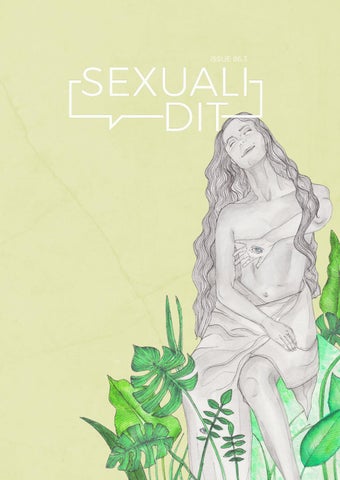
ISSUE 86.3
Upcoming Issue Contribution Due Dates Queer Dit: 13th April Issue 6: 27th April We’d love to hear your ideas! Email us at onditmag@gmail.com
– On Dit –
ON DIT CONTENTS Editorial SRC President What’s On Vox Pop Left, Right, & Centre EconDit
3 4 6 8 10 12
ARTICLES From Rabbits to Fingers The Stripper Stigma Rape is a 4 Letter Word Artist Feature SEX! History of Love We Speak No Americano The Curious Case of the Moral Media That's It, I'm Kinkshaming Nautilus Sex Sequel: The Cuddle My dog has met all my lovers
14 18 22 26 34 36 42 48 52 57 58 59
ARTWORK "Fingered Rose" by Emily Lewis "Sunflower Bloom" by Natasha Martin "Censored" by Natasha Martin "Gender and Insecurity" by Natasha Martin "Love" by Jennafer Milne "Squirting Flowers" by Emily Lewis
17 21 30 32 47 56
EDITORS Connie Tran Ethan Penglase Nuer Deng SUBEDITORS Dylan Rowen Ellie Stamelos Hilary D’Angelo Kiri Marker DESIGNERS Anzelle de Kock Jennafer Milne
COVER ART "I Only Have Eyes For You" By Nozhat Hassan EDITORIAL PHOTOGRAPHY By Kind passerby in the Cloisters
On Dit is produced on the land of the Kaurna people. We acknowledge them as the traditional owners and custodians of the Adelaide Plains. Their land was stolen, never ceded. It always was and always will be Aboriginal land.
2
– On Dit –
EDITORIAL
Welcome to our third issue of On Dit of the year! This sex-themed issue, Sexuali-Dit, is the one issue where we get to talk about the birds and the bees and what it’s like to bump uglies. At this point you may be thinking something along the lines of, “oh no, not another publication filled with awkward
piece on the ascension of questionable kinks that may appear to be acts of liberation but when closely examined, isn’t necessarily the case.
sex stories and kinks!”. While we hope this is not a sentiment you agree with, we would like to make the case for you to consider treating yo self and taking the time out of your oh-so-busy schedule and indulge yourself with this issue. We consider it to be an important part of On Dit and that’s why we’ve made sure to bring it back this year. It’s a great opportunity for students to express and discuss their most intimate thoughts about sex and the place it occupies in our society.
“Sex Sequel: The Cuddle”, Kylie Chinner manages to get the reader to relate to an intimate moment as if it were their own while Dylan explores the “History of Love”.
While most of the content is light and fun (check out Caitlin's piece to find out the many ways you can have fun with sex toys and a whole lot more), we are also proud to have pieces that discuss pressing issues in a more serious and conscientious tone. Be sure to have a read of one of our editor’s poignant
We also have a range of creative writing lined up which I’m sure you will find intriguing. In her piece
We hope you enjoy reading this issue as much as we enjoyed producing it. We are always looking forward to hearing from you so feel free to shoot us an email at onditmag@gmail.com, or like us on Facebook. (Also, check out the last question on LRC and let us know which of the three gentlemen you would Fuck, Marry or Kill.) Your editors, Connie, Ethan, and Nuer.
3
– On Dit –
SRC PRESIDENT Words by Matthew Boughey
CONTENT WARNING: Sexual Harassment, Sexual Assault, Rape. Consent: an unequivocal and voluntary agreement that is crucial for any sexual encounter. Consent is about communication. It should be agreed between participants to engage in sexual activity every time, regardless of circumstance. Whether you are kissing your long-term partner or having sexual intercourse with someone you haven’t met before, verbally agreeing to sexual activities can help you and your partner respect each other’s boundaries. Without gaining consent, any sexual activity constitutes sexual assault or rape. Engaging in this kind of behaviour is something you want to avoid. It not only causes long lasting psychological and emotional impact on your partner but can also have severe legal implications for you. Just don’t do it, OK? Gaining consent is simple. To be blunt, there is absolutely no excuse to not seek consent. Let’s break down the basics: Consent is mutual – both you and your partner have to agree. Consent is freely given – consent is a choice you make without coercion, manipulation or under the influence of drugs and alcohol. Consent is definite – it isn’t a “maybe” or a “I think so”. 4
Consent is reversible – anyone is able to change their mind about what they do or do not feel like doing, regardless of whether you’ve done it before. Consent is informed – you can only consent to something if you have the full story. For example, if someone says they’ll use a condom and don’t, consent hasn’t been fully established. Consent is never implied by things like your past behaviour, what you’re wearing or who you hang out with. Sexual consent is always communicated. There should be no guesswork or mystery. I find it quite sad that I must take the time to spell this out. It really is something everyone should have a firm understanding of. However, it is no secret that some in our community have an absolute inept understanding of consent and acceptable behaviour more broadly. The Australian Human Rights Commission found around half (51%) of Australian university students were sexually harassed on at least one occasion in 2016. The overwhelming majority of those affected were women. This survey further adds to the body of evidence that highlights the alarming levels of sexual violence against women in Australia.
– On Dit –
At our university, 28% of students reported being sexually harassed. This is the highest rate in South Australia. To paint even more of a bleak picture, last week the End Rape on Campus group published a report, titled “The Red Zone”, that details instances of hazing and sexual assault at university colleges around the country. The report includes instances of male students masturbating into female student’s shampoo bottles, annual events where students are encouraged to share details of other students’ sexual activity and “age-old traditions” of older students “ranking” younger women. Clearly, effective and meaningful discussions around consent are lacking in our universities. As well as this, university administrations across Australia have consistently failed to provide adequate support services to survivors. For example, 57% of Adelaide University students knew little to nothing about where to seek support from the university. Furthermore, there is a complete lack of consequences for offenders and action taken by universities to stamp out this type of behaviour. An FOI investigation by Channel 7 into sexual
misconduct at Australian Universities revealed, since 2012, there were 575 cases of sexual misconduct (a quarter of those specifically relate to rape), only six resulted in an expulsion. Your SRC will be agitating for meaningful change. We will be fighting for education programs for staff and students and adequate support services for survivors. As well as this, clear disciplinary consequences for offenders. All students should be able to come to university without the fear of sexual harassment and all students should know what is appropriate behaviour and what isn’t. If this has raised any issues for you please contact: Yarrow Place for counselling and 24 hour support on (08) 8226 8787 or 1800 817 421 (outside Adelaide) South Australia’s Victim Support Service on (08) 8231 5626 Relevant SRC Members: SRC Women’s Officer at srcwomens@auu.org.au SRC Queer Officer at srcqueer@auu.org.au SRC International Officer srcinternational@auu. org.au SRC President srcpresident@auu.org
5
– On Dit –
MICHEL FOUCAULT: “WHAT IS AN AUTHOR?” 29th March @ 15:00-17:00 Goodman Crescent (in front of Elder Hall) The folks at the University of Adelaide Literature Club will be holding a lil get together to discuss all things Foucault. Everyone is welcome, and don’t forget to bring snacks to share! Location subject to change due to weather. For updates and future event details follow their Facebook page for more.
THE CREATIVE DESIGN MARKET: EASTER SUNDAY 1st April @ 10:00-16:00 Plant 4 Bowden Love cute markets? Plant 4 Bowden will once again be open and feature a wide variety of local stallholders for you to peruse. And with free entry, you know it’s time treat yourself this Easter Sunday.
HOUNDWARE: DOGGY DAY OUT 7th April @ 11:00-14:00 Light Square, Adelaide If you’ve got a furry friend lying around at home, this is your opportunity to get out and about. HoundWave will bring together all dogs (and their humans) for a relaxed day out. Proceeds will go towards supporting RSPCA and AWL. 6
– On Dit –
TASTING AUSTRALIA 13 - 22nd April Victoria Square, Adelaide Calling all foodies! This 10 day extravaganza will feature a range of South Australian culinary delights. With plentiful of local food and beverages for you to try, your taste buds will be sure to thank you.
AUSCA SEMESTER ONE PUBCRAWL (PROPER LAB ATTIRE) 20th April @ 6:00pm - 12:00am Lady Symon Building, University of Adelaide
GROOVIN THE MOO
The Adelaide University Science Association will be holding their semester 1 pub crawl. Shirts are $20 for members and $25 for nonmembers. Make sure you rock up in "proper lab attire!"
27th April @ Wayville Showground One of the Adelaide’s most popular music festival is returning to Wayville this year. With the lineup including stellar acts like Duke Dumont, Sampa The Great and Dean Lewis, it’s not one to be missed!
7
– On Dit –
Vox Pop Where we ask students the important questions.
Elanor
Gustavo
Biomedical Science
Commerce
1. Meat stick.
1. Schlong.
2. Holes in underwear.
2. Sassy girls.
3. Jessica Rabbit.
3. Not into the 2D world.
4. Like a washing machine.
4. Biting your face off.
5. Yay. People who say no obviously haven’t had a good experience with it yet.
5. Fuck no!
8
– On Dit –
1. Weirdest euphemism you’ve heard of for a penis? 2. Biggest turn off? 3. Sexiest cartoon character? 4. Describe the worst kiss you’ve had. 5. Shower sex - yay or nay?
Mina
Cadeau
Law
Mathematics & Computer Science
1. Eggplant.
1. Haven’t heard a lot of weird names.
2. Guys watching a lot of porn.
2. Dishonest character.
3. Wonder Woman.
3. Chris from Family Guy.
4. Like eating slippery cabbage.
4. Pass.
5. Nay...
5. No? You’d get cold, it’s not practical.
9
– On Dit –
LEFT, RIGHT, & CENTRE LEFT
CENTRE
ADELAIDE UNIVERSITY SOCIALIST ALTERNATIVE
ADELAIDE UNIVERSITY LABOR CLUB
LEIGH BRIAR
1. There’s nothing positive in Turnbull’s ban on government ministers having sexual relationships with staffers. The justification for the new code of conduct is that it takes respect for women more seriously. No doubt there is a lack of respect for women amongst the political elite, but this implies that you can’t respect a woman you sleep with. There are plenty of more insidious issues of sexism and disrespect which Turnbull fails to address. A ban on consensual sex between men and women in different positions of power takes away women’s control of their lives. Penalty for a consensual relationship not for sexual abuse charges, but simply for adultery, and rules about who can sleep with whom, should be rejected. The ban does nothing to challenge the power imbalances created by an overwhelmingly male cabinet. Turnbull deserves no credit for this desperate attempt to save his crisis-racked government.
10
TAHLIA PENN
2. The criminalisation of sex work only supports the police victimising women in some of the worst conditions of poverty and unemployment, so should obviously be opposed. I’m also opposed to the sexist and violent practices within the industry. These can’t be fundamentally challenged without also taking on state-sanctioned violence and winning economic security and equal pay for women, LGBTI people and the rest of the oppressed. 3. Um, nah.
1. Yes, in my opinion it is inappropriate for government ministers to be having sex with their staff. All staff should be treated respectfully and equally based on their professional skill level, and by engaging in that kind of behaviour subconsciously creates a favoured opinion of someone, and the consequences of this could see a person more qualified for a job pushed back for it; many workplaces have this kind of code of conduct for this very reason. 2. Whilst I’m in favour of the decriminalisation of sex work, I believe it is wrong to place no restrictions on where the soliciting of the service takes place. Not every public place is appropriate for this, nor is it wanted in every type of public place. For example, you wouldn’t want a man or a woman soliciting sexual services at places such as family parks, outside of schools, and generally anywhere that has a high population of children. That being said, not all places
– On Dit –
1. Do you think it is inappropriate for government ministers to have sex with their staff? Why? 2. A Bill to decriminalise sex work and place no restrictions on where soliciting or prostitution can occur has already passed the SA Legislative Council. Should the House of Assembly support this Bill? 3. Fuck, marry, kill: Donald Trump, Vladimir Putin, Kim Jong-un
RIGHT
SARAH TELLIS ADELAIDE UNIVERSITY LIBERAL CLUB
are safe for the sex workers, so the House of Assembly should support the Bill, but they need to think about what places are actually appropriate for the public and are safe for the workers. 3. Fuck Putin. Marry Kim Jong-un. Kill Donald Trump.
1. This question should relate to all MPs. As long as both people consent, and taxpayer funds aren’t misused, I have no issue with it. Although I don’t think there would be any pride in having sex with any current ministers. 2. The house should support the decriminalisation of sex work in order to protect people working within the industry. However, there should be some restrictions on where soliciting and prostitution can occur for discretionary reasons. 3. Fuck Vladimir Putin. Marry Donald Trump. Kill Kim Jong-un.
11
– On Dit –
How frangas aid the economy: a brief analysis Words by Grace Morgan-Cocks Artwork by Jennafer Milne
Getting pregnant is expensive. Getting pregnant accidentally can be financially devastating. There is a large diversity of reasons that access to reproductive choice has been advanced by progressive organisations over the past century. Many of them are founded in ethical arguments over the rights of women to assert their bodily autonomy and choose their destinies for themselves. But, as many studies in developed and developing nations have shown, being able to plan your family (and avoid surprise pregnancies) can help to realise more opportunities and avoid a lifetime of poverty that often continues to resonate generations into the future.
12
Taking a broad example, it is understood that poorer families generally have more children than affluent ones. It is also well known that children from poorer families receive fewer parental time and resource investments, and are more likely to experience delayed development and health problems, live in more dangerous neighbourhoods, and attend underperforming schools. Children from poorer households are less likely to attend and complete higher education, limiting their earning potential. Consequentially, over 40 percent of children born to parents in the lowest quintile of family income remain in that income quintile as adults. This means that a woman’s inability to plan her family can lead to the impoverishment of her children, well into adulthood. This is true all over the world, but especially in service and resource poor areas. Women who can choose when and if to become pregnant also have more money and opportunities, whether educational or vocational, by delaying the pay gap typical between working mothers and their childless peers, and reduce a woman’s likelihood of relying on public assistance through welfare.
– On Dit –
In 2010, it was estimated in the US that a $1.9 billion investment into public family planning and sexual health services prevented 2.2 million unintended pregnancies and 761,000 abortions. Less significantly, this investment created a net saving of $13.6 billion for the public – that is, for every $1 dollar actually spent by the government, they saved $7.06 dollars that would have been spent otherwise. But, in the US, where health insurance is neither universal nor mandatory, subsidised family planning programs only meet 54 percent of the need. Sadly, many women go without critical education and prevention necessary to avoid pregnancy and illness – the consequence of this not only being billions of dollars spent on future welfare and healthcare, but more importantly the suffering and sometimes death of women who weren’t fortunate enough to receive the education and resources they deserved.
We are lucky in Australia to have access to safe, cheap, and effective contraception – many people elsewhere don’t and will be worse off for it. Rationalising the financial gains and losses on what always proves to be a divisive and emotional issue isn’t an attractive argument to pursue. But critically, like Thomas Malthus theorised 200 years ago, poverty and family planning are inextricably linked. Solving one without the other has and will continue to prove futile, and until every person has the resources to plan for their family and their future, tackling poverty will be a losing game.
If you'd like to get involved in the Economics Club, sign up to the Facebook group and tag along to some events.
13
– On Dit –
From Rabbits to Fingers Words by Caitlin Ellen Moore Artwork by Anzelle de Kock So, you’re getting hot and heavy with yourself (or someone else) and you want to add a little something to spice things up? Reader: meet sex toys. Sex toys: meet the reader. Like any new introduction, you’re not too sure where to start. Where do you even get one from? What do you get? How many are there? What types are there? Luckily, I’ve made a handy lil guide for you and your next solo time adventure (with a few handy tips too).
Hands ...or your fingers depending on your genitals. This one’s a classic. It doesn’t really require any prep and they’re ready to go whenever you are. It also happens to be free! So free, accessible, and no extra prep, what else do you need? There are different techniques to using your hands. So sit back, relax, and start feeling yourself.
Bullets The travel friendly vibrator! Bullet vibrators are an easy entry into vibrators. They’re small, sleek, not at all intimidating, and tend to be a little bit cheaper. The bullet is perfect if you travel a lot as they’ll easily fit in your bag.
14
– On Dit –
Rabbit “I’m not gonna replace a man with some battery-operated device.” “You say that but you haven’t met the rabbit.” Thanks Sex and The City for introducing the world to the rabbit vibrator. The rabbit hits all the right spots, from the clitoris to the g-spot. It’s a vibrating and rotating sex toy... which also happens to be phallic shaped (meaning penis shaped). Use this to speed your way to the end of the race.
Wand Stop your fantasizing now, this is not a magic wand. Rather, it’s the OG vibrator. It was originally designed to be an all body massager but became a common household vibrator in the late 60s. So props to all the sexually frustrated housewives for sparking a sex-positive, self-loving movement.
Vibrating Underwear Tired of your everyday life? Want to spice things up a bit? Bit of an exhibitionist? Vibrating underwear is the thing for you! Discreet, thrilling, and adds a little extra to lingerie. There is also edible underwear – but if you feel a tingling sensation over that, remove ASAP.
Anal Toys I’ve only got one thing to say about anal toys. Okay, I’ve got three. LUBRICATE. LUBRICATE. LUBRICATE. The skin there is extremely sensitive so be gentle, take your time, and slip slop slap!
15
– On Dit –
Dildos Ahh, dildos. Can’t forget about the penis now, can we? If you need something vaguely phallic shaped to get off – this is the toy for you. They come in different shapes, sizes, colours, some are ribbed, some are veiny, some can be shaped to look like a penis already in your life.
Penis Ring Speaking of penises, here’s one for all you penis owners out there. The penis ring is perfect if you want something a little extra in bed. It’ll cut off your blood flow, so longer erections, and it vibrates, adding some extra stimulation for your partner (15-20 mins max for this one).
Extra Tips 1. When trying a new lube, do a skin test! Make sure you aren’t allergic 2. 3. 4. 5. 6.
16
to it. A small spot on your arm is perfect. There are three main types of lube: oil based, silicone based, and water based. Oil based has a thicker consistency and tends to be less irritating. It doesn’t go well with latex. Silicone based is extremely slick and lasts longer. It does, however, destroy silicone toys. Water based dries out quickly and gets sticky. It goes well with everything. Buy batteries from Bunnings, you’ll thank me later.
– On Dit –
The Stripper Stigma Words by Ashleigh Trenwith Artwork by @angvs
It is no secret that stripping is grossly stigmatised. This is particularly true for the females in the industry. The stigma tends to portray strippers in a less than favourable light: assumptions are constantly being made that they have no morals, no self-respect and are stripping because they can’t get a “real job”. Since social media has become more dominant in society, strippers are often used as the butt of jokes and memes. Posts such as “I guess I’m dropping out and becoming a stripper” make it clear that stripping is perceived as the bottom of the barrel, an “easy way out” profession. I decided to investigate some of these stigmas and explore how much truth there is to them and if stripping is really as degrading as people perceive it to be. I also wonder if there is a degree of liberation to the job.
"Strippers have no morals" Perhaps the most common stigma is that strippers don’t have morals, and female strippers constantly being labelled as “gold-digging robots”. Furthermore, we must consider the basis of the “no morals” stigma. It is deeply derived from the medieval view that men are physically unable to control their sexual urges and therefore, it is immoral for a woman to put them in a situation that causes these urges to emerge. This view is extremely misogynistic and not to mention, grossly underestimates the abilities of men to be anything other than drooling chimps over a woman’s body. However, this is not particularly true. “I don’t remember signing a pact to give up my soul”, one stripper writes on an online forum. “I love my family and friends intensely.” Also, it raises the question of why the women in these professions are perceived as “immoral” for doing their job, however, the men attending their workplaces and paying them to perform provocatively and quite often sexually mistreating them are not. Why do we not hear as much about male strippers being called immoral as female strippers? Even though we have come a long way in terms of rape culture and gender roles since stripping first emerged in the 1800s, it would be naive to think that the factor of a stripper being female doesn’t feed into the “immoral” stigma. Furthermore, one Quora user raises the question, “how many strippers do you know who have been accused of molesting children? How many saints?” Although no morally correct person could deny that molestation of a child is 18
– On Dit –
a deeply an immoral act and despite the statistics, saints are often highly respected while strippers are perceived to be immoral simply for presenting their own body provocatively. This further emphasises the misogynistic nature of the stigma.
"Strippers have no self-respect" Leading on from the morality stigma, another huge stigma regarding strippers is that they have no self-respect and are sexually promiscuous. “You have to have the lowest of low self-esteem to do something that degrading...that and porn”, writes forum contributor “Pr0m Queen”, with many other contributors on the same forum likening strippers to prostitutes. However, this view is met with disagreements. Another contributor aliased as “hotsunset28” argues, “I'd say yes [strippers have self-respect]. You don't take your clothes off in a club full of folks unless you think you have something worth paying for.” This view implies that strippers taking off their clothes for an audience is simply a way for them to express confidence and empowerment within their body rather than open themselves up for sexual encounters and abuse. Furthermore, a Californian study was carried out involving 2 groups: one involving undergraduate students who were strippers and another group of undergraduates who were not strippers. This study revealed that strippers were more conscious of their physical appearance and therefore, invested more time in self-care rituals such as going to the gym and hair and nail treatments. This concern for their health and how they’re presented to the world implies at least some level of self-respect.
20
"Strippers can't get a 'real job'" Perhaps the most presumptuous of the stigmas: stripping is the epitome of dead end jobs and strippers only strip because they can’t get a degree or any other work. But in fact, this is in many cases, far from the truth. Staff that have been employed at a strip club have stated, “it’s not at all uncommon to find dancers with an advanced degree”. Furthermore, a British study found that many female strippers enjoy their work and conducted surveys on chat rooms where several strippers named many motivations that weren’t monetarily motivated as a reason for them to continue stripping, although they were capable of having other jobs. This puts into question the stigma that perceives stripping as a last resort to those desperate for money.
So why strip? If not for monetary reasons, why do people choose to strip? We’ve all heard of the downsides of stripping but is it possible that there’s a degree of liberation that comes with the job? One stripper thinks so. She writes, “I crave the stage...I love being the centre of attention and adoration. I love being the fantasy”. She then goes on to write how the job “embraces beauty, not perfection” and how she loves the “grace, confidence and energy of the dancers”. She also goes on to say that stripping allows women to “embrace their sexuality”. This implies that although there are obvious aspects that can be seen as degrading in being a stripper, there is also a definite sense of empowerment and liberation that comes from it. For many women, being involved in the profession even makes them feel more confident in themselves and their bodies, obliterating the “no self-respect” stigma discussed earlier. With all these aspects in mind, it is safe to say that stigmas surrounding strippers are almost never entirely true and there is undoubtedly a sense of empowerment and liberation to the job.
– On Dit –
RA E 4P IS A
22
LETTER WORD Words by Nijole Naujokas
E
– On Dit –
It seems that the whole country was affected when Jill Meagher disappeared. Her disappearance and death caused a mass outpouring of grief in Australia. I want to treat her passing with respect, and I do not want to add distress to her family. I do, however, want to analyse why the whole country grieved for her. What was so particularly poignant about her death?
Content warning: Rape By now you are probably sick to death of hearing about rape, violence against women and general sickness in society towards the female gender. Shit, even I’m getting a bit of rape fatigue. I want to make clear that rape and sex are not the same thing. Sex is a consensual act between willing parties who respect each other’s boundaries. Rape is a crime. It is a forcing of a physical act, imposing one’s will upon another through coercion, threats, or brute force. It can be silent, or loud, and happen to anybody. Many times however, sex can turn into rape when someone’s wishes are ignored, or when a sex act continues when one party wants to stop. In terms of rape, I want to turn to the horrific events in Victoria in 2012, where Jill Meagher, an Irish woman living in Brunswick, was abducted, raped and murdered. So I will now ear bash you for a bit and hopefully not add to your rape fatigue.
Jill Meagher was obviously a beautiful woman. Her stock file photo used over and over again in media reports show a woman with jet black hair, clear skin, and shining eyes. She is looking up, almost hopefully. It’s a powerful image. It shows a woman with promise and hope of all good things to follow. She was married, she was employed with ABC radio; stories in the media relay that she used to bring cupcakes to work. From all reports, she had a zest for life and was loved by everybody. It is clear that she was a lovely person, and
deserve this.
didn’t
And therein lies the reason we were shocked. She was married. She wasn’t dressed in a “provocative” manner. She used a busy, well-lit road to walk home. And yet, she was abducted, brutalised, and murdered. She took the necessary precautions. And yet she was still raped. This blows apart the flimsy bullshit advice women are told over and over again – you can avoid attack. If someone like Jill Meagher can be taken and murdered, then any woman can. Her demeanor and dress couldn’t be more dignified and appropriate, so it’s a little hard to blame her for her attack, which is what usually happens to women who have experienced sexual assault 23
– On Dit –
It helps that she was beautiful and married. She wasn’t single. She wasn’t going home with some guy. She was going home to her husband, someone who loved her, and that still did not protect her. Whether we realise it or not, society likes to find excuses for rapists. Because it’s uncomfortable to think any woman can be raped, that we can live in such a sick society, we focus on what women do or don’t do, and not the rapist. It’s important to note that the perpetrator, Adrian Ernest Bayley, had multiple previous convictions for sexual assaults. In 2000, he raped five prostitutes over a six month period and was on parole for those attacks at the time of Jill Meagher’s abduction, rape and murder. It makes me wonder if some women are more worthy victims than others when it comes to rape. Would the disappearance, rape and murder of a prostitute have garnered so much attention in the media? It should, but sadly I don’t believe it would. At the time of the Jill Meagher murder, Channel 10 interviewed one bereaved father who had lost his daughter to a violent stabbing 20 years ago. On Channel 10 he said she was “very naive” and that “unfortunately women continue to make risky decisions”. This father wanted to roll out to high schools his program of teaching “women’s safety.” I do not doubt his sincerity, or his passion to do good, to make something worthwhile out of his horrible tragedy. However, this is the worst approach to the situation of sexual assault. The
24
last thing high school girls need to be taught is that attacks on women are normal, and to basically expect them from men. I would dearly love to see a subject in high school taught to all students: consent. How about teaching boys that they do not have the right to a woman’s body, and to respect limits and boundaries? How about teaching that just because you have had sex before, or maybe mucked around, doesn’t mean you get a free pass to their body whenever you want? The respect for boundaries goes for boys and girls. How about specifically saying “don’t rape women, don’t rape men”, but more importantly, what rape actually is? A lot of the time, it is not a stranger on a street in the middle of the night, although that does happen. It is the drunken party at your friend’s place, where maybe you wanted to kiss but that was it. Or maybe you changed your mind, but you are so terrified that you feel you can’t voice that feeling, and go along with it. You might have agreed to one sex act but not another. Maybe you are drunk, or on drugs, or maybe you’ve had sex before. But in all these scenarios, the victim is just as deserving of help and sympathy as in the Jill Meagher case. The virtue of the victim should not be on trial. The perpetrator should be. It seems utterly bizarre that women are taught “walk in pairs”, “have money for a cab”, “don’t drink too much” but men are taught…nothing. Here are a few tips for said men. Don’t jump out of bushes and attack women. Don’t pretend to be concerned for her welfare when drunk and then rape her. Don’t abduct a woman or hold
– On Dit –
weapons to her throat to gain “sex”. Ask your sex partner, “are you ok with this?”. If you get no answer, or she looks away, or she is crying, or she is unconscious – don’t proceed. If she says, “I want to stop” or “I can’t anymore”, then for Christ’s sake, respect her wishes! Don’t think you can amp her up again, or change her mind, by maybe mucking around again and “convincing” her to go once more. If she says she doesn’t want you to touch her vagina, but she is happy to cuddle and fondle, don’t “accidentally” touch her vagina and then blame clumsy fingers, or that “it was only for a second”. Women are taught to shut up and ignore bad behaviour in men, so look for non-verbal cues. Pushing you away? Stop! Maybe she wants to stop but doesn’t know how to ask. Saying she feels sick? Stop! Saying she is sore? Stop! Women have been almost conditioned to
Better to have a “really bad” one-night stand, rather than say, “I was raped.” It is in this way that rape becomes a four-letter word. Consent is an ongoing process. It is not something that is given forever. And consent in the face of fear or coercion, or threat, is not consent at all. I realise I have focused on heterosexual man/ woman situations here, but these nuggets of wisdom can apply to any gender, any relationship. Rape happens in same sex scenarios too. Hopefully I haven’t added to your rape fatigue. Now you have dutifully read this article, go play some Angry Birds, or Farmville (if people still do that, I have no idea), or watch something on ABC iview. You deserve it for reading something not too fun.
expect sexual assault, and so are usually scared to say, “I’ve changed my mind” and feel compelled to continue in a sexual situation even if they don’t want to. The problem is many women do say they want to stop, and are ignored by men who refuse to see the terror in their eyes, or listen to things they don’t want to hear. They are scared that if they don’t want to fuck again, and say so, that the guy will go ahead anyway. It’s better to agree to sex than be raped isn’t it?
25
– On Dit –
Artist Feature
Nozhat Hassan I came to Australia when I was around 8 years old in 2006. I had just arrived from England, but I found it quite easy to settle into the Australian lifestyle (though I will admit the weather took some time). While growing up I’ve tried new hobbies, but nothing has made an impact the way art has. Art has always been there as a source of comfort for as long as I can remember. Whenever things get overwhelming, drawing even for a just few minutes allows me to pause and refocus. The cover for this issue was particularly fun to create as there was a bunch of people who contributed to it. I’d like to thank my lovely friend for modelling for it (I love you and your abs), and to the amazing On Dit team for creating the background! And if you are wondering what the two little eyes in the cover mean…I am just as clueless as you are.
26
X E S – On Dit –
Now that I have your attention, why not read my article about sex? The concept was first described to me in 2001 by Brendan Sullivan, who explained it was when a mum and a dad “rub their willies together.” We were both six years old and I took his word for it.
Not too long afterwards, I was wandering the school yard during lunch time, wondering where everybody was. The place was absolutely desolate, nothing in sight but asphalt, and I was beginning to think I’d not heard the bell. After a few minutes I made my way back to class and spied the darnedest thing; Martin Roseman and some girl named Phillipa were taking turns lying face-down on a bench, showing each other their bums. I’m pretty sure they rolled over too. I remember thinking it looked really fun, but there was a teacher vs student softball game on and we were obviously meant to be looking at that instead.
34
A few years later, my best friend at the time was sleeping over at my parents’ beach house. For some reason, we both decided to get naked and enjoy a bit of a frolic. Nothing to it, really, just a few laps of the room with our pre-pubescent dicks flapping about. We never directly spoke of it again but we did film a bit of it. I’m positive we made haste to tape over it the next morning but I’m terrified the footage will surface. It’s one of the reasons I never held a 21st birthday party; I don’t want any home movies sprung on me.
! X
– On Dit –
Many years went by before I had my first successful attempt at self-love. I’d been casually watching porn for a few months by the time –– ever since somebody posted that “xvideos.com is the best porn site” in the comments section of a Doctor Who episode I was watching on YouTube* –– but one day I saw somebody jacking off in the corner of the set and I wondered what that was all about. Safe to say what happened next is the worst thing that’s ever happened in my life. There was so fucking much. Plus it was spring, so the scent of Pyrus calleryana was everywhere in the air, taunting me for weeks. I first asked a girl out when I was 14. The next day was sex education and everybody in our class knew she’d said yes. When it came to forming groups, they all conspired so the two of us would be grouped together, and only us, because there were two more people in the class than whatever number divided perfectly into the number of students per group we’d been asked to form. I tried my best impress her with my limited knowledge of human sexual anatomy but the next day she questioned if I’d asked her out as a joke. Despite this, we lasted a happy six months before she broke up with me ‘cause she figured I was gay. If only she’d known how badly I wanted to rub her willy on mine! When I eventually lost my virginity, my girlfriend told me to “hurry up” because she’d finished already. A few weeks before that, she’d given me head. I asked, “why would you do that?”
afterwards and she cried. Before that, she once invited me to her Dad’s place (he was out of town) for the night but I couldn’t be bothered/ didn’t know where to find condoms in the supermarket so we just slept. I didn’t even try to cuddle her, and when I couldn’t sleep, I asked if I could use another bed. It took me years to figure what she was up to. That relationship didn’t last either. My girlfriend right now is the most beautiful person ever. We first made love after some wine and channel hopping between Smokey and the Bandit 3 and a show where hillbillies catch pigs. Our passion was all-consuming. I hadn’t even held her hand before that. If I could go back, what would I tell myself back in 2001? It’s hard to say. I don’t want to fill a kid’s head with smut and I would’ve been much too young to prevent 9/11. Perhaps the only lesson here is be yourself, let things play out, and be aware of your actions. Oh, and never read the comments. *It was The Mind of Evil, for those playing at home. Episode 6, I think.
Words by Tommy Giordano
35
– On Dit –
History of Love Words by Dylan Rowen Artwork by Jennafer Milne
36
– On Dit –
The concept of love was intrinsic to how power was exerted, maintained and influenced during the medieval and early modern period. Love, as an emotion, was expressed in misogynistic ways which were used to justify the subjugation of women within the early modern social order. Women’s lives were dictated in ways in which heterosexual love was espoused as an ideal, and anything varying from that mould was considered subversive and thus a threat. The emergence of the “population” as a political and economic force was described by Foucault as “one of the great innovations in the technique of power… population as wealth, population as manpower”. The people became a political and socioeconomic force which could be manipulated — how they loved and who they loved would be subject to political and economic scrutiny.
Gendered binaries were focalised during the medieval period to resituate women to roles within the home. The operation of “romantic love” has been a key feature of human society throughout history, however its performance has been dependent on time and place. Love has not always been about sex though. The medieval idea of “courtly” or “romantic love”, is defined as dependent on a “rubric of friendship that emphasised actions – virtue, deeds – and physical realities – boons, comfort –, rather than abstract feeling”. Males within the late eleventh century, as exemplified in Bonizo of Sutri’s writing on the ideal wife, were not considered as bound to ideals of virtue and deeds to exemplify the love of a partner as much as women were. For example, he states that: “if a woman is married, let her … tremble under his authority; she should bring up their children, and take care of the house; she should be terrified of wars, dread soldiers and love peace. Let her carry in her hands loom weights and a comb, spindles and threads, linen and wool and silk.” 37
– On Dit –
Males engaged and initiated in typically masculinised roles, and their “love” to their partners was expressed through actions that inadvertently or not heightened the sense of “otherness” towards the woman in the relationship. Women were expected to find displays of masculine power a form of love, and the upkeep of the familial unit in medieval society was thought of as the height of what was considered “romantic” as described by popular literature of the time. The very concept of “courtly love in the south of France in the eleventh century received special attention and flourished, elevating, and idealizing emotion of love. Love was viewed as an art having its rules; lovers take service in the army of Cupid, and in this service they become pale and thin and sleepless; one cannot love one’s own wife but has to love the wife of some other man, so lovers must keep the affair in secret; love cannot exist apart from jealousy.” 38
Andreas Capellanus’ The Art of Courtly Love (c.1174-1186) describes love as an essential prerequisite to marriage. The patriarchal institution of marriage consolidated the male’s intentions to control intrapersonal power through the acquisition of landownership and property rights that typically come with marriage — the “dowry”. The sanctity of “the marital bond, like that claimed for perfect friendship, is forceful in its singularity and particularity… the coupling of bodies becomes the necessary condition of a unity which must subsequently be constructed; by the same token, the virtues the [married] couple embody are simultaneously predetermined and contingent.” It has been argued that “while the rise of romantic love has been seen to reduce male authority, in practice, it reshaped the terms of negotiation in a manner that left women at a structural disadvantage that would continue into married life”. Single mothers, such as the one in the following source, tend to acknowledge their disadvantage within society as their “loving actions” (ie. sex) left them pregnant. Sex outside of marriage and a resulting pregnancy was considered one of the by-effects of love in late medieval France and acknowledged by the female to be undesired:
– On Dit –
“Here I am, wretched me, I had hidden the thing well, And loved secretly. At last the wrongdoer suffered, For her womb grew fuller And the pregnant one’s birth was upon her From here my mother called me From here my father blamed me Both dealt with me roughly … What shall I go through as a single woman? I am in the stories and mouths of everyone; My pain piles up Because my lover is in exile On account of that tiny trifle.”
39
– On Dit –
As is referenced above, women’s “loving behaviour was synonymous with obedience… love was manifested in behaviour, which, in turn, was expected to conform to rankappropriate patriarchal gender norms. As a result, love reinforced male authority and female subordination”. Julie Hardwick explores this through her exploration of the “familial model of a household in which authority was focused on the husband/father to be a popular concept for framing personal and political relations of authority, linking and naturalising many forms of power”. It still must be acknowledged that “throughout the early middle ages, a modified Aristotelian concept of gender prevailed, enabling some women to play masculine roles”, while still conforming to stereotypical views of how gender should be performed in relation to the narrative of female subservience. Some women in the early modern era could engage society in male roles, however institutions of power managed to inculcate any exploration of individual female identity that does not conform to the heterosexual standards of early modern era society.
40
What generally followed sex was love, which then resulted in marriage. The institution of marriage in medieval Europe was used to consolidate power for the male in relation to “landholding, legal competency, and social action[s]”, and women after this transaction were then barred from public life in ways that males were not. Historically, love and sex have always had complex power structures dictating their existence and how they were performed. Love has been intrinsically connected to domination. How about now, we change that dynamic?
– On Dit –
42
– On Dit –
WE SPEAK NO AMERICANO Words by Ivanna Radix Artwork by Jennafer Milne
It was a predominant sense of boredom during my 6 months abroad that first incited a curiosity to install Tinder. Having never used the app before, I figured that the isolated and foreign territory of Switzerland would be a suitable test location. Awkward encounters with those I knew would be no issue. I wouldn’t have to worry about particular people seeing, and ogling at, my profile. But most importantly, I’d be exposed to an array of intriguing Swiss men. Meeting locals was something I’d struggled with until this point, and perhaps Tinder was the answer. Or so I thought. Friday night. It begins with the typical ritual of pre-drinks at my friend’s flat before hitting up Zurich’s infamous gay club.
“You should get Tinder, Ivana,” she suggests. “If anything, the Swiss are fun to talk to.” The concept of Tinder has always terrified me. Based on stories I’ve heard, it seems intimidating, disappointing and ultimately futile. But hey, I’m in Switzerland, and tonight I see no convincing deterrent. Within two minutes of downloading the app I have multiple matches. Headlining my bio with ‘Australian in Switzerland’ was clearly a winning point. I instantly receive several messages along the lines of “OMG UR AUSTRALIAN???” Being from such a hot, distant and isolated place apparently brings with it celebrity status. People love us over here. I respond to a message that looks promising. Harrison.
“Look at this boy I matched with on Tinder,” my friend boasts as she waves her phone in my direction. In front of me is a muscular, dark haired Swiss man resembling a model. Dominik. Interesting. 43
– On Dit –
With typical Swiss features and dark hair, he looks and seems quite sweet. He asks me if I’m familiar with Zurich’s club scene after my two-month stay. I tell him that it’s lacking but we’re hitting up “Liebe” tonight as per usual. “Oh, my friend and I will come join you,” he offers. “I’ll message you when there.” Right, okay. Cool. First Tinder date occurring within 30 minutes of downloading the app. At a gay club. With my friends. Okay. An experience awaits. Surely enough, shortly after we arrive at the club, in walks Harrison to the outdoor area at which we’re seated. As he waltzes over to me, I barely notice the other boy trailing behind him. Feeling fortunate, I smile as his appearance perfectly matches his careful selection of profile photos. Running his fingers through the thick brown hair shaping his face, he places himself next to me. I catch a waft of what I assume is exotic cologne, exclusively Swiss. Maybe Tinder was a good idea after all. I stare into his deep hazel eyes, but it’s not until he opens his mouth to introduce himself that I realise something has gone horribly wrong. It takes me a minute to process. This boy, to my ignorance, is no Swiss local. He is American. Mistake number one.
44
Harrison starts to boast about how he drove at 200km/h on the Freeway the other day. I can’t remember the last time I’ve been less interested in a piece of information. He tells me that drinks are overpriced in Switzerland but sometimes his friends buy women drinks. Alright? All the while, the other male he brought with him (who, by the way, is actually Swiss) will not stop aggressively hitting on my lesbian friend. Harrison and I are painfully sober. I’m not sure why he told me that drinks story since he has no interest in buying either of us drinks. Fair enough? I feel bad, but I stay with him. I’m not a believer in Barney Stinson’s “Lemon Law”, and despite the unfortunate nationality he seems like a niceenough boy so I figure I’ll give him a chance. For the rest of the night my friends can’t stop laughing. They’ve never seen anything so amusing. “Hey Ivana, how’s your Tinder date going ;) ;)” “Hey Ivana, why is your Tinder date obsessed with you?” “Hey Ivana, you’ve left your Tinder date alone without a leash and I think he’s lost.”
– On Dit –
Next thing I know, Harrison and I are sitting next to each other on the couch. “Hey Ivana,” he initiates. “What do Hungarian people say?” A smile likened to that of an eager child fills his face in anticipation of what’s to come. “I don’t know. What?” I fidget with my hands, edging slightly further away from him on the couch. “Ya,” he declares. Right. “And Austrians, they say ya YA!.” I wonder what time it is and how long we’ve been sitting here. “Now, the Germans say ya ya YA.” I maintain my gaze on him. Maybe this is going somewhere. “But the Swiss,” he adds. “The Swiss say YA YA YA YA YA.” My expressionless face struggles to form any sort of reaction. Harrison beams. He’s so proud of himself. I’m not sure I understand what just happened. I quickly realise it is time to go. Tinder is indeed disappointing and futile. At a loss of how to respond to the highly questionable story, or joke, or thing, that I just heard, I tell him that my friends are waiting and I’m about to miss the bus. Hugging him goodbye, I say it was nice to meet him. What a culmination. On the bus home my friends are at it again. What a shit night, we all agree. One friend is concerned that Harrison’s accompaniment wouldn’t take his male gaze off her and her girlfriend. Another is confronted by having encountered his onenight stand from the previous week. I express my confusion that I somehow ended up on a date with an American when effectively my sole purpose of using Tinder was to meet locals. My friend spits out his water.
“He was Amercian? Oh my GOD. I thought he was Swiss and there was a language barrier and that’s why he was so awkward?” I’m afraid not. At this point, Harrison hasn’t done anything wrong. I feel a slight sense of guilt, but there was nothing there. I’m sure I’ve felt stronger connections with telemarketers. And at least my first Tinder experience is over. Nope. Apparently it isn’t over for Harrison. I wake up the following morning to a string of messages from Mr America. He asks what I’m doing. I feel no obligation to respond. Several hours later, with a suggestive winky face he reveals that he’s started drinking early today. It seems he felt some chemistry? Did I accidentally smile at his outrageous ‘joke’? Another day passes. Perhaps he’s given up. But it turns out Americans are persistent. Suddenly the opening line of another message flashes up on my lock screen: “I really hope you aren’t ghosting me…”
45
– On Dit –
Ah, fuck. Now I start to really feel bad. I anticipate that the rest of the message will express how much he thought we had a nice night and is genuinely hurt that I’m not responding. I open the message. “I really hope you aren’t ghosting me because I didn’t make a move on you the other night. I wanted to bring you home, but I wanted to find a girl for my friend first.”
His message has everything I need to confirm that Tinder is not for me. An insultingly arrogant gesture that the only reason I wouldn’t respond is because he didn’t ask me to come home with him. A complete lack of understanding of basic geography. A mortifying assumption that I would even consider spending hundreds of dollars to fly home in the opposite direction just to sleep with him. And…product placement? Who/what the fuck is Sofus? Despite the train wreck of presumption and insult that is his message, I respond the kindest way I can. I tell him that he seems like a lovely person, but I’m afraid that I didn’t feel a spark when we met.
There’s an alternative.
Buzz. I read the first line of his response. “It’s because the club wasn’t playing any Spanish music,” he insists. Is this guy real? “Believe me, if they’d been playing Spanish music, you would have felt a lot more than just a spark. There was a place like that across the road, but it would have been too hard to bring your friends there.”
I could come to the spa today where “clothing is optional and Sofus gets 50% off.”
And with that, I delete Tinder and vow never to use the app again.
As if that weren’t enough, he then suggests that I “come to Hawaii on my way home” where he can “show me a way better time ;) ;)”. But wait.
46
– On Dit –
47
– On Dit –
The Curious Case of the Moral Media Words by Lauren Copland Artwork by Natasha Martin
Should we bare all or bare nothing? How much or how little flesh should be flashed in the media? This all depends on whether we think the media reflects or shapes society. If it reflects society, then it basically holds a mirror up to us. So, if we live in a sexually free society then there is free reign as to what the media shows. However, if the media shapes society then it bares the question as to whether or not the media has a responsibility to protect the public and present positive content. What can be seen and shown differs from society to society as certain beliefs surrounding nudity and sex differ. Europe is generally considered to be more liberal than America or Australia. The trouble is that sex and nudity are often viewed in the same light. Nudity is seen as either a sexual act or a precursor to sex as the naked body has been so highly sexualised that it is no longer deemed appropriate to be seen. So, how naked is too naked and how much sex is too much sex? Socially acceptable sex scenes and nudity means something different to different countries, what may be acceptable for one may be completely unacceptable for another. For some it is quite common to see bare breasts in the media while for others it is unheard of. Typically, Europe is much more liberal when it comes to sex and nudity
than Australia; it is as if we are still living in the dark ages. I recently returned from a semester spent in a smallish German town and was surprised by some of the things I saw. Things like: a lube/vibrator vending machine in a Bavarian Restaurant, a sex shop on the main street with sex toys on full display to passers-by, and nude magazines with nude cover photos in the train station bookstore. In Australia anything remotely sexual tends to be censored or covered as if it were a crime to seek pleasure or flash flesh. Here, sex shops are secretive buildings with darkened windows which give no hints as to what sordid secrets and objects lurk inside and nude magazines are hidden away and their covers obscured. Germany is no stranger to public nudity, having been the forerunner of the nudism movement. Nudity in Germany finds its origins in the late 19th century, when stripping was seen as a route to fitness and sunbathing considered to be a possible cure for tuberculosis and rheumatism. While nudity might not actually promote those kinds of health benefits, it can help with body confidence and self-acceptance. It is regarded as a liberating act and being naked
49
– On Dit –
is seen as a normal and natural thing – for the self rather than another. Nudity isn’t reserved merely for the home or for nudist beaches, instead it is allowed in public parks like the English Garden in Munich and the Mauerpark in Berlin. In Australia, we tend to be more self-conscious when it comes to nudity as we are taught to hide our bodies under the shield of our clothes. This belief has been pushed to such extremes that women are judged and criticised if they go braless, especially if their nipples can be seen through their clothes. Even breastfeeding mothers are not immune from criticism. Sex sells, which is part of the problem. Nudity is portrayed in a sexualised way in the media to improve profits and sell objects, think of perfume adverts or brands like Lynx. The naked or nearly naked body is presented as being a sexual object rather than just being a body. It is also problematic that the body types shown tend to be idealised rather than representative of the wider population. This could lead to issues such as comparison, low self-esteem, body dysmorphia, and eating disorders. Perhaps if nudity were more acceptable, people would learn to accept their own bodies through being exposed to different body shapes and sizes.
50
Sex and nudity in the media is cause for concern for some as it is believed to influence people in real life. The thing is that people are always going to have sex and experiment, it’s human nature and what they do or do not see is not going to fundamentally change that fact. People can’t rely on what they’ve seen anyway, they need proper education to make informed choices and protect themselves. A sexually repressive society does not lead to less unwanted pregnancies or STD’s, only comprehensive sex education can help prevent that. Sex and sex education are viewed differently in Europe than Australia. The Netherlands is considered a pro-sex country and countries like Germany and Switzerland have comprehensive sex education, nudist areas, and legal prostitution. France is, of course, known for highly explicit films like Blue is the Warmest Colour. In comparison Australia is a kind of “nanny” country.
– On Dit –
ages with categories of 0, 6, 12, 16 and 18. 0 is no restriction and 12 is either 12+ or 6+ with parental supervision. For comparison, Lord of the Rings is rated 12 in Germany and M in Australia while Love Actually is rated 6 and M, so there are subtle variations. Film and television tends to be influenced by the beliefs and ideals of the societies in which they are created. Previously, codes like the Motion Picture Code dictated the kind of content films could contain. It was meant to maintain moral standards and create content which benefitted rather than corrupted society. Nowadays, the Australian Government controls classification. The classification board, as appointed by the Governor-General, follows the classification code, classification guidelines, and community values. In Germany classifications are organised by the movie industry. An autonomous body of volunteers, with no connection to the film industry, classifies content. They must have experience with children, youth, and their development. Germany’s classification system is based on
Ultimately, where you can or cannot take your kit off depends on the ideals of the society you live in. Without a doubt it can be liberating and thrilling to free yourself of clothes for a time, whether in private or in public. It doesn’t have to be about sex, it can just be about you and your body. Sex and nudity in the media can serve a purpose when it isn’t gratuitous. Since we relate to films and empathise with characters it can be helpful when they deal with issues and situations like we do. The media can highlight normal, natural bodies and sexual relations as well as less desirable situations. That is why it is important that content covering nudity and sex is available, even if it isn’t explicit. We need to see stories that speak to us.
51
– On Dit –
52
– On Dit –
THAT'S IT, I'M KINKSHAMING Words by Ethan Penglase Artwork by Kiri Marker Kink, defined as the “use of unconventional sexual practices, concepts or fantasies”, has recently made its way into public discussion. From ABC’s You Can’t Ask That hosting BDSM (bondage and discipline, sadism and masochism) partakers to SBS’s coverage of men who get sexual gratification out of pretending to be dogs (“pup play”), people’s sexual quirks are becoming increasingly public and normalised. The ongoing display and normalisation of sexual kinks is largely due to the sexual liberation movement that emerged in the 1960s (though it has its roots far earlier than that), which promoted the attitude that all consensual sexual activities between adults are fundamentally healthy and pleasurable. The movement came to receive support from the emerging ideological trend within feminism known as “sex-positive” feminism.
53
– On Dit –
Feminists like Susan Blight opposed the efforts of mainstream feminists, such as Catharine MacKinnon and Andrea Dworkin, to centre pornography as an explanation for women’s oppression and instead posited that sexual freedom was key to women’s empowerment. Kinks have become sacrosanct in many progressive spaces to the point that those who attempt to criticise certain kinks are denounced for “kinkshaming” – an act that is treated as bad as sexism or racism. Some “progressive” groups, such as online publication everyday feminism, go out of their way to sanitise kinks. See, for example their article “Your 3-Step Guide to Practicing NonOppressive BDSM”. And yes, that is a real article. Now, this wouldn’t be so morally egregious to me if what was accepted as a sexual kink came with reasonable conditions. But that’s not the case. What emerged as a movement for free love slowly became an excuse for the most problematic of men to carry out disturbing and violent acts upon women, to establish grotesque lifestyles and cultlike communities. But, so long as these repugnant acts are accompanied by an orgasm, the sex-positive activists will defend them to the grave.
One of the more confronting kinks on the rise is age play. Age play is a roleplaying fetish that involves one person taking on the role of an adult and another pretending to be anything from a teenager right down to a baby. The “younger” partner will adopt hobbies typical of children like playing with toys. They will call their partner “daddy” or “mummy”, pretend to not know what sex is and even wear diapers and pacifiers. Of course, the lust for children ends once the couple leave the bedroom. Equally disturbing is race play, in which couples perform racial stereotypes during sex. Think Asian comfort women, black slaves, etc. But I’m sure the (always) white (often) men who fill the dominating role in these scenarios are upstanding members of society. The racism stays in the bedroom. BDSM is a more mainstream kink that has recently received a somewhat facelift with the 50 Shades of Grey franchise. It is nonetheless an incredibly physically and psychologically damaging kink and deeply problematic. The role of gender and race within the BDSM community is stark and cannot be ignored. That is, that the majority of BDSM practitioners are white, the dominators are almost always men and the submissives are usually women. BDSM is nothing more than the eroticisation of the power imbalances within society.
54
– On Dit –
The most troubling aspect of BDSM is the concept of “safewords”. A safeword is a word agreed upon by those engaging in BDSM that essentially means “stop”. The reason “stop” and “wait, that hurts” cannot be used is because the lack of consent and infliction of pain are actually a part of the BDSM act. Thus, non-consent and harm is actively sexualised. But finding non-consent and causing pain arousing is totally an attribute of people who definitely wouldn’t commit rape. It would be incorrect to claim that the sex-positive movement simply went too far. At the crux of this problem is the theoretical error made by sex-positive activists that the bedroom is a space that exists in a vacuum, divorced from the rest of society. It is absurd to suggest that one can leave an entire world of experiences at the bedroom door, engage in sexual acts devoid of any social context, and then leave the bedroom as the same person that entered it. A man who gets off on imagining the black person he is fucking is his slave probably doesn’t have much better views of black people once he leaves the bedroom. Someone who is aroused by pretending to molest a child probably isn’t too far from being aroused by the thought of molesting an actual child. And the man who doesn’t stop when his partner screams “stop” because that isn’t their safeword might very easily, on another day, just not stop in a different scenario. Despite the moral dubiousness of these acts, sexpositive activists still hold that any act in which all parties involved have given free consent is innately good. This is lazy thinking and indicative of a rank liberalism that holds too much sway over supposedly progressive politics. When a depressed individual puts a knife to their skin, is it reasonable to say that this is okay because they technically consented?
Does it suddenly become “pain play” and not self-harm because of the presence of consent and that they wanted to do it? We all recognise this as ridiculous and acknowledge the psychological problems the harmer is suffering. So why is it that when someone else causes the individual harm it is seen as “kinky” and “liberating”? A woman posts a picture of her slashed wrists and we say she needs help. But if she posts a picture of the bruises her boyfriend gave her during sex we say she is empowered. We can debate the virtue or harm of prostitution while still believing that people can consent to sex work. We can talk about the problems of self-harm while acknowledging that the consent doesn’t transmute the harmful act into a good one. And we can do the same with sexual kinks. We can, and should, talk about kinks that normalise pedophilia and rape; kinks that reproduce sexist and racist thinking; and kinks that cause physical and psychological damage. No, I’m not suggesting that we have Big Brotheresque monitors in everyone’s bedrooms to make sure they are only having Party-approved sex. I simply believe that the presence of consent in any act shouldn’t preclude the possibility of debate around the social utility of that act. The fact that it gives you a boner doesn’t make it exempt from critical discussion. Feminists fought for ages to destroy the idea that what occurred in the household was not of society’s concern, an excuse used by abusive husbands and fathers. Today, the household is the bedroom, and we must burst it asunder to social scrutiny. People with age regression kinks, rape kinks or any kink that revolves around simulating lack of consent need to take a look at themselves and ask why exactly they find the idea of deeply harming another human being so arousing. And sex-positive activists need to ask themselves why they’re defending male domination and violence when it occurs in the bedroom. 55
– On Dit –
NAUTILUS Words by Emma Carson
The bed sheets are sand dunes in a silent, desert night –– Spacious and steep –– we tumble into each other’s embrace. Paddling in the oasis made by you and me, we kiss, sigh, bite Rising on a sandstorm and falling faster. Afterglow shimmers on your face. Our chests are now the sea, climbing and receding the tide Catching the sand and smothering us at the cusp of a dream. A nautilus is made from the stripes of our bodies side by side: Yours is a sweet, honey sun tan. Mine is a soft, sugared cream.
57
Sex Sequel: The Cuddle
– On Dit –
58
basking under lovely skin a hairy leg drapes whispers tickle muffled ears smushed between pillow & chest content in body content in soul like a fat cat’s smile love envelopes eats insecurity whole we cuddle until we’re bored. Words by Kylie Chinner
– On Dit –
My dog has met all my lovers. He may be a better judge of character than I. He realised who was shallow long before me. He knew some would not come back. He thought we were fighting in bed. He may have ripped your lingerie. He didn’t bark at you. He slept on your dress when you left it on the floor. He knew you were special long before I did. Words by Joshua Hibovesky
59
IVES E ARCH H T M O FR ) 1.5 (2013 ISSUE 8
K BY ARTWOR EGOR CGR CHLOE M