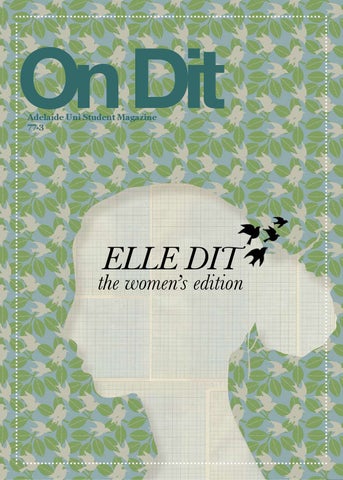
On Dit Adelaide Uni Student Magazine 77.3
ELLE DIT
the women’s edition
1
contact us
Phone: (08) 8303 5404 Email: ondit@adelaide.edu.au Editors: Clare Buckley, Steph Walker & Vincent Coleman
thank you: Clare thanks Chris and Adelaide Uni’s lovely security guards Anders for proofing lots Everyone who remembers distribution
contents
at On Dit :
the team
Everyone who remembers to Proof
2
Will for the nicknames Vinnytron and Stephypants. The new office phone, thanks Marissa! AUU Watch Hannah Mattner State of the Union Lavinia Emmett-Grey This Issues Issue Shelly Lasslet Local Issues Patrick McCabe Jarrod Fitch Lia Svilians Dit-licious Lily Hirsch Fashion Kate Bird Lara Francis Elise Lopez Film Nav Sandhu Anders Wotzke Sean Kellett Literature Alicia Moraw International Student Life Bob (Shenglan Liu) Music Andrew Auld Countney Day Jimmy (Swanny) Clarke
Vox Pop Myriam Robin Christopher Arblaster Nightlife Ainsley Campbell Arts Natalie Oliveri Science Anna Ehmann Gaming/PC Alan Lee Sport Angus Chisholm TV Lauren Roberts Poetry & Short Stories Lauren Lovett Adam Klimkiewicz Pro/Anti-Consumerism Greg Taylor Tristan Adams Witty Wordmith Sean Kellett Marketing William Fisher Design Daniel Brookes Jenna (Xiao Tu)
3-5 6-11 12-13 14 16-21 22 23 24-27 28-29 30-35 36-38 39 40-41 42-43 44-45 46 47 48 49 50
Tits out for the boys Local and Current Devil’s Advocate Witty Wordsmith Fashion Ditlicious Pitch with Steph Hughes Arts Section Vox Pop Music Film Adam Marley Column Neat Ladies Piece Literature Poetry and Short Stories Sport Science Nat’s Column Night Life Social Fumblings
Advertising: Lara Mieszkuc Phone: (08) 8303 6951 Email: lara.mieszkuc@adelaide.edu.au
On Dit: proudly sponsored by them Adelaide University Union folk.
On Dit is a publication of the Adelaide University Union. The opinions expressed herein are not necessarily those of the editors, The University of Adelaide, or the Adelaide University Union.
On Women in Engineering at the University of Adelaide Myriam Robin
A
s much as we at On Dit wish it were otherwise, the fact remains that few Engineering students regularly read your student magazine. And perhaps it is understandable. Engineering isn’t the easiest student culture to break into. The hours tend to be intense, and offer relatively little chance for socializing. Most engies will graduate after four years having not involved themselves in student culture beyond what is absolutely necessary. There is simply so little time. Yet, we have not forgotten the Engies. We keep a close watch. And what we see concerns us greatly. Engineering at Adelaide: Long hours, few women, and the AUES Engineering is not a traditional area of study for women. This is the case at most Australian universities. Female engineering students at Adelaide University are outnumbered four to one. However, this figure averages different degrees which often have much higher or lower numbers of female students. AUES President Kristina Noicos gave me the impression that the figure was often as low as one in twenty in some courses, a figure backed up by other Engineers I have spoken to. In 2008, there were 1776 women to 7910 men in the Faculty of Engineering, Maths and Computer Science (18% female). The Engineering faculty-supported club is the AUES (Adelaide University Engineering Society). It provides many academic services specific to Engineering students (eg. Firstyear Statics tutes, mock interviews, Careers Night), but the society is most famous for its annual pub crawl (‘the largest in the southern hemisphere’), and its barbecues held on campus once a term. Alcohol is at the core of these events, which are attended by both Engineering students and those
from other faculties (approximately 30% of the AUES’ membership are not Engineering students). The events which prompted this article either took place at AUES events, or involved AUES members. Originally, I was under the illusion that most Engineers joined, or were in some way involved with, the AUES. In the course of my interviews with rank and file engineers this misapprehension was changed. ‘I would suggest that the AUES represents true Engineering student culture as much as a beer bong represents the full depth and breadth of classical fluid mechanics’, says an anonymous Engineering student. The same student explained to me that ‘the basic engineering social unit is the Study Collective. These are groups of 8-15 people who study, party and attend lectures together, living in each others pockets. These groups will form in first year, and will remain essentially unchanged throughout the degree program for most students…The gang of engineers you see in the Unibar, or roaming the town, will usually be one of these groups trying to find some sort of break in the tyrannical workload’. AUES barbecues tend to be run during class-time, meaning many of the more studious engineers simply do not attend, free food and booze notwithstanding. Nonetheless, the AUES is huge. At the end of O’Week 2009 it had 700 members, making it one of the largest clubs on campus. That gets the background out of the way. The School of Engineering has received its fair share of complaints regarding harassment, especially that targeted by male engineering students towards their female colleagues, in recent months. These are some of the grievances. The Megaphone By far the most visible harassment
perpetuated by engineering students involves their use of the megaphone, which is used at many AUES events to promote participation. The use of the megaphone is frequently abused. Typically, this involves an engie chanting into the megaphone for a passing female to ‘get your tits out for the boys’, or making disparaging comments on her appearance. Admittedly, it is only a small number of engineers who engage in this type of harassment. However, it is so public and persistent that its continued existence cannot be written off as the handiwork of a few bad eggs, but must be blamed on a student culture which finds such harassment acceptable. There is little response a girl can make to an engie with a megaphone, making these acts especially cowardly. Sarah Anderson, a student of the University who has witnessed the taunt, says that ‘using a megaphone to ask girls to ‘get their tits out for the boys’ constitutes a breach of the university’s Fair Treatment Policy which condemns sexual harassment. Such behaviours isolate and degrade female students and establish an environment in which women, particularly women in the engineering department, are isolated and thus are disempowered’. AUES Women’s Officer Peta Johannson took a stand when this occurred on the Monday of O’Week this year. ‘I actually spoke to the student who was doing it on Monday, because we had complaints, and I thought as the women’s officer it was my role. I’ve done the sexual harassment course, and I realize that that cannot go on. Tuesday, Wednesday, Thursday, it was fine.’ It is worth noting that the Engineering megaphone was stolen early in this years O’Week. The Email In August of 2008, a female student at the University confronted some Engineering students about their behaviour. In response to this, an email was sent to the AUES mailing list (which in 2008 contained 1000 members by the end of the year),
3
making disparaging reference about the female student’s appearance and sexuality. This action, at best a misuse of the mailing list and vile singling out of a student for speaking out, was only minimally punished. The student who had sent out the email was forced to write an apology. The Scavenger Hunt The AUES conducted a quiz night in October 2008 at the Unibar. One of the activities on this night was a scavenger hunt. One of the items on the list to be collected was the bra of a female student, who was named on the list. This list was widely distributed among those at the Unibar. This item of underwear was forcibly removed from the female student in question while she was wearing it. When I asked AUES President Kristina Noicos why noone had stepped in to prevent it happening, she said ‘It was like, the blink of an eye. They were talking and then he just did it’. Kristina then went on to describe her shock at the incident. The student who committed the assault has since been expelled from the AUES. The T-Shirts All through 2009’s O’Week, the AUES sold T-Shirts to their annual pub crawl. On the Monday, some members of the society told some female students (drunk first-years from all accounts) that they could have free T-Shirts provided that they changed in front of them. Taken in conjunction with the other, more extreme, incidents, it is concerning. Undoubtedly, it puts the society in a very bad light, prompting Kristina Noicos to tell the students in question to stop on the Monday. They were threatened with removal from the lawns should their behaviour persist. There were no more reported incidents of this after that. Why This Can Occur: The Culture A female engineering student who is heavily involved within the AUES described it as ‘a real cultural problem. You have to be tough to survive. If you’re not, you probably don’t belong there…It’s not just within the society. This attitude is
4
evident throughout all of engineering. It does, however, become more pronounced at AUES events where alcohol is involved’. Other students I spoke to were very disparaging towards the AUES. One student wanted to make it clear that ‘what you see is not true engineering culture. it is merely a pimple of engineering counterculture, comprised of the academic scum of the programme, and any response to these unacceptable acts sexual harassment must be directed at the AUES alone, not at engineers in general…most of us… understand what is and isn’t appropriate behaviour for the 21st century’.
giving people a hard time. It is often women who are victimised in this manner.’ In response to some of the incidents described in this article, Lavinia Emmett-Grey wrote a paper on the problems within Engineering at Adelaide University. This confidential report was sent to the Vice Chancellor, the Chair of the Gender, Equity and Diversity Committee, Birgit Lohmann, and the General Manager of Student Services, Judy Szekeres.
Peta Johannson is more optimistic. ‘I think slowly the culture is breaking. Now and again those boys club elements show up, which is, of course, when you get all the guys and they’re together with their megaphones’.
The Faculty Response The Faculty of Engineering, Maths and Computer Science has been for more than a decade trying to increase the number of girls entering undergraduate Engineering programs. Last year, a ‘Women in Technology Challenge’ was held, which invited female students from years 10-12 to come to the University and try several practical Engineering projects, as well as receiving information about the Engineering degrees offered at the University of Adelaide. In the longterm, such strategies may do much to tone down the overt harassment that many female students receive. However, such courses of action have been pursued for years with little significant impact on the bullying and boys club mentality that pervades Engineering. As one male engineering student put it, ‘despite many efforts to increase the percentage of women in engineering throughout the last few decades, the proportions have barely changed, and the university ratios remain reflective of those in industry’. For girls who have been victimized, such long-term, measured responses add insult to injury, with many calling for a more proactive approach that directly addresses the problem to be taken.
AUU President Lavinia Emmett-Grey described an anecdote to me that seems to sum up the culture: ‘Once when I confronted an engineering student about his [calling a girl a slut], his response was ‘I probably shouldn’t have said it, but it is still true’…All this is founded in the idea that you cannot have fun without
The most damning thing regarding the university’s treatment of the situation however has been the breach of confidentiality that occurred when Ms Emmett-Grey’s confidential report was leaked first to the Dean of Engineering, which the Dean then read out at least some parts of to the committee of the AUES. ‘The response to the
The student who was ridiculed in the email was similarly critical of the culture in the AUES. She described it as bullying, and said that it had always been thus. ‘They go through periods where they watch themselves, and then as soon as whatever got them in trouble blows over they go back to being the way they were’.
/
confidential paper fulfilled the worst fears of any victim of sexual assault about reporting, says Ms EmmettGrey. ‘The first thing with such cases is to respect the confidentiality of the victim, and the second is not to take further action without their consent. I consulted with those on whose behalf I wrote the paper every step of the way. The Dean of Engineering’s actions violated both these rules.’ According to Ms Emmett-Grey, when she queried the General Manager of Student Services, Judy Szekeres, about the Dean’s action, Dr Szekeres did not seem to acknowledge a problem with the breach of confidentiality. The AUES Response Peta Johannson, the AUES’ women’s officer, when asked about the scavenger hunt incident, agreed with my assessment of it being ‘shocking. She also pointed out that ‘that’s just what some guys are like when they’re drunk,’ suggesting that while it was unfortunate there was relatively little the AUES can do but respond after the event. However,
the question must be raised why the AUES allowed the Scavenger’s Hunt list to be distributed to every table with the item of clothing listed. The female student made a complaint, which Peta says was the right thing to do. ‘I know it’s been a bit of a bitch, it’s screwed us up for the year… but because it’s gotten the Dean [of Engineering] involved. Suddenly he’s become interested in the society and aware of what we’re doing, it’s toned down some things. This isn’t necessarily a bad thing, because we’ve started thinking of ways we can get rid of these kinds of issues within the club’. As stated before, the student involved in the complaint was kicked out of the society. Ms Emmett-Grey thinks the problem lies not with the club, but with the School. ‘It is unfair to demand a standard of behaviour of the AUES when the Dean and General Manager of Student Services are not modelling appropriate behaviour’.
In her report, Ms Emmett-Grey called for widespread sexual harassment training as a way to educate the Engineering community as to what is and isn’t acceptable: ‘The University has recently placed an online Occupational Health and Safety Training module on My Uni. Why not do the same for harassment? Harassment requires empathy to identify it. Some engineers have a problem with this. I recommended that there be an educational approach to explain what is appropriate and what isn’t. Perhaps this is required for the staff as well as the students.’ This approach is also preferred by the AUES’ Treasurer Yasmin Freschi. One male student I spoke to was much less willing to give the perpetrators the benefit of the doubt. ‘I don’t buy all that ‘sexual harassment training’. Males don’t need to be educated to know it’s disgusting behaviour. Those who do it just don’t care’.
/ / / / / / / / / / / / / / / / / / / / / // / / / / / / / / / / / / / / / / / / / / / / / / / / / / / / / / / / / / / / / / / / / ///// // / / / / / / / / / / / / / / / / / / / / / / / / / / / / / / / / / / / / / / / / / / / // / / / / / / / / / / / / / / / / / / / / / //
n o i n u e h t f state o
Lavinia Emmett-Grey
In honour of Elle Dit, I would like to start this article by congratulating Clementine Ford, a previous On Dit Editor from 2005 who received Barbara Polkinghorne Award on International Women’s Day for service in the media with her feminist column in the Sunday Mail. It’s one of the wonderful things about being involved in the student organisation – so many of the people that you meet go on to be leaders in their area. And my involvement has ensured that I know a doctor, a lawyer and an accountant, which I figure covers me better than insurance. For this Women’s edition which is always one of my favourite editions of On Dit, I’ve decided to be slightly indulgent and tell you what it’s like being a woman involved in the student movement.
When I first became involved, there was a strong women’s collective on campus. Adelaide hosted the Network Of Women Students Australia (NOWSA) Conference in 2005 and it was amazing. Over a hundred female students from across the country participated in the workshops on a variety of topics, from sexual assault to body image. When the Students Association was closed down thanks to Voluntary Student Unionism, there was no support for a women’s collective anymore. In this edition you’ll find an article on harassment at the University of Adelaide. I hope you read it. I hope you’re outraged. And I hope you start to question sexism in your daily lives.
In the AUU, I am one of four women on a board of 18. The first board I sat on in 2004 had five. It’s really
hard to get elected if you’re a woman. When I was running for my first term as President, one board director famously said he wasn’t sure he could vote for me because “a woman can’t be President”. The factions rarely prioritise women on their tickets and its hard enough just to convince women to get involved. I have seen women in student politics have their physical appearance, their sexuality and their gender all come under attack – their policy is almost never the source of criticism.
One of the most common slants that people make against me is that I’m a crazy feminist. It reminds me of a quote I love: “Feminism is the radical idea that women are people.” If you want to get in touch with me, either for a Germain Greer interpretive dance or to call me a bra-burning feminist, you can reach me at lavinia.emmett-grey@adelaide.edu.au
5
Angela White is a humanities student from the University of Melbourne. She is majoring in Gender Studies and currently studying on exchange in Paris. She is also a porn star. Here she gives her own unique porn experience and also her impressions on the industry from and insider perspective and as a feminist, gender studies student. So you’re a porn star yeah? Sure, I’ll take that title! But sometimes I am referred to as a ‘Glamour Model’ or ‘Centrefold Model’ so take your pick. What are the names of some of your films? Big Boob Paradise, Girls with Desire, Bosom Buddies #6, BLOW, A Day with Angela White, Girls Craving Girls, Ultimate Cherry, Big Tit Overload … the list goes on but I’ll spare you the catalogue! What size are your boobs? 12GG-cup Who’s your favourite porn star? Annie Sprinkle How long have you been a porn star? I started straight after my eighteenth birthday. How did you get into it? I knew of a few companies in the United States from reading p o r n o mags that I got my older friends to buy for me. I emailed ‘The SCORE G r o u p ’ because I thought the women in their magazines and on their websites looked most like I do – large natural breasts with curvy hips and thighs – so I thought that would be the best company to work with. Plus, I had done
6
a lot of research into the company and found out that they were a legitimate, professional company. Within a couple of weeks I was flown to Miami, Florida to do my first shoot. I was still in high school and it was my first trip overseas alone, so it was pretty amazing to have an all expenses paid trip and to earn so much money for something I had always wanted to do. What is the funniest story you have from on-set? There have been plenty of funny moments on set. One of the funniest was when I was filming a solo dildo scene. We had to stop mid-way through shooting because the lighting was wrong. I was lying back with the dildo still inside me when the set designer tripped over and I burst out laughing. The laugh meant that I clenched my vaginal muscles and the dildo launched out and hit the videographer (who was poised for the next close-up) in the forehead. It was hilarious. Aren’t you worried about infections or your security? Obviously there is no STI risk when I make solo videos. The sets are always clean and new toys are used so there is no issue there. Of course, there is a risk of being infected with an STI when I shoot girl-girl scenes. But all parties involved in a scene must bring a clear current and comprehensive STI test before a scene can be filmed. It isn’t a foolproof method but the risk of catching an STI is greatly reduced. Damns and condoms need to be a permanent fixture in future porno movies for the protection of workers. Unfortunately because porn is about fantasy, and at the moment contraception isn’t seen as sexy, the viewers don’t want to see contraception so producers don’t want to use them. I’ve never had an STI and none of my friends in the industry have ever caught anything. Of course, it is a possibility but working in pornos is less risky than having a couple of drinks on a Friday night and having a one night stand – a comprehensive STI test is not usually the first thing that partiers ask for! So, you only do girls, why? There are quite a lot of reasons actually. Firstly, I love women! It is a great way for me to connect with other women like me. The
second is that to have longevity in the industry I believe that strategy is key. If I do everything straight off the bat then there is never any room to do anything new or reinvent myself. Plus, I still haven’t decided whether I am actually comfortable doing boygirl hardcore, and I won’t do it while there is any doubt in my mind. You also have a boyfriend, how does he feel about this? How did you break the news to him? The way that the question is phrased, how I ‘broke the news’, assumes that working in the industry is objectionable. I told him the same way I told my parents. Matter-offactly.
How would you respond to feminist critiques of porn? It depends on what they are arguing. I think anyone who critiques pornography needs to understand that pornography should not be taken as a whole. We need to speak of ‘pornographies’ and recognise that some pornography has the potential to be empowering while other pornography has the potential to be
Angela White
Why did you become a porn star? It was something I had wanted to do for years. The most common misconception is that women only do it for the money. I am certainly very privileged to have been able to make the decision to enter the industry without any economic pressures. I was highly sexual from a very young age and was always looking for new avenues to sexually express myself.
believe pornography to be the root of female oppression. What is really disempowering is having some radical feminist, who has never worked in the sex industry, tell me that I am a victim, that I have some kind of ‘false consciousness’ and that my empowering experience working in porn is actually a false one. So really women are only given a voice by some feminists if they are saying the ‘right’ thing.
The Study Buddy of Our Perverted Dreams
Do you ever feel degraded or cheap? No. I have never felt degraded or cheap when working for porn companies. I felt degraded working for Burger King and David Jones, and there were times when I felt degraded when I used to strip on the Gold Coast but never when filming and modelling (and my feelings during my dancing days were always an awkward and paradoxical mix of empowerment and degradation). I have never had better working conditions, or experienced more professionalism than when working in the movies. You consider yourself a feminist, isn’t that contradictory being a porn star? No. Some feminists would think so, but what is actually contradictory is some feminists telling me I can’t be a feminist. The idea that ‘pornography’, of all things, could be conceived of as empowering for women is enough to turn many femos stomachs. Particularly since Dworkinites and others
7
degrading to women (and also to men). I don’t advocate violent pornography, child pornography or any other illegal pornography. The only thing I have the authority to speak about is my own experience in the industry which has been entirely positive and liberating. Obviously that might not be everyone’s experience, and I’m sure that my own experience has been effected by the companies I have chosen to work with – many of which have been feminist or alterna-porn productions who pride themselves on their feminist ethics. Pornography has made me a more confident and independent individual and has helped me to experience and express the (almost) full potential of my sexuality with like-minded people. Do you tell people that you are a porn star? Why not? It depends. I used to tell everyone. I film under my real name as a deliberate attempt to show that I am not ashamed of working in the industry. But I do find that it makes my life easier not to tell certain people, not so much because people stigmatise me (which they do) but because I get treated like a circus freak. Everyone wants to know the ‘dirty little secrets’ of the industry because most people don’t encounter porn stars everyday. They squeeze the juicy information out of me, not because they are actually interested, but so they have some gossip to tell their friends. What do you feel the difference is between you and a prostitute? They get paid to have sex with people and so do you. Well obviously the sex that I am having is documented in photos and video. Thus, prostitution is easier to keep secret. There is a difference in safety. Clients don’t generally take their current STI tests in to show the women they are purchasing services from, whereas when we shoot scenes all parties involved need a current
8
STI/AIDS test. But on the flipside, most prostitutes would insist on condoms, or another contraceptive, but that’s not always the case in pornos. But I’ve never worked as a prostitute so I can’t really give a comprehensive comparison. Don’t you feel you are contributing to the oversexualisation and cheapening of women, as well as creating sexual stereotypes
that are difficult for ordinary women to fulfil? No. Firstly, a lot of the companies that I work for (although not all) are committed to capturing ‘real sex’ with real people. That means that the over-the-top sexual stereotypes created in some pornos are rejected – there are no fake orgasms, no ridiculous costumes, etc. Plus, I myself am not the stereotypical porno model. The fact that I have meat on my bones and have never had any cosmetic surgery (all my lumps, bumps and scars end up in the films) should be encouraging to women who usually only see the ‘prefect’ bodied women in mainstream media. What do you want to tell people about being a porn star? What misconceptions do you want to dispel or what idea do you want to get across? I’d love to dispel the misconception that all porn stars were abused as children or are just supporting a drug habit. My child hood was great, thank you. And I’m a committed student and the biggest nerd you will probably ever meet. I don’t have a drug habit and I rarely drink or party so go figure. What website can I find your pictures on? (secretly, thats just for me). Ha ha! Well there are heaps: www.scoreland.com w w w. v o l u p t u o u s . com www.ddfbusty.com www.scorevideos.com www.boobstudy.com www.dazglam.com www.tokyotopless.com www.tanya-song.com www.nadine-j.de www.ifeelmyself.com … I could make a comprehensive list but there are heaps so I won’t bore you. You can send love and abuse to bustyangelawhite@ hotmail.com
Submission, Islam and Women’s Rights Socrates Vrijheid
The death threat that was found stabbed into the bulletravaged carcass of film producer Theo Van Gogh (distant relative of the famous artist) vowed the same fate for writer, former Dutch parliamentarian and women’s rights activist Ayaan Hirsi Ali. The 2004 short film Submission (written and played by Ali and directed by Van Gogh – available on Google Video) created a storm of controversy, criticizing a range of alleged fundamentalist Islamic doctrines from ‘honor killings’, spousal abuse, misogyny to the wearing of the traditional Hijab (veil). It is no wonder that Ali now lives with constant security presence provided by the Dutch government. Ali, a Somalian expatriate and outspoken critic of her former faith, states that the Islamic belief has “certain characteristics that can coexist with Western democracy”. She says that “as a Muslim I was taught to be generous, to be hospitable, to be kind to the elderly and to be kind to the poor”. She goes on however to argue that “the basic tenets of Islam and the basic tenets of Western liberal democracies are incompatible. Islam fails to recognize secularity or the separation of church and State. Women are subordinate. In Islam, life, liberty and the pursuit of happiness are things that you can pursue when you go to heaven but you have to die first because life on earth is just a passage and you observe certain rules and if you don’t observe those rules you’re not considered a Muslim”. She also criticizes the treatment of homosexuals, or at least “the idea that they are not allowed to live and should either be banished or killed. Now, in liberal societies these are values that are radically different from what Islam preaches”. Facing a backlash from not only fundamentalist Islam, outrage from moderate Muslims is similarly heated. Careful not to generalize though, Ali makes a distinction between Muslims and the Islam faith itself: “Muslims are individuals and they are varied. You will find some of them are radical and some of them are moderate and some do not practice the religion at all. Islam as a doctrine, as a body of ideas, as a belief- means submission to the will of Allah”. In theocratic Iran, Islamic law (Shari’a) dictates that women are not allowed outside without the custom Hijab. She doesn’t believe that Western governments should prevent Muslim women from wearing Hijab in public, as was suggested by some in recent times, particularly in the wake of 9/11, rather she elucidates that “we should not be debating the clothe itself but what it stands for, the sexual morality and based on morality that says men cannot restrain themselves sexually. They are like wild dogs and we women are like pieces of tempting meat and if we do not want to put society into chaos, then we should ideally stay behind closed doors and if it’s necessary for us to go outside of the house, then we need to veil ourselves”. But Ali points out that the Hijab
is just the tip of the iceberg, particularly in Iran and Saudi Arabia, citing inequalities in custody, divorce, and women being not being able to study for any field or enter any occupation as further disparities; as well as vehemently challenging the barbaric act of female circumcision, which Amnesty International estimates some 2 million procedures commence every year, typically found in African communities. As the 2000s marked anew chapter in Western/ Islamic relations and two destructive wars, leaving more than 100,000 civilian deaths and more than a tenth of that figure in Western troop fatalities (Red Cross, 2008), the issue of integrating hard-line faith and democracy is a challenge that is sure to remain a focal point for politicians and human-rights activists alike. Ali, an atheist, said she lost her faith while sitting in an Italian restaurant in May 2002, drinking a glass of wine: “I asked myself: Why should I burn in hell just because I’m drinking this? But what prompted me even more was the fact that the killers of 9/11 all believed in the same God I believed in”. Interview courtesy of ABC
9
Angela McMillan Islamic fundamentalism has saturated media coverage of the Muslim world for far too long. It has led to misconceptions about Islamic people, and overshadows the parallel movement of Islamic feminism, which has been gaining momentum over the last few decades. In contrast to fundamentalism, this groundbreaking movement is challenging certain Islamic traditions that are no longer relevant in modern society. In mid-February, 250 delegates from 48 countries convened at a conference in Malaysia to launch Musawah (meaning “equality” in Arabic). This campaign aims to “reconcile the teachings of Islam with human rights, with women’s rights and with democracy,” according to Zainah Anwar, a leader of the group “Sisters in Islam” who organised the event. The focus of Musawah is to reform Islamic family law, one of the greatest sources of suffering for Islamic women, who are often rendered subservient and disadvantaged, dominated by male heads of household. According to the teachings of the Qur’an, women and men were fashioned from a single soul, and are equal in dignity and worth. Islam advocates “love and tenderness” (Ar-Rum 30:21) in marriage, with partners mutually benefiting and complementing each other. The lived realities of many Muslim families are consistent with these values, but classical Islamic law is not. The degree of discrimination in legal
10
systems varies between countries, but the implication that women are inferior is a staple. In Gambia, 75% of girls are subject to genital mutilation before age 12, despite no mention of this practice in the Qur’an. In Afghanistan, over the past year, there have been 100 cases of self-immolation, a traditional method by which women protest extreme domestic unhappiness. In other examples of Sharia law, women are faced with the prospect of unilateral divorce and abandonment, sometimes possible by text message. Polygamy
is permissible and, although it occurs rarely, this upsets the balance of power in a marriage, undermining the notion of partnership that the Islamic feminists advocate. Activists believe that the Qur’an holds certain universal and timeless truths, but that scriptures should be read within their historical context, and that practices must be re-evaluated for modern living. For instance, a man receiving double the inheritance that a woman does was plausible in a time of bride prices, and when women weren’t financially responsible for their families. Nowadays, Muslim girls often outnumber boys in higher
Painting by Sylvia Perez education, and their employment rates are surging, making this custom obsolete and a hindrance to progress. One must distinguish between Shariah, the divine and unchangeable path towards God, and Fiqh, the human process of establishing laws to achieve this path. Fiqh is meant to be adaptable. When first compiled, the Qur’an brought enlightening changes to Islamic women, improving their status beyond that of their counterparts in other cultures, including the West. S o m e h o w, their customs stagnated whilst others flowed with the times and amendments to Fiqh are now long overdue. M a n y countries have shown willingness to make changes, with Morocco l e a d i n g the way by recognising marriage as an equal partnership in 2004. Turkey revised its penal code in 2005, making marital rape an offence. Some Islamic women may still want to follow tradition, but laws must be amended so that women have the power to make that choice, without fear of condemnation or discrimination. Islam will not lose value by compromising these traditions. As speaker Cassandra Balchin points out “In every tradition, there are always good elements but there are also elements that no longer serve us. So we need to look at our traditions.” For this campaign to work, great value must be attached to adaptability, to free will and to being a woman.
Australia’s Awfuls Michael Norris
Vast improvements have been made to the status of women in Australia. In the last three decades alone, there have been vast advances in women’s education, employment, and political representation. Allow me to throw some statistics at you. In January 2008, women had a labour force participation rate of 58 per cent and accounted for 55 per cent of students enrolled in university. Women’s representation in federal parliament is at its highest and, for the first time in Australian history, the position of Deputy Prime Minister is held by a female, Julia Gillard. Yet, despite this progress, improvement is required. Inequalities between the sexes still exist within Australian society, notably, within the workplace. The most glaring issue is paid maternity leave. Female workers have been expectantly waiting 30 years for what, in many other developed nations, is a basic work entitlement. Sadly, in Australia, two-thirds of female employees do not have access to paid maternity leave. Moreover, recent analysis reveals Australia falls behind countries such as China, Iran, and Tanzania when it comes to the quality of paid maternity leave. The federal government, at the time of
writing, is considering a $530AUD million dollar package which would provide 18 weeks paid maternity leave ($544AUD a fortnight) to the 139 000 entitled mothers.
Surely this is far too much to throw at hormonal, chocolate-craving women! Can Australia really afford this hefty cost in this tumultuous economic landscape? Yes, it can. Any payments made to mothers would be injected straight back into the economy: nappies, baby food, furniture, toys, and ABC childcare centres don’t grow on trees. While this payment would cover material expenses, the most pressing issue is job security. Legislation needs to be put in place to protect female workers’ jobs and avoid unfair dismissal, before or during maternity leave. Job sharing (a three/four day working week) for mothers following maternity leave should be made available, allowing mothers to be with their child during these early years, encouraging healthy development. . Despite positive growth in the employment of women, there are a disproportionate number of women occupying senior roles in the private sector. Only 12 percent of women occupy management positions and measly 9 per cent hold board
directorships. To change these depressing statistics, discriminating institutional barriers within the sector must be dramatically changed. A policy of affirmative action is not the answer. Placing female employees in senior positions as a token to political correctness further angers the issue and is degrading to both men and women. Instead of taking this slippery slope, more Master of Business Administration (MBA) places should be available to females and nation-wide networking events should be organised to empower and encourage professional young women. Furthermore, in a commitment to its members, employee unions should establish commissions to investigate fair hiring, firing, training, and remuneration practices. Accreditations such as the ‘Pink Tick’, which officially recognises female-friendly workplaces, should be sought after certifications. Incentives, such as lower business taxes upon accreditation, could also be used as carrots to dangle in front of ever-greedy Managing Directors. Ultimately, to improve the status of women in Australia and bring about equality, a lot of work is required. Yet it is not an insurmountable task; it is both possible and necessary if full equality in Australia is to ever occur.
‘Work to be done’ Chris Woodard
Australia has the 32nd highest percentage of female representation in the world, lagging behind bastions of human and women’s rights such as Afghanistan, Sudan and Uganda. So why is Australia below countries whose number on the Human Developmental Index is higher than their number of politicians? The answer is simple: Australian female politicians are generally awful. Let me indulge. Meg Lees famously backflipped on the GST, essentially destroying the Democrats, Helen Coonan oversaw the $189 million NetAlert program which was broken in 30 minutes by a 16 year old power-geek. Amanda Vanstone, amongst other embarrassments, decided to deport a mentally ill Australian citizen. Julie Bishop argued for performance based pay for teachers’, further
destroying public schools in low socio-economic areas. Bronwyn Bishop, enough said, Sandra Kanck ditto, Nicole Cornes…ouch! Pauline Hanson, “Please Explain?” But the queen bee of bad pollies has to go to Liberal Sophie Mirabella. Mirabella in her finest hour was one of the few politicians to not attend the apology to the Stolen Generation, arguing there was no evidence for any ‘truly stolen’ children. There have of course been valid contributions made by women in Australian politics such as Edith Cowan, Ros Kelly, Julia Gillard and Natasha Stock Despoja and the list above would be dwarfed by only one of their male counterparts, Brian Burke, springs to mind. So the point is really quite redundant. Most pollies, not just the women are awful, but it is still our democratic responsibility to chose them.
11
Pro Choice
Tristan Adams (pro-consumer)
The Devil’s Advocate “A manichean pantomime on politics, religion and the economy.”
I was going to dutifully Ctrl+C points from both extreme feminist and chauvinist views for your comparison, but I can’t be arsed. Instead I’ll just tell you the conclusion I came to. Namely, that both sides seem to love making one huge fucking insult to women and that is by telling them what to think, rather than presenting them with the information and allowing them to make their own decisions. With this is mind, the modern day feminist might as well be the XX induced clone of her sworn enemy, the XY chauvinist. (Uh Oh, PC alert! Perhaps the chauvinists should be the induced clones in this ever equal society of ours.) Admittedly, I found the most extreme examples I could while procrastinating on the web. They were about as fair and balanced as a Michael Moore documentary, so the question is raised, is there even a place for moderate feminism in today’s society?
I find that a very hard question to answer, because there certainly was a place for feminism in the past and around the world there are definitely still massive injustices that should be dealt with. Indeed, there are very few things in life I would like to do more than lead a liberation force into Saudi Arabia. But, closer to home, equality has mostly been achieved, and for the few remaining instances of inequality, the fight may cost more than the benefits from victory. Looking at the back lash against the various waves of feminism, this is likely already to be true and we are dealing with those costs now.
12
Just one of these costs is IVF. After years of being told they could have it all, both a career and family, intelligent women are now realizing that it’s not true. They’re waking up at the age of forty and realizing they want children, so they resort to the magic of modern medicine and society foots the bill through Medicare. When men make the same mistake of putting career over family, society doesn’t pay their alimony. Then we have the whole gender divide and the concept that every profession needs at least 50% women in it. Hell, some feminists seem to think that 60% is a more appropriate number. Perhaps to compensate for lost time? I don’t know. These proponents seem to miss one crucial factor that permeates all of humanity: desire. Women don’t want to be politicians, investment bankers or engineers. Men don’t want to be nurses, preschool teachers or hairdressers. And just as importantly, there aren’t the numbers of capable men and women around in any of the fields to fulfill this 50% requirement. Pay attention to what I just said, there may be plenty of women who could cut it as investment bankers, but not enough to cut it as investment bankers, and politicians and engineers. Women and men are not blank slates programmed by society to go into discreet careers; they have innate talents and wants inflicted upon them by their DNA and their mothers’ hormone levels. Damn right, blame your mothers. I’m talking about the good old
testosterone and oestrogens here, they start writing neuronal connections in the womb that last throughout life that make men men, and women women. (Interestingly enough, there is plenty of evidence to support these claims of hormonal affect as we have a perfect control group, gays and lesbians. Google: finger lengths in gays, and finger lengths in investment bankers) Leaving the positive discrimination idiots behind, we have the feminists who lament that to cut it in a man’s world, women have to act like men. Women in big business aren’t allowed to act like girly girls. Instead they have to take risks, make decisions, be aggressive and confident. Hang on, aren’t those are the traits required to run a big business? Women aren’t forced to conform to men’s rules if they want to break glass ceilings, they’re forced to conform to the rules of the glass ceilings. Loving, caring, forgiving attitudes, more typical of women than men, don’t survive the ruthless competition at the top of the food chain. Finally, men and women are not equal, but neither is one better than the other. We both have our own advantages and disadvantages, likes and dislikes. To create the fullest and best society this has to be recognized, comparative advantage must be followed. Above all, people should make their own informed choices.
The Opression Demographic Greg Taylor (anti-consumer)
Have you ever wondered why still to this day a television commercial for a floor cleaning product showcases only women using, and thoroughly enjoying, that product? To me the message being promoted is simple; our culture is one in which women are generally bound to the home, and don’t have anything particularly important to do other than raising a family and keeping the house nice and fresh smelling. Such commercials tend to only come on during daytime TV, when it is expected of course that women are most likely those at home to watch television. Men during this time of the day, to take the message further, are apparently out doing their manly duties so that they can bring home the bacon. Meanwhile their wives wait dutifully at home, cleaning and scrubbing (please note my sarcasm, I speak in the voice of the marketer to make my point!). I ask now if this strikes a negative chord with my female readers? It should. It should because the above scenario is an extremely antiquated notion, at least in the minds of rational people. Most of you reading this paper are students, and I would imagine around half of you are female. As such, for those readers that are female, you are obviously not resigning yourselves to a life of housewifery. The appeal of such a life was perhaps left behind in the 50’s (if it ever really was appealing, perhaps just expected). So why hasn’t marketing caught up to 2009? Why are women still portrayed in certain roles, when those roles are fast becoming a thing of the past? The answer is of course,
consumerism. My favourite word. Any elements of oppression of women that are yet to disappear from our culture remain with us because the media that engulfs us is rife with them. Media in the form of advertising and marketing is the biggest perpetuator of gender inequality today. And we simply allow this to exist because we are all such consumers. Why would marketers cease targeting women for the sale of cleaning products when there is money to be made from it? Similarly, why would we stop draining the Earths natural resources while there is still money to be made from that? This is the mindset of a capitalist. The grip on marketing techniques is held until the very last dollar can be made, and we, as consumers, will spend it. While marketing works and products are still bought, whether they be unleaded fuel or grimecutting bleach, the media will be used to attempt to subvert human thinking. So does marketing dictate human culture, or does culture dictate marketing tactics and schemes? In the scope of this article this is an important question. On one hand we note that rational and intelligent
people today reject inequality in any form (at least we hope). On the other, we have recently emerged from a culture where women were in fact expected to be home during the day. My belief is that culture dictates marketing, however there seems to be a time lag between the progression of culture and the messages spewed forth in our media by marketing campaigns. This being the case, I hope this lag is not in the timeframe of 30-40 years. Let us all hope it’s not the 2040’s before we see the end of advertising that projects women in the role of the housewife. I say this because it is these excruciating examples of inequality via the media that stop us all from moving forward to a completely oppression free society. While we are all still held in the bondage of our addiction to the things that we apparently must buy, we will be subject to whatever the media feeds us. No matter how enlightened we become as time moves on, as consumers we will be constantly dragged back down to dark-age thinking by marketing campaigns designed to keep us consuming, and to keep us believing in the old messages that sell products. Living within this consumerist state of play, and indeed with capitalism itself, is like trying to swim against a tide. Ever encumbered are our efforts to reach a utopian view of the world and how we should be living. We are anchored by the individual purpose that capitalism has installed, and our focus on acquisition is why marketing has become a science. Class, race, and gender are all demographics in the mind of the marketer, and to separate people into such categories and to not hold all to be equal is the cornerstone of oppression.
13
From Bali with love ...
Witty Wordsmith with Sean Kellet I recently returned from my first trip to the Aussie tourist Mecca of Bali. Whatever ideas i had about my seventeen days there were rapidly altered on my first night in Kuta when i met a Russian Princessa who i spent the following ten days with. My plans of travelling the island faded as i fell into a routine of seeing her nightly. One week into the trip i found myself at a tailor during an ordinarily sweltering day. I was sitting along side my friend who had just collected his suit and now i was being sold on a three-piece two button navy single-breast. With only a sixteen dollar deposit i didn’t see the harm and after choosing a fabric and being measured up i was feeling quite optimistic. My optimism faded when on the first fitting my tailor Mowgli seemed more interested in selling me his services as a driver than in altering my suit. Every time i would request
14
an alteration he would feign interest and then repeatedly ask if i wanted “seafood dinner” at Jimbaran Bay. When i showed no interest in his masked offer he told me that he could get me the best mushrooms in Kuta. When i showed no interest in his mushrooms he adorned his pimp’s hat. Needless to say most of my requested alteration had not been performed when i went for my second fitting but luckily Mowgli was absent and i dealt with his apprentice instead. I was relieved on two counts; one, that i didn’t have to shake Mowgli’s foul hand and two, that his apprentice seemed far more adroit on a appearance alone. Despite Mowgli’s claimed fifteen years of experience (as a tailor, driver, drug dealer or pimp i’m not sure) his young apprentice managed to cast a significant shadow over his work. Upon my final fitting as i stood in the open air shop, sweat pouring down my face and looking into a filthy mid sized mirror, in my mind’s eye i was waltzing my Princessa about the Winter Palace.
reckon you can do better? Place an ad in On Dit. With several thousand copies printed each month, On Dit is the number one student publication at the University of Adelaide. For more information about advertising, contact Clare, Steph or Vincent (well, maybe just contact Steph as she handles stress the best) at the On Dit ofďŹ ce on 8303 5404, or email the crew at: ondit@adelaide.edu.au
15
fashion
Kate Bird
Each of these ladies made fashion history and their influential styles have proved a lasting legacy in the fashion world to this day. Twiggy Sporting a high fashion mod look, dramatic side part, black eye makeup and long lashes; at just sixteen years old, doe-eyed Twiggy (born Lesley Hornby in 1949) took over England and New York as ‘the face of ‘66’.
16 16
With her thin, androgynous frame weighing just 41kgs at the height of her modelling career, Twiggy is particularly famous for purportedly spawning the phenomena of the ‘waif’ figure still so desired, obsessed over and scrutinised by the fashion world. The legacy of her trademark elegantly thin figure can be seen in every skinny facet of the western fashion industry, from Kate Moss to Keira Knightley. Still active in the modelling industry and involved in television, film and stage productions, Twiggy is regarded as one of the most important, famous and respected models of all time.
Uschi Obermaier Model and actress Uschi Obermaier was a fashion icon in 1960s and a strong advocate of the 1968 German left-wing movement. A symbol of the sexual revolution in 1960s Germany, she was the model to show frontal nudity for the first time on a magazine cover in Germany. Petite, delicate, ultrafeminine and overtly sexual; Uschi was well known for her involvement with rock stars like Keith Richards, Mick Jagger and Jimi Hendrix and for appearing in magazines openly naked and smoking marijuana. Sweet.
Siouxsie Sioux The vocalist of Siouxsie & the Banshees (founded in 1976), Siouxsie was one of the most influential British musicians of her era and was well known in the London punk scene for her glam, fetish and bondage attire. She wore Egyptian inspired makeup with electric jet-black hair, tight leather and fishnets, which became staples of punk fashion. Pretty much every douchey little scene girl with winged eyeliner and black and bleached chunks in their sprayed hair has her to thank, except you know, they don’t, because they have no idea who she is.
Grace Kelly Star of 50’s classics Rear Window and Dial M for Murder, Grace Kelly defined intelligence, class, elegance, sexuality and sheer beauty. With a nipped in waist, neat twinsets, delicate negligees, full skirts and pearls; Grace’s immaculate wholesome and yet sophisticated look was both the perfect representation of the 1950s and inspiring as a true movie star. However, her biggest fashion moment inspired the entire world. Grace Kelly became Her Serene Highness of Monaco on April 19, 1956. Her ivory wedding gown, custom-made by the legendary Hollywood costume designer Helen Rose, consisted of 450 yards of Brussels rose-point lace, silk faille
and taffeta embellished with pearls. For her honeymoon, she packed 16 day costumes, 7 cocktail dresses, along with countless furs, suits, and high heels. Always effortlessly understated and impeccably accessorised – with gloves, hats, jewels, scarves and Hermes handbags – Grace cast a spell over the fashion world and her timeless and classic elegance and style lives on through every short-lived, inane and tackily unfeminine fad that appears on our streets today. Edie Sedgwick Andy Warhol’s famous muse, socialite/actress and New York cult icon Edie Sedgwick’s unique style inspired and influenced the fashion world for decades after her short life ended. Her cropped, peroxide blonde hair, dark eyebrows,
chandelier earrings, furs, leotards, black eyeliner and pointed heels over black, matte tights were avantgarde during her generation and this style coupled with her time at Warhol’s factory made her a star. The epitome of the swinging ‘60s scene and one of the architects of the beatnik style, Edie appeared on the covers of Vogue, Time and Life magazines. From pixie haircuts and metallic shifts to John Galliano’s 2005 show for Christian Dior, Sedgwick’s individual style is a lasting legacy. Lee Miller Born in New York, 1907, Lee Miller was a photographer, war correspondent, journalist, fashion model and gourmet. After a career as one of New York’s most sought after models, Lee moved to Paris at the age of 20 and, as a muse of the prolific surrealist artist and photographer Man Ray, became an established member of the surrealist movement, establishing her own studio with a circle of friends that included Pablo Picasso, Paul Éluard, and Jean Cocteau. At the outbreak of World War II, Lee (defying orders from the US Embassy to return to America) embarked on a career in photojournalism as the official war photographer for Vogue. Miller travelled to France less than a month after D-Day and recorded the first use of napalm at the siege of St. Malo, the liberation of Paris, the battle for Alsace, and the horror of the Nazi concentration camps at Buchenwald and Dachau. Miller also photographed dying children
in a Vienna Hospital, life in post-war Hungary and the execution of Prime Minister Lazlo Bardossy. Even as she continued her prolific and iconic work for Vogue, images from the war, especially of the concentration camps, continued to haunt her and harshly affected her physical and mental health. Her images of war, along with her fine art and fashion photography are studied extensively by art historians, but she is especially recognised and remembered for the fabulously bizarre and innovative surrealist images she produced throughout her career.
17
Elise Lopez Feminism is not about man-hating, it’s about women’s rights, equality and freedom for everyone to be what they want to be; men and women equally. So, I’m proposing a “New Feminism”; one in which women can be free to be women and embrace their femininity, rather than becoming more masculine in order to feel more powerful. Women’s rights have come a long way and we no longer have to be like men to feel more equal to them. The most recent Spanish defence minister, Carme Chacón, displays this as the first ever female (and pregnant) defence minister of Spain. Whilst pregnant, she visited conflict zones, such as Afghanistan and Lebanon to inspect troops. In Spain, a woman can choose to split her maternity leave with her partner after the baby is born, in order to reduce the strain on her career. Now tell me haven’t come a long way since the bra burning feminists of the 20th century. I say it’s time we Feminised Feminism! Don’t be afraid to be girly; you don’t have to change who you are to achieve your dreams. Sexy underwear is something we women have over men. It is perfectly acceptable for women to wear beautiful lingerie for our own pleasure and when something so simple can give us everyday confidence, we might as well wear it. Our secret weapon to selfconfidence comes in many forms. Some prefer comfortable cotton, while others prefer sophisticated stockings or boudoir bustiers. Women’s underwear varies as much as women themselves, so which style suits you?
Comfy Lingerie: Lingerie comes from the French ‘to lounge’, so why shouldn’t it be comfortable? Those who prefer everyday comfort often go for Bonds boylegs or those boylegs you find at Target with the funny messages. If you like comfy, but want to add a touch of class or feel sexy, chemises are great for the bedroom. Chemises are nighties that sit above the knee and are generally made of silky material. They are so soft against your skin. For a special occasion, if you really want to dress it up, fitted camisoles or bustiers look great with lace boylegs and are a lot more comfortable than corsets, because they are either loosefitted or made of stretch material.
18
Femin’ising Feminism
Girly Cute Lingerie: You can have so much fun with cute lingerie. Cotton On Body has a lot of fresh, young looks, with bows, lace and little metal love hearts stiched onto the front of frilly boy shorts and g-strings. The matching bra and bottom sets at Cotton On Body make it easy to wear matching underwear everyday, with a large selection, so you can get different combination bottoms with each bra. Sophisticated Lingerie: For sophisticated women corsets, garter belts and stockings can so easily be hidden under your dressy office clothing. It’s just a little bit naughty, but will give you the confidence you need for your next presentation. Pleasure State, located in the intimate apparel department of Myer (level 3), has some sexy, sophisticated, satin corsets and waist cinchers, which are becoming increasingly popular. As an alternative to the matching bottoms, you can always wear plain-coloured lace briefs, boylegs or g-strings, because the corset is the main feature.
Boudoir Sexy Lingerie: Lace, frills and satin bows, boudoir lingerie is so feminine and so elegant. Lace up corsets with elegant lace detail and frilly french knickers are common in this style. To find unique, delicatelooking boudoir lingerie, check out www. madamerouge.com.au/products/lingeriecollection.htm. To achieve this style, it’s best to find black lingerie with champagne or baby pinkcoloured detail. Racey Lingerie: For those who feel a little riské. Racy red lingerie is great if you’re feeling a bit cheeky. Bras N’ Things has sexy leopard print Playboy bra and g-string sets and other Playboy sets. While you’re there, have a look at the Hanky Panky section for some fun ideas. It’s also great for hens nights and bachelorette parties. Bras are no longer our shackles, they are our friend, our secret weapon and our symbol of femininity.
Lauren Lovett
Op Shop review
Op Shop: Grace Clothing Location: Near the Noarlunga train line, behind Castle Plaza. I would tell you the exact location if it was in the phone book or if I wasn’t the exact opposite of a GPS. On, what I believe is a highly inconspicuous side street behind Castle Plaza is Grace’s op shop. When you find Grace’s I promise that you will feel good inside. Reason being: this op shop is better than eating cereal for dinner. Bring your octagonal coins kids because at Grace’s all clothes are fifty cents. And if you happen to be (or know) a Gary Coleman sized retro lover then consider Grace your new best friend. At Grace’s, you can join me in making all the tiny babies you know look as though they have just walked out of an episode of the Wonder Years. Grace’s is also good if you want to catch up on your Jesus inspired children’s stories. All you agnostics out there needn’t panic because you will love Grace’s
too. No, Grace’s does not have any antireligious crockery or atheist scrunchies. My point is, you will love it simply because this shop is cuter than a geriatric in a pompom beanie. Oh and don’t leave any stone unturned, or in this case draw unopened. At Grace’s you will find dresser drawer compartments filled with everything from hand knitted booties to Rolf Harris’ reading glasses. One last thing - let Mr. or Mrs. Grace know when you plan on using the change room. I think the sight of my dear friend, Mecia Elliott, squeezing into a Dawn Weiner inspired unitard may have done further damage to Mrs. Grace’s (already delicate) heart. Note: Dawn Weiner is from Todd Solondz’s ‘Welcome to the Dollhouse.’ If you haven’t seen it, put your shoes on and run down to your local video store. Posthaste!
\\\\\\\\\\\\\\\\\\\\\\\\\\\\\\\\\\\\\\\\\\\\\\\\\\\\\\\\\\\\\\\\\\\\\\\\\\\
////////////////////////////////////////////////////
\\\\\\\\\\\\\\\\\\\\\\\\\\\\\\\\\\\\\\\\\\\\\\\\\\\\\\\\\\\
///////////////////////////////////////////////////////////////////////////
19
DIET…… A word able to make most women shudder, and the rest of us feel the need to reach for the closest chocolate product. Most women worry about their weight; how to lose it - or at the very least maintain it - and not end up like our mothers. Enter the fad diet; the popular, of-the-moment diet usually backed by an emaciated celebrity. They are as common-place in magazines as the celebrities who endorse them and are without a doubt as indispensable to the fashion industry as child labour. Unfortunately, for those of us without a team of nutritionists and trainers to keep us in shape, fad diets are often difficult to stick to and can deprive you of essential nutrients. On the upside, just because a diet has the prefix of ‘fad’ doesn’t necessarily mean it can’t work for you. As a horizontally-challenged (**eds: & good looking) female I understand how difficult it can be to sort through they hype and to get to that infamous goal weight without forgoing solids. And so I hereby present a summary of the good and bad of the fads for you to digest. Bon Appetite! rah said so!”) T- (a.k.a “Op IE D Y R R E B THE ACAI ced (ahberry pronounith a long i ca A e th s, beginning m tree w From humble berry of an Amazonian pal e little red berry e Th th l. is zi h’s in Bra sigh-ee) itional usage and onto Opra history of trad way out of the rainforest with upper-middle soon made its ularity soon skyrocketed ld. the wor couch – its pop en the rest of th d an es al m class fe list as there’s unique on this to be used in t ha ew m so is s aim The Acai berryi berry diet, instead it tend . Advocates cleing ca ns A la p al tu ss lo ac t no gh l-b ei el w r w l he ra ot ne ith conjunction w ts in the berry enhance geh suppression of the antioxidan well as weight loss throug and vitality as hunger. d if Oprah u, it’s natural anbeware of yo rt hu t n’ ca not, it !?! Just Verdict: Whymust be…right…..RIGHT? agon. w it d an ok b s h it’ Opra says mping on the nasty fakes ju
does diet with out
ATKINS DIE T
– (a.k.a Carbs are bad) Unless you’re gain weight no one of those freakish types of the Atkins matter what or how much who don’t seem to to stop your bdiet plan. It’s a low-carb myou eat, you’ve heard eating less thanody from putting on weigh ethod of weight loss t. Th 20 grams of ca rbohydrates p is translates into er day. Verdict: It p re tt y m uc h yanks the pyramid away fo to work, but atwhich is risky. It is easy to undation of the food follo the cost of a b alanced diet. w and does seem
20
WEIG bells ar HT LOSS PI e ringin LLS g!) (a.k.a Alarm There a r e s o m to sup any pil them dpress your apls out there pr o more im deliver if yo petite and momising -Yo) Yo e th u .a a portant .k (a ly, if thecan afford the ny of 3 DAY DIET around. ts ie d d y fa ’r rm e te Pills actually m or, shortsuch legal. most popular agical chemical reactions as e th of G e on lu a is boman s Ph This . In fact are no m ve ie e el er b th n e to is a n d ity n le t fu al ermine ll bec work and are But the re and seem to think lorie diet. that ca ause they c by making y some people h just a variant of a low ca n o o n a u t b a s fe in o uc el in r m s b up to water. d it’s pretty 200 timoluable fibre of a sudden anis se au ec e b t s its we ight diet lose weigh the weight loss Verdic People on the calorie intake. Some of loss. t : A p in p b p er e ro at u d w t r it ic n m es er fro drast ost of it is just treatmes” are really uppressants from fat but m a time or “fatn at s only d t ay d o e f re an ob for th u can only do tee short-term weight witd should onlyesity over theesigned for yo g in th ny A h d sho be to guaran Verdict: ts – is bound can only really therapy iet, exercis used in con rt term isn’t safe. It and – as the name sugges junctio e t o an be truly is not succes d behaviour n loss if at all, o from Fab back to flab! a d v is a a s medica make you Yo-Y l adviceble without sful. This pathl ome s . erious
?!? Please…) (a.k.a Fibre pills ck boxes in s pink and bla . Celebrity ou in om e th all seen the city I’m sure we’ve d Priceline outlets around ment diet which an ce s la p ie re ac l s. mea pharm , not celebritie uintessential Slim is the q endorsed by normal people urs surprisingly is shakes in flavo st add water’ u have portioned ‘ju of ty rie va This diet has ae to tropical. It suggests yo you combine the from chocolateanuts or half an apple (or ween shakes and snacks like p just half a peanut!) in bet two and have controlled meal at night. ep then a calorie re’ pills to ke mes with ‘fib tantly, however, co at th t ie d Verdict: Anyis not cool. More impor never really be you regular g meals with shakes cangain weight in the supplementin lve the issues made you to it, but you may satisfying or socan work if you can stick ith Metamucil. first place. It e intimately acquainted w have to becom
this go my fit?
SLIM CELEBRITY
ZONE DIET
a
r La
a
Fr
s
i nc
– (a.k.a Comp
licated) This special d doctor who thiet was created by a mathe nutrient ratios ought every meal should matically zealous It’s gathered of 40% carbs, 30% protein be divided into endorsement) a substantial following (agaand 30% fats. perfect diet. and many health specialis in with celebrity ts swear it’s the Verdict: Th is (recommended diet is ridiculously attempt), espec only for those who pass hard to follow and family. B ially if you ever want to ea Stats in their first doing the matut it’s not unhealthy if yout out or with friends of the zone av hs. There are also several can be bothered si ailable on the internet if you’mplified versions re keen. Times…) .a Desperate .k (a T if I hadn’t IE D N but I’d be lying t, ie d a AMPUTATIO ly al tu e this isn’t ac al weight. Okay, so mayb to get to my go b lim a g in at put considered am eight mediate W Im d te a im Est Procedure ) Loss 28g (maximum ils na ur yo g in Clipp 56 - 17g volve shaving) Haircut - 340g (May in 3 11 s) 85g (men) Drastic Haircut ir 28g (ladie ha ” er th “o g in Trimm 28g art mporary) Removing a w – about 1kg (te 3g 45 y) tic 1kg (temporar Taking a diure g - just under 45 y) ar or e 1kg (temp Taking a laxativ 0- just under 2 . o permanent) no a Doing 5- 9kg (way to 4. m ar , not advised) Amputate your – 20kg (again 6 g le Amputate your up to 680g Urinate. A lot. 450 - 900g t mer vs. winter) Going barefoo 0g – 3kg (sum 45 ties) g (granny pan Going Naked g (thong) - 56 28 o d an Going Comm
All laughs aside there isn’t really any fad diet that can keep you where you want to be for the rest of your life. They are, for the most part, short-term solutions. We all know what we really need to do, eat less calories than you burn and you’ll lose weight….easy right? Pass me the pudding…
21
ditlicious in
Mumbai Lily Hirsch
In my last post from India, I am going to focus on Mumbai. I have been staying with close friends and thoroughly enjoying not only the tourist parts of the city but also exploring cultural activities, like attending an Indian wedding, visiting temples and going to a local festival. Living in a Hindu household has been really interesting. We have had many discussions about the importance of prayer, reasons for eating particular foods and their uses, the meaning of life, the universe and everything. The plant Ocimum tenuiflorum or as it is known in Hindi, ‘Tulsi’ is a species of basil plant that is sacred to Hindus (it is also sacred in Thailand). It is known to have antibacterial properties, to help reduce blood pressure and is used as a relief for stomach aches. Due to its sacred nature, I have been told that it is disrespectful to chew it and it must therefore be swallowed. Most Hindu houses will keep a Tulsi plant outside their house. During prayer (puja) the leaves of tulsi are offered to Krishna (the blue cow herd God who plays the flute), the offering of food during a puja is known as ‘bhog’. A puja should always be performed before eating to ensure full concentration (dhyan). Unsurprisingly, one of my favorite gods is Annapurna, the Goddess of food and cooking. Her name literally translates as Anna (food) and Purna (filled completely). Her idol is often kept at the entrance to restaurants,
22
not only to give them good luck, but to symbolize that by serving food to people, they are providing them with the energy that will allow them to follow their destiny. She is always depicted as holding a bowl of food in one hand and a ladle to serve it in the other. Due to this, she reminds me a bit of the magic pudding, but in a better sense, because I really don’t like steak and kidney. With so many different people here with different beliefs, it is amazing that India is mostly peaceful. Food plays an intrinsic part in this- often bringing people together, but also keeping some people apart. In each religion in India there seems to be some sort of food taboo- always different from the next, so much so that many Muslims and Hindus think each other dirty simply because of the foods that they consume, or refuse to. Indeed, religious zeal can create so much ruckus that in some states here, the murder of a cow will land you in prison longer than if you kill a person. Food is used as a tool to differentiate and exclude within religions as well. In the Hindu caste system (which is more prevalent in villages than the cities) if a person of the lowest caste ‘bhargi’ (untouchable) handles the food of a higher class person, then the food will be deemed unfit to consume. So too, if a sweeper steps on the shadow of an upper class person, that person will have to go home and wash… luckily the caste system isn’t as fervently followed as it used to be,
but it is still quite obvious in places. On a happier note, in the mornings in Mumbai while the husband is at work, his wife will be busy in the kitchen preparing his lunch. To ensure that hubby has a hot and tasty lunch at work, a food delivery system has sprung up in Mumbai and the men delivering the food are known as “Dhabawallahs”, which literally translates as “Can Man”. Each day, 4,000,000 people in Mumabi are delivered their dhaba and the rate of error is only .001%! The service is literally a door to door pick up and drop off and only costs USD$4 a month. Each dhabawallah serves only one small area of the city, and because of this, there are certain places and times where you can see the exchange of dhabas between the workers. They are transported on bicycles, rickshaws, carts and trains. Businesses worldwide come to them for training and advice on staff management.
Chicks More Interesting Than You
Claire E. Knight speaks to Steph Hughes, Host of Home & Hosed on Triple J Just a few months ago, 22 year old Melbourne muso Steph Hughes was juggling her time (literally!) between an Illustration degree at the prestigious VCA, playing in a slew of East-coast bands, promoting gigs around the M-spizzle and uh… teaching circus tricks to kids. Now, along with Sydneysider Dom Alessio, Steph makes up one half of Triple J’s Home & Hosed team, which basically means that she listens to a shitload of music in order to bring us the best latest Australian tunes. Pretty rad. “It’s pretty amazing, it’s a big culture change for me” Steph says of her new gig at the J’s. “I’ve always had a lot of energy to distribute music to people, I just wasn’t doing it in such a public capacity.” Unlike her Co-host, who’d done, “a whole lotta legit stuff” such as Street Press and Community Radio, Steph had no formal media training before landing the job. “We’re pretty complimentary in that way” she observes. “It’s really strange cause I hadn’t done work on local community radio… I just took a punt. I’m not really a careerist in that way, it just seemed like something really organic to do.” And organic it is, with Steph taking us through a range of new and diverse Australian offerings every Tuesday and Thursday night, a task that keeps her pretty damn busy. “It’s absolutely a full time job. It’s listening to music, which I feel guilty calling a job” she laughs. With Dom based in Sydney, Steph pulls up the Melbourne side of things. “Melbourne is such a hive, a generator of music really” She says, likening it to Sydney in a creative mode.“(but) most of Triple J is up in Sydney so It’s important that we spread it out” she adds. With a focus on home-grown music, Steph admits that it is sometimes hard to steer clear of playing a Melbourneheavy reportoire. “I know so many Melbourne bands through playing gigs (so) I’m definitely very mindful of it.” She explains. From what Steph tells me, its seems as though Home & Hosed is
as much about an equal, fair sample of Australia as it is about the music. “It’s gotta be bloody democratic” she finishes. As far as musical direction goes, both Steph and Dom have a fair bit of control. “I’m weilding some power here” she laughs. Working in tandem with Richard Kingsmill, Triple J’s Music Director, Steph tells me that it’s all pretty liberal, “I think they really trust our discretion… unless I’m playing Eminem or something like that, something completely incongruent, that would be the only thing that would be a beef I’m pretty sure.” With that said, the Steph assures me that the music on Home & Hosed, as reflected by its audience, is far from pedestrian. “If you do play something extremely left of field, and I probably do listen to some pretty obscure stuff, you just have to know your audience” she advises. And as such new faces (or voices rather) to the J scene, there is still a lot to discover about their listeners, a feat made easier via the wonders of modern technology. “The blog is a platform… everything is quite bloggofied” Steph says, explaining her very active internet presence, which involves constantly trolling the Unearthed site and Triplej.net forums as well as regularly updating a blog. “It’s a port of call now for a lot of musical listeners. It’s Triple J’s duty, being a youth station, Home & Hosed blog is a stab at getting into that internet culture.” Keeping in the Elle Dit theme, I asked Steph about her observations as a female member of our largely male-saturated music industry. “The majority of Australia’s music scene is made up of males” she states quite matter of factly. “I think that there are two parts of the music industry” she reasons from her experience both on the stage and behind a radio mic. As a drummer, Steph’s been playing music and, “working like a trojon”, amongst her male counterparts since she was a teen. “There’ve been times when I’ve been carrying drums and guys would come up to me and be like ‘Aw you’re helping your boyfriend.’” She remembers with a cringe.
the music industry, are still extremely evident to some. “I do see it but I think I’m fortunate enough to be able to navigate and completely discredit anyone that ever tries to pull that card on me.” she laughs. “That male/ female assertive/non assertive cliché. It’s something I have no time for and it does happen.” Being of a certain age and gender is never easy when in the minority. “When you are a young female, it’s unusual, but it’s never really been a stumbling block for me” says Steph. Used to being the youngest, both in the live music and broadcasting realms, she reasons that “it is a youth music station and I’m (one of) the youngest so I’ve gotta own that.” And own it she does, putting her own unique brand on Triple J’s already established Oz Music show. “I always try to highlight bands that I reckon are doing good and potentially just need a bit more exposure” Steph says of the program and its corresponding blog. “Then we do have bigger name acts, but on our shows we kind of filter the lesser known acts with other Aussie acts that maybe have a bit more of a profile.” For expert advice on the best new tunes coming out of our sunburnt country, tune in to Steph and Dom on 105.5fm (or triplej.net.au) from Mon-Thurs at 9pm. Make sure you check out their beloved blog too: triplej.net.au/ homeandhosed. “Real friggin easy.”
Despite the fact that there are “so many amazing female musicians” that she has encountered on her travels, Steph agrees inherent sexist attitudes like this, whilst not largely acknowledged in
23
The Fringe Festival has been and gone and didn’t we have a marvellous time... Reviews by Natalie Oliveri
Orpheus: A Rock Storytelling
Holy Guacamole 13 March, 7pm Holden St Theatres Who would have thought: half boy, half avocado? Say you were to write a play about such a being, what do you reckon the underlying themes would be – the question of normality, acceptance, aphrodisiac? Well Holy Guacamole encompasses all of these things. Weird and fun, this play blows you away, you won’t know whether to laugh or cry. Holy Guacamole has got it all – eccentricity, social analysis, amazing acting and incredible costuming – just take a look at how they turn a man into half an avocado!
Closer 1 March, 8pm Little Theatre, Adelaide University A play written by Patrick Marber, this production of Closer is the baby of director and lead actor Sahil Choujar with his Half-a-Star theatre company. The play itself is supposed to be a demonstration of modern love, sex, relationships, revenge and betrayal, the people are real but their dialogue is not. Everything is direct, the characters say what they feel, ask exactly what they want to know and react just as they want to react, without the convoluted euphemisms people use every day to be polite. The two-hour play with 15-minute interval can seem a bit long, and the music between each scene is a little stretched and made the production lag a little. However, the lighting and set design were immaculate and simple, making great use of the Little Theatre’s two levels and the costuming was also key in making the characters seem very real. Closer isn’t necessarily uplifting, it’s dark and depressive, commenting on the often meaningless and hopeless situations that fill our modern lives, however other audience members who had seen the recent film with Jude Law and Julia Roberts said they enjoyed the play a lot more than the film adaptation because it was not as dark.
24
Written and performed by Simon Oats 10 March, 7pm Electric Light Hotel (Producers Bar) You may have heard of the mythical tale of Orpheus and Eurydice, or even be aware of Gluck’s opera; but you’ve never heard the tale told like this. Orpheus: A Rock Storytelling is the tale turned on it’s head, rocked out and amped up. It’s intimate, personal, sexual and in your face. Simon Oats is the catalyst for the tale: he and his guitar. He gets up and you think, “yeah, alright, a one-man show, how good is this going to be?” and it’s astounding. He begins by asking the audience some very personal questions, which introduces the legendry love tale and sets the tone for the show. Oats is the narrator and the characters, the protagonist and the villains; he’s every action, situation and emotion. With a voice like molten honey – similar to Jeff Buckley and with equal power - he gets up and weaves the tale through songs with the most poignant being at Eurydice’s death. A talented actor, he becomes each character, outpouring their emotions as he creates a song around each significant plot point. Each of the nine songs are original, and written for the theatrical/musical performance which verges on cabaret. Oats uses different styles relevant to the story; including blues, rock and metal. ‘Ferryman’ was a great track, adapting a hip-hop style that portrayed the cocky sarcasm of the Ferryman who transports the souls over the river to hell. We also saw him become the overtly sexual Satyr, with the song ‘Goat Man’ that was so full of lust and desire it made me blush. These songs, contrasted with the song of love-stricken Orpheus show Oats’ skill at portraying good and evil characters in his face, body, voice and music. The show is incredibly well structured, tight, brilliantly performed and the music is extraordinary; I can’t rave about it enough. It’s clear that Oats has obsessed over this performance and the story of Orpheus for a long time. Orpheus: A Rock Storytelling will have your imagination run wild. It will make you forget that just one man appeared on the stage, leaving you in awe of his ability to take you through such a multitude of emotions, and will leave you thinking; ‘would I ever love someone that much?’
Op Shop Tour (with Jo) ‘Op shop-ping’ from ‘opportunity’ shopping 1. an appropriate or favourable time or occasion to shop: the op shopping tour is a great opportunity to purchase bargains and quirky shit you don’t need.
I have been an op shop fan since I was a youngin’, but of late, I’ve been a little naughty and have left the musty, recycling havens on the wayside. Joanne O’Callaghan has re-inspired this love in me with the Fringe Festival Op Shop Tour. We boarded the bus at 9.30 in the morning on a Tuesday and we’re greeted by bubbly Jo, whose passion for op shopping is only surpassed by giving people an awesome time. A performer by trade, she started the tour with a rendition of Shirley Bassey’s ‘History Repeating’ – which, when you listen to the lyrics, could have actually been written about Op shopping. just little bits of history repeating .. and I’ve seen it before .. and I’ll see it again Part of me forgot that, as a Fringe show, I should expect to be entertained so I was pleasantly surprised. Jo encouraged people to share their bargain stories, told some of her own and, as the op shopping guru she is, let everyone in on her secrets of where to find the best stuff. Everyone’s spirits were high; retail therapy is a stunning thing, especially when you’re convinced you’re helping a good cause. The tour’s highlight was a stop at the In Vogue op shop on Unley road, where the little grannies and grandpas there had prepared us a morning tea complete with jam, scones and cream – it’s like they knew the way to my heart (through my stomach). Such lovely people there too and such bargains, I picked up a scarf-ring for $2 – now that’s kitsch! The tour takes about 4 hours for the round trip but the time really flies as you’re pushed on from store to store with strict time-limits and threats that you WILL be left behind. The age-range in the group varied, which actually added quite a nice element where everyone has their own clicks and knowledge of different areas, so you learn quite a lot from other people. The tour was complete with Op Shop Tours Australia memorabilia and a guide to Adelaide’s best stores, as well a friendly hi-five from Jo on the way out. Apparently no one leaves the tour without buying something; and her pledge still stands strong.
lture
Cu s and
Art
I know the Fringe is over, but that doesn’t mean that you can’t go on a tour. Jo is based in Melbourne – so check it out next time you’re visiting. However, being an Adelaidegirl originally, you can book tours with Jo in Adelaide for birthdays, baby showers, kitchen teas, or just any reason at all. Get a group of friends together and enjoy this fun day out – I know I went home with a bunch of shit I didn’t need in the first place – except my tripod that was a bargain. See: www.opshoptoursaustralia.com.
My Significant Other is a Mobile Phone 4 March, 7.30pm La Boheme Written by Nikki Aitken, My Significant Other is a Mobile Phone is a cabaret about the ways that people find love in the 21st century; the traditional and the technological. It details two women’s opposing lives, Xsanti (Nikki Aitken) who seems to take love and life how it comes, and the very corporate Nicola Bradfield (Sidonie Henbest) whose life is her work and whose Blackberry is permanently plastered to her face (not literally). The show appropriates songs of love, lust, longing and defiance from Chicago, Mack and Mabel and Hair to tell the tales and exert the emotions and strong characters of the two women; something that both Aitken and Henbest do best. Both accomplished singers and voice graduates at the Adelaide Conservatorium, one can overlook the sometimes ordinary (not very sharp) acting, and revel in the beauty and vigour in their individual singing and vocal harmonies. There are also kitsch original songs to look for, including GPS which asks the question; “without a GPS in your heart, how can you find a man?” - And how can you? The genre is cabaret - so corny is expected - but it’s sassy, straight to the point and doesn’t take itself too seriously, making it far from cringe-worthy.
25
Brigid Noone We had a chat to this local Adelaide artist about her pretty pictures... What mediums do you use? I use oil paint on canvas, but mostly on linen. The images you make are often very feminine... My current research within my masters is looking at vulnerability and intimacy. There are obvious connections with my painting and the feminine because i paint from my own experience and my feminine perspective, but i would hope that there are broader human emotions that are accessible in my painting that move beyond a definition of ‘feminine’.
My Love Who do you paint? I paint people from my immediate world and anonymous people from found images, from magazines, the internet, and old photographs. Whether I find the source images, or I take them myself, there is something I look for - a certain feeling, or an intention that exists mostly in the eyes of the subject.
Tough Love About Brigid: Brigid Noone is an Adelaide based artist, and had exhibited in Adelaide and overseas. She graduated with honours in a Bachelor of Visual Arts in 1998 at the the South Australian School of Art in the good old days at Underdale. Now she is undertaking a Masters degree by Research in Visual Art at the South Australian School of Art, where she also teaches first and second year painting. With great commitment to the arts community in Adelaide, as well as independent curating, she is also one of the founding members of FELTspace - an artist ran gallery in Crompton street near the Central Markets. www.brigidnoone.com
26
What challenges do you face as a young female artist? Any contemporary artist today faces the challenges of survival and being creative about income. It could be said that the arts industry is still predominantly male dominated, in terms of institutional, gallery directors and artists with profile. This is interesting because the number of students in art schools is consistently with a higher percentage of women, although I am not sure about the percentage of practicing artists. Being raised with a high awareness of my right to equality, and despite the ‘boys club’ mentality in the arts industry, I have been determined to just make things happen and my passion and determination has pushed me forward.
Breathe
Grace (sailing ship)
Viz Guide... Experimental Art Foundation (EAF): info@eaf.asn.au • Exhibition: Biotech Art – Revisited Opening 6pm Wednesday 8 April. 9 April – 2 May 2009. • Symposium - Life, death & biotechnia Wednesday 8 April. • Workshop - Vital micro-ecologies: splice, dice, duplicate Tuesday 14 – Friday 17 April. Other Exhibitions: to 6th April, Kensington Gallery, ‘From There to Here’, artworks from 17th to 21st Centuries. to 19th April, Jam Factory, ‘Moore is More’, Tom Moore, glass, ‘Special Vessels: glasses, goblets, cups and flutes’, various artists.
Miss
to 3rd May, Flinders Uni City Gallery, State Library, exhibition AND book launch, ‘Painting the Song’, various artists.
27
Luke 1. Lorali Gilmore, Why? Cause I understand where she’s coming from, her sense of humour appeals to me. 2. Deborah Morgan from Dexter cause she’s a hardass 3. Queen Latifah… makes me angry. 4. When they cook me breakfast.
Banjo 1. Tina Fey, she is hilarious and is getting the recognition she deserves 2. Liz Lemon, she’s the perfect woman 3. Kate Perry – so annoying! 4. Boobies…make me smile
*
NESS 1. Natalie Portman, one of the best actors of our generation and she’s still hot when she shaves her head. 2. Fran from Black Books she’s Frantastic! 3. Lindsay Lohan because she’s a trend. 4. We get cabs before men.
* Quotes taken out of context (By Steph) for comedic purposes. 28
Dunja
Elle Dit
1. Idolise Miranda Kerr. Few people bother doing anything when they’re so nice to look at. 2. Paris Hilton. Who else has bounced back from a sex tape like she did? 3. Women who like to shop. It plays into your sense of self-worth and you pay for the experience.
1. Who is the female you most identify with or idolise? 2. Name your favourite the best female ? character from TV or movies Why pick her? 3. Is there a lady that you especially dislike? Why ? 4. What is the best thing about women?
4. We’re not shutting up about things anymore. The work we’re having to do in the hopes of equality is a testament to us.
SAM 1. My Mum as she’s busier socially than me, loves her job, is hilarious and is a surrogate mum to many of my mates. 2. Ellen DeGeneres – she’s mad funny! Knows how to bust a move and is dating a very pretty lady… 3.Oprah – fuels ridiculous notions of consumerism by giving useless and/or extravagant gifts 4. They often give super-hugs
29
“The Electric Guitar I Never Had” : an interview with Xani Kolac
Electric violinist/composer Xani Kolac is quick to note that completion of a music degree does not guarantee you any success in the world of music. I caught up with Xani recently, and she explained to me her views on the music industry: “everyone has to start from the bottom and work their way up…I study music because I love it. I don’t do it for the piece of paper, because realistically the piece of paper means nothing in the world of music.” As a graduate of The Victorian College of the Arts, where she majored in Improvisation, Xani has had the opportunity to work with a lot of jazz artists. However, while she previously performed with the Women’s International Jazz Festival Sextet, she doesn’t consider herself as a jazz musician. As an electric violinist, Xani has toured with bands such as Martin Martini and the Bone Palace Orchestra, Scott Edgar and the Universe, and to the Edinburgh Fringe with My Friend the Chocolate Cake. She has also scored string parts for a number of short films and for other artists, and, in February, was also performing in a Malthouse Theatre Production of Woyzeck, adapted by Gilsi Örn Gardarsson from Georg Büchner’s 1837 masterpiece, with music by Nick Cave and Warren Ellis.
30
Recently, Xani has also become more involved with the indie music scene in Melbourne, performing with her “avant-pop band” Yohosie. Earlier this month, Xani also performed at the Adelaide Fringe Festival with her award-winning duo The Twoks, with drummer/percussionist Tom Gannon. At the 2007 Fringe, The Twoks were awarded the coveted ‘Best Music’ prize; last year they presented an entirely instrumental set, but this year featured both instrumental and vocal repertoire in which Xani sings. Of The Twoks’ broadening style, Xani explains that “the instrumental pieces are influenced by underground dance halls and driving dance beats as well as African rhythms. My songs [lyrics] are reflective of our times: of droughtstricken lands, of recession and giving
hope and happiness in these times.” The music of The Twoks is intriguing and unique, and, due to Xani and Tom’s strong views regarding improvisation, live shows are also different every time, an approach which is hard to replicate in a studio context. [Xani]: “Often I find that trying to capture the excitement and atmosphere of a live performance in a recording context is difficult, However, when I went in to record my first solo demo CD, I discovered that the world of recording is actually tremendously exciting and creative. It allows you to try a whole lot of different things that aren’t available to you in the moment of a live performance. With my work in particular, I use a loop station to record live while performing. Therefore, I have an understanding of loops and layering and overdubbing which are all recording techniques. The studio allows me to explore these concepts further and I do tend to get quite carried away with the effects and processes, which make the replication of the recording so much more difficult when performing live. This is the greatest challenge! Which is why I enjoy it so much. Having to manipulate buttons and pedals with my toes and learn to do everything at once using my voice and violin, is awesome fun!” (note: for anyone who is familiar with the difficulties of pitching notes on a violin, imagine pitching the violin while simultaneously singing and manipulating triggers/electronic effects etc. It’s very impressive!!) Due to a busy and successful touring/ gigging career, Xani was forced to put her studies on hold. However, this year she is returning to the VCA to complete a Masters degree. “My study has involved research into the electric violin and its developing aesthetic. I have researched the need for a pedagogy for the electric violin, which coincides with what I try to achieve and develop every day in my own music endeavours… the time spent learning with great musicians is what is most valuable.” And as for ‘being a girl’ in the Australian music scene? “I think that you have to be determined and strong to get your music out there. You have to be original and unique…You still tend to see a lot more guys performing than girls, but if you’re good at what you do then it really shouldn’t matter. There are a lot more women behind the scenes in music so perhaps it all evens out.” www.myspace.com/thetwoks Courtney Day
The Wunder Kids : an interview with BrotherSister’s Xavia Nou Given that Adelaide outfit BrotherSister are fronted by a sibling duo – Xavia Nou and her younger brother Dante – one might envisage the song-writing process as a very intimate, ‘family affair.’ However, after speaking to Xavia recently, I was surprised to learn that some of the BrotherSister repertoire was developed over the Internet, somewhere among the soundwaves between Nashville, Tennessee, and England.
Xavia originally became involved with the music scene in Nashville as a member of the band Butterfly Boucher, while Dante was in England doing music-related projects whch included working with a street performing group. However by 2006, they were both back in Adelaide and promptly began building up the BrotherSister repertoire, culminating in the release of their album The Wunder Tales in mid-2008.
For live performances, Xavia and Dante are joined by drummer Ryan Manolakis and bassist Nat Wiseman. However, in the studio, Dante and Xavia play all the ‘real’ instruments, while Dante produces and mixes the music himself. From listening to the album, you would think that a very expensive/talented professional had worked their charm using very expensive/high-tech recording equipment…but no. Regarding the live vs. recorded music mediums, Xavia also has some interesting views: “Performing live is more instant in ways, you practice and prepare for hours or days just to bring the songs to life in that 50 minutes. whereas working in the studio the life span of a song can be anything up to 2 years long (for us!), you become immersed in the details, kinda like working on a painting, layer after layer. I love both and think the songs need both to go full circle but I personally lean towards playing live. i love the interaction that goes on. It can be really unpredictable depending on the energy of the night, the crowd and the band dynamics. Sometimes you have to concentrate so hard you don’t know what just happened, but when it all clicks into place and you have a receptive crowd, it’s one of the most fulfilling experiences. Spontaneous things can happen in the songs- some terrible and some that you couldn’t re-create in all the studio time in the world. So some people, understandably, find it terrifying for this very reason. But i like to know what I’m made of!”
After spending three years in Nashville, Xavia has some interesting views regarding the reception of new music in Adelaide: “Inevitably, I initially found the Adelaide scene a bit hauled up and dry because the Nashville scene that i had known was so rich and diverse and embracing. Having said that, we’ve now made some warm ties to the scene here, there are some stunning pockets tucked away within it and some very talented musicians. My main hope is that musicians here can keep building on their professionalism and can work together more to increase awareness and support for local music and music that is a little off the beaten track.”
These insanely musically-talented siblings are among the most promising young talent in the Australian (and in my opinion, International) music scene. Their musical talents, which were nurtured from a young age by basic music lessons and musical parents, are mostly selfdeveloped. However, their unwavering passion has seen them collaborate with numerous international musicians. Xavia explains her and Dante’s musical development as follows: “We’ve both worked with many other musicians and learnt a lot that way. For our purposes this has probably been best. When you’re just playing an instrument by ear and for the thrill of it, you have more freedom to play around and make things up that speak about what you’re thinking and such. We’ve both played piano like that since we were toddlers!” www.myspace.com/littlebrothersister www.brothersistermusic.com Courtney Day
31
His n’ Hers : women in music from either side of the gender divide Sunday Morning Ladies By Andrew Auld
A playlist of sweet voiced, sugar coated ladies designed to help you beat that hangover from the night before Duffy – Live & Let Die
Lenka – The Show
The Welsh singer’s powerful and soulful cover of Paul McCartney’s classic. Taken from the War Child: Heroes compilation
Former Decoder Ring front woman’s sweet transition to pop. Just try and watch the film clip for this without smiling
Imagine: Amy Winehouse without the crack addiction
Imagine: An Australian take on ‘Jem’
Amy Winehouse – Valerie
Tegan & Sara – Back In Your Head
Upbeat take on The Zutons single, from Mark Ronson’s solo album ‘Version’ Imagine: Duffy with an abusive boyfriend and a crack addiction Lisa Mitchell Dreams
–
Neopolitan
Cute Australian Idol dropout does her own thing with this sugary glockenspiel laden track Imagine: Sarah Blasko doing Ben Lee
Sarah’s commanding voice carries you through various sound scapes in this 5:45mins chillout epic. Her whole EP is available as a free download at www.whitebirdsep. com
32
Imagine: if together…
they
hooked
up
SoKo – I Will Never Love You More The adorable French song smith’s tale of all the things she likes more than you on her ukulele Imagine: sonore magnifique!
Sarah Fimm – Afraid
Imagine: Amy Lee Radiohead track
Canadian twins catchy indie pop to walk down to the corner store to so you can buy milk, bread and aspirin
doing
a
Carol King – I Feel The Earth Move Ok, so it isn’t a ‘current’ song, this empowering classic will make you feel better regardless of how big your night was Imagine: a montage straight from a chick flick
Nicolette Director
Women who matter in the Australian Music Scene By Courtney Day
Elena Kats-Chernin - Composer Elena Kats-Chernin, born in 1957, is a Soviet-born Australian composer. Her works encompass a wide variety of mediums, including music for film, silent films, theatre, ballet, opera and concert music. For those who are unfamiliar with Kats-Chernin’s work, a nice one to start with is her ballet ‘Wild Swans,’ which includes the piece ‘Eliza’s Aria.’ (This piece, along with a number of other compositions, are featured on her MySpace page http://www.myspace.com/ elenakatschernin). The album Chamber of Horrors, released in August 2006 on the Tall Poppies label, is an amazing CD which features Charleston Noir, an intense rhythmic piece for four double basses. Clocks, written in 1993, is her most famous orchestral work - the driving rhythmicity and unusual orchestration makes it a completely unique aural experience. The Australian String Quartet The Australian String Quartet is Quartet-in-Residence at the Elder Conservatorium of Music at The University of Adelaide. Currently, the ASQ is an all-female ensemble featuring violinists Sophie Rowell and Anne Horton, violist Sally Boud and cellist Rachel Johnston. While String Quartet ensemble can often exude ‘stuffiness,’ the ASQ is an extremely vital ensemble. In 2006 I heard them give the most amazing performance of Carl Vine’s Third String Quartet! Recently, the ASQ performed at an Australia Day function in New York for United Nations delegates involved with the Asia Society; other special guests included film director Baz Luhrmann. The first SA concert in the ASQ’s national tour will be held on Thursday March 12 at 7pm at the Adelaide Town Hall. http://www.asq.com.au/
Fraillon
-
Conductor
and
Musical
Nicolette Fraillon is one of the most important musical figures in the current Australian music culture. She is currently the Music Director and Chief Conductor of the Australian Ballet, a position she has held since 2002, and has also worked with numerous international companies including the San Francisco Ballet and the New York Ballet. At the end of 2008, she concluded a successful year by conducting the Macedonian Philharmonic Orchestra at a New Years Gala in Skopje. Previously, Fraillon was also the Music Director and Chief Conductor of the National Ballet of the Netherlands. From February 24-28, the Australian Ballet presented ‘The Firebird and Other Legends’ at the Adelaide Festival Centre. The program included two of composer Igor Stravinsky’s most famous ballet works, Petrushka and Firebird, and also Les Sylphides, an abstract ballet choreographed to music by Frederic Chopin. http://www.australianballet.com.au Simone Young - Conductor Simone Young has become somewhat of a figurehead in work of classical music - her work earned her the title of ‘Conductor of the Year’ in 2006, a title awarded by the magazine Opera World, and she has received honorary doctorates from the Universities of Sydney and Melbourne, and, in 2004, became a member of the Order of Australia. In 1993, Young was the first female conductor at the Vienna State Opera, and in 2005 became the first female conductor of the the Vienna Philharmonic, an ensemble often classed as the world’s best Philharmonic Orchestra. In 2008, Young appeared on the judging panel in the BBC Two television production Maestro. Simone Young will be visiting Adelaide in August this year to conduct a program of Tchaikovsky and Prokofiev with the Adelaide Symphony Orchestra. http://www.aso.com.au/season09/aug09.htm and http://www.aso.com.au/season09/Artist%20Bios/ Simone%20Young.pdf for more information.
33
MUSIC REVIEWS Bon Iver Blood Bank EP
I feel that EPs should be judged by different criteria to full-length albums. No matter the quality of the music on an extended play, it lacks the coherent narrative and magic of an LP. Too often, artists underestimate the significance of a good EP and simply rummage around and fine a few songs not good enough to go on the LP. This is, however, not always a bad thing, and can often result in a pleasant companion to a great album. The two groups at the vanguard of the recent indie folk resurgence, Fleet Foxes and Bon Iver, provide good examples – Fleet Foxes following up their beguiling Sun Giant EP with their selftitled LP, and Bon Iver releasing the Blood Bank EP as the light to the dark of last year’s For Emma, Forever Ago. Various Artists Dark Was The Night Curated by Aaron and Bryce Dessner of The National for AIDS charity organisation ‘Red Hot’, ‘Dark Was the Night’, brings together a who’s who of American indie artists to maintain awareness and help fund research into the disease which, 20 years since the organisation started, remains without a cure. Comprised of original compositions and covers of songs by the likes of Nick Drake, Bob Dylan and the title track by bluesman Blind Willie Johnson, ‘Dark Was the Night’ reads like a modern adaptation of the old field recordings of provincial folk Antony and the Johnsons The Crying Light True beauty is not always easy to take. It may not always be pretty, but it has the capacity to resonate every cell and cause indescribable physical response, sometimes to the point of becoming difficult to embrace fully, so deep is the level of its piercing gaze. Such was the naked honesty of Antony’s 2005 release I Am A Bird Now; a work of deep personal anguish, with songs recounting his struggle of being miscast in the wrong body. Four years later, he has returned with another work of striking beauty, now turning to our
34
For Emma, Forever Ago was the product of a tough time in Justin Vernon’s life. Following the break-up of a band and a relationship, and a bout with mononucleosis, Vernon spent three months in his father’s cabin in northern Wisconsin. That he produced a work of such clarity and maudlin beauty is testament to his skill as an artist and has quickly become legend in the indie scene. To follow up an album regarded by many as the best of last year was always going to be a difficult task, but Vernon - who is accompanied at live shows by Sean Carey and Mike Noyce, who Vernon used to teach guitar to – has, with the Blood Bank EP, performed as admirably as he could have been expected to. It is easy, very easy, to disparage the trend towards softer, more folk-inclined indie music that has taken place in the last year or two. Bon Iver is, however, gifted with far more than an acoustic guitar, profound unhappiness and a good beard – he possesses and ethereal, otherworldly falsetto, as well as an intuitive sense of compromise between the emotive and aural aspects of music. Vernon’s songs are meaningful ones, but they do not come at the expense of pleasant sounds. It is far more difficult a task than it would seem – music by John and Alan Lomax in the 20s and 30s, compiling the leading proponents of diverse styles of modern American music from across the country, all of whom as Aaron Dessner puts it, “emphasise traditional themes in a contemporary way”.
witness the countless, witless Bon Iver and Fleet Foxes clones we will soon be subjected to. There is a reason why, for the most part, mediocre singer-songwriters perform in local clubs and the best get rave reviews from pretentious kids in university magazines (all generalisations aside). It’s difficult to find much to nitpick here. There are four tracks on this EP, all of which sound nice. The title track has an interesting moment, when, in amongst the music seemingly of a time now gone, there pops up a lyric about, you guessed it, blood banks. The dichotomy between old and new is a striking one. Apart from that, the first two tracks hold few surprises. The third, infuriatingly titled ‘Babys’, carries an interesting piano riff through it, and the final track, ‘Woods’, is a gorgeous a cappella piece that highlights Vernon’s extraordinary vocal talents (I’ll even overlook another dichotomy; the liberal use of overdubs to such seemingly natural music). What more is there to say? With the Blood Bank EP, Justin Vernon, as Bon Iver, has made more music to study to, hurt to, and live by. Mateo Szlapek-Sewillo or less to their preferred styles making it a much more diverse but less coherent listen than the first.
Although the record has no strict theme as such, most of the songs on offer are dark love songs, and the accompanying artwork which includes illustrations from Milton’s ‘Paradise Lost’ sets the mood perfectly. The first disc concentrates on updating classic style material, and has a mostly traditional feel to it. Album centrepiece ‘You Are The Blood’ by Sufjan Stevens transitions to the more modern sounding second discs with an array of erratic synthesised sounds meshed with Stevens’ delicate piano work, eventually building to a cacophonous eruption of horns, guitar squeals and digital beats.
The sheer volume of great artists here is impossible to cover in this review, but some of my personal favourites are contributions from Bon Iver, The Decemberists,, Iron & Wine, Kevin Drew, Dave Sitek of TV on the Radio’s rendition of upbeat 60’s hit ‘With A Girl Like You’, Kronos Quartet’s reworking of the title track, collaborations between Feist and Ben Gibbard, Conor Oberst and Gillian Welch’s inferior but topical alternate version of ‘Lua’, and The National’s own efforts. Along with obviously being a worthy cause, this collection is essential for any fan of folk tinged indie music and stands as an incredible achievement in chronicling the diverse musical palette of present day America.
The artists on the second disc stick more
J. Swanborough
place in the world around us.
‘Another World’ Japenese instrumentation flutters, and echoes the cover art; a picture of Kazuo Ohno, a master of Butoh dancing, a form sometimes called the ‘dance into darkness’. Making his best work well beyond his 70s, and performing until his body was no longer capable of moving, Ohno’s spirit of passion and resilience runs throughout the songs.
Little can be said about Antony Hegarty’s enraptured vocals that hasn’t been said before, other than that they are as impassioned as ever here, it is undoubtedly the central figure that draws you into his world and it’s a voice you really need to hear in order to understand. This time around, Antony’s fragile piano is augmented and often overshadowed by the accompanying string ensemble, who deliver arrangements that are at once delicate and muscular. Almost all of the sounds present are organic, and the production exceptionally warm. By diversifying the elements used, individual parts are allowed to breathe and leave greater impact when they do take centre stage. The slightly distorted guitar in ‘Aeon’ for instance proves highly potent sitting alongside the organic, acoustic resonance of its surroundings. On ‘One Dove’, and
Though I Am A Bird Now featured songs which were deeply personal and unquestionably affecting, their subject matter was often too narrow for a broader audience to relate to. In contrast, the songs on ‘The Crying Light’ are universal, laments to mother earth, reflective observations unveiling both the joy that is missed in every moment, and the finite number of these moments we have left. J. Swanborough
Amanda Palmer & The Danger Ensemble
The Governor Hindmarsh, March 4
Anyone who has been privy to a Dresden Dolls show in the past knows that the experience is not that of your general concert. Crowd interaction is always at the fore, and Amanda Fucking Palmer’s solo show in support of her recent album Who Killed Amanda Palmer? didn’t disappoint. Greeted upon arrival by members of her support troop The Danger Ensemble, the crowd was told that thee was some sad news, but it would be spared until after the opening act- a solo set by Amanda’s cello accompanist Zoe Keating. Keating played through an impressive set, using a loop pedal to weave intricate harmonies, and the crowd were attentive throughout (especially during a nice rendition of Muse’s ‘Time is Running Out’) but everyone was waiting with baited breath for Amanda. Alas, as we all had feared, the ringleader of The Danger Ensemble came back out and gave us the bad news, Amanda Palmer was dead! After a touching eulogy, proclaiming- “If you see Amanda Palmer, kill her, that way she will live forever!”, a gowned figure was raised from out of the crowd, and the show was underway with all the vulgar, fragmented glory of a modern day Weimar Cabaret show. Playing ‘Astronaut’ and ‘Ampersand’ from WKAP? to open, my original belief that we would be witnessing a highly theatrical reinterpreting of the current solo material seemed to be confirmed, but soon enough the façade was lifted and the show descended into organised chaos, with Amanda taking audience requests (including personal favourite Dolls song ‘Delilah’ apparently for the first time in around 2 years), performing covers of ‘My Favourite Things’ and a once off ‘Tainted Love’, hilarious accompanying dances from The Danger Ensemble, and answering of questions from the “Ask Amanda” box. Midway through the show, as Palmer took a swig of Hahn from her rider, someone yelled out “Why are you drinking that shit?”, prompting her to announce that she would personally make out with anyone who gave her a better beer… no, she did not disappoint on her bet, passionately snogging 3 audience members throughout the show. After just under 3 hours, nearing 1.30am, the set finally came to a close with Dolls favourites ‘Half Jack’ and ‘Girl Anachronism’ and a ukulele sing-a-long version of Radiohead’s ‘Creep’. Amanda’s love affair with Adelaide continues, and we sure as hell still have a soft spot for her. J.Swanborough
35
-FILM SECTION A Note from the Film Subbies, apple of my Editorial Eye. . . Each film reviewed this week was a part of the 2009 Bigpond Adelaide Film Festival, which went from February 17th to March 1st. Unless otherwise specified, these films are not currently set for wide release in Australia after the conclusion of the festival meaning you probably won’t get another chance to see them. In other words, these reviews exist only to make you feel bad about the many awesome movies you just missed. So shame on you, really... Chocolate (Chokgohlaet)
Thailand
Director Prachya Pinkaew is out to prove that anything Hong Kong cinema can do, Thailand can do better. His case in point is Chocolate; a jaw-dropping martial arts spectacle with so much energy, you could bottle it and sell it to caffeine addicted students. The only side-effect being that it’s lean on plot and character development. But when the action is this astonishing - where fists, feet, guns, knives and swords all fiercely meet in the middle – who really cares? Chocolate is structure somewhat like a video game, albeit one that’s being played by Quentin Tarantino. The first fifteen minutes is needlessly spent introducing the film with a montage sequence, which unfortunately hasn’t a ’skip’ button. It’s a misleading preamble; it takes on a self-serious attitude, before spending the remaining duration blatantly being anything but. All it really exists to do is provide a just motive for the endless kung-fu induced bloodshed that follows. It’s worth the wait; Chocolate makes even the best Hollywood martial art films look about as exciting as doing your laundry in comparison. Who is at the center of such carnage? An autistic teenage girl named Zen, of course. Obsessed with chocolate and watching martial art movies, Zen (JeeJa Yanin) unleashes her exceptional fighting ability to forcibly collect money from a bunch of shady mob-tied businessmen in order to fund her mother’s (Ammara Siripong) cancer treatment. Continuing the video game metaphor, each battle is a level-up from the last; the new location presents greater obstacles, the seemingly endless number of henchmen wield deadlier weapons and the boss battles proves to be more difficult than the last. Few films have caused my jaw to drop this often; Panna Rittikrai’s (Ong-Bak) brilliant choreography handles the action with matchless style. In her first film, 24 year-old JeeJa Yanin is a revelation of the martial arts as Zen. Her remarkable fluidity is captured exceptionally well by Pinkaew, whose questionable direction during the opening sequence truly comes into its own when it’s time to deliver the action. Which is all we really came for, anyway. Anders Wotzke 4/5 JCVD
France
Jean-Claude Van Damme. Action hero. The ‘Muscles from Brussels’. If you don’t know the man, you’ve been living under a rock. Bringing his karate skills to mainstream Hollywood, Van Damme’s glory days of the 80’s and 90’s were rivaled but rarely conquered. It was inconceivable that his fortune could turn – but as JCVD shows, it did. We first see Van Damme doing what he does best – kicking the crap out of gang members to save a distressed damsel. When we see the nature of his work, being forced to do more than his body can handle, it’s obvious that his passion for working isn’t all that drives him. In the middle of a child custody battle, Van Damme returns to hometown Brussels where he is still considered a hero for living a dream. A simple trip to the post office during his struggles turns nasty where his star power is used against him. It’s a case of art imitating life for Van Damme, where a washed up actor struggling for money will do anything to make life easier. Director and co-screenwriter Mabrouk El Mechri draws on this in his story, throwing in the action along with desperation and quite a bit of humour. What we get is a fast paced, stylised film with Run Lola Run-like flashbacks telling us different elements of the story to get to one point. Harsh lighting on Van Damme highlights his age, but as washed up as he may be, here he’s depicted as a good guy who gets caught up in some bad business. This is particularly evident in his touching monologue, showing talent worlds apart from his usual abilities. JCVD is a real ride. The pace is slowed down inside the post office but frantic scenes in the street outside show us a real urgency to the situation. The camera work, with both hand-held and steady shots, is used effectively, with the bleak tones casting aging shadows and an uneasy feeling. A washed up actor reinventing himself – as himself. What a genius. JCVD holds because of the bleak visuals, simple story and really, because we all want the underdog to rise from the bottom, don’t we?
36
4/5
Katina Vangopoulos
Let the Right One In
Sweden
Contrary to popular belief amongst teenage girls, Vampires are not handsome and romantic beings such as Edward Cullen of the Twilight phenomenon. Thankfully, Swedish author John Ajvide Lindqvist sees the murderous, bloodsucking creatures of the night for what they really are in Let the Right One In. Even with the gloomy horror aspect firmly in place, Lindqvist’s screenplay coupled with Tomas Alfredson’s direction still manages to masterfully flesh-out a young romance that puts Twilight-ers Edward and Bella’s to shame. Yet what’s most impressive here is that the Vampire aspect to the film actually works secondary to a heartfelt story about two troubled youths who, despite one being a bloodsucker, find comfort in each other. The film unfolds in a snowy Stockholm suburb during the 1980’s where Oskar (Kåre Hedebrant), a fragile twelve year-old who is regularly harassed by his classmates, spends his nights practicing outside with a blade he one day hopes to use against his tormentors. Beautifully captured with an eerie stillness and a profound use of negative space to connote his isolation, Oskar finds a friend in his new neighbour Eli (Lina Leandersson), a mysterious young girl who claims she is “more or less” twelve years old. Yet their endearing friendship turn romance is juxtaposed with Eli’s horrific method of survival; sucking the blood dry from unfortunate passerby’s during the night. Let the Right One In captivates because of its thoughtful exploration of the Vampire curse. Not only does it deal with the psychological torment of being forced to murder in order to live, but it also explores the damaging effect a Vampire’s presence has on a small community. In their feature debut, the young stars excel; Kåre Hedebrant’s unsteady walk bears the scars of Oskar’s parents failed marriage, whilst the intensity of Lina Leandersson’s dark eyes give insight into Eli’s burden. The two connect with the audience just as much as they connect with each other. Whilst their young romance is developed with great delicacy, such subtlety is somewhat lost to a conclusion that, despite its originality, borders on being excessive. To put it bluntly; if Twilight is the Vampire film for starry-eyed teenage girls, Let the Right One In is the Vampire film for everyone else. 4.5/5 Anders Wotzke
Fear Me Not (Den Du Frygter)
Denmark
Modern medications have the ability to rectify chemical imbalances, or even create them, but at what cost? The unknown side-effects of such meds has long been a psychological thriller waiting to happen, one that Danish screenwriter Anders Jensen explores with chilling consequence in Fear Me Not. However, the film falls victim to an imbalance of its own; director Kristian Levring can’t quite decide whether to settle for a drama or a thriller, leaving the film somewhere in the middle. The unfortunate side-effect of this is that anyone going in with expectations belonging to either of the genres will probably have their opinions left somewhere in the middle too. Taking a break from work, Mikael (Ulrich Thomson) desperately looks for something to take his mind off of the monotony that has become his life. When Mikael finds out that there is a trial for a new anti-depressant, he jumps at the opportunity. Yet the trial gets abandoned when the drug proves to have unexpected side-effects. Unwilling to give up the euphoria induced by the pills, Mikael continues the trial in secret. Soon, the side-effects start to take their toll, leading Mikael down a dark path that gradually sees him lose control of his inhibitions. Mikael’s degrading mental stability is chilling yet captivating; the odd juxtaposition of shots and an unsettling use of jump cuts is effectively used to distort our perception of time and stability as Mikael fall victim to his new-found sense of freedom. A strong performance from Ulrich Thomson will have you deeply invested in Mikael’s character, making his perverse actions all the more unnerving when things take a turn for the worst. However, the psychological mind games of Mikael are few and far between; Fear Me Not reaches a momentary peak in tension at the half way mark, almost feeling as though it’s working backwards from then on. However, the films solid climax thankfully manages to avoid the conventions of Hollywood by opting not to drift too far away from the realms of plausibility. Yet because the film distinctly segregates the drama from the thrills, it can be a fickle journey getting there. 3.5/5 Anders Wotzke
37
F
SECTIO
M IL
Stella
Man of Cinema
You know that weird kid you had in your class at school that deliberately wouldn’t talk to anyone, daydream classes away and not care for anything? There’s always one, and in Stella we see the life behind such a character, where not all is as it should be. Sylvie Verheyde’s story centres on Stella, an 11 year old Parisian girl accepted into a wealthy school who is the opposite of its archetype – rich kids with a sheltered life. Her parents own a cafe/bar where dancing and drunkenness goes well into the night and the regulars are her ‘pals’. We learn of her dislike for school; how it’s pointless, how the people aren’t that great and that she has friends already. It’s typical tween thinking, but Stella goes deeper than that and shows us why. The film has a distinctive feel that never lets up, with close camera shots constant in portraying reflective thoughts from the characters. The claustrophobic feeling with the cluttered space of the café is inescapable, yet you feel Stella’s freedom when she cycles down a deserted road in a wide shot. As she learns to forget her ignorance, with help from friend Gladys (Melissa Rodriguez, who is very cute), we see Stella grow and become a stronger character on the way to adulthood. Verheyde has mixed it up well, with great costumes and a brilliant soundtrack that really strengthens the film by giving poignance to important scenes. Guilliaume Depardieu as the welfare-bum Alain is fascinating and touching in his limited screen time, while Benjamin Biolay is Cesarnominated for portraying Stella’s father Serge, an unhappy soul who knows it. Leora Barbara as Stella is wonderful – the narration certainly helps to understand her character, but her screen presence is almost Lolitaesque; intriguing and innocent with the knowledge and developing maturity of an adult. Stella defies many adolescent films with a grittier take on life and love. With a resilient titular character, the story of growing up looks hard – we’ve all been there, but this is an emotionally-charged journey. 4/5 Katina Vangopoulos
38
N
US
In the eyes of industry renowned French cinephile Pierre Rissient, liking a film is not enough if you don’t like it for the right reasons. If you so happen to disagree with Rissient’s opinions, then he will be the first to tell you that your opinion is flat-out wrong. Simple as that. But Pierre can get away with such a stern attitude; as Todd McCarthy’s (chief critic of Variety magazine) documentary reveals, Rissient is ‘the’ man of cinema. Whilst few outside of the film industry know of his name, McCarthy’s doco honours the profound influence Rissient has had on those within the industry. From classic directors such as Joseph Losey (The Go-Between) to modern greats such as Clint Eastwood and Quentin Tarantino; many filmmakers, producers, critics and festival coordinators owe much of their success to Pierre Rissient. But what has Pierre actually done to gain such notoriety and respect? As the extensive set of interviews reveal, even those closest to the enigmatic man struggle to answer such a question. Tarantino gives it a shot when labeling Rissient as the “King of Cannes” due to his ability to use his influence to get mostly unknown films into the renowned festival. Yet Man of Cinema can be a one sided discussion; even though each interviewee details their relationship with Pierre, he seldom returns the favour, instead choosing to discuss his dealings with personalities of the past. Whilst this does make for a greater range of celebrity mentions, it can start to feel more like a mere listing of acquaintances rather than an insightful look into their relationship, leaving the story half told. Still, the diversity of the interviewees is impressive, even including Australian directors Rolf De Heer (Ten Canoes) and Jane Campion (The Piano) as well as distinguished film critic David Stratton. Despite its flaws, Man of Cinema pays a solid homage to one of the film industries unsung heroes, making this a must see doco for cinephiles. Todd McCarthy captures the great passion, blatant honesty and limitless influence of Pierre Rissient, a true man of cinema.
3.5/5
Anders Wotzke
INSERT TAB-A INTO TAB-A ... WAIT, WHAT? Words by Adam Marley
When their topic is anything gender related, words can easily become unintentionally misconstrued. In an effort to avoid such an occurrence, I have opted for a more abstract focus. One could easily delve into the issues of; female empowerment in the workplace: the glass ceiling, maternity leave, or the recent endangerment of the elusive SpottedDress-Housewife, but with no previous study (or interest) in the field, and no time for anything bar Wiki ‘research’ I counselled myself against such a direction. Instead, disguising ignorance and laziness with Original Thinking, I propose a fantastical hypothetical: If the Human Race had evolved to be asexual – that is without a gender distinction – how different would our current economic landscape be? [Eclectic say you? Nay! It’s downright useless to ask such a question save for two reasons: firstly without spontaneity life is but a shade of its potential, secondly – being a student is synonymous with wasting One’s life in pursuit of nought but words and fancies.] The joy of this particular scenario is it makes my other potential topics redundant; there are no longer any ceilings but the regular kind, maternity leave becomes omni-leave – the choice between career and kids is no longer exclusive to women, and there are no fictitious allegory-bird mutants in such a society. Alas, I digress. What would be different? Most obviously, there would exist no sex trade. That is, anything related to; prostitution, strip clubs, and pornography – no doubt a gazillion dollar industry worldwide. Similarly contraception would be unnecessary, however this would not simply
mean the loss of economic wealth created by the manufacture and sale of contraceptives, there would also be less capital invested in R&D (Research & Development/Rungeons & Dragons) – bad news. GDP takes a hit; millions of people have evolved to be unemployed. On the flip side, if it were not for junkies (they ruin it for everybody) Aids would be eradicated. Yay! Miss Alabama and Miss Utah can find a new dream. But wait, there’s more, pay with credit card today and we’ll also throw in a nasty Soylent Green scenario. Maybe the proliferation of HIV was a horrible yet organic way for our species to maintain sustainable levels? Maybe without such an epidemic our planet would be grossly overpopulated? Maybe we would have already exhausted all available natural resources and not only have missed the joys of sex, but (slightly) more importantly – be extinct? Maybe I should find a synonym for maybe? We cannot answer such questions, and it is folly to attempt it. Lament not however, for there is always a silver lining – we are not (for the most part) asexual. Go! Enjoy the ability to copulate with more than just your hand; safely – if you want to help us out of this recession, unsafely – if you want to help avoid the dire consequences of overpopulation. The choice is yours, and it’s the choice of a new generation.
39
The Ed’s List of Ladies D I R E C T O R S
Gurinder Chadha
Sophia Copola American film director, actress, producer and Academy Award-winning screenwriter. She is the third female director, and only American woman, to be nominated for an Academy Award for Directing,
Began her career as a news reporter with BBC Radio, directed several award winning documentaries for the BBC
Sophia Coppola us the daughter of set decorator/ artist Eleanor Coppola and director Francis Ford Coppola The Virgin Suicides (1999) and Lost in Translation
Directed Bend It Like Beckham and wrote and directed segment ‘Quais de Seine’ from Paris, je t’aime.
Amy Sedaris
Sarah Silverman C o m e D i a n s
M U S I C I A n S
40 40
Comedian, writer, musician and actress. Silverman’s comedy hits up social taboo and controversial issues by mock-endorsing them. Sarah Silverman joined the cast of Saturday Night Live in the 90s and stars and produces The Sarah Silverman Program. Silverman caused controversy after using an ethnic slur in an interview. Silverman explained that a friend advised her to avoid jury duty by writing a racial slur on the selection form, “something inappropriate, like ‘I hate chinks.’” not wanting to be considered racist she said, “ soI wrote ‘I love chinks’. Silverman said that the joke satirizes the racist thought process.
Zooey Deschanel Zooey Deschanel is an American actress, musician and singer-songwriter. Known for memorable, deadpan supporting roles in films such as Almost Famous. Since 2001, Deschanel has performed in the jazz cabaret act If All the Stars Were Pretty Babies with fellow actress Samantha Shelton. She plays the piano, percussion, xylophone, banjo and ukulele. She has sung in several of her films (eg. Elf), and her debut album Volume One (recorded with M. Ward aka She & Him).
Amy Sedaris is an American actress, author and comedian. Best known for playing the character Jerri Blank in the Comedy Central TV show Strangers with Candy, which she co-writes, . Sedaris regularly collaborates with her older brother, humorist and author David Sedaris. She runs a cupcake and cheese ball business (Dusty Food Cupcakes) out of her Grenwich Village kitchen. Author of I Like You : Hospitality Under The Influence and co-author of Wigfield: The Can-Do Town That Just May Not with Colbert, Dinello
AMANDA PALMER Amanda Palmer, street-performer come artist come cabaret-pop musical sensation is a something of a rarity in female entertainers. Conveying sexuality without reducing herself to objectification, she empowers her art with a strong yet feminine presence. Who else could make out with three audience members, male and female, at her recent Adelaide performance and lose not a jot of credibility as an artist?
who are rather neat Jane Campion
Gillian Armstrong
Gillian Armstrong entered the Australian Film Television and Radio School in 1972. Her feature length film My Brilliant Career was the first Australian feature length film to be directed by a woman for 46 years. Armstrong received six awards at the 1979 Australian Film Awards including Best Director. Armstrong has achieved her greatest Hollywood success with the 1994 adaptation of Little Women, and followed with the films Oscar and Lucinda and Charlotte Gray.
Tina Fey American writer, comedian, actress, and producer. She has won six Emmys, three Golden Globes, and three SAG Awards. Fey is best known for her work as writer and actor in Mean Girls, Saturday Night Live. Fey was the first female head writer for SNL, and maintained her role for five years before moving onto Mean Girls and 30 Rock. Her impersonation of Alaskan Governor Sarah Palin.
REGINA SPEKTOR The On Dit Editor’s Mascot of Morale and Lovliness. Spektor was born in Moscow to a musical Jewish family. She also uses a strong New York accent on some words, which she has said is due to her love of New York and its culture. Her lyrics are equally eclectic, often taking the form of abstract narratives or first-person character studies, similar to short stories or vignettes put to song. Spektor usually sings in English, though she sometimes includes a few words or verses of Latin, Russian, French,
Gillian Armstrong’s film My Brilliant Career was the first Australian feature length film to be directed by a woman for 46 years. Armstrong received six awards at the 1979 Australian Film Awards, including Best Director. Since then, Armstrong has specialised in period drama with films such as Little Women and and followed with the films Oscar and Lucinda (1997) and Charlotte Gray (2001).
Maria Bamford “I’m afraid that fulfilling my potential would really cut into my sitting around time.” - Maria Bamford Maria Bamford starred in her own SuperDeluxe comedy show “The Maria Bamford Show” of which she played every character. Variety’s Top Ten Comics to Watch, Best in the Festival Melbourne Comedy Festival Winner and had her own Comedy Central Presents Show.
Alison Mosshart / VV One half of the blues-trash-noise band The Kills, Alison (who renamed herself ‘VV’ upon starting The KIlls with Jamie Hince aka ‘Hotel’) has risen rapidly as a prominent female musciain and artist as well as becoming a stle icon, appearing prominently in Nylon magazine, sings in supergroup The Dead Weather with Jack White, sang on the Placebo track Meds, starred in the Pam Hogg video Opel Eyes. As VV she stalks the stage, chain smoking through her heavy black fringe, yowling to Hince’s savage dirty blues like a post-punk tomcat.
41
LIterature Section As this is Elle Dit, I have decided to promote strong females, whether they are real or fictional. Which is why I have chosen to introduce the Mitford Sisters to you. While yes, some of them were Fascists or Communists, they were examples of following your own destiny and choosing your own path, even if it would cause you problems and pain. Each sister chose their own way, instead of conforming to everything that was expected. It is only a superficial profile on each sister, but hopefully it will intrigue you to seek out more information on the Mitfords. There are many great books about them, one in particular which is excellent is by Mary Lovell. At the other end of the spectrum is the fictional Flavia de Luce, a precocious child who is unafraid, even at her young age to forge her own path when the one she’s on isn’t going the way that she wants.
The Mitford Sisters: Follow your Destiny! Even if it is Insane Words by Alicia Moraw It is very rare to find a family with six extraordinary women who made their mark in the world especially in a time where women were not really able to do so freely and without the world passing judgement on their every action. However that is just what the Mitford sisters managed to do. Admittedly, some were slightly left of centre in their choices, but they will always be remembered for doing their own thing. Nancy was the eldest and probably the most well known of all the sisters. The author of The Pursuit of Love and Love in a Cold Climate, she began her writing carer by contributing to society magazines like Harper’s Bazaar and Vogue. However, she was notorious for her disastrous love affairs. Her first engagement ended in her attempted suicide (she turned on the gas, but then decided against it as she didn’t want to upset her pregnant hostess) and her second marriage ended due to her husband’s philandering ways and her lack of being able to conceive. However, she eventually found love and moved to Paris where she discovered happiness lay in Christian Dior clothing and elegant living. Next to be born was Pamela who was rumoured to be a lesbian. However, before she could be who she really wanted, she went the conventional route and married and divorced scientist Derek Jackson all the while living happily in rural England content to farm the family land. She ended up living with an Italian horsewoman for the rest of her life. One of the more controversial Mitford sisters was Diana. She married into a dynasty, wedding Bryan Guinness and was a legendary hostess until she met Sir Oswald Mosley and began a lifelong affair which eventuated in marriage in Joseph Goebbels apartment in Germany with Hitler in attendance. A Fascist who firmly supported Mosley in all his Fascist endeavours, she was eventually denounced by her eldest sister Nancy and interned for being a Nazi sympathiser with her second husband. For three years she was imprisoned and upon her release her other sister Jessica, who was an ardent socialist, protested in an indignant letter to then Prime Minister Winston Churchill. She remained a fascist for the rest of her life. Unity was also an ardent, even obsessive Hitler supporter. She was obsessed with him from the time that Diana took
42
her to Germany for the first Nuremburg rally in 1933. Allowed to study in Munich, Unity stalked Hitler until he took notice of her. She then became a close confidant of Hitler and worshipped him. So much so, that upon Britain’s declaration of war against Germany, Unity attempted to commit suicide. She eventually died, still with the bullet from the suicide attempt lodged in her brain, of cerebral meningitis. However, in 2007 allegations that she had given birth to Hitler’s child surfaced, but were strenuously denied by her younger sister Deborah. A civil rights activist, Jessica was known as an investigative journalist and an acclaimed writer after publishing her own memoirs of the Mitford’s eccentric upbringing. She eloped with Winston Churchill’s nephew by marriage and both families were outraged by this union with Jessica being disinherited by her father. Eventually they moved to the United States where she became an active civil rights worker in the 50s and 60s. She and her second husband were part of the US Communist Party and due to this association were targeted by Senator Joseph McCarthy’s House Un-American Activities Committee. After all of her controversial sisters Deborah took the more conventional route in life, marrying well. She became a Duchess. As the Duchess of Devonshire, she became mistress of Chatsworth, which was the location of the 2005 movie remake of Pride and Prejudice. It has become one of Britain’s most successful stately homes under her care. She did take after her several of her sisters though and was an important figure in British politics in the early 1980s with the creation of a new political party SDP (which later merged to form the Liberal Democrats). These six sisters have managed to carve extraordinary lives out for themselves when they had been taught that their duty was to marry young and marry well. Although their lives took dramatic twists and turns, all but two (Jessica and Diana due to differing political stances) remained close as can be seen in their letters to one another, printed in collections. However, their sagas which played out over 104 years is nearing and end as Deborah is the only remaining sister, with Jessica passing away in 2003. The Mitford sisters intrigue all due of their courage to forge their own destinies and the continuation of their intense relationship throughout the decades.
with Alicia Moraw By Alan Bradley. Flavia de Luce is nearly eleven and has to contend with her two older sisters ganging up on her all the time and getting her into trouble. However, she is no doormat. Armed with an insatiable curiosity, and a long deceased relative’s fullyequipped chemical laboratory, she regularly seeks revenge with much success. However life changes when a stranger is found in the cucumber patch, murdered. Her father is charged with the crime and as Flavia does not want to lose another parent, she decided that the only thing to do is to find the real killer herself. Alan Bradley is a Canadian who has chosen to set his mystery in 1950s rural England. He does this well and reading his descriptions; one almost feels as if they are there observing on the side. His invention of Flavia is sometime unreal, but Bradley always makes her human again with moments of vulnerability. He has also created an interesting collection of characters that support Flavia and prevent her from being completely unrealistic. They seem to ground her and create more of a background for us as readers. For those who like fast paced, action packed drama filled with gruesome bodies and blood, this is not for you. However, for fans of vintage detective fiction in the style of Agatha Christie, this is the one for you. The Sweetness at the Bottom of the Pie is filled with quirky humour, witty lines and grips the reader. There is an innocence which refreshing. The plot is well crafted and the story flows from one event to another with an ease which allows the reader to relax, while at the same time eagerly anticipating what Flavia will deduce next. Highly recommended read! Shakespeare’s Wife by Germaine Greer We know a lot about Shakespeare. As one of England’s greatest playwrights, we know of his children, his life, and his plays. However, little is known about his wife who was left in their family home while Shakespeare gallivanted around London and had affairs left, right and centre. His lack of regard for his wife was illustrated in the fact that she was omitted from his will. In this book, Germaine Greer uses literaryhistorical techniques with documentary evidence about life in Stratford and tries to put the story about Shakespeare’s marriage in its social and historical context. This is partly a biography and partly a historical novel, reconstructing Ann Shakespeare’s life as well as the daily lives of Elizabethan women. It covers the working routines as well as social rituals which Elizabethan women had to go through.
The Séance by John Harwood
Portrait of a Lady by Henry James
When Henry James wrote this story, women had very little choice of how their lives would eventually play out. So this is an interesting depiction of life in the Victorian era. Isabel Archer is invited to visit her aunt in England and it is soon expected that she will marry one of two eligible bachelors who inspire passion in her. However, Isabel, who is resolved to live a life of independence and not marry rejects her two eminently suitable suitors and flees to Florence. There, against her resolve to not to marry, she finds herself attracted to Gilbert Osmond who beneath his surface of charm is actually cold and indifferent to his wife. James has written an incredible journey of a young woman who wants to discover her own destiny.
In the tradition of gothic novels, John Harwood brings The Séance, a novel set in London in the 1880s. John Harwood’s second novel, The Séance is a thrilling, not to mention chilling tale set in Victorian England. The tale begins with Constance Langton taking her mother to a séance. After growing up in a house with a distant father and a mother who is in constant grieving for a lost child, Constance is desperate to coax her mother back from the brink of death. However, this is a mistake on Constance’s behalf. The séance has tragic consequences and Constance is left on her own, with an inheritance which will cause her no end of trouble. Constance’s inheritance is part mystery, part house. Years ago, a family disappeared at Wraxford Hall, a mansion on the Suffolk coast, which is crumbling away. Constance needs to find out what happened, even if it means losing her own life.
43
Short Stories and Poetry With Lauren Lovett and Peach Howey-Lenixxh
artificial sweetener and stabbing. by vivienne milk
you tell me that you think you will eventually die at the hands of people who enjoy things. i ask you whether you mean that literally. whether you actually think you would be killed by people who like things such as artificial sweetener, anagrams and stabbing. you decide to respond by fingering the froth of your beer. you tell me that sometimes you believe animals know if you want to eat them. like how that fish wasn’t scared of us (when we swam over it) because it knew that we were vegetarian. the type of vegetarian that doesn’t require the eating of fish. i want to laugh, in your face. laugh and then tell you that i wish i had your legs. instead, i attempt to finger my own drink froth. i am drinking wine. moving on from fish awareness, you ask me if i wish that we were more like other girls. the ones that hug and call each other on the phone, the type of girls who have phones and get excited at the prospect of being married. i put my finger back in my wine.een the girls who hug and talk, on phones. sometimes i see them at the chemist. i feel like you want me to be more emotionally emotional. i say the word menstrual. you have misheard me. i do not repeat myself. instead i listen to you tell me that you will more than likely die at the hands of people who like orchestral music, the type of music that you imagine people wank to whilst they watch iain hewitson make something bland.
44
She Heard.
By Tiana Blazevic
The noise was not completely gone. This time it was not a piercing shriek but more of a beckoning. I was completely drawn to it. I sprinted, sprinted towards it but as quickly as my spontaneous outburst had arisen, i t ended. I tripped on a small but dangerous rock in the centre of my pathway. The rock sat there mocking me. I sat and scowled at the rock. I was covered in dirt. Thorns had also decided to embed themselves in my small palms. I winced as I brushed them off. There I was, in the cold, overcome by a sound inside my head. How feeble my attempts at sanity were. How bittersweet the world was to me. Again and again the sound kept coming back. I stood up and ran towards the luminous forest where the moon shined through the trees. I felt as though the trees were watching me. My milky white night gown caught on a rather large branch and I was pulled back suddenly, my body narrowly missing a jagged rock, a rock that I could have fallen victim to due to my already weakened state. I was flat on the ground again except this time I lay face up, looking at the sky and feeling like the sky was staring back at me. But the stars, I know, they were judging me.
I am Woman hear me Speak Fanny Flashing From a Feminist Focus Well Sharlene, I’ve found it at last. It pays to be persistent. The perfect job for a girl like me –a Gynae Training Assistant. A GTA to those in the know, a very important position. I help to train young medicos, Sharl. It’s given me purpose, a mission. Of course I’m qualified – der Sharlene!…Hang on! Come down a peg! It’s hardly open-heart my girl, it’s more like… ‘open legs’. Smear tests, Sharl, you’ve heard of those? They practise first you see. I’m always happiest flat on my back so it might as well be me. Using a speculum’s tricky, Sharl, like inserting the bill of a duck where no duck’s ever been before – it calls for more than luck. Best not trap the odd pubic hair – has that ever happened to you? There’s a lot to be said for a triple-x wax…but pinching’s painful too. And getting in’s not the only concern – it’s a kiddies’ maze in there. Someone has to lead the way so they don’t end up elsewhere. I guess I’m a sort of tour guide, Sharl – some do the Great Wall of China. But only the best are stationed, like me, in Deepest Darkest Vagina! One bloke seemed to be fossicking, a miner’s light strapped to his head, peering and prodding and poking around. “Found any gold?” I said. And another had no idea at all. I’m legs-apart, on display: “That’s a nasty gash, I’ll stitch it,” he said, and fainted dead away. We’re Fanny Flashers to some of them but I don’t think that’s funny. As if it’s titillation we want and a bit of extra money. I don’t, my dear, I’ll tell you straight – I’m over that for good. I wage war against cancer, Sharl, and all for the Sisterhood!
In association with the feminine side, Peach Howey-Lenixxh is proud to present the poetry of Jude Aquilina & Louise Nicholas (excerpts from their book 'WomanSpeak') Here's one for the sisterhood Peach bellows out in his charming falsetto. WomanSpeak, a collection of poems about women’s health, body image and issues will be published by Wakefield Press in April 2009. The project was supported by Arts SA and by Varuna The Writers’ House. Jude and Louise have performed their poetry at festivals, community events and for the South Australian Health Sector. Both poets have work published across Australia and abroad, and have published six poetry collections between them prior to WomanSpeak.
Louise Nicholas
Beauty and the Breast
Vulva Speak
Incarcerated behind whale-bones and wires, breasts have been raised, lowered, squashed and plied. Twenties titties were flattened into boyish fashions, but busts went forth in the forties with the conical armoured bra – the double pointed tasty-toaster which threatened those who dared dance close.
Doctors address me as Introitus or Pudendum. In the vernacular, I’ve been called a thousand cute and furry, gross and hairy, nicknames. I am none of these. I know I speak for my sisters when I say we are like any other part of the body: as they eye we weep in pleasure; as the ears we respond to tempo; as the lips we are first to kiss new life. And as the spirit, we are martyrs – we bleed and we tear for the sake of mankind.
Under loose cheese-cloth, sixties breasts swung free with the sunshine and love, while the grid-iron eighties saw shoulder-pads and professional breasts under silk shirts. Bust-lines pushed up in the nineties and pumped up thereafter. Now breasts are legal tender. Surgeons get rich from the. Women sell them on glossy paper. Yet most breasts are reclusive and look forward to their evening release. Like all twins, no two are exactly alike the shy nipple, the small freckle, go unnoticed until a lover, like a cartographer, tongues contour lines and makes up for all those years in brassiere prison.
-Jude Aqulina
Jude Aquilina
45
SPORT
the combustable Alex Ferguson, Donna Powell & Hope Powell (no relation), ‘keegan-esque’ Aurelio Vidmar & Keegan himself. I recently read a BBC story about a woman, Donna Powell, who raised money for conference side Fisher Athletic FC by giving up her turnstile operating duties and becoming their manager for a match. Her team lost the match 2-1 to a strong Eastleigh side seeking promotion. Incidentally, she became the first woman to manage in senior football in England. That statistic surprised me but I can’t really explain why. Men’s football is a big boys club. Ostensibly one great big sausage fest where supposedly the role of women is to merely form part of the WAG culture that does nothing but distract from the job that the men are supposed to be doing. I would just love to see a club take a chance on a female manager though. There might not be many women that could match Alex Ferguson for feral Glaswegian combustibility, mercifully, but surely it’s not beyond the realm of possibility that a woman could match his understanding of the game, of tactics and what it takes to rejuvenate a side over time. Likewise, surely there are women out there that could match Martin O’Neill’s savvy or Arsène Wenger’s erudite intensity and financial prudence. Some might argue that these men earn those qualities as the result of a career playing the game, but Jose Mourinho en route to becoming a top manager was not a successful player but a sports science student, physical education teacher, youth coach and translator,
46
all vital experiences gained from roles that women easily can and do fill in sport. Granted all those men are exceptional managerial talents, but I don’t think that the traits that make them so are inherently masculine. Football can be fiercely resistant to change and new ideas, and a woman gaining a contract to manage a men’s team is unlikely to happen any time soon. Consider this, though: Hope Powell, among other highly commendable achievements in her managerial career, lead the English women’s football team to the quarter finals of the 2007 Women’s World Cup, where they were knocked out by the USA. England is a country where the infrastructure of women’s football is vastly limited compared to the likes of the US and a host of nations in Northern Europe. England’s achievement from nonprofessional players was highly impressive. Meanwhile in 2007 and 2008, Steve McClaren took an England team including the likes of Steven Gerrard, Frank Lampard etc out of contention for the Euro 2008 finals in a qualifying group including an admittedly excellent Croatian team as well as Guus Hiddink’s fortuitous Russia, Israel, and of course the mighty Andorra. It’s little more than a pipe dream, but I would’ve been fascinated to see what the results would’ve been if Powell and McClaren’s roles had been reversed. Angus Chisholm
Pissant Town I was planning to write about Adelaide United’s finals campaign but then they had to go and get in the final being played the day after this issue’s deadline so I have to hold back. What I can’t leave untouched is Aurelio Vidmar’s now infamous ‘pissant town’ press conference, when he let loose on the club and its internal politics after losing the second leg of the first final against Melbourne 4-0, a game (or procession, if you prefer, which I do) that I happened to be at. It was absolutely fantastic, a Keeganesque outburst that delicately straddled the line between ill-judged meltdown and carefully considered defence of his team. It was exactly the shot-inthe-arm of interesting publicity that the A-league needs on a more regular basis. On returning to my hotel a sporting nonevent had gone from a second or third bill story on Sky News’ sports roundup to top bill on the merit of Vidmar’s perceived slight on Adelaide alone (incidentally I thought the notion that he was attacking the population of Adelaide was ridiculous. You could tell from the context of his comments that he was referring to the club and the media and not the entire city which, in fairness, we all know is a pissant town anyway). By diverting attention away from the playing staff in particular, and raising the nebulous idea of ‘politics’, it kept people guessing about what was going on behind the scenes and on Vidmar, and off the back of the team’s shoddy performance. I don’t think Vidmar’s a genius by any stretch of the imagination but contrast the performance against Melbourne with the wholly satisfying result against Queensland and you’d have to conclude that the incident had no detrimental effect at the very least (although in terms of the paltry crowd against Queensland it certainly backfired). It will have taken more than a bit of accidental psychology to claim a result against Melbourne, though.
Don’t lose your hair sharon!
e e i nc
sc
by Kathleen Wang I stumbled upon dad preening in front of the toaster this morning, coaxing his darling tufts of hair into compliance. His thinning tresses were perversely unhelpful – perhaps as a grudging protest against his latest conditioner of choice. There’s always some uneasiness when I watch him wrestle with his encroaching baldness. It reminds me of my own (hair) mortality. These days, with genetics sound bites being bandied about like cheap wine, it’s easy to indulge a hypochondric imagination. It takes only a few clumps of hair on a pillow and a bald uncle to reduce rational thinking women to walking-talking anxiety disorders. But is hair loss really rooted in our genes? And are a few lost hairs worth swooning over? Firstly, be assured that hair loss is not a non-refundable-non-exchangeable ticket to baldness. The very nature of hair and its cycle of growth make losing around 100 hairs daily (especially whilst taming unruly bedhead) perfectly normal. However, both men and women can suffer from pathological hair loss, some of which can be attributed to our blessed genes.
with Anna
Genetics 101 Genes, the sections DNA is organised into, are a bit like a set of instructions that explain how to make a bit of a person. You have about 30,000 genes in total. These are grouped together – like a blueprint – in structures called chromosomes. Different cells in your body all have the same blueprint, but they use different parts of it. The cells in your nose only look at the part of the blueprint that has instructions for noses, and so on (unless you get a freaky mutation – see picture). Both eggs and sperm have one set of chromosomes each, which merge to make up the two sets a human has. There are 46 chromosomes (arranged in 23 pairs) in a (normal) set, and only one pair, the “sex chromosomes” decides whether you’re going to be an electro girl or an electro boy. All eggs have an X chromosome, but a sperm can carry either an X or a Y chromosome. If a sperm with an X wins the race, congratulations. You’re going to be a woman, so you’ll never have to urinate into a big bowl while other men surreptitiously try to suss out the size of your equipment. If it’s a Y, well… sorry. On your new XY or XX chromosomes are a series of genes
For women, the most common forms of hair loss occur because of hormonal changes (such as pregnancy, contraceptives or stress), imbalanced diets and medical treatments (such as chemotherapy). These are often easy to treat and harbour no long term effects. Permanent hair loss, on the other hand, is largely genetic. There are two major types - androgenetic alopecia (caused by rampant testosterone levels) and alopecia areata (which is an autoimmune disease.) In the first case, hair tends to thin whereas the latter manifests as distinct bald patches, often occurring unpredictably. While distressing, these permanent types of hair loss are not uncommon amongst women, with more than 20% of the population afflicted by it. Despite this, it is still an understandable emotional strain. Unlike baldness for men which is socially sanctioned, it is less publicised
that give instructions to your body about how to maintain your man/ womanhood through hormones and other chemical signals. There are so many of these it’s impossible to mention them all, but there are a few that do most of the work. Hormones like testosterone and estrogen are chemicals that are released into the bloodstream. This means they can travel anywhere your blood goes (ie everywhere) and cause effects in any part of the body that can recognise them, which is why a single chemical can be responsible for thousands of effects. Estrogen is found in both men and women, but in higher levels in women, and highest in women of reproductive age. Testosterone is also found in both men and women but in very different amounts – men produce 40-60 times more than women. Basically, every characteristic we think of as masculine (stereotypical I know) is controlled or affected in some way by testosterone: it increases bone and muscle strength, aggression, libido and energy, to name just a few of its effects. Anna Ehmann
and understood for women. Like men, women lose more than their hair. There is a loss of confidence and perceived femininity. But help is available. With growing social awareness, more health professionals now offer psycho-medical advice targeted to help women cope. Not to mention that the buzz cut is now apparently at the high end of contemporary fashion. If all else fails, perhaps an Old English recipe will bring some relief. It suggests an ointment of “boar’s grease, ashes of burnt bees and southernwood, juice of white lily root, oil of sweet almonds and musk”. Though where I am to find burnt bees utterly eludes me.
47
Divide and Conquer Words by Natalie Wade
Society is no stranger to a suffragist movement. The social, political and economical fight against inequality and the fight to achieve an unprecedented level of inclusion are not unheard stories. There have been some notorious movements that have shaped today’s society to be what it is. These movements have had marginal and monumental impacts on all factions of society and the lasting effects are evident beyond the pages of the history books. There are classic signs of an oppressed population making an outcry. Organize a meeting, form a society, deliver an influential and inspiring speech, start a petition to collect every person of age’s signature and concrete the support of the ‘socially aware’ politician sitting in parliament at the time. Nevertheless it should not go unsaid that despite the rigor and bureaucratic banter that any given movement goes through it does change the lives of generations to come and overall perceptions. The Women’s Suffragist Movement of the 20th century was certainly satisfactory to all of these stages. The outcomes were considerable from a successful voting campaign, achievement of equality in the work place and greater powers of decision making. It goes without saying that these outcomes were achieved after years of hard work by motivated women of that time. Our society wholeheartedly admires people’s hard work to achieve goals, I wonder whether the fight of these motivated women creates an air of respect and in turn furthers this glorification of the movement. Without these efforts would people who create change be noticed as much? Now I agree that is unacceptable to be forced to fight for the very basic of human rights such as voting or general equality but if everyone was given this, then perhaps it would fail to be as appreciated by not only those affected but also by society as a whole. If there was no movement to greater equality, if society was perfect in formation then how would different factions be educated about each other? Advocating for a particular inconsistency allows much public and media attention on one particular issue, offering a prime opportunity to educate the government and the general public alike.
48
A less famous and historical movement, but certainly no less productive or worthy of our historians time is the Disability Movement. The fight for people with disabilities to have the right to equality in all aspects of their lives has been ongoing for decades. Just like the women’s movement, the gradual systematic change that has occurred over the last century has been indeed life changing for future generations. People with disabilities have certainly done their fair share of sitting on Parliament’s steps, participating in government boards and making those timeless speeches to the public. There have been some great women with disabilities of our time that have led society to change. The strength of these women simply based on gender is admirable, not to mention overcoming the stereotyped disbelief society has of people with disabilities in general. I think it is not necessarily how hard someone works to attain a goal that is the true point of admiration rather it is the obstacles endured and the education of a large proportion of the population that makes that person truly exceptional. It seems difficult to separate issues that are products of a woman’s determination and thus addressing specific woman concerns from the causes women fight for that benefit all people in some way. Women with disabilities are often known to be fierce advocates for employment, education and social inclusion. Whilst I do believe that by having an extra piece of minority spurring them on to make that difference, the true want to make a difference goes beyond breaking down gender barriers. It is not a case of ‘divide and conquer’ with the division being at the expense of further separating an already minority population. Rather it is a matter of divide from those who will settle for path of least resistance and conquer an entire system and flawed social perception.
Are you in need of a girl’s night out? Want to catch up in style? Looking for somewhere where you can sit down, enjoy a cocktail and not have to scream over the crappy cover band? Well, strap on your highest of heels because I have hunted down the best cocktail lounges in Adelaide.
by Ainsley Campbell
Venue: Vodka Bar Cover? Yes Location: Hindley You are doing well if you can find this bar; it is tucked away on ‘Register Street’ off of Hindley. The second challenge is navigating the door staff who notoriously exhibit a distinct cooler than thou attitude. If you want to get in, keep in mind that “image” is important in this place, so put your best fashionista face on and dress up to the nines. Inside, they boast six different bars, with names like “The Ice bar”, “100 percent Vodka Bar” & “Vitality Bar”. You’ll find shot-glasses made of ice, an impressive menu of creative cocktails with fanciful ingredients and even “health” inspired vodka infusions. The Vodka Bar is unique, impeccably decorated and great for a special occasion. Venue: Distill Cover? No Location: Rundle Street Situated in the East End of Adelaide, Distill is a classy bar with a classy crowd. A slightly older clientel than the other bars featured, but a favourite with many looking for a fair-priced cocktail and an escape from the 18 year olds. Distill aim to be eco-friendly, and source local produce and organic ingredients for their cocktails. The line is bearable, and the dress code formal, so dig through your closet and find a dress for this one…pants and a nice shirt will suffice for the boys here. The bar is best on a Saturday evening; it’s not the place if you feel like a dance, but if serious cocktail drinking is on the cards it is definitely worth a try!
Venue: Fumo Blu Cover? No Location: Rundle Street Wander downstairs to this 50’s inspired ‘cocktail and cigar’ lounge, where emanating blue light abounds, as do couches packed with ‘twenty something’s’ on a Friday or Saturday night. The drinks are creative and pack a punch, so one or two is enough. Fumo Blu’s claim to fame is its large aquarium filled with tropical fish and coral…need I say more…I was not completely impressed with this one, the atmosphere wasn’t quite there, but if you are into fish, and can afford to fork out twenty bucks for a drink Fumo might be worth a look.
49
Social Fumbling
Not understanding how the female mind works by Vincent Coleman On February 10th 2008 I was unceremoniously dumped, Further details don’t really matter, only that I was rather pissy that (a) I had once again been duped out of a partnered Valentine’s Day and (b) my successor was a fucking tool. My life a confusing shambles, I got through the obligatory angry drinking stage and decided to get proactive and ‘find myself’. What I did not intend on doing was finding myself for the next fucking calendar year. This discovery circa February 10th 2009, on the previously documented Melbourne Student Media Conference, may have had something to do with my wholesale drunken belligerence and skyrocketing credit card bill. I had to ask myself “how the hell did I manage to cock up the best part of a year as a reasonably handsome, educated, charming and (very) single young male?”
Choosing a Mate: The first step, and probably the
most crucial. For some reason, no matter how interesting and well–adjusted they appear when I meet them, I usually find that I have begun courting a girl whose psychological state ranges from to quirkily anxious to downright sociopathic and/or psychotic. Equally so, if you’re the sort of person who enjoys getting drunk to the point of blacking out and waking up wearing a woman’s fashion scarf with makeup smeared on your face, you probably shouldn’t go for religious and/or uptight sorts, unable to quote-unquote “take a cock in the face”.
Picking your battlefield: Location, location, location. There are excellent places to meet and take girls. I have as yet to find these. Places not to try and pick up girls – (i) Handing up an essay at 8am; most uni types aren’t mentally prepared for navigating public transport, let alone a clumsy breakfast-courting attempt. Warning: victim may run for nearest emergency exit. (ii) Boarding public transport; you always want to have yourself a clear escape route for when it all goers pearshaped, but a rapidly approach and hence departing bus piloted by a surly public servant is not a suitable choice. Nothing melts a girl’s heart like yelling dinner plans from closing hydraulic doors. (iii) Foreign backpacker dorms; probably the best and worst place to pickup. On the one hand you have the ‘what happens on tour, stays on tour’ ethos to help lower some otherwise prohibitive standards, an environment which encourages public communal binge drinking and ready access to a boudoir. Somewhat negatively, a half dozen other cock-blocking denizens usually inhabit said boudoir, snoring, farting and using intrusively bright reading lights.
50
I really need to hang out in more café’s, bookshops and vintage shops.
Clear and Present Danger: Now in the thick of
the dating game, having found a potential date in a lessthan-suitable location the social minefield only grows more dense. Girls will often give subtle hints ranging from body language to off-the-cuff comments. I do not notice these. A direct statement of intent would be good. Written notification would be better. It pays to try and take notice of these subtle messages. Some girls have ex issues. Like being in the middle of a divorce. No, you cannot wait until proceedings are completed. The same goes for those with newly broken hearts and/ or recently deceased relatives. Eyes wide-open guys, it’ll save you a lot of confused heartache.
The Getaway: By now, things have gone beyond
pear-shaped and are deep in SNAFU territory. You are now staring down the barrel of rejection. If you are lucky, and haven’t perpetrated any of the above crimes, you will probably be given a polite “it’s not you, it’s me” or “I’m not really ready for a relationship”. Worse case scenarios include “it’s not me… it’s you”, abject laughter and “I’m carrying mace”. I joke. Don’t try and palm your fumbled romantic lunge as a joke, you’ll come off looking a fool. Why not try cementing your position, you’ve already been denied, what have you got to lose? It’s pretty clear dignity was left way back in paragraph three. If all’s fair in love and war then fight a battle of attrition. Chances are her pool of friends will be equally poisoned like a Crimean War town well, so let that one go too. Best bet now is to shrug, give a defeated nod and stride on into the distance. Don’t look back, either you’ll be turned into a pillar of salt, or worse, you’ll have to see her laughing on her mobile to her bestie. Reading back over this article, I have to admit there are some glaring flaws in my dating technique. While I no doubt will be taking a dose of my own medicine and doing a rather drastic reappraisal of my têteà-tête, I regret nothing. In the words of Maxwell Scott: “When the legend becomes fact, print the legend.”
51
52