Spring 2026 | Our impact
Dyslexia voice
Featuring
Dougray Scott
Inspiring stories
Amazing changemakers
New initiative
T
Charity No. SC 000951 Registered No. SC 153321
Dyslexia Scotland 1st Floor, Cameron House Forthside Way
Office telephone: 01786 446650
Stirling
Helpline: 0344 800 84 84
FK8 1QZ dyslexiascotland.org.uk X (formerly Twitter): @DyslexiaScotlan Facebook.com/DyslexiaScotland Instagram @dyslexiascotland LinkedIn.com/company/dyslexiascotland/
Dyslexia Voice Design and Editorial staff: Cathy Magee Katie Carmichael Lena Gillies Sue Bowen
Other ways to read this magazine Members of Dyslexia Scotland can log into our website to access magazine articles online at dyslexiascotland.org.uk/dyslexia-voice-magazine, and download a free PDF version in our online shop.
Send a comment Do you have a comment about this magazine? Scan this QR code to share your feedback, or go to: https://forms.office.com/e/3EU1KarnYA All rights reserved. Dyslexia Voice is published by Dyslexia Scotland. Articles within this magazine provide a view from the author only. Opinions may differ from professional to professional. Dyslexia Scotland may or may not share these views and opinions. Reproduction or transmission in part or whole of any item within this magazine is not permitted. While every effort has been made to ensure the accuracy of the information in this publication, the publisher accepts no responsibility for errors or omissions. Images have been reprinted with the permission of the publishers or copyright holder. We acknowledge the support and funding of the Scottish Government for this work. ©2026 Dyslexia Scotland
Cover image: Dougray Scott. Credit: David Reiss
Membership matters Your membership matters to us. It’s about more than money - it’s about giving you a voice. As a member of Dyslexia Scotland, you get to speak your truth to power through us. We consult our members on issues that matter first, and we represent those views to the politicians, leaders and decision makers in Scotland. Your annual fee also helps sustain us. We work hard all year round to represent the views and needs of the dyslexic community and every membership fee counts towards these efforts. Thank you for being a member of Dyslexia Scotland. Please remember to renew your annual subscription and keep being part of Scotland’s effort to become a dyslexia-friendly nation.
Contents Features CEO’s Voice
6
New Chair appointed
8
MBE for Paul
10
Dougray voices new video
11
Call for Young Changemakers
12
Manifesto published
14
Tartan teaser
24
Helpline heroics
26
The value of volunteering
30
If it wasn’t for Dyslexia Scotland...
45
Educators Education Conference
32
Statement in response to ASN figures
35
A growing community of practice
38
Action research
40
Adults FInding success through sport
42
Growing connections
47
Corporates and empoyers Dyslexia at work podcast
48
Training and partnerships
49
Our Manifesto Read the summary p18
Changemakers Changemaker channel
50
Young and dyslexic Young Changemakers
53
How Abigail became an author
60
Manifesto p14
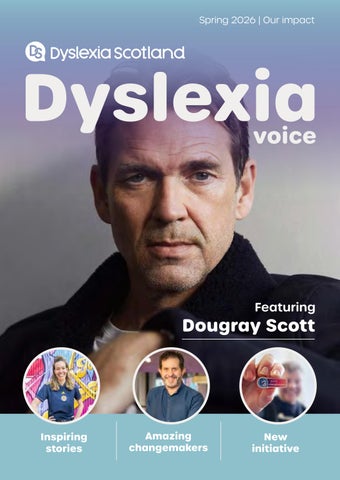
On the cover: Vice President of Dyslexia Scotland, Dougray Scott
Amazing changemakers p50
Education Conference p32
Pip’s story p42
The CEO’s Voice In this spring edition, Dyslexia Voice looks at the impact of Dyslexia Scotland’s work on the dyslexia community As we plan our new 5-year strategy, to be launched in April, we have been reflecting on the vital difference our services make to the dyslexia community. In response to our prompt, “If it wasn’t for Dyslexia Scotland…” our members have shared stories about the meaningful impact of our tutor service, our open meetings, our resources and being part of a community. Behind the scenes features news about Peter Lederer, Paul McNeill and Dougray Scott. Read more on page 8. We are grateful to our Vice President Dougray Scott for agreeing to voice the video for our new 5-year Strategy. Peter Lederer, the new Chair of our Board of Directors, stepped into this important role in January after David Shaw stepped down. We are delighted that Peter has taken on the baton so skilfully held by David for many years. Our sincere and heartfelt thanks go to David for his dedicated commitment since 2008. Congratulations to Ambassador Paul McNeill on being awarded an MBE in the New Year Honours List for services to young people with dyslexia…a well-deserved award.
Dyslexia Voice | Spring 2026
6
What’s new? We have launched two important initiatives so far in 2026: • our Young Dyslexia Scotland Changemakers initiative, backed by our Young Ambassadors • our Manifesto for the Scottish elections in May – this was accompanied by an open letter to MSPs asking them to support the three ‘asks’ within the manifesto. The letter was signed by over 1100 people, including many of our members.
The dyslexia community in Scotland includes supporters helping to make changes for dyslexic people in so many ways. Our volunteers are a vital part of that community of changemakers, as the article on volunteering demonstrates so powerfully. Similarly, our feature on the Helpline outlines the number and nature of the enquiries over the past year and some of the volunteer advisers who respond to those enquiries along with our paid advisers. I have really enjoyed reading the contributions this quarter and I hope you do too. There is something for everyone in our colour-coded sections about Educators, Corporates and employers, Adults, children and young people and Changemakers.
Keep up with all the Dyslexia Scotland news in real time on our website. dyslexiascotland.org.uk/news
7
Features
New Chair appointed Dyslexia Scotland has announced the appointment of Peter Lederer CBE as the new Chair of its Board of Directors An accomplished business leader, Peter’s career includes roles as Chief Executive of Gleneagles, Chair of VisitScotland, and playing a key role in securing the Ryder Cup for Scotland in 2014. Peter steps into the Chair role following seven years of service as a Director of Dyslexia Scotland. He succeeds David Shaw, whose 18-year tenure helped steer the charity from modest beginnings to its current position as a leading national organisation. Under David’s stewardship, with former Formula One World Champion Sir Jackie Stewart as our President, Dyslexia Scotland has influenced independent national reviews of education for children and young people with dyslexia in Scotland’s state schools; secured a cohort of high-profile Ambassadors including television presenter and wildlife cameraman Hamza Yassin and Olympian Keith Cook; and became a recognised thought leader and teacher-training provider in inclusive educational practice. Peter Lederer steps up to the role as our charity enters an ambitious new strategic cycle. Peter said: “Dyslexia Scotland is a charity that is very close to my heart. I was 42 when I ‘discovered’ I was dyslexic. My wife noticed that our son, Matthew, was suddenly struggling at school and that his demeanour had changed. I will never forget the day I came home from work and read Matthew’s assessment. Change the name at the top of the report and it described my own school life. Finally, I understood why I had spent so many years feeling stupid, inadequate, anxious, withdrawn and confused.
Dyslexia Voice | Spring 2026
8
This is what drives me now. It is a great honour to take on this important leadership role and to work with a tremendous CEO and Board to help steer our course towards a dyslexia-friendly society where, I hope, no child has to experience the feelings I did during my own school days.” Outgoing Chair David Shaw said: “My journey with Dyslexia Scotland has been a truly humbling one. I am constantly amazed by, and proud of, how this remarkably small organisation consistently punches above its weight. While I am sad to be stepping down, I do so confident that I leave the charity in good shape and with excellent leadership in place.” Chief Executive of Dyslexia Scotland, Cathy Magee, added: “We are thrilled that Peter is taking on the role of Chair and I look forward to working closely with him as we navigate challenges and strive for new achievements together. David Shaw leaves a meaningful legacy and a strong platform on which we can continue to build, and we are extremely grateful to him for his long and effective service.”
“It is a great honour to take on this important leadership role and to work with a tremendous CEO and Board to help steer our course towards a dyslexiafriendly society.” Peter Lederer CBE
9
Features | Behind the scenes
MBE honour for dyslexia Ambassador Paul Dyslexia Scotland Ambassador Paul McNeill has been awarded an MBE in the New Year Honours List for services to young people with dyslexia Paul has served as an Ambassador for Dyslexia Scotland for more than 15 years. During this time, he has delivered services directly to learners in schools through the award-winning Mission Dyslexia programme, supporting whole classes to understand the learning difference. He has also worked at a parliamentary level as Secretary to the Cross-Party Group on Dyslexia in the Scottish Parliament, helping to shape policy and raise awareness nationally. Speaking to the Paisley Daily Express, Paul said: “I always thought, well, if there’s anything I can do to help people who have a challenge in terms of a learning disability, or the learning difference that I have – and that so many people in Scotland also have – then I would do that.” Chief Executive of Dyslexia Scotland Cathy Magee said: “Paul’s contribution to our mission cannot be overstated. From rolling up his sleeves to run workshops for whole classes, through to top-level meetings with Ministers in the Scottish Parliament, he makes an impact at every level. We are delighted to see his work recognised.”
Dyslexia Voice | Spring 2026
10
Dougray voices new video From Holyrood to Hollywood... Dyslexia Scotland Vice President, actor Dougray Scott, is the voice of our new video Just off the back of publishing our manifesto, we scripted a short video about our vision for a dyslexia-friendly Scotland. We’re grateful to Dougray Scott for narrating the heartfelt plea to all of Scotland to help build a nation where people with dyslexia can live, learn, work, play, and grow up on equal terms.
Dougray has been one of our Vice Presidents since 2021, lending his name and voice to support our campaigns. Dougray was one of the first to sign our open letter in February. Look out for the video on our website and social media in April.
11
Features
Call for Young Changemakers Dyslexia Scotland has launched an inspiring new initiative inviting young people to become official Young Dyslexia Scotland Changemakers The campaign encourages young people to raise awareness of dyslexia in their schools and communities by putting simple ideas for inclusion into action. Young people can draw on their own creativity or make use of a range of free resources, including Busting Dyslexia Myths posters and lesson plans, information leaflets, and the Dyslexia Unwrapped website. To make their changemaking official, participants can visit the Be a Changemaker page on Dyslexia Scotland’s website. The charity encourages young people to discuss ideas with teachers, youth workers and families first, to make sure plans are practical and supported. They can then log their awarenessraising activities through the Changemaker channel, which acts as a record of small steps on Scotland’s journey to become a dyslexiafriendly country. Dyslexia Voice | Spring 2026
12
Young people who submit their activity can download a digital Young Changemaker badge, or order a wooden badge, while stocks last. Volunteers Manager Sue Bowen said: “We’re constantly impressed by the initiative shown by young people across Scotland to make their classrooms, communities and youth clubs more dyslexia friendly. We’re regularly inundated by young people wanting to have a formal Ambassadorial role for our charity, so we created the Young Changemaker initiative to empower young people to use the resources and take action at grassroots levels all across Scotland.” Our social media campaign promoting Young Changemakers features Dyslexia Scotland Young Ambassadors as the faces and voices of the initiative.
13
Features
Manifesto published Dyslexia Scotland has published its manifesto calling for people with dyslexia to be brought in from the margins of Scottish society The manifesto draws on academic research by the charity to highlight significant inequalities their community faces in education and employment. Dyslexia Scotland is calling on political leaders to implement three critical policy asks that will deliver measurable improvements in educational outcomes, workforce participation and lifelong wellbeing. Earlier this year we called on supporters to sign an open letter which we sent to all political parties as they set out their own priorities for government. The letter was signed by 1,124 people, including our high-profile supporters Sir Jackie Stewart, Audrey Baxter, actor Dougray Scott, and former Olympian Keith Cook. Chief Executive of Dyslexia Scotland Cathy Magee said: “The challenges facing dyslexic and neurodivergent
Election Manifesto 2026
people require immediate attention – delays mean continued disadvantage, lost potential, and unnecessary hardship for individuals and families across Scotland. Our educators are struggling to manage workloads, our support for learning
Urgent action needed: supporting dyslexic and neurodivergent learners across Scotland
needs are at a record high and people with dyslexia are consistently being left behind. Our community is calling for change: the time for action is now.”
Dyslexia Voice | Spring 2026
14
We are calling on all parties to commit to three urgent priorities in their 2026 manifestos: 1. A national, digital School Leavers Passport to ensure young people leave school with evidence of need that is recognised in further education, training and employment. 2. A funded national pathway for adult dyslexia assessment, progressing towards free access and supported by technology-enabled assessment tools. 3. Mandatory dyslexia and neurodivergence training in all teacher education, supported by assistive technology and AI-enabled classroom tools.
Dyslexia Scotland Chief Executive Cathy Magee OBE and Secretary for the Cross-Party Group on Dyslexia in the Scottish Parliament Paul McNeill MBE
15
Features
Over 1000 signed our open letter More than 1,100 people signed an open letter backing Dyslexia Scotland’s Manifesto The letter outlined the three practical proposals which would deliver longterm social and economic benefits – improving education and employment outcomes while helping to close Scotland’s poverty and attainment gaps. The move comes at a time when additional support needs in Scottish schools are at a record high. The Manifesto highlights the link between unsupported dyslexia and literacy difficulties, which can contribute to early school dropout, reduced employability and the disproportionate representation of people with dyslexia in the prison population. A total of 1,124 people supported the letter, which was sent to party leaders in February.
Read the open letter
Dyslexia Voice | Spring 2026
16
2026 and beyond... Our new strategy is due to be published in April Our current strategy, The Journey to a Dyslexia-Friendly Scotland was our post-Covid plan for making a direct difference to dyslexic children, young people and adults. We set out ambitious plans to create more opportunities for our community to achieve and attain in life, learning and work. We also introduced the concept of Changemakers, to activate and ackowledge the people across all areas of society who make efforts to be dyslexia inclusive. These last three years have been truly impactful, thanks to the hard work and dedication of our Directors, Ambassadors, staff team, volunteers and partners. Here are some highlights: •
hosting online events to increase our reach
•
providing free asssessments to adults
•
providing free tutoring through the Sean Connery Foundation funding
•
succesfully delivering a dyslexia and literacy support service in City of Edinburgh Council with support from the Sean Connery Foundation
•
gaining high profile new Vice Presidents and Ambassadors, Audrey Baxter, Dougray Scott and Hamza Yassin
•
celebrating our 55th anniversary
•
running Scotland’s biggest-ever research survey of dyslexic adults.
What will the next five years bring? We look forward to embracing the possibilities, with your support.
17
Features
Dyslexia Scotland calls on all parties to commit to three urgent, achievable, technology-enabled reforms that will transform outcomes for 1 in 10 children and adults with dyslexia across Scotland. Here’s what we’re asking for:
Election Manifesto 2026 A summary
Dyslexia Voice | Spring 2026
18
Our three urgent asks
1
A national School Leavers Passport
2
A funded National Pathway for Adult Dyslexia Assessment
3
Mandatory teacher training in dyslexia and neurodivergence
► ► 19
Features
1
A national School Leavers Passport
Solution A digital, portable passport giving every dyslexic young person a clear, recognised record of: •
assessment evidence fit for use beyond school
•
strengths, learning strategies and proven reasonable adjustments
•
leaver’s preferred way of learning
•
assistive technology needs where appropriate.
What Government must do •
standardise and strengthen school-based assessments (by trained teacher assessors)
•
build a national digital passport with recommendations including assistive technology, AI support and other adjustments for independent learning
•
require agencies including colleges, universities, Skills Development Scotland and employers to recognise the passport.
Impact Smooth transitions, reduced reassessment, improved employability and lifelong support. Investment at this stage will significantly reduce the costs of future adult assessment requirements.
Dyslexia Voice | Spring 2026
20
2
A funded National Pathway for Adult Dyslexia Assessment
Solution Free or subsidised assessment for all adults, supported by modern digital tools.
What Government must do •
establish a national adult assessment pathway within the first six months of the Parliament
•
commit to the continued appointment of a cross-government adult dyslexia lead
•
invest in AI-enabled screening as appropriate to widen access and reduce cost
•
increase specialist assessor capacity and create simple online self-referral routes
•
work with employers and unions to promote workplace assessments and support.
Impact Clear identification, better employment outcomes, improved wellbeing and reduced
►
inequalities.
21
Features
3
Mandatory teacher training in dyslexia and neurodivergence
Solution Every teacher trained in dyslexia and neurodivergence consistently, practically, and supported by technology.
What Government must do •
require all Initial Teacher Education programmes and Career-Long Professional Learning to include dyslexia, neurodivergence and inclusive practice training
•
include practical identification skills, assistive technology and inclusive pedagogy.
•
provide AI-powered classroom tools to support early identification and reduce workload
•
update General Teaching Council for Scotland Professional Standards
•
fund high-quality digital training resources.
Impact Earlier identification, better class support, reduced attainment gap and more confident teachers.
Dyslexia Voice | Spring 2026
22
The hidden cost of inaction Unidentified dyslexia has significant social and economic consequences for Scotland. Without timely identification and support, many children and adults experience avoidable barriers in education, work and wellbeing. This leads to lower attainment, reduced productivity, underemployment and higher rates of anxiety and depression, which increase pressure on the NHS and other public services. Employers lose out on talent and productivity, while the economy bears the cost of lost earnings, lower tax revenues and greater reliance on benefits. Delayed identification also contributes to higher school dropout rates, reduced employability and disproportionate representation of dyslexic people in the justice system, all of which create substantial long-term costs. By contrast, early assessment and intervention deliver strong returns through improved employment, better mental health, lower reoffending rates and a more skilled and confident workforce. Acting now is not only the right thing to do for individuals and families, but also a sound economic investment for Scotland’s future. Delays mean more children struggling, more adults unsupported, and more lost potential.
These reforms are affordable, practical and deliverable within one Parliament — and Dyslexia Scotland stands ready to work with all parties to make them a reality. ■
23
Features
Tartan teaser
Dyslexia Voice | Spring 2026
24
You heard it here first - Dyslexia Scotland has succesfully registered an offical tartan - and it needs your support It’s not because we’ve caught World Cup Fever (well, not just that). As a uniquely Scottish organisation, we know that we’re not complete without our very own tartan. We’re inviting the whole world to be part of Clan Dyslexia.
Keep an eye on our website and social media for more details coming soon
The colours are Dyslexia Scotland’s brand palette, which represents children, young people and adults with dyslexia; woven in with the changemakers; all working in harmony for a dyslexia-friendly Scotland. We partnered with Lochcarron to design this gorgeous pattern. But although we have the design ready, we have to pay a large sum to put the weave into production. So we’ll need your support. Later this spring, we’ll run a crowdfunding campaign and seek sponsorship for a minimum of £5000. We’d love for you to back the campaign, share it with your own connections, and try and encourage some companies to pledge larger sponsorship amounts. From 2027, we hope to sell tartan goods to generate income for our work. 25
Features
The Helpline continues to be a flagship service, responding to thousands of enquiries every year Our Helpline runs 5 days a week, with advisers on hand to answer questions and guide people on the 1000
next step of their dyslexia journey. In the last three years, we’ve
800
responded to 4,985 enquiries from parents and carers, adults,
600
employers, support workers and
What do people ask about most?
■ Assessments ■ General advice ■ Work
others.
400
Although 2025 had the lowest number of enquiries to the Helpline
200
in 15 years, there may be several reasons for this. For example, people
0
can get the information they need from our comprehensive website rather than speaking to an adviser.. The nature of enquiries gives us a picture of issues across Scotland, so we are constantly finding out what help and information our community needs. This helps us to design
Number of enquiries
2000
services and resources that meet those needs head on. Here are some key statistics from 2025. ►
1500 2023
Dyslexia Voice | Spring 2026
26
2025
e n i l p l e H oics r he
Who calls the Helpline? ■ Parents and carers 43% ■ Adults 41% ■ Parents and carers (about grown up children) 4% ■ Other relations 4% ■ Educators 3% ■ Employers 2% ■ Support workers 2% and Health professionals 1%
27
Features
The people answering your enquiries Our trained Helpline advisers listen to questions and signpost to information dyslexia-related issues in Scotland - all in complete confidentiality. Here’s what they say about their roles.
“The helpline
“We are a friendly
line reassures
voice and listening
people they
ear at the end of the
are not alone.”
phone who can help to make sense of the huge amount of information which is available.”
“The helpline offers a safe space to ask questions, seek advice, and find resources tailored to the individual’s unique circumstances.”
Dyslexia Voice | Spring 2026
28
Frequently asked questions •
What support am I entitled to in the workplace?
•
What support should I, as an employer, put in place for dyslexic employees?
•
How and where can I get a dyslexia assessment?
•
How do I get the school to assess my child?
•
What support is my child entitled to in school?
•
What should I do if I feel the school is not supportive?
•
What documentation is needed for the transition from school to Higher or Further Education?
•
What day-to-day and exam support exists in Higher and Further Education?
Do you need an answer to one of these questions, or another matter relating to dyslexia? Contact our Helpline: Monday to Thursday 10am to 4pm 0344 800 8484 or helpline@dyslexiascotland.org.uk
Volunteers needed - can you help? Are you a good listener? Do you want to make a positive difference to the lives of others? We are currently looking for new volunteers to join our Helpline team for just one morning or afternoon a week on a regular basis. You can be home or office based. Full training provided. ■
Email sue@dyslexiascotland.org.uk 29
Features
The value of volunteering The impact volunteers have on Dyslexia Scotland - and the impact we have had on them in the last year At Dyslexia Scotland we are very lucky to have many people with an interest in dyslexia who are prepared to give up their time and skills to support the work that we do. It would not be an exaggeration to say that all that we do would not be possible without our volunteers. Charities often measure the value of volunteering by the number of hours people give. But this doesn’t tell the stories of the personal impact that time has on either the organisation or the people.
“Volunteering gives you a voice to help others and that is the most rewarding work I have ever done.” Dyslexia Scotland volunteer, 2025
We asked volunteers about the personal benefits of being involved with Dyslexia Scotland. •
Over 90% said their confidence had increased, they felt a sense of achievement and believed they were making a difference.
•
Over 80% gained new skills and experiences and felt valued.
•
A third had improved their employment prospects. “I found the confidence to launch
“I now feel more comfortable
my own company …… [this]
to speak out to make a real
evolved from my volunteering
difference and I don't feel like an
role.”
imposter anymore.”
Dyslexia Scotland volunteer
Dyslexia Scotland volunteer
Dyslexia Voice | Spring 2026
30
Ways volunteers supported
Talks Event help
our
30 talks and workshops
Peer support
work in 2025
Supported
delivered at
Facilitated 22
national events
events
meetings
Professional
Speaking out Represented the lived experience
Member help
photography
Magazine input
For our reports,
Writing articles
Running the
brochures and
and proof-
formal forums
library service
press
reading
Research Academic
Corporates Helpline
Raising
insights and
1400 Helpline
awareness and
report writing
calls answered
fundraising
31
nk you a h
!
T
of dyslexia at
Educators
Education Conference: confidence, skills, impact Plans are already underway for this year’s Education Conference for teachers on 31 October in Glasgow Reflections from previous conferences are a crucial part of our planning - it’s not a case of ‘tick the box and move on’ - we always take time to review feedback and suggestions from delegates. The annual event aims to give educators more confidence, knowledge and practical skills to support children and young people with dyslexia. We want them to share their learning and to feel they can positively impact the experiences of dyslexic learners. As we work with others to develop our plans for this year, here’s just some of the feedback from our 2025 sell-out conference.
More confidence
“Excellent up to date knowledge presented in an engaging way, affirming the work currently being done in my workplace.” “It strengthened my understanding but gave me additional pathways to focus my future research.”
Dyslexia Voice | Spring 2026
32
Practical skills “Excellent practical reading and spelling lesson ideas together with effective observation tools.”
“This was a very practical workshop which has made me aware of resources I could be using immediately.”
Shared learning “Good to hear good quality practice from other authorities.”
“It also was a good networking opportunity to speak with other colleagues.”
“Best part was listening to the pupils who had benefited from interventions.”
► 33
Features
Positive impact on learners “It clarified how children learn to
“It made me very motivated to
read and gave me the tools to
go and learn more about how to
push for change in our reading
support learners who are finding
scheme.”
reading challenging.”
Inspiration “Inspiring, relevant, meaningful, clear and linked to data and practice.”
“The passion of the speakers was contagious.”
“Honestly one of the best professional development opportunities I have attended.”
These impact statements demonstrate the real-world difference that our professional learning offers educators.
We already have some exciting plans for this year’s conference keep an eye on our website for more details in due course. Photo credits: Dave Ferguson Photography
Dyslexia Voice | Spring 2026
34
Statement in response to ASN figures In December, Dyslexia Scotland issued the following statement in response to the news surrounding the national ASN figures Publication of the latest figures showed that 43% of pupils in Scottish schools are now identified as having additional support needs, with many unable to attend a traditional school system that cannot meet their needs. BBC News reported that “various forms of learning difficulty or disability, including dyslexia, accounted for about 112,000 of the overall figure.” We know that many young people, educators and families are worried about what this means for them. The rise in identification of Additional Support Needs highlights the urgent need for a modernised education system that is responsive to the social, emotional and communication needs of children and young people today. At Dyslexia Scotland, we believe that every child and young person deserves an inclusive education that meets them where they are on their learning pathway, supported by skilled educators with the training they need to help learners grow and thrive. To make this a reality, we need: • earlier identification of learning differences in primary school, preventing years of unnecessary struggle • practical, evidence-based teaching strategies for differentiation and inclusive pedagogy • regular professional learning updates as part of Scotland’s professional standards for educators. ►
35
Educators
Organisations like Dyslexia Scotland, along with educators and families, have continuously called for improved teacher training in Additional Support for Learning and for a fit-for-purpose education system that truly reflects the needs of its learners. The focus on the newly-published statistics reinforces an urgent need for intervention. We urge policymakers to work with us and with other leaders in the education community to provide the teacher training required to ensure that all learners are supported in environments that enable them to flourish – as individuals and as contributors to society. If Scotland’s ambition is to be a nation that treats everyone with kindness, dignity and compassion, then our education system must model these values at every level.
How is Dyslexia Scotland working for a solution? For years, Dyslexia Scotland has championed inclusive education where learners with dyslexia have their rights met and are enabled to reach their potential. Together with our President, Sir Jackie Stewart, we campaigned for mandatory training in teacher education. This led to the adoption of a Framework for Inclusion by universities providing initial teacher education in Scotland – a step forward, but not far enough. Following the 2014 Making Sense review Dyslexia Scotland and Education Scotland developed a series of three free, open-access online modules for Scottish teachers on the Open University platform. These continue to help thousands of educators better understand and support dyslexic learners. Political advocacy We met with the First Minister in November of 2024 and are in discussions with officials about the commitments we asked for in relation to our recommendations in the hard-hitting research report Towards a dyslexiafriendly Scotland?.
Dyslexia Voice | Spring 2026
36
The Scottish Government has acknowledged that “there is more to be done” to support children and young people with dyslexia. In November of this year, the Cabinet Secretary for Education and Skills Jenny Gilruth MSP wrote to all Executive Directors of Education and Children’s Services in Scotland, urging them to provide appropriate support for children and young people with dyslexia in schools. Grassroots action While we lobby at a strategic level, we are also leading action on the ground. Key initiatives include: •
A flagship dyslexia-inclusive education model co-developed with City of Edinburgh Council, funded by the Sean Connery Foundation. This trailblazing project has the potential to reshape practice across Scotland beyond its three-year delivery which ended in 2025.
•
A GTCS-accredited Professional Recognition programme, delivered with Education Scotland, that equips teachers to lead on dyslexia inclusion in their schools and learning communities. A strong community of committed, knowledgeable teachers has emerged over the past 5 years as a result.
•
Our annual Education Conference, bringing together over 200 educators for expert-led, evidence-based dyslexia training.
•
We are releasing two new online teacher training modules in 2026, to share the learning from the Sean Connery Foundation Dyslexia Initiative. These have been funded by HSBC UK. ■
37
Educators
A growing community of practice In December, 35 practitioners received their awards for GTCS Professional Recognition in Dyslexia at a special ceremony in the Barracks conference centre in Stirling Since the programme’s inception, 218 educators have taken part and 133 have gained their certification - far exceeding the initial expectations of the course’s potential. The practitioners who have completed the course and the 47 in the current cohort are adding to an ever-growing community of professionals equipped to identify and support learners with dyslexia in schools and colleges, and cascade knowledge throughout their learning communities. Prior to receiving their certificates, guests heard from esteemed speakers from across the field of education in Scotland. Cathy Magee OBE, Chief Executive of Dyslexia Scotland, welcomed the audience and congratulated the group on their successful learning journeys. Fran Foreman, Senior Education Officer at Education Scotland, gave an overview of the programme. David Burgess, , gave insights into the national picture, warmly congratulating the group and praising them for their vital input to Scotland’s evolving curriculum model. David urged the educators to remain true to the original purpose of education, stressing that as a sector, we must ask ourselves, “Are we teaching our children and young people to be taught, or are we teaching them to learn?” Jacqueline Morley, GTCS Teaching Standards Education Officer: Professional Recognition, sent a recorded message reminding the group of the
Dyslexia Voice | Spring 2026
38
importance of staying solution-focused in challenging times, sharing a mantra, “Start where you are, do what you can, use what you have.” Course alumnus and panel member Victoria Armet gave a perspective from her practice following her own Professional Recognition, sharing experiences of the programme and beyond. Finally, Beth Davidson, a dyslexic young person, talked about experiences at school, moving to college and how assistive technology has helped her. Her advice to the educators in supporting learners with dyslexia was, “Have a conversation. And repeat the conversation later on. It’s great asking me at the start of the year, but ask me again half way through about what I need then. I might not be confident to come and speak to you, but if you start the conversation, I’ll be able to talk about what I need now.” Following the speakers, the programme participants were presented their certificates, followed by a buffet lunch. The GTCS Dyslexia and Inclusive Practice programme is a critical initiative in the strategy for a dyslexia-friendly Scotland. Details of the next intake are expected to be announced soon.
The awardees with guest speakers. Credit: Dave Ferguson
39
Educators
Action research: improving the assessment process in schools School teacher Seona Stevenson shares insights to assessing and monitoring in the classroom Participants on our GTCS Dyslexia and Inclusive Practice programme are required to submit an action research enquiry. Alumnus Seona Stevenson from Dunblane primary school cascades her learning through this summary for Dyslexia Voice.
Overview and aims I wanted to seek learner and parent/carer experiences of the identification of dyslexia process and use the feedback to improve my practice. Providing quality service to children is extremely important to me. I want to help learners fulfil their potential and to have success in their lives. Pupil voice is integral to my practice. I believe that if learners were enabled to advocate for themselves, we would have a more inclusive education system. Equity is very important to me and I believe we must do more to improve attainment for pupils with dyslexia [in my setting]. Looking at the data, they are underachieving.
My professional learning journey •
I researched theory, policy and good practice examples.
•
I created surveys for learners and their families.
•
Our P7 Dyslexia Ambassadors trialled the surveys then helped younger learners access them on Chromebooks.
Dyslexia Voice | Spring 2026
40
•
I collated and studied the results.
•
I formulated a plan for change.
•
I shared my plan with other course participants.
•
I discussed my plan with my line managers.
Key findings •
90% of learners who have been assessed wanted to be assessed.
•
95% of learners liked doing the assessments.
•
93% of learners understood their dyslexic profiles better after feedback.
•
84% of families who returned surveys were entirely positive.
•
47% of families suggested improvements such as timescale of assessments could be shorter.
Impacts
Next steps
•
•
•
Increased confidence to approach line managers with
for children between starting
evidence for change.
and finishing the assessment process.
The timescale from start to •
completion of assessment
•
Shorten the length of time
Introduce an annual meeting
would be shortened, reducing
for families to hear about our
learner and family anxiety.
school approach to dyslexia assessments.
Collaboration with course participants was key as I could discuss my plans with fellow support for learning practitioners.
41
Adults
Thinking Differently: finding success through sport by Ross Duncan, a Member of Dyslexia Scotland
Pip Penman has always known she thinks differently, and she’s thrived because of it Growing up in Scotland, the signs were there early. She loved stories, imagination and creative writing, often placed in top English sets at school, yet struggled deeply with spelling.
Dyslexia Voice | Spring 2026
42
Because she was performing well academically, dyslexia was not immediately recognised - a common experience for many dyslexic young people whose difficulties are overlooked because they do not match outdated stereotypes. It was Pip’s mother, studying psychology at university, who first noticed the pattern. Dyslexia ran through the family - Pip, her identical twin sister and their father, so there was plenty of understanding at home. Even so, school brought a constant undercurrent of embarrassment. Pip loved learning, but worried about being “found out”: spelling mistakes, handwriting, or being asked to write publicly. Those anxieties followed her to the University of Edinburgh, where she studied English literature and history, and where traditional academic environments often felt unforgiving for dyslexic students. Despite this, Pip never lost her love of writing. Like many dyslexic learners, she adapted. Audio became essential to how she learned. Essays, books and exam notes were recorded and listened to repeatedly, allowing information to sink in through sound rather than text alone. Learning didn’t just happen at a desk - it happened while moving, listening and connecting ideas differently.
Finding a way with sport Sport played a key role in that process. Raised in Kirkcaldy, Pip grew up in a football-mad household, spending weekends watching Raith Rovers with her dad and siblings. Football meant family, belonging and community. When opportunities for girls became limited, Pip and her sister found freedom in skateboarding. The skate park offered space without rigid rules or expectations - somewhere creativity and individuality were celebrated. It also became an unconventional classroom. Pip vividly remembers listening to Pride and Prejudice through headphones while skating in a halfpipe, learning literature through movement and sound. For her, sport didn’t distract from education - it enabled it. ►
43
Adults
Today, Pip lives in New York, where her Scottish roots and American life increasingly overlap. This year, Scotland has qualified for the World Cup in the United States - a moment of national pride that feels deeply personal.
Speaking openly about dyslexia Pip’s move to America came through her love of literature. After being accepted to New York University, financial barriers nearly made it impossible to accept the offer - until she applied for a Fulbright Scholarship. In the interview, she made a courageous decision to speak openly about being dyslexic. Rather than hiding it, she explained how dyslexic thinkers process language and ideas differently, and how creativity and literature benefit from those perspectives. Now a co-founder of Women in Soccer, Pip works to make the sports industry more accessible and inclusive. Her message to young people with dyslexia is simple: there is no such thing as thinking wrongly. Every brain works differently, and those differences deserve recognition, support and pride. ■
Learn more about Women in Soccer
Dyslexia Voice | Spring 2026
44
If it wasn’t for Dyslexia Scotland….. Four readers share their impact stories
“As a long-term member of
“If it wasn’t for Dyslexia Scotland
Dyslexia Scotland, I have felt a
these last three years, I wouldn’t
strong sense of belonging through
have the resources I have across
their support. They introduced me
school for our learners. I also
to the dyslexic community, which
wouldn’t have completed the
has made me feel connected and
three modules needed so that
understood.
I can assess our learners for
They have also supported me
dyslexia. Thank you and keep up
with a mentor. I am grateful for the
the great work that you do.”
growth I experienced, especially when I made my first CV. They
Claire Levett, Aberdeenshire
supported me and helped me
Council
return to the education system when I needed an assessment to apply for my Disability Student Allowance (DSA). I had the chance to give back by becoming a volunteer Helpline Adviser. Hearing about the struggles of others in the dyslexia community was eye-opening.” Susan Taylor, dyslexic adult
45
Adults
“If it wasn’t for Dyslexia Scotland these last three years, I dread to think where we would be. Probably no further forward, with a stressed and unconfident boy who was struggling to realise his full potential. And an exasperated mum, who felt invisible, unheard and misunderstood... who may well at this stage have started second guessing herself. We would not have found the best assessor or had the brilliant advice from the Helpline, which helped us effectively communicate his support needs with his school. And we may never have discovered the wonderful world of Mission Dyslexia or bulletmapping, or heard from inspirational dyslexic thinkers like Paul McNeill MBE and Hamza Yassin - it would have been a very lonely place. Instead, he is flourishing in his first year of high school, where he is finding his strengths and beginning to shine. He is happy, settled and - thanks to all the Dyslexia Scotland input - advocating for himself and letting me know when he feels he needs more support. In turn, I am a happy, proud mum, who is much more confident in support and advocating for her son when she needs to. I feel heard, supported, and part of an incredible community who genuinely understands and believes in my son’s potential. It is early days in high school, and currently it seems the school are supporting him well, but he and I both know, if we need it, Dyslexia Scotland always has our back.” Kirsty Innes, Parent
“Over the last three years, Dyslexia Scotland and my tutoring with June McLister have helped me transition from primary school to high school. I have grown in confidence - English lessons in school are not as bad - it’s less hard now and it can be fun.“ Merryn Lord, dyslexic young person
Dyslexia Voice | Spring 2026
46
Growing connections by Liz Rodger, a Dyslexia Scotland volunteer
For Liz, being involved has led to a chance meeting that blossomed into a valued friendship If it wasn’t for Dyslexia Scotland, I wouldn’t have a gardener! To be more specific, someone to help me tame the overgrown shrubs, trees and hedges around my house, who has also become a friend. We met at a Dyslexia Scotland meeting a number of years ago. Although he no longer attends Dyslexic Adult Network meetings, (he feels he got the support he needed and has now moved on), we meet up every couple of months for a chat over pruning, followed by a curry. It helps that we understand each other and it allows each of us to have a break from our usual daily lives. We both think ahead and often voice thoughts that lag behind our brains, meaning we have a dyslexic tendency to start conversations in the middle of a thought. It is a trait I have that annoys my family but speaking with someone who understands, it is simple to do a quick rewind. I have made numerous friends over the years at Dyslexia Scotland events. These meetings offer new connections, mutual support and often continued friendships. If you would like to discuss adult dyslexia issues with other dyslexic adults who understand, come along to one of our monthly meetings where we offer empathy, workplace support and discussions on a variety of relevant topics.
Visit the Events calendar >>>>>>>
47
Corporates and Employers
Dyslexia at work podcast This lunchtime listen will boost your dyslexia awareness at work Our friends at legal firm MFMac host an excellent employment podcast. In this episode, David Hossack is joined by Dr Jeremy Law of the University of Glasgow to discuss dyslexia in the workplace and to consider the issues raised in our research report Towards a dyslexia-friendly Scotland. The engaging 35-minute listen is packed with insights into the challenges, supports and responsibilities around dyslexia at work.
Listen to the podcast >>>>>>>
Dyslexia Voice | Spring 2026
48
Bespoke training
Dyslexia Scotland can provide bespoke dyslexia training or a speaker for your event. Whether you want in-service training, workplace support or general awareness about dyslexia, we can help you. FInd out more and book a session via our website at dyslexiascotland.org.uk/dyslexia-training/.
Corporate partnerships We regularly look to form partnerships with corporate organisations. Are you our next sponsor? Help fund our projects and services. Get in touch today and make a real-world difference.
49
Changemakers
Changemaker channel People all across Scotland are taking small steps toward the big vision of a dyslexia-friendly Scotland
Sign of the times - a hospital highlight Retired Paediatrician Una MacFadyen writes: “At Forth Valley Royal Hospital we are working to help young people who will be leaving the children’s clinics and children’s ward and starting to attend the adult services. The Health and Social Care Partners and the Quality Improvement and Realistic Medicine teams, hope to make the hospital more dyslexia friendly starting with the information boards and signs. Based on Dyslexia Scotland’s tips in their new formatting guide, and with encouragement from the Bannockburn Library Makers Space, we are testing a change in the layout and format of some of the signs in the main public entrance. We will be depending on patient, carer and visitor feedback to then move on to other areas for change. If all goes well, we might even get to patient letters in the future.
Una used Dyslexia Scotland’s formatting guidance to produce an alternative sign
Dyslexia Voice | Spring 2026
50
I was guided by a brave dyslexic 11-year-old volunteer and his Mum, with lived experience to identify what most needs to change, in his opinion. This first step has highlighted how many adults of all ages have struggled to use standard written NHS communication due to their dyslexia. I hope this means that the changes we plan to make will help patients of all ages. I know that our simple changes will not answer every individual’s needs but this might be a nudge towards greater awareness of how neurodiversity must be recognised and included in every service offered to the public.”
Swap shop Gino Satti started a book-swap station for his colleagues in Social Security Scotland’s office in Glasgow. Staff can bring a book to exchange for one on on the shelf. Gino hopes the Dyslexia Scotland publications will be popular and help raise awareness. Why not do the same in your work place when you’re finished with this copy of Dyslexia Voice?
51
Changemakers
Marissa has the write stuff Writer Marissa McCudden says: “I have written and published my debut children's picture book called There's Lots of Different Types of Clever to nurture the self esteem of dyslexic learners and build their confidence in their own gifts and talents that might lie elsewhere rather than in reading, writing or spelling. I am also a primary teacher in St. Angela’s Primary in Darnley, Glasgow and have helped bring dyslexia awareness to the forefront through assemblies, running a dyslexia club to support the dyslexic learners in school and give them a voice. This helps children realise that dyslexia has nothing to do with intelligence and that, although they do have barriers in their learning of literacy, it does not mean that they have nothing to offer.“
Writer Marissa McCudden with Illustrator Michael Spy
Dyslexia Voice | Spring 2026
52
Children and young people
Young Changemakers
Since launching our Young Changemakers initiative in January, we’ve received all kinds of brilliant submissions from young people up and down the country taking positive action for change in your communities.
Check out these examples - maybe you’ll feel inspired to do something yourself. ► Above and right: Young Ambassadors Liam and Kate show off their badges
53
Children and young people
Designing a dyslexia mascot Kippen primary school says, “We are a group of pupils who have set up the Kippen Primary Dyslexia Awareness Group. So far, we have helped a whole school assembly to launch Dyslexia Awareness Week, distributed blue ribbons, created an information board (with our Dyslexia Mascot) and we are going to help our teachers make Kippen primary school as dyslexia friendly as possible. This helps learners with and without dyslexia gain a better understanding
Above: the Kippen primary school dyslexia mascot
about what dyslexia is. It makes us feel good about ourselves.”
Excellent editorial work James Sutherland from Crown primary school in Highlands says, “I want to be a Dyslexia Scotland Changemaker because I believe dyslexic people like me can do great things in reading and writing when they get the right support. I started and now run my school’s monthly newspaper. I had to meet the head teacher to share my idea, and I was really nervous, but this has helped me feel more confident when speaking to people. When the first edition was complete and posted on our school blog, I felt so happy. Lots of parents and teachers came up to me to tell me how much they enjoyed reading it. My family have also been really supportive of my idea. My brother has helped write some articles, and my mum and dad were very proud of me for taking on such a big task. Dyslexia Voice | Spring 2026
54
I now lead a team of students, including some who are dyslexic, and I have helped them feel brave enough to join in and share their ideas. Seeing them grow in confidence has made me want to help even more people. I want to be a Changemaker so I can keep showing others what dyslexic students can do and make them feel proud of their skills. By involving people with dyslexia in the newspaper they feel more confident and included. Seeing their work published and receiving positive feedback has made them feel proud and shows them that dyslexia does not stop them from doing something important. It has helped them believe in their abilities, improve their writing skills, and feel like they belong. They practiced writing, editing, and speaking and they learned how to research topics, organise ideas, present information and work as a team.”
55
Children and young people
Jack’s a myth buster! Jack Murray from South Lanarkshire used the Dyslexia Scotland Busting Myths materials to be a Young Changemaker in his school. He showed the presentation to help his friends and teachers learn the facts about dyslexia. Jack is really proud of his badge and sticker.
Download the Busting Myths materials for your school or club
Dyslexia Voice | Spring 2026
56
Marc says: earn your badge Young Ambassador Marc wants to see more young people taking part. Are you a Young Changemaker, helping to make your school, club or community more dyslexia friendly? Get in touch to tell us about your efforts. Once you’ve shared your update, you can order a Young Changemaker badge and sticker.
Share your update on the Changemaker Channel
57
Children and young people
Changemakers turning it up to 11 Jacob Petrie from City of Edinburgh Council is a making noise for dyslexia Jacob says, “My changemaker activity is the Unboxed Thinking group. It started from my experience with a lack of understanding and potential support for additional support needs. The Unboxed Thinking group is a group of learners
Above: The Battle of the Bands
in school with additional support
fundraiser for Dyslexia Scotland
needs and our aims are to spread
Below: Unboxed Thinking’s logo
awareness about how additional support needs are different for everyone and how teachers and fellow pupils can support us. We have created informative videos, presented at school staff training events and hosted a fundraising Battle of the Bands event to raise particular awareness of Dyslexia Scotland. This event was an unqualified success which showcased talent across the school and started conversations about how additional support needs should not limit you in any way. Dyslexia Voice | Spring 2026
58
This has helped people with dyslexia in many ways. One way is that the Unboxed Thinking group has brought young people with dyslexia together so that they learn more about and receive support from their peers. School staff have responded well to our videos which are a bridge between people with and people without additional support needs. These have helped close the knowledge gap as some people think that dyslexia is just about reading and writing, but it has also
Below: The Sound Clash crew after a successful gig
shown how it affects memory and many other aspects of a person’s life.”
59
Children and young people
How Abigail became an author Abigail from the Scottish Borders recently published her own book - she told Dyslexia Voice about the process I have always loved creative writing. When I was younger, I would make little books with folded paper. As I got older, I started to write longer stories and poems. My tutor Mo encouraged me to write my own book. This is how I made Wolf and Wolf Warrior.
Dyslexia Voice | Spring 2026
60
Writing my first draft The idea for my story came from two Lego pieces. To create the story Mo helped me with characterisation, plot and setting scenes. I used a mix of typing and voice-totext to help, and I brought my Lego with me for inspiration. When we completed the first draft, it felt absolutely fantastic.
Seeing the story all at once Mo gave me big sheets of lining paper and printed out my story. I stuck them on in the right order and did little doodles of what I wanted the pictures to look like and where they needed to go. ►
61
Children and young people
Using AI and finding workarounds Turning the images into illustrations wasn’t easy either, with many hiccups along the way. I decided to use AI for the illustrations. It didn't always do what we wanted it to do. When I asked it to extend a sword to match the words in my story, it just added a little white triangle shape on top. I asked it to try again, but it generated a fully black image with a tiny white triangle in the middle! I decided to just change the wording in my book from “huge sword” to “threatening dagger”.
One of Abigail’s AI-generated illustrations that wasn’t what she hoped for
Dyslexia Voice | Spring 2026
62
Reasons why my book is dyslexia friendly From my point of view, there aren’t enough dyslexia-friendly books as there should be, so I wanted my book to be as accessible as possible. These are things that I chose: •
Century Gothic and Quicksand 14 pt fonts because they are clear and easy-to-read
•
text spaced at 1.5 spaces apart and paragraphs 2 spaces apart so the story isn’t jammed together on the page
•
short paragraphs so nobody feels overwhelmed while reading
•
off-white paper. (I personally like reading from off-white paper because I find white paper too bright for my eyes.)
•
lots of illustrations to make the book less overwhelming.
Holding my first printed book When my printed books arrived, I felt indescribable joy and shock. The effort and work that I put in all felt worthwhile. My book is also for sale on Amazon and I have donated copies to my old primary school and two of my local libraries. My first retailer was Stow Post Office. I have now sold over a hundred copies, and I want to thank everyone who read my book and supported me, especially my tutor, Mo.
What I’ve learned I've learned many things from this experience, but my most important ones, I think, are: good things take time, believe in yourself, and do things step by step. ■
63
Strategic plan 2026 to 2031 Our new strategy will be published soon. Follow our website News page and social media for live updates.
Dyslexia Scotland Charity No. SC000951