THE
HOTEL ENGINEER OFFICIAL PUBLICATION OF THE AUSTRALIAN INSTITUTE OF HOTEL ENGINEERING
PP 319986/101
Volume 18 Number 3 October 2013
The ‘pico’ Sensor
lighting control for bathrooms & ensuites ... with its tiny dimensions and IP65 rating, the PICO is perfect for in-fitting installation, wet areas and spaces that require a visually discreet solution ...
l
IP65 rating, great for wet areas
Powerful high switching current
Ideal for in-luminaire operation
Tiny 33mm diameter sensor head
360 detection & 10m sensing range
Remote programmable
PH 1800 225 063 Download the latest BEG Product Guide at iautomation.com.au
2
Publishers
The Hotel Engineer The Official Publication of the Australian Institute of Hotel Engineering
LETTER
W
ith the end of the year a little over two months away this is our final edition for 2013. So a big thank you to everyone involved with and whom support this magazine. 2014 will bring the 25th Anniversary AIHE Update Conference. There has already been considerable planning going into this mile stone event. Expected to be the biggest and best yet, it will offer an excellent forum for Engineers and other hotel management to discuss the latest in technology and trends in their workplace. It will also offer companies the opportunity to exhibit their products and services to decision makers within the hospitality industry. For further information see our centre pages, and of course we will keep you updated over the next couple of issues on all further details as they progress. We hope you find the articles in this issue most informative, there is a mixture of technical articles along with some a little unusual.
A new contributor for us is Simon Lappas of Audio Systems Logic, whom looks at restaurant and function room Acoustics. If you would like to know more about this specialised field please let us know, Simon would only be too happy to hear of any feed back and reply to any problems you may have. Ted Horner gives his annual update on the current technology trends, and Ben Roberts of Green Connection helps to clarify Engineers throughout NSW on their current energy saving Scheme. A big thank you to John Mediati of Camfil Farr for their article on air filters, Rebecca Phelan for her article on kitchen exhaust and duct cleaning, along with Richard Mumberson from IMC. We also have articles on heat exchangers and HVAC corrosion. Finally, thanks to Paul Truman, for our front cover and case study on Watermark hotels Surfers Paradise and Brisbane. This is just the beginning of a major undertaking of improvements and upgrades at these properties. Paul is the QLD Chief Engineer for the group and we will follow up with him in the near future as they complete further progressive works at these properties.
Every hotel goes through tonnes of ice every year, and the humble ice cube comes in all sorts of configurations. We asked our very own “Ice Man”, Chris Jamieson of Zanussi ice systems to give us the low down on all things Ice.
Regards Neil Muir
Adbourne Publishing 18/69 Acacia Road Ferntree Gully, VIC 3156 PO Box 735, Belgrave, VIC 3160 www.adbourne.com
Administration Robyn Fantin T: (03) 9758 1431 E: admin@adbourne.com
Editorial Consultant Max Agnew Editorial Contributor Thomas Johnson
ADVERTISING Melbourne: Neil Muir T: (03) 9758 1433 F: (03) 9758 1432 E: neil@adbourne.com Adelaide: Robert Spowart T: 0488 390 039 E: robert@adbourne.com PRODUCTION Emily Wallis T: (03) 9758 1436 E: production@adbourne.com
Marketing Tania Lamanna T: (03) 9500 0285 E: tlamanna@bigpond.net.au SUBSCRIPTIONS Enquiries: (03) 9758 1431 Fax: (03) 9758 1432 Email: admin@adbourne.com
AIHE State Presidents Ian Crookston, QLD E: ian.crookston@ihg.com Anura Yapa, NSW E: Anura.Yapa@shangri-la.com David Zammit,VIC E: david.zammit@hyatt.com Tony Fioraso, WA E: tony.fioraso@burswood.com.au
Adbourne Publishing cannot ensure that the advertisers appearing in The Hotel Engineer comply absolutely with the Trades Practices Act and other consumer legislation. The responsibility is therefore on the person, company or advertising agency submitting the advertisement(s) for publication. Adbourne Publishing reserves the right to refuse any advertisement without stating the reason. No responsibility is accepted for incorrect information contained in advertisements or editorial.The editor reserves the right to edit, abridge or otherwise alter articles for publication. All original material produced in this magazine remains the property of the publisher and cannot be reproduced without authority. The views of the contributors and all submitted editorial are the author’s views and are not necessarily those of the publisher.
3
4
CONTENTS 6
AIHE State News
15 The Character of Acoustics 18 Filter Selection for Hotels 24 The Watermark Hotel Group 31 Key Trends in In-Room Technology in 2013 34 Break the ice with your clientele
15
43 Optimising your Kitchen Exhaust System Cleaning 48 Emergency Procedures Part 2 51 The NSW Energy Savings Scheme 55 Heat Exchangers 59 How Exposed is your Facility? 66 The High Cost of HVAC corrosion 71 Back of House Regulation Update 72
24
77 Product News Centre spread: AIHE 25th Anniversary Update Conference
C
G
25 EL E B R ATIN 14 YEA 0 R S IN 2
AIHE
AUSTRALIAN INSTITUTE OF HOTEL ENGINEERING INC
25th Anniversary Update Conference Outrigger Resort Surfers Paradise, Queensland, Australia 7th & 8th August 2014
Exhibitor Prospectus
Industry’s leading body, providing hotel engineers from across the national with a forum for progressive thought and best practice standards.
Exhibition of up to 50 key industry suppliers Up to 250 delegates in attendance Delegates include key decision makers in hotel engineering www.AIHEUpdate.com.au
THE
HOTEL ENGINEER OFFICIAL PUBLICATION OF THE AUSTRALIAN INSTITUTE OF HOTEL ENGINEERING
66
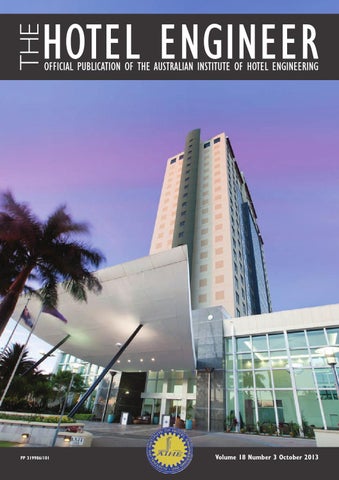
Front cover shows Watermark Hotel & Spa Gold Coast PP 319986/101
Volume 18 Number 3 October 2013
5
AIHE STATE
NEWS NEW SOUTH WALES With a fresh start to spring, it is hard to believe that the year is coming to an end. However, for the AIHE NSW Chapter we still have our last few hotel engineer meetings and our well earned Christmas party to look forward to. We have had a busy past 3 months with many changes and updates to follow through. I would like to start by congratulating 2 of our members, Mr. Andy Goonesekera from InterContinental Sydney and Mr. Cyrus Tolentine from the Sydney Harbour Marriott. Both gentlemen were finalists for 2 separate awards,The TAA NSW Awards for Excellence 2013 for the category of ‘Engineer of the Year’ and The 2013 HM Awards. Both Andy and Cyrus were chosen as the winners for the 2013 HM Awards. For their other nominations, Andy was awarded
with ‘Engineer of the Year’, followed by a commendation for Cyrus. From the NSW Chapter, it is a great pleasure to have both these gentlemen on board. We began our 3rd quarter with the July Hotel Engineer’s meeting held at the Grace Hotel Sydney. I would like to thank Mr. Philip Pratley for his indefinite support for the AIHE. Each year he welcomes our local engineers to his hotel to ensure that members are being informed, educated and encouraged. Our selected presenters, Mr. John Lloyd and Ross Sharman soon followed with their presentation on electricity tariff optimisation in line with energy efficiency programs and maximising return on investment from energy efficiency. Our August Hotel Engineers meeting was held at the Amora Hotel Sydney. Members were welcomed by Amora’s General Manager, Mr. Stephen Floyd who was pleased to be supporting our local engineers. We were fortunate to have 2 presenters for the afternoon; we began with Mr. Neale Stuart, from Dulux Australia. Neale informed members on the Environmental and Low VOC paint materials supplied by Dulux. He discussed the benefits and was very open to questions.
Mr. Mark Muladay & Mr. Brad Compton from Airefrig Australia followed with their presentation on the changes in refrigerants. Areas of questioning were covered including governing legislation, pricing, replacement options and WHS. Most recently, we held our Hotel Engineers meeting at the Holiday Inn Potts Point Sydney. Once again the meeting was a success with a very interesting and informative agenda. Our presenter Jonathon Clarke from Norman Disney & Young shared with our engineer’s information regarding Energy Management Controls and integration. I would like to once again thank Trevor McCarren as an active committee member of the chapter who organised the presentation. To finish up the year of 2013, NSW will be hosting the AGM Meeting in November, the State Presidents Meeting also in November, followed by the Institutes’ Christmas party scheduled for the 7th of December. I also hope to see an increase in attendance at the final two hotel engineer meetings for the year. I would like to thank all members for their commitment and dedication to the Institute. Your efforts and presence at monthly meetings are valued and appreciated. I hope every has had a successful year and wish everyone the best of luck for 2014. Enjoy your Christmas and New Year. Anura Yapa JP President – AIHE NSW chapter
6
VICTORIA Blah David Zammit President AIHE Victoria Chapter
WESTERN AUSTRALIA Blah With over 30 years experience, Tony Fioraso Yardley Hospitality has served the hospitality industry as a central provider in the supply of electrical equipment andAIHE specialist hospitality items. Through every trend and development, our specialty within the President
Western industry has always been our deep understanding of your every need, and unique ability to fulfil those needs. This has garnered our long,Australia successful history of providing a wide range of products from many leading brands, to Hotels, Motels, Apartments, Resorts and Tourists Parks throughout Australia. Quality; pricing; consistency of products; energy efficiency; we supply only the highest standard of products, tailoring a complete package of electrical appliances to suit your needs.
USB CLONING Helping you work efficiently for quick TV customisation and upgrade^ ACCO Y•
ION•I AT
O MM D
EASY INSTALLATION & SETUP Easy-to-use onscreen instructions that guide you through the entire process
SWIVEL STAND Allows for safe & easy adjustment of the TVs position for the best possible viewing angle. Not available on the 26” model
3 YEAR PRODUCT WARRANTY
We Deliver direct to your do or Australia wide*
DUSTR N
If you’re ready to take your hotel TV experience to the next level contact Paul Yardley T 1300 659 053 M 0412 974 878 F 1300 659 063 E paul@yardleyhospitality.com.au W www.yardleyhospitality.com.au *Delivery for all Samsung TVs is freight free to all Australian metropolitan areas and major regional cities. ^ USB sold seperately
7
AIHE STATE
NEWS • A wide variety of merchandise, catering, and beverage outlets • A very impressive entry foyer • Large concourses with high quality architectural finishes • Grand city views from concourse levels and function rooms.
WESTERN AUSTRALIA Greetings from Western Australia, In July the Western Australian Chapter visited the newly completed Perth Arena. This Arena is now the venue in Perth for all major concerts, Hopman Cup and home court for the Perth Wildcats basketball team. The Arena is a VenuesWest venue managed by AEG Ogden and was officially opened on 10th November 2012. Features of the Arena include: • Maximum capacity of 15,500 – a truly multi-purpose, indoor arena • State of the art acoustic design • Retractable roof • Permanent tennis court surface. • Five high quality and distinctive function rooms • Corporate VIP suites
8
• Low environmental footprint with the largest solar panel array in the Perth metropolitan area with capacity to generate up to 111kw of power • Located in the heart of the CBD – Wellington Street and Milligan Street • Underground car park This site visit was well represented with over 40 members. In August we held our meeting at the Tradewinds Hotel in Fremantle which again was well attended with over 20 members. There were two presenters for the night: Paul Ballantyne from System Maintenance gave a presentation on services in relation to plumbing, pump sets and general hydraulic services. Jake Hickey from Instant Waste – presented a video on the latest Material Recovery Facility. The site process’s over 200,000 tonnes of C & D waste to help improve Western Australia environmental credentials and waste reduction.
September took us to another site visit to Glazewell. They specialise in all types of glass replacement or installation of mirrors, shower screens, bar tops, splash backs, specialised tinting, frosting, and a new automatic block out system which allows the customer to change the state of a window from clear to frost, (electric glass window) which works a treat if the window requires a privacy option. Many thanks to Mick Camfield the General Manager of Glazewell for his time. During this visit we also had a LED lighting display and presentation on the latest LED lighting. Western Australian membership remains strong but we still need more Hotel Engineers/Maintenance Mangers to join this great networking opportunity. I encourage General Managers to assist in providing the time and resources for their Engineers to attend these events because the knowledge and advice is a great source of benefit for the property they manage. To conclude I wish everyone a safe and prosperous Christmas and New Year. Regards Tony Fioraso President – AIHE Western Australia
*Illustration purposes only E&OE
9
AIHE STATE
NEWS experience, in the company of Steve Richards. Josh Katz of Grand Hyatt Melbourne was the lucky member to win the draw; also lucky for him his boss let him have the day off at short notice!! The evening concluded with access to the Eureka sky deck, offering a great opportunity for a few more photos and plenty of laughs. Certainly a meeting that we will all remember.
VICTORIA With the AFL season now over for another year, we congratulate all our Hawks supporters for a Grand final end to a fabulous season. We now finally head into some warmer weather as we welcome spring and day light savings, whilst we fire up our chillers after being dormant over winter, time to consume those Kwhr’s... With Stephen Docherty, our trusted meeting co coordinator, out on a mission, he proudly secured our July meeting at Eureka tower.This was an absolutely brilliant night, as we took in the sites of our great city from the 89TH floor, enjoyed quality F&B and welcomed Laser Plumbing & Electrical as our presenters. Both Phil Craig and Nick Mason provided an overview of the services offered by their business, mostly specific to the hotel sector. They completed their presentation with a generous lucky draw prize that consisted of return flights for the day to Brisbane to participate in the Porsche ultimate driver
10
Our August meeting was held at The Hotel Windsor. Senior Engineering Supervisor Bob Shillito arranged their charming ballroom for our meeting, complemented by an abundance of F&B offering. Ron Oakley of Dalkia Energy Solutions and his team of experts presented on the evening, offering all who attended an insight into Air-conditioning solutions, coupled with the innovative ways that Dalkia can offer us options, cost savings and advice when upgrading or maintaining our crucial plant. I am positive that all who attended would have found this meeting to be both informative and beneficial. On exiting the Windsor that evening, we were all treated to a spectacular light show that Bob and his team had set up across the entire facade of this historic property.This was in celebration of their 130 year anniversary. September had us gather at Grand Hyatt Melbourne as we hosted our round table meeting.This is now the 3rd year we have held this meeting, which was equally attended by both Hotel engineers and our corporate members.This forum allows opportunity
to openly discuss any issues, new ideas and changes that may be affecting our industry. It is also a platform to converse on engineering related challenges that may be effecting each of our hotels, raise questions to the group, discuss products or just seek advise about anything relating to hotel engineering.The evening provided healthy discussion around subjects such as LED lighting; lift upgrades, carbon tax, emergency lighting and domestic hot water systems. Anton Vandenbrink was kind enough to take minutes and delivered a concise summary of the evenings discussion points. Please feel free to contact Anton if you would like a copy of these minutes, anton.vandenbrink@sofitel.com Our corporate & committee member, David Jones of Middys electrical, has been happily snapping away many photos at these past events.These photos can now be seen on our newly created face book page, Aihe Victoria. Get online and join our group as we use this social media tool to have a little fun and broaden our communication amongst our friends. If you are wishing to become a member or need further information about our meetings, feel free to drop me an email, david.zammit@hyatt.com Kind regards David Zammit President AIHE Victoria Chapter
Why a Dolphin is right for you? Wave 75 - Pools Up to 20 metres
ProX - Pools Up to 25 metres
Make your Life Simpler with a Dolphin Pool Cleaner • Trust the Brand The Dolphin brand is recognised internationally as the Number 1 choice for pool cleaners
• Trust the Company The pioneers of robotic pool cleaning with over 25 years experience
• Trust the Support Maytronics training and service centres in Major Centres around Australia
Liberty Pro - Up to 15 m with islands and obstacles
Please Contact Us for more Information & Demonstration of Cleaners
Exceptional Pool Experience
1300 MYDOLPHIN
www.maytronics.com.au
Commercial
maytr nics
11
AIHE STATE
NEWS from swimming pool water will prevent the growth of algae. Phosphate is introduced into swimming pools by several means including; • Water runoff from lawns and gardens • Fertiliser over-spray/over-drift • Rain
QUEENSLAND 3rd quarter July – was a social night with members participating in a Christmas in July dinner at the Olive Grove Restaurant Emerald Lakes – Carrara. All enjoyed the French style cooking, fine wines and a wonderful opportunity for all to meet the other member’s partners. September’s meeting was a presentation by Poolwerx at the Watermark Hotel in Surfers Paradise. Matt Gillam: Franchise Partner/General Manager of Poolwerx Surfers Paradise, specialises in Commercial Pools for Hotels, Resorts and Body Corporates. Topics that were discussed were: Solutions to those ‘common’ pool problems Is energy saving with pool equipment a reality? How to stay compliant with Pool Regulations Understanding basic pool health requirements Some of the key points highlighted were::
Control of Phosphates Phosphates are nutrients essential to the survival and growth of all living matter including algae. The removal of phosphate
12
Superchlorination may be required to reach ‘breakpoint chlorination’ and remove chloramines (the bad chlorine) from the water. Dissolving chemicals in a bucket of water before adding will assist. Maintenance doses of algaecide may be required (IQ Maintenance Algaecide).
• Dust
Green Pools
• Cleaning Solutions
Indicate algae growth due to inadequate chlorination which can be caused by;
• Swimmers (body fluids/Phosphate based body soap/swimming costumes (washed in phosphate containing detergents) • Decomposing organic matter (leaves, bark, sticks etc). The higher the phosphate level, the faster the algae growth leading to higher chlorine consumption and increasing water problems. Water quality may be best maintained by introducing the following procedures; • Regularly add maintenance dose of Phosphate Remover (IQ NilPhos) • Maintain adequate levels of chlorine • Remove all organic material from pool water (empty skimmer baskets, regularly vacuum etc) • Test for Phosphate levels regularly
Cloudy Water Cloudy pool water can be from a number of sources including; • Excessive combined chlorine, or free chlorine rapidly dissipated (bather load, phosphates etc) • Poor filtration • Calcium Hypochlorite (granular chlorine) added directly to pool water in large volumes In order to combat this issue, check filtration and backwash if necessary.
• Poor filtration and sanitation (is dosing system big enough to cope with the maximum load) • Increase in bather loads (number of swimmers) • Run-off from gardens, fertilisers etc/ phosphates
Blackspot Algae Very difficult to remove once in the pebblecrete and can also indicate poor circulation, sanitation and filtration. IQ Blackspot/Winteriser, Granular Blackspot used to combat.
Staining Staining can be caused by the addition of salt to the pool, usually iron and minerals in the salt will present as yellow to brown stains on the pool floor. Liquid chlorine can also cause staining after continuous use over many years. Bore water, algaecides containing metals, metal fixtures such as grab rails etc can all cause staining of the pool walls and floor. Maintain pH between 7.2-7.6 for best results as this will allow the metals to sit ‘in solution’ and not ‘fall out’ onto the pool surface. Assist with addition of IQA Metal Magnet and follow up with a clarifying treatment such as IQ Pool Shimmer. Ian Crookston AIHE – Qld Chapter President
13
Control Contractor 60 Series
Control Contractor 50 Series
Control Contractor 40 Series
COMPLETE COVERAGE
for your hotel or bar. High Performance Meets High Refinement The professionals choice for over half a century No matter where you go in this world, you’ll find JBL Installed Sound Speaker Systems at many of the most notable venues. With that kind of global perspective, JBL has come to respect the one indisputable truth of business: every customer is unique. A speaker system that is perfectly right for one job might be perfectly wrong for another. That’s why JBL Installed Sound products offer a range of options without equal. From the ex-
Distributed by
www.jands.com.au
14
traordinary value of the Control Contractor Series to the ultimate precision of the JBL Precision Directivity Series, there’s a JBL Installed Sound product with a solid business solution based on equally solid business savvy. For more than 60 years, JBL has been the professional speaker of choice wherever sound matters. We’d like to believe it should be your choice, too.
THE
CHARACTER OF ACOUSTICS SIMON LAPPAS I Audio Systems Logic
S
pacious... lively... warm... enveloping... fatiguing...
We will come back to these words a little later. With modern architectural design, it is form that should follow function.Your restaurant, function centre and pre-function areas concept designs have been directly derived from their purpose. So why are acoustic consultants one of the greatest competing forces to modern architectural design? Standards, design creativity and product knowledge.
The go to Australian Standard AS/NZS 2107-2000 (for those interested) is the most commonly referenced acoustic standard associated with the acoustic design of most projects. It even finds its way into our contract scope of works. You want a restaurant – sure, we have a reverberation time and design sound level for that.You need a function centre – no problem, check the volume of the space against this curve and here is the number you need to target for your acoustic design. All those large expanses
of glass providing you with those sensational views that you liked so much in the architectural concepts, they have to go.That simplified form with lack of applied decorations – can you integrate some perforated timber acoustic panels there? There are too many hard surfaces. How do those simple numerical targets (i.e. reverberation time) fit in with the architectural vision for your new spaces? On the whole, they don’t. What this standard provides is a numerical target you must achieve to provide a result that is similar to
15
Bar Boulud, New York Acoustically absorptive ceiling finish
66 Restaurant, New York Acoustically absorptive ceiling finish
Broad Stage, Santa Monica Acoustically absorptive vertical blades
The Great Hall and Balcony Room The University of Technology, Sydney
other spaces that fits the general profile of a restaurant, function centre, etc. and your contract requirements.
to engage users of the space; visually and aurally. This brings me to a story.
With the exception of a concert hall, acoustic consultants are not part of the creative concept design team that develop the form that follows the function. To be part of a concept design team, the acoustic consultant must free themselves of non-specific standards. It is critical to understand how the architect is wanting
16
Our consultant studio was recently involved in the design of a new multipurpose 1000-seat venue which had an adjoining voluminous pre-function area. The architectural team had previous input from an engineering consultant which led them down the path of a reverberation time which needed to be lower within the triple height pre-function area than in the multi-purpose hall on the basis of
classification within AS/NZS 2107:2000. The Client and Architect were concerned that the inclusion of vast amounts of acoustic finishes would detract from the simple, clean lines that they had envisioned for the space composed of large spans of glass, plasterboard and parquet flooring. What the consultant did not ask of the concept design team and Client were questions such as how does the prefunction area relate to the multi-purpose hall, how will people interact in the pre-
auralisations. Auralisation is a technique of creating audible sound files from simulated, measured or synthesized data of a sound field of a source (such as a loudspeaker or person) in a space, in such a way as to simulate the listening experience at a given position in the modelled space. The motivation for this is apparent: instead of describing the properties of a room and sound reinforcement system by numerical quantities (speech intelligibility, coverage and the like) it is possible to directly listen to the sound, which makes the results of room acoustics design more palpable to people who are not experts.
function area and what are you wanting people to feel as they move from the prefunction area to the multi-purpose venue? What was discovered within thirty minutes was that up to 1000 people would be within the pre-function area prior to entering the venue. The Client and the Architect envisioned this space to be “lively” and “energetic”. Additionally, groups of people could be involved in a private discussion and these discussions should not be intelligible to nearby and disparate groups. The pre-function area should build the anticipation of entering the performance venue and this voluminous performance venue should give impression of “intimacy”, “warmth” and that it should not feel as voluminous as it appears. What did this tell us? The pre-function space needed to be more reverberant than the multi-purpose venue in the first instance. The pre-function space needed to be sufficiently reverberant to promote speech privacy over a distance of 4-5m but allow speech to be intelligible within a group of people within a 1m range. Furthermore, this places a great emphasis on the need to obtain a briefing and ensure that the aesthetic, functional, operational and performance requirements are understood and well-defined.
AUDIO INTEGRATION DESIGN Sound and speech reinforcement can only perform as good as the acoustic space it operates in.
The majority of complaints surround the performance of sound/speech reinforcement systems solely relate the environment they operate within. This inevitably occurs due to a disengagement between the audio visual and acoustic designs which are generally two isolated pieces of work by two different consultants. In recent times, there has been a large uptake of electroacoustic modelling to in the first instance guide the integrated room acoustic and sound/speech reinforcement system design. This process has allowed the electroacoustic consultant (who designs the room acoustic environment and audio system in tandem) to consider the type, strategic location and extent of acoustic finishes within a space whilst selecting and locating loudspeakers strategically to perform optimally within a space. Electroacoustic modelling – what was intended to be an advanced design and design verification tool was for many years put aside for rule of thumb design work or direct SPL online modelling tools offered by manufacturers’ which don’t account for the room acoustic environment.
Listen to your restaurant, your pre-function space or your 3000-seat entertainment facility. Yes... this story is ultimately beyond the scope of this article, but hopefully this quick journey raises some awareness and increases expectations as to some elements that must be addressed by your chosen consultant on that next project. When the consultant has not fulfilled their role in this capacity, it is unfortunately the Client and the system integrator who is left to deal with the fallout of these problems.
The Star Event Centre (3000-seats) EASE™ Wireframe Model
The recent uptake in electroacoustic modelling by Clients via experienced designers is directly associated with a large number of underperforming and problematic venues and facilities. An extension of 3D electroacoustic modelling is the creation of
The Star Event Centre (3000-seats) AURA™ Speech Intelligibility Index Contour Map
17
Filter Selection for Hotels
John Mediati I Camfil Farr Australia Pty Limited
Indoor Air Quality
W
e breathe 20-30 kg of air per day and spend 80% of our time inside so Indoor Air Quality is important for human beings. Clean air is important because particles from soot from the combustion process are the most dangerous for one’s health, these combustion particles are very small <1 µm and these ultra-small particles cause heart and vascular disorders. 50% of all particles inside come from outdoor air. 50% are generated from indoor sources; the particles penetrate the building through ventilation and leaks. Air pollution adversely affects the growth of lung function during the period of rapid lung development that occurs between the ages of 10 and 18. (The New England Journal of Medicine). High contamination level of fine particles increases mortality rate, people exposed to air pollution are more likely to die from heart disease than respiratory disease with 31 percent increased risk of heart disease compared airborne combustion fine particles with particles that smoking adds to the lungs, it is believed that combustion particles cause greater damage (Brigham Young University, Utah) Ultra, Nano and Fine particles have a clear connection to health effects as mortality and respiratory problems with these fine particles contribute to cardiovascular diseases which will move the focus from PM10 particles to the finer PM2.5 particles. WHO concludes that there are no lowest harmless concentration limits. Instead they are talking about dose related response. PAH (Polyaromatic hydrocarbons) and heavy metals are created in combustion processes, for example:
18
Outdoor air quality
IAQ Indoor Air Quality IDA 1 (High)
IDA 2 (Medium)
IDA 3 (Moderate)
IDA 4 (Low)
ODA 1 (pure air)
F9
F8
F7
M6
ODA 2 (Dust)
F7 + F9
M6 + F8
M5 + F7
M5 + M6
ODA 3 (very high concentrations of dust or gases)
F7 + GF + F9
F7 + GF + F9
M5 + F7
M5 + M6
Recommendations in EN 13779 for air filter
• Traffic • Heating plants • Tobacco smoke Many PAH are classified as carcinogenic and heavy metals like lead, cadmium, mercury and arsenic are also increasing present in the outdoor air
How can air filters improve the IAQ? • Keeping the system clean – the projected airflow is maintained • Influence Temperature and RH by keeping sensors clean • Maintain the efficiency of equipment. (Fan, Heating, Cooling) • Reduce indoor contaminants from humans, building materials and equipment. • Remove outdoor contaminants, which could cause allergies, cancer and lungdiseases • Avoid micro-organisms in the system
Application and Selection of Air Filters Efficient air filters contribute to a better indoor air quality for humans and a better production result in the industry. This is very important to consider when selecting the right type of filter. It is necessary to first of all conclude which type of particle collecting efficiency (or adsorption efficiency
and capacity for molecular filters) one need to achieve a healthy and productive environment. The new European Standard for Ventilation is one of the standards that can be used as a guideline. EN 13779 is aimed at achieving a comfortable, healthy indoor environment in all seasons with acceptable installation and running costs. EN 13779 has now been adopted as a national standard in all European member countries. It specifies the required filter performance in a system to achieve good IAQ taking into consideration contamination in the outdoor air. We would recommend installing F7-filter as a minimum, to provide a moderate level of IAQ within the building in accordance with EN 13779. “An F7-filter has a 50% separation of 0.4 µm particles while an M6-filter has about 20%. The concentration of 0.4 µm particles downstream of an F7-filter will be reduced by a factor of two compared with the M6-filter. An F9-filter will reduce the downstream concentration further by a factor of two. This means that the F9-filter is twice as good as the F7-filters, which is twice as good as the F6-filter.” (Air Filtration in HVAC Systems – REHVA Guidebook No.11)
Eurovent Air Filter Certification Eurovent’s certification of our fine-dust filters means that you can rest assured that we live up to the performance requirements and the data we print in our official documentation. Our fine-dust filters are tested by independent laboratories selected by Eurovent and that means security for you. The key elements of the programme are that: • Published data must be correct • The products must comply with the EN 779:2002 standard • Filters must be tested by independent laboratories – SP in Sweden and VTT in Finland • The test laboratories must be ISO 17025 certified • We as manufacturers must be quality certified to ISO 9000 or a corresponding standard • Each year, Eurovent selects four new filters from our range for inspection Select Camfil air filters with Eurovent certification – it’s guaranteed
AIR FILTERS Y M5-F9 www.eurovent-certification.com
Principles of Filtration As mechanical filters load with particles over time, their collection efficiency and pressure drop typically increase. Eventually, the increased pressure drop significantly inhibits airflow, and the filters must be replaced. For this reason, pressure drop across mechanical filters is often monitored because it indicates when to replace filters. Conversely, electrostatic filters, which are composed of polarised fibres, may lose their collection efficiency over time or when exposed to certain chemicals, aerosols, or high, relative humidity. Pressure drop in an electrostatic filter generally increases at a slower rate than it does in a mechanical filter of similar efficiency. Thus, unlike the mechanical filter, pressure drop for the electrostatic filter is a poor
The above photo shows coarse fibre/electret media magnified 400 times. Coarse/electret fibres, because of their large size, are easier and less expensive to produce. Their primary effect of particle capture requires a charge imparted on the fibre during the manufacturing process. As the charge dissipates because of particulate loading, so does the efficiency of the filter. This is a critical condition, as 99% of all particles are under 1 micron in size — the range where these types of filters suffer critical loss of efficiency
indicator of the need to change filters. When selecting an HVAC filter, you should keep these differences between mechanical and electrostatic filters in mind because they will have an impact on your filter’s performance (collection efficiency over time), as well as on maintenance requirements (change-out schedules).
The above photo shows fine fibre media magnified 400 times. Fine fibre media operates under a mechanical removal principle, and fibres do not lose efficiency over time. Their initial efficiency is indistinguishable from their actual efficiency over life, providing the user with the particle removal performance they have specified.
Each component here is important for achieving a good indoor environment. Life Cycle Cost (LCC) of Air filters The energy losses in an AHU-system consist typically from pressure losses due to ducting and equipment like heat exchangers, cooling coils, the specific performance of fans and air filters. A large part of this comes from
Optimising the operational cost for clean air handling system
500 400 300 200
Energy consumption today and tomorrow
100 The awareness of the higher cost of energy together with the increased focus on the global climate has raised the demands on rs rs st er er ns cts lower energy consumption worldwide. This Du Filte hang ng Co Heat ilense ectio i c n l S on ex Coo in conjunction with a development of the C at He economy require an increase in number of Typical pressure loss (Pa) in a ventilation system with 2 stage filtration energy consuming activities, we do need to optimise the new systems. An equally important, and maybe in the short term 100 even more important question is what to 80 do with the already existing systems we 70 have today.
60
Air handling units (AHU) supplying clean air to buildings in the industry, offices and dwellings are important to create a good indoor air quality for both humans and production processes. An air handling system normally consists of many subsystems or components like: fans, heat exchangers, sound reduction, air filters etc.
40
15
E
gy ner
8
5
20
2
%
t t t t t Cos r Cos g Cos r Cos l Cos u a e n s t o i o Fil lean Lab Disp C
19
the pressure drop over the air filters, and therefore this part is important to address in order to minimise the energy consumption. The ‘typical’ energy cost of filters as a percentage of the total system is approximately 30%. Selecting the correct filter, i.e. F7 filter efficiency and lowest average pressure drop, can create significant savings on energy while maintaining healthy Indoor Air Quality (IAQ). This is an opportunity since the filters are the most inexpensive part of the system to improve.
• Filters • Labour (installing and replacing) • Energy consumption
In the example below two filters are compared, both of the same filter class, F7 and used as single stage filters in an AHU supplying an office building in a town environment with a Good AQI (PM2.5). The airflow per filter in the AHU of the office building is 3400 m3/ hr (944 l/s). The fan efficiency is determined to 60% and the airflow is the same during the entire operation. The LCC period is 5 years and the final pressure drop is 250 Pa.
• Cleaning of ventilation system • Disposal of used filters Considering the total operational cost for air filters in a system the vast majority of installations have a large share of the cost coming from the energy consumption (typically 60-70 %). The energy consumption is directly proportional to the average pressure drop over the life of the filter. Since air filters normally are replaced many times in a buildings life span, it is from this perspective quite obvious that by decreasing the pressure loss over the filters for the same given efficiency, a significant reduction in energy use can be obtained already today.
TCO Elements
Energy Cost
Filter Cost
20
Labour Cost
Waste Cost
CO² Impact
Landfill Impact
Minimum Life Efficiency (MLE) Total Cost of Ownership (TCO) Performance Satisfaction Terms
Camfil was the first filter manufacturer to develop a sophisticated program that calculates the Life Cycle Cost of air filters. Over many years the program has been improved. The program is based on numerous real life measures of filters. This allows us to predict the filter’s pressure drop and lifetime in an actual installation rather than relying on theoretical calculations. After having selected required filter class, we can calculate LCC for 1-, 2- or 3-step filtration based on either change outs after time or after final pressure drop. The program can be adjusted according to the characteristics of your outdoor air and your specific costs for filters, labour, disposal, cleaning and energy.
The LCC for a filter is the cost of the
Conducting an LCC-analysis
Energy Efficiency Classification – A new way of comparing air filters At last, buyers of air filters will find it a lot easier to find the right filter– regarding both energy efficiency and indoor air quality. Eurovent‘s new, objective energy efficiency classification has now been implemented. Now all air filters can be graded from A to G – A for the lowest energy consumption and G for the highest. The new classification is based on EN779:2012 and will give you a good
Camfil Hi-Flo 6 Pocket Bag Filter 695 AUD
400 AUD
64 AUD
14 AUD
3 Ton
0.26 m³
55.0% 1173 AUD
Camfil Hi-Flo 8 Pocket Bag Filter
Camfil Hi-Flo 12 Pocket Bag Filter
666 AUD
538 AUD
300 AUD
40 AUD
16 AUD
8 AUD
2 AUD
180 AUD
3 Ton
3 Ton
0.17 m³
0.07 m³
55.0% 1014 AUD
55.0%
736 AUD
The above examples highlights by just increasing the surface area of the filter, this will turn decrease the initial pressure drop. By lowering the average pressure drop of the filters, this can represent savings of up to 35% in the total cost of ownership.
understanding of annual energy consumption, initial efficiency and minimum efficiency. Higher demands. As the price of energy increases and the demands of reducing CO2 emissions get tougher, the energy consumption related to air filters has become the focus of attention. Currently, air filters are classified only by their average efficiency. The new energy classification is far more precise. The new standard. The energy consumption of air filters can be determined as a function of the volume flow rate, the fan efficiency, the operation time and the average pressure drop. Due to the dust loading during operation, the pressure drop of an air filter is constantly increasing. The related energy consumption during a certain period of time can be calculated from the integral average of the pressure drop over this period of time.
camfil solutions for guaranteed performance
Calculation and classification. The new standard measures both filtration efficiency and pressure drop as a function of dust loading. A representative energy consumption level is calculated using the mean pressure drop difference averaged over the course of dust loading. On the basis of these figures, the energy performance of a filter over an operating period of one year is simulated in a laboratory. This representative energy value is used for a classification of air filters into energy classes. www.camfil.com For further information please contact your nearest Camfil office
Y
IJA IE
IA
Camfil Farr Hi-Flo XLT7 A50+ 592x592x640-10 Air filter Trosa
F7 EN779
Nominal Air flow: Initial efficiency 0.4Âľm: Minimim efficiency 0.4Âľm: Energy Consumption: A B
3400 m3 /h 56 % 54 % 928 KWh/annum
A
C D E F G
CLEAN AIR SOLUTIONS
www.camfil.com
21
22
23
The Watermark Hotel Group
Paul Truman I QLD Chief Engineer, Watermark Hotel Group
The Watermark Hotel Group has been intensely focussed on transforming its two Queensland properties, Watermark Hotel Brisbane and Watermark Hotel & Spa Gold Coast, into impressive, contemporary hotels over the past year and there are no signs of this work abating any time soon.
W
atermark Hotel Brisbane is now repositioning itself as a sleek, boutique city hotel just minutes from the CBD after undergoing extensive multi-million dollar renovations. Rohrig Constructions were appointed as the building contractor and the renovations included a chic, sophisticated new lobby; new Park rooms and a Park Suite with designer bathrooms, new balconies and refurbished rooms;
24
contemporary, new conference facilities and significant upgrades across its public areas. Maintaining the operational functions of the hotel whilst stages of the refurbishment program were being undertaken was crucial. The QLD engineering team were very focussed around synchronising and co-ordinating works to enable the project to rollout exactly as planned.
Due to the age of the hotel and the fact that it was constructed in two stages across different time periods, the team also placed a strong emphasis on upgrading and repairing the hotel’s infrastructure. During the refurbishment, the hotel was still operating and minimising the disruption to guests was imperative. As with all major refurbishments which need to limit the impact on guests, it was impor tant that adequate contingency plans were developed to prevent potential construction issues that could affect normal operations. The project was delivered on budget and by adhering to a tight schedule, the overall outcome was a success. Par ticular thanks to Rohrig Contructions and all the sub-contractors working in unison. The QLD engineering team were heavily involved in the project as much of the infrastructure was connected with the refurbishments and input was required throughout both design and construction stages. For example, when designing the lobby and entrance, the team were able to provide input which enabled the amplification of natural light and more natural airflow (which also minimised air conditioning requirements). Other examples include the design of the new kitchen, LED replacement plan and restructuring of the gardens. This kitchen design involved a more ergonomic layout and better flow of the restaurant operation with the purchase of new appliances to increase reliability and enhance electricity, gas and water efficiencies. Lighting where possible was replaced with LED’s and following the refurbishment, the QLD engineering team restructured the gardens and landscaping to provide a refreshed look, ensure they are relatively drought proof and decrease maintenance requirements. Watermark Hotel Group CEO, Max Takamizawa proudly says “The hotel is now a serious 4 star contender for the corporate traveller market and guest feedback in relation to the new look has been extremely positive.” Max says, “we have jumped from number 95 on Tripadvisor to number 45 and expect this to continue rising.”
quality. This could not have been achieved without structured organisation and the dedication and hard work of the contractors involved and their staff. We were fortunate to have a group of Contractors who understood, accepted and committed to our plan so in turn we felt comfortable to continue with the same team for Stage two. Not limited to but many thanks
Hotels
We don’t want anyone to loose sleep over hotel construction.
But Watermark Hotel Brisbane isn’t the only property with news to tell, Watermark Hotel & Spa Gold Coast aims to become one of the leading 4.5 star hotels on the Gold Coast and is also planning a major overhaul which will include refurbishing over 60% of its rooms, a sparkling new look for its pool and marquee area, and an exciting dining and entertainment precinct on the ground floor of the hotel. To date, 110 rooms have been completely refurbished and another 132 are due for completion in October 2013. The new Superior rooms feature a striking new look and contemporary furniture and fittings including Gold Series Collection beds, Italian designed Europa sofa beds and Peter Morrissey amenities. The program for stage two of the refurbishment to the 132 rooms is still underway and at times the schedule has been extremely tight, as the hotel needs to keep as many rooms available for guests as possible.
At Rohrig we plan construction so your guests can sleep in peace and hotel income continues.
To date, the hotel has opened 5 levels of the 6 that are part of this stage over a period of 6 weeks without compromising
Brisbane Melbourne Sydney
It’s all part of an impressive experience designed to achieve your goals. Find out how we manage a dream construction project at www.rohrig.com.au
25
to all involved in making our task that less ardous. Major Contractors being, Metro Painting, Garvic Electrical, Hole Gone Plastering, Civic Shower Screens, Flooring Depot, Master Kelwin, 1300 Clear out (Furniture and carpet remants removal ), ProPlumbing, Classique Vanities, Tecnology 4 Hotels, and to all the team at Resor t Interiors who adhered to a very tight program.
“We are really proud of the new rooms and this has been reflected in the fantastic guest feedback we are receiving,” comments Watermark Hotel Group CEO Max Takamizawa. In addition to the room refurbishment, the hotel has embarked on significant modifications to the design of its main pool facility. The pool area will be altered and extended to include new seating such as day beds and lounges. The existing marquee on
TECHNOLOGY – use it to enhance your guest’s stay More and more guests carry mobile devices. These devices need to be charged and USB is the default standard for charging. • Replaces a standard powerpoint and provides 2 x power sockets and 2 x USB charging ports 2x USB CHARGING PORTS
• Charges: iPhones, iPads, iPods, Android phones and tablets, Samsung devices and many more
W I www.technology4hotels.com.au
26
P I 1300 503 657
Guests travel with laptops, tablets, phones, the list goes on – all these devices are power hungry. Add outlets for convenience at desk height. We have a number of solutions which elegantly add power outlets without breaking the bank or undergoing a refurbishment.”
E I Brendon@technology4hotels.com.au
Finally, both hotels have recognised the need to introduce new technology and installed LSP (Life Style Panels) televisions into all guest rooms. These TVs provide guests with in room WiFi access, Internet and movies on demand. The replacement of TVs to LEDs was included in the installation. The refurbishment and upgrade projects and programs, have enabled the QLD engineering team to consider and implement new sustainability measures. As with most properties, there is a major focus on the reduction of electricity costs. LED lighting has been installed in areas that require lights to be on for long periods of time, which include sensors to all public area amenities and major changes to foyer lighting. The LED installation program has been ongoing and involves a commitment from the hotel’s owners and their push towards sustainability. The team is also currently working through other alternatives in relation to electricity savings. The hotel is considering Power Factor Correction / Optimisation and reviewing in detail all relevant technology which can be included in its upgrade program. An extensive cost benefit analysis is being conducted to calculate the percentage of potential savings on our monthly power usage. However, electricity isn’t the only sustainability measure being considered. Reductions in water usage have been achieved through awareness and education, specifically to all in-house staff.
a lower level, which is used for cocktail functions, weddings and events, will soon be enclosed with tiled floor areas. This will create a more ambient space and the extensions will open the entire area to a more diverse range of uses for leisure guests, functions and events. However, Max says “the new dining and entertainment precinct is the most exciting project planned for Watermark Hotel & Spa Gold Coast in 2014.” The new development will be located directly in front of the new Surfers Paradise light rail station, planned to open in June 2014, and will entice both tourists and locals to play and dine with a plethora of sensational new offerings including a casual café, VIP & sports bar, gaming lounge and restaurants. Watermark Hotel & Spa have embraced the Light Rail Project as an opportunity to revitalise and redevelop the proper ty strategically around the new station which will be situated adjacent to the property, and create a unique tourism hub. Renowned architectural firm, Brand & Slater, have been entrusted to design the vibrant new precinct after showcasing their versatility across different hotels, restaurants and bars around the country. Max says “We are confident Brand & Slater will deliver a unique, cutting edge precinct which will become the future hero feature of the hotel.”
You can’t beat exPerience
30 Years 5,000+ aPartments no subcontractors
Proudly associated with
Watermark Hotels
1300 033 018
metropainters.com.au
27
The hotel has maintained its connection with the once WEMP program and is continuing the relationship with a company that data logs water usage, and through the information provided, audits water usage, reviews trends and provides detailed cooling tower reports. Both Watermark Hotel & Spa Gold Coast and Watermark Hotel Brisbane are extremely committed to addressing and reviewing all aspects of sustainable work practices for energy, water, waste, social and sustainable purchasing. The hotels are also fortunate enough to be able to maintain a strict Preventative Maintenance Program which helps with less remedial and reactive works. As revealed in the information above, it is obvious with so much happening, the future is bright for the Watermark Hotel Group and both hotels will have a great opportunity to shine in both the Brisbane and Gold Coast markets over the next few years.
Australian owned & manufactured • Standard range of vanities www.classiquevanities.com.au • Custom made vanities & laundries as per your specifications • Manufacture of acrylic tops in two different designs, sizes range from 600mm to 1800mm (available in single or double bowl options, 460mm depth or semi recessed) • Stone tops available in all sizes • Wall hung, on a kickboard or legs • In house 2 pac painting (colour match or pick a laminate finish) • Metal sided drawer runners & upgrade to soft close systems by Hettich (life time warranty) • Supply Australia wide
Classique Vanities Pty Ltd manufactures all our own products from our 1000m2 factory base in Queensland. We proudly supply Tradelink and Mitre10 groups Australia wide. Classique Vanities have built an enviable reputation with Interior Designers, Architects and Specifiers in the supply of made to measure and client design requirements. This aspect is of particular importance to Hotels, such as the Watermark Hotel, Gold Coast, currently undergoing refurbishment. We are able to manufacture one off or large volume runs with our use of modern CAD machinery. This allows us to remain competitive to the inferior import market whilst at the same time CLASSIQUE VANITIES maintaining our standards 71-73 Rowland Street, and quality production.
Slacks Creek, QLD 4127 P: 07 3804 3344
Classiques innovativeness have produced the “RenuBath”, a new bath designed to be installed inside & bonded to the existing bath. No retiling or plumbing necessary & ready to use in a matter of hours.
28
E: shaun@classiquevanities.com.au
www. classiquevanities.com.au
Professional cleaning with discreet performance. At Kärcher we don’t just think about our customers, but also our customers’ cus tomers. Hotel guests that don’t want to be disturbed and hotel managers that care about the ambience and cleanliness of their hotel above all else. People who want to clean in a reliable and economical manner. Kärcher machines provide sufficient levels of power whilst running extremely quietly and saving electricity. Rent, buy or lease options available. Kärcher eco!efficiency – achieve more with less. VIC, SA & WA & NT: 0419 184 717
www.karcher.com.au
NSW: 0437 933 453
QLD: 0400 971 753
29
30
Key Trends
in In-Room Technology in 2013 Ted Horner I E Horner & Associates Pty Ltd
1. BYOD: Bring Your Own Device
4. HOTEL BANDWIDTH IS BEING SQUEEZED
otels are increasingly becoming places for people to plug-in their own devices as hotel-provided, in-room entertainment takes a backseat to the entertainment travellers bring with them. A recent survey found digital travellers tend to own at least two devices, favouring laptops and smartphones that make it easy to pay little attention to an in-room TV or clock radio.
Whether it’s for business or pleasure, the one thing hotel guests want is faster Internet than they have at home. But travellers with their tablets are making it especially hard for hotels to keep up with demand for their bandwidth. And guests who once used hotel Internet to check emails now are using the service to stream movies, putting a squeeze on networks already struggling to meet the increased demand.
H
Hotels are responding by making it easier for guests to use their own devices in conjunction with hotel offerings, and some are even offering loaner devices for guests who may have left theirs at home. But it’s not just entertainment that guests are bringing with them.
2. PAY-PER-VIEW HAS BECOME A THING OF THE PAST? Pay-per-view is becoming a casualty of bring your own entertainment culture. A 2011 USA TODAY poll found 81 per cent of hotel guests weren’t ordering pay-per-view entertainment. Travellers instead were opting to bring their own DVDs, watch free TV or use streaming services via their laptops. Industry figures show hotel pay-per-view revenues have slid by 39 per cent from 2000 to 2009, and even porn hasn’t been able to survive the decline. Overall, movie rental revenues in 2011 made up .28 per cent of total hotel revenue, down from 0.76 per cent in 2002. Traditionally, half of all hotel movie rentals were of the adult genre.
3. HOTEL TVs ROLE IS CHANGING Today’s digital travellers are using entertainment in hotels in much the same way they do at home: via online services like Amazon Prime, Hulu and Netflix. Armed with laptops and tablets, guests are more likely than ever to leave their TVs off, and hotels are looking for new ways to incorporate the once cutting-edge devices into the guest experience. One approach is to turn TVs into hubs for more cohesive entertainment systems that work seamlessly with guests’ own devices and streaming services. For example, Hyatt Hotels Corp. envisions guests using its TVs as “fully connected, interactive entertainment centres.” It sees its in-room TVs as tools to book tours, order room service and stream content from services like Netflix.
31
Futurebrite™ Technology Our LED products are perfect for Hospital lighting as they are of high quality with low energy use. Our Medibrite™ range offers specialty Hi CRI LED lights that have been made specifically for Australian Hospitals.
From energy audits to supplying LED lighting only or a total installation on a design and construct basis, FUTUREBRITE™ Technology has the expertise and we continue to explore innovative ideas to suit our clients’ needs for each and every occasion. The FUTUREBRITE™ LED product range has been trialled in many applications with great success and reliability, and continue to be specified and utilised through the high performance and energy saving measures they deliver, from LED Tubes, LED Floodlights, LED Shoplighters, LED MR16’s and many other of our LED lighting products, www.futurebrite.com.au
By using our fully accredited LED lighting products and services you can save:
Hotels are turning to tiered pricing to balance customers’ demands for free Wi-Fi with their own desire to generate revenue and offset the costs of network upgrades. A large percent of hotels offer free Wi-Fi and it is typically a very basic service, but an increasing number of hotels are adopting tiered pricing strategies that require customers to pay for faster connections or to connect multiple devices. While more guests are opting for slower speeds over higher prices, there is increasing evidence that enough guests were selecting higher-priced options to drive revenue gains at hotels where a tiered pricing program is in place
6. A HOTEL GROUP THAT IS LEADING THE WAY If you’re looking for the ultimate in-room experience, look to Peninsula Hotel Group In their flagship hotel in Hong Kong, last year they installed in-room entertainment systems that cost approximately $25,000 a room. The systems feature bedside and desk tablets that allow for ordering room service and make concierge requests. They also can control lighting, curtains and temperature. The rooms also have flat-screen TVs, free HD and 3D movies, free VOIP and 450 Internet radio stations.
7. WHERE IS HOTEL LOYALTY HEADED?
• Up to 80% energy consumption on artificial lighting • Additional energy savings from reductions to the lighting heat load on the air conditioning system • You can earn carbon credits, saving you even more $ • FUTUREBRITE™ is a member of the Australian Lighting Council • FUTUREBRITE™ is an Accredited Certificate Provider under the NSW Energy Savings Scheme • FUTUREBRITE™ will do all the paperwork for you so you can receive the maximum rebate.
Hotel loyalty programs may not be as generous with the perks as they once were, but they are increasingly becoming a pathway for members to obtain free Internet access. Some hotel chains, including Kimpton, Omni, Fairmont, Swissotel and Wyndham properties offer free Wi-Fi to all loyalty club members while others like Hyatt, Hilton, Marriott and Starwood only offer free Wi-Fi to elite level members.
The benefits of our LED lighting products to users are:-
8. SMARTPHONES SINGLE DEVICE TO CONTROL GUESTROOM EXPERIENCE?
• Easy Installations - Little to no modifications required • Instant Start-up • RoHS Compliance means no toxic materials used • Dimming available on some products • Environmentally friendly • Extremely long life up to 50,000 hours • Good Power Factor
• Lower energy costs – up to 80% over conventional lighting systems • Reduces building heat loads and Greenhouse Gas Emissions • Minimal Ultra-Violet Emissions • Flicker Free • Minimal heat output • World class technology
IHG has just announced that it is going to provide free Wi-Fi for all Priority Reward members.
As hotels move toward providing guests with a single device to control everything in a room, the smartphone could emerge as the one device that does it all. In Bangkok at the Aloft, guests in certain rooms can retrieve a smartphone from the reception desk that serve as their room keys. This smartphone can enable guests to lock and unlock their door but also allow guests to control all things in the room. Ted Horner: ted@hornertech.com.au
FUTUREBRITE™ Technology Pty Ltd Suite 2, 180 Main Road Speers Point NSW 2284 P: 02 4958 8588 | F: 02 4953 0805 E: sales@futurebrite.com.au W: www.futurebrite.com.au
32
5. FASTER WIFI FOR A FEE
ADVERTORIAL
Renu Bath
Terry Cosgrove I Renu Bath
Renu Bath is a fully Australian-owned family business, founded in Queensland in 1985. Renowned for innovation, Renu Bath developed the system of fitting a new acrylic bathtub inside the old worn bathtub, “in situ”.
S
ince 1985, Renu Bath have manufactured and installed thousands of bath liners both in Australia and overseas earning valuable export dollars for Australia and Queensland.
The Renu Bath system has proven to be 100% successful. This is why Renu Bath carry a full 12 year written warranty backed by an established manufacturer. Some frequently asked questions about Renu Bath are: What is a Renu Bath Bathtub Liner? The ‘RenuBath’ bath tub liner is a brand new bath that is custom manufactured from a high impact stain resistant acrylic that is thermoformed to fit perfectly over your old bath. How long will it last? With the correct care, the baths durable acrylic finish will keep its high-gloss indefinitely, it won’t fade, peel or discolour. Why not just replace my old bath? The replacement cost of a standard new bath can be between $1,500 and $2,500. It is also necessary to disturb the plumbing, tiling and walls. This process can take up to 3 days.
Renu Baths are used and recommended by... • Leading Hotels • Local Housing Authorities • State Housing Authorities
Renu Bath Ashamed of your bath? Baths can become unsightly, unhygenic and an embarrassment Does your bath look like this Have a new bath fitted inside your old, worn bath in 3 hours. Ready to use
IMMEDIATELY! WHY you should use RenuBath... • A brand new bath install inside your old one • Not a sprayed on paint • Will not peel or chip • No re-tiling • No re-plumbing • A fraction of full replacement costs • 12 Year written warranty • Fully approved Australia Wide • Manufactured to AS202377 RESULT – Your new bath will be... • Sparkling Clean • Easy to Maintain • No More Futile Scrubbing • A Bath to be Proud of !! • No Disruption • Professionally installed • Absolutely top quality
• Commonwealth Department of Housing • Defence Housing • Hospitals & Nursing Homes • Householders & Borrowers throughout Australia, Europe, USA & Asia since 1985 Renu Bath is a division of Classique Vanities Pty Ltd. Check out www.renubath.com.au for more details.
Contact us to fix your bath today on 07 3804 3344 or email sales@classiquevanties.com.au 33
Break the ice with your clientele
Chris Jamieson I National Manager - Zanussi Ice Systems
The most important observation is as indisputable and immutable as a law of physics. That is; first impressions count. Providing quality ice comes down to choosing the right machine from the beginning and maintaining the ice machine properly which is critical to productivity, food safety and presentation. An ice machine is an important investment as the ice you serve says as much about your business as the food you serve. In this article we look at ice machine basics; choosing a machine and maintaining machine to deliver profits.
I
f there’s an easy way to make your business more money – would you consider it? Of course the answer is obvious. Have the occasional promotion or special – great for the short term to draw in customers and create a buzz or interest in your establishment. In the long term the real discipline is keeping an ever watchful eye on the money you spend to what you generate. For Hotels, weekly to monthly purchases of food, soft drink, beer, wine etc are inevitable. So with long term planning taking into account running costs of your larger kitchen and bar appliances especially your ice machine/s is a must.
34
Do you know how much electricity or water your ice machine uses? Do you store your excess ice for busy period’s especially for hot days? How often is your ice machine serviced and filter changed? Does your ice melt too fast in ice trays and drinks? Does location of your machine ever exceed 21° – i.e.; in a small area with little ventilation – under-bar, cupboard etc, exposed to heat sources like cooking banks or a storeroom not air-conditioned? How often is your ice rotated? Firstly, what sort of ice is your business servicing? For ease we’ve broken this down into 3 categories; Full ice Cubes, Half ice and Flaked ice.
Full Cubes: Good for shaking, stirring and drinks on the rocks – for juices and soft drink. They can also be pounded into cracked or crushed pieces – simply fold into a tea towel and hit with a blunt object, it’s quite therapeutic too. The traditional square dice cube shape is relatively equal in height, width and depth. Consideration should be given to how they fit into glassware however – as the saying goes; ‘you can’t fit a square peg into a round hole’. Another consideration as with all cubes is – ‘splash’. When soft-drinks hit a flat surface it fizzes slowing down drink service.
If the cube or any ice is cloudy it is porous as air has been trapped during the freezing process. This makes the cubes melt very quickly and can spoil the drink especially for high end spirits. One of the new types of popular ice cubes is ‘Gourmet Ice’. This is quite possibly the highest quality ice available. Shaped like a top hat, octagon or a small shot glass it melts slowly because of its unique shape. It is completely rock hard and crystal clear adding the ‘wow’ factor for businesses wanting to add an elegant touch to compliment their glassware in fine dining, bar, banquet and reception facilities. Other qualities worth looking for in ice cubes are; cubes that have rounded sides, created individually – not in a ‘block of chocolate’ shape that need staff to break up, shaped so they won’t adhere ‘bridge’ with other cubes, maintain shape while melting, won’t distort the taste of the drink, rock hard to last longer in storage bins and cocktail sinks.
Half Cubes: Smaller sized cubes allow more ice and less liquid which reduce costs on high markup beverages like soft-drink. Smaller cubes are also better for vending machines as it dispensers easily, resists clogging and fits into glasses more completely. Half cubes styles are small dice, half-moon, round and triangular/pyramid. Again, ‘splash’ is a consideration here as well. The better cubes lock together and allow easier soft drink pour without excess fizzing... Smaller cubes are produced quickly and transfer cold quickly ideal for very busy environments.
Flaked Ice: Flaked ice is the most efficient ice to produce when compared to cube ice. The soft tiny flakes make flake ice easy to pack, dispense and display – especially in buffets. It is also ideal for smoothies, juices and soft drinks and is chewable. Some bars use it to display beer and is excellent for use in champagne buckets.
Choosing the right ice machine for your premises Once you’ve selected the type of ice that best suits your needs important care needs to be taken when calculating how much your premises require for peak periods and not just your average demand. A general rule of thumb for hotels is approximately 1 kilo of ice per guest. For flaked ice used in displays 30 – 50 kilos per square metre depending on depth. Also a good idea is to add a 20% safety factor over and above what you have calculated. Care should be taken in regard to ambient air and incoming water temperatures especially in summer when ice needs are at their greatest. Look for machines that quote their production rates at 21° air temperature and 10° water temperature. All ice machines produce less ice in hotter environments. Depending on ambient heat and water temperature – in extreme heat, production can halve when required most. In addition
The ice you serve says a lot about your business Self contained and Undercounter units The perfect choice for your Café, Bar or Restaurant. From 21kgs to 130kgs daily production, Zanussi Ice Makers are perfect for all your ice making requirements.
Separate Head and Bin options
Choose from several head and bin options for the perfect solution for your larger icemaking requirements. From 140 to 770kgs of cubed ice and 90 to 500kgs of Flake ice, a large range of storage bins and Ice Dispensers, Zanussi Ice Makers offer a complete ice making solution.
To learn more – email: cjamieson@jllennard.com.au and P: 1800 777 440 35
higher room temperature will melt ice in storage bins more quickly, requiring more ice making capacity to replenish and fill the bin. Avoid under-estimating your ice demand; the last thing you want is a guest with a warm drink! There are four basic types of ice machines. 1) Modular Ice Machines requiring a Ice Storage Bin to sit on. Come in a large variety of physical sizes and ice production rates. The unit is stackable placed on top of a ice bin, creating the look of a single piece of equipment but allowing access for service or an upgrade at a later date. 2) Self Contained Ice Machines include both the icemaker and storage bin within the same cabinet. They also tend to have a smaller footprint than Modular Ice Head and Ice Storage bin units. 3) Undercounter Ice Machines – same as ‘Self Contained’ and designed to fit under a 900mm high bench. Are also great to move into temporary bars like those set up in a rooftop garden in the summer or for small places where space is a premium. 4) Ice Dispensing machines. Ideal for high volume soft drink fountain stations, breakfast bars and buffets. Are either self contained or employ Modular Ice Machines mounted onto a separate dispensing unit.
Ice Storage bins If you’ve calculated you require a Modular Ice Machine head make sure the ice storage bins are good as it’s two to three times more expensive to produce a kilo of ice than to store it. Look for bins that are built tough as they get a hard time during peak periods, especially the doors – look for piano hinged. The most popular bins have a stainless steel shell lined with foodgrade polyethylene with a very dense spray foam insulation between the two. For premises that are consistently busy a smaller bin with a fast modular ice maker will suffice.
Where to place your machine The amount of heat generated by ice machines is significant, especially if they’re located in a small confined area or in a kitchen that you’re trying to air-condition for
36
the comfort of the staff. Ice machines have a particularly tough life in environments that produce airborne particles or grease – especially when placed near patisseries and kitchens – so try avoid to avoid locations where there may be a lot of particulates. It’s best to make sure that they’re placed as far away from heat sources as physically possible. Ice production rates decrease as surrounding air temperature increases in addition higher room temperature will melt ice more quickly requiring more capacity to replenish and fill the bin – a vicious cycle. Machine access is also important for maintenance. If they are hard to get to, they often end up not being properly maintained and become a deterrent to proper cleaning – which can cause major headaches, again they’re a big investment so take care of them.
Installation Determine ahead of time where your electrical, water and drain connections are so that your ice machine will hook up with ease. Leave enough space for your filter system. Make sure your premises electrical system, meets the model specifications and that there is a separate circuit, fuse/and or breaker for each machine.
Filters Filters remove sediment, control calcium and hi-scale build up, remove odours, parasites and harmful chemicals. Use a good quality water filter and follow the directions to change when needed. Because water quality differs greatly across Australia it is advisable to consult local plumbers of what the best filter is for your immediate environment.
Maintenance: Maintaining your ice machine is critical to productivity, food safety and ice quality. Since ice is considered a ‘food’ by many health departments a maintenance routine is a must. There are 2 categories of maintenance – 1) in house maintenance and 2) technician maintenance. 1) In house maintenance: Staff should weekly clean the ice storage bin thoroughly – to allow for fresh new ice and wipe clean to remove any particle build up.There should also be a monthly check carried out on the filter. 2) A service technician half yearly to; Clean Air Filter and Finned Condenser,
Clean Water Inlet Solenoid Valve, Clean internal water reservoir and filter, sanitise unit, check operating cycle, check gas charge.
Warranty Even if you find a very appealing deal on a ice maker, always check for the warranty. Purchasing an ice maker with a minimum 2 year warranty ensure that you do not end up with a machine that costs you more in repairs that it’s worth. Before purchasing any ice maker check the warranty clauses and hidden limitations of coverage that could leave you paying for repairs in the end. For instance, PC boards are often more than 50% of the cost of the machine to replace.
Conclusion Is your ice spoiling your clients drinks? Measure twice, purchase once. By reducing the cost of operating your ice machine, you can save an exorbitant amount of money over you ice machines life time. Most ice shortage headaches are avoidable by proper equipment selection, sizing and maintenance. Problems with continual service calls are also often avoidable with avoidable with proper maintenance. Arguably’ the two biggest issues to consider are the unit capacity and ice style. Be aware that some of the production claims by manufactures can be misleading if you don’t know what to look for. Generally, production amounts are always in kilos per 24 hours. Be careful to note that many manufactures output amounts are based on unrealistic ambient air and water temperatures. Best to insure your machines have the capacity to perform to peak periods and not just your average demand. Refrigeration mechanics often suggest that ice machines with simple thermostat operation are the quickest and least expensive to service and repair. They also suggest buying ice machines that have cheap, readily available spare parts from major refrigeration suppliers like HEATCRAFT. Chris Jamieson cjamieson@jllennard.com.au Chris Jamieson is Ice Machine professional, occasional writer and speaker for the industry.
37
38
39
C
G
www.AIHEUpdate.com.au
Exhibition of up to 50 key industry suppliers Up to 250 delegates in attendance Delegates include key decision makers in hotel engineering
Industry’s leading body, providing hotel engineers from across the national with a forum for progressive thought and best practice standards.
Exhibitor Prospectus
Outrigger Resort Surfers Paradise, Queensland, Australia 7th & 8th August 2014
25th Anniversary Update Conference
AUSTRALIAN INSTITUTE OF HOTEL ENGINEERING INC
AIHE
25 EL E B R ATIN 14 YEA 0 R S IN 2
G
ROOM DEAL
THE VENUE
THE EVENT
25 EL E B R ATIN 14 YEA 0 R S IN 2
C
40
AIHE Exhibitor & Delegated deal: From $135 per night Upon submission of your Exhibitor Contract, details and promotion link will be issued
Outrigger Surfers Paradise 22 View Ave, Surfers Paradise, QLD, Australia
The AIHE Conference is held bi-annually, bringing together the hotel industry’s key decision makers and experts from across Australia and the world. AIHE Conferences have been providing inspiration and essential resources to the hotel engineers of Australia for 25 years (in 2014).
Founded in 1988, the Institute aims to provide its members with the latest developments in engineering, construction & technology. With a national membership base and chapters in Queensland, Victoria, New South Wales and Western Australia - the AIHE brings together a group that offers diverse experience and an extensive knowledge pool.
Boulevard 1
3
5
4
2
10
11
16
17
18
19
20
21
22
34
33
6
9
1
12
15
31
7
8
24
32
23
46 13
35
30
25
45 14
36
29
26
Registrations / Tea & Coffee Official Welcome Keynote Speaker Trade Show Opening & Morning Tea Keynote Speaker Lunch & Trade Show Keynote Speaker Afternoon Tea & Trade Show Keynote Speaker Cocktail Party
Exhibitor bump in Exhibitor Welcome
THE FLOOR PLAN
THURSDAY 7/8/14
WEDNESDAY 6/8/14
THE PROGRAM *Program subject to change
37
28
44
27
43
42
41
40
39
38
Welcome Keynote Speaker Morning Tea & Trade Show Keynote Speaker Lunch & Trade Show Keynote Speaker Afternoon Tea & Trade Sho Keynote Speaker Closing Address Gala Dinner
FRIDAY 8/8/14
ü
ü
ü
Delegate Database
25th Anniversary Badge
12 month Affiliate Membership of AIHE (Value $110)
ü
ü
ü
2
12sqm In Foyer
Photo
ü
ü
ü
2
12sqm In Foyer
Photo
Banner & Slideshow
Brochure/ Merchandise
4
Sponsors Welcome
$5500
Gold (1 Avail)
ü
ü
ü
1
6sqm In Foyer
Photo
Slideshow
Flyer
2
$4400
Silver + (11 Avail)
ü
ü
ü
1
6sqm In Ballroom
Photo
Slideshow
Flyer
2
$3850
Silver (21 Avail)
ü
ü
ü
900mm Sign
Table Top (1m Panel) in Ballroom
Photo
Slideshow
Flyer
1
$2200
Bronze (11 Avail)
SSS Events are a Gold Coast based leading regional business event display equipment hire company. Upon confirmation as an exhibitor you will receive an Exhibitor Booth Kit. All exhibitors must complete & return the Sign Upgrade & Furniture Order Form by 6/7/14. Freecall 1300 833 377 or email Expo@SSSEvents.com.au
THE EXHIBITION HIRE COMPANY
EXHIBITOR BOOKINGS CONTACT Bev Allen - AIHE Qld Secretary PO Box 5118 GCMC QLD 9726 Phone: 0403 208 981 (Ms Bev Allen) Email: Admin@AIHE.com.au
Booth Bundle - Trestle table, Cloth and 2 x Banquet Chairs. Additional exhibitor staff - $450 (includes one full delegate package) Prices inc GST. If paying by credit card, AIHE will absorb any surcharges or administration fees by merchant. Sponsorship categories are limited and will be allocated on a first in basis.
2
12sqm In Foyer
Exhibition Booth Size
Booth Bundle
Photo
Banner & Slideshow
Branding at Main Stage
Hotel Engineer Magazine
Brochure/ Merchandise
Brochure/ Merchandise
Branding in Satchel
Banner & Slideshow
4
Event Welcome
4
Gala Dinner
Exclusive Partnership
$6600
Platinum (1 Avail)
Tickets to Functions Including Worshops
$7700
Inclusions
Diamond (1 Avail)
Submit Exhibitor Contract & pay prior to 28/2/14 to receive 10% discount on below Site Investment. 10% non-refundable deposit required on signing of Exhibitor Contract to secure preferred site number and full payment must be received by 30/6/14 to guarantee all benefits.
EARLY BIRD BOOKING
41
THE OPPORTUNITIES
0 R S IN 2
1
L E B R ATING4
YEA
7th & 8th August 2014
Queensland, Australia
Outrigger Resort Surfers Paradise,
UPDATE CONFERENCE
AIHE
25
CE
42
_______
x ______
1 x 3 phase outlet @ $242.00
$
Tax invoices will be forwarded to successful applicants
Final Balance Due 30-06-2014
$
Deposit (10%) Due now
Phone
Deposit $
Company Title Date
Authorised Person (please print)
Signature
I hereby acknowledge having read the terms and conditions of this Contract appearing within this prospectus, and agree to be bound by these terms and conditions. If I sign this Contract as an employee, servant or agent of this Exhibitor, I warrant that I have the authority to enter into this Contract on behalf of the Exhibitor and agree to be personally bound by the terms and conditions of the agreement.I acknowledge and understand that AIHE has Safety Management Systems and OH & S Guidelines and that all those associated with our participation will be bound by the guidelines within these documents.
DECLARATION
Cardholder’s Signature
Credit Card surcharge will be absorbed by AIHE
/
Cardholder’ s Name (please print)
Mastercard Expiry Date
American Express
Card Number
Visa
Electronic Funds Transfer into account: BSB 084 462 Account No 205126424 Reference (invoice number or company name) OR
Cheque - Made payable to Australian Institute of Hotel Engineers
All payments must be made out in Australian dollars from an Australian bank account and free of all charges. Any cancellation of Contract must be submitted in writing. Cancellation of site Contract prior to 28-02-2014 will incur a 10% penalty for administration and delivery of services and Contract cancellations following this date will incur up to 100% of total site value.
Payment Details (Please tick one)
1 x 10 amp outlet @ $110.00
1 x 4 amp outlet @ $55.00
(Please indicate number of outlets required)
Power Required
Other
$
Total Extras Required $
$
Total Power Required
TOTAL PARTICIPATION COSTS
$
Expiry
Total Site Cost
Cover Date
Payment Summary
Website
Mobile
Post Code
Post Code
Preferred Site Number Site Size *Please Tick One Diamond 12sqm (6m x 2m or 4m x 3m) Platinum 12sqm (6m x 2m or 4m x 3m) Gold 12sqm (6m x 2m or 4m x 3m) Silver Plus 6sqm (3m x 2m in Foyer) Silver 6sqm (3m x 2m in Ballroom) Bronze 1m
Policy No
Fax
State
State
No. of Years Attended
Site Details
Name of Insurer
Insurance Details
Office
Town/City
Street Address
Town/City
Postal Address
Business Name
ABN
Registered Business Name
Exhibitors Listing Details
EXHIBITOR APPLICATION
exhibitor contRact
The Company • Reserves the right to vary the space allocated to the Exhibitor if to do so would be in the interest of a better Exhibition; • Reject any display that is not inkeeping with the intent of the Exhibition; • Reserves the right to cancel the Exhibitors right to occupancy and eject the exhibitor where the exhibitor breaches any of the terms and conditions.
The Exhibitor Shall: • Not assign or sublet any part of the space without the written consent of The Company. • Not remove any goods, displays etc from the Expo before or during the Expo, until official close time. • Maintain displays in keeping with the corporate standard expected within the Expo. • Hold timeless The Company from liability for any loss or damage by theft, fire, water or like causes to any of their goods, displays or tools of trade. • Comply with ALL legislation, regulations or by law in force under any federal, state or local legislation in respect of the conduct of the Exhibitor in the space. • Maintain a public and product liability policy of insurance for an amount of not less than $10,000,000 (ten million dollars) for the duration of the Expo. The Exhibitor indemnifies and will indemnify The Company, its agents, contractors and employees from all actions, claims, demands, losses, damages and expenses arising from the participants use of the site and without limitation • In the event of its breach of any of the terms and conditions hereunder, the Exhibitor forfeits all or any monies paid hereunder to The Company and be liable to The Company for all or any damages suffered by The Company in relation to such breach.
In consideration of the AIHE (herein referred to as “The Company”) accepting the deposit paid by the Exhibitor and allocating a space, the Exhibitor acknowledges accepts the terms and conditions of participation; not limited to the following:
After insurance Certificate of Currency must be received by 30/6/14.
TERMS AND CONDITIONS
OPTIMISING
YOUR KITCHEN EXHAUST SYSTEM CLEANING REBECCA PHELAN I GENERAL MANAGER, KLEENDUCT AUSTRALIA PTY LTD
A
grease, time to clean urgently!). Drawer type filters need to be inspected too. In fact the drawer type need inspection the most, as they are out of sight, but just because you can’t see them doesn’t mean that nasty volumes of grease aren’t building up in them. You are assessing the frequency of cleaning your filters. Frequencies can vary from weekly to 3 monthly and will depend entirely on your cooking practices.
clean and efficiently running kitchen exhaust system is surprisingly easy to achieve. Take a few simple steps and you will be well on the way to removing fire and health risks and saving yourself hundreds if not thousands of dollars along the way.
Inspection 1. Check the surface of filters for grease accumulation
Step 2 – Filters take a lot of wear and can become damaged. It’s important that they are in good condition and performing well. If a filter has recently been cleaned but seems to be filling up faster than the others or not trapping any grease at all, it’s likely that it needs to be replaced. The most common filters are honeycomb and can usually be “re-cored” for as little as $15 ea. A reasonable price for a complete replacement filter 395 x 495 x 50 honeycomb type as little as $30. Baffle type filters are a little more expensive at about $40 for a 495 x 495 x 50 and cannot be recored. There are many other types of filters in use in commercial kitchens which need to be assessed on an individual basis.
2. Check that filters are sound and securely in place 3. Take a filter out and check the grease accumulation in the gutters 4. Check the grease accumulation in the plenum/holding chamber 5. Check the grease accumulation at the initial ductwork Step 1 – For a few weeks look at your filters every few days and record the results on a simple form (example below). If the surface of a filter looks dirty, take it out, and get a feel of how heavy it is. If it’s noticeably heavy it’s time to clean (obviously if it drips
Baffle style filter
Double filter system
Draw type filter
Kitchen Canopy, Filter and Initial Ductwork Inspection Checklist L = Light, M = Moderate, H = Heavy Date
Notes:
Surface of the filters
Filters sound and secure, free of damage
Grease gutters
Plenum/holding chamber
Initial ductwork
L
Yes
L
L
L
M
No
M
M
M
H
Note below
H
H
H
Honeycomb filter
43
Step 3 – 5– Pretty much if there is excessive grease accumulation in the gutters the system is now compromised. There are a couple of measuring devices (see example below) and of course common sense prevails. Your regular inspections recorded on a simple form in conjunction with a regular filter cleaning/exchange program should reduce your whole system cleaning needs to at most once a year, of course always keeping in mind the volume of meals and type of cooking. It goes without saying that once grease starts accumulating your fans, horizontal ductwork and riser will need attention too and sadly this can end up being very costly to say nothing of the potential risks.
In this example if the grease touches the first “tooth” it’s acceptable and if it touches the third “tooth” immediate remedial action is required.
Filters Once they start filling up with grease they are no longer able to do their intended job. You will start to get a grease build up in the gutters that may well leak back onto your cooking, down the splashbacks and other areas in the immediate vicinity leading to what we call “grease bleeding syndrome”. Risk – This represents a high risk as the whole system is now basically a fire that’s waiting to happen. The filter’s job is to stop grease from entering the plenum/holding chamber and consequently the ducts. If the filter is full of grease, the grease will keep accumulating in the gutters and the chamber and will consequently be drawn into the ductwork by the exhaust fan. Filter cleaning/exchange – In an ideal world the filters will be exchanged/cleaned on a need to clean basis as dictated by the volume and type of cooking and the results of your inspections. The areas behind the filters the plenum/holding chamber, the ductwork and the fan will remain clean for extended periods of time. It is recommended that you use the same service provider for both the filter cleaning/ exchange as for your canopy, ductwork and fan cleaning. It’s very frustrating for a duct cleaner to have to replace dirty filters into a just cleaned canopy. Obviously if they are
44
really dirty they will start to “bleed” straight away and you might well wonder if the duct cleaner has even done their job. In the majority of cases filter cleaning cannot be done on site as this opposes by-laws and regulations. Filters can contain large volumes of grease that should not be washed down the drain. A reputable filter cleaning provider will be using a triple-interceptor which filters out the fat and the chemical rendering the waste water safe for water drains. The waste will be checked regularly with a kit (similar to a pool water testing kit) and the results recorded as evidence. You have every right to ask for evidence of this and it’s highly recommended that you do. We are all affected by unsafe practices at the end of the day. When you employ a service provider to carry out the cleaning make it very clear from the outset what your requirements are. If you invest in a replacement set of filters your contractor will engrave those filters with your name and if you terminate their services the filters will be returned to you. If you opt for a simple exchange (the filter company provides the swap over filters) they will retrieve any filters that belong to them on termination of service. Cost effective – Having the filters cleaned on a regular basis is cost-effective. Filter cleaning/exchange is relatively inexpensive when put into perspective. The cost will be averagely $8 per filter. If the system contains 16 filters and they are exchanged fortnightly this represents an annual expenditure of $3,328. If all has gone to plan you will only need a thorough clean of the whole system once a year. If the filters have not been cleaned regularly or at an appropriate frequency you could be looking at a complete clean four times a year. It’s not hard to calculate the cost savings represented by an efficient and regular filter cleaning programme.
Example of a dirty honeycomb filter
Example of a dirty drawer type filter
Canopies Canopies can present some real challenges to a duct cleaner but in the majority of cases can easily be accessed for a good clean. You should be fully informed of what you are getting for your money and if two quotes vary dramatically – there will be a good reason. A “cosmetic” clean only involves cleaning what you can see. If you’ve reached a point with your inspections that tell you a clean is required then the interior areas of the canopy need to be cleaned also. Filters will be removed, boards will be placed over stove tops and benches and the whole interior of the canopy should be thoroughly cleaned all the way to the initial ductwork and as far as accessible up the ductwork. You have every right to ask for evidence of this cleaning and you should. Reputable duct cleaners are trained to take before and after photos of their work. Be careful of the “other” company that comes in to discredit your current duct cleaner. Many embarrassing situations have arisen as grease can build up surprisingly quickly (particularly if the filters are neglected) and if your current duct cleaner has good evidence that the cleaning was carried out to an acceptable standard you may well have to re-assess your own practices.
A very dirty canopy.
and then onto the fan. Cleaning horizontal ductwork can be challenging. Access to the ductwork is the biggest issue faced and to be perfectly honest some systems have been designed with absolutely no thought given to cleaning requirements. This can end up being very costly as a seemingly simple job blows out with the need for hire of plant, closure of the site and duct cleaners who are trained in both confined spaces and height safety. If this is on-going then a better solution is to invest a little money into redesigning the system so it’s suitable for access rather than persevering year after year with costly cleaning.
Grease extracted from just ONE canopy!
Horizontal ductwork Horizontal ductwork exists when a straight run to the exhaust fan can’t be achieved or
when the duct has to pick up a couple of kitchens on its way to the exhaust fan. The ductwork will often lead to a riser
A cost effective and efficient means of assessing the need to clean is to use an inspection camera. Most duct cleaners offer this alternative now and these cameras are capable of giving excellent high quality imagery – some of them even have Wi-Fi capability and can transmit the imagery to other parties, perhaps sitting in their boardrooms!
An Industry Leader in the Field of Duct Cleaning
From Air Conditioning Duct Cleaning
To Kitchen Exhaust Systems
DUCT INSPECTIONS
Our duct cleaning services include: Duct Inspections Air Conditioning Systems Cooking Exhaust Systems Laundry Exhaust Systems General Exhaust Systems Filter Exchange Service Shutdown Services Factory/Overhead Cleaning COMPLIANT
Advanced camera system has a articulating eye with a full colour camera head and lets you take a closer look at horizontal and vertical ductwork… Super bright wide TFT monitor provides brilliant picture quality. Connection cable 60 to 80 metres. Waterproof high resolution 360° pan and 180° tilt camera head gives an inside view into air ducts. State-of-the-art battery packs provide 6 hours continuous operation.
1300 438 287 (1300 4 DUCTS) 45
In most cases a good clean is possible. The duct will have to be accessed often from the roof space. Access openings may have to be installed. If the duct is “human friendly” (large) less access openings will be required. If it is small more will be required every 3 – 4 metres. Where ever a bank of dampers or an inline fan or any other mechanical device exists within the duct access will be cut at either side. Knowing how and where to cut access is the job of a skilled duct cleaner and this is a skill that he/ she has learned after a considerable period of time working in the industry. The duct will be scraped free of grease build-up. Keep in mind that what you are looking for is the removal of “wet” grease. Sometimes it is nearly impossible to return the duct back to bare metal as this stuff has been baked on in some cases over years and years. If you want the bare metal look it will be more costly and you need to make that very clear to your duct cleaner from the outset. Again you have every right to ask for photographic evidence of the work completed and you should insist upon it.
Risers What were they thinking when they installed risers up the side of a multi-story building? Obviously not real practicalities! Anyway if you are “stuck” with a riser like this you are probably already well aware of the problems they present. Thankfully with the advent of these really high resolution inspection cameras there is a light at the end of the tunnel (so to speak). Most risers will not have a huge build-up and the inspection cameras are really great for determining the need to clean without question. They are also great for spotting leaks and other mechanical problems that may exist.
Some commonly encountered access problems
46
If you do need to clean, get your wallet out right now. Even if the duct is large enough to accommodate a human being, who in this day and age is going to put anyone down there? In our current climate the only person we can put down a riser is a highly trained professional rope worker, a Level One Rope Access Technician,and this comes with a hefty price tag. Not only will you be required to install tie off points you will also have to pay a very high hourly rate for the services of this trained specialist. If the duct
Conclusion
is not “human friendly” it involves hiring and installing swing scaffolding to enable the installation of access openings all the way down (or up) the riser allowing for a clean with extension rods and brushes, scrapers and so on. It may also involve isolating the area below at street level i.e; traffic control, pedestrian and/or vehicular.
Try to allow the estimator who comes out in normal business hours as much access to the system as is possible. This will enable him/her to accurately assess the whole project and give you a price that reflects this. Giving good access can head off many misunderstandings. For instance if you can’t provide the estimator with access to the ductwork and roof it soon becomes a “guesstimate” not an estimate and this can lead to a job being badly under-priced or perhaps even over-priced.
Thankfully most risers are not of the prehistoric monolithic type and can be cleaned relatively easily. The only impediment is lack of access, and access has to be addressed to enable a thorough clean. These concerns should be discussed with your duct cleaner. Keep in mind that cutting access can be a noisy exercise and therefore some consideration needs to be given as to the time of day or night it’s performed (this applies to horizontal ductwork also).
Good duct cleaners are versatile and adaptable as they encounter many different environments and circumstances. They need to possess a remarkably wide variety of skills considering that duct cleaning is not even a trade. Duct cleaning is the “non-tradesman” trade. They need to be well practiced with tools and they need training in quite a few areas; construction card, confined spaces, height safety and scissor/boom lift licenses are a minimum requirement. They need to be able to cut access and importantly where to do so and they need to know how to seal the openings. Some duct cleaning companies will have the more highly skilled licenses such Level One Rope Access Technician and operation of large boom lifts.
Fans The bane of a duct cleaner’s existence. Once all the other defences within a cooking exhaust system have been compromised the lowly humble fan can end up in a miserable and often disgusting state. Roof work is impossible in inclement weather and even if weather permits other factors must be taken into consideration, primarily the safety of the duct cleaner. Sloping roofs or fans installed dangerously close to the edge of the roof present a very real danger and every attempt should be made to make them safe. Your duct cleaner should provide you with a hazard identification report with their recommendations and these should be put into place.
You need to ensure that your chosen duct cleaning service provider holds all the necessary insurances such as Public Liability and Workers Compensation. A good duct cleaning company will automatically provide you with the required SWMS and/or JSA. They will have a good EH&S (OH&S) system in place and you have every right to ask to see it.
Just the process of cleaning can lead to unbalancing the fan. Duct cleaners can’t fix this and shouldn’t be expected to. You might require the services of a licensed technician to remedy this problem and you should factor this possibility into the cost of cleaning. The roof area surrounding the fan can often end up covered in grease and the cost of cleaning this is not an inclusion to the fan clean. In fact depending on the severity of the problem consideration should be given to performing a roof clean in daylight hours and should be treated completely separately to the fan clean. If the roof is badly affected further consideration may be needed to provide access to water enabling a hot water pressure clean.
Make sure that your duct cleaning service provider meets with all the requirements above and ensure that you discuss your needs fully. Ask questions as to the extent of the clean especially in regard to your particular requirements. For example; returning a duct to bare metal will incur additional costs and roof cleaning; although it can be performed by a duct cleaning company is generally not an inclusion.
Messy fans and roof areas
Insist on good quality photos of the cleaned system and a certificate of completion as evidence. Continue with your inspection routine and remember at all costs – do not overlook the importance of your filters.
47
EMERGENCY PROCEDURES Part II
Greg Muir I Managing Director, Beaware Solutions PTY LTD
T
he first part of this article touched briefly on risk management requirements for facility managers, identifying mandatory WH&S issues, general requirements of the Building Codes of Australia and the AS3745:2010 Planning for emergencies in facilities.The primary areas covered in that Standard are – • Emergency Preparedness • Emergency Prevention • Emergency Response and • Emergency Recovery. The greatest threat to the safe evacuation of occupants from any building relates to a number of issues.The nature of business conducted within the building, the number of actual occupants and their familiarity with the layout, response procedures and the essential fire safety measures in the building are all factors to be considered. The facility manager, on being appointed, would be wise to investigate the history of the building in relation to fire safety. In recent times buildings have been provided with Alternate Solutions to BCA requirements within a Fire Safety Engineering Report, during construction or material alterations. It is important for any conditions to be maintained. Similarly, an Emergency Management In Use Plan may be available as a consequence of that FSER.
Emergency planning Emergency planning starts with the formation of an Emergency Planning Committee (EPC). It should consist of at least two people, one being management, and, when required, a competent person1. Depending on the size of the facility, the manager should identify the key players to be involved in the initial planning phase. Risks
48
associated with all sections of the facility need to be identified and persons responsible for those sections are usually the best informed. AS3745:2010 recommends training for members of any EPC. At least one member of the EPC should be trained. Emergency procedures should be kept as simple as possible so that members of the Emergency Control Organisation (ECO) having roles and responsibilities during any emergency have a clear understanding of those procedures. A more comprehensive plan will be required for places of high risk such as a hotel, where occupants may be asleep (not aware of the emergency) or unfamiliar with the hotel layout. More often than not, an emergency will occur after normal business hours and when staff levels are minimal.
Indemnity There should be a documented agreement with the building owner or organisation regarding the level of indemnity for members of the EPC and ECO against liability when acting ‘in good faith’ in planning for and responding to any emergency. It is recommended that legal advice be sought in relation to this issue.
• Emergency contact details including local police, fire, ambulance, state emergency services for floods and storms, 24-hour emergency response for electricity, gas and water, and local hospital. Other numbers may include maintenance, glaziers, lift maintenance etc. • Emergency response procedures (preemergency, emergency, post-emergency). • Evacuation diagram/s. • Training program. • Equipment maintenance schedule2. • The validity period for the Plan (usually 5 years conditional upon changes to ownership, management, legislation, building structure). • Document control (date of issue, amendment date/s etc).
Key elements Incorporated within the Plan shall be the following – • Hazards and risks associated with neighbouring buildings that may impact on the facility, as well as means of communication with them. • Identification of an Emergency Control Point, as well as an alternate location.
Emergency Management Plan
• Information and instructions on the use of any emergency equipment in the facility, including any sound system for emergency purposes.
The Emergency Management Plan should include the following –
• Detailed evacuation options – partial or full evacuation, or shelter in place (lockdown).
• Information on the structure and purpose of the EPC.
• Identification of media response procedures.
• Description of the facility, including fire safety equipment and emergency features. • The organisation chart for the facility. • Specific emergencies relevant to the facility.
• Personal Emergency Evacuation Plan for occupants with disabilities.This may include the provision of equipment for evacuation, e.g. evac-chair, or strobe lights for hearing impaired occupants.
Strategies should also be devised to inform visitors of emergency procedures within the facility.This may include evacuation diagrams and instructions in each room.
instability, transport incidents, toxic emissions.
Distribution of Plan
The facility may be located within an area that is subject to mass evacuation plans.This usually applies to major metropolitan central business districts.The Emergency Management Plan should include reference to the strategies contained within those plans.
The Emergency Management Plan should be distributed to all members of the EPC, with sufficient information provided to ECO members for emergency response, and sufficient information provided to occupants as to evacuation procedures.This may be in the form of Evacuation Diagrams.
Types of emergency
Evacuation diagrams
The Standard identifies three categories of emergency that could be considered in the planning phase –
Diagrams can be presented in two formats – A4 or A3.To comply with AS3745:2010 the A4 presentation should only contain the heading Evacuation Diagram, facility name and address, location of the Assembly Area/s, the floor plan displaying a You Are Here, emergency exits and equipment, a Legend, as well as the date of issue, review date and version.The A3 format must be used if any other information is provided, with the size of the floor plan layout at least the same size as that displayed on the A4.The diagrams must be presented with appropriate orientation to clearly identify the location to the observer.
• Human – bomb threat, building invasion/ armed threat, personal threat, CBR3 threat, civil disorder, medical emergency, arson, explosion, suspect object. • Natural – bushfire, cyclones, earthquake, explosion, fire and smoke, flood, severe weather, storm damage. • Technological – Hazardous substances incidents, industrial incidents, structural
Additional information that may be provided includes RACE4 procedures, how to use a fire extinguisher, 000 procedures, site plan, site specific instructions.
Conclusion It should never be accepted that having an emergency procedure for a building is sufficient. Every facility should have a detailed Emergency Management Plan with the procedures a small part.The adage ‘fail to plan, plan to fail’ can have catastrophic ramifications for the facility manager.
References 1. A person who has acquired through training, education, qualification, experience, or a combination of these, the knowledge and skill enabling him/her to perform the required task. 2. AS1851:2012 3. Chemical, biological or radiation (usually associated with white powder or suspicious substance incidents) 4. Remove persons from danger, raise the alarm, contain the fire if safe to do so, evacuate if required.
Electronic Door Locks
• Over five million locks installed globally • Contactless RFID technology using MIFARE Classic proximity communication • All locks manufactured in North America. BHMA, UL & ANSI Grade 1 certified; your assurance of quality! • Latest wireless communications technology such as NFC, RF, IR & ZigBee ProStack for full integration
• Messenger™ Wireless Lock Access Network System for real-time lock event notification and centralised access control • Proven high-level interface with leading third-party PMS, energy management and room automation technologies • 5900 event lock memory, Concealed MKO and durable materials including 316 Marine Grade Stainless Steel on select models
Ph: +61 2 9472 2000 www.vintech.com.au 49
HOW TO ACCESS YOUR FINANCIAL INCENTIVES UNDER THE NSW ENERGY SAVINGS SCHEME
NSW Energy Saving Scheme The Energy Saving Scheme is a NSW based energy efficiency scheme. Businesses that save energy by installing, improving or replacing existing equipment such as lighting can access financial incentives. Green Connection Group is an accredited certificate provider under the scheme and can help your business access these financial incentives. Accredited Certificate Provider Number – GHGR01763A
Rebate Evaluations
Project Facilitation Green Connection Group is able to provided a range of services to help facilitate commercial lighting upgrades. A flexible approach to project delivery allows your organisation to work with your existing stakeholders and suppliers. Green Connection Group can work with your team to; Identify and select the most suitable products Provide saving calculation & payback periods Work with your existing supply chain or source products directly
Project Management
Work with your existing electrical services provider or deliver installation services Complete all rebate administration and scheme quality assurance Facilitate rebate payments or upfront discounts Contact Green Connection Group today to gain a better understating of how your organisation can access financial incentives for up to 100% of project costs.
Call Green Connection Group on
1300 786 482
1300 786 482 E: info@greenconnection.com.au 7/17 Green Street, Banksmeadow, NSW 2019 www.greenconnection.com.au
50
Scheme Administration
The NSW
Energy Savings Scheme
Ben Roberts I Managing Director of Green Connection Group Pty Ltd
H
otel Engineers and Management will have recently been ambushed by people offering energy efficient lighting upgrades at greatly discounted rates. This article helps to answer some of the questions, explain how the Energy Savings Scheme operates and provided greater clarity on what options are out there to help you identify the right solution for your hotel.
What is the Energy Saving Scheme? The Energy Savings Scheme is a NSW based energy efficiency scheme. Businesses that save energy by installing, improving or replacing existing equipment such as lighting can access financial incentives through their participation in the scheme. Victoria has a similar scheme, the Victorian Energy Efficiency Target Scheme.
Who funds the Scheme? The Energy Savings Scheme is funded through the generation and trading of Energy Saving Cer tificates (ESCs), commonly pronounced ESKIs. The credits are created by Accredited Certificate Providers or ACPs. ACPs have been accredited by the Independent Pricing and Regulatory Tribunal (IPART) who act as the Scheme Administrator. You can’t generate credits without either being registered as an ACP or partnering with an ACP. A list of ACPs can be found on the Energy Savings Scheme website http://www.ess.nsw.gov.au/How_to_be_ involved/Work_with_an_Accredited_ Certificate_Provider
Once the credits are generated they are traded to liable parties mainly being the electricity retailers. The revenue produced from this trading of the credits helps fund the projects.
What is covered by the scheme? Any activity that increases the efficiency of electrical consumption might be eligible to generate ESCs. This might be achieved through the modification of equipment or its use, replacing equipment, installing new high efficiency equipment, and/ or removing equipment and reducing electricity consumption.
Why are lighting upgrades such a popular activity under the scheme? Lighting upgrade activities can be verified in a relatively simpler manner helping to reduce associated costs. Default multipliers under the scheme rules for commercial lighting activities also helps to provide an attractive rate of credit generation and therefor revenue back to the project. This combined with decreasing product costs have made lighting projects cost effective with very attractive returns on investment.
Why are project within hotels so attractive? Hotels generally have large amounts of power hungry lighting units that have cost effective energy efficient options making them great targets for implementing projects under the scheme. Under the
Energy Savings Scheme’s Commercial Lighting Formula there is also an added benefit of increased credit generation from the lighting that operates for Extended Operating Hours. Many hotels have lighting which operates long hours in lobbies, hall ways and service areas which generate high levels of credits.
What is eligible for Extended Operating Hours & how is it calculated? Where lights operate for more than the default hours under the Commercial Lighting Formula, being 3000 hours annually additional credits can be generated. The extra credits are proportionate to the default hours. For example if lights operate for 6000 hours annually double the credits are generated. In order to claim these additional benefits evidence needs to be supplied. An ACP will be able to help you understand what is required. There is however an exception to this rule, accommodation rooms have no default limit and the average lighting operation must be calculated. It is important that you engage with a reputable ACP when evaluating projects and calculating ESCs as the generation of the credits becomes a financial transaction that may be independently audited in the future.
How do I select the right Accredited Certificate Provider? There are numerous providers available offering varied solutions under the scheme. As hotels are able to generate
51
CONTROL YOUR AIRCON COSTS!
15
,00 ove 0S r OL
D!
Introducing
the
remote Programme your Min & Max temperatures Less wear & tear on capital equipment Cheaper running costs & less maintenance Compatible with 98% of Split Systems in Australia
NEW FEATURES 24 Hour Daily Off Function
THE
ENERGY SAVING
Tamper-proof control panel Pseudo temperature display - You’ll Love It!
REMOTE
Security strap
1800 300 661 The Ultima II remote gives you more control over your air conditioners. Programmed for you, to save you money. www.thermocontrols.com.au info@thermocontrols.com.au
CONFUSED ABOUT LIGHTING? Talk to the experts with over 25 years experience in the Australian lighting industry
●
LED lighting solutions ● Emergency and safety lighting ● General fixtures/luminaires
●
Hospitality lighting products ● Commercial and retail lighting ● Control gear, starters and ballasts
●
Lighting accessories lampholders, clips etc. ● Lighting design
LRA stocks products from the highest quality suppliers that are lighting council approved & certified for Australian conditions. LRA provides the highest levels of service from fully trained & experienced staff. For any enquiries, please do not hesitate to contact us, or scan the QR code to visit our website and find out more. WESTERN AUSTRALIA O’Connor (O8) 9314 4555
52
Balcatta (O8) 9345 345O
VICTORIA
QUEENSLAND
Bayswater (O3) 9762 73OO
Coopers Plains (O7) 3345 57OO
www.lampreplacements.com.au
credits at a higher rate than most businesses it is impor tant your project’s quality reflects the value of your credits. It may be beneficial to look at projects which incorporate multiple types of products offering as a holistic solution. This will allow high value opportunities such as halogen downlight replacements to offset the cost of other lighting types. Different ACPs will offer a varied range of product options, some focus only on high value oppor tunities while others will provided a diverse range of solutions and flexibility.
What products are available under the scheme? The scheme does not limit the types of products available under the scheme. The individual product does however need to be accepted by the scheme administrator before credits can be generated. Some ACPs will work with you to have your preferred products accepted for use. When selecting an ACP to work with you should look at what product options they are able to provide and what flexibility they have in delivering solutions across a range of product categories and brands.
Can I use my existing supply chain or electrical service provider? Yes, but not all ACPs offer this type of project facilitation. Search around for an ACP that is able to deliver to your needs. You only get the chance to generate the credits associated with the energy saving once so it is impor tant you maximise the outcome.
Who guarantees the product Warranty? It is impor tant to review products carefully as lighting technologies are developing at a very fast rate. Some products offered may be sourced locally while others might be sources directly from the international manufacturer. Review product specification sheets
thoroughly and enquire as to whom, where and for how long the warranty is maintained. A warranty period shouldn’t be regarded as a sign of quality. Even if the manufacturer is happy to exchange faulty units the most significant cost is the labour to remove and replace the faulty unit.
When should I implement the project? What if the value of the credit goes up?
organisation with accreditations are currently underutilising the oppor tunity. Ben Roberts holds a Masters of Management with 8 years experience in the development, implementation and management of energy efficiency credit schemes. Ben is the Managing Director of Green Connection Group Pty Ltd whom has helped hundreds of organisation to better understand their opportunities for improved energy efficiency and access financial incentives to implement their projects. As well as helping organisations access funding Green Connection Group Pty Ltd also provides advise on developing and managing accreditations. ben.roberts@greenconnection.com.au
Credit values do change based on supply and demand. The number of lighting projects has increased significantly placing downward pressure on the value of the credit. The value of the credit is only one part of the decision to implement an energy efficient lighting project. The main value comes from the ongoing savings generated through the reduction in operating and maintenance costs. Many projects in the hotel industry have payback periods of less than 6 months once revenue generated from ESCs are applied. This means delaying a project by 6 month could mean a loss in operating savings equal to the total cost of the project.
Should my organisation become an Accredited Certificate Provider? Organisations that have large portfolios of properties might consider applying to become an ACP. The process can be time consuming and lengthy. Navigating through the application requirements can also be very difficult. Once you are accredited you also need to consider how you will approach quality assurance, risk management, independent auditing and the trading of the credits. In most cases it is more advantageous to partner with an ACP that best suits your needs and is able to work closely with you to help deliver your projects. If your organisation is currently an Accredited Certificate Provider under the scheme you may also find value in engaging a consultant to help leverage the opportunity, many
53
www.osram.com.au
Best in Class - Superior Quality OSRAM’s LUXPOINTTM MACRO and MIDI recessed downlights
MA DIM C R O
COM LUXPOINTTM MIDI 6
LUXPOINTTM MIDI
LUXPOINTTM MACRO
MA
ING
BLe
SOO
N!
OSRAM is one of the leading lighting manufacturers in the world. The name OSRAM has stood for continuous improvements in lighting for over 100 years. Lighting contributes significantly to guests feeling welcome in hotels or restaurants and their feeling of being well looked after. At the same time, with regard to rising energy costs, light is becoming an ever increasing economic factor. The LUXPOINTTM MACRO and MIDI recessed downlights deliver superior performance at a reasonable price and are the perfect solution for hotel rooms, lobbies, corridors and in particular, areas with high ceilings. Features and Benefits - LUXPOINTTM MACRO • 8 inch recessed downlight • Extra long life time of up to 50,000hrs • Uniform and low glare optical • 40% energy saving compared to CFL • OSRAM 3 Year Guarantee • Dimmable version coming soon
For more information about OSRAM LED downlights and compatible *dimmers visit www.osram.com.au. P: 1300 4 OSRAM (67726) E: sales.au@osram.com
54
Features and Benefits - LUXPOINTTM MIDI 6 • 6 inch recessed downlight • Exceedingly High Efficiency of 75-85lm/W • Extra long life time of up to 50,000hrs • Uniform and low glare optical • Available CCT in 3000K/4000K/6500K • OSRAM 3 Year Guarantee • 10 - 100% dimming range
Heat Exchangers
Kendall Ciraldo I Air Change Australia
1. Heat Exchangers
P
ut simply, a heat exchanger is a device used to transfer energy from one medium to another. HVAC applications are wide and varied, as they transfer energy (mostly in the form of heat) through working fluids such as air, water and refrigerant. Most heat exchangers consists of two working fluids, a primary stream that either absorbs or rejects energy and a secondary stream that conversely rejects or absorbs the energy from the primary stream. This energy is seen in the form of temperature only (heat). In some ‘air to air’ examples, latent energy (temperature and moisture) can also be transferred. The amount of energy that is transferred by the heat exchanger is known as its ‘effectiveness’ or ‘efficiency’. If a heat exchanger were to be able to transfer the entire energy from one medium to another, it would be rated at 100% efficiency. Other important properties of heat exchanger performance include • Pressure Drop – the amount of energy lost in pushing the working fluid through the heat exchanger at a given velocity • Fluid Velocity – dictates the overall required size of the heat exchanger required for a given flow rate
2. Air-Air Heat Exchangers Each year, building owners spend thousands of dollars on heating and cooling the interior and outdoor air required for optimal indoor air quality. Much of that energy is wasted when it is exhausted from the building. By implementing heat recovery technology to capture the energy embodied in heated or cooled exhaust air, HVAC plant size and running costs can be significantly reduced. An air to air heat exchanger can be used to perform this function, of which there are various types.
Exhaust Air Outside Air
Return Air HVAC Supply Air Figure 1 Complete Assembled Air-Air Heat Exchanger
2.1 Plate type A plate type heat exchanger comprises numerous air guiding passages which are separated by a ‘transfer media’ such as aluminium, plastic or cellulose. The orientation and direction of flow of adjacent air passages can be used to describe the type of plate heat exchanger.
Figure 3 Cross Flow Heat Exchanger 3D (courtesy of http://www.sciencedirect.com)
2.1.2 Counter Flow A counter flow heat exchanger has the primary and secondary air streams directly opposing each other. This leads to a higher efficiency as primary air progressively transfers with ‘stronger’ secondary air that holds more of the energy of its initial state.
2.1.1 Cross Flow Cross flow heat exchangers have their primary and secondary streams operating in a perpendicular orientation to each other. This provides a convenient means of attaching inlet and outlet connections to the heat exchanger; however it inhibits the overall efficiency. As primary air travels through the heat exchanger, it transfers with weaker secondary air that has already lost some of its energy. Figure 4 Counter Flow Heat Exchanger
2.1.3 Mixed Counter/ Flow A mixed counter/cross flow heat exchanger provides the high efficiency of a counter flow type with the ability of easily separating the inlet and outlet connections. The arrangement shown below is a ‘Z’ style heat exchanger, where the majority of transfer is counter flow with some cross flow regions at the inlet and outlets. Figure 2 Cross Flow Heat Exchanger 2D
55
Figure 5 ‘Z’ Flow Heat Exchanger 2D
Figure 7 Thermal Wheel
Figure 6 ‘Z’ Flow Heat Exchanger 3D
2.1.4 Enthalpy and Sensible Only Air to air plate heat exchangers can also be divided into ‘sensible only’ or ‘enthalpy’ types. Sensible systems transfer temperature only. In an enthalpy system the heat exchanger is able to transfer moisture in addition to temperature. To achieve this, a cellulose transfer media is used (similar to paper) which allows moisture to pass through in the form of vapour. The enthalpy type heat exchanger can be particularly useful in hot humid climates. For drier climates and in heating applications, a sensible only heat exchanger is more advantageous. Utilising a transfer media of aluminium, steel or plastic, this heat exchanger will only transfer temperature. 2.2 Thermal Wheel A thermal wheel looks very different to the plate heat exchanger, yet its concept of transferring energy from one path to another remains the same. Primary air is directed into one section of the wheel through a solid ‘heat storage matrix’ which absorbs some of the energy. The wheel is continuously rotating and as the heat storage matrix travels to the opposing side, a secondary air stream passes through it and the energy in the storage matrix is then transferred into the secondary air stream. The thermal wheel can have high
56
efficiencies comparable to a counter flow plate heat exchanger; however some of this is lost in the power input required to rotate the wheel. As it is a moving component, the additional maintenance costs also need to be considered. 2.2.1 Enthalpy and Sensible Only An aluminium heat storage matrix will normally be used in sensible only transfer. The aluminium surface can be applied with a hygroscopic coating which will allows for adsorption and release of water vapour providing both sensible and latent transfer. 2.2.2 Desiccant The thermal wheel can also have a desiccant coating (typically silica gel) applied for the purpose of dehumidifying the air stream. Moisture in the primary air is absorbed into the desiccant, and then the secondary air stream is used to ‘regenerate’ the moisture filled desiccant. The secondary air needs to be at an elevated temperature, normally heated by a water or refrigerant coil.
3 Applications 3.1 Tempering Outside Air The majority of applications in a building HVAC system use air to air heat exchangers to pre cool or pre-heat outside air. The minimum amount of outside air required is dictated by AS1668 ventilation rates, however to improve indoor air quality designers often recommend higher amounts
of outside air. In addition, accreditation services such as GBCA Green Star and NABERS IEQ promote greater amounts of outside air. There are also special applications such as pools, gyms and laboratories, where high outside air change rates lead to the use of heat exchangers. The majority of heat exchangers are not sold on their own and instead are factory installed into a packaged air handling system with the required fans, electrics, controls, casing, and heating/cooling mechanism. 3.2 Ventilation Only Units Ventilation only units comprise of the heat exchanger as well as supply and exhaust fan (primary and secondary) and are commonly known as ‘Energy Recovery Ventilators’ (ERV’s) or ‘Heat Recovery Ventilators (HRV’s). They are used to pre-condition the outside air before supplying into another air conditioning system. This can be achieved by using the energy recovery ventilator in series or parallel 3.2.1 Series Operation Tempered outside air from the ERV is supplied directly into a separate air conditioning system. This is more often used when low volumes of outside air are required. The ERV can handle all of the required outside air on a project, and then supply this into a larger AHU, which does the remainder of the cooling or heating.
3.2.4 DX Packaged Units The complete packaged solution is to have the heat exchanger coupled with a direct expansion heat pump system. In the schematic below, outside air enters the unit at A (35oC, 14.2g/kg). Simultaneously, the cool return air from the building enters at 1 (24oC, 9.2g/kg) through a separate inlet. The return air will absorb up to Figure 8 Ventilator in Series Operation
3.2.2 Parallel The ERV will supply pre-conditioned outside air directly into the space.This will then mix with the already conditioned internal air (handled by a separate system).This can sometimes be easier to install, particularly on retrofits. Care must be taken to ensure there is adequate air distribution to allow the outside air and indoor air to mix.This can be particularly important in high humidity climates, where humid outside air may be directed towards cold supply air grilles resulting in condensation.
75% of heat and humidity from outside air. Thus, the outside air enters the refrigeration system at a much cooler and drier state B (26.8oC, 10.5g/kg) which later is cooled to a nominal temperature at C (130C).
xpout = moisture content of primary air after the heat exchanger (kg/kg) xsin = moisture content of secondary air before the heat exchanger (kg/kg) The enthalpy transfer efficiency of a heat recovery unit can be expressed, in its simplest terms, as:
μh = enthalpy transfer efficiency hpin = enthalpy of primary air before the heat exchanger (kJ/kg) hpout = enthalpy of primary air after the heat exchanger (kJ/kg) hsin = enthalpy of secondary air before the heat exchanger (kJ/kg) 4.2 How to Calculate Total Heat Exchanger Capacity
Figure 11 DX Packaged Unit with Heat Recovery
The sensible only heat exchanger capacity can be calculated from:
4. Helpful Calculations 4.1 How to Calculate Heat Exchanger Efficiency The sensible transfer efficiency of a heat recovery unit can be expressed, in its simplest terms, as:
• HXsensible = sensible capacity (w) • tpin = temperature of primary air before the heat exchanger (DB) • tpout = temperature of primary air after the heat exchanger (DB)
Figure 9 Ventilator in Parallel Operation
• Airflow = primary airflow rate (l/s)
3.2.3 Chilled Water Units This is a very common way of utilising the heat exchanger. Essentially chilled and/or hot water coils are installed into a ventilator system which will handle the supplementary cooling. Initially outside air passes through the heat exchanger, which cools and preconditions (summer) or pre-heats (winter) the air.The air then passes through inbuilt chilled and/or hot water coils and is further cooled to the required supply air temperature.
The latent heat exchanger capacity can be calculated from: μt = temperature transfer efficiency tpin = temperature of primary air before the heat exchanger (DB)
• HXsensible = sensible capacity (w)
tpout = temperature of primary air after the heat exchanger (DB)
• xpin = moisture of primary air before the heat exchanger (kg/kg)
tsin= temperature secondary air before the heat exchanger (DB)
• xpout = moisture of primary air after the heat exchanger (kg/kg)
The latent transfer efficiency of a heat recovery unit can be expressed, in its simplest terms, as:
The enthalpy heat exchanger capacity can be calculated from:
• Airflow = primary airflow rate (l/s)
• HXenthalpy = total capacity (W) μx = latent transfer efficiency Figure 10 Chilled Water Unit
• hpin = temperature or primary air before the heat exchanger (kJ/kg)
xpin = moisture content of primary air before the heat exchanger (kg/kg)
57
• hpout = temperature or primary air after the heat exchanger (kJ/ kg) • Airflow = primary airflow rate (l/s) Further the enthalpy heat exchanger capacity should be the addition of the sensible plus latent portions.
5. Sizing a Total System with Heat Recovery Sizing a system with heat recovery is not much different to the conventional process. The heat load just needs to be adjusted to take into account the heat exchanger energy saving. The flow chart opposite shows the general steps to sizing a system with heat recovery.
6. Which Heat Exchanger Type to Use? The below table provides a guide to the benefits of each heat exchanger.
58
Heat Exchanger Type
Typical Transfer Media
Typical Efficiency
Typical Pressure Drop
Price
Relative Maintenance
Cross Flow Plate Sensible
Aluminium
60%
Low
Low
Low
Cross Flow Plate Enthalpy
Cellulose
60%
Low
Low
Low
Mixed Counter Flow Plate Sensible
Plastic Film
75%
Medium
Medium
Low
Mixed Counter Flow Plate Enthalpy
Cellulose
75%
Medium
Medium
Low
Thermal Wheel Sensible
Aluminium
80%
Medium
High
High
Thermal Wheel Enthalpy
Aluminium with hygroscopic coating
75%
Medium
High
High
HOW EXPOSED IS YOUR FACILITY?
Richard Mumberson I Independent Monitoring Consultants
Hotels, Resorts, Hospitals, and shopping centres, or any “people” sensitive places are increasingly faced with a wide range of situations that can and do impact on their business so knowing and understanding the impact of these risks especially when these risks relate to things that can and do cause illness or at worst death, can cause enormous damage to a reputation and impact on the business’ bottom line.
H
otels and Resorts are second only to hospitals because of their attraction to a broad cross section of the public and as such open the doors to more risk because of the unknown. How do you know the health status of any given guest, their sensitivities, or susceptibilities? The last thing anyone wants when on holiday or a business trip is to be stricken down with an illness even a mild dose of something is enough to spoil the occasion. Worse is an illness that’s life threatening! Swimming pools, Jacuzzis’, cooling towers, drinking water, food and ice and the quality of indoor air can all potentially be of concern to guests that have a predisposition to certain risk factors. Then along with easy access to information via the internet and various websites no business can afford to be complacent or take the chance that they won’t be exposed to litigation by an oversight or careless action in not exorcising due diligence. Most of us nowadays go online to see how others have reviewed the places we’re going to and guests are also quick to report anything that they see as unsatisfactory and spread “the word” very quickly through widely read websites so for a business not to take adequate
precautions, especially where everything receives instant coverage is fraught with danger. Following is a brief overview of some risk areas where bacteria can pose a problem without adequate caution and monitoring:
Swimming Pools and Jacuzzi’s (Spas) Inadequate disinfection of swimming pools and Jacuzzis’ offers ample opportunity for exposure to a number of bacterium, viruses’ and parasites not to mention the individuals that can have an adverse reaction to chlorine itself. Good management of public swimming pools and public spa pools is essential for the health of everyone that uses them. Swimming pools and spas (Jacuzzis) that contain insufficient or reduced levels of disinfectant have the potential for rapid growth of microorganisms. All swimming pools and spas should be equipped with an effective water circulation system with proper filtration and a continuous disinfectant dosing control system. • A continuous dosing system is one that uses a metering device to feed
the chemical/s at a controlled rate or can manufacture or generate chlorine to maintain a satisfactory residual to disinfect the water. • Disease causing organisms that affect bathers may be introduced into a pool or spa on the bather’s skin, in their saliva, urine or faeces. • Bird droppings, dust, water make-up, dirt and soil on the feet of bathers can also contribute and cause contamination. • If pool water is not properly treated and maintained disease causing organisms are not killed and may actually grow and proliferate. • The fast and effective kill of all disease causing organisms is essential for proper control. Spa pools should be drained at least once per month to enable cleaning procedures to be undertaken. There can be a build-up of acid in the spa pool and this requires an exchange of water to reduce the level. Thorough cleaning includes removal of lint and foreign matter, and soaking overnight in 10ppm chlorine or similar disinfectant. Where spa pools are heated, the temperature must never exceed 40OC and exposures at greater than body temperature should not exceed 20 minutes for a healthy adult.
59
Signs should be displayed around spa pools restricting bathing to 20 minutes. The temperature of the spa should be regularly checked. Temperature has an adverse effect on the killing power of disinfectants, such as chlorine, in that the disinfectant dissipates rapidly. Warmer temperatures favour bacterial growth, such as Legionella in filter media, which may be transmitted by aerosols in spa pools. Pseudomonas aeruginosa survival and growth is enhanced at temperatures exceeding 26OC. To help prevent the contamination of pool and spa waters by bathers, they should all be encouraged to perform toileting prior to bathing by locating such areas within dressing and change rooms close to the pool entry. Urine is the most polluting material to enter a pool or spa. Adequate numbers of showers should also be located in the dressing/change room areas and patrons should be encouraged to pre-shower before
swimming. Signage should be erected to help encourage showering and soap provided. Where persons are detected with wounds, sores and rashes, infected eyes, or wearing bandages it should be requested that they not swim in the pool. Pool contamination through nose blowing, spitting, and sprouting of water should be actively discouraged. It is important to understand the consequences of inadequate disinfection and how that impacts on your pool water, or more importantly, your guests. Most authorities recommend regular and routine testing plans to establish proper measurement and controls. Chemical levels should be performed at least at the start of pool openings and midway throughout the day. Microbiological testing should be performed by a recognised accredited laboratory at least monthly for standard indicator organisms. Swimming pools and
Our water saving and pressure balancing technology has been installed into more than 70,000 hotel rooms throughout Australia and the Asia Pacific region. – These properties have maximised their water saving but have not compromised guest comfort and satisfaction. – JEM Australia has more than 25 years of experience in the design and rectification of hot and cold water systems in Hotels. If you have any problems with your showering systems we have the answers.
Phone: 02 9807 8592 or Fax: 02 9807 8594 Water Efficient Technology from:
JEM Australia Pty. Ltd. ACN 071 535 450
sales@jemaustralia.com www.jemaustralia.com
60
spas should control these to minimise risk. It should also be realised that the results of a single sample do not necessarily give an indication of overall pool management therefore it is best that samples be collected over a long period of time such as 1 year to enable adequate assessment. Because there is a delay of some days before the results of a bacteriological analysis is known, the chemical quality of the swimming pool water will provide a measure of its “on the spot” ability to combat infection as it is introduced into a pool or spa.
Cooling Towers Cooling Towers are another area of risk with their potential to proliferate and harbour Legionella Bacterium. The three potential problems associated with cooling water are, corrosion, scale/ deposits, and Microbiological activity. Corrosion will shorten the life of the equipment, Scale/deposits will decrease heat transfer and increase energy usage,
INDEPENDENT MONITORING CONSULTANTS – AUSTRALIA
INDEPENDENT MONITORING CONSULTANTS Head Office: 23–25 Daking Street North Parramatta NSW 2151 Toll Free 1300 131 405 or (02) 9890 5067 New South Wales: Ian Hartup 0411 109 353 Queensland & NT: David Curry 0408 368 921 Victoria & South Australia: Steve Powell 0431 503 194
61
Further, a poorly maintained cooling water system will contribute to the growth of Legionella which as everyone knows has the potential to infect and kill. And, if a cooling tower isn’t fitted with an eliminator restricting the exhausting of tower water to atmosphere added risk is applied when these water droplets are spread throughout the surrounding area up to a distance of 2 kilometres where infection can reach a broader community and potentially create a greater risk to the public.
and unchecked microbiological activity will cause system blockages, increased operating, & running costs, and potential health hazards.
Proper water management is crucial along with good maintenance practices to ensure that the risks to public health are minimised and the cooling system operates effectively. Best practice includes annual Cooling Tower Risk Management plan, an independent and regular, routine sampling and testing programme for Legionella and Total Bacteria Counts to ensure the quality of the water treatment programme to manage bacterial levels
and, to monitor these systems for Legionella so that there is minimal risk to hotel guests.
Food and hygiene Food and hygiene is another very important area of concern, here the potential for harm is high as is risk to the establishment’s reputation critical. The manufacture and or sale of food, prepared or stored in a microbiologically hostile environment may result in any or all of the following • Food poisoning or illness • Food contaminated with foreign matter • Food contaminated with animals or insects • Food spoilage • Unhygienic or unclean premises • Unhygienic or unsafe food handling practices
ProMinent®
Warm Water Disinfection Package To help prevent bacteria build-up resulting in legionella in reduced temperature recirculating “warm water systems”, institutions should install chlorine/pH disinfection. The ProMinent® Compact warm-water package is the ideal system for monitoring and controlling disinfection parameters on an ORP & pH basis. Applications Aged Care Facility. Retirement Village. Hospital & Hotel.
Service Vehicles
Package includes
Dulcometer Compact Controller (pH/ORP). Industrial pH probe. Industrial ORP probe. Concept diaphragm metering pump kit. Probe holder & flow switch. Chemical tank 60 litre. Tank bund.
Disinfection Controller Bunded Chemical Dosing
ProMinent Fluid Controls Pty Ltd www.prominentfluid.com.au Sydney: 02 9450 0995
62
Melbourne: 03 8795 7430
Brisbane: 07 3247 5200
• Unhygienic or unsafe food storage practices The bullet points are mainly attributable to a lack of appropriate standards and controls. Foodborne illness is a significant and increasing public health problem. The causative agents are mostly harmful micro-organisms. Most foodborne illness results from inappropriate food hygiene and food handling practices, which could have been avoided. Other factors influencing the increase in foodborne illness worldwide include: the emergence of new and virulent strains of pathogens; the increased consumption of, and consumer preference for, fresh, minimally processed food, takeaway and ready-to-heat meals; changes in animal husbandry; and the increase in the propor tion of elderly and other at-risk groups (Gerba et al. 1996, ANZFA 1999). Every hotel should be aware of and incorporate proper HACCP applications and guidelines to prevent the potential
for food safety problems. HACCP is a system that identifies and monitors specific foodborne hazards – biological, chemical, or physical properties – that can adversely affect the safety of the food product. Hotels have a responsibility to their guests to ensure that all kitchen and similar activities undergo proper monitoring programs to ensure that hygiene, handling, preparation and storage strictly meet criteria designed to minimise risk. Even areas often taken for granted need to receive serious attention, such as ice machines and the handling of ice for food and drink, if manufactured off site you need to be assured that the quality of water is tested for the same microbiological parameters as drinking water, that staff are correctly handling it and bottled water provided to guests needs verification that it also has been measured and certified to ensure that there isn’t any contamination. The delivery of product should be made in such a way
StAtE-oF-thE-ARt IN-RooM DIgItAL SAFES • European designed, engineered and manufactured, JSH safes offer quality, security and reliability whilst still remaining cost effective • Over two million JSH safes have been installed in over 70 countries over the past 30 years; including over 30,000 in our region • Battery powered with internal light. Available in a variety of models, sizes and colours • Unparalleled user-friendly interface and unique security and audit features
as to assure its quality and integrity, and that adequate checks are made before it is accepted on arrival. Every procedure and practice should be reviewed, checked, and evaluated so that there are substantiated control standards enforced to minimise any risk.
Indoor Air Quality The importance of a safe indoor environment is crucial to the health of staff, guests, contractors and the general public. In many instances, the quality of the air is overlooked for more visible problems such as broken windows, slip hazards, and overhangs. In actual fact, the air quality is the single most significant aspect of an indoor environment. The World Health Organisation (WHO) estimates that more than 30percent of all commercial buildings have significant Indoor Air Quality problems, a figure that most people are oblivious to.
WoRLD’S FIRSt ‘CLASS A+’ & ‘CLASS A+++’ ENERgy EFFICIENt MINIbARS • • • • •
Rated Class A+ & Class A+++ in energy efficiency by EU standards Italian-designed with over 500,000 in service throughout the world Energy consumption over 70% less than standard minibars Ability to save approximately 5% of annual hotel energy costs Electronic timer with remote control operation and optional wireless remote door locking system • Available in 20-60 litre models – with or without glass door • Bartech automated minibars allow for dramatic increases in revenue through loss minimisation, automated stock control reporting and improvements in labour efficiency
Ph: +61 2 9472 2000 www.vintech.com.au 63
The indoor environment in any building is a result of interaction between the site, climate, building system, (original design and later modification in the structure, and mechanical systems), construction techniques, contaminant sources (building materials and furnishings, moisture, processes, and activities within the building, and outdoor sources), and building occupants. Indoor air should be free from harmful atmospheric pollutants such as gases, fumes, dust or vapours. The following four elements are involved in the development of indoor air quality problems: Sources: there is a source of contamination or discomfort indoors, outdoors, or within the mechanical systems of the building, HVAC: the HVAC system is not able to control existing air contaminants and ensure thermal comfor t (temperature and humidity conditions that are comfor table for most occupants), Pathways: one or more pollutant pathways connect the pollutant source to the occupants and a driving force exists to move pollutants along the pathway(s), Occupants: building occupants are present. It is impor tant to understand the role that each of these factors may play in order to prevent, investigate, and resolve indoor air quality problems.
What Causes Indoor Air Problems? Indoor pollution sources that release gases or par ticles into the air are the primary cause of indoor air quality problems. Inadequate ventilation can increase indoor pollutant levels by not bringing in enough outdoor air to dilute emissions from indoor sources and by not carrying indoor air pollutants out of the building. High temperature and humidity levels can also increase concentrations of some pollutants.
Improving Indoor Air Quality – There are three basic strategies to improve indoor air quality Source Control Usually the most effective way to improve indoor air quality is to eliminate individual sources of pollution or to reduce their emissions. Some sources, like those that contain asbestos, can be sealed or enclosed; others, like gas stoves, can be adjusted to decrease the amount of emissions. In many cases, source control is also a more cost-efficient approach to protecting indoor air quality than increasing ventilation because increasing ventilation will increase energy costs.
For most indoor air quality problems in a building, source control is the most effective solution. Ventilation Improvements Another approach to lowering the concentrations of indoor air pollutants in a building is to increase the amount of outdoor air coming indoors. Most building heating and cooling systems mechanically bring fresh air into the building at a controlled rate depending on the percentage and exchange rate of air can dramatically affect the pollutant levels. The minimum recommended fresh air rate is 10 Litres per second (L/s) per person or 10 L/s per 10 m2 for mechanical ventilation systems with optimum air movement of 0.1-0.5 m/s (naturally ventilated), 0.1-0.2 m/s (airconditioned). Air Cleaners There are many types and sizes of air cleaners on the market some air cleaners are highly effective at particle removal, while others are much less so. Air cleaners are generally not designed to remove gaseous pollutants. The effectiveness of an air cleaner depends on how well it collects pollutants from indoor air (expressed as a percentage efficiency rate) and how
64
much air it draws through the cleaning or filtering element (expressed in cubic feet per minute). A very efficient collector with a low air-circulation rate will not be effective, nor will a cleaner with a high air-circulation rate but with a less efficient collector. The long-term performance of any air cleaner depends on maintaining it according to the manufacturer’s directions. Another important factor in determining the effectiveness of an air cleaner is the strength of the pollutant source. People with sensitivity to particular sources may find that air cleaners are helpful only in conjunction with concerted effor ts to remove the source. Over the past few years, there has been some publicity around indoor houseplants and these should not be over-watered because overly damp soil may promote the growth of microorganisms which can affect allergic individuals and in the case of some plants spores can be collected and distributed through the air system to contribute significant allergy and contamination problems. Consultants in indoor air quality would state, “Dilution is the solution to indoor air pollution!” Today although we focus on controlling the source of contaminant, dilution makes a terrific second line of defence and can reduce or eliminate many IAQ concerns in commercial buildings. In overall terms any property that has an exposure to the general public must minimise their risk by making sure that they take every precaution in ensuring that there is no opportunity which leaves them open to criticism by their guests or in some public forum. Properly evaluating the areas that could or can open up these avenues must be seriously investigated and managed accordingly. No one wants to tarnish their reputation or find that their brand has been compromised by something that could have been easily prevented. Remember what fighters are told, “protect yourself at all times”. Independent Monitoring Consultants……20 years servicing Hotels, Hospitals and properties across Australia and in Asia.
65
The high cost of HVAC corrosion a ‘forgotten’ issue
Corrie Cook I Blygold Oceania
Corrosion in the HVAC industry is a forgotten issue, says Xavier Castelltort of Blygold Oceania, speaking at the Australasian Corrosion Association’s 2013 Roadshow in Auckland recently.
I
t is estimated that HVAC (heating, ventilation and air-conditioning) costs can represent approximately 50% of a building’s energy consumption, yet maintenance and corrosion of commercial HVAC units is often overlooked when they are mounted on roofs or ‘hidden’ at the side of buildings. Airborne salt and humidity are major causes of corrosion for New Zealand buildings, as are pollutants like sulphur oxides, hydrocarbons, chlorides and ammonia from vehicles, industrial processes and agriculture. Every part of a HVAC system’s heat exchanger coils is typically exposed to at least some of these every day. Rarely are components cleaned, let alone protected against them. Maintenance should be ignored at a building owner’s peril, says Mr Castelltort. When HVAC units are not maintained and corrosion sets in, it is calculated that operating efficiency can soon be reduced by between 50–70%, and unit life halved. Cooling performance, indoor air quality, energy efficiency, reliability and a unit’s service life are all affected. This in turn
66
Untreated coils made of aluminium fins and copper tubes, or similar coils treated with an epoxy coating, exposed to 4000 hours of salt spray will deteriorate as shown here – that’s just six months’ exposure
causes progressively increasing discomfort and health risks for occupants, higher running and capital costs for building owners, and the discharge of more CO2 into the atmosphere.
The weakest link “Heat exchanger coils are the weakest link,” says Mr Castelltort. “In some cases, their aluminium fins are no more than 0.1 mm
thick, with a pitch of typically 1.5–2.0 mm. These are then mechanically coupled to copper tubes and manifolds with soldered joints. Preventing corrosion setting in where metals or alloys touch different metals is notoriously difficult.” Building owners are usually told to expect in excess of 15 years of service life from their heat exchanger coils, but any corrosion cuts this time considerably. Corrosion diminishes the capacity of the coil to transfer heat. As the heat exchanger’s capacity reduces, the condensate temperature rises to maintain cooling performance. A higher condensate temperature: • Reduces efficiency, leading to increased power consumption and cost for the same cooling performance • Reduces maximum cooling capacity, which leads to premature coil failure and the need for early replacement • Requires higher system pressure, forcing an increased compressor duty cycle and higher thermal and mechanical loads on
the system. This means the unit is less reliable, with more frequent failures and consequently higher maintenance costs to both find and fix failures.
Pre-coatings Protective coatings are the most readily available and most frequently used measures to prevent coil corrosion, Mr Castelltort explains. Pre-coating coil components with epoxy-based inhibitors before assembly is a straightforward solution, and relatively inexpensive. “The problem with this process is that when fins are cut to shape and holes are punched, raw metal edges are immediately exposed again. This makes the unit’s coil vulnerable to corrosion. Another disadvantage is that headers and returns aren’t treated either, which opens another front for pin leaks and corrosion,” he says. Because epoxy coatings are relatively thick polymers with low thermal conductivity, pre-coating fins and coils with epoxy forms an insulating layer at the critical junction of fins and tubes. This then acts as insulation
that reduces the unit’s efficiency by up to 15%. Sometimes, corrosion of units can start within a few weeks when protected in this way, meaning the overall life of the unit is hardly longer than without any form of corrosion protection at all. “Unfortunately, epoxy coatings are neither flexible nor UV resistant,” claims Mr Castelltort. “Eventually, these coatings disintegrate, which leaves the coils completely exposed to pollution and corrosion.”
Post-coatings In the UK, the BSRIA Institute examined the issue of corrosion in relation to energy saving and sustainability. It is an independent research house that advises the UK government, and it found that energy savings of up to 20% can be delivered, and the lifespan of the units can be doubled, if a high-quality aluminium-pigmented polyurethane is applied after the coils have been assembled.
Prevent corrosion before it is too late... • Save up to 20% on energy use • Double the lifespan of the heat exchangers
Traditional pre-coatings still showing traces of the original epoxy
• Polyurethane base, Blygold has extremely high UV resistance, contrary to epoxy coatings • Provides full coverage, not only on the fins and fin edges but also the connection with the copper tubes and the tubes themselves • Has metal pigmentation, so conductivity stays high • Ensure the highest level of performance of heat exchangers • Increase reliability of the climate control system • Can be applied on site as well as in our workshop • Can be maintained on site • Casings can be treated as well
Extra protection available with Blygold Refamac
Complete protection with Blygold PoluAL XT
Coil after 5 years of Blygold treatment
www.blygold.com.au info@blygold.com.au 1300 271 115
67
16-17 July 2014 Jupiter’s Hotel & Casino Gold Coast, Australia
Most aluminium heat exchangers (coils) use copper pipes; when two different metals in a conducting liquid (for example, rain) are in direct contact with each other, corrosion of the least noble metal can result – this is called galvanic corrosion
Post-coating the coils using such a coating offers a wide-ranging temperature tolerance. Although it is initially more expensive, experience nevertheless shows the return on investment will be between 12–18 months. Every surface and joint is able to be reached with a spray coating of this corrosion-resistant film that’s only 25–30 microns thick, thus maximising thermal conductivity without dropping pressure. That in turn hardly affects the unit’s performance – studies suggest it would be affected by no more than 3%.
SPLASH! is recognised as the must attend event for manufacturers, retailers, pool builders, contractors, architects, landscapers, engineers and service technicians to stay ahead of market directions as the wet industry continues to expand and take on new dimensions and international trends. The show provides the opportunity to showcase your company, launch new products, network, build existing relationships, meet the press and build brand awareness while meeting the key decision makers in the wet industry.
REGISTER NOW
1300 789 845 or visit www.splashexpo.com.au Media Partner
Because the entire surface of the coil is coated, any small gaps between the fins and tubes formed in the manufacturing process, or even corroded areas on units that have been in operation, are effectively filled with conductive material that in turn maximises the unit’s operating efficiency. Post-coatings can be applied onsite to older units or in-house to new ones, and because this process delivers a smooth surface overall, it resists dirt adhesion while offering high UV resistance and flexibility.
About the ACA The Australasian Corrosion Association is a not-for-profit industry association established in 1955 to service the needs of Australian and New Zealand companies, organisations and individuals involved in the fight against corrosion. www.corrosion.com.au
Author Details Corrie Cook has a strong interest in environmental, sustainability and engineering issues and writes for a wide range of business organisations; she can be contacted at corrie@amcltd.co.nz This article was first published in the June/July’13 edition of NZ Construction News magazine, and is reproduced with the permission of its publishers, Aston Publishing Ltd
68
69
70
Back of House
The Inns in Victorian times were not the first hotels by a long mile, the old-style lodgings made no pretence of being more than an overnight stopping place.
I
nns in Europe were possibly first established when the Romans built their system of Roman roads two millennia ago. Some inns in Europe are several centuries old. In addition to providing for the needs of travellers, inns traditionally acted as community gathering places. Who then did the stop/start/fix thing? Ho hum, probably the publican. More wood on the fire if it was judged cool, and less if the opposite. Visiting friends recently in their home snuggled into the NSW/ Qld boarder territory, behold, there was a dinkum 9th Century cast iron space heater with an adjustable linked vane in the exhaust to enable what we might call prescribed temperature setting. Turns out that this was one of Honeywell’s first patents. Thus the hugely technical avalanche began. Mind, the stage was actually set years before when buildings were built with meter thick plus walls and huge open fireplaces doing the job of mechanical ventilation. The Singapore Post Office is a place in point; you come in from tropical weather conditions to a cool dry interior that immediately restores your physical and mental balance – and as the man said, suddenly it’s a beautiful world. One of course must suppose that the Great Change came with the head to head
challenge of technology and craft? And surely, those fortunate to have witnessed the magnificence of close fitting stone walled buildings must give thought regarding the design/construct even back then, of the passive interior environment. So many examples can be seen in the Old World – water cooled/heated stone floors, the ubiquitous roof-top chimney assisting in both cooling and heating needs, and so on. Inns, like ships, give us an historical tapestry of great technological interest. Today, however, the modern Inn – or Hotel, has lost something of this traditional character. Is this because our expectations have moved on, following the inevitable catch up syndrome? Heck what about Voyager this morning, [Sept 12] a NASA craft launched in 1977, designed to gather info on ‘near-by’ planets and now into the hitherto unknown black and murkiness of the outer reaches beyond our solar system. Beyond the Sun’s energy and [therefore] beyond anything we have imagined. In about 10 years the Plutonium powered craft will begin to lose power. Remember Hal, the space craft computer in the film 2012 and his slow demise? Oh Lordy how I shed tears at the movies that night... So too, our hotel buildings show radical outcomes down at the design office; just take
Neil Weenink
a look at the AIHE Journal front cover over the years. One muses how these ‘radical outcomes’ may have suffered without Otis and his Safety Elevator in 1852 and the Centrifugal Water Chiller of Willis Havilland Carrier in 1922. Certainly the troops at today’s coal faces have it easier – OK let’s put aside the dreaded paper work for now – because the plant operates more efficiently and the bottom line tends to be in positive territory. There is no doubt the so-called Green House Effect, a philosophy now shared by a majority of clear headed thinkers has had practical repercussions effecting our Industry. Governmental attention to carbon emissions today is the continuation of the attention and challenge. Seems just yesterday I had a call from Meridian’s Chief of Staff asking “Neil what the blue blazes is this Chlorofluro thing?” and today we are still at it. Actually it was in 1930 that Dr Thomas Midgley of Dupont introduced Freon-12 for commercial use. And the rest so to say is history. Stay well.. Neil
71
Regulation Update September 2013
Derek Hendry I Hendry Group
MFB: Enforcement & Prosecution
V
IC – Essential Property Services advises hotel engineers that the Metropolitan Fire and Emergency Services Board (MFB) has the power to investigate and prosecute building owners on poor essential safety measures or Annual Essential Safety Measures Report (AESMR) maintenance/installation. Under the Building Act 1993 and Building Regulations 2006, the MFB’s Chief Officer can enforce fire safety maintenance requirements within existing commercial buildings, as well as specific fire safety standards within certain existing residential buildings. This activity is performed by Officers of the Building Inspection
and Compliance department as they hold the delegations of the MFB’s chief officer. Buildings and public entertainment venues are inspected and any fire safety risks or regulatory breaches are identified so the occupier and owner can take appropriate action to meet their statutory obligations. The chief officer is authorised under Section 255 of the Building Act 1993 to issue an official warning or building infringement notice for prescribed offences.
Building Services Authority: Building Work: Building Regulations QLD – HENDRY building certifiers have had many questions and confusion from building owners, property managers and hotel engineers with regard to their responsibilities and requirements for registration with the Building Services Authority. The question to be answered is: Are you directly supervising or carrying out building works on your site with a value more than $3300.00? If the answer to this question is yes, then a BSA license is required to carry out the building work to comply with the building approval and Building Code of Australia. The Building Services Authority regulates the building industry through its registration process of contractors. Where building work, whether they be repair works for a building that you directly supervise or minor construction works – generally if the value of the building work exceed $3300.00 threshold and you are directly supervising or carrying out the building work yourself, then either yourself as the supervisor, the contractor you engage or the company you are employed with must hold an appropriate license.
EPAR: Fire Safety Provisions: Building Regulations NSW – HENDRY building certifiers advise building owners and hotel engineers intending to alter their building that they should be aware of possible exemptions for compliance under the Environmental Planning and Assessment Regulation 2000 (EPAR). If any Category 3 essential fire safety measures are considered to be unreasonable or unnecessary in the particularly circumstances of a proposed development, application may be made to the Fire Commissioner (Fire and Rescue NSW) for an exemption from certain fire safety provisions. (Category 3 fire safety provisions
72
examples are fire hydrants, sprinklers, fire control centres, smoke hazard management, emergency lifts, etc.)
Building Regulations: AS 1851-2005: As Built Drawing
If any Category 3 fire safety provisions are considered to be unreasonable or unnecessary in the particular circumstances of a proposed development, application may be made to the Fire Commissioner under EPAR, for an exemption from certain fire safety standards for fire safety provisions.
AUST – HENDRY building surveyors advise building owners, practitioners and hotel engineers that a building which has been issued with an Occupancy Permit, Schedule/ Determination or Certificate of Final Inspection that requires maintenance of essential safety measures to AS 1851-2005 needs specific attention.
There are two situations when this may apply under EPAR Clause 188:
The essential safety measures required to be maintained can be divided into two general areas known as active (fire services) and passive (fire rated structures).
• A Development Application or an application for a complying development certificate for the change of building use for an existing building that does NOT seek any alteration, enlargement or extension of the building or alteration to fire safety provisions; • An application for a Construction Certificate for building work, other than building works associated with a change of building use. There is no time frame specified in EPAR. It must be noted, however, that the fire safety provisions assessment is made on the basis of documents and plans submitted. If the documentation is not complete under EPAR, Fire and Rescue NSW cannot proceed and the application will be rejected.
For the passive fire and smoke containment systems, Section 17 of AS 1851-2005 applies. In order to comply with Section 17, a survey of the building is required to create marked plan drawings (As Built Drawings) with associated penetration schedules. We recommend that a visual inspection and survey of the building be undertaken to identify fire and smoke containment elements to be included in as built drawings such as: • Fire and smoke barriers such as walls floors, ceilings and bulkheads. • Structural fire resistant elements such as beams, columns, etc. • Fire doors and smoke doors • Fire shutters
FIRST CLASS COMFORT Dometic absorption miniBars FEATURE SILENT operation, all refrigerator - no freezer, high performance technology, shelf space and configuration to suit your guest room needs, integration for building into joinery, Fuzzy Logic temperature control for energy management, sensor-controlled surveillance of the cooling unit (CUC System).
Dometic guest room Premium Safes OFFER contemporary design, emergency access with
130915_HE
optional master key, new anti-tamper system, state of the art electronics for enhanced security, smooth surfaced rubber keypad, TFT colour display, illuminated keypad.
INSPIRED BY COMFORT 73
• Fire rated glazing • Access panels and ceiling hatches in fire rated elements • Ducts and dampers • Fire service penetrations and control joints As built drawings are required to be marked to identify or locate the relevant fire and smoke containment systems/ structural elements and the associated fire resistance level (FRL) requirements. A penetration schedule (penetrations in fire resisting structures) is required to be created to identify the associated FRL requirements and penetrations through fire/ smoke containment systems that correspond with the plans. Once the above as built drawings documentation has been created, the information must be validated every 6 months whilst undertaking ongoing essential/fire safety measures maintenance inspections in line with any building approval documents. Any variations to the building will require the as built drawings to be updated and amended accordingly. HENDRY building surveyors/certifiers have extensive experience in the building and property sector and can offer this ‘as built drawing’ service to any building owner and building manager in charge of maintaining building maintenance compliance.
AS 1851-2012: New Maintenance Standard: Building Regulations AUST – Essential Property Services advises that Glenn Talbot, representative for FMA Australia on the Australian Standards FP001 committee and Managing Director of Verified, provides a comprehensive overview of past, present and future maintenance provisions under the building regulations in several articles on the Verified website. Go to http://www.verified.com.au/ “Resources” and “Articles” for more information on these important changes.
Fire Alarm Systems: Essential Safety Measures AUST-Essential Property Services advise hotel engineers that fire alarm systems
74
(essential safety measures) detect the presence of fire (heat and smoke) and raise an alarm to alert occupiers, visitors and guests of the building to the fire. Heat sensors and smoke detectors are integrated to most fire alarm systems. Building surveyors and building certifiers nominate in essential safety measures schedules/ determinations either ‘fire detectors and alarm systems’ or fire alarm systems. Building Code of Australia Part E2 Smoke Hazard Management of the Building Code of Australia specifies the buildings required to have a smoke management system and the smoke detection system (fire alarm system) to operate in accordance with AS/NZS 1668.1-1998 ‘The use of ventilation and airconditioning in buildings – Fire and smoke control in multi-compartment buildings’. The following part extract of the Building Code of Australia describes the installation requirements of smoke detection/control systems: SPECIFICATION E2.2a SMOKE DETECTION AND ALARM SYSTEMS 1. Scope This Specification describes the installation and operation of automatic smoke detection and alarm systems. 3. Smoke alarm system 4. Smoke detection system SPECIFICATION G3.8 FIRE AND SMOKE CONTROL SYSTEMS IN BUILDINGS CONTAINING ATRIUMS 4. FIRE DETECTION AND ALARM SYSTEM 4.1 General requirements Except when superseded by this Specification, automatic fire detection and alarm systems in a building containing an atrium must comply with AS 1670.1. Table I1.7 Safety measures (part extract) depicts the essential safety measures a building surveyor/ certifier would nominate in an essential safety measure schedule/ determination for a fire alarm system:
Safety Measure
BCA provisions for determining standard of performance
Smoke and heat alarm system
Clause 3 of Specification E2.2a
Smoke and heat detection system
Clause 4 of specification E2.2a
Atrium fire detection and alarm systems
Clause 4 of specification G3.8a
Table I1.5 SAFETY MEASURES – AUTOMATIC FIRE DETECTION AND ALARM SYSTEMS
Essential Safety Measures Audit An essential safety measures auditor should be aware of those buildings under the Building Code of Australia that require the installation of a fire alarm system at building permit, construction certificate or building approval stage. The auditor should seek out the mandatory logbook as required under AS 1851-2005 ‘Maintenance of fire protection systems and equipment’ Part 8 ‘Automatic fire detection and alarm systems’ and check the inspection, testing and maintenance regime, and report the outcome in the building’s essential safety measures logbook.
About the HENDRY Group Derek Hendry is the Managing Director of the HENDRY group of consulting companies that include HENDRY Building Surveying Consultants, HENDRY Disability Access Consultants, Essential Property Service, Emergency Plan and Work Place Safety Assessors. HENDRY pioneered the private certification system of building approvals in Australia, and the consultancy assists clients nationally in all facets of building control and disability access compliance, essential safety measures audits, emergency planning and occupational safety requirements. HENDRY publish an e-newsletter entitled ‘Essential Matters” and BCA Illustrated, which provides over 3000 illustrations that interpret and explain the BCA as it applies to your building. http://www.hendrygroup.com.au
MEMBERSHIP FORM PLEASE CHOOSE THE STATE: NSW
QLD
VIC
WA
I WISH TO APPLY FOR: Renewal of my Membership
Membership Number (if known):
I WISH TO BECOME A NEW MEMBER VIA: (a) Fellow – a member of at least 10 years standing who has made an outstanding contribution to the advancement of hotel engineering (as determined by the management committee) or this association may be advanced by the management committee to the grade of Fellow. This membership class is a life membership of the institute. (b) Honorary Fellow – any person who has rendered conspicuous service to the hotel industry (as determined by the management committee), or any person prominently connected with but not necessarily in the hotel industry who may be approved by the management committee, shall be eligible as an Honorary Fellow. This membership class is a life membership of the institute. (c) Member – a person shall be eligible as a Member if the applicant holds a certificate, degree or diploma or such other qualification in engineering approved by the management committee, and has at least 5 years experience in a head of engineering position and shall be directly engaged in hotel engineering. (d) Associate Member – a person shall be eligible as an Associate Member if the applicant holds a qualification in engineering approved by the management committee and is directly engaged in hotel engineering and his/her qualifications and/or experience do not in the opinion of the management committee entitle him/her to admission as a Member. (e) Student Member – a person who is attending an appropriate course of instruction at an Institution approved by the management committee shall be eligible as a Student Member (f) Affiliate Member – shall be a person of 21 or more of age who is associated with the Hotel Industry and whose, qualification or experience do not in the opinion of Council entitle them to admission as a Member or Associate member. (f) Corporate Member – entitles applicants endorsed by the Council to be eligible for Corporate Membership, which will carry those rights and entitlements of an Affiliate Members, with a maximum of (5) members of the corporation being eligible to attend monthly meetings. In addition, this membership will entitle the Corporation to receive all specialised material sourced and published by the Institute for overall benefit of the Hotel Industry. All applicants’ membership classification shall be determined by Council in accordance with the above guidelines.
Membership Corporate Membership Associate Membership Student Membership Affiliate Membership Honorary Fellow Membership (no fee) Fellow Membership (no fee) SURNAME: GIVEN NAME(S): COMPANY NAME: POSITION: POSTAL WORK ADDRESS: WORK TELEPHONE: WORK FAX: WORK EMAIL: WORK MOBILE: HOME POSTAL ADDRESS: HOME TELEPHONE: HOME FAX: HOME EMAIL: PERSONAL MOBILE: Please send all my correspondence to my:
Work Email
Please send me an Invoice (if required) for payment by:
Email Mail (a receipt will be sent by mail)
Please send me newsletter by:
Email Mail
Please send ‘Hotel Engineer’ to my:
Work address
Home Email
Home address
QUALIFICATIONS/ EMPLOYMENT HISTORY:
75
FEES: Membership/Associate Membership:
New Member AUD$130
Student Membership:
New Member AUD$90
Corporate Fees: New Member AUD$550
Yearly Renewal AUD$100 Yearly Renewal AUD$60 Yearly Renewal AUD$550
PAYMENT CAN BE MADE BY: NSW Chapter: Cheque payable to:
Australian Institute of Hotel Engineering (NSW) Chapter
EFT Transfer/Direct Deposit to:
BSB: 062 014 Account Number: 0090 2426 Commonwealth Bank of Australia
(Please use surname/company name as reference)
QLD Chapter: Cheque payable to:
Australian Institute of Hotel Engineering (QLD) Chapter
EFT Transfer/Direct Deposit to:
BSB: 084 462 Account Number: 205126424 National Australia Bank
(Please use surname/company name as reference)
VIC Chapter: Cheque payable to:
Australian Institute of Hotel Engineering (VIC) Chapter
EFT Transfer/Direct Deposit to:
BSB: 013 403 Account Number: 4988 69693 ANZ Ringwood Nth
(Please use surname/company name as reference)
WA Chapter: Cheque payable to:
Australian Institute of Hotel Engineering (WA) Chapter
EFT Transfer/Direct Deposit to:
BSB: 086 086 Account Number: 518 190 216 National Australia Bank
(Please use surname/company name as reference)
MAIL COMPLETED FORMS TO: NSW Chapter: The Secretary, AIHE NSW Chapter, PO Box H263, Australia Square NSW 1215 QLD Chapter: The Secretary, AIHE QLD Chapter, PO Box 5118, Gold Coast Mail Centre 9726 VIC Chapter: The Secretary, AIHE VIC Chapter, PO Box 2136, Caulfield Junction VIC 3161 WA Chapter: The Secretary, AIHE WA Chapter, PO Box 6191, East Perth WA 6892 Your membership application will be processed, which includes the following:: o Certificate of membership
o Membership number
o Member name badge
o Official AIHE receipt
* Note: Allow up to four weeks for processing.
I have read, understood and agreed to conform to the Institute’s Code of Ethics as set out, conditional upon acceptance of my application for membership. Note: your membership includes receiving ‘Hotel Engineer’ quarterly. As the AIHE is a non-profit organisation, GST is not applicable. Signed: Date:
FOR INSTITUTE USE ONLY Date received: Fee received: Grading: Cheque #: Entered:
76
PRODUCT
NEWS
Is your pool facility up to standard? Statistics show that hotel, motel and apartment pool facilities have the highest number of health violations. Pool and spa experts PoolWerx explain how facility managers can help avoid costly pool health disasters. In 2008, a total of 121,020 routine pool inspections were conducted across various commercial pools. Amongst the pools inspected hotel, motel and apartment pool facilities had the highest percentage of immediate closures, the highest percentage of disinfectant level violations and pH level violations and circulation and filtration violations (figure 1).These violations were classified as the following: Serious – immediate pool closers – threatened the public’s health. Water Chemistry – Aggregated, dichotomous variable indicating whether at least one of the following inspection items was found to be in violation: cyanurate levels, algae, bacterial quality, disinfectant/pH chemical feeders, total alkalinity, calcium hardness, total dissolved solids, saturation index, and oxidation reduction potential.
Serious (pools closed immediately)
The results of the pool inspections in hospitality pools demonstrate pool inspection data can be used as a potential source to guide decision-making of resource allocation. Prevention requires pool operators to; 1) Maintain appropriate disinfectant and pH levels to maximise disinfectant effectiveness and 2) Ensure optimal water circulation and filtration Health, safety and legislation Hotel pools and spa pools have a number of requirements that must be met, vary from state to state Public Health departments.This aims to improve public health by controlling recreational water illnesses and infectious diseases.There are different risk categories for every pool and spa, meaning that different
Water chemistry Disinfectant level
16,561
12.8
2,120
34,492
13.1%
4,518
pH level
15,597
9
1,403
33,476
10%
3,348
Other water chemistry
11,318
13.6
1,539
32,205
13.5%
4,348
Circulation and filtration system
11,143
36.2
4,034
32,095
38.4%
12,324
Pool log improperly maintained
15,559
10.1
1,571
32,234
12%
3,868
Unapproved water test kit used
9,729
2.8
272
28,657
3.5%
1,003
Pool license
2,963
0.9
2.6
7,980
3.8%
303
Operator training documentation not provided and/or posted
893
4
36
6,553
21.9%
1,435
Policy and management
Figure 1
water management plans and equipment is required to meet or exceed compliance.To understand which category group for each hotel’s swimming pool or spa pool is based on assessment of risk. Assessment review includes parameters such as bather load and likely use, ability of the pool operating system to respond to water quality changes, primary disinfectant used, water test method used, manual water testing frequency and logged, level of likely environmental contamination, the climate, health and age of bathers, if the pool or spa is heated and the location of the facility if indoors or out as a minimum. Additionally pool fencing, signage, Australian Standards, Work Health and Safety legislation are referenced providing operators with a road map to maintain compliance. Notification/registration per pool are a legislative requirement in some states.
Energy & Time Saving Off-set costs by utilising new energy efficient equipment. Whilst saving overall energy costs daily this equipment can also be measured through reducing the hotel’s carbon footprint of emissions. Begin with eight Hotel/motel/resort/motel Apartment/Strata star energy efficient pumps. Additionally chain names operator time saving and work efficiency No. Overall #pool closed/ Inspection Overall #pool closed/ can be as simple as introducing a Robotic % violation No. % violation Cleaner. 15,245 15.3 2,332 32,818 12.4% 4,069
Policy and Management – Aggregated, dichotomous variable indicating whether at least one of the following inspection items
Type of violation
was found to be in violation: turbidity, cross connections, flow meter, water level, turnover, skimmer/gutter, weirs, filter, gauges, and pipe labelling.
Pool Maintenance Having standard operating procedures detailing regular and preventive maintenance programs extends the life of the equipment, minimises pool surface staining, lessens the cost in chemicals and reduces water usage.This ensures continued operating of the pool and long term reduced operating costs. Coupled with regulative maintenance of on-site log books all adds to a smooth trouble free pool or spa. A trained operator can result in substantial cost savings.
77
PRODUCT
NEWS
VTech appoints Technology 4 Hotels as Australian Channel Partner for its Hospitality Phones SYDNEY, AUSTRALIA, Technology 4 Hotels, a leading technology provider to the hospitality industry, announced today the formation of a new Australian based channel partnership with VTech Telecommunications Limited (VTech).. This relationship gives VTech a local presence for their hotel phones and has already seen the phones adopted by a number of top hotels including; Fraser Suites Perth, Shangri-La Hotel Sydney and Sofitel Melbourne On Collins. VTech’s hotel phones are designed with the unique needs of the hospitality industry in mind. Contemporary styling complements a range of interiors, while innovative, user-friendly features and technologies accommodate a variety of property needs. VTech’s rich history in manufacturing excellence, combined with a global sales and support team, provides customers with the highest degree of confidence in enhancing the guestroom communications experience. VTech hotel phones feature unique antibacterial plastics that help protect hotel guests and staff from germs.
About Technology 4 Hotels: Technology 4 Hotel’s sole focus is Helping Hoteliers Deliver The Best Possible In Room Experience To Their Guests. We bring together the latest research on current and emerging guest needs and demands with the latest technology designed to enhance the overall guest experience. We pride ourselves on our distinctively personalised approach to the hospitality technology business. For additional information contact Brendon Granger, by calling +61 2 9476 3505 or email Brendon@Technology4Hotels.com.au. Visit our web site www.Technology4Hotels.com.au Follow us LinkedIn http://www.linkedin.com/company/technology-4-hotels and Like on facebook.com/Technology4Hotels
About VTech®
Brendon Granger, Director of Technology 4 Hotels, comments “Working shoulder to shoulder with hoteliers to deliver the quality products they require and deserve is why we exist. We are delighted to have been chosen by VTech to be their partner in Australia. VTech is the market leader in telephony with more than 25 years of experience and they have leveraged this experience to create customised phones specifically for the hospitality industry.”
VTech is the world’s largest manufacturer of cordless telephones and a leading supplier of electronic learning products. It also provides highly sought-after contract manufacturing services. Founded in 1976, the Group’s mission is to be the most cost effective designer and manufacturer of innovative, high quality consumer electronic products and to distribute them to markets worldwide in the most efficient manner.
“We are proud to be partnering with Technology 4 Hotels,” said Dan Seale, President of VTech Hospitality Division. Our hospitality product line provides a clear cost and feature advantage that is backed by decades of expertise in the corded/cordless telephony industry. These scalable solutions can be customised for a variety of different needs with the option of corded or cordless, analog or VoIP and traditional or contemporary designs. Technology 4 Hotels experience and reputation for superior service in the hospitality industry makes them an ideal channel partner for VTech. We are pleased to welcome them to our international family,”
VTech Hospitality leverages the Group’s 20 years of experience and expertise in consumer telephony to develop innovative communication solutions customised specifically for hotels, resorts and conference centres. VTech delivers scalable phone systems that can be optimised for a variety of different business models, property configurations and hotel guest needs. For more information, please visit www.vtechhotelphones.com. For information via video please visit http://www.vtechhotelphones.com/our-videos
View The Hotel Engineer online now! Visit www.adbourne.com and click Hotel Engineer
78
720
LUMENS
720
LUMENS
380
LUMENS
79
80