AUCTION WEDNESDAY 27 MAY 2026
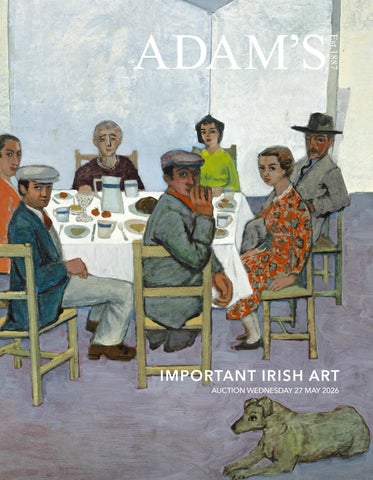
Front cover : Lot 10 Gerard Dillon (Detail)
Back cover : Lot 26 Jack B. Yeats
Inside front : Lot 17 Louis le Brocquy
Opposite: Lot 13 Frank McKelvey
Inside back : Lot 25 Paul Henry
AUCTION WEDNESDAY 27 MAY 2026

James O’Halloran BA FSCSI FRICS DIRECTOR j.ohalloran@adams.ie

Stuart Cole MSCSI MRICS MANAGING DIRECTOR s.cole@adams.ie

Nicholas Gore Grimes DIRECTOR nicholas@adams.ie

Amy McNamara BA MA ASSOCIATE DIRECTOR amymcnamara@adams.ie

Niamh Corcoran BA FINE ART DEPARTMENT niamh@adams.ie

Adam Pearson BA SALEROOM CURATOR a.pearson@adams.ie

Ronan Flanagan HDip WAREHOUSE MANAGER r.flanagan@adams.ie

Eamon O’Connor BA FINANCIAL DIRECTOR e.oconnor@adams.ie
AUCTION
Wednesday 27th May 2026 at 6.00pm
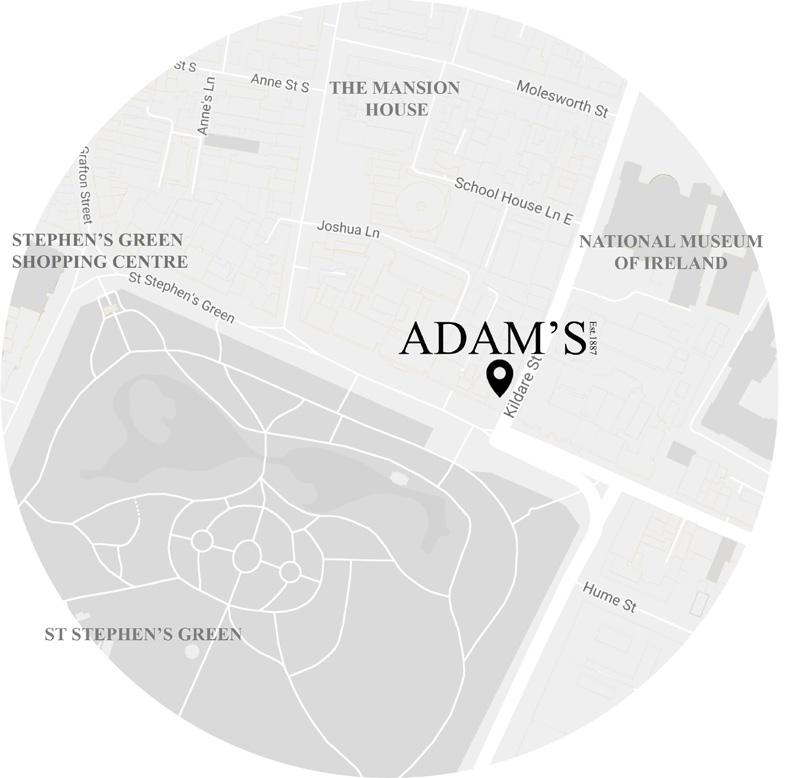
26 St. Stephen’s Green, Dublin 2. Ireland , D02 X665
+353 (01)6760261 adams.ie
FOLLOW US @Adams1887 #Adams.Auctioneers

ALL AUCTION VIEWINGS ARE FREE AND OPEN TO THE PUBLIC
Friday 22nd May
10.00am–5:00pm
Saturday 23rd May 2.00pm– 5.00pm
Sunday 24th May 2.00pm – 5.00pm
Monday 25th May
10.00am–5:00pm
Tuesday 26th May
10.00am–5:00pm
Wednesday 27th May
10.00am–4:00pm
Please refer to the Buying At Auction section in this catalogue, or adams.ie for further details on bidding in this auction, including absentee bidding.
26 St. Stephen’s Green, Dublin 2. Ireland +353 1 676 0261
info@adams.ie | www.adams.ie
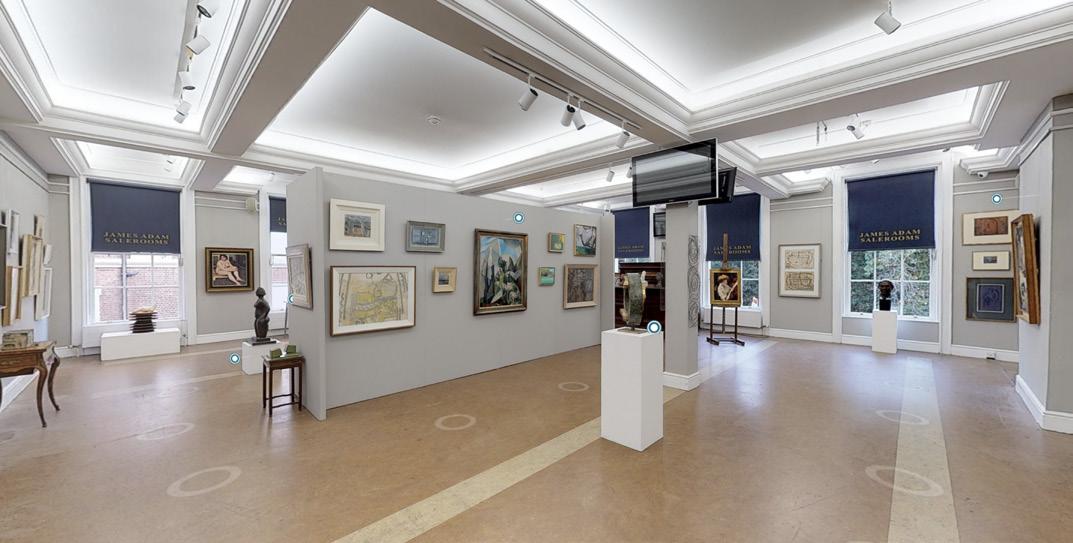
Go to www.adams.ie. Choose the auction you wish to view from the Auctions/Forthcoming auctions menu, and you will be offered a range of ways to view. You may choose to view a digital version of the printed catalogue in the view e catalogue option or explore the virtual 3D option which allows you explore the saleroom with easy to navigate options or view the list view which opens automatically. This last option provides additional information and photographs of each lot as you choose the View Details button. Lastly, and only during office hours, there is a live chat button onscreen. If at any time you have a question whilst you are online, you can open a live chat and one our staff can help you.
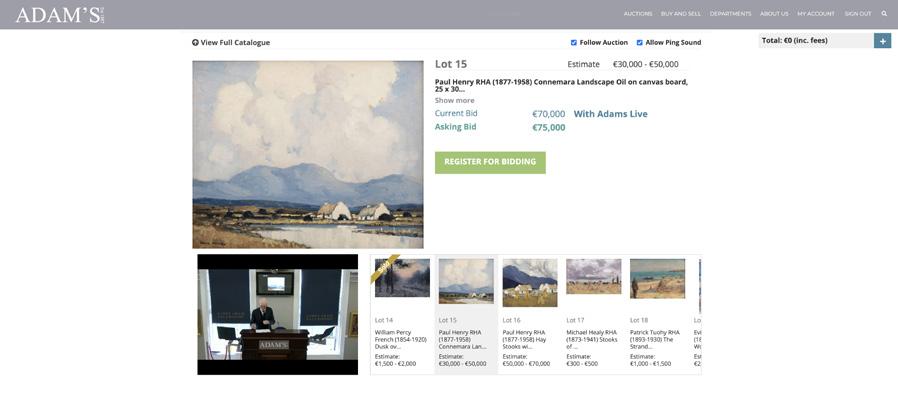
Log on to our web site www.adams.ie and create an account by signing up and registering your particulars online. The process involves supplying valid credit card information. This is a once off request for security purposes, and once the account is activated you will not be asked for this information again. The card information supplied is securely stored by Sage Pay. You can leave absentee bids online, and add, edit or amend bids accordingly as well as bidding over the internet in real time through ‘Adam’s Live’. You can also view your invoices, bid history, wish lists & other useful functions including paying your invoice and creating you very own personalised catalogue with search tags that will notify you once a catalogue is uploaded for your key word search.
We are delighted to advise that our own on-line bidding platform, Adam’s Live, is now fully operational for those who wish to bid online and watch the auction as it happens.
On the Live platform you can arrange to bid as the auction is taking place or at any time leave comission bids and the Adam’s Live platform will bid on your behalf.
Bidding through this portal will attract no additional internet surcharge for lots purchased so in effect those bidders will pay the same as a room bidder. Online bidding through the-saleroom.com and invaluable.com remains unaffected.
Sign up today for your own My Adam’s account and start saving on your on-line purchases.
These are shown below each lot in this sale. All amounts shown are in Euro. The figures shown are provided merely as a guide to prospective purchasers. They are approximate prices which are expected, are not definitive and are subject to revision. Reserves, if any, will not be any higher than the lower estimate.
All purchases must be paid for no later than Friday 29th May 2026. Please contact a member of staff to arrange collection/delivery of your purchases. Auctioneers commission on purchases is charged at the rate of 25% (inclusive of VAT). Terms: Bank Transfer, Debit or Credit Card via our payments processor STRIPE. Non EU card types will be subject to an additional 2% of the invoice total. We accept cash to a maximum of €10,000 per person in any 3-month period. Bank transfer details are displayed in your invoice communications from Adam’s or are available on request. For payments by bank transfer please ensure all bank charges are paid in addition to the invoice total, in order to avoid delays in the release of purchases. Goods will only be released upon clearance through the bank of all monies due.
All lots are sold within the auctioneers VAT margin scheme. Revenue regulations require that the buyer’s premium must be invoiced at a rate which is inclusive of VAT. This is not recoverable by any VAT registered buyer.
Lots marked * are to be sold whilst subject to Temporary Admission (Import) regulations. For purchasers based in the Republic of Ireland - the hammer price will be subject to import VAT at the reduced rate, currently 13.5%, and the Buyer’s Premium will be subject to VAT at the standard rate, currently 23%. For purchasers outside of the Republic of Ireland, please contact our Accounts Department for further details.
It is up to the bidder to satisfy themselves prior to buying as to the condition of a lot. In relation to Condition Reports, whilst we make certain observations on the lot, which are intended to be as helpful as possible, references in the condition report to damage or restoration are for guidance. The absence of such a reference does not imply that an item is free from defects or restoration, nor does a reference to particular defects imply the absence of any others. The condition report is an expression of opinion only and must not be treated as a statement of fact. Please ensure that condition report requests are submitted before 12 noon on Tuesday 26th May 2026 as we cannot guarantee that they will be dealt with after this time.
We are happy to execute absentee or written bids for bidders who are unable to attend or bid online themselves and can also arrange for bidding to be conducted by telephone. However, these services are subject to special conditions (see conditions of sale in this catalogue). All arrangements for absentee and telephone bidding must be made before 5pm on the day prior to sale. Bidding by telephone may be booked on all lots. Early booking is advisable as availability of lines cannot be guaranteed.
We would like to acknowledge, with thanks, the assistance of Aidan Dunne, Dr Julian Campbell, Karen Reihill, Dickon Hall, Niamh Corcoran, Stephanie Brennan and Emmalie Conroy in the preparation of this catalogue.
7.
ALL LOTS ARE BEING SOLD UNDER THE CONDITIONS OF SALE AS PRINTED IN THIS CATALOGUE AND ON DISPLAY IN OUR SALEROOMS AND ON OUR WEBSITE.
Follow Us


adams.auctioneers
Adam’s Auctioneers
@Adams1887
Adams Auctioneers
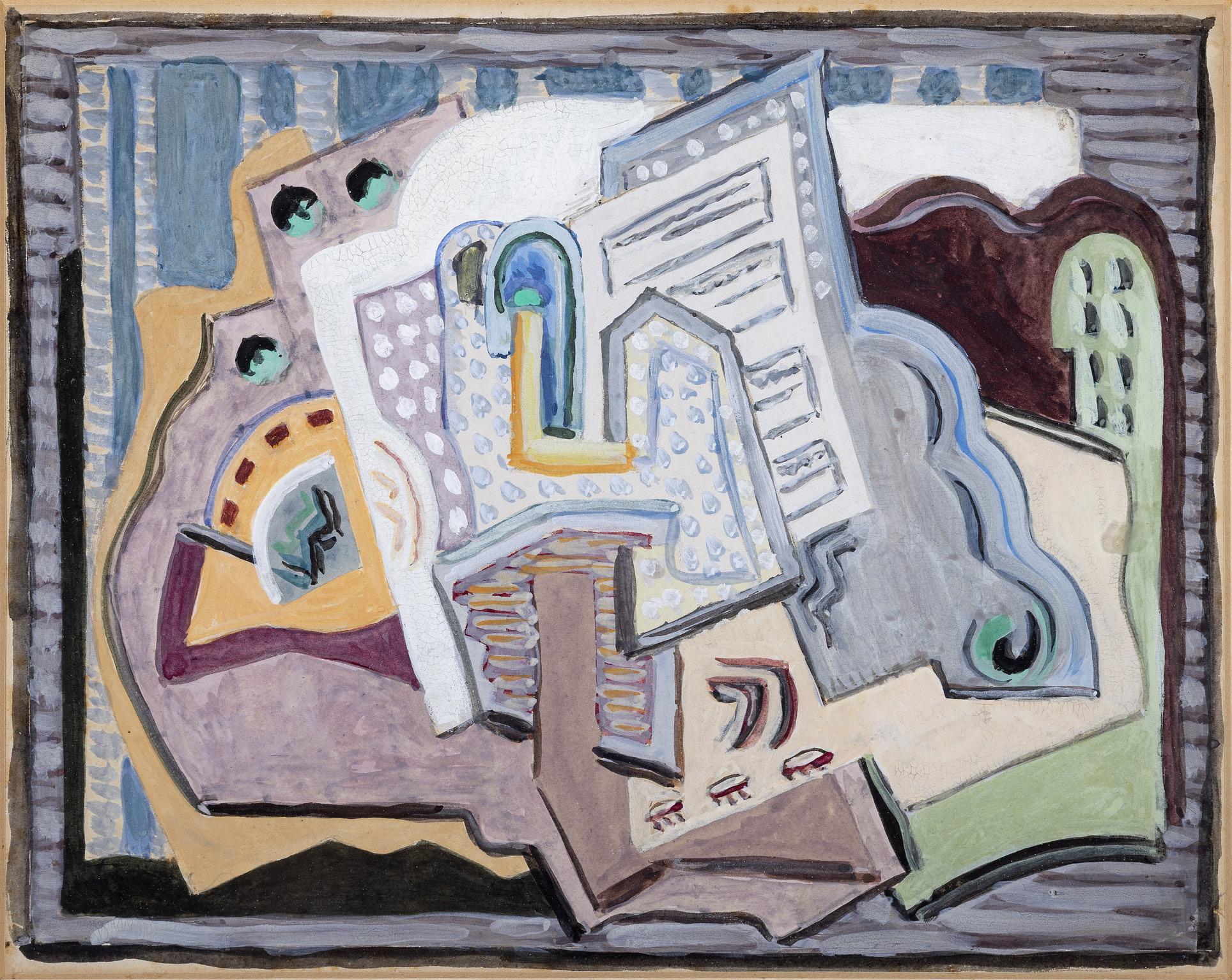
Abstract
Gouache, 22 x 28 cm (8½ x 11”)
Provenance: With Taylor Galleries, Dublin, label verso
€ 4,000 - 6,000
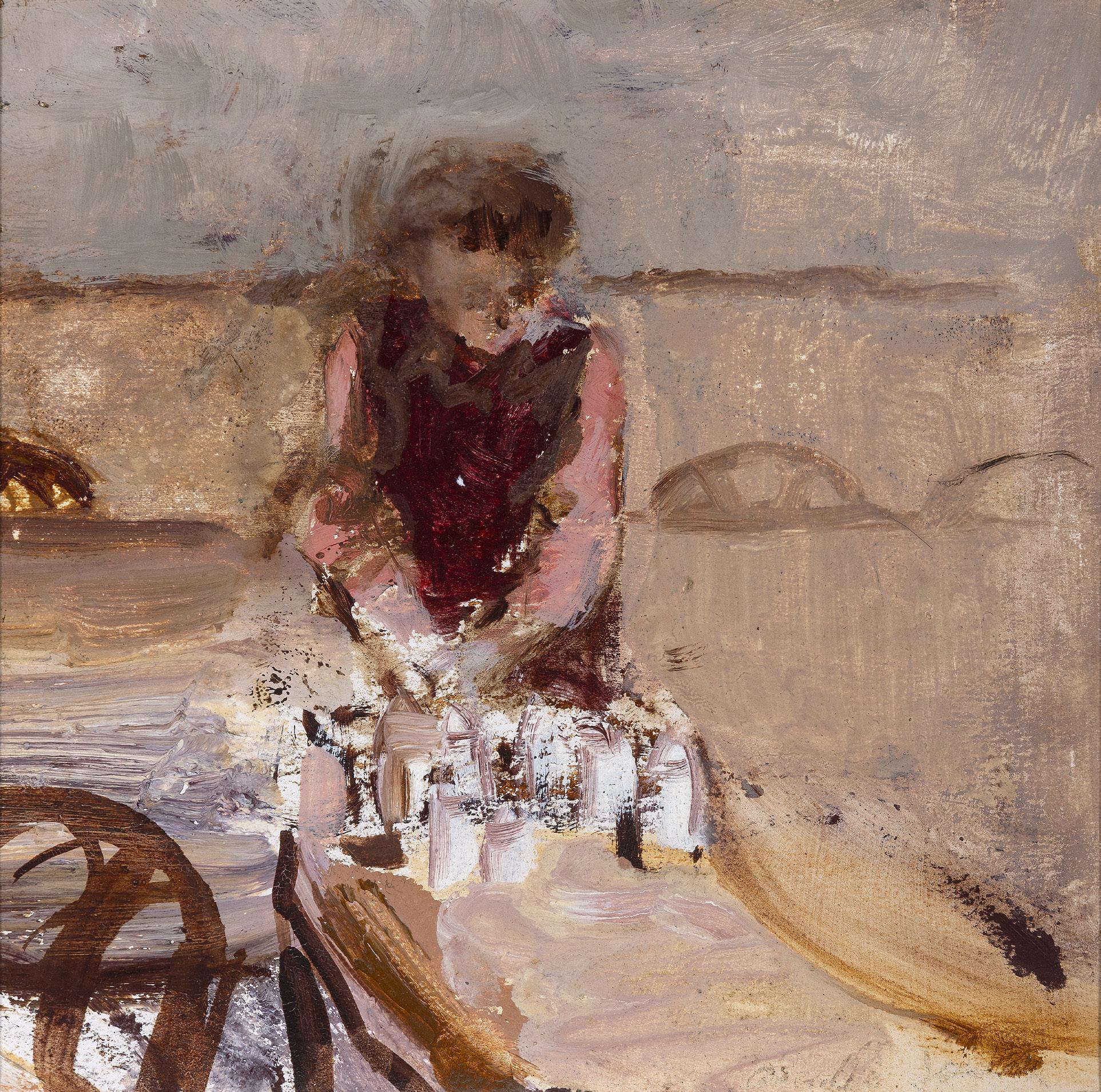
Bewley’s 8.45, Filling the Sugar (1975)
Oil on board, 18 x 18 cm (7 x 7”)
Signed and inscribed verso
Provenance: With The Dawson Gallery, Dublin, December 1975; Estate of Dr John and Mary Esther O’Driscoll, Kildare; their sale, these rooms, 31/5/2023, lot 44, where purchased by the present owner.
Exhibited: Dublin, Douglas Hyde Gallery, 1980, addenda no.11
Literature: Garrett Cormican, Camille Souter – The Mirror in the Sea, Dublin 2006, cat. no.365, illus. p.297
€ 5,000 - 7,000
This is one of a relatively small number of works by Camille Souter where a human figure takes centre stage. Camille Souter is best known for her landscapes. Part of the reason for this was her respect for other people’s privacy. If you were going to paint another person, particularly in a realistic way in which they might be recognized, she would have considered it necessary to ask their permission. This painting is, however, a more of an impressionistic genre piece. Until recent times before the proliferation of coffee shops from the mid 1990’s onward, Bewleys was something of a Dublin institution. People would go there to have their breakfast before doing their Christmas shopping, do The Irish Times crossword while having a coffee, or just going about their daily business.
Trinity students would often arrive there first thing in the morning after the Trinity Ball there being nowhere else to eat open in the city centre in the early hours. The title of this work suggests a daily routine in Bewleys of filling the sugar bowls to prepare for the day ahead and begs the question: just how much sugar did Dubliners consume daily in the 1970s? There are no figures seated in the background or to either side of the table. The sole protagonist is totally absorbed by her task. It captures a very intimate, quiet moment. While reminiscent or Bonnard’s work on one level, Souter’s palette is much more muted. This in keeping with the interior of Bewleys itself and seems reflective of the first semi-somnolent moments of day; one imagines while the artist waited for a first coffee.
Garrett Cormican
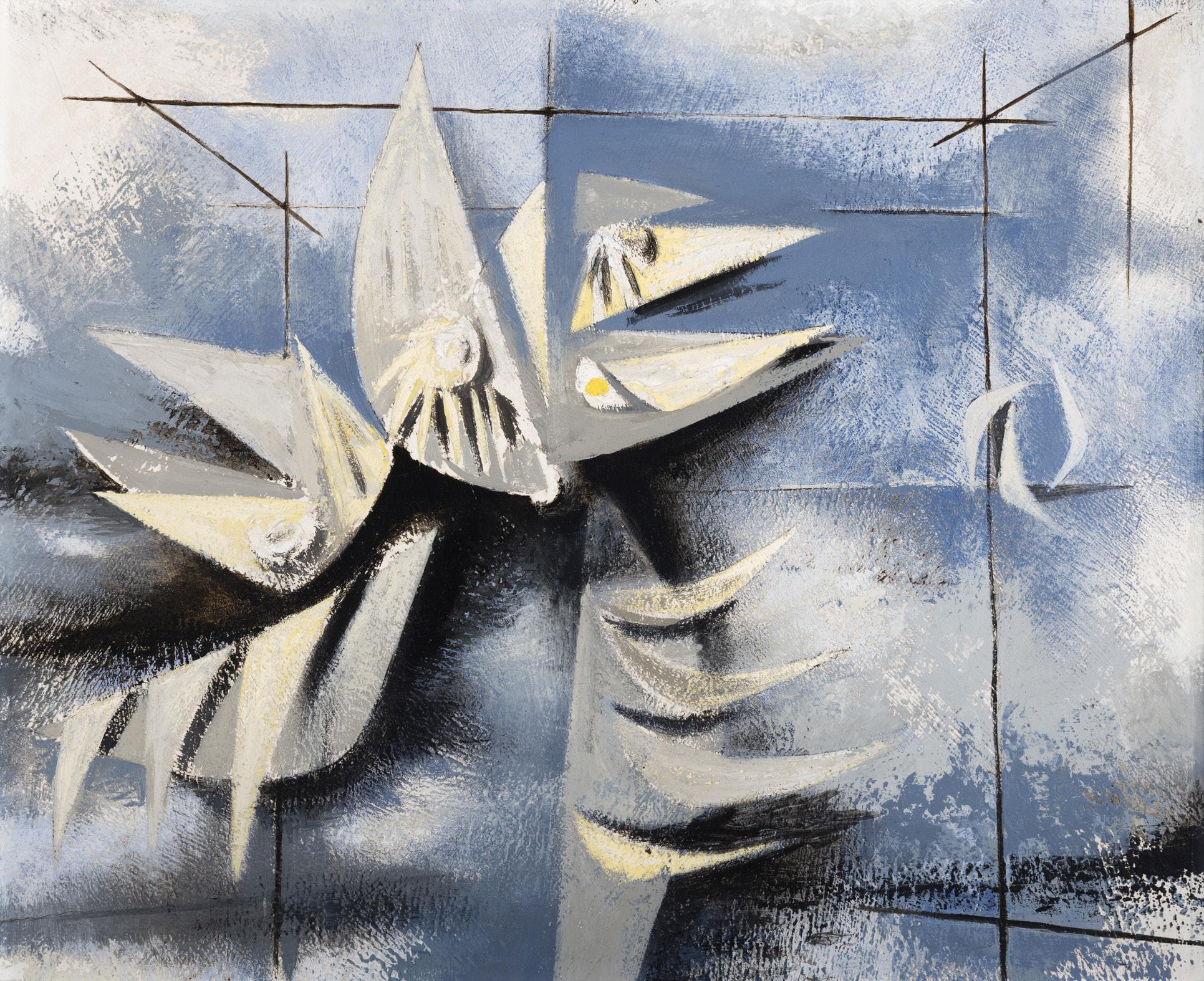
Bird (1957)
Oil on board 31 x 42cm (12¼ x 16½”)
Signed, inscribed and dated 1957 en verso
Provenance: With Waddington Galleries, remnants of label verso; Sale, these rooms, 31/5/2023, lot 10
Literature: Dickon Hall and Eoin O’Brien, ‘Nevill Johnson –Paint the Smell of Grass’, AVA Gallery Ltd, 2008, p.58
€ 2,000 - 3,000
4
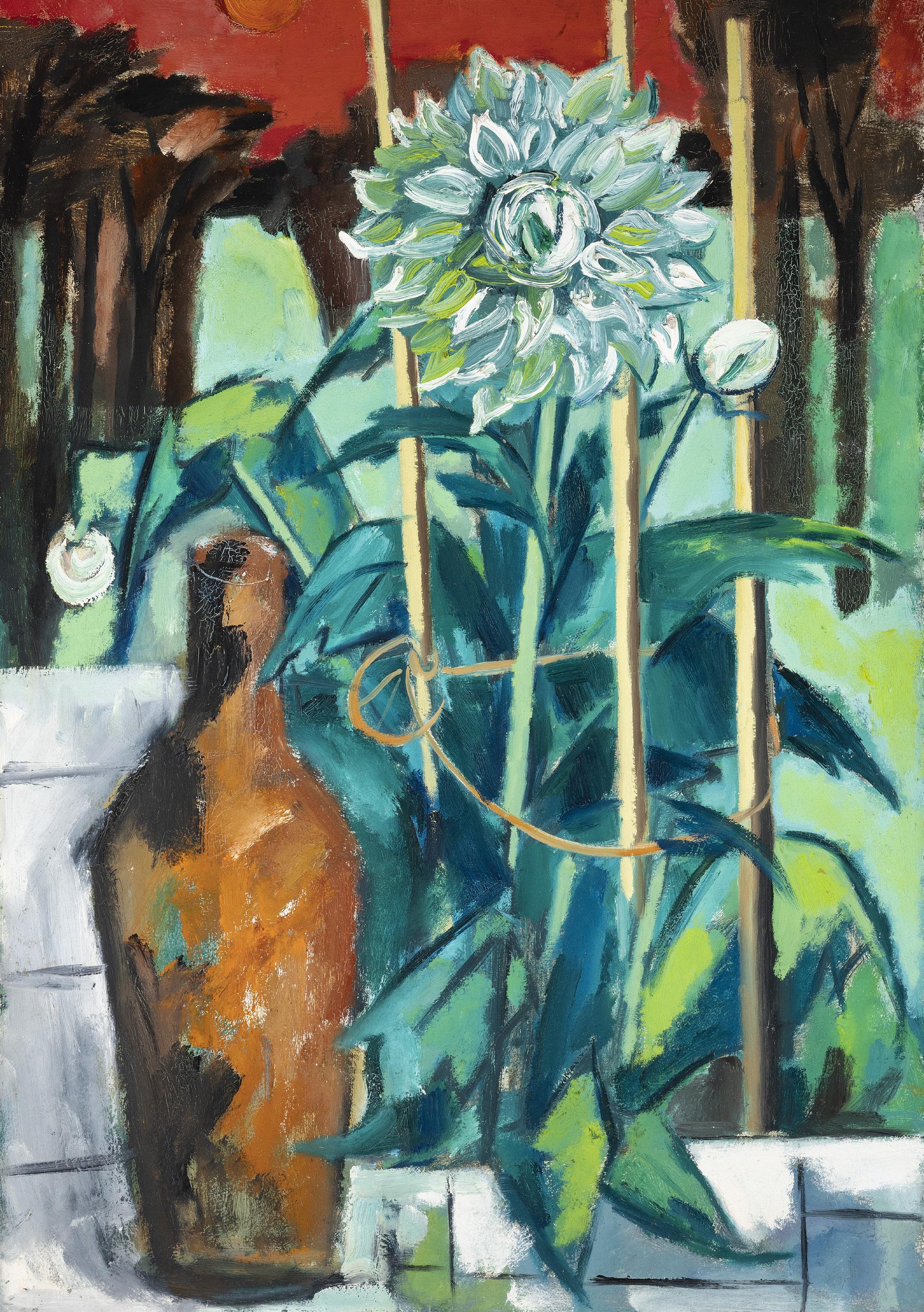
Still Life
Oil on board, 76 x 51cm (29¾ x 20’’)
Provenance: From the Artist’s Estate
€ 6,000 - 8,000
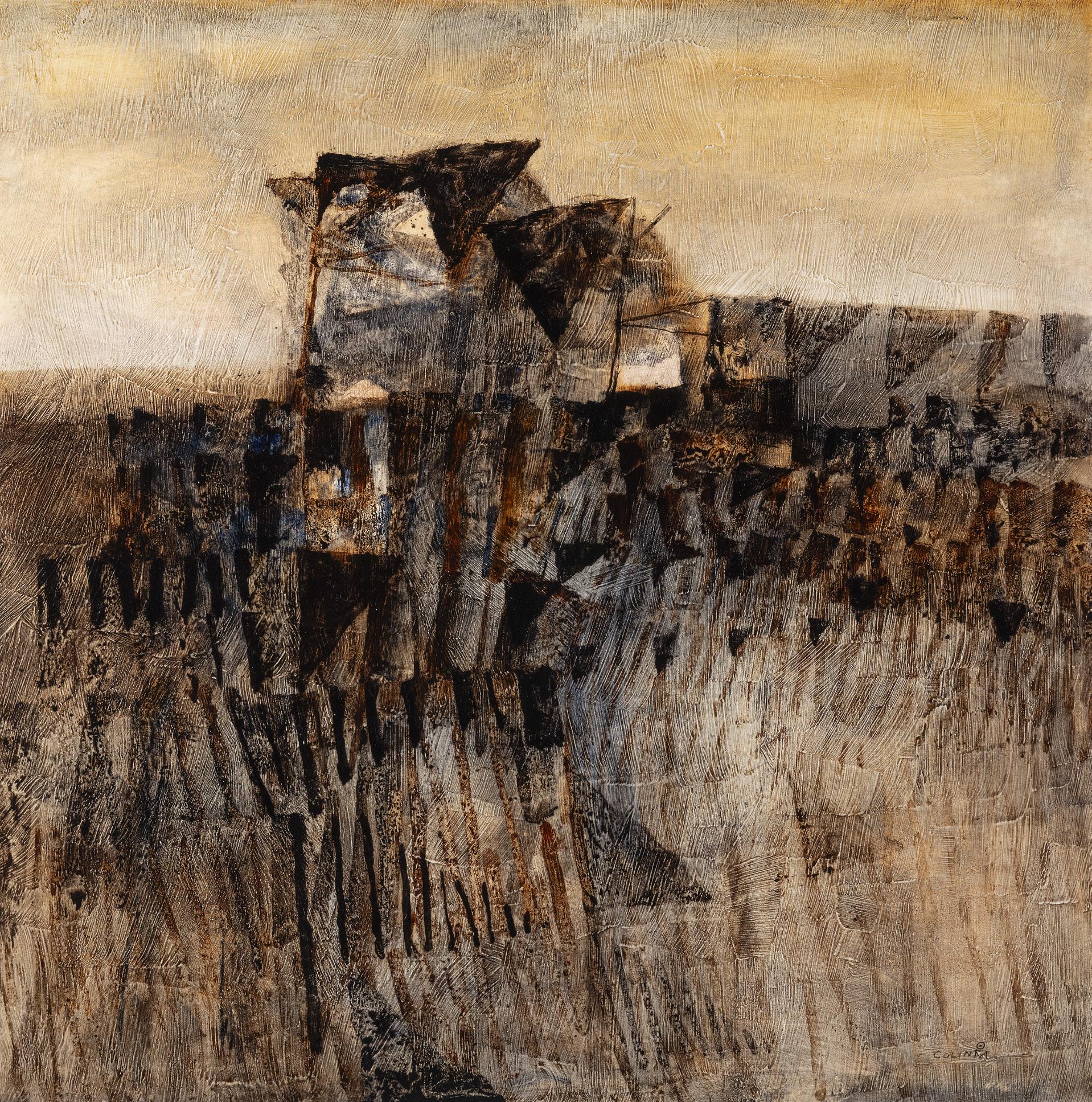
Tree in the Wind (c.1973)
Oil on board, 61 x 61cm (24 x 24’’)
Signed
Provenance: With David Hendriks Gallery, Dublin, label verso
€ 10,000 - 15,000
In the early 1970s, Colin Middleton embarked on a number of journeys that became very significant in his work, first of all a six month trip around the world, with a lengthy and productive period staying with his daughter, Alison, in Perth, and then the first of several visits to his daughter Jane, in Barcelona.
Although Tree in the Wind does not seem related to a specific place, and appears likely to be drawn from an Irish landscape, it has an unexpectedly surrealist quality that was more broadly sparked off in Middleton’s work by this intense period of travelling in 1972 and 1973. The prepared surface of the board and the particular language of repeated shapes and marks that Middleton evolved as signifiers
and shorthand in his landscape paintings in the 1960s, are used in a less structured manner than usual, to create a sense of disruptive energy that is increased by the jarring unevenness of the horizon line to right and left.
In the tree, Middleton creates a form that almost seems to prefigure his own Westerness series from later in the decade, in which figures seem to emerge from the physical substance of the landscape. While Middleton’s visual language remains distinctively individual, it remains true to the specific nature of the landscape or the moment it records, and always retains its direct expressiveness.
Dickon Hall, April 2026
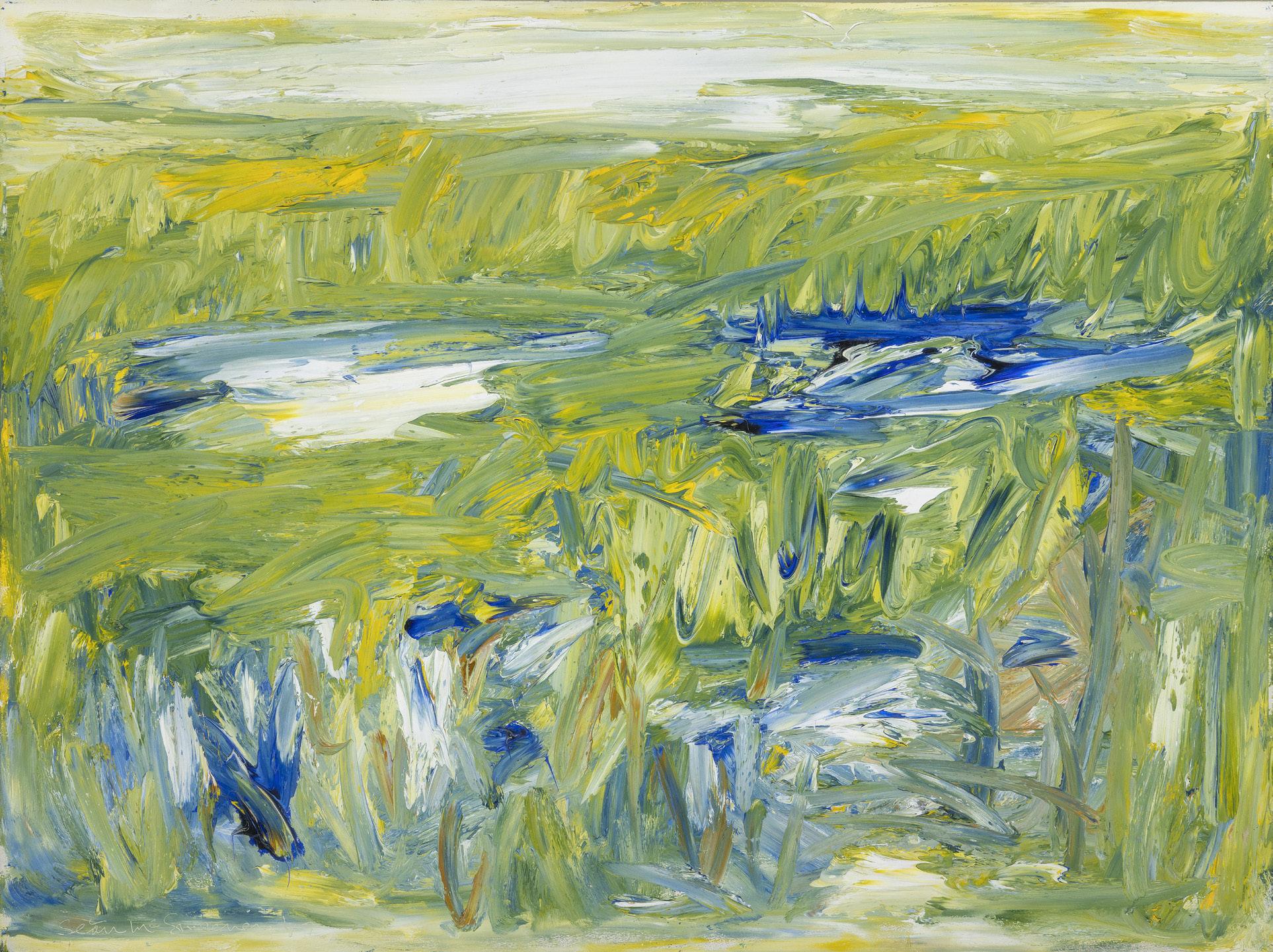
Summer Pools
Oil on board, 45 x 60cm (17¾ x 23½”)
Signed, inscribed with title verso
€ 3,000 - 5,000
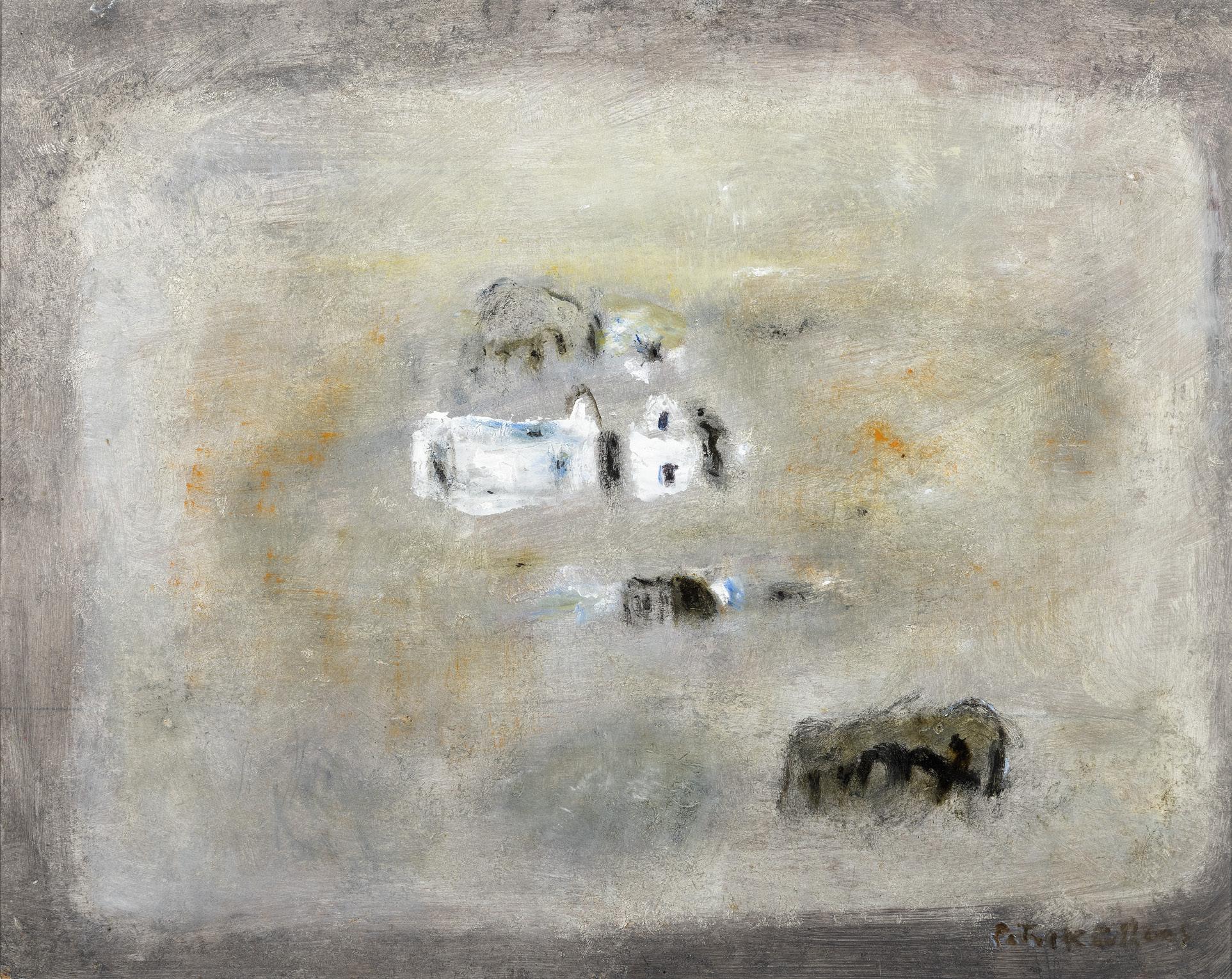
PATRICK COLLINS RHA (1911-1994)
Landscape with Cottage (1965)
Oil on board 40 x 50cm (15¾ x 19½”)
Signed
Provenance: With The Tom Caldwell Gallery, Belfast, label verso; Collection Patrick J. Murphy, Dublin; with Peppercannister Gallery, Dublin, label verso; with The Frederick Gallery, Dublin, label verso, from whom purchased by the present owner.
€ 7,000 - 10,000
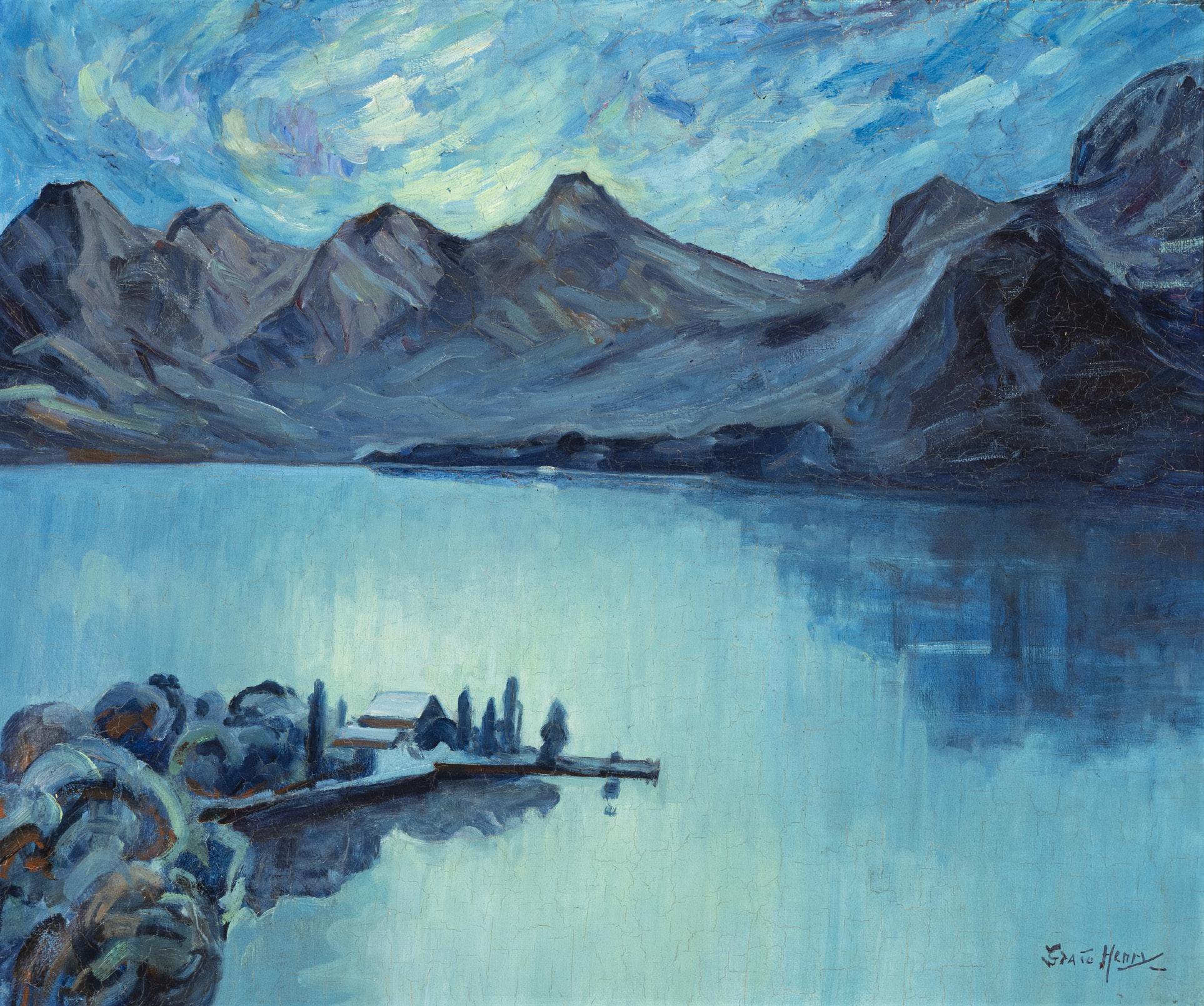
Oil on canvas, 50 x 61cm (19¾ x 24’’)
Signed
€ 3,000 - 5,000
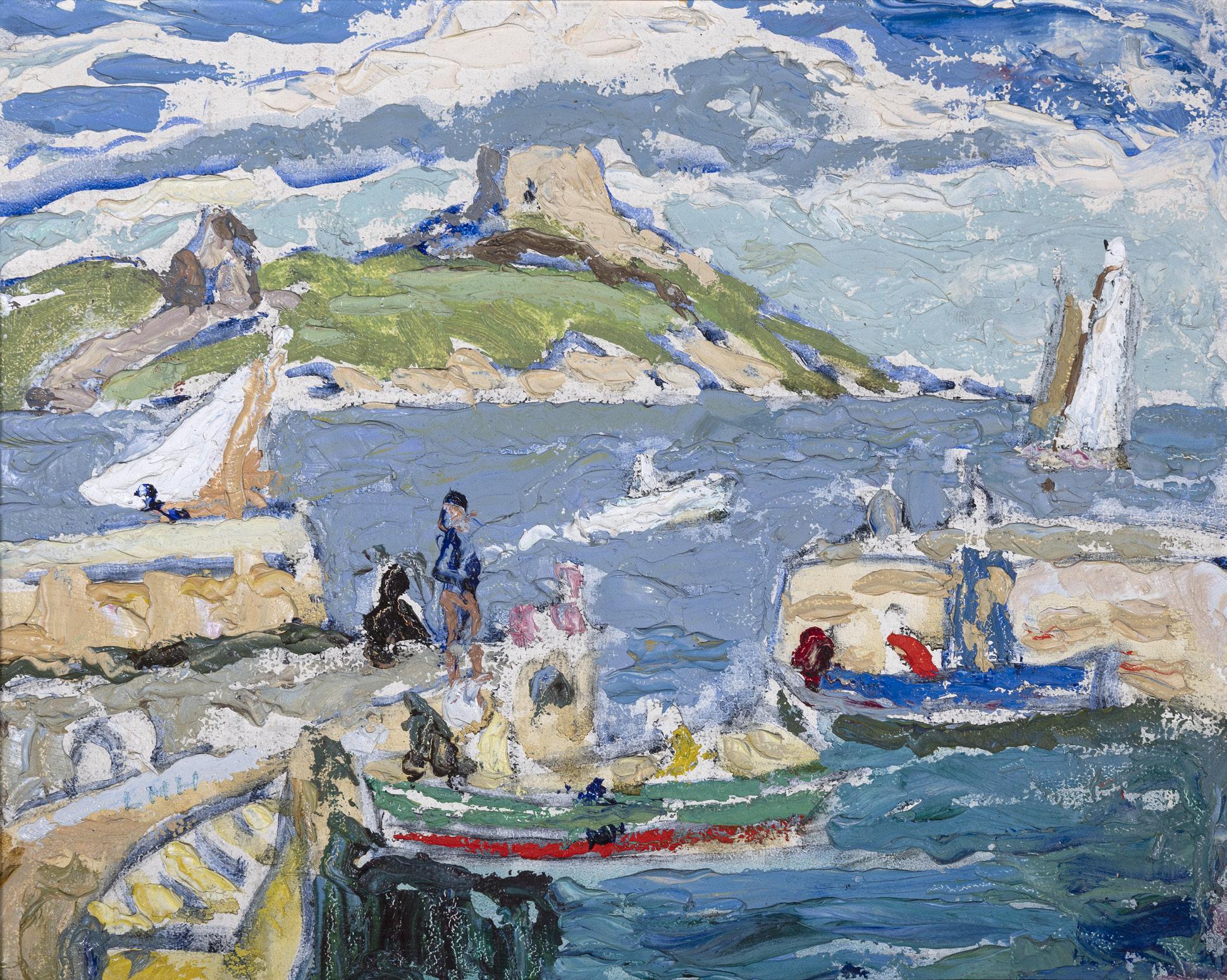
Oil on board, 20 x 25 cm (7¾ x 9¾”)
Signed with initials; also signed and inscribed verso
€ 2,000 - 3,000
Adam’s are honoured to have been chosen to offer by auction a number of important artworks by some of Ireland’s best loved 20th century artists from the late Reeta and Frank Hughes’ art collection.
Their collection was arguably one of the finest private collections of Irish Art in Ireland or anywhere for that matter. It was formed initially at a time when collecting Irish paintings and sculpture was not as fashionable as it is today and while it was a testament to Reeta and Frank’s cultured eye, it also attested to their far-sightedness in collecting work by artists before almost everyone else.
The Hughes’ began their art-buying in the 1960’s and were still buying up to the time of their deaths, Reeta in 2014 and Frank in 2020. I first met them in the early 1980’s and recall their infectious enthusiasm for art, something that we shared and which became the foundations of a long-standing friendship. What I found most inspirational about them was their desire to keep their collection alive and growing. They placed no limits on what could be included in the collection, buying with equal enthusiasm works by artists from the early 20th century as much as works by living painters.
What was also truly remarkable about Reeta and Frank was their ability to decide for themselves what to buy, and while they never refused advice, their ability to assess and judge quality was inspiring. In the early years of the formation of their collection, they enjoyed the advice and support of wonderful art people such as Tom Caldwell, the contemporary gallerist as well as the noted Belfast dealer Nelson Bell. Reeta and Frank were also regular and consistent auction-goers, attending and competing at the flagship Irish sales in Adam’s and in London, much to the delight of us auctioneers, who took solace in seeing them in the audience and as such could expect some bidding fireworks.
What was wonderful was the interest they both had in adding to the collection and what was a delightful sharing of taste, although all their purchases were not exclusively by agreement ! This occasional diversity of opinion added a lovely mix to the collection and created something unique and intensely personal.
This auction offers a rare opportunity to encounter works from a collection shaped by passion, independence, and a lifelong commitment to the visual arts.
James O’Halloran May
2026
DILLON (1916 - 1971)
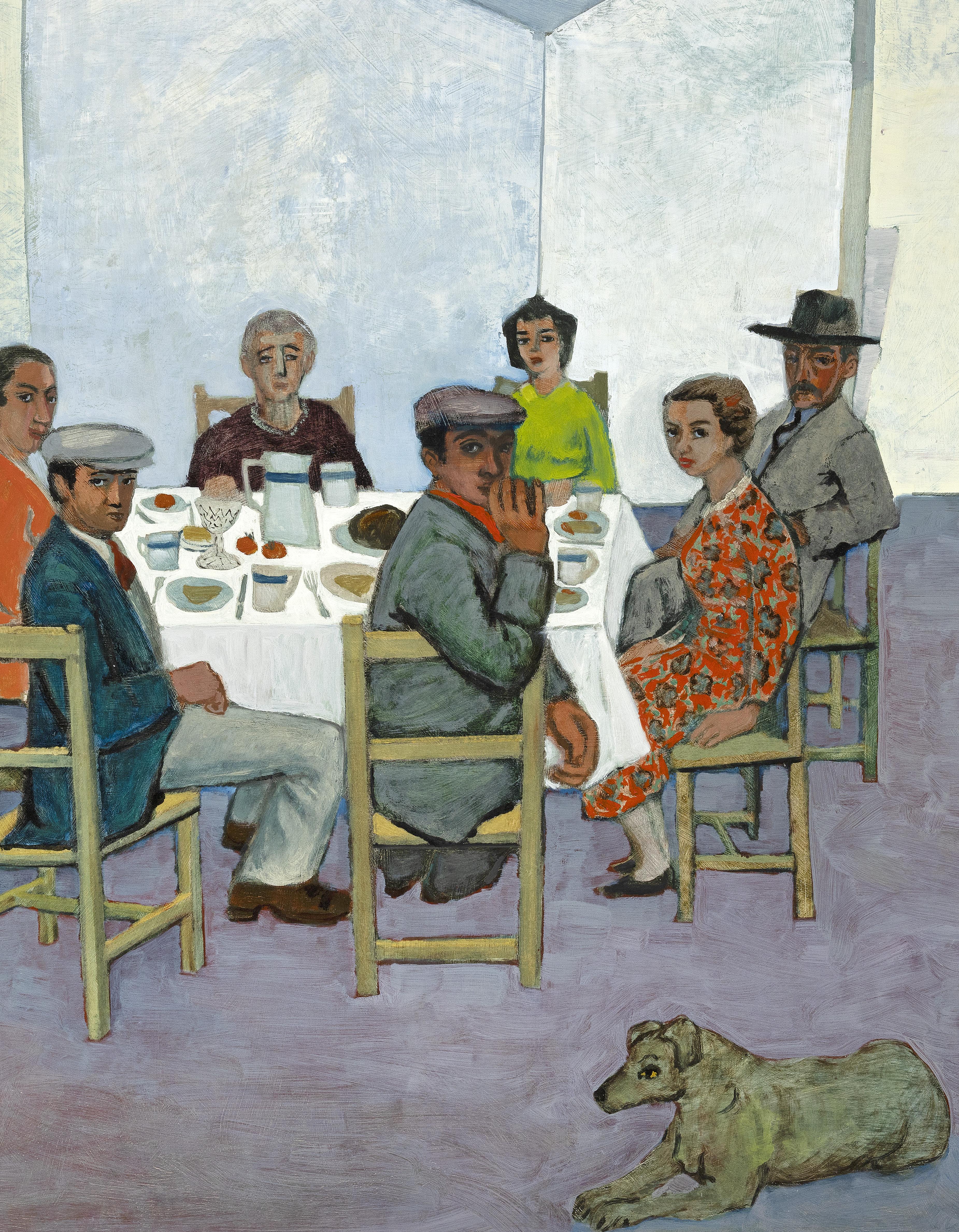
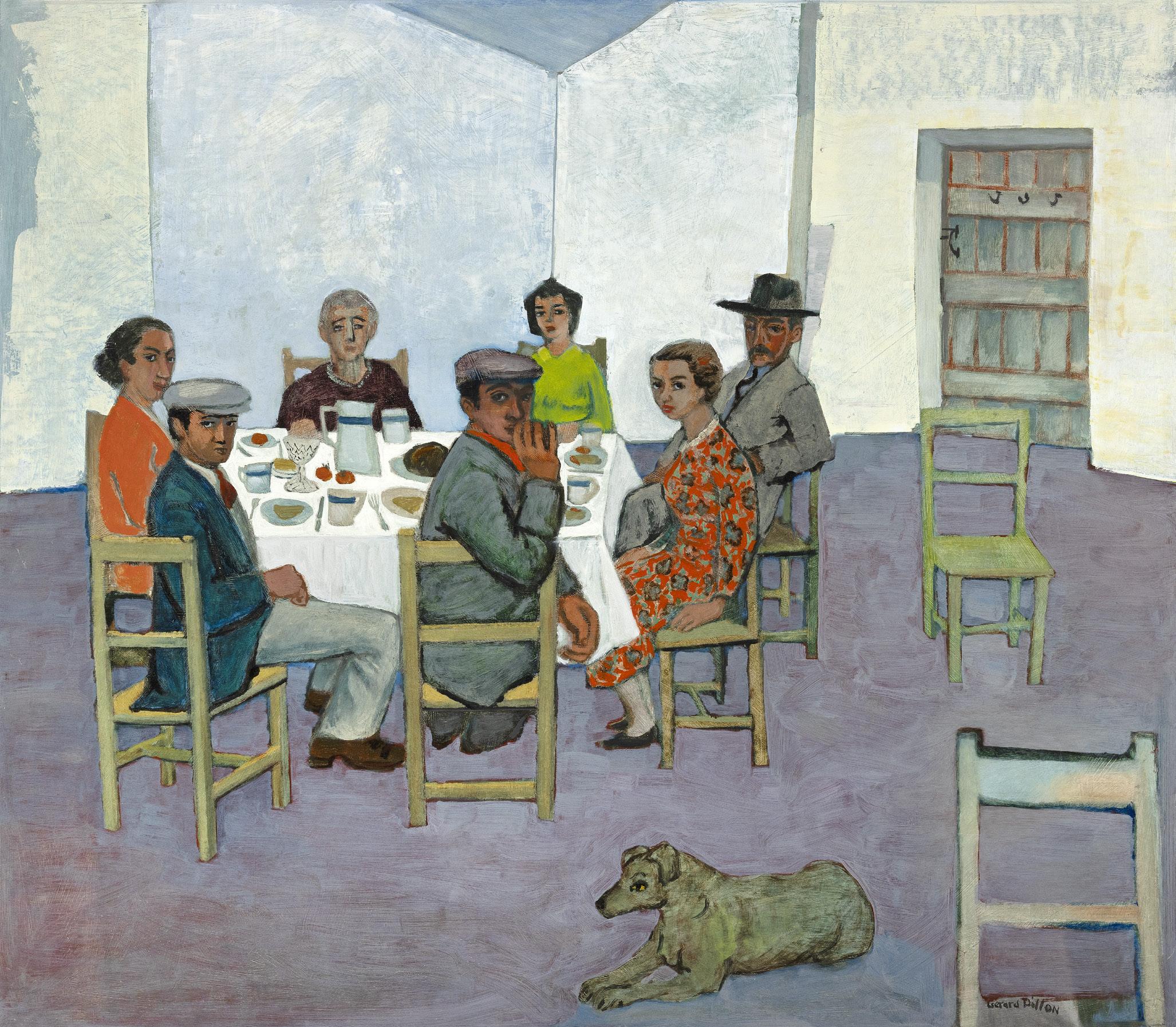
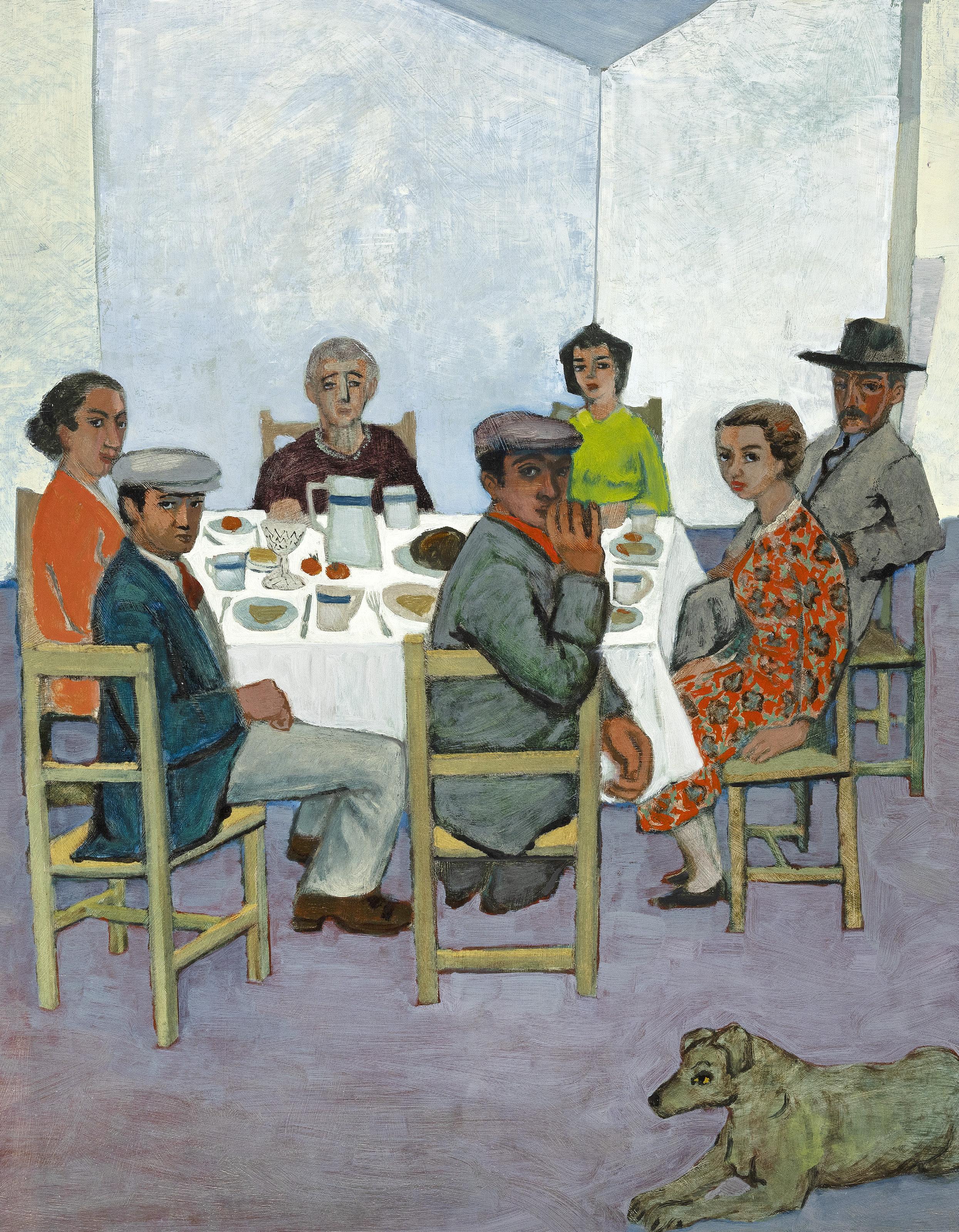
Tea Party (1955)
Oil on board, 86 x 99cm (34 x 39”)
Signed, inscribed with title verso.
Provenance: With The Dawson Gallery, Dublin, where purchased by the Arts Council of Northern Ireland. Their sale, Sotheby’s 24th November British and Irish Art, 1993, lot 53; Collection of Reeta and Frank Hughes, Warrenpoint, thence by descent.
Exhibited: Dublin and Belfast, Irish Exhibition of Living Art, 1955, no.101. £75; Dublin, Gerard Dillon’s Early Paintings of The West, Dawson Gallery, 1971 (March), no.6; Belfast, Gerard Dillon 1916-1971: A Retrospective Exhibition (Nov-Dec) 1972, Ulster Museum & Arts Council of Northern Ireland Gallery, travelling to Dublin, Municipal Gallery of Modern Art, (Jan-Feb) 1973, with An Chomhairle Ealáion, Dublin (Jan-Feb) no.59; Drogheda, Gerard Dillon 1916-1971 A Retrospective Exhibition, Droichead Art Centre, (Jan-Feb), Linen Hall Library and Arttank, Lisburn Road(Feb -Mar) ,Belfast, 2003, no.28 Dublin, Gerard Dillon, Art & Friendships, Adam’s Summer Loan Exhibition, (July), travelling to The Ava Gallery, Clandeboye, Co. Down (August), No. 1
Literature: Eamonn Mallie, One Hundred Years of Irish Art, 2000 p.119; Gerard Dillon 1916-1971, A Retrospective Exhibition, 2003, front cover illustration; Karen Reihill, Gerard Dillon: Art & Friendships, 2013, p.1
€ 150,000 - 200,000
First exhibited at the Irish Exhibition of Living Art (IELA) in Dublin in 1955, alongside Little Girl’s Wonder, Self-Contained Flat, and Inishlacken Couple, this work reached a wider audience when the IELA travelled to Belfast for the first time marking an important new stage of exposure for the artist in his native city. After becoming a committee member of the IELA in 1950, Dillon likely hoped a Belfast audience would become familiar with his work and that of his contemporary Northern Irish artist friends. But owing to its imposing scale, it was his Self-Contained Flat that drew most of the media attention, overshadowing other works in the exhibition.
Decades later, interest in Tea Party broadened following a retrospective in Belfast in 2003, when Belfast writer, Gerard Keenan, who knew the artist in the 1950s travelled from London to view the exhibition hanging at the Linen Hall Library and Bernard Jaffa’s Arttank Gallery. When Tea Party was last exhibited in Northern Ireland—as part of Adam’s 2013 summer loan exhibition, Gerard Dillon: Art & Friendships, Hal Rice, who also knew the artist in London in the late 1950s revisited the work and both he and Keenan
offered varied interpretations of its narrative. Other visitors approached Tea Party with fresh curiosity, speculating about the identities of the sitters, the context surrounding the scene, the subtle compositional devices, and the artist’s use of colour. Questions also arose about intriguing details within the composition, particularly the chairs, which appear to be deliberately positioned towards the picture plane.
While visiting the exhibition at Clandeboye, Co. Down, in 2013, Hal Rice suggested that the narrative of Tea Party was autobiographical. He pointed to the presence of the artist’s close friends, Madge and George Campbell as well as elements of Dillon’s characteristic impish, wiry humour in the sitters’ facial expressions. In Rice’s view, the central male figure gazing directly at the viewer and wearing a red neck scarf represented the artist himself. Although Dillon’s bald head and moustache are concealed, Rice speculated that the domestic scene may have been inspired by an amusing incident or a moment Dillon wished to capture during one of his visits to Connemara.
Both Tea Party and Little Girl’s Wonder are set within similarly open interior space, where a visible cottage door introduces a sense of ambiguity and spatial tension. Despite their contrasting narratives both works reflect Dillon’s close engagement with the local community in the region. While the artist’s 1993 biography offers limited insight into any friendships he experienced in Connemara, correspondence reveals that during his visits to the west of Ireland, he carried out house repairs and some of these were in lieu of rent particularly when staying in the village of Roundstone.
After spending several months over a winter in Roundstone in 1950-1, word spread that the Belfast painter—initially there on a sketching holiday was also a professional decorator. As a result, some local elderly residents employed him to undertake repairs in their homes during his stay. This dual role as artist and craftsman is subtly reflected in another painting from the same period, The Blue Room, where the artist’s tools are depicted on a cottage kitchen table, alluding to his practical work alongside his artistic practice.
The friendships Dillon formed during his annual visits to Roundstone proved invaluable. They not only grounded his work in lived experience but also provided practical support. The bond of friendships allowed him to store materials and unfinished paintings, including a hand-stitched tapestry safely in their homes. The tapestry, Gentle Breeze took three years to complete while the artist travelled between Dublin, Belfast and London.
The presence of a dog and an elderly woman seated at the table in this painting may point to Dillon’s friendship with Miss Alice Cashel. Cashel, who was unmarried and lived alone with her dog in ‘St Catherine’s’, a large Victorian house on the main street of Roundstone initially met the artist in 1950. Born in 1878, Alice Cashel was an Irish nationalist and a member of Cumann na mBan. Her republican background, combined with a strong interest in Irish folklore and holy wells, likely shaped lively and rich conversations she shared with Dillon during his stays. In the mid 1950s as her health declined, Alice Cashel invited the Belfast artist to stay for an extended period at St Catherine’s. There, he was able to prepare for his upcoming exhibitions while also assisting her with the upkeep of the house, further deepening a relationship that appears to resonate within the imagery of his work.
In considering other possible identities of the sitters, the young woman in the bold lime-coloured top may be Pamela Matthews (1931–2020). In a telephone interview in 2011, Matthews recalled that although she initially studied under George Campbell—having first encountered his work in the window of Victor Waddington’s gallery on South Anne Street, she found Gerard Dillon to be the more patient teacher. Her visit to Roundstone is reflected in paintings she exhibited at the IELA in 1955 and at the Dublin Painters Gallery in 1956. Further speculation on the other identities in Tea Party concluded from left to right: Molly Dillon, the artist’s sister; Alice Cashel; Pamela Matthews; and George and Madge Campbell.
The proximity of the two male sitters nearest the viewer suggest they are friends. The glimpse of overalls beneath the jacket of the male sitter positioned beside the artist may be a local resident or perhaps a friend from London— assisting Dillon with house repairs. Such ambiguity is a feature of Dillon’s work and reinforces the sense that some domestic interior scenes blend personal relationships with elements of everyday life, leaving aspects of the narrative deliberately open to intrepretation.
In 1993, Tea Party was included in a list of works which went for sale at Sotheby’s in London. The Arts Council of Northern Ireland’s decision to sell 31 works from its collection sparked considerable controversy when it emerged that all of its paintings by Gerard Dillon were to be sold. Particular concern centred on the proposed sale of his iconic Self-Contained Flat. In response to public protest, the painting was ultimately withdrawn and its ownership transferred to the Ulster Museum.
Interestingly, Self-Contained Flat and Tea Party represent Dillon’s two different lives in London and Roundstone when they were exhibited at the IELA in 1955. Together they reveal the duality of his role as both an artist and a painter-decorator. The relationship between Dillon’s work as a painter-decorator and his development as an artist emerge in a small number of works from this period which demonstrates a need to reassess this aspect of his west of Ireland interiors. They point to the extent to which his skills as both craftsman and creative artist were integral to his practice.
Karen Reihill, April 2026
Karen Reihill is currently re-examining key aspects of Gerard Dillon’s life and work.
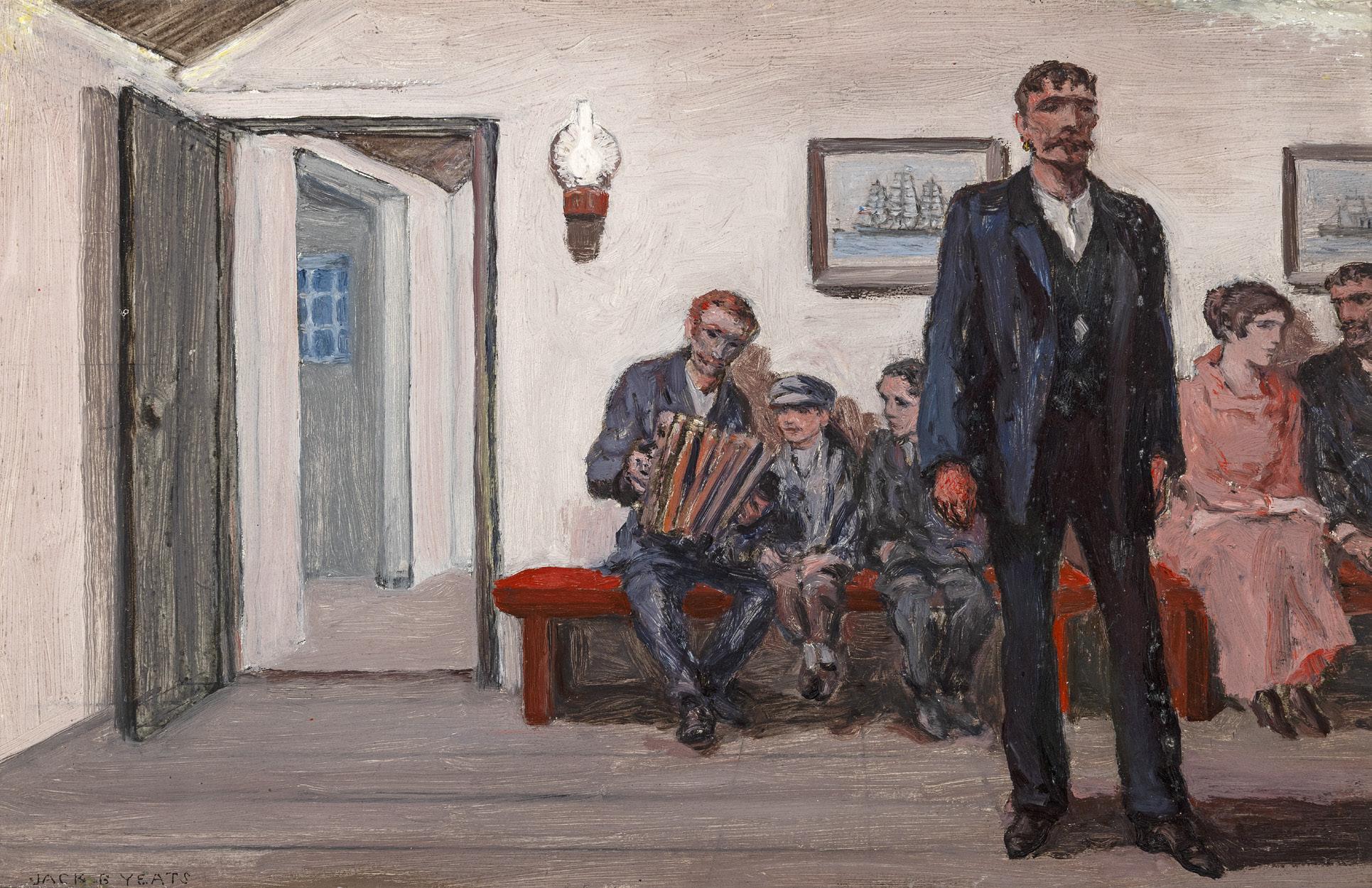
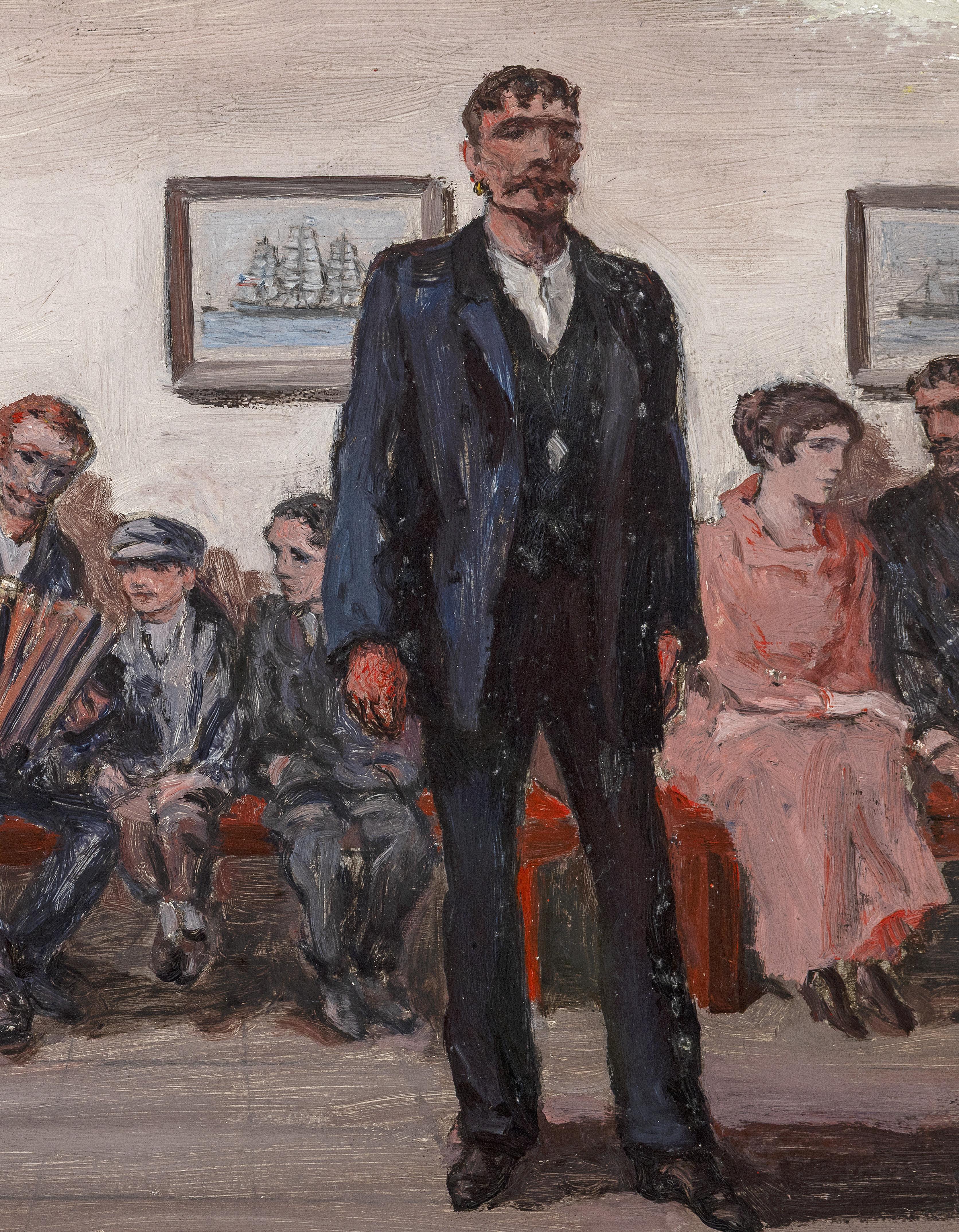
JACK BUTLER YEATS RHA (1871 - 1957)
The Dancer (Rosses Point, Sligo) (1921)
Oil on board, 23 x 35cm (9 x 14”)
Signed
Provenance: Collection of the late Justice Conor Maguire; Collection of Reeta and Frank Hughes, Warrenpoint, thence by descent.
Exhibited: Sligo, County Museum and Art Gallery, ‘Jack B Yeats’, Aug/Sept 1989, cat. no.24
Literature: Hilary Pyle, ‘Jack B. Yeats, A Catalogue Raisonne of the Oil Paintings’ cat. no.152, p.133; ‘Whipping the Herring’ 2006, p.118, illus. p.119; Claudia Kinmonth, ‘Irish Rural Interiors in Art ’, p.72 & 190, illustrated p.72
€ 120,000 - 160,000
This painting is one of three works inspired by the life of people of Sligo, painted by Jack B. Yeats in 1921. The others, A Summer Evening, Rosses Point and Knocknarea and the Flowing Tide show figures outside enjoying the fine weather and the magical landscape of that region. At Rosses Point, 1922, could be seen as a counterpart to A Dancer, as it shows a group of young women dancing outside a cottage.1 Yeats had a special regard for Rosses Point, a village at the mouth of the Garavogue river, a few miles from Sligo town. He spent much of his childhood there, visiting his uncle, Henry Middleton, and looking at the ships coming in and out from the Atlantic ocean. The setting remained a recurring backdrop in his work.
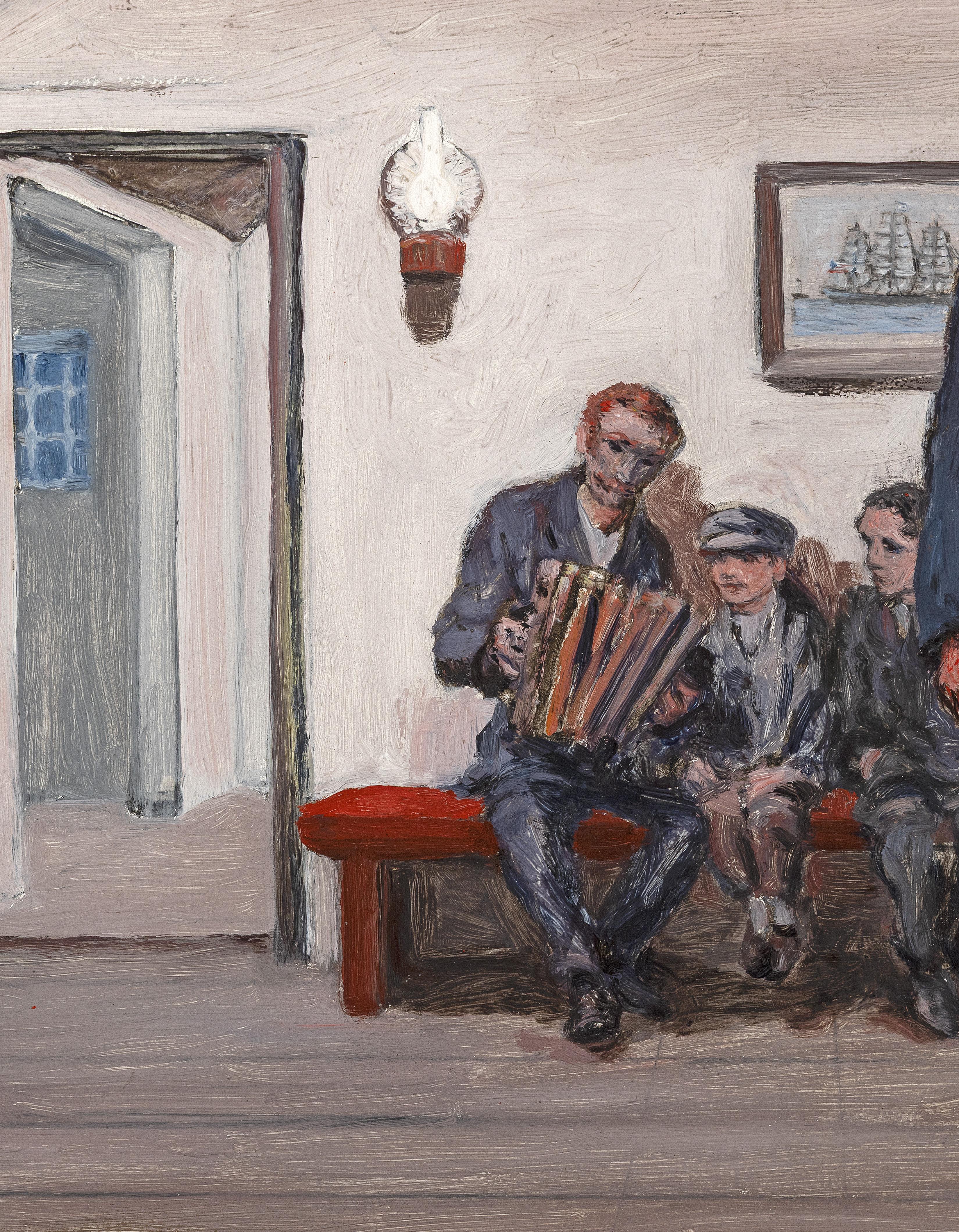
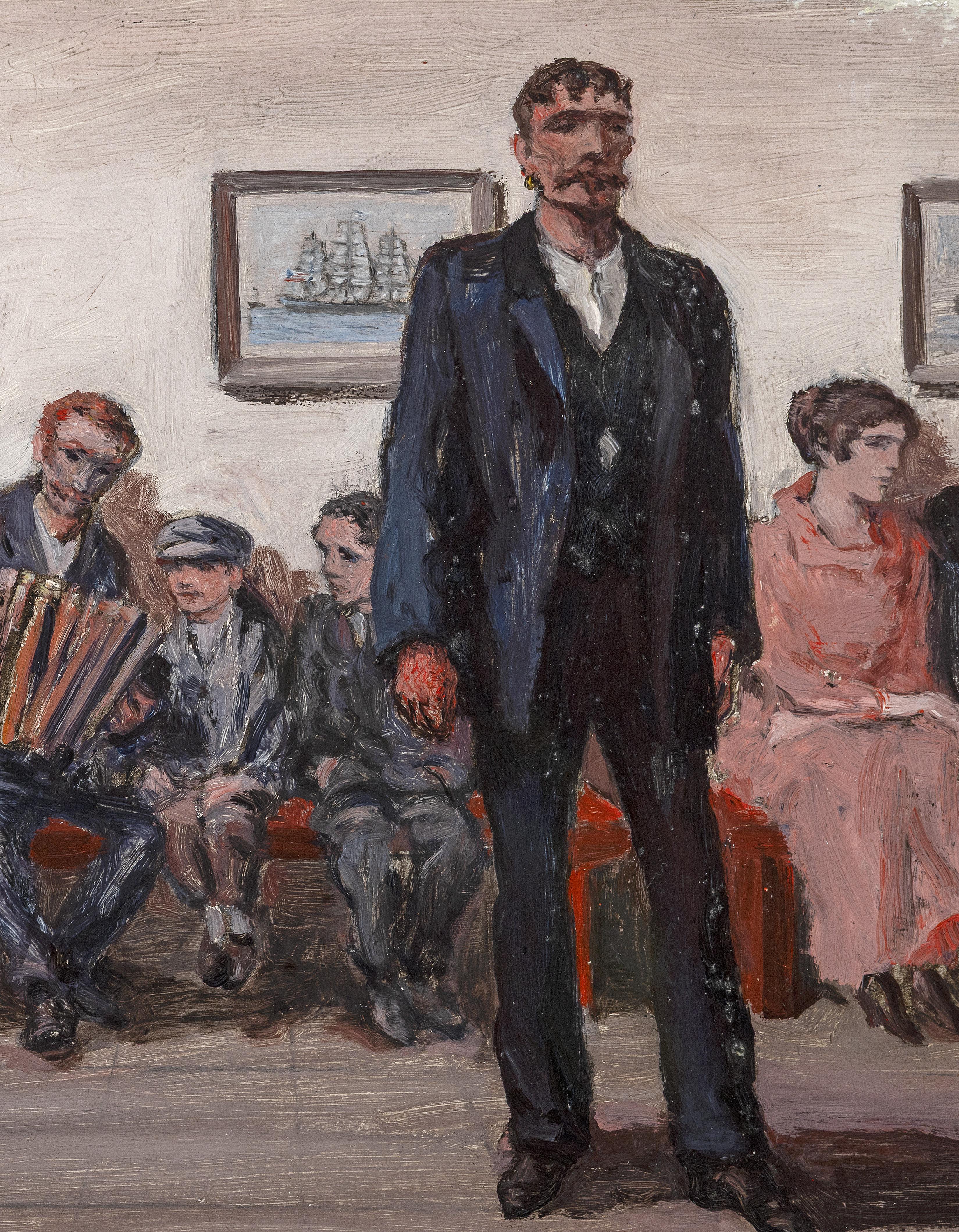
In the painting, a young man dances with his arms straight by his sides and his face looking directly ahead. His almost rigid pose contrasts with the informality of the figures seated on the red benches behind him. A young woman in a pink dress chats to a man. Two boys look on engrossed at the accordion, whose player inclines his head to one side, evoking the idea of music. The plain surroundings are of white washed walls, grey scrubbed floorboards and an open door that leads to the dimly lit porch with a window on the left. An oil lamp throws white light across the space. Next to it the only decoration are two framed prints of sailing ships, reminding us of the maritime nature of this location. This simple setting provides a powerful environment for the dancer, whose strong almost sculpted features, long thin face, moustache and curly hair and smart suit convey an air of dignity. According to Hilary Pyle, Yeats said that ‘the dancer deliberately opened his waistcoat in order to make clear that he was wearing a shirt, and not merely a dickey ’. 2 When exhibited at the Dublin Painters Gallery in 1921 the Freeman’s Journal noted that ‘there is humour as well as keen observation and admirable handling in ‘A Dancer’…. These paintings are all slices of life reflected by a temperament keenly sensitive to the comedy and tragedy of things’. 3
The painting is a master class in colour and form with the rounded shapes of the figures contrasting with the geometric contours of the doorways and the framed prints. White and grey tones are subtly counteracted by warm reds and pinks which recur across the composition.
Dr Róisín Kennedy, May 2026
(1) This painting is also known as A Summer Evening. Rosses Point. It is listed in H. Pyle, Jack B. Yeats. A Catalogue Raisonné of the Oil Paintings, Andre Deutsch, 1992, 1, p. 149.
(2) H. Pyle, Jack B. Yeats. A Catalogue Raisonné of the Oil Paintings ,1, p. 133.
(3) J.W.G, Freeman’s Journal. 21 February 1921.
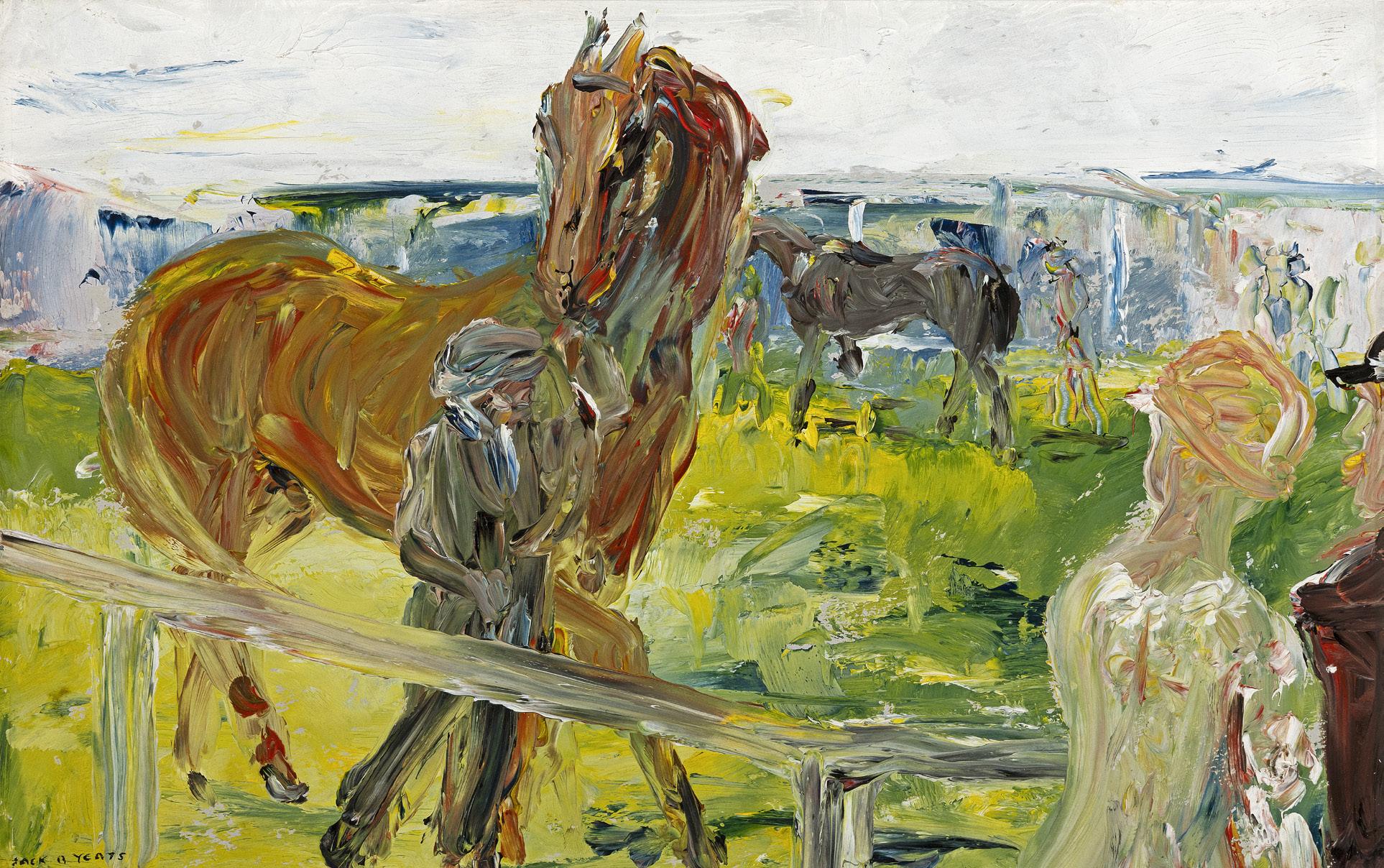
JACK BUTLER YEATS RHA (1871 - 1957)
The Paddock, Naas (1927)
Oil on board, 23 x 35cm (9 x 14”)
Signed
Provenance: Sold in 1930 to Dr. F. Murray, New York; Sale, these rooms, September 1977, lot 68; Collection of Reeta and Frank Hughes, Warrenpoint, thence by descent.
Exhibited: Dublin, Engineer’s Hall, 1927; London, Alpine Club Gallery, 1929
Literature: Hilary Pyle, ‘Jack B. Yeats, A Catalogue Raisonne of the Oil Paintings’ cat. no.352, p.320
€ 100,000 - 150,000
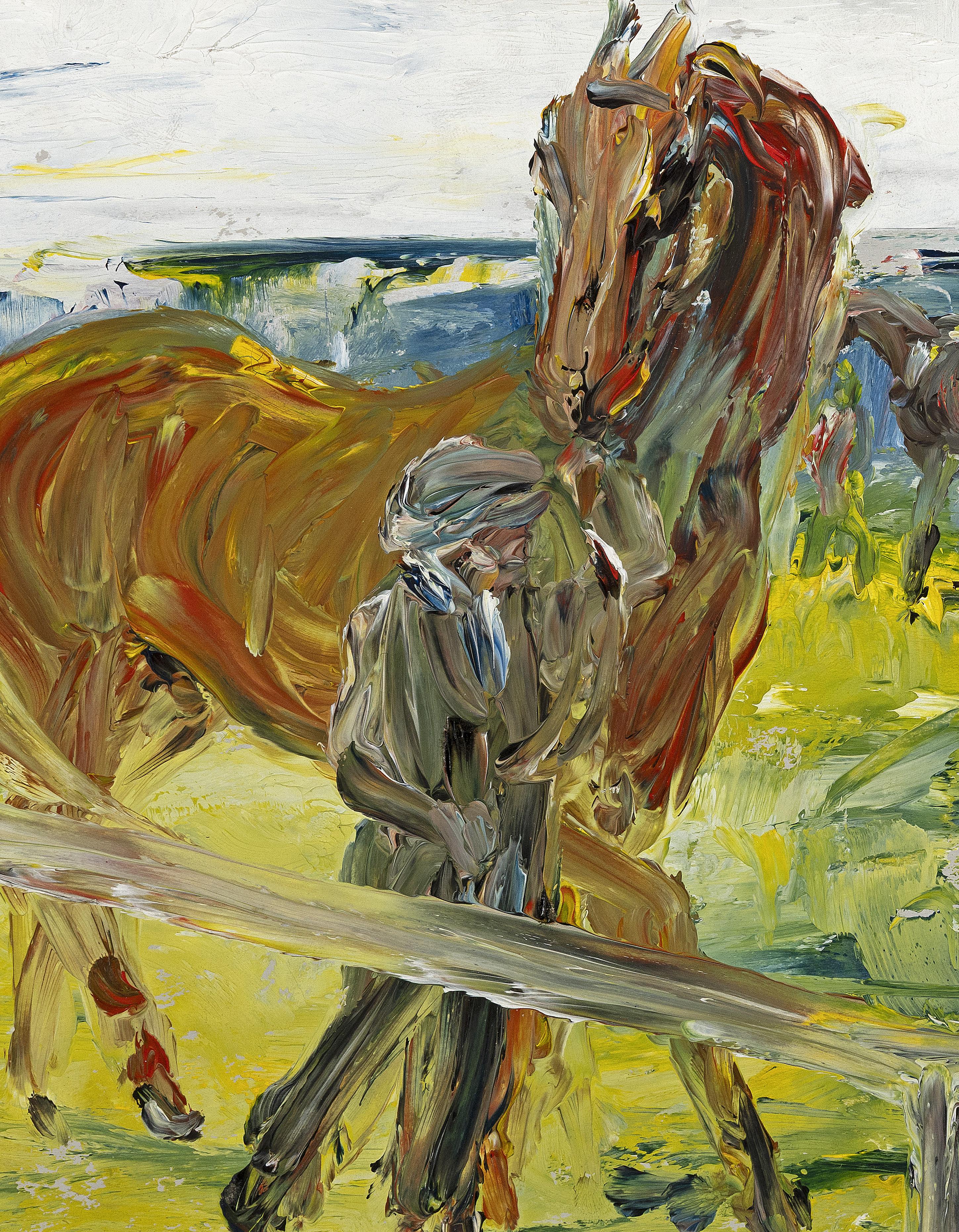
The Paddock, Naas, 1927
This small vibrant painting depicts a couple visiting the paddock at Naas Racecourse. Yeats was very fond of race meetings, of observing the horses, the jockeys and the crowds. In this work, a man leads a fine chestnut horse close to the railings. The animal’s large majestic head turns to gaze down at his human companion. On the far side another horse is being led with a figure following on. The buildings of the racecourse dominate the background. Naas Racecourse had recently opened in 1924 but had already established its reputation as a fashionable venue for race goers. Stylish ladies visited the paddock, according to contemporary newspaper accounts. One noted that ‘Lady McCalmont, in a large moleskin coats and felt hat; Lady Mahon, in a red leather coat and black hat, Lady Ainsworth in a coat of antelope fur and tweed suit’ were among the illustrious callers. The lady in Yeats’s painting, is also fashionably attired and her companion with his bowler hat and prominent moustache invokes an air of affluence. But the focus of the work is undoubtedly the captivating presence of the horse. The lively application of paint, especially in the dynamic form of the steed, evokes movement. This element combined with the complex and intricate building up of the green ground and the white sky create an absorbing exercise in paint. The geometric shapes of the railings and background buildings form a framing device around the central circular motif of the paddock, the two horses mirroring each other. But none of the elements in the painting seem to be fixed, instead due to the way in which Yeats has produced them, they appear erratic and fluid. This is a vigorous exercise in painting as well as a sharply observed encounter between man and beast.
Dr Róisín Kennedy, May 2026
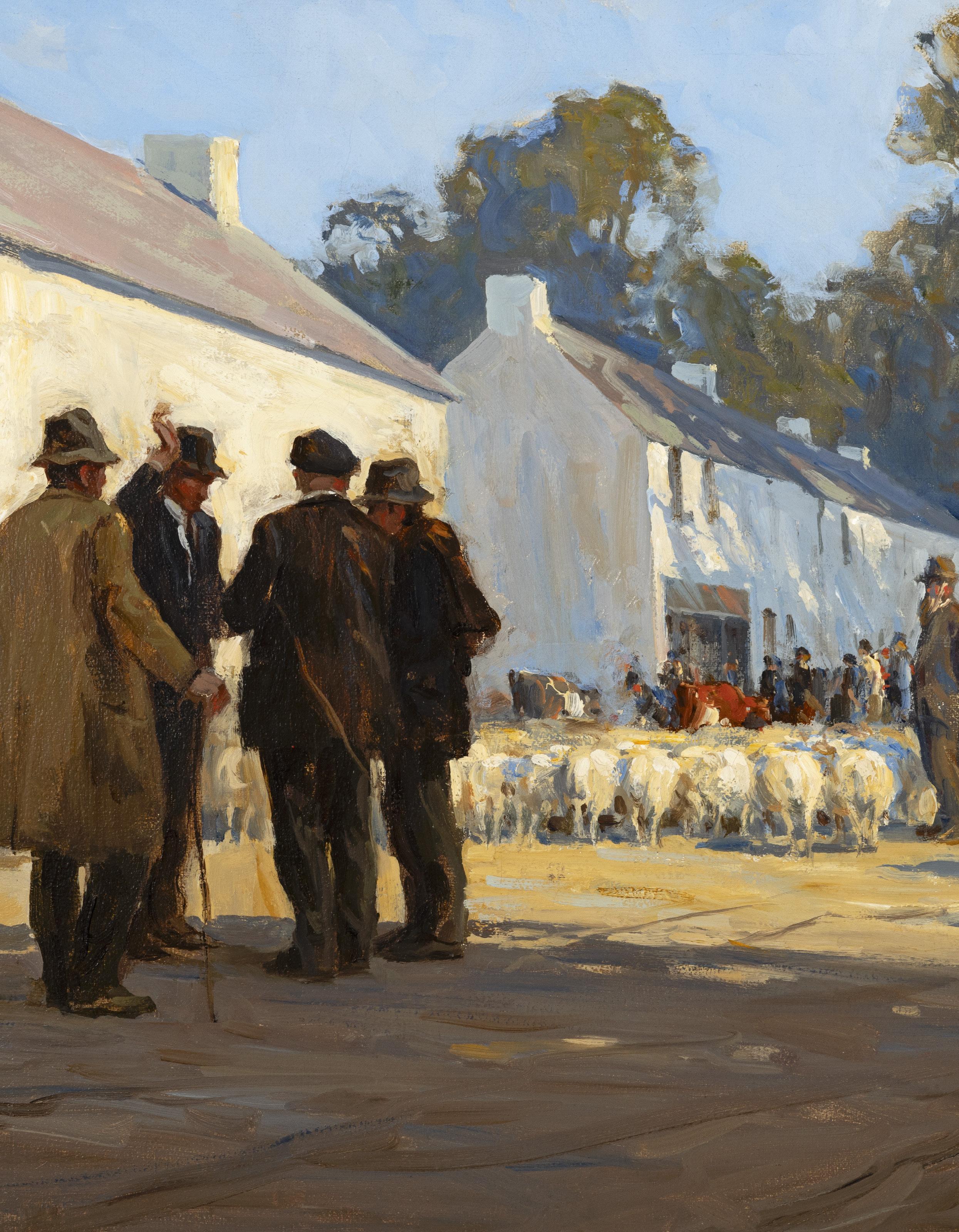
FRANK MCKELVEY RHA RUA (1895 - 1974)
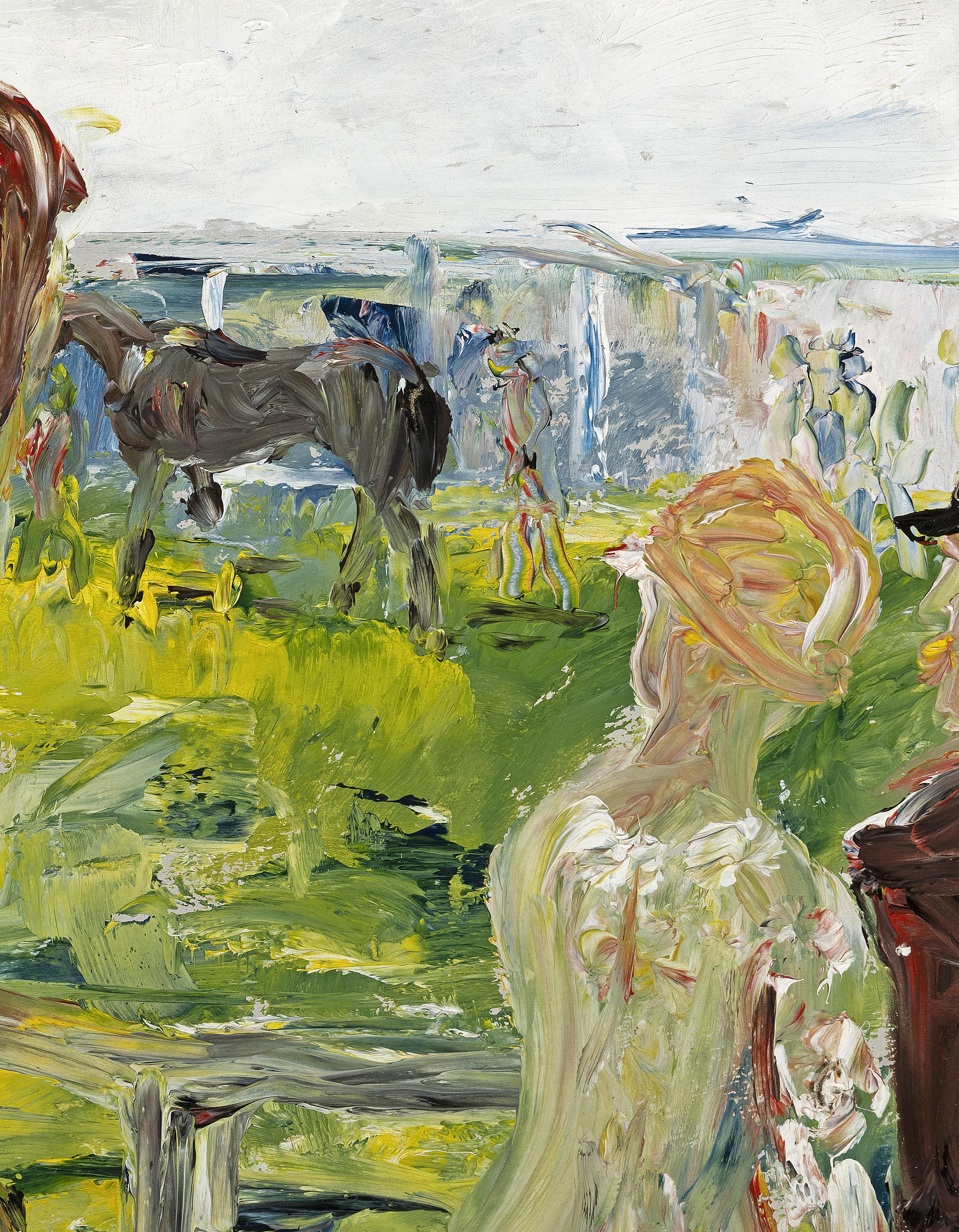
The Fair Day, Camlough, Co. Armagh
Oil on canvas, 42 x 52.5cm (16½ x 20½”)
Signed
Provenance: Collection of Reeta and Frank Hughes, Warrenpoint, thence by descent.
Literature: Eamonn Mallie (Ed), ‘One Hundred Years of Irish Art’, 2000, illustrations p.301
€ 20,000 - 30,000
Francis ‘Frank’ McKelvey was born on 3rd of June 1895 to a working class Belfast family. As the eldest son of six, McKelvey’s first foray into art world was purely practical as the son of painter decorator William McKelvey. The young Frank showed promise and on his father’s advice became an apprentice lithographer and poster designer with the firm of David Allen & Sons - a firm particularly noted for their designs for theatre, opera, postage stamp and general advertisement across Belfast and later across Great Britain with studios in Dublin, Liverpool, Glasgow, Harrow, London and Brentford. McKelvey’s artistic spark was further fanned when he entered the Belfast College of Art in 1911 as a full time student having attended evening classes for a period of time prior. It was here that McKelvey would meet the artist Alfred Rawlings Baker (1864-1939) who no doubt contributed a great deal to McKelvey’s partiality towards rural and rustic scenes.
Camlough Fair, here beautifully depicted was a repeat subject in McKelvey’s early work, likely introduced to the artist via his marriage to a local farmer’s daughter, Elizabeth Caldwell Murphy of Bessbrook, Co. Armagh in 1924. Bessbrook is located less than two miles from the aforementioned Camlough, and featured often in McKelvey’s work reflecting the nearby majesty of the Ring of Gullion. It should be noted that a very similar work by the artist titled Camlough Fair, The Clinching Bid was sold in these rooms on the 29th of May 2013 with the added date of 1924, indicating that this work was likely completed on this same year as the artist’s marriage. A subsequent work of a similar subject and varying composition titled Fair Day at Camlough was sold in Christie’s in May 2004, both with notable interest at sale. 1924 was indeed a fruitful year for McKelvey personally and professionally. His picture On the River Bann was purchased under the terms of the Gibson request for the Crawford School of Art, Cork. The Belfast Museum purchased Evening, Ballycastle for their collection. A glowing review of McKelvey’s exhibited works at the RHA that same year stated ‘Mr Frank McKelvey stands in the forefront of our interpreters of natural beauty…painting with him is an accomplishment and his pictures declare it. One feels the sunlight in every one of them’.
McKelvey is widely acknowledged as a leading landscapist and a luminary of the emerging Northern School of painters, later referred to as The Belfast School. The most revered of his works are those where his compositional instinct intersects with his genius for light play. In particular, those scenes where dappled sunlight falls across a scattering of hens in a traditional farmstead environment have captured the imagination of the wider public for their tranquillity and homely nature, as well technical ability. Similarly, the scene at Camlough here presented is a perfect intersection of the aforementioned conditions of composition and light which so define McKelvey’s greatest works. Later in his career his linework became looser and notably more romantic, however these earlier works evince a strong and structured approach. Structurally, the framing of this piece is robust and striking, no doubt influenced by McKelvey’s experience in the lithography studios of Belfast. An oblique view of a limewashed 19th century streetscape pulls the viewer’s eye from the left of the composition towards the centre where we see the livestock gathered and similarly small droves of tweed-clad locals vie for the best view of the sale. The low lying morning sun casts mauve shadows along the street and a hot blue sky indicates a fine day ahead. A small group of men are huddled on the left engaged in animated conversation. This is observed by three solitary figures on the right, each figure in their own rumination of the scene. McKelvey’s composition encourages the viewer to examine each in detail and in doing so actually includes the critical viewer as a bystander of this fine morning in Camlough. Later in his career McKelvey would continue to produce these vibrant market scenes such as Market Scene painted in 1945/36 (illus. pl. 19, Frank McKelvey, S.B. Kennedy). The scene at Camlough in its bold use of colour, strong contrast and definitive compositional choices is truly representative of McKelvey’s early defining work of the 1920s and an excellent example of the artist’s finest work.
Stephanie Brennan, April 2026
HUMBERT CRAIG RHA RUA (1877 - 1944)
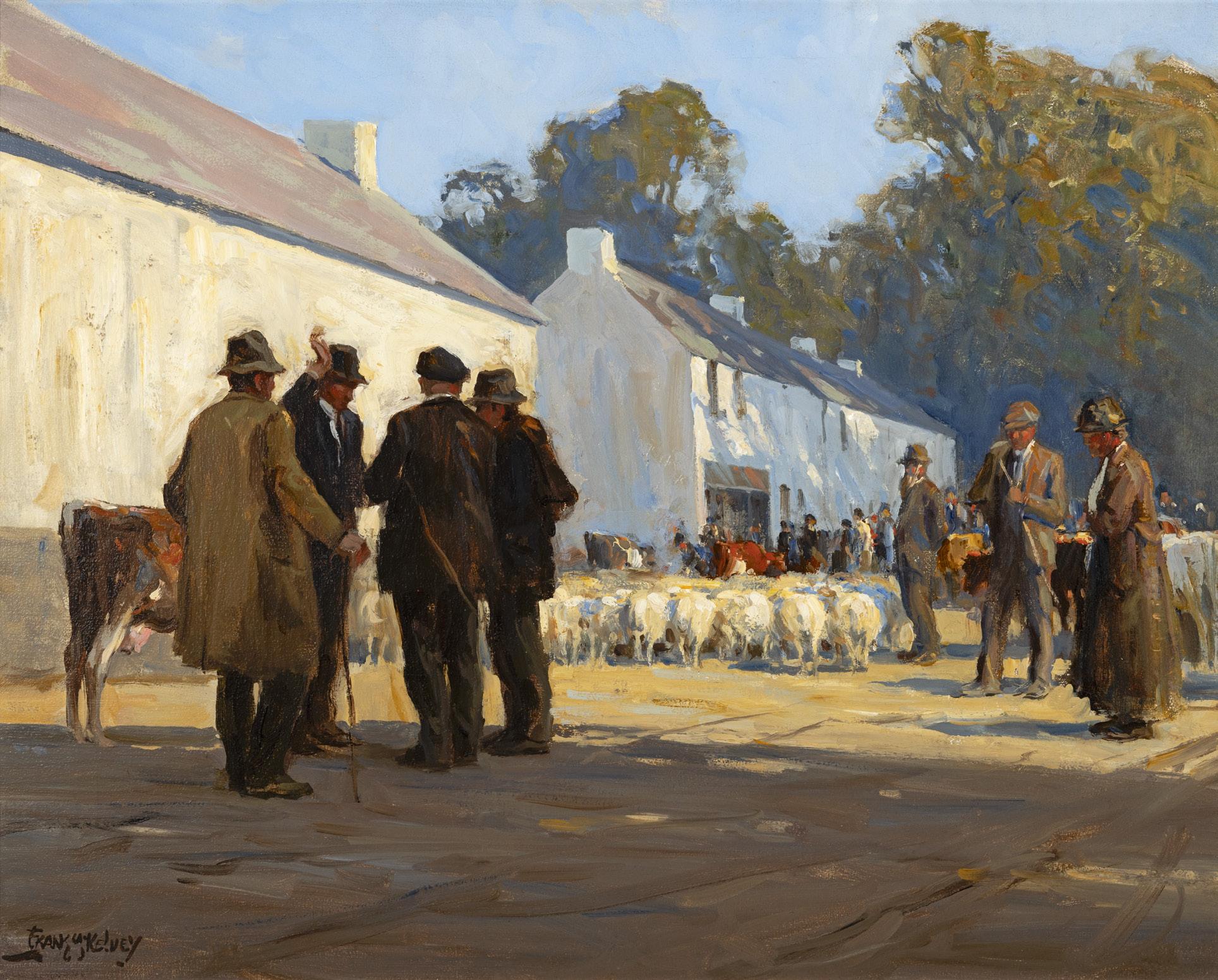
Dancing at the Cross Roads
Oil on canvas, 38 x 50.5cm (15 x 20”)
Signed
Provenance: Collection of Reeta and Frank Hughes, Warrenpoint, thence by descent.
€ 10,000 - 15,000
James Humbert Craig was born into comfortable means as the son of a Belfast tea merchant. Craig was, it appears, a healthy boisterous boy, inclined towards the outdoors. He benefitted from a private education and exposure to the various mechanics and humdrum happenings of the local shipyards and docks in Belfast and Bangor, Co. Down where the family soon relocated. Craig was not eager to join the family business but after a shortlived term at Belfast Art School and a failed spell in America he relented and spent some time working as a tea merchant for his father’s firm. This afforded him the economic means to indulge in his various pastimes of fishing, sailing, playing music and painting. James Humbert Craig painted for the love of it and while his later years proved financially lucrative, money was never really the motivation for his work. His career was punctuated by a series of professional accomplishments and critical recognitions – most notably a long association with the RHA, beginning with an exhibition in 1915. He was also the first elected President of the Ulster Society of Painters in 1921 and exhibited frequently with the Belfast Art Society (later known as The Ulster Academy of Arts) of which he was appointed Vice President in 1930.
Largely self-taught, Craig’s paintings seem to be mercifully unhindered by the rigours of formal training. He possessed a natural talent which when combined with an evident enjoyment for the task produced a catalogue of works which are remarkably fresh and honest. His one rule ‘Don’t try to improve upon nature’ is evident in the innumerable landscapes of the Antrim coastline and Donegal mountains he produced throughout his career. The painting Dancing at the Cross Roads here presented is a jubilant celebration of remarkable vitality, likely painted from a lived experience on the boreens of counties Antrim, Down or Donegal where the artist took much inspiration. It should be noted that Craig was a gifted fiddle player and a generous one at that. His retreat at Tornamona Cottage, Cushendun on the Antrim Coast reportedly hosted many music sessions and Craig
would entertain by imitating birdsong on his fiddle, to which the birds would reciprocate, much to the amusement of his guests. This anecdote is recounted in The Natural Talents of J.H Craig ‘The People’s Artist ’ by George A. Connell. The artist’s charming scene is a tribute to what was at that time already a dwindling social custom, negatively affected by rural depopulation and the disapproval of the Catholic Church. Dancing at the cross roads is a rural tradition that has also been interpreted by artists such as Craig’s contemporary Charles Lamb RHA RUA (1893-1964) and later fellow Northern Irish artist Gerard Dillon (1916-1971).
The frivolity of the scene here depicted is accentuated by Craig’s loose brushwork and impasto application of paint. A halo of unpainted canvas surrounds the dancing figures contributing to the movement and energy of the scene -a notable feature of Craig’s early works while still in his father’s employ. The young artist usually painted on crate panels from the tea trade as they were easily accessible to him. This influenced his early style as he frequently chose to leave sections of wood unpainted as a base colour. He was discouraged from doing this by his contemporaries who claimed the exposed wood would discolour over time and therefore Craig began using canvas instead once he could afford to do so. The manner in which this picture was painted would indicate that it was completed at that juncture in Craig’s early career. The palette used in this particular scene is also worth noting for its consistency throughout both human and landscape subjects. Craig has painted the human figures in a decidedly natural palette of greys, blues, browns and purples in direct correlation with the surrounding stone walls and distant tilled fields. The mark-making is expressive and the detail deliberately limited, adding to the communication between human and natural world. Craig’s dancers have seemingly sprung from the dusty road as naturally as daisies on a grassy verge. Typically, these scenes of everyday life would be read as Genre scenes, but Craig’s manipulation of the palette is so harmonious, the resulting picture reads as a Pure Landscape – no small feat. It is this natural ability Craig possesses for interpreting landscapes, pure and peopled that has resounded with admirers throughout his career and in the eighty years since. His pictures are unpretentious and familiar and yet steer clear of the sentimentality that commonly arises when responding to the market desires of that time. Ireland, a newly independent state was trying to find its footing and unsure of how to present itself to the world as a modern state while also acknowledging the rustic charm of the Irish vernacular tradition. James Humbert Craig manages to deftly capture the atmosphere of Ireland in the early 20th century and his work resounds with viewers both critical and popular today. In this sense he is truly ‘The People’s Artist’.
Stephanie Brennan, April 2026
WILLIAM CONOR RHA RUA ROI (1881 - 1968)
The Darlins (1923)
Oil on canvas, 45 x 36cm (17¾ x 14”)
Signed; also signed and inscribed with title and date verso
Provenance: With William Rodman & Co, Belfast, label verso; Collection of Reeta and Frank Hughes, Warrenpoint, thence by descent.
€ 8,000 - 12,000
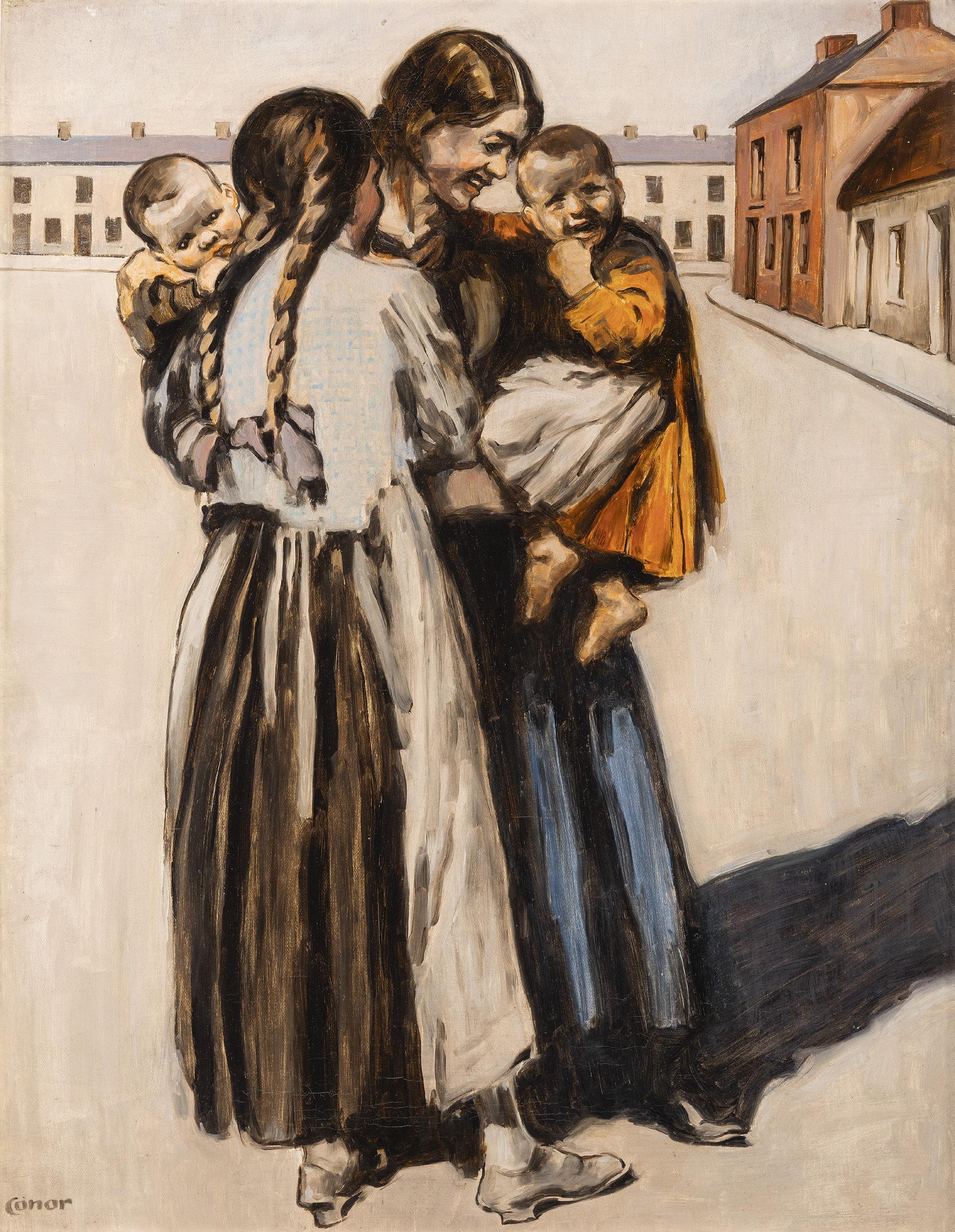
A tender and intimate depiction of maternal affection, The Darlins (1923) exemplifies Conor’s celebrated ability to elevate everyday life into scenes of quiet dignity and warmth. Set against a simplified urban backdrop, a mother gathers her children close, their forms arranged in a gentle, almost sculptural grouping. Conor’s restrained palette, punctuated by the rich ochre of a child’s garment, draws the eye into the composition, while his confident, economical brushwork lends immediacy and vitality to the scene. The figures are arranged in a compact, almost sculptural grouping, while the simplified architectural backdrop, rows of terraced houses, anchors the scene firmly in a working-class environment familiar from Conor’s Belfast.
Conor was deeply attuned to the lives of working-class communities in Belfast. His work often reflects a compassionate realism, informed by both observation and empathy. Conor trained at the Belfast School of Art and later in Paris, where he absorbed influences from contemporary French painting. However, unlike many of his peers, he remained committed to portraying local life, becoming closely associated with the cultural revival in Northern
Ireland. His work was widely exhibited, including at the Royal Hibernian Academy, and he was later elected a full member, cementing his status within the Irish artistic establishment. In The Darlins, the artist balances structure and spontaneity, capturing not only likeness but the fleeting warmth of familial connection.
Painted in 1923, during a mature and highly productive phase of his career, this work demonstrates Conor’s assured handling of composition and tone. The Darlins exemplifies the qualities that have made Conor’s work enduringly popular with collectors, it’s accessible subject matter, emotional immediacy, and strong sense of place. The painting resonates not only as a document of social history but also as a universal depiction of familial affection.
Emmalie Conroy, April 2026
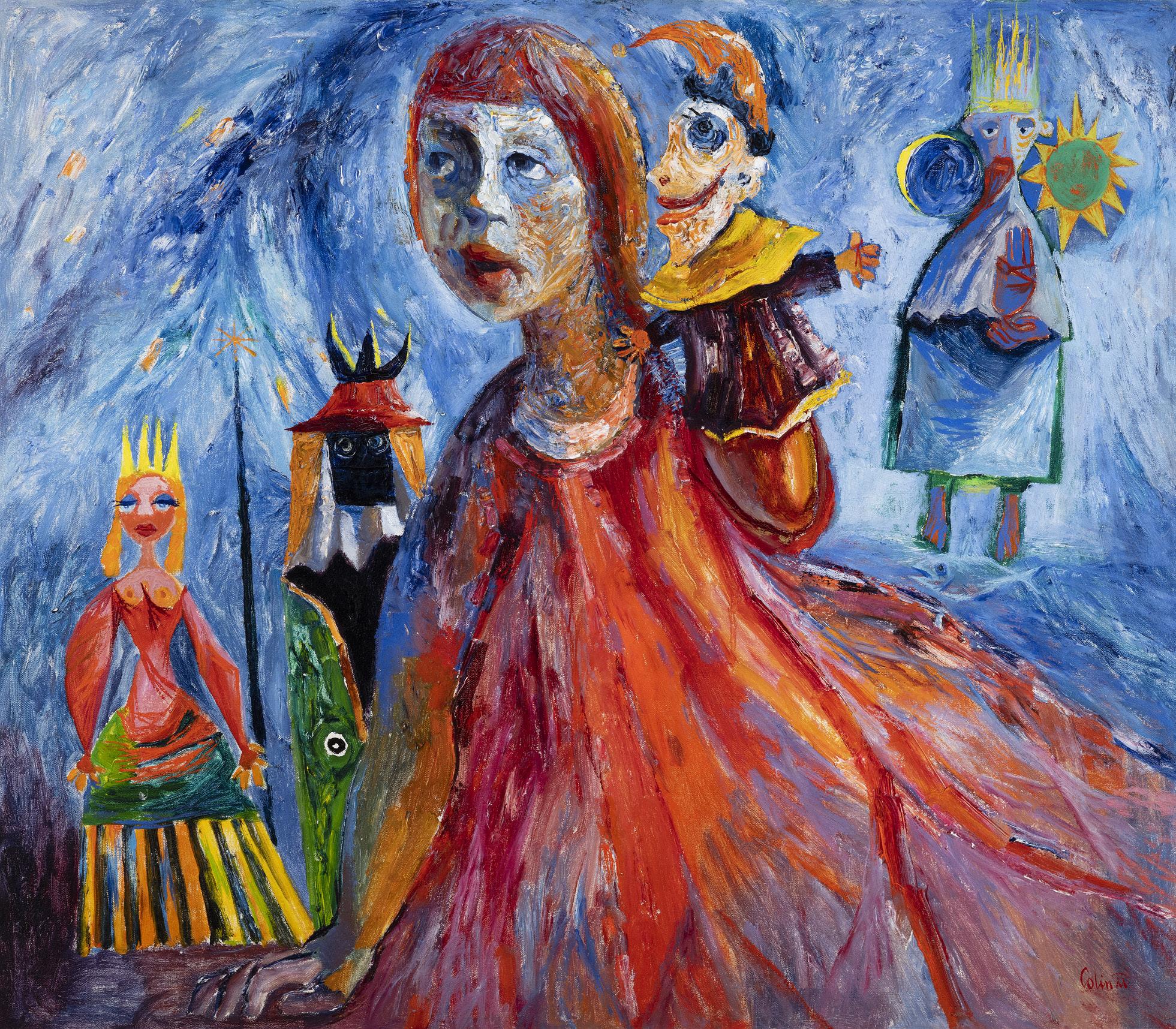
The Princess (1949)
Oil on canvas, 66 x 76cm (26 x 30”)
Signed, also signed and inscribed with title and dated Nov/Dec 1949 verso
Provenance: Collection of Reeta and Frank Hughes, Warrenpoint, thence by descent.
Exhibited: London, Tooth Gallery, ‘Colin Middleton, Paintings, 1947-1952’, Oct/Nov 1952, cat.no.16
€ 30,000 - 50,000
The Princess was painted at a remarkably productive time for Colin Middleton. He had moved to Ardglass with his family in the summer of that year, only a few months after his first one-person exhibition at the Victor Waddington Gallery in Dublin, of which the critic of the Dublin Magazine had written, ‘With this show, Middleton, from being just one of the more interesting of the moderns, has become a great painter.’ (1)
Waddington’s agreement to take Middleton on as a gallery artist, at the end of 1948, had enabled him to become a full-time painter and to leave Belfast, and the Dublin dealer’s practical and moral support was also very important for Middleton at this time, not only arranging regular exhibitions in Dublin, London and further afield, and planning to publish a book on his work , but also supporting Middleton’s powerful creative vision with regular letters and visits to Ardglass.
The Princess was included in Middleton’s 1950 Dublin exhibition; Waddington wrote to him that ‘The exhibition is magnificent’. (2) The painting was picked out in the lengthy review published in the Dublin Magazine, who also subsequently noted its inclusion in the Irish Exhibition of Living Art in 1952.
The Princess is a complex and ambitious painting. Dominated by the figure of a young girl in a red gown, whose features are treated in a more stylised and detailed manner than is typical of this period, the canvas is filled with dolllike figures, including a Mr Punch glove puppet, beneath a turbulent sky. Middleton’s work at this period is dominated by a number of significant multi-figure compositions, and symbolism remained central to his work, even as it became considered closer in style to expressionism in the late 1940s. Whether the girl is part of the same narrative as the figures around her, or whether they are part of her imagination or a dream, it is perhaps also relevant to consider that children’s toys, belonging to Kathleen’s two young daughters, would have been part of Middleton’s daily life outside the studio at this time, and there might be a rare nod to his domestic life within this work.
Dickon Hall, April 2026 (1)Dublin Magazine, April-June 1949, review of ‘Colin Middleton: Paintings 1942-49’ (2)Letter from Victor Waddington to Colin Middleton, 20th October 1950, Private Collection
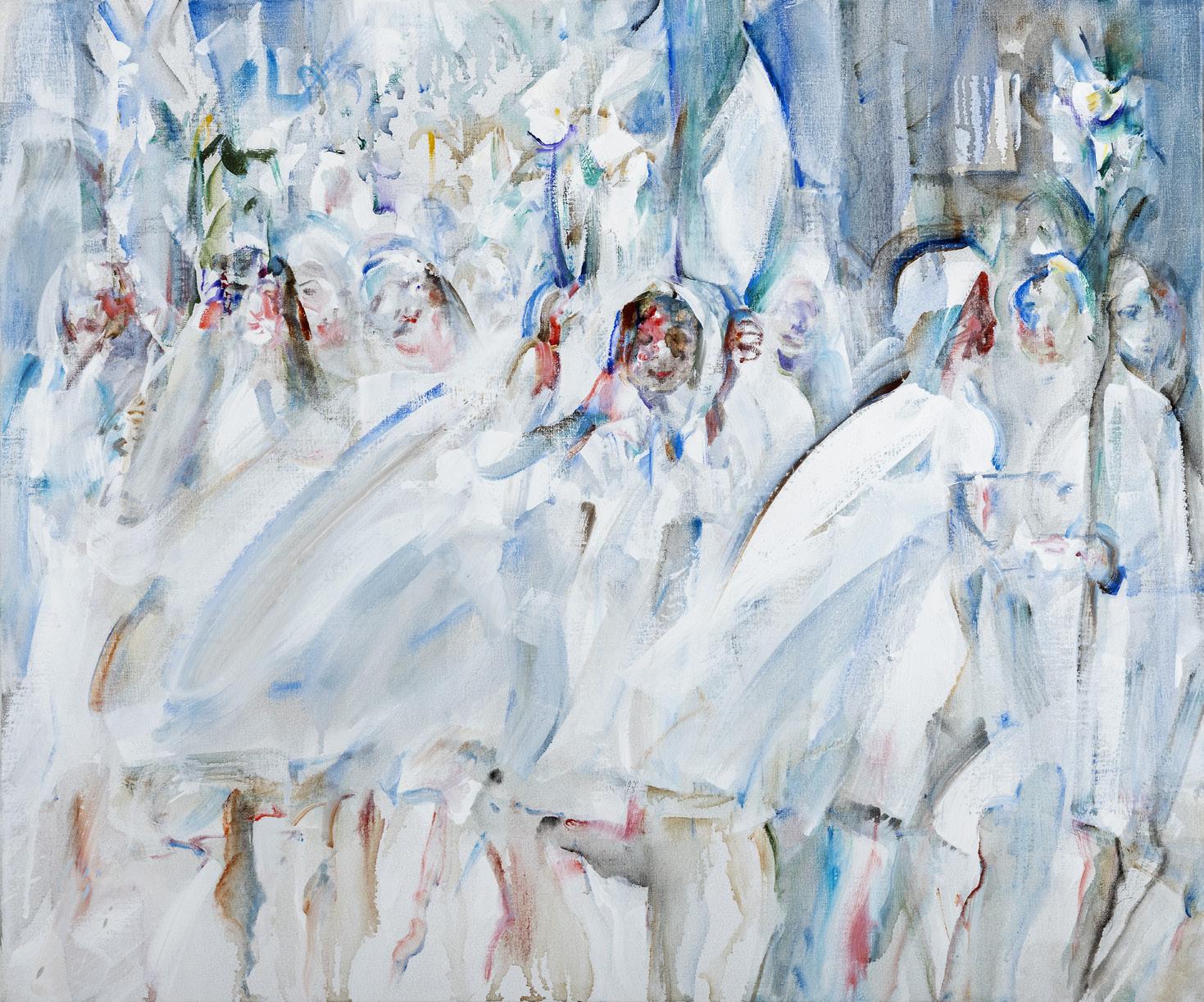
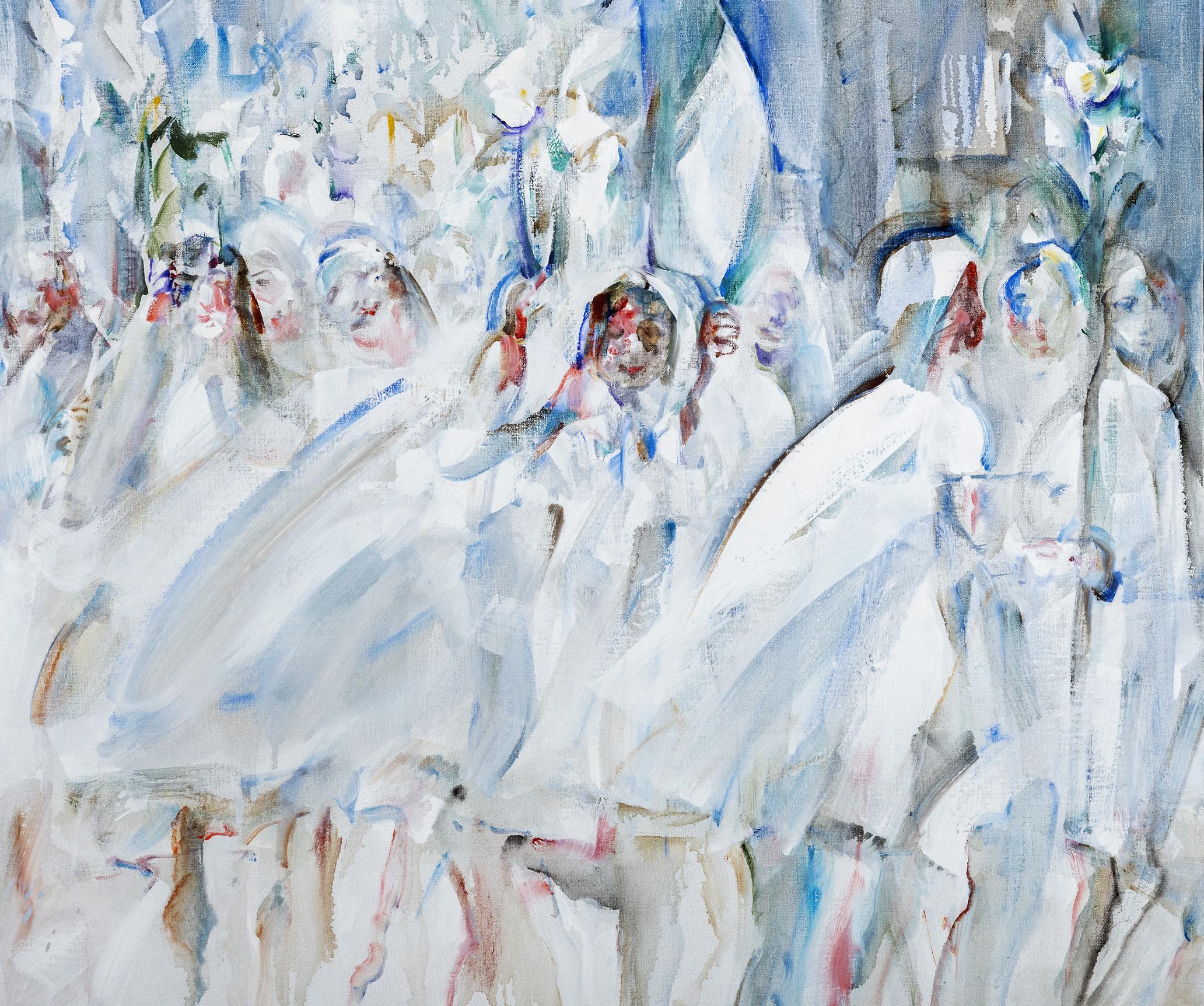
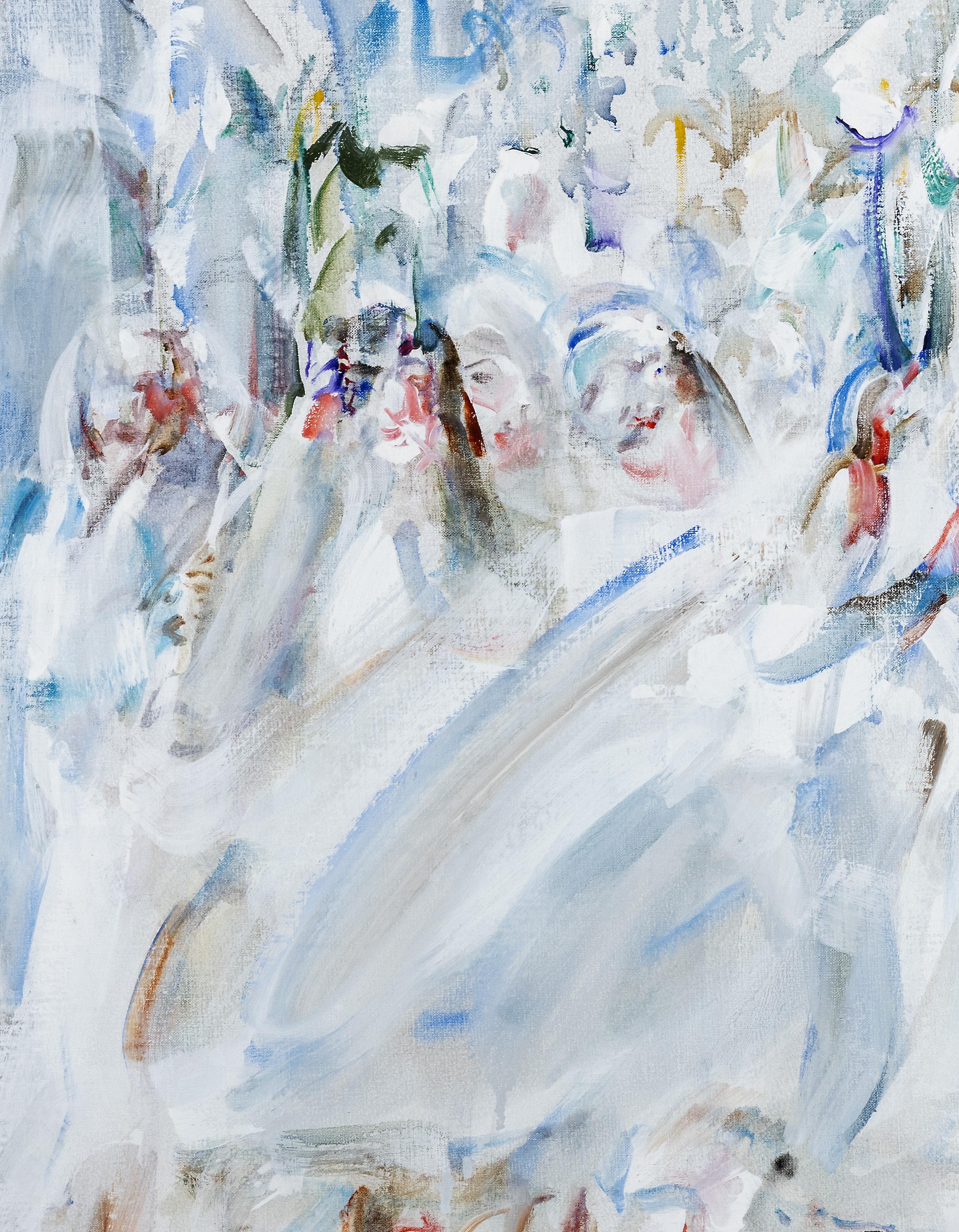
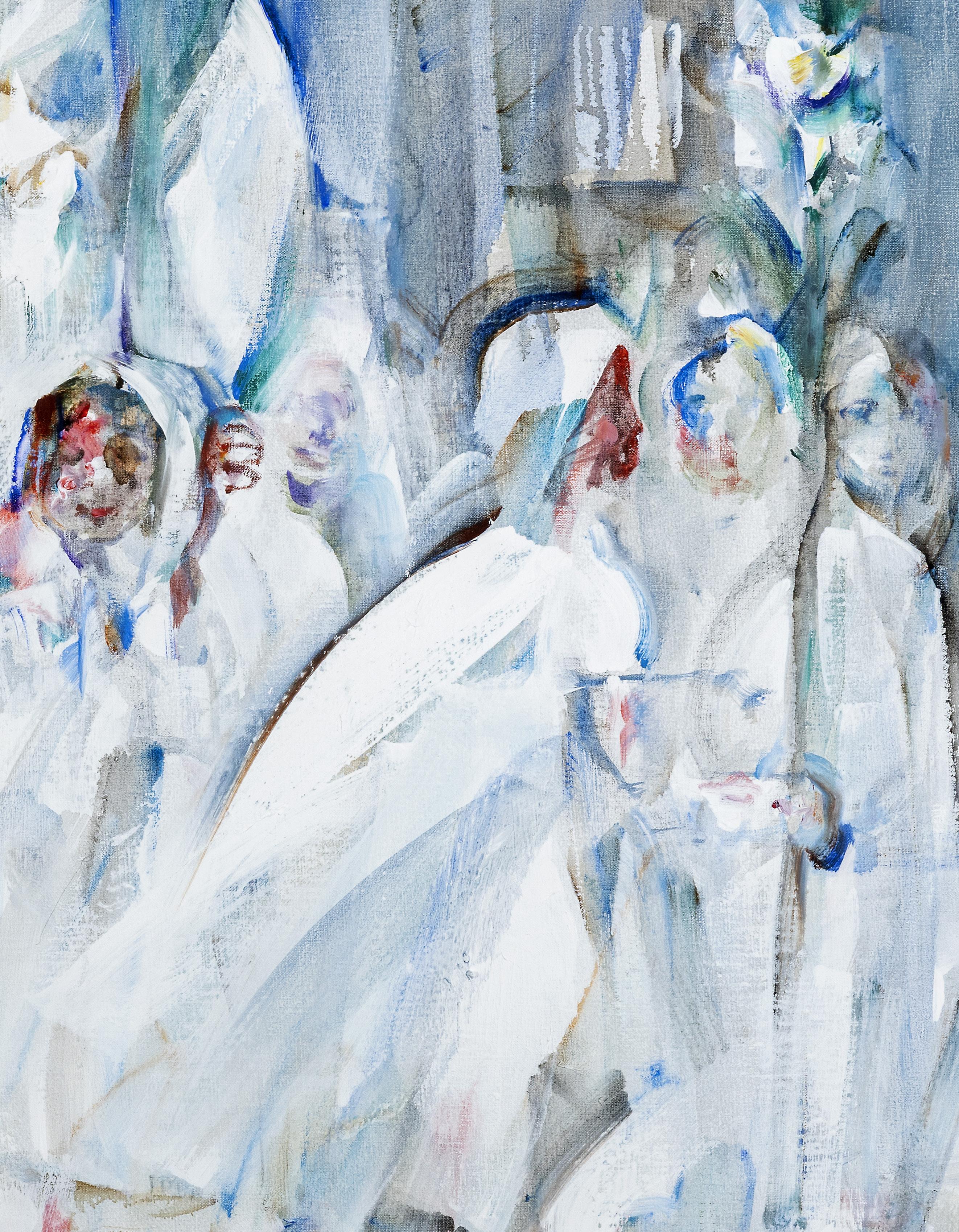
Study for Riverrun: Procession with Lilies (1984)
Oil on canvas, 54 x 65cm (21¼ x 25½”)
Signed and dated 1984 verso
Artist’s reference number: 520
Provenance: Collection of Reeta and Frank Hughes, Warrenpoint, thence by descent.
Exhibited: Cork, Crawford Gallery, ‘Louis le BrocquyProcession’, Oct/Nov 2003, travelling to Dublin, Taylor Galleries, Nov/Dec 2003
€ 50,000 - 80,000
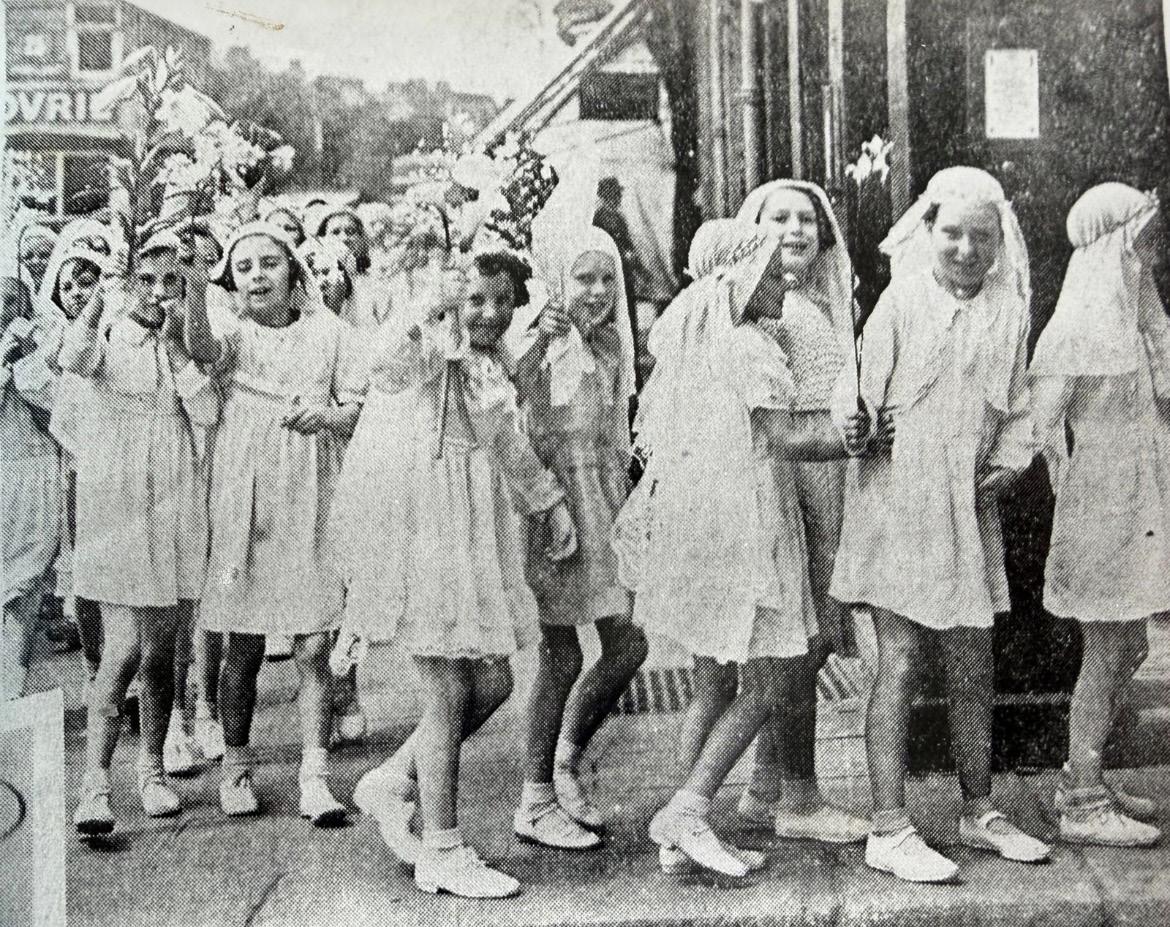
It’s not unusual that Louis le Brocquy might have noticed something in passing and mentally filed it away for processing. Eventually it might emerge in some form in his work, perhaps in conjunction with an apparently unconnected idea. Such was the case with a 1939 Evening Herald press photograph of cheerful Dublin schoolgirls in confirmation attire returning from the Church of Adam and Eve on Bloomsday, lilies held aloft. A friend sent him a cutting of the photograph in 1939. He is best known as a painter of the individual human being, though he periodically was drawn to family and social groups as subjects, and in 1954 a 17th century painting by Nicolaes Maes, of children playing in a wood, inspired an artistic response. Eventually the press photograph found its way into his work, first in 1962 and then, more extensively, in the 1980s and early 1990s.
The spark was the fact that the image’s date became known as Bloomsday, and le Brocquy saw the moment as a celebration of these youthful, joyous figures immersed in the heart of the city of Dublin, looking forward to their lives to come, paralleling in his mind Joyce’s tracking of his characters throughout the course of the day, depicting quotidian modernity on a classical, Homeric template. The timing also coincided with the recent publication of Joyce’s monumental Finnegan’s Wake (hence the Riverrun). So Joyce, Dublin and the hopes and expectations of people in the city loom large in the Procession paintings.
Born in Dublin in 1916, Louis le Brocquy grew up to become one of the leading Irish artists of the 20th century. His love of painting triumphed over expectations that he would enter the family’s oil refinery business and, encouraged by his mother Sybil, he set off to learn by studying the masters in the great galleries of Europe. Back in Ireland in the early 1940s, he quickly became a central figure in the fledgling Modernist movement. His early paintings, mostly of families and marginalised Traveller communities, gave way to studies of the isolated human presence throughout the 1950s. In the following decade he began a new series of works centred on the human head, leading on to the innovative, incisive portrait studies of Irish literary giants James Joyce, William Butler Yeats, Samuel Beckett and more. His work features in numerous public and private collections.
Aidan
Dunne, April 2026
FREDERICK E MCWILLIAM RA (1909 - 1992)
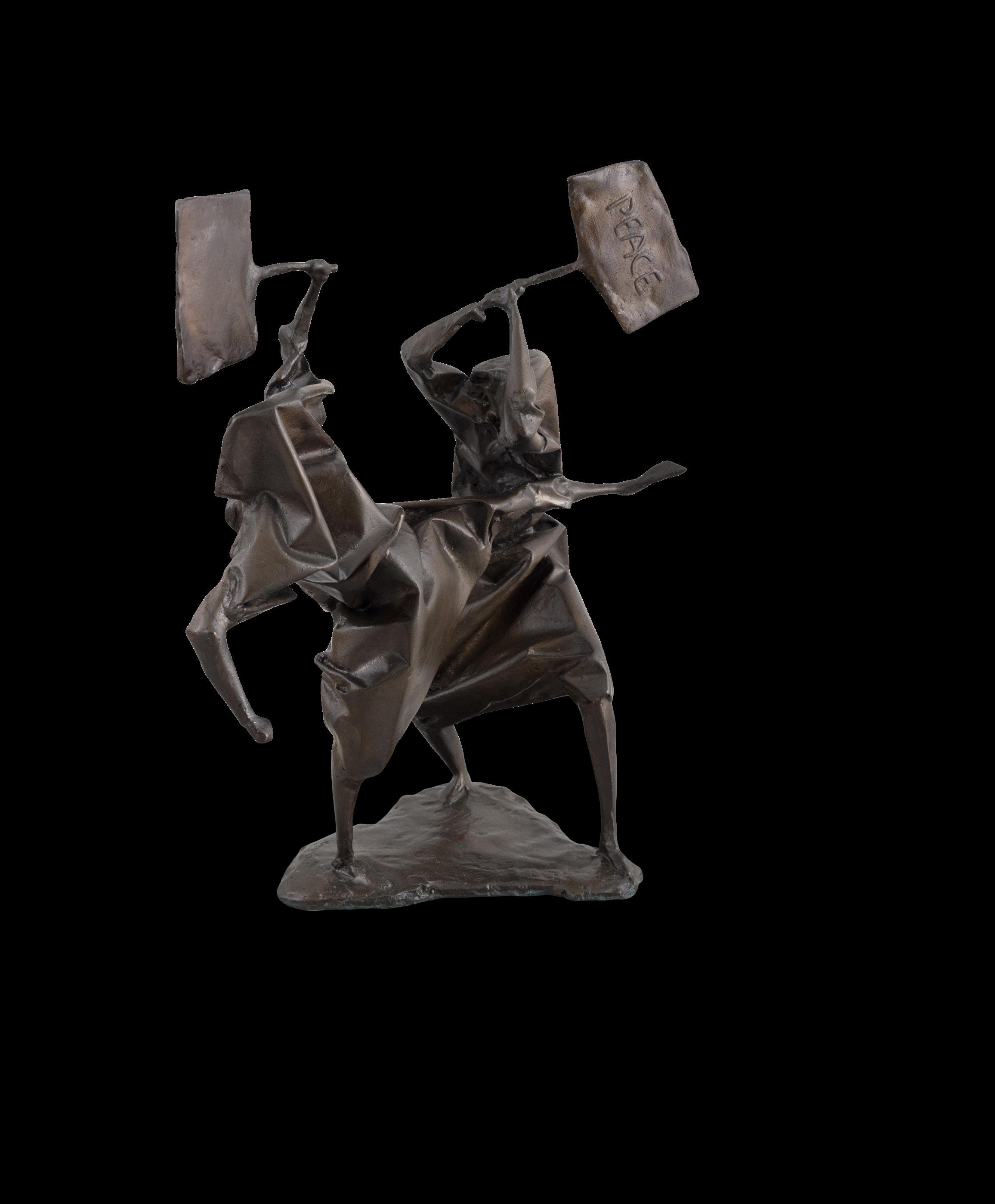
Peace Women (c.1975)
Bronze, 35cm (13¾”) (h)
Signed and numbered 3/5
Provenance: Collection of Reeta and Frank Hughes, Warrenpoint, thence by descent.
€ 10,000 - 15,000
When the Troubles erupted in Northern Ireland, FE McWilliam had long been gone from Banbridge, the Co Down town where he was born and grew up. Based in London and well established there as both sculptor and teacher, he nonetheless maintained links with the North, and had completed commissions there. In the late 1960s his work took a particularly figurative direction, culminating in a series of stylised female nudes in bronze. Events in Northern Ireland prompted a significant shift in the mood and form of his sculpture.
In the aftermath of Bloody Sunday, a Provisional IRA bomb explosion in Belfast’s Abercorn Restaurant killed two young women and caused horrific injuries for dozens more. The events triggered memories of the political violence happening during McWilliam’s early years and he was moved to create a series of sculptures, Women of Belfast, of figures as though thrown and contorted by a blast. He went on to create a series of Banner pieces, of women holding aloft banners, and then a series of clashing protestors, including several of peace protestors, using their banners as weapons in vigorous clashes. By this stage he seemed to be commenting on the ultimate futility of conflict. Although
the subject is highly charged, there is a lightness to the sculptor’s treatment, a choreography to the emphatic movement of the figures. And in fact they anticipate a subsequent, 1980 series of judo players in action.
Like many a sculptor, McWilliam originally had it in mind to be a painter, but when he went to the Slade in London to pursue his art studies, he found himself drawn into the orbit of Henry Moore and others who could see his sculptural potential. He spent most of WWII in the RAF in aerial reconnaissance. After teaching in India he returned to London, teaching at Chelsea and the Slade, all the while working industriously and completing major commissions. He exhibited with Waddington Gallery London and Taylor Galleries Dublin among others. There were retrospectives at the Ulster Museum (touring to Dublin and elsewhere) and the Tate Gallery London. He bequeathed his studio and works to Banbridge, where they are part of the FE McWilliam Gallery and Studio.
Aidan Dunne, April 2026
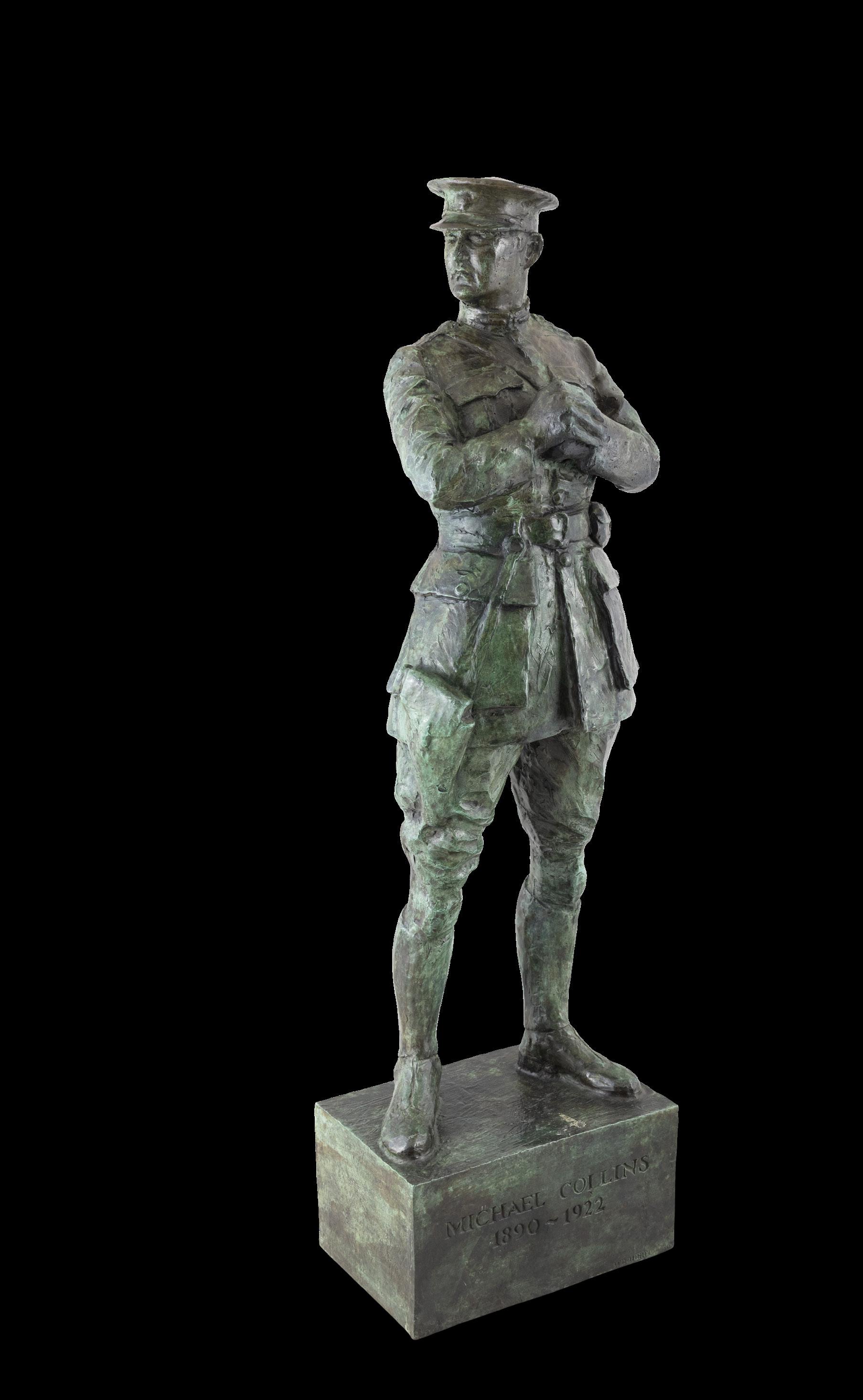
General Michael Collins (1890-1922)
Bronze, 86cm (33¾”) (h) inc. base
Signed
Provenance: Collection of Reeta and Frank Hughes, Warrenpoint, thence by descent.
€ 8,000 - 12,000
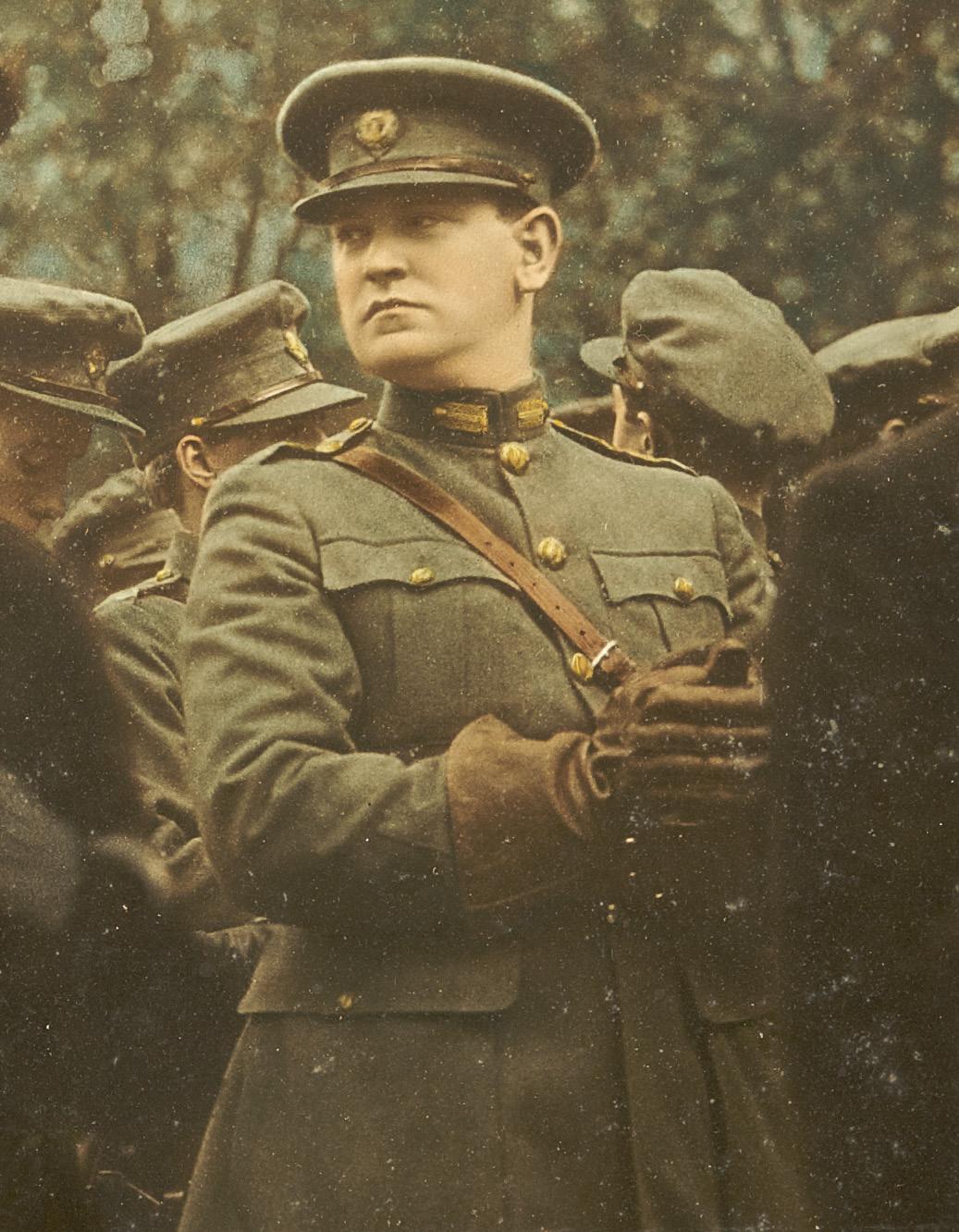
This accomplished bronze sculpture by Eamonn O’Doherty (1939-2011) belongs to a mature phase in the artist’s practice, in which historical commemoration and refined figurative modelling are brought into deliberate synthesis. The present work depicts Michael Collins not as the elusive revolutionary of the War of Independence, but in the formal uniform of Commander-in-Chief of the National Army of the Irish Free State, a position he held in the final weeks preceding his death in August 1922. The sculpture forms part of a limited series entitled General Michael Collins (1890–1922).
O’Doherty, a highly regarded Irish sculptor, painter and printmaker, has achieved international recognition for major public commissions across Ireland, the United Kingdom and the United States. Notable among these are the James Connolly Memorial, the Tree of Gold, and the Great Hunger Memorial. His work is distinguished by a capacity to merge robust, often monumental figuration with layered symbolic and historical narratives, an approach clearly manifests in the present work.
Here, Collins is rendered with notable fidelity to historical detail. He wears the Sam Browne belt and the specific uniform associated with the National Army during his tenure at Cathal Brugha Barracks- formerly Portobello Barracks[1]. His stance, upright with arms folded, projects a studied composure that evokes authority, resolve and a degree of introspection. This posture, at once formal and contemplative, encapsulates the dual burdens of military command and political stewardship borne by Collins during the fraught early months of the Irish Free State.
Significantly, O’Doherty avoids the more familiar image of Collins as a covert organiser during the War of Independence, when he deliberately avoided uniform in favour of
civilian attire to evade British intelligence. Instead, the artist foregrounds Collins’s transformation into a state figure, a commander operating within the structures of an incipient government. In doing so, the sculpture reframes its subject and emphasises not the covert tactician but the architect of emergent statehood.
Beyond its role as a likeness, the sculpture operates as a considered statement on Collins’s legacy. It captures a pivotal moment of transition, the passage from revolutionary insurgent to head of a formalised national army, a shift that both defined his achievements and precipitated the divisions culminating in the Irish Civil War.
A further point of interest lies in the striking visual correspondence between this sculpture and a well-known period photograph of Michael Collins in National Army uniform[2]. In that image, Collins adopts a similarly composed stance, his posture conveying a controlled authority tempered by introspection. It is reasonable to suggest that O’Doherty may have drawn upon such photographic sources in developing the present work. Rather than merely replicating a historical image, however, the artist appears to have distilled its essential qualities, translating the immediacy of photography into a three-dimensional form imbued with monumentality and permanence. This dialogue between photographic record and sculptural interpretation enriches the work, anchoring it in historical authenticity while elevating it into the realm of considered artistic reflection.
Emmalie
Conroy, April 2026
[1] Independent Newspapers. (1922). [Michael Collins in uniform at Portobello Barracks]. Two weeks after this photo was taken, Collins was killed in an ambush at Béal na Bláth on August 22nd, 1922.
BASIL BLACKSHAW HRHA RUA (1932 - 2016)
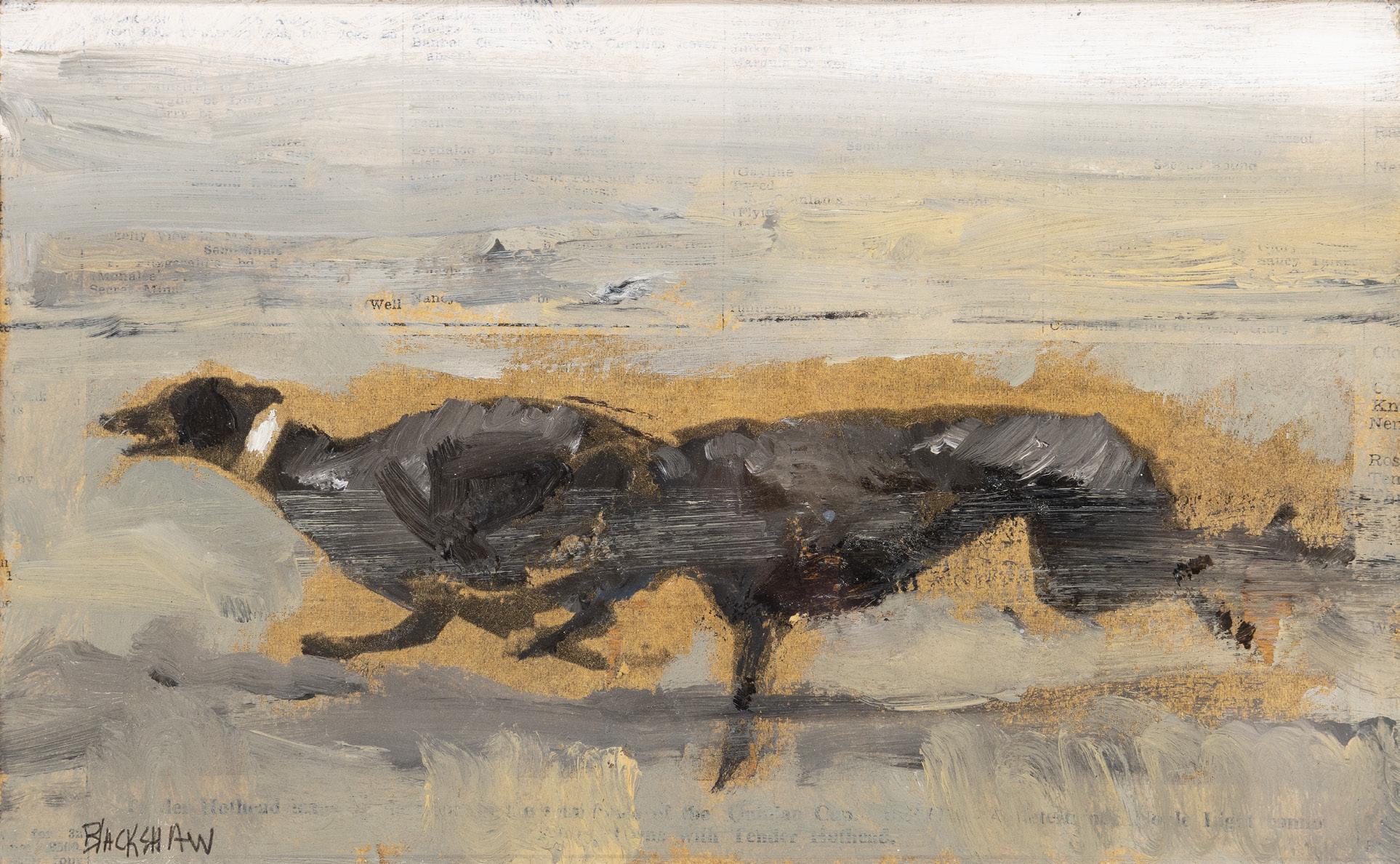
Coursing: Crebilly
Oil on board, 15 x 23cm (6 x 9”)
Signed
Provenance: Collection of Reeta and Frank Hughes, Warrenpoint, thence by descent.
Exhibited: Belfast, Tom Caldwell Galleries, March 1981
€ 3,000 - 5,000
21
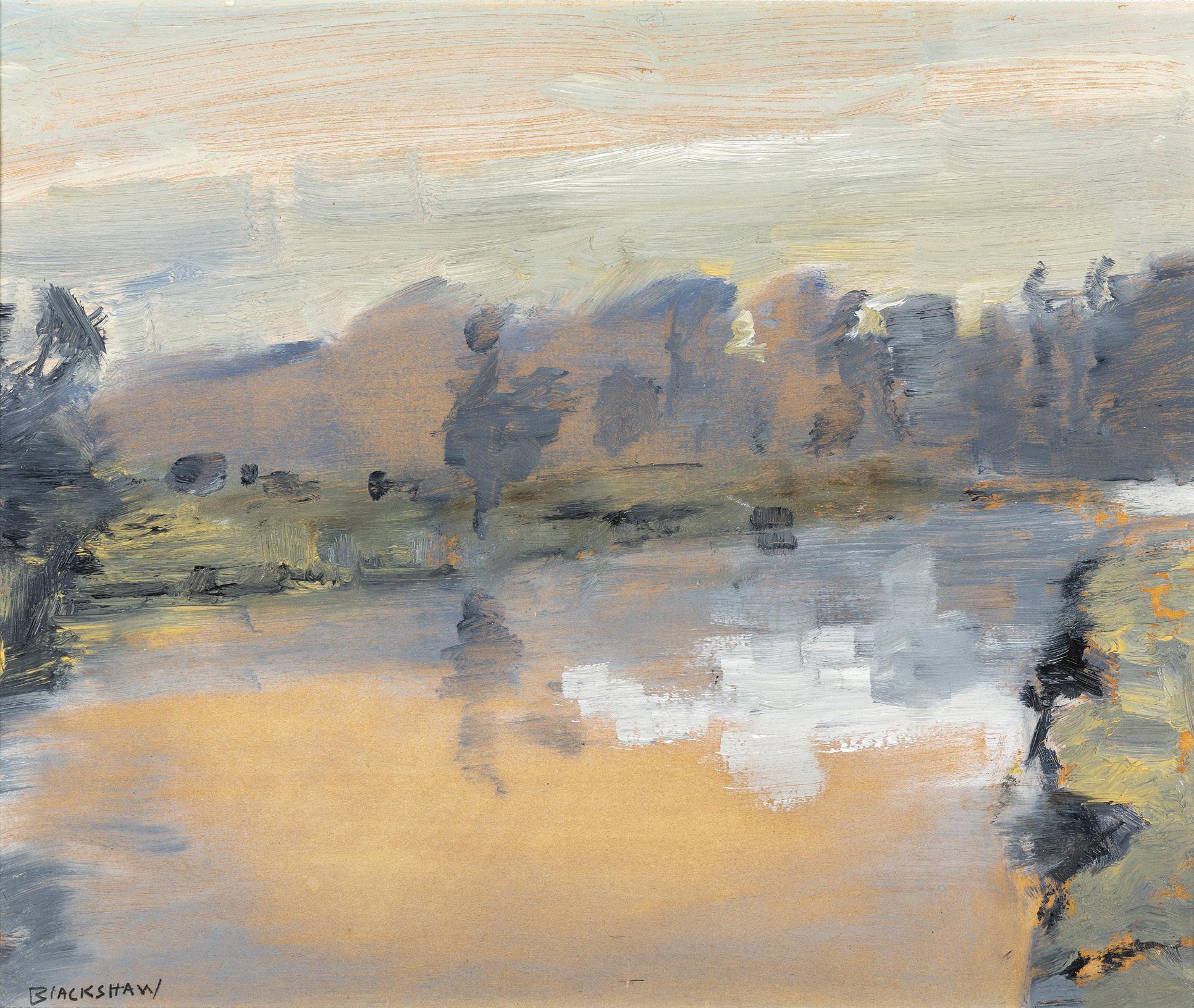
BASIL BLACKSHAW HRHA RUA (1932-2016)
Little Landscape (1989)
Oil on board, 25 x 30cm (10 x 11¾”)
Signed
Provenance: From the collection of Brian and Anne Friel - gifted to them by the artist; their sale, these rooms, 26/09/2018, lot 2.
Literature: Eamonn Mallie, Blackshaw, page 212, plate 87 (full page)
€ 2,500 - 3,500
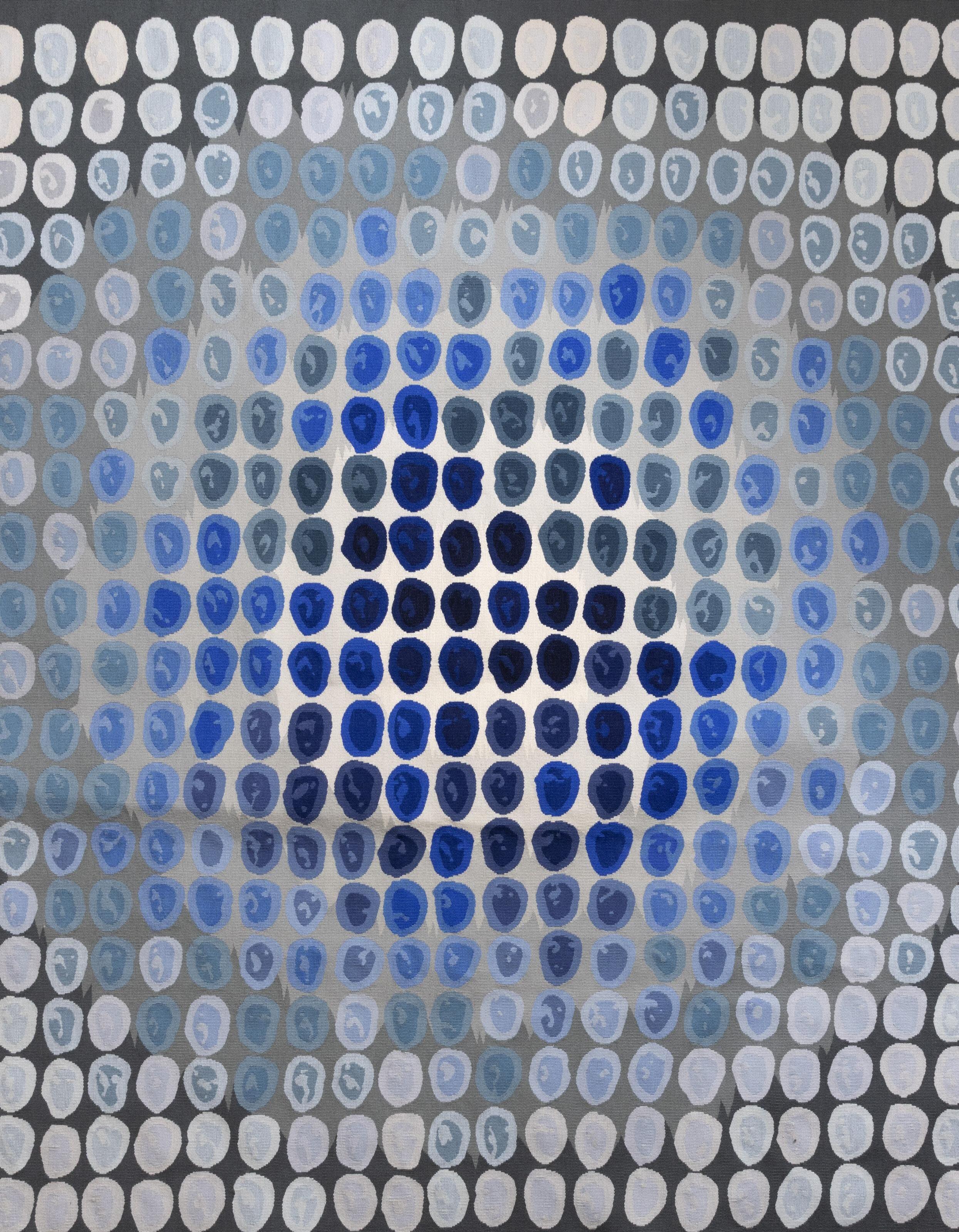
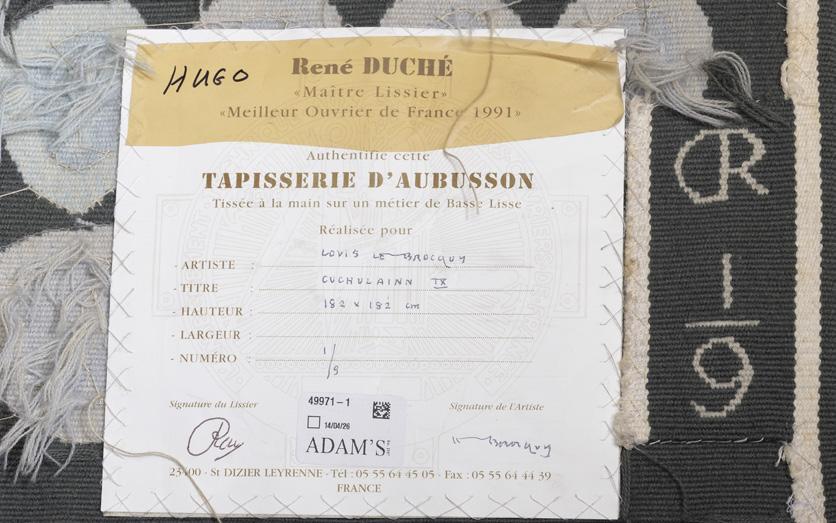
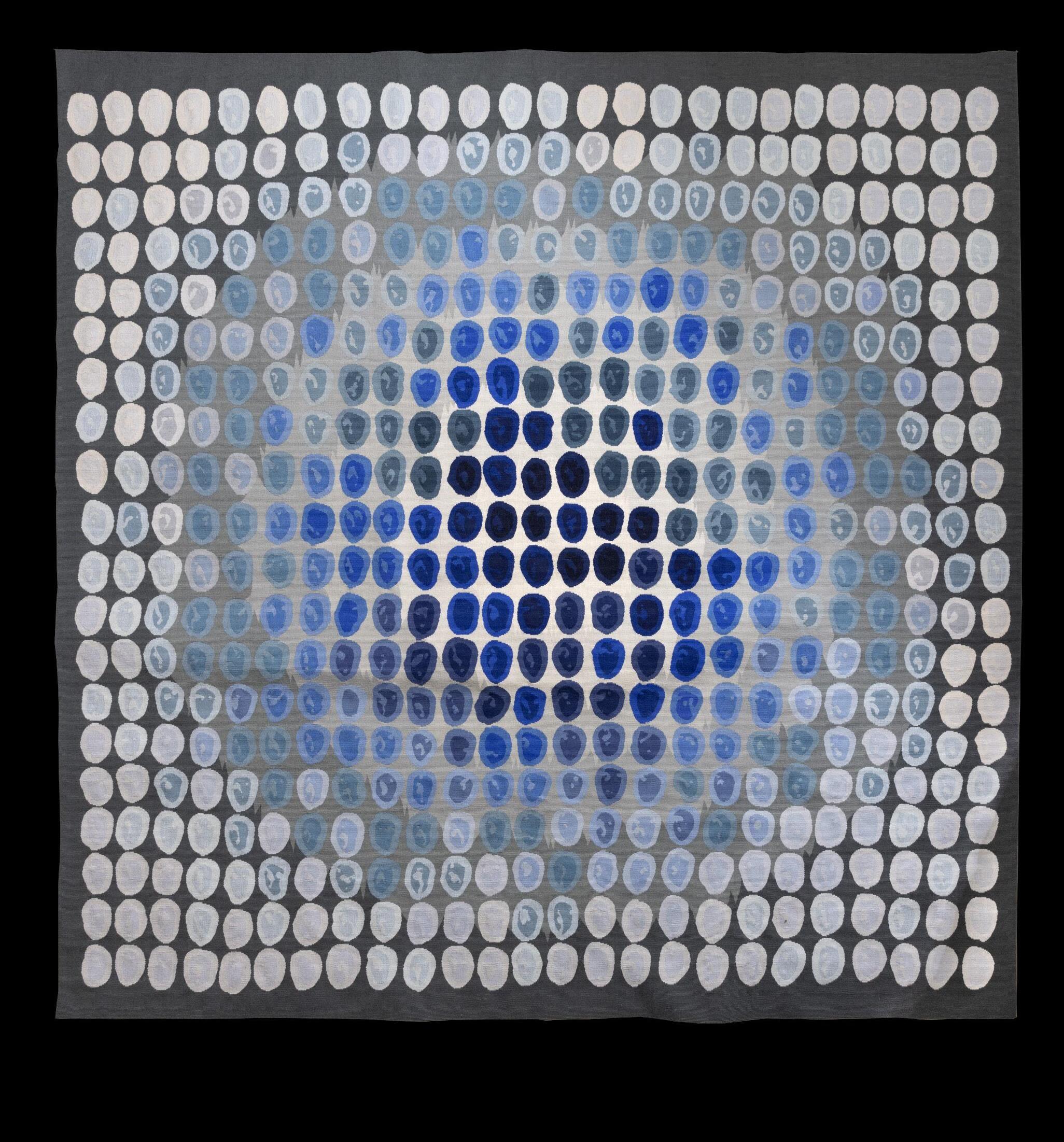
Cuchulainn IX (1991)
Aubusson Tapestry by Atelier René Duché, 182 x 182cm (71½ x 71½”)
Edition 1/9
Signed, numbered and dated 1991 on label verso
€ 30,000 - 50,000
In 1969 Louis le Brocquy came up with a brilliant response to the challenge of illustrating Thomas Kinsella’s new translation of the mythical Irish epic The Táin for Liam Miller’s Dolmen Press. He made brush drawings using gestural, calligraphic marks, focusing on individuals, including the superhuman Cúchulainn, and the mass of warriors and others involved. The images were both timeless and contemporary, and he explored the technique further at the time, in a series of lithographs and, audaciously, an epic, black-and-white tapestry for the RTE studios. Scott Tallon Walker also commissioned a monumental tapestry for PJ Carroll’s & Co’s cigarette factory in Dundalk, Co Louth. This time the artist had the luxury of using a colour palette, and he devised a new pictorial scheme.
Rather than the jagged gestural marks, he conceived an array of heads, each abstracted to an irregular oval form, “features uncertain” as he put it, each slightly different to represent the individuals member of the raiding party led by Cúchulainn. The play of colour too conveyed the idea of numerous distinct individuals united in purpose. The result was spectacular, a shimmering, informal grid, visualising the emergence of order in a mass of individuals, which he at one point likened to a honeycomb, or a mosaic. The Carrolls commission led on to further series of richly chromatic Cúchulainn tapestries.
Following an initial invitation from Edinburgh Weavers in the late 1940s, le Brocquy took to tapestry with enthusiasm, finding in it a new means of aesthetic exploration, not least a way of expressing his love of colour, rather than a “copy-a-painting” technique. He looked to Jean Lurçat, who had revived an early tapestry method involving full-scale linear cartoons with precisely defined colour keys: “a return to medieval ways”, as Brocquy put it. This meant that the artist’s input was at all stages accurate and definitive. He developed a strong relationship with the Aubusson tapestry makers at Atelier René Duché. There, the materials, experience and tradition ensured that the work was always made to an exemplary standard.
Aidan Dunne, April 2026
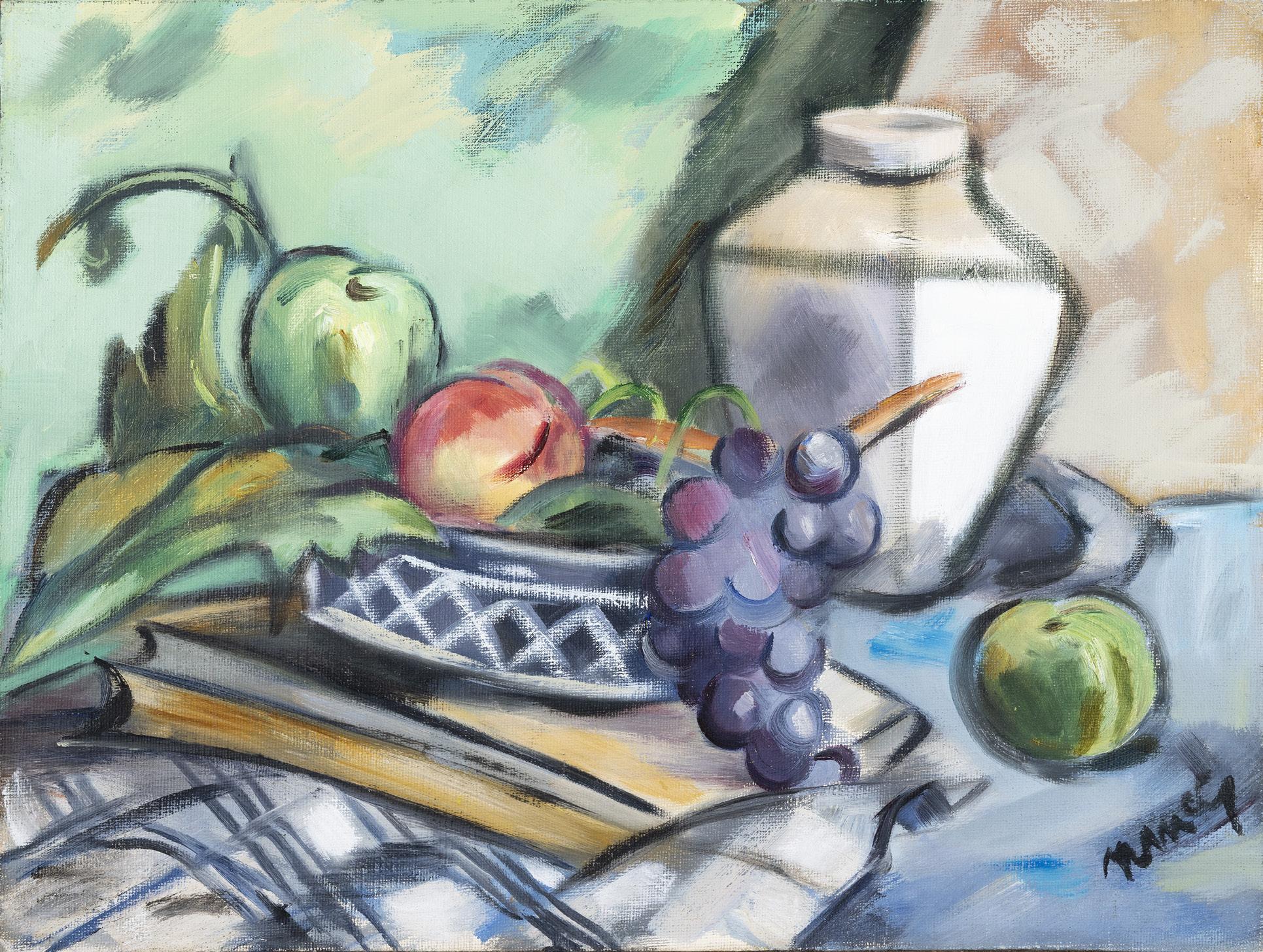
Still Life with Fruit
Oil on board, 30 x 40cm (11¾ x 15¾’’)
Signed with initials
Provenance: From the Artist’s Estate
€ 3,000 - 5,000
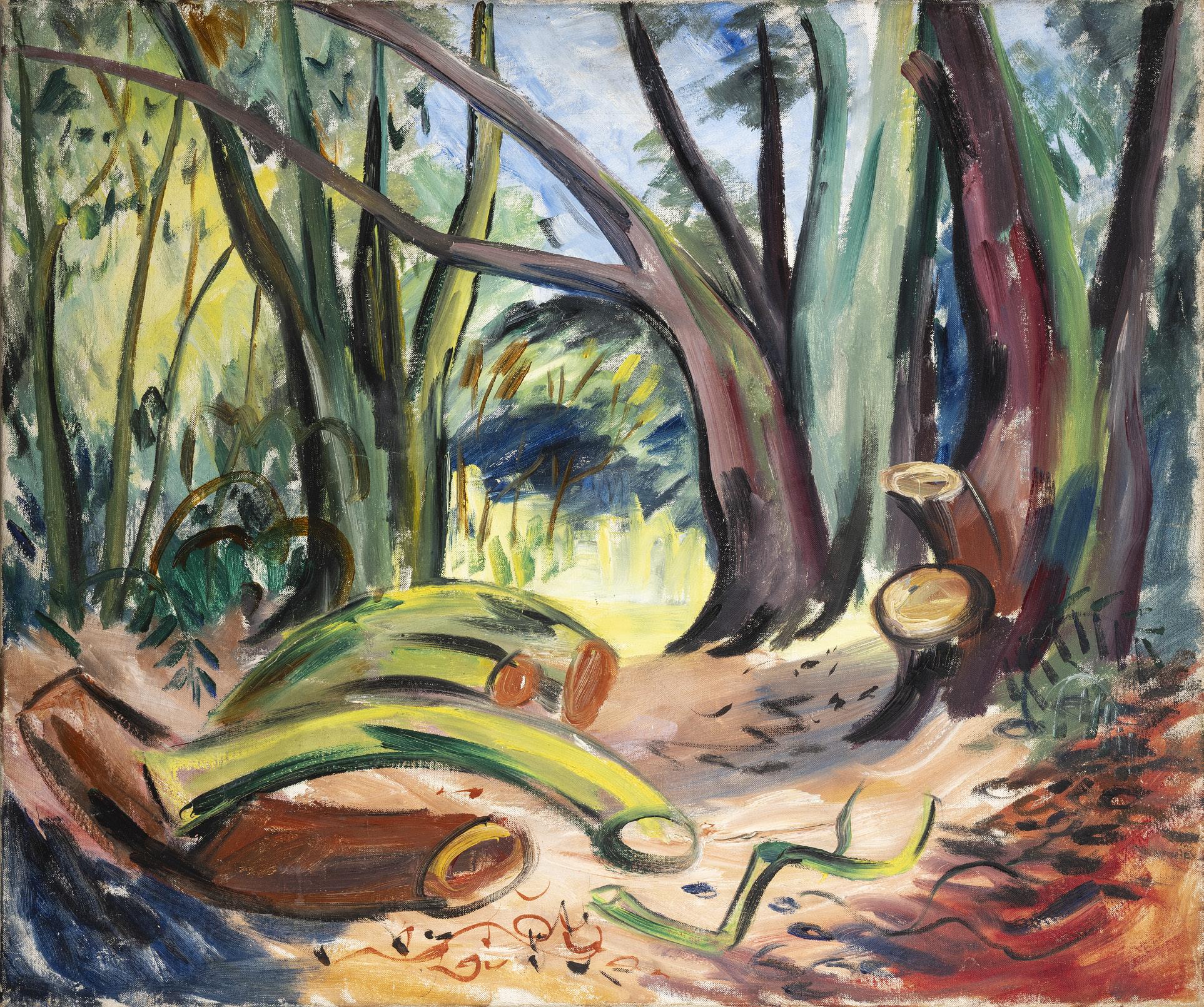
Provenance: From the artist’s Estate
€ 5,000 - 7,000
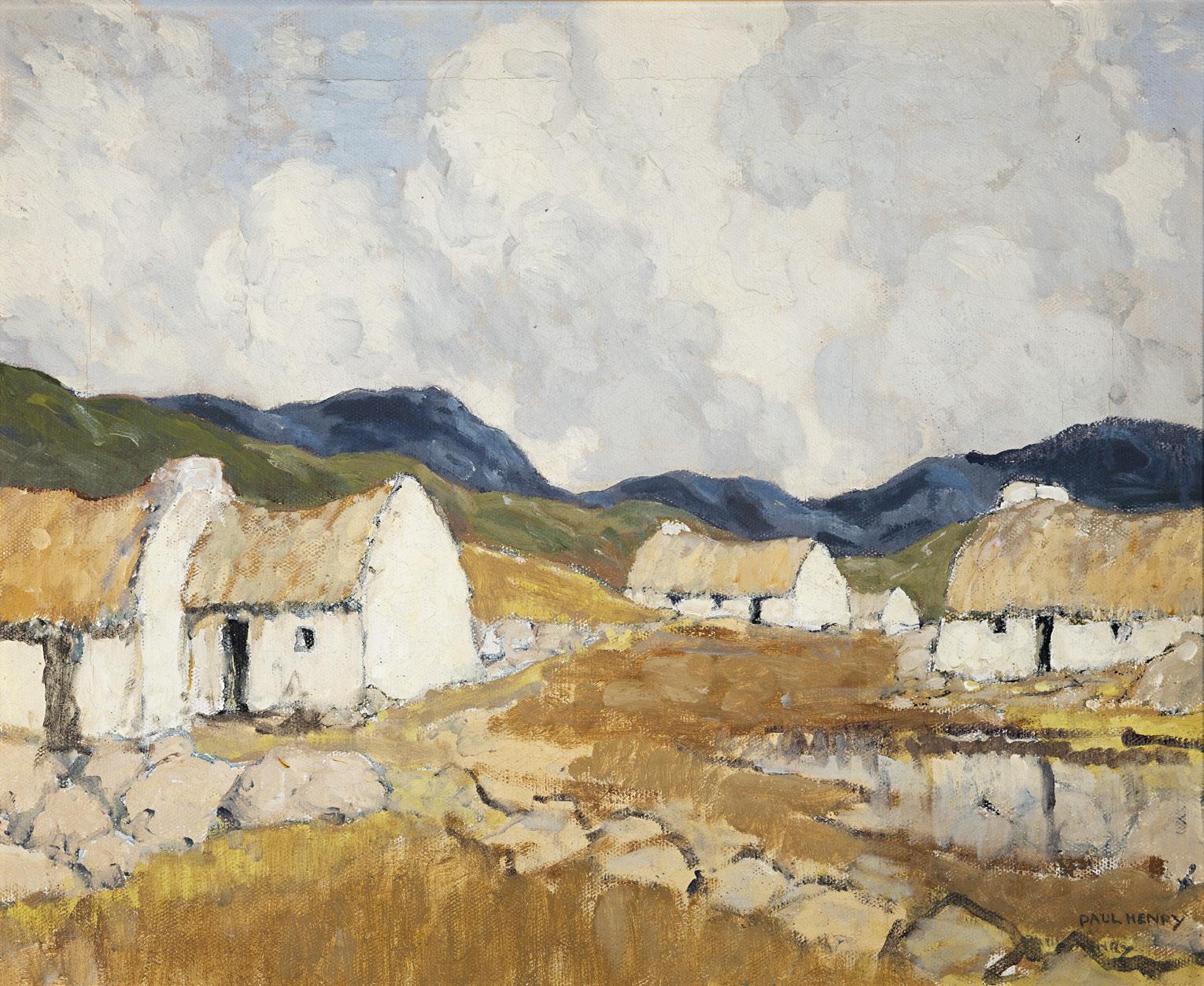
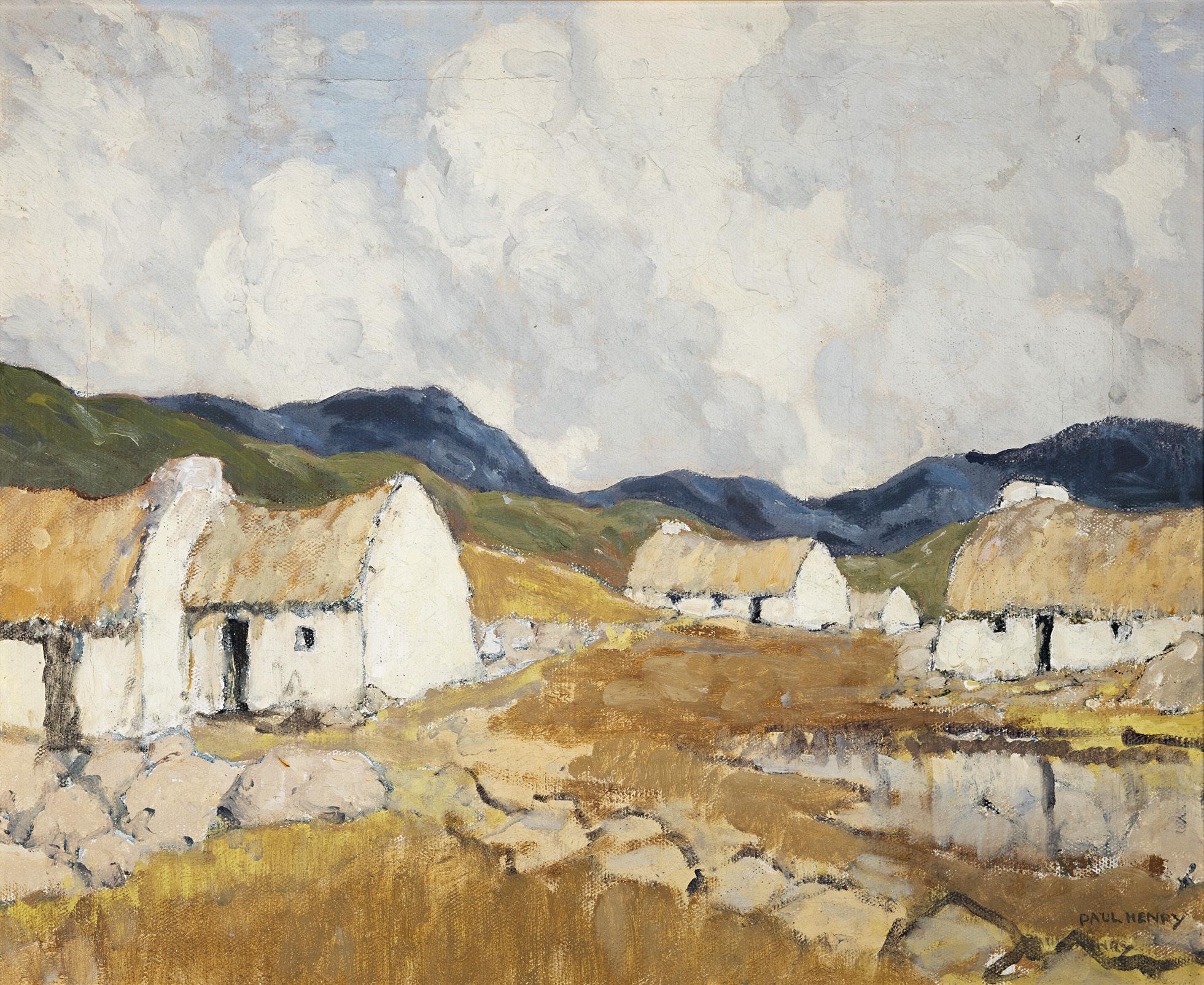
A Village in the West of Ireland (1941)
Oil on canvas, 37.5 x 45.5cm (14¾ x 18”)
Signed, also signed and inscribed with title verso
Provenance: Artist’s studio till 1957; deVere’s, Dublin, June 1997; Private Collection, Dublin; Sale, these rooms, Important Irish Art Sale, 21/03/2010, lot 105.
Exhibited: Dublin, 1941(7); Dublin, 1952(14); Bray, 1956(13); Dublin and Belfast, 1957(12) and Shannon, 1957(12)
Literature: Kennedy, S.B. Paul Henry, Yale 2007, p.302
Dr. S.B Kennedy wrote that this painting was almost certainly painted in the spring of 1941 when Paul Henry stayed for a time in Co. Kerry. Numbered 1020 in Dr. Kennedy’s then ongoing Catalogue Raisonne (2010)
€ 100,000 - 150,000
Almost certainly painted in the spring of 1941 when Paul Henry stayed for a time in Co. Kerry, this work depicts a grouping of thatched cottages nestled within the landscape. Green and dark blue hills rise in the background beneath a quintessential Henry sky. In the work he utilises a tighter composition, positioning the cottages at the edge of the picture frame, some slightly cut off from view. It immediately creates a sense of viewing a small village, a community of people living, albeit in a remote landscape, but within walking distance of their neighbours. This work is less focused on the open expansive environment as seen in his larger lake and mountain scenes and instead honing in on the more detailed depiction of the landscape.
In the mid-foreground of the composition sits a small pool of water reflecting the cloud formations above. In this work the handling of the paint is looser, more expressionistic in character. He draws our attention to the texture of the stone walls, outlined in strong black lines while for the grasses and thatching the paint is applied thinly in areas allowing the weft of the linen canvas to show through. He balances the volumes of the cottages against the rising undulation of hills and mountains beyond, ensuring that the cottages to not feel dwarfed by the natural landscape but rather in communion with it. Henry painted this work aged in his mid-sixties, after many years on the road travelling and in a radio broadcast that he made for the BBC in January of that year titled ‘Painting in Ireland ’, he remarked on the challenges of working as a landscape painter, ‘skirting a village or a lake…climbing stone walls and fences and ditches’ but also of the immense value of the experience ‘In all these things there is a wealth of interest… and somehow or another it gets into your work if you are really trying you to get the spirit of the place you are painting’ (Quoted in S.B Kennedy, Paul Henry, Yale 2007 p.80)
Niamh Corcoran, April 2026
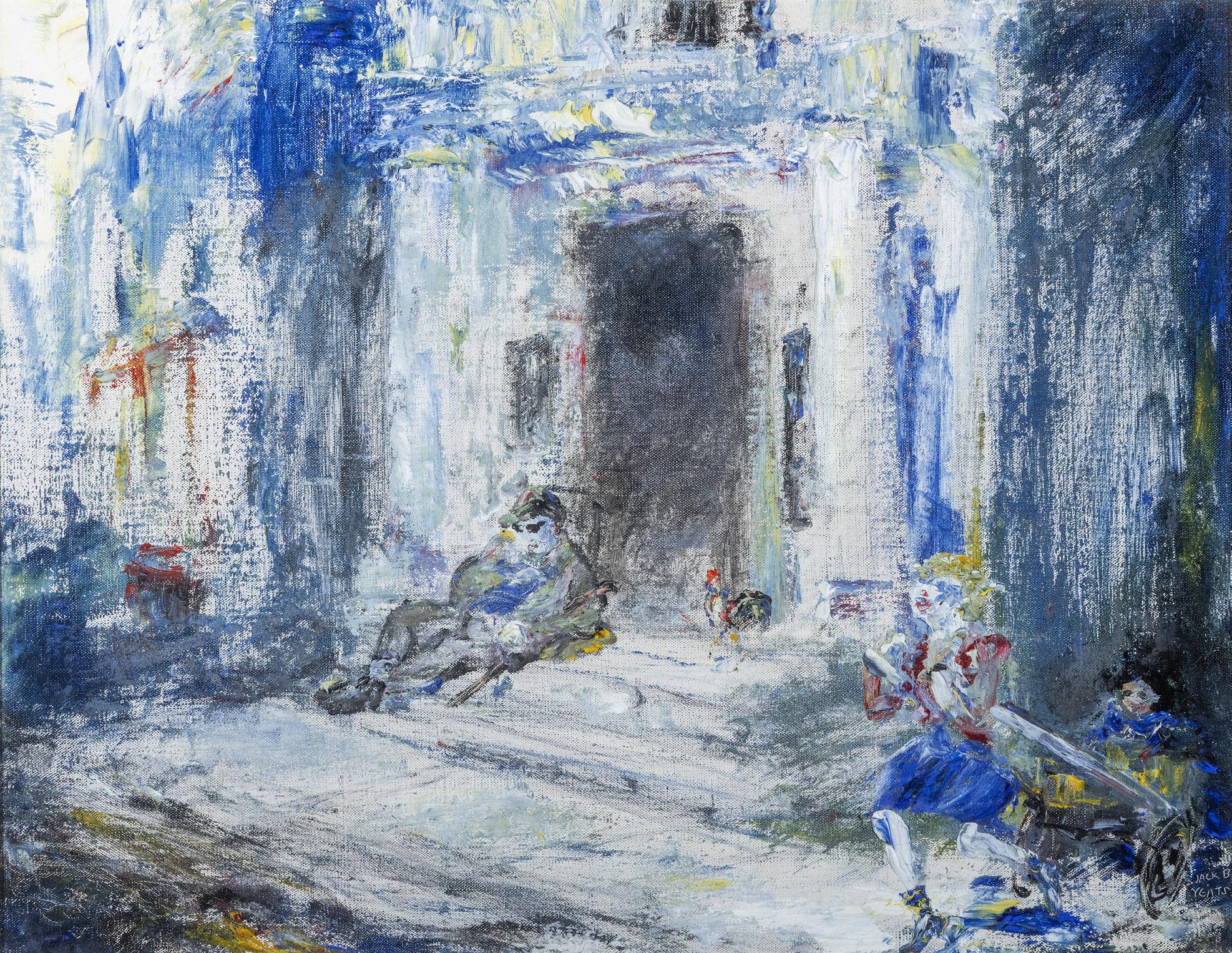
JACK BUTLER YEATS (1871-1957)
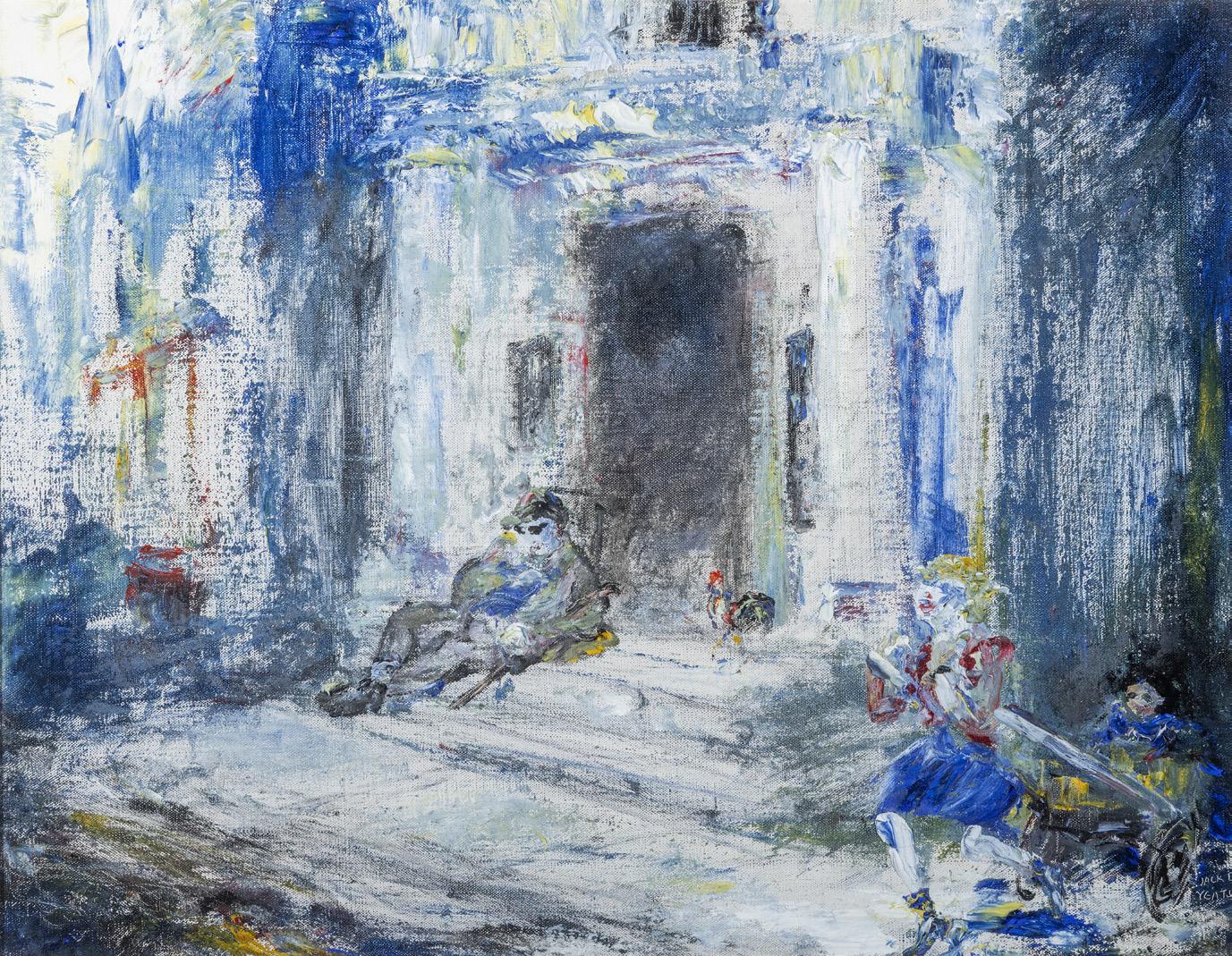
On the Courthouse Steps (1946)
Oil on canvas, 35.5 x 45.7cm (14 x 18”)
Signed lower right, inscribed with title on stretcher, verso With typed Arts Council of Ireland exhibition label affixed on reverse; also with Dawson Gallery framing label on reverse
Provenance: Purchased directly from the artist by Leo Smith, April 1946; with The Dawson Gallery, Dublin; Sale, ‘The Irish Sale’, Christies, 12 May 2006, lot 74; Private collection; Sale, Whyte’s 12th March 2012, lot 29
Exhibited: Dublin, ‘Contemporary Irish Art Society: Paintings and Sculpture from Private Collections’, Municipal Gallery, July 1965, exhibition no. 72; ‘Modern Irish Painting, European Tour’, Arts Council of Ireland (An Chomhairle Ealaíon), Dublin, 1969-1971, exhibition no. 54, travelling exhibition: Helsinki, Gothenburg, Norköpping, Stockholm, Copenhagen, Bielefeld, Bonn, Saarbrücken, London, Leeds, Glasgow, Mayo and Donegal
Literature: Pyle, Hilary, Jack B. Yeats A Catalogue Raisonné of the Oil Paintings, Vol. II, p.672, no. 744 (illustrated, Vol. III, p.396)
€ 120,000 - 180,000
A man slumps on the steps of a court house, identified by Hilary Pyle as that of Naas, Co. Kildare.[i] A walking stick and bundle of belongings lie beside him. The figure’s casual appearance is in marked contrast to the classical formality of the building which is typical of the grand-style architecture of Irish court houses. These were designed to project a sense of authority on to the surrounding streets and their inhabitants, although this is not evident in Yeats’s picture. The strutting cockerel on the steps of the court house adds to the sense of the pastoral and maybe a humorous allusion to the vanity of the judiciary and the legal system. The bird is also symbolic of time, and especially dawn, an indication of the man’s long journey to the court house and his vagrant status.
Yeats had a long-standing fascination with courts and their goings on. His father, John Butler Yeats began his career as a barrister. This had ended abruptly when he became more interested in sketching the protagonists in court than in the delivery of his legal duties. Several of Jack Yeats’s sketchbooks contain images of rural trials and legal proceedings such as the 1912 courtroom scene of The Poteen Makers, published in Yeats’s Life in the West of Ireland, 1912. In 1901 he sketched Galway’s court house paying close attention to the prominent coat of arms on its pediment.[ii] Yeats’s burlesque treatment of the relationship between the Irish citizen and the colonial formality of the court also features
in the writings of his favourite dramatist, Dion Boucicault and in the novels of Somerville and Ross.
In his sketches Yeats draws attention to the irreverent attitude of the populace to the courts while noting the importance of the petty sessions and court related activity to town life in rural Ireland. Painted in the remarkably prolific year of 1946 this work is undoubtedly inspired by memories of such scenes. However, in this case the business of the court is not evident and other aspects of human life take precedence. Like some other works of the later 1940s, the paint is thinly applied, allowing the white of the primed canvas to function visually as the stone facade of the building and steps. The reclining stance of the traveller is counteracted by the running child in the right foreground. The young girl with golden hair, has her mouth open as if shouting with joy, and her arms are extended upwards as she holds the handles of a go-cart. Behind her from the shadows of the building her tiny companion sits in the cart. Their dynamism is echoed in the strong diagonal sweep of the composition, emphasised by the stretch of the road in the foreground. All three figures, the children and the old man, evoke the idea of free spirits at either ends of their imaginative lives.
Dr. Róisin Kennedy, April 2026
[i] Hilary Pyle, Jack B. Yeats. A Catalogue Raisonné of the Oil Paintings, 1992, II, p.672. [ii] Sketchbook 1901, Y1/JY/1/1/36/48, Yeats Archive, National Gallery of Ireland.
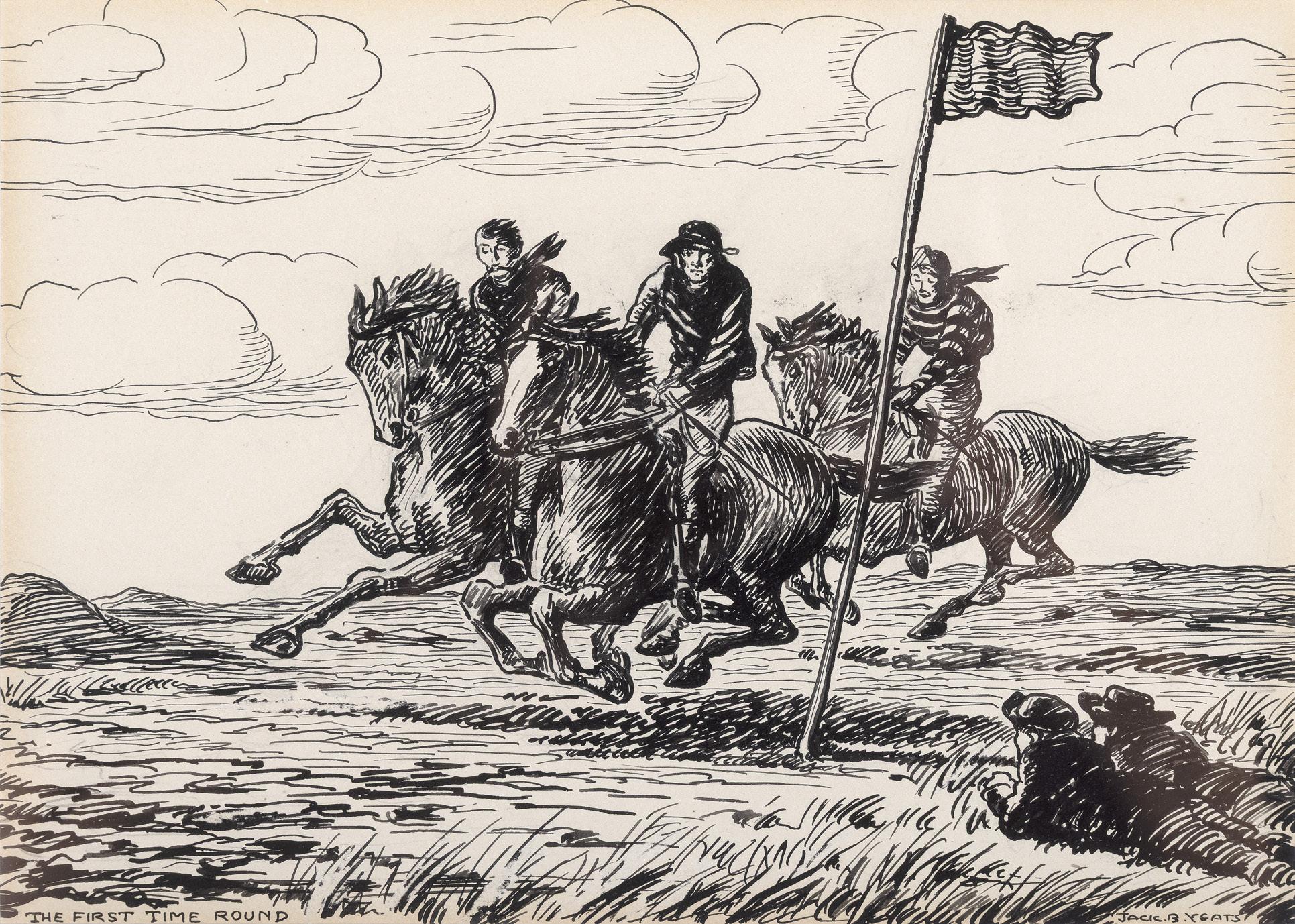
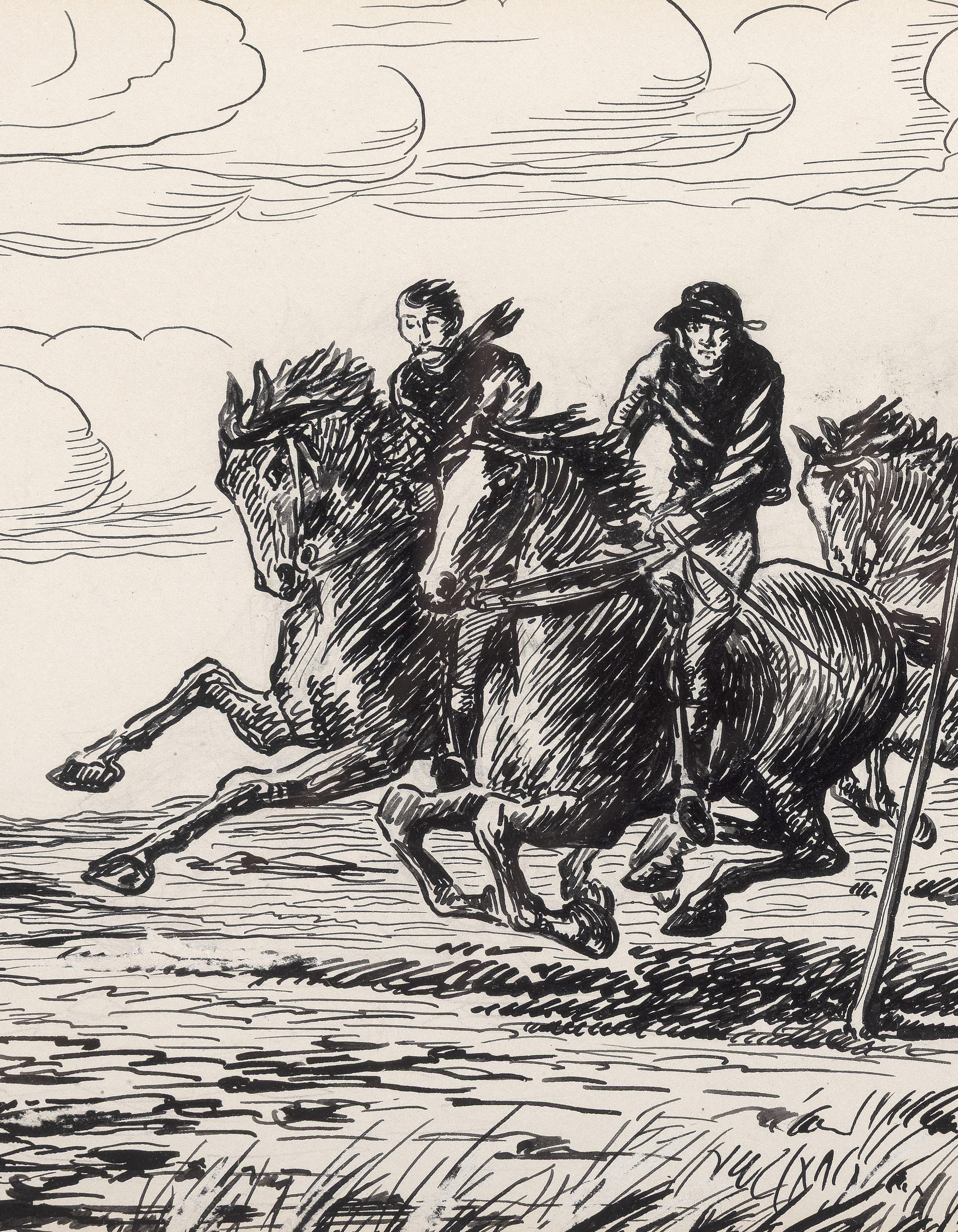
The 1st Time Around
Pen and ink, 16.5 x 23.5 cm (6½ x 9¼”)
Signed and inscribed with title
Provenance: With The Oriel Gallery, Dublin; Private Collection, Dublin
€ 10,000 - 15,000
This lively ink drawing by Jack B. Yeats illustrates a scene from J. M. Synge’s The Playboy of the Western World, first published in 1907 and set in County Mayo. The subject is the mule race run along the strand near Michael Flaherty’s public house, a pivotal episode in which Christy Mahon further consolidates his status within the community. As the tide recedes, the course is marked out with flagpoles, and Christy is mounted on the “winkered mule”, to the encouragement of the onlookers.
Yeats depicts the race with his characteristic energy and narrative clarity. Employing the now outmoded but highly effective Victorian convention of showing the animals with all four legs airborne, he heightens the sense of speed and urgency. Two mounts, neck and neck, thunder past the flagpole marking the turn, while a third, ridden by a jockey in striped colours, strains to close the gap. In the foreground, two boys lie in the grass, witnessing the drama at close quarters, their presence anchoring the scene in everyday observation.
The drawing captures much of the visual excitement and rough theatre of racing on the strand, a motif that appealed strongly to Yeats’s imagination. The composition was later reproduced as a print in 1913, hand-coloured and published by the Cuala Press, underscoring its importance within the artist’s graphic work inspired by Irish literature.
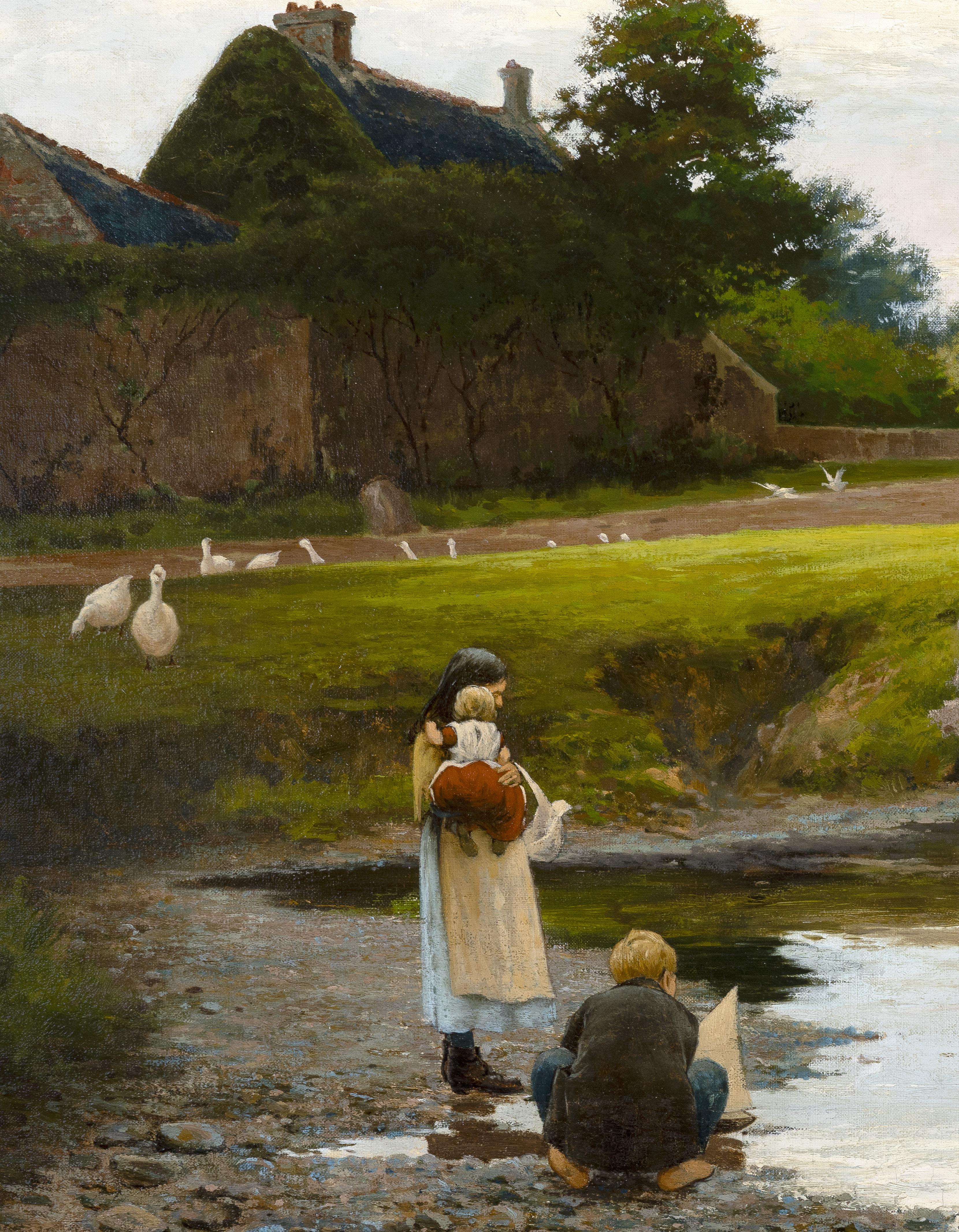
MALACHY KAVANAGH RHA (1856-1918)
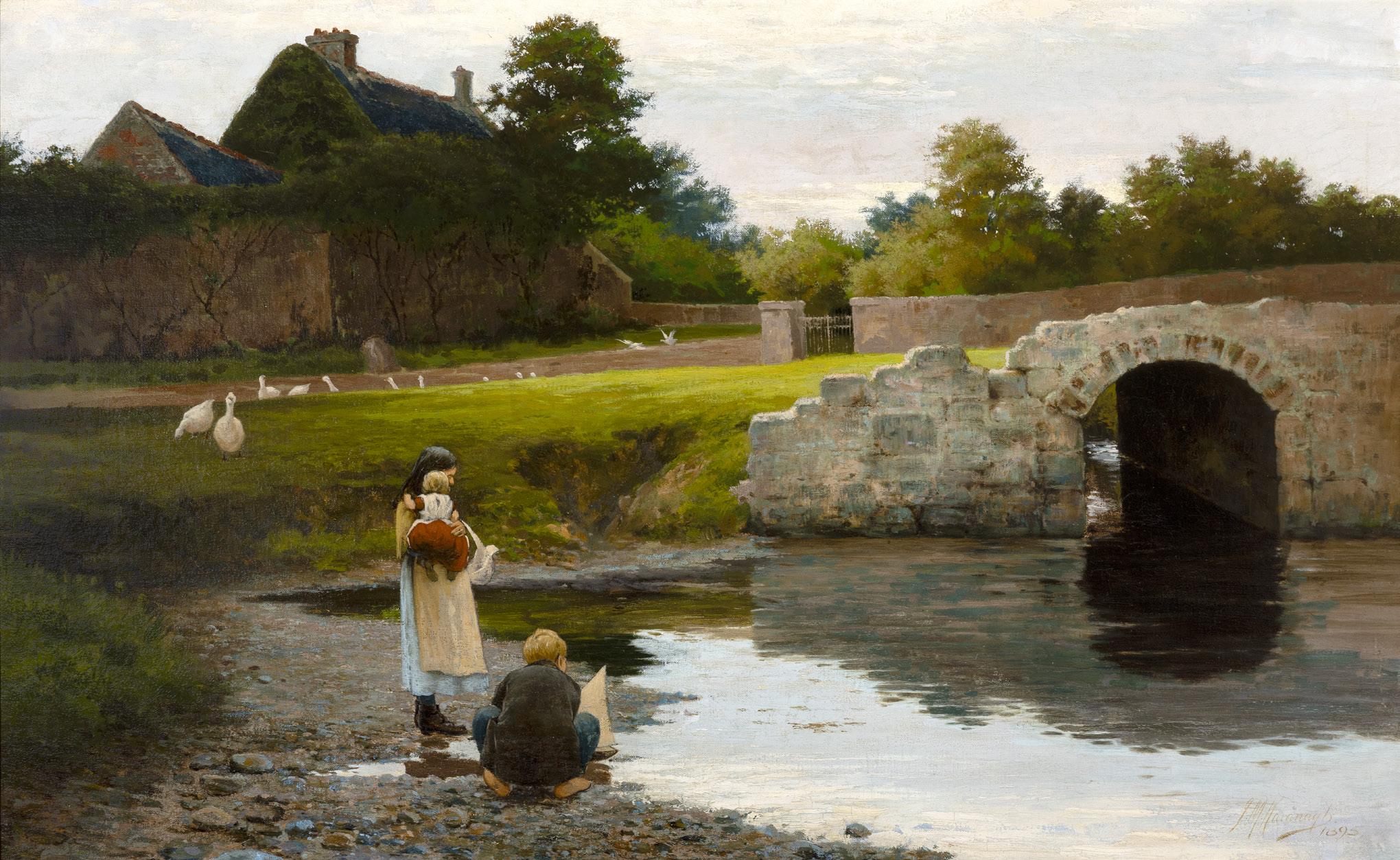
Children Playing by a Bridge (probably Watermill Bridge, Raheny, Co. Dublin) (1895)
Oil on canvas, 59 x 95cm (23 x 37½”)
Signed and dated 1895
Provenance: Collection of Thomas Brogan, Portadown; with Cynthia O’Connor Gallery, Dublin, August 1985; Private Collection; De Vere’s, Dublin; Private Collection.
Exhibited: Dublin, Royal Hibernian Academy, Annual Exhibition 1895, cat. no.57, as ‘A Grey Day, Watermill Bridge, Raheny’; Cynthia O’Connor Gallery, Dublin, 1994; Dublin, Exhibition of 18th-21st Century Irish Paintings; Gorry Gallery, 2024.
Literature: Robert Goff, Irish Paintings- Recent Acquisitions, 1994; Kavanagh, Joseph Malachy in Painting 1600-1900, ed. N. Figgis, Painting 1600 - 1900, RIA/Yale, 2014, p.328, illus; J Campbell, Irish Realist – Joseph Malachy Kavanagh, Irish Arts Review, Spring, 2014, p.110, illustrated p.112.
€ 20,000 - 30,000
More than the majority of his contemporaries – Joseph Malachy Kavanagh was a dedicated painter of the old streets of Dublin and the townlands of North Co. Dublin and Fingal. He painted variously at Raheny, Sutton, Howth, Malahide, Portmarnock and Rush. This painting Children Playing by a Bridge was probably painted at the old bridge over river Santry at Raheny.
Kavanagh’s work is often quite sombre and introspective in mood, but this picture shows him at his most relaxed, with tranquil mood and harmony of colour. It features three children playing at a bend in the river; a small girl in blue dress, pinafore and smart boots who holds a baby in her arms, while a boy crouches down, about to launch a toy yacht on the water. Kavanagh represents the beach with pebbles in the foreground, the tranquil water in which the small bridge and sky are reflected with care. In the background geese grazed on a riverbank, and across the road there is a wall, trees in full leaf, and then roofs of houses. Kavanagh captures well the dreamy stillness of a day in late summer.
Kavanagh was born in Dublin in circa 1856. His family home was in Great Britain Street, (now Parnell Street). He studied variously at the Royal Dublin Society Schools, The Royal Hibernian Academy Schools and the Academie Royale,
Antwerp – altogether for eight years. At the RHA Augustus Burke was Professor of Painting and Kavanagh was one of a talented generation of students, including Walter Osborne RHA (1859-1903), Nathaniel Hill RHA (1860-1930), Richard Thomas Moynan RHA (1856-1906), Dermod O’Brien PPRHA (1865-1945), Roderic O’Conor (1860-1940) and Henry Allen (1856 - 1912). He painted careful Realist scenes in Antwerp, Brittany and Normandy, and was also a skilled draughtsman and etcher. Amongst his best-known paintings are his pastoral landscapes around Co. Dublin, and his tranquil scenes of Dollymount and Merrion Strand, with cockle pickers and seaweed gatherers at work.
Kavanagh led a life of great dedication and hard work. He had a close professional connection with the RHA: studying there, then exhibiting over two hundred pictures there during the years 1875 to 1918, and was later elected an Associate in 1889 and a full member in 1892. He was a teacher in the Life Schools of the Academy, 1892 to 1911 and appointed Keeper in 1910, and Treasurer in 1911. Children Playing by a Bridge was exhibited at the RHA in 1895. Along with Osborne, O’Brien, Moynan and others he was instrumental in introducing a new spirit of Naturalism into Irish Art.
Julian Campbell, April 2026
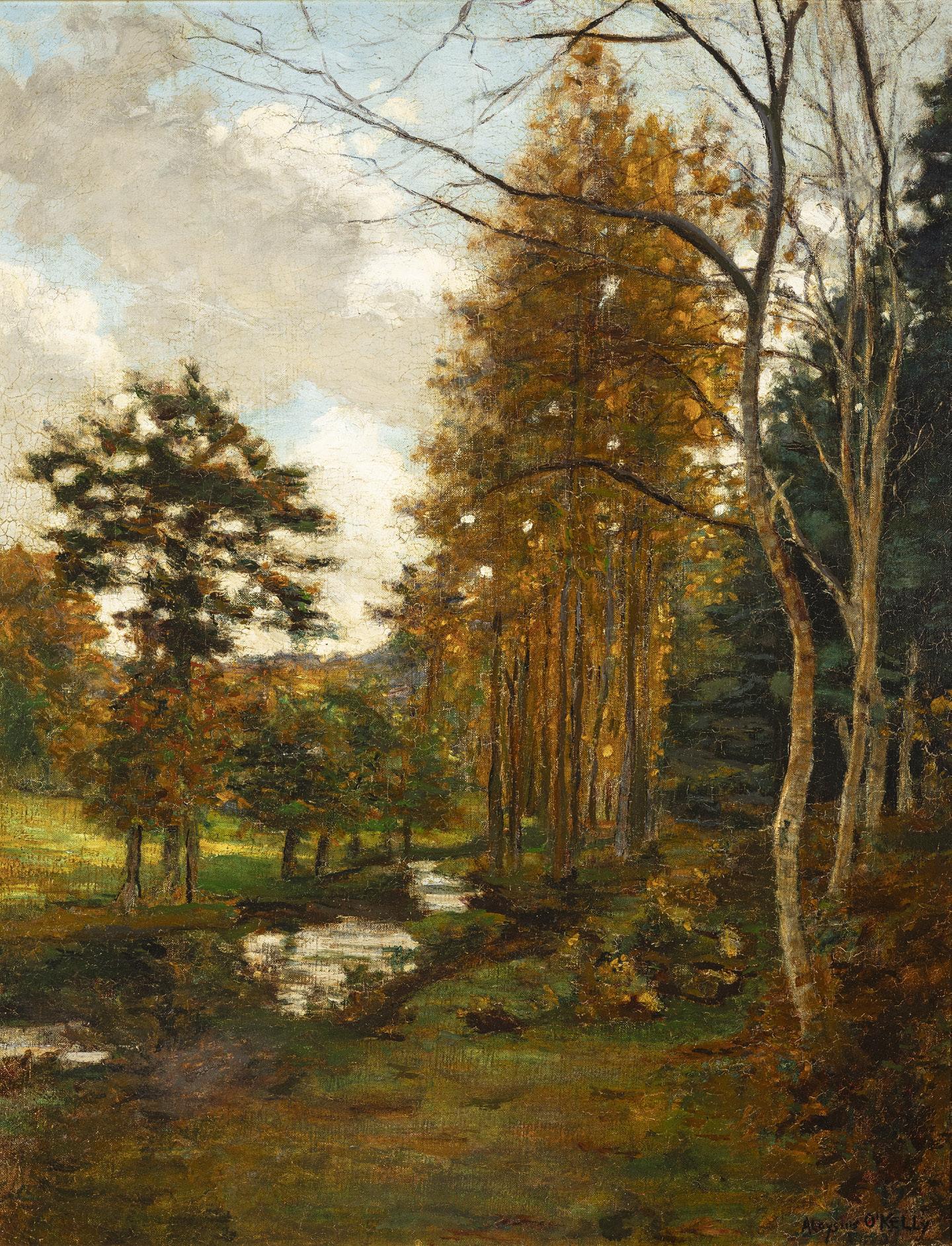
Oil on canvas, 70.5 x 55.5cm (27¾ x 21¾’’)
Signed
€ 3,000 - 5,000
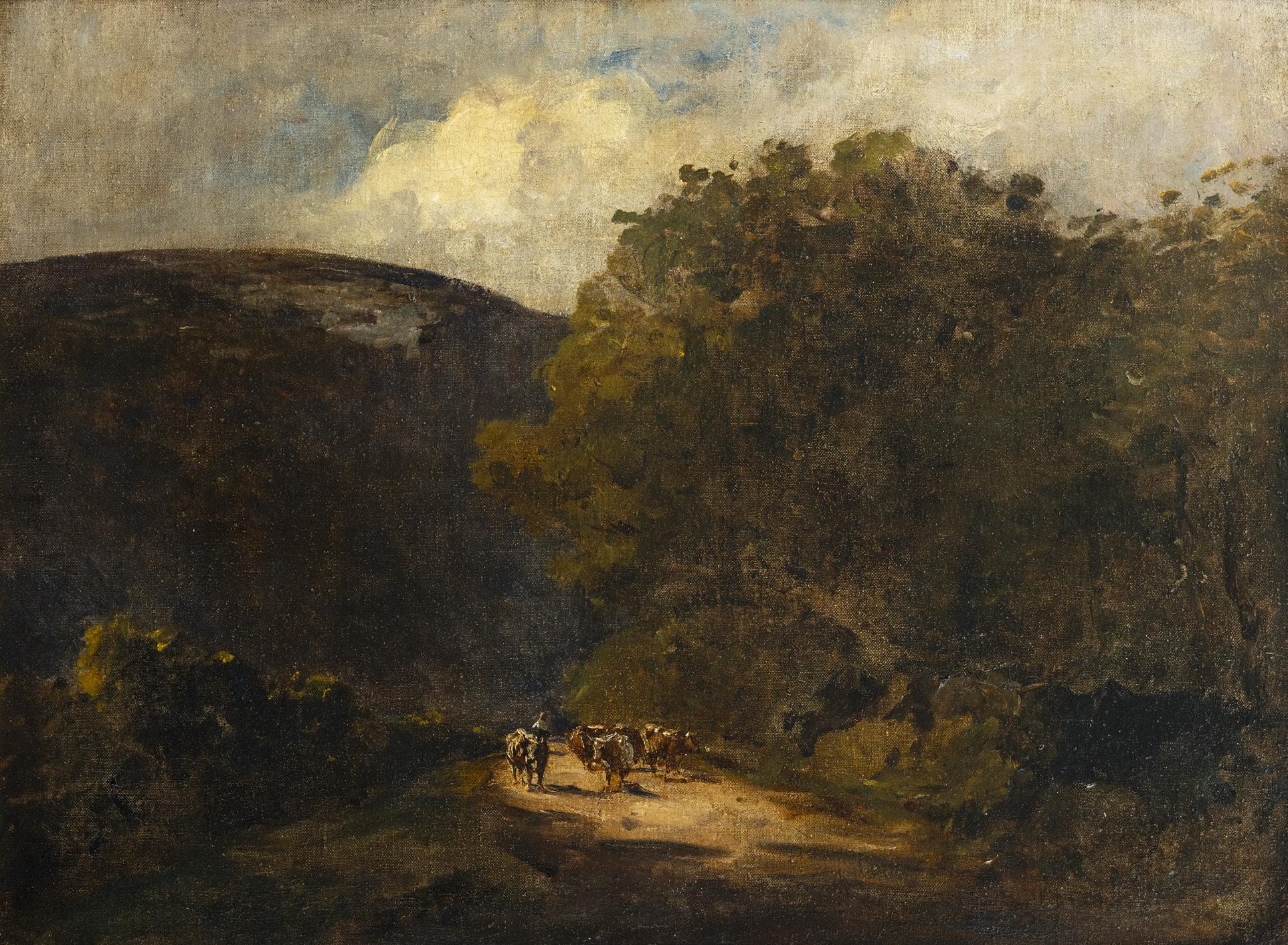
Oil on canvas, 44 x 59.5cm (17¼ x 23½”)
€ 4,000 - 6,000
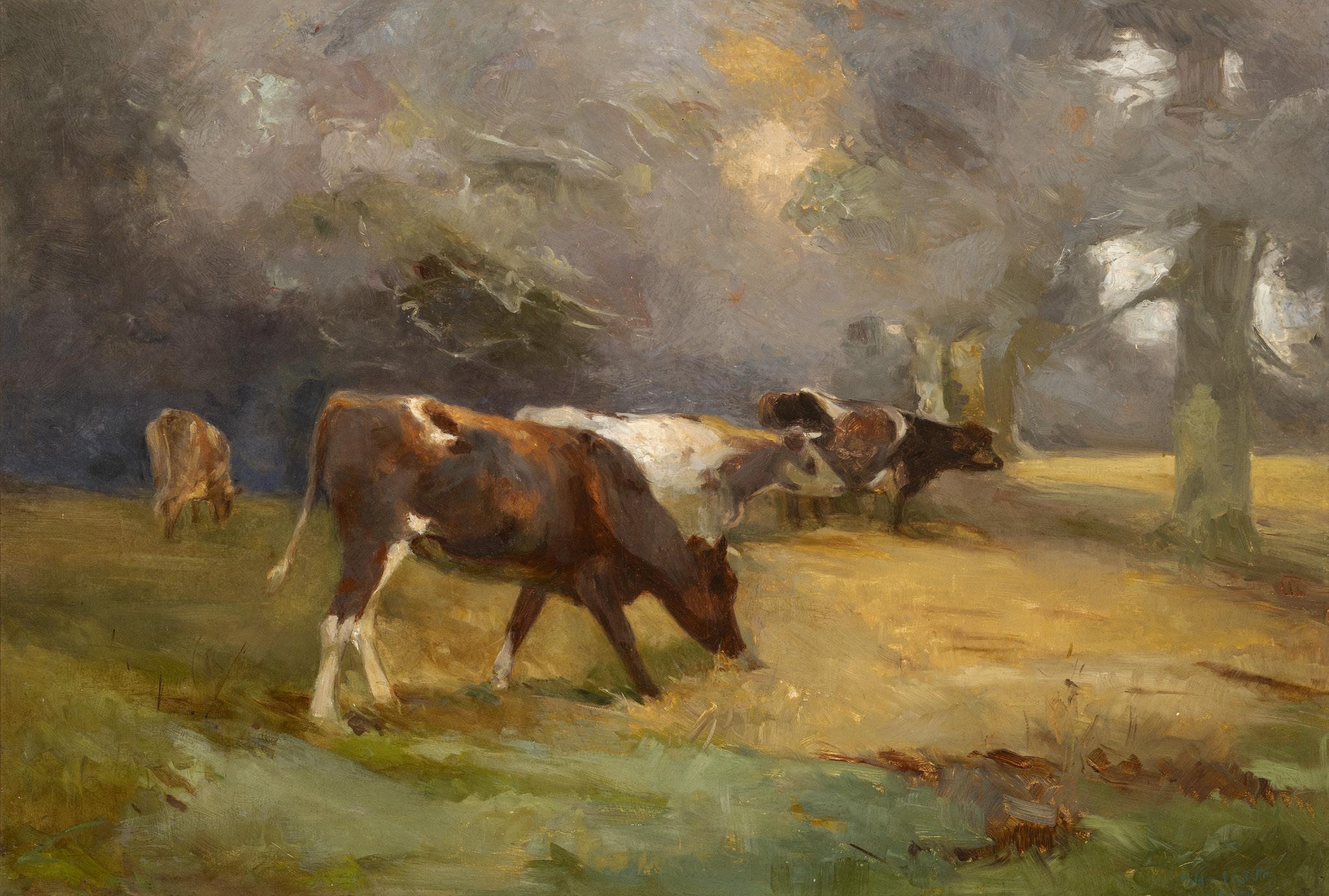
Cattle Grazing, Kilmurry
Oil on canvas, 66 x 96.5cm (26 x 38”)
Signed and dated indistinctly
Provenance: With Val Dillon mid 1980s, from whom acquired by the present owner
€ 8,000 - 12,000
The Georgian walls and idyllic gardens of Kilmurry House outside Thomastown, Co. Kilkenny have been faithfully recorded in watercolour countless times by its resident artist Mildred Anne Butler. The artist’s father, Captain Henry Butler, bought the estate from the Bushe family in the 1840s and the young family led what appears to be charmed lives in its abundant walled gardens and unspoilt estate grounds, as evidenced by the astonishing number of watercolours completed by Butler throughout her lifetime. Mildred outlived her older siblings and with no further family she inherited the estate where she continued to live for the rest of her life. The young artist, being of considerable privileged upbringing, benefited immensely from the opportunity to attend classes under the Guernsey-born draughtsman and watercolourist Paul Jacob Naftel RWS (1817-1891). She continued to credit her time with Naftel as crucially inspirational, and his influence can be seen throughout her oeuvre. Butler’s predilection towards animal painting as seen here was likely galvanised by her time studying in the studio of William Frank Calderon (1865-1943) who is known for his animal portraiture and hunting scenes.
Butler spent a significant amount of time in Cornwall painting with the Newlyn School of Art – no doubt employing the plein-air approach to painting as well as a preoccupation with light, similar to the Barbizon School in France. Butler enjoyed painting from life and often used photography and taxidermy to aid her animal studies when plein-air painting didn’t allow her enough accuracy. Her approach to animal painting is therefore imbued with an innate understanding of the physiology and anatomy of her subjects and yet a lightness of touch that rejects sentimentality. Butler’s paintings are no saccharine, watery spectacle of the rural idyll. They are preoccupied with depth, atmosphere and at times evoke a sense of strange, best evidenced by her studies of crows in flight for which she is well known.
‘‘The young lady knows how to look at her subjects with the eyes of a well trained artist; she can make good pictures out of simple and indeed trivial material; and all her …[…]… contributions are extremely interesting and even beautiful; although there is not a shred of story, anecdote, incident or an atom of pathos beyond that which always attends really artistic representations of homely nature… these pictures
command attention by the massing and breadth of chiaroscuro, and the solid way in which they have been handled’’ Critical Response, Atheneum, 5th May 1897
The painting of cattle grazing here presented is an exceptionally rare and large example of an oil painting by the artist. It presents the critical viewer with the opportunity to appreciate the extent of Butler’s ability to conjure atmosphere in a different medium. The broad slick strokes of the paddock’s coniferous foliage is deftly punctuated by soft mauves, pinks, warm greys and indigo to create a sense of distance and also movement. We are struck by the ‘Irishness’ of the day, a clouded patch of sky peaks out from downswept branches of the trees. The cattle lead our eyes instinctively towards it, their necks each bent towards the clearing encouraging the viewer to follow this trajectory. The artist’s choice to exclude the skyline here is an unusual one which lends the scene a faintly eldritch atmosphere, so different to the familiar rustic pastoral scene it could have easily been. The resulting picture benefits from her experience as a watercolourist and ensuing ability to create depth and shadow with a delicate touch. Note the absence of black in this composition. Butler has found other means of creating shadow through a combination of burnt umber, indigo, mauve and olive hues, masterfully manipulated to create alternative tonal values without relying on black. This is a typical approach of watercolour painters as it commonly believed that black lacks vibrancy and can flatten the scene if not used cautiously. Certainly, Butler rarely used it except in her scenes of crows and magpies where the black flutter of birds creates striking contrast against the skeletal boughs of a winter landscape. ‘Cattle Grazing, Kilmurry’ offers the viewer a very rare opportunity to examine Butler’s painterly approach in a different medium and benefits immensely from Butler’s extensive experience as a watercolourist.
Mildred Anne Butler maintained a level of critical and popular recognition throughout her lifetime, exhibiting consistently with the ‘Irish Fine Arts Society of Ireland’ from 1882 (later the ‘Watercolour Society of Ireland’) and also exhibited with the RHA, the RA, The Ulster Academy and The Royal Watercolour Society. The apex of her career was the purchase of her painting ’The Morning Bath’ by the Chantrey Bequest Fund for the British Nation in 1896 - an honour shared with Sir John Everett Millais, J. W. Waterhouse, Sir F. Leighton Bart PRA and John Singer Sargent. After the artists’ passing in 1941 the Kilmurry Estate was bequeathed to a distant cousin - equestrian expert Doreen Archer-Houblon (1899-1977). The latter enjoyed the estate for the remainder of her life. It was a few years later that the artist’s studio contents was revealed publicly in a landmark sale at Christie’s in October, 1981. The extent of the artist’s private meditative depictions of Kilmurry captured the imagination of a modern, post-war public, only too eager to acknowledge the beauty of an unspoiled Irish landscape once more.
Stephanie Brennan, April 2026
33
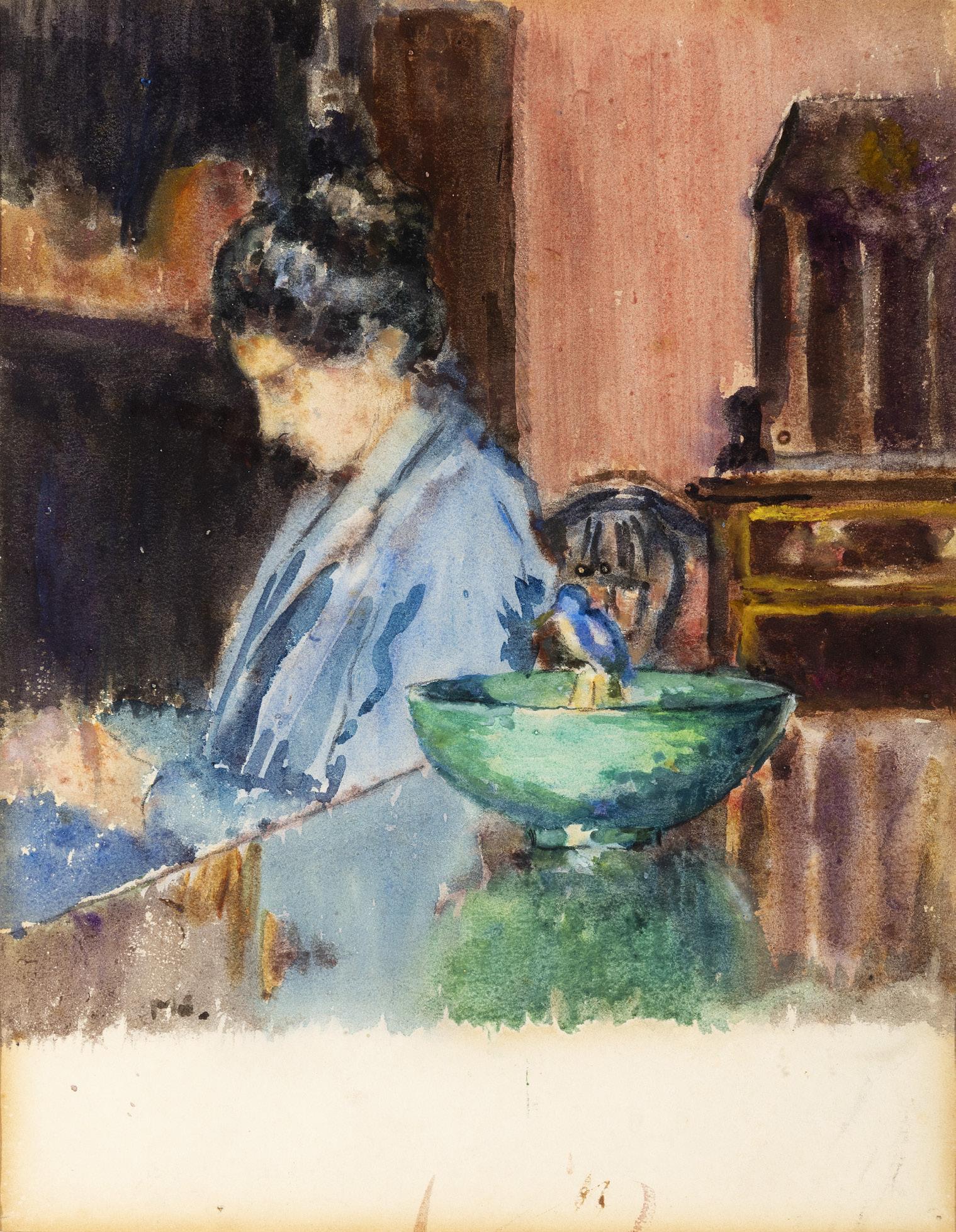
Portrait of the Artist’s Mother Janet, Seated at a Table with a Green Bowl
Watercolour, 25 x 20cm (9¾ x 8”)
Provenance: A gift to the present owners from Bruce Arnold
€ 800 - 1,200
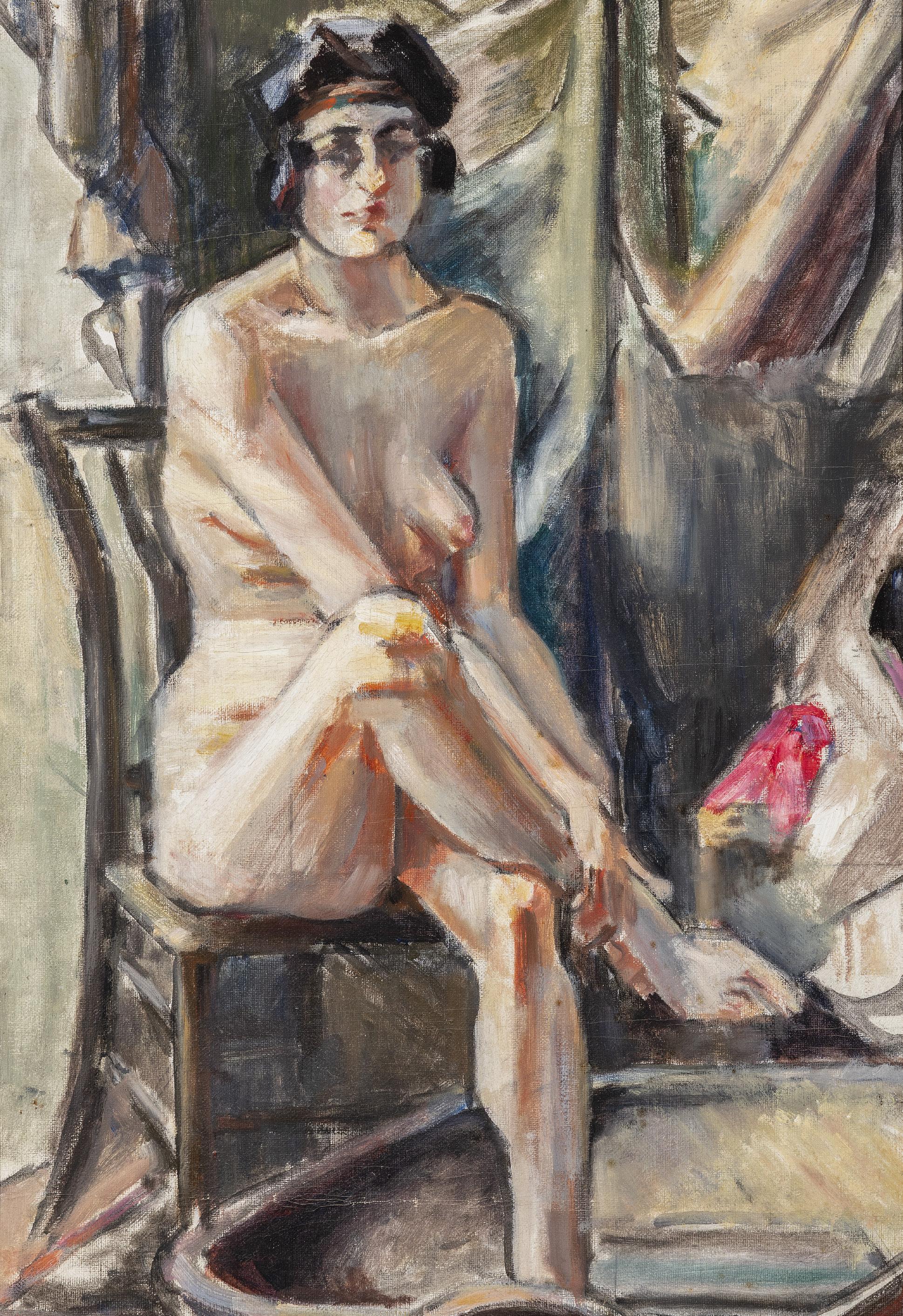
Nude Study - Seated in an Interior
Oil on canvas, 54 x 34cm (21½ x 13½”)
Provenance: A gift to the present owners from Bruce Arnold
€ 5,000 - 7,000
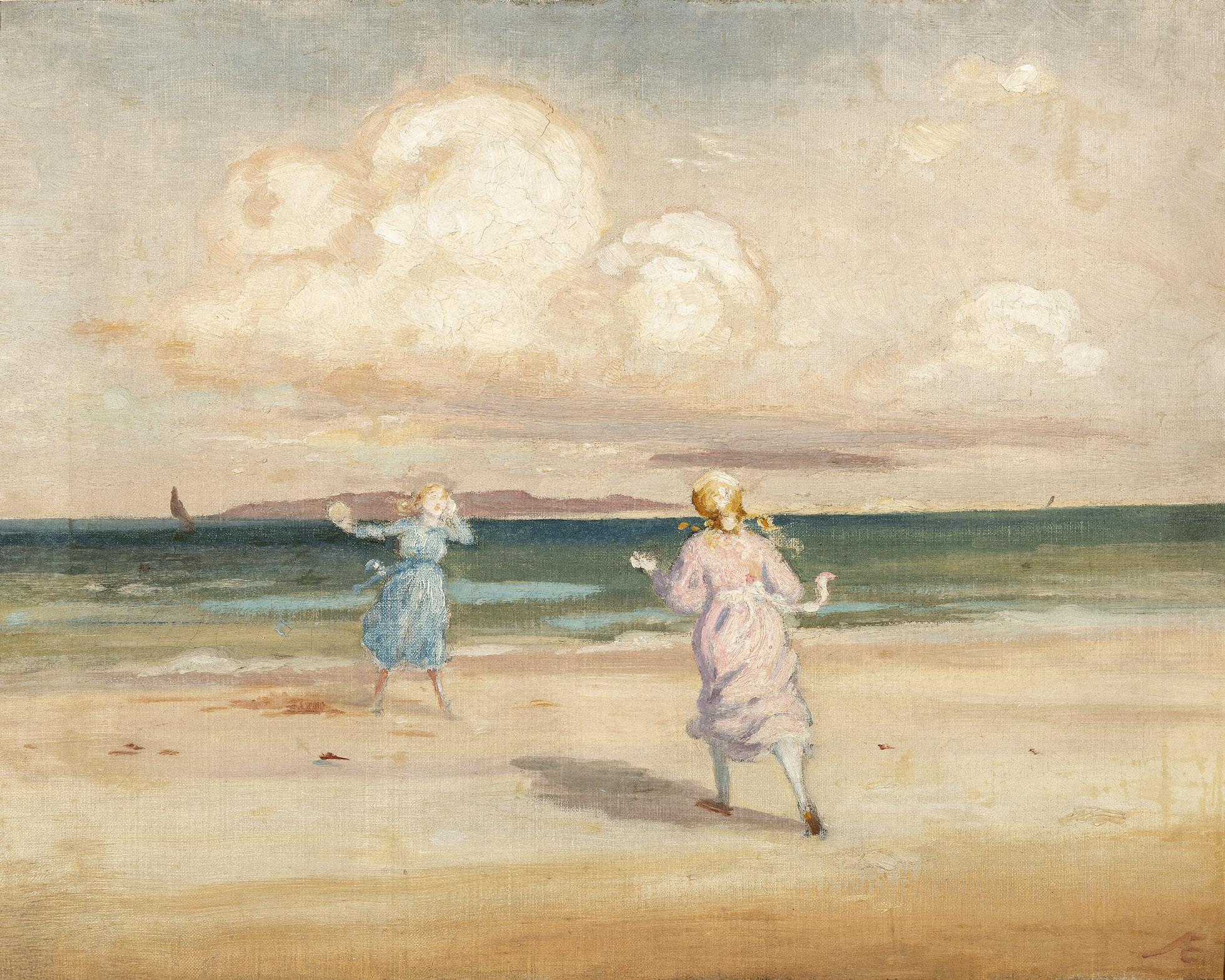
Two Girls Playing by the Seashore
Oil on canvas, 41 x 53.5cm (16 x 21”)
Signed
Provenance: With Pyms Gallery, London; Sale, Whytes, 2nd March, 2009, Lot 76
€ 8,000 - 12,000
George William Russell (1867-1935) was an Irish artist whose remarkable body of work has deservedly enjoyed a renewed interest in recent decades. Russell was a consummate polymath who in addition to being a prolific painter, was also involved in publishing, drama and poetry. A contemporary of William Butler Yeats, Russell was also a central figure of the The Irish Literary Revival.
Born in Lurgan, County Armagh, Russell moved to Dublin aged 11 and enrolled in the Metropolitan School of Art in 1884. It was during this time that his lifelong and influential friendship with Yeats began. In a passage from his autobiographies, Yeats described how Russell’s paintings engaged with a spiritual reality hidden behind their subjects ‘He did not paint the model as we tried to, for some other image rose always before his eyes’.
Like Yeats and his wider circle, Russell was deeply engaged with Eastern Mysticism and various esoteric doctrines, in particular those of the Theosophical Society. One of his main preoccupations was how these ideas gleaned from these belief systems could be applied to the context of Ireland.
The artist was primarily a painter of figures in a landscape and within this, two sides of his oeuvre emerged. One being the depiction of mythological and folkloric scenes, often drawn from his own vision of the sídh; the supernatural denizens of Ireland descendent from The Tuatha Dé Danann.
The other, exemplified by this painting, was more rooted in the recognisably Irish landscape and drew on scenes of everyday life. Russell had great affection for his country and its people, also evidenced by his many political and poetic writings. A cultural nationalist, he wrote passionately about the future of an independent and united Ireland and spent much time travelling around
rural Ireland via his work with the the Irish Agricultural Organisation Society (IAOS).
His affiliation with Ireland on cultural and political levels became intertwined with his aesthetic appreciation for the landscape. This work, most likely dating from the first decade of the 1900s features a reoccurring subject for the painter, that of figures gambolling on a beach. This subject and its treatment can be likened to that of French landscape painter Eugène Boudin, who became renowned for his coastal scenes in the last decades of the 19th century.
In this luminous painting, two ethereal figures commune with the elements, their hair and clothing whipped by the wind, their feet lifting them momentarily above the sands. Behind them, clouds roll over the azure sea and amethyst mountains. Their clothing shares the same pastel hues and hazy palette of the landscape and the colour and brushwork of the girl’s face echoes that of the clouds above. Just as Russell the artist straddled two worlds, one mystical and the other pragmatic, so in this painting, featuring one of his more ‘earthbound’ or quotidian of subjects, the influence of certain symbolist predilections and esoteric ideas still permeates. Landscape here is an expression of a psychic state, showing a deep connection between human life and the natural world.
Throughout his life, Russsell spent summers in the west and northwest of Ireland especially in Sligo and Donegal, where many paintings of his were made. However, Russell lived in Dublin and this scene strongly resembles a view of Lambay Island, seen from Malahide. In the bottom right-hand corner, just decipherable is the artist’s distinctive monogram. As the now legendary explanation goes, the artist originally assumed the name AEON, a Gnostic term to describe the personification of divinity. This was later shortened to the letters AE which became his lasting moniker.
Russell’s work as an artist and writer became increasingly prominent at the start of the 20th century and in 1913 several of his pieces were exhibited as part of the Armoury Show in New York; all loans from Irish art patron and collector John Quinn. His paintings can be now found in important public collections throughout Ireland including those of the Hugh Lane Gallery, Model Niland Collection, Trinity College Dublin, Armagh County Museum and The National Gallery.
Pádraic E. Moore, April 2026
Through the Streets to the Hills (1950)
Oil on board, 23 x 35cm (9 x 14’’)
Signed; inscribed with title verso
Provenance: With Victor Waddington Galleries, Dublin 1951; Collection of Dr. Thomas MacGreevy; Sale, these rooms, March 1968; Private collection, Dublin; Sale Adam’s, 29/9/1999, lot 75, where purchased by the current owner.
Literature: Hilary Pyle, ‘A Catalogue Raisonne of the Oil Paintings’, catalogue no.1015.
Hilary Pyle writes:
“A view of Fitzwilliam Street Dublin, on the corner of which Yeats lived from 1919 until he retired into the Portobello Home. Two men are walking in a sunlit gap. At the end of the street is a view of the Dublin hills.”
€ 100,000 - 150,000
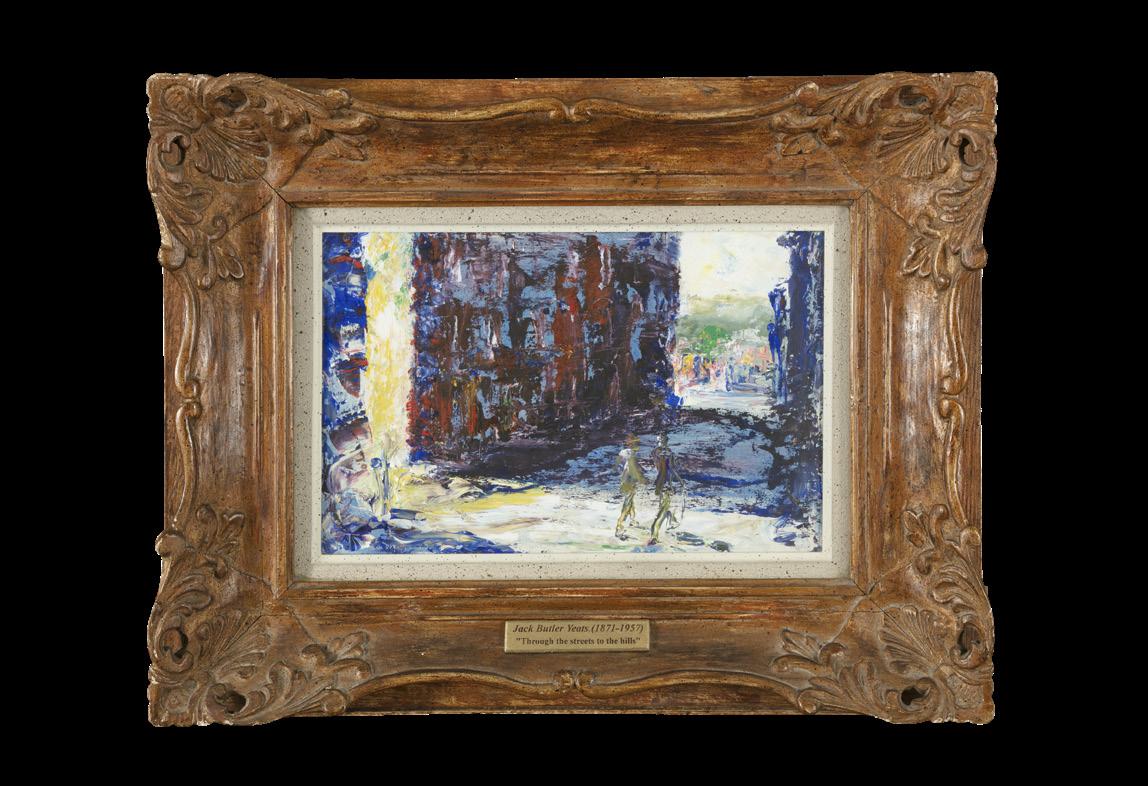
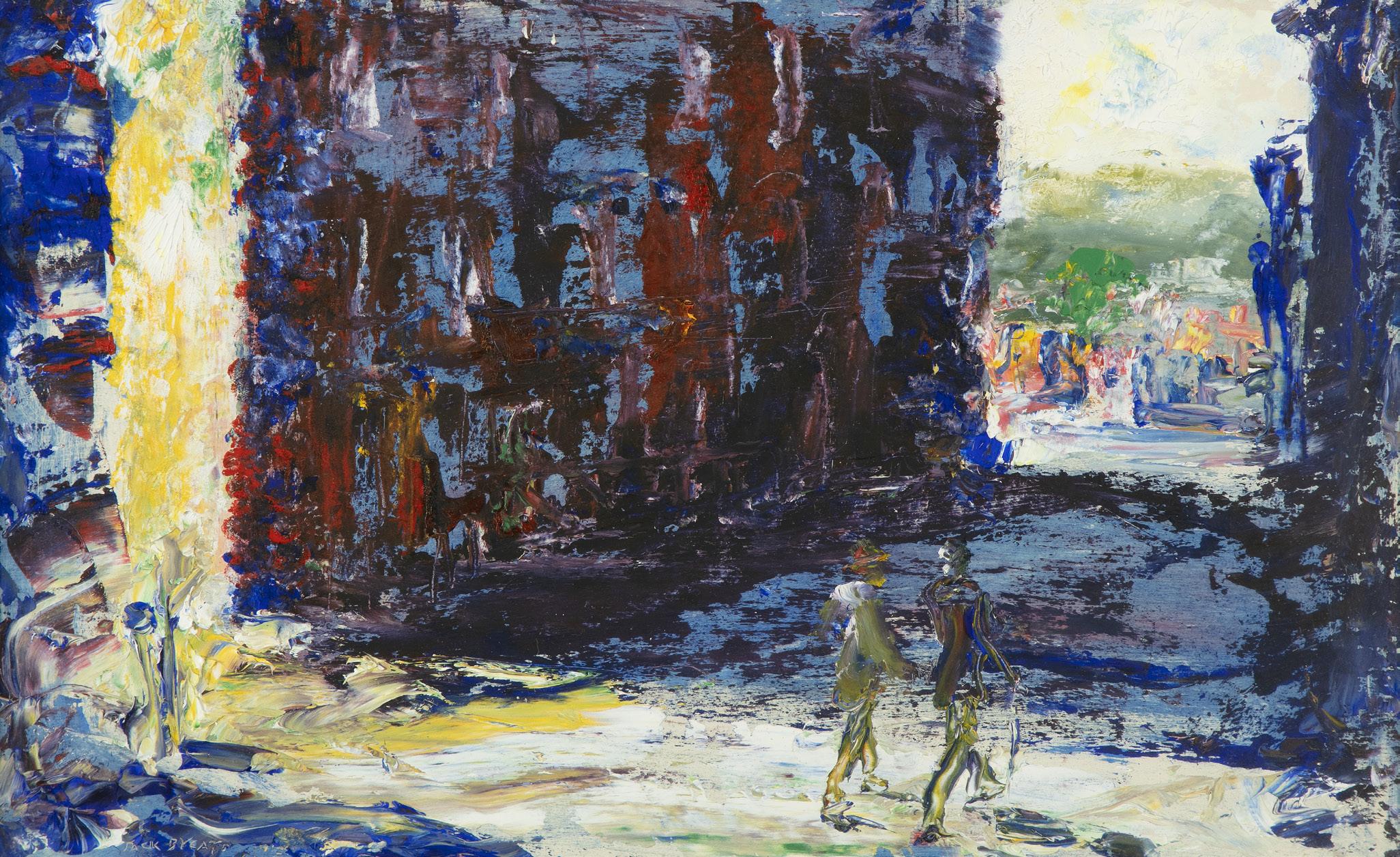
Mr. Clark Passing Tormore, Tory Island, in His Yacht with a Whole Gale of S.W. Wind and Rain, with Jill and Others on Board after Leaving Greenport with Daybreak About the Year 1952.
Household paint on brown paper, 63 x 81cm (24¾ x 32”)
Signed and inscribed
Provenance: From the collection of Wallace Clark; private collection, Northern Ireland.
Exhibited: Co. Donegal, ‘James Dixon - Retrospective’, The Glebe Gallery, 31st July - 31st August, 1990. Dublin, Two Painters: Works by Alfred Wallis and James Dixon, touring exhibition, Irish Museum of Modern Art, 1st September - 21st November 1999’ and travelling to Tate Gallery, St. Ives, May-November, 2000. Catalogue no. 38, page 70, illustrated (full page)
€ 6,000 - 8,000
Wallace Clark (1926-2011) was an accomplished yachtsman, writer and author of the classic maritime volume, Sailing Round Ireland. Clark circumnavigated Ireland, and all her islands, for the first time in 1951 and again in 1954. These voyages ultimately inspired him to write his classic sailing log. On these explorations he bonded with islanders and fisherfolk who shared his instinct for negotiating difficult waters. He met James Dixon on Tory Island in the early 1950s while sailing on his 36ft Bermudan yawl, ‘Wild Goose’. Dixon was the most significant member of the Tory Island school of primitive art. The two remained close friends until the artists death in 1970.
Both men shared a passion for the sea. Dixon was a fisherman by trade who took up painting in his later life but his affinity to the sea never waned and as a subject it was a constant throughout his work. He painted what he saw around him in his distinctive naturalistic style: boats, the wild seas, and the islands, while Clark sought to capture the same in his writing.
A series of letters from Dixon to Clark dated from the late 50s and early 1960s reflect this shared passion, the impetus for writing often relating to boats, new ones that have been purchased, things that are needed for their maintenance. While news from the ‘Island’ as Dixon refers to it are focused on weather and its impact on whether he has been able to go out fishing. Dixon often painted works relating to Clark’s marine adventures, most notably his 1963 journey
from Derry to Iona in a currach, a recreation of St Columba’s voyage of the same route, (Mr Wallace Clark and Crew and The Voyage to Iona, sold these salerooms, May 29th, 2024). Both understood the hardship of life at sea, as Dixon remarked ‘there is nothing romantic about little boats fighting with crashing waves and winds’ (Quoted to Derek Hill 1993). This inclement weather is captured in the present work as Clark’s boat, thrashed by wind and waves passes in front of the imposing cliff faces of Tormore. The crew are watched over by sea birds perched on rocky outposts while others circle over the open water. Clark and his crew had spent the night anchored at Greenport but had to depart in haste due the changing weather. This work is a very early example of Dixon’s painted in the early 1950s, with quite rudimentary materials of household paint on brown paper, reflecting clear desire to make works despite not having access to professional art supplies. Tormore, a knife-edge point from which Tory Island, seven miles off the Bloody Foreland, takes its name was painted some years before the famous artist Derek Hill started to summer on the island, who then assisted Dixon with better art materials. In another later letter to Clark dated February 1965, Dixon relates that he has thirteen pictures ready but is waiting for ‘Mr Hill’ to return home in April before he can send any on to Clark reflecting the challenges of selling and promoting his art from the remoteness of Tory Island.
Niamh Corcoran, April 2026
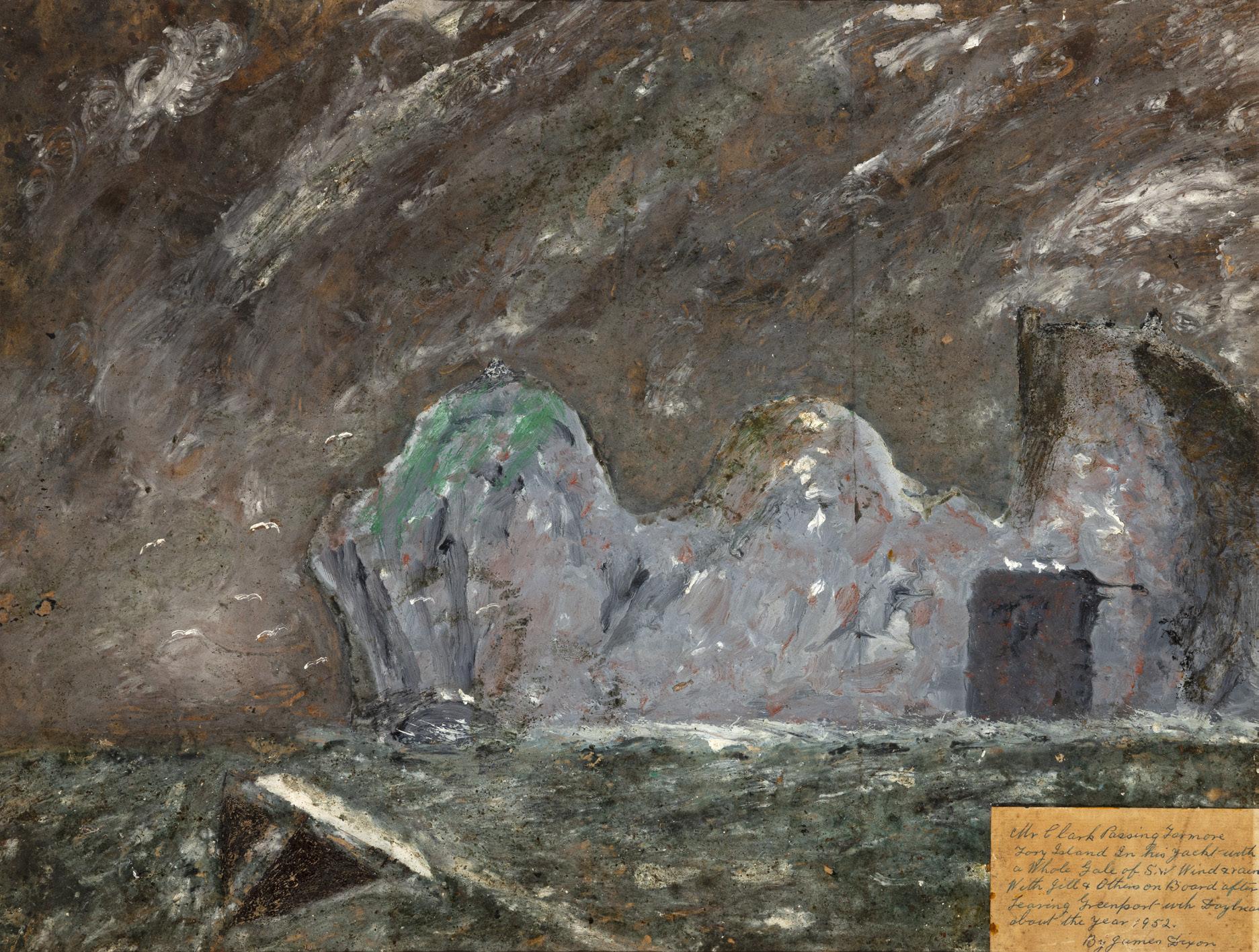
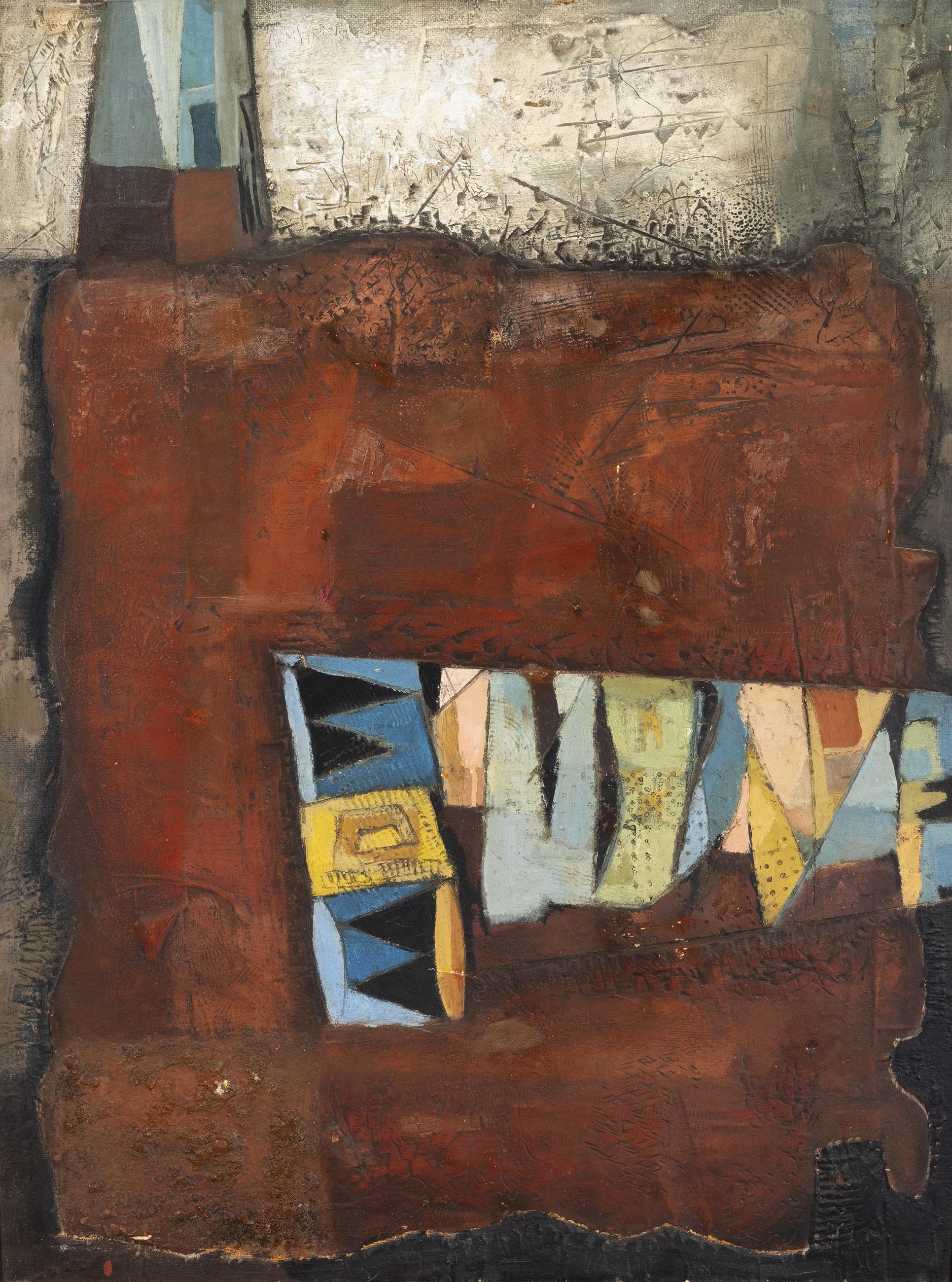
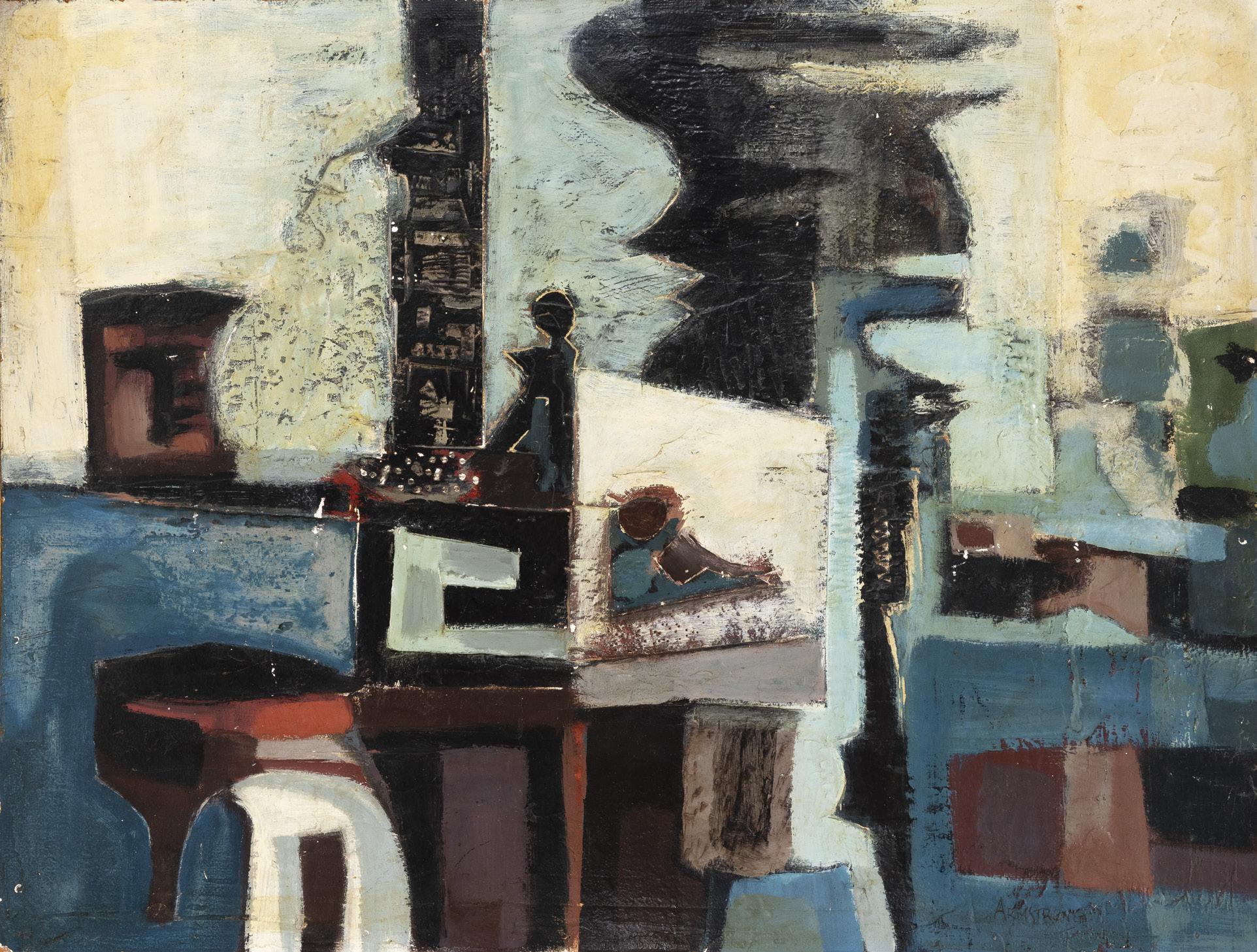
37
*ARTHUR ARMSTRONG RHA (1924-1996)
Red-Brown Abstract (1963)
Oil on board, 81 x 61cm (31¾ x 24’’)
Signed, inscribed with title verso
Provenance: With Ritchie Hendriks Gallery, Dublin, label verso; Collection of Ernest Anderson.
€ 1,500 - 2,000
38
*ARTHUR ARMSTRONG RHA (1924-1996)
Blue Abstract (1963)
Oil on board, 51 x 67cm (20 x 26¼’’)
Signed, inscribed with title verso
Provenance: With Ritchie Hendriks Gallery, Dublin, label verso; Collection of Ernest Anderson.
€ 1,500 - 2,000
*Please note this is imported under Temporary Admission. It will attract import duty of 13.5%
Towards an Image of W.B.Yeats (1992)
Watercolour, 62 x 46cm (24½ x 18’’)
Signed and dated (19)’92
Provenance: With Taylor Galleries, Dublin; Sale, these rooms, 26/4/2004, lot 144
€ 12,000 - 16,000
For le Brocquy, his paintings of heads were a continual process of excavation and speculation. They were in a sense portraits, most often of literary figures including Beckett, Joyce and Yeats. But his aim was not to capture a likeness per se, but to capture a sense of each writer’s unique consciousness. No attempt could be definitive or complete, hence his always working “towards an image”. The works ultimately stemmed from a chance visit to the Musée de l’Homme in Paris in 1964, when he felt at a dead end in his work. He was greatly struck by two things there: Polynesian painted skulls, and the Celtic cult of the head, based on a view of the head as a magic box containing the individual spirit. Quite soon, the artist began working on a new series of paintings, visualisations of ancestral heads. Over time, he explored his own ancestry by means of this “archaeology of the spirit.” In this way he concluded that no single image could comprise a definitive account of a person, each painting could offer a fragmentary glimpse, a glimpse that acknowledged the complexity of the incalculable inner world of the subject. From his own ancestors he moved on to attempt images of several writers.
Intriguingly, in the case of Yeats, there was an indirect though close connection. “My mother,” he related in a 2005 lecture, “was a friend of the Yeats family in Dublin and so, as a child, I was fairly familiar with WB’s appearance and with his extremely impressive manner.” Even within a single image it is apparent that the artist’s view encompasses multitudes. He commented on the way that, out of a series of photographs, even though all might be objectively faithful, their effectiveness at capturing a subject will vary. In each painting, we seem to look into multiple layers and possibilities, laid on with great sensitivity, from which emerge an almost ethereal sense of the person.
Aidan Dunne, April 2026
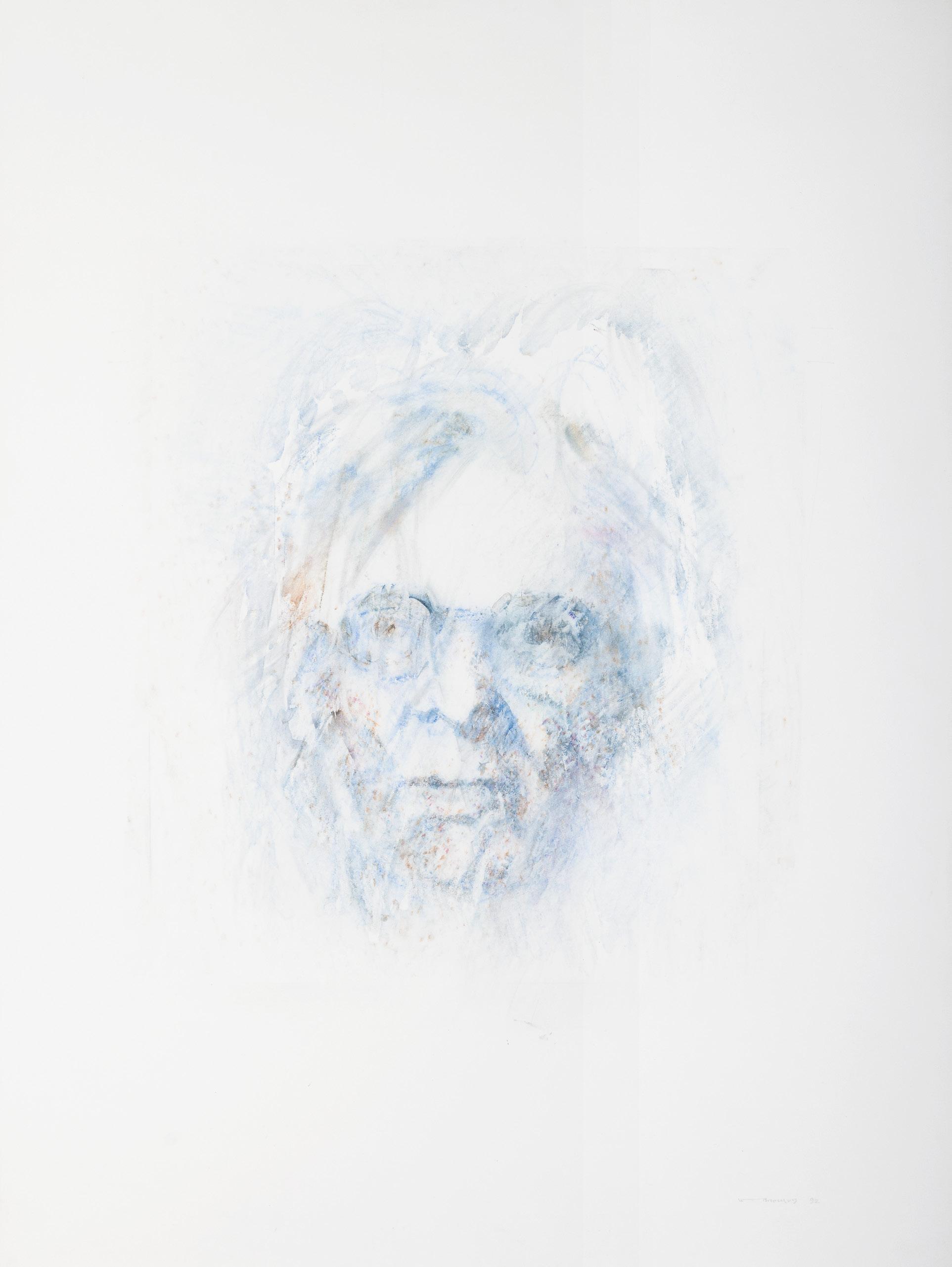
MAURICE MACGONIGAL PPRHA (1900-1979)
‘Turf Girl, by the Sea, Connemara’
Oil on board, 39 x 30cm (15¼ x 11¾”)
Signed
Provenance: Collection of Fr. Eric MacFhinn, Galway (Patron of the arts and noted scholar)
€ 5,000 - 8,000
Maurice MacGonigal was born into a family of artists in the suburb of Ranelagh, Co. Dublin in the year 1900. His father was a painter decorator from County Sligo and his uncle on his mother’s side was the illustrious stained glass artist Joshua Clarke (c.1868-1921). MacGonigal then was naturally predisposed to an artistic trade and enjoyed an apprenticeship in the Joshua Clarke & Sons studios of Dublin from the age of 15. During this period MacGonigal was also enlisted to Fianna Éireann in 1917 and was active during the War of Independence, culminating in his internment in 1920 for one year. On his release and with evident talent, he attended the Metropolitan School of Art throughout the period of 1923 to 1926. His education here exposed him to the influence of his tutor Seán Keating (1899-1977) whose blend of Social Realism and Romanticism can clearly be identified in the work here presented. MacGonigal exhibited frequently at the RHA, submitting on average five paintings a year before his eventual Presidency of the Academy from 1962 until 1977 - a role he inherited directly from Keating. The Artist’s fascination with the West of Ireland was purportedly ignited after a trip to the Aran Islands in 1924, at least in part inspired by the striking depictions of the islands he saw reflected in Keating’s work. Turf Girl, By The Sea, Connemara presents the viewer with a single figure in a landscape, very much in the tradition of his tutor, who had incidentally paid his first visit to the Island with Harry Clarke in 1912. The female subject in her striking red woollen skirt is crucial to the iconography of the West of Ireland. Historically the woollen petticoats were dyed with madder root and the resulting crimson ensemble contrasted beautifully against the cornflower blue mountains and the green patchwork of the small landholdings. Naturally therefore, the Irish Gleaner in her red petticoats has appeared throughout the works of landscape ‘Greats’ Sir William Orpen, RA RHA (1876-1931), Paul Henry RHA (1877-1958),
Charles Lamb RHA RUA (1893-1964) and Seán O’Sullivan RHA (1906-1964) to name but a few. MacGonigal’s interpretation of the scene follows this established tradition but notably presents the subject in a full length portrait, centred triumphantly against a cirrus speckled sky and a glittering sea. She stands authoritatively against her spade, her hand resting on her hip, supported by strong legs and sturdy black boots. The heavy black leather boots are particularly well delineated and despite the subject’s charming and youthful face, she has an uncommonly commanding presence in that landscape.
MacGonigal’s interpretation of the young labourer is likely influenced by his alternative employments as a poster and set designer for the Abbey Theatre as well as his early years in the glass studios of Joshua Clarke & Sons. He has presented the scene in a reduced palette of reds and blues, and the resulting picture is remarkably conducive to interpretation in these mediums. The breadth of the sky is accentuated due to the elliptical sweep of titanium white that aligns with the perfectly centred figure to create of halo effect. Above this ellipse, a shimmering concentration of small brushstrokes mimics the swift transition of the early morning clouds, a technique which is echoed in the glimmering waves beneath. The comparatively flat panes of red, blue, black and white used in the Turf Girl’s clothing recalls the typical palette of ecclesiastical windows. It is therefore impossible to ignore McGonigal’s formative training as a stained glass designer in the studio of his uncle. Neither can we deny his aptitude for creating a distinctly Irish iconography – incentivised by his early education in the Metropolitan School of Art and his lifelong interest in the concept of Irish Nationhood and cultural identify.
Stephanie Brennan, April 2026
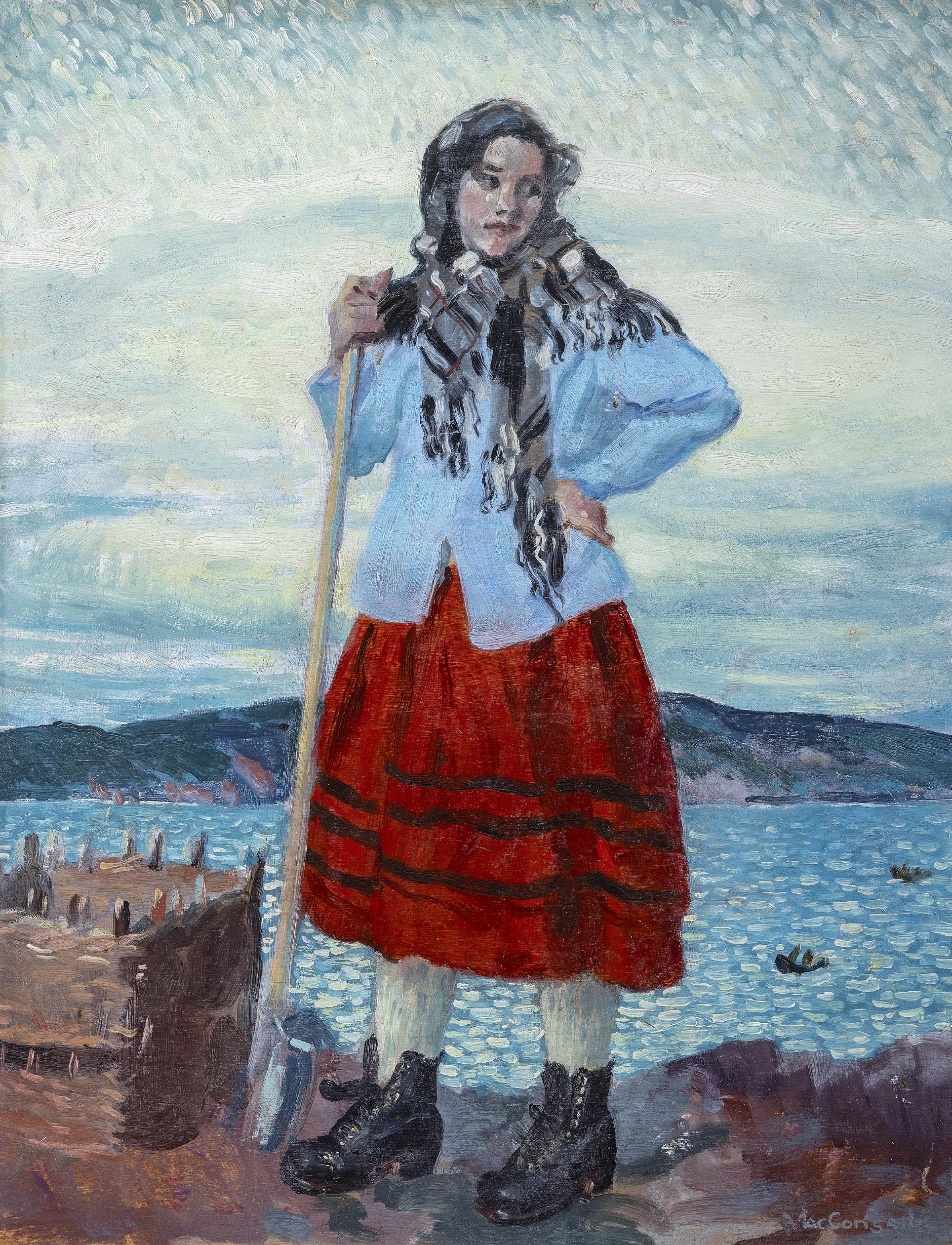
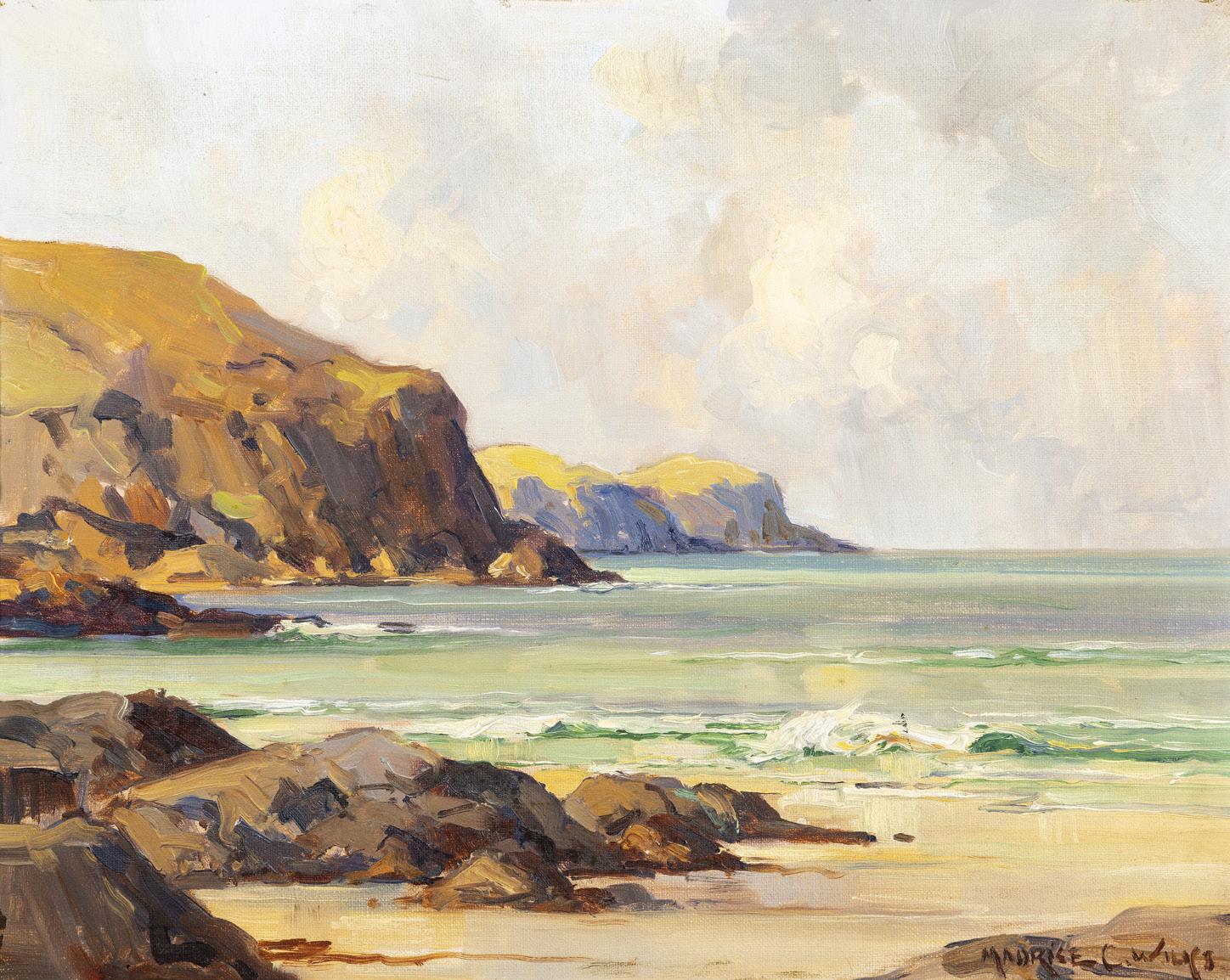
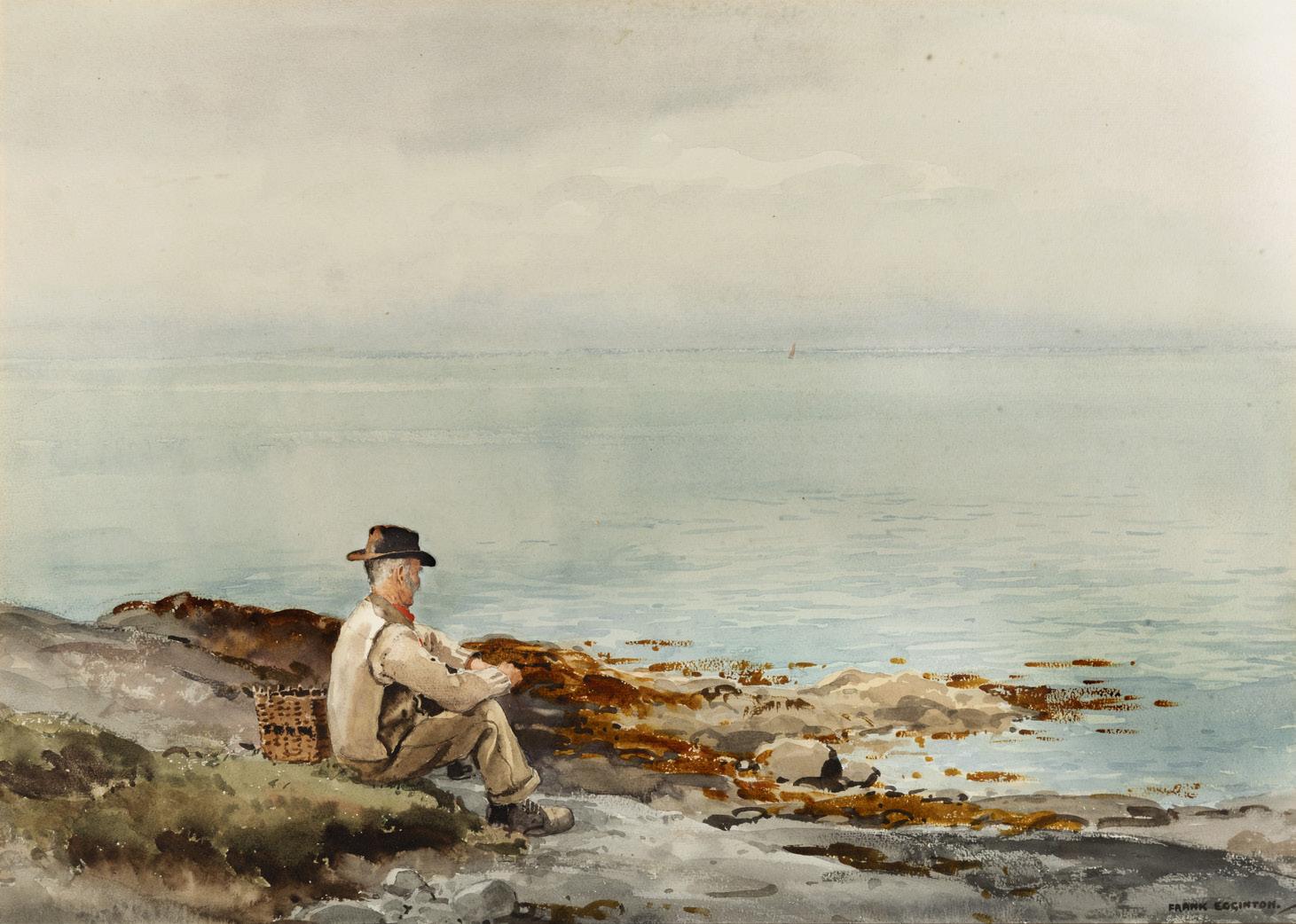
41
MAURICE C. WILKS
RUA ARHA (19101984)
Torr Head, Antrim
Oil on canvas, 39.5 x 50cm (15½ x 19½”)
Signed; inscribed with title verso
€ 1,000 - 1,500
42
FRANK EGGINTON
RCA FIAL (19081990)
The Fishing Boats Return, Connemara
Watercolour, 38 x 53.5cm (15 x 21’’)
Signed
Provenance: Sale, these rooms, 28 May 2014, lot 105; old William Rodman label affixed verso
€ 500 - 800
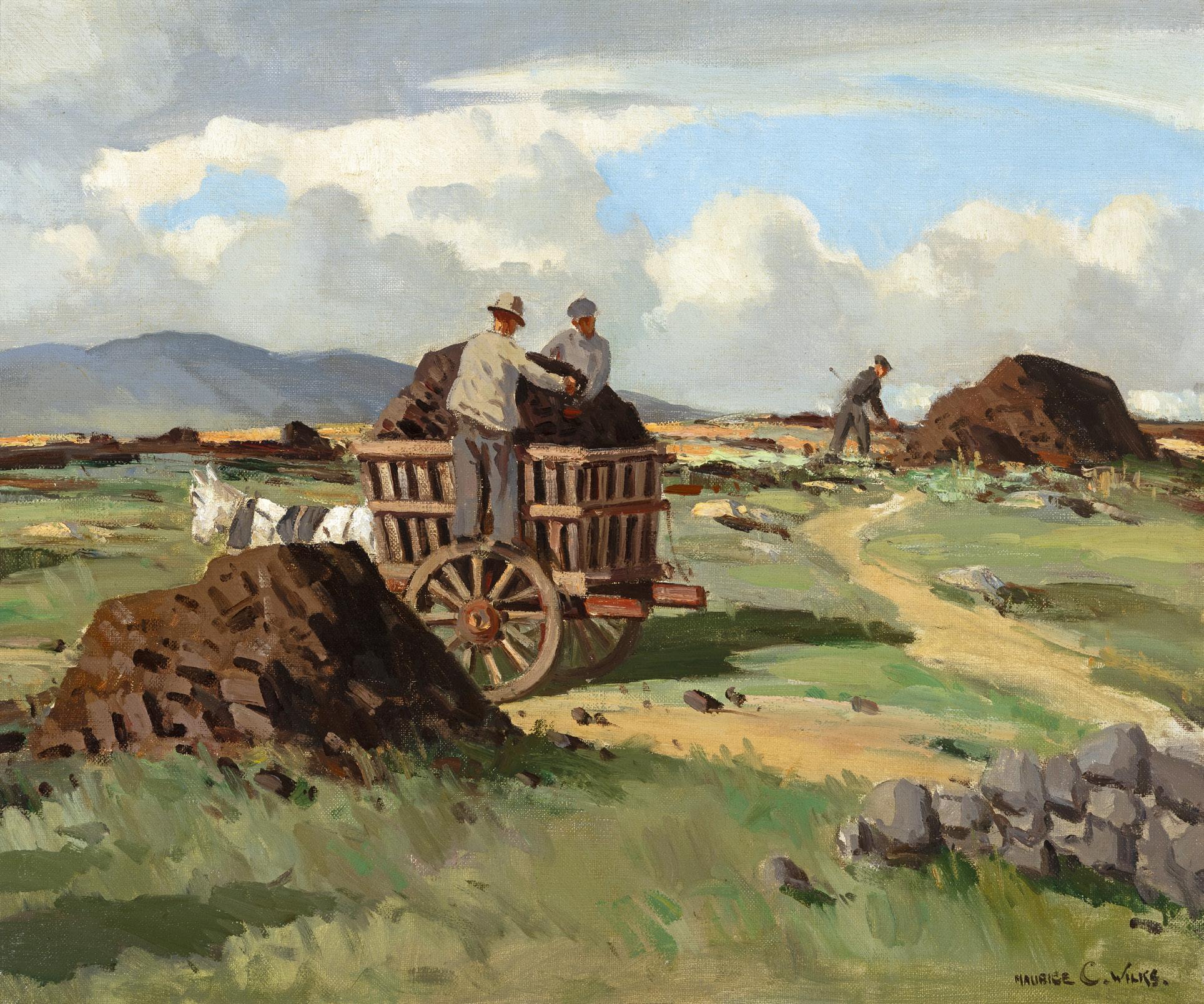
Bringing in Turf, Connemara
Oil on canvas, 49 x 59.5cm (19 ¼ x 23½”)
Signed; also inscribed with title verso
Provenance: With The Oriel Gallery, Dublin; sale, these rooms, 16/4/2024, lot 26
€ 3,000 - 5,000
WALTER FREDERICK OSBORNE RHA (1859 - 1903)
Sheep in a Field
Oil on canvas, 36 x 47cm (14¼ x 18½”)
Signed lower left
Provenance: Collection of Sarah Purser to Sean Purser thence by descent to the present owners.
Literature: Jeanne Sheehy, Walter Osborne, Ballycotton, 1974, cat. no. 189, p.122-123
€ 30,000 - 50,000
In Osborne’s painting a flock of black-faced sheep are shown grazing in a field. In the foreground is a trough and wicker fence, while behind is a flat landscape and hazy blue sky. The artist spent much of the late 1880s in England painting village subjects, landscapes and farming scenes. He was enamoured with the subject of sheep and painted many pictures of flocks, sometimes with the shepherd present. In 1885 he painted small panels of sheep in a pen on sunny days, probably in Hampshire. One delightful picture The Sheepfold, for example, shows a small flock in a paddock, one black-faced sheep in the foreground looking at us with curiosity. (1) One of Osborne’s best known pastoral scenes Counting the Flock, (sold in these rooms 30 May 2018), shows a shepherd with dog and sheep in a flat landscape.(2)
Osborne painted further sheep subjects in Berkshire c. 1887-1888. The present picture Sheep in a Field, c.1888, shows a small flock of black-faced animals grazing or resting in a pasture, one of them close to the viewer. Like his father, animal painter William Osborne, Walter has a profound empathy for his animal subjects. He captures well the woolly coats and calm demeanour of the sheep. Two rooks or carrion crows are shown pecking at the earth. In the right
foreground are a water trough and latticed wattle fence, the latter painted with such skillful realism that we almost feel we can touch it. In the distance is a landscape with small woods, and a flat horizon with hazy blue sky with clouds. The burnished tones that the artist employs: browns, bottle greens and beiges, give the painting a warm rural feeling.
It is a surprise then to see an embankment with railway line and telegraph poles cutting horizontally across the landscape behind the sheep in the middle distance. This seems like an intrusion upon the quiet, pastoral scene, (and adds an understated modern dimension to the picture). Yet Osborne himself loved to travel by train, and was engaged with contemporary life, as well as being a lover of nature and tradition.
Sheep in a Field has remained in the same family collection for over a hundred years. It was acquired by Sarah Purser, a relative and fellow painter of Osborne’s, and was displayed in her home, Mespil House, in Dublin. Subsequently it passed down through the family by descent.
Julian Campbell, April 2024
[1] J.Sheehy, Walter Osborne, NGI, 1983, cat.no.22, illustrated. [2] Counting the Flock, in Important Irish Art, Adam’s, 30 May 2018, lot 32
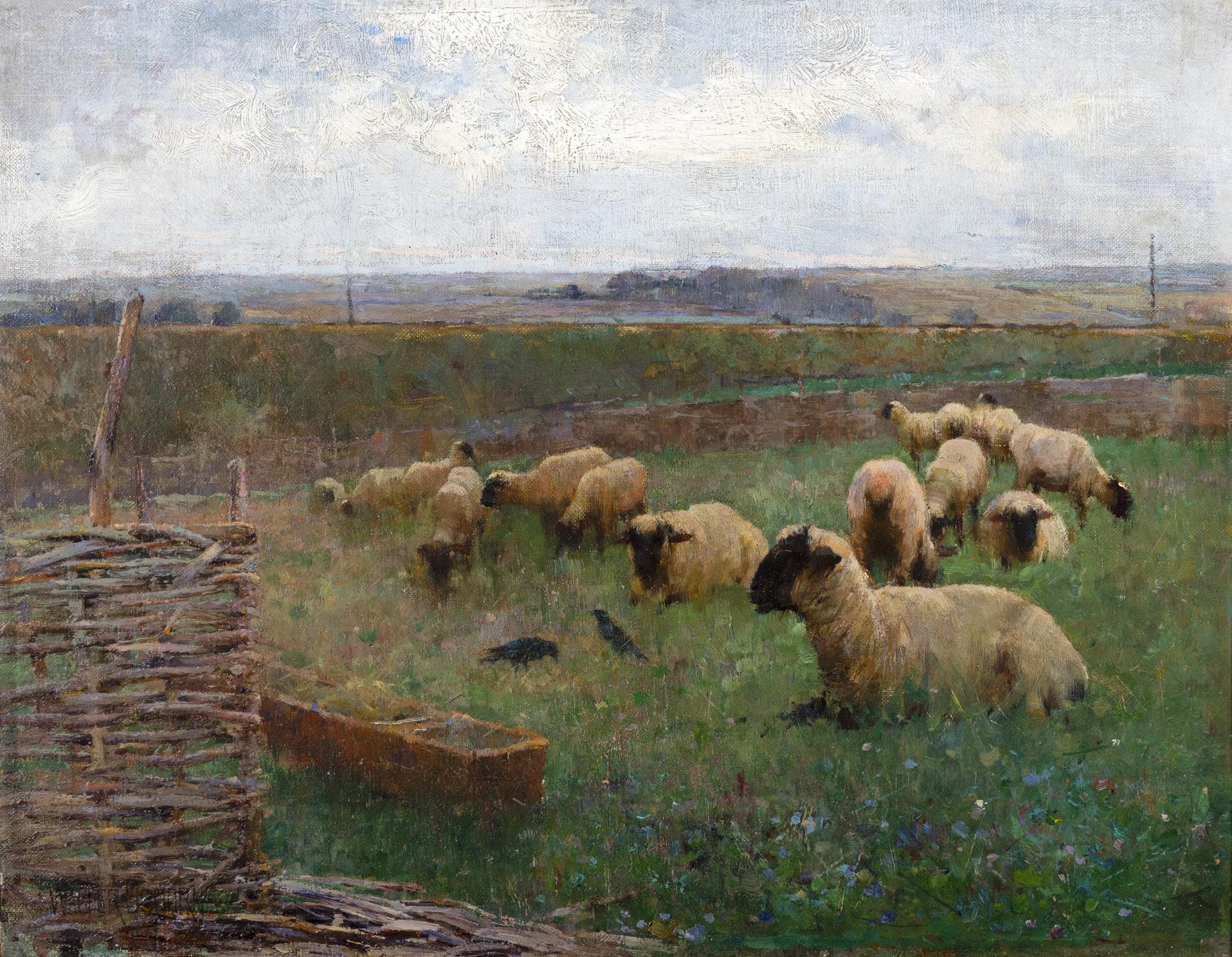
SARAH PURSER HRHA (1848 – 1943)
Woman with Fan
Oil on canvas, 85 x 66cm (33½ x 26”)
Provenance: The Collection of the Artist; Her Estate Sale, Mespil House, Dublin, 1943; Private collection; ‘The Sarah Purser Sale’, these rooms, 12 December 2006, lot 9; Irish & British Art, Whytes 12th March, 2012, Lot 42, where purchased; thence by descent
Exhibited: Thought to have been exhibited at ‘Pictures Old and New by Sarah Purser ARHA’, Engineers Hall, Dawson Street, Dublin, 1923, catalogue no. 80 [price £50-0-0]
€ 20,000 - 30,000
Though not a portrait in the strictest sense, in that we do not know the identity of the sitter, the work is evidence of Purser’s immense ability to capture likeness and imbue a work with a strong sense of character. This work was originally sold in the estate sale of her home on Mespil Road in 1943, where she held her ‘Second Tuesday’s’ gatherings, bringing together a mix of cultural figures from Ireland’s artistic and literary circles. Her home was not only a reposit for her own work but also for that of other artists and she was important advocate of for the visual arts in Ireland throughput her life. By the late 19th century, she had established a lucrative portrait practice and was regularly commissioned by patrons.
In this work a woman stands, looking off to the side, her dark hair piled on top of her head, loose strands framing her face, she wears a lace trimmed velvet cloak over a pale pink gown, the neckline gathered by a delicate silk bow. There is incredible softness in the work, the paint is applied in thin layers, building up the colours and textures of the clothes. In her right hand she holds a silk fan, a common accessory of the time for women. Purser manages to capture the angular folds of the fan with light brushstrokes of white paint almost giving it a transparent quality and extenuated
with marks of bright red and blue highlights. The background is left quite loose; the attention focused entirely on the figure.
Purser often painted portraits that fit more within a genre theme, women playing a game of chess, sitting in a n armchair reading, eating breakfast. Often, they hold a distant expression, looking away from the artist, lost in their own thoughts. This work is reminiscent of another example, A Lady Holding A Rattle, painted in 1881 in which a woman sits wearing an elaborate headdress while holding the child’s toy. These works can be viewed more as moments from daily life as in the Le Petit Dejeuner (1881, NGI) or Seated Lady Playing Chess (1895, Private Collection), or as staged scenes in which the women are holding props, such as another earlier work A Visitor from 1861 (Private Collection) which also sees a female friend of Pursers holding a flat woven fan while she relaxes on a settee. There is a natural quality to these portraits, they feel at ease with the artist and in turn Purser maintains her sitter’s sense of personality even while they adopt character within her pictorial narrative.
Niamh Corcoran, April 2026
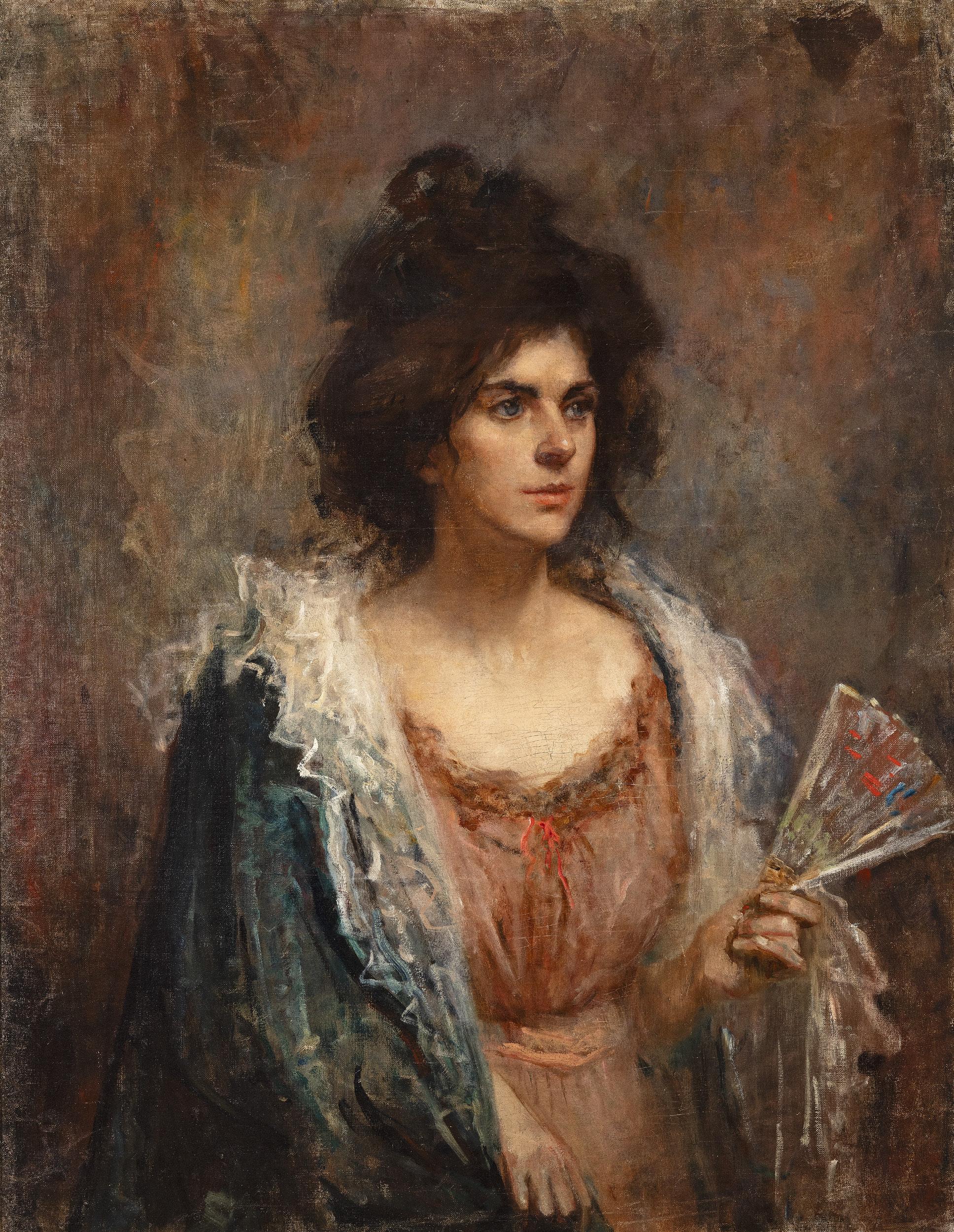
The Street Musician
Crayon, 61 x 46cm (24x18”)
Signed
Provenance: One of a collection of works by William Conor, sold at Waddington Auctioneers, Toronto, June 2001, lot 1712, where purchased; sale, these rooms, 26/03/2013 lot 15. Another smaller work from this same Canadian collection, Dancing the Jig, was also sold in these rooms December 2012, lot 48.
Music and dance feature strongly among William Conor’s work be they enjoying a dance, or in this case a street musician. Conor carried a notebook with him at all times which he would use to “note down any happening which strikes me as interesting and significant.” Here the musician is well observed with an assortment of generations looking on. There is a long tradition of flute playing around Belfast and the surrounding large towns.
€ 10,000 - 15,000
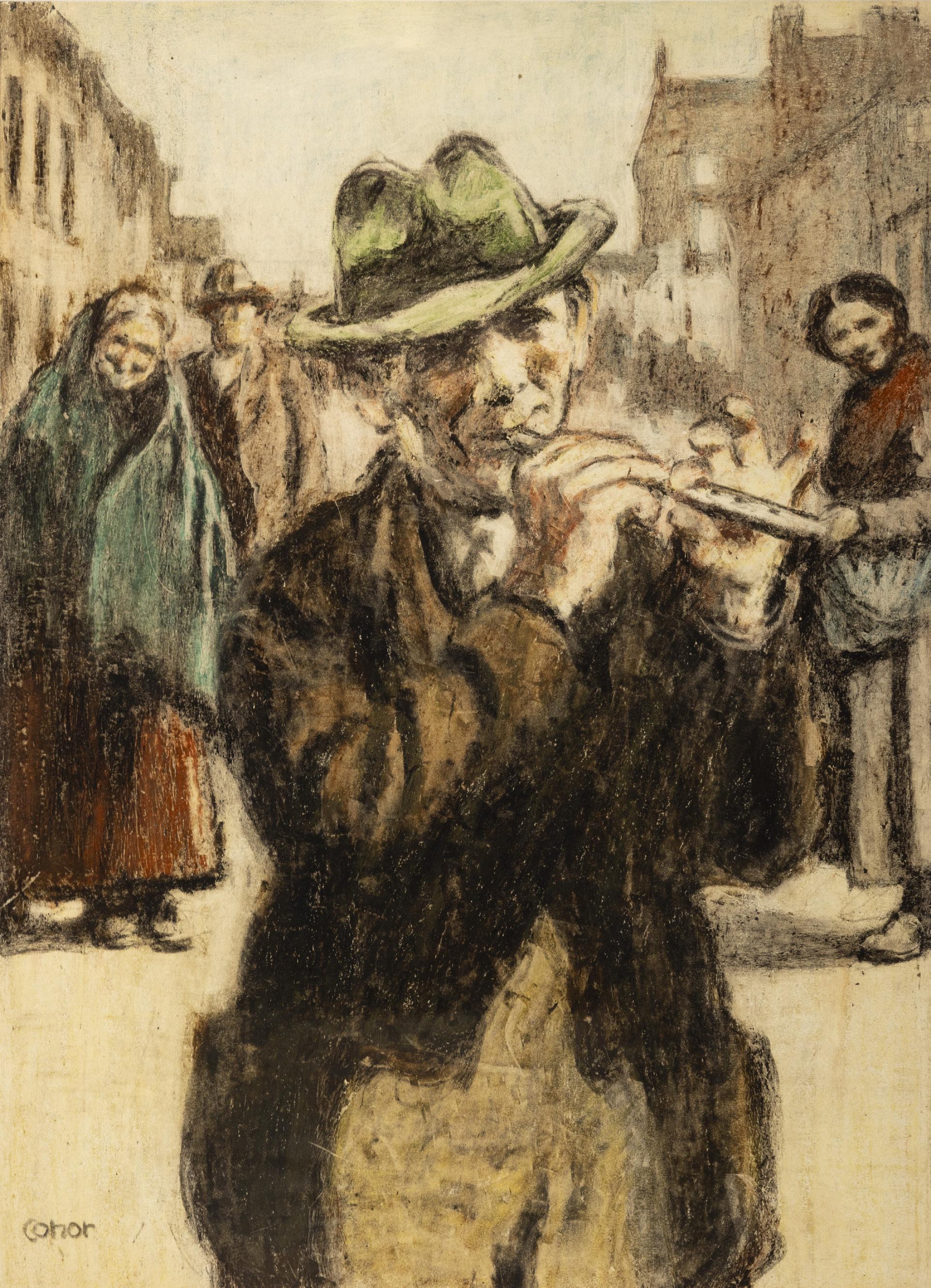
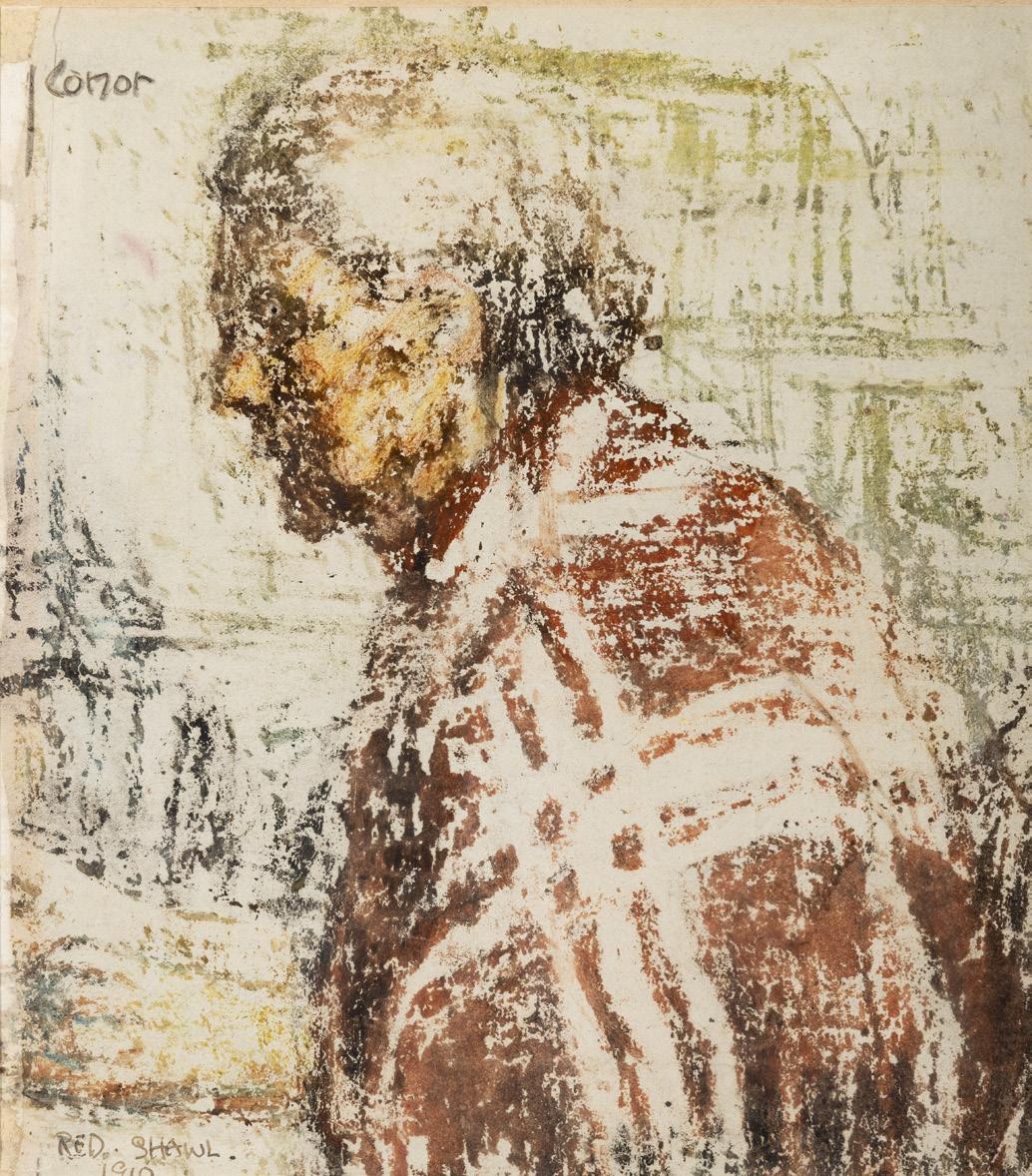
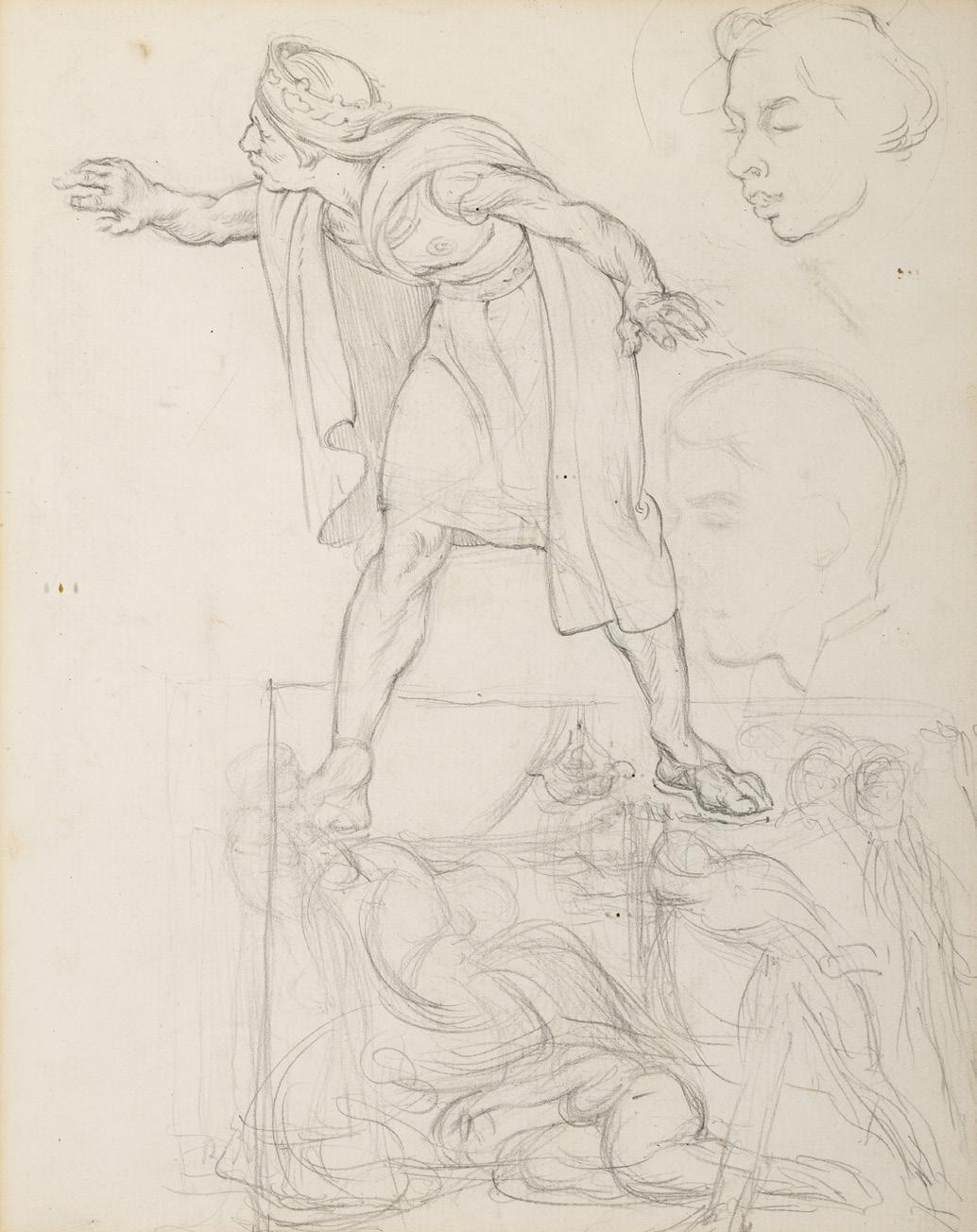
47
WILLIAM CONOR RUA RHA (1881-1968)
Red Shawl (1910)
Crayon on paper, 23.5 x 21.5cm (9¼ x 8½”)
Signed, inscribed with title and dated 1910
€ 1,500 - 2,000
48
SIR WILLIAM ORPEN KBE RA RHA (18781931)
Figure Study (From a Sketchbook)
Pencil, 21.5 x 17.5cm (8½ x 6¾”)
€ 600 - 800
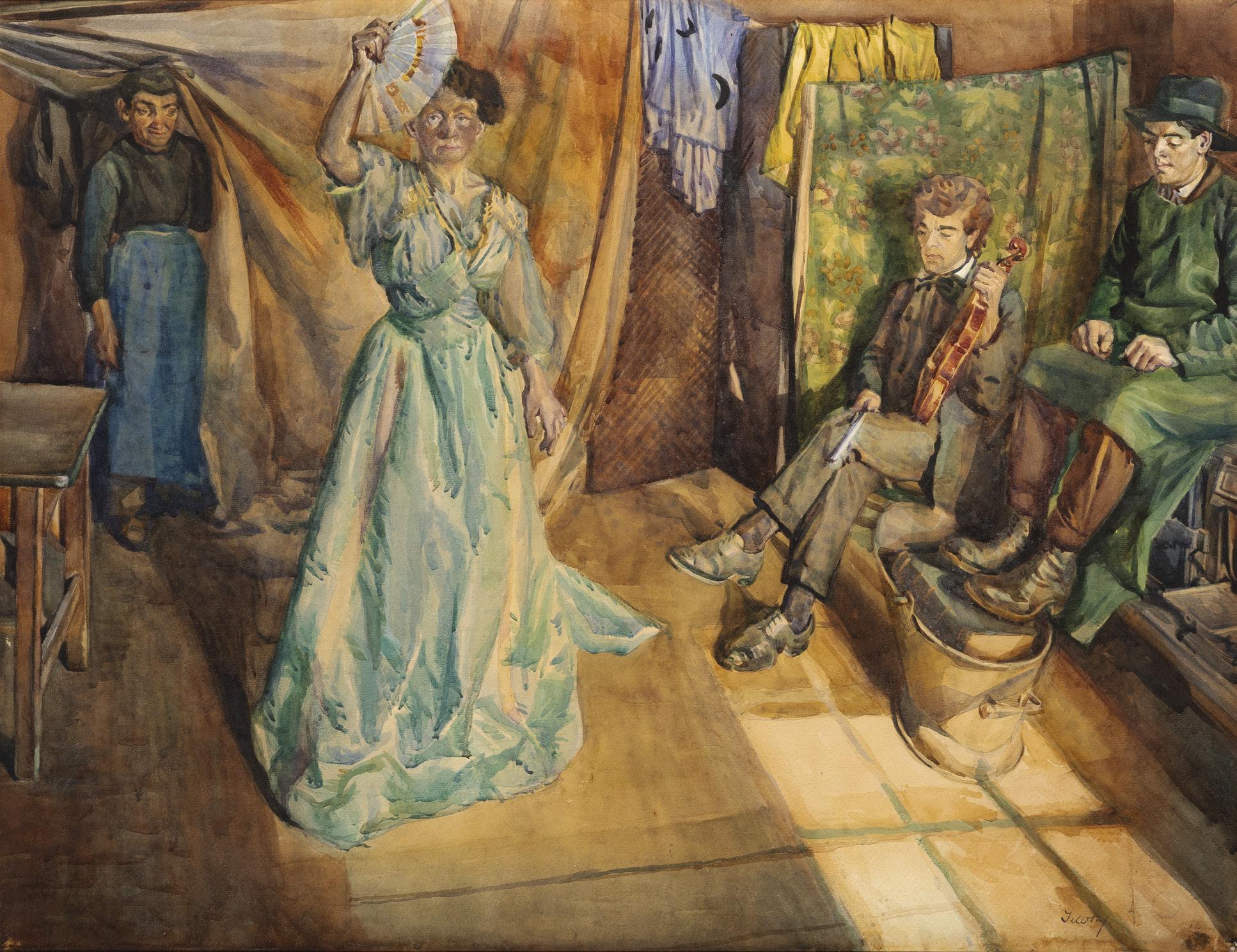
The Rehearsal
Watercolour, 62 x 75.5cm (24½ x 30”)
Signed € 4,000 - 6,000
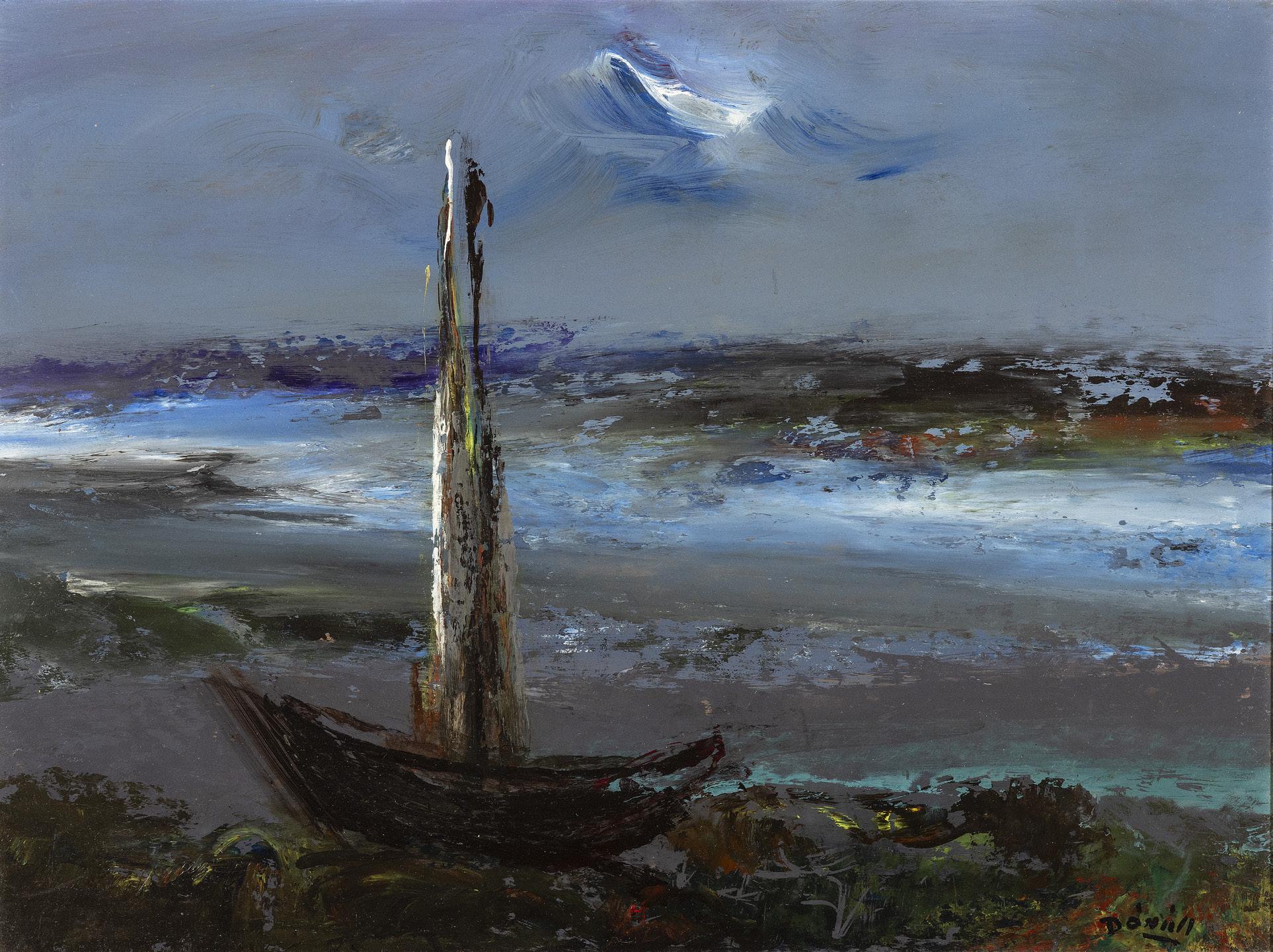
Oil on board, 30 x 40cm (12 x 15¾”)
Signed
Provenance: With The Oriel Gallery, Dublin, c.1972
€ 3,000 - 5,000
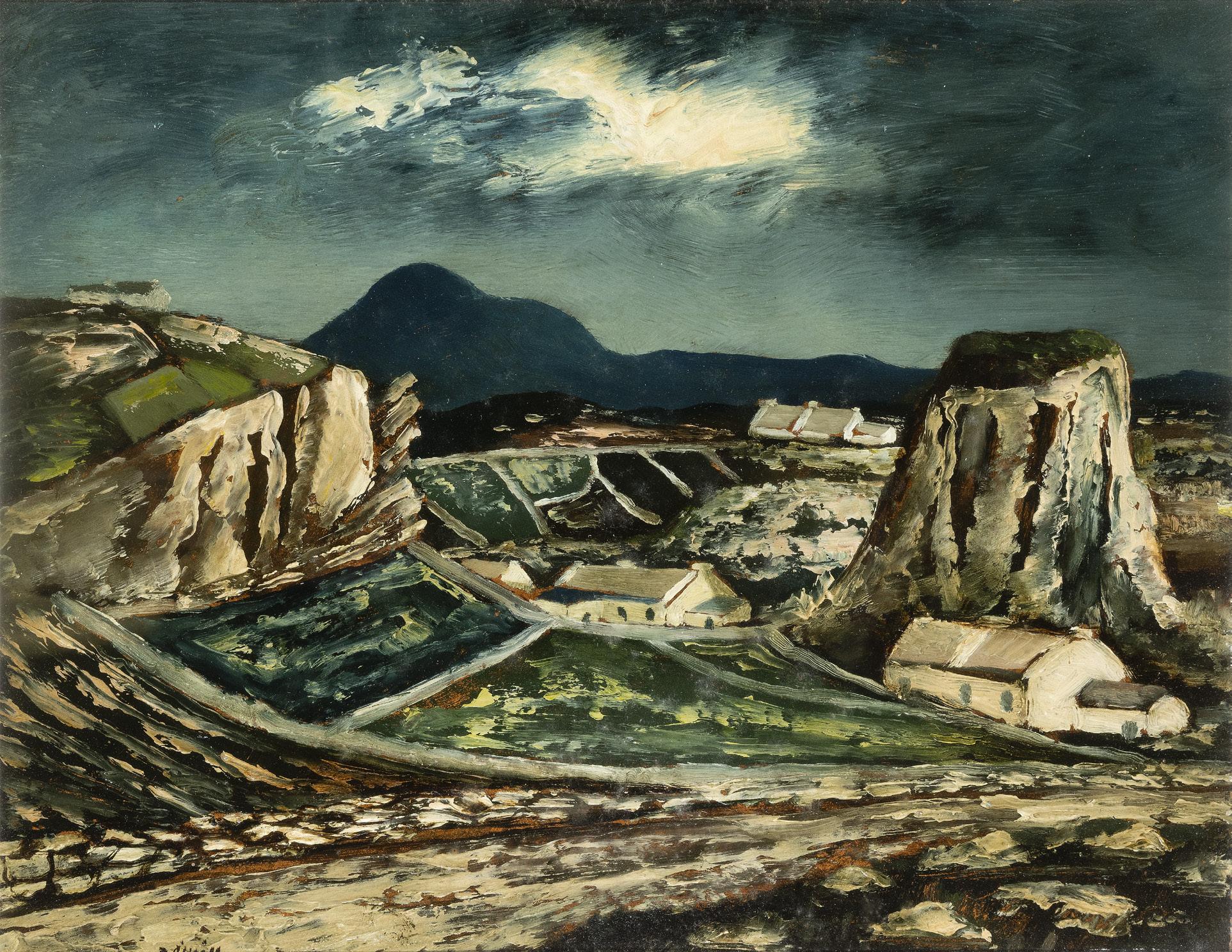
Oil on board, 40 x 50cm (15¾ x 19¾’’)
Signed
€ 4,000 - 6,000
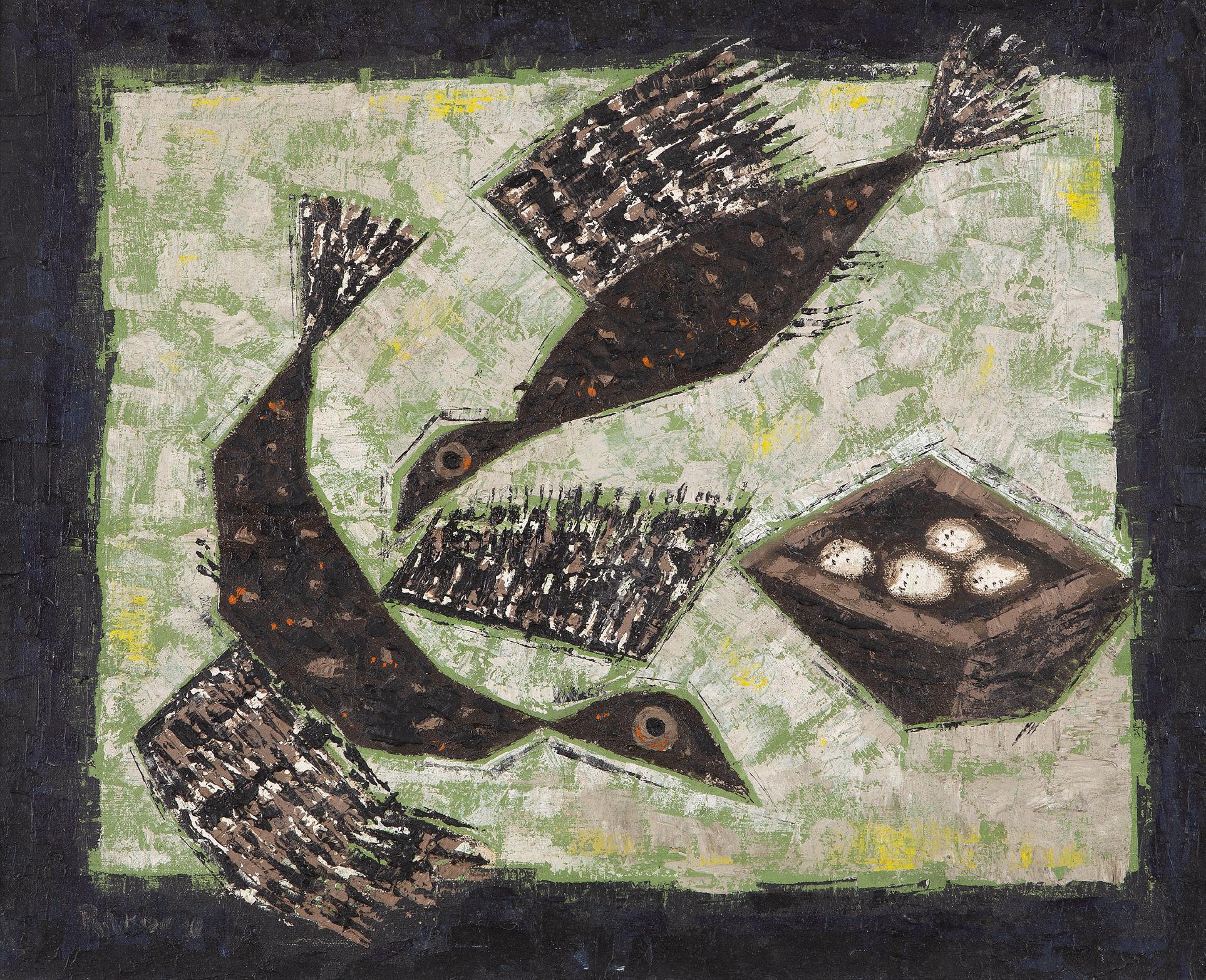
BASIL IVAN RÁKÓCZI (1908-1979)
Two Birds and a Nest
Oil on canvas, 49 x 59cm (19¼ x 23¼’’)
Signed; inscribed and dated (19)’68 verso
Provenance: The artist’s family by descent
€ 2,000 - 3,000
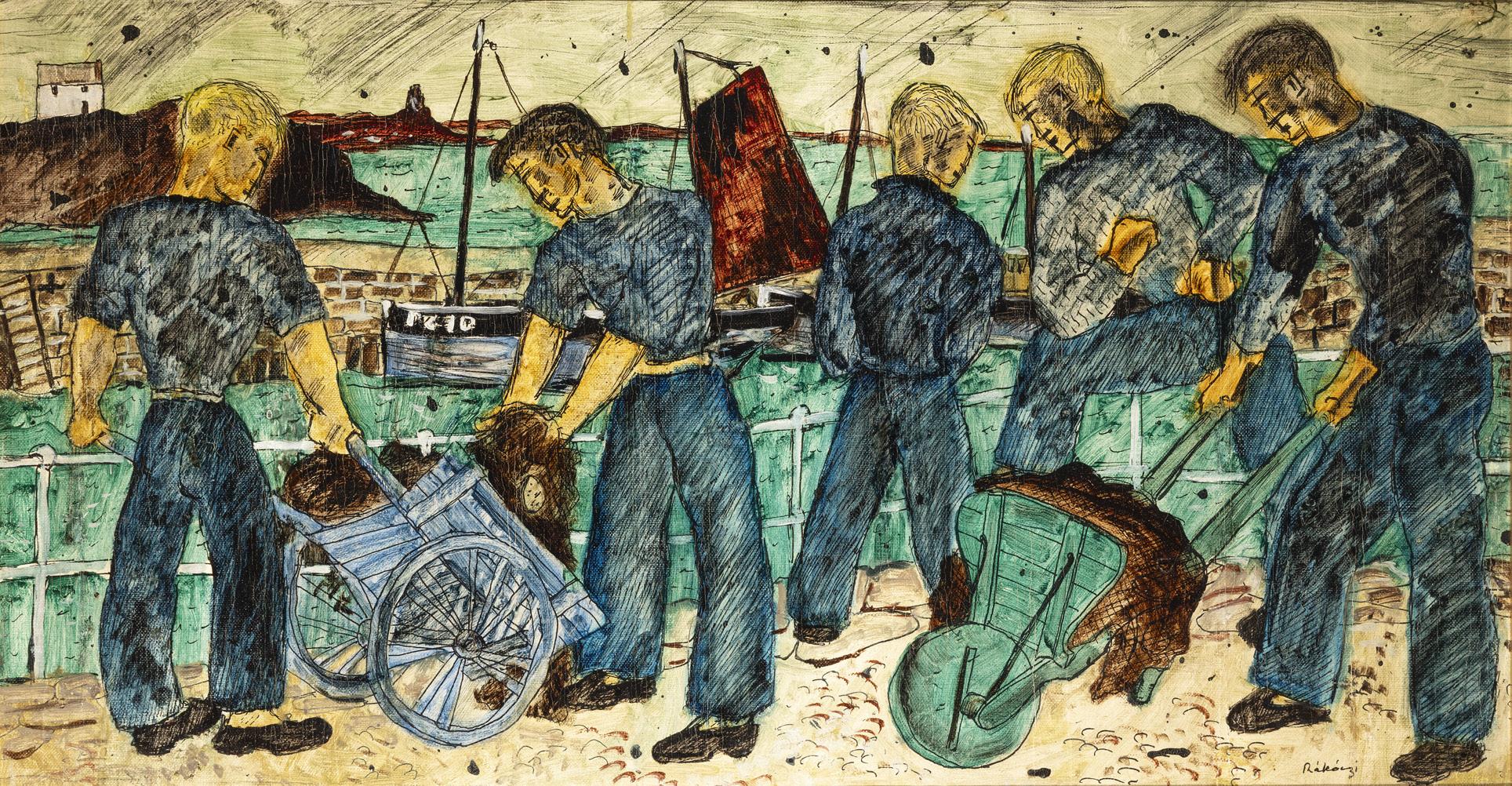
BASIL IVAN RAKOCZI (1908-1979)
Fishermen on the Pier
Oil on canvas, 43 x 84cm (17 x 33”)
Signed
Provenance: From the estate of Basil Rakoczi to Jacqueline Robinson, Paris; the Collection of Bruce Arnold; Private Collection
Exhibited: Belfast, The White Stag Group, Adam’s at the Ava Gallery, 2011, cat no. 66
€ 3,000 - 5,000
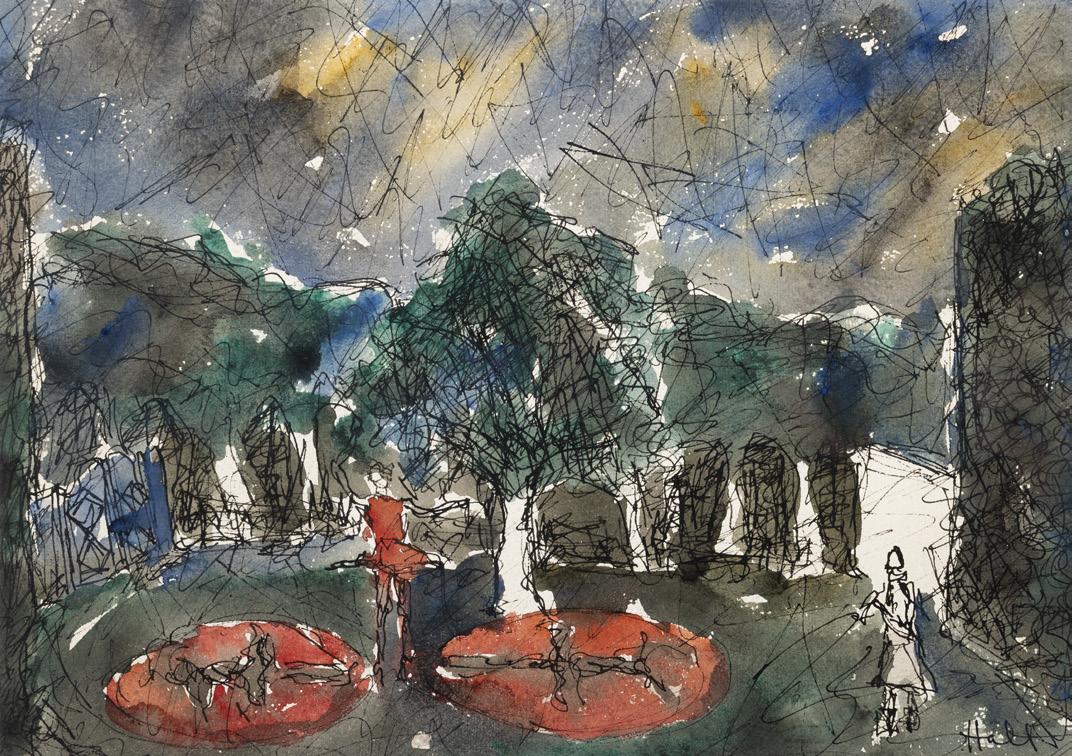
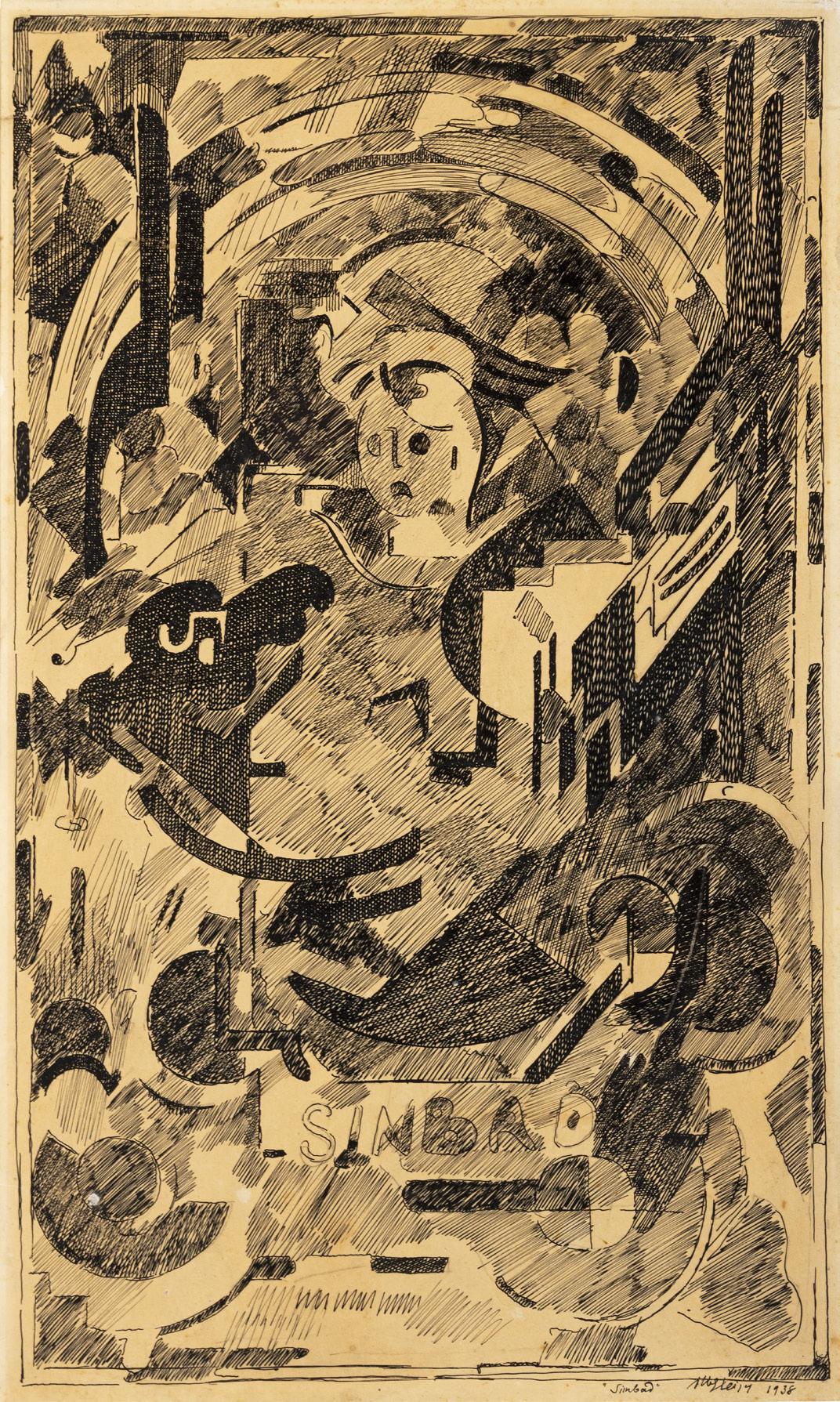
54
KENNETH HALL (1913-1946)
Design for a Ballet, Tristan & Isolde
Watercolour, 24 x 34cm (9½ x 13¼”)
Signed
€ 600 - 800
55
ALBERT GLEIZES (1881-1953)
Sinbad (1938)
Black ink on card, 47 x 28.5cm (18½ x 11¼”)
Signed, inscribed with title and dated 1938
Provenance: Collection of Bruce Arnold, from whom purchased by the present owner.
€ 1,000 - 1,500
56
TONY O’MALLEY HRHA (1913-2003)
Cottage, Callan (1974)
Gouache on paper, 56 x 46cm (22 x 18”)
Signed lower right and dated 1974
Provenance: Collection of George and Maura McClelland by whom gifted to the present owner.
€ 2,000 - 3,000
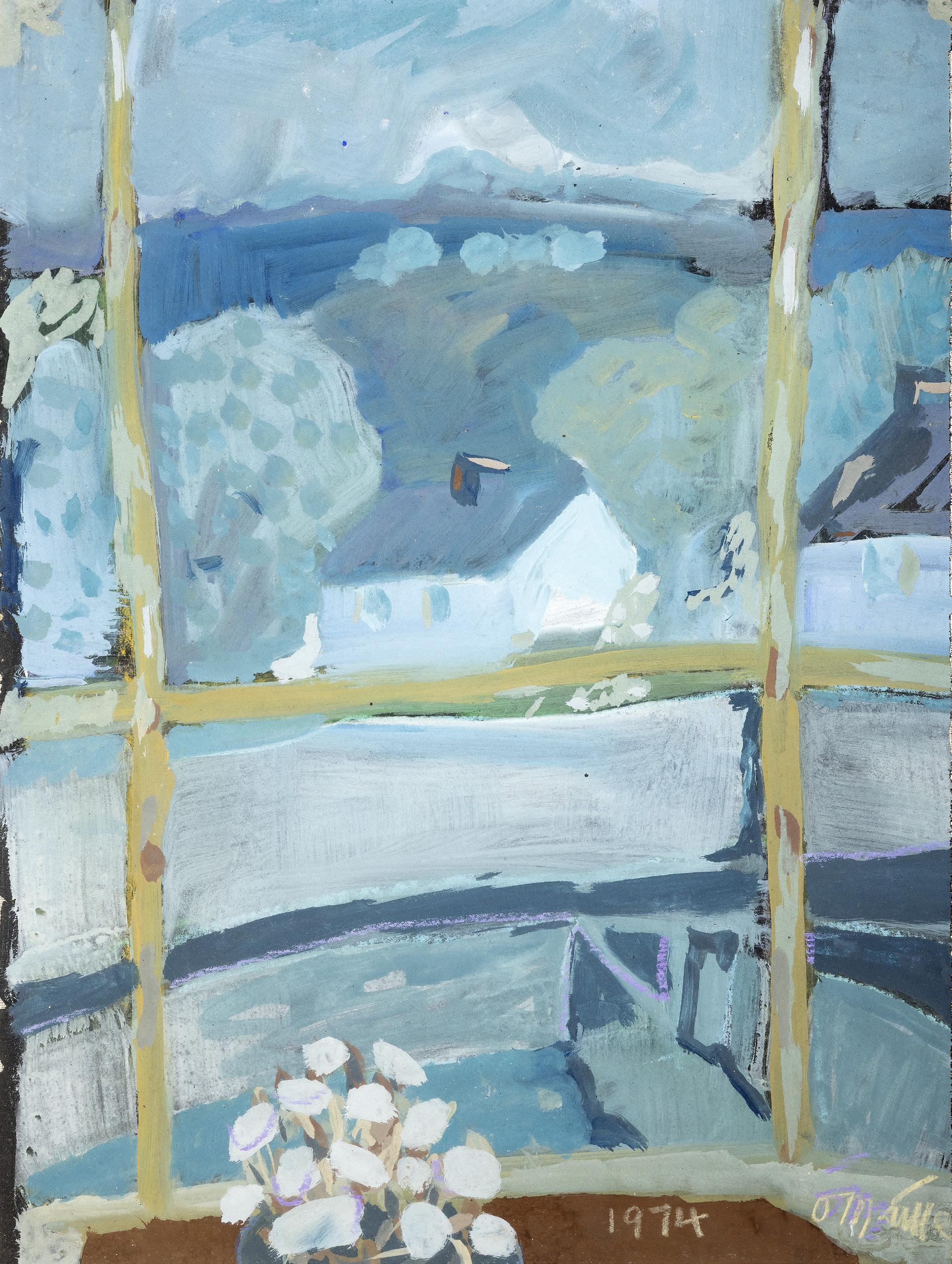
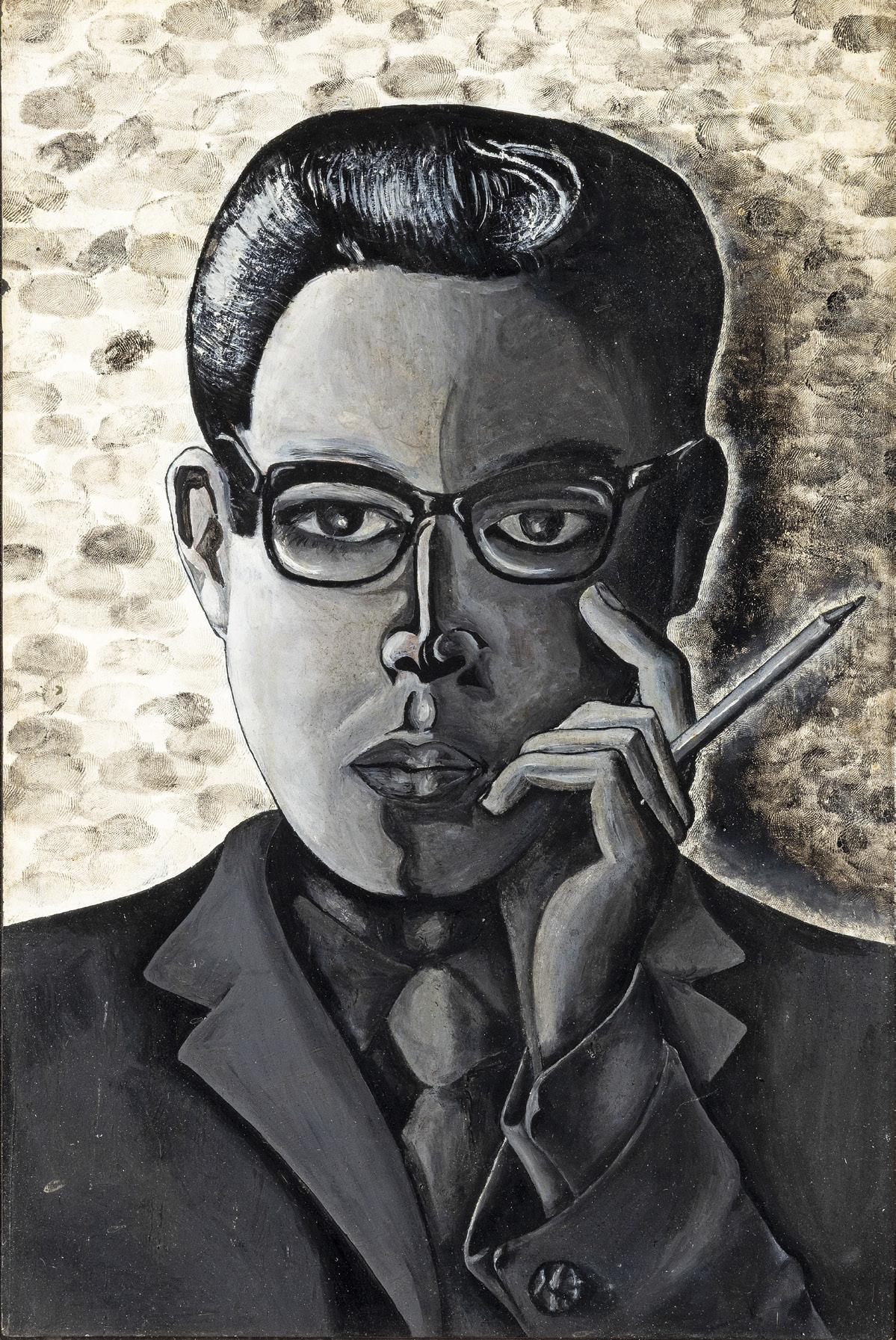
Oil on board, 37 x 25cm (14½ x 9¾’’)
Signed verso; with Gorry Gallery label verso
Provenance: With Gorry Gallery, Dublin, label verso
€ 3,000 - 5,000
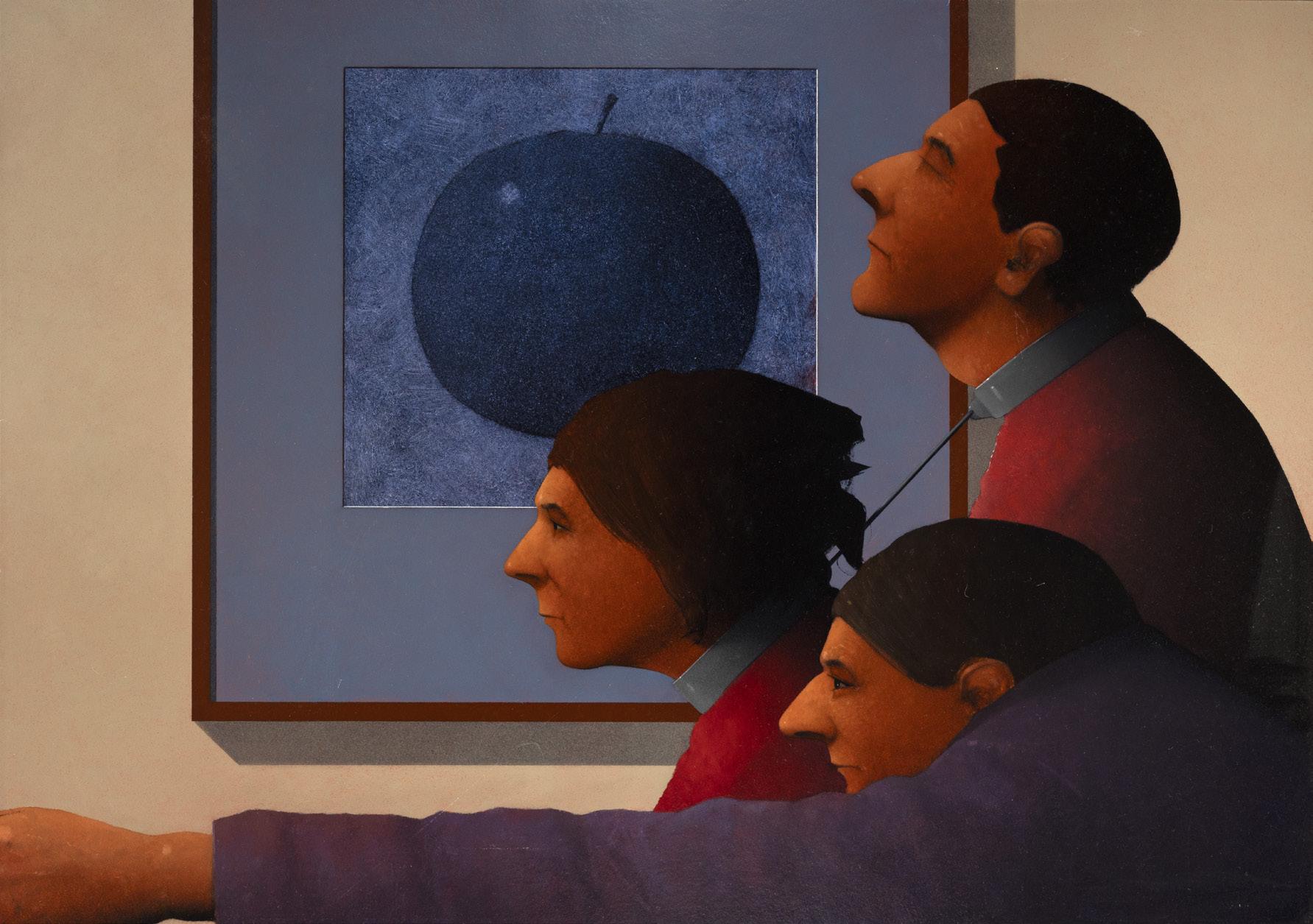
The Waiting Room (1997)
Oil on board, 53 x 75cm (20 x 29’’)
Signed; also signed, inscribed and dated (19)’97 verso
Provenance: With Christopher Hull Gallery, London, label verso
€ 6,000 - 8,000
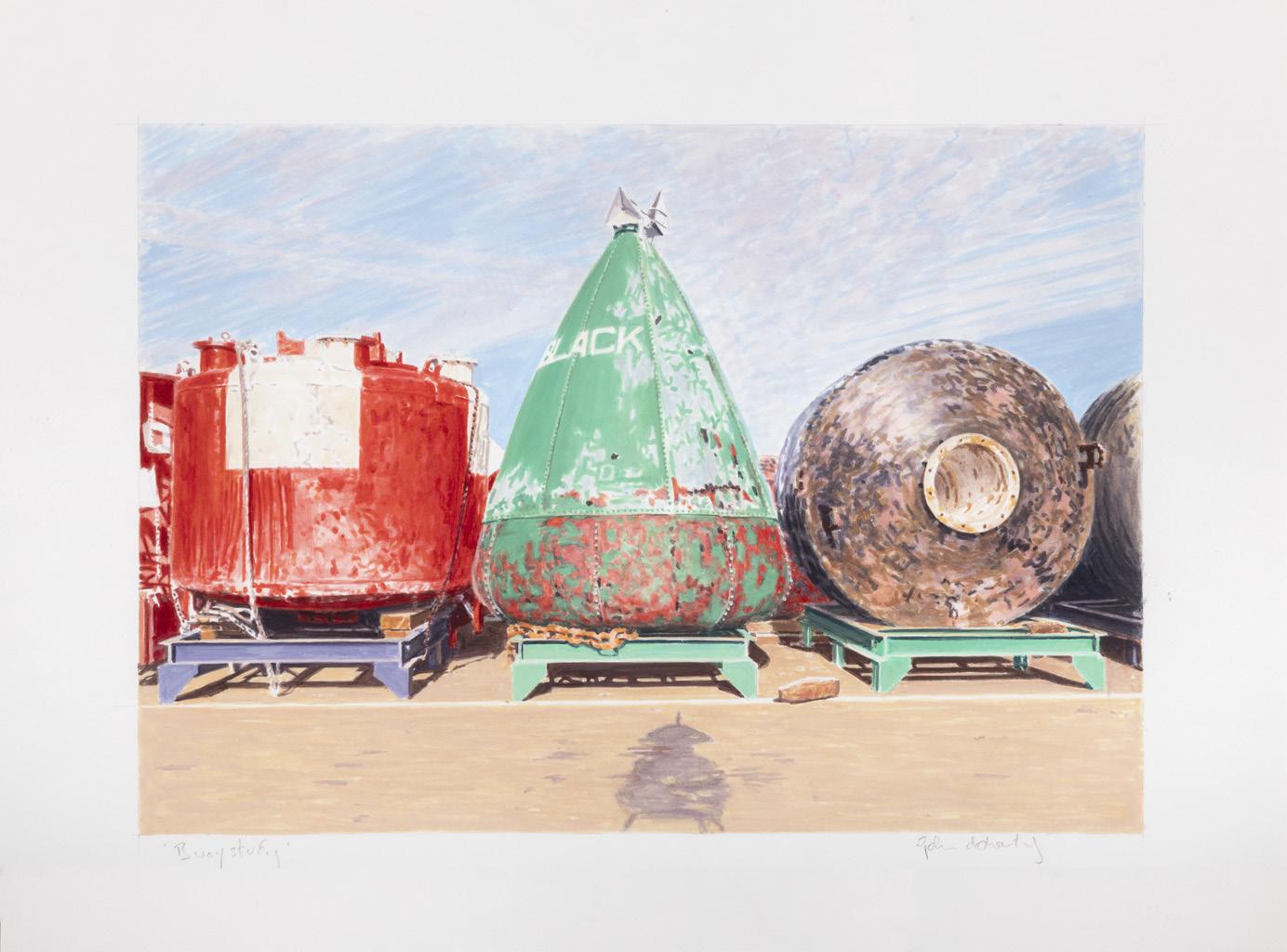
59
JOHN DOHERTY (B.1949)
‘Buoy Study’
Watercolour, 21 x 29cm (8¼ x 11½’’)
Signed and inscribed
€ 1,000 - 1,500
60
MARTIN GALE RHA (B.1949)
Animal Tent (2011)
Watercolour, 19 x 29cm (7½ x 11½’’)
Signed and dated 2011
Provenance: With Taylor Galleries, Dublin, label verso.
€ 700 - 1,000
Provenance: With
€ 2,000 - 3,000
Morning Exercises
Oil on canvas, 89 x 178cm (34¾ x 70’’)
Signed
€ 20,000 - 30,000
Born in Waterford, Peter Curling developed an early affinity for horses, nurtured in part by his mother’s involvement in the sale of sporting art. This formative exposure introduced him not only to the subject matter that would come to define his career but also to the visual traditions of equestrian painting. His aptitude for depicting horses emerged at a young age and was quickly recognised; by the age of fourteen, while living in England, he had already achieved notable success with a sold-out exhibition at Lambourn.
Curling’s formal education included studies at Stonyhurst, followed by a scholarship to Millfield. He subsequently pursued artistic training in Florence, where from 1971 to 1974 he studied under the renowned Signorina Simi. This period proved pivotal in refining his technical abilities and deepening his understanding of classical draughtsmanship. In particular, it enabled him to develop a precise and sensitive approach to equine anatomy, combined with a distinctive capacity to convey movement and vitality.
Upon returning to Ireland in 1975, Curling established himself as a painter of exceptional skill and focus, dedicated primarily to the horse as subject. His work is characterised by a balance between anatomical accuracy and an expressive rendering of motion, capturing both the physical power and the elegance of his subjects. This dual emphasis has become a defining feature of his practice and contributes to the enduring appeal of his work.
Curling’s engagement with horses extends beyond the studio. Over the years, he has been actively involved in
various aspects of equestrian life, including ownership, hunting, training, and stewarding. This direct experience informs his artistic output, lending authenticity and insight to his depictions.
Today, Curling’s work is in high demand, and he is widely regarded as one of Ireland’s leading equestrian painters. His distinctive treatment of the horse, combining technical mastery with an intimate understanding of the subject, has secured his reputation both nationally and internationally.
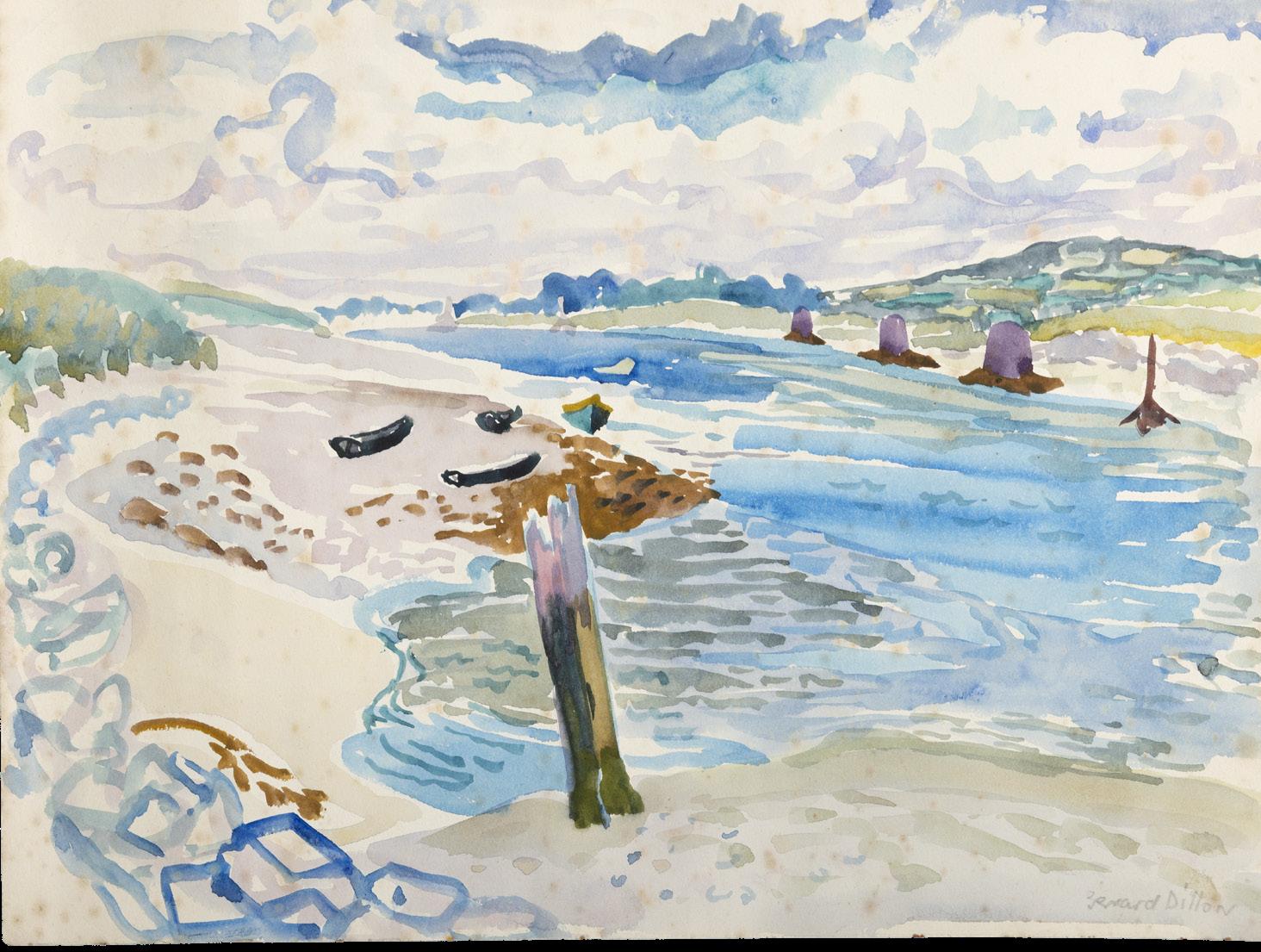
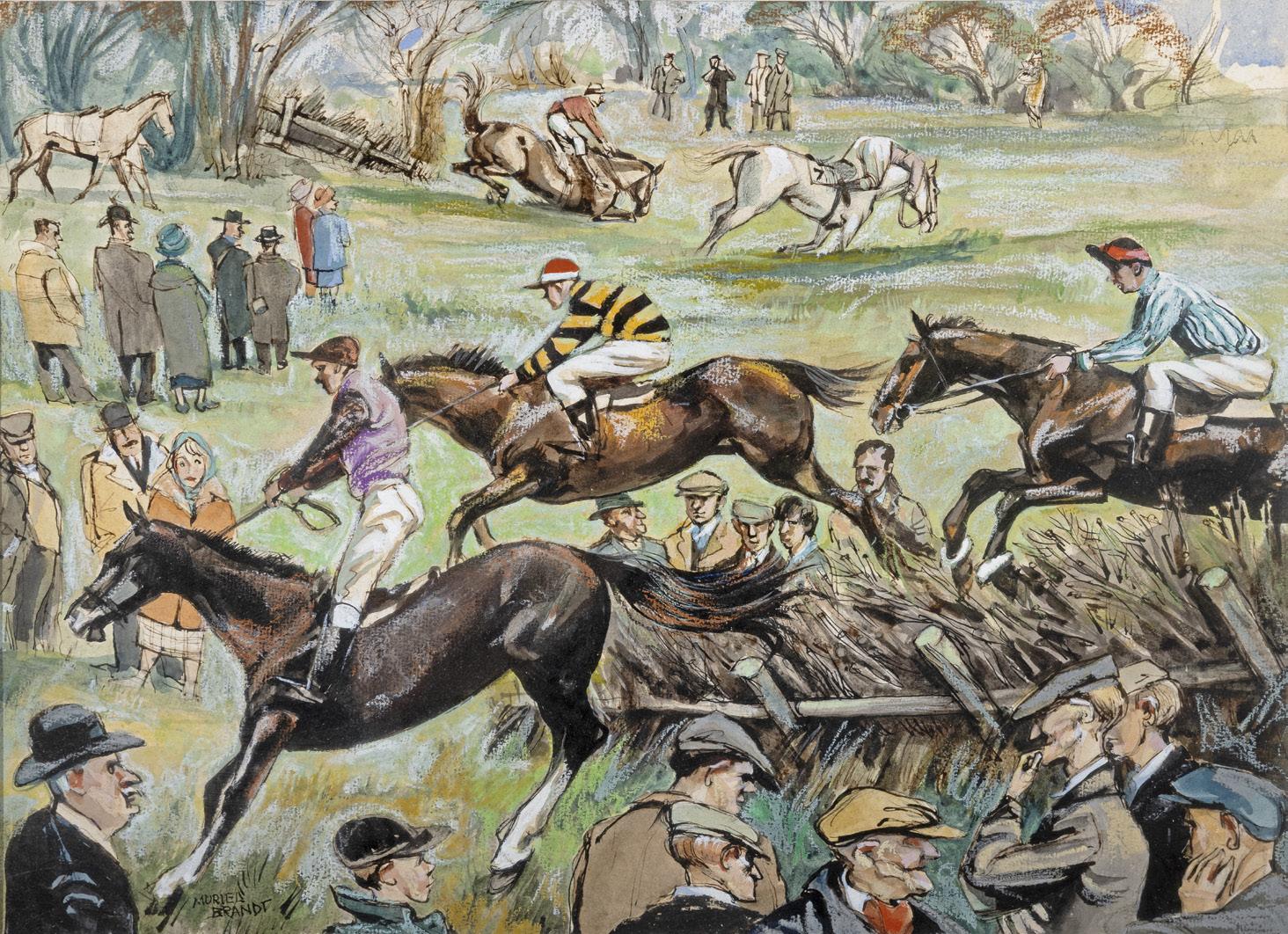
63
GERARD DILLON (1916-1971)
Untitled
Watercolour, 21.5 x 29cm (8½ x 11½”)
Signed
Provenance: A gift from the artist’s brother to the current owner
€ 800 - 1,200
64
MURIEL BRANDT RHA (1909-1981)
A Point to Point Meet
Watercolour and pastel, 33 x 46cm (13 x 18”)
Signed
Provenance: Sale, DeVere’s Dublin, 25/3/2025, lot 3
€ 1,000 - 1,500
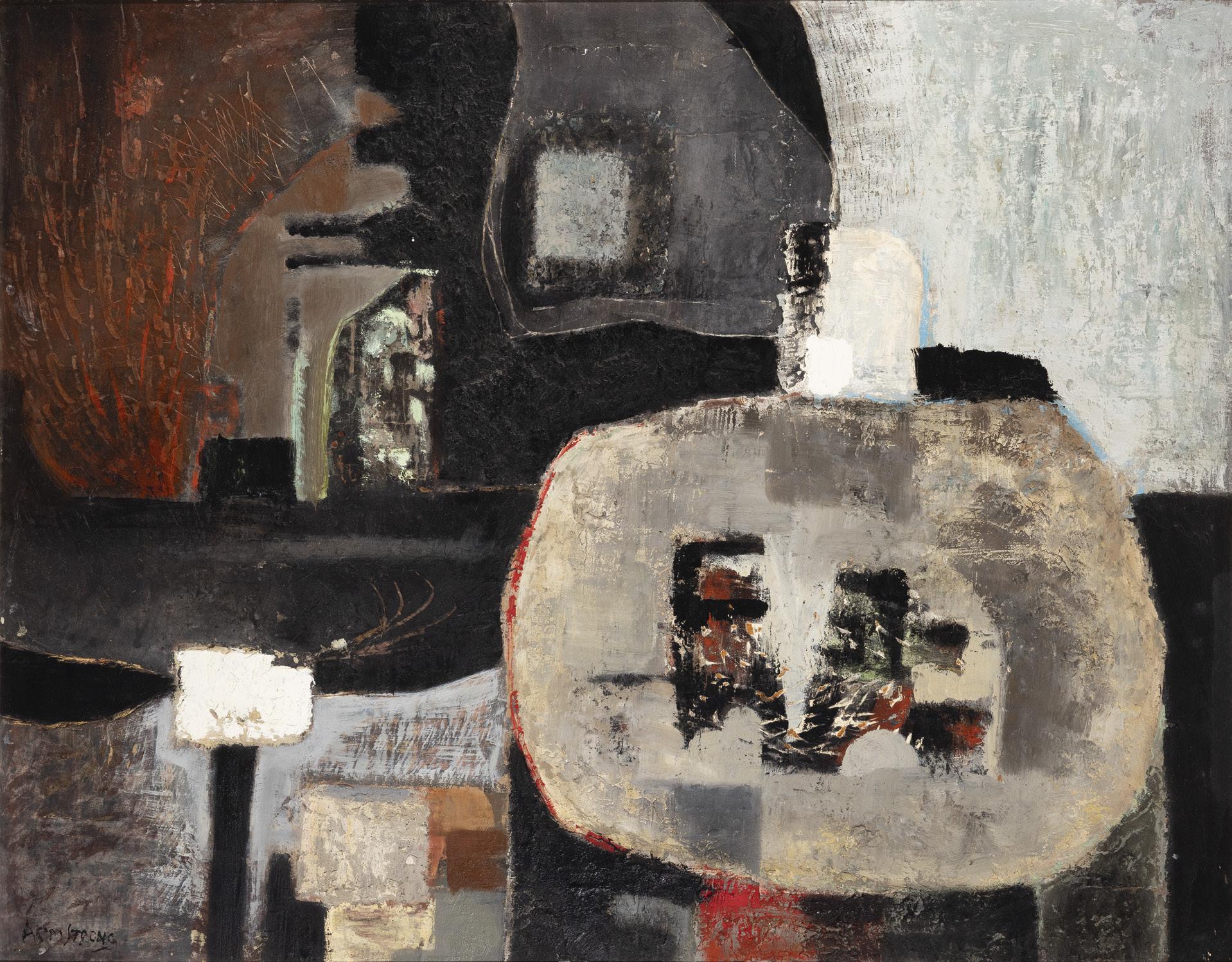
65
*ARTHUR ARMSTRONG RHA (1924-1996)
Abstract
Oil on board, 60 x 74.5cm (23 ¾ x 29¼’’)
Signed
€ 1,500 - 2,000
*Please note this is imported under Temporary Admission. It will attract import duty of 13.5%
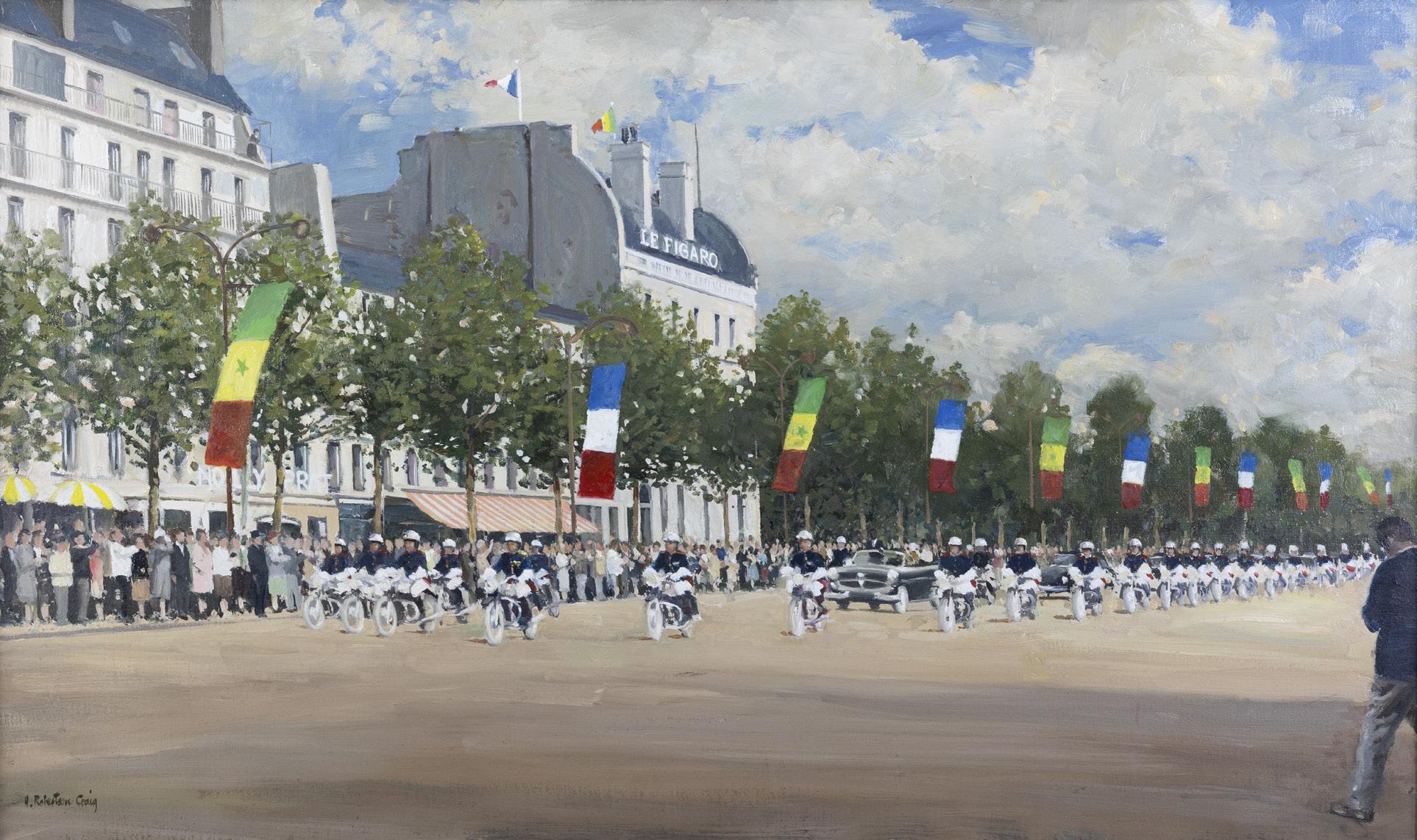
HENRY ROBERTSON CRAIG RHA (1916-1984)
H.E. Mr. Leopold Senghor, President of Senegal, in Procession in the Champs Elysees, Paris
Oil on canvas, 60 x 101cm (23½ x 39¾’’)
Signed; also signed, inscribed and with oeuvre number RC545 on stretcher
Léopold Sédar Senghor (1906-2001) was a Senegalese poet, politician and cultural theorist who for two decades served as the first president of Senegal (1960-80). Ideologically an African socialist, he was the founder of the Senegalese Democratic Bloc party.
In 1983 Senghor was elected as a member of the Académie Française, at the 16th seat where he succeeded Antoine de Lévis Mirepoix. He was the first African to sit at the Académie. Although a socialist, Senghor avoided the Marxist and anti-Western ideology that had become popular in post-colonial Africa, favouring the maintenance of close ties with France and the western world. This is seen by many as a contributing factor to Senegals political stability: it remains one of the few African nations never to have had a coup, and always to have had a peaceful transfer of power.
On 31 December 1980, he retired as President in favour of his prime minister, Abdou Diouf. On news of his death in 2001, Jacques Chirac is quoted as saying “Poetry has lost one of its masters, Senegal a statesman, Africa a visionary and France a friend.”
€ 3,000 - 5,000
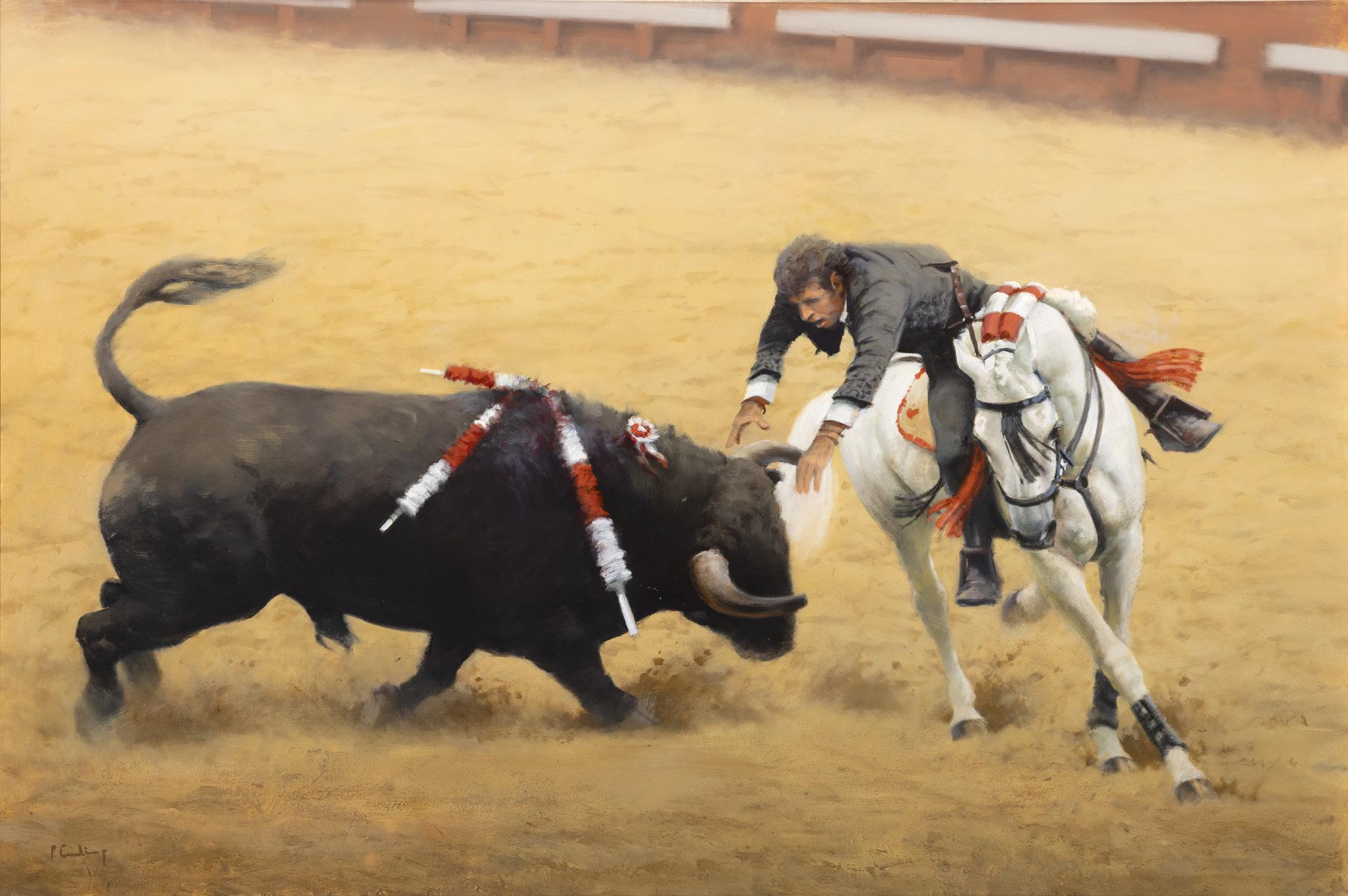
Oil on canvas, 122 x 183cm (48 x 72”)
Signed
€ 10,000 - 15,000
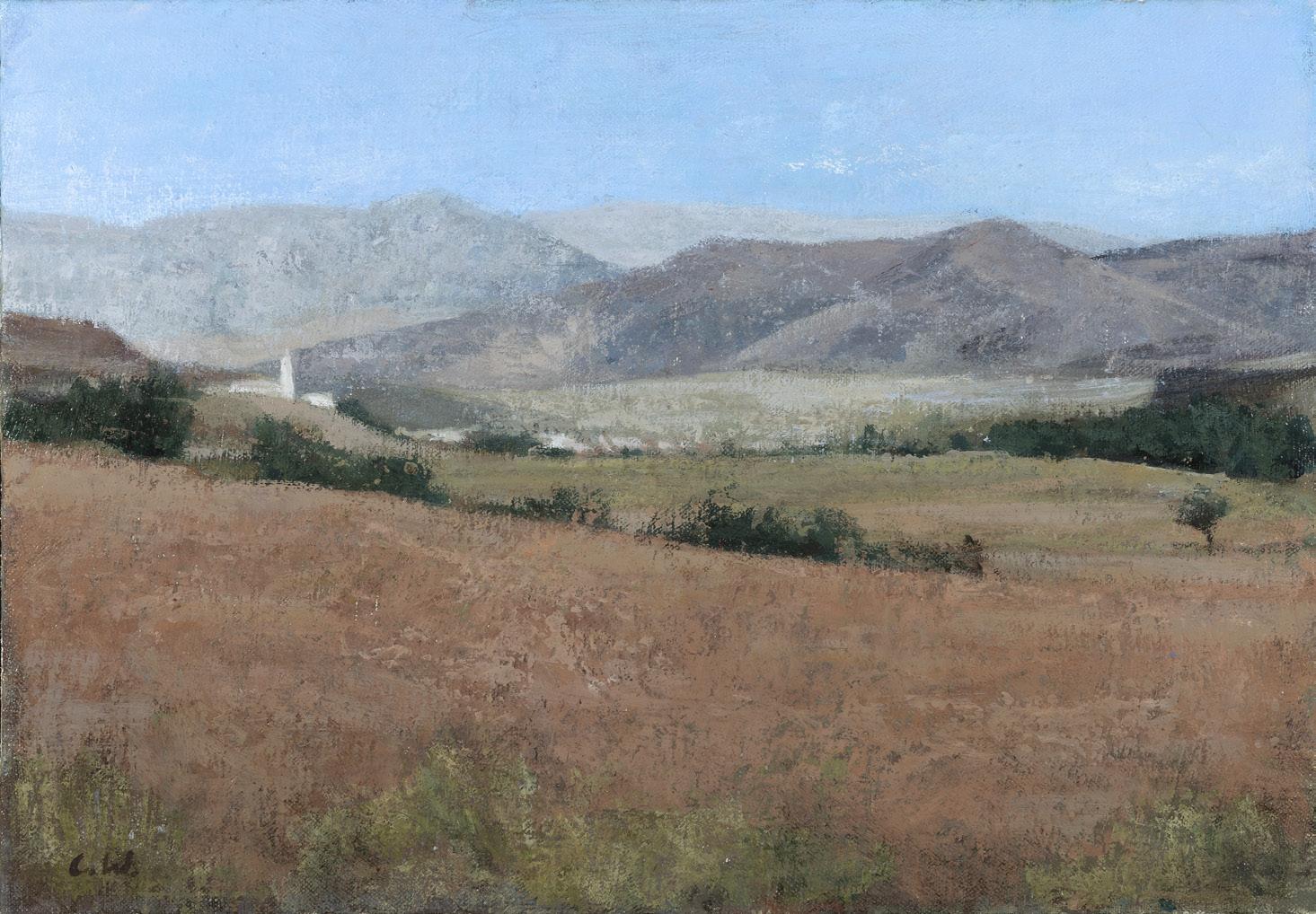
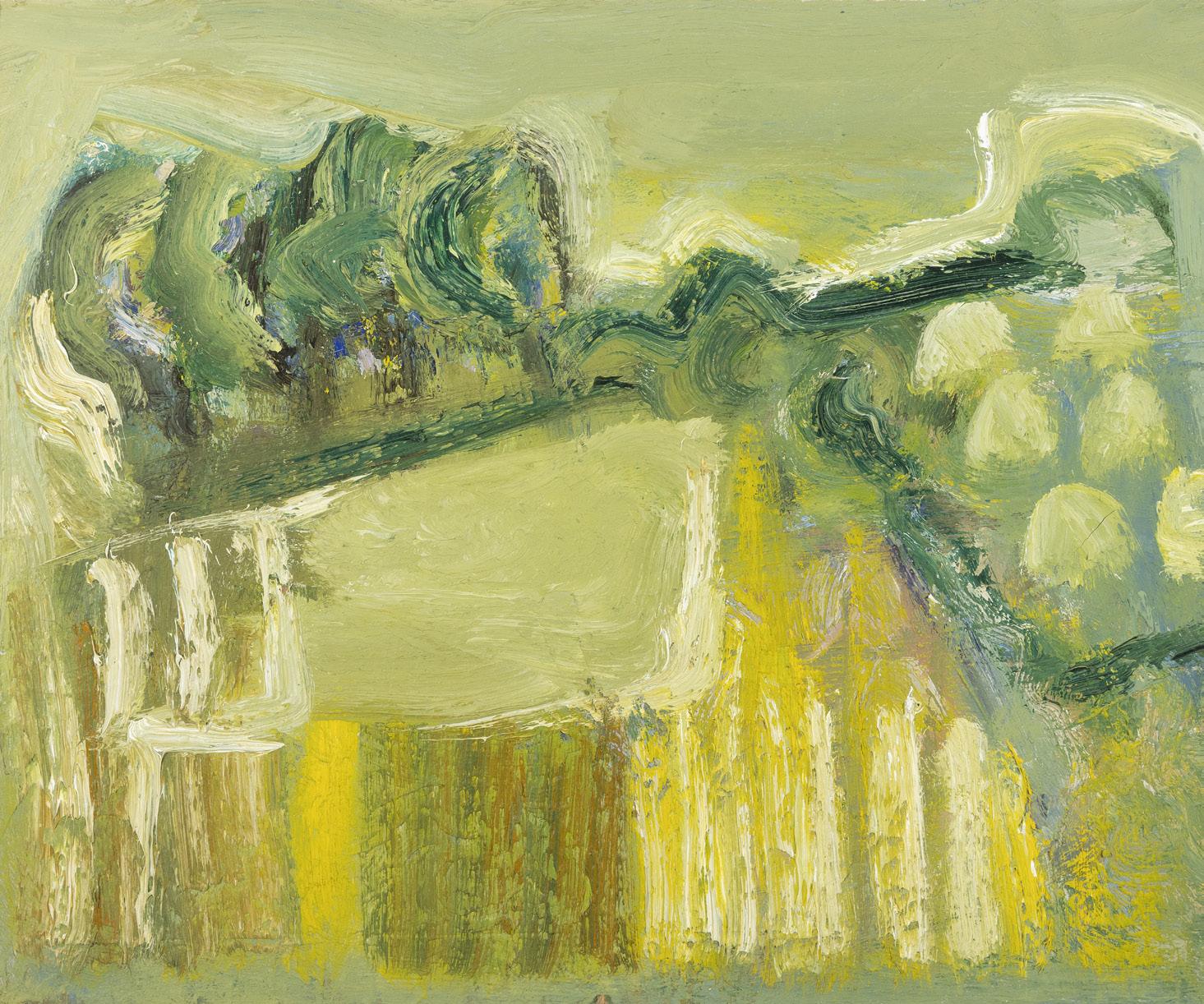
68
COLIN WATSON (B.1966)
Agouim with the High Atlas in the Distance
Oil on board, 25 x 37cm (10” x 14½”)
Signed with initials
Provenance: With Pyms Gallery, London, label verso.
€ 1,000 - 1,500
69
ANITA SHELBOURNE, RHA (B.1938)
Summer Haze
Oil on board, 23 x 28.5cm (9 x 11¼’’)
Signed verso
€ 500 - 700
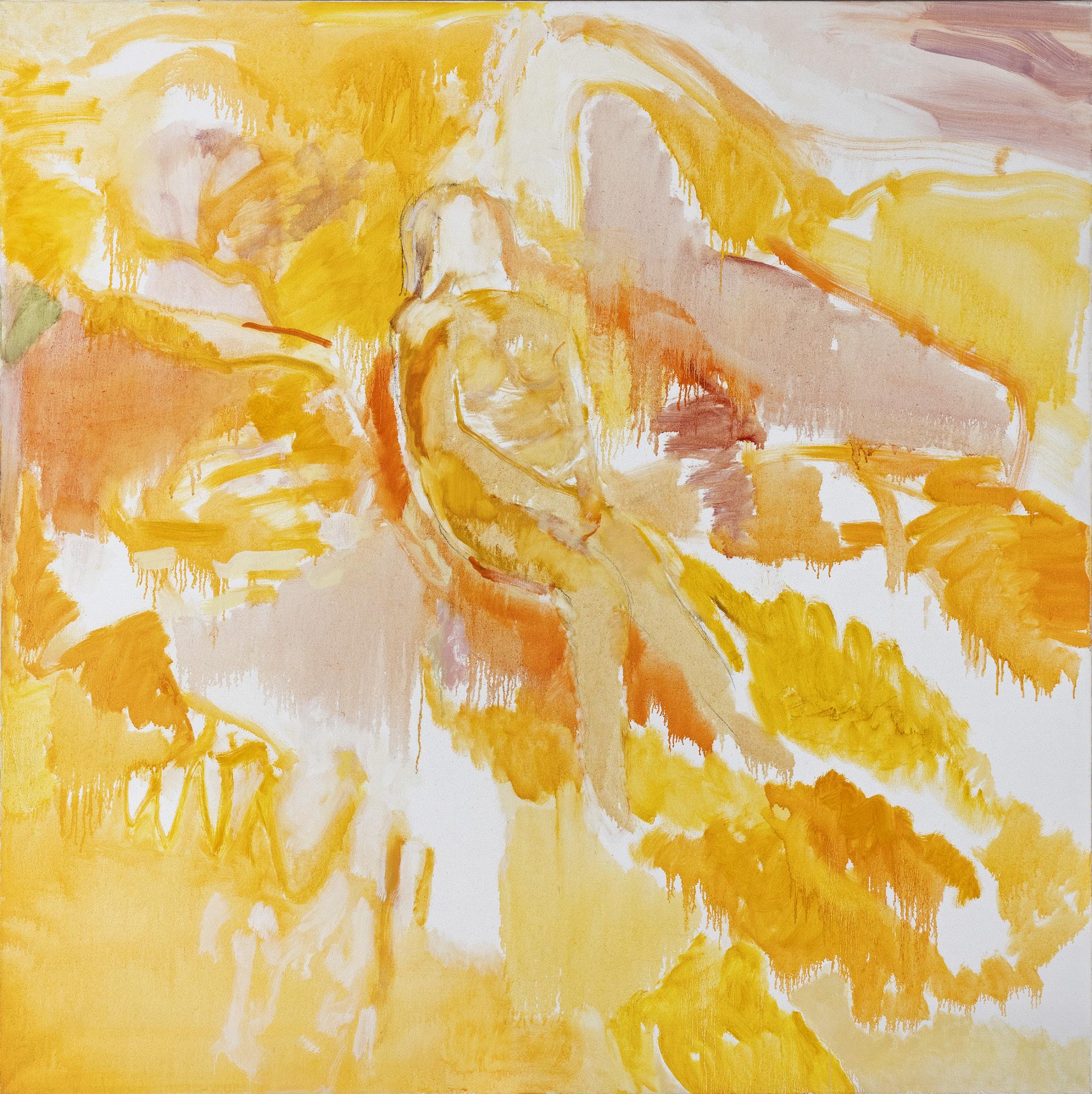
Sitting Figure
Oil on canvas, 185 x 185cm (72¾ x 72¾’’)
Signed, inscribed and dated 2006 verso
Provenance: With Kerlin Gallery, Dublin, label verso; From the artist’s estate
€ 7,000 - 10,000
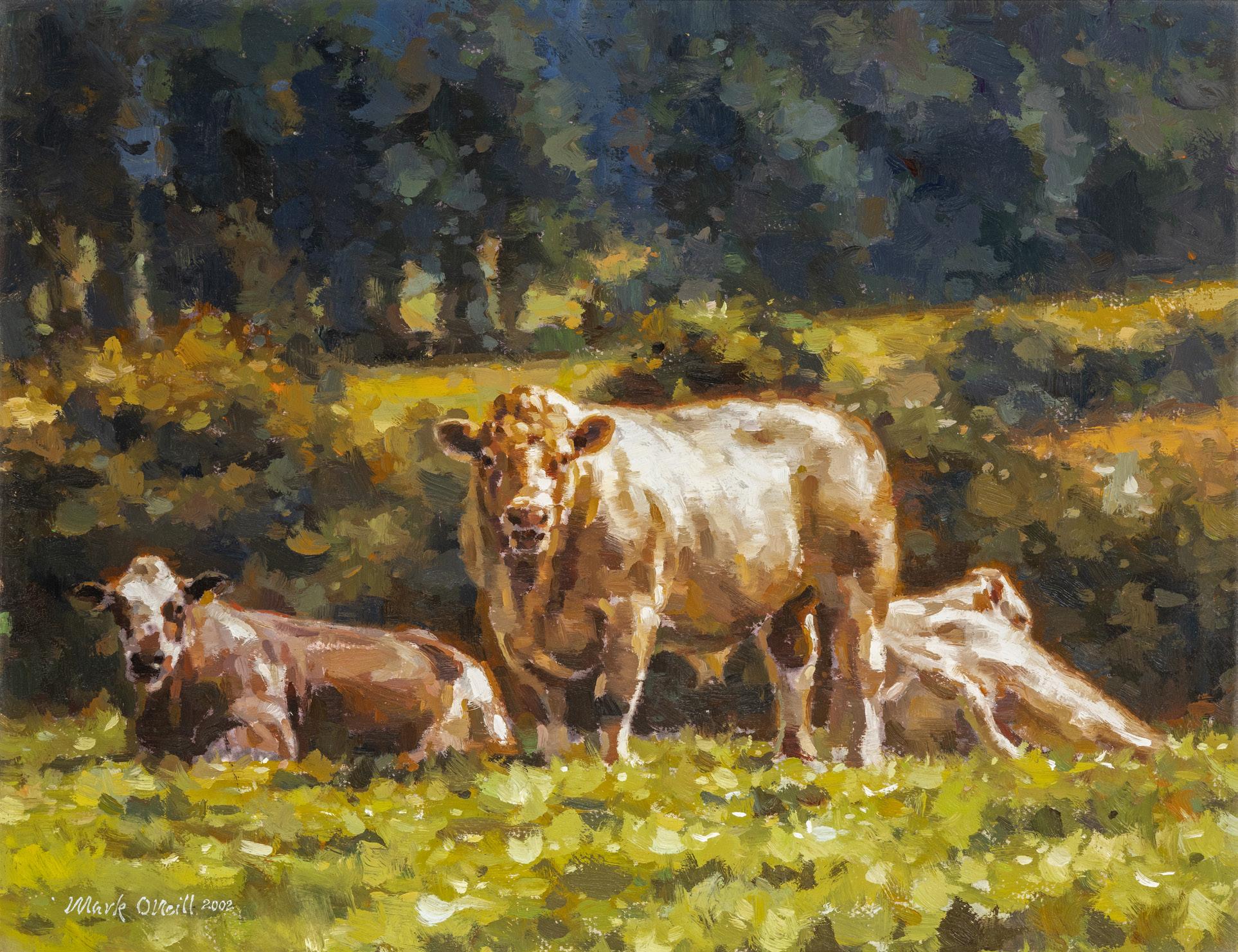
Oil on canvas, 36 x 46cm (14 x 18”)
Signed and dated 2002
€ 1,500 - 2,000
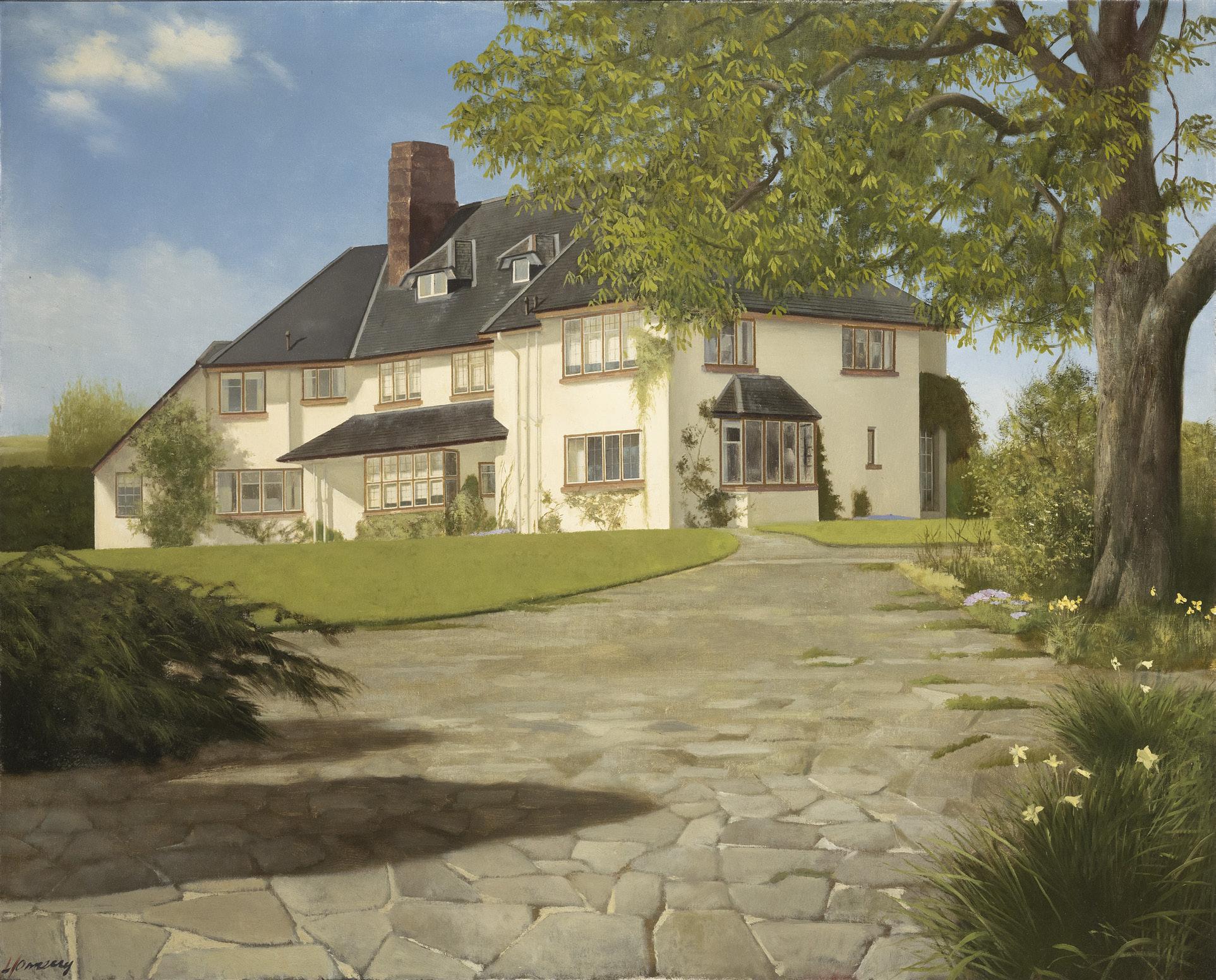
Oil on canvas, 101 x 126cm (39¾ x 49½”)
Signed
€ 3,000 - 5,000
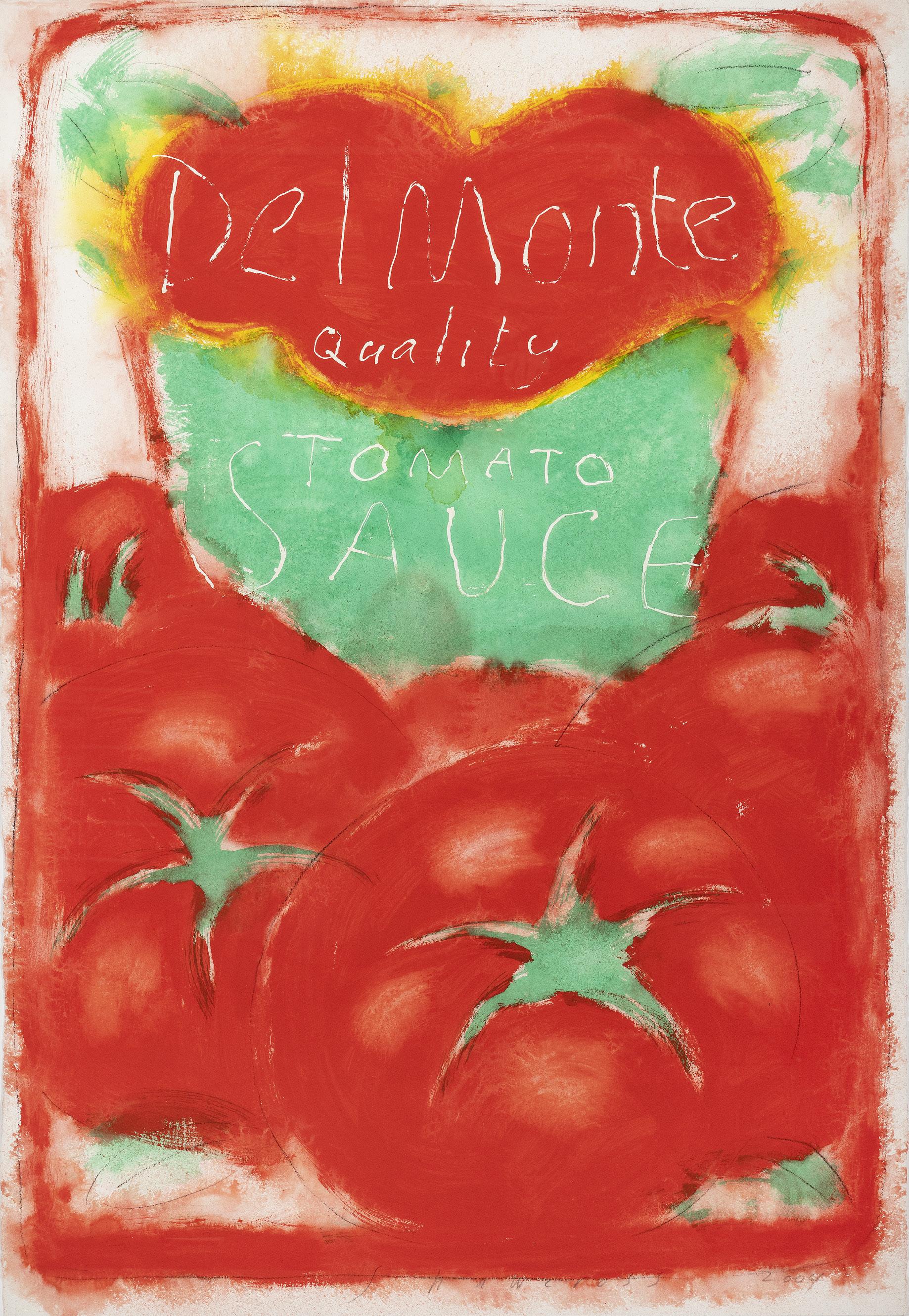
73
NEIL SHAWCROSS
MBE RUA HRHA (B.1940)
Del Monte (2004)
Watercolour, 151.5 x 102cm (59½ x 40¼’’)
Signed and dated 2004
€ 3,000 - 5,000
74
NEIL SHAWCROSS
MBE RUA HRHA (B.1940)
Mott’s (2007)
Oil and watercolour on canvas, 173 x 92cm (68¼ x 36¼’’)
Signed and dated 2007
€ 4,000 - 6,000
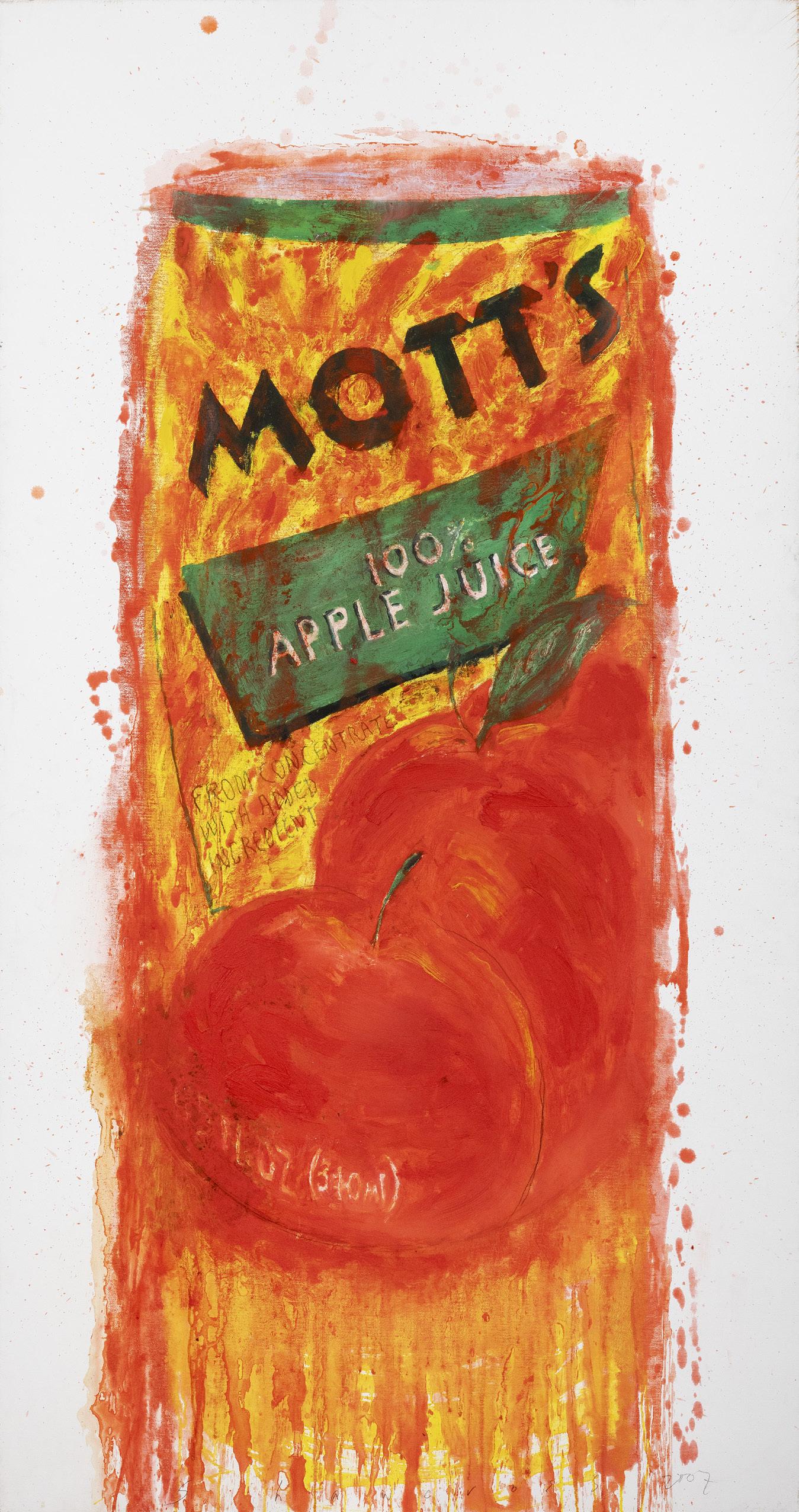
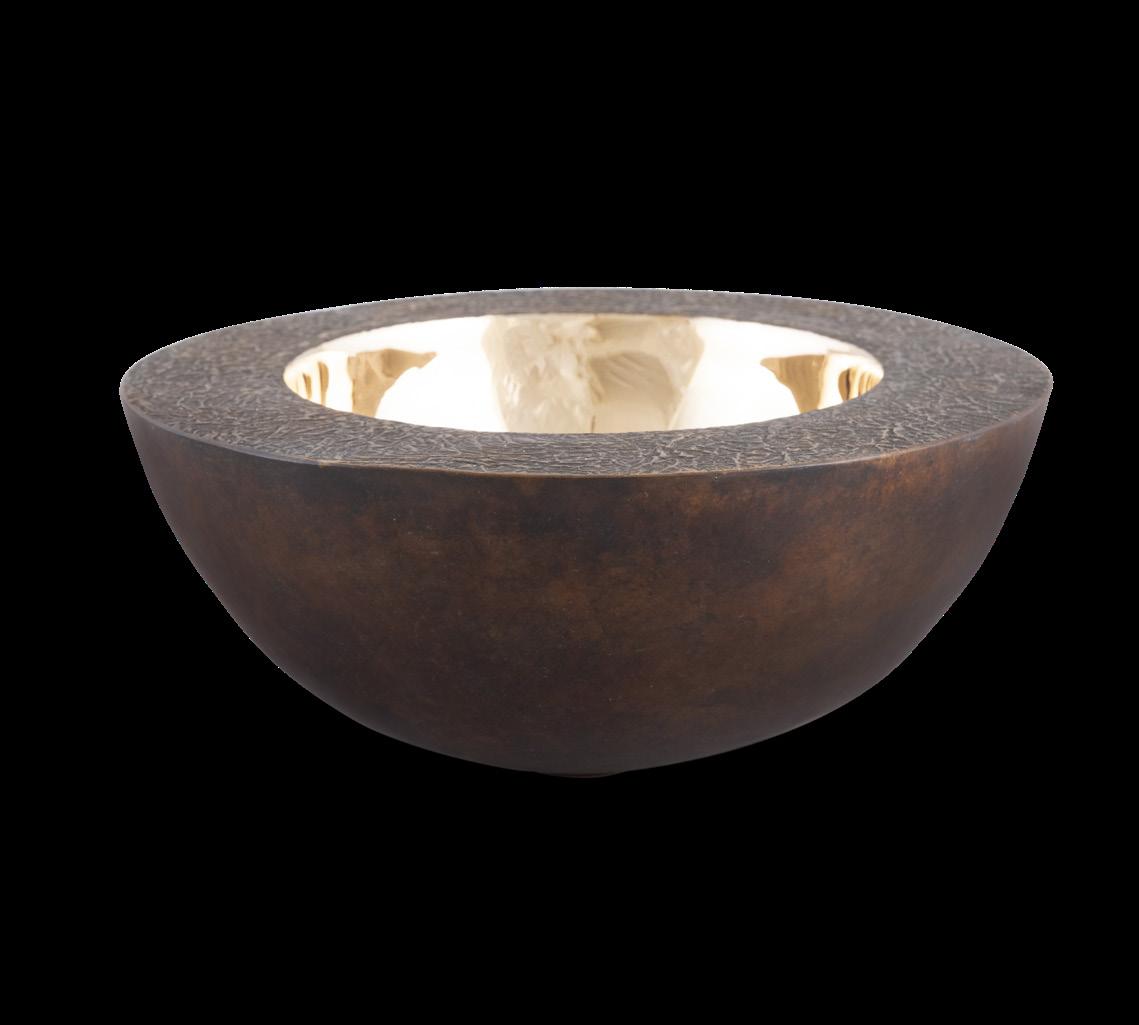
75
MICHAEL FOLEY (B.1963)
Ciotola Impuzzita (2026)
Bronze, 28 x 12cm (11 x 4¾”) (h)
Edition 1/9
Signed and dated 2026
€ 1,200 - 1,600
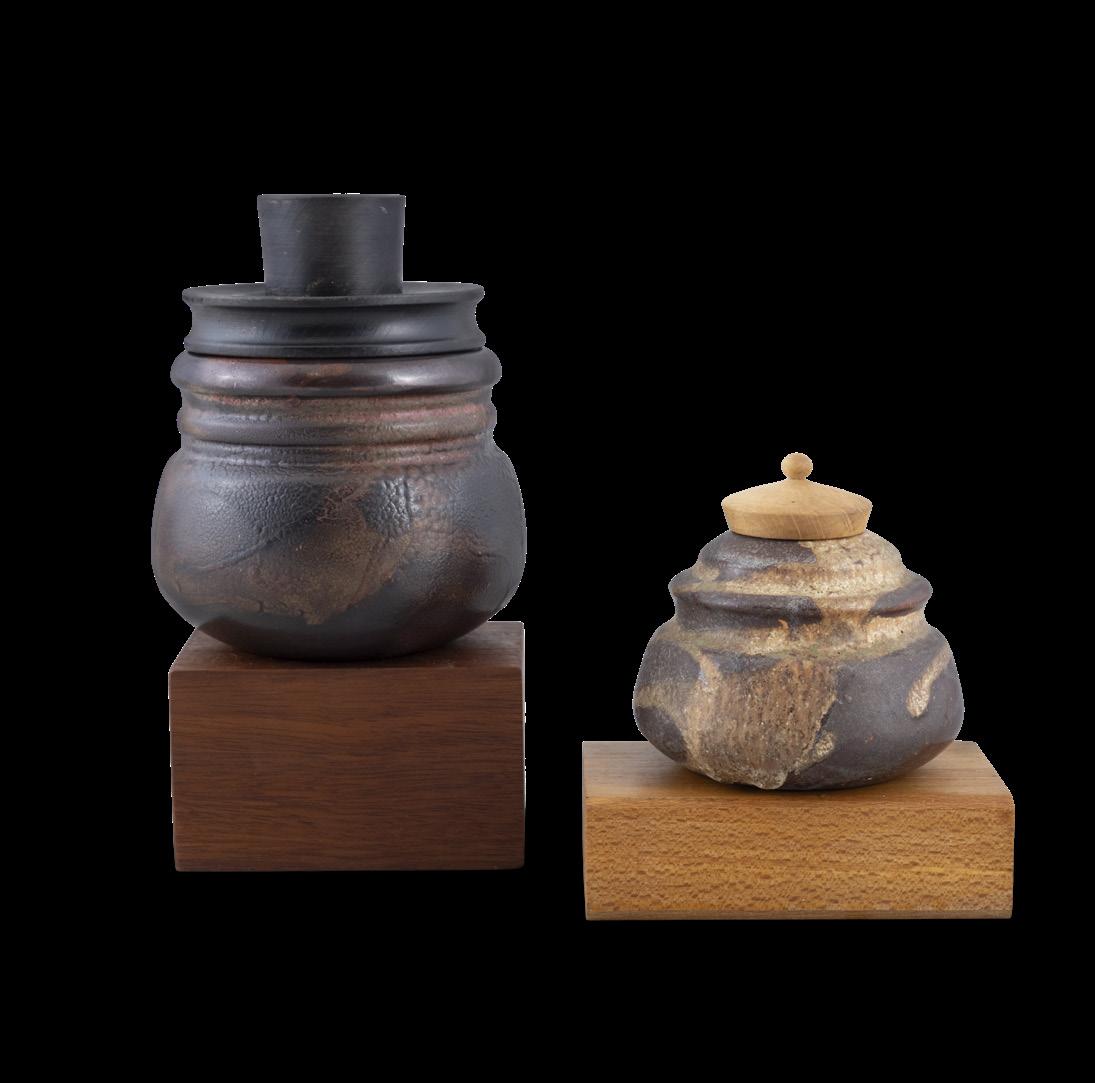
76 SONJA LANDWEER (1933-2019)
Vessels (2)
Ceramic, 16cm(h); 11cm(h) (6¼; 4¼’’)
Signed
Provenance: From the artist’s estate
€ 800 - 1,200
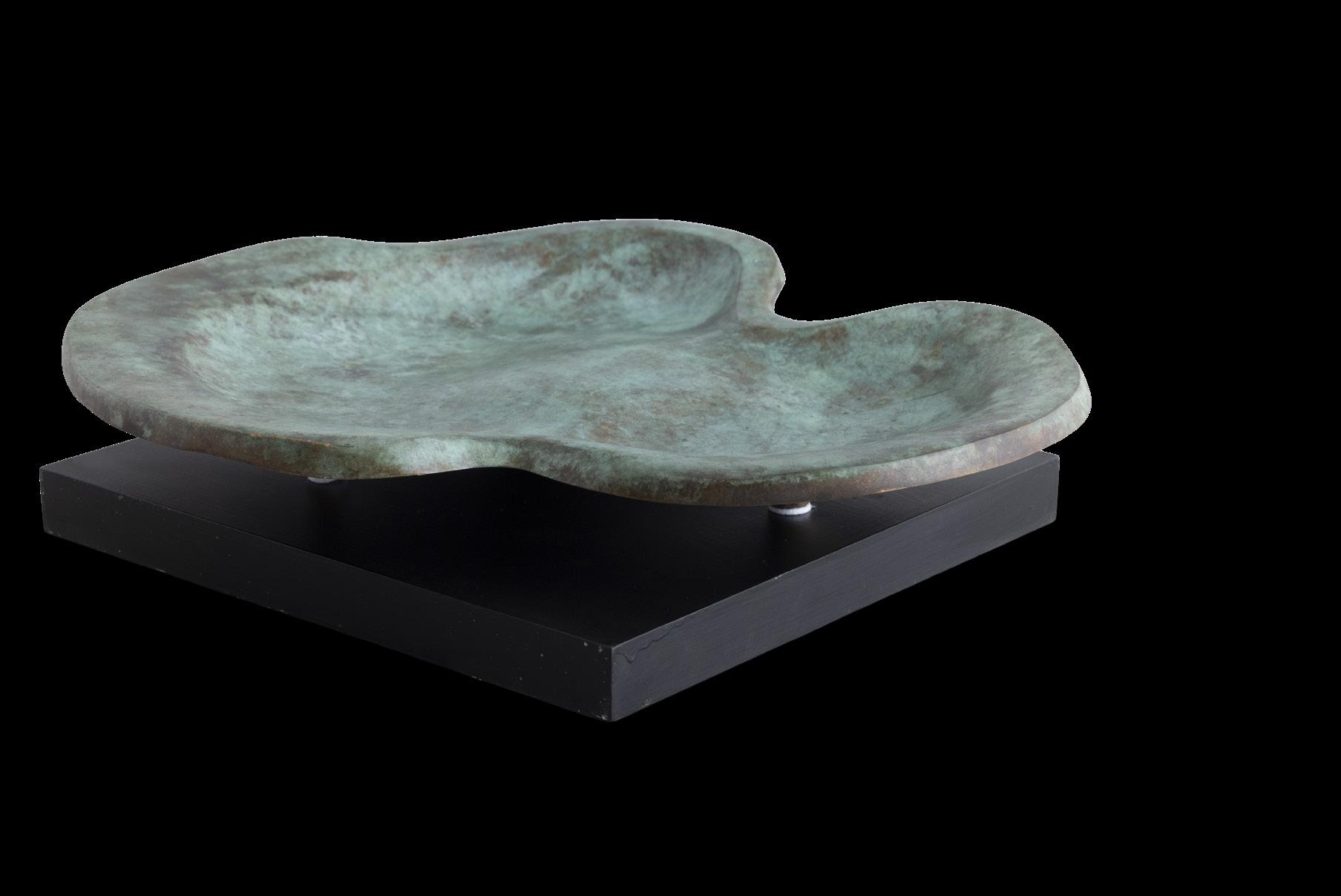
77
SONJA LANDWEER (1933-2019)
Leaf Shape
Bronze, 45 x 39 x 7cm(h) (17¾ x 15¼ x 2¾’’)
Provenance: From the artist’s estate
€ 2,500 - 3,500
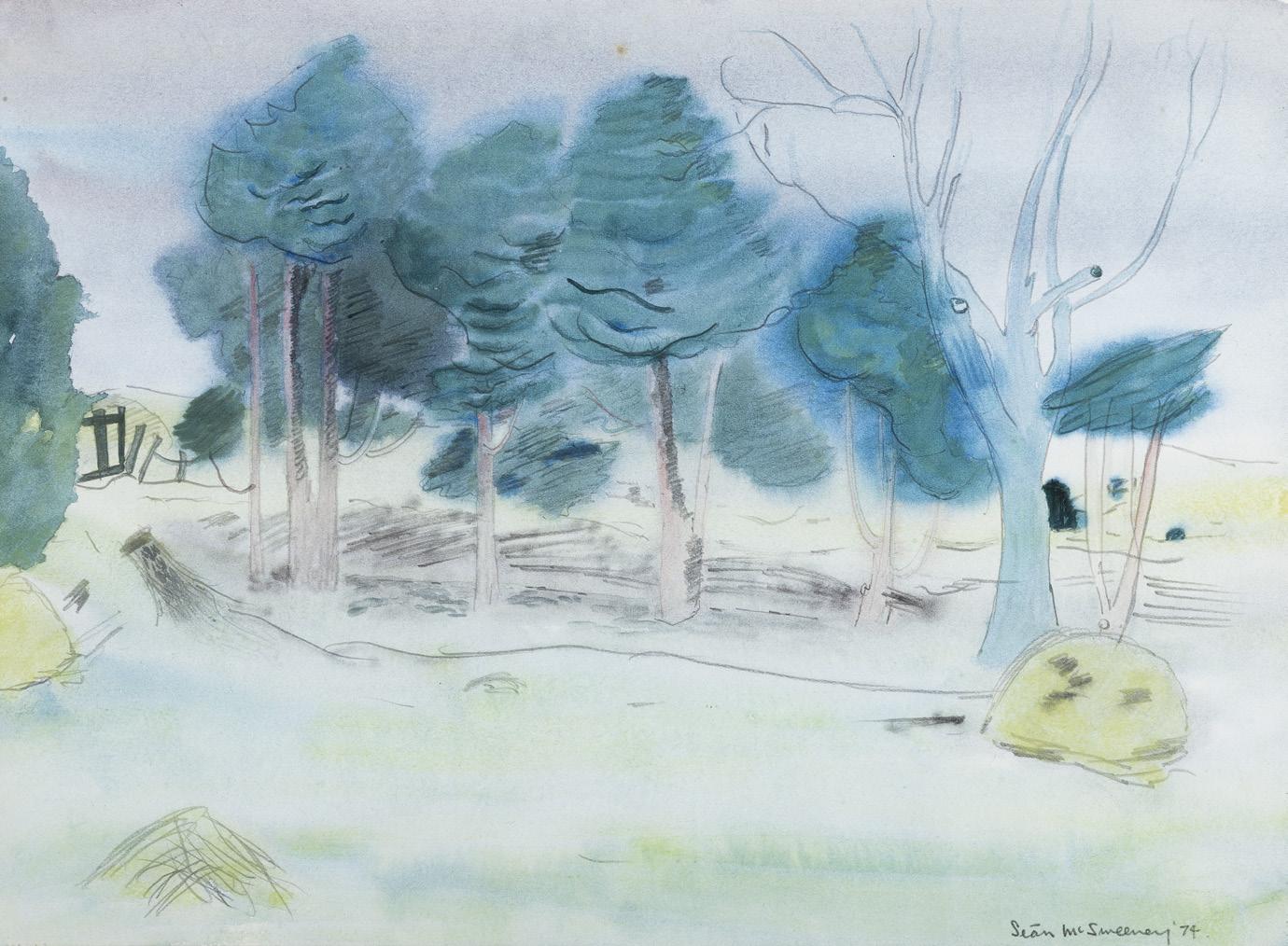
78
SEAN MCSWEENEY HRHA (1935-2018)
Landscape (1974)
Watercolour, 20 x 35cm (8 x 13¾’’)
Signed and dated (19)’74
€ 700 - 1,000
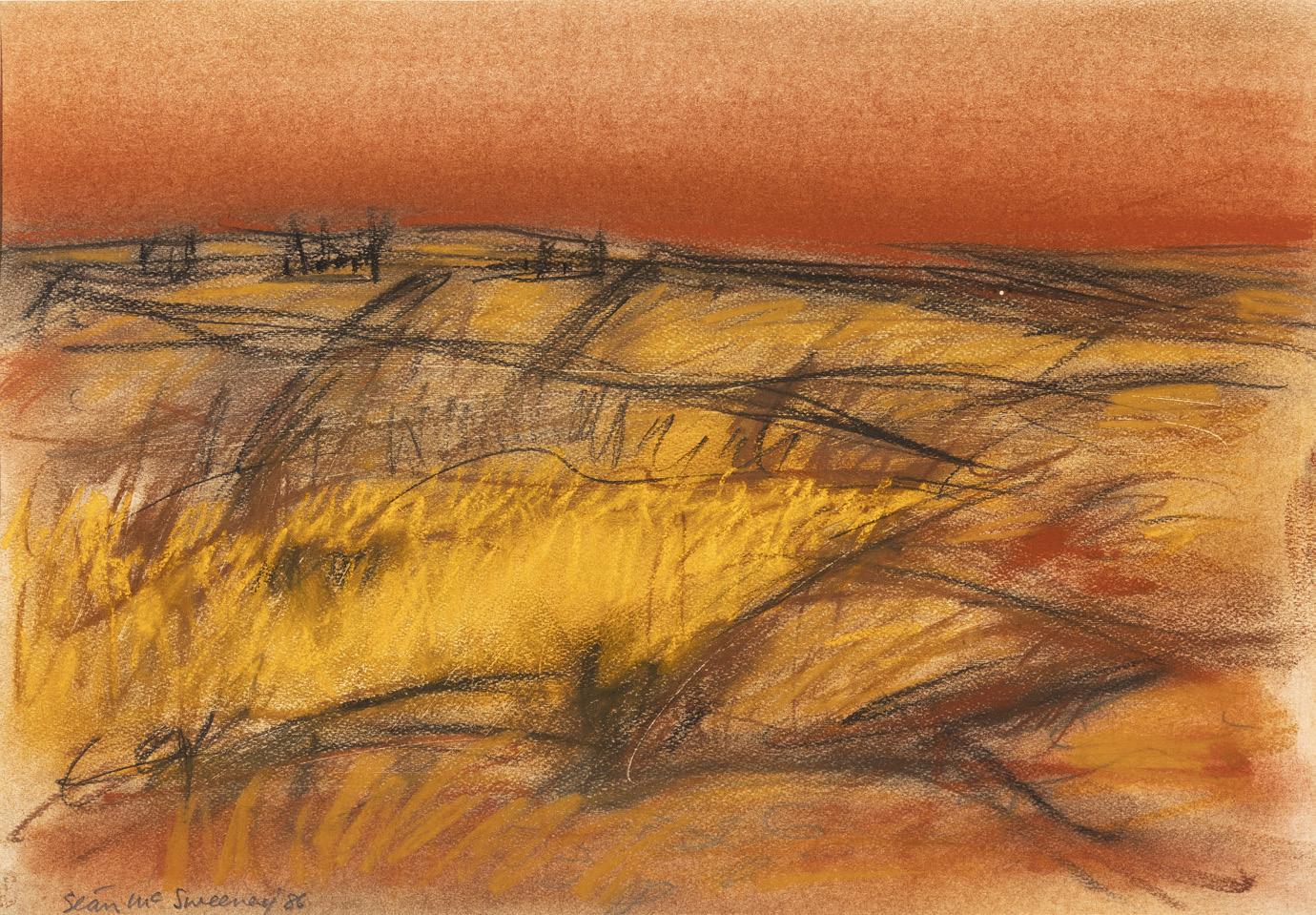
79
SEAN MCSWEENEY HRHA (1935-2018)
Deserted Cottages, Lochan (1986)
Watercolour, 29 x 39cm (11½ x 15¼”)
Signed and dated (19)’86, inscribed with title verso
€ 700 - 1,000
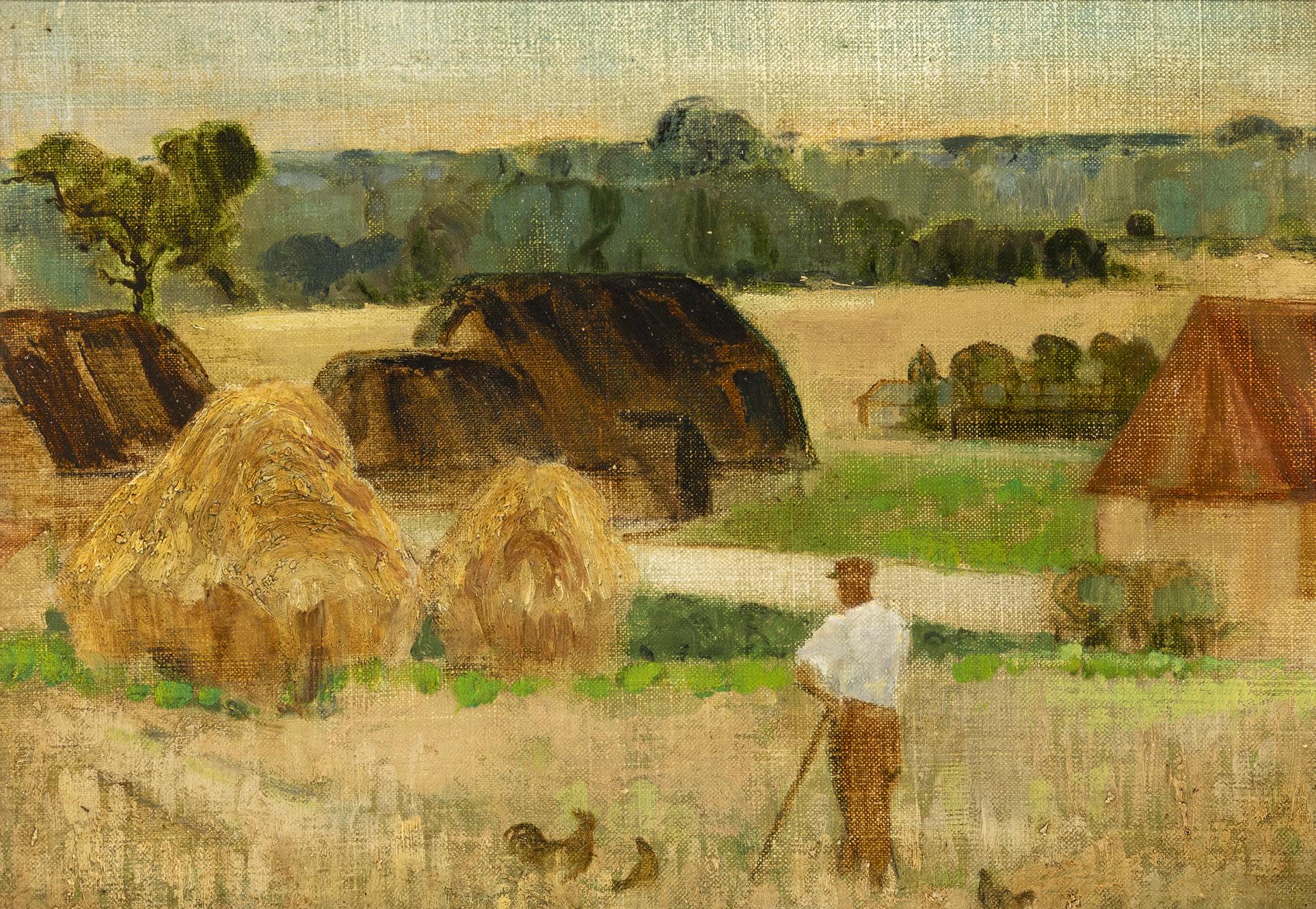
Oil on canvas, 23 x 32.5cm (9 x 12¾”)
Provenance: Collection of Bruce Arnold, by whom gifted to the present owner.
€ 1,000 - 1,500
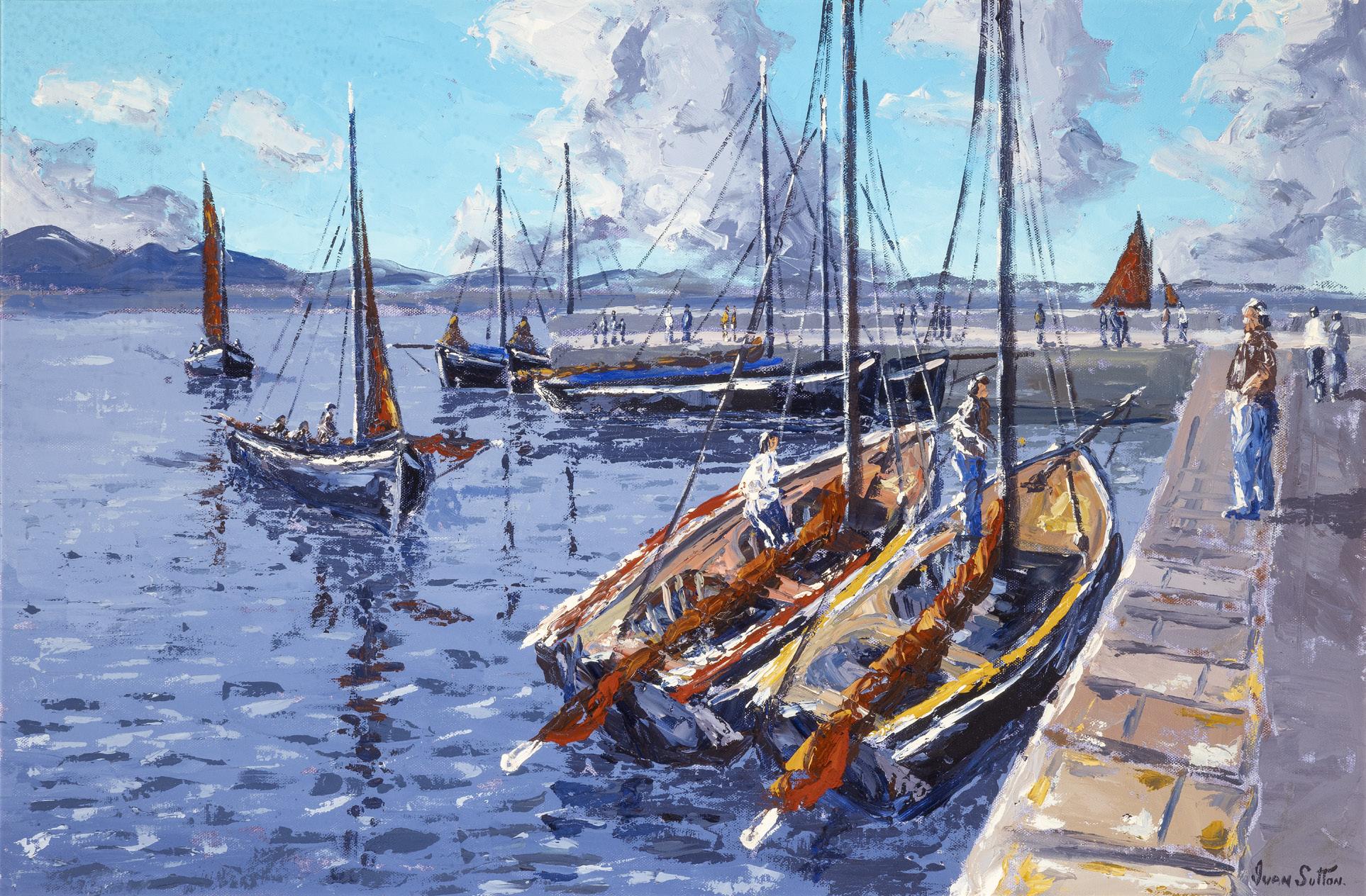
81
IVAN SUTTON (B.1944)
Regatta Day, Roundstone,
Oil on board, 50.8 x 76.2cm (20 x 30”)
Signed
Provenance: Sale, Whytes, Dublin, 18/05/2009, lot 192
€ 2,000 - 3,000
82
CAREY CLARKE PPRHA (B.1936)
King’s River, Co. Wicklow
Oil on canvas, 59 x 59cm (23¼ x 23¼”)
Signed
€ 2,000 - 3,000
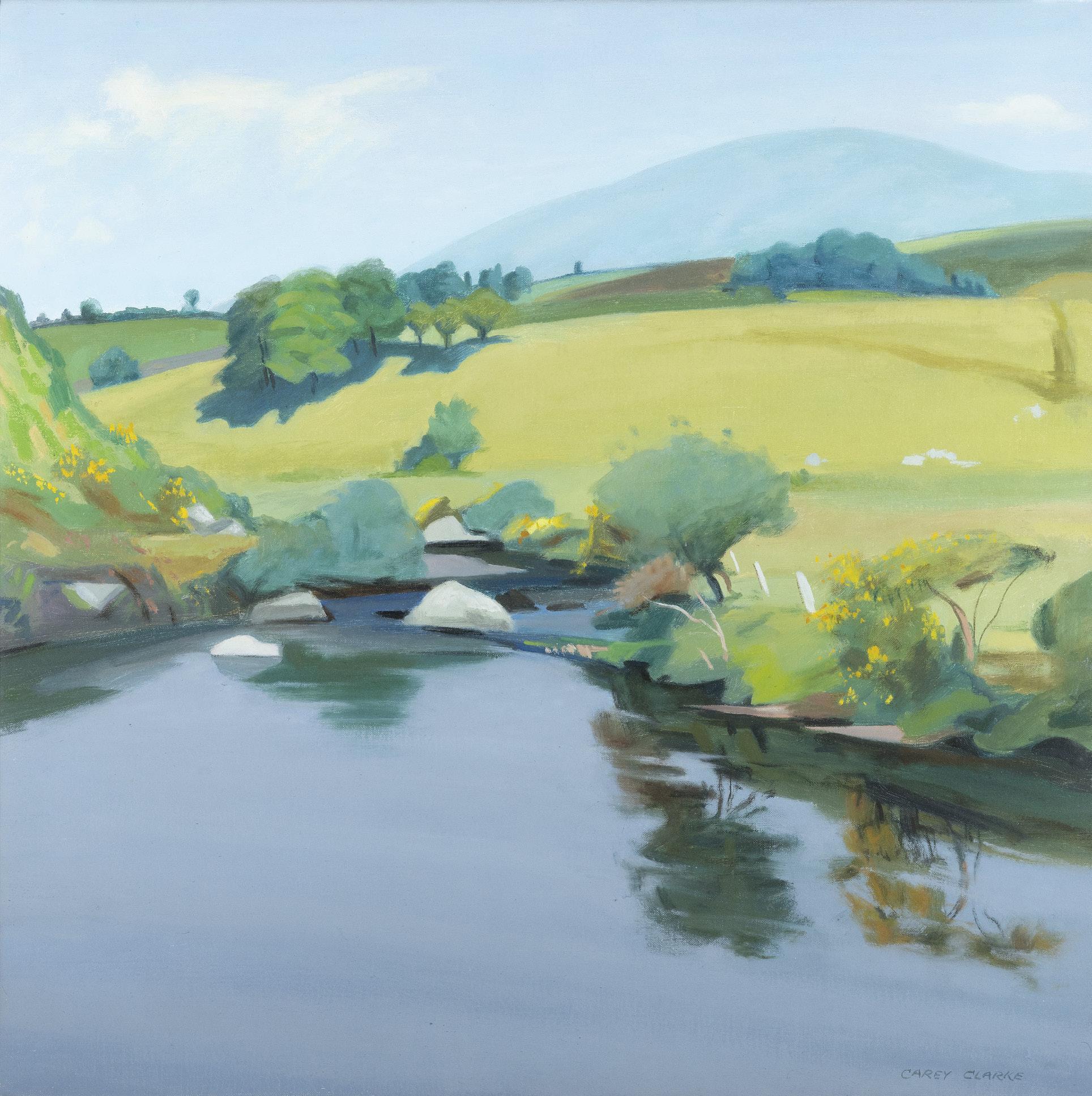
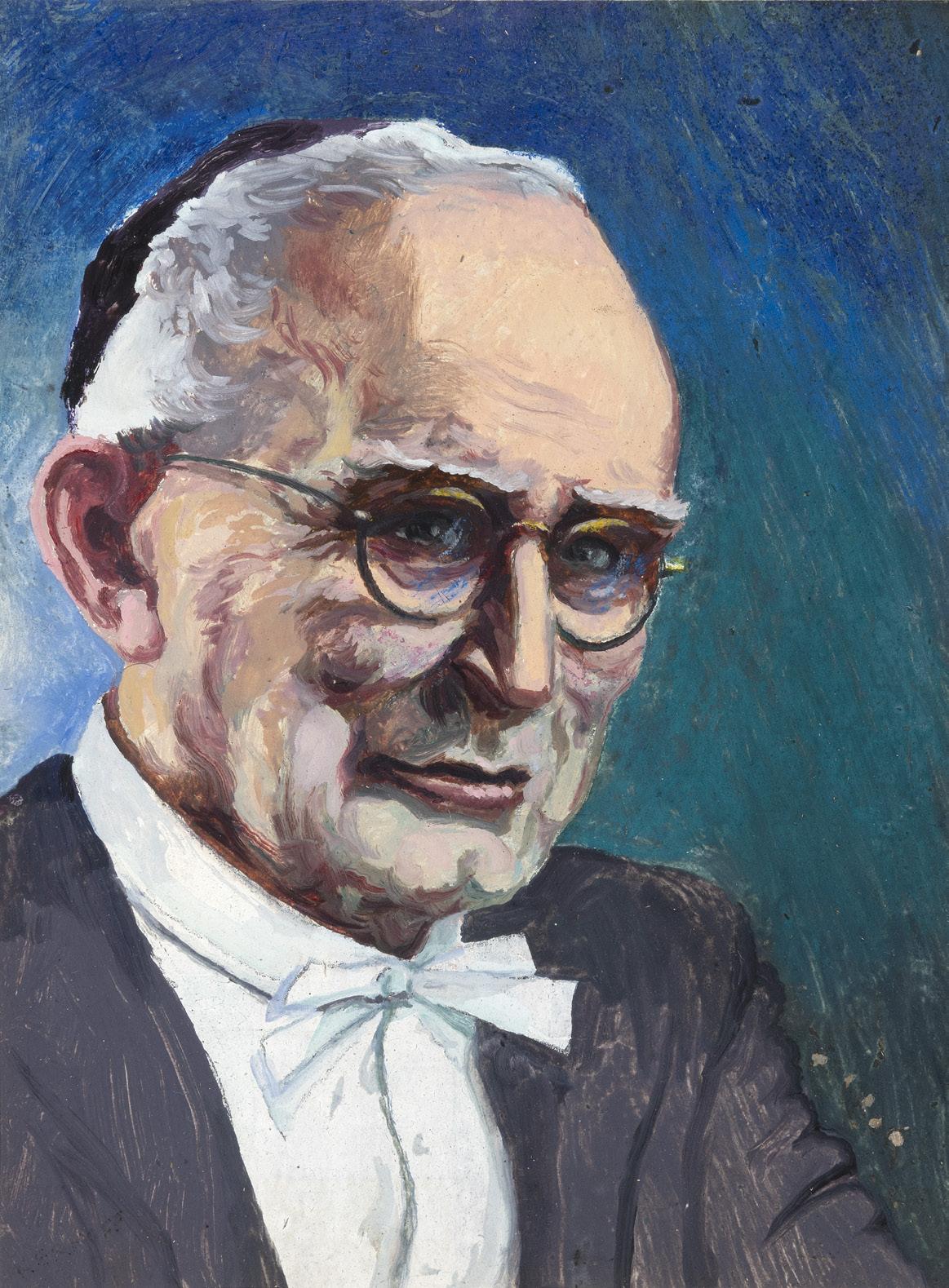
Oil and pastel, 20 x 15cm (7¾ x 13¼”)
Signed and dated (19)’63
€ 600 - 800
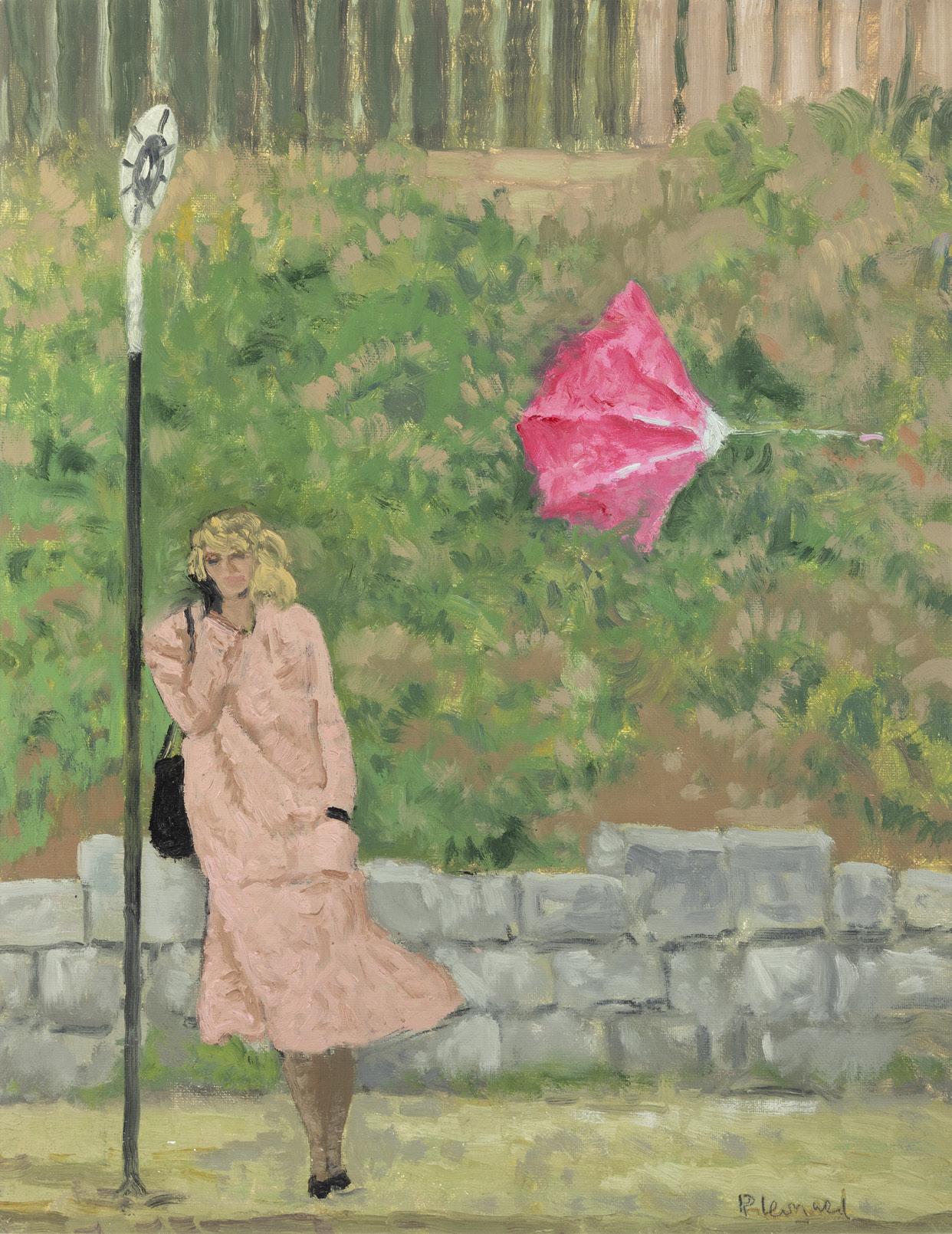
Day, Young Woman at a Bus Stop
Oil on canvas laid down, 49 x 37.5cm (19¼ x 14¾”)
Signed
€ 1,000 - 1,500
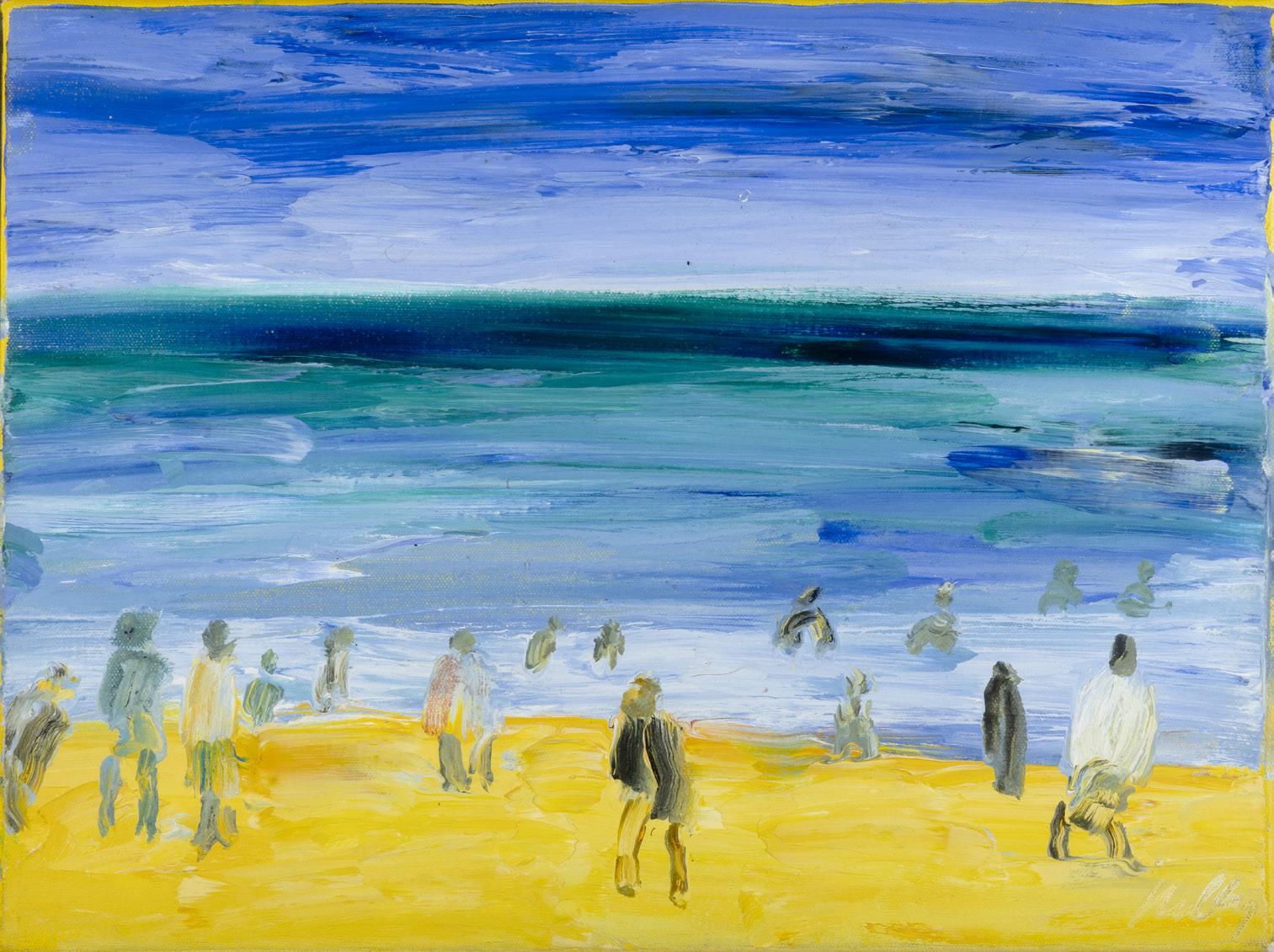
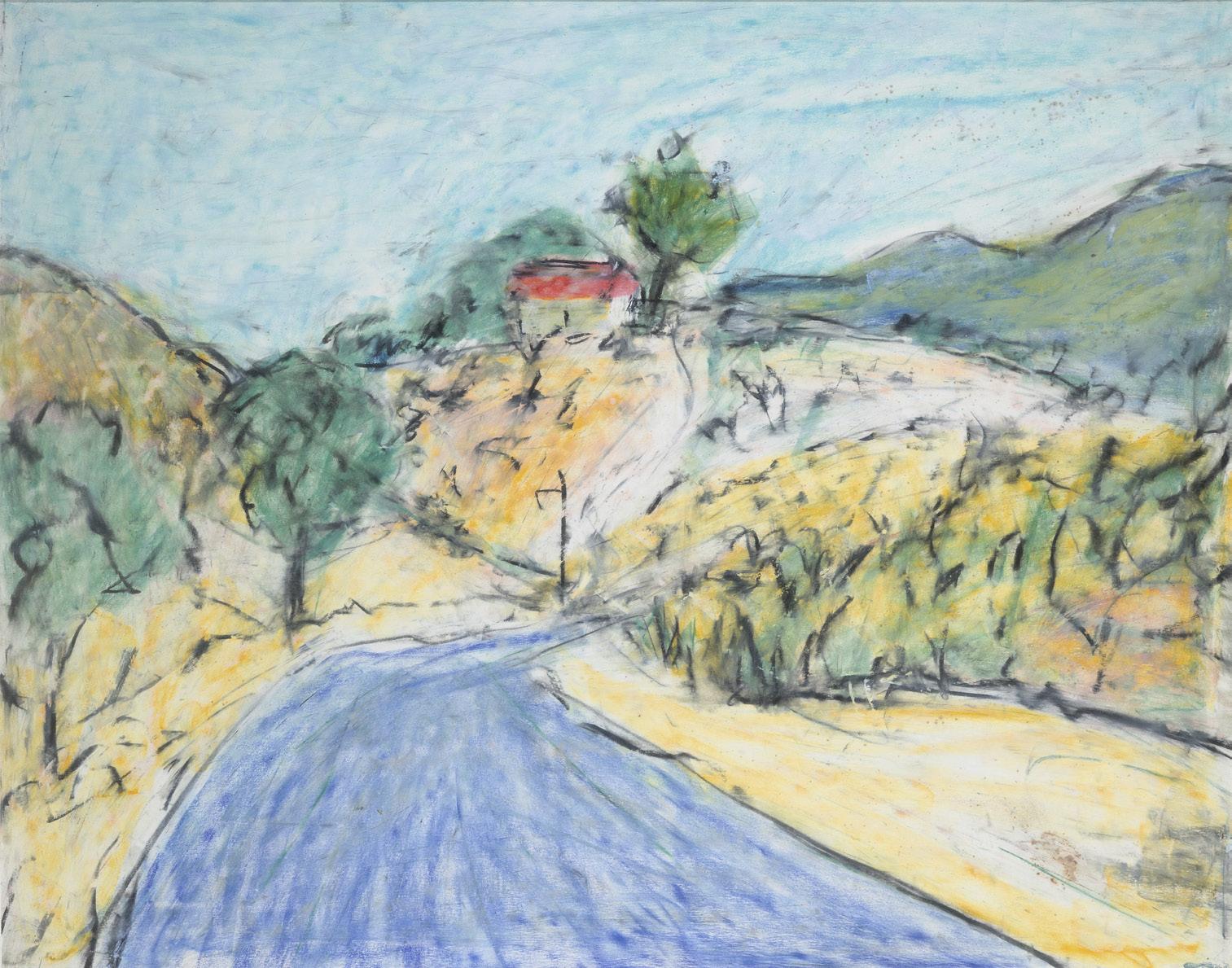
85
PHIL KELLY (1950-2010)
Talum (Beach scene)
Oil on canvas 30 x 40.5cm (11¾ x 16”)
Signed
Provenance: With The Frederick Gallery, Dublin, label verso
€ 700 - 1,000
86
PHIL KELLY (1950-2010)
Cottage on the Hill (1991)
Conte 57 x 72cm (22½ x 28¼”)
Signed, dated (19)’91 and inscribed by the artist on a Frederick Gallery label verso
Provenance: With The Frederick Gallery, Dublin, label verso
€ 800 - 1,200
87
MARKEY ROBINSON (1918-1999)
Figures by the Coast Gouache, 16 x 22cm (6¼ x 8¾”) (each)
Signed (a pair)
Provenance: Sale, Whytes, Dublin, 02/03/2009, lot 23 € 2,000 - 3,000
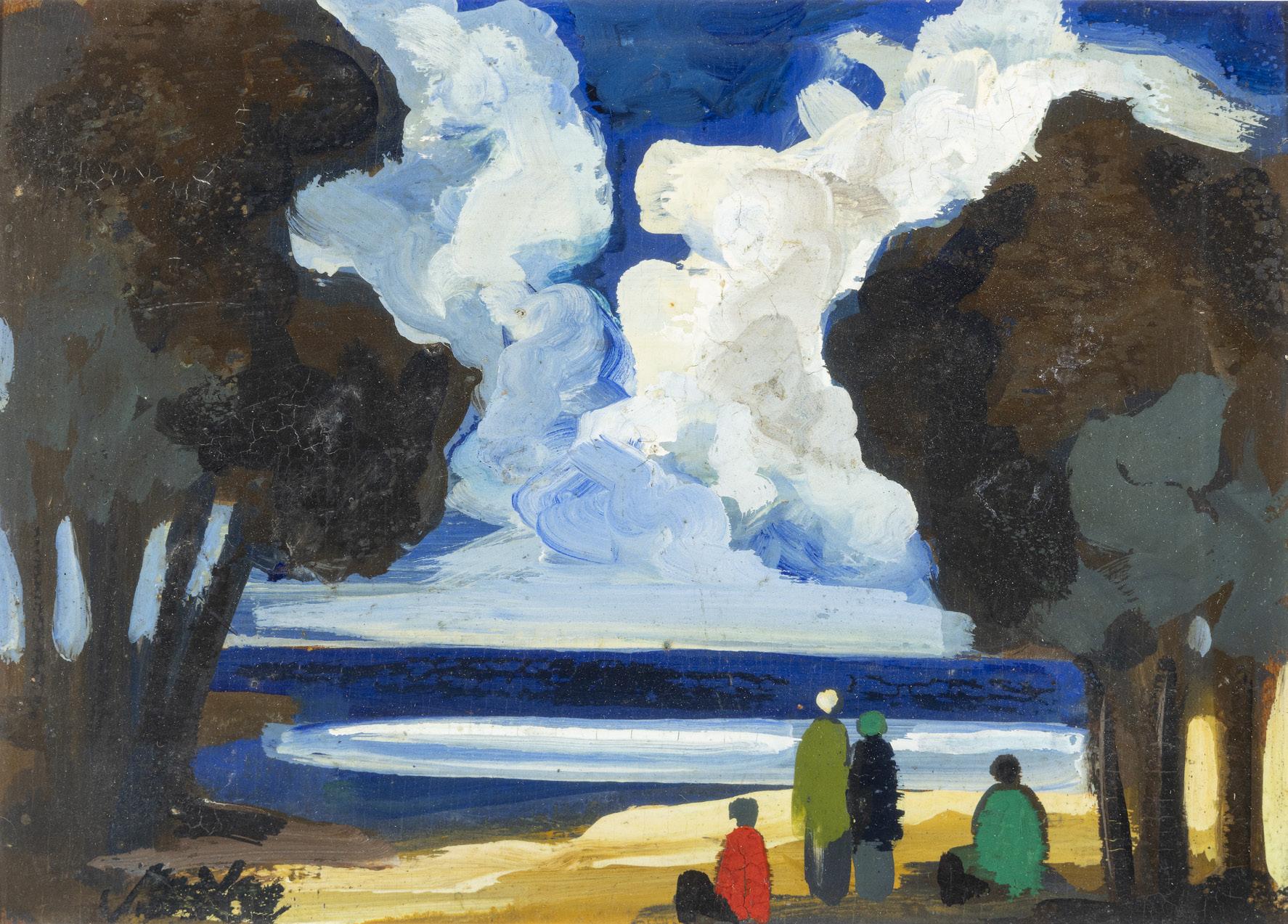
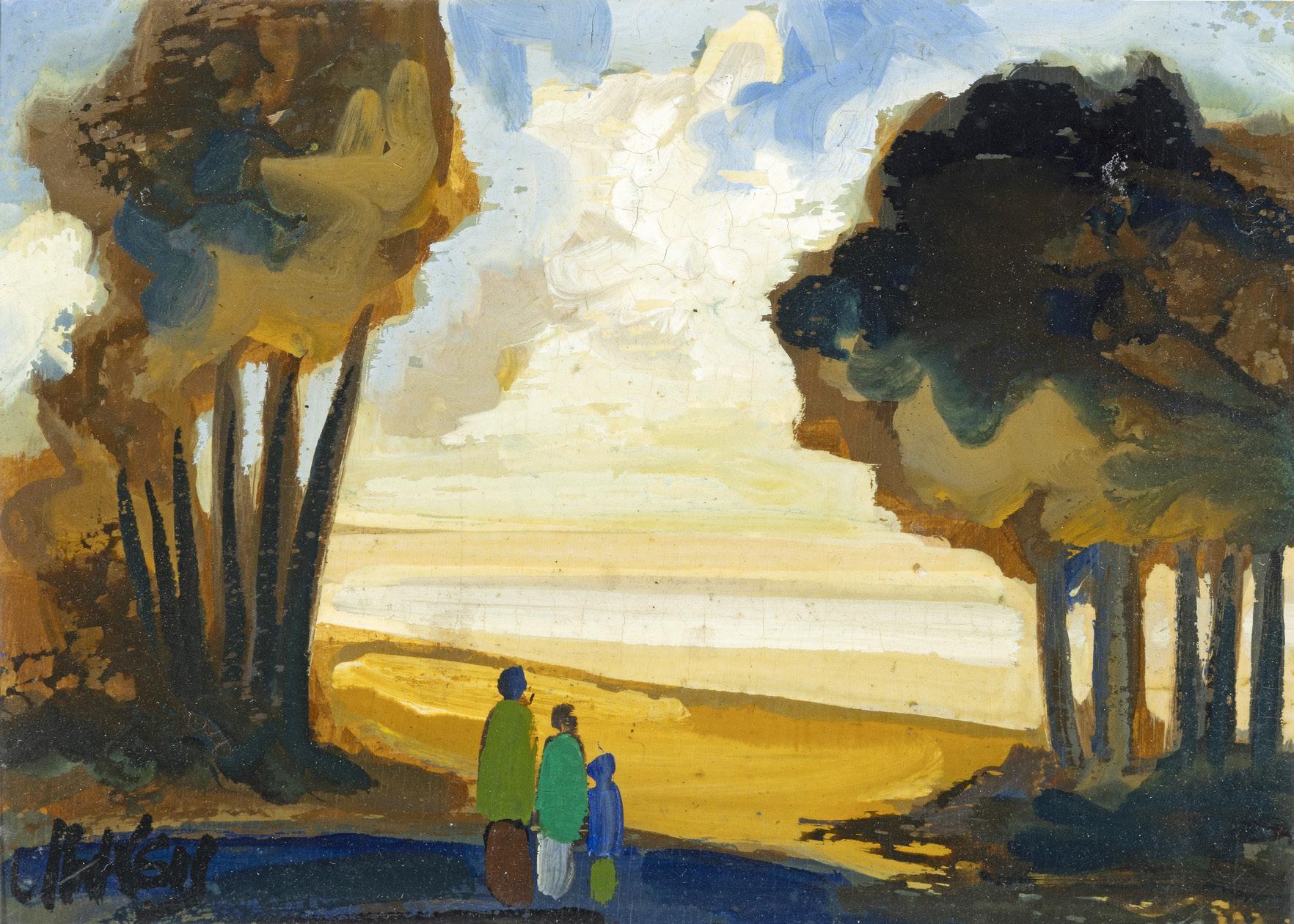
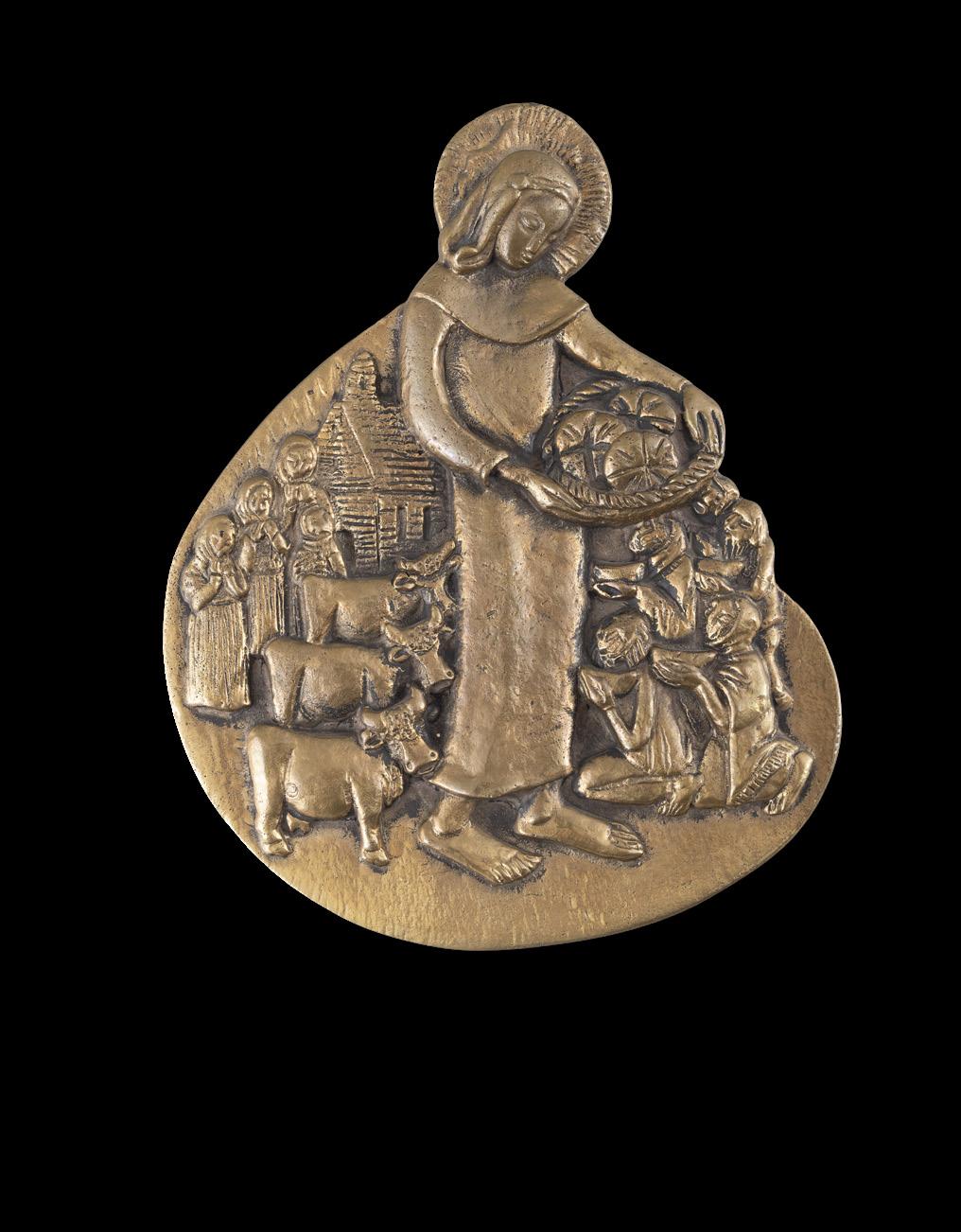
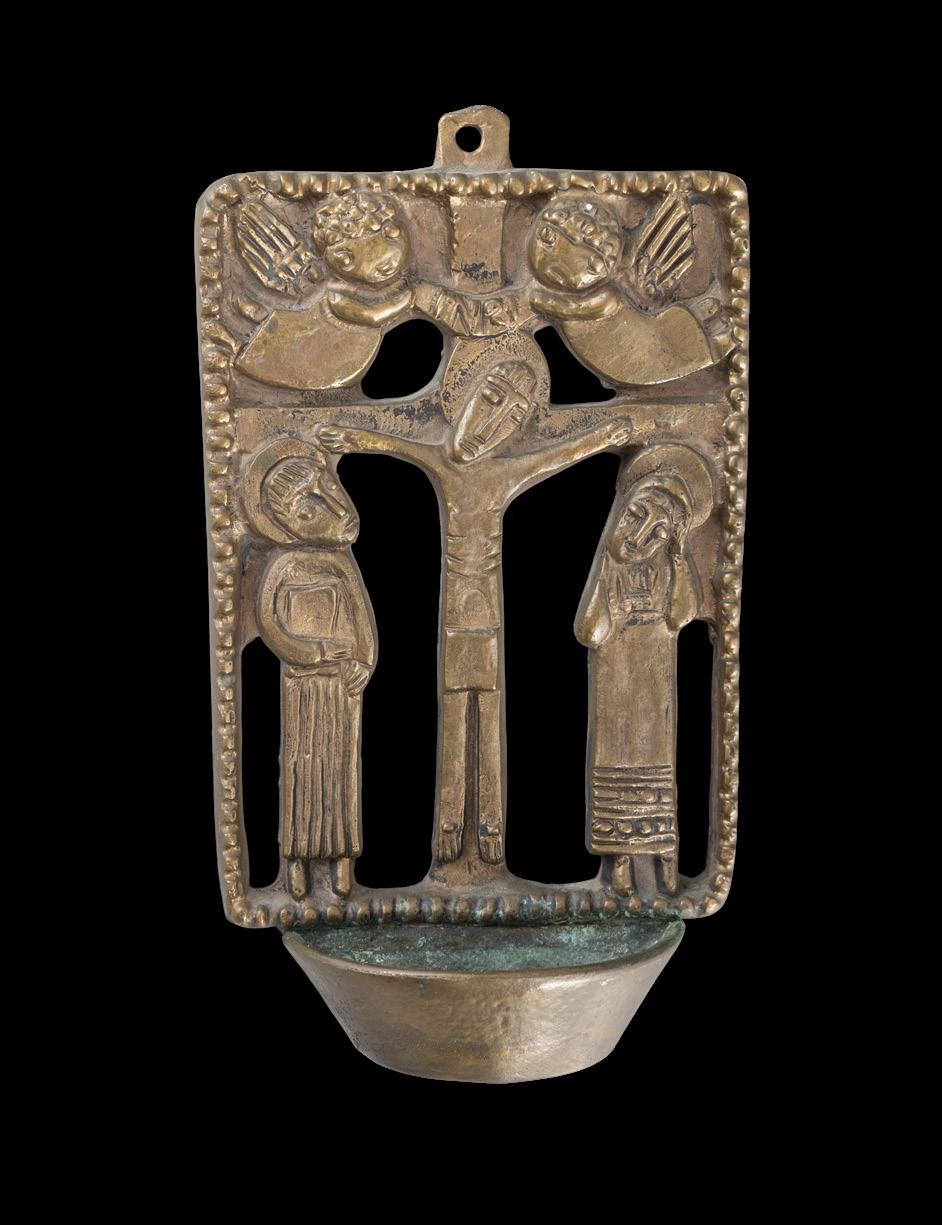
88
IMOGEN STUART RHA (1927-2024)
St. Brigid Feeding the Poor
Bronze, 23.5 x 19cm (9¼ x 7¼”)
Signed verso and numbered 73/100
€ 800 - 1,200
89
IMOGEN STUART RHA (1927-2024)
Crucifixion
Bronze water font, 19cm(h) (7½’’)
Signed and numbered 44/100
€ 600 - 800
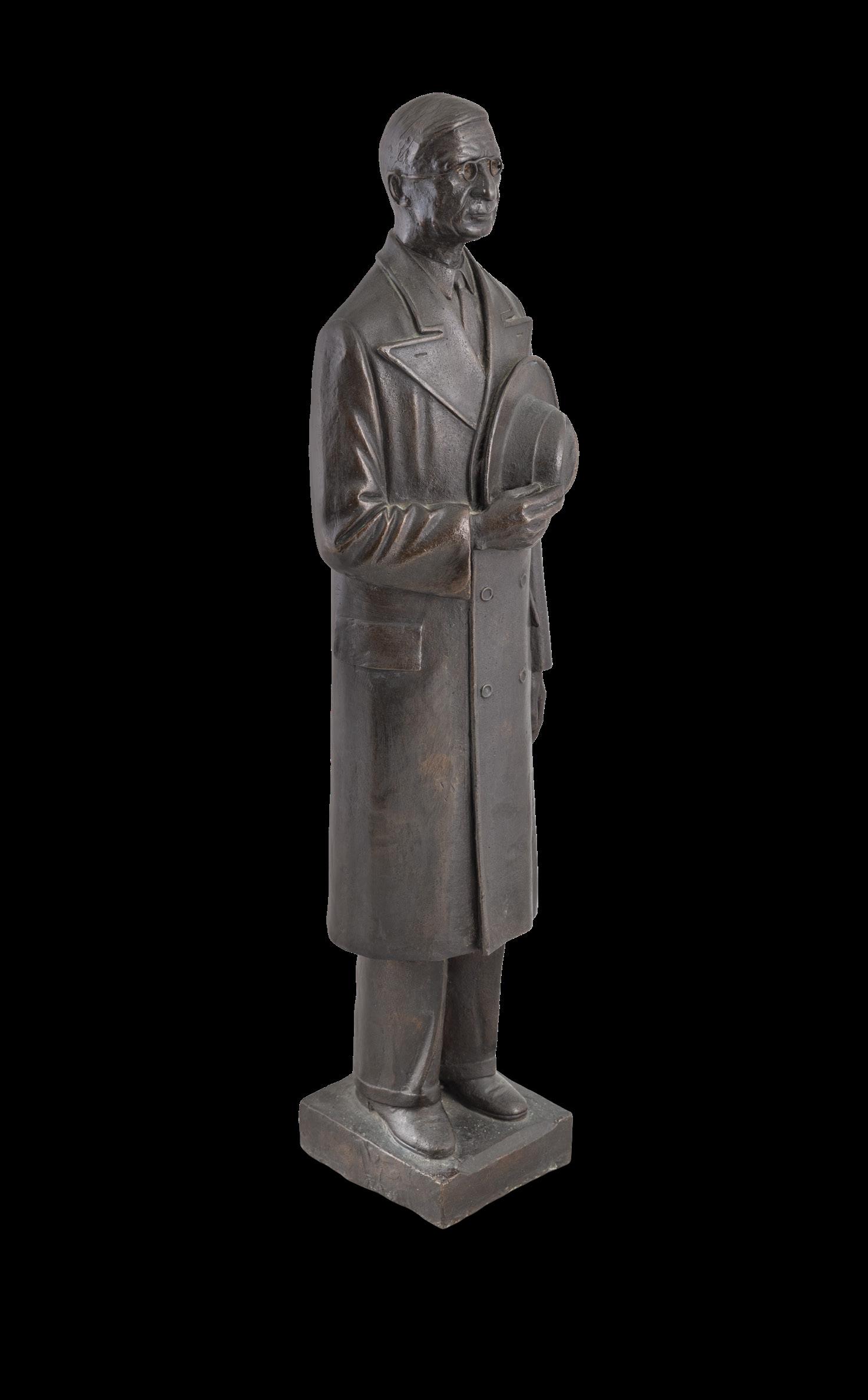
Bronze, 65cm(h) (25½”)
Signed
Provenance: Maquette for a larger work outside the Court House in Ennis, Co. Clare.
€ 1,500 - 2,500
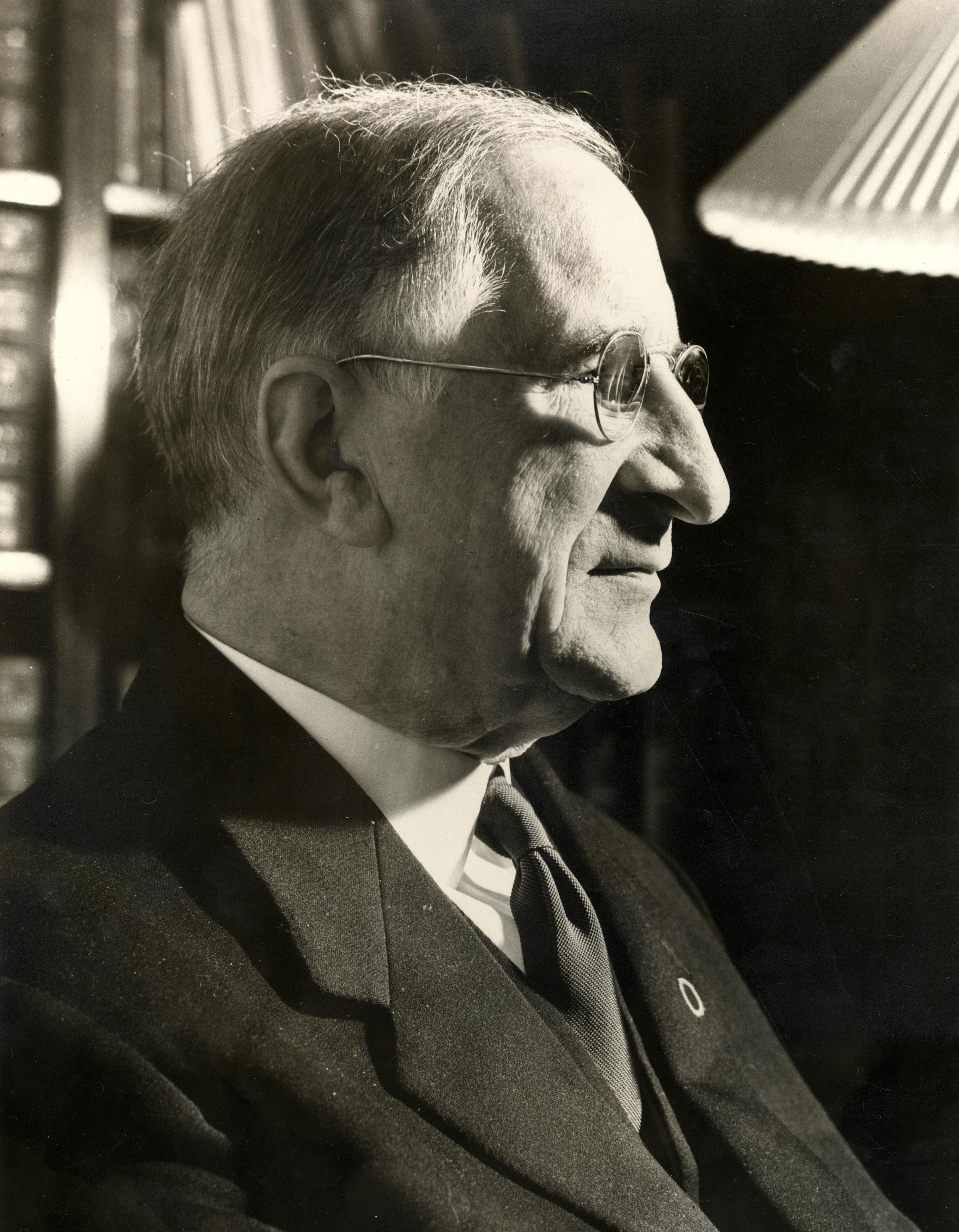
Portrait sculptor of note, Jim Connolly, now retired, was responsible for many private and public commissions around Ireland from the late 1970’s to the early 2000’s. These included statues such as the Bard of Thomond in Limerick, Jackie Power, Vincent O Brien, Payne Stewart and also the National Monument to late President of Ireland, Eamon de Valera. This particular statue is one of a small edition of maquettes of that specific de Valera piece; one of which was gifted to President Gorbachev of the then Soviet Union and one to the late Charlie Haughey.
Signed
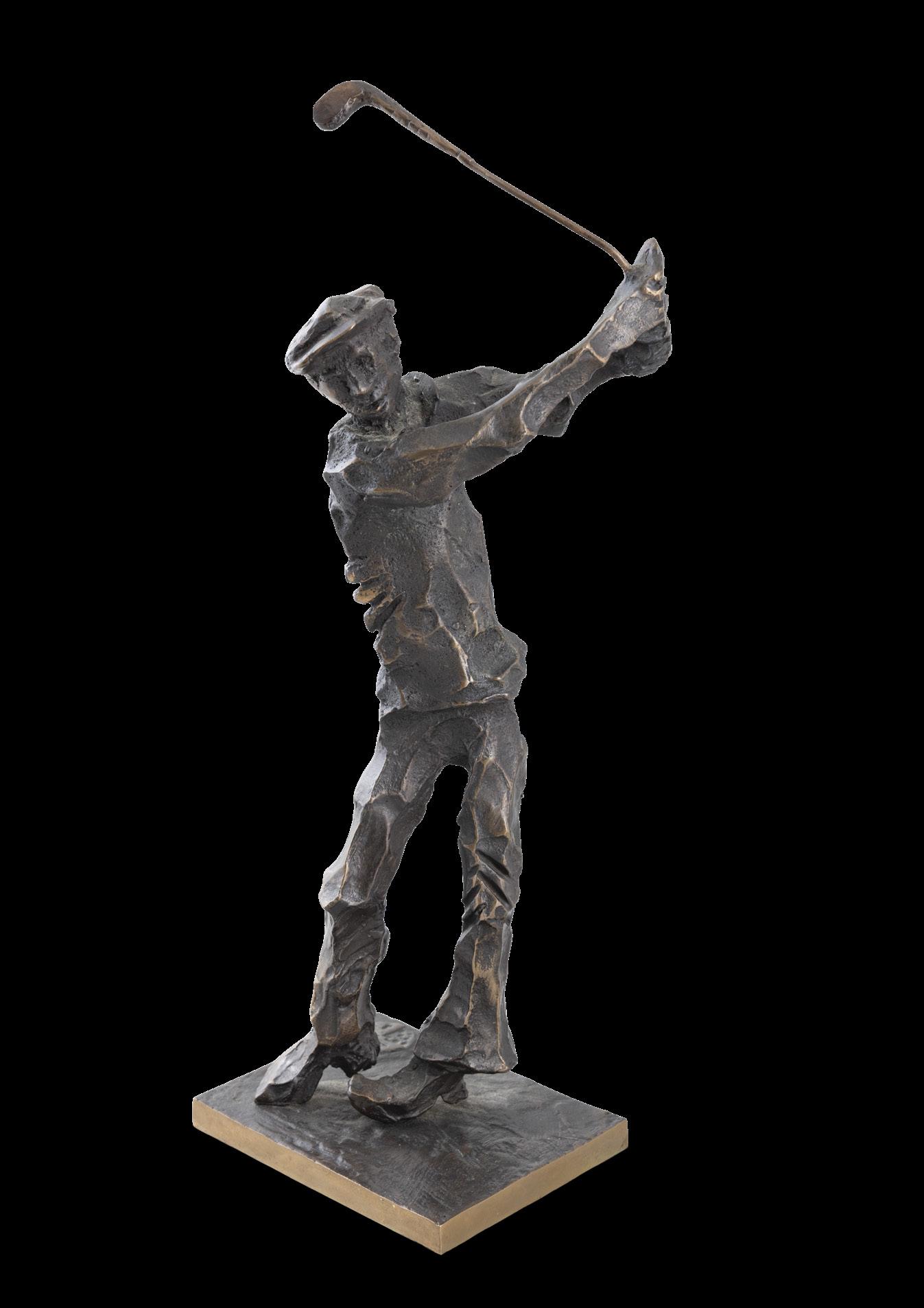
€ 800 - 1,200
CONCLUSION OF SALE
Armstrong, Arthur 37, 38, 65
Ballagh, Robert 57
Behan, John 91
Blackshaw, Basil 20, 21
Boyd, John 58
Brandt, Muriel 64
Butler, Mildred Anne 31
Clarke, Carey 82
Collins, Patrick 7
Connolly, Jim 90
Conor, William 15, 46, 47
Cooke, Barrie 70
Craig, Henry Robertson 66
Craig, James Humbert 14
Curling, Peter 62, 67
Dillon, Gerard 10, 63
Dixon, James 36
Doherty, John 59, 61
Egginton, Frank 42
Foley, Michael 75
Gale, Martin 60
Gleizes, Albert 55
Hall, Kenneth 54
Hamilton, Letitia Marion 9
Hennessy, Patrick 72
Henry, Grace 8
Henry, Paul 25
Hill, Derek 80
Hone, Nathaniel 30
Jellett, Mainie 1, 32, 33
Johnson, Nevill 3
Kavanagh, Joseph Malachy 28
Kelly, Phil 85, 86
Kernoff, Harry 83
Landweer, Sonja 76, 77
le Brocquy, Louis 17, 22, 39
Leonard, Patrick 84
MacGonigal, Maurice 40
McGuinness, Norah 4, 23, 24
McKelvey, Frank 13
McSweeney, Sean 6, 78, 79
McWilliam, Frederick E 18
Middleton, Colin 5, 16
O’Doherty, Eamonn 19
O’Kelly, Aloysius 29
O’Malley, Tony 56
O’Neill, Daniel 50, 51
O’Neill, Mark 71
Orpen, Sir William 48
Osborne, Walter Frederick 44
Purser, Sarah 45
Rákóczi, Basil Ivan 52, 53
Robinson, Markey 87
Russell AE, George 34
Shawcross, Neil 73, 74
Shelbourne, Anita 69
Souter, Camille 2
Stuart, Imogen 88, 89
Sutton, Ivan 81
Tuohy, Patrick 49
Watson, Colin 68
Wilks, Maurice C. 41, 43
Yeats, Jack Butler 11, 12, 26, 27, 35
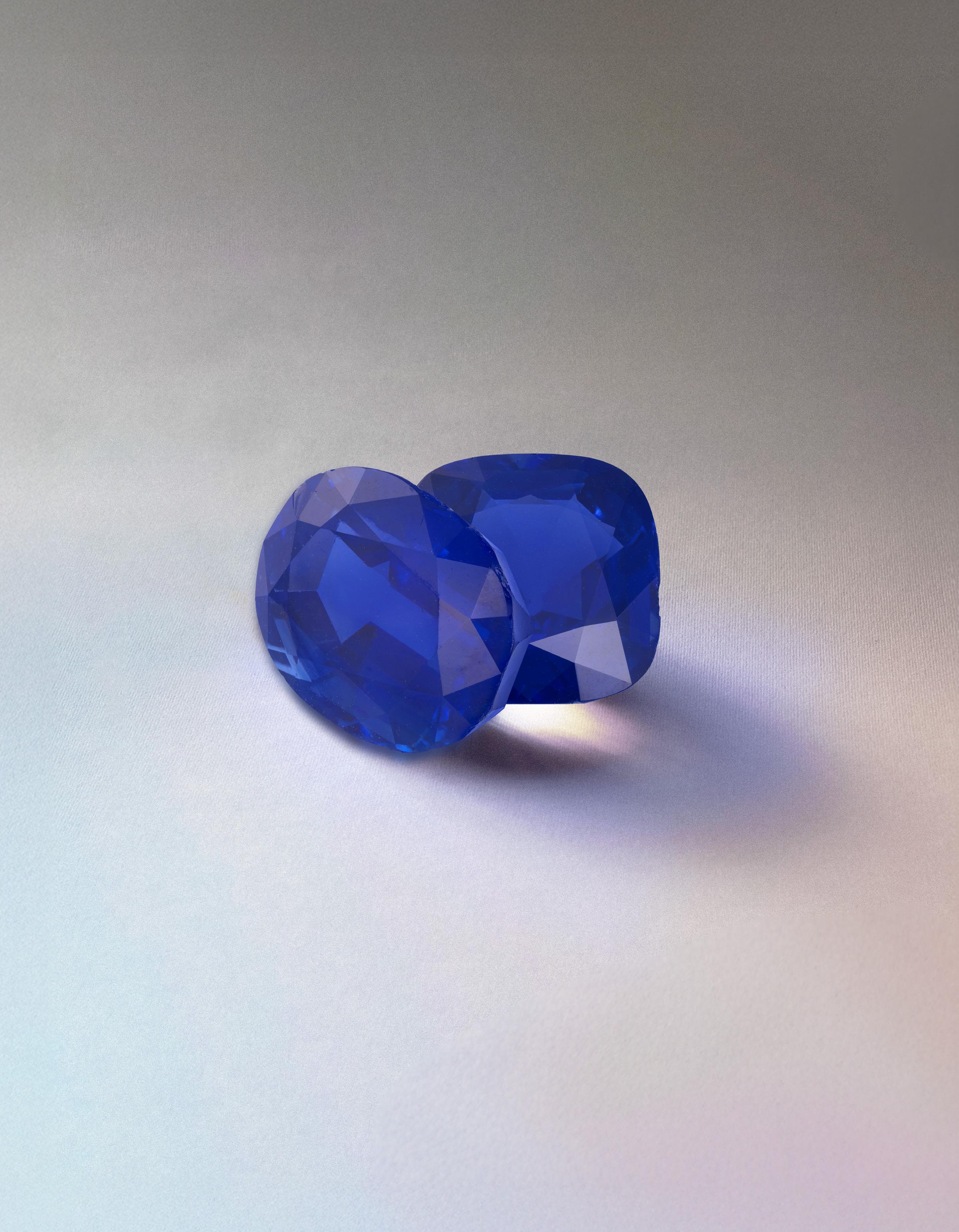
Two Rare Kashmir Sapphires
8.24cts & 6.53cts, with SSEF & Gubelin Lab. Reports, 2025
Price Realized: €660,000 & 650,000
Tuesday 8th September 2026
For a confidential and complimentary valuation: Contact Director: Claire Mestrallet jewellery@adams.ie
The Auctioneer carries on business on the following terms and conditions and on such other terms or conditions as may be expressly agreed with the Auctioneer or set out in any relevant Catalogue. Conditions 17-22 relate mainly to buyers and conditions 24-40 relate mainly to sellers. Words and phrases with special meanings are defined in condition 1. Buyers and sellers are requested to read carefully the Cataloguing Practice and Catalogue Explanations contained in conditions 2 and 8.
Definitions
1. In these conditions the following words and expressions shall have the following meanings:
‘Auctioneer’ – James Adam and Sons trading as Adam’s ‘Auctioneer’s Commission’ – The commission payable to the Auctioneer by the buyer and seller as specified in conditions 22 and 26.
‘Catalogue’ – Any advertisement, brochure, estimate, price list or other publication.
‘Forgery’ – A Lot which was made with the intention of deceiving with regard to authorship, culture, source, origin, date, age or period and which is not shown to be such in the description therefore in the Catalogue and the market value for which at the date of the auction was substantially less than it would have been had the Lot been in accordance with the Catalogue description.
‘Hammer Price’ – The price at which a Lot is knocked down by the Auctioneer to the buyer.
‘Lot’ – Any item which is deposited with the Auctioneer with a view to its sale at auction and, in particular, the item or items described against any Lot number in any Catalogue.
‘Proceeds of Sale’ – The net amount due to the seller being the Hammer Price of the Lot after deducting the Auctioneer’s Commission thereon under condition 26 the seller’s contribution towards insurance under condition 28, such VAT as is chargeable and any other amounts due by the seller to the Auctioneer in whatever capacity howsoever arising.
‘Registration Form or Register’ – The registration form (or, in the case of persons who have previously attended at auctions held by the Auctioneer and completed registration forms, the register maintained by the Auctioneer which is compiled from such registration forms) to be completed and signed by each prospective buyer or, where the Auctioneer has acknowledged that a bidder is acting as agent on behalf of a named principal, each such bidder prior to the commencement of an auction.
‘Sale Agreement Form’ – The sale agreement form to be completed and signed by each seller prior to the commencement of an auction.
‘Total Amount Due’ – The Hammer Price of the Lot sold, the Auctioneer’s Commission due thereon under condition 22, such VAT as is chargeable and any additional interest, expenses or charges due hereunder.
‘V.A.T.’ – Value Added Tax.
Cataloguing Practice and Catalogue Explanations
2.Terms regarding cataloguing practice used in catalogues have specific meanings, and attention is drawn to these explanations in each published catalogue.
Auctioneer Acting as Agent
3. The Auctioneer is selling as agent for the seller unless it is specifically stated to the contrary. The Auctioneer as agent for the seller is not responsible for any default by the seller or the buyer. The Auctioneer reserves the right to bid on behalf of the seller.
Auctioneer Bidding on behalf of Buyer
4. It is suggested that the interests of prospective buyers are best protected and served by the buyers attending at an auction. However, the Auctioneer will, if instructed, execute bids on behalf of a prospective buyer. Neither the Auctioneer nor its employees, servants or agents shall be responsible for any neglect or default in executing bids or failing to execute bids.
Admission to Auctions
5. The Auctioneer shall have the right exercisable in its absolute discretion to refuse admission to its premises or attendance at its auctions by any person.
Acceptance of Bids
6. The Auctioneers shall have the right exercisable in its absolute discretion to refuse any bids, advance the bidding in any manner it may decide, withdraw or divide any Lot, combine any two or more Lots and, in the case of a dispute, to put any Lot up for auction again.
Indemnities
7. Any indemnity given under these conditions shall extend to all actions, proceedings, claims, demands, costs and expenses whatever and howsoever incurred or suffered by the person entitled to the benefit of the indemnity and the Auctioneer declares itself to be a trustee of the benefit of every such indemnity for its employees, servants or agents to the extent that such indemnity is expressed to be for their benefit.
Representations in Catalogues
8. Representations or statements made by the Auctioneer in any Catalogue as to attribution, authorship, genuineness, source, origin, date, age, provenance, condition or estimated selling price or value is a statement of opinion only. Neither the Auctioneer nor its employees, servants or agents shall be responsible for the accuracy of any such opinions. Every person interested in a Lot must exercise and rely on their own judgement and opinion as to such matters.
Governing Law
9. These conditions shall be governed by and construed in accordance with Irish Law.
Notices
10. Any notice or other communication required to be given by the Auctioneer hereunder to a buyer or a seller shall, where required, be in writing and shall be sufficiently given if delivered by hand or sent by post to, in the case of the buyer, the address of the buyer specified in the Registration Form or Register, and in the case of the seller, the address of the seller specified in the Sale Agreement Form or to such other address as the buyer or seller (as appropriate) may notify the Auctioneer in writing. Every notice or communication given in accordance with this condition shall be deemed to have been received if delivered by hand on the day and time of delivery and if delivered by post three (3) business days after posting.
11. The Auctioneer affirms that no conflict of interest exists that prevents him/her providing the property service for the Client.
Records
12. The Auctioneer will keep a record of the services provided on foot of any Agreement for 6 years. All financial records must be kept for 7 years.
Bank Account
13. The Auctioneer’s “Client Account” is held at: Bank of Ireland 39 St. Stephen’s Green Dublin 2
Client Monies
14. Any interest credited to the Client Account in respect of monies held by the Auctioneer will be dispersed in accordance with the Property Services (Regulation) Act 2011 (Client Moneys) Regulations 2012.
Complaints
15. Any complaint which the Client may have arising under this Agreement may be dealt with by Eamon O’Connor - email: e.oconnor@adams.ie - tel: +353 1 6760261. A response will issue within 10 working days of receipt of the complaint.
Where the Client is dissatisfied with the response to the complaint received from the Auctioneer, the Client may make a complaint to: Property Services Regulatory Authority, Abbey Buildings, Abbey Road, Navan, Co Meath, C15 K7PY.
Statement of obligations on the Auctioneer pursuant to section 42 and 43 of the Criminal Justice (Money Laundering and Terrorist Financing) Act 2010
16. The Auctioneer is obliged under sections 42 and 43 of the Criminal Justice (Money Laundering and Terrorist Financing) Act 2010 to report to An Garda Síochána and the Revenue Commissioners suspicious transactions and transactions involving places designated under section 32 of that Act. The maximum cash accepted per transaction is €8,000. For any cash payments in excess of €500, a PSRA cash origin form will have to completed.
Non-Payment or Failure to Collect Purchased Lots
17. If a buyer fails to pay for and/or collect any purchased Lot by the dates herein specified for payment and collection the Auctioneer shall, in its absolute discretion and without prejudice to any other rights or remedies it may have, be entitled to exercise one or more of the following rights or remedies without further notice to the buyer:
(a) To issue court proceedings for damages for breach of contract.
(b) To rescind the sale of that Lot or any other Lots sold to the buyer whether at that or any other auction.
(c) To resell the Lot or cause it to be resold whether by public auction or private sale. In the event that there is a deficiency between the Total Amount Due by the buyer and the amount received by the Auctioneer on such resale after the deduction of any necessary expenses the difference shall be paid to the Auctioneer by the buyer. Any surplus arising shall belong to the seller.
(d) To store (whether at the Auctioneer’s premises or elsewhere) and insure the purchased Lot at the expense of the buyer.
(e) To charge interest on the Total Amount Due at the rate of 2% over and above the base interest rate from time to time of Bank of Ireland or if there be no such rate, the nearest equivalent thereto as determined by the Auctioneer in its absolute discretion from the date on which the payment is due hereunder to the date of actual payment.
(f) To retain that Lot or any other Lot purchased by the buyer whether at the same or any other auction and release same to the buyer only after payment to the Auctioneer of the Total Amount Due.
(g) To apply sums which the Auctioneer received in respect of Lots being sold by the buyer towards settlement of the Total Amount Due.
(h) To exercise a lien on any property of the buyer in the possession of the Auctioneer for whatever reason.
Liability of Auctioneer and Seller
18. Prior to auction ample opportunity is given for the inspection of the Lots on sale and each buyer by making a bid acknowledges that he has, by exercising and relying on his own judgement, satisfied himself as to the physical condition, age and Catalogue description of each Lot (including but not restricted to whether the Lot is damaged or has been repaired or restored). All Lots are sold with all faults and imperfections and errors of description. None of the seller, the Auctioneer nor any of their employees, servants or agents shall be responsible for any error of description or for the condition or authenticity of any Lot. No warranty whatsoever is given by the seller or Auctioneer or by any of their employees, servants or agents in respect of any Lot and any condition or warranty express or implied by statute or otherwise is hereby specifically excluded.
19. Any amount paid by a buyer in respect of a Lot which, if it is proved within 3 years of the date of the auction at which it was purchased, to have been a Forgery shall be refunded by the seller subject to the provisions hereof, provided that:
(a) The Lot has been returned by the buyer to the Auctioneer within 3 years of the date of the auction in the same condition in which it was at the time of the auction together with evidence proving that it is a Forgery, the number of the Lot and the date of the auction at which it was purchased;
(b) The Auctioneer is satisfied that the Lot is a Forgery and that the buyer has and is able to transfer good and marketable title to the Lot free form any third party claims;
FURTHER PROVIDED THAT the buyer shall have no rights here under if:
(i) The description of the Lot in the Catalogue at the time of the auction was in accordance with the then generally accepted opinion of the scholars or experts or fairly indicated that there was a conflict of such opinion;
(ii) The only method of establishing at the time of the auction in question that the Lot was a Forgery would have been by means of scientific processes which were not generally accepted for use until after the date of the auction or which were unresonably expensive or impratical.
The buyer’s sole entitlement under this condition is to a refund of the actual amount paid by him in respect of the Lot. Under no circumstances shall the Auctioneer be liable for any damage, loss (including consequential, indirect or economic loss) or expense suffered or incurred by the buyer by reason of the Lot being a Forgery. The benefit of this condition shall be solely and exclusively for the buyer and shall not be assignable. The buyer shall for the purpose of this condition be the person to whom the original invoice in respect of the sale of the Lot is made.
Photographs
20. The buyer authorises the Auctioneer at any time to make use of any photographs or illustrations of the Lot purchased by the buyer for such purposes as the Auctioneer may require.
New VAT Regulations
21. All lots are sold within the Auctioneer’s VAT margin scheme. Revenue Regulations require that the buyer’s premium must be invoiced at a rate which is inclusive of VAT. This VAT is not recoverable by any VAT registered buyer.
Buyer’s Premium
22. The Auctioneer may also charge a fee to the purchaser “the buyer’s premium”. The buyer’s premium is a commission paid by the buyer to the Agent in addition to the sale price. The standard buyer’s premium shall be 25% inclusive of VAT, and may be subject to change.
Internet Bidding
23. These terms and conditions apply to all internet bidding at sales conducted by, or in conjunction with, Adam’s, covering both live auctions and online-only timed auctions. Internet bidding conditions are in conjunction to those which are covered in our General Terms and Conditions of Business.
Registration
Before you can bid via Internet Bidding, you must register to bid online by signing up for a ‘My Adam’s’ account. Bidders must be registered at least 24 hours prior to the start of any Sale or you may not be able to bid online in that Sale. You will be liable for any and all bids made via your account.
Internet Bidding Process
Each bid made online shall be final and binding as soon as you click the Bid button. The bidder holds sole responsibility for any bid submitted, including those made in error, and will be held liable for the full payment and collection of the lot if named the winning bidder.
In the event of a tie between a bid placed by you online and any other identical bid(s) (including bids made in person at the Sale, telephone bids, absentee bids, and other internet bids), it will be at the auctioneer’s discretion as to which bid shall be accepted.
Adam’s reserves the right to reject a registration to bid online, withdraw its permission for you to use Internet Bidding, or terminate an Internet Bidding account, for any reason at any time prior to, during or after a Sale without prior notice.
If you choose to use the Internet Bidding service, you do so entirely at your own risk. Adam’s does not take responsibility for any issues regarding internet bidding functionality or delays which may occur due to software or hardware complications.
Auctioneer’s Discretion
24. With regard to the sale of any Lot the Auctioneer shall have the following powers exercisable solely in the discretion of the Auctioneer.
(i) To decide whether to offer any Lot for sale or not.
(ii) To decide whether a particular Lot is suitable for sale by the Auctioneer and, if so, to determine which auction, the place and date of sale, the conditions of sale and the manner in which such sale should be conducted.
(iii) To determine the description of any Lot in a Catalogue.
(iv) To decide whether the views of any expert shall be obtained and to submit Lots for examination by any such experts.
(v) To determine what illustration of a Lot (if any) is to be included in the Catalogue.
Seller’s Warranty and Indemnity
25. The seller warrants to the Auctioneer and to the buyer that he is the true owner of the Lot or is legally authorised to sell the Lot on behalf of the true owner and can transfer good and marketable title to the Lot free from any third party claims. As regards Lots not held by the Auctioneer on its premises or under its control the seller warrants and undertakes to the Auctioneer and the buyer that the Lot will be available and in a deliverable state on demand by the Auctioneer or buyer. The seller shall indemnify the Auctioneer and the buyer or any of their respective employees, servants or agents against any loss or damage suffered by any of them in consequence of any breach of the above warranties or undertakings by the seller.
26. The Seller shall pay the Auctioneer commission at the rate of 10% on the Hammer Price of all Lots sold on behalf of the seller at Irish Art Sales and 17.5% on all other sales together with VAT thereon at the applicable rate. Minimum charges are detailed below. The seller authorises the Auctioneer to deduct from the Hammer Price, paid by the buyer, the Auctioneer’s Commission under this condition; VAT payable at the applicable rates and any other amounts due by the seller to the Auctioneer in whatever capacity howsoever arising. The seller agrees that the Auctioneer may also receive commission from the buyer pursuant to condition 22.
Minimum Charges: Each individual lot is subject to a minimum fee of €25.00 plus VAT.
27. Subject to the Auctioneer’s discretion, the seller shall be entitled prior to the auction to place a reserve on any Lot. All reserves must be agreed in advance by the Auctioneer and entered on the Sale Agreement Form or subsequently be confirmed in writing to the Auctioneer prior to auction. This also applies to changes in reserves. A reserve may not be placed upon any Lot under €500 in value. The reserve shall be the minimum Hammer Price at which the Lot may be sold by the Auctioneer. A reserve once in place may only be changed with the consent of the Auctioneer. A commission shall be charged on the ‘knock-down’ bid for Lots which fail to reach the reserve price. Such commission shall be 5% of the ‘knockdown’ bid (Buying In Fee). This commission and any VAT payable thereon must be paid before removal of the Lot after the auction. The minimum commission hereunder shall be €25 per lot. The Auctioneer may in its sole discretion sell a Lot at a Hammer Price below the reserve but in such case the Proceeds of Sale to which the seller shall be entitled shall be the same as they would have been had the sale been at the reserve.Unless a reserve has been placed on a Lot in accordance with the provisions set out above such Lot shall be put up for sale without reserve. In the event that any reserve price is not reached at auction then for so long as the Lot remains with the Auctioneer and to the extent that the Lot has not been re-entered in another auction pursuant to condition 36 the seller authorises the Auctioneer to sell the Lot by private treaty at not less than the reserve price. The Auctioneer shall ensure that in such a case those conditions herein which concern mainly the buyer shall, with any necessary modifications, apply to such sale.
Reserve Instructions
Fixed - sell at a pre-determined value, no higher than the low estimate
Discretion - sell up to 10% below the low estimate
Wide Discretion - sell up to 30% below the low estimate
No Reserve - sell to the highest bidder
Sell - sell to the highest bidder at any amount irrespective of the Lot value
Loss Warranty
28. Unless otherwise instructed by the seller, all Lots deposited with the Auctioneer or put under its control for sale shall automatically be insured by the Auctioneer under the Auctioneer’s own fine arts policy for the median estimate, as determined solely at the Auctioneer’s discretion.The seller shall pay the Auctioneer a contribution towards such insurance at the rate of 1.5% of the Hammer Price plus VAT. If the seller instructs the Auctioneer not to insure a Lot then the Lot shall at all times remain at the risk of the seller who undertakes to indemnify the Auctioneer and hold the Auctioneer harmless against any and all claims made or proceedings brought against the Auctioneer of whatever nature and howsoever and wheresoever occurring for loss or damage to the Lot. The sum for which a Lot is covered for insurance under this condition shall not constitute and shall not be relied upon by the seller as a representation, warranty or guarantee as to the value of the Lot or that the Lot will, if sold by the Auctioneer, be sold for such amount. Such insurance shall subsist until
such time as the Lot is paid for and collected by the buyer or, in the case of Lots sold which are not paid for or collected by the buyer by the due date hereunder for payment or collection such due date or, in the case of Lots which are not sold, on the expiry of 7 days from the date on which the Auctioneer has notified the seller to collect the Lots.
Professional Indemnity Insurance
29. The Auctioneer holds PI Insurance with: Insurer’s Name: Hiscox Insurance PLC
Address: The Hiscox Building, Peasholme Green, York, YO1 7PR, UK.
Duration of Agreement
30. Duration of this agreement shall commence from the the date of consignment, as recorded on the sale agreement/receipt, and shall continue in force until the property is either sold or collected (The Contract Period). If terminated before the end of the contract period, 30 days notice shall be given.
Termination of Agreement
31. The Agreement can be terminated at the complete discretion of the Auctioneer at any time, subject to the 30 days notice, as outlined in condition 30. A vendor is able to end an agreement at any point up to the sale of the Lot but will be held subject to charges for withdrawn Lots, as outlined in Article 35.
Recision of Sale
32. If before the Auctioneer has paid the Proceeds of Sale to the seller the buyer proves to the satisfaction of the Auctioneer that the Lot is a Forgery and the requirements of condition 19 are satisfied the Auctioneer shall rescind the sale and refund to the buyer any amount paid to the Auctioneer by the buyer in respect of the Lot.
Payment of Proceeds of Sale
33. It is a condition of sale that payment to the seller cannot be made unless the buyer has paid, and their funds cleared through our bank. The Auctioneer shall remit the Proceeds of Sale to the seller not later than 30 days after the date of the auction, provided however that, if by that date, the Auctioneer has not received the Total Amount Due from the buyer then the Auctioneer shall remit the Proceeds of Sale within 7 working days after the date on which the Total Amount Due is received from the buyer. If credit terms have been agreed between the Auctioneer and the buyer the Auctioneer shall remit to the seller the Proceeds of Sale not later than 30 days after the date of the auction unless otherwise agreed by the seller. If before the Total Amount Due is paid by the buyer the Auctioneer pays the seller an amount equal to the Proceeds of Sale then title to the Lot shall pass to the Auctioneer. If the buyer fails to pay the Auctioneer the Total Amount Due within 14 days after the date of the auction, the Auctioneer shall endeavour to notify the seller and take opinion of the Auctioneer feasible, shall endeavour to assist the seller to recover the Total Amount Due from the buyer provided that nothing herein shall oblige the Auctioneer to issue proceedings against the buyer in the Auctioneer’s own name. If circumstances do not permit the Auctioneer to take instructions from the seller or, if after notifying the seller, it does not receive instructions within 7 days, the Auctioneer reserves the right, and is hereby authorised by the seller at the seller’s expense, to agree special terms for payments of the Total Amount Due, to remove, store and insure the lot sold, to settle claims made by or against the buyer on such terms as the Auctioneers shall in its absolute discretion think fit, to take such steps are necessary to collect monies due by the buyer.
34. If the seller resides outside Ireland the Proceeds of Sale shall be paid to such seller in Euros unless it was agreed with the seller prior to the auction that the Proceeds of Sale would be paid in a currency (other than Euros) specified by the seller in which case the Proceeds of Sale shall be paid by the Auctioneer to the seller in such specified currency (provided that the currency is legally available to the Auctioneer in the amount required) calculated at the rate of exchange quoted to the Auctioneer by its bankers on the date of payment.
35. Once catalogued, Lots withdrawn from sale before proofing/publication of Catalogue will be subject to commission of 5% of the Auctioneer’s latest estimate of the auction price of the Lot withdrawn together with VAT thereon and any expenses incurred by the Auctioneer in relation to the Lot. If Lots are withdrawn after proofing or publication of Catalogue they will be subject to a commission of 10% of the Auctioneer’s latest
estimate of the auction price of the Lot withdrawn together with VAT thereon and any expenses incurred by the Auctioneer in relation to the Lot. All commission hereunder must be paid for before Lots withdrawn may be removed.
36. Where any Lot fails to sell at auction the Auctioneer shall notify the seller accordingly and (in the absence of agreement between the seller and the Auctioneer to the contrary) such Lot may, in the absolute discretion of the Auctioneer, be re-entered in the next suitable auction unless instructions are received from the seller to the contrary, otherwise such Lots must be collected at the seller’s expense within the period of 30 days of such notification from the Auctioneer. Upon the expiry of such period the Auctioneer shall have the right to sell such Lots by public auction or private sale and on such terms as the Auctioneer in its sole discretion may think fit. The Auctioneer shall be entitled to deduct from the price received for such Lots any sums owing to the Auctioneer in respect of such Lots including without limitation removal, storage and insurance expenses, any commission and expenses due in respect of the prior auction and commission and expenses in respect of the subsequent auction together with all reasonable expenses before remitting the balance to the seller. If the seller cannot be traced the balance shall be placed in a bank account in the name of the Auctioneer for the seller. Any deficit arising shall be due from the seller to the Auctioneer. Any Lots returned at the seller’s request shall be returned at the seller’s risk and expense and will not be insured in transit unless the Auctioneer is so instructed by the seller.
Photographs and Illustrations/Marketing Charges
37. The seller authorises the Auctioneer to photograph and illustrate any Lot placed with it for sale and further authorises the Auctioneer to use such photographs and illustrations and any photographs and illustrations provided by the seller at any time in its absolute discretion (whether or not in connection with the auction).
Catalogue illustrations are included at the discretion of the Auctioneer. Marketing charges will be calculated as a scaled fee, working off the hammer price as per the table below. All prices are subject to VAT at the standard rate.
€0-€500 hammer price
€501-€2999 hammer price
€3000 and above hammer price
Outlay Charges
€25
€50
€100
38. Where additional costs from third parties have acrued from the handling and selling of a Lot, the seller authorises the Auctioneer to deduct these charges from the Total Amount Due. These charges include, but are not limited to, charges concerning carriage, restoration, framing and repair and are set by the third party. Where the Lot is not sold, these charges will be billed directly to the client. VAT
39. It is presumed, unless stated to the contrary, that the items listed herein are auction scheme goods as defined in the Finance Act 1995.
Artist’s Resale Rights (Droit de Suite)
40. Government Regulations (S.1. 312/2006)
Under this legislation a royalty (droit de suite) is payable to living or deceased (up to 70 years from date of death) artists of E.U. Nationality on all works resold for €3,000 or more, other than those sold by the artist or the artist’s agent.
The resale royalty payable is calculated as follows:
From €3,000 to €50,000 4%
From €50,000.01 to €200,000 3%
From €200,000.01 to €350,000 1%
From €350,000.01 to €500,000 0.5%
Exceeding €500,000 0.25%
The total amount of royalty payable on any individual sale shall not exceed €12,500.
The seller is liable for payment (paragraph 7.1 of Government Regulations (S.1. 312/2006)) of this royalty on completion of the sale. The artist may request from the Auctioneer any information necessary to secure payment.
Unless otherwise directed by the vendor, the Auctioneer will automatically deduct the amount due from the proceeds of sale and will hold in trust for the artist or their representative the said sum.
This guide outlines the Value Added Tax (VAT) treatment of lot(s) sold at auction through Adam’s. It covers the most common types of transactions, although other situations may arise. As every buyer’s situation is different, we cannot offer specific tax advice. In all cases the relevant tax legislation takes precedence. You are advised to, and are responsible for, obtaining independent tax advice where necessary.
Depending on the status of the lot, and your status as a buyer, VAT may be charged on the hammer price, the buyer’s premium or both. Any such taxes will be identified at lot level, therefore it is important to familiarize yourself with the key symbols below.
Most lot(s) are sold in accordance with the Irish Auctioneer’s Margin Scheme and accordingly VAT will not normally be charged on the hammer price. Adam’s must bear VAT on the Buyer’s Premium and hence will charge an amount in lieu of VAT at the standard rate on these premiums i.e., the invoiced buyer’s premium of 25% will therefore include the VAT. Said lots are identified with no symbol denoted beside the lot number.
A limited range of goods, including most books, are subject to a 0% rate of VAT and therefore no amount in lieu of VAT will be added to the Buyer’s Premium. Ɵ
Where Lots have been imported from outside the European Union, and are under a Temporary Admission Authorisation, they will be denoted by the symbol * shown beside the lot number in the catalogue. They may be subject to additional charges on the hammer price which should be the relevant prevailing rate in the jurisdiction of import on the date of importation.
No symbol This is an Irish Auctioneers Margin Scheme lot. 23% Irish VAT will be charged on the ‘buyers’ premium’ only and invoiced on an inclusive basis. Total payable 25%
* Lot imported under Temporary Admission. 13.5% Irish import VAT will be charged on the ‘hammer’ price and 23% Irish VAT will be charged on the ‘buyer’s premium’ and invoiced on an inclusive basis under Irish Auctioneer’s Margin Scheme rules. Total payable 38.5% (See below for more information)
0 VAT Zero-rated items (Ireland only) Total payable 20.325%
General
Exporting Lots from the European Union
Where a Lot is exported from the European Union in accordance with the conditions detailed below the VAT may be cancelled or refunded by Adam’s as follows: 1. Lots sold under the Auctioneers Margin Scheme – the amount charged in lieu of VAT on the buyer’s premium.
2. Lots under the Temporary Admission Authorisation - the amount charged in lieu of VAT on the buyer’s premium PLUS the prevailing Irish import VAT.
Original correct export document is required from the Irish Revenue Commissioners showing that the lot has been exported from the European Union.
A. Cancellation of VAT charges
Where a buyer instructs an Adam’s authorised carrier to facilitate the transportation of the lot then a zero-rated invoice can be issued. The proof of export in the form of an export declaration to the Irish Revenue Commissioners will be facilitated by Adam’s customs agent.
B. Refund of VAT Charges
Where a buyer makes their own arrangements for transportation of the lot(s), the buyer must pay for the lot(s) in full including all elements of the Irish VAT. ONLY upon receipt of satisfactory proof of export (i.e. a copy of the export declaration to the Irish Revenue Commissioners showing that the lot has been exported from the European Union) will Adams then refund to the Buyer the amount of VAT initially paid.
1. VAT TO BE REFUNDED MUST BE €50 OR MORE PER SHIPMENT
2. A PROCESSING FEE OF €20 (PLUS ANY APPLICABLE VAT) WILL APPLY.
Adam’s, upon request and for an administrative fee, may apply for a license to export your lot(s) outside of the EU.
Miscellaneous
1. Buyers from outside the European Union should note that upon importing lots to their final destination outside the European Union, local import VAT, import duties, sales taxes and/or use taxes may be payable. Please consult your local tax advisor.
2. If you purchase a lot which is under a Temporary Admission Authorisation (indicated by a * symbol and intend to export it from the European Union for repair, restoration or alteration, please contact Adams before collection. Failure to do so may result in the import VAT becoming payable immediately and Adam’s being unable to refund the VAT charged on deposit.
3. If you collect the Lot from Adams in Ireland with a view to “hand-carrying” it back to its final destination, you must pay the Irish VAT in full. Adams cannot cancel or refund the Irish tax in these circumstances.