IRONCLAD
Spring 2026
The Magazine of the American Civil War Museum
1861 PEACE CONFERENCE | BOY "SCOUTS" PART II | AUGUSTUS TAYLOR | WAR COFFEE
IRONCLAD Volume 4/ Issue 3/ Spring 2026
1 From the CEO
3
9
1861 Peace Conference
Boy "Scouts": Part II
19
25
“I was owned by your father”
Ersatz Coffee
15/31 Collection Highlights
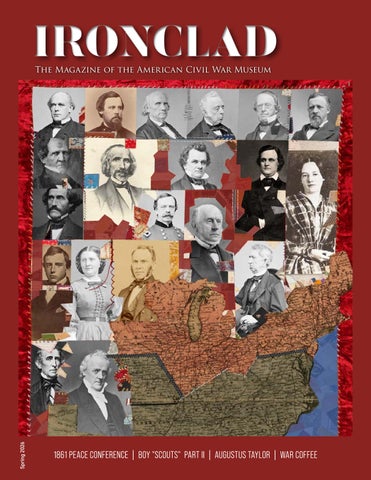
17 Bartlett Award Success ON THE COVER: Photo illustration depicting a patchwork effort to avoid war at the 1861 Peace Conference. Article on page 5.
29 Battlefield Tour Report
@acwmuseum ACWM.org
33 America 250
Magazine
FROM THE CEO
Publisher Rob Havers, Ph.D. ACWM President & CEO
PHOTO: JOHN DIXON
Managing Editor Robert Hancock
Art Director & Designer John Dixon
Editorial Review Kelly Hancock Jeniffer Maloney
Museum Board of Directors Richard S. Johnson, Chair Claude P. Foster, Vice Chair Stephen T. Gannon, Vice Chair Daniel G. Stoddard, Treasurer Walter S. Robertson III, Secretary Rob Havers, Ph.D., President & CEO Hans Binnendijk, Ph.D. Trevor S. Cox Audrey P. Davis Sally Diggs Fletcher George C. Freeman, III Stephen T. Gannon Bruce C. Gottwald, Sr. B. Hunt Gunter Andrew R. Hoehn Donald E. King Alexander Macaulay John L. Nau, III Davidson Perry-Miller William R. Piper Roderick G. Stanley Allison Thomas Daniel Webber Jeffrey L. Wilt H. Alexander Wise, Jr.
Foundation Board of Directors Jeffrey L. Wilt, Chair Stephen T. Gannon Rob Havers, Ph.D. Richard S. Johnson Donald E. King Walter S. Robertson, III H. Alexander Wise, Jr.
W
arm greetings, as ever, from Richmond, Virginia, and welcome to the latest edition of Ironclad magazine.
Here at the American Civil War Museum, we are basking, still, in the warm glow of the aftermath of a very successful, inaugural presentation of the William Francis Bartlett Medal. This award, presented to Austin Brockenbrough III—a very worthy and popular first recipient—will become a fixture on the American Civil War Museum’s calendar in future years. The award celebrates the astonishing life and career of William Bartlett, a Union general and post-war advocate for unity. More details and pictures of what was a tremendous occasion can be found on page 16. In the rest of this edition of Ironclad, you can read of the ultimately unsuccessful ‘Peace Conference’ of early 1861 and speculate about what might have been. What is particularly striking about the piece, written by Mark Tooley, is the very real sense that those involved in the endeavor represented a bygone world, an America that would soon be swept away by the American Civil War. The fact that this conflict really did ‘remake America’ is conveyed in no uncertain terms in this article. Elsewhere, Andrew Turner concludes his fascinating exposition of ‘Boy Scouts,’ and Stephen Cushman does a very fine job, indeed, of challenging our perceptions of what we think we know about the postwar years by drawing upon documents from the American Civil War Museum’s own collections, housed at the Virginia Museum of History and Culture. As we say often at the American Civil War Museum, the past really is another country. As always, thank you all for your support and a special thanks to everyone who helped make the Bartlett Medal award such a success and especially to Austin Brockenbrough III as the inaugural recipient. Austin has set the bar high for all subsequent nominees! I look forward to seeing you in Richmond or Appomattox over the course of the summer at some of our tremendous upcoming programs!
Dr. Rob Havers, President & CEO
Ironclad magazine is published quarterly by The American Civil War Museum. 490 Tredegar St., Richmond, VA 23219 The contents of this magazine may not be reproduced in whole or in part without the consent of the American Civil War Museum.
T HE A MERICA N CIVIL WA R MUSEUM
1
2
I RONC L A D : Spring 2026
Avoiding Civil War The Peace that Almost Was BY MARK TOOLEY
Over ten years ago a publisher asked me to give him proposals for a book. I gave him about a dozen, and as an afterthought, I suggested the 1861 Washington Peace Conference. My other ideas seemed splashier. But he picked the Peace Conference, explaining that America needed lessons about settling its political differences peaceably. I gladly agreed to write the book called The Peace That Almost Was: The Forgotten Story of the 1861 Washington Peace Conference and the Final Attempt to Avert the Civil War. But it was hardly a lesson in how to avoid conflict! After all, it spectacularly failed. It met February 4-27, 1861, and the war began less than six weeks later. So perhaps the Washington Peace Conference was a lesson in how NOT to resolve intractable differences. Perhaps by 1861 there was no alternative to war. Famously, Winston Churchill called America’s Civil War the most unavoidable war in history. Until my 2015 book, there had not been a book about the Peace Conference since Robert Gunderson’s The Old Gentleman’s Convention: The Washington Peace Conference of 1861, published in 1961. It’s a solid work, and nearly every history over the subsequent half century that touches on the Peace Conference cites it. But it’s not for the general reader. I wrote my book for a wider audience, focusing on the personalities and the drama that
brought them together. (Jay Winik’s new 1861: The Lost Peace devotes one chapter to the Peace Conference that is readable but does not offer new insights or include footnotes.) Often underappreciated is the central role of former President John Tyler in not just presiding but also suggesting the Peace Conference in January 1861. He was aged 70, long retired on his majestic Sherwood Forest estate on the James River. His father had been a postcolonial governor of Virginia who knew many of the Founding Fathers. And the younger Tyler himself had known Thomas Jefferson and James Madison. Deeply patriotic with a patriotic regard for the country his father’s generation had founded, Tyler resolved to help save at least what was left of the Union. Tyler’s published letter to the editor of a Richmond newspaper suggested a convention of six slave and six free states, leaving out the more radical and already seceded Deep South and the more abolitionist New England and upper Northwest. It was to be a reasonable conversation among centrist voices. But the Virginia legislature, backed by Virginia’s Governor John Letcher, decided to host an event to which all states were invited, to meet in only two weeks. Given the state of communications and transportation, the timeline for the conference was remarkable.
Convening at the venerable Willard Hotel in Washington, D.C., 131 delegates from 21 states agreed to participate. Some delegates were selected by governors, while others were elected by state legislatures. The already seceded six states ignored the convention as irrelevant. Many northern Republican states debated whether to participate. To many the proposal seemed like a southern or Democratic party plot to bypass the 1860 election result. States like Massachusetts decided it was better to attend and restrict any mischief. Others like the upper Midwest declined. The West Coast states were too distant to attend. The delegates arrived at the Willard Hotel on a chilly, snow-flecked day. They met in a former Presbyterian Church that looked like a Greek temple, which the Willard had recently purchased as a meeting space. Everyone there appreciated the momentousness of their purpose, which was to avert further dismantlement of the Union and possibly civil war. Tyler was quickly elected to preside. Like Tyler, many of the delegates were for their time elderly men, hence “The Old Gentlemen’s Convention,” as the press styled it. The notables there, big names then, are mostly unrecognizable names today. They were the generation continued on page 5
Photo-illustration by John Dixon/ACWM. Photo of the Willard Hotel in Washington, D.C., where the 1861 Peace Conference was held. c.1870. LIBRARY OF CONGRESS
T HE A MERICA N CIVIL WA R MUSEUM
3
Notable influencers during the 1861 Washington Peace Conference
William Cabell Rives, former U.S. Senator from Virginia
Roger Sherman Baldwin, former U.S. Congressman from Connecticut
Thomas Ewing, former U.S. Treasury Secretary
James Guthrie, former U.S. Senator from Kentucky
Reverdy Johnson, former U.S. Attorney General
Robert Stockton, U.S. Commodore
Salmon Chase, U.S. Senator from Ohio
Lucius Chittenden, Vermont Senator
James Seddon, former U.S. Congressman from Virginia
Julia Tyler, Wife of U.S. President John Tyler
Harriet Lane, Niece of U.S. President James Buchanan
Stephen Douglas, U.S. Senator from Illinois
Daniel Sickles, U.S. Congressman from New York
Charles Francis Adams, U.S. Congressman from Massachusetts
Winfield Scott, Commanding General, U.S. Army
William Seward, U.S. Senator from New York
John C. Breckinridge, U.S. Vice President
Phineas Gurley, Chaplain of the U.S. Senate
Henry Adams, Journalist & Historian
PHOTO CREDIT: LIBRARY OF CONGRESS, MASSACHUSETTS HISTORICAL SOCIETY, SEAN ADAMS, PRESBYTERIAN HISTORICAL SOCIETY, NEW YORK PUBLIC LIBRARY, NATIONAL PORTRAIT GALLERY, SMITHSONIAN LEARNING LAB, NATIONAL ARCHIVES 4
I RONC L A D : Spring 2026
continued from page 3
of leadership that followed the Founders and preceded the rising new Civil War generation. The great ones of their age, like Daniel Webster and Henry Clay, were gone. And the remaining oldsters lacked their skills and had lost touch with the country, as Tyler himself would learn to his horror. Those old men at the Willard Hotel included former U.S. Senator from Virginia and former ambassador to several European capitals William Cabell Rives; former Congressman Roger Sherman Baldwin of Connecticut, grandson of the Declaration and Constitution signer; former Treasury Secretary Thomas Ewing (father-in-law to William T. Sherman); former U.S. Senator from Kentucky James Guthrie; former Attorney General Reverdy Johnson; and former U.S. Senator from
New Jersey and U.S. Commodore Robert Stockton. One more recognizable delegate was former Ohio governor and newly elected U.S. Senator Salmon Chase, soon to be Lincoln’s Treasury Secretary. The Republicans, as the new party, were largely the younger men. One young Vermont politician was Lucius Chittenden who voluntarily, and over the objections of some, kept detailed minutes of the Peace Conference, without which we would know few details from the proceedings. The press was kept out, although newspapers across the country covered it daily. Some, like Chittenden, imagined the Peace Conference would be as important historically as the U.S. Constitutional Convention. Alas, it fell far short. But not for lack of drama.
The fireball of the Peace Conference was former U.S. congressman from Virginia, James Seddon, who would become the Confederacy’s War Secretary. Although a Virginian, he owned a large Louisiana plantation with many slaves. He was the voice for the otherwise not present Deep South and fiercely defended slavery in ways that other delegates from the upper south did not. He was the Peace Conference’s most powerful orator. A small, waif-like man who was pale and wore a skull cap, his dark eyes burned like furnace coals when he orated. Chief orator for the north was Roger Sherman Baldwin, a famed lawyer who had defended the captured slaves from the 1839 Amistad, a Portuguese slave ship that wandered into U.S. waters. In a case that went to the Supreme Court, Baldwin successfully argued they were continued on page 6
Illustration of attendees at the Peace Conference. Frank Leslie’s Illustrated Newspaper, February 16, 1861. DICKINSON COLLEGE T HE A MERICA N CIVIL WA R MUSEUM
5
continued from page 5
free since the transatlantic slave trade was illegal under U.S. law. Baldwin warned against further accommodating the slave power. Other major characters, although not delegates, were President Tyler’s much younger and beautiful wife Julia Tyler; James Buchanan’s niece Harriet Lane, who served as First Lady; U.S. Senator from Illinois Stephen Douglas; notorious Congressman Daniel Sickles, who had killed his wife’s lover (son of Francis Scott Key) in 1859 and would later become a Civil War general; Congressman Charles Francis Adams of Massachusetts, son of John Quincy Adams; General Winfield Scott, New York U.S. Senator William Seward; outgoing Vice President John C. Breckinridge; and Phineas Gurley, soon to become President Lincoln’s Presbyterian pastor, who would open prayers at the Peace Conference. Upon arriving in Washington, the delegates were received at the White House by President Buchanan and his niece. Buchanan hugged some
The very day the Peace Conference began, the new Confederate government convened in Montgomery, Alabama
Illustration of a group of politicians outside of the Willard Hotel in Washington, D.C., published in March 1861. LIBRARY OF CONGRESS
6
I RONC L A D : Spring 2026
delegates and wept, imploring them to compromise. Republican delegates suspected he was conspiring with proslavery delegates. Amid distrust, the delegates socialized extensively during their three weeks in Washington. Senator Douglas and his wife hosted a party of 400 people, including nearly all the delegates. Sardonic Henry Adams, son of Charles Francis and later a famed historian, attended and thought Douglas was a drunk and a beast. He also thought Tyler was an old fossil over whom the crowd pathetically fawned. Julia Tyler rejoiced to be back at the center of Washington social life, celebrated that the country looked to her husband as its savior, and danced with an especially handsome delegate, as she recalled. Amid the parties, somber events unfolded. The very day the Peace Conference began, the new Confederate government convened in Montgomery, Alabama, with John Tyler’s granddaughter raising the new Confederate flag over the Alabama state
house. The country debated the fate of besieged Fort Sumter, as President Buchanan pondered what to do. And President-elect Lincoln began his long, circuitous train journey to Washington from Springfield, stopping in many northern cities, warily following the Peace Conference while avoiding public comment about it. Plans began for Lincoln’s inauguration. Some wondered if it would even take place. General Winfield Scott moved his headquarters from New York to Washington to personally preside over the city’s security, especially during the inauguration. And before the inauguration, the electoral college vote ratifying Lincoln’s election would occur in the U.S. Capitol. Or would it? Rumors of violent plots were pervasive. Scott surrounded the Capitol with troops and artillery. Vice President Breckinridge, later a Confederate general who attacked Washington in 1864 alongside General Jubal Early, assured Scott the vote would proceed under his gavel.
Rives recalled Lincoln as amiable and humorous but not serious
Abraham Lincoln (left) and William Rives (right). PHOTO ILLUSTRATION: ACWM. PHOTOS: (LINCOLN) ACWM; (RIVES) SEAN ADAMS, BURNINGSETTLERSCABIN.COM
And General Scott assured Peace Conference delegate, Chittenden from Vermont, that: “I have said that any man who attempted by force or unparliamentary disorder to obstruct or interfere with the lawful count of the electoral vote should be lashed to the muzzle of a 12-pounder gun and fired out of a window of the Capitol. I would manure the hills of Arlington with fragments of his body, were he a Senator or a chief magistrate of my native state! It is my duty to suppress insurrection- my duty!” General Scott also had to deal with silliness over Washington’s Birthday. Congressman Sickles insisted there be a full military parade to honor the nation’s Founding Father and also as a show of force for the Union. But on the day of the parade, John Tyler was upset to learn of what he deemed a provocative act and implored President Buchanan to send home the already gathered troops on Pennsylvania Avenue. Sickles, when he heard, sped to the White House to object, with Buchanan confusedly ordering the parade back on, with some troops reassembling and parading by the President, Scott, and others. Newspapers mocked Buchanan’s dithering. Meanwhile, delegates debated. Ewing of Ohio insisted slavery was not the North’s business. Stockton of New Jersey likened the Republican ascendancy to the 1640s Puritan revolt in England. Baldwin of Connecticut opposed the triumph of slavery over freedom. Seddon insisted slave owners
must expand slavery to the West for security against the North and the new Republican Party. Eventually Abraham Lincoln, slipping through Baltimore at night, arrived at the Willard Hotel on Saturday morning and invited the delegates to meet him upstairs. Some objected, but President Tyler accepted the invitation. Rives of Virginia recalled Lincoln was amiable and humorous but not serious. When Lincoln declared he would defend the Constitution at all costs, delegates realized he was strong behind his avuncular façade. Ultimately the delegates considered a proposed constitutional amendment that would protect slavery where it existed, expand the Missouri Compromise line across the continent, ban the importation of slaves, enforce fugitive slave laws, federally reimburse slave owners for escaped slaves, require a majority of slave and free states in Congress to approve new states, and prevent any revocation of the above except by unanimous consent of all states. But rather than the presumed consensus, the initial vote failed 11-8, with delegates voting by delegation, and some delegations divided. The conference adjourned amid uproar. That night the Willard Hotel pulsated with negotiations which involved Lincoln. The next morning, the package was approved by 9-8. Illinois had switched to yes, possibly with Lincoln’s ascent. Lincoln didn’t want responsibility for
its failure but also knew its passage ultimately meant little. If so, he was right. John Tyler and James Seddon quickly relocated to Virginia’s Secession Congress in Richmond, and Tyler denounced his own conference as a “worthless affair.” In the U.S. House of Representatives, abolitionist Thaddeus Stevens jokingly declared he agreed with Tyler, and no vote occurred. It was voted down by the U.S. Senate 3 to 1. Was the Peace Conference worthless? Kentucky U.S. Senator John Crittenden later insisted not. It had delayed Virginia’s secession, helped keep border states in the Union, insured Lincoln’s inauguration, and allowed time for Union sentiment to coalesce in the North. So maybe the Peace Conference was more useful than its participants believed, or than dismissive historians have typically acknowledged. What struck me while writing the book was that the Peace Conference was the final act of an old America soon to be replaced. Its leading personalities, mostly now forgotten, spoke a different language, more antique than modern. Lincoln, who arrived late in the story, nearly alone spoke the new language recognizable today. Mark Tooley is president of the Institute on Religion and Democracy. He worked eight years for the Central Intelligence Agency and is a graduate of Georgetown University.
T HE A MERICA N CIVIL WA R MUSEUM
7
8
I RONC L A D : Spring 2026
The Original Boy “Scouts”
PART II
Youth of Color in Irregular Warfare BY DR. ANDREW TURNER
For African American youths, their very freedom and the liberty of their families often rested on their participation in irregular operations. As Edda L. Fields-Black has noted in her work on the Combahee River Raid of 1863, enslaved adolescents were liberated through irregular warfare, and they in turn became liberators during other raids into Confederate territory after they had enlisted in the Union army. One enslaved youth from North Carolina, William H. Robinson, who was born in 1848, was taken into Confederate service as body servant by his enslaver and was attached to Confederate cavalry forces for several years before he was captured by the Union army. After attaching himself to the Union army, he quickly went on a foray to free his mother. He remembered finding his mother and emphatically preparing her for liberation thusly, “I was saying in one breath - not waiting for one question to be answered before I asked another, ‘how are you?’ I am free, are you? Get ready to go to the Yankees….” Another enslaved youth,
Henry H. Butler, was transported from Virginia to Arkansas at the age of fifteen to prevent his emancipation by the advancing Union army. He liberated himself anyway. As a civilian, he aided the Union Army in repelling Confederate raids before enlisting as a solider to fight on the Arkansas frontier. He spoke of his experiences later in life, saying, “in 1863 Mr. Sullivan transported about 40 of us slaves to Arkansas, locating us on a farm near Pine Bluff, so we would not be taken by the Federal soldiers. I went to Federal Headquarters at Fort Smith, Arkansas, and was received into the army. We campaigned in Arkansas and nearby territory. The major battle I fought in was that of Pine Bluff, which lasted one day and part of one night.” In occupied eastern North Carolina, African American youths were noted as performing daring scouting ventures between Union and Confederate lines, sometimes at distances of more than thirty miles. In their efforts to obtain intelligence reports for the Union army, these same youngsters had continued on page 10
(Opposite) Unidentified African American youth. LIBRARY OF CONGRESS. COLORIZED BY ACWM
T HE A MERICA N CIVIL WA R MUSEUM
9
continued from page 9
standoffs with the dogs that chased them through the swampy pine forests between Kinston and New Bern and fought closequarter shootouts with Confederates who pursued them. Their intimate knowledge of the terrain and their skills at evading the tracking of enslavers certainly helped them make it back to safety where they collapsed with exhaustion. They were able to evade capture partially by shedding all of their clothing except their shirts, drawers, and revolvers. Even after emancipating themselves and enlisting in more conventional units, many African American youths served in armies of occupation and in those that conducted raids into enemy territory, further launching them into irregular missions.
Intimate knowledge of the terrain and skills at evading capture aided their safety during missions
——————— Native American youths fought in irregular battles in both the eastern and western theaters of the war. Youth fighters from the Anishinaabe people were enlisted with Company K of the First Michigan Sharpshooters of the Army of the Potomac. Native soldiers became known for their camouflage and skirmishing prowess. Cherokee youths living in the North Carolina, Tennessee, and Georgia mountains, where loyalties were divided, participated in irregular warfare for the Confederacy. Those who lived in the Indian Territory, the plains states, and southwestern deserts fought their own type of irregular war. War in these regions was frequently “irregular” by nature, with raids, mounted combat, and reprisals being the order of the day in regions where Anglo, Hispanic, and Native societies clashed. Native American youths fought for both the Union and the Confederacy, as well for the
These unidentified African American youths were photographed upon gaining freedom in Baton Rouge, Louisiana. Formerly enslaved youth who worked for the Union army as spies, scouts, and guides, often continued to dress in a way that did not betray their connection to it. Many others, however, were uniformed in standard issue uniforms that were given to them or which were passed down or cast off from soldiers. LIBRARY OF CONGRESS
10
I RONC L A D : Spring 2026
A youthful African American scout as depicted in Vincent Colyer’s 1864 book, which reported the contributions of freed people to the war effort in eastern North Carolina. Vincent Colyer, Report of the Services Rendered by the Freed People to the United States Army: In North Carolina, in the Spring of 1862, After the Battle of New Bern EAST CAROLINA UNIVERSITY LIBRARY
interests of their own people groups who were resisting the encroachment of Confederate and Union settlers. In some native societies, like the Comanche and Apache cultures, youths began taking on the duties of warriors as young as the age of fifteen, accompanying war parties into battle. George Washington Grayson, a teenage Confederate of Creek descent who fought in Indian Territory, remembered that he felt the need to prove his bravery to his fellow Creek soldiers. Grayson wrote of the combat he was involved in by saying, “we were constantly watching for weak places or insufficiently protected interests where we might run in, deliver a damaging blow and fly quickly to the cover of our base.” He fought in numerous running engagements and won the respect of the soldiers around him, but he later believed that it was youthful indiscretion and naivety that helped make him a brave fighter. continued on page 14
This formerly enslaved young African American, identified only as “Sandy,” was attached to the 15th Pennsylvania Cavalry, probably as an officers’ servant or another form of camp laborer. The 15th was an unassigned unit which did scouting, guard, and courier duty for generals in the Federal Army of the Cumberland. Sandy was noted as one of the favorite singers in the regiment. His smile shines across the photo to the present, a reminder of Sandy’s indomitable nature in the face of unknown hardships. SMITHSONIAN NATIONAL MUSEUM OF AFRICAN AMERICAN HISTORY AND CULTURE
T HE A MERICA N CIVIL WA R MUSEUM
11
This African American youth sits astride the horse of Union general John A. Rawlins near the James River (c. 1864). The equestrian skills of African American youths, often learned as enslaved hostlers, blacksmiths, farriers, and farm laborers, were utilized by themselves and the Union army as they fought irregular battles for their freedom and Union victory. LIBRARY OF CONGRESS
12
I RONC L A D : Spring 2026
Burrell Comer, pictured standing above, was sixteen when he was made to accompany his seventeen-year-old Confederate enslaver, John Wallace Comer, to war. Enslaved youths, who often accompanied white Confederate youths with whom they had been childhood playmates, found themselves conducting irregular operations even when they were attached to regular armies. While some were attached to guerilla units, others became foragers and caretakers, navigating the dangerous spaces between armies. They were actors in the irregular battles that took place on the fringes of regular warfare and became links between embattled Confederate armies and the equally embattled Confederate homefront. SOUTHERN HISTORICAL COLLECTION, THE WILSON LIBRARY, UNIVERSITY OF NORTH CAROLINA AT CHAPEL HILL
T HE A MERICA N CIVIL WA R MUSEUM
13
continued from page 11
——————— In the southwest, Hispanic youths found themselves fighting for survival in another region where raiding became the dominant form of combat between 1861 and 1865. In the shifting power dynamic created by the Confederate and Union struggle for the New Mexico and Arizona territories, youths became vulnerable to attack when they were forced to fight. Often they had to fight off raiders while older men were away from settlements fighting their own battles, or as they became swept up in raids that targeted their homes and livestock. Many of these youths were laboring as livestock herders when the capture of animals became the currency of combat in the region. Union army units stationed in the southwest often recovered Hispanic youths, such as the boy pictured below, who proved to be reliable scouts and guides for the army. One union officer fighting in New Mexico wrote of being guided through an attack on a group
of Native Americans by a “Mexican boy who escaped from captivity from Indians.” Other Hispanic youths joined Union army units to escape the debt peon slavery and irregular war that threatened their lives. Hispanic and Hispanic Tejano boys additionally fought on the side of the Confederacy. ——————— Irregular warfare rapidly drew youths into its vortex of violence and displacement during the Civil War. Their age made them particularly wellsuited for these operations but also particularly susceptible to depredations of a type of warfare that blurred the lines between the home front and battlefield. For some, military service meant agency in situations where they would otherwise feel helpless and yet endangered. For others, it was the lure of excitement, the prospect of masculine achievement, or the force of coercion that took them into
Saladin Watie, the son of famed Cherokee Confederate general Stand Watie, joined the 1st Cherokee Mounted Rifles around the age of sixteen and served throughout the war. He and his friend Charles Webber were noted as fierce fighters who had little sympathy for their enemies. After the war he was an important member of the formerly Confederatealigned Cherokee delegation that was sent to negotiate a treaty with the United States government in Washington, D.C. While in Washington, Saladin Watie posed for this photograph at the studio of famous photographer Matthew Brady, c.1864. OKLAHOMA HISTORICAL SOCIETY
14
I RONC L A D : Spring 2026
guerrilla warfare and special missions. Importantly, for many youths, irregular operations were a pathway to freedom and to contributing materially to ideological causes that were being contested door to door in their communities. In the violence of the Civil War, few were immune, especially those who were on the precarious boundary between childhood and adulthood. Their ages made them adaptable but vulnerable soldiers in the conflict, and they became agents in the intimate, close-quarter, and bloody struggles that would transform the nation as well as the trajectories of their young lives.
Captive Mexican Boy, c. 1871. The Mexican youth pictured was recovered around 1871 from the Comanche people following his capture. Youths like him proved valuable scouts and guides to Union army units that fought in New Mexico and other southwestern states during the 1860s. OKLAHOMA HISTORICAL SOCIETY
Dr. Andrew Turner is Postdoctoral Research Associate at the John L. Nau III Center for Civil War History at University of Virginia
collection highlight
Largely influenced by the French, coffee had become the libation of choice across the entire United States by the time of the Civil War. According to The Merchants Magazine and Commercial Review of 1859, “Until 1830, the consumption of coffee in the United States was limited; its high price making it more an article of luxury than necessity. It is now considered a necessity of life by the masses.” In 1860, the masses consumed approximately 185 million pounds of coffee. While most of us probably envision the early days of coffee-making as a tall, metal coffeepot boiling on a wood stove or campfire, the French also introduced a slightly more delicate way to prepare their favorite drink (second only to wine, of course). This small, porcelain coffee pot, made at the Pillivuyt factory in Mehun-sur-Yèvres, France, works in a similar fashion to a modern drip coffee maker. Ground coffee is placed in the cylindrical apparatus and hot water poured in. The water is strained through two “filters” of progressively smaller holes into the pot below. Inside, there is a spoon-shaped lip to catch any remaining grounds as the coffee is poured. This particular coffee pot in the museum’s collection was used to serve a cup of hot coffee to Lt. General A.P. Hill when he left Richmond, where he had been recuperating for a time, to rejoin the army at Petersburg.
T HE A MERICA N CIVIL WA R MUSEUM
15
Major General William Francis Bartlett Medal Award Dinner
Honoring Austin Brockenbrough III
T
he American Civil War Museum (ACWM) presented the inaugural William Francis Bartlett Medal on April 9th at Tredegar in Richmond. Awarded annually to an American leader in business, politics, or the military who best exemplifies character, selfless-service, and courage in adversity as well as patriotic commitment to the ideals of the United States of America. The inaugural Bartlett Medal recipient was Mr. Austin Brockenbrough, III of Richmond, Virginia. A former United States Marine, Mr. Brockenbrough’s life of dedicated service to his community and to this nation is exemplified by the dozens of charitable organizations he has supported and served for over six decades.
Establishing the Bartlett Medal award demonstrates the American Civil War Museum’s commitment to history and to the integrity of the sharing of history that has the power to inspire the present. The museum’s work through research, exhibitions, programs, lectures, and education brings to life the profound effects of the American Civil War in a way that resonates with the contemporary world but does so with a firm commitment to an understanding of the past as the past knew itself and not from the vantage point of the present. With the William Francis Bartlett Medal award, we continue those efforts.
16
I RONC L A D : Spring 2026
PHOTOS BY: AWESOMESAUCE PHOTOGRAPHY AND JOHN DIXON/ACWM
The award is named for Brevet Major General William Francis Bartlett who served during the Civil War, rising from private soldier in the Union Army to the rank of major general at age twenty-five by demonstrating unparalleled heroism, devotion, and endurance. Captured and held at Libby Prison in Richmond, Virginia, he bore no animosity toward his enemies post-war. An advocate for national unity, he became a manufacturing executive in the iron industry, making his home in Richmond, Virginia. At his early death, Bartlett was praised in the North and the South for his courage and magnanimity.
T HE A MERICA N CIVIL WA R MUSEUM
17
I was owned by
PHOTO ILLUSTRATION: JOHN DIXON/ACWM
18
I RONC L A D : Spring 2026
What should students of the American Civil War do when faced with something that does not match their preconceptions?
your father A Letter from Augustus Taylor to Landon Edwards
BY STEPHEN CUSHMAN
When it comes to what Abraham Lincoln called the offense of American slavery, their preconceptions might have come from reading, say, Harriet Jacobs’s Incidents in the Life of a Slavery Girl (1861), which includes the statement, “Slavery is terrible for men; but it is far more terrible for women.” Perhaps the preconceptions came from reading another slave narrative or a novel, such as Harriet Beecher Stowe’s Uncle Tom’s Cabin (1852) or Percival Everett’s James (2024). Or perhaps they come from visiting The Lost Cause: Myths, Monuments, and Murals exhibit in the Virginia Museum of History and Culture in Richmond, where a caption describing the Hospital Train panel from Charles Hoffbauer’s Confederate Military Murals, unveiled in 1921, explains that “During the war, Black Virginians— enslaved and free—were forced to work for the Confederacy,” before adding, “Thousands also fled and joined the Union war effort, a reality that contradicts the Lost Cause myth of the ‘contented slave.’” Whatever the source of their preconceptions, people who move from The Lost Cause exhibit to the E. Claiborne Robins, Jr. Research Library on the same floor can find there a collection titled “African American miscellaneous manuscripts, 17621954” from the ACWM Collection. This collection of seventy-one items contains no documents graphically detailing cruelties like those haunting Harriet Jacobs’s word terrible; yet it does contain many documents reflecting the day-to-day business of slavery, the bureaucratic logistics of routine coupled with an unquestioning matter-of-factness that anticipated the subtitle of Hannah Arendt’s Eichmann in Jerusalem: A Report on the Banality of Evil (1963). Even without manuscripts testifying to brutality like that of Harriet Beecher Stowe’s fictional Simon Legree or Frederick Douglass’s all-too-real slave-breaker Edward Covey, the collection offers abundant evidence of how the peculiar institution depended on the steady grinding of administrative machinery, particularly during the Civil War. At first, this paper trail may not appear especially horrific to imaginations already stocked with slave castles, the Middle Passage, slave
continued on page 20
T HE A MERICA N CIVIL WA R MUSEUM
19
continued from page 19
pens, auction blocks, parents torn from children, slave coffles, exile down the Mississippi River, can-to-can’t toil in steamy fields, sadistic overseers, whippings, rapes, and mixed-race progeny subjugated to the one-drop rule. But the emotionless impersonality of the paperwork cannot block out all human realities behind hiring and impressment by the Confederate government, as in the example of a form, dated May 5, 1865, releasing eight men and women from hospital service in Marion, Alabama—Alane, Mark, Nolan, Dinah, Jim, Stephen, Carolina, and Kitty—and sending them back to their nominal owner in Mississippi. Those human realities still show through many affidavits and fill-in-theblank pages related to a claim against the Confederate government, which resulted in payment of $3800 to a South
you when you I th ink you will y your fa ther, Landon Edwards en you an d your s FINDAGRAVE.COM in g in liv re you we u. I woul d ha ve an d didn’t know hose da ys when I e wa r, an d I woul d o Ri chm on d, an d ta inly ha ve com e to John Edwards, father of Landon Edwards m arrie d bu t ha ve CAROLINAGENEALOGY.COM e th g in ol k. I am fill ge r-Di spat ch, een wi th m y pr es ent om e to Norf ol k I to the oppor20tu niIty RONC L A D : Spring 2026 forg et when I was a
Carolinian for the loss of two men who died of typhoid contracted while working on Confederate fortifications. They show through policies insuring owners against the loss of their slave property or through account-book columns of dollar amounts beside names of people offered for sale or through a bank deposit book after the sales, each entry now without any names. Against this archival backdrop, enter Augustus Taylor. One of the last folders of the collection, gathering miscellaneous memoirs and writings, contains a letter written by him in Norfolk, Virginia, on October 28, 1908, a Wednesday six days before the presidential election won by Republican William Howard Taft over Democrat William Jennings Bryan, who carried the North and South respectively: Dr. Landon B. Edwards, Richmond, Va. My dear Sir: The writer of this is a colored man who knew you when you were a boy—when we were boys together, I think you will not object to me saying—for I was owned by your father, and I still love to think of those old days when you and yours were so kind and good to me. Learning that you were living in Richmond I thought I would like to write you. I would have done so long ago, but had lost track of you, and didn’t know where you were living. I remember so well those days when I was with you at Drewry’s Bluff, during the war, and I would so much like to see you again. I have been to Richmond, and if I had known you were there I should certainly have come to see you, in memory of the old times. I am married but have no children. I live at 27 New Street, Norfolk. I am filling the position of janitor at the office of the LedgerDispatch, the afternoon newspaper here, having been with my present employer some time. If you should ever come to Norfolk I would be so very glad if you will give me the opportunity to see and speak to you again. I shall never forget when I was a boy in your father’s family, and if I can ever do anything in appreciation of your many kindnesses those long years ago, I should be very glad indeed to do it. I hope I have not taken too great a liberty in writing to you. I couldn’t resist the desire to do so, after learning where you were. I remain your former servant, Augustus Taylor
This letter raises many questions for the history detective. Who were the principals? What was the nature of their relationship in “those old days?” What happened to each after the Civil War ended? What prompted Augustus Taylor to write Landon B. Edwards forty-three years later, a few days before an election in which one of the two may not have been able to vote, thanks to the Virginia Constitution of 1902? According to the U. S. Federal Census of 1850, the father of Landon B. Edwards, John Ellis Edwards, served as a Methodist preacher while living in Norfolk with his wife Elizabet and their three sons, the youngest of whom was Landon. Ten years later, according to the 1860 census, the Edwards family had moved to the South Ward of Petersburg, Virginia. Born in Guilford County, North Carolina, in August 1914, Reverend Ellis led an active life, which included writing and publishing The Confederate Soldier; Being a Memorial Sketch of George N. and Bushrod W. Harris, Privates in the Confederate Army (New York, 1868). He died the last day of March 1891 and was buried in Hollywood Cemetery, Richmond. As Augustus Taylor put it, this man owned him. But the slave schedules of 1850 and 1860 do not confirm Taylor’s statement. The 1850 schedule lists John E. Edwards as owner of three females, aged twenty-five, eighteen, and seven. True, one of the older two could have borne Augustus that year; yet the 1860 schedule lists Edwards as owner of only one person, a fifty-five-year-old man. What happened to the three females? Who was the fifty-five-year-old man? Where is Augustus? Did Reverend Ellis not own him until after 1860?
“ his hair and moustache had become as white as cotton and his step faltering.”
The official records listing Augustus Taylor do not clear up these questions, but another item in the same archival collection helps. Typed on Norfolk Ledger-Dispatch stationery and dated November 6, 1929, a letter from managing editor Henry D. Perkins to Dr. Charles M. Edwards, oldest child of Landon B. Edwards, conveys the gratitude felt by the widow of Augustus, nicknamed Gus, for flowers sent by Dr. Edwards. Perkins’s letter provides useful biographical details, along with a sketch of Gus as, until the last year or so, “a sturdy man, able to labor, in spite of the fact that he must have been more than eighty years old.” In the last year before his death, “his hair and moustache had become as white as cotton and his step faltering.” When he visited Gus in his room, Perkins reported to Dr. Edwards, “He talked constantly of your father and you.” If Augustus Taylor, buried in West Point Cemetery, Norfolk, was about eighty years old at his death on October 30, 1929, PHOTO ILLUSTRATION: JOHN DIXON/ACWM
continued on page 22
T HE A MERICA N CIVIL WA R MUSEUM
21
continued from page 21
he must have been born around 1849, though his death certificate lists his age as sixty-nine. It also names Moses and Annie Taylor as Gus’s parents, both of Norfolk, and his widow, Sallie Taylor, who signed the certificate. These details lead to more documents and more details, with the 1870 census listing Moses Taylor, a fifty-six-year-old laborer, living in Norfolk Ward Two with Ann, a fifty-five-year-old domestic servant; Augustus, a twenty-year-old waterman; and Charlotte, a twelve-year-old student. Meanwhile, marriage records show that Augustus Taylor married three times, wedding Elizabeth Williams on March 12, 1874; Carrie Miller on June 21, 1887; and Sally Johnson on December 31, 1902. More information leads to still more documents but also to more questions. The ages of Gus’s parents do not suggest they were the same people as those listed in the 1850 and 1860 slave schedules beside the name of John Ellis Edwards. Not surprisingly, however, the documentary record is clearer about Reverend Edwards’s youngest son, Landon Brame Edwards, of whom the dying Gus talked constantly to the managing editor of the Norfolk Ledger-Dispatch and to whom he had written in October 1908. Born September 20, 1845, Landon Edwards would have been about four or five years older than Gus Taylor. In 1863, Landon joined Drewry’s Company, Virginia Artillery (Southside Artillery). After the war, he graduated from medical school in New York and enjoyed a notable career as a physician before his death in November 1910. He, too, was buried in Hollywood Cemetery. Landon B. Edwards turned eighteen in 1863, when Augustus Taylor would have been about thirteen or fourteen. Taylor’s statement—“I remember so “I remember well those days when I was with you at Drewry’s those days when Bluff”—indicates that the two youths were together for some period between July 1863, when I was with you at Drewry’s Company was assigned to Drewry’s Drewry’s Buff.” Bluff, and September 1864, when according to his compiled service record, Edwards was admitted to General Hospital No. 9 in Richmond for “valvular disease of heart from Rheumatism.” Edwards was then furloughed for one hundred twenty days and, in March 1865, detailed to the Surgeon General’s office with a disability. The interval when Edwards and Taylor were “boys together” would have included the battle of Drewry’s Bluff on May 16, 1864, during the Bermuda Hundred Campaign. Taylor’s nostalgia for those wartime days does not suggest he had been impressed for heavy labor on Confederate fortifications ninety feet above a bend in the James River. Instead, he may have been acquired by Reverend Ellis as a personal servant for his son when the latter enlisted.
22
I RONC L A D : Spring 2026
Views of Confederate Fort Darling overlooking the James River at Drewry’s Bluff, Virginia. c.1865. Augustus Taylor recalled spending time with Landon Edwards at Drewry’s Bluff when they were young. LIBRARY OF CONGRESS
Available documents provide no evidence for or against this conjecture. Perhaps one day a descendant of either man will supply the missing knowledge. At some point, though, preoccupation with searching out more documents risks producing an emotionless impersonality of its own, as it defers or evades another reckoning: beyond August Taylor’s own feelings about his enslavement, what are the Civil War student’s feelings about his feelings? Where does Augustus Taylor’s letter to Landon Edwards belong on a spectrum running from the Myth of the Contented Slave, at one extreme, to Harriet Jacobs’s terrible, at the other? Twice in his letter, Taylor refers to the kindness of the Edwards family to him. Did this kindness include teaching him to write so well, or at least beginning the instruction that continued after the war? Many a twenty-first-century English teacher would be delighted to have students as stylistically fluent as Augustus Taylor. Does his letter call for adjustment of some preconceptions about slavery, or does it represent an aberration, an anomalous, inadmissible exception that
unsettles nothing and requires no such adjustment? Was Taylor merely performing the role of faithful servant in the hope of benefiting somehow from a show of loyalty? If not, how does one acknowledge the affection and gratitude apparently still felt by Augustus Taylor more than forty years after the war, affection and gratitude that suggest the human complexities of a system affecting millions of people over hundreds of years, without slipping into rationalizing or justifying American slavery or its offenses? Coming up with informed and responsible answers to these questions presents challenges as rigorous as any posed by the demands of archival investigation.
Dr. Stephen Cushman is the Robert C. Taylor Professor of English at University of Virginia
T HE A MERICA N CIVIL WA R MUSEUM
23
24
I RONC L A D : Spring 2026
BY WESLEY YORK
How the Confederacy Coped without Coffee
Ersatz adjective used instead of something else, usually because the other thing is too expensive or rare
“Pickets making coffee” on Matthew’s Farm in Manassas, VA. c.1862 LIBRARY OF CONGRESS
People around the world tend to start their day in much the same way. The alarm blares, they stumble out of bed, they flip a switch, put on a kettle, insert a K-cup, or, in our digital world, simply press a button on their phone. Some require just one cup, others have to have it all day long. There are those who are accustomed to making it a particular way, having it in a certain manner, or buying a specific brand. Some drinkers are casual, others are obsessive. Coffee, it is frequently said, makes the world go around. Aside from water, it is either the second or third mostconsumed beverage in the world, depending on the sources one consults. The ubiquity of coffee is not a modern phenomenon. The history of coffee consumption stretches back a millennium, introduced to Europe in the 16th century and to the Americas in the early 18th century. Coffee’s mass-market popularity among Americans can be traced back to the Boston Tea Party. The perceived lack of patriotism involved in consuming tea, a drink closely associated with the British Empire, led many of that revolutionary generation to seek alternative forms of caffeinating. hether in the city or on the frontier, coffee W quickly became a staple of the American diet through the late-18th and early-19th centuries. United States Army rations began to replace rum and whiskey with coffee, mountain men relied on it to stay alert in the harsh western landscape, and ladies served cafe au lait in their parlors instead of tea and sugar. By 1861, coffee was as commonly consumed by much of the American populace as beans, corn, or bread. Unlike beans, corn, or wheat, however, coffee does not grow in the United States. After the attack on Fort Sumter in April 1861, and the outbreak of the Civil War, one of first military actions conducted by the Union against the rebellious southern states was a naval blockade. Since coffee was imported from Latin American, Africa, or Asia, the Confederate States were rapidly left devoid of the caffeinated brew they had come to rely on so heavily. Cotton may have been king in the South, but coffee most certainly was not. continued on page 26
T HE A MERICA N CIVIL WA R MUSEUM
25
continued from page 25
Even before the First Battle of Bull Run, southern newspapers began publishing recipes for coffee alternatives. Dozens of such advertisements appeared in papers through 1865. They offered a variety of ersatz coffee, ranging anywhere from the sensible to the weird. Some of the recipes simply suggested rationing coffee, or outright abstaining. An article from Texas in June of 1861, for instance, promoted drinking just one cup per day in preparation for the shortages to be caused by the naval blockade. Another from Arkansas in January of 1862, made the argument that importing coffee into the South was not economical in the first place and that southerners should find a permanent substitute. Though coffee was still to be found in the South throughout the Civil War, as the bloody contest dragged on, most Confederates could not afford it. In March of 1861, a pound of coffee was a reasonable $1.20, but by March of 1865, that same pound of coffee would set a southerner back $196. For nearly all in the South, alternatives had to be sought. For those who could afford coffee beans, or those who were able to effectively ration, there were numerous methods to help stretch what little they had. A plethora of fillers were used to stretch supplies, such as cornmeal, okra seeds, wheat, parsnips, cotton seeds, rice, persimmon seeds, turnips, and chicory. All of them were typically roasted, just as one would coffee beans. Chicory was already popular among New Orleanian coffee drinkers. This method spread throughout the South during the war years and can still be purchased today. As early as June 1861, papers suggested that desperate coffeeholics mix browned cornmeal with coffee grounds. One Arkansas columnist propagandized this concoction as ‘War Coffee.’ While this was meant to give heart to the manly resistance against
26
I RONC L A D : Spring 2026
Yankee forces, many recipes, coffee alternatives or otherwise, borrowed their foes’ names as a reminder of the cause of their woes. In case any southerners had momentary amnesia and forgot who their great antagonists were, common adjectives given to substitute recipes were typically ‘Republican’ or ‘Lincoln.’ One resident of Little Rock decided to have a laugh at the
expense of any gullible northern readers and write a satirical recipe. “Recipes for the Times. To Make Coffee. Take tan bark, three parts; three old cigar stumps and a quart of water, mix well, and boil fifteen minutes in a dirty coffee pot, and the best judges cannot tell it from the finest Mocha.” Taunting one’s enemies is clearly a tactic that can take many forms.
An advertisement for an alternative coffee product. c.1862
(right-opposite) A page from Confederate Recipe Book, printed in 1863 with recipes for cream and coffee substitutes.
LIBRARY OF CONGRESS
HATHI TRUST/UNIVERSITY OF NORTH CAROLINA
The most readily available source for scholars or the curious to read about inventive alternatives Confederate citizens contrived is the Confederate Receipt Book. Originally printed in 1863 Richmond, it boasts over one-hundred recipes meant to help southerners make do during the war years. Still easy to obtain for the modern reader, it is a compilation built from various
newspaper ads throughout the Confederacy. As the publishers indicated, it contains not just recipes but many tips and tricks to aid the wartime housewife or traveler. The publishers also advertised that if the volume was met with favor, another may follow. One can surmise that war’s end in 1865 negated such a necessity. Much of the Confederate Receipt Book is of a practical nature,
RECEIPT BOOK.
17
repeat till all is covered, leaving the meat in brine from f^ir to seven weeks, according to size.
To prevent Skippers in Ham. —In order
to. avoid
the
Smoke with green hickory,
this
skipper, and all worms and bugs that usually infest and destroy bacon, keep your smoke house dark, and the moth that deposits the eggs
will never enter it.
is important,
as the flavor ©f the bacon is often destroyed by
smoking with improper wood.
Method of curing bad Butter. — Melt the butter in hot water, skim it off as cleaYi as possible, and work it over again
in a churn, add salt and fine sugar, aira. press well.
To Clarify Molasses. — To free molasses from its sharp taste, and to- render it fit to be used, instead of sugar, take
twelve pounds of molasses, twelve pounds of water, arid three pounds of charcoal, coarsely pulverized, mix them in a kettle, and boil the whole over a slow wood fire.
has boiled half an hour, pour
When the mixture
it into a flat vessel,
in order that
tho charcoal may subside to the bottom, then pour off the liquid, and place it over the fire once more, that the suporflous water may evaporate, and the molasses be brought to their former consistence. Twelve pounds of molasses will produce twelve pounds of syrup.
Substitute
for Cream in Tea or Coffee. — Beat the
white of an egg to a froth, put to it a very small lump of but-
ter, and mix well, then turn the coffee to it gradually, so that
it may not curdle. stitute for cream.
Substitute
If perfectly done it will be an excellent subFor tea omit the butter, using only the egg.
for Coffee. — Take sound ripe acorns, wash
them while in the shell, dry them, and parch until they open, take the shell off, rOast with a little bacon fat, and you will have
a
splendid cup of coffee.
including such everyday recipes as “Rice Cakes,” “Preserving Meat without Salt,” and “Paste for Pies” (using potatoes). Examples of its more head-turning contents are “Apple Pie without Apples,” “Method of Curing Bad Butter,” and, of course, “Artificial Oysters.” Naturally, the book would be remiss if it did not address the clear and present coffee shortage from which the South was suffering. The thrifty little Confederate Receipt Book has but one recipe for coffee. “Substitute for Coffee. Take some ripe acorns, wash them while in the shell, dry them, and parch until they open, take the shell off, roast with a little bacon fat, and you will have a splendid cup of coffee.” Revolting as it may sound, reviews in newspapers from the period seem to support this methodology, describing it as nearly indistinguishable from a cup of joe. If making coffee from roasted acorns and bacon grease doesn’t sound appetizing enough, the Confederate Receipt Book also provides a thrifty solution for a lack of coffee creamer. “Substitute for Cream in Tea or Coffee. Beat the white of an egg to a froth, put to it a very small lump of butter, and mix well, then turn the coffee to it gradually, so that it may not curdle. If perfectly done it will be an excellent substitute for cream. For tea omit the butter, using only the egg.” Perhaps some brave reader will give these recipes a try at home. Southerners seemed to go through patterns of experimentation, with one substitute being popular for a time, then another becoming so. Rye became a popular alternative with many favorable reviews, until a minor crisis birthed by a Georgia doctor made it a controversial ingredient. Dr. L. J. Robert claimed in March of 1862, that roasted rye was in fact poisonous. According to Dr. Robert, burnt rye is loaded continued on page 28
T HE A MERICA N CIVIL WA R MUSEUM
27
RECEIPT BOOK.
continued from page 27
with phosphoric acid which could cause gangrene in the elderly and miscarriages in pregnant women. It took little time for other Confederate doctors to refute Dr. Robert’s findings using the best scientific knowledge they had available at the time. Dr. Robert did not go down without a fight, vainly attempting to argue his theory to the Confederate public. Doctors from Louisiana to Arkansas continued to reassure readers that those making rye coffee would suffer no ill effects. The debate seems to have fizzled out by the following month, but it appears the damage was done. Rye coffee’s popularity, judging by the volume of southern advertisements, dropped altogether by late 1862. At the same time, perhaps the blame should not all rest on the shoulders of Dr. Robert. One South Carolinian pointed out that by November of 1862, rye and wheat had become so expensive in the South that they were no longer viable substitutes for coffee. By war’s end, okra and persimmon seeds had become the more novel alternative coffee options, likely owing to their affordability and availability. The inventiveness and imagination of the southern coffee-drinker clearly had no bounds. The struggle to continue finding ways to replace ordinary commodities and seek some semblance of normalcy can be found in nearly every war in human history. No matter how quixotic it became, the struggle of everyday people not to let go of the mundanities of life during the Civil War is a demonstration of the resilience of man. The quest to ‘keep calm and carry on,’ as the British would put it some eighty years later, can arguably be best demonstrated by wartime coffee alternatives. If nothing else, it can give some perspective to the citizens of the 21st century how much they might take for granted. As this author can hardly function for the first half of
28
I RONC L A D : Spring 2026
and boil them gently
7
till tender all through.
When done lay
each potato (one at a time) in a clean -warm napkin, and press and wring it till all the moisture is squeezed out, and the potato becomes around
Mince as fine as possible a quarter
dry lump.
of a pound of fresh beef suet, (divested of skin and strings;) crumble the potato and mis it well with the suet; adding a
Add sufficient milk to make a thick
small salt spoon of salt.
batter, and beat
it well.
Dip
a strong square
cloth in hot wa-
ter, shake it out, and dredge it well wiith flour.
Tie the pud-
ding in, leaving room for it to swell, and put it into a large pot of hot water, and boil it steady for an hour. This is a good
and economical pudding.
Potato Crust. — Boil six good-sized
mealy
potatoes,
and
mash them fine, add salt, a spoonful of butter, and two of wa-
ter/ while'they are hot, then work in flour enough for making roll out, or put in two or three spoonfuls, of cream, Common alternatives to replace coffee beans included acorns, rice, wheat, rye, okra seeds, and chicory root. This is a good crust for hot pies or and no butter or water. a paste to
PEXELS.COM/C.C. 4.0
dumplings.
Paste for Pies. — Excellent
be made with two-thirds
of boiled
potatoes,
and
paste for fruit or meat pies may
of wheat flour, one-third
some
of the flour
butter or dripping, the whole
being brought to a proper consistence with warm water, and a small quantity of yeast added when lightness is desired. This
will also make
palateaWe
cakes
for breakfast, and
made with or without spices, fruit, &c.
may be '
Apple Pie without Apples. — To one small bowl of crackers,
that have
been soaked
until- no hard parts remain, add one
teaspoonful of tartaric acid, sweeten butter, and a very little nutmeg.
to your
taste, add
some
Oysters. — Take young green corn, grate it in a to one pint of this add one egg, well beaten, a small tea-
Artificial
dish ;
cup of flour, two or three tablespoonfuls of butter, some
and pepper, mix them all together.
salt
Other recipes in the book Confederate Recipe Book (1863) included substitutes for pie paste, apple pie, and oysters. HATHI TRUST/UNIVERSITY OF NORTH CAROLINA
the day without at least two cups of bitter bean juice, research for this article has provided no small recognition of luckiness. Perhaps the most honest fortune cookie this author has ever received contained the aphorism, “We never know the worth of water till the well is dry.” In the case of the American Civil War, it is not the well, but the pot.
Wesley York is Education Specialist at ACWM.
After Action Report
Overland Campaign and the Richmond Evacuation Tour
On
Friday February 13th and Sunday February 15th, attendees of this year’s annual symposium were treated to caravan tours of the Overland Campaign of 1864 and the Richmond Evacuation (Appomattox Campaign) of April 1865, under the guidance of the museum’s Historic Engagement Manager, Chuck Young. Friday morning saw plenty of bright sunshine but with temperatures hovering around the freezing mark. That didn’t stop twenty-three attendees from arriving at the Historic Germanna visitor center in Orange County for a day of Civil War “campaigning.” This spot was chosen since it was near the site where the Army of the Potomac crossed the Rapidan River and entered the “Wilderness of Spotsylvania,” beginning the Overland Campaign. From there it was a short drive to Saunders Field, on the Wilderness National Battlefield, where the topic was the fighting on that part of the field between Union soldiers of Warren’s V Corps and Sedgewick’s VI Corps, against Confederate forces of Ewell’s Second Corps. The caravan of vehicles then proceeded along the Confederate line to the battlefield’s Widow Tapp House, where the topics were: the
fighting between Hancock’s II Corps and elements of the VI Corps, against A.P. Hill’s Confederate Third Corps; the stand made by Poague’s Confederate artillery near the Widow Tapp House; the delayed arrival of Longstreet’s First Corps and the subsequent “Lee to the Rear” moment; and the accidental wounding of Longstreet, so near to the spot where Stonewall Jackson was also accidentally wounded almost exactly one year prior. Leaving the Wilderness, the group followed the route taken by the II and V Corps toward Todd’s Tavern, the next stop on the tour, where the topic was the cavalry actions in the area that led the infantry columns out of the Wilderness. From here, the caravan proceeded to Spotsylvania Courthouse National Battlefield. At the exhibit shelter’s battle map of the “Muleshoe” salient, an overview of the fighting at Laurel Hill was provided, followed by a move to the Muleshoe itself. There, topics covered were: the construction of the salient and its liabilities; Upton’s attack, Hancock’s movement and Lee’s misinterpretation of it; and Hancock’s subsequent attack at the “Bloody Angle.” Next it was on to the McCoull House site from where Confederate counterattacks of Upton’s and Hancock’s attacks started
and where another “Lee to the Rear” incident occurred. After wrapping up the fighting at Spotsylvania, it was time for lunch at Massaponnax Church, site of the iconic photo of Grant meeting with his commanders, seated on church pews, outside the church. Due to the lingering aftermath of the snow and ice storm in the area, the stop at the North Anna Battlefield was inaccessible, so the caravan made the trek from Massaponax Church to the Totopotomoy Creek National Battlefield for a brief explanation of maintaining Confederate control over the nearby Virginia Central Railroad and an introduction to the Battle of Cold Harbor, which was the final stop of the tour. At the Cold Harbor National Battlefield, the strategic significance of the nearby crossroad was explained, followed by the futile Union attacks against the powerful Confederate earthworks, one of which resulted in 7,000 Union casualties in one hour. Confederate casualties were minimal. Thus ended the tour of the Overland Campaign. Sunday morning dawned not as cold as Friday, but a day-long rain set in. Unfortunately, due to the rain, the full continued on page 30
Scenes from the Overland Campaign tour on Friday, February 13. COURTESY OF ANONYMOUS
T HE A MERICA N CIVIL WA R MUSEUM
29
Historic Germanna Wilderness Battlefield
Massaponax Baptist Church ROB SHENK/FLICKR
Massaponax Baptist Church
Overland Campaign and the Richmond Evacuation Tour
Cold Harbor Battlefield WAYNE HSIEH/FLICKR
ACWM-Tredegar
Sailor’s Creek Battlefield VIRGINIA STATE PARKS/FLICKR
Sailor’s Creek Battlefield
Cold Harbor Battlefield
Amelia Court House
ACWM-Appomattox
ACWM-Appomattox JOHN DIXON/ACWM
continued from page 29
complement of twenty-seven registrants failed to materialize. Undaunted, eighteen hardy souls decided to stick it out! The group assembled at ACWM-Tredegar, where the Union breakthrough at Petersburg and the subsequent Confederate evacuation of Richmond was explained. From there, it was on the road to Branch Baptist Church, where Ewell’s column from the city’s inner defenses was joined by Custis Lee’s troops from the outer defenses from across the James River. The caravan then set off to the west, destination: Amelia Court House. Stopping near the Mt. Zion Road in Jetersville, Lee’s search for food in the area and the state of his army was described. The delay at Amelia allowed the Union pursuit to catch up to Lee’s column, prompting Lee to deviate his line of march south toward Danville to west toward Farmville. Following the
30
I RONC L A D : Spring 2026
Join us for our next battlefield tour—Seven Days Campaign.
June 27, 2026
See page 32 for more information.
line of Lee’s march as closely as possible, the caravan arrived at Sailor’s Creek Battlefield State Historical Park. After a brief stop for lunch and visit to the park’s visitor center, all three phases of the Battle of Sailor’s Creek were covered at each of their three sites. The takeaway from this battle was the loss by Lee of about 20% of his remaining army, including seven general-grade officers. Next stop was Cumberland Presbyterian Church, north of Farmville, where the topics were: the abbreviated feeding of Lee’s army due to the arrival of Sheridan’s Union cavalry; the strategic
significance of High Bridge for Lee; and the Battle of Cumberland Church. Most significantly, though, it was at this point that Grant began his direct correspondence with Lee concerning surrender, copies of which were provided for the group and read aloud. Proceeding westward, the caravan passed by “Clifton,” which was Grant’s HQ after Farmville, and through New Store, where Lee’s divided army from Cumberland Church reunited. Next, was Cut Bank Road, where Grant began his ride that culminated at Appomattox Courthouse on April 9, 1865. The final stop was made at New Hope Church, four miles from Appomattox. The site was the location of Lee’s rear guard and site of the last breastworks constructed by his army. The tour concluded at ACWM-Appomattox with an informative indoor program on the battles at Appomattox on April 8 & 9, provided by Programs & Interpretation Coordinator Carson Butler. By all accounts, despite the rain, a good time was had by all! END
collection highlight
April 1865 General Richard Ewell’s role during Lee’s retreat With the Union Second Corps closing in and Sheridan’s cavalry harassing the Confederates at any opportunity, General Richard Ewell had a decision to make. The day before, on April 5th, 1865, Robert E. Lee found his path south to Danville blocked by Federal troops. His men desperately needed sustenance, so he headed for his supply base to the west at Farmville. After the Union breakthrough at Petersburg on April 2nd, Lee had to abandon the defense of Richmond. He hoped to link up with General Johnston’s army in North Carolina. To do that, he had to try and maneuver around the pursuing Union army. General Ewell was commanding part of the Confederate rearguard composed for the most part of garrison troops from Richmond. They had to halt at Holt’s Corner to fight off the Union attackers. The Confederate supply wagons where sent on a more northerly route in hopes of avoiding the Union forces bearing down on them and somehow reach Lee’s retreating army, or what was left of it. General Ewell, along with General Richard Anderson’s command, decided to dig in along a patch of high ground between Little Sailor’s Creek and Marshall’s Crossroads in an attempt to stop, or at least slow, the Union pursuit. Union artillery shelled the Confederates for thirty minutes before attacking their positions. The Confederates were able to hold their ground for a while, but outnumbered and outflanked, they were forced to flee or surrender. The Federals took more than 7,000 prisoners. Included in that number was General Richard Ewell. Ewell was taken to Fort Warren in Boston where he remained until released in July.
Frock coat in the museum’s collection worn by General Richard Ewell.
T HE A MERICA N CIVIL WA R MUSEUM
31
Battlefield Tour
Seven Days Campaign
Join us for a caravan-style tour of the Seven Days Battles! This 6-hour tour will first meet at ACWM–Tredegar.
Saturday June 27, 2026 9:00 am - 3:00 pm
ACWM.org/events
TOUR STOPS INCLUDE Dabbs House Chickahominy Bluff Beaver Dam Creek Gaines’ Mill
32
I RONC L A D : Spring 2026
Savage’s Station White Oak Swamp Malvern Hill
A Slumbering Serpent
George Washington on Slavery and JUNE 30 / 6:00 PM Disunion at Tredegar
WITH LIVING HISTORIAN BRIAN HILTON
In this engaging living history program, George Washington (portrayed by Brian Hilton) will reflect on the moral, economic, and political challenges of slavery in his time and the growing divisions threatening the young nation’s unity. The presentation offers a historically grounded and thoughtful exploration of Washington’s evolving conscience and leadership.
ACWM.org/events
T HE A MERICA N CIVIL WA R MUSEUM
33
NON-PROFIT ORG. U.S. POSTAGE PAID RICHMOND, VA PERMIT NO. 2399
490 Tredegar St., Richmond, VA 23219
NOW AVAILABLE FOR PURCHASE! The American Civil War Museum presents our flagshipexhibition catalogue A People's Contest: Struggles for Nation & Freedom in Civil War America. The 145 page book features visually compelling imagery highlighting the artifacts and galleries that explore the entirety of the Civil War, as well as a history of the former Tredegar Ironworks and the museum site. This newly published book is available through our website or at our Tredegar site in Richmond, Virginia. Order today
$44.95 / SKU: 155542