IRONCLAD
Winter 2026
The Magazine of the American Civil War Museum
BLACK SANITARY COMMISSION | BOY "SCOUTS" | WILLIAM BARTLETT | ARTIST ON THE SCENE
IRONCLAD Volume 4/ Issue 2/ Winter 2026
5
11
Black Sanitary Commission
Boy "Scouts"
16
21
25
One of a Kind
William Francis Bartlett
Artist on the Scene
1 From the CEO
2 Symposium
17 In the Collection
24 John Sargeant Wise
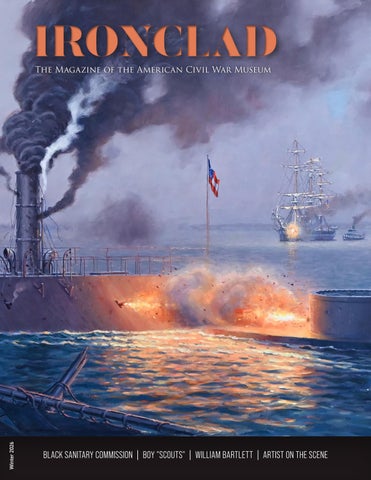
COVER: Detail of The Battle of Hampton Roads by John Barber, 2026. See the full article on page 16.
@acwmuseum ACWM.org
32 America 250
Magazine Publisher Rob Havers, Ph.D. ACWM President & CEO
Managing Editor Robert Hancock
Art Director & Designer John Dixon
Editorial Review Kelly Hancock Jeniffer Maloney
Museum Board of Directors Richard S. Johnson, Chair Claude P. Foster, Vice Chair Daniel G. Stoddard, Treasurer Walter S. Robertson III, Secretary Rob Havers, Ph.D., President & CEO Hans Binnendijk, Ph.D. Trevor S. Cox Audrey P. Davis Sally Diggs Fletcher George C. Freeman III Stephen T. Gannon Bruce C. Gottwald, Sr. B. Hunt Gunter Andrew R. Hoehn Donald E. King Alexander Macaulay Calvert Saunders Moore John L. Nau III Davidson Perry-Miller William R. Piper Roderick G. Stanley Ruth Streeter Allison Thomas Daniel Webber Jeffrey L. Wilt H. Alexander Wise, Jr.
Foundation Board of Directors Jeffrey L. Wilt, Chair Stephen T. Gannon Rob Havers, Ph.D. Richard S. Johnson Donald E. King Calvert Saunders Moore Walter S. Robertson III H. Alexander Wise, Jr. Ironclad magazine is published quarterly by The American Civil War Museum. 490 Tredegar St., Richmond, VA 23219 The contents of this magazine may not be reproduced in whole or in part without the consent of the American Civil War Museum.
FROM THE CEO PHOTO: JOHN DIXON
G
reetings from Richmond, Virginia, and welcome to the winter edition of Ironclad magazine. From the holiday season through our annual symposium, the American Civil War Museum provided engaging programming and events. The recent ACWM annual Symposium Relationships Forged In War was outstanding in every way. This year’s multi-day event included battlefield tours and a “Meet the Speakers” program and reception in addition to the full day of lectures by the panel of distinguished historians. We were delighted to welcome so many to our Tredegar site for this event. You can see photographs from the symposium on pages two and three.
Our upcoming Spring Lecture Series programs listed on page 32 focus on the 250th Anniversary of our country’s Declaration of Independence, examining how national leaders sought inspiration from the past while grappling with issues left unresolved by the Founding Fathers. Of course, in April we hold our annual Surrender and Freedom Day Commemoration festivities and programs at ACWM Appomattox. This year we will add an historian guided evening experience Voices of Appomattox, where small groups are led across the museum site to encounter powerful stories connected to the war’s final moments and the surrender in 1865. In a busy winter season, the ACWM was honored to be the beneficiary of a commissioned oil painting, “The Battle of Hampton Roads”, by noted maritime artist John M. Barber. A detail from the painting adorns the cover of this issue. This extraordinary artwork was done in support of and in conjunction with our museum, which sits at the former Tredegar Ironworks where the iron used to transform the frigate USS Merrimack into the CSS Virginia was forged. The piece was sold at auction in February, and prints are available through our website or in person at ACWM Tredegar. More information can be found starting on page 16. In another new initiative, I am pleased to share the establishment of the William Francis Bartlett Medal awarded annually to an American leader in business, politics, or the military who best exemplifies character, selfless-service, and courage in adversity as well as patriotic commitment to the ideals of the United States of America. The inaugural William Francis Bartlett Medal will be presented to Mr. Austin Brockenbrough, III at the Tredegar Foundry building at the American Civil War Museum on April 9, 2026. A former U.S. Marine, Mr. Brockenbrough’s life of dedicated service to this community and to this nation is exemplified by the dozens of charitable organizations he has supported and served for over six decades. More on the details of the Bartlett Medal award can be found on page 9. I hope you enjoy this issue of Ironclad. As always, thank you for your support, and I look forward to seeing you soon at the American Civil War Museum.
Dr. Rob Havers, President & CEO
T HE A MERICA N CIVIL WA R MUSEUM
1
REL AT IONSHIP S
FORGED I N WAR SYMPOSIUM 2026 This year's annual symposium Relationships Forged In War included a full weekend of Civil War history experiences! We offered tours of our collections, a special “Meet the Speakers” Q&A program, and ACWM historian-led battlefield tours, in addition to the outstanding lectures on Saturday.
2
I RONC L A D : W inter 2026
T HE A MERICA N CIVIL WA R MUSEUM
3
4
I RONC L A D : W inter 2026
The Urgent Necessity of Doing Something
BLACK SANITARY COMMISSION WORK DURING THE CIVIL WAR
BY DR. KATHRYN ANGELICA
IN
October of 1864, at the height of the American Civil War, hundreds of Bostonians flocked to Mercantile Hall to attend a “Fair for the benefit of disabled and sick colored soldiers.” The event, organized by the Colored Ladies’ Sanitary Commission of Boston, urged the public to bestow their patronage upon men who had “fought bravely to sustain our noble flag, and the country’s freedom.” Fairgoers first encountered a panoply of red, white, and blue draped across Sumner Street. The hall, decorated with stars and stripes, drew the eye to a portrait of Colonel Robert Gould Shaw, the white commander of the 54th Massachusetts, the first African American regiment formed the year prior.
The women of the fair framed the painting with embroidered letters spelling “Our Martyr.” For a twenty-five-cent admission price, one could peruse tables filled with useful and ornamental objects, admire displays of cakes and confectionery, and try their luck at the raffles. Prizes included the painting of Shaw, a Hamlin cabinet organ, and a Chickering piano. One evening, Anna Dickinson, the sensational young political orator, delivered a patriotic address. The fair ultimately raised over three thousand dollars for disabled soldiers of color and their families. The three-day patriotic display was only possible due to the organization, labor, and initiative of Boston’s women of color.
continued on page 6
Boston's Mercantile Building, Sumner Street. c.1860 COURTESY HISTORIC NEW ENGLAND
(Opposite) Map of U.S. Sanitary Commisson operations, 1864. NEW YORK PUBLIC LIBRARY
T HE A MERICA N CIVIL WA R MUSEUM
5
continued from page 5
The Civil War provided a platform for seasoned reformers to enact political citizenship claims and new ways for women in particular to demonstrate their patriotism. For many white reformers, this meant contributing to the United States Sanitary Commission. Formed in 1861, it linked sewing circles and soldier’s aid societies into a national network of aid, spanning the entire eastern United States as well as several cities in Canada during the Civil War. Powered by the volunteer labor of Northern women, the Commission offered new avenues through which to make public claims for citizenship. Activist women like Abigail Williams May, Louisa Schuyler, and Mary Livermore took on executive positions at the forefront of the Commission and wielded carefully curated skills built during decades of agitation, efforts that did not end with the onset of peace. However, Sanitary Commission records fail to elucidate the contributions and labors of women of color, like the Boston women who organized the elaborate patriotic display of 1864. This silence within official records provides a false narrative of their Civil War work. Black women in Boston, New York, and Philadelphia embarked upon parallel wartime labors that leveraged a sophisticated network of grassroots organization to support African American regiments, communities of freed people, and the Union war effort. Although Black women faced barriers that limited expressions of patriotism in public forums, they imbued their wartime activism with multifaceted and forward-thinking goals. In addition to contributing to the Sanitary Commission in various ways, women of color formed their own ‘sanitary commissions’ to support their communities. Their work during the Civil War shifted the tenor of the drive for abolition, racial equality, women’s rights, and citizenship claims in ways that placed women of color at the forefront of political and social debates. People of color labored on behalf of the Sanitary Commission in a variety of
6
I RONC L A D : W inter 2026
roles, including as laborers, entertainers, and organizers. Black men and women appeared conspicuously within Sanitary Commission offices as porters, clerks, and janitors. A commemorative photograph album of the New England branch includes an image of Elias Richards, an African American porter employed by the Boston office, wearing a necktie, vest, and white jacket. Richards received a salary for hauling, sorting, and transporting heavy boxes of supplies and other errands. Black men were also employed within auxiliary institutions such as the Union Volunteer Refreshment Saloon in Philadelphia. However, the most substantial labor performed was for the organization of “sanitary fairs,” massive fundraising endeavors that lasted multiple weeks, requiring the construction of huge exhibition halls and contributions from thousands of individuals. Fairs not only raised significant sums for the Union military effort but publicly demonstrated northern patriotism. African American waiters served the restaurant tables at sanitary fairs, wearing spotless white aprons and jackets and black pants with rosettes of red, white, and blue. Photographs of Philadelphia’s Great Central Fair depict close to thirty uniformed Black waiters assembled in front of patriotic banners. Charles Stillé’s Memorial of the Fair, in the only acknowledgment of Black labor, mocked the “very important air” assumed by these men “as if the success of the Fair depended upon the individual exertions of each.” This insulting reference minimized the contributions of Black men and women to menial labor and devalued their expressions of patriotism. However, it also revealed the dedication, enthusiasm, and effort made by men of color to support the Sanitary Commission. Sanitary Fair committees also positioned people of color as spectacles and entertainment for fairgoers. Caricatures of Black figures in minstrel shows were one of the entertainments offered in the Music Hall of New York’s Metropolitan
Elias Richards, c.1866 NEW ENGLAND WOMEN'S AUXILIARY ASSOCIATION PHOTOGRAPH ALBUM, MASSACHUSETTS HISTORICAL SOCIETY
African American waiters at the dining room of Philadelphia's Great Central Fair in 1864 LIBRARY COMPANY OF PHILADELPHIA
"Knickerbocker Kitchen," Harper's Weekly, April 23, 1864 (Below) "The Indian Department," Harper's Weekly, April 23, 1864 HATHI TRUST/ UNIVERSITY OF MICHIGAN
Fair. Likewise, visitors to the "Knickerbocker Kitchen" entered an environment styled after “early life” in the state. Fairgoers ate their lunches in the presence of “Chloe and Caesar, respectable people of color,” engaged in knitting and fiddle playing. When this pair proved too placid, “a real Virginia darky, all ebony and ivory” would “dance a ‘breakdown.’” In another section of the hall, white women dressed as Dutch mistresses “ruled the array of sable waiting women.” Both the Metropolitan and Great Central Fairs also organized “Indian Departments” in which indigenous people appeared in traditional costume to dance and sing. Advertisements listed the “war dance” and the “scalp dance” as features of a performance of “muscular savagery” accompanied by rattles, drums, and “strangely weird vocal melodies.” This caricatured routine and display of native bodies benefited both from the romanticization and mockery of Indigenous life and brought enormous profit to the Sanitary Commission. At the Great Central Fair, Thomas Nast’s “The Past and the Future” also served as a central exhibit. The engraving juxtaposed the cruelties of the slave auction and the torture of Black and Indigenous peoples with the civility of freedom, education, and free labor. As a result, fairgoers fondly gazed upon pantomimes continued on page 8
T HE A MERICA N CIVIL WA R MUSEUM
7
"The Past and the Future" by Thomas Nast, Harper's Weekly, January 24, 1863 LIBRARY COMPANY OF PHILADELPHIA
continued from page 7
of enslaved & indigenous people as relics of “an age passing away” while simultaneously championing images of antislavery and emancipation. People of color in Northern cities also made attempts to publicly participate in Sanitary efforts on equal footing with white volunteers only to be swiftly rebuffed. Amidst preparations for the Great Central Fair in Philadelphia, William D. Forten, uncle of famed intellectual and diarist Charlotte Forten, expressed a communal desire to honor those risking their lives for the cause. He described the Sanitary Commission as bestowing favors “without distinction of race or color” and requested that Black
8
I RONC L A D : W inter 2026
women in Philadelphia be furnished their own table at the Fair. Despite welcoming any material or financial donations, fair organizers denied Forten’s request as their “arrangements do not contemplate private tables.” As a result, Black and white participation in Sanitary Fairs and Sanitary Commission labor occurred along a clear racial line. An advertisement announcing the uniform for women volunteers at Philadelphia’s Great Central Fair outlined this division most clearly, proclaiming, “WHITE BODIES as being both Serviceable & Becoming.” This perhaps unintended double entendre painted a picture both of the intended costume
and the vision of white women in white dresses staffing a row of tables draped in red, white, and blue. Rather than a patriotic shield, the uniform provided to Black laborers marked them servants and non-participants. The exclusion of Black women from active participation as volunteers not only refused them space on fairgrounds but denied them their right to profess their patriotism in a public forum. Although able to submit anonymous contributions, Black women were not permitted to serve as symbols of patriotic benevolence. Despite rejection from its bureaucratic structure, Black women persisted to organize under the banner of the United
States Sanitary Commission. African American women in both Boston and Philadelphia formed “Colored Ladies’ Sanitary Commissions.” The Commission recognized the St. Thomas Ladies’ Sanitary Committee and the Colored Women’s Loyal Union League of Philadelphia as official auxiliaries to the Pennsylvania Women’s Branch. In Worcester, African American community leader, Martha A. Brown, contributed to an interracial Worcester Ladies Sanitary Fund. However, the Colored Ladies Sanitary Commission of Boston, despite its name, operated independently. Linking their efforts to the Sanitary Commission either in affiliation or name legitimized claims for donations under a familiar heading and allowed them to claim their rightful place under the banner of patriotic Northern womanhood. Black women leaders founded the Colored Ladies’ Sanitary Commission of Boston within the historically abolitionist Twelfth Baptist Church. Christiana Carteaux Bannister led the organization as its President. Of African-American and Indigenous descent, Bannister took on the professional name “Madame Carteaux” and owned a chain of salons between Boston and Providence. Entrepreneur, abolitionist, and property holder, she was also the wife of African American painter Edward M. Bannister. Octavia J. Grimes, wife of pastor Rev. Leonard A. Grimes of the Twelfth Baptist Church, served as Treasurer. Her position as spiritual leader and community organizer extended to her role as President of the Sewing Society of the church, organizing several fairs for its support. In contrast to Sanitary Commission circulars that solely highlighted the plight of the soldier, advertisements for Black women’s sanitary fairs contained
“their husbands, brothers, and fathers have gone to uphold the honor of our flag.” In addition to fundraising, Black women’s organizations sent committee members South to visit hospitals, raised money for orphaned children of color, and formed fugitive aid societies. Their public advertisements denounced the “unholy rebellion of the slave power” and called for the establishment of “Universal Freedom.” These declarations, coupled with public acts of patriotism, firmly aligned their Civil War labors not only with antislavery and abolition but with a broader civil rights movement.
Portrait of Christiana Carteaux Bannister painted by her husband, Edward Bannister. c. 1860. COURTESY OF THE RISD MUSEUM, PROVIDENCE, RI.
overtly political slogans that reflected the activist foundations of their organization. Black women activists presented the 54th Massachusetts with their regimental colors in a public ceremony in 1863. They highlighted the bravery and military service of Black men and in May 1864, denounced the mistreatment of Black soldiers – particularly the fact that many had not received any pay by bringing attention to the patriotic sacrifice of Black families. They also highlighted the political implications of Black military service, writing,
Outside of the Sanitary Commission, Black women’s Civil War work cultivated local, grassroots organization for interregional and national causes. Across the North, activist women leveraged church meeting rooms, front parlors, and street corners to raise funds for social and political causes. Civil War work included the formation of church organizations, soldiers’ aid societies, relief societies, and nascent freedmen’s aid organizations that paved the way for Reconstruction. These efforts also included continued campaigns to dismantle institutionalized racism, segregation, and exclusion. Black women’s activism during the Civil War demonstrates the many ways in which women of color used local organization and patriotic displays not only as tools to raise funds, but as signals of their broader political and citizenship claims. Kathryn Angelica is Assistant Professor of United States History at Purdue University Fort Wayne.
T HE A MERICA N CIVIL WA R MUSEUM
9
The Original Boy “Scouts” Underage Fighters in Irregular Warfare
10
I RONC L A D : W inter 2026
BY DR. ANDREW TURNER
…These boys were, in a very material sense, veterans before they joined.... Reared upon the border, they had passed the most impressionable time of life amid the scenes which attended the flooding and ebbing of the tide of war about their homes. They had become familiar with war in its darkest phases, and acquainted with the enemy in his strongest and weakest points. Armies had marched and countermarched about them; battles had been fought around them; their homes had been pillaged and burnt before
their eyes; scouts and spies and deserters were their familiars; they had become experts in running pickets, and securing and conveying secret information. In short, they had learned a whole lot of things which are not down in the standard books on the culture of youth, but which admirably fitted them for partisan warfare. Not a few of them had already made tests of their qualifications, and presented themselves for enlistment already mounted and equipped with the fruits of their experiments.
J
ohn Henry Alexander, who joined John S. Mosby’s battalion of Virginia partisan rangers as a teenager, wrote the above statement to describe the boys who were recruited into Mosby’s command specifically for their impressionability, their knowledge of enemy lines, their quickness to obey orders, and their seeming disregard for danger. Perhaps they did not stop to think about the danger that waited ahead of them, a trait that made them daring but endangered guerrilla warriors. But the quote also describes thousands of other underage youths who became valuable and vulnerable actors in the irregular warfare that defined much of the Civil War. From New Mexico to Maryland, boys under the age of eighteen became part of the spying, scouting, foraging, raiding, and continued on page 12
Brandy Station, Va. Scouts and Guides of the Army of the Potomac The youth of many of the scouts and guides of the Army of the Potomac is evident in this photograph from 1863-1864. Young boys, Black and white, are pictured in the photo, some with large revolvers tucked into their belts to protect themselves during their dangerous work probing enemy positions for information. Whether they were actively scouting or keeping horses and men fed and ready for dangerous combat, these youths contributed to the intelligence operations of the Army of the Potomac. LIBRARY OF CONGRESS
T HE A MERICA N CIVIL WA R MUSEUM
11
continued from page 11
guerrilla warfare operations that historians have recently pinpointed as a defining and traumatic portion of the Civil War. Though youths under the age of eighteen were not legally allowed to enlist without parental consent (or only became subject to conscription at the age of seventeen in the Confederacy in 1864) this age boundary was often ignored by youths and recruiters alike as irregular warfare eroded the boundaries between adults and children, home front and battlefield. In areas where freedom was contested, loyalties were divided, and regions of control were shifting, age did not protect people from the realities of war. In order to grasp at agency in places where their homes became battlegrounds, or because they were coerced into aiding Union and Confederate forces in areas of irregular warfare, underage boys became active soldiers, partisans, scouts, and spies. The faces of some of these young irregular fighters have been preserved in period photography and drawings. They offer a glimpse of the boys who were drawn into guerilla fights as well as those pulled into irregular warfare that was waged by and on the edges of more conventional armies. They serve as tangible reminders of the youths who were pulled, and who sometimes jumped, into a vast and violent civil war. Young boys sometimes found themselves in mounted commands purely because of their small stature. Thomas Duncan, who needed parental consent to enlist before he was eighteen, was given permission by his father to join the Confederate army under the condition that he join a cavalry unit. His father believed he was too small in size to endure the rigors of infantry service. Duncan acquiesced to his father’s wishes and was enlisted into an Alabama cavalry unit. He endured years of bloody combat and eventually rode with the command of Maj. Gen. Nathan Bedford Forrest as it engaged in
12
I RONC L A D : W inter 2026
I was a mere boy engaged in a struggle wherein men were seeking to destroy each other…
This image of Thomas D. Duncan, showing his small stature, was published along with his memoir in 1922. Thomas D. Duncan, Recollections of Thomas D. Duncan, A Confederate Soldier LIBRARY OF CONGRESS/HATHI TRUST
raids on Federal supply lines and units. He remembered his first engagement at Fort Donelson by saying, “This fight was the most appalling sight I had ever witnessed. I was a mere boy engaged in a struggle wherein men were seeking to destroy each other….” Within larger and more conventional operations and theaters, such as Sherman’s March through the Carolinas and Robert E. Lee’s campaigns in northern Virginia, underage soldiers became noted for their prowess as irregular fighters. They served as scouts that gathered information on enemy strength and positions, foragers who found provisions, and sharpshooters who sniped at enemy soldiers and skirmished with enemy formations, actions for which they were well suited because of their youthful enthusiasm,
their athleticism, and their desire to prove themselves equal to older men in action. Though they were attached to regular armies, their exploits were of an irregular nature. Charles Belknap became a respected commander of foraging parties in general Sherman’s army in the Carolina’s after enlisting as a sixteenyear-old. He passed on his memories of foraging and knowledge of scouting when he became a Boy Scout leader in the early twentieth century. Berry Benson, who served as a scout and sharpshooter in the Army of Northern Virginia (after enlisting as a teenager in South Carolina secessionist forces in the winter of 1860), is now popularly known because his diary has been widely published. Youths like William Calder and Randolph Abbott Shotwell led contingents of sharpshooters in the Army of Northern Virginia after enlisting underage.
The actions of Confederate guerillas and partisan ranger units could be a seductive draw for youths who were living in regions torn apart by irregular warfare. Partisan ranger units, which were government sanctioned units enlisted and organized to fight irregular battles, often recruited youths to their ranks. Bushwhacker and guerilla commands, which were often formed outside of government control at the behest of local and often rogue leaders, also impressed, coerced, and recruited young boys into their ranks. Flamboyant battle shirts, plumed hats, hit-and-run tactics, and senses of independence swirled to form an alluring form of masculinity ripe for the taking in the minds of some southern youths on the cusp of manhood. These commands could also offer ways to escape the impending Confederate draft with its
ever-lowering age range, to protect their vulnerable families, and to seek reprisal for wrongs committed by enemies. J. Wilson Montgomery, who joined an Arkansas irregular unit as a teenager, remembered his command by saying, “this little command was a terror to all the Federal Posts and scouting parties in N.W. Ark. for 4-5 counties and the edge of Mo. Lieut. Inks formed an advance guard of some twenty picked men of the two companies; boys I might say for scarcely any of them were over 20 years old.” Youths were recruited not only for their recklessness but also their ability to blend in with civilian populations more easily than men of military age who were expected to be at war.
In the image above, Tom Zachary (top right, age fourteen), from a North Carolina Unionist family, served as a guide for Union prisoners of war who were escaping through the North Carolina mountains. The divided loyalties of the mountainous regions of Tennessee, North Carolina, and other southern states often left little room for youths to remain inactive or neutral as brutal acts of guerilla warfare raged around them. Other youths throughout the South, both of Confederate and Federal loyalties, were regularly noted as being guides for military units, spies, and scouts in official reports. Some were even captured, released because of their youthful appearances, and then recaptured days later when they were guiding or fighting with other soldiers. LIBRARY OF CONGRESS
continued on page 14
T HE A MERICA N CIVIL WA R MUSEUM
13
continued from page 13
In other instances, military impressment was part and parcel of regions where irregular warfare was common. For some of the youths who joined bushwhacker and guerilla groups, especially in places like Missouri and Kentucky, lives of crime began during the war and continued after its close as youths learned the brutality of guerilla actions. Major General Robert H. Milroy (U.S.) even passed an order in middle Tennessee in April of 1865 requiring all men over the age of fourteen to enroll for service in the Union home guard. His reasoning was that he “found many of the very worst bushwhackers between the ages of fourteen and eighteen” and that “boys among those ages are much more liable to be seduced away among bushwhackers than those over eighteen.”
Regions of divided loyalty, like those in among the command and that the North Carolina, Tennessee, Maryland, Unionists often had families between Missouri, and Kansas, also drew youths or behind enemy lines. He wrote of into the Union army as one young soldier’s their homes became actions in battle by battlefields. To protect saying, “The North The North themselves and their Carolinia [sic] troops Carolina families, for which fought like tigers. One, they felt increasingly troops fought a boy only thirteen responsible as they grew years of age, was seen like tigers. older, from Confederate behind a large elm tree bushwhackers, many to load and fire several joined Union mounted times, and a squad of and irregular units. In rebels charged on him coastal North Carolina, where Union to dislodge him from his position. sentiments were strong, many youths The little fellow jumped down a steep enlisted in North Carolina Union embankment and ran down the street regiments that fought irregular battles leading to the wharf, to get under with Confederate North Carolinians. cover of the ‘Louisiana's’ guns.” Others A sailor aboard a Union gunboat joined because it could provide a near Washington, North Carolina, source of monetary income and food remembered that mere boys were for destitute mothers, fathers, and
Ten soldiers of the 2nd Kentucky Cavalry Regiment while imprisoned at Camp Douglas, Illinois Five of the ten soldiers from the 2nd Kentucky Cavalry, were born in the year 1843 or after. LIBRARY OF CONGRESS
14
I RONC L A D : W inter 2026
I was so thankful to find myself alive at daybreak.
Lucien Love, born between 1845-1847, was one of six Mosby partisans hanged by Union soldiers in Warrenton, Virginia in 1864. LIBRARY OF CONGRESS
sisters, and extended families in regions that had been devastated by foraging parties. Of course, some youths also were impressed or called into the Union military as recruiting parties moved through these areas or as forces were hastily mustered to oppose Confederate raids. Even if boys were not living in regions dominated by irregular warfare, their enlistment into mounted commands often found them serving in regions where they were fighting against guerillas. Stanton P. Allen joined the 1st Massachusetts Volunteer Cavalry at the age of fourteen in late 1863. When he stood picket near Warrenton, Virginia, in the early months of 1864, he was frightened by the prospect of one of Mosby’s guerillas attacking him in the middle of the night. He wrote: “It was one of the longest nights I ever put in during my army service. Of course, every noise made by the wind was a bushwhacker, I was so thankful to find myself alive at daybreak that I forgot to growl at the corporal for not relieving me on time.” The mental and physical trauma that came not only from the intense fear of being in irregular warfare but also from witnessing brutal atrocities, tolled hard on youth soldiers whose minds and bodies were still developing.
Dr. Andrew Turner is Postdoctoral Research Associate at the John L. Nau III Center for Civil War History at University of Virginia
One of the most infamous Confederate boy guerillas was Jesse James who began riding with William Clarke Quantrill’s bushwhackers around the age of seventeen
Alexander C. Simmons, born in 1847, enlisted in the Fourth Tennessee Cavalry (US). He died on March 20, 1864 and is buried the Nashville National Cemetery LIBRARY OF CONGRESS
LIBRARY OF CONGRESS
T HE A MERICA N CIVIL WA R MUSEUM
15
One of a Kind Commissioned Civil War Battle Painting at Auction to Benefit the American Civil War Museum
N
oted Chesapeake Bay artist John M. Barber has skillfully recreated the scene that ushered in a new era of naval warfare. The painting was done in support of and in conjunction with the American Civil War Museum (ACWM), which is built around the ruins of the Tredegar Iron Works in Richmond, Virginia. Tredegar Iron Works forged the iron used to transform the frigate USS Merrimack into the powerful ironclad vessel CSS Virginia. In the painting, we see the CSS Virginia (formerly the USS Merrimack) and the USS Monitor battling one another in Hampton Roads near the entrance of Chesapeake Bay on March 9, 1862. The 24” x 48” oil painting and preparatory studies was sold by the Guyette & Deeter auction house of St.Michaels, Maryland, in late February. Auction details available at Guyette & Deeter. Archival fine art reproductions will be available through the American Civil War Museum. For historic accuracy, Barber collaborated with John Quarstein, Director Emeritus of the USS Monitor Center at The Mariners’ Museum and Park in Newport News, Virginia.
Sketch for The Battle of Hampton Roads John Barber, 2026 Pencil on paper IMAGE COURTESY OF JOHN BARBER
More than 25,000 civilians, soldiers, and sailors gathered along the shores of Hampton Roads, Virginia, on the morning of March 9, 1862, to witness this very scene, depicted by John Morton Barber, the first fight between ironclad ships. The epic tale of the Battle of Hampton Roads shows how steam-powered iron warships not only influenced the Civil War but, more importantly, marked the dawn of a more modern navy. about the work Noted marine artist John M. Barber’s skillful recreation of this iconic scene on canvas makes viewers believe they, too, are there, watching history unfold. In the background at the left, lie the sunken remains of USS Cumberland. The sloop had been rammed by CSS Virginia with its flag still flying and continued on page 18
16
I RONC L A D : W inter 2026
The American Civil War Museum
Legacy Society What will your legacy be?
In the ACWM Collection is a piece of armor plating forged for the CSS Virginia at Tredegar Iron Works. This test plate was used to assess the strength of the armor. The one-inch thick armor plate was considered insufficient, so two-inch thick plates were rolled to cover the ironclad ship.
Help us preserve the most transformational period in United States history for generations to come by becoming a member of the American Civil War Museum Legacy Society. To receive information about our Planned Giving Program, please contact Anneka Early: aearly@acwm.org, 804.649.1861 ext. 144
T HE A MERICA N CIVIL WA R MUSEUM
17
continued from page 16
masts remaining above the depths of the James River. In the background at right is the grounded USS Minnesota and its support vessels, the armed tug USS Dragon and merchant vessel SS Lorenz. The massive frigate was Virginia’s intended victim on the next day; yet, USS Monitor survived heavy storms and arrived from New York to defend the Union wooden fleet in Hampton Roads.
18
I RONC L A D : W inter 2026
In the center, the fight between Virginia and Monitor is powerfully detailed with shot and shell bouncing off each ironclad. While Monitor was proclaimed ‘the little ship that saved the nation,’ the fight actually ended in a draw. These two ships were destined never to fight again. Yet, their legacy proved the power of iron over wood.
The Battle of Hampton Roads John Barber, 2026 Oil on linen canvas. 48" w X 24" h IMAGE COURTESY OF JOHN BARBER
To purchase an archival paper or canvas giclée print of the painting, visit the museum at Tredegar or ACWM.org.
about the artist John M. Barber, fellow emeritus of the American Society of Marine Artists, resides in Richmond and has focused his art for nearly 50 years on the threatened and vanishing aspects of the Chesapeake Bay. Through donations of his artwork and copyrights, over a half-million dollars has been raised to support the Chesapeake Bay Foundation, The Nature Conservancy, and other non-profit conservation groups. His work has been exhibited and collected nationally and internationally, and he
was commissioned by the National Geographic Society to create artwork for President Ronald Reagan and President Clinton. His most memorable project was sailing up the Atlantic Coast with Walter Cronkite to Martha’s Vineyard where he painted Walter’s beloved sailing yacht Wyntje. During his career, Barber published and distributed 135 limited-edition collector prints, most of which were of his beloved Chesapeake Bay.
T HE A MERICA N CIVIL WA R MUSEUM
19
The inaugural presentation of the
William Francis Bartlett Medal honoring
Austin Brockenbrough III April 9, 2026 THE AMERICAN CIVIL WAR MUSEUM 480 TREDEGAR ST.
20
I RONC L A D : W inter 2026
RICHMOND, VA
Country. Courage. Unity. Major General (Bvt.) William Francis Bartlett BY STEPHEN T. GANNON
The American Civil War Museum has established an award in honor of William Francis Bartlett, of Pittsfield, Massachusetts, one of the most extraordinary soldiers and leaders to arise from the cauldron of the Civil War. Bartlett devoted service in a time of war and was then dedicated to reconciliation and unity in time of peace.
as the colonel of a new volunteer regiment, the 49th Massachusetts. Despite the severity of his wound, he was able to fulfill his duty as a soldier using a prosthetic leg and crutches and by riding on a horse as much as possible, with his crutches slung over his back. Private Henry T. Johns wrote of Bartlett that “As few men, he looks the soldier, though quiet, there is an air for command about him that would make obedience to his order almost involuntary.” Johns went on to note Bartlett’s singular determination to overcome the loss of his leg.
William Francis “Frank” Bartlett was born in Haverhill, Massachusetts, and attended Harvard College. When war broke out in 1861, Bartlett William Francis Bartlett, c 1866. volunteered for duty and NATIONAL ARCHIVES began service with the 20th Massachusetts infantry, touched by the same spirit of loyalty and devotion that motivated other young Bartlett and the 49th Massachusetts saw action in men such as fellow Harvard student and future Gen. Nathaniel Banks’ initial attacks against Port Supreme Court Justice Oliver Wendell Holmes, Hudson in Louisiana, as part of Grant’s greater Jr. Rising quickly through the ranks, he became a Vicksburg Campaign. There, on May 27, 1863, he captain at age twenty-one and first saw combat led his troops on horseback because he could not on October 21, 1861, at the Battle of Ball’s Bluff, navigate the difficult, broken terrain over which the outside of Leesburg, Virginia. While that battle advance was made. Bartlett later wrote “I knew my was a disaster for the Union forces, Bartlett chances for life were very small. But I had to go on demonstrated extraordinary coolness under fire and horseback, or not at all.” During the attack, seeing was able to withdraw his troops successfully while his line faltering, Bartlett seized the colors from the others broke and ran. bearer and waved them aloft as he rode his horse closer to the enemy entrenchments. There his luck In action before Yorktown, Virginia, on April ran out. He was wounded in three places. After the 24, 1862, he was seriously wounded for the battle, during truce negotiations to remove the dead first time, with a bullet shattering his knee and and wounded, some of the Confederate officers resulting in the amputation of his left leg. Bartlett asked the Union officers: “Who was that man on returned to Massachusetts to recover, finished his horseback? He was a gallant fellow … We thought studies at Harvard, and while there, was selected him too brave a man to be killed …."
continued on page 22
T HE A MERICA N CIVIL WA R MUSEUM
21
continued from page 21
Bartlett returned again to Massachusetts to recuperate and was asked by Governor John Andrew to recruit another volunteer regiment, the 57th Massachusetts, which mustered south of Worcester in early 1864. There can be no doubt of Bartlett’s commitment to the prosecution of the war to the end. He told his new regiment there would be no peace except an honorable one: “You must put forth every exertion” he said, "you must spend, if need be, every dollar, and send, if need be, every man … Until you have broken down and punished rebellion and conquered victorious peace.”
After the war, Bartlett became involved in the iron business. He was asked to manage the Powhatan Ironworks, which had been purchased by a group of Northern businessmen. Bartlett split his time between Richmond, Virginia, and Pittsfield, Massachusetts.
Later that spring, the 57th Massachusetts moved south and began its part in the Overland Campaign. In the maelstrom of the Wilderness, as the Federals slammed into A.P. Hill’s battle line, the blue line began to dissolve. As the advance slowed and came to a stop, General Winfield Hancock appeared on horseback, ordering Colonel Bartlett to march his regiment to the front over another regiment that was lying prone, unwilling to advance. Bartlett later noted, “We did it in perfect line,” and Hancock referred to the 57th’s march forward as “glorious.” Bartlett was wounded yet again, this time by a shot that grazed his right temple.
Bartlett spoke at the commemoration at Lexington, Massachusetts, of the 100th anniversary of the battle that took place there on April 19, 1775. President Grant was the guest of honor, and Bartlett debated with himself how he could say something of importance to the whole country, given that he detested politicians (particularly those surrounding President Grant) for their divisiveness and their placing of party and themselves ahead of the country. Bartlett rose to the occasion, declaring: Sir, I am not an “unprejudiced observer.” On the contrary, I have a prejudice which is shared by all soldiers, in favor of peace. … I [also] have a strong prejudice against any man or men who would divide or destroy or retard the prosperity and progress of the nation, whose cornerstone was laid in the blood of our fathers 100 years ago today. Moved by this prejudice, 14 years ago, I opposed the men who preferred disunion to death. True to this prejudice, I today despise the men who would, for the sake of self or party, stand in the way of reconciliation and a united country.
While on medical leave, Bartlett received his commission as brigadier general. He was twentyfour years old. Reporting for duty outside Petersburg, he took command of a brigade in the Ninth Corps. On July 30, 1864, he led the brigade in its attack on the Crater, where one of his soldiers stated that Bartlett “was perfectly splendid, and led us in the charge on foot,” while an officer from a nearby brigade recorded seeing Bartlett “hopping along very cheerfully, aiding himself by a stout malacca cane with an ivory cross handle.” A shell exploded near Bartlett crushing his wooden leg and rendering him immobile. Despite this, Bartlett continued to direct Union defensive efforts in the Crater (by this time, primarily USCT soldiers), but as the Union forces retreated, Bartlett, unable to move, was captured. Bartlett was first sent to a military prison in Danville, Virginia, where he suffered from dysentery, a disease which plagued him for the rest of his life. He was transferred to Libby Prison in Richmond, from where he was exchanged on September 21, 1864. He made every effort to return to the fight, but the war ended before he could rejoin the battle. He was breveted major general on March 12, 1866. He resigned from service on July 18, 1866.
22
I RONC L A D : W inter 2026
Bartlett also spoke frequently at the dedication of war memorials and similar events. His public remarks and his writings reflect a remarkable spirit of reconciliation, brotherhood, and unity which was sorely needed in the nation then.
As a result of remarks such as these, Bartlett developed a national reputation as a leader in fostering the spirit of reconciliation and unity – an extraordinary display of virtue by one who had suffered so much for his country. He was broadly complimented across the nation for these remarks. Perhaps the highest compliment to Bartlett for this speech came upon his return to Richmond later that month. On the evening of April 28, a large number of former Confederate soldiers, from privates to generals, assembled in Richmond’s Capitol Square and, accompanied by the First Regiment Band, marched up the street to Bartlett's residence at Grace and Sixth to thank their former foe for his Lexington speech. Bartlett exhorted the former soldiers in the crowd to transmit to their children the lesson that “divided we were terrible, united we are forever invincible.”
In the end, Bartlett declined all political offers. Unfortunately, even as Bartlett’s notoriety grew, his body never fully recovered from the effect of the wounds and the disease that had ravaged it during the war. His health declined steadily, and he died, likely from tuberculosis, on December 17, 1876. He was remembered with great affection. The Boston Daily Globe commented: “No greater or purer hero lives in the pages of history or romance … He represented at once the courage and the magnanimity of the patriot soldier. The Richmond State noted his death with sadness: “The many friends he made shall mourn him long, and Virginia joins with Massachusetts in lamenting a loss not only to the two states, but to humanity.” In his famous 1884 Memorial Day speech at the Grand Army of the Republic post in New Hampshire, Oliver Wendell Holmes, Jr., Bartlett’s wartime colleague in the 20th Massachusetts and future Supreme Court Justice, famously noted that “Through our great good fortune, in our youths our hearts were touched with fire. It was given to us to learn at the outset that life is a profound and passionate thing,” in which a man learns that “the one and only success which it is his to command is to bring to his work a mighty heart.”
A statue of Bartlett was dedicated at the Massachusetts State House in 1904. KENNETH ZIRKEL, CC BY 4.0.
It was not only those in the South who were impacted by the power of Bartlett's words and the sincerity of the beliefs behind them. That fall, the Democratic Party in Massachusetts offered to nominate Bartlett as their candidate for lieutenant governor. Bartlett declined the offer, believing that Charles Francis Adams, whom he admired, would be nominated by the Republicans for governor. Nonetheless the Democrats went ahead and nominated Bartlett at their state convention. Remarkably, before Bartlett had a chance to reply, the Republican State Committee proposed to nominate him for governor. Incredibly, at the same time, leading citizens of Richmond considered nominating Bartlett for governor of Virginia.
Finally, at the dedication of the statue to Bartlett that still stands in Memorial Hall in the Massachusetts State House, John Sargeant Wise, son of a Virginia governor, former Virginia Military Institute cadet and New Market veteran, and an early champion of civil rights, paid tribute to Bartlett, noting that they had occupied neighboring pews at Saint Paul's church after the war, recalling: For strong and bold as he had been in the great struggle, he realized that it was over forever … and that the hope of the future lay in mutual forgiveness … and in the union of the best of both sides for the attainment of peace and a common glory. … Thank God that Virginia for a time enjoyed the privilege of witnessing his unsurpassed courage and afterwards claiming him as her adopted son.”
Stephen T. Gannon is a board member of the American Civil War Museum and member of the museum's Foundation Board
T HE A MERICA N CIVIL WA R MUSEUM
23
Courage Against the Tide BY ALEX WISE
G
eneral Bartlett’s connections to Richmond, Virginia, abound, as indicated by the tributes to him at the dedication of his statue in the Massachusetts State House. One of the tributes was from an extraordinary Virginian, John Sargeant Wise (18461913) , a Virginia Military Institute (VMI) graduate, a veteran of the Battle of New Market, and one of the best-known legal advocates of his day. During the depths of Jim Crow, he fought all the way to the United States Supreme Court for Black voting rights. Subsequent to the war, Wise moved to Richmond and recalled with fondness sharing a pew with William Francis Bartlett at Saint Paul’s Church in downtown Richmond. He obtained a law degree from the University of Virginia and began his legal career. Wise also became politically involved in former Confederate General William Mahone’s Readjuster party – a coalition of white farmers and working men, both white and Black , who won legislative majorities in both Houses of the General Assembly in 1879 and won all statewide offices in 1881. The Readjusters rose to power due to controversy around how to pay the state debt incurred on internal improvement projects before the American Civil War. Among other things, the Readjusters stood for improvements to public education, tax relief, abolition of the poll tax, and equal pay for educators across races. They also founded the first state supported college for African Americans (Virginia Normal and Collegiate Institute, now Virginia State University) and the first mental institution serving Black patients. As a Readjuster candidate, Wise was elected to the U.S. House of Representatives
24
I RONC L A D : W inter 2026
John Sargeant Wise in uniform was drillmaster with the rank of 2nd lieutenant in the Confederate army. VIRGINIA MILITARY INSTITUTE
in 1882, serving one term in an ‘at large’ district. Wise ran for governor of Virginia in 1885 as a Republican but lost to Democrat Fitzhugh Lee. Thereafter, Wise built a successful law practice in Richmond that included Black clients. His most remarkable cases were perhaps two lawsuits, Jones v. Montague and Seldon v. Montague, both in 1904, both challenging the Virginia Constitutional Convention of 1902, which had disenfranchised many poor whites and nearly all Black voters. Despite the fact that the convention itself had promised to submit its results for ratification by the voters, it later refused to do so, implementing its provisions without voter input. Wise began the case locally and initially
prevailed at trial. But that early result did not last. The Court refused to provide relief, ruling that it had no jurisdiction since “the thing sought to be prohibited has been done and cannot be undone by order of the court.” These were two of several cases, including Williams v. Mississippi (1898) and Mills v. Green (1895), in which discriminatory actions by states disenfranchising Black citizens were ignored on procedural grounds, such as mootness. Wise’s co-counsel in that litigation was the remarkable James H. Hayes, a Black lawyer and civil rights activist from Richmond. Among other matters, Hayes had successfully argued for the seating of John Mercer Langston as the representative to the U.S. House of Representatives from Virginia’s Fourth Congressional District, after Langston’s 1888 election was disputed by white Democratic opponents. Hayes also was quite active politically, forming an alliance with President Theodore Roosevelt, who appointed him as United States Consul to Guadaloupe. During the 1912 presidential election, Hayes was named director of the Bull Moose (Progressive) Party’s ‘Colored Bureau.’ Hayes also served as counsel to the Independent Order of St. Luke, the famed African-American fraternal order founded to promote Black economic independence and led by Richmonder Maggie L. Walker from 1899 to 1934. Alex Wise is an American Civil War Museum board member and was a co-founder of the American Civil War Center
Our Artist on the Scene BY ROBERT HANCOCK
IN
today’s world of multiple media outlets and videos going “viral” minutes after being uploaded, it might seem incongruous to find a 19th century equivalent. The American Civil War was the first conflict to be exhaustively covered by the relatively new medium of photography. However, it had its limits. The laborious process of setting up the large box cameras and preparing the photo-sensitive plates, as well as the slow shutter speeds of the cameras, prevented capturing anything much more than still lifes, whether they be people or landscapes. So, there exsist no photographs of soldiers storming the breastworks or cavalry galloping across a field, no photographs of artillery crews hauling their pieces into action and firing off the first shots at the enemy. Battlefields were no place for photographers until the fighting was over. There, the photographer came into his own in showing the aftermath of the battle with a stark realism that shocked many viewers unused to seeing a battle depicted with such graphic realism. Another limitation to photography during that period was that it could not yet be reproduced in any print media. It would be later in the century when the half-tone process allowed photographs to be printed directly in newspapers or magazines, hence the need for talented artists. The two most popular illustrated newspapers at the time were Harper’s Weekly and Frank Leslie’s Illustrated Newspaper. Both employed a cadre of artists and engravers who worked in the newspapers’ offices as well as in the field.
Photograph of Alfred Waud in the field by Timothy O’Sullivan. LIBRARY OF CONGRESS
Field artists were employed to record the stories and events of the war as they happened, producing quick sketches in pencil and charcoal on the spot. Artists like Alfred Waud and Arthur Lumley followed the armies wherever they went, pencil in hand, ready to dash off everything from a quiet camp scene to the largest battle. These rough sketches, often with copious notes of unseen details, were then sent to the home offices to be turned into finished works ready for publication. That job fell to the engravers. continued on page 26
T HE A MERICA N CIVIL WA R MUSEUM
25
continued from page 25
If only one engraver did the work, it could take weeks to complete an illustration. To get the images in print faster, the publisher utilized a team of engravers, dividing an illustration into sections, each assigned to a single engraver; thus, a photograph or a field artist’s sketch could be published within fortyeight hours of having been received. The artists in the field were dependent upon the army for basic subsistence and shelter. In camp, Alfred Waud and Henri Lovie joined an officers’ mess to which they were expected to contribute a share of the expenses. Even though each correspondent provided his own horse, the army quartermaster was often the sole source for feed. Artists with tact and an awareness of public relations gained access to certain units or individuals. Commanders such as George McClellan or Benjamin Butler were quite aware of the potential of the artists to create favorable impressions for the homefront, which were especially useful in later political careers.
A sketch of Benjamin Butler by Alfred Waud.
IMAGERY EXAMPLES CONTINUED ON THE FOLLOWING PAGES
Robert Hancock is the museum’s Director of Collections and Senior Curator.
Two versions of soldiers evacuating the wounded from the burning Wilderness by Alfred Waud and the final (right) engraving as printed. IMAGES: LIBRARY OF CONGRESS
26
I RONC L A D : W inter 2026
(Above) "Union and Confederate officers sharing a drink before a prisoner exchange" by Arthur Lumley. A critic left a comment on the reverse of Lumley’s sketch: “Sketched by A. Lumley and probably quite untrue.”
(Below) "A general and his staff reviewing troops in the field" by Alfred Waud. IMAGES: LIBRARY OF CONGRESS
T HE A MERICA N CIVIL WA R MUSEUM
27
"Commissary in Winter Camp" by Edwin Forbes. His sketch (left) was used to produce the engraving (below) for publication. IMAGES: LIBRARY OF CONGRESS
28
I RONC L A D : W inter 2026
"Seven sketches of soldiers and how they carry their packs" by Alfred Waud.
Roasting corn and foraging by Alfred Waud. IMAGES: LIBRARY OF CONGRESS
T HE A MERICA N CIVIL WA R MUSEUM
29
"Reveille" by John Chapin shows a full length sketch of a bugler in uniform with soliders waking up in background. The paper is also marked with grid lines for artists to use as guides when creating an engraving. (Right) A quiet moment in camp depicted by Alfred Waud. IMAGES: LIBRARY OF CONGRESS
30
I RONC L A D : W inter 2026
"Confederate dead at Fredericksburg" by Arthur Lumley, showing the stiff and bloated dead after a battle. Such images fascinated and shocked audiences unused to seeing a battle’s aftermath depicted so graphically. (Below) "Twenty Minute Halt" by Edwin Forbes presents a more accurate picture of a march than the early war stylized drawings of men marching in perfect step like toy soldiers with immaculate uniforms and equipment. IMAGES: LIBRARY OF CONGRESS
T HE A MERICA N CIVIL WA R MUSEUM
31
This spring we look at the American Civil War in light of the 250th Anniversary of our country’s Declaration of Independence, examining how national leaders sought inspiration from the past, grappled with issues left unsettled by the Founding Fathers, and sought to create a more perfect Union.
ACWM.org/events
Our Fathers Brought Forth Lincoln’s Gratitude in the Gettysburg Address March 26 @ 6:00 pm / tredegar Reflecting on Lincoln and the ancient virtue of gratitude, an essential attribute of free society, Dr. Andrew F. Lang reads the Gettysburg Address as a national expression of gratitude, honoring the past while charging the present to preserve freedom for the future. By situating Lincoln’s rhetoric within the political and military contexts of 1863, the talk connects 1776, 1863, and 2026, just as Lincoln intended.
Why Gettysburg Matters April 27 @ 6:00 pm / tredegar Why has Gettysburg always been the Civil War’s most famous battle and how has it shaped American national identity? In this talk, professor of U.S. political history Adam Smith argues that ever since the news of Confederate defeat spread on July 4, 1863, Gettysburg has been imagined as a place of national “rebirth”. In its own way, it is as been — and continues to be — as vital to the story of American nationhood as anything that happened in the Revolution.
A Slumbering Serpent George Washington on Slavery and Disunion June 30 @ 6:00 pm / tredegar In this engaging living history program, George Washington (portrayed by Brian Hilton) will reflect on the moral, economic, and political challenges of slavery in his time and the growing divisions threatening the young nation’s unity. The presentation offers a historically grounded and thoughtful exploration of Washington’s evolving conscience and leadership.
32
I RONC L A D : W inter 2026
COMMEMORATION of the Surrender and Freedom Day
APRIL ACWM11 & 12 APPOMATTOX IMMERSIVE LIVING HISTORY
NOW AVAILABLE FOR PURCHASE! The American Civil War Museum presents our flagship-exhibition catalogue A People's Contest: Struggles for Nation & Freedom in Civil War America. The 145 page book features visually compelling imagery highlighting the artifacts and galleries that explore the entirety of the Civil War, as well as a history of the former Tredegar Ironworks and the museum site. This newly published book is available through our website or at our Tredegar site in Richmond, Virginia.
T HE A MERICA N CIVIL WA R MUSEUM
33
NON-PROFIT ORG. U.S. POSTAGE PAID RICHMOND, VA PERMIT NO. 2399
490 Tredegar St., Richmond, VA 23219
The inaugural presentation of the
William Francis Bartlett Medal
April 9, 2026 THE AMERICAN CIVIL WAR MUSEUM