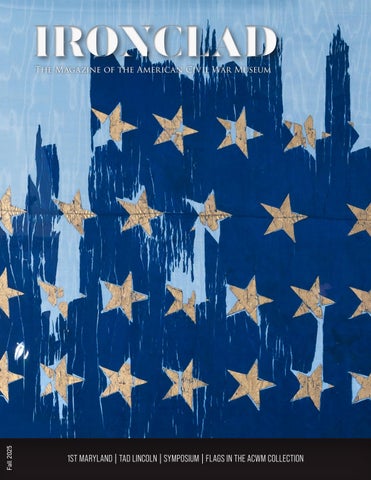
IRONCLAD
Fall 2025
The Magazine of the American Civil War Museum
1ST MARYLAND | TAD LINCOLN | SYMPOSIUM | FLAGS IN THE ACWM COLLECTION
IRONCLAD Volume 4/ Issue 1/ Fall 2025
3
9
One Flag: Two Owners
Tad Lincoln's Confederate Flag
16
23
Symposium 2026
Flags in the ACWM Collection
REL AT IONSHIP S
FORGED I N WAR 1 From the CEO
14 Recent Acquisition COVER: Detail section of the 1st Maryland regiment flag. See the article about its dual ownership on page 3. IMAGE: ACWM COLLECTION
18 Harriet Tubman
22 Lincoln Prize Lecture
@acwmuseum ACWM.org
31 Fall Festival
Magazine Publisher Rob Havers, Ph.D. ACWM President & CEO
Managing Editor Robert Hancock
Art Director & Designer John Dixon
Editorial Review Kelly Hancock Jeniffer Maloney
Museum Board of Directors Richard S. Johnson, Chair Claude P. Foster, Vice Chair Daniel G. Stoddard, Treasurer Walter S. Robertson III, Secretary Rob Havers, Ph.D., President & CEO Hans Binnendijk, Ph.D. Trevor S. Cox Audrey P. Davis Sally Diggs Fletcher George C. Freeman III Stephen T. Gannon Bruce C. Gottwald, Sr. B. Hunt Gunter Andrew R. Hoehn Donald E. King Alexander Macaulay Calvert Saunders Moore John L. Nau III Davidson Perry-Miller William R. Piper Roderick G. Stanley Ruth Streeter Allison Thomas Daniel Webber Jeffrey L. Wilt
FROM THE CEO PHOTO: JOHN DIXON
W
arm greetings from Richmond, Virginia, and welcome to the fall edition of Ironclad magazine.
We have had a busy few months at the American Civil War Museum (ACWM), at all three of our sites, since the last Ironclad. On page 22 you will find details of the 2025 Lincoln Prize Lecture delivered by Dr. Edda Fields-Black in association with the Gilder Lehman Institute of American History. This was a great occasion with a near-capacity crowd of members and history aficionados, as well as members of the Virginia state legislature. All in all, a great event. Not to be outdone, our Appomattox site saw a great crowd attend our annual Fall Festival enjoying local crafts and music as well as small arms demonstrations, and, of course, the opportunity to see (and hear) our 12lb Napoleon cannon discharged, all under clear blue skies. The White House is not left out as it hosted a film crew recording scenes of Lucy Otey’s visit to Jefferson Davis when she requested permission and resources to start a hospital in Lynchburg. These scenes are part of a larger film project produced by Historical Sandusky in Lynchburg as a part of their “Lynchburg at War” documentary film. All these great events are the opening shots for a packed Christmas season which began with the 3rd annual Tredegar Tree lighting. In December Santa Claus will visit Tredegar, we host Winter Wander at The White House of the Confederacy, and our Christmas Open House in Appomattox. Check our webiste for dates and details for these events. Mark your calendars, too, for the 2026 American Civil War Museum Symposium. This year, for the first time, we are offering battlefield tours as part of the event weekend. More details can be found on page 16. Aside from everything that has happened and will be happening at our three sites, this is a packed edition of Ironclad with a theme of flags from our impressive collections. Finally, we mark the sad passing of Bill Jamerson on 19 October 2025. Bill played an indispensable role in bringing our museum in Appomattox to fruition, and he continued to play a significant role there until the last. He is survived by his wife of 69 years, Ellen —a devoted museum supporter for decades—and his two sons Philip and Edward and myriad grand and great grandchildren. As always, thank you for your support and I look forward to seeing you at our Christmas season events and, of course, at the Symposium in February.
Dr. Rob Havers, President & CEO
Foundation Board of Directors Jeffrey L. Wilt, Chair Stephen T. Gannon Rob Havers, Ph.D. Richard S. Johnson Donald E. King Calvert Saunders Moore Walter S. Robertson III Ironclad magazine is published quarterly by The American Civil War Museum. 490 Tredegar St., Richmond, VA 23219 The contents of this magazine may not be reproduced in whole or in part without the consent of the American Civil War Museum.
IN REMEMBRANCE
William Edward 'Bill' Jamerson, Sr. 1934 - 2025
Bill Jamerson was a champion for the Appomattox region and likewise a driving force behind the American Civil War Museum's Appomattox site. His devotion to the community and vision for preserving and sharing regional history was unsurpassed. Bill's strong work ethic and dedication to community service was familiar to all who knew him. A very successful businessman and devoted family man, he was an unforgettable pillar of the region. ACWM remains grateful for his dedication and leadership over the years. T HE A MERICA N CIVIL WA R MUSEUM
1
2
I RONC L A D : FAll 2025
BY ROBERT HANCOCK
ONE FLAG
TWO OWNERS
Baltimore, Maryland, saw witness to the first deaths of Union volunteers in the war. Soldiers in Pennsylvania and Massachusetts state militias on their way to Washington, D.C., were attacked by anti-war Democrats and Confederate sympathizers. The U.S. government quickly took action to prevent Maryland, a slave state, from seceding from the Union. Many men sympathetic to the Confederate cause crossed state lines into Virginia and volunteered their services. Other Marylanders stayed loyal to the Union and enlisted in the 1st Regiment Maryland Volunteer Infantry. They would also enter Virginia, but with the intention of putting down the rebellion. John R. Kenly of Baltimore and a veteran of the Mexican-American War was commander of the 1st Maryland Infantry (USA) during the Valley Campaign in Virginia in 1862 where the contending armies tried to gain control of the fertile lands that became known as the Bread Basket of the Confederacy. For six months, Major General Thomas “Stonewall” Jackson marched his Confederate army up and down the valley in a cat and mouse game that kept a Federal force up to eight times larger than his own occupied and, thus, unable to join Gen. McClellan’s army trying to take Richmond. continued on page 4
Flag of the 1st Maryland Infantry (USA) captured by the 1st Maryland Infantry (CSA) at Front Royal, VA, May 23, 1862. It is the only instance during the war that two units with the same designation, but on opposite sides, faced off in battle. ACWM COLLECTION: on display in the exhibit A People's Contest at ACWM-Tredegar
T HE A MERICA N CIVIL WA R MUSEUM
3
continued from page 3
FRONT ROYAL MAY 23, 1862 In May 1862, Jackson was fighting against multiple Union commands. Having dealt with part of General Fremont’s army at the Battle of McDowell, Jackson turned his sights on General Nathaniel Banks’ army encamped around Strasburg. About twelve miles to the east of Strasburg was the town of Front Royal. Front Royal, a hamlet of a half-dozen blocks of stores and houses, was of far greater strategic significance than its size might indicate. It sits just to the southeast of the confluence of the North and South branches of the Shenandoah River with bridges allowing access to both sides. The Manassas Gap Railroad runs past Front Royal west to Strasburg, Bank’s main supply base. Surrounded by high hills with approaches from the south, east, and west, Front Royal was indefensible unless all the surrounding passes were sufficiently covered. Be that as it may, Colonel Kenly was stationed there with a small contingent to defend it. Kenly’s force at Front Royal consisted of nine companies of his own regiment, the 1st Maryland Infantry, and two ten-pounder Parrott guns of Knap’s Pennsylvania Battery. One company was on detached service at Linden on the Manassas Gap Railroad. There was no cavalry attached to his command, so Kenly had to rely on the pickets (two companies worth) guarding the camp to raise the alarm should the Confederates make an appearance. If they spotted the Rebels, they were to hightail it back to camp located about three-quarters of a mile outside Front Royal. Two companies of the 29th Pennsylvania Infantry were stationed nearby guarding a railroad bridge over the Shenandoah River. All told, Kenly had, perhaps, a little more than one thousand men at his disposal. The boys in blue were not welcomed with open arms by the citizens of Front Royal. Some of the men in the 1st Maryland were stationed in the town
4
I RONC L A D : Fall 2025
as a provost guard, watching over all the roads leading into town. Martial law was rigidly enforced and no one was allowed to leave town. The civilians of Front Royal treated the “occupying force” with disdain. Neither they nor the Federal soldiers camped there knew that “Stonewall” Jackson and his advance guard of about 3,000 men were just over the next hill. Another 13,000 men and twenty-seven guns were not far behind.
U.S. Col. John Kenly IMAGE: LIBRARY OF CONGRESS
Not knowing the exact disposition of the Federal force in Front Royal, Jackson chose not to attack the town head on via the main road but instead employed his favorite tactic of a flank march to surprise the enemy and, hopefully, cut off his line of retreat. When the Confederates approached, the Federal pickets, as instructed, retreated rapidly back to camp. It soon became clear to Col. Kenly that he was vastly outnumbered and his only line of retreat over two bridges spanning the river was threatened. He immediately sent a courier to General Banks to inform him of the situation. From some of the pickets captured by the advancing Confederates, Jackson learned that the town was garrisoned by the 1st Maryland Infantry. He immediately called for Col. Bradley T. Johnson to bring his own troublesome 1st Maryland to the head of the attacking column. First, Col. Johnson, a Baltimore attorney and ardent Confederate, had to give the regiment a soul-stirring speech. The twelve-month enlistments of many of the soldiers had expired and they were anxious to leave and were close to mutinying. However, Johnson was able to convince them to stay on, and they marched to the front of the column. At 2 P.M., the Confederates, with the 1st Maryland in the lead, swept down the hill continued on page 6
C.S. Maj. Gen. Thomas "Stonewall" Jackson IMAGE: ACWM COLLECTION
U.S. Gen. Nathaniel Banks IMAGE: ACWM COLLECTION
C.S. Col. Bradley Johnson IMAGE: ACWM COLLECTION
"Action at Front Royal, VA." This map accompanied a report by Lt. Col. Charles Parham, 29th PA Infantry. Published in Atlas to Accompany the Official Records of the Union and Confederate armies, 1861-1865. 1895. IMAGE: CREATIVE COMMONS/ DAVID RUMSEY MAP COLLECTION
THE BATTLE OF FRONT ROYAL, VA MAY 23, 1862
UNION CONFEDERATE COMMANDERS Col. John Kenly Gen. Thomas Jackson FORCES 1,063 3,000 CASUALTIES 82 (+ >700 captured) 36 RESULT
Confederate Victory
CASUALTIES 36 82
DATA: NATIONAL PARK SERVICE
T HE A MERICA N CIVIL WA R MUSEUM
5
continued from page 4
toward the small garrison holding Front Royal. Determined not to abandon the road to Strasburg to the enemy, Kenly held his position as long as possible in order to allow Gen. Banks to move his base farther north. Kenly’s single regiment of nine companies was spread thin trying to cover every approach to the town and keep his line of retreat across the bridges open. His two Parrott Rifles poured shell and canister into the attacking Confederates, and their longer range made it impossible for the Confederate artillery of smoothbores to silence them. However, in the face of overwhelming numbers, Kenly soon had to abandon the town. One civilian commented that Kenly’s men “scampered out of town like a flock of sheep.” The Confederates were hard on their heels and accepted the cheers from the citizens but could not stop to accept their hospitality. The 1st Maryland (CSA) surged straight ahead in pursuit of their Union counterparts, with Wheat’s Louisiana Tigers and Taylor’s Louisiana Brigade beside them. About an hour into the battle, two small companies of the 5th New York Cavalry, about one hundred troopers under the command of Maj. Philip Vought, arrived from the direction of Strasburg and joined Kenly, who kept them close, ready to charge the enemy to slow their progress if needed. Kenly then discovered that a large force of Rebel cavalry was approaching his
position from the west. He was about to be surrounded. It was time to make their way across the bridges, their only route of escape. The first men across formed a battle line on the opposite bank, covering those still crossing. When all were across, Kenly ordered the bridges to be burned. Farther down, Kenly could see Confederate cavalry fording the river, so he ordered Capt. Kugler’s company to hold them in check for as long as possible then join the rest of the regiment at the crossroads leading to Middletown. 2 When the Confederates reached the bridges, they were able to put out the fires before they were completely destroyed. They surged over the river after the Federals. "Stonewall" Jackson had been with the leading regiments since the attack began, sometimes even riding ahead of the skirmishers in his excitement to get at the enemy. When he reached the bridges, he saw the blue coats escaping north along the road. “Oh, what an opportunity for artillery!” he shouted. He sent a staff officer to the rear with orders to send up every available rifled gun to be found. However, his artillery train was too far away to get there in time. Jackson was watching the enemy slip through his fingers. He called for Major Thomas Flournoy, in command of the 6th and a portion of the 2nd Virginia Cavalry, and told him to get across the river and attack the enemy before they could make a stand. Flournoy saluted and galloped away.
7
3
4
5
6
I RONC L A D : Fall 2025
1
6
Thomas "Stonewall" Jackson's personal items from the ACWM Collection on display in the exhibit A People's Contest at ACWM-Tredegar. 1] forage cap 2] haversack 3] field glasses and case 4] spurs 5] Model 1850 U.S. officer's sword and scabbard Also pictured is a flask (6) used by Jackson after being mortally wounded on May 2, 1863, and the bullet-torn notebook (7) of C.S. Col. James Boswell who was killed in the same volley that wounded Jackson.
Meanwhile, Kenly continued his retreat northward. It was now nearly 6 p.m., and his men were exhausted. Seeing Confederate cavalry riding through the fields off to his left, Kenly determined to make his last stand at the crossroads if he could not outrun the approaching enemy. He still had most of his regiment with him as well as the two Parrotts and one of the Pennsylvania companies that had been guarding the bridge. Kenly ordered Maj. Vought’s New York cavalry to charge the enemy and check their advance, if only for a few minutes, while he got his men in some sort of battle line. Off the cavalry rode, while his men pushed over fences to gain access to the open fields either side of the road. His artillery, however, was not unlimbering in order to fire. When he rode over to ascertain why, he heard the discharge of rifles and the rush of cavalry behind him. The New Yorkers had not charged the enemy but were fleeing and running over his own men in their hasty attempt to avoid the enemy. The Confederate cavalry was hot on their tail. Some of Kenly’s men, who had managed to form up in the field beside the road, let off one volley at close range which emptied a number of saddles, but the succeeding Confederate horsemen wheeled off the road and rode down the Union infantry, capturing most of them; five or six officers and about one hundred men escaped into the surrounding woods. The Confederate cavalry that had been following on the left joined the fray
and captured one of the Parrot guns and most of the gunners along with the baggage wagons. The second gun had to be abandoned farther up the road when the horses gave out. Col. John Kenly, who was badly wounded during the engagement, was captured along with most of his men. A further fifty-seven men in the 1st Maryland were killed or wounded. All told, 736 men under his command were killed, wounded, or captured. With Front Royal in Confederate hands and his line of supply threatened, General Banks retreated north to Winchester where Jackson attacked and defeated him on May 25. Despite being outnumbered, "Stonewall" Jackson, with an army of no more than 17,000, was able to pin down Union forces numbering upwards of 60,000 men. Not only were the Union armies unable to wrest control of the Shenandoah Valley from the Confederates, they were unable to leave the valley and join McClellan’s army attacking Richmond.
Robert Hancock is the museum’s Director of Collections and Senior Curator.
IMAGES: ACWM
T HE A MERICA N CIVIL WA R MUSEUM
7
8
I RONC L A D : FAll 2025
Did Lincoln's Son Contribute to His Father’s Assassination? BY CHUCK YOUNG
One of my favorite artifacts in the museum’s A People’s Contest exhibit is the Army of Northern Virginia battle flag displayed in the Appomattox case. I admire it not for what it is, or what it represented, but for the story attributed to it: that it came into the possession of Tad Lincoln in early April 1865. But that’s not all of the story.
where did the flag come from?
Flag of the 14th Virginia Infantry (tentative) which was captured and given to Tad Lincoln. ACWM COLLECTION
The supposition is that it was surrendered at Appomattox on April 12, 1865. If that’s the case, how did it come into Tad’s possession in Washington? The surrendered flags probably arrived in the capitol too late for Tad to get one, making another scenario far more likely. In the book Lincoln’s Greatest Journey by Noah Andre Trudeau, the author writes that following the Battle of White Oak Road on March 31, 1865, General Grant telegraphed President Lincoln that “I will send you a rebel flag captured by our troops in driving the enemy back. There have been four flags captured today.” The flag mentioned was delivered to Lincoln the next day by newsman Sylvanus Cadwallader, who had been covering the action at the front from Grant’s HQ in the field and was going to transmit his report from continued on page 10
T HE A MERICA N CIVIL WA R MUSEUM
9
continued from page 9
the telegraph office at City Point, Virginia, where the president was anxiously awaiting Grant’s messages. Tad was present at City Point as well.
whose flag was it? During that battle, the V Corps brigade of General Joshua Lawrence Chamberlain spearheaded a Union counter-attack of two Union divisions, those of Generals Ayers and Griffin. This attack sent the four small, understrength Confederate brigades of Generals McGowan, Hunton, Wise, and Stansel back to the cover of their fortifications at around nightfall. One Confederate regiment, the 56th Virginia Infantry of Hunton’s Brigade, did not receive the order to retire. Abandoned, the Virginians found themselves surrounded and engaged in close-quarters, hand-to-hand fighting, resulting in the capture of nearly the entire regiment (135 men) and their battle flag.
Washington following Lee’s surrender on April 9th, and two days later, on the evening of April 11th, a crowd gathered on the front lawn to serenade their president. Moments before Lincoln appeared from an upstairs window, Tad appeared waving a Confederate flag! Since he had just recently received it, the flag was likely the one captured on March 31st. Among those in the crowd that day was actor and southern zealot John Wilkes Booth.
booth had a plan & lincoln's speech As the war continued to worsen for the south throughout 1864 and 1865, Booth drew upon the network of Confederate spies in eastern
Another Confederate banner was captured that day, that of the 41st Alabama, of Stansel’s Brigade. Stansel’s Brigade (formerly Gracie’s and later Moody’s) included the 43rd, 59th and 60th Alabama regiments. The 43rd and 59th lost their colors six days earlier on March 25th, leaving only the flag of the 60th, which was surrendered at Appomattox. The 43rd Alabama’s flag was returned to the state of Alabama by Chamberlain’s heirs. It was Chamberlain’s brigade that had engaged Moody’s on March 25th. So, my contention is that on the night of March 31st, Chamberlain turned over at least three captured banners to Grant at his HQ, the two Alabama flags captured by his brigade on March 25th (43rd, and 59th) and the flag of the 56th Virginia. Including the flag of the 41st Alabama, that makes four captured rebel flags. The three Alabama flags are accounted for at the Alabama Division of Archives and History, leaving only the 56th Virginia flag as being unidentified and probably winding up at City Point on April 1, 1865. It was this flag that came into Tad’s possession.
what did tad do with it? Tad and his late, older brother Willie, were known pranksters within the Executive Mansion. A state of euphoria existed in
10
I RONC L A D : Fall 2025
Thomas "Tad" Lincoln poses with his father, Abraham, for a portrait by Alexander Gardner (c.1865). (Opposite) When Lincoln traveled to Richmond, VA, on April 4, 1865, he was accompanied by Tad. They were quickly recognized, and a jubilant crowd of African-Americans followed them as they walked through the city as illustrated by Lambert Hollis (c.1865). IMAGES: NATIONAL PORTRAIT GALLERY, SMITHSONIAN INSTITUTION
Maryland, organized by John Surratt, Jr., to help him with a last-ditch plan to abduct President Lincoln and ransom him for the release of all Confederate prisoners of war. With this addition of thousands of soldiers, Confederate armies would be bolstered and be better able to succeed against the armies of Grant and Sherman. The plan was ready to be put in motion in April 1865. However, Robert E. Lee surrendered his army on April 9 at Appomattox Courthouse. Lincoln's April 11th speech focused on the complex process of reconstruction, particularly in Louisiana, which had recently established a new state government. He discussed the need for a flexible approach to restoring the Union,
recognizing the unique circumstances of each state. He emphasized the need to bring the "seceded States" back into "proper practical relation" with the Union, suggesting a way to do this without directly acknowledging their secession. He likened the process to a parent welcoming home prodigal sons, implying a sense of forgiveness and reconciliation. Also, for the first time publicly, Lincoln expressed his support for limited black suffrage, suggesting that it might be conferred on "the very intelligent" and those who served in the Union Army. This statement was controversial and contributed to the discontent of some, including John Wilkes Booth. continued on page 13
T HE A MERICA N CIVIL WA R MUSEUM
11
Printed Broadside "Wanted” poster identifies John Wilkes Booth and two co-conspirators, David E. Herold (Harold) and John Surratt for the assassination of Abraham Lincoln. IMAGE: NATIONAL PORTRAIT GALLERY, SMITHSONIAN INSTITUTION
12
I RONC L A D : Fall 2025
continued from page 11
there was a prior flag incident
Fate of the Confederate flags carried into battle on March 31, 1865 at White Oak Road, VA HUNTON’S BRIGADE 8th VA Infantry Captured at the Battle of Sayler's Creek, VA, on April 6, or surrendered at Appomattox, VA, on April 12. 18th VA Infantry Captured at the Battle of Sayler's Creek, VA, on April 6. 19th VA Infantry Captured at the Battle of Sayler’s Creek, VA, on April 6. 28th VA Infantry Surrendered at Appomattox, VA, on April 12. 56th VA Infantry Captured at the Battle of White Oak Road, VA, on March 31. STANSEL’S BRIGADE 41st AL Infantry Captured at the Battle of White Oak Road, VA, on March 31.
WISE’S BRIGADE 26th VA Infantry Captured at the Battle of Sayler's Creek, VA, on April 6. 26th VA Infantry Surrendered at Appomattox, VA, on April 12. 34th VA Infantry Captured at the Battle of Sayler's Creek, VA, on April 6 or surrendered at Appomattox, VA, on April 12. 46th VA Infantry Captured at the Battle of Appomattox Court House, VA, on April 9. McGOWAN’S BRIGADE All flags were surrendered at Appomattox, VA, on April 12.
On March 17th, Lincoln appeared at a Washington hotel to present a captured Confederate flag to the governor of Indiana, whose soldiers had seized it from Fort Anderson, North Carolina. During the ceremony, the flag became snagged on an ornamental eagle above the front door. “The eagle objected to having the flag put over it,” Lincoln quipped. According to Booth biographer Terry Alford, the actor was lurking in the crowd of 2,000, and fumed at the President’s disregard for a relic Booth regarded as sacred. So, as Booth was becoming more and more angered by the president’s speech on April 11th, he also had the memory of the March 17th flag incident still fresh in his memory, as well as Tad’s recent desecration of what Booth considered a sacred banner. All these events together may have been the reason why Booth commented to his companion that evening, that Lincoln’s speech “was the last speech he will ever make.” Four days later, on the morning of April 15th, Lincoln was dead, and his murderer, John Wilkes Booth, was on the run.
Chuck Young is the museum’s Historic Engagement Manager.
Battle flag of the 18th VA Infantry. ACWM COLLECTION T HE A MERICA N CIVIL WA R MUSEUM
13
recent acquisition
EZRA STEPHEN I remain your brother until Death Wartime letters of Ezra Stephen BY ROBERT HANCOCK, ACWM DIRECTOR OF COLLECTIONS
The men of the 128th Indiana Volunteer Infantry served in Tennessee and were with General William T. Sherman in Georgia and North Carolina where they witnessed the surrender of General Joseph Johnston’s Confederate army. Ezra Stephen was in Company K of the 128th and was quite a prolific writer (accompanied by his somewhat creative spelling) during his time in service. The museum has recently acquired a cache of thirty-one letters written by Stephen to his sister Matilda and his parents in Logansport, Indiana. He wrote of the long marches, the camaraderie and shared miseries with his fellow soldiers and, of course, the battles. Writing from camp near Cassville, Georgia (which he spells “Georgy”) May 21, 1864, Stephen wrote: “Sister you can tell all the folks that all the Rockcreek boys is all well and in the fight not one of them flinched but stood their [sic] ground as men ought to when they are fighting for thier [sic] Country. Sister I went over the battlefield last Sunday morning for the first time and it was a sight. I think that there was about 100 Rebs that was left on the field it was an offal [sic] sight.” While in North Carolina, he heard rumors from locals of the treatment of Union prisoners of war held in a nearby prison camp. “They have seen our men clime [sic] the trees to git [sic] the leaves to eat and they have seen the Reb guards shoot them while they was up in the trees a gitting [sic] leaves to eat to keep them from starving.” Apparently, the food and clothing sent for the prisoners was being sold by the officers in charge, who then pocketed the money. He seemed well informed about the strategic plight of the Confederates in North Carolina. In writing to his father on March 8, 1865, Stephen described the situation: “We are in about six miles from Kingston [Kinston, NC] which is on News [Neuse] river. Our advance reached the river yesterday but they could not cross for the Rebs has the river garded [sic]…if the Rebs intend to fight anymore they will surely hold Golesburrow [Goldsboro] for when that falls the last railroad to Richmond is ours and I think there is now [sic] doubt but that we will occupy Golesburrow and Rolly [Raleigh] before too [sic] months.” Not quite two months later, on April 26, General Joseph Johnston surrendered his Confederate army to Federal forces near Durham, NC. After the surrender, the 128th stayed in North Carolina for another year. “I think as soon as it gets a bit warm that this will be a very sickly place for it is so low and swampy it’s worse than Indiana.” His outlook improved once they settled in. “We have good time at this place and can get almost anything that we want to eat by trading shugar [sic] and coffee…one can get a peck of potatoes and apple[s], peaches, watermelon…and all kinds of vegetables is plenty.” Now begins the arduous task of digitally scanning and transcribing all the letters which were graciously donated to the museum by Renee Stephanie Doktorczyk, the great-great-great granddaughter of Ezra Stephen.
14
I RONC L A D : Fall 2025
Three of the 31 letters written by Ezra Stephen during his service in the 128th Indiana Infantry to his sister Matilda and parents in Logansport, Indiana. PHOTOS: ACWM COLLECTION
The American Civil War Museum
Legacy Society
This knapsack belonged to John Henry Vest of Louisa County, VA, and a member of the 1st Virginia Volunteer Howitzers. On display at ACWM–Tredegar.
What Will Your Legacy Be? Help us preserve the most transformational period in United States history for generations to come by becoming a member of the American Civil War Museum Legacy Society. For assistance and to receive information about our Planned Giving Program, please contact Anneka Early. aearly@acwm.org 804.649.1861 ext. 144
T HE A MERICA N CIVIL WA R MUSEUM
15
2026 SYMPOSIUM
REL AT IONSHIP S
FORGED I N WAR We are pleased to announce the 2026 ACWM annual Symposium Weekend!
FEBRUARY 13-15, 2026 ACWM Tredegar in Richmond, Virginia The American Civil War was not only a clash of armies and ideologies, but it also shaped and tested loyalty, friendship, family, and enmity on the battlefield and within the halls of government across a divided nation. The 2026 ACWM Symposium will explore human connections that emerged from conflict. ACWM Symposium 2026 is a full Civil War history weekend that you may customize to your schedule and interests! This year we are pleased to provide more options and more opportunities to engage with the museum, symposium speakers, and our historians! Join small group tours of the collections, a special “Meet the Speakers” Q&A program and private reception in the museum, and ACWM historian-led battlefield tours on Friday and Sunday!
Lectures presented by
DR. BRANDI BRIMMER Morehead-Cain Alumni Associate Professor, Director of Graduate Studies, Department of African, African American, and Diaspora Studies, The University of North Carolina at Chapel Hill.
DR. WILLIAM C. “JACK” DAVIS Retired Executive Director of the Virginia Center for Civil War Studies and Professor of History at Virginia Tech.
DR. CAROLINE JANNEY John L Nau, III, Professor in History of American Civil War, Director, John L. Nau III Center for Civil War History
DR. LINDSAY PRIVETTE Associate Professor of History, Anderson University
DR. JONATHAN WHITE Professor of American Studies, Christopher Newport University
In partnership with
16
I RONC L A D : FAll 2025
For the full schedule and additional information about registration options, please visit acwm.org or scan the QR code.
SYMPOSIUM
B AT T L E F I E L D T O U R S Caravan tours: participants will drive their own vehicles to meet an ACWM historic site interpreter at the stops for an overview of troop movements and battles.
Overland Campaign Friday, February 13th, 2026 9:00am - 3:00pm The tour begins at the Germanna Visitor Center (2062 Germanna Hwy, Locust Grove VA) near the site where Grant’s army crossed the Rapidan River to begin the campaign. From there, the tour proceeds through the Wilderness Battlefield (NPS), stopping at Saunders Field and the Widow Tapp Farm. Following the route taken by Grant’s army, the tour moves on to the Spotsylvania Courthouse Battlefield (NPS) with stops at Laurel Hill, the Muleshoe, and the fortification exhibit. From there, the tour continues on to the North Anna Battlefield site, then to the Totopotomoy Creek Battlefield (NPS), and finally the Cold Harbor Battlefield (NPS). At Cold Harbor, the group will be able to briefly explore the earthworks.
PHOTO: BUDDY SECOR. SOURCE: NATIONAL PARK SERVICE
Appomattox Campaign Sunday, February 15th, 2026 9:00am - 3:00pm The caravan tour begins at ACWM-Tredegar and follows the retreat route of General Richard S. Ewell’s Richmond defense forces. The first stop will be at Branch’s Baptist Church, where General Custis Lee’s forces from the Chaffin’s Bluff defenses joined the main marching column. The tour proceeds to Mt. Zion Road near Jetersville for the story of Amelia Court House and the retreat’s westward turn, before stopping at Deatonville and Sayler’s Creek Battlefield (VSP). From there, the tour makes its way to Farmville, the Cumberland Church battlefield, Clifton (Grant’s headquarters from April 8-9), and New Hope Church (Confederate rear guard April 8-9). The tour concludes at ACWM-Appomattox with a talk about the Battle of Appomattox Station and the group doing a self-guided tour of the museum galleries.
PHOTO: DOUG COLDWELL, CREATIVE COMMONS
T HE A MERICA N CIVIL WA R MUSEUM
17
Harriet Tubman's Humanity BY KELLY HANCOCK
When you hear the name Harriet Tubman what comes to mind? Most people know her as a conductor on the Underground Railroad, and some might know that during the American Civil War she served as a scout and a nurse. To many, she was the Moses of her people, and to John Brown she was “General.” The fact that so many people (even people who do not have a particular interest in history) know who she is and what she did says something about her impact. Just think about it—she was both an African American and a woman from the nineteenth century, and, yet, she is known by most Americans today. More children’s books have been written about Harriet Tubman than any other African- American historical figure—including Frederick Douglass. Although much of what we know about Harriet Tubman is based in truth, she is an example of the phenomenon “if the legend becomes fact, print the legend.” Her exploits have been magnified almost to the extent that the courage and fighting spirit she possessed to execute them has been forgotten. She has been portrayed more as a superhero than as a flesh and blood woman with all the feelings and emotions that accompany being mortal.
The earliest know photograph (detail) of Harriet Tubman, c.1868. IMAGE: LIBRARY OF CONGRESS
But Tubman or Araminta Ross, as she was first called, was very human. She was born into slavery in Dorchester County, Maryland between 1815 and 1825, and from the early age of five, she was hired out to do a variety of jobs. By the time she was an adult, she could chop and tote as much wood as most men; although she stood only five feet. Harriet (she took her mother’s name after seizing her freedom) felt the full oppression of slavery from the physical brutality (she endured beatings and was struck in the head by a weight that resulted in a lifetime impairment) to the emotional pain of seeing her sisters sold South. She determined she would not be sold and made the decision to escape. For the unknown world of the North, she left behind everything she knew, including her husband. Contrary to the 2019 movie Harriet, Tubman begged him to come with her to start a new life, and John Tubman, despite being a free man, refused. On a side note, but one illuminative of Harriet Tubman’s character, she took her marriage vows so seriously that she did not remarry until after her husband’s death in 1867. The story of Tubman’s escape is so familiar to us, that the amount of courage it took to make this move is often overlooked. There was
Advertisement in the Cambridge Democrat (Maryland) newspaper in 1849 offering a reward for Tubman's siblings, Harry and Ben, and herself (known as Minty) after they escaped. IMAGE: BUCKTOWN VILLAGE FOUNDATION. SOURCE: HARRIETTUBMANBYWAY.ORG
(Right) "Fugitives escaping from the eastern shore of Maryland." An Illustration published in William Still, The Underground Railroad (Philadelphia, Porter & Coates, 1872). IMAGE: LIBRARY OF CONGRESS
18
I RONC L A D : Fall 2025
no certainty that she would obtain her freedom and not be recaptured or worse, and a successful life in the North was not guaranteed. Sarah Bradford, the author of Tubman’s first biography, interviewed her in 1869 and quoted Tubman, describing both the exhilaration and alienation of her arrival in the “promised land.” I had crossed the line. I was free; but there was no one to welcome me to the land of freedom. I was a stranger in a strange land; and my home, after all, was down in Maryland; because my father, mother, my brothers, and sisters, and friends were there. But I was free, and they should be free. I would make a home in the North and bring them there, God helping me. Determination that her family should be free is what drove Harriet Tubman to make perhaps as many as
nineteen trips back into Maryland. Estimates of the number of enslaved people she rescued vary. Sarah Bradford claimed that Tubman rescued 300 people, but Kate Clifford Larson, who wrote a 2004 biography on Tubman, says her research confirmed 70 individuals were directly rescued by her and that she provided instructions to another 70 people. Tubman, herself, only claimed to have rescued 50 to 60 people. Whether the number was 70 or 300 hundred is moot. Rescuing herself was an act of courage; rescuing others personified courage and self-sacrifice. These two traits dominated Tubman’s life—from her initial escape to her determination to wrest fugitive slave Charles Nalle from the legal authorities in Troy, New York, to her work as a scout for the U.S. Army and participation in the Combahee River Raid, to running a home for aged and infirm people of color.
I was free… I was a stranger in a strange land. HARRIET TUBMAN
continued on page 21
T HE A MERICA N CIVIL WA R MUSEUM
19
CHARLES NALLE
Fight for Freedom …Again and Again On April 27, 1860, Harriet Tubman participated in one of her most daring rescues—that of Charles Nalle. Nalle was a twenty-eight-year-old man who escaped slavery in Culpeper County, Virginia. After making his way to Rensselaer County, New York, he worked a number of jobs, including that of a teamster and a coachman. Since he was illiterate, he asked one of his employers, Mr. Horace Averill, to write a letters for him. Mr. Averill soon discovered that Nalle had been formerly enslaved. As a lawyer, he was well aware of the Fugitive Slave Law (passed by the U.S. Congress as part of the Compromise of 1850) and the penalties it imposed on anyone who aided fugitive slaves. Averill contacted Mr. Hasbrough, the man who had previously enslaved Nalle. Hasbrough sent an agent to retrieve Nalle. On the morning of April 27, Nalle was arrested by a U.S. Marshal and taken to the commissioner’s office in Troy, New York. As soon word spread that Nalle had been captured, members of the area Vigilance Committee (these committees were specifically formed by abolitionists to aid individuals captured as fugitive slaves) gathered outside the office. Tubman was in the city at the time and got word of Nalle’s capture. Learning that Nalle had been brought to the commissioner’s office, she entered, disguised as an old woman, and made her way upstairs where she waited outside the room where his rendition hearing was being held. Outside the crowd, which had grown to about 2,000, could see the silhouette of Tubman in her large bonnet in the window. As long as she was there, Nalle was still inside the building. As the authorities sought to remove Nalle, Tubman yelled from the window to the crowd outside, but she did something more. According to Tubman’s first biographer, Sarah Bradford, as the guards were bringing Nalle out, Tubman raced down the stairs and, then, used her physical strength to pry him lose. “Again and again they were knocked down, the poor slave utterly helpless, with his manacled wrists, streaming with blood. Harriet's outer clothes were torn from her, and even her stout shoes were pulled from her feet, yet she never relinquished her hold of the man…” The large crowd of free Black people and abolitionists managed to get Nalle into a boat and transport him across the river. He was recaptured and returned to the commissioner’s office. Tubman, yet again, managed to free him and with the help of others in the crowd succeeded in getting him in a wagon that friends had provided for his escape. A month later, Charles Nalle’s friends ensured his legal freedom by purchasing him. "The Slave Rescue at Troy." A written account of the events surrounding Charles Nalle's rescue in Troy, NY. New York Daily Tribune, April 30,1860. IMAGE: LIBRABRY OF CONGRESS 20
I RONC L A D : Fall 2025
VERY BUGLE.
-A
asant! of the day and all ttt law it ever matlo wef awept Into me liamee together, tha people would all be the ng to the
Bugle.
And the Riohmond Enquhert Anti-Slave- ry ''That the two opposite and ootrfliotiog form of munity. The better off for it ten years hence. Yes, if Con aociety cannot among civilited men ooexiat and onus of 1,420 gress must continue, we eeoond the Vnotion that endure. Tha on most give way and oeate to txiat ''Providence das tutti m atr ACTOR, urgoniew for- the members be abut up like the inmate of a mad the other bioome universal. Slavert an OUTLAW." John Brown afOsawato-mi'- e. ract, that the house, and their doings never be permitted to reach And Wm. fl. Seward, that, from the ar- the outside world. Pleasure Boat, "The oolliaion between th two aystems of labor between the SALEM, OHIO, JANUARY in tbe United Statea, i an Irepreseible oonfliot er them more between opposing and enduring farces," they did authorities of continued from page 19 but eobo th voioe and decree of tho Eternal God, THE GOVERNORS' MESSAGES. not to inflict that between Slavery and Liberty there can be and The closing of Gov. Chase, and th ntence GRAND A. S. CONVENTION IN AUBURN. eball be tioTubman’s conoord; but faith was the hope and anchor ofMessage her life. It everlasting separation, of Gov. Deonisoa are greatly applauded nd imprisonwide as tbe difference between heaven and bell. NEW YORK. by tbe Republican preaa, mightforof oouree ba aa live sustained her in times of need and empowered her to The Resolution on tbe "Irrepressible Conflict" expected. To tits Editor: One of the most important Tbey are both tolerably lengthy n of his late was others. Her Quaker friend, Thomas Garrett who operated a good deal intensified Auby the fact that New Conventions held York In eVot and oover enongh space, one awould think, nobility of reaidenoe of Hon. W, II. Seward. has just closed in this city. Mrs. Martha Wright burn is the store to that give their authora to aay aom in Wilmington, Delaware, served as a euffioioot station room on the to them t was called to preside, with Mr. George Prior for And the applause which the reading of it called things which they have not said. lo visit yon, Underground Railroad explained: forth, showed hia neighhor tbat were afraid not Vice ProsidT&rt, and Mrs. Elixeboth Cady Stanton, The Message of Gov. Chase has much about fil that wish-to meet any oonsequence which adherence to bis' State finances and taxation, of tbe butand She has frequently told me that she talked with God, herepresentor ady consent, Secretary, righteous truthful and time. utterance at that Hon whioh ought oertainiy to aooompany tbe taxaTh Speakers Were Mariua R. RobinsoD, Susan have always talked with her every day of her life, and she has declared would to bring pass. tion, he is culpable silent. Althotgh thousand e. With the B. Anthony, Aaron M. Powell and Parker Pills- But I must hasten to other of Ohio ateby of theofoitiiens by fear excluded to me that dutios, she feltand noclose more being arrested her from lh bal' ssed you in bury. Mrs. Harriet Tribhman a fugititive from lot box because of thoir complexion, tha retiring1 antry, and I Slavery, also spoke in a most thrilling manner of subscribing former master, or any other person, when in his immediate Yours and Your Readers, Executive had no protest to enter against it aod no the others of her experiences in Slavery ; her etoape, and ber PARKER PILLSBURY of New tbe otber neighborhood, than she did condemnation in the State of York,political or and legal h interest to wondtrful success in leading other out of the Auburn, N. Jan, 12, 1860 Y. wrongs which result from complexional distincing forward worse than Egyptian bondage. We were told that Canada, for she said she never ventured only where God tions. It is true he referred lo the Demooratia ect ilk Cotsu sho had led mora than a hundred and fifty into law of the last session, in respect lo the casting of sent her. Y." that I mani- C.inada ; and that she waa called 'Moses' in some "CHRISTIAN ballots by colored persons, and the defining of who u, and with places, from her remarkablo deliverances of God's are prohibited by the Constitution from voting, SALINEVILLE, Jan, 15, 1860. will be con people out of tbe hands of Southern Pbaroahs. this matter Yet, :Harriet didand notaffirms quench fighting that her Tho following are tho resolutions. The discusFriend Jones should be left to tb Thinking Tubman’s th parties it might befaith interes y publio bo, aa fur aa sions excited intense interest, you may well sup ting to the lo compare notes in courts for adjudication ; but that waa all. This spirit. She knew all too well the evil that slavery was. Using regard to the progress of the cause in different lo complexional distinction aeema to ua a matter inme the condi- pose. ' volvingofnot only the democratio in its diSerent to combat most violent institutions was not calities and violence character of tba phases of the m persuaded presentation, FIRST SERIES. people of Ohio, but their very Christianity; yet send you an account of an you." meet Vesoked, That the American Slav System is a contradiction to her. She wholeheartedly supported John ing which haa beon held in thia place by an agent from neither Gov. Chaae nor Gov. Denciaon cornea the "sura of all villainies" a compound of all the polioy or the Christian Brown and would have participated in hisngainat raid on the federal which admita tba Convention, which any proteat cruelties and crimes; robbery, adultery, piracy and ENCE. foreigner to the ballot box, but proscribes thoua-And- a convened at ColUmbUs aome time since. arsenal at Harper’s Ferry, Virginia, had she not been ill at impure, unholy and alling of the murder, and whatever else of tbe native born citizana ofthe Ohio. Such it the gentleman (Mr. Baker) proposed to treat uction of hu accursed Republicanism, official role Although historians may dispute her exact in the and unofficial. the subieottime. religious from a moral and stand Pcsofted, Tbat slaveholders at such, have no ultitude hurWe bave looked in vain through the Message of point, and Combahee proceeded first River lo defineRaid, what which Slavery resulted in the emancipation menta, some rights which any human being is bound to respect was. Alter citing varioua definiliona which he Gov. Chase for a record of the judioiol otttfaga hi hot even to Life, Liberty, or tbe pursuit of hap rishing more with scouts of 725 people, thedefined information she and her provided the Oberlin case, but v fear thai considered defective, be at length it to be connection ded the fall piness but wbilu remaining in purpose and prac the prosecutions and the peraeoutloha to which tb chatlelism; in other words alave waasuccess a chatteland may have inspired was vital to athe raid’s it. ch we ought lice, Slaveholders, htj ahall be regarded aa crim personal. Hohrew aervitude, our lecturer aversd. Wellington rescuera were subjected, and tba ctures more ' inula and outlawa against humanity, whom Gen Undoubtedly, her presence on board themooting boat reassured Cleveland of ten thousand, upon whose) waa not included in Ihia definition. rpose of life, eral La Fayette, Capt. John Brown, or any other agitated wavee tbe Governor poured tbe oil of hia Tbe next frightened point which my enslaved a rescuer had arrived. memory people retains, that s and other righteous deliverer who believes in forcible resistwas wiadom, and there etraigbtway fell a great oalnj, for dwelling ance to tyrants, may lawfully and justly compel an allusion to the book entitled "Tbe Testimony are either altogether forgotten, or else adjudged of a Thousand Witnesses against Slavery," citing overtop the to release their proy as of no political mbment to the approaohing It is not an easy thing to venture all, to take a stand when from it various authenticated aocounts of cruel rea, and the Resolved, That our governmental Union with presidential contest of 1860, and possibly or no practiced upon slavery'a helpless vicnd economi- such slaveholders, is also a sin and crime an barbarities faced with opposition, or to live a life of service to others. on accoont tbe of ere State a Senatorial election. at the brjsd utheistio rebellion against every principle of jus tims, when lo my astonishment I beheld tbe apea- He even exults in the fact, tbat tbe people of Ohio Tubman didin all of this and more. She deserves our praise in a laugh, which be was joined uld be more tice and every law of nature and of God ; which ker indulging ''have never roeisted with illegal force even tba by the numerous boys, and even of some tbe men they were no pofsitle circumstances should have warranted if and to be remembered as a hero,execution but when forgetSlave Harriet of thewe Fugitive Aotby federal offer and more in its formation, and surely, no conceivable condi among hia audience. icers acting under legal warrants." Tubman’s humanity, we lessen her achievements. Slavery emaa a punishment for crime waa referred materials tions justify in its longer continuance. Tell it not in Kentucky ! name it not ia tha to, and the following reasoning given to illustrate eirtrength. streets of Frankfort lest the chivalry rejoioa id Resolved, That the first threat of disunion from tbe gentleman's views upon that subject. Citing this official ow, but they the South, condemnation of Bushnell, and Langs-to- n ehould haveofbeen hailed withattending general Newspaper accounts Harriet Tubman y not and their companions; who rescued) from lb joy by ull the friends of the enslaved ; inasmuch the case ol a brutal murderer, the supposition was made that such y while the asconventions an one might be sold to a humane fangs of the hunters the prey and helping to escape slavery. tbe only assurance they had seized. for people of slathe continuance master. While on the other hnnd, Kellya Hancock is the No Republican message wodld be complete m. and boy who bad ia in the support it derivea from union and very, with (Top) Attending the Grand A. S. Convention in Auburn, committed but a trivial offence might be aold to a oat a glorification of tand a little alliance with the North. the Union, and we have it aa; museum’s Director of man ot tbe opposite Characteristics. mates. The prasla-ver- y oordingty aa well in the message! of iha NY, Tubman is identified as "Harriet Tribbman." retiring Resolved, Tbat Ibe governments of position of tbe church waa Education deplored, Programs and aa governor, aa in the message of the governor el sot an inexcusaalave StatesBugle the are but organized Anti-Slavery (Salem, Ohio),bands January 1860.an illustration of their of 21, thieves character, the fined to the line lino, upoh and precept upon and Interpretation. preoept, hara and robbers ; living by plunder and piracy, speaker told ua be bad been denied the Use of their a little, and there a good deal. h carry railon the avails oi unpaid and aopitied labor, and pulpiteforanti-alaverlecturei.eveo when he promb pass heavy Gov. Dennison haa evidently a high appreciatherefore: (Middle) Attending the Woman's Rights Conventionised in them he would trea lonly upon the morality (he with freight, tion of tbe ordinance of 1787, which unqueationa-bl- y of Resolved, it isisthe solemn asand question, letting alone the political aspect of tbe imperious MA,Tbat Tubman identified "Harriet Tupman." e flimsiness Boston, haa in it much tbat ia good. But beoanae of duty of tbe Senators and Representativea of tbe subjeot. and then, of thia, we have no right to overlook in it tbat whioh Daily Dispatch (Richmond, VA), June 6, 1860. Statea and Territoriea to return weight of the Finally, we were told that it waa not proposed ia bad. Ooe of the propa of slavery is tbe Con- ed to ifrh, at odos to their respective constituencies, and take to place the slaves apon an equality with tbe free- atitutional guarantee concerning tbe rendition of immediate measures for the JVeui formation of a men. The elective franchise, right of holding e precipita fugitives, which, by the difficultiea it throw in th (Bottom)liepublic, Attendingthat the shall The New EnglandFree; Convention be indeed ao only a few Northern io, &o, were not to be theirs ocoording to tbe path of tbe escaping chattel, deters many from assylum of the oppressed for all nations; unoursed viewe of tbia nd occurred in Boston, MA, Tubman is identified as "Harriet Christian." In tbe making ibe attempt ; and by giving up the entira tendoncy ia by tbe presence of slaveholders, unstained by the course of the address an prayer meet- north as hunting ground to tbe slave oatcbers.and Garrison." Weekly Anglo-African (New York, NY), blood of slaves. ing was recommended, and at tbe close, a commit- binding tbe people of the free Stats by (olemn cost for tbe Resolved, That tbe ohuroh of the slaveholding tee was appointed to keep up an superfluous August 6, 1859. interest in the obligation to auppres their humane, and benevolnse at tbat States that permits and practices the breeding, aubject, by getting up meetings, eeouriDg speak- ent, and democratio promptings to stand by tha IMAGES: LIBRARY OF CONGRESS gbt to beat buying and selling of God'a own image.like cattle, ers, Ao. slave, and maintain hia right to freedom, it corur steamers trampling down marriage and tbe whole family Now to one who has long been accustomed to rupts and curses the people whet take it npoa his plan; we relations, forbidding its own Bible and all other accepting tbe golden rule a the sum aod sub- them. Ohio waa once free from tbe polluting tread! as if we in books to the enslaved, is most emphatically, the stance of Ibe Christian religion, and of looking of tbe kidnapper ; once eaw tbe time when no 'Synagogue of Satan ;' and every church and our smooth upon every human being aa equally entitled to government official bad any right to recapture fu T HE A MERICA N CIVIL WA R MUSEUM minister in the North tbat does not so regard and arsimony. life, liberty, and tbe purauit of happiness, thia gitia alavea upon her soil, or upon that of any name and trust, whole ; hundreds treat it, ia falae to the Cbriatian other portion of tbe great discourse aeemed a libel upon Chriatianity. North West Territory. aves in the and therefore nnwortby of countenance, fellowship I could not refrain from then and there entering The ordinance of 1787 established tbot legal pow or
The
sov-er- al
ai
21, 1860.
Communications.
ofien1-der-
doea-ment- e,
Anti-Slave-
.
Tubman’s faith was the hope and anchor of her life.
ANTI-SLAVER-
antit-slaver-
anti"-alave-
Anti-Slaver- y
1
-
1
unfre-qurntl-
somo-tim-
"Anti-Slaver-
y
anti-slave-
21
2025 LINCOLN PRIZE LECTURE This year's annual ACWM Lincoln Prize Lecture in October was a tremendous success as we hosted a near capacity crowd at Tredegar. The lecture was presented by Dr. Edda Fields-Black, recipient of the 2025 Gilder Lehrman Lincoln Prize AND a Pulitzer Prize for her book Combee: Harriet Tubman, the Combahee River Raid, and Black Freedom During the Civil War. We were pleased to welcome members of the Virginia General Assembly, history enthusiasts and members and donors, as well as new visitors to ACWM.
22
I RONC L A D : FAll 2025
SEE MORE PHOTOS
FLAGS IN THE ACWM COLLECTION T HE A MERICA N CIVIL WA R MUSEUM
23
The museum’s Civil War flag collection is the world’s largest— numbering 650, including 510 of wartime origin. The collection offers a visually impressive and historically important diversity of patterns and types consisting of an array of battle flag patterns, silk presentation flags, national flags, state flags, garrison flags, naval, headquarters, and signal flags. Flags during the war served many purposes including symbols of national pride and regimental esprit de corps. The battle flags served as markers on the battlefield and distinguished friend from foe. For a regiment to lose its flag was a horrible blow to morale. Many of the early war presentation flags reflected the sentiments of the givers and imbued the soldiers, soon to leave for the seat of war, a sense of tradition and place.
Hamburg (Germany), principality flag Material: wool, cotton Dimensions: 51 x 36 inches This flag was used as a decoy on a Confederate blockade runner captained by Charles Henry von Schwartz. When a U.S. ship came into sight, the Confederate flag was hauled down and replaced by this German flag in order to deceive then into thinking they were a German merchant ship and avoid capture. On display in the exhibit A People's Contest at ACWM-Tredegar. Catalog Number: 0985.03.00195
24
I RONC L A D : Fall 2025
FLAGS IN THE ACWM COLLECTION
Van Dorn pattern battle flag Material: cotton, silk, wool Dimensions: 76 x 46 inches Named after General Earl Van Dorn, commander of the Army of the West, these flags were used throughout the campaigns in Mississippi in 1862. This particular flag was made by the women of Guntown, Mississippi, and carried by the 4th Missouri (CS) Infantry. Catalog Number: 0985.08.00014
Headquarters flag of General Dabney Maury Material: silk Dimensions: 29.75 x 21.5 inches According Dabney Maury who donated the flag to the museum, the flag “was made by the ladies of Mobile [and] brought away with us when, on April 12, 1865, we marched out of that place after having held it 3 weeks against Canby’s army of 60,000 men and the fleet of Admiral Farragut. We had only 4,500 men left.” Catalog Number: 0985.00.00024
T HE A MERICA N CIVIL WA R MUSEUM
25
U.S. National Guidon Material: silk Dimensions: 36.5 x 27 inches Swallowtail flags like this one were carried by cavalry units. The stars and stripes pattern was adopted in 1862 to make them easily distinguishable on the battlefield. Catalog Number: 0985.14.00104
26
I RONC L A D : Fall 2025
FLAGS IN THE ACWM COLLECTION Powhatan Troop Material: silk, oil paint Dimensions: 40 x 35 inches This silk presentation flag was used by Company E, “Powhatan Troop,” of the 4th Virginia Cavalry. One side of the flag features a stylized portrait of Pocahontas and on the other, the Virginia State Seal. Catalog Number: 0985.13.01752
T HE A MERICA N CIVIL WA R MUSEUM
27
British Naval Jack Material: wool, canvas Dimensions: 84 x 56 inches This flag was found in Richmond, Virginia, at the end of the war and might have been used as a decoy flag on a Confederate blockade runner. Catalog Number: 1906.008
28
I RONC L A D : Fall 2025
FLAGS IN THE ACWM COLLECTION 15th Virginia Infantry Material: silk Dimensions: 69.5 x 49.5 inches This flag was made by Catherine Heth Morrison and presented by her to the 15th Virginia Infantry Regiment in June 1861. Catalog Number: 0985.13.01761
U.S. Regimental Color of the 29th Missouri Infantry Material: silk, oil paint Dimensions: 76 x 71 inches Most U.S. units carried two flags (or colors), a Stars and Stripes that often carried the battle honors of the regiment, and the blue regimental color emblazoned with the arms of the United States. Catalog Number: 0985.00.00110
T HE A MERICA N CIVIL WA R MUSEUM
29
30th Virginia Infantry, Co. E, "Caroline Greys" Material: silk, oil paint Dimensions: 60 x 48 inches Commissioned by the Ladies of Caroline County, Virginia and made by George Ruskell in Richmond, VA in 1861. A portrait of a militia company on parade was painted on one side and the Virgina state seal and motto "Sic Semper Tyrannis" on the opposite side. Catalog Number: 0985.13.01746
30
I RONC L A D : Fall 2025
FLAGS IN THE ACWM COLLECTION 5th Virginia Cavalry, Co. A, "Princess Anne Cavalry" Material: silk, oil paint Dimensions: 35 x 33.25 inches Commissioned by the Ladies Aid Society of the London Bridge Church and painted by Thomas R. Jeffreys of Baltimore, Maryland in 1861. The central seal on both sides depicts a portrait of Liberty. Catalog Number: 0985.13.01769
U.S. National Material: silk Dimensions: 81.5 x 41 inches From an unidentified U.S. unit, c.1863-1865 Catalog Number: 0985.13.01864
T HE A MERICA N CIVIL WA R MUSEUM
31
Fall Festival IN APPOMATTOX
It was a beautiful day at the 4th Annual ACWM-Appomattox Fall Festival! With live music, food, regional crafts and goods, historic trade demonstrations, and of course we fired the cannon ... A FEW TIMES!
32
I RONC L A D : FAll 2025
SEE MORE PHOTOS
@ WHITE HOUSE OF THE CONFEDERACY
DOCUMENTARY FILM An upcoming documentary, “Lynchburg at War,” produced by Historic Sandusky and the University of Lynchburg, will examine the many experiences of the city of Lynchburg during the Civil War.
Dawn Doss portrays Lucy Otey in the film.
OTEY ARTIFACTS IN THE ACWM COLLECTION The Museum has a number of artifacts that belonged to Lucy's son George (18341862), including a his kepi, gauntlets, sword belt, holster, and shell jacket.
The scenes filmed at The White House of the Confederacy, President Jefferson Davis’s Executive Mansion in Richmond during the war, depict Lucy Mina Otey, a widow from Lynchburg, who petitioned Davis directly for support in opening a hospital of her own. Lucy and about five hundred other women from Lynchburg established the Ladies Relief Hospital on Main Street. In time, Confederate surgeons sent their worst cases to Lucy’s hospital- due to their high level of care and low mortality rate.
PHOTO: LYNCHBURG AT WAR
COMMITMENT TO RESTORATION The White House of the Confederacy is our largest artifact, and restoration of this National Historic Landmark is one of the key goals of the American Civil War Museum. The most recent restoration effort was replacing the front doors of the structure which had weathered to the extent that facilitated their replacement. The new period-designed doors were handcrafted from solid mahogany wood and installed over several days by craftsmen to ensure an exact fit and professional standards.
(Left) The newly installed front doors at the White House of the Confederacy. (Right) Preparing and installing the new doors . PHOTOS: JOHN DIXON/ACWM
T HE A MERICA N CIVIL WA R MUSEUM
33
NON-PROFIT ORG. U.S. POSTAGE PAID RICHMOND, VA PERMIT NO. 2399
490 Tredegar St., Richmond, VA 23219
2026 SYMPOSIUM
REL AT IONSHIP S
FORGED I N WAR ACWM-Tredegar in Richmond, Virginia
FEBRUARY 13-15, 2026 Speaker programs Reception with the speakers Collections tours ACWM historian-led battlefield tours In partnership with