IRONCLAD The Magazine of the American Civil War Museum Volume 3/ Issue 4/ Summer 2025
HEROS VON BORCKE | VALOR AT SEA | DR. EDDA FIELDS-BLACK | RED RIVER CAMPAIGN
IRONCLAD Volume 3/ Issue 4/ Summer 2025
3
10
Heros Von Borcke
Valor at Sea
18
21
Q&A with Dr. Edda Fields-Black
Red River Campaign
1 From the CEO
14 U.S. Navy Acquisition
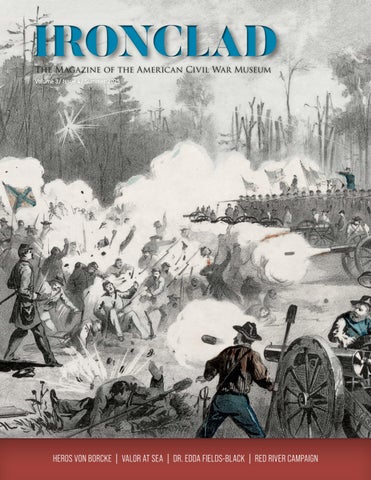
COVER: Battle of Pleasant Hill. This illustrated print depicts fighting at Pleasant Hill, the third battle during the Red River campaign in April 1863. See the article on page 21. IMAGE: LIBRARY OF CONGRESS
16 Outreach in Action
@acwmuseum ACWM.org
Magazine
FROM THE CEO
Publisher
PHOTO: JOHN DIXON
Rob Havers, Ph.D. ACWM President & CEO
Managing Editor Robert Hancock
Art Director & Designer John Dixon
Editorial Review Kelly Hancock Jeniffer Maloney
Museum Board of Directors Richard S. Johnson, Chair Claude P. Foster, Vice Chair Daniel G. Stoddard, Treasurer Walter S. Robertson III, Secretary Rob Havers, Ph.D., President & CEO Hans Binnendijk, Ph.D. Trevor S. Cox Audrey P. Davis Sally Diggs Fletcher George C. Freeman III Stephen T. Gannon Bruce C. Gottwald, Sr. B. Hunt Gunter Andrew R. Hoehn Donald E. King Alexander Macaulay Calvert Saunders Moore John L. Nau III Davidson Perry-Miller William R. Piper Roderick G. Stanley Ruth Streeter Allison Thomas Daniel Webber Jeffrey L. Wilt
Foundation Board of Directors Jeffrey L. Wilt, Chair Stephen T. Gannon Rob Havers, Ph.D. Richard S. Johnson Donald E. King Calvert Saunders Moore Walter S. Robertson III Ironclad magazine is published quarterly by The American Civil War Museum. 490 Tredegar St., Richmond, VA 23219 The contents of this magazine may not be reproduced in whole or in part without the consent of the American Civil War Museum.
Dear Friends
W
elcome to the latest edition of Ironclad magazine and a bumper issue it is too!
Robert Hancock’s article on Johann August Heinrich Heros von Borcke or The Prussian with the Big Sword profiles one of the most interesting Civil War characters as well as one of our most imposing artifacts, his massive broad sword. Von Borcke’s story reminds us of the international dimension of the American Civil War and also of the changing tides of history, as his grave marker now resides in Poland courtesy of the decisions at Yalta in 1945! Most of you are aware that the American Civil War Museum has a Historian Advisory Council, chaired by Dr. Carrie Janney, the John L. Nau, III, Professor in History of the American Civil War and Director of the John L. Nau III Center for Civil War History at the University of Virginia. These historians are drawn from the best in field, and we are always delighted to publish articles from their research. In this edition, Professor Wayne Hsieh of the United States Naval Academy, discusses the fascinating psychological impact on sailors with the development of the ironclad, not a topic that gets sufficient attention. Continuing our nautical theme, many of you will be aware we recently had the opportunity to acquire a collection of Union naval artifacts, including the uniform of a Union sailor currently on display in A People’s Contest exhibition at Tredegar. Thanks to two generous donors we were able to secure the loaned piece and the entirety of the collection which is a great addition to our holdings. See images and some more details of this great new addition on page 14. The ACWM not only preserves but is still active in collecting items and will continue to do so. Email our curator if you have pieces from the Civil War era that you would like to know more about. Although we are deep into our busy summer season, I’d like to get a fall event on your calendars: this year’s Lincoln Prize winner, Dr. Edda Fields-Black will be delivering our annual Lincoln Prize Lecture in partnership with Gilder Lehrman Institute of American History at our Tredegar location on October 15, 2025. Dr. Fields-Black’s work, COMBEE: Harriet Tubman, the Combahee River Raid, and Black Freedom during the Civil War has received widespread praise and also is now a Pulitzer Prize winning book. Our event promises to be a great occasion, and we look forward to seeing as many of you there as possible! In the meantime, please enjoy the summer months, and plan to visit us at any one of our three sites and avail yourself of our many summer programs. We look forward to seeing you!
Dr. Rob Havers, President & CEO
T HE A MERICA N CIVIL WA R MUSEUM
1
2025 LINCOLN PRIZE LECTURE with
Dr. Edda Fields-Black Join us for an evening with Dr. Edda FieldsBlack, recipient of the 2025 Gilder Lehrman Lincoln Prize AND a Pulitzer Prize for her book COMBEE: Harriet Tubman, the Combahee River Raid, and Black Freedom during the Civil War.
The lives of those liberated were transformed and contributed to the formation of the Gullah Geechee community along the lowcountry of the South's sea islands— a community that thrives to this day.
OCTOBER 15, 2025 tickets: acwm.org
The American Civil War Museum Richmond, VA
2
I RONC L A D : Summer 2025
PHOTOS: COURTESY OF J HENRY FAIR
During the night of June 1, 1863, Union gunboats pushed up the Combahee River from the federally controlled city of Beaufort, SC, destroying plantations and crops, and ultimately liberating more than 700 enslaved people. The raid was conducted by the U.S. 2nd South Carolina, an all-Black regiment, and guided by Harriet Tubman.
KE ORC ON B HER OS V T HE A MERICA N CIVIL WA R MUSEUM
3
Heros von Borcke in his Confederate uniform. After he joined J.E.B. Stuart’s staff, von Borcke was quickly promoted to major and, after his wounding, to lieutenant colonel. Some of the other members of Stuart’s staff found von Borcke more “ornamental” than useful. IMAGE: ACWM COLLECTION. COLORIZED FROM ORIGINAL.
4
I RONC L A D : Summer 2025
The Prussian with the Big Sword by Robert Hancock
At six feet, four inches and 240 pounds, Johann August Heinrich Heros von Borcke was destined to be a standout in any army. His outsized frame and larger-than-life personality served his military career well—once he left his native Prussia. Born in 1835 to a venerable military family, von Borcke found it difficult to locate horses and arms that suited his considerable span. In 1855, while serving in the Cuirassier Guards, he commissioned a long, broad sword for his use, much larger than the average cavalry saber. Young Heros first wore it on parade before King Frederick Wilhelm IV. His commander was outraged. His sovereign was sympathetic but instructed von Borcke to abide by regulations. Von Borcke obeyed, but kept his sword.
“...the first impression of these Confederate soldiers was not favorable.” At the outbreak of the American Civil War, the 26-year-old von Borcke was biding his time in the 2nd Brandenburg Dragoons. He quarreled with his father over money; he yearned for battlefield glory. He decided to make a fresh start in the Confederate States of America cavalry and arrived in Charleston, South Carolina, in May 1862. “[A]ccustomed as I was to European discipline and uniform,” he later wrote in his memoirs, “I must confess that on me the first impression of these Confederate soldiers was not favorable.” His English was uneven, and he did not know a soul in the South, but von Borcke’s resume and enthusiasm
impressed Secretary of War George Randolph, who upon introduction sent the Prussian nobleman off as captain and volunteer aide-de-camp to Brig. Gen. J.E.B. Stuart. By the summer of 1862, Stuart was a major general, and Maj. Heros von Borcke was Stuart’s assistant adjutant and inspector general. Von Borcke felt he had found his soulmates among the daring, funloving Virginia equestrians. Only two years younger than Stuart, von Borcke revered his commander. “His whole person seemed instinct with vitality,” von Borcke recalled, “his movements were alert, his observation keen and rapid, and altogether he was to me the model of a dashing cavalry leader.” Stuart was amused by the accomplished, gigantic foreigner he called “my dear old Von.” At last the huge sword came into its own. In August 1862, the heatexhausted von Borcke was awakened in the night by an angry rattlesnake. The major didn’t hesitate to subdivide the serpent “with his keen Damascus blade.” On June 9, 1863 at Brandy Station, Virginia, von Borcke had an opportunity to use his sword against human foes. After the war, von Borcke wrote of Brandy Station, “I had a happy feeling when riding out of battle and wiping the blood from my sword on my horse’s mane.” General Stuart complimented his efforts, and in the Northern newspapers “it was stated that the rebels in their charge had been led on by a giant, mounted on a tremendous horse, and brandishing wildly over his head a sword as long and big as a fence rail….” continued on page 6
(Previous page) A detail view of von Borcke's sword, showing a variation of his family's crest. An illustration of the crest is shown on this page. T HE A MERICA N CIVIL WA R MUSEUM
5
continued from page 5
The “Prussian with the big sword,” as von Borcke was known, relished life on and off the battlefield. Fellow officer and tent mate, Capt. William W. Blackford, declared von Borcke “a charming companion,” noting he was “very popular in the army.” Blackford knew von Borcke as a man of the world, recollecting, “He never spoke of his country or his high social position there unless asked about it, and then, if he found real interest was felt, he would be communicative and very entertaining about it. He had more tact than any young man I ever knew, and could adapt himself to any company.” Given his tenuous command of English, von Borcke endured ribbing from his fellows. Aiming for the phrase “warms my heart,” von Borcke once declared that listening to Gen. “Stonewall” Jackson gave him “heartburn.” J.E.B. Stuart lost no time in sharing this bon mot with Gen. Jackson, but Jackson would not laugh at von Borcke’s expense—thus earning his undying gratitude. Von Borcke’s lack of business acumen also came in for commentary. Looking to buy a reliable horse, von Borcke in his memoirs described having to buy two horses and a carriage from a determined seller. “[T]his setting up of my carriage became an inexhaustible source of joking and bantering,” von Borcke wryly noted. “…even General Lee, by no means addicted to the jocular vein, would
clipped the gold braid from his pants, another caught him in the throat. Captain Blackford ordered a courier to calm von Borcke’s rearing horse by twisting and holding the horse’s ear until the others got von Borcke back in the saddle and saw him to safety—a trick that von Borcke himself had taught Blackford and which may have helped Blackford save the Prussian’s life.
Von Borcke’s commander and friend, General J.E.B. Stuart. Von Borcke admired Stuart as a cavalry commander, and Stuart respected von Borcke as a professional soldier, a fun-loving companion, and thought him “a noble fellow.” IMAGE: ACWM COLLECTION
frequently on parade or in the battlefield, come out with, ‘Major, where’s your carriage?' ” Slightly more than a year after he joined the fight, the war ended for Heros von Borcke outside Middleburg, Virginia, on June 19, 1863. Rallying disorganized troops, the Prussian proved too tempting a target for Federal sharpshooters. One bullet
At a nearby plantation a doctor declared his wound mortal. But the diagnosis proved wrong. On June 23, Gen. Stuart wrote to his wife Flora, “…Major von Borcke is better. I do pray he may get well. He is a noble fellow.” Generals Stuart, Hampton, and Robertson paid visits to von Borcke; Gen. Longstreet sent three doctors. Von Borcke spent much of his time in Richmond recuperating at the home of Mrs. Thomas Price, mother of Stuart’s late assistant adjutant general, Channing Price. Ironically, just a month or so before his demise in May 1863, Channing had written to his mother that the rest of the headquarters staff had no skill at paperwork, von Borcke—among others— being merely “ornamental.” With his life out of danger, von Borcke fretted to be back in action but was much too debilitated to do anything other than rest and read accounts of all he was missing. In his memoirs he claimed Gen.
Von Borcke’s “big sword”. This non-regulation officer’s sword was made for von Borcke by Solingen in his native Prussia. The single-edged blade is 36 inches long and the sword weighs almost 4 pounds. IMAGE: ACWM COLLECTION
6
I RONC L A D : Summer 2025
Stuart wrote him, “My dear Von, I cannot tell you how much I missed you and your broad blade at Gettysburg.” Stuart repeatedly requested a new position and rank for von Borcke, but Confederate authorities, perhaps fearful of setting a precedent, found it “impracticable” to give the wounded warrior a brigadiership. The War Department did draft a resolution of thanks passed by the Confederate Congress in January 1864, which von Borcke later compared to the thanks given Lafayette by the Congress.
THE BATTLE OF MIDDLEBURG, VA JUN 17 - 19, 1863
UNION COMMANDERS David M. Gregg FORCES 6,400 CASUALTIES 350 RESULT
CONFEDERATE J.E. B. Stuart 3,200 40
CASUALTIES 40 350
INCONCLUSIVE DATA: BATTLEFIELD TRUST
Von Borcke was on hand in Richmond to visit the dying Stuart after the latter’s wounding at Yellow Tavern in May 1864. He quoted the upbeat Stuart as saying, “I don’t think I’m so badly wounded as you were, and I hope I shall get over it as you did.” With General Stuart’s death, von Borcke lost his champion and mentor. Friend Blackford could not help observing that von Borcke “had become a little spoiled by the admiration he received in society wherever he went. Gen. Stuart was fond of him at first but got a little tired of him towards the last when he became affected by the praises which Gen. Stuart had been mainly instrumental in bringing to him.” continued on page 9
Nearly mortally wounded. A drawing by Heros von Borcke depicting his own wounding, shot in the neck at Middleburg, Virginia. IMAGE: ACWM COLLECTION
T HE A MERICA N CIVIL WA R MUSEUM
7
The hilt of Heros von Borcke's sword. He left the sword with the Price family in Richmond, VA, for safe keeping when he returned to Prussia in 1865. IMAGE: ACWM COLLECTION
8
I RONC L A D : Summer 2025
continued from page 7
Major General Wade Hampton took up the Prussian’s cause, and in December 1864, von Borcke received a promotion to lieutenant colonel, to represent the Confederacy abroad. Upon his arrival in England the following spring, he heard of Gen. Robert E. Lee’s surrender at Appomattox. Von Borcke lost no time in returning to his homeland. He labored on his memoirs, originally published in Blackwood’s Magazine in 1866. With the outbreak of the Austro-Prussian war, von Borcke was recommissioned a second lieutenant in the 3rd Neumarkt Dragoons; he served as personal adjutant to Prince Frederick Karl. However, his old wound forced him to retire to his estate in 1867. He married and fathered three sons before his wife died in 1883. In May 1884, an older, heavier Heros von Borcke arrived in New Jersey, the start of a triumphal reunion visit with his fellow Confederate veterans. He was met and escorted by Tom Price, a professor at Columbia University, former Stuart staffer, and older brother of Channing Price. After stops in Baltimore, Washington, D.C., Alexandria, and Fredericksburg, von Borcke attended a gathering of old messmates in Richmond. There, too, von Borcke was reunited with his famous sword, which had been held for him by the Price family. In a grand gesture, he left his sword with the old soldiers at the R.E. Lee Camp for veterans. Von Borcke remarried and had a daughter he named—like Lafayette before him—Virginia. He corresponded regularly with the family of Col. Archer Anderson of Richmond (and Tredegar Iron Works fame), thanking them for their hospitality during his visit to the States and keeping them informed of his family affairs. At 52, his health was beginning to fail. He wrote to the Andersons: “My old wound having by some unaccountable reason recommenced bleeding again, the matter grew gradually worse and I had in one week four hemorrhages from the lungs.” But he rallied, and by the spring of 1888, he was writing of the political crisis at hand. “We are having quite exciting times over here now. Our glorious old emperor dead, his son, the present emperor, nearly a dying man, and the danger of war with Russia and with France.”
Heros von Borcke after the war. This undated carte-de-visite of von Borcke was made by Carl Gunther in Berlin, Germany. A large man–six feet, four inches tall and approximately 240 pounds during the American Civil War–von Borcke ballooned after the war to 400 pounds. During a visit to the U.S. in 1884, he confessed to a fellow staff officer that he hadn’t been able to tie his own shoes in years. IMAGE: ACWM COLLECTION
Heros von Borcke, however, would never see service again. His glory days long behind him, von Borcke died in Berlin on May 10, 1895.
Robert Hancock is the museum’s Director of Collections and Senior Curator.
T HE A MERICA N CIVIL WA R MUSEUM
9
A
Valor at Sea Amidst Iron and Steam by Dr. Wayne Hsieh
fter the famous showdown between the CSS Virginia and the USS Monitor at Hampton Roads, Nathaniel Hawthorne declared, “Henceforth there must come up a race of enginemen and smoke-blackened canoneers who will hammer away at their enemies under the direction of a single pair of eyes; and even heroism—so deadly as Science laying on our noble possibilities—will become a quality of very minor importance, when its possessor cannot break through an iron curst of his own armament and give the world a glimpse of it.” In contrast to this hidden valor, Benjamin West’s famous depiction of Horatio Nelson’s death at the Battle of Trafalgar put his bravery and sacrifice on display at sea, in the open air, and visible to gods and men. Meanwhile, How can an admiral Hawthorne asked condescend to go to half a century later, “How can an admiral sea in an iron pot? condescend to go to –Nathaniel Hawthorne
10
(Detail) The Death of Nelson by Benjamin West, 1806. Oil on canvas. 71.9 in × 97.4 in
USS Monitor drawing used by Continental Iron Works in Green Point, Brooklyn to build the ironclad warship.
IMAGE: CREATIVE COMMONS/GOOGLE ART PROJECT
IMAGE: MARINERS MUSEUM
I RONC L A D : Summer 2025
sea in an iron pot?” Indeed, the seeming invulnerability of the ironclads to enemy fire raised the question of whether or not sailors could prove their manhood and courage while fighting in an invulnerable metal box. If a sailor or soldier holds an insurmountable technological advantage over their opponent, does that mean they lose any moral credit for their victory? The crew of the USS Monitor certainly felt this burden—as the Monitor’s paymaster, William Frederick Keeler put it, “We were in no danger from shot or shell.” Unfortunately, that also meant that “there is not danger enough to give us glory.” Indeed, some reconciled their disquiet by pointing out a different opponent—not the technologically inferior Confederate navy, but the demands of the machines themselves. The bulk of the crew of the Monitor might have had little to fear from Confederate guns (as opposed to her captain, Lieutenant John Worden, who was wounded when a shell struck the less well protected pilothouse), but they struggled with the unhealthy working and living conditions within the ship itself, which were all exacerbated by the rushed wartime deployment of the ship without a proper shakedown cruise. In the summer, interior
temperatures rose to a measured 156 degrees Fahrenheit, and the ship’s ventilation depended on blowers prone to flooding due to being only four feet high above the deck. Conditions could become especially dire in the engine room. As Second Assistant Engineer Albert Campbell put it: “We left New York on a beautiful day and…the next afternoon we broke both our blower belts which spoiled the draft of our fires and drove all the gas into the engine room. This of course was rather inconvenient, for carbonic gas and hydrogen is not calculated to support animal life. I found myself getting weak and lost all consciousness and did not know anymore until I found myself on top of the turret with a couple of engineers lying along side of me, looking more dead than anything else… The water poured into the engine room around the smokestacks and ventilator like a miniature Niagara and it was doubtful whether we would float during the night.”
The engineers eventually made the repairs by splitting the tasks into smaller portions, which individual crewmen would complete in short intervals before becoming overwhelmed by the noxious gases. These procedures have an analogue to the limits on radiation exposure placed on current nuclear submariners. As Keeler put it after the battle, “I think we get more credit for the fight than we deserve—anyone could fight behind an impenetrable armor—many have fought as well behind wooden walls or none at all. The credit, if any is due, is in daring to undertake the trip and going into the fight in an untried experiment and in our unprepared condition.” As Worden put it after the war, “Here was an unknown, untried vessel, with all but a small portion of her below the waterline, her crew to live with the ocean beating over their heads—an iron coffin-like ship of which the gloomiest prediction were made, with her crew shut out continued on page 12
Here was an unknown, untried vessel… an iron coffin-like ship of which the gloomiest prediction were made. –William Keeler
T HE A MERICA N CIVIL WA R MUSEUM
11
continued from page 11
from sunlight and the air above the sea, depending entirely on artificial means to supply the air they breathe. A failure of the machinery to do this would be almost certain death to her men.” Concerns about our relationship with machines had deep roots in American and even western culture writ large. The interior of the Monitor was the naval counterpart to Charles Dickens’ famous criticism of industrial mill towns, describing “Coketown” in the novel Hard Times, published in 1854, as “a town of machinery and tall chimneys, out of which interminable serpents of smoke trailed themselves for ever and ever, and never got uncoiled. It had a black canal in it, and a river that ran purple with ill-smelling dye, and vast piles of buildings full of windows where there was a rattling and a trembling all day long, and where the piston of the steam-engine worked monotonously up and down, like the head of an elephant in
a state of melancholy madness.” Stephen Blackpool, one of Dickens’ characters, came out of the “hardest working part of that town; in the innermost fortifications of that ugly citadel, where Nature was as strongly bricked out as killing airs and gases were bricked in.” The iron turret of the Monitor was a nautical version of Dickens’ industrial mill town likened to an “ugly citadel,” isolated from Nature’s wind, sun, and sea. Dickens wrote about the plight of an industrial working class forced to subordinate themselves to the remorseless and inhuman demands of machines owned by capitalists. While the proletarian aspects of both soldiers and sailors has received more attention from historians as of late—I am thinking especially of William Marvel’s provocatively titled, Lincoln’s Mercenaries, which argues that economic motivations drove much of Union army recruitment, as opposed to ideas of duty and patriotism
and the digital history project, Professor David Gleeson’s Civil War Bluejackets, which has highlighted the transnational and working class origins of Union naval recruitment—it would also be a mistake to see soldiers’ and sailors’ relationship to technology as entirely analogous to industrial workers in Lancashire or Lowell. Unlike the capitalist owners of factories, military and naval officers shared with their soldiers and sailors serious risk of harm and injury on both land and sea. Furthermore, soldiers and sailors did not just service machines for some industrial purpose—they also collectively waged violence against their opponents. That violence gave them a sense of purpose and volition, but only if they felt that their actions had a real effect on the battlefield. The dilemma presented by the armored box of a Monitor was that it shifted sailors’ efforts away from proving their valor against the enemy to serving the needs of inanimate machines indifferent to displays of manly courage. As Henry Adams put
The first battle between "iron" ships of war Lithograph, 33.9 x 49 cm. Henry Bill. 1862 IMAGE: LIBRARY OF CONGRESS
12
I RONC L A D : Summer 2025
it, writing in London after the battle, “Man has mounted science, and is now run away with. I firmly believe that science will be the master of man. The engines he has invented will be beyond his strength to control. Some day science may have the existence of mankind in its power, and the human race commit suicide, by blowing up the world.” s it turns out, the executive officer of A the Monitor, Lieutenant Samuel Dana Greene, did in fact commit suicide, in 1884, shortly after writing his “Battles and Leaders” piece on the Battle of Hampton Roads for The Century Magazine. Greene had taken command of the Monitor after Worden was blinded by the shell strike on the pilothouse. He later insisted that he had not initially pursued the retreating Virginia due to orders to protect the grounded USS Minnesota and that various technical defects in the Monitor’s design prevented a successful pursuit of the Virginia. John Ericsson, the irascible inventor behind the design and construction of the Monitor, rightly saw this as an attack on his engineering prowess, and he became a partisan in a long running feud over the battle’s actual outcome. As a side note, Confederates insisted that the Virginia had actually won the battle by destroying the USS Congress and USS Cumberland before the arrival of the Monitor. Enlisted sailors on the Monitor also complained that they had missed the opportunity to sink the Virginia due to Greene’s cowardice, while most officers (including Worden) defended Greene’s conduct. As the historian David A. Mindell puts it his book, Iron Coffin: War, Technology, and Experience aboard the USS Monitor, “[D]ebates over both the success of the Monitor in battle and its failure at sea counterpoised the heroism and experience of the machine’s operators with the technical competence of the constructor and the engineer.” espite a distinguished postwar career, D the controversy shadowed Greene, and it is hard to believe that it played no role in his suicide. One could view this as the triumph of machine over man—the naval officer who found his honor impugned because he
military innovations in Greene’s experience and in this letter—the submarine-like existence of the Monitor’s crew, with much of the hull submerged (the doomed experience of the famous CSS Hunley also comes to mind), the beginnings of electric or electronic communication in the arrival of telegraphy, and even flight; the Monitor also encountered observation balloons during its brief time in service. But this is not only a story of technological advance and innovation—it may, in fact, be an example of how technology stretched human limits beyond their physical and psychic breaking point. Worse yet, the demands of machines exposed Greene to disgrace in the eyes of his shipmates, and he may have chosen to rectify the situation by taking his own life.
(top) John Ericsson, designer of the USS Monitor. 1861 (above) The first crew of the USS Monitor. 1862 IMAGES: LIBRARY OF CONGRESS
could not answer the remorseless demands of an iron coffin driven by infernal engines emitting noxious fumes hostile to human habitation. In describing his condition shortly after the battle, Greene wrote his family, “I had been up so long, had had so little rest and been under such a state of excitement that my nervous system was completely run down. Every bone in my body ached. My limbs and joints were so sore that I could not stand. My nerves and muscles twitched as though electric shocks were continually passing through them and my head ached as if it would burst. Some times I thought my brain would come right out over my eye brows. I laid down and tried to sleep, but I might as well have tried to fly.” One finds undeniably modern
egarding these themes, Mindell R also spends much time on Herman Melville’s poem, “A Utilitarian View of the Monitor’s Fight,” which deserves our attention. Melville’s reference to a “utilitarian view” of the battle hearkens back to Dickens’ character in Hard Times, Thomas Gradgrind, who begins the novel as a severe schoolmaster focused only on “facts,” but who eventually sees the error of his ways. In the poem, Melville describes the passing of military conflict with “glory” and “banners,” to be replaced by “mechanic power” from “the trades and artisans,” working via “crank,” with “calculations of caloric.” Amidst the conflict, Melville saw no pacifist dreams of the end of war altogether, but “warriors / Are now but operatives; War’s made / Less grand than Peace.” In nineteenth century usage, “operative” referred to factory workers such as female workers in textile mills in Lowell, Massachusetts. Nevertheless, the belabored debate over the actual outcome of the battle raises questions about how much warfare had really changed.
Dr. Wayne Hsieh is an Associate Professor at the United States Naval Academy and member of ACWM's Historian Advisory Council.
T HE A MERICA N CIVIL WA R MUSEUM
13
recent acquisitions
FRANK BRACKETT The museum’s latest acquisition includes items associated with the U.S. Navy squadrons blockading the southern coastline during the war, preventing imported goods, including weapons and ammunition, getting into the Confederacy. Frank Brackett was serving as Masters Mate aboard USS Release, a navy storeship, when he was detailed to U.S. Steamer Virginia, docked at the New York Navy Yard for refitting. The ship had been built in Scotland and used as a blockade runner by the Confederacy until she was captured by the U.S. Navy in January 1863 and commissioned as USS Virginia. She was refitted with an armament of five 24-pounder howitzers and a 30-pounder Parrott Rifle and assigned to the West Gulf Squadron under Rear Admiral David Farragut. Virginia was 170 feet from bow to stern and 26 feet at the beam. With her two steam engines, she could make nine knots. Grove S. Beardsley was an Assistant While patrolling the coast Surgeon in the U.S. Navy during the of Texas from September war. He was photographed in his 1863 until the end of the summer uniform wearing white linen war (with a short stint in pants and vest, similar to the uniform New Orleans for some of Frank Brackett. much needed repairs to IMAGE: LIBRARY OF CONGRESS her boilers), Virginia captured fourteen ships. Items included in the acquisition are Frank Brackett’s white linen seaman’s uniform, his insignia from his time as acting ensign, and several letters from Lieutenant Charles Brown, commanding USS Virginia.
Robert Hancock, ACWM Director of Collections, and Dan Stoddard, ACWM Board Chair and U.S. Naval Academy graduate (1994), review the U.S. Navy clothing and insignia of Frank Brackett recently acquired by the museum. PHOTO: JOHN DIXON
14
I RONC L A D : Summer 2025
The American Civil War Museum
Legacy Society
The undress white Union uniform of Frank Brackett is on display at ACWM–Tredegar.
What Will Your Legacy Be? Help us preserve the most transformational period in United States history for generations to come by becoming a member of the American Civil War Museum Legacy Society. For assistance and to receive information about our Planned Giving Program, please contact Annie Mowery. amowery@acwm.org 804.649.1861 ext. 133
T HE A MERICA N CIVIL WA R MUSEUM
15
ACWM Education Outreach in Action! 16
We
are proud to have served 7,052 Virginia public school students during the 2024-2025 school year. Through onsite field trips, classroom outreach, and virual programs, our education team provided engaging and high-quality Civil War history programs that so many teachers rely on. Students from elementary through high school learned about the American Civil War through our exhibits and hands-on programs such as “Artifact Investigation,” “Civil War Medicine,” “The Common Soldier,” and “Civil War Homefront.” Hundreds of teachers across the Commonwealth download our free educator resources from the museum website to utilize in their classrooms. Our work continues to reach more students, and we can’t wait to see what the next school year brings!
I RONC L A D : Summer 2025
The lesson was very engaging and interactive students still talked about it a couple of days later. – 4th grade teacher, Greenwood Elementary, Henrico County Public Schools
I LOVE this lesson. It kept the students involved, excited, and actively discussing ideas with classmates. – 4th grade teacher, Enon Elementary, Chesterfield County Public Schools
Everyone has let me know how amazing the outreach was and how they wish they could have it again! We are so grateful for your efforts to support our students and I’d love to continue our partnership next year and anything we can do to help support the museum’s efforts we will gladly do! – Coordinator of Elementary Social Studies, Portsmouth City Public Schools T HE A MERICA N CIVIL WA R MUSEUM
17
Beaufort
SOUTH CAROLINA
THE ICONS
As the American Civil War ravaged the nation, the region around Beaufort, South Carolina, became an epicenter of impact on the Confederacy and the war. Reflective of the changes that would eventually be realized across the entire country, the convergence of events and individuals with a common goal of freedom for the enslaved became reality much sooner in Beaufort.
1861
Beaufort, South Carolina, was occupied by the Union Army starting on November 7, 1861, following the Union victory at the Battle of Port Royal. White residents, including plantation owners, fled Beaufort and the nearby Sea Islands now under control of the Union. Approximately 10,000 enslaved people continued to live on the deserted plantations and looked to the Union for support. Initially unprepared for the influx of people, a plan was developed to integrate the formerly enslaved population into a free society. The plan was called the Port Royal Experiment, with two key aspects anchoring its objectives: economic development and education, including healthcare. ECONOMIC DEVELOPMENT: The experiment focused on transitioning from slave labor to wage labor with the opportunity for financial independence. This was the first time the formerly enslaved were paid for their labor.
Robert Smalls Robert Smalls was born enslaved in Beaufort. For years he worked on boats in the Charleston, SC, harbor. As a pilot of the Confederate steamer Planter, he devised a daring plan to escape to freedom. During the night of May 12, 1862, Smalls sailed the ship out of the harbor, navigating past Confederate fortifications, and surrendered it to Union forces. He received a monetary reward for the Planter. PHOTO: HAGLEY MUSEUM
EDUCATION AND HEALTHCARE: Northern missionaries and abolitionists established schools and hospitals to provide education and medical care to the formerly enslaved.
1862
Founded in 1862 by northern missionaries and abolitionists, the Penn School provided education for freed slaves—the first school established in the South to educate African-Americans. Headed by Laura Matilda Towne, the school was named after William Penn, the founder of Pennsylvania and advocate for liberty. Located on St. Helena Island, it also functioned as a health clinic, farm bureau, and as the center for sustaining West-African Gullah Geechee culture and history. Classes were held in the Brick Baptist Church until a dedicated school was built c.1864.
Harriet Tubman
Brick Baptist Church, c.1862.
Penn School, c.1864. PHOTOS: LIBRARY OF CONGRESS
18
I RONC L A D : Summer 2025
On June 1, 1863, three federal gunboats made their way up the Combahee River starting from Beaufort. Early the next morning, they destroyed seven plantations along the river, which resulted in the liberation of over 700 enslaved people. The raid was carried out by one of the earliest all-Black regiments, the U.S. 2 nd South Carolina Volunteers and guided by Harriet Tubman with knowledge she gained from her scouts in the area. PHOTO: LIBRARY OF CONGRESS
Q&A WITH DR. EDDA FIELDS-BLACK DR. HAVERS: Your book, Combee: Harriet Tubman, the Combahee River Raid and Black Freedom has been noted for the many details around the edges of the story. What did your research for this book really entail, and how long did it take and how did you bring out those details? DR. FIELDS-BLACK: So, it took about about nine years, and the last three years, I was researching and writing simultaneously. I came to Combee really through rice and my interest and love and passion for rice and rice farmers Dr. Fields-Black in West Africa and PHOTO: CARNEGIE MELLON U. the South Carolina low country. And then it sort of morphed into my research on the Gullah Geechee. And in that Gullah Geechee research, I started in the Civil War period for a number of reasons, which were mainly logistical. It was from that research that I started uncovering documents like Linus Hamilton’s life story that are now at the heart of Combee. So I say all that to say I was not thinking about the Combahee River raid. It was really finding these priceless documents that I knew hadn’t really seen the light of day that got me in. Once I started finding names and stories of enslaved people who were liberated in the raid, then I dug into the pension files. And I came to the pension files actually from my own family history. I was researching my father’s family, who are from the area and found them in pension files. And the information that I found about my own family kind of opened my eyes to what could be possible with these files. From there, we started trying to identify or substantiate the document.
PHOTO OF THE COMBHAEE RIVER BY J. HENRY FAIR
So it was a process of teasing out freedom seekers, trying to document where they came from and also building a tremendous database. And in this database, the pension files were the foundation, but then we layered other kinds of documents like Freeman’s bank accounts, the census, different kinds of documents, particularly documents in which formerly enslaved people name their family members; the family members of formerly enslaved people are identified. Because that then allowed me to trace these families back into these documents, the slave transactions. DR. HAVERS: Harriet Tubman is, of course, an iconic figure in American history and Civil War era history. What is the most interesting thing you learned about her as a person during your research for this book? DR. FIELDS-BLACK: I tried to think of Tubman in her early forties. She was in her early forties when she was in Beaufort. And shortly after I started writing Combee, or while I was researching Combee let’s say, the portrait of Tubman, taken a few years after the war, which is now housed at the Smithsonian and the Library of Congress was discovered by my colleague and friend, Dr. Kate Larson, and you see Tubman in the latest fashions. You see her wearing jewelry. You see her, and it’s such a contrast to what we usually see when she’s a much older woman. This was Harriet Tubman in her prime. And so thinking about Harriet Tubman – as my daughter would say a fashionista – thinking about Harriet Tubman as someone who cared about clothing and cared about jewelry and cared about her appearance. Thinking about her, even someone who was cultivating the image
of herself as a free woman. So looking the part of a free person was part of liberation. That was one thing I enjoyed, that I had not thought about before writing this book. DR. HAVERS: As part of our mission, we we explore the causes, the course, and the consequences of the American Civil War and the belief that this war remade the nation. What examples could you draw from your book that demonstrate how the Civil War did remake America? DR. FIELDS-BLACK: I think the biggest example that can be drawn from Combee is that the end of the Civil War led to the end of the institution of slavery, right? And I think that the Combahee River raid is an example of what enslaved and formerly enslaved people risked for freedom. How they pursued freedom every way they could, every chance they got—how they were willing to put their own freedom and their own lives on the line for the freedom of others. Think about the 756 people who were freed in the Combee River raid and the 300 2nd South Carolina Volunteers who are a small part of the entire U.S. Colored Troops. But if you think about these folks, the people who I write about, who liberated themselves before the raid and went to Beaufort, they are a drop in the bucket of the 500,000 enslaved people who left plantations, risked re-enslavement, risked all kinds of things to sail away from their families and go behind Union lines. It’s like the slow death of slavery. Let’s put it this way, it achieved a slow death, which was finalized with the end of the Civil War. So I think you’re seeing the agency of the enslaved, the agency of the formerly enslaved in their pursuit of freedom.
T HE A MERICA N CIVIL WA R MUSEUM
19
20
I RONC L A D : Summer 2025
Red River Campaign by Robert Hancock
New Orleans was captured by Federal forces in April 1862, and remained in U.S. hands for the rest of the war. From there, two years later, was launched the ill-fated Red River Campaign: the invasion of northwest Louisiana with the ultimate goal of taking Texas back for the Union. Why Texas? Cotton. The textile mills in the North desperately needed cotton. Also, France had made incursions into Mexico, setting up a puppet government that might, in the near future, recognize the Confederacy as an independent country. Securing Texas as a buffer felt expedient. Ultimately, the campaign was a short one, and the army got nowhere near winning back Texas. continued on page 22
“The War in Texas.” Frank Leslie’s Illustrated Newspaper, December 5, 1863. The vital port of Brownsville was one of a few areas in Texas that the Union controlled under Maj. Gen. Nathaniel Banks. IMAGE: ACWM COLLECTION T HE A MERICA N CIVIL WA R MUSEUM
21
continued from page 20
In charge of this expedition was Major General Nathaniel Banks, three term governor of Massachusetts with no military background. Nevertheless, over a period of three months in late 1863, Banks was able to establish small outposts at various spots along the Gulf coast of Texas. He proudly proclaimed that the flag of the Union floated over Texas; at least it floated over a couple of acres of barren sand dunes. Not, exactly, what the War Department in Washington had in mind, so Banks tried harder. An overland approach to Texas directly through western Louisiana got nowhere. So, at the suggestion of the current general-in-chief, Henry Halleck (soon to lose his title to U.S. Grant), a route following the Red River northwest to Shreveport, Louisiana, was chosen. With this plan, Banks could keep his army supplied by boat as they followed the river and, secondly, there was reportedly a vast amount of cotton stored in the Red River country which could be used to help the U.S. offset the cost of the war and supply the numerous textile mills in Banks’ home state of Massachusetts. Once a base of operations was established in Shreveport, Banks could launch an attack into Texas. Before the army could begin their march, they had to wait for the seasonal rise of the Red River, thus allowing the supply boats to follow the army. In March, the Union Army of the Department of the Gulf set off to conquer Texas with General Banks at their head (or, more literally, aboard his headquarters boat, Blackhawk). Lincoln was happy, General-in-chief Henry Halleck was happy, Banks was happy or, at least, cautiously optimistic. One person who was not happy was Ulysses S. Grant, who thought they should be concentrating their efforts against the port of Mobile, Alabama, but he did not press the issue. So, off Banks went with his army of approximately 30,000 men and a flotilla of some sixty vessels including ironclads, gunboats, transports, and supply boats under the command of Admiral David Porter.
[Map] The port of Alexandria, LA, on the Red River is halfway between New Orleans and Banks' objective of Shreveport, LA. In Alexandria, the low water level of the river caused Banks to alter his original plans. IMAGE: LIBRARY OF CONGRESS ALEXANDRIA, LA
Major General Nathaniel P. Banks commanded Union forces during the Red River Campaign. IMAGE: LIBRARY OF CONGRESS
The steamboat Blackhawk, Nathaniel Banks' headquarters during the campaign. IMAGE: MISSOURI HISTORY MUSEUM
Most imagined the campaign into Texas would be a relatively easy one. After all, weren’t the Confederate armies across the South on their last legs? Repulsed at Gettysburg, the loss of Vicksburg, vastly outnumbered in Tennessee and Mississippi, everywhere the barefoot and starving Rebels were on the defensive. As far as the Northern politicians and press were concerned, the end of the Southern Confederacy was nigh. Banks’ first port of call was Alexandria, about halfway between New Orleans and Shreveport on the Red River. None of this came as a surprise to the Confederates defending continued on page 24
22
I RONC L A D : Summer 2025
Admiral David Porter was in charge of the Union flotilla. IMAGE: LIBRARY OF CONGRESS
T HE A MERICA N CIVIL WA R MUSEUM
23
SHREVEPORT, LA
continued from page 22
Louisiana and Texas. Ever since the loss of Vicksburg, they suspected that a Union army would make their way up the Red River. Once confirmed, the Confederates began concentrating their forces. Brushing past the lightly defended Fort de Russy, Banks continued upriver. When the leading gunboats on the Red River reached Alexandria, they found the town abandoned and anything that might prove useful to an enemy removed. Delayed by rain that turned the roads to mud, Banks’ army slowly descended upon Alexandria between March 20 and March 25. It was in Alexandria that Banks’ problems started. The Red River had not risen as high as it usually did, so not all of Porter’s boats could continue upriver with the army. He also had to leave several thousand men behind to secure Alexandria and keep the supply line open. Be that as it may, Banks’ next target was Shreveport, which he expected to reach by April 10. When Banks, aboard his headquarters boat, landed at Grand Ecore, he paused to decide what to do next. Do they abandon their river support by striking an inland route to Shreveport or continue to follow the river? The big question was whether there was a serviceable road along the west side of the Red River. Banks, in his hurry to reach Shreveport, decided there was not time to send a reconnaissance force to find a river route, so the army turned left, leaving the river behind them.
MANSFIELD April 8, 1864
WILSON'S PLANTATION April 7, 1864
The cavalry led the way, followed by their 300 supply wagons. Then came the infantry with a thousand more wagons. Another cavalry brigade brought up the rear. While the Union army trudged across the comparatively barren interior, the Confederates were gathering and bringing in reinforcements to meet them. Among those trudging through the Louisiana wilderness was Lieutenant John Gibson, 161st New York Volunteer Infantry. Gibson, a boatman from Pulteney, New York, had joined the regiment in 1862, and he now found himself in far flung Louisiana marching towards he knew not what. Gibson’s older brother, Warren, had joined the regiment at about the same time but had died of disease in Baton Rouge in February before the army set out. His younger brother Judson was serving with a New York regiment in Virginia. Banks and most of the other generals did not expect any fighting to take place before they reached Shreveport and possibly not even there. However, on April 7, as the army approached Mansfield, those expectations were shattered. The leading column of mounted infantry, under the command of Brigadier General Albert Lee, was suddenly attacked at Wilson's Plantation by four regiments of howling Confederate cavalry. The Union troopers held their ground, but just barely, and were clearly shaken by the experience. Lee begged for reinforcements from General Franklin, whose infantry were a few miles farther back. Franklin refused, thinking that Lee was overreacting. continued on page 27
24
I RONC L A D : Summer 2025
PLEASANT HILL April 9, 1864
In Grand Ecore, north of Alexandria, U.S. Brig. Gen. Banks directed his forces to proceed overland, leaving the low waters of the Red River behind. The 3-day battle started at Wilson's Plantation on April 7. On April 8, the Union pushed towards Mansfield but the Confederates held and ultimately captured Union supply wagons. By April 9, Union forces had retreated to Pleasant Hill only to have the Confederates attack once again. However, the Union was well entrenched and withstood the Confederates, but the Union's campaign was tactically over. MAP: LIBRARY OF CONGRESS
(Left) U.S. Brig. Gen. Albert Lee's cavalry division was the first to encounter a strong Confederate force at Wilson’s Plantation. (Right) U.S. Maj. Gen. William Franklin, Commander of XIX Corps, who at first refused to send reinforcements to the beleaguered Albert Lee. IMAGES: LIBRARY OF CONGRESS
GRAND ECORE, LA
(Top) The Battle of Wilson's Plantation between U.S. Gen. Lee and C.S. Gen. Green. (Right) Confederate attack on Gen. Lee's wagon train. FRANK LESLIE'S ILLUSTRATED NEWSPAPER, MAY 14 & 21, 1864. IMAGES: LIBRARY OF CONGRESS
T HE A MERICA N CIVIL WA R MUSEUM
25
Camille Armand Jules Marie, Prince de Polignac
John Gibson Lieutenant, 161st New York
Brigadier General, Texas Infantry Camille Armand Jules Marie was born on February 16, 1832 in Seine-et-Oise, France and into French aristocracy. He served in the Crimean War from 1854-1855. In 1859, he received a military discharge and traveled to Central America to study geography and political economy. As France supported the conservative Mexican govenment—who were embroiled in their own civil war against the liberal government supported by the U.S.—when war started in the U.S., Polignac offered his services to the Confederacy. He was commissioned a Lieutenant Colonel and served under Gen. Beauregard and Gen. Bragg.
Prince Camille de Polignac IMAGE: ACWM COLLECTION
To learn more about the Confederate's diplomatic endeavors with Mexico, see Ironclad Winter 2025.
Polignac was promoted to Brig. Gen. in January 1863 for gallantry at the Battle of Richmond, KY, and later transferred to the TransMississippi Department with command of a Texas infantry brigade. He received a battlefield promotion to Major General for his leadership at the battle Sabine Crossroads. In early 1865, Polignac travelled back to France as an envoy of the C.S.A. to ask the French emperor, Napoleon III, for assistance. By the time they met, the war was ending, and the emperor did not respond to the request. After the war, Polignac remained in France then returned to Central America to continue his studies though he returned to France to fight in the Franco-Prussian War (1870-1871). After this war, Polignac married twice. In November 1913, he died and was buried in Frankfurt am Main, Germany next to his first wife, Marie Longenberge, who died in 1876 during the birth of their daugther. Polignac was the last surviving Confederate Major General.
John Gibson was born in 1836, one of nine children to Ira and Harriet Gibson. Ira was a farmer with twenty acres in Pulteney, New York, on Lake Keuka, one of the narrow Finger Lakes now famous for its wine. There he raised cattle, sheep, and hogs. John alternated between farming and working as a boatman on the lake like his brothers. His mother died in 1846, and some time around 1849, his father married Catherine Keggins, a widow from New Jersey who added four children of her own to the household. Gibson enlisted in the 161st New York Volunteer Infantry and was commissioned a lieutenant November 10, 1862. The regiment saw action at Plains Store, Louisiana in the East Baton Rouge Parish (May 21, 1863), and Port Hudson (May-July 1863). Wounded at Sabine Crossroads (April 8, 1864), he returned to service later that year and finished out the war. In 1867, John Gibson married Christina Keggins, a teacher, and the daughter of his father’s second wife. They had a farm in Pulteney, New York, where John cultivated grapes. Their vines produced about 12,000 pounds of grapes a year. Gibson, still listed as a “vineyardist” in the New York state census, died in 1909 at the age of seventy-three with the bullet that wounded him still in his leg.
Frock coat worn by Lt. John Gibson, 161st New York Volunteer Infantry.
French-made saber carried by Polignac during the American Civil War. IMAGE: ACWM COLLECTION
26
I RONC L A D : Summer 2025
JOHN L. NAU COLLECTION OF CIVIL WAR ARTIFACTS ON LOAN FROM THE AMERICAN BATTLEFIELD TRUST IMAGE: ACWM COLLECTION
continued from page 24
The next day, the Union columns moved forward again and instantly ran into resistance. Because of the terrain, many of Lee’s men had to fight on foot. As they crested a hill, they espied a large force of Confederate infantry and cavalry drawn up in line of battle. Banks ordered Lee to advance and take Mansfield. Lee protested, stating that if he moved against the obviously more numerous Confederate force that faced him, “we would be most gloriously flogged.” Banks relented and called for the infantry to hurry to Lee’s support. The Confederates, however, were not going to wait around and immediately launched an attack. According to one Northern soldier, the Confederates swept down on them “like a cyclone” and “yelling like infuriated demons.” The Union line held for a while, but outnumbered and outflanked, they panicked and ran. The retreating Federals slammed into the baggage wagons clogging the roads, causing yet more pandemonium. The hasty retreat became an all-out rout. Banks arrived and tried to rally his men. “Form line here,” he called out. “I know you will not desert me.” But they did, tossing away weapons and equipment and overturning wagons as they fled. Several miles behind the immediate fighting, Brigadier General William Emery was ordered to advance his division, of which the 161st New York was a part, and form a line of battle at the first good position he could find to make a stand. As John Gibson and the 161st New York advanced, they could probably hear the enemy’s guns booming away, and soon they saw the result. “Men without hats or coats, men without guns or accoutrements, cavalrymen without horses,” wrote one New Yorker, “all in a state of fear and frenzy, while they shouted to our boys not to go forward any farther, for they would all be slaughtered.” Emory formed his brigades while the fugitives continued to flow through his lines. The 161st New York was thrown out in front as skirmishers to slow the enemy advance. John Gibson told his men to keep well spread out and fire at will when they spotted the enemy. They did not have long to wait. On the heels of the retreating mob came the Confederates. They soon pushed the 161st back. They took refuge and reformed behind Emory’s main line. The Confederates pressed the attack, but they were tired and disorganized from having chased the Yankees over difficult terrain. The fighting was intense and, for a while, a near run thing, but Emory’s brigades held, and the Confederates eventually pulled back. The Battle of Sabine Crossroads, or Mansfield as the Confederates called it, was over. That night, the Federals could hear the enemy hauling away the captured supply wagons. continued on page 29
T HE A MERICA N CIVIL WA R MUSEUM
27
28
I RONC L A D : Summer 2025
RED RIVER CAMPAIGN APRIL 7 - 9, 1864
1,000 CASUALTIES
2,235
UNION COMMANDERS Nathaniel Banks FORCES 12,000 RESULT
CONFEDERATE Richard Taylor 9,000
CONFEDERATE VICTORY
continued from page 27
The battle was renewed the next day, April 9, at Pleasant Hill, about 15 miles farther back from where the fighting had ended the day before. The Confederates, bolstered by their successes, pressed the attack. Unlike last time, the Union army was better prepared to accept them. It ended with Banks’ army retaining the field, but for all intents and purposes, the Red River Campaign was over, and they went back the way they came, burning Alexandria on the way. In total, during the two days fighting, Banks’s army lost 2,235 men killed, wounded, and missing out of the force engaged of about 12,000. During the fighting on April 8, the 161st New York lost one hundred and seven men killed, wounded, or missing. One of the wounded was John Gibson, shot in the back of his right thigh. He was sent to St. James Hospital in New Orleans to recover from his wound and, after a short furlough home, was back with the regiment where he again saw action during the siege of Mobile, at Spanish Fort, and Fort Blakely. At the end of the war, he was mustered out with the rest of his regiment at Fort Jefferson, Florida. When he returned home from the war, John Gibson put away his uniform and took to farming like his father, replacing his sword with a plowshare in the best tradition of Cincinnatus.
Robert Hancock is the museum’s Director of Collections and Senior Curator.
Print illustrating the Battle of Pleasant Hill. IMAGE: LIBRARY OF CONGRESS
T HE A MERICA N CIVIL WA R MUSEUM
29
NON-PROFIT ORG. U.S. POSTAGE PAID RICHMOND, VA PERMIT NO. 2399
490 Tredegar St., Richmond, VA 23219
EXPERIENCE THE MUSEUM THIS SUMMER
www.ACWM.org