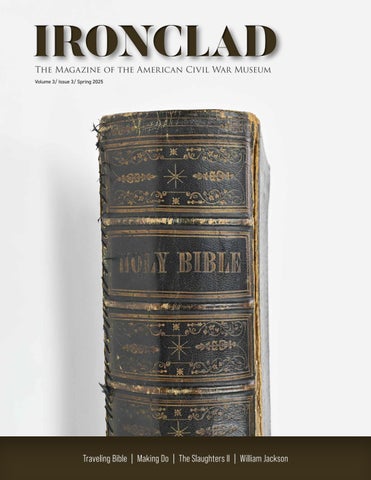
IRONCLAD The Magazine of the American Civil War Museum Volume 3/ Issue 3/ Spring 2025
Traveling Bible | Making Do | The Slaughters II | William Jackson
IRONCLAD Volume 3/ Issue 3/ Spring 2025
3
12
Traveling Bible
Making Do
17
23
The Slaughters: Part II
William Jackson
1 From the CEO
2 Etta Fields-Black: Lincoln Lecture
COVER: This Harper's Illustrated bible from 1846 was owned by two different families, one Confederate and one Union. It was recently donated to ACWM. See the article on page 3. IMAGE: ACWM COLLECTION
14 John Moorman
@acwmuseum ACWM.org
Magazine
FROM THE CEO
Publisher
PHOTO: JOHN DIXON
Rob Havers, Ph.D. ACWM President & CEO
Managing Editor Robert Hancock
Art Director/Designer John Dixon
Editorial Review Kelly Hancock Jeniffer Maloney
Museum Board of Directors Daniel G. Stoddard, Chair Claude P. Foster, Vice Chair Rob Havers, Ph.D., President & CEO Walter S. Robertson III, Secretary Hans Binnendijk, Ph.D. Trevor S. Cox Audrey P. Davis Sally Diggs Fletcher George C. Freeman III Stephen T. Gannon Bruce C. Gottwald, Sr. Andrew R. Hoehn Richard S. Johnson Donald E. King Calvert Saunders Moore John L. Nau III William R. Piper Roderick G. Stanley Ruth Streeter Allison Thomas Jeffrey L. Wilt
Foundation Board of Directors Jeffrey L. Wilt, Chair Stephen T. Gannon Rob Havers, Ph.D. Richard S. Johnson Donald E. King Calvert Saunders Moore Walter S. Robertson III
Ironclad magazine is published quarterly by The American Civil War Museum. 490 Tredegar St., Richmond, VA 23219 The contents of this magazine may not be reproduced in whole or in part without the consent of the American Civil War Museum.
Dear Friends Warm greetings from Richmond, Virginia, and welcome to the Spring edition of Ironclad magazine. We have enjoyed a very busy spring season with thousands of students and teachers on field trips, special programs, and visitors from across the country. In late April we welcomed Dr. William C. “Jack” Davis to Richmond to a packed house to talk on the complex relationship between Robert E. Lee and Jefferson Davis, while in Appomattox we marked the anniversary of the surrender of General Lee to General Grant with a full Students at ACWM-Tredegar program of events and lectures. Additionally, Kelly Childress started as our new site manager at ACWM Appomattox. Kelly comes to us with a strong track record in education and public programming from her time at Stratford Hall, the ancestral home of the Lees of Virginia. We look forward to the energy she will bring to our amazing Appomattox site. Congratulations to Dr. Edda Fields-Black for winning a Pulitzer Prize in addition to the 2025 Lecture and discussion with William C. "Jack" Davis Gilder Lehrman Lincoln Prize for her work entitled COMBEE: Harriet Tubman, the Combahee River Raid, and Black Freedom during the Civil War. As you know, through our partnership with Gilder Lehrman Institute of American History, we bring the Lincoln Prize laureate to speak at our Tredegar site. We are very much looking forward to welcoming her to Richmond on October 15. As always, this magazine is a judicious blend of articles from top scholars in the field and a discussion of some of the many fascinating pieces to be found in our collections. Please enjoy this edition of Ironclad, and thank you for all your support.
Dr. Rob Havers, President & CEO
T HE A MERICA N CIVIL WA R MUSEUM
1
2025 LINCOLN PRIZE LECTURE
Edda Fields-Black A very special 2025 ACWM Lincoln Prize Lecture This year's Lincoln Prize Lecture will feature Dr. Edda Fields-Black, recipient of the 2025 Gilder Lehrman Lincoln Prize AND a Pulitzer Prize for her book COMBEE: Harriet Tubman, the Combahee River Raid, and Black Freedom during the Civil War. The event will be October 15, 2025 at our Tredegar site. Stay tuned for details!
2
I RONC L A D : Spring 2025
The Strange Travels of a Civil War Bible by Megan Smolenyak
T HE A MERICA N CIVIL WA R MUSEUM
3
4
I RONC L A D : Spring 2025
The Strange Travels of a Civil War Bible by Megan Smolenyak
W hen I received the artifact, written in ink was: “Picked up on Battle Field of the Civil War by Harvey Annis.” The item in question was not a canteen, or a bayonet, or a bullet but a large family bible. At four inches thick and weighing a hefty thirteen pounds, the claim seemed questionable.
The bible was quite rare, an 1846 Harper’s illustrated Bible— said to be one of the most lavishly illustrated ever published. On the dedication page, after “A Sacred Token from,” Mary A. Williams had written her name. The recipient was “Her Dear & Beloved Husband, Nathaniel Thomas Williams on the 28th of June A.D. 1847.” I turned to the following page and scrutinized the faded inscription. This Sacred Book was given to me by my Dear and Beloved Wife on her death Bed with the request that I should read it attentively and try to meet her in Heaven. May the lord so direct and instruct me to do so is the prayer of her Affectionate Husband. Oct. 1st 1847. (SIGNED) Nat. T. Williams. Turning to the page where deaths were recorded, I noted that the first entry was for Mary’s father. The second was for Mary herself: “Died at 8 minutes before 10 o’clock A.M. on Monday the 28th of June A.D. 1847 Mary Atherton wife of Nathaniel T. Williams.” Mary was thirty-three when she died. Seemingly in a hurry to rejoin her, Nathaniel passed away less than two years later and his death was listed immediately after hers. What would Mary think if she could somehow know that her tender inscription to her husband would provoke a stranger to write about them more than 160 years later? This was interesting to consider, but their low profile (they were essentially absent from the countless family trees found online) also posed a bit of a problem. Perhaps because the couple were childless, they had been all but erased from memory. When they purchased the Bible, Mary and Nathaniel had recorded their own births. The next entry was for Thomas Williams Mason, who was born 1839. With his middle name, I assumed that he was a nephew, but that was not the case.
The first pages of the "The First Book of the Kings," showing artful illustrations—known as illuminations. (Previous page) Title cover page from the Bible.
I found online a citation from the Wilson Library at the University of North Carolina at Chapel Hill pertaining to a collection of Thomas Williams Mason’s papers. Mason was a lawyer and cotton continued on page 6
IMAGES: ACWM COLLECTION
T HE A MERICA N CIVIL WA R MUSEUM
5
continued from page 5
planter in Northampton County, North Carolina. He was born in Virginia and served in the Confederate Army. He was named for his first cousin, Nathaniel Thomas Williams. Williams gave his namesake the Huon Plantation, located in Madison Parish, Louisiana, as a birthday gift. Mason was only ten when Williams died, so regardless of which birthday he received the plantation, it was an impressive gift by any standard. Along with the plantation, it seems, came the Bible. Thomas Williams Mason, now the Bible’s second owner, accounted for the next run of entries. His 1860 marriage was recorded, as were both of their births and that of their daughter, Sallie. After that, the ink and the family name changed. In fact, there were no additional entries until 1871, which was curious because additional children were born to the couple in the 1860s. During the war, Mason briefly served on the staff of Confederate General Robert Ransom. Taking a leave of absence, he traveled to Louisiana to secure his inherited plantation. The 1860 slave schedule indicated that he had 206 enslaved workers, and many of them he moved to Texas. continued on page 9
Thomas Williams Mason (pictured post-War) was the second owner of the Bible. IMAGE: NORTH CAROLINA MUSEUM OF HISTORY
Harvey Annis purportedly found the Bible on a battlefield, as inscribed in the book. He was from Oshkosh, Wisconsin, and served in the 18th WI Infantry and 51st USCT. IMAGE: ANNIS FAMILY FOUNDATION
Thomas Williams Mason inherited Huon Plantation, located west of Vicksburg in Madison Parish along the Walnut Bayou. IMAGE: LIBRARY OF CONGRESS
6
I RONC L A D : Spring 2025
Bible page listing family births. IMAGE: ACWM COLLECTION
T HE A MERICA N CIVIL WA R MUSEUM
7
Bible page listing family marriages. IMAGE: ACWM COLLECTION
8
I RONC L A D : Spring 2025
continued from page 6
Back to the Bible, the next entry in the family records was the 1871 birth of Watson Lytle. Given the 18621871 gap in the listings, I suspected that this Lytle family might be associated with Harvey Annis, the fellow who, according to the inscription at the beginning of the Bible, had picked it up on a Civil War battlefield. Harvey Annis had enlisted in the 18th Wisconsin Infantry and later was commissioned an officer in the 51st United States Colored Troops regiment. I realized that the Bible had been owned by both Confederate and Union soldiers. It had changed hands and essentially changed sides, but I was curious exactly how the transfer had occurred. Before I would answer that question, though, the Bible had another twist in store for me.
THE SULTANA DISASTER Surprisingly few of us have heard of the sinking of the Sultana, America’s greatest maritime disaster, claiming roughly 1,700 lives—closer to 1,900 if you include those who initially survived but died shortly thereafter. More tragic still, the majority of those who died were former Union POWs anxious to get home after the war. Tempted by the generous five-dollar-per-head fee offered by the government, transport captains bribed army officers to look the other way as they overloaded their steamboats in Vicksburg where the POWs had gathered. The POWs, eager to get home, were willing to endure the packed conditions. The Sultana, legally registered to carry 367 people, wound up burdened with closer to 2,500 passengers.
Before departure, a leak was noticed in one of the boilers, but rather than risk losing business to competitors by doing a proper repair, the Sultana’s captain, J. Cass Mason, ordered a patch job instead. The inadequate repair, coupled with the extreme weight of the load, caused three of the four boilers to explode at 2 a.m. on April 27th. Among the victims were Lieutenant Harvey Annis and his daughter Belle. Among the survivors was his wife, Ann. Ann Vessey Laired Sims Annis was an English immigrant to the United States. The reason for all the surnames? Ann was widowed three times, each time because her husband had drowned. Ann had survived two shipwrecks that had taken her husbands, the Sultana being one of them. While stationed in Mississippi, Harvey Annis had become quite ill, so Ann had traveled from Wisconsin to Vicksburg to nurse him. She brought with her their seven-year-old daughter, Belle. While awaiting his discharge papers from the army, the family decided to join the POWs and others on the Sultana. Though they had a private cabin, the overcrowding of the steamboat didn’t escape their attention, but they were assured by an employee of the Sultana that it was safe, and as with the POWs, the urge to get home overrode their concerns. On the evening of the 24th, the steamboat left Vicksburg. Two nights later on the 26th, it arrived at Memphis continued on page 11
This photo of the steamboat Sultana was taken on April 26th, 1865—the day before it exploded and sank. Allowed to carry only 367 passengers, it was transporting nearly 2,500 people on the fateful voyage. IMAGE: LIBRARY OF CONGRESS
T HE A MERICA N CIVIL WA R MUSEUM
9
At 2 a.m. on April 27th, 1865, the boilers of the overloaded Sultana exploded. Over 1,700 people died—many were Union soldiers heading home. ILLUSTRATION: HARPER'S WEEKLY. MAY 20, 1865 IMAGE: LIBRARY OF CONGRESS
10
I RONC L A D : Spring 2025
continued from pag 9
where it stopped to pick up coal. In the early hours of the following morning, the first two boiler explosions occurred, triggering fires, destruction, and chaos. Tucked away in their cabin, the Annis family heard the tumult and was swallowed in steam when Lieutenant Annis opened their door to investigate the situation. Slamming the door, he put life-preservers on himself and Ann, grabbed their daughter and steered his family to the stern. Ann’s deposition records what happened next:
He [her husband, Harvey] let himself down to the lower deck with the child, and I followed him, but as I was descending the rope a man from above jumped on me and knocked me in the hold of the vessel. From this I was extricated, and my husband, with our child, jumped overboard. I followed as soon as I could, but the life-preserver was not placed on me right and I held onto the rudder till I was obliged to let go by the fire. Ann experienced the horror of watching her husband and daughter slip under the waters of the Mississippi River. They were never found. Badly burned, she somehow managed to grab a piece of wood before losing consciousness and eventually waking up to find herself on the deck of a boat. She is believed to have been one of possibly only two female survivors. Thrice water-widowed before the age of fifty, Ann returned to Oshkosh, Wisconsin, where she lived until 1900 but not without additional challenges. You might think that after all this that she would have been one of the first to be granted a widow’s pension for the loss of her husband but not so. Since her husband’s discharge papers had been signed, though not received, the government rejected her claim, insisting that Harvey was not in active service at the time of his death. I waded through Ann’s red-tape battles in Harvey’s pension file in disbelief, stunned that this insult had been added to such conspicuous injury. The struggle finally ended in an Act of Congress specially for the relief of Ann Annis, furnishing her with a monthly sum of $17. Since the Bible still exists, it is evident that it was not with the Annis family on the Sultana that awful night, so I imagine that one day during her eight-month stay in Vicksburg, Ann shipped it to Wisconsin along with other items that might have been inconvenient to travel with. One question remained: how had the Bible made the transition from the Mason family to the Annis family?
Ann Annis survived the Sultana explosion but her husband, Harvey, and their young daughter, Belle, died. IMAGE: FIND A GRAVE.COM
Harvey Annis, with the 51st USCT, was stationed not far from Thomas Williams Mason’s Louisiana plantation, located between Milliken’s Bend, Louisiana, and Vicksburg, Mississippi, where Annis would wind down his military career. Union forces had begun occupying plantations in this Louisiana river region. It is likely that Annis now commanded some of the men who were guarding the plantations. In an 1871 claim, the Bible’s previous owner, Mason, made to the U.S. Government, he sought reimbursement for stores taken from his plantation in May 1863. The petition was ultimately rejected, and it is not much of a stretch to imagine that a few personal items might also have been taken. The most likely sequence of events, then, seems to be that the Bible was taken—possibly in May 1863—from Mason’s plantation and found its way to where Annis was stationed nearby. From there, he presumably took it to Vicksburg where it was shipped to Wisconsin avoiding a watery end. The Bible now resides in the American Civil War Museum’s collection. Megan Smolenyak, who donated the Bible to the museum in 2024, is a genealogist and the author of six books including The Quest for Annie Moore of Ellis Island and Hey, America, Your Roots Are Showing, from which this article is excerpted.
T HE A MERICA N CIVIL WA R MUSEUM
11
Make Do OR Do Without T
ake one cup of crackers soaked in water, a teaspoonful of tartaric acid, some butter, and a pinch of nutmeg, and what do you get? An apple pie without apples. How about a pint of grated green corn, one egg, a cup of flour, two tablespoons of butter, and salt and pepper to taste? Artificial oysters. In the years after the war, much was made of the privations suffered by civilians due to wartime shortages, especially in the South. The war created shortages from the very beginning, and people quickly realized they needed to get creative or do without. During the pre-war years, the South was the most productive agricultural region in the United States. Cotton was the chief cash crop with tobacco a close second. Although southerners grew edible crops such as corn, these were largely for consumption on the farms on which they were grown. As the value of cotton increased, some southerners had to purchase food grown in places like Ohio and Illinois, and nearly all southerners purchased their manufactured items from New England and the Middle States. Some southern politicians and business leaders bemoaned their region’s limited industry and lack of diversified crops. South Carolina textile magnate William Gregg expressed a common sentiment in an article he wrote for the popular magazine DeBow’s Review in December 1860: “our entire dependence on others for the commonest necessaries in use, is a national evil.” Widespread discussion of these problems, however, ultimately did little to resolve them. With the outbreak of hostilities in 1861, it was already too late to rectify the problem. Those who had bemoaned the inadequacy of southern industry in peacetime could only urge economy and inventiveness in wartime. Since most people believed that the war would be over in a matter of weeks, they were confident that the resulting scarcities would be similarly brief. The Federal blockade of Confederate ports, however, added to the supply problem. Some Confederates believed the blockade would accomplish what their pleas had not: the expansion of industry and commerce. But that did not happen. As the blockade became more effective, those few items which were smuggled through were “only a drop in the great empty bucket of want,” as one writer later described it.
12
I RONC L A D : Spring 2025
(Clockwise from above) Homemade candle made from three layers of wax-coated string wrapped around a corncob (on display at ACWM-Tredegar); Woman's "bootie" made from raccoon skin (on display at ACWM-Tredegar); Homespun fabric swatches. (Opposite) Homespun cotton dress. IMAGES: ACWM COLLECTION
The lack of daily necessities was further strained by a variety of factors: speculators looking to get rich quick, ravenous roaming armies, cities and towns overcrowded with refugees. Add to that transportation difficulties, droughts and floods, portions of the South falling under Union control, and the privations only got worse. Confident in their ability to survive—indeed, to flourish— without help from anyone, many Confederates initially believed that they could produce anything they needed with a little patience, ingenuity, and hard work. The media was at the forefront of urging increased household production. Newspapers and journals published recurring columns that featured detailed instructions on how to make a variety of items. A collection of such recipes was published in 1863 under the title, “Confederate Receipt Book: A compilation of over One Hundred Receipts, Adapted to the Times.” The publishers intended “to supply useful and economical directions and suggestions in cookery, housewifery, &c., and for the camp” and promised to publish a second volume if there was enough public interest.
the time) was considered not only a practical matter but a patriotic one. Confederate President Jefferson Davis wrote in January 1863 that it was not only “honorable to our women to weave and wear their dresses” but that “homespun is becoming to them.” Since women constituted the majority of civilians on the home front, it fell upon them to make most of these items. Women from more modest economic backgrounds made many of these goods in the pre-war years, but now women from all backgrounds did so out of necessity. Mrs. Kellar Anderson of Arkansas was one of the latter. Although she had “never seen a loom or a spinning wheel…until the war came,” she met the challenge and learned to make homespun. Wartime shortages did not make southerners more selfsufficient in the long run. Poverty and sacrifice became the norm, rather than a revolution of creative production. Once the war ended and people could again order items from afar, most put away their receipt books and homespun as curiosities or mementoes. END
The manufacture and use of such substitution materials (later referred to as ersatz, though the term was not used at
T HE A MERICA N CIVIL WA R MUSEUM
13
From the Collection
John Moorman When the war began, John Addison Moorman was a seventeen-year-old student living with his parents in Bedford, Virginia. He had to wait a year before he enlisted as a private in the 11th Virginia Infantry under the command of Colonel Samuel Garland. He signed up for three years or until the end of the war, whichever came first, and received a $50 bounty. Shortly after his enlistment, Moorman joined the regiment on one of its most difficult marches of the war. Leaving their bivouac in Northern Virginia, the 11th marched through rain, sleet, and knee-deep mud on their way to join General Johnston’s forces protecting Richmond from McClellan’s Union army moving up the peninsula. Wagons bogged down on the roads, already churned into a morass by the proceeding cavalry and artillery. The men exhausted themselves slogging through the mire of liquid clay. They jettisoned any nonessential items to lighten their load. The number of stragglers increased daily. In an effort to brighten his men’s spirits, the brigade’s commander, A.P. Hill (soon to be promoted to major general and replaced by James Kemper), issued a ration of whiskey to his men, paid for out of his own pocket. continued on page 16
Samuel Garland, commanding officer of the 11th Virginia Infantry.
14
I RONC L A D : Spring 2025
Military shell jacket worn by John Moorman IMAGES: ACWM COLLECTION
The American Civil War Museum
Legacy Society
The diaries of John and James Petty—brothers who fought on opposite sides during the War—are on display at ACWM-Tredegar. DONATED BY DAVID ROBINSON
What Will Your Legacy Be? Help us preserve the most transformational period in United States history for generations to come by becoming a member of the American Civil War Museum Legacy Society. For assistance and to receive information about our Planned Giving Program, please contact Annie Mowery. amowery@acwm.org 804.649.1861 ext. 133
T HE A MERICA N CIVIL WA R MUSEUM
15
continued from page 14
Moorman’s first action, not quite two months after his enlistment, came at the Battle of Williamsburg on May 5th, 1862, where they pushed some Federal troops out of a pine forest despite many of their weapons failing to fire due to the damp conditions. The 11th's colonel, Samuel Garland, was wounded. Having delayed the Federal advance, the Confederates retreated to take up defensive positions around Richmond. On May 30, another downpour of rain soaked the men. Around midnight, they were issued ammunition and three days rations. At dawn, they broke camp and marched through the afternoon. In a tight column formation with the 11th Virginia in the lead, the brigade advanced on an abandoned Union breastworks and just beyond was their deserted camp. White canvas tents stood across the muddy fields, and one could see where soldiers had cooked their meals over now cold fires. As they made their way through the camp, they were met by a murderous barrage from the woods beyond. Bullets splatted on the wet ground and tore through the canvas tents. Men fell, some never to get up. The Confederates retreated to the abandoned breastworks to return fire. As additional Confederates appeared on the scene, the men rallied and cleared the woods of the Federals. In the chaotic fighting,
"The Battle of Williamsburg". Lithograph by Kurz & Allison, c.1893 IMAGE: LIBRARY OF CONGRESS
16
I RONC L A D : Spring 2025
the 11th lost thirty men killed and one hundred fifteen wounded, one of them John Moorman. The Richmond hospitals were overloaded with casualties, so Moorman was sent to Lynchburg to convalesce. In September 1863, he found himself assigned to the Quartermaster Department in Lynchburg. According to family history, he also may have served in the Lynchburg hospital system. In Moorman's Compiled Service Records, there is a record of an application being forwarded to the Army Medical Department in Richmond; however, there is no copy of the application itself. When the war ended, Moorman was paroled in Lynchburg. It may very well have been his service there that inspired him to become a physician. He attended the University of Virginia for one year, then finished his studies at the University of Maryland and Bellevue Medical College in New York, graduating in 1873. Two years later, he married Kate Warfield Price, and they settled in Gills Creek, Franklin County, Virginia, just a few miles from where Moorman was born. They raised nine children, while Moorman continued his private practice as a physician and ran a small farm. He died in 1912. END
Trials of Social Life. Trials of War.
The Slaughters of Lynchburg PART II By Robert Hancock
“ The prettiest girl in New Jersey is marrying the ugliest man in Virginia.” Or so John Slaughter’s friends supposedly teased him when he married Mary Haines Harker from Mt. Holly, New Jersey. Mary’s mother, a Quaker, was against her daughter marrying a slave-owning Virginian, preferring a local doctor who had been courting Mary while she was still in school. John (known as Jack) Slaughter had come north to visit Mary’s parents and, despite wearing a new suit of Quaker gray, did not sway Mrs. Harker’s opinion. Mary’s father was more supportive, however, and the couple were married on December 15, 1853.
(Above)The James River and covered bridge in Lynchburg, VA, from Harper’s Weekly, June 2, 1866. Illustration: Theodore R. Davis IMAGE COURTESY OF HISTORIC SANDUSKY
Six months earlier, Mary met Jack while visiting a schoolmate in Lynchburg, Virginia. Mary and two of her friends and classmates at St. Mary’s Hall girls’ school in Burlington, New Jersey, made the trek to Virginia to stay at the home of their classmate, Mary Boyd, whose father ran a packet boat company in Lynchburg. continued on next page
T HE A MERICA N CIVIL WA R MUSEUM
17
continued from previous page
The summer was filled with dancing, horseback riding, boating on the James, and experiencing life in what the Northern girls thought of as a strange and exotic land. At least Mary did. In a landscape she thought worthy of Sir Walter Scott, Mary fell in love with Jack Slaughter, a successful lawyer. (see Part 1 in the Winter 2025 issue of Ironclad)
Oh,this year of golden days, how long will the light continue? Forever? –Mary Harker
At that time, Jack was living with the Garland family to whom he was related by marriage (his mother was a Garland). He graduated from the University of Virginia in 1848 with a degree in law and was a principal in Garland, Slaughter, and Co., a law firm that also dealt in life and fire insurance as well as other capital investments including the auctioning of slaves. “I am happier than ever,” wrote Mary in her diary. “Oh, this year of golden days, how long will the light continue? Forever?” So, the happy couple set up house in Lynchburg. However, Jack’s sisters were resentful that the social nucleus of the Slaughter clan was shifting to the household of a Northern girl quite inexperienced in the artistries of a Southern hostess. Mary was required to raise her children in the traditions of the South. Enslaved servants had to be managed, entertainment for unexpected guests provided at a moment’s notice, and other relatives—sometimes to the number of twenty—catered to for Sunday dinner. According to her daughter, Mary’s Quaker upbringing gave her the courtesy, thoughtfulness, and gentle courage to take on any number of judgmental relatives. Mary quickly adapted to her new life. Coming to grips with living in a slave state, she had four enslaved domestic servants. One finds hints of that adaptation even before her marriage. In her diary, she wrote of a late night out and concluded with: “Got home about
18
I RONC L A D : Spring 2025
Half-plate ambrotype photographs of Mary Harker Slaughter and John F. Slaughter taken shortly after their marriage. IMAGES: ACWM COLLECTION
three. ‘Mammy’ [quotation marks are hers] was waiting to tuck us in bed.” Her head was filled with romantic notions of the South, having been sparked by reading the travel writings of Anne Royall who, while traveling through Virginia, described Lynchburg specifically, making it sound more like the wilds of the Scottish Highlands than the small Virginia town it was. This notion was further reinforced by Jack’s choices of books to feed Mary’s appetite for romantic literature. Besides the occasional book of poetry, he supplied her with novels that showed the South, and especially the institution of slavery, in the most favorable light. Sometimes referred to as “Anti-Tom” literature, these books were answers to Harriet Beecher Stowe’s Uncle Tom’s Cabin. It was as if Jack was trying to
convince Mary that the social order of the South was not what her Quaker upbringing suggested. Not that she needed any convincing. While loitering outside church with some of the local boys, she was casually asked how she liked the South. Her response was short and to the point. “I love it!” In a letter to her younger sister Sue, she wrote: “I see no one here who resembles the characters in Uncle Tom and probably never shall. When I come home, perhaps I can tell you about these things which is out of the question in a letter.” When she was at home, after returning from her summer in Virginia and before her marriage, some people Mary met at a social gathering asked her about the slaves and did
not believe her when she said they were happy. “Uncle Augustus and Pa took my side,” she wrote in her diary. “They said ‘nobody in the North has any right to criticize slave holding. They have gotten rid of their own too recently,’ adding ‘Ask the Yankee skippers whose ships brought the slaves to this country. Virginia was twenty years later than Massachusetts in legalizing slavery and the first state to pass an act with efficient penalties to prohibit slave trade in 1773.’ Wasn’t I proud! Uncle Gus knows everything!” Mary’s was a rather naïve view of the “peculiar institution,” to be sure, but probably typical of many peoples’ opinion, even those in the North, who did not put too much thought into it. After visiting Mr. Leftwich’s tobacco factory, where more than forty enslaved people worked, Mary wrote in her diary: “[The slaves] are all singing such melody[sic]. They sing in the fields, too. They are utterly content.” Life went on, and by 1860, the Slaughters had three children, all of them boys, and were living in a new house at 7th and Clay Streets. Jack still had his law practice while he oversaw a number of business concerns. He also sat on the city council. Secession and the War Years Then, Abraham Lincoln was elected the 16th president of the United States. South Carolina seceded from the Union, and six other Deep South states quickly followed suit.
Carte-de-Visite photograph of Mary Harker Slaughter taken in Staunton, VA, around the time of the war or slightly thereafter. IMAGE: ACWM COLLECTION
In February 1861, the city had to elect delegates for the state convention that would decide whether Virginia stayed in the Union or not. The Disunionists nominated John Goggin and Thomas Kirkpatrick. The Unionists elected John Speed and Charles Slaughter, Jack’s brother. After much debate, Virginia voted to remain in the Union. William M. Blackford, an officer at the continued on next page
T HE A MERICA N CIVIL WA R MUSEUM
19
continued from previous page
Exchange Bank in Lynchburg wrote “I have a lingering hope yet that all may not be lost.” In these uncertain times, money was tight, and some Lynchburg businesses closed because of debt. The conservatives continued to hold sway. The Lynchburg Virginian published pleas for the preservation of the Union, but talk of secession in the city grew. Many in Lynchburg celebrated the news of Fort Sumter’s capitulation. When Lincoln called for the state militias to help put down the rebellion, a second Virginia Convention convened, and this time, Charles Slaughter voted “Yes” and signed the ordinance of secession. William Blackford, the bank officer (and father of future Confederate colonel, William W. Blackford), wrote, “[I] never had more awful feelings. To think that a civil war had at last been inaugurated.” Lynchburg was in the war. Mary feared that it would sever the two allegiances of her heart: her parents and brother on one side and her husband and friends on the other. Jack found his own family divided. Jack’s cousin, Sam Garland, became a brigadier general in the Confederate army and was killed at South Mountain in 1862. John Garland, Sam Garland’s uncle, stayed in the Union army. Unlike many of the Slaughters' friends, Jack did not volunteer for the Confederate army but remained in Lynchburg. For the first time, Mary realized how venturesome her Jack had been in choosing a Yankee wife. Due to the number of railroads and turnpikes that passed through the area, Lynchburg became a major hub for the movement of troops and supplies for the Confederate army
At 204 miles long, the Virginia & Tennessee Railroad was the longest in the Confederacy—a vital transport of soldiers and materials between Lynchburg, VA, and Bristol, TN. Lynchburg was also a hub for the Southside, and Orange & Alexandria Railroads. IMAGE: LITHOGRAPH, C.1856. LIBRARY OF CONGRESS
20
I RONC L A D : Spring 2025
in Virginia. The town also serviced the overflow of sick and wounded from Richmond. Many of the tobacco factories were converted into hospitals. In a strange turn of fate, Caspar Morris, who had spent the carefree summer of 1853 in Lynchburg visiting his sister and socializing with Jack, Mary, and all their friends, was serving in the 14th Pennsylvania Cavalry. In 1864, he found himself, with the rest of General David Hunter’s army, in western Virginia under orders from Ulysses S. Grant to capture Lynchburg. Confederate General Breckinridge showed up to bolster the Lynchburg defenders, largely composed of local militia and convalescents from the hospitals. As Hunter’s forces approached Lynchburg, soldiers from Jubal Early’s command arrived by train from Charlottesville. The 14th Pennsylvania Cavalry were some of the first to arrive and after two days of fighting, were the last to leave. Hunter left an estimated 700 casualties behind and retreated, leaving Lynchburg in Confederate hands. The war notwithstanding, Mary kept her wedding day promise to her parents to visit them every two years with the youngest grandchild. So, she traveled north from her home in Virginia to New Jersey. In the collection at the University of Virginia, there is a pass signed by Abraham Lincoln which allowed Mary to cross Union lines on her way back to Lynchburg. It is dated February 16, 1865, and reads: “Allow Mrs. Slaughter, children, and servants, with ordinary baggage to pass our lines and go South. (signed) A. Lincoln.” continued on page 22
U.S. Gen. David Hunter was tasked by Grant with capturing Lynchburg. IMAGE: LIBRARY OF CONGRESS
C.S. Gen. John Breckinridge managed to hold off Hunter until Early arrived to aid him. IMAGE: ACWM COLLECTION
C.S. Gen. Jubal Early's timely arrival with his men at Lynchburg bolstered the Confederate defenses. IMAGE: ACWM COLLECTION
MAP: LIBRARY OF CONGRESS
THE BATTLE OF LYNCHBURG JUNE 17, 1864
UNION COMMANDERS David Hunter FORCES 16,643 CASUALTIES 700 RESULT
CONFEDERATE Jubal Early 14,000 200
CONFEDERATE VICTORY DATA: BATTLEFIELD TRUST T HE A MERICA N CIVIL WA R MUSEUM
21
continued from page 20
With the end of the war, Jack was one of the delegation assigned to get Virginia back into the Union as quickly as possible. We have no record of the Slaughters' financial state but have to assume they had suffered a loss. The immediate postwar years were lean ones for the Slaughters, Confederate money being about as valuable as old lottery tickets. The end of the war did not herald the end of hard times. Tragedy struck the Slaughter household. Jack and Mary lost three children in quick succession: Mary Garland in 1868, who did not live a full year; Augustus in 1870, age four; and Susan, in 1871, age two. The accidental death of her son, Augustus, whose laughter, she said, had sustained her through all her sorrow, hit Mary especially hard. They had two more children, making the total seven who survived to adulthood. Mary must have been especially proud of her daughter, Blanche Rosalie, who went to Philadelphia to study to become a doctor. A rarity in the late 19th century, Mary was, at first, against the idea of Rosalie going off to study medicine. However, Mary’s younger sister, Sue, took her niece’s side, reminding Mary that she had braved the family’s disapproval in leaving home at eighteen to marry and live in far off Virginia. Mary took the point, and Rosalie eventually became the first woman appointed as attending surgeon at the College of Physicians and Surgeons at Columbia University.
ROSALIE SLAUGHTER MORTON, M.D.
1872-1968
Rosalie was the next to last born child of Mary and Jack Slaughter. She earned a medical degree from Woman's Medical College of Pennsylvania, completed her post-doctorate studies in Berlin, Paris, Vienna, and London, and collaborated with the British Laboratory in India to devise treatments for the bubonic plague. During her career, she was appointed the first chair of the Public Health Education Committee of the American Medical Association and was the first woman faculty member at Columbia University's College of Physicians and Surgeons. During World War I, she worked in field hospitals near the front lines in Serbia and received a decoration for distinguished service from Serbia. After the war, Morton created the International Serbian Education Committee to aid in bringing refugees to the United States. Dr. Rosalie Slaughter Morton served in WWI She also organized the Virginia on the front lines in Serbia. Hospital Fund, which supported IMAGE: CREATIVE COMMOMNS Serbian hospitals and funded a tuberculosis clinic for children. In the Serbian capital city, Belgrade, a park is named in her memory—located next to a hospital and medical services complex. A marker in Lynchburg was erected in 2018 to recognize her accomplishments and contributions to the medical profession and public health initiatives.
In 1893, after forty years of marriage, Jack Slaughter died at the age of sixty-five. Mary outlived him by four years, dying in 1897 at age sixty-two.
Robert Hancock is the museum’s Director of Collections and Senior Curator.
22
I RONC L A D : Spring 2025
The recognition marker in Belgrade, Serbia, naming a park after "Rosali Sloter Morton".
The historical marker for Rosalie Slaughter Morton, MD, in Lynchburg.
IMAGE: IVAN25 (CREATIVE COMMONS)
IMAGE: DEVRY BECKER JONES (CREATIVE COMMOMNS)
Jefferson Davis’s Other Coachman By Kelly Hancock
T HE A MERICA N CIVIL WA R MUSEUM
23
Jefferson Davis’s Other Coachman By Kelly Hancock
J
ames Jones may have gone down in history as the Black coachman who drove the hearse bearing Jefferson Davis’s remains as a token of the relationship he shared with the former Confederate President. There was, however, an earlier coachman, one who made a name for himself by escaping to Union lines and championing the cause of freedom.
During the American Civil War, an estimated 500,000 individuals—perhaps more—escaped slavery. Regardless of where they were enslaved, Black people sought freedom and expended effort to achieve it. Being in the heart of the Confederacy, or even within the Confederate President’s house, did not deter them. ACWM staff can document five enslaved individuals who escaped slavery from the Confederate Executive Mansion. The first known escape occurred in the spring of 1862. On May 6, Chicago’s Daily Tribune, reported: “Washington, May 5—The following statement, dated yesterday on the Rappahannock, has reached Washington: A colored man came in to-day from the other side of the river, and represented himself as Jeff Davis’ coachman. From the examination of him this is probably the truth.”
The man referenced was William Jackson. According to other newspaper reports, Jackson was about 30 years of age and had been born enslaved in Hanover County. He was sent to Richmond when he was about fifteen, hired out by George Jones, the man who held him in bondage. Hiring out was a common practice in Southern cities. Because enslaved people were considered property, they could be bought, sold, or even rented. The term of lease was typically for a year, but it could be for a shorter period of time or even for a specific job. Over the years, Jackson had been hired out to do a number of jobs: driver, waiter, caretaker at City Hall, and messenger for the courts. Based on one account, the Davises paid Jones $20 a month for Jackson’s services. Jackson had only worked for the Davises about 8 months when he seized his freedom. By
May 1862, there was much talk in Richmond about the approaching Union army. General George B. McClellan with his army of over 100,000 men was moving up the Virginia Peninsula. General Joseph Johnston, the Confederate commander, had been forced to evacuate Yorktown and Norfolk, moving his troops back to Williamsburg. There he clashed with McClellan on May 5. Perhaps it was for this reason that William Jackson traveled north, rather than east toward Fort Monroe, which by this point was known as Freedom’s Fortress. William Jackson made his way to Fredericksburg, where General Irvin McDowell, in command of I Corps, had set up his headquarters at Chatham Manor. Jackson talked of the low morale in Richmond. He spoke of how the “negroes” and Unionists in the city were anxiously awaiting the arrival of the Union army, noting that the Davises had their continued on page 26
24
I RONC L A D : Spring 2025
William Jackson worked for the Davis family for eight months before self-emancipating. Pictured: the home of Confederate President Jefferson Davis in Richmond, VA , c.1865. IMAGE: ACWM COLLECTION
Article Cover: Engraving of William Jackson. Harper’s Weekly, 1862 IMAGE: CREATIVE COMMONS
T HE A MERICA N CIVIL WA R MUSEUM
25
continued from page 24
“books, clothing, and pictures ready to move off.” Not all that Jackson stated, or at least what the newspapers reported he stated, was accurate. Jefferson Davis did not start his day by drinking a mint julep, and it is doubtful that Varina made morning rounds to the cabinet offices to gather news. Still, he was able to provide a sense of what was happening in Richmond. Revealing the discord between Jefferson Davis and his commanding general in Virginia, Joseph Johnston, Jackson described how the two men “had some heated discussions about the latter’s retreat from Manassas.” He further stated that Davis was “much disheartened and querulous: fond of complaining of the want of popular support, and
very downhearted about the future.” He noted that Mrs. Davis said the “Confederacy was about played out.” Anyone familiar with the relationship between Jefferson Davis and Joseph Johnston knows it was a tense one. In late February, the two men had met to discuss the status of the army outside Manassas at Centerville. Each came away from the meeting with a different idea of what was to happen, and Davis was indeed shocked to learn that Johnston had withdrawn from his position. Certainly, too, the situation in Richmond was dire. Within a few days of Jackson’s self-emancipation, Jefferson Davis sent Varina and his children to Raleigh, North Carolina, worried for their safety.
Gen. Irvin McDowell (top) was in Fredericksburg, VA, with his headquarters at Chatham Manor (above) when William Jackson crossed Confederate lines to free himself and give the General information he had about Jefferson Davis. IMAGES: LIBRARY OF CONGRESS, C.1862
26
I RONC L A D : Spring 2025
continued on page 28
JACKSON IN ENGLAND
Transcription of Benjamin Moran's journal.
After self-emancipating in 1862, William Jackson lectured in the Northern states and England about the South, his experiences as an enslaved person, and advocating for the abolition of slavery. He spent a year in England and returned to the United States, discouraged by the proConfederacy support of many English. His time in England was documented by Benjamin Moran, a secretary at the U.S. legation in London, in his journal of daily activities. He noted three occurrences that Jackson visited. Two journal entries detailed their conversations. On January 9th, 1863, the Sheffield Daily Telegram reported on the lecture Jackson gave at Temperance Hall the prior evening. The report mentions Jackson's path to freedom including providing information on Jefferson Davis to U.S. Gen. McDowell.
SOURCE: ARCHIVE.ORG
A news report from the Sheffield Daily Telegram, January 9, 1863.
ANTI-SLAVERY LECTURE,—Last evening Mr. Jackson, a coloured man, who is described as an ex-coachman and slave of Jeff. Davis, delivered an address on slavery in the Temperance Hall, Townhead-street. Mr. E. Barnes presided over the meeting, and there was a very large audience, the hall being nearly filled. Mr. Jackson began by saying that he was born a slave in 18[3]2, about 37 miles on the north-west of Richmond, and that he was now about 31 years of age, his wife and children being slaves in America at the present time. He next proceeded to narrate some of the most important incidents connected with the history of his life while in servitude, and how he contrived for instance to educate himself when about 13 years of age in Virginia.
Having mentioned that he was for four years a messenger in the City Hall, at Richmond, and for two years afterwards a [ba]ck driver, he stated that in the latter part of August, 1861, he was hired from his master, Mr. G. W. Tyrer, by Jefferson Davis, President of the Southern States of America, and employed by him as a coachman until the 27th of April last, when he contrived to make his escape. He mentioned some of the leading characteristics and peculiarities of the Southern President which had come under his observation, and which apparently excited much interest among the audience. He also referred to an interview which he had, during the time of his escape, with General McDowell at Fredericksburg, to whom he detailed many
particulars connected with the fortifications of Richmond by the Confederates, General McDowell afterwards declaring him to be a free man, and enabling him to obtain a free pass for New York from the Secretary of the War Department at Washington. Mr. Jackson, who spoke in a tolerably clear and intelligible manner, concluded his address by alluding more particularly to the nature of slavery and the treatment of the American slaves, whom he said were unwilling to rise up in insurrection, but were wishful for emancipation when the present war was terminated.—A vote of thanks to the chairman concluded the proceedings.
SOURCE: UNIV. OF DETROIT MERCY
T HE A MERICA N CIVIL WA R MUSEUM
27
continued from page 26
William Jackson had a wife and children, too. Leaving them behind was the price he paid for his freedom. James Pemberton, Jefferson Davis’s enslaved body servant who managed to escape a little over a year later, told Union officials that Jackson’s wife lived “about three square from the President’s house.” He expressed the desire to find Jackson and relay this information to him. In November 1862, Benjamin Moran, a secretary at the U.S. legation in London, recorded in his journal a meeting he had with Jackson. According to him, what prompted Jackson’s escape was the news that he was to be taken South. Moran recorded that upon hearing this, Jackson gained permission to visit his wife, and it was she who encouraged him to flee by whispering the word “Yankees!” as an indication of where he should go. Then, Jackson “made” himself a pass and went to McDowell’s army.
A group of self-emancipated slaves at Bermuda Hundred, VA, clothed in old Union uniforms. c.1864. IMAGE: LIBRARY OF CONGRESS
28
I RONC L A D : Spring 2025
The true history of this war will show that the loyal army found no friends at the South so faithful, active, and daring in their efforts to sustain the government as the Negroes. – Frederick Douglass
According to P.K. Rose in the CIA’s Directorate of Operations, information provided by enslaved people “represented the single most prolific and productive category of intelligence obtained and acted on by Union forces throughout the Civil War.” This body of information became known as the Black Dispatches and contributed to the U.S. war effort. William Jackson was the first whom we know of to
provide information directly from the Confederate President’s house, but there would be others—James Pemberton (Davis’s body servant) and possibly Mary Richards (AKA Mary Elizabeth Bowser). As Frederick Douglass stated, “The true history of this war will show that the loyal army found no friends at the South so faithful, active, and daring in their efforts to sustain the government as the Negroes.”
Jackson achieved a degree of celebrity. He was interviewed by the press, and a sketch of him appeared in Harper’s Weekly. He spent some time touring in the North, making speeches. Then, he sailed for England and did a tour there, advocating for emancipation and the Union cause. While in London, Jackson was “smuggled” into a party held by an Englishman who often hosted “Southern refugees.” Jackson’s smuggler happened to be an acquaintance of James Mason, the Confederate Commissioner to Great Britain. According to the June 15, 1862, Cleveland Morning Leader, the gentleman took pleasure in introducing Jackson to him, saying, “Mr. Jackson, late coachman to your friend, Mr. Davis.” Mason looked as if he might insult Jackson, “but with the thoughts of the delicate nature of his diplomatic mission, and the troublesome
prejudices of Englishmen, he managed to extend his hand, drop his eye superciliously, saying, ‘Ah oh, indeed,’ and walked on.” By February 1864, Jackson was back in the United States giving speeches in the North. The last reference to William Jackson so far found is from the Orleans Independent. On February 8, 1867, the Vermont paper reported that William Jackson was preparing to attend the Pierce Academy, a college preparatory school in Middleboro, Massachusetts. Whether this report was legitimate or was written in jest is hard to say. One last piece of evidence related to William Jackson appeared in the March 1, 1888, Fort Worth Gazette. The paper quotes a letter written by Lieutenant William A. Jackson of North Topeka, Kansas. In the letter, Lt. Jackson spoke out against the movement to send African
Americans out West. He identified himself as the son of Davis’s coachman, writing: “I played with the children of Jefferson Davis. Slavery is dead, thank God! What is left is for the negro to make common cause with his white brother, north and south, and we expect aid from both sections in obtaining perfection of citizenship. What the negro needs now is mental and political freedom. Money will produce that and self-government, patriotism and home interest will follow.”
Kelly Hancock is the museum’s Director of Education Programs and Interpretation.
T HE A MERICA N CIVIL WA R MUSEUM
29
NON-PROFIT ORG. U.S. POSTAGE PAID RICHMOND, VA PERMIT NO. 2399
490 Tredegar St., Richmond, VA 23219
EXPERIENCE THE MUSEUM THIS SUMMER
APPOMATTOX
WHITE HOUSE OF THE CONFEDERACY
www.ACWM.org
TREDEGAR