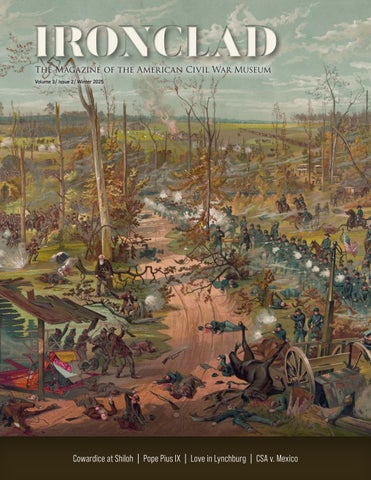
IRONCLAD The Magazine of the American Civil War Museum Volume 3/ Issue 2/ Winter 2025
Cowardice at Shiloh | Pope Pius IX | Love in Lynchburg | CSA v. Mexico
IRONCLAD Volume 3/ Issue 2/ Winter 2025
3
14
Cowardice at Shiloh
Papal Correspondence
17
24
Love in Lynchburg
Mexico v. CSA
1 From the CEO
12 Symposium Highlights
13 Profile: Lynchburg
COVER:“Battle of Shiloh - April 6th 1862”. This chromolithograph was published by Cosack & Co. from an original painting by Théophile Poilpot, c1885. Poilpot's painting measured 50x400 feet. IMAGE: LIBRARY OF CONGRESS
15 Your ACWM Legacy
@acwmuseum ACWM.org
Magazine
FROM THE CEO
Publisher Rob Havers, Ph.D. ACWM President & CEO
Managing Editor Robert Hancock
Art Director/Designer John Dixon
Editorial Review Kelly Hancock Jeniffer Maloney
Museum Board of Directors Daniel G. Stoddard, Chair Claude P. Foster, Vice Chair Rob Havers, Ph.D., President & CEO J. Gordon Beittenmiller, Treasurer Walter S. Robertson III, Secretary Hans Binnendijk, Ph.D. Trevor S. Cox Audrey P. Davis Sally Diggs Fletcher George C. Freeman III Stephen T. Gannon Bruce C. Gottwald, Sr. Andrew R. Hoehn Richard S. Johnson Donald E. King Calvert Saunders Moore John L. Nau III William R. Piper Roderick G. Stanley Ruth Streeter Allison Thomas Jeffrey L. Wilt
PHOTO: JOHN DIXON
Dear Friends Warm greetings from Richmond, Virginia, and welcome to the Winter edition of Ironclad magazine! In this issue we explore some of the finer, and far less well known, details of the Confederate States of America’s efforts to achieve international recognition as a bona fide nation in its own right. While most of us are familiar with the Confederacy’s labors to secure recognition from Great Britain, less well known were its endeavors on other fronts. Our piece looking at Confederate relations with Mexico is a fascinating discussion of how NOT to conduct diplomacy. In our From the Collection section, the private letters exchanged between the Pope and the Confederate President also provide some fascinating insights into both men’s preoccupations and possible commonalities. As you all know we have entered the Course of the War phase of our Remaking America undertaking. This was reflected in our symposium and Lesley Gordon’s article gets to the heart of combat and cowardice at the battle of Shiloh. In keeping with this we’re looking forward to our spring lecture series which examines the course of the war through the idea of “presidents and their generals". Also, in April, we will mark the 160th anniversary of Lee’s surrender at Appomattox with an impressive program of events at our Appomattox site in partnership with the National Park Service. As always, thank you for your support and I look forward to seeing you at one of our sites soon!
Dr. Rob Havers, President & CEO
Foundation Board of Directors Jeffrey L. Wilt, Chair Stephen T. Gannon Rob Havers, Ph.D. Richard S. Johnson Donald E. King Calvert Saunders Moore Walter S. Robertson III
Visitors at ACWM-Appomattox watch a cannon firing demonstration at the Commemoration of the Surrender event in 2024. IMAGE: JOHN DIXON/ ACWM
Ironclad magazine is published quarterly by The American Civil War Museum. 490 Tredegar St., Richmond, VA 23219 The contents of this magazine may not be reproduced in whole or in part without the consent of the American Civil War Museum.
T HE A MERICA N CIVIL WA R MUSEUM
1
2
I RONC L A D : W inter 2025
A Badge of Shame by Lesley J. Gordon
T HE A MERICA N CIVIL WA R MUSEUM
3
A Badge of Shame The 2nd Texas Infantry & Allegations of Cowardice at Shiloh by Lesley J. Gordon
The Lost Cause narrative romanticized Confederate soldiers as unwavering heroes; a myth perpetuated by the white South’s post-war propaganda that spread nationally. By the late 19th century, public memory of the Civil War celebrated all soldiers as courageous. The reality, however, was more complex. Like any war, there were instances of exceptional courage, but also times when men foundered. Most historians have been resistant to discuss moments when courage failed, reasoning that any instances of croakers or shirkers—contemporary terms for cowards— were rare and not representative of the common Civil War soldier experience. Soldiers themselves were acutely aware of the seriousness of such behavior; just the allegation of cowardice could be devastating to a man’s reputation. The Confederate Articles of War prohibited misbehavior before the enemy to include running away “shamefully” from one’s post and inducing others to do the same. Sentences for the guilty included death. One such episode of cowardice in combat is that of the 2nd Texas Infantry Regiment at Shiloh. Major General William Hardee accused the entire regiment of “disgracefully” breaking and running from the field of battle during the second day’s fight. These allegations of the Texans’ faltering in battle, forcefully denied by their officers, lingered and cast a shadow on the unit until the war’s end. The 2nd Texas Infantry was formed in 1861, drawing volunteers from Houston and Galveston and surrounding counties. Its ranks included an entire regiment of German immigrants and the son of one of the state’s illustrious founders, seventeen-year-old Sam Houston, Jr. The 2nd Texas’ colonel was a former professional U.S. army officer, Tennessean John C. Moore. Second in command was William P. Rogers, a native Georgian who had served with Jefferson Davis’s famed Mississippi Rifles in the Mexican American War. Several of the regiment’s captains had military experience, too, including
4
I RONC L A D : W inter 2025
fifty-four-year-old Clarke Owen, who had fought in the Texas Revolution. Until the spring of 1862, the 2nd Texas, like many western Confederate units, waited anxiously for battle. They participated in drill and parades and even a military ball. The men listened to stirring public rhetoric exhorting them to behave courageously in battle and affirm their white southern manhood, honor, and their devotion to the new Confederate nation. But the men wanted to see action. Finally, in mid-March, the regiment left Texas for the front. After an arduous journey by land and water, they arrived in Corinth, Mississippi, where Confederates were concentrating troops for a spring offensive. General Albert Sidney Johnston addressed his army on the eve of battle, rallying them to remember their families and the homes that they fought to defend. “You are expected,” Johnston told the troops, “to show yourselves worthy of your valor and lineage; worthy of the women of the South, whose noble devotion in this war has never been exceeded in any time.” They would, he declared, perform “brave deeds.” The resulting Battle of Shiloh was a bloody Confederate defeat. The 2nd Texas, like nearly all the regiments in the battle, was green and entirely untested by combat. The first day of violence and carnage had marked their baptism of fire. Even so, they performed continued on page 7
Maj. Gen. William Hardee
Hardee accused the 2nd Texas Regiment of disgracefully running away from the field of battle at Shiloh.
Brig. Gen. John C. Moore
Gen. Albert S. Johnston
Lt. Col. William Rogers
Moore was a colonel of the 2nd Texas at Shiloh, though he was leading a makeshift brigade, so not in direct command of his regiment.
(Previous page) “Battle of Shiloh - April 6th 1862”. This chromolithograph was published by Cosack & Co. from an original painting by Théophile Poilpot, c1885. Poilpot's painting measured 50x400 feet. (Left) “Shiloh or Pittsburg Landing, TN., Sunday, April 6th, and Monday, April 7th, 1862”. This engraved illustration was created by Henry Lovie and published by J.H. Brown Publishing Company, c1885. The original measures 36x48 inches. IMAGES: LIBRARY OF CONGRESS
T HE A MERICA N CIVIL WA R MUSEUM
5
6
I RONC L A D : W inter 2025
continued from page 5
well. But on the morning of April 7, ordered to reenter the fight, they faltered. Faced with confusing orders and enfilade fire, most of the regiment broke and fled the field. Initially, accounts of the unit’s performance indicated that the men had heeded General Johnston’s call for bravery and valor. Captain Ashbel Smith assured Sam Houston, that in his son’s company “all fought most gallantly as did all the Bayland Guards.” He singled out young Private Houston, whom he stated, “fought like a hero and with the coolness of a veteran.” Major Hal G. Runnels of the 2nd Texas addressed a letter to the editor of Houston’s Tri-Weekly Telegraph soon after the battle bemoaning the loss of “many brave and noble spirits.” Runnels used the adjective “brave” four times and “gallant” once to describe his fellow Texans. Lieutenant Colonel William P. Rogers similarly wrote his wife Martha: “The gallantry of our Reg. is spoken by all.” But that was not true. One of the first indications that the Texans had not performed well came from their colonel, John C. Moore. On the day in question, April 7, Moore led a makeshift brigade, no longer in direct command of his regiment. Nonetheless, he felt compelled to defend them, drafting three separate reports, each one more descriptive and defensive. Moore initially stressed their difficult journey to the front and their poor condition when they arrived. Still, he insisted, the regiment had done “noble work” on the first day of Shiloh. But by his second and third report, Moore acknowledged that his unit’s bravery was in question. He noted that on the morning of April 7, the Texans, along with two Alabama regiments, advanced under the orders from Major General William Hardee and his staff. Warned that Confederate troops were nearby, his men were urged to hold their fire. “We soon learned,” Moore explained, “that a truly sad mistake had been made respecting the force in front.” In fact, the soldiers before them were enemy troops, able to unleash “into the whole line a most murderous fire.” “So sudden was the shock and so unexpected was the character of our supposed friends,” Moore conceded, “that the whole line soon gave way from right to left in utter confusion.” Despite the panic, some officers regrouped and stayed in action. It was Hardee, Moore contended, who failed to recognize that advancing troops were the enemy, leaving the men vulnerable and unprepared for the assault. One detail, though, Moore neglected to divulge in any of his reports was that he was briefly arrested for his regiment’s poor performance. As Moore filed report after report, rumors and accusations of the regiment’s cowardice made their way to Texas, surfacing in the local newspapers. Lieutenant Colonel Rogers was shocked. “We were all astonished,” he wrote his wife, “to hear that we had been slandered by reports prejudicial to our gallantry, for we really thought we had fought well and our Generals thought so too for
We were all astonished to hear that we had been slandered by reports prejudicial to our gallantry – Lt. Col. William Rogers
continued on page 9
T HE A MERICA N CIVIL WA R MUSEUM
7
8
I RONC L A D : W inter 2025
continued from page 7
they have complimented us by authorising [sic] us to put Shiloh on our flag as a badge of conspicuous gallantry and as yet I am told no other Reg. engaged in that battle had a similar honor.” Rogers proclaimed that as far as he was concerned the 2nd Texas was “the Star Reg. of the army of the west.” The war raged on, and the 2nd Texas endured active campaigning into the fall of 1862. On October 4, Rogers, promoted to colonel, led a suicidal charge on the Union fortifications at Corinth. Rogers seemed to have redemption on his mind, urging his men to “Remember Shiloh.” Shot multiple times and left to die in a ditch after the Union victory, Rogers had a letter tucked in his pocket from one of his officers’ wives pleading for help to clear her husband’s name from the humiliating allegations. William Hardee certainly had not forgotten Shiloh, either. Despite the celebration of Rogers’ death as singularly heroic, Hardee wanted to be sure the failings of this regiment were not overlooked. In correspondence with the Confederate War Department in October 1862, just a few weeks after Corinth, he recounted witnessing the regiment at dress parade earlier that summer and spotting “Shiloh,” in Hardee’s words, “conspicuously emblazoned on the colors of the Second Texas Regiment.” Hardee was aghast. He attested that he had witnessed the entire regiment flee in panic, even after one of his staff threatened to call them a “pack of cowards.” In February 1863, when Hardee finally filed his official report of Shiloh, he made a point of repeating his censure of the 2nd Texas. In contrast to the “steady valor” exhibited by most Confederate troops on the first day of battle, he asserted that it would be “unjust to my brave and enduring soldiers, who stood by their colors to the end if I did not mention that many straggled from their ranks or fell back without orders.” The 2nd Texas in particular, Hardee alleged, “seemed appalled, fled from the field without apparent cause, and were so dismayed that my efforts to rally them were unavailing.” Hardee used the term “coward” as a character assessment, and a damning one at that, meant to shame and humiliate, but also to affirm the bravery of other Confederates. Moore, whose promotion lagged in Richmond due to these damning charges, remained on the defensive. In a letter to Adjutant General Samuel Cooper in December 1862, Moore cut to the heart of the issue: “That the Regt was repulsed and fell back in great confusion is set forth in my report, but this was not confined to the Regt, but extended the whole line; and why the Genl singled out this Regt. and pronounced its members ‘cowards,’ he can best explain.” Indeed, the existing historical record fails to fully explain why Hardee was so fixated on these allegations against the 2nd Texas and for so long. No formal charges were ever filed against the regiment or any
That the Regt was repulsed and fell back in great confusion is set forth in my report – Col. John Moore
continued on page 11
T HE A MERICA N CIVIL WA R MUSEUM
9
in the end
Lt. Col. William Rogers of the 2nd Texas Infantry (who had fought with Jefferson Davis in the Mississippi Rifles during the Mexican-American War) defended the valor and actions of the 2nd Texas at Shiloh. Six months later, he was killed at Corinth, MS, during an assault on a Union battery. The photo above shows Roger's body on the far left. PHOTO: LIBRARY OF CONGRESS
10
I RONC L A D : W inter 2025
continued from page 9
individual member. Moore finally exposed flanks, fatigue, and paralyzing received his promotion, and the 2nd fear. Nonetheless, they still conclude Texas continued its service, filling its that “no unit panicked to a man” and dwindling ranks with an increasing that in the end, “seeing the elephant” number of conscripts. During the siege was not “such a wrenching experience of Vicksburg, the 2nd Texas fought that they would be forever transformed well at the famed lunette, earning praise by its horrors.” and commendations. Colonel Ashbel Ultimately dismissing, ignoring Smith was intent that his report of or qualifying allegations such as those Vicksburg reach Richmond so that “my made against the 2nd Texas create a regiment may have its proper status and one-dimensional, misleading image repute in the War Department.” The of the Confederate war experience. shame of Shiloh had lingered over their For these soldiers, faltering in battle reputation and Smith was still fighting was not simply an issue of character, to redeem it. leadership, or circumstances, but was After the fall of Vicksburg due to a combination of several factors, most of the regiment, war-weary and many of them out of their control. They demoralized, went home without were exhausted and already battleDr. Gordon based this authorization rather than wait out their weary that second day. They were also article on research that is parole in camp. Eventually exchanged inexperienced and confused by sudden included in her new book and reassigned, the reconstituted 2nd changes in command. Even though the Dread Danger: Cowardice Texas would never again leave the state. unit earned accolades at Corinth and and Comfort in the American While stationed at Galveston Vicksburg, their reputation suffered. Civil War. Island, home to many members, William Rogers, it would seem, died Cambridge University Press, 2025. the regiment faced entirely new with these allegations weighing heavy adversaries far from the field of battle. on his conscience. In September 1864, a Yellow Fever This story of fear, failure, and epidemic plagued the coastal city and swept the ranks dishonor challenges abstracted and generalized tales of of the already depleted regiment, weakening and killing Civil War heroism and bravery. Such an example helps many who had survived the sufferings of combat and to disassemble yet another aspect of the mythic Lost imprisonment. Conditions worsened and by the spring, Cause and America’s romanticized martial past, and a desperate mix of soldiers and civilians fermented into thereby, allows us to better understand the complex, a mob, demanding the Confederate government feed often troubling but no less fascinating lived experiences them. The 2nd Texas was ordered to quell the uprising, of Civil War soldiers. firing shots into the angry crowd. This desperate situation contrasted sharply from their initial expectations of Lesley Gordon, Professor glorious combat and battle honors. By May 1865, of History, is the Charles G. Confederates evacuated Galveston, and some members of Summersell Chair of Southern the regiment looted the town as they left. History at the University of In the years since, these details of their service, Alabama. including the allegations of cowardice, largely disappeared from the public record. Instead, Rogers’ death at Corinth became a staple of Lost Cause mythology, he and his men celebrated as martyrs to “Anglo-Saxon courage.” In 1964, the state of Texas erected a monument on the battlefield at Shiloh, stating that “the 2nd Texas fought with gallantry.” Historians have generally been silent, too, in addressing these charges. Joseph Allen Frank and George Reeves in their study, Seeing the Elephant: Raw Recruits at The Battle Of Shiloh, is one of the few that acknowledges the 2nd Texas along with other units that shirked in battle. The authors explain cowardice in combat caused by inexperience, ineffective weaponry,
T HE A MERICA N CIVIL WA R MUSEUM
11
The American Civil War Museum
SYMPOSIUM HIGHLIGHTS
In partnership with 12
I RONC L A D : W inter 2025
LYNCHBURG
profile
In the 1850s, Lynchburg was quickly becoming a major conduit between the farmlands to the west and south and the markets to the east. The Virginia and Tennessee Railroad, incorporated in Lynchburg, ran southwest to Chattanooga. The Southside Railroad and, eventually, the Orange and Alexandria linked Lynchburg to Petersburg, Richmond, and northern Virginia. The James River and Kanawha Canal were also a direct link to the capital. Tobacco gave Lynchburg its financial base, and the numerous warehouses were filled to the rafters with the “golden leaf,” and the nearby factories refined it for smoking and chewing. It wasn’t just tobacco and farm produce supporting Lynchburg’s
economy. There was a burgeoning iron works industry taking advantage of the rich iron ore deposits nearby, and there were several grist mills. Add to that all the supporting craftspeople such as coopers, carpenters, wrights, smiths, etc., and the businesses to support the day to day existence of everyone who worked and lived in Lynchburg, and you have a thriving community enjoying an economic boom. With great financial success, tourism and social prosperity also flourished. Read on page 16 how one fateful trip to Lynchburg by a young New Jersey woman in the summer of 1853 changed the course of her life.
Illustration of a tobacco plant with flower blooms. IMAGE:LIBRARY OF VIRGINIA
From “Mrs. Royall’s Southern Tour” by Mrs. Anne Royall, author of “Sketches of History, Life, and Manners, in the United States, by a Traveller,”
The Banks of the river are lined with towering trees– enormous sycamores with their outstretched branches. To this freight boats, and skimming wild duck, farms and pleasure grounds, falling gardens terraced, rolling carts, rattling stages, thundering wagons and a busy multitude, the long warehouses, gay shops, and elegant buildings present a life-stirring scene. Current-day Lynchburg. PHOTO: LYNCHBURG TOURISM
T HE A MERICA N CIVIL WA R MUSEUM
13
From the Collection
Papal Correspondence Confederate President Jefferson Davis and Pope Pius IX
IN
October 1862, Pope Pius IX wrote a letter to the archbishops of New York and New Orleans urging them to use their influence to help mediate an end to the war. The letters were made public the summer of 1863. Jefferson Davis read them, and wrote directly to the Pope in September. The letter Davis wrote was brief and polite, a diplomatic missive relating Davis’s agreement with the Pope’s own sentiments in the letter he had written to his American archbishops. He wrote that the Confederate people “desire none of our enemy’s possessions, but that we fight merely to resist the devastation of our country and the shedding of our best blood, and to force them to let us live in peace under the protection of our own institutions and under our laws, which not only ensure to every one the enjoyment of his temporal rights, but also the free exercise of his religion.” The Pope sent the letter in Latin with an English translation. Ultimately, the Pope did not recognize the Confederacy in any official manner. After the war, when Davis was in jail, the Pope did send Davis a large inscribed photograph of himself, further cementing at least the idea that the Pope did indeed have some kind of personal sympathy for Davis. ecause the Pope himself was in a similar position, his sympathy for Davis was B understandable. He became pope in 1846 as a liberal, but in the face of the revolutions that swept Europe in the years immediately afterwards, he became a staunch conservative. The revolutionary fervor of the times would eventually cause him to lose all of his land and political power. In the late 1850s into the 1860s the country we now know as Italy was being created, with politicians in the northern part of the peninsula combining with partisans in the southern part, led by the famous revolutionary, Giuseppe Garibaldi, to create a unified country. e pope was being squeezed out of power. The Papal States, a nation in the center Th of the Italian peninsula that included Rome, was under threat of assimilation into the new country, something that Pius IX vigorously opposed. Thus it could be said that Pius IX was a “states’ rights” man like Jefferson Davis. A letter from Pope Pius IX to Jefferson Davis in 1863. ACWM also has the accompanying English translation in the Collection. IMAGE: ACWM COLLECTION 14
I RONC L A D : W inter 2025
Legacy Society
What Will Your Legacy Be? JOIN THE
American Civil War Museum Legacy Society and preserve history for generations to come. To find out more about our planned giving program, please contact Cara Sisson. csission@acwm.org 804.649.1861 ext. 145
T HE A MERICA N CIVIL WA R MUSEUM
15
The Slaughters of Lynchburg
16
I RONC L A D : W inter 2025
When North Met South PART I
By Robert Hancock
In the summer of 1853, Mary Haines Harker was eighteen, away from home, and very much in love.
The James River and industrial business along the waterfront of Lynchburg, c1850. DAGUERREOTYPE PHOTOGRAPH. IMAGE COURTESY OF THE VALENTINE MUSEUM, RICHMOND, VA
T HE A MERICA N CIVIL WA R MUSEUM
17
Mary was the eldest of five children of an indulgent father, Charles, and Edith, a rather strict Quaker mother with whom she attended Sunday meetings not far from their Mount Holly, New Jersey, home. “May 15th [1853], Sunday,” wrote Mary in her diary. “Quaker meeting! The Spirit moved no one. How Lucky! I could think of my visit to Virginia.” After graduating from St. Mary’s Hall, an Episcopal girl’s school in Burlington, Mary and two of her friends, Fannie Engle and Annie Milnor, traveled south to spend part of the summer at the home of another schoolmate, Mary Boyd, who lived in Lynchburg, Virginia. The months after graduation were, according to Mary Harker, the fullest experience of her existence, and she kept a diary to remember it.
18
I RONC L A D : W inter 2025
Mary took the train from her home in Mount Holly to Burlington, New Jersey, where she joined her friends and former classmates, Fannie, Annie, and Mary Boyd. Annie’s brother, Jim, accompanied them as “baggage-master” down the Delaware River as far as Philadelphia. “Only ten trunks and two carpet-bags for Mr. Boyd to take care of from there on!” wrote Mary. From Philly they took a train to Baltimore, then to Washington, D.C., and on to Richmond, passing by Mount Vernon, where Mary notes in her diary her first glimpse of slave quarters. A packet boat up the James River took them to their final destination. Five days after leaving her home in New Jersey, Mary Harker reached Lynchburg, Virginia. She never dreamed that any place could
be so beautiful. To her, it was a wild and exotic place. She copied a passage from Mrs. Anne Royall’s “Black Book,” a contemporary travel log. The land on which Lynchburg stands ascends from the water’s edge, at first gradually, then more abruptly, and finally terminates on an elevated table-land. From the summit there is a view unequaled either for grandeur or beauty. A smooth broad river rolls at your feet, again the opposite shore presents an abrupt high cliff with huge rocks of terrific wildness, terminating in smooth conic hills, beyond which are seen farm houses. The wildest hills and ledges of rocks run up to the river’s edge, and beyond all, the Blue Ridge Mountains!
Mary Boyd was surprised at all the changes that had taken place in her hometown during her time away at school: “Railroads, canal, fire-engine, gas lights! What will happen next?” It did not take long before half the town, including, of course, the eligible bachelors, descended upon the Boyd household to call upon the young ladies from up north. “Eighteen callers!” wrote Mary, “and all so agreeable! How cordial the Southerners are!” John (known as Jack) Slaughter came calling accompanied by Robert Brodnax, who was courting Jack’s sister at the time. That small detail, however, did not stop him from flirting with Mary at any opportunity. Soon, the invitations starting rolling in. They attended dances (a new
experience for this young Quaker girl), went horseback riding, boating, and stayed up into the wee hours. “We danced until after three. Day was breaking when we went to bed. What would Ma say?!” What indeed! Mary certainly did not lack for suitors. There was Clarke Leftwich, the son of a prosperous tobacco merchant with more than forty enslaved people working in his factories, from whom she received a red silk fan. Woodie Latham gave her a daguerreotype of himself. There was Ben Blackford, a young physician, and, of course, Robert Brodnax, despite the fact that he was already spoken for. And we cannot forget Jack Slaughter or even Jack’s cousin and captain of the local
militia, Samuel Garland, who Mary found “very dashing.” A couple of days later, Clarke Leftwich’s father had a little evening soiree for the girls. Mary saw quite a bit of Ben Blackford after she had him escort her to evening services. Evidently, he had enjoyed their stroll to church. However, it was Robert Brodnax who rode home in the carriage with her. Mary wrote in her diary: “From Col. Leftwich I received an exquisite bouquet, which I did not give to Mr. Jack Slaughter! Will that teach him anything? Got home about three.” Mary bought a riding habit with a silk hat and veil with the allowance money given to her by her father. continued on page 22
The house of Samuel Garland, Sr was built c1845. In 1850, Jack Slaughter was living with his uncle, Samuel Garland on Garland Hill in Lynchburg. Garland, Slaughter, & Co. was a law firm that also dealt in life and fire insurance. IMAGE: LIBRARY OF CONGRESS
(Left) The James River and covered bridge in Lynchburg, VA from Harper’s Weekly, June 2, 1866. Illustration: Theodore R. Davis IMAGE COURTESY OF HISTORIC SANDUSKY T HE A MERICA N CIVIL WA R MUSEUM
19
Half-plate ambrotype photographs of Mary H. and John F. Slaughter of Lynchburg, Virginia, taken shortly after their marriage. IMAGES: ACWM COLLECTION
20
I RONC L A D : W inter 2025
T HE A MERICA N CIVIL WA R MUSEUM
21
continued from page 19
She enjoyed riding, even having Lanty Blackford, Ben Blackford’s younger cousin, teach her how to jump fences. Her friend Fannie often went riding with Kirkwood Otey, a local tobacconist who followed Fannie everywhere. “Another northern girl had learned to handle a thoroughbred horse,” she wrote in her diary. However, despite Mary’s confidence in her own riding abilities, her horse bolted while she was out riding with Jack Slaughter, and she lost complete control of the beast. She wrote that: “Jack saved my life on the edge of the precipice. He caught the bridle and reared the horse right back. He is wonderful!” She began to see more and more of Mr. Jack Slaughter. June 24th. Friday—Mr. Slaughter came to take me to drive. He spent the evening. Went out on the back porch and walked at the side of the house. Can I ever forget? Came to bed, then such a scolding from Mary [Boyd]. How could I have acted so foolishly? Again I must suffer from acting from impulse. [Mary] is a lovely, quiet girl, more ‘Quaker’ than I.
the object of my adoration was absent for a short time. I say again beware. Mary’s friend, Fannie, had her own share of suitors (with Kirkwood Otey, the tobacconist, leading the pack) as did Annie. The boys of Lynchburg hovered around the New Jersey girls like bees around a honey pot. The queen bee had to be Mary Harker, the Quaker girl who excelled in her new-found freedom. The young men found her provocative schoolgirl naiveté charming, and they showered her with attention and gifts.
Jack saved my life on the edge of the precipice.
However, one stood out from the pack, especially after the incident of the runaway horse. Jack Slaughter was her favored suitor. “What will Ma say?” Mary confided in her diary.
Pa will like J.S. They both have blue eyes. Pa is very handsome. Jack, they say, is homely. He wears that awful beard to make him look older. But he Mary Harker has a beautiful forehead and nose, and such a lovely expression in his eyes… I am beginning to long to know the future…After supper [I] went out into the library with Mr. Slaughter. After many interruptions we went out and walked. Oh! A local girl teased Mary for having so many beaux, which never was moonlight so sweet as this! What moments of she dismissed out of hand. However, she was obviously exquisite happiness. having some trouble navigating the minefield of 19th century courtship. Mary’s inexperience with the opposite sex Mary and Annie had a long talk. “We are both very much must have been revealed in a letter to her father, who was in love.” her closest confident at home; her sister being too young and her mother too much a Quaker. Mary’s father offered The next day, Mary received a letter from “Dr. K” who had some helpful advice. briefly courted her while she was still in school in New Jersey. She wrote in her diary: I fear that you are too easily led by dreams, and are building airy castles of nothingness, and I warn you How little it matters to me now that he asked my parfrom indulging in such. It’s highly probable that the atents if they thought him a suitable husband for their tentions you are receiving are those of mere politeness seventeen-year-old daughter. Probably they let me such as any young gentleman would pay to a young come to Virginia so that I might meet other men and be lady sojourning away from her friends, merely endeavbetter able to decide. How coolly I received the letter. oring to make your time pass agreeably, the memory of It helped me to realize the truth of my feelings toward which will soon pass away as an agreeable dream. John Flavel Slaughter. oung gentlemen love to flirt and say agreeable things Y without any intention [of] loving or being loved and I dare say the young gentleman who has been so agreeable is acting accordingly, and it would be the height of folly in you to form an attachment on your part, which can never be reciprocated. I have done such things myself in my young days very often without ever dreaming of matrimony–sometimes have been desperately in love, as I thought, but it vanished when
22
I RONC L A D : W inter 2025
“July 8th. A Friday. I am a little sad. Spent the morning packing.” The girls boarded a boat to Richmond, then from there on to New Jersey. Their visit south was over all too quickly. Jack and Mary exchanged photographs and he bought her a pair of gloves. Many of the young men were there to bid the ladies adieu. “How cruel to part,” wrote Mary.
The prettiest girl in New Jersey is marrying the ugliest man in Virginia. Friend of Jack Slaughter
When she arrived home, Mary showed her parents the daguerreotype Jack had given her. “Hope dieth never. Ma– quite sad. A death stroke for me to love a Southerner!...Pa and I talked all evening.” Mary found Mount Holly quite tame after her adventures in Virginia. The relative calm of home gave her time to reflect. “How many changes since the 21st of July, 1852,” she wrote. Only twelve months have passed, yet it is the fullest period of my existence. I seem to have lived a lifetime…[M] eeting with Dr. Curtis K., whom all my family liked so well, and learning that he cared especially for me. How vividly everything stands before me! The first coloring of youth, the rosey dawn of life is upon it all. A few weeks’ infatuation with being admired—Dr. C.K. is a fine physician and agood man but too old. He is twenty-eight and very staid.” She went on to write: “My first draught of the siren cup of pleasure, my first glimpse of the world!...Much fun and frolic…Then my trip southward and enchantment in beautiful Virginia. Joy! Joy! I am happier than ever. Oh, this year of golden days, how long will the light continue? Forever? Happiness is mine and I am thine, thine, thine, J.F.S. On August 11, Jack arrived in Mount Holly to seek Mary’s parent’s approval to marry their daughter. He was suitably attired in new suit of Quaker gray, no doubt to win over his future mother-in-law. Mary’s mother still pinned her hopes on the mysterious “Dr. K,” but that ship had sailed. Mary’s father was more sympathetic after spending a day talking with Jack while Mary waited nervously in another room. The date of the wedding was fixed for December 15, 1853. Youthful sentiment and romantic love trumped parental judgement.
“The prettiest girl in New Jersey is marrying the ugliest man in Virginia.” Or so Jack’s friends supposedly teased him when he wed Mary at the Episcopal church in Mount Holly. They honeymooned in upstate New York before returning to Virginia and settling down in Lynchburg. Despite her love for Jack, Mary probably felt as much a foreigner in Virginia as Jack had when visiting her parents in New Jersey. Mary had to exercise all her tact and ingenuity in winning over three generations of Slaughters. She had grown up in a home that was soft-spoken, austere, and dignified. Her new home would be a different experience altogether. Jack’s sisters were resentful that the social nucleus of the Slaughter clan was shifting to the household of a Northern girl quite inexperienced in the artistries of a Southern hostess. Be that as it may, Mary and Jack Slaughter would be facing much sterner challenges in a few years’ time. If war came, as it seemed it might, Mary’s father and brother would be on one side, her husband and home on the other. But that is a story for next time.
Robert Hancock is the museum’s Director of Collections and Senior Curator.
T HE A MERICA N CIVIL WA R MUSEUM
23
Mexico's Cold Shoulder to the Confederacy No
foreign country recognized the Confederacy. The full story of Confederate attempts to win foreign support is ultimately written in defeat, disappointment, and failure. A handful of foreign leaders came tantalizingly close to recognizing the Confederacy as an independent country, but in the end none did. Duke Ernst II of the German state of Saxe-Coburg-Gotha requested diplomatic credentials from the Confederate government. Upon receiving them, the duke appointed a consul, Ernst Raven, to the Confederacy and assigned him to Galveston, Texas. This, however, did not constitute recognition. The Confederate leaders in Richmond knew that foreign support was crucial, just as it had been in what some Confederates called the First American Revolution of 1775-1783, and thus tried to win support from various foreign powers. Great Britain, the erstwhile enemy, received the most attention, but other countries were also courted for alliance. After the U.S. victory in the Mexican War (1846-1848), which resulted in a large land cession from Mexico to the United States, Senator Jefferson Davis (later Confederate President Davis), along with other Democratic senators, tried hard to obtain more land from the defeated country, specifically the northern Mexican states. The attempt was defeated, but it represented the desires of Davis and other Southern politicians to acquire more land south of the U.S. border.
24
I RONC L A D : W inter 2025
During the Civil War, President Davis sent commissioners to Benito Juarez’s central government in Mexico City and also to several of the very same northern border states of Mexico that he had wanted to annex in the wake of the Mexican War. The Juarez government was a liberal one that would not seem to be naturally disposed towards the Confederacy, and John Pickett, the commissioner Davis sent did not help the situation at all. Although Pickett knew Mexico fairly well and was personally acquainted with Juarez and his inner circle, he was, like a number of others in Confederate diplomatic service, remarkably unsuited for an ambassadorial role. During his stay in Mexico City, he repeatedly made crude remarks about the very people he was trying to win over to his side. Amazingly, in response to the rumor that some Mexican military officers might serve in the U.S. Army, Pickett expressed the hope that the entire Union Army be led by Mexicans, with the obvious implication that they were much inferior to the white officers serving with the U.S. He, furthermore, said that “they ought to be very careful not to be taken prisoners by the South, as they would in that event probably soon find themselves for the first time in their lives, usefully employed in agricultural pursuits— i.e. hoeing corn and picking cotton.” For a Confederate diplomat to strongly suggest that the people of his host country were racially inferior not only to his own countrymen but that of his enemy and that they would be suitable only as slaves, was, to say the least, undiplomatic. He also urged the Confederate seizure of Mexican territory and cozied up to the conservative political enemies of the Juarez government, perhaps hoping that Juarez would be overthrown soon (not an altogether unreasonable hope given the volatility of Mexican politics of this time) and that he could work with a new government. Picket was eventually thrown in jail in Mexico. He got out after a month by bribing various officials and left Mexico in disgrace in late 1861. When Jefferson Davis finally got the full story of Pickett’s stay in the capital city, he and the rest of the Confederate government were utterly disgusted.
Duke Ernst II (c1857) of the German state of SaxeCoburg-Gotha requested and received diplomatic credentials from the Confederacy, but it was not a recognition of the CSA as an independent country. IMAGE: ROYAL COLLECTION TRUST
Benito Juarez (c1860) was Mexico's embattled president from 1858 to 1872. After leading the Liberal Party to victory in the country's Reform War, he later drove out France in the Second Franco-Mexican War. IMAGE: WIKIMEDIA. CREATIVE COMMONS
Meanwhile, Santiago Vidaurri, the powerful governor of several of the northern border states (the ones that Davis continued on next page
T HE A MERICA N CIVIL WA R MUSEUM
25
The Plaza de Armas in Mexico City showing Sagrario Cathedral and the National Palace. ILLUSTRATION, C1880. IMAGE: LIBRARY OF CONGRESS
continued from previous page
had wanted to annex after the Mexican War), became friendly with the Confederacy and with its agent in that region, a Cuban-born Confederate diplomat named Juan Quintero who had lived in Mexico previously. The relationship led to the Confederacy and the northern Mexican states establishing a thriving commercial relationship in which the usual duties on goods sold across the border were greatly reduced or eliminated. Historians have compared the frenzy of trade to the 1849 Gold Rush in California, with cotton being the desired object instead of gold. By 1862, however, it was clear that Napoleon III, Emperor of France, had his eyes on Mexico. France, Britain, and Spain had joined together in an effort to recover some debt that the Mexican government owed to those three European powers. When it became clear that Napoleon was interested in more than just obtaining the payments, the other two countries backed off. Thus France commenced military action against the Mexican forces alone. In June 1863, French troops marched into Mexico City. Archduke Maximilian of Austria was subsequently enthroned as Emperor of Mexico under the sponsorship of Napoleon III. This obviously changed the political situation vis-à-vis the Confederacy: Davis and the Confederate government felt that the French regime in Mexico would benefit from a positive association with an independent Confederate States of America, and that the Confederacy, of course, would benefit from being recognized as a country and supported by France and its puppet regime in Mexico. The Confederate government, through its agent in Paris, John Slidell, offered just such an exchange many times, both directly and indirectly, even to Napoleon himself. However, Napoleon was too worried about the reaction
26
I RONC L A D : W inter 2025
Santiago Vidaurri (c1867) was a powerful governor of several northern Mexican states. He developed a friendly relationship with the Confederacy. IMAGE: SMU LIBRARY
Napoleon III, Emperor of France (1852-1870), used the French military to invade and defeat Mexico in 1862 to establish a monarchy in the Americas. Though trade was established with the Confederacy, Napoleon never recognized the CSA as an independent nation. IMAGE: ACWM COLLECTIONS
Matamoras was the center of a profitable cross-border trade that developed between Mexico and the Confederacy. IMAGE: LIBRARY OF CONGRESS
from the United States to make any deal with the Confederacy. He was certainly unwilling to do anything of that nature without being in alliance with Great Britain. Without British support he could draw the wrath of that country as well as that of the United States, which would be fatal to his efforts. It seemed obvious to many, including Jefferson Davis, that an established Confederate government friendly to the new French-supported government in Mexico was vital to Napoleon’s schemes. Maximilian agreed and conveyed the message to the Confederate government that he would like to have this recognition before he took the throne officially, and that he considered the success of his new Mexican Empire inextricably bound up with the success of the Confederacy. He tried to make reciprocal recognition a condition of his taking the throne, but the wily Napoleon maneuvered around him, and Maximilian went to Mexico without it.
Archduke Maximilian of Austria (pictured with his wife) was installed as Emperor of Mexico by Napoleon III in 1863. However, he was executed in 1867 after the French were defeated in the Second Franco-Mexican War. IMAGE: ACWM COLLECTION
Ultimately, nothing came of these considerations: neither Maximilian’s government nor the Juarez government before it, to say nothing of the French government, recognized the Confederacy as a sovereign nation. After the war—and after Maximilian had been deposed and executed by the re-established Juarez government—Davis was traveling in France when he got word that Napoleon III would receive him. Davis declined the invitation. by Dean Knight Originally published in the ACWM magazine in 2012
T HE A MERICA N CIVIL WA R MUSEUM
27
The Mexican-American War When Texas was in the process of being admitted into the United States as the 28th state in 1845, the border with Mexico was in dispute. U.S. President Polk sent a delegation to Mexico to negotiate the purchase of the disputed territory including California. Mexico declined the offer and the envoy mission failed. In April 1846, Polk sent a small contingent of the U.S. Army into the disputed territory. Mexico responded with force which led the U.S. Congress to
28
I RONC L A D : W inter 2025
declare war. The conflict ended in February of 1848 with the Treaty of Guadalupe Hidalgo. The treaty outlined the cession of territory in present-day Texas, California, Nevada, and Utah, plus parts of present-day Arizona, Colorado, New Mexico, and Wyoming to the U.S. The U.S. also paid $15 million to Mexico and assumed Mexican debt owed to U.S. citizens. The treaty also designated the Rio Grande river as Mexico's northern border with Texas.
Jefferson Davis, 1854
This photograph of Jefferson Davis was taken in 1854. He served as the U.S. Secretary of War under President Franklin Pierce from 1853-1857. Davis supported the development of a transcontinental railroad to the Pacific ocean and oversaw the Pacific Railroad Surveys to determine which route was best, though he favored a southern route through present-day New Mexico and Arizona. The map shown on this page, created by the Army Topographic Corps, was ordered by Davis when he served as Secretary of War. It shows the defined border with Mexico and the newly acquired
territories as a result of the Mexican-American War. The map accompanied surveyor reports to Congress to determine a route for the new transcontinental railroad. On the opposite page is a map of Mexico published by J. Disturnell in 1847 (showing Mexico territory extending to present-day Oregon). Disturnell's map was used during peace negotiations to determine the border between Mexico and the Unites States. MAP IMAGES: LIBRARY OF CONGRESS
IMAGE: ACWM COLLECTION
T HE A MERICA N CIVIL WA R MUSEUM
29
NON-PROFIT ORG. U.S. POSTAGE PAID RICHMOND, VA PERMIT NO. 2399
490 Tredegar St., Richmond, VA 23219
SPRING LECTURE SERIES
The Civil War & Remaking America March 24 6:00 pm
Nature’s Civil War
free to members
Civil War soldiers endured punishing environmental conditions, which increased disease and harmed morale. They forged informal networks of health care and adopted self-care habits as they fought to regain their health.
@ acwm-tredegar
with KT Shively, Associate Professor of Civil War History at VCU
April 24 6:00 pm
Jefferson Davis & Robert E. Lee
free to members
Davis and Lee were two proud, contained, but otherwise very different personalities. In normal times it is unlikely they would have been friends. Yet somehow from 1862 through the end of the war they evolved a working relationship.
@ acwm-tredegar
with William Davis, retired Professor of History at Virginia Tech
May 22 6:00 pm
Abraham Lincoln & George McClellan
free to members
McClellan is known as a foil to Lincoln – able to organize an army but not fight. Lincoln removed him from command. In his own day, however, McClellan had many friends and political supporters and no shortage of critics. Rable will delve into the politics of the clash between the two men and its impact on the course of the war.
@ acwm-tredegar
with George Rable, Professor Emeritus at the University of Alabama
Members are invited to a reception prior to each lecture.