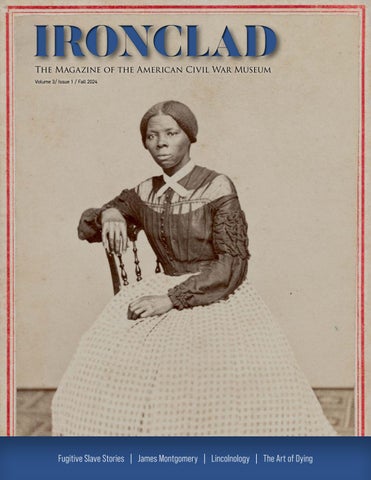
IRONCLAD The Magazine of the American Civil War Museum Volume 3/ Issue 1 / Fall 2024
Fugitive Slave Stories | James Montgomery | Lincolnology | The Art of Dying
IRONCLAD Volume 3/ Issue 1/ Fall 2024
3
14
Fugitive Slave Stories
A Good Death
on, s g n i y d r You J. R. ry Montgom e
1 From the CEO
20
24
Lincolnology
The Art of Dying
2 2025 Symposium
18 Lincoln Prize
31 New Acquisitions
COVER: The earliest known photograph of Harriet Tubman taken in Auburn, NY, circa 1868. Born into slavery in 1822 in Maryland, Tubman escaped to Pennsylvania in 1849.
@acwmuseum
PHOTO: LIBRARY OF CONGRESS
ACWM.org
32 Featured Books
Magazine
FROM THE CEO
Publisher Rob Havers, Ph.D. ACWM President & CEO
Managing Editor Robert Hancock
Art Director/Designer John Dixon
Editorial Review Kelly Hancock Jeniffer Maloney
Museum Board of Directors Daniel G. Stoddard, Chair Claude P. Foster, Vice Chair Rob Havers, Ph.D., President & CEO J. Gordon Beittenmiller, Treasurer Walter S. Robertson III, Secretary Hans Binnendijk, Ph.D. Trevor S. Cox Audrey P. Davis Sally Diggs Fletcher George C. Freeman III Stephen T. Gannon Bruce C. Gottwald, Sr. Andrew R. Hoehn Richard S. Johnson Donald E. King Calvert Saunders Moore John L. Nau III William R. Piper Roderick G. Stanley Ruth Streeter Allison Thomas Jeffrey L. Wilt
PHOTO: JOHN DIXON
Dear Friends Greetings from Richmond, Virginia! As we settle into the fall period, we are looking forward to our new Holiday season events and reflecting on a host of great programs and activities. In Mid-October, at Tredegar, we hosted the recipients of the 2024 Gilder Lehrman Lincoln Prize, Dr. Frances Clarke and Dr. Rebecca Plant for the second ACWM Lincoln Prize Lecture in partnership with the Gilder Lehrman Institute of American History. This year’s prize winning book, Of Age: Boy Soldiers and Military Power in the Civil War Era, is a fascinating exposition of the stories of child soldiers in the War, on both sides, and a much fuller portrayal of what went on, taking the discussion far beyond the traditional ideas of Johnny Clem. We’re delighted to feature, too, in this edition, an interview with Jonathan White, last year’s Gilder Lehrman Lincoln Prize laureate. The autumn season also brought the annual Fall Festival to ACWM-Appomattox. We welcomed hundreds of visitors from across the state, and were delighted to have our community partner history organizations join us, also! It was a beautiful day and a very well attended event highlighted with two cannon firings and a tutorial into what, exactly, it takes to discharge a weapon of that size. Special thanks to Patrick Schroeder, historian for the Appomattox Court House National Historical Park, and award-winning poet, Lisa Samia, for their presentations, too. This edition of Ironclad, as always, features great new scholarship on the Civil War era. Professor Richard Blackett discusses fugitive slaves and the underground railroad. This piece builds nicely on a topic he examined last February when he spoke at our 2024 symposium. Additionally, we also dive into the collection with a look at the background to one of the Museum’s most iconic artifacts, a letter written by James Montgomery from the field hospital where he lay mortally wounded. The letter, stained with his own blood, is tremendously significant and as moving today as when it was first written. Rare indeed are such pieces from the past and an outstanding example of the scope of the museum’s collection. Finally, on a sad note, we mark the passing of one of our loyal Board members, the Honorable David Gompert who died in August. David was a passionate and engaged Board member and a regular contributor to Ironclad magazine. We will miss him, and we extend our sympathies to his wife Cyndi and family. As always, thank you for your support and please enjoy this latest Ironclad.
Foundation Board of Directors Jeffrey L. Wilt, Chair Stephen T. Gannon Rob Havers, Ph.D. Richard S. Johnson Donald E. King Calvert Saunders Moore Walter S. Robertson III
Ironclad magazine is published quarterly by The American Civil War Museum. 490 Tredegar St., Richmond, VA 23219 The contents of this magazine may not be reproduced in whole or in part without the consent of the American Civil War Museum.
Dr. Rob Havers, President & CEO
In Remembrance
1945-2024
David Gompert was a devoted ACWM Board of Directors member who leaves a remarkable legacy of service to his country and in the private sector. He served under six United States Presidents through numerous foreign policy arena appointments. David was a graduate of the United States Naval Academy and Princeton University and was published extensively on national, international, and cyber security topics. David’s enthusiasm for Civil War history and his steadfast commitment to scholarship through his research and writing were invaluable. ACWM remains grateful for his dedication to our mission, and he will be sorely missed. T HE A MERICA N CIVIL WA R MUSEUM
1
The American Civil War Museum
Symposium
We are pleased to announce our annual ACWM Symposium to be held in Richmond at our Tredegar site on
February 21st & 22nd, 2025. The 2025 event will be our 20th annual symposium, and the launch of year two of ‘The Civil War & Remaking America’ - the course of the Civil War. In partnership with Friday 2/21 SPECIAL PROGRAM:‘TOOLS OF BATTLE’ A presentation by Director of Collections, Robert Hancock on the most significant objects from the battlefields in the ACWM artifact collection
Saturday 2/22 20th annual ACWM Symposium ‘On the Battlefield’ featuring lectures from: Dr. Andrew S. Bledsoe
Dr. Anthony J. Cade, II
Dr. Shauna Devine
Dr. Wayne Hsieh
Reception with the speakers and book signing
REGISTER TODAY ACWM.ORG
2
I RONC L A D : Fall 202 4
FUGITIVE SLAVE STORIES BY RICHARD BLACKETT
T HE A MERICA N CIVIL WA R MUSEUM
3
M
Most would now admit that, in running away, the enslaved were the driving force behind the Underground Railroad. They took the initiative to seek freedom, but they did not always do it on their own. This piece explores that association—one that sought to undermine
the slave system. The stories told here help us understand what prompted the enslaved to leave the places and family they knew for the uncertainty of a new life among strangers. They reveal the nature of assistance from family and friends, free black residents of the South as well as outsiders. They tell us much about what the enslaved thought about freedom. One South Carolinian estimated that, as a result, “thousands” left “their homes,” incited “by emissaries, books and pictures.” Not surprisingly, slaveholders did what they could to stem the flow of escapes and to recover their property. In doing so, they heightened political tensions in the years leading up to the Civil War. Here are a few stories that help us understand the nature of the enslaved struggle for freedom—why they acted and what they thought of their action. It also provides insights into the actions of those who aided them.
Fugitives escaping from the eastern shore of Maryland. Illustration published in The Underground Railroad, by William Still, 1872. IMAGE: LIBRARY OF CONGRESS.
4
I RONC L A D : Fall 202 4
Near midnight in early December 1848, Richard Dillingham, a 25-year-old Ohio Quaker, was caught by Nashville’s constable crossing the Cumberland River with two slaves, Winey and Ben. Family members had asked the Cincinnati school teacher to help rescue the two enslaved from Nashville. When caught, the group was riding in a hack driven by an unnamed free black hired by Dillingham. As it turned out, this was Dillingham’s first involvement in a rescue. Two weeks after his arrest, Dillingham pleaded guilty to multiple charges, including stealing, harboring and concealing slaves. Curiously, no charges were brought against the free black. Winey and Ben were returned to their enslavers, Sally Hall and James Owens.
N
At his trial in April 1849, Dillingham pleaded guilty but requested leniency claiming he had acted solely out of “feelings of humanity.” He also made it clear he had acted alone. The presence of his elderly mother and an uncle in the courtroom may have worked in his favor. The jury recommended, and the judge agreed, that Dillingham be treated leniently. The judge sentenced him to three years hard labor in the state penitentiary the “least time” allowed under state law. Many including John McIntoch, keeper of the prison, bristled at the judge’s leniency which did not auger well for Dillingham. In prison, Dillingham, however, won over the authorities by his willingness to endure his punishment without complaining. Within months, the prisoner was made steward of the prison hospital which carried with it increased privileges. But hospitals were not healthy places especially at a time when the city was hit with one of its frequent outbreaks of cholera. Dillingham contracted the disease and died in prison June 1850.
continued on next page
T HE A MERICA N CIVIL WA R MUSEUM
5
continued from previous page
When Henry Banks left Front Royal in Virginia’s Shenandoah Valley in February 1853, he may have been assisted by family and friends. Years earlier, a branch of the family had been manumitted and settled in Washington County, Pennsylvania. In a series of letters to the slaveholder, Banks gave details of his escape. His first opened with a tongue-in-cheek salutation: “I find myself in a Position to address you a few lines and I hope that they find you in as good health as I find myself in.” The letter was clearly meant to thumb his nose at the slaveholder as well as to demonstrate his capacity for independent action and a desire for freedom. The letter was also meant to deceive potential slave catchers. Written two days after Banks left, it was post marked New York City. It would have taken Banks more than two days to get to New York City. The letter also detailed his route of escape. He supposedly went north to Washington County, MD, a few miles short of the PA state line. Rather than cross at that point, he turned southwest to Baltimore from where he headed to Philadelphia, rested one night before going to New York City.
W
The slaveholder was not fooled; he suspected Banks’s was heading for Philadelphia, a traditional destination for those fleeing Front Royal. He sent an agent to Philadelphia in search of Banks. Even with the aid of a policeman, the search proved futile. It was, the agent wrote, like “looking for a needle in a haystack.” He suggesting the enslaver employ someone who could spend “several weeks” in the city. The slaveholder sent another agent who complained that the police were in cahoots with the fugitives. The trail went cold. At this point, the slaveholder received a second letter from Banks this one posted from a ship on the Allegheny River near Pittsburgh saying he was on his way to California. The slaveholder did not buy it; he suspected that Banks was on his way to the settlement of former slaves from the valley in Washington County, south of Pittsburgh. He sent another agent to the area. He too drew a blank. Nothing more was heard from Banks
6
I RONC L A D : Fall 202 4
until November 1853 when the slaveholder received a third letter announcing he had arrived safely in Hamilton, Ontario. Following the receipt of Banks’ first letter, the slaveholder had concluded that Banks’s “smartness” was a “sure guarantee for his escape.” He was proven right! Local support mattered. In the case of Banks, it seems family both in the Valley and in Western PA were supportive. We get another look at such support in the case of Rev. Samuel Green on Maryland’s Eastern Shore. For some time, local authorities suspected Green was involved in a raft of group escapes from the area. It was rumored he was related to Harriet Tubman and had helped her on her many trips south to bring out the enslaved. He had helped his son, with the Samuel Green same name, and a slave, IMAGE: NEW YORK PUBLIC LIBRARY escape to Canada in one of Tubman’s parties. Try as they may, the authorities, as they indelicately put it, could not put the ropes on Green. Following another group escape, in 1858, the police raided Green’s home where they found incriminating evidence including maps, train timetables, and a letter from his son suggesting it was time to send out the next contingent of escapees. None of this was evidence enough to tie Green to the escape. But during the raid, they found a copy of Uncle Tom’s Cabin, which violated an obscure 1841 state law banning free blacks from possessing abolitionists literature or information. The state silenced Green by sentencing him to ten years in the state penitentiary. Books, you see, have revolutionary potential as some modern politicians fear.
L
continued on page 8
T HE A MERICA N CIVIL WA R MUSEUM
7
continued from page 6
What of support of southern whites? A twenty-yearold enslaved woman named Rachel, the only slave of J. C. Wetherlee, escaped to Chatham, Canada in 1856 from Louisville, KY. She was assisted by F. George Cope, a well-known white grocer who had moved to the city from Pennsylvania years earlier. Rachel took in washing for Cope. There was apparently more to the relationship. Rachel frequently visited Cope’s shop and home, and, according to one suspicious witness, spent an inordinate amount of time in Cope’s room. With a poetical touch, Cope later admitted that Rachel had become his “wife in Heaven.” The two planned Rachel’s escape with the understanding that, once the crisis of her escaped eased, he would join her in Canada. Cope bought a pig in a poke. One month after her escape, Wetherlee went to Canada to persuade Rachel to return. She declined, but she handed her former owner Cope’s letters. Wetherlee used the letters as evidence in a suit against Cope for aiding Rachel to escape. When the case finally came to trial in 1859, three years after the escape, the jury deadlocked, according to one wag because there were too many “amalgamating” difficulties. Cope was found not guilty at a second trial by which time he had languished in prison two years.
W
8
I RONC L A D : Fall 202 4
Four years earlier, two unnamed whites, one a woman, accompanied Phillip Nettles, supposedly a free black, onto a ship about to leave Baltimore for Jamaica. The captain hired Nettles as a cook. It soon became clear, even before the ship left the Chesapeake, that Nettles could not cook. In fact, he was not free, but a slave named John Anderson. Rather than drop Anderson off at any of the ports-of-call along the Atlantic coast and face delay, or even worse, a charge of harboring a slave, the captain clapped Anderson in chains and continued to Jamaica. The brig dropped anchor at Savanna-la-Mar on the southern coast of the island. Word soon spread in the town that there was a slave on board. Having won their freedom from slavery less than twenty years earlier, the citizens of the town jealously guarded their freedom. Boats filled with locals, many of them women, paddle out to the ship and freed Anderson. The American counsel, a Virginian, and staunch supporter of slavery, who had been in the West Indies ever since 1838, protested insisting, correctly, that, under international law, the ship was American territory making the seizure illegal. Others countered that once the ship entered Jamaican waters it came under Jamaican law which did not permit slavery. The matter was settled, much to the American counsel’s annoyance, when Anderson was taken before a magistrate. When asked why he came to Jamaica, Anderson spoke for all escapees: “I have been kept in bondage,” he told the magistrate, “and hearing that this was a free country I tried to get here.”
F
continued on page 13
T HE A MERICA N CIVIL WA R MUSEUM
9
Between 1810 and 1850, up to 100,000 enslaved people fled through the Underground Railroad.
The Underground Railroad was not run by a single organization or person. Instead, countless individuals offered food, shelter, and directions to the next safe space. In the free states, some fugitives could find refuge in free Black communities and seek some legal protection from local courts. However, after the Fugitive Slave Act of 1850 became law, harboring refugees became much more difficult. In Canada and Mexico, fugitives were beyond the reach of government authority, but they had access to fewer resources including support networks.
10
I RONC L A D : Fall 202 4
Up to 40,000 people escaped to Canada and 5,000 made it to Mexico.
William Still (1821-1902) lived in Philadelphia, PA and directed a network of abolitionists, sympathizers, and safe houses in an area that stretched from Philadelphia northward to modern-day Ontario. The Underground Railroad also provided medical and personal care (like baths and haircuts) to refugees, as well as gathered information from local informants to thwart slave hunters who roamed the area.
“Underground” Routes to Canada Ill: W.H. Siebert, 1898
The 1872 edition of The Underground Railroad, written by William Still
IMAGE: LIBRARY OF CONGRESS
IMAGE: COURTESY OF ABEBOOKS.COM
After the war, Still published The Underground Railroad in 1872. In the book, he detailed the accounts of his participation in the network and the stories of those escaping to freedom, their journey and experiences in bondage. The book aided those looking for lost relatives, who had been separated because of slavery and the escape to freedom. The book documents over 800 people’s accounts as they made their passage to the north.
(top) William Still IMAGE: PUBLIC DOMAIN CC: WIKIPEDIA
T HE A MERICA N CIVIL WA R MUSEUM
11
12
I RONC L A D : Fall 202 4
continued from page 9
One last story involved a man named Samuel Clements! A thirty-six-year-old spinner, Clements was born in Massachusetts. His wife, Miriam, thirty-one, and a seamstress was born in Maine. Like many citizens of Missouri, they had migrated to the state seeking new opportunities. In mid-July 1852, they were arrested and charged with abducting two slaves, both mulattoes, from just outside Lexington, a small town, 40 miles from the Kansas territory. Evidently, the enslaved had asked Miriam to assist them. Together, the couple hatched a scheme to dress them as Indians and take them to the Osage nation in Kansas. They got as far as the “Osage hunting grounds” when they were taken and returned to Lexington. The Clements were each sentenced to the relatively short term of two years in the state penitentiary. Within weeks of her imprisonment, Miriam successfully petitioned the House and Senate Penitentiary Committee for a pardon on the grounds that the state had no facilities for women prisoners. She also promised to leave the state if pardoned. She was pardoned a mere five months after the failed abduction. Samuel was pardoned eighteen months later and left for Boston where he was aided by the city’s vigilance committee to get to Maine.
O
Two themes emerge from these stories. Wherever free soil existed, the enslaved attempted to reach it, whether it was in the Free States of the North, islands such as Jamaica where slavery had been abolished, or the “free” Indian territory. There is no doubt that the aid of blacks and whites played a critical role in the operations of the Underground Railroad. Those who arrived in Pittsburgh could rely on African Americans who staffed local hotels to guide them to members of the Philanthropic Society, a black vigilance society, formed in the mid-thirties, that is reputed never to have lost a fugitive who reached them. That may explain why the city became a haven for escaping slaves. By their actions the Philanthropic
Society had managed to carve out free soil space in the city. As the 1850 Fugitive Slave Law bore down on black communities throughout the North, one Pittsburgh editor was surprised to discover how many escaped slaves were residents of the city. These black communities were central to the development of the Underground Railroad as were the whites and blacks who risked life and limb to aid those seeking freedom.
Dr. Richard Blackett is Andrew Jackson Professor of History, Emeritus, at Vanderbilt University.
T HE A MERICA N CIVIL WA R MUSEUM
13
In Search of a
Good Death
14
I RONC L A D : Fall 202 4
BY ROBERT HANCOCK
The Battle of First Manassas (aka Bull Run) quickly dispelled any notions that the war would be over after one battle. Thousands of civilians rode out on the bright Sunday afternoon of July 21st to watch the battle as if it were a group of school boys playing a game. The picniclike atmosphere was violently disrupted when Union forces, having lost the battle, ran pell-mell through the lines of carriages and panicked sightseers in a hasty retreat back towards Washington. The bloody and destructive reality of war really hit home when the dead were counted and the wounded were brought to makeshift hospitals, many of whom would not survive the ordeal. It was especially troublesome to families at home who could not be with loved ones to comfort them and assist them on their final journey. For Christian Americans in the mid-19th century, there was an “art” to dying, and it bereaved them to think that a loved one, because of the sudden and violent nature of their demise, would be denied a “Good Death.” According to Dr. Drew Gilpin Faust, who published a study of death in Civil War America, condolence letters to the families of dead soldiers written by comrades, officers, or hospital attendants “sought to make absent loved ones virtual witnesses to the dying moments they had been denied, to mend the fissures war had introduced into the fabric of the Good Death.” In the museum’s collection is just such a letter written to the father of James Montgomery. What makes this letter so poignant is that it was a condolence letter written by the deceased himself and is stained with his own blood. James Montgomery was 23 years old and studying law when the war started. He enlisted in the “University Grays,” which became Company A of the 11th Mississippi Infantry. He later transferred to the Signal Corps. During the fighting around Spotsylvania Court House, Virginia, in 1864, Montgomery was severely wounded. Knowing he was going to die, he wrote to his father, providing the information that the grieving family would want to know. The Lost Found A.R. Waud, 1866
continued on next page
IMAGE: LIBRARY OF CONGRESS T HE A MERICA N CIVIL WA R MUSEUM
15
continued from previous page
Spotsylvania County, Va. May 10th 1864 Dear Father, This is my last letter to you. I went into battle this evening as Courier for General Heth. I have been struck by a piece of shell and my right shoulder is horribly mangled & I know death is inevitable. I am very weak but I write to you because I know you would be delighted to read a word from your dying son. I know death is near, that I will die far from home and friends of my early youth but I have friends here too who are kind to me. My friend Fairfax will write you at my request and give you the particulars of my death. My grave will be marked so that you may visit it if you desire to do so, but is optionary with you whether you let my remains rest here or in Miss. I would like to rest in the grave yard with my dear mother and brothers but it’s a matter of minor importance. Let us all try to reunite in heaven. I pray my God to forgive my sins & feel that his promises are true that he will forgive and save me. Give my love to all my friends my strength fails me. My horse & my equipments will be left for you. Again a long farewell to you. May we meet in heaven. Your Dying son, J. R. Montgomery
Letter from James Montgomery to his father, 1864. IMAGE: ACWM COLLECTION 16
I RONC L A D : Fall 202 4
Bringing in the wounded Mrs. Alsop’s house, Spotsylvania, VA Timothy O’Sullivan, 1864 IMAGE: LIBRARY OF CONGRESS
Soldiers graves at City Point, VA IMAGE: LIBRARY OF CONGRESS
As promised, James’ friend and comrade, Ethelbert Fairfax, wrote to James’ father offering condolences and additional details of his son’s death. They had both been called upon to act as couriers for Gen. Henry Heth. “It was in the performance of this duty,” wrote Fairfax, “that my Dear friend received his wound.” A sharp skirmish occurred along the left flank of the Confederate line at Spotsylvania. “[Heth’s] Division had charged and carried one line of breastworks and was attacking another, which was taken, when a piece of shell which burst in our midst struck your son on the right soldier, mangling it very badly…I was close at his side and immediately catching his horse and lifting him from the saddle I carried him to the nearest house. The people were very kind and did all in their power for him. The next day he was moved in an ambulance to the hospital. The surgeons determined that no operation could be performed. He lingered until daybreak Saturday when he expired peacefully.” Fairfax continued: “Any instruction with regard to his horse & his personal effects will receive prompt attention. His grave is marked[.] Allow me (altho a stranger to you) a warm friend of your son to tender my deepest sympathy.” Fairfax sent his letter along with James’ blood-stained note to the provost marshal in Enterprise, Mississippi, with instructions to forward it to James’ father. Several months later, the Montgomery family tried to have James’ remains brought home to Mississippi from Virginia. However, if Fairfax had been able to mark the grave of his friend, the marker had been lost, and James Montgomery’s name did not appear on a list of soldiers buried at Spotsylvania Court House.
Robert Hancock is the museum’s Director of Collections and Senior Curator.
T HE A MERICA N CIVIL WA R MUSEUM
17
LINCOLN PRIZE LECTURE Thank you to all who came to the annual ACWM Lincoln Prize Lecture on October 17 at Tredegar. The near capacity crowd heard an engaging discussion with 2024 Lincoln Prize laureates Dr. Frances Clarke and Dr. Rebecca Plant on their award winning book Of Age: Boy Soldiers and Military Power in the Civil War Era. Distinguished historian, Dr. Ed Ayers, moderated a conversation with the authors and led the audience question and answer session.
2025 SYMPOSIUM
Save the date for our annual ACWM Symposium to be held in Richmond at our Tredegar site on February 21st & 22nd, 2025. The 2025 event will be our 20th annual symposium, and the launch of year two of ‘The Civil War & Remaking America’ the course of the Civil War.
Friday 2/21 SPECIAL PROGRAM: ‘TOOLS OF BATTLE’ A presentation by Director of Collections, Robert Hancock on the most significant objects from the battlefields in the ACWM artifact collection Reception with the speakers and book signing Saturday 2/22 20th annual ACWM Symposium ‘ON THE BATTLEFIELD’ featuring lectures from: DR. ANTHONY J. CADE, II ‘We Will Never Stop’: The Louisiana Native Guards as Change Agents of Nineteenth-Century America” DR. ANDREW S. BLEDSOE ‘The Evolution of Military Thought in the American Civil War’ DR. SHAUNA DEVINE ‘The Civil War and the Rise of American Medical Science: Three Critical Points in Wartime Medicine’ DR. WAYNE HSIEH ‘Science and Daring: Modern Arms and Discontents’
REGISTER TODAY @ ACWM.ORG In partnership with
18
I RONC L A D : Fall 202 4
Scenes from the
LINCOLN PRIZE LECTURE
T HE A MERICA N CIVIL WA R MUSEUM
19
Lincoln
20
I RONC L A D : Fall 202 4
IMAGE: CLARK VAN DER BEKEN/ UNSPLASH
ology Q&A Dr. Jonathan White Jonathan White is professor of American Studies at Christopher Newport University and an author /editor of 17 books. His topics include civil liberties during the Civil War, the USS Monitor and the Battle of Hampton Roads, and the presidential election of 1864. He has won the Abraham Lincoln Institute Book Prize, and the 2024 University of Maryland Alumni Excellence Award in Research. He was co-winner of the 2023 Gilder Lehrman Lincoln Prize for his book, A House Built By Slaves: African American Visitors to the Lincoln White House. His most recent publication is a children’s book, My Day with Abe Lincoln (2024).
How and/or when did you become really interested in Abraham Lincoln?
I’ve always been interested in American history, and especially the Civil War. My dad had been a history major in college, and he and my grandfather used to take me to historic sites like Gettysburg. I also have fond memories of them telling me stories about American history and our own family history. From when I was 5 to 14, I lived in an old farmhouse from the 1720s that my parents rented from the company my dad worked for. As a kid I found the old trash pit in the woods out back, and I used to dig up belt buckles and horseshoes and bottles and all sorts of other things. Much to my wife’s chagrin, I still have a lot of those “artifacts” in boxes in our garage! But those sorts of experiences—hearing about history and touching the stuff of history—really helped me develop my love of learning about the past. When I started college at Penn State, I was a business major because I wanted to make a lot of money. I’d still like to make a lot of money, but during my freshman year I decided to follow my heart and switch to history. I was deeply inspired by my professors at Penn State and wanted to become like them, so I very quickly decided that I would go on to graduate school to earn my Ph.D. My doctoral dissertation at the University of Maryland examined the law of treason in the North during the Civil War. Most of my research looked at treason trials and debates in Congress, but I had a little bit on Lincoln. One of the cases I wrote about involved a Baltimore County farmer named John Merryman, who burned railroad bridges in Maryland in April 1861 so that Union soldiers couldn’t make it to Washington, D.C. The Merryman case is fairly well known today because it led to a public conflict between Lincoln and Chief Justice Roger B. Taney of the U.S. Supreme Court. In fact, it is still taught in some law schools. But most of what we knew about the case was based on Taney’s continued on next page
T HE A MERICA N CIVIL WA R MUSEUM
21
continued from previous page
published opinion and what newspapers at the time said about the case. While doing my research—probably around 2006—I discovered a letter that Merryman wrote describing why he had burned the railroad bridges. As far as I know, nobody had ever seen this letter. (It is buried in the Simon Cameron Papers at the Dauphin County Historical Society and was misidentified in the finding aid.) I sat on the letter for about three years. Then, when I was speaking at a Lincoln conference at Eastern University in October 2009, I told Matt Pinsker about it, and he encouraged me to write something about it. Long story short, over the next nine months I wrote Abraham Lincoln and Treason in the Civil War: The Trials of John Merryman, which LSU Press published in 2011. When my book came out I started to get invited to speak at Lincoln conferences around the country. There weren’t too many Lincoln scholars in their thirties, and so I was eagerly welcomed into the Lincoln community. Ever since then, I’ve focused most of my research and writing on some aspect of the Lincoln story. I also try to incorporate as much Lincoln as possible into my courses at Christopher Newport University. As a Lincoln scholar and a Gilder Lehrman Lincoln Prize winner, what motivated you to write a children’s book on the subject. What was your inspiration?
I have two young daughters (8 and 11), and I love taking them to historic sites and reading them history books for kids. I also really enjoy making up fantastical stories for them at bedtime, like stories about talking animals that go on adventures. A few years ago I decided to blend these two areas of my life by writing what I’m calling “a historical fantasy-fiction.” My Day with Abe Lincoln tells the story of a third-grade girl who doesn’t want to go to school on Monday morning. She throws a tantrum that causes her to travel back in time to Indiana in the 1820s, where she meets a young Abe and Sarah Lincoln.
22
I RONC L A D : Fall 202 4
As she spends the day with them, she learns a lot about Lincoln’s life. I thought this would be a fun and exciting way to share the Lincoln story with young readers—something different from a straight history or biography. There are enough of those. I wanted to find a different angle. And I’ve been gratified by the response. A lot of the reviews on Amazon appear to have been written by children, then posted by mom or dad. The kids who are reading the book seem to really resonate with the main character, and they also seem to enjoy this way of learning about an important historical figure. How was writing a children’s book on Lincoln different from a more “scholarly” work for adults?
I often joke that My Day with Abe Lincoln is 100% historically accurate except for the time travel parts! While working on other projects related to Lincoln, I kept a running list of anecdotes and quotes that I thought could work well in a kids book. So in a lot of ways, the research was similar to the research I do for an adult nonfiction book. But the writing then was very different. Writing an historical fiction kids’ book was a much more creative process. I got to develop the plot and characters, and to try to figure out how the main character—Lucy—would react to something as outlandish and unexpected as meeting a young Abe Lincoln. I’ve been reading and writing about Lincoln now for such a long time that I thought I was able to capture an authentic sounding voice for him. It helped that I could incorporate actual quotes from the historical record (although in some cases I modified them slightly to make them more suited for kid readers). In some ways, the biggest difference in writing this book was that I got my kids involved. We read through the text together many times, and they suggested some really helpful changes. Once we got the illustrator—a student at Christopher Newport University— my girls also worked with her to help develop the illustrations. My hope is that parents will enjoy reading this book to their kids, and that elementary school teachers will find it useful
in their classes. I created a free teachers’ guide that gives the historical background to each chapter so that if kids ask whether or not something in the story is true, the parent or teacher can quickly become an expert on the subject. The teachers’ guide also includes some primary sources that teachers can use in class to get students thinking about history using Lincoln’s own words. Do you feel there is a role for academic historians in early childhood education?
I’ve really enjoyed speaking to audiences of children since this book came out. This past spring I had fun talking to a group at the American Civil War Museum at the Civil War and Emancipation Day event, and I’ve done programs for kids in a lot of other states as well. I’ve found that we can capture kids’ imaginations if we can tell them a good story. There is so much that is fascinating in Lincoln’s life—kids just need to be introduced to it. Another way I try to help is by doing summer teacher workshops. For the past few summers I’ve done a number of lectures for teachers at the American Civil War Museum, as well as other sites like the Abraham Lincoln Presidential Library and Museum in Springfield, Illinois. I’ve found that teachers are hungry for information and stories that they can take back with them to their classrooms. They also want to have a firm understanding of complex issues, like the history of emancipation. I see summer teacher workshops as a way to have an exponential impact. If I can connect with twenty teachers, they then take that information back to hundreds of students.
described with one word: “defective.” And yet, like so many of us, he wanted to make the best possible life for himself. And so he strove to be the best person that he could be. It’s extraordinary to think about the things that he overcame to become our nation’s greatest leader. It’s also important to realize that Lincoln had principles that he clung to for his whole life. He believed that the ideas embedded in the Declaration of Independence are true and good and ought to be preserved. He devoted his political life to helping the nation live up to its founding ideals. He ultimately sacrificed his life because of his devotion to those ideals. Kids who read My Day with Abe Lincoln will get a different—and in some ways a more real—version of Lincoln’s life. And my hope is that they will resonate with him. For instance, they’ll learn that he struggled with spelling for his whole life. That’s something that I think a lot of kids can relate to. In writing this book, my hope was to inspire readers, both young and old, to learn more about Lincoln and to appreciate all that he accomplished. His great leadership during the Civil War should be all the more impressive when we consider the humble circumstances he arose from in his early life. Do you plan on writing any other books for children?
I’m planning to publish a sequel in February 2025 called At the White House with President Lincoln. In this book Lucy IMAGE: LIBRARY OF CONGRESS and her brother meet Lincoln in August 1861. She recognizes him immediately. He knows he’s met her before but he can’t What do you think are the most important quite put his finger on it since he’s aged forty years but she’s lessons children can learn from historical figures only aged six months. Lucy spends the day playing with the like Abraham Lincoln? Lincoln boys, Willie and Tad, seeing their antics and the trouble they cause. She also gets a sense of how difficult the Most of us, when we think about Lincoln, if we think war was for Lincoln as he had to manage and balance so of him at all, tend to think about the giant statue in the many competing interests. My hope is that this book will Lincoln Memorial, an icon, someone who’s larger than bring the war years to life for young readers and I’m excited life—or the guy on the penny and the five-dollar bill. for it to come out next year. END We often forget that Lincoln was a real person who went www.jonathanwhite.org through life in ways that aren’t always so different from @CivilWarJon the ways that we do. Abraham Lincoln, photographed by Alexander Gardner in 1863.
He loved and lost. He struggled with his emotions. He lost family members. He had a difficult relationship with his father. He grew up in poverty and with an education that he
T HE A MERICA N CIVIL WA R MUSEUM
23
1
7
2
6
5
8
Mourning artifacts in the ACWM Collection 1. Lace Collar 2. Brooch with hair 3. Brooch with hair 4. Black glass necklace 5. Silk mourning dress 6. Black glass & pearl cross pendant 7. Hair & brass cross necklace 8. Hair, gold & brass cross pendant
24
I RONC L A D : Fall 202 4
3
ars moriendi
The Art of Dying BY KELLY HANCOCK
During the Civil War, American’s faced death on an unprecedented scale. Depending upon what statistics are used, the traditional number of 618,000 men or the newer number based on J. David Hacker’s research, 750,000, the death toll is staggering. With an equivalent percentage of population loss today, we would be looking at the death of approximately 7 million men. It is no wonder that Americans were forced to adapt their 19th century ideals of death and dying. People of the time were hardly unaccustomed to death. The infant mortality rate was a startling 23%. However, once past childhood, people could be expected to live to middle age. But the war struck down young men in the prime of life—such as 26-year-old Pvt. Thomas Crowder Owens of the 9th VA Infantry, who was mortally wounded at Gettysburg and died two days later; or 20-year-old 2nd Lt. Charles S. Sheldon of the 12th New Hampshire Infantry, killed at Cold Harbor in June 1864; or 19-year-old Samuel DeMilt Mitchell, who was killed at Gaines’s Mill outside Richmond on June 27, 1862. Yet, people attempted to see these deaths as meaningful— for the greater good. There was an edge of glory to dying for God and Country. An obituary for Mitchell appeared in the Richmond Whig, noting: He died without a pang, and with a smile on his lip, and the flush of victory on his brow. When they were bearing his body slowly homeward a young girl met the ambulance and hearing of his brave conduct crowned him with laurels, with the request that he should be buried with the wreath which he had so nobly won. 4
Thomas Crowder of the 9th VA Infantry died two days after being wounded at Gettysburg. PHOTO: ACWM COLLECTION
A family legend asserts that when the painter, Louis Guillaume, saw Mitchell’s body in a cart he was so struck by the young man’s beauty that he insisted on painting this portrait. Whether this is true or not the story reveals how people wanted to view wartime death. However, not all deaths could be viewed so romantically. Especially since it was disease that took the lives of nearly 75% continued on next page
T HE A MERICA N CIVIL WA R MUSEUM
25
continued from previous page
of soldiers. There was nothing glorious about wasting away from dysentery or typhoid fever. Historian Drew Gilpin Faust in her book, This Republic of Suffering: Death and the American Civil War (2008), quotes a soldier from Iowa as saying that disease offered “all the evils of the battlefield with none of its honors.” Faust goes on to explain how the ideal of the Good Death was firmly embedded in the culture of the Victorian Era. Nineteenth century Americans were used to finding comfort in a Good Death. The ideal of a Good Death had been around at least since the Middle Ages. It was spelled out in the ars moriendi, the art of dying, two Latin texts on the protocols and procedures of a good death according to Christian precepts, and it is part of a larger Judeo-Christian tradition.
Jeremy Taylor, author of The Rule and Exercise of Holy Dying. IMAGE: UNIVERSITY OF LEICESTER
For a death to be considered “good” one must be aware that death is near and accept it willingly, one should affirm his faith in God and be surrounded by family, able to pass on last words. The guidelines of the ars moriendi had been restated
in more modern terms in The Rule and Exercise of Holy Dying, by Jeremy Taylor published in London in 1651. By the time of the Civil War these ideals were not merely theological but had made their way into secular culture. Two of the most popular deaths in Victorian literature were those of Charles Dickens’s Little Nell and William Makepeace Thackeray’s Colonel Newcome. In describing the death of Little Nell in the Old Curiosity Shop, Dickens has her expire in peace: They were all about her at the time, knowing that the end was drawing on… as the hours crept on, she sunk to sleep. They could tell, by what she faintly uttered in her dreams, that they were of her journeyings with the old man… of people who had helped and used them kindly, for she often said ‘God bless you!’ with great fervour. Waking, she never wandered in her mind but once, and that was of beautiful music which she said was in the air. Opening her eyes at last, from a very quiet sleep, she begged that they would kiss her once again.
Originally published in 1651, The Rule and Exercise of Holy Dying by Jeremy Taylor outlined the ways of preparing oneself and others for a “good” death. The book also provided remedies against evils and temptations. The recommended prayers and virtuous acts were to be used by the sick, the dying, or by others who were visiting them. PHOTO: COURTESY OF ABEBOOKS.COM
26
I RONC L A D : Fall 202 4
Thackeray in The Newcomes: Memoirs of a Most Respectable Family, has Colonel Newcome answer the roll call of death in this way: At the usual evening hour the chapel bell began to toll, and Thomas Newcome’s hands outside the bed feebly beat a time. And just as the last bell struck, a peculiar sweet smile shone over his face, and he lifted up his head a little, and quickly said, “Adsum!” and fell back. It was the word we used at school, when names were called; and lo, he, whose heart was as that of a little child, had answered to his name, and stood in the presence of The Master. These scenes exemplify both the young and old, welcoming death and departing this life in peace and faith surrounded by loved ones. The war wreaked havoc on these 19th century ideals of death and dying, especially because there were countless numbers of men dying away from home and family. In fact, according to Faust, until the 1920s, over 85% of Americans died at home.
Americans did their best to carry on, adapting their traditions as necessity demanded. To deal with departing life far from home and family, dying soldiers often removed photographs of family from their haversacks, gazing at them until the end. Other soldiers used their dying moments to send last words to their families. (see the article on the letter written by James Robert Montgomery on page 15). Members of the United States Christian Commission kept notebooks in which they recorded the dying words of soldiers, often making reference to the soldiers’ religious condition. These volunteer members wrote an estimated 92,000 letters to families back home.
This portrait of a young girl was found on the Port Republic, VA, battlefield between the bodies of a Confederate soldier and a Union soldier. PHOTO: ACWM COLLECTION
continued on page 30
This illustration by George Cattermole for Charles Dickens’s Old Curiosity Shop depicts the character Little Nell on her deathbed. IMAGE: PUBLIC DOMAIN CC
T HE A MERICA N CIVIL WA R MUSEUM
27
Mourning artifacts in the ACWM Collection 1. Black silk dress and veil worn by Elizabeth Susan Smith, c.1864 2. W oman in mourning clothing, possibly Emily Virginia Mason. Carte-de-Visite, c.1860 3. Georgia Bryan dressed for mourning. Ambrotype, c.1862 4. Unidentified woman in half-mourning clothing. Carte-de-Visite, c.1860 1
2
3 4
28
I RONC L A D : Fall 202 4
7
6
8 9
5
5. Post-mortem photo of Jesse Wilkinson, Commodore in the US Navy. Daguerreotype, 1861 6. Post-mortem photo of Ella Thomas Tebeau. Daguerreotype, 1863 7. P ortrait of Samuel DeMilt Mitchell painted after his death. Oil on Canvas, c.1862 8. P ortrait of Julia Ann Burnham Mitchellin in mourning dress. Carte-de-Visite, c.1862 9. Cotton half-mourning dress of Varina Howell Davis, possibly worn following the death of her son, Joseph. c.1864 T HE A MERICA N CIVIL WA R MUSEUM
29
continued from page 27
Women did their part, too, volunteering as nurses, they stood in as surrogate family members. Serving as stand-in mothers, sisters, and wives, they tenderly comforted soldiers, hoping that, perhaps, some other woman was performing the same service for their own loved one. In the chaos of war, with inaccurate casualty lists and limited protocols for burials, the fate of a loved one could not always be confirmed. The unknown made it difficult to fully realize or accept the death of a husband, brother, son, or father. But for those who did have confirmation of death, there was a need to mark the loss. Respectable Americans were expected to observe formal periods of mourning. Mourning was largely the domain of women. Women were considered to be the moral and emotional center of the family and, as such, were expected to demonstrate their grief. Whereas a widower was only expected to wear a black crape hatband or armband for a period of a few months, a widow would generally spend over two years progressing through various stages of mourning. Although it was more difficult to obtain the proper mourning attire in the South, women did their best, often dying clothing black as a means of making do.
Hand-colored lithograph print. These prints were commercially available and the family filled in the blanks with information about the deceased soldier.
The first stage was heavy mourning; it was IMAGE: ACWM COLLECTION expected to last a minimum of a year and a day for a widow. Proper attire consisted of a black dress, bonnet (hats were not acceptable), a black peaceful repose. Photographers advertised their services crape veil that covered the face in public, and black mitts in newspapers and even made house visits; although it was or gloves. Black jewelry of unpolished jet was allowed and common for infants and children to be taken to studios. occasionally pearl. Jewelry made from a loved one’s hair was a popular memento. An even more lasting memorial for the dead was the erection of tombstones and monuments in the years following the The next stage was full mourning. During this period, a war. And just as women had been the chief mourners during woman could add white trim, collars, and cuffs to her dress. the war, they took the lead in memorializing the fallen in Polished jet, glass beads, and gold became acceptable. From the post-war years. Throughout the North and the South, full mourning a widow progressed to half mourning. During women formed memorial associations to ensure that their half mourning, a woman could wear print and solid colored dead would long be remembered. dresses of gray and lavender. Apart from mourning attire, another way to keep the memory of a loved one alive was through photography. Postmortem portraits had long been a means of remembering the dead, but with the advent of photography, people could capture one last image of their loved one in a state of
30
I RONC L A D : Fall 202 4
Kelly Hancock is the museum’s Director Education Programs and Interpretation.
New Acquisitions
Virginia Manufactory Conversion Musket Flintlock muskets, such as those carried by soldiers during the American Revolution and the War of 1812, had long since been supplanted by percussion lock muskets and rifles. However, many state arsenals still contained a large number of the outdated flintlocks. To save money, the old flintlocks were converted to percussion locks, such as this Virginia Manufactory musket dated 1818.
Gallager Breech-loading Carbine Mahlon J. Gallager, of Savannah, Georgia, patented his breech-loading carbine in July 1860. More than 23,000 were manufactured by Richardson and Overman in Philadelphia and issued to Union cavalry troopers. Breech-loaders such as the Gallager were cutting edge technology in firearms design. Not requiring a ramrod to push the bullet down the barrel, the Gallager was much faster to load. The breech was opened by pulling down on the trigger guard, opening the back (breech) of the barrel.
Gallager Cartridge
T HE A MERICA N CIVIL WA R MUSEUM
31
Featured Books Purchase these and other books online @ ACWM.ORG
The Underground Railroad Records by William Still The true accounts of the Underground Railroad through a riveting collection of the hardships, daring escapes, and life-defining struggles of enslaved people seeking freedom. As a conductor for the Underground Railroad, William Still helped as many as eight hundred people escape enslavement. He also meticulously collected the letters, biographical sketches, arrival memos, and ransom notes of the escapees. The Underground Railroad Records is an archive of primary documents that trace the narrative arc of the greatest, most successful campaign of civil disobedience in American history.
Paperback: 384 pages Member: $16.20 ; Retail: $18.00 Publisher: Modern Library (2019)
SKU: 153973
Samuel Ringgold Ward: A life of Struggle by R.J.M. Blackett Born on the Eastern Shore of Maryland, Samuel Ringgold Ward (1817–c.1869) escaped enslavement and would become a leading figure in the struggle for Black freedom, citizenship, and equality. He was extolled by his contemporary Frederick Douglass for his “depth of thought, fluency of speech, readiness of wit, logical exactness.” Until now, his story has been largely untold. Despite Ward’s prominent role in the abolitionist movement, his story has been lost because of the decades he spent in exile. Blackett brings light to Ward’s life and his important role in the struggle against slavery and discrimination, and to the personal price he paid for confronting oppression.
Hardcover: 248 pages Member: $23.39; Retail: $25.99 Publisher: Yale University Press (2023)
SKU: 155273
Sweet Taste of Liberty: A True Story of Slavery & Restitution in America by W. Caleb McDaniel Winner of the Pulitzer Prize for History Born into slavery, Henrietta Wood was taken to Cincinnati and legally freed in 1848. In 1853, a Kentucky deputy sheriff named Zebulon Ward colluded with Wood’s employer, abducted her, and sold her back into bondage. She remained enslaved throughout the Civil War, giving birth to a son in Mississippi and never forgetting who had put her in this position. In 1870 she sued Ward for damages, and after eight years of litigation, Wood won her case. In 1878, a Federal jury awarded her $2,500.
Paperback: 352 pages Member: $17.00; Retail: $18.95 Publisher: Oxford University Press (2021)
Navigating Liberty: Black Refugees and Antislavery Reformers in the Civil War South by John Cimprich When thousands of African Americans freed themselves from slavery during the American Civil War and launched the larger process of emancipation, hundreds of northern antislavery reformers traveled to the federally occupied South to assist them. The two groups brought views and practices from their backgrounds that both helped and hampered the transition out of slavery. Some interactions resulted in constructive cooperation and adjustments to curriculum, but the frequent disputes more often compelled Blacks to seek additional autonomy. Navigating Liberty serves as the first comprehensive study of the two groups’ collaboration and conflict, adding an essential chapter to the history of slavery’s end in the United States.”
Hardcover: 296 pages Member: $40.50; Retail: $45.00 Publisher: LSU Press (2022)
32
I RONC L A D : Fall 202 4
SKU: 154534
SKU: 154863
Featured Books Purchase these and other books online @ ACWM.ORG
My Day with Abe Lincoln
A House Built by Slaves
by Jon White
by Jon White Gilder Lehrman Lincoln Prize Winner
Did you know that Abraham Lincoln was a terrible speller for his entire life? Or that kids teased him on his first day of school because he wore a sunbonnet? Or that he almost died several times when he was a child? Most people don’t know these things about our nation’s greatest president. But Lucy Millaway learns all about Lincoln when she travels back in time to the backwoods of Indiana in the 1820s. Join Lucy as she spends a day with young Abe and discovers fascinating stories and forgotten moments behind his remarkable rise to greatness! “Here’s the book which will fire a kid’s imagination about Lincoln and history—the same way my imagination was fired by an illustrated Lincoln book as a kid.” –Allen C. Guelzo, New York Times best-selling author.
This book illuminates why Lincoln’s unprecedented welcoming of African American men and women to the White House transformed the trajectory of race relations in the United States. From his 1862 meetings with Black Christian ministers, Lincoln began inviting African Americans of every background into his home, from ex-slaves from the Deep South to champions of abolitionism such as Frederick Douglass and Sojourner Truth. Drawing from an array of primary sources, White reveals how African Americans used the White House as a national stage to amplify their calls for equality. Even more than 160 years after the signing of the Emancipation Proclamation, Lincoln’s inclusion of African Americans remains a necessary example in a country still struggling from racial divisions today.
Paperback: 96 pages Member: $10.80; Retail: $12.00 Publisher: Reedy Press (2024)
Hardcover: 288 pages Member: $23.40; Retail: $26.00 Publisher: Rowman & Littlefield (2022)
SKU: 155283
This Republic of Suffering: Death and the American Civil War by Drew Gilpin Faust An estimated 750,000 soldiers lost their lives in the American Civil War. An equivalent proportion of today’s population would be seven and a half million. In This Republic of Suffering, Drew Gilpin Faust describes how the survivors managed on a practical level and how a deeply religious culture struggled to reconcile the unprecedented carnage with its belief in a benevolent God. Throughout, the voices of soldiers and their families, of statesmen, generals, preachers, poets, surgeons, nurses, northerners and southerners come together to give us a vivid understanding of the Civil War’s most fundamental and widely shared reality.
Paperback: 346 pages Member: $16.20; Retail: $18.00 Publisher: Knopf Doubleday (2009)
SKU: 154531
Civil War Hospital Sketches by Louisa May Alcott Before her wider fame as the author of Little Women, Louisa May Alcott achieved recognition for her accounts of her work as a volunteer nurse in an army hospital. Written during the winter of 1862–63, her lively dispatches appeared in the newspaper Commonwealth, where they were eagerly read by soldiers’ friends and families. Then, as now, these chronicles revealed the desperate realities of battlefield medicine as well as the tentative first steps of women in military service. Alcott recounts her two-day journey from her home in Concord, MA, to Washington, D.C. and the fiery baptism in the practice of nursing. A vivid and truthful portrait of an often overlooked aspect of the Civil War, this book remains among the most illuminating reports of the era’s medical practices as well as a moving testimonial to the war’s human cost.
SKU: 003817 Paperback: 80 pages Member: $7.15; Retail: $7.95 Publisher: Dover Publications (2006)
SKU: 003657
T HE A MERICA N CIVIL WA R MUSEUM
33
NON-PROFIT ORG. U.S. POSTAGE PAID RICHMOND, VA PERMIT NO. 2399
490 Tredegar St., Richmond, VA 23219
2025 Symposium The 20th annual symposium! And the launch of year two of ‘The Civil War & Remaking America’ – the course of the Civil War. Join us for this exciting event and hear from the premiere historians of the Civil War.
REGISTER TODAY
February 21 & 22, 2025 Richmond, VA @ Historic Tredegar
ACWM.ORG