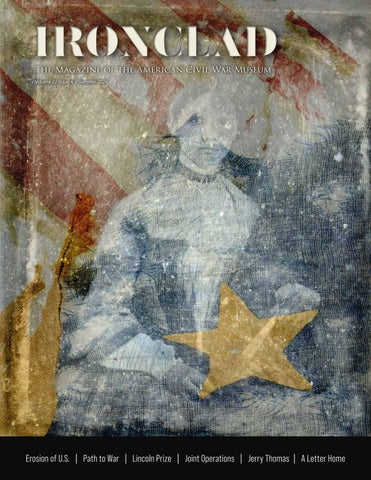
IRONCLAD The Magazine of the American Civil War Museum Volume 2/ Issue 4 / Summer 2024
Erosion of U.S. | Path to War | Lincoln Prize | Joint Operations | Jerry Thomas | A Letter Home
IRONCLAD Volume 2/ Issue 4/ Summer 2024
3
9
The Erosion of the United States
Radicalization of the Moderates & the Northern Path to War
1
15
19
23
Dear Sister
Joint Operations
Estes’ account of
Lincoln Prize Q&A
Pickett’s Charge
Drs. Clarke & Plant
strategic foresight
From the CEO
14
In the Collection
31
COVER: Daguerreotype of an unidentified woman from the ACWM collection of cased images. Photo illustration by John Dixon.
Ulysses S. Grant’s
Jerry Thomas
36 Featured Books
@acwmuseum ACWM.org
Magazine
FROM THE CEO
Publisher
PHOTO: JOHN DIXON
Rob Havers, Ph.D. ACWM President & CEO
Managing Editor Robert Hancock
Art Director/Designer
Dear Friends
John Dixon
Welcome to the summer edition of Ironclad magazine and a tremendous issue it is!
Editorial Review
Dovetailing very well with our new temporary exhibition, The Impending Crisis, which explores the origins of the War, Professor Ed Ayers’ piece ‘The Erosion of the United States’ looks at this topic in considerable detail. The conclusion to his opening paragraph, that ‘There is no shortcut to explaining the American Civil War’ well encapsulates the many contradictions inherent in this fascinating period of US history. Likewise the piece by Adam I.P. Smith in this issue, The Radicalization of the Moderates & the Northern Path to War explores the challenge historians face to explain the “how and why” slavery caused the war.
Kelly Hancock Jeniffer Maloney
Museum Board of Directors Daniel G. Stoddard, Chair Claude P. Foster, Vice Chair Rob Havers, Ph.D., President & CEO J. Gordon Beittenmiller, Treasurer Walter S. Robertson III, Secretary Hans Binnendijk, Ph.D. Trevor Cox Audrey P. Davis Sally Diggs Fletcher George C. Freeman III Stephen T. Gannon Hon. David C. Gompert Bruce C. Gottwald, Sr. Richard S. Johnson Donald E. King Calvert Saunders Moore John L. Nau III William R. Piper Roderick G. Stanley Ruth Streeter Allison Thomas Jeffrey L. Wilt
Foundation
If you haven’t yet seen The Impending Crisis please come and visit. Also in this issue, Joint Operations, co-authored by David Gompert, ACWM board member, and Dr. Wayne Wei-siang Hsieh, ACWM History Advisory Council and Associate Professor of History at the United States Naval Academy, looks at early iterations of joint Army and Navy operations in the Civil War period. At the ACWM, we talk a lot about how the Civil War remade this nation and that impact was felt at all levels. This article is a great demonstration of that impact. Looking ahead to a busy Fall, we encourage you all to mark your calendars for the annual Lincoln Prize Lecture. We very much look forward to hearing from the 2024 Gilder Lehrman Lincoln Prize laureates Francis M. Clarke and Rebecca Jo Plant. Read the Q&A on the research and writing of their book Of Age: Boy Soldiers and Military Power in the Civil War Era on page 19. As always, enjoy this edition of Ironclad. I look forward to seeing as many of you as possible at one – or all – of our three sites.
Board of Directors Jeffrey L. Wilt, Chair Stephen T. Gannon Rob Havers, Ph.D. Richard S. Johnson Donald E. King Calvert Saunders Moore Walter S. Robertson III
Dr. Rob Havers President & CEO
Ironclad magazine is published quarterly by The American Civil War Museum. 490 Tredegar St., Richmond, VA 23219 The contents of this magazine may not be reproduced in whole or in part without the consent of the American Civil War Museum.
T HE A MERICA N CIVIL WA R MUSEUM
1
The
Erosion
of the
United States
2
I RONC L A D : Summer 202 4
by Ed Ayers
Even if most Americans can finally agree that slavery lay at the heart of the Civil War, as historians, textbooks, and state standards now acknowledge, the complexities of the conflict somehow refuse clear resolution. A moment’s reflection reveals that exactly how slavery drove the United States into war is more complicated than simple formulas explain. Assertions of inevitable conflict between industrial vs agrarian economies, an intrinsic if unexpressed emancipatory determination of Abraham Lincoln and his party, or the unavoidable self-destruction of a slave society do not hold up to scrutiny. There is no shortcut to explaining the American Civil War. Part of the challenge is the frame we use to define the picture. If we look at United States history over a long period we can find seeds of the cancer of conflict in the Constitution, the Revolution, or even the arrival of the first African people in 1619. If we examine the months before secession through a close-up lens, on the other hand, we are struck by the intricate complexities on the ground. There, we find people in the North and South, Republicans and Democrats, entire states, repeatedly recalibrating, struggling, and then succumbing to a war they did not seek. Intimate biographies of Robert E. Lee and Abraham Lincoln show that these men struggled with the profound decisions before them. The most useful frame might be the six decades after 1800, when the issues that drove the war
grew to an unavoidable scale. The new nation expanded a vast empire of slavery, unforeseen by the men who wrote the Constitution, enabled by the dispossession of millions of acres of rich land from Native nations and an unprovoked and immensely advantageous war with Mexico. Within that frame, we might increase the resolution to see in greater detail what we call “culture,” the literature, art, and music of the era. With that resolution, we see that the struggle over meanings of slavery for the nation was fought on multiple fronts, across the entire period, by women as much as men, by Black people more than white. The most fundamental cultural conflict was religious, for fights within Protestant Christianity went to the heart of Americans’ understanding of themselves. From the very beginning of the century, some Christians pleaded for the nation to live up to the letter and spirit of the Golden Rule. And that meant acknowledging and correcting the national sins of slavery, dispossession, and unprovoked war. At first, the defenders of slavery had no religious answer to that charge, but slowly persuaded themselves that the Bible authorized slavery. continued on next page
T HE A MERICA N CIVIL WA R MUSEUM
3
continued from previous page
Christianity provided potent weapons of attack. Black Americans chastised white Americans for hypocrisy. In 1829, David Walker published his Appeal to the Colored Citizens of the World. His thesis was direct: “the white Christians of America, who hold us in slavery, (or, more properly speaking, pretenders to Christianity,) treat us more cruel and barbarous than any Heathen nation did any people whom it had subjected.” Angelina Grimké fled South Carolina for Philadelphia to avoid implication in the slavery from which her family benefited. She reached out to the women of her own race, class, and region, women who, she knew from harsh experience, despised her as a traitor. Grimké composed her Appeal to the Christian Women of the Southern States in 1836 because she felt “a deep and tender interest in your present and eternal welfare” for those who were “bound to me in Christian sympathy, and Gospel fellowship.” Grimké offered Christ’s fundamental teaching: “Whatsoever ye would that men should do to you, do ye even so to them.” Grimké then asked “every slaveholder” to “apply these queries to his own heart”: “Am I willing to be a slave—Am I willing to see my wife the slave of another—Am I willing to see my mother a slave, or my father, my sister or my brother? If not, then in holding others as slaves, I am doing what I would not wish to be done to me or any relative I have; and thus have I broken this golden rule which was given me to walk by.” When Grimké’s Appeal reached Charleston, city officials burned it publicly. Grimke’s mother was warned that her daughter must never visit Charleston again. Harriet Beecher Stowe wove together the power of sermons and parlor songs, of tender poems about children, death, of mothers and children, of the New Testament and reading. Stowe disdained “the dead sea of respectable churches.” She had nothing good to say of northern politicians or of those who upheld the sanctity of the Union as a reason to tolerate slavery and accept the Fugitive Slave Law. Stowe warned her fellow Christians that the “day of vengeance” would arrive with God’s judgment for the great sin they tolerated in their midst.
My dearly beloved Brethren and Fellow Citizens— Having travelled over a considerable portion of these United States, and having, in the course of my travels, taken the most accurate observations of things as they exist--the result of my observations has warranted the full and unshaken conviction, that we, (coloured people of these United States,) are the most degraded, wretched, and abject set of beings that ever lived since the world began; and I pray God that none like us ever may live again until time shall be no more. … These positions I shall endeavour, by the help of the Lord, to demonstrate in the course of this Appeal, to the satisfaction of the most incredulous mind–and may God Almighty, who is the Father of our Lord Jesus Christ, open your hearts to understand and believe the truth. The causes, my brethren, which produce our wretchedness and miseries, are so very numerous and aggravating, that I believe the pen only of a Josephus or a Plutarch, can well enumerate and explain them. …
Excerpt from the Preamble in David Walker's Appeal to the Colored Citizens of the World.
It was the cultural form of Stowe’s novel that changed hearts and minds. The book was not merely a product of American culture but a profound critique of it. The book would not have existed without the business models and inspiration of other bestselling novels by women, who helped create an audience for a book such as Stowe’s. Stowe integrated parts, too, of well-known fugitive slave narratives, Christian homiletics, and the serial form embodied in the most popular novelist of the era: Charles Dickens. Uncle Tom’s Cabin was part of a larger cultural constellation, not a single star. Contradictory images of slavery proliferated across the North in infinite variations: in plays and novels, sentimental songs and abolitionist meetings, statistics and speeches. The polarities of violence and permissiveness, of inefficiency and
4
I RONC L A D : Summer 202 4
Angelina Grimké
Harriet Beecher Stowe
IMAGE: MASSACHUSETTS HISTORICAL SOCIETY
IMAGE: LIBRARY OF CONGRESS
coercion, of wealth and neglect, of carefree song and dirge, changed according to the purposes to which they were put. The cultural expressions stirred engagement in slavery whether people wanted to pay attention or not, whether they were political or not, and whether they were male or female. Frederick Douglass reflected on this situation in 1855. As usual, he saw matters more clearly than anyone else. He understood the power of culture, even when it took unexpected forms. In the frontispiece of his new version of his autobiography — My Bondage and My Freedom — Douglass, still in his thirties, dressed in fine clothes, confronted readers with a direct gaze, nearly clenched fists, and a furrowed brow. Douglass fleshed out the scenes of his Narrative, published ten eventful years before, with new, novelistic effect of detail and dialogue, capturing the power of fiction for purposes that were all too true.
"
…we have allies in the Ethiopian songs; those songs that constitute our national music, and without which we would have no national music. They are heart songs, and finest feelings of human nature are expressed in them. –Frederick Douglass
Douglass was heartened by what he saw in 1855, the movement against slavery “moving in all directions, and in all weathers, and in all places, appearing most where desired least, and pressing hardest where most resisted. No place is exempt. The quiet prayer meeting, and the stormy halls of national debate, share its presence alike. It has grown too large—its friends are too numerous—its facilities too abundant—its ramifications too extended—its power too omnipotent, to be snuffed out by the contingencies of infancy. A thousand strong men might be struck down, and its ranks will be invincible.” The current age, Douglass felt sure, will be known by future generations “as the age of anti-slavery literature…when a picture of a negro on the cover was a help to the sale of a book.” The antislavery movement found that “scholars, authors, poets, and statesmen give it their aid.” It was remarkable, Douglass observed, and perhaps “almost absurd to say it, considering the use that has been made of them, that we have allies in the Ethiopian songs; those songs that constitute our national music, and without which we would have no national music. They are heart songs, and finest feelings of human nature are expressed in them.” Douglass acknowledged that “‘Lucy Neal,’ ‘My Old Kentucky Home,’ and ‘Uncle Ned,’ can make the heart sad as well as merry, and can call forth a tear as well as a smile.” As recently as 1848, Douglass himself had excoriated “the filthy scum of white society, who have stolen from us a complexion denied to them by nature, in which to make money, and pander to the corrupt taste of their white fellowcitizens.” But now, seven years later, Douglass believed the songs “waken the sympathies for the slave, in which antislavery principles take root, grow and flourish.” The culture had changed in ways no one could have predicted.
An Ethiopian azmari (musician) plays the masenqo, c1860s. IMAGE: CREATIVE COMMONS [CC-BY-SA-3.0], VIA REDDIT (R/ETHIOPIA).
Stephen Foster played an unlikely role in the creation of American music that promised to “waken sympathies for the continued on next page
T HE A MERICA N CIVIL WA R MUSEUM
5
continued from previous page
slave.” Foster’s “My Old Kentucky Home” was inspired by Tom’s memories of his cabin in Kentucky after he had been sold south. Foster did not set out to soften white northern attitudes toward Black people, but it was indeed possible that, as Frederick Douglass said, Foster’s music brought that softening nevertheless. He put human emotions of longing, love, and loneliness in the mouths of imaginary Black people. Foster’s brother later observed that in Stephen’s songs “ridicule began to merge into sympathy. Unknown to himself, he opened the way to the hearts of the people, which led to actual interest in the black man.” Songs did work that political speeches could not, and that overtly political songs could not. Poetry, too, played an important role in the campaign against slavery, for poems’ form and figurative language were charged with emotional meaning for nineteenth-century audiences. A young Black woman, Frances Ellen Watkins, sold 12,000 copies of her book of poems in the late 1850s as she spoke across the North to raise money for the Underground Railroad. Listening to Watkins, one audience member wrote, “there swept over me, in a chill wave of horror, the realization that this noble woman… might have been sold on the auctionblock, to the highest bidder.” Female writers and speakers such as Watkins evoked sympathies for the slave in ways that men could not, Black people in ways white people could not, poetry in ways prose could not.
Frances Ellen Watkins IMAGE: LIBRARY OF CONGRESS
The most prominent thinker in the nation, Ralph Waldo Emerson, had denounced organized reform of any sort. In his famous 1841 essay “Self-Reliance,” Emerson counseled that rather than indulge an “incredible tenderness for black folk a thousand miles off” it would be better to “go love thy infant; love thy woodchopper: be good natured and modest.” One event after another, however, changed Emerson’s mind. Emerson used his literary and lecturing fame, ever mounting in the United States and Great Britain, to lend credibility and visibility to the abolitionist cause, all the stronger for having resisted it. In 1855, Emerson spoke against slavery before large crowds in Boston, New York, Philadelphia, and elsewhere. Abolitionists expressed amazement and gratitude that the voice of Transcendentalism now touched the ground: “No more feeling in the skies, after the absolute, but sharp observations on human life and manners,” one exclaimed. “Never was such a change, apparently, as from the Emerson of ’45 to the Emerson of ’55.”
6
I RONC L A D : Summer 202 4
The Slave Auction by Frances Ellen Watkins
The sale began young girls were there, Defenseless in their wretchedness, Whose stifled sobs of deep despair Revealed their anguish and distress. And mothers stood, with streaming eyes, And saw their dearest children sold; Unheeded rose their bitter cries, While tyrants bartered them for gold. And woman, with her love and truth— For these in sable forms may dwell— Gazed on the husband of her youth, With anguish none may paint or tell. And men, whose sole crime was their hue, The impress of their Maker’s hand, And frail and shrinking children too, Were gathered in that mournful band. Ye who have laid your loved to rest, And wept above their lifeless clay, Know not the anguish of that breast, Whose loved are rudely torn away. Ye may not know how desolate Are bosoms rudely forced to part, And how a dull and heavy weight Will press the life-drops from the heart.
Emerson knew that such comments expended the social capital he had built over the preceding two decades among the educated and powerful, for “Judges, Bank Presidents, Railroad men, men of fashion, lawyers universally all take the side of slavery.” Emerson knew the conflict between North and South was not over industrial versus agrarian interests, for economic self-interest unified the nation far more than it divided it, though Americans perpetually forget that, imagining that modern economies could not tolerate the barbarity of slavery. The new nation lacked the resilience to weather the longbuilding crisis that threatened to engulf everyone and everything. No one could find the language to imagine a Union that was not divided. Americans had exhausted their good will, patience, trust, and empathy over the preceding decades. They had consumed themselves with vituperation, not only politically but culturally, so that the only honest language seemed the language of resentment and distrust, of cynicism and suspicion. Fantasies of violence, suffered and inflicted, filled imaginations. The network of partisan newspapers, telegraph lines, and political patronage spun over the preceding decades amplified bitter rhetoric into every American community. The nation eroded, often imperceptibly, from underneath as well as above, in apparently trivial changes and differences as well as obvious ones. People at the margins move the center, the disenfranchised move power, and the eccentric move the expected. Individuals dismissed for their skin, sex, or peculiarity spoke for an America of freedom and connection, of possibility and responsibility.
Emerson knew the conflict between North and South was not over industrial versus agrarian interests, for economic self-interest unified the nation far more than it divided it…
Ralph Waldo Emerson IMAGE: LIBRARY OF CONGRESS
And positive change comes from the same sources. The war came through the familiar scenes of political collapse, without any reasonable prospect for ending slavery. But the war changed the context in which culture lived. The decades of effort by the stubborn advocates for freedom, the opening of the hearts as well as minds of white Northerners, and the moral and political power of women driven by religious faith, created an environment in which the unimaginable—the end of more than two centuries of slavery—took place in a breathtakingly short time. In that victory, we see the power of culture, the power of visions sustained in the face of the most disheartening era of American history. The erosion of one, deeply compromised United States allowed a new, and better, one to rise in its place.
Ed Ayers is a prize-winning author and historian on the history of the United States. A National Humanities Medal recipient, his works have been finalists for the National Book Award and the Pulitzer Prize. Ed is President Emeritus and Professor of Humanities at the University of Richmond.
T HE A MERICA N CIVIL WA R MUSEUM
7
The United States Senate, A.D. 1850. Henry Clay addresses the U.S. Senate in a debate on the Compromise of 1850 legislation. IMAGE: LIBRARY OF CONGRESS 8
I RONC L A D : Summer 202 4
The Radicalization of the Moderates & the Northern Path to War by Adam I.P. Smith
The only plausible one-word answer to “What caused the Civil War?” is “slavery” since there is no plausible imaginary scenario in which you could take slavery out of the equation and still see conflict between North and South in the form and at the time it happened. But explaining precisely how and why slavery caused the war is a trickier business. As Abraham Lincoln put it in his second inaugural address, as he reflected on why, four years earlier, war had broken out, “all knew” that slavery was “somehow” the cause at issue. The challenge for historians is to explain that “somehow”.
WHAT, HOW, WHY... SOMEHOW
Over the last century and a half, and right down to the present day, there have, of course, been plenty of people who have wished to resist the idea that slavery “caused” the Civil War, but their attempts to argue against it usually boil down to the claim that most Southern whites did not own slaves and that most northerners were not abolitionists. Both of these claims are true but mistake the motivations of people at the time for the underlying problem. In explaining the secession of the Deep South, and then the further four slave states that seceded, it is extremely easy to show that not only was slavery the underlying driver of separatism but that almost everyone who advocated secession knew as much and said so proudly: the secession ordinances of the seceding states are eloquent testimony to white Southerners’ judgement – badly misguided as it turned out to be – that only by breaking away from the
United States could slavery be preserved in the long run. But explaining secession is only the first step to explaining why the war came. Of equal importance is the response of the rest of the Union. Secession is hardly a uniquely American experience, and in a majority of cases where one part of a nation has broken away from another in modern history, there was no war. The Federal government’s refusal to accept the legal or political legitimacy of the Confederacy, and therefore to treat secession as a giant insurrection or riot, was more historically contingent than most Americans— who naturally assume that the survival of the United States was a moral good—assume. And this is where we come to one of the ways in which those who claim that slavery was not the cause of the war seem to have a point. Because although the abolitionist movement was growing, and although the Republican Party – which was dominant in the North by 1860 – was undoubtedly, in a broad sense, “antislavery”, it is also unquestionably true that most Northerners did not go to war in 1861 with the avowed intention of destroying the South’s system of enslavement. Indeed, since four slave states remained in the Union, that could not have been the case. And the resolutions on the purpose of the war passed by Congress in July 1861 made clear that the objective of the loyal states was purely and simply to restore the Union. And yet the key to understanding why and how the overwhelming majority of Northerners continued on next page
T HE A MERICA N CIVIL WA R MUSEUM
9
continued from previous page
came to vote for the Republican party and then, in even larger numbers, to support the restoration of the Union by force is that the issue of slavery had radicalized otherwise moderate and conservative men and women. Millions of Northerners who were indifferent, and sometimes hostile, to abolitionism, had come to see slavery as a threat for which they were willing to take up arms. Why was this so? Part of the answer is that Northerners, like all antebellum Americans, were convinced that their republic was at the vanguard in a global struggle between democracy and despotism. America’s future prosperity and freedom depended—so it was frequently proclaimed—on adherence to the institutions and traditions established by a previous generation. This was a fundamentally conservative posture. As Alexis de Tocqueville observed, Americans “love change, but dread revolutions.” Of course they did, because their revolution – that of “1776”—had created what Lincoln was to call “the last, best, hope of earth.” So any further revolution, or backsliding from that promise, was dangerous revanchism. In the providential reading of the vast majority of nineteenth-century Americans, it was their fate as one of God’s chosen peoples to bear a precious burden. Their revolution had set in motion a free republic that was destined to do no less than redeem mankind. If preservation of the revolutionary settlement of the 1770s and 80s was the prerequisite for the Union’s expansion and onward progress, antebellum Americans had been schooled to believe that the best way to achieve this was through the practice and ideal of “compromise.” The Union was the first republic in the world to extend over so great an area, to contain such a multitude of people. Consequently, its maintenance required its people to be willing to develop a compromise mindset – to conciliate one another, and like the Founders to exhibit a moderate temperament – to be calm, dignified, and non-dogmatic – the temperamental embodiment of conservatism. This was the “compromise
10
I RONC L A D : Summer 202 4
tradition” associated most of all with the “Great Compromiser” Henry Clay. “I go for honorable compromise whenever it can be made,” wrote Clay in 1850. “All legislation, all government, all society, is formed upon the principle of mutual concession, politeness, comity, courtesy; upon these, everything is based.” Even an issue like human enslavement, which aroused fierce feelings and touched the very core question of humanity and freedom, should, Clay and his followers believed, be subjected to compromise. That, after all, had been what the much-venerated Founders had done. In their wisdom they had created a republic “half slave and half free” (to quote Lincoln again). If it was good enough for them, surely it was good enough for later generations.
All legislation, all government, all society, is formed upon the principle of mutual concession, politeness, comity, courtesy…
And so, right up to 1860, appeals to “moderation” and for “compromise” were commonplace in – Henry Clay northern politics. But by 1860, something had shifted which cut the ground from under the compromisers. To moderate Northerners, the real threat to the preservation of the Union – and with it the future of freedom around the world – was emanating not just from socialists and mobs, or from “one-idea” radicals, but from the defenders of slavery. This was evident to Abraham Lincoln as early as 1838, when he gave his first recorded public speech to the Young Men’s Lyceum of Springfield, Illinois. His speech was entitled in a truly conservative-sounding phrase, “The Perpetuation of our institutions,” and in it he made a passionate case for “reverence for the laws.” Yet, the context in which Lincoln was talking is a clue to how and why he – and, in the end, millions of other Northerners – began a journey towards a recognition that radical means might be necessary in order to preserve their republic, the last best hope of earth.
As his audience in Springfield knew all too well, three months earlier, the abolitionist Elijah Lovejoy had been murdered in Alton, Illinois. Alton’s town leaders had offered Lovejoy what they called “a compromise”: he would stop producing his newspaper and get out town, and in return they would refrain from killing him. Lovejoy refused the deal, and four days later he was dead, his printing presses tossed into the Mississippi river. The mob action—seemingly tacitly sanctioned by the town’s authorities— was widely covered in newspapers.
Elijah Lovejoy memorial card, ca. 1837. Lovejoy died during a mob’s attack on the office of the St. Louis Observer newspaper, where he printed abolitionist articles. IMAGE: MISSOURI HISTORICAL SOCIETY COLLECTIONS
Just the previous year, 1837, Lincoln, as a young Whig member of the state legislature had opposed a motion declaring that the right of property in slaves was “sacred” and that we “disapprove of the formation of abolitionist societies.” The motion was nevertheless passed by 77 votes to 6. So, when Lincoln spoke so passionately about the need for reverence for the law, everyone in the audience knew why he was making the point. For the young Lincoln, slavery was dangerous to the perpetuation of republican institutions not only because it was unjust but also because— as in Alton—it inspired mob violence. If the basis of the political order was compromise, and if the hardest issue by far to compromise was toleration of slavery, Lincoln was subtly signaling in his Lyceum Address that the compromise was under strain. In 1838, Lincoln was laying the groundwork for what was in effect a conservative antislavery case that identified radical threats to the republic from the tyranny and violence of those who would defend slavery.
In the 22 years that followed, a series of political events gradually convinced a majority of Northerners that the “Slave Power,” as it was increasingly known – the political operation that used Federal power to defend slavery – was undermining the freedoms of ordinary white Northerners. A major turning point was the passage through Congress in 1850 of the new fugitive slave law of 1850 which gave the Federal government massively increased power to override the local courts and law enforcement of free states in order to seize those who were accused of being fugitives from slavery. An infamous example was that of Anthony Burns, who was working in a clothing store on Brattle Street in Boston, when he was arrested by Federal agents in May 1854, and after a summary proceeding, marched in chains to a Federal ship and taken back south into slavery. Angry mobs gathered outside the Court House where Burns was being held, while ministers sermonized about the destruction of liberty in the cradle of the Revolution. Handbills urged “the yeomen of New England” as “the chief conservative element of the republic” to come to Burns’ aid in defiance of Federal authority. There were many other, similar moments during the 1850s when what one newspaper called the “silent majority” of moderate men in the free states had to come to difficult reckonings about the nature of their polity. Another came in 1857, with the Supreme Court’s decision in the Dred Scott case, which the incoming President – James Buchanan – hoped would be the final resolution of the slavery crisis. In response to the Dred Scott case, Lincoln argued that the founders of the republic had believed that slavery was “on the course of ultimate extinction.” The Dred Scott decision reversed that formulation. This was why Lincoln warned in 1858 that the country could not remain “half slave and half free” but would become “all one thing or all the other.” Even the Constitution, as it was now interpreted by the Court, seemed no longer to embody the spirit of the revolution as Lincoln understood it. continued on page 13
T HE A MERICA N CIVIL WA R MUSEUM
11
This print shows a portrait of Anthony Burns surrounded by scenes from his life. His arrest and trial under the Fugitive Slave Act of 1850 touched off riots and protests in 1854 by abolitionists in Boston. IMAGE: LIBRARY OF CONGRESS
12
I RONC L A D : Summer 202 4
I believe this government cannot endure, permanently half slave and half free. I do not expect the Union to be dissolved - I do not expect the house to fall - but I do expect it will cease to be divided. It will become all one thing, or all the other. – Abraham Lincoln, 1858
continued from page 11
Everything seemed topsy-turvy. Law no longer aligned with order. The Federal government and the Constitution no longer protected freedom. The new Republican Party, with Lincoln as one of its representative members, argued that the “Slave Power” was in effect, a counter-revolutionary force, subverting the institutions of the republic and replacing them – as the people of Boston had witnessed when Burns was carried off by Federal forces – with the tyrannical methods of despots. The Republican party saw their mission as being to save the republic by imposing on the South their deeply felt and plausibly articulated antislavery version of the political order created in the 1780s. As one Republican editor put it, “we seek to conserve and perpetuate the original principle on which our republican government is based, that freedom is the rule, and slavery the exception.” Most white Americans did not want to transform their world, they wanted to rid it of enemies. The slaveholders who had been exposed as counter-revolutionary oligarchs—had become the main enemy of the republic.
The dominant narrative of the Civil War dismisses the moderate majority as by-standers, hapless as radicals drove change. But at best this is only half the story. The choices this silent majority made were the ones that, in the end, led to the election of Lincoln as President in 1860, triggering secession and leading to war. Trying to make political judgements that would preserve their free institutions, the political order in which they had grown up and which they believed was the most perfect the world had ever seen, – trying to preserve all this they stumbled, eventually, into a situation where they felt compelled to use immense force to preserve the Union, and to destroy the institution of slavery not just for themselves but, to quote Lincoln again, for the “whole family of man.”
matters to us today both for what it created and the paths not taken, for what it foreclosed. Determined to preserve their own freedoms against increasingly authoritarian, un-American-seeming southern enslavers, Northerners – the great majority of them anyway – were willing to fight to preserve what they had always thought they had. And in doing so, they created a new world, almost without knowing what they were doing. END
Adam I.P. Smith is a Professor of U.S. Politics & Political History at Oxford University and Director of the Rothmere American Institute.
Obviously, the war transformed this country in many ways, some temporary, others revolutionary and long-lasting with which we are still grappling today. Yet, the paradox is that these revolutionary changes were brought about by men and women striving to stave off other revolutionary changes. The Civil War
T HE A MERICA N CIVIL WA R MUSEUM
13
In the Collection Armor Breastplate with Tassets
This armor breastplate was taken from an officer in the 5th New York Cavalry on May 24, 1862, during the First Battle of Winchester, part of “Stonewall” Jackson’s Valley Campaign. Randolph Fairfax, a private in the Rockbridge (Virginia) Artillery, wrote to his brother Bert: Among the spoils I have seen two of those Yankee breast plates that they talk so much about. They were of different patterns. One a simple steel plate, and the other had joints and came down over the hips. Unfortunately for the owners, they had no plates behind where they were most needed.
14
I RONC L A D : Summer 202 4
He later wrote to his sister: You have read I suppose of the Yankee breastplates. I saw two at Winchester. They are strong steel plates, so fixed that a ball glances instead of piercing. Unfortunately they had them on the wrong place. Armor vests or breastplates were not standard issue during the Civil War but were sold by private military outfitters or sutlers who followed the armies on their campaigns. Looking more like something from the English Civil War (1642-51) than the American one, the armor was heavy, hot, ineffective at close range, and likely to elicit ridicule or charges of cowardice from fellow soldiers.
Dear Sister
“God forbid that I shall ever see another such bloody field”
“Pickett’s Charge” is arguably the most recognized event of the Civil War. On July 3, 1863, at Gettysburg, Pickett’s Confederate division, along with Trimble’s and Pettigrew’s divisions, tried to break the Union line defending Cemetery Ridge. Edward Estes was a soldier in the 38th Virginia Infantry, part of Armistead’s brigade in Pickett’s division. Eight days after the battle, Estes wrote to his sister while stationed in Maryland, leaving us with a vivid account of his experience in this most famous of charges. Edward’s brother, Joseph (referred to as Joe in the letter), was wounded at the battle. When he wrote to his sister, he did not realize that Brigadier General Lewis Armistead had in fact died and that Brigadier General James Kemper had not. His letter also reveals how soon Virginia soldiers began blaming the failure of the charge on the alleged failure of North Carolina troops to support them. continued on page 17
T HE A MERICA N CIVIL WA R MUSEUM
15
Edward Estes, 38th Virginia Infantry IMAGE: ACWM COLLECTION
16
I RONC L A D : Summer 202 4
continued from page 15
Williamsport Md, July 11 1863 Dear Sister, Your kind and affectionate letter came to hand to day which was perused with more than ordinary interest as it has been a long time since hearing from you all before. I am exceedingly glad to hear that you are all well & that the late call is creating such consternation among the substitutes. I hope they will soon begin to realize the existence of war by which thousands upon thousands of the bravest & best spirits of the south are being daily sacrifice [sic] for their country while those miserable sneaks chuckle, and gloats with delight over the news of goary field. [F]or they know that it makes widows and orphans whom they can more easily defraud. I understand that a great many are selling out up that way with the intension of moving south. I reckon they think that they will not be liable there for military service but they will find it no go. As this war will never terminate while Abe is in power. I wrote a very hurried letter to Pa & Ma after the fight informing them of Joe’s and my safety which I hope they have gotten by this. Oh it is a sad thing now to look at our Division. Only a few hundred answer to the rolls where thousands answered a few days ago. It was one of the finest divisions in [the] army before it was cut up so. Genl Lee thought all & all of it. Our poor Col was shot dead right through the head while gallantly leading his brave boys onto bloody graves. What few of Regt is left, can hardly speak of him without shedding a tear. There never was a better man or one more universally beloved[.] Col. Whittle was wounded badly in two places. Every Brigadier in the Div was killed & wounded. Genl Armistead immortalized himself with every one on the field from Lee down for his gallantry of himself & brigade. He fell on the Yankee breast-works waving his hat. I am glad to hear that he was wounded & not killed. Kemper and Garnett were killed nearly every Col in the Div. God forbid that I should ever see another such bloody field. We could have held the breastworks and all their cannon if the the [sic] brigade of NC had not shown the white feather before they got properly on the field. They were to support our Div. All they had to do were to come up on a line with us and hold position we had gained. For we could not do it after having lost 4/5 of our men. Genl Pickett was in the thickest fight & escaped unhurt. When he came out and saw how few of us were left he wept like a child, & said he wished they had of killed him too. Genl Lee & Longstreet were present on the field[.] I take no interest at all in the company as I use to. For it make me almost cry to look at it. But thanks be to God our Div is not all of Lee’s army. Other Div are not hurt badly at all. My regt is here doing provost duty & in fact [?] brigade. Garnett Brigade has gone to Winchester with prisoners, Kempers is on the other side of the river guarding waggons [sic]. James is here attending the wounded. I shall enclose my letter in his. My love to all. Give my love to Sue and tell her she had better try & content herself in Old Virginia. I am afraid Joe will never be able for service again. As the Dr. Mc think that his arm will be stiff. Good bye may God bless is the prayer of your affectionate bro.
View from East Cemetery Hill, looking over Culp Farm, Gettysburg IMAGE: ACWM COLLECTION
Edward H. Estes
T HE A MERICA N CIVIL WA R MUSEUM
17
American Civil War Museum Lincoln Prize Lecture Please join us at for our annual Lincoln Prize Lecture to be held on October 17th at the American Civil War Museum (ACWM) at Tredegar in Richmond, Virginia. Featured speakers will be the recipients of the 2024 Gilder Lehrman Lincoln Prize, Dr. Frances M. Clarke and Dr. Rebecca Jo Plant. They were awarded the prize for their book Of Age: Boy Soldiers and Military Power in the Civil War Era. The Lincoln Prize Lecture is the result of our partnership with the Gilder Lehrman Institute of American History, an organization that has done so much for the preservation, dissemination, and teaching of American history. The relationship between our institutions reflects ACWM’s commitment to preeminence in the study of the Civil War. The Gilder Lehrman Institute’s support of a greater understanding of the Civil War is substantial, and their annual Gilder Lehrman Lincoln Prize is one of, if not the, most prestigious awards in the field. An important part of the American Civil War Museum’s work is to understand the past as the past knew itself, not as we know it from the vantage point of today. That is the framework that guides our mission, and our partnership with the Gilder Lehrman Institute of American History is reflective of that intention. Of Age: Boy Soldiers and Military Power in the Civil War Era offers military, legal, political, and cultural perspectives on the service of underage boys in both the Confederate Army and the U.S. Army. In line with the Museum’s multi-year initiative “The Civil War and Remaking America”, the book by Drs. Clarke and Plant includes the examination of 19th century perceptions of underage boys serving in the military and the challenges brought about in the Federal Courts. As with all our programs, we hope to inspire a greater understanding of the American Civil War—its causes, course, and consequences. Accordingly, we engage the foremost scholars in the discussion. Our goal is to bring to a national stage the conversations that implore a look at the circumstances and perspectives of those who lived through the most pivotal point in U.S. history. Premier events like the Lincoln Prize Lecture, our annual Symposium and many programs throughout the year are made possible by the support from our members. If you are not yet a member, please consider joining. If you are a member, we thank you for your continued support! Reserve your space at the annual ACWM Lincoln Prize Lecture today at acwm.org.
18
I RONC L A D : Summer 202 4
Q&A Authors Dr. Frances M. Clarke and Dr. Rebecca Jo Plant talk about the genesis of their 2024 Gilder Lehrman Lincoln Prize book Of Age: Boy Soldiers and Military Power in the Civil War Era; the impact of underage service on the country and how ACWM’s artifacts and exhibits create a connection through time to the individuals who lived and died in the Civil War era.
Frances M. Clarke
Rebecca Jo Plant
Of Age: Boy Soldiers and Military Power in the Civil War Era has been described as the first comprehensive study of how Americans responded to the unauthorized enlistment of minors in the Civil War. Why this topic? We did not initially set out to write a study of boy soldiers in the Civil War. In fact, Frances had embarked on a different project focused on how the war changed Americans’ ideas about citizenship and their relationship to the federal government. She was drawing on an enormous but woefully underexplored collection of letters and petitions from relatives of Union soldiers, housed in the National Archives in the wartime files of the Adjutant General’s Office. A significant subset of these letters were written by parents of underage boys who had enlisted in the Union army without their permission. For the first ten months of the war, all those below age 21—the legal age of majority—were supposed to obtain the consent of a parent or guardian before enlisting. Initially, Frances placed all of these sources to the side, thinking that underage enlistment was a discrete and not particularly promising topic, since everyone already knew that boy soldiers served on both sides during the Civil War. But the sheer volume of petitions from parents became impossible to ignore, as did the legalistic and proprietary language that many of them used to make their claims. Dependent on their sons’ labor, to which they had a legal right, many parents essentially portrayed themselves as victims of theft. When Frances shared some of these petitions with Rebecca—a scholar of family history—Rebecca insisted that they should be the focus of attention. We then decided to explore the issue together. We started by asking a number of questions: Why were there so many petitions; just how many underage enlistees made it into the ranks? Why did the War Department not simply release underage enlistees, especially when convincing proof of age had been provided? How many parents followed this administrative path in attempting to recover their children, and how many instead turned to the courts, seeking a writ of habeas corpus from a local or state judge who could discharge any soldier deemed to be fraudulently enlisted? And what were the social, political, and legal consequences of this struggle between parents and the government over the control of boys’ labor? In other words, we started off with one particularly compelling group of sources and eventually found ourselves focusing on the longer history of debates over enlistment age. Quite a few people, including writers of popular history and authors of children’s literature, had written about the astonishing feats of individual boy soldiers. But no one had previously taken on the topic of underage enlistment as a source of household disruption, a bureaucratic nightmare, a problem studied within military circles, or the subject of extensive litigation. We decided that explaining the wider significance of mass underage enlistment would bring a new perspective to the history of the Civil War. continued on next page
T HE A MERICA N CIVIL WA R MUSEUM
19
continued from previous page
Living on two different continents must have presented a challenge for co-authoring a book. What was your collaborative process like? It did present challenges, and it’s hard to imagine how we would have surmounted them without the generous grants we received from the Australian Research Council and the American Council of Learned Societies. This funding helped to support Frances’s many trips to the United States to conduct research, and the three trips that Rebecca made to Sydney, during which we focused on writing. This was so critical, because we really needed a full immersion period in order to get launched. In Australia, we spent many hours together every day. We literally wrote sentences together, taking turns typing on the computer. We’d continue to discuss issues when we broke to eat lunch or take a walk. That period was very intensive and allowed us to figure out the contours of the project and how our collaboration would actually work. Later in the process, we could break things up into chunks and each work independently on drafting sections or chapters. But through Zoom sessions and by using Dropbox, which allowed us to share all of our documents, we were continually responding to and editing whatever the other person had drafted. In short, it’s impossible to imagine how we could have completed the book without both ample funding and technological tools. What are the key points you hope readers will take away from this work? There are several key points. First and foremost, we want people to appreciate the extent of underage enlistment in Civil War armies. We estimate that around 10 percent of the Union army
Unidentified boys who served during the Civil War. IMAGES: LIBRARY OF CONGRESS
20
I RONC L A D : Summer 202 4
enlisted when below the age of 18, which amounts to more than 200,000 troops. Although extant records did not allow us to advance such an estimate for the Confederacy, the percentage was likely similar. The presence of so many youths made a difference in all kinds of ways, from the nature of social life in military camps to how the Civil War came to be commemorated and remembered in the late nineteenth and twentieth centuries. We want people to understand how mass underage enlistment could occur, even as some parties railed against the practice. It was not simply that people lacked birth certificates in this period and that enlistment officers were often lax about enforcing age restrictions. We tick through a whole series of reasons, including the incredibly youthful nature of the population (the median age in 1860 was 19.4); the reality that most boys were done with school and commenced working by age sixteen; the relative lack of emphasis on numerical age, as compared to strength, size, and skill; and the fact that social life was far less segmented by age than it is today, with boys and youths often laboring alongside grown men. We also show how the wartime culture of the United States celebrated drummer boys and boy soldiers as icons of the Union, while popular works of juvenile literature featured underage soldiers and sailors as protagonists, offering fictional models for boys hellbent on enlisting. The criticism of underage enlistment came from two main sources. Military physicians, including the US Surgeon General, argued that boys were still growing in their late teens and early twenties and would break down on long marches and prove a hindrance to the military. They consistently advocated an enlistment of twenty or even higher, without success. At the same time, parents and guardians vociferously condemned underage enlistment when it happened without their consent. They did so not because
they hoped to protect “children’s rights”—a concept that had yet to emerge—but rather because they had a very keen sense of parental rights. We hope our book will help readers appreciate just how much households depended on the labor and wages of young people to get by. A son’s enlistment, in other words, had major economic ramifications for families. Another key point is that underage enlistment evolved over the course of the war, as the premium on male bodies rose. In the United States, the amount of money volunteers could receive for serving as a substitute or in enlistment bounties skyrocketed during the last two years of the war. This presented both risks and opportunities for underage boys, especially those from struggling working-class, immigrant, and African American families. While some underage youths proved savvy in using military service to benefit their families, others became pawns in what amounted to human trafficking schemes. African American youths who made it to Union lines often found themselves compelled to enlist out of sheer destitution, or coerced by recruiters from northeastern states who came south to meet their enlistment quotas. Additionally, we want to draw readers’ attention to some surprising differences between the United States and the Confederacy. Most people assume that the Confederacy, which was seriously disadvantaged in terms of population size, enlisted boys more willingly and completely. But in fact, Confederate elites like Robert E. Lee and Jefferson Davis warned of youth enlistment, denouncing it as “grinding the seed corn”—a metaphor that does not appear in Unionist discussions. In addition, the Confederacy proved less determined or able to crack down on parents who sought to recover underage youths by petitioning the government or seeking a writ of habeas corpus.
John O’Farrell, son of Irish immigrants, enlisted in 1862 at the age of 17. He survived the war. IMAGES: ACWM COLLECTION
In the museum’s “The Civil War & Remaking America”, we are exploring the causes, course, and consequences of the Civil War. What examples can be drawn from your book that demonstrate how the Civil War remade America? The Civil War remade the United States by eradicating slavery and extending citizenship to the newly emancipated, and by consolidating power under a greatly strengthened federal government. So revolutionary were those changes that they tend to overshadow other, less dramatic transformations. But our book shows that the Civil War also had notable effects on certain aspects of law, household governance, and the organization of military power. One important change involves the federalization of habeas corpus. The fact that state and local judges could discharge soldiers frustrated military officers and officials within the Lincoln Administration. This was especially true as the war dragged on and recruiting and holding men to service became more difficult. Whereas scholars have discussed Lincoln’s suspensions of habeas corpus mainly in regard to questions of free speech and political dissent during wartime, we argue that manpower concerns played a major role in the sweeping suspension of September 1863. Thereafter, relatives could no longer attempt to recover soldiers through courts. (Family members also used writs to seek the discharge of older soldiers—claiming, for instance, that a man had been fraudulently enlisted while intoxicated—but allegations of underage enlistment constituted the greatest number of habeas cases.) This state of affairs became permanent after the war, when the Supreme Court, in an 1872 case involving a minor enlistee, ruled that state judges had no authority over federal detainees, including those serving in the military.
Tom (last name unknown) died of fever in Richmond, VA, during the war.
continued on next page
William Shores, drummer in the 1st Arkansas Infantry, died of wounds received at the Battle of Murfreesboro, TN. T HE A MERICA N CIVIL WA R MUSEUM
21
continued from previous page
This decision curtailed the reach of habeas corpus and allowed military bases to become walled-off citadels, operating largely beyond community oversight.
As prominent historians who know the American Civil War Museum and our work very well, what would you consider the most striking aspect of our exhibits?
Other transformations are less obvious because they played out within individual households, but no less significant. Already before the Civil War, economic developments had begun to undermine fathers’ ability to control minor children, especially older sons who left home to pursue opportunities in cities or the west. The war dramatically accelerated this trend. Military service legally emancipated young soldiers from parental control, while also equipping them with new perspectives, skills, and self-knowledge. It would have been difficult for these veterans to reoccupy subordinate positions within their families. One father, whose son had enlisted at the age of 14 and was discharged at age 16, wrote to Washington complaining of the “vast mischief” being done by military officials who claimed that “a minor of 16, or 17 years of age owes no service to their parents, by reason of their service in the army.” But legally speaking, these officials were correct.
When we visited the ACWM, we were thrilled to find copies of our book in the gift shop. We love everything about the Museum, starting with its iconic historic setting and the introductory film, which does a wonderful job of presenting the conflict in a condensed and accessible manner. It’s so important that Americans grapple with the Civil War not only as a series of increasingly deadly battles, but also as an event that thoroughly transformed American society. The ACWM is especially good at demonstrating how individuals from all walks of life experienced the conflict and its aftermath. The exhibits at the ACWM reminded us of how material objects can speak very poignantly across time in ways that differ from written works. This is why museums can never be replaced, however much historical material is digitized. For instance, you can read all kinds of sources by and about underage soldiers, as we have, but to see the diminutive jacket that a 15-yearold Virginia Military Institute cadet wore at the Battle of New Market hits home in a different way. We were also struck by the section of the permanent exhibit that features items created by prisoners of war, who used whatever raw materials they could find. To look at an intricate set of earrings carved out of cattle bone—to contemplate how humans in such dire circumstances could make something so beautiful out of waste—is an incredible experience.
Finally, our work sheds light on the transformation of military power in the United States. Originally, the nation had a dual military system, meaning Pvt. Charles Jefferies Anderson wore this that state-based militias supplemented a shell jacket during his cadet years at Virginia tiny regular army. People celebrated the Military Institute. He was only 15 years old when he fought in the Battle of New Market, VA. concept of the militia, in which service See this artifact on display at ACWM-Tredegar. was short-term, local, and geared toward IMAGE: ACWM community defense. While youths were supposed to serve alongside neighbors and relatives from the age of 18, militia service did not threaten What’s it like to win the Lincoln Prize? parental control over minors. Attitudes toward the US It’s amazing! To be on the shortlist for the Lincoln Prize was Regulars—in which enlistees signed five-year contracts and had to obtain parental consent if below age 21—were far more already an incredible honor; to win it was overwhelming. negative. Regular soldiers tended to be perceived as hardened Neither of us has ever experienced anything like the award banquet and ceremony. They run a tight ship at the Gilder men who signed away their liberty because they lacked other Lehrman Institute, so the whole evening was incredibly well prospects. During the Civil War, the mobilization of volunteers choreographed, but also very joyful. Students from New York in many ways reflected the old militia tradition, and historians have often viewed the conflict as the apotheosis of the citizenCity high schools attended the event and even introduced the two of us before we spoke, which was lovely. And we soldier tradition. But we argue that the Civil War actually also had the opportunity to interact with some prior Lincoln went a long way to blurring the distinctions between these two forms of service, not only in regard to the law, but also Prize recipients and some members of the prize committee, in terms of attitudes and experience. Debates over underage who had clearly read the entries very carefully. To have our work recognized in such a public way, and to know that the enlistees help to reveal this hugely consequential shift toward prize would significantly increase our readership, was truly a more centralized military force—a shift that remained wonderful. A thrilling high point of our careers! END incomplete until the twentieth century, but one that had its roots in the Civil War.
22
I RONC L A D : Summer 202 4
Joint Operations operations by David Gompert and Wayne Wei-siang Hsieh
T HE A MERICA N CIVIL WA R MUSEUM
23
C
oordinated action by separate military services – commonly called “jointness” — is now fundamental to the American way of war. U.S. forces are now organized under unified “combatant commands” for such operations. Precedent for leading separate services to fight as one is found during the Civil War, when land and naval forces did so with notable success. Comparing the progress in land-naval jointness with the prolonged and painful process of integrating U.S. air power with both land and naval power in the 20th Century reveals important lessons, even for today. By the time the Civil War began, many U.S. Army officers already respected the importance of naval forces from their prewar careers supervising coastal defense and managing logistics on a far-flung frontier. Winfield Scott’s Anaconda Plan, which combined a blockade of the Confederacy’s coasts with an Army-led military expedition down the Mississippi, was rooted in his service during the War of 1812 and the Mexican War.
Alexander Bache IMAGE: LIBRARY OF CONGRESS
Grant unhesitatingly pursued unified Army-Navy operations.
Coincidentally, Ulysses S. Grant’s first posting after West Point was on the Mississippi River. When the Civil War came, his appreciation of the power of combined operations stands out above all, both in the Western theater through 1863 and in the ultimate closure of Confederate ports in 1864-65, which he oversaw as General-in-Chief of all Union armies. Throughout the War, Grant showed that he was not bound by standard practices: he unhesitatingly pursued unified Army-Navy operations.
Apart from Grant’s personal initiative, the Civil War gave rise to bureaucratic expedients to produce land-sea cooperation. One was the Army-Navy Blockade Board of 1861, headed by Alexander Bache, a West Point graduate and head of the United States Coastal Survey. The Board conducted planning on how the Union Navy could build the logistical infrastructure for enforcing the Anaconda Plan’s blockade of 3,500 miles of Confederate coastline. Coaling requirements of Union vessels demanded refueling points on the Confederate coast, which had to be seized and defended by combined Army-Navy expeditionary forces. The Board helped lay the groundwork of the Army-Navy expedition of 1861 that seized and turned South Carolina’s Port Royal into a Union naval base.
24
I RONC L A D : Summer 202 4
However, the Blockade Board was temporary and soon disbanded. Moreover, Scott’s retirement impeded Army-Navy cooperation in coastal operations for the rest of the war. Inter-service rivalry and unilateral planning prevailed. Assistant Secretary of the Navy Gustavus Fox even declared to a subordinate in 1862 that “my duties are twofold; first, to beat our Southern friends; second, to beat the Army.” Such sentiments contributed to the Union failures to take Charleston in 1863 and Wilmington in 1864 (though they ultimately fell, owing to inter-service cooperation imbued by Grant). Due to the intensity of such inter-service rivalry, the Union Navy’s technological innovation with ironclad monitors became a double-edged sword. Naval authorities in Washington over-estimated the capabilities of the new ships and pressed for an exclusively naval assault on Charleston in April 1863. The assault failed, and Secretary of the Navy Gideon Welles relieved the local fleet commander, Samuel Francis Du Pont, despite the latter’s reservations before the attack that it could not succeed without the cooperation of ground forces.
“…my duties are two-fold; first, to beat our Southern friends; second, to beat the Army.” – Gustavus Fox
Army-Navy cooperation found greater promise on inland waters, in part because of Grant’s leadership and in part because river operations demanded it. Union Commander John Rodgers organized the “Western Flotilla” riverine fleet and supervised construction of its ironclad gunboats. Rodgers’s successor, Commander Andrew H. Foote, made history through his cooperation with General Grant, despite the absence of any sort of formal institutional mechanism for coordinating ArmyNavy relations or establishing unity of command. In his personal memoires, continued on next page
The Great Fight of Charleston S.C. April, 7 1863. Print by Currier & Ives. IMAGE: LIBRARY OF CONGRESS
T HE A MERICA N CIVIL WA R MUSEUM
25
continued from previous page
Grant praises Foote for crafting and executing plans to take Fort Henry and Fort Donelson, without which those important victories might not have come. At the same time, the overly personalized, trust-based nature of such cooperation made it depend too much on Grant’s political fortunes within the Union high command, which would suffer at the battle of Shiloh in April 1862. Future General-in-Chief Henry W. Halleck looked askance at Grant’s generalship and took direct control of the Army of the Tennessee after Shiloh. Because Halleck misunderstood the importance of joint operations, he refused to provide supporting ground forces to Commodore David G. Farragut’s initial assaults on Vicksburg in the summer of 1862.
Commander John Rodgers
Fortunately for the success of Union arms, Grant forged a strong working relationship with another Union naval commander, David Dixon Porter. After various failed attempts to approach Vicksburg from the north, Grant formulated a plan to cross the Mississippi River downstream in order to strike the citadel from the south and east. This required Porter to run his gunboats and transports past Vicksburg’s fortified batteries so that they could then transport Grant’s troops across the river. Porter executed a dangerous nighttime movement with some losses, but he was able to move most of his flotilla into position to support Grant’s operations. This in turn made possible the series of battles that resulted in Vicksburg’s siege and eventual fall to Union forces in July 1863.
Only the outright capture of the port cities and harbors could isolate the Confederacy
Grant’s promotion to General-in-Chief and his departure for the East once again highlighted his pivotal role in the success of joint operations. In his initial proposals to Washington for the 1864 Spring campaign, Grant integrated attacks on Confederate forts, harbors, and shipping into his larger campaign plan. The difficulty of enforcing the Union blockade due to the size of the Confederate coastline and the availability of swift blockade runners meant that only the outright capture of port cities and harbors could isolate the Confederacy from international shipping. In addition to calling for a campaign against the port city of Mobile, Grant also made plans for a raid on Raleigh, North Carolina, in order to isolate the Confederacy’s last East Coast port at Wilmington.
But, again, Army-Navy collaboration depended vitally on Grant’s autonomy. Speaking for Washington and the Lincoln administration, and before Grant’s eventual promotion to General-in-Chief, Halleck vetoed Grant’s proposals for land-sea cooperations in favor of a direct attack on Richmond via the overland route from Washington and a Red River campaign to be led by Nathaniel Banks to counteract French influence in Mexico and bolster Lincoln’s Reconstruction plans in Louisiana.
26
I RONC L A D : Summer 202 4
Commander Andrew Hull Foote
Commander David Dixon Porter IMAGES: LIBRARY OF CONGRESS
Porter found himself supporting the latter campaign, which nearly ended in disaster due to Banks’s ineptitude. The Navy Department then transferred Porter to the East to command naval operations against Wilmington. Army-Navy frictions once again flared but this time with General Benjamin Butler being the offending officer during ill-conceived and poorly coordinated assaults on Fort Fisher in December 1864. Lincoln’s re-election the previous month now gave Grant a free hand to dismiss Butler. He replaced him with General Alfred Terry, giving him orders to cooperate with Porter. With Union naval and ground forces now acting in concert, Fort Fisher fell in January 1865. Once again, Grant proved to be the leading proponent of Army-Navy cooperation. It is significant that impetus for land-naval collaboration came from the leader of the more established service during the Civil War: the Union Army. One can speculate that if leaders of the “lesser” service, the Union Navy, had attempted to convince skeptical and parochial Army commanders of the need for unified action, their pleas would have fallen on deaf ears. As we will see, real progress in operational integration takes active support of the established service(s).
General Alfred Terry IMAGE: LIBRARY OF CONGRESS
continued on next page
Bombardment and Capture of Fort Fisher, N.C. Jany 15th 1865. Print by Currier & Ives. IMAGE: LIBRARY OF CONGRESS
T HE A MERICA N CIVIL WA R MUSEUM
27
continued from previous page
Following the Civil War, cooperation between U.S. land and naval forces suffered, owing to lack of an institutional framework, the absence of energized post-Grant leadership, and the divergent demands on the two services. The Army was used mainly to contest land held by Native Americans, which required no sea power. Meanwhile, the huge Union Navy shrank abruptly due to lack of compelling national missions, only to be rebuilt when the United States sought to become a great sea power at the end of the 19th Century.
General Douglas MacArthur (left) and Admiral Chester Nimitz, 1944. IMAGE: NATIONAL ARCHIVES
Joint Army-Navy operations were conspicuously poor during the Spanish-American War. Subsequently, joint operations figured little in World War I: the Navy concentrated on convoy protection and U-boat suppression, which enabled the United States to deploy large ground forces to the Western Front far more rapidly than the German command thought feasible. In this sense, U.S. land-sea collaboration during World War I was strategic, not operational. In World War II, the need to dislodge and destroy Japan’s naval and military might in South Pacific waters and islands demanded that the U.S. Army and Navy combine their powers. Although a chain of joint commands had yet to be established, General Douglas MacArthur, as Southwest Pacific Theater Commander at the time, provided strategic unity of command in his theater, as Admiral Chester Nimitz did in his across the Central Pacific. In the meantime, the first half of the 20th Century focused the attention of some U.S. and other military strategists on the potential of air power in warfare. However, in contrast to the leader-driven progress in U.S. Army-Navy collaboration during the Civil War, it took thirty years before Army and Navy establishments made use of American air power in combat. The saga of combining air power
A U.S. Navy convoy of ships in the Pacific Ocean, 1940. IMAGE: LIBRARY OF CONGRESS
28
I RONC L A D : Summer 202 4
with the senior services, Army and the Navy, is one of resistance— part bureaucratic and part willful. Generals and admirals either did not grasp the importance of air power or feared that it would divert funding and authority from their traditional missions. The British were the first to appreciate the potential of sea-based air power. While the Royal Navy first used an aircraft carrier in the midst of World War I, not until five years later did the U.S. Navy—and, not by coincidence, the Imperial Japanese Navy— build and deploy aircraft carriers. Simply stated, the American admirals regarded the aircraft carrier mainly as a means to extend surveillance range from tens to hundreds of miles so that battleships and cruisers could move in to attack. This notion of the carrier as an auxiliary platform, lasted until war with Japan loomed. At the beginning of World War II, Japan had eleven carriers in service, compared to seven American ones, only three of which were in the Pacific. By 1943, the U.S. Navy had twenty carriers compared to nine for Japan.
By 1943, the U.S. Navy had 20 carriers compared to nine for Japan.
Admiral William Halsey IMAGE: U.S. NAVY
American admirals could no longer deny that the aircraft carrier was more important than the battleship. Then-Captain “Bull” Halsey was the leading pioneer. Having taken command of the carrier Saratoga in 1935, he went on to command the Navy’s most formidable carrier forces in the Pacific. But it was Admiral Nimitz who demonstrated U.S. carrier power at Midway, where the Japanese lost four carriers and the U.S. only one. By war’s end, the carrier was of primary importance in the fleet and is today the spearhead of American global power. continued on next page
U.S.S. Saratoga, 1934. IMAGE: U.S. ARCHIVES
T HE A MERICA N CIVIL WA R MUSEUM
29
continued from previous page
If it took twenty years for the Navy to embrace naval air power, it took thirty following the advent of land-based military aviation before the U.S. Air Force was established as a separate and co-equal military service. Through those years, the principal proponents of air power were aviators—a small outlying minority of Army officers. Most important was General Henry Arnold who directed the Army’s Air Corp activities against Germany and Japan during World War II. While generals George Marshall, George Patton, and Douglas MacArthur appreciated the growing importance of air power in support for ground forces, none of them showed leadership in creation of the Air Force. Much of the Army brass resisted formation of the Air Force out of concern that it would diminish the standing and funding of the Army, where air power was seen myopically as a subordinate if not subservient corps. In conclusion, what we find across military history’s sweep from the Civil War through World War II is that leadership of the established service or services is crucial but can only go so far in forging and sustaining unified operations. It also takes structural reform, particularly the creation of unified commands, with the separate services assigned to “organize, man and equip” their forces to support those commands in joint battle.
General Henry Arnold was in charge of the Army’s Air Corps during WWII, then was appointed the first 5-star General of the newly formed Air Force in 1947. IMAGE: U.S. ARMY
Arnold was a graduate of the U.S. Military Academy at West Point in 1907. In April 1911, He was assigned to aviation school at Simms Station, OH, where he received flight training from Orville and Wilbur Wright. IMAGE: U.S. AIR FORCE
More than a hundred years would pass from the Union victories at Fort Donelson and Fort Henry before unified combatant commands defined how American forces would fight. Even now, the mutual confidence first shown by Grant and Foote is indispensable.
David Gompert is an author, former acting Director of National Intelligence, and ACWM Board of Directors member.
Wayne Wei-siang Hsieh is Associate Professor of History at the U.S. Naval Academy and an author.
Lt. Arnold (2nd from left) poses with fellow aviators in July 1911. IMAGE: U.S. AIR FORCE
Lt. Col. Arnold in 1935. IMAGE: U.S. AIR FORCE
30
I RONC L A D : Summer 202 4
J E RRY
333
THOMAS
333
Codifying the American Cocktail By Robert Hancock The first known bartender’s guide, How to Mix Drinks or The BonVivant’s Companion, was published in 1862 in New York (price: $1.50) by Jerry Thomas, former bartender at the Metropolitan Hotel in New York and the Planter’s House in St. Louis. He codified the recipes of all mixed drinks for use by the best bartenders. Most of what we know about Jerry Thomas came from his own lips. Being an ardent self-promoter, he was probably prone to exaggerate a wee bit. He was born in November 1829 or 1830 in Sackets Harbor, New York, on the shores of Lake Ontario. At eighteen, according to Jerry Thomas, he “sailed all around the world before the mast.”
We know he made it as far as California, because it was there that he jumped ship to try his hand at prospecting. At some point, he took up bartending, and behind the bar is where he found his true vocation. The cocktail was an American invention and, like baseball and apple pie, has its roots in foreign soil. It is a distillation of the British bowls of punch into a convenient single-serving glass. Because before there were cocktails, there were punches—lots and lots of punches, great bowls of wine and/or spirituous liquors (brandy, rum, or gin), citrus, usually lemon or orange and served either hot or cold. Sometimes calves foot jelly or currant jelly was added. An egg sweetened with sugar was also an option. These punches and possets were generally made in large quantities and took some time to prepare. It wasn’t long before American mixologists found a way continued on next page
T HE A MERICA N CIVIL WA R MUSEUM
31
continued from previous page
to make them faster, sleeker, and so easily imbibed that you could down two or three at lunch before having to go back to work, and the bar wasn’t saddled with leftovers. It was one of the few things that we Americans excelled at. We, as a very young nation, had no wine culture like our European brethren, nor a long tradition of making beers and ales. Our distillations tended to be crude, albeit voluminous. There was plenty of wheat and barley, peaches and apples, and sugar that could be distilled into a variety of bibulous libations. Whether we drank more than our counterparts across the ocean, who knows, but there was no lack of spirituous potations if you wanted to.
Men of the 114th Pennsylvania playing cards in camp. On the table is a bottle of Haddon’s Old Tom [Gin] Cocktail. IMAGE: LIBRARY OF CONGRESS
The original cocktail was quite a simple affair compared to most of today’s concoctions which seem to include half the contents of the shelves behind the bar and (heaven forbid) a blender. A cocktail, according to Jerry Thomas’s codification, consisted of the customer’s liquor of choice, sweetener in the form of a little sugar dissolved in water (or gomme syrup which was sugar and water boiled with some gum Arabic to give it body), and bitters. Medicinal bitters had been used for years—some say as early as the Renaissance—as an all-purpose cure for everything from headaches to gout. To “take one’s bitters” was an exercise by the health conscious (or the hypochondriac) for anything that ailed you, from sour eructation to piles. After such simple beginnings, we, being Americans, could not stop fiddling with the cocktail, so Thomas’s book includes not only your basic cocktails but also juleps (which had been around since the American Revolution and share little resemblance to the abominations now served at most Derby Day parties), cobblers, egg noggs (even older than juleps), toddies, fancy cocktails,
32
I RONC L A D : Summer 202 4
crustas, fixes, slings, smashes, sours, and flips. Also included in the book are recipes for manufacturing cordials, liqueurs, fancy syrups, shrubs, etc. When you were feeling thirsty, finding a place to drink was seldom a problem. However, the majority of drinking establishments in any city were not the genteel affairs found in the best hotels, with gentlemen in neatly brushed frock coats and top hats, quietly discussing politics or the latest price for tobacco or pig iron over a julep cup. No, they were grog shops with unswept floors stained with tobacco juice where men in sack coats chewed a cheroot and discussed the latest racing news
over a game of Faro. The saloon community consisted largely of the Sporting Fraternity whose main interests tended to be any activity upon which a bet could be placed. Primarily it was horse racing and pugilism, but any sport was fair game—if the odds were right, of course. No great supporters of the war (it cut into their gambling time), the “Sports” shirked military duty and did their best to avoid conscription, exiting by back doors and diving out of windows when the military provosts showed up asking for exemption papers.
Saloon bar of the Spottswood House in Richmond, VA. Published in Harper’s Weekly, September 1861. IMAGE: EBAY
Drinking was a very popular pastime, but the activity was not without its detractors dead set on spoiling everyone else’s fun. Temperance Societies and alcohol prohibition leagues did their best to curb the obsessive, not to say abusive, drinking. With what became known as the 1851 “Maine Law,” first the city of Portland, and then the entire state banned the manufacture and sale of liquor within its borders. By 1855, thirteen states had passed alcohol prohibition laws. Most of these bans, however, continued on next page
T HE A MERICA N CIVIL WA R MUSEUM
33
continued from previous page
proved temporary; they were overthrown in the courts or relaxed by later amendments. Also, they were not difficult to circumvent. The first go at anything close to a national prohibition on alcohol fizzled, but the Temperance Movement lived on. One wit wrote the Richmond, Virginia, Times Dispatch (July 15, 1861): “Three cents worth of brandy, half a cent’s worth of ice, and a sprig of mint, properly compounded (i.e. a mint julep) will readily sell for fifteen cents. Two cents worth of distilled corn juice and a lump of ice, well shaken in a tumbler, is good for ten cents. By charging such prices, the bar-keepers are rendering material aid to the temperance cause.” During the war, there were varied attempts to keep alcohol out of soldiers’ hands. They ranged from restrictions to whom alcoholic beverages could be sold to all-out bans on the manufacture, sale, and consumption of spirituous liquors. As a result, black market sales increased, foreshadowing National Prohibition in the 1920s. To increase profits in this illicit trade, whiskies and brandies were doctored, with the contents of the bottle or keg containing less than 30% of the genuine article and the rest made up of water, vitriol, and some sort of coloring. The taste was “softened” by soaking raw meat in the concoction for three or four weeks. Newspapers warned of the potential fatal effects of consuming these potations, but to little avail.
J
erry Thomas was a showman. He wore diamond rings and tie pins, tossed flaming tumblers of liquor from one cup to another (a drink called a Blue Blazer), and even had a pet white rat that sat on his shoulders while he tended bar. I’m sure the Board of Health would have a thing or two to say about that if Thomas were around today!
34
I RONC L A D : Summer 202 4
When arresting suppliers and confiscating the booze didn’t work (there was always more where that came from), some turned to gentle persuasion. The Spirit of the Age, a gazette out of Raleigh, North Carolina, warned of the evils of intemperance and presented to the reading public a frightful list of diseases engendered by spirituous liquors:
1. A sickness of the stomach and vomiting in the morning 2. A universal dropsy 3. Obstruction of the liver 4. Madness. It is well known in every township that sells spirituous liquors. 5. The palsy and apoplexy Temperance tracts were distributed among the soldiers and alternative entertainments were arranged to lure them from the more disruptive influences, but there is no record of their success rate.
While Jerry Thomas’s book may not have single-handedly caused an increase in imbibing, it did set standards by which drinking establishments could be judged and gave a certain legitimacy to the job of slinging drinks. Barkeeps like Jerry Thomas, Mr. Willard (first name unknown) of the City Hotel in New York, and John Dabney of Richmond, Virginia, an enslaved caterer working to buy his freedom, became celebrities, finding themselves touted by newspapers and no less a personage than HRH the Prince of Wales who, during his 1860 visit to the United States, was not averse to enjoying the occasional julep cup. So, the next time you have an Old Fashioned or a Mint Julep (properly compounded, of course), you can think of Jerry Thomas who, in1862, started a Golden Era of American tippling. Robert Hancock is the museum’s Director of Collections and Senior Curator.
Illustrations from Jerry Thomas’ Bar-tending Guide, 1862. SOURCE: HTTPS://EUVSLIBRARY.COM T HE A MERICA N CIVIL WA R MUSEUM
35
Featured Books Purchase these and other books online @ ACWM.ORG
The Stormy Present: Conservatism and the Problem of Slavery in Northern Politics, 1846–1865
Building an Antislavery Wall: Black Americans in the Atlantic Abolitionist Movement, 1830–1860
by Adam I.P. Smith
by Richard Blackett
Adam I. P. Smith offers a new interpretation of the familiar story of the path to war and ultimate victory. Smith looks beyond the political divisions between abolitionist Republicans and Copperhead Democrats to consider the everyday conservatism that characterized the majority of Northern voters. A sense of ongoing crisis in these Northern states created anxiety and instability, which manifested in a range of social and political tensions in individual communities. This book was a finalist for the Lincoln Prize for the best book on Lincoln or the Civil War soldier, awarded by Gettysburg College and the Gilder Lehrman Institute for American History.
R. J. M. Blackett examines the efforts of black Americans in England to advance the cause of their own freedom. Speaking to enthusiastic working-class crowds in the cities and lobbying in the salons of the wealthy and aristocratic, black Americans used England as a forum to tell the world of their cruel plight in the United States, to expose what they saw as an oppressive slave society masquerading as the seat of democracy and freedom. It was their goal to create a moral cordon around the United States so that, in the words of Frederick Douglass, “wherever a slaveholder went, he might hear nothing but denunciation of slavery, that he might be looked upon as a man-stealing, cradle-robbing, woman-stripping monster, and that he might see reproof and detestation on every hand.”
Hardcover: 344 pages Member: $40.50 ; Retail: $45.00 Publisher: The University of North Carolina Press (2017)
Paperback: 256 pages Member: $18.85; Retail: $20.95 Publisher: LSU Press (2002)
SKU: 153547
What Caused the Civil War?: Reflections of the South and Southern History
Midnight Rising: John Brown and the Raid That Sparked the Civil War
by Edward Ayers
by Tony Horwitz
“An extremely good writer, [Ayers] is well worth reading … on the South and Southern history.”―Stephen Sears, Boston Globe
Plotted in secret, few Americans know the true story of the men and women who launched a desperate strike at the slaveholding South. Midnight Rising portrays Brown’s uprising in vivid color, revealing a country on the brink of explosive conflict.
Foremost in their ranks today is Edward L. Ayers, author of the award-winning and ongoing study of the Civil War in the heart of America, the Valley of the Shadow Project. In wide-ranging essays on the Civil War, the New South, and the twentieth-century South, Ayers turns over the rich soil of Southern life to explore the sources of the nation’s and his own history. The title essay, original here, distills his vast research and offers a fresh perspective on the nation’s central historical event.
Paperback: 224 pages Member: $18.00; Retail: $20.00 Publisher: W. W. Norton & Company (2006)
36
SKU: 155269
I RONC L A D : Summer 202 4
SKU: 2904
Joined by his teenage daughter, three of his sons, and a guerrilla band, on October 17, the raiders seized Harpers Ferry, stunning the nation. After Brown’s capture, his defiant eloquence galvanized the North and appalled the South. The raid also helped elect Abraham Lincoln, who later began to fulfill Brown’s dream with the Emancipation Proclamation, a measure he called “a John Brown raid, on a gigantic scale.”
Paperback: 384 pages Publisher: Picador (2012)
Member: $19.80; Retail: $22.00
SKU: 638
Featured Books Purchase these and other books online @ ACWM.ORG
To the Uttermost Ends of the Earth: The Epic Hunt for the South’s Most Feared Ship by Phil Keith & Tom Clavin On June 19, 1864, just off the coast of France, one of the most dramatic naval battles in history took place. On a clear day with windswept skies, the dreaded Confederate raider Alabama faced the Union warship Kearsarge in an all-ornothing fight to the finish, the outcome of which would effectively end the threat of the Confederacy on the high seas. Authors Phil Keith and Tom Clavin introduce some of the crucial but historically overlooked players, including John Winslow, captain of the USS Kearsarge and Raphael Semmes, captain of the CSS Alabama. Readers will sail aboard the Kearsarge as Winslow embarks for Europe with orders to destroy the Alabama.
Hardcover: 320 pages Member: $27.00; Retail: $29.99 Publisher: Hanover Square Press (2022)
SKU: 155077
by Barbara Brooks Tomblin As one of the most important transportation systems in the country, the Mississippi River became a strategically vital asset to both sides of the Civil War. The Confederacy relied on the river for cotton exportation as well as food and military supplies. The Union sought control of the river not only to disrupt Southern transport, but also to bisect the South as part of the Anaconda Plan. Drawing heavily on the diaries and letters of officers and common sailors, Tomblin explores the Union navy’s fight to win control of the Mississippi. She provides fresh insight into major battles, such as Memphis and Vicksburg, and offers fascinating perspectives from ordinary sailors engaged in brown-water warfare.
Paperback: 388 pages Member: $27.00; Retail: $30.00 Publisher: University Press of Kentucky (2022)
Soldier of Destiny: Slavery, Secession, and the Redemption of Ulysses S. Grant by John Reeves Presenting an original, thought-provoking look at Ulysses S. Grant, Soldier of Destiny evokes the life of the general through his conflicted connection to slavery, allowing readers a clearer understanding of this great American. Captain Ulysses S. Grant, an obscure army officer who was expelled for alcohol abuse in 1854, rose to become general-in-chief of the United States Army in 1864. What accounts for this astonishing turnaround during this extraordinary decade? Was it destiny? Or was he just an ordinary man, opportunistically benefiting from the turmoil of the Civil War to advance to the highest military rank?
Hardcover: 304 pages Member: $26.95; Retail: $29.95 Publisher: Pegasus Books (2023)
The Civil War on the Mississippi: Union Sailors, Gunboat Captains, and the Campaign to Control the River
SKU: 155266
SKU: 155095
Of Age: Boy Soldiers and Military Power in the Civil War Era by Frances M. Clarke & Rebecca Jo Plant Scholars have largely overlooked the masses of underaged youths who served as musicians, carried wounded from the field, ran messages, took up arms, and died in both the Union and Confederate armies. Of Age is the first comprehensive study of how Americans responded to the unauthorized enlistment of minors in this conflict and the implications that followed. Frances M. Clarke and Rebecca Jo Plant offer military, legal, medical, social, political, and cultural perspectives as well as demographic analysis of this important aspect of the war. Of Age convincingly demonstrates why underage enlistment is such an important lens for understanding the history of children and youth and the transformative effects of the US Civil War.
Hardcover: 448 pages Member: $31.45; Retail: $34.95 Publisher: Oxford University Press (2023)
SKU: 155097
T HE A MERICA N CIVIL WA R MUSEUM
37
490 Tredegar St., Richmond, VA 23219
AMERICAN CIVIL WAR MUSEUM
LINCOLN PRIZE LECTURE October 17, 2024 ACWM at Tredegar Dr. Frances M. Clarke and Dr. Rebecca Jo Plant discuss their book Of Age: Boy Soldiers and Military Power in the Civil War Era, the 2024 winner of the Gilder Lehrman Lincoln Prize.
Read the Q&A with Drs. Clarke and Plant in this issue.
NON-PROFIT ORG. U.S. POSTAGE PAID RICHMOND, VA PERMIT NO. 2399