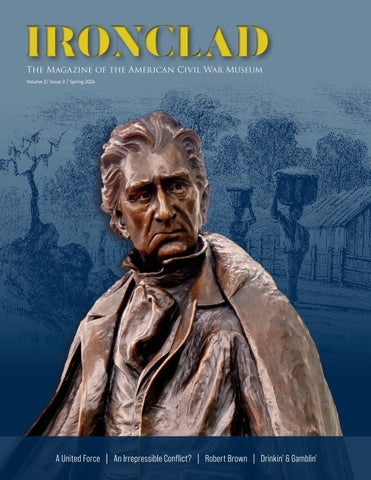
IRONCLAD The Magazine of the American Civil War Museum Volume 2/ Issue 3 / Spring 2024
A United Force | An Irrepressible Conflict? | Robert Brown | Drinkin' & Gamblin'
IRONCLAD Volume 2/ Issue 3/ Spring 2024
Features
3
19
A United Force
Iron Man
The Union's top military leaders
Robert Brown
9
25
An Irrepressible Conflict?
Drinkin' & Gamblin' and...
Secession warnings and debates
War-time liquor, money, and women
IMAGE: LIBRARY OF CONGRESS
1
From the CEO
COVER DESIGN : A statue of abolitionist William H. Seward by David and Judith Rubin, 2017. In the background, an engraving from 1854 depicting slaves carrying cotton. IMAGE SOURCES: ANCHORAGE DAILY NEWS & LIBRARY COMPANY OF PHILADELPHIA.
16
John L. Nau, III Collection
@acwmuseum
32 Shop: Featured Books ACWM.org
Magazine
FROM THE CEO
Publisher Rob Havers, Ph.D. ACWM President & CEO
Managing Editor Robert Hancock
Art Director/Designer John Dixon
Editorial Review Kelly Hancock Jeniffer Maloney
Museum Board of Directors Daniel G. Stoddard, Chair Claude P. Foster, Vice Chair Walter S. Robertson III, Treasurer Mario M. White, Secretary J. Gordon Beittenmiller Hans Binnendijk, Ph.D. Audrey P. Davis Sally Diggs Fletcher George C. Freeman III Stephen T. Gannon Hon. David C. Gompert Bruce C. Gottwald, Sr. Rob Havers, Ph.D. Richard S. Johnson Donald E. King John L. Nau III William R. Piper O. Randolph Rollins Kenneth P. Ruscio, Ph.D. Leigh Luter Schell Roderick G. Stanley Ruth Streeter Jeffrey L. Wilt
Foundation Board of Directors Jeffrey L. Wilt, Chair Hans Binnendijk, Ph.D. Rob Havers, Ph.D. Richard S. Johnson Donald E. King Walter S. Robertson III Kenneth P. Ruscio, Ph.D.
Ironclad magazine is published quarterly by The American Civil War Museum. 490 Tredegar St., Richmond, VA 23219 The contents of this magazine may not be reproduced in whole or in part without the consent of the American Civil War Museum.
PHOTO: JOHN DIXON
Dear Friends Greetings from the American Civil War Museum and welcome to the Spring issue of Ironclad magazine! A few highlights from this issue include articles by contributing authors, and ACWM Board members, Dr. Hans Binnendijk and the Hon. David Gompert with their fascinating piece on five Union military leaders and their contribution to winning the War. We are also delighted to include an article by Dr. Gary Gallagher entitled “An Irrepressible Conflict” that is reflective of the lecture he presented at this year’s ACWM annual symposium. Of particular interest in this Ironclad issue are images of a few of the many remarkable artifacts we recently received from the John Nau, III Collection. The objects entrusted to the museum by Mr. Nau, a member of the ACWM board of directors, are very significant to our institution as they expand our collection of artifacts that tell the Union side of the war and also show how we continue to grow the pool of threedimensional pieces to narrate more complex elements of the War. This is a particularly exciting time at the museum with the opening of our latest exhibition, The Impending Crisis, exploring the causes of the War from differing perspectives from across the nation in pre-civil war America. With generous funding from Altria and the Hearst Foundations, we are delighted to add this important element at our Tredegar site in Richmond. This exhibit continues our study of the causes, course, and consequences of the War as part of our “The Civil War and Remaking America” initiative. I am also pleased to say that the Greenback America exhibition, previously at Tredegar, is now open to visitors at our ACWM-Appomattox site. Visually stunning and artfully designed, this fascinating exhibit provides a study of the ways in which the nation’s monetary system was changed by the Civil War. Made possible with funding from the Mellon Foundation, and Jamerson Building Supply, Greenback America is not to be missed. Of course springtime at the museum is significant with the celebration of Civil War and Emancipation Day in Richmond at Tredegar, and Commemoration of the Surrender and Freedom Day at ACWM-Appomattox. Welcoming visitors from across the country to both events, April is always a special month for us and this year was no exception. As we near the close of the ACWM Spring Lecture Series, we have been delighted to present top scholars in the field of Civil War studies including Dr. Elizabeth Leonard and Dr. David Blight. We wrap up the Series with a lecture by Dr. Barton Meyers on May 30 at Tredegar. This publication provides an excellent opportunity to engage with our readers as we seek to provide interesting Civil War related content and to keep you informed about ACWM programming and exhibitions. Whether an artifact donation or an exhibit opening, we intend Ironclad to be an outstanding resource about the Civil War and the museum. If you know someone who would enjoy receiving the publication, please share the magazine and encourage them to become a member of the American Civil War Museum.
Dr. Rob Havers President & CEO T HE A MERICA N CIVIL WA R MUSEUM
1
FROM THE EDITOR The Civil War and Remaking America is the museum’s multi-year initiative, launched in 2023, presenting symposia, lectures, programs, and exhibits examining the cause, course, and consequences of the American Civil War. In this issue of Ironclad, we continue the practice of featuring articles penned by participants in our annual symposia, all leading scholars in the field of Civil War studies. The 2024 symposium, “The Impending Crisis,” held in February, featured discussions of the turbulent years leading up to
the outbreak of the war, exploring the political and social upheavals that came to a head with the secession of southern states from the Union and the firing on Fort Sumter.
Robert Hancock Managing Editor
NOW OPEN
THE
IMPENDING
CRISIS An exhibition exploring America on the verge of civil war.
2
I RONC L A D : Spring 202 4
A United Force The Union's Top Military Leaders by Hans Binnendijk & David Gompert
The quality of most importance among these leaders was strategic acuity.
As analysts of strategy, not scholars of history, we, the authors, are struck by the excellence of the Union’s top officers in the closing year of the American Civil War. With a common goal – to destroy the Confederacy, not merely defeat it – Ulysses Grant, William Sherman, Philip Sheridan, George Thomas, and David Farragut executed a coherent strategy to eliminate the South’s ability and will to fight. Each was battle-hardened, hand-picked, and played a crucial role. Each belongs in the pantheon of great American warriors. In hindsight, Union victory seems to have been inevitable, given the yawning gap between the North’s industrial and demographic might and the South’s declining resources. But it took superlative generalship to end the war so decisively and restore the Union. Even after its defeats at Gettysburg,
Vicksburg, and Chattanooga, the Confederacy was far from finished. Armies under Robert E. Lee and Joseph Johnston remained formidable. In early 1864, the Confederacy still had over 300,000 worn but highly capable veterans under arms versus about 550,000 Union troops, many of whom were recruits. Key Southern ports remained open. President Lincoln laid the foundation for victory by creating the position of lieutenant general and promoting Grant to it. Although Henry “Old Brains” Halleck was General-in-Chief of Union Armies from 1862 to 1864, he brought minimal combat experience, was essentially an administrator, and had no effective control over field operations. As intended by Lincoln, the promotion of Grant created genuine operational unity of command. continued on next page
Union commanders With compliments of the Travelers Insurance Company (detail), 1884. A photographic montage showing Abraham Lincoln (front center) surrounded by (l-r) Admiral David G. Farrugut, General William T. Sherman, General George Henry Thomas, General George Gordon Meade, General Ulysses S. Grant, General Joseph Hooker, General Philip Henry Sheridan, and General Winfield Scott Hancock. IMAGE: LIBRARY OF CONGRESS
T HE A MERICA N CIVIL WA R MUSEUM
3
continued from previous page
Grant in turn promoted fellow Ohioans William T. Sherman and Philip H. Sheridan to key commands. Along with Virginia-Unionists George Thomas and David Farragut, these are the officers who won the war. All four army generals were West Point graduates and had all fought together at Chattanooga. Sherman and Thomas were roommates at West Point while Grant was an underclassman. Farragut and Grant had together gained control of the Mississippi River. The quality of most importance among these leaders was strategic acuity. Warfighters and military experts know that while subordinates may excel operationally and tactically, the ability of top commanders to set, shape, and stitch together coherent strategies is paramount. Until Grant took charge and chose his chief subordinates, Lincoln was left to search for adequate generalship from a collection of expoliticians and flawed officers mainly
from the military-career bureaucracy. In 1864, he turned to proven strategists and fighters. Together these five men successfully executed the 1864 Valley Campaign, the Overland Campaign, Siege of Petersburg, the March to Atlanta and Savannah, the defense of Tennessee, and a key element of the Navy’s Anaconda Strategy. These campaigns broke the Confederacy. By virtue of their strategic acuity, the Northern commanders toward war’s end were superior to what was left of Confederate generalship, except for Lee and James Longstreet, both of whom were committed to combat in Virginia. During the first two and a-half years of the war, Confederate generals excelled, winning battles such as Chancellorsville with smaller forces using bold movements. By May 1864, however, Albert Sidney Johnston, Thomas “Stonewall” Jackson, and
J.E.B. Stuart had been slain. Lee lost ten of his best generals during the Gettysburg campaign alone. This left the likes of Joseph Johnston, Braxton Bragg, and John Bell Hood to oppose the Union’s new varsity team. Johnston was excessively defensive and fractious. Bragg caused rebellion among his chief lieutenants. Hood wasted his army with rash frontal assaults. On the Union side, earlier generals Irwin McDowell, John Pope, George McClellan, Ambrose Burnside, Joseph Hooker, Don Carlos Buell, and William Rosecrans were all removed or demoted by Lincoln. Time and again, those lackluster commanders missed strategic opportunities and were outfoxed or outflanked by Lee, Jackson, and Stuart. They tended to lose their nerve at critical moments, undermine subordinates, and feud with one another. Their removal made room for the crew of Union generals who won the war.
Gen. U.S. Grant (left) and officers on Lookout Mountain overlooking Chattanooga, TN in 1863. IMAGE: LIBRARY OF CONGRESS
4
I RONC L A D : Spring 202 4
Grant With his newly gained unity of command and prerogative to promote those in whom he had confidence, Grant authored and negotiated with authorities in Washington a strategy to end the war. He further refined that strategy with Sherman in a Cincinnati hotel room in March 1864. It was based on singularity of purpose, coordinated and continuous action across all theaters, and concentration of forces at key points. The main targets were Lee’s forces guarding Richmond and Johnston’s guarding Atlanta, with Farragut expected at last to take Mobile. Starting with about half of the Union Army on garrison duty, Grant pushed as many of those forces to the front line as possible.
Ulysses S. Grant
Grant had risen to direct all Union armies by virtue of what historian Shelby Foote called his “killer instinct,” earned by a string of victories in the West. His principal instrument in the East was the Army of the Potomac, which despite its victory at Gettysburg, had acquired a defeatist culture that Grant had to change. At least four attempts by that army to take Richmond had failed, and its commanders retreated after each. Grant helped
change this culture after the Wilderness Campaign by heading South towards Spotsylvania rather than falling back as previous commanders had done. While George Meade, victor at Gettysburg, retained command of the Army of the Potomac, Grant opted to accompany him on this “Overland Campaign” because of its critical importance. Grant provided Meade with memorable guidance: “Wherever Lee goes, there you will go also.” Grant’s priority was not to decapitate the Confederacy by occupying Richmond but to decimate Lee’s army by forcing it to protect Richmond. Grant was much criticized for inflicting and accepting massive casualties, but it worked. Lee’s casualties at the Wilderness, Spotsylvania, Cold Harbor, and the siege of Petersburg were about 35,000. Lee surrendered 28,000 men at Appomattox. Grant’s forces suffered some 55,000 casualties during this fighting, yet he had 110,000 soldiers by war’s end. Grant’s campaign was an unrelenting drive to exhaust the Army of Northern Virginia until Lee’s only option was complete submission “to the constitution and laws of the land.”
Sherman Grant’s closest confidant, Sherman, had served under Grant in Union victories at Shiloh, Vicksburg, and Chattanooga. At a time when Union generals constantly undercut each other politically, Grant and Sherman had each other’s backs. This was important to both, given Grant’s drinking and Sherman’s mood swings. Ordered by Grant to move against Johnston and take Atlanta, Sherman conducted a series of flanking movements that kept Johnston off balance and on the defensive.
William T. Sherman
Sherman embraced Grant’s notion of all-out war. He was less concerned with defeating Johnston, and then Hood, than with demolishing the Confederacy’s capacity to support its armies. By presenting Lincoln with the city of Atlanta in early September as “ours and fairly won,” Sherman swayed
political attitudes in the North, helped ensure Lincoln’s re-election, and removed the last hope of Confederate victory via the ballot box. After Atlanta, Sherman convinced Grant to let him abandon his vulnerable supply lines and live off of the land in his march to the sea. By the time they reached Savannah in December, Sherman’s army wrecked 300 miles of railroad; seized 20,000 head of horses, mules, and cattle; destroyed every cotton mill he found; and freed 25,000 slaves. And he had trapped Johnston’s new Confederate command between his army and Grant’s. continued on next page
IMAGES: LIBRARY OF CONGRESS T HE A MERICA N CIVIL WA R MUSEUM
5
continued from previous page
Sheridan “Little Phil” first demonstrated his killer instinct to Grant at Chattanooga when his division helped take Missionary Ridge without orders. Sherman considered him impulsive but a “deep thinker.” He began the war as a lieutenant and emerged a major general. Ordered East by Grant in April 1864, Sheridan commanded Meade’s cavalry with mixed results but importantly won the battle of Yellow Tavern (where Stuart was killed).
Philip H. Sheridan
In August, Sheridan became commander of the Army of the Shenandoah after its previous commander let Jubal Early slip through to attack Fort Stevens earlier that summer. It took Sheridan some three months to defeat Early, culminating in his historic ride from Winchester to the Cedar Creek battlefield to rally his troops to victory – another victory for Lincoln just prior to the election of 1864.
Sheridan’s scorched-earth policy in the Valley dramatically reduced the caloric intake of Lee’s army, leaving Confederate forces with little stomach to fight, physically and psychologically. After he annihilated Early’s army, he rushed to join Grant outside of Richmond, where he extended the Union left and helped force Lee to abandon Petersburg and Richmond. Sheridan used blocking movements at Five Forks and Sailor’s Creek to deny Lee a path southward to join with Johnston’s army, forcing a final battle at Appomattox. As with Grant’s other subordinates, Sheridan was given goals and left to determine how to accomplish them. Prussian General von Moltke said of Sheridan, “all the armies of Europe have adopted many lessons taught by him.”
Gen. Sherman (front, right) and staff in the trenches before the Battle of Atlanta, 1864. IMAGE: ACWM COLLECTION
6
I RONC L A D : Spring 202 4
George H. Thomas
Thomas
Farragut
George “Old Slow Trot” Thomas, whom Grant and Sherman found sluggish, was not so much an irresistible force as an immovable object – after all, he was the “Rock of Chickamauga.” Assigned the task of defending Tennessee against Hood’s approach, Thomas’ subordinates fought delaying actions at Spring Hill and Franklin, while Thomas assembled a dominant defense at Nashville. Grant had to prod the deliberate Thomas to fight Hood and signed an undelivered order removing him from command just before the decisive battle of Nashville. But Thomas designed and executed a decisive counter-offensive that soundly defeated Hood. That design was also subsequently studied as a model in European military schools. Thomas was right to be deliberate and to concentrate all available troops to meet Hood. What Grant really needed was an immovable object at Nashville. Thomas became the “Sledge of Nashville” and pursued Hood’s army until it disintegrated.
Unlike the others, Farragut was not a product of a military academy. Nor did he serve directly under Grant’s command. He went to sea at about age ten with his step-father, saw action in the War of 1812, fought pirates, and served on blockade duty in the Mexican American War. He became America’s first admiral. His accomplishments in capturing New Orleans in April 1862 and Mobile Bay in August of 1864 led historian James McPherson to conclude that Farragut should have equal status with Grant and Sherman in winning the war. Farragut entered Mobile Bay lashed to his mast so he could better observe the battle. Despite Confederate mining, he closed this vital Confederate port. Combined with Sherman’s capture of Atlanta and Sheridan’s triumph in the Shenandoah, Farragut’s victory in Mobile Bay assured Lincoln’s reelection in 1864. Farragut did more to implement the Union’s Anaconda strategy than any other single Union naval officer.
When Thomas decimated Hood’s army at Nashville in mid-December 1864, any threat that the Confederacy could regain the West vanished. Nashville was the Appomattox of the West. Historian Bruce Catton said of Thomas that “not a more dependable soldier for a moment of crisis existed on the North American continent” and later added Thomas was perhaps “the best [general] of them all.”
Admiral Farragut (right) and Captain Drayton on deck of U.S. frigate Hartford, c.1863. IMAGE: LIBRARY OF CONGRESS
David G. Farrugut
Grant and his team gripped the Confederacy in a tightening vise, trapped Lee, completed the “Anaconda” blockade, and demolished the South’s ability to make war. The campaigns to destroy the Confederacy succeeded because of the strategic acuity of Grant and his key officers. Historian John Keegan called Grant the “towering military genius of the Civil War,” using modern methods such as railroads and the telegraph to orchestrate his moves. Sherman called him the “greatest of us all,” and Confederate General Longstreet said Grant “eclipsed us all.” Of course, Grant could not have accomplished what he did without the team he led to victory and fame. Williamson Murray and Wayne Wei-siang Hsieh believe that Grant’s leadership “place him among the greatest generals in history.” Hans Binnendijk is the former Director of the Institute for National Security Studies at the National Defense University. David Gompert is on the faculty of the U.S. Naval Academy and former Acting Director of National Intelligence. Both are on the Board of Directors of the American Civil War Museum.
T HE A MERICA N CIVIL WA R MUSEUM
7
8
I RONC L A D : Spring 202 4
AN IRREPRESSIBLE CONFLICT by Gary W. Gallagher
The distinguished historian David M. Potter warned against “the fallacy of reading history backward.” Within the context of Civil War causation, this means beginning with knowledge that in 18601861 the nation split apart and fighting erupted and assuming the United States was destined to experience such armed conflict. This approach almost always obscures as much as it reveals and promotes a false sense of historical inevitability continued on next page
T HE A MERICA N CIVIL WA R MUSEUM
9
continued from previous page
Potter questioned whether Republican leaders in 1860 must have known war was possible. “The only reliable indices of the future,” he noted, “were the warnings of secession which came from Southern politicians, editors, and legislators.” In that regard, Republicans as well as Democrats had “long experience of Southern threats which had never led to action.” President James Buchanan remarked in 1856 that southern members of his Democratic Party “have so often cried ‘wolf,’… that it is difficult to make people believe it.” Three years later, a Republican congressman from Indiana somewhat humorously alluded to how “our Southern friends have dissolved the Union forty or fifty times.” Yet, landmark speeches in 1858 by Abraham Lincoln and William Henry Seward buttress the idea of an inevitable showdown. Lincoln argued that sectional agitation “will not cease, until a crisis shall have been reached, and passed. A house divided against itself cannot stand. I believe this government cannot endure, permanently half slave and half free.” Seward’s “Irrepressible Conflict” speech described “two radically different political systems—the one resting on the basis of servile or slave labor, the other on the basis of voluntary labor of freemen” and prophesied “an irrepressible conflict between opposing and enduring forces” that would yield “either entirely a slave-holding nation or entirely a free-labor nation.”
telegraph, demonstrated by Samuel F. B. Morse in May 1844, opened breathtaking possibilities. By 1861, Western Union’s lines connected the eastern seaboard and California. Railroads expanded exponentially from fewer than 3,000 miles of track in 1840 to more than 30,000 in 1860. The telegraph and trains allowed information, goods, and people to move much faster, increasing the pace of life and commerce in ways that left people somewhat flabbergasted.
President James Buchanan remarked that southern members of the Democratic party had "cried wolf" so many times regarding secession that it was difficult to believe them.
William Henry Seward's Irrepressible Conflict speech forecast an armed conflict where the country would become "either an entirely slaveholding nation or entirely a free-labor nation."
IMAGE: LIBRARY OF CONGRESS
IMAGE: ACWM COLLECTION
The graphic illustration overlays the 1854 map of the U.S.—highlighting the separation of free and slave states—with the broadside by the Charleston Mercury from December 20, 1860 announcing South Carolina's secession.
A second theme lay in explosive population growth that averaged more than 33 percent a decade between 1820, when Americans numbered 9,638,453, and 1860, when the total reached 31,443,321. Of the latter figure, more than four million were foreign-born and approximately 10 percent Catholic— substantial increases as percentages of the whole population due largely to German and Irish immigration. The contrast with major European nations is striking. Great Britain boasted double the population of the United States in 1830, but by 1860 the U.S. had surged ahead by more than 2 1/2 million residents.
ILLUSTRATION: JOHN DIXON/ACWM IMAGE SOURCES: LIBRARY OF CONGRESS & GILDER LEHRMAN COLLECTION
The pre-war decades also witnessed striking western expansion and
It is possible to identify interpretive themes between 1820 and 1860 not dominated by sectionalism. For example, these years witnessed a revolution in communications and transportation that dramatically shrank time and space. The PREVIOUS PAGE
10
I RONC L A D : Spring 202 4
settlement. In 1846, a treaty with Great Britain gave control of modern-day Oregon, Washington, Idaho, and farwestern Montana to the U.S. Two years later, the treaty of Guadalupe-Hidalgo, which ended the war with Mexico, added California, Arizona, Utah, Nevada, New Mexico west of the Rio Grande, and parts of Colorado and Wyoming. A final piece of territory came in 1854 with the Gadsden Purchase, which encompassed parts of southern Arizona and southwestern New Mexico. Meanwhile, population in the territories mushroomed. Washington increased roughly tenfold between 1850 and 1860, Utah and Oregon quadrupled, and New Mexico grew by 50 percent. These themes portray an expanding nation with an increasingly complex demographic and cultural make-up grappling with technological advances that heavily affected people’s daily lives. While interesting individually and collectively, it is important to realize that each theme also had a sectional dimension. The communications revolution meant that word of slaveryrelated strife in one part of the nation spread quickly and accelerated ill-feeling between North and South. Railroads also exacerbated sectional debates, most prominently about where to build a transcontinental route. In terms of demographics, population growth in the free states far outstripped that in the slaveholding states and fueled fears among white southerners. Between 1846 and 1859, the admission of Iowa, Wisconsin, California, Minnesota, and Oregon swelled the number of U.S. senators from free states with no prospect of new slaveholding states. Moreover, most immigrants in the 1850s settled in the North, which also possessed the overwhelming preponderance of the nation’s industrial, commercial, and financial strength. Only three of the nation’s 25 largest cities would be in the Confederacy, and states that remained in the Union possessed a white population four times that of those that seceded. continued on page 12
THE EXPANDING NATION: 1840s-1860s Southwest and Northwest Territories
A treaty with Great Britain in 1846 added territories of modern-day Oregon, Washington, Idaho, and western Montana to the U.S. In 1848 , the Mexican-American War ended with a treaty that added much of the southwest and California as U.S. territories. Additional southwestern territory was purchased in 1854. (Pictured) A photograph of the American Southwest (place unknown) with a train in the background and telegraph poles next to the railway. IMAGE: ACWM COLLECTION
Population & Immigration
Transportation
Communication
The population grew by 82% between 1840 and 1860 to over 31 million people, including more than 4 million immigrating from Ireland and Prussia. Most of the population growth was in free states.
By 1860 there was over 30,000 miles of track in the United States — a 10-fold increase from 1840.
Samuel Morse's telegraph invention was demonstrated at the U.S. Capitol in 1844, which led to federal funding—the first known example of a government supported project .
(Pictured) Patrick Cleburne immigrated from Ireland and settled in Arkansas. This photograph was made shortly after he arrived in the U.S. in 1849.
(Pictured) A section of rail from the Wilmington & Weldon Railroad. Completed in 1855, it was the longest railroad in the world with 161.5 miles of track. It ran from Wilmington, NC to Weldon, NC and connected with railroads to Portsmouth, VA and Petersburg, VA. The railroad played a key role in the Siege of Petersburg.
(Pictured) A pocket telegraph relay made and used by Lt. Painter of the CSA. It was able to send and receive messages at any point in the line.
IMAGES: ACWM COLLECTION T HE A MERICA N CIVIL WA R MUSEUM
11
continued from page 10
Sectional debates reached their most threatening intensity regarding slavery’s spread westward. In the late 1840s, many northerners supported a movement to reserve federal territories for free white families. A combination of former Whigs, abolitionists, and some Democrats formed the Free Soil Party in 1848, nominating former Democratic president Martin Van Buren as their standard-bearer and winning about 10 percent of the popular vote. Disruptive moments centered on slavery’s expansion mark well-known mileposts along the road of sectional friction—from the Missouri controversy of 1820 to the Wilmot Proviso of 1846 and the Compromise of 1850, the Kansas-Nebraska Act of 1854,
and the Dred Scott decision in 1857. The establishment of William Lloyd Garrison’s abolitionist newspaper The Liberator in 1831, Nat Turner’s rebellion in Southside Virginia that same year, publication of Harriett Beecher Stowe’s Uncle Tom’s Cabin in 1852, and splits among Baptists and Methodists in 1845 further buttress a portrait of the Union heading toward disintegration. The breakdown of the Second Party System signaled another dangerous development. Formed in the 1830s, it featured Democrats and Whigs. The Whig Party fell apart in the early 1850s, its southern and northern wings hopelessly at odds. Meanwhile, the Democratic Party became, in effect, a southern-dominated sectional party that
A political cartoon by Currier & Ives, 1860, depicts the Republican Party's turmoil over abolition. William Seward, who coined the phase "Irrepressible Conflict", is thrown out of the boat for his antislavery position. IMAGE: LIBRARY COMPANY OF PHILADELPHIA
12
I RONC L A D : Spring 202 4
elected to the presidency “doughfaces”— the derisive term for “northern men of southern principles” such as Franklin Pierce and James Buchanan. For many people in the free states, the Democratic Party served as a mere cat’s-paw for slaveholding oligarchs. The Republican Party, a purely sectional organization with no appeal in the South, first ran a presidential candidate in 1856 on a platform prohibiting slavery in the territories. Thus began the Third Party System of Democrats versus Republicans. At its national conventions at Charleston and Baltimore in 1860, the Democratic Party also foundered on the issue of slavery’s expansion, nominating Senator Stephan A. Douglas of Illinois as the “regular” Democratic nominee and
Vice President John C. Breckinridge of Kentucky as the southern Democratic nominee. This rupture left the country without a single true national party as voters went to the polls to elect a new president in 1860. What about the idea of two diverging civilizations trapped within a single republic? Powerful ties connected citizens across sectional lines. Political and cultural ligaments included a common language, a Protestant Christianity that claimed millions of adherents, and a shared history that celebrated the revolutionary generation’s achievements. Yet, northern Franklin Pierce, the 14th President, was one of the “Doughfaces”— northern men with southern principles. IMAGE: LIBRARY OF CONGRESS
and southern states indisputably developed in divergent ways that can be traced to the institution of slavery. By the mid-1850s, the free labor ideology had taken firm root across much of the North. Abraham Lincoln, himself a remarkable example of a poor man who achieved success, painted a picture in 1859 of how the “prudent, penniless beginner in the world, labors for wages awhile” but at length could hire “another new beginner to help him.” This was “free labor—the just and generous, and prosperous system, which opens the way for all—gives hope to all, and energy, and progress, and improvement of condition to all.” Many northerners believed the social and economic structures in the South mocked the democratic promise bequeathed by the founding generation. They claimed slaveholding oligarchs controlled the region, circumscribed opportunity for white residents, and thwarted economic improvement. As Senator Henry Wilson of Massachusetts put it, the institution of slavery created “a commanding power, ever sensitive, jealous, proscriptive, dominating, and
aggressive, which was recognized and fitly characterized as the Slave Power.” White residents in the South saw slavery as crucial to their social order. Only about one-quarter of white southern families owned slaves by 1860, but all white residents had a stake in slavery because it placed them in the region’s controlling class. For this reason, and because they feared what would happen should large numbers of enslaved people be freed, white southerners considered slavery necessary and generally beneficent and reacted defensively to criticism from the North. The image of a successful Black revolt in Haiti remained much on the minds of the white South throughout the first six decades of the 19th Century. Often overlooked in comparative discussions about the sections is that innumerable Americans believed there were significant differences. By the eve of the Civil War, many northerners saw the South as fundamentally shaped by the presence of slavery—a region of poorly educated, violent, lazy white people and a mass of enslaved continued on page 15
White residents in the South saw slavery as crucial to their social order.
Retreat Plantation cotton field on Port Royal Island, SC, c.1860s. IMAGE: STEREOGRAPH PHOTO. LIBRARY OF CONGRESS
T HE A MERICA N CIVIL WA R MUSEUM
13
The truth is, that though we are but one nation we are two peoples. We are a people of equality, and a people of inequality. – The New York Daily Tribune
Our manners, feelings and education is as if we were different Nations…that the Union of the States cannot exist harmoniously. – Stephen Dodson Ramseur
Scraps of the United States flag that flew over Fort Sumter when it was bombarded. IMAGES: ACWM COLLECTION
Interior of Fort Sumter after the bombardment in April 1861. IMAGE: ACWM COLLECTION
14
I RONC L A D : Spring 202 4
continued from page 13
Black drudges. For their part, white southerners characterized northerners as antagonistic and meddling, devoted to the worship of money above all else, and determined to undermine the South’s slavery-based social system. It mattered little whether a real chasm split the nation’s populace. The New York Daily Tribune put it well in 1856: “The truth is, that though we are but one nation we are two peoples. We are a people of equality, and a people of inequality… [W]henever a collision comes which brings out the peculiar characteristics of the two, they are seen to be as unlike as almost any two civilized nations on the face of the globe.” That same year, a young North Carolina cadet at West Point named Stephen Dodson Ramseur offered the white southern viewpoint. “Our manners, feelings & education is as if we were different Nations,” he wrote. Typical of many young people who tended to be less forgiving of those across the sectional divide than older Americans, Ramseur believed “that the Union of the States cannot exist harmoniously…” Certain things stand out clearly in late 1860 and early 1861. Abraham Lincoln’s election provoked just seven of the fifteen slaveholding states to secede—the Deep South, which contained less than a third of the region’s white population. As these states acted, Republicans castigated secessionists as enemies of the Union who menaced the accomplishments of the founding generation. But many northern Democrats, even if opposed to secession, deplored the idea of forced reunion. A British observer who met with a group
of prominent New York Democrats in March 1861, for example, recorded that “The feeling ag[ains]t the use of coercive means is very strong & general.” In early 1861, Upper South Unionists and northern leaders who hoped to dampen secessionist enthusiasm proposed a 13th Amendment to protect slavery, in perpetuity, wherever it already existed. The Corwin Amendment, so called because Republican congressman Thomas Corwin of Ohio introduced it in the House of Representatives, received the necessary votes in both chambers of Congress. By the end of May, Kentucky, Ohio, and Rhode Island had ratified the amendment, and Maryland and Illinois later followed suit. The outbreak of violence at Fort Sumter in April 1861, followed by the war’s first big battles at Manassas Junction in late July and Wilson’s Creek in early August, scuttled this effort to find a constitutional solution to the crisis. Violence proved to be the final factor in a six-month drama that illuminates how contingency figured in the outbreak of war. Shortly after Lincoln’s inauguration, events reached a climax at Fort Sumter in Charleston harbor. The fort’s garrison needed to be supplied, and Lincoln decided to send an unarmed vessel with provisions and hoped the slaveholding states that remained in the Union would be sympathetic. In the end, Confederates asked the fort’s commander to surrender before the relief ship arrived. He refused, and on April 12, the Confederates commenced a 36-hour bombardment that ended with the fort’s capitulation.
Representative Thomas Corwin of Ohio (R) introduced legislation to protect slavery in an effort to avoid war in early 1861.
On April 15, Lincoln issued a call for 75,000 90-day volunteers to suppress the rebellion. This sent four more slaveholding states out of the Union— Virginia, North Carolina, Tennessee, and Arkansas—and brought the total in the Confederacy to eleven. The other four—Missouri, Kentucky, Maryland, and Delaware—remained loyal, though all but Delaware included significant prosecession sentiment. People in the United States and the Confederacy understood they had reached a momentous point. “Never was known such excitement as was caused by Mr. Lincoln’s proclamation,” a woman in eastern North Carolina wrote: “The whole South flew to arms.” In Indiana, a diarist recorded his reaction to the news. “[T]he surrender of Ft. Sumter confirmed,” he began, “…North & South Both preparing for war—the South flushed with victory at the surrender & the [North] ready to resist the injury & disgrace of flag & country.” So was war inevitable? Sectional tensions related to slavery had been present since delegates had compromised while writing the Constitution in 1787. But secession was not inevitable in 1860-1861, and the departure of several states did not guarantee a civil war. Contingency provided the crucial element. Between April 1860 and June 1861, a sequence of political nominations, electoral outcomes, and individual presidential decisions and responses yielded a situation where eleven Confederate states squared off against the loyal states in what would become an all-encompassing military, political, and social conflict.
Gary Gallagher is the John L. Nau III Professor in the History of the American Civil War, Emeritus Prior Director, John L. Nau III Center for Civil War History
IMAGE: LIBRARY OF CONGRESS
T HE A MERICA N CIVIL WA R MUSEUM
15
John L. Nau, III Collection As a result of our partnership with the American Battlefield Trust, the American Civil War Museum (ACWM) has received important artifacts from the John L. Nau, III Collection. The Civil War era objects are entrusted into the museum’s care by Mr. Nau, a member of the ACWM board of directors. This impressive collection contains a variety of weapons, including a near pristine example of an Enfield rifle-musket manufactured in Birmingham, England, in 1862. Records do not show definitively whether it was employed by the Confederacy or the Union, but United States Army use is most likely. In addition, the uniform worn by Lt. John Gibson, 161st NY Infantry, is a particularly nice piece. Gibson was wounded in action in Louisiana in April of 1864. Also of interest is a magnificent Myriopticon made by Milton Bradley. A toy featuring a rolling panorama of 22 hand-colored Civil War scenes, it dates from 1866. These pieces in particular, and the collection in general, are very meaningful to our interpretative work as curators and historians. As you all know, we continue to work to expand our peerless collection. New items are donated to us almost daily. Loans, such as these from the Nau Collection, provide a way in which we broaden our ability to tell the story of the American Civil War. A first use of these items will be to embellish our permanent display, A People’s Contest.
Myriopticon by the Milton Bradley Company. IMAGES: ACWM COLLECTION
16
I RONC L A D : Spring 202 4
Uniform of Lt. John Gibson
Enfield rifle-musket
U.S. sword hilts
U.S. revolvers
With over 15,000 objects, our collection of Civil War era artifacts are our most important asset. We continue to grow our collection from donors across the country who entrust the American Civil War Museum to preserve these incredibly important elements to the story of Civil War history. The Museum’s state-of-the-art collections storage space at our Tredegar site houses the entirety of our collections, with the exception of some 500 objects on exhibit at Tredegar, and another 400 at our Appomattox site. At the American Civil War Museum, we pride ourselves on the incredible collection of Civil War-era artifacts in our care. Maintaining rigid standards to preserve these objects is our highest priority because we understand what is at stake. Unique pieces of our nation’s history, our collection is irreplaceable and each object represents an individual who bore witness to the remaking of America. From the swords and saddles of the iconic military leaders you know, to intricate carvings by soldiers at Libby Prison, the American Civil War Museum collection provides visitors with an up close experience through the historical objects that represent all facets of the Civil War. If you would like to help the American Civil War Museum continue to preserve our world-class collection of artifacts, become a member or donor. As a private, non-profit institution, any and all contributions make a big difference in our ability to continue our mission. Please visit our website www.acwm.org to learn more.
U.S. sword detail T HE A MERICA N CIVIL WA R MUSEUM
17
In the Collection
"The Landmark of Freedom"
Pamphlet, 1854. ACWM Collection: TRE2006.002.878 The printed speech "The Landmark of Freedom" by the Hon. Charles Sumner against the repeal of the Missouri prohibition of slavery, given in the United States Senate on February 21, 1854. Sumner represented Massachusetts in the United States Senate from 1851 until his death in 1874. A founding member of the Republican Party, he was an advocate for the abolition of slavery before and during the American Civil War.
18
I RONC L A D : Spring 202 4
N A M N IRO rown B t r e b o R
T HE A MERICA N CIVIL WA R MUSEUM
19
IRON MAN by Kelly Hancock
Robert Brown was one of the few enslaved people whom the Davises brought to Richmond when they moved into the gray mansion at the corner of 12th and Clay Streets in August 1861. Ironically, although much of his forty plus years had been spent in Mississippi, he was born in Virginia—Norfolk to be specific. And like so many others before and after him, he had been sold south. What thoughts crossed Brown’s mind as he returned to his native state? Did he wonder what had become of family members? Did he remember the plantation on which he was born? Brown, who could neither read nor write, left no direct record of his thoughts. We do not know exactly when Brown was born or how old he was when he was “sold down the river.” The most detailed information about Brown’s early life comes from two newspaper interviews that were printed about three years apart. In an article copied from the Daily Picayune and printed in Asheville, North Carolina’s Daily Citizen on December 17, 1889, Brown stated, “I don’t like to say how old I am, but I will tell you. I was born in 1811, just three years later than Mr. Davis.” However, when he was interviewed again in May, 1893, he told the New Orleans Daily Picayune, that he “must have been about ten years old during the great cholera epidemic in 1832.” The same article stated that Brown’s parents had belonged to Daniel Carey Barros.
20
I RONC L A D : Spring 202 4
Brown was purchased by Colonel George W. Martin of Mississippi sometime in the 1830s, but it was not until 1861 that Jefferson Davis bought him “before the first gun was fired.” Martin owned land in Grenada and Tallahatchie counties, enslaving around 50 individuals. When he died in 1854, he left his property to his children. A few years ago, a tenacious independent researcher, intent on locating Robert Brown’s final resting place, discovered a copy of Martin’s will. Interestingly, it contains a provision for his “body servant Robert.” Upon Martin’s passing, Robert was to be allowed to select three acres of land from the deceased’s holdings. On that property a house was to be built for Robert. The instructions were quite specific. The house was to be sixteen feet square with a gallery on each side running the full length. It was to have two doors and one window in addition to a “good brick chimney.” When Robert was no longer able to cultivate the three acres of land to support himself, he was to receive $50 a year. The will is an interesting document, but it raises some questions. Is the body servant Robert, referred to in the will, our Robert Brown? And if he is, why was he sold instead of provided with the promised home? One thing that points to it being Robert Brown is a July 3, 1932 article in the Richmond Times-Dispatch, discovered by the same researcher. The article featured an interview with Mrs. Stella McKnight Hoffa Lake, the granddaughter of George Martin. According to her, “When grandfather died, Robert, who had his own keys to the wine cellar, would imbibe too freely and would whip the other Negroes, which was not allowed. Mother gave him all of grandfather’s clothes and offered him $40 in gold, thirty acres of land and a mule, but he refused the offer, saying, ‘I never had any use for free Negroes and poor white trash.’” Although this account sounds farfetched, Jefferson Davis, himself, referenced Brown’s problem with alcohol and his relationship with Martin. In a letter, written in 1869 to his niece Mary Elizabeth Mitchell, he mentioned that she might be able to hire him as a servant but noted, “he has one fault, or failing, a fondness for drink; with that exception his capacity and faith are great for his race. He is expert as a driver and groom and never drank when he was travelling with me. He never seemed to have any fellowship with his own race, but was grateful & affectionate to his former owner as well as myself ” Mrs. Lake finished her account by saying that Brown asked to be sold to Jefferson Davis because “he liked Mr. Davis better than any of grandfather’s friends.” Nothing exists in the published Papers of Jefferson Davis to indicate a relationship with Colonel Martin, and since Mrs. Lake was only a one-year-old infant continued on next page
Robert Brown (standing) with the Davis' children and Joseph Davis, c 1865. IMAGE: ACWM COLLECTION
T HE A MERICA N CIVIL WA R MUSEUM
21
continued from previous page
at the time, she obviously had no direct knowledge of what happened. She was relying on what she had been told. Was this convenient story of Brown not wanting to own land as a free man created by the family to cover up the fact that he was sold against the provisions of the will? Whatever the case, Brown was purchased by Jefferson Davis and traveled with him to Montgomery, Alabama, the first capital of the Confederacy. According to the New Orleans Daily Picayune correspondent, “Brown spoke with pride of having served the first cabinet dinner of the new confederacy at Montgomery, Ala[bama.]” In the interview, Brown stated that “he was never butler, but that Mr. Davis always wanted him around while he was at table.” In addition to his table service, his special duty was to care for Davis’s horses. Interestingly, Brown seems to have had a close relationship with the Davis children. In the spring of 1862, when Varina refugeed to Raleigh, North Carolina, with the children, Brown accompanied them. After five-monthold Billy became ill, he stepped in to help. In a letter to Jefferson Davis, Varina described how Brown walked Billy “by the hour, so tenderly & never seemed tired.” She wrote, “but for him I don’t know what we would have done, with only Catherine and I to walk him. In later years, Brown kept a Christmas present made by Varina Anne, the youngest Davis child, “framed in his room” at Beauvoir.
…but for him I don ’t know wha t we wou ld have done … …he was too and brave… true
At the end of the war, after Jefferson Davis was imprisoned at Fort Monroe, Varina was sent to Savannah and placed under house arrest. Robert Brown accompanied her and the children there. Writing to her friend Francis Blair in June 1865, Varina explained, “Every art was used to persuade Robert off, but he was too true and brave a man to abandon women and children so desolate and oppressed as we were." Expanding upon this theme, in her Memoir, Varina used letters purportedly written to Dr. John Craven, Jefferson Davis’s physician at Fort Monroe, to describe how on at least two occasions Brown displayed his protectiveness of her and the children. When they first arrived in Savannah, a black waiter was rude to Varina. Brown waited until all the servants had gathered for dinner and then remarked that “he would hate to believe that there was a
22
I RONC L A D : Spring 202 4
— Varina Davis
colored man so low as to insult a distressed woman; but if so, though a peaceable man, he would whip the first who did so.”
war, he sought to bring about a peaceful solution by soliciting aid from European powers, and in 1864, he helped arrange the Niagara Peace Conference, in which Horace Greeley met with Confederate commissioners, James Holcombe, Jacob Thompson, and Clement Clay.
Worried about the tense situation in Savannah, Varina sent the children (except the baby Winne) to Canada along with her mother. Robert Brown served as their escort. While Robert Brown traveled with Jewett to Europe, on the way to Canada, someone made “abutelling Varina that he would come when called sive remarks before the children.” Brown confor. Judah Benjamin, one of Davis’s closest warfronted the man, asking “Then you tell me I time advisors, reported seeing Brown in London am your equal?” When the man agreed that he “dressed quite like a gentleman” but otherwise “certainly” was, Brown responded by saying, unchanged in his “quite respectful demeanor.” “Then, take this from your equal” and knocked However, Davis expressed concerns to Varina him down. Davis, writing to Varina about the that the “repute of Robert’s companion is not incident, noted, “That which seems in him to good” and noted that Robert’s European tour be bad temper is rather a spirit of independence, might “ruin him for your future service.” an uncourtly virtue but in time of trial a better reliance than submissive compliance.” By 1869, Robert Brown was back in the states living in New Orleans. According to the article Brown stayed with Varina’s mother and the chilin the Daily Picayune, he became a coachman dren until the fall of 1865. According to Mrs. to Mrs. Judge Fenner. Later, Brown joined the Howell, “[H]e was dutiful and they had an entirely Davises in Memphis. friendly time of it, but the idleness was doing him more harm than his presence was doing good.” In 1876, Jefferson began work on his memoirs and Perhaps for this reason, Brown took a position took up residence in a guest cottage at Beauvoir, with William C. Jewett. “Colorado” Jewett was a the estate of Mrs. Sarah Dorsey, a lifelong friend New Yorker, who had made his fortune out west of Varina’s. He brought Robert with him to act as and devoted himself to pacifism. During the his body servant, paying Mrs. Dorsey $50 a month. continued on next page
In the late 1860s, Robert traveled with William Jewett to England and Europe as a personal assistant. (right) Regent Street in London, England, c.1860s. IMAGE: ROYAL COLLECTION TRUST
T HE A MERICA N CIVIL WA R MUSEUM
23
continued from previous page
Eventually, Varina and, later, Winnie came to live at Beauvoir as well. When Mrs. Dorsey died in 1879, she left Jefferson Davis the property, and she even had a special bequest for Robert of $100. Additionally, she asked Robert Brown to care for her “Husband’s old saddle horse” and to watch over her “faithful Traveller.” At some point, Brown seems to have acquired his own place but continued to do work for the Davises. When Robert Brown was interviewed by the Picayune at the time of Davis’s death the correspondent reported, “His home is in St. Elmo, near Mobile, Ala., and he lives with Mr. Thomas Templeton, a Scotchman.” He was quoted as saying, “All my years have been pure, and I have nothing to be ashamed of. Mr. Templeton takes care of me, and he is a good man, too. My rheumatism troubles me a great deal and I can hardly stand now.” The last time Robert Brown appeared in the public record was when he attended Jefferson Davis’s reinterment ceremonies. Although he was not financially able to fund his own travel to Richmond, a committee provided transportation for him. At the time, he was still living at St. Elmo.
[An] iron m an for whom [Davis] entrusted his family. — Maggie Sto
e s sn
The date and place of Robert Brown’s death are unknown. He may have “died on his own place” as is noted on the back of the photograph (left) or, as one source indicates, at the home of Maggie Davis, Robert Brown, nd Jefferson Davis’s eldest IMAGE:ACWM COLLECTION daughter, and her husband in Colorado Springs, Colorado. Years after the war, Varina’s sister, Margaret Howell Stoessn wrote that Brown was Davis’s “iron man for whom he had a strong affection and to whom he entrusted his family.” Piecing together the scraps of information on Brown, a picture develops of a man who was both gentle and strong, high tempered, a bit of an outsider, loyal, dependable, and possibly dependent on alcohol. But the picture is obscured. In many ways it is like looking through a glass darkly. Kelly Hancock is the museum’s Director of Programs.
Robert lived at Beauvoir in Biloxi, MS, with the Davis' for a period of time after the war. IMAGE:LIBRARY OF CONGRESS 24
I RONC L A D : Spring 202 4
Drinkin’
&
Gamblin’
and…
T HE A MERICA N CIVIL WA R MUSEUM
25
Dr inkin’ & Ga mblin' a nd... by Robert Hancock
O
pen any big city newspaper during the war in a location where large numbers of soldiers were encamped, and you probably would have read something like this: Peter Allen…being in the city without leave, on Thursday evening got drunk, and amused himself by riding about Seventeenth Street, in a manner precarious to pedestrians. In the course of his ride, chancing to pass a blacksmith’s shop, where another cavalryman’s horse was being shod, he seized a sabre which was strapped to the cavalryman’s saddle, and made off up 17th street. [Provost] Officer Adam’s attention having been attracted to Allen’s pranks, he pursued him, and with the assistance of some citizens succeeded in capturing him… Allen fought and resisted so that it took four men to hold him, and it was found necessary to tie him and bring him to the watch-house in a cart. According to one Union officer, “Soldiers are not meant to be angels.” If you believe what you read in the papers, some soldiers were as far from being angels as heaven is from hell. Away from the restraints of mothers and wives, the young men in the army were left to their own devices. For many, this was their first time away from home and the temptations presented to them were just too great. “Few there are who have escaped the contagious effects of being mixed up with the vile and low,” wrote one Union soldier. “The bad are not reformed while the good are made bad.” Soldiers were inexorably drawn to whatever vices a locale had to offer. Take Richmond, the Confederate capital, for example. With a population of just under 38,000 at the start of the war (soon to swell to over 100,000), the city found itself overflowing with soldiers. There were no fewer than 88 licensed saloons and 24 restaurants with
26
I RONC L A D : Spring 202 4
Soliders of the 22nd New York State Militia play cards near Harpers Ferry, VA, in 1861. (Previous) Officers of 3rd and 4th Pennsylvania Cavalry share whiskey at Westover Landing, VA, in 1862. IMAGES: LIBRARY OF CONGRESS
attached drinking establishments. There were also 19 liquor and wine merchants, and most of the hotels had a gentleman’s saloon, serving up the latest cocktails, slings, smashes, and juleps. This does not count the number of unlicensed dealers in booze (and other entertainments) dotted across the city, who were more than ready to introduce the newly arrived soldiers to the local fleshpots. To take advantage of the increased customer base, merchants placed in the local papers advertisements targeted at soldiers, touting the goods they offered, specifically liquor and fine cigars. Other ads called particular attention to army sutlers who provided the men in uniform with all manner of creature comforts, including drink. If you couldn’t make it into town, obliging citizens would bring it to you—a very profitable business as soldiers, it seemed, were always thirsty. “Despite the industry of some of the Provost Marshal’s force,” wrote one Richmond editor, “drinking is indulged in here, if not by citizens by soldiers, to an extent that makes them unfit for the performance of their ordinary duty…Very often from this cause are rows produced and deeds of violence committed.” And it wasn’t just Richmond. In Alexandria, just outside Washington, D.C., “The streets were crowded with intoxicated soldiery; murder was of almost hourly occurrence, and disturbance, robbery and rioting were constant. Quiet citizens were afraid to venture into the streets, and life and property were at the mercy of the maddened mob.” The story was repeated in any place where soldiers with time on their hands could be found. Near Manassas, “[o]ne soldier shot continued on page 29
Gaming cups and dice. IMAGE: ACWM COLLECTION
T HE A MERICA N CIVIL WA R MUSEUM
27
(Above) Unidentified U.S. soldiers share a bottle of whiskey (left) and pose with cards (right). A sketch by Arthur Lumley of the interior of a sutler's tent, 1862. IMAGES: LIBRARY OF CONGRESS
28
I RONC L A D : Spring 202 4
continued from page 27
another…and caused his death. Both were drunk. Four men have been found dead here within the last twenty-four hours in consequence of drinking whiskey, large quantities of which were captured last night, and the trader in charge of it placed under arrest.” To try and curb the tide of drunkenness and the disorderly conduct that resulted, various forms of prohibitions on alcohol were introduced with the goal of keeping intoxicating beverages away from soldiers. U.S. Secretary of War Edwin Stanton, in a reply to a letter from the mayor of Washington, D.C., wrote that “The restrictions heretofore imposed upon liquor traffic in this city have been occasioned by military necessity, arising from the presence of large forces [of soldiers] and the improper practices of persons engaged in the trade.” Such prohibition efforts were of limited success.
Chuck-a-luck and faro banks are running night and day. Next to drinking, gambling was probably the greatest vice of the soldier. The old adage that whenever two or three soldiers gather together, a deck of cards makes its appearance, is barely an exaggeration. “Of all the evil in camp,” wrote T.C. Holliday, “gambling is the most pernicious.” Soldiers would bet on anything: horse or foot races, pugilism and wrestling, or any other athletic activity; cock fights, cockroach races, or who could belch the loudest. By far the most popular betting
pursuits were card and dice games: poker, faro, twenty-one, and craps. Some soldiers established regular gambling stations. As gambling was officially banned by the army, they would set up just outside camp. A South Carolinian noted that “One part of the forest was dubbed ‘chuck-a-luck woods.’” Chuck-a-Luck was a casino style game where the “house” (the soldier running the game) set up a board with squares labeled one through six. The board could be a piece of cloth with the numbers painted on, or the board was simply scratched into the dirt. Each player placed his bet on one of the numbers and the dealer then rolled three die. If the player’s number came up on one of the dice, he got his money back. If it showed up on two dice, he received double his money, the house having to pay out the other half. If, by chance, his number showed up on all three dice, he got triple his money back! Absolutely no skill or knowledge of the game was necessary. It is a game of pure luck that anyone could play. Of course, the odds always favored the house as he collected all the money that did not score—a lucrative trade until you got caught (or convinced the arresting officer to join in).
We have about forty women in the regiment, some of them make lots of money nature's way. Every army throughout all of history has had its share of “camp followers.” Some were wives of soldiers who assisted with daily chores such as laundry, or they sold extra food and drink and were often referred to by the French sobriquet of vivandiere or cantiniere. Sometimes the camp followers sold other things which were better left unmentioned in letters home. In the cities, and even in some of the smaller towns, such entertainment was fairly easy to find. In Richmond, Mary Driscoll was brought to court to answer the charge of selling liquor without a license and keeping a disorderly house (wink, wink). And she wasn’t the only one, not by a long shot. Richmond’s mayor, Joseph Mayo, often complained of the number of lewd women in the city, especially in Capitol Square across the street from City Hall. They physically pushed nice ladies out of the Square and commandeered all of the cabs to make their appointments. The manager of a home on Tenth Street used by convalescent soldiers and run by the YMCA, complained to Mayo’s office that the semi-dressed girls who paraded before the windows of the bawdy house across the street were distracting his continued on page 31
Scene on Almond St. Street scene in the red-light district of St. Louis, Missouri. WOOD ENGRAVING, 1878. IMAGE: MISSOURI HISTORY MUSEUM
T HE A MERICA N CIVIL WA R MUSEUM
29
Gambling and drinking related artifacts in the ACWM collection Playing cards from England imported through the Union's coastal blockade. A whiskey bottle and liquor chest of U.S. Gen. James Wilson. "Whist Party". A photograph of William W. Latham, William Gwinn, James R. Pruitt, and William L. Shaw from the 10th Mississippi Infantry. IMAGES: ACWM COLLECTION
30
I RONC L A D : Spring 202 4
continued from page 29
patients and “it was delaying their recovery.” According to the Richmond Dispatch, May 6,1862:
It seems that a resort for lewd females had been established opposite thereto [the YMCA], in rear of Duval’s drug store, and the managers of the hospital have complained to the provost marshal that the attention of the patients is very much diverted from their legitimate business of sickness by the antics cut up by the lascivious residents of the domicile alluded to. They disport themselves at the windows and doors in a half nude state, and in various other ways contribute to disgust the sober sided managers of the hospital. At City Point, Virginia, a young man working for the U.S. Sanitary Commission wrote to his father, “They have laid out a village to the east of where the railroad bends to the docks. There were parallel streets about four blocks each long. Each block there are about 10 structures on either side.” Some of the houses catered to officers, while others were for the enlisted men. He went on to write: “The average charge is $3 and on pay days some make as much as $250/$300.” He could give no further details as he, of course, did not frequent such establishments.
Some commanding officers did not want chaplains with the army. They believed that too much religion undermined discipline and made them more fearful of death. Nonetheless, the opposing armies were both convinced that God was on their side and would ultimately grant them victory. For most soldiers, their religious beliefs were more practical than patriotic. With a battle inevitable, the real possibility of death (and subsequent judgment) caused many drinking, gambling, cursing soldiers to rethink their priorities. The deck of cards in a breast pocket was, at least metaphorically, replaced with a bible. Afterwards, having survived the ordeal, most chose to once more alleviate their anxiety through various amusements, many of which were condemned by the Bible.
They which do such things shall not inherit the kingdom of God. – Galatians 5:21 Outrages against the common vices found in the army were many and manifested themselves largely in letters home which, of course, did nothing to curb the offenses of fellow soldiers. Even for those who spoke out, whether enlisted man or officer, it was like shouting into the wind. Many regiments had their own chaplain to minister to the men’s spiritual needs, though they, too, could succumb to earthly temptations. A soldier from Alabama wrote home: “You ought to hear your pious preacher curse. And you ought to see him bet on chuck-a-luck and farrer (faro or faro bank, a card game). Poor boy, I fear he is ‘forever fallen’ from his high state.” While many chaplains, whose presence was appreciated, performed their spiritual duties with competence, some were deemed more of a curse than a blessing. One Union chaplain stationed at a hospital had the demoralizing habit of sitting on the edge of a convalescing soldier’s bed, telling him he looked close to death and so should consequently prepare himself to die. For one patient, it was too much. He threw a plate at the clergyman and told him to go to the devil!
Sutler cart at Baileys Cross Roads [VA]. ALFRED WAUD. PENCIL, 1861. IMAGE: LIBRARY OF CONGRESS
Though a soldier was far more likely to die of some disease contracted in camp, it was the fear of death on the battlefield which caused him to turn to the Almighty for comfort. However, a soldier typically spent comparatively little time facing the enemy, so those fears tended to be short-lived. Though death in whatever guise was ever present, it was probably better not to think on it too much and follow the mantra of one soldier from Alabama who wrote: “We are all having a good time while the good times last.”
Robert Hancock is the museum’s Director of Collections and Senior Curator.
T HE A MERICA N CIVIL WA R MUSEUM
31
Featured Books Purchase these and other books online @ ACWM.ORG
Maladies of Empire: How Colonialism, Slavery, and War Transformed Medicine by Jim Downs Reexamining the foundations of modern medicine, Jim Downs shows that the study of infectious disease depended crucially on the unrecognized contributions of nonconsenting subjects―conscripted soldiers, enslaved people, and subjects of empire. Plantations, slave ships, and battlefields were the laboratories in which physicians came to understand the spread of disease. Military doctors learned about the importance of air quality by monitoring Africans confined to the bottom of slave ships. Statisticians charted cholera outbreaks by surveilling Muslims in British-dominated territories returning from their annual pilgrimage. The field hospitals of the Crimean War and the US Civil War were carefully observed experiments in disease transmission.
Paperback: 272 pages Member: $17.96; Retail: $19.95 Publisher: Belknap Press (2021)
SKU: 155304
The World Will Never See the Like: The Gettysburg Reunion of 1913 by John L. Hopkins The 1913 Gettysburg reunion is a story of 53,000 old comrades and former foes reunited, and of the tension, even half a century later, between competing narratives of reconciliation and remembrance. It was the largest gathering of Union and Confederate veterans ever held. For seven days, the old soldiers lived under canvas in stifling heat on a 280-acre encampment run by the U.S. Army. They swapped stories, debated still-simmering controversies about the battle, and fed tall tales to gullible reporters. On July 3, the aging survivors of Pickett’s Division and the Philadelphia Brigade shook hands across the wall on Cemetery Ridge in the reunion’s climactic documentation photo.
Hardcover: 208 pages Member: $29.66; Retail: $32.95 Publisher: Savas Beatie (2023)
32
I RONC L A D : Spring 202 4
SKU: 155287
Thunder in the Harbor: Fort Sumter and the Civil War by Richard W. Hatcher III The bombardment and surrender of Fort Sumter, in April 1861 was the start of the Civil War and only the beginning of the story. Both sides understood the military significance of the fort and the busy seaport, which played host to one of the longest and most complicated and fascinating campaigns of the entire Civil War. Richard Hatcher’s Thunder in the Harbor: Fort Sumter and the Civil War is the first modern study to document the fort from its origins, through the war, and up to its transfer to the National Park Service in 1948. Thunder in the Harbor fills a large gap in the historiography and underscores that there is still much to learn about our endlessly fascinating Civil War.
Hardcover: 256 pages Member: $29.66; Retail: $32.95 Publisher: Savas Beatie (2023)
SKU: 155303
Benjamin Franklin Butler: A Noisy, Fearless Life by Elizabeth D. Leonard Benjamin Franklin Butler was one of the most important and controversial military and political leaders of the Civil War and Reconstruction eras. Remembered for his uncompromising administration of the Federal occupation of New Orleans during the war, Butler reemerges in this lively narrative as a man whose journey took him from childhood destitution to wealth and profound influence. Leonard chronicles Butler's successful career in the law defending the rights of the Lowell Mill girls and other workers, his achievements as one of Abraham Lincoln's premier civilian generals, and his role in developing wartime policy in support of slavery's fugitives. Leonard also reveals how his limited understanding of racism and slavery transformed over time, leading him into a postwar role as one of the nation's foremost advocates for Black freedom and civil rights.
Paperback: 392 pages Member: $32.40; Retail: $36.00 Publisher: The University of North Carolina Press (2022)
SKU: 154528
Featured Books Purchase these and other books online @ ACWM.ORG
Soldier of Destiny: Slavery, Secession, and the Redemption of Ulysses S. Grant by John Reeves
Calamity at Frederick: Robert E. Lee, Special Orders No. 191, and Confederate Misfortune on the Road to Antietam
Captain Ulysses S. Grant, an obscure army officer in 1854, rose to become general-in-chief of the United States Army in 1864. Was it destiny or was he just an ordinary man, opportunistically benefiting from the turmoil of the Civil War? Soldier of Destiny reveals that Grant always possessed the latent abilities of a skilled commander— developing these skills out West at the beginning of the Civil War. Grant went from being ambivalent about slavery to becoming one of the leading advocates for emancipation. Grant’s life story is an almost inconceivable tale of redemption within the context of his fraught relationships with his antislavery father and his wife's slaveholding family. This narrative explores the poverty, inequality, and extraordinary vitality of the American West during a crucial time in our nation’s history.
In this meticulous study, Alexander Rossino presents a bold new interpretation of the evidence surrounding the Lee's Special Orders’ creation, distribution, and loss outside Frederick, Maryland, in September 1862. Rossino makes extensive use of primary sources to explore these subjects and other important questions related to the orders, including why Lee thought his army could operate north of the Potomac until winter; what Lee hoped to accomplish after capturing Harpers Ferry; where Corporal Barton Mitchell of the 27th Indiana found the Lost Orders; and if D. H. Hill or someone else was to blame for losing the orders. The result is a well-documented reassessment that sheds new light while challenging long-held assumptions
Hardcover: 304 pages Member: $26.96; Retail: $29.95 Publisher: Pegasus Books (2023)
Paperback: 168 pages Member: $17.06; Retail: $18.95 Publisher: Savas Beatie (2023)
SKU: 155266
Longstreet: The Confederate General Who Defied the South by Elizabeth Varon It was the most remarkable political about-face in American history. Longstreet is an authoritative biography of the controversial Confederate general, who later embraced Reconstruction and became an outcast in the South. He was alongside Lee at Gettysburg, won a major Confederate victory at Chickamauga and was seriously wounded during a later battle. After the war, he moved to New Orleans where he supported Black voting and joined the newly elected, integrated postwar government in Louisiana. Southerners branded him a race traitor and blamed him retroactively for the South’s defeat. Longstreet is the first biography in decades and the first to give proper attention to Longstreet’s long post-Civil War career.
Hardcover: 480 pages Member: $31.50; Retail: $35.00 Publisher: Simon & Schuster (2023)
SKU: 155265
by Alexander B. Rossino
SKU: 155286
Contrasts in Command: The Battle of Fair Oaks, May 31 June 1, 1862 by Victor Vignola The bloody two-day battle was fought on the doorstep of the Confederate capital. It was the first major combat in the Eastern Theater since Bull Run/ Manassas almost a year earlier, left more than 11,000 casualties in its wake, and cost the primary Southern field army its commander. The possession of Richmond hung in its balance. Yet, almost nothing has been written about Seven Pines/Fair Oaks. Victor Vignola’s Contrasts in Command focuses primarily on the Fair Oaks portion of the battle, is a major contribution to the historiography of the war.
Hardcover: 288 pages Member: $31.46; Retail: $34.95 Publisher: Savas Beatie (2023)
SKU: 155285
T HE A MERICA N CIVIL WA R MUSEUM
33
NON-PROFIT ORG. U.S. POSTAGE PAID RICHMOND, VA PERMIT NO. 2399
490 Tredegar St., Richmond, VA 23219
EXHIBIT NOW OPEN !
THE
IMPENDING
CRISIS An exhibition that explores America on the verge of civil war.