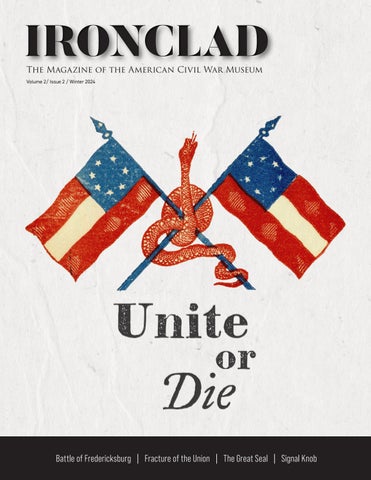
The Magazine of the American Civil War Museum Volume 2/ Issue 2 / Winter 2024
Unite or Die Battle of Fredericksburg | Fracture of the Union | The Great Seal | Signal Knob
IRONCLAD Volume 2/ Issue 2/ Winter 2024
Features
3
19
The Battle for Fredericksburg
The Great Seal of the Confederacy
A city and its people caught in the middle
The long journey of its creation and its short life
9
25
Fracture of the Union
Signal Knob
Southern public meetings set the tone for Secession
A geographical advantage
COVER DESIGN : The snake and motto, Unite or Die, were adopted from the American Revolution and reused by the Confederates. The flag is the Confederate First National Pattern designed in 1861.
1
From the CEO
16
A sketch by Edwin Forbes of Massanutten Mountain with Signal Knob on the far right. c.1862. IMAGE: LIBRARY OF CONGRESS
State of the Museum
@acwmuseum
acwm.org
32 Shop: Featured Books
Magazine
FROM THE CEO
Publisher Rob Havers, Ph.D. ACWM President & CEO
Managing Editor Robert Hancock
Art Director/Designer John Dixon
Editorial Review Kelly Hancock Jeniffer Maloney
Museum Board of Directors Daniel G. Stoddard, Chair Claude P. Foster, Vice Chair Walter S. Robertson III, Treasurer Mario M. White, Secretary J. Gordon Beittenmiller Hans Binnendijk, Ph.D. Audrey P. Davis Sally Diggs Fletcher George C. Freeman III Stephen T. Gannon Hon. David C. Gompert Bruce C. Gottwald, Sr. Rob Havers, Ph.D. Richard S. Johnson Donald E. King John L. Nau III William R. Piper O. Randolph Rollins Kenneth P. Ruscio, Ph.D. Leigh Luter Schell Roderick G. Stanley Ruth Streeter Jeffrey L. Wilt
PHOTO: JOHN DIXON
Dear Friends Welcome to the Winter issue of Ironclad magazine! As we all know, the Civil War re-made this nation. The country that entered the war in 1861 was radically different to the one that emerged in 1865. In that new country we can see ourselves, today. It is this transformation that we examine in our ‘Civil War and Remaking of America’ initiative where, over three plus years, we explore the causes, course, and consequences of the war. By the time you receive this edition of Ironclad, we will have just finished holding our annual symposium. Thank you to all who attended in-person and virtually. In addition to the stellar line-up of speakers, this year’s symposium offered a special program featuring conversations with the curatorial team behind our new exhibit, The Impending Crisis. This exhibit will bring the causes of the war to life in a dynamic and engaging fashion. We look forward to opening this exhibition in the spring, and I look forward to seeing you at Tredegar. Stay tuned to our website, acwm.org, for special events surrounding The Impending Crisis. We are also delighted to announce that the exhibition, Greenback America—funded by the Mellon Foundation and previously on display at Tredegar—will debut at ACWMAppomattox in the early spring. More details will be available soon on precise opening timings for both exhibitions. This edition of Ironclad is another tremendous edition, and I hope you enjoy it! Please think of those you know who would enjoy receiving Ironclad. Share the magazine and encourage them to become a member of the American Civil War Museum.
Foundation Board of Directors Jeffrey L. Wilt, Chair Hans Binnendijk, Ph.D. Rob Havers, Ph.D. Richard S. Johnson Donald E. King Walter S. Robertson III Kenneth P. Ruscio, Ph.D.
Dr. Rob Havers President & CEO
Ironclad magazine is published quarterly by The American Civil War Museum. 490 Tredegar St., Richmond, VA 23219 The contents of this magazine may not be reproduced in whole or in part without the consent of the American Civil War Museum.
T HE A MERICA N CIVIL WA R MUSEUM
1
I shall never forget to the day of my death – Jane Beale
2
I RONC L A D : W inter 202 4
When the War Came to Fredericksburg by Robert Hancock
Some families have very long memories. I remember being told of the time when the “Yankees” came and pillaged the town. They made it seem like recent history, not something that had happened more than a hundred years ago. As a child, I wondered if the Yankees might come back some day and do it again! Growing up in Fredericksburg, Virginia, a small tourist destination and college town along Interstate 95, we were used to visitors, and southern hospitality (less of a cliché than some might think) tended to hold sway regardless of where you were from.
Fredericksburg from the river. Showing Confederate troops and bridge. MATTHEW BRADY, C. 1862 IMAGE: NATIONAL ARCHIVES AND RECORD ADMINISTRATION
Today, Fredericksburg is still a college town and a bedroom community for commuters to Northern Virginia with a vibrant downtown of antique stores, coffee houses, and boutique shops. However, there are still plenty of families living there that can trace their roots back to the Civil War and before. All of them can no doubt recount (with varying degrees of historical accuracy), the day the Yankees showed up. continued on next page
T HE A MERICA N CIVIL WA R MUSEUM
3
continued from previous page
In 1862, Fredericksburg was a dirty little town of some 5,000 inhabitants on the banks of the Rappahannock doing a lively trade in goods coming in by railroad or floating up the river. Its history was strongly tied to the American Revolution. Founded in 1727, it had been the boyhood home of George Washington. It was where he [allegedly] threw the silver dollar across the river, (not the Potomac as it is often told) which used to be commemorated every year by the Boy Scouts trying to replicate the feat with a metal slug. George Washington’s mother, Mary Ball Washington, lived there, as did his sister. John Paul Jones had a house in town. James Monroe had his law offices there, and Hugh Mercer practiced medicine and ran an apothecary shop. So, when Virginia seceded from the Union in 1861, many men in the town and surrounding counties, brimming over with revolutionary fervor, rushed to enlist in the Confederate army. Many saw the impending conflict as a second revolution, and they sought to follow in the footsteps of the founding fathers, George Washington being the most obvious. Fredericksburg occupied the unenviable position of being almost exactly between the warring capitals, Washington and Richmond, and a hub on the Richmond, Fredericksburg, and Potomac Railroad, with a navigable river connecting it to the Chesapeake Bay. Militarily, it was an important crossroads on the way to Richmond or to Washington depending on which army you were in. For the inhabitants, life, for the most part, went on as usual, barring the occasional appearance of a band of Federals showing up to keep an eye on the locals and the arrest of certain noisy Confederate sympathizers. Every now and again, a fight would break out between the “visiting” Yankees and a few Confederates and a bold civilian or two, but these could hardly be called even a skirmish. All that changed in late November of 1862. After a year and a half of failing to bring the Confederates to heel, Lincoln was on his fourth army commander (after McDowell, Pope, and McClellan) when the impressively bewhiskered Ambrose Burnside showed up with his Army of the Potomac across the river from Fredericksburg. Burnside had managed to steal a march on the Confederates, camped around Culpeper and as far west as the Shenandoah Valley, Gen. Ambose Burnside and was poised to cross over the IMAGE: LIBRARY OF CONGRESS Rappahannock River and march due south to Richmond, the Confederate capital. Lincoln could not have been more pleased. Perhaps he had, at last, found a general who would take the fight to the Confederates.
4
I RONC L A D : W inter 202 4
The best laid plans However, having arrived at his destination with no opposition in sight, Burnside hesitated. The Rappahannock was too high to ford and the pontoon bridges had not arrived yet, delayed by bad weather and bureaucratic red tape. Three weeks passed, giving the Confederates time to make their way to Fredericksburg, thus blocking the road to Richmond. While the Union army waited for the bridging equipment, the Confederates spent the time bringing in reinforcements and fortifying their position. With Lee’s army stationed on the heights overlooking the town on one side and the Union army across the river on the other, the townspeople found themselves between the preverbal rock and a hard place. Some refused to leave their homes and chose to wait out the storm. Most packed what they could carry and left to stay with family and friends or camp in the nearby woods. The Confederates sent wagons and ambulances to help with the evacuation. The pontoon bridges finally arrived and work began on spanning the river in three places. Late at night on December 10, the engineers manhandled their pontoon boats and other necessities down to the river. They worked as quietly as possible, so as not to alert the Confederate pickets to their actions. It was cold, and the fog that settled on the river helped conceal their movements. The whole operation was to take half a day, then the army would cross the river and make themselves ready to do battle. However, you cannot build a bridge without making some noise, and soon the Confederates realized what they were up to. The element of surprise gone, the engineers worked as quickly as possible to get the bridges completed. continued on page 6
I t is strange how constantly we fall short in our endeavors at the very moment when we might succeed. – Lt. Josiah Favill, 57th New York Infantry
Gen. Ambose Burnside and staff IMAGE: LIBRARY OF CONGRESS
Above: Plan of the Battle of Fredericksburg, Va., Decr. 13, 1862. ROBERT KNOX SNEDEN, C. 1862 PEN-AND-INK AND WATERCOLOR IMAGE: LIBRARY OF CONGRESS
Below: View of Fredericksburg from the Union side of the river showing the commanding heights beyond the town where the Confederates established their defensive line. TIMOTHY O’SULLIVAN, C.1862 IMAGE: LIBRARY OF CONGRESS
T HE A MERICA N CIVIL WA R MUSEUM
5
continued from page 4
On the lower, or southern end, the work progressed steadily. The Confederate side was only lightly defended near the river, and Union artillery dominated the open ground opposite the bridge. At the crossings farther up, it was a different story. Brigadier General William Barksdale’s Mississippians, stationed in the town, were not going to just sit there and watch. From behind houses and fences and from second floor windows, the Confederates fired on the bridge-builders with impunity. Exposed as they were in the middle of the river, lashing pontoon boats together and laying down plank decking, the engineers dropped one by one from the constant fire from the opposite shore. Casualties mounted, and they had to abandon their work, leaving the bridges barely half finished. The Union response was to bombard the town. Every available cannon was trained on the city. A Union soldier recalled: “It was a great amusement to us to watch a solid shot tear through a building, beat down a wall, topple over a chimney or root out a nest of sharpshooters.”
The agony and terror of the next four hours, [it] is burnt in on my memory as with hot iron. I could not pray, but only cry for mercy. – Jane Beale
For those civilians still in town, huddled in basements or anywhere else that might afford some protection, it was anything but amusing. “I shall never forget to the day of my death,’ wrote Jane Beale, “the agony and terror of the next four hours, [it] is burnt in on my memory as with hot iron. I could not pray, but only cry for mercy.” When the artillery had completed its work, the engineers headed out onto the half-finished bridges, only to have the Confederates emerge from their hiding places to shoot them down. This cycle continued until someone came up with the idea to send men across on boats to secure a bridgehead on the other side and drive out the Confederate marksmen. They had to fight from house to house, street to street, and casualties were high, but they finally managed to dislodge the Confederates from the town. Work on the bridges recommenced.
Delight in destruction The crossing having been so hotly contested, the Union troops now took their frustrations out on the city. As they poured across the river, a wholesale ransacking took place. Officers, even if they had wanted to, would have been unable to stop it, and most eventually just ignored their men’s pillaging or shrugged their shoulders and joined in. Furniture was thrown out onto the streets; soldiers rummaged through bureaus and cabinets, tossing aside anything they couldn’t eat or carry off to be trampled underfoot; they smashed mirrors
Alfred Waud's sketch of U.S. engineers laying the pontoon bridges under fire. IMAGE: LIBRARY OF CONGRESS
6
I RONC L A D : W inter 202 4
and slashed portraits. “The soldiers seemed to delight in defeat. Without going into the gory details, it was an destroying everything,” wrote Maj. Francis Pierce of the 108th unmitigated disaster for the Union. Every attempt to break New York. It did not take the soldiers long to sniff out the through the Confederate defenses was a costly failure. stores of wine and liquor, and what the soldiers didn’t drink they poured into the streets. Strong drink only fueled the Few eyewitnesses of the battle failed to comment on the debauchery, creating an almost surreal carnival atmosphere. carnage left in the aftermath. In the area of most destructive In the flickering light from burning houses, looters rifled carnage, more than 8,000 bodies were piled one on top of through clothes presses and trunks and another in the open plain between the strutted through the streets in every town and the stone wall at the base of The soldiers seemed to delight manner of getup. Men who just hours Marye’s Heights. In total, the Army of before had been fighting their way the Potomac lost 12,653 men either in destroying everything. through the town, now strolled along killed, wounded, captured, or missing. – Maj. Francis Pierce, 108th NY wearing hoopskirts and shawls over their uniforms, tall beaver hats in place of forage caps, and shouldering parasols instead of muskets.
Some complained of their fellow soldiers’ behavior, but most were swept up in the bacchanalian frenzy of excess. News quickly travelled up the chain of command, but there was nothing to be done. One general quipped: “Soldiers are not meant to be angels.” Soldiers pulled wooden siding from the houses and broke up furniture to be used for firewood, and as the night wore on, they slowly settled down amongst the ruins. The next morning, December 13th, battle was joined. The men shook off the previous day’s revelry and formed ranks. Muddled orders, miscommunication, inaccurate maps, and well-prepared Confederate defenses all ensured Burnside’s
For those residents who returned after the battle, nothing could have prepared them for what they saw. Hardly a building was left unscathed, some totally destroyed. Debris from the battle and the previous day’s ransacking littered the streets: rifles and cartridge boxes and bits of uniforms, a cap, a shoe, a child’s toy, broken furniture. Crockery and glass crunched underfoot. The dead lay in the streets or had been hastily buried in back yards and gardens. There was no food. The only clothes were those on their backs. They would not soon forget the devastation wrought on their little town. The memories of Fredericksburg faded more quickly for those who had fought in blue uniforms and survived. They had more continued on next page
Unpublished sketch by Author Lumley of Union soldiers looting Fredericksburg. On the back, the artist scribbled his impression of soldiers’ conduct and thought it “a disgrace to the Union army.” IMAGE: LIBRARY OF CONGRESS
T HE A MERICA N CIVIL WA R MUSEUM
7
continued from previous page
battles to fight, soldiering on until they, too, became casualties or their enlistment ran out and they went home and tried to forget about it. Those who had been badly wounded during the battle were constantly reminded of that fateful day, but their pain and suffering was seldom exhibited for public view, and their memories died with them. In the history books, the battle at Fredericksburg, like all battles, is remembered and refought with little blue and red lines on a map. The blue lines of soldiers who marched shoulder to shoulder across the open field between the town and the distant heights was no abstract representation on a map. For them, the mud was real. The smoke was real. The bullets and exploding artillery shells were all too real. Certainly, the fear was real. The dead buried on Marye’s Heights are real. It somehow seems appropriately ironic that a national cemetery for Union soldiers killed at Fredericksburg was planted on the very hill they tried in vain to take. On Marye’s Heights, rows of white stone grave markers attest to the fruitless sacrifice made in a battle that did nothing to further the Union cause or enhance the army’s prestige. It took many years for the town to rebuild itself. The scars of the battle are mostly all gone now, save for the occasional souvenir bullet hole now protected by a bit of Plexiglas for posterity. Yes, some families have long memories, reinforcing the fact that the Civil War really wasn’t all that long ago.
Published in Harper’s Weekly, the figure of Columbia points an accusing finger at Lincoln and a cringing Secretary of War, Edwin Stanton, and demands: “Where are my 15,000 sons—murdered at Fredericksburg?” IMAGE: LIBRARY OF CONGRESS
Robert Hancock is the museum’s Director of Collections and Senior Curator. He was born in and grew up in Fredericksburg.
Destroyed buildings in Fredericksburg after the battle. IMAGE: LIBRARY OF CONGRESS
8
I RONC L A D : W inter 202 4
Fracture of the
Union
by Chris Graham
On November 12, 1860, just six days after American voters
elected Abraham Lincoln to the presidency, citizens of Selma, Alabama, met “to take into consideration of the affairs of the country.” These Alabamians, all white men, performed a political ritual common to the United States: public meetings to discuss problems and recommend solutions. This time, they did so with urgency. Secessionists had been threatening to leave the Union for a decade. Now, South Carolina had acted, and the threat become a reality. In Selma, Nathaniel Dawson proposed, “that as the whole South are equally interested in the great questions now presented by the election of Abraham Lincoln to the Presidency…the interests of all require that there should be union and cooperation with the great body of the Southern and slave-holding States of the Union in the final decision we may come to.” In short, they had to decide what to do. White citizens of Selma did not act alone. Scores, if not hundreds of these public meetings convened across the slaveholding states. The meeting minutes, published in newspapers, give us a wonderful opportunity to let these historical actors—the men who became the rank and file of the Confederate Army and government—explain themselves. They offered a range of options about courses of action. continued on next page
Nathaniel Dawson served as a captain in the 4th Alabama Infantry. IMAGE: ALABAMA DEPARTMENT OF ARCHIVES AND HISTORY
Detail of a political illustration advocating for slave holding states to join together with South Carolina as the leader. c 1860. IMAGE: ACWM COLLECTION
T HE A MERICA N CIVIL WA R MUSEUM
9
continued from previous page
Yet, they all maintained a remarkable consistency about the problem they faced: Lincoln, heading a party proven to be hostile to slavery, now held the reins of power in the Federal Government. That fact alone represented not just a threat to slavery but to the safety of white southerners in the Union and even in their own homes. As the meeting minutes tell us what participants considered to be at stake, they anticipated our own common questions about what motivated ordinary white southerners to support secession, and they tell us how slavery shaped their conceptions of themselves as citizens and their place in the Union.
We know that slavery caused the Civil War. Prominent men proclaimed this. Alexander Stephens said in his Cornerstone Speech: “Our new government[‘s]…foundations are laid, its corner-stone rests, upon the great truth that the negro is not equal to the white man; that subordination to the superior race is his natural and normal condition. This, our new government, is the first, in the history of the world, based on this great physical, philosophical, and moral truth.” Secession conventions established slavery’s centrality to their cause. Mississippi’s noted that “Our position is thoroughly identified with the institution of slavery—the greatest material interest in the world.” These are clear declarative statements, but they do not—on their own—reveal the reasoning that motivated ordinary men to act.
What did White southerners mean when they appealed to the Constitution, or to States’ Rights? “…the sectional election of Lincoln and Hamlin…show a determination on the part of the masses of the Northern people to crush out the constitutional rights of the South.” – St. Landry Parish, Louisiana, December 1, 1860.
10
I RONC L A D : W inter 202 4
Alexander Stephens A.A. TURNER, N.D. IMAGE:ACWM COLLECTION
Augustus Talbot, a 48 year old attorney in Plaquemine Parish, Louisiana, and the principal author of resolutions there, told the audience at his public meeting of white men that “the declaration has gone forth that you are an inferior race…It has been settled by ballot to the satisfaction of the Black Republicans, that upon the triumph of their “higher-law” doctrine, it became their imperative duty to civilize Southern barbarism,” he sarcastically sneered before becoming deadly serious. “[I]n other words, to wipe out the institution of slavery from the land, beggar you, and make you their vassals.” Republicans considered—according to Talbot—all slave state citizens unequal members of the Union because slavery existed there.
Broadside produced in Boston warning Colored People to avoid the police as they may be kidnapped or captured. C. 1851 IMAGE:LIBRARY OF CONGRESS
Talbot did not simply imagine a future. He turned to the recent past for tangible evidence to prove his point. By citing the “higherlaw doctrine,” Talbot referred to New York Senator William Seward’s 1850 declaration that his constituents cared not for the Constitutional protection of slavery but instead held their religious ethics—ethics that white southerners regarded as religious heresies— more closely than their love for the Union. Talbot queried, “Do such gentlemen know how the constitution has been violated by that part of the North—how many of its States have made it a crime for a citizen to aid in the execution of the Fugitive Slave Law? How that party has excluded your property in the territories?—that its settled policy is to admit no more slave States?” References to northerners’ alleged disregard for the Constitution and ongoing efforts to subvert the Fugitive Slave Act reflected themes seen in the vast majority of these public meetings. Indeed, free state violations of the Fugitive Slave Act became the singular focus of white southerners, who wrapped the language of constitutional rights with a very specific aspect of slavery. Passed as part of the Compromise of 1850, the Fugitive Slave Act reinforced the original Constitutional provision allowing for the return of freedom seekers. The Law of 1850 extended earlier legislation by mandating that all Americans—including private citizens and state officers—aid in the recapture and return of fugitives from slavery. In response, several free state legislatures passed “personal liberty laws” that absolved citizens from participation in what slaveholders regarded as their Constitutionally protected rights—the rights to recover property. The public meeting in Madison County, Mississippi, was clear when it resolved that “the nullification, by the people of the nonslaveholding States, of provisions of the Federal Constitution for the rendition of fugitive slaves,” had been the primary point of sectional tension and a preview of the Republican administration’s intentions toward white southerners’ constitutional rights. So when citizens like those in Clarksville, Tennessee, claimed that when “some of the States, disregarding the obligations imposed on them by the Constitution have in effect nullified the acts of Congress… materially affecting the value of that kind of property in certain portions of the Southern States,” they shed any pretense to states’ rights or any critique of an overbearing Federal power. “It becomes proper and necessary to use the power and influence of the Federal Government to cause a repeal of the obnoxious State laws.” Those that hesitated to endorse immediate secession still found the continued on next page
T HE A MERICA N CIVIL WA R MUSEUM
11
continued from previous page
personal liberty laws provocative, requiring a response. A meeting in North Carolina also concluded that federal power should be asserted. “Some course of retaliatory legislation,” it resolved, “should be adopted against the States that have nullified the fugitive slave law…to be in full force and effect till they withdraw their offensive legislation.” Needless to say, they had little faith that Lincoln intended to do so. Secessionists themselves constantly referred to their Constitutional rights but never cited any right other than their ability to have Federal protection of the right to recover fugitives from bondage. From tangible recent history to an imagined future, these men could envision a whole panoply of violations from a political faction that had already—according to them—proved more than willing to violate a right so central to slave state conception of what made them equal members of the nation. Or, as one Mississippi meeting noted, having violated Constitutional rights, Republicans fully intended “to reduce the Southern States to a condition of dependent and degraded provinces.”
What did White southerners mean when they referred to defense against invasion? A country is threatened, as this is, by a band of blood-thirsty villains, who boldy proclaim their intention are not forcibly and illegally to take our property, but who hang, in broad day-light, in view of their families, for no offense under Heaven, our very best citizens… – Madison County, Mississippi, November 28, 1860.
White southern fears of invasion preceded Lincoln’s April 15 call for volunteers. In fact, that call only confirmed for them what they long suspected—that Republicans intended to unleash Federally empowered bands of abolitionists and emancipated people to ravage southern homes. They pointed to—as a Warsaw, Missouri meeting did—abolitionist importation of firearms to Kansas. Of course, they had the example of the recent Harper’s Ferry raid and considered Republicans to be merely “aiders and abettors of John Brown.” That meeting in Plaquemine Parish confirmed this fear. “Submit now, and Lincoln in possession of the Government with eighty millions of Black Republicans to back him, his incendiary emissaries and doctrines will percolate through the South as water through the pores of the earth, undermining our principles and institutions, and securing us fatally in the web of Black Republican demoralization and destruction. You will be bound to submit to them, when you are throttled and fettered, however much you may be inclined to struggle and resist.” Roving abolitionists and arsonists, then, would be the instrument by which the Republicans intended to make white southerners second-class citizens. A Brunswick County, North Carolina, meeting put it another way. That “so many deeds of cruelty and bloodshed have been perpetrated against quiet and law-abiding citizens of the South, merely on account of the exercise of their constitutional rights, cannot reasonably be supposed to lessen those abuses and insults by this new gratification of their lust for power.”
12
I RONC L A D : W inter 202 4
What beliefs united slaveholders and non-slaveholders? We have a right to expect that redress [for violations of the Fugitive Slave Act] and we intend to enforce it all lawful means that God and the Constitution has given us. – Knox County, Tennessee, December 21, 1860. Though these petitions focused with astounding consistency on violations of the Fugitive Slave Act and the imagined bloody intentions of Republicans in federal office, they do reveal a great deal about the foundations of their universal racial outlook. Their allusions to a race war was not about Black revenge. Instead, the fear arose from their certainties about race. In the southern imagination, white people possessed the qualities necessary for self-control, self-government, and attainment of civilizational heights. In turn, Black people lacked self-control and the capacity for rational thought. If emancipated, Black people could not help but unleash an orgy of rape and murder. To white southerners, the only reason that White and Black people could even live in the same society was because of the discipline of slavery. They looked expectantly to the United States government to maintain that relationship. Instead, they anticipated that Republicans would attack slavery, not preserve it, and thus initiate a race war. L.J. Dupre of St. Landry Parish in Louisiana depicted Republicans as wild barbarians seeking to destroy social order when he frightened his audience with the specter of “basely bowing our necks for the yoke of Northern Vandals.” Citizens in Denton County, Texas, claimed that the Federal government should primarily concern itself with preserving the racial order. It was, they understood, “formed for the mutual benefit, happiness, and protection of whiteness, that the Negro population of the country had and should have no rights, interests or voice in said Government except by, in and through, their connection with the white population as dependents and slaves, and further believing, that the present constitution of the United States, is a compact formed by sovereign, and independent States upon this, then universally acknowledged view of the relative condition of the two races, for the sole benefit of the white race–that the Government, so formed, is one of strictly limited and expressly delegated powers to be exercised only for the mutual benefit of all the States composing the same, and to the injury of none.” No injury to white people, that is.
A broadside from Georgia, 1860. IMAGE:LIBRARY OF CONGRESS
Printed mail envelope IMAGE:ACWM COLLECTION
continued on page 15
T HE A MERICA N CIVIL WA R MUSEUM
13
The first flag of independence raised in the South. Prompted by the news of Lincoln's election, a crowd gathered at night in Savannah, Ga. At this public meeting a resolution was adopted to convene a state secession convention. HENRY CLEENEWERCK, ARTIST. C 1860 R. H. HOWELL, LITHOGRAPHER. IMAGE: LIBRARY OF CONGRESS
14
I RONC L A D : W inter 202 4
continued from page 13
Southern White Christians adhered to a proslavery theology in which God, Himself, had sanctified slavery. To suggest otherwise (as Senator Seward apparently had) signaled a heretical attempt to subvert the will of God. Augustus Talbot confirmed this in his speech, that northerner’s “holy altars have been desecrated to an anti-slavery God?” Non-slaveholding North Carolinians affirmed these twin pillars of proslavery thought when they declared that “although the greater part of us are not directly interested in the institution of slavery, [we] believe it to be a humane institution, sanctioned by the Holy Bible and the Constitution of the United States.“ A white man did not have to hold slaves to be worried about the dangers of opposing God’s will. Providential Christians understood that to do so would mean the downfall of great nations like their own.
These public meetings revealed disagreements on next steps. Some recommended that their states secede immediately and unilaterally. Some wanted their states to wait until a bloc could secede all at once, for greater unity of purpose. Some did not recommend secession, yet, but demanded that their states begin building the military capacity to resist Lincoln if needed. A few did reject secession and militarism altogether. Despite these differing recommendations, they all agreed on the nightmare that faced them: Lincoln and the Republicans threatened—with violence and venal intent—White southerner’s standing as American citizens and the safety of their very families through their assaults on slavery. They expressed no other concern.
In the end, the public meeting in Selma rejected the proposition that they simply consider their options. Instead, they voted to affirm that “we, the citizens of Selma, are opposed to living under a government with a Black Republican president.” In similar calculations across the slave states, the stakes of Lincoln’s election had become entirely clear. Chris Graham is the museum’s Curator of Exhibitions.
The interior hall of the St. Andrew's Society in Charleston, South Carolina, in December 1860. It became known as Secession Hall. PHOTO: GEORGE S. COOK IMAGE: LIBRARY OF CONGRESS
T HE A MERICA N CIVIL WA R MUSEUM
15
The State of the Museum
Dr. Rob Havers
As we begin this new year, I am pleased to say that we do so upon the strong foundations of many successes over the past year.
Dr. Holly Pinheiro
Dennis Frye
Dr. Manisha Sinha
16
I RONC L A D : W inter 202 4
2023 was a very good year for the American Civil War Museum, with record-setting visitation at all three of our sites. The museum welcomed travelers from across the country and across the world and our membership continued to increase. The White House of the Confederacy remains an important historic landmark for interpretation and study, and we continue to provide meaningful tours and discussions about the lives of those who lived and worked there. Our Appomattox site is an active destination for travelers from across the country and remains an important resource for the region. We look forward to a new exhibit experience opening there very soon! Our multi-year initiative The Civil War and Remaking America officially kicked-off with the annual symposium, ‘From Abolition to Reconstruction’, and set the stage for our current examination of the causes of the War through lectures and a major exhibit The Impending Crisis opening this Spring. Utilizing our world-class collection of artifacts, respected historians, and experienced curatorial staff, the museum continues to be a thought leader in exploration of the Civil War era. To further this continuing commitment to engaging in national conversations about the Civil War, we partnered with the Gilder Lehrman Institute of American History to host our first annual ‘Lincoln Prize Lecture’. This event welcomed the winners of the annual Gilder Lehrman Lincoln Prize to deliver a lecture at our Tredegar site. We intend for this to be an annual event. All of these activities contributed to our goals to bring the American Civil War Museum to a national audience as well as bringing that audience to Virginia. With the
Civil War never far from the surface of national discussions, we believe that the need for greater awareness of the Civil War era has never been more important. A pillar of our ongoing work is education and supporting the work of teachers in their classrooms. To this end, we continue to offer free admission to all Virginia Public School students and teachers as well as educational resources and workshops for educators at no cost to them. ACWM welcomes thousands of students and teachers each year from across the country. Our inaugural Tredegar Series was a tremendous success, as were the ACWM-Appomattox Fall Festival and Christmas Open House. With the lighting of the 20-foot tree and a visit from Santa, we celebrated the season to the fullest. We made new connections and new friends at the museum through these fun events that brought communities and regions together. As we embark on an exciting year with a new exhibit, lectures, engaging programs, we are very thankful for the support of our members and donors. It is your generosity which allows us to continue to provide educational programming and exhibits, and to expand our world-class collection of artifacts as we deliver on our mission to explore the causes, course, and consequences of the American Civil War. We look forward to continued success on all fronts!
T HE A MERICA N CIVIL WA R MUSEUM
17
18
I RONC L A D : W inter 202 4
T
h
reat Se G e a by Rober t Hancock
l
On February 9, 1861, the Provisional Congress of the Confederate States established a committee, consisting of one representative from each state, to consider designs for a national flag for the Confederacy and a seal of state with motto. The Committee on Flag and Seal sifted through hundreds of proposals. The design for a national flag took priority, so the Great Seal design was repeatedly punted down the agenda. Ideas for the central design of the seal ranged from a soldier advancing with a bayonet, to an armed youth in classical costume, to a coiled snake. An editor for the Charleston Mercury helpfully suggested that no other thing exemplified the “strength and courage, the ‘noble idea’ of a young State,” more than the American buffalo, “with threatening head, subscribed with the single word ‘Forward.’” A correspondent for the Columbia, South Carolina, Guardian suggested a plow as the ideal symbol to represent the south and gave ten reasons why this was so. Other suggestions included the thorny honey pod tree and the somewhat less threatening orange tree. Senator Clement Clay of Alabama suggested that the Committee on the Flag and Seal “inquire into the propriety of adopting a ‘Cavalier’ as the Seal…taking as a model the equestrian statue of Washington, in Capitol Square, in this city [Richmond], as it appears in an eastern view.”
(Left) Enlarged image of the original Great Seal. Handetched in reverse, its imprint creates a right-reading image as seen in the wax impression above. IMAGES: ACWM COLLECTION
Even more difficult than choosing the central device for the seal was finding an appropriate motto. Possible mottos considered included Liberty and Independence, Deo vindice (With God as our defender or vindicator), and Deo vindice majors aemulamur (With God as our defender we emulate our ancestors), to name just a few. As late as April 1863, two years into the war, the Confederate Congress still could not make up their minds. Most of what would become the final elements making up the seal were established: the central device of the equestrian statue of George Washington and a wreath of agricultural products. The sticking point was the motto. continued on next page
T HE A MERICA N CIVIL WA R MUSEUM
19
continued from previous page
Ideas bounced back and forth between the congress and the committee responsible for the seal’s design, but a suitable motto could not be decided upon. Deo duce vincemsus (With God as our leader we will conquer) was the latest suggestion. Mr. George W. Jones of Tennessee objected to any motto in Latin because he never understood what it meant, and he doubted if any two gentlemen on the floor of Congress would render it alike. Mr. Alexander Boteler from Virginia was of the opinion that Latin, as a dead language, would never change and would be understood by all the nations of the world. He was, however, not wedded to the Latin, but only wished that the House would make up its mind as he was sorely tired of it all. It took so long for the design to be finalized that the Augusta Weekly Chronicle & Sentinel suggested the central device should be a turtle and the motto: Never in Haste.
Clement Clay, C.S. Senator from Alabama, suggested the use of George Washington as the central device on the seal. PHOTO: MATHEW BRADY, C. 1860 IMAGE: LIBRARY OF CONGRESS
Finally, on April 30, 1863, the resolution for the official design for the Great Seal was passed by Congress: the equestrian figure of George Washington surrounded by a wreath of agricultural produce and the motto, Deo Vindice. Now the question was, who would make it? Judah Benjamin, the Secretary of State, wrote to Commissioner James M. Mason in London. “Congress has passed a law establishing a seal for the Confederate States. I have concluded to get the work concluded in England, and request that you will do me the favor to supervise it.” It was eventually decided to have the work executed by none other than Joseph Wyons, the seal-maker for her majesty, Queen Victoria. More delays followed. Mason wrote back to Benjamin that “the artisan [Mr. Wyon] employed to engrave it informs [me] that it will yet require six weeks or two months to finish it. As he is very anxious to bestow upon it all the pains so important a work demands. He is executing it in silver (the metal of the State Seals of England are executed in) which offers the advantage of proof against rust, so often destructive to a seal engraved in steel.” The finished seal was 3 5/8” in diameter, ¾” thick, and weighed just under three pounds [three pounds Troy measure].
Judah P. Benjamin, the Confederate Secretary of State responsible for having the Great Seal made. IMAGE: ACWM COLLECTION
Finally, on July 6, 1864, Mason wrote to Benjamin that the seal was finished. Lieutenant Robert T. Chapman, C.S. Navy, was to carry the seal from England and hand it personally to Judah Benjamin. He was to make a circuitous route to Richmond by way of Halifax, Nova Scotia, then a steamer to Bermuda. If there was any chance of the seal being captured, Lt. Chapman was to throw it overboard. From Bermuda, it took four tries to run the blockade to Wilmington, North Carolina, but Chapman finally got to Richmond and was probably more than a little relieved to hand the seal over to the Secretary of State. Two crates of sealing wax, parchment strips, silk cord, and other materials, as well as an iron press for making the impressions, never made it to Richmond. In his hurry to get the seal delivered, Chapman had left the crates of supplemental supplies behind in Bermuda to be continued on page 22
20
I RONC L A D : W inter 202 4
Some of the early designs for the Great Seal from the book Documentary History of the Flag and Seal of the Confederate States of America by Raphael P. Thian. IMAGES: ACWM COLLECTION
T HE A MERICA N CIVIL WA R MUSEUM
21
continued from page 20
shipped later. Most of the material was never accounted for. However, at the time of this writing, the press, at least, was still in Bermuda. After much debate and argument over the design, delays in having it made, and an arduous journey across the Atlantic and through the Federal blockade, the Great Seal of the Confederacy remained in its case on Judah Benjamin’s desk. At £122.10.0 (not including administrative costs) it proved to be a rather expensive desk ornament. To date, only one official document has surfaced adorned with an impression of the Great Seal. Not many months after its arrival the war ended. In the confusion and chaos of the evacuation of Richmond and the subsequent fire, many assumed the seal was lost or destroyed. So, what became of the Great Seal? In a newspaper article written after the war, James Jones, former coachman of Jefferson
Davis, claimed he was given the seal by the president with instructions to bury it, which he did. He did not divulge its hiding place, and the name of the location died with him. Who knows how many holes were dug around Richmond looking for it (along with the hidden Confederate gold, no doubt). All was in vain. The truth was far more straightforward, but just as mysterious. Towards the end of the war, William J. Bromwell, a clerk in the State Department, was given the assignment of transferring several boxes and crates of departmental records to safety. Included with the papers was the Great Seal. On April 1, he arrived in Charlotte, North Carolina, and the materials were placed in specially-made strongboxes marked only with Bromwell’s initials. With the flight and eventual capture of President Davis, and Judah Benjamin’s escape to England, Bromwell found himself the de facto custodian of the
A photograph of Captain (later Admiral) Raphael Semmes (center) and his officers aboard CSS Sumter. Robert T. Chapman, who transported the Great Seal from London to Richmond, Virginia, stands third from the right. IMAGE: ACWM COLLECTION
22
I RONC L A D : W inter 202 4
Confederate State Department records. He moved to Washington, D.C., where he was employed in the law firm of John T. Pickett. One of them came up with the idea of selling the documents to the government and splitting the proceeds. On and off negotiations with the Federal Government resulted in Congress appropriating $75,000 for the stash of papers. However, they were not about to make the purchase sight unseen, and first they had to be proved authentic. In fear of confiscation by the government, Pickett had always asserted that the papers were hidden away in Ontario, Canada, when, in fact, they were with him in Washington. Navy Lieutenant Thomas Selfridge was given the task of inspecting the papers. Not wishing to damage his integrity when he was so close to sealing the deal, Pickett had to take Selfridge to Canada where the records were supposed to be stored. When they boarded the train to Ontario, the very
papers Selfridge was sent to inspect were on the train with them! Upon arrival in Canada, Pickett carried out the last scene in the deception by arranging for the papers to arrive at the inspection site safely ahead of Selfridge. After a quick perusal, Selfridge declared them genuine. When the Confederate State Department papers arrived back in Washington, the Great Seal was not with them. No mention of the seal had been made, and it was not part of the deal. As a “token of appreciation” for Selfridge’s part in the negotiations, Pickett had given him the seal.
An example of Pickett’s electrotype copies of the Great Seal. The finished electrotypes were coated in either gold, silver, or bronze. This example is gold. IMAGE: ACWM COLLECTION
Cabinet Card of Alice Bromwell (Mrs William J. Bromwell) Mrs. Bromwell claimed (many years after the war) that she had smuggled the seal out of Richmond in the bustle of her dress. A romantic story, no doubt, and probably (almost certainly) apocryphal. She also stole a sponge cup from Judah Benjamin’s desk during the evacuation of Richmond, so she is obviously not to be trusted.
In 1872 or 1873, Pickett borrowed back the seal to have 1,000 electrotype copies made. All parties were sworn to secrecy. Selfridge began to worry that word would leak out that he had the seal. He also questioned whether Pickett even had the right to have given it to him in the first place. Pickett tried to reassure Selfridge in a letter where the seal was never referred to directly. “There’s no danger of the ‘aforesaid’ being known to be in your possession. In the public notice I shall make, when my electrotypes shall be ready (a few weeks hence), it is my purpose to create the impression that I still hold the ‘article.’ This will cause ‘fun.’ You will only have to keep quiet—which, of course, you’ll do.” He went on to write: “When you tire of the ‘bauble’ let me know, and my old offer will hold good.” What that offer might have been, we do not know. Probably to buy the seal back and then sell it at a profit. With the sale of the electrotypes (the profits supposedly going to Confederate widows and orphans), interest in the whereabouts of the original seal from which the copies were made was rekindled. A few interested parties did some snooping, and in an article in the Richmond TimesDispatch in 1911, speculation on the Great Seal’s owner fell on Selfridge’s doorstep. Others were digging even deeper into Pickett’s own correspondence (he had died in 1884 and Bromwell in 1875) to solve the mystery of the seal’s location. Now a retired admiral, Selfridge, in an attempt to avoid any bad press concerning his possession of the seal, decided to rid himself of his “bauble.” Three citizens of Richmond purchased the seal for $3,000, and in 1915, the seal was placed in the care of the museum where it has resided ever since. Robert Hancock is the museum’s Director of Collections and Senior Curator.
IMAGE: ACWM COLLECTION
T HE A MERICA N CIVIL WA R MUSEUM
23
An Intersection of
Geography & Communications
24
I RONC L A D : W inter 202 4
Civil War Outdoors Series
Getting outside and walking where people in the past walked, experiencing the topography, and seeing the landscape can help us connect with the past in new and different ways.
Signal Knob & the Battle of Cedar Creek by Samantha Barrett
A view of Signal Knob and surrounding valley from an overlook on Skyline Drive in Shenandoah National Park. IMAGE: FAMARTIN; WIKIMEDIA, CC BY-SA 4.0 DEED
On a cool, dank night in October 1864,
a line of gray-uniformed men moved single file through the hilly, rocky landscape. They stepped carefully, making sure not to jostle each other or create too much noise in their movements. Silence and surprise were of the utmost importance. Accomplishing this task with thousands of men over many miles was difficult, but it was their best way to finally crush the enemy once and for all. For the previous five months, General John B. Gordon and his men fought under Jubal Early in Virginia’s Shenandoah Valley. This campaign was an attempt to protect the “Breadbasket of the Confederacy” and threaten Union territory. With the help of inept leadership on the Federal side, the Confederates started out strong, but by July, President Lincoln and General Grant decided to Through tangled underbrush place Philip Sheridan in command and over giant boulders of Federal troops in the Valley, and jutting cliffs we finally hoping to reverse the situation. By September, Sheridan successfully reached the summit, from cowed Early and decimated many which the entire landscape of the largest farms and plantations in what is now known as “The was plainly visible. Burning.” After months of almost - Maj. Gen. John B. Gordon (CSA) constant moving and fighting, and with supplies dwindling, Early’s force probably should have left the Valley completely, but he received reinforcements, giving him hope of another chance. Despite the Confederate losses in the Valley Campaign of 1864, they had one distinct advantage over Federal forces. They held control of Massanutten, or Three Top, Mountain. Massanutten Mountain is technically a small mountain range that cuts directly through the Shenandoah Valley from Strasburg in the north to McGaheysville in the south. The Confederates had almost continually occupied Massanutten from the beginning of the war, and when you see it in person you quickly understand why. It is a natural fortification with steep cliffs, jagged talus formations covering the ridges, and multiple, easily defended valleys. The primary reason Massanutten was such an asset, though, was because it gave whoever controlled it high ground from which almost the entire valley could be seen, and it gave them a preeminent vantage point for sending and receiving signal communications. continued on page next page
T HE A MERICA N CIVIL WA R MUSEUM
25
continued from previous page
While various forms of signal communications, or telegraphy, have been used by militaries throughout history, they have often been inefficient or unreliable. Fire, reflected sunlight, and flags were the most common methods. However, before the 1850s there was not a single efficient system that could be used in most situations. Ten years before the Civil War, an army doctor named Albert Myer began developing the system that would come to be known as wig-wag signaling, and this system was officially adopted by the U.S. Army in 1860. Wigwag signaling is primarily conducted through the use of flags, but it also can be done with torches or lamps. This flexibility allowed the system to be used both day and night over long distances and in various weather conditions. Before Myer’s wig-wag system was adopted, he was able to conduct tests with several assistants, including Edward Porter Alexander. When the Civil War broke out, Alexander resigned his commission and joined the Confederate army. With his knowledge and experience, Alexander was tasked with setting up a Confederate Signal Corps. He became the first person to utilize the wig-wag system in battle during First Manassas in 1861. In fact, the Confederates seemed to have grasped the importance of a reliable signal system much faster than the Union army. The U.S. did not establish an official Signal Corps until 1863. The wig-wag system’s inherent flexibility allowed it to be used wherever it was needed, but strategically it was also important to have permanent stations set up. These stations could be used for reconnaissance as well as signaling, giving an army the ability to watch their opponent and instantly report their movements. This is why the establishment of Confederate signal stations on Massanutten Mountain were so important and why it was difficult for the Union army to operate effectively in the Shenandoah Valley for most of the war. With its central location, Massanutten provided the Confederates with unobstructed views of most of the Valley and any troops in the area. It was such a desirable location that when Gen. Sheridan’s Chief Signal Officer, Captain O.H. Howard arrived in the Valley he “found the enemy occupying an excellent station of observation on Three-Top Mountain, Massanutten range, where his signal officers looked down upon every point of our position, and reported the strength and disposition of our forces and their every movement… The points accessible to us for points of observation were of comparatively little value'…” More specifically, Powell’s Peak at the northern tip of Massanutten, now known as Signal Knob, was heavily utilized by the Confederates as a lookout and signal station. And it was there that, in October of 1864, Gen. Gordon devised his plan to attack the Union army encamped on the banks of Cedar Creek and the Shenandoah River. From Signal Knob, Gordon could see that Sheridan had heavily reinforced his right flank, while using the creek and river as natural barriers continued on page 28
26
I RONC L A D : W inter 202 4
Albert Myer, a U.S. doctor, developed the Wig-wag signaling system to visually communicate over distance. IMAGE: LIBRARY OF CONGRESS
Edward Porter Alexander learned the Wig-wag system from Myer but resigned his U.S. commission to join the Confederates. IMAGE: NEW YORK PUBLIC LIBRARY
Night Signaling. William Waud produced this watercolor illustration in 1864 showing signaling at night. IMAGE: LIBRARY OF CONGRESS
A photograph of the Signal Corps Detachment (U.S.) on Elk Mountain, Maryland in October 1862. IMAGE: LIBRARY OF CONGRESS
Illustration plates from Albert Myer's book titled A Manual of Signals: For the Use of Signal Officers in the Field, published in 1866. SOURCE: GOOGLE BOOKS VIA NEW YORK PUBLIC LIBRARY
T HE A MERICA N CIVIL WA R MUSEUM
27
continued from page 26
to protect his left. Gordon also was able to find a narrow, rough path the Confederates could use to attack Sheridan’s left without being seen. Even with all of these advantages in information, planning, and the element of surprise, the Confederates did not deal Sheridan and his army the crushing defeat they were hoping for. On October 19, 1864, they caught the Federal troops by surprise, initially causing a mass panic and retreat, but the force of the Confederate attack was blunted by soldiers stopping in the Union camp to plunder and eat and by inexplicable inaction from General Early. When the Confederates broke ranks to plunder, instead of reestablishing order and the line of battle, Early allowed the chaos to continue and chose not to pursue the enemy any further. Our ranks soon became almost as much disorganized as those of the enemy. The smoking breakfast, just ready for the table, stood temptingly inviting, while the opened tents displayed a scene almost enchanting to the eyes of the Southern soldier… All this fabulous wealth of provisions and clothing looked to the half-fed, half-clothed Confederates like the wealth of the Indies… Here came the stragglers, who looked like half the army, laden with every imaginable kind of plunder – some with an eye to comfort, had loaded themselves with new tent cloths, nice blankets, overcoats, or pants, while others, who looked more to actual gain in dollars and cents, had invaded the sutler's tents and were fairly laden down with such articles as they could find readiest for sale. – Capt. Dickert, 3rd South Carolina Infantry, Co. H While the Confederates dallied, Sheridan was able to rally his men and turn the tide. According to General Gordon,
All this fablous wealth of provisions and clothing look to the half-fed, halfclothed Confederates like the warlth of the Indies
His [Sheridan's] movements were seen by the clear eyes of the vigilant Confederate - Capt. Dickert, 3rd South Carolina Signal Corps from their lofty perch on Massanutten Mountain. Their flags at once waved left and right and front, signalling to us the news,’ The Yankees are halting and reforming.’… The flag signals from the mountain and the messages from Rosser became more intense in their warning and more frequent as the hours passed… but the commander of the Confederate forces evidently did not share in the apprehension manifested by the warning signals as to the danger which immediately threatened us. For whatever reason, Early ignored the warnings, and a resounding victory turned into an embarrassing route, leading to the loss of valuable territory. Despite Gordon’s initial success, the Confederates were forced to retreat and leave behind their post on Massanutten Mountain. They would continued on page 31
28
I RONC L A D : W inter 202 4
Sketch of the battle of Belle Grove or Cedar Creek, Wednesday, Oct'r 19th, 1864. JEDEDIAH HOTCHKISS, 1864. IMAGE:LIBRARY OF CONGRESS
T HE A MERICA N CIVIL WA R MUSEUM
29
A view from the top of Signal Knob. IMAGE: SAMANTHA BARRETT
30
I RONC L A D : W inter 202 4
continued from page 28
also never again have the power to challenge Sheridan or have access to the irreplaceable resources in the Valley.
If the Confederates lost the Knob in August, how did they get it back before Cedar Creek in October?
Today you can hike to Signal Knob and see the views from Massanutten Mountain yourself. I have done this hike twice, once ten years ago on the 150th anniversary of the Battle of Cedar Creek and again more recently. Hiking it the first time sparked my curiosity about the history of the mountain itself. Hiking it a second time and doing the research for this article brought about even more questions, some of which I still have not been able to answer. For example, I have seen secondary source references to the Knob being temporarily taken by Union troops in August of 1864, but I did not find any reference to that event in the primary sources I looked at. And I still have not found an actual account of that skirmish anywhere. How were the Union troops able to penetrate the mountain? Which path did they use?
The Signal Knob hike is about 10.5 miles, and the majority is not very strenuous. That being said, it is still quite tiring because of how rocky it is. I have been hiking throughout the southern and mid-Atlantic regions since I was a kid, and this has got to be the rockiest trail I have ever been on. As you are hiking it you really get a sense of why this would have been a prime location for the signal officers stationed here. The rocks provide natural fortification without having to build anything, and it’s difficult enough walking on parts of the trail with modern hiking boots. I can’t even imagine trying to efficiently move over this terrain in brogans.
has many camping spots along the way, including at Signal Knob, making it easy to split the hike over two days, if you prefer, and do it as an overnight backpacking trip. Make sure you have plenty of water because there is no water on the top of the mountain. There is a spring at the beginning of the hike, and there are creeks about twothirds of the way through and close to the end. For planning purposes, I highly recommend using HikingUpward.com. They have an excellent trail map and guide that will give you instructions on how to do the full 10.5 mile loop.
Samantha Barrett is an Education Specialist at ACWM and an avid hiker.
!"#$%&'($)* D(A%>@
D(A%>+
D(A%>?
D(A%>>
D(A%>*
D(A%>#
>A%B?
>A%B+
>A%B@
>A%B(
Considering how rocky the trail is, I would recommend going at a slower pace and using hiking poles. The trail
>A%B>
!"#$"%&'(') *
IMAGE: SAMANTHA BARRETT
The start and finish for the 10.5 mile loop trail to Signal Knob is located on Fort Valley Rd. near Strasburg, Va.
>A%B*
Talas rock formations along the trail.
IMAGE: COURTESY OF ALLTRAILS.COM
788,5, K@IDJ *=@3(GL!J <=@L!J 9*"".) :%%5#.) ;<00<=3;>05%5#.) ?==@AB;CDDDCEFGHB;AAIBB7J +,-#./01,+,2.3(!"$33"-#.,45.$063,"* 5#.>='3("@#.'6AM D(A%>@ D(A%>+ D(A%>? D(A%>> D(A%>* D(A%># !"
$%+
#$%#&'
$%+
()#*)#+
$
$%+ $
# !-
#%+ T HE,!A MERICA N CIVIL *.$$$ WA R MUSEUM $%+
$
#
*
31
> ? + @ ( A /0123456789:;7123927<;0= *.+>B
Symposium Speakers Find these and other books online @ ACWM.ORG
Making Freedom: The Underground Railroad and the Politics of Slavery by R. J. M. Blackett R. J. M. Blackett uses the experiences of escaped slaves and those who aided them to explore the inner workings of the Underground Railroad and the enforcement of the Fugitive Slave Law, while shedding light on the political effects of slave escape in southern states, border states, and the North. Blackett highlights the lives of those who escaped, the impact of the fugitive slave cases, and the extent to which slaves planning to escape were aided by free blacks, fellow slaves, and outsiders who went south to entice them to escape. Using these stories of particular individuals, moments, and communities, Blackett shows how slave flight shaped national politics as the South witnessed slavery beginning to collapse and the North experienced a threat to its freedom.
Paperback: 136 pages Member: $20.66; Retail: $22.95 Publisher: The University of North Carolina Press (2017)
SKU: 155271
The Stormy Present: Conservatism and the Problem of Slavery in Northern Politics, 1846–1865 by Adam I.P. Smith In this engaging and nuanced political history of Northern communities in the Civil War era, Smith offers a new interpretation of the familiar story of the path to war. Smith looks beyond the political divisions between abolitionist Republicans and Copperhead Democrats to consider the everyday conservatism that characterized the majority of Northern voters. A sense of ongoing crisis in these Northern states created anxiety and instability, which manifested in a range of social and political tensions in individual communities.
Hardcover: 344 pages Member: $40.40; Retail: $45.00 Publisher: The University of North Carolina Press (2017)
32
I RONC L A D : W inter 202 4
SKU: 153547
Samuel Ringgold Ward: A Life of Struggle by R. J. M. Blackett Born on the Eastern Shore of Maryland, Samuel Ringgold Ward (1817–c. 1869) escaped enslavement and would become a leading figure in the struggle for Black freedom, citizenship, and equality. He was extolled by his contemporary Frederick Douglass for his “depth of thought, fluency of speech, readiness of wit, logical exactness.” Despite Ward’s prominent role in the abolitionist movement, his story has been lost because of the decades he spent in exile. He never returned to the United States, and he died in obscurity in Jamaica. In this book, R. J. M. Blackett brings light to Ward’s life and his important role in the struggle against slavery and discrimination, and to the personal price he paid for confronting oppression.
Hardcover: 248 pages Member: $23.40; Retail: $25.99 Publisher: Yale University Press (2023)
SKU: 155273
The American Civil War by Adam I.P. Smith Arising out of a political crisis over the expansion of slavery, the American Civil War set the stage for the emergence of the modern American nation-state. One of the most mythologized events in modern history, Smith combines narrative with analysis and an assessment of the state of Civil War scholarship. Smith emphasizes the importance of Northern public opinion in shaping the meaning and outcome, exposes deep social and political divisions between the North and South, explores the experiences of ordinary soldiers and civilians, and views the war in a wider context of the nineteenth-century world. Concise and authoritative, this is an indispensable introduction to a critical period in modern American history.
Paperback: 304 pages Member: $36.86; Retail: $40.95 Publisher: Red Globe Press (2007)
SKU: 155274
Symposium Speakers Find these and other books online @ ACWM.ORG
American Visions: The United States, 1800-1860 by Edward L. Ayers
Southern Journey: The Migrations of the American South, 1790–2020
A revealing history of the formative period when voices of dissent and innovation defied power and created visions of America still resonant today. Without dour critique or blatant celebration, American Visions offers hope as well as honesty about the American past. The early nineteenth century saw the expansion of slavery, Native dispossession, and wars with Canada and Mexico. Mass immigration and powerful religious movements sent tremors through American society. But even as the powerful defended the status quo, others defied it: voices from the margins moved the center; eccentric visions altered the accepted wisdom, and acts of empathy questioned self-interest. Ayers’s rich history examines the visions that moved Frederick Douglass, Margaret Fuller, William Apess, and others to challenge entrenched practices and beliefs.
Taking a wide focus, Southern Journey narrates the evolution of southern history from the founding of the nation to the present day by focusing on the settling, unsettling, and resettling of the South. Ayers explains the major contours and events of the Southern past from a fresh perspective, weaving geography with history in innovative ways. Unique color maps created with sophisticated geographic information system (GIS) tools interpret massive data sets from a humanistic perspective, providing a view of movement within the South with a clarity, detail, and continuity we have not seen before. Southern Journey is not only a pioneering work of history; it is a grand recasting of the South’s past by one of its most renowned and appreciated scholars.
Hardcover: 368 pages Member: $29.25; Retail: $32.50 Publisher: W. W. Norton & Company (2023)
Hardcover: 168 pages Member: $35.96; Retail: $39.95 Publisher: LSU Press (2020)
SKU: 155226
by Edward L. Ayers
SKU: 154270
The Enduring Civil War: Reflections on the Great American Crisis
What Caused the Civil War?: Reflections on the South and Southern History
by Gary W. Gallagher
by Edward L. Ayers
In the seventy-three succinct essays gathered in The Enduring Civil War, celebrated historian Gary W. Gallagher highlights the complexity and richness of the war, from its origins to its memory, as topics for study, contemplation, and debate. He places contemporary understanding of the Civil War, both academic and general, in conversation with testimony from those in the Union and the Confederacy who experienced and described it, investigating how mid-nineteenth-century perceptions align with, or deviate from, current ideas regarding the origins, conduct, and aftermath of the war. The tension between history and memory forms a theme throughout the essays, underscoring how later perceptions about the war often took precedence over historical reality in the minds of many Americans.
Paperback: 294 pages Member: $31.46; Retail: $34.95 Publisher: LSU Press; Reprint edition (2022)
The Southern past has proven to be fertile ground for great works of history. The system of slavery flourishing in a land of freedom, secession, a civil war, and deep poverty persisting in a nation of fastpaced development, have been a bounty for accomplished historians. In wide-ranging essays on the Civil War, the New South, and the twentieth-century South, Ayers turns over the rich soil of Southern life to explore the sources of the nation's and his own history. The title essay, original here, distills his vast research and offers a fresh perspective on the nation's central historical event.
Paperback: 224 pages Member: $18.00; Retail: $20.00 Publisher: W. W. Norton & Company; Reprint edition (2006)
SKU: 2904
SKU: 154142
T HE A MERICA N CIVIL WA R MUSEUM
33
NON-PROFIT ORG. U.S. POSTAGE PAID RICHMOND, VA PERMIT NO. 2399
490 Tredegar St., Richmond, VA 23219
The American Civil War Museum presents
THE
IMPENDING
CRISIS An exhibition that explores America on the verge of civil war.
OPENING IN THE SPRING