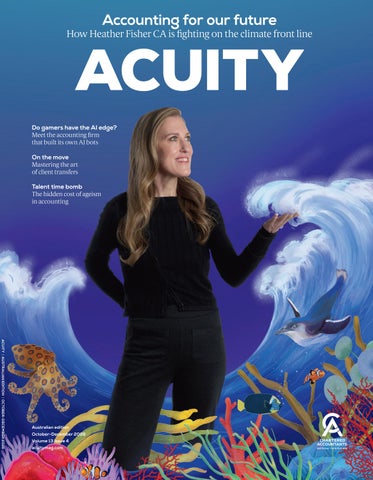
Accounting for our future
How Heather Fisher CA is fighting on the climate front line
Do gamers have the AI edge? Meet the accounting firm that built its own AI bots On the move Mastering the art of client transfers Talent time bomb The hidden cost of ageism in accounting
ACUITY | AUSTRALIAN EDITION | OCTOBER-DECEMBER 2026
Australian edition October-December 2026 Volume 13 Issue 4 acuitymag.com
zato Your firm just got a capacity upgrade. One agentic platform across ledger scrutiny, queries, workpaper compilation, review and finalisation, with human oversight and evidence trails.
GET PRIORITY ACCESS White labelled client portal
Smart questionnaires
Ledger scrutiny
Live workpapers + ZBox
Query hub
Review dashboard
Accounts + compliance
Autocoding
Total traceability
From engagement to sign-off, Zato brings the compliance workflow into one controlled production system.
Access ledger credits to the value of AU $ 2,500 per CA firm. T&Cs apply.
Find out more zatohq.com
Australian edition
CONTENTS
40
36
My profession
My expertise
My career
6
President’s letter
26
62
Events
28
Naomi Walsh FCA reflects on her experiences as CA ANZ president
Information overload
Susan Franks CA warns on relying on AI too much at tax time
64 7
8
Cover illustration by Marta Zafra, photography by James Braund
9
10
16
18
Upcoming events
34
CA ANZ advocacy
Damian Ogden discusses the team’s advocacy work and submissions
36
Heather Smith FCA
68
Level up!
72
Gold’s eternal lustre
74
The great carbon reset
79
Find out which tax tools are new to the market and best for business
Discover how one smart business saved by training staff to build bots
Failure as a blueprint for success
Failing can give you the insight to ensure you’re successful next time What are your red bricks?
What could you stop doing to improve your productivity?
Going bush
Four CAs share their career stories and what it’s like to work in regional areas
40
Public interest
46
A CA sounding board
52
Notice of Decisions of the Disciplinary Tribunal and Appeals Council
58
Our experts tell how to navigate ethical and professional risks
How the CA Advisory Group can help you during a dilemma
Investors are keen, but gold is a diverse and complex investment
Can AI do the job of carbon accounting software? Client transfers done right
How you should behave when you lose a client to another firm 80
22
Too young, too old. Why ageism is bad for business
It's increasingly clear that age – at both ends of the spectrum – should not be a factor in hiring
We profile two accountants who are passionate climate change leaders
From the CEO
Ainslie van Onselen updates us on CA ANZ’s focus areas
Meet the champions of climate action
Read, watch, listen
Latest library recommendations
October-December 2026
Donal Curtin
What makes for a good national retirement system?
AI and your job search
How to compose a CV that will get you that crucial interview Dear Abby
Our HR expert weighs in on how to broach a health issue at work and how to convince bosses you’re not too young for a senior role Quiz: what do you know about COP?
Test your knowledge of past UN Climate Change Conferences
1
THE TEAM
CA ANZ, chief marketing officer
CHARTERED ACCOUNTANTS AUSTRALIA
Chelsea Wymer
AND NEW ZEALAND (CA ANZ)
CA ANZ, head of content strategy and production
charteredaccountantsanz.com
Victoria Marin AUSTRALIA Call 1300 137 322 or +61 2 9290 5660 EDITORIAL
(outside Australia)
Editor-in-chief Camille Howard
service@charteredaccountantsanz.com
Editor Abigail Murison Art director Suzanne Elworthy
Australian national office
Digital and social lead Stefanie Jackson
33 Erskine Street Sydney, NSW 2000
Deputy editor Beth Wallace
Mail GPO Box 9985 Sydney, NSW 2001
Chief subeditor Carey Swan Content coordinator Ted Schief
Contact your local office
Production manager Neridah Burke
New South Wales 1300 137 322 or +61 2 9290 5660
Editorial enquiries
Victoria/Tasmania
+61 (02) 8114 8900
+61 3 9641 7400
acuityeditorial@mediumrarecontent.com
Australian Capital Territory
Level 5, 2 Holt Street, Surry Hills NSW 2010
+61 2 6122 6100 Queensland
ADVERTISING
+61 7 3233 6500
Advertising and partnership enquiries
South Australia/Northern Territory
BusinessPartnerships@
Call +61 8 8113 5500
charteredaccountantsanz.com
Western Australia Call +61 8 9420 0400
AU +61 2 9290 5583 NZ +64 9 303 5186 NEW ZEALAND Call 0800 469 422 or MEDIUM RARE CONTENT AGENCY
+64 4 474 7840 (outside New Zealand)
Managing director Nick Smith
service@charteredaccountantsanz.com
Account director Heather Jarvis Head of design Tony Rice
New Zealand office
Head of creative production Chantelle Love
Chartered Accountants House, Level 7, 50 Customhouse Quay, Wellington
mediumrarecontent.com
Mail PO Box 11342, Wellington 6142 Contact your local office Wellington +64 4 474 7840 Auckland +64 9 917 5915 North Island
Printed by IVE, Australia. Paper fibre is from sustainably managed forests and controlled sources. The opinions expressed in Acuity Magazine do not necessarily represent the views of the Chartered Accountants Australia and New Zealand nor the publisher. While every effort has been made to ensure accuracy, no responsibility can be accepted by the Chartered Accountants Australia and New Zealand or the publisher for omissions, typographical or printer’s errors, inaccuracies or changes that may have taken place after publication. All rights reserved. The editorial material published in Acuity Magazine is copyright. No part of the editorial contents may be reproduced or copied in any form without prior permission of and acknowledgement of the Chartered Accountants Australia and New Zealand. Acuity Magazine is a trademark of the Chartered Accountants Australia and New Zealand.
2
+64 7 839 4764 South Island +64 3 961 2410
Find a CA near you charteredaccountantsanz.com/find-a-ca
acuitymag.com
Brought to you by ANNATURE
Build AML/CTF compliance into your workflow New tools available to help accounting firms establish processes to meet tranche 2 AML/CTF obligations in Australia.
For thousands of accounting and bookkeeping firms, Australia’s tranche 2 anti-money laundering and counterterrorism financing (AML/CTF) reforms, which came into effect on 1 July, have introduced new compliance obligations. Unlike financial services businesses, which have operated under AML/CTF requirements, many accountants are having to establish these processes for the first time. That means developing an AML/CTF program, assessing the risks associated with their services and clients, conducting the required checks and – importantly – keeping evidence that demonstrates those processes are being followed. Build an audit trail from the start “The most important thing is documenting your evidence and having an audit trail,” says Corey Cacic, founder and CEO of eSignature and ID verification market leader Annature. For an accounting practice, that means being able to demonstrate what compliance activity was undertaken, when it happened and who completed it. Rather than relying on spreadsheets, paper records or information across different systems, firms need a reliable way to maintain evidence over time. Annature’s new AML/CTF module is designed to provide that central record, supporting firms to develop their AML/ CTF program and risk assessment, conduct identity verification and AML screening, and maintain an audit trail of their compliance activity. Apart from this firms need to know if every client requiring a check has been through the process, says Cacic.
Corey Cacic, Annature
“Everyone is doing the checks, but it doesn’t end there. Without connecting that information back to the practice management system, you don’t get that visibility,” he says. Practice management integration is central to how the module supports firms. It integrates with accounting firms including Xero Practice Manager, FYI Elite and MYOB Practice Manager. The integrations are designed to bring a firm’s client information into the AML/CTF dashboard, match it against verification and AML checks, and give firms a clear view of which clients have completed the required processes and which still need attention. Make compliance part of the workflow The module also helps firms manage compliance as an ongoing process,
Find out more Annature is a CA ANZ Member Benefits partner. To book a one-on-one demo with a member from its on-shore Australian team, visit: annature.com.au/partners/ca
rather than a one-off exercise. Reviews are flagged when they are due, with the system recording when a staff member completes the review and creating an ongoing record of the firm’s compliance activity. Cacic says Annature’s framework for establishing an AML/CTF program and completing risk assessments has been well received by firms. But he sees the connection with existing practice management systems as a key point of difference. “For accountants new to AML/CTF, the practical benefit of this module is being able to build compliance into the way the practice already operates – with a clear record of what has been done, visibility over what still needs attention and evidence to demonstrate that the firm is meeting its obligations.”
CA ANZ MEMBERS CAN SAVE WITH HCF CORPORATE CARE RANGE
ONGOING
5%
As Australia’s largest not-for-profit health fund, we put our money where our members are. CA ANZ members have exclusive access to a great range of offers and benefits when they join HCF corporate hospital and/or extras cover.
CORPORATE DISCOUNT#
WITH HCF CORPORATE CARE YOU GET:
More back on a range of extras and services. More out of your dental annual limit, as 2 check-ups don’t count towards your limit including scales and cleans. More out of your hospital* or extras^ cover if you’re injured in an accident. More coverage for non-emergency ambulance services under hospital cover.
Scan the QR code to learn more and get a quote
#
1800 880 049
corporate@hcf.com.au
Discount does not apply to any Lifetime Health Cover loading.
* If you’re involved in an accident, you’ll get the benefits of our top level cover for up to 12 months. Must visit the emergency department within 24 hours of the accident.
See hcf.com.au/accident-safeguard for more information.
^ If you have had an accident and your annual limit is already used up, you’ll get additional limits on included extras services. $200 to $500 per person per calendar year
depending on your corporate extras product to top up your annual limit for accident-related services. Can be used for 2 years after the accident, provided you make the first extras claim within 6 months of the accident.
My profession FEATURE
10 Going bush
We talk to four CAs who live and work regionally. The shared experiences and local perspective help them forge a unique relationship with clients.
Photography by Nearmap
8 From the CEO “The profession is being reshaped by AI. Like previous waves of technological change, AI will change how we work, while increasing the value of judgement, scepticism and advice. The challenge is ensuring future accountants continue to develop those capabilities as routine tasks become automated.” Ainslie van Onselen, CA ANZ
6 President’s letter
16 Public interest
7 Events
18 A CA sounding board
Naomi Walsh FCA reflects on her tenure and the professionalism of members
Upcoming events to diarise
Tips on how to avoid complaints through robust processes and planning
CA Advisory Groups offer guidance on ethical dilemmas
9 CA ANZ advocacy
Damian Ogden updates us on recent discussions to help shape economic success
22 Notice of Decisions of the Disciplinary Tribunal and Appeals Decisions
MY PROFESSION Naomi Walsh FCA president, CA ANZ
President’s letter
Everywhere I visit, I see chartered accountants delivering the very best of our profession through leadership, service, integrity and impact.
As I head into the final quarter of my presidential term, I’ve reflected on one of the greatest privileges of this role: meeting members, hearing their stories and carrying their perspectives into the CA ANZ board and council. Whether congratulating a new member, recognising a new fellow or meeting members marking 40, 50 or more years in the profession, I continue to be struck by the quality of people who make up our membership. Everywhere I visit, I see chartered accountants delivering the very best of our profession through leadership, service, integrity and impact. Over recent months, my role has taken me to the UK, Hong Kong, Singapore and Malaysia. While every region is different, one thing is remarkably consistent: the strength and portability of the CA designation. As in Australia and New Zealand, international members are using the skills and training available through CA ANZ to help navigate AI, sustainability, and other emerging risks and opportunities.
The conversations reinforced something I’ve said throughout my presidency: the future belongs to professionals who can combine technology with the human strengths of judgement, ethics and critical thinking. Chartered accountants are uniquely placed to do exactly that. Those visits also highlighted the diversity of careers our designation enables. Again and again, I met members whose careers have taken them into leadership, governance, entrepreneurship, policy, technology and sustainability. We can also see this in the results of our member satisfaction survey, which highlights member pride in the CA designation. The opportunities it unlocks continue to broaden. Closer to home, I was delighted to attend the Accounting & Finance Association in Australia and New Zealand‘s (AFAANZ) 2026 conference in Melbourne. The theme, Inspiring Accounting Minds, is a timely reminder that our profession’s future depends on inspiring curiosity, capability and confidence in the next
generation. Congratulations also to the winners of the inaugural CA ANZ Inspiring Minds Awards and to everyone working to show students what a CA career can offer. One of the things I’ve come to appreciate most as president is the breadth of support available to members. We often see the major events, advocacy and award programs, but there is also an enormous amount of work taking place every day through regional councils, member groups, committees, technical resources, mentoring programs and local networks. My message is simple: make the most of your membership. Connect with your local CA community. Attend an event. Reach out to your regional team. And ensure you have opted into our communications. There is a tremendous amount on offer. If there’s one takeaway from this year, it’s that we are a global profession with strong local communities and that our profession is strongest when members invest in each other. Long may those communities continue to thrive.
What do you think of Acuity ? Scan the QR code to give us feedback on Acuity print magazine and digital articles - what you enjoyed, where we can improve and what you’d like to see in future editions.
6
acuitymag.com
Events
CA ANZ is here to help members stay ahead and maintain your expertise as a trusted professional with learning designed 2902665 2026-05-27T14:31:41+10:00 for CAs.
Sustainability Conference 16 October, Sydney (in person) and online
Our Sustainability Conference is designed to elevate your knowledge and confidence in tackling the sustainability challenges faced by accounting, business and finance professionals every day.
Global Ethics Day complimentary webinar
Business Valuation and Forensic Accounting conferences 4–5 November and 11–12 November, online
Explore the latest developments, practical insights, emerging trends and legal frameworks at our biennial Business Valuation and Forensic Accounting conferences.
21 October, online
Financial abuse can affect anyone. Join our expert panel to explore – across diverse client groups – the ethical and professional responsibilities of recognising and responding to financial abuse. This session will guide you through practical tools and real-world insights delivering a deeper understanding of the Code of Ethics.
Find out more
store.charteredaccountantsanz.com
MY PROFESSION Ainslie van Onselen LLB, MAppFin, GAICD CA ANZ CEO and chair of Chartered Accountants Worldwide
From the CEO
Trust, accountability and the profession.
As we head into the final quarter of 2026, the accounting profession is operating in an environment more consequential than at any point in recent memory. Businesses and communities across Australia and New Zealand continue to navigate geopolitical uncertainty, cost pressures, changing regulatory expectations and the accelerating impact of artificial intelligence. Yet the defining issue for our profession this year has been trust. The serious allegations involving KPMG Australia and the handling of confidential client information have rightly attracted public, parliamentary and regulatory scrutiny. They go to the heart of what it means to be a professional. Confidentiality, integrity, objectivity and professional behaviour are fundamental to the trust placed in chartered accountants. CA ANZ has responded with the seriousness the matter demands. Our Professional Conduct Committee processes are active, the Disciplinary Tribunal has issued orders in relation to two members, and I have directed targeted Quality Practice Reviews of KPMG Australia and other major firms. We have also continued constructive engagement with parliament, Treasury, ASIC, the TPB, the Professional Standards Councils and other stakeholders.
8
This moment is bigger than one firm. It is a test of whether the profession can confront failures honestly, learn from them and lead reform, rather than merely respond to them. Due process matters. So does visible action. That is the purpose of our recent efforts: to advance practical reforms that strengthen accountability, improve whistleblower protections, support effective governance and close genuine regulatory gaps, without defaulting to blunt measures that may weaken audit capacity or create unintended consequences. Trust in the economy depends on trust in the profession. Capital markets, businesses, governments, investors and communities all rely on the judgement of chartered accountants. That trust is earned through continuous improvement, not complacency. At the same time, the profession is being reshaped by AI. Like previous waves of technological change, AI will change how we work, while increasing the value of judgement, scepticism and advice. The challenge is ensuring future accountants continue to develop those capabilities as routine tasks become automated. This is why CA ANZ’s strategy to 2030 matters. It is our roadmap for strengthening
member experience, building future capability, advocating in the public interest and ensuring the CA designation remains a mark of trust in a changing world. Thank you to every member who participated in our member satisfaction survey. This year’s results were encouraging. Ninety per cent of members told us they are proud of their CA designation and 87% agreed CA ANZ upholds high ethical and professional standards. Member engagement increased six points to 64%, reinforcing the value of ongoing investment in services, advocacy and support. I encourage you to read our FY26 Annual Report, available on our website in early October. Please also keep an eye out for your AGM notice and member vote materials. The AGM will again be held virtually, making it easier for members across Australia and New Zealand to participate. Finally, I would like to acknowledge Pamela Lee FCA, who retired this year after 40 years of service to CA ANZ and its predecessor bodies. Pamela has made an extraordinary contribution to the profession, and our members across Australia and New Zealand. Thank you, Pamela, for your dedication, wisdom and lasting impact.
acuitymag.com
Damian Ogden group executive of advocacy, public and government affairs, CA ANZ
Advocacy for a stronger profession and economy A trusted, growing accounting profession is crucial to Australia’s economic success.
As our CEO Ainslie van Onselen mentioned in her column, CA ANZ is shaping important discussions about the future regulation of audit firms. In August, we provided Treasury with our five-point reform plan to strengthen accountability, oversight and audit quality across Australia’s auditing profession, while ensuring reforms remain targeted, proportionate and carefully scoped so smaller practices and entities are not caught by requirements designed for the largest firms. Consistent with our longstanding advocacy on whistleblower protections, we also lodged a submission to the Treasury review of tax and corporate whistleblowing in Australia, calling for an independent whistleblower agency, improved access to remedies, and reforms to address gaps affecting large audit and professional services firms. And, in September, we launched a landmark report CA ANZ commissioned from Oxford Economics Australia to examine two questions: what does accounting contribute to Australia’s economy today and whether Australia will have the accounting capability it needs in the decade ahead. The report found the profession is a critical component of Australia’s economic infrastructure,
October-December 2026
CA ANZ provided Treasury with our five-point reform plan to strengthen accountability...
adding A$82.4 billion to the economy each year, equivalent to around 3% of GDP, and supporting more than 365,000 jobs. It also projects a shortfall of 17,900 accounting, audit and finance professionals by 2035, concentrated in junior and intermediate experience levels, in external audit, finance and tax. If left unaddressed, these shortages create significant risks to Australia’s productivity, economic resilience, tax and public revenue systems, market confidence and long-term prosperity. These findings will help strengthen our advocacy with governments and policymakers for coordinated action to
build the skilled, adaptable and sustainable accounting workforce Australia needs. We also noted the establishment of External Reporting Australia (ERA), which brings Australia’s accounting, audit and sustainability standard-setting functions together in a single body and advances several reforms CA ANZ has long advocated for. While we support measures to protect independence, we remain disappointed that experienced registered company auditors (RCAs) from firms with more than 50 RCA partners are excluded from participation, limiting access to some of the profession’s most experienced technical experts. A big thank you to Victorian members who participated in our recent survey to help inform CA ANZ’s advocacy priorities ahead of the November state election. Victoria is Australia’s second-largest economy, and the decisions taken by the next government will have significant implications for nationwide productivity, investment and business confidence. Your feedback is helping us develop practical policy insights to support a more innovative, competitive and fiscally sustainable economy. Finally, one of the most rewarding aspects of my role remains connecting directly with members. In addition to joining Ainslie at CEO Connect in Melbourne, in recent months we have spent time with our vibrant UK member community. We were able to discuss the valuable contribution our members make with the new Australian High Commissioner to the UK, His Excellency the Honourable Jay Weatherill AO, and I joined discussions with members and stakeholders at a sustainability roundtable. These conversations reinforce the profession’s global reach and the valuable role you play helping organisations navigate economic, technological and sustainability challenges. Thank you for your ongoing engagement, insights and support. They strengthen our advocacy and help ensure CA ANZ remains a trusted voice for the profession.
9
Story by Cameron Cooper
Story by Cameron Cooper
GOING BUSH 10
acuitymag.com
MY PROFESSION
Quick take
Growing opportunities exist for accounting professionals in regional and rural areas. Trust and relationships are even more critical to professional success in the bush. Community engagement is one of the side benefits of living and working regionally.
Working in Sydney for KPMG early in her finance career, Jo Balcomb FCA seemed to be on a fast track to partnership at a big four, city-based firm. Marrying a fifthgeneration sheep, cattle and wheat farmer in Orange, NSW, flipped that scenario on its head. Today, Balcomb is just as likely to be found vaccinating sheep and helping with the harvest as working on risk management and anti-money laundering (AML) strategies for her clients. Just over 20 years since moving to the bush, Balcomb has no regrets, professionally or socially. “I still bump into people from the city and they say, ‘Oh, do you get bored sometimes?’ and I say, ‘Never!’.
Photography by Sam Balcomb
Jo Balcomb FCA made the move from the city decades ago and has never regretted it. Pictured here with her trusty kelpie Rip.
Four accounting professionals explain the unique experience of living and working in regional and rural areas – and why they love it so much. October-December 2026
11
MY PROFESSION
Opportunity challenge A rising cohort of talented accountants are thriving in Australian and New Zealand regional towns. Paul Petrowski CA is among them. As a director and co-owner of Unlimit, he and his family live in the Taranaki region, known for its dairy farms, in the foothills of a dormant volcano on the west coast of New Zealand’s North Island. Drawing on his big four background, including working for PwC, Petrowski and colleague Grant McQuoid FCA recently completed a merger between their firm, Velocite, and Tandem Group to create Unlimit, an 85-staff firm that specialises in business advisory and accounting tax compliance. Petrowski says the venture highlights the opportunities that exist in regional areas for a progressive firm such as Unlimit, which helps commercial and agricultural clients transform their performance. Like Balcomb, Petrowski has no regrets about settling in the region. “It’s been a great choice. I’m proud that after working hard in my early career and achieving the knowledge and skill sets I’ve got, I’m now able to give back to my community and really benefit those people around me – and have a bit of fun at the same time.”
12
Angela Kain CA, the CFO at Van Schaik’s Bio Gro organics recovery business in Mt Gambier, South Australia, says one of the biggest misconceptions about regional accounting is that career prospects are limited. “My experience has been the complete opposite,” says Kain, who also runs a farm with her father. Her view is that regional businesses and firms often provide exposure to a much broader range of commercial, operational and strategic challenges than highly specialised city roles. “You can have a real impact on the business, the industry and the community around you,” Kain says. Just as importantly, regional careers often lead to lifelong friendships and incredible professional networks. “The relationships you build tend to be genuine and long-lasting because you’re working alongside people who are deeply connected to their communities and industries,” she says. “And, if I’m being honest, it’s also nice to swap the city suit for a pair of jeans and RM Williams boots from time to time.”
“Being a farmer means that when I talk to my farming clients, our first conversation is about what’s happening on the farm.” Gaye Cowie FCA, Shand Thomas
Balcomb adds that finance and accounting roles in the major cities tend to be “fairly channelled”, whereas in regional areas the jobs “stretch you”. In her case, the risk-management role with First Choice allowed her to work closely with the industry watchdog, the Australian Prudential Regulation Authority (APRA), enabling access that is unlikely to have occurred so quickly in equivalent, citybased roles. “You tend to be involved at a management level pretty early in your career.” Understanding numbers and mindsets Living in regional New Zealand, Gaye Cowie FCA feels lucky because she gets to combine two loves – accounting and farming. Principal co-owner at Shand Thomson, a chartered accounting firm in Balclutha, Otago, Cowie and her husband also live on and operate their farm at Tuapeka West. She loves working with farming families in the sheep, beef and dairy sectors to improve their financial management skills, and grow their businesses. Although she downplays her own farming skills, Cowie believes working on the property helps her to better understand client needs. “I’m involved in the management of the farm and occasionally get the gumboots on to help out in the sheepyards or cook for the shearers,” Cowie says. “Being a farmer means that when I talk to my farming clients, our first conversation is about what’s happening on the farm – have they sold lambs yet, what prices are they getting and how much rain they have had. Then we talk business. I have empathy and understanding for what they are dealing with on a day-by-day basis and I think it has really helped me to grow my relationships with my clients.” Kain says practising as an accountant and running enterprises in regional and rural areas is a unique experience, requiring cross-industry knowledge. Before joining Bio Gro, Kain worked in forestry. She obtained her truck licence and participated in fire-management
acuitymag.com
Photography supplied by Gaye Cowie
“On the weekends there’re bonfires during the winter, water skiing during the summer, and there’s always social functions and I do yoga. Then there’s the farm life. A lot of the cities in regional areas are really vibrant now,” says Balcomb, a member of the CA ANZ Regional Councils and Committees. Her career has been fulfilling too, engaging in auditing and risk-management roles, including a long stint at First Choice Credit Union (now Beyond Bank), before the switch to consulting work. Balcomb says the flexibility of remote, modern-day work allows regional accountants and advisers to perform roles that were once considered the domain of city-based cohorts. “You just have to back yourself. It’s about having belief in the skills and knowledge you’ve built over time.”
Gaye Cowie FCA co-owns chartered accounting firm Shand Thomson and helps her husband run their Tuapeka West farm.
October-December 2026
13
MY PROFESSION
operations. “While that might not be what people traditionally associate with an accounting career, those experiences gave me a greater appreciation of operational challenges and helped build credibility with frontline teams.”
Giving back to communities There is little doubt that accounting roles can expand into something bigger than might be the case in an urban setting. For his part, Petrowski is especially proud of contributing to the establishment of the Taranaki Community Rugby Trust,
14
which raises funds for local rugby programs across the region, including through an initial leasing arrangement to manage a dairy farm. “We’ve gone from having everything donated to us on day one, including cows,” he says. “And now 16 years later we’re in a position where we own our own dairy farm and we lease two other farms, and we’re providing NZ$250,000 a year back to community rugby, which is benefiting coaching and juniors. It just goes to show what communities can do when they work together.” For Kain, the chance to provide financial guidance to a regional business such as Bio Gro that makes a difference to sustainability is a privilege. Bio Gro transforms materials that would otherwise be wasted into products that support agriculture, forestry and land improvement. “Knowing that the decisions we make create both commercial and
Above: Paul Petrowski CA, director and co-owner of Unlimit in Taranaki. Right: Angela Kain CA, CFO at Van Schaik’s Bio Gro in Mt Gambier.
Photography supplied by Paul Petrowski and Angela Kain
Relationships and networks to the fore Looking back over her career, Cowie says she has often been surprised at the conversations she has had with clients that are not about financial matters. “Often it is about family and relationships. I think we provide a safe space that’s confidential and as accountants are, by nature, logical and down to earth, we can listen without getting emotionally involved.” Networks have been crucial to building trust for Cowie, whose community roles have included being deputy chair of Clutha Development and chair of the Board of Proprietors of St Hilda’s Collegiate School. She is also a past chair of the Clutha Valley Primary School board of trustees and was instrumental in securing a new school facility for the district. Given her community ties, she is ever conscious of protecting those client and personal relationships. “Of course, those ethics apply to all chartered accountants. That’s part of the oath we take when we become CAs, but living regionally means that my clients see me not just at work, but also socially and out in the community.” Petrowski agrees that relationships are sacrosanct in rural areas “because if you don’t have integrity, or if you do something that goes against someone else’s values or the values of the community, everyone’s going to know about it sooner or later.” “There’s nowhere to hide,” he says, “and it holds you accountable to what you do and how you act. That’s a good thing.”
acuitymag.com
“We’re already pursuing our AI strategy. Having scale with the new firm also gives us more scope to train our staff to reskill for the future.” Paul Petrowski CA, Unlimit
October-December 2026
environmental value gives the role a strong sense of purpose.” The future of rural accounting With the Unlimit merger bedded down, Petrowski says the firm can look forward to a strong future in which it draws on traditional accounting strengths and technology advances to deliver growth strategies for its clients. Scale and sophistication will allow the firm to pursue investments in key areas such as AI, while still being privately owned. “We’re already pursuing our AI strategy,” he says. “And we’re using that to help automate compliance but also using those tools to deliver our advisory services. Having scale with the new firm also gives us more scope to train our staff to reskill for the future. We want them to have a full career as accountants and advisers, without letting AI take over.” At Shand Thomson, Cowie is also drawing on her considerable career experience to empower the next generation
of rural businesspeople, both within her firm and out on farms. “It’s wonderful to see the next generation step up.” Cowie says new software and AI technology is clearly changing farming practices. “The younger generation of farmers are much more tech savvy but I think there will always be a place for accountants to add value to farming businesses. We understand and can explain what story the numbers are telling.” In the meantime, she will continue to relish the chance to engage with a diverse range of clients, from farmers and tradies to other professionals. “I love that in the morning you can be in the boardroom and in the afternoon have your boots on and be out on a client’s farm,” Cowie says. With an eye to the future, Kain says technology is creating enormous opportunities for regional businesses such as Bio Gro. It is using drone and light detection and ranging (lidar) technology to measure stockpiles and improve inventory accuracy. The next frontier is AI, that uses smart machines, sensors and data to grow more food with less water and fewer chemicals. “I’m excited by the potential to combine financial, operational and environmental data to better forecast demand,” Kain says. “Weather patterns, soil moisture and seasonal conditions all influence customer demand and recycling volumes, and AI will help businesses better understand those connections. “I think the future accountant will spend less time preparing information and more time interpreting it – combining commercial insight, technology and operational understanding to help businesses make better decisions.” For Balcomb, her immediate future will entail building on her AML consulting work, and using her compliance and regulatory knowledge to help clients. Of course, there will always be duties on the farm to keep her busy, too. The combination means she really does not miss her old life in Sydney. “And the good thing is you can always go back to the city for a highlights tour.”
15
MY PROFESSION
Navigating ethical and professional risks
Many disciplinary matters stem from common, avoidable missteps. Here are the key risks facing members and how you can stay on the right side of professional obligations. Story by Alexandra Johnson
Each year , the Professional Conduct Committee (PCC) receives numerous complaints and concerns about members. The New Zealand Institute of Chartered Accountants (NZICA) and CA ANZ disciplinary bodies handled more than 750 complaints over the past year. While the circumstances vary, several recurring themes emerge time and again. The good news is that many of these issues can be avoided through careful planning, robust processes and a proactive approach to ethical decision making. Kate Dixon and Rebecca Stickney, leaders of the CA ANZ professional conduct teams in Australia and New Zealand, discuss how understanding the most common pitfalls can help members reduce risk, meet their professional obligations and maintain public trust. Academic integrity and AI
Dixon says academic integrity concerns were the dominant issue before the disciplinary bodies, particularly in Australia, although they were also seen in New Zealand. Many were historical, reflecting the proactive approach the PCC in Australia has taken. “As well as self-reports of historical answer sharing in CA Program quizzes,
16
we’ve received a number of self-reported breaches of academic integrity linked to firms’ internal testing and assessments,” she says. More recently, this has included the use of AI during assessments where it was prohibited, a problem education providers around the world are grappling with. “We have had more than 25 self-reports from members who used AI in internal testing where this was not permitted,” says Dixon. Stickney and Dixon acknowledge that accountants are increasingly encouraged to use AI to work more efficiently yet being told to avoid it during assessments can feel at odds with how they work day-to-day. “This is fundamentally an integrity issue,” says Dixon. “If AI use is prohibited and a member has affirmed they will not use it, it’s a real problem if they choose to do so anyway. The issue is not the technology itself, but the breach of trust and the false confirmation.” Disclosing court and regulatory findings
The second most common theme this year involved matters arising from findings by courts, and other professional and regulatory bodies.
“Members must tell CA ANZ and NZICA about any findings against them, including criminal convictions and non-criminal adverse findings, as required under the rules and by-laws,” says Stickney. She warns that not reporting these findings is something the disciplinary bodies can weigh up. “It can lead to additional sanctions, because it shows a disregard for reporting obligations. On the other hand, coming forward early may count in a member’s favour,” Stickney says. Examples the disciplinary bodies dealt with this year included insider trading and breaches of the continuous disclosure obligations under the Financial Markets Conduct Act 2013 (NZ), which led to civil penalties. In Australia, matters included regulatory action by the Tax Practitioners Board and the Australian Securities & Investments Commission (ASIC). Managing conflicts of interest
Failing to manage conflicts of interest properly remains a consistent theme. Dixon says conflicts are not uncommon and will arise at some stage for most practitioners, so the key is to be prepared. “Establishing good conflict management processes in your firm and setting out in
acuitymag.com
Kate Dixon Australian conduct leader, CA ANZ
your engagement letter exactly what services you are providing and to whom, are just some of the precautions members should adopt.” Public practice and membership obligations
“We have had more than 25 self-reports from members who used AI in internal testing where this was not permitted.” Kate Dixon, CA ANZ
Another common issue is failing to meet CA ANZ and NZICA requirements, such as practising without a Certificate of Public Practice (CPP) or, in Australia, not meeting a CPP holder’s obligation to provide information under the Professional Standards Scheme. Dixon says it pays to stay across what membership requires. “It’s important to keep up to date with the obligations of membership. The Professional Standards and Member Care teams in Australia and New Zealand are always happy to help, as is the Chartered Accountants Advisory Group (CAAG).” The disciplinary bodies have also dealt with a range of client service complaints. “These include fee disputes, often caused by inadequate terms of engagement, unprofessional behaviour, and a lack of due care and diligence,” Dixon says. Most of these are avoidable with good practices in place. “Ensure you have good, regularly updated terms of engagement with your clients. Know your different obligations to different clients, even when they are part of a group,” Dixon says. How you communicate matters. “Be polite and cordial. Tell the client what you expect from them, what you are going to do, and flag any deadlines and
Rebecca Stickney New Zealand conduct leader, CA ANZ
delays,” says Stickney. “And put everything in writing, so there’s no room for misunderstandings. A quick email to make sure everyone is on the same page can save hours dealing with an unhappy client or a complaint.” Financial distress and solvency
With ongoing economic pressures, personal and practice solvency issues have featured more prominently this year. Stickney encourages members in financial difficulty to deal with it early, before it escalates. “Reach out early. Talking things through can make a real difference. If you’re finding it hard to call in your debts, it may be worth getting some advice or extra support to manage them.” She also encourages members to take an honest look at their business. “Ask yourself where your efforts are best spent. Do you have the right structure in place? Is the business still sustainable?” Crucially, Stickney urges members to stay on top of their taxation obligations and to keep in mind their fiduciary obligations with GST and employer deductions, including PAYE, KiwiSaver or other employer superannuation contributions, child support and student loans. Failing to pass these deductions on can have serious disciplinary and potentially criminal consequences for the member and unfairly disadvantages their staff. Says Stickney: “If you are not managing these, take advice. Don’t put your head in the sand.”
Need help? The CA Advisory Group (CAAG) provides counselling and support for chartered accountants facing ethical dilemmas or weighing career decisions. Local panels of experienced CAs offer guidance for fellow members, and can provide you with support on a range of professional and ethical matters. The CA Advisory Group service is free and all discussions are strictly confidential. Visit: charteredaccountantsanz.com/member-services/mentoring-and-support/ ca-advisory-group Call: 1300 137 322 (Australia) or 0800 4 69422 (New Zealand) and ask for a CAAG referral.
October-December 2026
17
MY PROFESSION
18
acuitymag.com
A CA sounding board
“CA ANZ meetings and functions provide a great opportunity to get to know each other’s interests and specialisations,” he says. “Then, if there’s something you’d like to discuss, you have a good idea of who might be able to help.” “What makes CA ANZ such a great resource is the range of help and guidance available to you,” says Bikram ‘Bik’ Ray FCA, managing director of ProAllied Australia, a specialised consultancy providing strategic procurement, commercial and probity services. “As a member, you don’t only have support from your peers, you can also approach experienced and diverse members through a Chartered Accountants Advisory Group [CAAG].” Support from senior CAs
Photography by charlesdeluvio
Story by Domini Stuart
Struggling with a professional or ethical dilemma? CA ANZ members have access to free, confidential support and guidance from their peers, in the form of CA Advisory Groups. October-December 2026
Quick take
If you’re facing a difficult professional, ethical or career decision, talking it through with someone you trust can help you find clarity. Along with a network of CA peers, you have access to the highly experienced professionals who make up CA Advisory Groups. When you are the one providing guidance, empathy, respect and an open mind should come first.
You’re being pressured to do something you suspect is unethical. You’re not sure whether to start your own accounting practice. The job you’ve been offered pays more, but you’re worried it will take your career off course. At times like these, it can be hugely helpful to talk to someone who understands the context, and has, quite possibly, experienced similar challenges. John Sexton FCA, owner of Sexton Business Builders Limited, has built up a network of helpful, local CAs from in and around his hometown of Masterton New Zealand. They’re ready to provide peer support whenever it’s needed.
CAAGs are panels of senior CAs who offer their own time to support their fellow CA ANZ members. They can provide independent and confidential guidance and support across non-technical topics such as professional and ethical challenges. “This is a great option when, for any reason, you can’t discuss your issue with your colleagues, management or senior leaders,” says Ray. “The fact that the setting is independent and strictly confidential is a major benefit if, for example, the problem lies in your workplace or relating to clients.” As members of CAAG, both Sexton and Ray know that no one group can include experts in every area of the profession. However, they are well placed to direct you to someone with the right experience. “Whether you need confirmation from a fresh pair of eyes or you’re dealing with a complex challenge, we can help you find the right person to talk to,” says Ray. “A liquidator is a good example of this. Say the third party has instructed them to do X, Y and Z but they’re really not sure whether this is the right course of action or how it should be carried out. That’s something that a CAAG member with a liquidation background would be best equipped to discuss.” Getting the most from the conversation
If you’re the one seeking guidance, you should have all of the relevant facts
19
MY PROFESSION
and evidence to hand before you start your conversation. “It may be tempting to cherry-pick information that presents you in the best light but it’s vital that you’re open and honest,” says Ray. “No-one can provide the support you’re hoping for if they only have half of the story.” Being well prepared can also help to keep emotion out of the discussion. “Talking about an experience or something else that’s worrying you can bring emotions into the conversation,” says Ray. “This could undermine the discussion, particularly as emotion can also affect your ability to absorb and evaluate information. The best way to get the support you need is to leave your emotions at the door. Don’t rush into solution mode and try to find the right answer straight away. Take the time to gather your thoughts and understand what you’d like to achieve from your interaction with a CAAG member, then calmly consider the scenario and put it into perspective.” Sexton recommends writing down everything you want to talk about, even if that’s just as a list of bullet points. “Writing helps you to put your thoughts in order,” he says. “As you do, you might see that there’s more to the problem than you realised. It might be more complex or have its roots in something that happened further back than you thought.” Providing guidance
Sexton has found that, when you’re the one providing guidance, you can’t be sure where a conversation will lead. “You might find that the real issue is buried beneath the one you expected,” he says. “As a result, you might not have the appropriate skill set after all. It’s important to recognise that, then call on your own networks to find someone more suitable.” From the outset, your most powerful tools are empathy and respect. “You also need to be an active listener, absorbing and considering all of the information presented to you,” says Ray. “Be willing to ask questions that will
20
deepen your understanding and keep an open mind. The person is trusting you, so don’t be judgemental about what they’re sharing.” If someone admitted to Sexton that they had behaved unethically or illegally, he would urge them to self-report, where appropriate. “It’s far better for the member if they put their hand up first. I would then continue to offer my support through the process that follows,” he says. “When, as the CAAG member you hear that something serious has taken place, you might have a responsibility to share that with CA ANZ or another regulator,” he says. In Australia, since the Tax Agent Services (Code of Professional Conduct) Determination 2024, there is a special provision for tax practitioners. If a material statement you prepared is false, incorrect or misleading, you must discuss it with your client and encourage them to correct it. If they refuse and the situation meets certain legal thresholds, you may be required to notify the Board or Commissioner (as the case requires). This could place you in a difficult position, struggling to balance your responsibilities to your clients with your legal and ethical obligations. That’s one more example of when informed support might be very welcome. Whether you want a sounding board for a challenging professional or ethical situation, or to discuss your next career move, your CA designation entitles you to all the free professional support, expertise and collective knowledge you may need to help you address the situation.
Need help? The CA Advisory Group (CAAG) provides counselling and support for chartered accountants facing ethical dilemmas or weighing career decisions. Local panels of experienced CAs offer guidance for fellow members, and can provide you with support on a range of professional and ethical matters. The CA Advisory Group service is free and all discussions are strictly confidential. Visit: charteredaccountantsanz. com/member-services/ mentoring-and-support/ ca-advisory-group Call: 1300 137 322 (Australia) or 0800 4 69422 (New Zealand) and ask for a CAAG referral.
acuitymag.com
Brought to you by ANNATURE
A new corporate compliance player enters the market Annature has built a corporate compliance product from the ground up, bringing entity establishment, legal document generation and eSigning into a single workflow.
Corporate compliance is a necessary part of running an accounting practice, but it’s also one of the most process heavy. Setting up companies, preparing legal documents and managing ongoing compliance often means bouncing between systems that were never designed to talk to each other. At the heart of many of these processes is document signing – an integral part of the compliance workflow. “Just about every single piece of corporate compliance work ends in a document that needs a signature. That’s not a coincidence, that’s the whole job,” says Annature founder and CEO Corey Cacic. He says Annature has long seen an opportunity to simplify this process, particularly for firms using NowInfinity for corporate compliance and Annature for eSigning. In these workflows, teams can find themselves “manually shuffling documents between the two platforms – downloading from one, uploading to the other, then reversing the process once a document is signed just to update a status field”. It’s an inefficient and cumbersome system, he says, adding: “Some firms do it anyway because Annature is that much better than the alternative. Others just give up and use Docusign and accept a broken process, because they don’t have the hours to spare.” Catering for customer need According to Cacic, an integrated corporate compliance workflow has been a longstanding request from Annature’s more than 1000 accounting
Corey Cacic, Annature
firm customers. “We’ve heard the same thing from customers for years,” Cacic says, adding that Annature initially looked to existing solutions to address the gap, but when that didn’t materialise, “we built the whole thing ourselves”. The resulting product is Pravo, Annature’s new corporate compliance platform, live in beta since January and now rolled out after more than 50 accounting firms tested it. Pravo brings entity establishment, legal document generation and ongoing compliance together with Annature’s existing eSigning, meaning documents can be generated, sent for signature and completed without leaving the platform. Pravo also includes streamlined Australian Securities & Investments Commission Form 484 handling bulk changes and automated lodgement
Find out more Annature is a CA ANZ Member Benefits partner. To book a meeting with the corporate compliance team, visit: annature.com.au/partners/ca
– features designed to reduce the administrative burden for firms managing large volumes of entities. Making the move to Pravo Annature has also developed a migration tool to help move existing corporate compliance data into Pravo, with Cacic explaining it can transfer an entire account into Pravo overnight. “We built that specifically so there’s no excuse left not to move,” he says. The launch represents an opportunity for Annature, to make corporate compliance more streamlined and connected – with fewer manual steps and less time spent moving information between systems. “This is a straightforward alternative for firms,” Cacic says. “We think a lot of them will make the move.”
MY PROFESSION
Notice of Decisions of the Disciplinary Tribunal and Appeals Council
AUSTRALIA Anthony Fiedler CA – adverse or unfavourable binding determination by the Tax Practitioners Board (TPB). He was suspended up to and including 25 April 2027 and ordered to pay costs of A$10,951. Anil Karnavat – academic misconduct. Breached APES 110 Code of Ethics, conduct brought or may bring discredit, and conduct was conduct unbecoming of a member. The provisional member was suspended for two years and ordered to pay costs of A$7039. Kamleshkumar Patel – academic misconduct. Breached APES 110 Code of Ethics, conduct brought or may bring discredit, and conduct was conduct unbecoming of a member. The provisional member was suspended for two years and ordered to pay costs of A$7039.
Wei Leah Zhao CA – adverse or unfavourable binding determination by the Supreme Court of Victoria and failed to comply with directions. Her membership was terminated and she was ordered to pay costs of A$13,344.
Stuart Alexander Third FCA – adverse or unfavourable binding determination by the TPB. He was suspended for a period of six months (provided he has discharged certain ATO obligations) and ordered to pay costs of A$4743.
Phillip Hunt CA – principal of a practice entity that suffered an insolvency event (a firm event). He was suspended for three years or until the practice entity is no longer subject to external administration, and ordered to pay costs of A$11,201.
Paul Christos Zahos – insolvency event. The provisional member was suspended for the duration of the bankruptcy not exceeding five years and ordered to pay A$500 towards costs.
Denis Allen Yeo FCA – adverse or unfavourable binding determination by the TPB. He was suspended up to and including 7 November 2028 and ordered to pay costs of A$3067.
Sam Danieli FCA – interim suspension as a result of the cancellation of his company auditor registration by the Companies Auditors Disciplinary Board which decision, although the subject of a review application, has not been stayed.
Stephen Costley FCA – principal of a practice entity that suffered an insolvency event (a firm event). He was suspended for three years and ordered to pay costs of A$11,890.
David Makowa CA – adverse or unfavourable binding determination by entering into a court-enforceable undertaking with Australian Securities
Disclaimer: Chartered Accountants Australia and New Zealand ABN 50 084 642 571 (CA ANZ) regulates the conduct of its members that reside in locations other than New Zealand. The New Zealand Institute of Chartered Accountants (NZICA) regulates the conduct of members of CA ANZ that reside in New Zealand in accordance with the New Zealand Institute of Chartered Accountants Act 1996 and other legislation regulating the profession of accountancy in New Zealand. To the extent permitted by law, CA ANZ and NZICA expressly disclaim all liability for any direct or indirect loss or damage (including on account of negligence or otherwise) arising from any reliance upon the fact that CA ANZ or NZICA exercise or have exercised professional conduct functions (either directly or indirectly via any disciplinary or appeals committee, tribunal or the like), or have investigated particular members and taken (or not taken) disciplinary action against members, or as a result of reliance by a person or entity on any materials, documents, reports or the like (including any reports of members’ practices) produced by CA ANZ in connection with its professional conduct functions.
22
acuitymag.com
DEPARTMENT SLUG
Full copies of all published decisions (including those of the Professional Conduct Committee) can be found at: charteredaccountantsanz.com/ disciplinary-decisions
& Investments Commission (ASIC) and agreed to, or had conditions or restrictions imposed on, a professional membership. He received a censure, is required to complete a CA Short Course, is to provide his Quality Review results to the Professional Conduct Committee (PCC) and ordered to pay costs of A$5218. Notice of decisions of the Appeals Council Australia
Kristian Convery CA – interim suspension as a result of being charged with multiple criminal offences, including acting as an auditor of a superannuation entity while knowingly being disqualified.
NEW ZEALAND
David Harry John Rickard CA – conduct unbecoming a member and failing to observe a proper standard of professional care, skill, competence or diligence. He was censured and required to pay costs of NZ$18,000. Steven James Mundy CA – conduct unbecoming a member, being a principal of a practice entity which was the subject of an insolvency event (firm event), suffering an insolvency event and breaching compliance obligations. He was suspended until 2 June 2030 and if he remains an undischarged bankrupt after 2 June 2030, then for a period of 12 months after he is discharged but no more than five years from the date his suspension commences, and required to pay costs of NZ$49,190.38.
October-December 2026
23
My expertise FEATURE
Illustration by Marta Zafra, Photography by Mike Heydon
28 Meet the champions of climate action
Heather Fisher CA and Julia Fink FCA (above) both believe financial professionals can play a major role in countering climate risks.
36 Level up! “Before we went out for Christmas that year, one of my team had created a bot to complete a BAS. We fired our external developers and started doing everything internally, and we started teaching ourselves how to build bots and automations.” Shannon Smit FCA, Smart Business Solutions
26 Information overload
Taxpayers need to carefully check any advice from AI
46 The great carbon reset
As some carbon accounting software providers leave the market, is AI the solution?
34 Heather Smith FCA
A run-down of AI-powered tax research tools
52 Client transfers done right
What to do to make the transition smoother
40 Gold’s eternal lustre
The precious metal hasn’t lost any of its shine
58 Donal Curtin
The differences between superannuation schemes
MY EXPERTISE Susan Franks CA CA ANZ Australian leader – tax, superannuation and financial advice
Information overload When everyone has tax advice, professional judgement matters more than ever.
Australians have never had easier access to tax information. A taxpayer can now ask an artificial intelligence platform about deductions, capital gains tax or investment structures and receive an instant, confidentsounding answer. Social media and so-called ‘finfluencers’ also offer quick tips, shortcuts and tax ‘hacks’ that can appear persuasive, especially at tax time. But information is not the same as advice. Tax law is complex, fact-specific and often dependent on context. A technically correct statement may still be misleading if it is applied to the wrong taxpayer, the wrong income year or the wrong set of facts. That is why professional judgement matters more in an environment where answers are abundant.
Many accountants are already seeing this play out in practice. Clients arrive with AI-generated responses that look authoritative but overlook critical facts. Others have been influenced by videos promising deductions or loopholes that do not exist or do not apply to them. Accountability remains central. Taxpayers are responsible for the accuracy of their returns, regardless whether information came from a friend, a website, a chatbot or a social media post. Registered tax practitioners also remain responsible for their advice and the work they sign off on. The Tax Practitioners Board’s guidance on AI reinforces that technology may assist research, drafting and analysis but it does not replace professional competence, confidentiality or ethical judgement.
Advised by AI
The ATO has warned taxpayers to be cautious about relying on AI-generated information, social media content and online tax commentary. These sources may be incomplete, outdated or based on overseas rules. They may also miss the practical questions that matter most: 1. What evidence is available? 2. What assumptions have been made? 3. Has the taxpayer’s full situation been considered?
26
The automation challenge
At the same time, regulators are using technology too. The ATO has described a future in which tax and super increasingly ‘just happen’. For taxpayers and advisers, that is not just a technology story, it’s a governance story. If tax reporting becomes increasingly automated, embedded in business systems and connected to thirdparty data, the quality of the inputs becomes even more important.
That means professional judgement must extend beyond interpreting the law. Advisers increasingly need to understand how information moves through client systems, software, payroll platforms, accounting ledgers and reporting tools. They need to ask whether the correct data is being captured, whether transactions are being coded appropriately, whether GST, PAYG, superannuation and income tax treatments are being applied consistently, and whether automated calculations can be checked and explained. Automation can reduce manual work but it can also scale errors quickly. A recurring coding mistake, an incorrect payroll setting, a misclassified worker, a flawed assumption in tax software or an unchecked, AI-generated answer may produce results that appear neat and complete, while still being wrong. This is why checking the automation process itself matters. Advisers and businesses should be able to verify how calculations are made, test whether outputs are reasonable, identify exceptions and trace figures back to source data. Controls, reconciliations and review processes are not administrative extras, they are essential safeguards in a digital tax system. Good tax governance becomes essential. A need for reliable advice
Some suggest AI will reduce the need for tax advisers because information is now widely available. The opposite is true. When information is plentiful, clients need help determining what is reliable. When AI-generated content is persuasive, they need advisers who can separate fact from fiction. When compliance tools are more powerful, they need confidence their tax positions are technically correct and properly supported. And when reporting becomes automated, they need advisers who can test whether the automation is working as intended. In a world where everyone seems to have tax advice and where tax administration is becoming increasingly digital, professional judgement has never mattered more.
acuitymag.com
Brought to you by ZATO
Beyond the chatbot: the agentic firm AI won’t replace accountants. Dr Srinivas Kishan, executive director of AI and innovation at Zato, answers questions about what agentic AI actually changes inside a firm.
through it, and firms need to think about that now rather than in five years. New Zealand is short of people and that isn’t ending. The real question isn’t whether to cut headcount, it’s whether scarce senior judgement goes to work that needs it, or to formatting a lead schedule.
What’s the biggest misconception firms have about agentic AI? That it’s a smarter chatbot. It isn’t. A chatbot answers a question and stops. An agentic system reasons, plans and runs a workflow from start to finish through specialised agents that hand work to each other. In accounting, raw intelligence isn’t enough on its own. The system has to understand engagement context, your firm’s methodology, the regulatory obligations that apply and how one workpaper depends on another. Without governance and human oversight built into it, what you have is a fast tool, not a trusted one.
Trust is everything in accounting. Why should a practitioner trust an AI-generated workpaper? They shouldn’t, until they can see how it was built. Trust comes from transparency, not automation. Every conclusion should trace back to a source document, a calculation and a stated confidence level, with the reasoning there to inspect. Nothing reaches a client file without a human approving it. Sign-off stays exactly where it has always been, with the practitioner whose name is on the engagement.
What separates a serious platform from a feature bolted onto existing software? Architecture, not marketing. An assistant improves a task, but the task was never really the problem – the chain is. Production runs from onboarding through ingestion, extraction, trial balance mapping, preparation, review and sign-off, and most of the cost sits in the hand-offs rather than inside the steps. Bolt AI onto one stage and you simply move the bottleneck somewhere else. So, ask any vendor three things: show me the audit trail, show me where the human
Dr Srinivas Kishan, Zato
approves and show me what happens when the model gets it wrong. The third one is the tell. If AI can prepare an entire workpaper, what’s left for the accountant? Preparing workpapers was never the point; judgement was. Machines can handle reconciliations, documentation and a competent first pass. Materiality, unusual transactions, client-specific calls and professional scepticism cannot be outsourced. It does change how you train juniors, who can no longer learn the work by grinding
Book a Zato workflow walkthrough Zato is a CA ANZ Member Benefits partner. CA firms that enter into an Annual Ledger Subscription Agreement with Zato receive ledger credits valued at A$2500. To learn more, visit: zatohq.com/contact
What does the accounting firm of 2035 look like? Organised around orchestration, rather than production. Agents run the routine work continuously, while accountants supervise, resolve exceptions and apply judgement where it counts. Capacity stops being a function of headcount. But the firms that pull ahead won’t be the ones that bought the most software. They’ll be the ones that redesigned their methodology, retrained their people and set clear rules about what AI may and may not decide. Start with one process, prove it against your own review standards, then scale.
MY EXPERTISE
MEET THE CHAMPIONS OF CLIMATE ACTION What role can accountants play in countering climate risk? Two leaders on climate action – Heather Fisher CA and Julia Fink FCA – share their views from the front line. Story by Susan Muldowney Illustrations by Marta Zafra Photography by James Braund and Mike Heydon
Climate change has long been the domain of scientists, engineers and policymakers, but two chartered accountants on either side of the Tasman are putting their expertise to work on what they see as the defining challenge of our time. Heather Fisher CA is COO at the Climate Council in Australia, an independent, nonprofit organisation that provides evidencebased information on climate-change impacts and solutions to policymakers and the public. In New Zealand, Julia Fink FCA is CFO of the country’s Climate Change Commission, an independent Crown entity tasked with providing independent expert advice to government on mitigating and adapting to climate change, and monitoring and reviewing government’s progress towards its emissions reduction and adaptation goals. Both leaders believe that finance professionals play a vital role in turning ambition into climate action. “When I joined the Climate Change Commission in 2024, I saw a direct opportunity to contribute to such an important issue using my accounting skills,” says Fink, who is also vice-president of CA ANZ and a board member of the Planetary Accounting Network, which supports a framework for environmental reporting based on the nine planetary boundaries.
Heather Fisher CA, chief operating officer, Climate Council, Australia.
October-December 2026
29
MY EXPERTISE Julia Fink FCA, chief financial officer, Climate Change Commission, New Zealand.
“People generally don’t make poor decisions deliberately – they respond to the incentives around them and climate is no different. If we want different outcomes, we need to change the systems and incentives that shape people’s decisions.” Heather Fisher CA, Climate Council, Australia
“I’m not a climate scientist, but accounting gives me a way to contribute to solving a problem that affects everyone.” Counting the costs
Climate change is leaving a devastating mark across the globe. The cost is being counted through shifting rainfall cycles, rising temperatures and sea levels, and extreme weather events that are becoming more devastating and harder to predict. Over the 15 years to 2026, natural hazards have cost New Zealand at least NZ$64 billion in direct losses, according to data from Insurance Australia Group New Zealand. This equates to an average of more than NZ$4.2 billion per year, with around 95% of the expenditure directed toward response and recovery. The 2023 Auckland floods and Cyclone Gabrielle resulted in 19 deaths and asset damage was estimated at between NZ$9 billion and NZ$14.5 billion. Treasury expects the costs of more frequent and severe extreme weather events driven by climate change to rise over time, adding to New Zealand’s already significant exposure to natural hazards. Natural disasters currently cost the Australian economy A$38 billion a year and the figure is forecast to rise to at least A$73 billion by 2060. During the Black Summer bushfires in 2019–2020, 33 people lost their lives, more than 3000 homes were destroyed and more than 17 million hectares of land were burned, devastating communities and regional economies. More recently, the catastrophic floods in NSW and south-east Queensland
30
in February 2022 resulted in 24 deaths. It is considered the costliest flood event in Australia, with a total insurance claim estimated at more than A$6 billion. Fisher notes the economic impact of climate change rarely includes the price of delayed action. “As accountants, we’re always thinking about cost but we also need to think about the opportunity cost of inaction,” she says. “If we don’t reduce emissions, somebody will pay. We’re already seeing it through higher insurance premiums, disaster recovery costs, healthcare expenses and food prices. The next generation will bear the cost of today’s decisions.” Two paths, one goal
Fisher and Fink followed different career paths, but both paths led to their shared focus on climate solutions. Fisher’s father was an accountant and company secretary at an international technology company, and she recalls that he “seemed to be involved in every important conversation across the organisation”. “When it came time to choose my own career, dad told me that being a chartered accountant was more about a skill set and a way of thinking, than a single job,” she explains. “He said it would allow me to make a difference in any organisation and give me a career that could evolve over time. That really appealed to me because I didn’t want to spend decades doing exactly the same thing.” After starting her career as a graduate accountant at EY, Fisher moved to an
advocacy role at Taxpayers Australia – now known as Institute of Financial Professionals Australia – before joining youth homelessness not-for-profit Kids Under Cover, as deputy CEO. “While I was working at EY, I felt a connection to my pro bono clients that were solving real-world problems and creating tangible impact, and I loved applying commercial skills to organisations that were directly improving people’s lives,” she says. “At Taxpayers Australia, I saw how good policy can create large-scale change and I feel like those two experiences have really aligned in the work that I do at the Climate Council. Moving to the Climate Council didn’t feel like moving to another cause. It felt like a multiplier for every cause I’d cared about throughout my career.” Like Fisher, Fink sees her role in climate change as the culmination of a career built across various finance roles. However, her path to accounting was not so linear. After completing high school, she moved to the UK for a gap year that stretched to six years. “One of my first jobs was as a receptionist, which involved answering phone calls and making coffee, but what I really enjoyed was the invoicing and billing part of the role – the logical nature of it appealed to me,” she says. Fink later worked as an accounts assistant with a travel agency in England, which paid for her bookkeeping course at night school. She returned to New Zealand to begin an accounting degree, where she learned about the chartered accounting pathway. After working at Deloitte in audit and advisory, she joined New Zealand’s charity
acuitymag.com
regulator, Charities Services, where she helped to educate charities about their financial reporting obligations. That role led to an appointment with the country’s accounting and audit standards setter, the External Reporting Board (XRB). “While I was there, we signed off on the country’s first climate-related disclosure standard and at around the same time I became CFO at Upper Hutt City Council, where I was exposed to issues like waste minimisation and climate adaptation,” she says. “Between the standards work and local government, I became increasingly interested in climate-related issues.” Beyond finance
As CFO of the Climate Change Commission, Fink oversees the finance, people and culture, risk, procurement and legal functions. She describes her role as “making things work”. “I use my chartered accounting skills every day, but I’m focused on making the organisation run smoothly and ensuring people who are tackling the really complex climate issues have the information they need to make decisions and to simply get on with their jobs to provide advice to government,” she says. “I make sure the systems behind the scenes support their work.” Fisher’s role at the Climate Council also extends beyond finance. She oversees operations, governance, fundraising, people and culture, technology, risk and legal. “My technical accounting skills are still important, but it’s really those broader professional skills that enable you to lead across all those different functions,” she says. “While I was at EY, I learned skills like building relationships, communicating complex issues simply, earning trust, making good decisions and bringing people with you, and I still rely on those skills every day.” Climate change is a complex challenge for business, influencing everything from strategy and investment to risk management, governance and supply chains. However, Fink says the challenges of her role are similar to any senior finance position.
32
“As CFO, you’re constantly making recommendations about where limited resources should be invested,” she says. “There are never enough resources to do everything and, with climate change, how long is a piece of string? You could devote endless effort and funding to solving the problem but, as an organisation, we have finite resources. So, it’s about helping the organisation decide where those resources will have the greatest impact. “We’re fundamentally a people business,” adds Fink. “Most of our investment goes into employing highly skilled people who can provide quality advice to government. That’s where the greatest value sits.” As the Climate Council is resourced through fundraising, Fisher says a key challenge as “creating organisational stability” in an environment where funding is uncertain. “Often, you’re choosing between two very good options, rather than between a good option and a bad one,” she says. “Sometimes you know exactly what impact you could have, if only you had the resources to do it.” Another challenge is communicating climate facts to the broader community. “There’s so much misinformation about climate that many Australians simply don’t know what to rely on,” says Fisher. “A huge part of our role is taking incredibly complex science and communicating it in language that everyday Australians can understand. But that’s actually something accountants are very good at – taking complex issues and explaining them simply.” From ambition to action
Countries such as Australia and New Zealand have many of the building blocks in place to achieve long-term climate targets. For example, Australia has seen rapid growth in renewable electricity generation, with renewables supplying a record 47% of the national electricity market in the first quarter of 2026. In New Zealand, renewables supplied 94.5% of electricity during the same period. However, Fisher believes the key climate change challenge is no longer the technical
acuitymag.com
MY EXPERTISE
aspect of reducing emissions, but rather the need for broad systems change. “We know how renewable energy works,” she says. “We know electrification works. We know batteries work. We know energy efficiency works. Countries like Australia have extraordinary renewable resources, a highly skilled workforce and incredible technological capability. We have everything we need to become a global clean energy leader. The challenge now is systems change. “People generally don’t make poor decisions deliberately – they respond to the incentives around them and climate is no different. If we want different outcomes, we need to change the systems and incentives that shape people’s decisions.” Fisher says decisions are influenced by factors such as economics, investment, legislation, trade, politics and community expectations. “They’re all interconnected, so solving climate change requires changing the system, rather than relying on one policy or one decision.”
“The more you read and engage with the topic, the more you’ll learn. That’s certainly how I became interested.” Julia Fink FCA, Climate Change Commission, New Zealand
Accounting for climate change
Fisher and Fink believe accountants have an important role to play in measuring, reporting on and countering climate risk. “Accountants are often the people who connect the dots across an organisation,” says Fisher. “We understand finance, governance, risk, operations and strategy, and climate risk doesn’t sit neatly in one department. It’s no longer something that sits off to the side under sustainability and it’s not just about compliance reporting – it affects every part of a business. “We don’t all need to become climate experts but we do need to listen to the science, ask good questions and challenge misinformation,” adds Fisher. “We have a responsibility to help organisations make better decisions. Accountants are trained to think about consequences, assumptions and risk. That’s exactly the mindset organisations need – accountants who can apply their professional skill set to one of the biggest strategic risks they face.”
October-December 2026
“If your clients’ own assets are exposed to physical climate risks and you’re not helping them think about those risks, then eventually that becomes your problem too because your clients are the ones who’ll suffer financially,” she says. “Climate risk really needs to be viewed as part of business performance and resilience. “I think every chartered accountant should be interested in this area, whether you want to build a career in sustainability or simply because it’s becoming an increasingly important risk management issue.” Fink says there are many ways to build climate-change knowledge. “CA ANZ offers climate-related disclosure microcredentials and there’s also a huge amount of informal learning available. The more you read and engage with the topic, the more you’ll learn. That’s certainly how I became interested. “If accountants invest a little time in building their knowledge, they can become genuine leaders in this space.”
Take aways
CA ANZ offers a range of micro courses in sustainability-related topics to top up your knowledge, ranging from assessing climate-related risks, to sustainable supply-chain management and applying ISAE 3000. Visit: store.charteredaccountantsanz.com
Fisher believes tackling climate change presents an “enormous opportunity” for chartered accountants. “We have the skills to lead organisations through this transition, whether that’s in governance, strategy, reporting, risk management or investment,” she says. “If more accountants embrace that opportunity, our profession can become a real leader in shaping a more sustainable future.” Fink says accountants in public practice also play an important role in the climate conversation.
If you want more comprehensive training, the new CA ANZ Certificate in Climate-Related Disclosures combines on-demand learning with workshops across seven weeks. Visit: store.charteredaccountantsanz.com/ sustainability Eric Archambeau’s ebook Costing The Earth: How to Fix Finance to Save the Planet argues that global financial action needs to align investments with the United Nations’ 17 Sustainable Development Goals. Search the title at: library.charteredaccountantsanz.com
33
MY EXPERTISE
Quick take
AI-powered tax-research tools can help accountants explore unfamiliar and highly technical tax issues. The tools have different strengths, depending on whether they are built up from content, workflow optimisation or an AI assistant. Professional judgement remains critical to interpret AI tax research outputs.
New tax tools in town
A range of AI tax-research tools has been specifically developed to help you decode complex tax issues. Here’s what you need to know.
If you’re working through a tricky tax treatment, typically you’ll start by mulling it over in your own mind. Then, maybe, refer to resource manuals or a quick Google search. Stepping it up, you may turn to tools like ChatGPT or Claude. Within those large language models (LLMs), if you’re tech savvy, you could have patched together a specific, AI-powered tax resource to help you. Today, we have a new category of AIpowered tools in the accounting world, where LLMs meet tax law. Specialised LLM tools can dive deep into notoriously dense tax law and draft plain English translations of the law, helping accountants navigate tax complexity with speed. The models are trained on general legal and tax frameworks, including legislation, rulings, case law and guidance materials such as the Master Tax Guide. The tools don’t replace tax advice, but they do help with the research and drafting responses. Of course, the draft output needs a human to verify the sources and technical accuracy.
Photography by Design Master
I pay for ChatGPT and Claude. Why should I pay for a specialised AI tax-research tool?
Yes, existing LLMs are pretty good. However, currently LLMs are US-heavy and are unlikely to be consistently accessing recent changes. In contrast, specialised taxresearch tools are constantly trained in jurisdiction-specific rulings, legislative amendments and case law updates.
34
acuitymag.com
Heather Smith FCA sits at the intersection of accounting technology, education and content creation. She holds various advocacy roles, including representing Qld members on the CA ANZ Council and the Trans-Tasman Public Practice Advisory Committee, and works extensively with the Smaller Practices team. She also shares her modern methodologies and insights through the Accounting Apps podcast, Accounting Apps newsletter and her books.
The responses will cite actual source material (legislation, rulings, determinations) that can be verified. Also, LLMs can become an echo chamber, learning off you, while some of these new tax-research tools have guardrails in place not to learn from you. At the Accounting and Business conference in March 2026, I was astonished by the number of AI tax-research tools exhibiting. In researching this article, I have come across the following solutions: 1. CCH iKnowConnect (wolterskluwer.com/en-au/ solutions/cch-iknowconnect/tax) 2. Elfworks (elfworks.ai) 3. Empathetic AI (empathetic-ai.com) 4. Law Cyborg, now known as Nylon (usenylon.com) 5. Praxio AI (praxio-ai.com.au) 6. Savvywise (savvywise.com.au) 7. TaxGuru Ai (tax-guru.ai) 8. Practice Genius (bestpracticegroup. com.au/practice-genius) 9. CassandraResearch (cassandraresearch.com). CCH iKnowConnect and Nylon have Australian and New Zealand offerings. The others are primarily Australian at the moment. So, how have these AI tax-research tools been developed?
It’s useful to understand how these tools have evolved, the assumptions built into them and where they will fit into your existing workflow. • Some have been purpose-built from the ground up to understand tax concepts, regulations and workflows. They focus on research and advice. Examples: Elfworks, Praxio AI and TaxGuru AI. • Some are existing legal databases, with an AI capability layered across them. Two examples are: CCH iKnowConnect (Wolters Kluwer) and Nylon. • Some are an AI copilot or assistant functionality, built specifically for Australian tax work. Examples: Empathetic AI and SavvyWise.
October-December 2026
This insight leaves you with the question: do you want to pay for a content library, a research workflow or a general assistant? What are some practical uses?
Beyond the most obvious use case for these AI-powered tax tools of searching, summarising and drafting unbiased interpretation of tax legislation, there are other ways they can stretch your subscription dollar further: • Useful for a second opinion or as a sounding board, especially for accountants working in small practices who don’t have people to bounce ideas off • Provide a starting point to research unfamiliar issues or obscure information • Create tax-centric content for client communication, blogs, newsletters and more • Development of internal process notes • Development of checklists. For example, use them to update your FBT questionnaires. Assess what changes are needed to ensure the form is technically correct • Create assessments for potential employees • Training in tax topics. Notably, Elfworks offers CPD-verifiable, hyper-personalised, structured learning • Supporting strategic tax advisory work. Limitations, risks and accuracy
There are a few things to be careful about when using AI-powered tax-research tools. They may hallucinate, that is, they are confidently wrong. The responses need to be relevant to the specific geographical region being queried. Tax legislation is a moving target and current relevant information needs to be surfaced, so as not to confuse you with outdated rulings. And, it’s important to remember they are a tool. Don’t become over-reliant on them. You have a professional responsibility
to assess the reasonableness of the response: is it what you expected? If not, dig a little deeper to verify the sources map to the work you are researching. Remember, the tools are a research assistant, not a decision maker. 10 questions to ask when evaluating AI tax research tools
1. What jurisdictions do the models cover and are they trained on legislation, rulings, case law and guidance materials such as the Master Tax Guide? 2. Do they de-prioritise private rulings? 3. What is the pricing model? Monthly? Locked-in annual subscription? 4. How often is the research database updated? 5. How is answer quality monitored? 6. Is your information used to train the model? 7. Is there an audit trail or a query history? 8. How responsive is the product roadmap to user feedback? 9. Are you able to share research with the team? 10. How long does it take to respond? I’m not convinced that AI-powered tax research tools have a long shelf life
Currently, general LLMs don’t have the latest Australian and New Zealand tax updates, and they can struggle to deepdive into rulings. Until that gap narrows, if you’re spending time on tax research these tools are definitely worth their monthly subscription fee. Some users have remarked to me that these tools are saving them three-to-five hours a week in tax research, which is transformational. If you’re currently using a solution with an inbuilt tax-research tool, initially test that out to see if it meets your needs. However, most of the available AI solutions are standalone and tech-stack agnostic, so they can be trialled and adopted into your workflow swiftly, with minimal disruption. I’d look at ones that offer a monthly subscription, rather than an annual commitment.
35
MY EXPERTISE
36
acuitymag.com
Story by Joshua Gliddon
the gamers thrived, and found building bots and creating automations was second nature, she says. Smit emphasised to her team that AI wasn’t going to take their job but, in a now well-worn trope, she advised that someone using it will. Introducing AI into the business wasn’t so much a technological shift as a cultural one and the change in culture needed to play to each team member’s strengths. Which is where the gamers came in. Staff who weren’t as technologically savvy would ask the gamers for help, explaining the process needing automation or the bot needing to be built, and the gamers would go away and do it for the rest of the team. A cultural challenge
Quick take
Shannon Smit FCA is the principal of Smart Business Solutions, an AI-first accounting and business advisory firm. Changing culture is as big a business transformation challenge as adopting new technology. Some people will be left behind – the time to upskill is now.
Will being a video gamer make you a better CA? In an accounting world where AI, coding and automation skills are rapidly becoming must-haves, Shannon Smit FCA thinks so. “I spent so many years telling my two sons, who are now both studying accounting, to get off their games,” she reveals. “Now I’m like ‘keep doing it boys, keep doing it’.” Why the change of heart? A couple of years ago, Smit embarked on building AI bots to automate processes within her accounting and advisory firm, Smart Business Solutions. Which staffers took to the new tasks and technologies like ducks to water? The gamers. Where some people struggled,
October-December 2026
Smit’s organisation has 21 employees, with its team evolving slightly as AI has been introduced into the business. Two longstanding team members chose to move on during this transition, deciding the change wasn’t a good fit for them. Rather than redundancies, this change reflects a natural alignment of skills and interests as the business embraces innovation. Both individuals had made meaningful contributions over many years in administrative roles, with one serving the business in-house for a decade and the other close to nine years offshore. “The in-house team member had built strong relationships with clients and was a valued part of the business,” Smit says. “There would always have been a place for her here. As the business began evolving, she made the decision that the shift towards new technologies and ways of working was not the right fit for her, and chose to step into a different path.” The upshot? Thanks to the automation of many previously manual admin tasks, three people’s roles have been replaced with two, at different wage levels. Tasks no-one really wanted to do are now handled by bots. And, the business bottom line benefited from a 23.6% reduction in wages. “Some things can be a blessing in disguise,” Smit says. “When she left, it didn’t seem like a blessing at the time because she
37
MY EXPERTISE
was such a great person but our junior admin has upskilled herself, she’s moved into a more senior role and she has really embraced the technology.” Bots benefit the bottom line
The raw figures around the revenue uplift Smart Business Solutions has experienced will open the eyes of any practice principal. For the fiscal year ending 30 June 2025, Smit’s business, along with the 23.6% reduction in admin wages, also recorded a 14% hike in gross revenue and an 11.9% reduction in professional wages. But AI didn’t come first. Before AI made its presence felt there was an aborted – and potentially expensive – attempt at robot process automation (RPA) using an external contractor. The idea for RPA emerged for Smit about a decade ago, when she began outsourcing several tasks offshore to the Philippines. “That experience highlighted how process driven some of the work had become,” she says. “It prompted me to think about how technology could enhance efficiency and consistency even further through automation.” At that time, tech wasn’t really Smit’s forte – she says she’s still not a hardcore techie even today but has learned her way around things – so she engaged a thirdparty contractor to build the RPA tools for her. The idea was to automate business activity statements (BAS) and workpapers, so a human’s role would be review, rather than creation, of those documents. The third-party supplier quoted A$3200 per automated process, along with A$5000 per month for each robot. Smit set aside A$50,000, figuring she’d have a relatively short return on investment once the bots were up and running and the humans she employed were doing higher-level, rather than rote, mundane tasks. “So, I set aside A$50,000 and asked the contractor to build out as many processes as possible, recognising the opportunity for automation to deliver consistent, roundthe-clock efficiency,” she says. Eight months later, the BAS robot was finally delivered. Smit affectionately
38
named the bot ‘Betty’ – a small but telling reflection of how quickly the technology became part of the team. Then, as often happens, a moment of discovery came through social media; not on Facebook or Instagram but on LinkedIn, where a post caught her attention. From RPA to AI
“You know how you sometimes come across people on LinkedIn who really stand out? That’s what happened here. I started following Daryl Aw, an accountant based in Singapore,” Smit says. Aw, founder of Skybots Singapore, had built his practice around robotics and automation. Through his LinkedIn posts, he shared how he was rethinking traditional accounting workflows using technology, offering a compelling glimpse into what the future of the profession could look like. This, Smit thought, was interesting. Here was someone who’d done what she was trying to do via a contractor. He’d done it himself and he hadn’t needed to spend A$50,000, nor wait eight long months for the deliverables. She reached out to him, told him she was getting frustrated with the external contractor developers she’d signed and what he told her blew her mind. “He said, ‘Look, you can create these bots yourself. I run workshops in Singapore teaching people like yourself how to do it’,” Smit says. Being a savvy accountant, Smit figured it probably wasn’t a good use of budget sending her team to Singapore to go to a workshop, so she made Aw a counteroffer: would he be willing to come to Australia and do a workshop Down Under? It was an offer he was happy to accept and, in November 2024, Aw presented a two-day workshop for Smit and her team. “When Aw got up to present, he told my team that at the end of the two days, they’d be building their own robots. “And you know what?”, she says. “He was right. Before we went out for Christmas that year, one of my team had created a bot to complete a BAS. With that result, I do not know why it took the external developers so long to deliver.”
Willing to play
Smit says the team had been spending close to 1000 hours each year on BAS compliance. By embracing automation and employee training, Smart Business Solutions transformed the process, reducing a task that once took around 40 minutes for a skilled team member to just seven minutes. “We fired our external developers and started doing everything internally, and we started teaching ourselves how to build bots and automations.” What is critical for CAs to understand, Smit says, is you don’t need to be a coder to build bots or automations. Yes, her gamers showed aptitude, but not everyone in her organisations who has the skills to develop a bot is necessarily an avid gamer.
acuitymag.com
Shannon Smit FCA believes that success comes not just from expertise but from genuine enthusiasm for what you do.
and emerging tech at PwC New Zealand, counsels accounting professionals that they should never use the free, public version of an AI tool, but instead pay for the business or enterprise version. Why? The public tools use everything entered into them to further train their models. This could compromise any sensitive information a CA puts into the chat box. The paid enterprise or business editions don’t use private information to train the AI model and are therefore more secure. But no AI tool is perfectly secure, so caveat emptor (Latin for ‘let the buyer beware’). AI agents and advisers
“The role of the accountant will continue to evolve beyond compliance towards genuine business advisory.” Shannon Smit FCA, Smart Business Solutions
October-December 2026
The key, she says, is a willingness to experiment and engage directly with the technology. Rather than looking for a perfect approach, it comes down to staying open to new ideas, challenging existing ways of working and exploring innovations that have the potential to reshape how a practice operates. The BAS robot consists of 937 separate steps which sounds daunting, but what most CAs don’t realise is they already have the tools – Microsoft Power Automate and ChatGPT – at their fingertips. Power Automate is included as part of Microsoft Windows. Microsoft just does a bad job of telling people about the tool and what it can do. The only area where CAs need to be careful is in the AI tools they use. Kayur Patel FCA, director, Gen AI
Smit and her team rely heavily on Microsoft Copilot to build their AI agents and it’s these agents that are primed to take her business automation to the next level. “We’ve built a review agent and a business planning agent and, because we’re on a practice-wide Microsoft platform which most firms would be on, once you build and publish your agent, it’s available to everyone in the business.” Agentic AI is more capable than simple bots because it is designed to be adaptive, Smit says. If a platform like Xero makes changes to its software, a traditional bot can struggle to keep up. An AI agent, by contrast, can respond to instructions, adjust to the change and still find a way to complete the task. “In the next five years, we will see a significant acceleration in automation,” Smit predicts. “As a result, the role of the accountant will continue to evolve beyond compliance towards genuine business advisory. This shift will require firms to actively support their teams in embracing change, building confidence with new technologies, and contributing to how both the business and the profession move forward.” Will being a gamer make you a better CA? Maybe, maybe not. But for Shannon Smit, she was pleasantly surprised that the gamers in her organisation have the edge. Maybe a little Red Dead Redemption on the PlayStation won’t hurt after all.
39
MY EXPERTISE
GOLD’S ETERNAL LUSTRE Story by Lachlan Colquhoun
The gold price has been on a roller coaster over the last 18 months, but veteran market players advise to ignore the headlines, resist the urge to speculate and look at it as a long-term asset. Quick take
Gold demand now comes from many sources, not just safe-haven buying. Investors use gold for diversification, inflation protection and liquidity. Eastern and western buyers often respond differently to price moves.
Ever since it was first mined and refined by the ancient Egyptians in about 3600BC, gold has been a store of wealth. The first gold coins were struck in the fourth century BC in present-day Türkiye, and subsequent civilisations and cultures all used gold as an anchor for currencies. While the legendary 19th century American banker JP Morgan once declared that “gold is money, everything else is just credit” the reality is that, in 2026, the use of
40
gold is more diverse and complex than it has been in the past. Since the US ended the link between the dollar and the gold standard in 1971, global currencies have been based on the fiat system of issuance by central banks. Gold has been free to float and find its own value as a separate asset on world markets. Traditionally, the thinking has been that gold is a safe haven to which people turn in times of uncertainty and risk, but that is only part of the story. Central banks, for example, are key drivers of demand for gold, which they buy as a hedge against inflation, to diversify their foreign reserves and to shift their risk away from holding sovereign debt and, in particular, US Treasuries which have also been a historic safe haven for investment. Gold continues to be in demand by the jewellery industry, with large production centres in China and India, but demand is
acuitymag.com
sensitive to changing tastes in fashion and the fluctuations of economies. And when the price of gold shoots higher, as it did in 2025, demand from jewellers typically drops off. Then there is also gold’s use in industrial processes and high-tech products such as satellites, computers and smartphones. Place in portfolios
For investors, gold plays a strategic role in their portfolios, well beyond the knee-jerk response to speculatively buy as equities and bond yields fall, or when the world is in geopolitical crisis. In the last five years, gold has appreciated around 137% in Australian dollar terms, which is just under double that of the S&P/ASX 200, the main index on the Australian Securities Exchange. “What underpins gold’s appeal today is a convergence of macroeconomic forces that are proving far more persistent than many investors expected: sticky inflation risks, rising sovereign debt burdens and growing uncertainty around the effectiveness of traditional portfolio diversifiers,” says the World Gold Council’s (WGC) senior market strategist John Reade. “Geopolitical events inevitably push gold into headlines. But it’s worth being
October-December 2026
clear: while gold often responds positively to sudden shocks, those moments are rarely the best time to initiate an allocation. “The protection gold provides frequently shows up before the event, not after it. That is why we consistently caution against treating gold as a tactical trade triggered by breaking news.” After setting a sequence of new record highs in 2025 and surging through the US$5000 per ounce barrier to more than US$5400, gold outperformed other asset classes by some distance last year. Gold prices then came off in the first part of 2026, as many investors took profits to rotate back into other assets and as bond yields moved higher. At just past the mid-year point, with gold at around US$4100, the WGC’s outlook is for the price to rebound towards US$4500 “if macro or geopolitical conditions deteriorate or rate expectations fall”.
“A stable, higher yield environment may however see gold decline further, but falls are likely to be limited to around 10–15% due to continued buying from central banks and long-term investors, plus growing Asian demand,” the WGC says. Some analysts, such as the team at Toronto-based brokerage Maison Placements and at JP Morgan, say gold could test US$6000, as US debt swells and central banks continue to buy. Different drivers
At The Perth Mint, Sawan Tanna CA is the chief commercial officer, responsible for the sales and marketing of products which also include silver and platinum.
One of The Perth Mint’s products is fine gold bullion bars.
41
MY EXPERTISE
“We are one of the few custodians offering a gold exchange traded product that allows customers to convert their holding into physical gold.” Sawan Tanna CA, The Perth Mint
Owned by the Western Australian Government, the mint refines gold and silver, with much of its gold coming from WA mines such as Northern Star’s Super Pit and Newmont Boddington. The Perth Mint is the third largest exporter out of Western Australia, after iron ore. China recently outpaced the US as the main market for Perth Mint gold, with India and South Korea also major markets. “Around 75% of the 196 tonnes of gold we refine each year is sourced from Australia, while the remaining 25% is sourced from other places such as New Zealand, Japan, Thailand and Africa, and we also receive gold all the way from Alaska,” says Tanna. The mint produces a variety of coins, some of them novelty coins like the James Bond 007 series, and stores around A$15 billion worth of precious metals for investors. For investors, the mint offers an exchange traded product (ETP) on the Australian Securities Exchange called PMGOLD (Perth Mint Gold). It is one of seven listed ASX ETPs which give access to the gold price and liquidity, while also being backed by physical gold. Mirroring the fluctuations in the gold price, the ETP units could be bought for around A$58 in August 2026, while the 12-month high was just above A$78. “We’re also seeing growing demand in India for ETFs [exchange-traded funds] particularly among younger investors who prefer to access gold in digital form,” says Tanna. “Historically, much of what we exported to India was destined for
42
jewellery manufacturing but increasingly it is being held by custodians that support exchange traded products.” Swings and roundabouts
Asian demand for gold ETFs is balancing a sell-off in the US. According to the latest data from the WGC, there is now US$526 billion in assets under management in gold ETFs globally. “We are one of the few custodians offering a gold ETF that allows customers to convert their holding into physical gold,” says Tanna. “If you hold units in PMGOLD, you can open an account with The Perth Mint and either collect your gold or have that gold delivered anywhere in Australia.” Tanna has observed the different drivers in the gold price in his 10 years at the mint. When Donald Trump became US president and introduced his tariff regime, Tanna says there was “huge demand” on the Commodity Exchange (COMEX) market – the New York-based futures and options market for precious metals – largely coming from financial institutions and hedge funds. The Chinese and Indian jewellery markets are highly sensitive to price. “Generally, we’ve found that when the price of gold is at record highs or rapidly increasing, the traditional jewellery buyers in China and India stay out of the market,” says Tanna. “Western markets, such as the US, tend to be less price-sensitive and we saw that clearly when gold reached record highs last year.
“There is a clear difference in mindset between eastern and western customers. In the east, demand tends to strengthen when prices fall or interest in gold fades. In western markets, buying is more often driven by uncertainty and headline events.” Gold as part of an investment mix
In New Zealand, Glenn Thomas is the co-founder of the Gold Survival Guide. In addition to being an educational resource, it is also the country’s largest repository of precious metals investing. Founded 20 years ago, the Gold Survival Guide also refines gold from New Zealand mines, is an exporter and an importer, and offers custody services. “For a lot of people, gold is mainly a diversification that performs differently,” says Thomas. “So, when one asset class zigs, another one zags, and there’s a level of uncorrelation which people like between other markets and asset classes. “Other people like it as inflation protection, because gold has probably outperformed the stock market indexes over the last 25 years or so.” Another attraction is that when an investor holds gold, Thomas says “there is no counterparty” while, almost counterintuitively, it is also highly liquid. “You’re not worrying about who is on the other side,” says Thomas. “There’s definitely a heightened appreciation for that counterparty risk element and while that might have been a fringe view a few years ago, I do see people being more comfortable buying physical gold than investing in ETFs.”
acuitymag.com
Looking at the performance of gold over the last period, Thomas says it “has been an interesting 18 months” as the price spiked and was then sold down. “A lot of new people came into the market at the end of last year because the more prices rise the more people seem to be interested. That’s human nature,” he says. “I try and encourage people to do the opposite, because when it is quiet that is probably a good time to buy.” Like Perth Mint’s Tanna, Thomas also sees a difference in buying patterns between eastern and western investors. “When the price falls, the eastern investors from India and China recognise the value,” he says. “When demand is high, their demand starts to drop, but with western investors when the price goes up, that’s when they get interested.” What’s next for gold?
Thomas sees the gold price as in a “plateauing phase” and says that even those investors who might be underwater on recent purchases should find themselves ahead if they resist the urge to sell and keep their gold. Events such as the Iran war, while having a short-term impact on price, were not main drivers for the gold price in the longer term. Investors had been asking why the price was not rising in March 2026, after the first hostilities in February. “Maybe it wasn’t rising because those main drivers had already happened and the price was so high that it had to take a dip,” says Thomas. He notes current buying from investors in eastern economies and central banks, and sees gold as “fair value” and well supported at the moment. One thing Thomas isn’t prepared to do, however, is make a prediction on the gold price. “If you put it on a timeframe, you’re pretty much guaranteed to be wrong,” he says. “All I’ll say is that it seems to me that if the prices haven’t bottomed out, they’re probably pretty close to it. “I’m not saying it’s going to suddenly take off again, but I think it’s more likely to be a steady zig-zagging sort of climb.”
October-December 2026
HOW HAS GOLD PERFORMED? On 30 July 2016, the gold price for one troy ounce was
US$1134.80 Ten years later, it was
US$4089.16 (One troy ounce is equivalent to 31.1035 grams)
That’s an annualised compound annual growth rate (CAGR) of
11–15% per year
Gold prices over 10 years (August 2016–2026) US$6000
US$4000
US$2000
$US0 Aug 2016
Aug 2017
Aug 2018
Aug 2019
Aug 2020
Aug 2021
Aug 2022
Aug 2023
Aug 2024
Aug 2025
Aug 2026
Source: macrotrends.net
43
Brought to you by XERO
How practices can turn payment conversations into proactive advisory New payment and AI tools from Xero can speed up small business payments, help improve cash flow and enable advisers to add more value.
For many accounting practices, payment conversations are often triggered by problems, rather than planning. Clients tend to wait until cash flow is under pressure, invoices are overdue or onboarding problems have escalated, before asking for help. Xero already offers the ability for customers to get paid online via GoCardless and Stripe, but now it’s going further with tools designed to turn payments from a reactive process to a proactive advisory conversation. “We view payments as part of a broader cash flow proposition,” says Peter O’Malley, general manager of product at Xero. “We’re bringing information, workflows and payments into one platform to help small business owners and their advisers see the effects of payments on their business.” Here are three ways Xero is evolving payments. 1. Predicting cash flow pressure Xero’s new Cash Flow Actions tool uses smart analytics to detect an upcoming cash shortfall and proposes an optimised bill-payment plan, so a business can protect its cash buffer. O’Malley explains it gives accountants a proactive, data-backed way to
advise clients before cash flow becomes a challenge. “It gives customers and advisers a view of cash flow over the next 90 days, identifies where there’s potential lumpiness and suggests a plan for working around it, so advisers don’t have to piece together what’s about to happen or what could happen. “Importantly, advisers can use their judgement about things like the most critical suppliers or whether a payment plan makes sense. It brings human judgement into a plan that’s built off a range of signals and patterns.” 2. Help clients get paid without chasing Late payments remain an ongoing challenge for small businesses, but JAX Payment follow-ups (in beta, coming soon) tackles the problem from the moment an invoice is sent, helping to speed up payments, while minimising the admin of chasing overdue invoices. “On average, over half of small business invoices are paid late, which is a massive problem,” says O’Malley. For long-running client or customer relationships, the JAX Payment follow-ups tool looks at factors like how often they pay, the payment methods they generally use and whether they have responded to payment reminders in the past.
“We’re aiming to give advisers a real-time view of what’s happening with their clients. That allows them to have proactive conversations about important issues like an upcoming cash flow crunch, the best method to get paid, and getting the right cash flow buffer in place.” Peter O’Malley, Xero
It then builds a personalised plan and determines the right message to send, at the right time, through the right channel, and triggers those communications at specific intervals. “Small businesses want to remain in control of the relationship and the communications going out between Xero and their customer,” says O’Malley. “That’s why we use customer history as the foundation for the types of messages we send. “We can see from our data that if a reminder is sent within about three days of an invoice being due, that’s the optimal time to help a small business get paid. Coupled with the right channel – email or SMS – that increases the likelihood of getting paid within the due date. “It should also free up accountants’ time to focus on higher-value advisory work, like the right payment terms, the right payment method and the right plans to put in place,” he says. 3. Simplifying bill payments, strengthening control Between manual data entry, chasing down approvals and logging in to bank portals to make payments, traditional accounts payable processes consume a lot of time for practices. That’s time that could be spent on strategic planning. Which is why Xero has partnered with leading financial platform Airwallex, to provide an embedded bill payments solution that enables customers and their advisers to manage bills, make payments and reconcile transactions all in one place. This helps save time, while providing real-time visibility of cash flow.
Peter O’Malley, Xero
“There’s a lot of manual processing involved with bills – capturing documents on the platform and switching between online banking portals or manually entering credit card details to make payments,” says O’Malley. “Xero’s online bill payments reduce that complexity by making payments – even to suppliers that only accept BPAY – without leaving Xero.” Once a bill has been drafted in Xero, the new bill protection feature adds an extra layer of review before payment. “Powered by JAX, bill protection screens information extracted from a bill and looks at a range of signals and patterns for suspicious signals, and flags anything that needs extra attention – things like a first-time supplier, changed bank details
or a bill outside the usual range for that type of payment,” says O’Malley. “So, in addition to saving time on manual entry, we’re also adding an extra layer of protection,” he adds. “Then, because the payments are triggered from Xero, it gives both the small business and the adviser stronger visibility and transparency around what’s owing and what’s been paid. That visibility can be supported by customisable bill approval workflows, which give small businesses more control over who needs to review and approve a bill before it is paid. Combined with automated bank reconciliation, these capabilities create a more connected accounts payable workflow – helping small
Find out more Learn more about how Xero is evolving payments at: xero.com
businesses not only see what is due, but understand what they need to do next to stay in the black.” As Xero continues to evolve its payments offering, small business advisers can spend less time on manual, mundane tasks – while still maintaining full control – and more time on value-added services. “We’re aiming to give advisers a real-time view of what’s happening with their clients,” says O’Malley. “That allows them to have proactive conversations about important issues like an upcoming cash flow crunch, the best method to get paid, and getting the right cash flow buffer in place. Our payments and AI tools help them manage all of these processes.”
MY EXPERTISE
THE GREAT CARBON RESET
Carbon accounting is being reshaped, just as scope 3 reporting starts to bite. With several software players pulling back, businesses now have to decide whether to buy a platform, use AI or do more of the work themselves.
Story by Sholto Macpherson
Quick take
Carbon accounting software is consolidating, just as scope 3 reporting becomes more important. Some businesses are shifting to AI-assisted or in-house methods, instead of buying specialist platforms. Businesses must decide whether they are satisfied with an estimate or audit-ready emissions data.
October-December 2026
Carbon accounting is going through a remarkable shakeout, just as scope 3 emissions become a mandatory reporting requirement for large entities in Australia from next year. The largest software companies that sprang up to service this segment have taken a step back. The home page of well-known Australian brand Sumday, says it is “your partner in AI transformation across finance, FP&A, procurement and sustainability”. The latter service includes carbon accounting and it still sells carbon accounting software, but it’s no longer the central theme of the business. New Zealand’s Cogo, which signed huge marketing partnerships with Xero, the Commonwealth Bank, Westpac and other institutions, no longer does any carbon accounting at all. It recommends solar panels and home batteries to bank retail customers. Another Australian player, NetNada, is one of the few that has stuck to pure-play software by targeting larger companies that need to audit and continually reduce emissions in their supply chain. Tellingly, Sumday and NetNada are two of the only players left in Australasia who provide carbon accounting tools for small and medium businesses. Most other players focus on enterprise customers. The pullback is not only commercial. New Zealand has quietly wound back the mandatory climate reporting entities from 180 to about 63, dropping fund managers and life insurers from the net. How are businesses calculating carbon emissions if they’re not buying software? Can you do this by using AI instead? How much accounting in carbon?
Carbon accounting is only accounting in a loose sense of the term. At the simple end, it is mostly activity data (products and services used in operating your business) multiplied by a list of emissions factors, which gives you your estimated emissions. That is closer to measurement and classification. There is no equivalent of double entry, bank reconciliation, statutory ledgers, tax treatment or a complete economic model of the business.
47
MY EXPERTISE
This is clear after companies have gone through the arduous process of mapping products and services to emissions. The following years only require feeding the numbers through the same list. Companies selling carbon accounting software have had to find ways to be more useful. “We’re selling carbon accounting software to large corporates… but the core piece of what businesses can leverage to decarbonise is often the procurement process,” Sumday’s Bradley Pitt says. Sumday is built around a carbon ledger, where transactions are automatically coded to an emissions source so a company’s footprint can be traced straight back to its financials. It measures scope 1, 2 and 3 emissions, uses AI to speed up data mapping – suggesting emissions sources with confidence scores – and to help generate climate disclosures. Sumday has since released a second product, Sumday Procurement and Projects, an AI-assisted tool that sets the financial return of a decision alongside its environmental and sustainability impact inside the procurement and project approval workflow. Pitt describes it as “your decision hub of where every decision gets made” – in effect, a business-case engine for embedding sustainability into everyday capex and opex choices, since almost every purchase carries scope 3 emissions. Earlier this year, Sumday announced it was expanding even further – into AI consulting. “When problems can be solved with software… we build the thing,” wrote Jess Richmond, CEO and co-founder of Sumday, in a blog post. “But sometimes organisations don’t need our software right now. They need help going from A to B on broader AI deployment. We provide world-class engineers and analysts that sit side by side with the internal team, moving from ideas to execution.” The reason for the transition was partly driven by the fact that sustainability advocates in a company were good at decarbonising ideas, but “putting the maths down into a business case was not that
48
good,” Pitt says. Carbon accounting alone, in other words, was never going to be the whole business – although Pitt is adamant it remains core. Companies are still buying Sumday’s carbon accounting software. Pitt said they had signed three clients in the past two days, mainly through referrals from accounting firms. Carbon accounting is still “all bread and butter of where we make our income,” Pitt adds. Selling defence
Once you have mapped your emissions, there are several reasons to keep using carbon accounting software, says Afonso Firmo, founder of NetNada. One is to support auditability, compliance and defensible climate reporting for customers, auditors and other stakeholders. The second is for companies that want the full range of climate reporting capabilities. This adds risk, governance, strategy and decarbonisation plans to the carbon accounting core. In organisations of different sizes, including larger enterprises that need to maintain a presentable set of data to different audiences, carbon accounting software helps a sustainability manager run workshops, address committees and present to the board. NetNada measures scope 1, 2 and 3 emissions with a full audit trail, and integrates directly with accounting and ERP systems including Xero, NetSuite and SAP. It uses AI to clean and process data, categorise emission factors and support climate reporting workflows. An audit-ready reporting engine documents the emission factors, data sources and methodology behind every number. Other features include a climate risk module drawing on physical and transition risk databases; governance and assurance tools that put audit packs, policies and verifiable disclosures in one place; and supplier engagement across a network of tens of thousands of connected suppliers. NetNada also offers consulting services through its team of experts or network of partners alongside its software, for
DEPARTMENT SLUG
Carbon is only the first measure The concept of carbon accounting may already be reaching its half-life. A New Zealand initiative is pushing a broader goal of planetary accounting that expands to include freshwater, land use and biodiversity, as well as carbon emissions. The model takes the nine scientific limits to the Earth’s resources – the planetary boundaries defined by the Stockholm Resilience Centre in 2009 – and turns them into a per-person budget. For example, driving 20 kilometres in a petrol car could use 17% of an individual’s daily environmental budget for a healthy planet, says Kate Meyer, founder of the Planetary Accounting Network. Why would you want to expand the scope of your environmental assessment? Because it helps you make better business decisions about how to reduce your environmental impact beyond reducing greenhouse gas emissions. Meyer points to two batches of chickens with an identical carbon footprint. If you feed one group of birds grain grown on land that has recently been deforested, its total environmental footprint could jump from 5%
companies that want support. NetNada can sell the software on its own, work in an assisting role, or run the whole climate reporting process for the customer. Pricing scales with the scope of reporting, the number of entities and the level of assurance required, and is set on engagement. It offers trial accounts and discounts for suppliers in the value chain. Today, some consultancies are eager to use AI to create lightweight applications to support their services. However, Firmo says that trust is lost when customers cannot
October-December 2026
of the daily limit to 30%. A strict carbon lens would have missed that impact. Similarly, when comparing wool with synthetic garments, wool can look poor on carbon alone but often comes out ahead once you count the water, waste and other impacts associated with petroleum-based fibres. Regulations are drifting in this direction. The EU’s product environmental footprint already demands a broader nature disclosure and the coming ISSB nature standards look likely to follow the same planetary-boundaries science. Meyer’s software, Planetary Insights, developed with co-founder Mike Merry, is designed to slot into the month-end close. Planetary Insights parses invoices and evidence, builds each activity into a fully auditable ledger and matches it across all the planetary accounts. A business can set science-based budgets and track its footprint annually, quarterly, monthly or in real time. For products, it adds full supplychain modelling, hotspot and scenario analysis, and consumer-ready ‘Planetary Facts’ labels that show where an item sits against the planetary boundaries.
see how calculations were produced or when security does not meet enterprise requirements. “When they don’t let people see behind the scenes, they kind of lose trust. The applications that are surviving are those built with auditability in mind; with a carbon ledger, the emission calculations, the assumptions and all the logic.” DIY with genAI
Smaller businesses that want to measure their emissions without buying software
and consulting always have the option of working it out for themselves. Data for scope 1 (fuel burned by your vehicles) and scope 2 (electricity from your power bill) is straightforward to collect. Scope 3 – the emissions from all the products and services you buy – is the real slog. It takes effort to pull the information out of your accounting system and, in theory, to look beyond financial spend to the actual items purchased. Warwick Russell CA, a chartered accountant at GreenMetrics in New Zealand,
49
argues you should not go anywhere near that level of detail. He uses tools such as Claude and ChatGPT for matching scope 3 emissions factors, and says he doubts whether matching emissions at the individual transaction level is worth the effort. In testing, matching supplier and expense descriptions to emissions categories produced an initial match rate of about 70% before review and adjustment. And it will be a long time before it is standard to include emissions factors on receipts. “Very few suppliers can provide a reliable product or service carbon footprint at invoice level,” Russell says. A $100 million company Russell now works with had tried to use a carbon accounting platform to match every invoice and eventually gave up. Instead, Russell starts with emissions-related spend data and reconciles it to the financial statements, rather than attempting to classify every individual supplier transaction. He treats scope 1 and scope 2 separately and uses activity data, such as fuel or electricity consumption. This leaves a manageable set of material scope 3 spend categories. “AI can support the initial classification and emissionsfactor matching, but the results still require review and adjustment,” Russell says. For the company with $100 million turnover mentioned earlier, it was at most 150 lines to match, rather than thousands of individual transactions, Russell says.
“If you have an emissions database, a dedicated carbon accounting platform is not always necessary. All you need is an official database to work from.”
“If you put a CFO’s head on this, it’s actually pretty easy to do,” he says. “If you have an emissions database, a dedicated carbon accounting platform is not always necessary. All you need is an official database to work from.” You can buy one for about $2500 or, like Russell, build your own, based on the same official sources. Sumday’s Pitt is also sceptical about using AI for matching transactions. For a small business pulling a dozen electricity invoices, ChatGPT “will get quite a way there” on scope 1 and 2. “When you get to a larger scale, it just doesn’t work. The large language model suffers when it gets to a huge amount of electricity invoices,” Pitt says. Buy or build
So, do you need to buy carbon accounting software? The matching at the centre of the job is now a commodity and an agent can do it. If you buy the software, you’re getting a bigger piece than just calculating emissions. Businesses that are serious about reducing their footprint can use the software to run programs to identify and replace or eliminate heavy contributors and take a generally more proactive approach. If you build it yourself, you also maintain it, and you also own the judgement calls a vendor would otherwise make for you. “If you’re willing to spend a lot of time doing it, you’ll probably get an OK outcome. But somebody’s just not going to spend that time,” Pitt says. The deciding factor is assurance. If your SME clients are simply being asked for a number by a customer or a bank, a disciplined AI workflow anchored to a reconciled trial balance may be all you need. The moment that number has to stand up to an audit, then you’ll need to show the paper trail behind it. Showing a printout from your chat window is probably not going to cut it.
Warwick Russell CA, GreenMetrics
50
acuitymag.com
Brought to you by ADVANCETRACK
How to raise your fees with confidence Advancetrack’s Louise Walpole shares her tips for boosting your income by providing high-value services.
A new report from Ignition found that 78% of Australian accounting practices plan to raise fees in 2026, but only 21% say they’re ‘very confident’ in their pricing strategy. Louise Walpole, commercial director at Advancetrack, sees that gap as an opportunity for firms to pull ahead by focusing on higher value advisory work and charging with conviction. Here are her pointers to success. Flag opportunities Accountants are well placed to anticipate clients’ pain points. “With your clients’ figures in front of you, it’s easy to see when cash is getting tight, margins are slipping or a business is growing faster than it can cope with,” says Walpole. “These are all advisory conversations waiting to happen. The trick is to train your team to notice them and jot down anything worth following up.” Move on from hourly billing Hourly billing punishes you for being good – the quicker you get, the less you earn for the same job. Clients are also in the dark about the cost until they get the bill. A fixed fee or subscription can solve both problems, says Walpole. “Your client knows the cost up front, while you
get a steady, predictable income. You’re also in a better position to grow when your income isn’t tied to your time.” Sell the benefits Think about your service in terms of benefits, then train your team to sell these to your clients. “It’s important to get your team on board early, so they understand the value they’re providing,” says Walpole. “This could be tax saved, better decision making, creating a more valuable business, even being able to sleep better at night. This way, higher fees will make sense to everyone and you’ll feel confident about charging more.”
Find out more Advancetrack is a CA ANZ Member Benefits partner. To book a call with the team, visit: advancetrack.com/book-a-call
If this sounds like too big a leap, it’s fine to start small. “Pick a few clients, do a good job and get testimonials to build up your proof,” says Walpole. Outsource routine work Your best people should be talking to clients about value, not bogged down by compliance. “The firms winning at advisory nearly always have compliance handled quietly in the background,” says Walpole. “When you outsource routine tasks, you can protect your margins and grow, without struggling to recruit more people. That’s exactly what our outsourcing, offshoring and podsourcing® models are for.”
CLIENT TRANSFERS DONE RIGHT
52
acuitymag.com
MY EXPERTISE
When a client moves on, the handover can raise a range of ethical and practical questions. Here is how to navigate them.
make sure they’re your North Star in everything you do,” says Stickney. The code provides detailed rules and guidance regarding changes in professional appointments, and sets out obligations for both the proposed or incoming accountant and the existing one. Decide whether to accept the engagement
Story by Sonakshi Babbar
Quick take
Both the incoming and existing accountant have responsibilities when a client changes accountants. Unpaid fees, client records and access to accounting software can cause issues during the transfer. Even when a client relationship ends badly, clear and timely communication can help make the transition smoother.
October-December 2026
A client deciding to change accountants is a routine part of practice. There can be many reasons for a change, but managing the transition professionally is important. Rebecca Stickney, leader of CA ANZ’s Professional Conduct team in New Zealand, says client transfers are an inevitable part of practice. “People move cities and they want to have an accountant in their area. Maybe they’re changing the nature of their business and they need a different kind of accountant, or the relationship has broken down.” Kate Dixon, leader of CA ANZ’s Professional Conduct team in Australia, says client transfers can also occur where an accountant ceases to act for a client due to a conflict or potential conflict of interest. Whether you are losing a client or taking on a new one, knowing your responsibilities as an accountant can help make the transfer smoother for everyone involved. Dixon points to the code of ethics – APES 110 Code of Ethics for Professional Accountants (including Independence Standards) in Australia and the NZICA Code of Ethics in New Zealand – which provides the ethical framework for managing client transfers. “The code is designed around the fundamental principles, so you need to
Seeking professional clearance is one step in client and engagement acceptance procedures. As a first step, an incoming accountant needs to consider whether they can act for the client, or if accepting the engagement could create any threats to their compliance with the fundamental principles of the code of ethics. “When an accountant is asked by a potential client to replace another accountant, they need to determine whether there are any reasons for not accepting the engagement,” says Stickney. “This obligation applies when you’ve been asked to take on a new engagement, you are tendering for new work or you are going to undertake complementary or additional work to that of another accountant.” The types of threats that need to be considered include potential conflicts of interest or objectivity threats, and if the accountant has sufficient capacity or experience to undertake the assignment in accordance with the fundamental principle of professional competence and due care. These include any threats that could be posed to compliance with professional behaviour and integrity obligations, such as a client’s involvement in illegal or questionable activities. “In terms of conflict, accountants need to consider a range of possible threats, including the potential for a self-interest threat, as well as the risk of conflict involving one of your existing clients or a member of your immediate family,” says Dixon. A conflict does not always mean the engagement must be declined. In some cases, the code allows safeguards to be put
53
MY EXPERTISE
Start with client authority
Before any discussions take place with the existing accountant, the incoming accountant must obtain the client’s permission to initiate such contact. This ensures confidential information can be shared appropriately and allows the professional clearance process to begin. “You need permission before you go ahead and make that contact and it is best if permission is sought and given in writing,” says Stickney. Stickney also recommends keeping a written record throughout the transfer. Client authority forms, professional clearance correspondence, engagement letters, conflict checks and discussions about outstanding fees should all be documented. “It’s a protective measure for both sets of accountants.” Existing accountant’s responsibilities When an existing or predecessor accountant receives a request for professional clearance, they must comply with the relevant laws and regulations, and provide information honestly and clearly. “In New Zealand, there’s an obligation to communicate as the existing accountant and promptly reply, preferably in writing, advising whether there are any professional reasons the proposed accountant should not accept the appointment,” Stickney says. Dixon adds that in Australia, this is only a requirement for audit matters, although it is good practice for all types of engagements. The existing accountant must also promptly transfer documents as per the client’s instructions and advise the client this has occurred, unless they have a legal right to withhold them, for example when claiming a possessory lien, in which case this should be communicated.
54
“An existing accountant should get the client’s consent before communicating with a proposed accountant to ensure compliance with conf identiality obligations,” explains Dixon. Respond professionally
Finding out that a client is leaving can be disappointing, particularly after working together for many years. But Stickney says your response should be guided by professionalism, rather than emotion. Where the relationship remains constructive, there can be value in discussing the reasons for the move. It is also important to make sure the client is aware of outstanding or part-completed work, any outstanding fees, any liens being claimed and how the transition will be handled. The objective should not be to persuade the client to stay, but to ensure the transfer is managed well. “The professional clearance process is also about collegiality,” says Stickney. “It’s a terrible experience if another accountant suddenly starts working for that client at the same time as you. You’re incurring fees that you may have difficulty enforcing, there may be a mismatch in instructions and both accountants can end up working on the same engagement.”
working collaboratively about an orderly transition to the new person,” she adds. Common pitfalls
Most complaints about client transfers are not about the transfer itself, but how it is managed. A few common issues come up time and again that you look out for: 1. Possessory liens and client records
“We get a lot of complaints about failure to provide books and records, including because of claimed liens,” says Dixon. “This includes withholding the statutory books and records of a company.” Dixon says members should take particular care before withholding access to cloud accounting platforms such as Xero. “One of the areas where there is often a dispute is around withholding access to accounting software subscriptions,” she says. “Members need to remember that these are books and records in the usual sense.” Stickney notes that members are generally not entitled to withhold statutory books and records, and may only be entitled to retain records relating to unpaid fees for that year. Records from earlier years should generally be released. 2. Concerns about previous work
Put the client’s interests first
A common challenge during a client transfer is when a client decides to leave before the work has been completed. Stickney says, “This issue often arises with compilation and tax engagements, where the outgoing accountant may be well into the job when the relationship breaks down and the client appoints a new accountant.” While clients have a right to appoint someone else, it may be in their interests and more cost effective for the current accountant to finish the engagement. “The professional clearance process enables this situation to be considered between the accountants, and discussed and agreed with the client, if this is an appropriate approach in the circumstances. “From a client experience point of view, this can reflect well on both CAs if they’re
Clients can raise concerns about the previous accountant’s work. But Stickney says these situations often come back to fee disputes or disagreements over a possessory lien, rather than genuine concerns about competence. Stickney explains that just because a new accountant would have handled something differently does not mean the previous accountant got it wrong. Different accountants can take different approaches, while still meeting professional standards. “However, if there are reasonable concerns that the work of the prior accountant has not been at the level expected of a reasonable, competent chartered accountant, the new accountant should consider whether the matter needs to be raised with us or advise the client to get legal help.”
acuitymag.com
Photography by MirageC
in place so the engagement can proceed. Section R120.6 sets out the different types of threats and how they could be addressed. Communicating with the existing or predecessor accountant is one action that can help a member assess relevant safeguards and factors when accepting or declining an appointment, Dixon adds.
Dixon also points out that in Australia, tax agents need to remember that they have positive breach reporting obligations in relation to the Code of Professional Conduct in the Tax Agent Services Act 2009. 3. Communication breakdowns
A common problem is not replying promptly to a professional clearance request. “Sometimes there’s a failure in communication between the two accountants where an existing accountant doesn’t respond promptly enough,” says Stickney. “A professional clearance request is left to linger for months, which can lead to disciplinary action.” Responding quickly is important, but so is keeping the communication respectful. “Sometimes the client relationship has broken down and the accountant may be fed up with their client,” says Stickney. “They may lose their professionalism in the way they’ve communicated back. Members should expect that anything they send to the new accountant may well be brought to the attention of the client.” The focus should always be on a smooth transition. “At the end of the day, clients have the right to choose whoever they want as their adviser – it’s part of the business,” says Stickney. “Be professional, be courteous, ensure a seamless transfer of records and hope that one day you’ll be the recipient of that same experience from another chartered accountant.”
“Be professional, be courteous, ensure a seamless transfer of records and hope that one day you’ll be the recipient of that same experience from another CA.” Rebecca Stickney, CA ANZ
October-December 2026
Take aways
Refresh your code of ethics knowledge at: charteredaccountantsanz.com/ member-services/memberobligations/codes-and-standards CA Library offers a range of resources, including the 9th edition of Business and Professional Ethics: For Directors, Executives & Accountants by Len Brooks and Paul Dunn. Search the title at: library.charteredaccountantsanz.com
55
Brought to you by AON
AI, accounting and risk How accountants manage risk in the age of intelligent work.
AI is no longer a future concept; it is actively transforming how businesses operate today. From financial reporting to workforce planning, AI is reshaping not only how work gets done, but what work looks like. A survey conducted by KPMG earlier this year identified that the percentage of finance organisations that have adopted AI has jumped from 30% in 2024 to 75% in 2026 – a consistent trend that can be viewed across all industries and company sizes1. As explored in Aon’s perspective on workforce transformation, the real shift is not just technological, it’s structural. Organisations are now designing operating models where human expertise and digital capability work together, supported by clear governance and defined roles2. For accountants and financial services, this shift presents a powerful opportunity to unlock efficiency and insight. In practical terms, what can this look like? The immediate benefits of AI adoption may include: • Automation of repetitive tasks, reducing manual workload • Improved accuracy, minimising costly human errors • Real-time insights, enabling faster decision making • Scalability, supporting business growth without increasing headcount.
Aon Insights highlight the importance of defining clear guardrails, accountability and governance structures as organisations integrate AI into their operations2.
Building an AI-ready workforce AI is also driving a fundamental shift in skills. As highlighted by Aon Insights, organisations must prioritise reskilling and continuous learning to build confidence and capability in AI adoption2. For accountants, key focus areas include: • Data literacy and analytics • Understanding AI tools and limitations • Risk management and governance.
While AI unlocks new capabilities, it also introduces new and evolving risks, making business insurance and risk management a greater consideration for small businesses.
In 2026, the most in-demand skill across the broader job market has been AI literacy4. For accountants adopting AI, the biggest challenge and opportunity lie
Key risk considerations • Professional liability: AI-generated data or reporting errors may expose businesses to claims. • Cyber risk: increased reliance on data-driven systems heightens exposure to breaches and cyber threats. • Regulatory compliance: automated systems must align with evolving tax and reporting requirements. • Over-reliance on AI: decisions made without human oversight may lead to costly mistakes, and may result in a failure to meet your obligations to verify your reports and data3.
in the quality of the data underlying AI systems. More than one-third of organisations (36%) see improving data quality, integration and system interoperability as the key to unlocking greater value from AI, highlighting that success depends more on reliable data than technology itself 1. At the same time, financial organisations must build stronger data fluency skills, enabling colleagues to assess data quality, interpret AI-generated insights and translate them into business decisions. Leading organisations are addressing this by both upskilling existing finance staff and selectively hiring talent with stronger data and AI capabilities, recognising that workforce capability
36% More than one-third of organisations (36%) see improving data quality, integration and system interoperability as the key to unlocking greater value from AI.
Information The information contained in this communication is general in nature and should not be relied on as advice (personal or otherwise) because your personal needs, objectives and financial situation have not been considered. Before deciding whether a particular product is right for you, please consider your personal circumstances, as well as the relevant Product Disclosure Statement (if applicable), Target Market Determination and full policy terms and conditions, which are available from Aon on request. All representations in this communication in relation to the insurance products Aon arranges are subject to full terms and conditions of the relevant policy. Please contact Aon if you have any queries. © 2026 Aon Risk Services Australia Limited ABN 17 000 434 720 AFSL no. 241141 (Aon)
is just as critical as data readiness for successful AI adoption. This is also relevant for employees, especially those in entry-level or graduate roles, as predictions have long pointed out the effect automation will have for those roles in the future. While this rate of replacement may be slow and take many years due to cost and inertia of most businesses, it’s important for accountants to ensure they are upskilling and diversifying their capabilities to suit higher-skill roles like financial planning and analysis3. A balanced approach to AI adoption The organisations that will succeed in the AI era are those that strike the right balance between leveraging technology, while maintaining human verification and risk controls2.
Key principles include: • Start with targeted, high-impact use cases • Implement clear governance and accountability • Maintain human verification of data, reports and findings. AI is a tool to support your expertise, not replace it. AI works best when it is paired with human judgement • Align AI adoption with a broader risk and insurance strategy. AI is transforming accounting and small business operations, unlocking efficiency, enabling smarter decisions and accelerating growth. But it is also reshaping the risk landscape, requiring businesses to adopt a more integrated approach to governance, skills and insurance.
Find out more Aon is the preferred professional indemnity CA ANZ Member Benefits partner for practitioners in Australia. Visit: aon.com.au/caanz
AI adoption should be approached in a measured and disciplined manner, supported by appropriate governance frameworks, informed consent processes, sound data management practices and a consideration of insurance arrangements. AI is intended to support, rather than replace professional judgement and expertise. Accountants remain responsible experts for their services provided and must ensure the accuracy of their advice. References 1. kpmg.com/au/en/insights/artificialintelligence-ai/ai-in-finance-report.html 2. aoninsights.com.au 3. aondirect.com.au/sme-talk/professions/ liability-in-automation 4. insurancebusinessmag.com/au/news/ breaking-news/aon-study-flagsaustralias-ai-workforce-gap-579486.aspx
MY EXPERTISE
You do it your way...
Australia and New Zealand have taken very different paths on retirement income. Which model works better is far from settled.
For two close, culturally similar and often friendly neighbours, Australia and New Zealand nevertheless manage to go their different ways across any number of dimensions, from accents to voting systems. Superannuation is another good example. In Australia, the key element is investment into superannuation schemes funded by compulsory employer contributions, with the back-up option of a state-funded pension subject to means tests. In New Zealand, it is the other way around, with the key feature being a universal, state-paid pension, non-means tested, with the backup being voluntary contributions into KiwiSaver investment funds. (Refer to the column on the right for a brief summary.) And it raises the inevitable question: who’s doing it best? Do we even know what is the best way to fund retirement over the longer haul? In favour of Aussie super
Currently it looks as if opinion is moving towards the Australian way of doing things. One dramatic and quite surprising example in June 2026 was the decision by New Zealand’s National Party – not historically a strong supporter of KiwiSaver – to campaign on bringing in a compulsory
58
KiwiSaver system, with minimum combined employer and employee contributions going up to 12%, the same contribution level as Australia’s. The new policy also proposed raising the age of eligibility for the state pension to 67 by 2044, again aligning with Australian practice. And you can see why opinion is trending that way. There is a lot to be said for a system which results in individuals building up large financial resources of their own and not being beholden to government IOUs. People look at the money piling up in Australia’s super funds and see larger and deeper financial markets emerging. Plus, it helps curtail the cost to the Australian taxpayer of the state pension as more people hit the means-test levels which abate eligibility for the scheme. These are perceived advantages of the Australian system; some folks would add in some perceived downsides to the New Zealand system, notably the openended universality of payment. The case for the NZ pension
There is a lot to be said for a system... that pays everyone the same, when compared with a contributions-based system which rewards those who earned the most over their careers.
But the argument is not a complete slam dunk. The self-reliance point is certainly a good one. But the deeper capital markets, cost containment and universality arguments are more debatable.
acuitymag.com
Photography by da-kuk
Donal Curtin is an Auckland-based economic consultant. He served on the New Zealand Commerce Commission for 12 years and was previously chief economist at BNZ.
On the capital markets point, there is still no knock-out evidence that Australian superannuation funds have raised the national level of savings. If they haven’t, and have merely changed the sectoral allocation of the same amount of capital, then the fact that the share market or the venture capital market is awash with liquidity has to be counterbalanced by some other financial market having less capability than before. If, for example, super funds are not very fond of boring old bank deposits, banks’ lending to businesses and consumers will be constrained. It’s not so obvious that, net, the country is better off. The cost containment argument can be overdone too. It is true that on the New Zealand Treasury’s long-term forecasts, the fiscal cost of super will rise from around 5% of GDP now to about 8% of GDP by 2065. But I’m tempted to reply, so bleeding what? For one thing, this wouldn’t be in the least bit unusual or unaffordable by international standards. The Organisation for Economic Co-operation and Development (OECD) reckons that across its member countries, public spending on pensions is already 8.1% of GDP. For another, let’s recall the purpose of the state pension in both countries. It’s to prevent hardship and to enable a pretty basic standard of living. Neither the Australian nor the New Zealand state pensions offer any kind of luxury in retirement. You won’t be going on any cruises down the Danube. Heck, you’ll be lucky to go up the Parramatta River from Circular Quay. As independent authorities in both countries have established, you need significantly more than the state pension to have any kind of moderately generous lifestyle in retirement. If it takes 8% of GDP to do the minimum, then I say pay it as a civilisational gesture of support for our elders. A universal benefit?
As for the universality argument, that can be pushed too hard as well. Yes, it does look odd to be paying New Zealand
October-December 2026
Superannuation to people who do not need it, doesn’t it? But on the other hand, you’re completely avoiding the extraordinarily expensive exercise of administering income and asset tests across literally millions of people. And maybe it’s just a typically egalitarian New Zealand perspective, but there’s something to be said from a social equity point of view in favour of a system that pays everyone the same, when compared with a contributions-based system which rewards those who earned the most over their careers. Another benefit of the universality of the New Zealand system is that it provides protection against governments reneging on their current promises. If you are dependent on New Zealand Super to get through your retirement years, you do not want a ‘welfare bashing’ or recklessly ‘austere’ government tearing up the contract you had relied on. Your wealthier compatriots who also receive the payment are more likely to join you in the trenches to resist any cutbacks. Change, at what cost?
Maybe New Zealand will indeed continue to drift closer to how Australia does things. Maybe some future, flinty-eyed New Zealand finance minister will focus more on targeting. If so, they’d better be careful. A wee while back, my wife was in the queue at the supermarket checkout. The old duffer in the queue ahead of her had his bank card declined and started to put back some of his purchases. My wife said, ‘Don’t be silly,’ and paid his bill. He was embarrassed. She was embarrassed. We don’t need any more of that happening.
HOW THE SYSTEMS WORK
Australia relies mainly on compulsory, private super. Employers now pay 12% of earnings into taxed, concessional funds, with voluntary top-ups allowed. Benefits can generally be accessed from 60, with tax-free withdrawals in retirement. A means-tested Government Age Pension remains as a safety net, available from age 67.
New Zealand is the reverse. NZ Super is the main support, paid from age 65, taxed, wage-linked and not means tested. To help meet future costs, New Zealand also runs the NZ Super Fund. Its private KiwiSaver scheme is voluntary, with automatic enrolment, employer and member contributions, modest tax advantages, and far smaller balances than Australia’s super system.
59
My career FEATURE
64 Too young, too old. Why ageism is bad for business
Discrimination at both ends of the age spectrum could be preventing some firms from finding great talent.
74 AI and your job search
62 Read, watch, listen
“What you really need to do is write an achievement-based CV and talk about how you automated tasks and how much time you saved the company.”
68 Failure as a blueprint for success
The latest offerings from the CA Library, free to members
Important lessons are learned through setbacks
Megan Alexander CA, Robert Half New Zealand 72 What are your red bricks?
Discover the daily tasks that could be holding you back
79 Dear Abby
What to do when a health issue requires a small workplace adjustment and how to lobby that you’re not too young for a senior role 80 Quiz: what do you know about COP?
Test your knowledge ahead of the annual UN Climate Change Conference
MY CAREER Reviews by Beth Wallace and Alexandra Johnson
CA Library A wealth of information in a single location.
Ecocivilization: Making a World that Works for All By Jeremy Lent (Tantor Media, 2026), audiobook Run time: 15 hrs 23 mins
Did you know the CA Library offers services and on-demand resources to members at no charge? The titles featured here are available to download directly from the library catalogue, along with a comprehensive collection of technical and soft-skill ebooks, audiobooks, articles and online resources. Members can also access the online database which includes The Australian Financial Review and The Harvard Business Review. The CA Library’s resources can help you meet your non-verifiable continuing professional development (CPD) hours. Need help finding information? To take advantage of the free research service, simply get in touch with the library team with your query. Email: library@chartered accountantsanz.com or visit us at: library.charteredaccountantsanz. com
Also recommended 101 Ways to Save Money on Your Tax Legally! 2026-2027: The Essential Guide for All Australian Taxpayers By Adrian Raftery (Wiley, 2026), ebook One of CA Library’s most popular titles, Adrian Raftery offers instructions and tips on topics ranging from super to business and property tax. Revised yearly, it includes the latest ATO updates.
62
What will it take to change the operating system of the entire world? This is the central question speaker and author Jeremy Lent poses in Ecocivilization. Lent, whose work focuses on finding pathways towards a life-affirming future, argues that climate change and ecological destruction are symptoms of a capitalist model that relies on extraction, exploitation and the relentless pursuit of wealth. Tracing the historical forces that have brought us to the brink of collapse – from the Black Death and European colonialism to the rise of neoliberalism – Lent contends that today’s inequalities and environmental crises stem from centuries of “global theft” that enrich wealthy nations and individuals, while exploiting people and natural resources, particularly in the Global South. Lent offers an alternative way forward. His imagined ecological civilisation is based on three core values: prioritising quality of life over material wealth, ensuring fairness and dignity for all, and making ecological regeneration central to every major decision. His proposed changes would transform many aspects of society, spanning regenerative agriculture,
AI-Powered Accounting with Excel and Power BI: Transform Finance Workflows with Real-World Cases Using AI, Excel, Power BI, Claude, and Copilot By Lance Rubin (Packt Publishing, 2026), ebook Lance Rubin shows how accountants and finance teams can use AI tools to transform workflows. He explains how to reduce manual finance processes, improve reporting accuracy and build AI-augmented workflows.
worker-owned cooperatives and wellbeing economics to alternative currencies, stronger rights for nature and more participatory forms of governance. Many of these ideas are already being trialled, often drawing on Indigenous knowledge, community initiatives and grassroots movements. Lent believes that if woven together into a cohesive fabric, they could “intertwine to form a fundamentally different society”. By its conclusion, the book presents a hopeful view, suggesting that periods of crisis create opportunities for renewal. Once a committed group of innovators and early adopters can convince even a quarter of the population to embrace their initiatives, Lent writes, transformative change can become unstoppable.
How Progress Ends: Technology, Innovation, and the Fate of Nations By Carl Benedikt Frey (Princeton University Press, 2025), ebook Go on a journey across the globe and 1000 years of history, as Carl Benedikt Frey explains why some societies flourish while others fail in the wake of rapid technological change. He weaves together history, economics and technology, examines key moments and explains that managing the future requires learning from the past.
acuitymag.com
The Solution Mindset: Mastering the Art of Problem Solving By Nir Bashan, (Ascent Audio, 2026), ebook and audiobook Run time: 8 hrs 35 mins
How to Retire on $3,000 a Week: The Property Couch’s Playbook for Passive Property Investing By Bryce Holdaway and Ben Kingsley, (Major Street Publishing, 2025), ebook and audiobook Run time: 7 hrs 56 mins
Of the 2.26 million property investors in Australia, most (71.5%) stop at one property. Yet according to the authors of How to Retire on $3,000 a Week, building a slightly larger portfolio – ideally two-to-four properties – can help you achieve a self-funded “lifestyle by design” during retirement. The book breaks the process into actionable steps. The authors, who also co-host The Property Couch podcast, combine clear guidance with case studies,
Listen How Change Really Works: Seven Science-Based Principles for Transforming Your Organization By Julia Dhar, Kristy Ellmer and Philip Jameson (Harvard Business Review Press, 2026), audiobook Run time: 10 hrs 32 mins Most company transformation programs fail to deliver their expected outcomes. These writers offer a five-phase guide to help beat the odds and succeed.
October-December 2026
covering ever ything from ta x considerations to risk tolerance and active versus passive investing, as well as the pillars of their ‘ABCD framework’ (asset selection, borrowing capacity, cash flow management and defence). Rather than promising overnight riches, the book champions thorough research and the power of compounding growth over decades. At a time when many are worrying they won’t have enough money in retirement, it offers a valuable guide to gaining long-term financial security. As the authors write: “Property investing isn’t just about accumulating wealth; it’s about securing a life of personal sovereignty – the freedom to do what you want, when you want, for as long as you want, and with the people who matter most to you.”
Big Time: A Simple Path to Time Abundance By Laura Vanderkam (WW Norton & Company, 2026), audiobook Run time: 6 hrs 52 mins The bestselling author of 168 Hours: You Have More Time Than You Think presents a new way to view and treat time. Laura Vandekam offers simple, tested, high-impact tactics to make time seem more abundant, from developing a “ringmaster” mindset to breaking goals into daily, bite-sized pieces.
Any problem can be solved, even if it feels overwhelming and insurmountable, writes Nir Bashan, a business speaker and consultant who helps leaders and companies drive innovation. He reasons that people have an extraordinary capacity to solve challenges both at work and beyond, provided they’re willing to approach them with curiosity, optimism and creativity. In The Solution Mindset, Bashan introduces 10 problem-solv ing ‘superpowers’, each accompanied by practical tools and strategies that readers can apply immediately. Some are simple, such as “just start”, which tackles the procrastination that stalls good ideas. Other chapters explore untangling complexity, embracing routine, questioning data and failing intentionally. Bashan illustrates these lessons with inspiring stories ranging from coral reef restoration and education reform to entrepreneurs turning personal adversity into opportunity. Together, they show that despite the slew of negative headlines we’re exposed to daily, people are finding creative ways to make a positive difference. Not every recommendation will resonate. Bashan’s suggestion, for example, that colleagues shouldn’t become friends feels unnecessarily cold. Yet even adopting a handful of his ideas can equip readers with skills to draw upon when challenges arise. Ultimately, The Solution Mindset examines how we can use “positivity as the benchmark” for making improvements. Bashan writes: “Whether your challenge is a global crisis or something that’s impacting your business on a more local scale, creativity and innovation fused into a superpower is the most potent tool for unlocking solutions to any challenges.” It’s an optimistic book that reminds us creativity is a skill anyone can cultivate to improve their business or career – or even help tackle the world’s biggest issues.
63
MY CAREER
TOO YOUNG, TOO OLD Judging people by their age drains invaluable skills from the workplace. Here’s what you can do to prevent it.
WHY AGEISM IS BAD FOR BUSINESS 64
acuitymag.com
Story by Domini Stuart
Quick take
Ageism can manifest at both ends of a professional career. How we see ourselves at various life stages can influence our perceptions of age. Strategies to reduce ageism are effective and easy to apply.
CA ANZ’s 2025 Members Diversity, Equity and Inclusion Survey Report identified ageism as the most common form of discrimination in the accounting profession. While the research shows most members feel they are valued and belong, and that both those factors are strongly correlated with job satisfaction, not everyone has the same experience of inclusion. Nearly one in five respondents (18%) reported observing age-related negative behaviour or discrimination at work in the past five years, while 12% experienced it firsthand. Although discrimination related to age is more common among older respondents, especially in Australia, ageism also occurs at the other end of the spectrum with a notable increase among younger respondents in Australia, largely driven by women aged 18–34. “Ageism is insidious and often overlooked as a form of discrimination prevalent in the workplace and in employment practices,” says Catherine Rickwood, a specialist in ageing, age diversity and workplace transformation. “While gainfully employed, a person’s age seems irrelevant. Yet, if a person at 45 or 50 years old accepts a redundancy package, they may struggle to find another role.” The assumption that employees will want to retire in their 60s can limit opportunities for training or gaining experience across different departments. (The pension age in Australia is 67 and 65 in New Zealand.)
October-December 2026
65
MY CAREER
“In fact, some people need to work longer for financial reasons,” says Rickwood. “For others, the purpose, meaning and social connections that come with paid work are crucial to their overall health and wellbeing.” Too young for consideration
As evidenced by the survey findings, ageism isn’t limited to the later stages of a career. “I’ve been told that I should wait for a certain number of years before I applied for higher roles or further educational development, as I wasn’t well suited due to lack of experience,” says Josephine Ng CA, last year’s chair of the NSW Young Chartered Accountants Panel. “I’ve also been told I’m too young to understand a joke or conversation, or that someone wished they were young like me and didn’t have to worry about the things that bother them.” Monique McKewen CA, a business adviser at the Dunedin accounting and advisory firm BB&S, was appointed as one of the firm’s directors while still in her 20s. “Rising through the ranks more quickly than most of my peers was challenging at first, as was managing people who had previously trained me,” she says. “I realised I had to work harder to earn respect, particularly in external settings. For example, when I meet a client for the first time, they often assume that the older person in the room is the more senior.” Challenging stereotypes
Stereotypes manifest in two ways – how we perceive others and how we think of ourselves. “At work, we either consciously or subconsciously make assumptions based on a person’s age and look for attitudes or behaviours that support our beliefs – what’s commonly known as confirmation bias,” says Rickwood. “Self-directed ageism occurs when we embody our ageist beliefs by applying ideas about what we should be doing at any particular age to our own lives, including when and how we should retire.” Many stereotypes are deeply embedded in our culture and reinforced by the media – for example, that older people find it hard
66
to relate to younger generations because they think they know it all and are attached to past ways of doing things. “Ageism is the only form of discrimination with the potential to impact everyone,” says Rickwood. “For individuals who already experience micro-aggressions due to gender, culture, sexuality or disability it’s a double whammy of discrimination.” Wide-ranging impacts of ageism on business
Despite the well-publicised shortage of accounting skills, some firms are losing deep knowledge and expertise by easing out older workers. “When organisations limit employment opportunities based on age or any other form of discrimination, they’re unlikely to represent the communities they serve,” says Rickwood. “They’re missing out on the chance to understand and satisfy the needs of a broader population.” Failure to recognise the potential of younger employees can also rob organisations of fresh ideas and innovative perspectives. “Graduates are like sponges,” says McKewen. “They’re hungry for knowledge and as they have a learning mindset, they’re quick to pick up new skills.” Ng believes that young people’s soft skills, such as resilience and adaptability, can improve workplace morale and encourage a more collaborative approach. “They also tend to be more purpose driven and factoring in societal issues such as corporate social responsibility can contribute to well-rounded decision making,” she says. Finding a new job
In Australia, it takes an average of 20 months for someone over 55 to find a new job. This compares with nine months for younger workers. According to Jobs and Skills Australia, 20% of employers consider anyone over 55 too old to work. So, how can older CAs secure the jobs they want and are well qualified to do? Ian Fraser, founder and director of New Zealand’s Seniors@work, strongly advises
against including your age on your CV or cover letter. “I also recommend limiting your work history to the past 10 or so years,” he says. “Most recruiters are only interested in your recent experience.” When you’re updating your application, look out for less obvious indications of your age. “Be sure to remove your graduation dates in the education section,” says Michael Edelstein from Recruitment Experts. “You should also ensure the names of firms and companies you worked for are current – for example, PwC rather than Coopers & Lybrand.” Your age might matter less if you’re applying for a senior role such as a partner or CFO. “In this case, the exception would be if the senior management is much younger than you,” says Edelstein. “You need to know your audience.” A LinkedIn profile can support your CV by filling in the details of your experience, recent training and professional recommendations. “Make sure it’s up to date, that the information matches your CV and that the photograph doesn’t give away your age,” says Edelstein. One of the biggest myths about older employees is that they’re neither adaptable nor tech savvy. “Where possible, provide evidence that you’re willing and able to keep up with new technologies,” says Fraser. “There are many online courses to help you upskill. “Ultimately, no amount of CV engineering changes the fact that you’ll be assessed on how you look and present in the room,” says Edelstein. “Then it’s your job to demonstrate a disproportionate amount of value compared with what’s expected of you.” Fraser urges older applicants to talk about experience, life skills and empirical common sense built up over decades. “Employers cannot – or should not – dismiss assets like these,” he says. “It’s also important to have questions ready to ask about the company and the role.” While stereotypes still persist, there have been favourable perception changes in older candidates. “Remote or hybrid working is less about office vibes, cultural fit and Friday night
acuitymag.com
Average duration of unemployment for Australian jobseekers:
Percentage of jobseekers who believe they won’t find work:
5% 15–54 year olds 20% Aged 55+ 100%
weeks
15–54 year olds
weeks
Aged 55+
0%
Top three reasons mature candidates got the job:
Top three reasons mature candidates did not get the job:
56% Experience 41% Attitude and/or work ethic 33% Qualifications and/or skills
27% Lacked relevant experience 21% Lacked qualifications and/or skills 17% Lost out to a better candidate
100%
100%
0%
0%
Source: Jobs and Skills Australia, August 2024 report, Mature Age Workers and the Labour Market
drinks,” says Edelstein. “It’s more about will this person make my life easier as a manager? Can I trust them to get the job done with minimal hassle? This is good news for older candidates because it plays to their strengths.” Effective strategies for reducing ageism in the workplace
Rickwood recommends several steps organisations can take to reduce agerelated bias and create more inclusive workplaces, including:
October-December 2026
• Reviewing HR policies and practices, and briefing recruiters to ensure there are no age restrictions within the hiring process • Offering progressive employment oppor t u n it ies t hat include intergenerational job sharing where, for example, someone returning from parental leave shares a role with an older person, both now preferring to work part-time • Introducing management training to support younger and older people
to work together in non-traditional hierarchies – for example, a younger person managing older team members. Ng recommends: • Ensuring each appointment is objective and based on merit, by providing a clear position description of the skills and competencies required for the role • Providing education about the meaning of ageism, and what to do if you see or experience age-based discrimination • Establishing intergenerational mentoring to broaden the perspectives of both parties as they share knowledge and experience. In addition, McKewen recommends using inclusive language and shares an example of how well this can work. “A few years ago, our managing director, Christine McNamara, decided everyone should have the title of business adviser,” she says. “As well as removing the traditional hierarchy in accounting, this helped to reduce ageism. Our graduates are out meeting clients from day one, which builds their confidence exponentially.” Apart from being unfair, ageism is bad for business. In a competitive job market, companies simply can’t afford to miss out on great talent. “My advice to employers is to judge people on coachability and skills, not on the number on their birth certificate,” Edelstein says. “Someone tech-savvy, adaptable and experienced will outperform, regardless of how old they are. “Firms that keep filtering for age will miss out on candidates most likely to solve their actual problems.”
Take away
The Harvard Business Review has compiled an audiobook titled Overcoming Ageism. Run time: 4 hrs 40 mins. Search the title at: library.charteredaccountantsanz.com
67
FAILURE AS A FOR SUCCESS
MY CAREER
Story by Chris Sheedy
Failure is an essential on the road to success. It’s the way we learn, improve and advance. So, why do we fear it?
Quick take
Fear of failure is something we learn, not something intrinsic. At work, it can manifest as perfectionism, over-preparation and procrastination. Individuals and teams can instead choose to find the lessons in failure and move forward better.
When AUTHOR Matthew Egan FCA was overlooked for partnership at PwC at a relatively young age, back in 2012, he saw it as a greater slight than was likely intended. After all, he was only 31 years old and it was the first time he had attempted to make partner. He now realises he still had much to learn. “I got so frustrated that they had told me no,” Egan, author of The Failure Advantage: Why Setbacks Are Your Secret Weapon for Success (available at the CA Library), recalls. “I took that as final. It was a classic case of fear of failure. I was so embarrassed and it was part of the reason I left the firm. “But now I look back, if I had waited one year and learned what I needed to learn, I probably would have been successful.”
October-December 2026
Having gone on to become head of finance operations at Vodafone Group in the UK, and now transformation director and client partner – industry solutions at Microsoft, the decision didn’t negatively affect Egan’s career. But, over the years, he increasingly realised how a fear of failure influences decisions and behaviours. Most interestingly, fear of failure is not something we’re born with, he says. Research has revealed that children are born with only two fears: the fear of loud noises and the fear of falling. Everything else is learned. “From the moment we’re old enough to understand success and failure, we’re conditioned to see failure as something shameful,” says Egan. “Schools reward the right answers. Businesses celebrate winners. Social media only exacerbates that. We see snippets of success of people’s lives and draw the conclusion that there is no failure in their life. The irony is that almost everything valuable we learn in life comes from failure.” Failure-related behaviours
Why is it important to recognise and change behaviours brought on by a fear of failure? Because they are typically negative and unproductive behaviours, Egan says.
69
MY CAREER
Because they are about avoidance. And because their outcome is a lack of improvement, innovation and learning. “Failure often disguises itself as positive behaviours,” he says. “Behaviours like perfectionism. If you’ve got a perfectionist tendency, often behind that is the fact that you’re fearful of getting it wrong.” Fear of failure could reveal itself in over-preparation that leads to a lack of productivity – spending hours preparing for a 15-minute meeting, for example. “Procrastination is another one,” Egan advises. “If you’re a big procrastinator, often sitting behind that is fear. ‘If I take that action, then I’ll expose myself to the potential that it could go wrong’. “Even constantly being busy is one of these behaviours. A lot of people fill the void, or avoid failure, by being busy.” Then, of course, there is also the more common problem of making no real effort in the first place. The message a person is broadcasting in this case is that they made little effort intentionally because they never intended to succeed, therefore they can’t be blamed for failing. It’s important to recognise these signals and to see the damage they are doing on a personal and organisational level. “The organisations and individuals that improve fastest are the ones that treat failure as information and take action on it, so they’re constantly learning,” Egan says. Of course, it’s also vital for organisations to analyse how they approach failure. Do they make their people fear failure, or is the right type of experimentation celebrated? Using failure to fuel success
Consider the stories of some of history’s greatest entrepreneurs, businesspeople and achievers, notes Egan. Steve Jobs was forced out of his own company, and experienced repeated business setbacks and failures before returning and revolutionising the world of technology. Even products such as the iPhone and iPod experienced failures and redesigns throughout the years. Then there’s the story of KFC’s Harland David Sanders (aka Colonel Sanders), who
70
was 62 years old when the first KFC franchise opened. Prior to that he’d been a steam engine stoker, an insurance salesman, pumped fuel at a petrol station and ran a roadside restaurant. How do we become more like those who see risk as an asset and don’t fear a potentially negative outcome? Egan suggests a four-part framework: 1. Recognition of fear of failure This first part of the process, Egan says, is simply about acceptance and awareness. This matters because fear of failure can disguise itself as diligence or professionalism, but ultimately leads to a lack of growth, learning and improvement.
“The organisations and individuals that improve fastest are the ones that treat failure as information and take action on it, so they’re constantly learning.” Matthew Egan FCA, Microsoft
2. Challenge the internal narrative “Where the first point is just to recognise that you fear failure, the second is about choosing a better story, so you can reframe it,” Egan says. Professionals can sometimes make the mistake of attaching a particular failure to their identity, rather than to a specific event. “Maybe something goes wrong during a project,” he explains. “But rather than saying, ‘I am a failure’ or ‘I failed at that’, actually it was the project that failed, not you. That’s fine. So, what did you learn from it? Distance yourself and make it a learning experience.” That shift in perspective then introduces space for the next stage of the process, the concept of treating setbacks as valuable feedback, rather than as negative verdicts. 3. Value the feedback Failures deliver powerful lessons. From the Wright brothers as they chased their dream of building a flying machine to explosions during launches or landings of SpaceX rockets, failure is an expected and constructive part of the process. “What feedback am I getting from this failure?” Egan says. “What can I take out of this to use as something constructive? Focus on what you can control by extracting as much feedback and information as possible.”
acuitymag.com
4. Do something small Instead of possibly becoming trapped in the pursuit of perfection, delaying decisions or endlessly refining work in the hope of avoiding mistakes, what is needed it to take some sort of action, advises Egan. “I call it progress over perfection,” he says, “But you could really dumb it down by saying, ‘Do something’. “In other words, make a start before you’re ready. Take action, because I think action is a great way to get yourself away from the thinking and into the doing. Rather than waiting until every uncertainty has been removed, just take the smallest action possible. Now, you’re moving forward again.” Egan says the goal is not a lowering of standards or an acceptance of poor performance or lower productivity. Instead, it is thoughtful experimentation, after taking on the learnings from past disappointments. “Something I don’t want to indicate is that failure is just acceptable because then we’re risking losing our standards,” he says. Instead, the final part of the framework involves a balance of action and discipline. It requires an acceptance that setbacks are inevitable during the pursuit of excellence. “Failure will continue to exist along the way to success,” he says. The objective is not to make more mistakes. It is instead to become better at recognising them, learning from them and moving forward before fear has a chance to delay the next decision. How to build teams unafraid to fail
When failure is treated as a source of valuable information, organisations find a new competitive advantage. “Most of the time, people spend time explaining, justifying, ignoring or rationalising,” Egan says. “But if an organisation builds it into their culture to value failure, they’re constantly learning.” So, how does a company build this into its behaviour? How do managers encourage the right level of failure? “One of the most misunderstood leadership concepts is that you need to lead
October-December 2026
from the front and that you need to demonstrate that you’re perfect,” he says. “I think the opposite. Being vulnerable and sharing your own failures is perhaps the most important leadership trait.” Managers should reward curiosity, honesty and experimentation to create an environment of psychological safety. That means intelligent experimentation is allowed and encouraged, no matter the outcome, Egan says. “It’s so that people can experiment in a controlled fashion, not recklessly and not carelessly,” he says. “They know they won’t be punished or shamed for less-thanperfect outcomes.” Egan believes shame is an important factor to remove from the outcome of failure. Imagine a child on a football field who is yelled at angrily by their coach for missing a shot at goal. “That child becomes attached to the shame associated with being told off by the coach,” he says. “That’s what you begin to associate with failure, that feeling of shame, as opposed to being able to think about what actually went wrong and what you can learn from it, and do better next time.” “Failure really can be a positive thing. But in the wrong environment, all you remember out of the experience is the emotional pain of being told off or being made to feel ashamed for getting something wrong. You associate the experience not with the valuable learning, but instead with the painful emotional outcome.” For organisations, he says, the real cost of fear of failure is the opportunities that never materialise because people become too afraid to try. Teams in such businesses learn more slowly, adapt less readily and, in an environment of change, react with caution instead of innovation. However, businesses and individuals that encourage thoughtful risk taking solve problems sooner, engage their staff, innovate with confidence and respond more effectively to disruption.
MY CAREER
Quick take
Operating at full capacity with no buffer is the biggest driver of productivity loss. Meetings, emails and digital distractions can consume most of the workday. Removing low-value tasks creates space for higher-impact work.
Productivity has become a national conversation across New Zealand and Australia. But many professionals remain stuck in the same cycle – full calendars, constant communication and minimal meaningful output. According to productivity expert Donna McGeorge, author of Red Brick Thinking: Make Space. Find Focus. Move Forward (ebook available at the CA Library), the core issue is operating at 100% capacity, with no buffer. “When there’s no margin in the day, any unexpected demand sends everything into chaos.” Linking our productivity slumps to burnout, poor sleep and chronic decision fatigue, McGeorge explains: “Burnout isn’t just about working too hard, it’s about working too hard on things that no longer
72
Ever feel like your day is packed but nothing meaningful gets done? The real challenge isn’t doing more – it’s cutting what no longer matters to make room for work that actually counts.
WHAT ARE YOUR RED BRICKS? Photography by Franck-Boston
Story by Sonakshi Babbar
acuitymag.com
feel meaningful, in systems that reward availability over output.” McGeorge says the instinctive response to these challenges is often to add more – more tools, more meetings, more processes. But that approach misses the real issue. “‘Red brick thinking’ is that instinct to look for what to remove, rather than what to add,” she says. “In accounting or business, it might mean cancelling the monthly report nobody acts on, cutting the fourhour strategy meeting to 45 minutes or stopping a legacy process that was set up for a problem that no longer exists.” McGeorge recommends asking a simple question: ‘If this disappeared tomorrow, would anyone miss it? Would anything break? If the answer is no, you’ve found your red brick.’ She says research supports this approach. Reducing cognitive load and narrowing focus leads to better performance. “Our brains are serial processors, not multitaskers. When we subtract the clutter, the signal sharpens.” For busy professionals across accounting and finance, McGeorge points to five practical things to stop doing, to reclaim time and improve productivity.
1.
Stop letting notifications run your day
Constant notifications and email checking are among the biggest hidden drains on productivity. Says McGeorge: “Turn off all notifications and check email at scheduled times. I believe twice a day is the goal, but even moving from constant monitoring to three or four check-ins is transformative. “Technology should serve your priorities, not redirect them. The simplest test: if a tool or platform is consuming more of your attention than it’s returning in value, it’s a red brick worth examining.”
2.
Stop trading time for output
Many professionals still operate under an outdated model where longer hours equal
October-December 2026
better results. McGeorge says this industrial-era thinking no longer applies in knowledge-based work. “The industrial model of productivity of more hours equals more output is broken. What actually matters is not how long you work but how much of your best thinking, judgement and creativity you bring to what matters most.” Her advice is simple: “Stop trading time for money and start trading energy for impact.” This shift reframes how work is approached. “Rest becomes strategic, saying no becomes responsible and protecting your energy becomes professional, not selfish,” she says.
McGeorge recommends a more deliberate approach. “The opportunity lies in batching similar tasks, protecting the first two hours of the day for high-intensity work and asking one honest question about every meeting on the calendar: ‘Does this actually need to happen?’” That thinking also applies to longstanding processes. “Look at legacy processes, for example: reporting nobody reads, approval chains nobody questions, tools that generate more work than they save. Every professional has red bricks hiding in plain sight,” McGeorge says.
5.
Stop saying yes when you mean no
3.
Stop wasting your peak hours
“Our peak cognitive alertness, the state where we make our best decisions, do our clearest thinking and produce our most complex work, occurs in the first few hours after waking for most people,” says McGeorge. Despite this, email – a low-value activity – is often the first task of the day. “The first two hours set the tone and trajectory for everything that follows. Starting with your most important, highintensity work before the demands of others crowd in is the single biggest lever most people have for improving their productivity,” McGeorge says. For those who work better later in the day, the same principle applies. “The core idea is to match your highest intensity work to your period of peak alertness, whenever that falls for you. If your peak is 10pm, protect that time just as fiercely.”
4.
Stop defaulting to outdated ways of working
McGeorge says most people spend 50% or more of their day communicating, rather than doing deep, high-value work. While some communication is essential, much of it is unnecessary or inefficient.
A reluctance to say no is another major contributor to overloaded schedules and diluted performance. “The key is recognising that saying no to one thing is always saying yes to something else and being willing to name that.” Rather than a blunt refusal, McGeorge suggests reframing the response. “A useful reframe is to say ‘not yet’ or ‘not this’, rather than a flat refusal. Something like: ‘That’s not something I can give the right attention to right now, can we revisit it next quarter?’” Another effective strategy is to make the trade-offs explicit. “Asking, ‘What would you need to deprioritise to make room for this?’ puts the trade-off on the table honestly.” Importantly, setting boundaries tends to strengthen, rather than damage, professional relationships. “People respect boundaries and clarity far more than they resent a thoughtful no. What damages relationships isn’t the no, it’s the grudging, resentful yes that leads to half-hearted delivery,” she says.
Take away
Search Donna McGeorge’s title, Red Brick Thinking: Make Space. Find Focus. Move Forward, at the CA Library: library. charteredaccountantsanz.com
73
MY CAREER
Story by Luke Dodemaide
AI AND YOUR JOB SEARCH
As machine-generated resumes are stripping the personality out of job hunting, employers are looking for super-specific examples and signs of authentic human traits to make better hiring decisions. Quick take
Many job applicants are using AI to draft their resumes and cover letters, resulting in applications that all sound generic. If you want to stand out, recruitment experts advise drafting the CV yourself, providing specific examples of how you have used your skills to make a difference in previous workplaces. If you have AI work experience, it’s a strong selling point in the current job market, especially when combined with an accountant’s professional scepticism.
74
To understand the artificial intelligencedriven deluge hiring managers face, consider the recruiter who told US business news channel CNBC the process is like “drinking through a fire hose” of applications. Unfortunately, it’s quantity over quality. Seek applications have risen 17.7% yearon-year. With escalation of AI-built CVs and cover letters flooding inboxes, 93% of Australian employers face challenges distinguishing exceptional talent from the broader pool, according to a recent Robert Half report. To know why, read some of the examples for yourself. In cover letters, you will find countless applicants who are ‘highly motivated and
acuitymag.com
Illustration created using AI via Gemini 3.6 Flash
results-oriented’, eager to contribute as a ‘valuable member of your team’. They insist your advertised role ‘seamlessly aligns’ with their ‘core values, fostering cross-functional synergy’. “That is where it has been challenging for both employers and employees, because if CVs are written very generically, they all look the same,” says Megan Alexander CA, managing director of Robert Half New Zealand. “You just look like a dime a dozen.” Alexander says the volume of candidates she sees has increased tenfold. Software platforms like Kickresume, Resume.io and ChatGPT are groundbreaking but have created an uncanny valley of candidates marching from one application to the next. Think John Brack’s famous 1955 painting
October-December 2026
Collins St, 5p.m – that depicts Melbourne’s financial hub at the end of the working day – except most are desperate for work and individuals who suit your specific role can feel impossible to spot in the masses. “I think you need to write your baseline and then get AI to improve it,” says Alexander. “That way, you do not lose your authentic self and it doesn’t read the same. If I am one candidate and say, ‘Write a letter for this job’ and then I am the next candidate, it will write a similar letter.” The faÇade inevitably crumbles during face-to-face interviews. “If you use AI to make up examples and have no depth, you will get caught out anyway,” says Alexander. “So, it’s just a waste of everyone’s time.”
A skills-first approach
This influx of applications has led to a noticeable mismatch in experience levels. According to the recent Robert Half report, 82% of employers have seen more candidates applying for roles they are overqualified for in the past 12 months. The report notes over-qualified candidates are not necessarily positive, as engagement and retention can suffer if the role underutilises their skills. To combat the mismatching impact of AI on applications, some recruiters are shifting a skills-first approach. According to a recent report by LinkedIn and Mandala, evaluating candidates based on concrete capabilities, rather than past job titles or qualifications, is gaining popularity. Data
75
MY CAREER
shows that adopting a skills-first approach can expand the candidate pool in Australia by 7.7 times. In the modern job market, generic cover letters have little value. Hiring managers are now actively seeking definitive, welldefined examples of how you have applied your skills. In the Robert Half research, when asked how candidates can rise above the crowd, employers pinpointed several key indicators. A third of employers (33%) look for proven experience tailored specifically to the role. The same propor tion (33%) value clear communication in application materials, while another 33% want concrete evidence of adaptability or problem-solving skills. A further 31% look for shared company values or culture. Alexander says a machine can list generic job duties but cannot authentically quantify business value without a human baseline. This is where you have to step in. “What is missing is the personality in those examples, those measurable examples of where you have been able to actually make a difference in an organisation,” she says. Alexander strongly advocates for an achievements-based resume, rather than a responsibilities-based one. Using a financial accountant or finance controller role as an example, Alexander says applicants blend into one when they merely list their skills. Preparing month-end reports, assisting with audits and driving reconciliations are baseline duties. “What you really need to do is write an achievements-based CV and talk about how you automated tasks and how much time that saved the company, or how you implemented processes that saved money or time,” says Alexander. “Getting that specific, measurable piece around time, value and enhancements, and being able to speak to it in the interview, is what really needs to come through.” Hiring managers are also conducting more in-depth pre-screening calls through human resources to cut through the noise and weed out AI-generated faÇades.
76
The applicant tracking systems trap
The paradox is that, as a result of exhausted recruiters turning to AI to initially screen candidates, job hunters now assume they must insert keywords to get past the applicant tracking systems (ATS). Nathan Thomas FCA, founder of recruitment firm Thomas Executive and a former CFO, believes the necessity of an ATS-compliant CV is largely a myth, particularly in the current accounting job market. Thomas says that despite outside perception, accounting candidates can be buoyed by a surge of new roles. “We have a candidate-short market in accounting, especially in public practice and junior to mid-level commercial accounting roles,” says Thomas. This is also backed by data. According to a January 2026 Jobs and Skills Australia report, demand for accountants has increased by 6.2% in Australia, with overall jobs increasing by 13,100. Even in the highly competitive market for C-suite roles, Thomas insists quality recruiters still personally screen every candidate. “I have tried endless amounts of AI and tech products in the market, and their screening ability is not good enough.” He also dismisses the viral fear that formatting errors will cause an algorithm to automatically reject a strong applicant. “I think this is seriously overblown,” says Thomas. “I read a lot of misguided commentary on socials about the need to have your CV ATS compliant. It is not how most recruiters are working.” Instead, Thomas suggests that candidates upload their draft CV alongside the job advertisement into their chosen software and ask the AI ‘to identify gaps or suggest improvements’, rather than writing the document from scratch. He says candidates must be aware of how AI shapes the job market but use it selectively. Thomas suggests job hunters polish their LinkedIn profile and add relevant keywords, so recruiters can find them easily. “The bottom line is, do not get AI to draft your CV,” says Thomas. “You must write the first draft, then have AI critique it. AI speaks
“What you really need to do is write an achievement-based CV and talk about how you automated tasks and how much time that saved the company.” Megan Alexander CA, Robert Half New Zealand
acuitymag.com
Hiring trends and insights
93%
82%
33%
93% of Australian employers say that they have difficulty identifying standout candidates from their CVs.
Employers say in the past year they’ve seen an increase (82%) in overqualified applicants.
Employers say tailored experience (33%), clear communication in application material (33%) and evidence of adaptability or problemsolving skills (33%) are key to rising above the crowd.
Source: Robert Half Sydney, February 2026
in generalities and it is obvious when your CV has been written by AI. “Treat your CV like a board paper. Make sure it is professional, well written and concise and lets the reader know exactly what’s needed to hear, so they want to meet you.” Where AI belongs in your resume
While AI-written applications are problematic, ignoring AI is just as dangerous. Alexander says employers seek candidates who can use technology effectively. During the past 12 months, she has seen a significant shift in how the accounting profession embraces AI. “We are starting to see job briefings where no one is looking for an AI expert because they do not really exist yet,” says Alexander. “However, we are starting to see where organisations want someone to be part of that working group. They want someone to have an interest
October-December 2026
in AI and bring those skill sets in, to be challenged and develop that capability within the company.” As chartered accountants who are using AI will have discovered already, it’s the combination of AI and human that can lead to increased productivity and better insights. AI tools are a natural fit with an accountant’s use of professional scepticism and that’s a real selling point if it’s included in your CV. “You still need to have that critical thinking over AI output and understand what it is telling you,” says Alexander. “Accountants really need to think about keeping on developing those critical thinking and analysis skills and those stakeholder skills, and so they should not be scared of it.” While AI can draft board reports or handle repetitive workflows, it cannot navigate strategic execution, leadership potential or cultural fit.
“Once you get into the workforce, the machine can’t do your job,” says Alexander. “You’re not being employed to have the machine do your job. You’ve got to be able to demonstrate that you can do that.” For a profession that has struggled to attract younger talent, embracing AI also offers a clear path out of the back office and into high-value corporate strategy. “I actually think AI is a game changer for the profession if we can really grab this and enhance the roles of accountants,” says Alexander. “Get the young ones more interested in [accounting] again and get those university numbers up.”
Take away
Empower Your Job Search With AI: A Future-Ready Strategy for Advancing Your Career by Carrie Christiano, search the ebook at: library. charteredaccountantsanz.com
77
Brought to you by BLACKLINE XXXXXX
Closing the AI trust gap in finance
Robert Crawford, BlackLine
As finance teams accelerate their adoption of AI, a critical trust gap has emerged, leaving boards and auditors to question whether speed is coming at the cost of accuracy.
Finance teams are using AI more and more, whether it’s to speed things up, spot patterns or make better decisions. Early efforts often ran into the same walls: fragmented data scattered across systems and AI outputs that couldn’t be fully explained or traced. Increasingly, though, the question has now shifted from whether to use AI to how to roll it out properly. Many CFOs are still cautious and for good reason: the things that make AI useful, such as its speed and ability to spot things humans might miss, are the same things that make it hard to trust with financial numbers that boards, auditors and regulators need to rely on. As Robert Crawford, BlackLine’s senior director of agentic AI and international growth, puts it: in finance, every decision must be explainable and defensible. “If AI decisions can’t be traced back to accurate data, rules and approvals, risk displaces efficiency,” he argues. Agentic financial operations has emerged as a response to that pressure by pairing AI with trusted
financial data and controls built into the workflow itself. Part of the problem it solves is structural: off-the-shelf AI isn’t built with accounting logic in mind, and the data it needs is usually spread across ledgers, platforms and spreadsheets. BlackLine predicts that by the end of 2026, businesses still relying on these kinds of disconnected systems will see 40% more corrections demanded by auditors – a clear sign of how costly messy, scattered data and processes can become. What it looks like day to day Three core pillars underpin the agentic financial operations model. First, a unified data layer creates a single source of truth across the finance function. Second, the agentic intelligence layer and third, an auditable system of record. This is imperative because the team that processes a transaction is never the same one that approves it. “This is the financial jurisprudence that CFOs expect and demand,” says Crawford.
Find out more BlackLine is a CA ANZ Member Benefits partner. For more information, visit: blackline.com/campaign/ca-anz To learn more about BlackLine’s agentic financial operations, visit: blackline.com/apac
Reconciliation is where this is most visible. Instead of a human working through accounts line by line, an AI agent can run the matching by pulling data from multiple systems, spotting discrepancies and packaging the results for a reviewer to sign off. BlackLine says teams have seen time savings of up to 90%. The transparent approach Crawford calls this a “glass box” approach. “Without complete transparency into how an AI arrives at its conclusions, CFOs cannot confidently defend its outputs,” he says. But most businesses aren’t there yet. Deloitte’s 2026 AI research found that while 74% of companies expect to be using agentic AI within two years, only 21% currently have proper governance in place to manage it safely. Even so, BlackLine expects more than 70% of finance leaders across Australia and New Zealand to be ready to make this shift in 2026, positioning agentic financial operations as the model set to define the next era of finance teams.
MY CAREER In her 20 years in media, Acuity editor Abigail Murison has observed and experienced her fair share of workplace and career dilemmas. Send in your questions, and she’ll pose them anonymously to our panel of experts.
Dear Abby
Our HR expert answers questions about workplace health accommodations and whether young applicants can land senior roles.
I have a health issue that requires some minor accommodations in the workplace. How can I raise this, without putting off an employer or seeming demanding?
It’s understandable to be nervous about how the conversation will be received. Many people hesitate to ask for workplace adjustments because they don’t want to be seen as difficult or treated differently. In my experience, these conversations are often more productive when they’re had early, before challenges begin to affect performance or wellbeing. Before speaking to your manager, think carefully about what you actually need. Be clear about how your health issue affects your work and, importantly, what practical adjustments would enable you to perform your role effectively. The more specific and solution-focused you can be, the easier it is for your employer to consider your request. You also don’t need to disclose every detail of your medical condition. Share enough information to explain the impact on your work and why the adjustment would help, while recognising that your employer may ask reasonable questions to understand what is being requested. Finally, keep an open mind. The adjustment you initially have in mind may
October-December 2026
not be workable, but there may be another solution that achieves the same outcome. I am hardworking and ambitious, and there are some senior roles I would love to apply for, but I’m worried firms will say I’m too young or lack experience. Is there an accepted ‘minimum’ age or number of years of experience for more senior positions? How can I convince employers to take my applications seriously?
There isn’t a universally accepted minimum age or number of years’ experience for senior roles. Every organisation is different and while some positions have minimum experience requirements, most employers are ultimately looking for someone who can demonstrate they’re ready for the responsibilities of the role. That said, it’s worth being realistic about what ‘ready’ looks like. Senior positions often require more than technical expertise, they involve leading people, navigating ambiguity, making difficult decisions and
The expert Holly Wilson Holly Wilson is an adviser at Ombpoint, Australia’s first independent workplace ombuds service.
influencing stakeholders. These capabilities are often developed through experience, not simply hard work or ambition. If you’re not yet landing the roles you’re applying for, try to reframe the feedback as information, rather than rejection. Ask yourself: ‘What experiences am I missing that employers are looking for?’. To close the gap in your experience, you can seek stretch assignments, volunteer for cross-functional projects, ask for roles in an acting capacity and let your manager know you’re interested in developing into more senior roles. This not only builds your capability, but also signals your ambition.
Do you have a question for Abby? Send your questions to acuityeditorial@mediumrarecontent.com Any we publish will be anonymous.
79
MY CAREER
The port city of Antalya in Türkiye is known as the Turquoise Coast and is the location for the 2026 annual UN Climate Change Conference.
6. At the United Arab Emirates’ (UAE) COP28, nations called for the world to triple renewable energy capacity by which year?
a) 2028 b) 2030 c) 2035
The annual UN Climate Change Conference (COP31) will be held in Antalya, Türkiye from 9–20 November 2026. 1. What year was the first COP?
a) 1989 b) 1995 c) 2000
2. Australia and the Pacific region’s COP31 pre-event main meeting on 5–8 October will be held on the island nation of:
a) Fiji b) Tonga c) Vanuatu
3. Why does it take so long for COP resolutions to be made?
a) Resolutions are proposed at one COP and adopted at the next one b) Russia, the US and the UK have overarching veto rights c) Every country that participates in COP must agree to the resolution
4. At COP21 in France, how many parties adopted the Paris Agreement?
a) 120 b) 154 c) 195
5. Which COP agreement first said countries should reduce unabated coal power and end inefficient fossil fuel subsidies?
a) Glasgow Climate Pact b) Paris Agreement c) Cancun Agreements
a) 879 b) 2456 c) 5202
8. Which COP agreed to triple climate finance to developed countries by 2035?
a) COP27 – Sharm El-Sheikh, Egypt b) COP28 – Dubai, UAE c) COP29 – Baku, Azerbaijan
9. Which COP introduced seasonal food and seaweed salt, and supplied aluminium water bottles?
a) COP26 – Glasgow, Scotland b) COP27 – Sharm El-Sheikh, Egypt c) COP28 – Dubai, UAE
Answers: 1. b, 2. a, 3. c, 4. c, 5. a, 6. b, 7. b, 8. c, 9. a.
80
acuitymag.com
Photography by ALYAS Production
Quiz: what do you know about COP?
7. At COP28, fossil fuel delegates outnumbered the delegates from the 10 most climate-vulnerable countries. How many fossil fuel delegates attended?
Is your AR team ready for the future? The answer is in the tension. For enterprise AR teams, the gap between what’s possible and what’s practiced has never been more expensive to ignore. A new survey from BlackLine and National Association of Credit Management reveals a function ready for change but still grappling with the risks.
Download the full report to explore three critical findings: •
Manual work still dominates.
Discover why, despite years of conversation, the day-to-day reality for most AR teams has barely moved and reducing repetitive tasks remains the top priority. •
Interest in AI is real. Trust in it is not. While over 80% of organisations expect to further automate AR, an equal number currently use no AI, revealing a major confidence gap.
•
AR professionals want to lead, not just process. Learn why the most consistent signal in the data is aspiration: a desire for more time for analysis, more visibility into risk, and greater influence on business decisions.
Scan to download your copy of the whitepaper:
Get into the property market sooner this spring. There’s never been a better time to get into your first home. Government schemes, preferential lending terms and a more buyer-friendly market could create new opportunities for first home buyers. Accounting Home Loans is Australia’s dedicated mortgage broker for accounting professionals, helping you leverage your profession to your advantage. Proud partner of the CA ANZ Member Benefits Program. Receive a $500 cash rebate at loan settlement for Australian members.* *Full terms and conditions/disclaimer apply.*
GET STARTED (02) 9127 5557 enquiries@accountinghomeloans.com.au
Buy property with a 5% deposit
Waived Lender’s Mortgage Insurance Access to preferential interest rates