40 Tax debt reduction a key focus for IR Tax reform strategies discussed 42 Donal Curtin
My career
76 Still lost in translation? How to move from spreadsheets to storytelling and persuasion
8 From the CEO Ainslie van Onselen shares CA ANZ’s focus areas and how they align with member feedback
9 CA ANZ advocacy Now is the time to discuss what retirement reform could look like
12 Behind every iconic landmark... Four CAs share the varied skills and balance needed to manage national gems
20 Public interest From complaint to consequence: how to avoid a complaint being escalated to the CA ANZ Disciplinary Tribunal 22 Disciplinary decisions
Disciplinary and Appeals tribunals
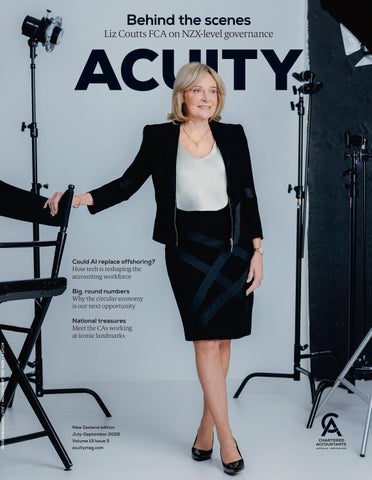
Is it time for political parties of all persuasions to tackle tax reform? 44 The quiet achiever Elizabeth Coutts ONZM FCA discusses her governance career
48 What’s next for the Commonwealth Games? Could New Zealand host in 2034? 50 Joining the dots The benefits of a circular economy 58 Climate and sustainability update The latest on climate reporting 62 Could AI solve our talent challenge? Which is best: offshoring or AI?
68 Trust no one The challenges of cybersecurity, when work devices do double duty
80 The new rules of workplace wellbeing
Creating a tailored wellbeing program employees will use
84 How to find new clients
Digital marketing and social media platforms have opened up an array of ways to promote your firm and connect with potential clients
88 Quiz: keep your eye on the ball How much do you know about the men’s FIFA World Cup?
CA ANZ, chief marketing officer
Chelsea Wymer
CA ANZ, head of content strategy and production
Victoria Marin
EDITORIAL
Editor-in-chief Camille Howard
Editor Abigail Murison
Art director Suzanne Elworthy
Digital and social lead
Stefanie Jackson
Deputy editor Beth Wallace
Chief subeditor Carey Swan
Content coordinator Ted Schief
Production manager Neridah Burke
Editorial enquiries
+61 (02) 8114 8900
acuityeditorial@mediumrarecontent.com
Level 1, 83 Bowman Street, Pyrmont, NSW 2009
ADVERTISING
Advertising and partnership enquiries
BusinessPartnerships@ charteredaccountantsanz.com
AU +61 2 9290 5583
NZ +64 9 303 5186
MEDIUM RARE CONTENT AGENCY
Managing director Nick Smith
Account director Heather Jarvis
Head of design Tony Rice
Head of creative production Chantelle Love
mediumrarecontent.com
Printed by Webstar, New Zealand. Paper fibre is from sustainably managed forests and controlled sources.
The opinions expressed in Acuity Magazine do not necessarily represent the views of the Chartered Accountants Australia and New Zealand nor the publisher. While every effort has been made to ensure accuracy, no responsibility can be accepted by the Chartered Accountants Australia and New Zealand or the publisher for omissions, typographical or printer’s errors, inaccuracies or changes that may have taken place after publication. All rights reserved. The editorial material published in Acuity Magazine is copyright. No part of the editorial contents may be reproduced or copied in any form without prior permission of and acknowledgement of the Chartered Accountants Australia and New Zealand. Acuity Magazine is a trademark of the Chartered Accountants Australia and New Zealand.
CHARTERED ACCOUNTANTS AUSTRALIA AND NEW ZEALAND (CA ANZ)
33 Erskine Street Sydney, NSW 2000 Mail GPO Box 9985 Sydney, NSW 2001
Contact your local office
New South Wales 1300 137 322 or +61 2 9290 5660
Victoria/Tasmania +61 3 9641 7400
Australian Capital Territory +61 2 6122 6100
Queensland +61 7 3233 6500
South Australia/Northern Territory Call +61 8 8113 5500
Western Australia Call +61 8 9420 0400
NEW ZEALAND
Call 0800 469 422 or +64 4 474 7840 (outside New Zealand) service@charteredaccountantsanz.com
New Zealand office
Chartered Accountants House, Level 7, 50 Customhouse Quay, Wellington Mail PO Box 11342, Wellington 6142
Contact your local office
Wellington +64 4 474 7840
Auckland +64 9 917 5915
North Island
+64 7 839 4764
South Island +64 3 961 2410
Find a CA near you charteredaccountantsanz.com/find-a-ca
Setting fees with confidence and clarity
A new report shows most accountants plan to lift their fees, but confidence is a barrier without data-driven tools.
Higher fees are on the agenda for accountants as rising costs, growing compliance complexity and changing client expectations prompt a review of pricing strategy.
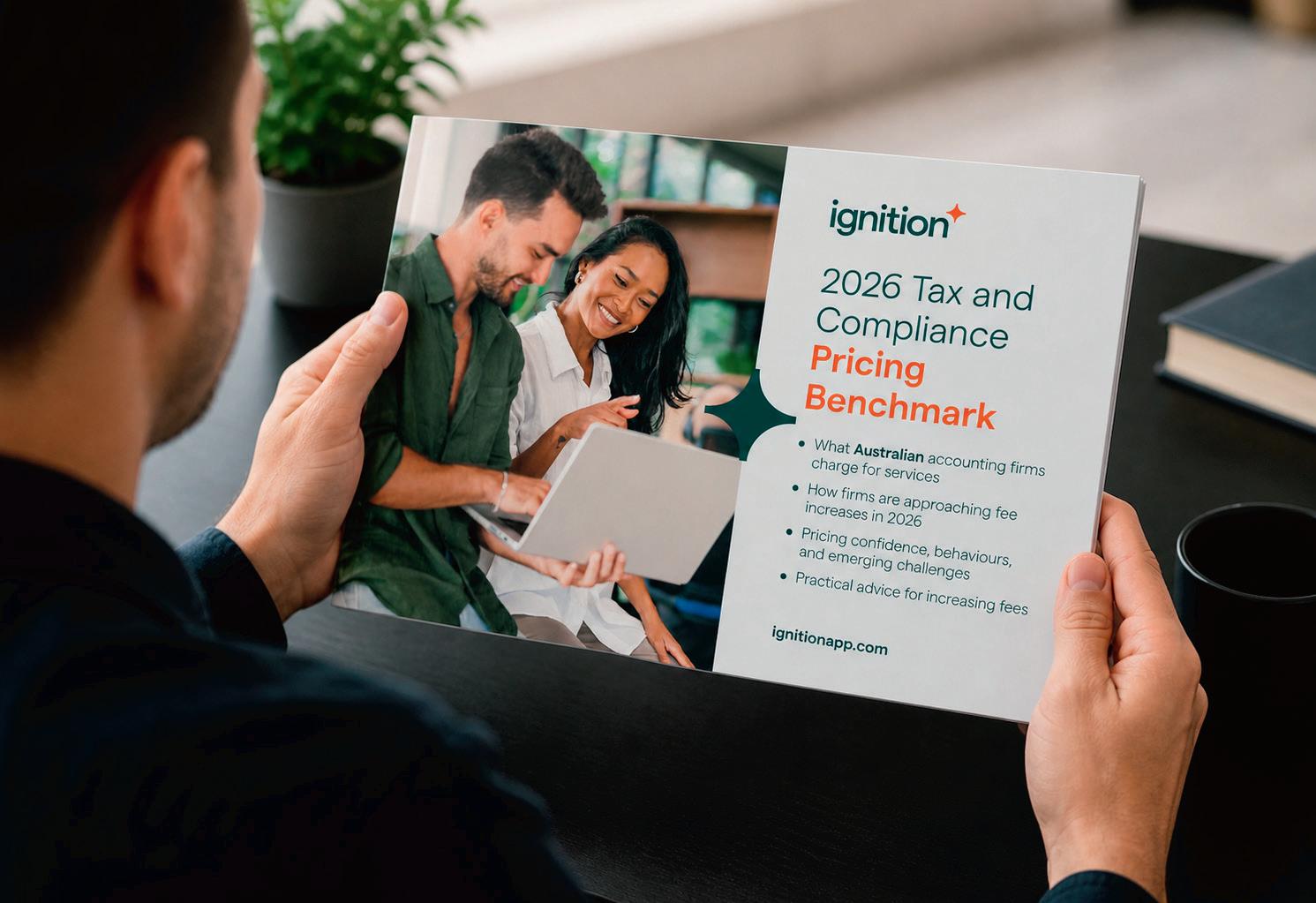
Findings of the 2026 Tax and Compliance Pricing Benchmark report from revenue and billing platform Ignition show nearly 80% of accounting practices plan to increase their fees this year. Based on a survey of 160 Australian accounting firms using Ignition, it shows the most common fee increase is 5–10%, with firms spreading adjustments across services, rather than applying blanket rises.
However, despite the momentum, only one in five firms report being ‘very confident’ and 64% are only ‘somewhat confident’ in their pricing strategy, with common barriers including fear of losing clients, uncertainty about what to charge and discomfort with pricing conversations.
Removing the guesswork
“There’s a tension where accountants know their own costs are going up, but they’re not always sure how they should approach their fee increases,” says Dave New, managing director of APAC and EMEA, Ignition.
Compare your firm’s pricing Get insights on current fees and planned increases for common tax and compliance services. Download the 2026 Tax and Compliance Pricing Benchmark report at: ignitionapp.info/benchmark-report-26
“There’s also quite a lot of variation in pricing for very similar services across the market and, in many cases, firms are undercharging relative to their peers. That’s a pretty strong signal that many firms are still pricing in isolation, without a clear benchmark.”
To help close the gap, Ignition provides tools for accountants to benchmark their own fees.
“Benchmark data from Ignition gives you context to help you understand where you sit relative to firms of a similar size and service offering,” says New.
While benchmark data provides a valuable reference point, firms are seeking ways to apply those insights in a tailored, practical way within their own businesses.
Personalised data
Ignition’s AI-powered Price Insights was designed to optimise revenue through personalised pricing suggestions tailored to the firm’s services, location and business profile.
Powered by real proposal data, it creates transparency around pricing by explaining the ‘why’ behind each suggestion, such as differences in service inclusions, billing models or regional pricing trends.
“Price Insights takes benchmark data and makes it actionable inside a firm’s day-to-day workflow,” says New. “It provides pricing guidance at the point where you’re creating proposals and setting fees.”
Price Insights includes features such as suggested price range, visibility into how your pricing compares, and guidance for packaging and positioning services consistently.
“It’s focused on solving everyday pricing challenges in a way that fits naturally into existing workflows.
“Pricing is one of those areas where hesitation can lead to undercharging,” says New. “When you’ve got data behind you, it’s much easier to stand behind your pricing with confidence.”
8 From the CEO
“Trust
Ainslie
I was proud to see CA ANZ’s bold advocacy and communication on the respective Australia and New Zealand budgets, as well as during our appearance before the Parliamentary Joint Committee in Canberra.
Watching the PJC in March, as Ainslie van Onselen and the executive team clearly expressed CA ANZ’s purpose of upholding technical expertise and ethical standards that define the CA designation, gave me a strong sense of direction and confidence.
Our disciplinary framework operates with a deep sense of responsibility –seeking accountability and outcomes that protect the public interest, while maintaining fairness, rehabilitation, privacy and due process.
That balance matters because it reflects the values of this profession and the seriousness with which chartered accountants approach both accountability and integrity. There are areas where we want to see progress, particularly around clarifying the roles of co-regulators – and I was equally proud to see that raised by our team.
Like many members, I was also wellinformed by CA ANZ’s advocacy and insights on the respective budgets and the changes which ultimately land on the desks of chartered accountants who work with
Naomi Walsh FCA president, CA ANZ
President’s letter
Strong advocacy, professional integrity and member engagement have been at the heart of the last three months – reinforcing our profession’s future and influence.
organisations big and small, to understand and implement.
Throughout all of this, the enduring focus is clear – to support you with your important work.
It has been inspiring to meet members across Tasmania, Christchurch, Manawatū and Victoria, to open this year’s Audit Conference and to attend the Australian Accounting Hall of Fame – each a powerful reminder of the calibre of people within our profession.
The Hall of Fame in particular highlighted the remarkable impact of the careers that these members have forged – across business, government, advisory, assurance, leadership and service to community. Congratulations to Jayne Godfrey FCA and Ian McPhee AO PSM FCA on their induction. Equally, it was a privilege to celebrate past-president Professor Nives Botica Redmayne FCA becoming a life member at the Manawatū ceremony, joining past-president Stephen Walker FCA and Professor Emeritus Ann Tarca PhD FCA as life members this year.
Also inspiring was meeting CA ANZ’s student ambassadors, Zainab, Sali and Anjani at the National Press Club in Canberra and Anna in Christchurch, bringing regional experience to the ambassador
role. They are showing others in their generation where a career in accounting can now lead – with core accountancy skills increasingly shaping emerging areas such as AI, sustainability and digital reporting.
Talking with our aspiring and new CAs gives me real confidence in the future of our profession and in the work we are doing to attract talented young people like them.
At our new member ceremonies, there is real energy as new CAs celebrate their achievements among supporters who share their immense pride. Keynote speeches from experienced members inspire them to pursue opportunities enabled by the CA designation.
The months ahead include a busy program of member events, with myself and our vice-presidents Matt Green FCA and Julia Fink FCA, in Waikato, Queensland, Wellington and Sydney.
I encourage you to say hello, share your experiences, and offer your feedback. These conversations play an important role in shaping our council and board conversations – and in turn how CA ANZ supports and represents you.
The strength of this profession lies not only in its standards, but in its people – and it remains a privilege to represent you.
Photography by Damien Ford
Events
CA ANZ is here to help members stay ahead and maintain your expertise as a trusted professional with learning designed for CAs.
Monthly Tax Update Series
Starts July 2026, online
Stay informed on the tax changes impacting you and your clients. Each month, tax specialist Stephen Richards will cover key updates to tax legislation, case law, IR guidance, and emerging developments.
Business
Valuation and Forensic Accounting Conferences
October, online
Our biennial Business Valuation and Forensic Accounting Conference event is dedicated to accounting professionals working in the business valuation and forensic accounting sectors, whether in practice or business.
Sustainability Conference
October, in-person (Sydney) and online
Our Sustainability Conference is designed to elevate your knowledge and confidence in tackling the sustainability challenges faced by accounting, business and finance professionals every day.
NZ Tax Conference
19–20 November 2026, in-person (Wellington) and online
With more than 35 years of providing industry updates and insights, our popular Tax Conference is the flagship event for tax professionals. 2726555 2025-12-05T05:44:23+11:00
Find out more store.charteredaccountantsanz.com
What do you think of Acuity?
Scan the QR code to give us feedback on Acuity print magazine and digital articles – what you enjoyed, where we can improve and what you’d like to see in future editions.
Ainslie van Onselen LLB, MAppFin, GAICD CA ANZ CEO and chair of Chartered Accountants Worldwide
GLOBAL uncertAinty continues to shape the environment in which you and your clients operate. Our member survey in May showed the Middle East conflict is having tangible economic impacts on Australian and New Zealand businesses. Higher energy and production costs, disrupted supply chains and freight delays are driving real-time volatility and affecting decision making across every sector of the economy. This comes on top of ongoing cost-of-living pressures, rapid technological change and evolving regulation, making your role as trusted advisers more critical than ever.
I also hear these realities from members at my CEO Connect events. If you have attended one in person, thank you for investing your time. Whether speaking with members in major cities or regional communities, the themes are remarkably consistent: managing costs, understanding the implications of AI and sustaining confidence through disruption. Your feedback shapes our efforts on your behalf.
This is why our Strategy to 2030 is deliberately long-term and membercentred. In a rapidly changing environment, it keeps us focused on what matters most: future-fit skills, trusted standards, strong international connections and influence
From the CEO
We’re engaging with members on what matters most.
with decision makers. We are supporting you now and for what will be a defining decade for the profession.
Understanding the economic context is essential, as clients seek assurance as well as technical advice. Member engagement with the monthly economic update from our chief economist, Professor Richard Holden, has been strong. Richard has also joined our expert policy leads at flagship events, including our Audit & Assurance Conferences and post-Budget Sharing Knowledge sessions, helping members make sense of fast-moving conditions.
We are also strengthening the platforms and learning pathways that support your professional development. New search functionality on our website, including our chatbot LuCA, makes it easier to find the resources you need. Demand for AI-related learning remains strong, and we have introduced new certificates in data analytics and finance business partnering to support this shift.
With more than 10,000 practising international members, global connections remain a key priority. Recent Global Accounting Alliance and Chartered Accountants Worldwide meetings reinforced shared challenges and opportunities, from talent mobility to
workable standards and practical technology implementation. We continue to expand mutual recognition arrangements, including with Canada and Bangladesh, and are proud to mark a 10year strategic partnership with Association of Chartered Certified Accountants.
Trust and integrity remain foundational to our role as a professional body and to your work as chartered accountants. Through our Quarterly Ethics Digest, we continue to highlight the ethical principles that underpin professional practice. Our next edition will align with Global Ethics Day, focusing on financial abuse, an area where you can play a vital role in protecting vulnerable people and sustaining confidence in the financial system.
Finally, in this moment of uncertainty and change, thank you for continuing to provide CA ANZ with your perspectives. At my CEO Connect meetings, I always share an update on our strategy because so many of you helped shape it. As then, the most important perspective will always continue to be yours. Your insights –whether through CEO Connect, our wide governance ecosystem or through surveys and events – guide our decisions and reinforce the critical role you play in the economy.
Rethinking retirement settings
As the New Zealand election draws nearer, we consider what retirement reform could look like.
In my previous column, I wrote about the place that retirement settings should take in conversations about New Zealand’s economic and fiscal future. Member feedback was clear from the survey we conducted late last year. Across all the different age groups, chartered accountants see the current settings as increasingly unsustainable and in need of reform.
This article focuses on what reform could look like.
Our advocacy on retirement settings is guided by a simple principle: New Zealand needs settings that are fiscally sustainable over the long term, while remaining fair, predictable and practical for individuals planning their retirement.
This requires a frank, cross-party conversation about the different options that could be considered for inclusion in a reform package. Any change needs to be considered carefully, not rushed and made under fiscal pressure.
Improving the affordability of national superannuation
National superannuation is becoming increasingly unaffordable because of the ageing population, low productivity growth and the way the current superannuation system is designed. Moving from universal
to means-tested entitlement is likely to be politically unpalatable.
Affordability could be addressed by slowly and gradually increasing the age of entitlement and/or introducing greater flexibility in superannuation entitlement age. Raising the age of entitlement and/or allowing retirees to choose when they want to commence entitlement (with payments scaled according to commencement age) could preserve universality.
Another approach could involve a twotier system with a lower superannuation fortnightly payment for those retiring prior to a certain age and a higher payment for those who retire after the relevant age.
These models are not new and some have previously been assessed as broadly revenue-neutral. What has changed is the context: with much higher participation in KiwiSaver, individuals now have more scope to shape their retirement income mix.
Greater flexibility would allow people to spread support across their retirement years, while easing the long-term fiscal pressure on the country.
Rethinking indexation settings
A second driver of long-term cost pressure is the link between superannuation increases and wage growth.
Peter Vial FCA group executive, New Zealand and the Pacific, CA ANZ
At present, national superannuation is increased in line with wage growth. This framework creates a structural problem. Productivity and wage growth automatically drive higher superannuation costs. New Zealand cannot grow its way out of this challenge.
Adjusting the indexation settings – for example, linking New Zealand Superannuation to CPI rather than wage growth – could help improve affordability over time.
Any change of this nature would need to be gradual, transparent and supported by stronger private savings.
Strengthening private retirement savings
Reform to public settings cannot succeed without stronger private savings incentives.
CA ANZ supports practical measures to lift long-term retirement saving, including options such as KiwiSaver salary sacrifice or targeted tax incentives. These approaches could increase contributions without increasing headline contribution rates, helping individuals better prepare for more flexible retirement pathways.
A long-term, multi-party approach
None of these issues has an easy answer. But doing nothing is not a sensible choice. We need a cross-party working group to examine retirement settings holistically, recommend options to improve affordability and identify measures to strengthen private savings.
Retirement policy works best when it is stable, long-term and supported across the political spectrum.
Take away
For a selection of New Zealand tax reading lists search the topic at: library.charteredaccountantsanz.com
Find out when your next AGM will be held
The 98th Annual General Meeting of Chartered Accountants
Australia and New Zealand will be held on Friday, 23 October 2026.
Administration
We remind Members entitled to vote that if they wish to bring before this meeting any motion or business not relating to the ordinary business of the meeting they must, together with 99 or more other eligible Members, give notice of that motion or business in writing to the Board and the Chief Executive Officer at least 60 days before the meeting by emailing that written notice to governance@charteredaccountantsanz.com.
The 2026 Annual General Meetings of Regional and Overseas Regional Members are scheduled for the dates below:
Location Date
Australian Capital Territory
New South Wales
Thursday, 15 October 2026
Wednesday, 14 October 2026
Queensland Wednesday, 14 October 2026
South Australia/Northern Territory
Thursday, 15 October 2026
Tasmania Wednesday, 14 October 2026
Victoria Thursday, 15 October 2026
Western Australia
New Zealand
Hong Kong
Wednesday, 14 October 2026
Wednesday, 14 October 2026
Wednesday, 14 October 2026
Malaysia Thursday, 15 October 2026
Singapore Wednesday, 14 October 2026
United Kingdom
Administration
Wednesday, 14 October 2026
If Members of a Region or Overseas Region wish to bring before the annual general meeting of that Region or Overseas Region any motion or business not relating to the ordinary business of the meeting they must, together with 99 or more other eligible Members, give notice of that motion or business in writing to the Regional Council or Overseas Regional Council and the relevant Regional Manager or Overseas Regional Manager at least 60 days before the meeting (see dates above) by emailing that written notice to governance@charteredaccountantsanz.com.
BEHIND EVERY ICONIC LANDMARK...
Story by Cameron Cooper
The stakes are higher for CFOs when they are in charge of the financial oversight of national treasures. Four chartered accountants give us an insider’s perspective.
Quick take
CFOs managing the finances of iconic institutions or sites must balance profitability with public sentiment.
Diverse skillsets required in such roles span everything from digital analysis to diplomacy.
Stewardship roles can bring rewards over and above a regular executive job.
As Jon Blackburn CA enters the Sydney Opera House each workday to get to his office, he realises it is a perk of the job that few can match.
Overlooking Sydney Harbour, with its views and vibe, the much-loved building is simultaneously a global icon and a complex business. For Blackburn, now more than eight years into his tenure as CFO, that dual identity defines his role. He is part custodian of a national symbol and part financial strategist responsible for keeping a multi-dimensional operation sustainable.
The walk to work is inspirational for him. “There’s always something happening and it’s always different,” Blackburn says. “A lot of the time, people are experiencing the opera house for the first time, including tourists or children coming to the site to perform or learn, and you see the joy on their faces.”
Balancing art and commerce
A sense of responsibility is a recurring theme among finance leaders working in landmark institutions – and the job comes with a set of challenges that are often more involved than those in traditional corporate roles.
Mary Fisher CA, CFO at the National Gallery of Australia (NGA) in Canberra, understands that reality. The gallery is Australia’s chief visual arts institution and it exists to reflect the nation’s cultural identity, care for the national collection and make art accessible to the public. That mission gives Fisher’s role in the institution a sense of deeper meaning that may not be easily found in typical commercial jobs.
“It also changes the definition of success,” she says. “Rather than focusing on chargeable hours and utilisation, an institutional role focuses on stewarding public funds responsibly, while enabling creativity and ambition. I have to constantly weigh financial discipline against cultural impact, and that tension makes the role both more complex and more rewarding.”
Such a sentiment resonates with Blackburn. The Sydney Opera House operates as a not-for-profit, but its financial
“A lot of the time, people are experiencing the opera house for the first time, including tourists or children.”
Jon Blackburn CA, Sydney Opera House
model is highly commercial. Just under 90% of revenue is generated through activities such as ticket sales, tourism, food and beverage, and venue hire, with government funding supporting the building and core operations.
For the CFO, the main tension is clear – enabling artistic ambition while maintaining financial discipline. “We’re a not-for-profit, but we’re not for-loss either,” Blackburn says.
That balancing act requires constant prioritisation. Not every production, program or idea can be funded, even when it aligns with the organisation’s cultural mission. CFOs must make difficult calls about where to allocate limited resources.
Challenges outside the norm
Whereas listed companies have more defined accountability structures, iconic
“It also changes the definition of success... an institutional role focuses on stewarding public funds responsibly.”
Mary Fisher CA, National Gallery of Australia
institutions must constantly please multiple stakeholders. Finance leaders have to navigate relationships with governments, boards, donors, community groups and, in many cases, the public.
Steve Wakefield FCA, director of the Christ Church Cathedral Reinstatement Project, has spent the past 15 years playing his part to help rebuild one of New Zealand’s most significant heritage sites, the Christ Church Cathedral, after the devastating 2011 earthquake that killed 185 people and destroyed many city buildings and parishes.
Built between 1864 and 1904, the cathedral is a cherished symbol of Christchurch and appears on the council logo. “So, the video of the cathedral’s spire coming down during the earthquake lives on as a symbol of the destruction,” Wakefield says.
Photography by Rory Gardiner (National Gallery of Australia) and Ben Mack
(Sydney Opera House)
The Canberra National Gallery of Australia was first mooted in the 1900s by landscape painter Tom Roberts. The Col Madigandesigned building was officially opened by Queen Elizabeth II on 12 October 1982.
The Christ Church Cathedral was severely damaged in the New Zealand September 2011 earthquakes. The spire collapsed into the square and back into the cathedral itself.
The cathedral rebuild, which is currently on pause pending additional funding requirements of about NZ$40 million, illustrates the broader reality for CFOs dealing with national treasures – financial leadership often extends well beyond normal boundaries.
Wakefield’s role has required the former Deloitte Canterbury managing partner to juggle the complexities of finance, government policy, community expectations and large-scale project management. Immediately after the quake, he played a central role in negotiating a NZ$120 million insurance settlement for the Diocese of Christchurch to repair its portfolio of damaged buildings. He continues to work with local and central government and stakeholders to advance a staged reopening plan.
“In my general manager role with the Canterbury Earthquake Recovery Authority, I was the link point between businesses and government immediately after the earthquakes,” Wakefield says. “It was a really interesting time formulating policy and shepherding it through government decision-making processes, ministries and cabinet.”
The goal now is for construction work to resume on the cathedral at the end of 2026 or in early 2027, with 2030 set as the possible re-opening date for the cathedral.
Sustainability the focus
Overseeing the operations of some of Australia’s most-loved natural sites keeps Otto Menzel CA motivated. Now CFO of Parks Australia, a government agency which helps operate Uluṟu-Kata Tjuṯa, Kakadu and a portfolio of national parks and marine reserves, he grew up spending a lot of time in a small national park in South Australia called Dhilba Guuranda-Innes.
“Most of my interests and hobbies are outdoors and nature-focused,” he says. “That connection made this role feel purposeful in a way that many other roles across the federal government hadn’t.”
The Parks Australia role is quite different from a traditional CFO position. Alongside the CFO responsibilities, Menzel runs the
“It was a really interesting time formulating policy and shepherding it through government decisionmaking processes, ministries and cabinet.”
Steve Wakefield FCA, Christ Church Cathedral Reinstatement Project
agency’s enabling and corporate functions – finance, property, security, governance, and information and communication technology (ICT), with a strong focus on reducing “corporate noise” so the parks can focus on looking after Country.
“It’s also more challenging because no two parks are alike,” Menzel says. “Our portfolio includes remote terrestrial parks, marine parks, botanic gardens and islands at the extremes of the country. Some parks are jointly managed with Traditional Owners, where we lease the land. Others operate in very complex and remote environments. That diversity makes standardisation difficult, but it also makes the role incredibly interesting.”
Long term, the challenge for Parks Australia is sustainability, with Menzel noting that the parks are not just operational environments.
“They are living cultural landscapes, ecologically fragile and deeply significant to Traditional Owners and to Australia’s identity. Protecting them isn’t about preserving something static – it’s about ensuring they can continue to be cared for, used and shared responsibly for generations to come.”
From a financial perspective, Menzel says that means balancing compliance and stewardship with flexibility and practicality, particularly in remote settings where standard government systems do not always fit neatly in every circumstance.
At the NGA, Fisher understands the dilemma of balancing financial and publicinterest goals.
Backed by a finance team of 12 professionals, she says two significant parts of the work are inherently contradictory.
“We need to both protect and preserve art, while also showing it off to the general public in an attractive and accessible way. That means we have high demands on infrastructure, but also a need to remain culturally and socially relevant, so that we can continuously present world-class exhibitions and attract visitors.”
Fisher adds that, like all not-for-profits, the long-term challenge is always sustainability. “We have to balance high public expectations with finite resources, acquitting funds responsibly and sustainably to ensure the gallery is positioned to thrive well into the future.”
At the Sydney Opera House, Blackburn also engages regularly with executives, the board, audit and risk committees, government representatives and cultural partners. Many stakeholders feel a strong sense of ownership over the institution, which adds opportunity and pressure.
“It’s as much qualitative as it is quantitative,” he says. “You can provide the numbers but you also need judgement around where to push and what to do.”
Blackburn’s biggest test came courtesy of COVID-19. In 2020, about two years into his tenure, the pandemic forced repeated closures of the opera house as tourism also collapsed. He steered the business through that period, with the opera house relying
on insurance and government support while tourism recovered.
During that phase and beyond, he has introduced much tighter reporting, including weekly key performance indicators. He has also introduced data-driven strategies that deliver faster access to information, so leaders can monitor the real-time performance of shows, food and beverage outlets, and tailor marketing to changing audience behaviours and boost ticket sales through personalised recommendations.
“So, I’ve brought a level of data-driven, considered discussions around how we spend our money.”
Full gamut of skillsets on show
What skills are needed to keep some of Australia and New Zealand’s most-loved natural sites and institutions thriving?
Menzel says strong technical skills are a given. CFOs also need judgement, curiosity and the ability to listen, especially with people who have deep cultural, environmental or operational expertise.
“I think it’s important to remember that behind every iconic landmark are people – rangers, Traditional Owners, scientists, corporate staff – all working together,” he says. “Good financial management in public sector organisations like Parks Australia isn’t about spreadsheets for their own sake. It’s about stewardship, trust, transparency and making sure we leave these places in good shape for those who come after us.”
Wakefield has always believed that being successful in accounting is not just about technical skills, but also the ability to lead teams and understand the needs of all stakeholders. “It’s about listening to people and building trusted relationships,” he says, noting that such skills have been especially crucial to the Christ Church Cathedral role.
Fisher highlights the importance of judgement, communication, problemsolving skills and the ability to build connection and influence. “A CFO in this environment needs to translate financial concepts into something meaningful for non-financial stakeholders. Much of the
“Parks Australia isn’t about spreadsheets... It’s about stewardship, trust, transparency and making sure we leave these places in good shape.”
Otto Menzel CA, Parks Australia
role involves working through ambiguity, identifying practical solutions and supporting good decision making, rather than simply providing answers.”
She adds that there is a growing recognition that finance is about enabling organisations to achieve their purpose.
“In environments like the NGA, that means recognising how interconnected everything is in practice – supporting creativity while managing complexity, balancing risk and opportunity.”
Blackburn says his opera house role has demanded a blend of finance, data, communication and diplomacy. Judgement is crucial too.
“There are things that we just need to be able to fund somehow, so we either fund them through our commercial revenues or we go out to private donors and partners and look to do more with more.”
Big commitment, big rewards
Despite myriad challenges, the finance leaders in these famous institutions consistently point to the rewards of the role. Chief among them is the sense of purpose that comes from contributing to organisations with cultural, historical or environmental significance.
For Fisher, one of the most satisfying aspects of her role is seeing exhibitions come together and resonate with the public. “Knowing that you’ve contributed to that outcome is incredibly satisfying,” she says.
Wakefield shares a similar perspective. His involvement in the cathedral rebuilding initiative led him to step away from a long career with Deloitte, and focus on governance and community-oriented roles. He relishes contributing during a period of recovery for the city.
Looking back on the disaster, he says it was “just a terrible time for the city... but in those difficult times, people have to step up and make a contribution. And I’ve been privileged to be able to do that.”
One of the biggest rewards for Menzel is being able to see where funding has made something better, whether that is new infrastructure, more resources to get on top of feral animals or weeds, science-led activities, or implementing new technology to be more efficient, such as the use of drones.
“I’m particularly proud of the progress we’ve made in strengthening governance and financial discipline, while still respecting the operational realities of remote and jointly managed parks. It’s not about perfection, it’s about steady improvement, building capability and trust over time so that corporate systems can work quietly and effectively in the background.”
Now overseeing a finance team of about 30, and roughly 60 people in the tech and cyber team at the opera house, Blackburn values the immediacy of the impact of his work and the chance to help lead a world-famous venue, while supporting the arts and seeing first-hand how the place matters to people across generations.
“It’s obviously an iconic building, an iconic business, so there’s a feeling of being able to give back.”
Photography by Daryl Mulvihill
Uluṟu-Kata Tjuṯa National Park is jointly managed by the Aṉangu Traditional Owners and Parks Australia.
From complaint to consequence
While some complaints are cleared up with simple inquiries, others are escalated to CA ANZ’s Disciplinary Tribunal. Here’s why.
Story by Alexandra Johnson
Quick take
The Disciplinary Tribunal is fundamentally reserved for the most serious offences but less serious complaints may be escalated.
Members may be referred to the Disciplinary Tribunal for failing to respond to the complaints process, being abjectly non‑compliant or not meeting their professional obligations.
Members who generally fare best when dealing with a complaint understand the disciplinary process, take time to know what ethical standards require, and take a reflective approach to the issues.
While many concerns raised about CA ANZ members are resolved through early-stage inquiries, alternative dispute resolution, remedial action or the imposition of more minor sanctions by the Professional Conduct Committee (PCC), a small proportion escalate to the Disciplinary Tribunal (DT).
The DT hears and determines complaints referred to it by the PCC. Tribunal hearings are a formal process and represent the sharpest end of the professional standards
framework for members. The DT is reserved for the most serious offences determined under the by-laws, New Zealand Institute of Chartered Accountants (NZICA) rules and code of ethics. The potential consequences may be significant and include substantial fines, restrictions on your ability to practise, mandatory training orders, suspension or termination of your membership.
Acuity spoke to Kate Dixon and Rebecca Stickney, leaders of the CA ANZ professional conduct teams in Australia and New Zealand, about the types of cases and behaviours that could typically trigger such escalation.
Serious transgressions
Stickney explains there is a range of conduct that may be referred to the DT. “Fundamentally, it includes conduct which demonstrates significant departures from the professional and ethical standards, where there’s a public interest in that matter being heard or where the powers of the PCC are insufficient to deal with the nature of the behaviour.”
The Members’ Handbook has been updated recently to include FAQs about complaints, professional conduct and disclosure obligations, to help members
“Members who acknowledge issues and come prepared to discuss what they have learned or changed in their practice usually benefit from such an approach.”
Kate Dixon, CA ANZ
understand the types of serious misconduct referred to the tribunal.
“Examples include when a member is guilty of a serious criminal offence, misappropriation, fraud or other financial crimes, or dishonesty findings,” says Dixon. “They also include inappropriate management of client monies, loss or suspension of an external registration, serious or sustained incompetence, fabricating records or bankruptcy.”
Stickney adds other types of conduct referred include practice solvency issues, integrity breaches and unprofessional behaviour which brings discredit to the profession.
“Additionally, in New Zealand, complaints involving serious breaches of assurance and insolvency standards are often heard in the tribunal due to NZICA responsibilities as a front-line regulator in those sectors of the accounting industry.”
The key is communication
Members may be referred to the DT for failing to respond to the complaints process or when they have been abjectly non-compliant, even if the complaint itself doesn’t warrant severe penalties.
“Issues that may have been resolved by the PCC are being escalated due to the member not responding to the PCC, providing inadequate information or offering misleading responses in mandatory declarations to CA ANZ or NZICA,” says Dixon.
“For example, one member who received an adverse finding from an overseas regulatory body for failing to act with professional competence or due care, failed to notify CA ANZ of this. He had his membership suspended for three years and was ordered to pay costs.”
Members who do not meet their quality review obligations, or who carry out work requiring a certificate of public practice without holding one, may also be referred to the DT.
“Members have a professional obligation to comply with all requirements, such as practice and quality reviews and to respond to all enquiries from the PCC in a
timely fashion,” says Stickney. “Failing to do so can escalate matters.
“We recently had a case where an insolvency practitioner failed to engage in a practice review. This went to the NZICA Disciplinary Tribunal, and the practitioner was sanctioned and ordered to undergo the practice review once again. They failed to comply with that order, resulting in the case being referred back to the DT and the practitioner’s licence was removed, in accordance with the tribunal’s powers under the Insolvency Practitioners Regulation Act 2019.”
Dixon also recalls a case where a member did not respond to the requirement to submit to a quality review. “His membership was suspended for two years, costs were imposed and his CA ANZ fellowship was removed.”
Honesty
is the best policy
Stickney says integrity breaches are also usually referred to the DT. “There is a range of behaviour that can come within this category, such as members being less than straightforward in their business dealings through misleading statements, covering a mistake with mistruth and, of course, outright dishonesty such as theft or misappropriation.”
Dixon says that while some matters are so serious they must go straight to the DT from a public interest perspective, many complaints can be resolved earlier if the member shows insight and an understanding of their obligations.
“If the member demonstrates they have a strategy to avoid these issues in the future, it can make a difference.”
Speak to the CA Advisory Group
At times, members fall short of their professional duties and leave clients in difficult positions due to burnout or personal challenges. Stickney notes that while life can present challenging situations, members still need to think about their professional obligations as sustained non-communication with clients or failure to complete work can also reach the threshold for referral to the tribunal.
“It is important to develop support networks and systems that can be used if needed.”
Navigating the Disciplinary Tribunal
If a complaint is referred to the tribunal, Stickney encourages members to consider taking legal advice early. “It can also be useful to seek peer and personal support, or talk to a colleague or a member of the CA Advisory Group [details below].”
She says the members who fare best in the disciplinary process are generally those who take time to understand the process, know what ethical standards require, and take a responsible and reflective approach to responding to the complaint.
“While members do not have to agree with the complaint, it is not in their interests to defend the indefensible or take an ardent position that is not supported by the facts.”
The DT assesses the seriousness of the case against the public interest but also considers rehabilitation and insight, says Dixon.
“Members who acknowledge issues and come prepared to discuss what they have learned or changed in their practice usually benefit from such an approach.”
Are you facing an ethical dilemma or are you the subject of a complaint?
CA ANZ members have access to the Chartered Accountants Advisory Group (CAAG), a confidential support service comprising senior professionals who can assist you with ethical and professional challenges.
Other support services available to members can be found at: charteredaccountantsanz.com/member-services/mentoring-and-support/ ca-advisory-group
Rebecca Stickney
New Zealand conduct leader, CA ANZ
Kate Dixon Australian conduct leader, CA ANZ
Disciplinary decisions
Effective regulation of members is essential to maintain the required high ethical and technical standards expected of chartered accountants. The disciplinary bodies at Chartered Accountants Australia and New Zealand help maintain the strength of the designations held by all members by ensuring that members continue to comply with those high professional and ethical standards throughout their careers.
Included below are summaries of recent decisions of our Australian and New Zealand disciplinary bodies. Full decisions are published on our website and can be found at: charteredaccountantsanz.com/ disciplinary-decisions
Notice of decision of the Professional Conduct Committee in Australia
Adverse findings by the Companies Auditors Disciplinary Board/Imposition of any condition or restriction on a professional registration/Discredit –Bradley Taylor CA
On 19 November 2025 the Professional Conduct Committee (PCC) considered the Disciplinary Tribunal would likely find that Bradley Taylor CA:
1. has been the subject of an adverse or unfavourable binding determination by the Companies Auditors Disciplinary Board (CADB);
2. has had imposed a condition or restriction on a professional registration in the Member’s name;
3. made an admission or committed an act, omission or default which brings, or may bring, discredit upon the Member or the profession of accountancy,
which are offences under By-Law 40.9(a) (vii), 40.9(a)(viii) and 40.9(a)(xvi) (Revised 25 January 2024 and 13 January 2025).
The Member has been censured, required to pay an amount of A$5000, provided an undertaking that he will not be involved in any audit engagements in the future, and required to pay Costs.
Notice of decision of the Professional Conduct Committee in Australia
Adverse or unfavourable binding determination/Imposition of conditions or restrictions/Firm Event – PKF Melbourne Corporate Pty Ltd
On 27 November 2025 the PCC considered in respect of PKF Melbourne Corporate Pty Ltd (PKFMC) that it was likely the Disciplinary Tribunal would find that PKFMC was the subject of
an adverse or unfavourable binding determination and it had agreed to, or has had imposed, any condition or restriction on any professional membership, registration or licence in its name, which are Firm Events under By-Laws 39(m)(iv) and (v) (Revised 25 January 2024).
PKFMC has been censured and required to pay Costs.
Notice of decision of the Professional Conduct Committee in Australia
On 8 December 2025 the PCC considered that the Disciplinary Tribunal would likely find that the Practice Entity was the subject of an adverse or unfavourable binding determination in relation to its professional or business conduct by a statutory or regulatory authority or statutory body which is a Firm Event under By-Law 39(m)(iv) (Revised 13 January 2025).
The Notifying Principal has been censured and required to pay Costs.
Notice of decision of the Professional Conduct Committee in Australia
Conflict of Interest/Objectivity –Allan Donald FCA
On 8 December 2025, the PCC considered that the Disciplinary Tribunal would likely find that Allan Donald FCA (Member) breached the Independence Standards in the Code of Ethics and the Member has therefore committed an offence under former By-Law 40(2.1)(h).
The Member has been censured and required to pay Costs.
Notice of decision of the Professional Conduct Committee in Australia
Academic Integrity – Member K
On 8 December 2025, the PCC considered that the Disciplinary Tribunal would likely find that the Member:
1. has committed a breach of the Compliance Obligations, including the Code of Ethics; and
2. has committed an act, omission or default which brings or may bring discredit on the Member or the profession of accountancy, which are Offences under By-Laws
40.9(a)(ix) and 40.9(a)(xvi) (Revised 25 January 2024).
The Member has been censured, required to undergo training and pay Costs.
Notice of decision of the Professional Conduct Committee in Australia
Adverse or unfavourable binding determination/Condition or restriction on registration /Discredit – Allan Facey CA
On 8 December 2025, the PCC considered that the Disciplinary Tribunal would likely find that the Member:
1. has been the subject of an adverse or unfavourable finding in relation to the Member’s professional or business conduct or competence by a regulatory authority;
2. has had imposed a condition or restriction on a professional registration in his name; and
3. has committed an act, omission or default which brings or may bring discredit on the Member, CA ANZ or the profession of accountancy, which are offences under By-Laws
40.9(a)(vii), 40.9(a)(viii) and 40.9(a)(xvi) (Revised 25 January 2024 and 13 January 2025).
The Member has been censured, required to provide further information to CA ANZ and pay Costs.
Notice of decision of the Professional Conduct Committee in Australia
Conflict of Interest/Objectivity –Member H
On 29 January 2026, the PCC considered that the Disciplinary Tribunal would likely find that Member H:
1. failed to comply with sections R120.3 and R310.9 of APES 110 in that he did not apply the conceptual framework to identify, evaluate and address threats to compliance with the fundamental principles and he did not exercise professional judgement to determine whether the nature and significance of a conflict of interest were such that specific disclosure and explicit consent were necessary when addressing the threat created by the conflict of interest; and
2. failed to comply with APES 305 in that a new engagement letter was required to be issued, given the new scope of work and to clearly identify the parties to the engagement, which are offences under former By-Law 40(2.1)(h)(Revised 30 March 2022).
The Member has been censured, required to undertake a course and required to pay Costs.
Notice of decision of the Professional Conduct Committee in Australia
Court Enforceable Undertaking – Hall Chadwick (NSW) (Practice Entity) and Drew Townsend CA, Sandeep Kumar CA and Graham Webb (collectively the Members)
On 29 January 2026 the PCC considered that the Disciplinary Tribunal would likely find that:
1. The Practice Entity has been the subject of an adverse or unfavourable binding determination in relation to its professional or business conduct, which is a Firm Event under By-Law 39(m)(iv) (Revised 13 January 2025);
2. Each of the Members has been the subject of an adverse or unfavourable binding determination in relation to their professional or business conduct and has made admissions and committed an act, omission or default which brings, or may bring, discredit upon them or the profession of accountancy, which are offences under By-Laws 40.9(a) (vii) and 40.9(a)(xvi) (Revised 13 January 2025).
The Notifying Principal (on behalf of and as representative of the Members who are Principals of the Practice Entity in relation to the Firm Event) and each of the Members has been censured and required to pay Costs.
Notice of decision of the Professional Conduct Committee in Australia
Adverse or unfavourable binding determination – Andy Choi CA
On 3 March 2026, the PCC considered that the Disciplinary Tribunal would likely find that the Member:
1. Has been the subject of an adverse or unfavourable binding determination in relation to the Member’s professional or business conduct, competence or integrity by a statutory or regulatory authority;
2. Has had imposed a condition or restriction on a professional registration in his name; and
3. Has committed an act, omission or default which brings or may bring discredit on the Member or the profession of accountancy, which are offences under By-Laws 40.9(a)(vii), 40.9(a)(viii) and 40.9(a)(xvi) (Revised 13 January 2025).
The Member has been censured, required to submit to a quality review and undertake professional development and required to pay Costs.
Notice of decision of the Professional Conduct Committee in Australia
Integrity/Professional Behaviour/ Discredit – Member J
On 5 March 2026, the PCC considered that the Disciplinary Tribunal would likely find that Member J:
1. Has committed a breach of the Compliance Obligations, including the Code of Ethics;
2. Has committed an act, omission or default which brings, or may bring, discredit on the Member or the profession of accountancy, which are offences under By-Laws 40.9(a) (ix) and 40.9(a)(xvi) (Revised 13 January 2025).
The Member has been censured, required to undertake a course and required to pay Costs.
Notice of decision of the Professional Conduct Committee in Australia
Professional care, skill, competence or diligence – Member M
On 24 March 2026, the PCC considered that the Disciplinary Tribunal would likely find that the Member has failed to observe proper standard of professional care, skill, competence or diligence in carrying out her professional duties,
which is an Offence under former By-Law 40(2.1)(h)(Revised 30 July 2019).
The Member has been censured, required to undertake a course and required to pay Costs.
DISCIPLINARY TRIBUNAL DECISIONS
Notice of decision of the Disciplinary Tribunal in Australia
Member was the subject of an adverse or unfavourable binding determination, had a condition or restriction imposed on a professional registration, and made admissions or committed acts, omissions or defaults which bring discredit
On 30 January 2026, the Disciplinary Tribunal dealt with a complaint, on the papers, in relation to Sam Danieli, a fellow chartered accountant of New South Wales.
Background:
(a) The Member became a Member of Chartered Accountants Australia and New Zealand (CA ANZ) in 1989.
(b) On 16 October 2024, Australian Securities & Investments Commission (ASIC) placed further conditions on the Member’s SMSF auditor registration which were varied on 4 November 2024. The ASIC decision stemmed from a referral from the ATO regarding the Member’s SMSF auditor registration.
(c) On 18 November 2024 the Financial Markets Authority (FMA) cancelled the New Zealand licence of the Member to carry out FMC audits in New Zealand. The decision stemmed from the audit of a former FMC reporting entity Alliant Perpetual financial statements for the year ended 31 January 2022.
(d) The FMA made orders cancelling the Member’s licence for multiple failures relating to the audit. The FMA also ordered that the Member may not reapply for an audit licence for FMC audits in New Zealand for three years.
(e) The PCC referred the Member to the Tribunal by way of Notice of Disciplinary Action (the NDA) which in summary alleged that the Member:
1. Breached By-Law 40.9(a)(vii) (2024 Version) in that he had been subject of an adverse or unfavourable binding determination in relation to his professional or business conduct, competence or integrity by a statutory body in circumstances where the FMA terminated his audit licence and imposed a period of three years concluding on the 18 November 2027 during which he is unable to apply for reregistration.
2. Breached By-Law 40.9(a)(viii) (2024 Version) in that he had imposed a condition or restriction on any professional membership, registration or licence in his name, where on the 16 October 2024 ASIC imposed additional conditions on his registration as an approved SMSF auditor under section 128D of the Superannuation Industry (Supervision) Act 1992 (Cth) which was varied on 4 November 2024.
3. Breached By-Law 40.9(a)(xvi) (2024 Version) in that he made admissions or committed any act, omission or default which brings, or may bring, discredit on him, or the profession of accountancy, as a result of the conduct associated with the matters set out in 1. and 2. above.
Decisions:
1. Pursuant to By-Law 40.28(b) (Revised 13 January 2025) (2025 Version) the Tribunal determined to hear the matter on an expedited basis.
2. Pursuant to By-Law 40.20(f) (2025 Version) and with the written consent of the Professional Conduct Committee and the Member, the Tribunal determined to dispense with the procedures in By-Law 40.20.
3. The Tribunal determined that:
(a) in breach of By-Law 40.9(a)(vii) (Revised 25 January 2024) (2024 Version) had been the subject of an adverse or unfavourable binding determination in relation to his professional or business conduct, competence or integrity by a statutory body when on the 18 November 2024 the Financial Markets Authority (FMA) terminated the Member’s membership and made associated findings;
(b) in breach of By-Law 40.9(a)(viii) (2024 Version) had a condition or restriction imposed on his professional membership with ASIC;
(c) in breach of By-Law 40.9(a)(xvi) (2024 Version) had made admissions or committed acts, omissions or defaults which bring discredit on you or the profession of accountancy, as a result of the conduct associated with the above breaches.
4. The Tribunal determined to:
(a) censure the Member; and (b) order the Member to pay to CA ANZ a sum of A$5000.
5. The Tribunal imposed a cost sanction in the sum of A$8893 towards the agreed Costs and expenses of the proceedings.
6. The Tribunal made the following directions regarding the conduct of the hearing and the publication of its reasons for decision:
(a) its decision with reasons, mentioning the Member’s name and location, be published on the CA ANZ website (the Published Decision);
(b) a summary of the Published Decision mentioning the Member’s name and location with a web address for the Published Decision be published in the CA ANZ official publication, Acuity;
(c) ASIC, the ATO and the Tax Practitioners Board be notified of this decision;
(d) except for the content of the Disciplinary Tribunal written decision with reasons, all written and oral evidence and submissions related to this determination are to remain confidential;
(e) the decision regarding confidentiality takes effect immediately from the date of this decision.
Notice of decision of the Disciplinary Tribunal in Australia
Member failed to observe a proper standard of professional care, committed Misconduct, failed to comply with Compliance Obligations, and committed an act bringing discredit
On 23 March 2026, the Disciplinary Tribunal dealt with a complaint, on the papers, in relation to Ainsley Coggins CA, of South Australia.
Background:
(a) The Member became a member of CA ANZ in August 1998.
(b) The Member was employed at the accounting firm Accru Harris Orchard (the Firm) from 2008 and promoted to director in 2014.
(c) In March 2025, CA ANZ received a complaint (the Complaint) from a different director on behalf of the Firm about the Member’s conduct. The Complaint related to the Member’s conduct regarding her handling of tax returns for four of the Firm’s clients. The Firm was investigating this conduct.
(d) CA ANZ investigated the Complaint and issued a Notice of Disciplinary Action dated 2 November 2025 (the NDA). The NDA alleged that:
(i) The Member had: (1) prepared and signed off on tax returns for a selfmanaged superannuation fund (Fund A) for the financial years ended 30 June 2018 to 30 June 2023 (inclusive), declaring that Fund A had been audited, when it had not been audited and the tax returns had not been signed by the directors of the trustee of Fund A (contrary to the representations made in the lodged tax returns) and that the tax returns were lodged late;
(2) prepared and signed off on tax returns for another self-managed superannuation fund (Fund B) for the financial years ended 30 June 2017 to 30 June 2023 (inclusive), declaring that Fund B had been audited, when it had not been audited during those years and the tax returns had not been signed by the directors of the trustee of Fund B (contrary to the representations made in the lodged tax returns) and that the tax returns were lodged late incurring late lodgement penalties;
(3) although acting for another self-managed superannuation fund (Fund C) at the relevant time, the Member did not prepare financial statements or tax returns for Fund C for the financial years ended 30 June 2019 to 30 June 2023 (inclusive) and there was no evidence of any requests for information being made by the Member to Fund C and she failed to forward the reminders and demand letters from the ATO to Fund C for the relevant financial years; and
(4) not informed individuals (Person D and Person E) about amendments made to their respective 2020 tax returns, following the correction of an error, which resulted in a tax debt nor about subsequent amendments to the respective tax returns for the financial years ended 30 June 2021 to 20 June 2023 (inclusive) to include a deduction against trust income which reduced
Person D’s and Person E’s residual unpaid tax liability for the financial year ended 30 June 2020 to materially nil.
(ii) By virtue of this conduct the Member:
(1) failed to observe a proper standard of professional care, skill, competence or diligence in the course of carrying out her professional duties and obligations;1
(2) committed an act, omission or default that amounted to Misconduct; 2
(3) failed to comply with certain Compliance Obligations being pronouncements issued by the Accounting Professional and Ethical Standards Board; 3
(4) committed an act, omission or default which brings, or may bring, discredit upon the Member or the profession of accountancy. 4
(e) The Member and the PCC reached an agreement on 26 November 2025 about the facts relating to breach, sanctions, Costs and request to dispense with procedures (the Agreement). The Member admitted the Offences alleged in the NDA.
(f) The Member and the PCC requested that the Disciplinary Tribunal (the Tribunal) deal with the matter in accordance with the Agreement.
Decisions:
1. Pursuant to By-Law 40.20(f) (Revised 13 January 2025) (2025 Version) and with the written consent of the Professional Conduct Committee and the Member, the Tribunal determined to dispense with the procedures in By-Law 40.20.
2. The Tribunal determined that the Member:
(a) failed to observe a proper standard of professional care, skill, competence or diligence in the course of carrying out her professional duties and obligations;
(b) committed an act, omission or default that amounted to Misconduct;
(c) failed to comply with certain Compliance Obligations being pronouncements issued by the Accounting Professional and Ethical Standards Board; and (d) committed an act, omission or default which brings, or may bring, discredit upon the Member or the profession of accountancy.
3. The Tribunal determined to suspend the Member’s membership for a period of four years.
4. The Tribunal imposed a cost sanction in the sum of A$8530 for the full Costs and expenses of the proceedings.
5. The Tribunal made the following directions regarding the conduct of the hearing and the publication of its reasons for decision:
(a) its decision with reasons, mentioning the Member’s name and location, be published on the CA ANZ website (the Published Decision);
(b) a summary of the Published Decision mentioning the Member’s name and location with a web address for the Published Decision be published in the CA ANZ official publication, Acuity;
(c) the Tax Practitioners Board be notified of this decision; (d) except for the content of the Disciplinary Tribunal written decision with reasons, all written evidence and submissions related to this determination are to remain confidential.
Notice of decision of the Disciplinary Tribunal in Australia
Former Member was the subject of an adverse or unfavourable binding determination (TPB)
On 26 March 2026, the Disciplinary Tribunal dealt with an expedited complaint, on the papers, in relation to Richard Gregg of New South Wales.
Background:
(a) On 6 June 2013 the now Former Member became an Affiliate Member of CA ANZ. Affiliate Member means a person who participates or works with individual members of CA ANZ in a Practice Entity and is not a fellow, chartered accountant, associate chartered accountant or accounting technician, or entitled to be admitted to membership in those capacities, but is admitted to membership in accordance with the By-Laws and Regulations. 5
(b) On 1 July 2013 the Former Member became a principal of PricewaterhouseCoopers (PwC). As at 1 July 2016 the Former Member was the leader of PwC’s tax incentive group. On 17 February 2024 the Former Member voluntarily retired as a principal of PwC and his eligibility for affiliate membership ceased on that date. Accordingly from 17 February 2024 he became a Former Member.
(c) Former Member means a person or entity who was at any time previously a Member and who is not a current Member in accordance with the By-Laws.6 Former Members remain subject to the Conduct Rules in Section 5 of the By-Laws and any applicable Regulations in relation to conduct which occurred while they were Members. 7
(d) CA ANZ became aware that the Tax Practitioners Board (TPB) had terminated the Former Member’s tax agent registration with effect from 11 August 2025 (the TPB Decision). This was on the basis he was no longer a fit and proper person.
(e) In summary, the TPB found that the Former Member as a partner at PwC made false or misleading statements in applications for the Research & Development Tax Incentive lodged on behalf of clients. These applications did not meet the eligibility requirements for this tax incentive and could not be substantiated. The TPB found that the Former Member’s failure to scrutinise these claims resulted in significant tax shortfalls and penalties imposed on his clients.
(f) The PCC initiated a complaint (the Complaint). After investigating the Complaint, the PCC referred the Former Member to the Disciplinary Tribunal (the Tribunal) by way of Notice of Disciplinary Action (the NDA) which in summary alleged that:
1. the Former Member had been the subject of an adverse or unfavourable binding determination in relation to his professional or business conduct, competence or integrity by a statutory authority, regulatory authority or statutory body, being the TPB, contrary to By-Law 40.9(a)(vii) (2024 version).
(g) The PCC and the Former Member entered into an Agreement as to Sanctions and Request to Dispense with Procedures dated 23 December 2025 (the Agreement).
Decisions:
1. The Tribunal determined that the Former Member had been the subject of an adverse or unfavourable binding determination in relation to his professional or business conduct, competence or integrity, thereby committing an offence in breach of By-Law 40.9(a)(vii) (Revised 25 January 2024) (2024 Version), in that on 27 June 2025 the Tax Practitioners Board (TPB) found the Former Member ceased to satisfy the tax practitioner registration requirement to be a fit and proper person, terminated his tax agent registration with effect from 11 August 2025, and imposed a period of four years during which he cannot apply for re-registration.
2. The Tribunal determined pursuant to By-Law 40.6(d) (Revised 13 January 2025) (2025 Version) that had the Former Member still been a member of CA ANZ, the Tribunal would have terminated his membership.
3. The Tribunal determined the Member pay A$7567 towards the Costs and expenses of the proceedings.
4. The Tribunal made the following directions regarding the conduct of the hearing and the publication of its reasons for decision:
(a) pursuant to By-Law 40.28(b) (2025 Version) the matter be heard on an expedited basis; (b) pursuant to By-Law 40.20(f) (2025 Version) and with the consent of the Professional Conduct Committee and the Former Member, the procedures in By-Law 40.20 be dispensed with;
(c) its decision with reasons, mentioning the Former Member’s name and location, be published on the CA ANZ website (the Published Decision);
(d) a summary of the Published Decision mentioning the Former Member’s name and location with a web address for the Published Decision be published in the CA ANZ official publication, Acuity; (e) the TPB be notified of this decision;
(f) except for the content of the Disciplinary Tribunal written decision with reasons, all evidence and submissions related to this determination are to remain confidential; and
(g) the decision regarding confidentiality takes effect immediately from the date of notification of this decision to the parties.
Notice of decision of the Disciplinary Tribunal in Australia
Member was found guilty of a criminal offence, had been the subject of an adverse or unfavourable finding, and had a restriction imposed on a professional registration.
On 22 April 2026, the Disciplinary Tribunal dealt with a complaint, on the papers, in relation to a member.
Background:
(a) The Member is a member of CA ANZ and was registered as a tax agent with the TPB.
(b) The Member was convicted of a criminal offence of a very serious nature and sentenced to a substantial period of imprisonment. The Member appealed against his conviction, but his appeal was dismissed.
(c) To protect the privacy of the victim, there is a statutory prohibition on publishing any identifying information. There is also a prohibition on publishing the Member’s name in connection with
the criminal proceedings. Accordingly, the Tribunal’s final decision and reasons are general in parts so as not to breach these prohibitions.
(d) The Member’s registration as a tax agent was terminated on the basis of the criminal proceedings and he was disqualified from applying for registration for a period.
(e) The PCC initiated a complaint(the Complaint). After investigating the Complaint, the PCC referred the Member to the Disciplinary Tribunal (the Tribunal) by way of a Notice of Disciplinary Action (the NDA) which in summary alleged that the Member had:
1. been found guilty of a criminal offence which had not been set aside on appeal.
8
2. been the subject of an adverse of unfavourable finding by the TPB (on the basis of the criminal proceedings) in relation to his professional or business conduct, competence or integrity. 9
3. had a restriction imposed on his professional registration as a tax agent with the TPB. 10
(f) The PCC and the Member entered into an Agreement as to Sanctions and Request to Dispense with Procedures dated 11 December 2025 (the Agreement).
Decisions:
1. Pursuant to By-Law 40.28 (Revised 13 January 2025) (2025 Version) the Disciplinary Tribunal (the Tribunal) determined to hear the matter on an expedited basis.
2. Pursuant to By-Law 40.20(f) (2025 Version) and with the written consent of the Professional Conduct Committee and the Member, the Tribunal determined to dispense with the procedures in By-Law 40.20 (2025 Version).
3. The Tribunal determined that the Member had:
(a) been found guilty of a criminal offence in a court of law in Australia which has not been set aside on appeal, in breach of By-Law 40(2.1)(b) (Revised 30 March 2022) (2022 Version);
(b) been the subject of an adverse or unfavourable finding in relation to the Member’s professional or business conduct by a statutory body in a jurisdiction in Australia, in breach of By-Law 40(2.1)(e) (2022 Version);
(c) a restriction imposed on a professional registration in the Member’s name, in breach of By-Law 40(2.1)(g) (2022 Version).
4. The Tribunal determined to terminate the Member’s membership.
5. The Tribunal determined the Member pay Costs in the sum of A$3267 towards the Costs and expenses of the proceedings.
6. The Tribunal made the following directions regarding the publication of its reasons for decision:
(a) its decision with reasons, without disclosing the Member’s name and location, be published on the
CA ANZ website (the Published Decision);
(b) a summary of the Published Decision, without disclosing the Member’s name and location, with a web address for the Published Decision be published in the
CA ANZ official publication, Acuity;
(c) the Tax Practitioners Board be notified of this decision;
(d) except for the content of the Published Decision, all written and oral evidence and submissions related to this determination are to remain confidential;
(e) the decision regarding confidentiality takes effect immediately from the date of notification of this decision to the parties.
Notice of decision of the Appeals Council in Australia
Non-Member Practice Entity was the subject of an adverse or unfavourable binding determination (PCAOB)
On 21 April 2026, the Appeals Council dealt with a complaint in relation to SW Audit as a Non-Member Practice Entity of Victoria.
Background:
(a) On 19 January 2026 the Disciplinary Tribunal issued a written decision to the NMPE and the PCC (the Original DTT Decision).
(b) The NMPE requested a one-week extension of time to submit their appeal, which the Appeal Council granted.
(c) On 16 February 2026 the NMPE submitted a Notification of Appeal form which requested the Disciplinary Tribunal decision be varied.
Decisions:
1. Pursuant to By-Law 40.22 (pursuant to By-Law 40.3(b)(i)) and with the written consent of the PCC and the NMPE, the Appeals Council (the Council) determined to dispense with the procedures in By-Law 40.22.
2. The Appeals Council determined to: (a) vary the Disciplinary Tribunal decision dated 19 January 2026, as requested by the NMPE and PCC in an Agreement as to Sanctions and Request to Dispense with Procedures (Agreement) dated 30 March 2026;
(b) to accept that the date of self-reporting by the NMPE of the PCAOB findings to CA ANZ was 21 February 2024; (c) to publish the varied Disciplinary Tribunal decision in the form requested by the parties.
3. The Council made the following directions regarding the conduct of the hearing and the publication of its reasons for decision:
(a) its decision with reasons, mentioning the NMPE’s name and location, be published on the CA ANZ website (the Published Decision);
(b) a notice mentioning the NMPE’s name and location with a web address for the Published Decision be published in the CA ANZ digital and print magazine Acuity;
(c) except for the content of this written decision with reasons and Annexure A to this decision, all written and oral evidence and submissions related to this determination, including the Original Determination of the Disciplinary Tribunal dated 19 January 2026, are to remain confidential.
Background (Disciplinary Tribunal):
(a) SW Audit (SWA or the NMPE) is an unincorporated partnership based in Australia. It is a member of the ShineWing International Limited network of firms.
(b) SWA is a Non-Member Practice Entity for the purposes of the CA ANZ By-Laws. NMPE means a Practice Entity which has agreed to be bound by the standards of practice and professional conduct, and by the regulatory or disciplinary jurisdiction of CA ANZ: By-Law 2(pp) (2024 Version). The NMPE has agreed to be so bound for the purposes of this matter.
(c) The NMPE was also previously registered with the Public Company Accounting Oversight Board (the PCAOB). The PCAOB is a statutory corporation established in the United States, which oversees the audits of public companies in order to protect investors and further the public interest in the preparation of informative, accurate and independent audit reports. The NMPE was, during its period of registration, subject to the oversight of the PCAOB.
(d) On 20 February 2024 the PCAOB made adverse findings against the NMPE and made an order imposing sanctions of censure, a civil financial penalty, and remedial actions (the PCAOB Order).
(e) The PCAOB Order was the subject of a media release on the same day, and at some point thereafter came to the attention of the Professional Conduct Committee (the PCC).
(f) The PCC then investigated the matter pursuant to the powers conferred by By-Laws 40.12(a) (2024 Version) (the Complaint).
(g) After investigating the Complaint, on 26 August 2025 the PCC referred the NMPE to the Disciplinary Tribunal (the Tribunal) by way of a Notice of Disciplinary Action (the NDA) (set out in full in Schedule 1) which in summary alleged that:
1. The NMPE committed an Offence pursuant to By-Law 40.9(vii) (2024 Version) in that the NMPE was the subject of an adverse or unfavourable binding determination in relation to its professional or business conduct, competence, or integrity by a statutory authority, regulatory authority or statutory body, namely the PCAOB, in circumstances where the PCAOB made an order instituting disciplinary proceedings, making findings and imposing sanctions which:
a. censured the NMPE ;
b. imposed a US$60,000 civil money penalty on the NMPE;
c. required the NMPE to comply with its policies and procedures directed toward ensuring compliance with PCAOB and Securities Exchange Commission independence requirements, PCAOB standards for communications with audit committees and PCAOB standards for timely assembly and retention of audit documentation, on the basis that the NMPE violated PCAOB rules and quality control standards relating to independence in connection with the audits of an issuer audit client, failed to make certain required audit committee communications with respect to another issuer audit client, and failed to establish and implement a system of quality control that provided reasonable assurance that its personnel comply with applicable PCAOB rules and standards.
(h) In the NDA the PCC sought that the Tribunal deal with the alleged offence on an expedited basis and that the matter be heard before a single Tribunal member pursuant to By-Law 40.28 (2024 Version). The PCC subsequently clarified that By-Law 40.28 (Revised 13 January 2025) (2025 Version) was relied on, that being the version of the By-Laws which currently applies to the Tribunal’s procedures.
Decisions (Disciplinary Tribunal):
1. Pursuant to By-Law 40.28 (Revised 25 January 2024) (2024 Version) the Disciplinary Tribunal (Tribunal) determined to hear the matter on an expedited basis.
2. Pursuant to By-Law 40.20(f) (2024 Version) and with the written consent of the Professional Conduct Committee (the PCC) and the NMPE, the Tribunal determined to dispense with the procedures in By-Law 40.20 (2024 Version).
3. The Tribunal determined that the NMPE had been the subject of an adverse or unfavourable binding determination in relation to its professional or business conduct, competence, or integrity, by a statutory authority, regulatory authority or statutory body, in breach of By-Law 40.9(vii) (2024 Version), in that on 20 February 2024 the Public Company Accounting Oversight Board (PCAOB) made adverse findings and imposed sanctions against the NMPE (the PCAOB Order).
4. The Tribunal imposed the following sanctions on the NMPE: (a) censure of the NMPE; and (b) the NMPE pay an amount of A$20,000 to CA ANZ within 28 days from the date of notification of this decision.
5. The Tribunal determined that the NMPE pay the sum of A$3578, being all the Costs incurred by or on behalf of CA ANZ in respect of the PCC’s investigation and the Tribunal’s determination.
6. The Tribunal made the following decisions regarding publication, confidentiality and notification to interested parties: (a) its decision with reasons, mentioning the NMPE’s name and location, be published on the CA ANZ website (the Published Decision); (b) a summary of the Published Decision mentioning the NMPE’s name and location with a web address for the Published Decision be published in the CA ANZ official publication, Acuity;
(c) the PCAOB be notified of this decision;
(d) except for the content of the Published Decision, all evidence and submissions related to this determination are to remain confidential; and
(e) the decision regarding confidentiality takes effect immediately from the date of notification of this decision to the parties.
NEW ZEALAND DISCIPLINARY TRIBUNAL DECISIONS
Kevin Young CA
A hearing on the papers of the Disciplinary Tribunal into the charges against the Member was held online on 15 December 2025. The parties had filed a joint memorandum in advance of the hearing confirming that Kevin Young a chartered accountant of Auckland pleaded guilty to the charges and particulars.
CHARGE
THAT in terms of the New Zealand Institute of Chartered Accountants Act 1996 and the rules made thereunder, and in particular Rule 13.9(a)(i), the Member is guilty of having been convicted of an offence punishable by imprisonment or a fine, and the conviction reflects on the Member’s fitness to practise accountancy and/or tends to bring the profession into disrepute.
PARTICULARS
IN THAT in breach of the Fundamental Principle of Professional Behaviour, the Member pleaded guilty to and was convicted of three charges of insider trading under ss 241, 242 and 243 of the Financial Markets Conduct Act 2013, for which he was sentenced on 17 April 2025 to six months’ home detention and fined NZ$11,241.
DECISION
The convictions are serious criminal convictions in which the Member deliberately revealed inside information of HGH knowing those he supplied it to would trade on that information. It was clear that he knew better as he provided his sister with an explanation to give to the Financial Markets Authority should they ask questions. The chartered accountancy profession relies on the integrity of members who hold a responsible and privileged position
in society. Members are expected to comply with all laws and regulations and not deliberately breach them for financial gain. The offence of insider trading when carried out deliberately and with concealment is dishonest. Dishonest behaviour is the antithesis of what the profession stands for and undermines his integrity as well as damaging the standing of the profession. Consequently, both the conviction and the circumstances of the Member’s offending reflect on the Member’s fitness to practise accountancy and also tends to bring the profession into disrepute.
Pursuant to the Rules of the New Zealand Institute of Chartered Accountants (NZICA) the Disciplinary Tribunal orders that Kevin Young’s membership be terminated (Rule 13.21(b)(i)(A) and that he pay NZ$5500 in respect of the Costs and expenses of the Disciplinary Tribunal hearing and the investigation by the Professional Conduct Committee (Rule 13.24(b)).
In accordance with Rule 13.26(d) of the Rules of the NZICA the decision of the Disciplinary Tribunal shall be published on CA ANZ’s website and in the official publication Acuity with mention of the Member’s name and locality.
Jason Paul Lougher CA
A hearing of the Disciplinary Tribunal into the charges against Jason Paul Lougher a chartered accountant of Whakatane was held in public on 16 March 2026 at the Auckland offices of Chartered Accountants Australia and New Zealand. The Member was in attendance and represented by counsel. The Member pleaded guilty to the charges and admitted the particulars.
CHARGES
THAT in terms of the New Zealand Institute of Chartered Accountants Act 1996 and the Rules made thereunder, and in particular Rule 13.9(a) he:
1. Committed any act, omission or default that amounts to conduct unbecoming a Member, in breach of Rule 13.9(a)(ii); and/or
2. Committed a breach of the Compliance Obligations prescribed in NZICA Rule 4.1, in breach of Rule 13.9(a)(ix).
PARTICULARS
IN THAT, in his role as a Chartered Accountant in public practice and in relation to a complaint by [Ms A] and [Mr B] (Complainants), the Member:
1. Failed to identify, and/or put in place appropriate safeguards to manage conflicts of interest and/or threats to his objectivity that arose by virtue of his role as accountant for both:
1. the Complainants and/or [AB Ltd], as purchasers of the franchise for [XY Gym] (the Business); and
2. [Mr C] and [Ms D] and/or [CD Ltd], as vendors of the Business, i n breach of the Fundamental Principle of Objectivity and sections 112 and 310 of the Code of Ethics.
2. Acted unprofessionally in his comments in response to the complaint, regarding the manner in which the Complainants had exited the Business, in breach of the Fundamental Principle of Professional Behaviour and paragraphs NZ R115.1 and 115.1A1 and NZ R115.3 of the Code of Ethics.
DECISION
The Member was advising and assisting (and indeed encouraging) the complainants in their purchase of another client’s business. The complainants were naïve and inexperienced in business matters and, as the correspondence shows, were heavily reliant on the Member to guide them. They should have received objective, independent advice and guidance, which the Member clearly did not provide and could not have,
given his connection with the vendor and having prepared the accounts on which the complainants were relying. The Member effectively denied the complainants the opportunity to receive independent advice necessary to protect their interests. The Tribunal finds that the Member’s conduct involved a substantial failure to observe the proper standards of professionalism in both objectivity and professional behaviour, to such a degree as to amount to conduct unbecoming.
Pursuant to the Rules of the NZICA the Disciplinary Tribunal orders that the Member:
1. be censured (Rule 13.21(b)(i)(J),
2. pay NZ$10,000 by way of fine within 35 days of this determination (Rule 13.21(b)(i)(I),
3. must complete, at his own expense and within 12 months of the date hereof, the following CA ANZ micro-courses, in addition to and not as part of the mandatory six hours of verifiable ethics training required for the triennium ending 30 June 2027: Ethics: Conflict of Interest, Ethics: Essentials of the Code and Ethics: Professionals in Practice (Rule 13.21(b)(i)(K),
4. update his firm’s System of Quality Management Manual to incorporate the conflict of interest management policies and procedures implemented following the complaint, and to submit the updated policies and procedures for inspection at his next practice review (Rule 13.21(b)(i)(L)
5. pay NZ$21,681.41 in respect to the Costs and expenses of the hearing before the Disciplinary Tribunal and the PCC’s investigation and presentation of the complaint (Rule 13.24).
In accordance with Rule 13.26(d) the decision of the Disciplinary Tribunal shall be published on CA ANZ’s website and in the official publication Acuity with mention of the Member’s name and locality.
Hayden Andrew Keast CA
A hearing of the Disciplinary Tribunal into the charges against Hayden Andrew Keast (Member) was held in public on 17 March 2026 at the Auckland offices of Chartered Accountants Australia and New Zealand. The Member was in attendance and represented by counsel. Following amendment, the Member pleaded guilty to the charges and admitted the particulars.
CHARGES
THAT in terms of the New Zealand Institute of Chartered Accountants Act 1996 and the Rules made thereunder, and in particular Rule 13.9, the Member is guilty of having:
1. Committed an act, omission or default that amounts to Conduct Unbecoming a Member (Rule 13.9(a) (ii));
2. Failed to observe a proper standard of professional care, skill, competence or diligence in the course of carrying out his professional duties and obligations (Rule 13.9(a)(iii));
3. Committed a breach of the Compliance Obligations prescribed by the NZICA Rules (Rule 13.9(a)(ix)).
PARTICULARS
IN THAT as a chartered accountant in public practice and in relation to a complaint by NZICA made following a practice review, the Member:
1. In breach of the Fundamental Principles of Integrity and/or Professional Behaviour of the Code of Ethics (4 December 2022) and/or PES 1 (2022):
a. Issued his audit report for [ABC] Limited for the year ended 30 June 2023, and recorded that it had complied with the International Standards on Auditing (New Zealand) (ISAs (NZ)), without having undertaken sufficient substantive audit work and/or when he knew, or ought to have known, that sufficient appropriate audit evidence had not been obtained and/or had not been documented, as required by the ISAs (NZ); and/or
b. Following being notified, on or about 27 May 2024, that his audit of [GHI] Limited for the year ended 30 September 2023 was selected for NZICA practice review, extensively altered the audit file and provided it to NZICA’s practice reviewer without proper explanation and/or record of the specific alterations made to his audit workpapers.
2. Failed to ensure that the assurance engagements he performed were completed with professional competence and/or due care and/or in accordance with the relevant technical and professional standards, in that:
(i) In respect of his audit of [DEF] Limited for the year ended 31 March 2022, he:
iv. Failed to ensure that the audit was completed in accordance with applicable auditing standards and/or that sufficient appropriate audit evidence was obtained and/or documented in respect of:
(ii) In respect of his audit of [DEF] Limited for the year ended 31 March 2022, he:
v. Failed to ensure that the audit was completed in accordance with applicable auditing standards and/or that sufficient appropriate audit evidence was obtained and/or documented in respect of:
1. Risk assessment and planning, contrary to ISA (NZ) 315 (Revised) (2015) and/or ISA (NZ) 330 (2015); and/or
2. Fraud risk assessment and/or journal testing, contrary to ISA (NZ) 240 (2020).
(iii) In respect of his audit of GHI Limited for the year ended 30 September 2023, he:
i. Failed to ensure that the audit was completed in accordance with applicable auditing standards and/or that sufficient appropriate audit evidence was obtained and documented in respect of:
1. Revenue cut-off procedures, contrary to ISA (NZ) 200 (2021) and/ or ISA (NZ) 500 (2021) and/or ISA (NZ) 230 (2021); and/or
2. Inventory cost and cut-off, contrary to ISA (NZ) 200 (2021) and/or ISA (NZ) 500 (2021) and/ or ISA (NZ) 330; and/or
ii. Failed to ensure that sufficient appropriate audit evidence was documented in respect of revenue from insurance claims, contrary to ISA (NZ) 200 (2021) and/or ISA (NZ) 500 (2021) and/or ISA (NZ) 540 (Revised) (2021) and/or ISA (NZ) 230 (2021).
(iv) In respect of his audit of [JKL] Limited for the year ended 30 September 2021, he failed to ensure that the audit was completed in accordance with applicable auditing standards and/or that sufficient appropriate audit evidence was obtained and/or documented in respect of:
1. Inventory, which was a material balance, contrary to ISA (NZ) 330 (2015) and ISA (NZ) 500 (2018); and/or
2. Payroll, which was also a material balance, contrary to ISA (NZ) 330 (2015) and ISA (NZ) 500 (2018).
in breach of the Fundamental Principle of Professional Competence and Due Care of the Code of Ethics (4 December 2022) and/or PES 1 (2020); and/or
3. In breach of the Fundamental Principles of Professional Competence and Due Care and/or Professional Behaviour:
a. In respect of a further 31 of his audits, he:
(a) Failed to ensure he prepared the audit documentation on a timely basis, contrary to ISA (NZ) 230 (2021); and/or
(b) Failed to ensure he assembled the audit file on a timely basis, within the ordinary 60-day file assembly period, contrary to ISA (NZ) 230 (2021); and/or
(c) Made changes outside the ordinary 60-day file assembly period where the reason for each change and the details of who and when reviewed those changes were not documented, contrary to ISA (NZ) 230 (2021); and/or
(d) In respect of the 31 audits referred to in particular 3.a, failed to ensure that sufficient audit documentation was prepared upon the expiry of the ordinary 60-day file assembly period, to enable an experienced auditor, with no previous connection with the audit file, to understand the audit procedures performed and/or audit evidence obtained and/or how he reached his conclusion, contrary to ISA (NZ) 230 (2021) and/or ISA (NZ) 220 (2020); in breach of the Fundamental Principles of Professional Competence and Due Care and/or Professional Behaviour of the Code of Ethics (4 December 2022) and/or PES 1 (2020).
The Tribunal concluded that the Member’s cumulative failures in respect of these 31 audit files constitute a breach of the Fundamental Principle of Professional Competence and Due Care. The Member did not act with the diligence required of a Chartered Accountant. Furthermore, the extent of the deficiencies and the retrospective nature of the file assembly were such that his conduct also breached the principle of Professional Behaviour, as it fell below the standards expected of the profession and reflects poorly on the integrity of the audit process.
To constitute conduct unbecoming there must be such a departure from acceptable professional standards as to attract a significant disciplinary response. It must be considered against the purpose of the disciplinary process being to maintain and uphold professional standards for the protection of the public. A judgement is required as to the standards expected of competent, ethical and responsible
practitioners in the circumstances in which the Member was acting –specifically the fundamental obligation to ensure that the public can rely on the integrity of an audit report sign-off.
The Tribunal finds that the Member’s conduct – characterised by the issuance of audit reports without an evidentiary foundation and the subsequent modification of files under regulatory scrutiny – involved a substantial failure to observe proper standards of professionalism in both integrity and professional behaviour, and of competence and due care, to such a degree as to amount to conduct unbecoming.
Pursuant to the Rules of the NZICA the Disciplinary Tribunal orders that the Member:
1. Be censured (Rule 13.21(b)(i)(J)
2. Pay a fine of NZ$15,000 within 35 days of this decision (Rule 13.21(b)(i) (I)
3. Not undertake any audit assignments for a period of two years from the date of this decision (Rule 13.21(b)(i)(F))
4. If he wishes to resume undertaking audit assignments he must undertake a minimum of 12 months mentored practical experience with a mentor approved by NZICA and engaged at the Member’s expense (Rule 13.1(b)(i)(L))
5. Pay NZ$34,542.08 in respect to the Costs and expenses of the hearing before the Disciplinary Tribunal and the PCC’s investigation and presentation of the complaint (Rule 13.24).
In accordance with Rule 13.26(d) the decision of the Disciplinary Tribunal shall be published on CA ANZ’s website and in the official publication Acuity with mention of the Member’s name and location.
In accordance with Rule 13.35(d)(i)(C) the Disciplinary Tribunal orders that there shall be no publication of the names of, or any matters that may identify, the client entities referred to in the particulars and evidence.
In accordance with Rule 13.35(d)(i)(A) and ((B) the Disciplinary Tribunal orders that there shall be no publication of the evidence or submissions provided to the Tribunal or given at the hearing relating to the Member’s health, nor of the parts in this decision that describe those matters.
Notice of Decisions and Orders of the Professional Conduct Committee in New Zealand
A Member – 9 December 2025
At a meeting of the Professional Conduct Committee (“the Committee”) of the NZICA held in private on 9 December 2025, the Committee considered a complaint in respect of a Member, a Chartered Accountant in public practice.
The matters considered related to the Member’s engagement with AB Limited (“the Company”) dated 12 March 2024 to prepare a valuation (“the engagement”) and whether the Member:
1. Took sufficient care in accepting and/or undertaking the engagement, including in respect of considering and/or managing potential threats to objectivity, independence and/or conflicts of interest, in circumstances where:
(a) he knew or ought to have known the purpose of the valuation related to a Call Option to compulsorily acquire shares; and/ or
(b) he also acted for related entities and/or persons including some who may benefit from the exercise of the Call Option; and/ or
(c) the shareholders agreement required an independent valuation under clause 16 (Call Option) and Schedule 5; and/or
2. Erred in stating in the letter of engagement that the valuation would be undertaken in accordance with an Agreed Upon Procedure standard, in that he did not carry out Agreed Upon Procedures and that was not the appropriate standard to base the valuation on.
The Committee considered this to be a serious matter that would warrant referral to the Disciplinary Tribunal. It considered, however, that it would be appropriate to offer the Member a consent order with terms that:
Article 1 He be censured in accordance with Rule 13.16(b)(i);
Article 2 The Member pay Costs of NZ$2,451.25 to NZICA, in accordance with Rule 13.16(b) (iii);
Article 3 The Member complete, at his own expense, a professional development course with a focus on conflicts of interest, objectivity and independence, in accordance with Rule 13.16(b)(iv); and
Article 4 The Committee’s decision be published on CA ANZ’s website and in its official publication, Acuity, without the name and location of the Member, in accordance with Rule 13.26.
A Member – 20 November 2025
At a meeting of the Professional Conduct Committee (the Committee) of the NZICA held in private on 20 November 2025, the Committee considered a complaint in respect of a Member, a Chartered Accountant in public practice.
The matters considered in relation to a complaint from Client Y regarding Company A included:
1. The delay in preparing Company A’s financial statements and tax returns and the tax returns for Mr and Mrs B for the years ending 31 March 2020, 31 March 2021, and 31 March 2022 until 30 November 2023; The Member’s failure to file Company A’s 2022 annual return leading to the Company being deregistered which complicated and increased the Costs of the Company’s property settlement;
2902665 2026-05-27T14:31:41+10:00
2. The Member’s management of his workload in circumstances where he faced significant personal challenges;
3. Whether he communicated with clients regarding the limitations on his ability to perform engagements in a timely manner; and
In relation to a Practice Review report:
4. Whether the Member is servicing his clients at the level of competence and due care required of a Chartered Accountant in public practice considering the findings of the Practice Review Report, including:
1. He has an out-of-date system of quality management (“SOQM”) which is evident in his practice, including a failure to supervise contractors and arrange a cyclical inspection of files;
2. Shortcomings in relation to engagement acceptance and
continuance procedures and documentation, including inadequate, out-of-date and/or non-existent letters of engagement;
3. Issues identified in individual compilation files including inaccurate notes on financial statements, inaccuracies and lack of documentation in company records, and failure to comply with the Companies Act 1993;
4. Indications that he is unable to provide clients with timely service, as evidenced by the significant number of clients with ‘L’ letters.
5. The extent of the Member’s personal tax arrears and whether they are under arrangement with Inland Revenue.
1. The Member’s significant shortfall of Continuing Professional Development hours in the triennium to 30 June 2024.
2. The Member’s lack of response to the Practice Review Report.
In the Committee’s view, the matters raised were serious and met the threshold to warrant referral to the Disciplinary Tribunal. However, in this particular instance, contingent on receiving written undertakings from the Member in accordance with Rule 13.33, the Committee determined it would be appropriate to sanction the Member by way of proposing a Consent Order Agreement in accordance with Rule 13.15(a)(vii) with the terms that:
1. He be censured in accordance with Rule 13.16(b)(i); and
2. Appoint a suitably qualified chartered accountant as his mentor to provide ongoing mentoring and support to him and his practice in accordance with Rule 13.16(b)(vi); and
3. He pay Costs in the sum of NZ$2314 in accordance with Rule13.16(b)(iii); and
4. Notice of the Committee’s decision and orders made will be published in CA ANZ’s official publication Acuity and on its website without mention of the Member’s name and location in accordance with Rule 13.26.
A Member – 15 August 2025
At a meeting of the Professional Conduct Committee (Committee) of the NZICA held in private on 14 August 2025, the Committee considered a complaint in respect of a Member, a chartered accountant.
The issues considered by the Committee related to the Member’s role as a
chartered accountant in public practice, providing accounting services to two clients who had joint shareholdings in companies and whose interests were in conflict.
The issues included the Member’s role providing accounting services to the Complainant and companies he held interests in, in conjunction with the Complainant’s business partner, Mr Y, (Companies).
In summary these issues related to:
1. The sufficiency and scope of the Member’s letters of engagement;
2. Whether or not the Member had sufficient clarity in his engagement over who he was taking instructions from; and
3. The Member’s management of conflicts of interest and threats to objectivity arising from the engagement, including at the commencement of the engagement and after the Member was put on notice of the shareholder/ director dispute.
The Committee considered that the matters raised in the issues to the complaint were serious and sufficient to meet the threshold to warrant referral to the Disciplinary Tribunal. However, with written consent the Committee made the following orders which shall be entered on the Member’s record:
1. That the Member be reprimanded in accordance with Rule 13.15(d)(iv), and
2. The Member pay Costs to NZICA of NZ$5131 in accordance with Rule 13.15(d)(vii).
The Committee also considered that it would be of benefit to the wider membership and the public to be aware of the issues raised in the complaint. The Committee determined to publish its decision on the CA ANZ website and in the Acuity magazine without the Member’s name or location.
Harmon Singh CA
At a meeting of the Professional Conduct Committee (Committee) of the NZICA held in private on 29 October 2025, the Committee considered a complaint in respect of Harmon Singh, a Chartered Accountant of Morrinsville.
The matter before the Committee:
The Member had appeared before the Hamilton District Court on 29 August 2025. The Member pleaded guilty to assault with intent to injure as a result of an altercation with a member of the public in October 2023. After the court considered the circumstances, the Member was granted a discharge without conviction.
The matter was reported in the media on 1 September 2025 and the Member self-reported to NZICA the following day.
The Committee considered the matters before it to be serious and sufficient to meet the threshold for referral to the Disciplinary Tribunal. However, it determined that the Member’s conduct could appropriately be sanctioned by way of a consent order under Rule 13.13(a)(ix) of NZICA’s Rules. In determining to offer a consent order, the Committee took into account the Member’s previously unblemished disciplinary record, his acknowledgment and insight into the seriousness of the incident he was involved in, the Member’s remedial steps he had taken to rehabilitate himself in order to prevent any such future occurrences happening.
The Committee determined to propose a consent order with terms that the Member:
1. Be censured in accordance with Rule 13.16(b)(i); and
2. Pay Costs to NZICA of NZ$550, in accordance with Rule 13.16(b)(iii) and
3. That notice of the Committee’s decision and orders made be published in CA ANZ’s official publication Acuity and on its website with the Member’s name and location, in accordance with Rule 13.16(c)(ii).
In deciding to order the publication of its decision and the orders made, the Committee had regard to the seriousness of the matters raised, the public interest in promoting transparency, the importance of informing both the public and the membership of decisions of this nature, and the need for consistency with the treatment of similar complaints. The Committee was particularly mindful of the importance of informing other members about the nature of the offence and the outcome to strongly denounce the conduct.
In this case, the Committee considered there to be special circumstances warranting publication of the Member’s name.
Footnotes
1. In breach of By-Law 40(2.1)(a) (revised 28 July 2016 (2016 Version), 30 July 2019 (2019 Version) and 30 March 2022 (2022 Version) and By-Law 40.9(a)(iii) (revised 24 Jan 2024 (2024 Version)).
2. In breach of By-Law 40.9(a)(i) (2024 Version). Misconduct is defined in By-Law 39(q).
3. In breach of By-Law 40(2.1)(h) (2016 version, 2019 Version and 2022 Version) and By-Law 40.9(a)(ix) (2024 Version). Compliance Obligations are set out in By-Law 38A(a).
4. In breach of By-Law 40(2.1)(k) (2016 Version, 2019 Version and 2022 Version) and By-Law 40.9(a)(xvi) (2024 Version).
5. As defined in By-Law (2)(e) per all versions of the By-Laws since the Member became an Affiliate Member.
6. By-Law (39)(n) per the 2024 and 2025 Versions.
7. By-Law 40.6(b) per the 2024 and 2025 Versions of the By-Laws.
8. In breach of By-Law 40(2.1)(b) (Revised 30 March 2022).
9. In breach of By-Law 40(2.1)(e) (Revised 30 March 2022).
10. In breach of By-Law 40(2.1)(g) (Revised 30 March 2022).
More information
The references in the written decisions of the Disciplinary Tribunal in Australia to By-Laws regarding publication, notification, confidentiality and rights of appeal should be read as references to their equivalent new provisions contained in the By-Laws of CA ANZ approved on 25 January 2024. The decisions printed here are abridged. The full decisions of the disciplinary bodies for these cases, as well as other decisions of Chartered Accountants Australia and New Zealand’s Professional Conduct Committees, Disciplinary Tribunals and Appeals Council/Tribunal in both Australia and New Zealand, can be found at: charteredaccountantsanz.com/disciplinary-decisions
Important notice: With the exception of any suppression orders and where the direction as to publication takes effect immediately, decisions of the Disciplinary Tribunal do not take effect while the parties remain entitled to appeal or while any such appeal by the parties awaits determination by the Appeals Council. Members that reside in New Zealand are charged under the New Zealand Institute of Chartered Accountants Act 1996 and other legislation regulating the profession of accountancy in New Zealand.
Disclaimer: Chartered Accountants Australia and New Zealand (CA ANZ) ABN 50 084 642 571 regulates the conduct of its members who reside in locations other than New Zealand. The New Zealand Institute of Chartered Accountants (NZICA) regulates the conduct of members of CA ANZ that reside in New Zealand in accordance with the New Zealand Institute of Chartered Accountants Act 1996 and other legislation regulating the profession of accountancy in New Zealand. To the extent permitted by applicable law, CA ANZ and NZICA expressly disclaim all liability for any direct or indirect loss or damage (including on account of negligence or otherwise) arising from any reliance upon the fact that CA ANZ or NZICA exercises or has exercised professional conduct functions (either directly or indirectly via any disciplinary or appeals committee, tribunal or the like), or has investigated particular members and taken (or not taken) disciplinary action against members, or as a result of reliance by a person or entity on any materials, documents, reports or the like (including any reports of members’ practices) produced by CA ANZ or NZICA in connection with its professional conduct functions.
My expertise
Photography by Emily Chalk
Tax debt reduction a key focus for IR
With funding and a clear plan, here’s how the tax office is tackling our tax debt problem – and some other strategies we could borrow from overseas.
Tax debT has ballooned over recent years, since a more lenient collection approach was adopted during COVID. But now, IR is taking a more focused debt collection approach, given the size of tax debt: NZ$9 billion at 31 December 2025 – and the importance of collection.
The government provided additional funding in the 2024 and 2025 budgets to assist with compliance and debt-recovery activity, and it expects results. Getting tax debt under control is important to support the provision of public services and to reduce pressure on the revenue base as a source of additional tax revenue.
NZ$9 billion goes a long way – to put it into perspective, it would cover the annual wage bill for defence, police, corrections and customs. It would also practically cover the annual cost of servicing existing government debt.
Key tax debt statistics
The composition of tax debt and who owes it may come as a surprise to some:
• GST (NZ$3.2 billion) and employer deductions (NZ$2 billion) make up
58.2% of our NZ$9 billion tax debt
• Tax debt is predominately owed (65.6%) by microbusinesses (NZ$3.5 billion) and SMEs (NZ$2.4 billion)
• 42% of collectible debt is more than two years old.
Dual track collection strategy
Managing tax debt is part of IR’s mandate to maximise net revenue over time. A dualtrack debt strategy is in play to:
• Reduce opportunities for new debt to arise in the first place and actively pursue early intervention once debt arises (prevent ageing), through:
» Increased communications and reminders
» Improved speed of collecting by automating processes, e.g. using more functions in START (such as automatic deduction notices and suggested instalment arrangements)
» Active case management, e.g. outbound calling, in-person visits, working directly with debt collection organisations and engagement with specific industries
• Maximise collection of older debt using all available collection techniques (recognising that once debt gets over two years old, recovery becomes harder.
A dedicated team has been established to focus on the collection of ‘high-end’ debt (e.g. taxpayers with more than NZ$50,000 tax debt).
Failure to account for PAYE and GST
It is not OK to divert PAYE and GST for cashflow purposes. Employer deductions (including PAYE) must be paid to IR by the due date. To knowingly divert funds is a criminal offence, with a maximum sentence of up to five years in prison.
Use of PAYE and GST in the business indicates that the taxpayer business is not viable and may be trading while insolvent. Greater use should be made of existing credit reporting tools and legislation should be amended where necessary to more widely publicise taxpayer debt. This would assist businesses generally and provide a more comprehensive credit picture as part of an external credit check.
CA ANZ supports taxpayer education on the potential consequences of failure to account for PAYE deductions. The tax office published Revenue Alert 26/01 Failure to pay PAYE to Inland Revenue on 16 March 2026.
Remove temptation
CA ANZ additionally favours the use of technology and intermediaries where
Other measures that could be employed are GST withholding on certain land transactions (typically B2C), to stop property developers avoiding payment of GST on sale.
appropriate to remove opportunity to use tax deductions and stop tax debt arising in the first instance. Payroll deductions could be a simple and easy win.
Deductions withheld by employers (such as PAYE and KiwiSaver) could be paid directly to IR at the time salary and wages are paid, or held by a payroll intermediary until due for payment to IR. In both instances, the funds would not be available to the employer, leaving the employer’s control at the same time as the employee is paid.
Legislative change would be required to implement this.
Make use of existing tools first
CA ANZ’s strong view is that existing legislative options should be used, before seeking a suite of new policy solutions. The focus should be on:
• Good debt collection practice – timely intervention, especially for new debt
• Use of the newly introduced IR decision support tool to:
» Considering taxpayer circumstances to tailor a solution
» Send deduction notices (withholdings from employment income and bank accounts)
» Make instalment arrangements
• Better and enhanced use of credit reporting
• Litigation, including use of the asset stripping provision contained in section HD 15 of the Income Tax Act 2007
• Statutory demands, liquidation and bankruptcy proceedings.
What may be imported
IR often looks to overseas revenue authorities for new policy initiatives. There is a reasonable likelihood that various tax debt-related measures in Australia will be imported across the Tasman.
Possible measures (which would require legislative change) include the introduction of director penalty notices and departure prohibition orders (rarely used, but prevent an individual from
John Cuthbertson FCA CA ANZ’s NZ tax and financial services leader
leaving the country if they have a significant tax debt and the commissioner believes they may depart without paying it or making satisfactory payment arrangements).
Other measures that could be employed are GST withholding on certain land transactions (typically B2C), to stop property developers avoiding payment of GST on sale – where the GST obligation shifts to the purchaser and is withheld from settlement proceeds – and increased GST filing frequency (move to monthly) for non-compliant businesses.
CA ANZ does not favour the widespread use of director penalty notices and would caution against their introduction. Our concerns include the impact on the available pool of independent directors with appropriate business acumen and the potential for financial abuse, where a spouse or others are not aware that they have been appointed as company directors, and last person standing and liable for debts of a taxpayer company.
Stay the course
The government has committed resources and IR is making meaningful progress with its tax debt reduction strategy. This work and related messaging need to continue (unchanged and at pace) to build momentum.
Now is not the time to consider a relaxation of tax payments to reduce business stress linked to the current rise in fuel costs flowing from the war in the Middle East. Reduced focus on tax payments and tax debt over COVID have in large part accounted for the rise in existing tax debt and the tax debt problem that we are trying to resolve.
We need to talk about tax
Will changing demographics and a growing sense of the built-in inequalities in our current tax systems finally convince gun-shy political parties to take on tax reform?
An election is due in New Zealand this year and in normal circumstances you might expect that one of the main battlegrounds would be tax. But as of May 2026, we’ve heard very little, with one exception.
Green Party first out of the gate
The exception is the Green Party. Last year they released a fully costed national budget and fiscal strategy. The major strategy elements were a wealth tax of 2.5% a year on net wealth over NZ$2 million, a more progressive income tax schedule – a NZ$10,000-a-year tax-free threshold (currently none), a 39% tax rate on incomes over NZ$120,000 (currently 33% up to NZ$180,000), and a top rate of 45% thereafter (currently 39% over NZ$180,000) – plus a wealth transfer tax on lifetime giving over NZ$1 million (currently not taxed), and a higher corporate tax rate of 33% (currently 28%). Their politics are not mine, but hat-tip nonetheless for fronting up with costed policies.
From the major parties, not so much.
National vs Labour
National, the lead partner in the current coalition government, is unlikely to spring any tax surprises, as it sticks with a fiscally conservative plan of balancing the books
Photography by Patpitchaya
by fiscal 2029–2030. Labour, the lead opposition party, has been a tad bolder, last year proposing a capital gains tax of 28% on residential and commercial property to kick in from July 2027. Otherwise, if it has any bright ideas about tax reform, it’s keeping them to itself. Perhaps we’ll see some of the Green ideas adopted if a left-leaning coalition gets in, but otherwise it looks very much like the tax status quo will prevail.
And there’s a similar tax debate vacuum in Australia.
Australia’s 16-year-old report
Somewhat notoriously, the last attempt to do a fundamental tax revisit was the 2010 ‘Henry Review’ – formally titled Australia’s Future Tax System, but known as the Henry Review after former Treasury secretary and review chairman Ken Henry – that went nowhere.
Virtually all of its recommendations were ignored and the big one that was adopted – a resources tax – was initially watered down and eventually abolished. It didn’t help that the Henry Review’s terms of reference excluded something that should have been well within scope: the GST rate and exemptions from GST. Australia still raises a relatively low proportion of its tax take from GST – 11.1% according to the Organisation for Economic Co-operation and Development (OECD), compared with the OECD average of 20.5% and New Zealand’s 29.2% – and there should have been room to rethink its role.
Some reforms may happen
There are some piecemeal changes likely. In the recent budget, Australian Treasurer Jim Chalmers made some changes to
Donal Curtin is an Auckland-based economic consultant. He served on the New Zealand Commerce Commission for 12 years and was previously chief economist at BNZ.
negative gearing and capital gains (risking taxing nominal paper gains rather than real post-inflation gains, as research from the Institute of Public Affairs shows), and the tax treatment of trusts. But there was no helicopter review of the overall regime and even less chance of the big tent bipartisan – or these days multipartisan – rethink that would be needed to make any changes stick from one election to the next.
Some of this reluctance to engage clearly stems from electoral fear. We’re not as bad as France, where there hasn’t been a fiscal surplus since 1974 and even modest proposals for change bring rioters onto the streets, but tax is felt to be a dangerously unpopular area to venture into. It needn’t be – people forget that the big post-1984 changes in New Zealand saw the reformist government romp home in the 1987 election – but it takes more moral fibre to go there than current politicians possess. But going there is inevitable, for at least four reasons:
1. Keeping federal, state and local taxes won’t even cover the full cost of today’s public services. Perhaps the worst example is the near terminally decrepit state of New Zealand’s water infrastructure, where local authorities have been electorally terrified to raise the rates to the level needed to maintain it. As a result, Infrastructure New Zealand (a trade group) reckons water needs somewhere between N$120 billion and NZ$185 billion in investment over the next 30 years. For context, if Australia had a problem of this proportion relative to its GDP, it would involve an investment bill of around A$900 billion.
Thomas Piketty’s Capital in the Twenty-First Century was a global bestseller, with its core message that there is an inequality engine under the bonnet of a modern economy.
2. The slow grind of underlying pressures from demographics, health care and, more recently, defence spending. Keeping tax at its current share of GDP isn’t going to cut it.
3. There’s a new redistributive mood in the air. Thomas Piketty’s Capital in the Twenty-First Century (available at the CA Library) was a global bestseller, with its core message that there is an inequality engine under the bonnet of a modern economy. Barring major wars and revolutions, that engine will inexorably make the rich richer. People look at the boomers’ wealth, extravagant CEO packages and the tech bro fortunes, and they say, yep. When Chalmers says that, “We recognise an outdated tax system is weighing on the opportunities faced by younger Australians and future generations. So, any changes would have a substantial focus on our intergenerational responsibilities”, this is what he’s on about.
4. Finally, we could be using the tax system better to boost growth and productivity. Tax reform isn’t a cure-all but it’s not unimportant, either. When the Economics Society of Australia recently ran a poll of its expert economic panel, tax policy came in fourth of seven pro-growth options, well behind the winner (skills and workforce capability) but only a little behind R&D and innovation, and roughly on a par with better regulation.
There is room for more pro-growth tax activism. One of the elements that fuelled the early rise of Ireland as the Celtic Tiger, for example, was its zero tax rate on export profits: unsurprisingly foreign inward direct investment soared. Subsequently the Irish got sat on by their EU confreres, who regarded it as unfair competition, but even at its current 15%, Ireland’s corporate tax rate means that it is a good deal more interesting to footloose firms than Australia (30%) or New Zealand (28%). Tax reform doesn’t have to be all about who pays more: it could also usefully help to make us better off.
Elizabeth Coutts ONZM FCA has built a distinguished governance career on sound judgement, strong financial acumen and understated influence. As boards grapple with rising complexity she reflects on what it takes to lead with purpose, navigate risk and create long-term value.
ElizabEth Coutts ONZM FCA has never been the loudest voice in the room. That may seem surprising, given the weight of her influence. A former Chairperson of the Year at the Deloitte Top 200 Business Awards, Coutts’s governance roles have spanned public, private and social enterprises. She became a CEO at the age of 31 and was appointed the first female president of the New Zealand Institute of Directors in 2017.
Coutts has been described as a quiet achiever but when she speaks, people listen.
One of New Zealand’s most respected directors, she currently chairs the boards of telecommunications company 2degrees and NZX- and ASX-listed Oceania Healthcare, as well as NZX- and ASX-listed healthcare and animal care products company EBOS Group, where she is a member of the audit and risk committee and chair of the remuneration committee.
While her focus remains on the creation of long-term value for the companies she helps govern, like all directors Coutts is navigating significant governance challenges, from soaring inflation and geopolitical tensions to climate change, labour shortages and the transformative impact of AI.
Staying the course requires a blend of leadership, strategic thinking, sound judgement and effective communication
– and, for Coutts, that’s about knowing when to speak and when to sit back, observe and listen.
“I received some good advice early in my career that we have two eyes, two ears and one mouth, so use them in proportion,” she says. “Effective leadership is not about how much you speak, but you need to know exactly what you’re saying.”
Willing and able
Growing up on a dairy farm in Matamata in New Zealand’s Waikato region, Coutts says she developed a strong work ethic and a desire to “get out and see the world”.
At the age of 16, she travelled to Canada as a Rotary exchange student and spent her final year of high school living just outside Toronto. Coutts views the experience as a catalyst for her finance and governance career journey.
“There was such a contrast between New Zealand and the rest of the world at that stage, because our economy was relatively closed,” she says. “I was very fortunate to go overseas when I was young and to see that there was a much bigger world out there. I became determined to have a role in business and I was good at maths, so accounting made a lot of sense to me.”
A Bachelor of Management Studies majoring in finance and marketing at Waikato University led to an accounting role at Tasman Pulp and Paper in Kawerau, where Coutts was the only female graduate. Within a decade, she was appointed CEO of forestry, pulp and paper business Caxton Group, which had manufacturing operations in New Zealand and the Pacific Islands, and export markets in Australia, Asia and the US.
Coutts credits her early success to a “willingness to do whatever came my way”.
“I was always open to any jobs I was given, I never complained and I never thought that anything was too much or wasn’t within my capability,” she says. “When I was appointed CEO of Caxton, I didn’t doubt myself because I was so busy and it just felt like the next step.
“I’d been the financial controller, so everything had come across my desk and I was very involved with the company,” adds Coutts. “Also, when you’re young, you don’t tend to see the barriers. It’s only later in life that you realise that there were some barriers there.”
Gender diversity, for example, was not on the agenda when Coutts entered the corporate world in the 1980s. She says she was often the only woman in the room.
Story by Susan Muldowney
THE QUIET ACHIEVER
Photograph by Emily Chalk
“I think that because I didn’t really draw attention to that, people didn’t notice,” says Coutts. “In fact, I recall someone once asking if there were any women on the team and someone else said, ‘Well, no, but we have Liz’.
“Of course, much has changed in terms of attitudes toward gender diversity but, at the time, my approach was to just get on with my work.”
Financial assets
A desire for diversity led Coutts toward a portfolio career. At just 34, she was approached to join the board of Trust Bank New Zealand, where she was involved with its public listing and then sale to Westpac. Coutts expanded her governance career with roles including commissioner with the Commerce Commission and Earthquake Commission (renamed the Natural Hazards Commission Toka Tū Ake), chair of Industrial Research and deputy chair of Public Trust. She has also held chair or directorship roles for organisations including listed companies Air New Zealand, Life Pharmacy, seafood business Sanford Limited, and rubber and dairy equipment manufacturer Skellerup.
“I could see that governance would give me exposure to different industries and different people, and that’s what I’ve most thoroughly enjoyed about all of my roles over the past 25 years,” she says. “And I feel privileged that so many people had confidence in me to offer these opportunities. I learned a lot by watching experienced directors. It’s always important to pay attention, and I always encourage new directors to observe and get the lay of the land before jumping in.”
Coutts says being a CA also gave her financial credibility, which she views as among a director’s greatest assets.
“When you start on your career path as an accountant, your role is about taking the score,” she says. “As you move up to financial leadership as a CFO, you’re contributing to making the score. Then, when you move into governance, you’re guiding and influencing the direction of the organisation, and that role is more aligned to that of a coach.
“Being a chartered accountant is a huge advantage and strength for a career in governance,” says Coutts. “It gives you a deep understanding of risk, controls and performance. In a governance role, you use it to provide management support and guidance with authority, and it also gives you the right to challenge management with authority.”
Governing through change
Coutts says good governance is vital, especially for listed companies that are accountable to shareholders, regulators and the public.
“Good governance is about an organisation being trusted, stable and sustainable,” she says. “You need to have good decision making, you need to ensure ethical behaviour and you need to manage your risk effectively for long-term success.”
Risk management is a key governance challenge in an environment of rapid change. Directors face a balancing act in fostering growth and resilience amid a range of disruptions.
Results of Deloitte’s Board Governance in 2026 report show leading topics on a current boardroom agenda include:
1. Navigating economic and geopolitical volatility
2. Governing emerging technologies
3. Overseeing cybersecurity risk and response
4. Understanding trends in human capital.
“There have always been risks that need to be managed,” says Coutts. “In the 1980s, for example, we had the deregulation of New Zealand’s banking and financial system, and there was a significant amount of change as New Zealand opened up its economy.”
The key challenge today, however, is the breadth of governance responsibility and complexity.
“Each individual issue is challenging on its own but now the breadth is huge, with multiple complex areas,” she says. “There’s economic uncertainty around the geopolitical environment, which creates uncertainty around questions like when to invest.
“There’s also the impact of climate change to consider, because regardless of where legislation ends up, we as governors have to manage the outcomes,” says Coutts. “We need to think ahead about how we can minimise the impact on our organisations.”
Coutts also points to the pace of technological change and the growth in stakeholder expectations.
“We need to speed up our processes and systems to keep up with the pace of technological change, but I also think that presents opportunities,” she says. “And we need to keep up with stakeholder expectations, which are increasing. They want more transparency in decision making, and we must ensure that we have the processes and systems to keep up with those expectations.
“I think that really goes to the heart of good governance – making sure an organisation is meeting the expectations of its stakeholders.”
Fit for the future
How can directors keep up with the complexity of contemporary governance? Coutts says the most effective directors show emotional intelligence, remain calm under pressure and “know when to speak and when to listen”.
“Communication skills are critical,” she says. “Even brilliant ideas can fail if they are not communicated well. You need to be able to explain your vision in a way that everyone can understand.
“A good director can make things feel intentional, memorable and hard to replicate. It’s also about knowing when to push and when to hold back. And it’s about collaboration without losing control, because teamwork is vital.”
Coutts adds that curiosity helps build professional capability.
“It helps to be curious about the world and to want to understand how and why things work and what the impact is,” she says. “These are important skills, because a relatively high IQ is assumed if you have reached director level. It’s these other skills that truly differentiate how effective you are as a director.”
What’s next for the Commonwealth Games?
Organisers are seeking to reinvent the Commonwealth Games – and a New Zealand member hopes to help host the event in 2034.
Story by Tony Malkovic
Nicki Nicol CA is likely to be one of the keenest spectators in the stands at the opening ceremony of the Glasgow 2026 Commonwealth Games in July.
But it’s not just the athletes she’ll be watching and supporting.
As the head of New Zealand’s major international sports body, she’ll be looking to network with games movers and shakers to see how to make things even better, with an eye to New Zealand hosting the Commonwealth Games in 2034.
Nicol is CEO and secretary general of the New Zealand Olympic Committee, which represents both the Olympic and Commonwealth Games movements in New Zealand.
She has no doubt about the popularity of the Commonwealth Games in New Zealand and why the nation should put up its hand to host.
“It’s the third most-followed sporting event for us, behind the Olympic Games and Rugby World Cup,” she says. “And, importantly for many of our athletes, it’s a really big part of their high-performance pathway as they build towards the Olympic Games.”
New Zealand already has a good track record with the Commonwealth Games. It successfully hosted the event in
1950 (Auckland), 1974 (Christchurch) and 1990 (Auckland).
“We’ve provided a formal expression of interest to host in 2034 to Commonwealth Sport [the international body responsible for the games], so the next phase will be when Commonwealth Sport seeks binding bids, which we expect will be postGlasgow,” Nicol says.
Reinventing the Games
If New Zealand is eventually confirmed to host the 2034 games, Nicol and her team will be tasked with not just continuing an almost century-long tradition, but helping to reinvent it after its near-death experience following two hosting fiascos.
Durban was stripped of the right to host the 2022 games due to financial problems.
More recently, former Victorian premier Dan Andrews cancelled the state’s bid to host the 2026 games, claiming the costs to stage the event in regional Victoria had skyrocketed from an estimated A$2.6 billion to an unaffordable A$6 billion or more.
Those withdrawals cast a pall over the future of the games, with some even predicting its demise.
But Commonwealth Sport now seems on track in its bid to reinvent the games for the 21st century. It has devised a new
model and new host city selection process, along with 10 games reset principles, with Glasgow first in line to trial the new approach.
Or, as Commonwealth Sport puts it: “Glasgow 2026 will be a bridge to the games of tomorrow – an important first step in our journey to reimagine and redefine the games as a truly collaborative, flexible and sustainable model for the future of major events.”
The games reset principles aim to:
• Lower costs by 60% to enable new countries and regions to bid
• De-risk budgets and timelines by mostly avoiding new capital infrastructure
• Encourage the use of existing venues for sport and accommodation.
It looks like Glasgow is already ticking all those boxes. The event will be held in one city, feature only 10 sports and six Para sports in four existing locations, and athletes will stay at hotels, rather than purpose-built accommodation.
Even better, Glasgow is set to deliver its games with a budget of only £150 million – a fraction of the failed Victorian bid – and with no public funding.
‘No discernible benefit’
So, did Victoria dodge a bullet when it pulled out of hosting this year’s games, citing a multi-billion-dollar blowout?
Well, more likely it shot itself in the foot.
At least that seems to be the view of the Victorian Auditor-General, who found that the cancelled bid had cost Victorian taxpayers more than half a billion dollars, with no discernible benefit.
Victoria had proposed a multihub, multicity, regional bid that involved considerable infrastructure spending.
The Auditor-General issued a scathing 78-page report saying the failed bid had wasted A$589 million of Victorian taxpayer money, including a cancellation fee of A$380 million. “This waste would have been avoided if agencies had worked together better to give frank and full advice to the government before it decided to host the games,” the Auditor-General said.
One New Zealand Stadium in Christchurch opened in March 2026. It’s one example of existing infrastructure a local Commonwealth Games could use.
What probably still brings a tear to the eyes of Victorian taxpayers is that they’re paying for the majority of the Glasgow 2026 games – more than A$200 million – from the cancellation fee they’re stumping up, in effect funding a major sporting event on the other side of the world.
The benefits of hosting, when it’s done right
Sports economist Professor Tim Harcourt says Victoria’s plan to stage a regional games and bypass Melbourne was mystifying, considering the years spent promoting Melbourne as a world-class sporting capital.
Harcourt is the chief economist with the Centre for Sport, Business and Society at the University of Technology Sydney,
and has also worked with Austrade on projects involving the Sydney 2000 Olympic Games and the Melbourne 2006 Commonwealth Games.
He says New Zealand has several factors in its favour when it comes to hosting big sporting events.
“They’ve got a good record, they’re very well organised with events, and Christchurch, Auckland, Wellington and Dunedin all have the new stadiums that they’ve built,” Harcourt says.
And there are some intangible benefits, which he calls the “schmooze effect”.
“When I was at Austrade, we ran a lot of business networking events at the [2006] Commonwealth Games, the Olympics and world cups and so on,” he says. “You get a lot of businesspeople coming to your
country for special events and you can leverage things to get new deals.
“For instance, we had a lot of architects who met with Chinese businesspeople at Sydney 2000 and they ended up getting the Water Cube building for the Beijing Olympics.
“So, I’d encourage host countries to really think about your business program, because you might get a lot more investment that’s got very little to do with the games.”
Plus, the timing might just be right to leverage Commonwealth ties.
“If you look at Australia, several of our major trading partners are Commonwealth countries,” Harcourt says. “In a world where headlines are dominated by China, President Trump and Iran, the Commonwealth Games is a good vehicle for Pacific diplomacy and better ties with countries such as Malaysia, Singapore and India.
“I wouldn’t underestimate the economic opportunities from the Commonwealth Games. I see it as another opportunity in a world that’s dominated by superpowers putting tariffs up all the time.”
A collaborative approach
Nicol says any New Zealand bid for 2034 still has a way to go.
“We have already a number of different cities that would be happy to be involved,” she says. “Auckland will be important and we would like to see other regional centres or other cities involved as well.”
Details might still be sketchy, but you can probably join a few dots already: the bid would be drawn up in partnership with government. There would probably be a modest opening ceremony to trim costs and athletes would likely stay in hotels close to the games venues, rather than a purpose-built village.
At Glasgow, Nicol will be looking to compare notes with representatives of the Indian city of Ahmedabad, which will host the centenary Commonwealth Games in 2030.
And, if all goes to plan for Nicol and her team, it will be game on for New Zealand in eight years’ time.
JOINING DOTS
THE
Story by Lachlan Colquhoun
There is almost universal agreement on the benefits of a circular economy. Here’s why it makes sense – for businesses and for the planet.
Our Over-reliance on diesel fuel has been exposed during the recent conflict in the Middle East, but if New Zealand and Australia had invested more in recycling and the circular economy, the shortage may not have been so acute.
Cleanaway, an Australian waste management and environmental services company, showed what was possible in two demonstration projects. The organisation collected cooking oil from hospitality businesses and processed it into renewable diesel.
The product, HVO100 (hydrotreated vegetable oil), is suitable for all diesel engines, with no need to retrofit. It delivers a 91% reduction in greenhouse gas emissions compared with fossil diesel, and there are no odours or carcinogens from tailpipe emissions.
Used cooking oil is not the only potential source for recycled diesel. Old tyres can also be recycled and waste plastics can be processed back into diesel fuel.
Despite the potential, and the risk which the Middle Eastern conflict has exposed, biodiesel production in Australasia remains low at just over 100 million litres a year in Australia and barely two million litres in New Zealand.
The circular opportunity
Quick
take
In many cases, the technology required to create a circular economy business model exists, but companies use a cheaper, less sustainable option that works at scale.
A combination of government incentives and regulation is driving more businesses globally to develop circular models, led by the EU.
Companies such as Cleanaway, Caterpillar and Nudie Jeans demonstrate how the circular economy can unlock new revenue streams, while reducing the impact on the environment.
The biodiesel example underlines the dilemma companies face in transitioning to a circular economy in Australasia.
The Organisation for Economic Co-operation and Development (OECD) describes the principles of a circular economy as:
1. Designing out waste and pollution
2. Keeping products and materials in use
3. Regenerating natural systems.
In many instances, the technology exists to move to a circular model, as does a widespread commitment to the ethics of recycling and reuse, but the economics of many industries mean that a cheaper, less environmentally sustainable alternative is often the one that is available at scale.
Recycling often imposes a cost, rather than a saving, and these costs are typically added on right at the end of the supply
chain – to the consumer – or buried in charges such as council rates.
Lisa McLean is the MD and CEO of Circular Australia, a member-based organisation which is a leader in the push towards a more circular economy. Her position is that rather than a cost, the circular economy is a significant economic opportunity and that, without embracing it, Australia has little hope of achieving its net zero targets.
Renewable energy, she says, can only get us so far, because 45% of total current emissions are embedded in products –from carbon-intensive extraction and manufacture to short-term use and disposal.
This current ‘take, make, waste’ approach to consumption means 90% of the things we make are wasted, increasing economic, environmental and social costs.
The circular economy is about designing our waste at every point of production, use and end of life, keeping materials in use at highest value for as long as possible, and regenerating the natural systems which are needed for productivity.
The circular economy push, however, needs more than good intentions and even net zero commitments. The finance industry – investors, lenders, accountants – has a major role to play, as does a more cohesive regulatory framework to make circular economy initiatives mainstream.
The risk of being left behind
In terms of regulation, Australia and New Zealand are somewhat laggards. EU countries, in particular, have introduced numerous programs and regulations to support the circular economy.
In 2025, the EU added to its extended producer responsibility (EPR) regulations with end-of-life requirements for textiles, giving manufacturers a financial incentive to develop circular business models and supply chains.
“Around 80% of our trading partners have circular economy strategies and policies,” says McLean. “They require things to be designed not for obsolescence, but to be repaired, broken down safely and not to have certain toxic chemicals in them.
“Australia risks becoming a dumping ground if we don’t move with that and we’ll also miss out on the massive potential revenue that is in waste.”
McLean says that the world is actually going backwards in terms of circularity. Several years ago, according to Deloitte’s Global Circularity Gap Report 2026, the global circularity rate was measured at around 9%, but it has since fallen to 6.9%. The Netherlands is the leader with a rate of 27.2% and Australia is well below the global average, at 4.6%.
New Zealand was not studied in the report, but the country has been identified as one of the highest waste generators in the world, producing roughly 750 kilograms of waste per person per year, which is almost 50% higher than the OECD average.
Even so, progress is being made in New Zealand, with the second-hand market reaching a value of NZ$5.5 billion by 2025, an improvement of NZ$500 million in one year. According to a 2025 report from online marketplace Trade Me, 89% of New Zealanders have purchased pre-loved items. Researchers found that the average Kiwi was holding NZ$1350 in unused and unwanted goods, and that 81 million items across the country could be sold for cash.
Putting circularity into practice
Brendan Lee is a circular economy manager at Closed Loop, a trans-Tasman agency best described as a circular economy consultancy. Active for more than 20 years, Closed Loop gets involved in specific projects across sectors which embrace circular economy principles.
“One of the key principles in our philosophy is that if you can control the inputs, then you can maximise the value of the outputs,” says Lee.
In New Zealand, Closed Loop has worked with festivals such as Bay Dreams and Summer Haze.
“If you allow vendors to use whatever packaging they desire, their motivations may not be aligned to those of the event organisers who are wanting to capture all the materials and redistribute them for another use.
“In this case, the right inputs are critical because if you have the vendors using plastic plates, it’s really hard at the back end,” he says.
At some events, Closed Loop hand-sorts waste to prevent contamination and improve recycling rates, with the goal of turning festival waste into new products. Food scraps and compostable packaging are processed into compost for local use.
On a wider scale, Lee says that efforts to promote recycling have, despite the best efforts of many, so far failed to deliver substantial outcomes because of a lack of financial and economic instruments.
EPR or product stewardship regulations would help but they have been slow in coming, with the result that there is little incentive for manufacturers to change their products.
“That economic cost is put onto the recycling industry, even though the economic benefit is given to the brands and the consumers and manufacturers, so the wrong people are paying,” says Lee.
“The downstream costs are hidden, and they are paid through council rates and other costs associated with collecting and disposing of waste.”
A product stewardship regime, he says, would put a cost on packaging at the point of use, with that cost transferred to the recycling sector which could then invest in taking that material and using it in a “useful secondary product”.
However, product stewardship or EPR would require an investment in data systems to track products through the supply chain to provide an audit trail.
“Contrast that to the linear solution of just taking stuff to the dump, because there’s very little to be reported on,” says Lee. “It’s only when you claim to do something good with it that you are forced to demonstrate that and it introduces another layer of cost. So, I think a product stewardship fee is critical if we are going to succeed.”
Changes ahead
In Australia, McLean says the country has strong ambitions to improve. Circular
Australia was involved in the Circular Economy Ministerial Advisory Group (CEMAG) on the circular economy which helped create a national framework in 2024, with a topline target of doubling the circularity of the economy by 2035.
Underneath that, there are targets to shrink the per capita material footprint by 10%, lift material productivity by 30% and safely recover 80% of our resources.
CEMAG has recommended the introduction of a national Circular Economy Act which would focus on national standards for product design in areas such as durability, repairability and recyclability. At the same time, there is a pressure to follow the EU, moving from voluntary to mandatory EPR and there is pressure to update recycling legislation.
The opportunity, says McLean, is significant. Doubling the circularity rate would add A$26 billion to Australia’s GDP each year by 2035, reduce greenhouse gas emissions by 14% and divert 26 million tonnes of material from landfill each year.
“A circular economy is more inevitable, given the risks in linear business models and the opportunities in circular solutions,” she says. “If you look at lithium batteries, there is a A$3 billion economic opportunity to get the lithium out and onshore it.”
Circular success stories
One company that has embedded the circular model very successfully is Caterpillar. The heavy machinery brand started remanufacturing diesel engines back in the 1970s. Today, it remanufactures and rebuilds multiple used parts, using a variety of incentives to encourage most purchasers to return broken parts. This helps the company to reduce its environmental impact and also saves customers money on ‘like new’ replacement parts that extend the life of their purchases.
McLean is also an advocate of the ‘as a service’ economic model as a way of achieving circularity across sectors such as transport, fashion and even lighting.
The Productivity Commission’s interim report – released in March 2025 – looked at priority opportunities for circularity and identified that Australians consume 39 kilograms of textiles and clothing per person each year, about 250% higher than the global average, and dispose of 33 kilograms.
GlamCorner in Sydney is an example of an online fashion rental platform which allows users to rent designer dresses and clothing for a fraction of the retail price. This not only gives people greater access
Nudie Jeans is committed to sustainability and transparent manufacturing with its concept of repairing rips and recycling old pairs of jeans to create ‘tomorrow’s vintage’, rather than contributing to fast fashion.
to high-quality garments, it limits wasting resources on expensive items which might only be worn once or twice if they were sold to one person.
Meanwhile, Swedish denim brand Nudie Jeans has built circularity into its business model, offering free repairs forever at its Nudie Jeans Repair Shops and repair partners. Customers who hand in their old pair at a Nudie Jeans Repair Shop get a 20% discount on their next Nudie purchase. Second-hand jeans are cleaned, repaired and resold under Nudie’s re-use collection. Denim that’s beyond fixing is repurposed into new garments or patches for future repairs.
Attracting investment
In November 2025, Circular Australia joined with financial services firm Mercer to deliver a Circular Economy Finance Report on the critical role the finance sector can play in the move to a circular economy. The report pointed out that while 2018–2023 investment in circular economy businesses grew at A$27 billion per year, it peaked in 2021 and then declined, as leadership momentum stalled.
Circular economy investment, the report noted, made up just 2% of total tracked investment, while the overwhelming majority of capital funds were invested in resource-intensive industries, “increasing economic and environmental risks”.
Mercer’s head of sustainable investment Jillian Reid, one of the report authors, said net zero commitments with a focus on scope 3 emissions – and international nature-positive frameworks – are increasingly on investor radars and should provide some fresh momentum for circular economy investment.
“We’re going to have to think about circular design and think about the whole supply chain and how we can make changes.”
Jillian Reid, Mercer
Caterpillar’s circular business model encourages customers to return broken parts for repair or remodelling into new components.
“We’re going to need to do some things differently, we’re going to have to think about circular design and think about the whole supply chain and how we can make changes,” Reid said at the report launch.
Regulatory and legislative frameworks are critical, as are standards, and Reid highlighted the new ISO 59000 series of standards, introduced in 2024 to provide a framework for defining, measuring and implementing circular principles.
“These developments are making the environment we are now working in and they are making it a really important topic from where it was a few years ago. The momentum is moving,” said Reid.
Could your company go circular?
At the moment, it’s more common for external vendors to step in to close the circle for manufacturers. Recycling businesses and secondary product producers are helping to collect, break down and repurpose materials – a responsibility that the EU is already placing on the original product manufacturers. However, Caterpillar and Swedish company Nudie Jeans demonstrate that adopting the recycling/secondary product role can offer new revenue streams, while improving sustainability credentials.
The question now is whether businesses will proactively explore circular economy options themselves or wait for local legislation to catch up and make it a business imperative.
Five circular economy initiatives
1. When property industry leader Stockland was planning a new CBD Sydney headquarters, it decided to rebuild rather than demolish its Piccadilly office tower. Keeping the bones of the existing building and creating a new structure around it saved 23,000 tonnes of embodied carbon, which comprises around 10% of Australia’s national building emissions and could rise as high as 85% by 2050.
2. In New Zealand, Rescued Kitchen is a sustainable food company that takes surplus and unsold food from retailers and manufacturers, and converts it into new products such as baking mix. Rescued upcycles food in what it says is the first consumer product-based solution to be scalable and economically sustainable.
3. Cleanaway takes household food and garden waste, and creates compost which is used in crop production. The cycle begins at kerbside bin collection and goes via transfer stations to Cleanaway Organics Eastern Creek in outer suburban Sydney, where the waste is turned into compost for distribution to agricultural producers. By keeping food waste out of landfill, Cleanaway is also reducing the methane gas which is produced when organic matter breaks down in landfill.
4. Closed Loop’s Simply Cups project is Australia’s largest paper cup recycling program. Each year, more than 1.8 billion hot drink cups are used in Australia. Simply Cups offers more than 1500 collection points for paper cups, with the paper collected and processed through innovative processing techniques.
5. New Zealand company Future Post takes plastic waste that would have ended up as landfill and recycles it into fence post products. Made from 100% recycled plastic waste, Future Posts are as strong as timber, do not split or crack and can be recycled (again).
Here to help with income tax debt
A new tool for tax debt
Tax pooling now covers income tax debt in New Zealand. Here’s what advisers need to know.
The government has expanded the use of tax pooling to cover income tax debt – a first for New Zealand. Kathleen Payne, head of adviser relationships at TMNZ, discusses what this means for accountants and their clients.
This feels like a significant shift. Can you explain what’s changed? It really is a landmark moment. Tax pooling has traditionally been used to manage provisional tax, but for the first time, it can now be used to settle income tax debt – specifically for the 2023 and 2024 tax years. A formal trial runs through to 30 September 2027, and we’re urging advisers to act on it now, because many of their clients are likely eligible.
Who
qualifies?
Clients need to have income tax debt for 2023 and/or 2024, with no overdue GST or PAYE, no outstanding returns, and they can’t be under insolvency or legal proceedings related to revenue recovery. But Inland Revenue (IR) may allow clients who already have an instalment arrangement with IR to address their debt, to participate in this new offering – that’s a detail some advisers may miss.
Why use tax pooling rather than just staying with IR?
The numbers speak for themselves. With IR, clients face late payment penalties of 5.04% on top of interest rates of up to 10.91%. Through TMNZ’s
tax pool, those penalties can be eliminated entirely, and the interest rate is significantly lower. But beyond cost savings, the client experience is fundamentally different. We’re a partner in resolving the debt – not a revenue collector. Clients get prompt, dedicated support rather than waiting up to 15 working days for a response.
What should advisers be doing right now?
The window to act is open, but it won’t be open forever – businesses have until 30 September 2026 to set up a payment arrangement, with the debt to be cleared by 30 September 2027. The good news is that the process is straightforward. Accountants apply via TMNZ on behalf of their clients, and once eligibility is confirmed, we send through the arrangement details and payment instructions. The savings can also be significant – settling a NZ$20,000 debt through TMNZ rather than IR could save a client more than NZ$1800. For many SMEs, that conversation is worth having urgently.
Why is TMNZ well-placed to lead on this?
We’ve been New Zealand’s tax pooling leader for more than two decades and we’re the exclusive tax pooling partner of CA ANZ. We have the expertise, industry relationships and dedicated specialist team to make this as seamless as possible for advisers and their clients. This initiative is exactly the kind of practical, cost-effective solution the profession needs right now.
Kathleen Payne, TMNZ
Story by Christopher Niesche
Quick take
Mandatory climate reporting is underway, with New Zealand lifting its threshold for large entities to NZ$1 billion and deferring AFIs and scope 3 disclosures to 31 December 2027, and Australia phasing Groups 1–3 from 2025 to 2027.
Assurance and guidance are still bedding down, with ASSA 5000 active in Australia and ISSA 5000 coming to New Zealand from mid-December 2026.
CA ANZ sees climate-related disclosures and reporting as both an expansion opportunity for CAs and a way to attract future talent to the profession.
Mandatory cli M ate reporting for large entities in Australia and New Zealand is now in place and the first reports published, but there is still work to do for the government, standards setters and practitioners as the reporting schemes are bedded down.
Still to come are:
• The commencement of scope 3 emissions disclosures
• The continued rollout of the Australian regime to include entities in Groups 2 and 3, and the refining of Treasury’s scenario analysis guidance
• Implementation of the ISSA 5000 standard on climate assurance in New Zealand.
The Australian Government is also developing guidance to support agriculture, fishery and forestry in emissions reporting.
Climate-related disclosures in New Zealand
The New Zealand Government has wound back the scope of its climate-related disclosures regime, increasing the threshold for listed entities that have to report from NZ$60 million market capitalisation to NZ$1 billion.
And, in November 2025, the New Zealand External Reporting Board (XRB) announced it would extend by two years to 31 December 2027 the requirement for disclosure of anticipated financial impacts and scope 3 emissions – indirect greenhouse gas (GHG) emissions produced by an organisation’s suppliers and customers, including purchased goods, transportation, waste and product use.
“During 2025, the XRB heard that the disclosure and assurance of scope 3 greenhouse gas emissions was continuing to be a challenge for entities. We were also aware of international uncertainty regarding the disclosure of anticipated financial impacts (AFIs), and implementation challenges relating to AFI disclosure in the absence of comprehensive ‘how to’ guidance,” the XRB said in a statement.
Karen McWilliams FCA, sustainability leader at CA ANZ, says these challenges related to the difficulty of data collection, particularly for managed investment schemes, which will no longer be included in the reporting regime following the recent changes to scope.
“Climate reporting entities that decide to make use of these extensions are strongly encouraged to continue to work internally, so that they are prepared for mandatory disclosure and assurance,” the XRB said.
New Zealand’s Financial Markets Authority (FMA) has introduced an equivalency regime regarding climate statements, which will allow international entities to lodge a climate report from another equivalent regime, with Australia the first one to be recognised.
“That would enable any entity that is dual listed in Australia and New Zealand, for example, to lodge their Australian report in New Zealand,” McWilliams says.
The FMA plans to assess other countries’ reporting standards as the need arises.
Climate-related
disclosures in Australia
Australia is a couple of years behind New Zealand when it comes to climate reporting, with the requirement only coming into force for financial years beginning 1 January 2025 or after. Currently
only Group 1 companies – those meeting two out of: A$500 million in revenue; A$1 billion in assets; or more than 500 employees – have commenced reporting.
Group 2 entities will start reporting on the financial year beginning 1 July 2026 and Group 3 will start from 1 July 2027.
With most Australian companies having a financial year ending on 30 June, only a few reports have been submitted so far. Although the sample is not really sufficient to give a good indication of how companies are managing the new requirement, it is positive to see how they have approached the disclosures.
At time of writing, about 30 listed entities in Australia have published their first reports on the ASX. A number of unlisted entities have also lodged their reports on the Australian Securities & Investments Commission (ASIC) register and so the reports are now publicly available.
In an analysis of the available reports from listed entities, Deloitte found that all entities reported scope 1 and 2 GHG emissions and 40% voluntarily disclosed scope 3 GHG emissions early. Australia has adopted the transitional arrangements for scope 3 emissions from the international standard, meaning entities won’t be required to report scope 3 emissions in their first year.
Deloitte noted that approaches to reporting anticipated financial effects ranged from qualitative assessments to more advanced quantitative modelling, with most entities using established reference pathways and over half disclosing more than the minimum number of scenarios.
“Quantification practices will mature. Over half of entities provided some level of quantified information on anticipated financial effects of [climate-related risks and opportunities], while others focused on qualitative explanations supported by key numerical inputs or assumptions, sensitivities or expected capital investment plans,” researchers reported.
Climate scenario analysis
The Australian Government is also considering guidance on climate scenario reporting, where entities are required to
identify and assess the risks and opportunities due to climate change as part of their mandatory reporting requirements.
The Department of Climate Change, Energy, the Environment and Water (DCCEEW) has released a draft of its National Climate Scenario Guidance to clarify the process of climate scenario analysis and promote consistency in reporting.
“When beginning a climate scenario analysis, users are faced with choices such as which emissions pathways and datasets to use, what timeframes to consider and which climate hazards and indices to assess,” DCCEEW says. “This can make the process complex and daunting. The array of choices may also lead to misalignment and inconsistency, making it hard to compare one analysis to another.”
The government has held consultation on the guidance, with submissions closing in December last year, and says it will release the final document this year.
In its submission during consultation, CA ANZ says there is a need for clearer, practical climate scenario guidance that aligns with legislation and supports reporting entities. CA ANZ notes there is currently a gap in available resources to support climate-related disclosures in Australia. Supporting those entities preparing sustainability reports for the first time should be the focus of the guidance.
CA ANZ states: “The guidance should address both physical and transition climate risks and opportunities, as required for comprehensive scenario analysis under
New Zealand has had guidance on scenario analysis since 2023–2024, where the FMA notes that traditional methods of future planning, such as forecasting, are “not suited to analysing and preparing for the uncertain future conditions that climate change presents us with”.
Benefitting from learnings
McWilliams says CA ANZ is supporting Australian entities implementing the regime for the first time and raising issues with standards setters.
“We’re very much trying to get learnings from those entities who are working through it, understanding where some of the sticking points are and then facilitating engagement to support the practical application,” she says.
“There’s assurance over the regime as well, so we’re also hearing from auditors as to some of the more challenging areas and we’re looking at how we can learn from the December year-end to then apply it through to the June year-end.”
“Sustainabilityactuallyenablesour members to applytheirskillsetsaroundanalytics, around judgement,aroundintegrity , intoanewfield. ”
LeeWhitney,CAANZ
Australia has adopted ASSA 5000, the Australian equivalent of the International Standard on Sustainability Assurance ISSA 5000 General Requirements for Sustainability Assurance Engagements, with the new assurance standard becoming effective in New Zealand from mid-December 2026.
Agriculture, fishery and forestry
The Australian Government is also providing guidance to support the agriculture, fisheries and forestry sectors to undertake GHG emissions estimation and reporting.
“Producers and land managers are increasingly being asked about their GHG emissions. These expectations are rising as markets evolve and supply chains increasingly track progress toward voluntary climate commitments,” the DCCEEW says.
The DCCEEW is currently consulting on the design of the guidance and plans to
release the first version of the guidelines in mid-2026. Consultation on new versions of the guidelines will occur annually.
In October 2025, New Zealand’s Ministry for Primary Industries released an online calculator to help farmers estimate their on-farm GHG emissions, although they are not required to report. The software powering the calculator can be integrated with existing farm management tools.
How CA ANZ is helping
CA ANZ sees the introduction of climate reporting and assurance as an opportunity for the profession that expands the role of accountants and will attract new members to the profession. Its recently released 2026–2030 organisational strategy includes a plan for helping individual members –and the profession as a whole – to make the most of the opportunity.
Lee Whitney, CA ANZ group executive – CFO and strategic planning, says climate reporting and assurance “expands the field of play for accountants”.
“Sustainability actually enables our members to apply their skillsets around analytics, around judgement, around integrity, into a new field,” he says. “We’re talking about environmental capital, rather than economic capital, but effectively deploying that same set of core skills that an accountant has into a new domain.”
Sustainability has been included in the current version of the CA Program since its launch in 2021, with the Sustainability for Accountants elective proving to be one of the most popular choices. As part of a holistic review of the CA Program, sustainability content is now being integrated in more depth across core subjects and a new sustainability elective, Leadership in Sustainability, is being launched early in 2027.
CAs who qualified before the introduction of sustainability reporting can take micro courses in subjects including climate-change essentials, climate-related disclosures, GHG accounting, and climate risk and resilience, as part of their continuing professional development. Members can also earn a CA ANZ Certificate in Climate-related Disclosures.
CA ANZ’s inaugural sustainability conference launched in 2025, offering wellcredentialled speakers who discussed all elements of sustainability reporting. It has also introduced a Sustainability Reporting Community of Practice, in partnership with the UN Global Compact Network Australia and the Australian Securities Exchange, as another way of helping members to strengthen their capabilities, along with a Sustainability Playbook and series of information guides. Details of all of these initiatives can be found online at the CA ANZ Sustainability Resource Centre.
Whitney thinks sustainability reporting will attract new members to the profession.
“One of our strategic aspirations is to be a magnet for diverse talent,” he says. Climate reporting “provides a purpose-led connection to the profession that will help us attract future talent”.
Could AI solve our talent challenge?
Story by Sholto Macpherson
AI and AI agents have been hailed as a productivity super-hack but how do they measure up against real people? We asked an AI-forward accounting firm and three prominent offshorers to weigh in with their experiences and opinions.
Quick take
Accounting firms are using AI but still have concerns about data management. At present, AI performs better on language-based tasks, than with numbers and accounting.
Offshorers have not seen any impact from AI yet. However, they foresee a significant change in accounting roles, as AI develops accountingspecific solutions.
In this new model, senior accountants will be completely client facing and focused on relationships, data interpretation and strategy. Under them, offshore juniors will manage AI accounting systems.
Prime Partners director James Carey CA has invested many hours experimenting with AI – and it shows in the services he delivers. Just not accounting services.
With no marketing background, Carey has effectively built a one-person SEO agency across his firm’s six websites. He is now ranking on the first page of Google, being cited by ChatGPT and fielding a new inquiry every day from a site he launched in January. “I think a firm would still spend A$50,000 on an agency and not get the traction I’ve had,” he says.
But when he turned the same tools on accounting, the results were less impressive. He fed in his bank accounts, and asked for a detailed profit and loss. “It’s OK, what’s spitting out, but it’s not great,” he says. “LLMs [large language models] are really good with words. In my experience, they’re less good with numbers.”
Rise of the robots?
Accounting is frequently cited as one of the occupations most in the crosshairs of the AI revolution. And yet the profession is still struggling with a labour shortage. Carey’s firm has 30 staff onshore and 20 offshore, and after months of experimentation he is convinced that adopting AI won’t reduce headcount in either location.
Offshoring is essential to accounting because there simply aren’t enough local accounting graduates to go around. AI is now being touted as another solution – one that could let firms do more with fewer people and at lower cost.
If that were actually happening, the offshoring firms would be the first to know. The work most vulnerable to automation is exactly the kind of lower-complexity, process-driven work that typically gets sent offshore.
So, what are they seeing? Has the AI disruption arrived and if not, why not – and when?
Offshore and in touch
TOA Global is one of Australia’s largest offshoring companies. It employs 4300 staff, servicing more than 1000 firms in six countries. Founder Nick Sinclair spends one day a week reading, researching and interviewing accounting firms and vendors about AI to understand its potential impact.
“We haven’t seen significant usage of AI, honestly, other than ChatGPTs and Claudes. There’s no one doing anything extensive yet to take away roles,” Sinclair says.
When he asked his own team to identify 10 accounting firms using AI well so he could interview them, they couldn’t find them.
His CEO in the Philippines ran focus groups with around 150 of the offshore staff who work directly for accounting firm clients. AI was not even registering as a concern. “Not even on their radar,” Sinclair says.
Firms are using ChatGPT or Claude in the browser to answer questions – a faster, more conversational version of a Google search. Some are exploring Microsoft Copilot, which operates within their own Microsoft 365 environment and keeps data inside their tenant.
A handful of technically inclined partners like Carey are going further – building workflow automations, connecting AI to their practice management systems and experimenting with the local models.
But structured, firm-wide AI rollouts with defined workflows and guardrails?
“I haven’t seen much of that,” says Jonathan Ryall CA, a director of Frontline Accounting, a competing offshoring provider. Some firms have gone the other direction and banned AI use, concerned about data leaking to third-party servers, Ryall says.
Despite the AI hoopla, neither TOA Global nor Frontline Accounting have seen any reduction in demand over the past 12 months. In fact, Sinclair said his firm grew 23% last year and that client churn is at its lowest point in 13 years.
“Nobody has overtly said to me, I’m pulling my team back and we’re replacing them with AI agents, or we don’t need as many staff because we’ve got AI now,” Ryall says. “I’ve not heard that said once.”
Ironically, some offshoring companies may be the ones driving AI automation before their accounting clients.
Separate to its offshoring teams, TOA Global employs 45 developers and six AI engineers to work on improving its own systems. The offshorer used to require six staff to screen incoming resumes at a volume of 10,000 job applications a month. TOA Global replaced them with a single AI agent that scans the applications and tells external recruiters which applicants to interview and the five questions to ask them.
“We’ve replaced six people with an AI agent just doing that,” says Sinclair.
Purpose-built AI
Sinclair draws a distinction in how you automate with AI. Most of what the industry is calling AI is actually workflow automation – mapping a process and automating it. That is genuinely useful and AI tools have made it more accessible, but it is not new.
Sinclair says AI could still reinvent the profession – but it won’t be with the browser-based AI tools used by individuals, delivering modest personal productivity gains. He sees engineered systems built by teams of developers capable of replacing entire functions, which is increasingly common in the US. He points to accounting
“AI still needs review. It makes mistakes. It’s dealing with complex things and so it needs oversight and supervision. You have a staff member and an agent working hand in hand, with staff overseeing the work of the agent.”
Jonathan Ryall CA, Frontline Accounting
platform Digits, which has raised more than US$100 million and is processing end-to-end tax returns on purpose-built infrastructure.
“They seem a lot more advanced,” he says. “I haven’t seen anything in Australia other than people using Claude and connecting things up.”
The clearest signal of where platformlevel AI is heading came with the announcement of a multi-year partnership between Xero and Anthropic in March.
Xero’s AI assistant Jax can already create invoices, reconcile accounts with bank records and visualise data (with mixed results). It is being developed into what CEO Sukhinder Singh Cassidy describes as a “super-agent” that directs sub-agents to complete specific tasks.
Anthropic’s managing director of international, Chris Ciauri, told the Australian Financial Review that the XeroClaude integration would bring “the kind of financial intelligence that used to require a dedicated analyst or CFO” to Xero’s small business customers.
In data we trust
While accounting firms work through the limits of AI with their own data, the model that has been delivering capacity for more than a decade is still going strong. One strength of outsourcing is that it’s much easier to know what’s happening with your data.
In the offshoring model, client data stays inside the firm’s own systems. There is no transfer to a third-party company, no separate technology stack to vet, no question about where the data ends up.
The firm retains the same control it would have over a local employee. This is one reason offshoring has remained a comfortable arrangement for accounting firms that are otherwise cautious about where client data travels – the same firms that are often hesitant to connect that data to a cloud-based AI service.
Even tech-savvy accountants like Carey who are hunting for ways to streamline their firms with AI are cautious when it comes to data.
Carey says firms are not going to feed client financial data into cloud-based AI services, regardless of what the terms of service say. “You don’t want client data going to Anthropic, CCH or Chinese LLMs.”
The paid enterprise plans offered by major providers include commitments not to train on customer data, but Bass Salah, co-CEO at ResetData which provides sovereign AI infrastructure to Australian enterprises, argues this misses the point.
“No one – even Anthropic and Google –fully knows how these models are working in detail,” he says.
“How do you expect enterprises to put their data, their most valuable possession, into those companies, when they don’t know what the models have the capacity to do?”
Data sovereignty
Data sovereignty is one of the greatest constraints on AI adoption for firms in processing client financial data, says Ian Gregory, CTO at Advancetrack, an offshoring and outsourcing firm operating across Australia, New Zealand, the UK and North America. Cloud-based AI tools outside Microsoft’s Copilot are US-centric or, in the case of Chinese models, Beijing-centric – neither of which sits comfortably with client confidentiality obligations or the contractual commitments his firm has made.
“We can’t easily start using them for processing production data, without having to go back to our customer base and start talking about data sovereignty,” Gregory says.
His firm is using Claude internally to develop tooling and improve its own processes but has stopped short of using it on client files directly.
For practices that want to experiment with client data without sending it offshore, options are emerging. ResetData builds graphics processing unit (GPU) clusters inside Australian data centres, with models – including versions of Anthropic and Google’s offerings – running locally. Data never leaves the client’s environment.
Salah says a firm can start experimenting for around A$5000, compared with
the A$20,000-plus required to build a comparable local setup on hardware like a high-spec Mac Studio.
Subscription pricing, rather than paying per token, also removes the risk of burning through a budget unexpectedly. Microsoft Copilot, for firms already in the Microsoft 365 ecosystem, offers a simpler path to the same principle – AI that operates inside the firm’s own tenant, without data crossing to external servers.
Claude vs Copilot
Gregory has used both Anthropic’s Claude and Microsoft Copilot and sees them as tools built for fundamentally different audiences.
Copilot’s constraints reflect Microsoft’s enterprise focus on data protection – but those restrictions come at a cost.
“That level of control actually makes it much less user friendly,” he says, adding that the fragmented interface – Copilot in Edge, Copilot in individual applications, free and paid versions with different capabilities, and Azure Foundry sitting separately again – creates a training overhead that is easy to underestimate.
Claude, by contrast, can be handed to staff with minimal instruction. “We can just pretty much give it to somebody, and they can ask it a question about how to do something and it will tell you.”
Photography by Peter Howell
But Anthropic’s desktop tool, Cowork, which can open and move files on your computer, is a little too easy to use. Gregory is wary of any AI tool that could access files from multiple firms on the one PC.
“Let’s say we had somebody working on a file called John Smith,” he says. “I think there’s a serious risk that Claude Cowork might pull out the wrong John Smith.”
AI use cases
Prime Partners’ Carey has found uses for AI in accounting that suit its predisposition to words, rather than numbers.
Carey’s lead qualification workflow is a good example of what works. When an
inquiry arrives through his website, an automated pipeline built on a tool called n8n picks it up, calls the Claude API, checks the query against his internal database of services and pricing, dispatches a research agent to investigate the company and raise any red flags, then drops a draft reply into his inbox along with a text message alert.
By the time he walks to his computer, 80% of the email is written. The whole process takes around 10 minutes. Without it, Carey says, the task either falls to him – badly, given competing demands – or doesn’t get done promptly at all.
He is building something similar for corporate structure mapping. He is prototyping a system where an accountant emails in the company extracts from Australian Securities & Investments Commission (ASIC) and gets a finished diagram back within five minutes. “It’s a thing that would be great if we could find an employee who was only doing that,” Carey says. “But it doesn’t happen – there’s so much work and not enough people.”
The numbers challenge
While Gregory uses AI tools for various internal business processes, he is more sceptical about the use of LLMs in accounting workflows.
Within a year, AI tools will probably be capable enough to do basic accounting work – but not consistently enough to be trusted without a human in the process, Gregory says. “I don’t think it will be good enough to do it consistently, and that means I don’t think we’re anywhere near taking people out of the process.”
Gregory cites an experiment that tested the leading LLM models against a chartered accountant by Penrose Labs, a New Yorkbased AI research team. The strongest models started well, with balances within 1% of the CA’s figures, but all of them accumulated compounding errors over time. By the end of the year, overall balances had diverged by more than 15%, representing roughly half a million dollars.
Regulatory requirements also must be met: a CA must still sign off on the work, regardless of who – or what – prepared it.
Changing roles
TOA’s Sinclair is building a research application for his own clients – a ‘senior accountant’ agent that offshore staff can query on complex technical questions such as Division 7A treatment, rather than interrupting the partner.
Sinclair says the model for firms will change to where local senior staff are almost entirely client-facing. They give advice, manage relationships and handle the judgement calls that require deep experience and trust. Below them will be a layer of people whose job is to operate, supervise and train AI agents. Those people, Sinclair says, will predominantly be offshore.
“Why would you have someone in Australia on A$130,000 managing an agent doing discrepancies?” he says. “I’ll get someone for 60% of that cost who is happy to do it.”
Frontline Accounting is also building an agent for its clients, though Ryall wasn’t willing to discuss details before its launch. However, any automation would still require human oversight; these are not replacing jobs but changing them.
“AI still needs review,” Ryall says. “It makes mistakes. It’s dealing with complex things and so it needs oversight and supervision.” Ryall’s vision is that AI will not be replacing staff but pairing with them. “You have a staff member and an agent working hand in hand,” he says, “with staff overseeing the work of the agent.”
The problem, he argues, is that the oversight burden falls on exactly the people who are already the bottleneck. Senior accountants are stretched. Asking them to review more output – from AI agents as well as junior staff – adds to the pressure, rather than relieving it.
“AI is pushing more review burden onto them,” he says. “That’s a big friction point in the industry that has to be overcome.”
TRUST NO ONE
How should firms be managing the decentralised IT model that goes hand in hand with hybrid work?
Story by Joshua Gliddon
Quick take
Blending personal and professional device use exposes sensitive client data to home-network vulnerabilities.
Protect borderless work environments by verifying every user, device and connection request.
Firms must provide modern tools to prevent shadow IT and risky workarounds.
For many chartered accountants, the reality is they have one computer and one phone. Those devices do double duty –work during the day and watching Netflix or letting the kids play games after hours.
This opens a can of worms around security and client confidentiality. And, if you are a sole practitioner or work for a smaller practice, there’s often no IT team to take care of computing and software. Lots of CAs wear the hat of accountant, IT support professional and cybersecurity team.
“The barriers to entry for CAs going out on their own or starting a small practice have never been lower,” observes Dennis Siebrecht, chief technical officer of Practice Protect, a managed security service provider for accounting firms.
Starting a practice 15 years ago required significant capital for tech, servers and office space, he says. Today, all that’s needed is a laptop, a phone, internet connection and a few hundred dollars a month in cloud software subscriptions.
Managed service providers and managed security service providers can handle device configuration and management, oversee patching and software updates, and look after security. This still raises the question of how CAs can protect themselves, and what firms should do about devices being used both professionally and personally.
Blending the professional and the personal “Blending work and personal use in the same device creates risks,” says Peter Wolski, general manager reliability and security at
MYOB. “There is the potential for client documents to end up in personal cloud storage, messaging apps or social media.”
Key mitigations, Wolski says, include implementing strong device controls, such as:
• Full-disk encryption, like BitLocker or FileVault
• Automatic screen locking
• Modern endpoint protection, like endpoint detection and response with antivirus.
The latter blocks everyday malware, while also detecting and responding to advanced cyber threats in real time.
It is also important to maintain a clear separation between work and personal use. Some strategies include using unique passwords across each account (ideally managed through a reputable password manager) and by adopting managed work profiles or virtual desktops. At a minimum, you should separate browsers or profiles for different activities.
“Multi-factor authentication should be enabled on all key services, especially those that provide access to client data,” Wolski says. “Additionally, home networks should be hardened by changing default router passwords and keeping firmware up to date.
“Finally, organisations should establish clear, practical policies and provide training to ensure users understand how to use their devices securely, and can recognise scams and social engineering tactics.”
In the shadows
Shadow IT is when employees install unauthorised software on their work devices. Shadow AI is the same thing, but involves installing and using an AI platform. Both pose security and client confidentiality challenges. The question for accounting firms of all sizes is: what should they do about it?
Alan FitzGerald is a fractional chief technology officer for accounting firms. He says the main reason CAs start using unsanctioned software and AI is because they’re simply trying to do their jobs and the firm isn’t giving them the tools they
The Windows 10 conundrum
need. Accounting firms can move slowly when implementing new tech and CAs often want to move faster because they’ve seen a better way of doing things.
The answer is for firms to ask their CAs what they’re using, and what they need to get their jobs done and service clients appropriately, says FitzGerald.
There are other problems with shadow technology, he adds. Work created on unsanctioned software might not be properly vetted and, if someone is using shadow AI and the AI service is a free, public one, then intellectual property and private client matters could be leaked.
“This also creates a silo mentality within the firm,” he notes, “with CAs saying ‘It’s just all too hard, I’ll keep doing things my way’.”
Siebrecht goes one step further, saying the use of unsanctioned software and AI could put firms and CAs in breach of the Privacy Act, Australian Financial Services Licensees obligations and other regulatory or legal requirements.
“There are also licensing risks,” Siebrecht says, adding that unsanctioned tools may violate vendor terms or fall outside of the firm’s accreditations. “This could potentially invalidate those accreditations altogether.”
In October 2025, Microsoft end-oflifed its long-serving Windows 10 operating system. The OS will no longer be supported or receive security patches, and Microsoft has run a years-long campaign to get people to move to Windows 11 which will be supported well into the future.
CAs who are still running Windows 10 need to move onto Windows 11 as soon as they can, says fractional chief technology officer Alan FitzGerald Why? Cybercriminals will be probing Windows 10 looking for vulnerabilities they can exploit. The unsupported OS poses a security risk to CAs, also potentially opening any client or
privileged data they have on their Windows 10 machine to compromise.
“It’s also an insurance issue,” says FitzGerald. “Many insurers will void your policies if you’re attacked and they find you’re still running an unsupported operating system.”
Some older machines can run Windows 11 out of the box, so upgrading to Windows 11 should be easy and relatively inexpensive. However, technical requirements associated with Windows 11 may mean your older machines can’t run it. What to do then?
You’ll need to bite the bullet and upgrade to a new machine.
What about zero trust?
Zero trust is a concept gaining ground in cybersecurity circles, mainly because the old ideas about there being a secure perimeter to a work environment – with everything inside a firewall – no longer exists.
Hybrid and remote work means company IT systems are now borderless and that’s where zero trust comes into play.
“Zero trust operates on the principle of ‘never trust, always identify’,” says Siebrecht. “No device, user or connection is trusted by default, regardless of whether it’s inside or outside the corporate network.”
This approach is particularly important today, says Wolski, when people are working on their own devices, working from different locations and are relying on cloud services instead of being in one office.
On the ground, it means checking every request for access by looking at who the user is, whether their device is secure (for example, updated and encrypted) and how sensitive the information is that they’re trying to access. It also means limiting access, so if one account or device is compromised, it can’t expose everything.
Zero trust doesn’t stop there: firms need to continuously monitor access, so it can be reduced or blocked if a device becomes less secure.
To do this, firms must rely on identityfocused security tools such as modern login systems, conditional-access rules and strong multi-factor authentication, rather than assuming that being connected to a VPN or office network automatically makes someone trustworthy.
CAs who are sole practitioners or working for a small firm need to wear many hats – tech person being one of them. If that’s you, the rules are simple: quarantine your work and personal accounts on the device you use, don’t install sketchy apps on your phone and, if in doubt, engage the services of a managed service provider or a managed security service provider to give you peace of mind.
Photography by Michael Bodmann
How much life cover is right for you?
Life insurance gives your loved ones the comfort of financial security.
A Worldmetrics report found that just 35% of New Zealanders had life cover in 2023. There are a number of reasons for this omission, many based on misconceptions. For example, life insurance is often more affordable than people expect. The application process is now quick and easy, taking just a few minutes online. And, while thinking about illness and death can be challenging, the relief of knowing you have protected the future of your loved ones can far outweigh any discomfort.
“Many people believe they don’t need life insurance – and if they have no dependants, no mortgage, no debt and adequate savings, they could be right,” says Charlotte Finer, marketing manager at Pinnacle Life. “Unfortunately, we often see people opting out of cover because they believe KiwiSaver or ACC will provide the same protection. In reality, each serves a completely different purpose.”
How much cover do you need?
When you’re assessing the amount of cover you need, you must be clear about what you want the cover to do. That might be ensuring your family could pay off the mortgage if you were to pass away or were no longer able to work. You might have school and university costs to cover or just want the peace of mind of knowing your loved ones could maintain a comfortable standard of living.
From there, Pinnacle Life’s online tools make the assessment easy.
“Our People Like You cover comparison shows the most popular types and amounts of cover taken out by people of your age and gender,” says Finer. “This might be enough if you just want to check you’re on the right track. If you want a personalised recommendation, we also offer a free digital advice tool. This asks a series of simple questions about your life, income, debts, dependants and goals, then generates a Statement of Advice.”
Maintaining the right amount of cover
The amount of life insurance you need can change with your circumstances. Moments to review your cover include:
Get a quote from Pinnacle Life
• getting married
• having a baby
• getting divorced
• buying a home
• increasing your mortgage
• paying off a loan
• changing your job
• starting a business.
“Pinnacle Life recognises that you can have different needs at different life stages by including a ‘special events’ option with most of our policies,” says Finer. “As long as you meet certain criteria, you may be able to increase your cover without updating your health information.”
To get a quote or find out more about the exclusive benefits Pinnacle Life offers CA ANZ members, visit: pinnaclelife.co.nz/partner/caanz
Would you prefer to try our digital advice tool first? You can do that here: advice.pinnaclelife.co.nz – just make sure to lock in your member benefits by starting with the first link.
Building a tech stack that works
What tech stack do you want your individual and small business clients to use, and how do you get them to use these tools?
Quick take
Designing your tech stack and encouraging clients to use it can drive better client outcomes.
Client training will be helpful for both them and the practice to unlock value from the tech.
Consistent systems create capacity and profitability for the practice.
There are a number of accounting practices that say yes to all client opportunities. They communicate with clients across several channels and service clients across multiple software packages.
As these practices grow, this may result in them feeling stretched, overwhelmed. They are scrambling to keep up with technology changes and locate the accurate information needed to complete the client work.
Setting clear boundaries for the client technology stack upfront can reposition your practice to be in control of designing streamlined processes and building expertise – and increased profitability.
Attracting the right clients
If you want to attract clients that are comfortable using technology, that should be included in your client profile and marketing material. Business case studies could show clients happily working with laptops or mobile devices, sharing the benefits they experienced moving from a shoebox to clear, digitally-enabled bookkeeping solutions.
This also plays out in who you attract. If the business is attracting clients who want to maintain their analogue experience or do the work their own way, are they really the right fit for your practice? I had a lovely friend who’d tag me in Facebook posts looking for accountants. I had a gentle conversation with her about the type of clients I wanted to work with and it certainly wasn’t Facebook tyre kickers wanting the cheapest service available!
The core tools you want clients to use are typically accounting software, receipt scanning solutions, e-signing solutions, data collection tools, client communication, payroll and reporting, to name a few.
For a successful digital relationship with your client, they need hardware, such as a mobile device or a computer or both and, importantly, reliable internet access.
The right foundations
Using the most efficient technology for the job may sound obvious to us, but it may not to our clients. A brief conversation about business hardware, or a resource outlining minimum requirements and the apps you recommend they download and use, may be helpful. Great hardware can improve productivity.
While you don’t want to become a software helpdesk, training in technology could be offered as part of the onboarding process and ongoing client relationship management. Don’t reinvent the wheel. Identify the core solutions your client base is using, then identify the suitable training options offered by providers.
You could develop a one-page technology FAQ, updated as needed and distributed annually, at a minimum. It is offering clients a useful value-add. As someone who’s been around technology for a long time, providers frequently change where the suitable training sits, so you do need to stay alert to updates.
Scale client knowledge with content
Taking it further, you could create simple video tutorials. For simple videos, try Loom. For more polished videos that will take a bit of extra tech knowledge and
Using the most efficient technology for the job may sound obvious to us, but it may not to our clients. A brief conversation about business hardware, or a resource outlining minimum requirements and the apps you recommend they download and use, may be helpful. Great hardware can improve productivity.
Heather Smith FCA sits at the intersection of accounting technology, education and content creation. She holds various advocacy roles, including representing Qld members on the CA ANZ Council and the Trans-Tasman Public Practice Advisory Committee, and works extensively with the Smaller Practices team. She also shares her modern methodologies and insights through the Accounting Apps podcast, Accounting Apps newsletter and her books.
effort to produce, try TechSmith Camtasia and, for step-by-step guides, try Scribe.
I’ve spent quite a bit of time developing technology training videos, and some of them can be repurposed to sit on the business YouTube channel and used across social media. They give clients a deeper understanding of what it’s like to work with the business and can effectively be a resource to attract new clients and retain existing clients. The secret is to try and make them evergreen, so they stay useful and relevant for a long period of time.
Another option is offering in-house workshops. Try a relaxed morning tea, plus some bite-size technical training, a macroeconomic update, small business tax updates and, of course, let them know what your own business is up to.
In addition to training clients to use the tools the way you would like them to, it’s an excellent excuse to connect with them. Sessions like this are an opportunity for small business owners to work on their business and a catalyst to discover other services you offer.
The accounting basics
Although every client has different requirements, the tech categories below are a starting point if you’re designing a tech stack for your practice and your clients:
1. Accounting platform
In practice, the tech stack often starts with the core accounting platform. It may not be viable to suggest your entire client base only use one accounting platform. However, as experts, you can guide clients to the solution with capabilities that suit their requirements and set clear boundaries around the solutions the practice will support.
For small business accounting software, Xero, MYOB and QuickBooks dominate the Australian and New Zealand markets. There are some other notable contenders: Zoho Books and Easy Business App which only serves the Australian market. For the smaller end of town, Solo by MYOB is a robust and affordable option.
2. Data capture
Depending on the setup, a receipt scanning solution can be used by clients to capture, extract, approve, publish and reconcile all business bills and expenses. Encouraging this habit assists with capturing source documents for outgoing transactions. You may simply instruct your clients to take a photo of any bills or receipts that they receive, or guide them to do more of the accounts payable process.
Clients also engage with technology that’s chosen by the practice. It’s essential that at every touchpoint the client’s experience is professional, user friendly and inspires confidence.
3. Document submission
Customisable platforms that support templates for ID verification, onboarding and ongoing data collection can minimise common bottlenecks caused by missing information. There are a number of solutions the practice can select from to automate document collection and save admin time, including Annature, Content Snare, Karbon or Seamlss.
4. e-Signing
Rather than send documents the client needs to print, sign and scan, e-signing solutions such as Annature, FuseSign, Docusign and Adobe Sign are an efficient and secure way to collect signatures.
Consistency creates capacity
Coherence in the tech stack a client uses creates efficiency which, in turn, creates capacity, which enables the opportunity to undertake better client work. Adapting to non-standard tools inevitably adds complexity and cost.
Being intentional about the tech stack you want clients to use influences who you attract, how you work, sets clear expectations for clients, and creates the foundations for scalable growth and improved profitability.
My career
FEATURE
76 Still lost in translation?
To make an impact on an executive level, here’s how to shift from complex data presentations to storytelling and persuasion.
80 The new rules of workplace wellbeing
“After years of trying different things myself, including therapy, gym, working with a nutritionist and massage, I started to realise that wellbeing isn’t a silver bullet or one-size-fits-all.”
Jonny Mirkin, Givenwell
84 How to find new clients
There was a time when networking and word of mouth were the primary ways to find new business, but digital and social media are offering new ways to connect
88 Quiz: keep your eye on the ball
Test your knowledge of the men’s FIFA World Cup
STILL LOST IN TRANSLATION?
Story by Chris Sheedy
Despite ever greater pressure to influence decision making at executive levels, many accountants are still struggling to be heard. It’s time to change how you’re telling the financial story.
Quick take
Accountants can lose influence by presenting accurate data, without translating it into decision-focused insights.
Too much detail and reporting may not help leaders, who need concise, forward-looking narratives.
To become valuable business partners, accountants must shift toward storytelling to communicate the financial information effectively.
In boardrooms across Australia and New Zealand the same scene plays out daily. Finance presents detailed and accurate numbers. Leaders nod politely, ask a few questions, then move on. Decisions are made, often with only partial input from the information provided by the accounting team.
The opportunity for those with the greatest grasp of the numbers slips away, once again.
James C Foo Leong CA, adjunct associate professor at the National University of Singapore and Amazon bestselling author of Once Upon a Balance Sheet: How to Make Better Decisions, Drive Growth, and Increase Profits, says that although this disconnect is all too familiar, it is also fixable.
“Yes, there is often a gap between finance and the rest of the business,” he says. “Finance tends to show the numbers and the problem here is the rest of the business doesn’t necessarily get it.”
This is not because finance is inherently complex, Leong says. It’s more to do with the fact that it is often presented and expressed in a complex way.
That distinction is important, he says. If the problem is not in the numbers themselves – if the challenge is not connected to a lack of accuracy or of depth, but instead to how the numbers are communicated – then the solution must lie in better communication.
Why accounting alone doesn’t do the trick
Central to the issue of finance professionals not having suitably powerful influence over executive decision making is a mismatch between what accountants think they should deliver and what business leaders actually need.
“The disconnect comes because finance often communicates in terms of reporting, but leaders are looking for decision clarity,” Leong says.
In other words, accounting often shows what happened in the past. Leaders are deeply focused on the future.
That gap becomes most obvious in moments of pressure, Leong says. Imagine a simple statement such as “profits are down”. On its own it is accurate but, from the point of view of a decision maker, it is also terribly incomplete.
“Leaders are asking, ‘So what?’” Leong says. “What does that mean? Why does it matter? And how can we move forward from there?
“‘Profits are down’ is simply the tip of the iceberg. Underneath the surface is where the true signal lies. Maybe the signal is that demand has weakened, so it’s a sales problem. Or perhaps there is emerging pressure coming from having low-quality growth in terms of who you’re treating as your customers. Or maybe you’re experiencing a higher cost base and the question is whether that is temporary or is it structural? They’re all very different stories with very different decisions to be made.”
The problem stems from how accountants are trained from the beginning of their careers, says Andrew Jepson FCA, CEO and founder of finance business training and coaching firm, The FBP Team.
“You’re actually conditioned and trained for the details,” he says. “Dot every i, cross every t, read everything 1000 times, give everyone all of the information.”
That rigour is excellent, he says. But, in leadership context, it can also get in the way of good communication.
“When you communicate for the purpose of telling a story or getting
“If I give you 1000 pieces for a jigsaw, you’ll be able to do the jigsaw, eventually. But imagine how much easier it will be for you if I give you the picture on the box.”
Andrew Jepson FCA, The FBP Team
a message across, the technique is less is more,” Jepson says. “You don’t want to give them all of the detail, because then you lose control of the narrative.”
Too much detail does damage
Leong and Jepson both say that the critical misconception in the accounting profession, at least as far as management accounting is concerned, is that accuracy alone represents a job well done. However, in terms of what a leader needs, if such flawless reporting does not lead to clearer and more confident decision making, the impact is limited and a powerful opportunity is lost.
“When you’re communicating, especially within a C-suite or with senior people, you need to narrow it down,” Jepson says. “Give them the best bits and the story, then if they’ve got questions, they’ll ask and you can go into the details. So, you reverse engineer it.
“If I give you 1000 pieces for a jigsaw, you’ll be able to do the jigsaw, eventually. But imagine how much easier it will be for you if I give you the picture on the box.”
Without that picture to help guide the viewer and the clear narrative it reveals, leaders are left to interpret the mass of data themselves. This could lead to them drawing different conclusions or focusing on the wrong point.
Good accounting doesn’t lead to confusion, but too much detail creates a real risk around loss of influence. Rather than being a driver of excellent decisions, it simply becomes a source of information in terms of perception.
Shifting to business partnering
There’s a shift in mindset required, from reporting to influencing, Leong says.
“Business leaders are saying, ‘Hey, give me decision clarity’,” he says. “That requires accountants to rethink their purpose and realise their knowledge and skills are far more powerful than they might think.”
This transition, Jepson says, is a move from functional competency to using that competency to become a valuable business partner.
“The functional competency is accounting standards, tax law, debits and credits,” he says. “The new behavioural skills required are communication, influencing, persuasion and storytelling.”
This represents a change from the norm, as accounting careers have typically been built on technical competence.
“Your early-stage career is all about the technical and the functional,” Jepson says. “And then you get to a point, in the current environment, where that flips.”
It’s a shift that is being accelerated by technology.
“AI is going to do the functional stuff,” he says. “So, what skillset will accountants need to be truly valuable? They’re going to need business partnering skills.”
And so, the ability to communicate, influence and collaborate, to be a vital adviser to leadership, is now becoming central to the accounting role.
So, how do you make the shift?
How to be an influencer
1. Identify the story told by the numbers “Every number tells a story. It leaves a financial story chain,” Leong says. “It tells a story of three things: a decision, an action and a consequence.”
Rather than reporting figures, accountants should explain how they came about and what they imply for the future. That implication should be shaped to match the leader’s focus.
“The numbers do not appear out of nowhere,” Leong says. “They are the results of actions that have been taken and these actions have been triggered by some form of decision.”
This way, reporting is transformed into insight that bridges to forward-looking decision making.
2. Consider Jepson’s “rule of three” “One tool we use all the time is the rule of three,” Jepson says.
Whenever an accountant goes into a meeting, or into another forum where they’re sharing organisational information, or even sending an informational email, they should only ever offer three facts.
“Don’t give them the whole report, just three pertinent, important facts,” he says. “Give them your top three because anything outside your top three is, by definition, not important.”
Limiting communication, he says, promotes clarity and prioritisation. It also enables the leader to consider potential causes and outcomes and ask for the detail they now require.
A focused message at the start ensures the relevant story is heard and understood.
3. Lead with the headline
Just like a journalist does, capture your audience’s attention early with a headline that engages them.
“What’s the message you want to get across and how can you capture their attention?” Jepson asks.
This could be on the opening page of a presentation or the header of an email. Whatever the platform, the key, specific message should be clear from the outset, letting the leader know the information is highly relevant to their decision making.
4. Show, don’t tell
“Finance people sometimes want to tell people what to do,” Jepson says. “You can do the same thing via questions, which not only improves understanding, but also builds engagement and buy-in.”
Showing only the relevant information and encouraging the leader to ask questions to develop an understanding relevant to their specific challenge tends to produce powerful outcomes, Leong says.
He says this shift is toward a “thinking partnership. The finance professional’s role, I believe, is to help expand how the leaders think,” he says.
5. Speak the way the business speaks “What are the things that people are doing that lead to the numbers?” Jepson asks. “That is the language that you want to be able to talk.
“This requires a good level of understanding around the ways different parts of the business operate, from sales and marketing to operations and HR.
“You’ll have to get away from your desk,” he says. “Go out into the business.”
Leong agrees communication must be tailored to each individual leader.
“The key word is contextualisation,” he says. “A conversation with a chief HR officer will differ from one with a manufacturing head. The numbers may be the same, but the framing must reflect each leader’s priorities.”
A change in
accounting’s self-image
To make the shift from better charts to better decisions, a CA’s storytelling ability separates those who have impact from those who struggle, Jepson says.
Leong agrees. “It is not a talent gap,” he says. “It is not as if accountants aren’t able to communicate well. It is more of a translation gap.
“We think, as accountants, that details provide clarity. But more details can
actually lead to more complexity, instead of more clarity.”
The shift, when executed successfully, can have profound career implications for accountants, Leong says. It will change how they are perceived in organisations and will also change the nature of the work.
“The accountant now focuses on something very valuable, which is the deepening of the conversation,” he says. “We can co-write the next chapter of the business with the leaders. It’s about making decisions clearer, not just the numbers.
“That’s when financial clarity becomes a leadership advantage.”
Take away
For more, try Tariq Mumir’s 2025 ebook Reimagine Finance: The CFO’s Leadership Playbook for the Age of AI, Data, and Digital. Search the title at: library.charteredaccountantsanz.com
Story by Luke Dodemaide
The new rules of workplace wellbeing
From neuro-inclusive shifts to tax-free allowances, here’s how you can level up your practice’s wellbeing program and slash the cost of employee disengagement and burnout.
Quick take
Up to five generations may be working together in your firm, all with different wellbeing needs.
Wellbeing programs are changing from single-solution offerings to choose-your-benefits frameworks, including a range of physical, mental and financial wellbeing choices.
For smaller practices, wellbeing at work should start with an open team discussion of what wellbeing means to your employees, to build a tailored, cost-effective program.
In the last 10 years, wellbeing has become big business. Software programs and apps like Telus Health, Sonder and Meditopia have emerged to address issues such as overwork, physical and mental fitness, lack of perceived value and COVID-era shortcomings in human connection.
But to paraphrase Bob Dylan’s song –I Contain Multitudes – workplaces contain multitudes. Firms include partners and junior accountants, each with different support needs. According to PwC Australia, for the first time, five generations now work together.
“You’re not just going to have different ages, you’re going to have different genders, you’re going to have different ethnicities and cultures, lived experiences, backgrounds,” says Jonny Mirkin, founder and CEO of Givenwell. “Particularly the newer generations that are coming through are more sensitive to that diversity and they are more sensitive to individuality.”
The younger staff, Mirkin says, are especially attuned to policies in place and will call attention to any outdated wellbeing solutions.
“Predominantly, the answers have all been the same,” says Mirkin. “It was, ‘Oh, we have an 1800 number for people to get a counselling session’ or ‘We have health insurance’ or ‘We have some app or something’, right?”
Finding the right fit
For small- to medium-sized businesses, traditional employee assistance programs (EAPs) can be costly and inefficient, with usage typically 2–5%. Mirkin has dedicated the last few years to finding an answer, driven by his own experience of burnout.
“It is different for all, but for me it manifested with weight gain, poor sleep, becoming more distant with people and feeling overwhelmed,” Mirkin says. “I ended up in the hospital, really sick with something I shouldn’t have gotten in the first place.
“After years of trying different things myself, including therapy, gym, working with a nutritionist and massage, I started to realise that wellbeing isn’t a silver bullet or one-size-fits-all,” he says. “It means very different things to each of us.”
Mirkin found that when employers prescribe generic wellbeing solutions, the investment is often ignored. Today’s employees – especially young professionals – want trust, work-life balance and support.
In response, he developed Givenwell, a platform that allows employers to provide personalised wellbeing allowances to their staff, giving employees the option to choose the health and wellness services that best suit their individual needs.
Spending on the right benefits
When employees have the ability to choose, the choices may be surprising. Mirkin says dentistry is the most popular wellbeing benefit in terms of dollars allocated, followed by gym memberships, fitness classes, physical therapies (such as physiotherapy, massage and chiropractic) and optometry.
The businesses that offer this style of choose-your-own wellbeing support see an 18% increase in productivity and a 23% increase in profitability, according to Givenwell’s database. Additionally, engaged teams experience an 81% decrease in absenteeism.
Under current law, SME Kiwi enterprises are also eligible for tax breaks.
“In New Zealand, IR approves up to NZ$22,500 each year for allowances without triggering FBT, so most small companies offering NZ$100/month or less as an allowance usually don’t need to worry about FBT,” Mirkin says.
In Australia, tax-free wellness allowances must be irregular and no more than A$300 per person per year. However, this applies to all organisations, regardless of their headcount.
“A lot of wellbeing from an inclusion perspective is about really honouring the differences that show up every moment of every day in our workspaces.”
Rachel Kasa, The Training Practice
More than the metrics
The financial imperative to get team wellbeing right is immense. According to Gallup’s State of the Global Workplace 2026 report, poor wellbeing and low employee engagement is costing the global economy about US$10 trillion annually in lost productivity.
While these figures provide crucial insights, leaders must avoid falling victim to what The Training Practice director Rachel Kasa calls “the tyranny of metrics”.
Relying solely on that data misses the complexity of human behaviour, as evidenced by return-to-office trends. She emphasises the importance of small emotional intelligence (EQ) adjustments that can outperform large-scale systems.
“I can go into any organisation, and if a leader walks in the room and everybody gets quiet, it tells me everything I need to know,” says Kasa. “You cannot measure that. No one is tracking that.”
Kasa’s background in human resources management, training and development, and career coaching spans the USA, Middle East, Australia and New Zealand. One shift she is seeing worldwide is an increasing awareness of the wellbeing of neurodiverse employees and what that looks like in practice. “A lot of wellbeing from an inclusion perspective is about really honouring the differences that show up every moment of every day in our workspaces,” Kasa says.
For neurodivergent staff who find open-plan offices overstimulating, accommodating these needs need not be an expensive administrative hurdle. Simple, cost-effective changes, like noise-
cancelling headphones or dimming office lights, can drastically reduce sensory input.
“For my menopausal friends, can we turn the heat down, please? These are simple shifts to make. When you centre inclusion in your wellness policies, it becomes really delightful.”
With neurodiversity now a priority, Kasa suggests that employers ask staff what they need, rather than assuming based on diagnoses. “What works for this person with an ADHD diagnosis may or may not be what is real or true for this person with an ADHD diagnosis,” Kasa says.
A tailored communication strategy can make a significant impact. For example, unexpected phone calls can trigger anxiety for some workers, so sending a direct email to schedule a chat may benefit this employee’s nervous system.
The AI and tech advantage
While Kasa’s own management style is human-centric, as AI is integrated into nearly every workplace, she says it can serve as a secure support tool for managers navigating sensitive discussions about mental health or neurodiversity.
“What I have seen is people creating AI programs where leaders can, in a protected, data-sensitive, well-managed way, input some employee opportunities into an AI program,” Kasa says. Rather than depersonalising the experience, it can feel non-judgemental and “safer”.
Third-party software platforms can also provide a layer of protection for employers, Mirkin explains. When firms attempt to process receipts manually, they often inadvertently
handle information that is strictly classified as health data.
“Most employers don’t realise that,” says Mirkin. “Once you receive health data, it opens a world of pain.” For many, the administrative burden is also entirely unnecessary.
“A lot of the things we do to look after ourselves, we’re shy about and we don’t want people knowing,” says Mirkin. “Most people wouldn’t want their employer or payroll team knowing, ‘Oh, I just went to a sexual health clinic’, ‘I just got a weight loss consult’, right?”
A wellbeing-positive workplace
According to 2024 research by Deloitte UK, employers see a GBP£4.70 ROI for every £1 spent on employee wellbeing. And, for smaller practice leaders, taking the first step towards a wellbeing-positive workplace does not require a sweeping, expensive corporate overhaul. Kasa says the best place to begin is with a simple conversation.
Kasa suggests facilitating an open discussion to discover what wellness means to each team member. Since definitions vary between generations and life stages, asking staff directly is an effective way to gather intelligence and build trust, without projecting personal preferences onto the group.
“It is inclusive, it is curious, it builds trust, it opens up space for conversations,” says Kasa. “Who knows where it’s going to go?”
When firms rethink the staff benefits, it starts empowering the office and it becomes less stressful and more of a community. Ultimately, the goal isn’t to find a single solution for 20 people, but to provide a culture where many people can find their own.
Take away
For more wellbeing tips for managers and smaller practice leaders search the audiobook, The Burnout Challenge: Managing People’s Relationships With Their Jobs by Christina Maslach and Michael P Leiter at: library.charteredaccountantsanz.com
Why your best growth comes from existing clients
Five practical ways to grow without chasing new business.
For many accounting firms, growth strategy still revolves around winning new business. In reality, some of the strongest growth opportunities sit within established client relationships. Here are five ways to unlock it.
1. Build on existing trust Trust is the hardest part of any commercial relationship, but existing clients have already crossed that hurdle, says Louise Walpole, commercial director, Advancetrack. That makes expanding services easier than winning new clients.
“Acquisition of new clients carries real cost: time, marketing spend,
Find out more
proposal effort and a much longer sales cycle,” she says. “When you map it out honestly, the cost of acquiring a new client can be five to 10 times higher than growing an existing one.”
2. Look for warm opportunities
A client who started with you for one service and is now ready for advisory, tax planning or outsourced support is a far warmer opportunity than a prospect you’ve never spoken to, says Walpole.
“The challenge is that it requires a different mindset – account management discipline rather than hunter instinct – and not every firm has built that skill set yet.”
Advancetrack is a CA ANZ Member Benefits Partner. Scan the QR code to discover how outsourcing can create new opportunities for your practice, or visit advancetrack.com/talent/ to download your copy of the 2026 Advancetrack Accounting Talent Index Report.
3. Check client needs
Client relationships can become transactional when deadlines and heavy workloads take over, leaving little space for meaningful conversations.
Structured check-ins help break that cycle, says Walpole. A quarterly call or annual review can be enough.
“When you ask the right questions, clients will tell you exactly where they’re struggling, often without realising they’re describing a service need,” she says.
4. Strengthen pricing and workflows
Firms can grow without adding headcount by reviewing pricing and internal processes.
“Many firms are undercharging, particularly as they move up the value chain into advisory,” says Walpole. “Reviewing service pricing in line with the actual value delivered can have an immediate impact on revenue without a single new client.”
Firms with clear workflows, onboarding structures and delivery frameworks can also scale more efficiently because they’re not constantly reinventing how work gets done.
5. Consider offshoring
Offshoring delivers the most value in high-volume, process-driven work such as bookkeeping, payroll and tax compliance, says Walpole.
“If your senior people are tied up in compliance work, they’re not having the conversations that actually move clients and the business forward. Get more from your existing team by removing low-value, time-consuming work from their plates.”
HOW TO FIND NEW CLIENTS
Still reliant on word of mouth for new business?
Here’s how other firms are using digital and social media channels to connect with a bigger audience.
by
Photography
Jacob Wackerhausen
Story by Megan Breen
Quick take
Word of mouth is still a very strong way to gain new clients, but digital platforms are making it easier to get noticed in the first place.
In recent research, 23% of 18–34year-olds say they found accounting firms through LinkedIn and 20% through TikTok.
Networking, targeted communication and personalised information are all ways to bring in new clients.
Finding new clients now depends on doing two things at once: building strong relationships and being visible in the places where clients are actively searching and making decisions.
For years, business growth followed a fairly simple formula: do good work, build trust and let referrals take care of the rest. That still holds true. Referrals remain one of the most powerful drivers of new business, with more than half of clients still choosing their accountant based on word of mouth, according to research from Intuit Mailchimp.
However, that model no longer works in isolation and the shift is particularly clear among younger clients. For 18–34year-olds, finding a service provider is increasingly digital and most often through LinkedIn, Google searches and platforms such as TikTok, says Anthony Capano, regional director of APAC at Intuit Mailchimp, arguing this is changing how professional services firms need to think about acquisition.
“Platforms like LinkedIn are now among the most influential channels, accounting for around 20%, alongside platforms such as TikTok, which are gaining real traction with younger audiences,” he says.
He adds that this shift reflects a broader change in behaviour.
“It means acquiring new customers now needs to be approached with a much more open mind than it did in the past. The media landscape has changed significantly and so has the way people make decisions.”
The role of online in building trust early For Natalie Lennon FCA, founder and director of Two Sides Accounting, digital channels have been central to growth since the business started.
“We get 80% of our clients from online platforms and it’s been that way since day one because we’re quite active on social media,” she says.
While referrals are still part of the mix, she is clear that client behaviour has evolved.
“Word of mouth definitely still has its place,” she says, “but younger generations are much more active online, and social media plays a big role in how and who they decide to work with.”
That means firms can no longer rely on reputation alone to carry growth. Instead, they need to shape how they are discovered and how they are perceived, long before that first meeting.
“If you’ve got on the front foot on social media, people have already learned a bit about you. So, they’re already a warm lead when they come in the door,” says Lennon.
What you post online is also important – it should be less about promotion and more about providing people with something informative. Short videos, podcasts and blogs are all good content to share.
“I think educational content works best,” says Lennon. “Video still stands out and it allows people to connect with you and feel like they know you. Podcasts are definitely another form of media that gets your thought leadership out there for people to consume.”
In many cases, potential new clients are already part-way through the decisionmaking process before they make contact because they have seen the online content and decided whether they would be able to work with someone.
“We’ve had a lot of success with posting videos because people reach out and they don’t even need to speak to me first,” she says. “They meet with my practice manager, have a chat over the phone and go, ‘We’ve already watched a lot of Natalie’s videos, we know she knows what she’s talking about. She seems personable. We’re ready’.”
“The traditional approach of simply acquiring leads is no longer enough. Instead, firms need to earn the right to communicate.”
Anthony Capano, Intuit Mailchimp
Turning attention into action
Once a firm has built visibility and started generating interest, the next challenge is turning that attention into actual client relationships, says Capano.
Firms need to earn the right to communicate with would-be clients. One good option is to use high-value content such as white papers, guides and webinars as lead magnets to encourage prospects to opt in and share their details.
“Establishing a value exchange is critical,” he says. “The days of just acquiring leads are over – you really need to give something of value in return for that attention.”
At the same time, communication channels are becoming more defined. According to Intuit Mailchimp’s research, email remains the dominant channel for professional services communications (85%) and invoices (83%), but younger clients are far more open to SMS – with 15% of 18–34-year-olds preferring it for invoices, compared with just 2% of those over 55.
What has changed significantly in recent years, however, is how these channels are being used behind the scenes.
“Gone are the days of the ‘batch and blast’,” says Capano. “You get a database, you send them all the same message with the same content.”
These four firms are harnessing digital channels and social media
Home of TikTok queen – and now podcaster – Natalie Lennon FCA, Two Sides Accounting breaks down complex accounting into quick, engaging explainers that are easy to understand
Sidekick Accounting treats social media as an ecosystem. Spanning YouTube, Spotify, Instagram and TikTok, it repurposes content across formats to maximise reach and reinforce its message.
That approach is quickly being replaced by more sophisticated systems that prioritise relevance over volume.
“With technology advancements, AI being one of them, there are much smarter and more effective ways to communicate with clients,” he says, “and a lot easier ways of working with an email platform that enable much stronger personalisation and segmentation.”
Firms can now differentiate between audiences at the point of communication, not just at the point of acquisition.
“People want to feel that you understand them,” he says. “They want to feel they’ve earned a relationship where the communication is relevant and personalised.”
Networking as a growth strategy
Alongside digital visibility, Carolyn Banks, CEO of the New Zealand
into personality. Its content is direct, conversational and relatable, making it easy for small business owners to engage with the firm.
Businesswomen’s Network says structured, intentional networking will always be an important pipeline for new business. For her, networking has little to do with casual connection and everything to do with purpose.
“Networking is not just having a drink with strangers,” she says. “It has to be goal oriented.”
At its core, she argues, business development is about relationships and those relationships need to be built with intent and clarity around the value being created. That thinking extends to how accountants position themselves in the market. Too often, she believes, firms underplay the advisory side of their role.
“Accountants need to realise they’re not just dotting the Is and crossing the Ts,” she says. “A good accountant is consultative, and someone a business owner can lean on for big decisions and advice.”
Future Advisory targets business clients. Its concise, straight-talking content speaks to a defined niche, using focused insights and practical tips to attract like-minded clients.
From a growth perspective, that also requires focus. Rather than trying to serve a broad market, Banks is a strong advocate for specialisation.
“Be really clear on who you serve,” she says. “If you try to be everything to everyone, you dilute your message. But if you find a niche, you become the solution for that specific group.”
And, even with digital discovery increasing, Banks argues online presence alone is not enough.
“Young people might find you on social media,” she says, “but they still need to see you in real life to trust you.”
Take
away
Search: 100 Proven Ways to Acquire and Keep Clients for Life: The Path to Permanent Business Success by Richard C Weylma at: library.charteredaccountantsanz.com
Hive Wise leans
Two Sides Accounting Sidekick Accounting
Hive Wise
Future Advisory
Boost your home’s efficiency for 0%
Westpac New Zealand’s Greater Choices Home Loan helps customers increase comfort, energy efficiency and climate resilience.
As the focus on sustainability continues to grow across New Zealand, consumers want their homes to be warm, dry and more resilient against future climate impacts. Improvements made today can help ensure homes are better prepared for natural hazards and extreme weather.
New or current Westpac Choices Home Loan customers can access a loan of up to NZ$50,000 interest free for five years, to help them make
improvements that increase both energy efficiency and climate resilience, while creating more comfortable homes to live in.
“During winters especially, keeping homes warm and dry is a major priority,” says Geri Fraser, portfolio head of home lending, Westpac New Zealand.
“We recently broadened our loan offering to include climate resilience measures. Funding these kinds of upgrades at a zero interest rate makes them much more accessible for customers.”
Value of resilience
Fraser notes that as customer needs changed, the Greater Choices Home Loan expanded into a broader sustainability and resilience offering.
The loan now covers four categories. The first is energy efficiency, which includes upgrades such as heat pumps, insulation and double glazing designed to make homes warmer and more energy efficient.
The loan’s renewable energy category can be used for solar panels and related systems that help to reduce both electricity bills and carbon emissions.
“Climate change resilience is another category,” says Fraser. “It covers home improvements like redirecting water flow, waterproofing homes and even raising floor levels to help reduce flood risk.”
The fourth category is low-carbon transport, which helps customers purchase electric vehicles and chargers. “Demand in this category has nearly doubled over the past two months,” says Fraser.
Strong customer uptake
In the past six months, Westpac New Zealand has written close to NZ$46.5 million in Greater Choices Home Loans.
“The strongest demand continues to come from the energy efficiency category, with homeowners investing back into their properties to improve comfort and reduce energy use,” says Fraser.
Customers can take out more than one Westpac Greater Choices Home Loan, provided they don’t exceed the NZ$50,000 limit overall.
Best offering in the market
“We are the only bank that offers zero interest on this type of loan to help New Zealanders improve the comfort and resilience of their homes,” says Fraser.
“We’re really proud that we have the best offering in this space in New Zealand across all of the major banks.”
Find out more
As a CA ANZ member, you’re eligible for a preferential Westpac Choices Everyday Home Loan rate. To learn more, visit: westpac.co.nz/caanz
Quiz: keep your eye on the ball
1. How many teams and matches are scheduled in the men’s 2026 FIFA World Cup?
a) 32 teams, 64 matches
b) 48 teams, 104 matches
c) 40 teams, 88 matches
d) 48 teams, 96 matches
2. How is the group stage structured?
a) Eight groups of four
b) 12 groups of four
c) 16 groups of three
d) 10 groups of five
3. If a team reaches the 2026 final, how many matches will it have played in the tournament?
a) Six
b) Seven
c) Eight
d) Nine
4. Which country has won the men’s FIFA World Cup the most times (five)?
a) Italy
b) Argentina
c) France
d) Brazil
5. What is FIFA’s revised 2023–2026 revenue budget, including the new global club competition?
a) US$10 billion
b) US$11.5 billion
6. Which revenue stream delivers the largest share of FIFA’s income?
a) Ticketing and hospitality
b) Broadcasting rights
c) Merchandising
d) Player transfer fees
7. Which male player currently tops the CIES Football Observatory’s estimated transfer value rankings?
a) Lamine Yamal (Spain)
b) Kylian Mbappé (France)
c) Erling Haaland (Norway)
d) Jude Bellingham (England)
8. How many ticket requests did FIFA receive to attend the 2026 tournament?
a) More than 5 million
b) More than 10 million
c) More than 25 million
d) More than 500 million
9. How many people attended the 2023 FIFA Women’s World Cup in Australia and New Zealand?
a) 0.9 million
b) 1.25 million
c) 1.98 million
d) 2.45 million
c) US$12 billion
d) US$13 billion With the men’s FIFA World Cup final kicking off on 19 July, what do you know about the participants, the tournament and its not-for-profit owner, Fédération Internationale de Football Association?
10. Who will host the FIFA Women’s World Cup in 2027?