I spent several years working as a clown, visiting children’s wards in hospitals. It was interesting to see how each family reacted to the challenges they faced while caring for their children interned in the hospital. Some families were in shock, anguish, or even denial. Others, however, seemed to have more inner resources that helped them navigate the rocky terrain. This was manifested also in the peace of their children and their ability to adapt to their new surroundings.
I pondered that if any of us knew when we would be flung into such unexpected circumstances, we would try to be well prepared. But, of course, the catch is—we don’t know. I read a story that sheds some light on how to be better equipped to face any difficult situation that we might find ourselves in. It goes like this:
In one region of Africa, the first converts to Christianity there were very diligent about praying. In fact, the believers each had their own special place outside the village where they went to pray in solitude. The villagers reached these “prayer rooms” by using their own private footpaths through the brush. When grass began to grow over one of these paths, it was evident that the person to whom it belonged was not praying very much. Because these new Christians were concerned for each other’s spiritual welfare, a unique custom sprang up. Whenever anyone noticed an overgrown “prayer path,” he or she would go to the person and lovingly warn, “Friend, there’s grass on your path.”—Henry G. Bosch
We can ask ourselves: How is our path to prayer? Is it well-worn through daily use, or is it overgrown with the thorns of concerns? When we are in times of need, like those families in the children’s hospital, will we find our path to prayer quickly? Or will we have to first get out our machetes to clear the path of weeds?
The Lord wants to be part of our lives every day, accompanying us through the easy and the difficult moments. If we develop a close relationship with Him, it will be second nature to run to Him in times of trouble. We won’t hesitate; the “path” will be clear.
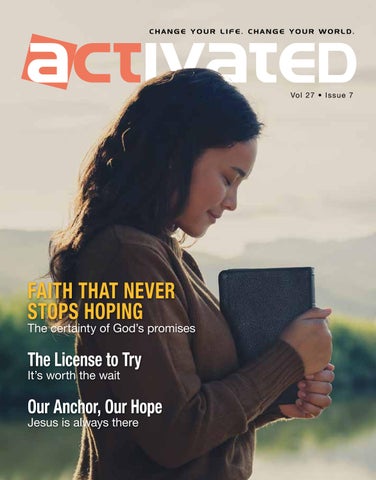
This month’s issue of Activated talks about many of the challenges of life and how to face them with faith, hope and perseverance. We pray that you will always remember that “God is our refuge and strength, a very present help in trouble” (Psalm 46:1).
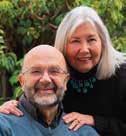
Gabriel and Sally Garcia Activated Editorial Team
For more information on Activated , visit our website or write to us.
We all know it’s ideal to be thankful, to remain positive, and to show appreciation to people around us. It’s not that difficult as long as things are going okay, or when you wake up to the sound of birds and see a breathtaking sunrise, such as happened to me this morning.
But what about when things go wrong and all is awry?—When you are going through a heartbreak, a disappointment, a sickness, or some traumatic experience?
Just the other day I was talking with a dear friend about this topic and asking him how he copes with the darker side of life. His simple but amazing answer was:
“I love the winter just as much as I love the summer.”
Wow, brief and to the point.
Truly, even the most beautiful things have a shadow, or they wouldn’t be real. The darkest moment of the day, which is right before the rising of the sun, contains seeds of new life and rebirth.
I can’t honestly say I jump for joy when things go wrong, despite my outward calm disposition. It takes me a while to appreciate the dark moments, the winters, and the disappointments. I would prefer everything to be always clear and sunny for me, for my loved ones and for all mankind, but I forget that even the clouds add much beauty to a perfectly blue sky.
The poet Percy Bysshe Shelley wrote: “Our sweetest songs are those that tell of saddest thoughts.” For sure, many famous and touching songs have been written during or after moments of distress; masterpieces have been painted through tears, and countless poems touch our hearts because of the bittersweet messages and emotions they communicate to the reader.
That to me says a lot about the importance and fruitfulness of “winters.” And I find great comfort in these beautiful promises from the Bible: “Consider it pure joy, my brothers and sisters, whenever you face trials of many kinds, because you know that the testing of your faith produces perseverance. Let perseverance finish its work so that you may be mature and complete, not lacking anything” ( James 1:2–4 NIV). “The God of all grace, who called you to his eternal glory in Christ, after you have suffered a little while, will himself restore you and make you strong, firm and steadfast” (1 Peter 5:10 NIV).
There’s beauty and value in every season of life. It’s simply up to us to notice it and appreciate it.
Josephine Kind has been active in humanitarian projects in Southern Europe for the last three decades. ■
FAITH THAT NEVER STOPS HOPING
By Maria Fontaine
Have you ever faced something in life that seemed totally hopeless, to where you felt like there was no way out of your difficulties and everything appeared lost? Or maybe you find yourself in a place right now where the situation seems impossible and there is no hope in sight. You wonder if God is hearing your prayers as you aren’t feeling the reassurance and comfort of His presence or seeing how your circumstances can change.
You may be tempted to feel as though no one else is experiencing such intense and challenging difficulties.
It is important at such times to remind ourselves of the promises in the Bible of the hope we have as Christians. The Bible refers to God as the God of all hope. “May the God of hope fill you with all joy and peace in believing, so that by the power of the Holy Spirit you may abound in hope” (Romans 15:13).
The word “hope” in the Bible carries a different meaning than how it is used today. Nowadays when people say they are hoping for something, it often carries the sense that they are wishing something will happen, but they are uncertain that it will. But when the Bible talks about hope, it is associated with our faith—our certainty—that
the things God has promised in His Word will come to pass.
Hebrews 11:1 gives us a definition of biblical faith:
“Now faith is the assurance of things hoped for, the conviction of things not seen.” Faith is assurance, or certainty, and it is grounded in the life, death, and resurrection of Jesus, who purchased our salvation through His suffering, and now reigns forever. That gives us the faith to endure the difficulties, challenges and tragedies we face in this life, as we are “waiting for our blessed hope, the appearing of the glory of our great God and Savior Jesus Christ” (Titus 2:13).
It can also help to bolster our faith if we remind ourselves that there have been some prominent biblical characters who have experienced great adversity, and reflect on how they came through the “darkest valley” of their lives (Psalm 23:4 NIV). They didn’t travel through such times unscathed, with unswerving joy and victory in their hearts, and yet they held on to hope and refused to give up.
Here are a few examples of men in the Bible who faced monumental challenges. We can find hope through their stories. “For whatever was written in former days was written for our instruction, that through endurance and through the encouragement of the Scriptures we might have hope” (Romans 15:4).
The story of Job in the Old Testament is a well-known one. The Bible contains a very vivid account of all that he went through, as he was severely tested and lost his
family, his wealth and his health. He was in such anguish and distress that he even cursed the day he was born ( Job 3:1–3) and begged God to end his life ( Job 6:8–9 NLT). But even as he struggled to understand why he was experiencing such trials, he took a stand of faith, declaring “Though he slay me, I will hope in him” ( Job 13:15). Job went on to experience God’s blessings once again in his life, with a much greater understanding of God and His love.
King David lost some of his sons, his kingdom, and his health, and he lost a series of battles against his enemies. It is hard to imagine the trauma he must have endured in such times. His feelings of woe and despair spilled over into his writings in Psalms. “Will the Lord turn away from us forever? And isn’t He going to be kind to us any longer? Is His unfailing love gone permanently?” (See Psalm 77:7–9.)
It sounds like David was at the end of his rope by that point, and yet he held on to hope, as we read throughout the Psalms. “Why are you cast down, O my soul, and why are you in turmoil within me? Hope in God; for I shall again praise him, my salvation and my God” (Psalm 43:5).
We can only imagine the despair and discouragement Peter must have experienced after he denied Jesus before His crucifixion (Matthew 26:69–75). Having denied knowing his own Savior, not once, but three times, how could he ever show his face in public again, much less be trusted as a leader of the early church? And yet, days later Peter stood up boldly in the public square, proclaiming Jesus, leading thousands of people to Christ, and being arrested in the process. (See Acts 2 and 3.) Peter went on to proclaim, “According to his great mercy, [God] has caused us to be born again to a living hope through the resurrection of Jesus Christ from the dead” (1 Peter 1:3).
Even the Apostle Paul, who played such a central role in the early church and voiced so much encouragement to the churches, felt hopeless and despondent at times. He expressed this when he wrote, “We do not want you to be uninformed, brothers and sisters, about the troubles we experienced in the province of Asia. We were under great pressure, far beyond our ability to endure, so that we despaired of life itself” (2 Corinthians 1:8 NIV). And yet throughout his epistles Paul constantly emphasizes
the hope we have in Christ and encourages us to “rejoice in hope of the glory of God” (Romans 5:2). We can still have faith in Jesus and hold on to hope even when the circumstances we face seem difficult, hopeless, and even impossible.
If these men, who are some of God’s greats, experienced such times of anguish of spirit, loss and tragedy in their lives, should we think it strange that we, as God’s
these valleys and are strengthened in the process. “As they go through the Valley of Baca they make it a place of springs... They go from strength to strength till each appears before God in Zion” (Psalm 84:6–7 NIV).
What a beautiful picture and promise! The key is that we go through the valley, and as we do, we can “make it a place of springs.” A dry valley of desolation can become a place of refreshment, and our faith can be strengthened in the process.
children today, experience our seasons of desolation and even despair? At such times, we can’t always see the rewards of our faithfulness or the fulfillment of His promises. But the Bible tells us that when our faith is tested, we can “rejoice inasmuch as you participate in the sufferings of Christ, so that you may be overjoyed when his glory is revealed” (1 Peter 4:12–13 NIV).
Everyone goes through dark valleys in life at some point. One psalm described it as the “Valley of Baca,” a place of weeping and lamentations. But the psalmist also speaks of the hope for those who pass through
One thing that these men of faith in the Bible have in common is that they continued to praise God through their darkest valleys and their times of despair and suffering (Psalm 84:4–5). So, as we pass through the valley of tears, suffering or hardship, if we continue to praise Him, we can turn that desolate valley into a spring of refreshing. Our journey of life can be turned into one of joy; our mourning can be turned into dancing, as He clothes us with gladness and gives us the strength of His joy (Psalm 30:11).
After we have come through the valley, we can look back with gratitude, realizing that the difficult experiences we have endured have brought enrichment and spiritual growth to our lives. The Lord will have enveloped us with His love and given us the priceless blessing of a deeper understanding of Himself, and a heart that comes to resemble His own more and more (2 Corinthians 3:18).
Maria Fontaine is a Christian author and retired co-director of TFI, a Christian online network. ■
THE LICENSE TO TRY
By Amy Joy Mizrany
My friend phoned me, overjoyed. She had finally passed her driving test. She had persevered through many almost-passes and tough instructors, earning her license at last. When she had been struggling through the “failures,” my mother had encouraged her, saying, “Nobody asks how many times it took to pass your driving test. No matter how many times you try, once you’ve got your license, you’ve got it.”
I hadn’t thought about perseverance in that way before. But it’s true—nobody will ask how many cakes burned before you got the delicious one you’re serving them. If you make it to the top of Mount Everest, you’ve made it to the top. The failures along the way do not detract from the final success. It’s a very comforting thought. It came back to me when I was thinking about the poem by E. A. Guest, “It Couldn’t Be Done.”
[He] buckled right in with the trace of a grin
On his face. If he worried, he hid it. He started to sing as he tackled the thing
That couldn’t be done, and he did it!
I noticed for the first time that it doesn’t say he did it right away. I had always imagined it as a kind of quick 1-2-3 story: “Man sees mountain, everyone says it can’t be done, he buckles in and voilà! Victory is his!” This was the mental picture I always had of the poem. But now, I see it differently. Maybe his “tackling the thing” had taken weeks or months or years. But none of that factored in to the final result: He did it! That says it all!
Sometimes, when I’ve faced a lot of obstacles and failure, I can’t see the value of trying again. Success and what it will give us can feel like a fantasy that we’re better off giving up on. Whenever my friend went through another almost-passedbut-not-quite result with her driving test, she felt like it wasn’t worth it. Despite that, she tried again. And again. Until, finally, she got her driver’s license and then she knew, it was worth it!
We can fail or disappoint ourselves; others can fail us or try to stop us. But we can always try again. We have a God-given right to keep trying. “A righteous person will fall seven times, and then get up again” (Proverbs 24:16 NET). We are given the privilege to choose, and we can always choose to give it another go.
We have the license to try.
Amy Joy Mizrany is a missionary in South Africa with Helping Hand. In her spare time, she teaches the violin. ■
Hospitalization—My Testing Ground for Patience
By Gabriel García Valdivieso
Patience in everyday circumstances is difficult enough, but patience in times of sickness and pain is a different story.
Most of us are not especially equipped for exercising patience. It seems to be one of those virtues that puts us to the test and draws us close to God, one we must practice in small and big ways almost continually.
I have been in and out of hospitals for the last five months; my latest stay has already stretched for a period
of two months. Those of you who have experienced hospitalizations know that a two-month stay can be quite exhausting: nurses coming in and out all the time to take tests, waking you up in the middle of the night or at 5:00 in the morning; bland unappealing food; long hours that drag on; doctors that don’t give you enough information; young doctors that come in for training to whom you have to explain your medical history time and time again; roommates that aren’t always pleasant,
and many more unwelcome situations.
It has been said that “patience is staying put where you are and holding on when you feel like running.” Well, after such a long time in the hospital I sure felt like running. Yet I had no other option but to stay put.
I thought to myself: Either I let this bring me down or I try to make lemonade out of this lemon. So, I made friends with my roommates and nurses, talking about different subjects, including the Bible, and leading some to receive the Lord. I decided that instead of complaining about the food, I would try to like it. I would enjoy the exercises recommended by the physiotherapists. At times I was so focused on leaving the place as soon as possible that I got anxious about the future. But as the saying goes: “Patience mustn’t be one inch shorter than the affliction.”
It’s human nature that we want to reach the Promised Land without going through the desert. But God knows we need those desert times to learn to wait on Him, which is an act of trust and faith. “Wait for the Lord; be strong, and let your heart take courage; wait for the Lord!” (Psalm 27:14).
I heard God’s still, small voice tell me innumerable times: “Wait on Me. Be patient. I am working on your behalf.” But it was easy to forget that and fall back into my impatient mindset. Sweetly and mercifully the Lord would remind me again and again that His times are not mine.
That’s where faith comes in, because as John Calvin said: “There is no place for faith if we expect God to fulfill immediately what He promises.”
I came to the point where I realized that my nervousness wasn’t going to get me anywhere, and I decided to trust God and not fret over my discharge date. I realized
the importance of just taking one day or even one hour at a time and living in the present.
Day by day I have learned and applied a few strategies that you might find helpful if you are ever in a similar situation.
—Read your Bible. The Gospels and the Psalms are particularly encouraging and strengthening. Memorize a favorite passage or two, especially one that encourages and inspires you in your affliction. The Word of God works wonders to calm an antsy spirit.
—Tell people about the wonders that God has done for you or the blessed life you have lived despite your present circumstances. Share testimonies of past miracles or instances where He showed up clearly in your life.
—Catch up on a book that you were hoping to finish but couldn’t find the time to read.
—Play Bible trivia or other games with your visitors. It helps to distract you and divert your attention from those agonizing thoughts about the future.
—Strength permitting, send messages to relatives and friends and catch up on your communications. A couple of phone calls to friends helps to alleviate your uneasiness.
—Find a good movie to watch on your cell phone, laptop, or TV if your hospital room has one.
—Whatever you do, don’t just stare at the roof and get depressed. Find some interesting activity or pastime that will cheer you up.
In the end, when I had resigned myself to waiting two more weeks for my discharge, the doctor came and told me that I could be released sooner. Hallelujah!
Someone once taught me: “Don’t give up too soon. Don’t fail the course by running out before the bell rings in God’s school and He is about to promote you to the next grade.”
“Blessed is the man who remains steadfast under trial, for when he has stood the test he will receive the crown of life, which God has promised to those who love him” ( James 1:12).
Gabriel García Valdivieso is part of the Activated editorial team. He is a writer, translator, and podcaster, and lives in Chile with his wife, Sally. ■
IT’S NEVER TOO LATE TO BEGIN AGAIN
By G.L. Ellens
At seventy-five years old, I smile at the unexpected turns my life has taken. When I entered the mission field five decades ago, I imagined a lifetime of raising a family, serving the Lord, and ministering to people. What I didn’t imagine was how quickly those years would pass, or how quiet my home would one day become.
I raised five children in Southeast Asia. I watched them grow up among rice fields, village roads, and friendly neighbors. Then, one by one, I watched them leave, returning to the West for college, careers, and eventually marriage. Each departure was a joy and a grief woven together—a mother’s pride wrapped in a mother’s ache. Eventually, I wondered what the next chapter of my life could possibly hold.
When I thought my most fruitful years were behind me, God opened new doors I never expected. “His mercies … are new every morning” (Lamentations 3:22–23). His calling is also renewed every morning.
Today, I sit beside children with cancer who need encouragement and with orphans who long to be reminded that they matter. I visit poor village children whose laughter fills rooms with no electricity but that overflow with joy. I realize that God still has work for me to do.
When I say, “It’s never too late to begin again,” I am speaking from a life reshaped by the faithfulness of God. Isaiah 46:4 is precious to me: “Even to your old age and gray hairs … I will sustain you and I will rescue you” (NIV). Moses was 80 when God called him to confront Pharaoh (Exodus 7:7). Caleb was 85 when he asked for the mountain God had promised him ( Joshua 14:10–12). Anna the prophetess spent her last years proclaiming the Messiah (Luke 2:36–38). Scripture never paints old age as a season of decline, but of ripened faith that still says, “Here am I. Send me!” (Isaiah 6:8).
Starting again means embracing whatever God places before you, believing that the righteous “will still bear fruit in old age” (Psalm 92:14).
Once, I was afraid of growing old alone. Now I see that I am never alone or without purpose. Every time I step into a hospital ward with children fighting for their lives, or sit on a bamboo floor with village families, or comfort an orphan, I feel the Lord whispering, “This is your new beginning.”
No matter our age, God’s story in our lives is never finished.
G.L. Ellens has been a missionary in Southeast Asia for four decades. She is active in volunteer work for children in need and is pursuing her interest in writing. ■
RAILROAD TRACKS
By Rosane Cordoba
As a young adult, I used to get stressed every time an obstacle or setback came my way, especially when big problems occurred. My husband was always the optimistic one, often reminding me of the famous quote by Mark Twain along the lines of, “I have known a great many troubles in my life, but most of them never happened!”
A while ago, I came into some money from the sale of my parents’ property. It was enough to buy a small house, but after looking for two months, I found nothing in the neighborhood that I wanted for the money I had. Encouraged by my eldest son, I chose instead to buy a piece of land, so that I could build the house I wanted. Not long after, on a Friday, I found a nice plot and arranged with the owner to close the deal on Monday. Unfortunately, he called me on Sunday and said that the plot had been sold. He apologized and said that he had also advertised the property in a brokerage company, but that there had not been any interest in it for months, until the company sold it that Saturday. I was so disappointed, but I kept trusting the Lord. After one week, he called me again to say that someone who was going to buy a similar plot at the end of the street had pulled out, and that I could buy that plot for the same price as the previous one.
I bought that land and am currently happily living in the house I had built. But that’s not the end of the story. It turned out that the original plot backed into a large property that began to be rented for parties that lasted all night. The family that bought that plot was forced to move and sell it at a loss. What I thought to be bad news at the time turned out to be God’s providence in disguise.
In thinking about this, it occurred to me that life can be compared to railroad tracks: the train needs both tracks to move forward. One represents the happy occasions and easy times, the other the difficulties and sorrows that help us grow and mature. Both are necessary for progress and fulfillment. The train must go through valleys and mountains, bridges and tunnels, deserts and oases, until it gets to its final destination.
To keep going is not an option, but a necessity. Sometimes we can’t see clearly the way ahead and have to trust the Lord to guide us, but it is worth the ride.
Rosane Cordoba lives in Brazil. She is a freelance writer, translator, and producer of faith-based and character-building children’s material. ■
START SMALL AND PERSEVERE
By Simon Bishop
My father once told me the story of a chess-playing king. Perhaps you’ve heard it?
Once upon a time, a king challenged a traveling sage to a game of chess, and the king promised the sage whatever reward he desired if he beat him.
The sage told the king that he had a very modest claim, and being a man of few material needs, all he wished for was some rice, the amount being determined using the chessboard in the following manner: one grain of rice in the first square, two in the second square, four in the third square, eight in the fourth square, sixteen in the fifth square, and so on, every consecutive square having double the number of grains.
The king was delighted at this simple request, and the game began. Sure enough, the king lost, so to keep his word, he ordered a sack of rice be brought and he began to do the math and count out the grains. But he eventually discovered that the final amount of rice that he owed the winner would be more than all the rice in his entire kingdom.
There are several versions and endings to this story, as well as lessons that can be drawn, besides the math lesson of exponential growth. But what brought this story to mind was this: As there are 64 squares on a chess board, there are 365 days in a year, and each one holds the possibility of growth, but—and here is the hard part—we have to be committed, consistent, and persistent. One grain of rice is next to nothing, and even when doubled with each new square, after 14 squares it would only amount to one pound or half a kilo. That doesn’t look like much. So, when we commit to something—a new good habit, learning a new skill, starting a new business—we are likely to become discouraged if we look for progress too quickly or we don’t see immediate change.
The Bible shows the importance of good stewardship and investing in growing what we have received. In the parable of the talents, we read that each person is given a certain number of talents to invest: “To one he gave five talents, to another two, to another one, to each according to his ability” (Matthew 25:15).
When the master returned, he rewarded each of the two stewards who invested and grew their talents, and he said to them, “Well done, good and faithful servant. You have been faithful over a little; I will set you over much. Enter into the joy of your master” (Matthew 25:23). Whereas the one who hid his talent in the ground and didn’t allow it to grow was deemed an unworthy servant (Matthew 25:14–30).
Let’s not underestimate the cumulative effect of seemingly small steps of progress! Let’s have patience and be good stewards of what God has entrusted to us and watch it grow.
■
The Bee
By Curtis Peter van Gorder
I was waiting for a friend to pick me up and decided to bide my time in a quiet restaurant. There on a pane of glass was a bee trying to escape his transparent prison. He would fly up the pane until he became so tired that he fell back down, only to repeat the same effort over and over. The curious thing about it was that he was only a few inches away from an open door to his right. He just didn’t see it. Perhaps he never considered a horizontal flight path to escape. From his perspective, the world outside and freedom looked so real, yet inaccessible.
It wasn’t until after ten minutes of frantic flying and falling that the bee finally escaped. How did he do it? He was scared into it. Someone from the outside bumped the pane and he felt threatened. He didn’t know that the glass separated him from his foe. Trying to avoid his perceived predator, he broke out of his routine and took off and flew out through the door.
Have you ever felt like that bee? Like you are in a routine and you can’t escape? As though the answer you seek seems so simple yet so unattainable?
Sometimes God may allow or send situations our way which seem like big problems (and obstacles), but perhaps He is closing one door to lead us through another door that will put us on the right path.
Curtis Peter van Gorder is a freelance writer and mime artist who has been active in missions work in 10 countries since 1971. He and his wife Pauline currently live in Germany. ■
Simon Bishop does mission and humanitarian work in the Philippines.
If you have not yet received Jesus as your Savior, you can do so by praying the following prayer:
Dear Jesus, I believe that You are the Son of God and that You died on the cross for me so that, through Your death and resurrection, I can live forever with You in heaven. I ask that You forgive my sins. I open the door of my heart to You. Please fill me with Your Holy Spirit and help me live in a way that glorifies You. Guide my life and help me to follow You. In Your name I pray. Amen.
OUR ANCHOR, OUR HOPE
By Marie Alvero
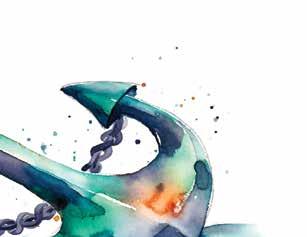
“We have this hope as an anchor for the soul, firm and secure. It enters the inner sanctuary behind the curtain” (Hebrews 6:19 NIV).
Sometimes I’m in awe of how beautiful the Bible is. Every time I read this scripture, it quiets my soul. The turmoil, whether it’s big or small, stills.
Think about it. The purpose of an anchor is to keep a ship secured to a particular place, to prevent it from drifting due to wind or current. The job of the anchor isn’t to stop the storm, but rather to hold the ship steady during a storm or choppy seas.
Spiritually, our hope acts to hold and steady us. Whatever is happening in the world or in our lives, we hold to the hope of Jesus. Our “hope” isn’t that Jesus will stop the storms of life, but rather that He will hold us steady.
The inner sanctuary was a place in the temple where only the high priests could go, and only after extensive rituals. There they would offer a sacrifice for themselves
and for the people and then intercede for the people before God.
Jesus is the ultimate High Priest. That’s what Hebrews 7:27 refers to when it says, “He has no need, like those high priests, to offer sacrifices daily, first for his own sins and then for those of the people, since he did this once for all when he offered up himself.” This same chapter in Hebrews also says that Jesus “is able to save to the uttermost those who draw near to God through him, since he always lives to make intercession for them” (Hebrews 7:25).
Put all that together and we can rest assured that Jesus is always present, in front of the throne of God, interceding for us. And we can put our hope in that, all day, every day.
Marie Alvero is a former missionary to Africa and Mexico. She currently lives a happy, busy life with her husband and children in Central Texas, USA. ■
CASTING OUR CARES ON JESUS
By Marie Knight
After a busy day I was exhausted. I climbed into bed. Glancing at my phone I saw it was after midnight, and I knew the next morning I had to get up bright and early. I really needed a good night’s sleep. That’s when I became worried that I would sleep so soundly that I wouldn’t hear the alarm and wouldn’t wake up on time to accomplish what I had on my schedule for the next day. The more I worried about it, the less I slept, and by the time the morning came around, my worrying had brought about a sleepless night.
There is a Swedish proverb that says, “Worry often gives a small thing a big shadow.” How true! Worry amplifies things in our minds until they loom so dark and menacing in front of us that we are convinced that terrible things are bound to happen.
The best place to go when we are tempted to worry is to God’s Word for faith and comfort. The Bible cautions us against worrying. “Do not be anxious about anything, but in everything by prayer and supplication with thanksgiving let your requests be made known to God. And the peace of God, which surpasses all understanding, will guard your hearts and your minds in Christ Jesus” (Philippians 4:6–7).
Prayer is an important step to overcome fear and worry. God is the only one who can bring peace and calm to our spirits, but we must be humble enough to ask Him for His help. “Humble yourselves, therefore, under the mighty hand of God ... casting all your anxieties on him, because he cares for you” (1 Peter 5:6–7).
He has promised to take care of us, but we have to let Him: “Cast your burden on the Lord, and he will sustain you; he will never permit the righteous to be moved” (Psalm 55:22).
To give in to fear and worry is to lose faith in God’s promises. “Have I not commanded you? Be strong and courageous. Do not be frightened, and do not be dismayed, for the Lord your God is with you wherever you go” ( Joshua 1:9).
If we truly believe that God is sovereign, we know that He can bring us through any trouble we face. “So we can confidently say, ‘The Lord is my helper; I will not fear; what can man do to me?’” (Hebrews 13:6).
Remember, there is not a worry in the world worth the worry!
Marie Knight is a missionary volunteer
From Jesus with Love
The Realities of Life
In the times in which you are living, people are often accustomed to rapid change and quick results. What was sufficient yesterday seldom seems to be enough today, and it can be easy to develop the expectation that life’s problems should be easily and quickly solved. But the reality is that many things in life simply take time. Most problems at work or with your health or relationships or finances can’t be resolved with the click of a mouse or the push of a button.
Some situations in life are challenging, and they may stay that way for a time or a season (Ecclesiastes 3:1–8). During such times, your faith may be tested, and in the process, you learn patience and you grow in endurance ( James 1:3–4). When problems or difficult situations drag on and you feel mentally exhausted or emotionally drained, remember that I am with you. Come to Me, and I will renew your spirit and grant you the patience and perseverance you need.
I didn’t promise you a trouble-free life. In this world, you will face troubles and trials, but take heart, as I have overcome the world ( John 16:33). I won’t instantly resolve all your problems and struggles, but I have given you My peace and grace to face the storms of life, and to come out stronger in faith and better equipped for the next challenge. Trust that I will work all things together for your good (Romans 8:28).