Decisions come in all shapes and sizes. Every day we face decisions about what to eat, whether to exercise, how to use our time, etc. Over the years, these decisions become habits, and we don’t think much about them. If we’ve made good decisions from the start, we don’t usually have to worry about them. When we haven’t made good choices, however, these small decisions can blossom into bad habits that take a long-term toll on our lives and relationship with God and others.
Consistently making good decisions is a daunting task. Thankfully, we’re able to look to God and His Word for help. God is our Heavenly Father, and His compassion and desire to help is just as great as when our own children ask for help. We often face limitations in our ability to help our children, though, whereas He can turn even the most hopeless situations around.
When Jerusalem was besieged by a huge army, King Hezekiah of Judah received a threatening letter from its pagan king. Hezekiah went into God’s temple, spread it out on the altar, and beseeched God for supernatural assistance, which He provided.1
Why not try it? Next time you feel besieged by setbacks, delays, personal or relationship issues, write down the onslaughts threatening you, point to the paper, and say: “Dear God, here are the problems I’m having. Please help me.”
Throughout the Bible and history, the great men and women of God depended on Him, and as a result, they left a legacy of faithfulness. By following their formula, we can do the same!
Samuel Keating Executive Editor
1. See 2 Kings 19:14–19,32–36.
For more information on Activated and other inspirational products, visit our website or contact one of our distributors below. activated@activated.org
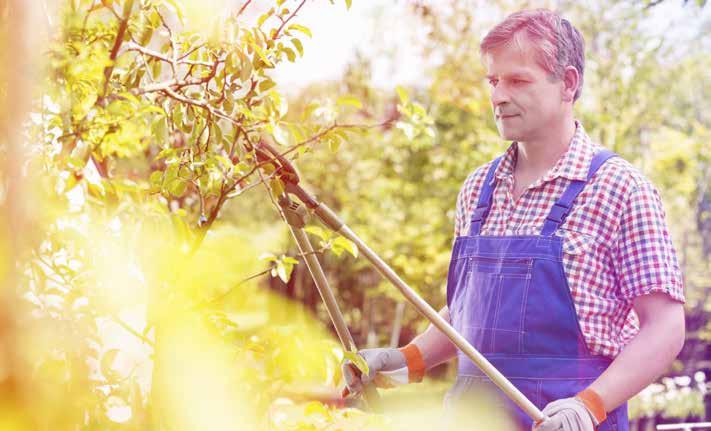
The tree trimmers finally showed up. I’d been nervously waiting for them, both looking forward to them pruning my trees and also terrified of what the outcome might be. I’d known for a long time that the trees needed to be trimmed, but a part of me loved the wild “jungle” growth, and I’d waited way too long before calling them.
They arrived this morning, and I had to keep myself from constantly running outside and telling them how to do their job. I’ve seen other trimmers before. I’ve seen the ugly devastation of hacked-off trees where they had taken a chainsaw and cut the large branches, leaving not much more than an angular trunk that takes years to regain its beauty.
But each time I looked out this morning, I was pleasantly surprised. I watched them take off the small
branches that had grown along the far edges of the tree. Then they used the chainsaw to cut off a couple of the larger branches, but only those that were no longer healthy. They worked all morning on one tree, like careful surgeons extricating the cancer that was sapping strength from it.
It’s a little like the work of the heart. It’s terrifying to admit fault, to realize that deep changes sometimes need to take place. It takes courage to use a saw on the branches of our personal problems and to begin cutting. It takes faith to ask God to cut away those things we have to let go of that are hindering our growth, spiritual health, and happiness. It’s a painful process, hearing the buzz of the proverbial chainsaw, and my heart aches.
It’s during these times of vulnerability, of opening up and facing
our weaknesses, that we need to be careful not to just begin hacking off everything about us, zealously chopping away and destroying even those things that are healthy and beautiful. That’s when we need the gentle hands of the surgeon, who is careful not to destroy the healthy parts of the body as he operates. We need the patient hands of the tree trimmers like those I hired today, taking time to cut only the branches that are overgrown or dead and dangerous, and leaving the large, beautiful branches that will provide shade in the summertime. This patient, careful pruning enables the tree to come back to life in spring, stronger in its individuality and lovelier and more vibrant than ever.
Joyce Suttin is a retired teacher and writer and lives in San Antonio, USA. ■
No human ever became interesting by not failing. The more you fail and recover and improve, the better you are as a person. Ever meet someone who’s always had everything work out for them with zero struggle? They usually have the depth of a puddle. Or they don’t exist.—Chris Hardwick (b. 1971)
UPS AND
By Maria Fontaine, adapted
Recently, I was contemplating the topic of wrong choices, after having made a few myself, and was feeling a bit discouraged. Most of us enjoy finding we’ve made the right decisions, and we can definitely see the benefits in those. But it’s harder to see any good that could come from our wrong choices. We make plenty of those, however, from the small ones that we often sweep under the carpet, hoping no one else noticed, to some real whiz-bangers.
Have you ever felt useless and defeated due to having made the wrong decision? Maybe you feel like no matter what you do, you’re never going to be able to make up for your mistakes. Perhaps it seems like the blessings you could have received have been lost, and your life will never be quite as good or complete as it could have been.
I believe that God wants us to see the ups and downs we experience in life through the eyes of faith. Whether
1. Romans 8:1
we make a right choice or a wrong one, there are many good things we can learn. In fact, I think it’s possible to gain as much—and in some cases, even more—when we mess up.
Our right choices often result in blessings and connection to God. With the wrong ones, even though they do often mean that the road ahead will be longer and more difficult, we can still gain priceless lessons and growth. As we learn to look to God to guide us in spite of our wrong choices, the harder path we find ourselves on can drive us closer to Him through our repentance. The wrong choices also provide a means to relate to others regarding their shortcomings. Eventually, our loving Father brings us through the difficulties wiser and better prepared to proceed to the next stage of our spiritual growth. Because of His sacrifice, Jesus can ultimately turn even our mistakes and wrong choices into greater victories if we’ll let Him. He doesn’t condemn us, and He can bring
DOWNS
us to where we need to be, to gain what we personally need from our life and circumstances.
The Bible promises that “There is no condemnation to those who are in Christ Jesus!”1 He is happy to see you recognizing the ways in which you can grow as you accept what He wants to show you from each situation. That’s part of the “good” that He helps you to gain.
Look at the Prodigal Son. He willfully rebelled out of selfish greed. But although his path was longer and more difficult than his older brother’s, he learned to understand his father’s love for him in a deeper way. He matured through what he suffered. He lost his physical inheritance, but he gained something much greater. He learned to value his spiritual heritage and his father’s love, which was infinitely more important than the things he’d focused on earlier. Though the older brother made a wise choice in sticking to the tasks the father had given him and was rewarded for it, he too made wrong choices that he could
In my life, I have made the occasional catastrophic choice, and it’s just a case of moving on and learning from it.—James Nesbitt (b. 1965)
How many people are completely successful in every department of life? Not one. The most successful people are the ones who learn from their mistakes and turn their failures into opportunities.—Zig Ziglar (1926–2012)
Inviting Jesus into your life is the best decision you could make. And all you have to do is ask Him:
Dear Jesus, please come into my heart and forgive me for the wrong choices I’ve made. Help me learn from my mistakes and do better in the future. Amen.
learn and grow from, as evidenced by his lack of compassion and forgiveness when it came to the failings of others. It’s all a part of the process. We should strive to do our best, to pick the right options, and we can save ourselves a lot of hardship and struggle when we choose rightly. But we all have times when we fall short. It’s part of why we’re here in this life: to learn and grow. It’s impossible to avoid ever making a wrong decision. The goal is to use the good and wise choices we make to the full, and to turn our mistakes into learning experiences. Through these ups and downs, we can learn wisdom and the depths of God’s mercy and compassion and so much more that will enhance and deepen our relationship with him and others.
Maria Fontaine and her husband, Peter Amsterdam, are directors of the Family International, a Christian community of faith. ■
By Elsa Sichrovsky
THE END
ofHER PART
Vanessa waved at me as the doors shut, and I watched the train whisk away a friendship of six years. Vanessa and I had met in junior high school, and our common interest in writing stories and shared taste in novels had started an unbreakable friendship that had lasted through all the highs and lows of our teenage years. Now she’d won a scholarship and was going abroad to pursue her degree, leaving me to try to figure out how to go on despite feeling like her departure had pulled the bottom out from under my life. Of course, I’d always known that one day we’d both leave home and go our separate ways, but now that it was actually happening, I was crestfallen.
During the first few weeks after her departure, Vanessa’s absence awakened me to how much I had depended on her. Instead of spending time with many different friends, I’d
stayed in the safe zone with Vanessa and a few of our common friends. It was easier to adopt the views of someone so likable and intelligent as Vanessa than to come up with my own views on everything. For example, I always followed Vanessa’s opinions about which books to read or what movies to watch.
While being staunchly loyal wasn’t a bad thing, I realized that I’d been reluctant to take the personal risk of making up my own mind and charting my own path. Though I admired Vanessa’s courage to leave her familiar surroundings and pursue her dream, I was also terrified at the thought of going through the emotional turbulence that comes with reaching adulthood without the assurance of my best friend’s validation and emotional support.
Vanessa and I kept in contact for the first year or so, but naturally
grew apart as time went by. Back then, having my hopes to preserve our friendship crumble away was heartbreaking. Yet looking back, it’s clear Vanessa’s moving out of my life gave an impetus to my personal growth.
I was forced to meet new friends, to make mistakes, and then pull myself up to stand again on my own two feet. Not being able to ask for her advice about everything made me search my heart more and contemplate issues for myself. Though at the time I felt lonely and abandoned, I understand now what Faraaz Kazi wrote about friendship: “Some people are going to leave, but that’s not the end of your story. That’s the end of their part in your story.”
Elsa Sichrovsky is a freelance writer. She lives with her family in Taiwan. ■
The Gift of
By Marie Alvero
Last year was a rough one . Not terrible, just trying. Our family faced lots of challenges regarding work, health, and finances, and I’ve been hoping that things will be easier this year. But let me tell you about what God is teaching me right now, because there are some wonderful things that I have gained from these challenges.
One day in particular, I was frustrated and discouraged about money being tight, again. I was also very, very tired. I felt like I was giving all I had and always coming up short.
I opened my Bible to the Lord’s Prayer: “Give us this day our daily bread.”1 The picture is of dependence, of having to come to God each day for enough to make it through that day. There was no running around like a crazy person
trying to get it all done, rather the confidence that God will give us enough. Every day.
Isn’t it embarrassing to be that dependent on God? Doesn’t that suggest we don’t have our act together? Or that we’re lazy or unsuccessful? I’ve had to reframe how I look at lack and want in order to see the things that God has been trying to show me. Lack is an opportunity to draw closer to God, to learn to trust in His goodness and not in my abilities.
I’m getting to the root of some of my fears and other issues, and I’ve found myself being grateful for this opportunity for spiritual growth and the lack of distractions.
In the seasons of life, sometimes we bloom and blossom, and sometimes our branches are bare and our roots are forced to go deep to survive the winter. Spring always follows winter, though. If you’re in the season of lack, maybe God is using this to show you His goodness. Maybe He wants to show you His faithfulness and the beauty of depending on Him. He’s your good shepherd (and mine), and He will take care of us.
Marie Alvero is a former missionary to Africa and Mexico. She currently lives a happy, busy life with her husband and children in Central Texas, USA. ■ 1. Matthew 6:11
This isn’t just regarding financial lack. What about loneliness? Or disability? Or anything that causes emptiness? I’ve noticed that when I feel lack or emptiness, my first reaction is to try to fill that void to feel better—friends, stuff, entertainment, accomplishments, and “productivity.” But right now I’m in a position where I’m forced to take a look at what’s going on in my heart and life.
FLIRTING WITH FAILURE
By Joseph Mai
As the sun was setting, I walked briskly toward the bus station after a tiring day at work. I knew from experience that the city bus didn’t come by that often, and I didn’t want to miss it.
A teenager sporting fashionable Oakley sunglasses, a plush black suit, and a haircut with designed grooves shaved into the sides above his ears stood in front of the mini-supermarket. His glasses and stance could have passed for someone applying for a position of private bodyguard.
I chuckled at this sight, but it also reminded me of an incident that happened to me as a teenager. My buddies and I were hanging out in our neighborhood when a friend of ours sped
“Wanna take it for a spin?” he asked me, his tone making me feel like “one of the bros.” As he leaned the motorcycle toward me, I remember thinking that it didn’t matter that I had no experience in riding one. I could only think about how awesome it would feel to race off into the sunset, with movie credits rolling down the screen to a beat-heavy song, with incredible guitar riffs. On my return, my friends would say, “Nice spin!” as the wheels stopped only inches away from the impact.
A decade after this humiliation, I met with another unfortunate incident. One dreadful morning … by on his new scooter, only to suddenly stop and swerve in our direction. I was in awe of how cool he was. His walk, his talk, even his clothes and gelled hair set our group’s fashion trends.
Unfortunately, that’s not the way things played out. I revved up the motorcycle, and before I knew it, the bike and I had shot across to the other side of the street and into a parked car. Of course, my friends were stunned and horrified rather than impressed, and as I watched an oil puddle form at my feet, I felt like a freshly pricked balloon—completely deflated.
The first thing I did after getting home was drag myself to my room and collapse in bed, fully clothed. I slept this accident off for a whole day. Nothing could make me feel better.
Boy, those kids sure are loud! I thought, as I navigated the turns on a mountain road. The laughing in the back seat grew louder, and I became more irritated. I really should say something! Then I heard one of the children shout, “I’m going to throw this out the window!”
I instinctively turned my head backwards, and in that split second, I heard the sound of crunching metal and plastic. There’d been someone in the incoming lane, and of course, I’d swerved right in front of them.
It’s a strange thing about car accidents. No eerie warning music starts to play. There’s no flashing lights or dark smoke. All you hear is “Crash!”
In the police station, I sat face to face with a young officer who took down the car accident sequence, asking for my verbal confirmation after each sentence. The driver whose car I’d hit sat next to me the whole time, staring and nodding.
Then another policewoman took my photo to confirm that the driver was actually me. I hadn’t had time to straighten my shirt or wipe off my despondent look. Not exactly a Kodak moment!
I remembered having paid for comprehensive coverage for my car, so that kept me from panicking right there in the police station. But later, when I spoke with the insurance company on the phone, it turned
out that they would only cover part of the expense. We were on the hook for $600! On top of it, we were in the middle of moving houses! Needless to say, I felt as low as I ever had.
As I lay in bed that night, the alltoo-familiar sickening feeling settled deep in my stomach. I hid from the world under my covers and just wanted to sleep. Something, though, about this car accident was different from the crash of my teens. This time I had the comfort of a dear wife and a close relationship with a Friend who has never left me alone.
“Do you want me to pray for you?” my wife gently whispered. I nodded in agreement.
It is impossible to live without failing at something, unless you live so cautiously that you might as well not have lived at all, in which case you have failed by default.
—J. K. Rowling (b. 1965)
I’m most proud of the blessings that God has bestowed upon me, in my life. He’s given me the vision to truly see that you can fall down, but you can still get back up. Hopefully I’ll learn from my mistakes and have the opportunity to strengthen and improve the next thing I do.
—Martin Lawrence (b. 1965)
As she prayed, relief and comfort flooded my downcast heart. My stomach began to feel much better as well.
I was reminded of King David in the Bible, who must have felt pretty low after some serious collisions in his personal and public life. His scandalous “wife nabbing” must have been humiliating.1 Guilt and discouragement must have also plagued him over the lack of control that he had over his adored, yet unruly, sons
1. See 2 Samuel 11.
2. See 2 Samuel 15; 1 Kings 1.
3. See 2 Samuel 24.
4. Psalm 34:18 NIV
5. 2 Corinthians 12:9 ERV
We need to teach the highly educated man that it is not a disgrace to fail and that he must analyze every failure to find its cause. He must learn how to fail intelligently, for failing is one of the greatest arts in the world.
Charles Kettering (1876–1958)
Keep on beginning and failing. Each time you fail, start all over again, and you will grow stronger until you have accomplished a purpose—not the one you began with perhaps, but one you’ll be glad to remember.
Anne Sullivan (1866–1936)
Absalom and Adonijah.2 I can’t imagine the criticism and blame that he must have received when God judged the entire nation because of his sin.3
And yet it was these very same failures—not the giant slaying or the Philistine slaughtering—that taught David the humbling, yet liberating truth: what a mess we all are without God.
He once gratefully confessed, “The Lord is close to the brokenhearted and saves those who are crushed in spirit.”4
It’s like a quote I once memorized that has encouraged me after a few of my fumbles. “Confessing to ourselves continually what a mess we are helps us to avoid that spirit of pride which causes us to criticize and condemn others.”
Jesus made you just the way you are, mistakes and all, and He loves you just the same!
He once encouraged the apostle Paul by telling him, “My grace is all you need. Only when you are weak can everything be done completely by my power.”5
So if you find yourself flirting with failure, don’t be dismayed! There is a Friend who will never leave you, who’ll help you resist the sirens of discouragement and despair and bring you to the haven of His comfort, acceptance, and forgiveness. Joseph Mai is a missionary and writer and lives with his wife and four daughters in Taiwan. ■
GIVE CHANGE A BEAR HUG
By Curtis Peter van Gorder
A friend of mine told me this bit of friendly advice in an effort to encourage me to welcome some new changes in my life. My wife and I had been living in the Middle East for some seven years, and it had been a great chapter of our lives, but we were finding ourselves slowly being phased out of our roles into a kind of preretirement. Over the years, we’d grown our roots, and like a potted plant that outgrows its pot, we felt as if we were running out of good ground to grow in. It seemed to both of us that this could be our time to be transplanted into a bigger pot—a new place with new challenges.
As often happens, when one door closes, another opens. In my case, it was an invitation to work in Mumbai, India. I’d visited there before and knew the physical challenges, as well as what a rewarding and adventurous experience it could be. I just wasn’t sure if the benefits would be worth the initial adjustment difficulties.
I thought back on what my friend had said about giving change a bear hug. If change could be personified,
1. See https://activated.org/en/life/the-whole-you /personal-growth/item/542-deserted-phone-booths 2. http://elixirmime.com
perhaps it would be a bear. Bears and change have something in common—not many people would gladly invite them into their lives. In some cases, a change from our routine can be as good as a vacation, but even vacations can be a lot of hard work. I read somewhere that “Everybody is in favor of progress. It’s the change they don’t like. The paradox we face is that we hate and love change at the same time. What we really want is for things to remain the same but get better.” That’s certainly true in my case.
Sometimes it helps to imagine what your life would be without the change. The alternative to change, just keeping things the same, can be just as scary, like the towns dotted with the remnants of public phone booths that stand as ghostly reminders of a once-thriving communication system that has now been totally replaced with mobile phones. There they stand, silent testaments to the adage “change or die!”1
Did we end up giving change a bear hug and accepting the job in India? We did, and that began a wonderfully fulfilling and exciting chapter of our lives.
Curtis Peter van Gorder is a scriptwriter and mime artist 2 in Germany. ■
MY LIFE.
MY CHOICES. MY FUTURE.
By Natalie Brooks
You’ve probably heard some of these familiar sayings:
• The world is your oyster.
• There are no limits.
• The word impossible is not in my vocabulary.
• Never give up.
• If you can dream it, you can do it.
• The best way to know the future is to invent it.
• Success is 1% inspiration and 99% perspiration.
Those might be pretty good points, but I end up thinking, Yeah, right. Then I realized that God’s Word says a lot of similar things:
• Jesus looked at them and said, “With man this is impossible, but with God all things are possible.” 1
• God shall supply all your need according to His riches in glory by Christ Jesus.2
• God will generously provide all you need. Then you will always have everything you need and plenty left over to share with others.3
• Abraham never wavered in believing God’s promise. In fact, his faith grew stronger, and in this he brought glory to God. He was fully convinced that God is able to do whatever he promises.4
• As long as he sought the Lord, God made him prosper.5
I have a personal relationship with Jesus. I know that God loves me, and I have the source of truth in my hands with the Bible and other godly materials. I believe I have much to offer the world, and I should be able to take advantage of the many opportunities around me to serve, give back, find fulfillment, and chart a path that will make my loved ones and Jesus proud of me.
So why is it that sometimes my “reality” doesn’t work out that way?
Sometimes I feel small, forgotten, lost, or as if I’m drifting almost aimlessly. I know I’ve been blessed and have knowledge, understanding, faith, and valuable spiritual gifts. But sometimes I just can’t put it all together to somehow make those gifts work for me.
The longer I feel this way, the worse it becomes, until eventually I start to wonder if I’ll ever find that path to a better life, a deeper relationship, a healthier lifestyle. When I feel stuck or unsure or dissatisfied with where I am today, it can be confusing or frustrating to try to “fix it” or even to know where to start.
Then I came to a conclusion that was helpful for me: This is my life. It is what I make it, by God’s grace.
My realization was that not even God can live my life for me; I have to take responsibility for my decisions.
I made a list of some of the obstacles that weigh me down and keep me stuck.
Inertia. It’s easier to keep doing what I’m doing than to change. It takes faith, energy, sacrifice, and movement to change the trajectory of my life. Without focused determination to change, I know I’ll naturally stay on my current path.
Fear. Fear of failure, fear of embarrassment, fear of success, fear of loss,
fear of too much hard work. All that fear can be paralyzing. I think fear makes us convince ourselves that what we have right now is not that bad; it’s not worth the risk of change. Procrastination. Putting things off until tomorrow is a recipe for stagnation.
The expectations of others. How I think people see me holds me back from making changes and venturing into unknown territory. But when I stand before God to give account of my life, He won’t go by what others thought I should do; He’ll look at what I actually accomplished.
Lack of clarity. That’s when you sense that you need to change your life, you feel restless or uneasy, but you’re not sure what direction to go or what to do—so you wait. I’ve done that. But the key is to do something while you’re waiting. As we move ahead with what we do know, we’ll find clarity for the things we don’t know.
It takes courage to take responsibility for your life.
It takes courage to change and to make different choices.
It takes courage to take risks. It takes courage to live life in sync with our highest aspirations, rather than succumb to mediocrity.
It takes courage to go deeper and grow into the people we want to be,
rather than hide behind excuses or blame others.
It takes courage to live the truth and be the truest expression of who God wants us to be.
It takes courage to stay the course and weather the storms that will come once we’ve made a change.
After we muster up the courage to acknowledge what needs to change, the next step is to take action. Today is all we have, and the action we take today is creating our life, our legacy. So this is the challenge:
• Take responsibility for my life.
• Recognize the obstacles that I’m facing or that are keeping me stuck.
• Have courage.
• Take action.
When we take a good look at our life choices, face whatever has been stopping us, seek God’s will for our lives, and ask Him for the courage to take action, we can rest assured that we are not alone. God is with us. He can’t live my life for me, but if I will take a step in the right direction, in accordance with His will, He will work on my behalf and cause all things to work together for good for me in His time and His way.6
Natalie Brooks is a freelance writer living in Texas, USA. ■
By Marie Story
LOOKING GOOFY
A good friend of mine decided to take up tennis. She bought all the gear, scheduled her first lesson, and headed off to the tennis courts.
When she got there, though, she was immediately aware that there were other people around. There were kids in the playground, people walking their dogs, and a group of others watching a baseball game nearby. Although none of them were watching her, having people around made her extremely self-conscious. Her lesson started, but she could hardly hit the ball for nervousness. She kept looking around to see if anyone was watching. She felt silly and clumsy—and stupid for even trying to play.
Finally, the instructor sat her down. “You know,” he said, “no one ever succeeds at anything unless
1. See Joshua 6:1–27.
2. See 1 Samuel 17.
3. “John Grisham marks 20th anniversary of A Time to Kill,” by Dennis Moore, USA Today
4. Philippians 4:13
they’re willing to risk looking silly at first.”
He explained that until she could quit thinking about herself and how she looked on the court—basically, until she was willing to look silly—she’d never make any progress with learning to play.
As my friend told me this story, it got me thinking about how often I’ve done the same thing—and not just in sports.
I lived in Mexico for nearly eight years, but never achieved more than beginner-level Spanish. Meanwhile, my sister was able to speak fluently after just a few short years. What made the difference? Superior intelligence? A higher I.Q.? Greater aptitude for languages? More hours spent studying? Perhaps those were contributing factors. But the biggest reason was a whole lot simpler. She was willing to try.
When I hung back because I wasn’t sure how to say something, she stepped up and tried. When there was an opportunity to hang out with people who only spoke Spanish, I’d try to squirm out of it. My sister jumped at the chance to practice.
She made a lot of mistakes and looked silly sometimes. In fact, at the beginning, I was still able to tease her about things she said wrong, but she didn’t let that stop her. She’d figure out what she’d said wrong, find out how to say it correctly, and try again.
I wonder how many things I’ve missed out on simply because I was afraid to fail, to look goofy? More importantly, what big plans might God have had for me that I missed for the same reason?
Maybe it doesn’t seem like a big deal once a person achieves their goals, but no one starts off as a hero. They all had to risk looking silly in order to accomplish something great.
When Joshua and the children of Israel took on the city of Jericho, they had a strong army that had already defeated other enemies. But instead of fighting, God told them to walk around the city. You can imagine what they were thinking by the third or fourth day: Okay, we’ve been walking for a few days now and nothing’s happening. Jericho’s army is laughing at us. How idiotic we must look!
But they didn’t quit, and because they followed God’s instructions, regardless of how silly it made them look, the walls fell down, and the city was conquered.1
David was certainly the least likely candidate to face the giant Goliath. He had no weapons training, no battle skills, no giant-fighting history. On top of that, he was just a scrawny teenager.
But did he let any of that stop him? Nope. Did he stop when people laughed at him for offering to fight Goliath? Did he stop when Goliath laughed at him? Nope and nope. He didn’t let anything get in the way of his destiny. He stepped up, looked goofy, and stopped that giant in his tracks.2
Bestselling author John Grisham’s first novel, A Time to Kill, was initially a flop. The book was rejected by 16 agents and a dozen publishing companies. Finally a small company printed 5,000 copies, and Grisham purchased 1,000 of those to sell personally. He did his own little book tour, promoting his book in his hometown library, then in various libraries across
the state. And it took a good few months before he sold off all those books. I imagine he felt nervous and maybe even silly trying to sell his own book to strangers. I wonder if he ever got hit with thinking I should just call it quits. During this time, however, Grisham didn’t give up on writing and worked on a second novel, The Firm, which became an instant success. His determination paid off.3
The Bible tells me I can do “all things through Christ who strengthens me.”4 It doesn’t say “all things perfectly, without mistakes,” or “all things easily, without looking silly.” If that were the case, I wouldn’t need Him to give me strength. I’d breeze right through life effortlessly.
It takes strength to risk looking foolish. It takes strength to fail and keep trying. It takes strength to try something that seems crazy or unrealistic. But that’s the strength God promises to give us.
Is there something you’ve been avoiding because you’re scared of failing? Are you running away from some challenge in your life because you don’t want to look dumb if you mess up? If you are, stop! Turn around. Face that challenge, dare to look goofy, and win!
Marie Story lives in San Antonio, USA, where she works as a freelance illustrator and volunteers as a counselor at a local homeless shelter. ■
POTS AND PANS
When you enter a well-used kitchen that belongs to someone who loves to cook their own meals, and is good at it, you won’t find shelves full of shiny, flawless pots and pans on display. Instead, the pots and pans have blemishes. They have grease stains or nicks or dents. Do these flaws stop these items from being useful? No.
Ask any chef what his favorite pots and pans are. They’ll likely be the ones that serve him well, that are tried and proven. They’ll often be the well-used ones, and they’ll have the marks to show it.
Thank Me for the challenges in your life. Trust Me to be there with you, right where you are, and I will show you the next step to take. Trust Me to bring you through trying times as a wiser, stronger, better person, whose life brings good fruit for you, for others, and for My kingdom. Instead of lamenting your mistakes or wasting time wishing you’d made different choices, ask Me to put you to use right where you are.
You can be one of those faithful, useful, trusty pots and pans that are so handy and valuable to Me, your master chef.