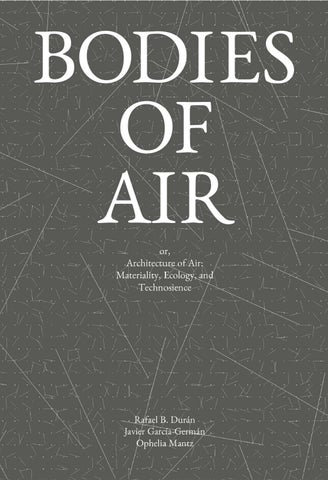
Rafael B. Durán Javier García-Germán
BODIES OF AIR Philip Ursprung Timothy Morton Emanuele Coccia New Territories/R&Sie(n)… Diller & Scofidio + Renfro Erik M.Conway Rafael B. Durán New Territories/M4 Ángel Borrego Cubero & Natalie Jeremijenko OFICINAA Salmaan Craig Kiel Moe HOME-OFFICE Andrea Faraguna Astrida Neimanis Marie Bardet Javier García-Germán Décosterd & Rahm Associated TAKK Anna Orbanic Cymene Howe & Dominic Boyer AGENCY Carlos Flick Federico Soriano & Dolores Palacios Architects Steven Connor Victoria McReynolds Olafur Eliasson Peter Jay Zweig & Rafael B. Durán Santiago Sierra Francois Roche, S/he Ophelia Mantz
TABLE OF CONTENTS 2 4 8 18 28 41
Table of Contents
2
Table of Contents Acknowledgments Foreword: Philip Urspung · Air is in the Air Prologue: Rafael B. Durán · Beige is the Color of the Anthropogenic Sky Introduction: Rafael B. Durán & Javier Germán-García · Becoming aerial AIR & PHILOSOPHY 55 Timothy Morton · A Quake in Being 87 Emanuele Coccia · In Open Air: Ontology of the Atmosphere 111 NEW TERRITORIES / R & SIE (N)... · Dustyrelief 123 Diller & Scofidio + Renfro · Blur Building 135 AIR & SCIENCE 149 Erik M. Conway · Reckoning with the Earth 165 Rafael B. Durán · The Materiality of Air 189 New Territories / M4 · Timidity Symptom 207 Ángel Borrego Cubero & Natalie Jeremijenko · Urban Space Station (USS) 219 AIR &TECHNOLOGY 228 OFICINAA · The Bestiae 243 Salmaan Craig · Lost Loops 287 Kiel Moe · Error from the Air 297 HOME-OFFICE · PALM-HOUSE 311 Andrea Faraguna · Heatwave 329 AIR & BODY 347 Astrida Neimanis · Bodies of Water, Human Rights and the Hydrocommons 379 Marie Bardet · Dancing Airscape: Spatiality as Relationship 399 Javier García-Germán · Body, Atmosphere and Climatic Typology 423 Dècosterd & Rahm Associated · Hormonorium 433 TAKK, Mireia Luzarraga & Alejandro Muiño · The Day After House 445 AIR & POLITICS 458 Anna Orbanic · Breathing Ground 471 Carlos Flick · The Movement of the Smoke Abatement in 19th Century Britain 501 Cymene Howe & Dominic Boyer · Aeolian Politics 513 AGENCY, Ersela Kripa & Stephen Mueller · Atmospheric Jurisdictions 539 XIX Century Industrial Chimneys 555 Federico Soriano & Maria Dolores Palacios Architects · Eco-Chimneys of Vallecas 571 AIR & AESTHETICS 587 Steven Connor · Next to Nothing: The Arts of Air 607 Victoria McReynolds · Light 110 633 Olafur Eliasson · Big Bang Fountain 641 Rafael B. DurÁn & Peter Jay Zweig · Airscapes #1 657 Santiago Sierra · 52 Canvases Exposed to Mexico City’s Air 662 Conclusion · Rafael B. Durán 687 Epilogue: François Roche, S/he · Contre Nature 701 Epilogue: Rafael B. Durán in conversation with François Roche, S/he 715 Contributors & Authors Index 759 Credits
3
BODIES OF AIR
Acknowledgments
4
ACKNOWLEDGMENTS
Bodies of Air took several years to develop and, naturally, encountered many influential voices and institutions that, in different ways, shaped this volume. We want to first thank our colleagues in West Texas, Lubbock, and the College of Architecture at Texas Tech University, whose former dean, James Williamson, sponsored the symposium Airscapes and produced by a team of students, faculty, the dean’s office, and staff, including Josh Hafel, Taylor Hantula, Chris Taylor, Ophelia Mantz, Victoria McReynolds, Lesley Nall Washington, and Denny Mingus. Airscapes met in April 2019 to discuss the origins of the volume, initially conceived as a symposium proceeding “to be printed soon,” but it never went to print and later became a long discussion. We appreciate the continuous support and lively conversations with Airscapes contributors: Ersela Kripa & Stephen Mueller of AGENCY, Aerocene.org, Karin ArdonDryer, Marie Bardet, Silvia Benedito, Salmaan Craig, Manuel DeLanda, Victoria McReynolds, Sean Lally, and Philippe Rahm. The discussion continued at the Hines College of Architecture and Design, which is sponsored by its dean, Patricia Belton Oliver, to whom we extend our gratitude. We sincerely thank Alessandra Arenes, Pedro Ignacio Alonso, Michael Benedikt, Leora Visotzky, Brittany Utting, Albert Pope, Natasha Sandmeier, Brett Steele, Joseph Campana, Liz Galvez, Juan José Castellón, Heather Davis, Paul DeFazio, Jane van Velden, Jonathan Scelsa, Tülay Atak, Luis Callejas, Jørgen Johan Tandberg, Miguel de Guzmán, Patrick Margain, Maisie Muñoz, Carlos Soto, Kaede Polkingorne, Brian Lee, Mark Bachman, Juan Miguel Hernandez de León, Juan Barja, Ángel Martínez García-Posada, Alfonso Garduño, Alejandro Valdevieso, Meredith Malone, Patrick Tempelton, Cyntia Davidson, Francois Roche, S/he, Mattie Salomon, Hannes Stiefel, Elisabeth Kolbert, Sara Kisner, Roxanne Mackie, Daisy Hildyard, Haus der Kulturen der Welt (HKV, Berlin), the Institute für Kunst und Architektur (IKA, Vienna), Círculo de Bellas Artes (Madrid), Escuela Tecnica Superior de Arquitectura de Madrid 5
BODIES OF AIR
ACKNOWLEDGMENTS
(ETSAM), the Sixth Sphere curated by Brittany Utting, exhibited at the 7th Lisbon Architecture Triennale and Aedes Architecture Forum in Berlin, the Museum of Fine Arts (Houston), El Museo de la Ciudad de Queretaro, Mexico, LABOR art Gallery, Mexico, Mildred Lane Kemper Art Museum, St Louis, and the University of Texas at Austin School of Architecture. We deeply thank Ramón Prat, Ricardo Devesa, and Pau Codina of Actar for their dedicated effort and endless patience. Finally, our boundless gratitude goes to Ophelia Mantz, who carefully listened to all dilemmas and disputes, read all the critical pieces, and took the necessary time to help this volume embody its ideas.
6
7
BODIES OF AIR
Foreword Philip Urspung Air is in the Air
8
FOREWORD
A tethered balloon floating over the exhibition grounds was the main attraction of the first Exposition des Produits de l’Industrie Française on the Champ-de-Mars in Paris in 1798. The montgolfière was a recent invention. Hardly a visitor of this new trade fair, which, during a couple of days, displayed an array of inventions and consumer goods, had ever encountered such a device. It must have been a fascinating sight. For the first time, humans could float in the air. A miracle! It was also a political sign of the young French Republic overcoming the gravity of the Ancien Régime after the French Revolution while at the same time keeping the raw forces of nature in check. It celebrated republican ingenuity, scientific progress, industrialization, and freedom. 9
PHILIP URSPRUNG
“Vehicle of life-giving forces”
Whereas the sun as a centralized source of energy had symbolized power in the absolutist age – personified by the sun king Louis XIV – air was at the core of the new postrevolutionary era. The tethered balloon was visible from the exhibition grounds, just as these grounds were visible to the lucky few who were invited to the balloon’s basket. The very fragility, mobility, ephemerality, and weightlessness made it the perfect monument of its time. In his book Ideas for a Philosophy of Nature, published in 1797, the young German philosopher Friedrich Wilhelm Schelling wrote: “Our globe is surrounded by a transparent, elastic fluid, which we call air […] as it seems, the universal vehicle of all life-giving forces, an inexhaustible source, from which with animate and inanimate Nature draw everything necessary to their welfare.”1 The tethered balloon could carry humans into the air, but it was not architecture at least not according to traditional categories. However, it had a stronger impact on the future of architecture than earlier preindustrial forms of ephemeral architecture, such as tents, pavilions, temporary decorations, or festive architecture. Tethered balloons, along with observation towers, Ferris wheels, and cable cars, became an integral part of exhibition grounds throughout the nineteenth, twentieth, and twenty-first centuries. Any human-made structure reaching the sky and interacting with air catches one’s attention, from the Eiffel Tower of the 1889 World Fair to the cable car carrying visitors through the vast grounds of the Expo 92 in Sevilla or the Garden in the Sky at the Expo City Dubai 2020. No one gets tired of enjoying a bird’s eye view. And no one gets tired of looking, from the stable ground, at those who are hovering high above them. The air, the ephemeral, the triumph over gravity, the spectacle, and the exhibition, it seems, are deeply intertwined. It took half a century for the impulse from the Champ de Mars to manifest itself in a building, the Crystal Palace. 10
AIR IS IN THE AIR
Joseph Paxton designed an entirely new ephemeral structure for the first World’s Fair, the Great Exhibition of the Works of Industry of All Nations in 1851, in London’s Hyde Park. The palace stood only during the time of the show, from May to October, and was dismantled, and transferred to Sydenham, where it burned in 1936. The permission to build was given under the condition that three old elm trees were conserved. The thousands of objects exhibited represented the products of the industrialized nations and their colonies, from raw materials to artifacts, machinery to works of art, and fascinated more than six million visitors. But an even stronger attraction was the exhibition space itself. Never had so much space been defined by so little mass. The seemingly endless interior, flooded with milky light, was both frightening and fascinating for visitors. Richard Lucae observed that it is as if “one has poured air, as it were, like a liquid,” leaving the sensation that “the free air has kept its solid shape after the form in which it had been poured was again taken away.2 Gottfried Semper criticized the main nave critically as a “glass-covered vacuum.” 3 Semper’s description of the interior of Crystal Palace as empty, as a vacuum, points at a specificity of the building and ephemeral architecture in general. Air – or its absence in the vacuum – has no shape. The Crystal Palace and its successors in the guise of exhibition halls, shopping A different version of this essay appeared under the title «The Longue Durée of the Ephemeral», in Grand Palais Ephemère, Paris, Réunion des musées nationaux – Grand Palais, 2022, 13-21. 1—Friedrich Wilhelm Schelling, Ideas for a Philosophy of Nature, 2nd edition 1803, translated by Errol. E. Harris and Peter Heath, (Cambridge: Cambridge University Press, 1988), p. 87.
2—Richard Lucae, “On the Meaning and Power of Space in Architecture” (1869), trans. Harry Francis Mallgrave, in Architectural Theory Volume 1: An Anthology from Vitruvius to 1870 (Malden, MA: Blackwell Publishing, 2006), p. 559.
3—This notion stems from the end of Gottfried Semper’s essay “Science, Industry, and Art” (1852), in The Four Elements of Architecture and Other Writings, eds. Harry Francis Mallgrave and Wolfgang Herrmann (Cambridge: Cambridge University Press, 1989), p. 164.
11
PHILIP URSPRUNG
malls, train stations, airports, and trade fare halls are systems and interrelations rather than forms. They contain the air and control the internal climate, but they have no clear beginning and no clear end. Instead of a façade, they have a membrane. To many observers, the Crystal Palace and its successors until the present day are not “real” architecture but rather a result of engineering. More than objects in space, they appear like events in time. Utopian Spaces
It seems that air comes into play prominently in the realm of architecture in times of change when categories are questioned and limits between the genres are blurred. The volatility of air, its ephemerality, invisibility, its relation to pneumatics, expansion, foam, and evaporation, and its indispensability for life, the body makes it a component for change as such. “Psyche,” the Ancient Greek word for “soul” is related to the Ancient Greek word for “breath” and “blow.” “All that is solid melts into the air” is a classic quote from the Manifesto of the Communist Party (1848) by Karl Marx and Friedrich Engels which describes the dynamics of capitalism. If one looks at the visual culture during the years following the Russian Revolution in 1917, the constructivist universe is full of airplanes, gliders, dirigibles, and balloons. Ivan Leonidov’s graduation project, Lenin Institute for Librarianship (1927), is perhaps the best-known example of this trend. It is a plea to overcome gravity. The auditorium, in the guise of a glass sphere, seems to float in the air and hover above the ground like a Montgolfière. Vladimir Tatlin imagined an apparatus that could fly like a bird, the LeTatlin (1930). And El Lissitzky drew horizontal skyscrapers, so-called Wolkenbügel (”cloudhooks”), which would elevate the inhabitants floating high above the ground and provide light and ventilation. None of these 12
AIR IS IN THE AIR
projects was realized except for the Shukov Tower (1922), a filigree construction that appears to dematerialize in the air (1922). Probably the first name that comes to mind when thinking of utopian spaces is Richard Buckminster Fuller’s. His lasting contribution to architecture is the tensegrity structures, which resemble balloons and are “almost magically suspended in air.”4 At the peak of the Cold War, with the biggest fear being the radioactively polluted air in the fallout of a nuclear bomb, he proposed to build a geodesic dome over midtown Manhattan (1960). This utopian project materialized with the US Pavilion of the Expo 67 in Montreal, a huge, quasi-immaterial sphere of networks and interconnections. If the Crystal Palace represents the achievements of the First Industrial Revolution, and the Shukow Tower stands for the Second Industrial Revolution, then the US Pavilion is emblematic of the Third Industrial Revolution, the Information Age. If the Crystal Palace resembled a factory, the US Pavilion resembles a brain.5 “Bucky’s” domes became cult objects for the counterculture. More than a tent but less than a house, they correspond to the mobility and flexibility demanded by alternative lifestyles since the 1970s and their plea to live on “love and fresh air.” The utopian impulse which had been sent out by the tethered balloon after the revolution resonated again in the spaces of 1968. Around the time of the cultural revolution, inflatable structures were en vogue. Once again, the limits of architecture were blurred, now, towards the arts. Christo & Jeanne-Claude inflated an 80m high column in Documenta 4, 1968. Panamarenko exhibited the huge sculpture Aeromodeller (1971) in the guise of a dirigible. 4—See “Tensegrity”, Buckminster Fuller Institute, https://www.bfi.org/about-fuller/ big-ideas/tensegrity/ (accessed 23 July 2024). 5—It is a coincidence that, like its ancestor, the Crystal Palace, the Biosphere went up in flames. The fire in 1976 destroyed the transparent hull but the structures remained. Is there a continuity between the early balloons, able to fly thanks to hot air or gas, but highly vulnerable by fire, the end of Crystal Palace in 1936, the disaster of the Hindenburg dirigible in 1937 and the Fuller dome in flames? No fire without oxygen.
13
PHILIP URSPRUNG
Gordon Matta-Clark offered passersby on New York’s Wall Street a sip of oxygen in Fresh Air Cart (1972). Hans-Walter Müller built an inflatable church in Montigny-lès-Cormeilles (1969). “This architecture lives in the moment,” he wrote in the statement “Architecture carried by Air” (2004).” 6 The collective Coop Himmelb(l)au, inhabiting Airbox (1970), a cylinder filled with air and moving through the streets in an inflatable Restless Sphere (1971) claimed: “Make architecture with fantasy, light and flexible as a cloud.” The collective Haus-Rucker-Co installed Oase Nº 7 on the facade of the main exhibition venue, the Fridericianum during Documenta 5 in Kassel, 1972. The transparent plastic globe with space for one person and a palm tree symbolized what had become of the earlier utopia. The artificial sky over lower Manhattan had shrunk to a bubble for the private sphere. Lighter than air
Faced with the challenge of finding an architectural representation of the Millennium two cases come to mind. The Millennium Dome in London, designed by Richard Rogers (1999), is a shiny silver stretched umbrella made of Teflon-coated glass fiber. It is said that the structure is lighter than the air it contains. Built on the Greenwich Peninsula, the dome rises where Europe’s largest gasworks once stood. The shape suggests a gently breathing giant airbag that wraps itself protectively around us. (The 1999 film The World Is Not Enough, for example, it cushions James Bond as he falls from an exploding hot-air balloon). The content of the Millennium Dome was secondary. What mattered was the presence of the empty hull. The same goes for Blur Building, designed by Diller Scofidio + Renfro. The lightweight tensegrity structure hovering over Switzerland’s idyllic Lake Neuchatel featured thousands of nozzles dispersing water and creating a permanent fog effect, a cloud hovering over the lake. 14
AIR IS IN THE AIR
The optical “white-out,” as the architects put it, corresponded to the acoustic “white noise” of the nozzles. It became a landmark of the Swiss National Exhibition in 2002, the Expo.02, precisely because it did not exhibit anything but itself but seemingly dissolved into nothing. Around the Millennium, the nebulous, cloudy, volatile, blurred, fuzzy, and indeterminate were all the rage. The buzzwords were “ambience,” “mood,” and “immersion.” Fredric Jameson coined the term “hyperspace,” Gernot Böhme brought the term “atmosphere” into play, Peter Sloterdijk’s philosophy revolved around concepts such as “spheres” and “foams,” and Giuliana Bruno analyzed the question of “surface.” In Olafur Eliasson’s installation, The Weather Project in the Turbine Hall of the Tate Modern in London (2003), one could marvel at an eternal sunset through artificial fog. And François Roche imagined the Dustyrelief (2002) for Bangkok, a dust museum with an electrostatically charged aluminum shell that would collect the fine dust emitted by the metropolis’ traffic and thus grow. Today, air is in the air again, so to speak. Data are stored in “clouds” as if they were immaterial, although they require hardware and consume immense quantities of energy. The pandemic that shook the world was a respiratory disease, and its transmission was airborne. Before a vaccine was available, all hope was focused on breathing masks and ventilators. Air was both the carrier of the disease and its remedy. The heating of the Earth’s atmosphere, its pollution, and its movements are at the core of the attention. We don’t know yet if the recent technological change towards artificial intelligence, machine learning, and robotics is actually a Fourth Industrial Revolution, and we don’t know if the notion of the Anthropocene will retain its current powers as a conceptual horizon of today’s discourse. 6— See Aut, Architektur im Tirol, Innsbruck, aut, info 1/2022, https://aut.cc/ magazin/aut-feuilleton/hans-walter-mueller-eine-von-luft-getragene-architektur (accessed 23 July 2024).
15
PHILIP URSPRUNG
AIR IS IN THE AIR
But the very fact that there is so much discussion in scholarship, architecture, popular culture, and politics about how to define these topics reveals that we are again in a phase of rapid change. Buildings with permeable membranes, which react to weather to change and interact with the environment rather than shielding it off, are closer to today’s values than buildings with solid walls that occupy space and represent exclusion and dominance. Architecture generally does not literally “express” or “represent” contents. But architecture, or, better put, phenomena that are at the margin of what is traditionally defined as architecture, make tangible and visible trends that are not yet defined. Air in architecture is about the unknown. It widens the horizon, opens up space, and allows one to breathe.
16
17
BODIES OF AIR
Prologue Rafael B. Durán Beige is the Color of the Anthropogenic Sky
18
PROLOGUE
Neither black nor white, beige is the color of the anthropogenic sky. With minimalist precision, a grid of thirteen columns and four rows of square canvases was on view from February 23 to July 29, 2024, in the Saligman Family Atrium of the Mildred Lane Kemper Art Museum at Washington University in St. Louis. From a distance, the composition appears geometrically precise, capturing a sequence of 52 colors—ranging from nearly white in the top left corner to almost black in the bottom right. Upon closer inspection, one notices that every canvas—from light to dark—is speckled with random dots and traces of lines: sometimes clear, sometimes dark; sometimes sharp, sometimes blurred. They resemble accidents— marks of contingent and involuntary 19
RAFAEL B. DURÁN
gestures—as if the artist played each one like an abstract expressionist. However, something also suggests that a second, involuntary author, the city’s air, is at work here alongside Sierra, as the canvases, like the city’s buildings, have weathered over time before becoming what we see now. How did all this happen?
BEIGE IS THE COLOR OF ANTHROPOGENIC SKY
In 2019, the Spanish artist Santiago Sierra arranged 52 adhesivelacquered canvases on the floor of a building in Mexico City. For a year, each week, Sierra removed one canvas and fixed the sediment that accumulated on its surface. The work results in a time-lapse of noxious accumulation later displayed at the Mildred Lane Kemper Art Museum in St. Louis. The wall label beside the piece reads: “In 52 Canvases Exposed to Mexico City’s Air, he [Santiago Sierra] does not reproduce the human-onhuman cruelty explored in his earlier works but instead uses art as direct evidence of environmental deterioration. With this installation, the artist has created a visualization of the toxicity of contemporary urban life.”1 As Félix González-Torres did in the 1990s, Santiago Sierra once again demonstrates— brilliantly—that the vocabulary of minimalist and conceptual art can shelter deeply ethical and political content. And while expanding minimal art aesthetics, he is also reactivating, with subtle allusions, works like Carl Andre’s 144 Magnesium Square or 144 Lead Square (1969) and Sol LeWitt’s Wall Drawing #1 (1968), without authorizing us to limit ourselves only to this interpretation of his work. Thanks to its formal features—the unifying grid, the gradient of colors, and its placement on the museum wall— the arrangement makes us perceive this work as an object, even though it consists of 52 separate elements. Although its abstract appearance at first glance doesn’t reveal the brutal story it contains, an uneven quality invites closer inspection. As in an urban grid, something repeats while something else resists repetition; something is equal while something else rejects equality. The color gradient is not mathematically precise; sometimes, subtly, it reverses, with the right side slightly darker than the left. Mostly beige, all are soft and gentle, yet also uneasy and dirty. From creamier shades to more grayish or sandy tones, they are all beige—polluted. What is the artist telling us? 1—Mildred Lane Kemper Art Museum, 2024; curator Meredith Malone
20
21
RAFAEL B. DURÁN
Like seismographs registering telluric forces beneath our feet, contemporary artists record the tremors of cultural and planetary shifts, and make them visible long before the rest of us feel them. Kubler’s The Shape of Time (1962) suggests that artists, like scientists, move ahead of their time; Benjamín Labatut’s The MANIAC (2023) reminds us that mathematicians can lead us into darkness as easily as out of it. The parade that advances through the dark, widening our knowledge of the world, is led, in Kubler’s image, by architects, artists, poets and musicians, and today also by philosophers and mathematical models2, and its destination is not guaranteed. What should be considered when artistic production explores pollution to reveal the connections between the economy and environmental degradation? What should we do when philosophers are concerned with waste? Or, what should we understand when climate scientists estimate that the carbon budget (the atmospheric waste capacity) will be exhausted by about 20283 to keep global warming below 1.5 °C? A stark reality emerges when aesthetics bring the polluted air we breathe onto the stage. The contemporary artist reprograms a cosmos through which humankind is violently cast, aiming to reconnect with the material world it belongs to. Today, contemporary artists acknowledge that modern abstraction, whether in art or technique, has pushed the world into a distance that the human hand cannot reach. Artists aim to reconnect us with the material world. The topocritical exploration4 presented in 52 Canvases Exposed to Mexico City’s Air shows how art can create new ethical and aesthetic values. Sierra’s canvases challenge minimal art as a distilled modernist 2—Kubler, George. (1962). The Shape of Time: Remarks on the History of Things. New Haven: Yale University Press, 2008, p. 16. 3—The Indicators of Global Climate Change 2024 study (Forster et al., Earth System Science Data, June 2025) puts the remaining 1.5 °C budget at about 130 GtCO₂ from the start of 2025, a little over three years at current emissions
BEIGE IS THE COLOR OF ANTHROPOGENIC SKY
avant-garde by re-appropriating and mixing its grammatical abstractions, forms, and visual resources—this time grounded in realities rather than representations—that speak to the brutal issues of our time and the journey that brought us here. This layered reality of the artist’s work—where symbolism returns to materiality and planetary pollution exceeds ideologies—serves as a prelude to exploring how architecture, as an intense form of material practice, develops and extends its influence on a planetary scale. The heat of global warming has created a new language. It says, your body is everywhere. Your actions here will reach
4—Bourriaud, Nicolas. (2008). “Topocrítica: El arte contemporáneo y la investigación geográfica.” In Heterocronías: Tiempo, arte y arqueologías del presente. Murcia: Cendeac.
Fig1— 52 Canvases Exposed to Mexico City’s Air, Mildred Lane Kemper Art Museum (2024). Washington University, St Louis, Missouri, USA
22
23
RAFAEL B. DURÁN
the other side of the planet. As Daisy Hildyard shows us in her book The Second Body (2017)5, everyone has two physical bodies: the first body is here and now, the second body is implicated in the whole world. That is the language of global warming, which we will refer to in this volume as the new ecological horizon. Historically, the pedagogical apparatus of design disciplines presents design as something connected to scale—the scales of industrial design, interior architecture, architecture, urbanism, landscape, or territory. However, the objects we design are not inert assemblies of material forms: in every design decision, architects—either intentionally or potentially—mobilize significant materiality, increase social and environmental pressure,
BEIGE IS THE COLOR OF ANTHROPOGENIC SKY
and provoke ecological tension, inequality, and disruptions that lead the planet toward amplified natural disasters—characteristic of the so-called Anthropocene. Design functions across scales from the molecular to the planetary: every material form has its equivalent negative somewhere else. If the objects we design are not innocent in shaping the built environment, how can we design ethically? A first step, perhaps, is learning to see our second body: to follow what our materials displace, emit, and leave suspended in the air. Sierra’s canvases record only what the air lets fall: soot, dust, particles heavy enough to settle. Beige is the color of the
5—Hildyard, Daisy. (2017). The Second Body. London: Fitzcarraldo Editions.
Fig2— 52 Canvases Exposed to Mexico City’s Air, Mildred Lane Kemper Art Museum (2024). Washington University, St Louis, Missouri, USA
24
25
RAFAEL B. DURÁN
visible sky we have polluted; carbon dioxide has no color at all. Its only hue lies in the infrared, in the heat it holds and our eyes cannot see. To read it, we must turn to another archive of air: the ice. In January 2025, the Beyond EPICA project reached bedrock in Antarctica, recovering ice more than 1.2 million years old, whose record of CO₂ levels is now being analyzed. The longest analyzed ice core spans 800,000 years, showing that CO₂ levels have never exceeded 300 parts per million (ppm) during that period. In 2025, the global average reached 426 ppm, about 40% higher than at any point in at least 800,000 years.6 Around 3 to 5 million years ago, during the Pliocene Epoch, CO₂ levels ranged between 400 and 450 ppm, and the planet was 2 to 4 degrees Celsius warmer than preindustrial levels. Sea levels were roughly 10 to 25 meters higher, and Greenland’s ice sheet was largely absent. Venus offers the extreme version: an atmosphere almost entirely of carbon dioxide, a surface hot enough to melt lead, and, seen from afar, a pale beige veil of sulfuric clouds. By contributing to changes in air chemistry, we actively shape the Earth’s new landscapes and climate shifts, displacing entire populations or punishing others. Designers must recognize their responsibility in the trans-scalar condition of materiality, since our second body began dwelling in places where our first body does not belong. So, what type of material features should we look at when exploring air materiality in architecture? Although it is soft, elastic, and light, the powers of air chemistry and air materiality are immense. As Claude Lévi-Strauss warned, “once man stops knowing limits to his power, he goes on to destroy himself,”7 and Nicolas Bourriaud, quoting him, adds, “be it in extermination camps or through air pollution.”8 Perhaps this is what Santiago Sierra’s seismograph, hanging in the
BEIGE IS THE COLOR OF ANTHROPOGENIC SKY
St. Louis museum, was telling us in its own way. It also invited us to look at architecture through air: not because air is the best frame for any given work, but to discover what might be understood anew when a work is read from within the air it inhabits and alters. The chapters that follow attempt that reading from several angles, as the Introduction explains. Like the 52 canvases, each holds a different shade of the same sky. In them, we found ourselves opening a new field of architectural discourse; we hope the reader will find their own, whether in agreement or disagreement with our interpretations.
6—Lan, X., P. Tans, and K. W. Thoning. “Trends in Globally-Averaged CO₂ Determined from NOAA Global Monitoring Laboratory Measurements.” NOAA Global Monitoring Laboratory, gml.noaa.gov/ccgg/trends/global.html October 15th 2026 7—Lévi-Strauss, Claude, and Didier Eribon. (1988). De près et de loin. Paris: Odile Jacob. 8—Bourriaud, Nicolas (2018). Crash Test. Montpellier: La Panacée.
NOTE: All beige-colored pages throughout the volume- the introduction to the chapters and the project criticism are written by Rafael B. Durán.
26
27
AIR & SCIENCE
ESSAY
NEW TERRITORIES /M4 2012-2014 Bangkok, Thaïlande
TIMIDITY SYMPTOM 188
189
AIR & SCIENCE
ESSAY
NEW TERRITORIES /M4 2012-2014 Bangkok, Thaïlande
TIMIDITY SYMPTOM 188
189
NEW TERRITORIES/M4
TIMIDITY SYMPTOM
190
191
NEW TERRITORIES/M4
TIMIDITY SYMPTOM
190
191
NEW TERRITORIES/M4
Predictive logics are no longer able to predict natural disasters that don’t result from natural spasms, but from political, industrial and human conjunctions, ... Angry” biotopes. Gaia’s furies are innumerable: Katrina, El Niño, Jeanne, Thomas and Nargis, Xynthia, Ewiniar, Fukujima... a series of devastations and uncertainties that our seismographs cannot prevent. The elements are raging and the gods, always ready to forgive human madness, suddenly seem powerless in the face of nature’s infernal rebellion. The scenario develops a strategy to infiltrate an abandoned tropical forest, in the middle of the BKK, through the principle of timidity (the phenomenon of the trees’ shyness), in a mimesis of the pheromonal behaviour of the foliage: the existing trees are used to metabolize the museum alien, made by the intricacy of a multitude of bio-components, issued from nature’s recycled waste computational growth in the negative void. This cradle to cradle scenario re-negociates the relationship between living and dead spirits, between Eros & Tanatos, the timidity symptom is a chemistry, an allelopathic apparatus to reinject a degree of dispute, of conflict between ‘proto and crypto’ natures. Allelopathy / Phytohormone
Etymologically ... to suffer from each other> Active or passive effect of chemicals released into the environment that affects other organisms. We include some D.E.P./diethyl phthalate (a member of the group of phthalic acid esters known as phthalates) in the bio-plastic of 15000 Components. D.E.P. belongs to the Low Molecular Weight (LMW) group, with a molecular weight of <250 daltons, relatively low viscosity and high volatility. It has a faint unpleasant odour and can be transferred from the plastics containing it, creating a pheromonal allelopathy between the museum and the jungle to keep them at a distance (about 0.9 metres), in a dynamic antagonism.
192
TIMIDITY SYMPTOM
Geometry
3D scanning of all the trees (three months of work!) Getting 5 gigabytes of point cloud from micro-station to transfer in Rhino point, with Python to generate attractors, repulsor effect and reveal the negative, the emptiness of the forest, where something could infiltrate. Approximation of the surface 3D printing and modelling in synthetic plaster to blur the positivism of the scientific process 3D scanning by Kinect and distribution and cluster population on the surface by Python-Rhino grasshopper shaking Design of the intricate component, test of cnc milling scale one by KukaAgilus and preparation of the final aluminium mould, again by cnc, followed by a dripping of bioplastic for 15.000 units. The research on the geometry is a mathematical development that reveals a shape according to the existing obstacles surrounding it (the trees calculation of distances to trunk, branches, foliage), followed by an equation to define a timidity relation between the limits of the emerging shapelessness and the contour of the existing morphologies. Design of a museum in a forest
Scenario: 1) Recognition of the situation / the family of the owner got its wealthy situation from a phyto-therapy drug research of the Grant Father, with development and fabrication from the trees in the Land. 2) Scanning of 30ties of the largest elements, on three months, to get billions of point cloud.as a starting point of a 3D cartography. 3) Research by scripts of the negative computation ghost of this forest, to use the void as an emerging strategy. Morphologically embedded or trapped in the negative part of the wood, the black matter is the house of the witches. 193
NEW TERRITORIES/M4
TIMIDITY SYMPTOM
4) Development of allelopathic intricate components with Velcro-like attachment, to create the repulsing forces (crown shy effects) between photosynthesis and artificial matter, between the existing nature and the architecture alien, as a dispute, of conflict of chemistry of pheromone behavior (see below). 5) Museum as a result of this timidity approach, including domestic curating strategies as the prolongation of the intimacy of the owner, the art collector spaces as multiple meander of curiosity cabinet and only one white cube, it’s enough to play for international standard. 6) Proposal to drive the evolution of the collection in a timidity symptom amateurism.
194
195
NEW TERRITORIES/M4
TIMIDITY SYMPTOM
196
197
NEW TERRITORIES/M4
TIMIDITY SYMPTOM
196
197
NEW TERRITORIES/M4
TIMIDITY SYMPTOM
198
199
NEW TERRITORIES/M4
TIMIDITY SYMPTOM
198
199
NEW TERRITORIES/M4
TIMIDITY SYMPTOM
200
201
NEW TERRITORIES/M4
TIMIDITY SYMPTOM
200
201
NEW TERRITORIES/M4
TIMIDITY SYMPTOM
202
203
NEW TERRITORIES/M4
TIMIDITY SYMPTOM
202
203
NEW TERRITORIES/M4
TIMIDITY SYMPTOM
Bangkok, Thailand, 2012-14 Architect: New-Territories / M4 Creative team: Francois Roche, Camille Lacadee, Cyril Lami, Jeep P. Narongthanarath with Devin Jernigan, Tiziano Derme, Myrtille Fakhreddine, Vongsawat Wongkijjalerd, Ip Panit, Patrick Mc Kechnie, Katrin Hochschuh, Hadin Charbel Biennale Installation : Nicolas Grawitz and Iris Godbille Design and engineering Partners : Ezio Blasetti_Architect / Mathematical Process / Andrew Snalune_ Façade Engineering / Sakkarn Sirisrisak_ Steel Engineering / Sanitas Studio_ Landscape Architect Key dimensions: Museum 2500m2 / House of Collector 2000 m2 / Employees quarter 600 m2 Client: Petch Osathanugrah / O’Museum Situation: Bangkok / Abandoned tropical forest in the middle of Bangkok Cost: 450 m THB / 15 m USD
204
205
BODIES OF AIR_CREDITS
Published by Actar Publishers, New York, Barcelona www.actar.com Author Rafael Beneytez-Durán Co-author Javier García-Germán Edited by Ramon Prat Homs
All rights reserved © edition: Actar Publishers, editors © texts: their authors © design, drawings, illustrations and photographs: their authors This work is subject to copyright. All rights are reserved, on all or part of the material, specifically translation rights, reprinting, re-use of illustrations, recitation, broadcasting, reproduction on microfilm or other media, and storage in databases. For use of any kind, permission of the copyright owner must be obtained.
Graphic Design Pau Codina
Distribution Actar D, Inc. New York, Barcelona.
Printing and binding Arlequin & Pierrot
New York 1216 Broadway, New York NY 10001 US salesnewyork@actar-d.com Barcelona Roca i Batlle 2 08023 Barcelona, Spain eurosales@actar-d.com English ISBN: 978-1-63840-083-7 Library of Congress Control Number: 2022947790 Printed in Europe Publication date: 2027
760
I I I I 111
ISBN 978-3-0346-0704-9
9 783034 607049