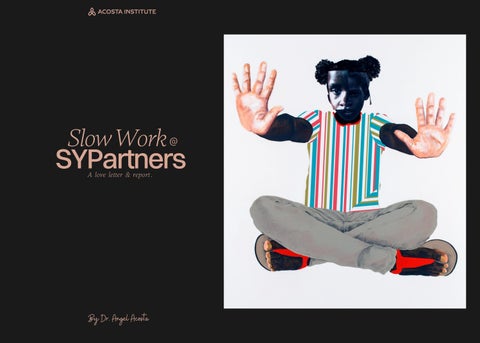
Slow Work @
SYPartners A love letter & report .
By Dr. Angel Acosta
" The times are urgent, therefore we must slow down." - Bayo Akomolafe
02/32
Deborah Roberts, “Fighting all the ISM,” 2019. Mixed media collage on canvas. 72 x 60 inches. Artwork © Deborah Roberts.
Opening
Love Letter A Mirror For
Leaders and Team Inclusive Culture
Squad
Teams
5-7
9
10
Holding Space
for Inclusion Going Deeper with the Managing Leadership Team
An Archaeology of Us
11-13
13-19
Lingering
Questions Closing
03/32
Remarks
21-22
23-24
A Love Letter and Report
Admin & People
4
Opening Love Letter,
SYPartners
Our relationship has been a serendipitous and synergistic response to history. The sweltering heat of the summer of 2020 was felt in your bones as you navigated the beginning of a global pandemic and the aftermath of the death of George Floyd. This odd combination of historical forces exposed cultural and organizational faultlines–intensifying some of your challenges and desires related to diversity, equity and inclusion. Fundamentally, it created opportunities for genuine engagement. With this, you expressed a profound yearning to go deep with me. I invited you to go slow.
After three years of walking beside you–observing, facilitating, listening, and challenging you–I write the following pages more as a love letter rather than a cumulative report. I have been utterly transformed by this witnessing. Throughout this report, you will find art from Deborah Roberts, a contemporary visual artist known for her mixed-media collages, which explore the complexities of Black identity, particularly for young girls. The piece on the cover is called Freedom Song (2020) and is mixed media collage on canvas. Her art often combines and overlays images, creating composite faces or bodies that convey the multifaceted and changing nature of identity. The children depicted in Roberts' works are both vulnerable and defiant, expressing themes of beauty, power, resilience, and social perception. In a way, I lean on Robert's masterpieces to evoke the multifaceted nature of the SYP Way and how it enabled you all to navigate a tumultuous moment in your history with vulnerability, power and with an eye towards how to make SYP a more beautiful place to work at. I also share this to remind you that in a corner of the organization you, in fact, did slow work. May these words reflect how tenderly I have held you. In solidarity,
Dr. Angel Acosta 04/32
A Love Letter and Report
The felt sense of discord between a feeling of urgency, the fast-paced consulting work you do and my suggestion that we do slow and healing-centered DEI work was palpable. I saw my role as a thought partner and to a certain extent, as a cultural doula–with the central role of continuously keeping the pace as slow as possible.
Close-up of 'Untitled 2018', Deborah Roberts Images courtesy The Contemporary Austin. Photographs by Paul Bardagjy
A Mirror for
LEADERS & TEAMS
Advisory Hours & One-On-One Coaching
Through advisory hours, Peas were able to explore feedback related to DEI, the experience of race in the workplace, and discuss the conditions for thriving for themselves and other Peas. One-on-one support from an external consultant enabled Peas to gain new perspectives, receive support and resources, and develop themselves in ways that would not otherwise be possible.
05/32
continue to next page....
A Love Letter and Report
Adrienne Maree Brown once wrote, “move at the speed of trust.” These words capture the essence and truth behind the profound moments that we were able to experience over the last few years. Spending one-onone time with members of the MLT, the Trio, members of the Admin Team and People team to deeply listen provided a mirror for deeper self-reflection.
Deborah Roberts, The Unseen, 2020. Mixed media collage on canvas. 65 x 45 inches.Artwork © Deborah Roberts. Courtesy the artist; Vielmetter Los Angeles; and Stephen Friedman Gallery, London. Image courtesy The Contemporary Austin. Photograph by Paul Bardagjy
06/32
Additionally, BIPOC (Black, Indigenous, and People of Color) Peas who engaged in advisory hours found that this kind of high-touch process supported their emotional wellbeing, while also generating feelings of affirmation and a sense of excitement towards contributing to the larger SYP culture. This feedback also points to the positive impact that such coaching can have on by lifting individuals and teams up. Below are some quotes from participants who experienced advisory hours. continue to next page....
A Love Letter and Report
Advisory hours also served as checkins that allowed individuals to slow down and reflect on their personal experiences, progress and roadblocks in relation to DEI work. These moments to slow down provided space for reflection and the opportunity to gain a broader and wider perspective. This aspect of the work revealed the value that coaching from an external entity might bring to key players within the organization to help with reframing problems and widen the range of responses to recurring challenges.
(A Mirror for)
LEADERS & TEAM " Quotes from Participants "
“ I truly feel like I can slow down and just focus on the conversation at hand when we check-in. It forces me to take a step back and reflect, which is so necessary to do—generally, and especially in our internal DE&I work.”
“ This part of the work provided a broader and wider perspective and also brought with a healingcentered frame to DEI that was refreshing. In light of how busy we are within the organization, carving out time for slow and structured reflection sharpened focus and energized me.”
6/21
07/32
A Love Letter and Report
“ I gained a greater perspective on DEI issues at SYP. This one-on-one dialogue fostered thoughtful ways to address situations. This also helped me to gain clarity around my role, sense of power, and mining opportunity in certain spaces within organization.”
" To realize the kind of cultural, political, and spiritual renewal we so desperately need will require us to re-examine and perhaps re-imagine certain older, slower modes of knowing and to consider the possibility that this slower, more spacious relationship with time might still be able to contribute something significant to our understanding of who we are in the world " - Douglas E. Christie The Eternal Present: Slow Knowledge and the Renewal of Time
08/32
Inclusive Culture Squad Beyond the advisory hours and coaching, we were able to support the Inclusive Culture Squad (ICS) over a four month period to prepare for a presentation to the entire organization on exploring White-Supremacy culture. The ICS is an informal group of Peas that organically formed to be a vehicle for people interested in doing internal culture change in the context of inclusion and belonging.
A Love Letter and Report
This was a significant moment in the history of the SYP. It is rarely the case that an organization in your industry would carve out time and empower an internal group to research and devise a plan to discuss this tender topic. As you might intuit, preparing for this conversation was a delicate endeavor. The same historical force that has propelled you to focus so intensely on DEI has also created pressure to explore Whiteness and the ideas that reinforce White privilege, in particular how these show up in company practices, policies and culture. The key role that I played in this work was helping the team narrow down the expansive wealth of insights they wanted to share. Another skillful exploration embedded in this process was skillfully holding space for identifying what truly constitutes elements of White Supremacy culture and what does not. The most insightful part of this process was witnessing the team develop the sophistication to curate a powerful learning experience for the company and see them develop the discernment necessary for holding nuanced conversations.
09/32
Observing the Inclusive Culture Squad's growth in their ability to thoughtfully design a robust learning journey for the organization and their development of the discernment required to navigate a complicated conversation, marked a notable milestone in this work with SYP. This moment underscored the value of being able to slow down as a small group to curate a powerful discussion that was nuanced and penetrating.
Roberts, Be Still, 2017, mixed media on paper, 44 x 32 inches, 300 dpi, 8.5 inches short side Image courtesy The Contemporary Austin. Photograph by Paul Bardagjy.
Admin & People
Teams
A Love Letter and Report
After the gradual building of robust relationships with key leaders in the organization through advisory hours, I was invited to deepen the work by supporting the Admin Team and the People Team. With both teams, I explored what were the conditions for members to thrive, how to develop the capacity to deal with conflict between each other, how to hold sensitive conversations around differences and astutely identify what was the skills gap in the groups. Across the board, the yearning that surfaced in both groups somewhat resembled what often comes up across the organization–deep desires to learn how to give and receive feedback, and a need for learning how to manage conflict better. The consistent emergence of these themes speaks not only to their importance but also to the potential transformative impact of addressing these areas. By tackling these shared challenges, we can not only elevate individual team dynamics but also contribute significantly to a more cohesive, effective, and harmonious organizational culture. Deborah Roberts The Bearer, 2017 Mixed media on paper 44 × 32 in | 111.8 × 81.3 cm
10/32
Holding Space For Inclusion In addition to the many other DEI initiatives that ran parallel to each other over the last few of years, the Identity Circles began in 2020 as spaces for Peas to come together to deepen conversations around how they experienced the organization and how they wanted to help to transform it. The Black Identity Circle met every quarter, while other groups met more infrequently.
Deborah Roberts, “We heard the thunder no.1″, Mixed Media on Paper, 30 x 22 inches (Framed: 33 x 25 inches), 2017, Courtesy of the artist and Fort Gansevoort, New York.
INITIAL IDENTITY CIRCLES:
ASIAN AMERICAN AND PACIFIC ISLANDERS IDENTITY CIRCLE BIPOC IDENTITY CIRCLE WHITE-IDENTIFIED PEAS CIRCLE
Holding space within affinity groups was a powerful way to foster a culture of inclusion and belonging. By creating spaces for Peas to come together and deepen conversations around how they experience the organization and how they want to help transform it, SYP Partners demonstrated a bold commitment to human-led, purpose-driven transformation. The Black Identity Circle, Asian American and Pacific Islanders Identity Circle, BIPOC Identity Circle, and White-Identified Peas Circle provided a supportive space for individuals to share their experiences, reflect on their thoughts and feelings, and engage in vulnerable conversations. 11/32
continue to next page....
A Love Letter and Report
BLACK IDENTITY CIRCLE
Holding Space For Inclusion Part 2
This work allowed Peas to feel seen, heard and valued, amidst a complicated and tumultuous moment outside of the organization. This fostered a sense of closeness and belonging between Peas as well.
Participants also appreciate the moments of reflection and engagement that these circles provided, as they allowed for thoughts and feelings that go unaddressed to be explicitly expressed. By acknowledging and addressing issues such as anti-Asian hate and anti-Blackness, while also centereding a restorative process that cultivates belonging, SYP Partners demonstrated their commitment to creating a safe and inclusive environment for all employees. Ultimately, holding space within affinity groups contributes to building a more vibrant version of SYP, where everyone has the opportunity to grow with purpose and have a positive impact within the organization at large.
12/32
continue to next page....
A Love Letter and Report
The power of holding space within affinity groups created an opportunity for individuals to support each other in a meaningful way. For example, during the wave of anti-Asian hate crimes, affinity groups became a space to vent and process feelings of fear and insecurity, while at the same time developing a deeper sense of comradery.
Holding Space For Inclusion " Quotes from Participants "
“ I appreciate that the circles are a moment to be in the moment and support each other. We need it even when we don't think we need it. There is a level of closeness that has emerged which I love and value.”
“It was a safe place to talk about things out loud, and reflect, and engage thoughts and feelings that often run as undercurrents, but may not always have space explicitly devoted to them.” “ In the midst of what is happening to Asian Americans from the aftermath of Covid, I think it's especially important now to recognize what some of SYPeas might be going through: Commuting to and from work might involve a level of fear that didn't exist before. A question that keeps coming up for me is how does the organization respond to and cope with anti-Asian hate in light of how many of us are being impacted so intensely by this.”
13/32
A Love Letter and Report
“It felt good to talk more broadly and truly honestly with the group about how we’re all feeling and what we’re dealing with. I liked being there to support others when they revealed vulnerable stories, but I really liked being able to tell my own vulnerable stories as well.”
“ The great benefit of slowing down is reclaiming the time and tranquility to make meaningful connections-with people, with culture, with work, with nature, with our own bodies and minds ” - Carl Honoré In Praise of Slowness: Challenging the Cult of Speed
14/32
An Archaeology of Us Going Deeper with the Managing Leadership Team
In addition to the previously discussed opportunities to listen to people within the organization, a three-month research project was executed to engage the Managing Leadership Team (MLT). It was a contemplative qualitative inquiry, which carried out one-on-one interviews with each MLT member, analyzed key mission-related documents, and collected over fifty pages of field notes from observations made across different meetings.
In terms of identity, this process gave each leader the opportunity to slow down to reflect on the many aspects of their identities in order to find the edge of their learning and understanding in the context of diversity, equity and inclusion. A key finding was the importance of helping each individual to identify their blindspots or what we termed “learning edges. More importantly, a strategic move here was to make these individual blindspots explicit to the whole team. This would require vulnerability, yet engender a sense of accountability. Arriving at a more transparent space in regards to each other’s limitations related DEI would set a sturdy foundation for Deborah Roberts - “The duty of disobedience,”2020 moving the work forward. Mixed media collage on canvas. 53 x 38 inches. Images courtesy The Contemporary Austin. Photographs by Paul Bardagjy
15/32
continue to next page....
A Love Letter and Report
With the pressures of navigating the pandemic in a volatile business environment and the pulsing tensions regarding DEI–inflamed by the postGeorge Floyd moment–the MLT was open and eager to get quiet and do inner work. This study explored the perspectives within the team in regards to identity, team power dynamics, the team’s governance structure and human flourishing.
An Archaeology of Us
Going Deeper with the Managing Leadership Team
In the context of team power dynamics, there was a shared desire to become clearer about how the MLT was defining what was meant by “redistributed power” and how this related to the larger organization. There was a palpable tension between wanting to redistribute power somehow throughout the organization, yet hold power through the traditional structure of the MLT. It was a unique moment to wrestle with this kind of power in light of the turbulent historical moment. This brought up a lot in regards to both claiming power and developing structures to share it–a true paradox.
It felt seamless to integrate a conversation about human flourishing at this juncture in the research process. At a moment when everything was changing, it was pivotal to identify the conditions for the group to thrive. Each MLT member was invited to reflect on what conditions or dynamics needed to be in place for them to flourish. Identifying each individual team member's ideal conditions for flourishing and sensing into how this shaped a formula for the team’s collective flourishing was a fruitful exercise. This study was considered a contemplative qualitative inquiry in light of the use of meditation during data analysis. Slowing down to code and review the data through the use of contemplative practices created space to observe the emergent patterns and themes across interviews, fieldnotes and document review in a more expansive way. This meditative approach to research yielded rich insights into the intricacies of the team's dynamics, their DEI journey, and the broader organizational context in which they operate. 16/32
continue to next page....
A Love Letter and Report
Amidst the rapid shift from in-person meetings to online and hybrid work, a hunger for more clarity regarding the governance structure of the MLT emerged. The majority of the team expressed a desire to refine decision-making processes and agreements in order to become more clear about the best way to deliberate. The work-from-home phenomenon heightened the need to develop new ways to make decisions but also stay close and engaged as a team.
An Archaeology of Us
Going Deeper with the Managing Leadership Team
There was a culture of curiosity, a high level of trust and a robust work ethic within the MLT. The commitment to each other and the people in the organization was palpable. It was indeed a Hero’s Journey for each of them. They were tasked with leading the organization through a pandemic and take on the herculean task of deciding what parts of the old SYP DNA should be kept and and which ones should be left behind. As one could imagine, this slow and deep work surfaced a multitude of insights, aspirations, unresolved questions and blindspots. The MLT was invited to sit with the study’s findings to engage in a rich discussion on whether or not this process served as an accurate mirror.
The second blindspot worth noting was grasping the extent of moral injury and racial battle fatigue for Peas of Color. Members of the MLT had a deep understanding of the ways in which communities of Color might experience SYP culture differently. But it was important to help the MLT to dive deeper into thehe emotional toll that comes with experiencing racism, whether real or perceived in the workplace.
The Unbothered, 30x22, 2017. Courtesy of the artist.
17/32 continue to next page....
A Love Letter and Report
In order to respect confidentiality, it might be worth exploring just two of the blindspots found during this study. One of the first blindspots discussed was understanding the extent of fracture, segregation, and dispersal within the organization's communities. In light of navigating the world of work in the context of the pandemic, individuals across the company seemed to have established different forms of community, often independent of company-wide initiatives. This self-organization, though seemingly positive, inadvertently led to the formation of silos. Thus creating a segmented rather than a unified organizational landscape.
An Archaeology of Us
Going Deeper with the Managing Leadership Team
To support this part of the discussion, quotes from anonymous Peas of Color were used to dive deeper into the moral injury and racial battle fatigue. These two concepts were extremely useful to educate the MLT about the nuanced emotional and psychological stressors that were at play for particular Peas.
Mixed media collage on canvas. 72 x 100 inches. Artwork © Deborah Roberts. Courtesy the artist
18/32
continue to next page....
A Love Letter and Report
Moral injury is a term that originated in the military, describing the psychological distress experienced by individuals when their actions, or those they witness, violate their deeply held moral or ethical beliefs. This distress can manifest as profound feelings of guilt, shame, or betrayal, and may contribute to mental health conditions such as depression, anxiety, and post-traumatic stress disorder (PTSD). This term has since been expanded and applied to various other contexts, including fast-paced consulting companies like SYPartners. Racial battle fatigue is a theoretical model that encapsulates the psychological, physiological, and behavioral stress responses experienced by individuals, particularly People of Color, due to persistent exposure to racially discriminatory environments.
An Archaeology of Us Deborah Roberts - “Jamal" 2020 Mixed media collage on canvas. 53 x 38 inches. Images courtesy The Contemporary Austin. Photographs by Paul Bardagjy
Going Deeper with the Managing Leadership Team
Through tender and difficult dialogue, the MLT engaged truly courageous conversations. They committed to continue to do personal inner work, while also diving into these matters as a team. This research project was titled an Archaeology of Us, to evoke the metaphor of selfexcavation. This process represented a collective dig of sorts–unearthing biases, probing questions, volatile feelings and fears. Overall, this part of our slow work provided another layer to the rich data and insights curated in this report. It was a true honor to be let into the heart of the organization to learn more about the MLT’s internal dynamics. This, was sacred work. 19/32
A Love Letter and Report
It was crucial for the MLT to fully grasp the feelings of separation and isolation that some Peas of Color were feeling. Through this reflective practice the team could sit with the frustration and powerlessness that, when compounded together, might make an organization like SYP hard to navigate. It was inspiring to bear witness to the MLT’s capacity to sit with this conversation and candidly probe and ponder. They underscored the critical need for a more inclusive and empathetic leadership approach that actively worked to bridge divides and foster a more integrated and nurtured community.
"These slow practices can enable our awareness of our social-ecological embeddedness, so that we will have more chances to consciously experience the results of our actions and to better recognize and support mutual well- being." The Study of Slow, in Collaborative Resilience
20/32
Lingering
QUESTIONS Part 1
HOW CAN WE CONTINUE TO PRIORITIZE SLOW AND HEALING-CENTERED DEI WORK WHILE ALSO ADDRESSING URGENT AND PRESSING ISSUES RELATED TO DIVERSITY, EQUITY, AND INCLUSION?
WHAT ARE SOME OF THE SKILLS GAPS THAT EXIST WITHIN OUR TEAMS, AND HOW CAN WE DEVELOP STRATEGIES TO ADDRESS THEM IN ORDER TO CREATE A CULTURE OF GROWTH AND DEVELOPMENT?
HOW CAN WE CONTINUE TO HOLD SPACE WITHIN AFFINITY GROUPS IN A WAY THAT SUPPORTS THE EMOTIONAL WELLBEING AND GROWTH OF ALL EMPLOYEES, AND HOW CAN WE ENSURE THAT THESE SPACES REMAIN SAFE AND INCLUSIVE?
WHAT ARE SOME CONCRETE ACTIONS WE CAN TAKE TO ADDRESS ISSUES RELATED TO ANTI-ASIAN HATE? WHAT RESOURCES ARE NEEDED TO SUPPORT OUR PEAS WHO FEEL UNSAFE?
HOW CAN WE BALANCE THE NEED FOR URGENT ACTION WITH THE NEED TO DO SLOW AND INTENTIONAL WORK IN ORDER TO CREATE LASTING CHANGE AROUND ISSUES OF DIVERSITY, EQUITY, AND INCLUSION?
HOW CAN WE CONTINUE TO DEEPEN OUR UNDERSTANDING OF WHAT CONSTITUTES ELEMENTS OF WHITE SUPREMACY CULTURE AND WHAT DOES NOT, AND HOW CAN WE WORK TO DISMANTLE THESE ELEMENTS WITHIN THE ORGANIZATION?
HOW CAN WE CONTINUE TO BUILD A CULTURE OF TRUST, RESPECT, AND INCLUSIVITY WITHIN THE ORGANIZATION, AND WHAT ROLE CAN EACH OF US PLAY IN THIS PROCESS?
IN WHAT WAYS CAN WE INTEGRATE MORE ONE-ONONE COACHING AND ADVISORY HOURS TO SUPPORT THE EMOTIONAL WELLBEING AND GROWTH OF PEOPLE WITHIN THE ORGANIZATION?
WHAT PROACTIVE MEASURES CAN WE TAKE TO ENSURE THE EMOTIONAL WELL-BEING OF OUR TEAM MEMBERS, ESPECIALLY AMIDST CHALLENGING SOCIAL AND PROFESSIONAL LANDSCAPES?
HOW MIGHT WE ADAPT OUR EXISTING MODELS OF POWER DISTRIBUTION TO MORE EFFECTIVELY FOSTER EQUITY AND INCLUSIVITY WITHIN THE TEAM?
21/32
3
continue to next page....
Lingering
QUESTIONS Part 2
IN WHAT WAYS MIGHT WE DEEPEN OUR COMMITMENT TO THOUGHTFULNESS AS A SHARED PRACTICE AND VALUE ACROSS ALL LEVELS OF OUR TEAM?
HOW CAN WE ADDRESS THE TENSION BETWEEN OUR DESIRE TO REDISTRIBUTE POWER AND THE REALITIES OF OUR TRADITIONAL MLT STRUCTURE?
HOW CAN WE TAKE PROACTIVE STEPS TO REDUCE THE INCIDENCE OF RACIAL BATTLE FATIGUE AND MORAL INJURY WITHIN OUR ORGANIZATION?
HOW CAN WE CREATE AN INCLUSIVE SPACE THAT ACTIVELY COUNTERS SEGREGATION WITHIN OUR COMMUNITIES, ENABLING ALL MEMBERS TO FEEL A SENSE OF BELONGING?
22/28
WHAT STRATEGIES CAN WE IMPLEMENT TO NURTURE A CULTURE OF CURIOSITY THAT SUPPORTS ONGOING LEARNING AND ADAPTATION IN RESPONSE TO OUR EVOLVING CONTEXT?
HOW CAN WE ENHANCE OUR METHODS FOR IDENTIFYING AND ADDRESSING BLIND SPOTS RELATED TO RACE, POWER, AND COMMUNITY?
WHAT LESSONS CAN WE TAKE FROM OUR TEAM'S RESILIENCE DURING PERIODS OF CHANGE AND CRISIS, AND HOW CAN WE APPLY THESE TO FUTURE CHALLENGES?
HOW CAN WE CONTINUE TO FOSTER A DEEP CARING FOR OUR PEOPLE, BOTH IN TERMS OF THEIR PROFESSIONAL DEVELOPMENT AND THEIR PERSONAL WELL-BEING?
HOW CAN WE EMPOWER MORE INFORMAL GROUPS LIKE THE INCLUSIVE CULTURE SQUAD TO RESEARCH AND DEVISE PLANS FOR EXPLORING DIFFICULT TOPICS RELATED TO DEI, AND HOW CAN WE ENSURE THAT THESE CONVERSATIONS REMAIN PRODUCTIVE AND RESPECTFUL?
WHAT CHANGES CAN WE MAKE TO OUR LEADERSHIP STYLE OR STRUCTURE TO ALLEVIATE FEELINGS OF POWERLESSNESS AMONG CERTAIN TEAM MEMBERS?
3
(CLOSING)
REMARKS The work we have done together has been nothing short of remarkable. Through our work, we have explored the conditions for Peas to thrive, developed conflict resolution skills, held sensitive conversations around differences, and identified skills gaps within key teams. We have created spaces for Peas to come together and deepen conversations around how they experience the organization and how they want to help transform it. These affinity groups have provided a safe and supportive space for individuals to share their experiences, reflect on their thoughts and feelings, and engage in vulnerable conversations.
The depth and breadth of this report and love letter stand as a testament to the work we all put in to engage in a candid exploration together. This document is not just a mirror held up to reflect your current state but a window propped open to capture a small part of the work SYP has done in the context of DEI. The reality is that there are other DEI efforts afoot that are doing incredible work alongside the work explored in this text. We give thanks to all the people involved in all of these organizational change efforts. As you absorb the insights offered here, remember that the power of this report lies not just in the findings but in the journey it invites each reader to undertake. We encourage you to approach it as a portal for dialogue, a source of rich material for conversation and contemplation. By continually reflecting and striving to enhance your understanding of the unique dynamics within the organization, you can build a stronger foundation of trust, commitment, and care for all. 23/32
continue to next page....
A Love Letter and Report
Through our work together, we have embodied the values and approach that SYP Partners holds dear – fostering a purpose-driven, human-led, and future-focused culture. The work we have done together has demonstrated your commitment to building a more vibrant version of yourselves and your tireless pursuit of greatness. I am grateful for the opportunity to have been a part of this journey, and I look forward to seeing the continued growth and transformation that will undoubtedly take place within your organization.
(CLOSING)
REMARKS May this document empower you with the insights and wisdom it has unearthed, and may it inspire you to harness that knowledge in service of your continued evolution as an organization. It is a testament to your dedication to fostering an environment where every individual feels seen, heard, and valued.
With gratitude,
Dr. Angel Acosta
24/32
A Love Letter and Report
Thank you for allowing me to express my findings and expertise in this playful form. Indeed it is a report and a love letter. The latter rings with more truth for me, for SYP is one of the organizations that I have profound love for. I am grateful for the opportunity to have been a part of this journey, and I look forward to seeing the continued growth and transformation that will undoubtedly take place within your organization.
FEATURE ARTIST
DEBORAH ROBERTS
In her own words… “My art practice takes on social commentary, critiquing perceptions of ideal beauty. Stereotypes and myths are challenged in my work; I create a dialogue between the ideas of inclusion, dignity, consumption, and subjectivity by addressing beauty in the form of the ideal woman, the Venus. By challenging Venus, my work challenges the notion of universal beauty—making room for women of color who are not included in this definition.”
25/32
A Love Letter and Report
Deborah Roberts (American, b. 1962) is a mixed media artist whose work challenges the notion of ideal beauty. Her work has been exhibited internationally across the USA and Europe. Roberts' work is in the collections of the Whitney Museum of American Art, New York, New York; Brooklyn Museum, New York, New York; The Studio Museum in Harlem, New York, New York; LACMA, Los Angeles, California; the Virginia Museum of Fine Arts, Richmond, Virginia, Guggenheim Museum, New York, New York, and the Modern Art Museum of Fort Worth, Fort Worth, Texas, among several other institutions. She was selected to participate in the Robert Rauschenberg Residency (2019) and was a finalist for the 2019 Outwin Boochever Portrait Competition, as well as the recipient of the Anonymous Was A Woman Grant (2018), and the Pollock-Krasner Foundation Grant (2016). Texas Metal of Arts Award (2023) Roberts received her MFA from Syracuse University, New York. She lives and works in Austin, Texas. Roberts is represented by Stephen Friedman Gallery, London and Susanne Vielmetter Los Angeles Projects, CA.
DR. ANGEL ACOSTA For the last decade, Angel Acosta has worked to bridge the fields of leadership, social justice and mindfulness. He recently received his doctorate in the Curriculum and Teaching Department at Teachers College, Columbia University. Angel has supported thousands of leaders by facilitating leadership trainings, and designing dynamic learning experiences. His dissertation explores healing-centered education as a promising framework for educational leadership development.
A Love Letter and Report
After participating in the Mind and Life Institute’s Academy for Contemplative Leadership, he began consulting and developing learning experiences that weave leadership development, conversations about inequality and healing to support educational leaders through contemplative and restorative practices. As a former Trustee for the Center for Contemplative Mindin Society, he participated as a speaker and discussant at the Asia Pacific Forum on Holistic Education in Kyoto, Japan. Angel continues to consult for organizations like SYPartners, Garrison Institute, the NYC Department of Education, UNICEF, Columbia University and others. He is a proud chair of the Acosta Institute. The Acosta Institute is a learning and research hub fostering innovation at the intersection of healing-centered education, contemplative social science and slow work through the facilitation of online courses, trainings, workshops, lectures and international summits. This document was designed by Steve Saint Fleur, Lead Designer, and Angel Acosta at the Studio [A]–a collaboration between Culture Touch and the Acosta Institute serving as a creative hub where storytelling, design, and education intersect to harness the power of creativity, technology, and contemplative practices.
15/21
The Acosta Institute is a learning and research hub fostering innovation at the intersection of healing-centered education, contemplative social science and slow work through the facilitation of online courses, lectures, trainings, workshops, and summits.
Contact Us:
Arthur Zajonc
27/32
A Love Letter and Report
Is it possible to be alive, active in the world, and yet have such calm, such kind of inner openness and presence that one can lead a life, at least in part, that is an expression of that quality of meditative quiescence that's on the one hand quite alert and on the other hand, completely at ease, completely at rest.
Parker J. Palmer
28/32
A Love Letter and Report
Some journeys are direct, and some are circuitous; some are heroic, and some are fearful and muddled. But every journey, honestly undertaken, stands a chance of taking us toward the place where our deep gladness meets the world’s deep need.
angel Kyodo williams
29/32
A Love Letter and Report
“Without inner change there can be no outer change. Without collective change, no change matters.”
A love letter & report .
A love letter & report .
" Slowing down is a matter of ethical import. To drive oneself as if one were a machine should be recognized as a form of self-harm.” Maggie Berg, Slow Professor: Challenging the Culture of Speed in the Academy
30/32
31/32
By Dr. Angel Acosta
Slow Work @
SYPartners A love letter & report .