FALL 2026
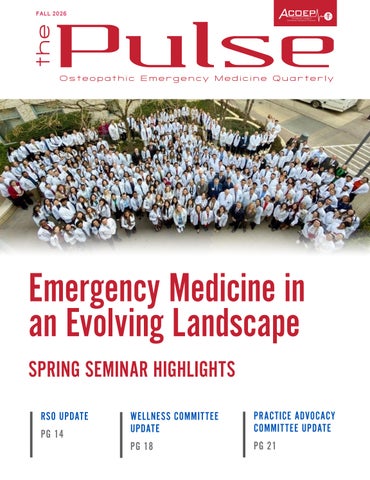
Emergency Medicine in an Evolving Landscape SPRING SEMINAR HIGHLIGHTS RSO UPDATE PG 14
WELLNESS COMMITTEE UPDATE
PRACTICE ADVOCACY COMMITTEE UPDATE
PG 18
PG 21
The Pulse VOLUME LVI No. 2 EDITORIAL STAFF Victoria Selley, MS, DO, FACOEP, Editor Regina Hart, DO, Assistant Editor Ariana Cranston, OMS-IV ACOEP-RSO Student Social Chair Amanda Mahan, MA, ACOEP Executive Director Megan Heller, ACOEP Association Manager Claire Krzyzewski, Graphic Designer
The Pulse is a copyrighted bi-annual publication distributed at no cost by ACOEP to its Members, Colleges of Osteopathic Medicine, sponsors, exhibitors, and liaison associations recognized by the national offices of ACOEP. The Pulse and ACOEP accept no responsibility for the statements made by authors, contributors, and/ or advertisers in this publication; nor do they accept responsibility for consequences or response to an advertisement. All articles and artwork remain the property of The Pulse and will not be returned. Display advertisements are accepted by the publication. Please contact ACOEP at info@acoep.org for the specific rates, due dates, and print specifications. Deadlines for article submissions are January 15 for the March issue and June 15 for the August issue. The Editorial Board of The Pulse reserves the right to decline articles or advertisements for any issue. ©ACOEP 2026 – All rights reserved. Articles may not be reproduced without the expressed, written approval of ACOEP and the author. ACOEP is a registered trademark of the American College of Osteopathic Emergency Physicians.
TABLE OF CONTENTS 4
PRESIDENT’S REPORT Benjamin Godfrey, DO, FACOEP-D
6
A MESSAGE FROM THE PRESIDENT-ELECT John Dery, DO FACOEP-Dist, FACEP, FAWM
8
EXECUTIVE DIRECTOR’S DESK Amanda Mahan, MA
10 AOCA / ACOEP REGIONAL ANESTHESIA WORKSHOP 10 FOEM COMPETITIONS OMED 2026 12 2026 ACOEP AT OMED 14 RSO UPDATE WOMEN’S COMMITTEE UPDATE 17 Jacqueline M. Dziedzic, DO, FACEP, FACOEP
18
WELLNESS COMMITTEE UPDATE More Than Surviving the Shift: Reflections on Physician Wellness After 12 Years in Emergency Medicine
20 ACOFP & ACOEP COLLABORATIVE WORKSHOP ACOEP PRACTICE ADVOCACY COMMITTEE UPDATE 21 Jeremy Selley, DO, FACOEP
23 SPRING SEMINAR HIGHLIGHTS SPRING SEMINAR 24 2026 FOEM COMPETITION AWARD WINNERS
FALL 2026 THE PULSE
| 3
PRESIDENT’S REPORT
Benjamin Godfrey, DO, FACOEP-Dist
COURAGE, ADVOCACY, AND THE FUTURE OF EMERGENCY MEDICINE
C
orporate medicine, AI advancements, and APP practice rights expansion. Sometimes, I feel like Dorothy in The Wizard of Oz, chanting “Lions and tigers and bears, oh my.” With all the things going on in our practice world, it can be tempting to let it overwhelm you. The frustration grows as things creep into and supplant what we once held as our own, what made us special.
and endanger physician jobs in the modern insurance run CMG model of healthcare, makes one wonder, “Why the hell am I even here?” What each of these problems need to rectify them, and most of the difficulties we face in our daily lives, is Courage… and advocacy! At Spring Seminar, Dr. Anthony Cirillo, President of ACEP, talked briefly about advocacy and how important it is. I agree with his assessment. Advocacy is a life skill that each of us uses daily that can be developed and refined to become more effective in our personal and professional lives. Do you see something in your department that’s a sore spot or inefficiency and propose a solution? Do have a sick child or intubated patient and the family wants to do something Dr. Benjamin Godfrey joined fellow osteopathic physicians at DO Day on Capitol Hill in March 2026, that isn’t in the representing ACOEP and advocating for the osteopathic profession. patient’s best interests, and you must step When we see shenanigans like of Nurse Practitioners and some in to represent the patient? Do you we witnessed in Eugene, Oregon Physician Associate groups which, have an issue with your significant earlier this year and are seeing in my opinion, threaten patient care other that needs to be addressed
4 | THE PULSE FALL 2026
again in West Virginia, where hospital administrators are firing long-standing EM groups in favor of the large CMGs, it’s disheartening. With AI models and programs becoming increasingly sophisticated, and patients trusting their “Dr. Google” query more than the board-certified physician standing in front of them with decades of education, experience and expertise, it can be infuriating. The continuous practice creep
and adjust your relationship for your happiness? All these things are advocacy… and we can do better. I am pleased to announce that ACOEP and ACEP are partnering together to create an online seminar series to help members learn more about advocacy, conflict resolution, negotiation and how to apply it in our personal and professional lives and even politics (hospital, local, State or national). It is an uncomfortable truth that you have to fight for what you want and what you think is right. You may not have to fight the battle every day, but you need to be able to fight when the time comes, and ACOEP is gearing up to help you get more tools in your toolbox or sharpen the tools you already have! Historically, ACOEP has tried to be apolitical. We don’t have our own PAC or professional advocacy arm, like the AOA, AAEM or ACEP. Instead, as an organization, we focused on developing our membership and doing excellent CME. I would submit that we’ve buried our heads in the sand for too long. We need to pull our heads out of the sand, gain some situational
awareness and be prepared to fight. Though ACOEP as an organization isn’t in a position to develop our own professional advocacy resources at the moment, we can become more aware of the landscape around us. ACOEP is partnering with other organizations, adding our voice to current discussions of policy and standards, for the benefit of all our members and the House of Medicine as a whole. I have three examples to cite, from the just the last few months. First, is the advocacy seminar series previously mentioned. Second, the AllEmergency Medicine Work Group (with representatives from ACEP, ACOEP, AAEM, SAEM, EMRA, CORD, ABEM, AOBEM and others) has finalized their recommendations for the use and incorporation of AI as a clinical tool in the practice of emergency medicine, setting guidelines and limits on it’s use and scope, so that it remains a tool and not a replacement of members of the healthcare team. These guidelines and principles will be published in the coming weeks, and advocacy will be needed to advance their incorporation
at the local, state, and national levels. Third, ACOEP will be participating in creating new guidelines for diagnosis and management of Traumatic Brain Injury. The expert panel, with members from across the house of medicine, will be meeting in October. Our own Dr. Jennifer Axelband, who is fellowship trained in neuro critical care, will be a key member on that panel, and help develop the new practice guidelines for the future. I invite all of you to participate in the advocacy development series when it rolls out in the coming months. Use these tools to make your life, your work and culture of emergency medicine better, stronger and more prepared for the future. If you have desires to get more involved, consider serving on one of ACOEPs committees, run to be on the Board of Directors, get involved with AOAs OPAC, ACEP or AAEM… just get involved! We can’t afford to let others do the lifting anymore. –•– Benjamin Godfrey, DO, FACOEP-D President, ACOEP
FALL 2026 THE PULSE
| 5
THE ON-DECK CIRCLE
By John Dery, DO, FACOEP-Dist, FACEP, FAWM President-Elect
WHERE ARE YOU GOING, EMERGENCY MEDICINE?
I
t’s a fair question, and right now most of us are not the ones answering it. An AI program reads our EKGs and writes our notes. Corporate staffing models set the ratios and decide what a Physician’s judgement is worth on a spreadsheet with consistent diminished reimbursement. The workforce numbers that promised us leverage three years ago have quietly turned against us. Sit back and wait for all this to settle and we’ll inherit a speciality designed by people who’ve never run a code at 0300 on a shift with a skeleton crew. That’s the part nobody wants to say from the podium; so I’ll say it here. Look at what just happened in Oregon. A major health system moved to end a 35-year relationship with a local, physicianowned emergency group and hand three emergency departments to an out-of-state staffing company through a shell entity built for the occasion. The medical staff voted no confidence. The governor asked for a pause. A federal judge said in open court that there was ample evidence the arrangement violated the state’s corporate-practice-ofmedicine law and that witnesses for the company were being dishonest under oath. Only then did the system reverse course. That’s not negotiation. That’s what it takes to claw back ground we should never have had to defend. This isn’t isolated. In Virginia this spring, a six-hospital system is replacing one of the few remaining independent emergency groups in a state with a national corporate 6 | THE PULSE SUMMER 2024
employer, citing a $80 million funding hit and “operational infrastructure” that a local group supposedly cannot provide. The states and the healthcare systems change; the playbook doesn’t. A long-standing physician group gets labeled “too small” to survive, a corporate staff in entity moves in, and the doctors who built that department’s reputation discover their complement was never really theirs to keep. Here’s the takeaway message I want every ACOEP member to sit with: These deals are sold as inevitable and the natural response to reimbursement cuts and H.R.1; they are not inevitable. They are choices and they consistently move control over clinical decisions away from the people licensed to make them. When reimbursement drops, financial pressures can shift decision-making away from frontline physicians and toward operational priorities. Our answer has to be to make physician governance a real voice in hiring, scheduling, and determining the standard of care worth defending in statehouses and at the bargaining table. I’ll be plain about the line I am walking. Many of our members (myself included) work inside these large groups and do excellent, principled medicine there every shift. This isn’t an indictment of the physicians. It’s an argument about who holds the controls - and a refusal to pretend the structure is neutral when it isn’t. There’s a quieter version of the same fight, and it’s at the bedside. Over the last year, the push for
independent nurse practitioner practice has stopped being a primary-care debate and walked into the Emergency Department. Roughly thirty (30) states now grant nurse practitioners full practice authority - five states just joined in 2025. Meaning no physician oversight, no collaboration agreement, the right to evaluate, diagnose, and prescribe alone. Several of those states lump physicians and non-physicians together under a single flattened word: “provider.” That word is doing enormous damage, and we let it. Let me be blunt about why this matters in our specialty specifically. An Emergency Medicine trained physician completes roughly ten to fourteen thousand hours of supervised clinical training across residency. A nurse practitioner enters practice on a fraction of that. This gap is not arrogance and it is not turf. It is the difference between the clinician who recognizes the atypical MI, the early necrotizing infection, the subtle aortic dissection on the patient who “looks fine”, and the one who doesn’t yet have the pattern recognition library to know what they are missing. The undifferentiated patient walking through our doors is the single hardest problem in medicine, and it is precisely the patient this movement assumes can be managed without a physician. Then there’s the title. In September, a federal court upheld California’s law barring nonphysicians from calling themselves “doctor” in clinical settings after an
AMA survey found that thirty-nine percent of patients already believe a doctorally prepared nurse is a physician, Read that number again. Four in ten patients don’t know who is treating them. When a DNP introduces themselves as “Doctor” in an emergency department, that isn’t an academic courtesy - it’s a patient who may consent to care under a misunderstanding about who holds the training to manage it. Words like “provider” and “doctor” are being stretched until the stops meaning anything, and a term that
the physician-led team, defending the patients’ right to know who is standing at the foot of the bed - is not optional. It is the job. What I’m sure of is this: the Osteopathic approach is worth more in this environment, not less. When medicine gets automated and sliced into fifteen-minute transactions, the physician who actually treats the whole patient becomes the rare thing. Our training isn’t a heritage piece to defend at the annual meeting. It is leverage - and I’ve lost patience
stop waiting and start placing the members where the decisions happen. The CORE pathway, the fellowship and leadership tracks, the advocacy work - those aren’t separate line items competing for space in this newsletter. They’re one strategy: keep this membership at the front of the specialty instead of mopping up behind it. A caution, because conviction without honesty is just noise. None of this holds if we keep losing the people who do the work. Burnout and moral injury aren’t Wellness-
stops meaning anything stops protecting everyone. I’ll say what the polite version of this conversation won’t. I am not against nurse practitioners, they are skilled colleagues and the ED does not run without them. I am against a model that erases the distinction between a residency-trained boardcertified physician and everyone else, then sells that erasure to legislators as “access.” Access alone should not be confused with access to the highest standard of emergency care. ACOEP’s voice in these statehouses - defending the word “physician”, defending
with how often we are asked to justify what makes us different instead of selling it. So here is a position that will not be unanimous. We are too passive about claiming new ground. Telehealth governance. AI validation. Rural and critical-access coverage. The administrative offices where these contracts actually get signed. None of it is anyone’s birthright; it’s an open field. Our people are qualified to walk in and take it. Too often we don’t take that jump because we are waiting for an invitation that isn’t coming. ACOEP’s job is to
Committee Business to handle after a real strategy talk - they ARE the strategy. A college that cannot protect its members’ autonomy and their sanity has nothing left worth planning. Measure us by whether our physicians are still standing and still leading when the dust clears. Not by any slide in a strategic deck. I have no interest in nostalgia. I care about the next fifty years, and the specialty that is moving into these spaces whether we’re ready or not. We will be ready. We will be in the room. And we will be unmistakably osteopathic when we arrive. –•– FALL 2026 THE PULSE
| 7
EXECUTIVE DIRECTOR’S DESK
BUILDING A STRONGER ACOEP, TOGETHER
A
s emergency medicine continues to evolve beyond the traditional walls of the emergency department, ACOEP is evolving alongside it. This issue’s theme, “Beyond the ED: Emergency Medicine in Evolving Spaces,” reflects what many of our members experience every day. Osteopathic Emergency physicians are leading in community hospitals, rural medicine, telehealth, administration, education, wellness, EMS, observation medicine, and countless other settings that extend the reach and impact of our specialty. And the practice of Emergency Medicine continues to evolve. The future of the specialty is broader than ever, and ACOEP is committed to ensuring that osteopathic emergency physicians have a professional home wherever their careers take them. That spirit of growth and adaptation was on full display at our recent Spring Seminar, where more than 500 attendees came together in Orlando, FL for education, networking, leadership development, and collaboration. The incredible engagement from members, residents, students, faculty, and partners reinforced something we’ve known for a long time: our community remains one of ACOEP’s greatest strengths. As we look ahead, our focus turns toward OMED 2026 in Las Vegas, where ACOEP will continue expanding its educational footprint and national presence. Our integration into OMED represents more than a venue change—it reflects a broader strategy of
leveraging partnerships to increase value, broaden reach, and position osteopathic emergency medicine on larger stages while ensuring responsible stewardship of association resources. We’re partnering with other specialties like Anesthesia with the “AOCA / ACOEP Regional Anesthesia Workshop” and are planning a collaboration with ACOFP on an OMT Bootcamp course in addition to our own workshops, FOEM research competitions, a networking event at TopGolf and full weekend of emergency medicine CME sessions. While our educational programs and events remain highly visible, much of the most important work happening at ACOEP has occurred behind the scenes. Over the past year, leadership, volunteers, and staff have focused on strengthening the infrastructure of the College. Committee structures and expectations are being clarified. Governance policies and bylaws are being modernized. Operational processes are becoming more consistent and streamlined. These efforts may not be glamorous, but they are critical. Strong organizations don’t happen by accident—they are built intentionally so that volunteer leaders can spend less time navigating processes and more time advancing the profession. That foundation positions us for several important initiatives already underway. One of our highest priorities is strengthening the membership pipeline from medical student to resident to attending physician. We are expanding outreach to
Amanda Mahan, MA Executive Director
osteopathic emergency medicine residency programs, increasing engagement opportunities for trainees and early-career physicians, and creating pathways that keep future leaders connected to ACOEP throughout their professional journey. Supporting the next generation is not simply a programmatic objective—it is essential to our long-term success. We are also investing in the future of osteopathic emergency medicine education and scholarship. Whether through conferences, digital learning opportunities, or research initiatives, ACOEP remains committed to delivering practical, relevant education while encouraging the growth of osteopathic emergency medicine research and academic contributions. As emergency medicine practice models continue to evolve, we are likewise exploring new ways to support physicians working in community, rural, nontraditional, and emerging practice settings. Our goal is simple: ensure that ACOEP remains relevant and valuable throughout the many career paths available to today’s
continued on page 11 8 | THE PULSE FALL 2026
May 2-6, 2027 | Myrtle Beach, SC Hilton Myrtle Beach Resort Additional event information, dates, speakers, and registration details will be provided as they become available.
SAVE THE DATE
Join ACOEP in Myrtle Beach for Spring Seminar 2027. Connect with colleagues, earn CME, participate in handson workshops, and enjoy a premier beachfront destination while advancing your emergency medicine education. For updates and future registration information, visit ACOEP Education & Events
HOTEL WEBSITE FALL 2026 THE PULSE
| 9
10 | THE PULSE FALL 2026
continued from page 8 emergency physicians. Operationally, members can expect additional modernization efforts ahead, including a transition to a calendar-year dues cycle and corresponding fiscal year alignment. While these changes require thoughtful planning and execution, they are part of a larger effort to simplify the member experience, improve consistency, and better position ACOEP for sustainable growth. Perhaps the clearest indication of ACOEP’s momentum is the strength of our membership growth. When I joined the College in January 2025, active membership stood at 1,475. Today, that number has grown to surpass 2,333 members—an increase of 850+ members, representing more than 58% growth in just eighteen months. While we are proud of
that progress, the number itself is only part of the story. It represents hundreds of students, residents, fellows, attendings, and leaders who have chosen to invest in the future of osteopathic emergency medicine through ACOEP. We should take pride in that progress. Thank you for your investment in the College, and for your honest feedback on what you need and where our focus needs to shift. But we recognize that we are nowhere near where we want or need to be to meet the moment. The work we are doing today—strengthening governance, enhancing member value, modernizing operations, supporting innovative practice models, investing in education, expanding our residency outreach, and encouraging osteopathic emergency medicine research—
is creating the foundation for ACOEP’s next chapter. At the same time, staff and leadership are working together on a new strategic plan that will help guide the College through its next phase of growth, ensuring that our priorities, resources, and volunteer efforts remain aligned with the needs of our members and the future of the specialty. A tremendous amount has been accomplished since our 50th anniversary. The foundation is stronger. The vision is clearer. The future is brighter. And we’re just getting started. –•– Warmly, Amanda Mahan Executive Director, ACOEP Amandam@affinity-strategies.com
Season 11 of EM Over Easy is here!
With new hosts joining the team there’s never been a better time to listen to EM Over Easy, the official podcast of ACOEP.
Listen Now! FALL 2026 THE PULSE
| 11
Join ACOEP in Las Vegas for five days of emergency medicine education, hands-on workshops, networking opportunities, competitions, and CME. Emergency medicine physicians can earn up to 17 hours of emergency medicine CME through ACOEP’s dedicated educational track, with additional CME available throughout the full OMED26 program.
Hands-On Workshops
OMED26 attendees may earn up to 60 total CME credits, including: • 40 AOA Category 1-A Credits • 20 AOA Category 1-B Credits • 60 AMA PRA Category 1 Credits™ All in-person registrants receive on-demand access to recorded sessions following the conference, allowing attendees to revisit content or watch sessions they were unable to attend live.
Thursday, October 22 | 8:00–11:00 AM
Featured Events FOEM Competitions Wednesday, October 21 | 8:00 AM–3:00 PM. FOEM’s annual emergency medicine competitions bring together students, residents, and physicians for educational challenges focused on clinical decisionmaking, procedural skills, teamwork, and emergency medicine knowledge.
Topgolf Emergency Medicine Networking Event Wednesday, October 21 | 6:00–8:00 PM Registration Fee: $75 Physicians | $50 Residents & Students Join ACOEP and FOEM for an exclusive networking event at Topgolf Las Vegas. Attendees will enjoy: • • • • •
Private Topgolf bays Topgolf gameplay for all skill levels Chef-curated Asian Street Fare buffet Two-hour open bar Networking with emergency medicine colleagues from around the country Advance registration is required.
AOCA/ACOEP Regional Anesthesia Workshop All-In on Regional Anesthesia: A Multispecialty Ultrasound Workshop Registration Fee: $300 Members | $400 Non-Members (AOA) Get hands-on with ultrasound-guided regional anesthesia through six small-group stations covering brachial plexus, rib, hip fracture, extremity, and facial nerve blocks. Designed for emergency medicine, anesthesiology, and multispecialty clinicians seeking immediately applicable skills. Capacity is limited to 60 participants.
ACOEP Airway Lab Thursday, October 22 | 8:00–11:00 AM Registration Fee: $300 Members | $400 Non-Members (AOA) A practical, hands-on emergency medicine workshop focused on essential airway skills and procedures. This interactive lab is designed for emergency physicians seeking focused skill development and real-world application. Advance registration required.
ACOFP & ACOEP Collaborative Workshop OMT Next Level: Systemic Conditions Thursday, October 22 | 8:00–11:00 AM Registration Fee: $300 Members | $400 Non-Members (AOA) This hands-on workshop focuses on applying osteopathic manipulative treatment (OMT) to the diagnosis and management of systemic conditions affecting ENT, pulmonary, gastrointestinal, and genitourinary systems. Participants will review differential diagnoses, identify somatic dysfunction, and practice targeted OMT techniques through guided instruction and case-based learning. Approved by AOBFP to count toward OMT recertification requirements.
Registration & Housing ACOEP members should register through ACOEP’s dedicated registration pathway to ensure proper tracking and access to ACOEP-specific benefits. ACOEP Physician Discount Promo Code: ACOEPCOLO • $200 off physician registration • Available to attending physicians • Cannot be combined with other promotional offers Registration Information • Registration and housing open the week of May 4, 2026 • Maritz is the official registration and housing provider • Caesars Palace Las Vegas is the official conference hotel • ACOEP workshops and activities can be found in the Add-On section of the OMED registration platform
Learn More For registration, housing, workshop updates, speaker announcements, and the latest schedule information, visit the ACOEP OMED26 webpage: https://acoep.org/educationevents/acoep-omed-26/ Schedule and session information are subject to change. Additional educational sessions and event details will be added as they are finalized.
ACOEP Emergency Medicine Track Thursday, October 22, 2026
Friday, October 22, 2026 (continued)
8:00-11:00 AM
Airway Lab
3:00-3:30 PM
Halo Procedures in the ED Part I
8:00-11:00 AM
EM/Anesthesia Regional Block Lab
3:30-4:00 PM
The ED Approach to Chemical Exposures
12:00-12:30 PM
Back Pain in the ED
12:30-1:00 PM
Additional Session Details Coming Soon
4:00-4:30 PM
When to Stop: An Evidence Based Guide to Terminating Resuscitation Efforts
1:00-5:00 PM
ACOFP & ACOEP Collaborative OMT Workshop
4:30-5:00 PM
Halo Procedures in the ED Part II
1:00-1:30 PM
Child Abuse Recognition and Evaluation
1:30-2:00 PM
EMS Update 1
2:00-2:30 PM
Additional Session Details Coming Soon
2:30-3:00 PM
Anxiolysis and Procedural Sedation and Analgesia (PSA) in the Pediatric ER
3:00-3:30 PM
High Stakes Neurology: PracticeChanging Advances Beyond the Guidelines
3:30-4:00 PM
Small Bodies, Big Emergencies
4:00-4:30 PM
Beyond the Clock: Applying the 2026 AHA/ASA Stroke Guidelines in the Emergency Department
4:30-5:00 PM
EMS Update 2
Friday, October 22, 2026 10:00 -10:30 AM
OMT in the ED: Coding and Billing
10:30-11:00 AM
My Military Medicine Career
11:00-11:30 AM
OMT in the ED: Top Complaints to DX and Treat
11:30 AM-12:00 PM
Emergency Medicine and the Media
12:00-12:30 PM
ED Observations: When and Why?
1:30-2:00 PM
You Don't Need to Admit that Chest Pain
2:00-2:30 PM
Fever in the Returning Traveler
2:30-3:00 PM
Tiny Humans, Big Decisions: Antibiotics in Common Pediatric Infections
Saturday, October 23, 2026 9:00-9:30 AM
A Career Pivot: Lessons Learned Moving from Graduate to Undergraduate Medical Education
9:30-10:00 AM
ReThinking GI Bleeds
10:00-10:30 AM
Medical Legal
10:30-11:00 AM
Peptides in Your ED
11:00-11:30 AM
Using AI to Better Understand Clinical Research
11:30 AM-12:00 PM 12:00-12:30 PM
Observation Medicine Beyond Chest Pain: Expanding the Modern Observation Unit Strategies for Improving Clinical Productivity in the ED
1:30-2:00 PM
The Modern Emergency Department Leader
2:00-2:30 PM
Flow State
2:30-3:00 PM
The Blame Game: Fundamental Attribution Error in Emergency Medicine
3:00-3:30 PM
EM Over Easy Live Show
Additional Saturday Events • Residency Fair • Mentor Café • Mock Residency Interview Session
Sunday, October 24, 2026 10:20 AM
Nutrition Panel: Specific Dietary Indications
Resident & Student Opportunities at OMED26 ACOEP-RSO resident and student programming will be integrated throughout OMED 2026, providing opportunities for education, networking, career development, research presentation, and mentorship. Residents and students interested in participating in ACOEP-RSO sessions, activities, and events should plan to register for OMED 2026. Whether you are exploring emergency medicine as a specialty, preparing for residency, presenting scholarly work, or expanding your professional network, OMED offers dedicated programming designed specifically for osteopathic medical students and residents. ACOEP-RSO participation throughout the conference provides opportunities to connect with emergency medicine faculty, peers, residency programs, and ACOEP leadership in a national conference setting.
Residency Fair
Featured Resident & Student Events Wednesday, October 21 • FOEM Clinical Pathological Case (CPC) Competition • FOEM Oral Abstract Competition • Emergency Medicine Topgolf Networking Event (select add-on during OMED registration) Friday, October 23 • Resident Track (10:00 am-12:30 pm) • Resident Track (1:30-4:30 pm) Saturday, October 24 • Residency Fair (8:30 am-12:30 pm) • Student Track (9:00 am-12:30 pm) • Mentor Café (12:30-1:30 pm) • Mock Residency Interviews (2:30-3:45 pm) • Student/Resident/BEL Reception (6:00-7:00 pm) Sunday, October 25 • Student Track (9:00 am-12:00 pm)
Saturday, October 24 | 8:30 am-12:30 pm Meet residency program representatives and explore training opportunities in emergency medicine and other specialties. The Residency Fair provides a unique opportunity to engage directly with programs, ask questions, and make valuable professional connections. ACOEP-RSO is excited to participate and explore additional networking opportunities for emergency medicine students and residents.
FAIR INFO
ACOEP RSO BOARD
Nicole Gentile, DO, PGY2 ACOEP-RSO President
RSO UPDATE
HELLO FROM THE RSO!
T
he Resident Student Organization (RSO) continues to grow with one mission at its core: empowering the next generation of osteopathic emergency physicians through leadership, education, mentorship, advocacy, and meaningful connection. As Emergency Medicine continues to evolve, so too must the opportunities we create for
residents and students to develop not only as exceptional clinicians, but also as future leaders within our specialty. This past spring, we had the pleasure of gathering in Orlando for ACOEP Spring Seminar. Residents and students participated in hands-on procedural workshops, educational sessions, networking events, and opportunities to connect with leaders from across
14 | THE PULSE FALL 2026
osteopathic emergency medicine. Conferences such as Spring Seminar continue to demonstrate that some of the most valuable learning occurs outside the lecture hall - through conversations with mentors, collaboration with peers, and exposure to the incredible diversity of career paths within our specialty. ACOEP remains deeply committed to investing in resident and student programming, creating environments where professional development, mentorship, and lifelong friendships can flourish. One of the highlights of Spring Seminar was another successful Residency Fair. We were thrilled by the outstanding participation from both residency programs and medical students. Bringing together future applicants with programs from across the country allows students to explore the breadth of opportunities within osteopathic Emergency Medicine while giving residency leaders the chance to connect with the next generation of physicians. We look forward to continuing to grow this event and helping students discover programs that align with their goals and values. Beyond our national meetings, the RSO continues to host a monthly mentorship series for medical
students at every stage of training. These virtual sessions cover topics that evolve throughout the journey to Emergency Medicine; from exploring the specialty and building a competitive application to navigating audition rotations, interviewing, developing a rank list, and preparing for intern year. Each session features residents and attending physicians who recently experienced these milestones themselves, providing practical advice and honest insight. Our goal is to continue fostering an accessible, supportive community where students feel comfortable asking questions, building relationships with mentors, and gaining confidence throughout the residency application process. Looking ahead, we are excited for the opportunity to partner with OMED this fall and have big plans for both the Resident and Student learning tracks. From hands-on educational experiences to interactive workshops and plenty of opportunities to connect with colleagues from across the country, we’re looking forward to an unforgettable meeting. We hope to see you in Las Vegas, sharpening your skills, and making memories with the osteopathic Emergency Medicine community! –•– Nicole Gentile, DO, PGY2 ACOEP-RSO President Prisma Health/USC Greenville
RSO AT THE 2026 SPRING SEMINAR
CALL FOR
GUEST EDITORS In collaboration with WestJEM
Help us publish case reports from ACOEP’s annual meetings in WestJEM each year.
16 | THE PULSE FALL 2026
Email us at info@acoep.org
WOMEN’S COMMITTEE UPDATE
ACOEP WOMEN IN EM COMMITTEE
Jacqueline M. Dziedzic, DO, FACEP, FACOEP Chairwoman
YOU DON’T HAVE TO DO IT ALL: DELEGATION, SUPPORT, AND THE FIGHT
“ By leaning on each
Sofia Ferrezza, OMS-II Touro College of Osteopathic Medicine
S
ince the pandemic, conversations among healthcare workers have increasingly centered on burnout; what it is, how to recognize it, and, most importantly, how to prevent it. Within the Women’s Committee, we are especially mindful of the unique stressors women face while navigating careers in medicine. While burnout can affect anyone, many women physicians also shoulder responsibilities outside the workplace, making it even more important to identify practical strategies that promote balance and long-term well-being. Guest speaker Dr. Jamie Hope discussed the importance of delegating responsibilities at home to help balance the demanding lifestyle of emergency medicine physicians. One of her more lighthearted examples involved picking up outside after her dogs. While the task itself is mundane, it represents yet another responsibility that can add unnecessary stress when you are already stretched thin. Her message was a powerful reminder that protecting our energy is not about avoiding hard work, it is about being intentional with where we invest our time and attention. The pressures of being a physician while also serving as a mother, friend, spouse, partner, daughter, caregiver, or any of the many other roles we hold can be overwhelming. Learning to delegate everyday tasks is not simply a good idea; it is essential for thriving. Whether that means assigning
your children the responsibility of cleaning up after the family pets, asking your spouse to plan meals for the week, or even hiring a dog walker a few times each week simply because you want the extra support, these small changes can significantly lighten your mental load. Often, the relief is felt almost immediately. Delegation can also extend beyond the home. At work, asking colleagues for assistance when appropriate, sharing responsibilities within a team, or accepting help from support staff can improve efficiency while reducing unnecessary stress. Medicine has long fostered a culture of self-reliance but recognizing that we do not have to carry every burden alone is a major step toward preventing burnout. Giving ourselves permission to ask for help is not a sign of weakness; it is an investment in our ability to continue providing excellent care to our patients. Beyond individual strategies like delegation, gatherings like this luncheon remind us of the value of having the Women’s Committee as a support network. In a profession that often demands perfectionism, having a space to openly discuss burnout and the realities of worklife integration is invaluable. These candid conversations remind us that we are not alone in our struggles. By leaning on each other, sharing resources, and normalizing the act of asking for help, we build the resilience necessary to sustain long
Join us at our Facebook page ACOEP Committee for Women inEM
other, sharing resources, and normalizing the act of asking for help, we build the resilience necessary to sustain long and fulfilling careers in emergency medicine.
and fulfilling careers in emergency medicine. Just as importantly, these opportunities foster mentorship, encourage meaningful connections, and remind us that taking care of ourselves is essential to taking care of others. Looking ahead, keep an eye out for this year’s nominees for the Willoughby Award. This honor recognizes a female physician who has gone above and beyond in advancing the field of emergency medicine while overcoming the challenges and inequities women continue to face in a historically male-dominated profession. Voting for this prestigious honor will officially open on the ACOEP website this winter. Join us at the 2027 ACOEP Spring Seminar in Myrtle Beach to celebrate this outstanding physician and honor her achievements. –•–
and our new Instagram acoepwomeninem FALL 2026 THE PULSE
| 17
WELLNESS COMMITTEE UPDATE
ACOEP WELLNESS COMMITTEE
By Tiffany Brown, DO
MORE THAN SURVIVING THE SHIFT: REFLECTIONS ON PHYSICIAN WELLNESS AFTER 12 YEARS IN EMERGENCY MEDICINE
T
welve years ago, I completed my Emergency Medicine residency eager to begin a career dedicated to helping patients during some of the most vulnerable moments of their lives. I knew Emergency Medicine would be challenging. I expected long shifts, difficult diagnoses, critically ill patients, and occasional emotional exhaustion. What I did not fully appreciate was how much the practice of Emergency Medicine itself would evolve—and how physician wellness would need to evolve alongside it. Like many emergency physicians, I entered the profession with a strong work ethic and a belief that resilience was
simply part of the job. We were trained to perform under pressure, make rapid decisions, and push through fatigue. We learned to compartmentalize difficult cases and move quickly to the next patient because that is often what the environment demanded.
18 | THE PULSE FALL 2026
For years, physician wellness was discussed primarily in terms of individual responsibility. We were encouraged to exercise, practice mindfulness, improve sleep habits, and maintain worklife balance. These strategies remain important, but over time it became clear that wellness is far more complex than simply learning how to manage stress. The reality is that many of the challenges affecting physician well-being originate not within physicians themselves, but within the systems in which they practice. The Emergency Department Has Changed Emergency departments have become the healthcare safety net for nearly every unmet need in our communities. On any given shift, we care not only for heart attacks, strokes, trauma patients, and respiratory emergencies, but also for individuals experiencing psychiatric crises, substance use disorders, homelessness, food insecurity, and barriers to accessing primary care. The complexity of our patients continues to increase. Many arrive with multiple chronic conditions, extensive medication lists, and significant social challenges that influence their care. The cognitive demands placed upon emergency physicians have never been greater. At the same time, operational challenges continue to grow. Hospital overcrowding, prolonged boarding of admitted patients, staffing shortages, and limited resources have become routine realities rather than occasional obstacles.
As physicians, we often find ourselves navigating circumstances that prevent us from delivering care in the way we believe our patients deserve. This experience has led many healthcare professionals to embrace the concept of moral injury—a term that resonates deeply with many physicians. Understanding Moral Injury Burnout is often described as emotional exhaustion, depersonalization, and a reduced sense of accomplishment. While burnout remains an important concern, many physicians feel that moral injury more accurately captures what they experience. Moral injury occurs when external constraints prevent clinicians from providing the level of care they know their patients need. It is the critically ill patient waiting for an intensive care bed that is unavailable. It is the psychiatric patient remaining in the emergency department for days because no inpatient placement exists. It is the frustration of watching healthcare systems struggle under increasing demands while physicians continue doing everything possible to meet patient needs. The emotional burden of these experiences can be profound. A Shift in How We Think About Wellness One of the most encouraging developments in recent years is the recognition that physician wellness is not solely an individual responsibility. Healthcare organizations, professional
societies, and physician leaders increasingly acknowledge that system-level solutions are necessary. Today, conversations about wellness include: • Reducing administrative burden • Improving scheduling practices • Addressing staffing shortages • Enhancing workplace safety • Promoting psychological safety • Supporting career flexibility • Strengthening physician leadership involvement This shift represents meaningful progress because it recognizes that resilient physicians still require supportive environments. Redefining Career Sustainability Perhaps the most significant lesson I have learned over the past twelve years is that wellness is closely tied to sustainability.
Many emergency physicians are reimagining what a successful career looks like. Some pursue leadership roles, teaching opportunities, public health initiatives, entrepreneurship, real estate investing, consulting, or other professional interests outside of clinical medicine. This diversification is not necessarily a sign of dissatisfaction with Emergency Medicine. Rather, it reflects a desire to build careers that remain fulfilling over decades rather than years. For many physicians, creating multiple avenues for professional growth provides renewed purpose, financial flexibility, and protection against burnout. The Importance of Community Medicine has traditionally celebrated independence and self-reliance. Yet one of the most powerful contributors to wellness is connection. Peer support programs,
mentorship relationships, professional organizations, and trusted colleagues provide spaces where physicians can discuss challenges openly and honestly. The reality is that no physician should feel compelled to navigate difficult cases, adverse outcomes, or personal struggles alone. Creating cultures where vulnerability is accepted and support is readily available may be one of the most important investments healthcare organizations can make. Looking Toward the Future I remain optimistic about the future of physician wellness. The conversation has matured significantly. We are moving beyond simplistic messages about resilience and recognizing the complexity of physician well-being. We are beginning to address the organizational and systemic factors that contribute to distress while still encouraging healthy personal habits and self-care. Emerging technologies may eventually reduce administrative burdens. Healthcare leaders are increasingly prioritizing workforce well-being. Younger generations of physicians are entering the profession with a greater willingness to advocate for balance, flexibility, and sustainability. These developments offer hope. More Than Surviving For much of my career, wellness was often framed as avoiding burnout. Today, I believe the goal should be much larger. Physician wellness is not merely the absence of burnout. It is the presence of purpose, fulfillment, connection, and professional sustainability. Emergency Medicine remains one of the most rewarding specialties in healthcare. We have the privilege of caring for patients
continued on page 20
FALL 2026 THE PULSE
| 19
continued from page 20 during critical moments, providing comfort during uncertainty, and making meaningful differences in countless lives. As the demands of Emergency Medicine continue to evolve, our approach to physician wellness must evolve as well. The future of our specialty depends not only on our ability to care for patients, but also on our commitment to caring for the physicians who serve them. After twelve years in Emergency Medicine, I have come to believe
that wellness is not about surviving the shift. It is about building a
career—and a life—that can thrive long after the shift ends. –•–
REFERENCES 1. American College of Emergency Physicians – Wellness and Resilience Resources 2. American Medical Association – Joy in Medicine Program 3. National Academy of Medicine – Action Collaborative on Clinician Well-Being and Resilience 4. National Academy of Medicine Clinician Well-Being Resources 5. Shanafelt TD, Noseworthy JH. Executive Leadership and Physician Well-Being. 6. West CP, Dyrbye LN, Shanafelt TD. Physician Burnout: Contributors, Consequences, and Solutions. 7. Agency for Healthcare Research and Quality resources on healthcare workforce resilience and patient safety.
20 | THE PULSE FALL 2026
ACOEP PRACTICE ADVOCACY COMMITTEE
PRACTICE ADVOCACY COMMITTEE UPDATE
By Jeremy Selley, DO, FACOEP, FACEP Chair, ACOEP Practice Advocacy Committee
PRESERVING ACCESS TO EMERGENCY CARE REQUIRES MORE THAN REGULATIONS
R
ecent developments involving the No Surprises Act (NSA) and physician workforce policy highlight a common challenge facing healthcare today: preserving patient access to emergency physicians when they need care most. When Congress passed the No Surprises Act, emergency physicians strongly supported its goal of protecting patients from unexpected medical bills. In that respect, the law has been successful. Patients are now shielded from surprise billing disputes that occur between physicians and insurers.
Unfortunately, protecting patients was only part of the equation. Behind the scenes, emergency physicians continue to face chronic insurer underpayment, growing administrative burdens, and a lack of accountability when insurers fail to follow the law. Congress created the Independent Dispute Resolution (IDR) process as a fair mechanism to resolve payment disputes. Yet insurers frequently force claims into arbitration by offering reimbursement amounts that bear little resemblance to the value of the care provided. The results speak for themselves. Independent arbiters rule in favor of physicians in more than 85 percent of disputed cases, demonstrating that many insurer payment offers are simply not reasonable. Even after losing arbitration, insurers often fail to pay within the timelines required by law, creating unnecessary administrative work and financial strain for physician practices. Compounding the problem is the Qualifying Payment Amount (QPA), a benchmark used throughout the IDR process. Because insurers largely control its calculation and little transparency exists regarding its accuracy, the QPA has become a source
of ongoing concern. Federal audits intended to verify these calculations have largely failed to materialize, leaving physicians and policymakers with limited insight into whether the system is functioning as Congress intended. Recognizing many of these shortcomings, the administration recently finalized reforms aimed at improving the IDR process. These changes are a welcome step forward and should help reduce some of the unnecessary burdens that have accumulated since implementation of the law. At the same time, a federal court recently struck down a proposed $100,000 visa fee that would have created a significant barrier for many international physicians seeking to practice in the United States. International medical graduates play a vital role in staffing hospitals and emergency departments, particularly in rural and underserved communities where physician shortages remain severe. Preserving these workforce pathways is critical to maintaining access to care. While both developments are encouraging, neither fully addresses the broader challenges facing emergency medicine. Fair continued on page 22
FALL 2026 THE PULSE
| 21
continued from page 21
reimbursement and physician workforce stability are not competing priorities; both are essential to ensuring patients have access to timely, high-quality emergency care. That is why Congress must continue its work. Passage of the No Surprises Act Enforcement Act would represent an important next step. Strengthening enforcement mechanisms and holding insurers accountable for statutory violations would help ensure the law operates as intended. Likewise, policymakers must continue supporting physician recruitment and retention efforts to address workforce shortages that threaten access to care in communities across the country. However, meaningful legislative change does not happen on its own. Physicians must remain engaged in the advocacy process. Whether through legislative advocacy days, meetings with elected officials, responses to action alerts, or sharing firsthand experiences from the emergency department, physicians bring a
22 | THE PULSE FALL 2026
perspective that policymakers cannot obtain anywhere else. Building relationships with state and federal lawmakers remains one of the most effective ways to influence healthcare policy. Personal stories from practicing physicians often carry far greater impact than statistics alone. Political action committees (PACs) also play an important role in ensuring emergency medicine has a voice in policy discussions. Supporting advocacy organizations and physician-led PACs helps amplify the interests of patients and physicians alike and ensures emergency medicine remains represented when critical healthcare decisions are made. The message for emergency physicians is clear: regulatory improvements are welcome, workforce protections are necessary, but lasting progress will require meaningful enforcement and continued physician engagement. By combining thoughtful policy reforms, workforce stability, and sustained advocacy, we can help preserve access to high-quality emergency care for the patients and communities who depend on it. –•–
ADVOCACY & INVOLVEMENT LINKS ACOEP ADVOCACY UPDATES acoep.org/advocacy-update
JOIN THE PRACTICE ADVOCACY COMMITTEE acoep.org/about-acoep/committees
DONATE TO A PAC NEMPAC (ACEP) | OPAC (AOA)
KNOW YOUR LEGISLATORS Find Your Rep/Senator
ATTEND NATIONAL ADVOCACY EVENTS D.O. Day on the Hill (AOA) ACEP Leadership & Advocacy Conference
TAKE ACTION NOW ACEP 911 Grassroots Network Osteopathic Advocacy Network
SPRING SEMINAR PHOTO FLASHBACK! Thank You for an Unforgettable 2026 Spring Seminar! A huge thank you to our attendees, speakers, and presenters for making this year’s Spring Seminar one to remember – this event was packed with learning, connection, and innovation. We saw hands-on workshops, two full days of Resident Student Organization (RSO) programming, and a residency fair that welcomed over 30 programs. The excitement continued with our FOEM competitions, showcasing the next generation of emergency medicine leaders, and we capped it all off with an inspiring awards and fellowship ceremony. We’re already looking ahead to Spring Seminar 2027 in Myrtle Beach, South Carolina, from May 2-6, 2027 — don’t miss out! Get updates here
FALL 2026 THE PULSE
| 23
Thank you again for your participation!
FOEM Spring Competition
Award Winners Spring Seminar
Best wishes in your future research endeavors.
Case Study Poster Competition 1ST PLACE (TIE)
Vincent Abiona “Pseudohypoglycemia in Septic Shock”
2ND PLACE
Madison Gackle “Oil of Wintergreen Toxicity”
3RD PLACE
Jacqueline M. Dziedzic “Creutzfeldt-Jakob Disease”
Katarina Werst “Trauma-Induced Angioedema” The Board of Trustees of the Foundation for Osteopathic Emergency Medicine thanks you for participating in the competition and hope that you will participate in future events like this as a Resident or apply for research grants as a physician. The Foundation is here to help serve the research needs of the specialty of emergency medicine and hopes that you have found the creation of a research paper a worthwhile experience worthy of repeating in the future.
New Innovations in Emergency Medicine Competition 1ST PLACE
Thomas Creech, Huda Faiz, Ciera Causey “A Novel High-Fidelity Surgical Airway Trainer Using 3D-Printed Tracheas with Biologic Tissue Overlays”
2ND PLACE
Liesl Prather “Improving Procedural Education using a Multifaceted Procedural Manual”
3RD PLACE
Kayla Jackson “Strengthening SANE Workforce Capacity: Training Adequacy, Emotional Burden, and the Impact of SimulationBased Education”
FOEM PRESIDENT’S DESK
HONORING OUR FOUNDATION, EMBRACING THE FUTURE
A
s we begin this new chapter of the Foundation of Osteopathic Emergency Medicine, our mission and dedication to academic and professional development remains stronger than ever. Research built upon connecting our Medical students, Interns/ Residents and Physicians in practice to competition and publication opportunities remains the core of the FOEM as we foster growth in the arena of Emergency Medicine. Through generous funding and collaborations with the American College of Osteopathic Emergency Physicians, FOEM continues to advance and celebrate the achievements of our medical scholars.
FOEM change of leadership, Spring 2026 Jasper Yung, DO, President John Ashurst, DO, MSc, Immediate Past President
At our last ACOEP Spring Seminar meeting, we welcomed the most submissions we have had since pre-COVID times. We also completed the selection process for this year’s Summer Research Internship project funded with grants and support on behalf of our members of ACOEP and FOEM. As we look forward to our Fall Scientific Assembly meeting, many research opportunities remain available in the form of our Oral Abstract, Clinical Pathological Case Competitions and collaborative publication tracks. Each year, FOEM provides dedicated
grant opportunities for students, interns and residents to further their educational and research endeavors. As we celebrate these achievements, it is equally important to consider the evolving innovations that will shape the future of emergency medicine and medical research. As the Foundation of Osteopathic Emergency Medicine enters its 28th year, we stand at the forefront of a new era of innovation, technology and discovery that will influence the next generation of osteopathic medicine. We stand on the precipice of a paradigm shift driven by a new form of technology to incorporate into our daily practices, Artificial Intelligence. While concerns surrounding the growing role of artificial intelligence in healthcare are understandable, innovation has always been a driving force behind improvements in patient care, education and research. Medicine has been built upon science, technology and innovations that aid us in delivering evidencebased medicine, best practices and high-quality patient care. Artificial intelligence does not replace the foundation of osteopathic education and clinical reasoning. AI complements the quality of our care and helps maintain integrity in the care process. Artificial intelligence provides a new platform for enhancing efficiency, insight and accountability as it is already implemented in multiple areas of our daily interactions with technology. Machine learning, large-scale data processing and image pattern recognition are now embedded in the tools we use daily to teach, learn and innovate the landscape of medicine and research. Applications are evolving rapidly from operational improvements in workflow management and resource allocation to direct clinical support. We see this in Radiology and Dermatology image analysis,
Jasper Yung, DO FACOEP – FOEM President
FOEM Fall Research Competitions in Las Vegas Wednesday, October 21
J
oin the Foundation for Osteopathic Emergency Medicine (FOEM) the day before OMED begins for two of their annual research competitions:
• Clinical Pathological Case (CPC) Competition • Oral Abstract Competition To learn more about eligibility, submission requirements, and how to apply, visit the FOEM Research page:
Explore FOEM Research Competitions Application deadline: August 15
pathological pattern recognition, augmented reality overlays for surgical and oncological procedures, and AI-enhanced documentation and clinical workflow tools. In cardiology, rhythm and sound analysis demonstrates how AI can extend clinical expertise without replacing it. Our Osteopathic philosophy remains central as we navigate this new landscape of medicine and research. To support responsible adoption, FOEM has partnered with the American Osteopathic Information Association to promote the Emerging DO Platform. This resource connects our members to DORA, an AI-powered assistant for trusted osteopathic information, along with mentorship opportunities, residency insights and career coaching that strengthen professional development and peer collaboration. I am confident in our medical students, interns, residents and practicing physicians as they thoughtfully integrate these emerging technologies into education, research and patient care. By holding fast to our principles while embracing new tools, we will open the next chapter of osteopathic emergency medicine together. FOEM will continue to fund, mentor and spotlight your work every step of the way. –•– FALL 2026 THE PULSE
| 25
CHECK OUT ACOEP’S DIGITAL CLASSROOM WHEN YOU NEED ON-DEMAND CME CREDITS
Digital Classroom Link
Join Our ACOEP Network! Stay connected with the ACOEP family and enhance your networking opportunities by following us on social media! Whether you’re seeking to foster professional relationships, explore exciting events like our Scientific Assembly and Spring Seminar, or connect with fellow emergency medicine professionals, our social media channels offer a vibrant community and valuable updates. Join us as we build a supportive network that celebrates growth and collaboration in emergency medicine. Follow us today and be part of our journey toward collective success!
@theacoep
@acoep
ACOEP Official
American College of Osteopathic Emergency Physicians
info@acoep.org